
Traffic Engineering Queue Optimization Models with Guaranteed Quality of Service Support

 ,
,  ,
,  ,
,  and
and 
Abstract
1. Introduction
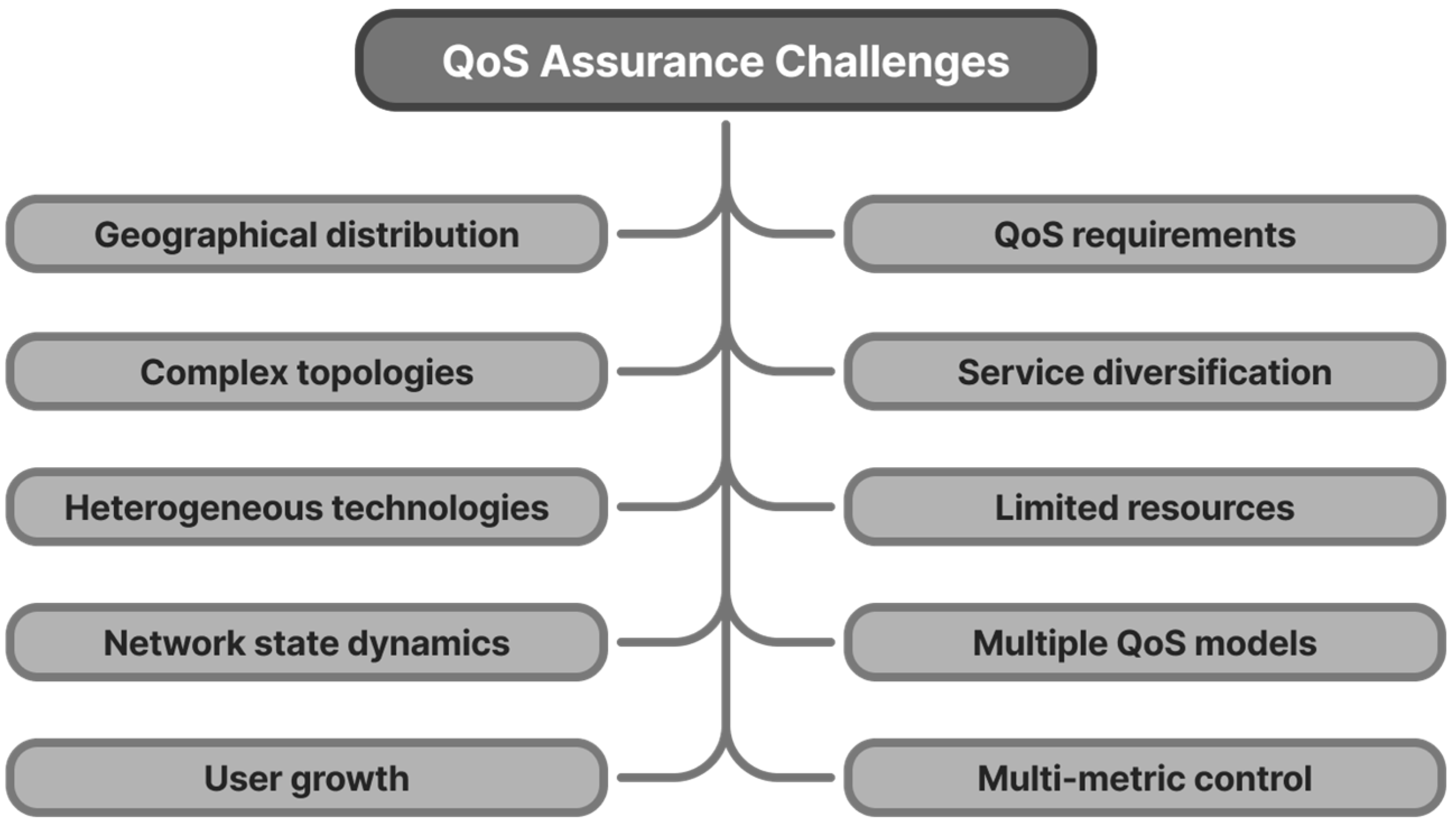
- wide geographical distribution of network elements;
- complex topologies;
- heterogeneity of technologies and protocols;
- highly dynamic network states due to variations in topology, load, and traffic characteristics;
- continuous growth in user number and QoS requirements;
- expansion and diversification of offered services;
- limited resources, including bandwidth, buffer capacity, and computational power of network and server equipment;
- coexistence of multiple QoS models (guaranteed, differentiated, best-effort);
- need for simultaneous control of multiple QoS metrics (bandwidth, delay, jitter, packet loss).
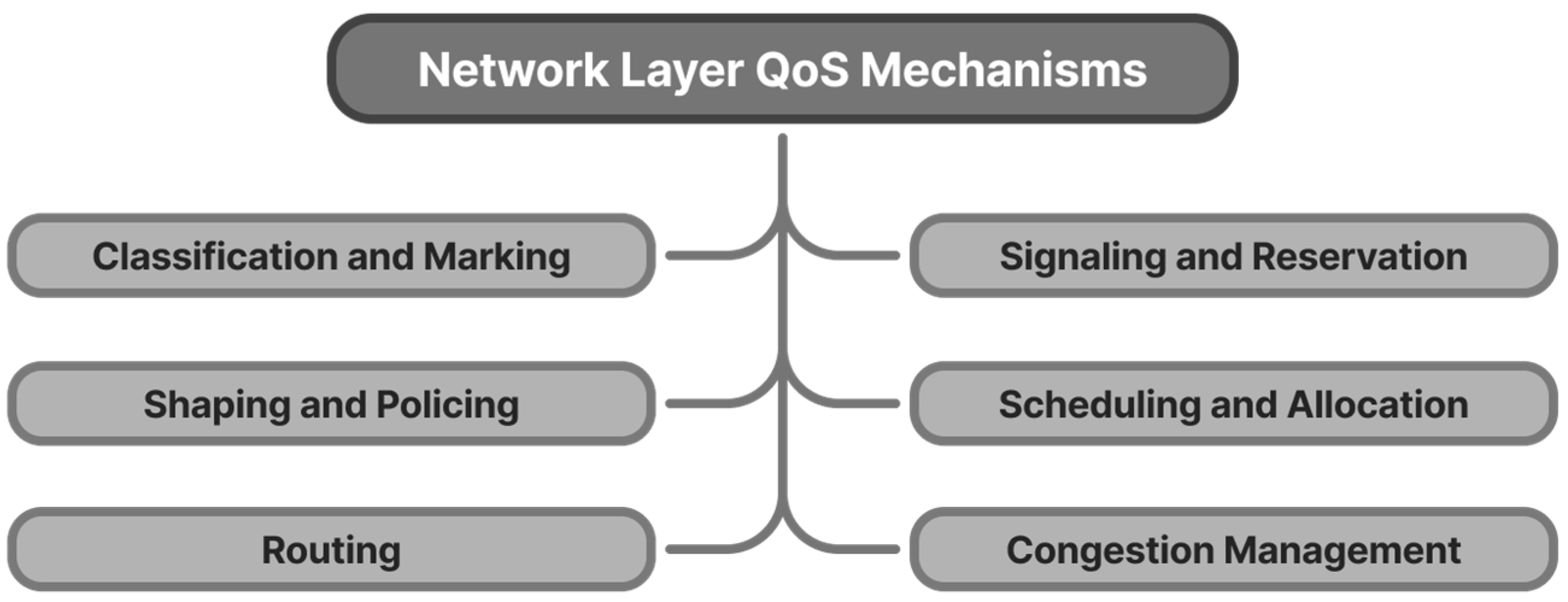
- packet classification and marking (prioritization);
- traffic shaping and policing;
- routing protocols;
- signaling and reservation protocols for network resources;
- scheduling, resource allocation, and congestion management.
- support for multiple queues to enable service differentiation;
- provision of service guarantees through the reservation of link and buffer resources for specific traffic types;
- uniform processing of packets with identical characteristics (e.g., length, priority, class);
- high flexibility and a significant degree of automation in configuration;
- simplicity of algorithmic design and feasibility of software and hardware implementation in practice.
- conducting a comparative analysis of existing technological and theoretical solutions for queue management on router interfaces;
- improving and investigating optimization models of queue management to verify the adequacy and effectiveness of the proposed solutions;
- developing recommendations for practical implementation.
2. Overview of Queue Scheduling Mechanisms in Routers
3. Novel Approaches to Queue Management in Networking
4. Class-Based Traffic Engineering Queue Model
5. Enhancement of the Class-Based Traffic Engineering Queue Model
6. Investigation and Comparative Analysis of the Proposed Solutions
- allocated bandwidth (, Mbps),
- utilization (),
- average queue length ().
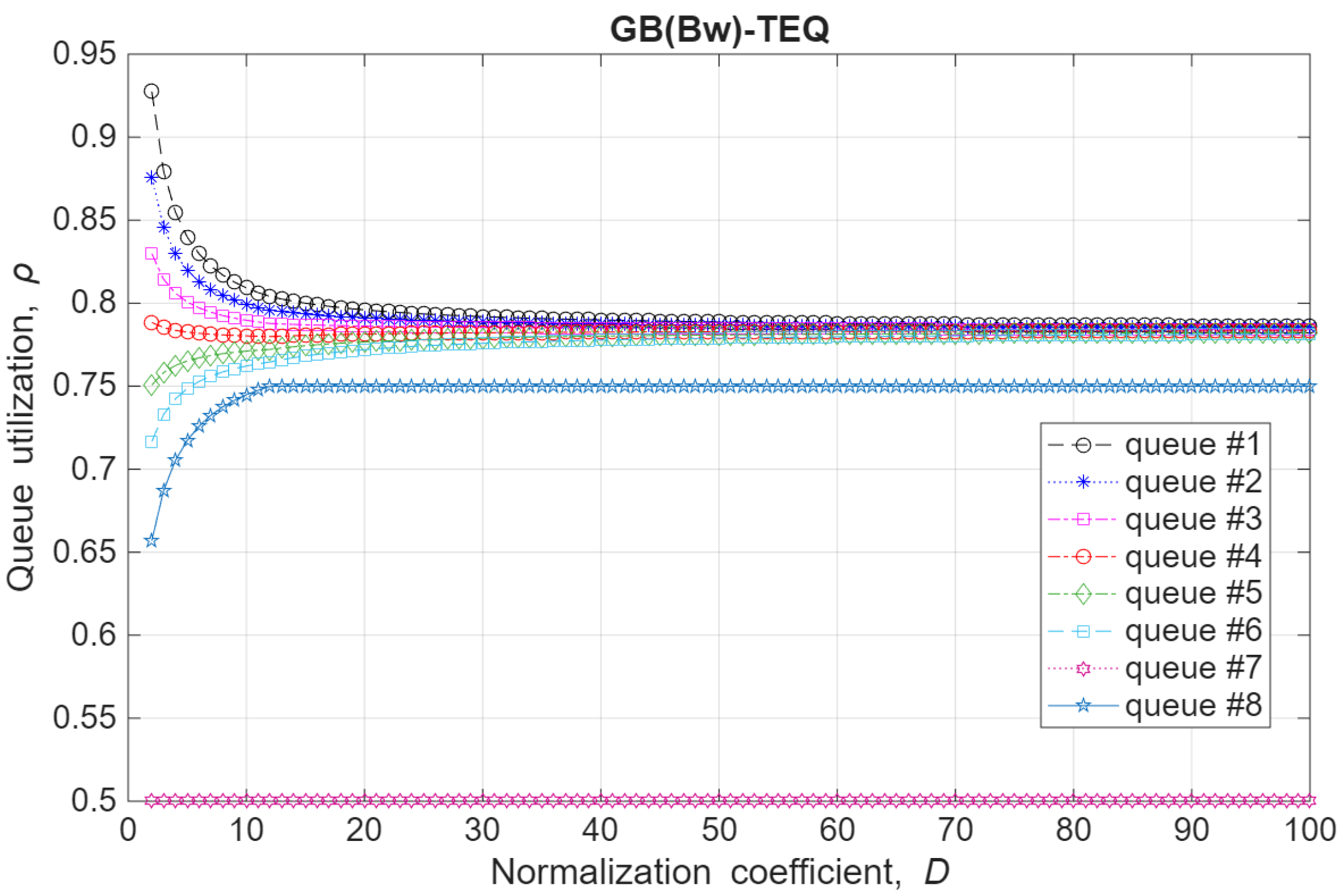
- Irrespective of the load applied to the class queues, the seventh and eighth queues were guaranteed the specified portion of the interface bandwidth.
- The guarantees referred to the minimum allocated bandwidth, meaning that class queues could receive additional resources. For instance, in Table 5, the eighth queue was allocated 18.27 Mbps under Scenario I and 16.13 Mbps under Scenario II.
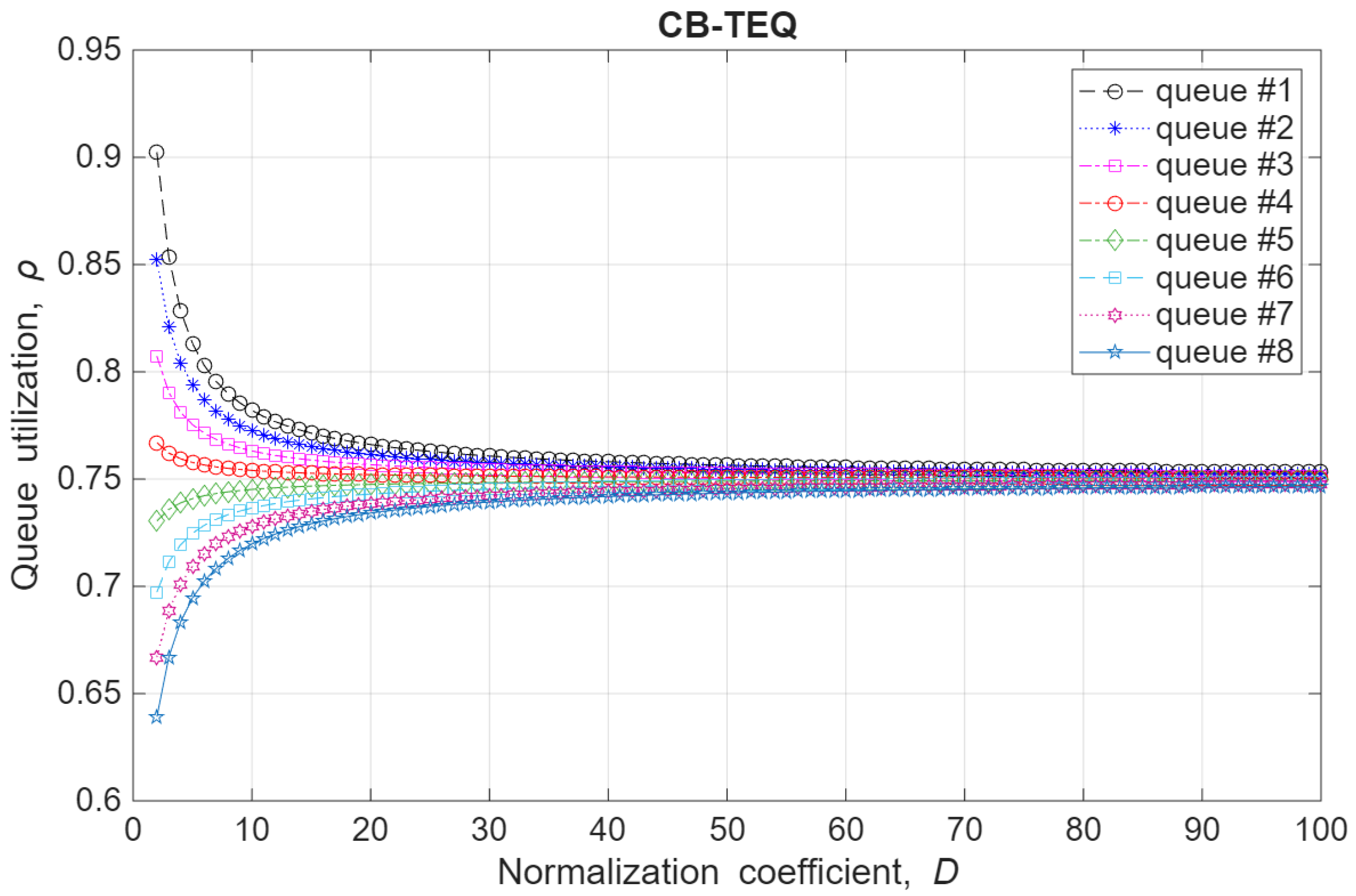
- The remaining interface bandwidth, after the reservation procedure, was distributed in a balanced manner among the queues according to their class values, as in the CB-TEQ case.
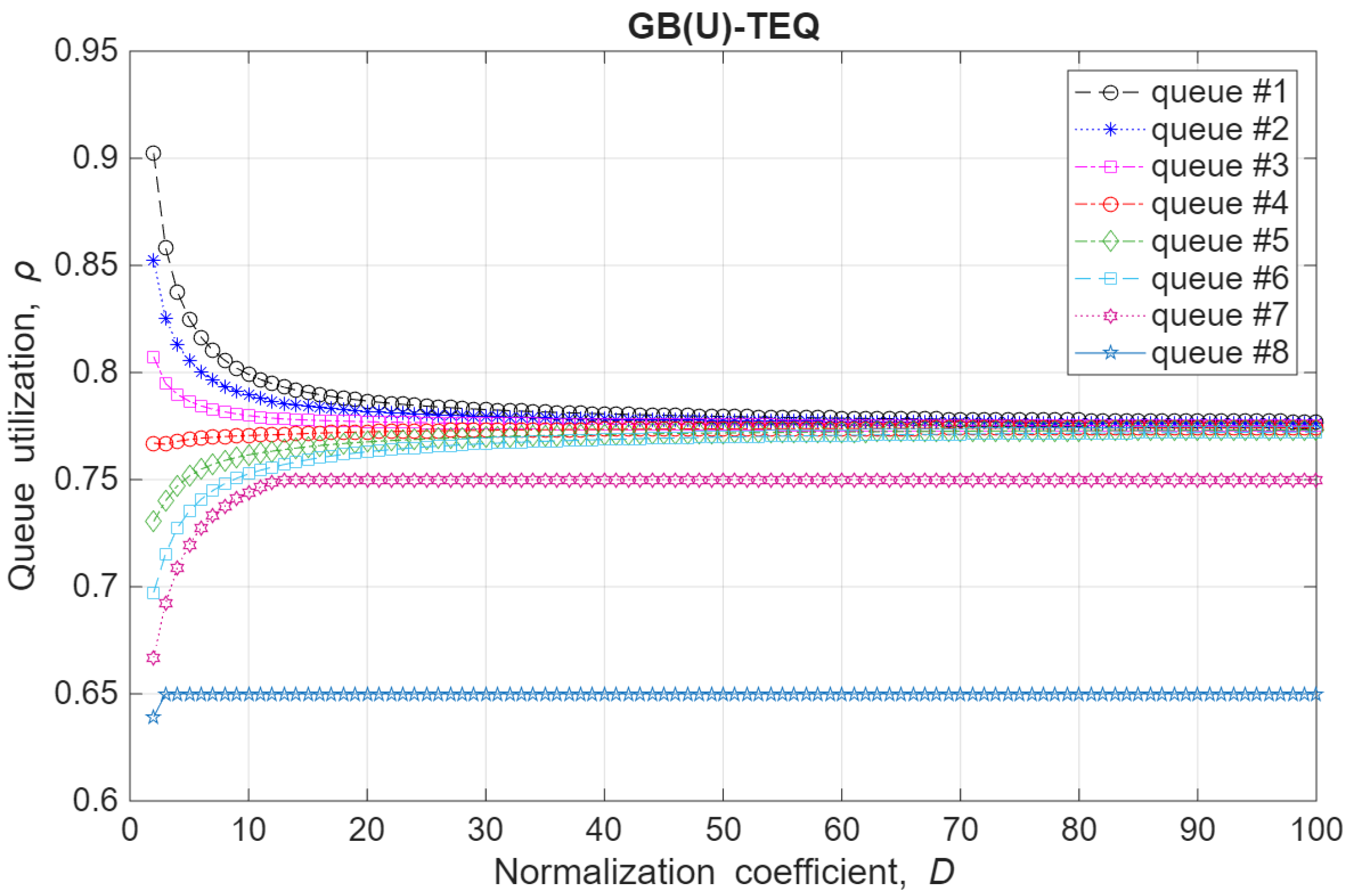
- In accordance with the values of and , and depending on the load received by the class queues, the seventh and eighth queues were guaranteed a specified portion of interface bandwidth.
- The guarantees applied to the maximum allowable utilization coefficient of the selected queues, meaning that they could receive additional link resources. For example, in Table 6, the eighth queue under Scenario I had = 0.6392, which was below , and the seventh queue under Scenarios I and II had = 0.667 and 0.7446, respectively, both below the threshold .
- The interface bandwidth remaining after the reservation procedure was distributed evenly among the queues according to their class values, as in the CB-TEQ case.
7. Practical Recommendations for Applying the Proposed Solutions
8. Conclusions
Author Contributions
Funding
Data Availability Statement
Conflicts of Interest
Abbreviations
| CBQ | Class-based Queuing |
| CB-TEQ | Class-Based Traffic Engineering Queue |
| CQ | Custom Queuing |
| DiffServ | Differentiated Services |
| DRL | Deep Reinforcement Learning |
| DSCP | Differentiated Services Code Point |
| FIFO | First In, First Out |
| GB(Bw)-TEQ | Guarantee-Based Bandwidth Traffic Engineering Queue |
| GB(U)-TEQ | Guarantee-Based Utilization Traffic Engineering Queue |
| IntServ | Integrated Services |
| IP | Internet Protocol |
| LLQ | Low Latency Queueing |
| MILP | Mixed-Integer Linear Programming |
| PHB | Per-Hop Behavior |
| PQ | Priority Queuing |
| QoS | Quality of Service |
| RL | Reinforcement Learning |
| RSVP | Resource Reservation Protocol |
| TE | Traffic Engineering |
| WFQ | Weighted Fair Queueing |
References
- Troia, S.; Borgianni, L.; Sguotti, G.; Giordano, S.; Maier, G. A Comprehensive Survey on Software-Defined Wide Area Network. IEEE Commun. Surv. Tutor. 2025, 1–40, Early Access. [Google Scholar] [CrossRef]
- Zanbouri, K.; Noor-A-Rahim, M.; John, J.; Sreenan, C.J.; Poor, H.V.; Pesch, D.K. A Comprehensive Survey of Wireless Time-Sensitive Networking (TSN): Architecture, Technologies, Applications, and Open Issues. IEEE Commun. Surv. Tutor. 2025, 27, 2129–2155. [Google Scholar] [CrossRef]
- Cristobo, L.; Ibarrola, E.; Casado-O’Mara, I.; Zabala, L. Global Quality of Service (QoX) Management for Wireless Networks. Electronics 2024, 13, 3113. [Google Scholar] [CrossRef]
- Tache, M.D.; Păscuțoiu, O.; Borcoci, E. Optimization Algorithms in SDN: Routing, Load Balancing, and Delay Optimization. Appl. Sci. 2024, 14, 5967. [Google Scholar] [CrossRef]
- Ma, Z.; Zhang, R.; Ai, B.; Lian, Z.; Zeng, L.; Niyato, D. Deep Reinforcement Learning for Energy Efficiency Maximization in RSMA-IRS-Assisted ISAC System. 2025. IEEE Trans. Veh. Technol. 2025. Early Access. [Google Scholar] [CrossRef]
- Relington, J. QoS in IP Networks: Prioritization, Classification, and Traffic Shaping, Kindle ed.; 2025; 225p. Available online: https://www.amazon.com/QoS-IP-Networks-Prioritization-Classification/dp/B0F3W4JBCT (accessed on 1 August 2025).
- CISCO. QoS: Congestion Management Configuration Guide; Cisco IOS XE 17; Cisco Systems, Inc.: San Jose, CA, USA, 2019. [Google Scholar]
- Barreiros, M.; Lundqvist, P. QoS-Enabled Networks: Tools and Foundations; John Wiley & Sons: Hoboken, NJ, USA, 2016; 256p. [Google Scholar]
- Edgeworth, B.; Rios, R.G.; Gooley, J.; Hucaby, D. CCNP and CCIE Enterprise Core ENCOR 350-401 Official Cert Guide, 2nd ed.; Cisco Press: Hoboken, NJ, USA, 2023; 1072p. [Google Scholar]
- Chahed, H.; Kassler, A. TSN Network Scheduling—Challenges and Approaches. Network 2023, 3, 585–624. [Google Scholar] [CrossRef]
- Bernet, Y.; Ford, P.; Yavatkar, R.; Baker, F.; Zhang, L.; Speer, M.; Braden, R.; Davie, B.; Wroclawski, J.; Felstaine, E. RFC2998: A Framework for Integrated Services Operation over Diffserv Networks. 2000. Available online: https://www.rfc-editor.org/rfc/rfc2998.html (accessed on 1 August 2025).
- Grossman, D. RFC 3260: New Terminology and Clarifications for Diffserv. 2002. Available online: https://www.rfc-editor.org/info/rfc3260 (accessed on 1 August 2025).
- Yu, Q.; Meng, J.; Xu, J.J. SW-EDF: A Single-Iteration Algorithm for Combined Input- and Output-Queued Switching. In Proceedings of the 2025 IEEE 26th International Conference on High Performance Switching and Routing (HPSR), Suita, Japan, 20–22 May 2025; pp. 1–7. [Google Scholar] [CrossRef]
- Yang, W.; Luo, H.; Luo, S.; Zhang, Z.; Wang, X.; Liu, T. Efficient Scheduling Function for IETF 6TiSCH Networks Based on Multiweight Evaluation and Improved Q-Learning. IEEE Internet Things J. 2025, 12, 35731–35743. [Google Scholar] [CrossRef]
- Lin, H.; Wang, H.; Wang, N.; Luo, D. Research on Dynamic Traffic Scheduling Algorithm Based on Huawei Network Equipment. In Proceedings of the 2024 IEEE 4th International Conference on Data Science and Computer Application (ICDSCA), Dalian, China, 22–24 November 2024; pp. 578–584. [Google Scholar] [CrossRef]
- Alfredsson, F.; Hurtig, P.; Brunstrom, A.; Høiland-Jørgensen, T.; Brouer, J.D. XDQ: Enhancing XDP with Queuing and Packet Scheduling. In Proceedings of the 2024 27th Conference on Innovation in Clouds, Internet and Networks (ICIN), Paris, France, 11–14 March 2024; pp. 52–56. [Google Scholar] [CrossRef]
- Yu, X.; Chen, W.; Tian, Y. OWFQ: Reducing Packet Drops for Approximate Weighted Fair Queueing with Calendar Queues. In Proceedings of the 2023 9th International Conference on Computer and Communications (ICCC), Chengdu, China, 8–11 December 2023; pp. 540–544. [Google Scholar] [CrossRef]
- Zhu, Y. Quality of Service Optimization for Satellite-Borne Router with Multi-Priority Scheduling Queues. IEEE Commun. Lett. 2023, 27, 3003–3007. [Google Scholar] [CrossRef]
- You, C.; Zhao, Y.; Feng, G.; Quek, T.Q.; Li, L. Hierarchical Multiresource Fair Queueing for Packet Processing. IEEE Trans. Netw. Serv. Manag. 2023, 20, 726–740. [Google Scholar] [CrossRef]
- Pan, J.; Chen, G.; Wu, H.; Peng, X.; Xia, L. Deep Reinforcement Learning-based Dynamic Bandwidth Allocation in Weighted Fair Queues of Routers. In Proceedings of the 2022 IEEE 18th International Conference on Automation Science and Engineering (CASE), Mexico City, Mexico, 20–24 August 2022; pp. 1580–1587. [Google Scholar] [CrossRef]
- Yang, K.; Xu, C.; Qiao, G.; Zhong, J.; Zhang, X. Intelligent Queue Scheduling Method for SPMA-Based UAV Networks. Drones 2025, 9, 552. [Google Scholar] [CrossRef]
- Lemeshko, O.; Persikov, A.; Yeremenko, O.; Yevdokymenko, M. Method of Hierarchical Queue Management on Network Routers Based on the Goal Coordination Principle. In Advanced Smart Information and Communication Technology and Systems. MCT 2024; Lecture Notes in Networks and Systems; Springer: Cham, Switzerland, 2025; Volume 1470, pp. 200–214. [Google Scholar] [CrossRef]
- Lemeshko, O.; Yeremenko, O.; Titarenko, L.; Barkalov, A. Hierarchical Queue Management Priority and Balancing Based Method under the Interaction Prediction Principle. Electronics 2023, 12, 675. [Google Scholar] [CrossRef]
- Lemeshko, O.; Lebedenko, T.; Holoveshko, M. Development and Research of Active Queue Management Method on Interfaces of Telecommunication Networks Routers. In Data-Centric Business and Applications; Lecture Notes on Data Engineering and Communications Technologies; Springer: Cham, Switzerland, 2021; Volume 69, pp. 1–20. [Google Scholar] [CrossRef]
- Lemeshko, O.; Yeremenko, O.; Persikov, A.; Yevdokymenko, M.; Mersni, A.; Harkusha, S. Queue Management Priority-Based Traffic Engineering Method. In Proceedings of the 2022 IEEE 9th International Conference on Problems of Infocommunications, Science and Technology (PIC S&T), Kharkiv, Ukraine, 10–12 October 2022; pp. 479–483. [Google Scholar] [CrossRef]
- Wu, G. An Innovative Priority Queueing Strategy for Mitigating Traffic Congestion in Complex Networks. Mathematics 2025, 13, 495. [Google Scholar] [CrossRef]
- ITU-T Rec. Y.1541. Network Performance Objective for IP-Based Services. December 2011. 66p. Available online: https://www.itu.int/rec/T-REC-Y.1541-201112-I/en (accessed on 1 September 2025).
- Lakatos, L.; Szeidl, L.; Telek, M. Introduction to Queueing Systems with Telecommunication Applications, 2nd ed.; Springer: Cham, Switzerland, 2019; 568p. [Google Scholar] [CrossRef]
- Hwang, R.H.; Lin, J.Y.; Lin, J.Y.; Lin, Y.D. Communication and Computing Offloading in 6G Hotspot Scenarios. In Proceedings of the 2025 IEEE International Conference on Communications Workshops (ICC Workshops), Montreal, QC, Canada, 8–12 June 2025; pp. 1525–1531. [Google Scholar] [CrossRef]
- Kumar, M.S.; Dadlani, A.; Tabassum, H. Age of Information in Unreliable Tandem Queues. IEEE Commun. Lett. 2025, 29, 2308–2312. [Google Scholar] [CrossRef]
- Chen, Z.; Zhu, J.; Pappas, N.; Zhang, L.; Wang, M.; Tang, C.; Quek, T.Q. Real-Time Status Update System in a Parallel Blocking Queue. IEEE Open J. Commun. Soc. 2025, 6, 4608–4623. [Google Scholar] [CrossRef]
- Roy, A.; Pachuau, J.L.; Singh, N.B.; Saha, A.K. Quantum inspired genetic algorithm and optimization of queuing delay. In Proceedings of the TENCON 2024-2024 IEEE Region 10 Conference (TENCON), Singapore, 1–4 December 2024; pp. 1929–1933. [Google Scholar] [CrossRef]
- Lin, W.; Li, L.; Yuan, J.; Han, Z.; Juntti, M.; Matsumoto, T. Age-of-Information in First-Come-First-Served Wireless Communications: Upper Bound and Performance Optimization. IEEE Trans. Veh. Technol. 2022, 71, 9501–9515. [Google Scholar] [CrossRef]



| Name | Number of Queues | Operating Principle | Advantages | Disadvantages | Level of Automation |
|---|---|---|---|---|---|
| FIFO (First In, First Out) | 1 | Packets are processed in the order of arrival | Simple implementation, minimal resource consumption | No support for service differentiation | High |
| PQ (Priority Queuing) | 4 | Service order determined by queue priority | Minimal delay for high-priority traffic | Low-priority traffic may be blocked | Medium |
| CQ (Custom Queuing) | 16 | Service level of each queue regulated by byte counters | Allows differentiated servicing through configuration | Requires additional administrative configuration | Medium |
| WFQ (Weighted Fair Queuing) | 16–4096 | Service order depends on packet length and priority | Fair resource allocation | Large number of low-priority flows may reduce bandwidth for high-priority flows | High |
| CBQ (Class-Based Queuing) | 64 class-based queues | Traffic is divided into classes with assigned bandwidth shares | Bandwidth control, service differentiation | Complex setup, processing overhead | Medium |
| CBWFQ (Class-Based Weighted Fair Queuing) | 64 class-based queues, each configurable with WFQ | Combination of CBQ and WFQ | Provides QoS guarantees | Requires significant administrative configuration | Low |
| LLQ (Low Latency Queuing) | 64 class-based queues, one designated as priority | Combination of CBWFQ with a priority queue | Minimal delay for critical traffic | Requires significant administrative configuration | Low |
| Ref. | Main Contribution | Advantages | Limitations |
|---|---|---|---|
| [13] | Proposed SW-EDF, a single-iteration switching algorithm for Combined Input-Output Queued (CIOQ) switches. | Reduces complexity to a single iteration, near Output-Queued performance, and low delay. | Only an approximation of stable matching, CIOQ requires costly stable matching. |
| [14] | Developed a scheduling function for IETF 6TiSCH networks based on multiweight evaluation and Q-Learning. | Precise slot selection, efficient resource use, less congestion/interference; improves latency by up to 55%, increases packet delivery ratio by 6%. | High computational cost, depends on training with real data (global network state). |
| [15] | Proposed a dynamic traffic scheduling algorithm for Huawei devices using priority queues. | Better resource utilization, bandwidth allocation, reduced delay and congestion, real-time adaptation. | Tested in simulations, limited to Huawei devices. |
| [16] | XDQ—an XDP/eBPF extension for programmable packet scheduling in Linux OS. | High performance, allows programmable scheduling within eXpress Data Path (XDP), reduces overhead. | XDQ still under development, requires Linux integration. |
| [17] | Opportunistic Weighted Fair Queueing (OWFQ)—approximate WFQ with calendar queues to reduce packet drops. | Significantly reduces packet drop rate, improves bandwidth utilization. | Approximation of ideal WFQ, validation limited to simulation environment. |
| [18] | QoS optimization for satellite-borne routers with multi-priority queues. | Simplifies optimization model, optimizes traffic arrival rates, achieves 30% QoS gain, fast convergence. | Limited to satellite-borne routers. |
| [19] | Multi-resource fair queueing algorithms with hierarchical scheduling—collapsed Hierarchical Dominant Resource Fair Queueing (collapsed H-DRFQ) and dove-tailing H-DRFQ. | Provides hierarchical QoS guarantees to individual flows, lower delay with dove-tailing H-DRFQ. | Validated only on the Click modular router. |
| [20] | WFQ-DRL algorithm—applied DRL to dynamic bandwidth allocation in WFQ. | Reduces delay and packet loss, adapts to real traffic. | Complex G/G/1/K model, limited scenarios tested. |
| [21] | Adaptive Credit-Based Shaper with Reinforcement Learning (ACBS-RL) method for UAV networks based on Static Priority-based Multiple Access (SPMA). | Ensures the QoS requirements for all priority traffic, increases UAV network throughput. | Relies on Q-learning-based reinforcement learning adaptation. |
| [22] | Hierarchical queue management on routers based on the goal coordination principle. | Scalable, balanced interface bandwidth allocation, fast convergence. | Theoretical approach, requires further real-world validation. |
| [23] | Two-level hierarchical queue management using interaction prediction principle. | High scalability, balanced and priority-based packet flow distribution, balanced bandwidth allocation, high convergence. | Limited experimental validation, hardware implementation challenges. |
| [24] | Developed an Active Queue Management method for network routers. | Reduced average packet delay, reduced packet loss, validated on Cisco lab setup. | Recommended mainly for high-load (>80%) scenarios, tested in the laboratory environment only. |
| Queue | Scenario I | Scenario II | Scenario III |
|---|---|---|---|
| 1 | 12 | 12 | 12 |
| 2 | 8 | 10 | 8 |
| 3 | 6 | 8 | 7 |
| 4 | 14 | 15 | 18 |
| 5 | 7 | 8 | 15 |
| 6 | 11 | 11 | 11 |
| 7 | 5 | 4 | 7 |
| 8 | 12 | 12 | 12 |
| Queue | ) | ) | ) | ||||||
|---|---|---|---|---|---|---|---|---|---|
| b | L | b | L | b | L | ||||
| 1 | 13.30 | 0.9024 | 8.34 | 13.24 | 0.9064 | 8.78 | 12.44 | 0.9647 | 26.36 |
| 2 | 9.39 | 0.8522 | 4.91 | 11.47 | 0.8715 | 5.91 | 8.46 | 0.9454 | 16.37 |
| 3 | 7.43 | 0.8074 | 3.38 | 9.53 | 0.8393 | 4.38 | 7.55 | 0.9269 | 11.75 |
| 4 | 18.25 | 0.7670 | 2.52 | 18.54 | 0.8093 | 3.43 | 19.80 | 0.9090 | 9.08 |
| 5 | 9.58 | 0.7305 | 1.98 | 10.24 | 0.7814 | 2.79 | 16.82 | 0.8919 | 7.36 |
| 6 | 15.78 | 0.6973 | 1.61 | 14.56 | 0.7553 | 2.33 | 12.57 | 0.8754 | 6.15 |
| 7 | 7.50 | 0.6669 | 1.34 | 5.47 | 0.7310 | 1.99 | 8.14 | 0.8594 | 5.26 |
| 8 | 18.77 | 0.6392 | 1.13 | 16.95 | 0.7081 | 1.72 | 14.22 | 0.8441 | 4.57 |
| Queue | ) | ) | ) | ||||||
|---|---|---|---|---|---|---|---|---|---|
| b | L | b | L | b | L | ||||
| 1 | 12.94 | 0.9275 | 11.86 | 12.60 | 0.9520 | 18.88 | 12.14 | 0.9885 | 84.67 |
| 2 | 9.13 | 0.8759 | 6.18 | 10.92 | 0.9154 | 9.90 | 8.18 | 0.9775 | 42.42 |
| 3 | 7.23 | 0.8298 | 4.05 | 9.08 | 0.8815 | 6.56 | 7.24 | 0.9667 | 28.10 |
| 4 | 17.76 | 0.7883 | 2.94 | 17.65 | 0.8500 | 4.82 | 18.83 | 0.9562 | 20.89 |
| 5 | 9.32 | 0.7508 | 2.26 | 9.75 | 0.8207 | 3.76 | 15.86 | 0.9459 | 16.55 |
| 6 | 15.35 | 0.7167 | 1.81 | 13.87 | 0.7933 | 3.05 | 11.75 | 0.9359 | 13.66 |
| 7 | 10.00 | 0.5000 | 0.50 | 10.00 | 0.4000 | 0.27 | 10.00 | 0.7000 | 1.63 |
| 8 | 18.27 | 0.6569 | 1.26 | 16.13 | 0.7438 | 2.16 | 16.00 | 0.7500 | 2.25 |
| Queue | ) | ) | ) | ||||||
|---|---|---|---|---|---|---|---|---|---|
| b | L | b | L | b | L | ||||
| 1 | 13.30 | 0.9024 | 8.34 | 13.00 | 0.9232 | 11.11 | 12.05 | 0.9951 | 200.69 |
| 2 | 9.39 | 0.8522 | 4.91 | 11.26 | 0.8877 | 7.02 | 8.08 | 0.9907 | 105.11 |
| 3 | 7.43 | 0.8074 | 3.38 | 9.36 | 0.8549 | 5.03 | 7.10 | 0.9863 | 71.00 |
| 4 | 18.25 | 0.7670 | 2.52 | 18.20 | 0.8243 | 3.87 | 18.33 | 0.9820 | 53.49 |
| 5 | 9.58 | 0.7305 | 1.98 | 10.05 | 0.7959 | 3.10 | 15.34 | 0.9777 | 42.84 |
| 6 | 15.78 | 0.6973 | 1.61 | 14.30 | 0.7694 | 2.57 | 11.30 | 0.9734 | 35.67 |
| 7 | 7.50 | 0.6670 | 1.34 | 5.37 | 0.7446 | 2.17 | 9.33 | 0.7500 | 2.25 |
| 8 | 18.77 | 0.6392 | 1.13 | 18.46 | 0.6500 | 1.21 | 18.46 | 0.6500 | 1.21 |
Disclaimer/Publisher’s Note: The statements, opinions and data contained in all publications are solely those of the individual author(s) and contributor(s) and not of MDPI and/or the editor(s). MDPI and/or the editor(s) disclaim responsibility for any injury to people or property resulting from any ideas, methods, instructions or products referred to in the content. |
© 2025 by the authors. Licensee MDPI, Basel, Switzerland. This article is an open access article distributed under the terms and conditions of the Creative Commons Attribution (CC BY) license (https://creativecommons.org/licenses/by/4.0/).
Share and Cite
Titarenko, L.; Lemeshko, O.; Yeremenko, O.; Savchenko, R.; Barkalov, A. Traffic Engineering Queue Optimization Models with Guaranteed Quality of Service Support. Electronics 2025, 14, 4078. https://doi.org/10.3390/electronics14204078
Titarenko L, Lemeshko O, Yeremenko O, Savchenko R, Barkalov A. Traffic Engineering Queue Optimization Models with Guaranteed Quality of Service Support. Electronics. 2025; 14(20):4078. https://doi.org/10.3390/electronics14204078
Chicago/Turabian StyleTitarenko, Larysa, Oleksandr Lemeshko, Oleksandra Yeremenko, Roman Savchenko, and Alexander Barkalov. 2025. "Traffic Engineering Queue Optimization Models with Guaranteed Quality of Service Support" Electronics 14, no. 20: 4078. https://doi.org/10.3390/electronics14204078
APA StyleTitarenko, L., Lemeshko, O., Yeremenko, O., Savchenko, R., & Barkalov, A. (2025). Traffic Engineering Queue Optimization Models with Guaranteed Quality of Service Support. Electronics, 14(20), 4078. https://doi.org/10.3390/electronics14204078