Abstract
This paper presents a cognitive radio (CR)-enabled symbiotic ambient backscatter communication (AmBC) system with the help of a zero-energy reconfigurable intelligent surface (zeRIS). An adaptive transmission (AT) strategy for the zeRIS is devised based on the amount of harvested energy. Specifically, when energy reserve is insufficient, the zeRIS merely reflects signals without any phase adjustments (PAs), whereas under sufficient energy conditions, it reflects signals following precise PAs. Moreover, a segmented zeRIS is adopted by taking primary transmission (PT) and backscatter transmission (BT) into account. Following this, the coexistence outage probability and ergodic capacity are derived to assess the reliability and effectiveness of the proposed model, respectively. Their asymptotic performance is analyzed to gain insightful observations. Finally, simulation results are provided to verify the accuracy of the theoretical analysis, confirming that AT offers improved reliability, system rate, and energy efficiency over non-adaptive transmission. Furthermore, CR-aided AT demonstrates superior energy efficiency compared to non-CR-assisted AT. It is also crucial to note that the allocation of reflective elements between PT and BT must be reasonably managed to satisfy specific system requirements.
1. Introduction
The exponential growth of the Internet of Things (IoT) devices across various sectors is expected to create an unprecedented density of devices in sixth-generation communication networks, potentially reaching up to devices per square kilometer [1]. This surge presents significant challenges in managing scarce spectrum and energy resources. To address these challenges, cognitive radio (CR) [2], symbiotic ambient backscatter communication (AmBC) or AmBC [3], and reconfigurable intelligent surfaces (RISs) [4] promise to enhance both energy efficiency (EE) and spectral efficiency (SE).
Specifically, cognitive radio (CR) endows wireless devices with the capability to perceive the spectrum environment surrounding them. Depending on the availability and accessibility of spectrum resources, these devices can intelligently adjust their operational behavior. This smart adaptation leads to an increase in both spectrum utilization and efficiency. Regarding symbiotic AmBC, it involves two types of transmissions. The first is primary transmission (PT) from a primary user (PU). The second is backscatter transmission (BT) from a backscatter device, such as a tag. In contrast, AmBC only includes the latter. The tag in (symbiotic) AmBC first harvests energy from and then overlays its own signal onto the PT or ambient signal, avoiding dedicated spectrum allocation for BT. As for RIS, it is typically made up of numerous low-cost and low-power reflective elements (REs). These REs can be independently controlled to alter the phase, amplitude, or polarization of incident signals. The precise controllability of RISs not only boosts signal strength but also serves a crucial function in augmenting SE and EE, e.g., in the realm of AmBC and CR.
Recent endeavors have delved into the strategic integration of the aforementioned technologies to harness their aggregate advantages. These efforts encompass the exploration of combining CR with AmBC [3,5], integrating CR with RISs [6,7], and merging AmBC with RISs [8,9,10,11]. Furthermore, there are innovative efforts to converge all three technologies into a unified framework [12,13,14]. The objective of this integration is to enable efficient connectivity for massive IoT devices, markedly lowering energy usage while maintaining high-quality communication. It has been demonstrated that in contrast to operating in either AmBC- or RIS-alone modes, RIS-assisted AmBC in CR-IoT systems achieves superior EE [12]. The study in [13] focuses on a symbiotic CR network, comprising a primary network (PN) based on non-orthogonal multiple access (NOMA) and a secondary network (SN) equipped with multiple RISs for BT. That work showcases how RISs in the SN provide the PN receivers with spatial diversity while simultaneously transmitting their own data. In [14], the authors introduce an active RIS-enabled downlink NOMA CR system which can offer reflective link array gains.
References [13,14] utilize successive interference cancellation (SIC) by treating unrelated signals as interference. However, with all REs dedicated to loading BT information, employing SIC might induce severe interference to PT and weak BT decoding in large-scale and small-scale RIS environments. To address this, a viable solution is to segment RIS into two zones to separately enhance PT and BT, as suggested in [8,9,10,11]. Nonetheless, these references [8,9,10,11] focus solely on RIS-aided symbiotic AmBC and overlook the integration of CR aspects. Moreover, given the paramount importance of sustainability in future eco-friendly networks, energy harvesting (EH) can be integrated into a RIS to create a zero-energy RIS (zeRIS), eliminating the need for dedicated power sources [15]. Above all, there remains a lack of research addressing the performance balance between PT and BT while achieving sustainability in CR-enabled and RIS-assisted symbiotic AmBC, which motivates our work.
To tackle these research gaps, this paper proposes a segmented zeRIS-assisted symbiotic AmBC within the CR-IoT network framework. Our work differs from the studies referenced in [12,13,14] by integrating EH to support sustainable communication. Notably, in contrast to [8,9,10,11,12,13,14], we adopt an adaptive transmission (AT) approach that depends on the harvested energy level by the zeRIS to achieve enhanced performance. Additionally, to balance the performance of PT and BT, we incorporate RIS partitioning, an aspect that was previously overlooked in [13,14]. For the sake of clarity and intuitiveness, we provide a comparative analysis of system configurations between our proposed model and other relevant studies, as outlined in Table 1. Our main contributions are as follows:
Table 1.
The configuration comparison of our paper with other related studies.
- An AT strategy is introduced in a zeRIS to improve CR-enabled zeRIS symbiotic radio performance. Specifically, the zeRIS executes accurate phase adjustments when harvested energy is abundant and merely reflects incoming signals directly when energy is insufficient. Moreover, the zeRIS is categorized into two segments, one for PT and the other for BT.
- Coexistence outage probability (COP) and ergodic capacity (EC) are derived to evaluate the reliability and effectiveness of our proposed model, respectively. Furthermore, asymptotic COP and EC at low or high maximum transmission power are calculated to offer profound insights into system performance.
- To corroborate the validity of our analytical derivations, extensive simulations compare them with non-adaptive transmission (NAT). The simulation results highlight the superiority of our scheme over NAT concerning COP, EC, and EE, particularly in scenarios featuring low transmission power levels. Additionally, our findings indicate that the proposed CR-aided AT excels over AT without CR support in terms of EE.
Notation: and denote the expectation and variance of the random variable (RV) x, respectively. The probability density function (PDF) of an exponentially distributed RV is if . The PDF of a Gamma-distributed RV is if denotes an indicator function, which equals one when condition x holds, and is zero otherwise.
2. System Model
2.1. Model Description
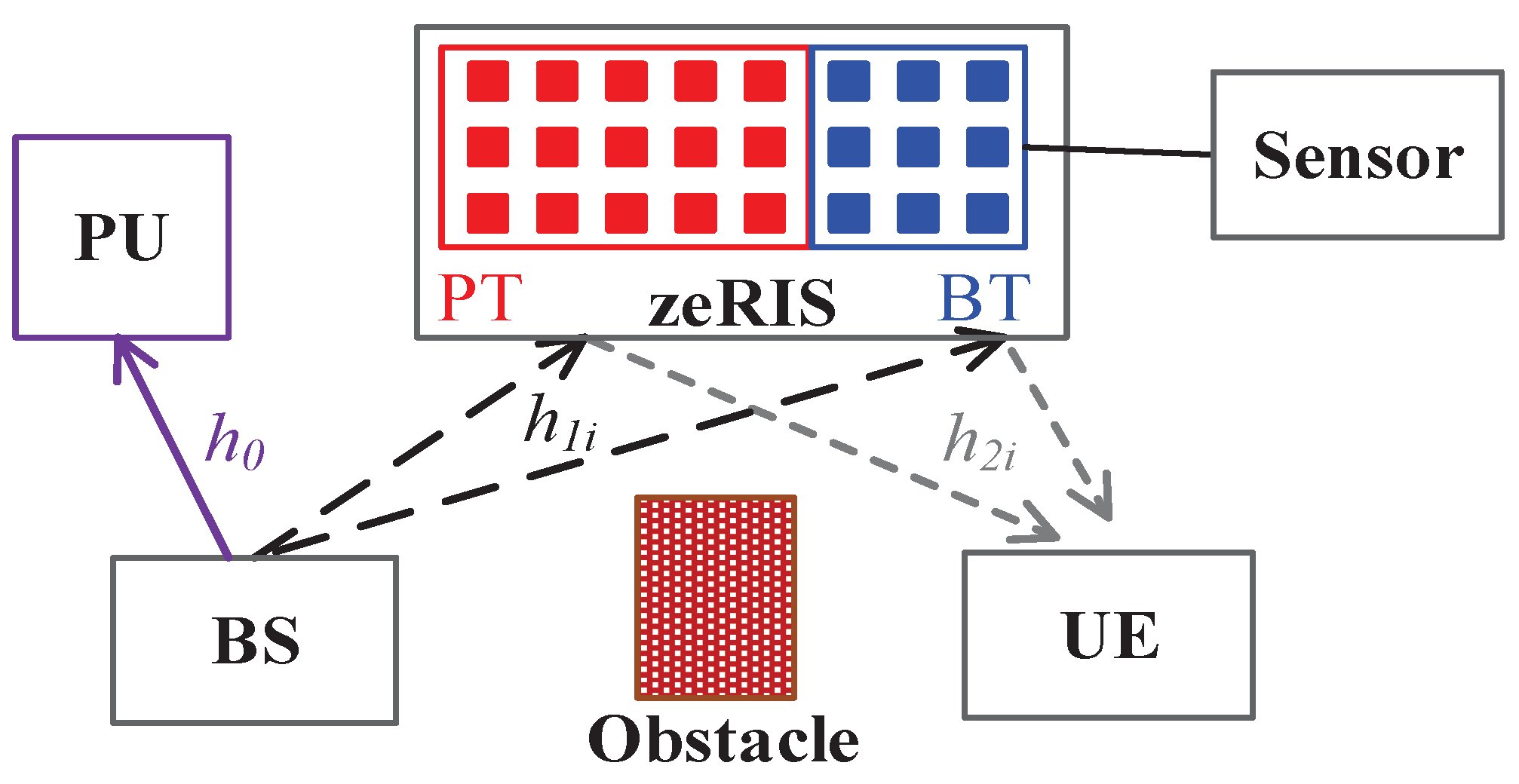
Figure 1 considers a CR-enabled zeRIS-segmented symbiotic backscatter communication system, including a transmitter base station (BS), a PU, user equipment (UE), and a sensor. The RIS contains REs with the ith RE being denoted by for . Without loss of generality, we assume REs for PT from the BS and REs for BT via the zeRIS connected to an outside sensor. The following assumptions are made: (i) the direct link from the BS to the UE is blocked due to the existence of obstacles between the BS and the UE; (ii) all channels are assumed to be independent, and the channel coefficients of the BS-PU, BS-, and -UE links are denoted by , , and , respectively; (iii) the channel between the zeRIS and the BS is assumed to be a line-of-sight link due to the high altitude of the BS and the zeRIS [16,17]. Hence, let . Moreover, the channels and are assumed to follow Rayleigh fading [18]. Thus, they are distributed as and (In mobile environments, channel fading can be modeled as a zero-mean complex Gaussian distribution using a first-order auto-regressive process, as detailed in [19]); (iv) the BS operates in an underlay CR mode [20], which enables it to concurrently utilize the spectrum of the PU as long as the interference imposed on the PU remains beneath a tolerable limit. Denote the interference power of the BS to the PU as and the maximum transmission power at the BS as . Then, the transmission power (As the interference power approaches infinity, the transmission power converges to . Consequently, it can be considered that CR ceases to function effectively in the case of approaching infinity.) at the BS can be expressed as
where . Setting , Equation (1) is equivalent to
Figure 1.
A CR-enabled zeRIS-segmented symbiotic AmBC system.
Operating in power-splitting (PS) mode [15], the REs adaptively orchestrate their phases . To be specific, the zeRIS adapts the phases based on when the energy harvested by the zeRIS exceeds its total power consumption for phase adjustments (PAs) (The circuit power consumption of the zeRIS is primarily attributed to the PA operation conducted by each RE. Other power consumption values, including those for energizing the EH circuit and signaling overhead, are deemed insignificant [21].), where is the power consumption for PA at each RE. Otherwise, the zeRIS only reflects the incident BS signal or loads backscatter signal over without any phase change, i.e., . Due to the low efficiency of EH, there is a high possibility that the instantaneous power by EH will not saturate and be in the linear operating region. In addition, linear operation is simple and tractable. Consequently, we adopt the linear EH model, which can be mathematically expressed as
Here, represents the PS factor, and denotes the energy conversion efficiency.
2.2. SNR and Capacity Representation
The system uses the same symbol period for and . Because of this, the UE decodes the BS signal first by treating the backscatter signal as interference and recovers next after the removal of , where and . Represent , , , and by , , , and , respectively. According to (5), in the case of and , the signal-to-noise-ratios (SNRs) and for decoding and can be separately calculated as
and
where , , , , , , , , and . Correspondingly, the capacity for demodulating and can be expressed as
where .
3. Coexistence Outage Probability
To comprehensively assess the reliability of the concurrent transmission for and in the system, the COP [8] may be utilized as a performance metric. The COP represents the probability that the UE fails to decode either or , which can be measured when the capacity falls below a predefined threshold , i.e., .
3.1. Derivation of COP
When the transmission power at the BS is configured to , let represent the joint probability of successfully decoding both and simultaneously in the case of adequate energy for PAs. In contrast, signifies this probability under conditions of insufficient energy. Similarly, with the transmission power adjusted to , and correspond to the probabilities of successfully demodulating both and under scenarios of sufficient and inadequate energy, respectively. To proceed, the COP, denoted as , can be mathematically formulated as
where
Obviously, a crucial step in solving Equations (10)–(13) is to obtain the statistical characteristics of the random variables g, , , , and . It can be verified that g, , and are exponentially distributed with parameters , , and , respectively. Given the complexity involved in deriving the exact PDFs for and , it is appropriate to separately approximate them using Gaussian and Gamma distributions [22]. Specifically, can be approximated by a Gaussian distribution with mean and variance . Meanwhile, can be modeled by a Gamma distribution with shape parameter and scale parameter . Here, represents the mean , and denotes the variance . Set , , , and . Then, substituting the corresponding Gaussian, Gamma, or Exponential distribution, along with (6)–(8), into (10)–(13) yields
where
and
Here, both (14) and (15) are derived using Equation (2.33.1) in [23], Equation (8.250.4) in [23], and the Gaussian–Chebyshev quadrature (GCQ) rule, and is the complementary error function [23].
3.2. Asymptotic COP Analysis
In the scenario where tends toward infinity (), the transmission power becomes . This indicates that the COP is no longer influenced by , but rather is completely determined by . Conversely, if approaches zero (), the power equals , which suggests that the COP is independent of and is only affected by . Moving forward, by leveraging Equations (9)–(13), the asymptotic results of COP in low and high can be separately expressed as
where and ( and ) denote the asymptotic outcomes of and ( and ) in the context where tends to zero ( approaches infinity), i.e., , , , and . Deriving from (14)–(17), , , , and can then be, respectively, determined as
where , , , , , and are defined in (18), (19), (20), (21), (22), and (23), respectively. Herein, (26) and (28) are derived by using the approximation . Analogously, (27) and (29) are obtained by separately applying the indicator function and the equality .
4. Ergodic Capacity
The EC is an important performance measure of wireless systems in a fading environment. Thus, the sum EC of the concurrent transmissions for both primary signal s and IoT data c is derived next.
4.1. EC Derivation
Denote by the EC of in the case of and , i.e.,
Then, the EC of equals
Further, the sum EC of the proposed system can be expressed as
Substituting (6)–(8) into (32) and taking expectation over , , and g yield
where
is the incomplete Gamma function [23], and is the ith root of Laguerre polynomial . Herein, (33) and (35) are achieved by leveraging Equation (13) in [24]; (34) and (36) are achieved by leveraging the Gauss–Laguerre quadrature; (35) and (36) also apply the GCQ rule; (37)–(40) are obtained by using Equation (12) in [25], and (38)–(40) are achieved by utilizing for , , and . The proof is given in Appendix A.
Remark 1.
In the NAT scheme, no transmission happens at the zeRIS without enough harvested energy. Therefore, the COP and EC in the case of NAT can be given as
and
respectively.
Remark 2.
The energy efficiency is defined as the ratio of the ergodic capacity to the average power consumed [26]. Then, the EEs and in the scenarios of AT and NAT can be derived as
and
where the average power can be computed as .
4.2. Asymptotic EC Analysis
Following a similar analysis as outlined in Section 3.2, the EC is only determined by (or ) if (or ). Let and represent the asymptotic results of at the low- and high-power regimes of , respectively. Let denote the approximation of in (30) under the conditions that approaches zero for or tends to infinity for . Then, we have
and
The counterparts in (50) and (51) can be calculated as
For further details on , , , , and , refer to the definitions provided in Equations (41), (42), (43), (44), and (45), respectively.
Remark 3.
Based on the analysis in Section 3.2 and Section 4.2, the transmission power is only related to when . Therefore, the gain in COP or EC at very high power levels of is asymptotically zero, as shown by the limit for . This indicates that the performance gains become marginal beyond a certain threshold for . This threshold can be approximated by the condition , i.e., . Here, κ represents a high probability value, for instance, 0.99.
5. Numerical and Simulation Results
This section provides numerical results to validate the accuracy of our analysis and to discuss the performance of the proposed model. Each simulation datum was derived from averaging over Monte Carlo iterations. Unless specified otherwise, the parameters were set as follows: , , , , mW [21], , , , and .
5.1. Numerical and Simulation Results of COP
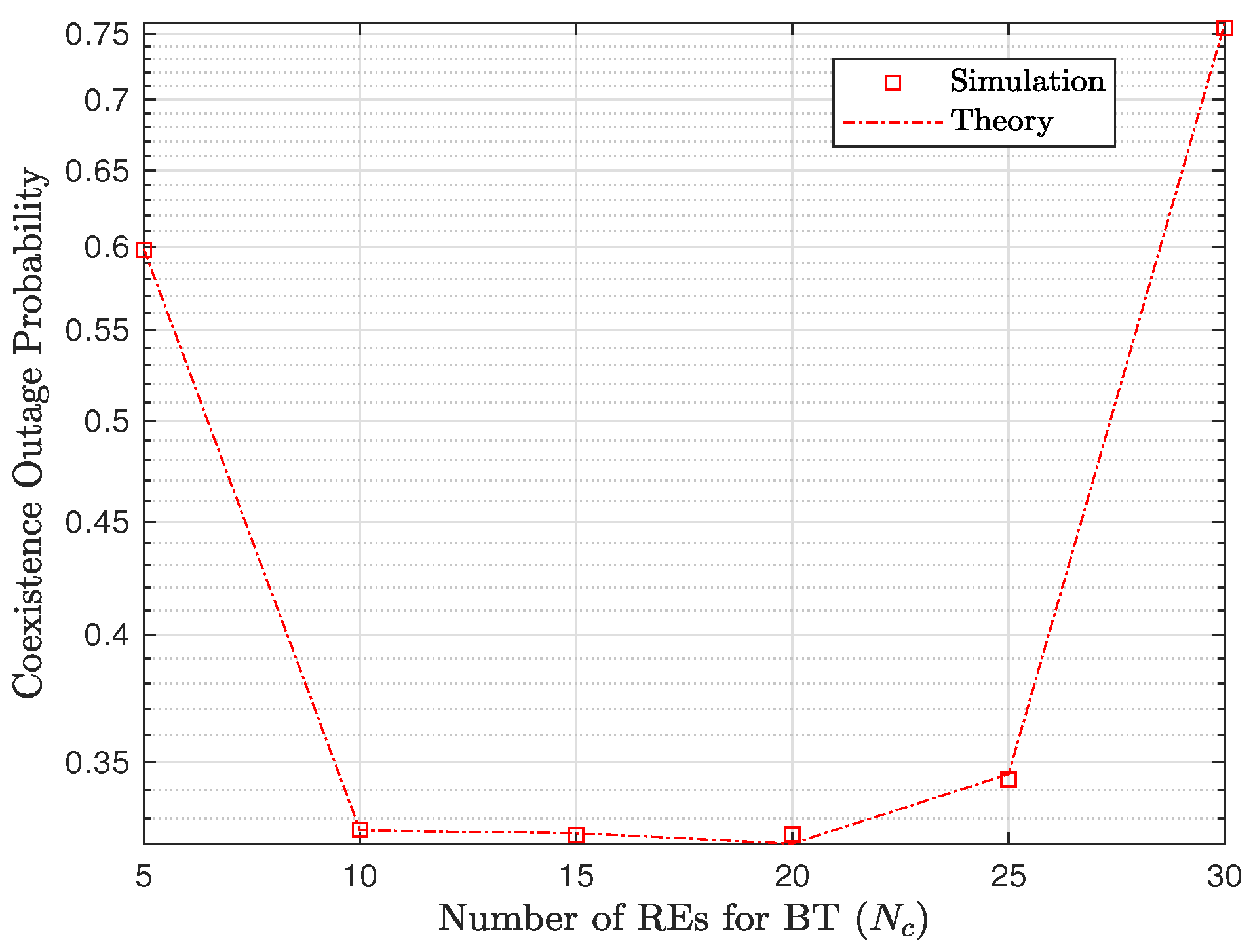
Figure 2 illustrates the COP as a function of the number of REs, , dedicated to backscatter transmission when dBm and dBm. It can be observed that the COP initially decreased and then ascended as increased. This indicated the necessity of allocating a reasonable number of REs for PT and BT to achieve a satisfactory reliability in practice.
Figure 2.
COP versus number of REs for BT, .
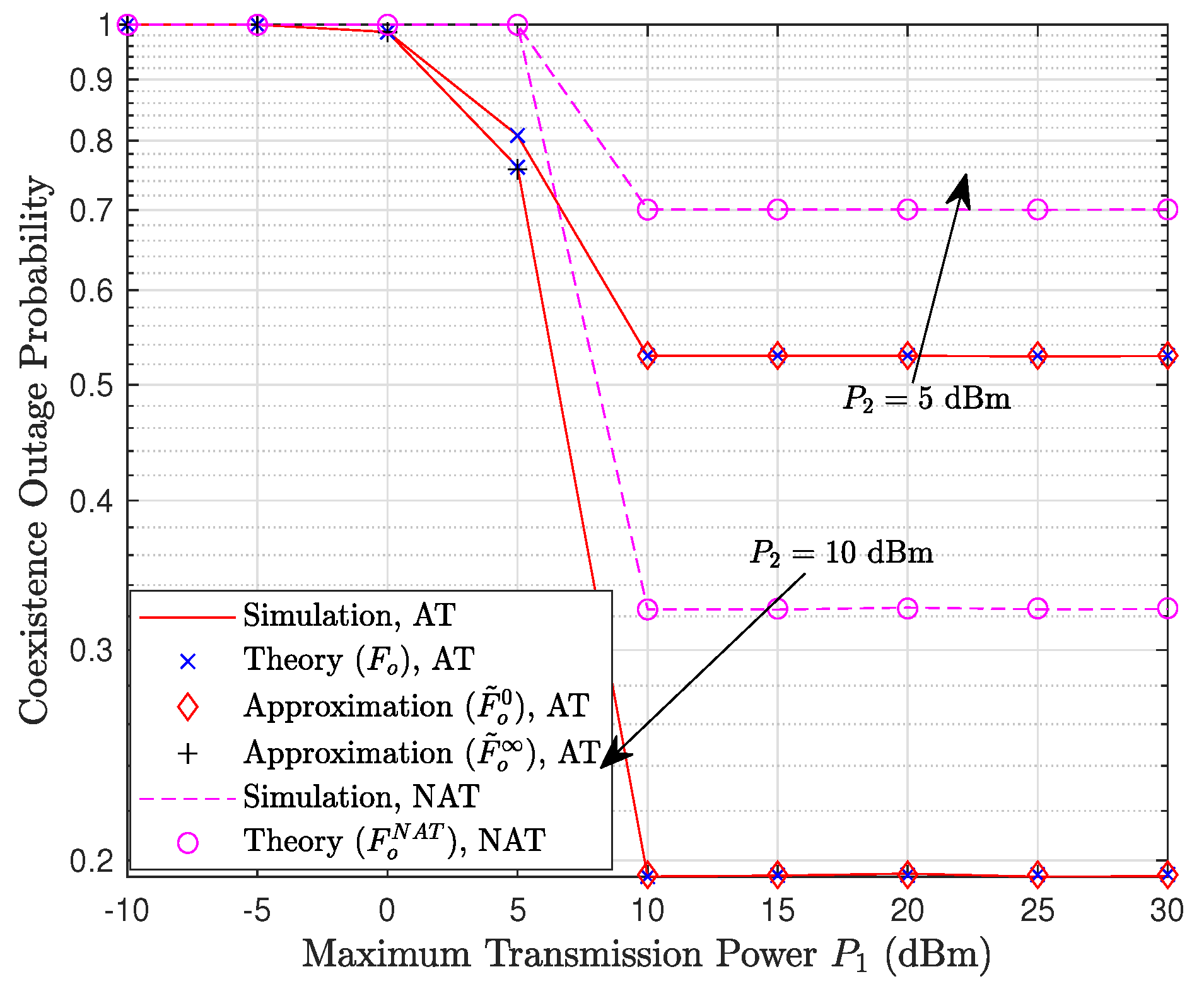
Figure 3 portrays the influence of the maximum transmission power and interference power on the COP under the AT and NAT scenarios. It is clear that the proposed AT scheme outperformed the NAT one in terms of COP. This is because unlike the NAT scheme, the zeRIS in our proposed AT scheme still performed a reflecting operation when the harvested energy was insufficient for PA. Furthermore, it was observed that the COP exhibited a non-increasing trend with increasing or . This can be explained by the following:
Figure 3.
COP versus maximum transmission power.
- (i)
- (ii)
- Initially, with a small value dBm for , . Consequently, the transmission power equals . As gradually increased, remained true, accompanied by an increasing SNR and thus a decreasing COP.
- (iii)
- However, as exceeded a certain value (e.g., dBm in the case of dBm in our simulation), the power became and remained unchanged even though increased. In that situation, the constant power guaranteed a stable SNR , indicating that the COP had reached its minimum. This observed behavior suggested that additional power failed to enhance reliability further, as elaborated in Remark 3.
Similarly, under conditions of high maximum transmission power , a smaller corresponded to a reduced SNR and thus a higher COP. Moreover, Figure 3 shows that the approximate results (24) and (25) closely matched the exact values (9) in both low-power (i.e., [−10 dBm, 0 dBm]) and high-power (i.e., [10 dBm, 30 dBm]) regions, confirming the accuracy and tightness of our asymptotic COP results.
5.2. Numerical and Simulation Results of EC and EE
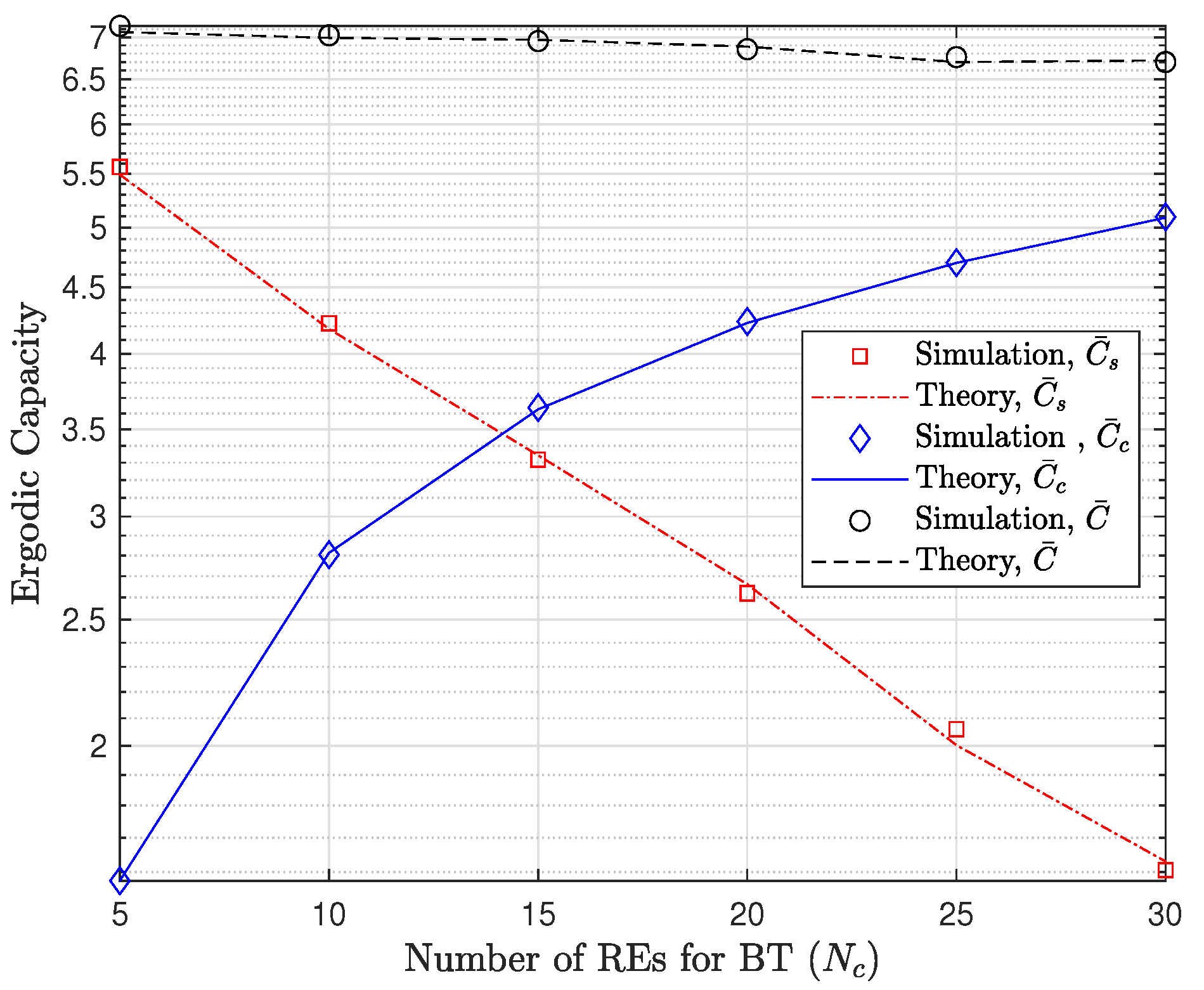
Figure 4 presents the relationship between the ergodic capacity and the number of REs, , when the total number of REs was set to , dBm, and dBm. The plots in Figure 4 reveal that the EC of the backscatter signal (i.e., ) increased with the growth of , while the EC of the BS signal (i.e., ) declined. This dichotomy was attributed to the fact that an increase in led to a reduction in and a corresponding increase in . According to (6) and (7), this shift resulted in a reduced SNR and an increased SNR , which in turn led to a decrease in and a rise in . Remarkably, the opposite trends did not necessarily ensure an increase in the total EC (i.e., ). These observations further highlight the importance of strategically configuring the number of REs for PT and BT to meet predetermined system requirements, while taking into account COP and EC.
Figure 4.
EC versus number of REs for BT, .
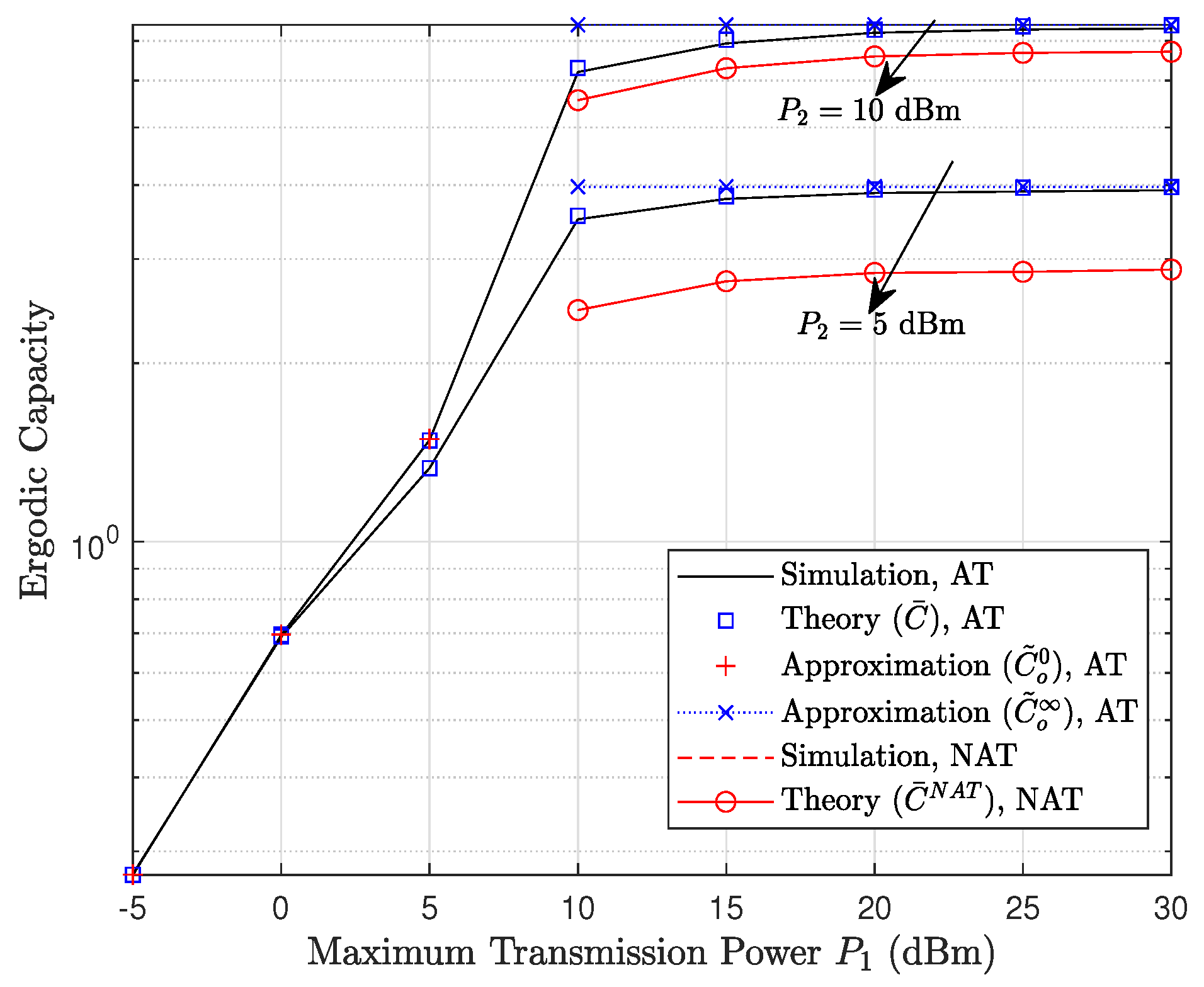
Figure 5 illustrates the impact of the maximum transmission power and interference power on ergodic capacity for both our proposed AT strategy and the NAT counterpart. It can be seen that the EC within the AT framework outperformed that of the NAT one, particularly in the low-power range from −5 dBm to 10 dBm. This superior performance highlights the efficiency of our proposed model over NAT, especially under constrained energy conditions where communication in the AT framework persists while the NAT remains inactive. Furthermore, it was observed that incrementing the transmission power guaranteed a non-decreasing EC . This phenomenon can be attributed to two main factors:
Figure 5.
Ergodic capacity versus maximum transmission power.
- (i)
- (ii)
- As previously analyzed in Figure 3, the transmission power initially increased and then plateaued as rose from −5 dBm to 30 dBm. Consequently, the SNR initially exhibited an upward trend before it stabilized. This sustained SNR resulted in a continuous EC growth until it reached a plateau at a sufficiently high level of (e.g., dBm in the case of dBm), which aligned with the explanation provided in Remark 3.
Additionally, in line with the analysis of the effect of on EC, Figure 5 confirms that an increase in interference power corresponds to a larger EC. Moreover, Figure 5 validates both the precision of our theoretical results (32) and the robustness of our asymptotic results (50) and (51).
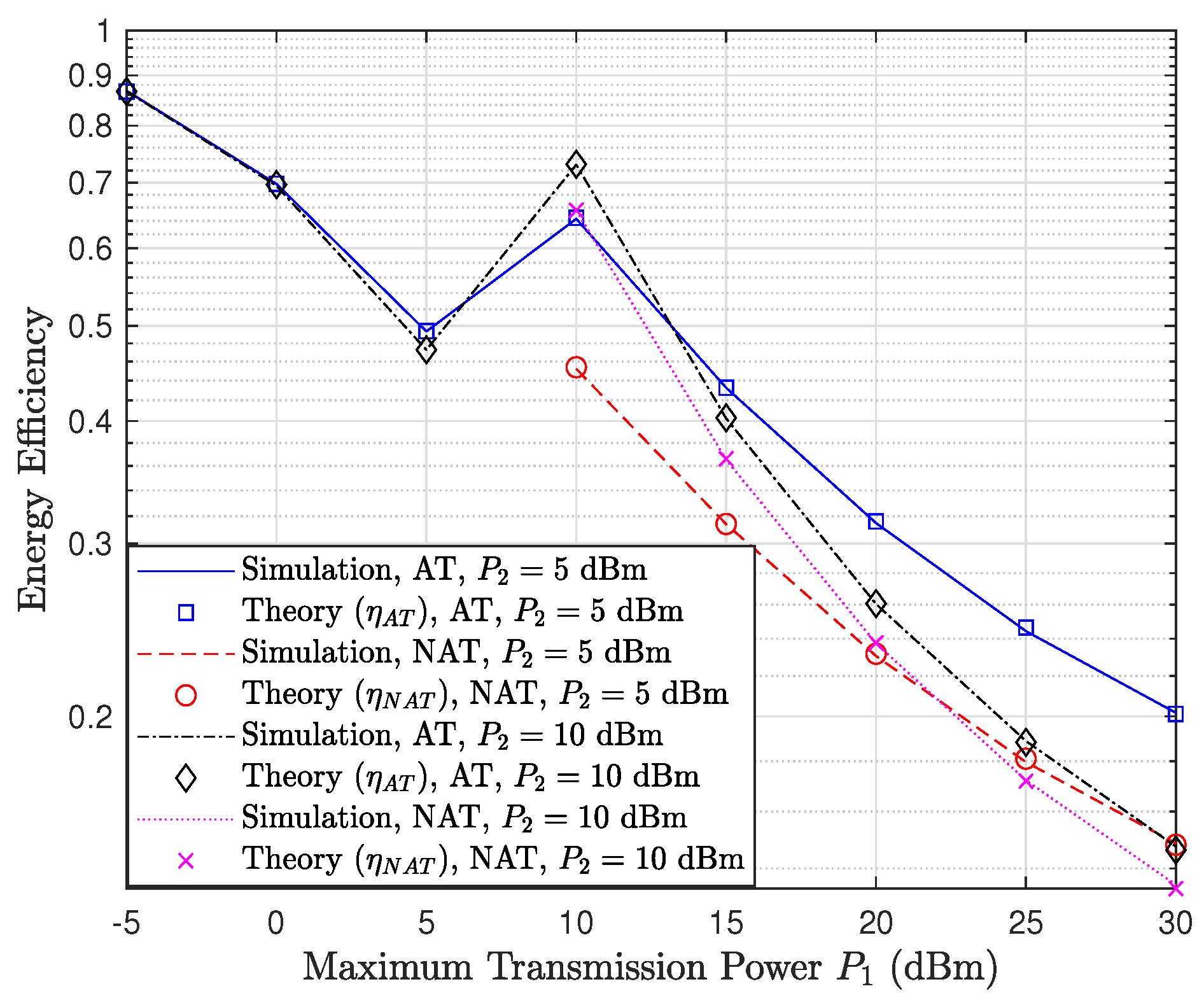
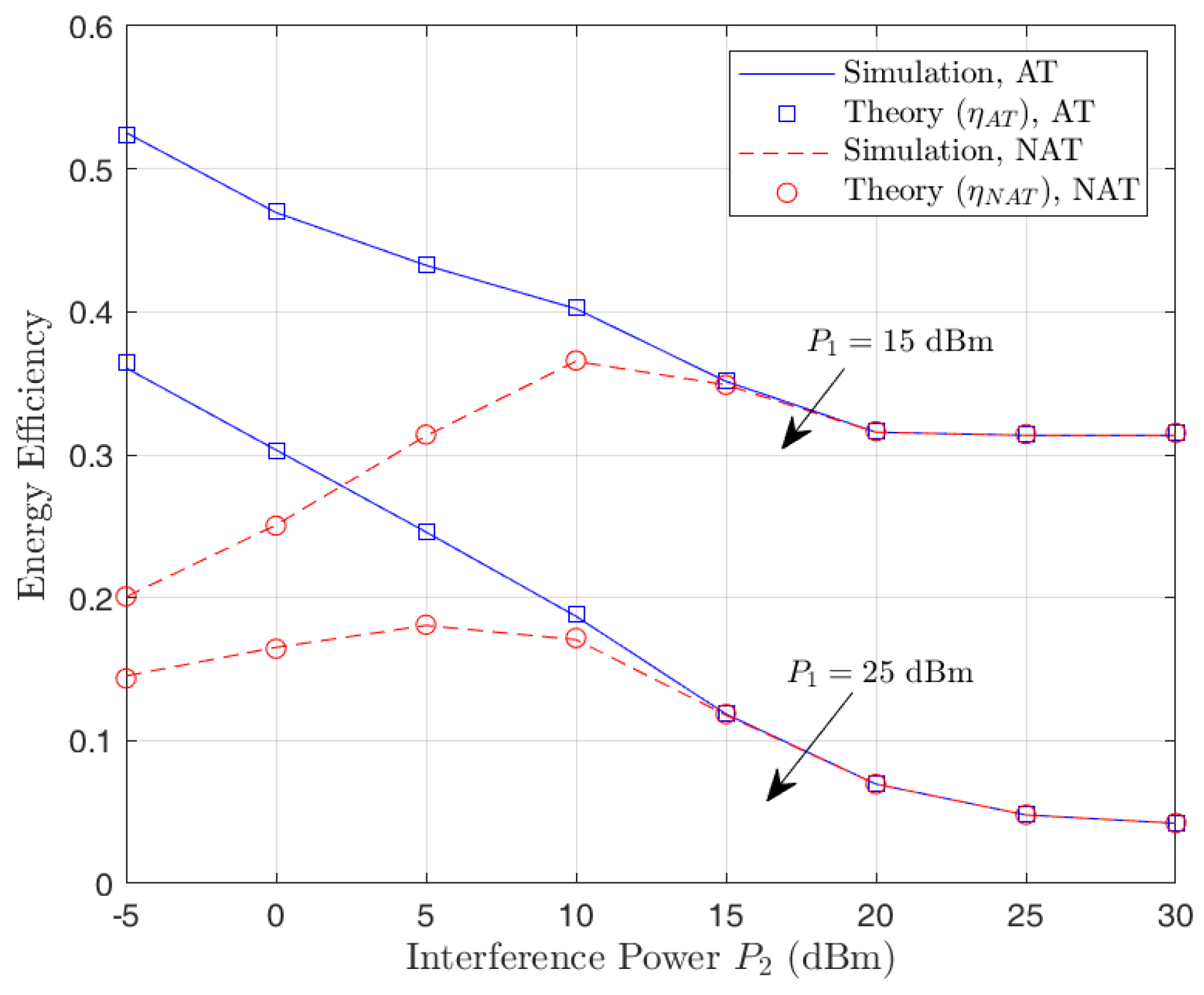
Figure 6 and Figure 7 offer a comparative analysis of energy efficiency between the AT and NAT mechanisms. These two figures clearly exhibit the substantial boost in EE achieved by our AT approach over NAT within the realm of low-to-moderate power settings, corresponding to [−5 dBm, 10 dBm] in Figure 6 and Figure 7, which was attributed to . In addition, when is significantly large or tends towards infinity, it indicated that the BS could function independently of the CR support during signal transmission. Thus, it was considered that the performance curve without CR assistance aligned with the one corresponding to levels ranging from 25 dBm to 30 dBm. This observation allowed us to conduct a preliminary evaluation of the EE performance in both CR-aided and non-CR-assisted scenarios. Figure 7 illustrates that our proposed AT scheme achieved equal or higher EE compared to the AT approach without CR aid. Additionally, it is noteworthy that the EE under NAT with CR help did not consistently outperform that of NAT without CR assistance, as illustrated by the curve marked with “o” in the case of dBm. This finding further emphasized the superiority of our proposed model over both AT without CR support and NAT in terms of EE enhancement. This advantage was due to CR-assisted transmissions limiting the BS transmission power to the lower of and , and the zeRIS in AT continuing to operate even when there was insufficient energy for PA.
Figure 6.
Energy efficiency versus maximum transmission power.
Figure 7.
Energy efficiency versus interference power.
6. Conclusions
This paper designed a novel symbiotic AmBC architecture that integrated CR technology with a segmented zeRIS. A key feature of our system was the PA capability of the zeRIS, which operated based on real-time energy harvesting conditions, thereby striking a dynamic balance between energy management and signal transmission. Furthermore, the zeRIS boasted the flexibility to configure the number of REs for PT and BT. To thoroughly assess the reliability and effectiveness of our proposed system model, the COP and EC were derived, analyzing their asymptotic performance under varying transmission power levels. Simulation results substantiated the accuracy and tightness of our theoretical derivations and revealed a diversity order of zero at high maximum transmission powers. Moreover, achieving the desired system performance necessitated a reasonable allocation of REs between PT and BT. Notably, the presented AT scheme exhibited superiority over NAT in COP, EC, and EE. Additionally, the CR-enabled AT outperformed AT without CR support in terms of EE, highlighting the benefits of incorporating CR capabilities into our system.
Author Contributions
Conceptualization, W.Z. and G.W.; methodology, J.Z.; validation, W.Z., J.G. and Y.G.; writing—original draft preparation, W.Z. and N.L.; writing—review and editing, C.T. All authors have read and agreed to the published version of the manuscript.
Funding
This research was funded by the fund of National Key R&D Program of China and Shandong Province under Grant 2021YFB3901300.
Data Availability Statement
The complete research data produced within the study are contained within this article.
Conflicts of Interest
The authors declare no conflicts of interest. The funders had no role in the design of the study; in the collection, analyses, or interpretation of data; in the writing of the manuscript; or in the decision to publish the results.
Appendix A
For , , and , we have
where (A1) is achieved by applying integration by parts and the derivative , and (A2) is obtained by adopting , L’Hôpital’s rule, Equation (3.351.4) in [23], and Equation (8.359.1) in [23].
References
- ITU. Available online: https://www.itu.int/dms_pubrec/itu-r/rec/m/R-REC-M.2160-0-202311-I!!PDF-E.pdf (accessed on 28 October 2024).
- Park, J.; Jang, C.; Lee, J.H. Outage Analysis of Underlay Cognitive Radio Networks with Multihop Primary Transmission. IEEE Commun. Lett. 2016, 4, 800–803. [Google Scholar] [CrossRef]
- Liang, Y.-C.; Zhang, Q.; Larsson, E.G.; Li, G.Y. Symbiotic Radio: Cognitive Backscattering Communications for Future Wireless Networks. IEEE Trans. Cogn. Commun. Netw. 2020, 12, 1242–1255. [Google Scholar] [CrossRef]
- Liang, Y.-C.; Zhang, Q.; Wang, J.; Long, R.; Zhou, H.; Yang, G. Backscatter Communication Assisted by Reconfigurable Intelligent Surfaces. Proc. IEEE 2022, 9, 1339–1357. [Google Scholar] [CrossRef]
- Kishore, R.; Gurugopinath, S.; Sofotasios, P.C.; Muhaidat, S.; Al-Dhahir, N. Opportunistic Ambient Backscatter Communication in RF-Powered Cognitive Radio Networks. IEEE Trans. Cogn. Commun. Netw. 2019, 6, 413–426. [Google Scholar] [CrossRef]
- Li, X.; Zhang, J.; Han, C.; Hao, W.; Zeng, M.; Zhu, Z.; Wang, H. Reliability and Security of CR-STAR-RIS-NOMA-Assisted IoT Networks. IEEE Internet Things J. 2024, 9, 27969–27980. [Google Scholar] [CrossRef]
- Abdelaziz, S.A.; Ismail, M.H.; Ibrahim, A.S. Securing Full-Duplex Cognitive Radio with Reconfigurable Intelligent Surfaces via Coordinated Beamforming and Power Control. IEEE Open J. Commun. Soc. 2024, 7, 4764–4777. [Google Scholar] [CrossRef]
- Yang, H.; Ding, H.; Cao, K.; Elkashlan, M.; Li, H.; Xin, K. A RIS-Segmented Symbiotic Ambient Backscatter Communication System. IEEE Trans. Veh. Technol. 2024, 1, 812–825. [Google Scholar] [CrossRef]
- Wen, Z.; Ding, H.; Elkashlan, M.; Yuen, C.; Moualeu, J.M.; Liu, J.; Xin, K.; Yang, C. Outage Analysis for a STAR-RIS-Segmented Symbiotic Backscatter NOMA System. IEEE Trans. Commun. 2024, 5, 1–15. [Google Scholar] [CrossRef]
- Liu, M.; Peng, H.; Zhang, P.; Zeng, M.; Zhu, Z.; Boulogeorgos, A.-A.A.; Dev, K.; Li, X. RIS-Segmented Symbiotic Covert Cooperative Backscatter Communication Systems. IEEE Trans. Veh. Technol. 2024, 9, 1–5. [Google Scholar] [CrossRef]
- Liu, J.; Ding, H.; Elkashlan, M.; Chen, W.; Wang, S.; Sun, T. A STAR-RIS-Segmented Symbiotic AmBC System. IEEE Wireless Commun. Lett. 2024, 2, 1379–1383. [Google Scholar] [CrossRef]
- Baluwale, V.; Chandankumar, H.M.; Charan, K.T.; Manjunath, K.; Suhas, S.M.; Kishore, R.; Gurugopinath, S. Intelligent Reflecting Surfaces-Assisted Ambient Backscattering Communication for Cognitive Radios. In Proceedings of the 2023 IEEE International Conference on Advanced Networks and Telecommunications Systems (ANTS), Jaipur, India, 17–20 December 2023; pp. 1–6. [Google Scholar]
- Asiedu, D.K.P.; Yun, J.-H. Multiuser NOMA with Multiple Reconfigurable Intelligent Surfaces for Backscatter Communication in a Symbiotic Cognitive Radio Network. IEEE Trans. Veh. Technol. 2023, 4, 5300–5316. [Google Scholar] [CrossRef]
- Han, S.; Sun, Z.; Xu, S.; Xie, D.; Li, C. Multi-ARIS Backscatter Enabled Downlink NOMA Communication for Cognitive Radio Systems. IEEE Trans. Cogn. Commun. Netw. 2024, 6, 1–15. [Google Scholar] [CrossRef]
- Tyrovolas, D.; Tegos, S.A.; Papanikolaou, V.K.; Xiao, Y.; Mekikis, P.-V.; Diamantoulakis, P.D.; Ioannidis, S.; Liaskos, C.K.; Karagiannidis, G.K. Zero-Energy Reconfigurable Intelligent Surfaces (zeRIS). IEEE Trans. Wireless Commun. 2024, 7, 7013–7026. [Google Scholar] [CrossRef]
- Cao, Q.; Zhang, H.; Shi, Z.; Wang, H.; Fu, Y.; Yang, G.; Ma, S. Outage Performance Analysis of HARQ-Aided Multi-RIS Systems. In Proceedings of the 2021 IEEE Wireless Communications and Networking Conference (WCNC), Nanjing, China, 29 March–1 April 2021. [Google Scholar]
- Shi, Z.; Wang, H.; Fu, Y.; Ye, X.; Yang, G.; Ma, S. Outage Performance and AoI Minimization of HARQ-IR-RIS Aided IoT Networks. IEEE Trans. Commun. 2023, 3, 1740–1754. [Google Scholar] [CrossRef]
- Zhang, Z.; Dai, L.; Chen, X.; Liu, C.; Yang, F.; Schober, R.; Poor, H.V. Active RIS vs. Passive RIS: Which Will Prevail in 6G? IEEE Trans. Commun. 2023, 3, 1707–1725. [Google Scholar] [CrossRef]
- Pei, X.; Wang, X.; Chen, Y.; Pei, T.; Wen, M. AmBC-NOMA-Aided Short-Packet Communication for High Mobility V2X Transmissions. IEEE Wireless Commun. Lett. 2024, 9, 2402–2406. [Google Scholar] [CrossRef]
- Xu, W.; Zhang, J.; Zhang, P.; Tellambura, C. Outage Probability of Decode-and-Forward Cognitive Relay in Presence of Primary User’s Interference. IEEE Commun. Lett. 2012, 8, 1252–1255. [Google Scholar] [CrossRef]
- Lyu, B.; Ramezani, P.; Hoang, D.T.; Gong, S.; Yang, Z.; Jamalipour, A. Optimized Energy and Information Relaying in Self-Sustainable IRS-Empowered WPCN. IEEE Trans. Commun. 2021, 1, 619–633. [Google Scholar] [CrossRef]
- Zhao, W.; Wang, G.; Atapattu, S.; Tsiftsis, T.A.; Tellambura, C. Is Backscatter Link Stronger than Direct Link in Reconfigurable Intelligent Surface-Assisted System? IEEE Commun. Lett. 2020, 6, 1342–1346. [Google Scholar] [CrossRef]
- Gradshteyn, I.S.; Ryzhik, I.M. Table of Integrals, Series and Products, 7th ed.; Academic Press: Burlington, VT, USA, 2007; pp. 1–1220. [Google Scholar]
- TotaKhel, A.M.; Hamdi, K.A. Effects of Hardware Impairments on IRS-Enabled MISO Wireless Communication Systems. IEEE Commun. Lett. 2022, 2, 259–263. [Google Scholar] [CrossRef]
- Zhao, W.; Zhu, J.; She, X.; Wang, G.; Tellambura, C. Ergodic Capacity Analysis for Cooperative Ambient Communication System Under Sensitivity Constraint. IEEE Commun. Lett. 2023, 10, 2822–2826. [Google Scholar] [CrossRef]
- Isheden, C.; Chong, Z.; Jorswieck, E.; Fettweis, G. Framework for Link-Level Energy Efficiency Optimization with Informed Transmitter. IEEE Trans. Wireless Commun. 2012, 8, 2946–2957. [Google Scholar] [CrossRef]
Disclaimer/Publisher’s Note: The statements, opinions and data contained in all publications are solely those of the individual author(s) and contributor(s) and not of MDPI and/or the editor(s). MDPI and/or the editor(s) disclaim responsibility for any injury to people or property resulting from any ideas, methods, instructions or products referred to in the content. |
© 2024 by the authors. Licensee MDPI, Basel, Switzerland. This article is an open access article distributed under the terms and conditions of the Creative Commons Attribution (CC BY) license (https://creativecommons.org/licenses/by/4.0/).