1. Introduction
The millimeter-wave band generally covers 30 to 300 GHz. Since the introduction of fourth-generation (4G) mobile communication, frequencies below 30 GHz have been occupied by military and civilian applications, leaving few frequency resources available. To meet the heightened demand for mobile users and data services driven by the rapid development of mobile Internet and the Internet of Things, the millimeter-wave band has been applied in 5G mobile communications [
1,
2,
3]. Compared to ultrashort waves and microwaves, millimeter waves [
4,
5] offer faster data transmission speeds, larger transmission bandwidths, and delays on the order of a millisecond, all of which have become advantages and technical bases for 5G millimeter waves. However, the characteristics of these high-frequency millimeter waves also introduce significant challenges for 5G technologies.
Wireless communication signals, especially mobile signals, are essential for cities to maintain normal and efficient operations. Urban microcellular environments are the basic application scenarios for transmitting and receiving wireless communication signals. In the millimeter-wave band, the distribution density and roughness of buildings in urban microcellular environments have a significant impact on the distribution of wireless communication signals in cities. The propagation characteristics and models of wireless channels are prerequisites for technology evaluation, equipment development, and the system design and network deployment of mobile communication. The propagation mechanism of the millimeter-wave band differs from that of the lower frequency band. As the millimeter-wave wavelength becomes shorter, the diffraction ability of the radio wave is reduced, and it is vulnerable to extreme weather conditions such as interference from the atmosphere, rainfall, snowfall, and fog, as well as other obstacles. However, the scattering effect is more pronounced in the millimeter wave band (as seen in [
6]). Therefore, conducting research on channel modeling methods based on scattering effects plays an important role in the development of 5G technology. In general, there exist two methods for channel modeling. One is the statistical model [
7,
8,
9] based on experimental data, which offers the advantages of easy and fast calculation but is hindered by poor prediction accuracy. Experiments must be conducted for various scenarios, and a large amount of experimental data must be acquired at an early stage. The other method is the deterministic model based on theory, which offers the advantages of high accuracy across a wide variety of application scenarios but is hindered by long calculation times and poor efficiency. Considering the very complex and diverse application scenarios of 5G, it takes considerable human and material resources to carry out complete statistical modeling. Therefore, conducting research on deterministic radio wave propagation methods in the millimeter wave is the key to performing multi-scene 5G channel modeling.
At present, the main deterministic models are the PE and RT [
10,
11,
12]. RT can clearly portray the propagation trajectory of electric waves and provide a powerful and intuitive tool for the study of propagation characteristics. The PE can portray the spatial distribution of the field of electromagnetic wave propagation, which facilitates the reasonable planning of system design and network layout according to the field distribution.
Both methods offer distinct advantages in the study of electric wave propagation and have received considerable attention. There have been a number of studies on the use of the three-dimensional PE [
13,
14,
15,
16] to calculate the propagation characteristics of electromagnetic waves through buildings. The characteristics of the field distribution through a single building were analyzed by Levy using a scalar three-dimensional PE model in 1992 [
17]. In 1996, Zaporozhets and Levy introduced the finite difference (FD) method to the solution of the three-dimensional PE. However, it is more difficult to apply this method in real-world scenarios with multiple buildings [
18]. In 1999, Zelley et al. proposed the topographic boundary conditions of the three-dimensional PE and calculated the PE using the FD method [
19]. In 1999, Zaporozhets proposed a strict three-dimensional vector PE model based on the FD method to solve the problems in the calculation of bistatic RCS for electric large-scale targets and urban wave propagation [
20]. In 2003, Janaswamy elaborated the split-step Fourier transform (SSFT)-based algorithm for solving simple urban radio wave propagation characteristics using the three-dimensional PE in a single lossy medium for the first time [
21]. Huibin et al. used the scalar three-dimensional PE method to calculate the wave propagation characteristics of single and multirow buildings based on the SSFT on flat terrain in 2006 [
22]. In 2017, El Ahdab et al. considered the bidirectional propagation of the three-dimensional vector PE on flat terrain with peaks and irregular terrain comprising hills [
23]. In 2018, Rasool et al. applied a 3DPE method to calculate the propagation factor over the flat terrain [
24]. In 2019, Rasool et al. used a 3DPE method to calculate the field strength due to the forest on a lossy ground [
25]. In 2022, Wang Zhiyi et al. proposed a scheme of ground clutter simulation based on the 3DPE model in simple urban environments [
14]. However, only simple urban environments and terrain are computed using three-dimensional PE.
A number of studies have calculated the scattering effects of buildings. In 1999, Degli-Esposti proposed an effective roughness model to show that scattering effects are important for both received power and channel dispersion in various situations [
26]. In 2001, Degli-Esposti [
27] proposed a method based on the Lambertian model to simulate the scattering of buildings in urban wireless propagation environments. In 2007, Degli-Esposti et al. [
28] conducted experiments which were compared with RT, specifically, a fusion of the Lambertian or directive models. The results showed that the simulations agree well with the measurements when a suitable directive model is used. In 2011, Mani et al. [
29] examined the prediction accuracy of an advanced deterministic model for the depolarization of the channel and frequency selectivity in an indoor wireless propagation channel. Their results showed that RT, which considers the directive pattern model, significantly improved the prediction accuracy of path loss and cross-polarization discrimination, as well as the prediction of delay spread. In 2012, Mani et al. [
30] compared the RT method including the directive scattering pattern model with experimental data and showed that upon including diffuse scattering, it was able to reproduce the angular spread of dense multipaths with an error of approximately 4° to 20°. Later, Vitucci et al. [
31] added a Lambertian model to the RT method, which was compared with the post-processed data, and their results showed that diffuse scattering is a key component of the received power. In 2014, Mani et al. [
32] developed a polarized diffuse scattering model based on the effective roughness model. In 2015, Pascual-Garcia et al. [
33] proposed that choosing the appropriate parameter values for the effective roughness model could improve the accuracy of evaluating the power delay distribution at 60 GHz. In 2017, Navarro et al. [
34] added a Lambertian model to the RT method to calculate the total electric field for horizontal and vertical polarizations. In 2021, Yaman et al. [
35] accounted for the directive diffuse scattering model. In 2022, Andani et al. [
36] proposed an empirical diffuse scattering in RT. In 2023, Chizhik et al. [
37] set diffuse scattering to a value. Therefore, the scattering effect is crucial. However, the traditional RT emits a lot of rays. When the surrounding environment is more complex, the traced rays will frequently be reflected, diffracted, or scattered in RT, which results in considerable time being consumed in evaluating their traces and calculating the electric field. As a result, the calculation efficiency is very low.
The single deterministic model is inadequate in modeling radio wave propagation in the millimeter wave. Therefore, it is necessary to study the scattering effect and the fusion of RT and the PE. A method is proposed in this study—namely, the proposed 3DFPHPCM—based on three-dimensional RT and a three-dimensional PE. The method takes the scattering effect into account and introduces the end field of the three-dimensional vector PE to the initial field of three-dimensional RT that can reduce the number of transmitting rays and improve the accuracy of the single deterministic model.
The structure of the remainder of this paper is as follows. In
Section 2, the relevant propagation modeling theory is introduced. In
Section 3, a hybrid propagation channel model based on three-dimensional RT and the three-dimensional vector PE is presented. In
Section 4, the millimeter-wave channel measurement at 39 GHz in urban microcellular environments is described. In
Section 5, the hybrid propagation channel model is analyzed. Finally, the conclusions are presented in
Section 6.
4. Millimeter-Wave Channel Measurement at 39 GHz
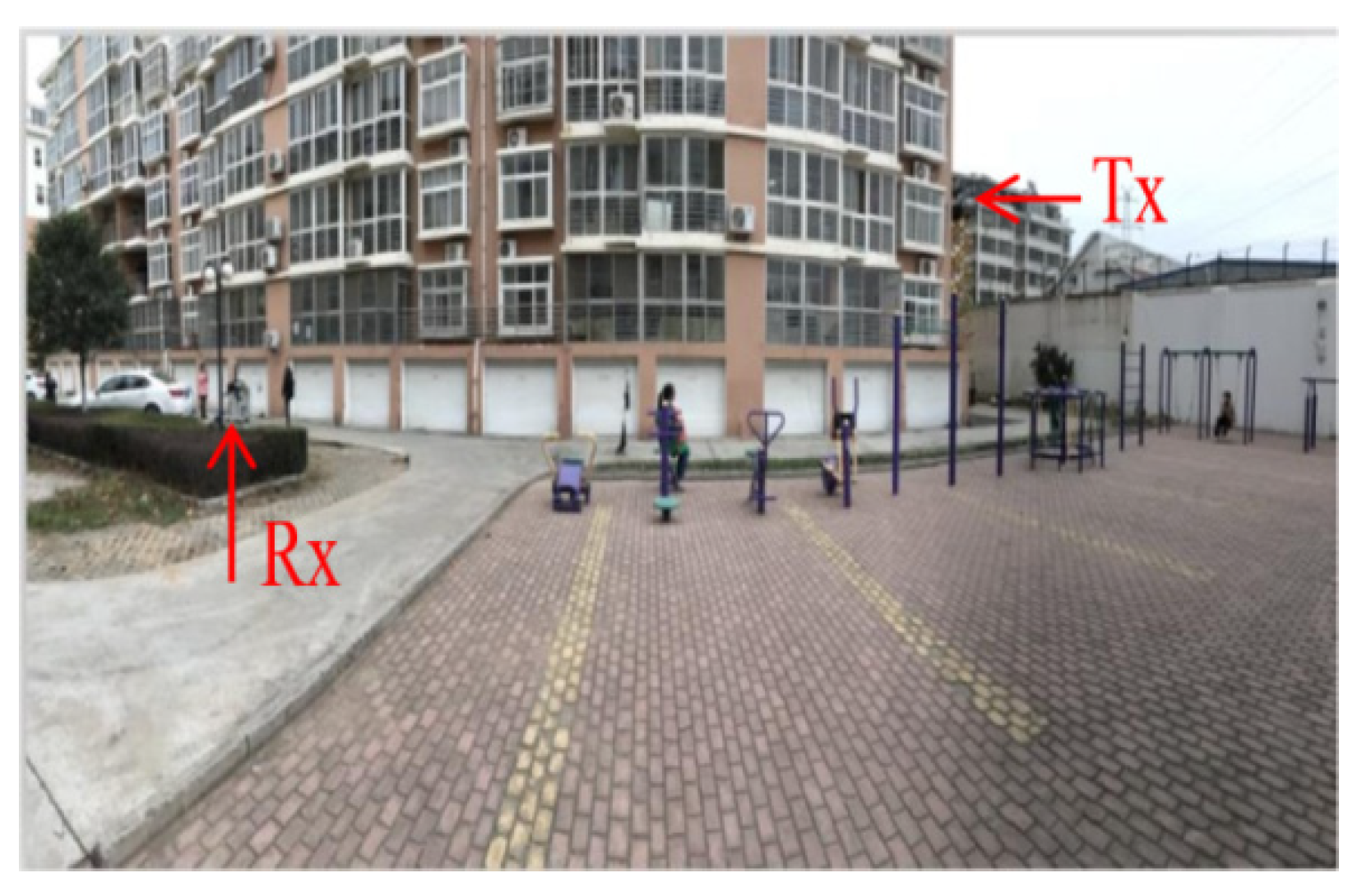
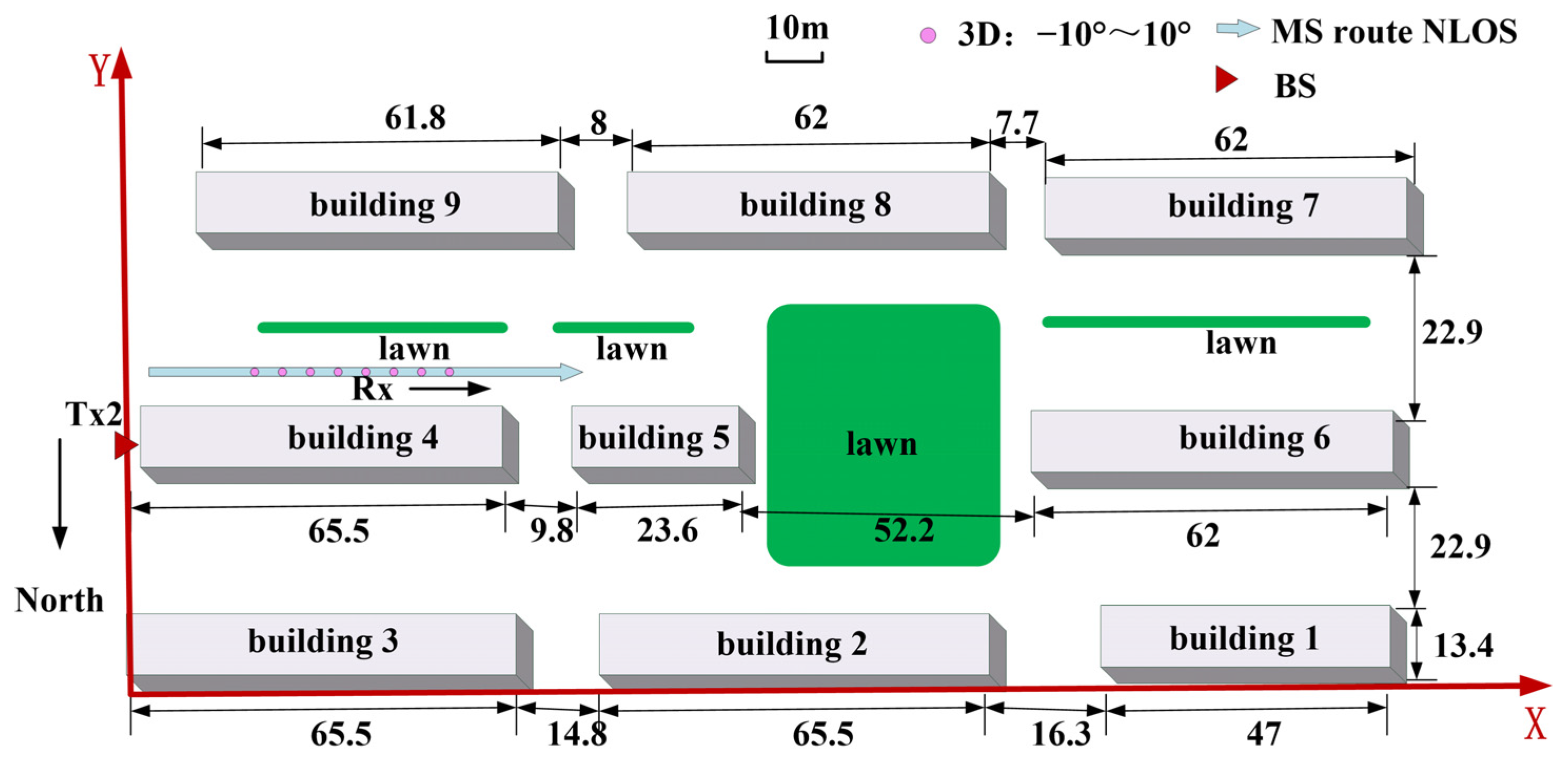
The channel measurements in NLOS environments were conducted in the urban microcellular environments of Qingdao, China, as shown in
Figure 2.
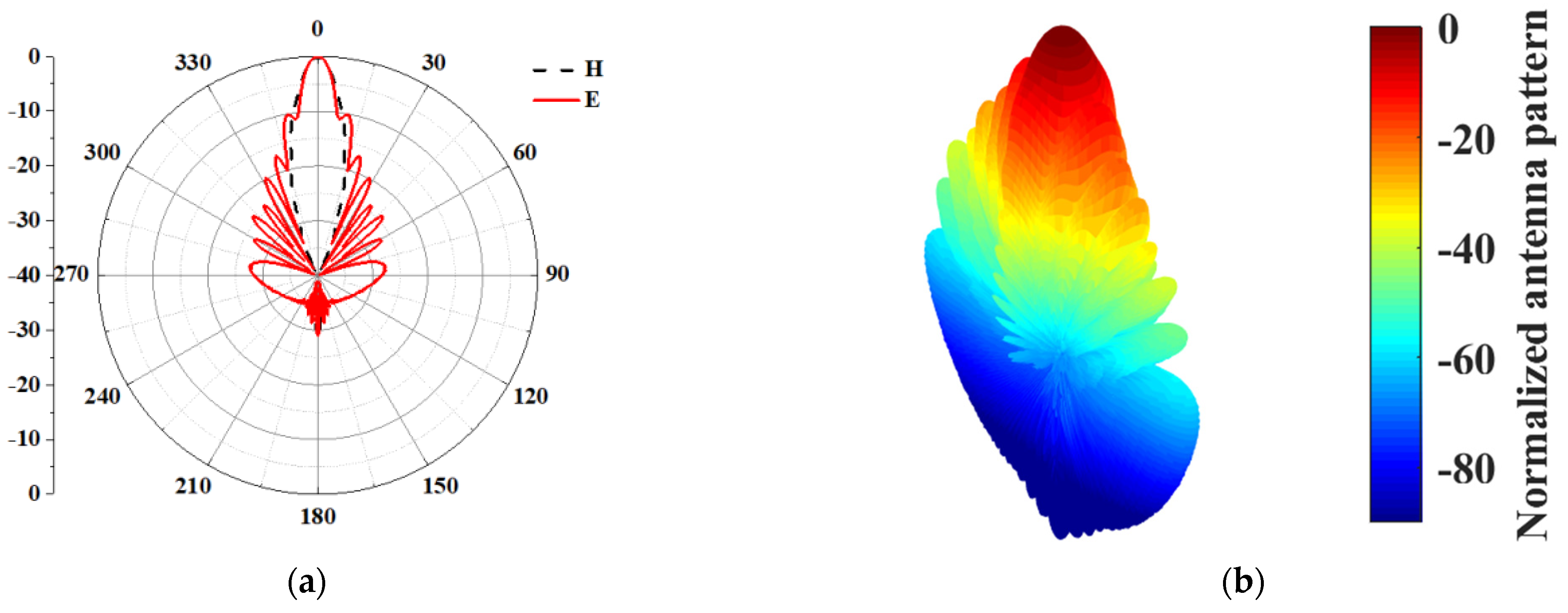
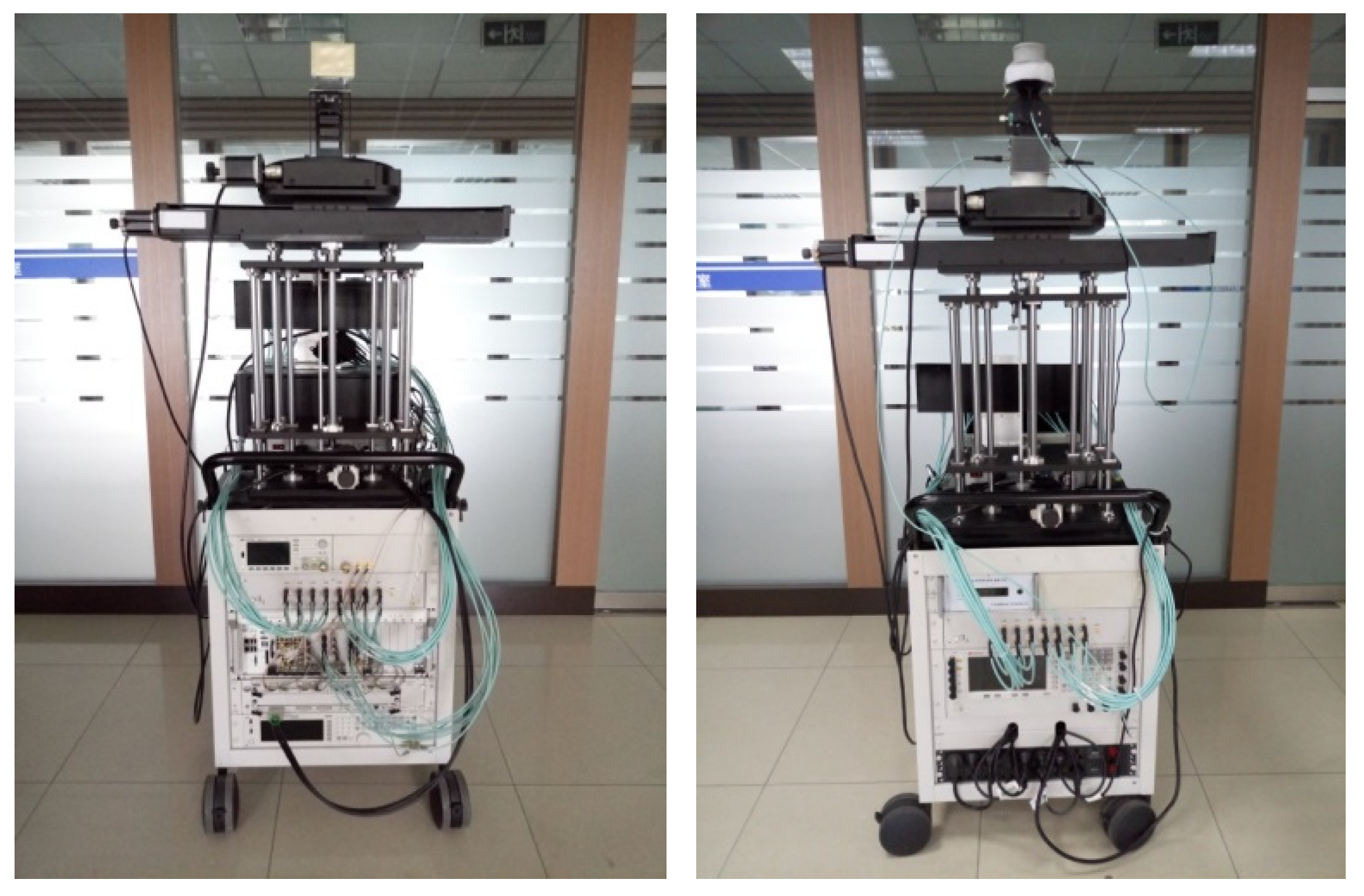
An omnidirectional antenna was used at the transmitter (Tx), with an operating frequency of 26.5–40 GHz. Moreover, the receiver (Rx) adopted a horn antenna (as shown in
Figure 3) and its operating frequency was also 26.3–40 GHz. The MIMO channel measurement system is shown in
Figure 4. The relevant measurement parameters are shown in
Table 1.
The specific measurement process is shown in
Figure 5. During measurement, Tx was fixed, and its coordinates were (2.9, 54.7, 9). A total of 10 points were selected for Rx, which was moved in increments of five meters along the gray line, namely, y = 62.9, z = 1.5, x = (10, 15, 20, 25, 30, 35, 40, 45, 50, and 55). Moreover, Rx was moved in the horizontal and vertical directions using a rotary table at each receiving point. In
Figure 5, the 3D label indicates experimental data where the azimuth and elevation angles were measured, and the 2D label indicates experimental data where only the elevation angle was 0° and azimuth angles were measured at 5° intervals. The solid red lines represent the
x-axis (along the direction of the building length) and the
y-axis (along the direction of the building width), and the
z-axis is measured along the direction of the building height. Moreover, the green lines represent the lawn. The power transmitted by the Tx is 0 dBm, the measurement bandwidth is 1 GHz, and both Tx and Rx are vertically polarized.
The 3D measurements were performed for azimuth angles at 5° intervals and elevation angles at −10°, 0°, 10°, 20°, and 30° at the receiving end when the receiving antenna was very close to the transmitting antenna. The farther the receiving antenna is from the transmitting antenna, the smaller the effect of the elevation angle on the path loss. Therefore, these data were collected for azimuth angles of every 5° and elevation angles of −10°, 0°, and 10° at the Rx in NLOS environments. The complex relative permittivity of the wall is , which is taken from the reference literature.