Review

Advancements and Challenges in Machine Learning: A Comprehensive Review of Models, Libraries, Applications, and Algorithms


Department of Electrical and Computer Engineering, Florida International University, Miami, FL 33174, USA
*
Authors to whom correspondence should be addressed.
Electronics 2023, 12(8), 1789; https://doi.org/10.3390/electronics12081789

Submission received: 16 February 2023 / Revised: 29 March 2023 / Accepted: 5 April 2023 / Published: 10 April 2023
(This article belongs to the Special Issue Feature Papers in Computer Science & Engineering)

Abstract

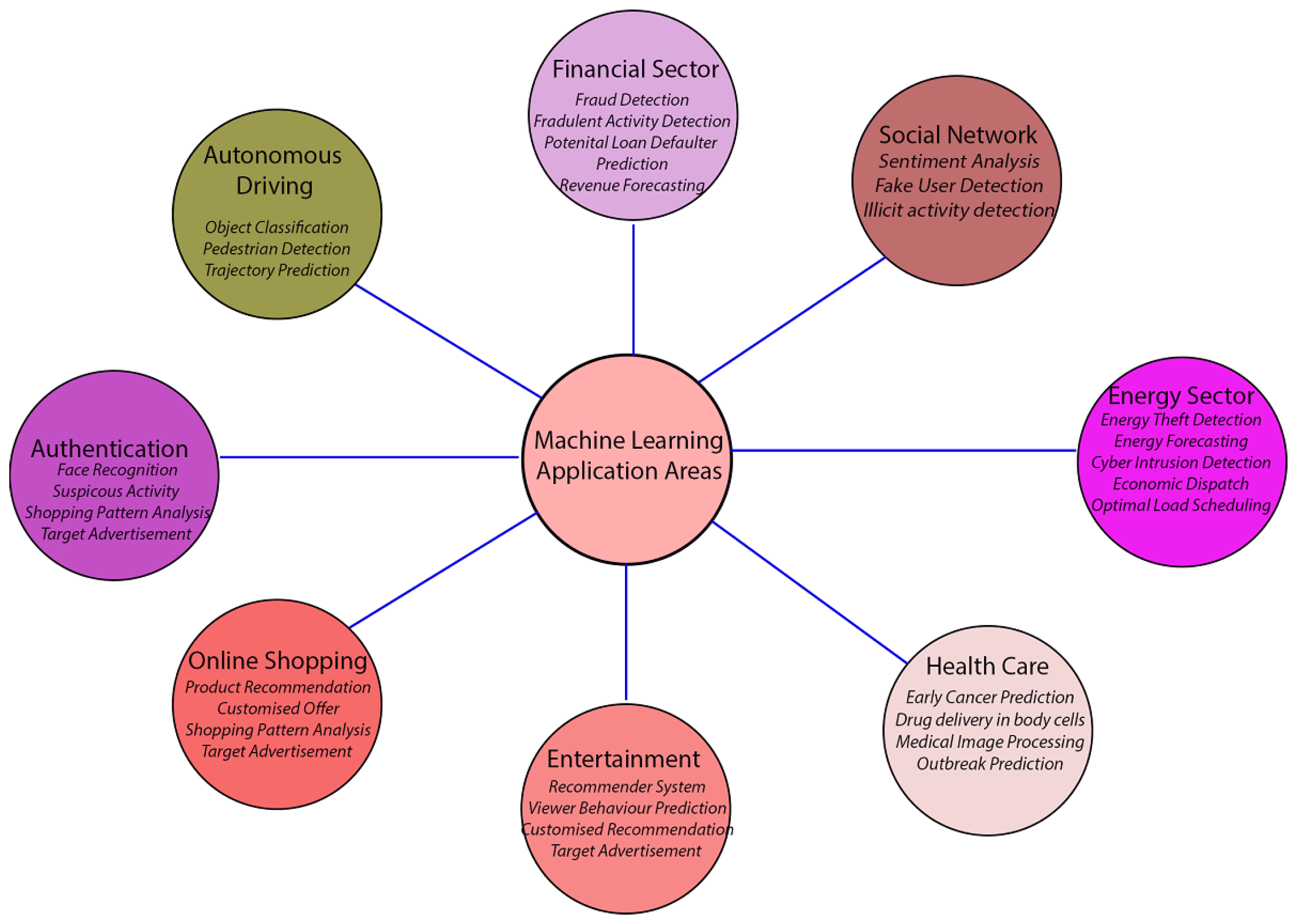
In the current world of the Internet of Things, cyberspace, mobile devices, businesses, social media platforms, healthcare systems, etc., there is a lot of data online today. Machine learning (ML) is something we need to understand to do smart analyses of these data and make smart, automated applications that use them. There are many different kinds of machine learning algorithms. The most well-known ones are supervised, unsupervised, semi-supervised, and reinforcement learning. This article goes over all the different kinds of machine-learning problems and the machine-learning algorithms that are used to solve them. The main thing this study adds is a better understanding of the theory behind many machine learning methods and how they can be used in the real world, such as in energy, healthcare, finance, autonomous driving, e-commerce, and many more fields. This article is meant to be a go-to resource for academic researchers, data scientists, and machine learning engineers when it comes to making decisions about a wide range of data and methods to start extracting information from the data and figuring out what kind of machine learning algorithm will work best for their problem and what results they can expect. Additionally, this article presents the major challenges in building machine learning models and explores the research gaps in this area. In this article, we also provided a brief overview of data protection laws and their provisions in different countries.
Keywords: machine learning; artificial intelligence; neural network; auto encoder; support vector machine; regression; classification; object detection; supervised training; random forest; decision tree machine learning; artificial intelligence; neural network; auto encoder; support vector machine; regression; classification; object detection; supervised training; random forest; decision tree