You are currently viewing a new version of our website. To view the old version click .
Electronics
  • Article
  • Open Access

18 September 2023

A Knowledge-Graph-Driven Method for Intelligent Decision Making on Power Communication Equipment Faults

,
,
,
and
1
College of Artificial Intelligence, Tianjin University of Science & Technology, Tianjin 300457, China
2
Beijing Zhongdian Feihua Communication Co., Ltd., Beijing 100070, China
3
Electric Power Scientific Research Institute, State Grid Tianjin Power Company, Tianjin 300450, China
*
Author to whom correspondence should be addressed.
This article belongs to the Topic AI-Enabled Sustainable Computing for Digital Infrastructures: Challenges and Innovations

Abstract

The grid terminal deploys numerous types of communication equipment for the digital construction of the smart grid. Once communication equipment failure occurs, it might jeopardize the safety of the power grid. The massive amount of communication equipment leads to a dramatic increase in fault research and judgment data, making it difficult to locate fault information in equipment maintenance. Therefore, this paper designs a knowledge-graph-driven method for intelligent decision making on power communication equipment faults. The method consists of two parts: power knowledge extraction and user intent multi-feature learning recommendation. The power knowledge extraction model utilizes a multi-layer bidirectional encoder to capture the global features of the sentence and then characterizes the deep local semantics of the sentence through a convolutional pooling layer, which achieves the joint extraction and visual display of the fault entity relations. The user intent multi-feature learning recommendation model uses a graph convolutional neural network to aggregate the higher-order neighborhood information of faulty entities and then the cross-compression matrix to solve the feature interaction degree of the user and graph, which achieves accurate prediction of fault retrieval. The experimental results show that the method is optimal in knowledge extraction compared to classical models such as BERT-CRF, in which the F1 value reaches 81.7%, which can effectively extract fault knowledge. User intent multi-feature learning recommendation works best, with an F1 value of 87%. Compared with the classical models such as CKAN and KGCN, it is improved by 5%~11%, which can effectively solve the problem of insufficient mining of user retrieval intent. This method realizes accurate retrieval and personalized recommendation of fault information of electric power communication equipment.

1. Introduction

1.1. Background

With the development of economic society and information technology, the stable supply of power resources directly affects people’s daily life and production activities. A power communication system is an important support facility for power grid production and control operations. The stable operation of power communication equipment plays a decisive role in improving the reliability of power grid operation. Within the construction process of the digital smart grid, a massive amount of electric power communication equipment is deployed inside and outside the grid, which realizes the digital interaction of the physical space–information space of the grid [1]. The deployment of massive power communication devices and the expansion of distribution scenarios bring enormous challenges for smart grid operation and maintenance. Failure of power communication equipment leads to grid interruptions, further affecting the perception and real-time assessment of grid operating conditions [2]. Meanwhile, equipment failures lead to losing control of energy scheduling, distribution and transmission. This poses a serious threat to the operational security of the power system [3]. Therefore, it is urgent to improve the operation and maintenance management of power communication equipment.

1.2. Challenges

Nevertheless, the current maintenance approach for equipment faults primarily relies on periodic inspections and reactive maintenance. This approach leads to increasing maintenance costs and poor timeliness. It cannot meet the needs of smart grid development. Meanwhile, the maintenance process heavily depends on subjective decision making by maintenance personnel. When equipment failure occurs, operation and maintenance personnel need to query all kinds of fault plans, scheduling regulations, distribution network defect library and other text data [4]. This can lead to high time costs, inefficient implementation and no guarantee of accuracy. Furthermore, the massive amount of power communication devices leads to an exponential growth of fault information. Power grid communication equipment typically stores data in unstructured formats, making it difficult for maintenance personnel to extract and utilize the implicit maintenance knowledge related to indicator anomalies, fault occurrences and operational state transitions [5]. These problems make it difficult to locate faults in grid communication equipment and reduce maintenance efficiency. Therefore, there is an urgent need for an effective solution, which effectively filters and structures the massive fault data. Thus, it can accurately locate equipment faults and realize efficient maintenance and fault diagnosis of power equipment.

1.3. The Role of Knowledge Graphs

A knowledge graph (KG) is a structured representation of facts. It describes the set of internal associations of entities, entity relationships and semantic descriptions of entities [6]. It is capable of better representing heterogeneous objects and connecting these heterogeneous objects using a unified space, which thereby enables more powerful knowledge representation and knowledge association. KGs are designed to capture various concepts and facts in the real world and to store and retrieve this information in a computable and queryable manner. This helps machines to understand and reason about the world. The KG is an important data structure and information model in the field of artificial intelligence. Google was the first to propose applying knowledge graphs to search engines. The knowledge graph refines vector representation through entity connections, which effectively excavates potential relationships between entities [7]. Applied to intelligent operation and maintenance of power equipment, it exhibits strong knowledge representation capabilities and interpretability. It efficiently integrates data from the entire lifecycle of the equipment, forming a knowledge-driven approach to maintenance management. This not only alleviates the problem of data sparsity in the recommendation process but also makes the results more interpretable [8]. Nguyen et al. [9] utilized the Bio-BERT model for knowledge extraction, which plays an important role in improving the relationship extraction results. Bekouli et al. [10] proposed the multi-head model type, which realizes the joint extraction of entities and relationships by judging each entity with other entities in an effective relationship. Wei et al. [11] proposed the CASREL model to transform knowledge extraction into a mapping task between two entities, which analyzes the types of overlapping entity relationships. Nevertheless, most of the above methods use labeled relationship classification to achieve knowledge extraction. This suffers from the problem of poor interaction of entity relations. In addition, when the sample distribution is not uniform and there are multiple relationships between entities, entity relationship superposition and information redundancy will occur, which leads to poor knowledge extraction.
The incorporation of knowledge graphs as auxiliary information into recommender systems can improve the interpretability of the system. The mining of multiple connectivity relationships between users and entities from knowledge graphs is performed in order to construct recommendation algorithms using heterogeneous information. Liang et al. [12] utilized a bilateral branching network to trade off the diversity and accuracy of recommendation lists and avoid the singularity of recommendation lists. Jin et al. [13] enhanced sequence recommendation by utilizing knowledge-indexed interaction sequences to enhance the representation of capturing complex entity preferences. However, the above algorithms for knowledge-graph-assisted recommendation are mainly based on embedding propagation. This leads to the underutilization of structural information in the knowledge graph and also neglects the fusion of multiple features [14,15]. At the same time, they are not guaranteed to capture long-distance node dependencies and have difficulty interpreting higher-order semantic relationships between entities for recommendation. In domain knowledge graph research, it is still a challenge to accurately achieve joint extraction of entity relationships. Meanwhile, there are still research difficulties in realizing user intent recommendation based on domain knowledge graphs using multi-feature higher-order interaction learning.

1.4. Contributions

To address the limitations of existing methods, this paper proposes a knowledge-graph-based fault diagnosis method for power communication equipment. The method includes two parts: power knowledge extraction and user intent multi-feature learning recommendation (MFLR). The power knowledge extraction method uses a multi-layer bidirectional encoder to capture the global features of the sentence and characterizes the deep local semantics of the sentence through the convolutional pooling layer, which achieves the joint extraction and visual display of the fault entity relationships. The user intent multi-feature learning recommendation method uses a graph convolutional neural network to aggregate the higher-order neighborhood information of faulty entities and solves the feature interaction degree of the user and graph through a cross-compression matrix, which achieves accurate prediction of fault retrieval.
The contributions are as follows:
  • The paper proposes a knowledge extraction method that enables joint extraction of erroneous entity relationships to obtain structured fault knowledge.
  • The paper reconstructs the knowledge ontology layer of power communication equipment faults and relies on fault knowledge, which enables the visual display of fault data.
  • The paper designs a user intent multi-feature recommendation method, which realizes accurate prediction and personalized recommendation for user intent fault retrieval.
The rest of the paper is organized as follows. Section 2 focuses on reviewing relevant research. Section 3 introduces the power knowledge extraction model and the user intent multi-feature learning recommendation model. Section 4 is the situational analysis of experimental simulations. Section 5 is a summary and a prospect for the next steps.

3. Methodology

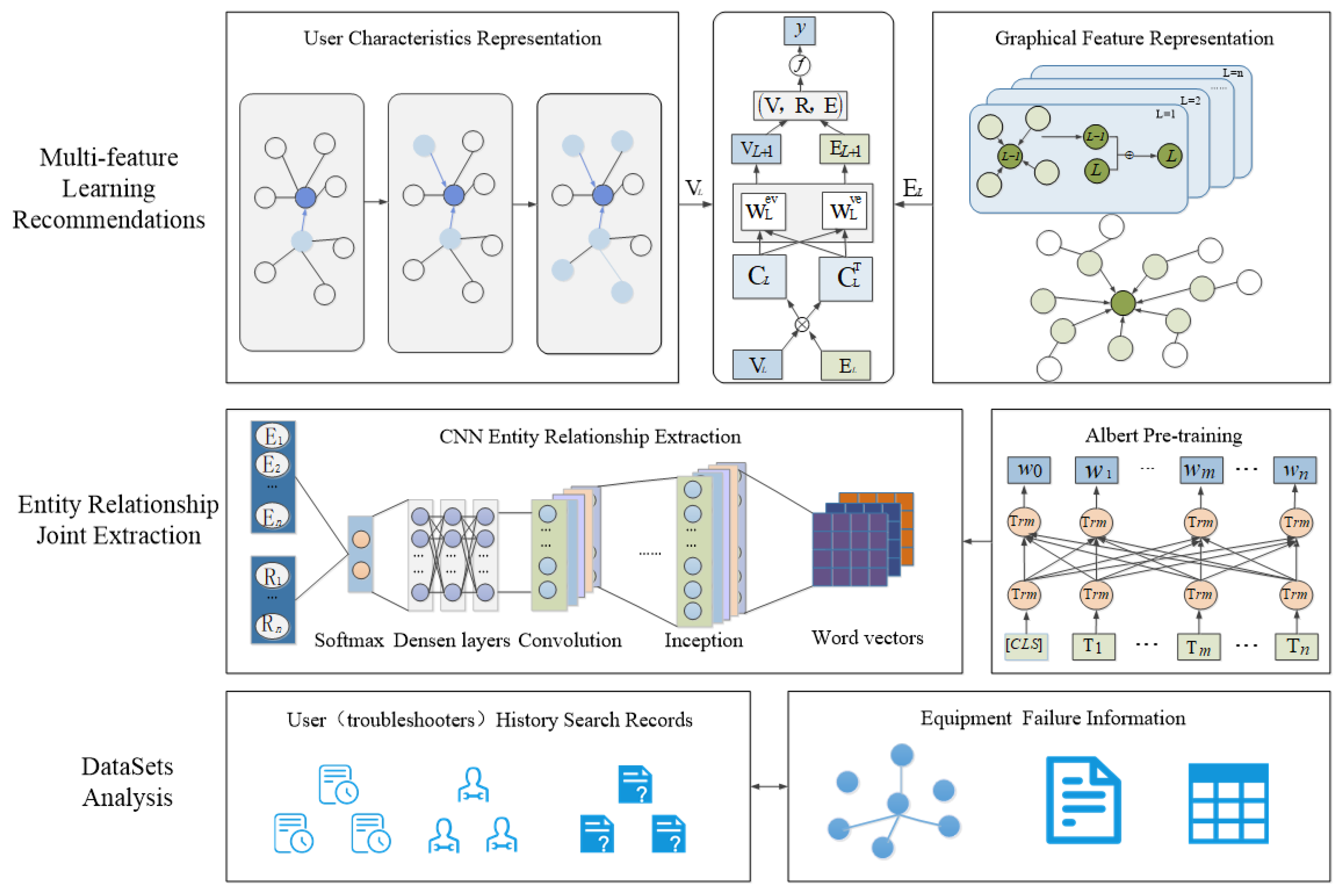
Aiming at the characteristics of complex fault data structure and high correlation of fault information of electric power communication equipment, this paper proposes a knowledge-graph-driven method for intelligent decision making on power communication equipment faults. As shown in Figure 1, the method mainly consists of two parts: power knowledge extraction and user intent multi-feature learning recommendation. In the power knowledge extraction model, the model first generates word vectors using the ALBERT, then captures the dynamic word vector features of sentences in the faulty corpus using a multi-layer bi-directional encoder and finally characterizes the deeper local semantics of the sentences through a convolutional pooling layer. The model achieves joint extraction and visualization of faulty entity relations. In the user intent multi-feature learning recommendation model, firstly, the model uses a preference advancement algorithm to acquire entity association knowledge. Meanwhile, it iteratively learns the user’s latent interests. Secondly, the model uses a graph convolutional neural network to aggregate node neighborhood information to obtain feature representations. Finally, the model automatically shares potential features through cross-compression units to achieve higher-order interactions between users and graph features. The method proposed in the paper achieves accurate prediction for routine fault retrieval. Moreover, the paper analyzes and processes information about faults in power communication equipment. The process involves unstructured processing of equipment faults into the form of short texts as a corpus, breaking and supplementing the longer natural language with manual and expert databases and then labeling the fault entities and relationships in the corpus with sequences.
Figure 1. Overall algorithm structure.

3.1. Preliminaries

3.1.1. Equipment Failure Knowledge Graph

In this paper, knowledge mapping of power communication faults is defined as G = { e i , r i , e i | e 1 , r 1 , e 1 e n , r n , e n }   e , e E , r R , where E is the faulty entity set, R is the set of relationships between faulty entities, e and e represent two different types of faulty entities, and r represents the relationship connecting the entities.

3.1.2. Predictive Function

Suppose there are M users (operations and maintenance personnel who troubleshoot power communications equipment), V = v i | v 1 , v 2 , , v m . Power communication equipment fault data are defined as T = t 1 , t 2 , , t n , and user history retrieval information is defined as H = h 1 , h 2 , , h n . The user v i retrieval problem is defined as   Q v i . The recommended results for different retrieval questions go through the fault data and the user’s history of retrieval records, which more closely matches the user’s retrieval intent. Therefore, the fault retrieval result   P v i for user v i is defined as follows:
  P v i = F T ,   H ,   Q v i

3.1.3. Task Description

The paper tackles two main issues: on the one hand, for the unstructured power communication equipment fault data, how to solve the entity overlapping problem by using the knowledge extraction model proposed in the paper, so as to obtain the fault entity relationship triples more accurately and realize the visual display of fault knowledge, and on the other hand, based on the storage structure of the knowledge graph and the intelligent fault reasoning method, how to display the relevant retrieval results of the fault problem to the user more in line with the user’s retrieval intention and to assist the user in overhauling and troubleshooting the faults of the power communication equipment.

3.1.4. Data Pre-Processing

First, the paper breaks the sentences of the faulty text to be extracted and sets the sentence length of the text to 200 words uniformly. After that, this paper splits and fills in the missing and extra characters in the remaining sentences to unity. Finally, combined with the characteristics of the fault text data of the power communication equipment, the paper divides the labels of the equipment entities according to the type of faulty equipment, reason, treatment plan and identification. We use the BIEO labeling strategy to label each character in the fault sample set and label each element as “B-X”, “I-X”, “E-X” or “O” [48]. “B” represents the beginning of the tagged entity or relationship, “I” represents its middle, “E” represents the end of the tagged entity or relationship, and “O” indicates that the text does not belong to any of the entity and relationship types.
In order to solve the problem of relationship overlap in the joint extraction model, the paper proposes a sequence annotation strategy that considers the overlapping of complex entity relationships, where “OL” is used to mark overlapping relationships. The strategy solves the problem of overlapping relationship extraction in traditional sequence annotation by adding entity relationship categories and enriching entity roles, which realizes accurate prediction of entity and relationship types and effectively improves extraction accuracy. The labels of entity types and relationship categories labeled in this text are shown in Table 3. Examples of pre-labeled data for faulty text are shown in Table 4.
Table 3. Entity type and relationship category labels.
Table 4. Example of training set corpus sample labels.

3.2. Electricity Knowledge Extraction

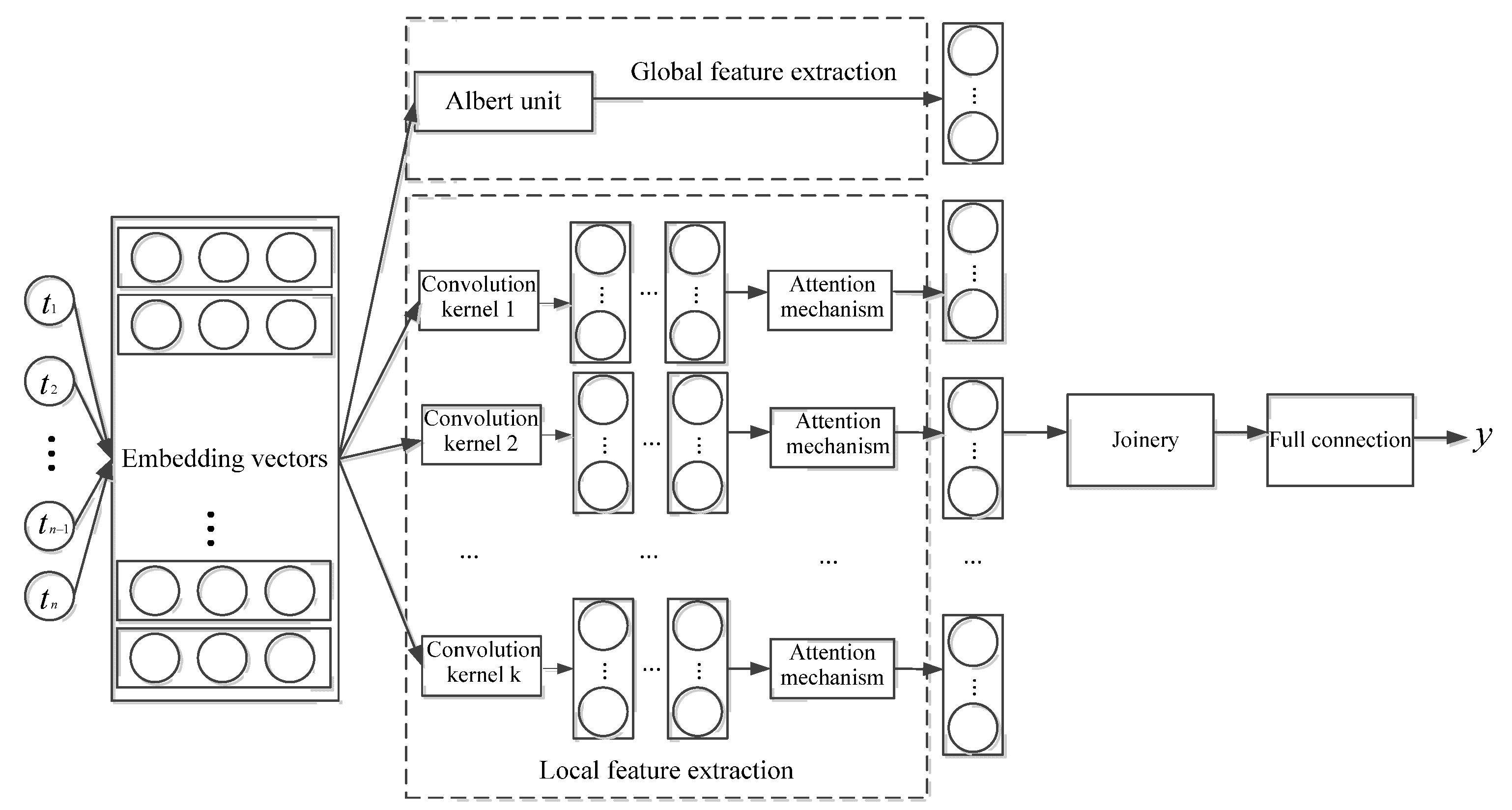
Due to the characteristics of power fault data with strong specialized fields and complex structure, the paper designs the power knowledge extraction model. As shown in Figure 2, the model inputs a sequence of labeled entity relations into the input layer for vector embedding. And it captures the global semantic features of sentences in the faulty corpus using a multi-layer bidirectional encoder. Then, it inputs the vector sequences into the semantic extraction layer of the CNN, extracts the local features by convolution operation and pooling and integrates and normalizes the mapping of the local features. In addition, the deep mining of corpus features through parameter layer sharing draws on contextual relationships to enhance the coupling between quantum tasks, which enables joint coding of entity-relationship information. Eventually, the model uses softmax logistic regression to classify the input values and passes the entity and relationship results to the output layer.
Figure 2. Electricity knowledge extraction.

3.2.1. Input Layer

The MASK-LM method incorporates contextual information by utilizing pre-trained language models, which can be effective for knowledge extraction. It has obvious advantages especially when dealing with large-scale and diverse text data. The input layer is constructed using the MASK-LM method, in which any word in the faulty text is randomly masked or replaced [49], as shown in Figure 3. It infers the meaning of the masked or replaced word based on the meanings of the words to the left and right. The fault text data T = T 1 , T 2 , T n are input, and then the fault text data are serialized to encode them as E = E 1 , E 2 E n , where E n denotes the nth serialized encoded character of the fault text.
E = σ T ,   H · Q
In this formula, Q R n × d is the embedding layer weight. d is the dimensionality.

3.2.2. Global Feature Extraction Layer
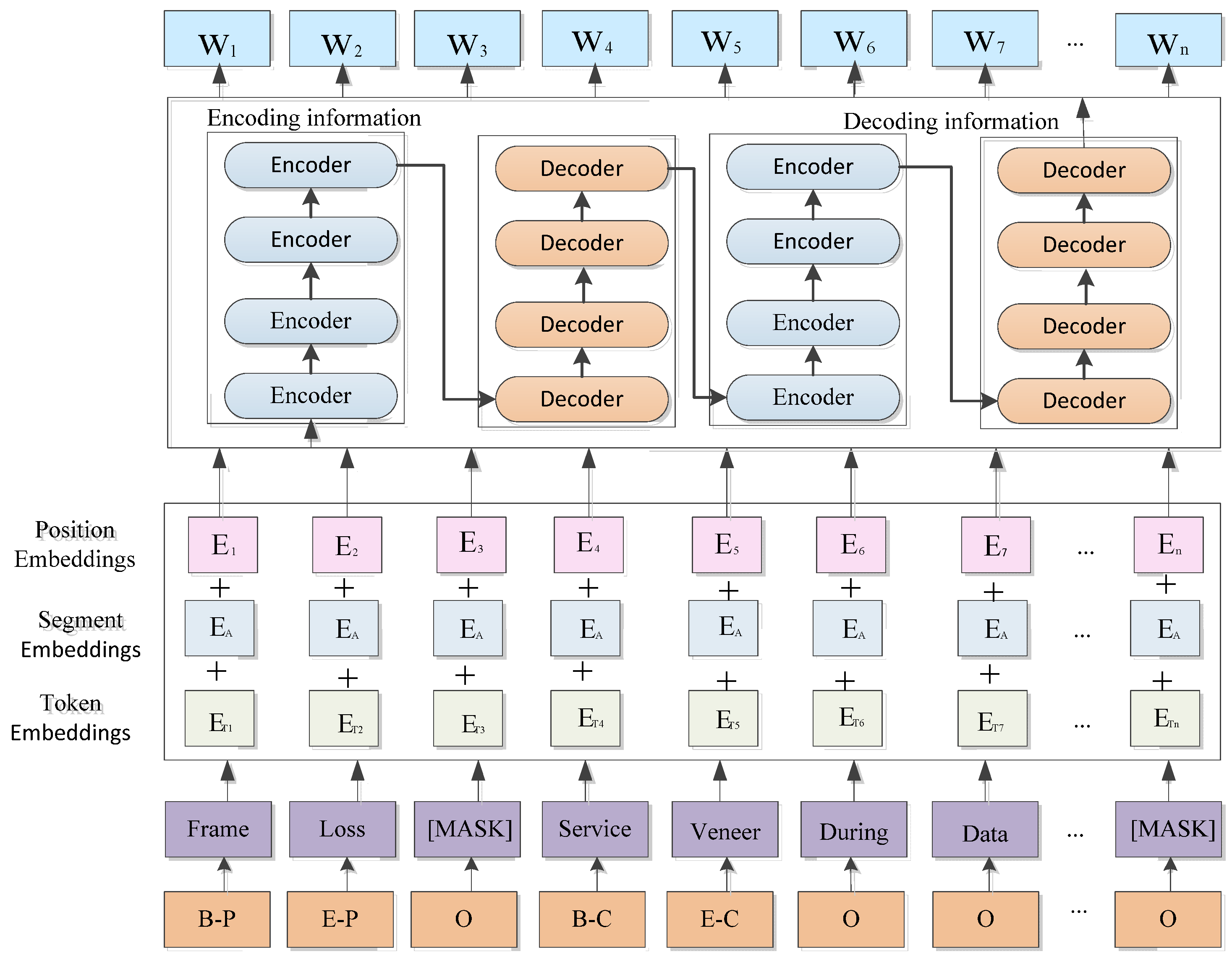
ALBERT model has higher training efficiency due to its strategy of parameter sharing and cross-layer parameter binding. In addition, ALBERT model has high generalization ability and has a significant advantage in capturing the global features of utterances. The serialized fault text data are transferred from the input layer to the semantic extraction layer of the ALBERT model. Subsequently, the multi-layer bi-directional transformer encoder is utilized to generate the global semantic features W = W 1 , W 2 W n of the fault text. As shown in Figure 3, the self-attention module within the transformer encoding unit is utilized to extract the semantic vector features of the input text information, which is defined as follows:
A t t e n t i o n T , E , U w = s o f t m a x T E T d e U w
In this formula, U w denotes the feature weights calculated based on the contextual semantics.
Figure 3. Power communication equipment fault information coding.

3.2.3. Local Feature Extraction Layer

The paper uses the convolution layer in CNN to represent the deep local semantics of sentences. By adopting the CNN structure for the semantically encoded text vectors to obtain contextual information, the paper draws on the entity-relationship information of the more distant layers, which further tightly couples the correlation between the two subtasks of entity extraction and relationship extraction. The paper uses word mapping to map each word as a vector form, performs the convolutional operation on the word vectors in the convolutional layer to extract the features and ultimately captures the most important features that have the maximum value. The text local feature extraction formula is defined as
C i , d a 1 + j = σ ( k = 1 d Q U i ˜ j + k 1 Q c a , k )
In this formula, Q c a , k is the weight of row k columns of a convolutional kernel Q c R k × d Q . C i , j is the jth eigenvalue of the ith vector in the convolutional eigenvector sequence C R n × k d . d is the dimension of the eigenvector after convolution of a single convolutional kernel. And d Q is the size of a single convolutional kernel.
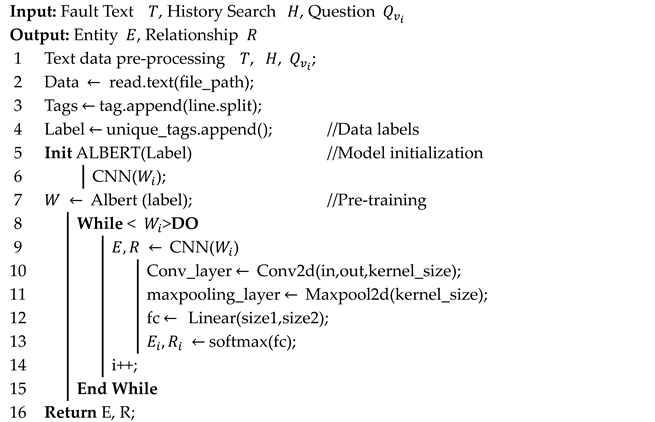
The sequence features are pooled and classified in the fully connected layer to obtain a vector sequence of labeled probability distributions L . Then, the softmax function is used to obtain a sequence of entity and relationship vectors. The pseudo-code of the entity relationship extraction algorithm is presented in Algorithm 1.
Algorithm 1: Entity relationship extraction algorithm
Electronics 12 03939 i001

3.3. Multi-Feature Learning Recommendations

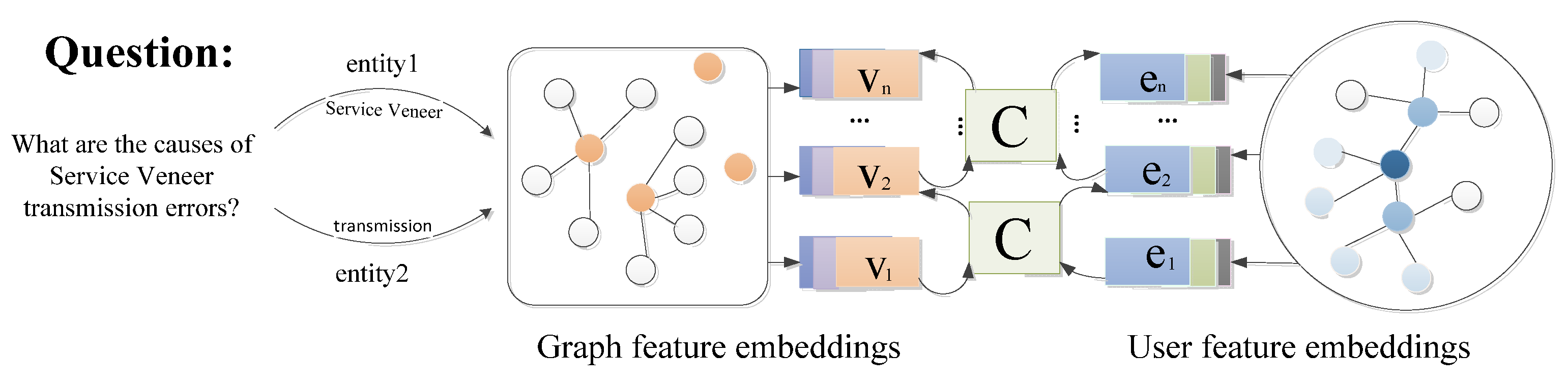
Aiming at the problems of data sparsity and insufficient mining of user retrieval intent, the paper constructs a multi-feature learning recommendation model for user intent. The specific process is shown in Figure 4. Firstly, with the user’s historical retrieval record information H v i , the model utilizes a preference propagation algorithm to obtain personalized user features containing user-specific information. Then, the model aggregates the higher-order neighborhood information of faulty entities on the fault knowledge graph using a graph convolution neural network, which is to obtain the graph feature representation. Finally, the model utilizes cross-compression units to share and learn potential features between user features and graph features and complete feature higher-order interactions. The model achieves accurate retrieval and personalized recommendation of fault information for power communication equipment.
Figure 4. User intent multi-feature interaction.

3.3.1. User Preference Representation

For user v i , the set of entities corresponding to k (k = 1, 2, …, H) is formed based on its historical interest set H as the seed set for preference propagation. Then, the corresponding set of related entities is expanded outward along the directed relationships of entities in G. The k of v i jumps the set of related entities ε v i k defined as
ε v i k = e | e , r , e ϵ G , e ε v i k 1 , ε v i 0 ϵ   H
To avoid introducing a lot of noise due to sparse data, the neighborhood information of the two hops of entities in the history subgraph is aggregated using a graph convolutional neural network. The initial representation ε v i L 1 of the user feature and its neighborhood representation ε v i L are aggregated using an aggregator. The item representation V f l containing the neighborhood information is obtained as
V f l = R e L U Q v i · ε v i L 1 + ε v i L + b
In this formula, ReLU(x) = max(0, x) is a nonlinear activation function. W R d × d and b R d denote the weight and bias, respectively.

3.3.2. Graph Neighborhood Representation

To prevent too sparse data for filtering neighboring nodes based on the retrieval problem, the knowledge graph of power communication equipment faults is first transformed into an undirected graph. L e denotes the neighboring entities of the retrieved entity Q v i . Since the number of L e elements varies from entity to entity, the same number of neighbors is reserved for each entity to achieve uniformity. To investigate the impact of different user queries on the neighborhood information in the knowledge graph, we calculated the question neighborhood score π. The score is defined as follows:
π ˜ Q v i e = e x p Q v i · e e L e e x p Q v i · e
In this formula, π ˜ Q v i e denotes the importance of the entity e to the problem Q v i . “ ” is the inner product operation.
In order to characterize the neighborhood topology of the project e , the calculation of v first-order neighborhood representation E S e is defined as
E S e = e S e π ˜ Q v i e e
In this formula, e R d is the vector representation of entities in the knowledge graph. (e) ⊆ L(e) and |S(e)| = K, with K being a predefined constant.
The knowledge graph neighborhood information of the user-retrieved problem entities is aggregated. A graph feature representation of the fused neighborhood information E f l is obtained. It is defined as
E f l = L e a k y R e L U ( W ( E S e k + e , r , e S e k 1 π ˜ Q v i e e , r , e e ) + b )
In this formula, k denotes the aggregated k -hop neighborhood information, generally k = 1.

3.3.3. Multi-Feature Interaction

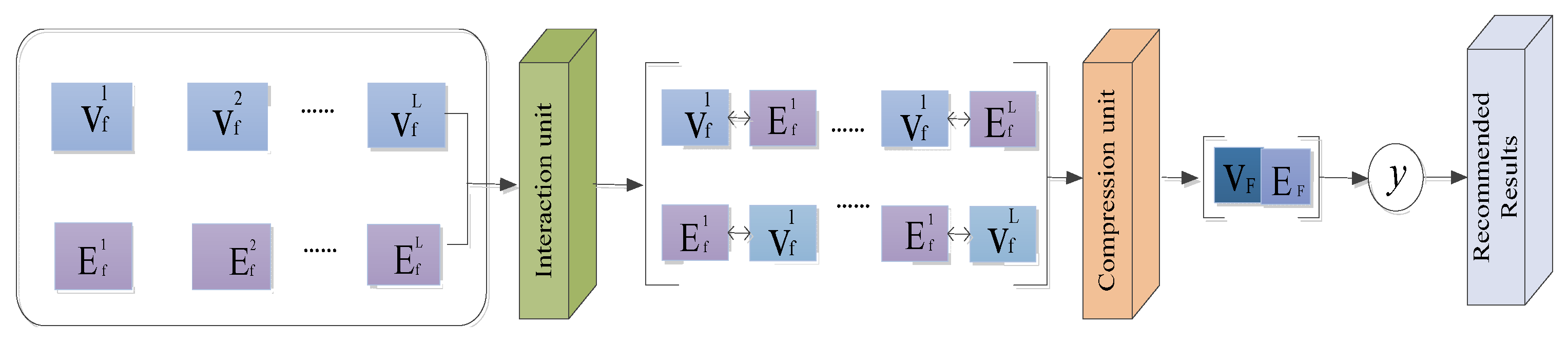
To improve the generalization ability and reduce the fitting noise, the cross-compression unit is used to explicitly interact the higher-order feature information between the user feature representation V f l and the atlas feature representation E f l . As shown in Figure 5, the potential features existing in the user representation and the atlas representation are automatically shared to realize the knowledge cross-transfer and mutual complement between them.
Figure 5. Cross-compression unit.
Step 1: It restores the user representation and the mapping representation by the compression unit, so as to complete the update operation between the historical retrieval record and the mapping entity neighborhood information. The structure of the cross-compression unit is shown in Figure 5. The characteristic cross matrix C is defined as
C = V f l E f l T = V f l 1 E f l 1                 V f l 1 E f l d V f l d E f l 1                   V f l d E f l d
In this formula, “T” denotes the matrix transposition operation.
Step 2: The projection of C into the potential representation space by cross-compression to obtain the feature vector:
V f l = C ω V f l V f l + C T ω E f l V f l + b V f l
E f l = C ω E f l E f l + C T ω V f l E f l + b E f l
In this formula, ω denotes the weight of the cross-compression unit. b denotes the deviation of the cross-compression unit.
Step 3: Using the compression unit, the user potential features V f l and the graph potential features E f l are obtained, respectively. Finally, user potential features and graph potential features are captured to calculate the predicted probability of the answer.
V F = M M . M V f l
E F = E v V F , e E f l C v , e e , r , e r e
y ^ = y ¯ + e ϵ g w v g σ V F , E F y ¯ e ϵ g w v g
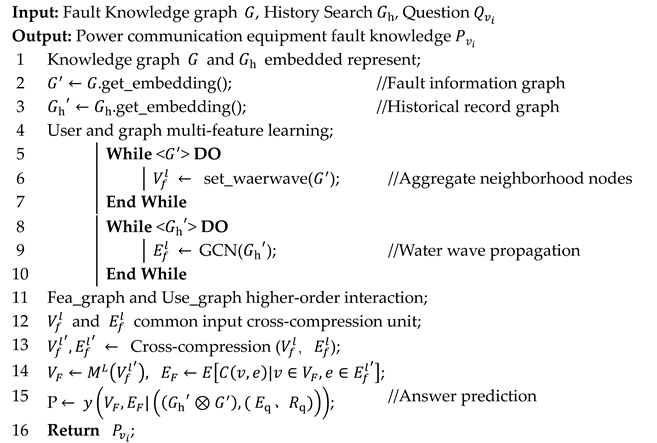
In the above formula, an L-layer MLP is utilized for user latent feature extraction. y ¯ represents the average score on interaction prediction. The pseudo-code of the multi-feature interaction learning algorithm is presented in Algorithm 2.
Algorithm 2: Multi-feature interaction learning algorithm
Electronics 12 03939 i002

4. Experimental Results and Analysis

4.1. Experimental Setting and Data

This paper uses the tensorflow framework in Python to build the model. The specific training environment is configured as follows: CPU Inter(R) Core(TM) i7-6700HQ CPU@2.60GHz, GPU is NVIDIA GeForce GTX1060, Python version 3.7, Tensorflow1.14 and Windows 10.
The fault dataset mainly consists of two parts: one is the fault data of power communication equipment operation in South China, and the other is the fault information retrieval data of power communication equipment operation and maintenance personnel. Fault data for the operation of power communication equipment include power operation and maintenance manuals, expert cases and failure log data for the equipment. And 25,430 sentences in these data can be used for experiments through preliminary manual screening. Among them, 530 fault entities and 16 fault relationships are included. The fault information retrieval data of power communication equipment operation and maintenance personnel contain 2000 users and their historical retrieval log information, including 360 entities and 17 kinds of relations. In addition, this paper adds a set of Chinese comparative dataset Cluener to the experimental part of the knowledge extraction model, which includes category labels of 10 life scenarios, and the total sample size of the corpus is 12,091 items [50,51,52].
For the experimental design, we randomly selected 60% of each dataset for model training and selected another 20% to be used as test data. The remaining 20% is used for parameter tuning. This setup has been widely used in previous research work. The quality of Top-K item recommendations is evaluated by three commonly used evaluation metrics: accuracy, recall and F1-score. In our experiments, we empirically set K to 50 and 100. For each metric, we first compute the precision for each test user and then report the average precision for all test users. The statistics of these experimental datasets are shown in Table 5.
Table 5. Statistics of the experimental datasets.
The AUC assessment metrics are more commonly used and do a good job of eliminating the effects of sample category imbalance on the metrics results. Therefore, the optimal hyperparameters in the experiments are obtained based on the optimization curve (AUC) values. The number of iterations for each experiment is 256, repeated five times, and the average of the five experimental results is taken as the final experimental result. During the training process, the L2 regularization technique is used to prevent overfitting, and Adam’s algorithm is used for parameter optimization. The hyperparameter settings for the dataset are shown in Table 6.
Table 6. Hyperparameter settings for faulty text dataset.
In Table 6, d denotes the embedding dimension. N denotes the number of neighbors of the item when the graph is convolved. L denotes the number of layers of the graph convolutional network. λ 1 and λ 2 denote the equilibrium parameter. η denotes the learning rate.

4.2. Experimental Analysis for Electricity Knowledge Extraction

In the evaluation metrics of knowledge extraction experiments, the accuracy is the proportion of the number of positive samples that are correctly classified by the faulty entity–faulty entity relationship to the number of samples that the classifier determines to be positive samples. Recall is the ratio of the number of positive samples correctly categorized by the faulty entity–faulty entity relationship to the number of true positive samples. F1-score is used to evaluate the classification prediction effect of the model, and the higher its value, the better the classification effect.

4.2.1. Performance Comparison

The model extraction comparison test is performed on the fault text dataset and Cluener dataset of power communication equipment, respectively. In order to verify the effectiveness of the joint extraction method of entity relations proposed in this paper, BiLSTM-CRF, BERT-CRF and Atten-BiLSTM-CRF are set up for experimental comparison with the proposed model. As shown in Table 7, whether in the faulty text dataset or the Cluener dataset, the performance of the joint extraction model proposed in this paper is higher than other classical models in relation extraction. Among them, the accuracy and recall are improved by 4.7% and 5.3%, respectively, compared with the optimal Atten-BiLSTM-CRF extraction model, and the F1-score reaches 81.7%. To verify the generalizability of the model, the experiments are also tested on the Cluener dataset. The experimental results show that the model proposed in this paper obtains the best extraction results on the open-source Chinese dataset. The model improves the accuracy by 5.6% and recall and F1 value by 1.8% and 3.2% relative to the best results of the comparison model.
Table 7. Entity relationship joint extraction prediction.
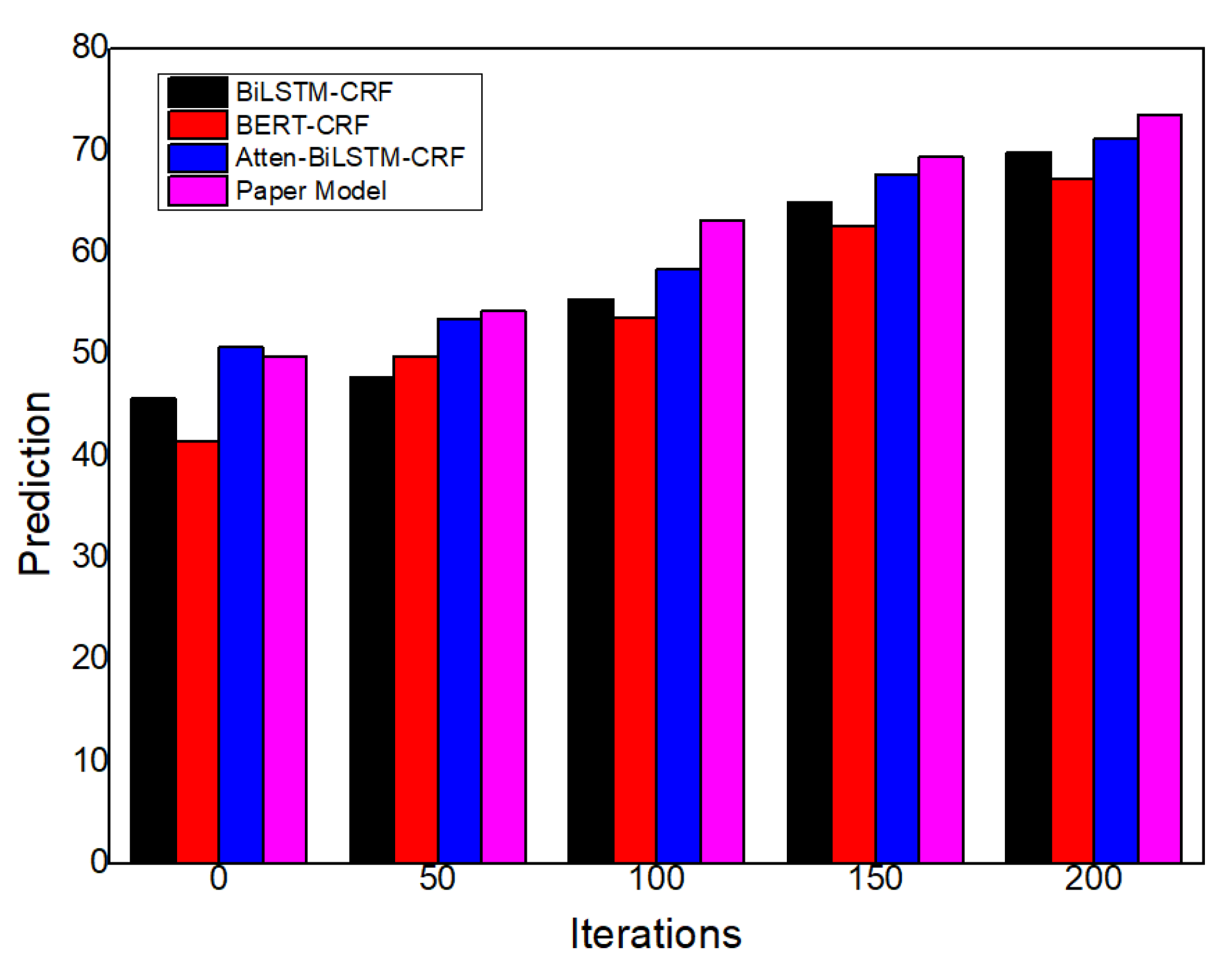
As shown in Figure 6, on the faulty dataset and after 200 iterations of comparison experiments, the model proposed in this paper predicts entity relationships with a higher accuracy compared with other classical models. Experiments show that the joint entity-relationship extraction model proposed in this paper can deeply mine the relationships between multiple entities and improve the accuracy of relationship extraction.
Figure 6. Comparative assessment of predictive values of entity-relationship joint extraction models and multiple models.
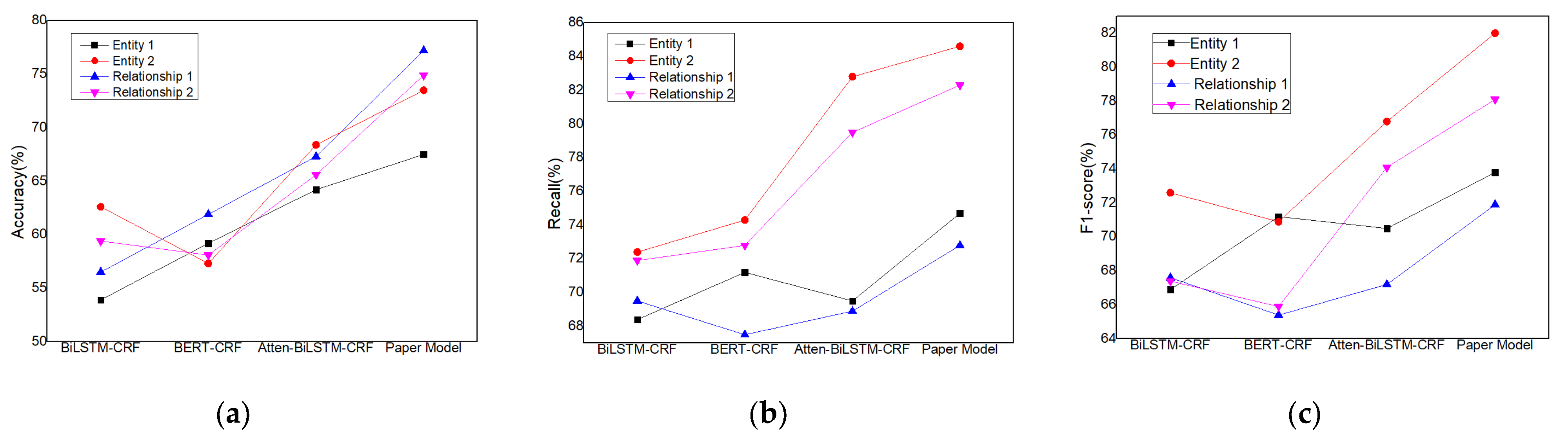
The performance of each model in terms of accuracy, recall and F1-score for faulty entity and relationship extraction is shown in Figure 7. Therein, entity 1 and relationship 1 denote the results of experiments on the faulty dataset, and entity 2 and relationship 2 denote the results of experiments on the public dataset Cluener. Comparing the effect of the model on the faulty text dataset and the Cluener dataset for entity relationship extraction, the knowledge extraction model proposed in this paper has the best effect and improves the efficiency of the model application.
Figure 7. Comparison chart for evaluating the effectiveness of multi-model fault knowledge extraction. (a) Accuracy of entity relationship extraction. (b) Recall of entity relationship extraction. (c) F1-score of entity relationship extraction.

4.2.2. Parameter Analysis

In knowledge extraction model training, the learning rate will directly affect the extraction results of the model. When the learning rate is set too large, although the model learns quickly, it may lead to large oscillations in the results. When the learning rate is set too small, the results may tend to fall into local optimization. In this paper, in order to evaluate the effect of learning rate on the fault knowledge extraction results, the average effect of entity relationship extraction is compared by setting different learning rates while other parameters are determined to be unchanged in the experimental part. Table 8 shows the effect of different learning rates η on the model extraction effect. A comparison of the two datasets shows that the model extraction is better for η = 3 ×   10 5 and η =   2   ×   10 4 , with the best performance for η = 3 ×   10 5 .
Table 8. The AUC values for different η.

4.2.3. Sample of Electricity Knowledge Extraction

Samples of equipment faults are fed into an entity-relationship joint extraction model and output predictions of faulty entities and relationships. A sample example of the predicted results is shown in Table 9. Based on predefined entity relationship labels, the model outputs the number and name of the faulty entity in the text. Meanwhile, the model mines the hidden relationship between two entities and obtains the fault knowledge triad. This provides data support for the visual display of fault knowledge.
Table 9. Experimental prediction results of joint extraction model.

4.3. Data Storage Structure of Atlas

Based on the ternary data of fault knowledge of power communication equipment obtained above, the paper relies on fault knowledge and uses visualization calculation software to realize the visual display of fault data. The fault knowledge structure is integrated through ontology layer reconstruction. For each fault case in the mapping, relationships and entities are extracted based on this structure, which enables us to query for more detailed solutions during the retrieval of power communication equipment faults.
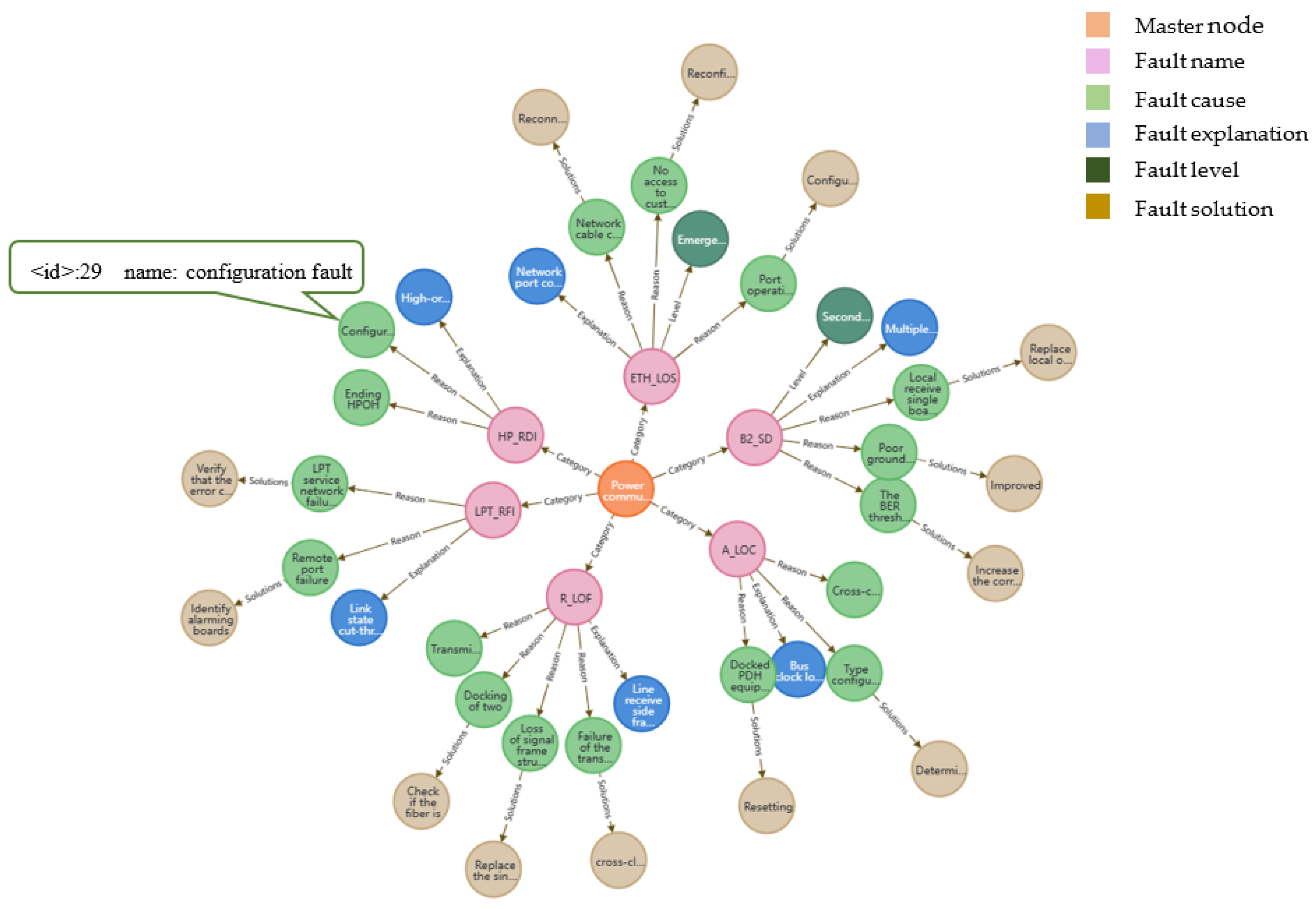
A partial view of the graphical visual display of fault operation and maintenance data of power communication equipment is shown in Figure 8. The fault data stored in the graph are connected to the scheduling specifications through subordination or containment relationships. The nodes represent equipment fault entities and the phrases on the arrows between them represent the type of relationship between the entity points. In this case, the orange color represents the fault knowledge of the power communication equipment, which is in the center of the fault knowledge graph. The pink color represents the fault name. The light green color represents the fault cause. The blue color represents the fault explanation. Dark green represents the fault level. The brown color represents the fault solution.
Figure 8. A partial view of the fault knowledge graph for power communication equipment.
It is stored in the form of a vector to the corresponding feature attribute unit of the entity. When equipment failure occurs, O&M staff can refer to fault knowledge mapping. Use this to search the relationship between the fault handling case and the related equipment. This can locate the cause of the fault as soon as possible and help in overhauling and troubleshooting.

4.4. Experimental Analysis of Multi-Feature Recommendation

4.4.1. Performance of MFLR

In this paper, the proposed MFLR method is experimentally compared with five classical recommendation methods Pag-eRank, Inte_pre, CKAN, KGCN and Inte_mat classical recommendation methods. The main indicators for evaluating the performance of the methods in the experiments are as follows.
(1)
Hit Forecast
The test set is put into the trained model, and the click-through rate prediction performance is evaluated using the area under the ROC curve (AUC) metric, which is obtained by integrating the horizontal axis of the ROC curve, with the horizontal coordinate of the ROC curve being the false-positive rate and the vertical coordinate being the true-positive rate.
(2)
Top-K Recommendation
The test set is put into the trained model to recommend the items with top K click-through rates to users, and the model recommendation performance is evaluated using accuracy, recall and F1-score metrics.
Accuracy (ACC) is the percentage of fault entities recommended to the user that are of interest to the user. The recall metric focuses on the proportion of fault entities recommended to the user that are of interest to the user out of the total number of fault entities interacting with the user’s graph. The F1-score is used to evaluate the recommendation prediction effect of the model. And the higher its value, the better the recommendation result matches the user’s retrieval intent.
In the cold-start search mode, which is oriented to the sparse and high-order user feature information, the experiments use AUC and ACC to evaluate the relevance of the recommendation effect in the cold-start situation.
As shown in Table 10, the average AUC and ACC effects of each recommended model are evaluated in the cold-start situation. A comparison of the experimental results shows that the MFLR proposed in this paper has better performance results in both AUC and ACC. The high correlation of retrieval results in the cold-start situation is more helpful for rapid fault diagnosis. And MFLR can integrate highly correlated data, which is in line with the user’s need to retrieve highly correlated problems in the cold-start situation. In the regular search mode oriented to the long-term use of users with rich feature information, the experiment uses the accuracy, recall and F1-score to evaluate the effect of user click recommendation.
Table 10. AUC and ACC performance comparison.
Table 11 shows the evaluation of the user click recommendation effect. In terms of accuracy and F1 value, the recommendation effect of CKAN and KGCN is similar. Intention matching adds the attention mechanism associated with mining the user’s personality, and its recommendation effect is better compared with the above two. The MFLR recommendation model proposed in this paper realizes high-order multi-feature fusion on this basis, which is 5.2% more accurate than intention matching, and the F1 value is improved by 2.2%, with a better overall effect. The MFLR algorithm also has a high domain recommendation effect and effectively avoids the information cocoon effect.
Table 11. Evaluation of the effect of model recommendation.
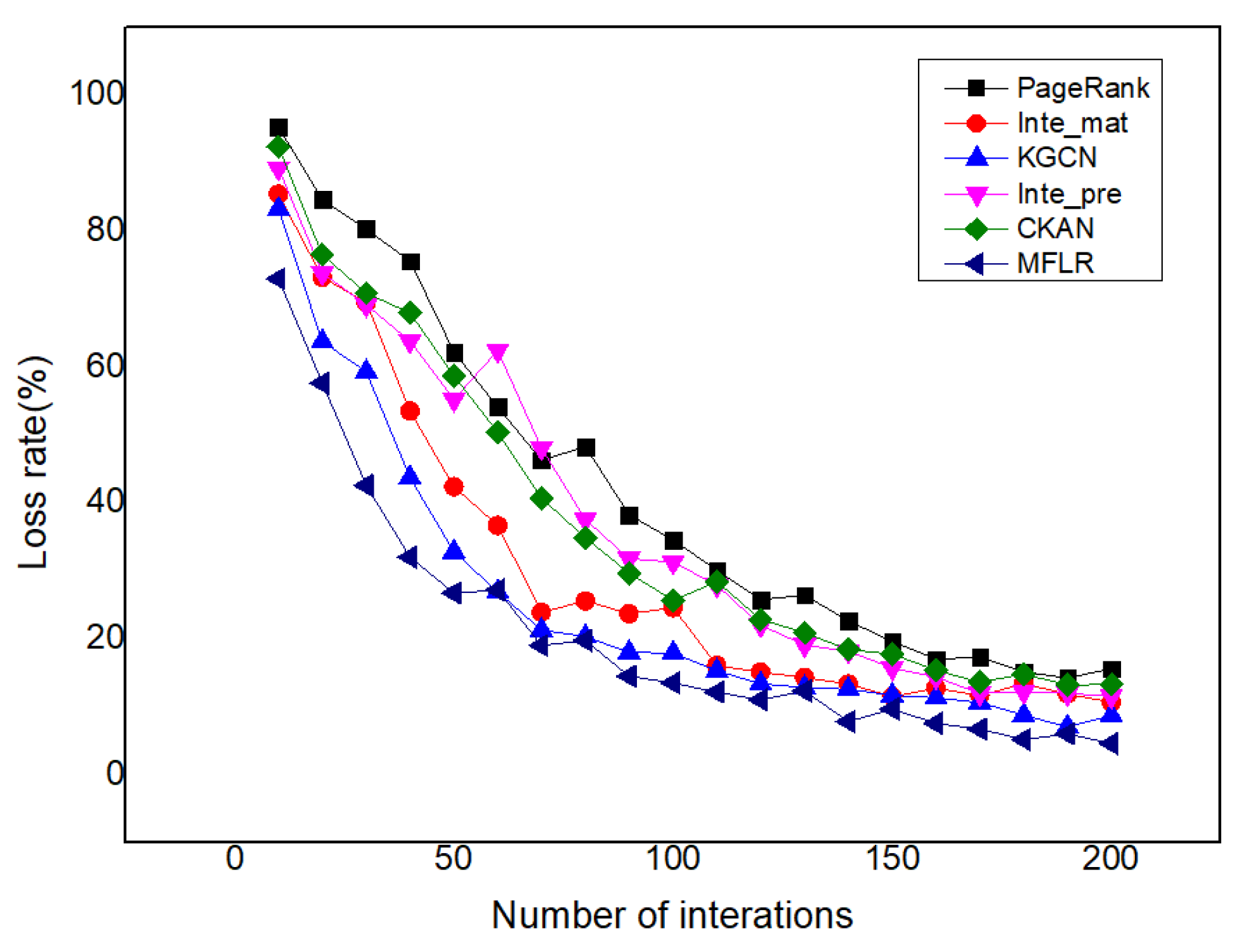
Figure 9 shows the results of the loss rate evaluation of the recommendation model. After convergence, the loss rate of the MFLR proposed in this paper is minimized. As a result, the method has strong robustness, and its recommendation results are more in line with the user’s retrieval intent.
Figure 9. MFLR and multi-model loss function ratio evaluation.
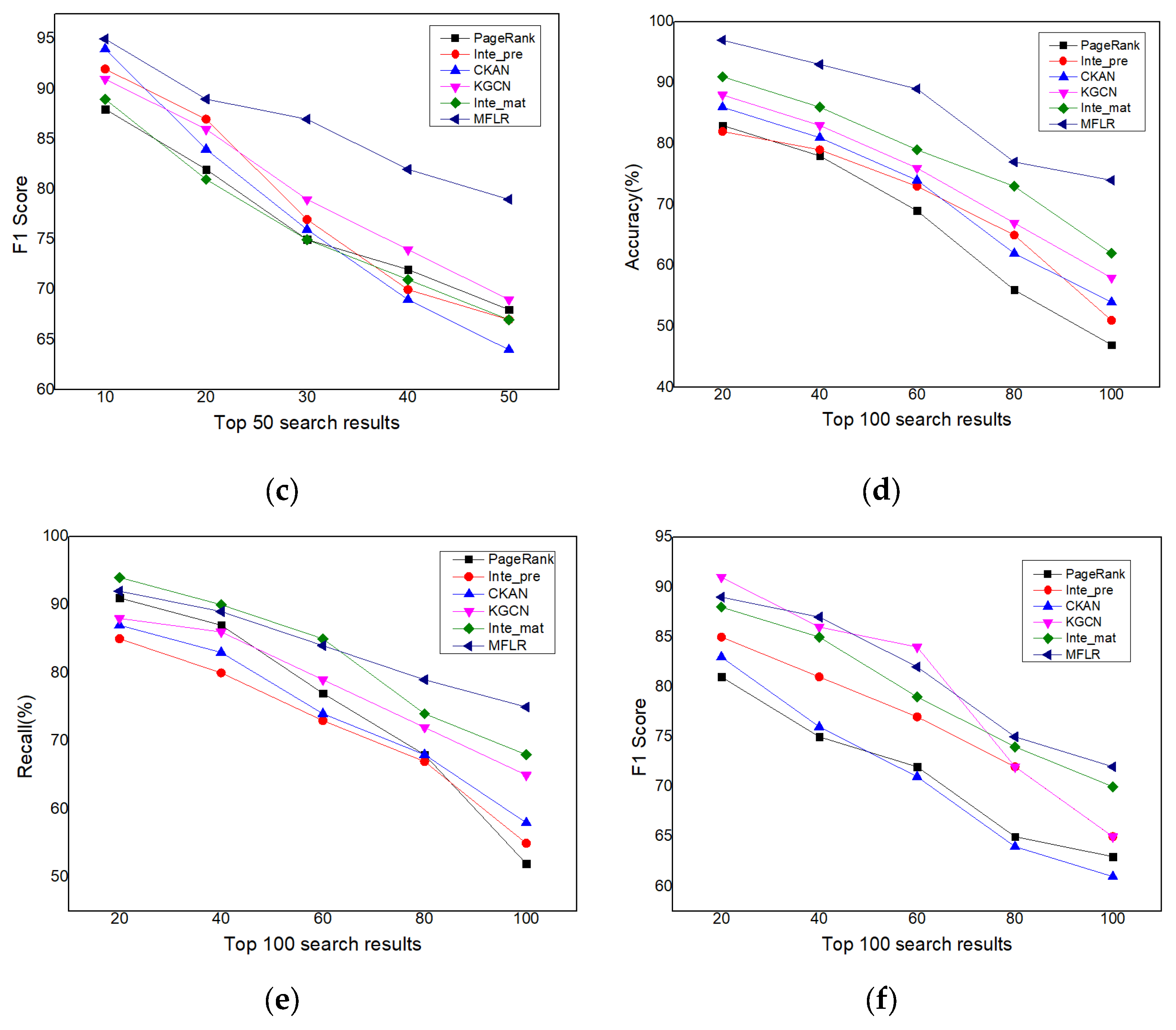
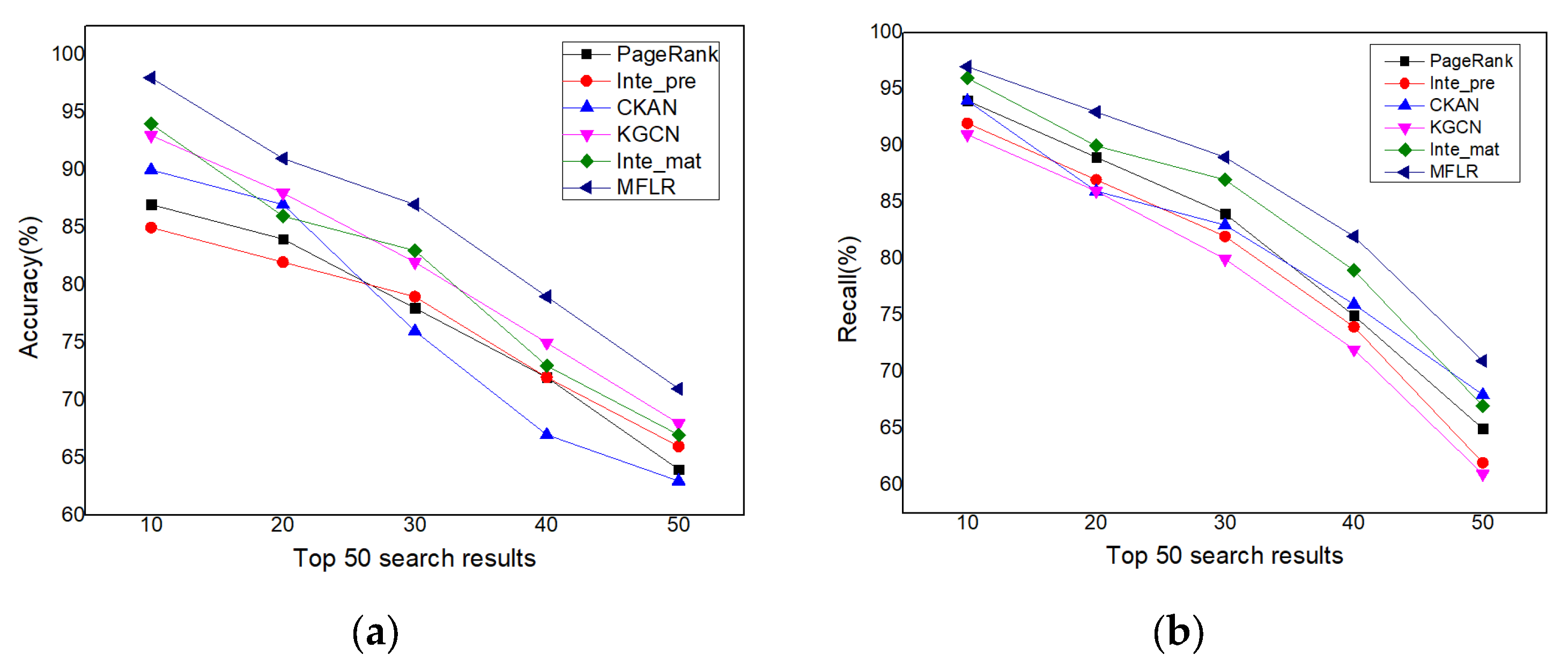
As shown in Figure 10, the evaluation metrics for the top 50 and top 100 retrieval recommendation results of the six models are experimentally analyzed and evaluated. Similarly, each additional 20 referral results are evaluated as a whole, plotted via line graph comparison. According to the analysis of the comparison results, the first 30 results calculated by the recommendation algorithm are the closest. After that, the prediction effect decreases rapidly. However, the MFLR proposed in this paper performs better in the later predictions. The experimental results show that the proposed MFLR model performs best in the first 30 model retrievals. After that, 30–100 retrieval results were higher than the best model comparing 12%, 7% and 2% accuracy, recall and F1 values.
Figure 10. Three assessments of top 50 and top 100 users clicking on recommendations. (a) Accuracy of the first 50 recommended results. (b) Recall of the first 50 recommended results. (c) F1-Score of the first 50 recommended results. (d) Accuracy of the first 100 recommended results. (e) Recall of the first 100 recommended results. (f) F1-Score of the first 100 recommended results.
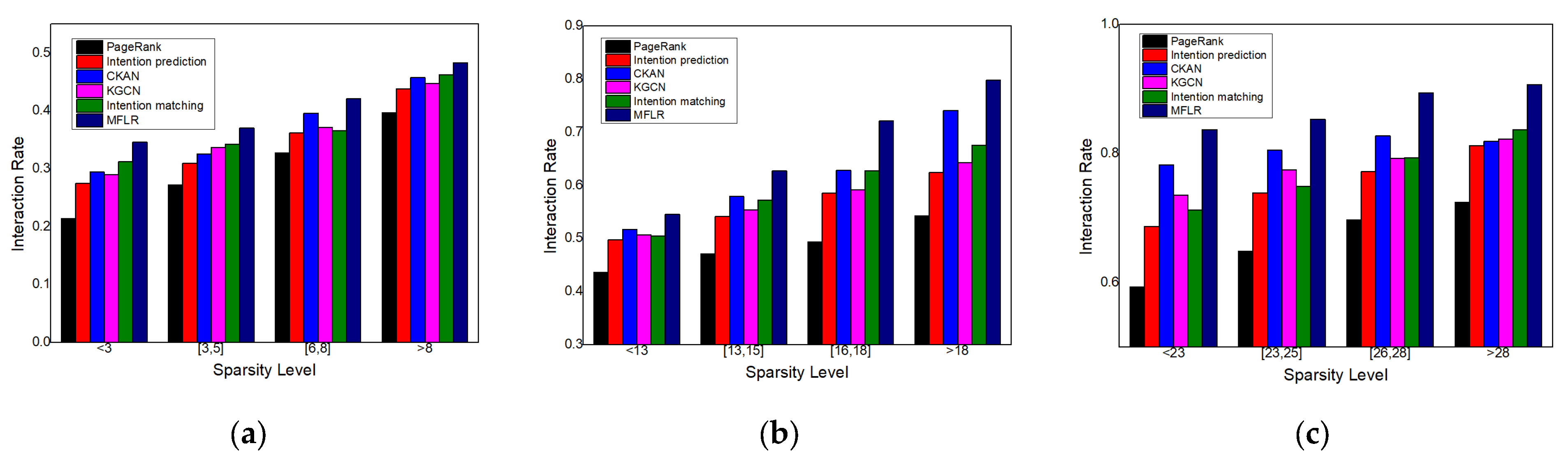
Data sparsity is a major problem that limits the performance of recommendation algorithms. Data sparsity tends to result in fewer user features interacting with graph features, making it difficult to learn to predict the best representation. Therefore, we evaluate the ability of algorithms to mitigate the data sparsity problem. To this end, we compare the performance of MFLR with other classical models on groups of users with different sparsity levels. We rationalize the sparsity of the data in our experiments, and the grouping boundaries of sparsity are 10, 20 and 30, respectively, where one group has at most 10 items, the second group has 11~20 items and so on. As shown in Figure 11, this paper demonstrates the interaction efficiency under different sparsity levels to verify the recommendation performance of the model.
Figure 11. Performance comparison of interaction ratios with different sparsity levels. (a) Interaction rate under 0 to 10 items. (b) Interaction rate under 10 to 20 items. (c) Interaction rate under 20 to 30 items.
From the results in the above figure, it can be seen that MFLR has optimal recommendation performance at different sparsity levels, which proves the effectiveness of MFLR in sparse interaction scenarios. The possible reason is that MFLR aggregates local graph contexts by considering the user’s personalized preference propagation algorithm and aggregates non-local graph contexts by having cross-compression units, which mitigates the incompleteness and noise problem of fault knowledge recommendation.
The model has a good recommendation effect and can retrieve fault information efficiently and accurately based on the user’s historical preferences and domain information. It conforms to the user’s habitual retrieval behavior and more closely matches the user’s retrieval intention.

4.4.2. Hyperparametric Analysis

In order to evaluate the impact of some modules in MFLR on the recommendation results, the paper measures the cross-compression unit module which has a large impact on the model performance. In addition, the paper considers the parameter settings for the number of sampled neighbors N and the number of layers of the graphical convolutional network L in order to assess the robustness and stability of the model under different conditions.
(1)
Cross-compression Unit Analysis
As shown in Table 12, the AUC, ACC and F1 values of the MFLR are improved with the addition of the cross-compression unit. Meanwhile, combining Table 10 and Table 11, it can be found that the AUC, accuracy and F1 values of MFLR without an added cross-compression unit are also more effective than other models. It is further illustrated that the fusion proposed in this paper of a graph convolutional network and preference propagation strategy has excellent performance.
Table 12. Impact of cross-compression unit on the model.
(2)
Sampling Neighborhood Number N Analysis
Neighborhood information in the knowledge graph has a great impact on the influence of recommendation effectiveness. Although MFLR aggregates more higher-order relational information can improve the recommendation performance, too much higher-order relational information also increases unpredictable and noisy data, which makes the performance degraded. Therefore N = 1, 3, 5, 7, 9 are taken for the experiment, and the results are shown in Table 13. It can be found that the best recommendation is made when N = 3.
Table 13. The AUC values for different N.
(3)
Graph Convolutional Network Layer L Analysis
In MFLR, L has a certain recommendation effect on sparse dataset influence; the paper takes L = 1, 2, 3, 4, 5 to conduct experiments, and the results are shown in Table 14. It can be found that it has the best results when L = 1 and the lowest model performance when L = 5. This is due to the fact that the multi-layer model not only aggregates more neighborhood information but also brings a lot of noise.
Table 14. The AUC values for different L.

5. Conclusions

The paper proposes a knowledge-graph-driven method for intelligent decision making on power communication equipment faults. Firstly, the method completes the entity relationship extraction of fault information by using a CNN and achieves the structured storage and visual display of fault data by using the visualization tool of the knowledge graph. Then, based on the user history data and fault mapping knowledge, the method uses preference propagation and a graph convolutional network to obtain user feature representation and graph feature representation. Finally, the method uses a multi-feature cross-compression unit to achieve higher-order interaction between user features and graph features. Experimental results show that the method outperforms other baseline methods in terms of accuracy and feasibility. The method proposed in this paper mitigates data sparsity and attenuates the noise generated by higher-order interactions, which solves the problem of under-mining user intent. Furthermore, it improves the recommendation performance and effectiveness and achieves fast retrieval and intelligent recommendation of fault information for power communication equipment. Through the knowledge graph to build the fault disposal model of electric power communication equipment, the massive and dispersed terminal equipment data information and fault case data are transformed into a professional domain knowledge graph. The knowledge graph can effectively reduce the pressure of fault disposal and assist in the development of a professional knowledge graph. And based on the constructed knowledge graph to realize the solution recommendation, it can effectively reduce the pressure of fault disposal and assist the relevant personnel in making decisions on fault disposal, which improves the disposal efficiency and the level of intelligence.
Although the knowledge-graph-driven decision-making method proposed in this paper improved the fault resolution efficiency of power communication equipment, the real-time efficiency and robustness of the model in the face of unexpected faults and massive data need to be further verified. In addition, the structure of the knowledge representation and the autonomous learning method also need to be further investigated. Further, in order to process the information in the knowledge graph more comprehensively, we will effectively integrate the information in the knowledge graph with the recommendation system. And we will explore more efficient time-series knowledge graph construction and updating methods. This will improve the real-time updating of the fault information and solutions of the graph, which will further enhance the accuracy and usefulness of the recommendation results.

Author Contributions

All authors contributed to the writing and revisions; writing—review and editing, Y.Z.; writing—original draft, H.Q.; methodology, H.Q.; data curation, K.L.; project administration, S.L.; supervision, X.H. All authors have read and agreed to the published version of the manuscript.

Funding

This research was funded by the Tianjin Research Innovation Project for Postgraduate Students, grant number 2022SKY122.

Data Availability Statement

Data are available on request due to restrictions of privacy or ethics.

Conflicts of Interest

The authors declare no conflict of interest.

References

  1. Bakkar, M.; Bogarra, S.; Córcoles, F. Artificial Intelligence-Based Protection for Smart Grids. Energies 2022, 15, 4933. [Google Scholar] [CrossRef]
  2. De, L.; Cruz, J.; Gómez-Luna, E.; Ali, M. Fault location for distribution smart grids: Literature overview, challenges, solutions, and future trends. Energies 2023, 16, 2280. [Google Scholar]
  3. Liang, K.; Zhou, B.; Zhang, Y.; He, Y.; Guo, X.; Zhang, B. A Multi-Entity Knowledge Joint Extraction Method of Communication Equipment Faults for Industrial IoT. Electronics 2022, 11, 979. [Google Scholar] [CrossRef]
  4. Junior, R.; Almeida, F.; Gomes, F. Fault classification in three-phase motors based on vibration signal analysis and artificial neural networks. Neural Comput. Appl. 2020, 32, 5–6. [Google Scholar]
  5. Do, P.; Phamp, W. KG2Vec: A weighted text-enhanced meta-path-based knowledge graph embedding for similarity search. Neural Comput. Appl. 2021, 33, 16533–16555. [Google Scholar] [CrossRef]
  6. Zamini, M.; Hassan, R.; Rabiei, M. A review of knowledge graph completion. Artif. Intell. 2022, 8, 396. [Google Scholar] [CrossRef]
  7. Liu, J.; Huang, W.; Li, T. Cross-domain knowledge graph chiasmal embedding for multi-domain item-item recommendation. IEEE Trans. Knowl. Data Eng. 2022, 35, 4621–4633. [Google Scholar] [CrossRef]
  8. Chen, J.; Yu, W.; Lu, Y.; Qian, P.; Li, P. An Interpretive Rules-guided Recommendation over Knowledge Graph. Inf. Sci. 2021, 563, 326–341. [Google Scholar] [CrossRef]
  9. Nguyen, D.P.; Ho, T.B. Drug-drug interaction extraction from biomedical texts via relation BERT. In Proceeding of the 19th ACM International Conference Computer Communication Technology, Ho Chi Minh City, Vietnam, 14–15 October 2020; pp. 1–7. [Google Scholar]
  10. Bekoulisg, D.; Demeestert, E. Joint entity recognition and relation extraction as a multi-head selection problem. Expert Syst. Appl. 2018, 114, 34–45. [Google Scholar] [CrossRef]
  11. Wei, Z.P.; Su, J.L. A novel hierarchical binary tagging framework for joint extraction of entities and relations. In Proceedings of the 58th Annual Meeting of the Association for Computational Linguistics, Online, 5–10 July 2020. [Google Scholar]
  12. Liang, Y.; Qian, T.; Li, Q. Enhancing domain-level and user-level adaptivity in diversified recommendation. In Proceedings of the 44th International ACM SIGIR Conference on Research and Development in Information Retrieval, Online, 11–15 July 2021; pp. 747–756. [Google Scholar]
  13. Jin, H.; Zhao, X.; Dou, H. Improving Sequential Recommendation with Knowledge-Enhanced Memory Networks. In Proceedings of the 41st International ACM SIGIR Conference, Ann Arbor, MI, USA, 8–12 July 2018; pp. 505–514. [Google Scholar]
  14. Xie, F.; Zheng, A.; Chen, Z. Attentive Meta-graph Embedding for item Recommendation in heterogeneous information networks. Knowl. Based Syst. 2020, 45, 106. [Google Scholar] [CrossRef]
  15. Singer, U.; Roitman, H.; Eshel, Y. Sequential Modeling with Multiple Attributes for Watchlist Recommendation in E-Commerce. arXiv 2021, arXiv:2110.11072. [Google Scholar]
  16. Lv, K.; Yi, W.; Zhou, M. A review of the knowledge extraction technology in knowledge graph. In Proceedings of the 41st Chinese Control Conference, Hefei, China, 25–27 July 2022; pp. 4211–4218. [Google Scholar]
  17. Khaing, M.; Thein, M. Stock Trend Extraction using Rule-based and Syntactic Feature-based Relationships between Named Entities. In Proceedings of the 2019 International Conference on Advanced Information Technologies, Yangon, Myanmar, 6–7 November 2019; pp. 78–83. [Google Scholar]
  18. Xu, C.; Li, S. Research on the construction of tourism knowledge graph by integrating BERT-WWM and pointer network. Comput. Eng. Appl. 2022, 58, 280–288. [Google Scholar]
  19. Jiang, C.; Wang, Y.; Chen, M. Transformer fault recognition based on kbert text clustering model. High Volt. Eng. 2022, 48, 2991–3000. [Google Scholar]
  20. Song, Y.; Yu, Y.; Liang, X.; Wang, Y.; Hou, T. Calibration method of line transformer relationship in distribution network based on data analysis of electric energy metering management system. High Volt. Eng. 2021, 47, 4461–4470. [Google Scholar]
  21. Srivastava, S.; Bej, K.; Schultz, K.; Wolkenhauer, O. Attention Retrieval Model for Entity Relation Extraction from Biological Literature. IEEE Access. 2022, 10, 1109. [Google Scholar] [CrossRef]
  22. Al-Sabri, J.; Gao, J.; Chen, B.; Oloulade, M.; Lyu, T. Multi-View Graph Neural Architecture Search for Biomedical Entity and Relation Extraction. IEEE/ACM Trans. Comput. Biol. Bioinform. 2023, 26, 1221–1233. [Google Scholar] [CrossRef] [PubMed]
  23. Zhang, R.; Meng, F.; Zhou, Y. Relation classification via recurrent neural network with attention and tensor layers. Big Data Min. Anal. 2018, 1, 234–244. [Google Scholar]
  24. Christou, D.; Tsoumakas, G. Improving Distantly-Supervised Relation Extraction through BERT-Based Label and Instance Embeddings. IEEE Access 2021, 10, 1109. [Google Scholar] [CrossRef]
  25. Erekhinskaya, T.; Balakrishna, M.; Tatu, M.; Werner, S.; Moldovan, D. Knowledge extraction for literature review. In Proceedings of the 2016 IEEE/ACM Joint Conference on Digital Libraries, Newark, NJ, USA, 19–23 June 2016; pp. 221–222. [Google Scholar]
  26. Eberts, M.; Ulges, A. Span-based joint entity and relation extraction with transformer pre-training. arXiv 2019, arXiv:1909.07755. [Google Scholar]
  27. Hillebrand, L.; Deußer, T. KPI-BERT: A Joint Named Entity Recognition and Relation Extraction Model for Financial Reports. In Proceedings of the 26th International Conference on Pattern Recognition, Montreal, QC, Canada, 21–25 August 2022; pp. 606–612. [Google Scholar]
  28. Lai, T.; Ji, H.; Zhai, C.X. Joint biomedical entity and relation extraction with knowledge-enhanced. In Proceedings of the 59th Annual Meeting of the Association for Computational Linguistics and the 11th International Joint Conference on Natural Language Processing, Virtual, 1–6 August 2021; pp. 6248–6260. [Google Scholar]
  29. Carbonell, M.; Riba, P.; Villegas, M.; Fornés, A.; Lladós, J. Named Entity Recognition and Relation Extraction with Graph Neural Networks in Semi Structured Documents. In Proceedings of the 25th International Conference on Pattern Recognition, Milan, Italy, 10–15 January 2021; pp. 9622–9627. [Google Scholar]
  30. Zhao, C.; Cao, H.; Lv, P.; Chu, Y.; Wang, F.; Liao, T. Adaptive Context-Embedded Hypergraph Convolutional Network for Session-based Recommendation. Inf. Technol. Control. 2023, 52, 111–127. [Google Scholar] [CrossRef]
  31. Li, Y. A graph convolution network based on improved density clustering for recommendation system. Inf. Technol. Control. 2022, 51, 18–31. [Google Scholar] [CrossRef]
  32. Sun, W.; Chen, P.; Xiong, J.; Shen, J. Graph attention recommendation model based on two-terminal knowledge graph. Comput. Eng. Appl. 2021, 58, 141–147. [Google Scholar]
  33. Gunasekar, M.; Thilagamani, S. Improved Feature Representation Using Collaborative Network for Cross-Domain Sentiment Analysis. Inf. Technol. Control. 2023, 52, 100–110. [Google Scholar] [CrossRef]
  34. Shambour, Q.Y.; Abu-Shareha, A.A.; Abualhaj, M.M. A Hotel Recommender System Based on Multi-Criteria Collaborative Filtering. Inf. Technol. Control. 2022, 51, 390–402. [Google Scholar] [CrossRef]
  35. Sangeetha, M.; Thiagarajan, M. An Enhanced Neural Graph based Collaborative Filtering with Item Knowledge Graph. Int. J. Comput. Commun. Control. 2022, 17, 4. [Google Scholar]
  36. Sun, Z.; Yang, J. Recurrent knowledge graph embedding for effective recommendation. In Proceedings of the 12th ACM Conference on Recommender Systems, Vancouver, BC, Canada, 2–7 October 2018; pp. 297–305. [Google Scholar]
  37. Lyu, Z.; Wu, Y.; Lai, J.; Yang, M. Knowledge Enhanced Graph Neural Networks for Explainable Recommendation. IEEE Trans. Knowl. Data Eng. 2023, 3, 5. [Google Scholar] [CrossRef]
  38. Gao, J.; Liu, Q.; Huang, W. Research on automatic generation of learning paths based on knowledge graphping. Mod. Educ. Technol. 2021, 57, 1–23. [Google Scholar]
  39. Kartheek, M.; Sajeev, P. Building Semantic Based Recommender System Using Knowledge Graph Embedding. In Proceedings of the Sixth International Conference on Image Information Processing, Shimla, India, 26–28 November 2021; pp. 25–29. [Google Scholar]
  40. Jiao, J.; Wang, S.; Zhang, X.; Wang, L.; Wang, J. gMatch: Knowledge base question answering via semantic matching. Knowl.-Based Syst. 2021, 43, 2–5. [Google Scholar] [CrossRef]
  41. Hu, B.; Shi, B. Leveraging meta-path based context for top-n recommendation with a neural co-attention model. In Proceedings of the 24th ACM SIGKDD International Conference on Knowledge Discovery & Data Mining, London, UK, 19–23 August 2018; pp. 1531–1540. [Google Scholar]
  42. Zhao, H.; Yao, Q. Meta-graph based recommendation fusion over heterogeneous information networks. In Proceedings of the 23rd ACM SIGKDD International Conference on Knowledge Discovery and Data Mining, Halifax, NS, Canada, 13–17 August 2017; pp. 635–644. [Google Scholar]
  43. Suzuki, T.; Oyama, S.; Kurihara, M. A Framework for Recommendation Algorithms Using Knowledge Graph and Random Walk Methods. In Proceedings of the 2020 IEEE International Conference on Big Data, Atlanta, GA, USA, 10–13 December 2020; pp. 3085–3087. [Google Scholar]
  44. Wang, H.W.; Zhang, F.Z. RippleNet: Propagating user preferences on the knowledge graph for recommender systems. In Proceedings of the 27th ACM International Conference on Information and Knowledge Management, Torino, Italy, 22–26 October 2018; pp. 417–426. [Google Scholar]
  45. Mezni, H.; Benslimane, D.; Bellatreche, L. Context-Aware Service Recommendation Based on Knowledge Graph Embedding. IEEE Trans. Knowl. Data Eng. 2022, 34, 11. [Google Scholar] [CrossRef]
  46. Wang, X.; He, X.N.; Cao, Y.X. KGAT: Knowledge graph attention network for recommendation. In Proceedings of the 25th ACM SIGKDD International Conference on Knowledge Discovery & Data Mining, Anchorage, AK, USA, 4–8 August 2019; pp. 950–958. [Google Scholar]
  47. Ferguson, N.; Mu, D.; Gong, R. Gated Knowledge Graph Neural Networks for Top-N Recommendation System. In Proceedings of the 24th International Conference on Computer Supported Cooperative Work in Design, Dalian, China, 5–7 May 2021; pp. 1111–1116. [Google Scholar]
  48. Wang, P.F.; Li, M.C.; Li, S. Chinese medical named entity recognition based on data augmentation. J. Beijing Univ. Posts Telecommun. 2020, 32, 57. [Google Scholar]
  49. Cui, Y.; Sun, H.; Zhao, Y. Sequential-Knowledge-Aware Next POI Recommendation: A Meta-Learning Approach. ACM Trans. Inf. Syst. 2022, 40, 1–22. [Google Scholar] [CrossRef]
  50. Maskeliūnas, R.; Pomarnacki, R.; Khang Huynh, V.; Damaševičius, R.; Plonis, D. Power Line Monitoring through Data Integrity Analysis with Q-Learning Based Data Analysis Network. Remote Sens. 2023, 15, 194. [Google Scholar] [CrossRef]
  51. Sedghi, H.; Jonckheere, E. Statistical Structure Learning to Ensure Data Integrity in Smart Grid. IEEE Trans. Smart Grid. 2015, 6, 4. [Google Scholar] [CrossRef]
  52. Anwar, A.; Mahmood, N.; Tari, Z. Ensuring Data Integrity of OPF Module and Energy Database by Detecting Changes in Power Flow Patterns in Smart Grids. IEEE Trans. Ind. Inform. 2017, 13, 6. [Google Scholar] [CrossRef]
Disclaimer/Publisher’s Note: The statements, opinions and data contained in all publications are solely those of the individual author(s) and contributor(s) and not of MDPI and/or the editor(s). MDPI and/or the editor(s) disclaim responsibility for any injury to people or property resulting from any ideas, methods, instructions or products referred to in the content.

Article Metrics

Citations

Article Access Statistics

Multiple requests from the same IP address are counted as one view.