Review of Communication Technology in Indoor Air Quality Monitoring System and Challenges


Abstract
1. Introduction
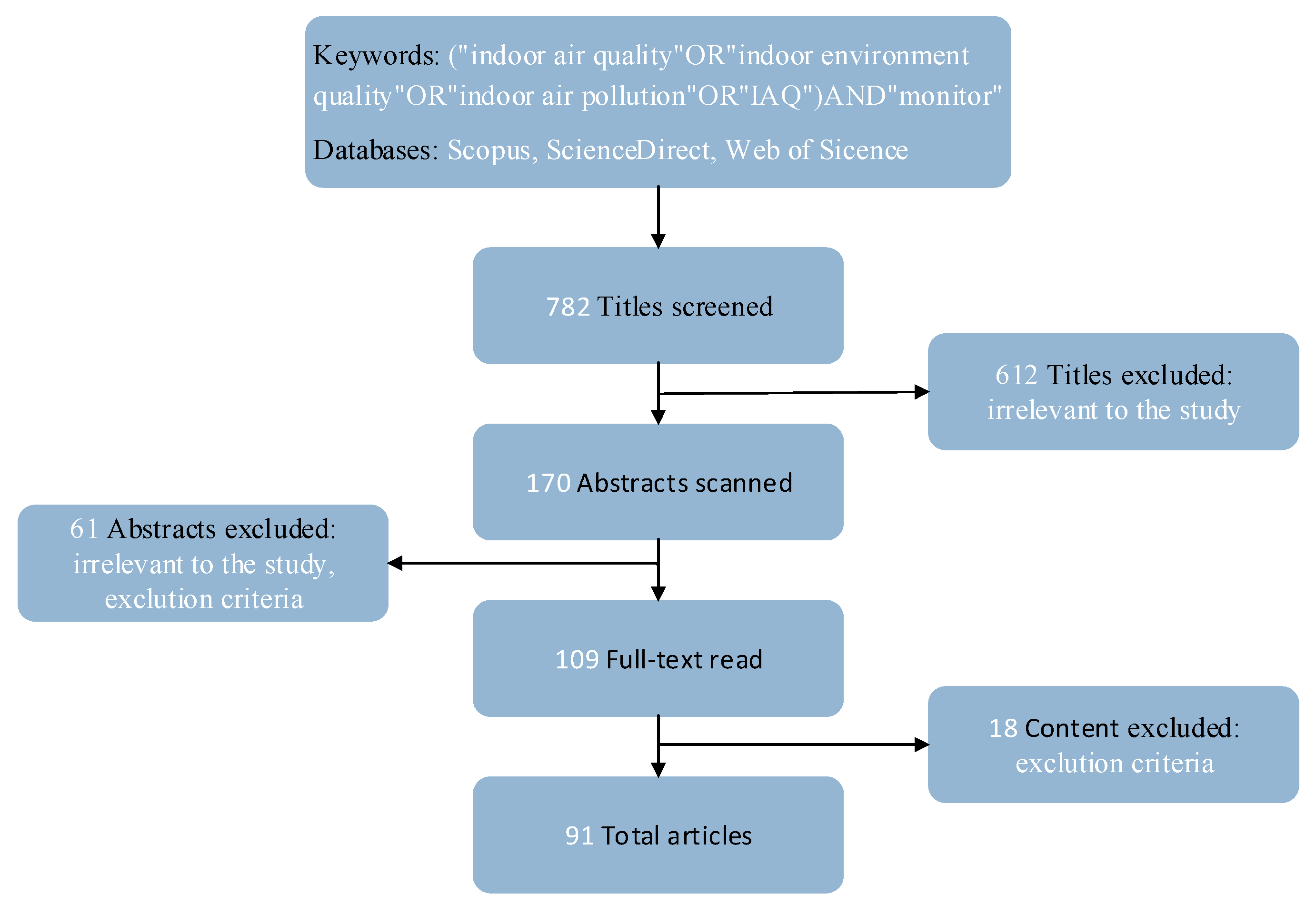
2. Methodology
3. Distribution Results
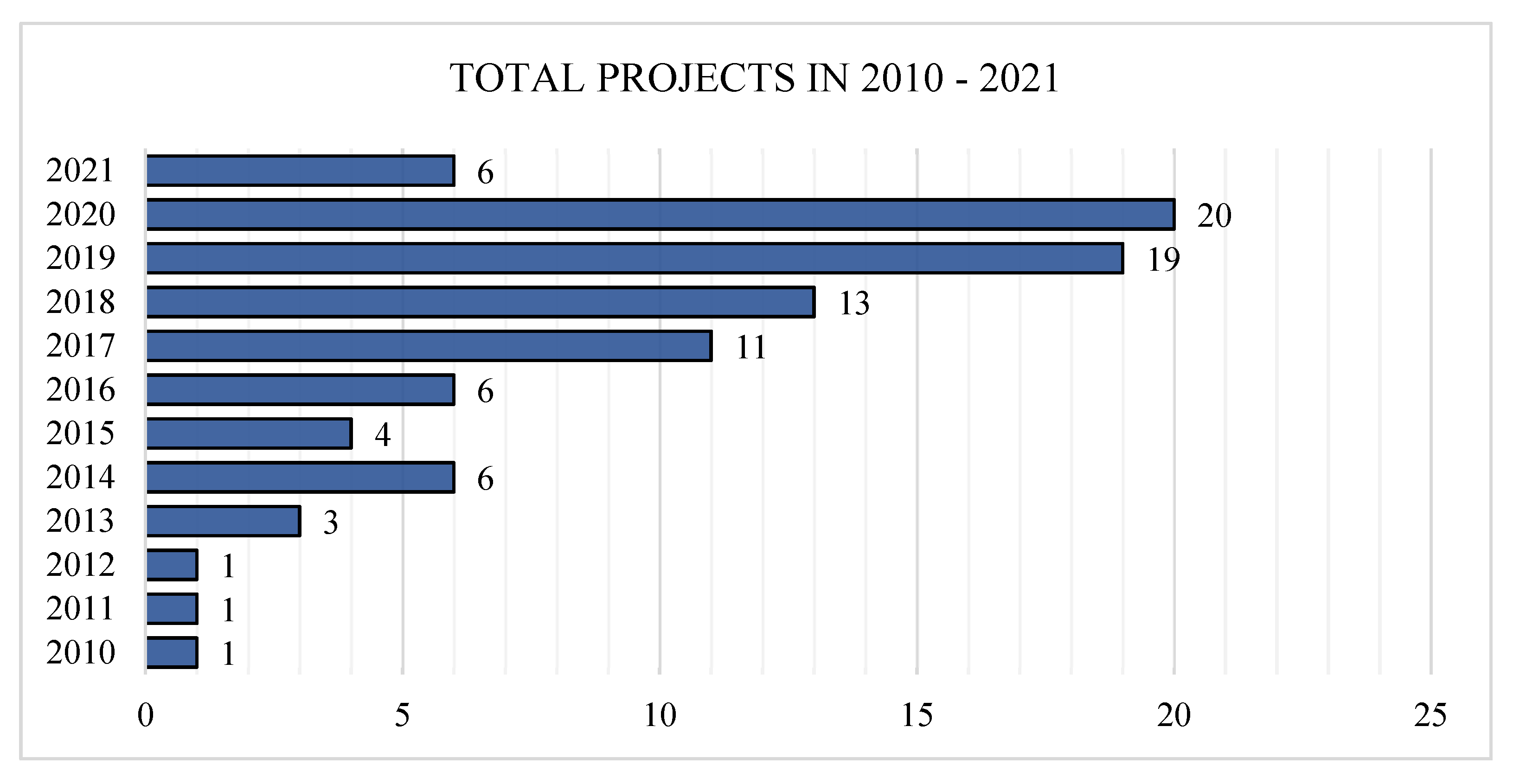
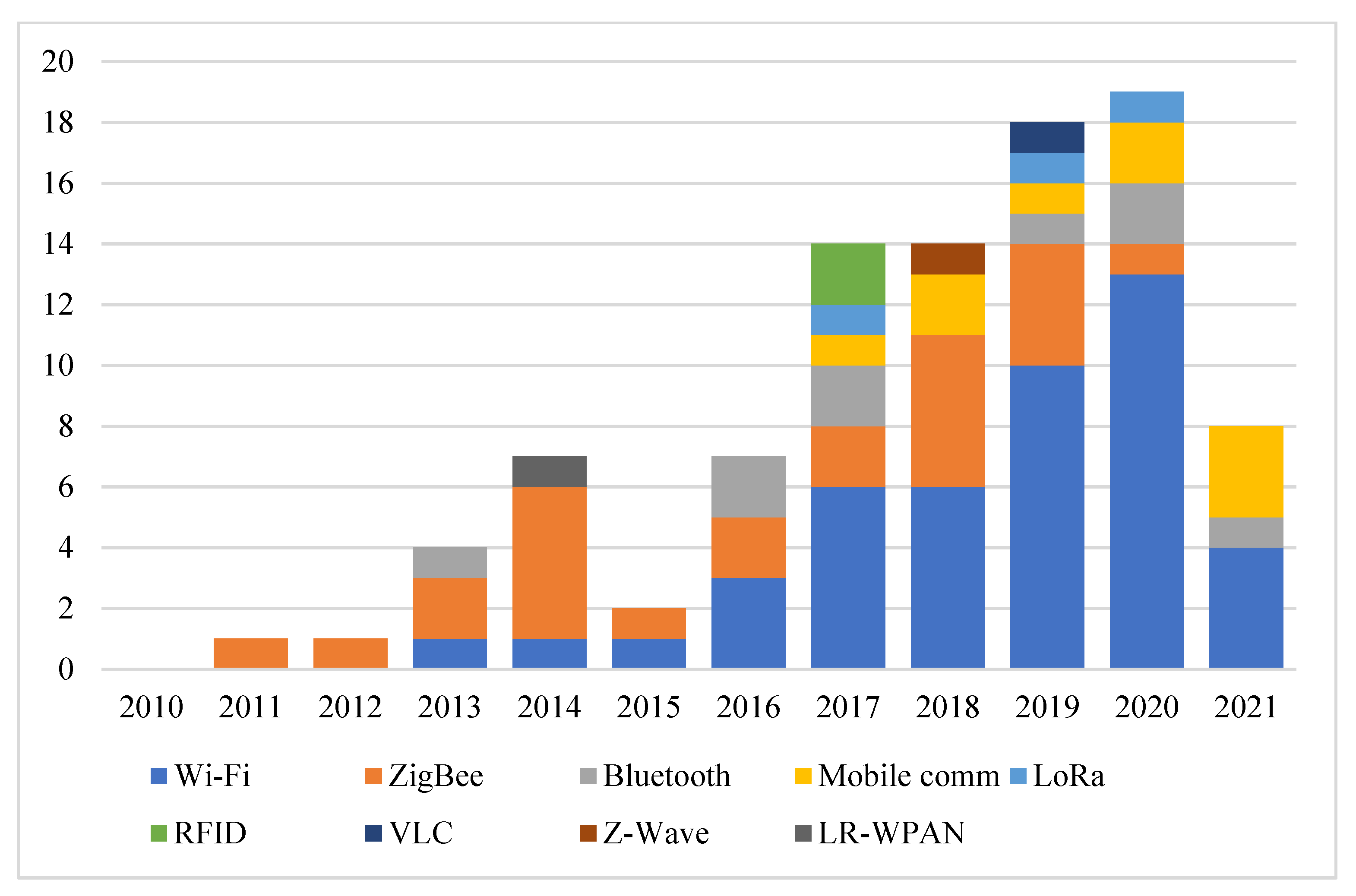
3.1. Distribution by Year of Publication
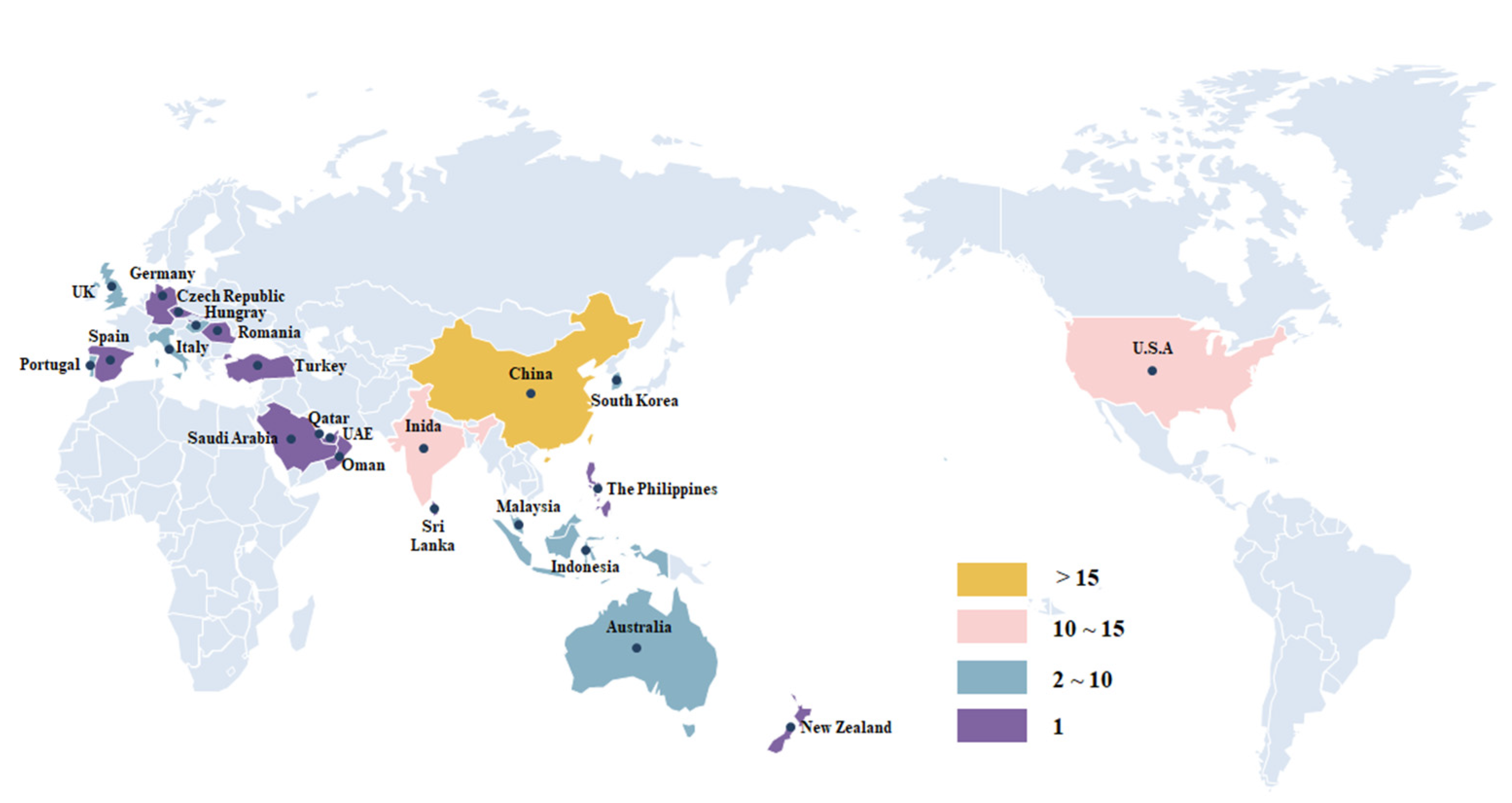
3.2. Distribution by Authors’ Nationality
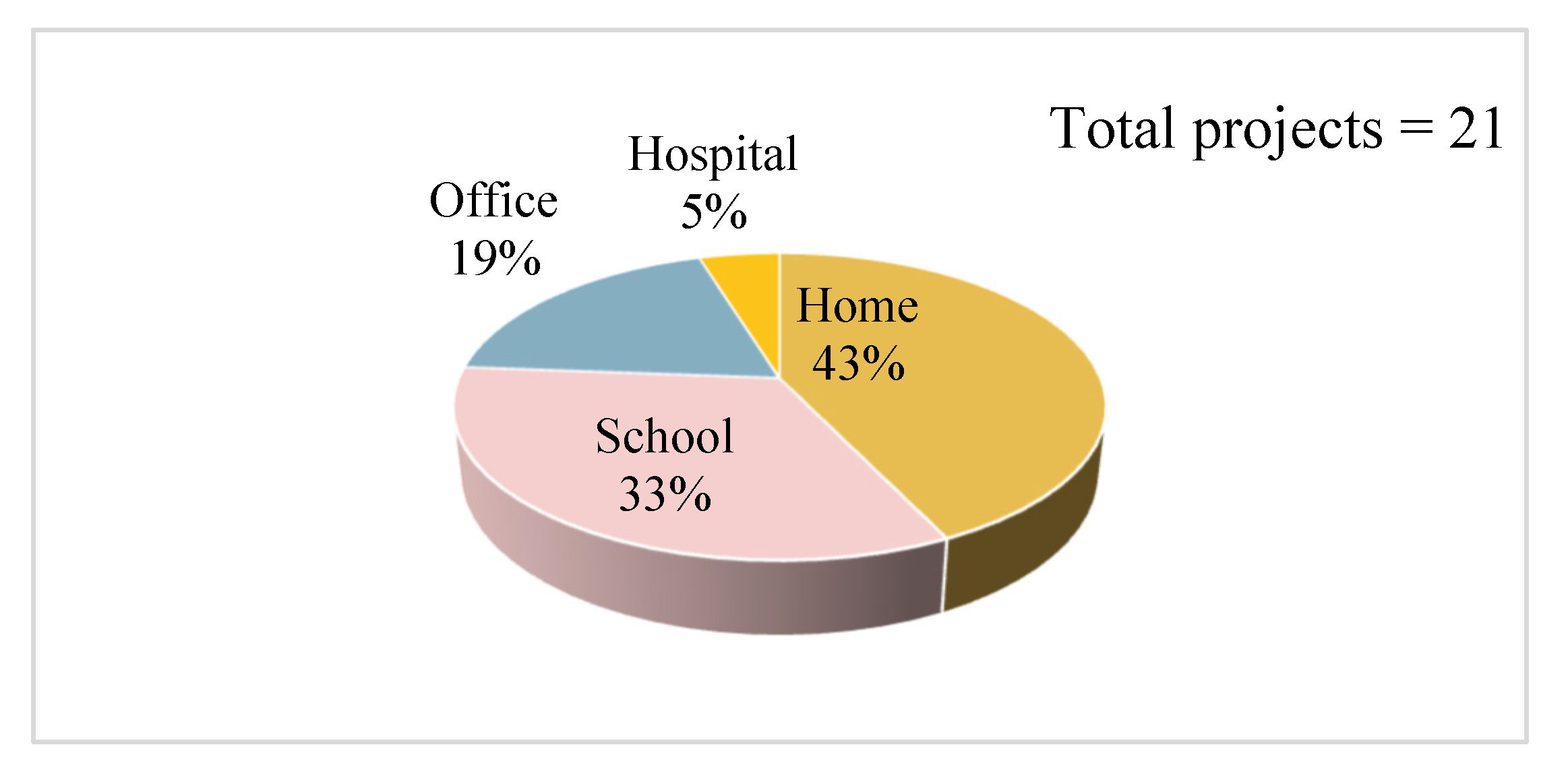
3.3. Distribution by Category
4. Discussion
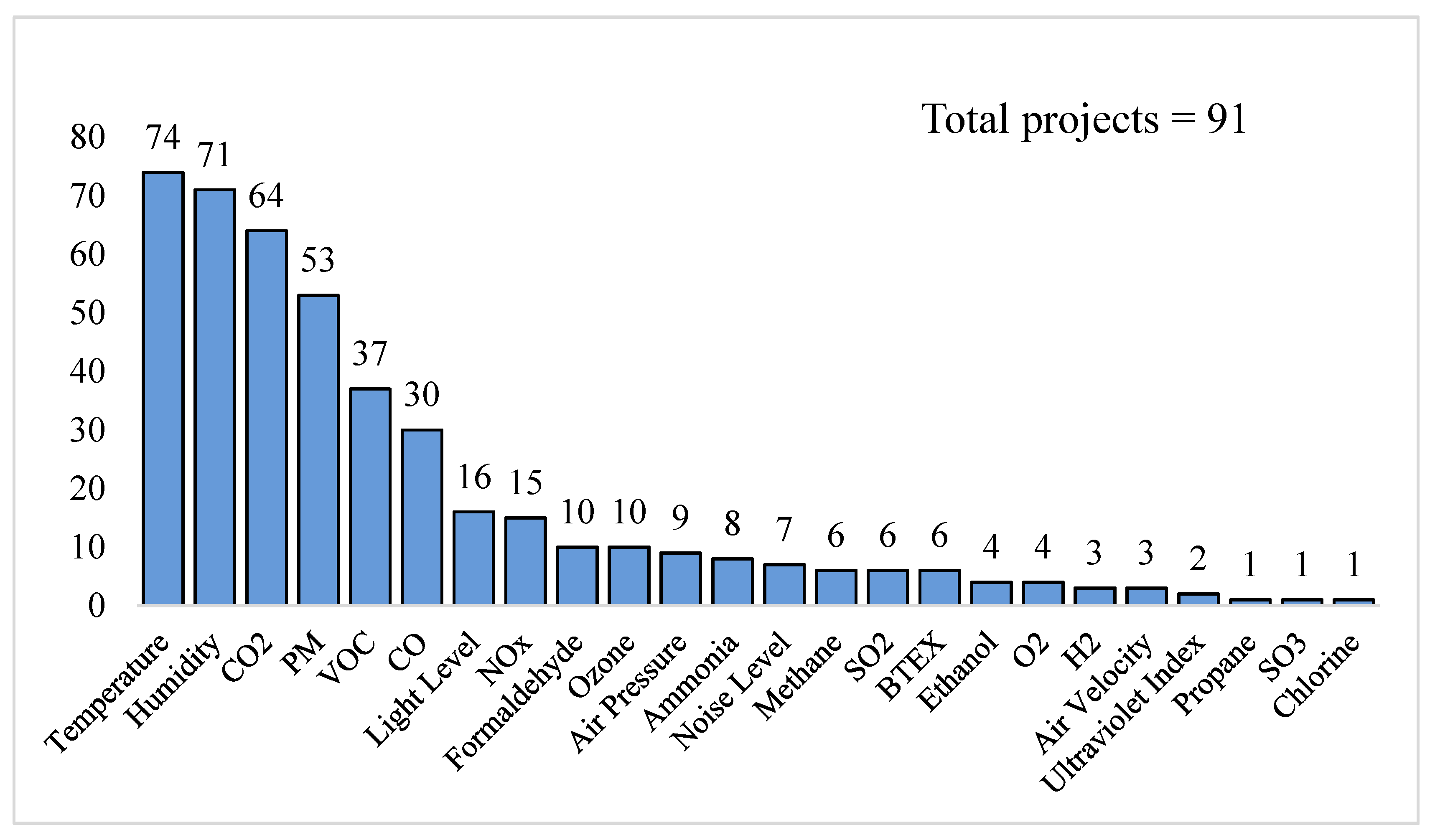
4.1. Sensors
4.2. Communication Technology
4.2.1. Wi-Fi
4.2.2. ZigBee
4.2.3. Bluetooth
4.2.4. Mobile Communication
4.2.5. LoRa
4.2.6. RFID
4.2.7. Visible Light Communication
4.2.8. Z-Wave
4.2.9. Heterogeneous Communications
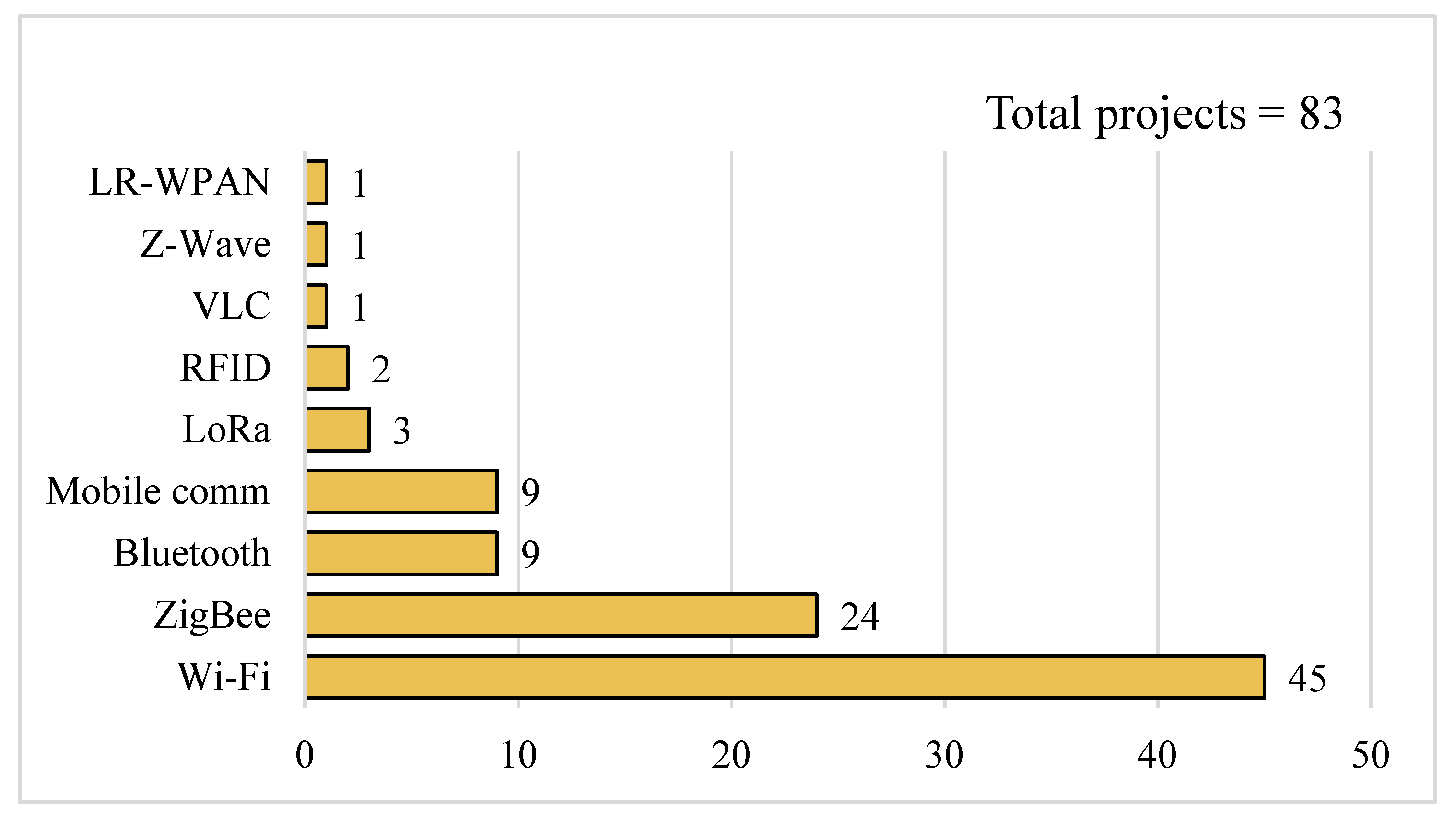
4.2.10. Results and Suggestions
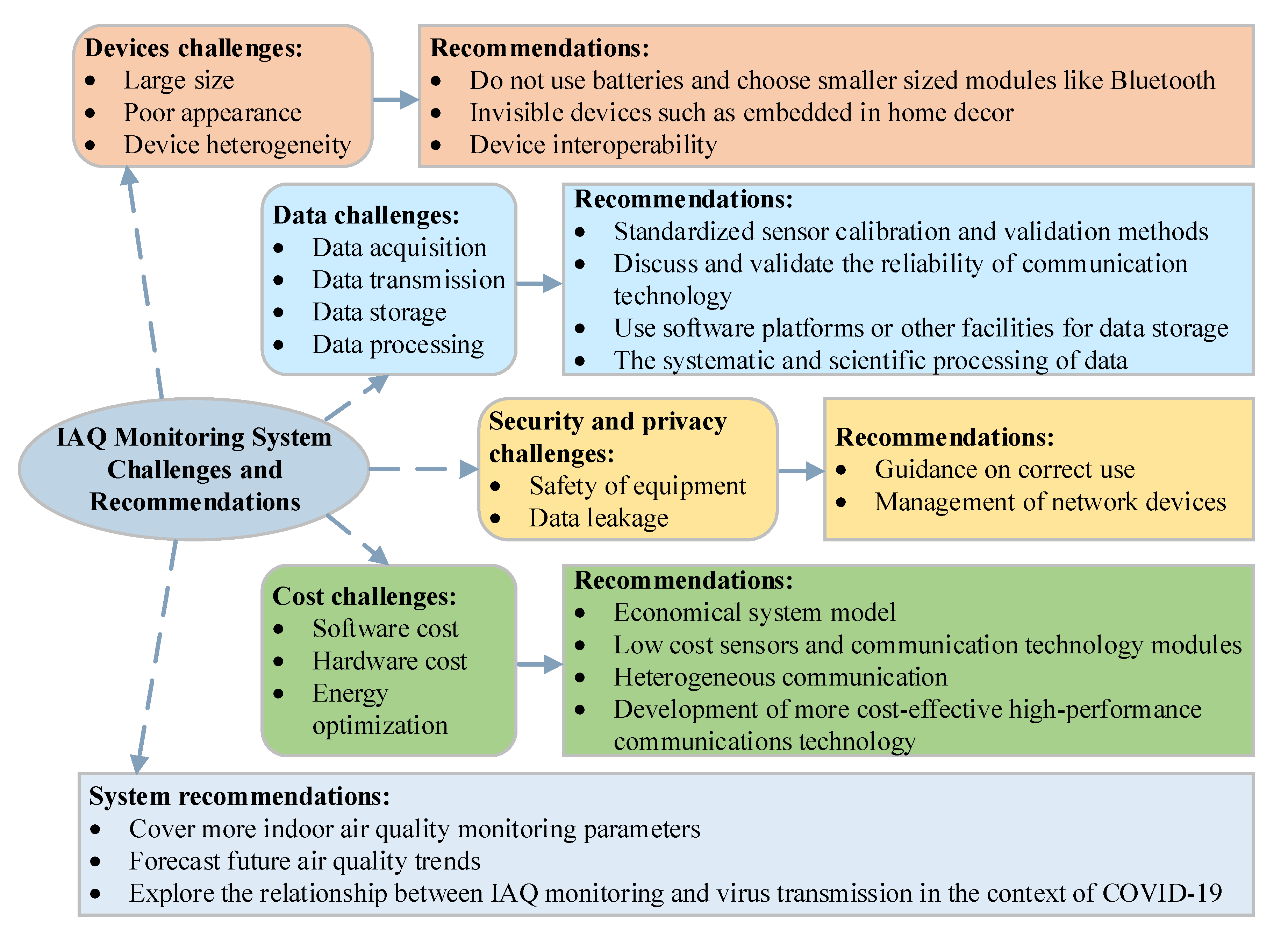
5. Challenges and Recommendations
5.1. Devices
5.2. Data
5.3. Security and Privacy
5.4. Cost
5.5. System
6. Conclusions
Author Contributions
Funding
Institutional Review Board Statement
Informed Consent Statement
Conflicts of Interest
Abbreviations
| A | Ammonia/NH3 | NO2 | Nitrogen dioxide |
| AP | Air Pressure/Atmospheric Pressure | NOx | Nitrogen oxides |
| AV | Air Velocity | O2 | Oxygen |
| BLE | Bluetooth Low Energy | O3 | Ozone |
| BTEX | Benzene, Toluene, Ethylbenzene, Xylene | P | Propane/C3H8 |
| BZ | Benzene | PM | Particulate matter |
| C1 | CO/Carbon monoxide | PM2.5 | Fine particles with a diameter of 2.5 μm (μm) or less |
| C2 | CO2/Carbon dioxide | PM10 | Particles with a diameter of 10 μm (μm) or less |
| Cl2 | Chlorine | PM20 | Particles with a diameter of 20 μm (μm) or less |
| E | Ethanol | RH | Relative Humidity |
| F | Formaldehyde/HCHO | SO2 | Sulfur dioxide |
| H | Humidity | SO3 | Sulfur trioxide |
| H2 | Hydrogen | T | Temperature |
| LL | Light Level/light luminosity | TVOC | Total Volatile Organic Compounds |
| M | Methane/CH4 | UVI | Ultraviolet Index |
| NA | Not Available | VLC | Visible Light Communication |
| NL | Noise Level | VOC, VOCs | Volatile Organic Compounds |
References
- WHO. New WHO Global Air Quality Guidelines Aim to Save Millions of Lives from Air Pollution. 2021. Available online: https://www.who.int/news/item/22-09-2021-new-who-global-air-quality-guidelines-aim-to-save-millions-of-lives-from-air-pollution (accessed on 15 October 2021).
- WHO. Ambient Air Pollution: A Global Assessment of Exposure and Burden of Disease; World Health Organization: Geneva, Switzerland, 2016. [Google Scholar]
- Klepeis, N.E.; Nelson, W.C.; Ott, W.R.; Robinson, J.P.; Tsang, A.M.; Switzer, P.; Behar, J.V.; Hern, S.C.; Engelmann, W.H. The National Human Activity Pattern Survey (NHAPS): A resource for assessing exposure to environmental pollutants. J. Expo. Sci. Environ. Epidemiol. 2001, 11, 231–252. [Google Scholar] [CrossRef] [PubMed]
- Zhang, W.; Wang, S. Indoor Air Quality Detector Design Based on ATMEGA32 Single Chip Computer. In Lecture Notes on Data Engineering and Communications Technologies; Springer Science and Business Media Deutschland GmbH: Cham, Switzerland, 2021; pp. 103–108. [Google Scholar] [CrossRef]
- Kanal, A.K.; Tamas, K. Assessment of Indoor Air Quality of Educational Facilities using an IoT Solution for a Healthy Learning Environment. In Proceedings of the 2020 IEEE International Instrumentation and Measurement Technology Conference, I2MTC, Dubrovnik, Croatia, 25–28 May 2020; Institute of Electrical and Electronics Engineers Inc.: Piscataway, NJ, USA, 2020. [Google Scholar] [CrossRef]
- Yang, C.-T.; Liao, C.-J.; Liu, J.-C.; Den, W.; Chou, Y.-C.; Tsai, J.-J. Construction and Application of an Intelligent Air Quality Monitoring System for Healthcare Environment. J. Med. Syst. 2014, 38, 15. [Google Scholar] [CrossRef] [PubMed]
- WHO. Type of Pollutants. 2021. Available online: https://www.who.int/teams/environment-climate-change-and-health/air-quality-and-health/health-impacts/types-of-pollutants (accessed on 10 November 2021).
- Morawska, L.; Thai, P.K.; Liu, X.; Asumadu-Sakyi, A.; Ayoko, G.; Bartonova, A.; Bedini, A.; Chai, F.; Christensen, B.; Dunbabin, M.; et al. Applications of low-cost sensing technologies for air quality monitoring and exposure assessment: How far have they gone? Environ. Int. 2018, 116, 286–299. [Google Scholar] [CrossRef]
- Snyder, E.G.; Watkins, T.H.; Solomon, P.A.; Thoma, E.D.; Williams, R.W.; Hagler, G.S.W.; Shelow, D.; Hindin, D.A.; Kilaru, V.J.; Preuss, P.W. The Changing Paradigm of Air Pollution Monitoring. Environ. Sci. Technol. 2013, 47, 11369–11377. [Google Scholar] [CrossRef]
- Pillai, M.A.; Veerasingam, S. Implementation of Sensor Network for Indoor Air Quality Monitoring Using CAN Interface. In Proceedings of the 2010 International Conference on Advances in Computer Engineering, Washington, DC, USA, 20–21 June 2010; ACE: Oak Brook, IL, USA, 2010; pp. 366–370. [Google Scholar] [CrossRef]
- Ray, P.P. A survey on Internet of Things architectures. J. King Saud Univ. Comput. Inf. Sci. 2018, 30, 291–319. [Google Scholar] [CrossRef]
- Agrawaal, H.; Jones, C.; Thompson, J. Personal Exposure Estimates via Portable and Wireless Sensing and Reporting of Particulate Pollution. Int. J. Environ. Res. Public Health 2020, 17, 843. [Google Scholar] [CrossRef]
- Pham, N.Q.; Rachim, V.P.; Chung, W.-Y. EMI-Free Bidirectional Real-Time Indoor Environment Monitoring System. IEEE Access 2019, 7, 5714–5722. [Google Scholar] [CrossRef]
- Kodali, R.K.; Pathuri, S.; Rajnarayanan, S.C. Smart Indoor Air Pollution Monitoring Station. In Proceedings of the 10th International Conference on Computer Communication and Informatics, ICCCI, Coimbatore, India, 22–24 January 2020; Institute of Electrical and Electronics Engineers Inc.: Piscataway, NJ, USA, 2020. [Google Scholar] [CrossRef]
- Jo, J.; Jo, B.; Kim, J.; Kim, S.; Han, W. Development of an IoT-Based Indoor Air Quality Monitoring Platform. J. Sensors 2020, 2020, 8749764. [Google Scholar] [CrossRef]
- Saini, J.; Dutta, M.; Marques, G. Sensors for indoor air quality monitoring and assessment through Internet of Things: A systematic review. Environ. Monit. Assess. 2021, 193, 66. [Google Scholar] [CrossRef]
- Chojer, H.; Branco, P.; Martins, F.; Alvim-Ferraz, M.; Sousa, S. Development of low-cost indoor air quality monitoring devices: Recent advancements. Sci. Total Environ. 2020, 727, 138385. [Google Scholar] [CrossRef]
- Nezis, I.; Biskos, G.; Eleftheriadis, K.; Kalantzi, O.-I. Particulate matter and health effects in offices—A review. Build. Environ. 2019, 156, 62–73. [Google Scholar] [CrossRef]
- Cho, H. Personal Environmental Monitoring System and network platform. In Proceedings of the 9th International Conference on Sensing Technology, ICST, Auckland, New Zealand, 8–10 December 2015; IEEE Computer Society: Piscataway, NJ, USA, 2016; pp. 751–756. [Google Scholar] [CrossRef]
- Kumar, P.; Martani, C.; Morawska, L.; Norford, L.; Choudhary, R.; Bell, M.; Leach, M. Indoor air quality and energy management through real-time sensing in commercial buildings. Energy Build. 2016, 111, 145–153. [Google Scholar] [CrossRef]
- Huang, K.; Sun, W.; Feng, G.; Wang, J.; Song, J. Indoor air quality analysis of 8 mechanically ventilated residential buildings in northeast China based on long-term monitoring. Sustain. Cities Soc. 2020, 54, 101947. [Google Scholar] [CrossRef]
- Ribino, P.; Bonomolo, M.; Lodato, C.; Vitale, G. A Humanoid Social Robot Based Approach for Indoor Environment Quality Monitoring and Well-Being Improvement. Int. J. Soc. Robot. 2021, 13, 277–296. [Google Scholar] [CrossRef]
- Dhanalakshmi, S.; Poongothai, M.; Sharma, K.; Thampi, S.M.; Madria, S.; Fernando, X.; Doss, R.; Mehta, S.; Ciuonzo, D. IoT Based Indoor Air Quality and Smart Energy Management for HVAC System. Procedia Comput. Sci. 2020, 171, 1800–1809. [Google Scholar] [CrossRef]
- Zhu, H.-C.; Yu, C.W.; Cao, S.-J. Ventilation online monitoring and control system from the perspectives of technology application. Indoor Built Environ. 2020, 29, 587–602. [Google Scholar] [CrossRef]
- Brunelli, D.; Minakov, I.; Passerone, R.; Rossi, M. POVOMON: An Ad-hoc Wireless Sensor Network for indoor environmental monitoring. In Proceedings of the 6th IEEE Workshop on Environmental, Energy and Structural Monitoring Systems, EESMS, Naples, Italy, 17–18 September 2014; Institute of Electrical and Electronics Engineers Inc.: Piscataway, NJ, USA, 2014; pp. 175–180. [Google Scholar] [CrossRef]
- Bidila, T.; Pietraru, R.N.; Ionita, A.D.; Olteanu, A. Monitor Indoor Air Quality to Assess the Risk of COVID-19 Transmission. In Proceedings of the 23rd International Conference on Control Systems and Computer Science Technologies, CSCS, Bucharest, Romania, 26–28 May 2021; Institute of Electrical and Electronics Engineers Inc.: Piscataway, NJ, USA, 2021; pp. 356–361. [Google Scholar] [CrossRef]
- Chen, H.; Zhang, Z.; Li, J.; Liu, S.; Liu, X.; Qiao, S. Design of the Highly Integrated Indoor Environment Monitoring System with Dual Data Transmission Mode Based on the Interconnect of Things. IOP Conf. Series Earth Environ. Sci. 2021, 668, 012028. [Google Scholar] [CrossRef]
- Hikmah, I.; Ramadhani, A.D.; Syifa, F.T. The comparison of essential oil concentration to maximum air quality produced by diffuser based on Internet of Things (IoT) technology to create a healthy room. J. Phys. Conf. Ser. 2021, 1816, 012029. [Google Scholar] [CrossRef]
- Mumtaz, R.; Zaidi, S.; Shakir, M.Z.; Shafi, U.; Malik, M.M.; Haque, A.; Mumtaz, S.; Zaidi, S. Internet of Things (IoT) Based Indoor Air Quality Sensing and Predictive Analytic—A COVID-19 Perspective. Electronics 2021, 10, 184. [Google Scholar] [CrossRef]
- Afroz, Z.; Higgins, G.; Shafiullah, G.; Urmee, T. Evaluation of real-life demand-controlled ventilation from the perception of indoor air quality with probable implications. Energy Build. 2020, 219, 110018. [Google Scholar] [CrossRef]
- Cicceri, G.; Scaffidi, C.; Benomar, Z.; Distefano, S.; Puliafito, A.; Tricomi, G.; Merlino, G. Smart Healthy Intelligent Room: Headcount through Air Quality Monitoring. In Proceedings of the 6th IEEE International Conference on Smart Computing, SMARTCOMP, Bologna, Italy, 14–17 September 2020; Institute of Electrical and Electronics Engineers Inc.: Piscataway, NJ, USA, 2020; pp. 320–325. [Google Scholar] [CrossRef]
- Esfahani, S.; Rollins, P.; Specht, J.P.; Cole, M.; Gardner, J.W. Smart City Battery Operated IoT Based Indoor Air Quality Monitoring System. In Proceedings of the 2020 IEEE Sensors, Rotterdam, The Netherlands, 25–28 October 2020; Institute of Electrical and Electronics Engineers Inc.: Piscataway, NJ, USA, 2020. [Google Scholar] [CrossRef]
- Hapsari, A.A.; Vresdian, D.J.; Aldiansyah, M.; Dionova, B.W.; Windari, A.C. Indoor Air Quality Monitoring System with Node.js and MQTT Application. In Proceedings of the 1st International Conference on Information Technology, Advanced Mechanical and Electrical Engineering, ICITAMEE, Yogyakarta, Indonesia, 13–14 October 2020; Institute of Electrical and Electronics Engineers Inc.: Piscataway, NJ, USA, 2020; pp. 144–149. [Google Scholar] [CrossRef]
- Hu, Z.; Cong, S.; Song, T.; Bian, K.; Song, L. AirScope: Mobile Robots-Assisted Cooperative Indoor Air Quality Sensing by Distributed Deep Reinforcement Learning. IEEE Internet Things J. 2020, 7, 9189–9200. [Google Scholar] [CrossRef]
- Kaur, S.; Bawa, S.; Sharma, S. IoT Enabled Low-Cost Indoor Air Quality Monitoring System with Botanical Solutions. In Proceedings of the 8th IEEE International Conference on Reliability, Infocom Technologies and Optimization (Trends and Future Directions), ICRITO, Noida, India, 4–5 June 2020; Institute of Electrical and Electronics Engineers Inc.: Piscataway, NJ, USA, 2020; pp. 447–453. [Google Scholar] [CrossRef]
- Meris, P.R.; Dimaunahan, E.; Cruz, J.C.D.; Fadchar, N.A.; Manuel, M.C.; Bonaobra, J.C.C.; Ranosa, F.J.I.; Mangaoang, J.L.D.; Reyes, P.C. IOT Based—Automated Indoor Air Quality and LPG Leak Detection Control System using Support Vector Machine. In Proceedings of the 11th IEEE Control and System Graduate Research Colloquium, ICSGRC, Shah Alam, Malaysia, 8 August 2020; Institute of Electrical and Electronics Engineers Inc.: Piscataway, NJ, USA, 2020; pp. 231–235. [Google Scholar] [CrossRef]
- Nasution, T.H.; Hizriadi, A.; Tanjung, K.; Nurmayadi, F. Design of Indoor Air Quality Monitoring Systems. In Proceedings of the 4th International Conference on Electrical, Telecommunication and Computer Engineering, ELTICOM, Medan, Indonesia, 3–4 September 2020; Institute of Electrical and Electronics Engineers Inc.: Piscataway, NJ, USA, 2020; pp. 238–241. [Google Scholar] [CrossRef]
- Putra, J.C.P.; Susanto, T. Artificial Neural Network Modelling of Indoor CO2 Reduction as Energy-Efficient Strategies. In Proceedings of the 6th International Conference and Exhibition on Sustainable Energy and Advanced Materials, ICE-SEAM, Surakarta, Indonesia, 16–17 October 2019; Sabino, U., Imaduddin, F., Prabowo, A.R., Eds.; Springer: Cham, Switzerland, 2020; pp. 695–702. [Google Scholar] [CrossRef]
- Rastogi, K.; Lohani, D. An Internet of Things Framework to Forecast Indoor Air Quality Using Machine Learning. In Proceedings of the 1st Symposium on Machine Learning and Metaheuristics Algorithms, and Applications, SoMMA, Trivandum, India, 18–21 December 2019; Thampi, S.M., Trajkovic, L., Li, K.C., Das, S., Wozniak, M., Berretti, S., Eds.; Springer: Cham, Switzerland, 2020; pp. 90–104. [Google Scholar] [CrossRef]
- Rickenbacker, H.J.; Collinge, W.O.; Hasik, V.; Ciranni, A.; Smith, I.; Colao, P.; Sharrard, A.L.; Bilec, M.M. Development of a framework for indoor air quality assessments in energy conservation districts. Sustain. Cities Soc. 2020, 52, 101831. [Google Scholar] [CrossRef]
- Saini, J.; Dutta, M.; Marques, G. Indoor Air Quality Monitoring with IoT: Predicting PM10 for Enhanced Decision Support. In Proceedings of the 2020 International Conference on Decision Aid Sciences and Application, Sakheer, Bahrain, 8–9 November 2020; Institute of Electrical and Electronics Engineers Inc.: Piscataway, NJ, USA, 2020; pp. 504–508. [Google Scholar] [CrossRef]
- Zhou, M.; Abdulghani, A.M.; Imran, M.A.; Abbasi, Q.H. Internet of Things (IoT) Enabled Smart Indoor Air Quality Monitoring System. In Proceedings of the 2020 International Conference on Computing, Networks and Internet of Things, CNIOT, Sanya, China, 24–26 April 2020; Association for Computing Machinery: New York, NY, USA, 2020; pp. 89–93. [Google Scholar] [CrossRef]
- AbdulWahhab, R.S. Air Quality System Using IoT for Indoor Environmental Monitoring. In Proceedings of the 2019 5th International Conference on Computer and Technology Applications, Stanbul, Turkey, 16–17 April 2019; Association for Computing Machinery: New York, NY, USA, 2019; pp. 184–188. [Google Scholar] [CrossRef]
- Asthana, P.; Mishra, S. IoT Enabled Real Time Bolt based Indoor Air Quality Monitoring System. In Proceedings of the 1st IEEE International Conference on Computational and Characterization Techniques in Engineering and Sciences, CCTES, Lucknow, India, 14–15 September 2018; Institute of Electrical and Electronics Engineers Inc.: Piscataway, NJ, USA, 2019; pp. 36–39. [Google Scholar] [CrossRef]
- Chiesa, G.; Cesari, S.; Garcia, M.; Issa, M.; Li, S. Multisensor IoT Platform for Optimising IAQ Levels in Buildings through a Smart Ventilation System. Sustainability 2019, 11, 5777. [Google Scholar] [CrossRef]
- Gillooly, S.E.; Zhou, Y.; Vallarino, J.; Chu, M.T.; Michanowicz, D.R.; Levy, J.I.; Adamkiewicz, G. Development of an in-home, real-time air pollutant sensor platform and implications for community use. Environ. Pollut. 2019, 244, 440–450. [Google Scholar] [CrossRef] [PubMed]
- Jose, J.; Sasipraba, T. Indoor air quality monitors using IOT sensors and LPWAN. In Proceedings of the 3rd International Conference on Trends in Electronics and Informatics, ICOEI, Tirunelveli, India, 23–25 April 2019; Institute of Electrical and Electronics Engineers Inc.: Piscataway, NJ, USA, 2019; pp. 633–637. [Google Scholar] [CrossRef]
- Kanal, A.K.; Kovacshazy, T. IoT Solution for Assessing the Indoor Air Quality of Educational Facilities. In Proceedings of the 20th International Carpathian Control Conference, ICCC, Krakow-Wieliczka, Poland, 26–29 May 2019; Institute of Electrical and Electronics Engineers Inc.: Piscataway, NJ, USA, 2019. [Google Scholar] [CrossRef]
- Ladekar, V.; Daruwala, R. Indoor Air Quality Monitoring on AWS Using MQTT Protocol. In Proceedings of the 10th International Conference on Computing, Communication and Networking Technologies, ICCCNT, Kanpur, India, 6–8 July 2019; Institute of Electrical and Electronics Engineers Inc.: Piscataway, NJ, USA, 2019. [Google Scholar] [CrossRef]
- Marques, G.; Pitarma, R. A Cost-Effective Air Quality Supervision Solution for Enhanced Living Environments through the Internet of Things. Electronics 2019, 8, 170. [Google Scholar] [CrossRef]
- Nigam, H.; Saini, A.K.; Banerjee, S.; Kumar, A. Indoor Environment Air Quality Monitoring and its Notification to Building Occupants. In Proceedings of the 2019 IEEE Region 10 Conference: Technology, Knowledge, and Society, TENCON, Kochi, India, 17–20 October 2019; Institute of Electrical and Electronics Engineers Inc.: Piscataway, NJ, USA, 2019; pp. 2444–2448. [Google Scholar] [CrossRef]
- Parkinson, T.; Parkinson, A.; de Dear, R. Continuous IEQ monitoring system: Context and development. Build. Environ. 2019, 149, 15–25. [Google Scholar] [CrossRef]
- Parkinson, T.; Parkinson, A.; de Dear, R. Continuous IEQ monitoring system: Performance specifications and thermal comfort classification. Build. Environ. 2019, 149, 241–252. [Google Scholar] [CrossRef]
- Patil, K.; Laad, M.; Kamble, A.; Laad, S. A Consumer-Based Smart Home with Indoor Air Quality Monitoring System. IETE J. Res. 2019, 65, 758–770. [Google Scholar] [CrossRef]
- Pradityo, F.; Surantha, N. Indoor Air Quality Monitoring and Controlling System based on IoT and Fuzzy Logic. In Proceedings of the 7th International Conference on Information and Communication Technology, ICoICT, Kuala Lumpur, Malaysia, 24–26 July 2019; Institute of Electrical and Electronics Engineers Inc.: Piscataway, NJ, USA, 2019. [Google Scholar] [CrossRef]
- Salman, N.; Kemp, A.H.; Khan, A.; Noakes, C. Real Time Wireless Sensor Network (WSN) based Indoor Air Quality Monitoring System. IFAC-PapersOnLine 2019, 52, 324–327. [Google Scholar] [CrossRef]
- Satyanarayana, P.; Narmadha, R. Implementation of Wireless Sensor Network Based Indoor Air Quality Monitoring System using GSM. Int. J. Eng. Adv. Technol. 2019, 8, 4885–4889. [Google Scholar] [CrossRef]
- Taştan, M.; Gökozan, H. Real-Time Monitoring of Indoor Air Quality with Internet of Things-Based E-Nose. Appl. Sci. 2019, 9, 3435. [Google Scholar] [CrossRef]
- Wu, F.; Rüdiger, C.; Redouté, J.-M.; Yuce, M.R. A Wearable Multi-Sensor IoT Network System for Environmental Monitoring; Internet of Things; Springer International Publishing: Cham, Switzerland, 2019; pp. 29–38. [Google Scholar] [CrossRef]
- Xiahou, R.; Yi, J.; He, L.; He, W.; Huang, T. Indoor Air Monitoring System Based on Internet of Things and Its Prediction Model. In Proceedings of the 2019 International Conference on Industrial Control Network and System Engineering Research, ICNSER, Shenyang, China, 21–22 April 2019; Association for Computing Machinery: New York, NY, USA, 2019; pp. 58–63. [Google Scholar] [CrossRef]
- Yang, C.-T.; Chen, S.-T.; Den, W.; Wang, Y.-T.; Kristiani, E. Implementation of an Intelligent Indoor Environmental Monitoring and management system in cloud. Futur. Gener. Comput. Syst. 2019, 96, 731–749. [Google Scholar] [CrossRef]
- Benammar, M.; Abdaoui, A.; Ahmad, S.H.; Touati, F.; Kadri, A. A Modular IoT Platform for Real-Time Indoor Air Quality Monitoring. Sensors 2018, 18, 581. [Google Scholar] [CrossRef] [PubMed]
- Carre, A.; Williamson, T. Design and validation of a low cost indoor environment quality data logger. Energy Build. 2018, 158, 1751–1761. [Google Scholar] [CrossRef]
- Idrees, Z.; Zou, Z.; Zheng, L. Edge Computing Based IoT Architecture for Low Cost Air Pollution Monitoring Systems: A Comprehensive System Analysis, Design Considerations & Development. Sensors 2018, 18, 3021. [Google Scholar] [CrossRef]
- Karami, M.; McMorrow, G.V.; Wang, L. Continuous monitoring of indoor environmental quality using an Arduino-based data acquisition system. J. Build. Eng. 2018, 19, 412–419. [Google Scholar] [CrossRef]
- Lee, C.-L.; Lee, J.-S. Development of indoor air quality supervision systems using ZigBee wireless networks. In Proceedings of the 13th IEEE Conference on Industrial Electronics and Applications, ICIEA 2018, Wuhan, China, 31 May–2 June 2018; Institute of Electrical and Electronics Engineers Inc.: Piscataway, NJ, USA, 2018; pp. 95–98. [Google Scholar] [CrossRef]
- Luo, H.; Li, W.; Wu, X. Design of indoor air quality monitoring system based on wireless sensor network. IOP Conf. Series Earth Environ. Sci. 2018, 208, 012070. [Google Scholar] [CrossRef]
- Martín-Garín, A.; Millán-García, J.; Baïri, A.; Millán-Medel, J.; Sala-Lizarraga, J. Environmental monitoring system based on an Open Source Platform and the Internet of Things for a building energy retrofit. Autom. Constr. 2018, 87, 201–214. [Google Scholar] [CrossRef]
- Panghurian, F.P.; Surantha, N.; Zahra, A. A low-power scenario for IOT-based indoor air quality monitoring system at workplace. IOP Conf. Series Earth Environ. Sci. 2018, 195, 012048. [Google Scholar] [CrossRef]
- Perez, A.O.; Bierer, B.; Scholz, L.; Wöllenstein, J.; Palzer, S. A Wireless Gas Sensor Network to Monitor Indoor Environmental Quality in Schools. Sensors 2018, 18, 4345. [Google Scholar] [CrossRef]
- Tiele, A.; Esfahani, S.; Covington, J. Design and Development of a Low-Cost, Portable Monitoring Device for Indoor Environment Quality. J. Sensors 2018, 2018, 5353816. [Google Scholar] [CrossRef]
- Tijani, I.B.; Almannaee, A.D.; Alharthi, A.A.; Alremeithi, A.M. Wireless sensor node for indoor air quality monitoring system. In Proceedings of the 2018 Advances in Science and Engineering Technology International Conferences, ASET, Abu Dhabi, United Arab Emirates, 6 February–5 April 2018; Institute of Electrical and Electronics Engineers Inc.: Piscataway, NJ, USA, 2018; pp. 1–6. [Google Scholar] [CrossRef]
- Wang, Y.; Boulic, M.; Phipps, R.; Chitty, C.; Moses, A.; Weyers, R.; Jang-Jaccard, J.; Olivares, G.; Ponder-Sutton, A.; Cunningham, C. Integrating Open-Source Technologies to Build a School Indoor Air Quality Monitoring Box (SKOMOBO); Institute of Electrical and Electronics Engineers Inc.: Piscataway, NJ, USA, 2018; pp. 216–223. [Google Scholar] [CrossRef]
- Wang, Y.; Jang-Jaccard, J.; Boulic, M.; Phipps, R.; Chitty, C.; Weyers, R.; Moses, A.; Olivares, G.; Ponder-Sutton, A.; Cunningham, C. Deployment issues for integrated open-source—Based indoor air quality school Monitoring Box (SKOMOBO). In Proceedings of the 2018 IEEE Sensors Applications Symposium (SAS), Seoul, Korea, 12–14 March 2018; Institute of Electrical and Electronics Engineers Inc.: Piscataway, NJ, USA, 2018; pp. 1–4. [Google Scholar] [CrossRef]
- Zakaria, N.A.; Zainal, Z.; Harum, N.; Chen, L.; Saleh, N.; Azni, F. Wireless Internet of Things-Based Air Quality Device for Smart Pollution Monitoring. Int. J. Adv. Comput. Sci. Appl. 2018, 9, 65–69. [Google Scholar] [CrossRef]
- Ahn, J.; Shin, D.; Kim, K.; Yang, J. Indoor Air Quality Analysis Using Deep Learning with Sensor Data. Sensors 2017, 17, 2476. [Google Scholar] [CrossRef] [PubMed]
- Alhmiedat, T.; Samara, G. A low cost ZigBee sensor network architecture for indoor air quality monitoring. Int. J. Comput. Sci. Inf. Secur. 2017, 1, 15. [Google Scholar]
- Firdhous, M.; Sudantha, B.; Karunaratne, P. IoT enabled proactive indoor air quality monitoring system for sustainable health management. In Proceedings of the 2nd International Conference on Computing and Communications Technologies, ICCCT, Chennai, India, 23–24 February 2017; Institute of Electrical and Electronics Engineers Inc.: Piscataway, NJ, USA, 2017; pp. 216–221. [Google Scholar] [CrossRef]
- He, J.; Xu, L.; Wang, P.; Wang, Q. A high precise E-nose for daily indoor air quality monitoring in living environment. Integr. VLSI J. 2017, 58, 286–294. [Google Scholar] [CrossRef]
- Kumar, A.; Kumar, A.; Singh, A. Energy efficient and low cost air quality sensor for smart buildings. In Proceedings of the 3rd IEEE International Conference on “Computational Intelligence and Communication Technology”, CICT, Ghaziabad, India, 9–10 February 2017; Institute of Electrical and Electronics Engineers Inc.: Piscataway, NJ, USA, 2017. [Google Scholar] [CrossRef]
- Li, Y.; He, J. Design of an intelligent indoor air quality monitoring and purification device. In Proceedings of the 3rd IEEE Information Technology and Mechatronics Engineering Conference, ITOEC, Chongqing, China, 3–5 October 2017; Institute of Electrical and Electronics Engineers Inc.: Piscataway, NJ, USA, 2017; pp. 1147–1150. [Google Scholar] [CrossRef]
- Salamone, F.; Belussi, L.; Danza, L.; Ghellere, M.; Meroni, I. How to control the Indoor Environmental Quality through the use of the Do-It-Yourself approach and new pervasive technologies. Energy Procedia 2017, 140, 351–360. [Google Scholar] [CrossRef]
- Scarpa, M.; Ravagnin, R.; Schibuola, L.; Tambani, C. Development and testing of a platform aimed at pervasive monitoring of indoor environment and building energy. Energy Procedia 2017, 126, 282–288. [Google Scholar] [CrossRef]
- Tran, T.V.; Dang, N.T.; Chung, W.-Y. Battery-free smart-sensor system for real-time indoor air quality monitoring. Sensors Actuators B Chem. 2017, 248, 930–939. [Google Scholar] [CrossRef]
- Vcelak, J.; Vodicka, A.; Maska, M.; Mrna, J. Smart building monitoring from structure to indoor environment. In Proceedings of the 2017 Smart Cities Symposium Prague, SCSP, Prague, Czech Republic, 25–26 May 2017; Institute of Electrical and Electronics Engineers Inc.: Piscataway, NJ, USA, 2017. [Google Scholar] [CrossRef]
- Yang, X.; Yang, L.; Zhang, J. A WiFi-enabled indoor air quality monitoring and control system: The design and control experiments. In Proceedings of the 13th IEEE International Conference on Control and Automation, ICCA, Ohrid, Macedonia, 3–6 July 2017; IEEE Computer Society: Piscataway, NJ, USA, 2017; pp. 927–932. [Google Scholar] [CrossRef]
- Abraham, S.; Li, X. Design of A Low-Cost Wireless Indoor Air Quality Sensor Network System. Int. J. Wirel. Inf. Netw. 2016, 23, 57–65. [Google Scholar] [CrossRef]
- Ali, A.S.; Zanzinger, Z.; Debose, D.; Stephens, B. Open Source Building Science Sensors (OSBSS): A low-cost Arduino-based platform for long-term indoor environmental data collection. Build. Environ. 2016, 100, 114–126. [Google Scholar] [CrossRef]
- Kang, J.; Hwang, K.-I. A Comprehensive Real-Time Indoor Air-Quality Level Indicator. Sustainability 2016, 8, 881. [Google Scholar] [CrossRef]
- Pitarma, R.; Marques, G.; Caetano, F. Monitoring Indoor Air Quality to Improve Occupational Health. In Proceedings of the World Conference on Information Systems and Technologies, WorldCIST, Recife, Brazil, 22–24 March 2016; Rocha, A., Adeli, H., Reis, L.P., Correia, A.M., Reis, L.P., Teixeira, M.M., Reis, L.P., Eds.; Springer: Cham, Switzerland, 2016; pp. 13–21. [Google Scholar] [CrossRef]
- Smith, J.P.; Li, X. AirSniffer: A smartphone-based sensor system for body area climate and air quality monitoring. In Proceedings of the 10th International Symposium on Medical Information and Communication Technology, ISMICT, Worcester, MA, USA, 20–23 March 2016; IEEE Computer Society: Piscataway, NJ, USA, 2016. [Google Scholar] [CrossRef]
- Tapashetti, A.; Vegiraju, D.; Ogunfunmi, T. IoT-enabled air quality monitoring device: A low cost smart health solution. In Proceedings of the 6th Annual IEEE Global Humanitarian Technology Conference, GHTC, Seattle, WA, USA, 13–16 October 2016; Institute of Electrical and Electronics Engineers Inc.: Piscataway, NJ, USA, 2016; pp. 682–685. [Google Scholar] [CrossRef]
- Saad, S.M.; Shakaff, A.Y.; Saad, A.R.M.; Kamarudin, A.M.Y. Development of wireless sensor network for monitoring indoor air pollutant. In Proceedings of the International Conference on Mathematics, Engineering and Industrial Applications, ICoMEIA 2014, Penang, Malaysia, 28–30 May 2014; American Institute of Physics Inc.: College Park, MD, USA, 2015. [Google Scholar] [CrossRef]
- Yang, Q.; Zhou, G.; Qin, W.; Zhang, B.; Chiang, P.Y. Air-kare: A Wi-Fi based, multi-sensor, real-time indoor air quality monitor. In Proceedings of the 2015 IEEE International Wireless Symposium, IWS, Shenzen, China, 30 March–1 April 2015; Institute of Electrical and Electronics Engineers Inc.: Piscataway, NJ, USA, 2015. [Google Scholar] [CrossRef]
- Yu, T.-C.; Lin, C.-C. An Intelligent Wireless Sensing and Control System to Improve Indoor Air Quality: Monitoring, Prediction, and Preaction. Int. J. Distrib. Sens. Netw. 2015, 11, 140978. [Google Scholar] [CrossRef]
- Zhang, Y.; Zhao, Y. Design & implementation of an Air Quality Monitoring System for Indoor Environment based on Microcontroller. Int. J. Smart Home 2015, 9, 301–312. [Google Scholar] [CrossRef]
- Abraham, S.; Li, X. A Cost-effective Wireless Sensor Network System for Indoor Air Quality Monitoring Applications. Procedia Comput. Sci. 2014, 34, 165–171. [Google Scholar] [CrossRef]
- Kim, J.-Y.; Chu, C.-H.; Shin, S.-M. ISSAQ: An Integrated Sensing Systems for Real-Time Indoor Air Quality Monitoring. IEEE Sensors J. 2014, 14, 4230–4244. [Google Scholar] [CrossRef]
- Saad, S.M.; Shakaff, A.Y.; Saad, A.R.; Kamarudin, A.M. Implementation of index for real-time monitoring indoor air quality system. In Proceedings of the 2014 2nd International Conference on Electronic Design (ICED), Penang, Malaysia, 19–21 August 2014; pp. 53–57. [Google Scholar] [CrossRef]
- Teixeira, A.F.; Postolache, O. Wireless sensor network and web based information system for asthma trigger factors monitoring. In Proceedings of the 2014 IEEE International Instrumentation and Measurement Technology Conference: Instrumentation and Measurement for Sustainable Development, I2MTC, Montevideo, Uruguay, 12–15 May 2014; Institute of Electrical and Electronics Engineers Inc.: Piscataway, NJ, USA, 2014; pp. 1388–1393. [Google Scholar] [CrossRef]
- Jiang, Y.; Li, K.; Piedrahita, R.; Yun, X.; Tian, L.; Mansata, O.M.; Lv, Q.; Dick, R.P.; Hannigan, M.; Shang, L. User-Centric Indoor Air Quality Monitoring on Mobile Devices. AI Mag. 2013, 34, 11. [Google Scholar] [CrossRef]
- Peng, I.-H.; Chu, Y.-Y.; Kong, C.-Y.; Su, Y.-S. Implementation of Indoor VOC Air Pollution Monitoring System with Sensor Network. In Proceedings of the 2013 7th International Conference on Complex, Intelligent, and Software Intensive Systems, CISIS, Taichung, Taiwan, 3–5 July 2013; pp. 639–643. [Google Scholar] [CrossRef]
- Saad, S.M.; Saad, A.R.M.; Kamarudin, A.M.Y.; Zakaria, A.; Shakaff, A.Y.M. Indoor air quality monitoring system using wireless sensor network (WSN) with web interface. In Proceedings of the 2013 International Conference on Electrical, Electronics and System Engineering, ICEESE, Kuala Lumpur, Malaysia, 4–5 December 2013; Institute of Electrical and Electronics Engineers Inc.: Piscataway, NJ, USA, 2013; pp. 60–64. [Google Scholar] [CrossRef]
- Bhattacharya, S.; Sridevi, S.; Pitchiah, R. Indoor air quality monitoring using wireless sensor network. In Proceedings of the 2012 6th International Conference on Sensing Technology (ICST), Kolkata, India, 18–21 December 2012; pp. 422–427. [Google Scholar] [CrossRef]
- Tzeng, C.-B.; Wey, T.-S. Design and Implement a Cost Effective and Ubiquitous Air Quality Monitoring System Based on ZigBee Wireless Sensor Network. In Proceedings of the 2011 2nd International Conference on Innovations in Bio-inspired Computing and Applications, IBICA, Shenzhen, China, 16–18 December 2011; pp. 245–248. [Google Scholar] [CrossRef]
- Yu, B.; Hu, Z.; Liu, M.; Yang, H.; Kong, Q.; Liu, Y. Review of research on air-conditioning systems and indoor air quality control for human health. Int. J. Refrig. 2008, 32, 3–20. [Google Scholar] [CrossRef]
- Gorai, A.K.; Tuluri, F.; Tchounwou, P.B. A GIS Based Approach for Assessing the Association between Air Pollution and Asthma in New York State, USA. Int. J. Environ. Res. Public Health 2014, 11, 4845–4869. [Google Scholar] [CrossRef]
- Kuzlu, M.; Pipattanasomporn, M.; Rahman, S. Review of communication technologies for smart homes/building applications. In Proceedings of the IEEE Innovative Smart Grid Technologies—Asia, ISGT ASIA, Bangkok, Thailand, 3–6 November 2015; Institute of Electrical and Electronics Engineers Inc.: Piscataway, NJ, USA, 2016. [Google Scholar] [CrossRef]
- Yoshigoe, K.; Dai, W.; Abramson, M.; Jacobs, A. Overcoming invasion of privacy in smart home environment with synthetic packet injection. In Proceedings of the TRON Symposium, TRONSHOW, Tokyo, Japan, 9–11 December 2015; Institute of Electrical and Electronics Engineers Inc.: Piscataway, NJ, USA, 2016. [Google Scholar] [CrossRef]



| Publication Date | Country | Objectives | Category | Connectivity | Communication Technology | Monitoring Parameters | References |
|---|---|---|---|---|---|---|---|
| 2021 | Romania | To develop a dual monitoring system based on IoT to assess the IAQ and risk of COVID-19 transmission. | Indoor | Wireless | Wi-Fi | T, H, TVOC | [26] |
| 2021 | China | To design a set of indoor environment monitoring systems with dual data transmission mode based on the Interconnect of Things. | Indoor | Wireless | GSM/Wi-Fi | C2, F, VOC, PM, T, H, NL | [27] |
| 2021 | Indonesia | To develop a system which can record air quality data and connect to an Internet server to monitor indoor air. | Indoor | Wireless | Wi-Fi | A, H2 | [28] |
| 2021 | USA | To develop an IAQ monitoring and prediction solution based on the latest IoT sensors and machine learning capabilities. | Indoor | Wireless | GSM/Wi-Fi | A, C1, NO2, M, C2, PM2.5, T, H | [29] |
| 2021 | Italy | To develop an approach based on a social humanoid robot that monitors indoor environmental quality and interacts with occupants providing appropriate suggestions. | Office | Wireless | BLE (Bluetooth Low Energy) | T, LL, NL | [22] |
| 2021 | China | To design an air quality test system, which can monitor and adjust the concentration of harmful substances in the home environment. | Residential buildings | Wireless | GSM | BZ, F, C1, PM2.5, T, H | [4] |
| 2020 | Australia | To develop an IAQ monitoring system, which can predict and monitor the indoor environmental conditions in terms of CO2 and VOC concentrations. | Indoor | Wired | NA | C2, VOC | [30] |
| 2020 | USA | To design low-cost, portable particle sensors, which are used to monitor human exposure to particle pollution. | Indoor | Wireless | 3G | PM | [12] |
| 2020 | Italy | To develop a low-cost Smart and Healthy Intelligent Room System, able to monitor IAQ and infer human presence (headcount) from environmental data analysis. | Indoor | Wireless | Wi-Fi | H, C2, C1, PM, T, AP | [31] |
| 2020 | India | To develop a heating ventilation and air conditioning control (HVAC) system that automates the HVAC operation in real time by considering energy management policies and user preferences. | Office | Wireless | Wi-Fi | PM2.5, T, C2 | [23] |
| 2020 | UK | To design and develop a low-cost, portable IoT IAQ monitoring system with a custom Blynk smartphone app, developed for easy user engagement. | Indoor | Wireless | Wi-Fi | VOCs, C2, PM2.5, PM10, T, H, LL | [32] |
| 2020 | Indonesia | To build a monitoring system able to transfer IAQ data to the cloud and publish messages by open source clients. | Indoor | Wireless | Wi-Fi | C2, T, H | [33] |
| 2020 | China | To develop a mobile sensing system that employs cooperative robots to monitor IAQ, and aims to minimize the average data latency by properly planning the routes of the robots. | Indoor | Wireless | Wi-Fi | PM2.5 | [34] |
| 2020 | China | To develop an IAQ system and select residential buildings with installed fresh air systems to monitor, which show that the IAQ varied with seasonal characteristics. | Residential buildings | Wireless | Wi-Fi | T, H, F, VOC, C2, PM2.5 | [21] |
| 2020 | South Korea | To build an IoT-based IAQ monitoring platform, which relies on an IoT and cloud computing technology to monitor IAQ anywhere and anytime. | Indoor | Wireless | LTE | PM2.5, PM10, VOCs, C1, C2, T, H | [15] |
| 2020 | Hungary | To develop an environmental monitoring solution based on the IoT paradigm, primarily for educational facilities, which can be reproduced with minimal investment. | School buildings | Wireless | BLE, Wi-Fi | C2, TVOC, T, RH, AP, UVI, NL | [5] |
| 2020 | India | To develop a Smart IAQ Monitoring System for measuring carbon dioxide and particulate matter from household and workplace activities. | Indoor | Wireless | Wi-Fi | C2, PM | [35] |
| 2020 | India | To build a wireless air pollution monitoring system which sends alerts to the user by using the Internet, when the concentration of pollutants measured goes beyond a safe level. | Indoor | Wireless | Wi-Fi | A, Smoke, C2, BZ, E, NOx | [14] |
| 2020 | The Philippines | To build a system that utilizes supervised machine learning using Support Vector Machines, which monitors parameters and notifies the user about potential risks in the specific location, and helps the system to try and predict new data as accurately as possible. | Indoor | Wireless | Wi-Fi | Smoke, M, C1, C2, PM2.5, T, H | [36] |
| 2020 | Indonesia | To build an air quality monitoring system using ESP32 as a controller and several sensors to measure air quality. | Indoor | Wireless | Wi-Fi | T, H, PM, A, C1, NO2, SO2 | [37] |
| 2020 | Indonesia | To develop a system that monitors indoor CO2 through Arduino UNO Microcontroller and involves the Artificial Neural Network to predict the level of indoor CO2 during the application of the smart sensor system. | Indoor | Wireless | NA | C2, T, H | [38] |
| 2020 | India | To develop an IoT sensing system to monitor and analyze the time variation of carbon dioxide in a university classroom, and using the sensed data, forecast models have been developed to predict the build-up of carbon dioxide, an indicator of IAQ. | School buildings | Wireless | Bluetooth | C2 | [39] |
| 2020 | USA | To develop a replicable framework and actionable program that monitors and assesses IAQ in a wide range of buildings. | Indoor | Wireless | Wi-Fi | PM, TVOC, C2, RH, T | [40] |
| 2020 | India | To design an IAQ monitoring systems based on IoT with an automated prediction system for PM10. | Indoor | Wireless | Wi-Fi | PM10, PM2.5, C2, VOC, T, H | [41] |
| 2020 | China | To develop a system that monitors and improves IAQ automatically with the interactive platform triggering events based on certain predetermined conditions, which improve air quality through SMS alerts and circuit actuators. | Indoor | Wireless | LoRa | PM2.5, T, H | [42] |
| 2020 | China | To develop an online monitoring and control ventilation system using fast prediction models and micro-control. | Office | Wireless | ZigBee | C2 | [24] |
| 2019 | Oman | To develop a system that tackles the problems of abnormal changes in the level of air quality through proposing units designed in a level model to collect, manage, and process sensory data of indoor environmental parameters and propose the CPT+ model to predict the air pollutant levels of the next day. | Indoor | Wireless | Wi-Fi | T, H, C2 | [43] |
| 2019 | India | To develop a Bolt based IoT system that monitors in real time the basic pollutants. | School buildings | Wireless | Wi-Fi | C1, PM2.5, SO2, NO2, O3 | [44] |
| 2019 | Italy | To develop an experimental low-cost system, which addresses IAQ issues by using a distributed IoT platform to control and monitor the indoor environment in building spaces, while adopting a data-driven approach. | Indoor | Wireless | Wi-Fi | C2, VOCs, AP, RH, T | [45] |
| 2019 | USA | To develop a comparatively low-cost, portable, in-home air sampling platform, and a guiding development and maintenance workflow that achieves the goal of characterizing some key indoor pollutants with high sensitivity and reasonable accuracy. | Residential buildings | Wired | NA | C1, PM2.5, NOx | [46] |
| 2019 | India | To build a system that identifies the IAQ with the help of the IoT by using the sensors BME680 from Bosch, SGP30, CCS811, and a low-power wide area network for data transfer. | Indoor | Wireless | LoRa | C2, TVOC, E, AP, T, RH, F | [47] |
| 2019 | Hungary | To present an environmental monitoring solution based on the IoT paradigm, primarily for educational facilities, which can reproduce the system with minimal investment by using a low-cost BLE wireless sensor. | School buildings | Wireless | BLE | C2, TVOC, T, RH, AP, LL, UVI, NL | [48] |
| 2019 | India | To develop an air quality monitoring system, which pushes and stores the data on the cloud and alerts users if IAQ is poor. | Indoor | Wireless | Wi-Fi | C2, Dust, O2 | [49] |
| 2019 | Portugal | To develop an IoT system for real-time IAQ monitoring named iAir with a smartphone application for data consulting and real-time notifications. | Indoor | Wireless | Wi-Fi | C1, NO2, E, H2, A, M, P | [50] |
| 2019 | India | To develop a system with mobile SMS notification and email, which can be used in real time for the indoor environment and provide information for the IAQ Index. | Indoor | Wireless | Wi-Fi | T, H, C1, C2 | [51] |
| 2019 | Australia | To develop a state-of-the-art monitoring station for continuous, real-time measurements of indoor environmental quality parameters from occupants’ work desks, which integrates a low-cost suite of sensors with a software platform designed to automatically analyze and visualize data. | Indoor | Wireless | LTE | C1, C2, PM10, T, RH, AV, F, TVOC, NL, AP, LL | [52,53] |
| 2019 | India | To develop a smart home system that monitors and controls the overall power consumption of the home, and keeps a check on healthy environmental conditions by measuring the level of oxygen, thereby producing an alarm when it falls below the safe limit. | Residential buildings | Wireless | ZigBee | O2, C1, H, T | [54] |
| 2019 | South Korea | To develop an indoor environment monitoring system using EMI-free bidirectional VLC technology to aggregate and visualize data in a cloud platform by a graphical user interface. | Indoor | Wireless | VLC | C2, VOCs, O2, T, RH | [13] |
| 2019 | Indonesia | To develop an IAQ monitoring and control system that can monitor the air condition and control the air condition using an exhaust fan. | Indoor | Wireless | Wi-Fi | C2, PM10 | [55] |
| 2019 | UK | To develop a system that monitors IAQ parameters for real-time visualization and recording of the measured data. | Indoor | Wireless | ZigBee | C2, T, H | [56] |
| 2019 | India | To design a portable multi-sensory IAQ monitoring system that sends alerts to users via Wi-Fi. | Indoor | Wireless | Wi-Fi | C2, SO2, VOC, Dust, T, H | [57] |
| 2019 | Turkey | To develop a real-time mobile air quality monitoring system with various air parameters, which is produced with an open-source, low-cost, easy installation and do-it-yourself approach. | Residential buildings | Wireless | Wi-Fi | C2, C1, PM10, NO2, T, H | [58] |
| 2019 | Australia | To design a low-power wearable sensor node for environmental IoT applications that monitors environmental conditions reliably, forming a wireless sensor network (WSN) based on XBee. | Indoor | Wireless | ZigBee | C2, T, H, AP, LL | [59] |
| 2019 | China | To design an indoor air monitoring system, which can monitor and collect various parameters of indoor air in real-time, upload them to the data center for analysis, predict the air quality indicator in the next few hours, and push them to the user end for display. | Residential buildings | Wireless | Wi-Fi | PM2.5, PM10, T, H, C2, TVOC, F | [60] |
| 2019 | China | To develop an intelligent indoor environment monitoring system combined with ZigBee WSN technology and presents the resulting information by a web-based monitoring platform. | Indoor | Wireless | ZigBee | C1, C2, T, RH, F, VOCs | [61] |
| 2018 | Qatar | To present a mechanism for the backup and the restoration of the collected data in the case of Internet outage and develop an end-to-end IAQ monitoring that allows seamless integration of various sensing technologies, WSNs and smart mobile standards. | Indoor | Wireless | ZigBee | C1, C2, NO2, T, RH, SO3, O3, Cl2 | [62] |
| 2018 | Australia | To explore a new approach to residential IEQ appraisal which extends the FSTC approach to the visual, aural, and olfactory dimensions using a low-cost data collection system based upon the Arduino microcontroller platform. | Residential buildings | Wireless | 3G | C2, PM, T, RH, LL, NL, AV | [63] |
| 2018 | China | To develop an air quality monitoring system employing edge-computing based on IoT with power consumption reduction a significant low cost, which reduces the computational burden over sensing nodes and sets up automatic calibration to ensure the accuracy of the sensors reporting. | Indoor | Wireless | ZigBee, Wi-Fi | T, H, C2, PM2.5, PM10, SO2, NO2, O3, C1 | [64] |
| 2018 | USA | To develop a portable continuous measurement toolbox that provides a robust, easily extendable, and low-cost setup for indoor environmental quality monitoring and performance assessment. | Indoor | Wireless | ZigBee | C2, PM2.5, T, RH, LL, VOCs | [65] |
| 2018 | China | To develop an IAQ supervision system using ZigBee wireless networks, in which people could observe the real-time status by using the developed user interface app. | Residential buildings | Wireless | ZigBee | C1, C2, PM2.5, T, H | [66] |
| 2018 | China | To design an air quality monitoring system based on ZigBee WSN, which transfers data through GPSR and reminds users when the air quality index deteriorates. | Residential buildings | Wireless | ZigBee, GPRS | T, H, PM2.5, SO2, NO2 | [67] |
| 2018 | Spain | To design and develop a low-cost building environmental monitoring system that has a clear ability to develop monitoring systems for the building sector, which can also be extended to multiple applications of smart environments. | Indoor | Wireless | Wi-Fi | C2, T, RH, AP | [68] |
| 2018 | Indonesia | To develop an air quality monitoring system for the indoor workplace so that users could monitor air quality remotely via a web application. | Indoor | Wireless | Wi-Fi | C1, C2, PM2.5, T, H | [69] |
| 2018 | Germany | To develop a system with a wireless gas sensor network to determine parameters, which transmits data via a Z-Wave protocol to a central gateway that in turn sends the data to a web-based platform for online analysis. | School buildings | Wireless | Z-Wave | C2, T, H | [70] |
| 2018 | UK | To develop a low-cost, portable monitoring system for indoor environment quality with a custom index to rate the parameter readings with a simple scoring system, to calculate on overall indoor environment quality percentage. | Indoor | Wired | I2C/UART | T, H, PM2.5, PM10, TVOC, C2, C1, LL, NL | [71] |
| 2018 | UAE | To develop a system with a sensor node with capability for wireless sensor networking. | Indoor | Wireless | Wi-Fi | C1, Dust, H, T, M | [72] |
| 2018 | New Zealand | To develop a low-cost, low-power consumption indoor environment monitoring device that monitors the IAQ in primary school classrooms. | School buildings | Wireless | Wi-Fi | C2, PM2.5, T, RH, PM10 | [73,74] |
| 2018 | Malaysia | To develop a wireless IoT-based air quality device that monitors the air quality in the indoor environment and transfers the data through a wireless network to the Internet and displays the data on the dedicated webpage. | Indoor | Wireless | Wi-Fi | NOx, T, RH, BZ, A | [75] |
| 2017 | South Korea | To design a system with a microchip made out of sensors and an efficient algorithm to record measurements periodically, determine the optimal observation period for accurate air quality prediction, and estimate atmospheric changes. | Indoor | Wireless | Wi-Fi | C2, Dust, T, H, LL, VOC | [76] |
| 2017 | Saudi Arabia | To develop a low-cost system architecture that has been proposed for automatically monitoring air quality indoors and continuously in real-time. | Indoor | Wireless | ZigBee | T, H, A, NOx, BZ, C2 | [77] |
| 2017 | Sri Lanka | To develop an IoT-based IAQ monitoring system for tracking the ozone concentrations near a photocopy machine. | Indoor | Wireless | Bluetooth, Wi-Fi | O3 | [78] |
| 2017 | China | To develop an IAQ monitoring system with a high precise E-nose, which provides high-precision indoor air pollution concentration monitoring. | Indoor | Wireless | ZigBee/Wi-Fi | M, T, H, A, H2, C1, E, Toluene | [79] |
| 2017 | India | To develop an IAQ system for monitoring the concentrations of parameters, which is controlled through smart devices with GSM network. | Smart buildings | Wireless | GSM | C1, PM2.5, C2, O3, F | [80] |
| 2017 | China | To develop an air monitoring and purifying device indoors, based on wireless transmission. | Indoor | Wireless | RFID | PM2.5, T, H, BTEX | [81] |
| 2017 | Italy | To develop an open-source smart lamp, a smart appliance that integrates a wireless communication system for building automation, which is installed in an office to manage the lighting and air quality levels. | Indoor | Wireless | Wi-Fi, Bluetooth | C2, T, RH, AV, LL | [82] |
| 2017 | Italy | To develop a low-budget monitoring platform currently for monitoring indoor environment and HVAC system parameters. | Indoor | Wireless | Wi-Fi | C2, T, RH, LL, PM | [83] |
| 2017 | South Korea | To develop a low-power system with battery-free smart-sensor devices for monitoring air quality in an indoor environment. | Indoor | Wireless | RFID | AP, VOCs, T, RH | [84] |
| 2017 | Czech Republic | To develop a system with real-time measurement and early warning system, which also monitors the structure of the building. | Indoor | Wireless | LoRa | C2, PM2.5, T, RH | [85] |
| 2017 | China | To develop an open platform of a WiFi-enabled IAQ monitoring and control system for monitoring the IAQ, as well as controlling an air purifier to regulate the concentration of the particulate matter. | Indoor | Wireless | Wi-Fi | PM2.5, PM20, T, H | [86] |
| 2016 | USA | To develop a low-cost IAQ monitoring WSN system that is capable of collecting six air quality parameters from different locations simultaneously. | Indoor | Wireless | ZigBee/Wi-Fi | C2, T, H, VOC, C1, O3 | [87] |
| 2016 | USA | To develop a suite of inexpensive, open-source devices based on the Arduino platform for measuring and recording long-term indoor environmental and building operational data. | Indoor | Wired | NA | C2, T, RH, LL | [88] |
| 2016 | South Korea | To develop a tiny air-quality monitoring system with a real-time comprehensive indoor air-quality level indication method, which effectively copes with dynamic changes. | Indoor | Wireless | Wi-Fi, Bluetooth | PM, VOC, C1, T, H | [89] |
| 2016 | Portugal | To develop a low-cost IAQ monitoring WSN system with storage and availability of monitoring data on a web portal in real-time. | Indoor | Wireless | ZigBee | T, H, C1, C2, LL | [90] |
| 2016 | USA | To develop a smartphone-based sensor system, which can be conveniently used for personal body area microclimate monitoring. | Indoor | Wireless | Bluetooth | T, RH, C2 | [91] |
| 2016 | USA | To develop a low-cost indoor air monitoring device that measures the concentration of CO and HCHO gases at a specified rate and communicates over the cloud to notify any wireless device when the threshold of these gases is reached. | Indoor | Wireless | Wi-Fi | LL, C2, F, T | [92] |
| 2015 | Malaysia | To develop a WSN monitoring system for monitor air pollution in an indoor environment that displays the data on the web, which can be accessed by the user. | Indoor | Wireless | NA | C2, PM, T, H | [93] |
| 2015 | China | To develop a portable, real-time, wireless indoor air monitoring system that can wirelessly monitor parameters in households with acceptable sensitivities within 50 m away. | Indoor | Wireless | Wi-Fi | T, H, VOCs, PM | [94] |
| 2015 | China | To develop an intelligent air quality control system that monitors IAQ by combining wireless sensing technology, ARIMA prediction models, and fuzzy theory. | Indoor | Wireless | ZigBee | T, RH, C2 | [95] |
| 2015 | China | To develop an IAQ monitoring system that simultaneously monitors a variety of parameters and sets alarm values according to the requirements of the indoor environment. | Indoor | Wired | Ethernet | T, H, F, M, PM2.5 | [96] |
| 2014 | USA | To develop a low-cost IAQ monitoring WSN system with a linear least square estimation-based method for sensor calibration and measurement data conversion. | Indoor | Wireless | ZigBee | C2, VOC, T, H, C1, O3 | [97] |
| 2014 | Italy | To develop a WSN deployment for indoor environmental quality monitoring in office buildings to balance the indoor environmental quality and inhabitant comfort level and power demands. | Office | Wireless | LR-WPAN | T, H, LL, C2, C1, VOCs | [25] |
| 2014 | USA | To develop an integrated sensing system for real-time IAQ monitoring that provides a timely, real-time basis and overall air quality alert. | Indoor | Wireless | ZigBee | T, RH, VOC, PM, NO2, C1, O3, SO2, C2 | [98] |
| 2014 | Malaysia | To develop an IAQ monitoring system that gives a real-time alert to the users on the conditions of the current IAQ. | Indoor | Wireless | ZigBee | T, H, VOCs, PM10, C2, C1, O3, NO2, O2 | [99] |
| 2014 | Portugal | To develop a flexible system characterized by low-cost sensing nodes that assure robust and continuous monitoring of air conditions for IAQ monitoring with application in asthma trigger factors assessment. | Indoor | Wireless | ZigBee/Wi-Fi | T, RH, O3, PM10, NO2 | [100] |
| 2014 | China | To develop an intelligent environmental monitoring system that activates ventilation and an air purifier and an alert message when concentration exceeded a pre-set value. | Hospital | Wireless | ZigBee | C2, T, H | [6] |
| 2013 | USA | To develop a portable air quality sensing system that supports accurate personalized IAQ monitoring and quantitative analysis with high energy efficiency. | Indoor | Wireless | Bluetooth, Wi-Fi | C2, T, H, LL | [101] |
| 2013 | China | To develop an air pollution monitoring system with long term monitoring and set up of indoor gases WSN with the consideration of cost, development complexity, and operation convenience. | Indoor | Wireless | ZigBee | VOCs | [102] |
| 2013 | Malaysia | To develop a web-based system for monitoring IAQ, in which users can access the collected data using a self-developed server program through the web. | Indoor | Wireless | ZigBee | Dust, PM, T, H | [103] |
| 2012 | India | To develop a wireless solution for IAQ monitoring that measures environmental parameters to determine the environmental health of an indoor space. | Indoor | Wireless | ZigBee | C1, C2, PM2.5, PM10, T, H | [104] |
| 2011 | China | To develop a cost-effective and user-friendly IAQ monitoring system based on ZigBee WSN. | Indoor | Wireless | ZigBee | T, RH, C2 | [105] |
| 2010 | India | To develop a framework of sensor networks for monitoring IAQ where the serial common bus communication network, CAN, is used to exchange system information. | Indoor | wired | CAN | VOCs | [10] |
| Table | Standard | Frequency Band | Data Rate | Transmission Range | Energy Consumption | Cost |
|---|---|---|---|---|---|---|
| Wi-Fi | IEEE 802.11 a/c/b/d/g/n | 5–60 GHz | 1 Mbps–6.75 Gbps | 20–100 m | High | Medium |
| ZigBee | IEEE 802.15.4 | 2.4 GHz | 250 kbps | 10–20 m | Low | Medium |
| Bluetooth | IEEE 802.15.1 | 2.4 GHz | 1–24 Mbps | 8–10 m | Bluetooth: Medium BLE: Very Low | Low |
| Mobile communication | 2G-GSM, CDMA, 3G-UMTS, CDMA2000, 4G-LTE, GPRS | 865 MHz, 2.4 GHz | 2G: 50–100 kbps 3G: 200 kbps 4G: 0.1–1 Gbps | Entire cellular area | High | High |
| LoRa | LoRaWAN R1.0 | 868/900 MHz | 0.3–50 kbps | <30 km | Very Low | Medium |
| RFID | RFID | 120 kHz–10 GHz | 4 Mbps | <200 m | Low | Low |
| VLC | VLC | 100 kHz | 1 Mbps | <6 m | Low | Low |
| Z-Wave | Z-Wave | 900 MHz | 40 kbps | <30 m | Low | Low |
Publisher’s Note: MDPI stays neutral with regard to jurisdictional claims in published maps and institutional affiliations. |
© 2022 by the authors. Licensee MDPI, Basel, Switzerland. This article is an open access article distributed under the terms and conditions of the Creative Commons Attribution (CC BY) license (https://creativecommons.org/licenses/by/4.0/).
Share and Cite
Zhao, L.; Yang, Y.; Wu, Z. Review of Communication Technology in Indoor Air Quality Monitoring System and Challenges. Electronics 2022, 11, 2926. https://doi.org/10.3390/electronics11182926
Zhao L, Yang Y, Wu Z. Review of Communication Technology in Indoor Air Quality Monitoring System and Challenges. Electronics. 2022; 11(18):2926. https://doi.org/10.3390/electronics11182926
Chicago/Turabian StyleZhao, Liang, Ye Yang, and Zhenyu Wu. 2022. "Review of Communication Technology in Indoor Air Quality Monitoring System and Challenges" Electronics 11, no. 18: 2926. https://doi.org/10.3390/electronics11182926
APA StyleZhao, L., Yang, Y., & Wu, Z. (2022). Review of Communication Technology in Indoor Air Quality Monitoring System and Challenges. Electronics, 11(18), 2926. https://doi.org/10.3390/electronics11182926