
Data Distribution Service Converter Based on the Open Platform Communications Unified Architecture Publish–Subscribe Protocol
Abstract
:1. Introduction
2. Background and Related Work
2.1. Background
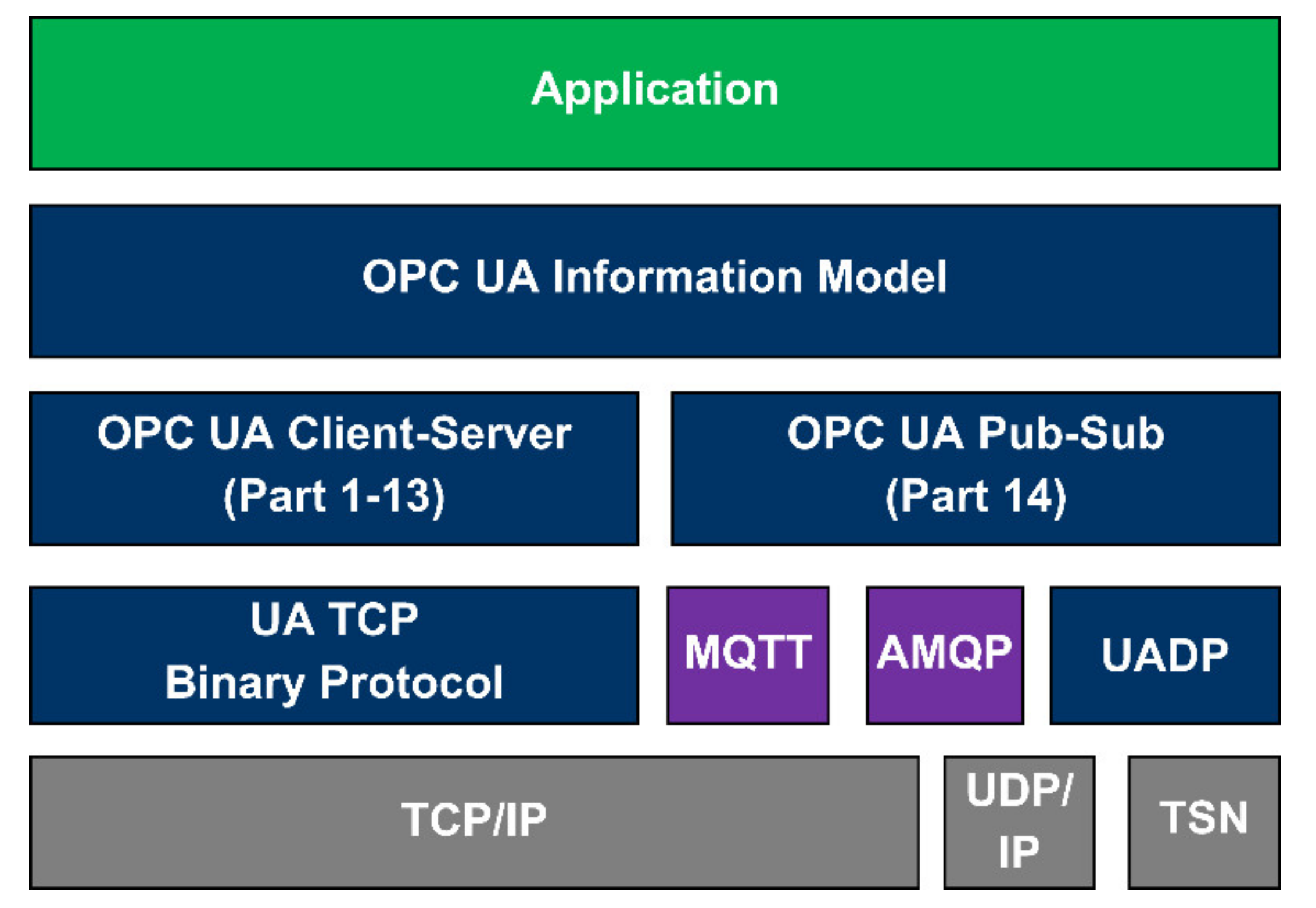
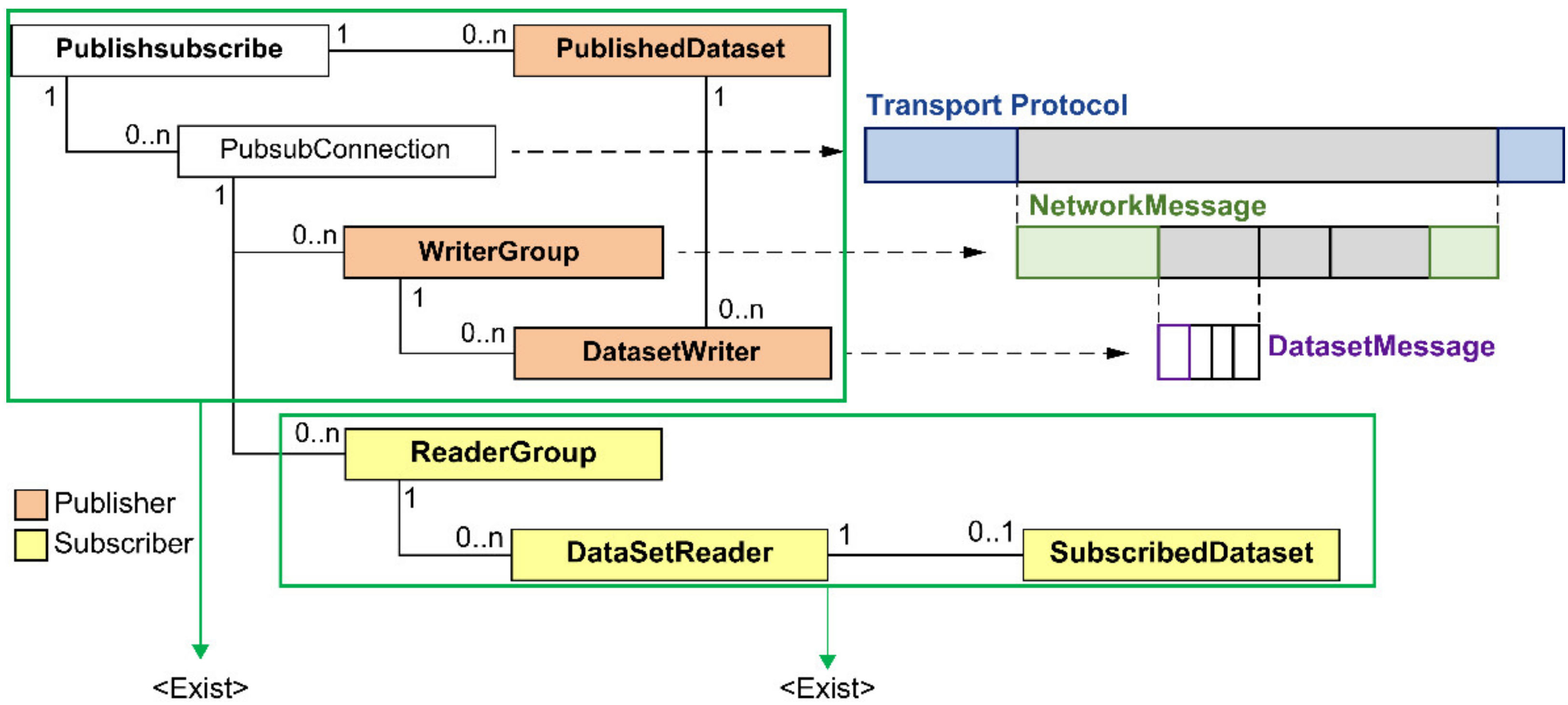
2.1.1. OPC UA PubSub
2.1.2. Data Distribution Service (DDS)
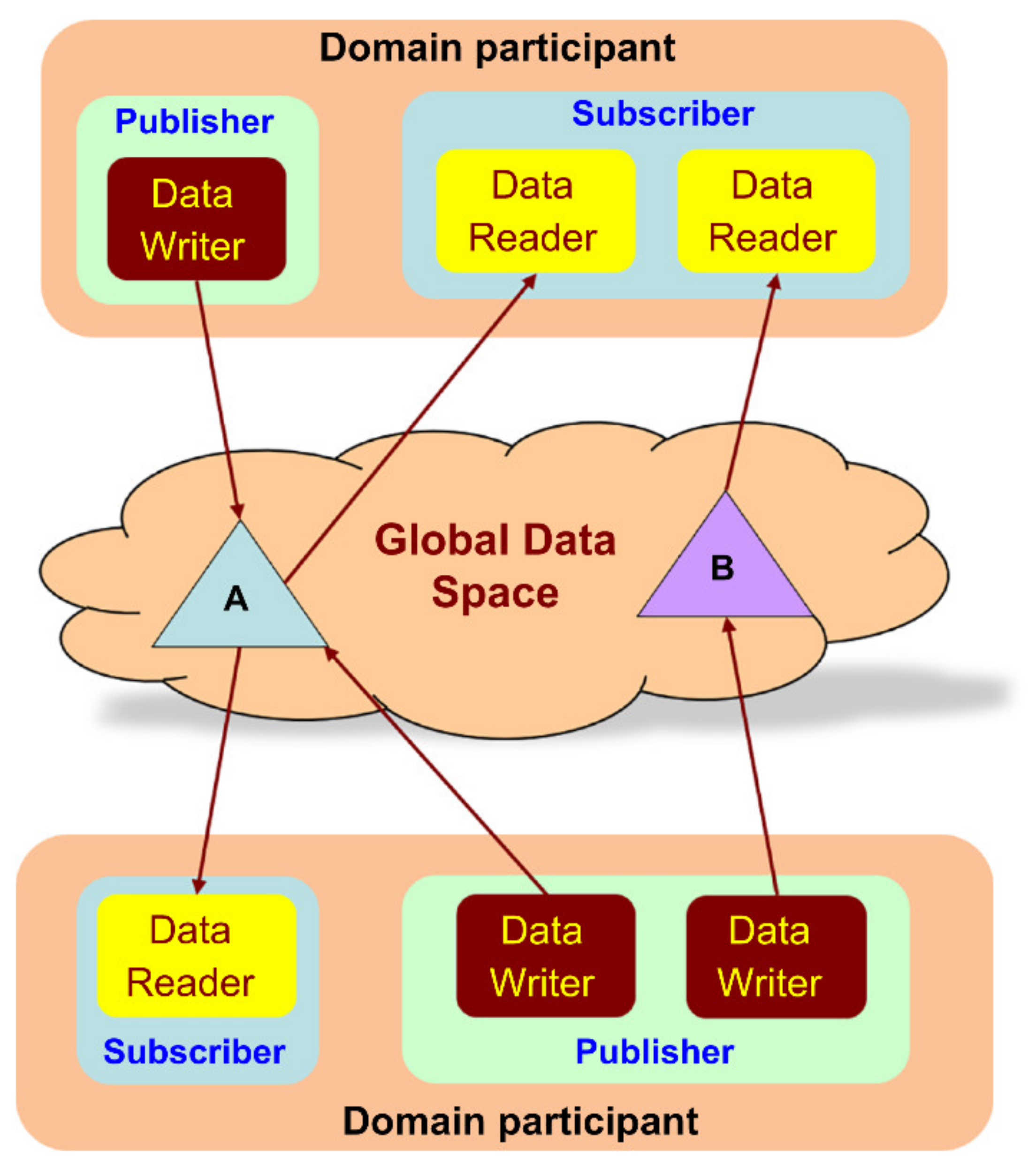
- Topic: An information exchange unit is defined by using a subset of the interface definition language (IDL), identified by a name. A topic connects the publisher and the subscriber to allow anonymous transparent communication. A topic instance is a data entity separated by a key.
- Domain: A scoping mechanism for establishing a separate virtual network or communication context. Domains provide an optimal communication environment by separating different applications.
- Domain Participant: An entity participating in a domain.
- Partition: A scoping mechanism that logically groups topics and further constructs domains.
- Data Writer: An entity that publishes a topic.
- Data Reader: An entity that subscribes to a topic.
- Publisher: An entity that manages the data writer group.
2.2. Related Work
3. OPC UA PubSub Protocol Converter Model
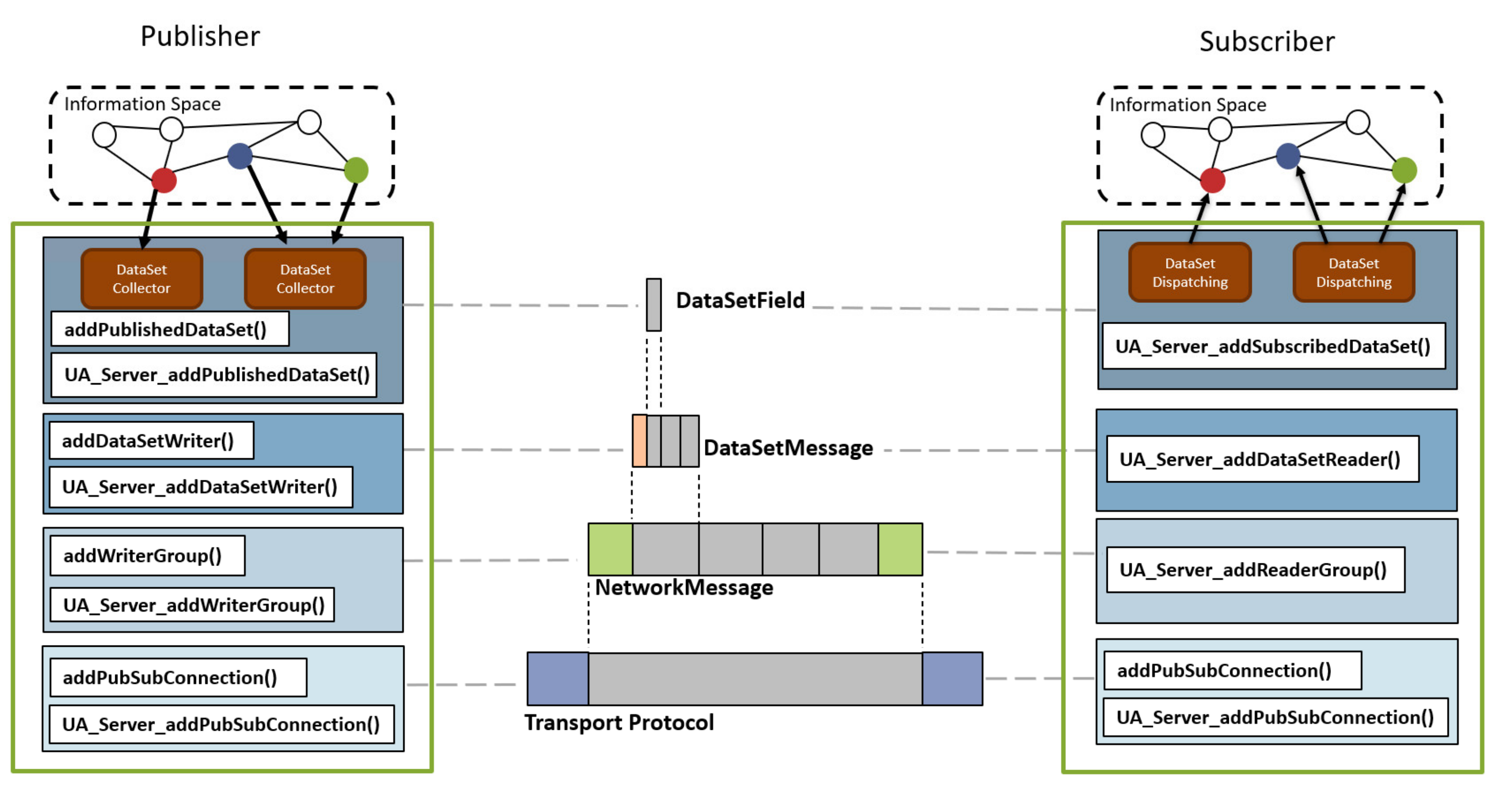
3.1. A-Open62541 PubSub
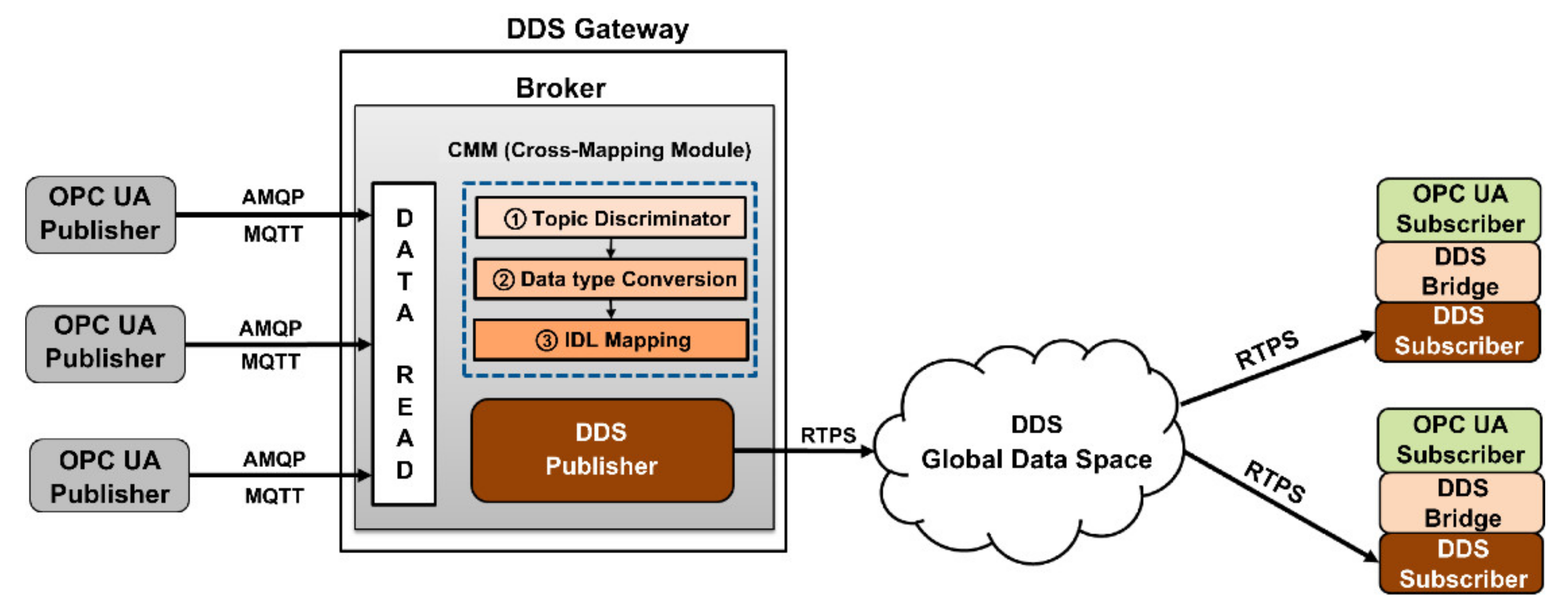
3.2. DDS Gateway
- Topic discriminator: The data and topics sent to the broker are read to call the “Data Type conversion” function if a topic is “DDS Gateway” or, if not, pass it onto the subscriber connected to the broker.
- Data type conversion: OPC UA publish data are sent in an encoded type, which is converted to DDS IDL before being received by the DDS subscriber.
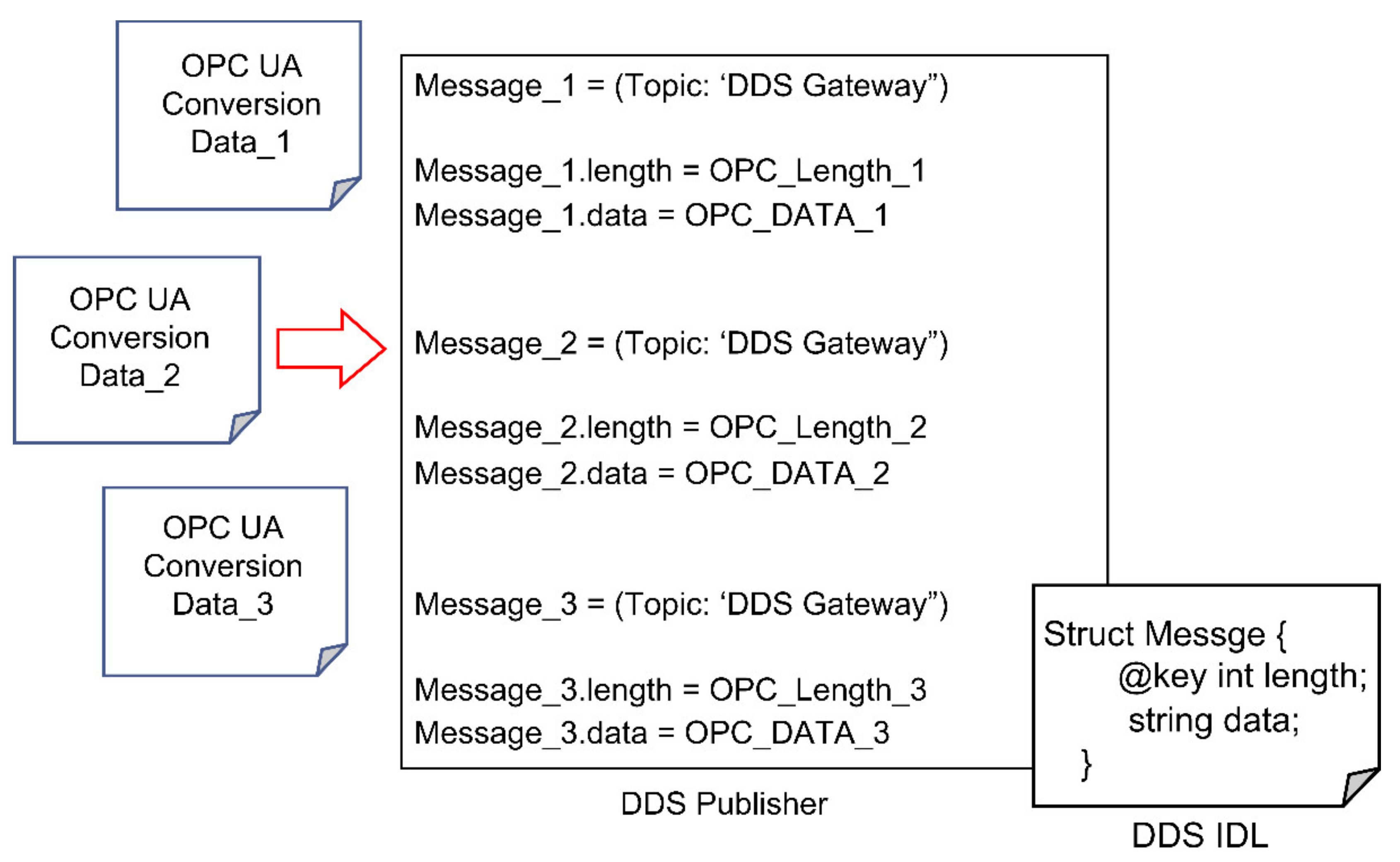
- IDL mapping: The converted data are substituted into topics containing key values and data, and the key values are set to the length of the publish data.
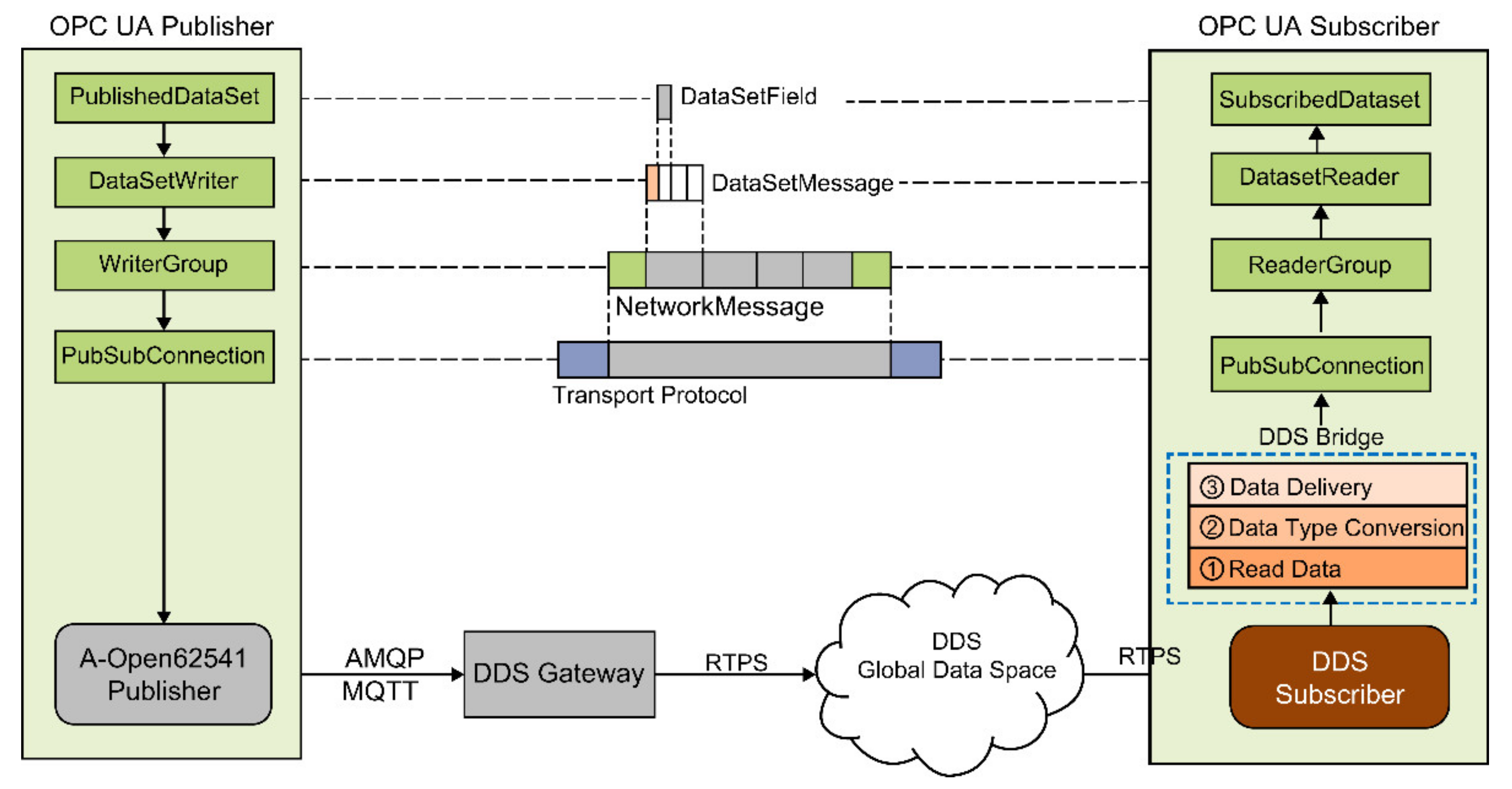
3.3. DDS Bridge
4. Implementation and Performance Evaluation
4.1. Implementation
4.1.1. A-Open62541 PubSub
4.1.2. DDS Gateway
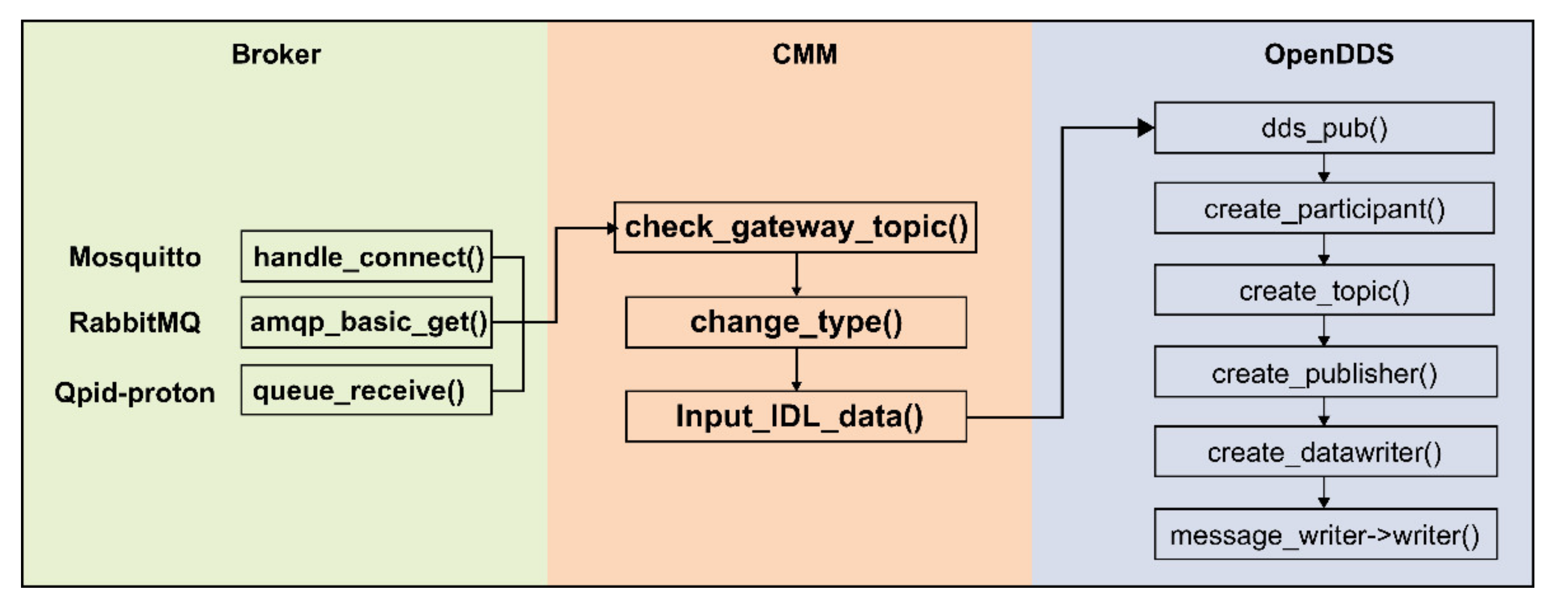
- handle_connect(): This checks data and topics by receiving the data sent from the publisher to the Mosquitto broker.
- amqp_basic_get(): This checks data and topics by receiving the data sent from the publisher to the RabbitMQ broker.
- queue_receive(): This checks data and topics by receiving the data sent from the publisher to the Qpid-proton broker.
- check_gateway_topic(): If a topic is “DDS Gateway,” the received data are passed to the change_type() API parameter.
- change_type(): Encoded OPC UA published data are converted into IDL types that can be used in DDS.
- input_IDL_data(): DDS topics are generated using IDL.
| Algorithm 1. DDS gateway QoS setting. |
Initialization
Task 1: Modify QoS settings
|
4.1.3. DDS Bridge
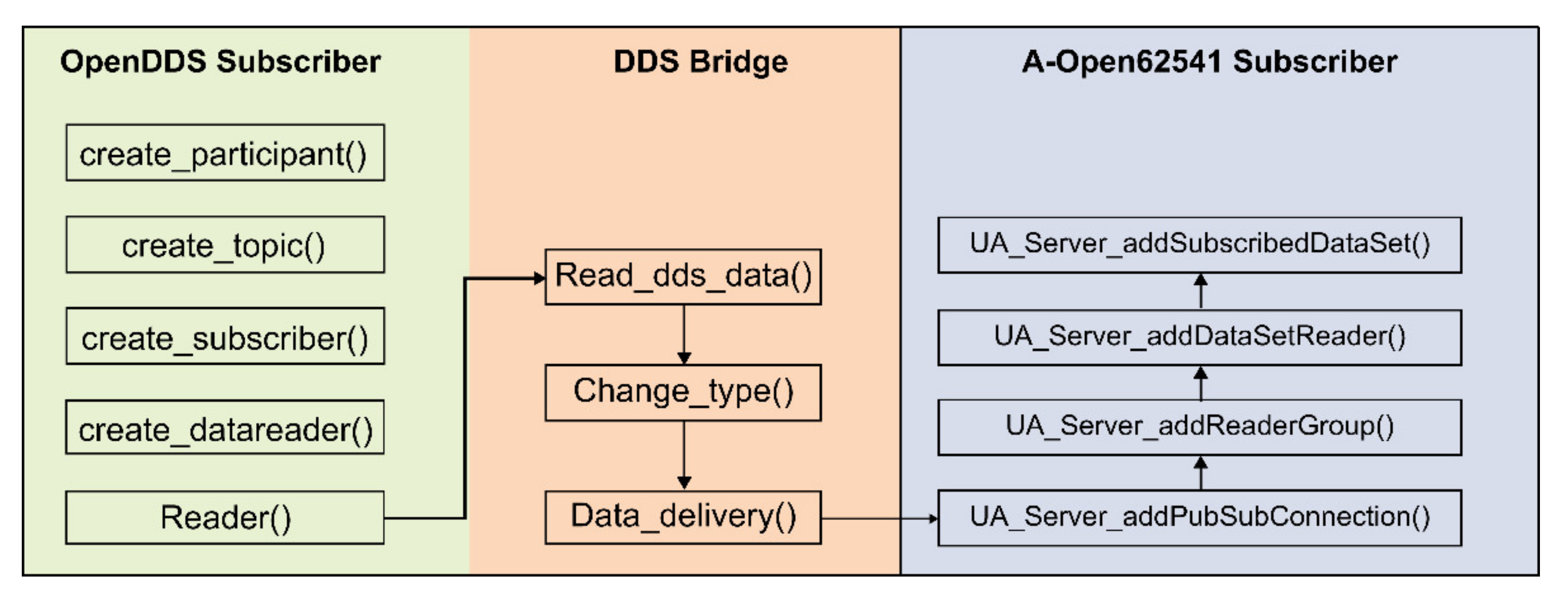
- Read_dds_data(): This receives and reads DDS messages.
- Change_type(): This converts DDS messages to OPC UA subscriber data types according to the rules in Figure 9.
- Data_delivery(): This passes the information model converted to OPC UA subscriber data types to UA_Server_addPubSubConnection(), which provides the “PubSubConnection” function.
4.2. Performance Evaluation
4.2.1. Testbed and Scenario
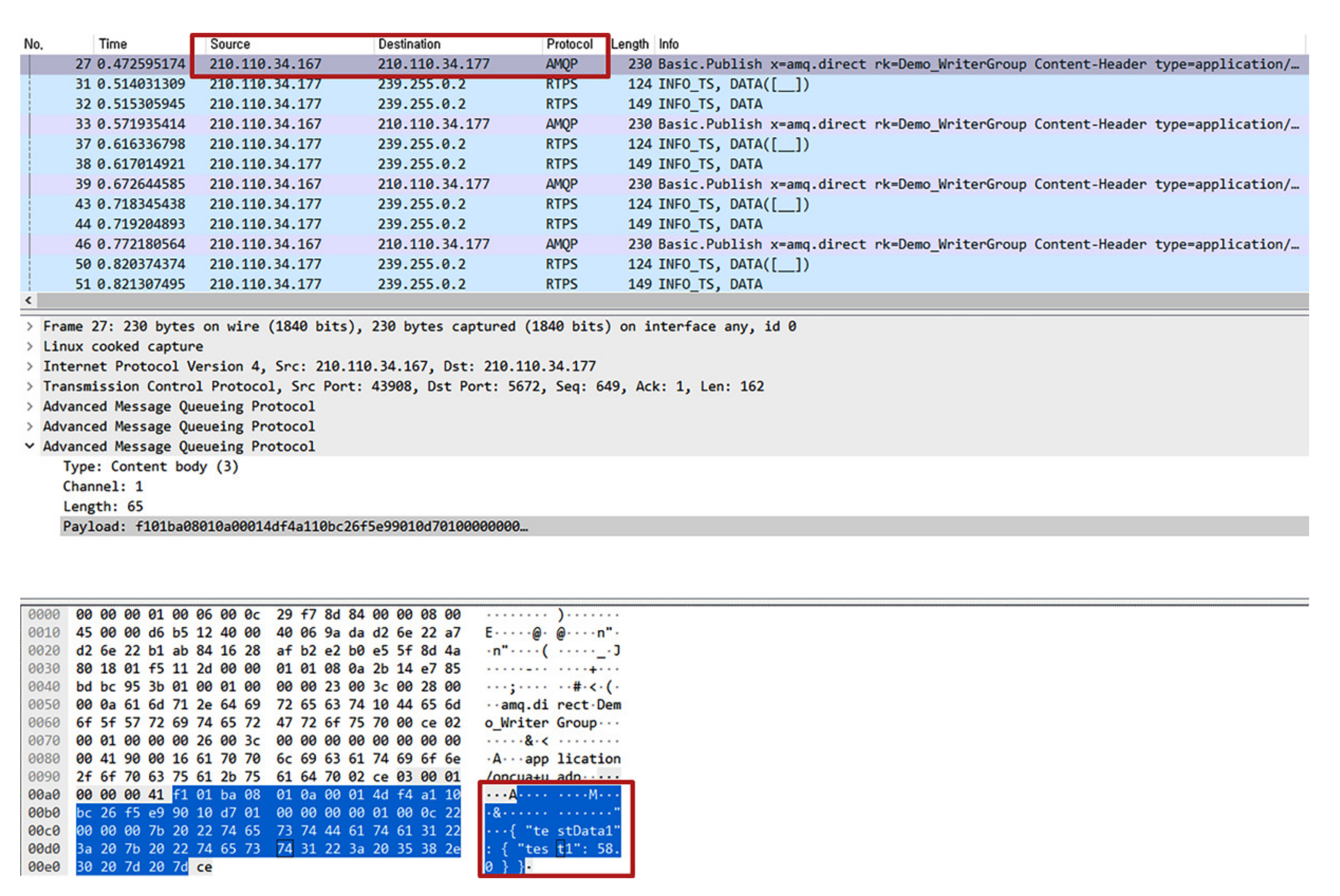
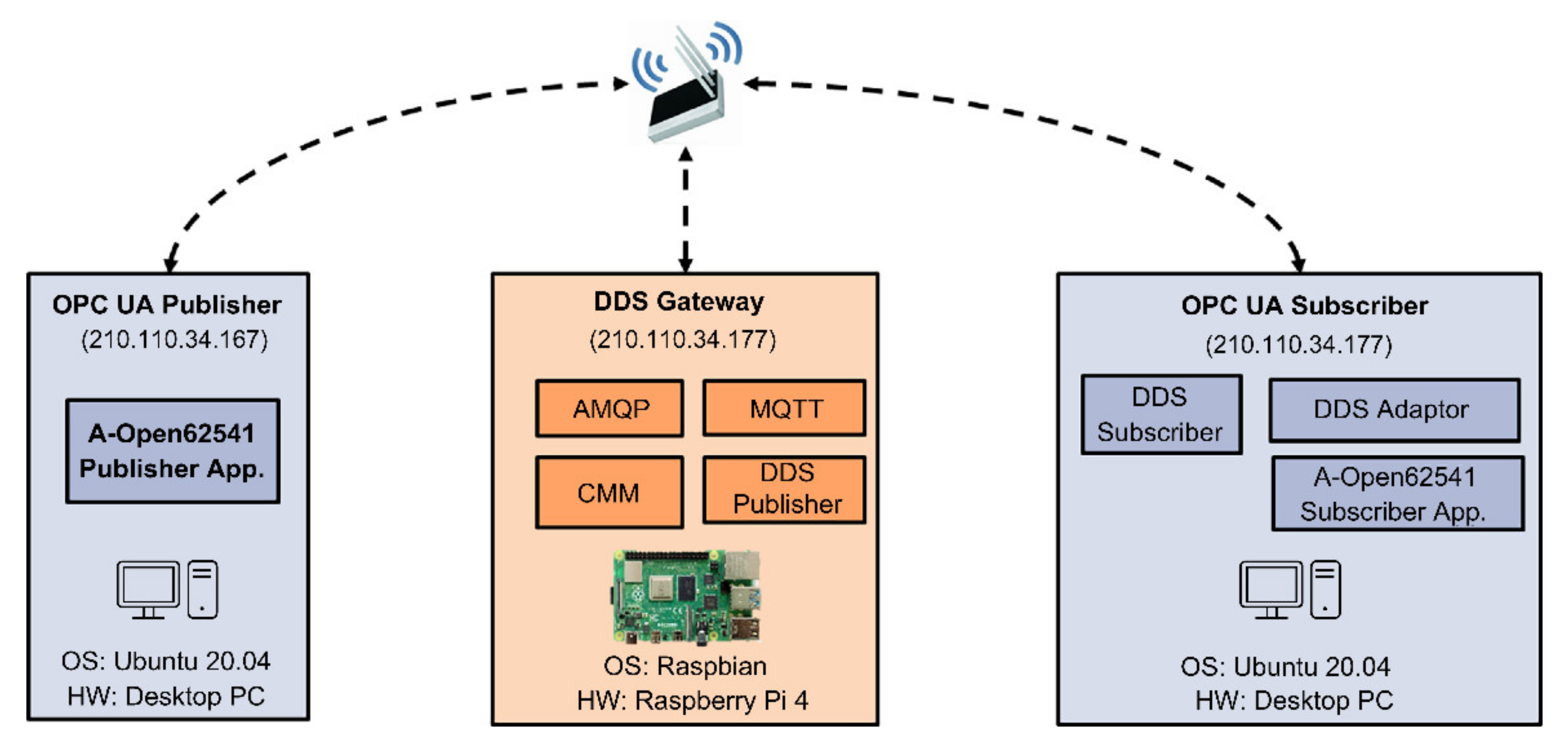
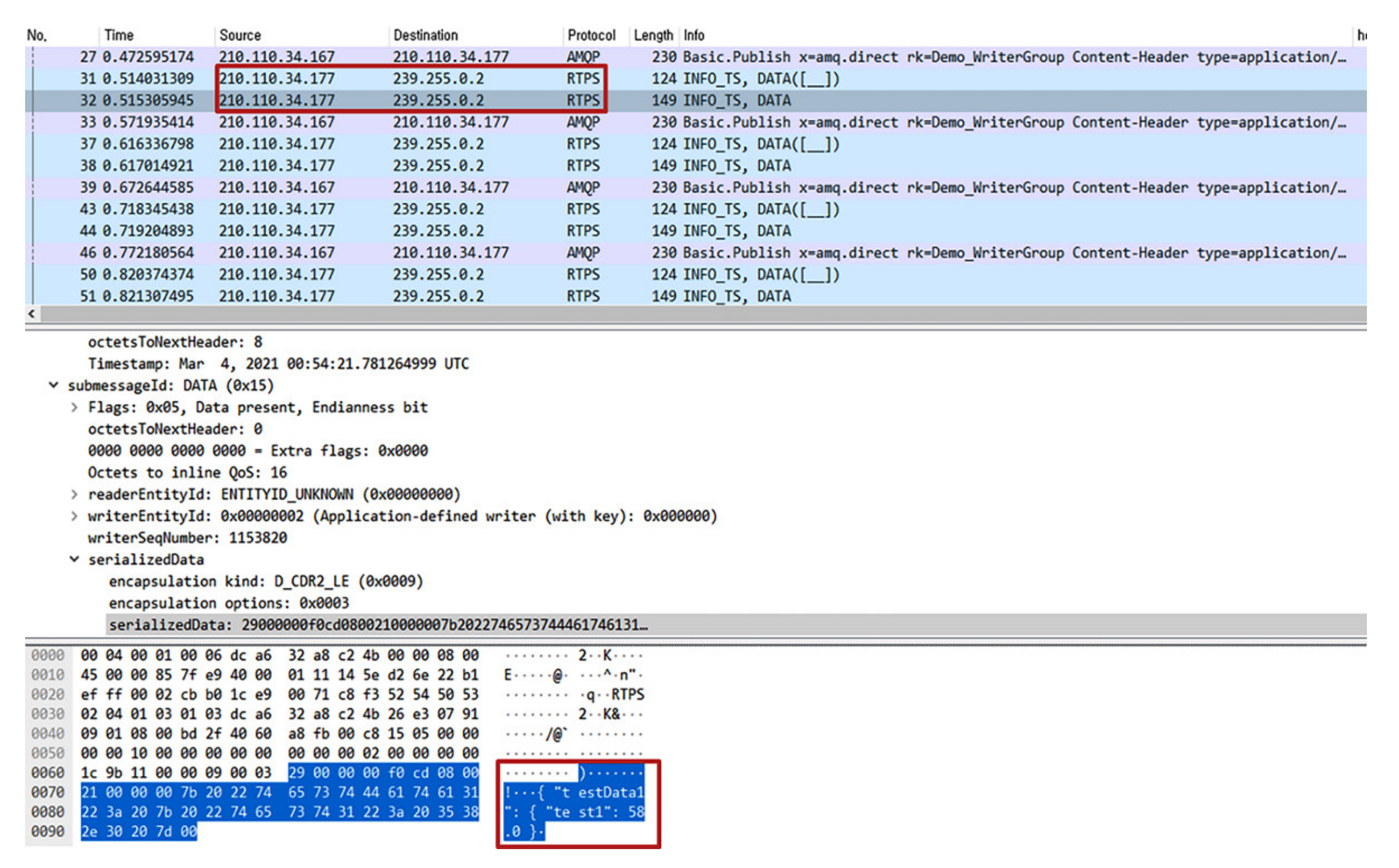
- AMQP/MQTT-based OPC UA publisher data publication (source IP: 210.110.34.167).
- Broker reception (destination IP: 210.110.34.177).
- Publication of RTPS messages to UDP by the DDS publisher inside broker (source IP: 210.110.34.177).
- UDP-based RTPS messages received by DDS subscriber (destination IP: 239.255.0.2).
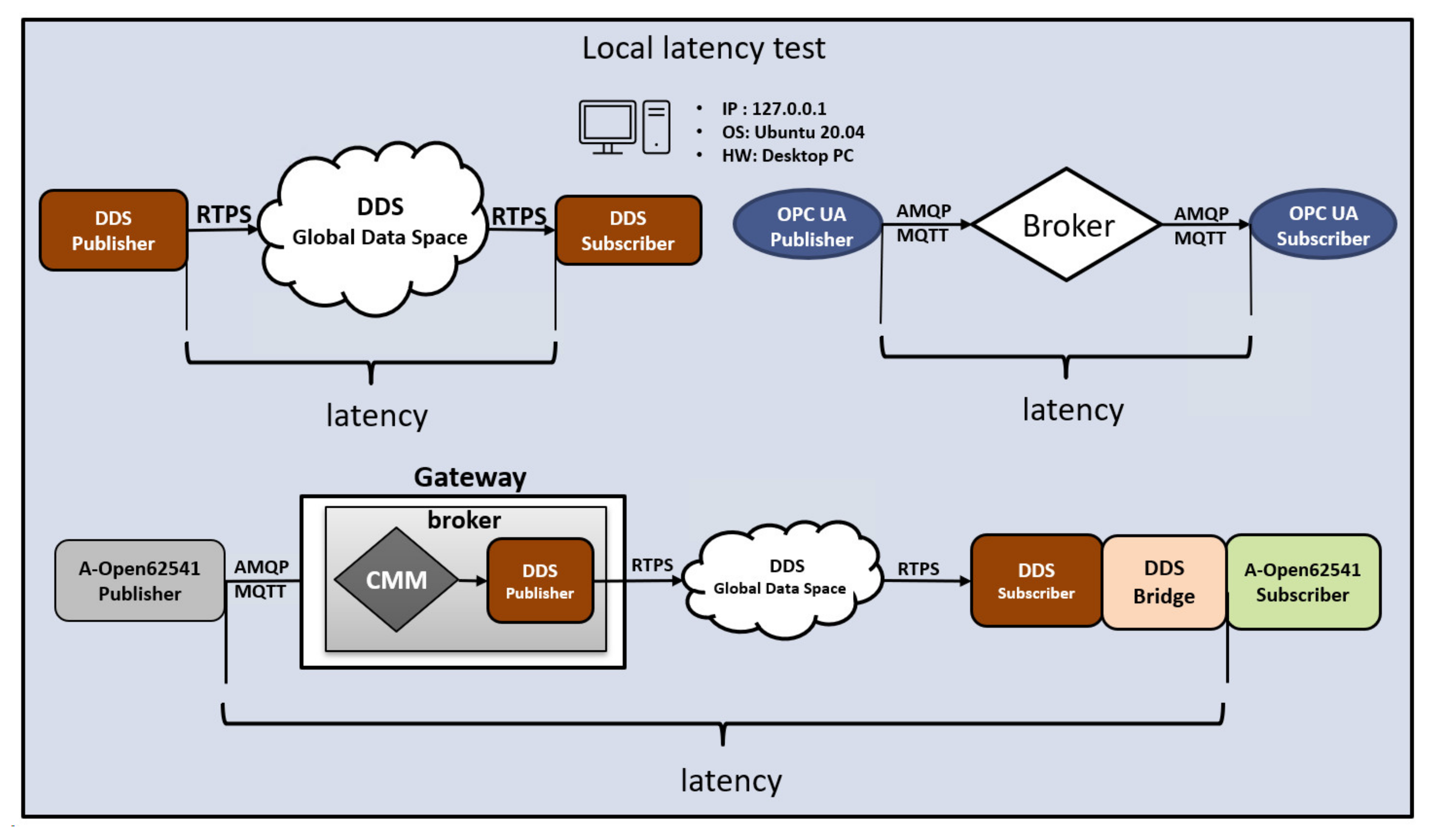
- A measure of the OpenDDS latency obtained without the protocol converter – ①;
- A measure of the OPC UA PubSub latency obtained without the protocol converter – ②;
- A measure of the A-Open62541 PubSub latency obtained with the protocol converter – ③;
- The comparison of latency ③ and the sum of latency ① and ②.
4.2.2. Evaluation Results
5. Conclusions
Author Contributions
Funding
Conflicts of Interest
References
- Prinz, F.; Schoeffler, M.; Eckhardt, A.; Lechler, A.; Verl, A. Configuration of Application Layer Protocols within Real-time I4.0 Components. In Proceedings of the 2019 IEEE 17th International Conference on Industrial Informatics (INDIN), Helsinki, Finland, 22–25 July 2019; pp. 971–976. [Google Scholar] [CrossRef]
- Eckhardt, A.; Muller, S.; Leurs, L. An Evaluation of the Applicability of OPC UA Publish Subscribe on Factory Automation Use Cases. In Proceedings of the 2018 IEEE 23rd International Conference on ETFA, Turin, Italy, 4–7 September 2018; pp. 1071–1074. [Google Scholar] [CrossRef]
- OPC Foundation, OPC Unified Architecture Specification Part 14: PubSub. 2019. Available online: https://opcfoundation.org/developer-tools/specifications-unified-architecture/part-14-pubsub/ (accessed on 19 July 2021).
- Open62541. Available online: https://open62541.org (accessed on 19 July 2021).
- Song, B.K. A-Open62541 PubSub Technical Memorandum. 2020. Available online: https://github.com/SimWB/A-62541 (accessed on 19 July 2021).
- GitHub. Available online: https://github.com/LiamBindle/MQTT-C (accessed on 19 July 2021).
- Mosquitto Eclipse Foundation. Available online: https://mosquitto.org (accessed on 19 July 2021).
- RabbitMQ. Available online: https://www.rabbitmq.com/ (accessed on 19 July 2021).
- Apache Qpid. Available online: https://qpid.apache.org/proton/ (accessed on 19 July 2021).
- OpenDDS. Available online: https://opendds.org/ (accessed on 19 July 2021).
- Object Management Group (OMG). Available online: https://www.omg.org/omg-dds-portal/ (accessed on 19 July 2021).
- Etxeberria-Agiriano, I.; Calvo, I.; Pérez, F. Providing Soft Real-Time Capabilities to Business Applications. In Proceedings of the 7th Iberian Conference on Information Systems and Technologies, Madrid, Spain, 20–23 June 2012; pp. 1–6. [Google Scholar]
- Endeley, R.; Fleming, T.; Jin, N.; Fehringer, G.; Cammish, S. A Smart Gateway Enabling OPC UA and DDS Interoperability. In Proceedings of the 2019 IEEE SmartWorld, Ubiquitous Intelligence & Computing, Advanced & Trusted Computing, Scalable Computing & Communications, Cloud & Big Data Computing, Internet of People and Smart City Innovation, Leicester, UK, 19–23 August 2019; pp. 88–93. [Google Scholar] [CrossRef]
- Cheikh, F.B.; Mastouri, M.A.; Hasnaoui, S. Implementing a Real-Time Middleware Based on DDS for the Cooperative Vehicle Infrastructure Systems. In Proceedings of the 2010 6th International Conference on Wireless and Mobile Communications, Valencia, Spain, 20–25 September 2010; pp. 492–497. [Google Scholar] [CrossRef]
- Cilden, E.; Gültekin, E.; Poyraz, D.; Haluk Canberi, M. A Generic Distributed Architecture to Integrate Simulated Participants with Modular Avionics. In Proceedings of the 2018 IEEE/ACM 22nd International Symposium on Distributed Simulation and Real Time Applications (DS-RT), Madrid, Spain, 15–17 October 2018; pp. 1–2. [Google Scholar] [CrossRef]
- Lee, W.; Chung, S.; Choi, M.; Cho, S.; Joe, I.; Park, J.; Lee, S.; Kim, W. A Robust Inter-Domain DDS Gateway Based on Token Passing for Large-Scale Cyber-Physical Systems. In Proceedings of the 16th International Conference on Advanced Communication Technology, Pyeongchang, Korea, 16–19 February 2014; pp. 868–871. [Google Scholar] [CrossRef] [Green Version]
- OpenSSL. Available online: https://www.openssl.org/ (accessed on 19 July 2021).
- OAuth 2.0. Available online: https://oauth.net/2/ (accessed on 19 July 2021).
- TTTech Industrial. Available online: https://www.tttech-industrial.com/products/slate/edge-ip-solution/ (accessed on 19 July 2021).






| DDS QoS Policies | |
|---|---|
| Deadline | Ownership strength |
| Destination order | partition |
| Durability | Presentation |
| Durability service | reader data lifecycle |
| Entity factory | Reliability |
| Group data | Resource limits |
| History | Time-based filter |
| Latency budget | topic data |
| Lifespan Liveliness Ownership | Transport priority user data Writer data lifecycle |
| OPC UA PubSub Type | DDS Type |
|---|---|
| Boolean | Boolean |
| Sbyte | Byte |
| Byte | Byte |
| Int16 | Int16 |
| UInt16 | Uint16 |
| Int32 | Int 32 |
| UInt32 | Uint32 |
| Float | Float32 |
| Double | Float64 |
| String | String |
| DateTime | Int64 |
| ByteString | Sequence(Byte) |
| Open62541 PubSub | A-Open62541 PubSub (JSON-C) |
|---|---|
| make_json() | Json_object_new_object() /*create a new Json object*/ |
| Json_object_object_add() /*Add an object field to a json_object of type json_type_object*/ | |
| decode_json() | json_tokener_parse() /*Parse a string and return a non-NULL json_object if a valid JSON value is found*/ |
| json_object_object_get() /*Get the json_object associated with a given object field*/ | |
| json_object_get_int() /*Get the int value of a json_object*/ | |
| json_object_get_string() /*Get the string value of a json_object*/ |
| Open62541 PubSub | A-Open62541 PubSub(Mosquitto) |
|---|---|
| UA_PubSubChannelMQTT_open() | mosquitto_lib_init() /* Must be called before any other mosquitto functions.*/ |
| mosquitto_new() /* Create a new mosquitto client instance. */ | |
| UA_PubSubChannelMQTT_regist() | mosquitto_subscribe() /* Subscribe to a topic. */ |
| UA_PubSubChannelMQTT_send() | mosquitto_publish() /* Publish a message on a given topic. */ |
| UA_PubSubChannelMQTT_close() | mosquitto_disconnect() /* Disconnect from the broker. */ |
| Open62541 PubSub | A-Open62541 PubSub (RabbitMQ) |
|---|---|
| UA_PubSubChannelAMQP_open() | amqp_new_connection() /*Allocate and initialize a new amqp_connection_state_t object*/ |
| amqp_tcp_socket_new() /*A TCP socket connection. Create a new TCP socket.*/ | |
| UA_PubSubChannelAMQP_regist() | amqp_bytes_malloc_dup() /*Duplicates an amqp_bytes_t buffer.*/ |
| amqp_queue_bind() /*amqp bind*/ | |
| amqp_basic_consume() /*Subscribe to a message from the broker*/ | |
| UA_PubSubChannelAMQP_send() | amqp_basic_publish() /*Publish a message to the broker*/ |
| amqp_bytes_free() /*Frees an amqp_bytes_t buffer*/ | |
| UA_PubSubChannelAMQP_close() | amqp_channel_close() /*Closes a channel*/ |
| amqp_connection_close() /*Closes the entire connection*/ | |
| amqp_destroy_connection() /*Destroys an amqp_connection_state_t object*/ |
| Open62541 PubSub | A-Open62541 PubSub (Qpid-proton) |
|---|---|
| UA_PubSubChannelAMQP_open() | pn_event_connection() /*Get the connection associated with an event.*/ |
| pn_session() /*Factory for creating a new session on a given connection object.*/ | |
| pn_connection_set_container() /*Set the AMQP Container name advertised by a connection object.*/ | |
| pn_connection_open() /*Open a connection.*/ | |
| UA_PubSubChannelAMQP_regist() | pn_event_delivery() /*Get the delivery associated with an event.*/ |
| pn_link_recv() /*Receive message data for the current delivery on a link.*/ | |
| UA_PubSubChannelAMQP_send() | pn_message_body() /*Get and set the body of a message.*/ |
| pn_data_put_binary() /*Puts a PN_BINARY value.*/ | |
| pn_data_exit() /*Sets the current node to the parent node and the parent node to its own parent.*/ | |
| pn_message_send() /*Encode and send a message on a sender link.*/ | |
| UA_PubSubChannelAMQP_close() | pn_connection_close() /*Close a connection.*/ |
| Component | OPC UA Publisher | DDS Gateway | OPC UA Subscriber |
|---|---|---|---|
| OS | Ubuntu 20.04 | Raspbian GNU/Linux 10 | Ubuntu 20.04 |
| Tool | A-Open62541 Pub | Mosquitto v2.0.4 RabbitMQ v3.8.2 Qpid-proton v0.33.0 OpenDDS v3.17 | OpenDDS v3.17 |
| Language | C | C, C++ | C, C++ |
| RAM | 4 GB | 4 GB | 4 GB |
| Capacity | 30 GB | 32 GB | 30 GB |
| CPU | Intel Core i7 | ARM v7 Processor rev3 | Intel Core i7 |
| OS | Tool | RAM | Language | Capacity | CPU |
|---|---|---|---|---|---|
| Ubuntu 20.04 | A-Open62541 OpenDDS v3.17 Mosquitto v2.0.4 RabbitMQ v3.8.2 Qpid-proton v0.33.0 | 4 GB | C, C++ | 30 GB | Intel Core i7 |
| Data Lengths and Corresponding Latencies | ||||
|---|---|---|---|---|
| 10 B (µs) | 100 B (µs) | 1 kB (µs) | 1 MB (µs) | |
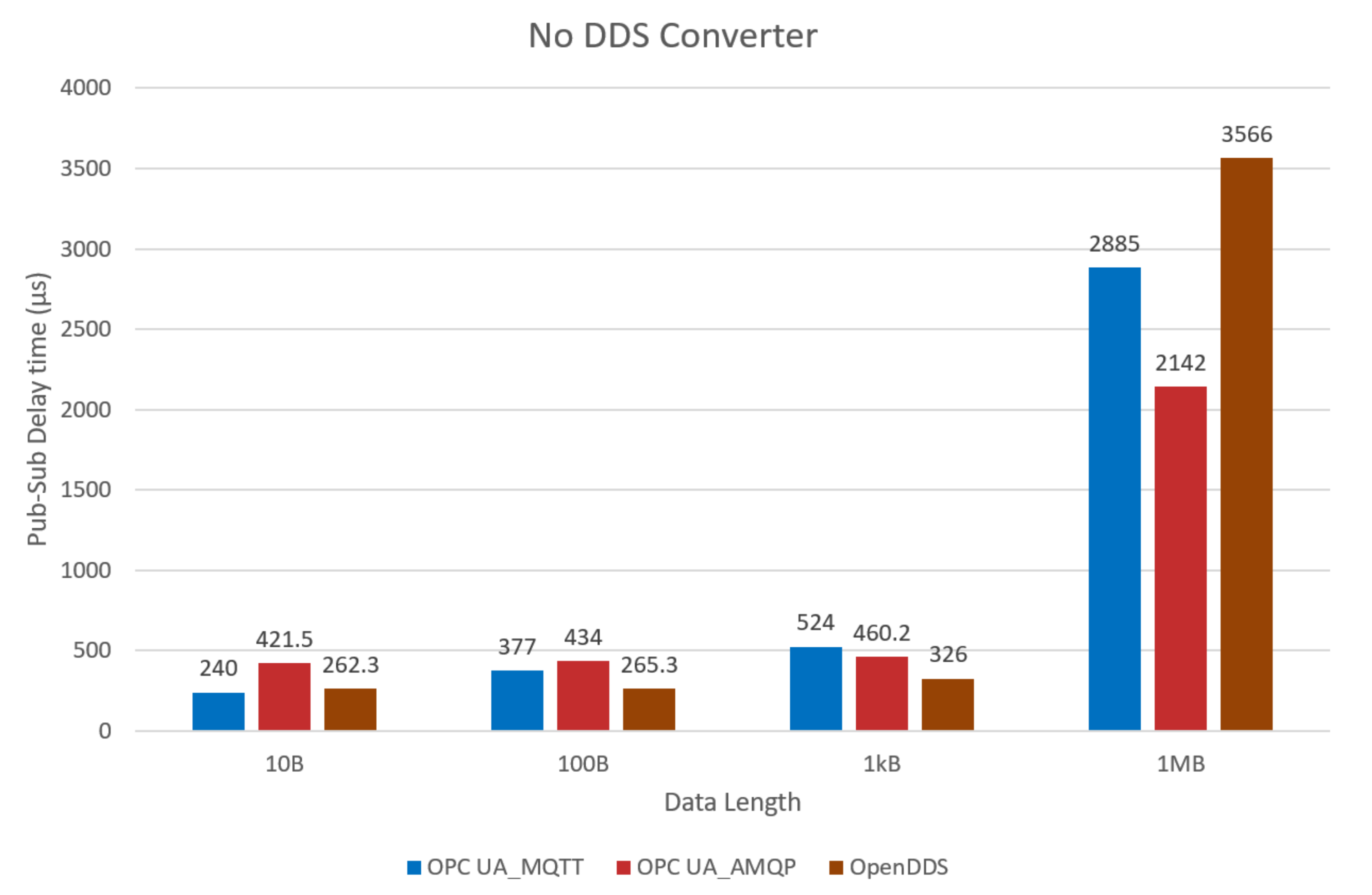
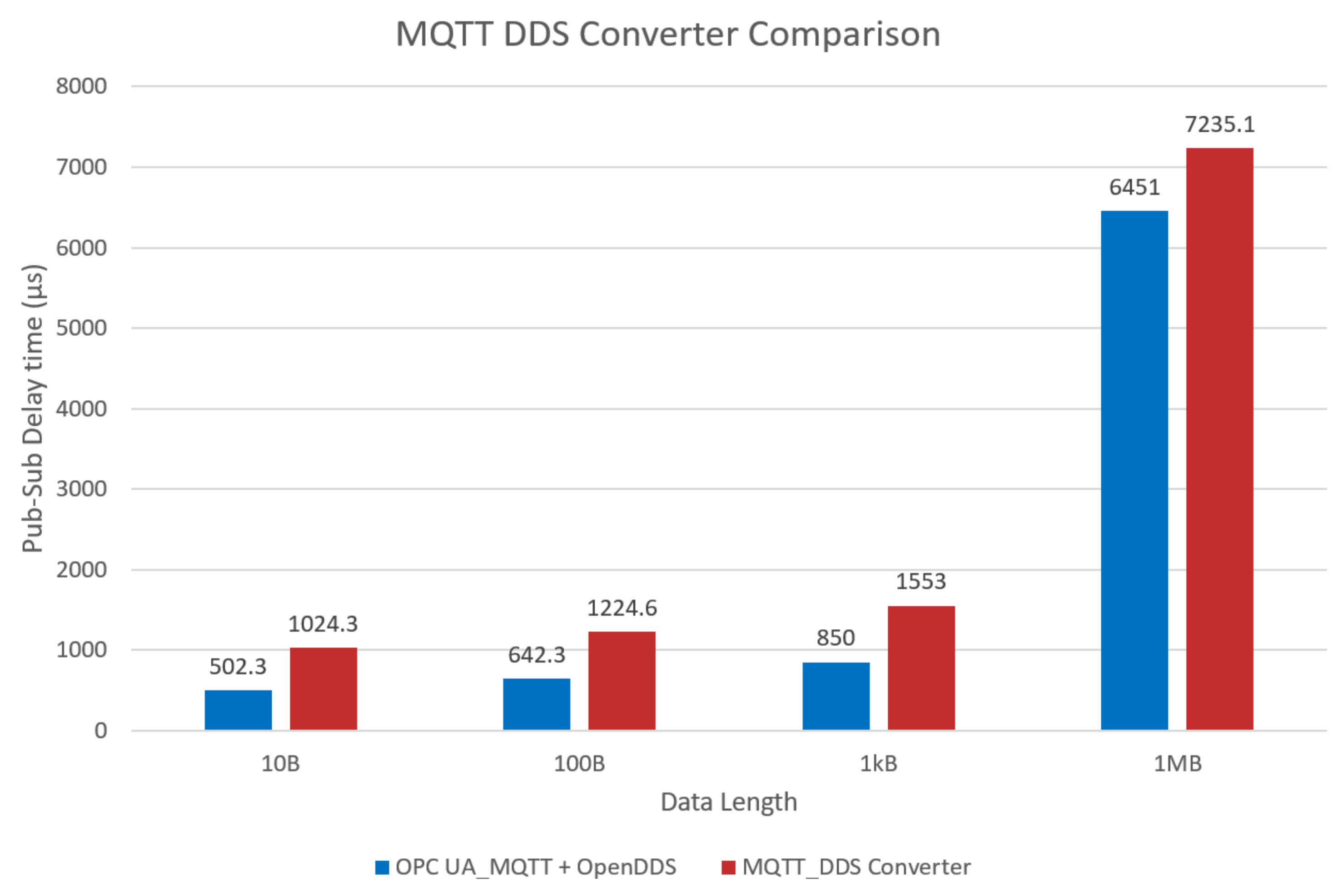
| OPC UA MQTT | 240 | 377 | 524 | 2885 |
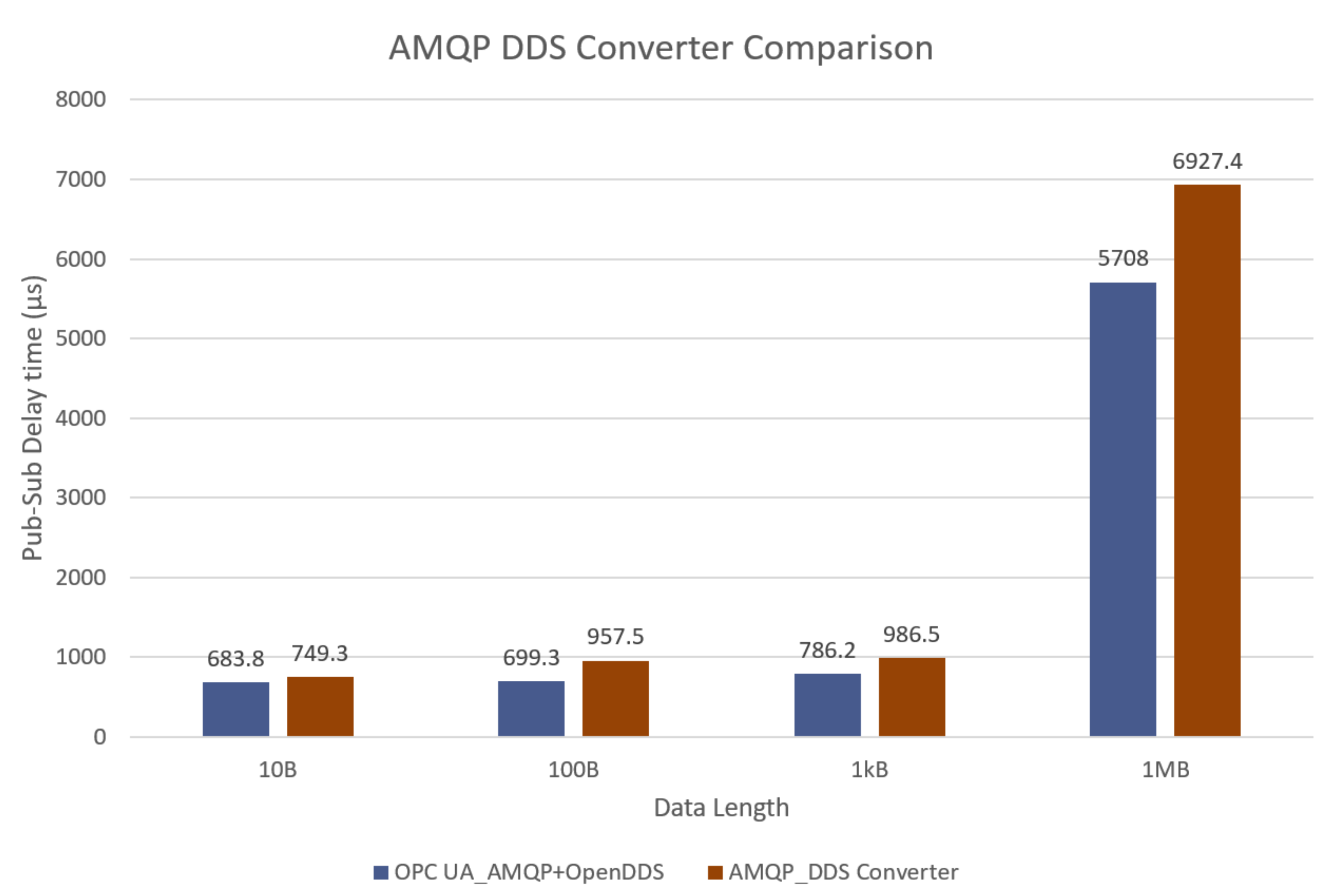
| OPC UA AMQP | 421.5 | 434 | 460.2 | 2142 |
| OpenDDS | 262.3 | 265.3 | 326 | 3566 |
| MQTT DDS converter | 1024.3 | 1224.6 | 1553 | 5235.1 |
| AMQP DDS converter | 749.3 | 957.5 | 986.5 | 4927.4 |
Publisher’s Note: MDPI stays neutral with regard to jurisdictional claims in published maps and institutional affiliations. |
© 2021 by the authors. Licensee MDPI, Basel, Switzerland. This article is an open access article distributed under the terms and conditions of the Creative Commons Attribution (CC BY) license (https://creativecommons.org/licenses/by/4.0/).
Share and Cite
Sim, W.; Song, B.; Shin, J.; Kim, T. Data Distribution Service Converter Based on the Open Platform Communications Unified Architecture Publish–Subscribe Protocol. Electronics 2021, 10, 2524. https://doi.org/10.3390/electronics10202524
Sim W, Song B, Shin J, Kim T. Data Distribution Service Converter Based on the Open Platform Communications Unified Architecture Publish–Subscribe Protocol. Electronics. 2021; 10(20):2524. https://doi.org/10.3390/electronics10202524
Chicago/Turabian StyleSim, Woongbin, ByungKwen Song, Junho Shin, and Taehun Kim. 2021. "Data Distribution Service Converter Based on the Open Platform Communications Unified Architecture Publish–Subscribe Protocol" Electronics 10, no. 20: 2524. https://doi.org/10.3390/electronics10202524
APA StyleSim, W., Song, B., Shin, J., & Kim, T. (2021). Data Distribution Service Converter Based on the Open Platform Communications Unified Architecture Publish–Subscribe Protocol. Electronics, 10(20), 2524. https://doi.org/10.3390/electronics10202524