Article

Operationalising the Water–Energy–Food–Ecosystem Nexus in Life Cycle Assessment Ecolabelling: Exploring Indicator Selection Through Delphi Engagement


1
Interdisciplinary Center on Sustainability and Climate, Sant’Anna School of Advanced Studies, 56124 Pisa, Italy
2
University School for Advanced Studies IUSS Pavia, 27100 Pavia, Italy
3
Department of Management in Mechanical Engineering, Faculty of Mechanical Engineering, University of Nis, 18000 Nis, Serbia
4
Faculty of Occupational Safety, University of Nis, 18000 Nis, Serbia
5
Institute for Integrated Management of Material Fluxes and of Resources (UNU FLORES), United Nations University, 01067 Dresden, Germany
6
Abruzzo Regional Government DPC022, 67100 L’Aquila, Italy
7
School of Civil Engineering, Faculty of Engineering, Aristotle University of Thessaloniki, 54124 Thessaloniki, Greece
*
Author to whom correspondence should be addressed.
Resources 2026, 15(2), 23; https://doi.org/10.3390/resources15020023
Submission received: 14 December 2025 / Revised: 19 January 2026 / Accepted: 26 January 2026 / Published: 30 January 2026

Abstract

Ecolabelling has emerged as a key instrument to communicate environmental performance to consumers, particularly in the agri-food sector where resource use and ecological pressures are highly interlinked. Conventional Life Cycle Assessment (LCA)-based ecolabels often suffer from methodological discretion, lack of territorial specificity, and limited consumer trust. This study investigates how the Water–Energy–Food–Ecosystem (WEFE) Nexus could be integrated into LCA-based ecolabelling, with a specific focus on pasta production as a representative case in the food industry. Indicators were collected from recent literature on LCA and Nexus applications, selected for simplicity and clear attribution to one WEFE dimension, and then evaluated by experts from COST Action CA20138 (NexusNet) through a two round Delphi protocol. The process yielded 23 indicators distributed across the four dimensions, which were subsequently compared with six Environmental Product Declarations to assess data availability and compatibility. The results suggest that many indicators can be computed with standard LCA inventories, while the Nexus perspective adds value by capturing multidimensional impacts and regional resource pressures. Further refinement and empirical testing are expected to enhance the framework’s applicability, but the findings already indicate that incorporating WEFE-based indicators into pasta ecolabelling could represent a promising pathway to improve analytical depth and consumer relevance, aligning circular economy principles with corporate assessment practices.

1. Introduction

Ecolabelling is a corporate sustainability practice consisting of voluntary certifications that provide consumers with information about the environmental impact of a product, based on a Life Cycle Assessment [1]. It provides consumers with information about the environmental quality of products and is an important tool for enhancing transparency and trust [2]. Consumers increasingly consider ecolabels as a driver for product preferences and a decision-making factor for product choices [2], as they can strengthen motivation, psychological capability, and product comparability [3]. Ecolabels also respond to the need for a growing niche of environmentally aware consumers, enabling them to distinguish between traditional and sustainable products and to pay attention to production methods, energy use, and pollutant generation [4]. As consumers become increasingly selective in their purchases—whether due to rising environmental awareness or the pursuit of healthier products—ecolabels become relevant in market competition [4]. As a consequence, a growing number of companies are improving their environmental performance and leveraging ecolabels as a strategic tool in market competition for consumer goods [4,5].
Life-cycle-based ecolabeling popularity is especially high in the agricultural sector for food production, as ecolabelling is increasingly used as a marketing tool to value the products [5,6]. Driven by sustained human development, agriculture has intensified over time to meet the demands of expanding markets and a growing global population. Yet since the late twentieth century, large scale practices have been increasingly linked to environmental concerns, including landscape degradation, pollution, soil erosion, and ecosystem threats [7]. In this frame, rising consumer awareness and stricter regulation have made ecolabelling a strategic tool, both from a technical and commercial perspective [5]. Through it, producers can positively leverage their environmental performance improving their product, while gaining a competitive advantage [1]. This practice recently gained popularity in the pasta production sector, because of the increasing attention of final consumers on the possible impact of industrial production on the environment and the related public pressure [8]. As a matter of fact, the implementation of life cycle assessments allowed international pasta brands to highlight potential opportunities for improvement in their environmental footprint through low-input agronomic practices, while maintaining a high-quality, high-yield product [9].
The momentum toward pasta ecolabeling is driven by the growing attention to the sustainability of production processes and their impact on resources [8]. Pasta is among the most widely consumed foods in the world, thanks to its accessibility and versatility [10], with a global production of 16.5 million tonnes in 2020 [11]. The environmental footprint of pasta production is therefore highly relevant within the broader agri-food sustainability discourse [8,12]. Moreover, the increasing interest in ancient grains and high-quality flours—typically characterised by lower yields and a higher footprint on WEFE resources—has stimulated demand for more accurate life-cycle-based analyses of production processes [8]. This trend is reflected in the growing number of producers conducting life cycle assessments and implementing Environmental Product Declarations for their products [8,13]. Ecolabels are based on a Life cycle assessment (LCA), which became the most used circular-economy-based (CE) tool to collect information about the environmental footprint of production processes [6]. CE is grounded in the principles of resource preservation, process efficiency, and waste reduction [14,15], offering instruments to reduce material and energy leakages, enhance self-sufficiency, and mitigate resource-related risks [16]. Grounded in the Circular Economy, LCA consists of the analysis of the environmental aspects related to a product or service throughout its different life cycle stages [6]. It has acquired great popularity because of its effectiveness and reliability [5,15]. LCA is also internationally recognised as an integrated sustainability assessment. It allows the analysis of the whole system or supply chain and provides a systematic path to measure improvements in resource productivity, thereby promoting cleaner production [15]. As a result, LCA-based ecolabels serve a dual purpose: technically, they deliver a rigorous analysis of environmental footprints; and commercially, they act as a signalling tools that shape corporate reputation and steer market competition toward sustainability [5,17]. Indeed, they influence and support the development of more environmentally sustainable products [5], while raising consumers awareness working as a marketing tool [18].
Nonetheless, the proliferation of LCA-based ecolabels raises doubts within the scientific community about their effectiveness in providing a consistent and comprehensive view of products’ environmental impacts. Many labels focus on single aspects—such as carbon emissions or water consumption—or contribute to unclear messaging by allowing the application of different Product Category Rules (PCRs) for the same sector. This creates transparency and comparability issues, which may lead to unfair competitive advantages and an impaired representation of the product’s actual footprint [19]. A further limitation is the frequent neglect of territorial specificities, such as the relative pressure exerted on each resource with respect to its local availability. This omission undermines the capacity of ecolabels to reflect the intrinsic impacts of production processes on local resource systems [19]. Because of these methodological and contextual shortcomings, consumers struggle to trust ecolabel claims and become reluctant to exercise their green purchasing power, as they no longer know who or what to believe [5]. This struggle, rooted in complexity and a lack of clarity, directly affects the appeal and functionality of ecolabels, reinforcing the need to provide information that is comprehensible, useful, and motivating for consumers, which is a central issue in the academic discourse around ecolabeling schemes [1,20].
To overcome the current shortcomings of LCA-based ecolabels—namely methodological discretion, neglect of territorial specificities, and consumer confusion—the Water–Energy–Food–Ecosystem (WEFE) Nexus offers a coherent solution. By emphasising the inseparable links between resource use, waste reduction, and the minimization of material and energy losses along the value chain [21], it strengthens the application of Circular Economy principles through LCA for food products. At the same time, the Nexus directs attention to local territorial complexities [22], thereby addressing one of the main weaknesses of existing ecolabels.
Moreover, the WEFE perspective fosters a more intersectoral and holistic view of environmental footprints [6,23]. Drawing from this broader perspective, it enables novel integrations, such as linking the nutritional contributions of food products with their environmental performance [13]. This combined view helps to identify environmental hotspots and impact categories, with a stronger focus on waste prevention, water and energy recovery, and resource efficiency [13]. In this way, the WEFE Nexus provides a relevant framework to integrate LCA-based ecolabels for food products, a topic that has attracted growing interest from both businesses and the scientific community [23,24,25].
Beyond food products, the WEFE Nexus has recently received scientific attention as an effective framework to improve corporate sustainability instruments, translating sustainable development objectives into actionable tools and measurable targets [23,24,25]. Scholars have begun developing practical methodologies to operationalise the Nexus in the business landscape, where implementation remains limited [25,26]. This responds to the need of businesses to address complex interconnected resource systems through comprehensive approaches, despite the challenges posed by data requirements and analytical robustness [6,23,27]. Agriculture is particularly relevant, given its bidirectional relationship with the natural environment and its embeddedness in WEFE feedback loops [7]. Nonetheless, despite this relevance, a standardised way of quantifying and displaying the interrelations among WEFE systems is still missing [28].
In this context, the WEFE Nexus emerges as a promising framework to integrate circular economy principles into production assessments and to reframe LCA by embedding multidimensional resource interdependencies [6,21,27,29], thereby strengthening its role in guiding decision making [30]. Integrating the WEFE Nexus into ecolabelling could contribute to addressing both the methodological flaws of LCA and LCA-based ecolabels, highlighting room for improvement from an integrated and transdisciplinary perspective [21]. At the same time, it would provide an effective communication and assessment tool for businesses in the agriculture sector, aligning marketing aspirations with a consistent effort to improve sustainability performance [31].
Nonetheless, despite LCA and WEFE-based ecolabels beginning to gather scientific interest [11,13,28], particularly in the food industry [6], the topic remains underexplored, with the scientific community calling for further investigation [13,15]. Integrating actionable instruments, such as an LCA-based ecolabelling scheme, with the WEFE Nexus remains a major challenge [32]. A primary hurdle lies in the development of clear and operational indicators. While indicator design is gaining traction in Nexus literature [6], effective WEFE metrics must balance analytical depth with usability: they should be manageable in terms of data requirements and complexity, while also easily synthesised into a normalised and communicable format [25].
Recent contributions, such as the WEFE-oriented, life-cycle-based ecolabel for fishery products proposed by Entrena-Barbero et al. (WEFni Index) [11], demonstrate that operationalising the Nexus within ecolabelling schemes is feasible. However, these early attempts have also highlighted several methodological tensions—most notably the difficulty of capturing the breadth of WEFE interlinkages while maintaining indicator clarity and communicability. Rather than taking these exercises as a starting point, the present manuscript positions itself as a response to the concerns they have raised. By acknowledging both the value and the limitations of previous efforts, this work seeks to advance the discussion on how WEFE-inspired indicators can be meaningfully integrated into LCA-based ecolabelling.
Developing this critical perspective, and while also incorporating the Ecosystem dimension, the manuscript addresses the challenge of expanding the indicator set without compromising usability. The aim is to combine quantitative and qualitative impacts across the WEFE dimensions, exploring their interdependencies while ensuring that the resulting metrics remain easily actionable and highly informative for both producers and consumers.
The focus of this paper acknowledges the contribution that the WEFE Nexus could bring to the refinement of LCA-based ecolabelling instruments and their role in enhancing businesses’ sustainability performance in the food sector. Recognising the need to develop WEFE inspired indicators to complement LCA, and their requirement to be both easily actionable and highly informative [6], this manuscript proposes a set of indicators to enable a WEFE-based ecolabelling scheme for pasta production.
Considering these challenges, the paper addresses the following research questions to guide the development of a WEFE-Nexus-based ecolabel framework:
  • RQ1: How can circular economy principles support the development of a WEFE-Nexus-based indicator set, for a life-cycle-based ecolabelling scheme for pasta production?
  • RQ2: In what ways can life-cycle-based instruments be adapted to operationalise the WEFE Nexus within business practices?
To pursue this objective, the research engaged a group of experts for the evaluation of a selection of indicators through direct weighting, by means of a Delphi protocol. This exercise sought to stimulate debate and consensus in the discourse about the development of a WEFE ecolabelling scheme. A validation process will compare the selected indicators with existing EPD certification of some pasta producers. The aim is to understand how WEFE-based ecolabelling can add value and refine existing LCA ecolabelling instruments, along with understanding the added data collection burden placed on potential adopters.
The remainder of the paper is structured as follows. Section 2 presents the Materials and Methods, describing the selection of indicators through a literature review, their allocation to the four WEFE dimensions, the direct weighting procedure supported by the Delphi protocol to foster consensus among experts from the NexusNet network, and the validation based on data availability in the Environmental Product Declarations (EPDs) of the pasta sector. Section 3 reports the Results, presenting the final batch of 23 indicators (grouped into Energy, Water, Food, and Ecosystem) and the outcomes of the technical validation process against standard LCA inventories. Section 4 provides the Discussion, examining the effectiveness of the framework in capturing cross-sectoral tensions, the importance of territorial specificity (through indices such as AWARE and WEI+), and the challenges related to ensuring clear communication of the ecolabel to consumers. Section 5 addresses the limitations of the research and outlines future avenues for investigation. Section 6 then summarises the added value of the WEFE Nexus approach for the life-cycle-based ecolabelling of pasta products.

2. Materials and Methods

2.1. Selecting Life-Cycle-Based Indicators and Assigning Them to the Water–Energy–Food–Ecosystem Dimension

The work started with selecting a list of indicators and assigning them to the four WEFE dimensions. The aim was to group indicators that clearly contributed to the footprint of a specific dimension. To assign the correct dimension, the analysis focused on identifying which resource system was most affected by each indicator. For example, indicators relating to water consumption were grouped under the Water dimension, while those concerning water quality were placed in the Ecosystem dimension. This distinction reflects the fact that intervening in water quantity directly affects availability, whereas compromising water quality impacts the surrounding ecosystem and indirectly reduces usable water (Table 1).
Indicators were collected through searches in the Scopus database between June and July 2025. The focus was on conventional LCA studies, following ISO 14040-44 guidelines [33,34], and on manuscripts investigating the integration of LCA with the WEFE Nexus. Search strings included “((WEFE) OR (Wate Energy Food) Nexus) AND (LCA OR Ecolabel* OR certification OR (green label))” and “(Pasta) AND (LCA OR Ecolabel* OR certification OR (green label))”. From the retrievals, a selection process then limited the list according to defined criteria: indicators had to be (i) simple (excluding ratios or complex models) and (ii) clearly attributable to a single WEFE dimension.
The final list was divided into two categories: (i) life-cycle-based indicators and (ii) non-life-cycle-based indicators, consistent with ISO 14040-44 standards [33,34]. Indicators in the first category are accepted as valid for product life cycle assessment and can be used to produce Environmental Product Declarations (EPDs) under ISO 14025 [35], making them likely candidates for inclusion in Product Category Rules (PCRs) for pasta production [36]. This division highlights both the coherence of the indicator list with LCA standards and the additional data requirements introduced by integrating the WEFE perspective, which adds value by capturing multidimensional impacts beyond conventional LCA. Eventually, a total of 53 indicators were selected to undergo the following part of the research: the Delphi engagement.

2.2. Direct Weighting of the Indicators: Engaging with a Set of Experts Through a Delphi Process

The Delphi technique is an expert-based approach designed to evaluate and stimulate consensus on a specific topic. Its objective is to obtain the most reliable collective opinion of a group of experts through a series of intensive questionnaires interspersed with controlled feedback [37]. This technique was applied to participants of the COST Action CA20138 ‘Network on Water–Energy–Food Nexus for a Low-carbon Economy in Europe and Beyond’ (NexusNet) [38], an international network of researchers collaborating with policymakers and businesses to foster policy coherence across the water–energy–food domains and support the transition toward a circular, low-carbon economy in Europe.
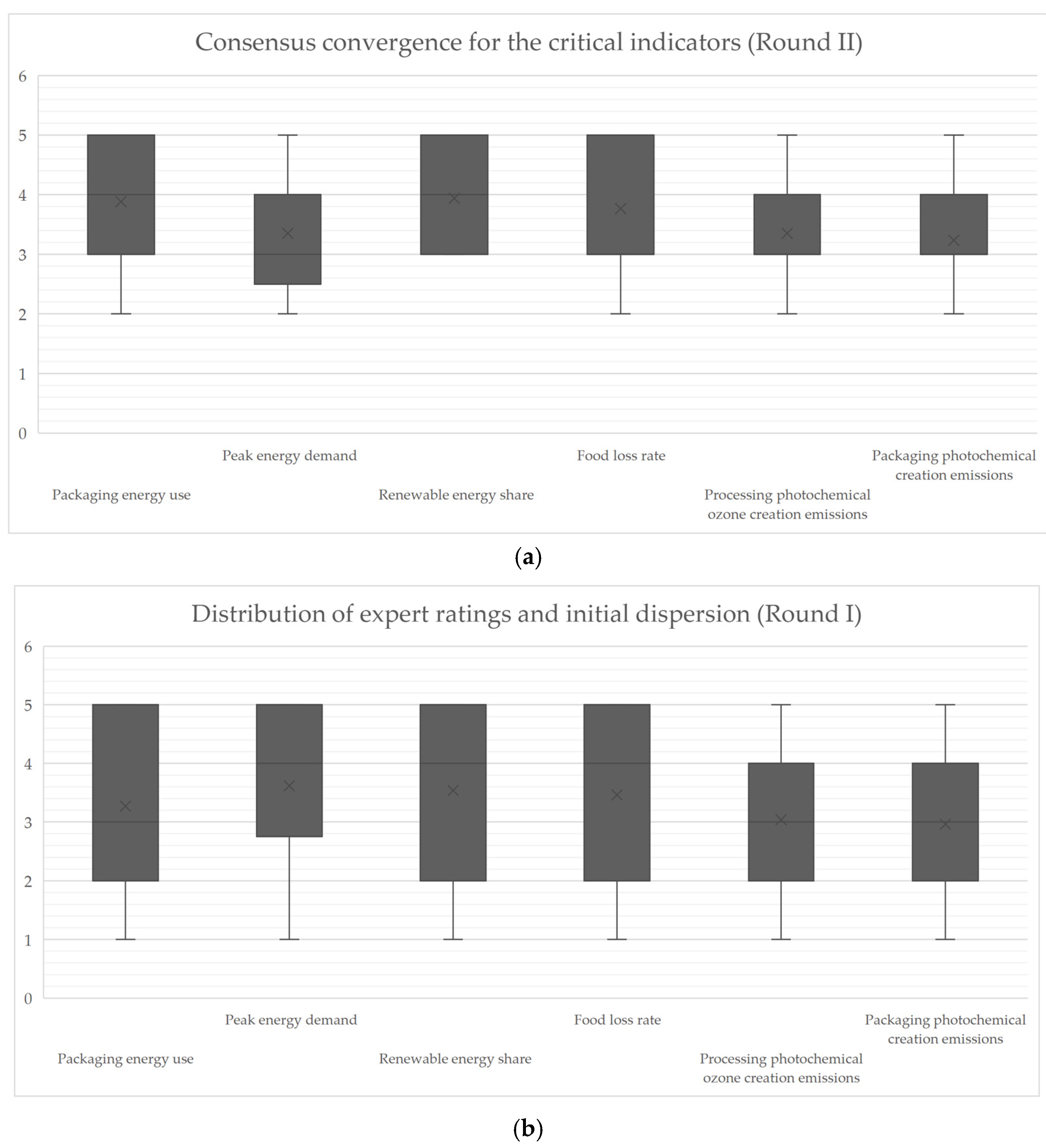
In the first round, respondents were asked to weight each indicator on a 1–5 Likert scale. The weighting was based on two criteria: the indicator’s ability to capture the actual impact within its assigned WEFE dimension, and its capacity to provide informative value for both producers and consumers. More specifically, the weight reflected the relative priority of each indicator as a tool to: (i) provide clear and effective information to producers about their WEFE performance, and (ii) guide consumer choices through accessible information. To build consensus, indicators with a standard deviation greater than 1.25 were selected for a second round of assessment. In this round, respondents were invited to revise their scores after being shown the average results. Six indicators underwent this process through a Google Form distributed on 25 August 2025. This iterative procedure ensured that the final weights represented a more stable and shared expert consensus.

2.3. Validation of the Indicators Set Based on Data Availability

To assess the technical feasibility of the proposal, the indicator list was evaluated against actual data requirements. Valid Environmental Product Declarations (EPDs) in pasta production were collected and examined to determine which indicators were already covered by both the EPDs and the proposed set. For those indicators that did not match directly, it was assessed whether they could be fully or partially satisfied using the data available in the EPDs.
The defined set of indicators was compared with six Life Cycle Assessments (LCAs) conducted within the EPD ecolabelling scheme (Table 2). This scheme follows ISO 14025 [35] standards, which guide Type III labelling programmes by providing quantified and independently verified environmental information over the life cycle of a product [19]. The selected EPDs were retrieved from the official EPD catalogue [39]. Each indicator was then examined to determine whether it could be fulfilled using data collected during the Life Cycle Inventory phase of the analysed EPDs.
This step is particularly relevant because, although all EPDs are equally valid, they rely on different Product Category Rules (PCRs), which are standardised guidelines for conducting LCAs in specific product categories. PCRs are designed to enable product comparability within a category, yet they may differ even among LCAs of the same product type [19].
Each indicator was classified into three categories: (i) identical or different but fully computable with available inventory data; (ii) partially computable with available data; and (iii) not computable with available data. This analysis determined the share of indicators that could be readily fulfilled with a standard life cycle inventory. It highlights both similarities and differences between the proposed framework and a regular EPD, clarifying the added value generated through the integration of life cycle and non-life cycle indicators in line with the WEFE logic.

3. Results

After the first selection, the list included 14 indicators for the Energy dimension, 12 for Water, 10 for Food, and 15 for Ecosystem. All indicators were considered for the Delphi engagement (Figure 1). The first round was sent to 47 respondents via Google Forms on 29 July 2025, of which 26 provided complete and useful responses. The process revealed a cautious approach by respondents. Specifically, the full set of indicators received an average weight of 3.54 and a median weight of 3.56. Among all indicators, only six displayed a standard deviation greater than 1.25, requiring a second round of engagement.
In the second round, respondents were invited to voluntarily revise their scores for the six indicators not meeting the consensus requirements. This iterative process ensured that the final weights reflected a shared expert agreement. As shown in Figure 2a,b, consensus increased among respondents, despite the generally cautious attitude reflected in their evaluations, in line with the core objectives of the Delphi method to progressively refine expert agreement through iterative feedback.
Indicators were then ranked within each dimension, and the top five to seven with the greatest weights were selected. During this process, some indicators were excluded following expert and collaborator feedback regarding their actionability, particularly in relation to data requirements and computational capacity (Table 3).
Despite the precautionary stance on indicator weights, numerous positive observations were provided, endorsing both the aim and scope of the proposed instrument. Several experts described it as “creative” and suitable for “high capacity for replication in non-food processing industries,” while also highlighting its potential to stimulate industrial symbiosis processes by leveraging the WEFE Nexus. Additionally, experts helped identify overlapping and unfeasible metrics considering data needs. Overall, the Delphi approach was considered appropriate given the objectives and scope of the research, though methodological limitations were also noted and will be addressed in the discussion.

3.1. Final Indicators Batch

At the end of the ranking and cleaning process, we were left with 23 indicators divided as follows (Table 3):
  • Energy: 4 indicators
  • Water: 6 indicators
  • Food: 7 indicators
  • Ecosystem: 6 indicators

3.1.1. Energy-Related Indicators

Full-Life-Cycle Energy-Related Indicators
  • Cumulative energy demand
Constituting a fundamental dimension of the WEFE framework, energy is regarded as a resource that flows through processes and is transformed into the final product. Assessing the quantity of energy input across the entire production process makes it possible to evaluate the efficiency with which energy is converted into the desired output, thereby highlighting opportunities for improvement and overall efficiency. In particular, some specific energy intensive hotspots in pasta production process, such as the drying phase, are worthy of attention for significant improvement in energy efficiency [57]. The Cumulative Energy Demand (CED) framework seeks to quantify the total amount of energy—both renewable and non-renewable—required, resulting in an indicator that defines energy intensity. This indicator adheres to the ISO 14040-44 [33,34] LCA framework.
Cumulative Energy Demand [40]:
C E D = T o t   E n e r g y   i n p u t   ( M J ) 1   k g   f i n a l   p r o d u c t
  • Renewable energy share
Assessing the renewable energy share in the production process allows a clearer definition of the qualitative profile of energy use, providing a more comprehensive view of the overall sustainability of energy provision, in line with the WEFE Nexus and Sustainable Development principles. The CED framework provides the means to differentiate between the two types of energy and to highlight the reliance of the production process on unsustainable energy sources.
Renewable Energy Share [8]:
R E S = R e n e w a b l e   e n e r g y   i n p u t   ( M J )   T o t   E n e r g y   i n p u t   ( M J ) %
Non-Life-Cycle Energy-Related Indicators
  • Exergy efficiency
With the purpose of developing a complete energy profile of the production process, conducting an exergy efficiency analysis allows the identification of insightful qualitative information on energy use. Indeed, exergy efficiency assesses the quality and usability of energy flows, facilitating the mapping of inefficiencies and losses across unit operations [43].
In our study, exergy efficiency defines how effectively a process converts the available energy (i.e., exergy) into the desired output.
E × E = O u t p u t e x   I n p u t e x %
  • Peak energy demand
This figure is defined as the single highest instantaneous electrical draw from the facility’s machineries for each stage of production. It represents the worst-case stress on the grid connection [44].
This indicator calculates the maximum quantity of energy some machineries may require for working under great stress.
Peak Energy Demand:
P E D = max i ( P t o t , i )
where i represents the set of machineries performing the same task along the production chain.

3.1.2. Water-Related Indicators

As a foundational dimension of the WEFE framework, water is a crucial resource in the context of resource security. Scarcity and overexploitation of freshwater are on the rise, leading to conflicts and trade-offs [9]. At the same time, awareness of the water footprint is increasing across society and the economy [9]. Acknowledging the water footprint of production processes is essential for businesses to assess their level of resource sustainability and to ensure long term resource security. Indeed, pasta production—and grain cultivation, more broadly—requires substantial amounts of water. Since cereals are often grown in regions affected by water scarcity, accounting for local territorial water availability becomes essential for accurately assessing the water footprint of agricultural production processes [58]. Understanding the total water required in production processes—namely, accounting for all the water that directly or indirectly affects product output (virtual water [48])—is therefore fundamental to identifying opportunities for improvement in production processes.
Life-Cycle-Related Indicators
  • Water footprint
In line with life cycle principles as required by the standard ISO 14040-44 [33,34], the water footprint indicator accounts for all the water needed along the production process, along the lines of the prescriptions of the ISO 14046 standard [41]
Total Water Footprint:
T W F = T o t a l   w a t e r   u s e   ( m 3 ) 1   k g   f i n a l   p r o d u c t
  • Blue, green, and grey water footprints
To provide a complete and informative picture of water consumption in the production process, it is important to describe the qualitative profile of water use alongside its quantitative dimension. Water not only comes from different sources, but its type of use during the product life cycle can vary greatly, causing different environmental pressures. Following the framework of Hoekstra and Mekonnen [44], the three types of water used in production processes are green, blue, and grey, each characterised by distinct features. Green water refers to rainwater stored in the soil and used by plants. Blue water includes surface and groundwater (rivers, lakes, and aquifers) that is consumed—that is, not returned to the source during production—and is closely linked to water scarcity and competition for use. Grey water footprint represents the volume of freshwater required to dilute pollutants (e.g., nitrogen runoff) to meet water quality standards. It is calculated according to pollutant load and acceptable concentration thresholds [44]. In our case, the three shares are represented as the ratio between each type of water (green, blue, and grey) and the Total Water Footprint (TWF), thereby coupling quantitative figures on water consumption with its qualitative characteristics.
  • Blue water footprint
B W F = B l u e   w a t e r   c o n s u p m p t i o n   ( m 3 ) T o t a l   w a t e r   u s e   ( m 3 ) %
  • Green water footprint
G N W F = G r e e n   w a t e r   c o n s u p m p t i o n   ( m 3 ) T o t a l   w a t e r   u s e   ( m 3 ) %
  • Grey water footprint
G Y W F = G r e y   w a t e r   c o n s u p m p t i o n   ( m 3 ) T o t a l   w a t e r   u s e   ( m 3 ) %
  • Available water remaining (AWARE)
The available water remaining framework was developed by the Water Use in Life Cycle Assessment working group with the purpose of quantifying the potential impact of water consumption on regional water scarcity, aligned with the goals of ISO 14046 [41,45]. Supporting regular life cycle figures with indicators based on territorial specificity aligns the assessment with the principles of the WEFE Nexus, which stands on the interaction of resource dimensions within a specific territory. The core question of the indicator revolves around defining what the potential of depriving another freshwater user is, by consuming water in the region.
a. Availability Minus Demand (AMD):
A M D = A v a i l a b i l e   w a t e r H u m a n   W a t e r   c o n s u m p t i o n E n v i r o n m e n t a l   w a t e r   r e q u i r e m e n t A r e a   ( m 2 )
Available water: Modelled runoff, including infrastructure effects.
HWC = water consumed and not returned for every human purpose (civil, industrial, or agricultural).
EWR = minimum flow needed to maintain freshwater ecosystem in “fair” conditions.
Area = watershed surface area (m2).
AMD = m 3 / m 2 / m o n t h .
b. Characterisation Factor:
C F A W A R E = W o r l d   A v e r a g e   A M D A M D s t u d y   a r e a
CF is dimensionless and must be normalised for comparability.
c. Water Scarcity Footprint:
W S F = W a t e r   C o n s u m p t i o n   I n v e n t o r y C F a w a r e
Non-Life-Cycle-Related Indicators
  • Water productivity
With this indicator, we define the amount of output gained per litre of consumed water. In other words, this indicator is the inverse of the Water Footprint. Although it is not part of the ISO 14046 standards for water footprinting in LCA, it can provide a clearer picture of how much yield can be obtained from impacting the water resource. Focusing on water productivity is particularly relevant because global food production is expected to grow by 60% by 2100 compared to 2005 [27]. In a context of changing rainfall patterns and climate disruption, 66% of the global population will be living in countries subject to water stress by 2050 [27]. Water productivity thus enables responses to increasing demand, pressures on water availability, and contributions to economic growth [46]. Despite being unconventional in life cycle-oriented analysis, we draw from the literature on water productivity to define the following indicator:
W P = T o t a l   o u t p u t   ( k g ) G r e e n   w a t e r + B l u e   w a t e r   c o n s u m p t i o n   ( m 3 )
  • Water exploitation index
The Water Exploitation Index, or WEI+ in its revised version, was introduced by the Drought Expert Group of the European Commission. This scarcity indicator provides an evaluation of the stress on water resources as a consequence of human abstractions [47]. The indicator essentially expresses the ratio between water abstractions and the renewable availability of freshwater, and it is generally computed at the territorial level. Nonetheless, its structure allows it to be scaled to the subbasin and single operator levels [47]. This indicator provides a territory-specific ratio reflecting the level of pressure exerted on regional water availability.
Water Exploitation index+:
W E I + = F r e s h w a t e r   w i t h d r a w a l   ( m 3 ) R e t u r n   f l o w s   ( m 3 ) R e n e w a b l e   w a t e r   r e s o u r c e s   ( m 3 ) M i n i m u m   e n v i r o n m e t n a l   f l o w   ( m 3 )

3.1.3. Food Indicators

In line with the concept of the WEFE Nexus, which comprises the interconnection of resource systems and their interdependence, we selected 100 kcal as the functional denominator of the indicators when focusing on the FOOD dimension. Choosing this functional denominator captures the resource intensity required to produce a defined output of food energy. This, in turn, enables the assessment of the overall efficiency of the production process. The application of macronutrients as the reference base for environmental indicators was previously undertaken by Nijdam et al. [59]. In that work, the authors conducted a review of the environmental impact of protein-rich food production, using defined protein content as the functional denominator. Given that pasta is an energy-rich food, with carbohydrates as its main constituent, we selected 100 kcal as the functional denominator for our study.
Life-Cycle-Based Indicators
  • Nutritional water intensity
To develop such indicators, we relied on the concept of the Water Footprint as described in ISO 14046:2014 [46], namely the sum of direct and indirect freshwater use across the full supply chain. For the present work, we considered only blue water consumption, defined as the sum of withdrawals from surface and underground sources. Specifically, we excluded green water, understood as the total volume of rainwater [48]. Green water consumption was excluded because it is highly dependent on annual precipitation, providing limited information on process efficiency and opportunities for improvement. Isolating the blue water consumption component is generally valuable because this resource is scarcer and carries higher opportunity costs than green water [48].
  • Nutritional water intensity
N W I = L i f e   c y c l e   w a t e r   u s e   ( m 3 ) F i n a l   p r o d u c t   e n e r g y   ( 100   k c a l )
  • Nutritional energy intensity
The concept of the WEFE nexus revolves around the indivisibility and interconnection of resource systems and resource flow exchanges. In line with this, it is relevant to analyse how energy input flows into the final energy output for human consumption. Utilising the concept of EROI—defined as the ratio between the amount of energy produced and the amount of energy consumed in the production process [51]—we seek to achieve this objective. This measurement provides an overall picture of the efficiency of the energy transformation process, from raw material to final product. Specifically, EROI measures how much edible biomass energy is produced per unit of invested energy. In this context, edible energy production refers to energy suitable for human consumption, that is, the energy potentially provided by food produced, in conformity with the methodology adopted by the United Nations Food and Agriculture Organisation (FAO) [51].
E R O I =   E n e r g y   O u t p u t   ( J   o r   k c a l ) Σ   E n e r g y   I n p u t (   J   o r   k c a l )
Non-Life-Cycle-Based Indicators
  • Nutritional potential
To assess the nutritional potential of pasta, we apply the NRF 9.3 index [51]. This is a composite indicator measuring the nutritional value of food grounding in the balance between nine nutrients to be promoted and three nutrients to be limited. Specifically, the following nutrients should be promoted: protein, fibre, vitamins A, C, and E, calcium (Ca), iron (Fe), magnesium (Mg), and potassium (K). The following nutrients are discouraged: saturated fat, added sugars, and sodium (Na). All the nutrients are computed in g or mg/100g and are referenced to the suggested daily intake for an adult per day. This indicator provides broad and straightforward information on the overall nutritional value of food, in tune with the Food dimension of the WEFE, and it can be easily used to be fed into more complex composite indicators. Indeed, a tailored version of this indicator was used by Entrena Barbero et al. [13] to design a WEF Nexus ecolabel for fish products.
N R F   9.3 = ( Σ   % D V   o f   9   n u t r i e n t s   t o   e n c o u r a g e ) ( Σ   % D V   o f   3   n u t r i e n t s   t o   l i m i t ) × ( 100   g   f o o d )
where DV = Daily suggested value.
  • Nutritional land productivity
Nutritional Land Productivity [50]:
N L P = T o t a l   o u t p u t   o f   f i n a l   p r o d u c t   ( k c a l ) C r o p p e d   l a n d   ( m 2 )
  • Fertiliser use
Fertiliser use efficiency: This indicator computes the N and P intensity for calorie production, namely how much of the nutrient is used to produce one calorie of final output. Kg, N, and P applied/100 kcal [53].
F U E = C r o p p i n g   N   ( k g ) + C r o p p i n g   P   ( k g ) + C r o p p i n g   K   ( k g ) k g   f i n a l   p r o d u c t
  • Material intensity-related food indicators
Quantifying material input intensity for edible energy production is a relevant step, coherent with the principles of CE [60] and the WEFE Nexus principle of “producing more with less” [23]. In this sense, the former indicator focuses on the quantity of raw material lost along the production process in terms of quantity, while the latter quantifies how many raw calories are needed to obtain one final output calorie. This design identifies the energy density of the processed weight mass, offering a link between produced biomass and edible energy delivery.
Raw material intensity: The indicator evaluates the ratio between the mass weight of harvested wheat and the mass weight of net final product, namely how much raw material is needed to collect one unit of final product [55].
R M I = T O T   M a s s   o f   h a r v e s t e d   w h e a t   ( k g ) T O T   M a s s   o f   f i n a l   p r o d u c t   ( k g )
Food loss rate: The indicator quantifies the quantity of edible energy lost through the process (own elaboration).
F L R = T O T   H a r v e s t e d   e n e r g y   ( k c a l ) S o l d   e n e r g y   ( k c a l )

3.1.4. Ecosystem-Related Indicators

Life-Cycle-Based Indicators
  • Acidification potential and photochemical ozone creation potential
The following indicators seek to quantify the emission of Volatile Organic Compounds (VOCs) and Nitrous Oxides (NOx) that react under the sunlight-producing toxic tropospheric ozone (O3). The quantification of these compounds, similarly to the previous sections, is prescribed by life cycle assessment standards [33,34]. This aspect gains particular relevance in the food sector, given the pressure exercised by agricultural practices on the ecosystem.
Acidification footprint: Quantification of the ammonia emissions from fertilisers (kgNH3/ha); diesel fuel burned (L) associated with NOx and SO2 emission factors and soil management practices that influence acidity; vehicle-specific acidifying emissions during transportation and cropping operations; grid-mix acidification footprint linked to electricity consumption (kWh); fuel-burning emissions factors for SO2 and NO in the manufacturing process; and total acidifying emissions from the packaging production process [11].
A F = T O T   k g   S O 2 e q k g
Photochemical ozone creation potential: VOCs and CO emissions from diesel and fuel usage (g/Km) during cropping operations and transport, and emissions from fertiliser production; quantity and composition of glues and solvents in packaging manufacturing; cleaning agent used in machineries (composition and evaporation rates); facility VOC/NOx reporting (if available); and lubricants and greasers (composition and evaporation rates) [11]:
P O C = T O T   k g   C 2 H 4 e q k g
  • Freshwater eutrophication potential
As previously mentioned, the imbalanced use of chemical fertiliser can alter soil pH and increase pests and acidification, ultimately threatening plant health and leading to the emission of greenhouse gases [12]. The excess nitrogen used to sustain crop growth can pollute freshwater sources, impairing their ecosystems [52].
Freshwater Eutrophication Potential [50]:
F E P = k g   P e q / k g
where Ei= Emission of substance i to freshwater (e.g., kg of phosphorus), and CFi = Characterisation factor for substance i (e.g., PDF·m2·yr/kg).
  • Freshwater ecotoxicity potential
The freshwater ecotoxicity potential is a life cycle impact category estimating the potential harm of chemical emissions to freshwater and ecosystems, based on their toxicity, persistence, and exposure level [52]. This figure is assessed using models like USEtox [50] or ReCiPe 2008 [52], which consider how chemicals behave in the environment and react with biological entities to produce a toxic effect.
Freshwater Ecotoxicity Potential:
F E T = k g   1,4   D C B e q / k g
Non-Life-Cycle-Related Indicators
  • Overall nutrient circularity
The use of fertilisers and pesticides today is fundamental to maintain a sufficient level of productivity. Nonetheless, the intensive use of these chemicals is able to impair the local ecosystem, promoting the build-up of pollutants like heavy metals and unbalancing local ecosystems [54]. For this reason, the following indicator quantifies their intensity of use, to provide an informative clue on how the cropping process is affecting the ecosystem and its long term stability.
Overall nutrient circularity: Defines the fraction of recycled nutrient on the total mass of used nutrients (own elaboration).
[ R e c y c l e d   N T o t a l   N + R e c y c l e d   P T o t a l   P   + R e c y c l e d   K T o t a l   K   ] 3   %
  • Land use intensity
The indicator aims at summing how much land (ha) is occupied to produce a defined amount of food (in kg of final product), considering the time span of one year. This concept is linked to the Ecological Footprint, which focuses on the scarcity of fertile land to produce food and its perishability [61].
Land use intensity: Needed extension of land to produce one functional unit of final product [56].
L U I = O c c u p i e d   h a / 1   y e a r 1   k g   f i n a l   p r o d u c t

3.2. Validation: Checking for Data Availability

The validation process served to test the feasibility of the indicator batch, based on the amount of required data and the degree of difference from a regular life-cycle-based EPD. The general results demonstrate that 56.5% of the indicators cannot be computed without additional work on data collection and computation; 25.3% of the indicators are identical or can be easily computed with the available data; and 18.2% of the indicators have partial data available. Overall, these initial results highlight how the proposed WEFE-based indicator batch provides a significant level of innovation and refinement to a life-cycle-based ecolabel, while maintaining a solid level of coherence with the framework. Nonetheless, this aspect can be better appreciated when considering the coherence within each individual WEFE dimension.
  • Energy dimension
Data need/availability comparison with a regular EPD:
  • Available: 50%
  • Not available: 50%
  • Partially available: 0%
As for the energy dimension, the indicators (i) Cumulative Energy Demand and (ii) Renewable Energy Share were always fulfilled, as these figures are foundational for an EPD assessment (Table 4).
Exergy efficiency, by contrast, has never been required in LCA, which traditionally focuses on energy quantity while only partially addressing energy quality. Investigating exergy efficiency provides valuable insights into resource degradation within the study system, offering a deeper understanding of the link between inefficiencies, economic losses, and resource depletion [43]. In line with the WEFE principle “produce more with less” [23], exergy awareness enables the identification of key losses and the connection of thermodynamics to environmental impact, since optimising exergy use directly supports reductions in fuel consumption and carbon footprints [43].
Similarly, peak energy demand cannot be computed with data from a regular EPD. This metric does not comply with a life-cycle-based perspective. On the contrary, when considered alongside Cumulative Energy Demand and total production, it can provide valuable insights into machinery efficiency across the life cycle, highlighting opportunities for improvement throughout the production chain.
  • Water Dimension
Data need/availability comparison with a regular EPD (Table 5):
  • Available: 26%
  • Not available: 57%
  • Partially available: 17%
The water dimension displays different results for each product, reflecting the evolution of the PCRs. Indeed, total water footprint data are available only for three out of six producers, who published their EPDs after the release of ISO 14046, the standard for water footprint quantification. This standard later became mandatory for life cycle assessment in this sector [36]. The same applies to the Water Productivity indicator, which became an additional indicator after the implementation of ISO 14046 and PCR 2010:01; this is fundamental to assess the amount of final product produced per unit of consumed water [41,46].
Regarding the difference between blue, green, and grey water, EPD standards do not require quantification of these categories. On the contrary, differentiating them expands the perspective on sustainable water use and highlights the different impacts that water can bear (consumption or pollution). This provides essential understanding of how production and consumption decisions affect freshwater resources across supply chains [62].
The AWARE index is usually computed in LCAs to operationalise the ISO 14046 standard and make figures comparable. This metric provides a territorial characterisation of water consumption, relating it to local availability and offering a measure of water stress compared to other territories [45]. This indicator can be combined with the WEI+ index, which focuses on the pressures placed on renewable water resources, to capture the interaction between water consumption, territorial water availability (AWARE), and the pressure on annually renewable freshwater (WEI+). This approach aligns with the WEFE Nexus framework, which is grounded in developing methodologies that account for territorial specificities and the temporal evolution of resource flows [32].
  • Food dimension
Data need/availability comparison with a regular EPD (Table 6):
  • Available: 0%
  • Not available: 69%
  • Partially available: 31%
The food dimension shows the lowest level of data availability for two main reasons. Aside from the scope of EPD, which is oriented toward a generalisable application of an environmental footprint framework, the tool aims to assess the environmental footprint of food products in an innovative way. Indeed, we applied 100 kcal as the functional denominator, to define what we call the “nutritional environmental footprint”—namely, the environmental impact generated to produce one unit of available energy serving the purpose of the final product. Although this approach is novel, some authors have begun to relate the environmental impacts of food products to a certain amount of a macronutrient as a functional unit, as in Nijdam et al., 2012 [59].
Hence, almost none of our indicators could be fulfilled by the data gathered for a regular EPD, except for the indicators evaluating water intensity (id: 1) and energy consumption (id: 2). Other exceptions include Land Productivity (id: 4) and Raw Material Intensity (id: 6), specifically for producers 4 and 5, due to the PCRs applied. Nonetheless, indicators such as Nutritional Potential (id: 3), Land Productivity (id: 4), Fertiliser Use (id: 5), Raw Material Intensity (id: 6), and Food Loss Rate (id: 7) provide a significant level of innovation to life-cycle-based indicators for ecolabelling. These indicators facilitate the comparison of relevant figures pivoting around the nutritional potential of food products in relation to resource intensity. This is particularly relevant in a world where resources are scarce and where high-production/low-input crops will be structurally necessary to meet development needs [63,64].
  • Ecosystem dimension
Data need/availability comparison with a regular EPD (Table 7):
  • Available: 61%
  • Not available: 39%
  • Partially available: 0%
Regarding the ecosystem indicators, their feasibility is dual-sided. Most of them are coherent with PCR prescriptions [36], while some others were included to more deeply integrate the ecosystem view into our indicator system. The first three indicators (id 1, 2, and 3, Table 7) are easily found in regular EPDs and effectively target several significant impacts on the ecosystem. The same is true for the Land Use indicator (id 6, Table 7), which became mandatory since PCR 2010:01 v. 4.01 [36].
With respect to Freshwater Ecotoxicity Potential (id 4, Table 7), this indicator is not generally required by standard PCRs. This is because indicators covering the ecological impact of toxic substances are generally considered methodologically less robust and require a considerable amount of data. Additionally, consensus about characterisation factors is partially lacking [65]. On the contrary, considering the importance of this indicator in the Water–Ecosystem relationship—within the framework of the WEFE Nexus—it is crucial for our purpose. We included this indicator as a precautionary measure to account for ecosystem impacts, despite the difficulty of its computation.
Moreover, overall nutrient circularity adds information about the amount of nutrients that may reach the ecosystem. Indeed, the high dependence on mined nutrients such as phosphorus (P) makes its sourcing process linear, with cascade effects on food prices and human and ecosystem health [66]. Considering an indicator that covers the source of nutrients, distinguishing between newly industrially sourced nutrients and those derived from recycled organic matter would integrate figures on ecological pressures with information about the ratio of pressure to the nutrient cycle, both upstream (sourcing) and downstream (pollution).

4. Discussion

Up to this stage, the validation process is partial, and further efforts are needed to test the indicator list with real world data. Nonetheless, some inferences about its effectiveness can already be made, considering their potential use in an ecolabelling system. Testing the data burden aimed to assess the effort required from producers and its balance with the effectiveness of the ecolabel for consumers in terms of market relevance. This provides the basis for discussing both the strengths and limitations of the proposed framework.
The results about data availability, which appear to be balanced across the dimensions, testify the objective of this paper—namely, integrating LCA with the WEFE Nexus, while keeping the data and computational needs limited and manageable. Applying the WEFE Nexus perspective requires tackling multiple and interconnected issues [26]. It also requires overcoming traditional siloed approaches and adopting an interdisciplinary perspective [16,32], while recognising the coupled nature of these sectors and their interlinkages [32]. To achieve this purpose, the proposed approach strives to highlight and valorise interdimensional trade-offs and tensions, while keeping the indicators limited, informative, and easily actionable in terms of data burden. Highlighting the tensions among WEFE dimensions and endowing the assessment with local specificities can refine the informativeness of an ecolabelling program that seeks to display the sustainability performance of pasta production in the four WEFE dimensions.
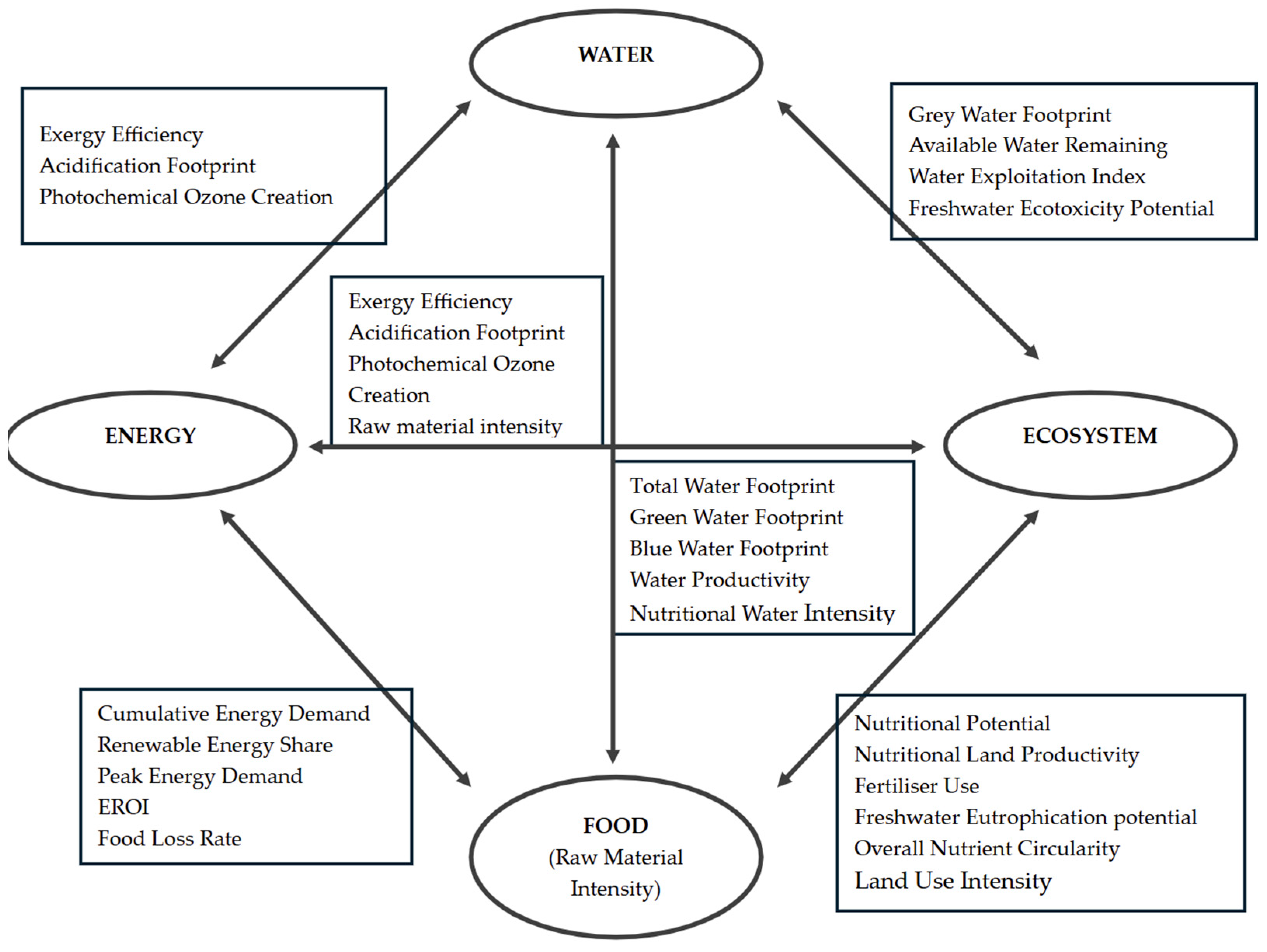
To reflect the interconnected nature of the WEFE Nexus and move beyond a purely sectoral perspective, the proposed framework does more than simply catalogue indicators: it highlights their interdimensional tensions. Although each indicator is methodologically assigned to a primary dimension for clarity of calculation, their application reveals the trade-offs and synergies across different resource systems (Figure 3). As illustrated in the schematic representation, the indicators act as bridges between dimensions. For example, the Water–Ecosystem tension integrates quantitative withdrawals with impacts on ecological quality, while the Energy–Food relationship maps the efficiency with which energy is transformed into vital nutrients. This representation presents the indicator set as an integrated system capable of capturing the fundamental interdependencies of the Nexus.
The endeavour to highlight WEFE tensions lies in highlighting the relations among different impacts linked to the use of the same resource within different dimensions. As an example, the link between water consumption and water pollution, highlighted by the tension among the indicators in the Water and Ecosystem dimensions, suggests how exploiting the water resource can have different impacts of a different nature. Indeed, quantitative and qualitative impacts are different, affecting different resources dimensions. Again, the relationship between the Energy and Food dimensions strives to describe how energy is manipulated and flows from energy sources to the final product, hence serving its ultimate use of providing “vital” energy. This provides useful insights on the level of efficiency in energy use, embodying the natural trade-offs of energy transfers in an ecological perspective, in line with WEFE principles [23,25,67]. This ecological perspective allows for highlighting room for improvement, potential synergies, and unexpected trade-offs, spanning from industrial efficiency to the choice of the right crop for optimising the energy transfer, water use, and nutrient selection. This perspective harnesses the verticality of LCA—which normally focuses on environmental subsystems—with the Nexus approach, which emphasises the need to consider interlinkages between resources [68]. Another tension highlighted by our framework comes from the Fertiliser Use indicator (Food dimension) and the Overall Nutrient Circularity indicator (Ecosystem dimension). This tension recognises the need for fertilisers to sustain food production, and its trade off with food quality impoverishment and ecosystem degradation [54], encouraging the use and re-use of organic fertilisers, along with circular practices. Attention was placed on highlighting the role of food waste along the production chain. This because food waste is deeply linked with the concept of the WEFE Nexus, as it translates in a multidimensional waste of resources. In this regard, analysing the food-production life cycle through a WEFE Nexus perspective is a promising step to reduce food waste and find novel solutions to address the problem [15]. This is supported by the findings of Castell Perez et al. [69]. The authors conducted a review on food processing waste impact on the Nexus, highlighting how robust frameworks like the LCA start to quantify the impacts on the WEFE Nexus but are still neglecting the impact coming from food waste.
Another added value of the proposed framework comes from trying to refine the displayed environmental pressures according to the actual resource availability of the considered territory, something peculiar in the WEFE Nexus discourse [23,32]. This was especially done for the Water dimension, in which indicators like the WEI+ and the AWARE base their figures on the availability of water in a defined perimeter and the ecological water flow needed to preserve the ecosystem linked to the specific water basin. Indeed, considering local conditions in the LCA assures comparability and prevents impaired comparisons [70]. This is relevant for the Energy dimension, which is greatly linked to the local energy provision mix [70], and for the Water dimension. As described by Mir et al. [71], the provision of a unit of water has extremely different impacts from one place to another. As a result, including local specificities is crucial for the purpose of LCA comparability, especially if the complexity of the WEFE Nexus is considered.
At the same time, the number and complexity of the indicators was kept limited, to encourage adoption of a potential ecolabeling scheme. Indeed, one of the biggest obstacles to adoption comes from the expected complexity and the related costs when it comes to data collection and computation. Ghazzai et al. [72] demonstrated that ecolabels requiring a excessive information tend to discourage businesses adoption, because they require high costs and bureaucratic effort. On the contrary, an effective ecolabel should balance information transparency and a clear economic convenience [72]. This is the reason why simple indicators were selected, partially overlapping with a regular EPD ecolabel. This provides producers with a reworked version of a framework they have confidence with [6,14,15], while endowing it with the multidimensionality and integrative perspective of the WEFE Nexus.
Concerning the organisation of the indicators in an ecolabelling scheme, some consideration must be given with respect to information clarity and effectiveness for consumer signalling. Consumers use ecolabels as a decision-making support tool, but their understanding and willingness to adopt ecolabels is crucial for their success [1]. Consumers’ adoption of an ecolabel is strongly linked to their ability to understand what the purpose of the ecolabel is, along with their motivation to align with the same purpose [1].
Thereby, consumers’ attention toward ecolabels is stimulated when they have confidence with and knowledge about the matter of concern [1,18]. This requires providing them with information that is easy to interpret in a limited time, and thus limited in quantity and complexity [20]. This justifies the aim of limiting the number of indicators and their complexity, limiting difficult ratios and models. Moreover, spreading the impacts among the four WEFE dimensions avoids overwhelming consumers with technical terminology [20]. In a paper conducting focus groups with consumers, Hay et al. [20] found that the assignment of general categories such as ‘air, land, and water’ was appreciated, as it facilitates immediate understanding and comparability. This proved particularly effective when assessments were expressed through simple scales such as ‘good, medium, bad’, benchmarked with industry standards [20].
Given these findings, and provided that the proposed indicator list adheres to these principles of effectiveness and simplicity, the progression toward an ecolabelling scheme should normalise the results for each dimension using a simple scale, while also combining them into a single, univocal WEFE performance indicator.

5. Limitations and Future Research

This study adopts an exploratory approach, which is appropriate given the limited academic consensus and the scarcity of literature on the topic. The aim is to foster convergence among expert opinions. Yet, methodological limitations remain, particularly regarding direct weighting within the Delphi method. This approach is further constrained by the potential bias of experts, which stems from their direct involvement in and prior engagement with the topic. Future research could mitigate these limitations by employing more advanced hierarchical weighting techniques, such as AHP or SWARA, applied to more heterogeneous focus groups to reduce bias and enhance representativeness.
Moreover, while this study explores novel ways to integrate the WEFE Nexus into life-cycle-based ecolabels, thorough validation with real world data is still missing. Future research should therefore not only validate the proposed indicator set but also assess the market appeal of a potential ecolabel from the perspective of enterprises. At the same time, the ecolabel must be designed to remain informative for consumers. This requires the development of benchmarking methods that present performance in a simplified manner (e.g., good, medium, bad) across each dimension, and that can be aggregated into a single, univocal WEFE performance indicator.
In doing so, further research should extend this framework to other sectors, ensuring that it becomes generalisable beyond the specific contexts examined here. Such efforts would help transform the ecolabel into a commercially viable and technically actionable instrument.

6. Conclusions

The present manuscript harnesses the Circular Economy framework to advance life cycle assessment (LCA). It proposes a set of indicators to be integrated into a WEFE perspective for the development of an ecolabelling scheme in pasta production. By embedding the principles of the Circular Economy, the framework complements conventional assessments of food products’ environmental footprint. It does so by adding an integrated and holistic view of the pressures exerted on WEFE resource systems.
For this purpose, a set of experts were engaged by means of a Delphi protocol. The experts were asked to directly weight a set of indicators according to their significance within the framework of a consumer-oriented ecolabel. The process successfully stimulated consensus among the experts, facilitating convergence on several items. In the end, we selected a total of 23 indicators covering the four WEFE dimensions. The validation process was based on the data requirements for indicator fulfilment, grounded in the additional data needed compared to a regular LCA, with the purpose of appreciating both the data burden and the innovative drive of our indicator set.
The proposed framework demonstrates that the Circular Economy offers a valuable lens to integrate life cycle assessment (LCA) with the WEFE Nexus. By emphasising the unity and integrity of resource flows, it stimulates an ecological perspective that highlights trade-offs, synergies, and local specificities. This approach addresses interconnected issues such as water use, energy efficiency, nutrient cycles, and food waste, while keeping indicators limited and manageable. In this way, the framework balances transparency and feasibility, encouraging both producer adoption and consumer understanding of ecolabelling schemes.
At the same time, the study shows that LCA can be effectively combined with the WEFE Nexus. The verticality and specificity of LCA, traditionally focused on environmental subsystems, can be positively integrated with the holistic and interdisciplinary nature of the Nexus approach. This integration refines the assessment of sustainability performance by capturing interdimensional tensions and resource interlinkages, while remaining accessible through simplified indicators. Such convergence paves the way for ecolabelling schemes that are both scientifically robust and practically actionable, enhancing their role as tools for ecological transition in food production.

Author Contributions

Conceptualization, E.B., M.R., T.R. and S.C.; methodology, E.B., M.R., T.R. and S.C.; validation, E.B.; investigation, E.B. and M.R.; resources, G.A.; data curation, E.B. and M.R.; writing—original draft preparation, E.B.; writing—review and editing, E.B., T.R. and S.C.; and supervision, G.A. and M.F. All authors have read and agreed to the published version of the manuscript.

Funding

This research received no external funding.

Institutional Review Board Statement

This study involved a Delphi consultation with academic and professional experts participating in COST Action CA20138 (NexusNet). The research did not involve clinical trials, vulnerable populations, or the collection of personal or sensitive data. All data were collected anonymously and exclusively for research purposes. According to the ethical guidelines of the participating institutions and standard practices for non-clinical, expert-based survey research, formal approval by an institutional review board or ethics committee was not required for this study. This determination is consistent with institutional regulations governing non-interventional research involving expert opinion elicitation.

Informed Consent Statement

Informed consent was obtained from all participants involved in the study. Participation in the Delphi process was entirely voluntary. Participants were informed about the purpose of the study, the anonymous nature of data collection, and their right to withdraw at any time without consequences. Completion and submission of the questionnaire were considered as implicit consent to participate.

Data Availability Statement

Data are contained within the article.

Acknowledgments

This paper and related research have been conducted during and with the support of the Italian national inter-university PhD course in Sustainable Development and Climate change (link: www.phd-sdc.it). This paper and the related research have been conducted with the scientific support of the Network on Water–Energy–Food Nexus for a Low-Carbon Economy in Europe and Beyond—NEXUSNET (CA 20138).

Conflicts of Interest

The authors declare no conflicts of interest.

Abbreviations

The following abbreviations are used in this manuscript:
AHPAnalytic Hierarchical Process
CECircular Economy
EPDEnvironmental Product Declaration
LCALife Cycle Assessment
PCRProduct Category Rules
SWARAStep-Wise Assessment Ratio Analysis
VOCsVolatile Organic Compounds
WEFEWater–Energy–Food–Ecosystem
WEIWater Exploitation Index

References

  1. Praneetvatakul, S.; Vijitsrikamol, K.; Schreinemachers, P. Ecolabeling to Improve Product Quality and Reduce Environmental Impact: A Choice Experiment with Vegetable Farmers in Thailand. Front. Sustain. Food Syst. 2022, 5, 704233. [Google Scholar] [CrossRef]
  2. Thøgersen, J.; Haugaard, P.; Olesen, A. Consumer Responses to Ecolabels. Eur. J. Mark. 2010, 44, 1787–1810. [Google Scholar] [CrossRef]
  3. Potter, C.; Bastounis, A.; Hartmann-Boyce, J.; Stewart, C.; Frie, K.; Tudor, K.; Bianchi, F.; Cartwright, E.; Cook, B.; Rayner, M.; et al. The Effects of Environmental Sustainability Labels on Selection, Purchase, and Consumption of Food and Drink Products: A Systematic Review. Environ. Behav. 2021, 53, 891–925. [Google Scholar] [CrossRef]
  4. Camilleri, M.A.; Cricelli, L.; Mauriello, R.; Strazzullo, S. Consumer Perceptions of Sustainable Products: A Systematic Literature Review. Sustainability 2023, 15, 8923. [Google Scholar] [CrossRef]
  5. Iraldo, F.; Testa, F.; Bartolozzi, I. An Application of Life Cycle Assessment (LCA) as a Green Marketing Tool for Agricultural Products: The Case of Extra-Virgin Olive Oil in Val di Cornia, Italy. J. Environ. Plan. Manag. 2014, 57, 78–103. [Google Scholar] [CrossRef]
  6. McGrane, S.J.; Acuto, M.; Artioli, F.; Chen, P.Y.; Comber, R.; Cottee, J.; Farr-Wharton, G.; Green, N.; Helfgott, A.; Larcom, S.; et al. Scaling the Nexus: Towards Integrated Frameworks for Analysing Water, Energy and Food. Geogr. J. 2019, 185, 419–431. [Google Scholar] [CrossRef]
  7. Gallardo, R.K. The Environmental Impacts of Agriculture: A Review. Int. Rev. Environ. Resour. Econ. 2024, 18, 165–235. [Google Scholar] [CrossRef]
  8. Recchia, L.; Cappelli, A.; Cini, E.; Garbati Pegna, F.; Boncinelli, P. Environmental Sustainability of Pasta Production Chains: An Integrated Approach for Comparing Local and Global Chains. Resources 2019, 8, 56. [Google Scholar] [CrossRef]
  9. Ruini, L.; Ferrari, E.; Meriggi, P.; Marino, M.; Sessa, F. Increasing the Sustainability of Pasta Production through a Life Cycle Assessment Approach. In Proceedings of the 20th Advances in Production Management Systems (APMS), State College, PA, USA, 9–12 September 2013; pp. 383–392. [Google Scholar] [CrossRef]
  10. Catellani, E.; Manfredini, S.; Amico, C.; Ciccullo, F.; Cigolini, R. Sustainability on the plate: Unveiling the environmental footprint of pasta supply chain through Life Cycle Assessment. Environ. Impact Assess. Rev. 2025, 112, 107821. [Google Scholar] [CrossRef]
  11. Zingale, S.; Licciardello, F.; Giunta, G.; Mistretta, M. Environmental Life Cycle Assessment for Improved Management of Agri-Food Companies: The Case of Organic Whole-Grain Durum Wheat Pasta in Sicily. Int. J. Life Cycle Assess. 2022, 27, 205–226. [Google Scholar] [CrossRef]
  12. Krasilnikov, P.; Taboada, M.A.; Amanullah. Fertilizer Use, Soil Health and Agricultural Sustainability. Agriculture 2022, 12, 462. [Google Scholar] [CrossRef]
  13. Entrena-Barbero, E.; Santos, S.C.; Cortés, A.; Esteve-Llorens, X.; Moreira, M.T.; Villanueva-Rey, P.; Quiñoy, D.; Almeida, C.; Marques, A.; Quinteiro, P.; et al. Methodological Guidelines for the Calculation of a Water-Energy-Food Nexus Index for Seafood Products. Sci. Total Environ. 2023, 877, 162845. [Google Scholar] [CrossRef]
  14. Green, J.; Cranston, G.R.; Sutherland, W.J.; Tranter, H.R.; Bell, S.J.; Benton, T.G.; Blixt, E.; Bowe, C.; Broadley, S.; Brown, A.; et al. Research Priorities for Managing the Impacts and Dependencies of Business upon Food, Energy, Water and the Environment. Sustain. Sci. 2017, 12, 319–331. [Google Scholar] [CrossRef] [PubMed]
  15. Del Borghi, A.; Moreschi, L.; Gallo, M. Circular Economy Approach to Reduce Water–Energy–Food Nexus. Curr. Opin. Environ. Sustain. Sci. Health 2019, 41, 24–31. [Google Scholar] [CrossRef]
  16. Geissdoerfer, M.; Savaget, P.; Bocken, N.M.P.; Hultink, E.J. The Circular Economy—A New Sustainability Paradigm? J. Clean. Prod. 2017, 143, 757–768. [Google Scholar] [CrossRef]
  17. Voulvoulis, N. The Potential of Water Reuse as a Management Option for Water Security under the Ecosystem Services Approach. Desalin. Water Treat. 2015, 53, 3263–3271. [Google Scholar] [CrossRef]
  18. Sammer, K.; Wüstenhagen, R. The Influence of Eco-Labelling on Consumer Behaviour—Results of a Discrete Choice Analysis for Washing Machines. Bus. Strategy Environ. 2006, 15, 185–199. [Google Scholar] [CrossRef]
  19. Minkov, N.; Schneider, L.; Lehmann, A.; Finkbeiner, M. Type III Environmental Declaration Programmes and Harmonization of Product Category Rules: Status Quo and Practical Challenges. J. Clean. Prod. 2015, 94, 235–246. [Google Scholar] [CrossRef]
  20. Hay, C.; Meyer, K.; Rutherford Carr, G.; Hill, J.P.; Hort, J. Taking a Consumer Led Approach to Identify Key Characteristics of an Effective Ecolabelling Scheme. Sustainability 2024, 16, 6260. [Google Scholar] [CrossRef]
  21. Del Borghi, A.; Strazza, C.; Magrassi, F.; Taramasso, A.C.; Gallo, M. Life Cycle Assessment for Eco-Design of Product–Package Systems in the Food Industry—The Case of Legumes. Sustain. Prod. Consum. 2018, 13, 24–36. [Google Scholar] [CrossRef]
  22. van Zanten, J.A.; van Tulder, R. Towards Nexus-Based Governance: Defining Interactions between Economic Activities and Sustainable Development Goals (SDGs). Int. J. Sustain. Dev. World Ecol. 2020, 27, 210–226. [Google Scholar] [CrossRef]
  23. Hoff, H. Understanding the Nexus. Background Paper for the Bonn2011 Conference: The Water, Energy and Food Security Nexus; Stockholm Environment Institute: Stockholm, Sweden, 2011; 51p. [Google Scholar]
  24. Estoque, R.C. Complexity and Diversity of Nexuses: A Review of the Nexus Approach in the Sustainability Context. Sci. Total Environ. 2023, 854, 158612. [Google Scholar] [CrossRef]
  25. Bigolin, E.; Rossetto, R.; Corsini, F.; Frey, M. The Integration of the Water-Energy-Food Nexus Framework into Corporate Sustainability Strategies: A Systematic Literature Review. Corp. Soc. Responsib. Environ. Manag. 2025, 32, 7490–7509. [Google Scholar] [CrossRef]
  26. Dahlmann, F.; Bullock, G. Nexus Thinking in Business: Analysing Corporate Responses to Interconnected Global Sustainability Challenges. Environ. Sci. Policy 2020, 107, 90–98. [Google Scholar] [CrossRef]
  27. Wang, X.; Jiang, P.; Yang, L.; Fan, Y.V.; Klemeš, J.J.; Wang, Y. Extended Water-Energy Nexus Contribution to Environmentally-Related Sustainable Development Goals. Renew. Sustain. Energy Rev. 2021, 150, 111485. [Google Scholar] [CrossRef]
  28. Moreschi, L.; Gagliano, E.; Gallo, M.; Del Borghi, A. A Framework for the Environmental Assessment of Water-Energy-Food-Climate Nexus of Crops: Development of a Comprehensive Decision Support Indicator. Ecol. Indic. 2024, 158, 111574. [Google Scholar] [CrossRef]
  29. Entrena-Barbero, E.; Rebolledo-Leiva, R.; Vásquez-Ibarra, L.; Fernández, M.; Feijoo, G.; González-García, S.; Moreira, M.T. Water-Energy-Food Nexus Index Proposal as a Sustainability Criterion on Dairy Farms. Sci. Total Environ. 2023, 874, 162507. [Google Scholar] [CrossRef]
  30. Lin, H.; Borrion, A.; Fonseca-Zang, W.A.; Zang, J.W.; Leandro, W.M.; Campos, L.C. Life Cycle Assessment of a Biogas System for Cassava Processing in Brazil to Close the Loop in the Water-Waste-Energy-Food Nexus. J. Clean. Prod. 2021, 299, 126861. [Google Scholar] [CrossRef]
  31. Benites-Lazaro, L.L.; Giatti, L.L.; Puppim de Oliveira, J.A. Water-Energy-Food Nexus Approach at the Core of Businesses—How Businesses in the Bioenergy Sector in Brazil are Responding to Integrated Challenges? J. Clean. Prod. 2021, 303, 127102. [Google Scholar] [CrossRef]
  32. Liu, J.; Yang, H.; Cudennec, C.; Gain, A.K.; Hoff, H.; Lawford, R.; Qi, L.; Zheng, C. Challenges in Operationalizing the Water–Energy–Food Nexus. Hydrol. Sci. J. 2017, 62, 1714–1720. [Google Scholar] [CrossRef]
  33. ISO 14040:2006; Environmental Management—Life Cycle Assessment—Principles and Framework. International Organization for Standardization (ISO): Geneva, Switzerland, 2006.
  34. ISO 14044:2006; Environmental Management—Life Cycle Assessment—Requirements and Guidelines. International Organization for Standardization (ISO): Geneva, Switzerland, 2006.
  35. ISO 14025:2006; Environmental Labels and Declarations—Type III Environmental Declarations—Principles and Procedures. International Organization for Standardization (ISO): Geneva, Switzerland, 2006.
  36. EPD International. Product Category Rules (PCR) 2010:01 Uncooked Pasta, Not Stuffed or Otherwise Prepared, UN CPC 2371 (Version 4.0.5); EPD International AB: Stockholm, Sweden, 2025; Available online: https://www.environdec.com/pcr-library/pcr2010-01 (accessed on 20 November 2025).
  37. Dalkey, N.; Helmer, O. An Experimental Application of the Delphi Method to the Use of Experts. Manag. Sci. 1963, 9, 458–467. [Google Scholar] [CrossRef]
  38. NEXUS Energy-Water-Food-Land Network. Available online: https://nexusnet-cost.com/ (accessed on 13 December 2025).
  39. EPD International. Environmental Product Declaration (EPD) Library Search: Pasta. Available online: https://www.environdec.com/library?q=pasta (accessed on 26 October 2025).
  40. Frischknecht, R.; Jungbluth, N.; Althaus, H.-J.; Doka, G.; Dones, R.; Heck, T.; Hellweg, S.; Hischier, R.; Nemecek, T.; Rebitzer, G.; et al. Overview and Methodology: Data v2.0 (2007); Ecoinvent Report No. 1; Swiss Centre for Life Cycle Inventories: Dübendorf, Switzerland, 2007. [Google Scholar]
  41. ISO 14046:2014; Environmental Management—Water Footprint—Principles, Requirements and Guidelines. International Organization for Standardization (ISO): Geneva, Switzerland, 2014.
  42. Mekonnen, M.M.; Hoekstra, A.Y. The Green, Blue and Grey Water Footprint of Crops and Derived Crop Products. Hydrol. Earth Syst. Sci. 2011, 15, 1577–1600. [Google Scholar] [CrossRef]
  43. Aghbashlo, M. Exergy-Based Sustainability Analysis of Food Production Systems. Planet. Sustain. 2023, 1, 19–44. [Google Scholar] [CrossRef]
  44. Wohlgenannt, P.; Huber, G.; Rheinberger, K.; Kolhe, M.; Kepplinger, P. Comparison of Demand Response Strategies Using Active and Passive Thermal Energy Storage in a Food Processing Plant. Energy Rep. 2024, 12, 226–236. [Google Scholar] [CrossRef]
  45. Boulay, A.M.; Bare, J.; Benini, L.; Berger, M.; Lathuillière, M.J.; Manzardo, A.; Margni, M.; Motoshita, M.; Núñez, M.; Pastor, A.V.; et al. The WULCA Consensus Characterization Model for Water Scarcity Footprints: Assessing Impacts of Water Consumption Based on Available Water Remaining (AWARE). Int. J. Life Cycle Assess. 2018, 23, 368–378. [Google Scholar] [CrossRef]
  46. Molden, D. Improving Agricultural Water Productivity: Between Optimism and Caution. Agric. Water Manag. 2010, 97, 528–535. [Google Scholar] [CrossRef]
  47. Casadei, S.; Peppoloni, F.; Pierleoni, A. A New Approach to Calculate the Water Exploitation Index (WEI+). Water 2023, 12, 3227. [Google Scholar] [CrossRef]
  48. Hoekstra, A.Y.; Hung, P.Q. Virtual Water Trade: A Quantification of Virtual Water Flows Between Nations in Relation to International Crop Trade; Value of Water Research Report Series No. 11; IHE Delft: Delft, The Netherlands, 2002. [Google Scholar]
  49. Bajan, B. Edible Energy Production and Energy Return on Investment—Long-Term Analysis of Global Changes. Energies 2021, 14, 1011. [Google Scholar] [CrossRef]
  50. Hauschild, M.; Goedkoop, M.; Guinee, J.; Heijungs, R.; Huijbregts, M.; Jolliet, O.; Margni, M.; De Schryver, A. Recommendation for Life Cycle Impact Assessment (LCIA) in the European Context—Based on Existing Environmental Impact Assessment Models and Factors; JRC Scientific and Technical Reports 2011, EUR 24571 EN; Publications Office of the European Union: Luxembourg, 2011. [Google Scholar]
  51. Fulgoni, V.L.; Keast, D.R.; Drewnowski, A. Development and Validation of the Nutrient-Rich Foods Index: A Tool to Measure Nutritional Quality of Foods. J. Nutr. 2009, 139, 1549–1554. [Google Scholar] [CrossRef]
  52. Gnielka, A.E.; Menzel, C. The Impact of the Consumer’s Decision on the Life Cycle Assessment of Organic Pasta. SN Appl. Sci. 2021, 3, 839. [Google Scholar] [CrossRef]
  53. Fixen, P.E.; Bruulsema, T.W.; Mikkelsen, R.; Sulewski, G.; Williams, C. Nutrient/Fertilizer Use Efficiency: Measurement, Current Situation and Trends. In Managing Water and Fertilizer for Sustainable Agricultural Intensification; Drechsel, P., Heffer, P., Magen, H., Mikkelsen, R., Wichelns, D., Eds.; International Fertilizer Industry Association (IFA): Paris, France, 2015; Volume 270, pp. 1–30. [Google Scholar]
  54. Deng, J.; Bai, X.; Zhou, Y.; Zhu, W.; Yin, Y. Variations of soil microbial communities accompanied by different vegetation restoration in an open-cut iron mining area. Sci. Total Environ. 2020, 704, 135243. [Google Scholar] [CrossRef]
  55. Cibelli, F.; Mistretta, M.; Raggi, A.; Raugei, M.; Reck, B.; Rugani, B.; Vázquez-Rowe, I. Environmental Profile of Organic Pasta. Int. J. Life Cycle Assess. 2011, 16, 443–455. [Google Scholar] [CrossRef]
  56. Poore, J.; Nemecek, T. Reducing Food’s Environmental Impacts through Producers and Consumers. Science 2018, 360, 987–992. [Google Scholar] [CrossRef]
  57. Bevilacqua, M.; Braglia, M.; Carmignani, G.; Zammori, F.A. Life cycle assessment of pasta production in Italy. J. Food Qual. 2007, 30, 932–952. [Google Scholar] [CrossRef]
  58. Aldaya, M.M.; Hoekstra, A.Y. The water needed for Italians to eat pasta and pizza. Agric. Syst. 2010, 103, 351–360. [Google Scholar] [CrossRef]
  59. Nijdam, D.; Rood, T.; Westhoek, H. The Price of Protein: Review of Land Use and Carbon Footprints from Life Cycle Assessments of Animal Food Products and Their Substitutes. Food Policy 2012, 37, 760–770. [Google Scholar] [CrossRef]
  60. Ellen MacArthur Foundation. Towards the Circular Economy. Ellen MacArthur Foundation Report 2013. Available online: https://ellenmacarthurfoundation.org (accessed on 31 July 2025).
  61. Wackernagel, M.; Rees, W. Perceptual and structural barriers to investing in natural capital: Economics from an ecological footprint perspective. Ecol. Econ. 1997, 20, 3–24. [Google Scholar] [CrossRef]
  62. Mubako, S.T. Blue, Green, and Grey Water Quantification Approaches: A Bibliometric and Literature Review. J. Contemp. Water Res. Educ. 2018, 165, 4–19. [Google Scholar] [CrossRef]
  63. Bekele-Alemu, T. Rethinking Progress: Harmonizing the Discourse on Genetically Modified Crops. Front. Plant Sci. 2025, 16, 1547928. [Google Scholar] [CrossRef] [PubMed]
  64. Ngongolo, K. Necessities, Environmental Impact, and Ecological Sustainability of Genetically Modified (GM) Crops. Discov. Agric. 2025, 3, 29. [Google Scholar] [CrossRef]
  65. Aggarwal, R. Ecotoxicological Effect Factors for Calculating USEtox Ecotoxicity Characterization Factors. Environ. Sci. Eur. 2024, 36, 127. [Google Scholar] [CrossRef]
  66. Walsh, M.; Schenk, G.; Robinson, N.; John, S.; Dayananda, B.; Krishnan, V.; Adam, C.; Hermann, L.; Schmidt, S. The Circular Phosphorus Economy: Agronomic Performance of Recycled Fertilizers and Target Crops. J. Plant Nutr. Soil Sci. 2025, 188, 408–421. [Google Scholar] [CrossRef]
  67. Atkins, P.; De Paula, J.; Keeler, J. Atkins’ Physical Chemistry, 11th ed.; Oxford University Press: Oxford, UK, 2017; pp. 154–196. [Google Scholar]
  68. Mannan, M.; Al-Ansari, T.; Mackey, H.R.; Al-Ghamdi, S.G. Quantifying the Energy, Water and Food Nexus: A Review of the Latest Developments Based on Life-Cycle Assessment. J. Clean. Prod. 2018, 193, 300–314. [Google Scholar] [CrossRef]
  69. Castell-Perez, M.E.; Gomes, C.; Tahtouh, J.; Moreira, R.; McLamore, E.S.; Knowles, H.S., III. Food Processing and Waste Within the Nexus Framework. Curr. Sustain./Renew. Energy Rep. 2017, 4, 99–108. [Google Scholar] [CrossRef]
  70. Ciacci, L.; Passarini, F. Editorial: Life Cycle Assessment (LCA) of Environmental and Energy Systems. Energies 2020, 13, 5892. [Google Scholar] [CrossRef]
  71. Mir, B.A.; Nurdiawati, A.; Al-Ghamdi, S.G. Assessing the Environmental Impact of Freshwater Use in LCA: Established Practices and Current Methods. Environ. Sci. Water Res. Technol. 2025, 11, 196–221. [Google Scholar] [CrossRef]
  72. Ghazzai, H.; Lahmandi-Ayed, R. Ecolabel: Is More Information Better? Environ. Model. Assess. 2022, 27, 505–524. [Google Scholar] [CrossRef]
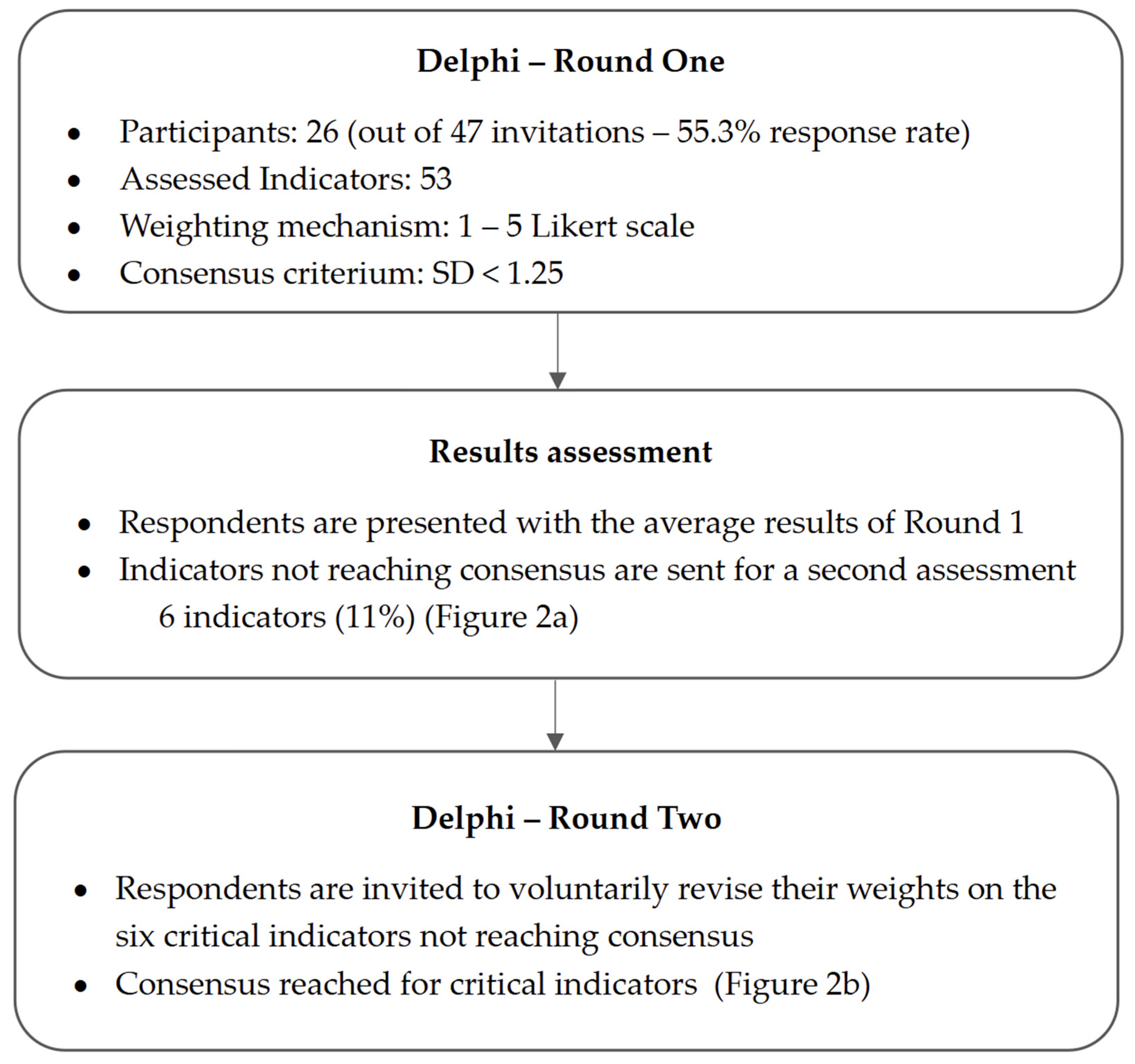
Figure 1. Flowchart of the Delphi method used to reach expert consensus across two rounds of evaluation. Preliminary stage and first round of assessment (Figure 2a); Second round of evaluation and final consensus synthesis (Figure 2b).
Resources 15 00023 g001
Figure 2. (a) Distribution of expert ratings and initial dispersion on six critical indicators not meeting the consensus criterium, and (b) consensus convergence for six critical indicators not meeting the consensus criterium.
Resources 15 00023 g002
Figure 3. Conceptual diagram of WEFE Nexus interconnections and tensions among indicators in the pasta supply chain. The arrows illustrate the functional dependencies and display the inherent tensions among the Water, Energy, Food, and Ecosystem dimensions.
Resources 15 00023 g003
Table 1. Methodology workflow scheme.
StepObjectiveCriteria
a. Selecting life-cycle-based indicators and assigning them to the Water–Energy–Food–Ecosystem dimensionLiterature search for relevant indicatorsScopus search:
TITLE-ABS-KEY: “((WEFE) OR (Wate Energy Food) Nexus) AND (LCA OR Ecolabel* OR certification OR (green label))” and “(Pasta) AND (LCA OR Ecolabel* OR certification OR (green label))”.
Indicator selection(i) Simple indicators excluding ratios or complex models, and (ii) indicators clearly falling into a specific WEFE dimension
Allocation to the WEFE dimensionsAllocation of the indicators to the dimension that best captured the described impact
Categorisation of the indicators between LCA-based and non-LCA-based indicators, within each dimension(i) LCA-based indicators following ISO 14040-44 [33,34] standards, and (ii) non-LCA-based indicators not following ISO 14040-44 standards.
b. Direct Weighting of the indicators: engaging with a set of experts through a Delphi process.First round of Delphi engagement with the experts of the “Nexus Net” Cost Action (CA 20138)Direct weighting on a 1–5 Likert scale according to the indicator’s capability to: (i) provide clear and effective information to producers about their WEF performance; and (ii) serve as a direct instrument to inform consumers and guide their choices.
Second round of Delphi engagement with the experts of the “Nexus Net” Cost Action (CA 20138)Reassessments of the indicators collecting a Standard Deviation above 1.25 on the received weighting.
c. Validation of the indicators set based on data availabilityCollection of valid EPDs in the pasta sectorSix EPDs for the LCA of some pasta brands were collected from https://www.environdec.com/services/what-is-pcr (accessed on 16 October 2025).
Evaluation of indicator fulfilment based on data availability in standard LCA inventories of the selected EPDsEach indicator was classified into three categories: (i) identical or different but fully computable with available inventory data; (ii) partially computable with available data; and (iii) not computable with available data.
Table 2. Descriptive information of the analysed EPDs.
ID123456
Functional unit1 kg1 kg1 kg1 kg1 kg1 kg
Geographical areaThiva, GreeceMarcianise, ItalyItaly and GreeceImperia, ItalyFossano, ItalyCastello di Godego, Italy
Type of LCA certificationEPD ISO 14025EPD ISO 14025EPD ISO 14025 EPD ISO 14025EPD ISO 14025EPD ISO 14025
System boundariesCradle to graveCradle to graveCradle to graveCradle to graveCradle to graveCradle to grave
Used PCRPCR 2010:01—CPC 2371PCR 2010:01 v. 4.0.4PCR 2010:01 v. 4.0.4PCR 2010:01 v. 4.01PCR 2010:01 v. 4.01PCR 2010:01 v. 3.11
Validity period2014–20232024–20302025–20302022–20262022–20262020–2025
Number of revisions770 (1st edition)1212
Table 3. Final indicators for the Energy, Water, Food and Ecosystem WEFE dimensions.
ENERGYWATER
NameUMWeightNameUMWeight
LIFE CYCLE INDICATORSLIFE CYCLE INDICATORS
Cumulative energy demand
[40]
MJ/kg4.1Water footprint (WF)
[41]
L or m3/kg4.5
Renewable energy share
[8]
% (MJ renewable/MJ total)3.5Green water footprint
[42]
m3GNWF/m3WF%4.1
NON-LIFE CYCLE INDICATORSBlue water footprint
[42]
m3BWF/m3WF%4.1
Exergy efficiency
[43]
% (Exergy output/Exergy input)3.3Grey water footprint
[42]
m3GYWF/m3WF%4.1
Peak energy demand
[44]
∑max_i(Ptot,i)3.9NON-LIFE CYCLE INDICATORS
AWARE (Available water remaining)
[45]
AMD_world/AMD_region3.9
Water productivity
[46]
kg crop yield/L or m34.2
Water exploitation index (WEI)
[47]
(m3/available m3)%3.8
FOODECOSYSTEM
NameUMWeightNameUMWeight
LIFE CYCLE INDICATORSLIFE CYCLE INDICATORS
Nutritional water intensity,
adapted from [41,48]
m3/100 kcal or m3/g protein3.9Acidification footprint
[11]
kg SO2 eq/kg3.5
Energy return on investment (EROI)
[49]
MJ output/MJ input (per kg pasta)3.7Photochemical ozone creation
[11]
kg C2H4-eq/kg3.1
NON-LIFE CYCLE INDICATORSFreshwater eutrophication potential (FEP)
[50]
kg P-e/kg3.5
Nutritional potential (nutrient-rich food index, NRF 9.3)
[51]
Composite indicator (g or mg/100 g); % by weight for processed products3.6Freshwater ecotoxicity potential (FET)
[50,52]
kg 1,4-DCB-eq/kg3.8
Nutritional land productivity
[50]
kcal/m23.6NON-LIFE CYCLE INDICATORS
Fertiliser use
[53]
N + P + K kg/kg3.7Overall nutrient circularity
[54]
[(Recycled N/Total N) + (Recycled P/Total P) + (Recycled K/Total K)]/3 × 1003.9
Raw material intensity
[55]
kg harvested grain/kg pasta3.5Land use
[56]
m2 year/kg4.0
Food loss rate% of edible harvested kcal lost3.7
Table 4. Data availability comparison between EPD ecolabel and the energy indicator cluster (A: Available and NA: Not Available).
n.Indicator NameOrganisation
123456
1Cumulative Energy Demand (CED)AAAAAA
2Renewable Energy ShareAAAAAA
3Exergy EfficiencyNANANANANANA
4Peak Energy DemandNANANANANANA
Table 5. Data availability comparison between EPD ecolabel and the water indicator cluster (A: Available; NA: Not Available; and PA: Partially Available).
n.Indicator NameOrganisation
123456
1Water FootprintPAPAPAAAA
2aGreen Water FootprintNANANANANANA
2bBlue Water FootprintNANANANANANA
2cGrey Water FootprintNANANANANANA
4AWARE (Available Water Remaining)AAAAAPA
5Water ProductivityNANANAAAA
6Water Exploitation Index+ (WEI+)NANANAPAPAPA
Table 6. Data availability comparison between EPD ecolabel and the food indicator cluster (NA: Not Available and PA: Partially Available).
n.Indicator NameOrganisation
123456
1Nutritional Water Intensity NANANAPAPAPA
2Energy Return on Investment (EROI) PAPAPAPAPAPA
3Nutritional Potential (Nutrient-rich food index, NRF 12.2)NANANANANANA
4Nutritional Land productivity NANANAPAPANA
5Fertiliser UseNANANANANANA
6Raw Material IntensityNANANAPAPANA
7Food Loss Rate (Edible food loss along the value chain)NANANANANANA
Table 7. Data availability comparison between EPD ecolabel and the ecosystem indicator cluster (A: Available and NA: Not Available).
n.Indicator NameOrganisation
123456
1Acidification FootprintAAAAAA
2Photochemical Ozone CreationAAAAAA
3Freshwater Eutrophication Potential (FEP)AAAAAA
4Freshwater Ecotoxicity Potential (FET)NANANANANANA
5Overall Nutrient CircularityNANANANANANA
6Land UseNAAAAANA
Disclaimer/Publisher’s Note: The statements, opinions and data contained in all publications are solely those of the individual author(s) and contributor(s) and not of MDPI and/or the editor(s). MDPI and/or the editor(s) disclaim responsibility for any injury to people or property resulting from any ideas, methods, instructions or products referred to in the content.