Article

Low-Carbon Green Hydrogen Strategies for Sustainable Development in Senegal: A Wind Energy Perspective


by
Astou Sarr
1,*,
Mamadou Simina Dramé
1,2,
Serigne Abdoul Aziz Niang
1,
Abdoulkader Ibrahim Idriss
3,
Haitham Saad Mohamed Ramadan
4,5,
Ali Ahmat Younous
2,
Kharouna Talla
1,
John Robert Bagarino
6,
Marissa Jasper
6 and
Ismaila Diallo
6,7,*
1
Department of Physics, Faculty of Sciences and Techniques, Cheikh Anta Diop University of Dakar (UCAD), Dakar-Fann BP 5085, Senegal
2
Laboratory of Atmospheric and Ocean Physics Siméon Fongang, Cheikh Anta Diop University of Dakar (UCAD), Dakar-Fann BP 5085, Senegal
3
Department of Electrical and Energy Engineering, Faculty of Engineering, University of Djibouti, Djibouti 1904, Djibouti
4
Electrical Power and Machines Department, Zagazig University, Zagazig 44519, Egypt
5
Université Marie et Louis Pasteur, Pôle Universitaire d’Innovation Bourgogne-Franche-Comté (PUI-BFC), Belfort, F-90000, France
6
Department of Meteorology and Climate Science, San José State University (SJSU), San José, CA 95192, USA
7
Wildfire Interdisciplinary Research Center (WIRC), San José State University (SJSU), San José, CA 95192, USA
*
Authors to whom correspondence should be addressed.
Resources 2026, 15(1), 9; https://doi.org/10.3390/resources15010009
Submission received: 3 November 2025 / Revised: 11 December 2025 / Accepted: 19 December 2025 / Published: 31 December 2025

Abstract

This study presents the first comprehensive techno-economic assessment of wind-based green hydrogen production across Senegal, a country highly dependent on fossil fuel imports. Using a novel integrated approach combining 30 years of ERA5 reanalysis data (1993–2023), turbine performance modeling and electrolyzer comparison, it fills an important gap for renewable hydrogen development in West Africa. Wind resources were analyzed at multiple altitudes, revealing strong potential in both coastal and northeastern regions, particularly during the dry season, with higher wind speeds at higher turbine heights. Four turbines (Vestas_150, Goldwind_155, Vestas_126 and Nordex_N100) and two electrolyzer types (alkaline and PEM) were evaluated. The alkaline system performed best. Vestas_150 and Goldwind_155 achieved the highest hydrogen yields of 241 and 183 tons/year and CO2 reductions of 2951 and 2241 tons/year, generating carbon credits of 0.118 M$ and 0.089 M$, respectively. Their levelized cost of electricity remained low (0.042 and 0.039 $/kWh), while smaller turbines showed higher costs. Vestas_150 also had the shortest payback period of 2.16 years, making it the most competitive option. Sensitivity analyses showed that longer system lifespans and high-performance turbines significantly reduce the levelized cost of hydrogen. Priority investment zones include Saint-Louis, Matam, Louga and Tambacounda, with levelized cost of hydrogen values as low as 3.4 $/kg.

1. Introduction

Climate change and the global energy transition represent significant challenges that demand innovative and sustainable solutions [1].
The urgent need to mitigate greenhouse gas emissions to curb global warming and to address the depletion of fossil fuel reserves has prompted governments and industries worldwide to seek decarbonized and sustainable energy alternatives [2,3,4]. Among these, green hydrogen, produced through water electrolysis powered by renewable energy sources, is increasingly recognized as a crucial element in the global shift toward cleaner energy [4,5,6,7,8,9,10,11,12].
Green hydrogen offers a clean means of storing and transporting energy, with the potential to fuel diverse sectors such as industry, transportation, and electricity production, thus providing a flexible solution to the ongoing energy crisis [13,14]. Globally, investments in green hydrogen have been accelerating at an impressive rate. According to Morgan [15], the global investments in hydrogen initiatives reached $570 billion in 2023, representing a 31% increase over the previous year [15]. The International Energy Agency [3] highlights that several countries, including those in the European Union, the United States, Japan, and Australia, have launched ambitious plans to incorporate green hydrogen into their energy transition frameworks. In comparison, during the period 2010–2020, investments in hydrogen production infrastructures across Europe amounted to less than 20 billion euros, showing that the 2030 commitment of 430 billion euros represents more than a twenty-fold increase in ambition and financial support [16]. These efforts are aimed at making hydrogen a key component in decarbonization, especially in sectors that are challenging to electrify, such as heavy industry and maritime transport [8].
Senegal, located in West Africa, heavily depends on fossil fuel imports, which account for 80% of the country’s energy production [17]. However, Senegal benefits from significant natural resources, including strong winds exceeding 9 m/s along its Atlantic coastline and year-round sunlight with more than 2000 kWh of solar exposure [18]. These resources provide Senegal with considerable potential for renewable energy production, particularly through wind and solar power [19,20]. Senegal has committed to an ambitious energy transition, with a goal of producing 30% of its energy from renewable sources by 2030 [17]. Wind energy, with wind speeds ranging from 6 to 8 m/s along the Senegalese coast, is a key resource that could allow for competitive green hydrogen production [17]. Several wind energy initiatives are currently underway, notably in the Tivaouane region, where the 158.7 MW Taïba Ndiaye wind farm has been operational since 2019 [21]. Within this transition, green hydrogen production from wind energy represents a strategic opportunity for Senegal. Not only could this reduce the country’s energy dependence, but it would also contribute to job creation and CO2 emission reductions [22]. Green hydrogen programs have already been initiated in the sub-region, particularly in Mauritania, with support from international organizations such as the International Renewable Energy Agency (IRENA) and the German government, aiming to develop hydrogen as a source of energy to be exported to Europe [23,24]. These initiatives demonstrate West Africa’s potential to play a significant role in global green hydrogen production. Mauritania has emerged as one of the most ambitious countries in West Africa regarding green hydrogen development. Several large-scale projects have been announced, including the AMAN project led by CWP Global, which aims to produce up to 10 Mtons/year of green hydrogen through a combination of solar and wind energy [25]. In addition, the AMAN Hydrogen and Noor initiatives highlight Mauritania’s strategy to leverage its vast renewable resources and strategic proximity to Europe [25]. These developments not only illustrate the scale of investment and international partnerships attracted by the Mauritanian government but also demonstrate the broader capacity of West Africa to become a competitive hub for green hydrogen production.
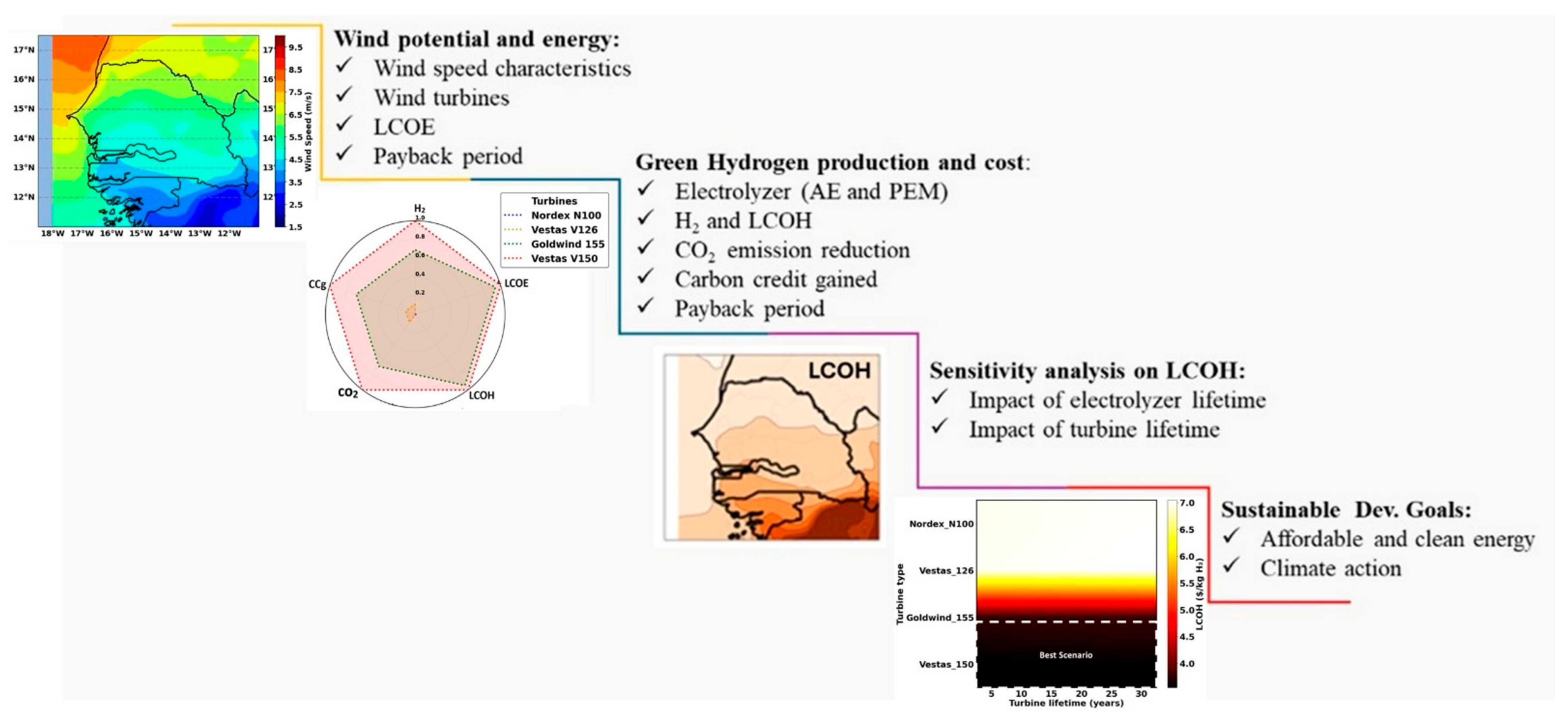
This paper aims to evaluate the techno-economic feasibility of green hydrogen production from wind energy in Senegal, as illustrated in Figure 1.
It focuses on analyzing local wind resources, investment and production costs, and the technical and economic challenges associated with this emerging technology. Additionally, the paper considers public policies and international initiatives that support the growth of green hydrogen in Senegal and across the globe. The objective is to identify the most suitable sites for green hydrogen production, comparing the performance of different wind turbines and electrolyzer technologies (Alkaline Water Electrolysis (AWE) and Proton Exchange Membrane (PEM)), and conducting a sensitivity analysis on the lifetime of the equipment. This paper explores how to produce green hydrogen at a competitive cost and reduce CO2 emissions. It also seeks to contribute to Senegal’s energy transition while positioning the country as a key player and maritime hub in green hydrogen markets. By combining high-resolution climate data with detailed techno-economic modeling, the study provides a fine-scale mapping of hydrogen production potential and costs across Senegal. This approach allows for the identification of priority investment zones (in Figure 1b) and the comparison of different wind turbines and electrolyzer technologies. Moreover, the paper offers practical decision-making tools for policymakers and investors, bridging the gap between academic research and real-world applications.
The paper framework is depicted in Figure 2 and is designed to assess the techno-economic potential of green hydrogen production in Senegal from wind energy. The methodology is divided into four main steps. The first step involves positioning the study within the Senegalese territory by collecting and processing climate data, particularly wind speeds at different altitudes across the country, to better understand local conditions. This initial analysis aids in identifying geographic areas with high hydrogen production potential, especially in the northern and eastern regions of the country. Also, the wind potential is further evaluated by analyzing key parameters such as wind speed, variability, turbine performance, Levelized Cost of Electricity (LCOE), and payback period, which provide a clearer picture of the economic feasibility of each turbine model. This step is complemented by a color-coded map that shows the geographical distribution of wind speeds, highlighting the most favorable areas for wind energy production.
The second step focuses on green hydrogen production by considering the two main electrolyzer technologies studied: alkaline and PEM. This step estimates the amount of hydrogen produced, the Levelized Cost of Hydrogen (LCOH), CO2 emissions reduction, and the carbon credits generated. A spatial map is also included to visualize regional variations in hydrogen production costs, highlighting the most competitive areas. In the last two steps, a sensitivity analysis is conducted to assess the impact of the electrolyzer and turbine lifetimes on the economic competitiveness of hydrogen. This analysis identifies the optimal scenario where longer lifetimes minimize LCOH and maximize profitability. This research supports the achievement of the Sustainable Development Goals (SDGs), particularly SDG 7 (ensure access to affordable, reliable, sustainable and modern energy for all) and SDG 13 (take urgent action to combat climate change and its impacts), by promoting clean hydrogen production and low-carbon development in West Africa.
The structure of the paper is as follows: Section 1 introduces the global and local contexts of green hydrogen development, with particular emphasis on the wind energy potential in Senegal and the objectives of the present study. Section 2 provides a review of existing literature, summarizing the state of the art regarding methodologies for hydrogen production and cost assessments reported in previous studies. In Section 3, the study site, data sources, materials, and the mathematical framework are described, forming the basis for the techno-economic analysis of wind-to-hydrogen conversion. Section 4 presents and discusses the main results, including wind resource assessment, hydrogen production potential, cost evaluation, environmental benefits, and a sensitivity analysis of the Levelized Cost of Hydrogen (LCOH) with respect to the lifetimes of wind turbines and electrolyzers. Finally, Section 5 concludes the paper by summarizing the key findings, outlining the challenges and opportunities for green hydrogen deployment in Senegal, and offering directions for future research and policy development.

2. Literature Review

Faced with the major challenges of climate change and the need for a sustainable energy transition, hydrogen has emerged as a key solution, offering innovative possibilities for storing, transporting, and utilizing energy in a clean and efficient manner.
Recent studies have significantly advanced the understanding of green hydrogen potential in Africa and comparable regions. Boutaghane et al. [27] have shown that an off-grid PV–wind hybrid system integrated with an electrolyzer, fuel cell and hydrogen storage exhibits an LCOE of 0.514–0.868 $/kWh, an LCOH of 8.31–12.4 $/kg and an NPC of 10.28–17.7 M$, with all metrics exhibiting strong sensitivity to regional variability in resources and capital costs. This finding is particularly important for African contexts such as Algeria, where pronounced spatial heterogeneity and limited grid infrastructure necessitate decentralized, resource-adapted energy strategies to enable a resilient clean energy transition. Dagnachew et al. [24] have argued that although Africa’s abundant renewable resources offer exceptional potential for green hydrogen, this potential will only translate into real development if hydrogen is used to strengthen local industries rather than focusing solely on exports. Their results have also shown that major barriers such as limited finance, technology access, infrastructure and policy stability must be addressed through equitable partnership, clear regulations and investments in local demand to support a truly transformative hydrogen economy aligned with Agenda 2063. Husein et al. [28] have highlighted that green hydrogen could play a central role in South Africa’s clean energy transition, supported by strong public recognition of its environmental and economic benefits. High production costs and insufficient storage and transportation infrastructure remain major challenges, underscoring the need for targeted policies, strategic infrastructure development and educational initiatives to enable green H2 integration and support job creation and regional development.
Other studies have also explored the techno-economic potential of green H2, covering various technologies and highlighting both opportunities and challenges for cost-effective and sustainable deployment. Albalawi et al. [29] have demonstrated that green hydrogen production from offshore wind in Saudi Arabia’s Red Sea presents significant potential but remains costly, with levelized cost of hydrogen for floating offshore wind ranging from 6.93 to 8.52 $/kg. Major capital expenditures are driven by offshore wind farm costs and floating foundations, and substantial cost reductions would be required for both onshore and offshore configurations to compete with alternative renewable energy sources. Jiang et al. [30] have shown that hydrogen-based steel production using renewable energy, especially offshore wind in Japan and South Korea, can decarbonize the steel industry, while technology imports from China and international cooperation are key to reducing costs and enhancing regional competitiveness. Munther et al. [31] have shown that solar PV is the most cost-effective option for green hydrogen production in Iraq, with production costs of 1.98 $/kg for alkaline and 2.72 $/kg for PEM electrolyzers, and identified Anbar City as the optimal location, providing key insights for strategic planning and sustainable energy development. Zhang et al. [32] have indicated that off-grid wind–solar hybrid systems in northern China can produce green hydrogen at a minimum LCOH of 3.77 $/kg with negligible carbon emissions and that reducing capital costs of wind, solar and electrolyzers can further lower LCOH, highlighting the potential of such systems as a sustainable alternative to fossil-based hydrogen.
Green hydrogen has been identified as a versatile solution for decarbonizing multiple sectors, although it faces significant practical challenges, including high energy consumption, conversion inefficiencies and complex supply chains, which necessitate substantial investments in renewable capacity and infrastructure [33]. Overcoming these barriers also requires technological innovation, supportive financial strategies and international cooperation to enable large-scale deployment and ensure that green hydrogen contributes effectively to sustainable and equitable energy transitions [34]. Younus et al. [35] have also shown that, despite its potential to decarbonize key sectors, green hydrogen faces high production costs (3.8–11.9 $/kg versus 1.5–6.4 $/kg for gray hydrogen) and technological and infrastructure challenges, highlighting the need for advances in electrolysis, supportive policies and international collaboration to enable scalable and cost-competitive deployment.
To better understand the challenges and competitiveness of green hydrogen production from wind energy, Table 1 provides a summary of the state of the art from various studies. These studies highlight the different electrolyzer technologies used (such as alkaline or PEM), installed capacities, hydrogen production amounts, and the Levelized Cost of Hydrogen (LCOH). This comparison helps to contextualize the research in Senegal and evaluate its competitiveness. In Asia, studies conducted in Afghanistan (Faizabad, Jurm, Khandud, and Qal’eh-ye Panjeh) showed annual production ranging from 17.58 to 99.36 tons-H2, with relatively competitive LCOH values ranging from 5.84 to 10.82 $/kg, depending on the sites and turbine configurations (600 kW to 2.5 MW) [36].
In several Middle Eastern countries, such as Saudi Arabia, Yemen, Jordan, Kuwait, Qatar, Bahrain, and the UAE, studies report hydrogen production ranging from 141 to 265 tons/km2, with LCOH values between 7.08 $/kg (Kuwait) and 13.3 $/kg (UAE) [37]. The higher costs of wind energy systems are typically linked to low-power systems or less favorable climatic conditions. Similarly, in Western China, a study combining solar (PV) and wind energy results in an annual H2 production of 7.3 tons, with an LCOH of 12.5 $/kg, despite the complementary nature of the two energy sources [38]. These findings highlight the technical and economic limitations in certain regions of the world. In Africa, studies conducted in Djibouti (sites of Nagad, Bara Wein, Yoboki, and Gobaad) reveal significant variability in performance depending on the site and the electrolyzer technology [22,39]. For example, at Bara Wein, monthly H2 production with an alkaline electrolyzer can reach 29.68 tons, but with a high LCOH, exceeding 99 $/kg in some cases due to low efficiency and technological costs [22]. In contrast, at Yoboki, an LCOH of 7.06 $/kg was achieved with an annual H2 production of 15.9 tons, which remains competitive for a small installation (600 kW) [39]. In Cameroon, sites in the Far North region (Kaele, Maroua, Mokolo, Mora, Yagoua, and Kousseri) showed relatively consistent results, with annual H2 productions ranging from 11 to 53 tons and LCOH values between 4.38 and 15.64 $/kg, depending on installed capacity and local conditions [40]. These results highlight the relevance of the Sahelian context for green hydrogen but also underscore the importance of technical and economic parameters in the variation in costs. At the same time, several studies assessing the environmental and economic impacts of energy plants show significant differences depending on the size of the installations [39], the electrolyzer technologies used [39], and the types of pollutants emitted [39]. For example, annual pollutant emissions expressed in tons per year and the associated costs in dollars per kilogram for several energy plants are presented [39]. For the Moulouhle plant in Djibouti, with a capacity of 150 MW, emissions range from 24.9 to 564.3 tons/year, depending on the pollutants measured, with unit costs ranging from 1.79 to 3.05 $/kg [39]. Next, the Khor Angar plant shows annual emissions between 44.9 and 325.9 tons, with unit costs varying from 1.98 to 3.8 $/kg [40]. Furthermore, the smaller Yoboki plant, with 50 MW, presents a wide variation in emissions ranging from 12.3 to 799.3 tons per year, accompanied by relatively high unit costs, between 3.17 and 7.06 $/kg [40]. Similarly, the Gobaad plant records annual emissions between 14.6 and 170.2 tons, with unit costs ranging from 3.13 to 4.31 $/kg [29]. Finally, the Petit Bara plant reports emissions ranging from 17.8 to 209.8 tons per year, with unit costs between 2.53 and 3.99 $/kg [39]. These data illustrate the significant differences in environmental and economic impacts between plants, influenced by their capacity, the technologies used, and the nature of the pollutants emitted. The research results provide guidance for decisions on energy and environmental policies towards more sustainable and economically viable solutions [22]. According to the Electricity Transmission Network (ETN) report (2024), electrolysis production costs in France are expected to range between 2.5 and 3.2 €/kg by 2030, compared to 4.5 and 6 €/kg in 2025, provided that initial investments (CAPEX) and the cost of renewable electricity decrease significantly [40,41,42]. These estimations were corroborated by [41], which even suggested a potential cost as low as €1.36/kg in the most optimistic scenarios, although these figures rely on very favorable assumptions such as a rapid scale-up of electrolyzer manufacturing capacity and a sharp decline in renewable electricity prices [41,42]
On a global scale, ABI Research forecasted a significant reduction in LCOH, potentially reaching 2.5 $/kg by 2030 and approximately 1 $/kg by 2050, driven by technological advancements and declining renewable energy costs [41,43]. However, in less favorable contexts, particularly in Sub-Saharan Africa, the LCOH could exceed 7 $/kg due to high investment costs, financial risks, and logistical constraints [44,45].
In this context, Senegal presents significant potential for green hydrogen production, particularly due to its wind resources in certain regions of the country. Studies showed that competitive production costs can be achieved. This analysis relies on a rigorous methodology that incorporates precise climate data, modeling of several turbines at different heights, and a comparison between electrolyzers. By cross-referencing techno-economic and environmental indicators, the study will identify the optimal geographical areas for the implementation of green hydrogen industrial developments. However, some limitations may persist, including the lack of detailed consideration of local infrastructure (electric grid, access to water, logistics), simplified economic assumptions, and insufficient in-depth analysis of wind intermittency. Additionally, the socio-economic impacts on local populations, territorial governance, and social acceptance have not yet been addressed. Despite these challenges, the opportunities are abundant: Senegal could become a regional hub for green hydrogen in West Africa, thanks to its geostrategic position, maritime access via the port of Dakar, and proximity to Europe, a major potential market. The country could also benefit from international financing linked to climate finance and public–private partnerships. The integration of hybrid systems combining wind, solar, and storage would help stabilize production and improve economic viability. These developments would promote sustainable industrialization, the creation of skilled jobs, and the decarbonization of strategic sectors such as transport and heavy industry, while strengthening the country’s energy security [46,47]. Politically, Senegal relies on a clear strategic framework. The National Energy Pact (MEPM, 2025) set ambitious goals to increase the share of renewable energy and ensure energy sustainability and security [48,49,50]. Recent reports highlight the need to improve governance to facilitate investments [51,52]. Furthermore, the country benefits from the support of international partnerships, including the Just Energy Transition Partnership (JETP), which provides financing and technical support [53]. These initiatives align with the global decarbonization effort and the climate goals of the Paris Agreement [54].
Table 1. Overview of recent literature studies for wind–green hydrogen production and cost.
ReferencesTechno-Economic AnalysisLCOECarbon FootprintCarbon CreditElectrolyzer Technologies ComparisonsSensitivity AnalysisH2LCOHPayback Period
Touilli et al. (2020) [55]
Mostafa Rezaei et al. (2020) [51]
Almutairi et al. (2021) [52]
Delpierre et al. (2021) [56]
Ali Javaid et al. (2022) [57]
Nasser et al. (2022) [58]
Ibrahim et al. (2023) [22]
Ashish Sedai1 et al. (2023) [59]
Henry et al. (2023) [60]
Koholé et al. (2023) [39]
Cheng & Hughes (2023) [61]
Rezaei et al. (2024) [62]
Chunyan Song et al. (2024) [63]
Javanshir et al. (2024) [64]
Maaloum et al. (2024) [65]
Albalawi et al. (2025) [29]
Bagheri et al. (2025) [66]
Perdana et al. (2025) [67]
Boutaghane et al. (2025) [27]
Albalawi et al. (2025) [29]
Jiang et al. (2025) [30]
Munther et al. (2025) [31]
Zhang et al. (2025) [32]
This study
✔ realized study in each reference.

3. Data, Materials Descriptions and Mathematical Background

3.1. Site Description

The study focuses on the entire territory of Senegal, located at the westernmost point of Africa, between latitudes 11° and 17° North and longitudes 11° and 18.5° West [68]. It is bordered to the west by the Atlantic Ocean, to the north by Mauritania, to the east by Mali, and to the south by Guinea Conakry and Guinea-Bissau. The climate of Senegal is divided into two main seasons: the dry season, from November to May, and the rainy season, from June to October. During the dry season, trade winds blow from the northeast, bringing Harmattan, a dry and dusty wind from the Sahara. This wind is particularly strong from December to February, influencing not only the temperature but also air quality, sometimes reducing visibility, especially in the northern and central parts of the country [69,70]. In contrast, during the rainy season, monsoon winds from the southwest strongly influence the climate, bringing humidity and precipitation, creating a stark contrast to the dry season. This variation in wind regimes plays a key role in the distribution of rainfall and temperature regulation while also impacting wind variability and, consequently, the potential for wind energy production. Precipitation, on the other hand, varies significantly across regions: the south, notably Casamance, can receive over 1500 mm of rain per year, while the north and central areas, closer to the Sahel, experience a more arid climate with annual precipitation often below 600 mm [69,70]. This climatic diversity directly affects wind variability and influences the potential for renewable energy production [71]. Furthermore, the country’s predominantly flat topography, combined with these distinct wind regimes, provides a particularly favorable environment for wind energy exploitation, especially in the eastern zones and higher regions.

3.2. Wind Data Collection

The wind data at 100 m used in this study comes from the ERA5 reanalysis, developed by the European Centre for Medium-Range Weather Forecasts (ECMWF, 2017) [20,72,73]. This reanalysis provides a detailed and spatiotemporal representation of atmospheric conditions, covering the period from 1979 to the present day [63,64,65]. With its high spatial horizontal resolution of 0.25° by 0.25°, ERA5 allows for accurate analysis of wind regimes at the regional scale. The wind parameters are provided in three components: meridional wind speed (u), zonal wind speed (v), and the vertical component (w). For this study, the wind speed data at 100 m above ground was considered available at various temporal scales. This height is chosen as a reference, particularly due to the heights (117 m) of the wind turbines at the Taiba Ndiaye wind farm. Indeed, ERA5 integrates data from multiple sources, such as satellites, radars, ground-based weather stations, and radiosondes. These data are then assimilated into a numerical weather prediction model, generating a consistent and continuous representation of atmospheric fields [74]. The uncertainty sources in this study include: (i) wind speed vertical extrapolation using the power law (+/−5–10%), which is inherent to any wind resource assessment that extrapolates from reference heights to hub heights; (ii) turbine power curve accuracy (+/−3% according to manufacturer specifications); and (iii) electrolyzer efficiency variations under variable load conditions (+/−5%), as real-world performance may differ from nominal values due to operating conditions. These uncertainties propagate to the LCOH estimates with an overall uncertainty of +/−12–15%.

3.3. Selection of Turbines and Electrolyzers

In this study, turbine selection is based on four technologies that are well-established and widely deployed at both international and regional levels: Vestas_150, Goldwind_155, Vestas_126, and Nordex_N100. These turbines are selected due to their proven industrial reliability, established commercial presence in the region, and their ability to operate effectively under the diverse wind conditions of Senegal. Notably, the Vestas_126 is already operational at the Taïba Ndiaye wind farm, the largest in West Africa, highlighting its technical and logistical compatibility with the local context. Furthermore, the presence of manufacturers such as Vestas, Goldwind, and Nordex enhances the accessibility of supply, maintenance, and technical support, thereby ensuring the long-term sustainability and local integration of the installations.
From a technical perspective, these turbines exhibit complementary characteristics, allowing for a precise comparative assessment based on wind regimes, as shown in Table 2. The Vestas_150, with a height of 166 m and a capacity of 5.6 MW, is the most powerful and thus particularly suitable for areas with moderate wind speeds, thanks to its startup speed of 3 m/s and cut-off at 25 m/s. In contrast, the Goldwind_155, with a height of 140 m and a capacity of 4.5 MW, begins operation at 2.5 m/s, making it ideal for areas with low wind speeds. These two high-rise models capture more stable winds at higher altitudes, which enhances production consistency, particularly in the northern and northeastern regions of Senegal. On the other hand, the Vestas_126, with a height of 117 m and a capacity of 3.45 MW, features intermediate wind speeds (startup at 4.5 m/s, nominal at 11.5 m/s), making it a suitable option for sites with moderate wind resources. Finally, the Nordex_N100, the smallest model (100 m height, 2500 kW), has a startup speed of 3 m/s and a nominal speed of 12 m/s, which makes it well-suited for moderately windy sites at medium altitudes. Its lower investment costs make it an attractive option for operations with budget constraints. Ultimately, all turbines considered have an estimated lifespan of 20 years, and their differences in terms of height, power, and startup speed enable a detailed evaluation of their techno-economic performance according to the specific geographical and climatic conditions of Senegal, thereby facilitating the identification of the best trade-offs between cost, efficiency, and local adaptability.

3.4. Characteristics of Electrolyzer Technologies

Currently, two electrolysis technologies dominate the green hydrogen production market: alkaline and PEM electrolyzers [75]. These two solutions are the most mature, technologically proven, and commercially available at large scales [75]. According to the International Energy Agency (IEA), the globally installed electrolyzer capacity reached approximately 300 MW by the end of 2020, with 61% consisting of alkaline electrolyzers and 31% of PEM electrolyzers [75]. The remaining capacity was distributed between emerging or unspecified technologies, such as solid oxide electrolyzers (SOEC) [75]. This situation justifies the methodological choice of this study to focus on alkaline and PEM electrolyzers, which are currently the most widespread, accessible, and technically applicable solutions in the Senegalese context. In terms of performance, alkaline electrolysis has a specific energy consumption of 42 kWh/kg of hydrogen, with a rectifier efficiency of 0.95, a unit investment cost of 1300 €/kW, and an overall conversion efficiency of about 0.6 [22]. PEM electrolysis, on the other hand, has a higher energy consumption (60 kWh/kg), a rectifier efficiency of 0.65, a higher unit cost (2000 €/kW), and a lower overall efficiency (0.48) [22]. In both cases, the electrolyzer lifespan is assumed to be 15 years, allowing for a comparative evaluation on an equivalent basis [22].

3.5. Mathematical Background

Table 3 provides a summary of the key equations and definitions used in assessing wind resources, energy potential for hydrogen production, and cost analysis. The primary methods include the Energy Performance Form Factor Method (EPFM) and the extrapolation of wind speeds at various turbine mast heights [22]. Additionally, Equations (3)–(7) are used to analyze wind turbine performance, such as the capacity factor, energy production, and LCOE, and Equations (10) and (11) are used to calculate carbon emission reductions and carbon credits gained at the study sites. The Levelized Cost of Electricity (LCOE in Equation (7)) represents the minimum electricity price required for a wind turbine project to break even over its lifetime, accounting for initial investment (I), operation and maintenance costs (Comr) and discounted energy production. The Levelized cost of Hydrogen (LCOH in Equation (9)) extends this analysis to include the electrolyzer system, comprising two components: CA (annualized electrolyzer capital cost) and CB (cost of electricity consumed per hydrogen production). The LCOH represents the total cost per kilogram of hydrogen produced associated with the selected electrolyzer (alkaline or PEM, as well as their respective costs and lifespans), enabling comparison with market prices and alternative production methods. The LCOH calculated in this study represents the production gate cost, including wind turbine and electrolyzer capital and operating costs. Downstream costs not included in this analysis comprise: (i) water supply and purification estimated at 0.02–0.05 $/kg H2 [76]; (ii) hydrogen compression to 350–700 bar (0.15–1 $/kg); (iii) storage infrastructure (0.2–0.5 $/kg); and (iv) transport to demand centers (0.5–2 $/kg depending on distance). Future studies should incorporate these components for a complete value chain assessment.
It is important to note that the economic evaluation of wind energy involves considering several key parameters, including investment costs, interest and inflation rates, and the lifespan of wind turbines, as well as maintenance and repair costs. In this study, the input parameters, summarized in Table 4, are estimated (or obtained from the literature) in accordance with the cost evaluation equations employed in Table 3.

4. Results and Discussions

The results presented in this section are derived from the systematic application of the methodological framework described in Section 3. The wind resource characterization applied the vertical extrapolation (Equations (1) and (2)) and Weibull distribution analysis to ERA 5 data. The techno-economic analysis employs Equations (3)–(12) to evaluate turbine performance, hydrogen production, costs and environmental benefits across Senegal.

4.1. Spatiotemporal Characterization of Wind Potential

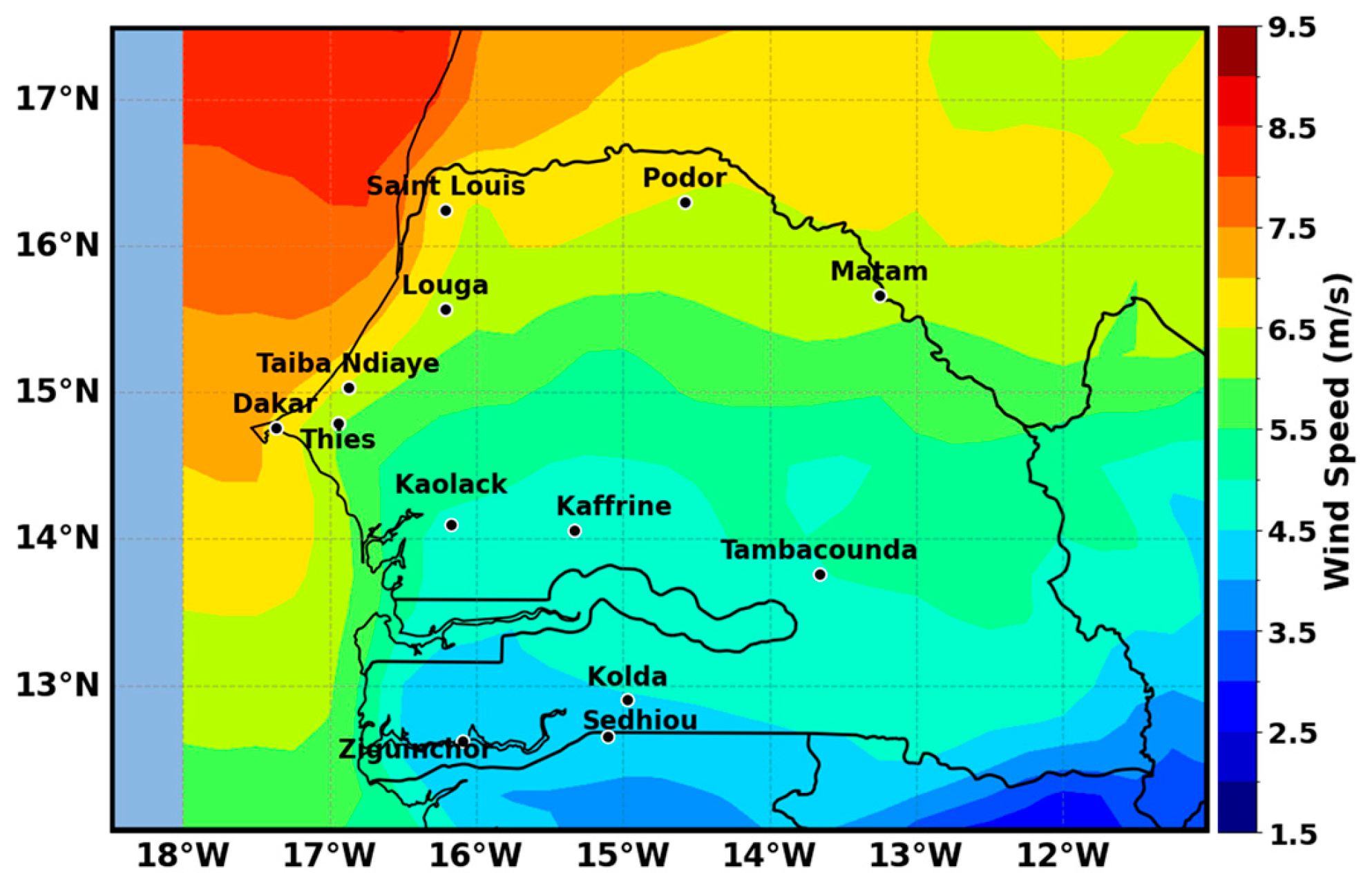
Figure 3 illustrates the spatial distribution of mean wind speeds from 1993 to 2023 at 100 m above ground level (AGL). Overall, the results show an average wind speed of approximately 5.05 m/s, with significant spatial variability observed, especially between coastal and inland areas, as well as a latitudinal gradient. A key finding of this study is the steep wind speed gradient between the coast and the interior of the country, with wind speeds considerably higher along the coastline than in inland regions. This phenomenon can be explained by the influence of marine trade winds, combined with the direct impact of the Atlantic Ocean [20]. Another notable aspect is the latitudinal gradient, which highlights the variation in wind speeds from north to south. The results reveal three distinct zones based on average wind speed and wind potential. The first zone, located in the northwest, particularly along the coastline of Saint-Louis (15.36° N, 16.28° W), Louga (16.15° N, 16.25° W), and the rest of the Atlantic shoreline, benefits from the highest wind potential [84]. Wind speeds here often exceed 6 m/s, enhanced by the trade winds, suggesting this region offers the best opportunities for large-scale wind energy exploitation. In contrast, the second zone, located in the central and eastern parts of the country, including the Kaffrine (12.03° N, 15.55° W), Kaolack (14.1° N, 16.1° W), and Tambacounda (13.8° N, 13.7° W) regions, shows moderate potential [84]. Wind speeds in this zone range from 3.5 to 5.5 m/s, indicating lower, yet still exploitable, potential for smaller-scale wind systems. Finally, the third zone, covering Casamance (12.6° N, 16.3° W) and southern Senegal, is characterized by low wind potential, with wind speeds falling below 3.5 m/s [84].
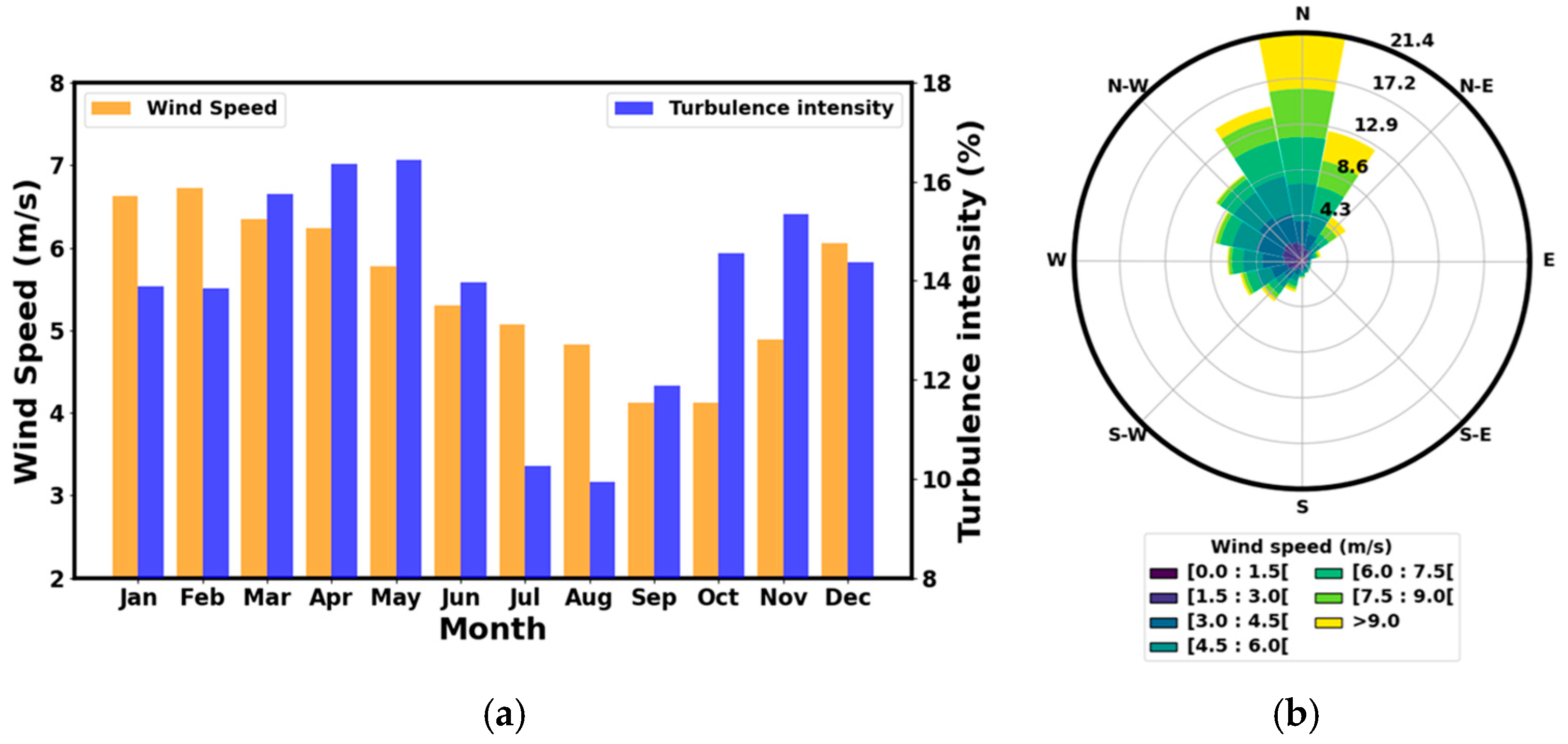
Figure 4 presents, on the left, the monthly evolution of wind speed and turbulence intensity for the period 1993–2023 and, on the right, the annual wind rose for the same period. These graphs highlight seasonal variations in wind patterns and analyze their potential impact on wind energy exploitation. The results reveal two distinct seasonal trends: the rainy season, from June to November, and the dry season, from December to May. The maximum monthly average wind speed occurs in February, reaching 6.72 m/s, while the minimum is observed in September and October, at 4.12 m/s. During the dry season, the country is influenced by the Northeast trade winds, also known as the “Harmattan”, which bring dry and cool winds. In contrast, during the rainy season, the Southwest monsoon and the Intertropical Convergence Zone (ITCZ) generate cool, humid air masses from the South Atlantic, influencing wind speeds. The turbulence intensity also follows this seasonal dynamic, with the highest values observed in April (16.40%) and May (16.38%), and the lowest in July (10.22%) and August (10.02%). This fluctuation is closely linked to the dynamics of air masses associated with the trade winds and the monsoon, which modulate the intensity of turbulence in the atmosphere. Finally, the annual wind rose (represented by a circle divided into 45° sectors) shows the frequency of winds coming from each direction over the period 1993–2023. The longest radius of the wind rose indicates the dominant wind direction. In the context of this study, the dominant directions are North–North–East and North–North–West, confirming the predominant influence of maritime trade winds on the region’s climate.
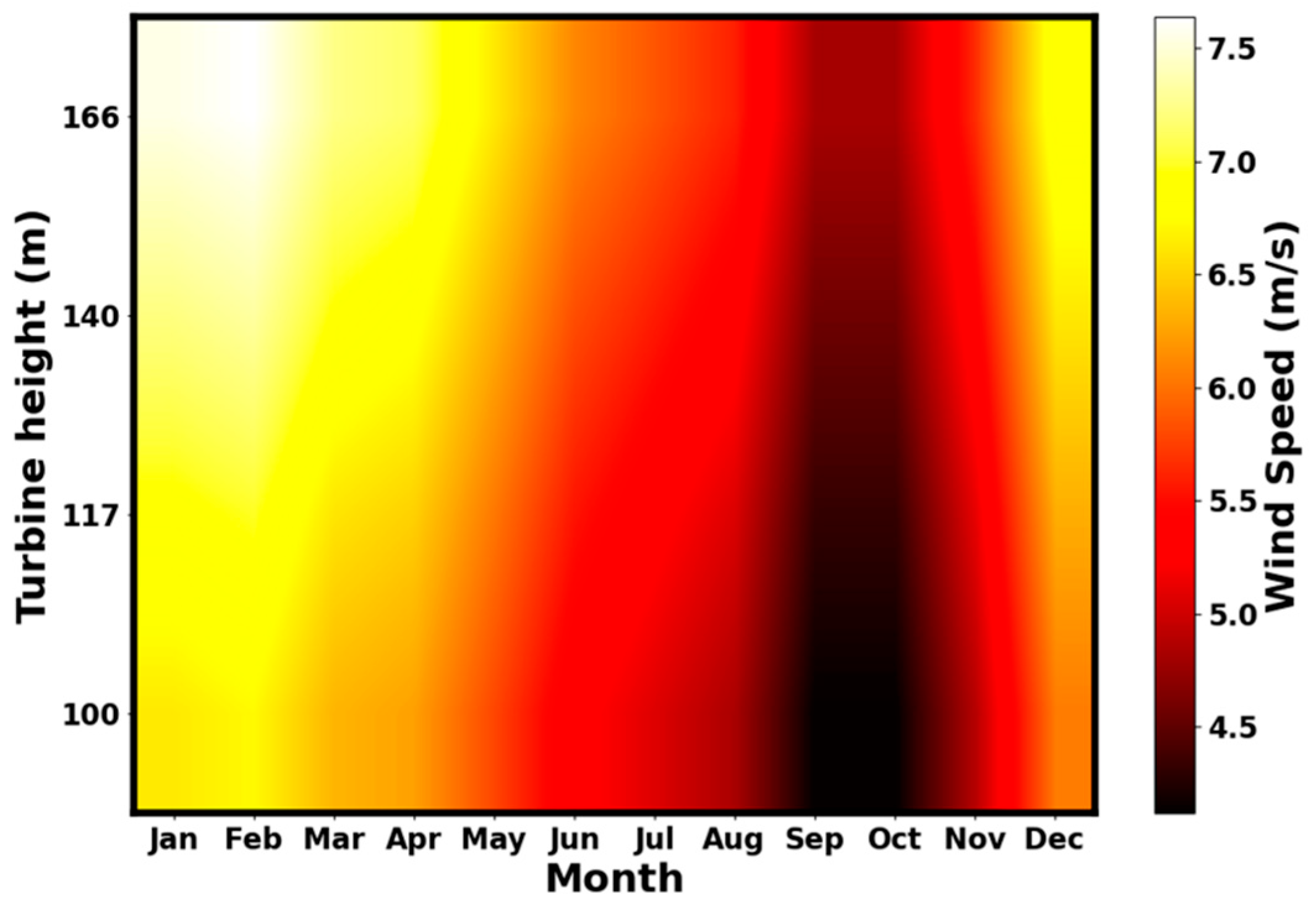
Figure 5 presents the monthly mean distribution of wind speed at four turbine heights considered in this study. Using wind speeds measured at 100 m, obtained from the ERA5 reanalysis, the data are extrapolated for turbine heights of 117 m, 140 m, and 166 m. As shown in Figure 3, a clear seasonal variation is observed at all turbine heights. Wind speed maxima, ranging from 6.5 to 7.5 m/s, are recorded from December to March, corresponding to the winter period. In contrast, minimums occur between May and November, with values ranging from 4.5 to 6 m/s. It is also important to note that wind speeds generally increase with the height of the turbine. This trend can be attributed to the reduction in friction effects on the Earth’s surface at higher altitudes. Consequently, turbines located at greater heights capture stronger winds, leading to increased energy production.

4.2. Technical Analysis and Estimation of Green Hydrogen Production

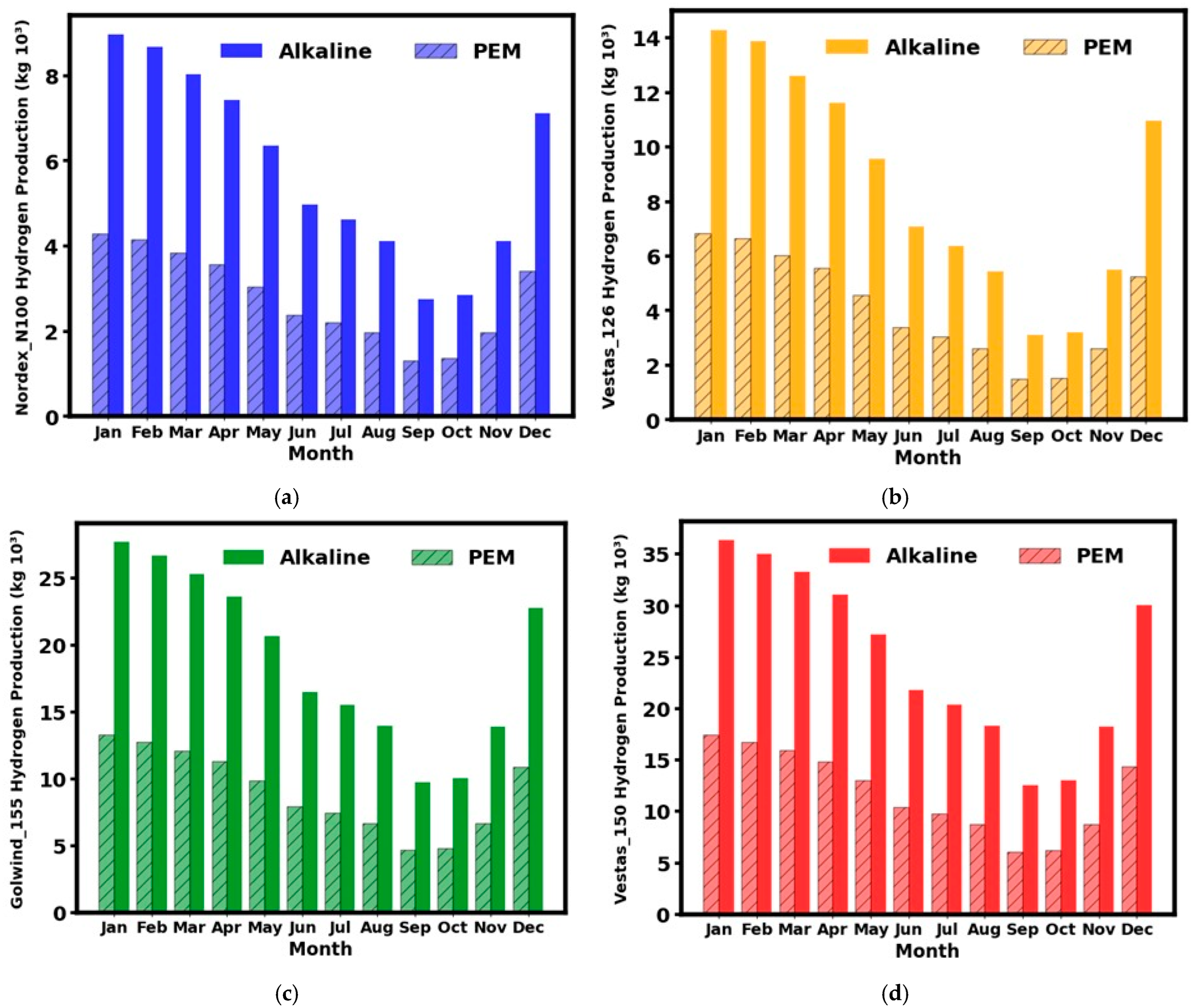
The estimation of techno-economic indicators for green hydrogen production in Senegal starts with selecting an electrolyzer suitable for the local context. Water electrolysis is the primary technology for converting renewable electricity into hydrogen. Among the available options, the two most used electrolyzers are the alkaline and PEM electrolyzers. Figure 6 illustrates the monthly hydrogen production obtained with these two technologies: the alkaline and the PEM electrolyzer, combined with four types of wind turbines. The analysis corresponding to the Nordex_N100 turbine (Figure 6a), Vestas_126 turbine (Figure 6b), Goldwind_155 turbine (Figure 6c), and Vestas_150 turbine (Figure 6d) shows a consistent superiority of the alkaline electrolyzer in terms of production. The performance differences between the two technologies can range from 2 to 3 times, depending on the month and turbine model. For example, the Vestas_150 turbine achieves a maximum production of approximately 36.4 tons per month with alkaline electrolysis compared to 17.4 tons with PEM technology in January. Similarly, the Goldwind_155 turbine produces up to 27.7 tons with alkaline electrolysis, versus only 13.3 tons with PEM. Even for lower-capacity turbines such as the Nordex_N100, this trend holds: in January, production reaches 8.9 tons with alkaline electrolysis compared to 4.3 tons with PEM. A strong seasonality is also evident in these results, with production peaks observed between January and March and minimal production between September and October. For instance, during this low period, the Nordex_N100 generates only 2.8 tons with alkaline electrolysis and 1.3 tons with PEM. High-power turbines like the Vestas_150 and Goldwind_155 stand out with significantly higher annual productivity due to their superior capacity factors. These results suggest that alkaline technology, with its better energy performance, is particularly suited for large-scale industrial applications. In contrast, PEM technology, despite its more modest production, remains relevant for modular, decentralized applications or regions with more variable energy availability. Finally, the pronounced seasonality of production emphasizes the need to integrate hydrogen storage systems or hybridize solar energy to ensure a continuous and stable supply.
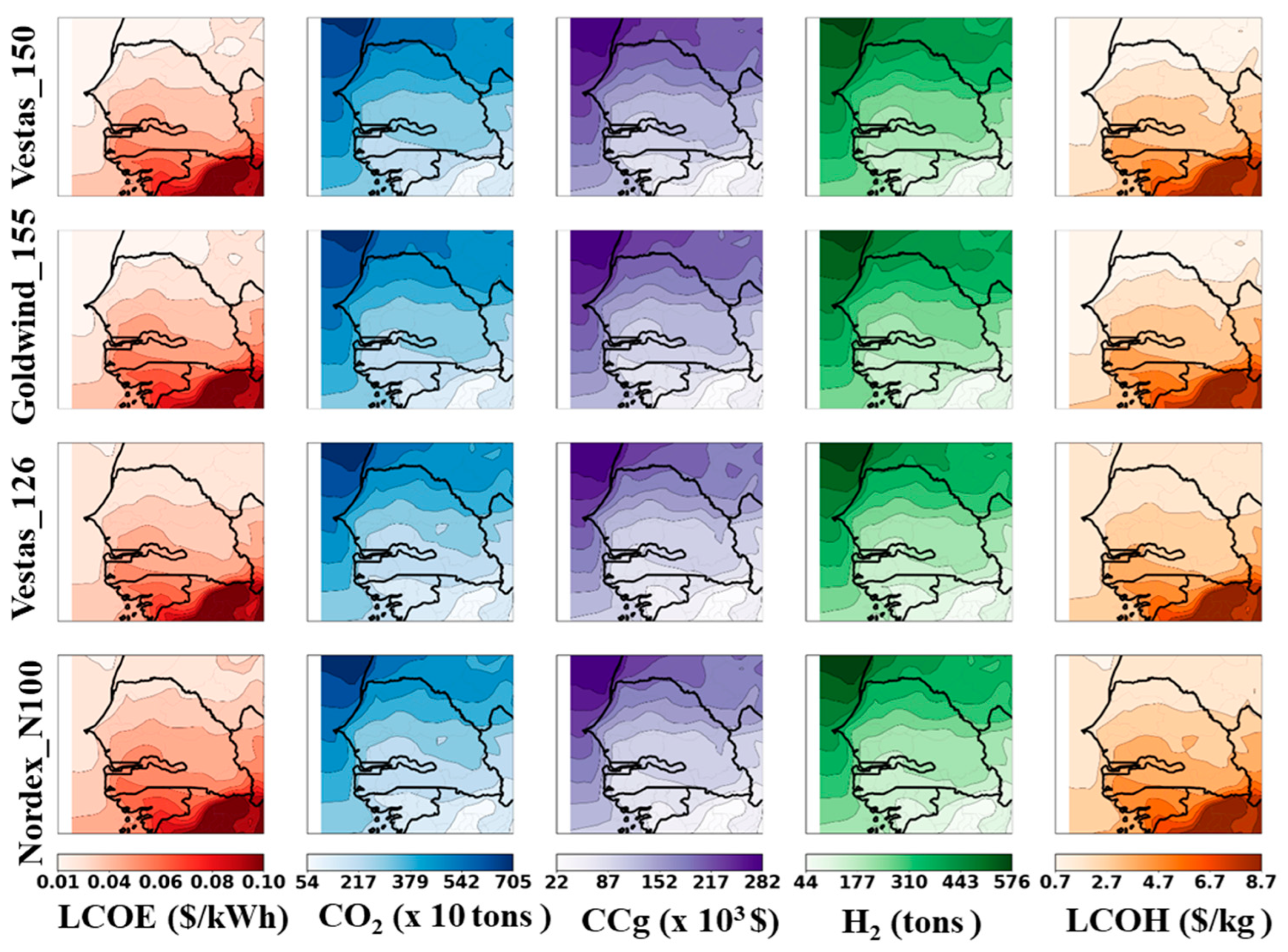
Figure 7 presents a multi-parameter spatial analysis of the techno-economic performance of green hydrogen production and cost from wind energy in Senegal. This analysis relies on five key indicators: LCOE, avoided CO2 emissions, carbon credit gained (CCg), annual hydrogen production (H2), and the levelized cost of hydrogen (LCOH). These parameters are mapped for four turbine heights corresponding to four different models: Nordex_N100 (100 m), Vestas_126 (117 m), Goldwind_155 (140 m), and Vestas_150 (166 m). Each row of the figure represents a turbine height, while each column corresponds to one of the five indicators. This organization allows for a cross-reading of the effect of turbine height on performance while illustrating the spatial distribution of each parameter. The results show that the LCOE decreases with the increase in turbine height. At 100 m, the values are generally high (up to 0.10 $/kWh), especially in the southern part of the country. However, at 166 m, this cost decreases significantly, particularly in certain regions like the northeast, where values fall below 0.045 $/kWh. Overall, the most advantageous areas in terms of low LCOE are found in the north and east of Senegal, notably in the regions of Matam, Podor, Tambacounda, and Louga. Regarding avoided CO2 emissions, there is a direct gain with the increase in turbine height.
The gains can exceed 7000 tons/year in the most favorable areas for wind potential, such as the northeast and southeast of the country, which provide the best environmental yields. This gain is directly linked to the increase in carbon credit generated, which also follows the trend of turbine height. At 166 m, regions in the northwest generate carbon credits of about 0.28 M$ over the lifetime of the project. The impact of heights on hydrogen production is also significant. At 100 m, production reaches a maximum of 443 tons/year, while at 166 m, it can exceed 576 tons/year. The most productive areas are in the north, central–east, and far east of Senegal, while the southern and southwestern regions, such as Kolda, Ziguinchor, and Sédhiou, show much lower production levels. The LCOH also follows this trend of cost reduction with the elevation of turbines. At 166 m, certain regions exhibit an LCOH lower than 3 $/kg, making them highly competitive in the international market. In contrast, at 100 m, some areas show values exceeding 7 $/kg, making production economically less viable. Once again, the north and east regions stand out for their competitiveness. This integrated mapping highlights the importance of turbine height in optimizing green hydrogen production. High turbines (140 to 166 m) significantly reduce costs (LCOE and LCOH), increase hydrogen production, and maximize environmental benefits by reducing CO2 emissions and generating carbon credits. The spatial analysis also reveals strong regional variability, depending on wind regimes. The most favorable areas for industrial project development are Matam, Podor, Louga, Tambacounda, the north of Kaffrine, and the southeast of Saint-Louis. In contrast, the southwestern regions, such as Ziguinchor, Kolda, and Sédhiou, present less favorable conditions, requiring hybrid technologies (wind + solar) or small-scale or modular applications.
Table 5 presents a comparison of the performance of four turbines used for green hydrogen production through electrolysis in Senegal. The evaluation is based on key indicators that assess the economic and environmental performance of each technology. For electricity produced using fuel oil, the mean CO2 emission factor is 0.277 kg CO2 per kWh. The mitigation of CO2 emissions by using wind power instead of fuel-oil-generated electricity can be calculated as expressed in Equation (10), as integrated in Table 3. The results highlighted in bold reveal that the Vestas V150 turbine significantly outperforms the other models due to its superior performance. It generates over 10,656.31 MWh annually, with the highest mean capacity factor and the lowest LCOH values of 22% and 3.56 $/kg, respectively. Additionally, it enables a substantial reduction in CO2 emissions (approximately 2951.8 tons/year) and generates significant annual carbon credits, exceeding 0.118 M$ over the 20-year lifetime of the project. Its specific payback period (PBP) is also the shortest, around 2.16 years, making it the most cost-effective option. In contrast, the Nordex_N100, despite having a lower initial investment cost, offers less competitive performance. It generates only 2415.34 MWh per year, with a relatively high LCOH of 7.01 $/kg and a PBP of 6.52 years, making it a less attractive choice. The Goldwind_155 and Vestas_126 wind turbines fall in the middle range. The Goldwind_155 stands out with an annual production of 8091 MWh, a notable reduction in CO2 emissions, a competitive LCOH of 3.77 $/kg, and a reasonable PBP of 3.64 years, outperforming the Vestas_126, which shows less favorable results in terms of energy production and profitability.
The LCOH range, listed in Table 6, obtained for Senegal in the present study (3.56–7.03 $/kg), falls within the ranges reported by recent literature, including Cameroon [39], the Middle East [37] and East Asia [30]. When compared with higher-cost regions such as Iraq [31], Senegal demonstrates a comparatively competitive cost profile, reinforcing its positioning in the emerging green H2 market.
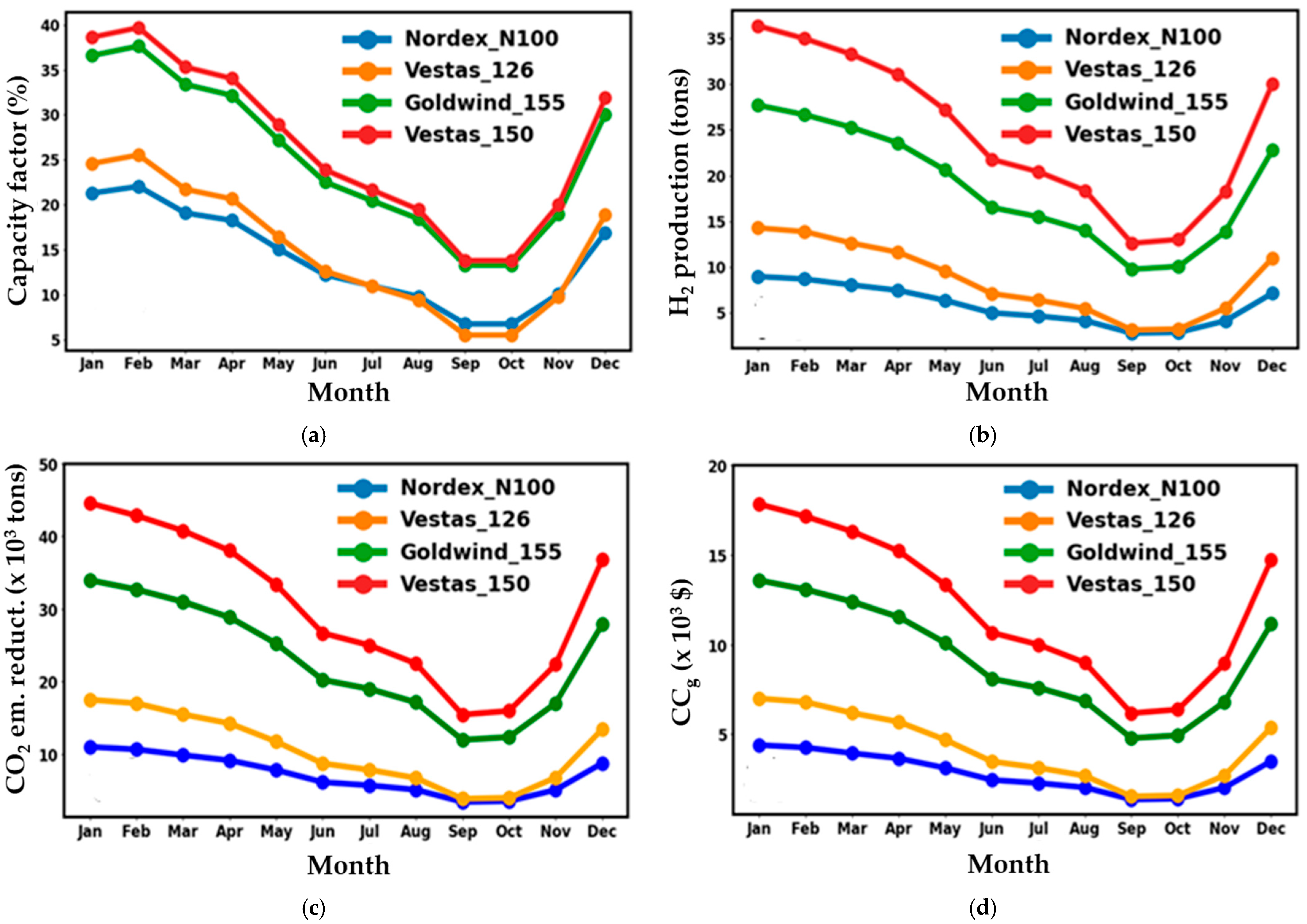
Figure 8 presents the monthly evolution of the techno-economic indicators for four wind turbine technologies used in green hydrogen production in Senegal: Nordex_N100, Vestas_126, Goldwind_155, and Vestas_150. Figure 8a shows the monthly evolution of the mean capacity factor, where maximum performance is observed in winter (from January to March) for all wind turbines, with peaks reaching nearly 40% for the Vestas_150 model. This performance gradually decreases as the wet season (August–September) approaches, due to lower wind speeds. A similar trend is observed in the monthly hydrogen production, presented in Figure 8b, where production peaks at the beginning of the year, with the Vestas_150 turbine producing around 35 tons of hydrogen in January. Regarding carbon footprint, Figure 8c shows the monthly reduction in CO2 emissions, where the Vestas_150 stands out by preventing up to 45 (×103 tons) of CO2 per month during favorable periods, compared to about 9 (×103 tons) for the Nordex_N100. This reduction highlights the environmental impact of turbines, which varies with hydrogen production. Finally, Figure 8d illustrates the monthly mean carbon credit gained, where the Vestas_150 continues to outperform the other turbines.
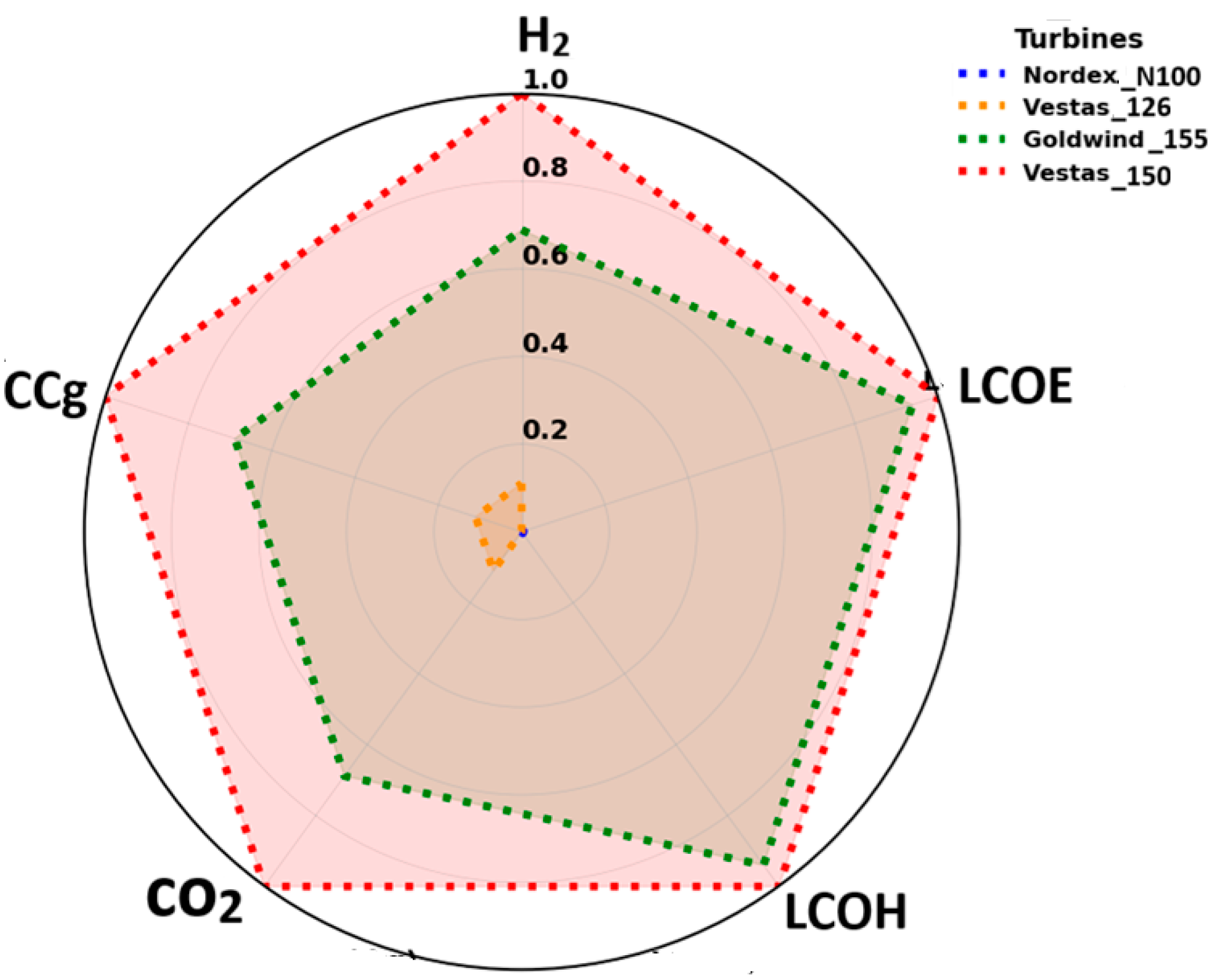
Figure 9 presents the impartial analyses of techno-economic indicators for green hydrogen production obtained from the studied wind turbines using alkaline electrolyzer. This radar chart provides a clear and concise visual evaluation of the techno-economic performance of each turbine for green hydrogen production in Senegal. The analysis is based on five key indicators: LCOE, avoided CO2 emissions reduction, carbon credit gained (CCg), annual hydrogen production (H2), and levelized cost of hydrogen (LCOH). All values have been normalized to a scale of 0 to 1, enabling direct comparison despite differences in units and scales. A value closer to 1 indicates better performance on the corresponding indicator. The chart reveals that the Vestas_150 turbine (represented by the red) stands out from the others, demonstrating superior performance across all criteria: low LCOE, high hydrogen production, competitive LCOH, and substantial environmental benefits. Its nearly circular shape and large area on the radar reflect its overall excellence in both economic and environmental aspects, making it particularly suitable for large-scale green hydrogen development in Senegal. The Goldwind_155 (in green), while slightly behind the Vestas_150, still performs well. It offers a solid alternative, especially for sites with specific technical or economic constraints, maintaining a good balance between productivity, cost, and environmental impact. On the other hand, the smaller turbines, such as the Nordex_N100 (blue) and Vestas_126 (orange), show lower overall performance. These models have higher LCOE and LCOH, reduced hydrogen production, and fewer carbon credits, making them less competitive for large-scale industrial applications. However, they may be suitable for decentralized or small-scale applications.

4.3. Sensitivity Analysis on LCOE and LCOH

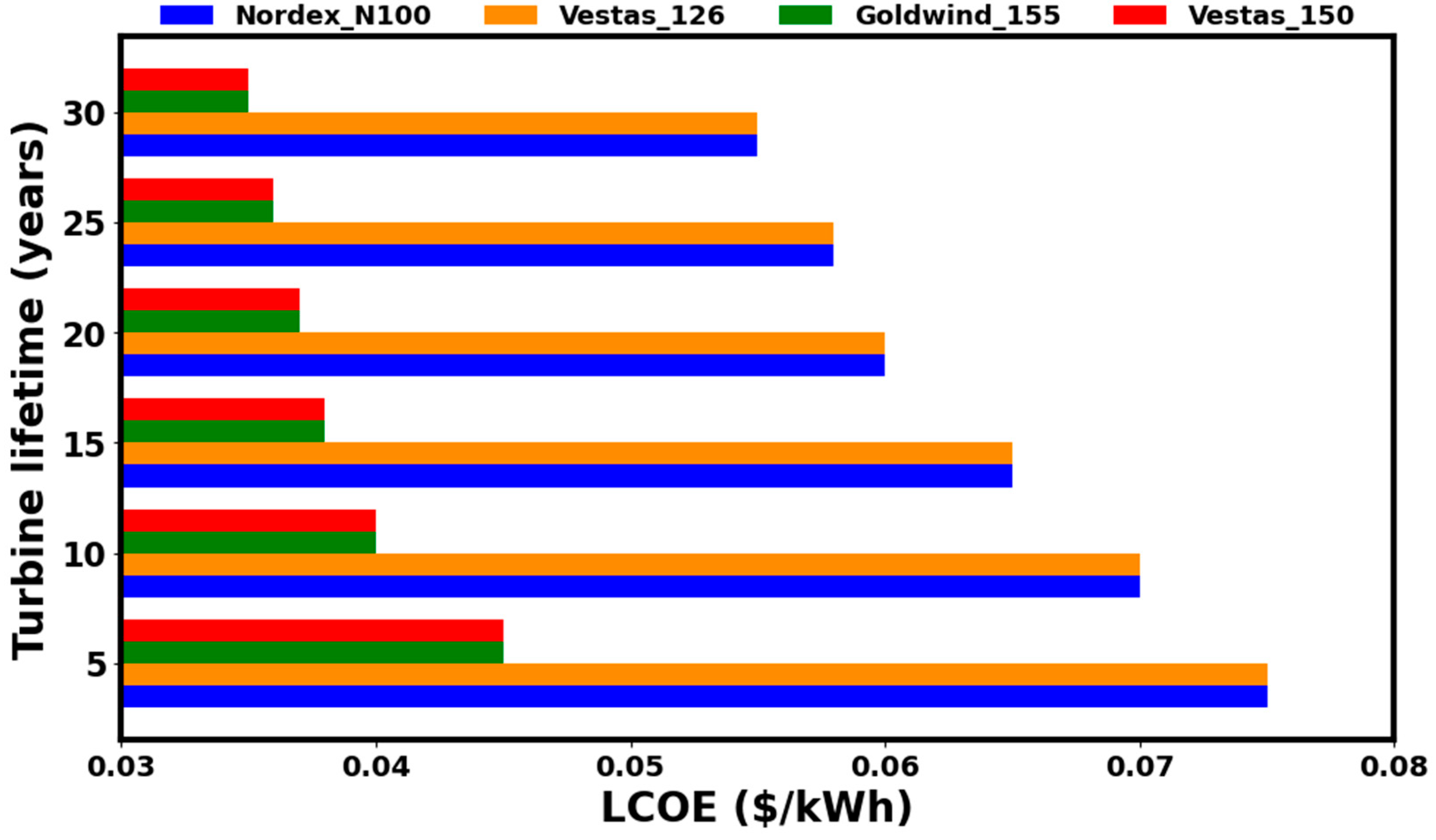
Figure 10 illustrates the evolution of the LCOE as a function of the turbine lifetime for four wind turbines. It is observed that for a 5-year lifetime, the LCOE is highest, reaching approximately 0.075 $/kWh for the Nordex_N100 and Vestas_126 models, while Goldwind_155 and Vestas_150 show lower values, around 0.045 $/kWh. As the turbine lifetime increases to 10 years, the LCOE decreases for all models: it reaches about 0.07 $/kWh for Nordex_N100 and Vestas_126 and about 0.04 $/kWh for Goldwind_155 and Vestas_150. This trend continues at 15 years, where the LCOE for the Nordex_N100 and Vestas_126 models drops to approximately 0.065 $/kWh, while Goldwind_155 and Vestas_150 are around 0.038 $/kWh. For a 20-year lifetime, the LCOE is around 0.06 $/kWh for Nordex_N100 and Vestas_126, compared to 0.037 $/kWh for Goldwind_155 and Vestas_150. Finally, for a maximum lifetime of 30 years, the LCOE reaches about 0.055 $/kWh for Nordex_N100 and Vestas_126, while Goldwind_155 and Vestas_150 present the lowest values, close to 0.035 $/kWh. Thus, Figure 10 highlights that increasing the turbine lifetime significantly reduces the LCOE, with notable differences between the various models. Goldwind_155 and Vestas_150 offer the best economic performance across all considered lifetimes.
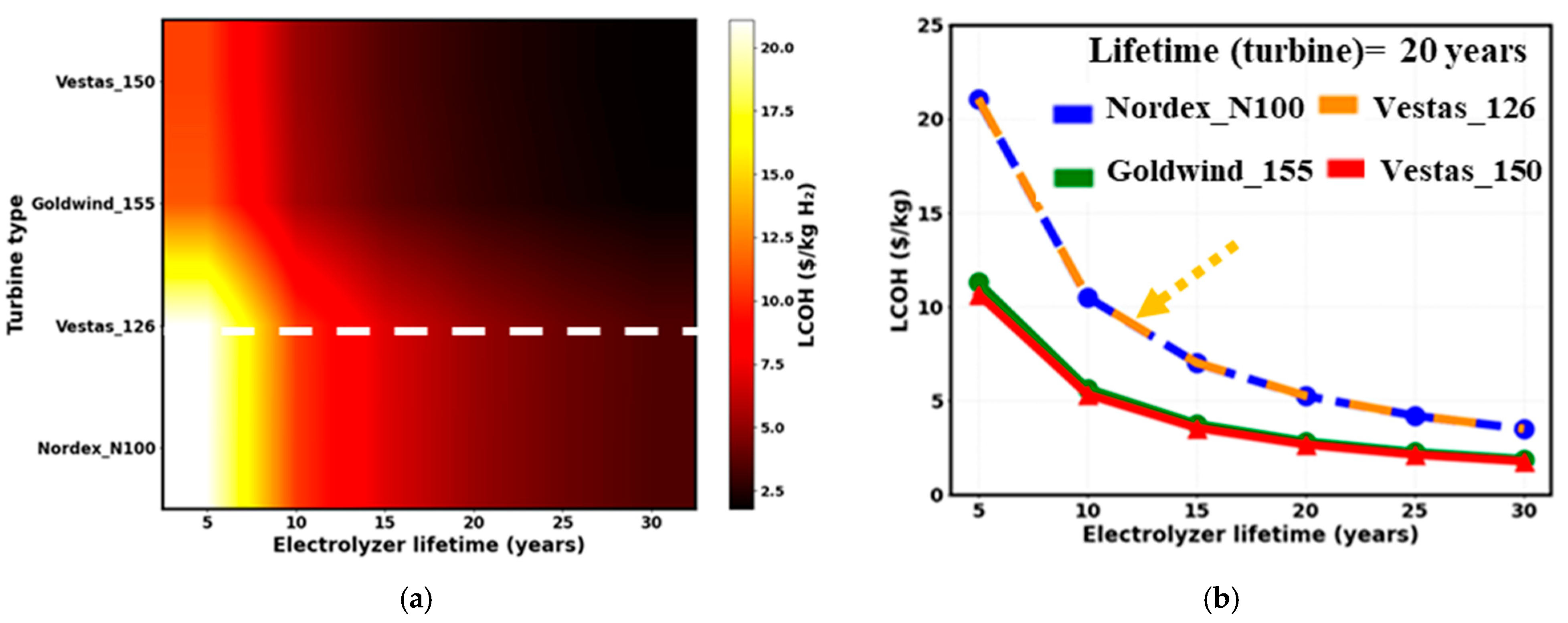
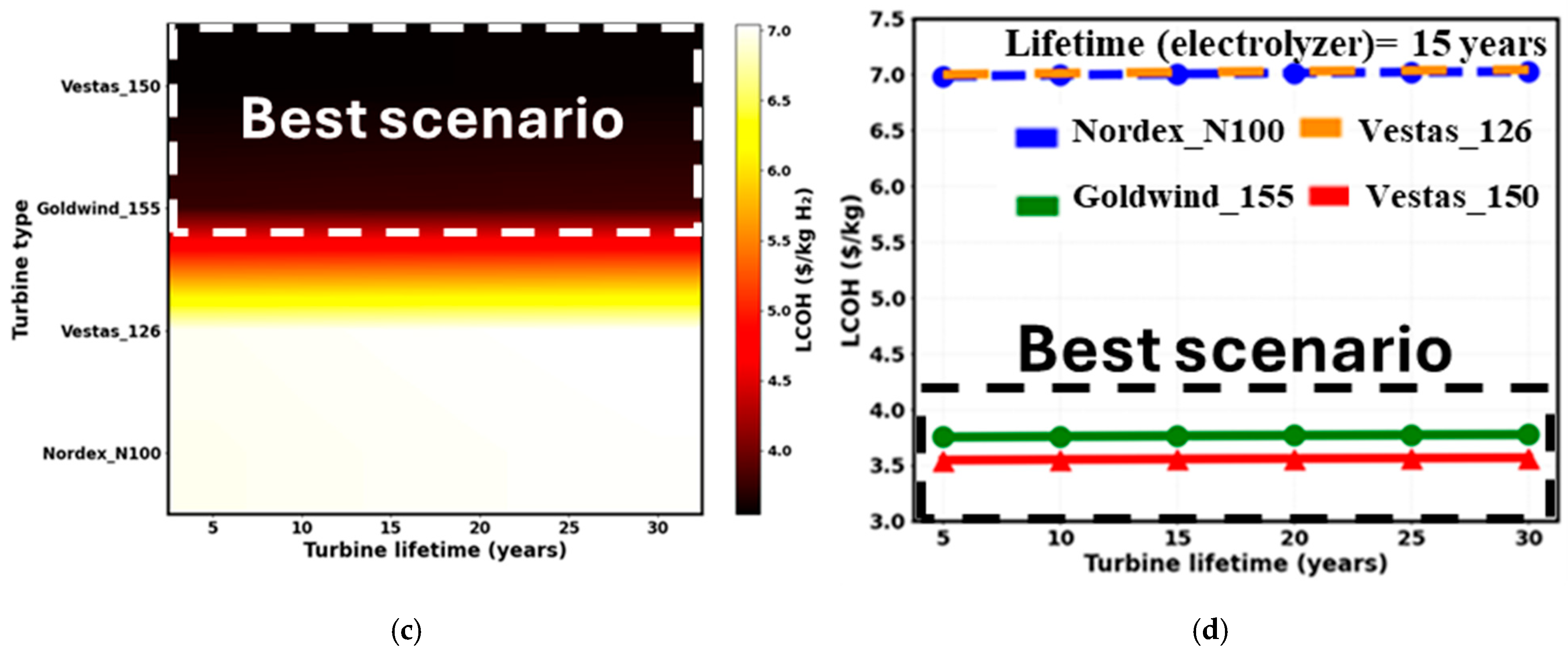
Figure 11 shows the evolution of the LCOH, in $/kg as a function of the lifetime of wind turbines and alkaline electrolyzers. This evolution is illustrated by heat maps and curves. (Figure 11a,c) shows the distribution of LCOH according to the lifespan of the electrolyzer (horizontal axis, in years) and that of the wind turbine (vertical axis, in years). The LCOH decreases significantly as the lifespan of the equipment increases. For example, with a 5-year electrolyzer, the LCOH is around 20 $/kg for Nordex_N100 and Vestas_126 turbines, while it is around 7 $/kg for Goldwind_155 and Vestas_150 turbines. The most favorable scenario corresponds to extended lifespans, with an LCOH of less than 4 $/kg, particularly for Goldwind_155 and Vestas_150 wind turbines.
Figure 11b illustrates the evolution of LCOH as a function of the electrolyzer’s lifespan, with a turbine lifespan set at 20 years. For a 5-year electrolyzer’s lifetime, the LCOH is around 17 $/kg for Nordex_N100 and Vestas_126 and around 5 $/kg for Goldwind_155 and Vestas_150. When the electrolyzer’s lifespan reaches 30 years, the LCOH drops to around 5 $/kg for Nordex_N100 and Vestas_126 and below 4 $/kg for Goldwind_155 and Vestas_150. Figure 11d shows the evolution of LCOH as a function of wind turbine lifetime, with the electrolyzer fixed at 15 years. For Nordex_N100 and Vestas_126, LCOH remains stable at around 7 $/kg, regardless of the wind turbine’s lifetime. However, for Goldwind_155 and Vestas_150, the LCOH is lower, at around 3.7 $/kg, which corresponds to the best-case scenario indicated by the dotted rectangles. In summary, the key values show a maximum LCOH of 21 $/kg for Nordex_N100 and Vestas_126 with a minimum lifespan and a minimum LCOH of 3.7 $/kg for Goldwind_155 and Vestas_150 with extended lifespans. These two models offer the best economic performance, with LCOH below 4 $/kg in optimal scenarios. This analysis highlights the importance of equipment lifespan and turbine selection in optimizing hydrogen production costs. LCOH decreases rapidly (according to an exponential trend) as the electrolyzer’s lifespan increases, while the impact of turbine lifespan remains almost constant over 30 years.

5. Conclusions, Recommendations and Perspectives

The objective of this study was to assess the techno-economic potential of green hydrogen production in Senegal from wind energy. This analysis was based on spatially distributed climate data, turbine performance simulations, and a comparison of electrolysis technologies. By examining four wind turbines technologies paired with two types of electrolyzers (alkaline and PEM), it was found that turbine height plays a crucial role in system performance. High-hub-height–high-altitude turbines, such as the Vestas_150 and Goldwind_155, enable annual hydrogen production of 241 tons per turbine on average, reaching up to 576 tons/turbine at the most favorable locations (capacity factor > 40%). In contrast, for the low-hub-height turbines, like the Nordex_N100, the results show an LCOE value of 0.084 $/kWh and an LCOH greater than 7 $/kg, with production lower than 1000 tons/year.
Additionally, alkaline electrolysis demonstrated superior performance compared to PEM technology, with monthly production 2 to 3 times higher. For instance, in January, the Vestas_150 paired with alkaline electrolysis generates 36.4 tons of hydrogen, compared to 17.4 tons for PEM. Spatial analysis revealed that the regions of Saint-Louis, Podor, Matam, Louga, and Tambacounda offer significant potential, with an LCOH as low as 3.4 $/kg and an LCOE under 0.05 $/kWh. These results position Senegal competitively within the West African region, with LCOH values comparable to or better than those reported in Mauritania (3.17–7.06 $/kg) and significantly lower than less favorable sites in Djibouti (up to 99 $/kg).
Future research should address the following challenges: (i) detailed grid integration studies to assess the impact of variable hydrogen production on electricity infrastructure, particularly given Senegal’s current grid capacity constraints; (ii) comprehensive water resource assessment for electrolysis in semi-arid regions, including seawater desalination options for coastal installations; (iii) full life cycle assessment of the H2 value chain, from wind turbine manufacturing to end-use applications; (iv) socio-economic impact studies on local communities, including job creation potential and skill development requirements.
Key opportunities for Senegal’s green hydrogen sector include: (i) development of integrated hubs combining wind, solar and CSP technologies to improve capacity factors and reduce intermittency; (ii) exploration of hydrogen derivatives (green ammonia, green methanol) for maritime fuel application, leveraging the Port of Dakar’s strategic position; (iii) international partnerships for technology transfer and financing, including the Just Energy Transition Partnership (JETP); (iv) establishment of hydrogen certification schemes to access premium markets in Europe; and (v) regional cooperation within ECOWAS for cross-border hydrogen trade and infrastructure development.
The main barriers to implementation include the high upfront capital costs, which call for innovative financing mechanisms. Another limitation is the lack of existing infrastructure for hydrogen storage and transport. Senegal also needs to strengthen its regulatory framework and develop supportive policies. In addition, the successful deployment of hydrogen technologies will require dedicated workforce training. Finally, social acceptance and effective community engagement remain critical. Overcoming these challenges through coordinated policy action and international cooperation will be essential to unlock Senegal’s full green hydrogen potential.
This study thus serves as a strategic foundation to guide the development of a competitive, sustainable, and resilient national green hydrogen sector in Senegal.

Author Contributions

A.S.: Conceptualization, Project administration, Data curation, Investigation, Methodology, Writing—original draft, and Writing—review and editing; M.S.D.: Formal analysis, Investigation, Data curation, Visualization, Methodology; S.A.A.N.: Conceptualization, Investigation, Data curation, Writing—original draft, and Writing—review and editing, Visualization; A.I.I.: Project administration; Resources; Software; Supervision; Validation; Visualization; Writing—original draft; and Writing—review and editing; H.S.R.: Supervision, Conceptualization, Methodology, Writing—original draft, and Writing—review and editing, Validation, Visualization; A.A.Y.: Software, Resources, Investigation; K.T., J.R.B., and M.J.: reviewed the original draft; I.D.: Supervision, Data curation, Methodology, Validation, Visualization. All authors have read and agreed to the published version of the manuscript.

Funding

This research received no external funding.

Data Availability Statement

Satellite datasets used in this study were obtained from publicly available archives of ERA5 using ERA5 wind data (from 1993 to 2023) at 100 m above ground level. The processing scripts for wind speed characteristics, temperature, and conversions were developed in MATLAB (R2023) and Python 3.12.8 using standard image-processing and numerical libraries. These routines are available from the corresponding author upon reasonable request for academic and non-commercial study purposes.

Conflicts of Interest

The authors declare no conflicts of interest.

Abbreviations

The following abbreviations are used in this manuscript:
Nomenclature
α Wind shear coefficient
AWEAlkaline electrolyzer
$ US Dollar
τ a Efficiency of electrolyzer
τ c o n v Conversion efficiency
c Scale parameter of Weibull distribution
c 0 Scale parameter at h 0
C A Capital cost of the electrolyzers
CAPEXCapital Expenditure
C B Cost of wind electricity
C fac Capacity factor
C h h Scale parameter at extrapolated height
ComrOperation, maintenance and repair cost
CO2Carbon dioxide emission reduction
CCgCarbon credit gained
CuUnit cost of wind energy
CSPConcentrated Solar Power
CWPContinental Wind Partners
E a Electrolyzer energy consumption
E A Energy output
ECMWFEuropean Center for Medium-Range Weather Forecasts
EPFMEnergy pattern factor method
hExtrapolated height
h 0 Initial height
H2Amount of hydrogen
IInvestment cost
iInflation rate
IEAInternational Energy Agency
ITCZIntertropical Convergence Zone
IRENAInternational Renewable Energy Agency
JETPJust Energy Transition Partnership
k Shape parameter of Weibull distribution
k 0 Shape parameter at h 0
k h h Shape parameter at extrapolated height
LCOELevelized cost of electricity
LCOHLevelized cost of Hydrogen
M Million
nExponent
P out Average power output
P e r Rated electrical power
PEMProton exchange electrolyzer
rInterest rate
ETNElectricity Network Transmission
tTime
SOECSolid Oxide Electrolyzers
SDGSustainable Development Goals
TThe operational life of the electrolyzer
v Wind speed
v 0 Wind speed at h 0
v c Cut-in wind speed
v f Cut-off wind speed
v r Rated wind speed

References

  1. Askari, M.; Parsa, N. A Techno-Economic Analysis of the Interconnectedness between Energy Resources, Climate Change, and Sustainable Development. arXiv 2024, arXiv:2412.12235. [Google Scholar] [CrossRef]
  2. Intergovernmental Panel on Climate Change (IPCC) (Ed.) Climate Change 2022—Mitigation of Climate Change; Cambridge University Press: Cambridge, UK, 2023. [Google Scholar] [CrossRef]
  3. IEA. Net Zero by 2050: A Roadmap for the Global Energy Sector; Int Energy Agency: Paris, France, 2021; Volume 224. [Google Scholar]
  4. Lee, S.; Al-Ghussain, L.; Alrbai, M.; Al-Dahidi, S. Integrating Hybrid PV/Wind-Based Electric Vehicles Charging Stations with Green Hydrogen Production in Kentucky through Techno-Economic Assessment. Int. J. Hydrogen Energy 2024, 71, 345–356. [Google Scholar] [CrossRef]
  5. Hassan, Q.; Algburi, S.; Sameen, A.Z.; Salman, H.M.; Al-Jiboory, A.K. A Review of Green Hydrogen Production by Renewable Resources. Energy Harvest. Syst. 2024, 11, 20220127. [Google Scholar] [CrossRef]
  6. Kourougianni, F.; Arsalis, A.; Olympios, A.V.; Yiasoumas, G.; Konstantinou, C.; Papanastasiou, P.; Georghiou, G.E. A Comprehensive Review of Green Hydrogen Energy Systems. Renew. Energy 2024, 231, 120911. [Google Scholar] [CrossRef]
  7. Lebrouhi, B.E.; Djoupo, J.J.; Lamrani, B.; Benabdelaziz, K.; Kousksou, T. Global Hydrogen Development—A Technological and Geopolitical Overview. Int. J. Hydrogen Energy 2022, 47, 7016–7048. [Google Scholar] [CrossRef]
  8. International Renewable Energy Agency (IRENA). Renewables Readiness Assessment PARAGUAY; IRENA: Abu Dhabi, United Arab Emirates, 2021.
  9. Ganji, M.D.; Sharifi, N.; Ghorbanzadeh Ahangari, M.; Khosravi, A. Density Functional Theory Calculations of Hydrogen Molecule Adsorption on Monolayer Molybdenum and Tungsten Disulfide. Phys. Low Dimens. Syst. Nanostruct. 2014, 57, 28–34. [Google Scholar] [CrossRef]
  10. Reaño, R.L. Assessment of Environmental Impact and Energy Performance of Rice Husk Utilization in Various Biohydrogen Production Pathways. Bioresour. Technol. 2020, 299, 122590. [Google Scholar] [CrossRef]
  11. Cho, S.; Kim, J. Multi-Site and Multi-Period Optimization Model for Strategic Planning of a Renewable Hydrogen Energy Network from Biomass Waste and Energy Crops. Energy 2019, 185, 527–540. [Google Scholar] [CrossRef]
  12. Ebrahimi, A.; Ghorbani, B.; Ziabasharhagh, M. Pinch and Sensitivity Analyses of Hydrogen Liquefaction Process in a Hybridized System of Biomass Gasification Plant, and Cryogenic Air Separation Cycle. J. Clean. Prod. 2020, 258, 120548. [Google Scholar] [CrossRef]
  13. Alrbai, M.; Al-Dahidi, S.; Al-Ghussain, L.; Shboul, B.; Hayajneh, H.; Alahmer, A. Assessment of the Polygeneration Approach in Wastewater Treatment Plants for Enhanced Energy Efficiency and Green Hydrogen/Ammonia Production. Process Saf. Environ. Prot. 2024, 192, 803–821. [Google Scholar] [CrossRef]
  14. Bouhal, T.; Agrouaz, Y.; Kousksou, T.; Allouhi, A.; El Rhafiki, T.; Jamil, A.; Bakkas, M. Technical Feasibility of a Sustainable Concentrated Solar Power in Morocco through an Energy Analysis. Renew. Sustain. Energy Rev. 2018, 81, 1087–1095. [Google Scholar] [CrossRef]
  15. dos Santos, B.H.M. Modelling Energy Sector Integration Using Green Hydrogen to Define Public Policies and New Regulatory Support Schemes to Accelerate Energy Transition. Ph.D. Thesis, Universidade do Porto, Porto, Portugal, 2024. [Google Scholar]
  16. European Commission. EU Hydrogen Strategy; European Commission: Brussels, Belgium, 2020. [Google Scholar]
  17. Niang, S.A.A.; Cisse, A.; Dramé, M.S.; Diallo, I.; Diedhiou, A.; Ndiaye, S.O.; Talla, K.; Dioum, A.; Tchakondo, Y. A Tale of Sustainable Energy Transition Under New Fossil Fuel Discoveries: The Case of Senegal (West Africa). Sustainability 2024, 16, 10633. [Google Scholar] [CrossRef]
  18. Niang, S.A.A.; Gueye, A.; Sarr, A.; Diop, D.; Goni, S.; Nebon, B. Comparative Study of Available Solar Potential for Six Stations of Sahel. Smart Grid Renew. Energy 2023, 14, 153–167. [Google Scholar] [CrossRef]
  19. Ndiaye, A.; Wane, D.; Dione, C.; Gaye, A.T. Assessing Solar Energy Production in Senegal under Future Climate Scenarios Using Regional Climate Models. Sol. Energy Adv. 2025, 5, 100101. [Google Scholar] [CrossRef]
  20. Niang, S.A.A.; Gueye, A.; Drame, M.S.; Ba, A.; Sarr, A.; Nebon, B.; Ndiaye, S.O.; Niang, D.N.; Dioum, A.; Talla, K. Analysis of Wind Resources in Senegal Using 100-Meter Wind Data from ERA5 Reanalysis. Sci. Afr. 2024, 26, e02480. [Google Scholar] [CrossRef]
  21. Niang, S.A.A.; Drame, M.S.; Gueye, A.; Sarr, A.; Toure, M.D.; Diop, D.; Ndiaye, S.O.; Talla, K. Temporal Dynamics of Energy Production at the Taïba Ndiaye Wind Farm in Senegal. Discov. Energy 2023, 3, 6. [Google Scholar] [CrossRef]
  22. Idriss, A.I.; Ahmed, R.A.; Atteyeh, H.A.; Mohamed, O.A.; Ramadan, H.S.M. Techno-Economic Potential of Wind-Based Green Hydrogen Production in Djibouti: Literature Review and Case Studies. Energies 2023, 16, 6055. [Google Scholar] [CrossRef]
  23. Hasan, W.S.A.; Hassan, A.S.M.; Shukri, M.A. Assessing the Performance of Several Numerical Methods for Estimating Weibull Parameters for Wind Energy Applications: A Case Study of Al-Hodeidah in Yemen. Energy Rep. 2023, 10, 2725–2739. [Google Scholar] [CrossRef]
  24. Dagnachew, A.G.; Yalew, S.G.; Tesfamichael, M.; Okereke, C.; Abraham, E. A Green Hydrogen Revolution in Africa Remains Elusive under Current Geopolitical Realities. Clim. Policy 2025, 25, 291–302. [Google Scholar] [CrossRef]
  25. International Energy Agency. Renewable Energy Opportunities for Mauritania; International Energy Agency: Paris, France, 2023.
  26. Institut de Recherches Énergétiques et Sociales (IRES). Atlas Cartographique De L’Afrique, 1st ed.; Institut de Recherches Énergétiques et Sociales (IRES): Paris, France, 2018. [Google Scholar]
  27. Boutaghane, A.; Aksas, M.; Chabane, D.; Lebaal, N. Feasibility and Sensitivity Analysis of an Off-Grid PV/Wind Hybrid Energy System Integrated with Green Hydrogen Production: A Case Study of Algeria. Hydrogen 2025, 6, 103. [Google Scholar] [CrossRef]
  28. Hussein, M.; Jen, T.C.; Imoisili, P.E. South Africa Clean Energy Transition: The Future of Green Hydrogen Energy Technology. Energy Rep. 2025, 13, 5501–5511. [Google Scholar] [CrossRef]
  29. Albalawi, A.A.; Hasan, S.; Elshurafa, A.M. The Economics of Off-Shore Wind-Based Hydrogen Production in Saudi Arabia. Int. J. Hydrogen Energy 2025, 170, 151225. [Google Scholar] [CrossRef]
  30. Jiang, W.; Jung, T.; Dai, H.; Xiang, P.; Chen, S. Transition Pathways for Low-Carbon Steel Manufacture in East Asia: The Role of Renewable Energy and Technological Collaboration. Sustainability 2025, 17, 4280. [Google Scholar] [CrossRef]
  31. Munther, H.; Hassan, Q.; Khadom, A.A.; Mahood, H.B. Evaluating the Techno-Economic Potential of Large-Scale Green Hydrogen Production via Solar, Wind, and Hybrid Energy Systems Utilizing PEM and Alkaline Electrolyzers. Unconv. Resour. 2025, 5, 100122. [Google Scholar] [CrossRef]
  32. Zhang, Y.; He, Q.; Fan, J.; Zheng, L.; Yan, J.; Huo, Y.; Xu, J. Modeling Off-Grid Wind–Solar Hydrogen-Production System in North China. Clean Energy 2025, 9, 323–335. [Google Scholar] [CrossRef]
  33. Franco, A. Green Hydrogen and the Energy Transition: Hopes, Challenges, and Realistic Opportunities. Hydrogen 2025, 6, 28. [Google Scholar] [CrossRef]
  34. Algburi, S.; Al-Dulaimi, O.; Fakhruldeen, H.F.; Khalaf, D.H.; Hanoon, R.N.; Jabbar, F.I.; Hassan, Q.; Al-Jiboory, A.K.; Kiconco, S. The Green Hydrogen Role in the Global Energy Transformations. Renew. Sustain. Energy Transit. 2025, 8, 100118. [Google Scholar] [CrossRef]
  35. Younus, H.A.; Al Hajri, R.; Ahmad, N.; Al-Jammal, N.; Verpoort, F.; Al Abri, M. Green Hydrogen Production and Deployment: Opportunities and Challenges. Discov. Electrochem. 2025, 2, 32. [Google Scholar] [CrossRef]
  36. Almutairi, K.; Almutairi, M.S.; Harb, K.M.; Marey, O. A Thorough Investigation of Renewable Energy Development Strategies through Integrated Approach: A Case Study. Energy Sources Part A Recovery Util. Environ. Eff. 2023, 45, 708–726. [Google Scholar] [CrossRef]
  37. Gado, M.G. Techno-Economic-Environmental Assessment of Green Hydrogen Production for Selected Countries in the Middle East. Int. J. Hydrogen Energy 2024, 92, 984–999. [Google Scholar] [CrossRef]
  38. Li, J.; Liu, P.; Li, Z. Optimal Design and Techno-Economic Analysis of a Hybrid Renewable Energy System for off-Grid Power Supply and Hydrogen Production: A Case Study of West China. Chem. Eng. Res. Des. 2022, 177, 604–614. [Google Scholar] [CrossRef]
  39. Koholé, Y.W.; Fohagui, F.C.V.; Djiela, R.H.T.; Tchuen, G. Wind Energy Potential Assessment for Co-Generation of Electricity and Hydrogen in the Far North Region of Cameroon. Energy Convers. Manag. 2023, 279, 116765. [Google Scholar] [CrossRef]
  40. Fontecave, M.; Candel, S.; Poinsot, T. Hydrogen Today and Tomorrow; French National Research Agency: Paris, France, 2024. [Google Scholar]
  41. Benamara, M.; Bessalem, C.; Diemer, A.; Batisse, C. Les Transitions Énergétiques à l’horizon 2030 et 2050, Le Retour En Grâce Des Scénarios et de La Prospective. Rev. Francoph. Développement Durable 2022, 19, 1–67. [Google Scholar]
  42. Hassan, Q.; Nassar, A.K.; Al-Jiboory, A.K.; Viktor, P.; Telba, A.A.; Awwad, E.M.; Amjad, A.; Fakhruldeen, H.F.; Algburi, S.; Mashkoor, S.C.; et al. Mapping Europe Renewable Energy Landscape: Insights into Solar, Wind, Hydro, and Green Hydrogen Production. Technol. Soc. 2024, 77, 102535. [Google Scholar] [CrossRef]
  43. Hazenberg, W. Green Hydrogen Cost and Reduction Potential; International Renewable Energy Agency (IRENA): Abu Dhabi, United Arab Emirates, 2025. [Google Scholar]
  44. Uzoagba, C.E.J.; Ikpeka, P.M.; Nnabuife, S.G.; Onwualu, P.A.; Ngasoh, F.O.; Kuang, B. Development of the Hydrogen Market and Local Green Hydrogen Offtake in Africa. Hydrogen 2025, 6, 43. [Google Scholar] [CrossRef]
  45. Odoi-Yorke, F.; Agyekum, E.B.; Adegboye, O.R.; Sekyere, C.K.K. Exploring the Potential of Solar Photovoltaic and Wind-Based Green Hydrogen Projects in ECOWAS Region: Production, Cost, and Environmental Maps. Energy Explor. Exploit. 2025, 43, 2041–2073. [Google Scholar] [CrossRef]
  46. Dabar, O.A.; Awaleh, M.O.; Waberi, M.M.; Ghiasirad, H.; Adan, A.B.I.; Ahmed, M.M.; Nasser, M.; Juangsa, F.B.; Guirreh, I.A.; Abdillahi, M.O.; et al. Techno-Economic and Environmental Assessment of Green Hydrogen and Ammonia Production from Solar and Wind Energy in the Republic of Djibouti: A Geospatial Modeling Approach. Energy Rep. 2024, 12, 3671–3689. [Google Scholar] [CrossRef]
  47. Alturki, A.A. Optimal Design for a Hybrid Microgrid-Hydrogen Storage Facility in Saudi Arabia. Energy Sustain. Soc. 2022, 12, 24. [Google Scholar] [CrossRef]
  48. Haag, S.; Diop, M.F.; Faye, T. The Financing of The Energy Transition in Senegal Green Promises, Unequal Gains; Oxfam in Senegal: Dakar, Senegal, 2025. [Google Scholar]
  49. Mouhammadou Chamssoudine DIA. Accélérer La Transition Énergétique Au Sénégal: Cadre Régulateur et Gouvernance; Heinrich Böll Stiftung: Dakar, Sénégal, 2023. [Google Scholar]
  50. Ministère de l’Energie, du Pétrole et des Mines. Lettre de Politique de Développement du Secteur de L’énergie et des Mines 2025–2029; Ministère de l’Energie, du Pétrole et des Mines: Dakar, Sénégal, 2025.
  51. Rezaei, M.; Mostafaeipour, A.; Jafari, N.; Naghdi-Khozani, N.; Moftakharzadeh, A. Wind and Solar Energy Utilization for Seawater Desalination and Hydrogen Production in the Coastal Areas of Southern Iran. J. Eng. Des. Technol. 2020, 18, 1951–1969. [Google Scholar] [CrossRef]
  52. Almutairi, K.; Hosseini Dehshiri, S.S.; Hosseini Dehshiri, S.J.; Mostafaeipour, A.; Jahangiri, M.; Techato, K. Technical, Economic, Carbon Footprint Assessment, and Prioritizing Stations for Hydrogen Production Using Wind Energy: A Case Study. Energy Strategy Rev. 2021, 36, 100684. [Google Scholar] [CrossRef]
  53. Ha-Duong, M. Transition Énergétique: Promesses et Défis Des JETP. Rev. L’énergie 2024, 670, 11–21. [Google Scholar]
  54. Sarr, M. La Transition du Système Électrique Sénégalais: Regards des Acteurs du Secteur. In Proceedings of the Transition Energétique et Egalité des Genres: Catalyser le Changement en Afrique Par des Politiques de Développement Inclusives, Dakar, Sénégal, 30–31 May 2024. [Google Scholar]
  55. Touili, S.; Merrouni, A.A.; El Hassouani, Y.; Amrani, A.I.; Azouzoute, A. Techno-Economic Investigation of Electricity and Hydrogen Production from Wind Energy in Casablanca, Morocco. In IOP Conference Series: Materials Science and Engineering; IOP Publishing: Bristol, UK, 2020; Volume 948. [Google Scholar] [CrossRef]
  56. Delpierre, M.; Quist, J.; Mertens, J.; Prieur-Vernat, A.; Cucurachi, S. Assessing the Environmental Impacts of Wind-Based Hydrogen Production in the Netherlands Using Ex-Ante LCA and Scenarios Analysis. J. Clean. Prod. 2021, 299, 126866. [Google Scholar] [CrossRef]
  57. Javaid, A.; Javaid, U.; Sajid, M.; Rashid, M.; Uddin, E.; Ayaz, Y.; Waqas, A. Forecasting Hydrogen Production from Wind Energy in a Suburban Environment Using Machine Learning. Energies 2022, 15, 8901. [Google Scholar] [CrossRef]
  58. Nasser, M.; Megahed, T.F.; Ookawara, S.; Hassan, H. Techno-Economic Assessment of Green Hydrogen Production Using Different Configurations of Wind Turbines and PV Panels. J. Energy Syst. 2022, 6, 560–572. [Google Scholar] [CrossRef]
  59. Sedai, A.; Dhakal, R.; Gautam, S.; Kumar Sedhain, B.; Singh Thapa, B.; Moussa, H.; Pol, S. Wind Energy as a Source of Green Hydrogen Production in the USA. Clean Energy 2023, 7, 8–22. [Google Scholar] [CrossRef]
  60. Henry, A.; McStay, D.; Rooney, D.; Robertson, P.; Foley, A. Techno-Economic Analysis to Identify the Optimal Conditions for Green Hydrogen Production. Energy Convers. Manag. 2023, 291, 117230. [Google Scholar] [CrossRef]
  61. Cheng, C.; Hughes, L. The Role for Offshore Wind Power in Renewable Hydrogen Production in Australia. J. Clean. Prod. 2023, 391, 136223. [Google Scholar] [CrossRef]
  62. Rezaei, M.; Akimov, A.; Gray, E.M.A. Techno-Economics of Offshore Wind-Based Dynamic Hydrogen Production. Appl. Energy 2024, 374, 124030. [Google Scholar] [CrossRef]
  63. Song, C.; Zhang, B.; Cai, W.; Zhang, D.; Yan, X.; Yang, T.; Xiao, J. Techno-Economic Analysis of Hydrogen Production Systems Based on Solar/Wind Hybrid Renewable Energy. In Journal of Physics: Conference Series; IOP Publishing: Bristol, UK, 2023; Volume 2723. [Google Scholar] [CrossRef]
  64. Javanshir, N.; Pekkinen, S.; Santasalo-Aarnio, A.; Syri, S. Green Hydrogen and Wind Synergy: Assessing Economic Benefits and Optimal Operational Strategies. Int. J. Hydrogen Energy 2024, 83, 811–825. [Google Scholar] [CrossRef]
  65. Maaloum, V.; Bououbeid, E.M.; Ali, M.M.; Yetilmezsoy, K.; Rehman, S.; Ménézo, C.; Mahmoud, A.K.; Makoui, S.; Samb, M.L.; Yahya, A.M. Techno-Economic Analysis of Combined Production of Wind Energy and Green Hydrogen on the Northern Coast of Mauritania. Sustainability 2024, 16, 8063. [Google Scholar] [CrossRef]
  66. Bagheri, B.; Kumagai, H.; Hashimoto, M.; Sugiyama, M. Techno-Economic Assessment of Green Hydrogen Production in Australia Using Off-Grid Hybrid Resources of Solar and Wind. Energies 2025, 18, 3285. [Google Scholar] [CrossRef]
  67. Perdana, G.R.; Bagheri, B.; Kumagai, H.; Sugiyama, M. Techno-Economic Analysis of Integrated Offshore Wind–Solar Energy Systems for Green Hydrogen Production. Int. J. Hydrogen Energy 2025, 180, 151587. [Google Scholar] [CrossRef]
  68. Nakalembe, C.; Frimpong, D.B.; Kerner, H.; Sarr, M.A. A 40-Year Remote Sensing Analysis of Spatiotemporal Temperature and Rainfall Patterns in Senegal. Front. Clim. 2025, 7, 1462626. [Google Scholar] [CrossRef]
  69. Faye, D.; Kaly, F.; Dieng, A.L.; Wane, D.; Fall, C.M.N.; Mignot, J.; Gaye, A.T. Regionalization of the Onset and Offset of the Rainy Season in Senegal Using Kohonen Self-Organizing Maps. Atmosphere 2024, 15, 378. [Google Scholar] [CrossRef]
  70. Mendes, O.; Correia, E.; Fragoso, M. Variability and Trends of the Rainy Season in West Africa with a Special Focus on Guinea-Bissau. Theor. Appl. Climatol. 2025, 156, 242. [Google Scholar] [CrossRef]
  71. Cradden, L.C.; Restuccia, F.; Hawkins, S.L.; Harrison, G.P. Consideration of Wind Speed Variability in Creating a Regional Aggregate Wind Power Time Series. Resources 2014, 3, 215–234. [Google Scholar] [CrossRef]
  72. Sow, E.A.; Vall, M.M.; Abidine, M.M.; Babah, H.; Hamoud, A.; Faye, G.; Semega, B. Assessment of Green Hydrogen Production Potential from Solar and Wind Energy in Mauritania. Geogr. Tech. 2024, 19, 1–12. [Google Scholar] [CrossRef]
  73. Soci, C.; Hersbach, H.; Simmons, A.; Poli, P.; Bell, B.; Berrisford, P.; Horányi, A.; Muñoz-Sabater, J.; Nicolas, J.; Radu, R.; et al. The ERA5 Global Reanalysis from 1940 to 2022. Q. J. R. Meteorol. Soc. 2024, 150, 4014–4048. [Google Scholar] [CrossRef]
  74. Garniwa, P.M.P.; Azzahra, R.O.; Lee, H.; Aditya, I.A.; Dimyati, R.D.; Sani, I.S.; Ramlah, R.; Garniwa, I.; Sri Sumantyo, J.T.; Dimyati, M. Comparison of Semi-Empirical Models in Estimating Global Horizontal Irradiance for South Korea and Indonesia. Resources 2025, 14, 170. [Google Scholar] [CrossRef]
  75. Gómez, J.; Castro, R. Green Hydrogen Energy Systems: A Review on Their Contribution to a Renewable Energy System. Energies 2024, 17, 3110. [Google Scholar] [CrossRef]
  76. International Renewable Energy Agency. Renewable Power Generation Costs in 2024; International Renewable Energy Agency: Abu Dhabi, United Arab Emirates, 2025; ISBN 9789292606695.
  77. Hesty, N.W.; Aminuddin; Supriatna, N.K.; Cendrawati, D.G.; Nurliyanti, V.; Nurrohim, A.; Fithri, S.R.; Niode, N.; Al Irsyad, M.I. Unlocking Development of Green Hydrogen Production through Techno-Economic Assessment of Wind Energy by Considering Wind Resource Variability: A Case Study. Int. J. Hydrogen Energy 2025, 138, 1249–1262. [Google Scholar] [CrossRef]
  78. Ouerghi, F.H.; Omri, M.; Menaem, A.A.; Taloba, A.I.; Abd El-Aziz, R.M. Feasibility Evaluation of Wind Energy as a Sustainable Energy Resource. Alex. Eng. J. 2024, 106, 227–239. [Google Scholar] [CrossRef]
  79. Dabar, O.A.; Awaleh, M.O.; Waberi, M.M.; Adan, A.B.I. Wind Resource Assessment and Techno-Economic Analysis of Wind Energy and Green Hydrogen Production in the Republic of Djibouti. Energy Rep. 2022, 8, 8996–9016. [Google Scholar] [CrossRef]
  80. Koung, V.D.P.I.E.; Menga, F.D.; Bonoma, B.; Nsouandele, J.L.; Mouangue, R.M. Technoeconomic Analysis of a Wind Power Generation System and Wind Resource Mapping Using GIS Tools: The Case of Twelve Locations in the Commune of Evodoula, Cameroon. Int. J. Energy Res. 2024, 2024, 8825472. [Google Scholar] [CrossRef]
  81. Agence Nationale de la Statistique et de la Démographie (ANSD). En 2022, le Taux D’inflation Annuel Moyen est de 9,7%. Available online: https://www.ansd.sn/flash-stat/en-2022-le-taux-dinflation-annuel-moyen-est-de-97 (accessed on 31 October 2025).
  82. Banerjee, A.; Srivastava, R. Production of Green Hydrogen from Wind Energy in India. Int. J. Recent Technol. Eng. (IJRTE) 2025, 13, 20–23. [Google Scholar] [CrossRef]
  83. Banque Centrale des États de L’afrique de L’ouest. Taux D’intérêt Légal|BCEAO. Available online: https://www.bceao.int/fr/documents/taux-dinteret-legal (accessed on 30 June 2025).
  84. Database SC. SimpleMaps Senegal Cities Database|Simplemaps.Com. Available online: https://simplemaps.com/data/sn-citiess (accessed on 30 September 2025).
  85. Hassan, Q.; Sameen, A.Z.; Salman, H.M.; Jaszczur, M. Large-Scale Green Hydrogen Production Using Alkaline Water Electrolysis Based on Seasonal Solar Radiation. Energy Harvest. Syst. 2024, 11, 20230011. [Google Scholar] [CrossRef]
  86. Ibrahim Idriss, A.; Awalo Mohamed, A.; Abdi Atteye, H.; Ali Ahmed, R.; Abdoulkader Mohamed, O.; Cetin Akinci, T.; Ramadan, H.S. Sustainable Pathways for Hydrogen Production: Metrics, Trends, and Strategies for a Zero-Carbon Future. Sustain. Energy Technol. Assess. 2025, 73, 104124. [Google Scholar] [CrossRef]
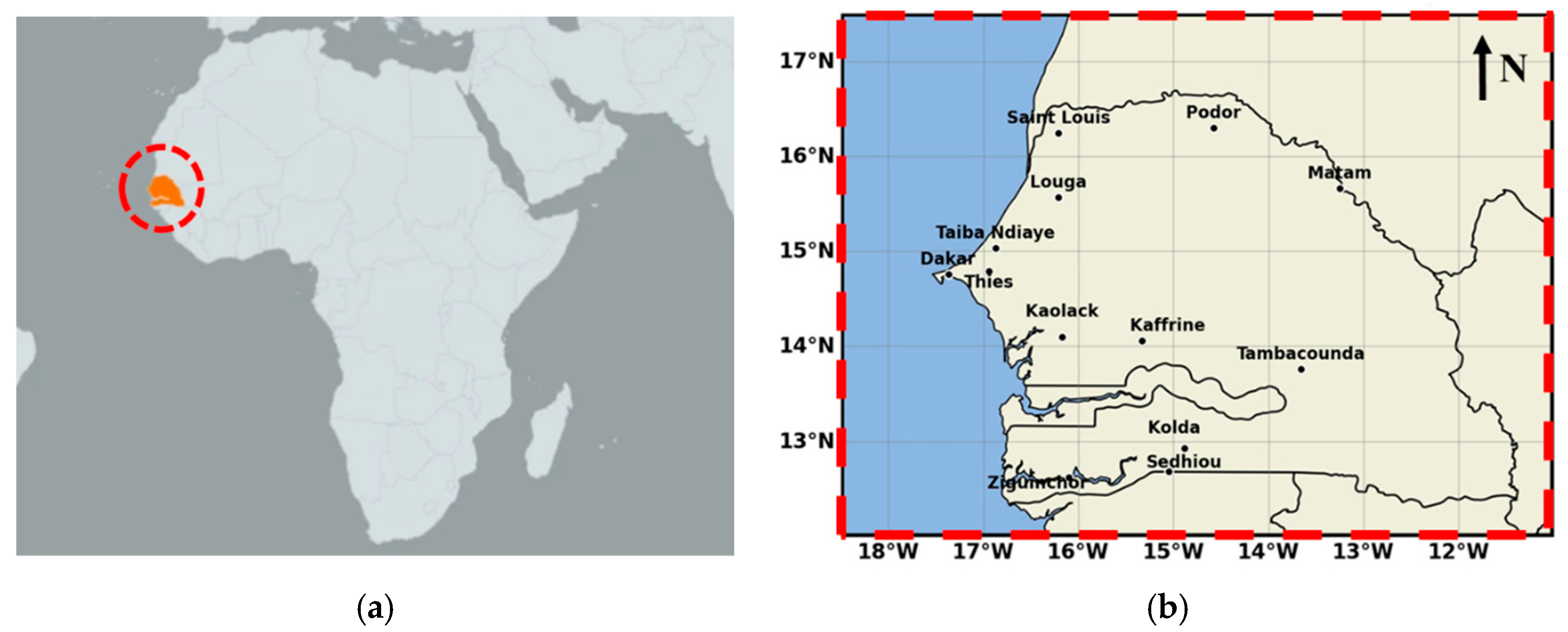
Figure 1. (a) Map of Africa with (b) zoom of the Republic of Senegal and cities [26]. Source: Author’s own work.
Resources 15 00009 g001
Figure 2. Flowchart of the proposed methodology. Source: Author’s own work.
Resources 15 00009 g002
Figure 3. Spatial variation in the wind speeds in Senegal (1993–2023) at 100 m above ground level (AGL). The color scale ranges from 1 m/s (dark blue) to 9.5 m/s (dark red). The spatially averaged wind speed is 5.5 m/s, with maximum values (>6.5 m/s) in the northwestern coastal regions (Saint-Louis, Louga) and minimum values (<4 m/s) in Southern Casamance. Source: Author’s own work.
Resources 15 00009 g003
Figure 4. Wind regime characteristics in Senegal (1993–2023) at 100 m: (a) Monthly variation in wind speed and turbulence intensity; (b) Yearly wind rose plot by wind speed.
Resources 15 00009 g004
Figure 5. Monthly mean distribution of wind speed at the wind turbines’ hub height in Senegal.
Resources 15 00009 g005
Figure 6. Monthly amount of H2 at turbine heights for four studied wind turbines: (a) 100 m: NordexN_100; (b) 117 m: Vestas_126; (c) 140 m: Goldwind_155; and (d) 166 m: Vestas_150, using alkaline (non-hatched) and PEM (hatched) electrolyzers.
Resources 15 00009 g006
Figure 7. Spatial variations in the techno-economic indicators of wind-based green hydrogen production at wind turbine hub heights in Senegal (1993–2023). Spatial variations in techno-economic indicators per ERA5 grid cell (0.25° by 0.25° horizontal-grid spacing), assuming one turbine per cell. Source: Author’s own work.
Resources 15 00009 g007
Figure 8. Monthly mean variations in techno-economic indicators for green hydrogen: (a) Capacity factor, (b) Hydrogen production, (c) CO2 emission reduction and (d) Carbon credit gained based on studied turbines’ heights.
Resources 15 00009 g008
Figure 9. Yearly impartial analyses (radar chart) of techno-economic indicators for green hydrogen production obtained from the studied wind turbines using alkaline electrolyzer.
Resources 15 00009 g009
Figure 10. Effect of the turbines’ lifetime on the annual mean values of LCOE.
Resources 15 00009 g010
Figure 11. Distribution of the lifetime effect of (a) alkaline electrolyzer and (c) turbine on yearly mean values of LCOH: The dashed line in (a) corresponds to the curvilinear trend of LCOH illustrated in figure (b) by orange arrow for Vestas_126. Furthermore, the best scenarios represented by the dashed rectangles in figures (c,d) indicate regions where the LCOH drops below 4 $/kg, based on turbine lifetime assumptions.
Resources 15 00009 g011aResources 15 00009 g011b
Table 2. Technical characteristics of selected wind turbines.
TurbinesHub Height (m)Per (MW)Vc (m/s)Vr (m/s)Vf (m/s)Turbine Lifetime (Years)
Nordex_N1001002.53122020
Vestas_1261173.454.511.52220
Goldwind_1551404.52.510.82620
Vestas_1501665.63112520
Table 3. Summary of equations employed in wind resource analysis and techno-economic studies for hydrogen production and cost [22,46,77].
Metrics for Performance Evaluation and ReferencesUnitEquationsNo.
Vertical extrapolation of wind speed [39,46,77,78]m/s v ( h ) = v 0 h / h 0 α (1)
Wind shear coefficient [22,78]- α = [ 0.37 0.088 l n ( c _ 0 ) ] / [ 1 0.088 l n ( h / 10 ) ] (2)
Average power output [22,46]kW P out = P e r e v c / c k e v r / c k / v r / c k v c / c k e v f / c k (3)
Capacity factor [22,39]% C f a c = P o u t / P e r (4)
Energy output [22,79,80]kWh E A = C f a c × P e r × t (5)
Present Value Cost [22,65,79]$ P V C = I + C o m r 1 + i / r i × 1 1 + i / 1 + r t S 1 + i / 1 + r t (6)
Levelized cost of electricity [65,77,79,80]$/kWh L C O E = P V C / E o u t (7)
Amount of hydrogen produced by wind turbine [22,39,77]tons H 2 = E A / E a · τ c o n v (8)
Levelized cost of hydrogen [39,77,79]$/kg L C O H = C A + C B / M h y d · T with
C A = C u n i t · M H 2 × E a / 8760 × C fac × τ a and C B = L C O E × i = 1 t E A / T
(9)
Carbon dioxide emission reduction from wind energy [22,65,79]tons C O 2 = E A × 0.277 ( k g C O 2 / k W h ) (10)
Carbon Credit gained or green credit [22,79]$ C C g = C O 2 × 40   ( $ / tons ) (11)
Payback Period [22,65,79]yearsPBP = (ln ((C + i)/(EA × C)) + 1)/(ln(1 + i))(12)
Table 4. Input parameters used for hydrogen production and cost potential evaluations [22,81,82].
Input Parameters and ReferencesUnitElectrolyzersValuesNo.
Inflation rate [81] %-9.7(1)
Interest rate [83] %-5.03(2)
Operation and Maintenance (O&M) cost (turbine transport, civil works, grid connection and related setup costs) [22] %-25 (3)
Scrap value [22] %-10(4)
Energy consumption of electrolyzer [22]kWh/kgAlkaline42(5)
kWh/kgPEM60(6)
Efficiency of the converter [22]%Alkaline95(7)
%PEM65(8)
Efficiency of the electrolyzer [22] %Alkaline95(9)
%PEM65(10)
Unit cost of the electrolyzer [22] $/kWAlkaline1522.10 (11)
$/kWPEM2342.07 (12)
Maintenance and Operation (O&M) cost of electrolyzer [22] %Alkaline4 (13)
%PEM4 (14)
Electrolyzer lifetime [22,82] yearsAlkaline15(15)
Electrolyzer lifetime [22,82] yearsPEM15(16)
Wind turbine lifetime [22,82] years-20(17)
Table 5. Annual mean values of techno-economic parameters at turbines’ hub heights in Senegal 1. All values reported per single turbine installation.
ParametersNordex_N100Vestas_126Goldwind_155Vestas_150
EA (MWh/year)2415.343325.68809110,656.31
Cfac (%)11112022
LCOE ($/kWh)0.080.080.040.04
CO2 em. reduct. (tons)669.04921.212241.22951.8
CCg (M$)0.0260.0360.0890.118
H2 (tons)54.6375.22183.01241.03
LCOH ($/kg)7.017.033.773.56
PBP (years)6.526.533.642.16
1 with O&M (investment) = 25%, O&M (electrolyzer) = 4%, Turbine lifetime = 20 years; Electrolyzer lifetime = 15 years.
Table 6. Comparison of the LCOH values from previous research and the current study.
Authors (Year)LocationsElectrolyzer TechnologiesLCOH ($/kg)References
Koholé et al. (2023)North region of Cameroon (6 cities)PEM (54 kWh/kg)4.38–15.64[39]
Qusay et al. (2024)IraqAlkaline (not specified)6.82–8.32[85]
Gado et al. (2024)Middle East region (10 cities)PEM (not specified)5.34–6.18[37]
Ibrahim et al. (2024)Horn of Africa (4 cities)Alkaline (42 kWh/kg)1.17–7.72[86]
Jiang et al. (2025)East Asia (2 cities)Not specified2.3–14[30]
Munther et al. (2025)Iraq (4 cities)Alkaline (Not specified)8.15–36.1[31]
Albalawi et al. (2025)Saudi ArabiaPEM (50 kWh/kg)6.93–8.52[29]
Present studySenegalAlkaline (42 kWh/kg)3.56–7.03Competitive position for green H2 production in West Africa.
Disclaimer/Publisher’s Note: The statements, opinions and data contained in all publications are solely those of the individual author(s) and contributor(s) and not of MDPI and/or the editor(s). MDPI and/or the editor(s) disclaim responsibility for any injury to people or property resulting from any ideas, methods, instructions or products referred to in the content.