1. Introduction
Agriculture persists as a central contributor to the socioeconomic well-being of rural populations in India, providing food security, employment, and economic stability for a substantial share of the population. Over 85% of India’s population depends on agriculture, with smallholder farmers forming the majority [
1]. The sector serves a pivotal function in ensuring food availability, but its sustainability is increasingly threatened by climate-exacerbated challenges including erratic rainfall, declining soil fertility, and extreme temperatures [
2,
3,
4]. Climate change has already resulted in damaging consequences for global agriculture [
5,
6], particularly in developing nations, exacerbating food insecurity, rural poverty, economic instability [
7,
8]. As a result, farmers face declining yields, water shortages, and soil degradation, making them highly vulnerable to climate-driven threats. The vulnerability of farming communities is further intensified by their dependence on rain-reliant agriculture, weak institutional support, and limited access to climate-resilient technologies [
9,
10,
11].
In light of these challenges, Climate-Smart Agriculture (CSA) has been introduced as a strategic framework to reinforce the resilience (capacity of farming systems to absorb, adapt to, and recover from climate-related shocks) and long-term viability (sustainability and continued functionality of the system over an extended period) of farming systems. Introduced in 2009, CSA focuses on the sustainable enhancement of agricultural productivity, strengthening resilience to climate change, and lowering greenhouse gas emissions [
12]. This framework is implemented through the adoption of Climate-Smart Agricultural Practices (CSAPs) such as improved soil and water management, crop diversification, agroforestry, and efficient resource use, which help mitigate climate risks while improving farm productivity. Studies indicate that CSAPs adoption enhances farmers’ adaptive capacity, ensuring long-term food security and environmental sustainability [
13,
14,
15,
16]. Nevertheless, despite the well-documented benefits of CSAPs, its adoption continues to be limited in many developing regions due to socioeconomic barriers, limited technical knowledge, and institutional constraints [
17,
18].
The state of Himachal Pradesh, situated in the Northern Western Himalayan region of India, faces significant vulnerability to climate change due to its fragile agroecological system. The region relies heavily on climate-sensitive crops, and changes in temperature, precipitation, and soil conditions have significantly impacted agricultural productivity [
19]. Farmers in this region face challenges such as erratic monsoons, prolonged droughts, and increased pest infestations, further threatening their livelihoods. In response, CSAPs including agroforestry, drought-resistant crop varieties, water management strategies, and natural farming have been identified as potential adaptation measures [
20,
21,
22]. Among these, agroforestry has gained significant attention due to its high carbon sequestration potential, capacity to improve soil fertility and agricultural strategies [
23]. While traditional ecological knowledge plays an important role in farmers’ adaptation strategies, scientific knowledge, and modern innovations remain crucial for developing effective, evidence-based climate adaptation solutions [
24,
25].
However, many farmers in developing countries struggle to incorporate scientific advancements due to socioeconomic constraints, limited access to information, and weak institutional frameworks [
26]. Despite CSAPs gaining growing acknowledgment as a crucial strategy for improving farm productivity, stabilizing household income, and reducing climate-related livelihood risks, significant research gaps persist, particularly in the context of Himachal Pradesh. Existing literature predominantly addresses global and national trends, often overlooking region-specific assessments that account for the state’s distinct agroecological and socioeconomic conditions. While individual climate-smart agricultural practices, such as agroforestry, crop diversification, and water conservation have been examined, there remains a paucity of research on their integrated adoption and synergistic effects on farm productivity and resilience. Furthermore, despite the well-documented benefits of CSAPs, empirical evidence regarding their direct influence on reducing livelihood vulnerability, particularly in terms of food security, household income, and long-term resilience—remains scarce. Moreover, while national policies advocating CSA have been formulated, their practical efficacy at the grassroots level and alignment with the adaptive needs of smallholder farmers require further investigation. Given these pressing issues, the current investigation intends to gauge the adoption of climate-smart agricultural practices among farming communities in the North-Western Himalayan region of Himachal Pradesh. The study specifically aims to: (i) assess the level of adoption of CSAPs, (ii) identify factors influencing adoption, and (iii) evaluate the effect of CSAPs on reducing livelihood vulnerability of farming communities. By identifying vulnerability hotspots and adaptation gaps, this research will contribute to policy recommendations geared toward augmenting the resilience of smallholder farmers. Furthermore, the study will elucidate the effectiveness of climate-resilient farming strategies, thereby supporting the development of sustainable rural agricultural systems in climate-sensitive regions.
The paper follows a structure: A review of pertinent literature is provided in
Section 2, synthesizing key theoretical and empirical studies to establish the study’s contextual framework.
Section 3 details the methodology, detailing the data sources and regression models employed.
Section 4 summarizes the empirical findings, while
Section 5 provides an in-depth discussion of the outcomes.
Section 6 concludes the paper by highlighting the key insights and policy recommendations.
Section 7 outlines the limitations of the study and suggests directions for future research.
2. Empirical Insights into Barriers and Impacts of Climate-Smart Agriculture Adoption
Climate-smart agriculture is widely recognized as a scientifically grounded approach to addressing climate change challenges in agriculture by enhancing productivity, strengthening adaptive capacity, and reducing greenhouse gas emissions [
27]. Despite its potential benefits, the adoption of CSA remains uneven, primarily due to a range of interrelated barriers operating at the farmer, institutional, and systemic levels.
At the farmer level, socio-demographic and resource-related constraints significantly influence CSA adoption. Factors such as age, education, farm size, gender, and off-farm income shape farmers’ capacity and willingness to adopt CSA practices, though their effects vary across contexts [
28]. Limited technical knowledge, inadequate financial resources, and insecure land tenure further restrict adoption, particularly among smallholder farmers. Empirical evidence indicates that younger and more educated farmers are more inclined to invest in CSA technologies, while female farmers often face additional social, cultural, and resource-based constraints that limit their participation in climate-smart interventions [
29,
30].
Beyond individual characteristics, institutional barriers play a decisive role in constraining CSA adoption. Limited access to extension services, insufficient agricultural training, weak farmer organizations, and poor access to climate and market information significantly reduce adoption likelihood [
28]. Although institutional support mechanisms such as farmer-based organizations, access to quality inputs, and policy incentives have been shown to enhance adoption intensity, these mechanisms remain inadequately developed in many regions [
31,
32]. Weak governance structures, inconsistent policy implementation, and fragmented market linkages further undermine the effective diffusion of CSA technologies [
33].
Practice-specific and economic barriers also limit the uptake of CSA. While practices such as improved crop varieties, minimum or zero tillage, laser land leveling, agroforestry, conservation agriculture, crop diversification, and efficient water management have demonstrated significant benefits in terms of farm returns, soil health, and resource-use efficiency [
34,
35,
36,
37], their adoption is often constrained by high initial investment costs, increased labor requirements, and site-specific performance variability. Meta-analytical evidence confirms that although CSA practices enhance soil organic carbon stocks and crop productivity, their widespread adoption is hindered by financial constraints and contextual agro-climatic conditions [
38].
Despite growing empirical evidence on adoption determinants, knowledge gaps persist regarding the livelihood impacts of CSA. Existing studies demonstrate that CSA adoption improves agricultural productivity, technical efficiency, food security, and agrifood system resilience, while reducing emissions and enhancing soil carbon sequestration [
39]. CSA practices also contribute to broader socio-economic and environmental outcomes, including poverty reduction, land sustainability, and reduced exposure to climate-induced risks [
40,
41]. However, while CSA adoption has been shown to increase crop productivity and household income [
42,
43], there remains limited quantitative evidence on its direct influence on specific components of the Livelihood Vulnerability Index, such as exposure, sensitivity, social networks, resource accessibility, and adaptive capacity.
Furthermore, the role of institutional support in mitigating livelihood vulnerability remains insufficiently explored. Most studies focus on short-term productivity outcomes, with limited attention to long-term resilience and vulnerability reduction. This highlights the need for longitudinal and region-specific analyses that examine how CSA adoption, in combination with institutional and policy support, shapes household-level vulnerability outcomes over time. Addressing these gaps will strengthen the empirical foundation for evidence-based policy interventions aimed at promoting sustainable and climate-resilient agricultural systems.
3. Methodology
3.1. Description of the Research Area
Himachal Pradesh, lying within the Indian Himalayan Belt, encompasses an area of 55,673 km
2 and exhibits diverse topographical and climatic variations. The state is classified into four distinct agro-climatic zones: subtropical low hill, sub-humid mid hill, wet temperate high hill, and dry temperate high hill. Geographically, the region spans from 30°22′ to 33°12′ N latitude and 75°45′ to 79°04′ E longitude, covering altitudes from 248 m to 6735 m a.m.s.l. The region’s varied physiography and climatic conditions support extensive biodiversity, along with significant agricultural and horticultural activities, making it crucial ecological and agrarian landscape. The research was carried out in the wet temperate and dry temperate zones of Himachal Pradesh, India. The wet temperate zone includes a significant portion of Shimla (excluding Rampur tehsil) and Kullu districts, along with areas of Sirmour, Solan, Chamba, Kangra, and Mandi districts. The dry temperate zone comprises Lahaul & Spiti, Kinnaur districts, along with the Pangi block of Chamba district. These high-altitude regions are highly vulnerable to climate change, impacting both farm productivity and economic well-being. The study area is indispensable to the state’s economy, particularly due to its production of lucrative temperate crops including apples and pears, which contribute significantly to the agricultural sector [
44,
45].
3.2. Sampling Technique and Sample Size
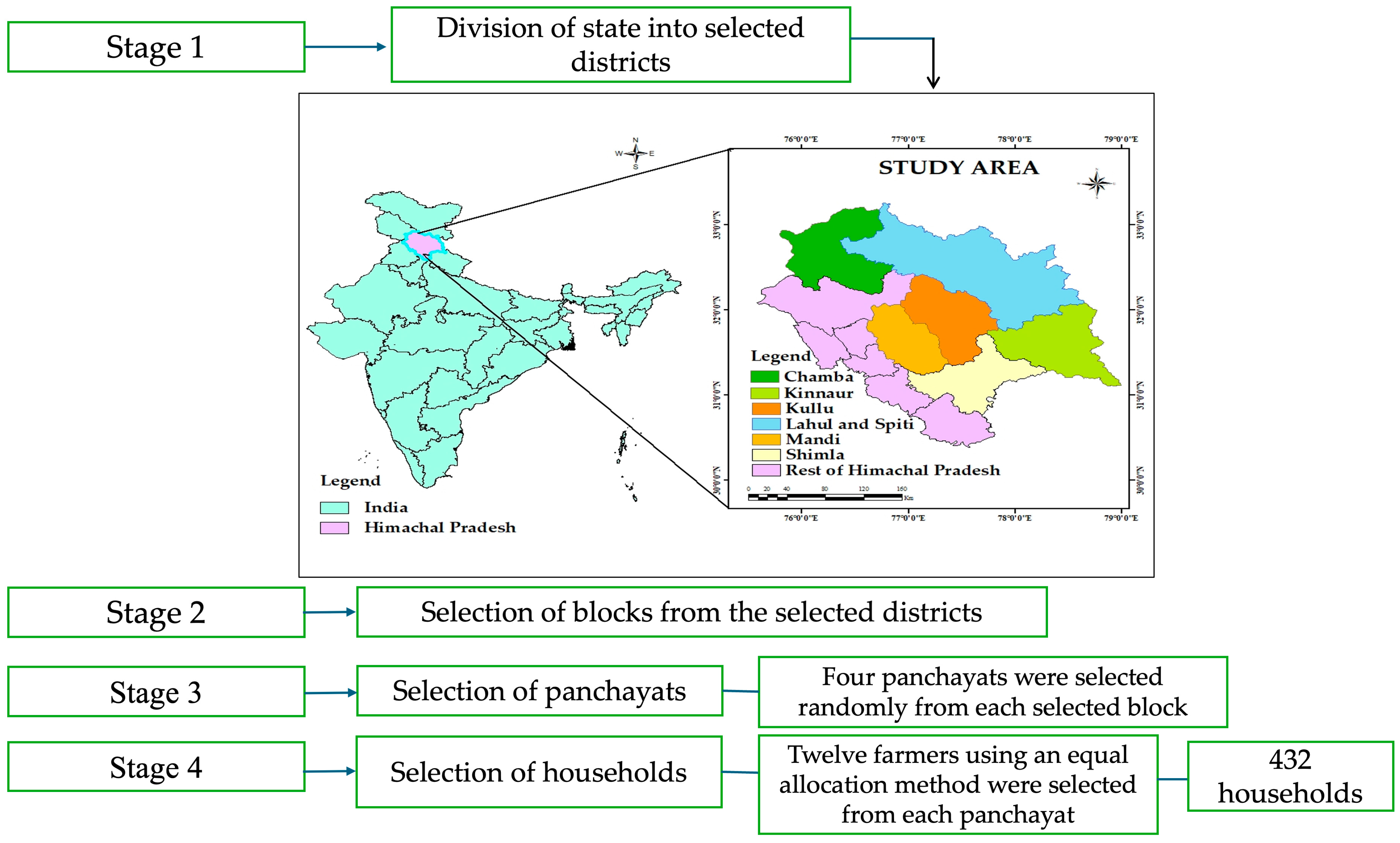
The research sample was drawn using multistage random sampling technique (
Figure 1). The study area was divided into two zones: wet temperate and dry temperate zones. At the initial stage, four districts—Shimla, Chamba, Mandi, and Kullu—were randomly chosen from the wet temperate zone, while Kinnaur and Lahaul & Spiti were chosen from the dry temperate zone, based on their significant temperate region coverage.
In the second stage, a complete list of blocks within these districts was prepared. In the Indian administrative system, a block represents an intermediate rural administrative unit that comprises several Gram Panchayats and exhibits relatively similar agro-climatic, institutional, and socio-economic characteristics. From this list, 30% of the blocks were randomly selected to ensure adequate spatial coverage, capture variability in farming systems and climatic exposure, and maintain feasibility for intensive fieldwork. The detailed list of selected blocks is presented in
Appendix A,
Table A1.
The third stage involved preparing a list of panchayats from each selected block. A Gram Panchayat is the lowest tier of rural local self-government under India’s three-tier Panchayati Raj system and typically governs one large village or a group of small villages. Panchayats are responsible for implementing local development programs, managing basic rural infrastructure, and maintaining close interaction with farming households. From each selected block, which four panchayats were chosen randomly to capture intra-block heterogeneity while avoiding excessive clustering.
Finally, during the fourth stage, twelve farm households were selected from each panchayat using an equal allocation method, resulting in overall sample size of 432 farm households drawn from the total population of farming households residing in the selected panchayats across six districts. This sample size was considered adequate to reflect the dominant characteristics of the study population, including the prevalence of marginal, small and semi-medium farmers, mixed crop–livestock and horticulture-based farming systems, variations in farm size and income sources, access to institutional services, and exposure to climatic risks prevalent in the temperate regions of Himachal Pradesh.
The multistage random sampling approach was utilized to enhance the statistical reliability and representativeness of the sample, ensuring that key socio-economic, institutional, and agro-climatic features of the study population were appropriately captured.
3.3. Data Sources and Data Collection Tools
The present research incorporated a mixed-method approach, integrating both first-hand data and second-hand data for a comprehensive evaluation. First-hand data was systematically gathered using a structured household survey schedule, designed to capture socio-economic conditions, agricultural practices, and farmers’ livelihood status. This approach ensured the acquisition of first-hand, context-specific information relevant to the objectives of present research.
Second-hand data was obtained via comprehensive review of scholarly articles, books, conference proceedings, theses, and research publications, including both published and unpublished literature. Government sources such as the Department of Agriculture Cooperation and Farmers Welfare, Department of Horticulture, and the Directorate of Economics and Statistics were consulted to obtain information on agro-climatic conditions, crop patterns, productivity trends, institutional support mechanisms, and district-level agricultural statistics. Digital repositories like Krishi-Kosh, Shodhganga, and CeRA (Consortium for e-Resources in Agriculture) were used to review earlier empirical studies on climate change impacts, climate-smart agricultural practices, livelihood vulnerability, and methodological approaches relevant to the Livelihood Vulnerability Index (LVI).
These secondary sources were analyzed to (i) contextualize the study area, (ii) support the selection and construction of key indicators used in the LVI and ordered logit model, (iii) compare findings with existing literature, and (iv) validate trends observed in the primary survey data.
To enhance the consistency and accuracy of the survey instrument, a pre-test was conducted with 43 households before the final survey. This sample size aligns with the methodological guidelines of [
46,
47], who suggest allocating 10 percent of the total sample size for pilot testing to strengthen data robustness as also supported by [
48].
3.4. Data Analysis
This research delves into the adoption of CSAPs, the determining factors, and the link between CSA adoption and farmers’ livelihood vulnerability. CSA adoption is considered a key adaptation strategy to mitigate the impacts of climatic shifts. These practices are regarded as a key strategy for strengthening resilience, with the potential to mitigate vulnerability to climate variability, improve the capacity to endure climatic disturbances and enhance the adaptive capabilities of farming communities.
3.4.1. The Composite Score
To assess the adoption of CSAPs by farming households, a composite scoring approach was utilized [
49]. This method involved using a binary scale, where a response of “Yes” (adoption of the practice) was scored as 1, and “No” (non-adoption) was scored as 0. The adoption level was measured across 12 CSAPs, with each practice contributing equally to the composite score. Consequently, the total score for a respondent could range from a maximum of 12, indicating the adoption of all practices, to a minimum of 0, representing non-adoption of any practices. Based on their scores, respondents were categorized into three groups: high adopters, who demonstrated significant adoption of CSAPs; moderate adopters, who showed partial adoption; and low or non-adopters, who exhibited limited or no adoption.
3.4.2. Ordinal Logistic Regression Model
Ordinal Logistic Regression (OLR) was employed to systematically investigate the association between an ordinal outcome variable and a set of explanatory factors, specifically assessing the socio-demographic, institutional, socio-cultural, climatic, and economic determinants influencing the extent of CSAPs adoption among farm respondents. This statistical technique is appropriate when the dependent variable possesses an inherent order but the intervals between categories are not assumed to be equal. In the present study, the outcome variable (Yi) denotes the level of adoption of CSAPs, categorized as follows: high adopters (Yi = 3), moderate adopters (Yi = 2), and low adopters (Yi = 1). This modeling approach is especially fitting for cases where the response variable reflects ranked or hierarchical outcomes, such as the intensity of CSAPs adoption among farming households.
The ordered logistic regression model is specified using the cumulative logit (proportional odds) formulation as follows:
where Y is the ordinal outcome variable representing the level of CSA adoption, categorized as low (0), moderate (1), and high (2). The proportional odds model assumes a common set of slope parameters
β for all predictors, while the ordinal outcomes are distinguished by the J−1 threshold parameters
. The model can also be rewritten in linear predictor form as:
where p is the number of predictors included in the model.
Explanatory variables included in the model are:
X1 = Age of the household head
X2 = Gender of the household head
X3 = Education status of the household head
X4 = Farming experience
X5 = Market distance
X6 = Access to extension
X7 = Access to credit
X8 = Participate in training
X9 = Member in local area
X10 = Access to climate change information
X11 = Family size
X12 = Adult Cattle Unit (ACU)
X13 = Off-farm income
X14 = On-farm income
X15 = Farmers category
To ascertain the adequacy of the OLR model for investigating the effects of predictor variables on CSAPs, it is essential to examine the presence of multicollinearity among the continuous covariates. The Variance Inflation Factor (VIF) was employed as a diagnostic measure to detect potential multicollinearity, with higher VIF values indicating redundancy among predictors that could affect the stability and interpretability of the model coefficients. The VIF for each predictor was determined based on subsequently presented formula:
where
A VIF of 1 indicates that multicollinearity is absent between the regressors. However, when the VIF exceeds 10—corresponding to R
2 value greater than 0.90—the predictor is considered to exhibit a high degree of collinearity with other variables [
50].
To assess the extent of association between categorical (dummy) predictors, the Contingency Coefficient (CC) was computed, with a value approaching 1 indicating a stronger association between the variables. The CC was calculated using the following formula:
where CC denotes the coefficient of contingency, χ
2 represents the chi-square value, and
N denotes the total sample size.
3.4.3. Livelihood Vulnerability Index
The current investigation evaluates livelihood vulnerability using the Livelihood Vulnerability Index framework originally conceptualized by [
51], integrating primary household survey data with secondary climate risk indicators, including temperature, rainfall, and precipitation variability [
51,
52].
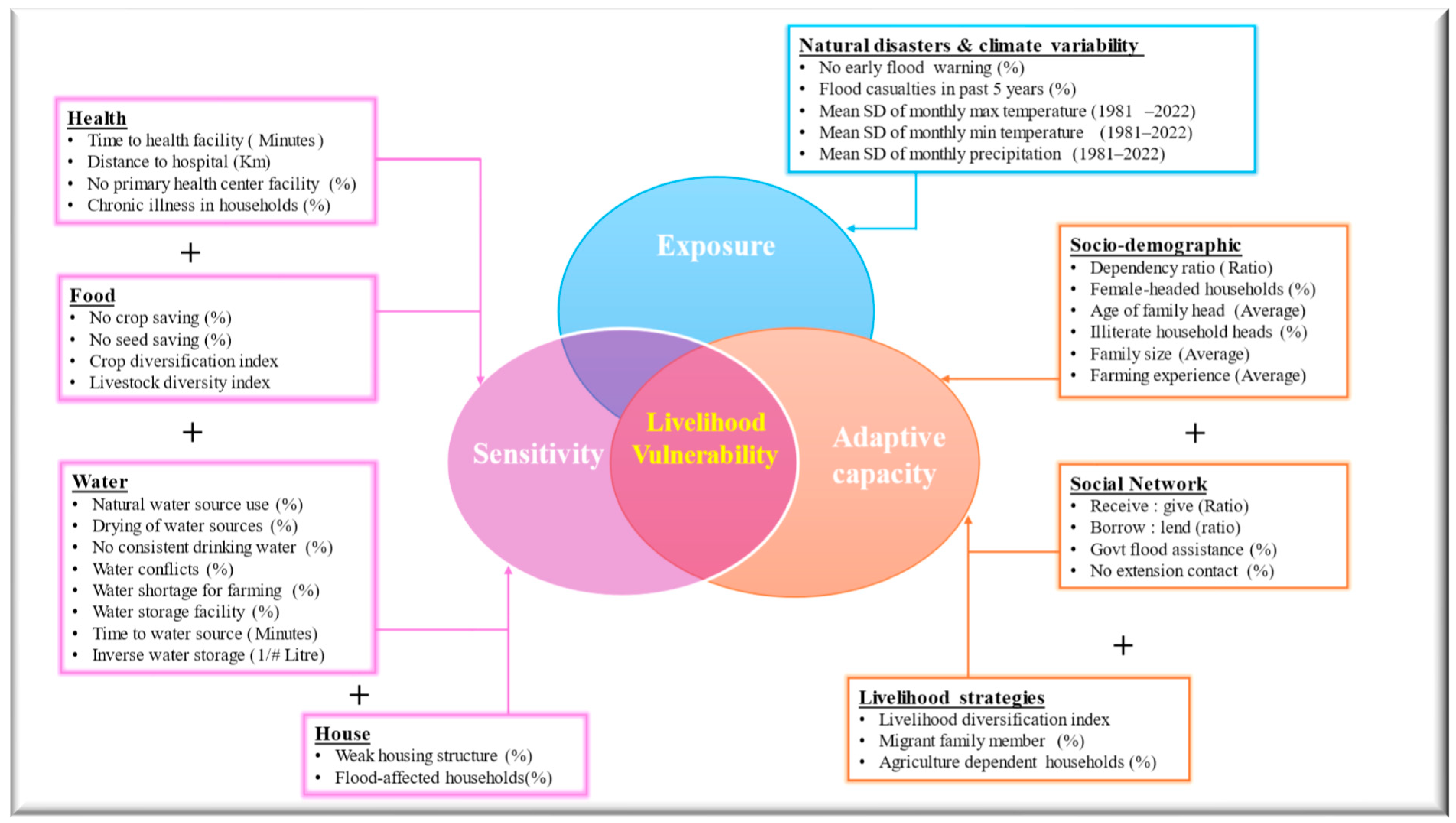
In the context of current research, LVI comprises eight key components: livelihood strategies; socio-demographic profile; health; social networks; house; water; food; and natural disaster and climate variability. Eight key components were grouped into adaptive capacity (livelihood strategies, socio-demographic profile, social networks), sensitivity (health, house, water, food), and exposure (natural disasters & climate variability). The measurement and standardization methods for each sub-component such as time to health facility, household size, and water availability—are detailed in
Appendix B (
Table A2). Overall, the framework consisted of eight main components and thirty-six sub-components, as illustrated in
Figure 2. Indicator selection was driven by an in-depth analysis of the literature and regional context, ensuring relevance to the specific social and economic conditions, along with environmental factors of the study area. Standardization of indicators followed the Human Development Index methodology, normalizing values between minimum and maximum thresholds.
S
d represents the observed value of a given indicator, while S
min and S
max represent its minimum and maximum across all observations, respectively. The standardized sub-component values within each major component are averaged using Equation (2).
M
d reflects the value of a major component, n denotes total number of sub components, and Index S
di indicates the standardized value of each sub-component. Finally, overall LVI is computed as the weighted average of these major component indices, given by Equation (3).
The LVI yields a score spanning from 0 to 1, with values nearer to 0 indicating lower vulnerability and values approaching 1 reflecting higher levels of vulnerability, providing a quantitative measure of livelihood vulnerability. Higher LVI values indicate greater exposure to climate-induced challenges and lower adaptive capacity, making the index a valuable tool for identifying at-risk communities and informing targeted interventions for enhancing resilience.
3.4.4. Multiple Linear Regression Model
A Multiple Linear Regression Model was deployed to assess the impact of CSAPs on the Livelihood Vulnerability of farming communities. Livelihood Vulnerability of farmers was considered as a response variable, while the explanatory variables included climate-smart agricultural practices, exposure to information, and participation in training programs on CSAPs. The following equation represents the multiple linear regression model.
where,
Y = Livelihood Vulnerability Index
α0 = Intercept
α1–α3 = Coefficients for the explanatory variables
μ = Error term
X1 = Climate-smart agricultural practices
X2 = Access to information on climate change
X3 = Access to training on CSAPs
4. Results and Analysis
4.1. Economic Structure of the Study Area
This section presents the empirical results derived from the survey of 432 farm households, in accordance with the stated objectives. It begins with an overview of the economic structure of the study area, including the occupational profile of households, livestock ownership, and levels of agricultural investment. The section then examines the adoption of CSAPs, identifying the practices adopted by farmers, categorizing households based on composite adoption scores, and analyzing the influence of key socio-demographic, economic, institutional, socio-cultural, and climatic factors on adoption using an ordered logit regression model. Finally, the results assess the impact of CSAP adoption on the livelihood vulnerability of sample households, highlighting the role of practice adoption, access to climate information, and participation in training programs in reducing vulnerability to climate-related risks.
4.1.1. Status of Occupation
Occupation is a key determinant of livelihood, shaping income and social status. In the study area, agriculture, services, and business form the primary occupations, each playing a distinct role in the local economy. Agriculture constituted the primary livelihood source, accounting for 83.39% of total employment, followed by business activities (9.01%) and salaried employment (7.60%). Among the studied blocks, Kalpa exhibited the highest reliance on agriculture (86.39%), whereas the highest engagement in business activities was recorded in Jubbal (10.43%) and the lowest in Kalpa (6.51%). The highest proportion of individuals employed in the salaried sector was observed in Theog (10.69%), followed by Jubbal & Kotkhai (8.59%) and Rohru (8.09%). These findings indicate regional disparities in livelihood diversification and off-farm employment opportunities (
Table 1).
4.1.2. Livestock Status
Livestock rearing is a crucial component of the rural economy, particularly in hilly regions, where it enhances socio-economic stability and agricultural sustainability. The practice is shaped by social, ecological, and economic factors, with cows, sheep, goats, and bullocks being the predominant livestock. The analysis of Adult Cattle Units (ACU) (
Table 2) were recorded in Mehla block (2.73), followed by Chamba (2.44) and Nagar (2.44). Cow rearing was the most common livestock activity in the study area, forming a substantial portion of total livestock holdings. The highest average number of improved cows per household was reported in Gohar (47.31%), followed by Rohru (42.39%) and Theog (42.96%), indicating a strong preference for or better access to improved cattle breeds in these areas. In contrast, the lowest averages of improved cows were observed in Kalpa (41.23%) and Chamba (34.90%). Local cows were relatively fewer, contributing on average 17.55% to the total livestock. Overall, the study concluded that improved cows made up the largest proportion of livestock (40.36%), followed by bullocks (30.78%), local cows (17.55%), calves (4.13%), goats (4.10%), and sheep (3.09%), with the average Adult Cattle Units in the temperate region calculated at 2.36.
Dairy farming is a crucial secondary livelihood activity across all sampled households, significantly enhancing household income. Analysis of milk production and disposal (
Table 3) revealed substantial output, with Rohru and Gohar again emerging as top performers in terms of total milk production (301 L per day). These differences in output may be influenced by factors such as the breed of livestock, feeding practices, and the local environment. The majority (50.16%) of the milk produced was sold rather than consumed at home, emphasizing the role of dairy as a key income-generating enterprise. On average, sale receipts per farm during the lactation period were estimated at ₹37,687.50, indicating moderate but vital role of dairy farming in supplementing rural household incomes. Overall, the findings highlight the critical role of dairy farming in boosting the economic resilience of farming households, with strong market linkages and efficient management practices driving increased income and socio-economic benefits.
4.1.3. Level of Investment of Sampled Households in Study Area
Irrigation is essential for sustaining agricultural productivity by ensuring reliable water availability and facilitating improved cropping patterns. Adequate irrigation infrastructure enables farmers to diversify crops, adopt high-value varieties, and enhance yields. However, investment in irrigation systems varies across households due to differences in financial capacity, resource availability, and individual needs. The study identified six primary irrigation sources: kuhls (traditional water channels), tanks, lifts, tube wells, drip systems, and sprinklers (
Table 4), each requiring different levels of investment based on complexity and efficiency. Traditional kuhls are the most cost-effective, with investments ranging from ₹2125 in Mehla to ₹2937.50 in Theog, averaging ₹2553.24. Tanks emerge as the most expensive, averaging ₹41,527.78 and peaking at ₹55,104.17 in Jubbal & Kotkhai, reflecting their importance in high water-storage regions. Lift irrigation incurs moderate costs, averaging ₹15,138.89, with the highest expenditure in Theog (₹17,916.67) and the lowest in Lahaul (₹13,854.17). Sprinkler systems, averaging ₹8912.04, show minimal regional variation, with the highest spending in Lahaul (₹10,625), indicating specific water distribution needs. Tube wells, averaging ₹29,976.85, have the highest investment in Theog (₹41,666.67), highlighting their role in areas with limited surface water. Drip irrigation, averaging ₹27,912.04, is highest in Lahaul (₹34,729.17), demonstrating a shift towards water-efficient technologies in high-value cropping areas. Overall, irrigation investments average ₹1,26,020.84, with Theog reporting the highest (₹1,54,041.67) and Mehla the lowest (₹89,229.17). These findings underscore the critical role of irrigation in agricultural sustainability, with region-specific disparities influenced by water availability, crop selection, and economic factors. Targeted interventions are required to optimize irrigation efficiency and enhance cost-effective water management across diverse agricultural landscapes.
The baseline characteristics presented in
Table 1,
Table 2,
Table 3 and
Table 4 provide critical context for CSA adoption and livelihood vulnerability. High dependence on agriculture increases exposure to climate risks, while livestock ownership and dairy income act as income buffers that can support adaptive capacity. Differences in irrigation investment reflect unequal access to resources and capital, directly influencing farmers’ ability to adopt climate-smart practices and reduce vulnerability. These variations help explain observed differences in CSA adoption and livelihood outcomes analyzed in subsequent sections.
4.2. Climate-Smart Agricultural Practices
4.2.1. Identification of Climate-Smart Agricultural Practices Adopted by Farm Respondents
The adoption of diverse CSAPs s among farmers in the study region was assessed by categorizing each practice as either adopted (Yes) or not adopted (No) as presented in
Table 5. Mulching was adopted by 72.90 percent of farmers, with 27.10 percent not adopting this practice. Minimum/zero tillage was adopted by 50.20 percent of farmers, while 49.80 percent did not implement it. Fruit-based agroforestry was adopted by 82.40 percent of farmers, with 17.60 percent not engaging in this practice. Integrating crop-livestock production was adopted by 81.70 percent of farmers, while 18.30 percent did not adopt this practice. The adoption of micro-irrigation was the lowest, with only 35.60 percent of farmers adopting this practice and 64.4 percent not adopting it, likely due to the high installation costs.
The practice of changing planting time was adopted by 70.10 percent of farmers, while 29.90 percent did not adopt it. Improved crop varieties were adopted by 53.20% of respondents. Diet improvement for animals, and crop insurance were each adopted by 50.90 percent of farmers, with the remaining 49.10 percent not implementing these practices. Soil testing was adopted by 53.00 percent of farmers, while 47.00 percent did not adopt this practice. The use of compost and farmyard manure (FYM) demonstrated the highest adoption, with 85.90 percent of farmers employing this practice, and only 14.10 percent did not adopt it. ICT-based weather forecasting was adopted by 57.90 percent of farmers, with 42.10 percent not utilizing this practice. These findings reveal significant variation in the implementation of CSAPs, with more accessible and cost-effective, such as composting, fruit-based agroforestry, integrating crop-livestock production and mulching, achieving higher adoption rates, while more resource-intensive practices, such as micro-irrigation, exhibit lower adoption rates.
4.2.2. Categorization of Respondents Based on Composite Scores
The composite score was used in a binary scale to categorize respondents into three distinct groups, providing a structured framework for analyzing the extent of CSA adoption. This method of categorization, grounded in statistical measures of central tendency and dispersion, facilitated the identification of adoption patterns and the targeting of interventions to address barriers, enhancing the understanding of CSAPs integration among the sampled households.
The composite score assessment indicated that the largest proportion of respondents (40.00%) were classified as low adopters of CSAPs (
Table 6). This was followed by moderate adopters (30.60%) and high adopters (29.40%). Overall, nearly two-thirds of the sampled households fell within the low and moderate adoption categories, while less than one-third exhibited high levels of CSAP adoption. This distribution underscores the scope for improving adoption intensity among farm households in the study area.
4.2.3. Ordered Logit Regression Model: Estimation of Key Drivers Affecting Adoption Levels of CSAPs
An ordered logit regression model was employed to determine the primary drivers affecting farmers’ adoption of CSAPs, which strive to lessen the damaging effects of extreme weather conditions and evolving climatic trends. The predicted variable in OLR represents the categories of adopters of CSAPs, classified into three levels: high, moderate, and low adopters. The descriptive analysis (
Table 7) revealed that the most widely adopted CSAPs were the application of compost and farmyard manure (M: 0.86), followed by fruit-based agroforestry (M: 0.82) and crop-livestock integration (M: 82). In contrast, micro-irrigation (M: 0.36) and crop insurance (M: 0.51) exhibited lower adoption rates. The average respondent was 57.15 years old and had accumulated 25.54 years of farming experience, reflecting a highly experienced farming population. The farming demographic was predominantly male (M: 0.84), with a moderate education level (M: 2.34 on a scale of 0–5). Institutional support played a crucial role, with 59% accessing extension services, 66% having credit access, and 60% participating in agricultural training programs. Climate change information was available to 56% of respondents, emphasizing its role in shaping adaptation strategies. The mean household size was 5.44, while the adult cattle unit averaged 2.36. Economic analysis indicated that on-farm income (₹725,801) was significantly higher than off-farm income (₹211,227), underscoring the dependence on agriculture for livelihood. The average farm size was 1.67 ha, classifying the respondents as small-scale farmers, which may influence the adoption of input-intensive CSAPs.
Diagnostic Test
Diagnostic assessments were conducted prior to implementing the ordinal logistic regression model to evaluate multicollinearity among continuous independent variables and to analyze the interrelationships among categorical dummy variables. The Variance Inflation Factor (VIF) served as a diagnostic measure for identifying multicollinearity, and the results indicated that all continuous variables had VIF values below 10, demonstrating the absence of significant multicollinearity issues. As a result, all continuous variables were preserved for inclusion in the regression model. Similarly, the Contingency Coefficient was calculated to determine the extent of association between the dummy explanatory variables [
48]. In the study, the computational results of the VIF were found to be below 3.73, with a mean VIF of 2.16, as shown in
Table 8. These values confirm the non-existence of a multicollinearity problem among the continuous predictor variables, allowing them to be included in the model.
Moreover, the CC values for the dummy variables were all below 0.610, which is significantly less than 0.75 [
48], indicating a low level of association among these variables, as presented in
Table 9. The analysis revealed weak relationships among the dummy variables, suggesting minimal overlap or redundancy. Based on these results, all continuous and dummy variables were included in the regression analysis, ensuring a reliable and unbiased determination of the model parameters and accounting for the contributions of all relevant predictors.
The ordered logistic regression model identified key factors shaping the adoption of CSAPs (
Table 10), with a pseudo-R
2 of 0.4371, indicating strong explanatory power. Model validity was confirmed by goodness-of-fit tests (Prob > χ
2 = 0.000), ensuring robustness. For the odds ratios (OR), values greater than 1 indicate an increased likelihood of being in a higher CSA adoption category, while values less than 1 indicate a decreased likelihood. Education (odds ratio = 0.25,
p = 0.020) significantly influenced CSA adoption, as higher education levels enhance farmers’ ability to evaluate and implement these practices. Farming experience (0.046,
p = 0.048) showed a positive relationship, with experienced farmers more inclined to adopt these practices as a result of accumulated knowledge and risk assessment skills. Access to extension services (1.107,
p = 0.000) played a crucial role in increasing adoption rates, while access to credit (1.051,
p = 0.000) provided financial resources necessary for investments in CSA technologies. Participation in training programs (0.603,
p = 0.016) significantly improved farmers’ technical knowledge and adoption rates. Membership in agricultural groups (0.54,
p = 0.024) facilitated knowledge exchange and resource access, further promoting CSA adoption. Access to climate information (2.462,
p = 0.000) was a key driver, as farmers equipped with climate knowledge were more prone to engage in climate-resilient practices. On-farm income (3.64 × 10
−6,
p = 0.000) positively influenced adoption, allowing farmers to invest in sustainable farming practices. However, farm size (−0.813,
p = 0.017) had a mixed effect, with larger farms more likely to adopt CSA, while smallholders often opted for resource-efficient innovations. These findings highlight the critical role of education, institutional support, financial access, and social networks in promoting CSA adoption while stressing the importance of strategic interventions to enhance agricultural resilience.
Several variables were statistically non-significant, indicating minimal influence on CSA adoption. Age (p = 0.405) had no significant impact, suggesting that decision-making is influenced more by exposure to modern technologies than age alone. Gender (p = 0.812) showed no effect, implying similar access to information and decision-making for male and female household heads. Market distance (p = 0.385) and family size (p = 0.963) were also non-significant, likely due to stronger influences from income and resource availability. The adult cattle unit (p = 0.078) showed marginal non-significance, indicating that livestock ownership may not directly drive CSA adoption, particularly in crop-focused households. Off-farm income (p = 0.377) had no significant effect, possibly because agricultural decisions rely more on farm-based income. These findings suggest that CSA adoption is primarily driven by education, institutional support, and financial resources rather than demographic factors.
4.3. Impact of CSA Practices on Livelihood Vulnerability of Sample Households
The relationship between CSAPs and livelihood vulnerability among households in study region was explored through multiple linear regression analysis. The dependent variable is livelihood vulnerability, which refers to the degree of susceptibility of households to the harmful repercussions of climate disruption. In this model, the Livelihood Vulnerability Index, developed from eight major components—livelihood strategies, socio-demographic profile, health, social networks, house, water, food, and natural disaster and climate variability—served as the dependent variable. Following the framework proposed by [
51], these components were further divided into thirty-six sub-components to provide a comprehensive, multidimensional measure of household vulnerability, as shown in
Figure 2.
Table 11 presents the final score of major components of livelihood vulnerability index. This index captures the multidimensional nature of household vulnerability by integrating exposure, sensitivity, and adaptive capacity into a single composite score. The key independent variable, CSA practices, was used to assess the extent to which their adoption influences vulnerability.
As presented in
Table 12, the Livelihood Vulnerability Index served as the dependent variable to quantify household vulnerability. The LVI was first calculated for each block by aggregating standardized values of the eight major components—adaptive capacity, sensitivity, and exposure—across their respective sub-components. These block-wise LVI scores capture variation in vulnerability within each geographical unit. To obtain a measure representative of the entire study area, the mean of the block-wise LVI scores was then computed, providing a single composite value for use in the regression analysis. This approach allows the regression model to assess how variations in independent variables, such as the adoption of CSAPs, access to climate information, and CSA training, influence overall household livelihood vulnerability.
The regression analysis highlights the influence of CSAPs, access to information on climate change, and provision of training on CSA practices on the livelihood vulnerability of the sample respondents.
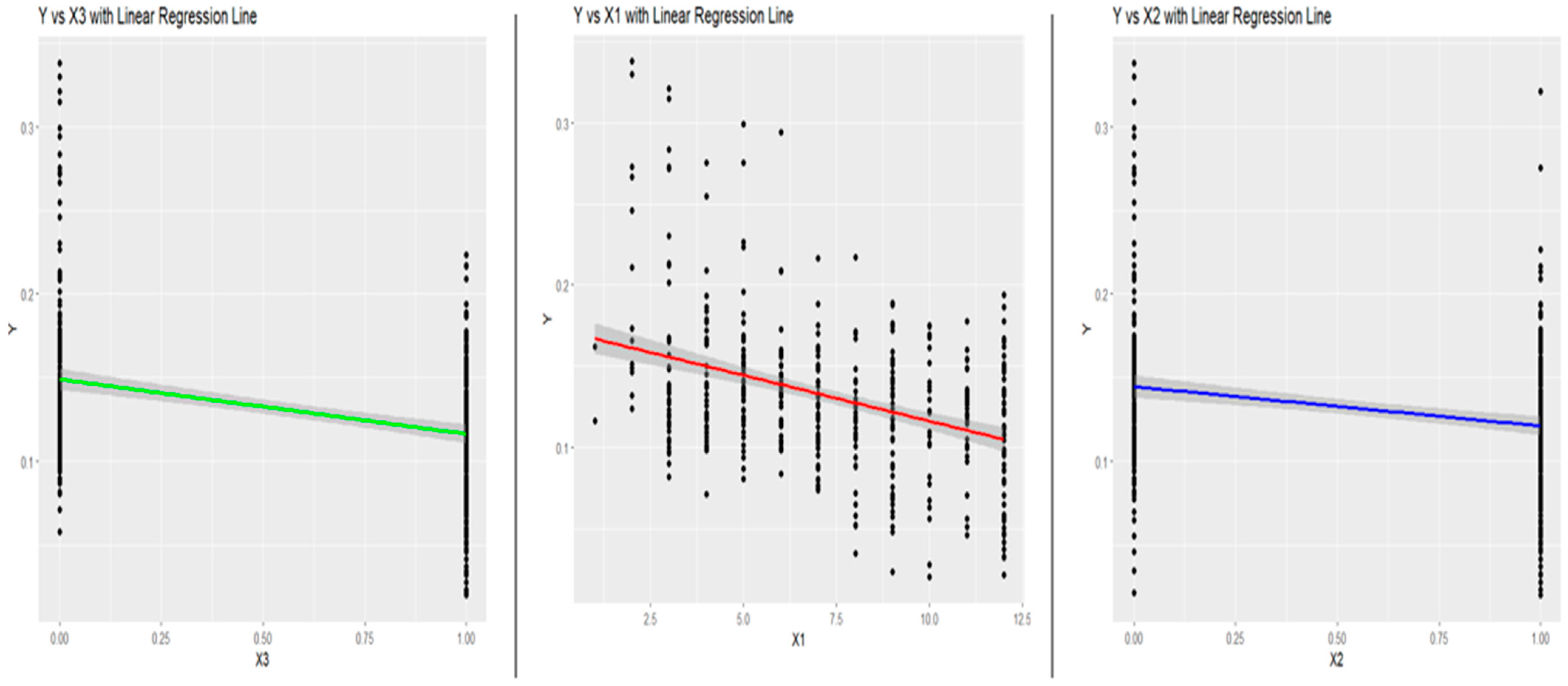
Table 13 summarizes these findings, where the outcome variable, livelihood vulnerability, is represented by Livelihood Vulnerability Index (Y). The constant term has a coefficient of 0.171602 with a standard error of 0.005834. A t-statistic of 29.41 and a
p-value of 0.000 demonstrate the statistical significance of the intercept, providing the baseline level of livelihood vulnerability when all other predictors are set to zero.
The regression model analysis for climate-smart agricultural practices (X
1), reveals a coefficient of −0.00341, with a small margin of error (0.000996) and a t-value of −3.42 (
p = 0.001). The negative value of coefficient demonstrates that the adoption of CSAPs is linked with a reduction in livelihood vulnerability. Specifically, each unit increase in the adoption of CSAPs brings about a 0.00341 decrease in livelihood vulnerability. The negative and statistically significant coefficient suggests that greater adoption of CSAPs enhances households’ capacity to cope with climate-related risks. The negative sign and statistical significance indicate that CSAPs contribute to enhancing resilience and mitigating vulnerability to climate uncertainties. The variable for access to information on climate change (X
2) shows a coefficient of −0.01319 with a standard error of 0.004524, and the t-value is −2.92 (
p = 0.004). This outcome implies that access to climate change information significantly reduces livelihood vulnerability. Agrarian communities with improved access to such information are more predisposed to embrace adaptive strategies, thereby decreasing their vulnerability to climate-related hazards. Similarly, access to training on CSA practices (X
3) exhibits a negative value of −0.01384, with an error margin of 0.006139, and a t-value of −2.25 (
p = 0.025). This indicates that training in climate-smart agricultural practices also significantly reduces livelihood vulnerability. The findings imply that the knowledge and skills gained through such training enable households to implement adaptive measures that bolster their capacity to respond to shifting climate patterns and their associated risks. The overall model is statistically significant (F(3, 428) = 28.10;
p < 0.001). This suggests that the independent variables (CSAPs adoption, access to information, and access to training) collectively have a substantial influence on the livelihood vulnerability of the households. The R-squared value of 0.1646 reveals that the model captures approximately 16.46% of the variation in livelihood vulnerability, while the Adjusted R-squared of 0.1587 adjusts for the number of predictors and offers a slightly lower explanation of variance. This suggests that while the model identifies important factors influencing livelihood vulnerability, other unmeasured variables may also contribute to the variability in the dependent variable. It can be indicated from
Figure 3 that the adoption of CSAPs, access to information on climate change, and access to training on CSAPs are significant factors in reducing livelihood vulnerability. These results underscore the significance of promoting these factors to reinforce the resilience of households to withstand climate change. However, given the relatively low explanatory power of the model, further research incorporating additional variables may yield a more thorough understanding of the determinants of livelihood vulnerability.
5. Discussion
The adoption of CSAPs is driven by a nuanced interaction of education, institutional support, financial accessibility, and social networks, highlighting the multifaceted nature of agricultural decision-making. Education emerged as a fundamental determinant of CSA adoption, as higher education levels equip farmers with critical thinking and analytical skills, enabling them to assess and implement sustainable practices effectively. In the context of the temperate Himalayan region, education enhances farmers’ ability to interpret climate information and extension advisories, reducing uncertainty associated with new practices. This finding resonates with earlier research that emphasizes the role of education in streamlining access to agricultural information and fostering the likelihood of adopting innovative practices [
53,
54,
55]. Similarly, farming experience positively influenced adoption, as experienced farmers develop better risk management strategies and accumulate practical knowledge, allowing them to navigate climate variability more effectively [
30,
42,
49,
51]. Experienced farmers may also be more aware of long-term climate risks due to repeated exposure to climatic shocks, which increases their willingness to adopt adaptive practices. Although recent evidence suggests that its influence on climate-smart agriculture (CSA) adoption is highly context-dependent and mediated by institutional and resource conditions [
28].
Institutional support, particularly through extension services and training programs, was identified as a crucial driver of CSA adoption. Agricultural extension services are instrumental in disseminating technical knowledge and improving farmers’ capacity to implement climate-resilient strategies, consistent with research highlighting the significant impact of advisory services in encouraging adoption behavior [
30,
56]. Large-scale synthesis studies further confirm that secure land tenure, access to extension services, agricultural training, farmer organization membership, and access to climate and market information consistently enhance CSA uptake across diverse contexts [
28]. Equally, attending training programs enhances farmers’ technical knowledge, reinforcing the argument that continuous learning opportunities significantly improve the uptake and sustainability of CSAPs [
57]. Furthermore, social networks, particularly farmer organizations, facilitated information exchange, peer learning, and collective decision-making, corroborating studies that emphasize the role of social capital in agricultural innovation [
56,
58,
59]. Recent European evidence shows that CSA adoption is not merely an individual decision but is embedded within broader governance systems, policy structures, and value-chain relationships that shape farmers’ access to resources and incentives [
31].
Financial accessibility was another key enabler of CSA adoption, as access to financing provided the farming population with the necessary investment capital to implement sustainable agricultural technologies. This supports prior research indicating that credit availability reduces financial constraints and enhances farmers’ ability to integrate resource-intensive CSAPs [
60,
61]. Similarly, on-farm income positively influenced adoption, as financially stable farmers are more predisposed to channel resources into climate-resilient technologies, aligning with findings that highlight income security as a determinant of CSA adoption [
62,
63,
64,
65]. However, the influence of farm size on adoption showed mixed results, suggesting that while larger farms have the capacity to implement CSA, smallholder farmers often prioritize cost-effective and resource-efficient practices, reflecting findings from [
66]. Climate information accessibility was instrumental in CSA adoption, as farmers with reliable and timely weather forecasts were better equipped to implement adaptive strategies. This evidence concurs with prior studies emphasizing the importance of climate advisory services in promoting resilience among farmers [
62]. Moreover, participatory technology transfer approaches—such as living laboratories, demonstration trials, and training of intermediaries—have recently been shown to improve CSA uptake by enhancing usability, perceived profitability, and sustainability of technologies among smallholder farmers in semi-arid regions [
67].
Conversely, several demographic factors, including age, gender, market distance, and family size, were found to exert no substantial influence on CSA adoption. The non-significance of market distance may reflect improved rural connectivity, localized availability of agricultural inputs, and increased reliance on extension services and digital platforms, which reduce farmers’ dependence on physical proximity to markets. Similarly, the marginal influence of livestock ownership indicates that CSA adoption is largely crop-focused, reflecting the dominance of crop-based farming systems in the temperate regions of Himachal Pradesh. The non-significance of off-farm income further suggests that farm-level investment decisions are primarily influenced by agricultural income rather than supplementary earnings from non-agricultural activities. These outcomes echo the results of previous studies indicating that CSA adoption is primarily driven by economic and institutional factors rather than household characteristics [
13,
68,
69].
The insights from this research provide strong evidence that the adoption of CSA practices, access to climate change information, and participation in training programs are instrumental in reducing livelihood vulnerability. The significant negative estimate for CSAPs adoption suggests that these practices enhance resilience by mitigating exposure to climate-related risks. This aligns with previous research indicating that CAPS, such as conservation agriculture and water-efficient farming, improve agricultural productivity while reducing susceptibility to climatic shocks [
13,
70]. Recent global-scale reviews further show that regenerative and integrated CSAPs—such as precision agriculture, agroforestry, and biochar application—simultaneously enhance soil health, carbon sequestration, and long-term resilience in degraded agricultural landscapes [
71].
Access to climate change information and training also contributed to reducing livelihood vulnerability [
72,
73]. Households with better climate knowledge and training exhibit higher adaptive capacity, improved technical skills, and better resource management, which collectively reduce exposure to climate risks [
56,
74,
75,
76]. However, these findings should be interpreted in light of the cross-sectional design of the study and its focus on temperate regions, which may limit causal inference and broader generalizability.
Importantly, the regression model explains only 16.46% of the variance in the Livelihood Vulnerability Index (R2 = 0.1646), indicating that while CSA adoption, access to climate information, and training significantly influence vulnerability, a substantial portion of variation remains unexplained. This modest R2 highlights the complexity of household vulnerability, which is shaped by multiple unmeasured factors, including social capital, exposure to specific climate events, local institutional arrangements, and other environmental or socio-economic conditions. Future research incorporating these additional dimensions may provide a more comprehensive understanding of the determinants of livelihood vulnerability.
This finding underscores the complexity of livelihood vulnerability, which is influenced by a broader set of socioeconomic, institutional, and environmental variables. Similar studies have indicated that factors such as financial resources, land tenure security, and social capital also contribute to shaping households’ adaptive capacities [
77,
78,
79,
80]. Beyond influencing adoption behavior, CSA practices were found to significantly reduce livelihood vulnerability. The negative and statistically significant association between CSA adoption and livelihood vulnerability underscores the role of CSA strategies in enhancing resilience by mitigating exposure to climate-induced risks. This finding aligns with prior research demonstrating climate-smart practices, such as conservation agriculture and water-efficient farming techniques, improving agricultural productivity while reducing susceptibility to climatic shocks [
13,
70,
81,
82,
83]. Notably, ref. [
71] argues that given that over 40% of global agricultural land is already degraded, a transition beyond sustainability toward regenerative CSA practices is critical for long-term resilience and food system stability.
Overall, the study underscores the importance of an integrated approach that combines education, institutional support, financial accessibility, and climate information dissemination to promote CSA adoption and enhance farmers’ resilience. While CSA strategies were found to significantly reduce livelihood vulnerability, broader socioeconomic and policy interventions are necessary to address barriers to adoption. In line with recent policy-oriented studies, effective CSA scaling requires coordinated multi-level governance, strengthened institutional capacity, and targeted financial incentives to move CSA beyond a conceptual framework into a practical and scalable development pathway [
71,
84,
85].
6. Conclusions and Policy Recommendations
The current investigation ascertains the critical role of CSAPs in improving farm income, and reducing livelihood vulnerability in climate-sensitive regions. The findings reveal considerable variation in the adoption of CSAPs, with cost-effective and accessible strategies, such as composting and mulching, exhibiting higher adoption rates, whereas resource-intensive practices, such as micro-irrigation, face lower adoption due to financial constraints. The implementation of these practices is significantly shaped by demographic, socio-cultural, economic, climatic, and institutional factors. Key determinants include access to extension services, education, financial resources, farming experience, and climate information. Institutional support, particularly through agricultural extension programs and farmer organizations, is integral to knowledge dissemination and capacity building, thereby facilitating the adoption of climate-resilient strategies. Therefore, financial accessibility—such as Credit access and stable agricultural income—empowers farm households to invest in CSA technologies, strengthening their ability to respond to climate-related challenges. Empirical evidence from the present study confirms that CSA adoption significantly reduces livelihood vulnerability by enhancing adaptive capacity, improving agricultural productivity, and increasing resource efficiency. Access to climate-related information and training programs further reduces vulnerability by empowering farmers with the essential competencies and insights to deploy adaptive strategies. The findings indicate that market distance and family size do not have a strong influence on the uptake of these practices, suggesting that other aspects, including income levels and resource availability, exert a more decisive role in influencing adoption decisions. Similarly, the marginal non-significance of the adult cattle unit variable suggests that livestock ownership may not directly drive CSA adoption, particularly in crop-dominant farming systems. Furthermore, the non-significance of off-farm income implies that agricultural investment decisions are primarily influenced by farm-based income rather than supplementary earnings from non-agricultural activities. To accelerate the implementation of CSAPs, research, policy, and supportive programs should prioritize strategies that encourage the uptake of less adopted but highly beneficial practices. The introduction and promotion of CSAPs should be geographically tailored, feasible, and aligned with the requirements and expectations of rural farming populations to ensure practical implementation and long-term sustainability.
To develop an effective bottom-up climate adaptation framework in agriculture, it is imperative to strengthen farmer cooperatives as key facilitators of knowledge dissemination, resource mobilization, and collective action to enhance the incorporation of these practices. The lower adoption rates of micro-irrigation, particularly drip irrigation, underscore the necessity for strategic interventions to address financial and technical constraints. High installation costs, limited access to credit, and insufficient technical knowledge hinder widespread adoption among farmers. Policymakers should focus on providing financial support mechanisms, including subsidies, low-interest loans, and incentive programs, to alleviate financial pressures and incentivize adoption. Therefore, strengthening farmer assistance programs and skill development initiatives can improve awareness and technical capacity, ensuring the effective utilization of drip irrigation systems. Public–private partnerships should be promoted to develop cost-effective and locally adaptable micro-irrigation technologies, making them more accessible to subsistence farmers. To enhance the overall adoption of CSAPs, policies need to prioritize improving farmers’ financial accessibility through credit schemes, subsidies, and incentive programs. Strengthening institutional support, particularly through agricultural extension services and farmer cooperatives, is crucial for knowledge dissemination and skill development. Additionally, integrating value-added agricultural activities and promoting agribusiness opportunities can provide alternative revenue streams for farmers, making it easier for them to invest in CSA technologies. While livestock ownership did not significantly influence CSA adoption, targeted interventions ought to prioritize integrating climate-smart livestock management practices, like improved feeding strategies and sustainable grazing systems, into broader CSA programs. Although the market distance was not a significant determinant, infrastructure improvements, including better rural roads and storage facilities, can indirectly support CSA adoption by enhancing farmers’ access to inputs, technology, and markets. By addressing financial, institutional, and knowledge-related barriers, policymakers and stakeholders can create a supportive framework to encourage broader adoption of CSAPs among farm households. A multi-stakeholder approach involving policymakers, researchers, extension agents, and farmer organizations is necessary for scaling up CSA initiatives and ensuring their seamless integration into existing agricultural systems. These interventions will not only improve climate resilience but also contribute to sustainable agricultural productivity, enhanced farm income, and reduced livelihood vulnerability among smallholder farmers. Government intervention, in collaboration with relevant stakeholders, is essential for promoting CSA adoption through targeted policy measures, financial incentives, capacity-building programs, and improved access to critical services and infrastructure. Strengthening agricultural extension services and promoting knowledge-sharing avenues can enhance farmers’ awareness and technical skills, facilitating the successful deployment of CSAPs. Therefore, the availability of climate and weather information and financial resources, such as credit facilities and insurance schemes, can empower agrarian households to invest in these technologies and mitigate climate-related risks.
7. Limitations of the Study and Future Research Directions
While this study provides valuable insights into the adoption of climate-smart agricultural practices (CSAPs) and their influence on livelihood vulnerability, several limitations should be acknowledged. First, the analysis is based on cross-sectional data, capturing associations rather than causal relationships. Adoption of CSAPs may vary seasonally or across cropping cycles, which cannot be assessed in this design. Longitudinal or panel studies could better capture temporal dynamics and the long-term effects of CSAP adoption on household resilience.
Second, the study relies on self-reported survey data, which may be subject to recall or social desirability bias, particularly in reporting adaptation practices and livelihood outcomes. Future research incorporating qualitative or mixed-method approaches could provide deeper insights into socio-cultural, behavioral, and institutional determinants of adoption.
Third, the study focuses on temperate agro-climatic zones of Himachal Pradesh, limiting generalizability to other regions with different ecological, social, or economic conditions. Comparative analyses across multiple agro-ecological contexts would strengthen the applicability of findings.
Fourth, the Livelihood Vulnerability Index (LVI) is constructed from a selected set of indicators and methodological assumptions. Alternative indicator selection, weighting schemes, or inclusion of additional dimensions such as institutional resilience, ecological factors, or exposure to extreme climate events could provide a more robust assessment of vulnerability.
Finally, some factors influencing CSA adoption—such as financial constraints, cost-intensive technologies, access to credit, and quality of extension services—were only partially captured. Incorporating these economic and policy-related variables in future studies could yield a more comprehensive understanding of adoption drivers and their impact on reducing livelihood vulnerability.
Addressing these limitations through longitudinal, multi-method, and multi-regional research will enhance the understanding of CSA adoption, inform targeted policy interventions, and strengthen climate adaptation strategies in agriculture.
Author Contributions
Conceptualization, S.B., R.C. and Y.J.; methodology, S.B., R.C. and P.S.; software, P.S.; validation, R.C., Y.J., A.K. and P.S.; formal analysis, S.B., A.K., P.T. and P.S.; investigation, S.B. and A.K.; resources, Y.J., A.K., P.T. and P.S.; data curation, S.B., R.C., Y.J., A.K., P.T. and P.S.; writing—original draft preparation, S.B.; writing—review and editing, R.C., Y.J., A.K., P.T. and P.S.; visualization, R.C., A.K., P.T. and P.S.; supervision, R.C., Y.J. and P.T.; project administration, R.C., Y.J., P.T. and P.S. All authors have read and agreed to the published version of the manuscript.
Funding
This research received no external funding.
Institutional Review Board Statement
The study was reviewed and approved by the Institutional Ethics Committee of Dr. Yashwant Singh Parmar University of Horticulture and Forestry, Nauni, Solan, Himachal Pradesh, India. The research was conducted under Project Number HPL-205-23, with official approval granted vide letter UHF/COH/Acad/PF/ABM-2021-8-D/9123-24, dated 10 February 2023.
Informed Consent Statement
Informed consent was obtained from all subjects involved in the study.
Data Availability Statement
The data will be made available on reasonable request.
Acknowledgments
The authors gratefully acknowledge the Department of Agri-Business Management, Dr. Yashwant Singh Parmar University of Horticulture and Forestry, Solan, for providing the necessary support during the course of the investigation. The authors also extend sincere thanks to the farmers of the study areas for their cooperation and for providing valuable responses to the questionnaires.
Conflicts of Interest
The authors declare no conflicts of interest.
Appendix A
Table A1.
List of selected blocks in selected research zones.
Table A1.
List of selected blocks in selected research zones.
| Zones | Selected Districts | Number and Name of Blocks Under High Hill Wet and Dry Temperate Zones | Number and Name of Selected Blocks |
|---|
| High hill temperate wet zone (Z3) | Shimla | (09) Basantpur, Chhohara, Chopal, Mashobra, Nankhari, Narkanda, Theog, Rohru, Jubal-Kotkhai | (03) Rohru, Jubal Kotkhai and Theog |
| Chamba | (05) Mehla, Chamba, Tissa, Salooni, Bharmour | (02) Mehla and Chamba |
| Kullu | (03) Nagar, Nirmand, Kullu | (01) Nagar |
| Mandi | (03) Karsog, Seraj, Gohar | (01) Gohar |
| High hill temperate dry zone (Z4) | Lahaul & Spiti | (02) Lahaul & Spiti | (01) Lahaul |
| Kinnaur | (03) Kalpa, Nichar, Pooh | (01) Kalpa |
Appendix B
Table A2.
Description of sub-components comprising the Livelihood Vulnerability Index developed for nine blocks.
Table A2.
Description of sub-components comprising the Livelihood Vulnerability Index developed for nine blocks.
| Major Components | Sub-Components | Units | Description of Sub-Components |
|---|
| Socio-demographic | Dependency ratio | Ratio | Ratio of dependents—those younger than 15 and older than 65—to the economically active age group (19–64 years). |
| Female-headed households | Percent | Households led by women, either by designation or due to the prolonged absence (over six months per year) of the male head. |
| Average age of the family head | Years | Age average of adults identified as primary decision-makers within households. |
| Percent of illiterate household heads | Percent | Household heads lacking any formal education (0 years of schooling). |
| Average family size | Count | Average count of individuals living within each household. |
| Average years of farming experience | Count | Average years of farming experience |
| Livelihood strategies | Households with family members working in a different community | Percent | Households where at least one individual is primarily employed outside the community. |
| Households dependent solely on agriculture as a source of income | Percent | Households reporting agriculture as their only means of income. |
| Average livelihood diversification index (Herfindhal Index) | Index | Herfindahl index (HI) is calculated as the sum of the squared income proportions of each income source relative to the total household income sources, expressed as:
HI =
where N denotes the number of distinct income sources and Pᵢ denotes the proportion of income derived from the ith source. The index ranges from 0 to 1, with higher values indicating lower diversification. |
| Social Network | Average receive: give (ratio) | Ratio | Ratio is defined as the sum of one plus the number of help types received by a household in the past month, divided by the sum of one plus the number of help types provided by the household to others in the same period. |
| Average borrow: lend money (ratio) | Ratio | Ratio of borrowing to lending is calculated by dividing the number of households that borrowed money by the number of those who lent money in the past month. For instance, borrowing without lending yields a ratio of 2:1 (or 2), while lending without borrowing yields 1:2 (or 0.5). |
| Households received local government assistance in the last year (during flood season) | Percent | Households that have received support from local government within the past 12 months (during flood season). |
| HH does not have any extension contact | Percent | Households do not have any extension contact. |
| Health | Average time to district health facility (minutes) | Minutes | Average travel time for households to reach the nearest healthcare facility. |
| Average distance to district hospital | Km | Average travel distance for households to reach the closest healthcare center. |
| HH reporting non-availability of health facilities in nearest PHC | Percent | Households that report non-availability of health facilities in the nearest PHC. |
| Households with family members with chronic illness | Percent | Households in which the respondent reports at least one member suffering from a chronic illness, as subjectively defined by the respondent. |
| Food | Households that do not save crops | Percent | Households failing to store crops when floods strike. |
| Households that do not save seeds | Percent | Households that do not engage in seed-saving practices |
| Average Crop Diversification index (Herfindahl Index) | Index | Herfindahl index (HI) is calculated as the sum of the squared acreage proportions the ordinal outcome variable representing the level as:
HI =
where N refers to the total count of crops, while Pᵢ represents the proportion of the total cropped area assigned to the ith crop. The index value lies within a range from 0 to 1. |
| Average Livestock Diversity Index | Index | The reciprocal of the total number of livestock species plus one. |
| Water | Utilize natural source of water | Percent | Households relying on natural water as their primary source. |
| Households reporting recent drying of water sources | Percent | Households experiencing the recent drying up of water sources. |
| HH that do not have a consistent water supply for drinking | Percent | Households reporting that water is unavailable at their primary water source on a daily basis. |
| Households reporting water conflicts | Percent | Households that have heard of disputes over water in their local area. |
| Households reporting shortage of water supply for farming | Percent | Households experiencing a shortage of water supply for farming. |
| Households storing water | Percent | Households that store water for everyday consumption. |
| Average time to water source | Minutes | Average time households spend reaching their main water source. |
| Inverse of the average amount (liters) of water stored per household | 1/# Litre | Reciprocal of the sum of the average number of liters of water stored by each household plus one. |
| House | HH whose houses do not have a solid structure and are prone to damage by floods | Percent | Households lacking solid structures and are more prone to damage by floods. |
| Flood affected households | Percent | Households suffering from flood damage (more than 30% damage). |
| Natural disasters & climate variability | Households who were not provided with early flood warnings | Percent | Households lacking access to early flood warning information. |
| Households experienced catastrophic accidents or deaths from floods in the past five years | Percent | Households that reported an injury or death of at least one family member in the past five years due to severe floods. |
| Mean standard deviation of the monthly average of average maximum daily temperature (1981–2022) | Celcius | Standard deviation of the average daily maximum temperature by month between 1981 and 2022 was averaged for each block. |
| Mean standard deviation of the monthly average of the average minimum daily temperature (1981–2022) | Celcius | Standard deviation of the average daily maximum temperature by month between 1981 and 2022 was averaged for each block. |
| Mean standard deviation of monthly average precipitation (1981–2022) | Millimeter | Standard deviation of the average monthly precipitation between 1981 and 2022 was averaged for each block. |
References
- Komba, C.; Muchapondwa, E. Adaptation to climate change by smallholder farmers in Tanzania. In Agricultural Adaptation to Climate Change in Africa; Routledge: London, UK, 2018; pp. 129–168. [Google Scholar]
- Parry, M.L.; Rosenzweig, C.; Iglesias, A.; Livermore, M.; Fischer, G. Effects of climate change on global food production under SRES emissions and socio-economic scenarios. Glob. Environ. Change 2004, 14, 53–67. [Google Scholar] [CrossRef]
- Schellnhuber, H.J.; Hare, B.; Serdeczny, O.; Schaeffer, M.; Adams, S.; Baarsch, F.; Schwan, S.; Coumou, D.; Robinson, A.; Vieweg, M.; et al. Turn Down the Heat: Climate Extremes, Regional Impacts, and the Case for Resilience; World Bank: Washington, DC, USA, 2013. [Google Scholar]
- Praveena, K.; Malaisamy, A. Climatic shifts and agricultural strategies: A thorough review on impact of climate change on food security and crop productivity. Int. J. Environ. Clim. Change 2024, 14, 817–831. [Google Scholar] [CrossRef]
- Bandara, J.S.; Cai, Y. The impact of climate change on food crop productivity, food prices and food security in South Asia. Econ. Anal. Policy 2014, 44, 451–465. [Google Scholar] [CrossRef]
- Kumar, P.; Tokas, J.; Kumar, N.; Lal, M.; Singal, H.R. Climate change consequences and its impact on agriculture and food security. Int. J. Chem. Stud. 2018, 6, 124–133. [Google Scholar]
- Kahsay, G.A.; Hansen, L.G. The effect of climate change and adaptation policy on agricultural production in Eastern Africa. Ecol. Econ. 2016, 121, 54–64. [Google Scholar] [CrossRef]
- Onyeaka, H.; Nwauzoma, U.M.; Akinsemolu, A.A.; Tamasiga, P.; Duan, K.; Al-Sharify, Z.T.; Siyanbola, K.F. The ripple effects of climate change on agricultural sustainability and food security in Africa. Food Energy Secur. 2024, 13, e567. [Google Scholar] [CrossRef]
- Byerlee, D.; Spielman, D.J.; Alemu, D.; Gautam, M. Policies to Promote Cereal Intensification in Ethiopia: A Review of Evidence and Experience; IFPRI Discussion Paper 707; International Food Policy Research Institute (IFPRI): Washington, DC, USA, 2007; Available online: https://hdl.handle.net/10568/160209 (accessed on 5 January 2024).
- Deressa, T.T. Measuring the Economic Impact of Climate Change on Ethiopian Agriculture; World Bank Publications: Washington, DC, USA, 2007. [Google Scholar]
- Deche, A.; Assen, M.; Damene, S.; Budds, J. Implications of large-scale agricultural investment for adaptation to climate change by smallholders in the Central Rift Valley, Ethiopia. Theor. Appl. Climatol. 2024, 155, 1637–1651. [Google Scholar] [CrossRef]
- Manono, B.O.; Khan, S.; Kithaka, K.M. A review of the socio-economic, institutional, and biophysical factors influencing smallholder farmers’ adoption of climate-smart agricultural practices in Sub-Saharan Africa. Earth 2025, 6, 48. [Google Scholar] [CrossRef]
- Aryal, J.P.; Jat, M.L.; Sapkota, T.B.; Khatri-Chhetri, A.; Kassie, M.; Rahut, D.B.; Maharjan, S. Adoption of multiple climate-smart agricultural practices in the Gangetic plains of Bihar, India. Int. J. Clim. Change Strateg. Manag. 2018, 10, 407–427. [Google Scholar] [CrossRef]
- Issahaku, G.; Abdulai, A. Adoption of climate-smart practices and its impact on farm performance and risk exposure among smallholder farmers in Ghana. Aust. J. Agric. Resour. Econ. 2020, 64, 396–420. [Google Scholar] [CrossRef]
- Praveen, D.; Ramachandran, A. The current policies and practices behind scaling up climate-smart agriculture in India. In Global Climate Change: Resilient and Smart Agriculture; Venkatramanan, V., Shah, S., Prasad, R., Eds.; Springer: Singapore, 2020; pp. 95–107. [Google Scholar] [CrossRef]
- Zerssa, G.; Feyssa, D.; Kim, D.G.; Eichler-Löbermann, B. Challenges of smallholder farming in Ethiopia and opportunities by adopting climate-smart agriculture. Agriculture 2021, 11, 192. [Google Scholar] [CrossRef]
- Kassie, M.; Jaleta, M.; Shiferaw, B.; Mmbando, F.; Mekuria, M. Adoption of interrelated sustainable agricultural practices in smallholder systems: Evidence from rural Tanzania. Technol. Forecast. Soc. Change 2013, 80, 525–540. [Google Scholar] [CrossRef]
- Wossen, T.; Abdoulaye, T.; Alene, A.; Feleke, S.; Menkir, A.; Manyong, V. Measuring the impacts of adaptation strategies to drought stress: The case of drought tolerant maize varieties. J. Environ. Manag. 2017, 203, 106–113. [Google Scholar] [CrossRef]
- Lal, D.; Kumar, R.; Ahmed, I.; Mishra, M.; Shekhar, M.; Patil, C.; Chand, P. Intraseasonal variability of monsoon extremes and its impact on Kharif crops in the Western Plains and Kachchh Peninsula agroecological region of India. Theor. Appl. Climatol. 2025, 156, 170. [Google Scholar] [CrossRef]
- Pandey, R.; Kumar, P.; Archie, K.M.; Gupta, A.K.; Joshi, P.K.; Valente, D.; Petrosillo, I. Climate change adaptation in the western-Himalayas: Household level perspectives on impacts and barriers. Ecol. Indic. 2018, 84, 27–37. [Google Scholar] [CrossRef]
- Tewari, V.P.; Verma, R.K.; Von Gadow, K. Climate change effects in the Western Himalayan ecosystems of India: Evidence and strategies. For. Ecosyst. 2017, 4, 13. [Google Scholar] [CrossRef]
- Datta, P.; Behera, B. Climate change adaptation through agroforestry: Empirical evidence from Indian Eastern Himalayan Foothills. In Strategizing Agricultural Management for Climate Change Mitigation and Adaptation; Bandh, S.A., Ed.; Springer International Publishing: Cham, Switzerland, 2023; pp. 167–181. [Google Scholar] [CrossRef]
- Essegbey, G.O.; Nutsukpo, D.; Karbo, N.; Zougmoré, R. National Climate-Smart Agriculture and Food Security Action Plan of Ghana (2016–2020); Ministry of Food and Agriculture: Accra, Ghana, 2015. [Google Scholar]
- Tengö, M.; Brondizio, E.S.; Elmqvist, T.; Malmer, P.; Spierenburg, M. Connecting diverse knowledge systems for enhanced ecosystem governance: The multiple evidence base approach. Ambio 2014, 43, 579–591. [Google Scholar] [CrossRef]
- Klenk, N.; Fiume, A.; Meehan, K.; Gibbes, C. Local knowledge in climate adaptation research: Moving knowledge frameworks from extraction to co-production. Wiley Interdiscip. Rev. Clim. Change 2017, 8, e475. [Google Scholar] [CrossRef]
- Salite, D. Explaining the uncertainty: Understanding small-scale farmers’ cultural beliefs and reasoning of drought causes in Gaza Province, Southern Mozambique. Agric. Hum. Values 2019, 36, 427–441. [Google Scholar] [CrossRef]
- FAO. Climate-Smart Agriculture Sourcebook; FAO: Rome, Italy, 2013; Available online: http://www.fao.org/3/a-i3325e.pdf (accessed on 12 March 2024).
- Li, J.; Ma, W.; Zhu, H. A systematic literature review of factors influencing the adoption of climate-smart agricultural practices. Mitig. Adapt. Strateg. Glob. Change 2024, 29, 2. [Google Scholar] [CrossRef]
- Pello, K.; Okinda, C.; Liu, A.; Njagi, T. Factors affecting adaptation to climate change through agroforestry in Kenya. Land 2021, 10, 371. [Google Scholar] [CrossRef]
- Anugwa, I.Q.; Onwubuya, E.A.; Chah, J.M.; Abonyi, C.C.; Nduka, E.K. Farmers’ preferences and willingness to pay for climate-smart agricultural technologies on rice production in Nigeria. Clim. Policy 2022, 22, 112–131. [Google Scholar] [CrossRef]
- Gemtou, M.; Kakkavou, K.; Anastasiou, E.; Fountas, S.; Pedersen, S.M.; Isakhanyan, G.; Erekalo, K.T.; Pazos-Vidal, S. Farmers’ transition to climate-smart agriculture: A systematic review of the decision-making factors affecting adoption. Sustainability 2024, 16, 2828. [Google Scholar] [CrossRef]
- Liang, Z.; Zhang, L.; Li, W.; Zhang, J.; Frewer, L.J. Adoption of combinations of adaptive and mitigatory climate-smart agricultural practices and its impacts on rice yield and income: Empirical evidence from Hubei, China. Clim. Risk Manag. 2021, 32, 100314. [Google Scholar] [CrossRef]
- Zakaria, A.; Alhassan, S.I.; Kuwornu, J.K.; Azumah, S.B.; Derkyi, M.A. Factors influencing the adoption of climate-smart agricultural technologies among rice farmers in Northern Ghana. Earth Syst. Environ. 2020, 4, 257–271. [Google Scholar] [CrossRef]
- Negera, M.; Alemu, T.; Hagos, F.; Haileslassie, A. Determinants of adoption of climate-smart agricultural practices among farmers in Bale-Eco region, Ethiopia. Heliyon 2022, 8, e09824. [Google Scholar] [CrossRef]
- Khatri-Chhetri, A.; Aryal, J.P.; Sapkota, T.B.; Khurana, R. Economic benefits of climate-smart agricultural practices to smallholder farmers in the Indo-Gangetic Plains of India. Curr. Sci. 2016, 110, 1251–1256. Available online: https://www.jstor.org/stable/24908014 (accessed on 28 September 2024).
- Makate, C.; Makate, M.; Mango, N.; Siziba, S. Increasing resilience of smallholder farmers to climate change through multiple adoption of proven climate-smart agriculture innovations: Lessons from Southern Africa. J. Environ. Manag. 2019, 231, 858–868. [Google Scholar] [CrossRef]
- Sedebo, D.A.; Li, G.C.; Abebe, K.A.; Etea, B.G.; Ahiakpa, J.K.; Ouattara, N.B.; Olounlade, A.; Frimpong, S. Smallholder farmers’ climate change adaptation practices contribute to crop production efficiency in southern Ethiopia. Agron. J. 2021, 113, 4627–4638. [Google Scholar] [CrossRef]
- Akter, A.; Geng, X.; Mwalupaso, G.E.; Lu, H.; Hoque, F.; Ndungu, M.K.; Abbas, Q. Income and yield effects of climate-smart agriculture (CSA) adoption in flood-prone areas of Bangladesh: Farm-level evidence. Clim. Risk Manag. 2022, 37, 100455. [Google Scholar] [CrossRef]
- Tyagi, A.; Haritash, A.K. Climate-smart agriculture, enhanced agroproduction, and carbon sequestration potential of agroecosystems in India: A meta-analysis. J. Environ. Stud. Sci. 2025, 15, 167–185. [Google Scholar] [CrossRef]
- Zheng, H.; Ma, W.; He, Q. Climate-smart agricultural practices for enhanced farm productivity, income, resilience, and greenhouse gas mitigation: A comprehensive review. Mitig. Adapt. Strateg. Glob. Change 2024, 29, 28. [Google Scholar] [CrossRef]
- Paudel, D.; Tiwari, K.R.; Raut, N.; Bajracharya, R.M.; Bhattarai, S.; Sitaula, B.K.; Thapa, S. What affects farmers in choosing better agroforestry practice as a strategy of climate change adaptation? An experience from the mid-hills of Nepal. Heliyon 2022, 8, e09695. [Google Scholar] [CrossRef] [PubMed]
- Kifle, T.; Ayal, D.Y.; Mulugeta, M. Factors influencing farmers’ adoption of climate-smart agriculture to respond to climate variability in Siyadebrina Wayu District, Central Highland of Ethiopia. Clim. Serv. 2022, 26, 100290. [Google Scholar] [CrossRef]
- Meshesha, A.T.; Birhanu, B.S.; Bezabih Ayele, M. Effects of perceptions on adoption of climate-smart agriculture innovations: Empirical evidence from the upper Blue Nile Highlands of Ethiopia. Int. J. Clim. Change Strateg. Manag. 2022, 14, 293–311. [Google Scholar] [CrossRef]
- Chand, H.; Verma, S.C.; Kapoor, T.; Bhardwaj, S.K. Assessment of apple crop vulnerability to climate change in Himachal Pradesh, India. J. Agrometeorol. 2018, 20, 347–352. [Google Scholar] [CrossRef]
- Rana, V.S.; Sharma, S.; Rana, N.; Kumar, V.; Sharma, U.; Modgill, V.; Prasad, H. Underutilized fruit crops in North-Western Himalayan region under changing climatic scenario. Genet. Resour. Crop Evol. 2023, 70, 37–69. [Google Scholar] [CrossRef]
- Connelly, L.M. Pilot studies. Medsurg Nurs. 2008, 17, 411. [Google Scholar]
- Moore, C.G.; Carter, R.E.; Nietert, P.J.; Stewart, P.W. Recommendations for planning pilot studies in clinical and translational research. Clin. Transl. Sci. 2011, 4, 332–337. [Google Scholar] [CrossRef]
- Kassa, B.A.; Abdi, A.T. Factors influencing the adoption of climate-smart agricultural practice by small-scale farming households in Wondo Genet, Southern Ethiopia. SAGE Open 2022, 12, 21582440221121604. [Google Scholar] [CrossRef]
- Abegunde, V.O.; Sibanda, M.; Obi, A. Determinants of the adoption of climate-smart agricultural practices by small-scale farming households in King Cetshwayo district municipality, South Africa. Sustainability 2019, 12, 195. [Google Scholar] [CrossRef]
- Gujarati, D.N.; Porter, D.C. Basic Econometrics; Tata McGraw-Hill: New Delhi, India, 2004. [Google Scholar]
- Hahn, M.B.; Riederer, A.M.; Foster, S.O. The Livelihood Vulnerability Index: A pragmatic approach to assessing risks from climate variability and change—A case study in Mozambique. Glob. Environ. Change 2009, 19, 74–88. [Google Scholar] [CrossRef]
- Etwire, P.M.; Al-Hassan, R.M.; Kuwornu, J.K.; Osei-Owusu, Y. Application of Livelihood Vulnerability Index in assessing vulnerability to climate change and variability in Northern Ghana. J. Environ. Earth Sci. 2013, 3, 157–170. [Google Scholar]
- Šūmane, S.; Kunda, I.; Knickel, K.; Strauss, A.; Tisenkopfs, T.; des Ios Rios, I.; Rivera, M.; Chebach, T.; Ashkenazy, A. Local and farmers’ knowledge matters! How integrating informal and formal knowledge enhances sustainable and resilient agriculture. J. Rural Stud. 2018, 59, 232–241. [Google Scholar] [CrossRef]
- Ma, W.; Rahut, D.B. Climate-smart agriculture: Adoption, impacts, and implications for sustainable development. Mitig. Adapt. Strateg. Glob. Change 2024, 29, 44. [Google Scholar] [CrossRef]
- Hasan, M.K.; Desiere, S.; D’Haese, M.; Kumar, L. Impact of climate-smart agriculture adoption on the food security of coastal farmers in Bangladesh. Food Secur. 2018, 10, 1073–1088. [Google Scholar] [CrossRef]
- Kassie, B.T.; Asseng, S.; Rotter, R.P.; Hengsdijk, H.; Ruane, A.C.; Van Ittersum, M.K. Exploring climate change impacts and adaptation options for maize production in the Central Rift Valley of Ethiopia using different climate change scenarios and crop models. Clim. Change 2015, 129, 145–158. [Google Scholar] [CrossRef]
- Marenya, P.P.; Barrett, C.B. Household-level determinants of adoption of improved natural resources management practices among smallholder farmers in western Kenya. Food Policy 2007, 32, 515–536. [Google Scholar] [CrossRef]
- Zhang, A.J.; Matous, P.; Tan, D.K. Forget opinion leaders: The role of social network brokers in the adoption of innovative farming practices in North-western Cambodia. Int. J. Agric. Sustain. 2020, 18, 266–284. [Google Scholar] [CrossRef]
- Ofoegbu, C.; New, M. The role of farmers and organizational networks in climate information communication: The case of Ghana. Int. J. Clim. Change Strateg. Manag. 2021, 13, 19–34. [Google Scholar] [CrossRef]
- Kling, G.; Volz, U.; Murinde, V.; Ayas, S. The impact of climate vulnerability on firms’ cost of capital and access to finance. World Dev. 2021, 137, 105131. [Google Scholar] [CrossRef]
- Venner, K.; García-Lamarca, M.; Olazabal, M. The multi-scalar inequities of climate adaptation finance: A critical review. Curr. Clim. Change Rep. 2024, 10, 46–59. [Google Scholar] [CrossRef]
- Mogaka, B.O.; Bett, H.K.; Karanja Ng’ang’a, S. Socioeconomic factors influencing the choice of climate-smart soil practices among farmers in western Kenya. J. Agric. Food Res. 2021, 5, 100168. [Google Scholar] [CrossRef]
- Sardar, A.; Kiani, A.K.; Kuslu, Y. Does adoption of climate-smart agriculture (CSA) practices improve farmers’ crop income? Assessing the determinants and its impacts in Punjab province, Pakistan. Environ. Dev. Sustain. 2021, 23, 10119–10140. [Google Scholar] [CrossRef]
- Agbenyo, W.; Jiang, Y.; Jia, X.; Wang, J.; Ntim-Amo, G.; Dunya, R.; Siaw, A.; Asare, I.; Twumasi, M.A. Does the adoption of climate-smart agricultural practices impact farmers’ income? Evidence from Ghana. Int. J. Environ. Res. Public Health 2022, 19, 3804. [Google Scholar] [CrossRef]
- Atsiaya, G.O.; Gido, E.O.; Waluse Sibiko, K. Uptake of climate-smart agricultural practices among smallholder sorghum farmers in Busia County, Kenya. Cogent Food Agric. 2023, 9, 2204019. [Google Scholar] [CrossRef]
- Nyasimi, M.; Kimeli, P.; Sayula, G.; Radeny, M.; Kinyangi, J.; Mungai, C. Adoption and dissemination pathways for climate-smart agriculture technologies and practices for climate-resilient livelihoods in Lushoto, Northeast Tanzania. Climate 2017, 5, 63. [Google Scholar] [CrossRef]
- Zuma-Netshiukhwi, G.; Anderson, J.J.; Wessels, C.H.; Malatsi, E. Upscaling the uptake of climate-smart agriculture in semi-arid areas of South Africa. Atmosphere 2025, 16, 729. [Google Scholar] [CrossRef]
- Wekesa, B.M.; Ayuya, O.I.; Lagat, J.K. Effect of climate-smart agricultural practices on household food security in smallholder production systems: Micro-level evidence from Kenya. Agric. Food Secur. 2018, 7, 80. [Google Scholar] [CrossRef]
- Anuga, S.W.; Gordon, C.; Boon, E.; Surugu, J.M.I. Determinants of climate smart agriculture (CSA) adoption among smallholder food crop farmers in the Techiman Municipality, Ghana. Ghana J. Geogr. 2019, 11, 124–139. [Google Scholar]
- Lipper, L.; Thornton, P.; Campbell, B.M.; Baedeker, T.; Braimoh, A.; Bwalya, M.; Caron, P.; Cattaneo, A.; Garrity, D.; Henry, K.; et al. Climate-smart agriculture for food security. Nat. Clim. Change 2014, 4, 1068–1072. [Google Scholar] [CrossRef]
- Kabato, W.; Getnet, G.T.; Sinore, T.; Németh, A.; Molnár, Z. Towards climate-smart agriculture: Strategies for sustainable agricultural production, food security, and greenhouse gas reduction. Agronomy 2025, 15, 565. [Google Scholar] [CrossRef]
- Hansen, J.W.; Mason, S.J.; Sun, L.; Tall, A. Review of seasonal climate forecasting for agriculture in sub-Saharan Africa. Exp. Agric. 2011, 47, 205–240. [Google Scholar] [CrossRef]
- Partey, S.T.; Dakorah, A.D.; Zougmoré, R.B.; Ouédraogo, M.; Nyasimi, M.; Nikoi, G.K.; Huyer, S. Gender and climate risk management: Evidence of climate information use in Ghana. Clim. Change 2020, 158, 61–75. [Google Scholar] [CrossRef]
- Teklewold, H.; Kassie, M.; Shiferaw, B.; Köhlin, G. Cropping system diversification, conservation tillage and modern seed adoption in Ethiopia: Impacts on household income, agrochemical use and demand for labor. Ecol. Econ. 2013, 93, 85–93. [Google Scholar] [CrossRef]
- Raj, S.; Garlapati, S. Extension and advisory services for climate-smart agriculture. In Global Climate Change: Resilient and Smart Agriculture; Venkatramanan, V., Shah, S., Prasad, R., Eds.; Springer: Singapore, 2020; pp. 273–299. [Google Scholar] [CrossRef]
- Osumba, J.J.; Recha, J.W.; Oroma, G.W. Transforming agricultural extension service delivery through innovative bottom–up climate-resilient agribusiness farmer field schools. Sustainability 2021, 13, 3938. [Google Scholar] [CrossRef]
- Deressa, T.T.; Hassan, R.M.; Ringler, C.; Alemu, T.; Yesuf, M. Determinants of farmers’ choice of adaptation methods to climate change in the Nile Basin of Ethiopia. Glob. Environ. Change 2009, 19, 248–255. [Google Scholar] [CrossRef]
- Persha, L.; Stickler, M.M.; Huntington, H. Does stronger land tenure security incentivize smallholder climate-smart agriculture? Understanding drivers of agricultural investment in Zambia’s Eastern Province. In Proceedings of the Annual World Bank Conference on Land and Poverty, Washington, DC, USA, 23–27 March 2015. [Google Scholar]
- Antwi-Agyei, P.; Nyantakyi-Frimpong, H. Evidence of climate change coping and adaptation practices by smallholder farmers in northern Ghana. Sustainability 2021, 13, 1308. [Google Scholar] [CrossRef]
- Alharbi, S.; Felemban, A.; Abdelrahim, A.; Al-Dakhil, M. Agricultural and technology-based strategies to improve water-use efficiency in arid and semiarid areas. Water 2024, 16, 1842. [Google Scholar] [CrossRef]
- Nhemachena, C.; Nhamo, L.; Matchaya, G.; Nhemachena, C.R.; Muchara, B.; Karuaihe, S.T.; Mpandeli, S. Climate change impacts on water and agriculture sectors in Southern Africa: Threats and opportunities for sustainable development. Water 2020, 12, 2673. [Google Scholar] [CrossRef]
- Zakaria, A.; Azumah, S.B.; Appiah-Twumasi, M.; Dagunga, G. Adoption of climate-smart agricultural practices among farm households in Ghana: The role of farmer participation in training programmes. Technol. Soc. 2020, 63, 101338. [Google Scholar] [CrossRef]
- Martey, E.; Etwire, P.M.; Mockshell, J. Climate-smart cowpea adoption and welfare effects of comprehensive agricultural training programs. Technol. Soc. 2021, 64, 101468. [Google Scholar] [CrossRef]
- Olabanji, M.F.; Chitakira, M. The adoption and scaling of climate-smart agriculture innovation by smallholder farmers in South Africa: A review of institutional mechanisms, policy frameworks and market dynamics. World 2025, 6, 51. [Google Scholar] [CrossRef]
- Bhatnagar, S.; Chaudhary, R.; Sharma, S.; Janjhua, Y.; Thakur, P.; Sharma, P.; Keprate, A. Exploring the dynamics of climate-smart agricultural practices for sustainable resilience in a changing climate. Environ. Sustain. Indic. 2024, 24, 100535. [Google Scholar] [CrossRef]
| Disclaimer/Publisher’s Note: The statements, opinions and data contained in all publications are solely those of the individual author(s) and contributor(s) and not of MDPI and/or the editor(s). MDPI and/or the editor(s) disclaim responsibility for any injury to people or property resulting from any ideas, methods, instructions or products referred to in the content. |




 ,
,