
Co-Treatment of Municipal Landfill Leachate in Sewage Treatment Plants: A Model Based on a Literature Review



Abstract
1. Introduction
2. Background of Co-Treatment
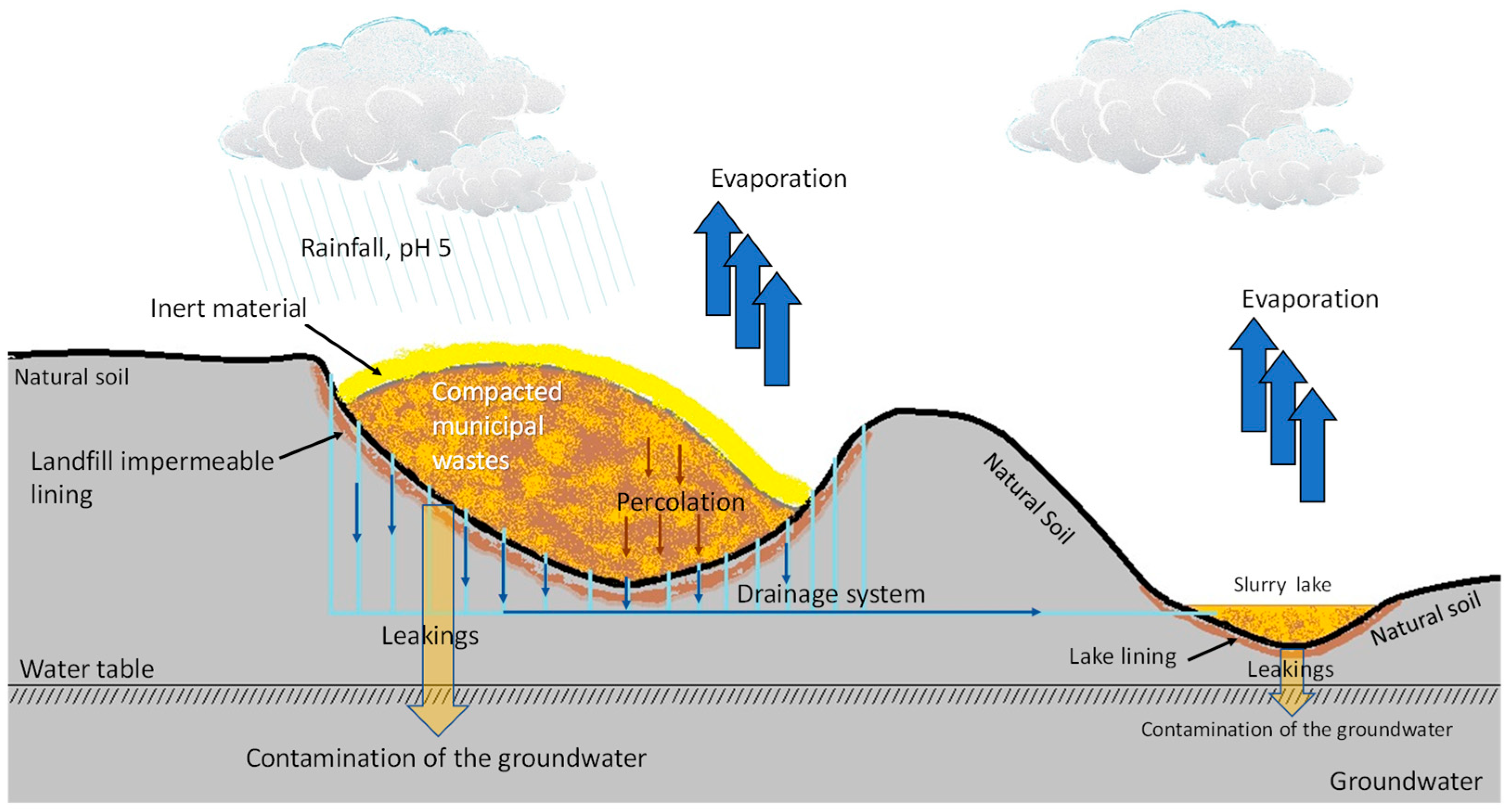
2.1. Leachates from Municipal Waste Landfill (MWLL)
2.2. Biochemistry of the Domestic Sewage Treatment Plants (STP)
3. Municipal Waste Leachate Behavior in STPs
4. Mass Balance Model for Co-Treatment Systems
4.1. Simulated Concentrations in the Effluents
- [Mixraw]—Concentration in the sewage after mixture with MWLL.
- %M—Percentages of mixture sewage and MWLL (corresponds to 1, 3, or 5%).
- [Trlevel]—Expected concentration after a defined level of treatment (decanter or UASB).
- [Mixraw]—Concentration of the mixture sewage and MWLL (Equation (1)). Different values for 1, 3 and 5%.
- %dec/UASB—Efficiency from the sequential treatment in decanter and in UASB (from Table 6).
4.2. Simulated Concentrations in the Sludges
- [Mesludge]—Metallic concentration in the sludge (mg kg−1).
- [Mixraw]—Metallic concentration in sewage MWLL mixture (Equation (1)).
4.3. Sensitivity Analysis
5. Concluding Remarks
Author Contributions
Funding
Data Availability Statement
Acknowledgments
Conflicts of Interest
References
- Slack, R.J.; Gronow, J.R.; Voulvoulis, N. Household hazardous waste in municipal landfills: Contaminants in leachate. Sci. Total Environ. 2005, 337, 119–137. [Google Scholar] [CrossRef]
- Eberemu, A.O.; Amadi, A.A.; Edeh, J.E. Diffusion of municipal waste contaminants in compacted lateritic soil treated with bagasse ash. Environ. Earth Sci. 2013, 70, 789–797. [Google Scholar] [CrossRef]
- Klauck, C.R.; Giacobbo, A.; de Oliveira, E.D.L.; da Silva, L.B.; Rodrigues, M.A.S. Evaluation of acute toxicity, cytotoxicity and genotoxicity of landfill leachate treated by biological lagoon and advanced oxidation processes. J. Environ. Chem. Eng. 2017, 5, 6188–6193. [Google Scholar] [CrossRef]
- Wasserman, J.C.; Wasserman, M.A. Behavior of metals in sediments (Comportamento de Metais em Sedimentos). In Poluição Marinha; Batista-Neto, J.A., Wallner, M., Patchineelam, S., Eds.; Editora Interciência: Rio de Janeiro, Brazil, 2005; pp. 197–236. [Google Scholar]
- Menikpura, S.N.M.; Gheewala, S.H.; Bonnet, S. Sustainability assessment of municipal solid waste management in Sri Lanka: Problems and prospects. J. Mater. Cycles Waste Manag. 2012, 14, 181–192. [Google Scholar] [CrossRef]
- Trankler, J.; Visvanathan, C.; Kuruparan, P.; Tubtimthai, O. Influence of tropical seasonal variations on landfill leachate characteristics—Results from lysimeter studies. Waste Manag. 2005, 25, 1013–1020. [Google Scholar] [CrossRef]
- Hua, J.; Zhang, L.S.; Li, Y.Z. Application of UASB-MBR system for landfill leachate treatment. In Proceedings of the International Conference on Energy and Environment Technology (ICEET 2009), Guilin, China, 16–18 October 2009; pp. 203–206. [Google Scholar]
- Yan, Y.; Hua, J.; Zhang, L.S. Application of Integrated MBR Technology for Leachate Treatment An engineering example of Jiangqiao landfill leachate treatment plant in Shanghai. In Proceedings of the 3rd International Conference on Bioinformatics and Biomedical Engineering, Beijing, China, 11–16 June 2009; IEEE: New York, NY, USA, 2009; pp. 1–4. [Google Scholar] [CrossRef]
- Kargi, F.; Pamukoglu, M.Y. Powdered activated carbon added biological treatment of pre-treated landfill leachate in a fed-batch reactor. Biotechnol. Lett. 2003, 25, 695–699. [Google Scholar] [CrossRef] [PubMed]
- Li, J.; Dong, X.R.; Liu, F.N. Research and Implementation of Landfill Leachate Control System. In Proceedings of the 6th International Conference on Control, Mechatronics and Automation (ICCMA), Tokyo, Japan, 12–14 October 2018; pp. 35–39. [Google Scholar]
- Li, T.X.; Yang, W.W.; Zhang, J. The design of the rainwater and sewage conveying system and landfill leachate treatment for a landfill site of Shanghai. In Proceedings of the Beijing International Environmental Technology Conference, Beijing, China, 16–19 October 2009; pp. 270–277. [Google Scholar]
- Varma, S.K.; Singh, R. SRB-based bioelectrochemical system: A potential multipollutant combatant for enhanced landfill waste stabilization. Waste Manag. 2022, 154, 1–14. [Google Scholar] [CrossRef] [PubMed]
- Vlyssides, A.; Karlis, P.; Loizidou, M.; Zorpas, A.; Arapoglou, D. Treatment of leachate from a domestic solid waste sanitary landfill by an electrolysis system. Environ. Technol. 2001, 22, 1467–1476. [Google Scholar] [CrossRef]
- da Silva, V.E.P.; Rollemberg, S.L.D.S.; e Santos, S.G.D.S.; Silva, T.F.C.; Vilar, V.J.P.; dos Santos, A.B. Evaluation of leachate impact on domestic sewage co-treatment in aerobic granular sludge systems. Chem. Eng. J. 2023, 470, 144178. [Google Scholar] [CrossRef]
- Machado, W.D.; Marquetti, F.; Molina, F.; Gusils, C.; Quaia, E.A. Caracterización de lodos como inoculantes para un reactor anaeróbico para el tratamiento de vinaza. Rev. Ind. Agrícola Tucumán 2016, 93, 13–17. [Google Scholar]
- Parra-Orobio, B.A.; Torres-Lozada, P.; Marmolejo-Rebellón, L.F.; Cárdenas-Cleves, L.M.; Vásquez-Franco, C.; Torres-López, W.A.; Ordóñez-Andrade, J.A. Influencia del pH sobre la digestión anaerobia de bioresiduos de origen municipal. Rev. UDCA Actual. Divulg. Científica 2014, 17, 553–562. [Google Scholar]
- Campos, F.; Bueno, R.d.F.; Piveli, R.P. Co-treatment of leachate and domestic sewage and its influence on nitrogen removal. Braz. J. Chem. Eng. 2019, 36, 763–773. [Google Scholar] [CrossRef]
- Renou, S.; Givaudan, J.G.; Poulain, S.; Dirassouyan, F.; Moulin, P. Landfill leachate treatment: Review and opportunity. J. Hazard. Mater. 2008, 150, 468–493. [Google Scholar] [CrossRef] [PubMed]
- Welander, U.; Henrysson, T.; Welander, T. Nitrification of landfill leachate using suspended-carrier biofilm technology. Water Res. 1997, 31, 2351–2355. [Google Scholar] [CrossRef]
- Chian, E.S.K.; DeWalle, F.B. Sanitary Landfill Leachates and Their Treatment. J. Environ. Eng. Div. 1976, 102, 411–431. [Google Scholar] [CrossRef]
- Kang, K.H.; Shin, H.S.; Park, H. Characterization of humic substances present in landfill leachates with different landfill ages and its implications. Water Res. 2002, 36, 4023–4032. [Google Scholar] [CrossRef]
- Cenci, M.P.; Dal Berto, F.C.; Castillo, B.W.; Veit, H.M. Precious and critical metals from wasted LED lamps: Characterization and evaluation. Environ. Technol. 2022, 43, 1870–1881. [Google Scholar] [CrossRef]
- Huang, B.; Pan, Z.F.; Su, X.Y.; An, L. Recycling of lithium-ion batteries: Recent advances and perspectives. J. Power Sources 2018, 399, 274–286. [Google Scholar] [CrossRef]
- Miao, Y.; Liu, L.; Zhang, Y.; Tan, Q.; Li, J. An overview of global power lithium-ion batteries and associated critical metal recycling. J. Hazard. Mater. 2022, 425, 127900. [Google Scholar] [CrossRef] [PubMed]
- Al-Harahsheh, S.; Masad, M.; Ibrahim, M.; Al-Awaideh, S.; Alnawaiseh, A. Study of municipal landfill site for dioxin/furan and chlorinated pesticides for al-Husainiyat landfill in al-Mafaq Jordan. Fresenius Environ. Bull. 2020, 29, 6090–6101. [Google Scholar]
- Haarstad, K.; Borch, H. Halogenated compounds, PCB and pesticides in landfill leachate, downstream lake sediments and fish. J. Environ. Sci. Health Part A-Toxic/Hazard. Subst. Environ. Eng. 2008, 43, 1346–1352. [Google Scholar] [CrossRef]
- Ramakrishnan, A.; Blaney, L.; Kao, J.; Tyagi, R.D.; Zhang, T.C.; Surampalli, R.Y. Emerging contaminants in landfill leachate and their sustainable management. Environ. Earth Sci. 2015, 73, 1357–1368. [Google Scholar] [CrossRef]
- Huckele, S.; Track, T. Risk management of emerging compounds and pathogens in the water cycle (RiSKWa). Environ. Sci. Eur. 2013, 25, 1. [Google Scholar] [CrossRef]
- Yadav, V.; Sherly, M.A.; Ranjan, P.; Prasad, V.; Tinoco, R.O.; Laurent, A. Risk of plastics losses to the environment from Indian landfills. Resour. Conserv. Recycl. 2022, 187, 8. [Google Scholar] [CrossRef]
- Yu, F.; Wu, Z.J.; Wang, J.Y.; Li, Y.Y.; Chu, R.D.; Pei, Y.Z.; Ma, J. Effect of landfill age on the physical and chemical characteristics of waste plastics/microplastics in a waste landfill sites. Environ. Pollut. 2022, 306, 9. [Google Scholar] [CrossRef]
- Shadi, A.M.H.; Kamaruddin, M.A.; Niza, N.M.; Emmanuela, M.I.; Shaah, M.A.; Yusoff, M.S.; Allafi, F.A. Characterization of stabilized leachate and evaluation of LPI from sanitary landfill in Penang, Malaysia. Desalination Water Treat. 2020, 189, 152–164. [Google Scholar] [CrossRef]
- Hofmann, A.F.; Middelburg, J.J.; Soetaert, K.; Wolf-Gladrow, D.A.; Meysman, F.J.R. Proton cycling, buffering, and reaction stoichiometry in natural waters. Mar. Chem. 2010, 121, 246–255. [Google Scholar] [CrossRef]
- Di Nanno, M.P.; Curutchet, G.; Ratto, S. Anaerobic sediment potential acidification and metal release risk assessment by chemical characterization and batch resuspension experiments. J. Soils Sediments 2007, 7, 187–194. [Google Scholar] [CrossRef]
- Caroline Baettker, E.; Kozak, C.; Knapik, H.G.; Aisse, M.M. Applicability of conventional and non-conventional parameters for municipal landfill leachate characterization. Chemosphere 2020, 251, 126414. [Google Scholar] [CrossRef]
- Erabee, I.K.; Ahsan, A.; Jose, B.; Arunkumar, T.; Sathyamurthy, R.; Idrus, S.; Daud, N.N.N. Effects of electric potential, NaCl, pH and distance between electrodes on efficiency of electrolysis in landfill leachate treatment. J. Environ. Sci. Health A Tox Hazard Subst. Environ. Eng. 2017, 52, 735–741. [Google Scholar] [CrossRef]
- Mavakala, B.K.; Le Faucheur, S.; Mulaji, C.K.; Laffite, A.; Devarajan, N.; Biey, E.M.; Giuliani, G.; Otamonga, J.P.; Kabatusuila, P.; Mpiana, P.T.; et al. Leachates draining from controlled municipal solid waste landfill: Detailed geochemical characterization and toxicity tests. Waste Manag. 2016, 55, 238–248. [Google Scholar] [CrossRef]
- Zhang, Y.X.; Cai, X.; Zhang, X.G.; Ke, H.; Lan, J.W.; Xu, W.J.; Chen, Y.M. Periodic injection of liquefied kitchen and food waste in municipal solid waste: Effects on leachate and gas generation. Waste Manag. 2024, 176, 1–10. [Google Scholar] [CrossRef]
- Delhez, É.J.M.; de Brye, B.; de Brauwere, A.; Deleersnijder, É. Residence time vs influence time. J. Mar. Sys. 2014, 132, 185–195. [Google Scholar] [CrossRef]
- Kanmani, S.; Dileepan, A.G.B. Treatment of landfill leachate using photocatalytic based advanced oxidation process—A critical review. J. Environ. Manag. 2023, 345, 118794. [Google Scholar] [CrossRef] [PubMed]
- Li, S.; Yang, Y.; Zheng, H.; Zheng, Y.; Jing, T.; Ma, J.; Nan, J.; Leong, Y.K.; Chang, J.S. Advanced oxidation process based on hydroxyl and sulfate radicals to degrade refractory organic pollutants in landfill leachate. Chemosphere 2022, 297, 134214. [Google Scholar] [CrossRef]
- Templeton, D.M.; Ariese, F.; Cornelis, R.; Danielsson, L.-G.; Muntau, H.; Van Leeuwen, H.P.; Lobinski, R. Guidelines for terms related to chemical speciation and fractionation of elements. Definitions, structural aspects, and methodological approaches (IUPAC Recommendations 2000). Pure Appl. Chem. 2000, 72, 1453–1470. [Google Scholar] [CrossRef]
- Peretyazhko, T.; Van Cappellen, P.; Meile, C.; Coquery, M.; Musso, M.; Regnier, P.; Charlet, L. Biogeochemistry of major redox elements and mercury in a tropical reservoir lake (Petit Saut, French Guiana). Aquat. Geochem. 2005, 11, 33–55. [Google Scholar] [CrossRef]
- Machado, W.; Santelli, R.E.; Carvalho, M.F.; Molisani, M.M.; Barreto, R.C.; Lacerda, L.D. Relation of reactive sulfides with organic carbon, iron, and manganese in anaerobic mangrove sediments: Implications for sediment suitability to trap trace metals. J. Coast. Res. 2008, 24, 25–32. [Google Scholar] [CrossRef]
- Hosseini Beinabaj, S.M.; Heydariyan, H.; Mohammad Aleii, H.; Hosseinzadeh, A. Concentration of heavy metals in leachate, soil, and plants in Tehran’s landfill: Investigation of the effect of landfill age on the intensity of pollution. Heliyon 2023, 9, e13017. [Google Scholar] [CrossRef]
- Barrouilhet, S.; Monperrus, M.; Tessier, E.; Khalfaoui-Hassani, B.; Guyoneaud, R.; Isaure, M.P.; Goñi-Urriza, M. Effect of exogenous and endogenous sulfide on the production and the export of methylmercury by sulfate-reducing bacteria. Environ. Sci. Pollut. Res. Int. 2023, 30, 3835–3846. [Google Scholar] [CrossRef]
- Matsuyama, A.; Yano, S.; Hisano, A.; Kindaichi, M.; Sonoda, I.; Tada, A.; Akagi, H. Distribution and characteristics of methylmercury in surface sediment in Minamata Bay. Mar. Pollut. Bull. 2016, 109, 378–385. [Google Scholar] [CrossRef]
- Mounier, S.; Lacerda, L.D.; Marins, R.V.; Bemaim, J. Copper and mercury complexing capacity of organic matter from a mangrove mud flat environment, Sepetiba Bay, Brazil. Bull. Environ. Contam. Toxicol. 2001, 67, 519–525. [Google Scholar] [CrossRef] [PubMed]
- Besser, J.M.; Brumbaugh, W.G.; May, T.W.; Ingersoll, C.G. Effects of organic amendments on the toxicity and bioavailability of cadmium and copper in spiked formulated sediments. Environ. Toxicol. Chem. 2003, 22, 805–815. [Google Scholar] [CrossRef] [PubMed]
- Paskuliakova, A.; Tonry, S.; Touzet, N. Phycoremediation of landfill leachate with chlorophytes: Phosphate a limiting factor on ammonia nitrogen removal. Water Res. 2016, 99, 180–187. [Google Scholar] [CrossRef]
- Yuan, H.Z.; Tai, Z.Q.; Li, Q.; Liu, E.F. In-situ, high-resolution evidence from water-sediment interface for significant role of iron bound phosphorus in eutrophic lake. Sci. Total Environ. 2020, 706, 11. [Google Scholar] [CrossRef]
- Guimarães, T.C.S.M.; Montenegro, K.S.; Wasserman, M.A.V.; Wasserman, J.C. Innovative microcosm experiments for the evaluation of the regeneration rates of nutrients in sediments of a hypersaline lagoon. Mar. Pollut. Bull. 2021, 166, 112252. [Google Scholar] [CrossRef] [PubMed]
- Xiao, X.; He, X.S.; Xi, B.D.; Gao, R.T.; Li, D.; Zhang, H.; Cui, D.Y.; Yuan, Z.Y. Composition, Evolution, and Complexation of Dissolved Organic Matter with Heavy Metals in Landfills. Huan Jing Ke Xue 2017, 38, 3705–3712. [Google Scholar] [CrossRef]
- Celso Monteiro Zanona, V.R.; Rodrigues Barquilha, C.E.; Borba Braga, M.C. Removal of recalcitrant organic matter of landfill leachate by adsorption onto biochar from sewage sludge: A quali-quantitative analysis. J. Environ. Manag. 2023, 344, 118387. [Google Scholar] [CrossRef]
- Chen, Y.; Guo, R.; Li, Y.C.; Liu, H.; Zhan, T.L. A degradation model for high kitchen waste content municipal solid waste. Waste Manag. 2016, 58, 376–385. [Google Scholar] [CrossRef]
- Brito, E.M.; Guyoneaud, R.; Goni-Urriza, M.; Ranchou-Peyruse, A.; Verbaere, A.; Crapez, M.A.C.; Wasserman, J.C.A.; Duran, R. Characterization of hydrocarbonoclastic bacterial communities from mangrove sediments in Guanabara Bay, Brazil. Res. Microbiol. 2006, 157, 752–762. [Google Scholar] [CrossRef]
- Wasserman, J.C.; Botelho, A.L.M.; Crapez, M.A.C.; Bispo, M.G.S.; Silva, F.S.; Filgueiras, C.M. Hydrocarbons and bacterial activity in mangrove sediments from Guanabara Bay, Brazil. Geochim. Bras. 2006, 20, 14–25. [Google Scholar]
- Ali, A.; More, T.A.; Hoonjan, A.K.; Sivakami, S. Antiglycating potential of acesulfame potassium: An artificial sweetener. Appl. Physiol. Nutr. Metab. 2017, 42, 1054–1063. [Google Scholar] [CrossRef]
- Tong, H.H.; Yin, K.; Ge, L.Y.; Giannis, A.; Chuan, V.W.L.; Wang, J.Y. Monitoring transitory profiles of leachate humic substances in landfill aeration reactors in mesophilic and thermophilic conditions. J. Hazard. Mater. 2015, 287, 342–348. [Google Scholar] [CrossRef]
- Xu, Y.D. Variation of concentration of humic-like matter in landfill leachate with landfill age. In Proceedings of the IEEE International Conference on Electronics, Communications and Control (ICECC), Ningbo, China, 9–11 September 2011; IEEE: New York, NY, USA, 2011; pp. 4617–4620. [Google Scholar]
- Bai, F.; Tian, H.; Wang, C.; Ma, J. Treatment of nanofiltration concentrate of landfill leachate using advanced oxidation processes incorporated with bioaugmentation. Environ. Pollut. 2023, 318, 120827. [Google Scholar] [CrossRef] [PubMed]
- Zhang, C.; Liu, J.; Yang, X.; Cao, W.; Qian, G. Degradation of refractory organics in biotreated landfill leachate using high voltage pulsed discharge combined with TiO2. J. Hazard. Mater. 2017, 326, 221–228. [Google Scholar] [CrossRef] [PubMed]
- Menéndez Gutiérrez, C.; Dueñas Moreno, J. Los procesos biológicos de tratamiento de aguas residuales desde una visión no convencional. Ing. Hidráulica Ambient. 2018, 39, 97–107. [Google Scholar]
- Mohamed, S. Biological and Chemical Wastewater Treatment Processes. In Wastewater Treatment Engineering; Mohamed, S., Ed.; IntechOpen: Rijeka, Croatia, 2015; pp. 1–50. [Google Scholar] [CrossRef]
- Kim, S.Y.; Lopez-Vazquez, C.M.; Curko, J.; Matosic, M.; Svetec, I.K.; Štafa, A.; Milligan, C.; Herrera, A.; Maestre, J.P.; Kinney, K.A.; et al. Supersaturated-oxygen aeration effects on a high-loaded membrane bioreactor (HL-MBR): Biological performance and microbial population dynamics. Sci. Total Environ. 2021, 771, 144847. [Google Scholar] [CrossRef]
- Von Sperling, M. Introdução à Qualidade das Águas e ao Tratamento de Esgotos, 4th ed.; Editora da UFMG: Belo Horizonte, Brazil, 2011; Volume 1, p. 452. [Google Scholar]
- de Albuquerque, E.M.; Pozzi, E.; Sakamoto, I.K.; Jurandyr, P. Treatability of landfill leachate combined with sanitary sewage in an activated sludge system. J. Water Process Eng. 2018, 23, 119–128. [Google Scholar] [CrossRef]
- Schwantes, D.; Goncalves, A.C.; Schiller, A.D.; Manfrin, J.; Campagnolo, M.A.; Somavilla, E. Pistia stratiotes in the phytoremediation and post-treatment of domestic sewage. Int. J. Phytoremediation 2019, 21, 714–723. [Google Scholar] [CrossRef]
- de Araújo, K.S.; Antonelli, R.; Gaydeczka, B.; Granato, A.C.; Malpass, G.R.P. Advanced oxidation processes: A review of fundamentals and applications in the treatment of urban and industrial wastewaters. Rev. Ambient. Agua 2016, 11, 387–401. [Google Scholar] [CrossRef]
- Santos, M.V.A.d.; Morais, J.C.d.; Veras, S.T.S.; Leite, W.R.M.; Gavazza, S.; Florencio, L.; Kato, M.T. Reatores híbridos anaeróbio e aeróbio para remoção de matéria orgânica e nitrogênio em esgoto doméstico diluído. Eng. Sanit. Ambient. 2021, 26, 591–600. [Google Scholar] [CrossRef]
- Li, Y.; Zhao, S.Y.; Zhang, J.J.; He, Y.; Zhang, J.Q.; Ge, R. Screening and Diversity Analysis of Aerobic Denitrifying Phosphate Accumulating Bacteria Cultivated from A(2)O Activated Sludge. Processes 2019, 7, 12. [Google Scholar] [CrossRef]
- Feng, L.; Jia, R.; Zeng, Z.; Yang, G.; Xu, X. Simultaneous nitrification–denitrification and microbial community profile in an oxygen-limiting intermittent aeration SBBR with biodegradable carriers. Biodegradation 2018, 29, 473–486. [Google Scholar] [CrossRef] [PubMed]
- Iurchenko, V.; Tsytlishvili, K.; Malovanyy, M. Wastewater treatment by conversion of nitrogen-containing pollution by immobilized microbiocenosis in a biodisk installation. Ecol. Quest. 2022, 33, 21–30. [Google Scholar] [CrossRef]
- Mehrotra, T.; Srivastava, A.; Rao, R.P.; Singh, R. A Novel Immobilized Bacterial Consortium Bioaugmented in a Bioreactor For Sustainable Wastewater Treatment. J. Pure Appl. Microbiol. 2019, 13, 371–383. [Google Scholar] [CrossRef]
- Safitri, R.; Priadie, B.; Hawadish, A. Domestic waste water bioremediation by consortium of bacteria. Sci. Pap.-Anim. Sci. Ser. Lucr. Ştiinţifice-Ser. Zooteh. 2015, 63, 134–141. [Google Scholar]
- Dhall, P.; Kumar, R.; Kumar, A.J.T.S.W.J. Biodegradation of Sewage Wastewater Using Autochthonous Bacteria. Sci. World J. 2012, 2012, 861903. [Google Scholar] [CrossRef] [PubMed]
- Gupta, A.B.; Gupta, S.K. Simultaneous carbon and nitrogen removal from high strength domestic wastewater in an aerobic RBC biofilm. Water Res. 2001, 35, 1714–1722. [Google Scholar] [CrossRef]
- Gupta, A.B.; Gupta, S.K. Simultaneous carbon and nitrogen removal in a mixed culture aerobic RBC biofilm. Water Res. 1999, 33, 555–561. [Google Scholar] [CrossRef]
- Zhang, J.; Zhang, L.; Miao, Y.; Sun, Y.; Li, X.; Zhang, Q.; Peng, Y. Feasibility of in situ enriching anammox bacteria in a sequencing batch biofilm reactor (SBBR) for enhancing nitrogen removal of real domestic wastewater. Chem. Eng. J. 2018, 352, 847–854. [Google Scholar] [CrossRef]
- Song, P.; Huang, G.; Hong, Y.; An, C.; Xin, X.; Zhang, P. A biophysiological perspective on enhanced nitrate removal from decentralized domestic sewage using gravitational-flow multi-soil-layering systems. Chemosphere 2020, 240, 124868. [Google Scholar] [CrossRef]
- Gong, L.; Jun, L.; Yang, Q.; Wang, S.; Ma, B.; Peng, Y. Biomass characteristics and simultaneous nitrification-denitrification under long sludge retention time in an integrated reactor treating rural domestic sewage. Bioresour. Technol. 2012, 119, 277–284. [Google Scholar] [CrossRef]
- Abdelgadir, A.; Chen, X.G.; Liu, J.S.; Xie, X.H.; Zhang, J.; Zhang, K.; Wang, H.; Liu, N. Characteristics, Process Parameters, and Inner Components of Anaerobic Bioreactors. Biomed. Res. Int. 2014, 2014, 841573. [Google Scholar] [CrossRef] [PubMed]
- Flemming, H.-C.; Wingender, J.; Szewzyk, U.; Steinberg, P.; Rice, S.A.; Kjelleberg, S. Biofilms: An emergent form of bacterial life. Nat. Rev. Microbiol. 2016, 14, 563–575. [Google Scholar] [CrossRef]
- Arévalo-Arbeláez, Á.J.; Bedoya-Urrego, K.; Cabarcas-Jaramillo, F.; Alzate-Restrepo, J.F. Descripción de la microbiota bacteriana residente en el biosólido generado en la planta de tratamiento de aguas residuales San Fernando. Itagüí, Colombia. Rev. Salud Pública 2017, 19, 806–813. [Google Scholar] [CrossRef] [PubMed]
- Dumontet, S.; Dinel, H.; Baloda, S.B. Pathogen Reduction in Sewage Sludge by Composting and Other Biological Treatments: A Review. Biol. Agric. Hortic. 1999, 16, 409–430. [Google Scholar] [CrossRef]
- Ji, J.Y.; Xing, Y.J.; Ma, Z.T.; Zhang, M.; Zheng, P. Acute toxicity of pharmaceutical wastewaters containing antibiotics to anaerobic digestion treatment. Chemosphere 2013, 91, 1094–1098. [Google Scholar] [CrossRef]
- Ruiz, I.; Blázquez, R.; Soto, M. Methanogenic toxicity in anaerobic digesters treating municipal wastewater. Bioresour. Technol. 2009, 100, 97–103. [Google Scholar] [CrossRef]
- Zhang, L.; Mendoza, L.; Marzorati, M.; Verstraete, W. Inhibition of sulfide generation by dosing formaldehyde and its derivatives in sewage under anaerobic conditions. Water Sci. Technol. 2008, 57, 915–919. [Google Scholar] [CrossRef]
- Garcia, M.T.; Campos, E.; Sánchez-Leal, J.; Ribosa, I. Effect of linear alkylbenzene sulphonates (LAS) on the anaerobic digestion of sewage sludge. Water Res. 2006, 40, 2958–2964. [Google Scholar] [CrossRef]
- Barreira, R.P.R.; Villar, L.D.; Garcia, O., Jr. Tolerance to copper and zinc of Acidithiobacillus thiooxidans isolated from sewage sludge. World J. Microbiol. Biotechnol. 2005, 21, 89–91. [Google Scholar] [CrossRef]
- Shen, C.F.; Kosaric, N. Toxicity of sulfite and cadmium to anaerobic granular sludge. Water Pollut. Res. J. Can. 1994, 29, 581–597. [Google Scholar]
- Muller, R.; Steiner, A. The influence of nickel on sewage sludge digestion. GWF Wasser Abwasser 1988, 129, 425–430. [Google Scholar]
- Berry, R.C.; Lin, K.C. Experimental studies on the co-treatment of landfill leachate and sewage in Fredericton, NB, Canada. WIT Trans. Ecol. Environ. 1997, 14, 463–472. [Google Scholar]
- Niininen, M.; Kalliokoski, P.; Eskelinen, T. Co-treatment of landfill leachate and domestic sewage in activated sludge plant: A case study in Finland. In Proceedings of the International Conference on Environmental Pollution—ICEP-1, Lisbon, Portugal, 1 April 1991; pp. 307–313. [Google Scholar]
- Danley-Thomson, A.; Worley-Morse, T.; Contreras, S.U.J.; Herman, S.; Brawley, A.; Karcher, K. Determining the effects of Class I landfill leachate on biological nutrient removal in wastewater treatment. J. Environ. Manag. 2020, 275, 111198. [Google Scholar] [CrossRef]
- Diamadopoulos, E.; Samaras, P.; Dabou, X.; Sakellaropoulos, G.P. Combined treatment of landfill leachate and domestic sewage in a sequencing batch reactor. Water Sci. Technol. 1997, 36, 61–68. [Google Scholar] [CrossRef]
- Bae, W.; Kim, S.; Lee, J.; Chung, J. Effect of leachate circulation with ex situ nitrification on waste decomposition and nitrogen removal for early stabilization of fresh refuse landfill. J. Hazard. Mater. 2019, 371, 721–727. [Google Scholar] [CrossRef]
- Elk, A.G.H.P.v.; D’Oliveira, P.M.S.; Giordano, G.; Andrade, R.C.d. Potencial poluidor da disposição final de resíduos sólidos nas águas da bacia hidrográfica da Baía de Guanabara—RJ. Eng. Sanit. Ambient. 2022, 27, 195–203. [Google Scholar] [CrossRef]
- Vicente, M.A.; de Melo, G.V.; Baptista Neto, J.A.; de Oliveira, A.S. Phosphorus fractionation distribution in Guapimirim estuary: SE Brazil. Springerplus 2016, 5, 1406. [Google Scholar] [CrossRef]
- Øygard, J.K.; Gjengedal, E.; Røyset, O. Size charge fractionation of metals in municipal solid waste landfill leachate. Water Res. 2007, 41, 47–54. [Google Scholar] [CrossRef]
- Yuan, Q.; Jia, H.; Poveda, M. Study on the effect of landfill leachate on nutrient removal from municipal wastewater. J. Environ. Sci. 2016, 43, 153–158. [Google Scholar] [CrossRef]
- Baun, D.L.; Christensen, T.H. Speciation of heavy metals in landfill leachate: A review. Waste Manag. Res. 2004, 22, 3–23. [Google Scholar] [CrossRef]
- Ngoc, N.T.; Nakajima, J.; Takaoka, M.; Hang, N.T.A. Heavy metal speciation in landfill leachate and its association with organic matter. In Proceedings of the 4th International Forum on Sustainable Future in Asia, Hanoi, Vietnam, 23–24 January 2019. [Google Scholar]
- Zheng, X.; Li, R. Mechanisms of how exogenous CO(2) affects methane production in an optimized high-solid anaerobic digester treating co-substrates of sewage sludge and food waste. Sci. Total Environ. 2024, 951, 175837. [Google Scholar] [CrossRef]
- Trabelsi, I.; Salah, S.; Ounaeis, F. Coupling short-time sequencing batch reactor and coagulation-settling process for co-treatment of landfill leachate with raw municipal wastewater. Arab. J. Geosci. 2013, 6, 2071–2079. [Google Scholar] [CrossRef]
- Iskander, S.M.; Zhao, R.Z.; Pathak, A.; Gupta, A.; Pruden, A.; Novak, J.T.; He, Z. A review of landfill leachate induced ultraviolet quenching substances: Sources, characteristics, and treatment. Water Res. 2018, 145, 297–311. [Google Scholar] [CrossRef] [PubMed]
- Patel, H.V.; Zhao, R. Synergetic Effects of Chemically Enhanced Primary Treatment (CEPT) on UV Quenching Phenomenon during the Co-treatment of Sewage and Landfill Leachate. In Proceedings of the 91st Annual Water Environment Federation Technical Exhibition and Conference, WEFTEC 2018, New Orleans, LA, USA, 29 September–3 October 2018; pp. 2412–2421. [Google Scholar]
- Dereli, R.K.; Clifford, E.; Casey, E. Co-treatment of leachate in municipal wastewater treatment plants: Critical issues and emerging technologies. Crit. Rev. Environ. Sci. Technol. 2021, 51, 1079–1128. [Google Scholar] [CrossRef]
- De Carluccio, M.; Sabatino, R.; Eckert, E.M.; Di Cesare, A.; Corno, G.; Rizzo, L. Co-treatment of landfill leachate with urban wastewater by chemical, physical and biological processes: Fenton oxidation preserves autochthonous bacterial community in the activated sludge process. Chemosphere 2023, 313, 137578. [Google Scholar] [CrossRef]
- Mannarino, C.F.; Ferreira, J.A.; Moreira, J.C.; Bila, D.M.; Magalhaes, D.P. Assessment of Combined Treatment of Landfill Urban Solid Waste Leachate and Sewage Using Danio rerio and Daphnia similis. Bull. Environ. Contam. Toxicol. 2010, 85, 274–278. [Google Scholar] [CrossRef]
- Yang, K.; Zhou, X.N.; Yan, W.A.; Hang, D.R.; Steinmann, P. Landfills in Jiangsu province, China, and potential threats for public health: Leachate appraisal and spatial analysis using geographic information system and remote sensing. Waste Manag. 2008, 28, 2750–2757. [Google Scholar] [CrossRef]
- Øygard, J.K.; Gjengedal, E.; Mobbs, H.J. Trace element exposure in the environment from MSW landfill leachate sediments measured by a sequential extraction technique. J. Hazard. Mater. 2008, 153, 751–758. [Google Scholar] [CrossRef] [PubMed]
- Lo, I.M.C. Characteristics and treatment of leachates from domestic landfills. Environ. Intern. 1996, 22, 433–442. [Google Scholar] [CrossRef]
- Zhang, H.Y.; Yang, B.; Zhang, G.W.; Zhang, X.C. Sewage sludge as barrier material for heavy metals in waste landfill. Arch. Environ. Prot. 2016, 42, 52–58. [Google Scholar] [CrossRef]
- DelaPaz-Ruíz, N.; Augustijn, E.-W.; Farnaghi, M.; Zurita-Milla, R. Modeling spatiotemporal domestic wastewater variability: Implications for measuring treatment efficiency. J. Environ. Manag. 2024, 351, 119680. [Google Scholar] [CrossRef]
- Alsulaili, A.; Al-Buloushi, B.Y.; Hamoda, M.F. Seasonal variation pattern of physicochemical and microbial parameters in a wastewater treatment plant. Desalination Water Treat. 2020, 208, 244–260. [Google Scholar] [CrossRef]
- Agoro, M.A.; Adeniji, A.O.; Adefisoye, M.A.; Okoh, O.O. Heavy Metals in Wastewater and Sewage Sludge from Selected Municipal Treatment Plants in Eastern Cape Province, South Africa. Water 2020, 12, 2746. [Google Scholar] [CrossRef]
- Szylak-Szydlowski, M. Effectiveness of Removal of Humic Substances and Heavy Metals from Landfill Leachates During Their Pretreatment Process in the SBR Reactor. Ecol. Chem. Eng. S 2012, 19, 405–413. [Google Scholar] [CrossRef]
- Gao, Y.L.; Yang, J.; Song, X.W.; Shen, D.M.; Wang, W.F.; Liu, W.; Zhang, W.M. Co-treatment of mixed municipal sewage and landfill leachates via the hydrolytic acidification-sequencing batch reactors-membrane bioreactor process. Desalination Water Treat. 2021, 216, 96–103. [Google Scholar] [CrossRef]
- Teiri, H.; Rezaei, M.; Nazmara, S.; Hajizadeh, Y. Sulphate reduction and zinc precipitation from wastewater by sulphate-reducing bacteria in an anaerobic moving-liquid/static-bed bioreactor. Desalination Water Treat. 2016, 57, 25617–25626. [Google Scholar] [CrossRef]
- Ismail, S.; Nasr, M.; Abdelrazek, E.; Awad, H.M.; Zhaof, S.; Meng, F.G.; Tawfik, A. Techno-economic feasibility of energy-saving self-aerated sponge tower combined with up-flow anaerobic sludge blanket reactor for treatment of hazardous landfill leachate. J. Water Process Eng. 2020, 37, 11. [Google Scholar] [CrossRef]
- Luo, Y.; Guo, W.; Ngo, H.H.; Nghiem, L.D.; Hai, F.I.; Zhang, J.; Liang, S.; Wang, X.C. A review on the occurrence of micropollutants in the aquatic environment and their fate and removal during wastewater treatment. Sci. Total Environ. 2014, 473–474, 619–641. [Google Scholar] [PubMed]
- Reimann, C.; de Caritat, P. Chemical Elements in the Environment: Factsheets for the Geochemist and Environmental Scientist; Springer: Heidelberg, Germany, 1998; p. 398. [Google Scholar]
- Veeck, L.; Silva-Filho, E.V.d.; Wasserman, J.C.; Sella, S.M.; Santos, I.; Lacerda, L.D. Mercury distribution in sediments of a sub-tropical coastal lagoon, Sepetiba Bay, SE Brazil. Geochim. Bras. 2007, 21, 50–57. [Google Scholar]
- Lopez, P.R.S.; Bispo, M.d.G.S.; Crappez, M.d.A.C.; Wasserman, J.C. Role of bacterial esterase on mercury dynamics in mangrove sediments. Geochim. Bras. 2019, 33, 64–75. [Google Scholar] [CrossRef]
- Wasserman, J.C.; Freitas-Pinto, A.A.P.; Amouroux, D. Mercury concentrations in sediment profiles of a degraded tropical coastal environment. Environ. Technol. 2000, 21, 297–305. [Google Scholar] [CrossRef]
- Kehrig, H.A.; Pinto, F.N.; Moreira, I.; Malm, O. Heavy metals and methylmercury in a tropical coastal estuary and a mangrove in Brazil. Org. Geochem. 2003, 34, 661–669. [Google Scholar] [CrossRef]
- Wasserman, J.C.; Moutella, A.C.; Da Silva Filho, E.V. Attenuation of metallic concentrations model applied to a polluted bay in Brazil. In Remediation of Contaminated Sediments—2003: Proceedings of the Second International Conference on Remediation of Contaminated Sediments; Battelle Conferences (Columbus, Ohio): Venice, Italy, 2004; pp. 399–406. [Google Scholar]
- Oliveira, F.F. Distribuição de Mercúrio nos Sedimentos Superficiais da Baía de Guanabara (RJ—Brasil); Universidade Federal Fluminense: Niterói, Brazil, 2009. [Google Scholar]


| COD (mg L−1) | BOD (mg L−1) | BOD/COD | pH | TSS (mg L−1) | N-Kjeldal (mg L−1) | NH4+-N (mg L−1) | |
|---|---|---|---|---|---|---|---|
| Recent sanitary landfills | |||||||
| Average | 21,809 | 10,477 | 0.43 | 7.5 | 2313 | 1381 | 1663 |
| Standard deviation | 18,507 | 7986 | 0.17 | 1.0 | 1278 | 1480 | 1501 |
| Maximum | 70,900 | 26,000 | 0.70 | 9.1 | 5000 | 3400 | 5210 |
| Minimum | 1870 | 90 | 0.05 | 5.6 | 950 | 11 | 3 |
| N | 18 | 18 | 18 | 21 | 10 | 8 | 17 |
| Mature sanitary landfills | |||||||
| Average | 5353 | 897 | 0.21 | 8.0 | 632 | 1339 | 1638 |
| Standard deviation | 2500 | 400 | 0.09 | 0.5 | 215 | 271 | 1718 |
| Maximum | 9500 | 1436 | 0.33 | 9.0 | 784 | 1670 | 5500 |
| Minimum | 1180 | 331 | 0.07 | 6.9 | 480 | 1100 | 743 |
| N | 12 | 9 | 9 | 10 | 2 | 4 | 7 |
| Old sanitary landfills | |||||||
| Average | 2125 | 147 | 0.10 | 8.2 | 574 | 586 | 632 |
| Standard deviation | 2676 | 249 | 0.12 | 1.3 | 671 | 637 | 571 |
| Maximum | 10,000 | 800 | 0.37 | 11.5 | 1600 | 1680 | 1590 |
| Minimum | 100 | 3 | 0.01 | 7.0 | 13 | 5 | 0.2 |
| N | 12 | 9 | 10 | 11 | 7 | 6 | 9 |
| Fe (mg L−1) | Mn (mg L−1) | Ba (mg L−1) | Cu (mg L−1) | Al (mg L−1) | Si (mg L−1) | |
|---|---|---|---|---|---|---|
| Recent sanitary landfills | ||||||
| Value | 2.7 | 0.04 | – | – | – | – |
| n | 1 | 1 | 0 | 0 | 0 | 0 |
| Mature sanitary landfills | ||||||
| Average | 780.1 | 3.66 | 0.09 | 0.39 | 0.47 | 7.1 |
| Standard deviation | 1694.6 | 7.15 | 0.11 | 0.35 | 0.64 | 4.8 |
| Maximum | 3811.0 | 16.40 | 0.20 | 0.78 | 0.92 | 10.5 |
| Minimum | 1.3 | 0.03 | 0.01 | 0.12 | 0.02 | 3.7 |
| n | 5 | 5 | 2 | 3 | 2 | 2 |
| Old sanitary landfills | ||||||
| Average | 13.8 | 4.03 | 0.15 | 0.04 | 1.50 | 5.0 |
| Standard deviation | 10.7 | 7.65 | 0.03 | 0.71 | ||
| Maximum | 26.0 | 15.50 | 0.15 | 0.08 | 2.00 | 5.0 |
| Minimum | 4.1 | 0.13 | 0.15 | 0.01 | 1.00 | 5.0 |
| n | 4 | 4 | 1 | 4 | 2 | 1 |
| Landfill | Pb (mg L−1) | As (mg L−1) | Cr (mg L−1) | Hg (µg L−1) |
|---|---|---|---|---|
| Pingwang | 0.195 | 0.113 | 0.086 | 0.467 |
| Badu | 0.034 | 0.078 | 0.132 | 0.093 |
| Taochuashan | 0.098 | 0.033 | 0.064 | 4.670 |
| Xinhu | 0.098 | 0.065 | 0.110 | 0.930 |
| Miaogang | 0.179 | 0.065 | 0.110 | 0.561 |
| Average | 0.121 | 0.071 | 0.100 | 1.344 |
| Standard deviation | 0.066 | 0.029 | 0.026 | 1.883 |
| Maximum | 0.195 | 0.113 | 0.132 | 4.670 |
| Minimum | 0.034 | 0.033 | 0.064 | 0.093 |
| N | 5 | 5 | 5 | 5 |
| Landfill | Fe (mg L−1) | Zn (µg L−1) | Cr (µg L−1) | Cu (µg L−1) | Pb (µg L−1) | Cd (µg L−1) | Ni (µg L−1) |
|---|---|---|---|---|---|---|---|
| Landfill 1 | 22 | 150 | 63 | 31 | 11 | 0.44 | – |
| Landfill 2 | 15 | 220 | 7.9 | 8.4 | 3.4 | 0.16 | – |
| Landfill 3 | 35 | 550 | 44 | 190 | – | 0.32 | – |
| Landfill 4 | 110 | 240 | 58 | 16 | 4 | 0.15 | 31 |
| Landfill 5 | 24 | 52 | 30 | 11 | 3.1 | 0.09 | 13 |
| Landfill 6 | 10 | 320 | 36 | 24 | 7.1 | 1.4 | 20 |
| Landfill 7 | 20 | 110 | 31 | 21 | 4.3 | 0.65 | 12 |
| Landfill 8 | 59 | 50 | 12 | 5.3 | 1.5 | 0.09 | 8.5 |
| Average | 36.9 | 211.5 | 35.2 | 38.3 | 4.9 | 0.4 | 16.9 |
| Standard deviation | 33.2 | 166.0 | 19.6 | 61.9 | 3.2 | 0.4 | 8.9 |
| Maximum | 110.0 | 550.0 | 63.0 | 190.0 | 11.0 | 1.4 | 31 |
| Minimum | 10.0 | 50.0 | 7.9 | 5.3 | 1.5 | 0.1 | 8.5 |
| n | 8 | 8 | 8 | 8 | 7 | 8 | 5 |
| Parameter | Description | References | From Equation |
|---|---|---|---|
| [MaxMWLL] | Maximum concentration in MWLL (values from Table 1, Table 2, Table 3 and Table 4) | [18,110,111] * | Equation (1) |
| %M | Percentages of mixture sewage and MWLL (corresponds to 1, 3 or 5%) | Attributed by the authors | Equation (1) |
| %dec | Percentage of removal from the decantation system | [65] | Equation (2) |
| %UASB | Percentage of removal from the UASB system | [65] | Equation (2) |
| [Mixraw] | Concentration of the mixture of sewage and MWLL (Equation (1)). Different values for 1, 3, and 5% | Obtained from Equation (1) | Equation (3) |
| %dec/UASB | Efficiency from the sequential treatment in the decanter and in the UASB | [65] | Equation (3) |
| [Susp] | Concentration of total suspended matter in the sewage MWLL mixture | [112] | Equation (4) |
| RA | Rate of adsorption. Conservatively assumed to be 70% | [101,113] | Equation (4) |
| Expected Concentrations from the Mixture (with no Treatment) | ||||
|---|---|---|---|---|
| Parameter | Maximum Values in the Landfill Leachate | 1% | 3% | 5% |
| COD (mg L−1) | 70,900 1 | 709 | 2127 | 3545 |
| BOD (mg L−1) | 26,800 1 | 268 | 804 | 1340 |
| Suspended solids (mg L−1) | 5000 2 | 50 | 150 | 250 |
| Ammonium (mg L−1) | 5500 1 | 55 | 165 | 275 |
| Al (mg L−1) | 2.00 1 | 0.02 | 0.06 | 0.1 |
| As (mg L−1) | 0.113 3 | 0.00113 | 0.00339 | 0.00565 |
| Ba (mg L−1) | 0.20 1 | 0.0020 | 0.0060 | 0.010 |
| Cd (µg L−1) | 1.4 4 | 0.014 | 0.042 | 0.07 |
| Cr (µg L−1) | 132.00 3 | 1.32 | 3.96 | 6.60 |
| Cu (mg L−1) | 0.78 1 | 0.0078 | 0.0234 | 0.039 |
| Fe (mg L−1) | 3811.0 1 | 38.11 | 114.33 | 190.55 |
| Hg (µg L−1) | 4.67 3 | 0.0467 | 0.1401 | 0.2335 |
| Mn (mg L−1) | 16.40 1 | 0.164 | 0.492 | 0.82 |
| Ni (µg L−1) | 31 4 | 0.31 | 0.93 | 1.55 |
| Pb (mg L−1) | 0.195 3 | 0.00195 | 0.00585 | 0.00975 |
| Si (mg L−1) | 10.5 1 | 0.1048 | 0.3144 | 0.524 |
| Zn (µg L−1) | 550 4 | 5.5 | 16.5 | 27.5 |
| Removal Capacity (%) | |||
|---|---|---|---|
| Parameter | Primary Decanter | UASB System | Total |
| COD | 10.0 ± 1.3 | 93.0 ± 7.0 * | 93.7 ± 6.3 * |
| BOD | 25.0 ± 3.1 | 88.0 ± 11.0 | 91.0 ± 9.0 * |
| Suspended solids | 60.0 ± 7.5 | 30.0 ± 3.8 | 72.0 ± 9.0 |
| Ammonium | 10.0 ± 1.3 | 60.0 ± 7.5 | 64.0 ± 8.0 |
| Aluminum | 42.0 ± 5.3 | 25.2 ± 3.2 | 56.6 ± 7.1 |
| Arsenic | 42.0 ± 5.3 | 25.2 ± 3.2 | 56.6 ± 7.1 |
| Barium | 42.0 ± 5.3 | 25.2 ± 3.2 | 56.6 ± 7.1 |
| Cadmium | 42.0 ± 5.3 | 25.2 ± 3.2 | 56.6 ± 7.1 |
| Chromium | 42.0 ± 5.3 | 25.2 ± 3.2 | 56.6 ± 7.1 |
| Copper | 42.0 ± 5.3 | 25.2 ± 3.2 | 56.6 ± 7.1 |
| Iron | 42.0 ± 5.3 | 25.2 ± 3.2 | 56.6 ± 7.1 |
| Mercury | 42.0 ± 5.3 | 25.2 ± 3.2 | 56.6 ± 7.1 |
| Manganese | 42.0 ± 5.3 | 25.2 ± 3.2 | 56.6 ± 7.1 |
| Nickel | 42.0 ± 5.3 | 25.2 ± 3.2 | 56.6 ± 7.1 |
| Lead | 42.0 ± 5.3 | 25.2 ± 3.2 | 56.6 ± 7.1 |
| Silicium | 42.0 ± 5.3 | 25.2 ± 3.2 | 56.6 ± 7.1 |
| Zinc | 42.0 ± 5.3 | 25.2 ± 3.2 | 56.6 ± 7.1 |
| Primary Decanter | ||||
|---|---|---|---|---|
| Level of Treatment (%) | 1% | 3% | 5% | |
| COD (mg L−1) | 10.0 ± 1.3 | 638.10 ± 8.86 | 1914.30 ± 26.59 | 3190.50 ± 44.10 |
| BOD (mg L−1) | 25.0 ± 3.1 | 201.00 ± 8.38 | 603.00 ± 25.13 | 1005.00 ± 41.88 |
| Suspended solids (mg L−1) | 60.0 ± 7.5 | 20.00 ± 3.75 | 60.00 ± 11.25 | 100.00 ± 18.75 |
| Ammonium (mg L−1) | 10.0 ± 1.3 | 49.50 ± 0.69 | 148.50 ± 11.25 | 247.50 ± 3.44 |
| Al (µg L−1) | 42.0 ± 5.3 | 11.60 ± 0.00 | 34.80 ± 2.06 | 58.00 ± 0.01 |
| As (µg L−1) | 42.0 ± 5.3 | 0.66 ± 0.06 | 1.97 ± 0.18 | 3.28 ± 0.30 |
| Ba (µg L−1) | 42.0 ± 5.3 | 1.16 ± 0.11 | 3.48 ± 0.32 | 5.80 ± 0.53 |
| Cd (µg L−1) | 42.0 ± 5.3 | 0.01 ± 0.00 | 0.02 ± 0.00 | 0.04 ± 0.00 |
| Cr (µg L−1) | 42.0 ± 5.3 | 0.77 ± 0.07 | 2.30 ± 0.21 | 3.83 ± 0.35 |
| Cu (µg L−1) | 42.0 ± 5.3 | 4.52 ± 0.41 | 13.57 ± 1.23 | 22.62 ± 2.05 |
| Fe (µg L−1) | 42.0 ± 5.3 | 22,104.00 ± 2000.00 | 66,311.00 ± 6002.33 | 110,519.00 ± 10,003.88 |
| Hg (µg L−1) | 42.0 ± 5.3 | 0.03 ± 0.00 | 0.08 ± 0.01 | 0.14 ± 0.01 |
| Mn (µg L−1) | 42.0 ± 5.3 | 95.12 ± 8.61 | 285.36 ± 25.83 | 475.60 ± 43.05 |
| Ni (µg L−1) | 42.0 ± 5.3 | 0.18 ± 0.02 | 0.54 ± 0.05 | 0.90 ± 0.08 |
| Pb (µg L−1) | 42.0 ± 5.3 | 1.13 ± 0.10 | 3.39 ± 0.31 | 5.66 ± 0.51 |
| Si (µg L−1) | 42.0 ± 5.3 | 60.78 ± 5.50 | 182.35 ± 16.51 | 303.92 ± 27.51 |
| Zn (µg L−1) | 42.0 ± 5.3 | 3.20 ± 0.29 | 9.60 ± 0.87 | 15.95 ± 1.44 |
| Primary Decanter + UASB | |||||
|---|---|---|---|---|---|
| Level of Treatment | 1% | 3% | 5% | NOP-45 | |
| COD (mg L−1) | 93.7 ± 6.3 * | 44.67 ± 44.67 | 134.00 ± 134.00 | 223.30 ± 223.30 | 180 |
| BOD (mg L−1) | 91.0 ± 9.0 * | 24.12 ± 24.12 | 72.36 ± 72.36 | 120.60 ± 120.60 | 40 |
| Suspended solids (mg L−1) | 72.0 ± 9.0 | 14.00 ± 4.50 | 42.0 ± 13.50 | 70.00 ± 22.50 | 40 |
| Ammonium (mg L−1) | 64.0 ± 8.0 | 19.80 ± 4.40 | 59.4 ± 13.20 | 99.00 ± 22.00 | 20/10 |
| Al (µg L−1) | 56.6 ± 7.1 | 8.70 ± 1.42 | 26.0 ± 4.26 | 43.40 ± 7.10 | 3000 |
| As (µg L−1) | 56.6 ± 7.1 | 0.49 ± 0.08 | 1.47 ± 0.24 | 2.45 ± 0.40 | 100 |
| Ba (µg L−1) | 56.6 ± 7.1 | 0.87 ± 0.14 | 2.60 ± 0.43 | 4.34 ± 0.71 | 5000 |
| Cd (µg L−1) | 56.6 ± 7.1 | 0.01 ± 0.00 | 0.02 ± 0.00 | 0.03 ± 0.00 | 100 |
| Cr (µg L−1) | 56.6 ± 7.1 | 0.57 ± 0.09 | 1.72 ± 0.28 | 2.86 ± 0.47 | 100 |
| Cu (µg L−1) | 56.6 ± 7.1 | 3.38 ± 0.55 | 10.15 ± 1.66 | 16.92 ± 2.76 | 1000 |
| Fe (µg L−1) | 56.6 ± 7.1 | 16,534.00 ± 2697.04 | 49,601.00 ± 8091.13 | 82,668.00 ± 13,485.22 | 15,000 |
| Hg (µg L−1) | 56.6 ± 7.1 | 0.02 ± 3.30 | 0.06 ± 9.91 | 0.10 ± 16.52 | 10 |
| Mn (µg L−1) | 56.6 ± 7.1 | 71.15 ± 11.61 | 213.45 ± 34.82 | 355.75 ± 58.03 | 1000 |
| Ni (µg L−1) | 56.6 ± 7.1 | 0.13 ± 21.94 | 0.40 ± 64.82 | 0.67 ± 109.69 | 1000 |
| Pb (µg L−1) | 56.6 ± 7.1 | 0.85 ± 0.14 | 2.54 ± 0.41 | 4.23 ± 0.69 | 500 |
| Si (µg L−1) | 56.6 ± 7.1 | 45.47 ± 7.42 | 136.40 ± 22.25 | 227.33 ± 37.08 | |
| Zn (µg L−1) | 56.6 ± 7.1 | 2.39 ± 0.39 | 7.16 ± 1.17 | 11.93 ± 1.95 | 1000 |
| Concentrations in the Sewage Sludge | ||||
|---|---|---|---|---|
| 1% | 3% | 5% | Mean Shale | |
| Suspended solids (mg L−1) 5000 | ||||
| Al (mg kg−1) | 2.8 | 8.4 | 14.0 | 91,000 |
| As (mg kg−1) | 0.16 | 0.47 | 0.79 | 13 |
| Ba (mg kg−1) | 0.28 | 0.84 | 1.40 | 550 |
| Cd (mg kg−1) | 2.0 × 10⁻⁶ | 5.9 × 10⁻⁶ | 9.8 × 10⁻⁶ | 0.25 |
| Cr (mg kg−1) | 0.18 | 0.55 | 0.92 | 100 |
| Cu (mg kg−1) | 1.09 | 3.28 | 5.46 | 45 |
| Fe (mg kg−1) | 5335 | 16,006 | 26,677 | 55,000 |
| Hg (mg kg−1) | 0.00 | 0.00 | 0.00 | 0.18 |
| Mn (mg kg−1) | 22.96 | 68.88 | 114.80 | 850 |
| Ni (mg kg−1) | 0.00 | 0.00 | 0.00 | 70 |
| Pb (mg kg−1) | 0.27 | 0.82 | 1.37 | 22 |
| Si (mg kg−1) | 14.67 | 44.02 | 73.36 | 288,000 |
| Zn (mg kg−1) | 0.00 | 0.00 | 0.00 | 100 |
| Expected Concentration from a 5% Mixture with Various Removal Rates | ||||
|---|---|---|---|---|
| Parameter | 100% * | 50% * | 20% * | NOP-45 |
| COD (mg L−1) | 223 | 1884 | 2881 | 180 |
| BOD (mg L−1) | 120.6 | 730.3 | 1096.1 | 40 |
| Suspended solids (mg L−1) | 70 | 160 | 214 | 40 |
| Ammonium (mg L−1) | 99.0 | 187.0 | 239.8 | 20/10 |
| Al (mg L−1) | 43.40 | 71.70 | 88.68 | 3000 |
| As (mg L−1) | 2.45 | 4.05 | 5.01 | 100 |
| Ba (mg L−1) | 4.34 | 7.17 | 8.87 | 5000 |
| Cd (mg L−1) | 3.04 × 10⁻⁵ | 5.02 × 10⁻⁵ | 6.21 × 10⁻⁵ | 100 |
| Cr (mg L−1) | 2.86 | 4.73 | 5.85 | 100 |
| Cu (mg L−1) | 16.93 | 27.96 | 34.59 | 1000 |
| Fe (mg L−1) | 82,699 | 136,624 | 168,980 | 15,000 |
| Hg (mg L−1) | 1.01 × 10⁻⁴ | 1.67 × 10⁻⁴ | 2.07 × 10⁻⁴ | 10 |
| Mn (mg L−1) | 355.9 | 587.9 | 727.2 | 1000 |
| Ni (mg L−1) | 6.73 × 10⁻⁴ | 1.11 × 10⁻³ | 1.37 × 10⁻³ | 1000 |
| Pb (mg L−1) | 4.23 | 6.99 | 8.65 | 500 |
| Si (mg L−1) | 227.4 | 375.7 | 464.7 | |
| Zn (mg L−1) | 0.012 | 0.020 | 0.024 | 1000 |
| Expected Concentrations in the Sludge from a 5% Mixture with Various Adsorption Rates | ||||
|---|---|---|---|---|
| Parameter | 100% * | 50% * | 20% * | Mean Shale |
| Al (mg kg−1) | 14 | 7 | 280 | 91,000 |
| As (mg kg−1) | 0.791 | 0.396 | 0.158 | 13 |
| Ba (mg kg−1) | 1.4 | 0.7 | 0.3 | 550 |
| Cd (mg kg−1) | 9.8 × 10⁻⁶ | 4.9 × 10⁻⁶ | 1.96 × 10⁻⁶ | 0.25 |
| Cr (mg kg−1) | 0.924 | 0.462 | 0.185 | 100 |
| Cu (mg kg−1) | 5.46 | 2.73 | 1.09 | 45 |
| Fe (mg kg−1) | 26,677 | 13,339 | 5,335 | 55,000 |
| Hg (mg kg−1) | 3.27 × 10⁻⁵ | 1.63 × 10⁻⁵ | 6.54 × 10⁻⁶ | 0.18 |
| Mn (mg kg−1) | 114.8 | 57.4 | 23.0 | 850 |
| Ni (mg kg−1) | 21.7 × 10⁻⁵ | 10.9 × 10⁻⁵ | 4.34 × 10⁻⁵ | 70 |
| Pb (mg kg−1) | 1.365 | 0.683 | 0.273 | 22 |
| Si (mg kg−1) | 73.36 | 36.68 | 14.67 | 288,000 |
| Zn (mg kg−1) | 38.5 × 10⁻⁴ | 19.3 × 10⁻⁴ | 7.7 × 10⁻⁴ | 100 |
Disclaimer/Publisher’s Note: The statements, opinions and data contained in all publications are solely those of the individual author(s) and contributor(s) and not of MDPI and/or the editor(s). MDPI and/or the editor(s) disclaim responsibility for any injury to people or property resulting from any ideas, methods, instructions or products referred to in the content. |
© 2026 by the authors. Licensee MDPI, Basel, Switzerland. This article is an open access article distributed under the terms and conditions of the Creative Commons Attribution (CC BY) license.
Share and Cite
Wasserman, J.C.; Freitas, T.O.P.d. Co-Treatment of Municipal Landfill Leachate in Sewage Treatment Plants: A Model Based on a Literature Review. Resources 2026, 15, 13. https://doi.org/10.3390/resources15010013
Wasserman JC, Freitas TOPd. Co-Treatment of Municipal Landfill Leachate in Sewage Treatment Plants: A Model Based on a Literature Review. Resources. 2026; 15(1):13. https://doi.org/10.3390/resources15010013
Chicago/Turabian StyleWasserman, Julio Cesar, and Tácila Oliveira Pinto de Freitas. 2026. "Co-Treatment of Municipal Landfill Leachate in Sewage Treatment Plants: A Model Based on a Literature Review" Resources 15, no. 1: 13. https://doi.org/10.3390/resources15010013
APA StyleWasserman, J. C., & Freitas, T. O. P. d. (2026). Co-Treatment of Municipal Landfill Leachate in Sewage Treatment Plants: A Model Based on a Literature Review. Resources, 15(1), 13. https://doi.org/10.3390/resources15010013