Article

Reducing Regional Inequalities in Healthcare Systems Through Data, Interoperability and Artificial Intelligence: An Equity-Oriented Systemic Framework


by
Gabriel Osório de Barros
1,* and
João Condeixa
2
1
Iscte—Instituto Universitário de Lisboa (Iscte-IUL), 1649-026 Lisbon, Portugal
2
Independent Researcher, 2780-154 Oeiras, Portugal
*
Author to whom correspondence should be addressed.
Systems 2026, 14(9), 1162; https://doi.org/10.3390/systems14091162
Submission received: 21 July 2026 / Revised: 2 September 2026 / Accepted: 11 September 2026 / Published: 16 September 2026
(This article belongs to the Special Issue Leveraging AI Algorithms to Enhance Healthcare Systems)

Highlights

Please indicate how your work links to systems science via your contributions to systems practice, theory, and/or methodology.
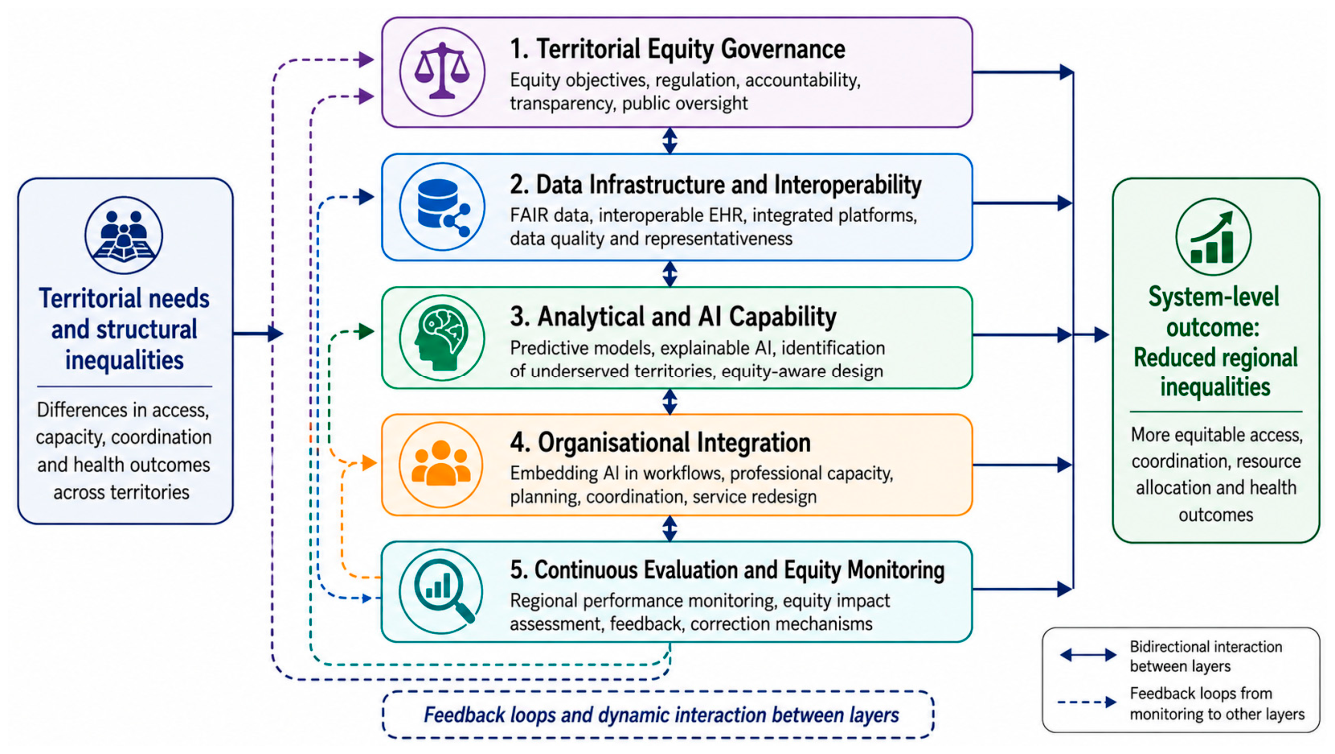
  • The study develops a five-layer conceptual systems framework linking Territorial Equity Governance, Data Infrastructure and Interoperability, Analytical and AI Capability, Organisational Integration, and Continuous Evaluation and Equity Monitoring through interdependencies and feedback mechanisms.
  • The framework contributes to systems practice by treating territorial equity as a system-level outcome that depends on the interaction between governance, data flows, technological capability, organisational readiness and continuous evaluation, rather than on the deployment of isolated digital or AI solutions.
What are the main findings and/or the implications of the main findings?
  • The conceptual synthesis indicates that digital transformation may contribute to reducing regional healthcare inequalities only when interoperable data, AI capabilities, governance and organisational capacity are aligned with territorial need; otherwise, infrastructure, AI-adoption and benefit/outcome divides may reinforce existing disparities.
  • Interoperability should therefore be understood as an equity-relevant infrastructure, and the effects of digital transformation should be assessed through territorially disaggregated measures of access, continuity of care, waiting times, data coverage and health outcomes.

Abstract

This article examines how health data, system interoperability and Artificial Intelligence (AI) can help reduce regional inequalities in healthcare systems, with particular attention to the Portuguese National Health Service (NHS). Methodologically, the study adopts a qualitative conceptual synthesis of purposively selected academic literature and authoritative policy and regulatory sources across three intersecting domains: territorial inequalities in health systems; digital health, interoperability and data governance; and AI and health equity. The synthesis identifies recurring mechanisms linking territorial disparities to data fragmentation, institutional capacity and AI adoption, which inform the authors’ synthesis tables and five-layer systemic framework. The evidence shows that disparities in access, service availability, coordination and outcomes remain structurally embedded across Europe and persist in Portugal despite universal coverage. The study argues that data infrastructures and interoperability are not merely technical enablers, but core determinants of governance capacity and equity. It situates this argument within the European Health Data Space (EHDS) and HealthData@PT, distinguishing between primary use of health data for care delivery and secondary use for research, innovation, policy evaluation and system learning. The analysis highlights AI’s dual potential: poorly governed, it may reinforce inequalities through biased data, uneven adoption and institutional fragmentation; properly governed, it can support predictive planning, coordination, waiting-list management, equitable triage, value-based outcome measurement and disparity monitoring. The proposed framework integrates territorial equity governance, data infrastructure and interoperability, analytical and AI capability, organisational integration, and Continuous Evaluation and Equity Monitoring. The study concludes that digital transformation may contribute to reducing regional inequalities, but such effects should not be assumed: they depend on alignment with territorial need, equity-oriented governance, secure interoperable infrastructures, transparency, citizen trust and institutional capacity, and require empirical evaluation.

1. Introduction

1.1. Practical Challenge: Persistent Regional Inequalities

Regional inequalities in access to healthcare services remain a persistent and structural challenge across contemporary health systems. Despite the widespread adoption of universal health coverage principles in Europe, substantial disparities persist in access, availability, quality and outcomes of healthcare between territories, particularly along urban–rural divides and across socioeconomically disadvantaged regions. These inequalities are not merely residual imperfections of otherwise equitable systems; rather, they reflect deeply embedded structural, territorial and institutional dynamics that continue to shape population health outcomes [1,2].
In this study, regional inequalities and territorial equity refer to related but distinct concepts. Regional inequalities describe observable differences across territories in healthcare access, service availability, coordination, resource distribution and health outcomes. Territorial equity refers to the normative objective of ensuring that healthcare resources, opportunities and system capabilities respond appropriately to differences in population need, so that place of residence does not generate avoidable disadvantage. Accordingly, the study examines regional inequalities as the problem to be addressed and territorial equity as the policy objective guiding the use of data, interoperability and AI. The term fairness is retained only when referring to the established literature on algorithmic or clinical AI fairness; efficiency and value are used only as secondary health-system performance concepts, not as alternative normative objectives.
Comparative European evidence confirms that disparities in health and healthcare provision remain widespread and, in several countries, are even widening despite improvements in average health indicators. Recent cross-national analyses based on the European Social Survey show that lower-educated and economically disadvantaged populations continue to experience worse health outcomes, higher unmet healthcare needs and poorer self-reported health, with limited evidence of sustained “levelling up” across social groups [2]. Importantly, these inequalities are spatially structured: rural, peripheral and economically weaker regions consistently exhibit lower densities of healthcare professionals, weaker service provision and worse health outcomes than metropolitan areas [1].
The Portuguese case illustrates these dynamics particularly clearly, with persistent disparities in health outcomes and self-perceived health, structured along clear social gradients [3]. A growing body of national empirical research documents persistent socioeconomic and territorial inequalities within the Portuguese National Health Service (NHS), despite its universalistic institutional design. Quantitative analyses based on national administrative data show significant disparities between municipalities and regions in the distribution of hospitals, healthcare professionals, primary care units and access to family doctors, with structural disadvantages affecting interior and ageing territories [4]. Spatial accessibility studies further demonstrate that geographical access to hospital care remains uneven, with longer travel times systematically associated with higher proportions of elderly population and higher premature mortality rates [5]. Complementary evidence from health economics and public health research indicates that equity in access is not achieved across most healthcare domains in Portugal: individuals with higher income and education levels consistently use more specialised healthcare services for equivalent levels of need, while disadvantaged populations face greater barriers, particularly in specialist care, oral health and mental health services [6]. Longitudinal reviews of Portuguese research further confirm that health inequalities have been structurally persistent over decades, affecting mortality, morbidity and self-perceived health along clear social gradients [3].
These territorial and social inequalities have direct implications for equity, efficiency and the long-term sustainability of health systems. Inequitable access leads not only to avoidable suffering and unjust health outcomes, but also to inefficient resource allocation, delayed diagnosis, higher downstream costs and reduced overall system performance. At the European level, comparative analyses of digital readiness and healthcare access suggest that countries with weaker institutional capacity, fragmented information systems and lower digital maturity, including Portugal, tend to experience both higher unmet healthcare needs and weaker ability to leverage innovation to address these gaps [7]. In this context, persistent inequalities represent both a normative failure and a structural inefficiency of contemporary health systems.

1.2. Opportunities and Risks of Digital Transformation

Against this backdrop, digital transformation, particularly the use of health data, interoperability infrastructures and Artificial Intelligence (AI), is increasingly framed as a potential lever to improve equity, coordination and effectiveness in healthcare delivery, a perspective also explicitly adopted in recent national guidance for healthcare organisations in Portugal [8]. A growing literature argues that AI should not be understood merely as a technological enhancement for clinical accuracy, but as a strategic instrument for advancing health equity, provided it is embedded within appropriate governance, data infrastructures and institutional capacity [9]. From this perspective, AI offers distinctive capabilities that are directly relevant to the challenge of regional inequalities: the ability to analyse large-scale administrative and clinical datasets, detect hidden patterns of need and deprivation, support more precise resource allocation, optimise patient pathways and improve system-level coordination.
International policy-oriented literature reinforces this systemic interpretation. The OECD argues that the primary barriers to the beneficial use of AI in healthcare are not technological but institutional: fragmented data ecosystems, lack of interoperability, insufficient governance frameworks, limited public sector capacity, and low trust among professionals and citizens [10]. Crucially, the OECD emphasises that when poorly governed, AI risks amplifying existing inequities; when well governed, it can instead help to identify underserved populations, improve targeting of interventions and support more equitable policy design.
Recent empirical evidence further illustrates both the potential and the risks of AI-driven transformation. A large-scale spatial analysis of AI adoption in U.S. hospitals shows that implementation is highly geographically clustered and often misaligned with population health needs: hospitals in more advantaged areas are significantly more likely to adopt AI, while hospitals serving vulnerable populations lag [11]. Importantly, this study identifies interoperability capacity as the strongest predictor of AI adoption across regions, suggesting that data infrastructure constitutes a structural precondition for equitable digital transformation. These findings reinforce the argument that without deliberate policy design, digital innovation may deepen rather than reduce territorial divides.
At the same time, critical scholarship on algorithmic bias warns that AI systems trained on non-representative or structurally biased data can systematically underperform for disadvantaged populations and perpetuate historical inequities [12]. Reviews of economic evaluations further reveal that while many AI applications appear cost-effective on average, very few studies assess how benefits and costs are distributed across population groups or territories, leaving major blind spots regarding equity impacts [13]. This growing body of work converges on a central insight: digital technologies and AI are not inherently equitable, and their impact depends on governance, design choices, data quality and institutional context.
More recently, the literature on clinical AI fairness has begun to conceptualise equity not merely as a statistical property of algorithms, but as a socio-technical challenge that must be addressed at the level of healthcare systems. A comprehensive scoping review of 272 studies shows that most fairness research remains disconnected from real-world clinical contexts, overly focused on narrow demographic metrics, and insufficiently attentive to organisational processes and institutional practices [14]. The authors argue that meaningful equity in healthcare AI requires integration with clinical workflows, involvement of professionals, attention to territorial and socioeconomic contexts, and alignment with broader governance frameworks. This perspective directly challenges purely technical approaches to fairness and highlights the need for systemic frameworks that connect data infrastructures, organisational design and policy objectives.

1.3. Research Gap

Taken together, this literature suggests both a significant opportunity and a critical gap. On the one hand, there is increasing recognition that data-driven approaches, interoperability and AI could enable more precise, responsive and equitable healthcare systems. On the other hand, there remains a lack of integrated conceptual and policy frameworks that explicitly link digital transformation to the reduction in territorial inequalities in healthcare delivery, particularly in specific national contexts.
This gap is consequential because the territories facing greater healthcare needs may also have weaker digital, analytical and institutional capacity. Without an explicit territorial-equity orientation, investments in data infrastructures, interoperability and AI may therefore reproduce existing gradients in resources and organisational capability rather than reduce them. An integrated systemic perspective is needed to identify the conditions under which digital transformation can contribute to reducing regional inequalities and the safeguards required to prevent its benefits from becoming concentrated in already advantaged institutions and territories.

1.4. Research Objectives and Contributions

This study seeks to address this gap by examining how data infrastructures, system interoperability and AI can be strategically mobilised to reduce regional inequalities in access, coordination and outcomes, with particular attention to the Portuguese NHS. Rather than treating AI primarily as a clinical technology, the study analyses it as a potential governance instrument for identifying territorial needs, improving coordination and supporting more equity-oriented resource allocation.
The study makes three contributions. First, it synthesises the literature on regional health inequalities, digital health and AI to examine how reducing regional inequalities can support greater territorial equity. Second, it develops a systemic framework that conceptualises data, interoperability and AI not merely as technological tools, but as governance instruments capable of reshaping information flows, coordination mechanisms and resource allocation across healthcare systems. Third, it derives concrete policy implications for national health systems and for Portugal in particular, regarding the institutional, regulatory and infrastructural conditions required for digital transformation to contribute effectively to equity rather than exacerbate existing disparities.
The novelty of the proposed framework therefore lies not in treating governance, interoperability, AI capability or equity monitoring as individually new concepts, but in integrating these dimensions into a territorially explicit and feedback-based architecture. The framework connects observable regional inequalities to an explicit territorial-equity objective and specifies how governance, data infrastructure, analytical capability, organisational integration and continuous evaluation must interact if digital transformation is to support that objective.
Its novelty therefore lies in bridging domains that existing digital-health transformation, AI-governance and health-equity frameworks generally address separately.

1.5. Structure of the Paper

The remainder of the paper is organised as follows:
-
Section 2 describes the research design, source-selection strategy, analytical synthesis and framework-construction process.
-
Section 3 reviews the main dimensions and structural drivers of regional inequalities in healthcare, including evidence from Portugal.
-
Section 4 examines health data, interoperability and digital governance as potential enablers of territorial equity.
-
Section 5 analyses potential applications of AI to regional health-system challenges.
-
Section 6 focuses specifically on data principles, equity-sensitive data and AI governance.
-
Section 7 develops the policy implications and an implementation-oriented set of priorities for Portugal.
-
Section 8 presents and explains the proposed five-layer systemic framework, examines its dynamic interactions and feedback mechanisms, comparatively positions it against established approaches, maps the Portuguese evidence onto its five layers to identify system bottlenecks, and discusses its implications for system-level decision-making.
-
Section 9 concludes by summarising the paper’s contribution, limitations and priorities for empirical validation.

2. Materials and Methods

2.1. Research Design and Scope

This study adopts a qualitative conceptual-synthesis design. Its purpose is not to estimate causal effects or conduct a systematic review or meta-analysis, but to integrate evidence and concepts from fields that are usually examined separately (territorial health inequalities, digital health and data governance, and AI and health equity) in order to construct an explanatory and policy-oriented systemic framework. The Portuguese NHS provides the principal institutional context through which the conceptual relationships are examined, while international and European evidence is used to identify broader mechanisms and governance conditions. The study adopts a conceptual systems perspective by examining these mechanisms as interacting components whose interdependencies, feedback processes and combined effects shape health-system behaviour and territorial equity.

2.2. Source Selection and Evidence Base

The evidence base was assembled through purposive selection of peer-reviewed academic studies and authoritative policy, regulatory and institutional sources. Sources were selected across three intersecting domains: (i) territorial inequalities in health systems; (ii) digital health, interoperability and data governance; and (iii) AI and health equity. Selection prioritised direct relevance to the research question, contribution to the identification of mechanisms or governance conditions, methodological or institutional authority, and relevance to the European and Portuguese context. The resulting evidence base includes empirical studies, literature reviews, international policy analyses, European regulatory instruments and Portuguese health-system documents. The approach was deliberately integrative rather than protocol-driven and should therefore not be interpreted as a systematic review.

2.3. Analytical Synthesis

The analytical synthesis proceeded iteratively in three steps. First, each selected source was examined for explicit or implicit relationships between territorial inequalities and the conditions through which digital transformation could reduce, reproduce or amplify those inequalities. Particular attention was given to recurring mechanisms such as fragmented information flows, uneven digital maturity, interoperability constraints, algorithmic bias, unequal AI adoption, organisational capacity and differences in the ability to monitor distributive effects. Second, mechanisms identified across the three evidence domains were compared to distinguish recurrent cross-cutting relationships from context-specific observations. Mechanisms were retained when they recurred across multiple sources or when authoritative policy or regulatory evidence identified them as structurally relevant to health-system governance. Third, the retained mechanisms were organised according to the principal system function through which they operate: governance arrangements; data availability and interoperability; analytical and AI capability; organisational capacity and implementation; and evaluation of distributive effects. Evidence from Portugal was then used to contextualise these mechanisms and assess their relevance to a universal national health system characterised by persistent territorial disparities.

2.4. Framework Construction and Analytical Boundaries

Framework construction proceeded in four stages. First, the recurring mechanisms identified through the analytical synthesis were grouped according to their principal system function. Where a mechanism was relevant to more than one function, it was assigned to the layer representing its primary role while its cross-layer relationships were retained explicitly in the framework. This avoided treating the layers as mutually exclusive categories and preserved the interdependencies identified in the literature. Second, these groups were organised into five interdependent layers: Territorial Equity Governance; Data Infrastructure and Interoperability; Analytical and AI Capability; Organisational Integration; and Continuous Evaluation and Equity Monitoring. Third, the relationships between the layers were specified as bidirectional and feedback-based rather than sequential, reflecting the assumption that technological capability produces equity effects only through interaction with governance and organisational conditions. Fourth, the resulting architecture was comparatively positioned against established approaches to digital-health transformation, AI governance and health-equity assessment, as presented in Section 8.5, and subsequently mapped onto the Portuguese evidence in Section 8.6 as a contextual plausibility check. Portuguese evidence is used as a contextual application and plausibility check, not as empirical validation of the framework. No new empirical dataset was created or analysed, and the framework’s effects on regional inequality remain to be tested empirically.
Validation in this conceptual study should therefore be understood as an assessment of conceptual robustness rather than empirical validation. The framework was assessed in three complementary ways. First, internal consistency was examined by checking whether the five layers collectively captured the recurrent mechanisms identified in the synthesis without treating interdependent mechanisms as isolated factors. Second, the resulting architecture was comparatively positioned against established digital-health transformation, AI-governance and health-equity frameworks to assess both conceptual overlap and the specific contribution of the territorial-equity orientation. Third, the framework was mapped onto the Portuguese evidence as a plausibility check, examining whether the five layers could coherently organise documented system constraints and identify bottlenecks across governance, interoperability, analytical capacity, organisational integration and evaluation. These steps strengthen the conceptual credibility of the framework while not constituting empirical validation of its effects.

3. Regional Inequalities in Health Systems

3.1. Territorial Inequality in Healthcare

Regional inequalities in healthcare systems manifest through multiple, interconnected dimensions, including access to services, waiting times, availability of resources, and discrepancies between perceived and actual quality of care. These inequalities are not episodic anomalies, but structural features observed across different health systems and institutional models.
Comparative European analyses consistently show that rural, peripheral and socioeconomically disadvantaged populations experience poorer health outcomes and higher levels of unmet need, with important territorial dimensions also emerging in several national contexts [1,2]. Importantly, improvements in national averages often conceal persistent or even widening disparities between regions and social groups. Recent evidence shows that several countries have experienced “levelling down” rather than “levelling up”, meaning that apparent reductions in inequality sometimes result from deteriorating health among more advantaged groups rather than genuine improvements among vulnerable populations [2].
Territorial inequality is also reflected in objective measures of access, such as waiting times and availability of specialised services. Empirical spatial analyses demonstrate that travel time to hospitals, density of healthcare facilities and geographic proximity to specialised care remain strongly patterned by territory. In the Portuguese case, municipalities with longer average travel times to hospitals exhibit higher proportions of elderly residents and significantly higher premature mortality rates, illustrating the direct relationship between geographic access and health outcomes [5]. These findings confirm that physical accessibility remains a relevant determinant of inequality, even in countries with dense healthcare networks.
Beyond physical access, inequalities also emerge in waiting times and effective utilisation of services. Evidence from health economics research shows that individuals with higher income and education consistently achieve greater utilisation of specialised healthcare services for equivalent levels of clinical need, suggesting that formal entitlement to care does not guarantee equitable effective access [6]. This phenomenon highlights the distinction between nominal access and realised access, where social, informational and organisational barriers shape healthcare trajectories.
Perceived quality of care also diverges from objective service availability. Surveys on self-reported health and healthcare experience show that populations in disadvantaged regions and social groups consistently report poorer health status and greater dissatisfaction with healthcare services, even when objective indicators suggest similar service coverage [2]. These discrepancies point to the importance of considering experiential dimensions of inequality alongside infrastructural and clinical indicators.
Taken together, the evidence suggests that territorial inequality in healthcare is multidimensional, combining material deficits in infrastructure and workforce with organisational barriers, informational asymmetries and differences in users’ capacity to navigate health systems.

3.2. Structural Drivers of Regional Inequalities

The persistence of territorial inequalities in healthcare is partly explained by structural characteristics of health systems rather than by short-term fluctuations or isolated failures. The first critical driver is the uneven distribution of healthcare professionals and installed capacity across regions. Comparative European research demonstrates that physician density, nurse availability, hospital bed supply and specialised services are consistently higher in urban and economically prosperous regions, while rural and peripheral areas face chronic shortages [1].
Recent evidence from Portugal confirms that these disparities do not follow a uniform territorial pattern. An analysis of the 39 Local Health Units found substantial variation in the availability of physicians and nurses per thousand inhabitants in primary care, with little geographical convergence between the two professional groups. No ULS combined high ratios of both physicians and nurses: some territories displayed relatively strong physician provision but only intermediate nurse availability, while others presented the opposite pattern. More importantly, twelve ULS recorded low ratios for both professional groups, including Arrábida, Estuário do Tejo, Loures-Odivelas, Médio Ave, Região de Leiria and Santa Maria. These findings indicate that workforce constraints affect both metropolitan and non-metropolitan territories and reflect mismatches between population needs, institutional capacity and the composition of local healthcare teams [15].
This uneven distribution is reinforced by cumulative dynamics. Regions with greater service availability tend to attract more professionals, further strengthening their capacity, while disadvantaged territories struggle to recruit and retain staff, creating a self-reinforcing cycle of deprivation. Empirical studies in Portugal document precisely this pattern, showing persistent concentration of resources in coastal metropolitan areas and structural fragility in interior regions, particularly in territories with ageing populations and low population density [4].
A second structural driver concerns the organisation and fragmentation of services. Health systems characterised by weak coordination between primary care, hospitals and long-term care services tend to generate inefficiencies that disproportionately affect vulnerable populations. Fragmented information flows, duplication of diagnostic exams, weak referral mechanisms and lack of continuity of care exacerbate existing inequalities by imposing higher navigational burdens on users with lower health literacy and fewer resources [4,6].
Evidence from European comparative studies further indicates that institutional design matters significantly. Franco and Marques da Costa [1] show that countries with stronger welfare regimes and more robust public investment in health are better able to mitigate the negative effects of rurality and regional disadvantage. Conversely, health systems operating under more constrained institutional frameworks exhibit greater difficulty in counteracting territorial inequalities, even when overall health expenditure levels are comparable.
These findings underscore that inequalities are not merely a function of demographic or geographic factors but are shaped by policy choices, organisational architectures and governance arrangements.
Taken together, territorial inequalities in healthcare are multidimensional and result from the interaction of spatial, organisational, social, economic, environmental and technological factors. These dimensions do not operate independently: they frequently overlap and reinforce one another, creating cumulative disadvantages for particular territories and population groups. The following table, Table 1, synthesises the main dimensions, the mechanisms through which they affect territorial equity, and their implications for data, interoperability and Artificial Intelligence.

3.3. International Evidence on Territorial Inequalities and Digital Capacity Gaps

International organisations increasingly recognise territorial inequalities as a critical challenge for health system performance and social cohesion. Comparative analyses conducted at the European level confirm that regional disparities in healthcare provision and health outcomes remain widespread and structurally embedded across Member States [1,2].
EU-wide comparative studies combining healthcare indicators and measures of digital maturity show that countries facing higher unmet healthcare needs often also display weaker institutional and infrastructural capacity to deploy innovative solutions, including digital health technologies [7]. This pattern is particularly concerning because it suggests that regions and countries most in need of systemic improvement are often least equipped to leverage new tools capable of addressing these deficits.
International evidence therefore points to a potential ‘double disadvantage’: populations facing higher unmet healthcare needs may also be served by systems with weaker digital and institutional capacity. Comparative European evidence indicates that differences in healthcare access coexist with marked differences in digital readiness [7]. This is particularly relevant to the present study because the capacity to integrate data, establish interoperable systems and deploy advanced analytics is a limiting factor and itself is becoming unevenly distributed as different entities are trying to solve their own limitations instead of a broader and more strategic national approach, potentially limiting the ability of higher-need systems and territories to identify and address existing disparities.
The policy-oriented international literature also highlights the growing importance of data infrastructures and governance capacity in tackling inequalities. The OECD emphasises that health systems increasingly require robust information architectures to identify underserved populations, monitor disparities and support evidence-informed resource allocation [10]. Without reliable, interoperable and timely data, inequalities tend to remain statistically invisible and politically under-addressed.
Crucially, international evidence suggests that average national indicators are insufficient for effective policy design. Territorial disaggregation of data is essential to reveal within-country disparities and to support targeted interventions. The lack of granular, integrated data infrastructures is increasingly identified as a core barrier to effective equity-oriented health policy across countries [2,10].
International evidence therefore broadens the concept of territorial inequality beyond the distribution of healthcare resources. It also encompasses unequal capacity to generate, integrate and use information for governance. This digital and institutional capacity gap provides the analytical bridge to Section 4, where health data infrastructures, interoperability and digital governance are examined as potential enablers of territorial equity.

3.4. The Portuguese Context

The Portuguese health system offers a particularly relevant case study for examining regional inequalities. Despite the universalistic design of the Portuguese NHS, a substantial body of empirical evidence demonstrates that territorial and socioeconomic inequalities persist across multiple dimensions of healthcare provision and utilisation.
A recent assessment of the 39 ULS shows that healthcare needs are also distributed unevenly across Portugal. The composite indicator used in the assessment combines population ageing and longevity, premature mortality and low educational and health-literacy levels. High-need populations are particularly concentrated in inland areas: they represent 43% of the population covered by the Guarda Local Health Unit, 33% in Nordeste, 31% in Alto Alentejo and 30% in Castelo Branco. By contrast, low estimated needs predominate in several coastal and metropolitan territories. This pattern indicates that the regions facing the greatest demographic and health-related pressures are frequently those with lower population density and more fragile service capacity, reinforcing the importance of allocating resources according to territorial need rather than population size alone [15].
Quantitative analyses based on national administrative and statistical data reveal significant regional asymmetries in the distribution of healthcare infrastructure and professionals. Interior municipalities and low-density territories consistently exhibit lower availability of hospitals, fewer healthcare professionals per capita, weaker coverage of primary care services and greater difficulty in ensuring access to family doctors [4]. These structural imbalances reflect long-term patterns of demographic decline, professional concentration in metropolitan areas and limited territorial planning capacity.
Geographical accessibility remains a relevant constraint. Using fine-grained spatial methodologies, Costa et al. [5] demonstrate that municipalities with longer average travel times to hospitals systematically present higher proportions of elderly residents and higher premature mortality rates. These findings illustrate that territorial inequalities are not only organisational but also linked to measurable health outcomes.
Recent spatial evidence further confirms a marked coastal–inland divide in geographical access to hospital care. Average road travel times to the nearest hospital services are generally shorter around the principal metropolitan and coastal areas, where healthcare facilities are more densely concentrated, and substantially longer across extensive parts of inland northern, central and southern Portugal. These geographical barriers are especially significant because inland territories also tend to have older populations, lower population density and more limited transport alternatives. Distance therefore operates not merely as a spatial inconvenience, but as a structural determinant of effective access, increasing the time and resources required to obtain hospital care and potentially compounding other socioeconomic and health-related disadvantages [16].
Beyond infrastructure, inequities in effective access are also well documented. A comprehensive review of the Portuguese literature shows that individuals with higher income and education levels make greater use of specialist care, dental services and mental health services for comparable levels of need, while disadvantaged populations face greater barriers in navigating referral pathways and overcoming waiting times [6]. This evidence confirms that formal entitlement under the Portuguese NHS does not translate into substantively equal access.
Longitudinal reviews of national research further confirm the structural persistence of health inequalities in Portugal. Over several decades, gradients in mortality, morbidity and self-perceived health have remained strongly associated with education, income and occupational status, with limited evidence of sustained convergence [3]. Importantly, these inequalities are not static but interact with territorial patterns, disproportionately affecting rural and economically fragile regions.
Together, these findings portray a health system in which inequality is not peripheral but structurally embedded. They also highlight the limitations of traditional policy instruments focused solely on funding levels or isolated service expansions, suggesting the need for more systemic approaches capable of addressing coordination failures, information asymmetries and territorial blind spots.
The Portuguese evidence therefore establishes the existence and territorial patterning of the problem, but it does not demonstrate that data, interoperability or AI will reduce these disparities. The following sections accordingly examine these technologies as potential mechanisms through which planning, coordination, information flows and monitoring may be improved. Their effectiveness and distributive effects within the Portuguese NHS remain to be empirically tested.

4. Health Data, Interoperability and Digital Governance as Enablers of Territorial Equity

4.1. Data as Essential Infrastructure for Health Systems

Health systems increasingly depend on data infrastructures not merely as technical back-office tools, but as foundational components of system governance, coordination and equity, a view explicitly reflected in national implementation guidance for the Portuguese health sector [8]. High-quality, timely and interoperable data enable decision-makers to understand population needs, monitor disparities, allocate resources more effectively and evaluate the impact of policies. Conversely, weak data infrastructures contribute to the invisibility of inequalities and to persistent misalignment between needs and services.
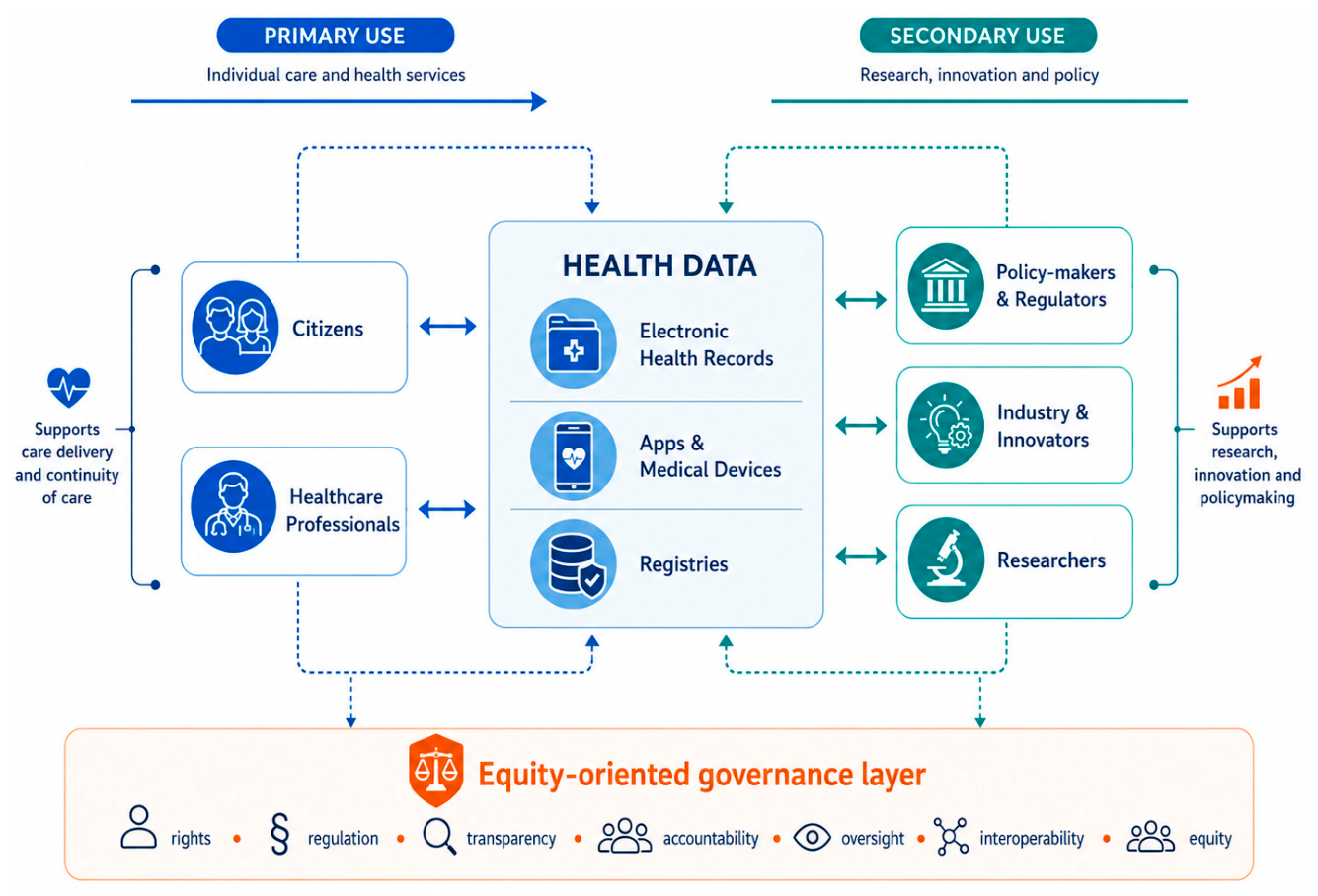
Within this infrastructure perspective, it is essential to distinguish between the primary and secondary use of electronic health data. Primary use refers to the use of data for healthcare delivery, including clinical decision-making, continuity of care, prescription, dispensation, administrative and reimbursement purposes, as well as operational management across care settings. Secondary use refers to the reuse of electronic health data for purposes such as research, innovation, policymaking, regulatory activities, patient safety, statistics, public health and health-system planning.
This distinction is central to the European Health Data Space (EHDS), which creates a common legal and technical framework for both uses with phased implementation across EU Member States up to 2031, as better described below. From an equity perspective, primary use can improve coordination and clinical decision-making for individual patients, while secondary use can support research and development in different health dimensions, evidence generation, policy evaluation and the identification of structural inequalities across territories and population groups.
The recent international literature frames data infrastructure as a form of public infrastructure analogous to physical facilities or workforce capacity. The OECD explicitly argues that the effective use of AI and digital health technologies is structurally dependent on the availability of robust data ecosystems, governed by clear rules and supported by institutional capacity [10]. Without such infrastructures, health systems struggle to identify underserved populations, monitor territorial disparities or design evidence-informed interventions.
The importance of data extends beyond operational management to the very possibility of recognising inequality as a policy problem. Large-scale European evidence shows that national averages systematically conceal substantial within-country disparities and that only granular, disaggregated data allows for the identification of regional and social gradients in health outcomes and access [2]. Where data systems lack territorial resolution or integration across sectors, inequalities remain statistically invisible and politically marginalised.
Moreover, data quality and representativeness have direct implications for equity. Research on algorithmic bias demonstrates that datasets reflecting historical inequities or incomplete population coverage systematically produce distorted representations of need, risk and performance, with negative consequences for disadvantaged groups [12,20]. This reinforces the argument that data infrastructure is not a neutral technical resource, but a determinant of equity within health systems.
In this sense, data should be conceptualised as a strategic public asset: it shapes how problems are defined, which populations become visible to policymakers and how resources are distributed across territories.

4.2. Coordination Failures That Amplify Regional Asymmetries

Territorial inequalities are not driven solely by the uneven distribution of physical resources; they are also amplified by systemic coordination failures within health systems. Fragmented information flows between providers, lack of integrated patient records and weak coordination mechanisms across levels of care generate inefficiencies that disproportionately affect vulnerable populations and disadvantaged regions, a systemic problem explicitly recognised by national authorities as a barrier to safe and scalable AI adoption in healthcare organisations [8].
Empirical evidence from the Portuguese context illustrates these dynamics clearly. Analyses of service organisations show that fragmentation between primary care, hospital services and other subsystems contributes to duplicated diagnostic tests, avoidable referrals, discontinuity of care and increased waiting times [4]. These inefficiencies do not affect all users equally. Individuals with higher health literacy, stronger social capital or access to private alternatives are better able to navigate fragmented systems, while more vulnerable populations face greater obstacles in overcoming organisational complexity [6].
Patient-reported experience data provide further evidence of these organisational shortcomings. According to the OECD PaRIS 2024 survey, Portugal performed below the average of the ten participating EU countries across all five assessed dimensions: confidence in self-management, experienced quality of care, trust in the healthcare system, person-centred care and experienced care co-ordination. The weakest result concerned co-ordination, with only 49% of respondents reporting a positive experience, while person-centred care was positively assessed by 77%, compared with 88% across the participating EU countries. These results suggest that fragmentation is experienced directly by patients through insufficiently connected pathways, limited continuity and weaker support in navigating care, reinforcing the need for integrated information systems and systematic, standardised monitoring of patient-reported experiences [16].
These coordination failures are also linked to efficiency and sustainability. Waste in health systems is not only a financial problem; it is also an equity problem, because resources absorbed by avoidable duplication, administrative burden, low-value activity or poorly coordinated pathways are resources unavailable for patients and territories with greater unmet needs. OECD [21] evidence suggests that around one-fifth of health expenditure may make little or no contribution to good health outcomes, while earlier World Health Organisation [22] work estimated that 20–40% of health-sector resources could be wasted through inefficiency. In this context, data infrastructures and interoperability should be understood not only as instruments for digital modernisation, but also as mechanisms for reducing waste, improving coordination and redirecting capacity towards areas of higher need.
The lack of integrated patient views also has direct implications for clinical decision-making and system-level efficiency. When healthcare professionals operate with incomplete information, they tend to rely on precautionary duplication of exams, conservative referral practices and defensive clinical behaviour, all of which increase system costs and contribute to congestion. Over time, these inefficiencies accumulate and disproportionately burden under-resourced services and territories.
International analyses further suggest that these coordination failures are structurally linked to weak information architectures. The OECD identifies fragmented digital systems, lack of common standards and limited interoperability as major obstacles to effective coordination, leading to inefficiencies that undermine both quality and equity [10]. In such environments, disparities are not only a function of geography but also of how effectively information circulates across the system.
Importantly, coordination failures also limit the capacity of health authorities to understand system performance. Without integrated information flows, policymakers lack visibility over patient pathways, service utilisation patterns and territorial variations in outcomes. As a result, planning and resource allocation decisions are often based on partial or outdated information, reinforcing existing asymmetries.

4.3. Interoperability Across Hospitals, Primary Care Units and National Subsystems

Interoperability, understood as the capacity of different information systems to exchange, interpret and meaningfully use data, has emerged as a critical determinant of both system performance and territorial equity. It is increasingly recognised that digitalisation without interoperability tends to produce isolated technological silos rather than integrated health systems.
For the purposes of this study, interoperability is therefore treated as multidimensional rather than binary. Five dimensions are particularly relevant to territorial equity: (i) technical interoperability, enabling secure connectivity and exchange between systems; (ii) syntactic and semantic interoperability, ensuring that exchanged data follow common formats, terminologies and meanings; (iii) organisational and process interoperability, allowing information to follow patients across referral pathways and levels of care; (iv) governance and legal interoperability, defining rights, responsibilities, access conditions, security and accountability; and (v) data quality and territorial coverage, ensuring that sufficiently complete, timely, granular and representative information is available across regions. Weakness in any one of these dimensions can constrain the equity value of the others.
The European Health Data Space operationalises interoperability through two complementary dimensions. For primary use, MyHealth@EU is intended to strengthen individuals’ access to and control over their electronic health data and to enable secure cross-border continuity of care through standardised and interoperable EHR systems. For secondary use, HealthData@EU and national health data access bodies provide a governance framework for the secure reuse of data for research, innovation, regulatory activities and policymaking, subject to defined purposes, safeguards and prohibited uses. Across both dimensions, implementation depends on an enabling combination of legal and governance arrangements, data quality, shared infrastructure and institutional capacity-building. The expected benefits therefore extend beyond data exchange itself, encompassing stronger patient control and data protection, more integrated digital health services, improved cross-border care and better evidence for research and public policy [23].
The OECD emphasises that interoperability is not merely a technical requirement but a structural enabler of coordinated, equitable and scalable healthcare delivery [10]. Systems characterised by strong interoperability can support continuity of care, reduce duplication, improve clinical decision-making and enable system-level oversight. Conversely, fragmented information systems reinforce organisational silos and institutional boundaries, exacerbating inequalities between regions and providers with different technological capacities.
Recent empirical evidence provides concrete support for this argument. A large-scale spatial analysis of AI implementation across U.S. hospitals demonstrates that interoperability capacity is the strongest predictor of advanced digital adoption, even more than hospital size or financial resources [11]. Hospitals with stronger interoperability infrastructures are significantly more likely to adopt innovative technologies, while those operating within fragmented digital environments lag. This finding has direct implications for territorial equity: regions with weaker data infrastructures risk becoming structurally excluded from the benefits of digital transformation.
The relevance of interoperability extends beyond technological adoption to the capacity to govern health systems effectively. Integrated information flows across primary care, hospitals and other subsystems enable health authorities to construct comprehensive views of patient journeys, identify bottlenecks, detect regional gaps and design targeted interventions. Where such integration is absent, health systems operate with partial visibility, making it difficult to pursue deliberate equity-oriented strategies.
In the Portuguese context, national policy documents already recognise this challenge. The national digital health authority explicitly frames the lack of integrated data architectures and the persistence of fragmented systems as barriers to effective, ethical and scalable use of digital technologies, including AI [8]. This acknowledgement reinforces the idea that interoperability is not a peripheral technical concern but a vital component of modern health system governance.

4.4. The European Health Data Space as an Implementation Pathway for Portugal

The EHDS represents a decisive institutional development for the arguments advanced in this paper. Rather than treating interoperability, data governance and digital health as voluntary or fragmented national initiatives, the EHDS establishes a common European framework of rules, standards, infrastructures and governance mechanisms for the primary and secondary use of electronic health data. It therefore provides a concrete implementation pathway for transforming health data into a shared public infrastructure capable of supporting care continuity, research, innovation, policymaking and equity-oriented system governance.
One of the most important contributions of the EHDS is that it institutionalises the link between data use for care delivery and data reuse for collective purposes. Primary use supports better individual care by enabling patients and health professionals to access relevant electronic health data across providers and, where applicable, across borders. Secondary use, by contrast, enables the controlled reuse of health data for research, innovation, public policy, regulatory activities, patient safety and health-system planning. The strategic value of the EHDS therefore lies not only in improving data flows at the point of care, but also in creating the conditions for health systems to learn from the data they generate.
This distinction between primary and secondary use should not be conflated with the distinction between primary, secondary and tertiary levels of care. The former concerns the purpose for which health data are used, whereas the latter concerns the organisation of healthcare delivery. Giri and Ud Din [24] conceptualise data as an interface between primary, secondary and tertiary care, highlighting the role of integrated EHR and health-information-exchange arrangements in supporting continuity, reducing redundant interventions and improving decision-making across patient pathways. In the Portuguese context, this means that the equity value of primary-use interoperability should be assessed not merely by whether systems can technically exchange data, but by whether relevant information follows patients across primary care, hospital and specialist pathways and whether this contributes to reducing avoidable duplication, referral delays and discontinuities of care in disadvantaged territories. Secondary-use infrastructures can complement this function by aggregating pathway and outcome data to identify where coordination failures are concentrated, monitor whether territorial gaps narrow over time, and generate evidence that informs decision-making, research, development and health-system innovation.
For Portugal, the EHDS is particularly relevant because it directly addresses several of the structural problems identified in this study: fragmented information systems, limited interoperability across providers, incomplete visibility over patient pathways and insufficient use of data for planning and evaluation. In the domain of primary use, the EHDS reinforces citizens’ access to their own electronic health data and the ability of health professionals to access relevant data for care provision, including in cross-border contexts. It also prioritises categories of data that are critical for continuity of care, including patient summaries, electronic prescriptions, electronic dispensations, medical imaging, laboratory and other diagnostic results, and discharge reports.
The implementation timetable is also significant. Regulation (EU) 2025/327 [25] applies from 26 March 2027, but several operational obligations are phased in. From 26 March 2029, the framework applies to patient summaries, electronic prescriptions and electronic dispensations, as well as to the corresponding EHR systems. From 26 March 2031, it extends to medical imaging studies and related reports, medical test results and discharge reports. Chapter IV, concerning secondary use of electronic health data, applies from 26 March 2029, although some provisions concerning governance, secure processing environments, HealthData@EU and data access bodies apply earlier or later depending on the specific obligation.
This staged implementation creates both an opportunity and a challenge for Portugal. Earlier research on Portugal’s readiness for the EHDS, conducted while the Regulation was still at proposal stage, suggested that Portugal was well advanced in several components of primary use, including patient access services, professional access to summary data and cross-border sharing of patient summaries and ePrescriptions. However, the same study also identified important gaps, particularly the absence of a common interoperability framework and the fact that electronic dispensations, medical imaging, laboratory results and discharge reports could not yet be shared cross-border [26]. These gaps are directly relevant to territorial equity, since regions and providers with weaker digital infrastructures risk being less able to benefit from data-driven transformation.
The HealthData@PT initiative [27] is an important national step in this transition. By setting up a Health Data Access Body in Portugal, it aims to establish the national infrastructure, network and foundational capabilities required for secure access to and use of health data for research, medical innovation and health policymaking. Its planned capabilities include a Data Access Application Management System, connection to the HealthData@EU infrastructure, recommendations to improve data quality, a national dataset catalogue for secondary use, and a secure processing environment. If effectively implemented, these components could strengthen Portugal’s capacity to use health data not only for innovation but also for monitoring regional disparities, evaluating policy interventions and supporting more equitable resource allocation.
Accordingly, the implementation of the EHDS and HealthData@PT can be evaluated through territorially disaggregated indicators that go beyond the existence of data-exchange infrastructure. Relevant measures include the availability of key clinical information across levels of care, avoidable repeat testing, referral and transfer times, waiting times, continuity-of-care indicators, completeness and timeliness of shared records, and regional differences in access and outcomes. Monitoring these indicators would allow policymakers to distinguish successful technical data exchange from measurable improvements in service integration and territorial equity.
For Portugal, the secondary use of health data can become a strategic asset if implemented under public governance. A credible national health data access infrastructure can improve the country’s capacity to participate in European research networks, generate real-world evidence, support health technology assessment, evaluate public policies and accelerate responsible innovation. This may reduce asymmetries between Portugal and more mature European health ecosystems, while also improving the capacity to detect and address inequalities within the Portuguese NHS. However, these gains are not automatic. They depend on data quality, transparent access procedures, secure processing environments, clear public-interest criteria, and safeguards ensuring that secondary use serves research, innovation and policy objectives without weakening citizens’ rights or public trust.
From an equity perspective, the EHDS should therefore be understood not only as a digital health regulation, but as a structural reform of health-system intelligence. Its implementation in Portugal should be guided by three priorities: first, ensuring that interoperability requirements are applied consistently across territories and providers; second, making secondary use infrastructures serve explicit research needs, leveraging both national and European innovative environment and fostering competitiveness; and third, ensuring that citizens, professionals and institutions develop the digital and organisational capabilities required to use health data safely, transparently and effectively.

4.5. Lessons from International Models

International experience offers important lessons regarding the relationship between data infrastructures, interoperability and equity. Comparative European analyses show that countries with stronger institutional capacity and more mature digital ecosystems are better positioned to use data strategically for planning, monitoring and service improvement [7]. Conversely, countries with weaker data infrastructures often experience a double disadvantage: they face higher unmet healthcare needs while also lacking the analytical capacity to understand and address these gaps effectively.
Policy-oriented international literature consistently highlights that digital transformation must be designed explicitly around system-level objectives rather than pursued as a collection of isolated technological projects. The OECD argues that successful models of digital-health governance are characterised by coherent data strategies, common standards, strong public sector leadership and explicit alignment between digital infrastructures and policy goals such as equity and quality [10].
Evidence from digital health research further suggests that the effectiveness of digital tools depends critically on integration rather than mere availability. Reviews of digital health initiatives argue that isolated applications, such as standalone telemedicine platforms or disconnected decision-support tools, are unlikely to generate substantial systemic impact unless embedded within interoperable architectures and coordinated service models [18]. Where digital innovations are integrated into broader governance frameworks, they can support improved access, better coordination and more equitable outcomes.
Finally, the literature on responsible AI and clinical fairness reinforces a key systemic lesson: technology alone does not generate equity. Rather, equitable outcomes emerge when digital infrastructures, organisational practices and governance mechanisms are aligned with explicit equity objectives. This perspective suggests that the design of data infrastructures and information flows must be understood as a normative and strategic choice, not simply as a technical implementation issue.

5. Addressing Regional Inequalities Through Health Data and Artificial Intelligence

5.1. Predictive Models to Identify Regional Needs

One of the most promising contributions of AI to health system equity lies in its capacity to analyse large-scale, multidimensional datasets to identify patterns of need that remain invisible to traditional analytical approaches. Predictive models can integrate demographic, epidemiological, socioeconomic and service utilisation data to anticipate demand for healthcare services, identify high-risk populations and support more equitable resource allocation across territories.
The literature increasingly frames AI as a strategic analytical tool for understanding health disparities rather than merely as a clinical technology. Green et al. [9] argue that AI has a distinctive capacity to capture the complex, multifactorial nature of health inequalities, enabling policymakers to identify structural patterns of disadvantage and to design more targeted interventions. Similarly, explainable AI approaches have demonstrated their capacity to reveal spatial heterogeneity in health determinants, allowing for geographically differentiated policy responses rather than uniform, one-size-fits-all strategies [19].
From a system governance perspective, the OECD emphasises that advanced analytics can support proactive planning by enabling early identification of underserved populations and regions, facilitating anticipatory rather than reactive policy interventions [10]. Such predictive capabilities are particularly relevant in contexts characterised by demographic ageing, uneven population distribution and chronic resource constraints.

5.2. AI for Optimisation of Patient Pathways, Particularly for Chronic Conditions

Chronic diseases represent a major driver of inequality in health systems, disproportionately affecting older, socioeconomically disadvantaged and territorially vulnerable populations. AI-based tools offer significant potential to improve continuity of care, coordination between services and long-term disease management, thereby contributing to more equitable outcomes.
Systematic evidence from rural and underserved healthcare contexts indicates that AI-supported clinical decision tools, remote monitoring systems and predictive risk models have the potential to improve access to specialised care, enable earlier interventions and enhance management of chronic conditions such as diabetes, cardiovascular disease and chronic respiratory illness [17]. These applications are particularly relevant for territories with limited specialist availability, where AI-supported tools can partially compensate for structural capacity constraints.
The digital health literature further suggests that when embedded within integrated care models, AI-enabled tools may contribute to improved continuity of care, better patient engagement and more coordinated care trajectories, if implementation challenges related to governance, inclusion and infrastructure are adequately addressed [18]. Such improvements are not merely technical gains; they have distributive implications, as populations with complex chronic conditions are often those most exposed to systemic barriers and fragmentation.

5.3. AI for Waiting List Management and Capacity Optimisation

Long waiting times constitute a central mechanism through which inequalities in effective access emerge. Where waiting lists are poorly managed, individuals with greater resources, information or access to alternative providers are better able to circumvent delays, while disadvantaged populations bear the full burden of congestion.
AI-based optimisation tools offer concrete opportunities to address this problem. Economic evaluations reviewed by El Arab and Al Moosa [13] show that AI applications in scheduling, workflow optimisation and resource management can contribute to efficiency gains, including improved throughput and, in some cases, reductions in waiting times, and generate measurable performance improvements. Importantly, these gains are achieved not through additional resources but through improved coordination and allocation.
Policy-oriented analyses argue that the greatest systemic value of AI may lie precisely in these “invisible” organisational domains rather than in highly specialised clinical applications [28]. By improving the functioning of appointment systems, referral management and capacity planning, AI can contribute to more equitable, effective access, particularly in overburdened public systems.

5.4. Triage and Prioritisation Systems to Promote Equitable Access

Triage and prioritisation decisions play a significant role in determining who receives care first and who waits longer. Traditionally, these decisions are often based on fragmented information, subjective judgement or limited criteria, which can inadvertently reproduce existing biases.
AI-based triage systems, when designed responsibly, can incorporate a broader range of clinical and contextual variables, potentially supporting more consistent and needs-based prioritisation. Reviews of AI applications in health systems report growing evidence suggesting that algorithmic decision-support tools can enhance the accuracy and consistency of risk stratification, particularly in emergency care and chronic disease management [17].
However, the literature also cautions that triage algorithms can reinforce inequities if trained on biased data or designed without explicit equity objectives. Chen et al. [12] document multiple cases in which algorithms systematically underperform for disadvantaged populations due to biased training data. For this reason, the use of AI in triage must be accompanied by explicit fairness-aware design and continuous monitoring [14]. When appropriately governed, however, such systems hold potential to reduce arbitrary variation and promote more equitable prioritisation.

5.5. AI-Enabled Integration of Regional Data and Unified Platforms

A key systemic contribution of AI lies in its capacity to operate across integrated datasets and to support unified analytical platforms. When data from primary care, hospitals, long-term care and public health systems are interoperable, AI tools can construct comprehensive views of patient trajectories and regional system performance.
The OECD highlights that the strategic value of AI emerges only when it is embedded within integrated data ecosystems rather than deployed as isolated tools [10], a principle also emphasised in Portuguese national guidance, which explicitly frames integration across organisational and information silos as a prerequisite for effective AI deployment [8]. Empirical evidence supports this view: Hwang et al. [11] demonstrate that interoperability capacity is the strongest predictor of advanced AI adoption across hospitals, reinforcing the idea that AI and data integration are mutually reinforcing processes.
Digital health reviews further argue that fragmented digital applications are unlikely to generate systemic impact, whereas more integrated digital ecosystems are described as enabling conditions for population-level analytics, improved coordination and better targeting of interventions [18]. For regional equity, this implies that AI-enabled platforms can support the identification of underserved territories, monitoring of disparities over time and evaluation of policy effectiveness. Whether these capabilities translate into reduced regional inequalities in access remains an empirical question.

5.6. AI for Optimising the Measurement of Patient-Value Outcomes

Equity-oriented health systems require not only efficient service delivery but also robust mechanisms for measuring outcomes that matter to patients. Traditional performance indicators often fail to capture dimensions such as functional status, quality of life and patient-reported outcomes, which are particularly relevant for vulnerable populations.
This perspective is closely aligned with value-based healthcare approaches, which define value as the health outcomes achieved for patients relative to the costs of delivering those outcomes [29]. From this standpoint, interoperable data infrastructures are essential because they allow health systems to move beyond activity-based indicators, such as number of appointments, procedures or hospital episodes, towards outcome-oriented measures that reflect clinical results, patient-reported outcomes, functional status, quality of life and continuity of care. If properly designed, such approaches can support equity by shifting attention from institutional activity and provider incentives towards the outcomes experienced by patients across different territories and population groups.
From a sustainability perspective, value-based healthcare is also relevant because it shifts the focus from volume of activity to the relationship between outcomes, costs and patient value. Health systems facing demographic ageing, workforce shortages and rising demand cannot rely only on additional funding or capacity expansion. They also need to ensure that existing resources are used in ways that generate meaningful health gains. By identifying which interventions, pathways and organisational models produce better outcomes relative to their costs, value-based approaches can help reduce low-value care, avoid unnecessary duplication and support more rational allocation of resources. In this sense, interoperable data and outcome measurement are not only instruments of quality improvement, but also prerequisites for sustainable and equity-oriented health-system governance.
AI-based analytics offer opportunities to integrate diverse sources of data, including clinical records, patient-reported outcome measures (PROMs) and real-world data, to develop more nuanced and comprehensive measures of value. Reviews of digital health innovations highlight that advanced analytics are increasingly discussed as potential tools to support improved monitoring of outcomes and more nuanced evaluation of health interventions across population groups, although their effective implementation remains contingent on governance, infrastructure and inclusion challenges [18]. Moreover, explainable AI approaches enable a deeper understanding of why outcomes differ across regions and groups, thereby supporting more targeted improvement strategies [19].
However, value-based models do not automatically reduce inequalities. If outcomes are measured without adequate risk adjustment, territorial contextualisation and monitoring of social gradients, providers serving older, poorer or more clinically complex populations may appear to perform worse and may be unfairly penalised. Equity-oriented value-based healthcare therefore requires outcome measures that are disaggregated by region and population group, adjusted for clinical and social risk where appropriate, and complemented by safeguards ensuring that payment or performance models do not redirect resources away from already disadvantaged providers or territories [30]. AI and advanced analytics can contribute to this agenda by supporting risk adjustment, identifying unwarranted outcome variation and monitoring whether value-based reforms improve or worsen territorial equity.
This capacity to link outcome measurement with actionable system learning is central to equity-oriented governance.

5.7. Reducing Redundancies Through AI

Redundancy in diagnostic testing represents both a financial inefficiency and an equity problem. Duplicate exams disproportionately burden overstretched services and contribute to longer waiting times, with indirect effects on access for vulnerable populations.
The efficiency dimension is particularly important in public health systems facing demographic ageing, workforce constraints and rising demand. When previous test results, referrals or clinical information are not visible across providers, the system tends to compensate through repeated examinations, conservative referrals and avoidable use of scarce capacity. Interoperable data systems can reduce these inefficiencies by making relevant information available at the point of care, while AI-enabled tools may help identify patterns of low-value activity, bottlenecks and avoidable duplication. The equity implication is that efficiency gains should not be treated merely as cost savings, but as opportunities to release capacity for patients and regions facing greater barriers to access.
Evidence from economic evaluations shows that AI-supported diagnostic tools and integrated information systems can contribute to reducing unnecessary testing by improving diagnostic accuracy and facilitating access to prior results [13]. When clinicians have access to comprehensive patient histories and decision-support tools, the tendency toward defensive duplication decreases.
Furthermore, the digital health literature emphasises that many inefficiencies in healthcare systems, including duplication of effort, are frequently linked to fragmented information systems and weak integration rather than solely to individual clinical behaviour [18]. By supporting integrated views of patient data across providers, AI-enabled systems can reduce waste, free capacity and indirectly contribute to more equitable access.

5.8. Technologies Applicable in the Portuguese Context

While many AI applications discussed in the literature originate from international contexts, their relevance to Portugal is conceptual rather than technological. The core challenges faced by the Portuguese health system—fragmented information flows, uneven resource distribution, long waiting times and weak coordination across levels of care—are precisely the domains where data-driven tools may generate the greatest value [4,6].
Conceptually, several applications appear particularly pertinent. Predictive analytics could support regional planning by identifying municipalities with rising unmet needs, ageing-related risk profiles or underutilisation of preventive services. AI-supported scheduling systems could be deployed to optimise waiting list management across hospitals and regions. Risk stratification tools could support more equitable triage in primary care and emergency departments. Integrated analytical platforms could enable national and regional authorities to monitor disparities in real time and evaluate the impact of targeted interventions.
Importantly, the applicability of these technologies does not depend primarily on advanced technological sophistication, but on the existence of adequate data infrastructures, interoperability frameworks and governance capacity. As both the OECD and national policy documents emphasise, the primary constraint is not technological feasibility but institutional readiness, including governance capacity, interoperability maturity and organisational preparedness [8,10].
Accordingly, the applications summarised in Table 2 should be interpreted as plausible policy and implementation pathways rather than as demonstrated effects on territorial inequality. The reviewed evidence supports their potential to improve planning, coordination and service management, but this study does not estimate the causal effect of any application on regional inequalities in Portugal. Whether such tools produce equitable outcomes depends on adoption, implementation quality, local capacity and the distribution of benefits, and requires prospective empirical evaluation.

6. FAIR Principles, Explainability, Transparency, Ethics, Privacy, and Security

6.1. The Importance of the FAIR Principles

As health systems increasingly rely on data-driven tools and AI, the quality, structure and governance of underlying data become decisive determinants of both performance and equity. The FAIR principles—Findable, Accessible, Interoperable and Reusable—have emerged as a widely accepted framework for ensuring that data can be effectively used across organisational and technological boundaries.
From a system perspective, FAIR-aligned data infrastructures are not merely technical assets but institutional enablers of coordination, transparency and accountability. The OECD explicitly frames high-quality, standardised and interoperable data as a structural precondition for responsible AI deployment in healthcare, enabling better monitoring of disparities, improved coordination between providers and more evidence-informed policymaking [10]. Without adherence to such principles, digital systems tend to reinforce fragmentation, creating new silos rather than integrated ecosystems.
The relevance of FAIR principles is particularly evident when considering territorial equity. Disaggregated, standardised and Reusable datasets enable health authorities to identify regional gaps in access, detect underserved populations and monitor disparities over time. Conversely, poorly structured or non-interoperable datasets render inequalities statistically invisible, limiting the capacity of policymakers to respond effectively [2]. In this sense, FAIR is not only a data management principle but a governance principle with direct distributive implications.

6.2. Explainability as a Prerequisite for Public Trust and Institutional Adoption

Explainability has become a central requirement for the legitimate use of AI in healthcare, particularly in public systems where decisions must be justified to professionals, patients and citizens, and is explicitly framed in national implementation guidance as a practical condition for professional adoption and institutional trust [8]. Black-box models that generate predictions without interpretable reasoning undermine trust, limit accountability and hinder institutional adoption.
Recent empirical research demonstrates that explainable AI (XAI) techniques can play a crucial role in translating complex models into actionable insights. Studies applying XAI to spatial health analysis show that interpretability enables the identification of territorially differentiated determinants of health outcomes, providing an analytical basis for geographically differentiated policy responses [19]. This illustrates that explainability is not only a technical property but also a condition for meaningful policy use.
Clinical AI fairness research further reinforces this argument. A large scoping review of the literature shows that many AI systems fail to gain traction in real-world clinical contexts precisely because their outputs are not interpretable by professionals and cannot be meaningfully integrated into clinical workflows. The authors argue that explainability is essential not only for trust but also for professional accountability and institutional learning.
From a governance perspective, explainability supports deliberation. It allows decision-makers to question outputs, understand trade-offs and detect unintended biases, thereby transforming AI from a purely technical artefact into a tool compatible with democratic and professional accountability.

6.3. Transparency and Accountability

Transparency is closely related to explainability but operates at a broader institutional level. While explainability concerns the interpretability of specific models, transparency refers to the visibility of processes, responsibilities and decision structures surrounding the design, deployment and use of AI systems.
Policy-oriented literature increasingly frames transparency as a core pillar of responsible digital-health governance, a position also defended in national recommendations that call for formal governance structures, documentation requirements and clear institutional responsibility for AI-supported decisions [8]. The OECD argues that clear institutional responsibility, auditability of systems and transparency regarding data use are essential to ensure legitimacy and public trust in AI-enabled healthcare [10]. Without such transparency, responsibility becomes diffuse, accountability mechanisms weaken and citizens’ trust in public institutions may erode.
In the European context, the EHDS gives institutional expression to this principle by establishing governance mechanisms for the primary and secondary use of electronic health data. For secondary use, national Health Data Access Bodies are expected to play a vital role in authorising access, applying safeguards, ensuring transparency over data use, and enabling secure processing environments. In Portugal, this function is directly linked to the implementation of HealthData@PT and to the establishment of a national Health Data Access Body, which can provide a clearer institutional framework for access requests, accountability, traceability and public-interest oversight [23,25,26].
Transparency is also critical for equity. Without visibility over how models are trained, which data are used, and how outputs are operationalised, it becomes difficult to detect whether digital systems are systematically disadvantaging regions or social groups. Reviews of algorithmic bias emphasise that many cases of discrimination in healthcare AI only became apparent through external scrutiny and transparency about model behaviour [12].
The literature on responsible AI increasingly converges on the view that transparency should be understood not as a purely technical disclosure requirement but as an institutional design principle: who is responsible, who can contest decisions, who audits systems and how errors are corrected.

6.4. Ethical Risks Related to Regional Inequalities

While AI and data infrastructures offer significant potential to reduce inequalities, they also carry substantial ethical risks if deployed without explicit equity-oriented design. One of the most significant risks is the reproduction or amplification of existing territorial disparities through biased data and uneven system performance (Table 3).
Research on algorithmic bias demonstrates that models trained on historically unbalanced datasets tend to underperform for underrepresented populations, including socioeconomically disadvantaged and, in practice, often underserved or peripheral groups [12,20]. This phenomenon is particularly problematic in health systems characterised by territorial inequalities in service availability and data completeness. Regions with weaker infrastructures tend to generate poorer quality data, which in turn reduces model performance for those same regions, a dynamic that risks creating self-reinforcing cycles of exclusion.
Empirical studies of AI adoption further illustrate this risk. Evidence from hospital-level analysis in the United States shows that advanced AI technologies are more likely to be adopted in better-resourced institutions and regions, while hospitals serving vulnerable populations lag, thereby deepening digital divides [11]. Without deliberate corrective strategies, digital transformation risks reinforcing rather than correcting structural inequalities.
Scholars working on clinical AI fairness argue that equity cannot be treated as a secondary technical property but must be embedded in the entire socio-technical system. Liu et al. [14] show that most fairness research remains overly focused on abstract demographic metrics and insufficiently attentive to organisational and territorial contexts. They argue that ethical AI in healthcare requires contextual awareness, professional involvement and institutional governance mechanisms that explicitly address distributive consequences.

6.5. Data Privacy and Information Security

Privacy and security are foundational requirements for any legitimate use of data and AI in healthcare. Health data are among the most sensitive categories of personal data, and failures in data protection can severely undermine public trust and institutional credibility.
Beyond individual rights, privacy and security also have systemic implications. Without robust safeguards, data sharing between institutions tends to be restricted, which in turn undermines interoperability and limits the potential for integrated analytics. The OECD identifies the absence of clear governance frameworks for privacy and data protection as one of the main obstacles to effective data use in healthcare systems [10].
National policy documents further reinforce this perspective. The Portuguese national digital health authority explicitly frames privacy-by-design, security-by-design and continuous risk management as preconditions for the ethical, scalable and institutionally sustainable deployment of AI in healthcare organisations [8]. This approach aligns with emerging international consensus that privacy and security should not be treated as external constraints on innovation but as enabling conditions for legitimate and scalable digital transformation.
Importantly, the relationship between privacy and equity must also be acknowledged. Weak governance in this domain can disproportionately harm vulnerable populations, who may be less able to contest misuse of their data or less likely to trust public institutions. Ethical data governance must therefore consider both individual protection and collective trust.

6.6. Alignment with the AI Act, GDPR and National Legislation

The governance of AI in healthcare is increasingly structured by legal and regulatory frameworks at European and national levels. The European Union’s AI Act subjects many healthcare AI systems, particularly those used as safety components of regulated medical devices or in high-risk decision-making contexts, to requirements concerning risk management, data governance, transparency, human oversight and post-market monitoring. This regulatory approach reinforces the principle that healthcare AI is not an ordinary technology but one with significant societal implications.
The General Data Protection Regulation (GDPR) further establishes strict conditions for the processing of health data, including requirements related to lawful basis, purpose limitation, data minimisation, transparency and individual rights. While sometimes perceived as constraints on innovation, these frameworks also provide essential safeguards that support public trust and legitimate data use.
National guidance documents increasingly emphasise the need to align technological innovation with these regulatory principles. The Portuguese SPMS explicitly situates AI deployment within the combined framework of the AI Act, GDPR and broader European data governance legislation, arguing that legal compliance, ethical governance and technical robustness must evolve together rather than in isolation [8].
This alignment has direct relevance for territorial equity. Regulatory frameworks that require transparency, documentation, monitoring and accountability create opportunities to detect discriminatory effects, audit system performance across regions and intervene when inequitable outcomes emerge. When properly implemented, legal governance can thus function not merely as a constraint but as structural support for equitable digital transformation.

7. Policy Implications for National Health Systems

7.1. AI as a Policy Instrument to Reduce Territorial Inequalities

The literature reviewed throughout this paper suggests that AI should not be understood merely as a technological innovation, but as a potential policy instrument capable of reshaping how health systems identify needs, allocate resources and coordinate services. When embedded within appropriate governance frameworks, AI can support more proactive, evidence-informed and equity-oriented policymaking.
Several authors explicitly frame AI as a tool for advancing health equity. Green et al. [9] argue that AI’s greatest societal value lies in its capacity to uncover structural patterns of disadvantage and to guide targeted interventions aimed at underserved populations. Similarly, the OECD emphasises that AI, when strategically governed, can enable governments to better identify vulnerable groups, monitor disparities and evaluate policy effectiveness, thereby strengthening the equity function of public health systems [10].
Conversely, empirical evidence also shows that in the absence of deliberate policy orientation, AI adoption tends to follow existing institutional strengths rather than population needs. Hwang et al. [11] demonstrate that hospitals located in more advantaged regions are significantly more likely to implement advanced AI technologies, reinforcing the idea that market-driven or uncoordinated adoption is unlikely to reduce territorial inequalities. These findings suggest that public policy must actively steer the deployment of AI if it is to contribute to territorial cohesion rather than exacerbate divergence.
From this perspective, AI becomes analogous to other policy instruments, such as financing mechanisms, regulatory frameworks or planning tools, whose distributive effects depend on design choices and governance arrangements.

7.2. Preconditions for Enabling Equity

The potential of AI to support equity is conditional on a set of institutional and infrastructural preconditions. The literature consistently highlights four interdependent requirements—robust data governance, mandatory interoperability, capacity-building and appropriate financing mechanisms—which closely align with the implementation principles articulated in national guidance for Portuguese healthcare organisations [8].
First, data governance is essential. The OECD argues that health systems require clear rules regarding data ownership, access, quality assurance and accountability to support large-scale analytical use while maintaining public trust [10]. Without coherent governance frameworks, data remain fragmented, underutilised or contested, limiting their strategic value.
Second, interoperability must be treated as a policy mandate rather than a voluntary technical aspiration. Evidence from AI implementation in healthcare demonstrates that interoperability capacity is a key structural determinant of advanced digital adoption [11]. This suggests that national authorities should establish binding standards and requirements for interoperability across providers and systems, rather than relying on incremental or fragmented approaches.
Third, institutional and technical capacity-building is critical. Thornton et al. [28] emphasise that many public health systems lack the organisational capabilities, workforce skills and analytical competencies required to meaningfully adopt and govern AI. Investment in digital literacy, data science capacity, clinical leadership and organisational learning is therefore a central policy requirement, not a secondary technical concern.
Fourth, financing mechanisms must support purposeful transformation rather than isolated technological procurement. Reviews of digital health innovations consistently argue that technology deployed as standalone tools is unlikely to produce substantial impact, whereas digital innovation is more likely to contribute to system improvement when explicitly aligned with performance objectives such as access, coordination and equity [18]. This implies that funding models should reward outcomes (e.g., reduced waiting times, improved access, better continuity of care) rather than mere acquisition of technology.
In this context, value-based healthcare should be understood as an equity-sensitive governance approach rather than simply as a financing reform. Linking resources to outcomes that matter to patients can help align incentives with public value, but only if performance measurement accounts for territorial context, population complexity and differences in baseline need. Otherwise, outcome-based models may unintentionally penalise providers operating in disadvantaged regions. For Portugal, this implies that any movement towards value-based management should be supported by interoperable data, robust outcome measurement, risk adjustment and explicit monitoring of territorial equity.
Efficiency should therefore be incorporated into equity-oriented digital transformation as a governance objective. The policy question is not simply whether AI and data systems can reduce costs, but whether they can help health systems use existing resources in ways that generate greater value for patients and reduce avoidable territorial disparities. This requires monitoring whether efficiency gains are reinvested in access, continuity of care, waiting-time reduction and underserved regions, rather than being captured only as aggregate budgetary savings.

7.3. Regional and National Coordination Models

Reducing territorial inequalities requires coordination mechanisms that operate both at national and regional levels. Fragmented governance structures tend to reproduce local disparities, while overly centralised systems may lack sensitivity to contextual needs. The literature points to the need for multi-level governance models that combine national strategic direction with regional operational flexibility.
Comparative European evidence shows that countries with stronger institutional coordination are better able to mitigate the negative effects of regional disadvantage [1]. This suggests that governance arrangements matter as much as technological capacity in shaping equity outcomes.
Digital transformation reinforces the need for coordination. The OECD argues that national-level leadership is essential to define common data standards, ensure interoperability and establish governance frameworks, while regional and local actors play a crucial role in adapting tools to specific population needs [10]. Without such coordination, digital initiatives risk becoming fragmented pilot projects with limited systemic impact.
Furthermore, digital health research emphasises that integrated platforms are more likely to be effective when embedded within coherent organisational models rather than deployed as isolated innovations [18]. This reinforces the idea that AI-enabled transformation should be conceived as a system-level reform involving governance, planning and coordination across administrative levels.

7.4. Preventing AI from Amplifying Inequalities

A central policy challenge is ensuring that AI contributes to equity rather than reinforcing existing disparities. The literature reviewed identifies several mechanisms through which AI can unintentionally amplify inequalities if left unguided.
First, biased or incomplete data can produce systematically unequal model performance, a pattern consistently documented across recent reviews of healthcare AI systems [12,20]. Chen et al. [12] document how models trained on non-representative datasets tend to underperform for disadvantaged populations. This risk is particularly acute in health systems where data quality itself is uneven across territories.
Second, patterns of adoption tend to favour already advantaged institutions. Hwang et al. [11] show that hospitals in wealthier regions are more likely to adopt AI, suggesting that innovation diffusion follows existing resource gradients rather than population need. Without policy intervention, this dynamic can deepen digital and territorial divides.
These mechanisms can be organised into three related but distinct divides. The infrastructure divide concerns unequal access to connectivity, interoperable information systems, data quality and technical and institutional capacity. The AI adoption divide concerns whether healthcare organisations possess the resources, skills and organisational readiness required to acquire, validate, integrate and routinely use AI tools. The benefit/outcome divide concerns whether populations and territories actually receive comparable gains once technologies are deployed: adoption may occur without reducing waiting times, improving continuity of care or narrowing differences in access and outcomes. These divides can compound one another. Weaker infrastructure constrains adoption, unequal adoption concentrates digital capability in already advantaged institutions, and even widespread adoption may fail to produce equitable benefits when models, workflows or service capacity remain misaligned with territorial need.
Third, the literature on clinical AI fairness highlights that technical approaches to bias mitigation are insufficient on their own. Liu et al. [14] argue that fairness must be treated as a socio-technical and institutional challenge, requiring governance mechanisms, professional engagement and continuous monitoring of real-world impacts.
These findings imply that equity must be an explicit design and governance objective, supported by regulatory oversight, monitoring mechanisms and institutional accountability. From a policy perspective, this means requiring equity impact assessments, mandating performance monitoring across population groups, and embedding corrective mechanisms when disparities are detected.
Reducing territorial inequalities through digital transformation requires moving beyond a uniform approach to investment. Equity does not imply investing less in high-performing hospitals but rather recognising that institutions start from different levels of digital maturity and organisational readiness. International experience suggests that the most effective strategies combine shared national infrastructures, targeted capacity-building, knowledge transfer from leading organisations, and additional support for disadvantaged regions. In this way, digital transformation can become a mechanism for convergence rather than a force that further concentrates resources and capabilities in already advantaged territories.

7.5. Recommendations for the Portuguese National Health Service and Policymakers

The Portuguese NHS exhibits many of the structural challenges identified in the international literature: fragmented information systems, uneven territorial capacity, long waiting times and persistent inequalities in effective access [4,6]. At the same time, Portugal possesses a universal public system and a national governance structure that could, in principle, support coordinated transformation.
Based on the literature reviewed, several policy directions emerge as particularly relevant.
First, Portugal would benefit from adopting a national strategy explicitly linking digital transformation to the reduction in territorial inequalities, rather than treating digital health primarily as a technological modernisation agenda. Thornton et al. [28] argue that without explicit strategic orientation, innovation remains fragmented and inequitable.
Second, strengthening interoperability as a binding national requirement should be prioritised. As evidence suggests, interoperability is a foundational enabler of both advanced analytics and equitable innovation diffusion [10,11]. This interoperability agenda should be explicitly aligned with the EHDS implementation roadmap. In practical terms, Portugal should treat the 2027–2029–2031 timeline not only as a compliance obligation, but as an opportunity to harmonise data standards, strengthen national governance structures, connect primary and secondary use infrastructures, and ensure that the benefits of digital transformation are not concentrated in the most digitally mature institutions or regions.
Third, investment in public sector analytical and governance capacity is essential. This includes developing expertise in data governance, evaluation of AI systems and equity-oriented monitoring within health authorities and regulatory bodies [28].
Fourth, Portugal should develop mechanisms for systematic monitoring of territorial disparities using integrated data, enabling policymakers to track access, outcomes and service performance across regions in near real time [2].
Fifth, Portugal should treat the secondary use of health data as a strategic public capability. The implementation of the EHDS and HealthData@PT should not be limited to regulatory compliance or technical infrastructure. It should be used to strengthen research capacity, support innovation, improve health technology assessment, evaluate policy interventions and generate evidence on territorial disparities. To maximise public value, secondary use should be aligned with explicit priorities, including the reduction in inequalities, improved access to innovation, better monitoring of patient outcomes and more efficient allocation of resources across regions.
Finally, AI deployment should be accompanied by explicit safeguards against bias and unequal impact, including requirements for transparency, auditability and continuous evaluation of distributive effects [12].
Taken together, these recommendations suggest that the question facing policymakers is not whether to adopt AI, but how to govern its adoption so that it becomes an instrument of territorial cohesion rather than a driver of further fragmentation.

7.6. Five Implementation Priorities for Portugal

The preceding analysis can be translated into five implementation priorities (Table 4). These priorities consolidate the broader recommendations discussed throughout the paper and identify the principal actors, actions, indicative implementation horizons and indicators through which progress can be assessed. The timelines are aligned, where relevant, with the phased implementation of the EHDS. Because this conceptual study does not contain project-level expenditure data, feasibility is expressed in terms of the principal institutional and resource requirements rather than unsupported monetary estimates.

8. A Systemic Framework for AI-Enabled Territorial Equity in Healthcare

8.1. Rationale for a Systemic Approach

The literature reviewed throughout this paper converges on a central insight: the impact of AI on healthcare equity does not depend primarily on technological sophistication, but on the systemic context in which it is embedded. Studies across domains repeatedly emphasise that AI is a socio-technical phenomenon shaped by governance structures, institutional capacity, data infrastructures and policy priorities [10,28].
This approach is consistent with systems theory and systems thinking in health, which understand system behaviour as arising from interactions, interdependencies and feedback processes among interconnected components rather than from the isolated performance of individual elements [31,32]. From this perspective, territorial equity is conceptualised as a system-level property: it emerges from the configuration and interaction of governance arrangements, information flows, digital and analytical capabilities, organisational practices and evaluation mechanisms across the health system.
Digital health innovations are frequently described in the literature as struggling to produce systemic impact when implemented as isolated tools rather than as components of coherent institutional architectures [18]. Conversely, when embedded within integrated governance and data ecosystems, AI tools demonstrate the capacity to support better planning, coordination and equity-oriented decision-making [9].
This study therefore proposes a systemic framework that conceptualises AI not as a standalone solution, but as an enabling layer within a broader governance architecture oriented towards territorial equity.

8.2. Conceptual Foundations of the Framework

The proposed framework rests on four conceptual premises derived from the literature.
First, inequalities are structural and territorially patterned, not merely individual or random. Empirical evidence from Europe and Portugal consistently shows that health outcomes, access and service availability are shaped by territorial, socioeconomic and institutional factors [1,6].
Second, data and digital infrastructures are not neutral technical artefacts, but determinants of governance capacity. Where data are fragmented or non-interoperable, inequalities remain partially invisible to policymakers [2]. Where data are structured and integrated, disparities become measurable and governable [10].
Third, AI can either mitigate or amplify inequalities depending on how it is governed. Evidence shows that unregulated adoption tends to concentrate innovation in advantaged institutions and regions [11], while biased data can systematically disadvantage vulnerable populations [12].
Fourth, equity must be treated as a design objective rather than an external ethical constraint. Research on clinical AI fairness demonstrates that equitable performance depends on the broader socio-technical system, including governance structures, workflows and accountability mechanisms [14].

8.3. Core Components of the Framework

The framework proposes five interdependent layers through which data, interoperability and AI can support the reduction in regional inequalities. Territorial equity governance provides the overarching direction, while the remaining layers provide the infrastructural, analytical, organisational and evaluative capabilities required to operationalise that objective.

8.3.1. Territorial Equity Governance Layer

At the foundation lies a territorial equity governance layer that connects the central problem addressed by the study (regional inequalities) to explicit objectives for needs-based planning, resource allocation, accountability and evaluation. This includes national strategies explicitly linking digital transformation to the reduction in inequalities, legal and regulatory frameworks (AI Act, GDPR) supporting accountability and transparency and institutional mechanisms for oversight, auditability and evaluation.
In the European context, the EHDS provides a concrete example of this governance layer. It combines rights for citizens, obligations for Member States, technical requirements for EHR systems, cross-border infrastructures for primary and secondary use, and national and European coordination mechanisms. Its relevance for territorial equity lies in the fact that it can make health-system performance more visible, comparable and governable across territories, if implementation is accompanied by strong public oversight, inclusive digital literacy strategies and explicit attention to regional disparities.
As an institutional illustration of the territorial equity governance layer, Figure 1 depicts the multi-stakeholder environment surrounding the EHDS, showing how health data generated through EHR, applications, medical devices and registries support both primary healthcare use and secondary uses such as research, policymaking and innovation. Figure 1 is therefore complementary to, rather than a representation of, the full systemic framework synthesised in Figure 2.
The OECD stresses that without clear governance and accountability, AI deployment risks reinforcing fragmentation rather than improving outcomes [10]. Similarly, Thornton et al. [28] show that lack of strategic direction leads to dispersed innovation with limited systemic value.
Furthermore, funding allocation is a critical lever for preventing digital transformation from widening territorial inequalities. To mitigate these risks, investment strategies should move beyond uniform or siloed funding models and instead account for differences in digital maturity, organisational capability and population need. Hospitals and healthcare organisations in less advantaged territories often face greater barriers to digital adoption, including ageing infrastructure, workforce constraints and limited technical expertise. Targeted funding can help close these capability gaps, ensuring that digital investments promote convergence rather than disproportionately benefiting institutions that are already better equipped to innovate.

8.3.2. Data Infrastructure and Interoperability Layer

The second layer consists of robust data infrastructures aligned with FAIR principles and supported by mandatory interoperability, an approach explicitly endorsed in national guidance, which frames interoperability and data governance as structural prerequisites for ethical and scalable AI deployment [8].
Operationally, this layer therefore requires technical connectivity between systems; common data structures, coding standards and semantic definitions; workflows that allow information to follow patients across care levels; governance rules defining access, responsibility and security; and data-quality and territorial-coverage requirements that make regional comparisons reliable. Its implementation can be monitored through indicators such as the proportion of providers connected to interoperable EHR services, completeness and timeliness of exchanged records, use of common standards, cross-level availability of key clinical information, and regional completeness of datasets used for planning and AI.
The development of shared national infrastructures is essential to reduce territorial fragmentation. Interoperability frameworks, common data platforms, electronic health records and AI-enabling infrastructures can provide a baseline level of technological capability across the entire health system, reducing dependence on local investment capacity and limiting variation in access to digital tools. Nationally coordinated infrastructures also facilitate standardisation, scalability and the equitable diffusion of innovation.
Evidence demonstrates that interoperability capacity is one of the strongest predictors of the adoption of digital innovation across organisations, which in turn has important implications for equity of access [11], while fragmented data ecosystems severely constrain the capacity to monitor and address inequalities [2].
This layer transforms health systems from data-poor organisations into learning systems capable of equity-oriented governance.

8.3.3. Analytical and AI Capability Layer

The third layer concerns the deployment of AI and advanced analytics not primarily for automation, but for system intelligence.
This includes predictive models for identifying underserved territories, risk stratification tools for population health management, explainable AI for understanding drivers of disparities and continuous monitoring systems for access and outcome gaps.
Explainable AI studies demonstrate that advanced models can reveal spatial heterogeneity in health determinants, supporting geographically differentiated policies [19]. Green et al. [9] further argue that AI’s greatest contribution lies in its capacity to uncover hidden patterns of structural disadvantage.
Crucially, this layer must be governed by equity-aware design to avoid reproducing biases embedded in historical data [12].

8.3.4. Organisational Integration Layer

AI tools only generate equity if they are embedded in organisational practices rather than deployed as parallel technological artefacts.
This layer includes integration of AI into clinical workflows, training of professionals in data literacy and AI interpretation, use of analytics in planning, budgeting and coordination and feedback loops between frontline services and policymakers.
Balakrishnan et al. [17] argue that AI tools are most likely to generate meaningful benefits in underserved settings when aligned with organisational processes and adapted to local contexts. Conversely, Liu et al. [14] demonstrate that lack of clinical and organisational integration undermines both equitable performance and real-world effectiveness.
While analytical capabilities provide the intelligence required to identify and address disparities, their impact ultimately depends on the capacity of healthcare organisations to absorb, disseminate and act upon these insights.
Mechanisms for knowledge transfer and institutional learning should be embedded within digital transformation strategies. Rather than viewing hospitals as isolated units, health systems can promote collaborative networks in which digitally mature organisations act as innovation hubs, supporting the adoption of successful practices, governance models and technological solutions by less advanced institutions. Such arrangements can accelerate diffusion while reducing duplication of effort and implementation costs.
Furthermore, investments in technology must be accompanied by investments in people and organisational capabilities. Digital transformation depends not only on infrastructure but also on the availability of skilled professionals, leadership commitment, data governance expertise and the capacity to manage organisational change. Targeted programmes for workforce development, digital literacy, data analytics and AI competencies are therefore critical to ensuring that hospitals with lower levels of digital maturity can effectively adopt and sustain new technologies. This layer transforms AI from a technological novelty into an institutional capability.

8.3.5. Continuous Evaluation and Equity Monitoring Layer

The final layer concerns system learning and accountability over time.
It includes continuous monitoring of performance by region and population group, equity impact assessment of AI systems, mechanisms for correction when disparities emerge and public reporting and transparency.
The literature on responsible AI repeatedly emphasises that static ex ante evaluation is insufficient. AI systems evolve, contexts change and unintended effects emerge over time [10]. El Arab and Al Moosa [13] further show that most current evaluations ignore distributional impacts, highlighting the need for systematic equity-sensitive monitoring frameworks.
This layer is intended to help ensure that equity is not only designed but also actively maintained over time.
The five components described above are synthesised in Figure 2, which represents the framework as an interdependent system rather than a linear implementation sequence. The figure emphasises bidirectional relationships between layers, the feedback mechanisms through which continuous evaluation informs governance, data infrastructure and organisational implementation, and the emergence of reduced regional inequalities as a system-level outcome.
The framework should not be interpreted as a linear sequence of technological implementation. Territorial needs and structural inequalities constitute the starting policy problem, while reduced inequalities in access, coordination, resource allocation and health outcomes represent the intended system-level outcome. The bidirectional links between adjacent layers indicate that governance, data infrastructure, analytical capability, organisational integration and evaluation are mutually dependent. The feedback mechanisms further indicate that observed outcomes should inform subsequent adjustments in governance, data quality and interoperability, and organisational implementation. Territorial equity governance therefore provides the overall direction of the framework, while the remaining layers translate that objective into operational capabilities.
Governance and evaluation frameworks should incorporate explicit measures of territorial equity. Monitoring systems typically focus on technology deployment and adoption rates, but these indicators provide limited insight into whether digital transformation is reducing or widening disparities. Evaluations should therefore assess how benefits are distributed across regions, institutions and population groups, including impacts on access, quality of care, efficiency and health outcomes. Such an approach enables policymakers to identify emerging inequalities and adjust investment strategies accordingly.
Under this framework, equity should not be understood as equal investment across all organisations, nor as a redistribution of resources away from leading institutions. Rather, it implies proportionate support according to differing levels of need and readiness. The objective is to allow digitally advanced hospitals to continue driving innovation while ensuring that less mature organisations acquire the capabilities required to participate fully in the transformation process. In this way, digitalisation can function as a mechanism for territorial convergence rather than a source of further divergence within the health system.

8.4. Dynamic Interaction Between Layers

A key contribution of this framework is that it conceptualises equity not as an output of any single component, but as an emergent property of the interaction between layers.
For example, advanced AI models without interoperable data infrastructures produce limited or biased insights, strong data infrastructures without governance allow technology to follow market logic rather than equity goals, and governance without analytical capacity produces normative commitments without operational tools.
Only when governance, infrastructure, analytics, organisational integration and evaluation co-evolve can AI function as a genuine instrument of territorial cohesion.
An illustrative scenario helps to show how these interactions may operate in practice. Consider a territorially disadvantaged health region characterised by longer waiting times, weaker digital maturity and limited specialist capacity. At the Territorial Equity Governance Layer, reducing the regional access gap is established as an explicit objective and additional implementation support is directed towards the higher-need territory. The Data Infrastructure and Interoperability Layer enables waiting-list, referral, clinical and capacity data to be integrated across primary and hospital care. The Analytical and AI Capability Layer uses these data to identify demand patterns, predict bottlenecks and support needs-based prioritisation and capacity planning. The Organisational Integration Layer translates these insights into redesigned referral pathways, cross-institutional coordination and appropriate workforce and service adjustments. Finally, the Continuous Evaluation and Equity Monitoring Layer tracks territorially disaggregated waiting times, access and outcomes. If the gap does not narrow–for example, because incomplete local data reduce model reliability or organisational capacity limits implementation–the resulting evidence feeds back into governance, data-quality requirements, resource allocation and operational design. The scenario therefore illustrates how system behaviour emerges from interaction between the five layers rather than from the introduction of AI alone.
This systemic perspective aligns with the broader digital health literature arguing that transformation is primarily institutional rather than technological [10,18].
The framework can also be read as a response to these three divides. The Data Infrastructure and Interoperability Layer addresses the infrastructure divide; the Analytical and AI Capability and Organisational Integration Layers address the conditions underlying the AI adoption divide; and the Continuous Evaluation and Equity Monitoring Layer tests whether adoption actually translates into more equitable benefits and outcomes. Territorial Equity Governance connects these dimensions by ensuring that investment and implementation are oriented towards population need rather than existing institutional capacity.

8.5. Comparative Positioning and Contribution of the Framework

This framework contributes to existing research in three ways.
First, it bridges technical AI literature and health systems governance, responding to calls for more context-aware approaches to fairness and implementation [14].
Second, it reframes AI from being primarily a clinical optimisation tool to being a governance instrument for equity-oriented system steering, extending arguments made by Green et al. [9] and the OECD [10].
Third, it explicitly foregrounds territorial equity as a design objective, addressing a gap in both digital health and AI policy literature, where spatial inequalities are often under-theorised despite strong empirical evidence of their importance [1].
The framework should also be distinguished from established approaches that address individual components of digital transformation, AI governance or health-equity assessment. The WHO Global Strategy on Digital Health 2020–2027 provides a broad strategic architecture for digital transformation, integrating organisational, human, financial and technological resources [33]. WHO guidance on the ethics and governance of AI for health focuses on ethical principles, human rights, transparency, accountability and inclusive governance across the AI lifecycle [34]. The WHO Health Equity Assessment Toolkit (HEAT), in turn, provides a structured approach to measuring and comparing health inequalities through disaggregated data and summary measures [35]. These approaches are complementary to the framework proposed here. Its distinctive contribution is to connect digital-health capacity, AI governance and equity monitoring within a single territorially oriented health-system architecture, in which regional inequality constitutes the policy problem, territorial equity the governing objective, and continuous evaluation the feedback mechanism linking implementation to distributive outcomes.
The distinction can be stated more explicitly. Existing digital-health transformation frameworks provide broad guidance on the organisational, technological and institutional conditions for digitalisation, but do not generally place territorial equity at the centre of system design. AI-governance frameworks provide essential principles for responsible development and deployment, including transparency, accountability, human oversight and fairness, but do not by themselves specify how these principles interact with territorial resource allocation, interoperability and organisational capacity across a health system. Health-equity assessment frameworks, in turn, provide methods for identifying and measuring inequalities, but do not explain how digital infrastructures and AI capabilities can be integrated into the governance response. The proposed framework connects these three perspectives by treating territorial equity as the explicit system-level objective and by linking governance, interoperable data, AI capability, organisational integration and continuous evaluation through an interdependent and feedback-based architecture (Table 5).

8.6. Mapping the Portuguese NHS onto the Five-Layer Framework

The Portuguese evidence reviewed throughout the paper can be mapped directly onto the five-layer framework, making it possible to identify the principal system bottlenecks that may condition equity-oriented digital transformation. Table 6 summarises this mapping. The purpose is not to provide an empirical validation of the framework, but to show how the conceptual architecture can be used to organise existing evidence on the Portuguese NHS and identify where constraints in one layer may limit the functioning of the others.
The mapping also illustrates that these bottlenecks are interdependent rather than independent constraints. Fragmented data infrastructures limit analytical capability; weak organisational capacity constrains the translation of analytical insights into changes in care delivery; and insufficient monitoring reduces the capacity of governance actors to detect unequal outcomes and redirect resources. Conversely, stronger governance, interoperable infrastructures and continuous territorial monitoring can create reinforcing conditions for organisational learning and more effective use of AI. The Portuguese case therefore illustrates the central systems proposition of the framework: improving one layer in isolation is unlikely to produce territorial equity if bottlenecks persist elsewhere in the system.

8.7. Systems Implications

The framework has implications for system-level decision-making because it shifts attention from the performance of individual technologies or organisations to the interactions through which health-system outcomes are produced. Decisions concerning AI adoption, data infrastructure, funding or service redesign should therefore be assessed in relation to their effects across the five layers rather than within a single organisational or technological domain. For example, investment in advanced analytical capability may produce limited system value where interoperability remains weak, organisational capacity is insufficient to translate insights into practice, or equity monitoring does not detect whether benefits are reaching higher-need territories. Conversely, interventions in one layer may generate reinforcing effects elsewhere in the system, such as improvements in interoperability strengthening analytical capability, coordination and subsequent organisational learning. The framework therefore supports decision-making by helping policymakers identify cross-layer dependencies, anticipate bottlenecks and consider the distributive consequences of interventions across the health system.
This perspective differs from linear policy approaches in which a discrete intervention is assumed to produce a relatively direct sequence of inputs, outputs and outcomes. In the proposed framework, the relationship between digital investment and territorial equity is conditional, recursive and adaptive: outcomes depend on interactions between governance, infrastructure, analytical capability and organisational implementation, while continuous evaluation feeds information back into subsequent decisions. System-level decision-making consequently requires iterative adjustment rather than one-off intervention design. The framework does not predict system behaviour quantitatively but provides a structured basis for considering how changes in one component may enable, constrain or generate unintended effects in others, and how monitoring can support corrective action over time.

9. Conclusions

The conclusion is organised into four complementary components, distinguishing the study’s main conceptual contributions, their policy implications, the principal limitations of the analysis, and the resulting priorities for future research.

9.1. Main Contributions

This paper set out to examine how health data, interoperability and AI can contribute to reducing regional inequalities in healthcare systems, with particular attention to the Portuguese NHS. The evidence reviewed throughout the article confirms that territorial disparities in access, quality and outcomes remain structural and persistent across Europe and Portugal [1,2,6]. These inequalities are not merely demographic or geographic phenomena, but reflect deeper institutional, organisational and informational asymmetries.
Overall, the review supports a conditional rather than technological conclusion: data, interoperability and AI can contribute to reducing regional inequalities only when digital capabilities are explicitly aligned with territorial need and embedded in governance arrangements that monitor distributive effects over time.
A first contribution of this paper lies in reframing data and interoperability as infrastructures of equity, rather than as purely technical enablers. The literature consistently suggests that fragmented information systems, lack of data integration and weak analytical capacity limit the ability of health systems to detect, understand and govern inequalities [10,18]. By contrast, interoperable and high-quality data infrastructures make disparities visible and governable, enabling evidence-informed allocation of resources and more coherent coordination across care levels.
A second contribution concerns the conceptualisation of AI as a governance instrument, not merely as a clinical optimisation technology. While much of the existing literature focuses on diagnostic performance or operational efficiency, several studies suggest that AI’s most transformative potential lies in its capacity to support system-level intelligence, including predictive modelling, territorial planning and continuous monitoring of inequalities [9,19]. However, empirical evidence also shows that, without deliberate governance, AI adoption tends to concentrate in more advantaged institutions and regions, thereby risking the amplification of existing disparities [11].
Third, this paper advances a systemic framework for AI-enabled territorial equity, responding to growing recognition that equity cannot be achieved through technical design alone. Research on clinical AI fairness demonstrates that equity is a socio-technical property emerging from governance structures, organisational practices, professional engagement and accountability mechanisms [14]. By integrating governance, data infrastructures, analytical capacity, organisational embedding and continuous evaluation into a coherent architecture, the proposed framework contributes to bridging the gap between technical AI research and health systems policy.
Finally, the paper grounds this conceptual discussion in the Portuguese context, where persistent inequalities in access and utilisation have been documented across socioeconomic and territorial dimensions [3,6]. It argues that Portugal’s ongoing digital transformation initiatives, including those outlined by SPMS [8], represent a strategic opportunity to align technological innovation with explicit equity objectives, particularly because they already articulate an integrated vision of governance, ethics, interoperability and institutional readiness rather than a purely technological agenda.
Taken together, the evidence suggests that AI, when embedded within robust data infrastructures, interoperable systems and equity-oriented governance architectures, can become a powerful instrument for territorial cohesion in healthcare; when deployed without such systemic foundations, however, it risks reinforcing the very inequalities it is often assumed to solve.

9.2. Policy Recommendations

The analysis developed in this paper points to a set of policy recommendations for Portugal and, more broadly, for national health systems seeking to use data, interoperability and AI as instruments of territorial equity.
First, digital transformation should be explicitly linked to equity objectives in health policy. Data sharing, interoperability and responsible AI adoption should not be treated only as technical or compliance requirements, but as measurable components of health-system performance. In the Portuguese context, this implies incorporating data-sharing, interoperability and data-quality indicators into planning, contracting and performance-evaluation mechanisms, including institutional programme contracts where appropriate. Such indicators should be connected to access, continuity of care, waiting-time reduction, patient outcomes and the reduction in territorial disparities.
Second, Portugal should use the implementation of the EHDS as a strategic reform opportunity rather than as a narrow regulatory obligation. The 2027–2029–2031 implementation horizon should be used to harmonise national data policies, strengthen governance structures, align infrastructures with European requirements and ensure that all territories and providers are able to participate in the emerging health data ecosystem. This requires a clear national roadmap linking primary use, secondary use, interoperability, data quality, secure processing environments and citizen rights.
Third, interoperability should be established as a binding system-wide requirement across public, social and private providers involved in healthcare delivery. The adoption of internationally recognised standards and common implementation guides is essential to avoid fragmented digitalisation and ensure that patient information, clinical data and system-performance indicators can be meaningfully exchanged across institutions. Interoperability should therefore be understood as a prerequisite for continuity of care, equitable access, planning capacity and responsible AI deployment. Monitoring should therefore distinguish technical connectivity, semantic consistency, organisational continuity, governance compliance and territorial data coverage, rather than treating interoperability as a binary technical condition.
Fourth, the secondary use of health data should be developed as a public-interest capability. HealthData@PT and the future national Health Data Access Body should support research, medical innovation, policy evaluation, health technology assessment and monitoring of inequalities. To achieve this, Portugal should develop a coherent model for dataset quality, based on European criteria and the principle of fitness for purpose. Data quality should be assessed not only in technical terms, but also in relation to representativeness, completeness, territorial coverage and relevance for specific research, policy or innovation purposes.
Fifth, access to health data for secondary use should follow a unified, transparent and risk-based model. A single access journey should cover dataset discovery, submission of requests, assessment, authorisation, access conditions and secure processing. This should include clear guidelines, typologies of requests and responses, objective eligibility criteria, distinction between permitted and prohibited uses, and human validation whenever automated tools or AI-supported procedures are used. Such a model would reduce uncertainty for data users while strengthening safeguards for citizens and public institutions.
Sixth, secure processing environments should become a vital component of the national health data infrastructure. They should enable authorised users to analyse data under strict conditions of security, confidentiality, access control, traceability and monitoring. Clear rules on anonymisation, pseudonymisation, access modalities and levels of data granularity should be established through a common protocol, ensuring proportionality between the public-interest value of each request and the level of data access granted.
Seventh, governance of the National Health Data Access Body should be inclusive, transparent and institutionally robust. A consultative body could support this function by bringing together public and private data holders, health authorities, regulators, academia, industry, patient associations, civil society and professional representatives. Its role should not be to replace formal decision-making or regulatory responsibility, but to provide a permanent forum for identifying operational constraints, aligning priorities, discussing technical requirements and strengthening trust in the secondary use of health data.
Eighth, the institutional sustainability and independence of the Health Data Access Body should be ensured through an appropriate financing model. A hybrid model combining stable public funding with transparent user fees may help ensure technical capacity, independence and operational continuity. Any user-pays component should be based on objective criteria, including the purpose of data use, type of user, recurrence of requests and public-interest value. Mechanisms should also be considered to recognise the costs borne by institutions responsible for preparing, curating and making data available.
Ninth, AI and advanced analytics should be deployed only within an explicit equity and accountability framework. This includes requirements for transparency, auditability, human oversight, bias assessment, regional and population-level performance monitoring, and corrective mechanisms when unequal effects are detected. AI systems used for planning, triage, prioritisation, waiting-list management or resource allocation should be evaluated not only in terms of accuracy or efficiency, but also in terms of their distributive impact across territories and population groups.
Finally, Portugal should invest in communication, literacy and change management. Citizens and healthcare professionals need clear information on the primary and secondary use of health data, expected benefits, safeguards, opt-out or opt-in mechanisms where applicable, data-subject rights and the role of professionals in producing, validating and using high-quality data. Without public trust and professional engagement, the technical implementation of EHDS, HealthData@PT and AI-enabled tools may fail to generate the expected public value.
Taken together, these recommendations suggest that reducing territorial inequalities through data and AI requires more than technological investment. It requires a coherent public policy agenda combining governance, interoperability, data quality, secure access, institutional capacity, citizen trust and explicit distributive objectives.

9.3. Limitations: Systems Validity and Empirical Boundaries

This study has several limitations that should be acknowledged.
First, the paper is based on a qualitative conceptual synthesis of the existing literature rather than on original empirical data. The proposed framework has therefore not been empirically validated through implementation, longitudinal observation or comparative case evaluation. Accordingly, claims concerning reductions in regional inequalities should be interpreted as theoretically grounded mechanisms and policy hypotheses rather than as observed or causal effects demonstrated by this study. The Portuguese evidence is used to contextualise the framework and assess its plausibility within a specific health-system setting, but it does not constitute empirical validation of the relationships proposed between the five layers.
Second, systems validity of the framework is conceptual rather than model-based. The five layers, their interdependencies and the proposed reinforcing and balancing feedback mechanisms are derived from the literature synthesis and are intended to provide a structured representation of plausible system behaviour. The study does not apply formal systems-modelling methods, such as system dynamics simulation, causal-loop modelling, stock-and-flow modelling or agent-based modelling, and therefore does not estimate the strength, direction, timing or relative importance of the relationships represented in the framework, nor does it test for non-linear effects, time delays, thresholds or unintended system responses. The conceptual robustness and contextual plausibility assessments described in Section 2 strengthen the coherence of the framework but should not be interpreted as formal systems validation.
Third, the analysis relies on a heterogeneous body of literature, including academic articles, systematic reviews and policy reports. Although this diversity strengthens the breadth of perspectives, it also reflects differences in methodological rigour and epistemological orientation across sources [13]. The conclusions therefore aim to be theoretically coherent rather than statistically generalisable.
Fourth, while the Portuguese case is used as an important reference point, the paper does not include comparative empirical analysis across national health systems. The applicability of the proposed framework to other institutional contexts may therefore vary depending on governance structures, funding models and levels of digital maturity.
Finally, the paper focuses primarily on territorial equity. Other important dimensions of inequality, such as gender, ethnicity, disability or migration status, are acknowledged in the literature [2,12] but are not explored in depth within the scope of this study.

9.4. Future Research Agenda

The findings of this paper point to several promising directions for future research.
First, there is a clear need for empirical studies testing equity-oriented AI frameworks in real-world health systems, which would help to strengthen the evidence base. Pilot implementations that explicitly evaluate the impact of interoperable data infrastructures and AI tools on territorial allocation of resources, waiting times or access to care would significantly strengthen the evidence base.
Second, future research should focus on the development of equity-sensitive metrics and evaluation models. As highlighted by El Arab and Al Moosa [13], most existing economic and performance evaluations of AI neglect distributional effects. Developing methodological approaches that integrate cost-effectiveness with territorial and social equity would represent an important advance.
Third, there is scope for deeper exploration of institutional and organisational factors influencing the success or failure of AI-enabled transformation. Comparative studies across regions or countries could shed light on how governance models, professional cultures and leadership structures mediate the impact of digital innovation [10,28].
Fourth, further work is needed on participatory and democratic governance of health data and AI. Building public trust, ensuring legitimacy and incorporating citizen perspectives are increasingly recognised as central to responsible AI adoption [10], yet remain underdeveloped in both research and practice.
Finally, future research should increasingly treat territorial equity as a core analytical dimension in digital health studies. While regional disparities are well documented in health geography and social epidemiology [1], they remain under-integrated into AI and digital health scholarship. Bridging these fields offers significant potential for both theoretical innovation and practical impact.
Taken together, these research priorities reinforce the central proposition of this study: reducing regional inequalities through digital transformation requires more than the deployment of advanced technologies. It requires a system in which territorial need guides governance, interoperable data make disparities visible, AI supports evidence-informed decision-making, organisational capacity enables implementation, and equity is continuously monitored as a measurable system outcome.

Author Contributions

Conceptualisation, G.O.d.B. and J.C.; methodology, G.O.d.B.; formal analysis, G.O.d.B. and J.C.; investigation, G.O.d.B. and J.C.; resources, G.O.d.B. and J.C.; writing—original draft preparation, G.O.d.B.; writing—review and editing, G.O.d.B. and J.C.; visualisation, G.O.d.B.; supervision, G.O.d.B.; project administration, G.O.d.B. All authors have read and agreed to the published version of the manuscript.

Funding

This research received no external funding.

Institutional Review Board Statement

Not applicable. This study is a qualitative conceptual synthesis of the published academic literature and policy and regulatory sources. It did not involve human participants, identifiable personal data, clinical interventions, or primary data collection.

Informed Consent Statement

Not applicable. This study did not involve human participants or identifiable personal data.

Data Availability Statement

No new data were created or analysed in this study. Data sharing is not applicable to this article.

Acknowledgments

The authors acknowledge the use of Artificial Intelligence tools to support bibliographic exploration, the structuring of ideas and the refinement of the manuscript’s wording. These tools were used only as auxiliary support. All decisions regarding the selection and interpretation of sources, the framing of the argument, the substantive content and the final text remain the sole responsibility of the authors. The opinions expressed in this paper are solely those of the authors and should not be attributed to, nor be understood as representing, the views, positions, or policies of any of the institutions with which the authors are affiliated.

Conflicts of Interest

The authors disclose the following potential or perceived conflicts of interest. Gabriel Osório de Barros was Deputy Director at PLANAPP—Centre for Planning and Evaluation of Public Policies at the time of manuscript submission; however, he contributed to this manuscript in an academic capacity, associated with his PhD background at Iscte-IUL. PLANAPP had no role in the conception, drafting, review, approval or submission of the manuscript. João Condeixa is professionally affiliated with Johnson & Johnson, where he serves as Director of External Affairs and a member of the Board in Portugal; however, he contributed to this manuscript in his personal capacity as an independent researcher. Johnson & Johnson had no role in the conception, drafting, review, approval or submission of the manuscript, and no financial or institutional support was provided by the company for this work. The views expressed in the manuscript are solely those of the authors and should not be attributed to, nor understood as representing, the views, positions or policies of Johnson & Johnson, PLANAPP, Iscte-IUL or any other institution with which the authors are affiliated.

Abbreviations

The following abbreviations are used in this manuscript:
AIArtificial Intelligence
CHAINCentre for Health Equity Analytics
EHDSEuropean Health Data Space
EHRElectronic Health Record
FAIRFindable, Accessible, Interoperable and Reusable
GDPRGeneral Data Protection Regulation
NHSNational Health Service
OECDOrganisation for Economic Co-operation and Development
PROMsPatient-Reported Outcome Measures
SPMSServiços Partilhados do Ministério da Saúde
(Shared Services of the Ministry of Health)
ULSUnidade Local de Saúde (Local Health Units)
XAIExplainable Artificial Intelligence

References

  1. Franco, P.; Marques da Costa, E. Regional disparities in health services provision in the European Union: When territory matters. Finisterra 2022, 57, 45–71. [Google Scholar]
  2. EuroHealthNet; Centre for Health Equity Analytics (CHAIN). Social Inequalities in Health in the EU: Are Countries Closing the Health Gap? Technical Report. 2025. Available online: https://eurohealthnet.eu/publication/social-inequalities-in-health-in-the-eu/ (accessed on 10 January 2026).
  3. Conceição, S.L.L. Investigação sobre desigualdades sociais de saúde em Portugal: Breve panorama a partir de uma revisão da literatura. Sociol. Probl. Prát. 2019, 89, 97–113. [Google Scholar]
  4. Marques, V.S. Desigualdades Socioeconómicas e Territoriais na Oferta de Cuidados de Saúde: O Caso Português. Master’s Thesis, ISCTE Business School, Lisbon, Portugal, 2023. Available online: http://hdl.handle.net/10071/30903 (accessed on 7 December 2025).
  5. Costa, C.; Tenedório, J.A.; Santana, P. Disparities in Geographical Access to Hospitals in Portugal. ISPRS Int. J. Geo-Inf. 2020, 9, 567. [Google Scholar] [CrossRef] [Scilit]
  6. Fernandes, J.; Furtado, C.; Pereira, J. Equity in Access to Health Care in Portugal: What Do We Know? Acta Médica Port. 2025, 38, 104–111. [Google Scholar] [CrossRef] [Scilit] [PubMed]
  7. Majcherek, D.; Hegerty, S.W.; Kowalski, A.M.; Lewandowska, M.S.; Dikova, D. Opportunities for healthcare digitalization in Europe: Comparative analysis of inequalities in access to medical services. Health Policy 2024, 139, 104950. [Google Scholar] [CrossRef] [Scilit] [PubMed]
  8. SPMS. Inteligência Artificial nas Organizações de Saúde: Implementação Integrada, Segura e Ética. White Paper. 2025. Available online: https://www.spms.min-saude.pt/wp-content/uploads/2025/11/White-paper_IA-4.pdf (accessed on 5 December 2025).
  9. Green, B.L.; Murphy, A.; Robinson, E. Accelerating Health Disparities Research with Artificial Intelligence. Front. Digit. Health 2024, 6, 1330160. [Google Scholar] [CrossRef] [Scilit] [PubMed]
  10. OECD. Collective Action for Responsible AI in Health. OECD Artificial Intelligence Papers, No. 10. 2024. Available online: https://www.oecd.org/en/publications/collective-action-for-responsible-ai-in-health_f2050177-en.html (accessed on 7 December 2025).
  11. Hwang, Y.-M.; Ng, M.Y.; Pillai, M.; Sahai, M.P.; Hernandez-Boussard, T. AI Implementation in U.S. Hospitals: Regional Disparities and Health Equity Implications. 2025. Available online: https://www.medrxiv.org/content/10.1101/2025.06.27.25330441v2 (accessed on 10 January 2026).
  12. Chen, R.J.; Chen, T.Y.; Lipkova, J.; Wang, J.J.; Williamson, F.K.; Lu, M.Y.; Sahai, S.; Mahmood, F. Algorithm Fairness in AI for Medicine and Healthcare. 2023. Nat. Biomed. Eng. 2023, 7, 719–742. Available online: https://www.nature.com/articles/s41551-023-01056-8 (accessed on 7 December 2025). [PubMed]
  13. El Arab, R.A.; Al Moosa, O.A. Systematic review of cost effectiveness and budget impact of artificial intelligence in healthcare. npj Digit. Med. 2025, 8, 548. [Google Scholar] [CrossRef] [Scilit] [PubMed]
  14. Liu, M.; Ning, Y.; Teixayavong, S.; Liu, X.; Mertens, M.; Shang, Y.; Li, X.; Miao, D.; Xu, J.; Ting, D.S.W.; et al. Towards Clinical AI Fairness: Filling Gaps in the Puzzle. arXiv 2024. [Google Scholar] [CrossRef] [Scilit]
  15. Entidade Reguladora da Saúde. Estudo Sobre as Unidades Locais de Saúde—2025. 2025. Available online: https://www.ers.pt/media/idoftqiz/ers_estudo-uls-2025.pdf (accessed on 21 June 2026).
  16. OECD/European Observatory on Health Systems and Policies. State of Health in the EU—Portugal: Country Health Profile 2025. 2025. Available online: https://www.oecd.org/content/dam/oecd/en/publications/reports/2025/12/country-health-profile-2025-country-notes_7e72146d/portugal_6d4acb43/56041c8e-en.pdf (accessed on 21 June 2026).
  17. Balakrishnan, K.; Velusamy, D.; Hinkle, H.E.; Li, Z.; Ramasamy, K.; Khan, H.; Ramaswamy, S.; Shah, P.M. Artificial Intelli-gence in Rural Healthcare Delivery: Bridging Gaps and Enhancing Equity through Innovation. arXiv 2025. [Google Scholar] [CrossRef] [Scilit]
  18. Ahmed, M.M.; Okesanya, O.J.; Olaleke, N.O.; Adigun, O.A.; Adebayo, U.O.; Oso, T.A.; Eshun, G.; Lucero-Prisno, D.E. Integrating Digital Health Innovations to Achieve Universal Health Coverage: Promoting Health Outcomes and Quality Through Global Public Health Equity. Healthcare 2025, 13, 1060. [Google Scholar] [CrossRef] [Scilit] [PubMed]
  19. Ahmed, Z.U.; Sun, K.; Shelly, M.; Mu, L. Explainable artificial intelligence (XAI) for exploring spatial variability of lung and bronchus cancer (LBC) mortality rates in the contiguous USA. Sci. Rep. 2021, 11, 24090. [Google Scholar] [CrossRef] [Scilit] [PubMed]
  20. Chinta, S.V.; Wang, Z.; Palikhe, A.; Zhang, X.; Kashif, A.; Smith, M.A.; Liu, J.; Zhang, W. AI-Driven Healthcare: A Review on Ensuring Fairness and Mitigating Bias. arXiv 2025. [Google Scholar] [CrossRef] [Scilit]
  21. OECD. Tackling Wasteful Spending on Health; OECD Publishing: Paris, France, 2017. [Google Scholar] [CrossRef] [Scilit]
  22. World Health Organization. Improving Health System Efficiency: How to Make Measurement Matter for Policy and Management; World Health Organization: Geneva, Switzerland, 2015; Available online: https://www.who.int/publications/i/item/improving-health-system-efficiency (accessed on 21 June 2026).
  23. LabToMarket. European Health Data Space in Portugal—White Paper. 2024. Available online: https://eithealth.eu/wp-content/uploads/2024/06/EHDS-white-paper-Portugal.pdf (accessed on 21 June 2026).
  24. Giri, A.; Ud Din, F. Role of data as an interface between primary, secondary and tertiary care: Evidence from literature. Inform. Health 2025, 2, 63–72. [Google Scholar] [CrossRef] [Scilit]
  25. European Parliament and Council. Regulation (EU) 2025/327 of the European Parliament and of the Council of 11 February 2025 on the European Health Data Space and amending Directive 2011/24/EU and Regulation (EU) 2024/2847. Off. J. Eur. Union 2025, L 2025/327, 1–96. Available online: http://data.europa.eu/eli/reg/2025/327/oj (accessed on 5 July 2026).
  26. Mateus, M.; Loureiro, M.; Fernandes, A.R.; Oliveira, M.; Cruz-Correia, R. Implementation status of the proposal for a Reg-ulation of the European Health Data Space in Portugal: Are we ready for it? In Caring is Sharing—Exploiting the Value in Data for Health and Innovation; Studies in Health Technology and Informatics; IOS Press: Amsterdam, The Netherlands, 2023; Volume 302, pp. 48–52. [Google Scholar] [CrossRef] [Scilit] [PubMed]
  27. SPMS. HealthData@PT: Setting Up a Health Data Access Body in Portugal. SPMS. Available online: https://www.spms.min-saude.pt/healthdatapt-eng/about/ (accessed on 5 July 2026).
  28. Thornton, N.; Hardie, T.; Horton, T.; Gerhold, M. Priorities for an AI in Health Care Strategy; The Health Foundation: London, UK, 2024; Available online: https://www.health.org.uk/reports-and-analysis/briefings/priorities-for-an-ai-in-health-care-strategy (accessed on 10 January 2026).
  29. Porter, M.E. What Is Value in Health Care? N. Engl. J. Med. 2010, 363, 2477–2481. [Google Scholar] [CrossRef] [Scilit] [PubMed]
  30. Liu, M.; Sandhu, S.; Joynt Maddox, K.E.; Wadhera, R.K. Health equity adjustment and hospital performance in the Medicare Hospital Value-Based Purchasing Program. JAMA 2024, 331, 1387–1396. [Google Scholar] [CrossRef] [Scilit] [PubMed]
  31. von Bertalanffy, L. General System Theory: Foundations, Development, Applications; George Braziller: New York, NY, USA, 1968; Available online: https://archive.org/details/generalsystemthe0000bert_f7s2 (accessed on 7 December 2025).
  32. de Savigny, D.; Adam, T. (Eds.) Systems Thinking for Health Systems Strengthening. In Alliance for Health Policy and Systems Research; World Health Organization: Geneva, Switzerland, 2009; Available online: https://iris.who.int/server/api/core/bitstreams/885c4703-060b-463e-ae06-a0fdc02dbd4e/content (accessed on 7 December 2025).
  33. World Health Organization. Global Strategy on Digital Health 2020–2027; World Health Organization: Geneva, Switzerland, 2025; Available online: https://www.who.int/publications/i/item/9789240116870 (accessed on 7 December 2025).
  34. World Health Organization. Ethics and Governance of Artificial Intelligence for Health: WHO Guidance; World Health Organization: Geneva, Switzerland, 2021; Available online: https://www.who.int/publications/i/item/9789240029200 (accessed on 7 December 2025).
  35. World Health Organization. Health Equity Assessment Toolkit (HEAT and HEAT Plus); World Health Organization: Geneva, Switzerland, 2026; Available online: https://www.who.int/data/inequality-monitor/assessment_toolkit (accessed on 21 June 2026).
Figure 1. Multi-stakeholder governance environment in the EHDS. Source: authors’ elaboration based on LabToMarket [23] (Figure 2). Note: figure developed with the support of AI tools. Note: Colours distinguish primary use, secondary use and the equity-oriented governance layer; arrow styles are used to illustrate the relationships represented in the figure.
Systems 14 01162 g001
Figure 2. Dynamic five-layer systemic framework showing bidirectional interactions, feedback loops and system-level outcomes. Source: authors’ elaboration based on the literature reviewed in Section 5, Section 6 and Section 7. Note: figure developed with the support of AI tools. Note: The arrow types are already explained in the figure legend. The different frame colours are used only to visually distinguish the five layers and do not encode an additional analytical dimension.
Systems 14 01162 g002
Table 1. Main dimensions and mechanisms of territorial inequality in healthcare systems.
DimensionMain Mechanism of InequalityIllustrative IndicatorsImplications for Data, Interoperability and AI
Health-system organisation and governance [4,6,10]Fragmentation between institutions, levels of care and administrative areas; inconsistent referral and coordination arrangementsDuplicate examinations; avoidable referrals; discontinuity of care; variation in regional pathwaysIntegrated records, interoperable systems and process analysis can improve coordination, but digitalisation should not merely reproduce fragmented organisational arrangements
Geographical and physical accessibility [1,5,16]Distance, travelling time, transport availability and the spatial concentration of facilitiesTravel time to primary, hospital and emergency care; public transport coverage; emergency response timesGeospatial analysis and predictive planning can identify underserved areas, but remote solutions cannot fully compensate for the absence of essential physical services
Health-workforce availability [1,4,15]Unequal distribution, recruitment and retention of health professionalsPhysicians, nurses and specialists per inhabitant; vacancies; turnover; use of overtimeForecasting tools can support workforce planning and allocation, but AI adoption may remain concentrated in institutions with greater technical and human capacity
Availability of specialised services [1,4,6,17]Concentration of specialist consultations, diagnostic equipment and highly differentiated treatment in major urban centresRegional availability of oncology, cardiology, mental-health and other specialised services; waiting and referral timesTelemedicine, remote diagnosis and shared platforms can extend specialist expertise, provided that local diagnostic, treatment and follow-up capacity exists
Health and digital literacy [2,6,18]Unequal ability to understand health information, navigate the system and use digital servicesHealth-literacy levels; digital skills; use of online services; abandonment or non-completion of digital proceduresDigital tools can provide tailored information and assisted access, but poorly designed services may exclude older, less educated or digitally disadvantaged populations
Socioeconomic conditions [2,3,6]Income, education, employment and housing conditions affect health needs, access to care and the ability to comply with treatmentIncome, education, employment status, deprivation indices and unmet healthcare needsLinking health and socioeconomic data can support targeted intervention, but requires strong safeguards against profiling, discrimination and stigmatisation
Environmental and territorial determinants [2,19]Unequal exposure to pollution, industrial activity, climate risks and unhealthy built environmentsAir and water quality; proximity to industrial areas; heat exposure; housing and urban-environment indicatorsIntegrated environmental and health data can reveal territorial risk patterns, but incomplete or geographically uneven data may conceal vulnerable communities
Digital infrastructure and data quality [7,8,10,11,12,20]Unequal connectivity, digital maturity, data completeness and information-system capacityBroadband coverage; use of Electronic Health Records (EHR); data completeness; interoperability maturityReliable infrastructure and representative data are prerequisites for AI; territorial data gaps may generate poorer model performance in already disadvantaged regions
Source: authors’ elaboration based on the references indicated in each dimension.
Table 2. Potential applications of Artificial Intelligence across levels of the Portuguese NHS and their implications for territorial equity.
Level of Care or FunctionPotential AI ApplicationsPotential Territorial Equity ContributionMain Risks or Safeguards
Primary careDigital triage, virtual assistants, predictive risk assessmentEarlier identification of underserved populations; remote support to low-density territoriesDigital exclusion; need for human oversight
Hospital careImaging analysis, adverse-event prediction, capacity managementRemote access to specialist expertise; better use of regional capacityUnequal adoption between hospitals; model validation
Integrated and long-term careRemote monitoring, crisis prediction, personalised rehabilitationContinuity of care in ageing and geographically dispersed populationsInteroperability and sensitive data protection
Public healthEpidemiological surveillance, needs forecastingIdentification of territorial risk patterns and underserved areasGeographical bias and incomplete regional data
Emergency careIntelligent dispatch and resource allocationReduced territorial differences in response timesReliability, redundancy and human control
Central administrationPlanning, fraud detection, expenditure and resource analysisEquity-oriented planning and allocation of national resourcesTransparency and accountability
Source: authors’ elaboration based on SPMS [8]. Table 1, “Utilização de IA segundo o nível de prestação de cuidados e serviços no contexto do SNS” [“Use of AI according to the Level of Care and Service Provision within the NHS”]. Note: The territorial-equity contributions presented in Table 2 represent potential mechanisms identified from the reviewed literature and should not be interpreted as empirically demonstrated causal effects within the Portuguese NHS.
Table 3. Sources of bias across the AI lifecycle and implications for territorial equity.
AI Lifecycle StageMain Sources of BiasPotential Territorial ImplicationsMain Safeguards
Problem definition and equity objectiveProblem-framing bias; inappropriate target definition; use of proxies that reproduce existing service patterns rather than population needTerritorial needs may be misidentified, causing models to optimise historical utilisation or existing capacity rather than unmet healthcare needsExplicit problem definition; stakeholder and professional involvement; specification of the target population and intended equity objective; ex ante equity impact assessment
Data collection and pre-processingSelection, measurement and representation biasPopulations and regions with weaker digital infrastructures may be underrepresented or represented through lower-quality dataTerritorial coverage requirements; data-quality audits; assessment of regional representativeness
Model development and trainingAlgorithmic bias and inappropriate optimisation objectivesModels may reproduce historical patterns of resource concentration and service provisionEquity-aware objectives; regional and subgroup validation; professional involvement
Evaluation and post-processingEvaluation bias and inappropriate decision thresholdsAverage performance may conceal systematic underperformance in rural, peripheral or disadvantaged regionsPerformance indicators disaggregated by region; comparison of error rates; independent auditing
Deployment and continuous monitoringDataset shift, uneven institutional capacity and unequal adoptionModels developed in well-resourced institutions may perform poorly elsewhere, while adoption remains concentrated in stronger providersLocal validation; continuous monitoring; human oversight; targeted support for lower-capacity institutions
Source: authors’ elaboration based on Chinta et al. [20] (Table 1), Chen et al. [12], and Liu et al. [14].
Table 4. Implementation priorities for equity-oriented digital transformation in the Portuguese NHS.
PriorityPrincipal ActorsCore ActionIndicative TimelineIndicators of ProgressMain Feasibility/Resource Considerations
1. Establish territorial equity as a digital-health governance objectiveMinistry of Health and national health/digital-health authoritiesDefine explicit territorial-equity objectives, baseline indicators and accountability arrangements for digital transformation and AIGovernance framework and baseline by 2027; annual review thereafterExistence of national equity objectives; territorially disaggregated baseline; annual reporting of access, waiting-time, continuity and outcome gapsCan build on existing planning and performance structures but requires sustained analytical and governance capacity
2. Implement multidimensional interoperability across territories and care levelsSPMS, healthcare providers and relevant regulatory/governance bodiesImplement technical, semantic, organisational and governance interoperability and ensure territorial completeness of data, aligned with the EHDS roadmapPhased implementation during 2027–2031Provider connectivity; use of common standards; completeness and timeliness of exchanged records; cross-level availability of key clinical information; regional data coverageRequires coordinated implementation and targeted support to providers with lower digital maturity; fragmented parallel solutions should be avoided
3. Operationalise secondary-use infrastructure as a public-interest capabilityNational Health Data Access Body, SPMS and health-data holdersDevelop HealthData@PT functions for dataset discovery, access management, secure processing, data-quality improvement and territorial monitoringOperational development during 2027–2029; continuous improvement thereafterDatasets catalogued; completeness and territorial coverage; processing time for access requests; authorised public-interest uses; availability of secure processingCan leverage EHDS-related investment but requires resources for data curation, secure environments and access governance
4. Reduce the AI adoption divide through targeted capacity-buildingNational health authorities, ULS and healthcare providers, supported where appropriate by professional and academic partnersPrioritise training, technical support, local validation capability and shared expertise for institutions and territories with lower digital maturityBaseline capacity assessment by 2027; phased capacity-building during 2028–2031Staff trained; local validation capability; regional distribution of AI adoption; reduction in digital-readiness gaps between providersShared services and pooled expertise can reduce duplication; additional support should be concentrated where institutional capacity is weakest
5. Make equity evaluation continuous throughout the AI lifecycleNational health authorities, healthcare providers and independent evaluation/audit functionsRequire ex ante equity assessment, regionally disaggregated performance monitoring and corrective action for AI and major digital-health interventionsBaseline before deployment; continuous monitoring with at least annual equity reviewRegional model-performance measures; access and waiting-time gaps; continuity and outcome indicators; documented corrective actions where inequalities emergeCan be incorporated into existing performance and audit systems but requires access to granular data and dedicated analytical capacity
Source: authors’ elaboration based on the literature reviewed and the implementation framework developed in Section 4, Section 5, Section 6, Section 7 and Section 8.
Table 5. Positioning of the proposed framework relative to established digital-health, AI-governance and health-equity approaches.
ApproachPrimary FocusMain ContributionRelationship to Territorial EquityDistinction of the Proposed Framework
WHO Global Strategy on Digital Health 2020–2027 [33]Digital-health transformationStrategic integration of organisational, human, financial and technological resourcesEquity and universal health coverage form part of broader digital-health objectivesThe proposed framework focuses specifically on territorial inequality and links digital capacity to regionally differentiated needs and outcomes
WHO Ethics and Governance of AI for Health [34]Responsible AI governanceEthical principles, human rights, transparency, accountability and inclusive governanceEquity is a core normative principle in responsible AIThe proposed framework embeds AI governance within a broader health-system architecture including interoperability, organisational integration and territorial monitoring
WHO Health Equity Assessment Toolkit (HEAT) [35]Health-inequality measurement and monitoringAnalysis of disaggregated data and summary measures of inequalityMakes inequalities measurable across population groups and settingsThe proposed framework connects measurement to governance, digital infrastructure, AI-supported analysis, organisational action and feedback
Proposed Five-Layer FrameworkAI-enabled territorial equity in healthcare systemsIntegration of territorial equity governance, interoperability, AI capability, organisational implementation and continuous evaluationTerritorial equity is the explicit system objectiveConnects digital transformation and AI capabilities to a territorially explicit problem–implementation–evaluation pathway
Source: Authors’ elaboration based on WHO [33,34,35].
Table 6. Mapping the Portuguese NHS onto the five-layer framework: evidence and system bottlenecks.
Framework LayerEvidence from the Portuguese ContextMain System BottleneckSystem Implication
1. Territorial Equity GovernancePersistent territorial inequalities remain despite the universal design of the NHS, while the EHDS and HealthData@PT are creating new governance arrangements for primary and secondary use of health data [3,4,6,23,25,26,27].Incomplete integration of territorial-equity objectives into digital-health governance, investment and performance monitoring.Digital transformation may follow existing institutional capacity rather than territorial need unless equity is made an explicit governance objective.
2. Data Infrastructure and InteroperabilityPortuguese policy documents identify fragmented information architectures as a barrier to scalable digital and AI deployment [8]. Earlier EHDS-readiness analysis also identified the absence of a common interoperability framework and gaps in the exchange of several categories of health information [26].Fragmented systems, uneven interoperability and differences in data completeness and digital maturity across providers.Weaknesses in this layer reduce visibility over patient pathways and territorial disparities and constrain the reliability and diffusion of advanced analytics.
3. Analytical and AI CapabilityNational guidance recognises that AI deployment depends on data quality, interoperability, governance and institutional readiness [8]. The Portuguese evidence reviewed in this paper does not yet provide a systematic regional mapping of AI capability or adoption.Uneven analytical readiness and limited evidence on the territorial distribution of AI capability.Regions or organisations with weaker digital foundations may be less able to adopt, validate and benefit from AI-supported tools.
4. Organisational IntegrationEvidence shows substantial variation in healthcare workforce availability across the 39 ULS [15], while patient-experience evidence points to weaknesses in care coordination; only 49% of Portuguese respondents in PaRIS reported a positive experience of coordination [16].Fragmented care pathways, unequal organisational capacity and workforce constraints.Even technically effective digital tools may fail to improve equity if organisations cannot integrate them into workflows, referral pathways and coordinated care delivery.
5. Continuous Evaluation and Equity MonitoringExisting Portuguese evidence demonstrates the value of territorially disaggregated analysis of access, workforce, travel times and healthcare need [5,15,16], while HealthData@PT may strengthen future secondary-use and monitoring capacity [27].Limited integrated and timely territorial monitoring across datasets, providers and outcomes.Without continuous regionally disaggregated evaluation, it is difficult to determine whether digital transformation is narrowing inequalities or merely increasing technology adoption.
Source: authors’ elaboration based on the Portuguese evidence reviewed in Section 3, Section 4 and Section 7.
Disclaimer/Publisher’s Note: The statements, opinions and data contained in all publications are solely those of the individual author(s) and contributor(s) and not of MDPI and/or the editor(s). MDPI and/or the editor(s) disclaim responsibility for any injury to people or property resulting from any ideas, methods, instructions or products referred to in the content.