Article

Enabling Supply Chain Resilience Through Green Supply Chain Integration in Agribusinesses: The Role of Responsible Innovation and Agentic AI

by
Xinyu Teng
1,*,
Baowen Zhang
1,* and
Yinuo Dong
2
1
Business School, University of Jinan, Jinan 250022, China
2
School of Water Conservancy and Environment, University of Jinan, Jinan 250022, China
*
Authors to whom correspondence should be addressed.
Systems 2026, 14(9), 1117; https://doi.org/10.3390/systems14091117
Submission received: 19 July 2026 / Revised: 25 August 2026 / Accepted: 4 September 2026 / Published: 8 September 2026
(This article belongs to the Special Issue Systems Thinking for Sustainable and Responsible Innovation)

Highlights

Please indicate how your work links to systems science via your contributions to systems practice, theory, and/or methodology.
  • Expanding organizational information processing theory to complex adaptive supply chain networks, this study conceptualizes responsible innovation as a critical system-level processing mechanism that deconstructs internal and external green information into resilient capabilities, aiming to build highly resilient and green supply chains.
  • This study clarifies how agentic AI expands system information processing capacity, mitigates information friction, and moderates the “GSCI–responsible innovation–SCR” pathway, thereby deepening our understanding of the underlying mechanisms of agentic AI in supply chains.
What are the main findings and/or the implications of the main findings?
  • This study uncovers an inverted U-shaped relationship between green supply chain integration and supply chain resilience, identifying responsible innovation as a key mediating pathway that converts cross-organizational green resources into systemic adaptive capabilities.
  • Agentic AI positively moderates the inverted U-shaped relationships of green supply chain integration with both responsible innovation and supply chain resilience by flattening the non-linear slopes and shifting turning points rightward, guiding managers to leverage agentic AI to overcome information friction and achieve a dynamic equilibrium between supply chain green practice and resilience.

Abstract

In the face of severe impacts on agricultural supply chains caused by ecological degradation and environmental turbulence, leveraging green supply chain integration practices to build supply chain resilience has become pivotal in agribusiness management. However, empirical evidence remains insufficient regarding the specific internal mechanisms and boundary conditions through which green supply chain integration practices foster supply chain resilience. To address this knowledge gap, our study investigates the impact of green supply chain integration on supply chain resilience based on organizational information processing theory, while focusing on the mediating and moderating roles played by responsible innovation and agentic AI within this mechanism, respectively. Utilizing hierarchical regression analysis and the MEDCURVE macro program on survey data from 225 Chinese agribusinesses, the results indicate that green supply chain integration has an inverted U-shaped relationship with both responsible innovation and supply chain resilience. Responsible innovation partially mediates the relationship between green supply chain integration and supply chain resilience. Furthermore, agentic AI positively moderates the linear slopes and shifts the turning points of the inverted U-shaped relationships rightward, extending the optimal threshold of green supply chain integration for both responsible innovation and supply chain resilience. Our study aims to introduce agentic AI into empirical research on green supply chain practices and resilience mechanisms, thereby offering theoretical and managerial insights for advancing agribusinesses toward building highly resilient, intelligent, and green agentic supply chains.

1. Introduction

Extreme climate events caused by global warming are spreading across global supply chains, with many industries suffering from supply chain crises [1], and the agricultural sector is particularly affected. Compared with other industries, agriculture is characterized by high natural dependence, long production cycles, and lengthy recovery periods [2,3], making its supply chain more vulnerable. For this very reason, agricultural supply chains constitute a natural “stress-test scenario” for testing supply chain management theories. Against this backdrop, how to enhance the ability of agricultural supply chains to quickly adapt and recover from environmental crises—namely, supply chain resilience (SCR) [4]—has become an urgent issue to be addressed. Meanwhile, in the face of severe ecological and environmental problems, an increasing number of enterprises are committing to green supply chain practices to reduce waste and improve eco-efficiency [5]. Consequently, scholars have begun to explore the relationship between green supply chain practices and supply chain resilience [4,6,7].
Green supply chain integration (GSCI) refers to the coordinated efforts of enterprises and supply chain members to address environmental issues both within and across organizational boundaries [8,9], and represents one of the core green supply chain practices. Existing research on its relationship with SCR remains inconclusive. Some studies suggest that GSCI helps enhance SCR by promoting the sharing of environmental knowledge and technologies [4,10]. In contrast, other studies find that there may be tensions between supply chain greening and resilience goals, as green practices often come at the expense of reducing redundancy, which in turn weakens the flexibility needed to cope with supply chain disruptions [5,6].
Our study argues that the aforementioned controversy stems from a neglect of the non-linear relationship between the two constructs. According to organizational information processing theory (OIPT), an organization’s information processing capacity must match the information processing requirements imposed by its environment and tasks to maintain firm performance and cope with environmental shocks [11]. Essentially, GSCI represents a highly complex, cross-organizational collaborative activity [8]. As the depth of integration intensifies, firms must receive, process, and align a massive volume of upstream and downstream unstructured green standards, carbon emission data, and environmental compliance information in real time, thereby generating substantial information processing requirements. However, once the level of integration surpasses the threshold of a firm’s existing information processing capacity, redundant information exchange and cross-organizational coordination costs escalate. This can easily trigger information overload and delayed decision-making, which ultimately undermines SCR. This gives rise to the first research question: is there an inverted U-shaped non-linear relationship between GSCI and SCR?
It is worth noting that building high-level SCR implies rejecting a simple return to the pre-crisis state [2], and thus innovation is indispensable [12]. Among the various forms of innovation, responsible innovation, as a stakeholder-driven innovation paradigm, aims to align innovation processes and outcomes with standards of ethical acceptability, sustainability, and social desirability [13]. Unlike green innovation, which emphasizes technological breakthroughs, or open innovation, which focuses on external knowledge acquisition, responsible innovation internalizes stakeholders’ sustainability demands into the innovation process. It naturally aligns with the multi-party collaborative logic of GSCI and can more directly transform integrated resources into resilient capabilities with ethical sustainability. Drawing upon OIPT, responsible innovation can be conceptualized as a higher-order information processing mechanism whereby firms absorb, deconstruct, internalize, and translate cross-organizational green information into problem-solving solutions. The multifaceted environmental claims channeled through green supply chain integration are not directly translated into sustainable resilience capabilities; rather, they are precisely converted through the internal dynamic transformation pathway of responsible innovation. Nevertheless, responsible innovation has received only scant attention in the supply chain management literature. This leads to the second research question: does responsible innovation play a mediating role in the relationship between GSCI and SCR?
OIPT further emphasizes that when confronted with uncertainty and overloaded information processing requirements, organizations can enhance their information processing capacity by investing in information systems or constructing advanced data-driven architectures, thereby resolving multi-objective conflicts [14]. As artificial intelligence enters a new paradigm, agentic AI is emerging as a pivotal force reshaping supply chain management [15,16]. Distinct from traditional, passive big data analytics, agentic AI utilizes Large Language Models (LLMs) as its core information processing unit, possessing advanced cognitive capabilities such as autonomous planning, situational awareness, and automated multi-agent consensus-seeking and collaboration [17,18]. As a highly transformative organizational information processing resource, agentic AI can significantly expand a firm’s information processing boundaries through its real-time deconstruction of massive, heterogeneous green data and cross-organizational natural language interactions. When firms possess a high level of agentic AI, AI agents can automate the alignment and filtering of multi-party green standards, mitigating the information overload caused by excessive green integration, and thereby achieving a dynamic equilibrium between greenness and resilience. However, the current literature remains largely silent on how this cutting-edge agentic AI moderates the non-linear relationships among GSCI, responsible innovation, and SCR. This leads to our third research question: how does agentic AI moderate the relationships among GSCI, responsible innovation, and SCR?
In summary, our study aims to make contributions in the following three aspects. First, drawing upon OIPT, our study illuminates the non-linear impact mechanism of GSCI and SCR. By doing so, we offer a nuanced contingency perspective to reconcile ongoing debates in the literature regarding how green supply chain practices translate into resilience capabilities. Second, by identifying and validating responsible innovation as an internal mechanism for dynamic transformation, our study uncovers the micro-foundational transmission pathway through which GSCI affects SCR, while simultaneously extending the research on responsible innovation into the domain of supply chain management. Third, by introducing agentic AI as a critical boundary condition, our study clarifies the contextual dependency of cutting-edge AI technologies in resolving multi-objective conflicts within supply chains, thereby making an incremental contribution to the research on AI-enabled agricultural supply chain management and the digital transformation of agricultural supply chains in developing countries.

2. Theoretical Background and Hypotheses Development

2.1. Organizational Information Processing Theory

OIPT views an enterprise as an open information processing system that continuously interacts with its external environment [11,19]. The core tenet of this theory posits that for an organization to maintain high performance and long-term viability in a dynamic environment, its information processing capacity must match the information processing demands driven by environmental uncertainty, inter-organizational relationships, and task characteristics; the alignment between these two constructs directly determines the organization’s ultimate performance outcomes [20]. According to OIPT, information processing demands primarily stem from environmental uncertainty and task ambiguity [21]. When existing information processing capacities fail to cover surging information processing demands, organizations inevitably encounter information overload and collaboration bottlenecks, which in turn trigger delayed decision-making and performance degradation [22]. Consequently, under uncertain and multi-objective decision-making contexts, adopting cutting-edge digital technologies to fundamentally restructure and enhance information processing capacity becomes an inevitable strategic choice for organizations to cross the threshold of information overload and achieve strategic equilibrium [23,24].
The pathways constructed in our study perfectly align with and extend the core logic of OIPT. First, GSCI is, in essence, a highly complex cross-organizational collaborative activity [8]. Within the context of high ecological dependence and inherent vulnerability in agricultural supply chains, green integration with upstream and downstream members requires firms to align and process a massive volume of high-frequency, heterogeneous, and unstructured carbon footprint trajectories and environmental compliance information in real time, thereby generating highly intensive information processing demands. Once these demands surpass the organization’s pre-existing capacity threshold, the redundant coordination costs will impair supply chain resilience, resulting in an inverted U-shaped non-linear tension. Second, as a multi-stakeholder-driven innovation paradigm [25], responsible innovation under the OIPT lens represents an information assimilation and internalization mechanism constructed by firms to cope with inter-organizational collaborative ambiguity. By conducting sustainable innovation practices that align with societal value expectations and ethical acceptability, firms can transform complex GSCI efforts into resilience capabilities that safeguard organizational stability. Finally, agentic AI, functioning as an advanced information processing capability, can automatically align cross-organizational green assets with minimal coding friction [23], thus serving as a crucial contextual boundary condition to mitigate the information overload caused by excessive green integration and to foster a synergistic development between “green practice” and “resilience.”

2.2. Green Supply Chain Integration and Supply Chain Resilience

Under the context of modern agriculture, characterized by high ecological dependence and the perishability of agricultural products, external risks often manifest strong cascading disruption effects [2]. This requires enterprises to prudently balance environmental sustainability with systemic robust responsiveness when pursuing GSCI. Our study argues that GSCI exerts an inverted U-shaped, non-linear effect on supply chain resilience by reshaping the equilibrium between organizational information processing demands and capacity.
Specifically, during the stage of moderate GSCI, integration primarily plays a dominant positive role in eliminating information asymmetry and enhancing information processing capacity. GSCI in agriculture spans multiple echelons, including ecological cultivation, green cold-chain logistics, and low-carbon distribution [3]. Moderate integration fosters the establishment of routine trust and communication channels between focal firms and upstream/downstream members [26]. From the perspective of OIPT, such cross-organizational collaboration facilitates the real-time flow of precision agriculture data, cold-chain temperature logs, and carbon footprint information, thereby mitigating the information scarcity driven by external uncertainties to a certain extent [27]. This enhanced information transparency significantly elevates overall supply chain visibility [4,28], enabling firms to acutely detect potential risks and swiftly reallocate alternative resources, which ultimately strengthens their adaptive and restorative capabilities during crises. Furthermore, moderate integration effectively eliminates inter-organizational conflict and value ambiguity arising from divergent stakeholder demands by establishing unified environmental compacts and operational protocols [29], thus demonstrating a significant empowering effect on SCR.
However, once GSCI crosses a critical threshold, the negative forces of “capacity failure induced by information overload and ambiguous friction” will become predominant. OIPT posits that organizational information processing capacity has boundaries; excessive integration exponentially escalates cross-organizational information processing demands, ultimately overwhelming the enterprise’s pre-existing information processing architectures [19]. On the one hand, excessive integration forces focal firms to track massive volumes of heterogeneous green data. When sudden supply chain disruptions occur, such data may generate noise that masks high-risk early warning signals, suggesting a potential risk of managerial information overload and decision-making delays. On the other hand, excessive integration can heighten cognitive ambiguity regarding diverse demands in cross-organizational collaboration. From an OIPT perspective, aligning these conflicting demands theoretically requires exorbitant negotiation and compliance-verification costs, which in turn may crowd out the flexible managerial resources dedicated to maintaining the system’s buffering capacity against external shocks [5,6], thereby heightening supply chain vulnerability. Taken together, moderate integration bolsters resilience by empowering information processing, whereas excessive integration hinders resilience by generating overloaded information demands. Accordingly, we propose the following hypothesis:
Hypothesis 1. 
GSCI has an inverted U-shaped relationship with SCR.

2.3. Mediating Effect of Responsible Innovation

Based on OIPT, GSCI merely provides opportunities for acquiring and utilizing resources [26]; organizations must still match corresponding innovation mechanisms to reshape these resources to enhance resilience. Responsible innovation represents an emerging innovation paradigm whose core characteristic lies in embedding anticipation, reflexivity, inclusion, and responsiveness throughout the entire innovation process [13]. Distinct from traditional innovation, which focuses solely on technological and market efficiency, responsible innovation requires enterprises not only to process commercial information but also to deeply process heterogeneous demands encompassing environmental ethics and social desirability from multiple stakeholders [30]. Therefore, our study introduces responsible innovation as a mediating variable to gain a deeper understanding of the underlying mechanism through which GSCI affects SCR.
During the initial-to-moderate stages of GSCI, integration primarily drives responsible innovation to the maximum extent by enhancing cross-organizational information processing capacity. On the one hand, the routine communication channels established through moderate integration break down inter-organizational information silos [26], significantly reducing the information scarcity driven by environmental uncertainty. This high visibility activates the anticipation and reflexivity characteristics of responsible innovation [13], enabling enterprises to proactively identify and reflect upon potential social and environmental side effects of current production models during the early stages of innovation [31]. On the other hand, the trust mechanisms and environmental compacts established via moderate integration construct an inclusive dialogue platform [26,32]. This allows enterprises to listen to the demands of diverse stakeholders—such as smallholder farmers, green consumers, and regulatory agencies—in real time, and to translate these precise demands derived from environmental collaboration into innovative iterations of green, healthy agricultural products. Consequently, this efficiently triggers the inclusive and responsive performance of responsible innovation [33,34], guiding innovation toward environmental protection and social welfare enhancement.
However, once GSCI crosses a critical threshold, the overloaded information processing demands will exceed the boundaries of the organization’s information processing capacity, thereby suppressing the implementation of responsible innovation. Practices across various echelons of agricultural green supply chains involve a vast amount of tacit, complex, and highly fragmented interdisciplinary knowledge [3]. Excessive GSCI often requires substantial human and material resources to filter, identify, and utilize newly acquired knowledge, which also incurs exorbitant coordination costs [35]. This inevitably scatters the enterprise’s attention allocation away from core innovation initiatives, reduces investment in the managerial and innovative capabilities required for responsible innovation, and may ultimately cause the firm to lose its capacity for prudent assessment regarding whether innovation outcomes adhere to ethical and legal standards [5]. Generally speaking, the impact of GSCI on responsible innovation exhibits an inverted U-shaped relationship. Therefore, we suggest the following hypothesis:
Hypothesis 2. 
GSCI has an inverted U-shaped relationship with responsible innovation.
Responsible innovation enables agribusinesses to improve stakeholder relationships, enhance brand value, and elevate corporate social reputation, thereby bolstering the overall competitiveness of the agricultural supply chain [36]. This implies that responsible innovation holds substantial potential to foster a more resilient, secure, and stable agricultural supply chain. As a strategy for engaging diverse stakeholders in the innovation model, responsible innovation encourages enterprises to share perspectives and feedback with supply chain members, guiding innovation toward positive, trusting, and collaborative relationships [13,37]. It enables agricultural enterprises to share best practices and technological advancements with supply chain partners, thereby strengthening collective resilience against natural risks such as climate change, resource shortages, and soil degradation. Moreover, through responsible innovation, agricultural enterprises supply technologies and products that meet environmental and social responsibility standards. This approach not only helps protect the natural environment but also enhances enterprise reputation, allowing the supply chain to maintain relatively stable market demand under natural risk threats and achieve rapid recovery capability [38]. We propose the following hypothesis:
Hypothesis 3. 
Responsible innovation is positively related to SCR.
Furthermore, by integrating H2 and H3, we aim to analyze the mediating role that responsible innovation plays in the process by which GSCI affects SCR. The above influence mechanism aligns with the research framework of “organizational resources–innovation capability–SCR” proposed by previous scholars [39,40]. Specifically, agricultural enterprises with attentional perspectives characterized by GSCI strengthen resource resilience by optimizing and integrating internal and external resources, and establish an adaptive mechanism of dynamic interaction and flexibility [27], responding to stakeholders’ ethical, environmental, and technological demands. This, in turn, promotes innovation in a responsible direction. Furthermore, the responsible innovation process enhances the adaptability of agricultural supply chains in response to environmental threats, thereby making them more resilient and sustainable [37]. However, excessive GSCI may undermine a firm’s managerial and technological capabilities when handling innovation projects. This imbalance in resource allocation can compromise the effectiveness of responsible innovation and the fulfillment of corporate social responsibility. Consequently, it may diminish inter-firm trust and collaborative willingness among supply chain partners, ultimately exerting a negative impact on SCR. Based on the above analysis, the following assumption is proposed:
Hypothesis 4. 
Responsible innovation mediates the relationship between GSCI and SCR.

2.4. Moderating Effect of Agentic AI

Traditional agriculture heavily relies on the bounded experience of humans for decision-making. This lagged and fragmented approach to information processing fails to effectively cope with the complex, volatile, and highly ecologically dependent environment of modern agriculture, frequently triggering operational bottlenecks across inter-organizational supply chains [41]. With the advent of agentic AI, a viable solution has emerged to address this information demand–capacity imbalance. Distinct from conventional digital tools that possess only passive data analytics functions, agentic AI exhibits a high degree of autonomy, goal-oriented reasoning, and delegable execution capabilities [17]. In complex agricultural supply chain contexts, agentic AI does not merely passively provide filtered green data to management; instead, it can independently initiate multi-criteria analysis, evaluate alternative courses of action, and execute multi-step decision sequences [17,42]. Grounded in OIPT, we conceptualize agentic AI as a critical information processing capacity and examine how it conditions the relationships among GSCI, responsible innovation, and agricultural SCR.
During the stage of moderate integration, a high level of agentic AI, leveraging its goal-oriented reasoning, can maximally unlock and amplify the marginal value of these integrated resources. On the one hand, high-level agentic AI can match adaptive and deep evaluation capacities with the data input from supply chain integration [18]. It can proactively span organizational boundaries to preemptively identify potential environmental innovation opportunities and ecological risks embedded within the integrated, multi-source information [27], thereby more efficiently translating these inputs into the anticipatory and reflexive dimensions of responsible innovation. On the other hand, high-level agentic AI possesses the capability to autonomously decompose complex responsibility goals into multi-stage decision chains [15]. This characteristic breaks the deadlock of low technology-sharing efficiency and uncontrollable risks inherent in traditional supply chain integration. When focal firms integrate green resources and technologies with upstream and downstream partners, high-level agentic AI can independently map out optimal conversion pathways and precisely decipher process bottlenecks, significantly accelerating the transfer and implementation efficiency of cross-organizational environmental knowledge and low-carbon technologies across the supply chain network [42,43]. Consequently, the multi-stakeholder collaboration brought by moderate integration can be more agilely converted into the inclusive and responsive performance of responsible innovation. Conversely, without the support of high-level agentic AI, even if firms acquire abundant cross-organizational resources through green integration, the lack of multi-step decision planning and proactive simulation capabilities will lead to information stagnation and resource idleness, ultimately weakening the empowering effect of integration on responsible innovation. Accordingly, we propose the following hypothesis:
Hypothesis 5a. 
Agentic AI moderates the positive relationship between GSCI and responsible innovation.
The relationship between GSCI and SCR is also moderated by agentic AI. A high level of agentic AI can significantly accelerate the speed and deepen the depth of information sharing regarding environmental risk monitoring and impact assessments [44]. Moreover, by jointly modeling historical environmental events with real-time supply chain data, it can provide proactive early warnings for extreme weather or environmental emergencies, independently execute multi-step decision sequences, and automatically generate alternative solutions such as adjusting raw material supplies, increasing safety stock, or switching supply sources. This highly autonomous dynamic sensing and responsiveness mechanism allows the information transparency brought by supply chain integration to be instantly converted into the focal firm’s proactive crisis intervention capability [18], remarkably enhancing the system’s early adaptation and rapid recovery efficiency when facing external environmental shocks. Conversely, under conditions of low-level agentic AI, enterprises lack automated and intelligent risk identification and response mechanisms. In this scenario, excessive green integration will instead exacerbate managerial attention crowding due to the inability to process massive volumes of unstructured environmental data in a timely manner. This ultimately leads to delayed decision-making and coordination difficulties, thereby amplifying the negative effect of excessive green integration on SCR. We therefore present our hypothesis below:
Hypothesis 5b. 
Agentic AI moderates the positive relationship between GSCI and SCR.
Figure 1 shows the conceptual model.

3. Methodology

3.1. Sample and Data Collection

We selected the Chinese agricultural sector as the research context for several key reasons. While undergoing long-term, high-intensity, and leapfrog development, Chinese agriculture has simultaneously incurred heavy environmental and ecological costs. Against this backdrop, investigating how to drive sustainable agricultural development through GSCI while comprehensively enhancing agricultural SCR carries significant practical and theoretical demonstration value for China’s goal of becoming an “agricultural powerhouse” and for the global green transformation of agriculture. To minimize regional bias to the greatest extent and enhance the generalizability of our findings, our study constructs a multi-regional sample spanning different agricultural resource endowments and functional orientations across China. The sample covers three representative geo-economic zones: first, the Eastern Region (Shandong, Jiangsu, Guangdong), which is economically developed with active technological innovation, representing the vanguard of high-value-added and export-oriented modern agriculture; second, the Central and Northeastern Region (Jilin, Heilongjiang), which serves as the nation’s core grain production base, with extremely high levels of scale and mechanization, representing the classic paradigm of bulk agricultural product supply chains; and third, the Western Region (Sichuan, Guizhou), which faces apparent topographical and ecological constraints, representing highland characteristic agriculture and ecological barrier functions. This multi-dimensional sampling strategy ensures the systematic representativeness of the sample across China’s diversified agricultural contexts.
To ensure the accuracy and professionalism of key information, the survey respondents were strictly restricted to mid-to-senior managers of agribusinesses. These respondents primarily came from supply chain management, R&D, IT, and operations management departments. Due to their cross-functional positions, they possessed sufficient knowledge and evaluative capacity regarding their firms’ green supply chain practices, responsible innovation, supply chain risk resilience, and the adoption of cutting-edge digital technologies like agentic AI. During the survey design phase, we explicitly distinguished agentic AI from related constructs such as Robotic Process Automation (RPA) and traditional Decision Support Systems (DSS). While RPA executes deterministic, single-step tasks and DSS passively provides predictive recommendations requiring human intervention, agentic AI is uniquely defined by autonomous goal decomposition, multi-step workflow initiation, and environment-driven execution without explicit human prompting [17]. Furthermore, to prevent respondents from experiencing conceptual confusion, which could lead to sample contamination, and to mitigate self-report bias, our screening criteria operationalized these theoretical capabilities into dynamic and concrete supply chain actions. A forced-termination logic was embedded in the survey platform: a sample was deemed acceptable only when the respondent explicitly checked that their AI system could “autonomously execute multi-step decisions and automatically trigger supply chain adjustment workflows” when confronting extreme weather or environmental emergencies, or could “autonomously simulate and generate compliance standards that balance multi-stakeholder demands.” Conversely, if a firm only utilized AI for “passive data visualization and routine queries,” or had not practically implemented relevant scenarios, the respondent was directly terminated and excluded at the front end of the questionnaire. The complete survey architecture is provided in Supplementary Materials, along with the front-end screening logic, demographic modules, and cross-wave longitudinal tracking protocol.
We first made a pre-test of 20 agricultural enterprises, and further improved the questionnaire according to their feedback. During the formal investigation stage, we utilized the “So Jump” questionnaire survey platform to collect data by distributing online questionnaires. We utilized team resources, the official websites of various enterprises, and lists provided by agricultural and rural departments in select provinces to distribute an online survey link to 1050 enterprises (150 in each province). With a cover letter introducing our research purpose and ethical considerations, we informed the recipients about the confidentiality and intended use of the data we collected.
To minimize common method bias (CMB) and establish temporal precedence for mediation testing [45,46], data were collected in three waves at six-month intervals between March 2025 and March 2026. All data collection stages utilized an online survey platform, with a follow-up reminder email sent one week after each initial invitation. To ensure response consistency across waves, each initial participant was assigned a unique encrypted tracking code, and explicit guidelines instructed that all three surveys must be completed by the same designated respondent. The sample flow proceeded as follows: Wave 1 (March 2025): Surveys measuring respondent/firm characteristics, GSCI, and Agentic AI were distributed to 1050 initially targeted firms, with 484 firms accessing and participating in the survey. During the pre-screening stage, 72 firms were automatically excluded by the automated funnel screening procedure for failing to meet the application eligibility criteria for Agentic AI, ultimately yielding 412 valid responses. Wave 2 (September 2025): a second survey measuring responsible innovation was sent to the 412 Wave 1 respondents, resulting in 298 completed questionnaires (a 27.67% attrition rate from Wave 1). Wave 3 (March 2026): the final survey measuring SCR was distributed to the 298 Wave 2 respondents, yielding 257 completed questionnaires (a 13.76% attrition rate from Wave 2). Following data collection, 32 responses were eliminated due to failing quality control checks (e.g., completion times under two minutes, straight-lining responses). Consequently, a final sample of 225 valid, fully matched three-wave questionnaires was retained, yielding an overall effective response rate of 21.43%. To check for potential attrition bias, we conducted independent-samples t-tests comparing the final valid respondents (N = 225) with the respondents who naturally dropped out between waves (N = 155, excluding the 32 cases removed during quality screening) on key firm demographics and baseline constructs (GSCI, Agentic AI). The results showed no statistically significant differences (p > 0.100), confirming that longitudinal attrition did not introduce systematic bias.
To evaluate whether pre-screening constrained the variance of agentic AI, we examined its empirical distribution in the final sample (N = 225). Agentic AI exhibited a mean of 5.350 (SD = 0.945) and a range of 4.60 (min = 2.40, max = 7.00), with skewness (−1.048) and kurtosis (0.802) well within the acceptable bounds for univariate normality [47]. These figures confirm that despite excluding non-adopters, the final sample preserves sufficient variability in agentic AI implementation maturity, offering a solid statistical foundation for moderation analysis. Table 1 provides the sample characteristics.

3.2. Measures

All subjective variables are based on scales that have been established and previously validated. Respondents were instructed to evaluate the measurement items using a 7-point Likert scale, where 1 represented “strongly disagree” and 7 represented “strongly agree.” Following the study by Yuan and Li [48], we assessed SCR using a five-item scale. Intra-organizational cross-functional coordination and boundary-spanning external cooperation do not operate in isolation; rather, they serve as complementary dimensions of an enterprise’s overall GSCI [49]. Consequently, GSCI is operationalized as an overarching higher-order construct comprising both green internal integration (GII) and green external integration (GEI). Specifically, GII and GEI assess environmental management integration within the organization and across supply chain boundaries in five key operational domains, respectively. Given that firms typically interact with multiple suppliers and customers, the extent of joint environmental engagement may vary. To minimize potential measurement variance and noise, respondents were instructed to complete the survey with reference to their primary suppliers and customers [50]. Empirically, GII and GEI exhibit a strong bivariate correlation (r = 0.836, p < 0.001), reflecting their close interdependency in supply chain management. Furthermore, a second-order confirmatory factor analysis (CFA) demonstrated an excellent model fit (χ2/df = 2.061, RMSEA = 0.069, CFI = 0.915, TLI = 0.905, SRMR = 0.058), formally confirming the appropriateness and statistical validity of operationalizing GSCI as a higher-order construct. Adopted from Hadj [51] and Zhang et al. [34], responsible innovation was assessed using a four-item scale that encompasses the four attributes of responsible innovation: inclusion, anticipation, responsiveness, and reflexivity. The items for assessing agentic AI were adapted from the validated scale of Bag et al. [42]. To ensure context-specific relevance to supply chain management and to maintain the theoretical applicability and scientific rigor of the scale, we ultimately retained five core measurement items. To avoid text redundancy and ensure complete transparency of the measurement instrument, the full English wording of all measurement items is provided in Supplementary Materials.
Previous research has demonstrated that factors such as firm age, firm size, industry type, and ownership type can influence SCR [52,53]. Additionally, the development of digital infrastructure varies across different geographical locations [41], which impacts the agentic AI levels of enterprises. Consequently, we have identified these factors as control variables. Among them, firm age was measured by the operating years of the firm (from 1 = ‘≤ 3’ to 5 = ‘≥ 15’). Firm scale was assessed by operating income according to the scale classification standard of agricultural enterprise in the Statistical Classification Method for Large, Medium, Small and Micro Enterprises (National Bureau of Statistics of China, 2017) (from 1 = ‘≤500 thousand’ to 4 = ‘≥2 hundred million’). The enterprise region is divided into eastern, central, and western areas, and is virtualized. According to the Statistical Classification of Agriculture and Related Industries (National Bureau of Statistics of China, 2020), industry types were classified, among which we selected the industry types closely related to supply chain, including agricultural production; edible agricultural product processing and manufacturing; non-edible agricultural product processing and manufacturing; and agricultural and related product circulation services. Meanwhile, we virtualize industry type. Ownership types were divided into state-owned/collective firms, private-owned firms, foreign-funded/joint firms, and others. We measured ownership type with a dummy variable (1 = state-owned/collective firms and 0 = others).

4. Data Analysis and Results

4.1. Non-Response Bias and Common Method Bias

Questionnaires often indicate that there are non-response bias and common method bias [26]. A t-test comparing the first 25 responses to the last 25 responses showed no significant difference in enterprise characteristics at the 0.05 level, proving that non-response bias is not a serious problem [54].
In order to mitigate the serious impact of common method bias (CMB), we implemented both procedural and statistical remedial measures [55]. Procedurally, we collected data in stages to ensure the anonymity of participants. Additionally, we disrupted the order of questionnaire items and minimized the interference of contextual background to reduce bias in respondents’ answers. Next, we used the following three methods to evaluate CMB. The first test is the Harman single-factor test, and the first principal component explains less than half (30.830%) of the total variance. Next, the Harman single-factor method based on CFA was used in our study. We loaded all items onto a single latent construct and created a one-factor model, which is unacceptable (χ2/df = 8.084; RMSEA = 0.178; CFI = 0.420; IFI = 0.424; TLI = 0.364). Third, we also used the CMV factor method. We included a potential CMV factor in the original measurement model, resulting in a five-factor model. The fit indices are marginally improved (RFI by 0.001 and TFI by 0.001). Therefore, serious CMB can be ruled out.

4.2. Reliability and Validity of Measurement

The content validity, convergence validity and discriminant validity of the scale were tested in our study. Content validity is supported by a literature review, manager interview and pre-test. Table 2 demonstrates that the minimum factor loading of all constructs is 0.626, the Cronbach’s α, KMO and CR value of all constructs are higher than the 0.700 threshold, and the AVE value is higher than the acceptable value of 0.500, indicating that the scales have high convergence validity. In addition, CFA was used to test discriminant validity, and the model fit indices were acceptable (χ2/df = 2.061; RMSEA = 0.069; CFI = 0.915; IFI = 0.916; TLI = 0.905; SRMR = 0.058), indicating that discriminant validity was good. Combined with the descriptive statistical results presented, the square root of AVE value for each construct is larger than the correlation between any pair of constructs, which further indicates discriminate validity.

4.3. Descriptive Statistics and Correlation

Table 3 shows the mean, standard deviations, and correlation of the constructs. GSCI is positively related to responsible innovation (r = 0. 347, p < 0.010) and SCR (r = 0. 152, p < 0.050). Furthermore, responsible innovation is positively related to SCR (r = 0. 361, p < 0.010). These findings provide basic evidence for the next hypotheses testing. In addition, in order to eliminate the multi-collinearity problem caused by the high correlation between the linear term and its square term, before the data analysis, all variables related to the square term were mean-centered. The results show that the variance inflation factor (VIF) values are far less than 10, and the correlation of all variables are less than 0.700. Therefore, there is no serious multi-collinearity problem.

4.4. Hypotheses Testing

Direct effect test. We used SPSS 23.0 software to test the hypotheses through hierarchical regression analysis, and the results are shown in Table 4. Model 1 is a basic model that merely involves control variables. Models 2 and 3 represent the main models of GSCI on SCR. GSCI squared is added to Model 3. Compared with Model 2, the R2 value of Model 3 is significantly increased, which shows that Model 3 has better fitting results and stronger explanatory power. Considering that there is obvious deviation when judging and explaining only the coefficient of the squared variable, the stricter standard proposed by Haans et al. [56] is used. Therefore, the inverted U-shaped relationship between GSCI and SCR should meet three conditions. First, the hierarchical regression and 5000 bootstrap resamples reveal that the coefficient of GSCI squared on SCR is negative and statistically significant (β = −0.346, Boot SE = 0.081, p < 0.001, CI95% = [−0.505, −0.187]). Second, after standardization, GSCI value ranges between −1.248 and 1.352 and the slope of the curve is positive and significant on the left (1.073, p < 0.001), and negative and significant on the right (−0.726, p < 0.010). Third, the turning point of the curve is 0.303 (CI95% = [0.112, 0.494]), which is located well within the range of GSCI1. Thus, H1 is supported.
Mediating effect test. The mediating effect of responsible innovation is tested by hierarchical regression, and the results are shown in Table 4. First, Model 8 shows that GSCI squared is negatively and significantly related to responsible innovation (β = −0.414, Boot SE = 0.079, p < 0.001, CI95% = [−0.569, −0.259]). Further evaluation following Haans et al. [56] confirms that the curve’s slope is positive and significant on the left (1.464, p < 0.001) and negative and significant on the right (−0.688, p < 0.010). Additionally, the calculated turning point of the curve is 0.521 (CI95% = [0.285, 0.631]), which is located well within the empirical range of GSCI. Thus, H2 is supported. Model 4 shows that after incorporating responsible innovation into the model, responsible innovation exerts a significant positive impact on SCR (β = 0.319, Boot SE = 0.068, p < 0.001, CI95% = [0.186, 0.452]). Hence, H3 is supported.
Model 5 shows that the coefficients between GSCI and SCR (β = 0.138, p < 0.100) and GSCI squared and SCR (β = −0.277, p < 0.001) are significant. Compared with Model 3, the absolute value of these two coefficients decreased, but remained significant, indicating that responsible innovation plays a partial mediating role in the inverted U-shaped relationship between GSCI and SCR, and hypothesis H4 is verified. Furthermore, to formally evaluate the non-linear indirect effect implied by H4, we followed the curve-mediation procedure outlined by Hayes and Preacher [57] using the MEDCURVE macro in SPSS 23.0. A bootstrap resampling procedure (5000 resamples) was executed to generate 95% Bias-Corrected Confidence Intervals (95% BC-CI). The instantaneous indirect effect (θ) of GSCI on SCR through responsible innovation was evaluated at conditional levels of GSCI. As detailed in Table 5, when GSCI is low (−1 SD), the indirect effect is positive and statistically significant (θ = 0.504, SE = 0.195, CI95% = [0.125, 0.888]). At a high level of GSCI (+1 SD), the instantaneous indirect effect turns negative and significant (θ = −0.208, SE = 0.140, CI95% = [−0.559, −0.011]). Because neither 95% bias-corrected confidence interval contains zero, these results provide strong statistical support for the non-linear indirect mechanism proposed in H4.
Moderating effect test. Table 6 shows the results of hierarchical regression analysis of the moderating effect of AI capability. Aiken and West [58] pointed out that there are the following tests for the moderating of a quadratic curve: (1) When only the interaction coefficient between the independent variable and moderator variable is significant, only the slope of the curve is changed; (2) When only the interaction coefficient between the independent variable squared and moderator variable is significant, only the curve shape is changed; and (3) When the above two coefficients are significant, the slope and shape of the curve will be changed.
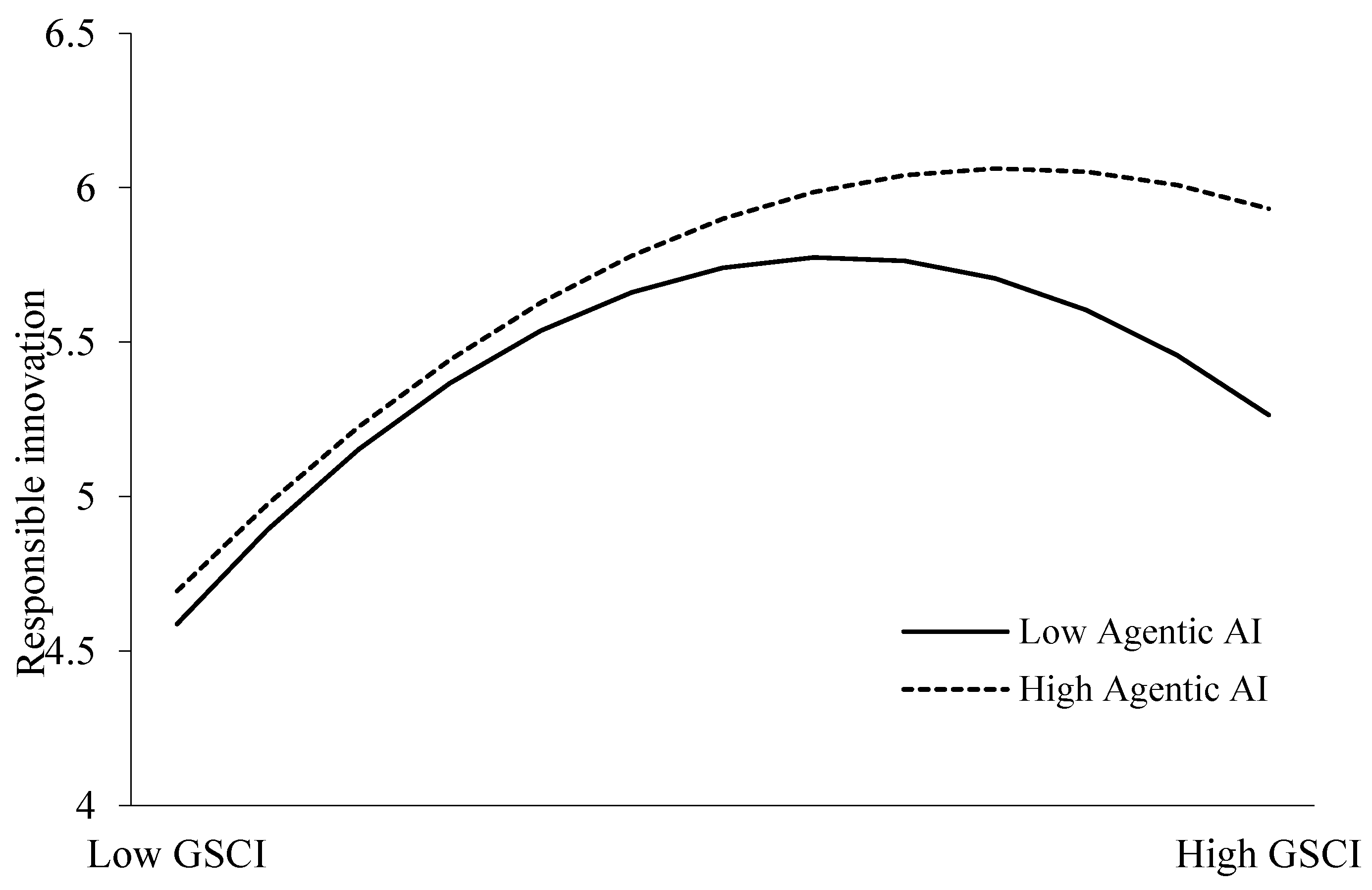
According to Model 10, the linear interaction term between GSCI and agentic AI significantly influences responsible innovation (β = 0.136, Boot SE = 0.062, p < 0.050, CI95% = [0.014, 0.258]), whereas the quadratic interaction term (GSCI2 × AAI) does not exhibit a statistically significant effect (β = 0.115, Boot SE = 0.071, p > 0.100, CI95% = [−0.024, 0.254]). Following Haans et al. [56], this pattern confirms that agentic AI moderates the linear slope and shifts the location of the curve’s turning point, rather than changing the overall quadratic curvature. Therefore, H5a is partially supported.
As illustrated in Figure 2, further turning-point analysis reveals that a high level of agentic AI (+1 SD) shifts the peak of responsible innovation rightward from GSCI = 0.377 SD (at low AAI) to GSCI = 0.749 SD (at high AAI)2. Graphically, under high agentic AI, the initial positive impact of GSCI on responsible innovation is intensified, while the subsequent decline beyond the turning point is substantially buffered. This demonstrates that agentic AI acts as a threshold-extending moderator, allowing firms to pursue deeper GSCI before experiencing diminishing returns in responsible innovation.
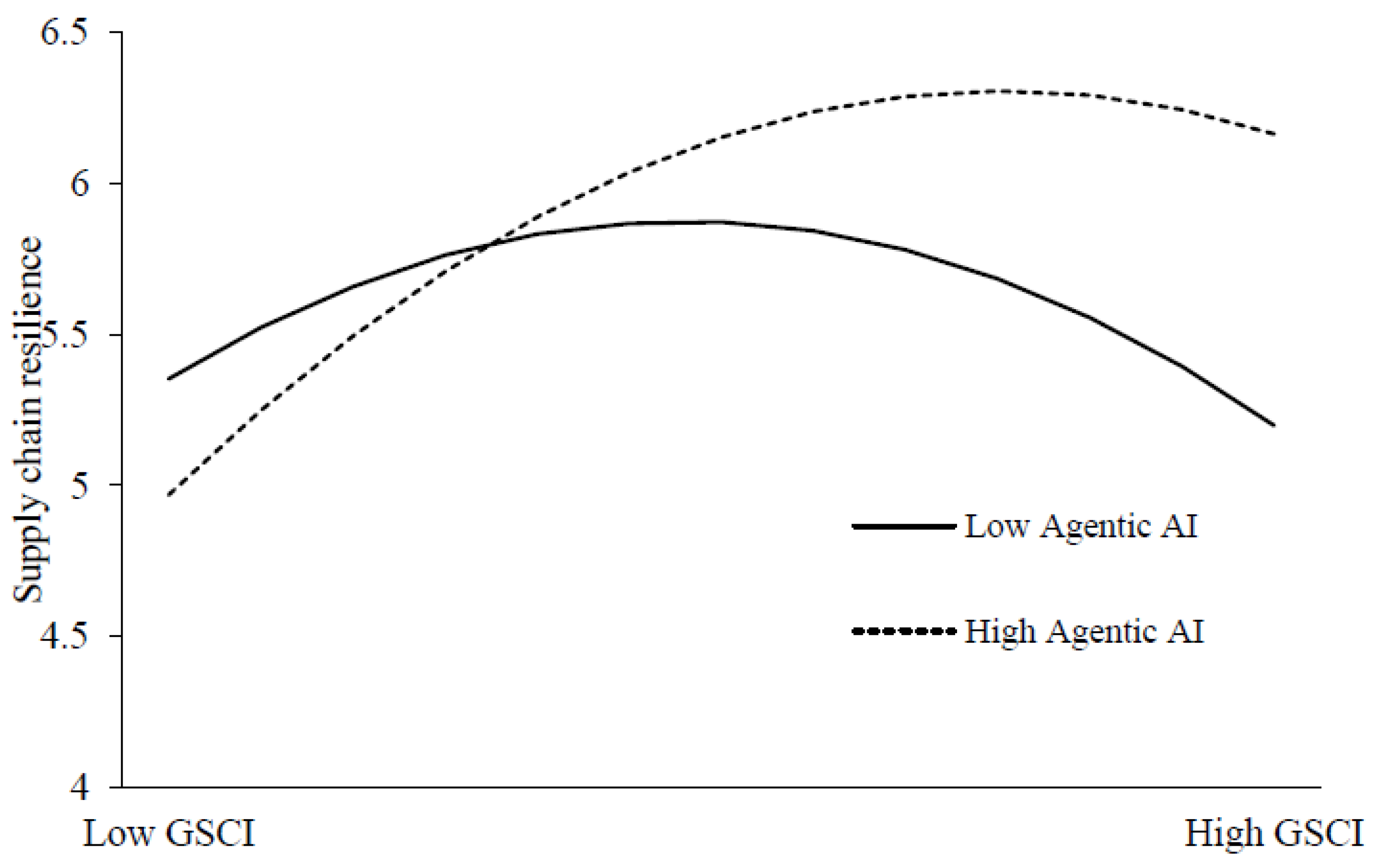
According to Model 12, the interaction between GSCI and agentic AI significantly affects SCR (β = 0.147, Boot SE = 0.069, p < 0.050, CI95% = [0.202, 0.472]), whereas the quadratic interaction term (GSCI2 × AAI) is statistically non-significant (β = 0.004, Boot SE = 0.065, p > 0.100, CI95% = [−0.123, 0.131]). Further turning-point analysis indicates that agentic AI positively moderates the linear slope and shifts the turning point of the inverted U-shaped relationship rightward (from GSCI = 0.330 SD at low AAI to GSCI = 0.749 SD at high AAI), thus providing partial support for H5b. As illustrated in Figure 3, a high level of agentic AI enables firms to extract higher SCR from GSCI while buffering against the negative effects triggered by excessive GCSI.

4.5. Robustness Analysis

To address potential concerns regarding measurement error inherent in composite-score regressions and to verify whether the inverted U-shaped relationship is sensitive to weighting specifications, we performed two supplementary robustness tests. First, we extracted latent factor scores via CFA using Bartlett’s method, which incorporates unique indicator loadings to minimize measurement noise. Re-estimating the structural model with factor scores confirmed that the quadratic effect of GSCI remains highly significant and strongly negative (β = − 0.326, p < 0.001), eliminating concerns of measurement-induced artifact. Second, we disaggregated GSCI into GII and GEI. As displayed in Table 7, the non-linear curvature is overwhelmingly driven by external integration (GEI2: β = −0.401, p < 0.001), whereas internal integration displays a robust linear positive effect (GII2: β = 0.016, p = 0.797). These combined results demonstrate that our conclusions are both methodologically and substantively robust.
Taken together, these robust findings reaffirm the validity of our main conclusions while revealing the precise theoretical mechanism: the non-linear inflection is largely propelled by GEI. This aligns seamlessly with OIPT, as boundary-spanning external integration introduces complex, uncodified information and heightened coordination costs beyond a threshold, whereas internal integration primarily fulfills basic information processing requirements with steady linear gains.

5. Conclusions and Implications

5.1. Discussion

Grounded in the perspective of OIPT, we investigate the impact of GSCI on SCR, introducing responsible innovation and agentic AI as the mediating and moderating variables within this pathway, respectively. An empirical analysis was conducted focusing on Chinese agribusinesses. By developing this research framework, our study responds to the academic concern raised by Fahimnia et al. [5] regarding “whether it is possible for a supply chain to maintain robustness against disruptions while minimizing its environmental impacts.” The empirical findings reveal that:
First, there is an inverted U-shaped relationship between GSCI and SCR. As direct process variables were unmeasured, the underlying mechanisms remain theoretical inferences. Grounded in OIPT, a plausible explanation lies in a multi-stage process: excessive integration exponentially inflates information volume, degrading information quality and heightening stakeholder ambiguity. Resolving this ambiguity demands heavy coordination and resource costs that exceed existing processing capacity and crowd out operational flexibility [59]. Beyond OIPT, alternative mechanisms may also account for this relationship. Hyper-integration may induce structural inertia and partner over-embeddedness, or directly deplete risk-management buffers through continuous compliance expenditures. Overall, these insights suggest that only a moderate level of GSCI promotes SCR.
Second, our empirical results provide supportive evidence for the mediating role of responsible innovation in the link between GSCI practices and SCR. Rather than claiming absolute causality, our findings suggest an indirect transmission mechanism where moderate GSCI aligns with heightened responsible innovation, which in turn is positively associated with enhanced SCR. Previous research has concentrated on the influence of GSCI on green innovation [8,29], particularly in terms of environmental sustainability outcomes. Based on the previous research, we further broaden the scope of the innovation effects of GSCI to encompass a wide range of sustainability and social acceptability by examining the impact of GSCI on responsible innovation. Meanwhile, by confirming the inverted U-shaped relationship between GSCI and responsible innovation, our study highlights the significance of moderate GSCI for responsible innovation, aiming to deepen the understanding of the innovation effects of GSCI. We also found that responsible innovation positively impacts SCR, supporting the view of Xie et al. [37]. They argue that responsible innovation can be employed to tackle significant challenges, such as rapid recovery from disruptions in business networks.
Finally, our study confirms that agentic AI, as an advanced organizational information processing capacity, plays a nuanced slope-moderating role within the aforementioned pathways. Specifically, while agentic AI does not eliminate the overarching inverted U-shaped curvature, its goal-oriented reasoning and scenario simulation capabilities significantly alleviate unstructured information overload and mitigate the crowding-out effect on managerial attention caused by moderate-to-high GSCI. By pushing the diminishing-returns threshold (turning point) rightward, a high level of agentic AI allows enterprises to absorb deeper levels of GSCI before encountering performance plateaus, thereby fostering responsible innovation and enhancing SCR.

5.2. Theoretical Contributions

The theoretical contributions of our paper are embodied in the following three aspects. First, grounded in OIPT, we have uncovered an inverted U-shaped non-linear relationship between GSCI and SCR, offering a fresh theoretical lens to reconcile divergent perspectives on whether green practices bolster supply chain resilience [6,10]. Our findings indicate that moderate integration enhances an organization’s information processing capacity to capture environmental risk signals. From a theoretical perspective, excessive integration beyond the critical threshold is associated with heavy information friction and coordination demands, which may crowd out the firm’s bounded information processing resources and induce a mismatch between information supply and demand. Furthermore, by expanding the application boundaries of OIPT from intra-organizational information process design to inter-organizational contexts characterized by information capacity spillover and overload management under green barriers, our study enriches the explanatory power of the theory within multi-objective collaborative settings.
Second, we open the “black box” of the relationship between GSCI and SCR, identify responsible innovation as a key mediating pathway, and extend the research context of responsible innovation from the firm level to the supply chain level. Most existing empirical studies have focused on the direct impact of GSCI on SCR [4,10], while paying insufficient attention to the transmission mechanisms between the two. Under the lens of OIPT, externally acquired heterogeneous green information cannot automatically crystallize into the system’s defensive rigidity; instead, it must rely on specific organizational processing mechanisms for assimilation and absorption. By introducing responsible innovation as the core mediating variable, our study uncovers how resources acquired through GSCI enhance a firm’s capacity to cope with ecological risks and supply chain crises through the pivotal pathway of responsible innovation. Furthermore, while the extant literature on responsible innovation predominantly focuses on its driving antecedents and performance outcomes within a single, isolated organization [60,61], our study contextualizes responsible innovation within a dynamic information transmission chain of inter-organizational supply chain integration and resilience outcomes. Consequently, this advances a paradigm shift in responsible innovation research toward the broader supply chain network ecosystem.
Third, we identify agentic AI as a critical boundary condition, clarifying the contextual dependency of GSCI on SCR through responsible innovation. Compared with existing research that largely focuses on the direct effects of conventional digital tools [62], our study, anchored in the OIPT perspective, conceptualizes agentic AI—characterized by autonomous decision-making—as a key contextual factor capable of adaptively regulating organizational information processing capacity. To the best of our knowledge, this is the first study to empirically test the moderating effect of agentic AI within the core “GSCI—responsible innovation—SCR” pathway, thereby deepening our understanding of the underlying mechanisms of agentic AI in supply chains. More importantly, our study extends the empirical context of agentic AI to the traditional agricultural sector of a developing economy, providing robust micro-foundational data support while laying a solid foundation for future research on agentic supply chains.

5.3. Managerial Implications

Our study offers valuable managerial implications for agribusiness executives. First, managers should prudently navigate the boundaries of green integration to dynamically balance information supply and demand within the supply chain. Since our findings confirm that green supply chain integration is not a case of “the more, the better,” agribusinesses should adopt a moderate integration strategy. Within the optimal range, firms ought to deepen cross-functional environmental collaboration and forge long-term, stable green strategic alliances with partners such as smallholder farmers and suppliers. This enables the deep assimilation of heterogeneous environmental knowledge across the chain, matching sufficient information processing capacity for responsible innovation and resilience building. However, once the degree of integration crosses the critical threshold and triggers an “information rebound effect,” managers must streamline inter-organizational collaborative processes and selectively filter external environmental noise. This prevents massive volumes of fragmented data from maliciously crowding out bounded resources, thereby avoiding delayed decision-making that impairs crisis response speeds when confronting ecological risks.
Second, agribusinesses must dismantle the sole focus on economic benefits and deeply embed responsible innovation into the bedrock of agricultural resilience. To address the ecological over-exploitation caused by certain agricultural technologies that prioritize economic gains at the expense of societal welfare, agribusinesses need to reallocate core innovation resources. Responsible innovation should be leveraged as a strategic-grade tool to bolster environmental resilience across the supply chain. Corporate managers should proactively transcend narrow economic responsibilities by embedding ecological compliance, social welfare, and ethical considerations throughout the entire life cycle of agricultural product R&D and circulation. By implementing responsible innovation initiatives, firms can fundamentally mitigate secondary environmental impacts induced by high-intensity development. Moreover, when commercial networks encounter unexpected disruptions, such initiatives enable firms to swiftly mobilize multi-stakeholder trust leveraging high social desirability, thereby achieving high-resilience system recovery.
Finally, firms should deploy agentic AI to construct an agentic-enabled modern agricultural supply chain ecosystem. Agribusinesses should actively introduce agentic systems as an adaptive regulating mechanism to expand organizational information processing capacity and flatten the negative externalities of over-integration. On the one hand, managers should authorize AI agents to autonomously execute multi-step decision sequences—such as automatically reconfiguring agricultural sourcing routes or triggering safety stock adjustments—during environmental crises, effectively translating technological dividends into instantaneous crisis intervention capabilities. On the other hand, recognizing that smallholder farmers at the upstream of the supply chain reside at the bottom of the digital pyramid, leading agribusinesses should proactively shoulder social responsibilities. This can be achieved by feeding back into smallholder farmers through technical training and smart equipment deployment. By fostering a collaborative ecosystem where “leading enterprises build platforms and smallholder farmers connect to the intelligent network,” firms can establish a solid micro-foundational bedrock for the sustainable and healthy development of agricultural supply chains.

6. Limitations and Future Research

While our study offers useful insights, several limitations warrant future research. First, to ensure assessment accuracy, our scenario-based screening limited the sample to firms with operational agentic AI deployments. While safeguarding internal validity, this makes our findings more applicable to digitally advanced firms, offering limited generalizability to traditional firms without an AI baseline. Additionally, as all data were drawn from Chinese agricultural enterprises, the findings may be bounded by specific regional and industry contexts. Future research could explore other countries or environmentally impactful sectors. Second, several methodological limitations regarding data collection and research design warrant attention. Although we follow Flynn et al. [63] in viewing survey-based methods as effective for capturing internal managerial perceptions and integration practices—and despite procedural controls to minimize CMB and non-response bias—reliance on single-informant subjective surveys still cannot entirely eliminate self-reporting bias [64]. Furthermore, the cross-sectional nature of our survey data constrains our capacity to establish strict causal relationships, making it difficult to fully rule out potential endogeneity issues such as reverse causality and omitted variable bias. Future research could adopt multi-wave longitudinal panel designs or quasi-experimental methods to further enhance the validity of causal inference and the robustness of the empirical findings. Third, as micro-level process variables (such as information overload and coordination costs) were not directly measured, our mechanism explanations grounded in OIPT remain theoretical inferences. On the basis of our empirical validation regarding the mediating effect of responsible innovation, future research could directly measure these micro-level scales or incorporate theoretical lenses such as complexity theory to explain the complex relationship between GSCI and SCR [65]. Finally, future case studies could explore managers’ perspectives on green and resilient supply chains and identify additional best practices and exploration avenues to achieve supply chain management goals. Furthermore, future research could explicitly incorporate realized environmental performance resulting from GSCI into the model to explore best practices and strategic pathways that achieve a genuine “win-win” between environmental performance and SCR.

Supplementary Materials

The following supporting information can be downloaded at: https://www.mdpi.com/article/10.3390/systems14091117/s1.

Author Contributions

Conceptualization, X.T.; methodology, X.T.; software, X.T.; validation, B.Z.; formal analysis, B.Z.; investigation, Y.D.; resources, X.T.; data curation, Y.D.; writing—original draft preparation, X.T.; writing—review and editing, B.Z.; project administration, X.T.; funding acquisition, B.Z. All authors have read and agreed to the published version of the manuscript.

Funding

This research was funded by the Shandong Provincial Natural Science Foundation (grant number ZR2026QC1601),and Shandong Provincial Social Science Planning Research Project (grant number 25CGLJ05).

Institutional Review Board Statement

Ethical review and approval were exempted for this study as it involved only a minimal-risk, fully anonymized survey that did not collect sensitive personal data or involve clinical/experimental procedures.

Informed Consent Statement

The respondents are fully aware of the objectives, procedures, and privacy protection measures, as well as the potential risks and benefits of participating in this research. On this basis, they voluntarily participated in this research and consented to the researchers collecting, using, and protecting their personal information.

Data Availability Statement

The original contributions presented in this study are included in the article. Further inquiries can be directed to the corresponding author.

Acknowledgments

We are grateful to the anonymous reviewers for their thorough and insightful comments.

Conflicts of Interest

The authors declare no conflicts of interest.

Notes

1
Following Haans et al. (2016) [56], for a quadratic regression model Y = β0 + β1 X + β2 X2 + controls, the turning point (X *) is derived by taking the first derivative with respect to X and setting it to zero ( y x = β1 + 2 β2 X = 0), yielding: X * = − β 1 2 β 2 .
2
When moderated by Z (AAI), the regression equation expands to: Y = β0 + β1 X + β2 X2 + β3 Z + β4 (X × Z) + β5 (X2 × Z) + controls, setting y x = 0 gives X *(Z) = − β 1 + β 4 Z 2 ( β 2 + β 5 Z ) . Since β5 (GSCI2 × AAI) was non-significant in both Model 10 and Model 12, the equation simplifies to: X *(Z) = − β 1 + β 4 Z 2 β 2 .

References

  1. Roh, T.; Noh, J.; Oh, Y.; Park, K.-S. Structural Relationships of a Firm’s Green Strategies for Environmental Performance: The Roles of Green Supply Chain Management and Green Marketing Innovation. J. Clean. Prod. 2022, 356, 131877. [Google Scholar] [CrossRef] [Scilit]
  2. Shukla, S.; Kapoor, R.; Gupta, N.; Garza-Reyes, J.A.; Kumar, V. Role of Information and Communication Technology in Mitigating Risks in Indian Agricultural Supply Chains. Supply Chain Manag. 2023, 28, 544–558. [Google Scholar] [CrossRef] [Scilit]
  3. Nayal, K.; Raut, R.D.; Narkhede, B.E.; Priyadarshinee, P.; Panchal, G.B.; Gedam, V.V. Antecedents for Blockchain Technology-Enabled Sustainable Agriculture Supply Chain. Ann. Oper. Res. 2023, 327, 293–337. [Google Scholar] [CrossRef] [Scilit] [PubMed]
  4. Ji, L.; Yuan, C.L.; Feng, T.W.; Wang, C. Achieving the Environmental Profits of Green Supplier Integration: The Roles of Supply Chain Resilience and Knowledge Combination. Sustain. Dev. 2020, 28, 978–989. [Google Scholar] [CrossRef] [Scilit]
  5. Fahimnia, B.; Jabbarzadeh, A.; Sarkis, J. Greening Versus Resilience: A Supply Chain Design Perspective. Transp. Res. Part E Logist. Transp. Rev. 2018, 119, 129–148. [Google Scholar] [CrossRef] [Scilit]
  6. Cotta, D.; Klink, L.; Alten, T.; Al Madhoon, B. How Do Supply Chain Managers Perceive the Relationship Between Resilience and Sustainability Practices? An Exploratory Study. Bus. Strategy Environ. 2023, 32, 3737–3751. [Google Scholar] [CrossRef] [Scilit]
  7. Sauer, P.C.; Silva, M.E.; Schleper, M.C. Supply Chains’ Sustainability Trajectories and Resilience: A Learning Perspective in Turbulent Environments. Int. J. Oper. Prod. Manag. 2022, 42, 1109–1145. [Google Scholar] [CrossRef] [Scilit]
  8. Wu, G.C. The Influence of Green Supply Chain Integration and Environmental Uncertainty on Green Innovation in Taiwan’s IT Industry. Supply Chain Manag. 2013, 18, 539–552. [Google Scholar] [CrossRef] [Scilit]
  9. Zhang, W.; Zhang, F.; Cheng, Z. Green Entrepreneurial Orientation and Green Human Capital: Unlocking the Potential of Green Supply Chain Integration Through Corporate Environmental Strategy. Humanit. Soc. Sci. Commun. 2025, 12, 655. [Google Scholar] [CrossRef] [Scilit]
  10. Chen, P.K. Efficiency of Lean Practices and Blockchain Combinations for Green Supplier Integration Improvements in Sustainable Development. Sustain. Dev. 2023, 31, 555–571. [Google Scholar] [CrossRef] [Scilit]
  11. Galbraith, J.R. Designing Complex Organizations; Addison-Wesley: Boston, MA, USA, 1973. [Google Scholar]
  12. Sabahi, S.; Parast, M.M. Firm Innovation and Supply Chain Resilience: A Dynamic Capability Perspective. Int. J. Logist. Res. Appl. 2020, 23, 254–269. [Google Scholar] [CrossRef] [Scilit]
  13. Stilgoe, J.; Owen, R.; Macnaghten, P. Developing a Framework for Responsible Innovation. Res. Policy 2013, 42, 1568–1580. [Google Scholar] [CrossRef] [Scilit]
  14. Li, G.; Li, L.; Choi, T.M.; Sethi, S.P. Green Supply Chain Management in Chinese Firms: Innovative Measures and the Moderating Role of Quick Response Technology. J. Oper. Manag. 2020, 66, 958–988. [Google Scholar] [CrossRef] [Scilit]
  15. Jannelli, V.; Schöpf, S.; Bickel, M.; Netland, T.; Brintrup, A. Agentic LLMs in the Supply Chain: Towards Autonomous Multi-Agent Consensus-Seeking. Int. J. Prod. Res. 2025, 1–31. [Google Scholar] [CrossRef] [Scilit]
  16. Ivanov, D. Agentic Digital Twins: Bridging Model-Based and AI-Driven Decision-Making Support for a New Era of Supply Chain and Operations Management. Int. J. Prod. Res. 2026, 64, 6574–6590. [Google Scholar] [CrossRef] [Scilit]
  17. Hughes, L.; Dwivedi, Y.K.; Malik, T.; Shawosh, M.; Albashrawi, M.A.; Jeon, I.; Dutot, V.; Appanderanda, M.; Crick, T.; De’, R.; et al. AI Agents and Agentic Systems: A Multi-Expert Analysis. J. Comput. Inf. Syst. 2025, 65, 489–517. [Google Scholar] [CrossRef] [Scilit]
  18. Xu, L.; Mak, S.; Brintrup, A. Will Bots Take Over the Supply Chain? Revisiting Agent-Based Supply Chain Automation. Int. J. Prod. Econ. 2021, 241, 108279. [Google Scholar] [CrossRef] [Scilit]
  19. Tushman, M.L.; Nadler, D.A. Information Processing as an Integrating Concept in Organization Design. Acad. Manag. Rev. 1978, 3, 613–624. [Google Scholar] [CrossRef] [Scilit]
  20. Gómez, J.; Salazar, I.; Vargas, P. Firm Boundaries, Information Processing Capacity, and Performance in Manufacturing Firms. J. Manag. Inf. Syst. 2016, 33, 809–842. [Google Scholar] [CrossRef] [Scilit]
  21. Daft, R.L.; Lengel, R.H. Organizational Information Requirements, Media Richness and Structural Design. Manag. Sci. 1986, 32, 554–571. [Google Scholar] [CrossRef] [Scilit]
  22. Srinivasan, R.; Swink, M. Leveraging Supply Chain Integration Through Planning Comprehensiveness: An Organizational Information Processing Theory Perspective. Decis. Sci. 2015, 46, 823–861. [Google Scholar] [CrossRef] [Scilit]
  23. Buttke, L. Information Processing in Supply Chain Due Diligence: From Multi-Stakeholder Uncertainties to Organizational Needs. Supply Chain Manag. Int. J. 2026, 31, 690–710. [Google Scholar] [CrossRef] [Scilit]
  24. Koyra, K.T.; Wang, M.Y.; Zhang, C. How IT Capability Misalignment Between Buyers and Suppliers Affects Product Co-Development: An Information Processing Theory Perspective. Int. J. Oper. Prod. Manag. 2026, 46, 938–958. [Google Scholar] [CrossRef] [Scilit]
  25. Teng, X.; Zhang, X.; Li, Y.; Dong, Y. The Impact of AI Capability on Responsible Innovation in High-Tech SMEs from the Perspective of the Knowledge-Based View. J. Innov. Knowl. 2026, 11, 100875. [Google Scholar] [CrossRef] [Scilit]
  26. Kong, T.; Feng, T.; Huo, B. Green Supply Chain Integration and Financial Performance: A Social Contagion and Information Sharing Perspective. Bus. Strategy Environ. 2021, 30, 2255–2270. [Google Scholar] [CrossRef] [Scilit]
  27. Feng, T.; Sheng, H. Identifying the Equifinal Configurations of Prompting Green Supply Chain Integration and Subsequent Performance Outcome. Bus. Strategy Environ. 2023, 32, 5234–5251. [Google Scholar] [CrossRef] [Scilit]
  28. Song, M.; Yang, M.X.; Zeng, K.J.; Wang, C.; Wang, F. Unlocking Green Innovation Through Big Data Analytics Capability: A Moderated Mediation Model of Green Supply Chain Integration and Green Leadership Style. Bus. Strategy Environ. 2026, 1–21. [Google Scholar] [CrossRef] [Scilit]
  29. Kong, T.; Feng, T.; Huang, Y.; Cai, J. How to Convert Green Supply Chain Integration Efforts Into Green Innovation: A Perspective of Knowledge-Based View. Sustain. Dev. 2020, 28, 1106–1121. [Google Scholar] [CrossRef] [Scilit]
  30. Adomako, S.; Tran, M.D. Environmental Collaboration, Responsible Innovation, and Firm Performance: The Moderating Role of Stakeholder Pressure. Bus. Strategy Environ. 2022, 31, 1695–1704. [Google Scholar] [CrossRef] [Scilit]
  31. Memon, K.R.; Ooi, S.K.; Han, H. Responsible Innovation and Corporate Sustainability Performance: A Structural Equation Modeling-Neural Network Approach. Bus. Strategy Environ. 2024, 33, 2712–2730. [Google Scholar] [CrossRef] [Scilit]
  32. Al-Swidi, A.K.; Al-Hakimi, M.A.; Alyahya, M.S. Green Innovation for Sustainable Development: Leveraging Green Knowledge Integration, Blockchain Technology and Green Supply Chain Integration. J. Knowl. Manag. 2024, 28, 1746–1770. [Google Scholar] [CrossRef] [Scilit]
  33. Ureña-Espaillat, H.J.; Briones-Peñalver, A.J.; Bernal-Conesa, J.A. Influencing Responsible Green Innovation in Dominican Agribusiness Performance. Corp. Soc. Responsib. Environ. Manag. 2022, 29, 675–685. [Google Scholar] [CrossRef] [Scilit]
  34. Zhang, X.; Teng, X.; Le, Y.; Li, Y. Strategic Orientations and Responsible Innovation in SMEs: The Moderating Effects of Environmental Turbulence. Bus. Strategy Environ. 2023, 32, 2522–2539. [Google Scholar] [CrossRef] [Scilit]
  35. Zhao, G.; Feng, T.W.; Wang, D. Is More Supply Chain Integration Always Beneficial to Financial Performance? Ind. Mark. Manag. 2015, 45, 162–172. [Google Scholar] [CrossRef] [Scilit]
  36. Lees, N.; Lees, I. Competitive Advantage Through Responsible Innovation in the New Zealand Sheep Dairy Industry. Int. Food Agribus. Manag. Rev. 2018, 21, 505–524. [Google Scholar] [CrossRef] [Scilit]
  37. Xie, X.M.; Wu, Y.H.; Tejerob, C.B.G. How Responsible Innovation Builds Business Network Resilience to Achieve Sustainable Performance During Global Outbreaks: An Extended Resource-Based View. IEEE Trans. Eng. Manag. 2024, 71, 12194–12208. [Google Scholar] [CrossRef] [Scilit]
  38. Camilleri, M.A. The Rationale for Responsible Supply Chain Management and Stakeholder Engagement. J. Glob. Responsib. 2017, 8, 111–126. [Google Scholar] [CrossRef] [Scilit]
  39. Al-Hakimi, M.A.; Borade, D.B.; Saleh, M.H. The Mediating Role of Innovation Between Entrepreneurial Orientation and Supply Chain Resilience. Asia-Pac. J. Bus. Adm. 2022, 14, 592–616. [Google Scholar] [CrossRef] [Scilit]
  40. Le, T.T.; Behl, A. Linking Artificial Intelligence and Supply Chain Resilience: Roles of Dynamic Capabilities Mediator and Open Innovation Moderator. IEEE Trans. Eng. Manag. 2024, 71, 8577–8590. [Google Scholar] [CrossRef] [Scilit]
  41. Jiang, Q.; Li, J.Z.; Si, H.Y.; Su, Y.Y. The Impact of the Digital Economy on Agricultural Green Development: Evidence from China. Agriculture 2022, 12, 1107. [Google Scholar] [CrossRef] [Scilit]
  42. Bag, S.; Routray, S.; Chiarini, A.; Qudaih, R. Agentic AI and Circular Procurement Performance: An Empirical Study. Bus. Strategy Environ. 2026, 1–24. [Google Scholar] [CrossRef] [Scilit]
  43. Rahman, M.K.; Shamsuddoha, M. AI Contribution for Developing Green Visibility and Integration Toward Sustainability Performance in Supply Chain. J. Enterp. Inf. Manag. 2025, 1–39. [Google Scholar] [CrossRef] [Scilit]
  44. Cui, R.; Xia, E.; Zhou, C. How Digital Agility Influences Green Supplier Integration: Exploring the Role of Supply Chain Traceability and Market Turbulence. J. Manuf. Technol. Manag. 2026, 1–22. [Google Scholar] [CrossRef] [Scilit]
  45. Cole, D.A.; Maxwell, S.E. Testing Mediational Models with Longitudinal Data: Questions and Tips in the Use of Structural Equation Modeling. J. Abnorm. Psychol. 2003, 112, 558–577. [Google Scholar] [CrossRef] [Scilit] [PubMed]
  46. Podsakoff, P.M.; MacKenzie, S.B.; Podsakoff, N.P. Sources of Method Bias in Social Science Research and Recommendations on How to Control It. Annu. Rev. Psychol. 2012, 63, 539–569. [Google Scholar] [CrossRef] [Scilit] [PubMed]
  47. Curran, P.J.; West, S.G.; Finch, J.F. The Robustness of Test Statistics to Nonnormality and Specification Error in Confirmatory Factor Analysis. Psychol. Methods 1996, 1, 16–29. [Google Scholar] [CrossRef]
  48. Yuan, Y.Q.; Li, W. The Effects of Supply Chain Risk Information Processing Capability and Supply Chain Finance on Supply Chain Resilience: A Moderated and Mediated Model. J. Enterp. Inf. Manag. 2022, 35, 1592–1612. [Google Scholar] [CrossRef] [Scilit]
  49. Wang, G.; Feng, T.; Zhu, Z.; Jiang, Y. Enabling Green Supply Chain Integration Via Green Entrepreneurial Orientation: Does Environmental Leadership Matter? Corp. Soc. Responsib. Environ. Manag. 2023, 30, 518–530. [Google Scholar] [CrossRef] [Scilit]
  50. Du, L.; Zhang, Z.; Feng, T. Linking Green Customer and Supplier Integration with Green Innovation Performance: The Role of Internal Integration. Bus. Strategy Environ. 2018, 27, 1583–1595. [Google Scholar] [CrossRef] [Scilit]
  51. Hadj, T.B. Effects of Corporate Social Responsibility Towards Stakeholders and Environmental Management on Responsible Innovation and Competitiveness. J. Clean. Prod. 2020, 250, 119490. [Google Scholar] [CrossRef] [Scilit]
  52. Cui, L.; Wu, H.; Wu, L.; Kumar, A.; Tan, K.H. Investigating the Relationship Between Digital Technologies, Supply Chain Integration and Firm Resilience in the Context of COVID-19. Ann. Oper. Res. 2023, 327, 825–853. [Google Scholar] [CrossRef] [Scilit] [PubMed]
  53. Zhou, J.; Hu, L.; Yu, Y.; Zhang, J.Z.; Zheng, L.J. Impacts of IT Capability and Supply Chain Collaboration on Supply Chain Resilience: Empirical Evidence from China in COVID-19 Pandemic. J. Enterp. Inf. Manag. 2024, 37, 777–803. [Google Scholar] [CrossRef] [Scilit]
  54. Armstrong, J.S.; Overton, T.S. Estimating Nonresponse Bias in Mail Surveys. J. Mark. Res. 1977, 14, 396–403. [Google Scholar] [CrossRef] [Scilit]
  55. Podsakoff, P.M.; MacKenzie, S.B.; Lee, J.; Podsakoff, N.P. Common Method Biases in Behavioral Research: A Critical Review of the Literature and Recommended Remedies. J. Appl. Psychol. 2003, 88, 879–903. [Google Scholar] [CrossRef] [Scilit] [PubMed]
  56. Haans, R.F.; Pieters, C.; He, Z.L. Thinking About U: Theorizing and Testing U-and Inverted U-Shaped Relationships in Strategy Research. Strateg. Manag. J. 2016, 37, 1177–1195. [Google Scholar] [CrossRef] [Scilit]
  57. Hayes, A.F.; Preacher, K.J. Quantifying and Testing Indirect Effects in Simple Mediation Models When the Constituent Paths Are Nonlinear. Multivar. Behav. Res. 2010, 45, 627–660. [Google Scholar] [CrossRef] [Scilit] [PubMed]
  58. Aiken, L.S.; West, S.G. Multiple Regression: Testing and Interpreting Interactions; Sage Publications: Thousand Oaks, CA, USA, 1991. [Google Scholar]
  59. Johnsen, R.E.; Lacoste, S. An Exploration of the ‘Dark Side’ Associations of Conflict, Power and Dependence in Customer–Supplier Relationships. Ind. Mark. Manag. 2016, 59, 76–95. [Google Scholar] [CrossRef] [Scilit]
  60. Ahuja, S.; Chan, Y.E.; Krishnamurthy, R. Responsible Innovation with Digital Platforms: Cases in India and Canada. Inf. Syst. J. 2022, 33, 76–129. [Google Scholar] [CrossRef] [Scilit]
  61. Memon, K.R.; Ooi, S.K. Identifying Digital Leadership’s Role in Fostering Competitive Advantage Through Responsible Innovation: A SEM-Neural Network Approach. Technol. Soc. 2023, 75, 102399. [Google Scholar] [CrossRef] [Scilit]
  62. Modgil, S.; Singh, R.K.; Hannibal, C. Artificial Intelligence for Supply Chain Resilience: Learning from COVID-19. Int. J. Logist. Manag. 2022, 33, 1246–1268. [Google Scholar] [CrossRef] [Scilit]
  63. Flynn, B.B.; Sakakibara, S.; Schroeder, R.G.; Bates, K.A.; Flynn, E.J. Empirical Research Methods in Operations Management. J. Oper. Manag. 1990, 9, 250–284. [Google Scholar] [CrossRef] [Scilit]
  64. Boyer, K.K.; Swink, M.L. Empirical Elephants—Why Multiple Methods Are Essential to Quality Research in Operations and Supply Chain Management. J. Oper. Manag. 2008, 26, 338–344. [Google Scholar] [CrossRef] [Scilit]
  65. Norberg, J.; Cumming, G. Complexity Theory for a Sustainable Future; Columbia University Press: New York, NY, USA, 2008. [Google Scholar]
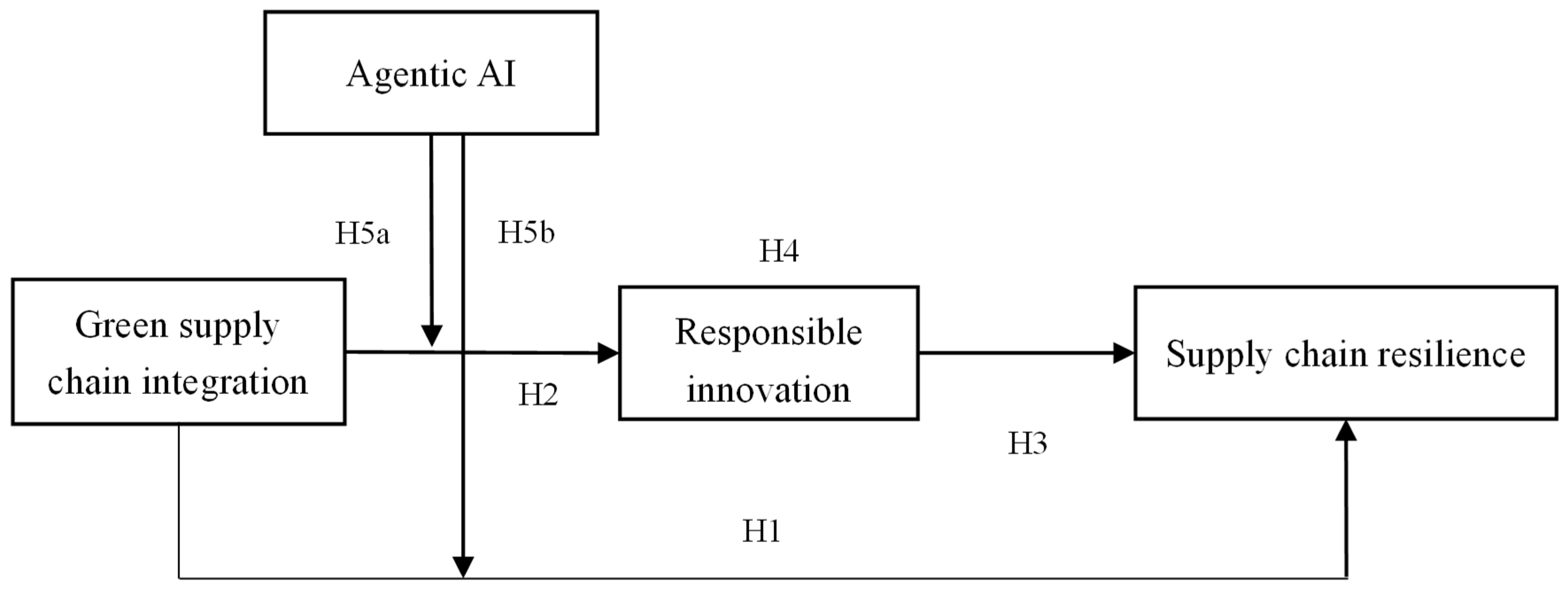
Figure 1. Conceptual model.
Systems 14 01117 g001
Figure 2. Moderating effect of agentic AI on the relationship between GSCI and RI.
Systems 14 01117 g002
Figure 3. Moderating effect of agentic AI on the relationship between GSCI and SCR.
Systems 14 01117 g003
Table 1. Samples Characteristics.
ItemNumberPercentage (%)ItemNumberPercentage (%)
PositionFirm scale (thousand CNY)
Supply chain manager10144.9≤5003214.2
R&D manager5825.8500–50009441.8
IT manager6629.35000–200,0007232.0
Work experience (years)≥200,0002712.0
≤55624.9Industry type
5–1011249.8Agricultural production2912.9
≥105725.3Edible agricultural product processing and manufacturing9240.9
RegionNon-edible agricultural product processing and manufacturing6629.3
Eastern Region11551.1Agricultural and related product circulation services3816.9
Central Region6629.3Ownership type
Western Region4419.6State-owned/collective firms4520.0
Firm age (years)Private-owned firms9743.1
≤34118.2Foreign-funded/joint firms6528.9
3–58638.2Others188.0
6–104218.7
11–153515.6
≥15219.3
Table 2. Reliability and Validity of the Measures.
ConstructsItem CodeFactor
Loadings
Cronbach’s αKMOCRAVE
Green supply chain
integration
(Wang et al. [49])
GII10.7080.8620.8890.9100.505
GII20.675
GII30.664
GII40.648
GII50.692
GEI10.759
GEI20.626
GEI30.792
GEI40.770
GEI50.752
Responsible innovation
(Hadj [51] and Zhang et al. [34])
RI10.8670.8890.7500.9220.750
RI20.862
RI30.875
RI40.859
Supply chain resilience
(Yuan and Li [48])
SCR10.6640.8390.8400.8870.612
SCR20.842
SCR30.743
SCR40.786
SCR50.861
Agentic AI
(Bag et al. [42])
AAI10.8810.9180.8910.9390.755
AAI20.878
AAI30.845
AAI40.876
AAI50.865
Note: CR = composite reliability, AVE = average variance extracted. See Supplementary Materials for detailed measurement items.
Table 3. Mean, Standard Deviations and Correlations of the Constructs.
ConstructsMeanSDGSCIRISCRAAI
Green supply chain integration (GSCI)5.2500.7190.711
Responsible innovation (RI)5.3900.7750.347 **0.866
Supply chain resilience (SCR)5.5660.7530.152 *0.361 **0.782
Agentic AI (AAI)5.3500.9450.247 **0.360 **0.252 **0.869
Note: * p < 0.050, ** p < 0.010; the square root of the AVE is reported on the diagonal.
Table 4. Hierarchical Regression Analysis Results.
Supply Chain ResilienceResponsible Innovation
VariableM1M2M3M4M5M6M7M8
Age−0.168 *−0.160 *−0.196 **−0.144 *−0.179 **−0.075−0.056−0.100 +
Size0.1580.124 +0.0910.114 +0.0870.138 *0.0600.021
Eastern−0.069−0.062−0.007−0.034−0.002−0.111−0.094−0.029
Central−0.030−0.035−0.018−0.044−0.0260.0410.0310.051
Industry10.0960.1140.1100.0290.0680.211 *0.252 **0.247 **
Industry2−0.097−0.099−0.003−0.0570.001−0.127−0.132−0.017
Industry3−0.085−0.092−0.047−0.094−0.0580.0260.0120.066
Ownership−0.167−0.222 *−0.166 *−0.107−0.125−0.189 *−0.314 ***−0.247 **
GSCI 0.166 *0.210 ** 0.138 + 0.379 ***0.431 ***
GSCI2 −0.346 *** −0.277 *** −0.414 ***
RI 0.319 ***0.168 *
F value2.484 *2.904 **5.858 ***5.096 ***5.865 ***3.075 **7.046 ***13.112 ***
R20.0840.1080.2150.1760.2320.1020.2280.380
ΔR20.0840.0240.1070.0920.0180.1020.1260.152
Notes: + p < 0.100; * p < 0.050; ** p < 0.010; *** p < 0.001. Industry 1, agricultural production; Industry 2, edible agricultural product processing and manufacturing; Industry 3, non-edible agricultural product processing and manufacturing.
Table 5. Conditional Instantaneous Indirect Effects of GSCI on SCR via Responsible Innovation.
GSCI LevelIndirect Effect (θ)Standard Error (SE)z-Statistic95% Bias-Corrected CI (Lower, Upper)
Low (−1 SD)0.5040.1952.585[0.125, 0.888]
Mean (0 SD)0.1480.0722.056[0.021, 0.310]
High (+1 SD)−0.2080.140−1.486[−0.559, −0.011]
Table 6. Regression Results for Moderation Effect of Agentic AI.
Responsible InnovationSupply Chain Resilience
VariableM9M10M11M12
Age−0.101 +−0.085−0.197 **−0.150 *
Size0.002−0.0100.0770.012
Eastern−0.012−0.0040.0050.025
Central0.0470.030−0.021−0.038
Industry10.236 **0.228 **0.1020.107
Industry2−0.013−0.0140.001−0.003
Industry30.0680.087−0.045−0.023
Ownership−0.230 **−0.209 **−0.153 *−0.111
GSCI0.389 ***0.411 ***0.179 **0.380 ***
GSCI2−0.378 ***−0.365 ***−0.319 ***−0.352 ***
AAI0.162 **0.1030.122 +0.187 *
GSCI × AAI 0.136 * 0.147 *
GSCI2 × AAI 0.115 0.004
F value13.004 ***11.903 ***5.695 ***7.788 ***
R20.4020.4230.2270.324
ΔR20.3000.0210.1430.097
Notes: + p < 0.100; * p < 0.050; ** p < 0.010; *** p < 0.001.
Table 7. Robustness Analysis Results.
Model SpecificationDependent Variable: SCR
VariablesModel 2 (Factor Scores)Model 3 (Dimension
Separation)
ControlsIncludedIncluded
GSCI0.208 ***
GSCI2−0.326 ***
GII0.393 ***
GII20.016
GEI−0.080
GEI2−0.401 ***
R20.2210.279
F Value6.12 ***8.29 ***
Notes: GII = green internal integration; GEI = green external integration. *** p < 0.001.
Disclaimer/Publisher’s Note: The statements, opinions and data contained in all publications are solely those of the individual author(s) and contributor(s) and not of MDPI and/or the editor(s). MDPI and/or the editor(s) disclaim responsibility for any injury to people or property resulting from any ideas, methods, instructions or products referred to in the content.