Article

AI-Based Recruitment: An Integrative Framework for Human Resources Professionals’ Adoption

1
Department of Industrial Engineering, Istanbul Technical University, 34357 Istanbul, Türkiye
2
Department of Management Information Systems, Özyeğin University, Çekmeköy Campus Nişantepe District, Orman Street, Çekmeköy, 34794 Istanbul, Türkiye
*
Author to whom correspondence should be addressed.
Systems 2026, 14(6), 713; https://doi.org/10.3390/systems14060713 (registering DOI)

Submission received: 28 April 2026 / Revised: 5 June 2026 / Accepted: 17 June 2026 / Published: 20 June 2026
(This article belongs to the Section Artificial Intelligence and Digital Systems Engineering)

Abstract

The existing literature highlights that artificial intelligence (AI) creates both hope and threat perceptions among managers and workers, particularly due to concerns about potential job losses and the negative effect on continued professional development. Employee trust in AI-based systems varies depending on their features and performance. Furthermore, regardless of the performance of such systems, some individuals are inherently opposed to AI, a phenomenon known as AI aversion. In this study, an Integrative AI Adoption Framework is developed, drawing upon principles from established theories, including the technology acceptance model, behavioral decision theory, and emotion-based frameworks, to assess how perceived usefulness and perceived ease of use, along with perceived threat, trust, and AI aversion, influence human resources (HR) professionals’ attitudes and behavioral intentions to use AI-based recruitment systems. In doing so, the study conceptualizes AI-based recruitment as a socio-technical system in which a technical subsystem (the system’s instrumental and AI-specific properties) and a social subsystem (the affective and trust-related responses of HR professionals) must be jointly considered to explain adoption. The model was tested using the partial least squares structural equation modeling (PLS-SEM) approach through survey-based data collected from 242 HR professionals. The study’s findings indicate that attitude plays an important role in shaping behavioral intention, and perceived usefulness is a key driver of attitude. AI aversion negatively influences attitudes, while trust has a twofold effect of reducing AI aversion and positively influencing attitude. Additionally, perceived threat significantly increases AI aversion, which is driven by concerns over job replacement and personal development.

1. Introduction

In the dynamic human resources (HR) field, adopting cutting-edge technologies is crucial for maintaining competitiveness and efficiency in talent acquisition and management. Within these developments, artificial intelligence (AI) draws attention as a leading force for change, reshaping traditional recruitment processes and transforming how organizations identify, attract, and retain talents [1,2,3].
Alan Turing, in 1947 (cited by Copeland and Proudfoot [4]), first defined the concept of AI as “a machine that can learn from experience”, which has now evolved significantly. Today, intelligence is understood as the capacity to adapt to new information and is integrated into modern computers. As organizations navigate the digital age, incorporating AI into HR practices has emerged as an essential strategy for optimizing recruitment processes, enhancing candidate experience, and accelerating business success.
With 79% of organizations investigating the use of AI and automated systems in their talent recruitment processes, AI is now part of everyday life [5]. However, despite the immense potential of AI for revolutionizing HR recruitment, its successful adoption remains contingent upon user acceptance and the alignment of technology with user needs and expectations [6]. Organizations planning to implement AI-based human resources management (HRM) systems should encourage employees to adopt them [7]. In the information technology (IT) acceptance and adoption literature, the Technology Acceptance Model (TAM) [8,9], TAM2 [10], TAM3 [11] and the Unified Theory of Acceptance and Use of Technology (UTAUT) [12] have been widely used to understand the key variables that strongly influence users’ adoption behavior towards IT-based systems. In this study, the theoretical foundations of TAM were utilized—particularly the latest and most comprehensive version, TAM3—to explore the influential mechanisms and significant factors that have critical effect on HR professionals’ behavioral intention to use AI-based recruitment systems. Although these models have presented accepted results, they have also been criticized for focusing primarily on motivational factors and lacking in addressing barriers and negative perceptions that could affect user adoption. As is already known, the nature of human decision making is much more complex and comprehensive, as it unfolds within an organization that operates as a system of interrelated subsystems, in which the technological, individual, and social components continuously influence and interact with one another. Understanding both positive and negative aspects dynamically and accounting for potential barriers therefore requires an integrative perspective; this calls for a model that captures not the effect of any single subsystem in isolation, but the combined effects and interactions of all relevant subsystems shaping the adoption decision. The objective is to present as complete but as parsimonious a framework as possible that together can capture the most important subsystems through which adoption decision is formed rather than trying to capture all possible variables. This systems view is based on the socio-technical systems (STS) theory as the conceptual foundation for identifying these subsystems and their interactions. According to STS theory, every work system consists of two interdependent subsystems: a technical subsystem (tools and procedures) and a social subsystem (people, their beliefs and organizational processes). For a system to work well, the two must be jointly optimized, as a technically superior system that disregards its human users will underperform or fail [13]. Bostrom and Heinen [14] brought this lens into the information systems field and note that system failures usually happen because the “human side” is neglected, rather than because of technical issues. The rise of AI makes this balance even more important because work processes are not merely supported by AI systems; they actually take part in the decision-making process, acting as a new, non-human member within traditional team structures [15,16]. As a result, it will require alignment across the governance, management, and work level of the organization to successfully leverage AI. Moreover, this alignment is also influenced by corporate culture, so it is essential to understand its role in how users react to new technologies. Therefore, to truly understand how HR professionals adopt AI, it is essential to examine both the technical and social components and evaluate how they interact within this cultural background. Extending existing models thus requires considering both subsystems and the channels through which they interact to better understand HR professionals’ AI adoption [17,18,19,20].
To address this gap, this study extends traditional technology acceptance frameworks in line with the socio-technical view introduced above: alongside the motivational and cognitive factors that capture how the technology is appraised (the technical subsystem), it incorporates the emotion-driven rejection that can arise on the human side (the social subsystem). This rejection stems from the unique technological characteristics of AI systems, such as autonomy and decision-making capability, black-box nature, bias and fairness risks, and learning from data and adaptivity. Traditional IT tools, such as enterprise resource planning (ERP) systems, databases, and office software, are largely rule-based and predefined and are generally viewed as decision-support tools rather than decision-making agents.
At a personal level, AI creates both hope and fear among managers and workers, particularly due to concerns about job losses and technological unemployment [21]. Ore and Sposato [22] found that HR professionals experience extensive skepticism driven by fears of job loss due to automation, even though they realize AI’s vital role in reinforcing recruitment strategies and believe that human involvement will always be necessary in the recruitment process. Additionally, there are concerns that AI-based systems may negatively affect personal professional development [17]. Some studies have also suggested that trust in such systems varies among employees depending on system features and performance and should be considered as a potential factor in explaining adoption behavior. For instance, Shin [23] found that when users perceive the algorithms as fairer, more accountable, transparent, and explainable, they see them as more trustworthy and useful. Similarly, Wanner et al. [24] also revealed that if users perceive the ability of an algorithm as high, their initial trust in the system is likely to increase. Furthermore, regardless of the performance of AI-based systems, some individuals are inherently opposed to AI. In the literature, this factor is called “algorithm aversion” [25,26] and has arisen as a key aspect influencing AI adoption [27].
Depending on this background, the following research questions are addressed in this study:
i.
What are the potential factors affecting HR professionals’ perceived threat caused by AI-based recruitment systems, such as “job replacement concern” and “personal development concern”?
ii.
How do perceived AI ability, system transparency, and privacy concerns influence the HR professionals’ trust toward the AI-based recruitment systems, and what is the effect of this trust on shaping their attitudes?
iii.
What are the relationships between trust, AI aversion, perceived threat, and attitudes toward AI-based recruitment systems, and how does AI aversion mediate the effects of trust and perceived threat on attitudes?
An Integrative AI Adoption Framework, which aims to provide a comprehensive understanding of the factors influencing HR professionals’ attitudes and behavioral intentions toward using AI in recruitment, has been developed to address these research questions. The study highlights the importance of including both positive and negative perceptions interactively, and, additionally, it contributes to the emerging literature on the use of AI-based systems for organizational decision making.
The rest of the paper is structured as follows: Section 2 explains the theoretical background, gives hypotheses, and introduces the proposed model. Section 3 describes the research methodology and presents the findings of the analysis. Section 4 discusses the results and highlights the implications for theory and practice. Finally, Section 5 concludes the study and gives the limitations and further suggestions.

2. Theoretical Background

2.1. The Role of AI in Recruitment

AI recruiting is the application of AI technologies to different phases of the hiring process. These applications can range from using AI to conduct interviews with candidates to more complex tasks, such as continuous monitoring, analysis, and refinement of the selection process to identify candidates with high potential for success [28]. The systems used to recruit staff using AI can undertake sophisticated tasks such as analyzing video interviews for emotional and behavioral traits that are then matched against job specifications [29,30]. AI in recruitment enhances the quality of talent acquisition by identifying candidates with the right skills and attitudes while improving the objectivity, consistency, and overall decision making in the hiring process. Research shows that AI-based recruitment systems can reduce bias by lessening the influence of factors, such as age, gender, and race, that undeniably affect human judgment [28,31].
With the growing use of AI technologies, various tasks of selection and hiring are being conducted more effectively. For instance, resume screening tasks that consume too much time for recruiters can be automated by using AI, which uses natural language processing (NLP) to find semantic connections between candidate profiles and job descriptions [31]. By accelerating recruitment processes and improving hiring quality, AI helps organizations quickly adapt to changing conditions while enhancing their competitive advantage [29]. AI’s predictive capabilities allow organizations to improve workforce planning and management by anticipating future needs and adjusting recruitment strategies accordingly [32].
The adoption of AI in recruitment is not without difficulties, despite these benefits. The transparency of AI algorithms and the potential for bias have drawn ethical criticism [33]. The need for carefully considering these issues is highlighted by the so-called “application gap”, where AI-based systems are technologically competent but have not yet been fully integrated into recruiting processes due to their potential adverse impacts [33]. In addition, the “knowledge gap” between AI decision makers and the candidates impacts the level of trust or understanding that recruits have in AI-generated results [34].

2.2. Conceptual Model and Hypotheses Development

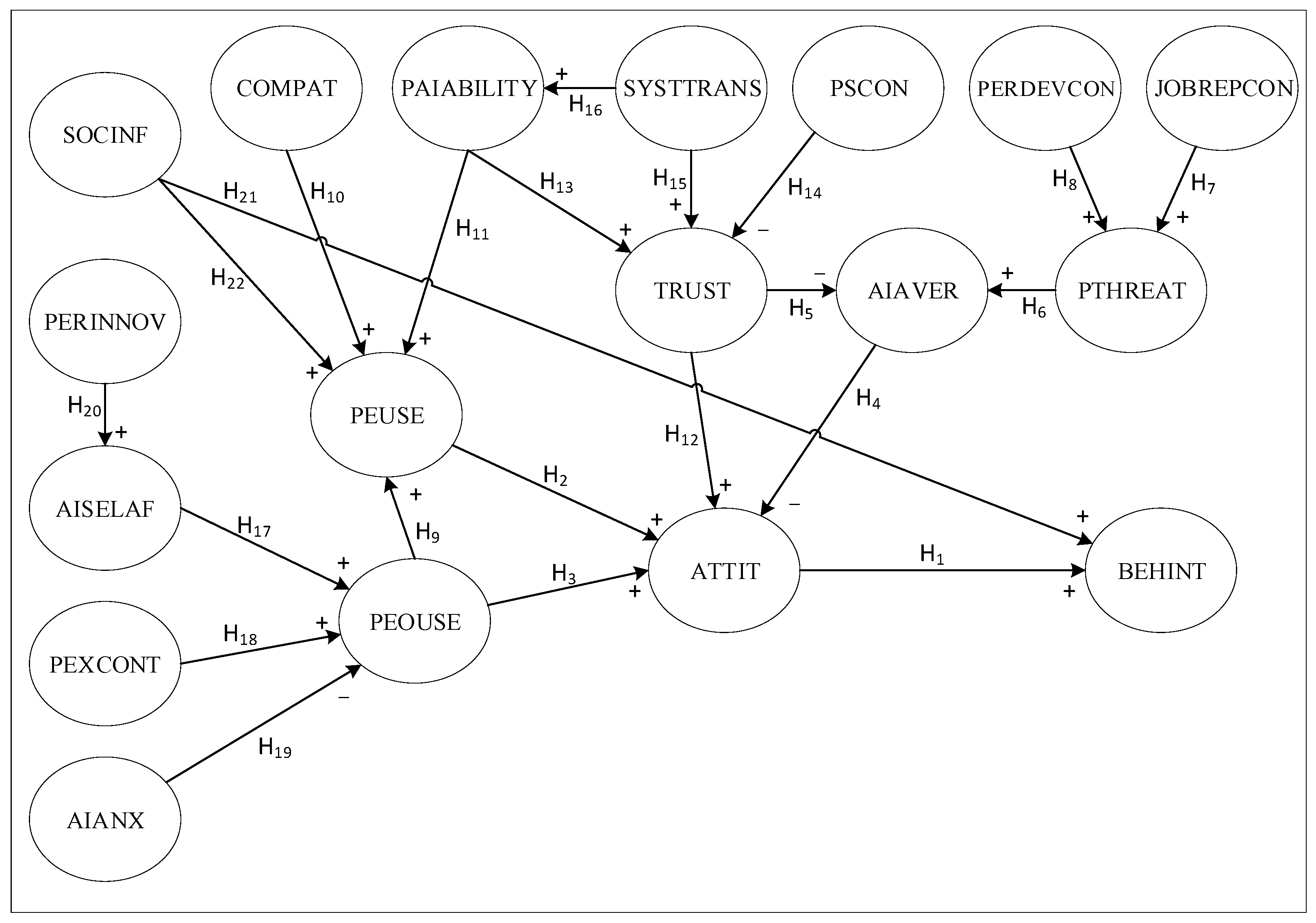
The proposed conceptual model (shown in Figure 1) builds on the TAM’s [8,9] theoretical foundation which itself is theoretically based on the Theory of Reasoned Action (TRA) [35]. TRA proposes that an intention toward a behavior is formed before the behavior itself occurs. In the IT systems context, “behavioral intention to use” refers to the motivation and willingness to put effort into using a tool or system [8,10,11]. Accordingly, TAM considers behavioral intention to use as the only direct determinant of actual using IT tools and systems. This study relies on this assumption because, for newly emerging and not yet widely adopted systems such as AI-based recruitment tools, it is not feasible to measure adoption through actual usage. Instead, behavioral intention provides a valid proxy for understanding adoption factors at the preadoption stage. Moreover, the primary aim of this study is to investigate how AI-based decision-support systems can be designed and introduced effectively to ensure a smoother transition from preadoption to post-adoption. While TRA is not domain-specific, its application through TAM in the IT domain has widely confirmed the intention–use relationship, and numerous studies—particularly those examining newly developed technologies—have successfully employed behavioral intention as the primary outcome variable [36,37,38,39].
From an STS perspective, the adoption of an AI-based recruitment system is not a purely individual or purely technical event but the outcome of the interaction between a technical subsystem and a social subsystem [13,14]. The proposed framework is organized along precisely this distinction. The technical subsystem is represented by constructs concerning the system’s instrumental and AI-specific properties—perceived usefulness, perceived ease of use, compatibility, perceived AI ability, system transparency, and perceived external control—which capture how the technology is appraised as a working tool and the external conditions that enable its use. The social subsystem is represented by constructs concerning the human actor’s response to that technology—AI aversion, perceived threat (together with its sources, job-replacement, and personal-development concerns), privacy concern, trust, AI anxiety, AI self-efficacy, personal innovativeness, and social influence—which capture the affective, dispositional, and social conditions under which adoption is enacted. Attitude and behavioral intention then function as the integrative locus at which the appraisal of the technical subsystem and the state of the social subsystem are reconciled into an adoption decision. In this sense, the proposed framework is not an arbitrary aggregation of constructs but a socio-technical specification of AI-based recruitment systems’ adoption, in which each construct in the model corresponds to an identifiable component of the underlying system.
This systemic view also extends beyond the individual user. Following the governance–management–work hierarchy through which organizations enact change, the successful adoption of AI-based recruitment systems requires alignment across levels: owners and governors must legitimize and resource AI use, management must embed it in processes and incentives, and the HR professionals performing the work must be willing and able to use it [40,41]. Resistance at any level—withheld governance support, misaligned managerial incentives, or worker aversion rooted in threat—propagates through the system and undermines adoption. The present study models the work level, where adoption is ultimately enacted, while recognizing that the attitudes and intentions examined here are conditioned by the governance and management levels. These levels are in turn embedded in the organization’s culture. For example, an innovation-oriented culture that rewards experimentation tends to lower perceived threat and strengthen self-efficacy, whereas a risk-averse culture amplifies aversion and resistance [32,42]. Although corporate culture is not modeled as a separate construct in this study, it constitutes the systemic context within which the modeled relationships operate and represents an important boundary condition for interpreting the findings.

2.2.1. Attitude and Intention to Use

Although the TAM [8] originally emphasized two key belief factors (perceived usefulness and perceived ease of use), later extensions of the model (see TAM2 [10] and TAM3 [11]) excluded the attitude construct, as it was found to only partially mediate the relationship between beliefs and behavioral intention.
However, the TRA [35] and the Theory of Planned Behavior (TPB) [43] conceptualize attitude as a fundamental determinant of intention, positioning it as a key psychological mechanism linking beliefs to behavioral outcomes. In their study, Todd and Taylor [44] adapted the TPB [43] to the IT field as the Decomposed Theory of Planned Behavior (DTPB) [45]. In DTPB, the belief factors of perceived usefulness and perceived ease of use affect attitude and attitude directly affects intention, and no direct relationship was claimed between belief factors and intention to use. Similarly, based on DTPB, Lin [46] found a positive relationship between perceived usefulness and perceived ease of use with attitude, and between attitude and intention.
Recent research on AI-based technologies supports this theoretical instance, showing that attitude remains a critical predictor of intention to use such systems [7,17,24,47,48,49,50]. In light of these considerations, this study included the attitude variable in the model as a critical construct to assess the intention to adopt AI-based systems. Similarly, perceived usefulness and perceived ease of use were also included in the model, both positively influencing the attitude factor throughout the belief structure. However, no direct relationship was established between usage intention and any belief factor, as the mediating effect of attitude was expected. Based on the above-mentioned studies, the following hypotheses are formulated:
H1: 
Attitude positively influences the behavioral intention to use AI-based recruitment systems.
H2: 
Perceived usefulness positively influences attitude toward AI-based recruitment systems.
H3: 
Perceived ease of use positively influences attitude toward AI-based recruitment systems.

2.2.2. Affective Dominance, AI Aversion, and Threat Perception Process

According to behavioral decision theory, cognitive biases and emotional mechanisms can distort cognitive evaluation processes and negatively affect attitudes [51,52,53]. AI aversion refers to the tendency of a person to overlook decisions made by AI-based systems in favor of their own judgments or those of their peers, whether consciously or subconsciously [25,26]. This tendency is rooted in a fundamental distrust of algorithms [54] and is reinforced when individuals know an algorithm’s fallibility [55], leading to emotional resistance and negative attitudes toward AI systems.
AI aversion functions as a direct affective mechanism distinct from the rational influences of perceived usefulness and perceived ease of use. Drawing on Decision Affect Theory (DAT) [56] and the concept of integral emotions, emotional reactions linked directly to decisions can override cognitive assessments and have an immediate and direct effect on attitude [51,57]. For example, even when objective data demonstrates the effectiveness of AI tools, people may refrain from depending on them due to their potential for inaccuracy, similar to how fear of flying may lead someone to drive despite the higher risks associated with driving [51]. Studies indicate that some individuals naturally resist algorithms, regardless of how well they function [27,55,58]. When someone experiences AI aversion, this situation tends to trigger negative feelings, such as discomfort or skepticism toward AI-based systems. Therefore, acknowledging AI aversion is critical when developing an acceptance model for AI-based systems, as the inconsistency between emotional and rational evaluations can compromise the development of general attitudes [59]. Consequently, the following hypothesis is formulated:
H4: 
AI aversion negatively affects attitudes toward AI-based recruitment systems.
On the other hand, trust plays a vital role in mitigating negative perceptions and emotional biases toward AI technologies. Trust refers to the degree to which HR specialists perceive the system as dependable, honest, reliable, and effective in facilitating the recruitment process, which fosters a willingness to rely on the system’s actions even without direct control over its operations. Trust in AI’s capabilities, fairness, and reliability can alleviate these emotional reactions, reducing the aversion to such technologies [54,60]. Through trust, individuals are more likely to evaluate AI-based systems based on a rational decision-making process and objective benefits rather than emotional influence mechanisms that cause negative emotions or biases. Given this relationship, trust emerges as a critical factor in overcoming AI aversion. Consequently, the following hypothesis is proposed:
H5: 
Trust negatively affects AI aversion toward AI-based recruitment systems.
When a new system is introduced, potential users assess how its features interact with their individual and organizational conditions, forming projections about its outcomes. When the expected outcomes are perceived as threatening, people are likely to engage in resistance behaviors [61,62]. Such resistance may appear as active opposition or passive emotional rejection, avoiding the system, continuing with existing tools, or refusing to use it even when available [61,63]. Perceived threat refers to the degree to which an individual believes that a technological system could harm their well-being, personal development, or professional autonomy [64,65]. It has been shown to trigger avoidance behaviors conceptualized as emotional coping mechanisms to keep oneself away from stressors like new technologies [64]. These avoidance behaviors are also closely linked with the AI aversion, both rooted in emotional resistance to change. For professionals whose expertise defines their identity, AI-based systems may further intensify such perceptions. When AI appears to undermine authority or autonomy, users perceive it as a threat [66].
Although direct empirical evidence linking between perceived threat and AI aversion remain limited, related research provides useful insights. Walter and Lopez [65] showed that reduced professional autonomy lowers attitudes toward technology, while Cao et al. [17] found that perceived threat to diminish positive attitudes toward AI-based decisions. Similarly, Balakrishnan et al. [19] demonstrated that perceived threat increases resistance to AI technologies such as voice assistants. Building on these findings, this study expects that AI aversion mediates the relationship between perceived threat and negative attitudes. For some employees, adopting AI-based systems may create fear of reduced relevance, diminished roles, or loss of control, leading to the following hypothesis:
H6: 
Perceived threat positively influences AI aversion toward AI-based recruitment systems.
Furthermore, AI-based systems raise concerns about job replacement among employees and managers. Although the term “technological job loss” entered the literature in the 1930s, AI’s ability to perform many human skills more effectively has made this threat more prominent in today’s work environment. Some experts argue that certain jobs will be performed by AI systems instead of humans [67], creating a widespread fear that job opportunities will disappear [68,69,70,71,72]. In this study, job replacement concern refers to HR professionals’ fear of losing their jobs due to the growing dependence on AI-based technologies. Employees with this concern may feel disturbed by the idea of implementing AI-based systems, perceiving them as threats to their positions. Ore and Sposato [22] found that while AI automates repetitive recruitment tasks effectively, it also triggers fear and insecurity among HR professionals. Although they believe AI can improve recruitment processes, skepticism remains due to job replacement concerns. Notably, previous studies have not included this variable in models examining AI acceptance intentions. Personal development concern refers to HR professionals’ worries that AI may hinder their ability to learn and experience professional growth. Prior studies show that AI users fear losing opportunities to learn from experience and make better decisions. For example, Cao et al. [17] found that concern for personal development negatively influences managers’ intention to use and their attitude toward AI-based systems for decision-making tasks. Employees who believe AI limits their personal development are likely to experience higher perceived threat and form negative attitudes toward such systems. Consequently, the following hypotheses are proposed:
H7: 
Job replacement concern positively affects perceived threat from AI-based recruitment systems.
H8: 
Personal development concern positively affects perceived threat from AI-based recruitment systems.

2.2.3. Cognitive and Rational Evaluations

Individuals engage in a cognitive evaluation process by assessing the system’s features and capabilities to form their perceptions of its usefulness [10]. As highlighted in the TAM and TAM2, this study expects perceived ease of use to positively influence perceived usefulness, particularly in the context of AI-based systems. Assuming all other factors remain constant, the easier it is for a person to cognitively use a system, the higher its perceived usefulness will be [7,37,49,73,74]. Accordingly, the following hypothesis is proposed:
H9: 
Perceived ease of use positively affects the perceived usefulness of AI-based recruitment systems.
When people are asked to use a system, they cognitively evaluate its fit with their job requirements. According to the image theory, individuals first assess alternatives as “suitable” or “not suitable” based on their needs [10]. Similarly, the Task–Technology Fit (TTF) [75] model states that technology enhances performance to the degree that it fits the needs of the work. The adoption of technology is closely related to its suitability for job-related tasks and its capacity to fulfill these tasks [76,77,78,79]. In the context of AI-based systems, employees are likely to perceive a system as more useful when it is compatible with their work, prior experiences, and organizational systems [37]. The Diffusion of Innovation Theory (DIT) [80] identifies compatibility—how well an innovation aligns with users’ values and needs—as a key determinant of adoption [37,81,82,83]. Prior research confirms that perceived compatibility positively affects perceived usefulness [48,84].
Perceived AI ability refers to the belief that AI systems can effectively and fairly perform recruitment tasks, provide measurable and transparent results, and support high-level performance. The capacity of AI to perform tasks, such as gathering information, scheduling meetings, and coordinating activities, is valued by users [85]. People believe that an AI-based system with high capability can help them perform their work processes better and more efficiently [49,86]. Consequently, the following hypotheses are proposed:
H10: 
Compatibility positively affects the perceived usefulness of AI-based recruitment systems.
H11: 
Perceived AI ability positively affects the perceived usefulness of AI-based recruitment systems.

2.2.4. The Rational Perspective Toward Trust

As has been highlighted, trust provides a willingness to be reliant on the system, even without direct control over its actions. There has been continuous discussion in the literature over the significance of trust as a variable to explain attitudes toward such systems [7,24,49,50]. Fairness and transparency [33] play a particularly critical role in AI-driven recruitment. Ensuring fairness in AI-based recruitment systems entails demonstrating that such systems operate without bias and discrimination, which means they have high capabilities to execute hiring functions [60,87]. Therefore, fairness is integrated into the perceived AI ability construct in this study. A system perceived as competent and fair is also viewed as reliable and worthy of trust, which in turn fosters positive attitudes.
The literature also indicates that trust is accompanied by the transparency of AI-based systems [23,24,33,88]. Transparency means that the decision-making processes of the system are understandable and explainable [24,29,30,60]. Choung et al. [49] emphasized that transparency has the potential to foster trust and thereby increase the likelihood of users accepting the system. When AI-based systems used in recruitment processes provide feedback on the decision-making process, it is expected that the users will perceive that the system has the capability to function in the hiring process, and the reliability of the system among users will increase.
Privacy and security concerns are also important considerations for AI-based systems [73,76,89]. Users want to know how their data is used and protected. Secure data processing and privacy preservation can promote trust in the system. Overall, trust emerges as a major factor driving the acceptance of AI-based recruitment systems. The following hypotheses are proposed:
H12: 
Trust positively affects attitudes toward AI-based recruitment systems.
H13: 
Perceived AI ability positively affects trust in AI-based recruitment systems.
H14: 
Privacy and security concerns negatively affect trust in AI-based recruitment systems.
H15: 
System transparency positively affects trust in AI-based recruitment systems.
H16: 
System transparency positively affects the perceived ability of AI-based recruitment systems.

2.2.5. Anchoring Effect

According to the TAM3, individuals form their first impressions of the ease of use of a system through general beliefs about computer use; an anchoring effect shaped by factors such as self-efficacy, anxiety, playfulness, and perceptions of external control [11]. Self-efficacy is fundamental in shaping personal beliefs and behaviors [90] and has been adapted to AI contexts as AI self-efficacy, referring to HR professionals’ confidence in their ability to use AI technologies effectively throughout recruitment processes. Due to the unique nature and challenges of AI, it is more appropriate to use AI self-efficacy rather than computer self-efficacy in this case [91].
Similarly, AI anxiety describes the discomfort or apprehension professionals experience when interacting with AI-based recruitment systems [33,69,92]. Perception of external control refers to the extent to which HR professionals believe that organizational and technical resources are available to support the use of AI-based recruitment systems, paralleling the facilitating conditions in the UTAUT framework.
Personal innovativeness refers to the proactive inclination of HR professionals to use AI-based recruitment systems, driven by their inherent enjoyment of technological interaction (i.e., AI playfulness) and motivation to seek new technology advancements with a proactive attitude toward technological transformation and adaptation. Individuals high in innovativeness are more likely to experiment with AI technologies, build confidence, and develop stronger AI self-efficacy [36,93,94].
In accordance with the above-mentioned points, the following hypotheses are proposed:
H17: 
AI self-efficacy positively affects the perceived ease of use of AI-based recruitment systems.
H18: 
Perception of external control positively affects the perceived ease of use of AI-based recruitment systems.
H19: 
AI anxiety negatively affects the perceived ease of use of AI-based recruitment systems.
H20: 
Personal innovativeness positively affects AI self-efficacy.

2.2.6. Social Influence Process

Social influence refers to the extent to which HR professionals perceive that using the AI-based recruitment system will enhance their status within their social or professional network, as well as how important it is that others believe he or she should use this system. The UTAUT, TAM2, and TAM3 models have shown that social influence affects the intention to use beyond all other variables. TAM2 and TAM3 also indicate that social influence impacts individuals’ perceptions of usefulness. Research in this area supports these two effects [28,50,79,95,96,97]. Accordingly, the following hypotheses are proposed:
H21: 
Social influence positively affects the behavioral intention to use AI-based recruitment systems.
H22: 
Social influence positively affects the perceived usefulness of AI-based recruitment systems.
Figure 1. Conceptual model.
Systems 14 00713 g001

3. Research Methodology and Results

3.1. Research Instrument, Sample, and Data Collection

Data was collected through an online survey administered to HR professionals to test the suggested hypotheses. At the beginning of the survey, participants were provided with a definition of AI-based recruitment decision support systems, as presented in Appendix A, and they were instructed to consider the survey questions based on this explanation.
Participation in the survey was voluntary, and no personally identifiable information was collected to ensure confidentiality. To ensure the survey’s validity, all constructs, definitions, and items were sourced from well-established references. Before sending the survey to the respondents, a pilot test was conducted with seven recruitment specialists. These seven specialists reviewed the questionnaire, and their feedback was used to validate and refine the survey items before distribution. In developing the questionnaire, several procedural remedies were also applied to mitigate the risk of common method bias [98]. The items were prepared using clear, specific, and neutral language, avoiding ambiguous or complex phrasing, and were sequenced to ensure a logical flow. In addition, respondents were assured that their responses would remain confidential and anonymous. The survey included 76 items measured on a seven-point Likert scale, ranging from “strongly disagree” to “strongly agree”, and it required approximately 10–12 min to complete. Table 1 contains information on the constructs, including their definitions and references, and Appendix B presents each construct’s measurement items.
Participants were recruited using a combination of convenience and snowball sampling, an approach well suited to reaching specialized professional populations such as HR practitioners, who are difficult to access through probability-based sampling frames. Recruitment began on a professional networking platform (LinkedIn), where the researchers identified and connected with HR professionals and invited them to take part. Those who agreed were sent the survey link and, upon completion, were encouraged to refer other qualified HR professionals, allowing the sample to expand through referral. As recruitment progressed, the platform’s professional recommendations surfaced additional relevant HR professionals, who were likewise invited to participate. In parallel, the survey was distributed through the researchers’ social and professional networks by asking contacts in the HR departments of accessible organizations to circulate it among their HR staff. The respondents worked in a wide range of organizations—predominantly private-sector firms across various industries, together with some public-sector and mixed institutions—located mainly in Turkey, spanning different sectors, firm sizes, and firm ages, as shown in Table 2.
A total of 242 responses were collected over five months, from August to December 2024. Nine responses that were not from HR professionals were excluded, leaving 233 responses that may be used. The partial least squares structural equation modeling (PLS-SEM) approach and SmartPLS 4 software (version 4.1.1; SmartPLS GmbH, Monheim am Rhein, Germany) were used to evaluate the developed model. The PLS-SEM approach is particularly well suited for research scenarios where the theory is still growing [99,115,116] and when the research model is large and complex [115,117].
To assess sample size adequacy, established PLS-SEM guidelines were followed, which highlight the importance of statistical power and the population’s nature [115,116,117,118]. While PLS-SEM accommodates smaller samples, adhering to sampling theory ensures reliable results [119]. The 10-times rule offers a rough estimate by suggesting a minimum sample size that is ten times the maximum number of arrowheads pointing to a latent variable. Providing a more refined approach, the inverse square root method recommends approximately 155 observations for path coefficients between 0.11 and 0.20 to achieve 5% significance [117,120]. In this study, with 233 usable responses, the sample size is considered sufficient for the use of PLS-SEM. This is further supported by the statistical power considerations outlined above and the use of SmartPLS software, which is robust to smaller sample sizes without compromising statistical accuracy [117]. The sample size, therefore, exceeds the minimum requirements and ensures the reliability of the results. Table 3 shows the demographic details of 233 respondent HR professionals.

3.2. Measurement Model Analysis

When evaluating reflective measurement models, the reliability of indicators, internal consistency, convergent validity, and discriminant validity were evaluated. For this purpose, firstly, the outer loadings (OLs) of the scale items were examined. All OLs were statistically significant and ranged from 0.720 to 0.965, exceeding the reference threshold of 0.70 [117], except for AIANX01, which was excluded from the model due to low OL value. Following the analysis of the indicator reliabilities, internal consistency was assessed using Cronbach’s alpha and composite reliability (CR), and convergent validity was assessed using average variance extracted (AVE). All Cronbach’s alpha and CR values exceeded 0.7, and all AVE values were above 0.5 [121], confirming the internal consistency reliability and convergent validity, respectively (see Table 4).
Discriminant validity was evaluated using the Fornell–Larcker criterion and the heterotrait–monotrait (HTMT) ratio [121,122]. According to the Fornell–Larcker criterion, the square root of the AVE values of each latent variable exceeded its highest correlation with other variables (see Table 5), and for HTMT values, the threshold was 0.85 (or 0.90 for very closely related constructs) [116,117,123]. The calculated HTMT values were all lower than 0.90, except the ones between ATTIT–BEHINT and ATTIT–PERUSE. Considering these two HTMT values exceeding the threshold value, the ATTIT03 indicator was excluded from the model. Following the exclusion of this indicator, the recalculated HTMT values (presented in Table 6) were all below 0.90, except for the ATTIT–BEHINT pair (0.907). Attitude and behavioral intention are theoretically very closely related constructs; indeed, they constitute two of the core, well-established constructs of TAM [9] and the TRA [35], where they are conceptually defined and consistently treated as distinct yet sequentially linked constructs. For such conceptually proximate constructs, a threshold of 0.90 is considered appropriate [124], and a value marginally above it does not indicate a lack of discriminant validity. This is further supported by the Fornell–Larcker criterion, which is satisfied for all constructs, including ATTIT and BEHINT, whose square-root-of-AVE values (0.974 and 0.963) exceed their inter-construct correlation. Taken together, these results support the discriminant validity of the measurement model. In addition to assessing reliability and validity, Harman’s single-factor test was performed to assess common method bias. The results showed that a single factor accounted for 38.16% of the variance, which is below the 50% threshold [98], indicating that common method bias is not a serious concern in this study.

3.3. Structural Model Analysis

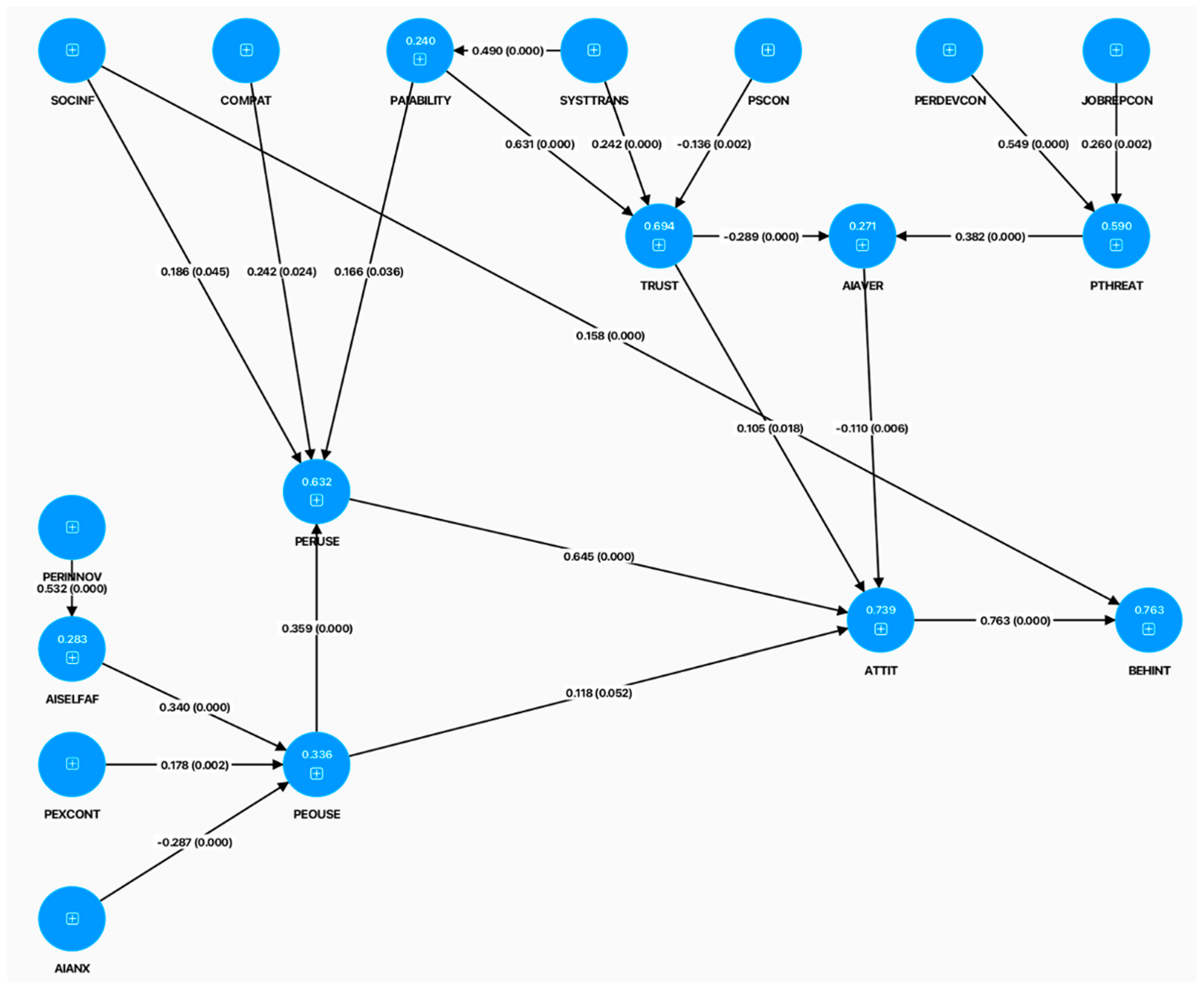
After verifying the measurement models’ validity and reliability, the standard structural model evaluation criteria (i.e., (i) the collinearity between constructs, (ii) the significance and relevance of the path coefficients, and (iii) the explanatory power (R2) and predictive power of the model) apply to the structural part of the developed model. The collinearity assessment for the structural part of the developed structural equation model was performed by looking at the variance inflation factor (VIF) values between the latent variables. The collinearity assessment showed no problem, as all VIF values were below 3, except the one between COMPAT and PERUSE (3.100), all under the threshold value of 5. On the other side, path coefficients were evaluated based on their magnitude, sign, and significance levels (p < 0.05) [123]. A bootstrapping procedure was applied, generating 5000 random subsamples with a sample size equal to the original data (n = 233) to determine statistical significance. Figure 2 shows the statistically significant relationship coefficients (p < 0.05). The results indicate that, except for H3, all hypotheses were significant at p < 0.05 level (some at p < 0.001, some at p < 0.01). When H3 is considered, perceived ease of use was not found to have a significant impact on attitude. Table 7 displays the results of the analysis.
The model’s explanatory power was assessed by the R2 coefficient, which indicates the explained variance of the endogenous latent variables [116,117,123]. The R2 values range from 0 to 1, with higher levels indicating higher levels of explanatory power; above 0.75 is substantial, between 0.50 and 0.75 is moderate, and between 0.25 and 0.50 is considered weak [123]. In Figure 2, the numbers in the latent variable circles indicate these R2 values. Additionally, adjusted R2 values, which account for the number of predictors and sample size, were calculated (see Table 8) to provide a more accurate evaluation of the model’s explanatory power [117]. The results given in Table 8 demonstrate that the model exhibits substantial explanatory power for key constructs such as behavioral intention (0.761), attitude (0.735), and trust (0.690), while providing moderate to weak explanatory power for others.
Lastly, the PLSPredict procedure in SmartPLS was used to assess the model’s predictive power (see Table 9). All Q p r e d i c t 2 values were positive, suggesting that the model outperforms the linear regression model (LRM) benchmark. Furthermore, the model’s high predictive power was confirmed by the root mean square errors (RMSEs) being lower than or equal to that of the LRM benchmark.
Table 5. Fornell–Larcker criterion analysis.
VariablesAIANXAIAVERAISELFAFATTITBEHINTCOMPATJOBREPCONPAIABILITYPEOUSEPERDEVCONPERINNOVPERUSEPEXCONTPSCONPTHREATSOCINFSYSTTRANSTRUST
AIANX0.896
AIAVER0.3290.878
AISELFAF−0.277−0.1020.888
ATTIT−0.338−0.4740.3330.974
BEHINT−0.353−0.4380.3930.8650.963
COMPAT−0.386−0.3610.3250.6880.6770.849
JOBREPCON0.6520.308−0.137−0.204−0.227−0.2430.890
PAIABILITY−0.226−0.2890.2280.5530.5390.629−0.0560.839
PEOUSE−0.408−0.2370.4740.6400.6390.564−0.2100.4800.871
PERDEVCON0.7180.365−0.205−0.307−0.310−0.3480.778−0.133−0.2750.879
PERINNOV−0.506−0.3510.5320.5420.5280.560−0.3000.4370.598−0.4030.871
PERUSE−0.374−0.4620.4190.8450.8640.693−0.2250.5880.679−0.3360.6110.932
PEXCONT−0.1480.0110.3040.2850.2440.591−0.1340.3140.324−0.1620.2430.3080.921
PSCON0.5580.282−0.206−0.351−0.333−0.4350.419−0.279−0.3310.541−0.321−0.323−0.2750.893
PTHREAT0.6290.436−0.146−0.243−0.262−0.2990.687−0.052−0.2160.751−0.351−0.275−0.0720.4120.927
SOCINF−0.287−0.3570.3160.6500.6530.774−0.1620.5220.557−0.2620.5080.6600.497−0.338−0.2140.821
SYSTTRANS−0.398−0.3210.4560.5360.4770.588−0.2720.4900.514−0.2950.5980.5440.287−0.331−0.2980.5240.865
TRUST−0.282−0.3610.2910.6310.6170.731−0.1450.7870.542−0.2250.5050.6540.304−0.392−0.1900.6580.5960.893
Table 6. HTMT values.
VariablesAIANXAIAVERAISELFAFATTITBEHINTCOMPATJOBREPCONPAIABILITYPEOUSEPERDEVCONPERINNOVPERUSEPEXCONTPSCONPTHREATSOCINFSYSTTRANSTRUST
AIANX
AIAVER0.348
AISELFAF0.3010.111
ATTIT0.3550.5040.358
BEHINT0.3670.4620.4200.907
COMPAT0.4110.3800.3590.7300.713
JOBREPCON0.7140.3500.1510.2290.2530.282
PAIABILITY0.2530.3160.2590.6060.5900.6930.090
PEOUSE0.4390.2460.5170.6800.6760.6050.2360.528
PERDEVCON0.7770.3990.2260.3340.3350.3830.8730.1590.303
PERINNOV0.5330.3780.5660.5710.5520.5980.3230.4890.6440.431
PERUSE0.3910.4880.4480.8850.8980.7280.2490.6450.7160.3640.638
PEXCONT0.1610.0760.3360.3060.2600.6670.1550.3590.3500.1780.2590.329
PSCON0.5880.3010.2240.3660.3480.4760.4740.2950.3520.5950.3320.3330.304
PTHREAT0.6660.4620.1570.2560.2740.3180.7520.0660.2310.8120.3690.2880.0770.444
SOCINF0.3100.3890.3530.7090.7070.8680.1990.5910.6130.2920.5530.7120.5670.3730.233
SYSTTRANS0.4640.3400.5500.5870.5180.6510.3330.5300.5860.3440.6860.5900.3190.3520.3350.581
TRUST0.3090.3970.3240.6890.6670.8080.1760.8910.5950.2590.5550.7080.3410.4320.2090.7450.658
Figure 2. Structural model coefficients and statistical significance values.
Systems 14 00713 g002
Based on the above-detailed assessments, Table 7 summarizes the results of the hypotheses examined in the study.
Table 7. Standardized path coefficients.
HypothesesPath CoefficientsResult
H1:
Attitude positively influences the behavioral intention to use AI-based recruitment systems.
0.763 ***Supported
H2:
Perceived usefulness positively influences attitude toward AI-based recruitment systems.
0.645 ***Supported
H3:
Perceived ease of use positively influences attitude toward AI-based recruitment systems.
0.118Not Supported
H4:
AI aversion negatively affects attitudes toward AI-based recruitment systems.
−0.110 **Supported
H5:
Trust negatively affects AI aversion toward AI-based recruitment systems.
−0.289 ***Supported
H6:
Perceived threat positively influences AI Aversion toward AI-based recruitment systems.
0.382 ***Supported
H7:
Job replacement concern positively affects perceived threat from AI-based recruitment systems.
0.260 **Supported
H8:
Personal development concern positively affects perceived threat from AI-based recruitment systems.
0.549 ***Supported
H9:
Perceived ease of use positively affects the perceived usefulness of AI-based recruitment systems.
0.359 ***Supported
H10:
Compatibility positively affects the perceived usefulness of AI-based recruitment systems.
0.242 *Supported
H11:
Perceived AI ability positively affects the perceived usefulness of AI-based recruitment systems.
0.166 *Supported
H12:
Trust positively affects attitudes toward AI-based recruitment systems.
0.105 *Supported
H13:
Perceived AI ability positively affects trust in AI-based recruitment systems.
0.631 ***Supported
H14:
Privacy and security concerns negatively affect trust in AI-based recruitment systems.
−0.136 **Supported
H15:
System transparency positively affects trust in AI-based recruitment systems.
0.242 ***Supported
H16:
System transparency positively affects the perceived ability of AI-based recruitment systems.
0.490 ***Supported
H17:
AI self-efficacy positively affects the perceived ease of use of AI-based recruitment systems.
0.340 ***Supported
H18:
Perception of external control positively affects the perceived ease of use of AI-based recruitment systems.
0.178 **Supported
H19:
AI anxiety negatively affects the perceived ease of use of AI-based recruitment systems.
−0.287 ***Supported
H20:
Personal innovativeness positively affects AI self-efficacy.
0.532 ***Supported
H21:
Social influence positively affects the behavioral intention to use AI-based recruitment systems.
0.158 ***Supported
H22:
Social influence positively affects the perceived usefulness of AI-based recruitment
0.186 *Supported
*** p < 0.001, ** p < 0.01, * p < 0.05.
Table 8. R2 values.
Table 8. R2 values.
R2R2 AdjustedConsideration
AI Aversion (AIAVER)0.2710.265Weak
AI Self-efficacy (AISELFAF)0.2830.279Weak
Attitude (ATTIT)0.7390.735Moderate
Behavioral Intention (BEHINT)0.7630.761Substantial
Perceived AI Ability (PAIABILITY)0.2400.236Weak
Perceived Ease of Use (PEOUSE)0.3360.327Weak
Perceived Usefulness (PERUSE)0.6320.626Moderate
Perceived Threat (PTHREAT)0.5900.586Moderate
Trust (TRUST)0.6940.690Moderate
Table 9. PLSPredict results.
Q p r e d i c t 2 PLS-SEM
RMSE
LRM
RMSE
BEHINT010.391.081.08
BEHINT020.391.101.14
BEHINT030.451.061.11

4. Findings and Discussion

This section presents and discusses the results of the structural model. Rather than treating each relationship in isolation, the findings are interpreted through a socio-technical lens. The discussion first considers how HR professionals evaluate the system as a working tool, then turns to their emotional and individual responses to it, and finally to the social and cultural context in which adoption takes place, before bringing these threads together into an integrated account of how the two subsystems jointly shape adoption.

4.1. Socio-Technical Theory Perspective

Beyond the confirmation of the individual hypotheses, an interpretation of the findings through a socio-technical lens provides additional value. In this perspective, AI-based recruitment systems’ adoption does not result from a single factor. Instead, it emerges from the continuous interaction between a technical and a social subsystem. The technical subsystem reflects how HR professionals evaluate the AI system as a working tool, and it includes perceived usefulness, perceived ease of use, compatibility, perceived AI ability, and system transparency. On the other hand, the social subsystem reflects the emotional and social conditions of the potential users, and is captured by AI aversion, perceived threat, trust, AI anxiety, AI self-efficacy, personal innovativeness, and social influence. The final adoption decision is shaped by the interplay of these two subsystems. This integration is realized through attitude and behavioral intention. Therefore, the following results demonstrate a synergistic process rather than isolated individual effects. The technical subsystem determines whether the system is perceived as capable and useful, whereas the social subsystem establishes the HR professionals’ willingness to accept it.

4.2. Attitude, Intention, and the Instrumental (Technical) Subsystem

The results of this study highlight the critical role of attitude in determining behavioral intention to use AI-based recruitment systems, as outlined in the TAM [8,10] and its foundation, the TRA [35]. Attitude significantly influences behavioral intention (β = 0.763, p < 0.01), supporting H1 and emphasizing the need for organizations to foster positive perceptions toward AI-based systems to enhance their adoption. This finding aligns with prior research [8,44,46,47] that positions attitude as a key mediator between belief factors and intention. Moreover, perceived usefulness emerged as a strong predictor of attitude (β = 0.645, p < 0.01), supporting H2 and confirming that belief in the performance-enhancing capabilities of a system significantly shapes attitudes [46,47,125]. These results underscore the importance of demonstrating tangible benefits, such as improved efficiency and objectivity, to drive the acceptance of AI-based systems.
Interestingly, the relationship between perceived ease of use and attitude was not significant (not in support of H3). This suggests that HR professionals consider the effectiveness of AI-based systems more than their usability in determining adoption potential, which differs from previous findings [8,9]. However, perceived ease of use influences perceived usefulness (β = 0.359, p < 0.01), which in turn affects attitude. This result aligns with TAM and TAM2 models [8,9,10], indicating that a design that is easy to use enhances perceived usefulness, although it does not affect attitude. Moreover, compatibility with task requirements and job relevance also enhance perceived usefulness [48,76], as highlighted in the Task–Technology Fit model [75]. These results imply that perceived ease of use may not directly affect attitudes but that its role in enhancing the perceived usefulness of AI-based systems can indirectly foster positive attitudes toward these systems. Consequently, training, awareness creation, and demonstrating the clear value of AI-based recruitment systems may be significant instruments for organizations to demonstrate AI-based tools as not only effective and efficient but also easy to use and compatible with job tasks.
Cognitive and rational evaluations alone are insufficient to predict acceptance, but, at the same time, the findings of this study also confirm the significant role of this type of decision-making mechanism on the evaluation of the usefulness of AI-based recruitment systems. Specifically, the results indicate that compatibility (β = 0.242, p < 0.05) and perceived AI ability (β = 0.166, p < 0.05) both positively impact perceived usefulness, thereby supporting hypotheses H10 and H11, respectively. These results suggest that when AI-based recruitment systems are designed to align with organizational processes, together with HR professionals’ specific needs and experiences, and have advanced capabilities such as efficient task execution and decision making, they are considered to be useful, and consistent with the Task–Technology Fit model [75] and Diffusion of Innovation Theory [80], both of which emphasize the importance of compatibility in the adoption of technology. Users are more inclined to integrate technologies consistent with their previous experiences and organizational settings into their everyday routines, which increases the perceived usefulness of those systems. Studies on perceived AI ability [49,85] highlight that users’ perceptions of AI-based systems’ cognitive and functional capabilities significantly influence their judgment regarding the relevant system’s usefulness.
Compatibility ensures that the system is contextually relevant and easy to integrate into current HR practices, while perceived AI ability ensures that the system effectively performs tasks and makes accurate decisions. For instance, an AI-based recruitment system that not only supports organizational goals but also demonstrates advanced ability in candidate screening or decision making is likely to increase productivity and save HR professionals’ time, which would raise the system’s perceived usefulness [48,84]. Such a combined perspective underscores the synergistic role of compatibility and perceived AI ability in shaping HR professionals’ perceptions of AI-based recruitment systems. Besides that, the results also emphasize how crucial it is to balance technical sophistication with contextual alignment when creating systems. Developing solutions that suit the requirements of particular HR roles and can demonstrate cutting-edge AI abilities should be the top priority for developers. HR professionals are more likely to adopt such systems as they are both easy to integrate and effective.

4.3. Emotional Responses: AI Aversion, Perceived Threat, and Trust

The critical role of emotional mechanisms, such as AI aversion, in shaping attitudes toward AI-based recruitment systems is also supported, according to the results of this study. In favor of H4, AI aversion significantly and negatively affects attitudes (β = −0.110, p < 0.01). This result underscores that cognitive and rational evaluation alone is insufficient to predict acceptance; emotional biases like distrust, discomfort, and skepticism toward AI-based systems substantially influence attitudes, as posited in prior studies [25,26,51,55]. These findings conform to DAT [56], which highlights the influence of integral emotions and anticipated regret on decision making. Therefore, organizations must be concerned with emotional resistance to generate positive attitudes toward AI-based systems, for instance, by directly expressing the benefits of these systems, demonstrating their reliability, and highlighting successful applications to reduce aversion. In this regard, trust considerably reduces AI aversion (β = −0.289, p < 0.01), thereby supporting H5. This result is consistent with previous research emphasizing trust as a critical factor in overcoming emotional biases and fostering acceptance of AI technologies [54,60]. HR professionals will be more likely to evaluate these systems objectively if they perceive them as reliable, fair, and effective, which in turn reduces emotional rejection.
On the other side, perceived threat was found to significantly increase AI aversion (β = 0.382, p < 0.01), supporting H6. This result supports the claim that perceived risks increase emotional resistance to one’s well-being, job security, or professional autonomy [19,65]. The higher sensitivity to potential losses (e.g., diminished authority or errors) compared to possible gains explains why HR professionals would be hesitant to adopt AI-based systems. Addressing perceived threats entails personalized interventions that address concerns, such as emphasizing human engagement in AI activities and reasserting the complementary role of AI to enhance, rather than replace, professional capabilities.
The result that the job replacement concern increases perceived threat (β = 0.260, p < 0.01) supports H7 and is consistent with prior research suggesting that fear of job displacement leads to resistance to AI technologies [67,71]. The current study supports the findings of Ore and Sposato [22], who found that HR professionals are skeptical about adopting AI, despite acknowledging its potential benefits. Organizations can address the fear of job replacement by stressing the enhancement of human roles rather than their replacement and by clearly communicating the changing nature of HR jobs as AI is adopted.
On the other hand, personal development concern also significantly increases perceived threat (β = 0.549, p < 0.01), supporting H8. HR professionals are concerned that reliance on AI-based systems could hinder their ability to grow professionally and develop decision-making skills, which is consistent with the findings of Cao et al. [17]. This concern increases the sense of threat. As mentioned above, organizations should enable employees to upskill and integrate AI competencies into their professional development plans and demonstrate that AI adoption supports their personal development to overcome this challenge.
Trust, which reflects HR professionals’ perceptions of the relevant system’s reliability, fairness, and transparency, emerged as a significant predictor of positive attitudes toward AI-based recruitment systems (β = 0.105, p < 0.05), supporting H12. This finding is similar to that of Balakrishnan et al. [50] and Wanner et al. [24]. As Shin and Park [60] noted, trust is essential to establish willingness to adopt AI-based systems, particularly in sensitive areas like recruitment, where fairness and ethical considerations are crucial. In this context, perceived AI ability significantly and substantially affects trust = 0.631, p < 0.01), supporting H13. This finding supports Lee and See [86] and Choung et al. [49]’s argument that individuals will more easily trust systems that they perceive to be competent and capable of performing job-related tasks effectively. Therefore, demonstrating the capability of AI-based systems in recruitment will increase the users’ trust and confidence in the system’s functionality.
Likewise, system transparency was found to positively affect both trust (β = 0.242, p < 0.01) and perceived AI ability (β = 0.490, p < 0.01), supporting H15 and H16, respectively. Similarly, the studies Höddinghaus et al. [88], Shin and Park [60], and Wanner et al. [24] emphasized that clear, explainable, and understandable decision-making processes foster users’ trust and confidence in AI-based systems. Transparent systems that demonstrate how decisions are made (e.g., criteria for candidate selection) reinforce perceptions of fairness and competence. On the other side, privacy and security concerns negatively affect trust (β = −0.136, p < 0.01), which supports H14 and is consistent with the literature [76,89]. However, this effect is less than the perceived AI ability’s effect. HR professionals value systems that ensure privacy protection and secure data processing. Negative perceptions can be reduced, and trust in AI-based recruitment systems can be enhanced by mitigating these concerns through robust security measures and clear data use policies. In building trust, organizations can commit to making AI-based recruitment tools transparent, capable, and fair and ensuring adequate training and support to alleviate fears of unpredictability or loss of control.
These findings also highlight the ethical dimension of AI-supported decision making. This dimension underlies many reservations expressed by HR professionals. The adoption of AI in recruitment faces clear difficulties. For instance, the opacity of algorithms and the potential for bias draw ethical criticism [33]. These concerns create an “application gap” [33]. Technologically competent AI systems are often not fully integrated into recruiting processes due to potential adverse effects. Furthermore, there is a “knowledge gap” between AI decision makers and candidates. This gap negatively affects the trust and understanding that applicants place in AI-generated outcomes [34]. The results highlight the significance of these issues by showing that ethical concerns operate largely through trust. System transparency directly strengthens trust, aligning closely with the ethical principles of explainability and accountability. When HR professionals comprehend the system’s decision-making process, they can better evaluate its fairness, consequently increasing their willingness to rely on the technology. Conversely, privacy and security concerns reduce trust. These concerns are critical ethical issues in their own right, reflecting apprehensions about how candidate data are handled. Trust, in turn, plays a dual role in the model. It reduces AI aversion and directly strengthens positive attitudes. Therefore, addressing these ethical concerns is not a peripheral issue, but, rather, a central mechanism for facilitating adoption.
This also suggests that the appropriate role of AI strictly varies with the nature of the decision. For structured, high-volume tasks like initial CV screening, AI meaningfully improves efficiency and consistency. However, final candidate selection involves sensitive, judgment-intensive decisions. In these specific cases, a “human-in-the-loop” configuration is much more appropriate. In this setup, AI informs human judgment rather than replacing it. This approach successfully preserves accountability and addresses the ethical reservations revealed in the findings. Therefore, framing AI as an augmenting tool is crucial. It serves as both an ethical safeguard and a practical strategy to strengthen trust and reduce aversion.

4.4. Individual Readiness: Self-Efficacy, Anxiety, and Personal Innovativeness

Additionally, the study’s findings underscore anchoring factors (i.e., AI self-efficacy, perception of external control, and AI anxiety) and personal innovativeness’ importance in shaping HR professionals’ perceptions of AI-based recruitment systems. As proposed by the TAM3 model [11], these anchoring factors influence initial beliefs about a system’s perceived ease of use. The analysis confirmed that AI self-efficacy (β = 0.340, p < 0.01), and perception of external control (β = 0.178, p < 0.01) have a significant positive effect on perceived ease of use, while AI anxiety = 0.287, p < 0.01) negatively affects it, supporting H17, H18, and H19, respectively. As AI self-efficacy has been identified as a significant enabler of perceived ease of use, this finding is in line with past research [90,91], emphasizing the reality that HR professionals who are confident in using AI-based technologies view such systems as less challenging and more intuitive. Besides that, the positive effect of personal innovativeness on AI self-efficacy also has been confirmed (β = 0.532, p < 0.01), supporting H20. This finding aligns with recent studies by Balcerak and Wozniak [94] and Chen [36], which found that individuals who are intrinsically motivated and proactive in exploring new technologies are more likely to have confidence in using AI-based systems. Personal innovativeness can be fostered within organizations by taking forward-looking actions like creating an innovation-driven culture, offering opportunities for experimentation with new technologies, and rewarding employees for taking the initiative in using AI-based solutions to achieve greater engagement and adaptability. Organizations may promote AI self-efficacy by providing interactive sessions, real-world applications, individualized skill-based training, and user-friendly system interfaces. Organizations should establish strategies that include designing hands-on learning opportunities, where employees can interact with AI tools, to build familiarity and confidence in AI technologies to manage AI anxiety. Reskilling and upskilling opportunities may be utilized to both decrease AI anxiety and increase AI self-efficacy.

4.5. Social Influence and Corporate Culture

Finally, it was also found that social influence positively affects the intention to use AI-based systems (β = 0.186, p < 0.05) and the perceived usefulness of AI-based systems (β = 0.158, p < 0.01), confirming H21 and H22, respectively. This finding demonstrates the role played by social influence in shaping HR professionals’ attitudes and intentions to utilize AI-based recruitment systems, in alignment with UTAUT, TAM2, and TAM3 theories. These results are also consistent with previous research [28,50,79,95,96,97], which support the idea that the views and expectations of peers, supervisors, and broader professional networks significantly influence individual attitudes toward new technologies. Social factors often shape the way that HR professionals view AI-based recruitment systems. When professionals hear from their peers that these systems are helpful and valuable, they become more inclined to try them. Given the strong impact of social factors on behavioral intention, HR professionals are more likely to adopt AI-based recruitment systems if they think that doing so will improve their status within the organization or if their professional networks find these systems useful. The insights they gather from their network significantly affects their acceptance and use of new technologies in hiring.
The value of leveraging social norms and peer support should not be underestimated to promote acceptance. For instance, organizations can engage respected HR leaders as champions of AI adoption or provide opportunities for mutual learning and discussion of AI benefits within professional networks.
Taken together, these findings highlight the critical role of corporate culture. It serves as the primary organizational context for AI adoption. The study’s results show significant effects of social influence on both perceived usefulness and behavioral intention. Additionally, personal innovativeness positively influences AI self-efficacy. These relationships indicate that adoption is not based solely on individual appraisals. Instead, it is heavily shaped by the organization’s shared norms, values, and expectations. Prior work on information technology culture supports this view. The fit between a new technology and an organization’s prevailing values strongly dictates how that technology is received [42]. In this light, an innovation-oriented culture plays a highly protective role. An environment that encourages experimentation and frames AI as an opportunity for growth naturally strengthens user self-efficacy. Consequently, it mitigates perceived threat and AI aversion, which are identified as central barriers. Conversely, a risk-averse or control-oriented culture amplifies these reservations. Such environments reinforce employee resistance, even when the technical subsystem functions perfectly. Therefore, AI adoption is never a culturally neutral event. Introducing a non-human decision-making agent directly challenges established norms about hiring practices and accountability. As a result, AI adoption both depends on and actively reshapes the organization’s culture. Therefore, building a supportive culture is not merely a complement to technical integration. It is a necessity for successful AI recruitment adoption.

4.6. Synthesis: How the Subsystems Jointly Shape Adoption

Synthesizing these results reveals an underlying pattern that individual relationships alone fail to fully explain. The strongest paths in the model cluster around two main themes. The first is the instrumental appraisal of the system. Here, perceived usefulness serves as the dominant driver of attitude, supported by compatibility, perceived AI ability, and ease of use. The second theme is the emotional–evaluative response, which contains the threat-aversion chain on one side and the trust-building chain on the other. This indicates that the adoption decision for HR professionals depends heavily on whether the system is perceived as both useful and non-threatening, rather than just whether the technology functions. Notably, the technical and social subsystems are highly interdependent. Perceived AI ability and system transparency build trust, which then suppresses aversion. In contrast, perceived threat amplifies aversion, driven by concrete concerns about job replacement and personal development. Therefore, adoption emerges from a careful balance. The technical subsystem must demonstrate capability, while the social subsystem must be reassured. This integrated view directly answers the study’s research questions. Perceived threat is driven by personal development and job replacement concerns. Trust is shaped by perceived AI ability, system transparency, and privacy concerns, and it subsequently strengthens attitudes. Crucially, AI aversion operates as the central emotional mechanism affecting HR professionals’ attitudes. Within this path, perceived threat increases AI aversion, while trust actively reduces it. Practically, interventions targeting only one subsystem are unlikely to succeed. Improving technology without addressing emotional resistance, or vice versa, will fail. Effective adoption strategies must act on both subsystems simultaneously.

5. Conclusions

This study investigates how HR professionals form their attitudes and behavioral intentions toward AI-based recruitment systems. Specifically, it examines what drives perceived threat and how trust is shaped. It also analyzes how AI aversion mediates the effects of both trust and perceived threat. To address these questions, an Integrative AI Adoption Framework was developed and empirically tested. The findings provide clear answers to these objectives. First, perceived threat is driven mainly by job-replacement and personal-development concerns. Second, trust is shaped by perceived AI ability, system transparency, and privacy concerns. Trust then plays a dual role by reducing AI aversion and strengthening positive attitudes. Finally, AI aversion serves as the central emotional mechanism linking these responses to attitudes. Based on these results, the following sections discuss the theoretical and practical implications of the study, as well as its limitations.

5.1. Theoretical Implications

This research contributes to the growing body of literature on AI adoption in HR by developing an empirically validated structural equation model that integrates belief–attitude–intention frameworks with unique AI-related constructs. The study’s findings show that attitude plays an important role in shaping behavioral intention, which confirms its place in technology adoption models. The fact that perceived usefulness has been proven to be an effective driver of attitude is specifically interesting as it indicates that HR professionals appreciate AI-based systems delivering clear performance benefits. Although perceived ease of use positively affects perceived usefulness, it does not directly affect attitude. This suggests that the functional utility of these systems will be more influential than ease of use in adoption decisions.
From an emotional perspective, the study underlines psychological factors that facilitate and hinder the adoption of AI-based systems. In this regard, AI aversion has a negative impact on attitudes, while trust has a twofold effect of negatively influencing aversion and positively influencing attitudes. Additionally, perceived threat significantly increases AI aversion, which is driven by concerns over job replacement and personal development. These findings highlight the significance of addressing HR professionals’ concerns and building trust through system transparency, robust privacy and security measures, and clear communication of AI capabilities.
The findings on rational evaluation mechanisms give importance to the role of technological factors. Perceived AI ability, compatibility, and system transparency are found to be important predictors of perceived usefulness and trust. This emphasizes how crucial it is to align AI technologies with current HR practices and ensure their transparency and reliability. Furthermore, perceived ease of use is positively influenced by the perception of external control and AI self-efficacy, which is positively affected by personal innovativeness, indicating that HR professionals’ willingness to adopt new technologies and confidence in their ability to use AI tools are important adoption facilitators.
The study also shows that social influence considerably impacts behavioral intentions and perceived usefulness, confirming the importance of social factors in technology adoption. These findings underscore how organizational culture and peer influence shape attitudes and perceptions and enable the adoption of AI-based HR tools. More broadly, by jointly modeling the technical and social subsystems within a single framework, the study demonstrates the value of a socio-technical perspective for explaining AI adoption, showing that neither technical capability nor social acceptance alone is sufficient to account for adoption decisions.

5.2. Practical Implications

For practitioners, the findings emphasize the need to design AI-based systems that are transparent, compatible, and easy to use while addressing trust and psychological concerns. Organizations also need to supply a supportive environment that fosters innovation, increases self-efficacy, and decreases job security and personal development concerns. Because adoption depends on both subsystems, technical investment in capable and transparent systems should be accompanied by measures that build trust, reduce aversion, and address the ethical concerns surrounding fairness and data privacy. AI should be positioned as a tool that empowers, rather than replaces, HR professionals. This strategy can be supported by reskilling opportunities and peer advocacy. Together, these actions further reduce perceived threat and encourage acceptance.

5.3. Limitations and Future Directions

While this study contributes significantly to understanding the adoption of AI-based recruitment systems and offers valuable insights, it is not without limitations. First, the study is based primarily on self-reported data that may be susceptible to common method bias. In future studies, self-reported measures could be complemented by objective measures of system use or by experiments. Second, the sample consists of HR professionals, which, while being suitable for the research concern, might constrain the generalizability of findings to other groups of professionals or industries. Third, the study evaluates perceptions and attitudes at a specific moment in time and is cross-sectional. The dynamics of how attitudes and behavioral intentions evolve when AI-based systems are implemented and used over time may be better understood through longitudinal study. Finally, the current study considers AI-based recruitment systems; future research could study other HR functions to which AI is increasingly being applied, such as performance management or staff engagement.
Future research could extend this study by exploring the long-term impact of AI adoption on HR practices and employee outcomes and examining these factors across different organizational and cultural contexts. In addition, the dynamic relationship between the evolving capabilities of AI and HR professionals’ perceptions needs to be further explored.

Author Contributions

Conceptualization, B.G. and A.S.; methodology, B.G.; software, B.G.; validation, B.G. and A.S.; formal analysis, B.G.; investigation, B.G.; resources, B.G. and A.S.; data curation, B.G.; writing—original draft preparation, B.G.; writing—review and editing, B.G. and A.S.; visualization, B.G. and A.S.; supervision, A.S. All authors have read and agreed to the published version of the manuscript.

Funding

This research received no external funding.

Institutional Review Board Statement

This study was approved by the Ethics Committee of Istanbul Technical University, Social and Human Sciences Scientific Research and Publication Ethics Committee (Approval No: 546, Date: 28 June 2024).

Informed Consent Statement

Informed consent was obtained from all participants at the beginning of the survey, prior to their participation.

Data Availability Statement

The data presented in this study are available on request from the corresponding author.

Conflicts of Interest

The authors declare no conflict of interest.

Appendix A

The considered AI-based recruitment decision support system in this study (i) analyzes the resumes of potential candidates by scanning various online career management platforms and performs a prescreening by identifying suitable candidates for the vacant position according to the position requirements; (ii) candidates deemed suitable in the preselection process are invited to a virtual video interview; (iii) AI-based chatbots and video conferencing technology are used for interviews with candidates who accept the invitation; (iv) the answers given by the candidates during the offline video interview are converted into structured textual data with speech recognition algorithms and natural language processing techniques, and these data are compared with the reference texts to be used in the scoring of the interviews with the help of semantic classification algorithms; (v) system evaluates candidates’ answers to the interview questions as well as their tone of voice, body language, facial expressions and gestures, etc. during the interview; (vi) by evaluating the behavioral competencies, personality traits, etc. determined for the vacant position, the degree of compatibility of the candidates with the position is determined and the candidates are ranked according to their suitability for the relevant position; and (vii) candidates are invited for an online/face-to-face interview by integrating the calculated degree of compatibility obtained through machine evaluation and expert evaluations.

Appendix B

Table A1. Measurement items.
ConstructItems
Behavioral Intention (BEHINT)BEHINT01. Assuming I had access to the AI-based recruitment system, I intend to use it.
BEHINT02. Given that I had access to the AI-based recruitment system, I predict that I would use it.
BEHINT03. If the AI-based recruitment system was available to me, I would plan to use this system in the future.
Attitude (ATTIT)ATTIT01. Using the AI-based recruitment system is a good idea.
ATTIT02. Using the AI-based recruitment system is a wise idea.
ATTIT03. I like the idea of using AI-based recruitment system.
Perceived Usefulness (PERUSE)PERUSE01. Using the AI-based recruitment system would improve my performance in my job.
PERUSE02. Using the AI-based recruitment system in my job would increases my productivity.
PERUSE03. Using the AI-based recruitment system would enhance my effectiveness in my job.
PERUSE04. I find the AI-based recruitment system to be useful in my job.
PERUSE05. Using the AI-based recruitment system would make it easier to do my work.
Perceived Ease of Use (PEOUSE)PEOUSE01. Learning to use the AI-based recruitment system would be easy for me.
PEOUSE02. I would find it easy to get the AI-based recruitment system to do what I want it to do.
PEOUSE03. My interaction with the AI-based system is clear and understandable.
PEOUSE04. It would be easy for me to become skillful at using the AI-based recruitment system.
PEOUSE05. I would find the AI-based recruitment system to be easy to use.
AI Self-efficacy (AISELFAF)AISELFAF01. I have knowledge about AI-based recruitment systems.
AISELFAF02. I have relevant skills to use AI-based recruitment systems in my work.
AISELFAF03. I have skills to interpret the AI-based recruitment system outputs
AISELFAF04. I have skills to prepare inputs for AI-based recruitment systems
Perception of External Control (PEXCONT)PEXCONT01. I believe that the organizational resources are readily available to support the implementation and utilization of the AI-based recruitment system.
PEXCONT02. I believe that technical support structures are in place to assist me in effectively using the AI-based recruitment system.
PEXCONT03. I believe that the organization would provide adequate training and guidance to me for the successful adoption of the AI-based recruitment system.
AI Anxiety (AIANX)AIANX01. I am not confident I can learn the skills related to the AI-based recruitment system.
AIANX02. I feel apprehensive about using the AI-based recruitment system.
AIANX03. I have avoided the AI-based recruitment system because it is unfamiliar to me.
AIANX04. I hesitate to use AI-based recruitment system for fear of making mistakes I cannot correct.
AIANX05. Working with an AI-based recruitment system makes me nervous.
AIANX06. AI-based recruitment systems make me feel uncomfortable.
Personal Innovativeness (PERINNOV)PERINNOV01. If I hear about new AI based systems or tools, I look for ways to try it out.
PERINNOV02. Among my peers, I am usually the first to explore new AI based systems or tools.
PERINNOV03. In general, I like to experiment with new AI based systems or tools.
PERINNOV04. In general, I am not hesitant to try out new AI based systems or tools.
PERINNOV05. In general, I find new AI based systems or tools playful.
PERINNOV06. In general, I find new AI based systems or tools creative.
Social Influence (SOCINF)SOCINF01. My colleagues or peers would think that I should use the AI-based recruitment system.
SOCINF02. My leaders or superiors would think that I should use the AI-based recruitment system.
SOCINF03. People in my organization who use the AI-based recruitment system would have more prestige than those who do not.
SOCINF04. People in my organization who use the AI-based recruitment system would have a high profile.
SOCINF05. Using the AI-based recruitment system would be a status symbol in my organization.
SOCINF06. In general, my organization would support the use of the AI-based recruitment system.
Perceived AI Ability (PAIABILITY)PAIABILITY01. I believe that the AI-based recruitment system would have the skills and capabilities needed to effectively execute recruitment tasks.
PAIABILITY02. I believe that the AI-based recruitment system would have the necessary features to handle various recruitment challenges and scenarios.
PAIABILITY03. I believe that the procedures used by the AI-based recruitment system would be fair.
PAIABILITY04. I believe that the decision made by the AI-based recruitment system would have high accuracy.
PAIABILITY05. I believe that the AI-based recruitment system performs recruitment decision support very well.
PAIABILITY06. I believe that the AI-based recruitment systems can flexibly consider different circumstances when making recruitment decisions.
Privacy and Security Concern (PSCONS)PSCON01. I am worried that using the AI-based recruitment system is not secure.
PSCON02. I am concerned that using the AI-based recruitment system may result in the misuse of collected and stored information.
PSCON03. I am concerned that personal and organizational information stored and used by the AI-based recruitment system lacks confidentiality and privacy.
System Transparency (SYSYTRANS)SYSTTRANS01. I think I could understand the decision-making processes of the AI-based recruitment system very well.
SYSTTRANS02. I think I could understand why the AI-based recruitment system provided the decisions it did.
SYSTTRANS03. I think I could understand what the AI-based recruitment system bases its provided decision on.
SYSTTRANS04. I think the decision-making processes of AI-based recruitment system are clear and transparent.
Trust
(TRUST)
TRUST01. I believe that the AI-based recruitment system is dependable and reliable in facilitating the recruitment process.
TRUST02. I feel comfortable entrusting the AI-based recruitment system with sensitive tasks, knowing it would operate with integrity and reliability.
TRUST03. Despite not having direct control over its operations, I would trust the AI-based recruitment system to make decisions in the recruitment process.
Compatibility (COMPAT)COMPAT01. Using the AI-based recruitment system would be compatible with the way I generally work.
COMPAT02. Using the AI-based recruitment system would be compatible with the needs and demands regarding recruitment process.
COMPAT03. Using the AI-based recruitment would not create any conflicts with my working values.
COMPAT04. Using the AI-based recruitment system is compatible with business legacy and ethical system in our organization.
COMPAT05. Using the AI-based recruitment system would be compatible with other systems I use.
AI Aversion (AIAVER)AIAVER01. I prefer to rely on my own intuition when hiring employees rather than AI-based recruitment systems.
AIAVER02. I prefer recommendation made by my peers and managers rather AI-based recruitment systems.
AIAVER03. I prefer that a hiring specialist/manager, rather than AI-based recruitment system, determine a candidate suitability for a job.
AIAVER04. If a person were applying for a job, I would prefer that the candidate be evaluated by a hiring specialist/manager, rather than an AI-based recruitment system.
Perceived Threat (PTHREAT)PTHREAT01. I fear that I may lose control over the way I work if I started using the AI-based recruitment system.
PTHREAT02. I fear that I may lose control over the recruitment decision if I started using the AI-based recruitment system
PTHREAT03. I fear that the AI-based recruitment system decreases my professional discretion over recruitment decision.
PTHREAT04. I fear that the AI-based recruitment system might actually degrade my status in the organization.
Personal Development Concern (PERDEVCON)PERDEVCON01. The AI-based recruitment system would have a negative impact on my learning ability.
PERDEVCON02. The AI-based recruitment system would have a negative impact on my career development.
PERDEVCON03. I hesitate to use AI-based recruitment system for fear of losing control of my personal development.
PERDEVCON04. It scares me to think that I could lose the opportunity to learn from my own experience using the AI-based recruitment system.
Job Replacement Concern (JOBREPCON)JOBREPCON01. I am worried that AI-based systems will replace my work in the future.
JOBREPCON02. I feel anxious working with AI that is smarter than me.
JOBREPCON03. I’m worried that AI-based systems will replace many people’s works.

References

  1. Nawaz, N.; Arunachalam, H.; Pathi, B.K.; Gajenderan, V. The Adoption of Artificial Intelligence in Human Resources Management Practices. Int. J. Inf. Manag. Data Insights 2024, 4, 100208. [Google Scholar] [CrossRef]
  2. Del Giudice, M.; Scuotto, V.; Orlando, B.; Mustilli, M. Toward the Human—Centered Approach. A Revised Model of Individual Acceptance of AI. Hum. Resour. Manag. Rev. 2023, 33, 100856. [Google Scholar] [CrossRef]
  3. Agarwal, A. AI Adoption by Human Resource Management: A Study of Its Antecedents and Impact on HR System Effectiveness. Foresight 2023, 25, 67–81. [Google Scholar] [CrossRef]
  4. Copeland, B.J.; Proudfoot, D. What Turing Did after He Invented the Universal Turing Machine. J. Log. Lang. Inf. 2000, 9, 491–509. [Google Scholar] [CrossRef]
  5. Naik, N. How Artificial Intelligence Benefits Recruiting. Available online: https://www.forbes.com/sites/forbesbusinesscouncil/2023/06/01/how-artificial-intelligence-benefits-recruiting/?sh=56582bbd7f222/4 (accessed on 6 June 2024).
  6. Budhwar, P.; Malik, A.; Thedushika De Silva, M.T.; Thevisuthan, P. Artificial Intelligence-Challenges and Opportunities for International HRM: A Review and Research Agenda. Int. J. Hum. Resour. Manag. 2022, 33, 1065–1097. [Google Scholar] [CrossRef]
  7. Chatterjee, S.; Chaudhuri, R.; Vrontis, D.; Thrassou, A.; Ghosh, S.K. Adoption of Artificial Intelligence-Integrated CRM Systems in Agile Organizations in India. Technol. Forecast. Soc. Change 2021, 168, 120783. [Google Scholar] [CrossRef]
  8. Davis, F.D.; Bagozzi, R.P.; Warshaw, P.R. User Acceptance of Computer Technology: A Comparison of Two THEORETICAL MODELS. Manag. Sci. 1989, 35, 982–1003. [Google Scholar] [CrossRef]
  9. Davis, F.D. A Technology Acceptance Model for Empirically Testing New End-User Information Systems: Theory and Results. Ph.D. Thesis, Massachusetts Institute of Technology, Cambridge, MA, USA, 1986. [Google Scholar]
  10. Venkatesh, V.; Davis, F.D. A Theoretical Extension of the Technology Acceptance Model: Four Longitudinal Field Studies TAM2. Manag. Sci. 2000, 46, 186–204. [Google Scholar] [CrossRef]
  11. Venkatesh, V.; Bala, H. Technology Acceptance Model 3 and a Research Agenda on Interventions TAM3. Decis. Sci. 2008, 39, 273–315. [Google Scholar] [CrossRef]
  12. Venkatesh, V.; Morris, M.G.; Davis, G.B.; Davis, F.D. User Acceptance of Information Technology: Toward a Unified View UTAUT. MIS Q. 2003, 27, 425–478. [Google Scholar] [CrossRef]
  13. Trist, E.L.; Bamforth, K.W. Some Social and Psychological Consequences of the Longwall Method of Coal-Getting. Hum. Relat. 1951, 4, 3–38. [Google Scholar] [CrossRef]
  14. Bostrom, R.P.; Heinen, J.S. MIS Problems and Failures: A Socio-Technical Perspective. Part I: The Causes. MIS Q. 1977, 1, 17–32. [Google Scholar] [CrossRef]
  15. Yu, X.; Xu, S.; Ashton, M. Antecedents and Outcomes of Artificial Intelligence Adoption and Application in the Workplace: The Socio-Technical System Theory Perspective. Inf. Technol. People 2023, 36, 454–474. [Google Scholar] [CrossRef]
  16. Makarius, E.E.; Mukherjee, D.; Fox, J.D.; Fox, A.K. Rising with the Machines: A Sociotechnical Framework for Bringing Artificial Intelligence into the Organization. J. Bus. Res. 2020, 120, 262–273. [Google Scholar] [CrossRef]
  17. Cao, G.; Duan, Y.; Edwards, J.S.; Dwivedi, Y.K. Understanding Managers’ Attitudes and Behavioral Intentions towards Using Artificial Intelligence for Organizational Decision-Making. Technovation 2021, 106, 102312. [Google Scholar] [CrossRef]
  18. Shirish, A.; Batuekueno, L. Technology Renewal, User Resistance, User Adoption: Status Quo Bias Theory Revisited. J. Organ. Change Manag. 2021, 34, 874–893. [Google Scholar] [CrossRef]
  19. Balakrishnan, J.; Dwivedi, Y.K.; Hughes, L.; Boy, F. Enablers and Inhibitors of AI-Powered Voice Assistants: A Dual-Factor Approach by Integrating the Status Quo Bias and Technology Acceptance Model. Inf. Syst. Front. 2021, 26, 921–942. [Google Scholar] [CrossRef]
  20. Cenfetelli, R. Inhibitors and Enablers as Dual Factor Concepts in Technology Usage. J. Assoc. Inf. Syst. 2004, 5, 472–492. [Google Scholar] [CrossRef]
  21. Jarrahi, M.H. Artificial Intelligence and the Future of Work: Human-AI Symbiosis in Organizational Decision Making. Bus. Horiz. 2018, 61, 577–586. [Google Scholar] [CrossRef]
  22. Ore, O.; Sposato, M. Opportunities and Risks of Artificial Intelligence in Recruitment and Selection. Int. J. Organ. Anal. 2021, 30, 1771–1782. [Google Scholar] [CrossRef]
  23. Shin, D. User Perceptions of Algorithmic Decisions in the Personalized AI System: Perceptual Evaluation of Fairness, Accountability, Transparency, and Explainability. J. Broadcast. Electron. Media 2020, 64, 541–565. [Google Scholar] [CrossRef]
  24. Wanner, J.; Herm, L.V.; Heinrich, K.; Janiesch, C. The Effect of Transparency and Trust on Intelligent System Acceptance: Evidence from a User-Based Study. Electron. Mark. 2022, 32, 2079–2102. [Google Scholar] [CrossRef]
  25. Dietvorst, B.J.; Simmons, J.P.; Massey, C. Algorithm Aversion: People Erroneously Avoid Algorithms After Seeing Them Err. J. Exp. Psychol. Gen. 2015, 144, 114–126. [Google Scholar] [CrossRef] [PubMed]
  26. Dietvorst, B.J.; Simmons, J.P.; Massey, C. Overcoming Algorithm Aversion: People Will Use Imperfect Algorithms If They Can (Even Slightly) Modify Them. Manag. Sci. 2018, 64, 1155–1170. [Google Scholar] [CrossRef]
  27. Jain, R.; Garg, N.; Khera, S.N. Adoption of AI-Enabled Tools in Social Development Organizations in India: An Extension of UTAUT Model. Front. Psychol. 2022, 13, 893691. [Google Scholar] [CrossRef] [PubMed]
  28. Horodyski, P. Recruiter’s Perception of Artificial Intelligence (AI)-Based Tools in Recruitment. Comput. Hum. Behav. Rep. 2023, 11, 100303. [Google Scholar] [CrossRef]
  29. Chowdhury, S.; Dey, P.; Joel-Edgar, S.; Bhattacharya, S.; Rodriguez-Espindola, O.; Abadie, A.; Truong, L. Unlocking the Value of Artificial Intelligence in Human Resource Management through AI Capability Framework. Hum. Resour. Manag. Rev. 2023, 33, 100899. [Google Scholar] [CrossRef]
  30. Chowdhury, S.; Budhwar, P.; Dey, P.K.; Joel-Edgar, S.; Abadie, A. AI-Employee Collaboration and Business Performance: Integrating Knowledge-Based View, Socio-Technical Systems and Organisational Socialisation Framework. J. Bus. Res. 2022, 144, 31–49. [Google Scholar] [CrossRef]
  31. Lavanchy, M.; Reichert, P.; Narayanan, J.; Savani, K. Applicants’ Fairness Perceptions of Algorithm-Driven Hiring Procedures. J. Bus. Ethics 2023, 188, 125–150. [Google Scholar] [CrossRef]
  32. Tambe, P.; Cappelli, P.; Yakubovich, V. Artificial Intelligence in Human Resources Management: Challenges and A Path Forward. Calif. Manag. Rev. 2019, 61, 15–42. [Google Scholar] [CrossRef]
  33. Lee, C.; Cha, K. FAT-CAT—Explainability and Augmentation for an AI System: A Case Study on AI Recruitment-System Adoption. Int. J. Hum. Comput. Stud. 2023, 171, 102976. [Google Scholar] [CrossRef]
  34. Ochmann, J.; Gengler, E.; Laumer, S. Fairness as a Determinant of AI Adoption in Recruiting: An Interview-Based Study. Diffus. Interes. Gr. Inf. Technol. 2019, 16, 1–9. [Google Scholar]
  35. Ajzen, I.; Fishbein, M. Attitude-Behavior Relations: A Theoretical Analysis and Review of Empirical Research. Psychol. Bull. 1977, 84, 888–918. [Google Scholar] [CrossRef]
  36. Chen, J. Adoption of M-Learning Apps: A Sequential Mediation Analysis and the Moderating Role of Personal Innovativeness in Information Technology. Comput. Hum. Behav. Rep. 2022, 8, 100237. [Google Scholar] [CrossRef]
  37. Chatterjee, S.; Rana, N.P.; Dwivedi, Y.K.; Baabdullah, A.M. Understanding AI Adoption in Manufacturing and Production Firms Using an Integrated TAM-TOE Model. Technol. Forecast. Soc. Change 2021, 170, 120880. [Google Scholar] [CrossRef]
  38. Chiu, Y.T.; Zhu, Y.Q.; Corbett, J. In the Hearts and Minds of Employees: A Model of Pre-Adoptive Appraisal toward Artificial Intelligence in Organizations. Int. J. Inf. Manag. 2021, 60, 102379. [Google Scholar] [CrossRef]
  39. Kamal, S.A.; Shafiq, M.; Kakria, P. Investigating Acceptance of Telemedicine Services through an Extended Technology Acceptance Model (TAM). Technol. Soc. 2020, 60, 101212. [Google Scholar] [CrossRef]
  40. Davis, M.C.; Challenger, R.; Jayewardene, D.N.W.; Clegg, C.W. Advancing Socio-Technical Systems Thinking: A Call for Bravery. Appl. Ergon. 2014, 45, 171–180. [Google Scholar] [CrossRef] [PubMed]
  41. Jöhnk, J.; Weißert, M.; Wyrtki, K. Ready or Not, AI Comes—An Interview Study of Organizational AI Readiness Factors. Bus. Inf. Syst. Eng. 2021, 63, 5–20. [Google Scholar] [CrossRef]
  42. Leidner, D.E.; Kayworth, T. Review: A Review of Culture in Information Systems Research: Toward a Theory of Information Technology Culture Conflict. MIS Q. 2006, 30, 357–399. [Google Scholar] [CrossRef]
  43. Ajzen, I. The Theory of Planned Behavior. Organ. Behav. Hum. Decis. Process. 1991, 50, 179–211. [Google Scholar] [CrossRef]
  44. Todd, P.A.; Taylor, S. Understanding Information Technology Usage: A Test of Competing Models. Inf. Syst. Res. 1995, 6, 144–176. [Google Scholar] [CrossRef]
  45. Taylor, S.; Todd, P. Decomposition and Crossover Effects in the Theory of Planned Behavior: A Study of Consumer Adoption Intentions. Int. J. Res. Mark. 1995, 12, 137–155. [Google Scholar] [CrossRef]
  46. Lin, H.F. Applicability of the Extended Theory of Planned Behavior in Predicting Job Seeker Intentions to Use Job-Search Websites. Int. J. Sel. Assess. 2010, 18, 64–74. [Google Scholar] [CrossRef]
  47. Andrews, J.E.; Ward, H.; Yoon, J.W. UTAUT as a Model for Understanding Intention to Adopt AI and Related Technologies among Librarians. J. Acad. Librariansh. 2021, 47, 102437. [Google Scholar] [CrossRef]
  48. Chatterjee, S.; Rana, N.P.; Khorana, S.; Mikalef, P.; Sharma, A. Assessing Organizational Users’ Intentions and Behavior to AI Integrated CRM Systems: A Meta-UTAUT Approach. Inf. Syst. Front. 2021, 25, 1299–1313. [Google Scholar] [CrossRef]
  49. Choung, H.; David, P.; Ross, A. Trust in AI and Its Role in the Acceptance of AI Technologies. Int. J. Hum. Comput. Interact. 2023, 39, 1727–1739. [Google Scholar] [CrossRef]
  50. Balakrishnan, J.; Abed, S.S.; Jones, P. The Role of Meta-UTAUT Factors, Perceived Anthropomorphism, Perceived Intelligence, and Social Self-Efficacy in Chatbot-Based Services? Technol. Forecast. Soc. Change 2022, 180, 121692. [Google Scholar] [CrossRef]
  51. Lerner, J.S.; Li, Y.; Valdesolo, P.; Kassam, K.S. Emotion and Decision Making. Annu. Rev. Psychol. 2015, 66, 799–823. [Google Scholar] [CrossRef] [PubMed]
  52. Lee, M.K. Understanding Perception of Algorithmic Decisions: Fairness, Trust, and Emotion in Response to Algorithmic Management. Big Data Soc. 2018, 5, 2053951718756684. [Google Scholar] [CrossRef]
  53. Bettiga, D.; Lamberti, L.; Noci, G. Do Mind and Body Agree? Unconscious versus Conscious Arousal in Product Attitude Formation. J. Bus. Res. 2017, 75, 108–117. [Google Scholar] [CrossRef]
  54. Prahl, A.; Van Swol, L. Understanding Algorithm Aversion: When Is Advice from Automation Discounted? J. Forecast. 2017, 36, 691–702. [Google Scholar] [CrossRef]
  55. Maasland, C.; Weißmüller, K.S. Blame the Machine? Insights From an Experiment on Algorithm Aversion and Blame Avoidance in Computer-Aided Human Resource Management. Front. Psychol. 2022, 13, 779028. [Google Scholar] [CrossRef] [PubMed]
  56. Mellers, B.A.; Schwartz, A.; Ho, K.; Ritov, I. Decision Affect Theory—Emotional Reactions to the Outcomes of Risky Options. Am. Psychol. Soc. 1997, 8, 423–429. [Google Scholar] [CrossRef]
  57. Loewenstein, G. Out of Control: Visceral Influences on Behavior. Adv. Behav. Econ. 1996, 65, 272–292. [Google Scholar] [CrossRef]
  58. Renier, L.A.; Mast, M.S.; Bekbergenova, A. To Err Is Human, Not Algorithmic—Robust Reactions to Erring Algorithms. Comput. Hum. Behav. 2021, 124, 106879. [Google Scholar] [CrossRef]
  59. Venkatesh, V. Adoption and Use of AI Tools: A Research Agenda Grounded in UTAUT. Ann. Oper. Res. 2022, 308, 641–652. [Google Scholar] [CrossRef]
  60. Shin, D.; Park, Y.J. Role of Fairness, Accountability, and Transparency in Algorithmic Affordance. Comput. Hum. Behav. 2019, 98, 277–284. [Google Scholar] [CrossRef]
  61. Lapointe, L.; Rivard, S. A Multilevel Model of Resistance to Information Technology Implementation. MIS Q. 2005, 29, 461–491. [Google Scholar] [CrossRef]
  62. Beaudry, A.; Pinsonneault, A. Understanding User Responses to Information Technology: A Coping Model of User Adaptation. MIS Q. 2005, 29, 493–524. [Google Scholar] [CrossRef]
  63. Kim, H.-W.; Kankanhalli, A. Investigating User Resistance to Information Systems Implementation: A Status Quo Bias Perspective. MIS Q. 2009, 33, 567–582. [Google Scholar] [CrossRef]
  64. Bala, H.; Venkatesh, V. Adaptation to Information Technology: A Holistic Nomological Network from Implementation to Job Adaptation to Information Technology: A Holistic Nomological Network from Implementation to Job Outcomes. Manag. Sci. 2016, 62, 156–179. [Google Scholar] [CrossRef]
  65. Walter, Z.; Lopez, M.S. Physician Acceptance of Information Technologies: Role of Perceived Threat to Professional Autonomy. Decis. Support Syst. 2008, 46, 206–215. [Google Scholar] [CrossRef]
  66. Elkins, A.C.; Dunbar, N.E.; Adame, B.; Nunamaker, J.F. Are Users Threatened by Credibility Assessment Systems? J. Manag. Inf. Syst. 2013, 29, 249–262. [Google Scholar] [CrossRef]
  67. Frey, C.B.; Osborne, M.A. The Future of Employment: How Susceptible Are Jobs to Computerisation? Technol. Forecast. Soc. Change 2017, 114, 254–280. [Google Scholar] [CrossRef]
  68. Sindermann, C.; Yang, H.; Elhai, J.D.; Yang, S.; Quan, L.; Li, M.; Montag, C. Acceptance and Fear of Artificial Intelligence: Associations with Personality in a German and a Chinese Sample. Discov. Psychol. 2022, 2, 8. [Google Scholar] [CrossRef]
  69. Wang, Y.; Wang, Y. Development and Validation of an Artificial Intelligence Anxiety Scale: An Initial Application in Predicting Motivated Learning Behavior. Interact. Learn. Environ. 2022, 30, 619–634. [Google Scholar] [CrossRef]
  70. Kaya, F.; Aydin, F.; Schepman, A.; Rodway, P.; Yetişensoy, O.; Kaya, M.D. The Roles of Personality Traits, AI Anxiety, and Demographic Factors in Attitudes toward Artificial Intelligence. Int. J. Hum. Comput. Interact. 2022, 40, 497–514. [Google Scholar] [CrossRef]
  71. Hampel, N.; Sassenberg, K.; Scholl, A.; Reichenbach, M. Introducing Digital Technologies in the Factory: Determinants of Blue-Collar Workers’ Attitudes towards New Robotic Tools. Behav. Inf. Technol. 2022, 41, 2973–2987. [Google Scholar] [CrossRef]
  72. Li, J.; Huang, J.S. Dimensions of Artificial Intelligence Anxiety Based on the Integrated Fear Acquisition Theory. Technol. Soc. 2020, 63, 101410. [Google Scholar] [CrossRef]
  73. Lee, J.H.; Kim, J.H.; Kim, Y.H.; Song, Y.M.; Gim, G.Y. Factors Affecting the Intention to Use Artificial Intelligence-Based Recruitment System: A Structural Equation Modeling (SEM) Approach. In Studies in Computational Intelligence; Springer International Publishing: Cham, Switzerland, 2021; Volume 985, pp. 111–124. [Google Scholar]
  74. Ye, T.; Xue, J.; He, M.; Gu, J.; Lin, H. Psychosocial Factors Affecting Artificial Intelligence Adoption in Health Care in China: Cross-Sectional Study. J. Med. Internet Res. 2019, 21, e14316. [Google Scholar] [CrossRef] [PubMed]
  75. Goodhue, D.L.; Thompson, R.L. Task-Technology Fit and Individual Performance. MIS Q. 1995, 19, 213–233. [Google Scholar] [CrossRef] [PubMed]
  76. Pillai, R.; Sivathanu, B. Adoption of Artificial Intelligence (AI) for Talent Acquisition in IT/ITeS Organizations. Benchmarking 2020, 27, 2599–2629. [Google Scholar] [CrossRef]
  77. Pai, J.C.; Tu, F.M. The Acceptance and Use of Customer Relationship Management (CRM) Systems: An Empirical Study of Distribution Service Industry in Taiwan. Expert Syst. Appl. 2011, 38, 579–584. [Google Scholar] [CrossRef]
  78. Virdyananto, A.L.; Ayu, M.; Dewi, A.; Hidayanto, A.N.; Hanief, S. User Acceptance of Human Resource Information System: An Integration Model of Unified Theory of Acceptance and Use of Technology (UTAUT), Task Technology Fit (TTF), and Symbolic Adoption. In Proceedings of the 2016 International Conference on Information Technology Systems and Innovation (ICITSI), Bandung, Indonesia, 24–27 October 2016. [Google Scholar]
  79. Zhou, T.; Lu, Y.; Wang, B. Integrating TTF and UTAUT to Explain Mobile Banking User Adoption. Comput. Hum. Behav. 2010, 26, 760–767. [Google Scholar] [CrossRef]
  80. Rogers, E.M. Diffusion of Innovations, 5th ed.; Free Press: New York, NY, USA, 2003. [Google Scholar]
  81. Parikh, A.; Patel, J.D.; Jaiswal, A.K. Managing Job Applications Online: Integrating Website Informativeness and Compatibility in Theory of Planned Behaviour and Technology Acceptance Model. Decision 2021, 48, 97–113. [Google Scholar] [CrossRef]
  82. Bhattacherjee, A.; Hikmet, N. Physicians’ Resistance toward Healthcare Information Technology: A Theoretical Model and Empirical Test. Eur. J. Inf. Syst. 2007, 16, 725–737. [Google Scholar] [CrossRef]
  83. Yang, Z.; Sun, J.; Zhang, Y.; Wang, Y. Understanding SaaS Adoption from the Perspective of Organizational Users: A Tripod Readiness Model. Comput. Hum. Behav. 2015, 45, 254–264. [Google Scholar] [CrossRef]
  84. Tsai, J.M.; Cheng, M.J.; Tsai, H.H.; Hung, S.W.; Chen, Y.L. Acceptance and Resistance of Telehealth: The Perspective of Dual-Factor Concepts in Technology Adoption. Int. J. Inf. Manag. 2019, 49, 34–44. [Google Scholar] [CrossRef]
  85. Dennis, A.R.; Lakhiwal, A.; Sachdeva, A. AI Agents as Team Members: Effects on Satisfaction, Conflict, Trustworthiness, and Willingness to Work With. J. Manag. Inf. Syst. 2023, 40, 307–337. [Google Scholar] [CrossRef]
  86. Lee, J.D.; See, K.A. Trust in Automation: Designing for Appropriate Reliance. Hum. Factors 2004, 46, 50–80. [Google Scholar] [CrossRef] [PubMed]
  87. Shin, D. The Effects of Explainability and Causability on Perception, Trust, and Acceptance: Implications for Explainable AI. Int. J. Hum. Comput. Stud. 2021, 146, 102551. [Google Scholar] [CrossRef]
  88. Höddinghaus, M.; Sondern, D.; Hertel, G. The Automation of Leadership Functions: Would People Trust Decision Algorithms? Comput. Hum. Behav. 2021, 116, 106635. [Google Scholar] [CrossRef]
  89. Bhatt, P. AI Adoption in the Hiring Process—Important Criteria and Extent of AI Adoption. Foresight 2022, 25, 144–163. [Google Scholar] [CrossRef]
  90. Compeau, D.R.; Higgins, C.A. Computer Self-Efficacy: Development of a Measure and Initial Test. MIS Q. 1995, 19, 189–210. [Google Scholar] [CrossRef] [PubMed]
  91. Wang, Y.Y.; Chuang, Y.W. Artificial Intelligence Self-Efficacy: Scale Development and Validation. Educ. Inf. Technol. 2023, 29, 4785–4808. [Google Scholar] [CrossRef]
  92. Van Esch, P.; Black, J.S.; Arli, D. Job Candidates’ Reactions to AI-Enabled Job Application Processes. AI Ethics 2021, 1, 119–130. [Google Scholar] [CrossRef]
  93. Basch, J.M.; Melchers, K.G. The Use of Technology-Mediated Interviews and Their Perception from the Organization’s Point of View. Int. J. Sel. Assess. 2021, 29, 495–502. [Google Scholar] [CrossRef]
  94. Balcerak, A.; Wozniak, J. The Synchronous Video Interviews in Personnel Selection Processes. Eur. Res. Stud. J. 2021, XXIV, 3–13. [Google Scholar] [CrossRef]
  95. Alam, M.S.; Khan, T.-U.-Z.; Dhar, S.S.; Munira, K.S. HR Professionals’ Intention to Adopt and Use of Artificial Intelligence in Recruiting Talents. Bus. Perspect. Rev. 2020, 2, 15–30. [Google Scholar] [CrossRef]
  96. Nascimento, A.; Meirelles, F.S. An Artificial Intelligence Adoption Intention Model (AI2M) Inspired by UTAUT. In Proceedings of the Information Systems in Latin America Conference (ISLA 2022); Association for Information Systems: Atlanta, GA, USA, 2022. [Google Scholar]
  97. Peisl, T.; Edlmann, R. Exploring Technology Acceptance and Planned Behaviour by the Adoption of Predictive HR Analytics During Recruitment. In Proceedings of the Systems, Software and Services Process Improvement. EuroSPI 2020; Springer: Cham, Switzerland, 2020; Volume 1251, pp. 177–190. [Google Scholar] [CrossRef]
  98. Podsakoff, P.M.; MacKenzie, S.B.; Lee, J.Y.; Podsakoff, N.P. Common Method Biases in Behavioral Research: A Critical Review of the Literature and Recommended Remedies. J. Appl. Psychol. 2003, 88, 879–903. [Google Scholar] [CrossRef] [PubMed]
  99. Sohn, K.; Kwon, O. Technology Acceptance Theories and Factors Influencing Artificial Intelligence-Based Intelligent Products. Telemat. Inform. J. 2020, 47, 101324. [Google Scholar] [CrossRef]
  100. Dwivedi, Y.K.; Rana, N.P.; Jeyaraj, A.; Clement, M.; Williams, M.D. Re-Examining the Unified Theory of Acceptance and Use of Technology (UTAUT): Towards a Revised Theoretical Model. Inf. Syst. Front. 2019, 21, 719–734. [Google Scholar] [CrossRef]
  101. Venkatesh, V. Determinants of Perceived Ease of Use: Integrating Control, Intrinsic Motivation, and Emotion into the Technology Acceptance Model. Inf. Syst. Res. 2000, 11, 342–365. [Google Scholar] [CrossRef]
  102. Agarwal, R.; Prasad, J. A Conceptual and Operational Definition of Personal Innovativeness in the Domain of Information Technology. Inf. Syst. Res. 1998, 9, 204–215. [Google Scholar] [CrossRef]
  103. Meuter, M.L.; Ostrom, A.L.; Bitner, M.J.; Roundtree, R. The Influence of Technology Anxiety on Consumer Use and Experiences with Self-Service Technologies. J. Bus. Res. 2003, 56, 899–906. [Google Scholar] [CrossRef]
  104. Park, J.; Woo, S.E. Who Likes Artificial Intelligence? Personality Predictors of Attitudes toward Artificial Intelligence. J. Psychol. Interdiscip. Appl. 2022, 156, 68–94. [Google Scholar] [CrossRef] [PubMed]
  105. Koksalmis, G.H.; Damar, S. An Empirical Evaluation of a Modified Technology Acceptance Model for SAP ERP System. EMJ—Eng. Manag. J. 2021, 34, 201–216. [Google Scholar] [CrossRef]
  106. Oostrom, J.K.; Van Der Linden, D.; Born, M.P.; Van Der Molen, H.T. New Technology in Personnel Selection: How Recruiter Characteristics Affect the Adoption of New Selection Technology. Comput. Hum. Behav. 2013, 29, 2404–2415. [Google Scholar] [CrossRef]
  107. Walczuch, R.; Lemmink, J.; Streukens, S. The Effect of Service Employees’ Technology Readiness on Technology Acceptance. Inf. Manag. 2007, 44, 206–215. [Google Scholar] [CrossRef]
  108. Erdoǧmuş, N.; Esen, M. An Investigation of the Effects of Technology Readiness on Technology Acceptance in E-HRM. Procedia-Soc. Behav. Sci. 2011, 24, 487–495. [Google Scholar] [CrossRef]
  109. Tong, D.Y.K. A Study of E-Recruitment Technology Adoption in Malaysia. Ind. Manag. Data Syst. 2009, 109, 281–300. [Google Scholar] [CrossRef]
  110. Mcknight, D.H.; Carter, M.; Thatcher, J.B.; Clay, P.F. Trust in a Specific Technology: An Investigation of Its Components and Measures. ACM Trans. Manag. Inf. Syst. 2011, 2, 1–25. [Google Scholar] [CrossRef]
  111. Jihad, F.; Várallyai, L. Proposed Model For Artificial Intelligence Acceptance in Recruitment: Telecom in Jordan. J. Agric. Inform. 2021, 12, 46–57. [Google Scholar] [CrossRef]
  112. Moore, G.C.; Benbasat, I. Development of an Instrument to Measure the Perceptions of Adopting an Information Technology Innovation. Inf. Syst. Res. 1991, 2, 192–222. [Google Scholar] [CrossRef]
  113. Wu, W.W. Developing an Explorative Model for SaaS Adoption. Expert Syst. Appl. 2011, 38, 15057–15064. [Google Scholar] [CrossRef]
  114. Terzi, R. An Adaptation of Artificial Intelligence Anxiety Scale into Turkish: Reliability and Validity Study. Int. Online J. Educ. Teach. 2020, 7, 1501–1515. [Google Scholar]
  115. Ringle, C.M.; Sarstedt, M.; Mitchell, R.; Gudergan, S.P. Partial Least Squares Structural Equation Modeling in HRM Research. Int. J. Hum. Resour. Manag. 2020, 31, 1617–1643. [Google Scholar] [CrossRef]
  116. Hair, J.F.; Ringle, C.M.; Sarstedt, M. PLS-SEM: Indeed a Silver Bullet. J. Mark. Theory Pract. 2011, 19, 139–152. [Google Scholar] [CrossRef]
  117. Hair, J.F.; Hult, G.T.M.; Ringle, C.M.; Sarstedt, M. A Primer on Partial Least Squares Structural Equation Modeling (PLS-SEM); Springer International Publishing: Cham, Switzerland, 2022. [Google Scholar]
  118. Rigdon, E.E. Choosing PLS Path Modeling as Analytical Method in European Management Research: A Realist Perspective. Eur. Manag. J. 2016, 34, 598–605. [Google Scholar] [CrossRef]
  119. Sarstedt, M.; Bengart, P.; Shaltoni, A.M.; Lehmann, S. The Use of Sampling Methods in Advertising Research: A Gap between Theory and Practice. Int. J. Advert. 2018, 37, 650–663. [Google Scholar] [CrossRef]
  120. Kock, N.; Hadaya, P. Minimum Sample Size Estimation in PLS-SEM: The Inverse Square Root and Gamma-Exponential Methods. Inf. Syst. J. 2018, 28, 227–261. [Google Scholar] [CrossRef]
  121. Hair, J.; Hollingsworth, C.L.; Randolph, A.B.; Chong, A.Y.L. An Updated and Expanded Assessment of PLS-SEM in Information Systems Research. Ind. Manag. Data Syst. 2017, 117, 442–458. [Google Scholar] [CrossRef]
  122. Fornell, C.; Larcker, D.F. Evaluating Structural Equation Models with Unobservable Variables and Measurement Error. J. Mark. Res. 1981, 18, 39–50. [Google Scholar] [CrossRef]
  123. Hair, J.F.; Risher, J.J.; Sarstedt, M.; Ringle, C.M. When to Use and How to Report the Results of PLS-SEM. Eur. Bus. Rev. 2019, 31, 2–24. [Google Scholar] [CrossRef]
  124. Henseler, J.; Ringle, C.M.; Sarstedt, M. Testing Measurement Invariance of Composites Using Partial Least Squares. Int. Mark. Rev. 2016, 33, 405–431. [Google Scholar] [CrossRef]
  125. Davis, F.D. Perceived Usefulness, Perceived Ease of Use, and User Acceptance of Information Technology. MIS Q. 1989, 13, 319–339. [Google Scholar] [CrossRef] [PubMed]
Table 1. Construct definitions.
ConstructDefinitionReference
Behavioral Intention (BEHINT)“HR professionals’ motivation or willingness to exert effort to use AI-based recruitment systems.”[8,10,11,12,24,99]
Attitude (ATTIT)“HR professionals’ positive or negative feelings about using AI-based recruitment systems.”[8,24,81,100]
Perceived Usefulness (PERUSE)“The degree to which HR professionals believe using AI-based recruitment systems would enhance their job performance.”[8,10,11,101,102]
Perceived Ease of Use (PEOUSE)“The degree to which HR professionals believe using AI-based recruitment systems will be free of effort.”[8,10,11,101,102]
AI Self-efficacy (AISELFAF)“HR professionals’ overall confidence in their capability to effectively utilize and engage with AI-based recruitment systems.”[11,91,96]
Perception of External Control (PEXCONT)“The degree to which HR professionals believe that organizational and technical resources exist to support the use of the AI-based recruitment systems.”[11,12]
AI Anxiety (AIANX)“The extent of fear or discomfort experienced by HR professionals when utilizing AI-based recruitment systems.”[33,103]
Personal Innovativeness (PERINNOV)“The proactive inclination and readiness of HR professionals to embrace AI-based recruitment systems, motivated by their intrinsic enjoyment of technology interaction (AI playfulness) and their eagerness to explore new technological advancements.”[10,11,36,73,93,104,105,106,107,108]
Social Influence (SOCINF)“The degree to which HR professionals perceive important others believe they should use the new AI-based recruitment systems.”[12]
Perceived AI Ability (PAIABILITY)“The belief that the AI-based recruitment systems have the skills and capabilities to carry out recruitment tasks effectively and fairly, as well as to ensure measurable, observable, and communicable results and maintain a high level of performance in carrying out HR professionals’ tasks.”[24,49,50,55,85,88]
Privacy & Security Concern (PSCONS)“The degree to which HR professionals are worried about the safety and integrity of sensitive data, as well as the likelihood of privacy violations or misuse of information, and to the level which AI-based recruitment systems are presumed to be insecure for conducting recruitment tasks.”[36,73,76,89,94,109]
System Transparency (SYSYTRANS)“The extent to which the AI-based recruitment systems’ operations, processes, and decision-making mechanisms are visible, understandable, and accountable to users.”[24,33,60,88]
Trust
(TRUST)
“The extent to which HR professionals perceive the AI-based recruitment systems as dependable, honest, reliable, and effective in managing the recruitment process, such that they rely on the system’s actions, even without direct control over its actions.”[7,24,33,84,86,88,110,111]
Compatibility (COMPAT)“The extent to which how consistent AI-based recruitment systems are perceived by HR professionals to be with their job process requirements, level of experience, values, and the organization’s systems they are a part of, as well as being perceived as applicable and fitting to their job responsibilities.”[7,37,45,48,81,82,83,84,102,112]
AI Aversion (AIAVER)“The tendency for HR professionals to overlook decisions made by AI-based recruitment systems in favor of their own judgments or those of their peers, whether consciously or subconsciously.”[25,26,27,113]
Perceived Threat (PTHREAT)“The degree to which HR professionals believe that using AI technology in recruitment may pose risks or harm to their well-being, personal growth, and professional autonomy.”[17,19,61,64,65]
Personal Development Concern (PERDEVCON)“HR professionals’ apprehensions about the extent to which the use of AI might hinder their ability to learn and grow from their professional experience.”[17]
Job Replacement Concern (JOBREPCON)“The fear of losing jobs experienced by HR professionals, due to the increasing reliance on AI in the recruitment process.”[22,69,70,71,72,114]
Table 2. Organizational characteristics of respondents’ firms.
FrequencyPercentage
IndustryInformation Technology4218.0%
Energy2912.4%
Transportation and Logistics219.0%
Holding/Conglomerate166.9%
Textile166.9%
Finance156.4%
Food156.4%
Healthcare135.6%
Metal114.7%
Trade (Sales and Marketing)114.7%
Automotive104.3%
Machinery83.4%
Other2611.2%
Number of employees1–502510.7%
51–2503414.6%
251–5002812.0%
501–10002510.7%
1001–25003816.3%
2501–5000166.9%
5001+6728.8%
Firm age5 years or less229.4%
6–10 years187.7%
11–20 years5423.2%
21–40 years6226.6%
Over 40 years7733.0%
Table 3. Basic descriptive statistics of respondents.
FrequencyPercentage
AgeUnder 308737%
30 to 4010445%
41 to 503716%
Over 5052%
GenderFemale16069%
Male7331%
EducationBachelor13156%
MSc9641%
PhD63%
Table 4. Cronbach’s alpha, CR, and AVE values.
Cronbach’s AlphaCRAVE
AIANX0.9390.9530.804
AIAVER0.9020.9310.772
AISELFAF0.9100.9370.789
ATTIT0.9470.9740.949
BEHINT0.9610.9750.928
COMPAT0.9040.9280.721
JOBREPCON0.8690.9190.792
PAIABILITY0.8600.9050.704
PEOUSE0.9200.9400.759
PERDEVCON0.9010.9310.772
PERINNOV0.9360.9490.759
PERUSE0.9620.9710.868
PEXCONT0.9110.9440.849
PSCON0.8750.9220.798
PTHREAT0.9450.9610.859
SOCINF0.8780.9110.674
SYSTTRANS0.8360.8980.749
TRUST0.8730.9220.798
Disclaimer/Publisher’s Note: The statements, opinions and data contained in all publications are solely those of the individual author(s) and contributor(s) and not of MDPI and/or the editor(s). MDPI and/or the editor(s) disclaim responsibility for any injury to people or property resulting from any ideas, methods, instructions or products referred to in the content.