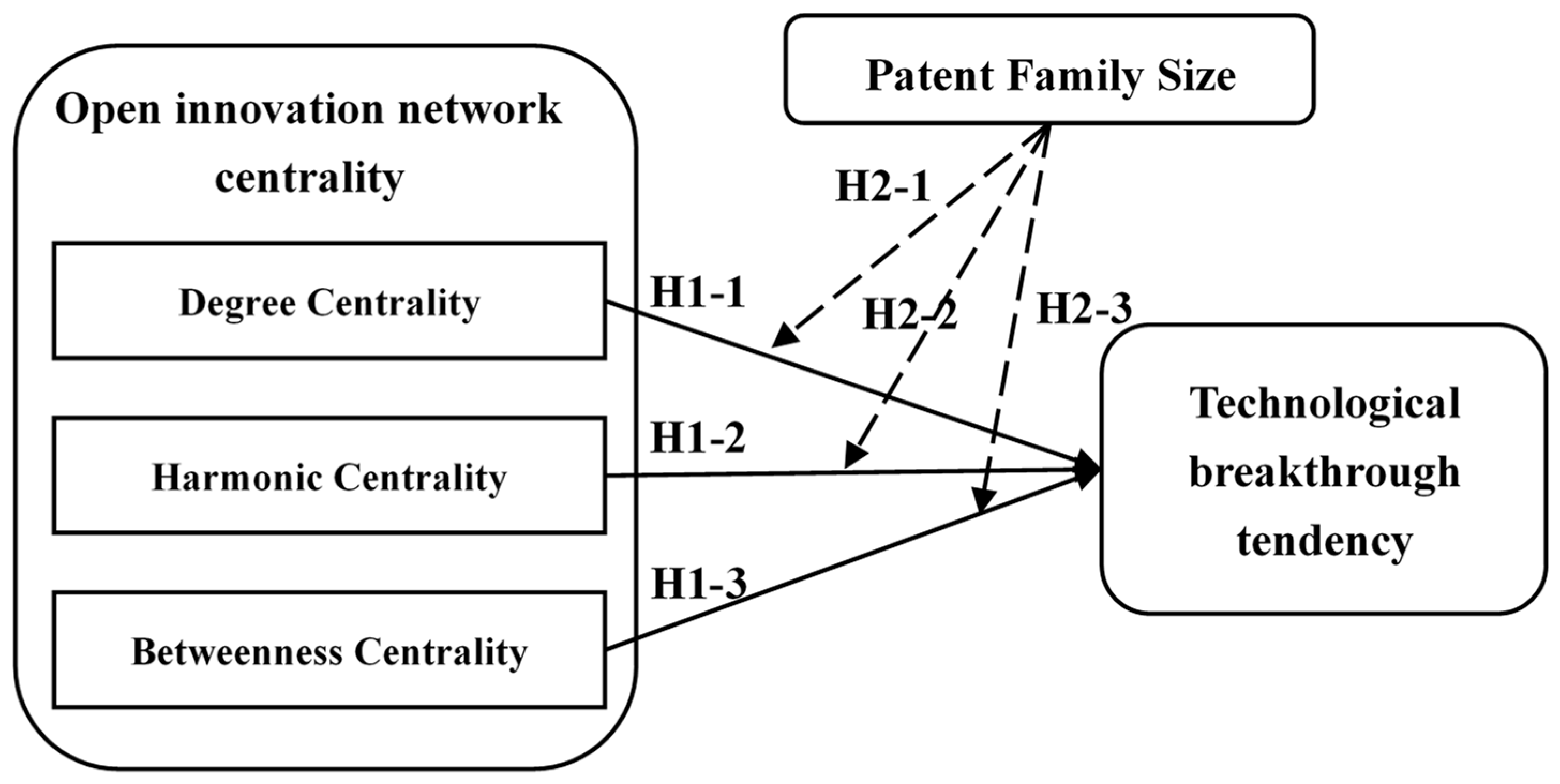
Technological Breakthrough Tendency in Patent Networks Under Open Innovation: Evidence from Autonomous Driving Patents


Abstract
1. Introduction
2. Literature Review
2.1. Theoretical Evolution of Technological Breakthroughs
2.2. Innovation Strategy for Technological Breakthroughs
2.3. Research Gap and the Focus of This Research
3. Theoretical Framework and Research Hypotheses
3.1. Technological Breakthroughs Based on Open Innovation Networks
3.2. The Impact of Open Innovation Network Centrality on TBT
3.3. The Moderating Effect of Patent Family Size
4. Research Method
4.1. Data Sources
4.2. Variable Selection
4.2.1. Dependent Variable
- (1)
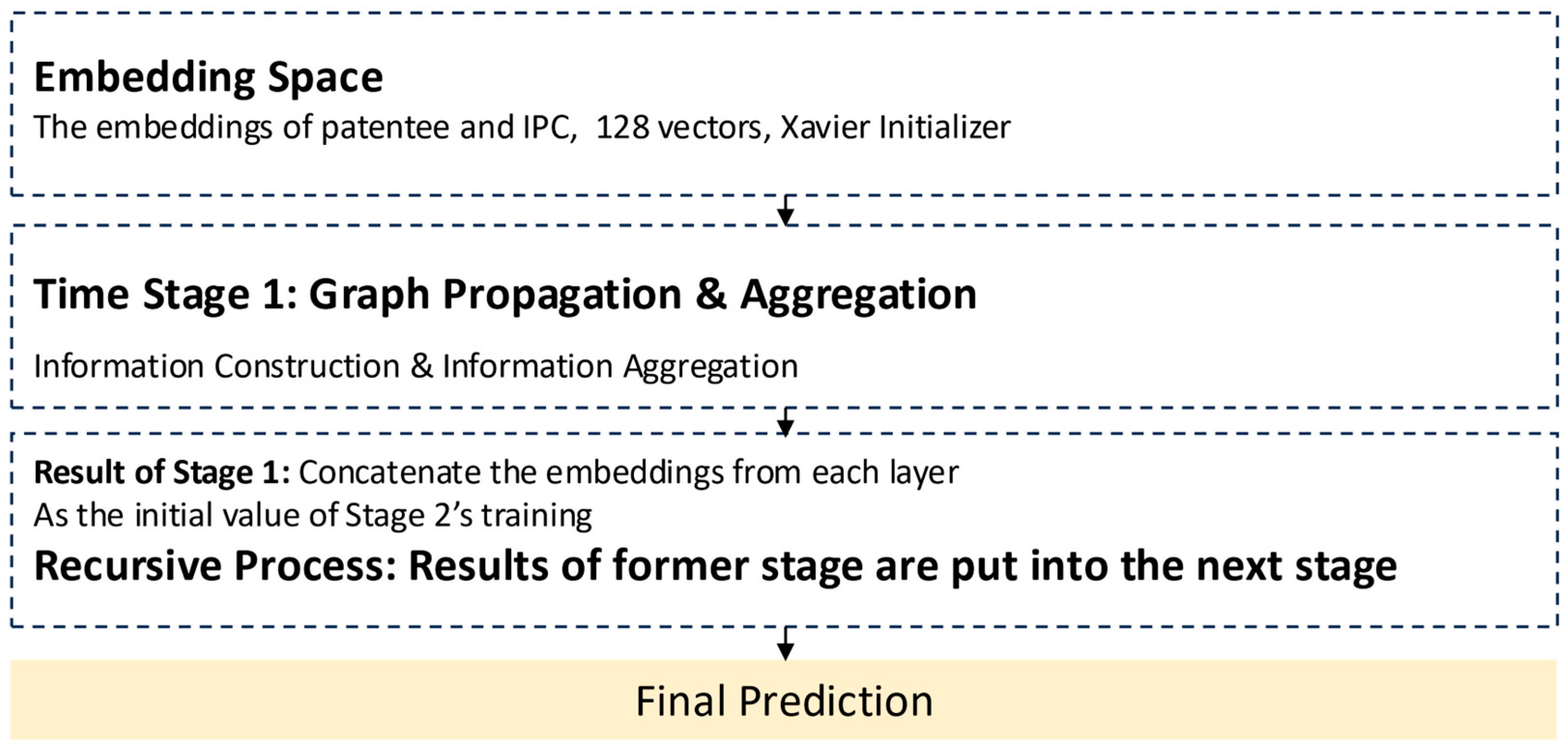
- Embedding Initialization: Each node (firm or IPC) is initialized with a low-dimensional embedding vector. The initial embeddings are randomly generated using Xavier initialization to ensure stable training. For nodes that newly appear in later periods, embeddings are initialized in the same manner.
- (2)
- Representation Learning: The RGNN model learns node representations through a multi-layer message-passing mechanism. At each layer l, the embedding of node v is updated by aggregating information from its neighbouring nodes as follows:where denotes the embedding of node v at layer l, N(v) is the set of neighbouring nodes, is a trainable weight matrix, and σ represents the adopted nonlinear activation function, namely the LeakyReLu.
- (3)
- Recursive Temporal Updating: To reflect the dynamic evolution of technological activities, the model is trained recursively across multiple time periods. The embeddings learned in period t are used as the initial embeddings for period t + 1. This design allows the model to accumulate historical information and capture temporal continuity in firm–technology relationships. This propagation mechanism enables each node to incorporate both direct and higher-order structural information from the network.
- (4)
- Latent Preference Score (LPS): After training, the latent preference score between a firm f and an IPC class i is computed as the inner product of their embeddings:This score reflects the relative affinity between a firm and a technological domain, capturing latent technological orientation inferred from the network structure. Higher LPS values indicate that the patent has a stronger propensity toward specific technological domains.
- (5)
- Model Training and Convergence: The model is trained using a pairwise ranking objective based on observed firm–IPC interactions. For each firm, observed IPC classes are treated as positive samples, while unobserved IPC classes are sampled as negative instances. The optimization is performed using stochastic gradient descent. Training proceeds until convergence, which is the defined by stabilization of the loss function or reaching a predefined maximum number of epochs. In practice, the loss function decreases steadily and converges within a limited number of iterations, indicating stable embedding representations. This study adopts the RGNN method and transforms the application into an individual patent of an autonomous vehicle, which assesses each patent’s TBT through LPS.
4.2.2. Independent Variable
4.2.3. Moderating Variable
4.2.4. Control Variable
- (1)
- Number of cited patents in a patent (Cited_patents): This metric refers to the count of prior art patents referenced by a single patent. Patent citations serve as a critical indicator of patent influence, which can be categorized into backward citations and forward citations. Therefore, Cited_patents in this study specifically denote backward citations. This measure reflects the extent to which existing technologies are referenced, bearing a certain correlation with technological breakthroughs, and the citation of prior art also signifies the contribution to innovation and development within the broader technological domain.
- (2)
- Number of inventors in a patent (Inventor_Num): This indicator refers to the inventor team listed on a patent. As the direct source of patent formation, the knowledge background composition of inventors is closely related to technological breakthroughs. Meanwhile, the information disclosed by inventors in patents also has a potential impact on the performance of patents in open innovation networks.
- (3)
- Number of present assignees in a patent (Assignee_Num): This indicator quantifies the count of individual entities collectively holding patent rights for a given patent. Similar to inventors, the structure of assignees’ technical expertise influences technological breakthroughs. Furthermore, competitive and collaborative dynamics among assignees contribute additional value to the patent itself.
4.2.5. Instrumental Variable
5. Results
5.1. Descriptive Statistics and Analysis
5.2. Baseline Regression Results
5.3. Moderating Effect Results
6. Robustness Analysis
6.1. Endogeneity Issue Test
6.2. Heterogeneity Analysis
6.3. Alternative Variables Analysis
7. Discussion and Conclusions
7.1. Theoretical Discussion
7.2. Practical Implications
7.2.1. Technical Management for AD
7.2.2. Policy Implications for Industrial Planning
7.3. Limitations and Further Research
Supplementary Materials
Author Contributions
Funding
Institutional Review Board Statement
Informed Consent Statement
Data Availability Statement
Acknowledgments
Conflicts of Interest
Abbreviations
| AD | Autonomous Driving |
| DII | Derwent Innovations Index |
| IPC | International Patent Classification |
| TBT | Technological Breakthrough Tendency |
| RGNN | recursive graph neural networks |
| TF-IDF | term frequency–inverse document frequency |
| LPS | latent preference score |
| IDF | inverse document frequency |
| DC | Degree Centrality |
| HC | Harmonic Centrality |
| BC | Betweenness Centrality |
| VIF | Variance Inflation Factor |
| 2SLS | two-stage least squares |
References
- Holgersson, M.; Granstrand, O. Value capture in open innovation markets: The role of patent rights for innovation appropriation. Eur. J. Innov. Manag. 2021, 25, 320–339. [Google Scholar] [CrossRef]
- Zhu, M.; Zhou, W.; Zhou, X.; Duan, C. Stakeholders’ collaborative strategies of intelligent manufacturing innovation consortium: A tripartite evolutionary game perspective. Technol. Anal. Strateg. Manag. 2025, 1–19. [Google Scholar] [CrossRef]
- Wang, Z.; Fang, C.; Liu, X. Does Digital Transformation Stimulate Breakthrough Innovation? Evidence From Chinese Firms. IEEE Trans. Eng. Manag. 2024, 71, 11599–11614. [Google Scholar] [CrossRef]
- Hou, J.; Yang, X.; Song, H. The Impact of Scientific and Technological Information Resource Utilization on Breakthrough Innovation in Enterprises: The Moderating Role of Strategic Aggressiveness. Systems 2024, 12, 248. [Google Scholar] [CrossRef]
- Li, M.; Porter, A.L.; Suominen, A. Insights into relationships between disruptive technology/innovation and emerging technology: A bibliometric perspective. Technol. Forecast. Soc. Change 2018, 129, 285–296. [Google Scholar] [CrossRef]
- Cammarano, A.; Varriale, V.; Michelino, F.; Caputo, M. A Framework for Investigating the Adoption of Key Technologies: Presentation of the Methodology and Explorative Analysis of Emerging Practices. IEEE Trans. Eng. Manag. 2024, 71, 3843–3866. [Google Scholar] [CrossRef]
- Garud, R.; Karnøe, P. Bricolage versus breakthrough: Distributed and embedded agency in technology entrepreneurship. Res. Policy 2003, 32, 277–300. [Google Scholar] [CrossRef]
- Yu, T.; Guan, J.; Luo, T. Mapping the Dynamics Behind Breakthrough Innovations in China’s Energy Sector: The Evolution of Research Foci and Collaborative Networks. Systems 2025, 13, 996. [Google Scholar] [CrossRef]
- Moeen, M.; Agarwal, R. Incubation of an industry: Heterogeneous knowledge bases and modes of value capture. Strateg. Manag. J. 2016, 38, 566–587. [Google Scholar] [CrossRef]
- Hung, S.C.; Liu, J.S.; Lu, L.Y.Y.; Tseng, Y.C. Technological change in lithium iron phosphate battery: The key-route main path analysis. Scientometrics 2014, 100, 97–120. [Google Scholar] [CrossRef]
- Lai, K.K.; Bhatt, P.C.; Kumar, V.; Chen, H.C.; Chang, Y.H.; Su, F.P. Identifying the impact of patent family on the patent trajectory: A case of thin film solar cells technological trajectories. J. Informetr. 2021, 15, 101143. [Google Scholar] [CrossRef]
- Qu, G.; Chen, J.; Zhang, R.; Wang, L.; Yang, Y. Technological search strategy and breakthrough innovation: An integrated approach based on main-path analysis. Technol. Forecast. Soc. Change 2023, 196, 122879. [Google Scholar] [CrossRef]
- Sun, B.; Kolesnikov, S.; Goldstein, A.; Chan, G. A dynamic approach for identifying technological breakthroughs with an application in solar photovoltaics. Technol. Forecast. Soc. Change 2021, 165, 120534. [Google Scholar] [CrossRef]
- Corredoira, R.A.; Banerjee, P.M. Measuring patent’s influence on technological evolution: A study of knowledge spanning and subsequent inventive activity. Res. Policy 2015, 44, 508–521. [Google Scholar] [CrossRef]
- Ardito, L.; Petruzzelli, A.M.; Panniello, U. Unveiling the breakthrough potential of established technologies: An empirical investigation in the aerospace industry. Technol. Anal. Strateg. Manag. 2016, 28, 916–934. [Google Scholar] [CrossRef]
- Yuan, X.; Li, X. The evolution of the industrial value chain in China’s high-speed rail driven by innovation policies: A patent analysis. Technol. Forecast. Soc. Change 2021, 172, 121054. [Google Scholar] [CrossRef]
- Jiang, Z.; Liu, Z. Policies and exploitative and exploratory innovations of the wind power industry in China: The role of technological path dependence. Technol. Forecast. Soc. Change 2022, 177, 121519. [Google Scholar] [CrossRef]
- Meng, J.H.; Wang, J.; Liu, Y. How is government embedded in innovation process for breakthroughs? A meta-synthesis of qualitative case studies. Technol. Forecast. Soc. Change 2023, 194, 122735. [Google Scholar] [CrossRef]
- Liu, Q.; Wen, X.; Peng, H.; Cao, Q. Key technology breakthrough in new energy vehicles: Configuration path evolution from innovative ecosystem perspective. J. Clean. Prod. 2023, 423, 138635. [Google Scholar] [CrossRef]
- Liao, W.; Gu, J.; Li, K. Roles of related and unrelated external technologies in shaping regional breakthrough technological advantages. Technol. Forecast. Soc. Change 2025, 210, 123871. [Google Scholar] [CrossRef]
- Hu, W.; Liu, Y.; Li, Y.; Chen, D. Work together, walk forward: Unveiling collaborative innovation networks and mapping paths to breakthrough innovation in electric vehicles. J. Clean. Prod. 2024, 480, 144077. [Google Scholar] [CrossRef]
- Wang, X.; Huang, J. The realization and transformation law of the boundary-spanning technological innovation of manufacturing enterprises based on the framework of “internal reconfiguration—Networking capability—BSTI”. J. Manuf. Technol. Manag. 2024, 35, 1581–1604. [Google Scholar] [CrossRef]
- Sun, C.; Wei, J. Digging deep into the enterprise innovation ecosystem. Chin. Manag. Stud. 2019, 13, 820–839. [Google Scholar] [CrossRef]
- Wang, J.; Cao, N.; Wang, Y.; Wang, Y. The Impact of Knowledge Power on Enterprise Breakthrough Innovation: From the Perspective of Boundary-Spanning Dual Search. Sustainability 2022, 14, 10980. [Google Scholar] [CrossRef]
- Hu, J.; Zhao, X.; Wu, D. Implementation of industrial enterprises’ green innovation strategy under technology spillover. Technol. Anal. Strateg. Manag. 2025, 37, 629–647. [Google Scholar] [CrossRef]
- Chen, W. Can low-carbon development force enterprises to make digital transformation? Bus. Strateg. Environ. 2022, 32, 1292–1307. [Google Scholar] [CrossRef]
- Yang, B. Data element marketization and energy efficiency of heavy polluting enterprises: A technology innovation perspective. J. Environ. Manag. 2025, 391, 126318. [Google Scholar] [CrossRef]
- Song, X.; Yang, J. Assessing the impact of digitization and servitization of manufacturing firms in the context of carbon emission reduction: Evidence from a microsurvey in China. Energy Environ. 2023, 35, 3340–3385. [Google Scholar] [CrossRef]
- Zhang, Y.; Yang, X.; Xu, X.; Wan, J. Catalyzing re-innovation: How digital transformation drives recovery from technological failure in manufacturing. J. Retail. Consum. Serv. 2026, 89, 104611. [Google Scholar] [CrossRef]
- Cao, Y.; Tang, L. Digitalization and agricultural businesses’ environmental sustainability. Financ. Res. Lett. 2025, 86, 108442. [Google Scholar] [CrossRef]
- Su, J.; Liu, J.; Wang, S. A study on the action mechanism of digital transformation on the output quality of technological innovation. Total Qual. Manag. Bus. 2024, 35, 321–340. [Google Scholar] [CrossRef]
- Shi, J.; Wang, Y. Prerequisites for the Innovation Performance of Artificial Intelligence Laboratory: A Fuzzy-Set Qualitative Comparative Analysis. IEEE Trans. Eng. Manag. 2024, 71, 5341–5356. [Google Scholar] [CrossRef]
- Yu, X.; Zhang, B. Obtaining advantages from technology revolution: A patent roadmap for competition analysis and strategy planning. Technol. Forecast. Soc. Change 2019, 145, 273–283. [Google Scholar] [CrossRef]
- Yilmaz, E.D.; Naumovska, I.; Miric, M. Does imitation increase or decrease demand for an original product? Understanding the opposing effects of discovery and substitution. Strateg. Manag. J. 2022, 44, 639–671. [Google Scholar] [CrossRef]
- Gómez, J.; Salazar, I.; Vargas, P. Does Information Technology Improve Open Innovation Performance? An Examination of Manufacturers in Spain. Inform. Syst. Res. 2017, 28, 661–675. [Google Scholar] [CrossRef]
- Kwon, D.; Lee, H.Y.; Cho, J.H.; Sohn, S.Y. Effect of an open patent pool strategy on technology innovation in terms of creating shared value. Technol. Forecast. Soc. Change 2023, 187, 122251. [Google Scholar] [CrossRef]
- Zhang, B.; Yu, X.; Zhang, R. Emerging technology identification based on a dynamic framework: A lifecycle evolution perspective. Technol. Anal. Strateg. Manag. 2024, 36, 378–392. [Google Scholar] [CrossRef]
- Zhang, R.; Yu, X.; Zhang, B.; Ren, Q.; Ji, Y. Discovering technology opportunities of latecomers based on RGNN and patent data: The example of Huawei in self-driving vehicle industry. Inform. Process Manag. 2025, 62, 103908. [Google Scholar] [CrossRef]
- Zhang, B.; Ming, C. Patent Value Promotion Based on the Technology Proximity Network: An Empirical Analysis of Artificial Intelligence for Healthcare. Sci. Technol. Soc. 2023, 28, 213–234. [Google Scholar] [CrossRef]
- Kamuriwo, D.S.; Fuller, C.B.; Zhang, J. Knowledge Development Approaches and Breakthrough Innovations in Technology-Based New Firms. J. Prod. Innov. Manag. 2017, 34, 492–508. [Google Scholar] [CrossRef]
- You, Y.B.; Kim, B.K.; Jeong, E.S. An exploratory study on the development path of converging technologies using patent analysis: The case of nano biosensors. Asian J. Technol. Innov. 2014, 22, 100–113. [Google Scholar] [CrossRef]
- Dechezleprêtre, A.; Ménière, Y.; Mohnen, M. International patent families: From application strategies to statistical indicators. Scientometrics 2017, 111, 793–828. [Google Scholar] [CrossRef]
- Torrisi, S.; Gambardella, A.; Giuri, P.; Harhoff, D.; Hoisl, K.; Mariani, M. Used, blocking and sleeping patents: Empirical evidence from a large-scale inventor survey. Res. Policy 2016, 45, 1374–1385. [Google Scholar] [CrossRef]
- Harhoff, D.; Scherer, F.M.; Vopel, K. Citations, family size, opposition and the value of patent rights. Res. Policy 2003, 32, 1343–1363. [Google Scholar] [CrossRef]
- Bhaskarabhatla, A.; Deng, Y.; Liu, Y. Open disclosure using invention pledges: A case study of IBM. J. Technol. Transf. 2023, 49, 1532–1566. [Google Scholar] [CrossRef]
- Martínez, C. Patent families: When do different definitions really matter? Scientometrics 2010, 86, 39–63. [Google Scholar] [CrossRef]
- Tahmooresnejad, L.; Beaudry, C. Capturing the economic value of triadic patents. Scientometrics 2018, 118, 127–157. [Google Scholar] [CrossRef]
- Kabore, F.P.; Park, W.G. Can patent family size and composition signal patent value? Appl. Econ. 2019, 51, 6476–6496. [Google Scholar] [CrossRef]
- Andersson, D.E.; La Mela, M.; Tell, F. Family first: Defining, constructing, and applying historical patent families. Explor. Econ. Hist. 2024, 94, 101627. [Google Scholar] [CrossRef]
- USPTO. Manual of Patent Examining Procedure (MPEP) Ninth Edition. Available online: https://www.uspto.gov/web/offices/pac/mpep/index.html (accessed on 9 May 2026).
- Angrist, J.D.; Krueger, A.B. Does Compulsory School Attendance Affect Schooling and Earnings? Q. J. Econ. 1991, 106, 979–1014. [Google Scholar] [CrossRef]
- Acemoglu, D.; Johnson, S.; Robinson, J.A. The Colonial Origins of Comparative Development: An Empirical Investigation. Am. Econ. Rev. 2001, 91, 1369–1401. [Google Scholar] [CrossRef]
- He, X.; Liao, L.; Zhang, H.; Nie, L.; Hu, X.; Chua, T.S. Neural Collaborative Filtering. In WWW’17: Proceedings of the 26th International Conference on World Wide Web, Perth, Australia, 3–7 April 2017; International World Wide Web Conferences Steering Committee: Geneva, Switzerland, 2017; pp. 173–182. [Google Scholar]
- Wang, X.; He, X.; Wang, M.; Feng, F.; Chua, T.S. Neural Graph Collaborative Filtering. In SIGIR’19: Proceedings of the 42nd International ACM SIGIR Conference on Research and Development in Information Retrieval, Paris, France, 21–25 July 2019; Association for Computing Machinery: New York, NY, USA, 2019; pp. 165–174. [Google Scholar]
- Holgersson, M.; Dahlander, L.; Chesbrough, H.; Bogers, M.L.A.M. Open Innovation in the Age of AI. Calif. Manag. Rev. 2024, 67, 5–20. [Google Scholar] [CrossRef]
- Viadero-Monasterio, F.; Meléndez-Useros, M.; Jiménez-Salas, M.; Boada, B.L.; Boada, M.J.L. Key influencing factors in vehicle platoons: A systematic study and review. Evol. Syst. 2025, 16, 116. [Google Scholar] [CrossRef]
- Viadero-Monasterio, F.; Meléndez-Useros, M.; Zhang, H.; Boada, B.L.; Boada, M.J.L. Low-Cost Vehicle Rebalancing Control for an Autonomous Mobility on Demand System. J. Frankl. Inst. 2025, 363, 108333. [Google Scholar] [CrossRef]
- Viadero-Monasterio, F.; Meléndez-Useros, M.; Zhang, N.; Zhang, H.; Boada, B.L.; Boada, M.J.L. Motion Planning and Robust Output-Feedback Trajectory Tracking Control for Multiple Intelligent and Connected Vehicles in Unsignalized Intersections. IEEE Trans. Veh. Technol. 2025, 74, 18543–18555. [Google Scholar] [CrossRef]
- Wang, H.; Zhang, G.; Cao, H.; Hu, K.; Wang, Q.; Deng, Y.; Gao, J.; Tang, Y. Geometry-Aware 3D Point Cloud Learning for Precise Cutting-Point Detection in Unstructured Field Environments. J. Field Robot. 2025, 42, 3063–3076. [Google Scholar] [CrossRef]
- Wang, C.; Yang, M.; Han, Q.; Li, P.; He, Z.; Zhao, Z.; Wu, F. Dynamic litchi fruit trajectory prediction using Extended Kalman Filter in simulated wind environment. Comput. Electron. Agric. 2026, 247, 111666. [Google Scholar] [CrossRef]
- WIPO. IPC Publication. Available online: https://ipcpub.wipo.int/?notion=scheme&version=20260101&symbol=none&menulang=en&lang=en&viewmode=f&fipcpc=no&showdeleted=yes&indexes=no&headings=yes¬es=yes&direction=o2n&initial=A&cwid=none&tree=no&searchmode=smart (accessed on 19 May 2026).


| Variables | Definition | Exploration |
|---|---|---|
| Degree Centrality (DC) | The number of connections that a node establishes with other nodes in a network | This study employs this indicator to quantify the number of IPCs associated with patent nodes within the patent–IPC network, thereby characterizing the technological breadth of individual patents |
| Harmonic Centrality (HC) | The reciprocal of the harmonic means of the shortest-path distances from a node to all other nodes in a network | This study employs this indicator to quantify the similarity degree between a patent node and other nodes within the patent–IPC network, thereby delineating the specific position of individual patents within the network |
| Betweenness Centrality (BC) | The probability that a node lies on the shortest path between two other nodes in a network | This paper employs this indicator to measure the bridging role of patent nodes in the patent–IPC network, thereby depicting the technological control ability of individual patents |
| Variables | Means | SD. | Min | Max |
|---|---|---|---|---|
| TBT | 2.541 | 1.117 | 0.009 | 6.383 |
| DC | 1.094 × 10⁻⁴ | 9.185 × 10⁻⁵ | 2.410 × 10⁻⁵ | 0.002 |
| HC | 10,782.822 | 1799.287 | 1.000 | 14,913 |
| BC | 3.962 × 10⁻⁵ | 1.184 × 10⁻⁴ | 0.000 | 0.004 |
| Family_size | 2.034 | 2.115 | 1.000 | 52.00 |
| Cited_patents | 10.714 | 47.542 | 0.000 | 1012 |
| Inventor_Num | 3.520 | 2.873 | 1.000 | 55.00 |
| Assignee_Num | 1.560 | 1.052 | 1.000 | 18.00 |
| Variables | VIF | 1/VIF |
|---|---|---|
| DC | 2.104 | 0.475 |
| HC | 1.162 | 0.861 |
| BC | 1.538 | 0.65 |
| Cited_patents | 1.062 | 0.942 |
| Inventor_Num | 1.038 | 0.964 |
| Assignee_Num | 2.242 | 0.446 |
| Family_size | 2.389 | 0.419 |
| Overall_lens | 1.082 | 0.924 |
| M1 | M2 | M3 | |
|---|---|---|---|
| DC | −0.279 *** (−46.609) | ||
| HC | 0.384 *** (74.759) | ||
| BC | −0.124 *** (−22.271) | ||
| Cited_patents | 0.028 *** (5.236) | −0.033 *** (−6.61) | 0.006 (1.077) |
| Inventor_Num | 0.035 *** (6.595) | 0.023 *** (4.573) | 0.028 *** (5.216) |
| Assignee_Num | −0.067 *** (−11.175) | −0.281 *** (−53.672) | −0.162 *** (−28.852) |
| N | 33,347 | 33,347 | 33,347 |
| M4 | M5 | M6 | M7 | |
|---|---|---|---|---|
| DC | −0.427 *** (−78.370) | −0.288 *** (−40.718) | −0.420 *** (−66.204) | |
| HC | 0.490 *** (99.700) | 0.422 *** (82.542) | 0.490 *** (99.697) | |
| BC | −0.204 *** (−39.5) | 0.016 * (2.416) | −0.013 * (−2.362) | |
| Cited_patents | 0.022 *** (4.724) | −0.006 (−1.206) | 0.027 *** (5.048) | 0.023 *** (4.882) |
| Inventor_Num | 0.033 *** (7.131) | 0.024 *** (4.819) | 0.035 *** (6.624) | 0.033 *** (7.102) |
| Assignee_Num | −0.116 *** (−22.058) | −0.243 *** (−46.678) | −0.066 *** (−11.089) | −0.116 *** (−22.133) |
| N | 33,347 | 33,347 | 33,347 | 33,347 |
| M8 | M9 | M10 | M11 | M12 | M13 | |
|---|---|---|---|---|---|---|
| DC | −0.274 *** (−43.932) | −0.338 *** (−47.361) | ||||
| HC | 0.393 *** (76.82) | 0.372 *** (53.82) | ||||
| BC | −0.113 *** (−19.988) | −0.161 *** (−22.544) | ||||
| Family_size | −0.019 * (−2.413) | −0.184 *** (−15.192) | −0.165 *** (−22.463) | −0.314 *** (−9.489) | −0.094 *** (−11.802) | −0.137 *** (−15.429) |
| DC × Family_size | 0.202 *** (18.135) | |||||
| HC × Family_size | 0.156 *** (4.630) | |||||
| BC × Family_size | 0.087 *** (10.972) | |||||
| Cited_patents | 0.029 *** (5.402) | 0.031 *** (5.858) | −0.020 *** (−4.034) | −0.019 *** (−3.869) | 0.012 * (2.191) | 0.015 ** (2.661) |
| Inventor_Num | 0.035 *** (6.649) | 0.032 *** (6.051) | 0.026 *** (5.269) | 0.026 *** (5.170) | 0.030 *** (5.576) | 0.029 *** (5.358) |
| Assignee_Num | −0.055 *** (−7.034) | −0.015 (0.054) | −0.165 *** (−22.463) | −0.163 *** (−22.143) | −0.097 *** (−12.317) | −0.079 *** (−9.843) |
| N | 33,347 | 33,347 | 33,347 | 33,347 | 33,347 | 33,347 |
| First-Stage Regression | M14 | M15 | M16 |
|---|---|---|---|
| Overall_lens | 4.61 × 10⁻⁸ *** (32.12) | 0.60 *** (18.97) | 1.40 × 10⁻⁸ *** (6.73) |
| Cited_patents | 2.55 × 10⁻⁷ *** (27.62) | 1.66 *** (8.14) | 3.43 × 10⁻⁷ *** (25.69) |
| Inventor_Num | 8.35 × 10⁻⁷ *** (5.50) | 7.68 * (2.29) | 2.65 × 10⁻⁷ (1.21) |
| Assignee_Num | 3.77 × 10⁻⁵ *** (87.60) | 381.41 *** (40.13) | 2.51 × 10⁻⁵ *** (40.32) |
| F test of excluded instruments | F = 1031.64 | F = 359.93 | F = 45.32 |
| Underidentification test | p = 0.000 | p = 0.000 | p = 0.000 |
| Weak identification test | F = 1031.64 (>10% maximal IV size 16.38) | F = 359.93 (>10% maximal IV size 16.38) | F = 45.32 (>10% maximal IV size 16.38) |
| Weak-instrument-robust inference test | p = 0.000 | p = 0.000 | p = 0.000 |
| IV (2SLS) Estimation | M17 | M18 | M19 |
|---|---|---|---|
| DC | −6661.19 *** (−15.50) | ||
| HC | −5.11 × 10⁻⁴ *** (−10.19) | ||
| BC | −21,957.77 *** (−6.47) | ||
| Cited_patents | 1.58 × 10⁻³ *** (8.93) | 7.34 × 10⁻⁴ ** (3.34) | 7.42 × 10⁻³ *** (6.00) |
| Inventor_Num | 1.48 × 10⁻² *** (6.97) | 1.31 × 10⁻² *** (4.10) | 1.50 × 10⁻² ** (2.96) |
| Assignee_Num | 6.86 × 10⁻² *** (3.76) | 1.21 × 10⁻² (0.54) | 0.37 *** (4.15) |
| Endogeneity test | p = 0.000 | p = 0.000 | p = 0.000 |
| Year_Range | IPC_Section | |
|---|---|---|
| Sample Classification |
|
|
| M20 | M21 | M22 | |
|---|---|---|---|
| DC | −0.263 *** (−9.383) | ||
| HC | 0.384 *** (16.478) | ||
| BC | −0.095 ** (−3.956) | ||
| Year_Range | 0.114 *** (14.806) | 0.053 * (2.002) | 0.082 *** (14.607) |
| DC × Year_Range | −0.032 (−1.129) | ||
| HC × Year_Range | −0.006 (−0.162) | ||
| BC × Year_Range | −0.033 (−1.358) | ||
| Cited_patents | 0.036 *** (6.688) | −0.030 *** (−6.042) | 0.011 * (1.957) |
| Inventor_Num | 0.031 *** (5.93) | 0.021 *** (4.209) | 0.025 *** (4.668) |
| Assignee_Num | −0.047 *** (−7.821) | −0.274 *** (−51.947) | −0.152 *** (−26.896) |
| N | 33,347 | 33,347 | 33,347 |
| M23 | M24 | M25 | |
|---|---|---|---|
| DC | −0.218 *** (−19.436) | ||
| HC | 0.386 *** (41.193) | ||
| BC | −0.117 *** (−11.766) | ||
| IPC_Section | −0.050 *** (−6.057) | −0.047 * (−2.324) | −0.082 *** (−14.447) |
| DC × IPC_Section | −0.088 *** (−7.050) | ||
| HC × IPC_Section | −0.015 (−0.690) | ||
| BC × IPC_Section | −0.010 (−0.976) | ||
| Cited_patents | 0.030 *** (5.750) | −0.032 *** (−6.446) | 0.007 (1.263) |
| Inventor_Num | 0.036 *** (6.884) | 0.024 *** (4.720) | 0.029 *** (5.385) |
| Assignee_Num | −0.063 *** (−10.605) | −0.280 *** (−53.347) | −0.161 *** (−28.722) |
| N | 33,347 | 33,347 | 33,347 |
| M26 | M27 | M28 | M29 | M30 | M31 | |
|---|---|---|---|---|---|---|
| DC | −0.085 *** (−11.522) | −0.380 *** (−54.446) | ||||
| HC | 0.052 *** (6.957) | 0.157 *** (21.549) | ||||
| BC | −0.061 *** (−8.424) | −0.182 *** (−25.793) | ||||
| Family_size | −0.168 *** (−13.342) | −0.426 *** (−11.825) | −0.143 *** (−15.942) | −0.243 *** (−20.533) | −0.362 *** (−10.361) | −0.180 *** (−20.506) |
| DC × Family_size | 0.066 *** (5.710) | 0.250 *** (22.968) | ||||
| HC × Family_size | 0.289 *** (7.908) | 0.198 *** (5.576) | ||||
| BC × Family_size | 0.032 *** (4.034) | 0.115 *** (14.727) | ||||
| Cited_patents | 0.055 *** (9.920) | 0.044 *** (8.053) | 0.053 *** (9.597) | 0.025 *** (4.846) | −0.019 *** (−3.594) | 0.006 (1.203) |
| Inventor_Num | 0.037 *** (6.695) | 0.035 *** (6.371) | 0.036 *** (6.593) | 0.015 ** (2.968) | 0.012 * (2.170) | 0.012 * (2.303) |
| Assignee_Num | −0.019 * (−2.275) | −0.053 *** (−6.662) | −0.034 *** (−4.196) | −0.017 * (−2.149) | −0.145 *** (−18.709) | −0.089 *** (−11.192) |
| N | 33,347 | 33,347 | 33,347 | 33,347 | 33,347 | 33,347 |
Disclaimer/Publisher’s Note: The statements, opinions and data contained in all publications are solely those of the individual author(s) and contributor(s) and not of MDPI and/or the editor(s). MDPI and/or the editor(s) disclaim responsibility for any injury to people or property resulting from any ideas, methods, instructions or products referred to in the content. |
© 2026 by the authors. Licensee MDPI, Basel, Switzerland. This article is an open access article distributed under the terms and conditions of the Creative Commons Attribution (CC BY) license.
Share and Cite
Zhang, B.; Zhang, R. Technological Breakthrough Tendency in Patent Networks Under Open Innovation: Evidence from Autonomous Driving Patents. Systems 2026, 14, 682. https://doi.org/10.3390/systems14060682
Zhang B, Zhang R. Technological Breakthrough Tendency in Patent Networks Under Open Innovation: Evidence from Autonomous Driving Patents. Systems. 2026; 14(6):682. https://doi.org/10.3390/systems14060682
Chicago/Turabian StyleZhang, Ben, and Runzhe Zhang. 2026. "Technological Breakthrough Tendency in Patent Networks Under Open Innovation: Evidence from Autonomous Driving Patents" Systems 14, no. 6: 682. https://doi.org/10.3390/systems14060682
APA StyleZhang, B., & Zhang, R. (2026). Technological Breakthrough Tendency in Patent Networks Under Open Innovation: Evidence from Autonomous Driving Patents. Systems, 14(6), 682. https://doi.org/10.3390/systems14060682