1. Introduction
Since the early 21st century, China has witnessed rapid urbanization driven by a land-centered development paradigm. The share of the urban resident population increased markedly from 17.92% in 1978 to 66.16% in 2023, providing sustained, continuous momentum for economic growth. Nevertheless, this land-intensive growth model has generated a series of land-related challenges, such as farmland quality degradation, inefficient land utilization, and ecological deterioration [
1,
2]. As a scarce and irreplaceable strategic resource, land is essential for safeguarding national food security and advancing ecological civilization. Against the backdrop of China’s ongoing transformation toward high-quality development, addressing the structural tensions emerging between extensive land exploitation and growing environmental constraints has become an urgent issue requiring systematic research and coordinated policy responses [
3].
Urban land green use efficiency refers to the capacity of urban land resources to generate economic and social benefits while minimizing environmental pollution and resource consumption within a framework of sustainable development. Unlike conventional measures of urban land use efficiency, which primarily emphasize economic output, this concept integrates economic performance, social welfare, and ecological impacts, thereby offering a more comprehensive assessment of the sustainability of urban land utilization [
4]. Enhancing efficiency contributes not only to ecological civilization and sustainable development but also to the transition away from extensive urban land use models. In this context, China’s 14th Five-Year Plan explicitly emphasizes the modernization of the national spatial governance system, the acceleration of land conservation and intensive utilization, and improved resource allocation efficiency. It also highlights the necessity of promoting the rational, secure, and environmentally friendly allocation of land resources through legal safeguards, policy guidance, and institutional innovation. Accordingly, examining the institutional pathways for improving urban green land use efficiency within the legal framework is consistent with China’s strategic objective of high-quality development and provides theoretical and practical insights into the institutional mechanisms of ecological civilization.
In recent years, environmental courts, as an important institutional innovation within the environmental governance system, have been progressively established and promoted in China, as an important institutional innovation in environmental governance and a major manifestation of specialized environmental adjudication. Although environmental courts belong to the judicial subsystem, their influence can extend beyond case adjudication and general environmental performance to the functioning of urban land use systems. Urban land use systems are shaped not only by land markets and spatial planning, but also by legal rules governing pollution control, ecological damage compensation, industrial location, and restoration obligations. In China, many land-use activities, such as industrial land development, construction land expansion, soil pollution, illegal occupation of ecological space, and the relocation or upgrading of high-polluting enterprises, are related to environmental legal responsibilities. By increasing the expected costs of environmental violations, improving the enforceability of environmental regulation, and strengthening judicial supervision over ecological restoration, environmental courts can reshape the incentives of enterprises and local governments in land development and resource allocation. Consequently, the establishment of environmental courts may affect the intensity, structure, and ecological consequences of urban land use, making it theoretically relevant to green land use efficiency rather than only to broad indicators of green performance.
In contrast, research on environmental justice in foreign jurisdictions began earlier and has developed into a relatively systematic body of scholarship encompassing multiple dimensions, including institutional functions and governance effectiveness. From an institutional analysis perspective, Angstadt (2023) [
5] argues that environmental courts, by strengthening judicial review and professional capacity, contribute to enhancing the domestic implementation of international environmental rules. Preston (2014) [
6], taking the Land and Environment Court of New South Wales in Australia as a case study, finds that specialized environmental courts possess significant advantages in integrating administrative, civil, and criminal environmental disputes, thereby improving the overall coherence of environmental governance. Within the European context, although quantitative studies directly focusing on “environmental courts” remain relatively limited, the existing literature generally emphasizes the critical constraining role of the judiciary in environmental governance. Specifically, Mayer (2019) [
7], examining climate litigation in the Netherlands, finds that courts, by affirming the government’s positive obligations in addressing climate change and requiring the achievement of explicit greenhouse-gas reduction targets, demonstrate the substantive role of judicial institutions in strengthening governmental environmental responsibility. Keller et al. (2022) [
8], based on an empirical analysis of environmental cases before the European Court of Human Rights, show that the extent to which scientific evidence and expert opinions are employed significantly influences judicial outcomes and the effectiveness of environmental rights protection. Faure and Svatikova (2012) [
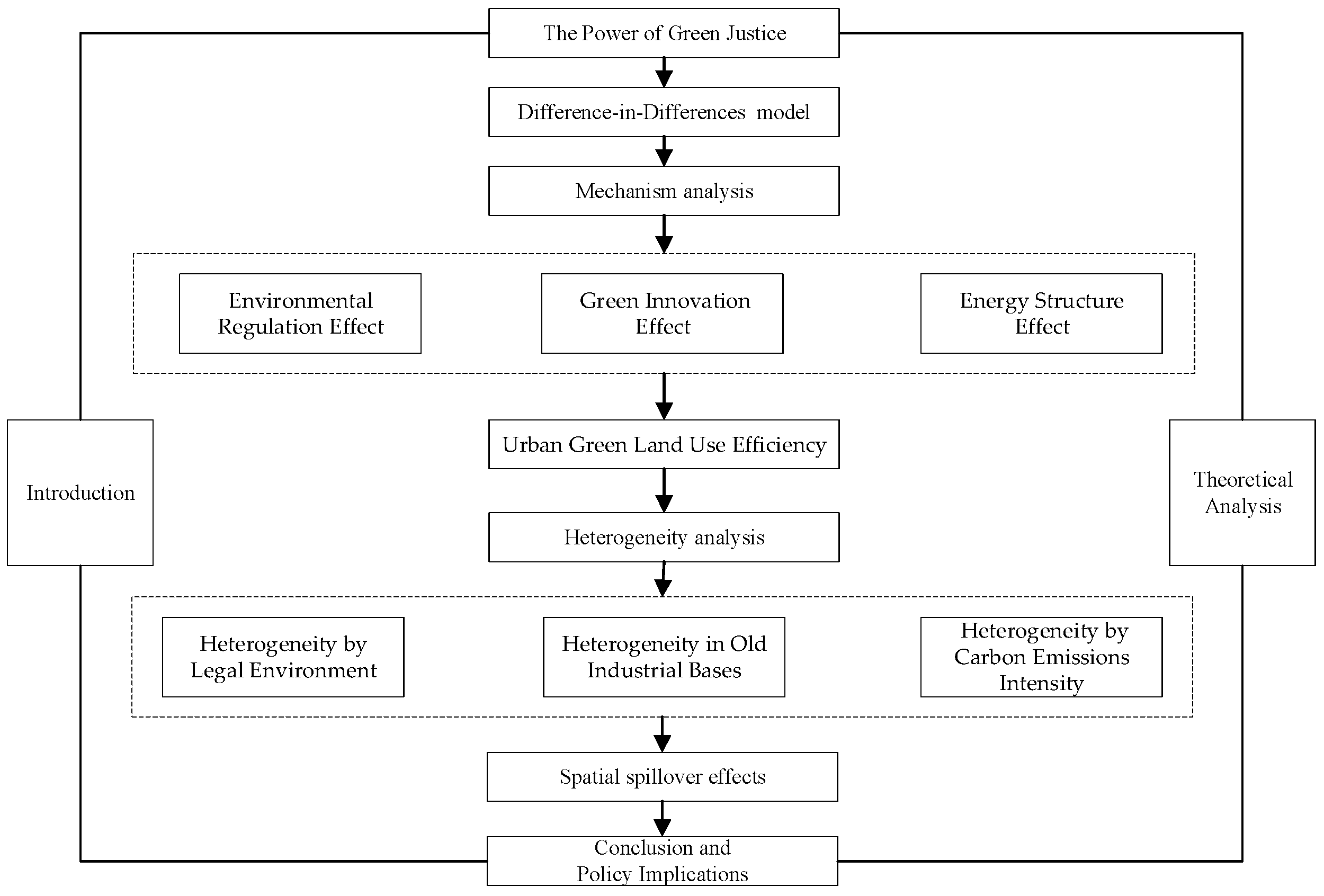
9], from the perspective of environmental crime enforcement, further indicate that the severity of judicial sanctions and the efficiency of enforcement are key institutional factors shaping environmental compliance. The research framework of this paper is shown in
Figure 1. Building on the above discussion, this paper empirically examines the impact of environmental courts on the green efficiency of urban land use. Its potential marginal contributions are as follows:
First, this study extends the institutional explanation of urban green land use efficiency from a systems perspective. Unlike existing studies that primarily attribute variations in urban green land use efficiency to external drivers such as economic growth and technological progress, this paper conceptualizes environmental judicial system reform as an intervention in the governance subsystem and explicitly incorporates judicial institutions into the analytical framework of urban land use systems. By examining the environmental court establishment of environmental courts as a form of institutional reform, this study systematically analyzes the role of judicial governance in resource allocation and ecological governance, thereby enriching the theoretical foundations and analytical pathways for understanding urban green land use efficiency within a systems perspective.
Second, this study elucidates the system-level mechanisms through which environmental judicial system reform influences urban green land use efficiency at the system level. Based on the interactions among governance, economic, and environmental elements within urban land use systems, this paper constructs and empirically tests multiple institutional channels through which environmental courts operate, including stronger environmental regulation, fostering green technological innovation, and optimization of energy consumption structures. These findings provide empirical evidence on how environmental judicial institutions improve urban green land use efficiency in practice and deepen the understanding of the role of institutional capacity building within complex governance systems.
Third, this study reveals the heterogeneous effects of environmental judicial system reform across different urban land use systems. Given the substantial variation among Chinese cities in legal foundations, industrial structures, and environmental pressures, this paper systematically examines heterogeneity along three dimensions—legal environment, carbon emission intensity, and old industrial base status—to identify how the impacts of environmental courts differ across urban contexts. These findings offer important empirical evidence and policy-relevant insights for advancing context-specific environmental judicial reforms and innovations in land governance systems.
2. Literature Review
With the continuous advancement of ecological civilization construction, issues related to environmental regulation and green development have gradually become central topics in academic research. Existing studies primarily examine the impact of institutional factors on green development from multiple dimensions, including environmental regulatory instruments, firm behavioral responses, and resource allocation efficiency. Against this backdrop, environmental courts, as a key institutional innovation in the specialization of environmental justice, have attracted increasing attention regarding their economic and environmental effects. However, their impact on urban green land use efficiency remains insufficiently explored.
First, existing research on the institutional effects of environmental courts has been conducted at both international and domestic levels. From an international perspective, the role of environmental justice has become increasingly important within environmental governance systems. Collectively, these studies suggest that environmental justice not only plays a crucial role in rule enforcement but also in environmental governance by strengthening accountability constraints and improving enforcement efficiency.
From a domestic perspective, environmental courts enhance regional environmental governance by strengthening enforcement and judicial constraints, as evidenced by significant reductions in pollutant emissions and continuous improvements in environmental quality [
10,
11,
12]. At the micro level, environmental courts raise the costs of violations and reinforce accountability mechanisms, thereby deterring firms from non-compliance, encouraging greater environmental investment, optimizing production structures, and promoting green technological innovation [
13]. Moreover, some studies suggest that environmental court establishment helps alleviate lax local enforcement and strengthens the practical effectiveness of environmental regulation [
14]. However, existing research has largely focused on pollution reduction and firm behavior, with relatively limited attention to resource allocation efficiency, particularly the allocation efficiency of land resources.
Second, regarding urban green land use efficiency, the literature generally agrees that its connotation should comprehensively incorporate economic output, resource consumption, and environmental constraints. Empirical studies typically use data envelopment analysis (DEA) and its extensions, such as the SBM model incorporating undesirable outputs, to measure urban land use efficiency [
15,
16]. In terms of influencing factors, previous studies have examined the roles of economic development level, industrial structure optimization, technological innovation capacity, and government intervention. Among these factors, environmental regulation is regarded as a key institutional variable affecting urban green land use efficiency. On the one hand, well-designed environmental regulation can promote technological progress and industrial upgrading, thereby improving resource allocation efficiency [
17]. On the other hand, overly stringent regulations may increase compliance costs and suppress economic activity, potentially reducing efficiency [
18]. As a result, the relationship between environmental regulation and urban green land use efficiency may exhibit non-linear characteristics.
Third, the relationship between environmental regulation and green development remains inconclusive in the literature. Based on the “Porter Hypothesis,” some studies argue that appropriately designed environmental regulation can stimulate innovation, thereby achieving a “win–win” outcome between environmental protection and economic efficiency [
19]. In contrast, other studies suggest that environmental regulation increases compliance costs, crowds out productive investment, and inhibits efficiency improvements. Additionally, some scholars identify potential non-linear relationships, such as inverted U-shaped or U-shaped patterns [
20]. These divergent findings indicate that different types of regulatory instruments and their implementation mechanisms may exert heterogeneous effects on green development.
In this context, environmental courts, as a coercive and authoritative form of judicial environmental regulation, possess distinctive mechanisms of influence. Compared with traditional administrative regulation, environmental courts strengthen legal constraints through judicial adjudication, effectively increasing the cost of environmental violations [
21]. Through mechanisms such as precedent-setting and information transmission, they also enhance the stability and credibility of regulatory expectations [
22,
23]. Consequently, environmental courts may not only directly influence firm behavior but also indirectly affect the efficiency of resource allocation by improving the institutional environment. Nevertheless, existing studies have predominantly focused on pollution control and firm innovation, with limited attention to how environmental courts influence urban green land use efficiency through the reinforcement of environmental regulation.
In summary, although existing literature provides valuable, substantial insights into the institutional effects of environmental courts and the determinants of urban green land use efficiency, the intrinsic linkage between the two has not been systematically examined. In particular, research from the perspective of environmental justice remains limited on how environmental courts, by strengthening environmental regulation and influencing firm behavior and governmental governance, ultimately affect urban green land use efficiency. Therefore, it is necessary to develop an analytical framework linking “environmental courts—environmental regulation—resource allocation efficiency” and to empirically examine the impact of environmental courts on urban green land use efficiency and its underlying mechanisms, thereby addressing the existing research gap.
3. Institutional Background and Theoretical Framework
3.1. Institutional Background
Prior to the establishment of environmental courts in 2007, China’s environmental judiciary faced three structural constraints. First, fragmented jurisdiction reduced judicial efficiency. Environmental cases were mechanically divided among civil, criminal, and administrative courts, resulting in inconsistent rulings for similar polluting activities and significantly prolonged litigation due to poor coordination across divisions. Second, a lack of technical expertise hindered fact-finding. Cases involving soil contamination, ecological damage, and other complex issues often relied heavily on environmental science assessments, yet most traditional judges lacked the necessary technical background. This often led to disputes over the admissibility of evidence and further delayed the adjudication process. Third, local protectionism undermined judicial impartiality. Under a decentralized governance structure, local governments—driven by GDP growth and fiscal incentives—sometimes intervened to shield polluting enterprises from accountability. These institutional flaws created a vicious cycle of “high litigation costs and low expectations of success,” dampening public willingness to pursue legal remedies and trapping environmental rule of law in a dilemma of “sound legislation but weak enforcement.” This paper not only analyzes the institutional innovation of China’s environmental justice system but also situates it within a comparative framework of global environmental governance and judicial enforcement.
To address the limitations of traditional environmental adjudication, China pursued institutional innovation while drawing on international experience. In 2007, the Intermediate People’s Court of Guiyang City established the country’s first fully functional environmental court, pioneering a model of cross-regional centralized jurisdiction to handle pollution cases in key watersheds such as the Hongfeng Lake area. This local initiative was elevated to a national strategy in 2014 with the creation of the Environmental and Resources Tribunal under the Supreme People’s Court, marking the formal institutionalization of specialized environmental adjudication. Since then, environmental courts have expanded rapidly. While only 134 specialized tribunals existed nationwide in 2014, the number had risen to 2813 by 2023, covering all provincial-level administrative regions and major ecological function zones. This growth has produced a comprehensive judicial network that accommodates both regional and watershed-specific characteristics. At the same time, the volume of environmental cases has increased sharply: in 2022 alone, courts across China concluded 246,000 first-instance environmental and resource cases, representing a 108% rise compared with 2014. The establishment and evolution of environmental courts in China represent a major institutional transformation—from localized pilot programs to a nationwide system—and have become a cornerstone of the legal framework supporting the country’s ecological civilization.
Environmental courts in China handle a broad range of cases, including civil disputes over environmental pollution and ecological damage, criminal cases involving environmental offenses, and administrative litigation challenging regulatory actions or inaction. In addition, they play a central role in environmental public interest litigation initiated by procuratorial organs and qualified social organizations. Courts are empowered not only to order compensation for damages but also to mandate ecological restoration, issue injunctions to halt ongoing harm, and continuously supervise the implementation of restoration plans. In practice, environmental courts rely on technical investigators to assist in the examination of scientific evidence and have introduced innovations in evidentiary rules. For example, in pollution cases, they often apply a reversal of the burden of proof to mitigate information asymmetry between polluters and victims. These functional features enable environmental courts to act not only as adjudicatory bodies but also as important participants in the broader environmental governance system. The core institutional breakthrough of environmental courts lies in the development of an integrated four-pronged innovation mechanism that significantly enhances the judicial effectiveness of environmental rights protection and provides a solid institutional foundation for improving urban green land use efficiency. In terms of adjudication model integration, courts have implemented “three-in-one” (civil, criminal, and administrative) or even “four-in-one” models (adding enforcement proceedings), which consolidate multiple lawsuits arising from the same pollution incident under a unified judicial process. For example, after the Yanqing District Court in Beijing adopted the four-in-one model, the average trial duration of environmental and resource cases was reduced by 58 days, accounting for 38% of the original litigation cycle. With respect to jurisdictional reform, cross-administrative courts have been established to sever local government interference. In 2007, the People’s Court of Qingzhen City introduced a model of “cross-administrative-region centralized jurisdiction,” whereby all first-instance environmental and resource protection cases from ten districts and counties of Guiyang were handled by the Qingzhen Environmental Court. In 2014, the Guizhou High People’s Court further expanded this jurisdiction to include cases from Anshun and Gui’an New District. In terms of professional capacity building, the Fujian High People’s Court issued the Opinions on Promoting the Technical Investigator System for Ecological and Environmental Adjudication to Support the Building of a Beautiful China Demonstration Province, which introduced technical investigators and established a jury pool composed of environmental scientists and engineers, effectively resolving technical challenges such as tracing the sources of soil pollutants. Finally, in constructing a collaborative governance network, environmental courts have strengthened coordination with multiple agencies—including the Bureaus of Agriculture and Rural Affairs, Ecology and Environment, Natural Resources, Public Security, and Procuratorates—by institutionalizing mechanisms for information sharing, joint consultations, and regular liaison meetings. This has improved cooperation in areas such as evidence collection and admissibility, case mediation, clue transmission, and judgment enforcement supervision, thereby forming a coordinated, complementary, and interactive chain of environmental and resource protection across administrative and judicial bodies.
From a comparative perspective, significant differences exist across countries in terms of environmental adjudication and enforcement mechanisms. In most European countries, environmental cases are primarily handled by ordinary administrative and civil courts, with judicial functions centered on reviewing the legality of administrative actions, while environmental enforcement largely relies on administrative authorities. In the United States, environmental governance is highly dependent on administrative agencies such as the Environmental Protection Agency, with courts mainly exercising their role through judicial review and mechanisms such as citizen suits. By contrast, China’s environmental courts exhibit stronger features of specialization and integration. By consolidating multiple adjudicatory functions and strengthening cross-sectoral coordination, they play a more proactive role in environmental governance, offering an institutional pathway distinct from that of Western countries for advancing the rule of law in environmental protection.
3.2. Theoretical Analysis
From a systems perspective, the influence of environmental courts on urban green land use efficiency should not be understood as the simple addition of three independent channels. Instead, environmental regulation, green innovation, and energy structure adjustment are mutually connected components within urban land use systems. Environmental courts first strengthen the credibility and enforceability of environmental law, thereby increasing the expected costs of pollution-intensive and extensive land use. This regulatory pressure induces enterprises and local governments to adopt adaptive responses, including cleaner production, green technological upgrading, and more cautious land development decisions. Over time, these technological and behavioral adjustments further promote changes in local energy-use structures and industrial land allocation. Meanwhile, improvements in energy structure and green innovation can feed back into the governance subsystem by reducing environmental pressure, improving compliance capacity, and strengthening the effectiveness of environmental regulation. Therefore, the three mechanisms are characterized by coupling relationships, time-lagged effects, feedback loops, and conditional dependence on local institutional and industrial contexts.
3.2.1. Environmental Regulation Effect
By strengthening environmental governance and improving the enforceability of environmental regulations, environmental courts influence the behavioral incentives of governments and enterprises in resource use and pollution control. These governance effects gradually reshape patterns of urban development and land allocation, thereby creating the institutional conditions for improving urban green land use efficiency. In traditional environmental governance systems, administrative enforcement has long faced challenges such as limited effectiveness, high costs, and low public trust, making it difficult to impose meaningful constraints on environmental violations [
24]. As specialized judicial institutions for hearing environmental cases, environmental courts effectively address these shortcomings by significantly improving the efficiency and standardization of environmental law enforcement [
13]. First, in terms of institutional design, environmental courts establish specialized adjudication functions, thereby advancing the professionalization and precision of legal application and reinforcing the institutional foundation of judicial governance. Second, in terms of operational mechanisms, these courts employ standardized trial procedures and multi-agency coordination mechanisms to ensure the efficiency and timeliness of judicial intervention, enhancing their capacity to handle complex environmental disputes. Finally, at the practical level, environmental courts, through their authority to enforce rulings and their commitment to public trials, have helped restore public trust and build a more binding and credible system of environmental governance [
25].
The objective of urban green land use efficiency is to enhance economic productivity while reducing both resource depletion and environmental pollution. As an essential institutional mechanism, environmental regulation plays a pivotal role in realizing this goal. From one perspective, such regulation defines emission thresholds, pollution management criteria, resource utilization limits, and green market-entry standards, effectively constraining unsustainable urban land use by high-emission and energy-intensive enterprises. Under increasing regulatory pressure, urban development has gradually shifted toward ecological protection and pollution mitigation, promoting a transition from extensive to intensive and efficient land use [
26]. From another perspective, environmental policies also encourage green technological advancement and the adoption of cleaner production techniques by shaping expectations and signaling policy incentives, thereby addressing environmental externalities at their origin [
27]. Accordingly, the following hypothesis is formulated:
Hypothesis 1. Environmental judicial system reform improves urban green land use efficiency by strengthening the legal framework for environmental governance.
3.2.2. Green Innovation Effect
The establishment of environmental courts not only strengthens the judicial framework for ecological governance but also activates the internal momentum of urban green innovation [
27]. This mechanism functions through two primary pathways: external constraints and institutional safeguards. From one perspective, such courts deter environmental misconduct by intensifying legal enforcement and enhancing the predictability and effectiveness of rulings. This raises the costs of non-compliance for enterprises, encouraging them to adhere to lawful operations. To avoid regulatory risks and reduce compliance expenses, firms are inclined to adopt cleaner production modes, advance research in green technologies, and modernize industrial processes. Consequently, this law-based approach fosters innovation driven by regulation, referred to as “green by law” [
28]. From another perspective, by handling cases concerning ecological damage, green finance, and environmental public-interest litigation, environmental courts contribute to a more transparent and stable legal environment, thereby boosting corporate confidence and expectations toward sustainable innovation. Landmark rulings and public trials also send clear policy signals, cultivating a market climate in which compliance is valued and violations are penalized, further consolidating the legal foundation for environmentally oriented innovation [
29].
Green innovation refers to the process of improving resource efficiency and reducing pollution through the adoption of new technologies, processes, and institutional arrangements under the guidance of environmental sustainability. Within the context of urban land use, green innovation enhances the ecological performance of land development by reducing resource waste and mitigating environmental pollution, while simultaneously promoting the growth of green infrastructure such as energy-efficient buildings, intelligent transportation systems, and circular industrial parks. This, in turn, strengthens green production and enhances urban land use efficiency per unit area [
30]. Furthermore, green innovation reshapes the spatial pattern of urban land use through technological empowerment, policy guidance, and conceptual transformation [
31]. Based on this reasoning, the following hypothesis is proposed:
Hypothesis 2. Environmental judicial system reform improves urban green land use efficiency by promoting green innovation.
3.2.3. Energy Consumption Structure Effect
As a key institutional mechanism for advancing the rule of law in environmental governance, environmental courts play a multifaceted role in energy governance. They strengthen environmental constraints on energy use and promote a transition toward low-carbon and clean urban energy structures [
32]. The underlying mechanisms follow a progressive logic that spans external regulation of enterprises, internal efficiency improvements, and broader societal oversight. First, by adjudicating cases involving excessive emissions, energy waste, and pollution-related accidents, environmental courts reinforce judicial penalties for high-carbon energy use. This increases the legal costs associated with reliance on coal, oil, and other carbon-intensive sources, thereby compelling enterprises to shift toward cleaner alternatives such as natural gas, wind, and solar energy, and reducing potential legal risks [
33]. Second, by issuing rulings that require firms to undertake green technological upgrading, environmental courts indirectly promote investments in energy-saving equipment and the development of energy efficiency management systems, thereby improving energy use efficiency from within the enterprise [
19]. Finally, through active acceptance of public interest litigation and ecological compensation cases, environmental courts enhance the participation and oversight of the public and environmental organizations’ participation and oversight in energy restructuring. This fosters a collaborative governance framework that integrates legal, market-based, and societal forces, reinforcing the institutional foundation for a sustainable energy transition [
34].
With the continuous strengthening of environmental accountability within the judicial system, both enterprises and local governments have enhanced their institutional responsiveness in optimizing energy structures. This development provides strong support for achieving “carbon reduction and efficiency improvement” as well as “clean energy utilization,” thereby creating favorable conditions for improving urban land green use efficiency [
35]. The widespread adoption of clean and renewable energy has further accelerated the transition of urban energy structures toward low-carbon and green models. The mechanisms through which this transformation promotes urban land green use efficiency can be summarized along three dimensions. First, the pollution reduction effect: the substitution of clean energy significantly reduces pollutant emissions during land development and industrial production, alleviating environmental pressures on land and strengthening the stability and sustainability of terrestrial ecological functions. Second, the resource efficiency effect: the integrated deployment of renewable energy technologies—such as photovoltaic power generation, geothermal heating, and wind energy—within urban land spaces increases energy output per unit of land, achieving synergistic optimization between energy utilization and land intensification. Third, the industrial restructuring effect: adjustments in the energy structure encourage the transformation and relocation of energy-intensive industries, guiding land resources toward green industries and ecological zones, reshaping urban spatial structures, and ultimately enhancing the green performance of urban land use [
36,
37]. Based on this reasoning, the following hypothesis is proposed:
Hypothesis 3. Environmental judicial system reform improves urban green land use efficiency by facilitating the restructuring of urban energy consumption patterns.
4. Data Analysis and Results
4.1. Data Sources and Processing
The data used in this study consist of two main components: environmental court establishment data and city-level socioeconomic and environmental data. Environmental court data were manually collected from official public sources, including announcements issued by intermediate people’s courts, local court websites, information on the establishment of environmental resources tribunals, court news releases, and other publicly available judicial documents. For each city, we identified whether an environmental court or environmental resources tribunal had been established and recorded the corresponding year of establishment. These data were then used to construct the treatment variable in the difference-in-differences framework.
City-level socioeconomic and environmental data were mainly obtained from the China City Statistical Yearbook and the EPS data platform. These data include variables related to economic development, population density, industrial structure, government intervention, openness, urbanization, human capital, environmental regulation, and the input–output indicators used to calculate urban green land use efficiency. Environmental court data were matched with the city-level panel dataset according to city name, administrative division code, and year. The final sample covers 266 Chinese prefecture-level cities from 2006 to 2021. To ensure the continuity and completeness of the panel dataset, we conducted data cleaning and consistency checks before the empirical analysis. For a limited number of missing observations, linear interpolation was applied only when the missing values occurred between adjacent years and the corresponding variables showed strong temporal continuity.
4.2. Baseline Regression Model
This study employs a multi-period difference-in-differences model to examine the impact of environmental court establishment on urban green land use efficiency. Since environmental courts were established in different cities at different points in time, the empirical setting corresponds to a staggered DID design.
We first define the treatment and control groups explicitly. Cities that established environmental courts during the sample period are classified as treated cities. Cities that had not yet established environmental courts in a given year are used as control observations, including both never-treated cities and not-yet-treated cities. For each treated city , the year in which its environmental court was established is denoted as .
The treatment-group indicator
equals 1 if city
established an environmental court during the sample period, and 0 otherwise. The post-treatment indicator
equals 1 if city
is observed in year
, and 0 otherwise. For cities that never established an environmental court during the sample period,
is always equal to 0. The multi-period DID variable is constructed as follows:
Thus, equals 1 only for treated cities after the establishment of environmental courts and equals 0 otherwise. Because environmental courts were established at different times across cities, the year in which changes from 0 to 1 varies by city. This staggered treatment timing provides the basis for the multi-period DID identification.
The baseline model is specified as follows:
where
represents the city and
represents the year.
denotes the urban green land use efficiency of city
in year
.
is the multi-period DID treatment variable, which equals 1 only when a treated city has entered the post-treatment period after the establishment of an environmental court, and 0 otherwise.
represents a vector of city-level control variables.
and
denote city fixed effects and year fixed effects, respectively, and
is the error term.
The coefficient of interest is . It captures the average change in urban green land use efficiency in treated cities after the establishment of environmental courts relative to the corresponding change in cities that were untreated or not yet treated during the same period.
4.3. Indicator Selection and Measurement Methods
4.3.1. Dependent Variable
Urban land green use efficiency in this study is defined and quantitatively measured as the efficiency with which urban land inputs are transformed into economic, social, and ecological outputs under environmental constraints. Specifically, it reflects the ability of cities to achieve higher levels of economic and social performance while minimizing resource consumption and pollution emissions within a sustainable development framework. It should be noted that urban green land use efficiency differs from general urban green development efficiency. The former takes urban construction land as the core spatial carrier and evaluates the economic, social, and ecological outputs generated within a given scale of urban land use, together with the environmental costs arising from that land-based development process. In this sense, land is not merely one ordinary production input in the indicator system, but the central spatial factor around which the efficiency evaluation is constructed. Capital and labor are included as auxiliary inputs because urban land development and utilization are jointly realized through investment and employment activities. Their inclusion helps control for the production conditions attached to land use, while the interpretation of the efficiency score remains focused on the green performance of urban land utilization.
To operationalize this concept, we employ the Slack-Based Measure (SBM) model, a non-radial and non-oriented data envelopment analysis approach that explicitly incorporates both desirable and undesirable outputs. The SBM model evaluates efficiency by accounting for input excesses and output shortfalls, while also penalizing undesirable outputs such as pollution emissions. This feature makes it particularly suitable for measuring green land use efficiency, where environmental costs must be considered alongside economic benefits. In this framework, urban land green use efficiency is calculated based on a set of input and output indicators. Inputs include land (urban construction land area), capital (fixed asset investment), and labor (employment in secondary and tertiary sectors). Therefore, the dependent variable does not measure general city-level green performance alone, but rather the relative efficiency with which urban construction land, under given capital and labor conditions, produces desirable outputs and avoids undesirable environmental outputs. Desirable outputs capture economic, social, and ecological performance, while undesirable outputs include major pollution emissions such as wastewater, SO
2, and smoke/dust. The detailed definitions of all input and output indicators are presented in
Table 1.
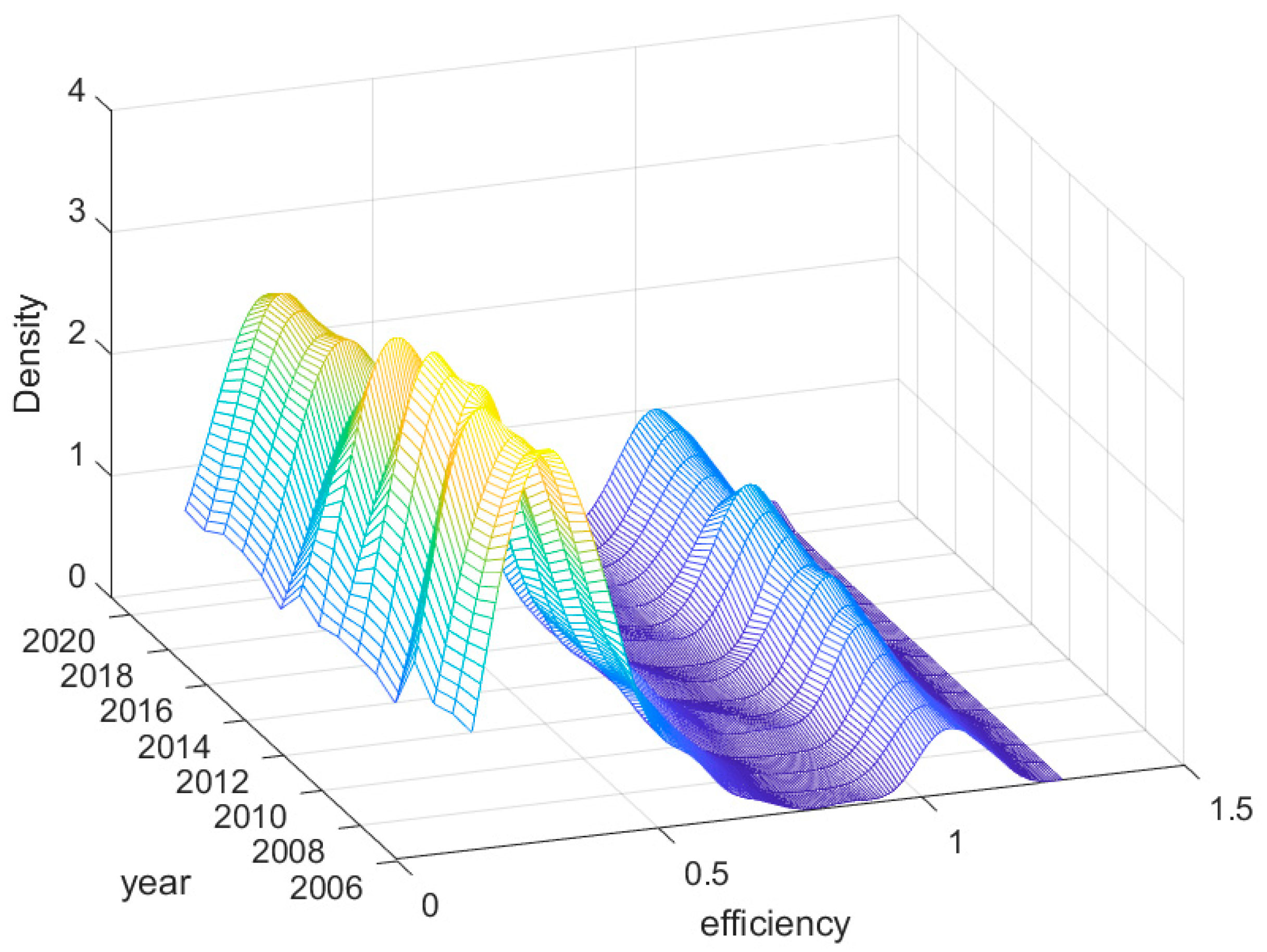
Figure 2 demonstrates the temporal evolution of the kernel density distribution of urban green land use efficiency across more than 200 Chinese cities during 2006–2021. Overall, the main peak of the distribution gradually shifts to the right over time, signaling a consistent nationwide enhancement in urban land use performance. In the initial years, the distribution reveals a distinct low-value concentration (around 0.2) and a pronounced right-skewed pattern, suggesting that most cities exhibited relatively low efficiency, while only a few achieved high levels—indicative of substantial regional disparities in green development. As the period advances, the distribution becomes more concentrated, and the peak progressively moves toward the medium-to-high efficiency range (above 0.5), reflecting a growing share of high-efficiency cities and a reduction in inter-city disparities. Meanwhile, the decline in density at the low-efficiency end (below 0.2) implies a shrinking number of lagging cities and an overall trend toward optimization and upgrading of green land use. This figure offers clear visual support for evaluating the policy effects of environmental court establishment, suggesting that such institutional interventions may have contributed at least partially to the observed improvement in urban ecological land use efficiency.
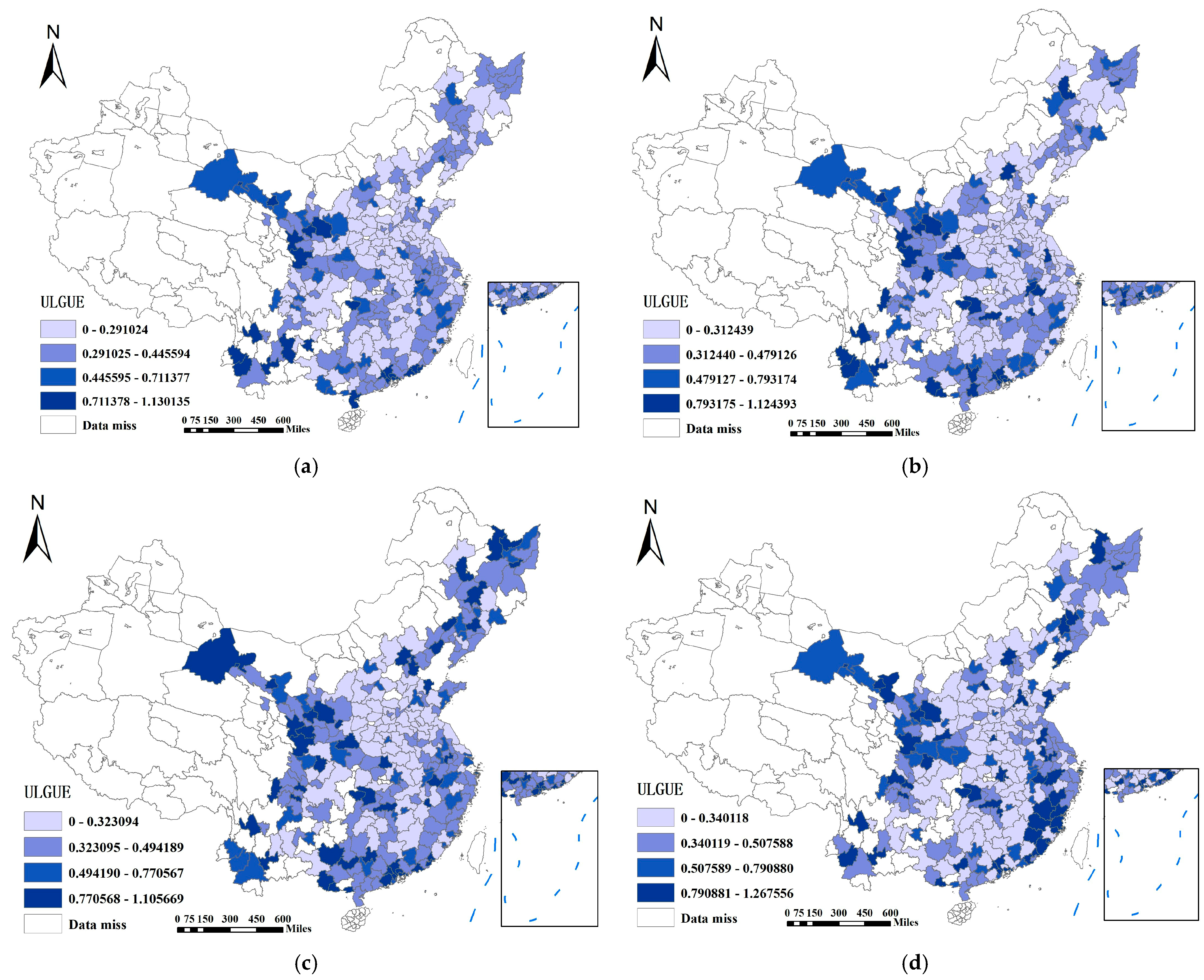
Figure 3 depicts the spatial evolution of urban land green use efficiency (ULGUE) across Chinese cities from 2006 to 2021, revealing a sustained upward trajectory in efficiency and a gradual optimization of regional spatial patterns. The expansion of dark-blue areas, accompanied by a reduction in lighter zones, indicates that an increasing number of cities achieved notable progress in green land use performance. Furthermore, the upper limit of the ULGUE index rose from 1.1301 in 2006 to 1.2766 in 2021, reflecting a general shift toward higher efficiency values. Spatially, coastal urban agglomerations consistently display superior efficiency outcomes, which may be attributed to robust institutional frameworks and strong governance capacity supporting land intensification and ecological transformation. In contrast, cities in central and western China exhibit a clear convergence pattern, demonstrating substantial progress from low to higher efficiency levels in recent years and underscoring the positive influence of regional coordination and policy-driven development.
4.3.2. Core Explanatory Variable
This study incorporates environmental court establishment into the model as a dummy variable (Did), constructed as an interaction term between the policy treatment variable and the policy implementation time variable. China’s environmental court reform began in 2007, when the Intermediate People’s Court of Guiyang City established the country’s first environmental court with substantive jurisdiction over environmental and resource cases; therefore, 2007 is regarded as the starting point of this institutional reform. Specifically, when a city is designated to establish an environmental court in a given year, the interaction term takes the value of 1; otherwise, it is 0. For each treated city, the policy implementation year is defined as the first year in which an environmental court, environmental tribunal, or specialized environmental and resources adjudication body began to exercise substantive jurisdiction over environmental and resource cases in that city. In cases involving pilot implementation, formal inauguration, institutional upgrading, renaming, or expansion of cross-regional centralized jurisdiction, the coding follows the principle of first substantive judicial exposure. That is, the treatment year is the earliest year in which the city’s environmental and resource cases were formally accepted by a specialized environmental adjudication body, rather than the year of later upgrading or renaming.
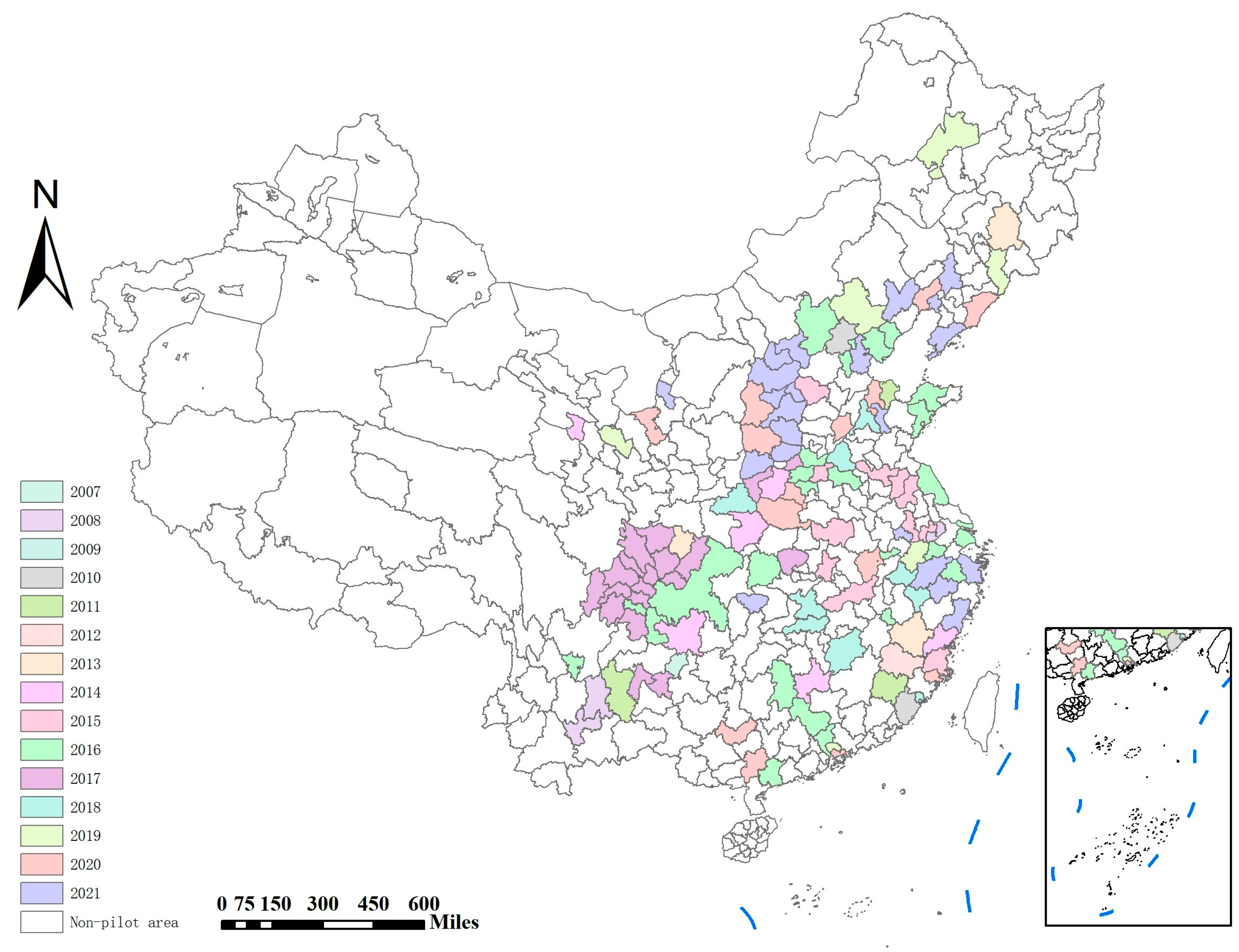
Figure 4 illustrates the distribution of cities that established environmental courts and their corresponding years of establishment. Map source: Standard map service system of the Ministry of Natural Resources of China (Approval No. GS(2019)1822).
4.3.3. Control Variables
Drawing on the existing literature, this study includes a set of control variables: population density (lndensity, measured as the logarithm of permanent residents per unit area), level of economic development (lnpgdp, logarithm of per capita GDP), openness (Op, ratio of actual foreign investment utilized to GDP), government intervention (Gov, ratio of local fiscal expenditure to GDP), urbanization level (Urban, proportion of urban population to total population), industrial structure (Industry, share of tertiary industry added value in GDP), human capital (Human, number of students enrolled in higher education institutions per 10,000 people), and environmental regulation intensity (Env, measured as the proportion of the number of words in sentences containing environmental protection-related terms to the total number of words in the entire government work report). The statistical characteristics of these variables are reported in
Table 2.
To reduce potential heteroscedasticity and mitigate the influence of extreme values, several variables—including population density and per capita GDP—are transformed using natural logarithms. This transformation helps improve the normality of variable distributions and enhances the stability and interpretability of the regression estimates.
4.4. Baseline Regression Results
Table 3 reports the baseline regression results for the impact of environmental courts on urban land green use efficiency. Column (1) presents the benchmark estimation without fixed effects or additional control variables, and the coefficient on Did is positive and statistically significant. Column (2) further introduces city fixed effects and year fixed effects to control for unobserved city-specific characteristics and common time shocks; the estimated coefficient remains significantly positive. Column (3) adds core control variables, and Column (4) further includes the full set of control variables. Across all specifications, the coefficient on Did remains positive and statistically significant, indicating that the establishment of environmental courts exerts a robust promoting effect on urban land green use efficiency.
To ensure the validity of the core conclusions presented above, this study conducts a parallel trend test to examine the pre-intervention trajectories of the treatment and control groups. The model is specified as follows:
In Equation (2),
represents a series of dummy variables capturing the relative year t before or after the establishment of an Environmental Court in city i; Specifically,
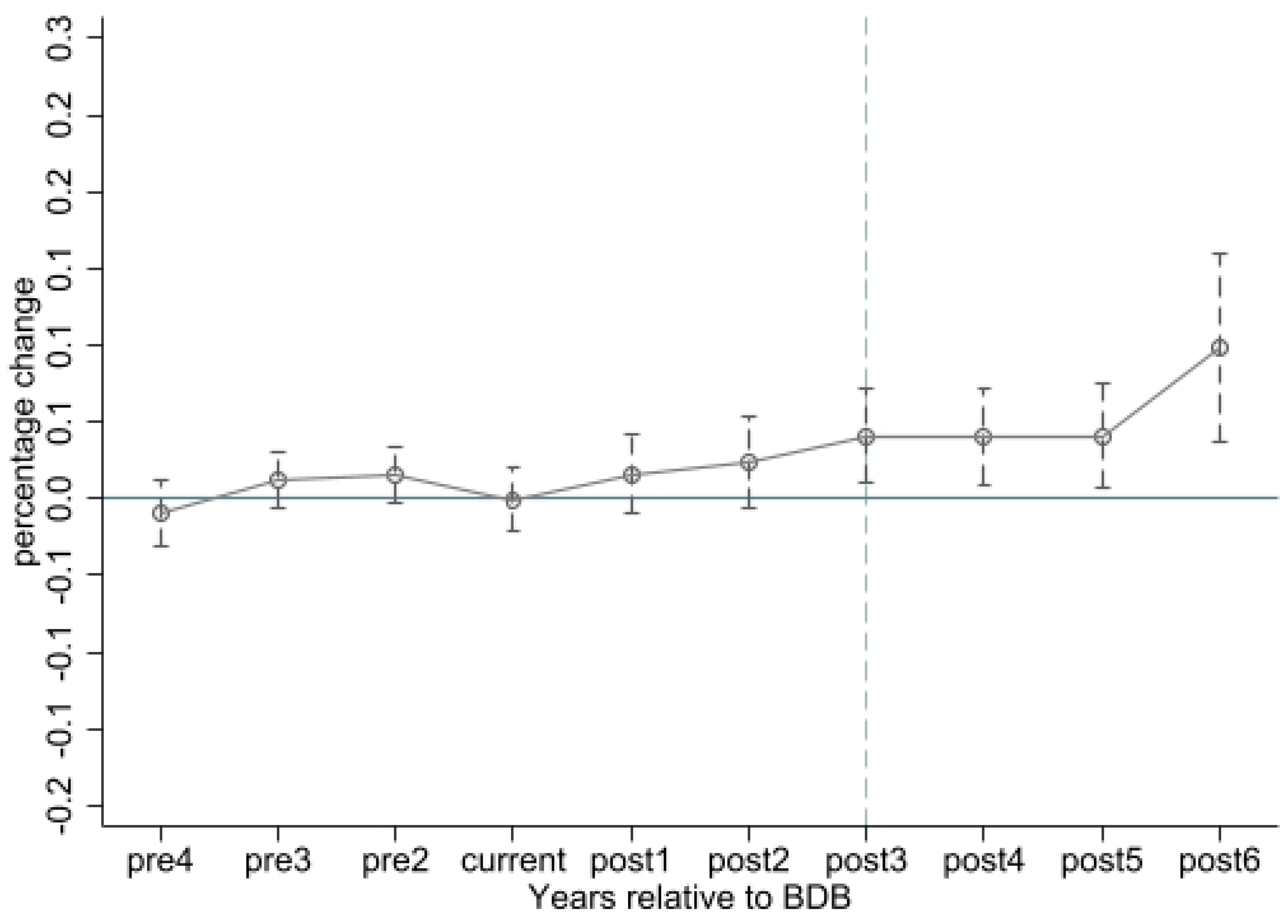
if the observation occurs t years prior to the court’s establishment, and all other values are set to zero. We omit the dummy for year t = −1, which serves as the reference period. The results of the parallel trend test are shown in
Figure 5. The horizontal axis represents the years since the establishment of environmental courts, and the vertical axis represents the estimated coefficients of the relative-time dummy variables.
As shown in
Figure 5, the estimated coefficients of
prior to the establishment of environmental courts are statistically insignificant. In contrast, when t = 3, 4, 5, and 6, the coefficients of
become significantly positive, suggesting that the establishment of environmental courts begins to exert a significant positive effect on urban land green use efficiency starting from the third year after implementation.
4.5. Robustness Checks
4.5.1. Placebo Test
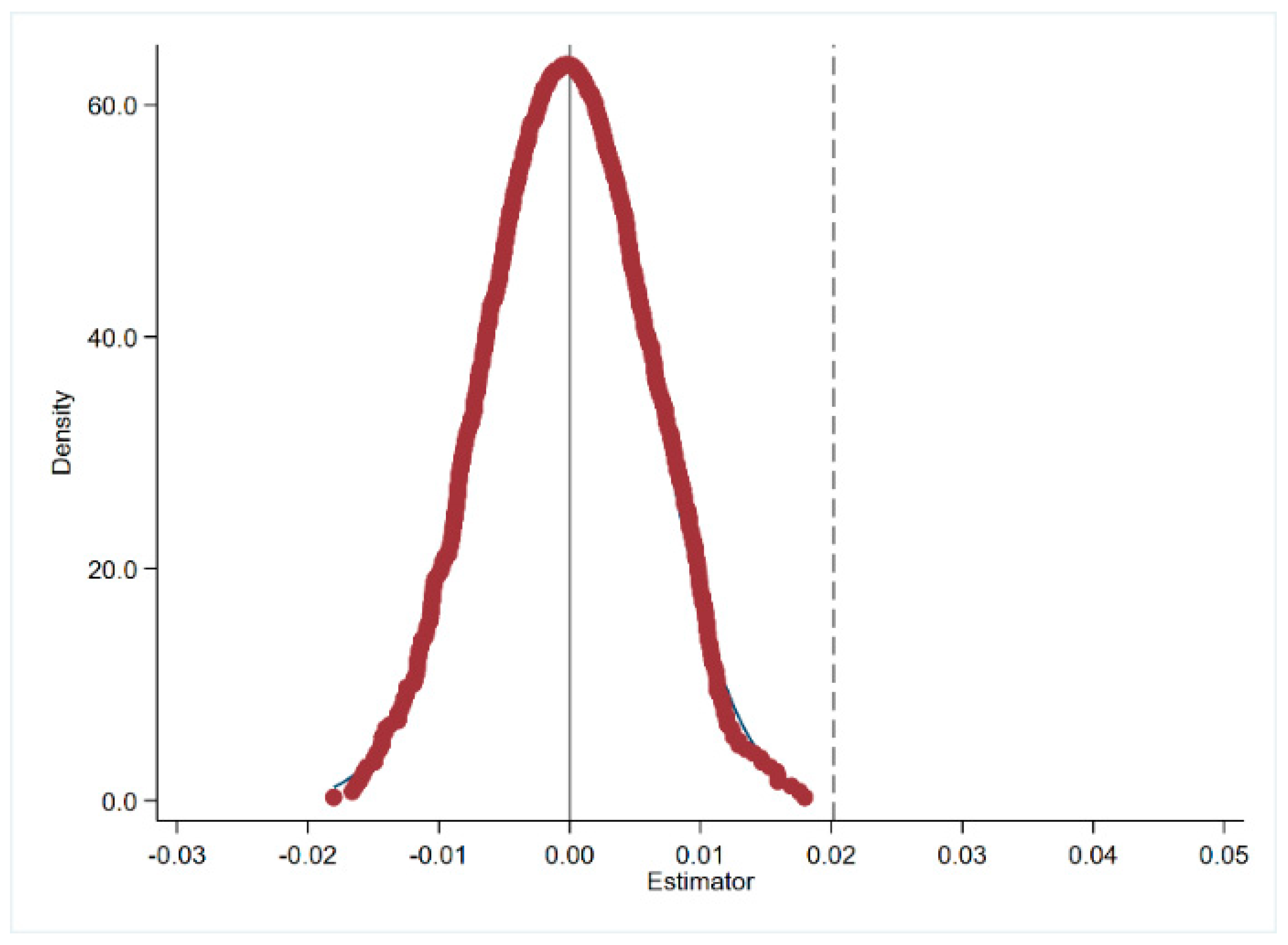
Although the baseline regression controls for a relatively comprehensive set of city-level covariates and incorporates city and year fixed effects to mitigate potential omitted-variable bias, the influence of unobservable factors cannot be completely ruled out. To address this concern, the study conducts a placebo test using a Monte Carlo simulation based on 500 random experiments. In each simulation, cities are randomly assigned to treatment and control groups, and the “policy implementation” time is randomly allocated to the treatment group. A pseudo policy interaction term is then constructed, and the difference-in-differences model is re-estimated to obtain the distribution of placebo policy coefficients.
Figure 6 illustrates the distributional characteristics of the coefficients obtained from 500 simulations. The results reveal that the placebo coefficients are approximately symmetrically distributed around zero, with the vast majority falling below 0.02, indicating no evidence of systematic bias. The red curve shows the kernel density distribution of placebo estimates; the solid line denotes zero; the dashed line denotes the actual estimated coefficient. The actual coefficient clearly deviates from the placebo distribution, suggesting that the results are not driven by random factors.
4.5.2. Lagged Dependent Variable
To address potential endogeneity concerns between environmental courts and urban green land use efficiency, this study introduces the lagged dependent variable as an additional robustness test. Specifically, a one-period lag of urban land green use efficiency
is included in the regression model. By controlling for the persistence of urban land use efficiency across periods, this specification helps mitigate potential reverse causality and dynamic adjustment effects. The estimation results, reported in
Table 4, column (1), show that the coefficient of the environmental court variable remains positive and statistically significant, indicating that the main empirical findings remain stable and robust.
4.5.3. Higher-Level Fixed Effects
The efficiency of urban green land use may be shaped not only by city-specific attributes but also by broader provincial-level influences, including policy frameworks, resource endowments, and development trajectories. To mitigate the potential impact of unobserved heterogeneity at higher administrative levels, the baseline regression is further refined through the inclusion of province fixed effects. This specification helps control for systematic inter-provincial differences—such as variations in institutional settings, economic capacity, and development paths—that might otherwise distort the estimated effect of environmental court establishment. The findings, as presented in
Table 4 (column 2), show that the coefficient for the environmental court variable remains positive.
4.5.4. Excluding Major Municipalities
Municipalities administered directly by the central government usually possess distinct advantages in resource distribution, policy assistance, and institutional frameworks. Incorporating these cities into a unified empirical model could potentially bias the estimation of policy effects. Hence, this research removes the four centrally governed municipalities from the sample and performs a re-estimation of the model. The outcomes, as displayed in
Table 4 (column 3), consistently validate the baseline conclusions.
4.5.5. Excluding the COVID-19 Period
Considering the substantial disruptions caused by the COVID-19 pandemic to urban economic operations, this research performs an additional robustness test by omitting observations from 2020 to 2021. The estimation results indicate that the coefficient associated with the environmental court variable continues to be positive and statistically significant, thereby reaffirming the stability and reliability of the baseline estimations.
4.5.6. Other Robustness Tests
Beyond the robustness analyses discussed earlier, this study performs additional verification by excluding atypical cities and controlling for potential policy overlaps—such as the Low-Carbon Pilot Policy, the Carbon Emissions Trading Scheme, and the Smart City Initiative. The estimation outcomes presented in
Table 4 (columns 5–7) demonstrate that the coefficients of the explanatory variables remain significantly positive, thereby reaffirming the central findings of this research. In addition to the robustness checks discussed above, this study further applies the Callaway and Sant’Anna staggered DID estimator to address the phased implementation of environmental court reform. As reported in column (8) of
Table 4, the CSDID estimate remains significantly positive, further supporting the robustness of the main conclusion.
5. Results and Discussion
5.1. Mechanism Analysis
5.1.1. Environmental Regulation Effect
As an important institutional innovation within the environmental governance system, environmental courts introduce specialized judicial adjudication mechanisms that effectively complement the traditional regulatory model dominated by administrative enforcement. Compared with conventional approaches that primarily rely on administrative penalties, environmental courts impose legally binding constraints on environmental violations through judicial decisions. This institutional distinction should be understood within a broader international context. In developed economies such as the United States and the European Union, environmental governance largely depends on administrative agencies, while judicial bodies typically play a supplementary and relatively passive role through mechanisms such as judicial review and public interest litigation. Although countries such as Australia and India have also established specialized environmental courts or tribunals, their institutional scope, allocation of authority, and degree of integration into the overall governance framework differ significantly from those in China.
By contrast, China has developed a more systematic and institutionalized system of environmental courts, which is deeply embedded in the environmental governance framework and plays a more proactive role in environmental enforcement. Through specialized adjudication and enhanced judicial intervention, environmental courts have significantly improved the authority, professionalism, and independence of environmental governance. This transition toward a rule-based model of environmental governance not only strengthens the rigidity of environmental regulation but also enhances the efficiency and equity of policy implementation. At the same time, by improving the standardization, credibility, and enforceability of environmental law enforcement, environmental courts strengthen firms’ incentives to comply with environmental regulations. Consequently, they provide a solid legal foundation for improving urban green land use efficiency.
Building upon the previous analysis, this study introduces multiple proxy variables to capture environmental regulatory and enforcement intensity—namely, the completion rate of pollution control investments, industrial sulfur dioxide emissions, the number of environmental protection staff, and the logarithm of environmental enforcement cases—for further empirical testing [
38]. The regression outcomes, reported in
Table 5 (columns 1–4), reveal that environmental courts effectively enhance urban green land use efficiency by strengthening both the implementation of environmental regulation and the intensity of legal enforcement. This finding highlights the institutional role of the rule of law in facilitating urban ecological transformation and promoting sustainable development. Thus, Hypothesis 1 is supported.
5.1.2. Green Innovation Effect
As specialized adjudicative institutions within the environmental judicial system, environmental courts significantly enhance the legal and credibility enforceability of environmental governance and strengthen external regulatory pressure on firms’ environmental behavior. Under conditions of greater judicial independence and institutional enforceability, environmental courts impose more certain and deterrent penalties for environmental violations, thereby increasing firms’ perception of legal risk and their expectations of regulatory compliance. To avoid litigation costs, financial penalties, and reputational damage resulting from environmental non-compliance, firms are more inclined to adopt green technologies and clean production processes to improve their environmental performance. These behavioral adjustments substantially stimulate green technology investment and R&D at the firm level, thereby enhancing the overall capacity for environmental innovation in cities. This constitutes one of the key transmission mechanisms through which environmental courts improve urban land green use efficiency.
This study employs the number of green utility model patents, green invention patents, and total authorized green patents as proxy measures for green technological innovation [
39]. The empirical estimations indicate that the coefficients of the environmental court variable remain positive and statistically significant, implying that the establishment of environmental courts has a notable and significant positive effect on urban green innovation activities. These findings support the theoretical mechanism that environmental judicial institutions foster urban land green use efficiency through the stimulation of innovation-related inputs and outputs. Moreover, the results emphasize the institutional importance of environmental adjudication in propelling green transformation and advancing ecological civilization. Thus, Hypothesis 2 is confirmed.
5.1.3. Energy Structure Effect
The establishment of environmental courts strengthens the legal constraints on environmental violations and increases the environmental compliance costs faced by enterprises. At the same time, it provides a clear and predictable institutional framework, which enhances firms’ confidence and policy certainty regarding green investment and energy structure adjustment. Under this incentive mechanism, enterprises gradually reduce their reliance on high-carbon, high-pollution energy sources and increase investment in clean and renewable energy, thereby accelerating the green transformation of the energy system. In parallel, the professional adjudication of environmental disputes, ecological damage compensation, and public interest litigation by environmental courts sends a strong institutional signal of enhanced green governance. This reinforces the expectations of both governments and enterprises regarding the continuity of green development policies. Such institutional support helps improve energy use efficiency at the urban level and optimize energy consumption structures, thereby providing a cleaner and more stable energy foundation for the green and efficient use of urban land.
To evaluate whether environmental courts contribute to urban green land use efficiency through energy structure optimization, this research uses the proportion of coal consumption in total energy use as a key indicator of a city’s energy profile. Furthermore, total factor productivity is employed to represent resource allocation efficiency and energy utilization effectiveness [
40]. The regression outcomes, summarized in
Table 5 (columns 8–9), show that the coefficients of the environmental court variable remain positive and statistically significant across all model specifications. This evidence implies that the establishment of environmental courts significantly improves the urban energy structure by reducing dependence on high-carbon energy sources and enhancing overall resource efficiency. These findings provide strong empirical support for the proposed mechanism, indicating that environmental judicial institutions promote urban land green use efficiency by facilitating cleaner and more efficient energy use, thereby underscoring their critical institutional role in advancing urban sustainability. Thus, Hypothesis 3 is confirmed.
5.2. Heterogeneity Analysis
The baseline results confirm that the establishment of environmental courts significantly improves urban green land use efficiency. However, the impact of environmental judicial reform may vary across cities because urban land use systems differ substantially in terms of institutional capacity, industrial structure, environmental pressure, and land development patterns. To further explore the deeper economic and regional land use implications of specialized environmental courts, this section conducts heterogeneity analysis from three perspectives: legal environment, old industrial base status, and carbon emission intensity.
5.2.1. Heterogeneity by Legal Environment
Environmental courts serve an important institutional function in promoting environmentally friendly corporate behavior by strengthening the deterrent effect of regulation, increasing the credibility of green policies, and reducing firms’ uncertainty in meeting compliance obligations. This institutional framework facilitates increased investment in green technology R&D and cleaner production, optimizes the allocation of production factors, and channels capital and land resources toward low-pollution, high-efficiency green industries—ultimately advancing urban land green use efficiency. However, the effectiveness of this policy largely depends on the institutional environment at the city level. Variations in rule-of-law foundations, intellectual property rights protection, and institutional quality may limit both the transmission mechanism and the strength of policy effects. Therefore, heterogeneity in the legal and institutional environment should be recognized as a critical moderating factor in shaping the effectiveness of environmental court policy.
To verify this hypothesis, the ratio of market transaction volume to GDP is employed as a proxy variable representing the quality of a city’s legal environment. This indicator reflects the degree of marketization and the effectiveness of institutional enforcement in economic activities. Regions with more active market transactions generally rely more heavily on contract enforcement and property rights protection, which are key components of a well-functioning legal environment. According to the sample median, cities are divided into two categories—those with strong and weak rule-of-law contexts. A heterogeneity analysis is then performed using subgroup regressions. The estimation results, summarized in
Table 6 (columns 1–2), indicate that in cities with more robust legal institutions, the coefficient of the environmental court variable remains positive and statistically significant at the 1% level. This evidence suggests that a stronger institutional framework enhances the policy transmission efficiency of environmental courts. It underscores not only the critical importance of institutional quality in shaping policy outcomes but also the need to strengthen the rule of law to improve urban land green use efficiency.
5.2.2. Heterogeneity in Old Industrial Bases
To further investigate regional disparities in the impact of environmental court establishment on urban green land use efficiency, this study incorporates the heterogeneity of old industrial bases and performs subgroup regression analysis. Given their long-standing dependence on heavy industries, these regions typically feature resource- and energy-intensive industrial structures, inefficient land utilization, and serious environmental pressures. Consequently, they tend to exhibit lower levels of urban land green use efficiency. Within the framework of high-quality green urban development, old industrial bases encounter the dual challenges of industrial transformation and ecological restoration, often accompanied by high institutional reform costs and complex governance demands. Therefore, such regions are more responsive to the establishment of environmental courts, leveraging environmental judicial mechanisms to promote industrial upgrading and green transformation, thereby amplifying the overall policy effect.
The regression results validate this hypothesis. Within the sample of old industrial base cities, the estimated coefficient of the environmental court variable remains positive and statistically significant. This indicates that, in such regions, environmental courts have been instrumental in reinforcing environmental regulation, effectively raising the costs of corporate noncompliance and reducing opportunities for environmental infractions. These mechanisms have accelerated the phase-out of high-pollution and energy-intensive industries, while facilitating the reallocation of land resources toward low-carbon and green sectors. Consequently, these transformations have enhanced urban land green use efficiency.
5.2.3. Heterogeneity by Carbon Emissions Intensity
Given that cities with different levels of carbon emission intensity may vary significantly in terms of the marginal benefits of pollution control, the urgency of institutional regulation, and the pressure on enterprises to undergo green transformation, the effectiveness of environmental court policies may be conditioned by these differences. Therefore, this study introduces carbon emission intensity as a criterion for heterogeneity analysis. Theoretically, cities with higher carbon emissions intensity often face more severe environmental challenges, are dominated by traditional energy-intensive industries, and derive greater marginal benefits from pollution reduction. These cities are typically more reliant on institutional regulation and stronger pressures on firms to adopt green development strategies. In such contexts, enterprises tend to be more sensitive to environmental governance policies. The establishment of environmental courts in these regions not only enhances the deterrent effect against environmental violations but also reinforces the policy signal of green development, thereby exerting a stronger influence on firms’ production decisions and urban land use patterns.
To examine this mechanism, this study uses carbon emissions per unit of GDP as a proxy indicator for urban carbon intensity. Based on the sample median, cities are categorized into high- and low-carbon groups, and corresponding subgroup regressions are conducted. The estimation outcomes, reported in
Table 6 (columns 5–6), demonstrate that for high-carbon-intensity cities, the coefficient of the environmental court variable remains positive and statistically significant at the 1% significance level. This finding indicates that in regions with larger carbon footprints, environmental courts exert a stronger influence in curbing pollution-intensive land expansion through stricter judicial enforcement and incentive mechanisms. Furthermore, these courts promote the reallocation of land resources toward cleaner and low-carbon industries, thereby enhancing urban land green use efficiency.
6. Conclusions and Policy Implications
Against the backdrop of accelerating urbanization and increasingly binding resource and environmental constraints, improving urban green land use efficiency has become a key issue for achieving high-quality development and ecological civilization. Using panel data from 266 Chinese prefecture-level cities from 2006 to 2021, this study treats the establishment of environmental courts as a quasi-natural experiment and applies a multi-period difference-in-differences model to examine the impact of environmental judicial system reform on urban green land use efficiency. The results show that environmental court establishment significantly improves urban green land use efficiency, and this conclusion remains robust after a series of tests, including parallel trend tests, placebo tests, and alternative specifications. Mechanism analysis further indicates that environmental courts enhance urban green land use efficiency mainly by strengthening environmental regulation, promoting green innovation, and optimizing energy consumption structures. Heterogeneity analysis shows that it is more pronounced in cities with stronger legal environments, higher carbon emission intensity, and old industrial base characteristics.
Based on the above findings, policy design should further translate the institutional role of environmental judicial institutions into actionable governance arrangements. First, the specialization and institutional capacity of environmental courts should be continuously strengthened to enhance the judicial support system for urban land use. This requires improving specialized adjudication mechanisms for environmental and resource cases, strengthening the professional training of judges, and improving the use of technical investigators and expert consultation systems in complex cases. At the same time, environmental courts should strengthen supervision over ecological restoration, environmental damage compensation, and land-related pollution disputes, thereby converting judicial authority into effective institutional constraints on extensive land development and high-pollution land use.
Second, the alignment between judicial reform and regional contexts should be strengthened to promote differentiated governance in key areas. Because the effects of environmental judicial system reform vary across cities with different legal foundations, industrial structures, and environmental pressures, a uniform reform model may not fully exploit the institutional effectiveness of environmental courts. For cities with weak legal foundations, priority should be given to improving judicial capacity, public legal awareness, and enforcement mechanisms. For old industrial base cities and high-carbon-intensity cities, environmental courts should focus on pollution-intensive industries, inefficient industrial land, and energy-intensive activities, thereby supporting industrial upgrading, land redevelopment, and low-carbon transformation.
Third, coordination between environmental judicial institutions and other governance subsystems should be promoted to strengthen overall governance effectiveness. While advancing environmental judicial reform, it is necessary to establish more effective coordination mechanisms among courts, ecological and environmental departments, natural resource departments, procuratorates, and local governments. Such coordination can promote information sharing, joint enforcement, ecological restoration supervision, and the integration of judicial decisions with land planning and environmental regulation. In addition, environmental courts should further leverage their signaling and deterrence effects to guide enterprises toward green technological innovation, cleaner production, and energy structure optimization, thereby forming a coordinated governance framework that integrates judicial constraints, administrative regulation, market incentives, and social participation.