1. Introduction
The rapid expansion of sustainable finance has transformed ESG investing from a niche preference into a structurally relevant segment of global capital markets. As this segment has grown, however, ESG assets have become increasingly exposed to uncertainty generated by evolving regulation, new disclosure requirements, geopolitical tensions and shifting investor expectations about how sustainability-related risks should be interpreted and priced. In this paper, sustainability-related uncertainty and ESG market volatility are treated as conceptually distinct constructs. Sustainability-related uncertainty refers to ambiguity in the ESG and sustainability-related information environment, including uncertainty about regulation, disclosure credibility, transition risks and contested sustainability narratives. By contrast, ESG market volatility refers to fluctuations in ESG equity benchmark prices and reflects the market-pricing response to information, risk reassessment and portfolio rebalancing. The distinction is important because ESG market volatility may reflect sustainability-related uncertainty, but it is not equivalent to it.
Recent studies show that ESG markets are deeply embedded in broader networks of volatility transmission, connectedness and informational spillovers, particularly during turbulent periods and crisis episodes [
1,
2,
3]. Yet an important gap remains. Much of the recent literature examines ESG market dynamics through adjacent but distinct constructs, such as ESG performance, ESG rating disagreement, or broad uncertainty indicators, rather than through a dedicated measure of sustainability-related uncertainty itself [
4,
5,
6]. In addition, a substantial part of the evidence is regional, event-specific, or based on full-sample estimates that may conceal instability in the underlying predictive structure [
2,
3,
7]. The recent introduction of the ESG-Based Sustainability Uncertainty Index (ESGUI) provides a new opportunity to address this issue more directly, because it captures uncertainty explicitly linked to ESG and sustainability-related narratives rather than relying on indirect proxies [
8]. Against this background, the aim of this paper is to examine whether changes in sustainability-related uncertainty contain predictive information for ESG equity market volatility, whether ESG market volatility feeds back into sustainability-related uncertainty and whether this nexus remains stable over time or instead evolves across regimes within a broader adaptive system shaped by changing information, market-pricing and institutional conditions [
9].
This paper contributes to the literature in three main ways. First, it shifts the focus from indirect or neighboring proxies toward a dedicated measure of sustainability-related uncertainty. While recent studies have linked ESG performance, ESG disagreement and ESG-related indicators to stock volatility and return dynamics [
4,
5,
6], far less is known about whether a direct sustainability uncertainty measure contains predictive information for volatility in ESG market benchmarks themselves. Second, it contributes at the level of scope by moving from predominantly regional or event-conditioned settings to a global perspective, which is more closely aligned with the architecture of sustainable finance and with the construction of ESGUI. Third, it contributes methodologically by combining model-based volatility estimation with bootstrap Granger causality tests, parameter-stability diagnostics and rolling-window inference in order to assess whether directional predictability is stable or only emerges in specific episodes. The empirical interpretation is deliberately framed in terms of predictive content and Granger-causal predictability, not structural causality. Details on the sample period, benchmark selection, and variable construction are presented in
Section 5.
The remainder of the paper is organized as follows.
Section 2 reviews the literature, while
Section 3 develops the conceptual framework and research hypotheses.
Section 4 presents the empirical methodology and
Section 5 describes the data and variables.
Section 6 reports the empirical results,
Section 7 discusses their broader implications, and
Section 8 concludes the paper.
3. Conceptual Framework and Hypothesis Development
3.1. Theoretical Anchoring: Sustainability Uncertainty, Information Processing, and Market Repricing
This study approaches the relationship between sustainability-related uncertainty and ESG market volatility through a systems-informed financial framework. More specifically, sustainable finance is treated as a setting in which information, market pricing, and institutional change interact over time. The conceptual framework is therefore grounded in three complementary theoretical perspectives: information-based asset pricing, uncertainty and ambiguity in financial decision-making and adaptive systems theory.
From an information-based asset-pricing perspective, financial markets respond not only to realized fundamentals, but also to changes in the information environment [
32]. When investors face new or ambiguous information, prices and volatility may adjust as market participants revise expectations about future cash flows, discount rates, risk premia and portfolio allocation [
33]. ESG markets are especially exposed to this mechanism because sustainability-related information is complex, multidimensional and institutionally evolving [
34,
35]. Disclosure rules, taxonomy debates, climate-policy signals, ESG rating disagreement and greenwashing concerns may all affect how investors interpret the credibility and financial relevance of ESG information [
6,
36].
A second theoretical anchor comes from uncertainty and ambiguity-based interpretations of financial behavior. Unlike measurable risk, uncertainty reflects situations in which investors cannot easily assign stable probabilities to future states [
37,
38]. Sustainability-related uncertainty has this feature because it is linked to regulatory change, transition-risk interpretation, disclosure credibility, and contested ESG narratives [
10]. Under such conditions, investors may require additional compensation for ambiguity, rebalance portfolios, delay decisions, or react more strongly to negative signals [
39]. These mechanisms can translate sustainability-related uncertainty into ESG market volatility, particularly during periods of institutional change or market stress. This is consistent with evidence that ESG-related information can influence volatility forecasting, spillovers and connectedness across ESG and related asset classes, especially during turbulent periods [
40].
A third theoretical layer is provided by adaptive systems theory. Sustainable finance is not a static market segment, but a socio-technical system in which investors, firms, regulators, data providers, and standard setters continuously interact [
41]. In such systems, information and market responses co-evolve [
42]. Sustainability-related uncertainty may affect ESG market volatility through repricing, but market volatility may also feed back into sustainability-related uncertainty by increasing attention to ESG risks, disclosure credibility, classification problems, and policy uncertainty. Consequently, the uncertainty–volatility relationship should not be expected to remain constant over time. It may strengthen, weaken, disappear, or reverse depending on crisis intensity, regulatory developments, and market-learning processes [
41].
This theoretical anchoring implies that the sustainability uncertainty–ESG volatility nexus should be examined as a directional, potentially bidirectional, and time-varying predictive relationship rather than as a simple static association. The role of the conceptual framework is therefore not to claim structural causality, but to organize the mechanisms through which sustainability-related uncertainty and ESG market volatility may contain predictive information for each other.
3.2. Construct Delimitation: Sustainability-Related Uncertainty Versus ESG Market Volatility
A clear distinction between the two core constructs is essential. Sustainability-related uncertainty and ESG market volatility are related, but they are not the same phenomenon. Treating them as interchangeable would make the research question circular.
In this study, sustainability-related uncertainty refers to uncertainty embedded in ESG and sustainability-related narratives. It is proxied by the ESG-Based Sustainability Uncertainty Index, which captures the intensity of uncertainty surrounding sustainability, ESG, regulation, transition risk, and related narratives [
8]. Conceptually, ESGUI belongs to the information and interpretation layer of the system. It reflects ambiguity in the sustainability-related information environment: what investors, policymakers, and market participants know, do not know, or struggle to interpret about sustainability-related developments.
By contrast, ESG market volatility refers to fluctuations in ESG equity market prices. It is measured through conditional volatility extracted from ESG benchmark returns [
43]. Conceptually, ESG volatility belongs to the market-pricing layer of the system. It reflects the extent to which ESG asset prices fluctuate as investors process information, update beliefs, rebalance portfolios, and reassess risk [
44]. ESG market volatility is therefore an outcome of market repricing, not a direct measure of sustainability uncertainty itself.
The distinction can be summarized as follows. Sustainability-related uncertainty is an upstream informational and narrative construct, while ESG market volatility is a downstream market-based pricing construct [
24]. The former captures ambiguity in sustainability-related information; the latter captures instability in ESG equity market prices. The empirical question is therefore whether changes in the information layer contain predictive content for the market-pricing layer and whether turbulence in the market-pricing layer feeds back into subsequent sustainability-related uncertainty.
This distinction also clarifies the interpretation of the empirical results. Evidence that ESGUI predicts ESG volatility would be consistent with an information-to-pricing channel [
45]. Evidence that ESG volatility predicts ESGUI would be consistent with a feedback channel from market turbulence to uncertainty narratives [
10]. In neither case do the tests identify structural causality. Rather, they assess whether one construct contains incremental predictive information for the other within a Granger causality framework.
3.3. Hypothesis Development
The first mechanism is the information-to-pricing channel. Sustainability-related uncertainty may affect ESG market volatility because investors must interpret ambiguous sustainability information and incorporate it into asset prices. Regulatory ambiguity, disclosure complexity, rating divergence, and contested sustainability narratives may increase disagreement among investors, raise ambiguity aversion and trigger portfolio rebalancing. When sustainability-related uncertainty rises, ESG assets may become more difficult to price, particularly if investors are uncertain about the credibility, comparability or financial materiality of ESG information.
This mechanism is consistent with the literature on ESG volatility forecasting, spillovers and connectedness, which shows that ESG-related information can influence financial volatility and transmit across market segments, especially during stress periods [
2,
10,
46,
47]. Under this view, sustainability-related uncertainty acts as an informational disturbance that may be incorporated into ESG market risk through repricing, risk-premium adjustment and changes in investor attention. This leads to the first hypothesis:
H1. Changes in sustainability-related uncertainty have predictive content for ESG market volatility.
The second mechanism is the feedback channel from ESG market volatility to sustainability-related uncertainty. The relationship is not assumed to be purely one-way. Episodes of elevated ESG market volatility may themselves intensify sustainability-related uncertainty by changing the salience of ESG risks and triggering renewed interpretation of sustainability narratives [
10]. Market turbulence can lead investors, analysts, and policymakers to reassess whether existing ESG classifications, disclosure standards, and sustainability commitments are credible and sufficient [
48]. In this sense, ESG market volatility may not only reflect uncertainty but may also contribute to the subsequent formation of uncertainty narratives.
This feedback mechanism is especially plausible in sustainable finance because ESG markets are closely linked to regulatory expectations, reputational concerns, and evolving disclosure regimes. When ESG market volatility rises sharply, market participants may revisit the interpretation of transition risk, greenwashing risk, policy credibility, and disclosure quality [
49]. This can generate additional sustainability-related uncertainty after the volatility shock itself. This leads to the second hypothesis:
H2. ESG market volatility has predictive content for changes in sustainability-related uncertainty.
The third mechanism concerns dynamic instability. If sustainable finance operates as an adaptive socio-technical system, the predictive relationship between sustainability-related uncertainty and ESG market volatility should not be expected to remain constant over the full sample [
42]. The strength and direction of the relationship may depend on market regimes, crisis episodes, regulatory developments and the degree of investor attention to ESG information. During periods of calm, sustainability-related uncertainty may have little measurable effect on ESG volatility. During periods of crisis, policy transition, or market repricing, the same uncertainty signal may become much more relevant.
This logic is consistent with recent evidence showing that ESG connectedness, volatility spillovers, and market adjustment processes vary across periods of stress and relative calm [
1,
2,
7]. It implies that full-sample estimates may conceal important temporal heterogeneity. A relationship that is insignificant on average may become significant during specific subperiods, while a full-sample significant result may be driven by a limited number of episodes rather than by a stable predictive structure. Therefore, the empirical design must allow for parameter instability and rolling-window variation. This leads to the third hypothesis:
H3. The predictive relationship between sustainability-related uncertainty and ESG market volatility is unstable over time and depends on market regimes.
Beyond the three core hypotheses, the paper also examines whether the time-varying uncertainty–volatility nexus displays benchmark-specific features when the global ESG benchmark is replaced by an emerging-market ESG benchmark. This step is treated as a heterogeneity and robustness extension rather than as a separate formal hypothesis.
3.4. Empirical Implications of the Framework
The conceptual framework has four direct empirical implications. First, if the information-to-pricing channel is present, lagged changes in sustainability-related uncertainty should contain predictive information for subsequent ESG market volatility. This implication is tested through the direction in the baseline Granger causality framework.
Second, if the feedback channel is present, lagged ESG market volatility should contain predictive information for subsequent changes in sustainability-related uncertainty. This implication is tested through the reverse direction, . Together, H1 and H2 imply that the relationship may be bidirectional, although not necessarily symmetric in magnitude, persistence, or timing.
Third, if the nexus is regime-dependent, full-sample results should be treated as average evidence rather than as a complete description of the relationship. Parameter-stability tests are therefore required before interpreting the full-sample results. If parameter stability is rejected, rolling-window bootstrap Granger causality tests are necessary to identify when and in which direction predictive linkages emerge.
Fourth, if the nexus depends on market structure, the results may differ across ESG benchmarks. The MSCI ACWI ESG Leaders Index is used as the baseline global ESG benchmark because it is conceptually aligned with the Global GDP-weighted ESGUI. The MSCI Emerging Markets ESG Leaders Index is used as a benchmark-heterogeneity extension because emerging ESG markets may display stronger information frictions, higher volatility and different institutional dynamics [
3,
7].
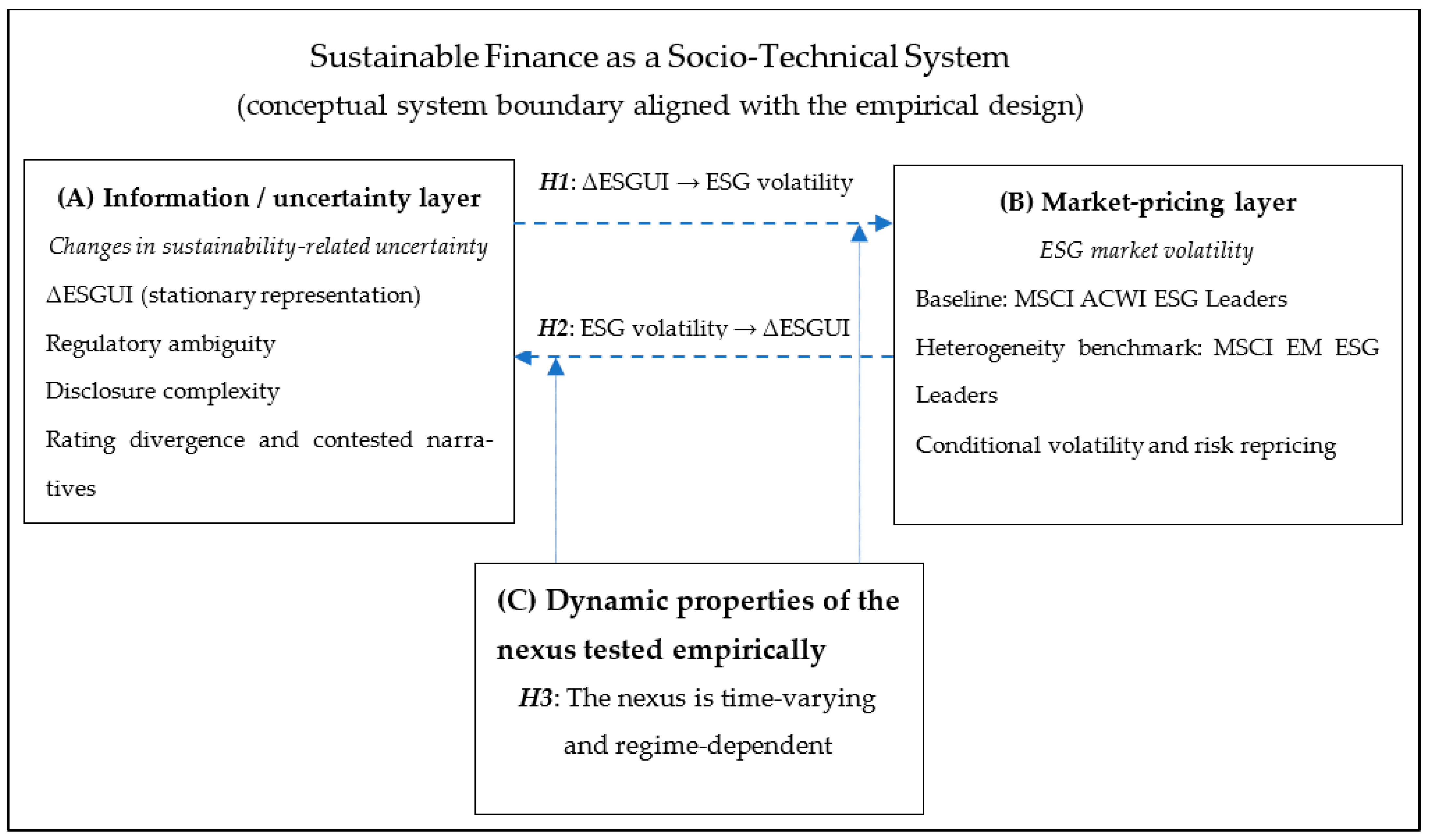
Figure 1 presents the sustainability uncertainty–ESG volatility nexus as a bidirectional and dynamic relationship between changes in sustainability-related uncertainty and ESG market volatility. The information layer reflects the generation of sustainability-related uncertainty through regulatory ambiguity, disclosure complexity, rating divergence and contested sustainability narratives. The market-pricing layer reflects the incorporation of sustainability-related information into ESG volatility through conditional volatility dynamics, portfolio rebalancing and risk repricing. H1 and H2 capture the two directional predictive channels examined in the VAR framework, while H3 emphasizes that the nexus is time-varying and regime-dependent.
4. Methodology
4.1. Empirical Strategy
The empirical strategy is organized in three layers. The first layer establishes the baseline uncertainty–volatility nexus. ESG market volatility is first constructed from daily MSCI ACWI ESG Leaders returns using a GJR-GARCH(1,1) specification with Student-t innovations. The resulting monthly volatility proxy is then used together with the first difference in the Global GDP-weighted ESGUI in full-sample bootstrap Granger causality tests, parameter-stability diagnostics, and rolling-window bootstrap analysis. This layer provides the main evidence on whether sustainability-related uncertainty and ESG market volatility contain predictive information for each other, and whether this predictive relationship is stable or regime-dependent.
The second layer evaluates the robustness of the baseline findings. The analysis first replaces the GJR-GARCH-based volatility proxy with an EGARCH-based volatility proxy in order to assess whether the results depend on the functional form used to extract conditional volatility. It then repeats the rolling-window analysis using alternative 18- and 36-month windows to examine whether the timing and persistence of predictive episodes are sensitive to the chosen window length. In addition, the baseline VAR framework is augmented with macro-financial controls capturing global market stress, changes in long-term interest-rate conditions and changes in monetary policy stance. These robustness checks are designed to assess whether the baseline Granger-causal predictability patterns remain visible after accounting for alternative volatility construction, window-length choice, and potential omitted common drivers.
The third layer provides additional evidence on benchmark heterogeneity, dynamic adjustment, and predictive usefulness. Benchmark robustness is examined by replacing the global MSCI ACWI ESG Leaders volatility proxy with the MSCI Emerging Markets ESG Leaders volatility proxy. Generalized impulse-response functions and forecast-error variance decomposition are then used to examine whether the dynamic responses of the two variables are consistent with the information-pricing and feedback channels proposed in the conceptual framework. Finally, a recursive out-of-sample forecasting exercise evaluates whether the documented in-sample predictive linkages translate into practical forecasting usefulness relative to parsimonious autoregressive benchmarks. Throughout the analysis, rejection of a Granger causality null hypothesis is interpreted as evidence of Granger-causal predictability or predictive content, not as evidence of structural causality.
4.2. Construction of ESG Market Volatility
4.2.1. Baseline GJR-GARCH Volatility Specification
Market volatility is not observed directly and is therefore proxied through conditional variance dynamics estimated from daily returns. Following the volatility literature, this paper models daily ESG benchmark returns using asymmetric GJR-GARCH(1,1) specifications with Student-
t innovations in order to capture volatility clustering, heavy tails and potential asymmetry in the response of conditional variance to positive and negative return shocks [
50]. For each ESG benchmark, daily log returns are computed from the corresponding daily price index. Let
denote the daily return. The conditional mean equation is written as in Equation (1).
where
follows a standardized Student-
t distribution. The conditional variance equation is specified as in Equation (2).
where
is the one-step-ahead conditional variance and
is an indicator function that captures the asymmetric impact of negative shocks on volatility. A positive and statistically significant
coefficient indicates an asymmetric or leverage-type response, meaning that negative return shocks increase conditional volatility more strongly than positive shocks of comparable magnitude.
The GJR-GARCH(1,1) specification is retained as the baseline volatility model because it provides a parsimonious and directly interpretable framework for modeling asymmetric volatility dynamics in ESG equity benchmarks. The estimated daily conditional variance series obtained from this model are subsequently used to construct the baseline monthly ESG market volatility proxies employed in the main VAR-based predictability analysis.
The estimated daily conditional variances are then aggregated to the monthly frequency. Let
denote the estimated daily conditional variance on day
within month
. The monthly volatility proxy is constructed as in Equation (3).
where
is the number of trading days in month
. The resulting monthly measure is an aggregated conditional variance series; for expositional simplicity, it is referred to throughout the paper as monthly ESG market volatility. This procedure preserves the information contained in daily volatility dynamics while producing a monthly series that is consistent with the frequency of ESGUI. The resulting baseline and robustness variables are denoted
and
, respectively, where
is constructed from the MSCI ACWI ESG Leaders Index and
is constructed from the MSCI Emerging Markets ESG Leaders Index.
4.2.2. EGARCH-Based Volatility Proxy for Robustness
To assess whether the empirical results are sensitive to the specific asymmetric volatility model used to construct the monthly ESG market volatility proxy, the baseline GJR-GARCH(1,1) specification is complemented by an alternative EGARCH(1,1) model with Student-t innovations. This additional specification is used as a robustness check rather than as a replacement for the baseline volatility model. The purpose is to verify whether the subsequent VAR-based predictability results depend on the functional form imposed on the conditional variance process.
The EGARCH model is particularly useful in this context because it captures asymmetric volatility responses through the logarithm of conditional variance. Unlike standard GARCH-type models, the EGARCH specification allows positive and negative shocks to have different effects on volatility without requiring the same non-negativity restrictions on the variance parameters [
50]. This makes it a suitable alternative to the GJR-GARCH model when testing whether the estimated uncertainty–volatility nexus is robust to alternative asymmetric volatility dynamics.
The EGARCH(1,1) conditional variance equation is specified as in Equation (4):
where
denotes the conditional variance,
captures the magnitude effect of standardized shocks,
captures the asymmetric effect of positive and negative shocks, and
measures volatility persistence. Under this specification, a negative and statistically significant
coefficient indicates that negative shocks generate stronger volatility responses than positive shocks of comparable magnitude.
The EGARCH(1,1) model is estimated using the same daily MSCI ACWI ESG Leaders return series and Student-t innovation distribution as the baseline specification. The estimated daily EGARCH conditional variances are then aggregated to the monthly frequency using the same procedure as in the baseline case. The resulting monthly volatility series, denoted , is used as an alternative ESG volatility proxy in the robustness analysis.
4.3. Bootstrap Full-Sample Granger-Causal Predictability Framework
Following Hacker and Hatemi-J [
51], the bootstrap VAR framework is used to assess directional predictability between the stationary representation of ESGUI and the stationary ESG volatility measure. Since Granger-causal predictability results may be sensitive to the sample period and to instability in the underlying data-generating process, the full-sample evidence should be interpreted as a benchmark characterization of average directional predictability over the whole period rather than as proof of a permanent and invariant predictive structure.
Within the VAR framework, the variables entering the causality test must be represented in stationary form in order to avoid spurious inference. Accordingly, the causality analysis is implemented using the first difference in the uncertainty index, , together with the stationary monthly ESG volatility measure, denoted generically by . In the baseline specification, refers to the monthly volatility of the MSCI ACWI ESG Leaders Index (), while in the robustness specification, it refers to the monthly volatility of the MSCI Emerging Markets ESG Leaders Index ().
To address the finite-sample limitations of conventional asymptotic Granger-causal predictability tests, this paper applies a residual-based bootstrap (RB) procedure in conjunction with the modified Likelihood Ratio (LR) statistic. Bootstrap-based causality testing is particularly useful when the variables may exhibit non-standard distributional behavior or when asymptotic critical values are less reliable in small samples, as emphasized by Hacker and Hatemi-J [
51].
The RB-based modified-LR causality test is implemented using the following bivariate VAR(
) process as in Equation (5).
where
denotes the first difference in the Global GDP-Weighted ESG-Based Sustainability Uncertainty Index and denotes the monthly ESG volatility measure. The disturbance term is a zero-mean white-noise process with a non-singular covariance matrix. The optimal lag length is selected using the Schwarz Information Criterion (SIC), which indicates = 1 in the baseline specification.
To investigate the directional relationship between sustainability-related uncertainty and ESG market volatility, Equation (6) can be written as follows:
where
and
is the lag operator, such that
.
The null hypothesis that sustainability-related uncertainty does not Granger-cause ESG market volatility is tested by imposing the restriction:
If this null hypothesis is rejected, past values of contain predictive information for subsequent movements in .
Analogously, the null hypothesis that ESG market volatility does not Granger-cause sustainability-related uncertainty is tested by imposing the restriction:
If this second null hypothesis is rejected, past values of contain predictive information for changes in . In both cases, rejection of the null indicates Granger-causal predictability in the relevant direction.
4.4. Parameter-Stability and Rolling-Window Analyses
An important limitation of full-sample Granger-causal predictability tests is that they implicitly assume parameter constancy over the entire estimation period. When the underlying VAR parameters shift over time because of structural changes, crisis episodes, or gradual market reconfigurations, full-sample causality results may mask episodic or regime-dependent relationships rather than reveal a stable average effect. The econometric literature has repeatedly emphasized that parameter non-constancy is one of the main challenges in time-series analysis and that stability tests should therefore precede the interpretation of full-sample causal results [
52].
To examine whether the predictive relationship between sustainability-related uncertainty and ESG market volatility is stable over time, this paper applies a set of parameter-constancy tests to the estimated VAR system. Following Andrews [
53] and Andrews and Ploberger [
54], short-run parameter stability is examined using the Sup-F, Mean-F and Exp-F tests. The Sup-F test is designed to detect discrete structural shifts in the VAR coefficients, while the Mean-F and Exp-F tests are more sensitive to gradual and recurrent parameter changes. In addition, the
test developed by Nyblom [
55] and Hansen [
56] is employed to assess the overall stability of the parameters in the bivariate VAR system. As emphasized in related bootstrap rolling-window causality studies, rejection of parameter stability indicates that the assumption of a single, time-invariant predictive structure is inappropriate and that full-sample Granger-causal predictability results should be interpreted with caution [
57].
Because these tests exhibit non-standard asymptotic distributions, bootstrap-based p-values are used when evaluating statistical significance. If the null hypothesis of parameter constancy is rejected, the analysis proceeds to a sub-sample rolling-window causality framework. In this case, the role of the full-sample test is not discarded, but reinterpreted as a benchmark summary over potentially heterogeneous regimes rather than as a complete characterization of the uncertainty–volatility nexus.
As discussed above, structural changes in the underlying VAR system may render full-sample Granger-causal predictability results incomplete or potentially misleading. To address this issue, the analysis is extended using a sub-sample rolling-window bootstrap causality approach. This procedure is designed to capture time variation in the predictive relationship between sustainability-related uncertainty and ESG equity market volatility and is consistent with the view that Granger-causal predictability may be temporary rather than permanent [
58].
Following the bootstrap rolling-window framework widely used in the literature, the method employs fixed-size sub-samples that move sequentially from the beginning to the end of the full sample [
58,
59]. Let the total sample size be
and let
denote the fixed rolling-window width. The full sample is then divided into a sequence of overlapping sub-samples of size
, such that each sub-sample covers the interval
, where
. For each sub-sample, the residual-based bootstrap modified-LR causality test described in
Section 4.3 is re-estimated. This generates a sequence of bootstrap
p-values for the observed LR statistics and allows the predictive relationship between ESGUI and ESG volatility to be examined over time rather than only over the full sample.
In addition to the rolling bootstrap
p-values, the procedure also permits an assessment of how the sign and relative magnitude of the predictive relationship evolve across sub-samples. Statistical uncertainty is evaluated using bootstrap confidence bands constructed from the empirical distribution of the estimated coefficients within each window. In line with the rolling-window bootstrap literature, the lower and upper bounds are obtained from the 5th and 95th percentiles, respectively, of the corresponding bootstrap distributions [
60]. This makes it possible to assess whether the estimated effect within a given sub-sample is statistically distinguishable from zero and whether it is positive or negative.
A key practical issue in rolling-window estimation is the choice of window size. A larger window improves estimation precision, but may average over multiple regimes and weaken local representativeness. A smaller window is more sensitive to local structural changes, but may generate less stable estimates. Following the trade-off emphasized in the literature, this paper adopts a 24-month rolling window, which is commonly used in monthly bootstrap rolling-window causality studies and provides a reasonable balance between representativeness and estimation accuracy [
57,
58]. The rolling-window results are interpreted as local evidence on time-varying directional predictability and therefore remain conditional on the selected window length and on the sequential nature of the estimations. Because the rolling procedure generates a sequence of overlapping sub-sample tests, isolated significant windows are interpreted with caution, while greater weight is assigned to contiguous runs of significance that are also consistent with the corresponding coefficient dynamics.
4.5. Robustness Checks and Extended Analyses
The baseline empirical framework is complemented by several robustness checks and extended analyses. The first robustness check concerns volatility construction. In addition to the baseline GJR-GARCH-based volatility proxy, an alternative EGARCH-based monthly volatility measure is constructed from the daily MSCI ACWI ESG Leaders return series. The full-sample and rolling-window predictability tests are then repeated using this alternative proxy in order to assess whether the results depend on the functional form used to model asymmetric volatility.
The second robustness check concerns the rolling-window design. Because the choice of window length may influence the timing and persistence of detected predictive episodes, the baseline 24-month rolling-window analysis is complemented by alternative 18-and 36-month windows. This allows the study to examine whether the time-varying predictability patterns are robust to shorter and longer estimation windows.
The third robustness check extends the baseline bivariate VAR by adding macro-financial control variables. These augmented VAR specifications are used to examine whether the relationship between sustainability-related uncertainty and ESG market volatility remains present after accounting for broader financial conditions, global risk sentiment and monetary policy influences. The macro-financial controls are introduced one at a time rather than jointly in a fully augmented VAR. This choice is motivated by the limited monthly sample size and by the need to preserve degrees of freedom in the bootstrap causality framework.
The fourth robustness check concerns ESG benchmark selection. While the baseline analysis uses the MSCI ACWI ESG Leaders Index, the analysis is repeated using the MSCI Emerging Markets ESG Leaders Index as an alternative benchmark. This extension makes it possible to assess whether the baseline uncertainty–volatility nexus is specific to the global ESG benchmark or also appears in emerging ESG markets.
Finally, the study includes two extended analyses. Generalized impulse-response functions are used to examine the dynamic response of each variable to shocks in the other variable, while an out-of-sample forecasting exercise evaluates whether the empirical framework has predictive usefulness beyond the in-sample Granger-causal predictability tests. Forecasting performance is assessed using standard forecast accuracy indicators and compared with benchmark alternatives.
5. Data and Variables
5.1. Sample Period and Data Sources
This study uses monthly data covering the period from September 2014 to June 2025. The sample is determined by the common availability of the ESG-Based Sustainability Uncertainty Index (ESGUI), the ESG equity market benchmarks, and the macro-financial control variables employed in the analysis. The selected period is also substantively appropriate because it captures the phase in which sustainable finance became more deeply embedded in global portfolio allocation, disclosure regulation, and transition-risk pricing.
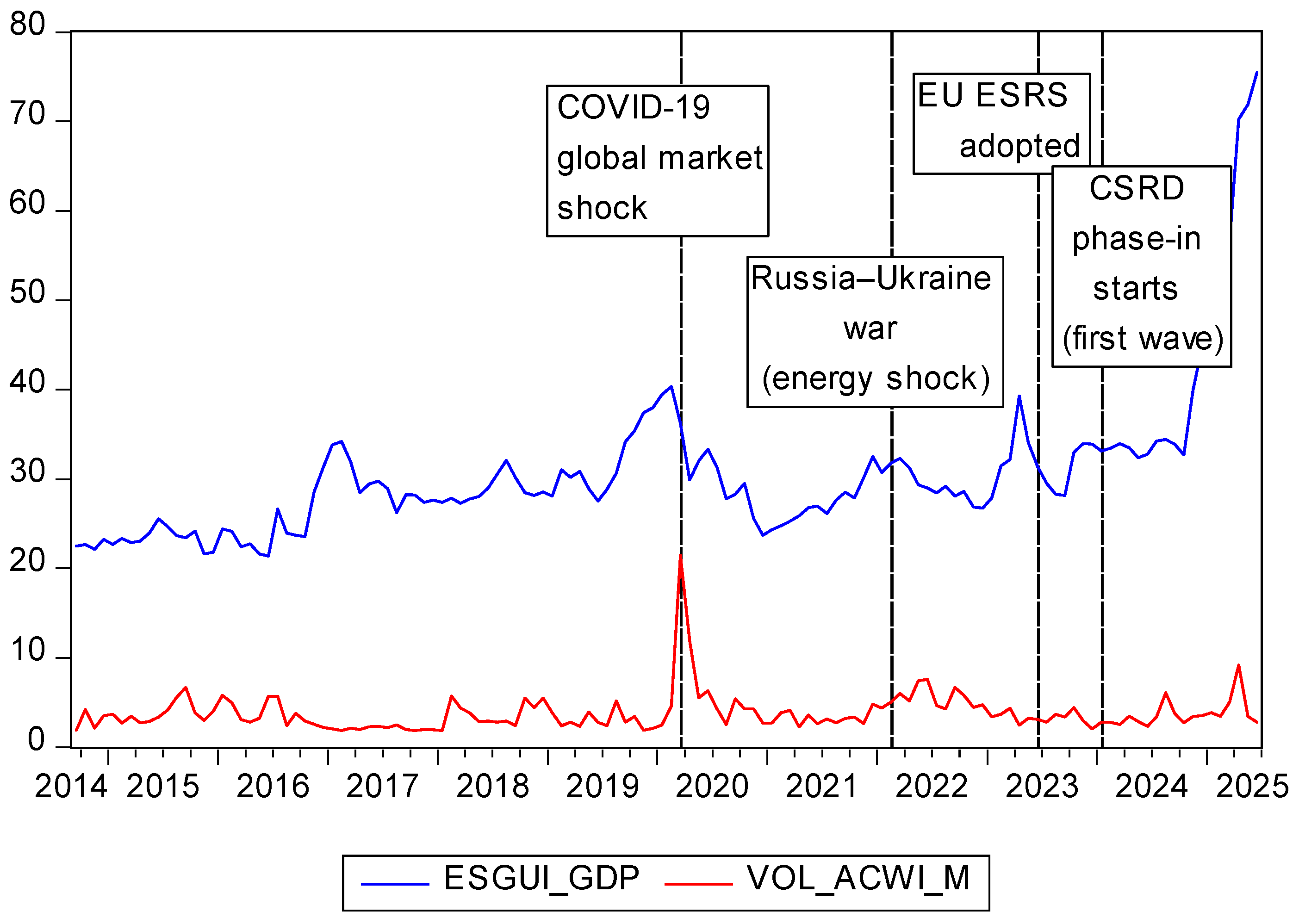
The sample includes several major events that plausibly affected both sustainability-related uncertainty and ESG market volatility, including the COVID-19 global market shock, the Russia–Ukraine war and the associated energy shock, the adoption of the European Sustainability Reporting Standards (ESRS), and the initial phase-in of the Corporate Sustainability Reporting Directive (CSRD). As illustrated in
Figure 2, these events coincide with visible shifts in the behavior of the uncertainty and volatility series, which makes the chosen sample suitable for investigating time-varying Granger-causal predictability. First, sustainability-related uncertainty remains persistently elevated and displays several upward shifts, suggesting that it constitutes a recurrent component of the recent sustainable-finance environment rather than an isolated disturbance. Second, ESG market volatility behaves in a more episodic manner, with sharper spikes during crises and repricing episodes. While
Figure 2 does not establish causality, it provides useful descriptive evidence that the interaction between sustainability-related uncertainty and ESG market volatility is unlikely to be constant over the full sample, thereby supporting the paper’s later focus on parameter instability and rolling-window Granger-causal predictability. It should also be noted that
Figure 2 is purely descriptive and reports ESGUI in levels together with the baseline ESG volatility proxy. By contrast, the VAR-based analysis is implemented using the first difference in ESGUI,
, in line with the stationarity results reported in
Section 6.1.
The sustainability-related uncertainty variable is made available through PolicyUncertainty.com. ESG equity market data are obtained from the MSCI daily index series through LSEG Data and Analytics. Daily ESG benchmark prices are used to estimate conditional variances, which are subsequently aggregated to the monthly frequency in order to match the frequency of ESGUI. Macro-financial controls are obtained from CBOE and the Federal Reserve Bank of St. Louis FRED database.
5.2. ESGUI: Construction, Interpretation and Limitations
The main uncertainty variable is the ESG-Based Sustainability Uncertainty Index (ESGUI), introduced by Ongan et al. [
8] and obtained from the updated ESGUI database hosted by PolicyUncertainty.com. Although the original article introduces the index for the period available at the time of publication, the database is regularly updated; the version used in this study uses monthly observations covering the sample period 2014M09–2025M06. The use of EIU country reports provides a standardized textual source across countries, although the index remains limited to the 25-country sample covered in the original construction.
For each country
and month
, environmental, social and governance keyword frequencies are extracted from the corresponding EIU report and normalized by report length:
where
,
and
denote the frequencies of environmental, social and governance keywords, and
is the total number of words in the report. The E, S and G keyword lists are constructed separately, and the counts are divided by total report words to obtain monthly country-level raw indices.
Each component is then rescaled using min–max normalization:
The ESG sub-index is computed as
The uncertainty sub-index is constructed analogously from uncertainty-related terms:
where
denotes the frequency of uncertainty-related terms such as “uncertain”, “uncertainty” and “uncertainties”. The country-level ESGUI is then obtained as
Thus, ESGUI combines the ESG sub-index and the uncertainty sub-index with equal weights. In this construction, the index captures the joint salience of ESG-related narratives and uncertainty-related language within the same country-level information environment.
The global ESGUI is available in both equal-weighted and GDP-weighted forms. The equal-weighted version is
while the GDP-weighted version is
This study uses , because the baseline ESG benchmark is global and includes both developed and emerging markets. The GDP-weighted series gives larger economies greater influence and is therefore more consistent with the structure of global ESG capital markets than the equal-weighted alternative. However, GDP weighting should not be interpreted as a perfect proxy for ESG market capitalization weights, sectoral exposure, or investor-base composition. That limitation is relevant when comparing a macro-weighted uncertainty index with equity-market benchmarks.
In the empirical analysis, the level series is transformed into first differences:
This transformation follows the stationarity evidence reported in
Section 6.1.
ESGUI is therefore interpreted as a narrative-based proxy for sustainability-related information uncertainty. It does not measure ESG performance, ESG scores, corporate sustainability quality, or realized ESG fundamentals. Its main limitations are those typical of text-based indices: dependence on predefined keyword dictionaries, sensitivity to reporting intensity, possible reporting lags, coverage limited to the country sample available in the original index, aggregation across E, S and G dimensions, and potential mismatch between GDP weights and ESG market capitalization weights. These limitations require cautious interpretation, but they do not invalidate its use as a transparent proxy for sustainability-related uncertainty.
5.3. ESG Market Benchmarks and Volatility Proxies
The baseline market variable is derived from the MSCI ACWI ESG Leaders Index, which serves as the primary ESG equity benchmark. This index is selected because it includes both developed and emerging markets and therefore provides the closest market counterpart to a global sustainability uncertainty measure. For heterogeneity and robustness purposes, the analysis additionally uses the MSCI Emerging Markets ESG Leaders Index. This alternative benchmark isolates ESG equity dynamics in emerging markets, where institutional frictions, information asymmetry and structural volatility may be more pronounced. Recent studies suggest that ESG market dynamics vary across regional and emerging-market settings, which makes this extension empirically relevant [
3,
7].
Because market volatility is not directly observed, the monthly ESG volatility proxies are constructed from daily benchmark returns. As presented in
Section 4.2, the baseline monthly volatility series is obtained by first estimating daily conditional variances from GJR-GARCH(1,1) models with Student-t innovations and then aggregating those estimated variances to the monthly frequency. The resulting baseline volatility proxy is denoted
, while the emerging-market benchmark volatility proxy is denoted
.
In addition to the baseline GJR-GARCH-based volatility proxy, an alternative EGARCH-based volatility series is constructed for the MSCI ACWI ESG Leaders Index. This variable, denoted , is used only in the robustness analysis in order to assess whether the main results depend on the functional form used to extract conditional volatility. The EGARCH-based proxy is therefore not treated as a competing baseline variable, but as an alternative volatility construction.
5.4. Macro-Financial Control Variables
The augmented VAR robustness checks additionally include macro-financial controls capturing broader market and monetary conditions. The inclusion of these controls is motivated by the possibility that the relationship between sustainability-related uncertainty and ESG market volatility may be partly driven by common macro-financial forces rather than by ESG-specific dynamics alone. Without such controls, the baseline bivariate VAR may overstate directional predictability by attributing to ESG uncertainty or ESG volatility patterns that are actually linked to broader market stress, interest-rate repricing, or monetary policy conditions.
The first control variable is the monthly average VIX,
, which captures global market stress and risk-aversion conditions. The VIX is widely used as an option-implied measure of expected equity-market volatility and is often interpreted as a market-based indicator of investor fear or risk aversion [
61]. For this reason,
is included to control for broad market-stress conditions that may simultaneously affect ESG volatility and sustainability-related uncertainty.
The second control variable is the first difference in the monthly average U.S. 10-year Treasury yield,
, which captures changes in long-term interest-rate and discount-rate conditions. Long-term yields are relevant because equity prices and volatility are sensitive to changes in discount rates, expected returns and valuation conditions [
62]. In asset-pricing terms, changes in discount-rate expectations are a central channel through which macro-financial conditions affect equity-market dynamics. Accordingly,
is included to account for shifts in the long-term rate environment that may influence ESG equity volatility independently of sustainability-related uncertainty.
The third control variable is the first difference in the monthly average effective federal funds rate,
, which captures changes in the monetary policy stance. Monetary policy shocks affect equity prices through discount rates, expected cash flows, and risk premia [
63]. Therefore,
is included to control for changes in short-term monetary policy conditions that may affect both financial market volatility and sustainability-related uncertainty.
The transformations of the macro-financial controls follow the stationarity diagnostics reported in
Appendix A. The VIX is stationary in levels and is therefore included as
. By contrast, the U.S. 10-year Treasury yield and the effective federal funds rate are non-stationary in levels but stationary after first differencing; they therefore enter the augmented VAR specifications as
and
.
Table 1 summarizes the variables used in the analysis.
6. Empirical Results
6.1. Stationarity and Descriptive Evidence
Before implementing the bootstrap Granger-causal predictability tests, the integration properties of the variables included in the bivariate VAR system must be established.
Table 2 reports the results of the Augmented Dickey–Fuller (ADF), Phillips–Perron (PP) and KPSS tests for the monthly series. The ADF and PP tests are conducted under the null hypothesis of a unit root, while the KPSS test is based on the null of stationarity. Using these complementary procedures makes it possible to assess the stochastic properties of the variables more reliably than relying on a single test alone.
The results in Panel A show that the level of the Global GDP-Weighted ESG-Based Sustainability Uncertainty Index is non-stationary. Specifically, both the ADF and PP tests fail to reject the null hypothesis of a unit root , indicating that the level series should not be treated as stationary. By contrast, the two volatility measures, and , are clearly stationary in levels. For both series, the ADF and PP statistics are strongly negative and highly significant , while the KPSS statistics remain low, supporting their classification as processes.
Panel B reports the results for the first difference in the uncertainty index. In this case, both the ADF and PP tests strongly reject the null hypothesis of a unit root for and the KPSS statistic is consistent with stationarity. This indicates that the uncertainty index becomes stationary after first differencing and can therefore be classified as an variable.
In conclusion, the evidence implies that the variables do not share the same order of integration. Accordingly, the causality analysis is implemented using the first difference in the uncertainty index, , together with the volatility measures in levels, and . This specification ensures that the bootstrap VAR causality tests are conducted on stationary series and avoids spurious dynamic inference.
Table 3 reports the descriptive statistics for the monthly series used in the empirical analysis. The average monthly change in sustainability-related uncertainty is positive (0.411), with a median of 0.294, indicating that increases in ESG-related uncertainty slightly dominate decreases over the sample. At the same time, the series is relatively volatile, with a standard deviation of 2.470 and spans a wide range from −6.301 to 13.632. The two volatility measures are also persistently positive, with mean values of 3.854 for
and 4.670 for
. Thus, the emerging-market ESG benchmark exhibits a higher average volatility level, whereas the global ACWI benchmark shows greater dispersion, with a standard deviation of 2.204 compared with 1.433 for the emerging-market series.
All three variables display strong departures from symmetry and normality. Skewness is positive in every case, indicating longer right tails, and is particularly pronounced for the volatility measures, especially (4.574). Kurtosis is also well above the Gaussian benchmark of three for all variables, reaching 34.316 for , 19.629 for and 9.403 for . These values indicate substantial tail thickness and the presence of extreme observations in the sample.
The Jarque–Bera statistics confirm this pattern. For all three series, the null hypothesis of normality is decisively rejected . This evidence is consistent with the use of Student- innovations in the volatility extraction stage and with the subsequent reliance on bootstrap-based causality inference, both of which are better suited to handling non-Gaussian features in financial and uncertainty data.
Descriptive statistics for the macro-financial control variables used in the augmented VAR robustness checks are reported in
Appendix A (
Table A1), while the EGARCH-based volatility proxy is discussed in the robustness section because it is used only as an alternative volatility construction.
Before implementing the bootstrap Granger-causal predictability tests, the lag order of the bivariate VAR model must be determined. Based on the Schwarz Information Criterion (SIC), the optimal lag length for the baseline specification including
and
is
. The lag-order selection output also shows that the remaining information criteria, including LR, FPE, AIC, SC and HQ, point to the same choice, which further supports the use of a parsimonious first-order VAR specification. Lag-order selection results reported in
Appendix A,
Table A2, support the use of a VAR(1) specification in both the baseline and EGARCH robustness analyses. This is also consistent with the standard implementation of bootstrap causality procedures in related rolling-window applications, where SIC is commonly used to select a compact lag structure before full-sample and sub-sample testing.
6.2. Baseline Volatility Diagnostics
Before estimating the VAR-based predictability models, the adequacy of the baseline volatility construction is assessed using the GJR-GARCH(1,1) estimates and residual diagnostics obtained from daily ESG benchmark returns.
Table 4 presents the GJR-GARCH(1,1) estimates and residual diagnostics for the daily returns of the two ESG benchmarks under Student-t innovations. In both specifications, the threshold coefficient
is positive and significant at the 1% level, which indicates asymmetric volatility responses to negative shocks. The ARCH coefficient
is small and not statistically significant, whereas the GARCH coefficient
is large and significant at the 1% level in both cases. The persistence measure, calculated as
, is 0.975 for MSCI ACWI ESG Leaders and 0.950 for MSCI EM ESG Leaders, suggesting a high degree of volatility persistence.
The ARCH-LM(10) test applied to standardized residuals yields insignificant -values for both indices, implying that the estimated models adequately capture conditional heteroskedasticity. These results support the use of the fitted conditional variances for constructing the monthly volatility proxies employed in the subsequent predictability analysis.
Given the significant asymmetric term and the absence of residual ARCH effects in both series, the GJR-GARCH(1,1) specification is retained as a parsimonious model for extracting the daily conditional variance series used to construct the monthly ESG volatility proxies. The robustness of the main predictability results to an alternative volatility construction is examined later using an EGARCH-based volatility proxy.
6.3. Full-Sample Granger-Causal Predictability and Parameter-Stability Results
Table 5 reports the results of the full-sample bootstrap Granger-causal predictability tests for the baseline specification. The tests are implemented in the bivariate VAR system defined in
Section 4, using the stationary representation of the sustainability-related uncertainty index and the monthly volatility series of the MSCI ACWI ESG Leaders Index.
The results indicate a clearly asymmetric predictive structure over the full sample. The null hypothesis that does not Granger-cause cannot be rejected . Therefore, the full-sample evidence does not support the existence of predictive content running from sustainability-related uncertainty to global ESG market volatility. By contrast, the null hypothesis that does not Granger-cause is rejected at the 5% level . This implies that past values of ESG market volatility contain statistically significant predictive information for subsequent changes in sustainability-related uncertainty.
These findings suggest that, at the aggregate full-sample level, the direction of predictability is more pronounced from ESG market volatility to sustainability-related uncertainty than in the reverse direction. Put differently, turbulence in the global ESG equity market appears to precede and help predict shifts in sustainability-related uncertainty more clearly than uncertainty predicts volatility when the entire sample is treated as a single regime. At the same time, this conclusion should be interpreted with caution, because full-sample Granger-causal predictability inference remains informative only if the underlying VAR parameters are stable over time. This issue is examined in the second part of this section.
The interpretation of the full-sample bootstrap Granger-causal predictability results depends on the assumption that the parameters of the underlying VAR system remain stable over time. To assess this condition,
Table 6 reports the short-run parameter-stability tests, while
Table 7 presents the long-run stability results.
The short-run tests provide strong evidence against parameter constancy. In the volatility equation, the Sup-F, Ave-F and Exp-F statistics are all highly significant, with bootstrap -values of 0.001, 0.007 and 0.004, respectively. This indicates that the short-run parameters in the ESG volatility equation are unstable over the sample period. A similar conclusion emerges for the ESGUI equation, where the three statistics are again significant, with bootstrap -values of 0.001, 0.020 and 0.002. The same pattern extends to the VAR process as a whole: the corresponding Sup-F, Ave-F and Exp-F tests are all significant, and the Hansen–Nyblom statistic is also significant . These results show that the short-run dynamics linking sustainability-related uncertainty and ESG market volatility are not constant over time.
Table 7 points in the same direction for the longer-run parameter configuration. The long-run stability tests yield additional evidence of instability. In particular, the Sup-F and Exp-F statistics are significant at the 10% level, while the
statistic is significant at the 5% level
. Although the Ave-F statistic is not statistically significant, the overall pattern remains consistent with parameter instability in the longer-run relationship. Accordingly, the assumption that the uncertainty–volatility nexus can be represented by a single stable coefficient structure over the entire sample is not supported by the data.
These findings materially qualify the interpretation of the full-sample causality results reported above. The significant predictive effect from to should therefore be read as an average full-sample pattern rather than as evidence of a uniform and time-invariant relationship. More importantly, the rejection of parameter constancy provides a direct empirical justification for moving to the rolling-window bootstrap causality analysis. If the coefficients of the VAR system shift across episodes, then the uncertainty–volatility nexus must be examined in a framework that allows its significance, direction and magnitude to vary over time.
6.4. Rolling-Window Baseline Results
Given the evidence of parameter instability, the analysis is extended using the rolling-window bootstrap causality approach for the baseline global ESG benchmark.
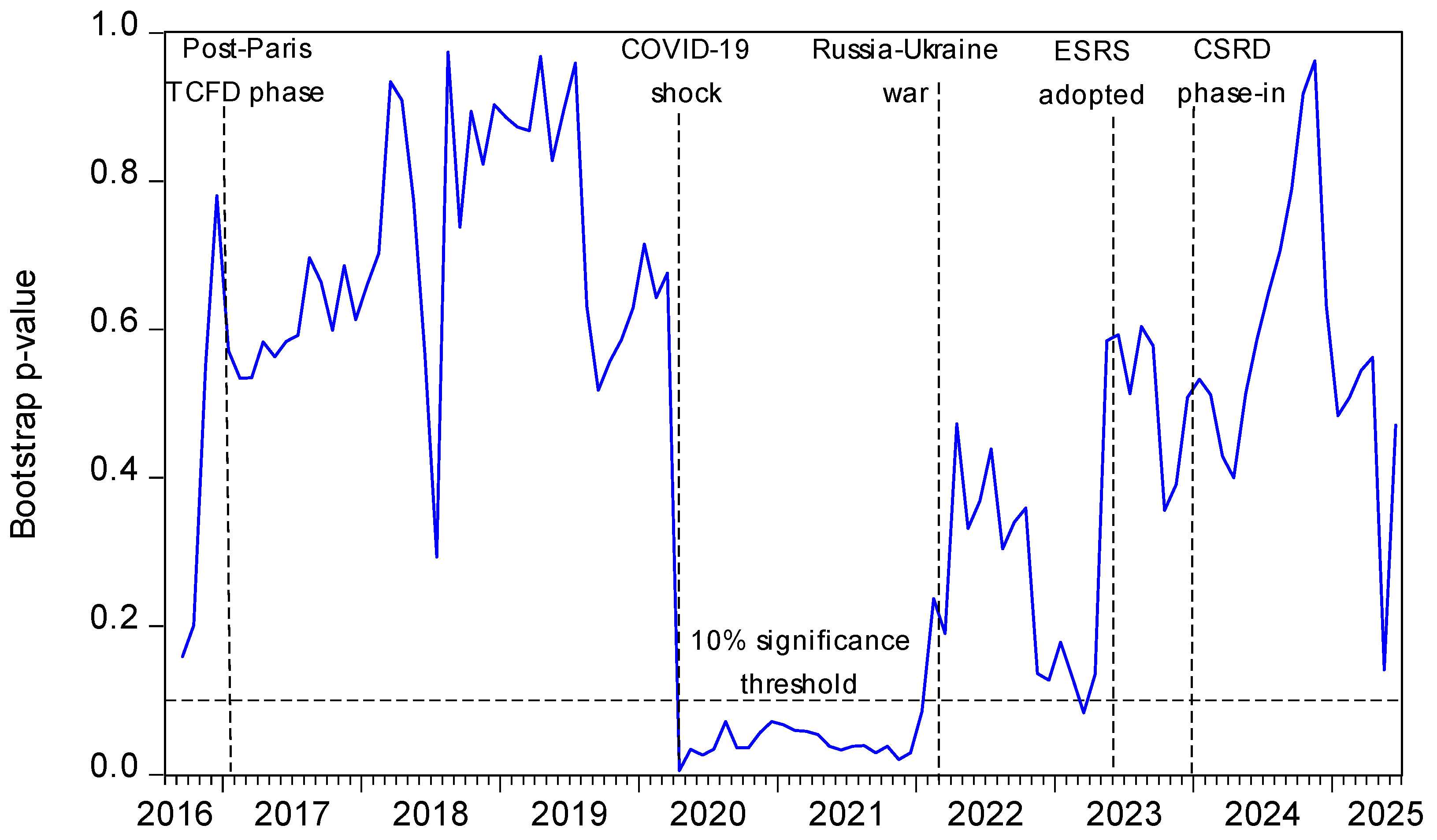
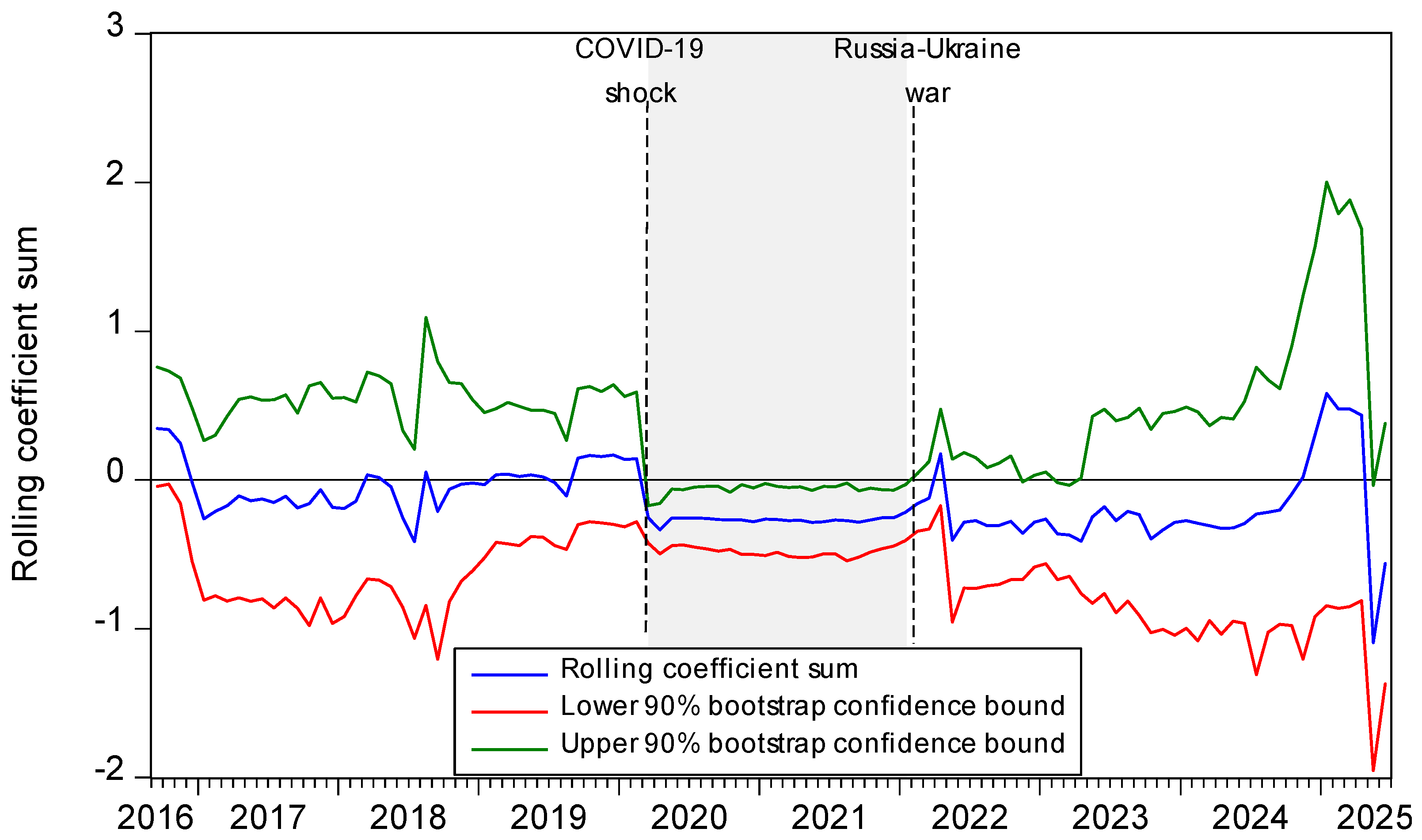
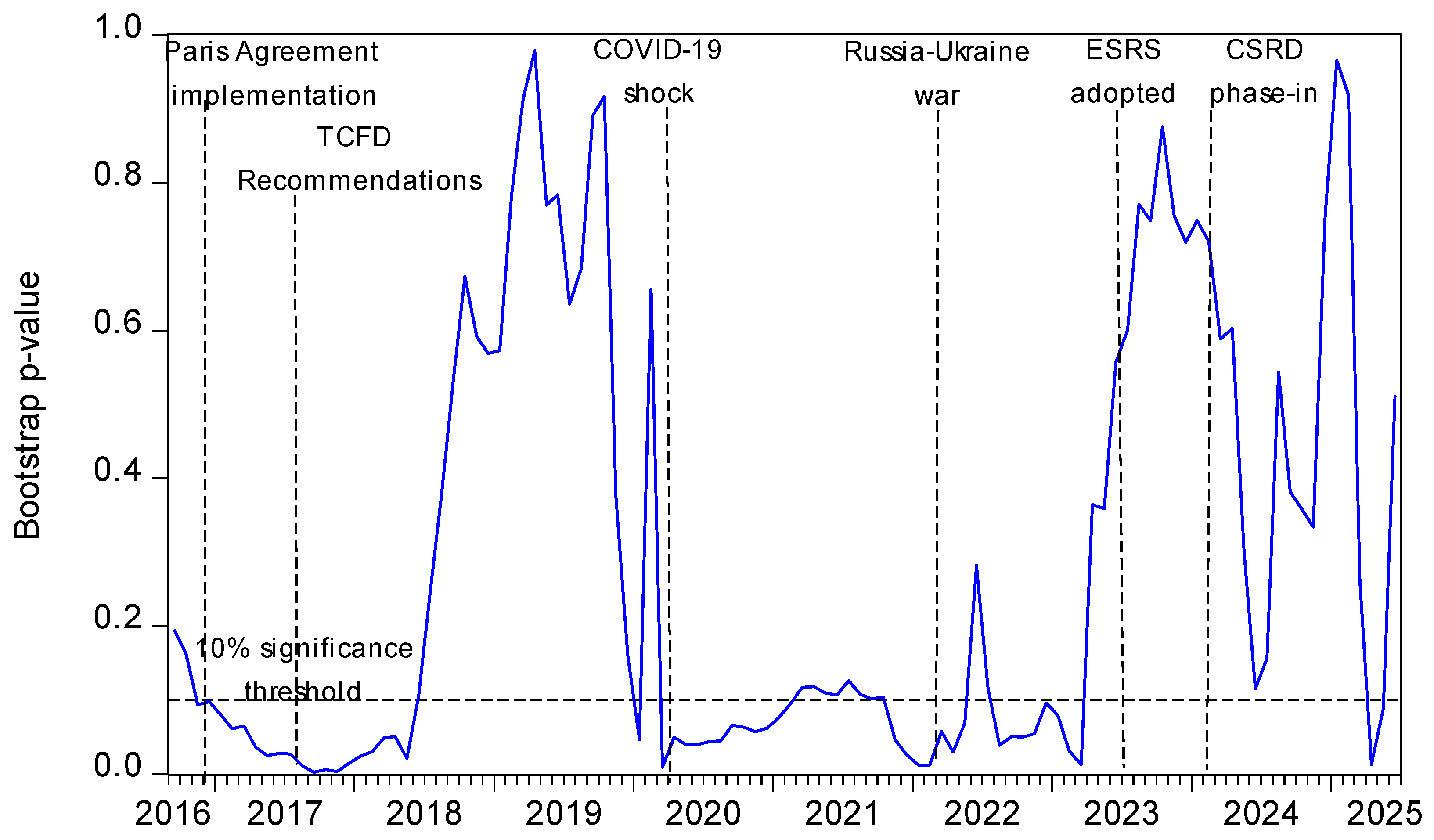
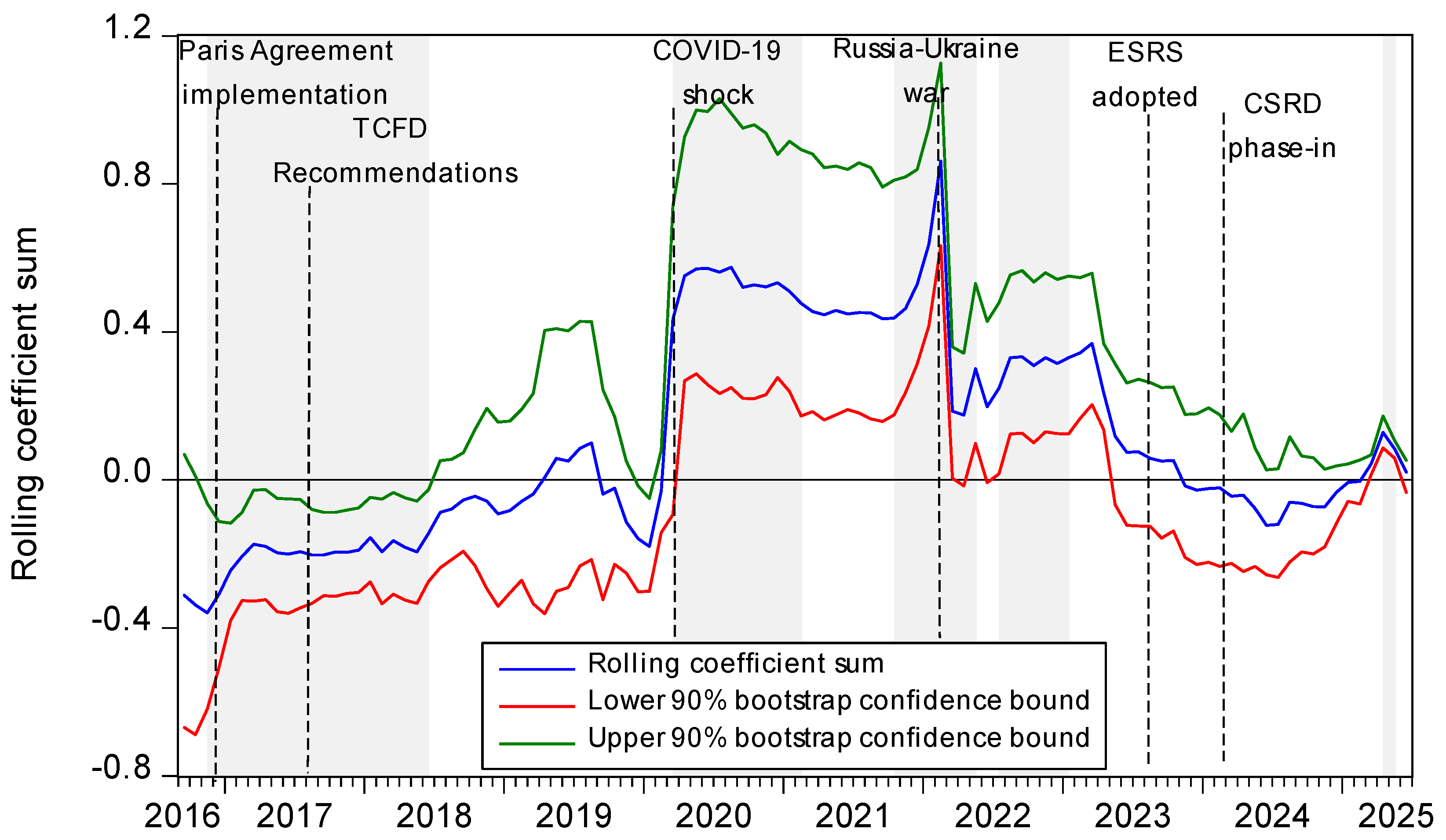
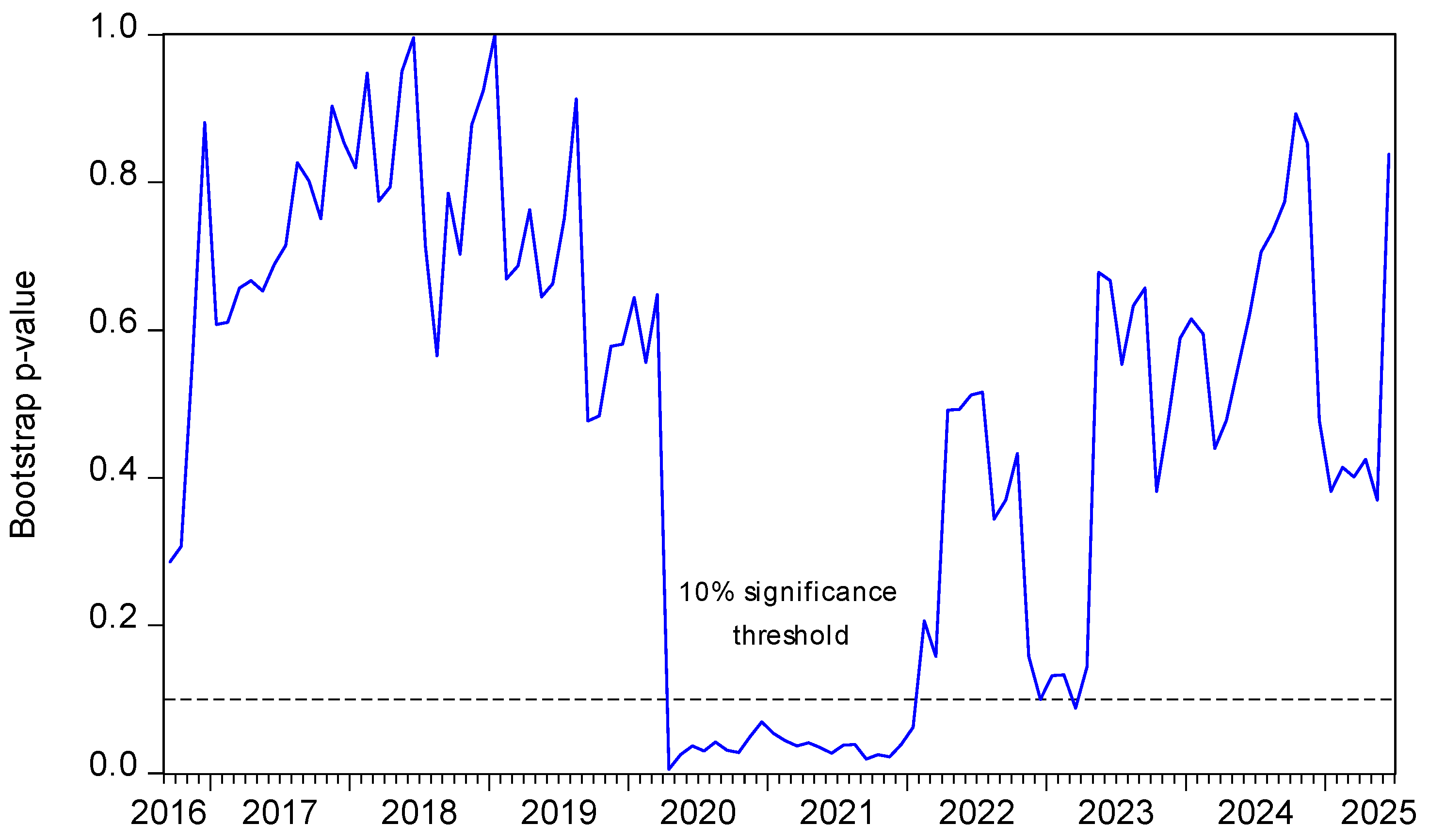
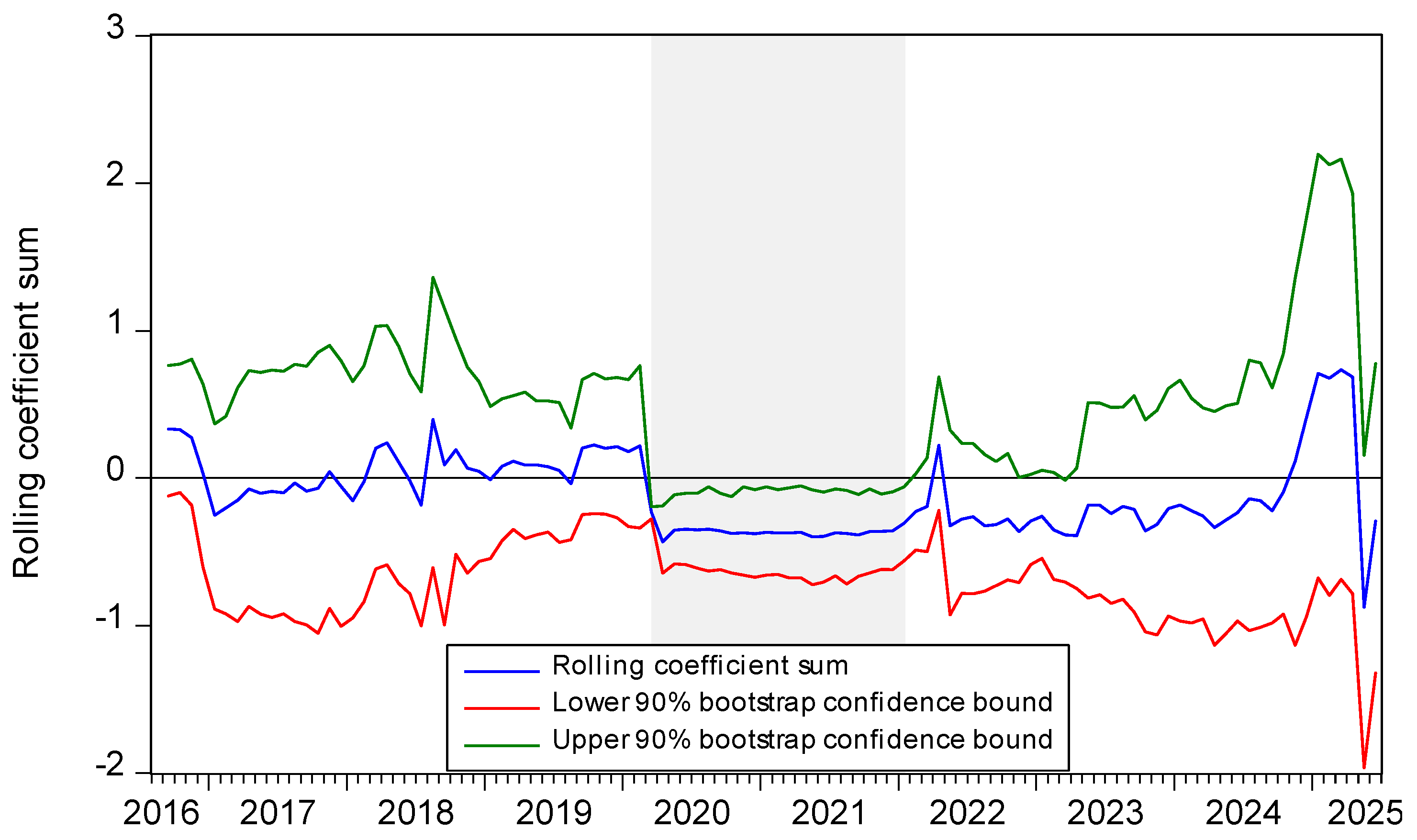
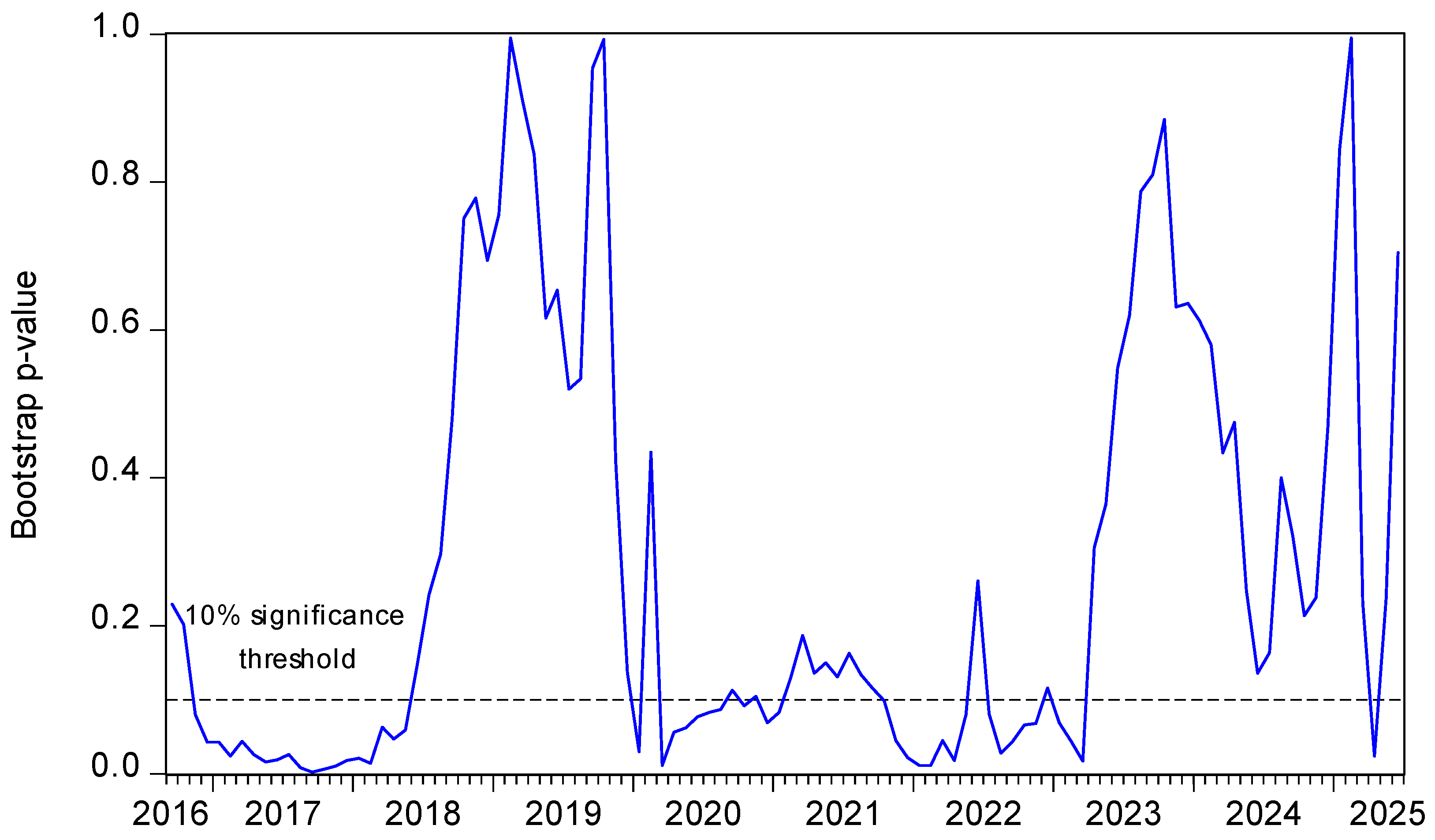
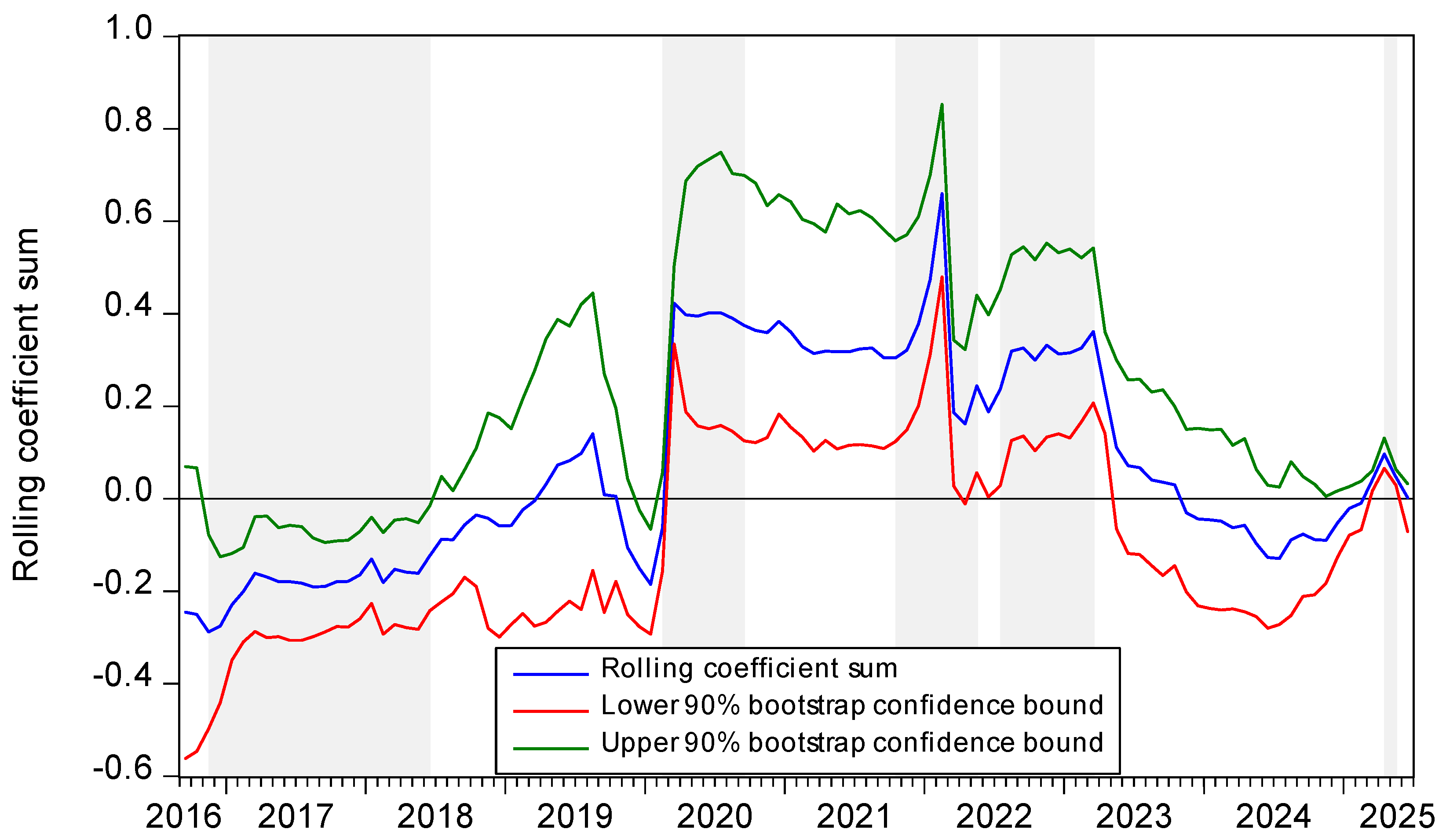
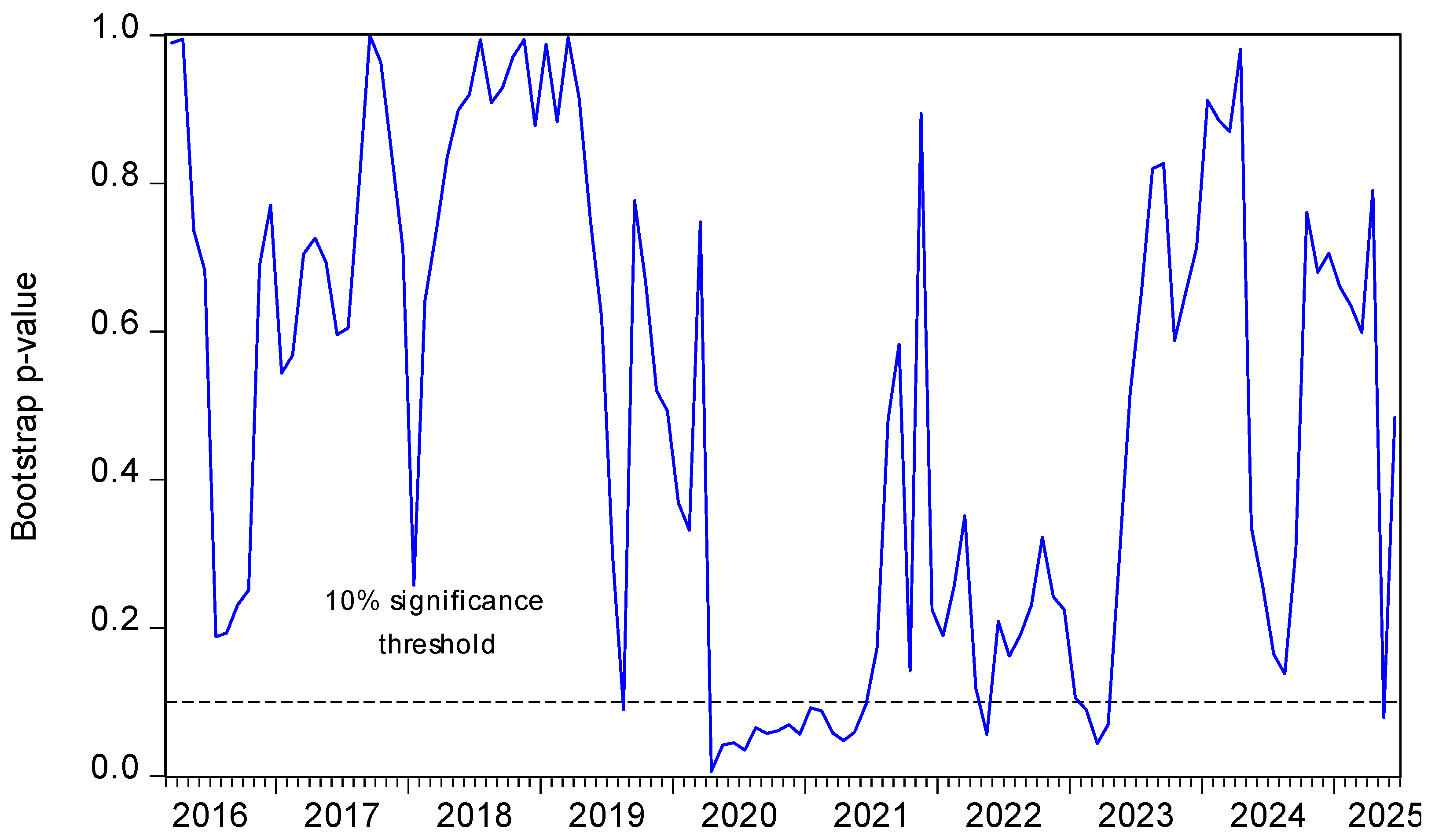
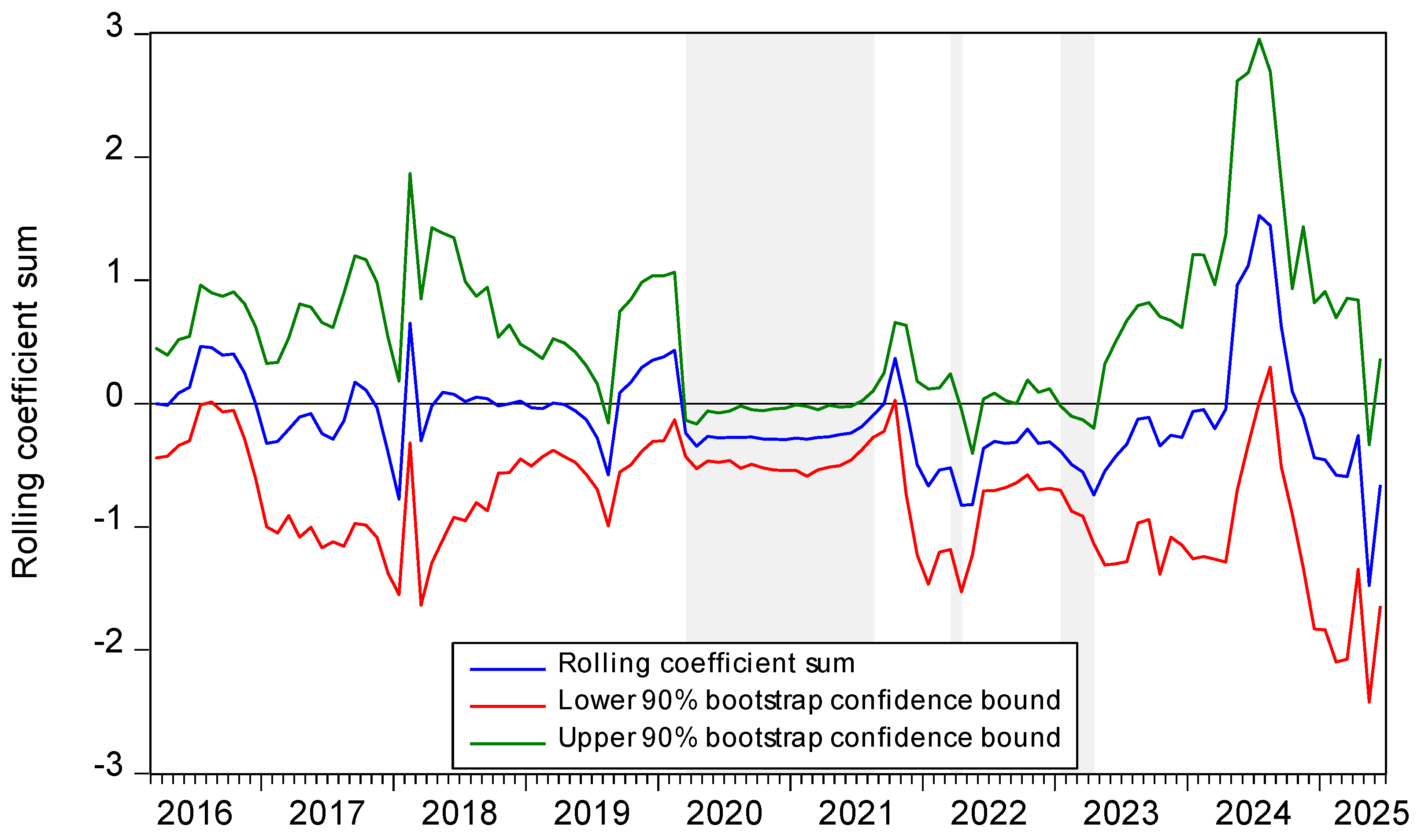
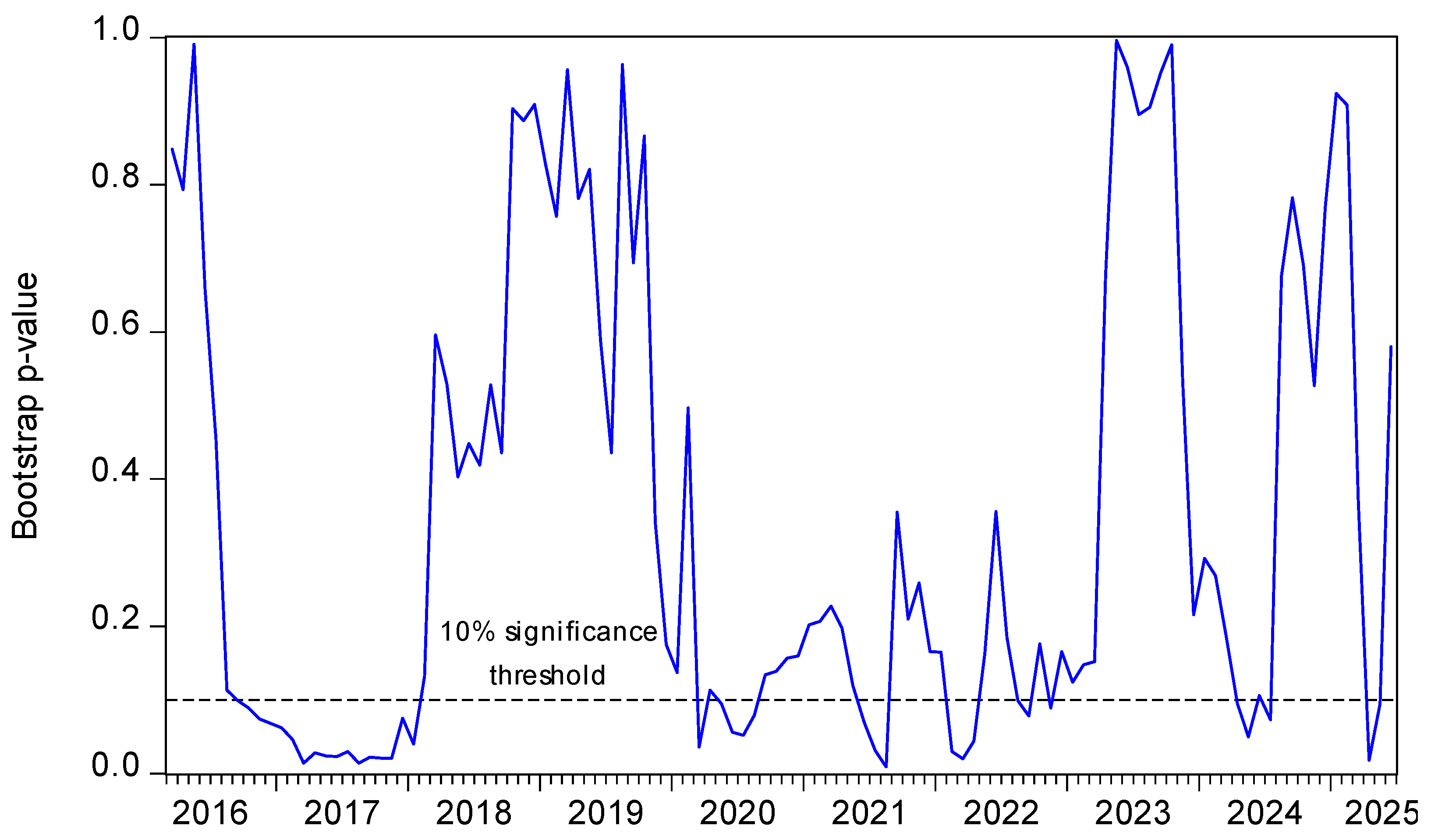
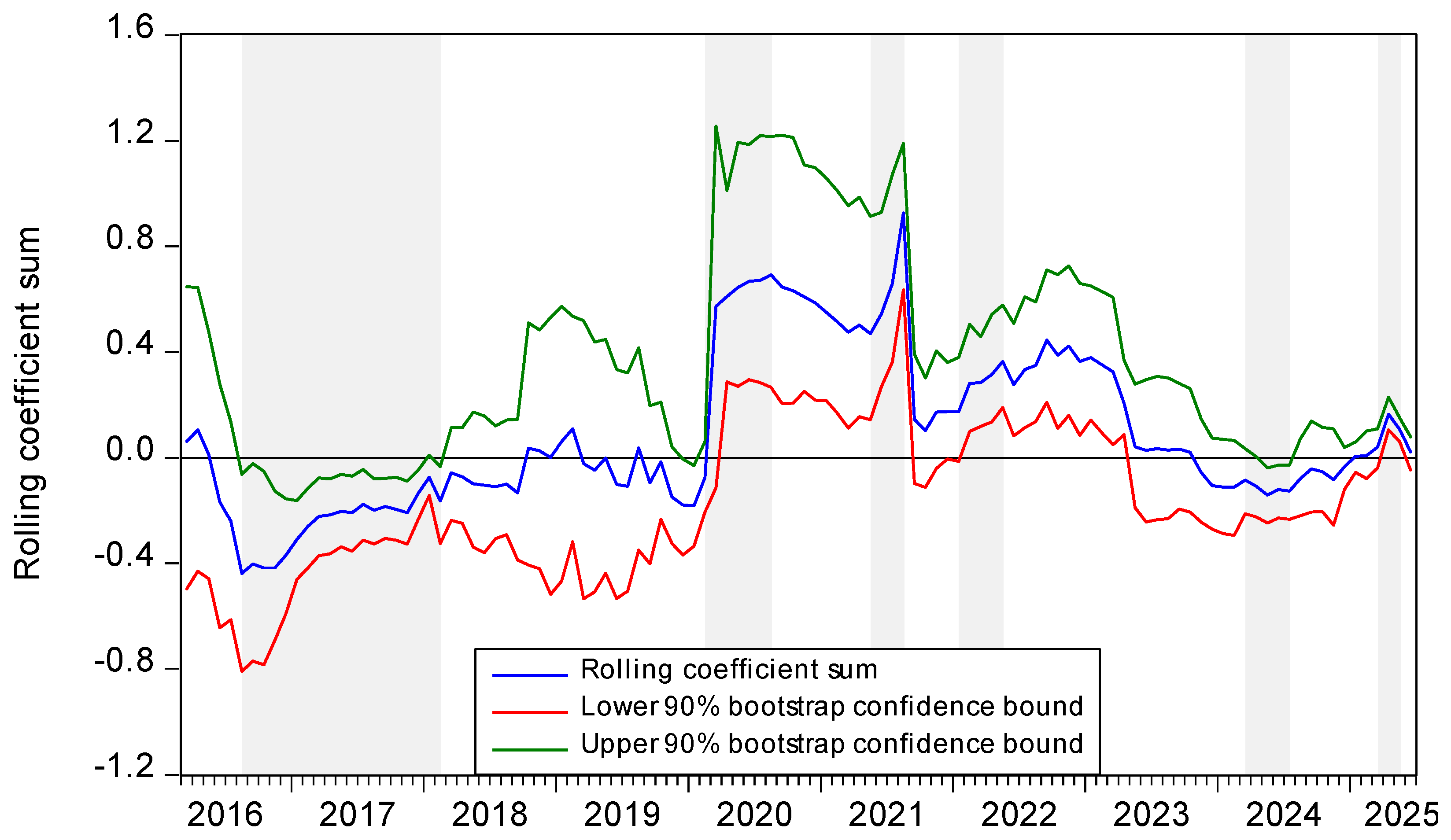
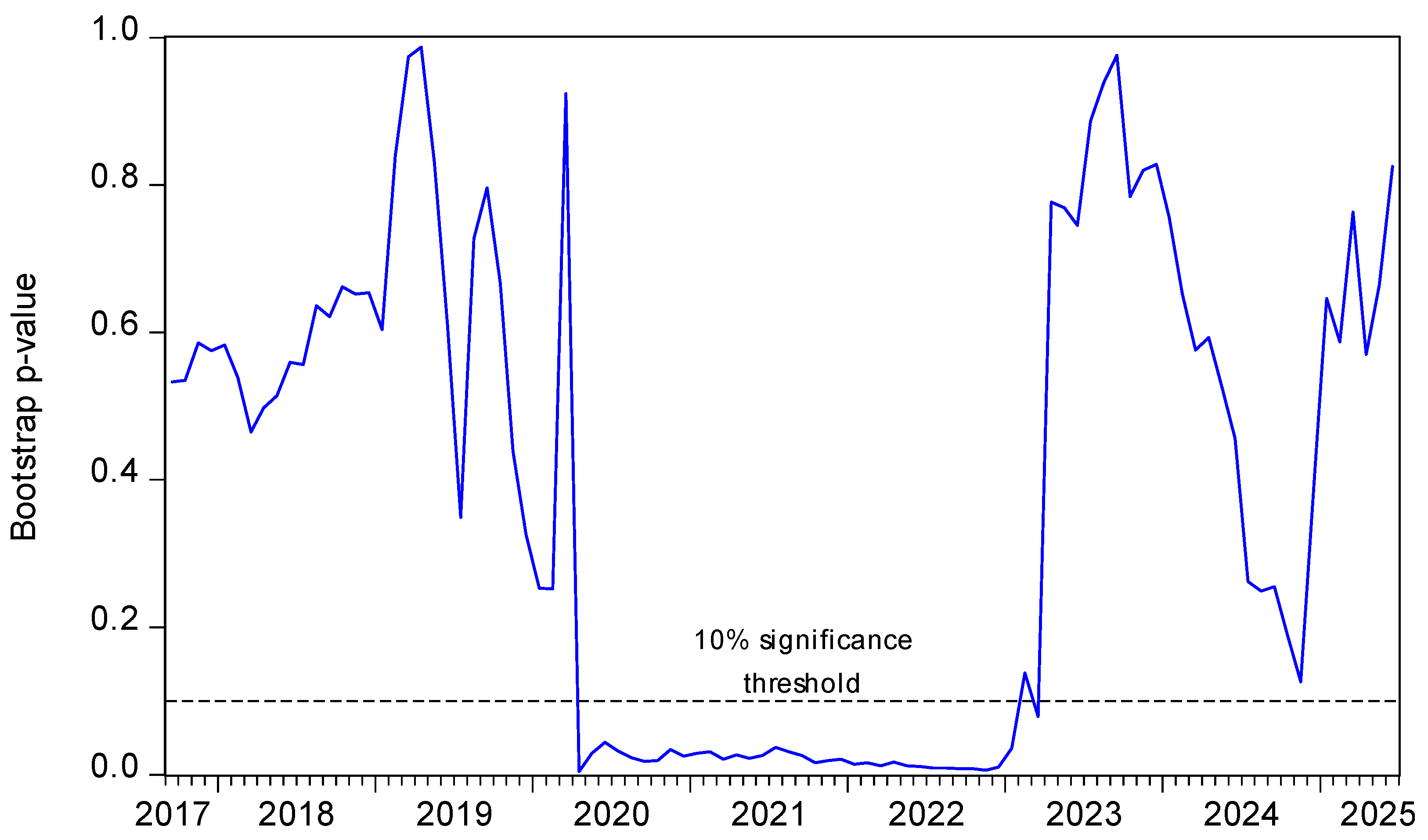
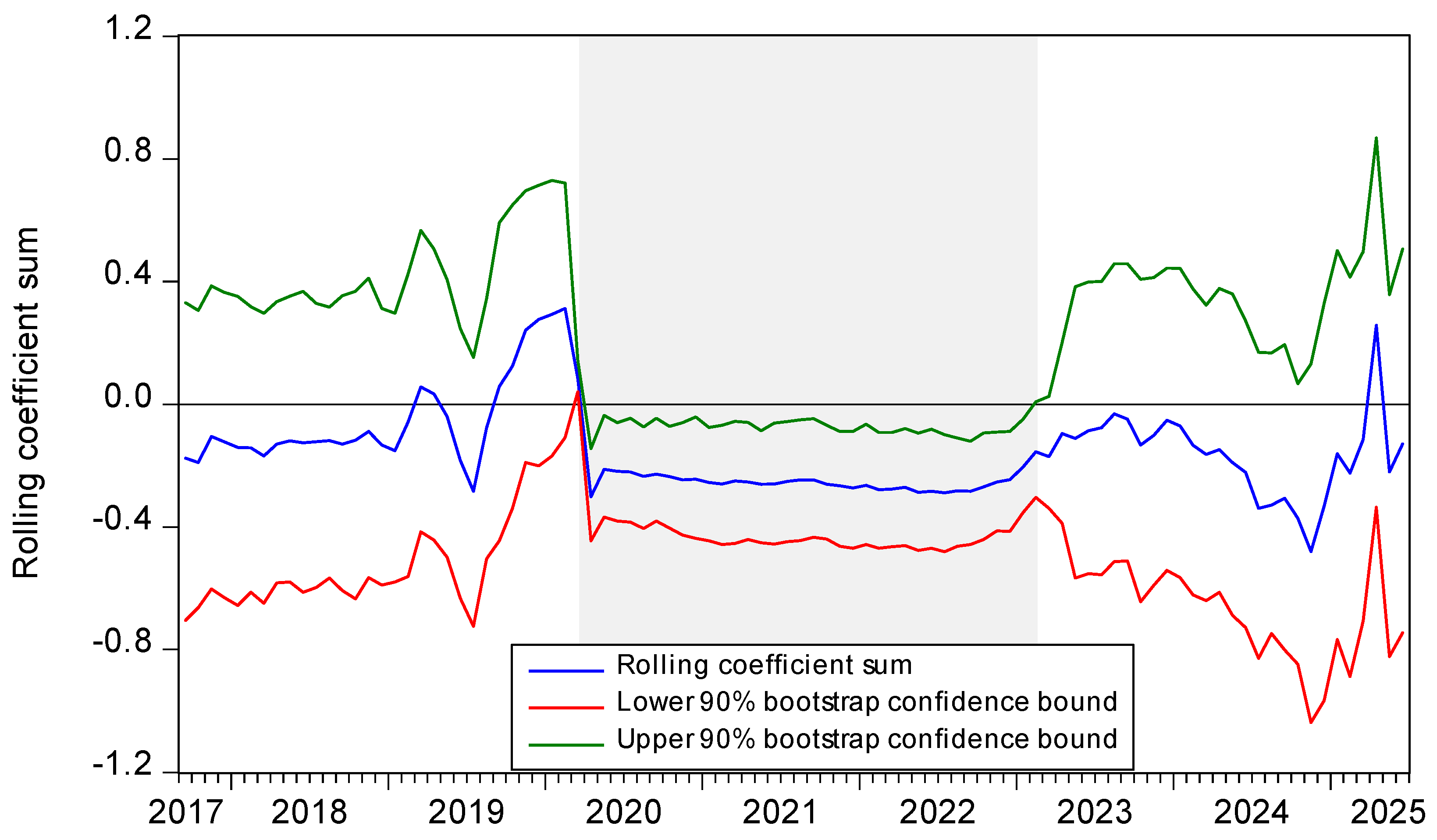
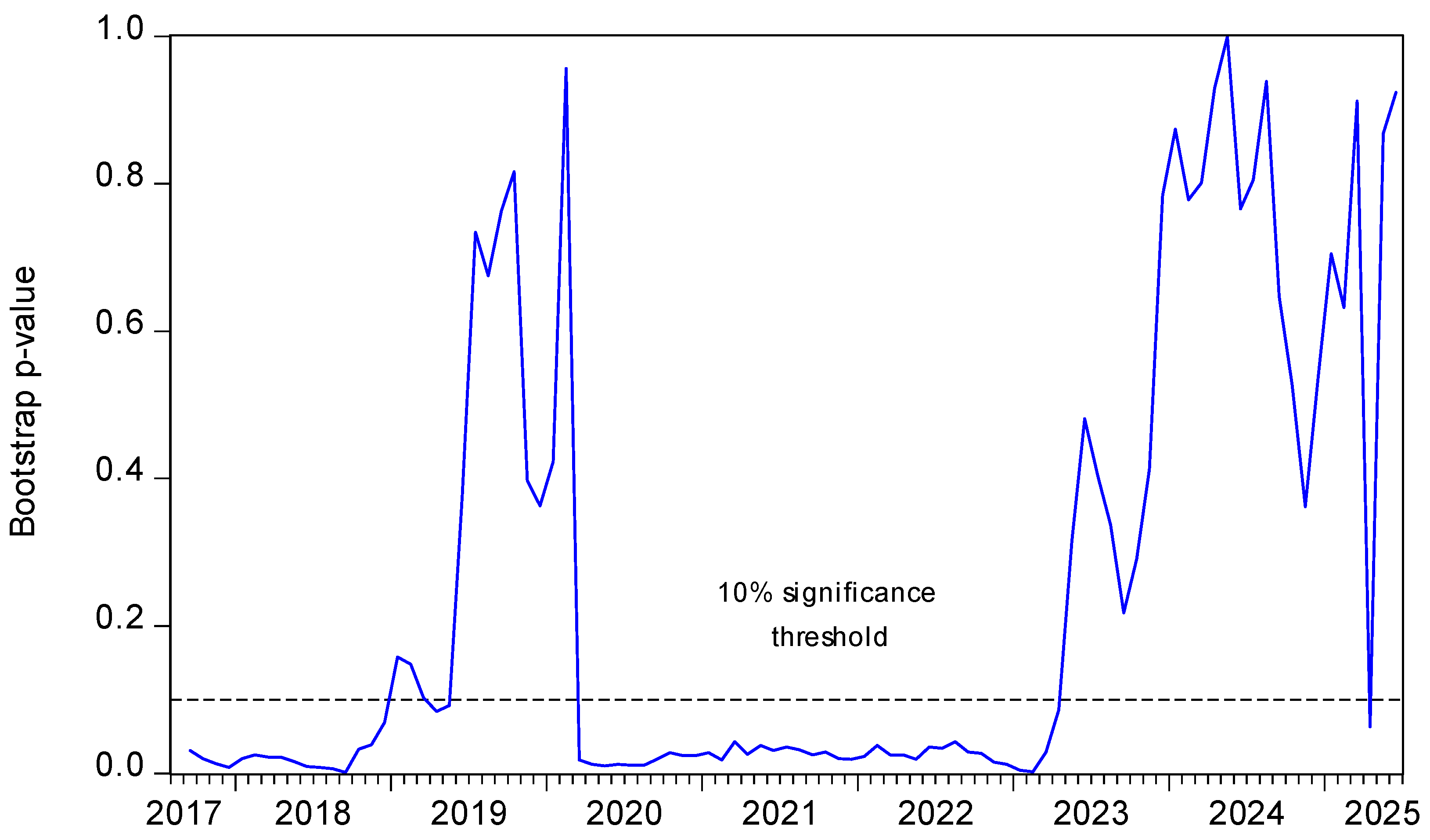
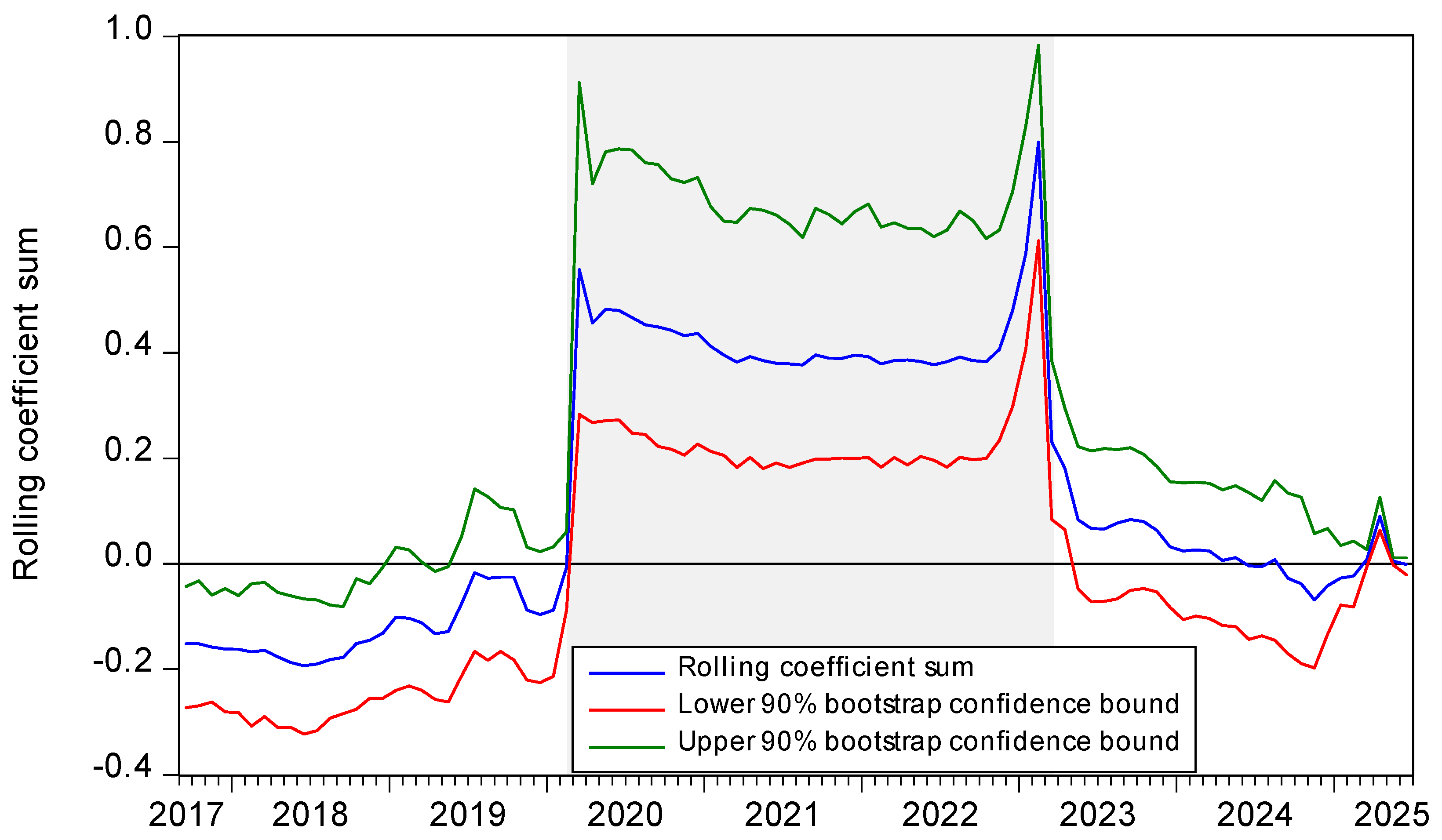
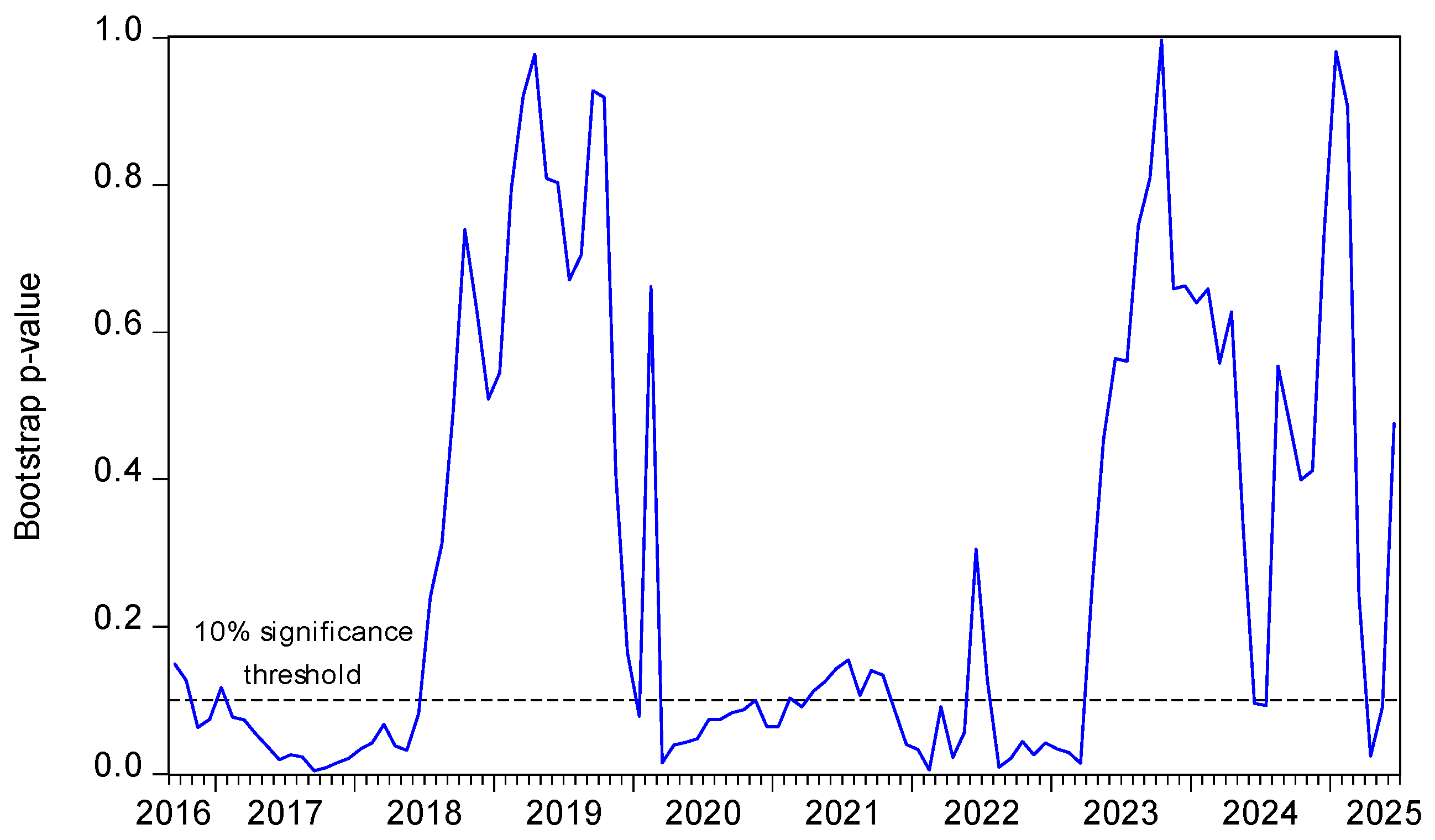
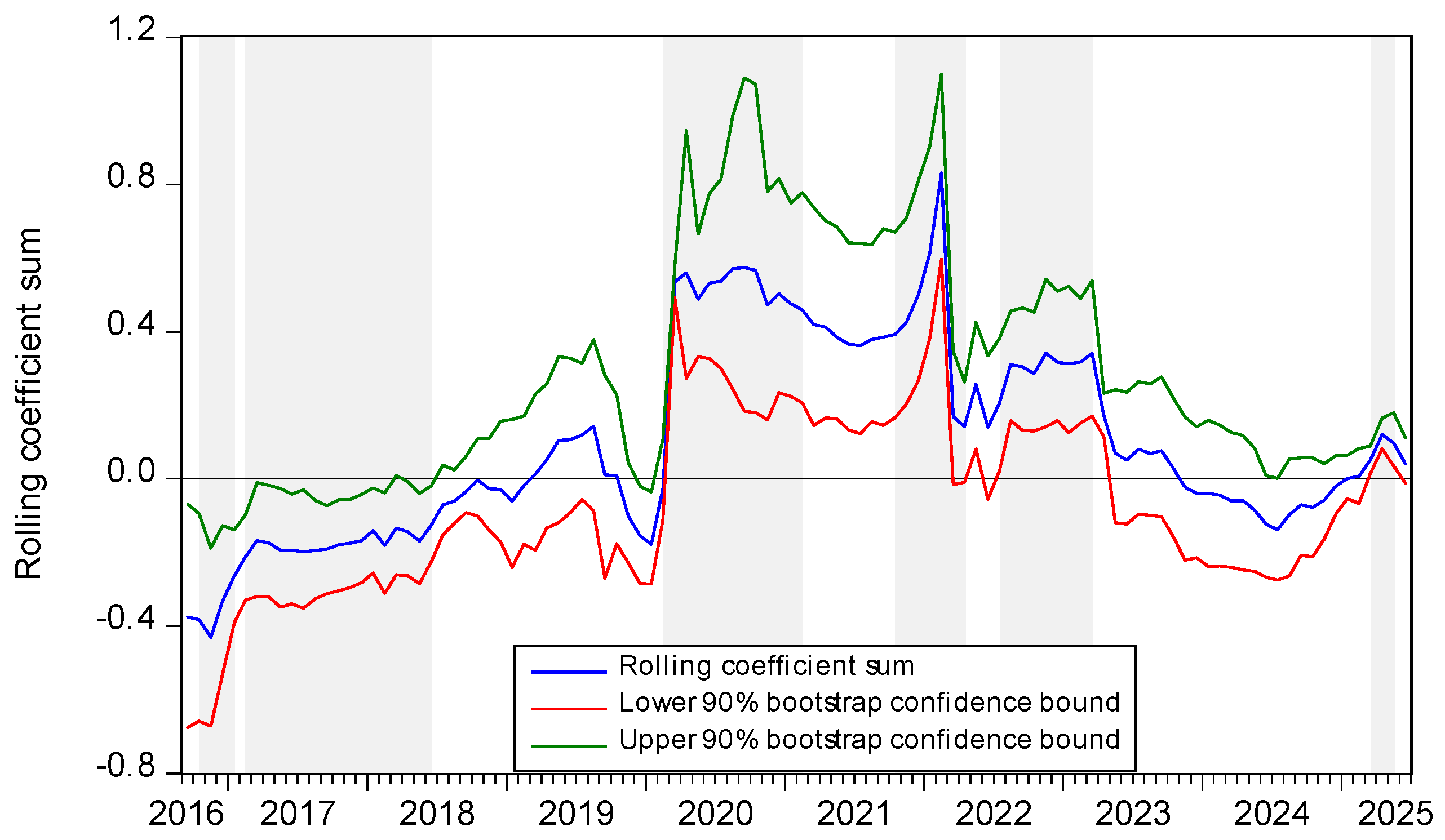
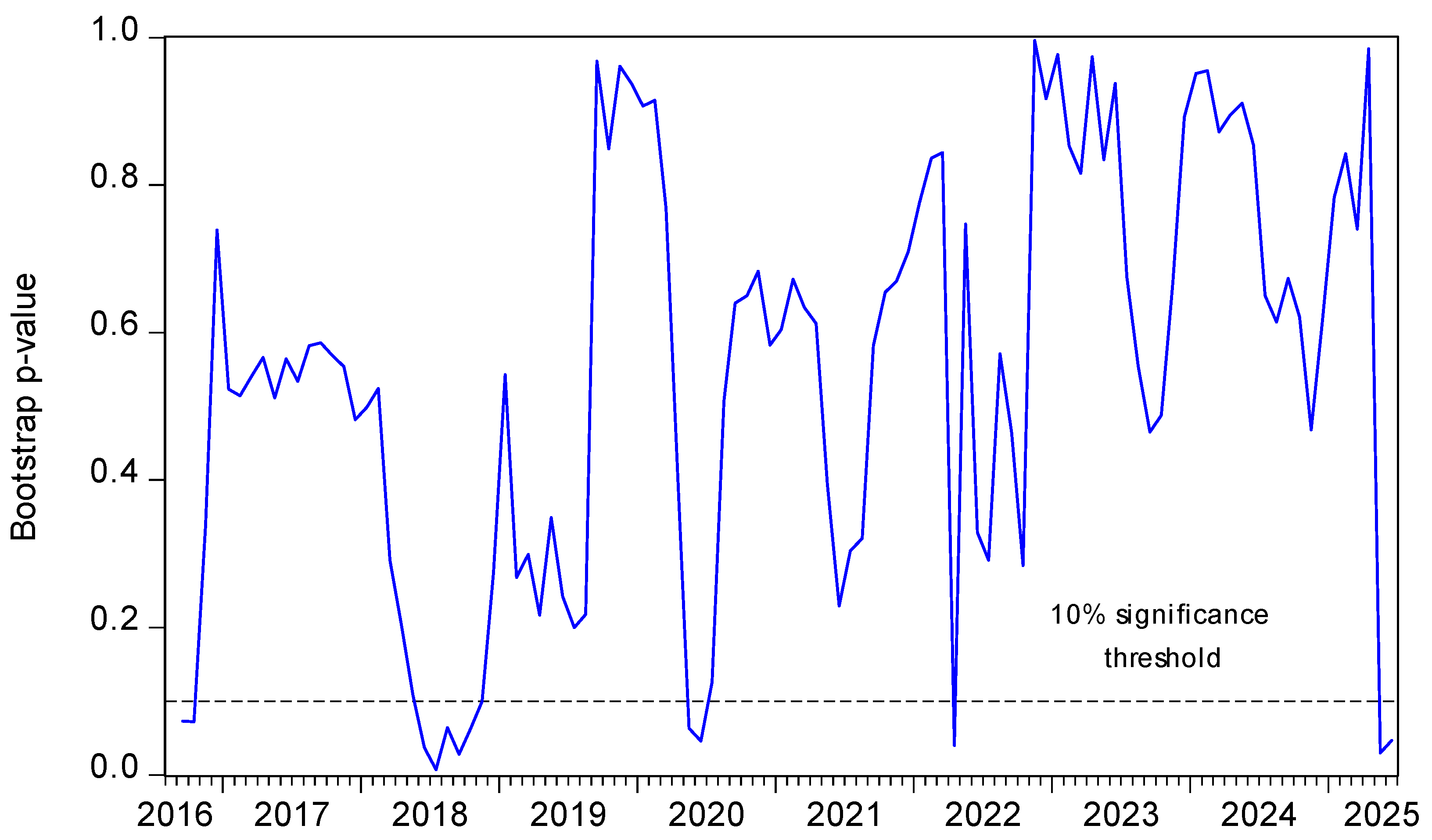
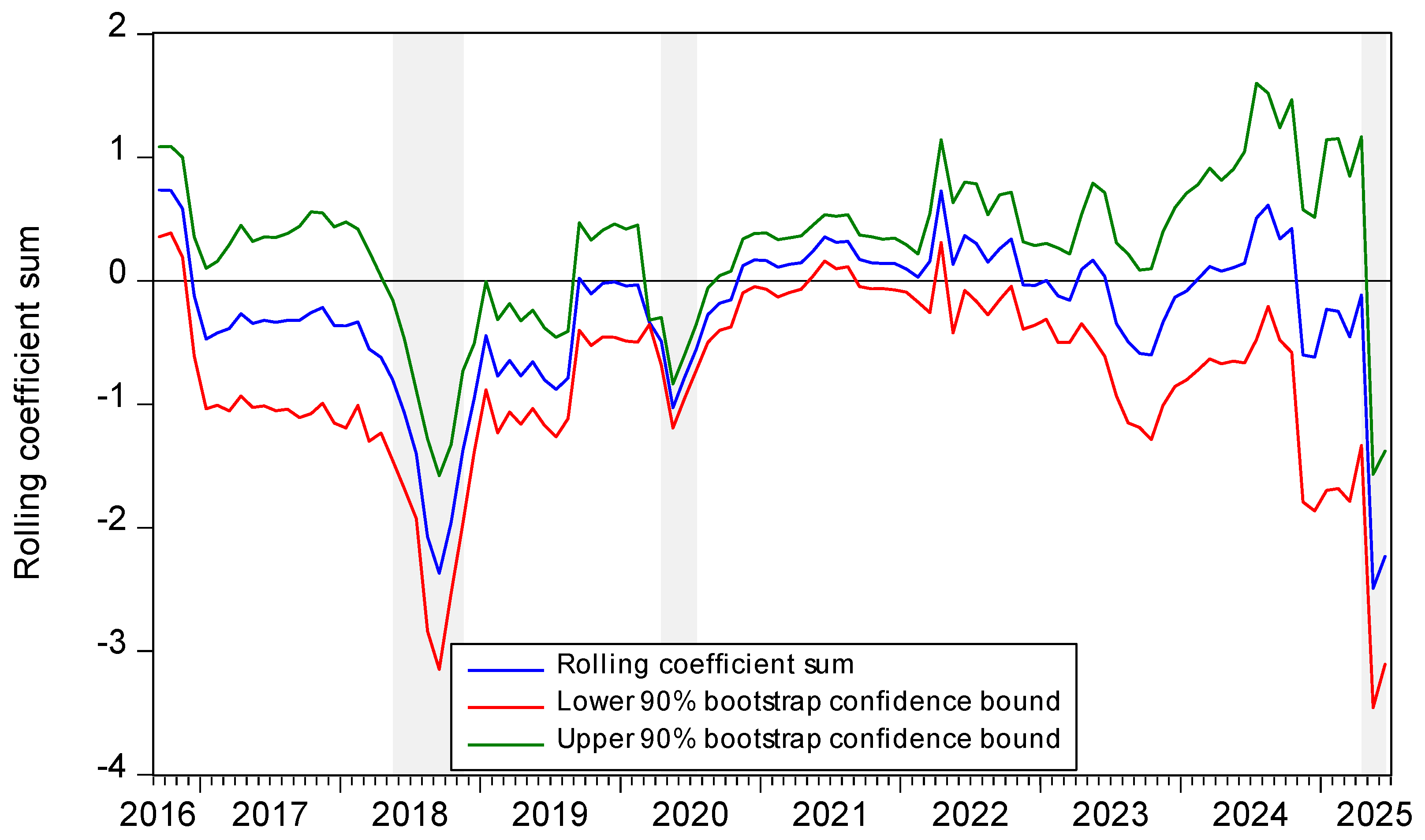
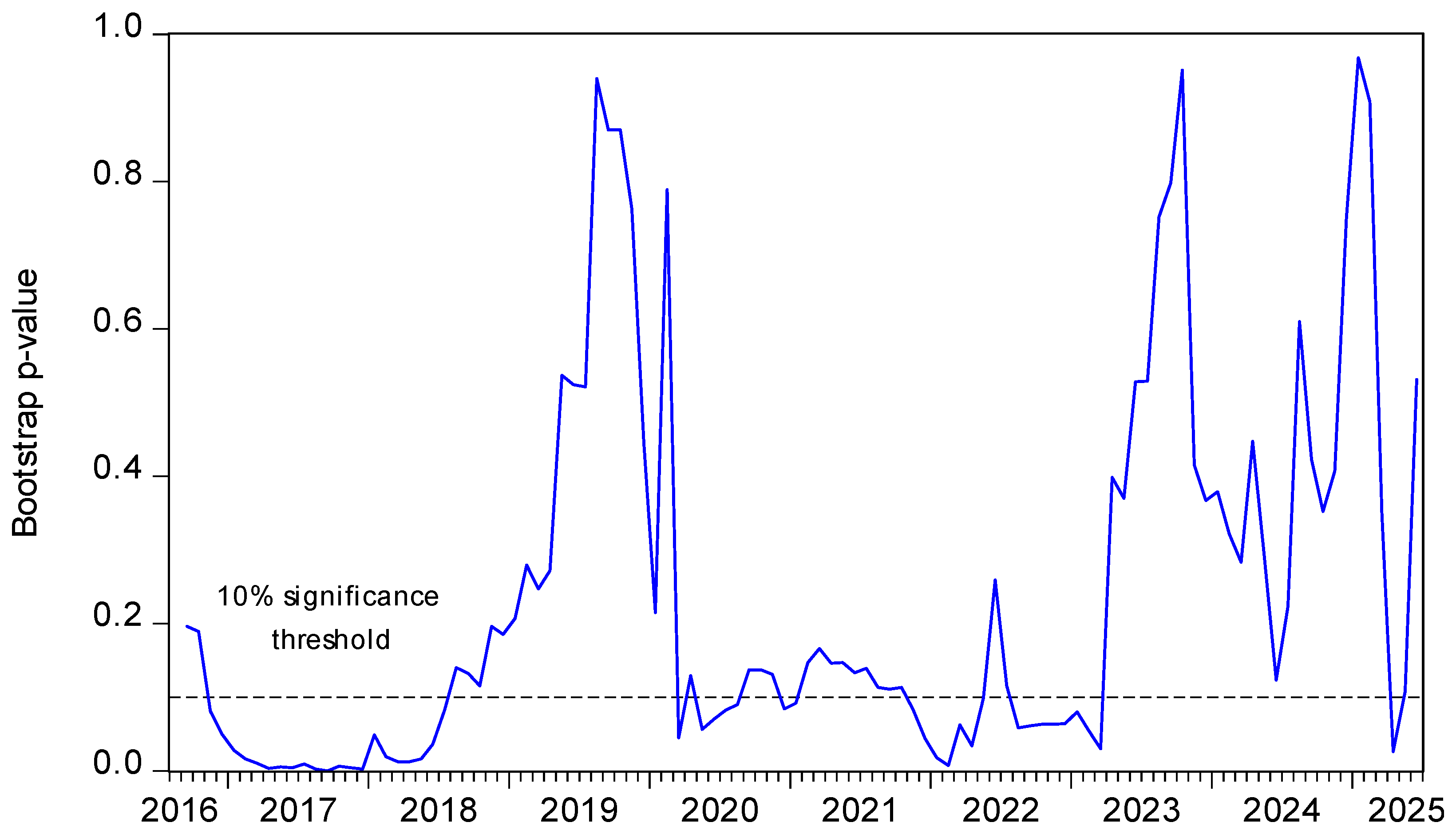
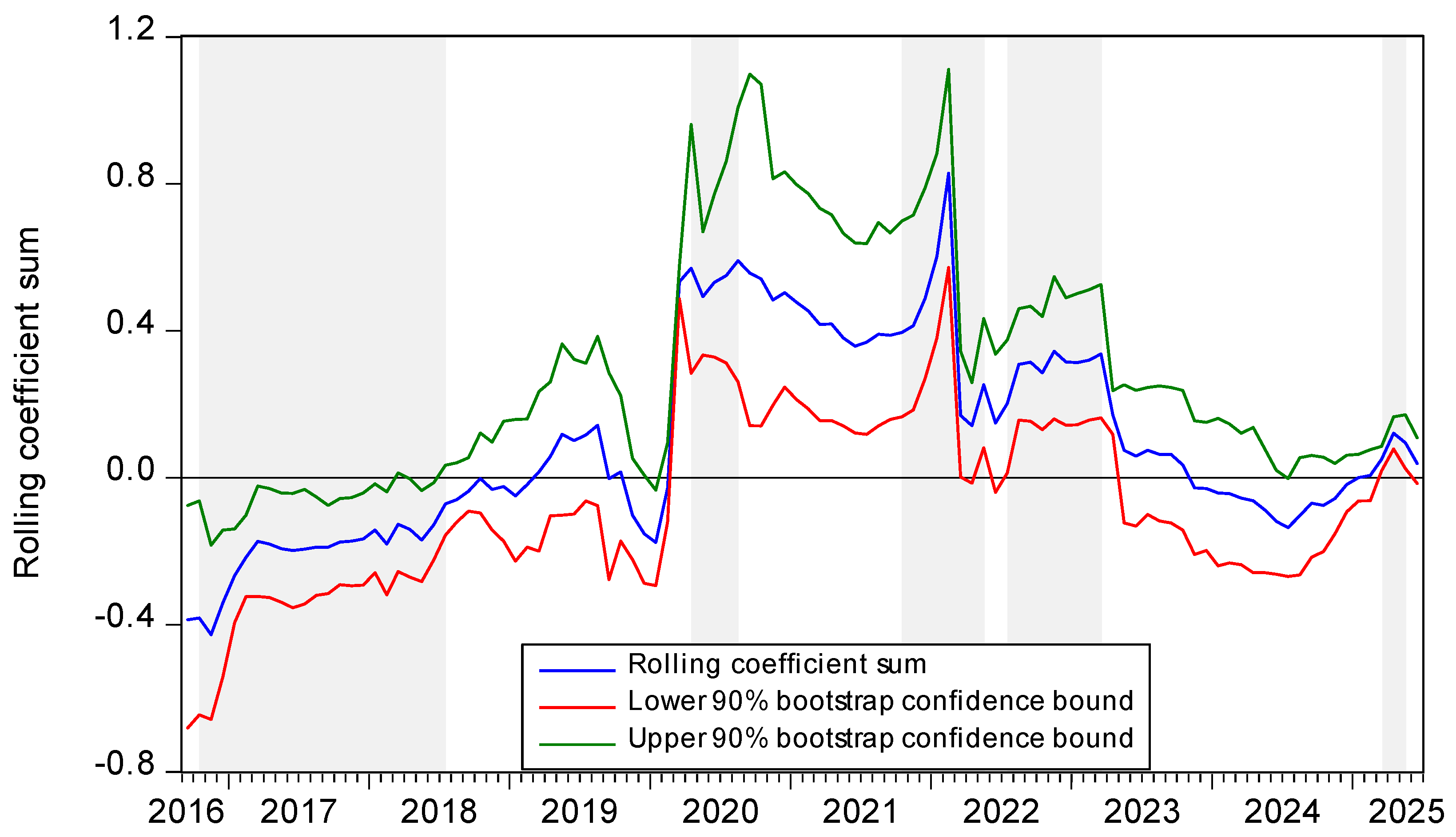
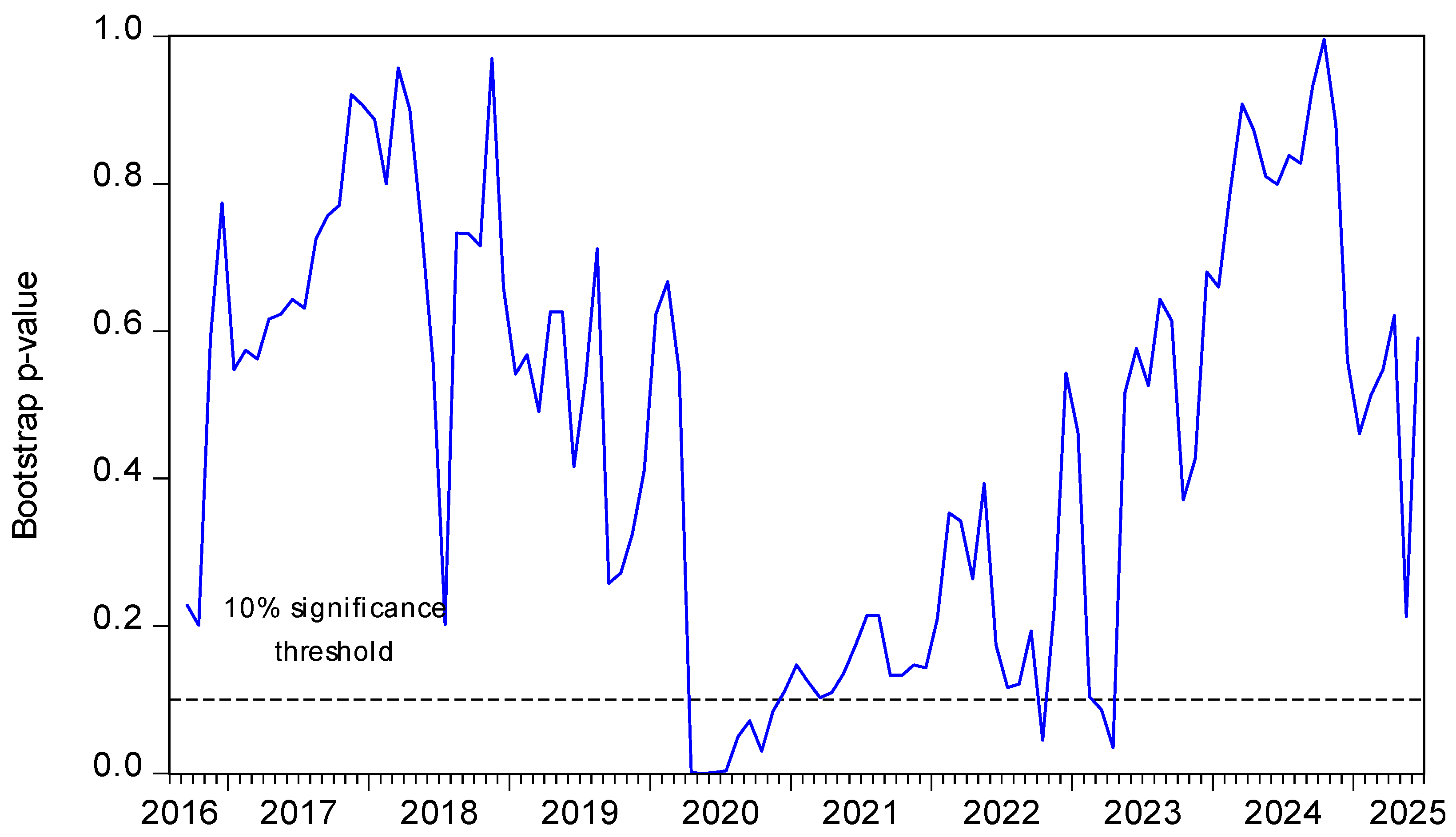
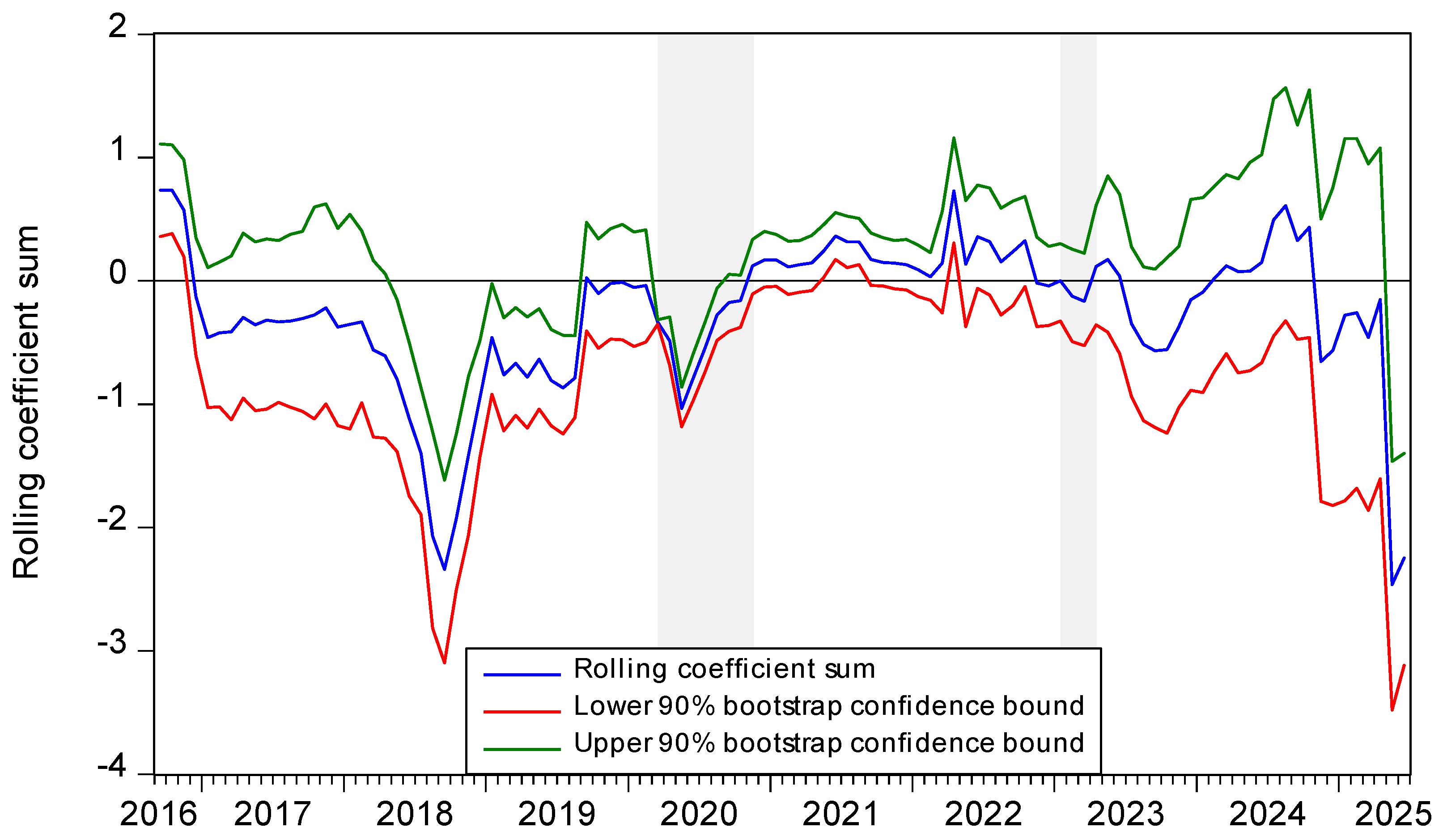
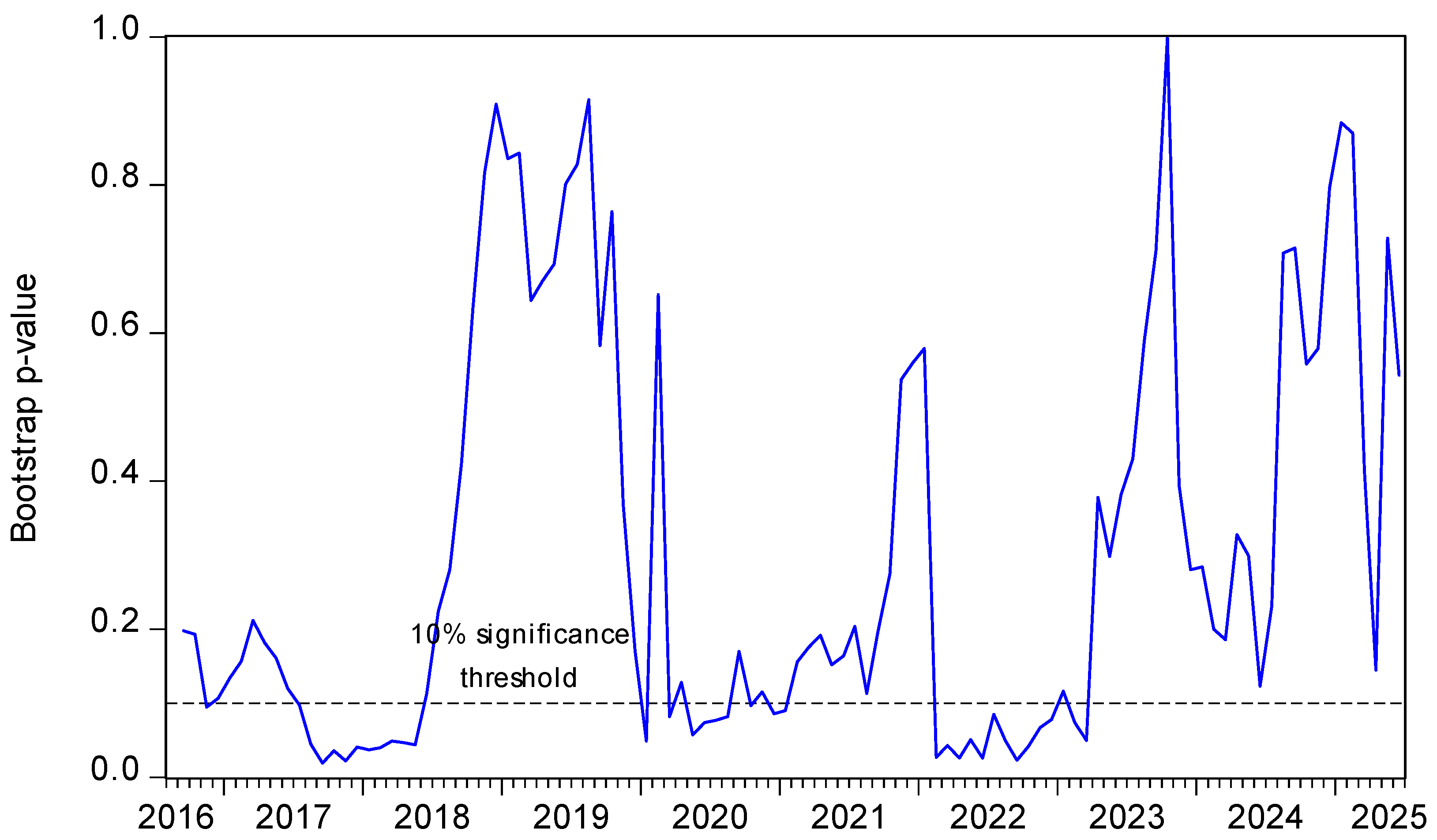
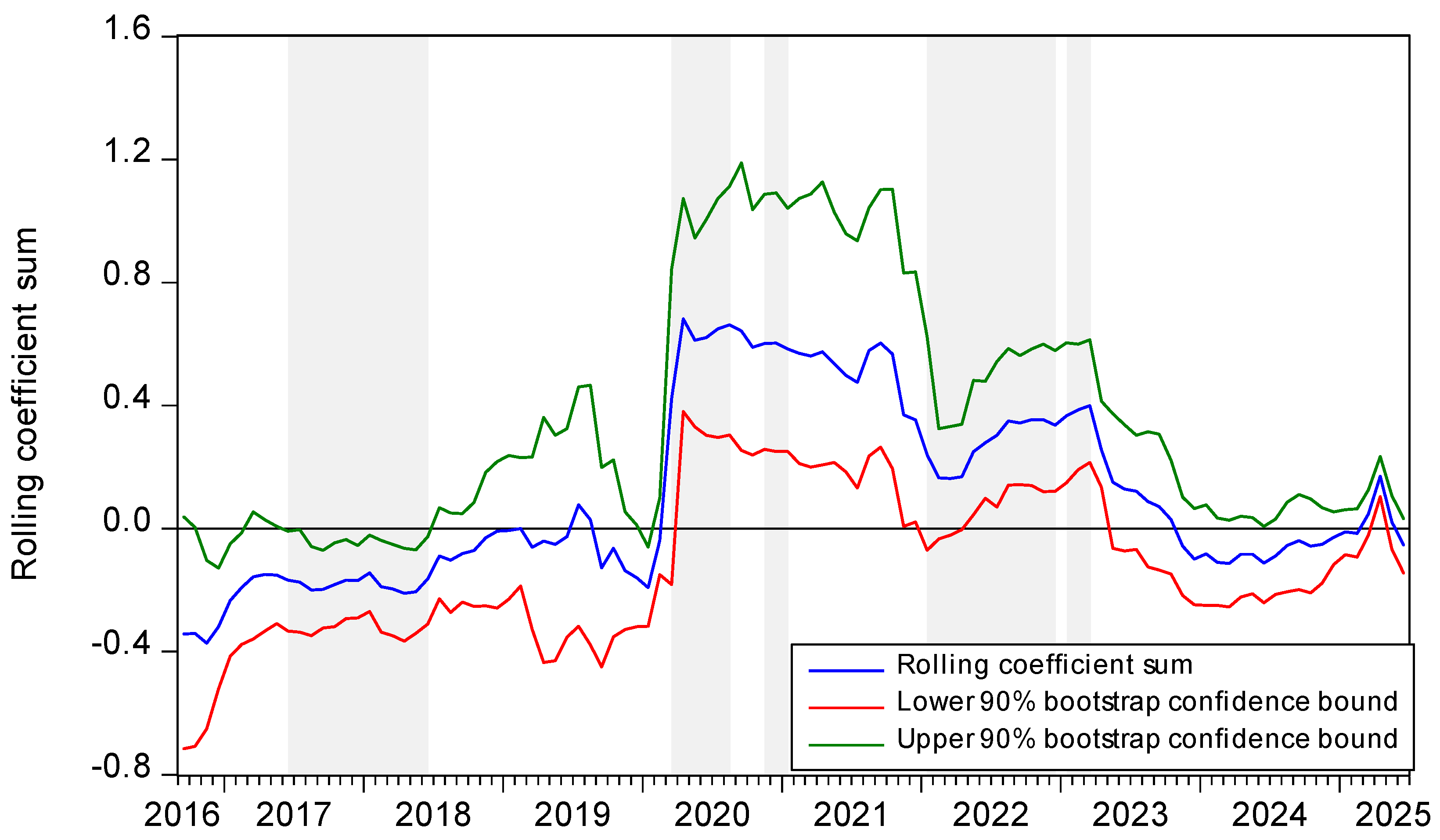
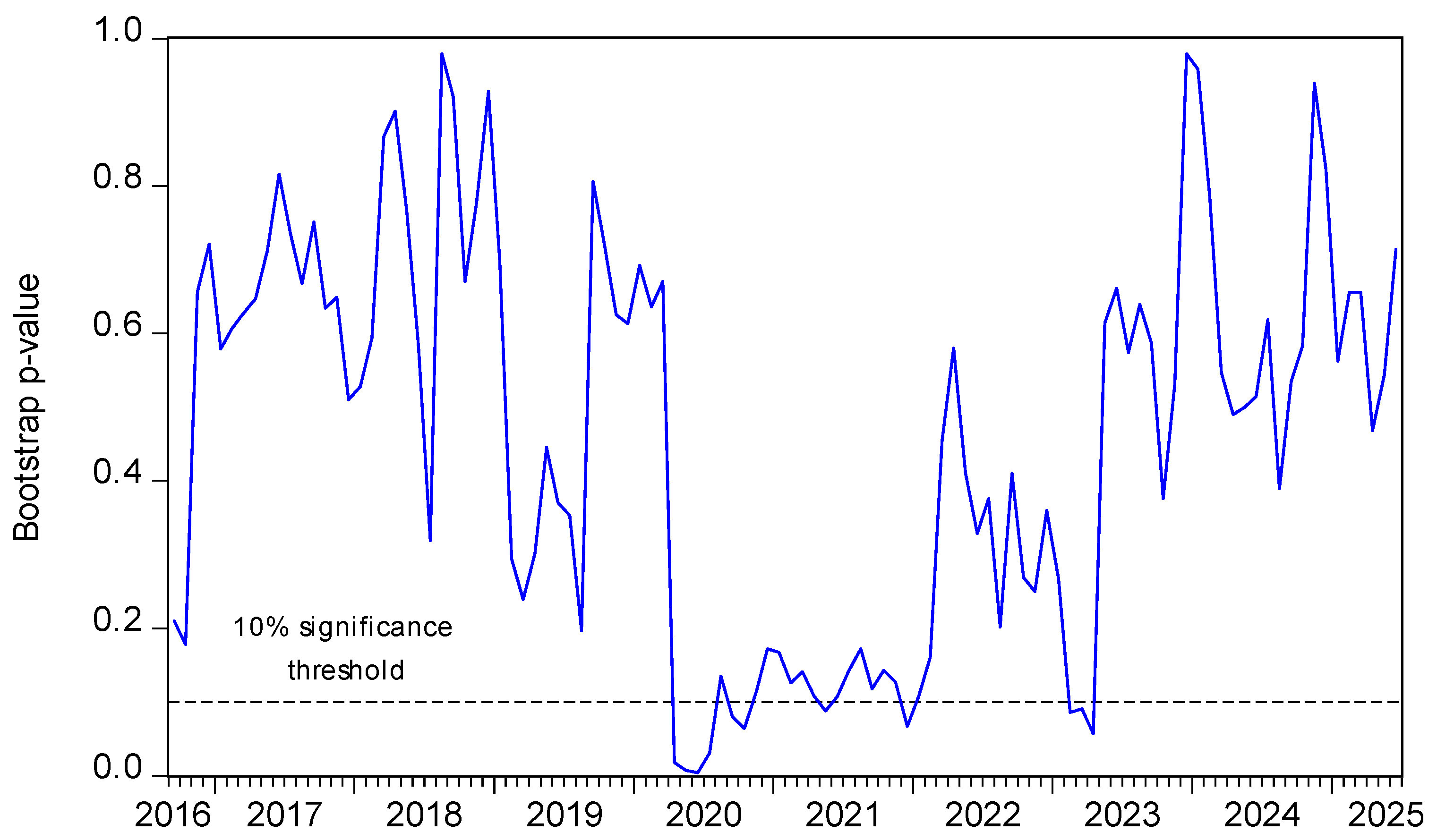
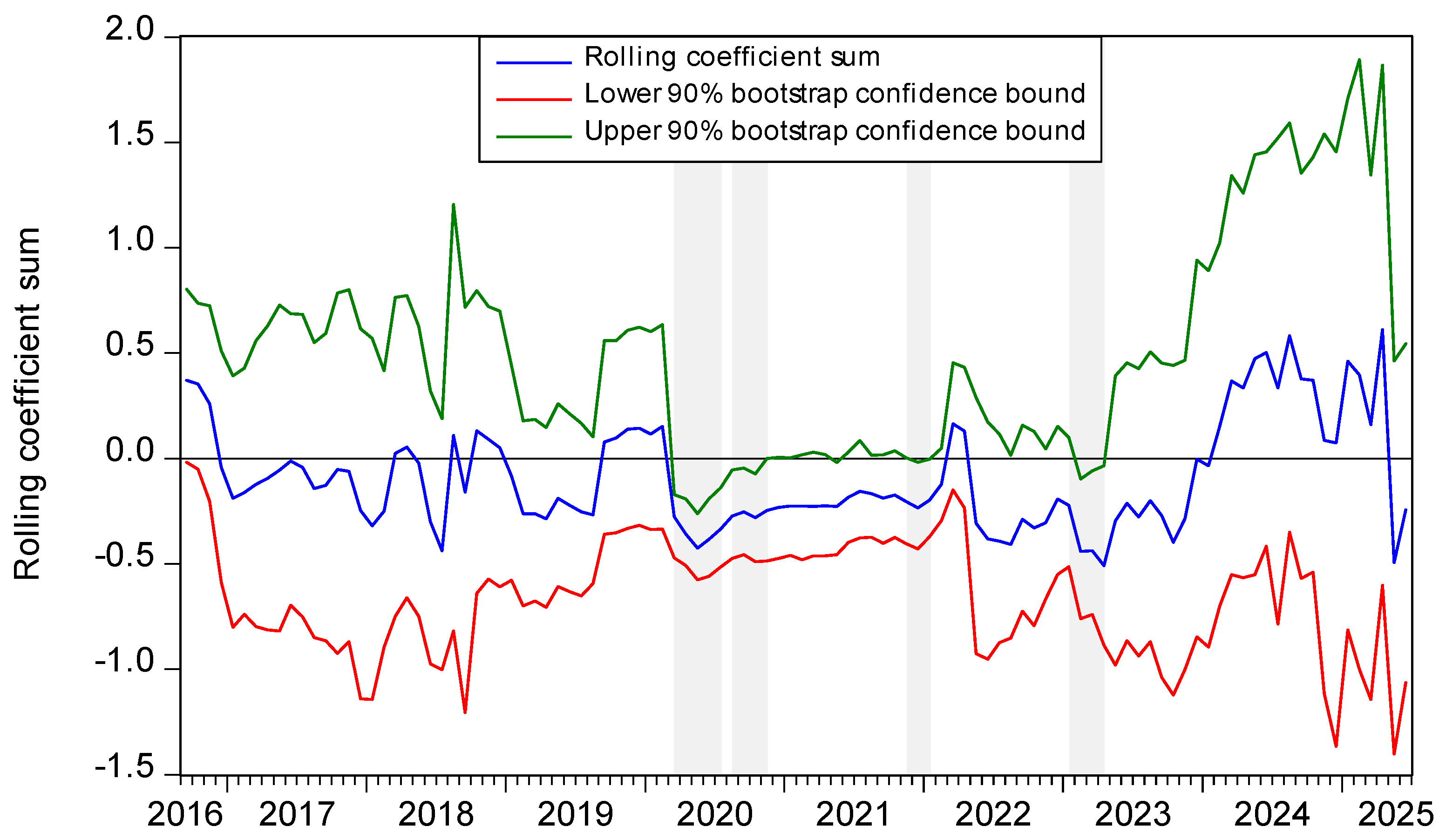
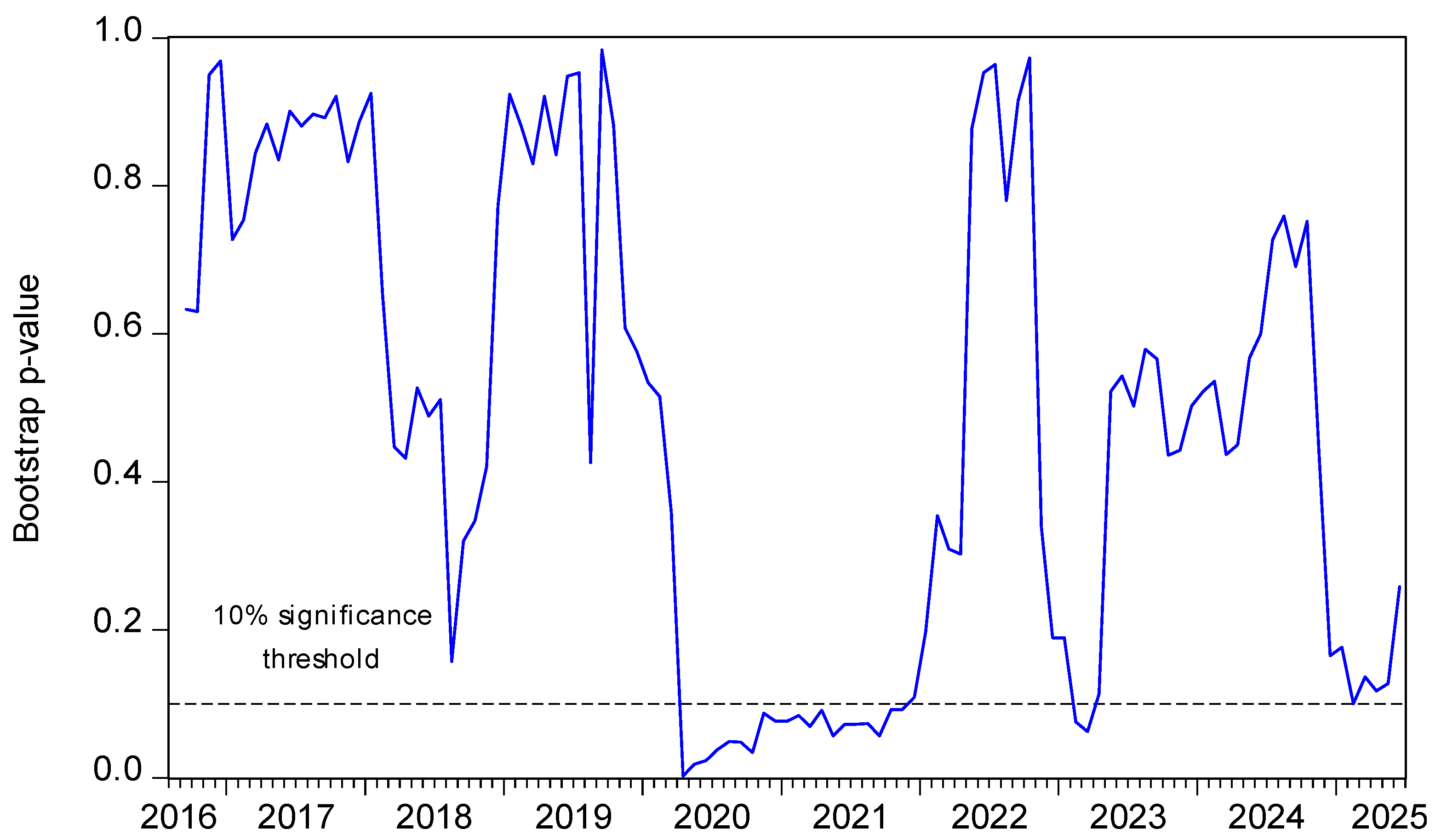
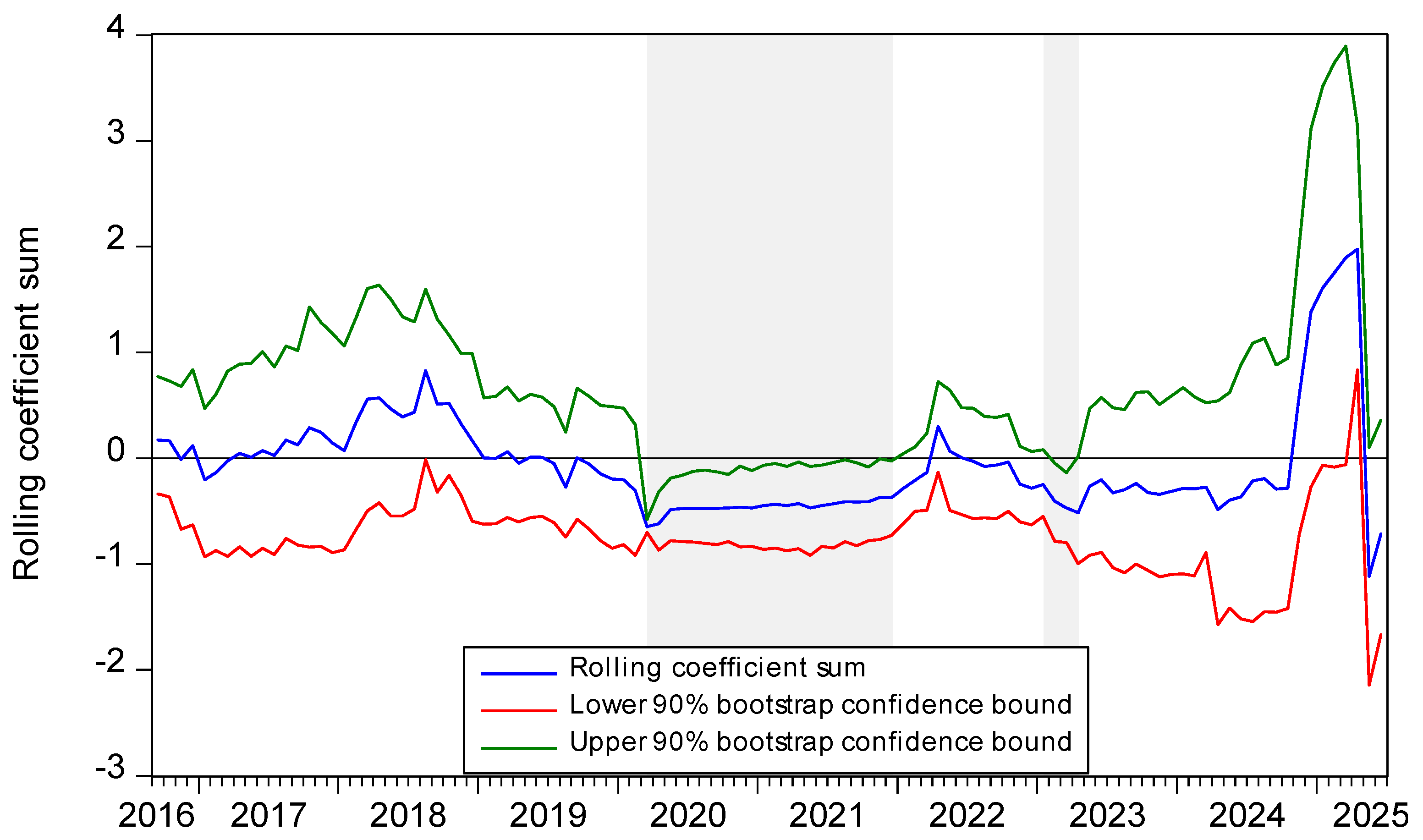
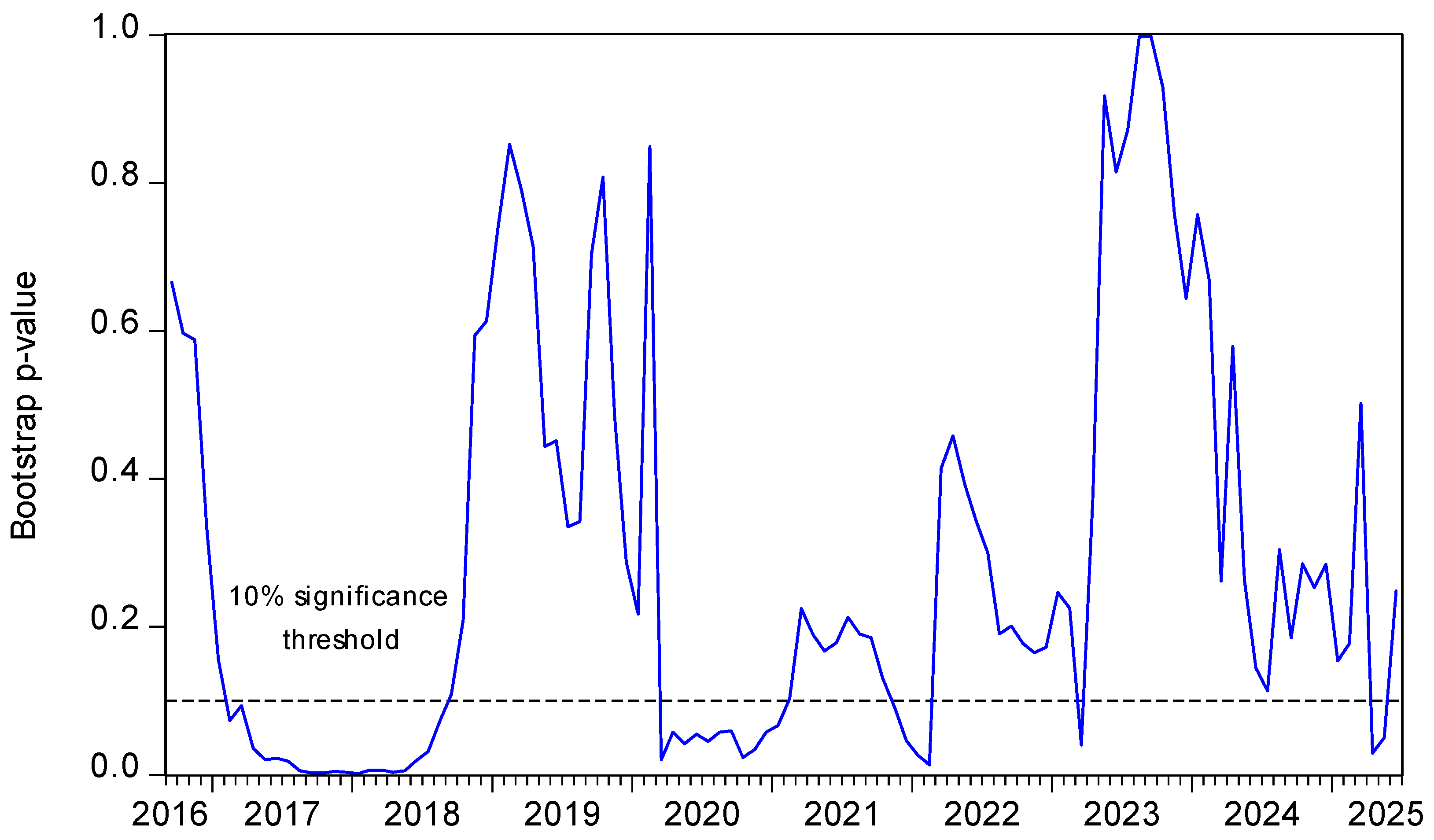
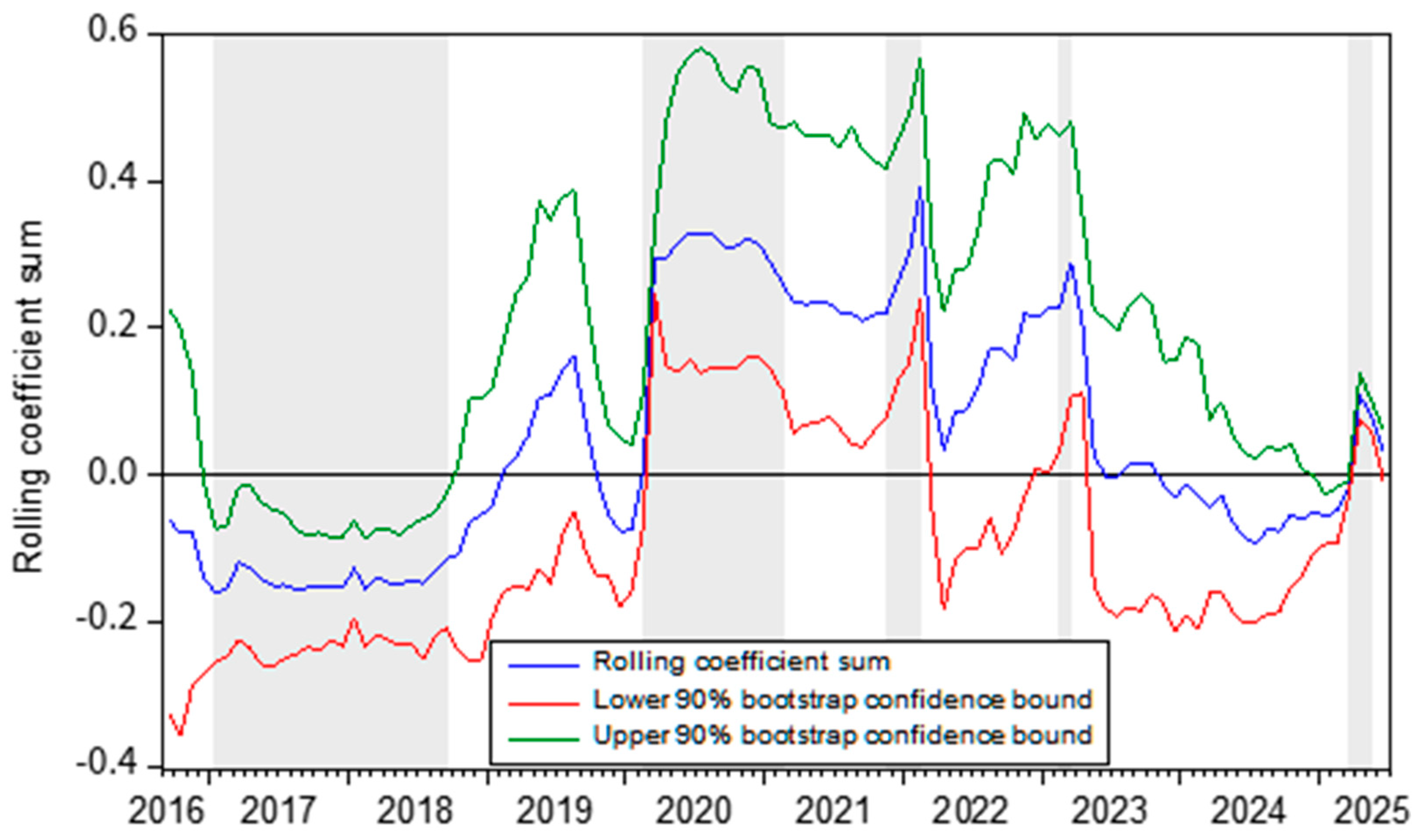
Figure 3,
Figure 4,
Figure 5 and
Figure 6 report, respectively, the rolling bootstrap
-values and the rolling sums of coefficients for the two predictive directions between
and
.
The first direction examined is the effect of ESG market volatility on sustainability-related uncertainty. As shown in
Figure 3, the bootstrap
p-values from the rolling Granger-causal predictability tests indicate that the null hypothesis that
does not Granger-cause
is rejected only in specific sub-periods rather than over the entire sample. Statistically significant predictive effects emerge mainly around the end of 2019 and remain visible through much of 2020 and 2021, while later periods display only shorter and less persistent episodes of significance. This suggests that the full-sample evidence is not driven by a stable and permanent causal mechanism, but rather by a sequence of temporally localized episodes. This conclusion is reinforced by
Figure 4, which reports the bootstrap estimates of the sum of rolling-window coefficients. The cumulative effect is not constant over time. For a large part of the sample, the estimated effect remains weak and predominantly negative, indicating that higher ESG market volatility was associated with a limited adverse effect on sustainability-related uncertainty. Toward the end of the sample, however, the estimates become more volatile and temporarily turn positive, pointing to a shift in both the intensity and the direction of the relationship. Overall, the transmission from ESG market volatility to sustainability-related uncertainty is best characterized as intermittent, unstable and time-dependent, rather than uniformly persistent.
The reverse direction examines the effect of sustainability-related uncertainty on ESG market volatility. As reported in
Figure 5, the bootstrap
-values from the rolling Granger-causality tests show that the null hypothesis that
does not Granger-cause
is rejected only in certain sub-periods. The most evident episodes of statistical significance occur during 2016–2017, again from 2019 to 2021, and in a few short intervals near the end of the sample. In contrast, other periods, particularly parts of 2018, 2023 and 2024, show weaker or no significant predictive content. Hence, this direction also does not support the existence of a stable predictive effect over the full sample, but rather reveals an episodic pattern that becomes stronger during periods of heightened stress.
Further evidence is provided by
Figure 6, which presents the bootstrap estimates of the sum of rolling-window coefficients. In the earlier part of the sample, the estimated cumulative effect is mostly negative and relatively small. From late 2019 onward, however, the effect turns clearly positive and rises sharply, reaching its highest levels during 2020–2021. After that, the effect remains positive for some time but gradually weakens during 2022–2024, moving closer to zero and occasionally becoming slightly negative. These results indicate that the predictive content of sustainability-related uncertainty for ESG market volatility is likewise time-varying, unstable and concentrated in specific episodes, with the strongest predictive transmission occurring in periods of elevated uncertainty.
In conclusion, the baseline rolling-window results show that the uncertainty–volatility nexus in the global ESG market is not stable over time. Instead, the relationship strengthens during specific episodes, especially around the pandemic and subsequent repricing phases, and weakens or disappears in other periods. The evidence, therefore, refines the full-sample findings in two important ways. First, it shows that the significant full-sample predictive effect from to is driven by specific windows rather than by a uniform effect over the entire sample. Second, it reveals that the reverse direction, which is not significant in the full-sample test, becomes statistically relevant in several rolling sub-periods. The overall implication is that the interaction between sustainability-related uncertainty and ESG market volatility is episodic, regime-dependent and consistent with a time-varying predictive structure rather than a single constant relationship.
6.5. Robustness Checks
To assess whether the baseline findings are sensitive to key modeling choices, the analysis is complemented by several robustness checks. Detailed auxiliary results are reported in the Appendices, while the main text focuses on the implications for the baseline findings.
6.5.1. EGARCH-Based Monthly Volatility Proxy
The first robustness check concerns the construction of ESG market volatility. To examine whether the baseline predictability results are sensitive to the volatility extraction model, the main tests are repeated using an EGARCH-based monthly volatility proxy,
, constructed from daily MSCI ACWI ESG Leaders returns. This robustness exercise keeps the same uncertainty variable,
, the same sample period and the same VAR lag structure as in the baseline specification.
Appendix B (
Table A3) reports the comparison between the baseline GJR-GARCH specification and the alternative EGARCH specification.
Appendix B presents the rolling-window results obtained from the EGARCH-based volatility proxy (
Figure A1,
Figure A2,
Figure A3 and
Figure A4). The EGARCH specification confirms statistically significant asymmetric volatility dynamics, with a negative and significant asymmetry term indicating that negative return shocks generate stronger volatility responses than positive shocks of comparable magnitude. The insignificant ARCH-LM(10) statistic suggests that the model removes residual conditional heteroskedasticity, supporting its use as an alternative volatility proxy for robustness analysis.
Table 8 compares the baseline GJR-GARCH results with the EGARCH-based robustness results. The full-sample evidence remains qualitatively similar in one important respect: under both volatility constructions, the null hypothesis that
does not Granger-cause ESG volatility cannot be rejected. However, the reverse direction weakens under the EGARCH-based proxy. In the baseline GJR-GARCH specification,
contains significant Granger-causal predictive information for
at the 5% level. Under EGARCH, the same direction remains statistically relevant only at the 10% level. Thus, the full-sample evidence is partially robust, but the strength of the volatility-to-uncertainty linkage depends to some extent on the volatility proxy used.
The rolling-window evidence provides stronger qualitative consistency across volatility specifications. Under both GJR-GARCH and EGARCH, predictive linkages are not stable over the full sample but emerge episodically, especially around 2019–2021. The volatility direction again becomes relevant during early sample episodes and around the COVID-19/repricing period, while the volatility direction remains concentrated mainly around 2019–2021. The EGARCH-based results support the main interpretation of the baseline analysis: the uncertainty–volatility nexus is time-varying, episodic and regime-dependent rather than constant.
6.5.2. Alternative Rolling-Window Lengths
A second robustness check examines whether the baseline rolling-window findings depend on the selected 24-month window length. The rolling-window analysis is therefore repeated using one shorter window, 18 months, and one longer window, 36 months. The detailed rolling-window figures are reported in
Appendix C (
Figure A5,
Figure A6,
Figure A7,
Figure A8,
Figure A9,
Figure A10,
Figure A11 and
Figure A12), while the main text summarizes the implications for the baseline findings.
The results indicate that the main inference is not driven by the specific choice of the 24-month window. Under the 18-month specification, the null hypothesis that does not Granger-cause cannot be rejected , whereas the reverse direction remains statistically significant . The same conclusion holds under the 36-month specification: the uncertainty-to-volatility direction remains insignificant , while the volatility-to-uncertainty direction remains significant .
The rolling-window patterns reported in
Appendix C further support this interpretation. The shorter 18-month window produces a more locally responsive but more fragmented pattern, while the longer 36-month window smooths short-lived fluctuations and highlights more persistent episodes. Across both alternative window lengths, the evidence remains consistent with the baseline conclusion that the sustainability uncertainty–ESG volatility nexus is time-varying and regime-dependent rather than constant over the full sample.
6.5.3. Augmented VAR with Macro-Financial Controls
A third robustness check addresses omitted-variable concerns by augmenting the baseline bivariate bootstrap Granger causality framework with macro-financial controls introduced one at a time. Given the relatively short monthly sample, the control variables are added separately. This avoids overparameterizing the VAR system while still allowing the analysis to test whether the baseline bivariate predictability is absorbed by broader market stress, long-term interest-rate changes, or monetary policy conditions. Specifically, the analysis controls for global market stress using the monthly average VIX, for changes in long-term interest-rate conditions using the first difference in the U.S. 10-year Treasury yield, and for changes in monetary policy stance using the first difference in the effective federal funds rate. The transformation of the control variables follows the stationarity diagnostics reported in
Appendix A (
Table A1):
is used in levels, whereas
and
enter the augmented specifications in first differences.
Table 8 and
Appendix D (
Figure A13,
Figure A14,
Figure A15,
Figure A16,
Figure A17,
Figure A18,
Figure A19,
Figure A20,
Figure A21,
Figure A22,
Figure A23 and
Figure A24) report the detailed augmented VAR robustness results corresponding to the macro-financial control specifications. The uncertainty-to-volatility direction remains statistically insignificant across all control specifications, which is consistent with the baseline full-sample evidence. By contrast, the volatility-to-uncertainty direction becomes more sensitive to the inclusion of macro-financial controls. After controlling for
, the predictive linkage from
to
is no longer statistically significant
. When changes in long-term interest-rate conditions are controlled for using
, the same direction remains weakly significant at the 10% level
. When changes in monetary policy stance are controlled for using
, the volatility-to-uncertainty direction remains significant at the 5% level
.
These results indicate that the baseline full-sample evidence is only partially robust to macro-financial controls. The disappearance of statistical significance after controlling for VIX suggests that global market stress absorbs part of the predictive information previously attributed to ESG market volatility. This is economically plausible, since ESG equity volatility and sustainability-related uncertainty may both respond to broader risk-aversion episodes. However, the persistence of weak or moderate predictability after controlling for interest-rate and monetary policy variables suggests that the volatility-to-uncertainty linkage is not entirely reducible to rate conditions.
6.5.4. Alternative ESG Benchmark
A fourth robustness check replaces the baseline MSCI ACWI ESG Leaders volatility proxy with the monthly volatility of the MSCI Emerging Markets ESG Leaders Index. This benchmark is used to examine whether the baseline uncertainty–volatility nexus is specific to the global ESG benchmark or whether it also appears in emerging ESG markets, where information asymmetry, institutional frictions and market volatility may be more pronounced.
The results show that the uncertainty-to-volatility direction remains statistically insignificant when the emerging-market ESG benchmark is used . By contrast, the reverse direction from emerging-market ESG volatility to changes in sustainability-related uncertainty remains only weakly significant . Thus, the emerging-market benchmark broadly preserves the asymmetric structure observed in the baseline full-sample results, but the evidence is weaker than for the global ACWI benchmark. This suggests that the predictive linkage is partly benchmark-sensitive and that the volatility-to-uncertainty channel is more robust in the global ESG benchmark than in the emerging-market ESG benchmark.
The rolling-window evidence reported in
Appendix E (
Figure A25,
Figure A26,
Figure A27 and
Figure A28) further indicates that the emerging-market specification does not generate a stable predictive pattern over the full sample. Instead, the predictive linkages remain episodic and concentrated in specific subperiods, consistent with the broader interpretation that the sustainability uncertainty–ESG volatility nexus is time-varying rather than constant. The EM results therefore support the regime-dependent interpretation of the baseline findings, while also showing that the strength of the relationship varies across ESG benchmark definitions.
In conclusion, the robustness checks support the central conclusion that the sustainability uncertainty–ESG volatility nexus is time-varying and episodic. However, the evidence is not uniformly robust across all specifications. The strongest and most consistent result is the rejection of a stable, constant relationship; the exact strength of directional predictability varies with volatility construction, macro-financial conditioning, and benchmark definition.
6.6. Extended Analyses: Impulse Responses and Forecasting Performance
6.6.1. Impulse-Response and Variance-Decomposition Evidence
To provide additional evidence on the dynamic mechanisms suggested by the conceptual framework, the baseline bootstrap Granger causality analysis is complemented with generalized impulse-response functions and forecast-error variance decomposition based on the baseline VAR(1) specification. These additional analyses examine whether the dynamic responses of sustainability-related uncertainty and ESG market volatility are consistent with the proposed information-pricing and feedback channels.
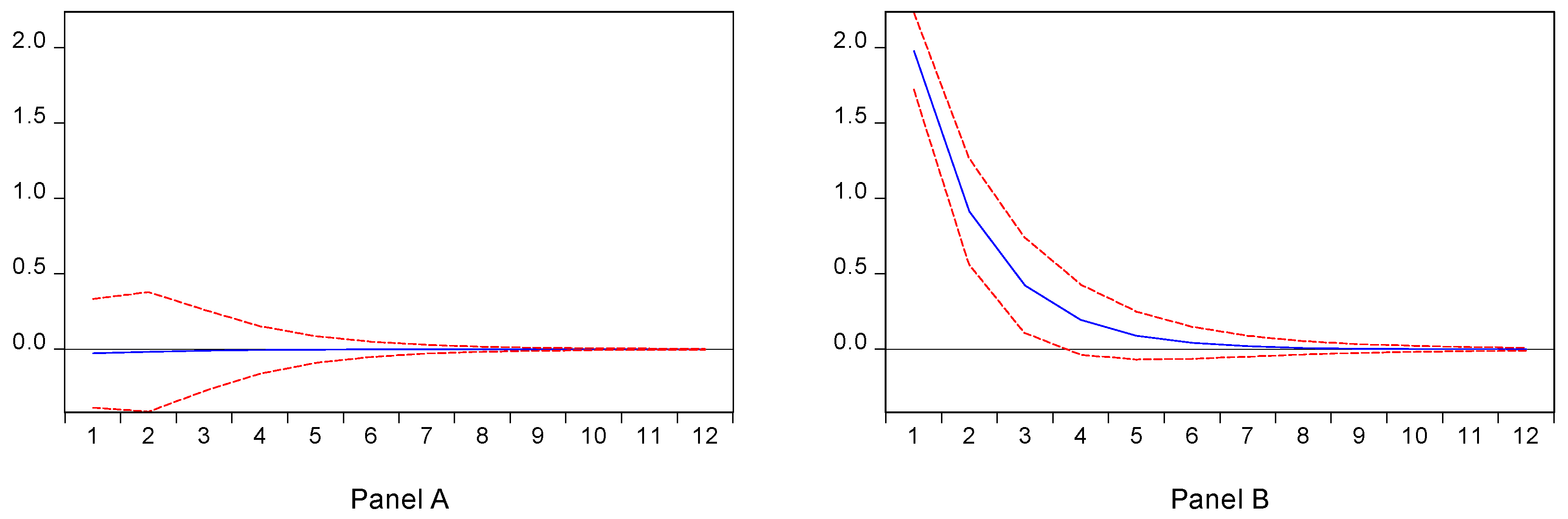
Figure 7 reports the generalized impulse-response functions for the baseline ACWI ESG volatility specification. The results indicate an asymmetric dynamic pattern. The response of ESG market volatility to a shock in sustainability-related uncertainty is weak and remains close to zero over the 12-month horizon. This suggests limited full-sample evidence for a stable information-to-pricing channel, whereby sustainability-related uncertainty is systematically incorporated into ESG market volatility. By contrast, the response of sustainability-related uncertainty to an ESG volatility shock is positive and stronger in the short run before gradually fading out. This pattern is consistent with the feedback interpretation suggested by the full-sample Granger causality results: ESG market turbulence appears to precede and help predict changes in sustainability-related uncertainty.
Table 9 reports the forecast-error variance decomposition for the same baseline VAR(1) specification. The results provide complementary evidence on the relative contribution of shocks to each variable. Changes in sustainability-related uncertainty are driven predominantly by their own innovations, although ESG market volatility shocks explain a small but non-negligible share of their forecast-error variance. Specifically, the contribution of ESG volatility shocks increases from 0% at the one-month horizon to approximately 2.3% after six to twelve months. By contrast, sustainability-related uncertainty shocks explain only a negligible share of ESG market volatility, remaining close to 0.02% across forecast horizons. This confirms the asymmetric nature of the full-sample evidence: the feedback channel from ESG market volatility to sustainability-related uncertainty is more visible than the direct uncertainty-to-volatility channel, although its economic magnitude remains limited.
6.6.2. Out-of-Sample Forecasting Performance
To assess whether the predictive linkages documented in the bootstrap Granger causality framework translate into practical forecasting usefulness, a recursive out-of-sample forecasting exercise is conducted over the 2020M01–2025M06 period. The initial estimation window covers 2014M09–2019M12. For changes in sustainability-related uncertainty, the benchmark model is an AR(1) specification, while the extended model additionally includes lagged ESG market volatility. For ESG market volatility, the benchmark model is an AR(1) specification, while the extended model additionally includes lagged changes in sustainability-related uncertainty. Forecasting performance is evaluated using RMSE, MAE and directional accuracy.
Table 10 reports the out-of-sample forecasting results. The extended specifications do not improve point forecast accuracy relative to the parsimonious AR(1) benchmarks. For
, adding lagged
increases RMSE from 2.985 to 3.037 and MAE from 1.976 to 1.984. However, directional accuracy improves from 59.09% to 62.12%, suggesting limited usefulness for anticipating the direction of changes in sustainability-related uncertainty, even though point forecast accuracy does not improve.
For , the inclusion of lagged worsens all forecasting metrics. RMSE increases from 2.5719 to 2.6179, MAE increases from 1.2657 to 1.2974, and directional accuracy decreases from 62.12% to 60.61%. Therefore, the out-of-sample evidence does not support the use of sustainability-related uncertainty as a superior forecasting input for ESG market volatility in the baseline ACWI specification.
The forecasting results support a cautious interpretation of the empirical framework. The extended models do not provide stronger point forecasts than simple AR(1) benchmarks. At most, they offer modest directional information for changes in sustainability-related uncertainty. Accordingly, the findings should be interpreted as useful for dynamic ESG risk monitoring and regime-dependent assessment rather than as evidence of operational forecasting superiority. This conclusion is consistent with the Granger causality, impulse-response and variance-decomposition evidence, which points to a more visible feedback channel from ESG market volatility to sustainability-related uncertainty than to a stable uncertainty-to-volatility forecasting channel.
6.7. Summary of Hypotheses and Empirical Evidence
To synthesize the empirical results,
Table 11 summarizes the evidence obtained for the three hypotheses developed in
Section 3. The table distinguishes between full-sample evidence, time-varying rolling-window evidence, and robustness or extended-analysis evidence. This distinction is important because the results show that the sustainability uncertainty–ESG volatility nexus is not adequately described by a single full-sample relationship.
The results provide the strongest support for H3. The parameter-stability tests and rolling-window results consistently show that the relationship between sustainability-related uncertainty and ESG market volatility is unstable over time. This confirms that full-sample results should be interpreted as average evidence rather than as a complete characterization of the uncertainty–volatility nexus.
The evidence for H1 and H2 is more asymmetric. H1 is not supported by the full-sample baseline test, but rolling-window results indicate that sustainability-related uncertainty contains predictive information for ESG market volatility during specific stress and repricing episodes. H2 receives stronger full-sample support, since ESG market volatility Granger-causes changes in sustainability-related uncertainty in the baseline specification. However, this evidence is also time-varying and becomes weaker once global market stress is controlled for. Thus, the feedback channel from ESG volatility to sustainability uncertainty is present, but should not be interpreted as a stable structural mechanism.
7. Discussion
The rolling-window evidence shows that the relationship between sustainability-related uncertainty and ESG market volatility is best understood as a time-varying and regime-dependent process, rather than as a stable causal linkage operating uniformly over the full sample. This interpretation follows directly from the empirical results. In both predictive directions, the rolling bootstrap
-values indicate that statistical significance appears only in selected subperiods, while the rolling sums of coefficients vary substantially in sign and magnitude over time. Accordingly, the baseline full-sample findings should be interpreted as average effects that mask considerable temporal heterogeneity, structural instability, and changes in the underlying transmission mechanism. This reading is consistent with the broader view in the sustainable finance literature that ESG markets are shaped by evolving information environments, institutional adaptation, disclosure changes, and shifting perceptions of materiality rather than by a fixed linear pricing structure [
64].
This interpretation also clarifies the meaning of the empirical evidence. The paper does not identify a permanent structural causal mechanism linking sustainability-related uncertainty and ESG market volatility. Instead, it identifies time-varying Granger-causal predictability, meaning that one variable contains predictive information for the other only during specific regimes.
For the direction from sustainability-related uncertainty to ESG market volatility
, the results are most consistent with an uncertainty-transmission and repricing mechanism. The rolling tests show that the strongest predictive episodes are concentrated especially between late 2019 and 2021, while the corresponding rolling coefficient sums become clearly positive during that interval. This suggests that increases in sustainability-related uncertainty were followed by higher ESG market volatility precisely when investors were required to process ambiguous or rapidly changing sustainability information. In theoretical terms, this pattern is compatible with an uncertainty-premium or disagreement channel, whereby ambiguity about climate policy, sustainability standards, transition trajectories, or ESG interpretation raises dispersion in expectations and amplifies volatility in ESG-oriented asset prices [
65,
66]. At the same time, the same channel is not continuously active across the sample. In earlier subperiods, particularly around 2016–2018, the estimated cumulative effect is weaker and at times negative, while after 2022 the positive effect gradually attenuates and moves back toward zero. This implies that sustainability-related uncertainty does not act as a uniformly destabilizing force, but instead becomes volatility-relevant mainly when the informational and institutional environment is under stress.
The reverse direction, from ESG market volatility to sustainability-related uncertainty
, appears weaker and less persistent, although it remains episodically significant. The rolling bootstrap evidence suggests that this feedback channel is concentrated mainly around the 2020–2021 interval and in a few additional shorter windows, whereas for much of the sample, the cumulative coefficient sums remain negative or close to zero. This indicates that episodes of market turbulence do not automatically translate into sustained increases in sustainability-related uncertainty. Instead, volatility shocks appear to generate only temporary and context-dependent feedback into the uncertainty process. Such a pattern is consistent with a feedback interpretation in which market stress triggers reassessment, clarification, or reinterpretation of sustainability narratives, but does not by itself produce a permanent upward drift in uncertainty [
67].
The timing of the most relevant episodes is also substantively meaningful. The stronger uncertainty-to-volatility transmission observed from late 2019 through 2021 is plausibly linked to a broader period of overlapping shocks and narrative reconfiguration in global financial markets. The COVID-19 disruption, the acceleration of sustainable finance regulation, and the intensification of debate over transition risk, green classification and implementation credibility likely increased the sensitivity of ESG asset prices to changes in sustainability-related uncertainty. In such an environment, uncertainty about sustainability narratives may have moved ahead of volatility because investors were repricing not only macroeconomic conditions, but also the meaning, comparability, and regulatory relevance of ESG information. This interpretation is aligned with recent evidence showing that crisis periods tend to strengthen connectedness and spillovers across ESG markets and related uncertainty channels [
2,
3]. It is also compatible with the argument that the development of sustainable finance depends crucially on evolving disclosure infrastructures and institutional standardization, which can reduce information asymmetries in the long run while temporarily increasing ambiguity during implementation phases [
64].
The post-2022 attenuation of the coefficient sums in both directions is equally informative. Rather than indicating the disappearance of the relationship, it suggests that the transmission mechanism weakened as markets partially absorbed the earlier uncertainty shock or adapted to the evolving sustainability reporting and classification environment. This dynamic fits the idea that regime dependence in ESG finance is shaped not only by the level of uncertainty itself, but also by the capacity of institutional changes to either amplify or absorb ambiguity. When new disclosure rules, taxonomies and reporting standards are introduced, they may initially raise uncertainty because market participants must interpret scope, credibility and implementation details. Over time, however, these same institutional developments can reduce informational frictions by improving comparability and standardization. The empirical pattern found here is consistent with such a transition from an earlier phase of elevated interpretive uncertainty to a later phase of partial market accommodation [
64].
The robustness checks support, but also qualify, this interpretation. The EGARCH-based volatility proxy preserves the main time-varying pattern, although it weakens the full-sample volatility-to-uncertainty result. The 18-month and 36-month rolling-window specifications confirm that the baseline evidence is not driven solely by the selected 24-month window. The augmented VAR results further show that macro-financial conditions matter: once global market stress is controlled for using the VIX, the full-sample volatility-to-uncertainty direction loses statistical significance. Thus, the baseline evidence should be interpreted as partially robust and macro-financially conditioned, not as proof of a stable structural mechanism.
The robustness analysis based on the MSCI Emerging Markets ESG Leaders Index strengthens the broader interpretation of the results. Although the exact timing and intensity of the predictive episodes differ from the baseline specification, the emerging-market benchmark leads to the same general conclusion that the uncertainty–volatility nexus is episodic, unstable and benchmark-sensitive in its local expression but robust in its overall time-varying character. In the direction
, significant episodes remain concentrated in selected windows, especially around 2019–2021, while the cumulative coefficients are negative or close to zero for much of the sample and become sharply positive only near the end. In the reverse direction
, the uncertainty-to-volatility channel is again present but intermittent, with the strongest positive cumulative effects concentrated around 2020–2021. This suggests that the instability observed in the baseline results is not an artifact of the ACWI ESG benchmark alone. Rather, it reflects a broader feature of ESG market dynamics, while the specific pattern of significance and intensity can vary across market structure, information frictions, and the institutional characteristics of the benchmark considered. This interpretation is consistent with recent research emphasizing that ESG connectedness, volatility spillovers, and information asymmetries can differ materially across regional and emerging-market settings [
3].
The findings have concrete implications for investors, portfolio managers, regulators, standard setters and ESG data providers. However, these implications should be framed in terms of dynamic monitoring rather than mechanical forecasting. The out-of-sample forecasting exercise shows that the extended models do not improve point forecast accuracy relative to simple AR(1) benchmarks. Therefore, the framework should not be used as a standalone forecasting tool. Its practical value lies in identifying periods when the uncertainty–volatility relationship becomes active and when ESG risk monitoring should be intensified.
For investors and portfolio managers, ESGUI can be used as a conditional risk-monitoring signal. It is unlikely to improve ESG volatility forecasts uniformly across all periods, but sharp increases in sustainability-related uncertainty may become informative during stress regimes, regulatory transitions, or market repricing episodes. In practice, ESGUI should be monitored together with ESG benchmark volatility, VIX, interest-rate changes, and major sustainability-policy events. When these indicators move jointly, portfolio managers may need to reassess ESG benchmark exposure, strengthen hedging strategies, or stress-test portfolios against sustainability-related news shocks.
For risk managers, the evidence supports rolling-window diagnostics, regime-dependent sensitivity analysis, and stress-period monitoring. Treating sustainability-related uncertainty as a permanently active destabilizing factor would lead to overreaction, while ignoring it entirely would miss important stress-regime signals. The useful approach is conditional: ESGUI matters most when market and regulatory conditions make sustainability information salient for pricing.
For regulators and policymakers, the results suggest that sustainability-related uncertainty is partly shaped by the clarity, timing and credibility of regulatory communication. New reporting standards, taxonomy rules and disclosure obligations may reduce uncertainty in the long run, but they can temporarily increase ambiguity during implementation if market participants face unclear scope, timing, enforcement, or data requirements. Clear implementation guidance, predictable timelines and consistent definitions can reduce the risk that sustainability regulation unintentionally amplifies market uncertainty.
For standard setters and ESG data providers, the findings underline the importance of comparability, transparency and interpretability. More ESG disclosure is not automatically better if it is inconsistent, difficult to compare, or weakly connected to financial risk relevance. Standard setters should prioritize comparable reporting structures, sector-specific materiality guidance, and clearer links between sustainability metrics and financial risk. ESG data providers and index constructors should also be transparent about index composition, screening rules, rebalancing procedures and regional exposure, because benchmark sensitivity shows that ESG volatility may partly reflect benchmark design rather than ESG risk alone.
The findings support a more general conceptual view of sustainable finance as an adaptive informational system [
9] in which sustainability narratives, market pricing and regulatory developments interact through changing feedback loops. Sustainability-related uncertainty is not merely background noise; under some regimes, it becomes a central driver of ESG market repricing. Conversely, ESG volatility is not a constant generator of new uncertainty, but it can feed back into the uncertainty environment when market stress prompts renewed contestation over sustainability interpretation, disclosure, or transition credibility. The principal implication is therefore both substantive and methodological. Substantively, the results point to a conditional and evolving uncertainty–volatility nexus. Methodologically, they show why full-sample inference alone is insufficient. Average coefficients conceal shifts in sign, bursts of predictive significance, and long periods in which the transmission mechanism is weak or dormant. The rolling-window bootstrap framework thus offers a more realistic representation of the dynamics linking sustainability-related uncertainty and ESG market volatility.
8. Conclusions
This paper investigated the dynamic relationship between sustainability-related uncertainty and ESG equity market volatility by combining the Global GDP-Weighted ESG-Based Sustainability Uncertainty Index (ESGUI) with the MSCI ACWI ESG Leaders Index in the baseline analysis and the MSCI Emerging Markets ESG Leaders Index in the robustness analysis. Methodologically, the study integrated model-based volatility estimation, full-sample bootstrap Granger causality testing, parameter-stability diagnostics, and rolling-window bootstrap analysis. This framework made it possible to move beyond average full-sample inference and examine whether the predictive relationship between sustainability-related uncertainty and ESG market volatility remains stable over time.
The results show that the full-sample relationship is asymmetric on average, but also that this average effect is not stable across the sample period. Once parameter instability and rolling dynamics are taken into account, significant predictive episodes emerge in both directions, with substantial changes in sign and magnitude across subperiods. In the baseline specification, the uncertainty-to-volatility predictive channel becomes especially relevant during stress episodes, particularly around 2019–2021, when increases in sustainability-related uncertainty are followed by higher ESG market volatility. The reverse direction, from ESG market volatility to sustainability-related uncertainty, is also present, but appears weaker, more intermittent, and less persistent over time. The central empirical message is therefore that the nexus between sustainability-related uncertainty and ESG market volatility is regime-dependent, episodic, and structurally unstable over time.
The robustness checks qualify this conclusion in important ways. The EGARCH-based volatility proxy preserves the broader time-varying interpretation, although it weakens the full-sample volatility-to-uncertainty evidence. Alternative 18-month and 36-month rolling windows confirm that the main results are not driven solely by the baseline 24-month window. The emerging-market ESG benchmark also supports the broader conclusion that the nexus is episodic and benchmark-sensitive, although the timing and intensity of predictive episodes differ from the global ACWI benchmark. The augmented VAR results further show that macro-financial conditions matter: once global market stress is controlled for using the VIX, the full-sample volatility-to-uncertainty direction loses statistical significance, while the relationship remains more visible under interest-rate and monetary policy controls. Thus, the findings should be interpreted as evidence of partial robustness and conditional Granger-causal predictability, not as proof of a stable structural causal mechanism.
The extended analyses provide additional support for this interpretation. Generalized impulse-response functions and forecast-error variance decomposition indicate that the feedback from ESG market volatility to sustainability-related uncertainty is more visible than the direct uncertainty-to-volatility channel in the full-sample VAR, although the economic magnitude remains limited. The out-of-sample forecasting exercise also supports a cautious interpretation. The extended models do not improve point forecast accuracy relative to simple AR(1) benchmarks, although they provide some limited directional information for changes in sustainability-related uncertainty. Therefore, the practical value of the framework lies less in mechanical forecasting and more in dynamic monitoring of ESG risk regimes.
These findings have several implications. For investors and portfolio managers, the results suggest that ESG market volatility cannot be fully understood without accounting for changes in sustainability-related uncertainty, disclosure reforms, regulatory redesign and transition-related expectations. At the same time, the evidence cautions against treating sustainability-related uncertainty as a uniformly destabilizing force, since its effects vary across regimes and may weaken, reverse, or disappear outside stress periods. Risk management, hedging, and portfolio-allocation strategies in ESG markets should therefore be designed in a dynamic rather than constant-parameter framework. For regulators and standard setters, the findings underline the importance of clarity, consistency and coordination in sustainability reporting, taxonomy design, and implementation sequencing. Regulatory transitions may generate short-run ambiguity even when their long-run purpose is to improve transparency and comparability. A practical implication is that the communication and staging of sustainability-related reforms matter for financial market stability, because poorly synchronized rule changes may unintentionally intensify uncertainty during periods of market fragility.
This study is nevertheless subject to several limitations. First, the empirical design is intentionally parsimonious and focuses on a bivariate uncertainty–volatility setting, with macro-financial variables introduced only as robustness controls. This helps isolate directional predictability, but it does not capture the full set of macro-financial, geopolitical, regulatory, and policy factors that may jointly affect ESG markets. Second, ESGUI is a narrative-based uncertainty proxy and captures reported sustainability-related uncertainty rather than latent uncertainty itself; its dynamics may therefore reflect reporting intensity, institutional attention and possible reporting lags. Third, ESG market volatility is constructed from broad ESG equity benchmarks and remains partly model-dependent, even though the GJR-GARCH and EGARCH diagnostics support the adequacy of the extracted volatility measures. Fourth, the analysis does not distinguish across sectors, regions, investment styles, or other sustainable asset classes such as green bonds or climate-transition indices. Finally, the rolling-window and Granger causality framework identifies local predictive content and temporal precedence, not structural causality. The modest forecasting results further indicate that the contribution of the paper lies in dynamic ESG risk monitoring and regime-dependent interpretation, rather than in providing a standalone forecasting tool.
Future research could extend this framework in several directions. A natural next step would be to estimate multivariate systems that explicitly incorporate macroeconomic uncertainty, geopolitical shocks, energy-market variables, monetary policy conditions and regulatory announcements alongside sustainability-related uncertainty and ESG volatility. Further work could also examine alternative ESG asset segments, including regional ESG equity indices, sectoral decompositions, green bonds and broader sustainable-investment vehicles, in order to determine whether the regime-dependent patterns documented here vary across market segments. Finally, structural identification strategies could help distinguish more clearly between regulatory, market-driven, and geopolitical sources of sustainability-related uncertainty. Such extensions would contribute to a deeper understanding of how uncertainty propagates through the evolving architecture of sustainable finance and how ESG markets absorb, amplify, or neutralize those shocks over time.