1. Introduction
Nearly every decade has witnessed substantial evolution in mobile communication technology [
1]. Although current fifth-generation (5G) network technology has been widely adopted, it fails to meet emerging demands such as the proliferation of Internet of Things (IoT) devices, ultra-precise control, and immersive content [
2,
3]. To bridge these gaps, 6G technology extends 5G capabilities while meeting new technical requirements. This includes extending features such as immersive communication, massive communication, and hyper-reliable low-latency communication (HRLLC), as well as introducing novel concepts including integrated sensing and communication (ISAC), integrated artificial intelligence (AI) and communication (IAAC), and ubiquitous connectivity (UC) [
4,
5]. With terabit-level communication speeds, ultra-low latency, precise positioning, and AI-native architectures, 6G is expected to enable advanced use cases such as intelligent mobility, digital twins, smart healthcare, and real-time extended reality (XR) services [
6,
7].
Ongoing 6G research across standardization bodies, industry consortia, and academia has produced technology white papers [
8,
9,
10] and prompted studies addressing use cases [
6,
11], business opportunities [
12], and ecosystem evolution [
13]. Nevertheless, most of these studies have relied on qualitative approaches rather than structured quantitative analyses of the technical elements of individual use cases and their interdependencies [
7,
14]. Moreover, existing classification methods based on industry sectors or functions have failed to capture the convergence and overlap inherent in 6G use cases [
11]. These limitations have constrained the prioritization of technical development and the design of integrated 6G services.
To address these shortcomings, this study presents a comprehensive review and synthesis of 6G use cases reported in key domestic and international literature. Specifically, we consolidate diverse sources into 21 representative use cases and evaluate them against six core technical requirements using a Delphi-based expert assessment. We then propose a prism-shaped three-dimensional (3D) visualization method based on a 3D analytical structure wherein multiple dimensions are represented along orthogonal axes, thereby enabling the simultaneous visualization of interdependencies and overlaps among factors.
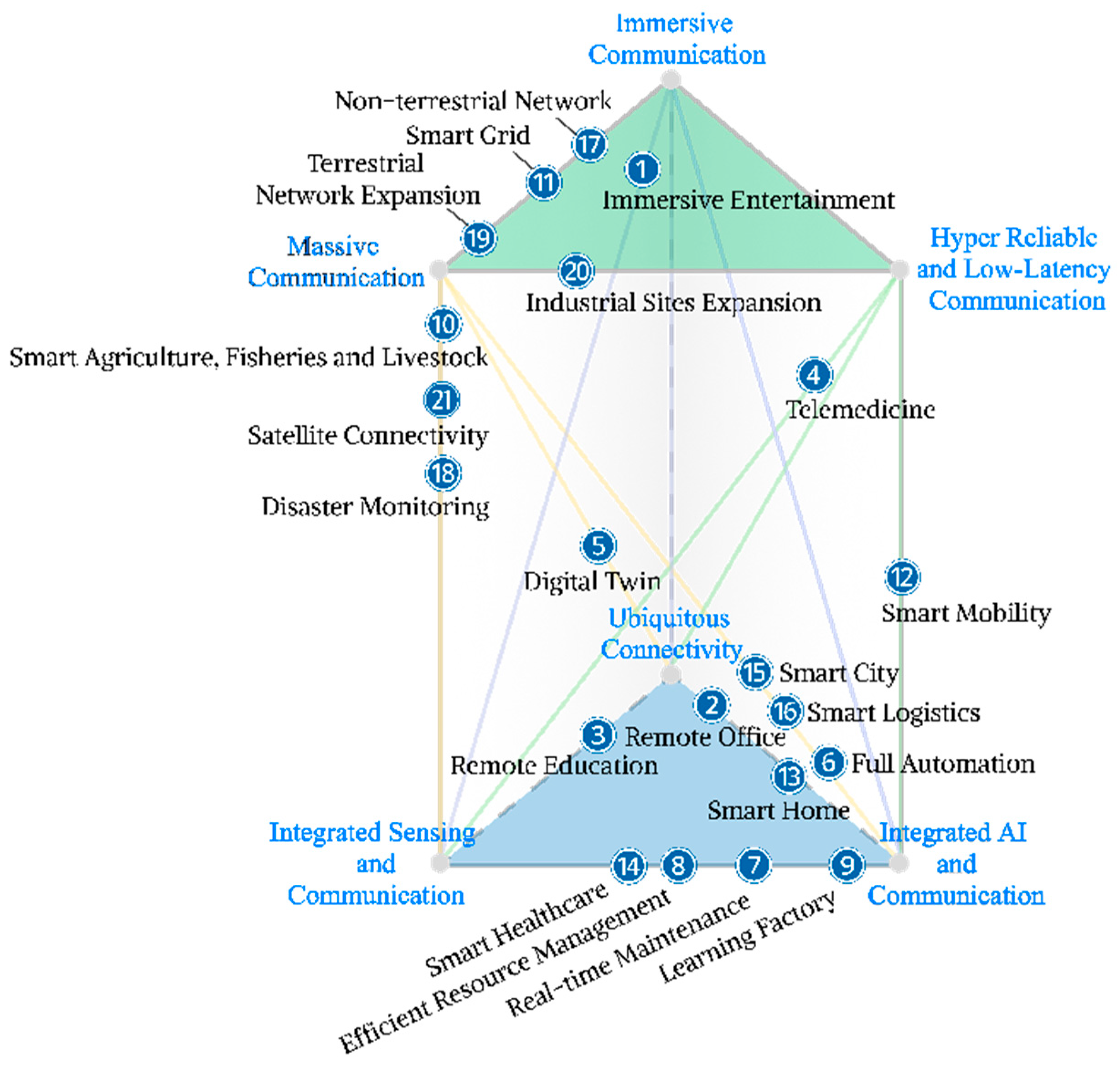
The conventional visualization approach proposed by the International Telecommunication Union Radiocommunication Sector (ITU-R), namely the hexagon-based “Wheel diagram” of the IMT-2030 framework, illustrates the overall structure of six core capabilities, specifically immersive communication, massive communication, HRLLC, ISAC, IAAC, and UC, arranged on a single plane. However, this 2D representation has a fundamental limitation because it cannot clearly capture the continuity and interdependencies among these functional dimensions. To address this limitation, the present study proposes a prism-based visualization structure that depicts the hierarchical and interconnected relationships among the six 6G technical requirements in 3D form. Specifically, this prism pairs the three existing capabilities (immersive communication, massive communication, and HRLLC) with the three emerging capabilities (ISAC, IAAC, and UC) using its two opposing triangular planes. Here, the upper plane represents extensions of 5G functions, namely enhanced mobile broadband (eMBB), ultra-reliable low-latency communication (URLLC), and massive machine-type communication (mMTC), and the lower plane represents newly introduced 6G functionalities. This configuration enables the visualization of continuity, scalability, and complementarity among technologies, which is difficult to realize using a 2D format, thereby providing a more comprehensive and differentiated perspective on the structural relationships within the 6G framework.
Overall, this framework enables the reclassification of use cases according to their primary and secondary technical requirements, thereby revealing their interdependencies in a structured and intuitive manner. In this context, this study represents one of the earliest review-based analyses to derive actionable insights from systematic 6G use case mapping by integrating both technical and service perspectives. Here, interdependencies are defined as structural relationships wherein a single use case simultaneously depends on multiple technical requirements. In other words, a given use case cannot be realized through a single technology but instead requires the combined fulfillment of multiple technical requirements. From this perspective, the prism-based visualization illustrates overlapping and shared structures among technical requirements, as well as the specific combinations of technologies that underpin each use case.
Beyond technical classification, this study further introduces a multidimensional criteria framework that considers data transmission mode, decision-making mode, interaction type, device characteristics, user type, and personalization level. This framework enables a more comprehensive understanding of the social, behavioral, and industrial contexts of 6G applications, thereby extending the analysis beyond purely technical factors. Consequently, the resulting 6G use case mapping prism and multidimensional criteria classification aim to guide user-centric service design, strategic technology planning, and policy formulation.
In summary, this study makes three primary contributions. First, it presents a comprehensive review and integration of 6G use cases from authoritative sources, thereby resulting in a consolidated dataset for analysis. Second, it applies structured technical mapping using a Delphi-based evaluation, thereby classifying use cases according to primary and secondary technical requirements and visualizing them through a prism-based framework. Third, it proposes a service-oriented, multidimensional criteria-based classification that incorporates nontechnical dimensions such as user behavior and industrial context. Collectively, these contributions provide actionable insights for user-centric service design, strategic technology planning, and policy formulation in the early stages of 6G development.
The remainder of this paper is structured as follows.
Section 2 first presents a review of the literature and then describes the methodology used to collect and refine 6G use cases.
Section 3 then presents the results of the prism-based mapping and multidimensional service classification.
Section 4 subsequently discusses implications for government policy and industry. Finally,
Section 5 presents concluding remarks and outlines future research directions.
2. Sixth-Generation Use Case Analysis
2.1. Use Case Analysis
Use case analysis is a powerful tool for capturing the functional requirements of a system [
15]. Specifically, it defines how a system operates and how users interact with it. Accordingly, this methodology plays a critical role during technical system design as it clarifies functional requirements and outlines scenarios that satisfy them [
16]. In this process, it identifies sequences of interactions aimed at achieving specific system goals while accounting for potential variables throughout the process.
In the context of next-generation communication networks, use case analysis has emerged as a key exploratory tool for understanding and clarifying system vision from the user perspective [
17]. Many studies have used use case analysis to derive user requirements and identify necessary new functionalities. These studies have provided insights into how evolving user needs can be addressed to guide the development of next-generation networks that overcome the limitations of previous technologies and systems. Consequently, use case analysis plays a vital role in forecasting 6G applications and identifying the technical innovations required to support them.
Because 6G communication technologies are still under development, no definitive guidelines have been set for their technical requirements and use cases [
18]. Accordingly, in this study, we collect and synthesize previously published 6G use cases from the literature and offer an integrated view of potential 6G applications based on these data.
2.2. Collection of 6G Use Case Scenarios
We gathered 6G use case scenarios from major domestic and international institutions, along with relevant academic literature on this topic [
6,
11,
17,
18,
19]. The identified use cases were categorized from several perspectives, including 6G core drivers, technical requirements, and industry types (
Table 1).
Among these, the 6G core drivers comprise four categories proposed by the Next Generation Mobile Networks Alliance within the Third Generation Partnership Project (3GPP) framework, outlining the directional goals that 6G is expected to achieve from the perspectives of human, machine, service, and network development.
Use cases categorized under enhanced human communication involve immersive experiences, telepresence, and multimodal interactions, thereby highlighting their potential to improve human communication. Meanwhile, enhanced machine communication reflects the increasing use of collaborative robots and autonomous systems, need for environmental sensing, and requirement for seamless communication between humans and machines. Further, enabling services include use cases related to positioning, mapping, smart healthcare, and manufacturing. These scenarios focus on delivering and managing services based on purpose-specific data, thereby enhancing the functional capabilities of both users and systems. Finally, network evolution encompasses advancements in core technologies, including AI-driven services, energy efficiency, and ubiquitous network coverage.
With regard to the second perspective, 6G has advanced and extended the three core technical requirements of 5G, namely eMBB, mMTC, and URLLC, into immersive communication, massive communication, and HRLLC [
20]. This shift reflects not merely a continuation of technical capabilities but a substantial enhancement in performance and application scope. For instance, eMBB evolves into immersive communication to support XR and holographic services, whereas URLLC extends to scenarios requiring higher reliability and ultra-low latency, such as remote surgery and fully autonomous driving. Similarly, mMTC evolves to meet the demands of more complex connectivity, such as large-scale dense sensor networks. In addition to the three technical requirements described above, three new technical requirements are introduced: UC, ISAC, and IAAC. These requirements reflect service scenarios and functionalities not previously considered in 5G, thereby representing an expansion of technical expectations.
Specifically, these requirements are classified into six categories, namely immersive communication, ISAC, massive communication, IAAC, HRLLC, and UC, each defined as follows:
Immersive communication provides rich and interactive immersive experiences as an extension of eMBB, addressing scenarios such as holographic communication for remote collaboration and education, alongside remote healthcare and telesurgery. ISAC integrates sensing and communication functions, covering scenarios such as object detection and tracking, motion monitoring, and environmental monitoring. Massive communication extends mMTC to support large-scale device connectivity, covering applications such as IoT implementations in industrial automation and monitoring, smart cities and infrastructure, and intelligent manufacturing and logistics. IAAC enables native integration between AI and communication, supporting applications such as autonomous collaboration among connected AI robots in smart cities or factories and the automation of large-scale computational tasks across devices and networks. HRLLC extends URLLC to cover scenarios such as automation in precision manufacturing environments, remote surgery, and smart healthcare through remote diagnostics. Finally, UC addresses IoT network deployment in smart cities and environmental monitoring, as well as network coverage for underserved or remote areas.
Finally, the third perspective 6G industry types is categorized into five domains based on industrial characteristics, namely machinery industry, automotive industry, warehousing and logistics industry, healthcare industry, and media industry.
Among these, the machinery industry includes applications of wireless communication technologies in manufacturing environments. Within this domain, it covers scenarios such as wireless communication for transmitting product data; wireless video transmission to support on-site operations; and remote control of mobile robots, such as automated guided vehicles (AGVs). Similarly, the automotive industry supports mobility-as-a-service platforms to enable efficient accessibility and mobility. It also includes scenarios that enable collaboration between smart cities and connected vehicles. The warehousing and logistics industry addresses scenarios focused on transitioning toward eco-friendly logistics through structural reform, developing sustainable logistics networks, and achieving seamless digital transformation in logistics operations. Meanwhile, the healthcare industry includes scenarios such as brain–machine interfaces, personalized medicine, remote surgery using robotic systems, and minimally invasive surgical procedures using microrobotic technologies. Finally, the media industry includes scenarios that support virtual environments and holographic communication, aiming to enhance personalization and customization for more efficient content delivery.
2.3. Detailed Use Case by Technical Requirement
A review of the literature revealed that many institutions and researchers classify 6G use cases based on six key technical requirements, namely immersive communication, massive communication, HRLLC, ISAC, IAAC, and UC (
Table 2).
Accordingly, the six technical requirements adopted in this study are not merely derived from the existing literature but are grounded in official frameworks established through international 6G standardization efforts. In particular, both the ITU-R IMT-2030 framework and technical white papers from the 3GPP identify six core capabilities, namely immersive communication, massive communication, HRLLC, ISAC, IAAC, and UC, as the fundamental pillars of 6G technology. Furthermore, major academic studies structure 6G technologies around these six dimensions, indicating that they represent a consensus-based taxonomy shared across international standardization and industrial research communities.
This technical classification framework has been adopted in several studies, leading to the proposition of use cases that reflect industry-specific characteristics. For instance, scenarios such as smart factories, autonomous vehicles, robotics, and remote surgery reflect not only technical requirements but also the diversity of application domains and their industrial impact. This observation indicates that 6G technology provides the infrastructure required to support a wide range of current and future industries.
However, individual use cases cannot be implemented using a single technological component [
21]. For instance, hologram-based remote collaboration requires the combined operation of immersive communication for high-speed data transmission, HRLLC to minimize response delays, and massive communication to support high-density device connectivity. In other words, 6G use cases rely on the integration of multiple complementary technological elements.
Therefore, to effectively structure and interpret 6G use cases, a new approach is required to visualize relationships among technological components in a multidimensional manner, enabling integrated analysis. Accordingly, the next section presents a prism-based reconstruction of 6G use cases centered on the six core technical requirements, along with an analytical framework that enables visual understanding of the interconnections among these technologies.
3. Prism Map of 6G Use Cases
3.1. Classification Based on Technical Requirements
In this study, we performed a structured reclassification and visual depiction of diverse 6G use cases based on the key technical requirements. Specifically, this process involved three systematic steps: literature collection and organization, evaluation based on technical requirements, and structural visualization.
First, major domestic and international publications and institutional reports were reviewed [
6,
11,
17,
18,
19], and 65 use cases were extracted. Because the description and classification of use cases differed across sources, they were consolidated based on functional similarities and application purposes. For instance, use cases such as “remote diagnosis” and “medical services via tactile internet” were grouped under “telemedicine,” whereas cases including “optimized supply chain through logistics digital transformation” and “cargo transport/sorting/loading optimization” were categorized as “smart logistics.” Consequently, 21 representative use cases were finalized through this integration process. This synthesis was based on the major 6G-related publications presented in
Table 1, from which repeatedly cited use cases were consolidated without duplication. Finally, representative use cases were selected based on three criteria. First, only use cases with clearly defined technical relevance to the six core 6G requirements were included. Second, use cases sharing similar purposes or functions were merged based on functional similarity (for example, “remote diagnosis” and “medical services via tactile internet” were integrated into the category of telemedicine). Third, use cases that appeared exclusively in a single document or organizational report and lacked reproducibility were excluded. Through this process, 21 representative use cases were selected from the initial pool of 65 use cases.
Subsequently, the relationship between each refined use case and the six core 6G technical requirements was determined through a three-round Delphi-based expert evaluation. The expert panel included six members selected according to explicit criteria: (i) a minimum of 10 years of professional experience in wireless communications, AI, or technology management; (ii) active involvement in 6G-related research, standardization, or product development; and (iii) balanced institutional representation across academia (two professors), government-affiliated research institutes (two senior researchers), and industry (two practitioners from telecommunications and AI sectors). In Round 1, the research team developed an initial mapping of use cases to technical requirements. In Round 2, each expert independently scored the relevance of each technical requirement for each use case using a five-point Likert scale (1 = not relevant, 5 = critically important). Consensus was monitored using the interquartile range (IQR), and any item with IQR > 1.0 was flagged for further deliberation [
22]. In Round 3, all experts convened in a structured workshop to discuss flagged items and reach consensus; meanwhile, items with IQR ≤ 1.0 were accepted without further discussion. Notably, this IQR threshold reflects established Delphi methodology practices, wherein IQR ≤ 1.0 on a five-point scale is widely accepted as indicating sufficient inter-rater agreement [
22,
23]. To further assess the internal consistency of expert ratings across the 21 use case–requirement pairs, Cronbach’s alpha (α) was computed for the Round 2 scores. The resulting α = 0.83 indicated good inter-rater reliability, thereby satisfying the commonly applied threshold of α ≥ 0.70 [
24]. The coefficient of variation across items ranged from 8.2% to 23.6%, with a mean of 14.7%, thereby confirming acceptable homogeneity in expert judgments for items that achieved consensus without a third-round workshop. Finally, the resulting primary and secondary technical requirement assignments were organized into a mapping table (
Table 3) to highlight the areas of application and interconnections among the technical requirements.
Thereafter, each use case was mapped within the spatial domain of the prism according to its relative priority, as determined by the primary and secondary technical requirements assigned through the Delphi process, thereby highlighting the interrelationships among these requirements; the results were visualized using the prism structure depicted in
Figure 1. Here, the triangular prism (T-prism) was selected over alternative 3D geometries for three structural reasons. First, the six core 6G requirements decompose into two triads (three 5G-inherited capabilities on the upper face and three 6G-native capabilities on the lower face), which makes the T-prism the simplest 3D structure capable of representing both triads simultaneously as parallel planes connected by lateral edges. In contrast, cubes and spheres impose equal hierarchical weight across all dimensions and therefore cannot highlight the evolutionary layering between existing and emerging capabilities [
21]. Second, the ternary prism has a precedent in multidimensional data visualization: In 2019, Nagata et al. showed that a T-prism provides a coordinate-transformation-based 3D space that supports simultaneous inspection from multiple viewing angles while preserving relational distances between components that 2D projections inevitably distort [
25]. Third, the rectangular lateral faces of the prism encode the vertical correspondence between each inherited 5G capability and its 6G counterpart (e.g., eMBB—immersive communication, mMTC—massive communication), thereby representing a hierarchical relationship that cannot be conveyed by radar charts or parallel coordinate plots without additional visual encoding. Overall, the T-prism illustrates the distribution and interconnections of key use cases along each technical axis, thereby enabling interpretation of the complexity and relative importance of these 6G technical characteristics. Notably, the current placement of use cases within the prism is based on expert-assigned priority rankings rather than on computed geometric coordinates. In future research, we will develop a quantitative coordinate-mapping model that converts Likert-scale scores into 3D coordinates based on the T-prism transformation framework [
25], thereby enabling reproducible algorithm-based positioning and mathematical comparison of use case profiles within this prism space.
The results of the Delphi evaluation indicated that IAAC and massive communication were the most critical technical requirements in the 6G environment. Across the 21 use cases, IAAC exhibited the highest mean Likert score among the six dimensions (mean = 4.31, SD = 0.47) and was identified as a primary or secondary requirement in 14 of the 21 use cases (67%). Massive communication followed closely (mean = 4.18, SD = 0.52) and was associated with 13 of the 21 use cases (62%). In contrast, immersive communication (mean = 3.62, SD = 0.71) and ISAC (mean = 3.58, SD = 0.68) were associated with fewer use cases, reflecting domain-specific rather than cross-cutting roles. These differences in scores were statistically confirmed: a one-way analysis of variance across the six dimensions yielded F = 14.3 (
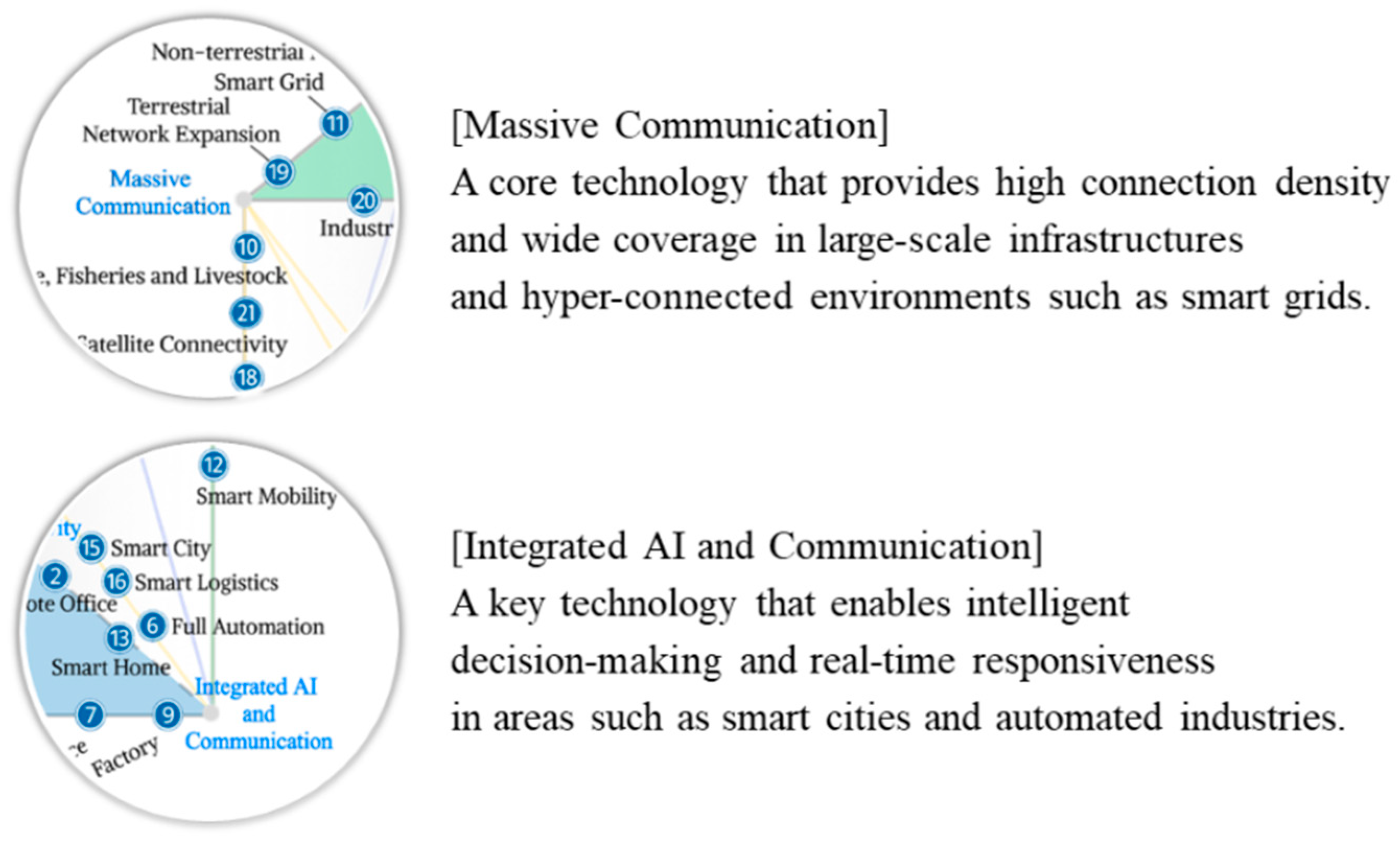
p < 0.001), indicating that the observed variation in mean importance scores across requirements was not attributable to random judgment variance. These results suggest that while massive communication (a core component of 5G) continues to play a key role, IAAC represents the most distinctively important new requirement in the 6G context (
Figure 2). In particular, massive communication functions as a core infrastructure technology supporting large-scale connectivity and data transmission demands in ultra-connected environments involving IoT devices, sensors, and wearables. Meanwhile, IAAC constitutes a critical technical requirement of the 6G environment, encompassing paradigms not realized in 5G, including intelligent network operation, autonomous quality of service (QoS) management, and network optimization through user behavior prediction. Overall, the integration of AI-based decision-making across network design and operation enhances the feasibility of AI-driven networks with automated key functions such as resource allocation, traffic management, and fault response.
Massive communication and IAAC are not merely abstract technical constructs but are identified as central components in practical 6G application scenarios. Specifically, our findings revealed that massive communication was a core technical requirement in ultra-connected infrastructure expansion scenarios, including non-terrestrial networks (e.g., satellite connectivity), terrestrial network expansion, industrial sites, and smart agriculture, fisheries, and livestock. In particular, maintaining stable, real-time data flow in energy networks such as smart grids requires the high connection density and wide coverage provided by massive communication.
Additionally, IAAC is essential in scenarios involving intelligent decision-making and autonomous operations, including smart cities, smart logistics, full automation, learning factories, real-time maintenance, and smart homes. These domains require not only data connectivity but also a context-aware, adaptive network infrastructure capable of recognizing user and service environments and responding in real time to dynamic changes. Such capabilities are enabled through AI-integrated communication infrastructure.
These findings suggest that future 6G technology development must extend beyond improvements in transmission performance and support both large-scale connectivity and AI-driven intelligence. Furthermore, IAAC and massive communication can be employed as complementary components in the design of core 6G service scenarios.
3.2. Classification Based on Multidimensional Criteria
To systematically assess the diversity and complexity of the 6G use cases, classification was performed based on the following criteria. First, data transmission mode was categorized according to the time sensitivity of data delivery and QoS requirements into hard real-time, soft real-time, non-real-time, and hybrid types [
26]. For instance, decision-making use cases involving the operation of moving vehicles in real time were classified as hard real-time, whereas use cases involving the connection and tracking of consumer mobile devices, wherein slight delays did not lead to critical issues, were classified as soft real-time. Overall, this classification established the basis for network resource allocation and technical design.
Second, decision-making mode was classified according to the timing at which the system processed data and made decisions into real-time, periodic, one-time, and hybrid types [
23]. For instance, drone-based autonomous power line inspection, requiring real-time obstacle avoidance, status analysis, and environmental response, was classified as real-time, whereas use cases involving periodic monitoring of production line conditions using IoT devices and sensors were classified as periodic. Overall, this classification enabled the consideration of diverse scenarios, ranging from ultra-low-latency requirements to predictive policy design.
Third, communication flow was classified according to the directionality of information flow and the complexity of interaction into unidirectional, multidirectional, and hybrid types [
27]. For example, public safety alerts targeting large populations were classified as unidirectional, whereas use cases involving real-time data exchange among multiple vehicles, infrastructure components, and control systems were classified as multidirectional. Accordingly, each category involved distinct technical considerations, including bandwidth optimization, real-time synchronization, and flexible connectivity.
Fourth, communication and interaction type was categorized according to the communication subject and the nature of the interaction into human-to-human (H2H), human-to-machine (H2M), machine-to-machine (M2M), and device-to-device (D2D) types [
26,
28,
29]. For example, use cases wherein users exchanged data in real time while in motion were classified as H2H, whereas scenarios in which enterprise devices automatically transmitted data via satellite without human intervention were classified as M2M. This classification therefore covered diverse interaction demands, ranging from immersive services to fully automated systems.
Fifth, device type was classified according to the usage environment and functional purpose into personal devices, industrial devices, or hybrid devices, thereby enabling technical design focused on either user experience or industrial productivity [
27,
28]. Specifically, use cases involving devices that users could access at any time and location were classified as personal devices, whereas those relevant to equipment such as smart sensors and factory automation systems were classified as industrial devices.
Sixth, device deployment type was determined according to whether 6G technology operated on existing devices or required the introduction of new devices. For example, use cases that relied on existing mobile devices, such as smartphones or Global Positioning System units, for communication were classified as operation on existing devices, whereas those that required new hardware to enable immersive technologies (e.g., VR/AR devices) were classified as the introduction of new devices. This criterion offered support for developing commercialization strategies and examining user acceptance.
Seventh, the type of human activity innovation was classified according to the impact of the technology on human roles and activities into task replacement, task assistance, or new activity creation types [
30,
31]. For instance, cases wherein autonomous driving technologies and smart transportation systems replaced human activities, such as traffic management, were classified as task replacement, whereas scenarios involving new modes of transportation, such as air taxis and drones, were classified as new activity creation alongside the supporting network infrastructure. This classification therefore supported understanding of both technology adoption and its broader societal implications.
As an eighth criterion, user type was classified according to the service user into individual users, industrial users, and public users, thereby enabling service design tailored to diverse requirements [
30,
31]. Specifically, use cases that utilized 6G networks and services for business purposes were classified as industrial users, whereas those involving 6G applications for public safety, disaster relief, and related functions were classified as public users.
Finally, the level of personalization was categorized according to the degree to which services were tailored to users into personalized or generic types [
11,
32]. For instance, use cases involving personalized learning and educational experiences were classified as personalized, whereas public services that were applied uniformly to all users were classified as generic. This classification therefore constitutes a key factor in designing 6G user experiences and developing AI-driven network optimization strategies.
Table 4 presents representative examples of 6G use cases that were matched according to this classification strategy. Notably, while the classification based on technical requirements detailed in
Section 3.1 enabled clear prioritization, the classification strategy outlined in this section offered conceptual criteria incorporating social and behavioral characteristics. Overall, applying a perfect mutually exclusive, collectively exhaustive framework carries inherent limitations. Moreover, classifications such as user type or human activity vary with user context and tend to follow a continuous spectrum rather than discrete boundaries. Accordingly, rather than forcing all use cases into rigid categories, multidimensional use case matching was performed to comprehensively examine the scope and characteristics of the social and industrial scenarios that 6G may enable.
4. Implications for Government Policy
The findings of this study carry important policy implications for governments, industry leaders, and standardization bodies preparing for the 6G era. For instance, IAAC and massive communication were consistently rated as highly important in the expert workshop assessment, with many use cases clustering around these dimensions. Consequently, these dimensions emerged as central components in the prism visualization. This finding reflects a shared understanding that AI integration and the requirement for ultra-massive connectivity serve as foundational elements in the advancement of 6G technologies.
The prominence of IAAC therefore highlights the necessity of establishing AI-native autonomous networks capable of intelligent decision-making, real-time optimization, and adaptive service delivery. To realize this potential, policymakers should create an innovation ecosystem that encourages public–private partnerships; supports the development of AI-integrated communication standards; and promotes research and development (R&D) in AI chips, edge computing infrastructure, and AI governance frameworks. These measures should also be accompanied by initiatives that address ethical, privacy, and security concerns, thereby ensuring trust in AI-embedded communication systems.
Massive communication, in turn, necessitates the deployment of ultra-reliable, high-capacity network infrastructure capable of supporting the substantial data traffic volumes anticipated in applications such as XR, digital twins, autonomous driving, and smart cities. Addressing this requirement requires strategic policy measures, including investment in high-frequency spectrum utilization, development of terahertz-based communication technologies, and integration with satellite systems to enable seamless global coverage. In parallel, incentive mechanisms could be implemented to promote the adoption of large-scale IoT and machine-type communication systems across industrial sectors, thereby facilitating the transition toward fully connected environments.
Collectively, these technologies exhibit cross-sectoral relevance, with applications extending across healthcare, manufacturing, content production, education, logistics, and related industries. Consequently, policymakers should emphasize cross-industry convergence strategies, advance interoperable infrastructure, and develop targeted incentives for sectors with strong potential for early adoption of 6G-enabled services. Furthermore, economic objectives, including digital inclusion, sustainability, and workforce development, should be systematically incorporated into technology deployment strategies to ensure that 6G adoption advances broader societal goals. Finally, 6G policy formulation should align with international cooperation frameworks that support spectrum sharing, interoperability, and joint R&D while preserving regulatory agility to respond to the rapid evolution of related technologies.
The mapping results also offer concrete recommendations across three regulatory domains. First, in the domain of standards and spectrum policy, the prominence of IAAC (appearing in 67% of use cases) and massive communication (62%) suggests that governments should strategically align their IMT-2030 standardization contributions, including submissions to 3GPP Release 20 and Release 21 technical specifications, with the IAAC and massive communication capability pillars. From a spectrum standpoint, the massive communication use cases listed in
Table 3, spanning non-terrestrial networks, smart city environments, and industrial site extensions, necessitate broad-coverage, high-density spectrum that cannot be adequately supported by millimeter-wave bands alone. Consequently, regulatory bodies should proactively designate upper mid-band spectrum (7–24 GHz) as the primary coverage layer for 6G, consistent with the technical performance requirements defined under the ITU-R IMT-2030 framework [
21], and coordinate national spectrum strategies accordingly. Second, in the context of AI governance, the central role of IAAC in the mapping calls for governance frameworks specifically tailored to network-embedded AI, as distinct from general-purpose AI regulation. In this regard, the February 2024 Joint Statement by ten governments endorsing principles for 6G that is “secure, open, and resilient by design” establishes an international baseline. National policymakers should operationalize this baseline by developing sector-specific requirements for algorithmic transparency; data sovereignty; and liability allocation in AI-driven network operations, including autonomous QoS management and real-time traffic orchestration [
34]. Third, in the context of regulatory sandboxes, governments should implement controlled deployment environments within sectors exhibiting the highest technical centrality, as indicated in
Table 3, including healthcare (primary requirement: HRLLC), smart manufacturing (co-primary requirements: IAAC and ISAC), and smart city infrastructure (massive communication and UC). These sandbox frameworks facilitate controlled experimentation with 6G-enabled services under relaxed licensing conditions while producing empirical evidence on performance, safety, and economic returns; such evidence is currently lacking in the literature and would substantially reduce investment uncertainty for subsequent commercial deployment [
38].
An additional policy recommendation concerns the sequencing of public support across the use case portfolio identified in this study. The Delphi mapping reveals a natural structured differentiation of 6G use cases along two dimensions, namely technical readiness, reflected in Likert scores above or below the median (4.0), and deployment maturity, proxied by the presence of active pilot programs or existing 5G infrastructure. Use cases that scored above the median on both HRLLC and massive communication, including telemedicine, smart grid systems, disaster and emergency monitoring, and terrestrial network extension, exhibit clear social mandates and established operator ecosystems, which render them suitable for near-term incentive programs, such as targeted subsidies, mandated service-level commitments, and public procurement requirements that establish demand certainty. Use cases predominantly centered on IAAC, including full automation, smart logistics, and learning factory applications, necessitate substantial investment in AI infrastructure and cross-industry data-sharing frameworks before viable commercialization; accordingly, policy support here should prioritize enabling conditions, including open data initiatives, interoperability requirements, and R&D co-investment programs aligned with 3GPP Release 20 timelines. Meanwhile, immersive use cases, including immersive entertainment and remote education incorporating holographic components, are primarily constrained by device affordability and consumer adoption rather than network capability; consequently, policy should emphasize demand-side stimulation, including content ecosystem development, digital literacy initiatives, and targeted tax incentives for device manufacturers, rather than infrastructure subsidies, and should be sequenced to follow rather than precede the HRLLC and massive communication infrastructure build-out [
39,
40].
Beyond technical policy considerations, the use case mapping results of this study also carry direct implications for the economic and financial dimensions of 6G commercialization. As Oughton and Lehr [
35] demonstrated through a comprehensive techno-economic assessment of 5G, infrastructure investment requirements scale non-linearly with performance targets; for example, delivering a guaranteed speed of 100 Mbps per user requires four to five times the capital expenditure of a best-effort deployment. In the 6G context, where IAAC and massive communication emerge as the dominant technical requirements, this cost amplification is particularly pronounced. Specifically, AI-native network architectures require substantial investment in edge computing hardware, specialized AI chips, and AI governance frameworks, whereas massive communication use cases, spanning non-terrestrial networks, smart cities, and large-scale industrial IoT, necessitate dense deployment of terahertz-band base stations that incur high unit costs under limited-range propagation conditions [
39]. Policymakers should therefore prioritize use cases based on a dual criterion of technical centrality and economic readiness. Based on the mapping results in
Table 3, healthcare (e.g., remote surgery and telemedicine) and smart city infrastructure exhibit high technical centrality (primary requirements: HRLLC and massive communication, respectively) combined with relatively mature deployment ecosystems, which make them strong candidates for early-stage investment incentives and public–private partnership frameworks. By contrast, immersive entertainment and full automation use cases, although technically demanding, encounter greater market-readiness barriers owing to device cost, spectrum availability, and uncertainty in consumer adoption and may therefore warrant a later investment phase aligned with 3GPP Release 20 and subsequent releases [
37]. To translate the technical mapping presented in this study into actionable investment strategies, future research should extend the prism framework by incorporating a fourth dimension that captures economic feasibility scores, drawing on cost–benefit analysis, total cost of ownership modeling, and societal demand indicators, as recommended in the 5G/6G techno-economic literature [
39,
40]. Such an extension would transform the current technical roadmap into a comprehensive tool for assessing commercialization readiness.
5. Conclusions
This study compiled and synthesized 6G use cases from major domestic and international literature sources and evaluated them against six core technical requirements, namely immersive communication, massive communication, HRLLC, ISAC, IAAC, and UC, using a three-round Delphi expert evaluation with IQR-based consensus monitoring. Its key innovations are as follows: (1) a prism-based 3D visualization framework that captures structural interdependencies among the six technical requirements, which cannot be effectively represented using conventional two-dimensional diagrams; and (2) a nine-criterion multidimensional classification framework that incorporates social, behavioral, and industrial service contexts beyond purely technical dimensions. This framework generates industry-specific insights: in healthcare, HRLLC functions as the primary enabler for remote surgery and telemedicine, whereas IAAC supports intelligent diagnostics; in smart manufacturing, IAAC and ISAC operate as co-primary requirements for autonomous quality control and real-time sensing; in infrastructure domains, including smart cities and non-terrestrial networks, massive communication and UC establish baseline connectivity requirements. The proposed multidimensional classification further enables the identification of key technological applications, informs the development of cross-industry convergence strategies, and supports the design of user-oriented services across diverse industrial contexts.
Overall, this study advances the literature by introducing a replicable methodological framework that integrates structured technical requirement analysis with multidimensional service-context classification. The identification of IAAC and massive communication as dominant cross-use case requirements underscores the need for strategic R&D planning that concurrently addresses AI-native network intelligence and large-scale device connectivity. The prism framework therefore operates as a practical decision-support instrument for establishing phased technology roadmaps and guiding the allocation of R&D investment across the six technical dimensions.
This study also presents four principal limitations that define its future research agenda. First, the prioritization of technical requirements was based on qualitative expert judgment; although IQR-based consensus monitoring was applied, future research should further incorporate objective quantitative indicators, such as technology dependency scores, performance requirement weights, and scenario implementation difficulty coefficients, alongside formal reliability and validity analyses of expert scoring results to reduce subjectivity and improve reproducibility. Second, all 21 use cases were sourced from existing academic literature and institutional reports; accordingly, future iterations should integrate emerging use cases identified through 6G pilot projects, laboratory experiments, and forward-looking industry roadmaps to improve foresight. Third, the current prism placement was determined based on expert consensus rankings rather than computed coordinates; therefore, future research will establish a quantitative mapping model that translates Likert-scale scores into 3D prism coordinates, thereby enabling mathematical comparison and algorithmic positioning of use cases. Fourth, and most notably, this study focused exclusively on technical requirements and did not consider economic feasibility, market readiness, cost–benefit analysis, or societal demand, which constitute essential factors for practical 6G commercialization. Accordingly, integrating techno-economic dimensions into the prism framework represents the most impactful direction for future research, as it would convert the current technical mapping into a comprehensive tool for assessing 6G commercialization readiness.