1. Introduction
Human experience is increasingly mediated by complex interactive systems whose behavior unfolds over continuous time. In domains ranging from adaptive interfaces to autonomous robotics, interaction is rarely a sequence of isolated, predictable events. However, standard computational architectures often model these interactions transactionally: an agent observes a discrete state, computes an optimal policy, and executes an action based on predefined, rule-based logic. While highly effective for closed-loop, goal-oriented tasks, this reductionist approach becomes brittle when deployed in dynamically rich, open environments. When system objectives are plural or shifting, and when the temporal structure of the environment is the core phenomenon rather than a side-effect, discrete state representations fail to capture the continuous entanglement between the agent and its context. For complex systems, we argue that interaction must be re-conceptualized not as a discrete exchange (input → process → output), but as the maintenance of a continuous, coupled dynamical system.
This study builds on the design argument that complex interactive systems should shift from creating transactional interactions to organizing relational complexity [
1]. The use of the term ‘organization’ draws on Edgar Morin’s work on complexity, where organization is understood as a “continually generative and regenerative activity at all levels based on computation, strategic planning, communication, and dialogue.” [
2] (p. 128). This understanding resonates closely with agential realism [
3], where agency and meaning are enacted through relational configurations rather than located in isolated entities. Incorporating agential realism into the design of a complex system, from the choice of topology and dynamical regime to the configuration of feedback and memory, constitutes a way of shaping what kinds of relations, distinctions, and temporal continuities the system can enact.
We posit that the ‘organization’ of a complex agent emerges from its material configuration. Specifically, we show how the sedimented history of a system can function as the regenerative structure that Morin describes, allowing an agent to maintain its ontological integrity against the disruptive affective force of the environment. ‘Organizing relational complexity’ therefore implies designing an agent capable of sustaining relational rhythms which we define as the emergent, spatiotemporal interference patterns generated by the continuous friction between the immediate environmental forcing and the agent’s habitual momentum.
To empirically test these concepts, we introduce the
Affective Reservoir, an experimental computational architecture built upon a standard Echo State Network (ESN) [
4]. Rather than presenting a performance-driven machine learning model evaluated through predictive accuracy, we configure this architecture to embody interactional values such as temporal thickness, openness to emergence, and non-teleological agency. Grounded in the philosophy of agential realism [
3,
5,
6], this approach shifts the role of the reservoir from a passive, predictive black-box to an active material-discursive apparatus. We instantiate the architecture within a dynamically rich human-machine scenario (gameplay). We demonstrate how coherent, macro-scale behavioral rhythms emerge purely from the continuous, unscripted friction of a coupled agent–environment system, rather than from pre-trained reward optimization.
Research Question: How can we organize relational complexity within a reservoir architecture to sustain and transition between emergent Relational rhythms arising from the curated friction of an agent–environment coupling, rather than predefined mode logic or reward optimization?
The contribution of this paper is the methodological repurposing of a standard Echo State Network, shifting its function from a predictive machine learning model to a diffractive material-discursive apparatus. We break this down into four points:
We present the Affective Reservoir, a training-free architecture in which Relational rhythms are sustained and modulated through the continuous friction between the agent’s habitual momentum and contextual environmental forcing, demonstrating an alternative to goal-driven optimization.
We present a relational design framework for organizing relational complexity that operationalizes agential realism as a computational design orientation.
We propose a diffractive analysis method that uses high-dimensional reservoir dynamics and multi-scale clustering to map emergent regimes of intra-action rather than evaluating quantitative performance metrics.
We demonstrate the approach through a gameplay instantiation, showing how coherent, macro-scale regimes of interaction emerge within the agent’s internal state space without predefined rule-based switching.
The remainder of the paper is organized as follows:
Section 2 develops the conceptual framework (agential realism).
Section 3 presents the Affective Reservoir architecture.
Section 4 describes the experimental instantiation and analysis pipeline.
Section 5 reports on the emergent regime structure and generated dynamics, including a discussion.
Section 6 concludes and suggests further studies.
2. Background
Our work is situated at the intersection of nonlinear dynamics, complex systems theory, dynamic interactive systems, and neomaterialist philosophy. This study is part of a broader effort to pursue a non-Cartesian approach to computational design and complex interactive systems. Traditional computing traditions, including standard predictive machine learning, are heavily reliant on linear causality. In such frameworks, causality is treated as a direct state change transmitted from a cause (input) to an effect (output). Standard Echo State Networks (ESNs) typically operate within this paradigm: they function as inference machines that observe discrete inputs, calculate optimal policies, and minimize internal error to accurately reflect or predict an independent reality.
We draw on reservoir computing as a computational base, analyzed through the lens of agential realism, to elaborate a technical and theoretical framework for computational design.
2.1. Design Commitments and Computational Mechanisms
The Affective Reservoir bridges established computational methods in reservoir computing with a design-oriented theoretical framework grounded in agential realism. In doing so, we expand on the underexplored design practice of organizing relational complexity. We adopt a Morinian perspective, where interaction is defined by reciprocal relations. Morinian interaction implies that the internal dynamics of a system and the expression of a user do not merely exist in parallel but mutually constitute one another in a continuous recursive loop.
To ensure conceptual clarity within this complex entanglement, we explicitly distinguish between (i) the computational mechanisms that structure the dynamics of the system and (ii) the design concepts employed to interpret their role in interaction.
At the level of computational mechanism, the Affective Reservoir is based on a standard echo state network (ESN) with fixed recurrent connectivity, leaky integrator neurons, and near-critical reservoir dynamics. We rely on well-established properties of nonlinear dynamical systems: recurrent state propagation, fading memory, and the separation property [
7]. We do not claim novelty at the level of these underlying mathematical operations. Instead, our contribution lies in the design interpretation of these mechanics. We introduce concepts such as
re-membered inertia,
Affective Gradients, and
dynamical friction to articulate how the computational mechanisms can be operationalized as design constructs. These concepts provide a vocabulary for reasoning about how abstract mathematical qualities are enacted as affective reciprocal interaction.
2.2. Reservoir Computing
Reservoir computing (RC) is a research area that has been spun off from Recursive Neural Networks (RNNs) [
8,
9]. RC has established itself as a highly effective framework for processing complex temporal and sequential data, offering a computationally efficient alternative to RNNs. By restricting training solely to the output layer, RC avoids the vanishing gradient problem [
10] and significantly reduces computational cost while maintaining high performance. The approach first gained prominence through the seminal work of Jaeger and Haas [
4], who demonstrated that Echo State Networks (ESNs) could predict chaotic time series, specifically the Mackey-Glass system, with an accuracy orders of magnitude higher than established benchmarks. Since then, RC has been successfully applied to a diverse range of domains. In signal processing, Verstraeten et al. [
11] unified various RC approaches and showed their efficacy in speech and handwriting recognition tasks. Pathak et al. [
12] extended these capabilities to high-dimensional problems, successfully using reservoir computing for model-free prediction of large spatiotemporally chaotic systems, such as fluid dynamics and weather models. Furthermore, the robust nature of the reservoir concept has led to the emergence of Physical reservoir computing. As reviewed by Tanaka et al. [
13], this field utilizes physical substrates, ranging from optical systems to soft robotics, as the reservoir itself, enabling high-speed and low-energy information processing suitable for edge computing and real-time embedded applications.
Our central concern though is not prediction or how agents compute optimal actions, but how patterns of resonance (rhythms) emerge within systems whose dynamics are themselves evolving. Based on the analysis in the paper, we argue for a material-discursive design practice that attends to the enactment of these emergent rhythms.
2.3. Relation to Prior Work
Our approach aligns with the tradition of Enactive AI and dynamical systems theory in cognitive science. Varela et al. [
14] argued that cognition is not the processing of pre-given information but the enaction of a world through embodied action. From this perspective, an agent does not passively reflect an independent environment, but brings a meaningful world into existence through its structural coupling. Froese and Ziemke [
15] further clarify this by distinguishing between behavioral and constitutive autonomy. They argue that traditional robotics often simulates agency through behavioral rules, but true enaction requires a system to be “precarious”, meaning it must actively generate the conditions for its own persistence to avoid disintegration. Similarly, Beer [
16] demonstrated how minimally cognitive behavior can emerge from the coupled dynamics of a continuous-time recurrent neural network (CTRNN) and its environment, without requiring explicit internal representations. The Affective Reservoir is related to this lineage.
The dynamical perspective also relates to Artificial life-research regarding attractor landscapes [
17]. From that perspective, an agent’s history is not stored as discrete data but is encoded as the topology of the state space itself. Stable behaviors correspond to basins of attraction, while adaptation requires maintaining dynamics near the “edge of chaos” [
18], a phase transition where the system balances the order required for memory with the fluidity required for change.
We extend this dynamical foundation by framing the reservoir through the lens of agential realism, using it as a diffractive apparatus to investigate the material-discursive enactment of Relational rhythms.
2.4. Agential Realism
Karen Barad’s framework of Agential realism [
6] proposes a fundamental shift in how we understand reality and agency. Originating from the intersection of quantum physics and technoscience studies, the framework is a critique of Cartesian metaphysics. In an agential reality, the primary ontological unit is not an independent object that a subject externally can observe. The primary ontological unit is instead phenomena itself as the dynamic relationality from which subjects and objects emerge. In this view, agency is not an attribute possessed by an independent entity, such as a human or a machine, but an enactment of iterative reconfigurations in the world.
To rigorously implement this within computational design, we must first deconstruct the metaphysical assumptions underlying conventional computer science. We must move from a representationalist epistemology, where computational models are seen as passive reflections of an independent reality, to a performative ontology. With this shift, a model ceases to be a neutral tool and becomes a material-discursive apparatus that actively participates in the creation of phenomena. This distinction is crucial for understanding the architecture presented here. Standard agentic systems, such as traditional AI and ML, function as inference machines. They operate on the logic of reflection. Their job is to hold a mirror up to nature and to reflect it as accurately as possible based on the assumption that there is a static ground truth ‘out there’.
In contrast, the Affective Reservoir is configured as an interference machine. It operates on the logic of diffraction. In physics, interference occurs when waves overlap to create a new pattern. Within such an apparatus, the goal is not to copy the input, but to map where the ‘waves’ of the input, the system’s material configuration, and the observer’s intent overlap. The result is not a static representation of the input. The result is a dynamic reconfiguration of the entanglement between them.
2.4.1. Intra-Action
In traditional systems theory, the “system”, the “observer”, and the “environment” are treated as separate entities with inherent properties that exist prior to their interactions. Karen Barad’s agential realism [
3] challenges this through the concept of intra-action. Unlike interaction, which presupposes pre-existing entities, intra-action implies that the entities are constituted and acquire their boundaries and properties through their relationship. Agential realism implies that agency is not a property possessed by humans alone; it is an enactment that emerges from material-discursive arrangements. From this perspective, causality is not a linear transaction, but a specific materialization of the world resulting from “agential cuts” (temporal contextual reconfigurations) [
5,
6].
In the context of RC, this represents a paradigm shift. First, the input signal is not an external “thing” that is fed into the reservoir. In systems with feedback or active sensing, the signal is a consequence of the previous state of the reservoir and its material configuration. Second, the untrained network (the reservoir) has no inherent computational capability in itself. Its capacity as a “memory” or “transformer” arises only in the intra-action with a specific input signal and a specific readout mechanism. Lastly, the primary ontological unit is not the neuron or the weight, but the phenomenon; the specific material arrangement (apparatus) that produces intelligibility.
2.4.2. Agential Cuts
One of the most central concepts for agential realism is the agential cut. This refers to the demarcation that separates the “object” (that which is measured/calculated) from the “subject/apparatus” (that which measures). In classical physics, this limit is assumed to be given (Cartesian res cogitans and res extensa). In quantum mechanics and Barad’s extension, this limit is a enactment enforced by the measuring apparatus itself.
From this perspective, a computational system is not merely a passive processor of inputs but an active participant in the production of phenomena. The choice of sensors, state representations, update rules, and readout mechanisms constitutes the conditions for what agential realism terms an agential cut: a boundary-making practice that temporarily stabilizes what is enacted as object (the measured) and apparatus (the measuring). Crucially, these configurations are not neutral. They define what differences are allowed to matter and what is rendered irrelevant or invisible. This is not only an analytical abstraction. It has real-world consequences as shown in [
19,
20,
21].
For the design and implementation of a computing system such as a predictive AI-model (e.g., for weather forecasting or robot control), this means that the choice of which nodes are “visible” (readout nodes), which are “hidden”, and what the topology (connections) look like are not neutral technical choices. They are material-discursive practices that enact a specific version of reality.
For models of human–agent intra-action, this implies that behavior should not be understood as the execution of a policy over a predefined state space. Instead, behavior emerges as a phenomenon produced by the ongoing reconfiguration of relations among agent, system, and measurement. This shifts the design question from “What action should the agent choose?” to “What relational dynamics should the system be capable of sustaining?”
2.4.3. Re-Membering
A key limitation of many computational approaches to interaction lies in their treatment of time. Temporal progression is often modeled as a linear sequence of discrete steps, where the past influences the present only through explicitly stored state variables, and the future is treated as a space of predicted outcomes. Such representations are poorly suited to systems in which history persists as a dynamic structure rather than as a static record.
Barad’s re-membering (with the hyphen) is crucial here. Re-membering is:
not a process of recollection, of the reproduction of what was, … Rather, it is a matter of re-membering, of tracing entanglements, responding to yearnings for connection, materialized into fields of longing/belonging. [
22] (pp. 406–407).
A temporal structure is thus not a strict reproduction of the past, but a re-configuration of past material traces into present configurations. Re-membering is the process by which the past is not recalled but actively reconnected and reshaped in the present. The past does not disappear; it persists as an active influence that is continuously reconfigured through ongoing dynamics. This view aligns with non-linear dynamical systems in which feedback loops, delayed effects, and critical regimes give rise to history-dependent behavior [
18,
23]. Re-membering emphasizes not only technical recurrence but also the epistemic consequences of temporal entanglement. What appears as stability or change is inseparable from how the system is probed, parameterized, and interpreted. The temporal structure is thus not merely simulated; it is enacted through the computational setup.
2.5. Methodological Consequences of the Framework
As we shift toward Enactive AI, and further toward an Agential realist framework, the fundamental purpose of the computational architecture changes. Under agential realism, causality is not a linear transaction but an enactment of a specific materialization of the world resulting from agential cuts. When we look toward non-causal or intraactive computing architectures, we are looking for systems that allow cause, effect, subject, and object to be continually and temporarily co-constituted.
To clarify our scientific and methodological contribution, we map how the same underlying mechanisms of an ESN are conceptualized across different computational approaches.
Table 1 synthesizes the background literature of standard RC and Enactive AI to contrast them against our agential realist design orientation. This conceptual reframing is not merely a post-hoc application of philosophical metaphors; it fundamentally alters the methodological design decisions and evaluation criteria of the architecture.
In a standard ESN, hyperparameters like the spectral radius () are tuned to maximize predictive accuracy or memory capacity. In the Affective Reservoir, we tune specifically to set the Temporal Thickness of the system’s ‘now.’ Methodologically, the goal is not to find an optimal prediction rate, but to empirically locate the specific edge of chaos where the system’s regenerative capacity allows the past to persist just long enough to create meaningful spatiotemporal friction with the present.
Traditional RC systems evaluate performance based on how quickly they converge on a target state, treating internal state divergence as an error to be minimized. In our analytical framework, this divergence (Dynamical Friction) is the interaction itself. Instead of using a loss function to train away the divergence, our methodology uses it as the primary metric to map and visualize the intensity of the ongoing agent–environment co-constitution.
Traditional computational agents are driven by explicit reward functions or target states that define success teleologically. In contrast, our framework replaces the concept of a ‘goal’ with a ‘yearning’. This aligns with Karen Barad’s description of lightning, which does not possess an explicit goal of striking the ground but whose trajectory emerges as a yearning from a situated tension; a differential in charge seeking resolution [
22]. Methodologically, a yearning is not a programmed instruction, but a situated tension emerging from the interference between the agent’s habitual momentum and its immediate situational forcing. Consequently, the reservoir’s dynamics become processual rather than teleological; its state transitions do not attempt to minimize distance to a predefined future, but rather act to continuously navigate the spatiotemporal friction of the present moment.
2.6. Ontological Claims
It is important to clarify the status of the claims made in this study. Agential realism is not a hypothesis that is to be proven. Just as standard computing often assumes Cartesian reality, agential realism is adopted here as the ontological baseline and foundational design perspective. The Affective Reservoir is analyzed as a realization of specific concepts from agential realism. Concepts like the ‘agential cut’ are used as interpretive translations to bridge the gap between philosophical theory and algorithmic implementation. Consequently, the reservoir dynamics should be understood as an enactment of a specific design hypothesis inspired by agential realism. Our goal is to assess the utility of this framework for organizing relational complexity. We have tried to maintain an epistemic modesty regarding the underlying nature of computation itself.
In the following section, we show how these ontological commitments can be instantiated in a concrete computational architecture.
3. The Architecture of the Affective Reservoir
The Affective Reservoir is a computational architecture configured to enable agents to handle non-linear spatio-temporal dynamics; it is based on agential realism. Its purpose is not to solve a predefined task or to approximate an optimal policy, but to generate temporally extended patterns of behavior that emerge from the agent’s ongoing engagement with its environment. The architecture implies a move away from static predictive models toward dynamic responsive systems. In this section, we describe the architecture at a conceptual level, independent of any specific experimental instantiation.
For the Affective Reservoir to support emergent agency rather than reactive behavior, its internal dynamics must occupy edge of chaos, the critical regime between order and instability. While often discussed in technical terms with respect to the spectral radius , its importance here is ontological. If the reservoir dynamics are overly stable, the internal activity quickly collapses toward fixed-point attractors. In such a regime, the system behaves as a reactive filter; Dynamical Friction is minimized because the system complies immediately with its inputs. Conversely, if the dynamics are chaotic, small perturbations amplify uncontrollably, dissolving the coherence required for re-membered inertia.
Operating at the edge of chaos enables a third mode. In this regime, the dynamics of the reservoir remains sensitive to affective forcing while preserving inertial structure over time. Past reconfigurations persist as active influences that interfere with present dynamics. From an agential realist perspective, this critical regime is where intra-action becomes computationally possible. It allows the reservoir to function as a material-discursive apparatus in which the past is re-membered rather than stored, and where future tendencies emerge based on a situated tension. The edge of chaos thus provides the temporal ‘thickness’ required, where each moment is shaped by multiple overlapping histories without collapsing into determinism.
The architecture is organized around three interacting mechanisms:
- 1.
Re-membered Inertia, which constitutes the agent’s material memory not as passive storage, but as an active trajectory that resists immediate deviation, stabilizing the agent’s temporal continuity.
- 2.
Affective Gradients, which replace fixed objectives with dynamic fields of anticipatory tension. Arising from the immediate input projection, these gradients act as a situational forcing, directing the agent not toward a static goal, but establishing a vector of attraction that challenges the agent’s habitual trajectory.
- 3.
Dynamical Friction, which serves as a measure of situated tension. Emerging from the spatiotemporal interference between the agents’ habitual momentum (Re-membered Inertia) and the immediate situational forcing (Affective Gradients). This friction quantifies the intensity of the differential strain placed on the agent.
Using these terms, we now redefine Relational rhythms as the emergent, spatiotemporal interference patterns generated by the Dynamical Friction between the immediate environmental forcing (Affective Gradients) and the agents’s habitual momentum (Re-membered Inertia).
The Affective Reservoir is a 200-dimensional echo state network (ESN) at its core [
4]. An ESN consists of a large, fixed, sparsely connected recurrent neural network (the reservoir) that is excited by an input signal. Jaeger’s original work [
8], provided the mathematical conditions for ESP: if the spectral radius
of the reservoir matrix W is less than 1 (
), the system will converge. But this does not mean that a higher value of
will not converge. A higher value is desired since
controls the system’s temporal memory, with higher values enabling longer memory. Typically, one wants a reservoir to operate at the “edge of chaos” [
18]. This means that the echoes in the reservoir will last as long as possible without risking chaotic instability.
To control the timescale of these dynamics and introduce a specific degree of habitual momentum, we implement the reservoir nodes as leaky integrators. The equation looks like this:
where
is the reservoir state,
is the input signal,
and
are weight matrices for autonomous dynamics and input projection, and
is the leak rate.
In our framework, we reinterpret these terms through the lens of agential realism. The term represents the system’s inertia. It corresponds to the active resistance of an accumulated momentum against an immediate deviation. The second term represents the immediate affective force exerted by the system’s sensed environment and its recurrence couplings. The leak rate ensures that the distant past gradually dissolves, creating a temporality where recent tensions dominate, but a deeper history still actively shapes the present. The input weight matrix was generated with an input scaling of 0.2. This scaling factor calibrates the absolute intensity of the Affective Gradients, dictating how forcefully the immediate situational context (u) is allowed to intervene against the system’s Re-membered Inertia (x).
We decouple the reservoir’s feedback dynamics. The Re-membered Inertia (
) is driven solely by the recurrent weight matrix
W and the reservoir’s history. This represents the ‘habitual’ trajectory if left undisturbed. This is then compared to the actual realized state (
), which is driven by the immediate forcing of the Affective Gradients. The divergence between these two trajectories quantifies a Dynamical Friction (
) as the interference between the agent’s habitual momentum and the immediate situational forcing. Again, drawing on Barad’s discussion of lightning [
22], this friction can be described as a yearning; a physical embodied state of anticipation; an indeterminacy reaching out for determination. Just as a lightning bolt’s ‘stepped leader’ erratically feels its way through a field of electromagnetic possibilities before the strike connects, the reservoir is in a constant state of tension.
Table 2 summarizes how standard parameters are re-framed not as hyperparameters to be optimized, but as design handles that shape the texture of the
material-discursive apparatus. The distinction is complementary, the computational dynamics provide the material affordances, while the design interpretation guides how these dynamics are configured to sustain meaningful regimes of agent–environment intra-action.
We re-conceptualize the input projection as Affective Gradients. Drawing directly on our Morinian perspective, we define this not as a one-way transaction but as a reciprocal relation. An agent and its environment do not exist as isolated entities, but mutually constitute one another through continuous recursive loops. Within the reservoir, this is manifested as a situational forcing that intervenes against the system’s re-membered inertia. This relationship is bidirectional. In the Affective Reservoir, the inputs are not unilateral signals from a static world; they are dynamically enacted by the agent’s own behavior. This creates a situational coupling where the sensing agent and the sensed environment are continuously co-constituted.
To capture the autonomous drive of the system () alongside its leaky integration, we rely on the concept of Re-membered Inertia. This inertia is not merely a static structural bias or a passive memory bank. In a reservoir operating near edge of chaos, the recurrent state vector carries a deep temporal history, creating a ‘thick now’. This produces a behavioral tendency that is independent of the current sensory input (), but deeply dependent on the specific history of intra-actions that preceded it. Therefore, the recurrent state propagation () represents the mechanism by which the sedimented history of the agent is projected through its structural topology. It is the momentum of the past that actively asserts itself in the present.
The recurrence-couplings loops signals back as echoes in the reservoir. For proper functioning, as shown in Yildiz et al. [
25], the echo state property (ESP) is crucial for an ESN. The ESP guarantees that the effect of initial conditions vanishes asymptotically. In other words, the system “forgets” its arbitrary initialization and becomes input-driven. However, this forgetting is simultaneously a process of sedimentation. As the arbitrary starting point fades, the reservoir becomes a re-membering machine. It holds a sedimented history of past intra-actions. Here, the recurrent dynamics (
) act as the echoing structure that governs this sedimentation. The resulting state is therefore not merely a passive reflection of an input history, but an active reverberation where the Re-membered Inertia and the Affective Gradients continuously interfere. The ‘echo’ is thus a diffractive pattern shaped as much by the reservoir’s internal habitual momentum as by the surrounding context.
In the Affective Reservoir, the past is diffracted into the present. Each time step is not a discrete point on a linear timeline but a ‘thick now’ where past trajectories and future tendencies are entangled. In reference to Barad, the ‘now’ is ‘thick’ because it holds the weight of the past (Re-membered Inertia) and the situational forcing of the present (Affective Gradients) simultaneously, creating Dynamical Friction. Recent events leave traces, interfering with ongoing events to produce complex spatiotemporal interference patterns. The history of the system is not a passive data log from which events can be read back. Rather, ‘the past’ exists as a re-configuring dynamic in the present. Parameters such as the leak rate () and the spectral radius () are not just technical settings for stability; they are constitutive constraints that shape the texture of this temporal diffraction. By modulating Re-membered Inertia (tuning the ‘depth’ of the now) these parameters configure the reservoir as a material-discursive apparatus, defining the boundaries within which the agent can re-member its past and engage with its present.
In the next section, we describe how this general architecture is instantiated in an experimental system, and how its dynamics are analyzed to reveal emergent regimes of intra-action.
4. Materials and Methods
The material for empirically testing the arguments in this paper is inspired by the findings from a recent study reported in [
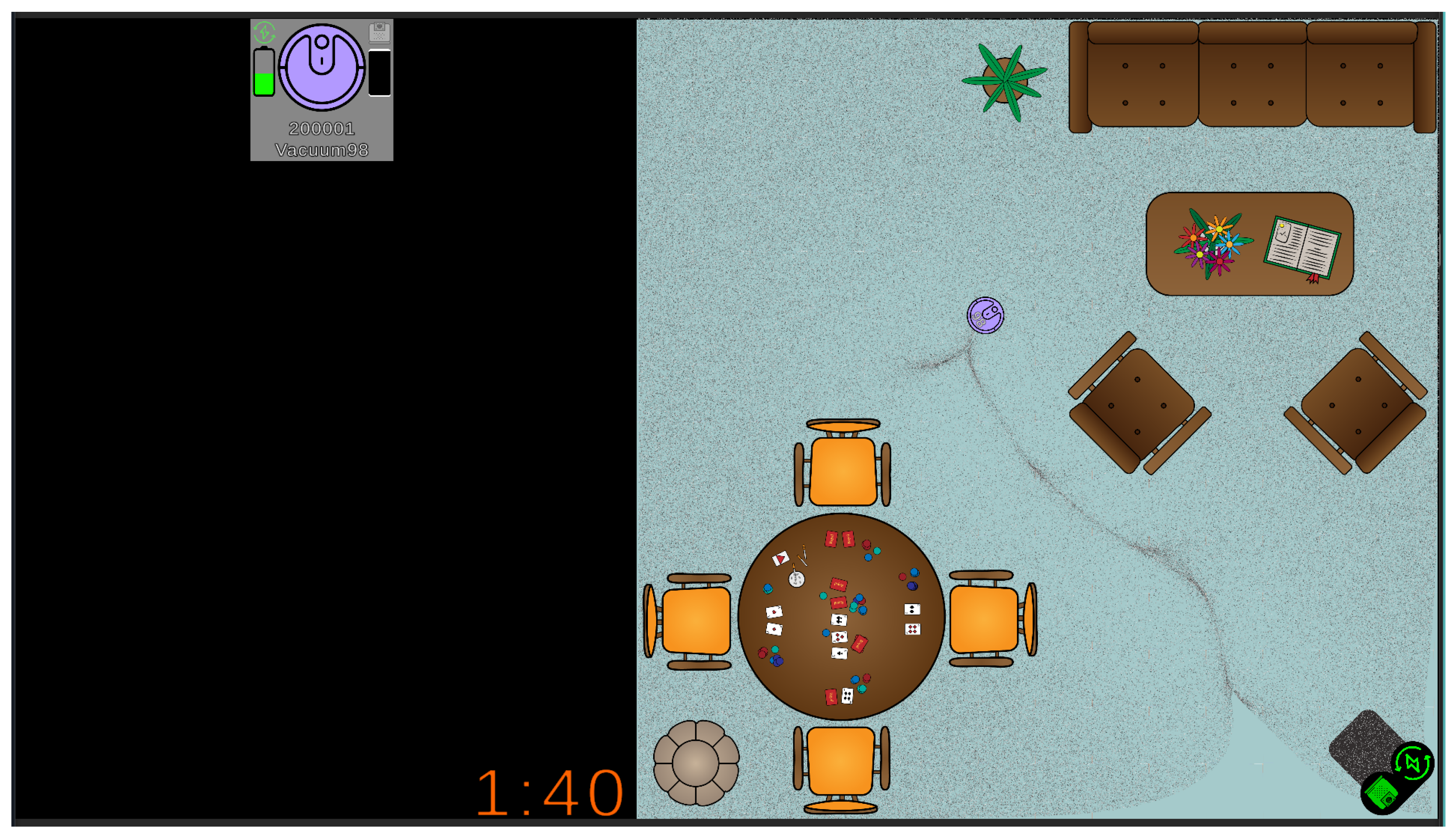
26]. That workshop used a custom-designed game (developed in Unity, Unity Technologies, San Francisco, CA, USA, version 6000.0.40f1) intended to capture the essence of agential realism by staging a game where participants became involved in a socio-technical arrangement. The entire context was shown to influence the course of events, such as how the participants organized themselves in the room, interactions with the digital game world, and the interactions and discussions among the participants’. Participants took on the roles of robot vacuum cleaners. The players had to control a virtual vacuum to collect as much dust as possible. At the same time, they had to balance their battery level and dustbin level in relation to the environment and other players. To survive for an entire game session, players periodically had to visit a charging station to recharge their battery and empty their dustbin. The setup required players to anticipate and adapt to changing relational constraints, yielding distinct, emergent gameplay rhythms that were neither explicitly programmed nor strictly predictable. A screen capture of the game is shown in
Figure 1.
4.1. Data Collection
To work with something less complex than the reported multiplayer setup, we gathered our data by adapting the game to a simplified single-player scenario. In conjunction with an annual science festival (Researchers’ night
1) at a local science center, we put up two stations where the attendees could play a similar game as the original. Players used a common controller (game pad), and were given 3 min of playtime with the task of trying to collect as much dust as possible. All play sessions were recorded at a frame-rate of 50 frames per second, amounting to about 9000 data-entries per play session.
In total, we got 22 players to play the game. To be able to replay the sessions and have a large data set to analyze, we sampled 16 different features at each time step: the timestamp for each entry; the players input actions (forward, left, right, and vacuum); and contextual features (horizontal position, vertical position, current direction, current Dustflow, total amount vacuumed, battery level, dustbin level, distance to charging station, angle to charging station, whether the vacuum is charging its battery and whether the vacuum is emptying its dustbin). In the end, we had to remove two play sessions due to logging errors resulting in faulty data. The data is stored in separate files (one per session) in CSV format (Comma Separated Values). All features were normalized to the range .
4.2. Data Selection and ESN Configuration
Although our raw data set contains 16 features, we deliberately did not feed the players direct input actions and absolute spatial metrics into the reservoir. Instead, the reservoir was driven exclusively by a 5-dimensional input vector consisting of: [Battery level; Dustbin level; Dustflow; Distance to charging station; Angle to charging station]. These variables constitute the situational forcing (Affective Gradients).
This approach intentionally decoupled the analysis from the player’s explicit input actions and absolute spatial metrics (such as position and current direction). The selection of these 5 dimensions configures the agent’s relational boundary. By retaining only relational features, we organize the reservoir’s sensitivity to be purely relative and affective, rather than absolute and reactive. From an agential realist interpretation, we argue that this makes the reservoir’s internal dynamic a high-dimensional spatiotemporal re-membering of the evolving context in which the player is entangled.
All data processing, reservoir simulation, and dimensionality reduction were performed using Python (Python Software Foundation, Wilmington, DE, USA, version 3.12.9). The topological algorithms and visualizations were implemented using the libraries: umap-learn (version 0.5.6), hdbscan (version 0.8.40), scikit-learn (version 1.5.0), and matplotlib (version 3.10.0).
4.2.1. Finding the Edge of Chaos
An ESN was instantiated with the random seed 42. This seed is used in all of our analyses and plots unless otherwise stated. To ensure that the reservoir operates in the critical regime described as edge of chaos, we empirically evaluated its stability and memory properties. Rather than relying solely on theoretical bounds, we assessed the echo state property (ESP) directly from the recorded data.
A common practice in the RC community to determine
is to track the median convergence time of perturbed state trajectories under real input data, providing an empirical assessment of the reservoir’s fading-memory properties. We empirically determined the spectral radius
of our reservoir’s weight matrix using the common method and the now formalized method proposed by Gallicchio [
27]. The approach proposed by Gallicchio measures the median convergence time of state trajectories starting from completely different random initial conditions under the same input data. This provides an empirical assessment of whether the reservoir satisfies the ESP. The reservoir will then eventually “forget” the initial conditions and become input driven.
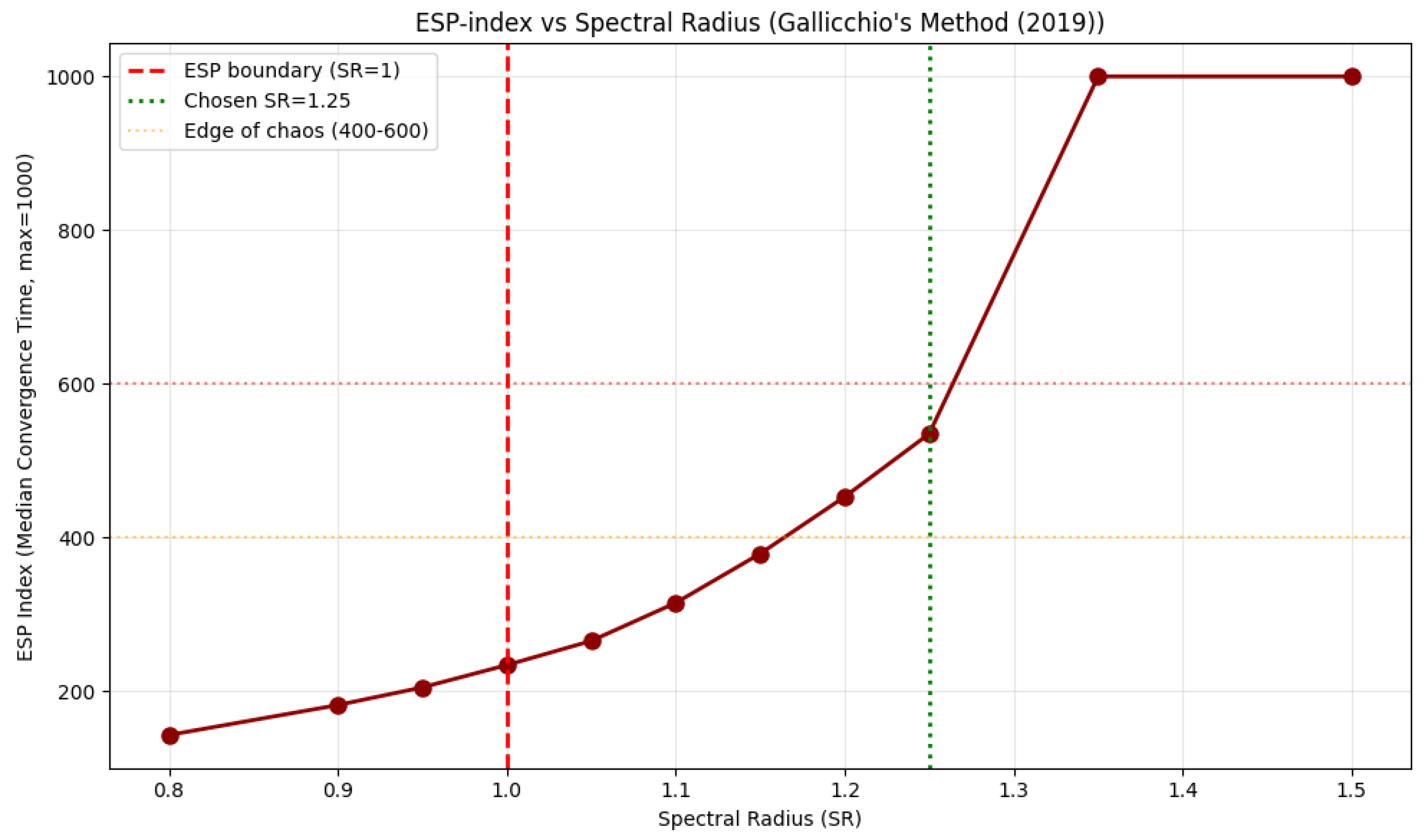
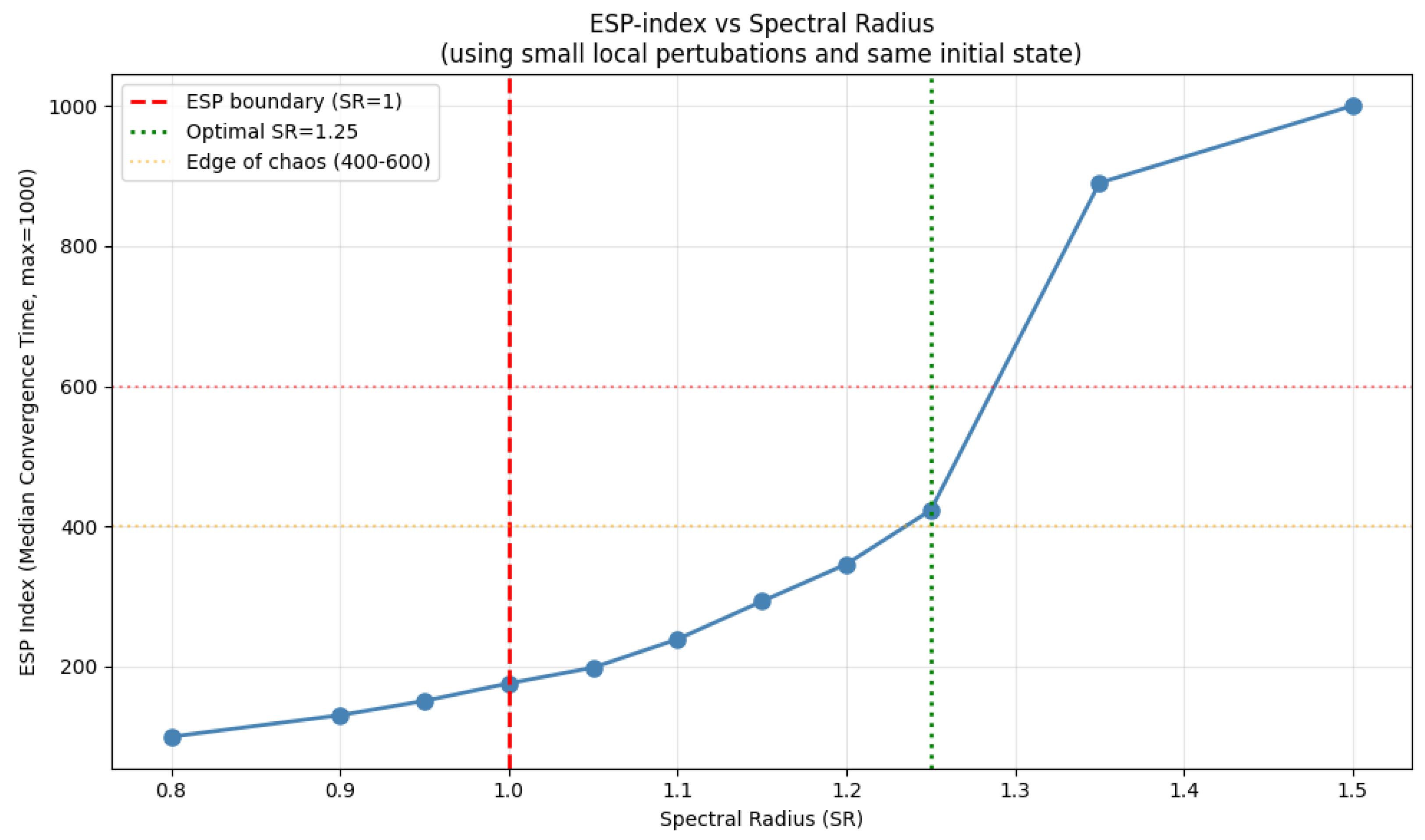
We tested spectral radius values from 0.8 to 1.5 for our reservoir using recorded vacuum cleaner data from the play sessions. The plots in
Figure 2 and
Figure 3 show the ESP index as a function of the spectral radius using both the common method and the one proposed by Gallicchio. Lower values indicate faster trajectory convergence. Values over 1000 mean chaotic instability. We chose a spectral radius
as our operating point. The set bound 400–600 for the
edge of chaos is a chosen interval based on our ESP index analysis. This does not mean that the system enters chaos immediately above 600, but the trajectory above 600 is quite steep. We thus identified the
edge of chaos as in this interval. While standard metrics would quantify this as memory capacity (the number of past steps recoverable), in our design framework, this metric equates to the Temporal Thickness of the agent’s experience. It defines how deeply the sedimented history of the system (Re-membered Inertia) resists the immediate Affective Gradients.
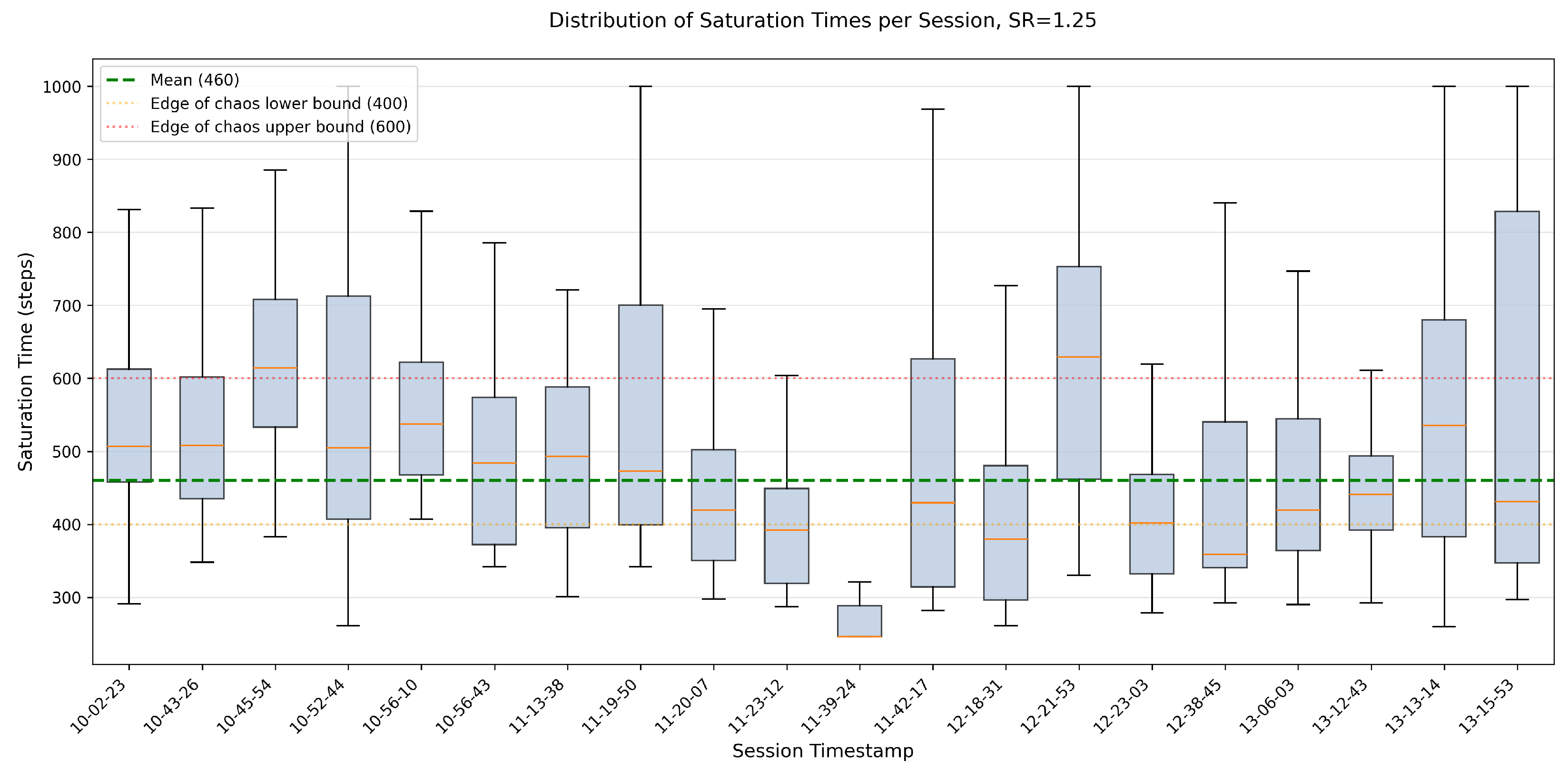
The plot in
Figure 4 shows the distribution of saturation times across the play sessions for our choice of spectral radius. Our test used a random sampling of 1000 timesteps from all of the player sessions. The results show that our choice of spectral radius mostly keeps the reservoir within the set bounds for the
edge of chaos. Some sessions are outside the interval, all below the bounds. In these ‘outlier’ sessions, the players ran out of battery before the end of the session, which left the vacuum ‘dead’ for a portion of the session. Thus, they are not outliers, but reflect the fact that a ‘dead’ vacuum is not anymore forced by Affective Gradients, making the dynamics of the reservoir echoes fade out.
In the context of organizing relational complexity, the spectral radius serves as a dial for temporal thickness. By tuning to 1.25, we are organizing the system’s regenerative capacity, ensuring that the past persists long enough to create meaningful friction with the present.
4.2.2. Hyperparameters of the ESN Configuration
To provide a concise overview of the computational setup resulting from our tuning, the Affective Reservoir was configured as follows:
Network type: Echo State Network (ESN) with leaky integrator neurons;
Reservoir size (N): 200 nodes;
Input dimensions (): 5 (Affective Gradients);
Spectral radius (): 1.25;
Input scaling: 0.2;
Leak rate (): 0.2;
Random seeds evaluated: 42, 123, 456, 789.
4.3. Mapping the Emerging Spatiotemporal Structure
Having established the fundamental properties of the ESN, the next step was to map the spatiotemporal structure of the reservoir based on the recorded gameplay sessions. We sought to visualize how the reservoir’s internal state, its Re-membered Inertia, becomes re-configured. To do this, the 200-dimensional ESN was instantiated. At each timestep, we fed the 5-dimensional feature vector (Affective Gradients) from the human play sessions into the reservoir and recorded its resulting 200D internal state vector trajectory. We generated trajectories for specific individual sessions to analyze per-session dynamics, as well as for the full concatenated data set to map the global structure.
To inspect this high-dimensional manifold, the trajectories were projected from 200 dimensions to a 2D-map using UMAP. We then applied DBSCAN (Density-Based Spatial Clustering of Applications with Noise). The strength of DBSCAN lies in its ability to discover clusters in arbitrary shapes and sizes, which is essential for capturing the organic, non-linear traces of gameplay [
28]. This aligns with our aim of identifying the ‘sedimented’ traces of past intra-action.
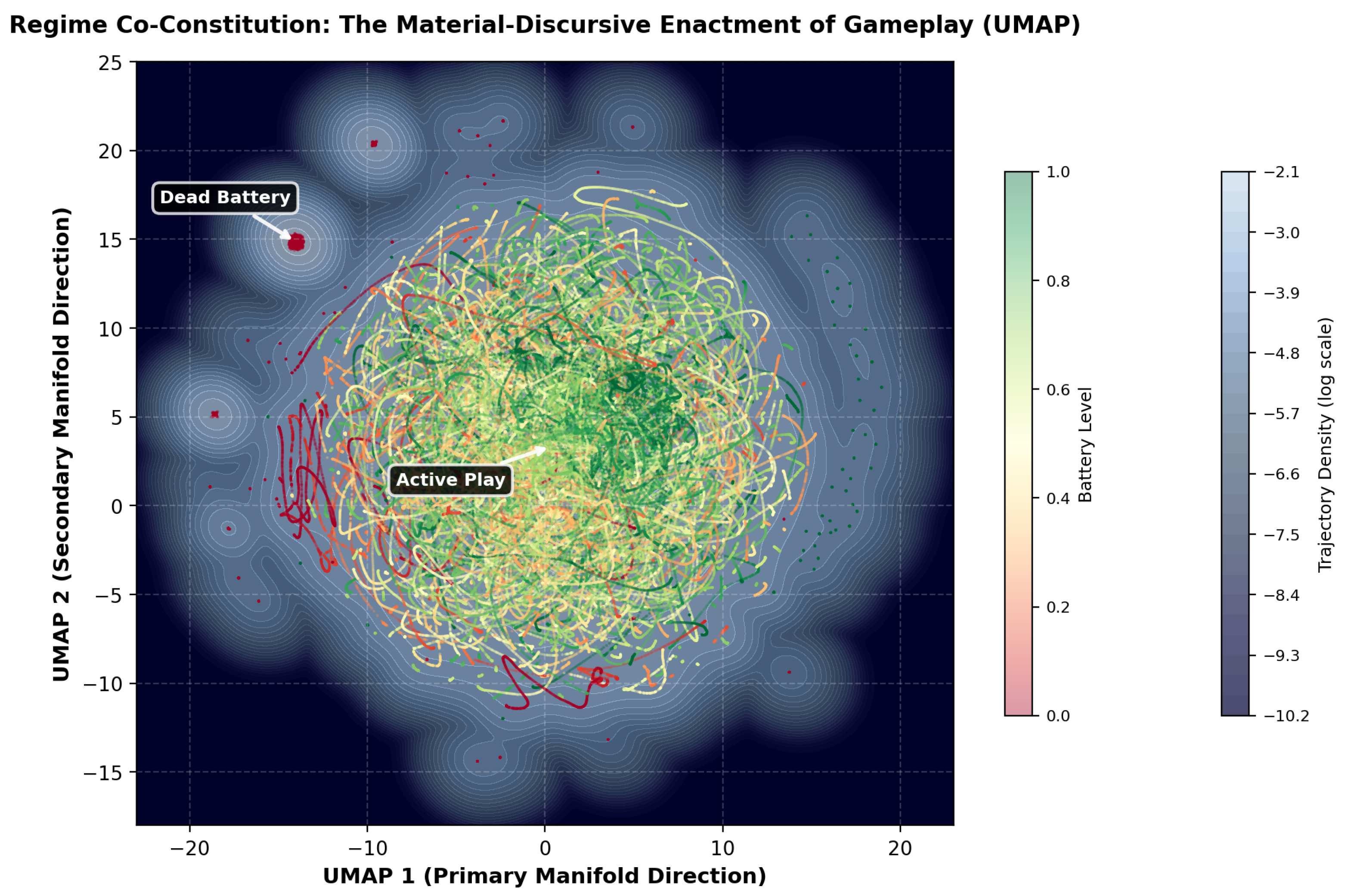
At a coarse scale (think of it as being zoomed out on a map), the clustering output revealed a striking ontological bifurcation of two distinct regimes that represent active play (approximately 94%) and game failure (empty battery) (approximately 6%). This bifurcation shows an existential boundary for a playing agent running out of battery.
The plot in
Figure 5 shows the bifurcation. The trajectory of the reservoir is plotted against a backdrop of a density map and the reservoir trajectory is color-coded to show the corresponding battery level. The plot is made using UMAP (Uniform Manifold Approximation and Projection), which is a dimensionality-reduction technique that captures the intrinsic geometry of high-dimensional data embedded in lower-dimensional spaces.
Validating the Thick Now
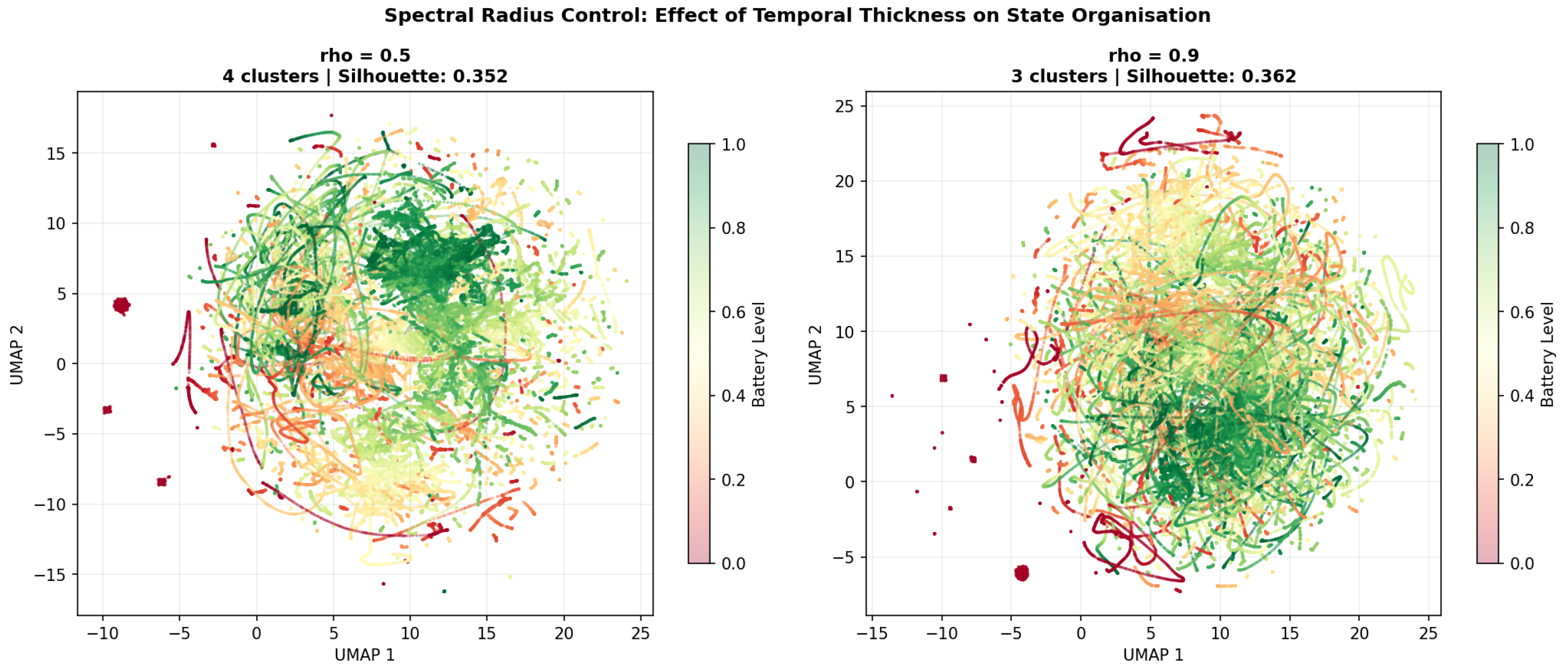
To ground our validation of Temporal Thickness, we first evaluated the structural cohesion of Active play vs Dead Battery using different configurations. Applying HDBSCAN to the raw 5D input yielded 4 clusters (silhouette score = ). Introducing highly stable recurrent topologies resulted in: (4 clusters, silhouette = ) and (3 clusters, silhouette = ). Our near-critical reservoir () converged into two clusters (silhouette = ). All configurations showed one large cluster for states with Battery level > 0. The Dead Battery-clusters thus converged from 3 to 2 with a higher spectral radius.
But the Affective Reservoir is not expected to generate the existential boundary of a ‘Dead Battery’. That boundary is a material reality of the recorded context. Instead, the reservoir should provide Temporal thickness and Re-membered Inertia. To empirically validate this, we performed tests to separate the raw input structure from the recurrent reservoir dynamics.
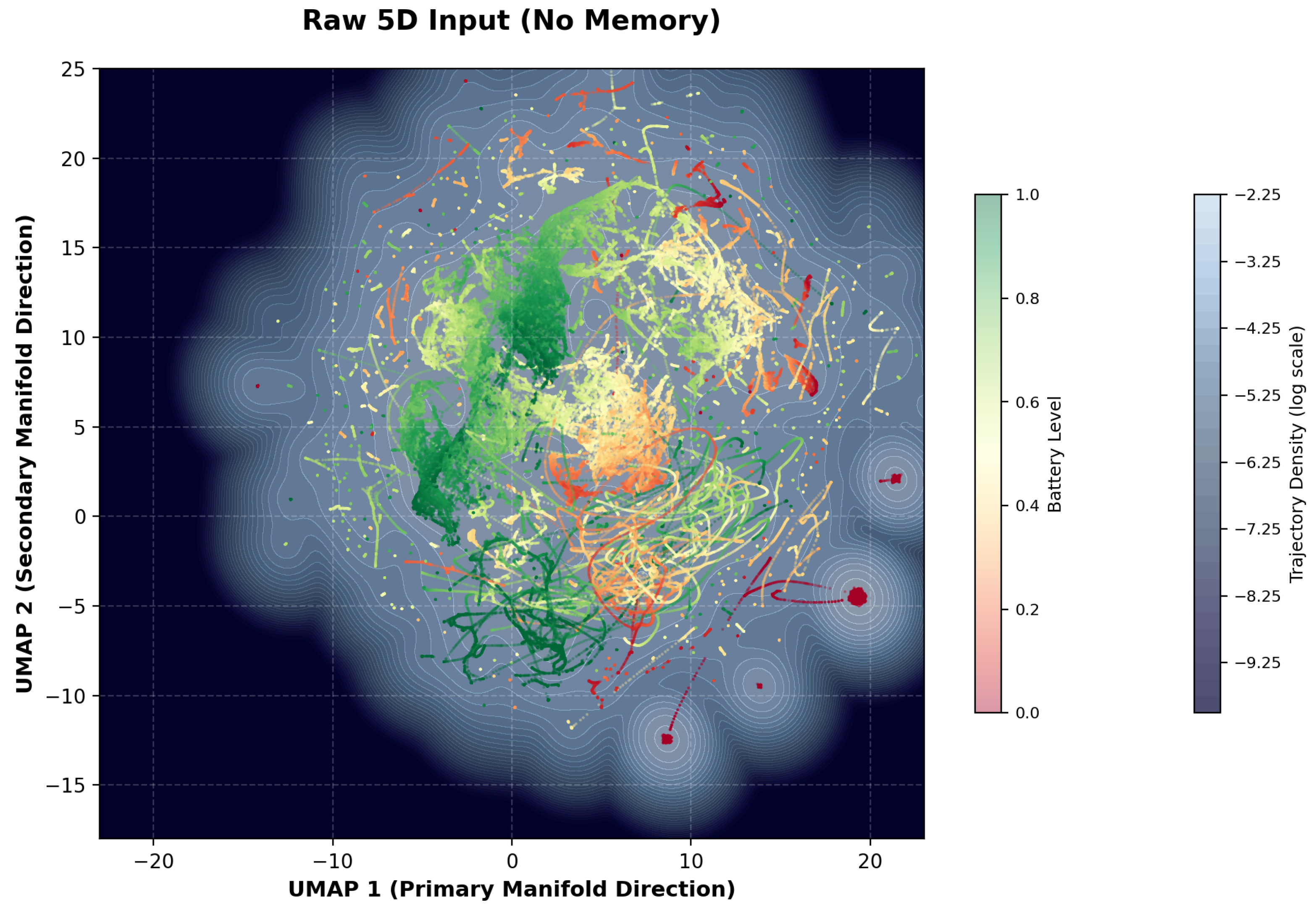
As a first control, we apply dimensionality reduction and clustering directly to the raw Affective Gradient vector. This tests whether the coarse-scale bifurcation between Active play and Dead Battery is already present without any temporal integration. As expected,
Figure 6 shows that the raw input separates the Dead Battery states (visible as isolated dark red islands pushed to the periphery). However, the Active play regime remains fragmented and scattered. Without the reservoir’s recurrent topology, the data consist of a sequence of isolated noisy coordinates. The raw input provides the existential boundary, but it lacks the continuous rhythmic topologies; the ‘lived’ history.
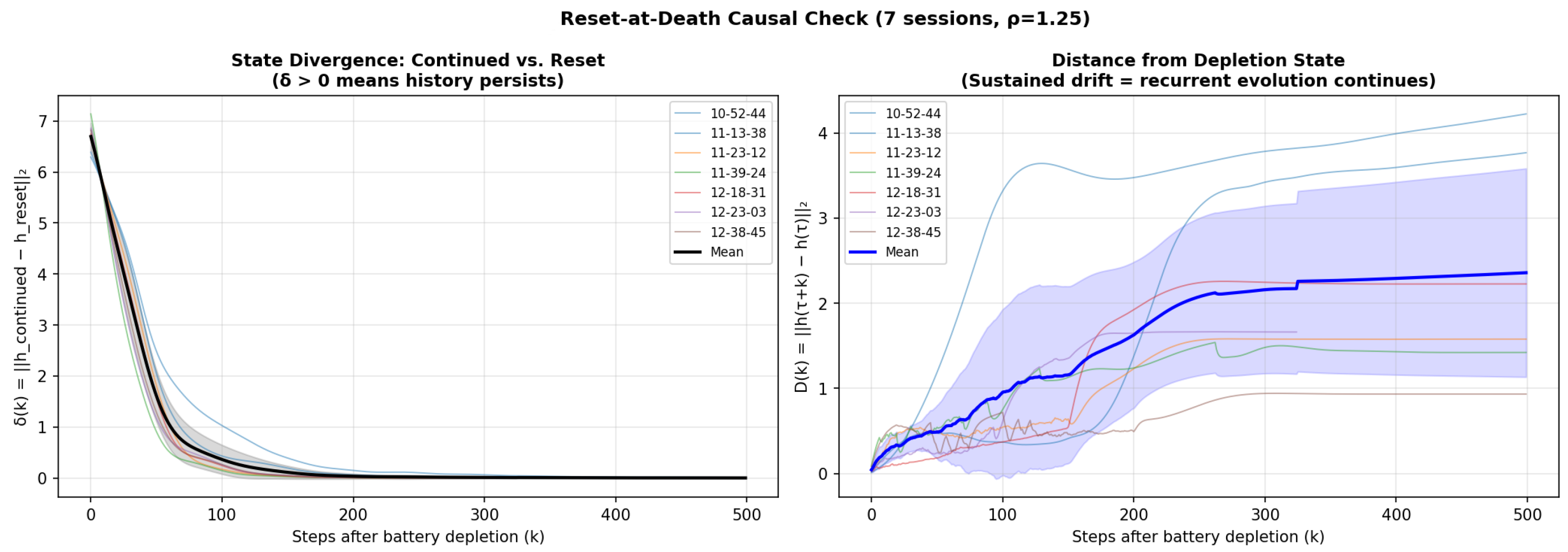
Second, to test if the continuous rhythmic topologies are genuinely dependent on the recurrent history of the reservoir, we perform a causal intervention: a history-reset at the exact moment of battery depletion (). For each session that reaches battery zero, we generate two post-depletion trajectories using identical post-depletion input sequences:
- 1.
The continued trajectory, initialized from the actual sedimented habitual momentum .
- 2.
The reset trajectory, initialized from an un-sedimented zero-state at time .
The difference between these trajectories is measured as the state divergence:
If
decays immediately, the post-depletion structure is purely input-driven. However, as shown in
Figure 7 (left), the divergence remains significant for up to 200 timesteps after the battery has died. Furthermore, the distance from the depletion state
Figure 7, right shows a sustained drift, indicating that the recurrent evolution continues autonomously even when the environmental forcing flat-lines.
These causal checks confirm that the observed topological structures are a true co-constitution. The selected Affective Gradients already contain the coarse existential boundaries of the environment, but they lack temporal cohesion. The contribution of the Affective Reservoir is not the generation of these boundaries, but the structural capacity to sustain and ‘live’ them. By operating at the edge of chaos, the reservoir’s Re-membered Inertia resists and holds the discrete, instantaneous agential cuts of the raw input. It is the continuous friction of this encounter that enacts the Relational rhythms, echoing long after the immediate forcing has stopped.
Finally, as a third test to validate that the rhythmic topologies are not merely an automatic artifact of any recurrent network, we introduced two highly stable ESN controls. We retained the exact same reservoir topology and input data, but reduced the spectral radius to stable values ( and ). These settings drastically reduce the network’s memory capacity, shrinking its Temporal Thickness and forcing it to forget past states much faster.
As expected, the resulting UMAP projection of the stable ESNs (
Figure 8) lacks the deep temporal cohesion seen in our near-critical operating point (
). While the stable ESNs smooth the raw input slightly, their state-space remains more tightly clustered and predominantly input-driven. This comparison demonstrates that
Relational rhythms do not emerge simply because recurrence is present; they require the specific material conditions of the ‘edge of chaos’. It is only in this near-critical regime that the
Re-membered Inertia is strong enough to resist immediate input, generating the sustained
Dynamical friction required to weave a
Thick Now.
4.4. Rhythms of Play and the Leroy Jenkins of Robot Vacuum Cleaners
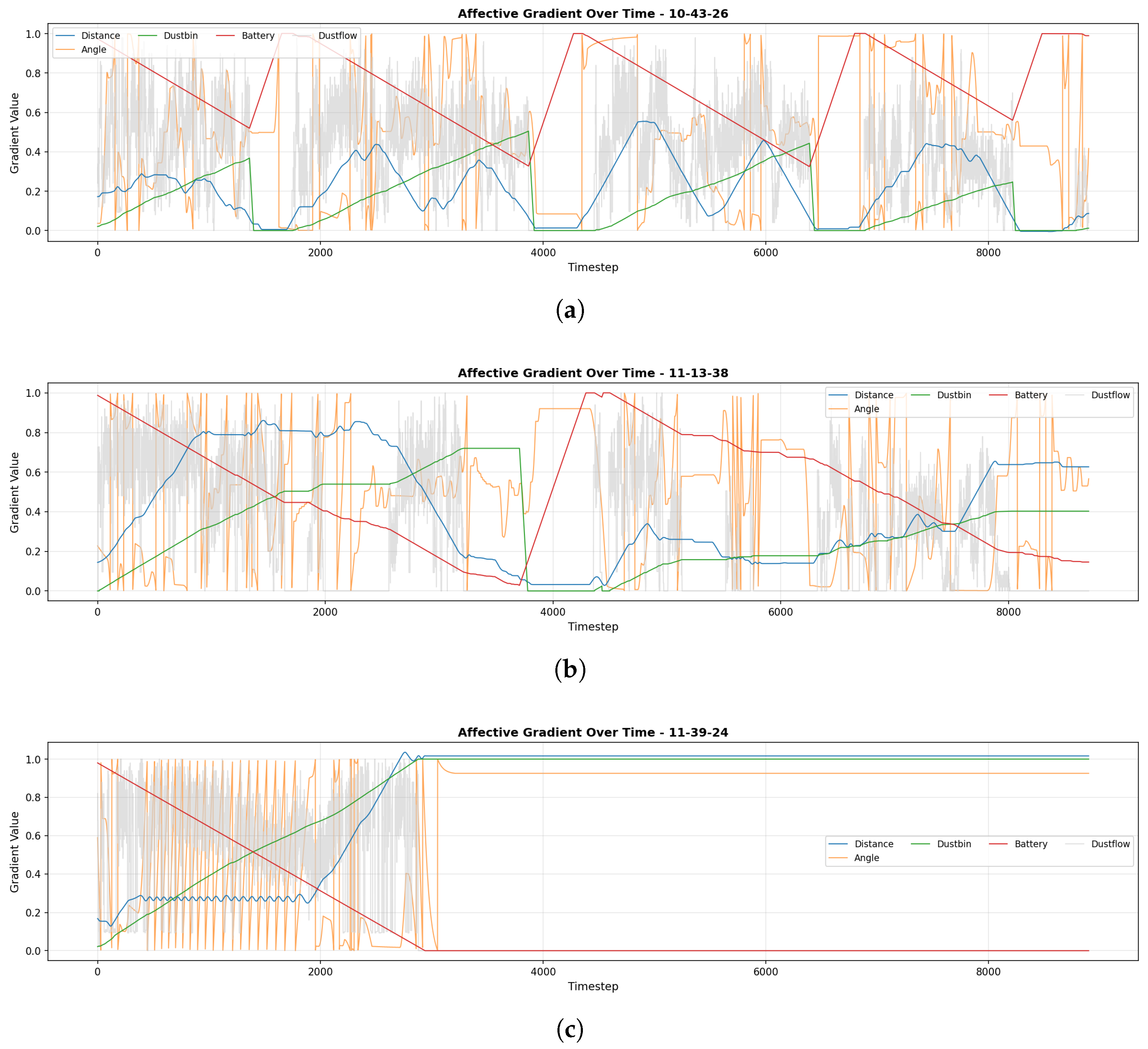
We have selected to highlight three play sessions in the rest of the paper. These sessions represent vastly different gameplay dynamics, allowing us to analyze and discuss our architecture in as broad a way as possible. The Affective Gradients show different rhythms of gameplay for these sessions (see
Figure 9). Some rhythms, like the battery- and dustbin level, show repeated slow oscillations, whereas the dustflow is more like a noise signal. Distance and angle show irregular, erratic signals, but not as noisy as dustflow. The rhythm of the oscillations can be argued to represent different player dispositions. For example, a lower frequency in battery level oscillation corresponds to a risk-taking player, and a higher frequency to a more cautious player.
While these raw rhythms clearly reflect different player dispositions, they represent only the surface-level of the agent–environment encounter. Importantly, the Affective Gradients are reciprocal relations, co-created by the agent’s interactions in the environment. However, to understand how these gameplay rhythms are actively ‘lived’ or ‘felt’ by the computational system, we must shift our focus to the internal dynamics of the Affective Reservoir.
We are specifically interested in how this situational forcing continuously collides with the system’s own structural momentum (Re-membered Inertia). It is this internal collision that generates Dynamical Friction, weaving the raw sensor data into emergent Relational rhythms.
To map these internal rhythms,
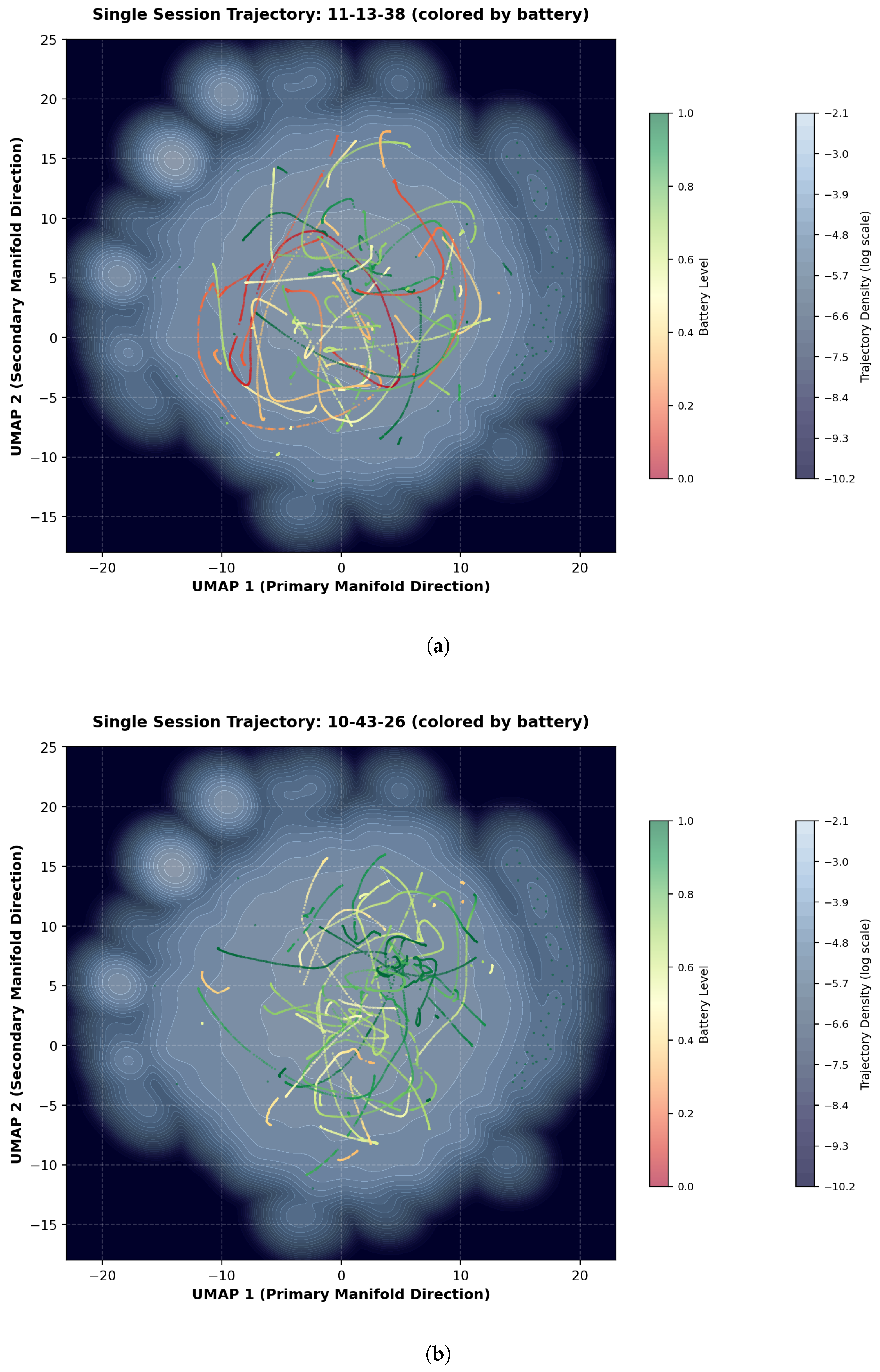
Figure 10 projects the high-dimensional state of the reservoir into a 2D UMAP space, revealing how different gameplay dynamics manifest as distinct topological trajectories. In session ‘10-43-26’ (
Figure 10b), the cautious player frequently goes back and forth between vacuuming and recharging. The reservoir never experiences the structural tension of severe battery depletion, resulting in a tight, looping trajectory. Conversely, in session ‘11-13-38’ (
Figure 10a), the risk-taking player pushes the existential precariousness to its limit, draining the battery almost completely before returning. This forces the internal state of the reservoir deep into the low-battery regime, stretching the relational rhythm across the topological space.
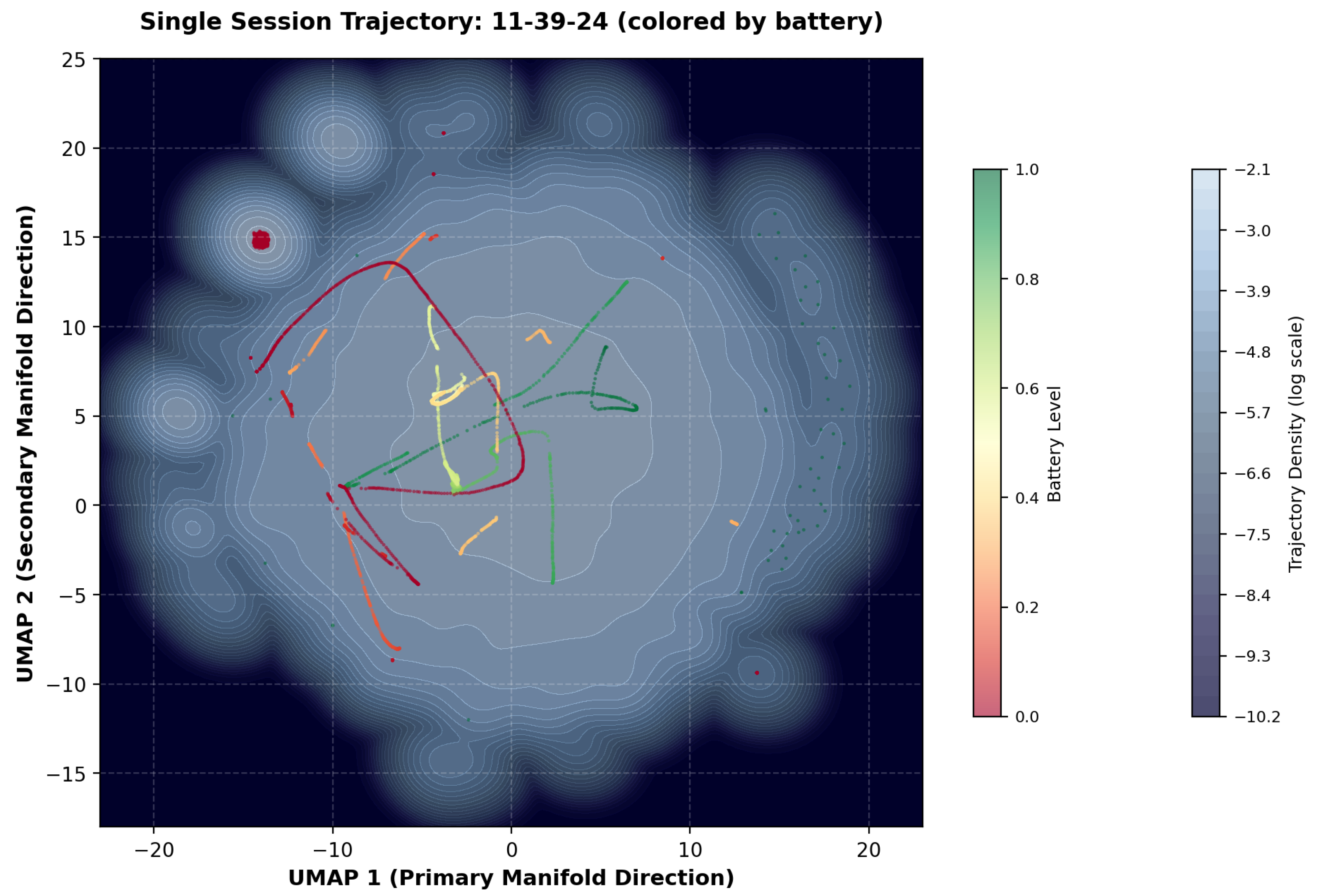
Session 11-39-24 in
Figure 11 presents a radical deviation. In that session, the player went full speed away from the charging station with full vacuuming on, ending up with an empty battery almost as far away as possible from the charging station. The dynamics thus collapsed into the Dead Battery regime after only 1/4 of the session duration. This session serves as a stark visualization of a high-risk player-disposition. In gaming culture, this high-risk charge into the fray is famously known as the Leeroy Jenkins-strategy
2.
The difference in the plots highlights the capability of the reservoir. It does not merely indicate a static coordinate (‘where you are’); it encodes the momentum of the trajectory, offering a material trace of the history that led to the current state (‘how you got here’). It is important to note that the position in UMAP-space is not equivalent to position as spatial coordinates in the game world.
For the arguments to hold, what we see in UMAP-space cannot be traced to behavior and clustered behavioral modes. To investigate potential behavioral sub-modes, we applied Hierarchical DBSCAN (HDBSCAN) [
29] to the manifold. While the macro-scale bifurcation between Active play and Dead Battery proved topologically invariant across all four reservoir seeds, the internal structure of the Active play regime revealed a radically different characteristic: fluidity.
We subdivided the Active play cluster from the coarse scan at different granularities. A sweep was performed over different granulatity-settings to find a silhouette-optimized value. At
, the clustering showed maximum within-cluster coherence and between-cluster separation. With this choice, three distinct sub-clusters were found: that of an average active dusting; that of a reloaded battery and empty dustbin; and that of a fading battery. Both first clusters show a vicinity to the charging station. However, only 6.2% of Active gameplay data were classified into the clusters, 93.8% were classified as noise.
Table 3 shows the identified clusters in the subdivision and the average values of the different input features.
Cluster 0 (Restored) has distinct initial conditions (full battery, empty bin) close to the charging station, which quickly dissipate into fluid dynamics. Cluster 1 (Survival) has survival conditions with a fading battery going towards the charging station. Cluster 2 (Average) is about halfway from the charging station with a half-full dustbin and enough battery left. The clusters do not appear as meaningful behavioral modes but rather as artifacts where the algorithm converges on minimized average sensor values. By varying HDBSCAN parameters, we could isolate other micro-clusters but they remained trivial variations in average values.
4.5. Validation of Regimes
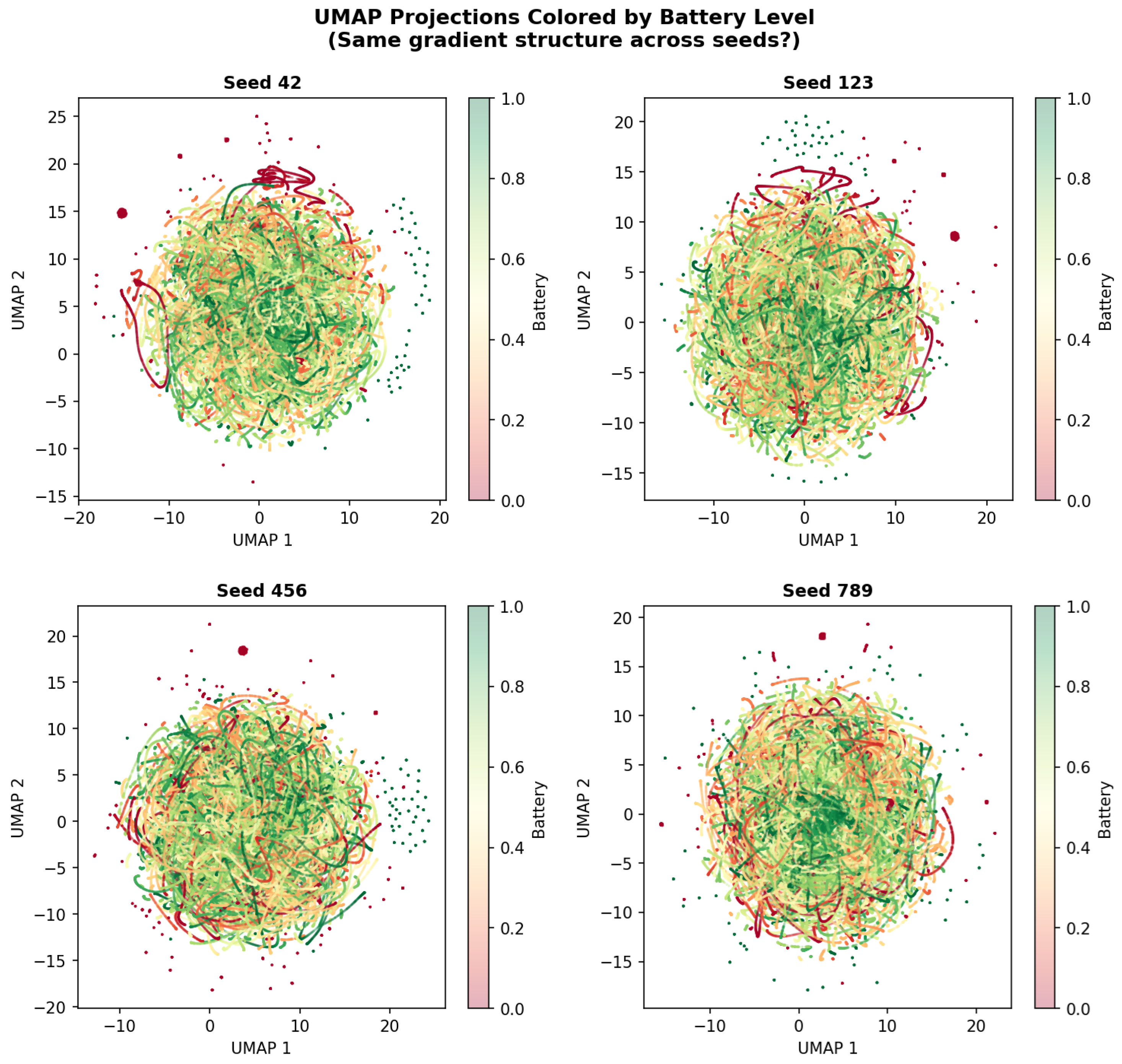
To ensure that the identified regimes were not artifacts of a specific weight initialization, we replicated the dimensionality reduction and clustering for three additional reservoir topologies (seeds 123, 456, 789). As illustrated in
Figure 12, the topological bifurcation proved invariant. Across all instances, DBSCAN consistently identified the same two dominant regimes with minimal noise, maintaining a stable distribution where the Active play regime constituted 93–95% of the manifold. The geometric shapes of the trajectories vary due to the unique structural topology of each seed. They all produce a slightly different texture of Re-membered Inertia, but the overall relational structure remained absolute. This confirms that the bifurcation is a fundamental property of the agent–environment relation regardless of the random internal couplings in the reservoir.
In contrast to the robust bifurcation at the coarse level, the fine-grained subclustering of the Active play regime was consistently resistant across all reservoir topologies. Applying the same subclustering pipeline independently to each of the four seeds yielded uniformly high noise fractions (see
Table 4). Where subclusters did emerge, between one and three per seed, these are not behavioral modes but artifacts where the algorithm converges on minimized average sensor values.
4.6. The Rhythms of Gameplay
To demonstrate that the reservoir functions as a diffractive apparatus rather than a passive recorder, we conducted a comparative analysis of the three gameplay sessions. Each session was processed through four reservoir instances with identical parameters but with different random seeds (representing distinct structural topologies that uniquely shape the agent’s Re-membered Inertia).
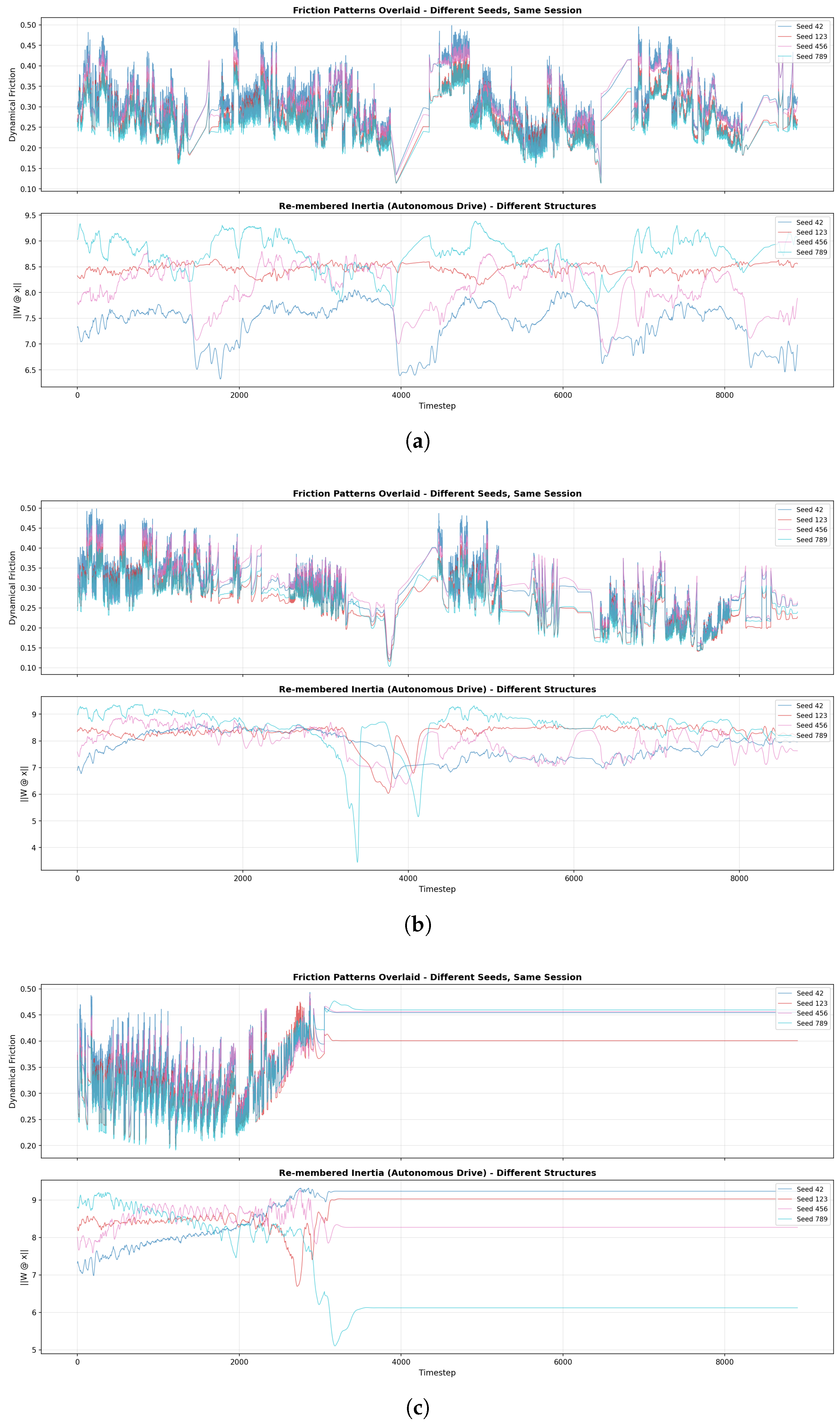
As shown in the comparative overlays (
Figure 13), major events such as battery depletion trigger universal responses across all instances. The situational forcing of the input projection is undeniable. When the world pushes hard, all reservoirs respond with identical surges in Dynamical Friction. However, while the top subplots show a striking surface convergence, the bottom subplots (plotting the recurrent drive magnitude (
)) reveal that each reservoir maintains a unique autonomous internal dynamic to achieve this alignment.
For example, Session 11-13-38 shows synchronized alignment of diffraction patterns across instances, but the internal means of achieving this alignment are deeply subjective. We can observe that Seed 789 undergoes a dramatic internal collapse in its recurrent drive (dropping to ) to cope with an input sequence that other seeds handle stably. This demonstrates that co-constitution is not a uniform mechanical process but a situational negotiation. The ‘reality’, from a reservoir perspective, is enacted differently depending on the specific structural topology of the agent. It shows that the reservoir is not a passive neutral funnel for the input but an active participant, where the same environmental forcing meets a distinctly different internal resistance (Re-membered Inertia) in each seed.
The comparative analysis allowed us to disentangle the source of the gameplay rhythms. While the Affective Gradients drive the intensity and timing of the friction, triggering almost universal responses across different seeds, the Dynamical Friction is co-constituted. It is not a fixed object in the input data. It is an interference pattern that requires a resisting body to exist. This confirms that the rhythms of gameplay are not fixed objects in the input data. The rhythms are an interference produced where the waves of the player’s history collide with the specific structural topology of the reservoir.
5. Results and Discussion
5.1. The Co-Constitution of Gameplay
The structural analysis of the reservoir’s history via DBSCAN and UMAP reveals that gameplay is fundamentally bifurcated. It visualizes the traces of a fundamental agential cut that delineates the conditions of possibility for gameplay. In the active play regime, the agent exists as a dust-collector, entangled with an environment of opportunities where Dustflow is the situational forcing. However, as the battery level diminishes, the gameplay phenomenon dissolves and reconstitutes. The agent re-emerges as a survivalist, no longer forced by the Dustflow, but with the navigation gradients toward the charging station. Sometimes, the disposition of the players (e.g., risk takers) overrides this reconfiguration, resulting in total depletion of the battery beforehand. The two regimes are qualitatively different modes of existence. Prolonged engagement in the Active gameplay regime incurs a dissolving of that regime. Pushing this too far leads to a collapse into the Dead battery regime.
Ending up with a Dead Battery is a boundary condition that defines what Active gameplay means by contrast. Active gameplay inevitably drains the battery, leading to “game over” if one does not make it to a charging station in time. The two regimes mutually define each other through the material constraint of battery depletion. The Dead Battery state is both a consequence of active play and a defining boundary that gives meaning to Active gameplay. There would be no Active gameplay if not for the co-constitution of ‘game over’, like when Barad states:
only part of the world can be made intelligible to itself at a time, because the other part of the world has to be the part that it makes a difference to” [
6] (p. 351).
As shown in
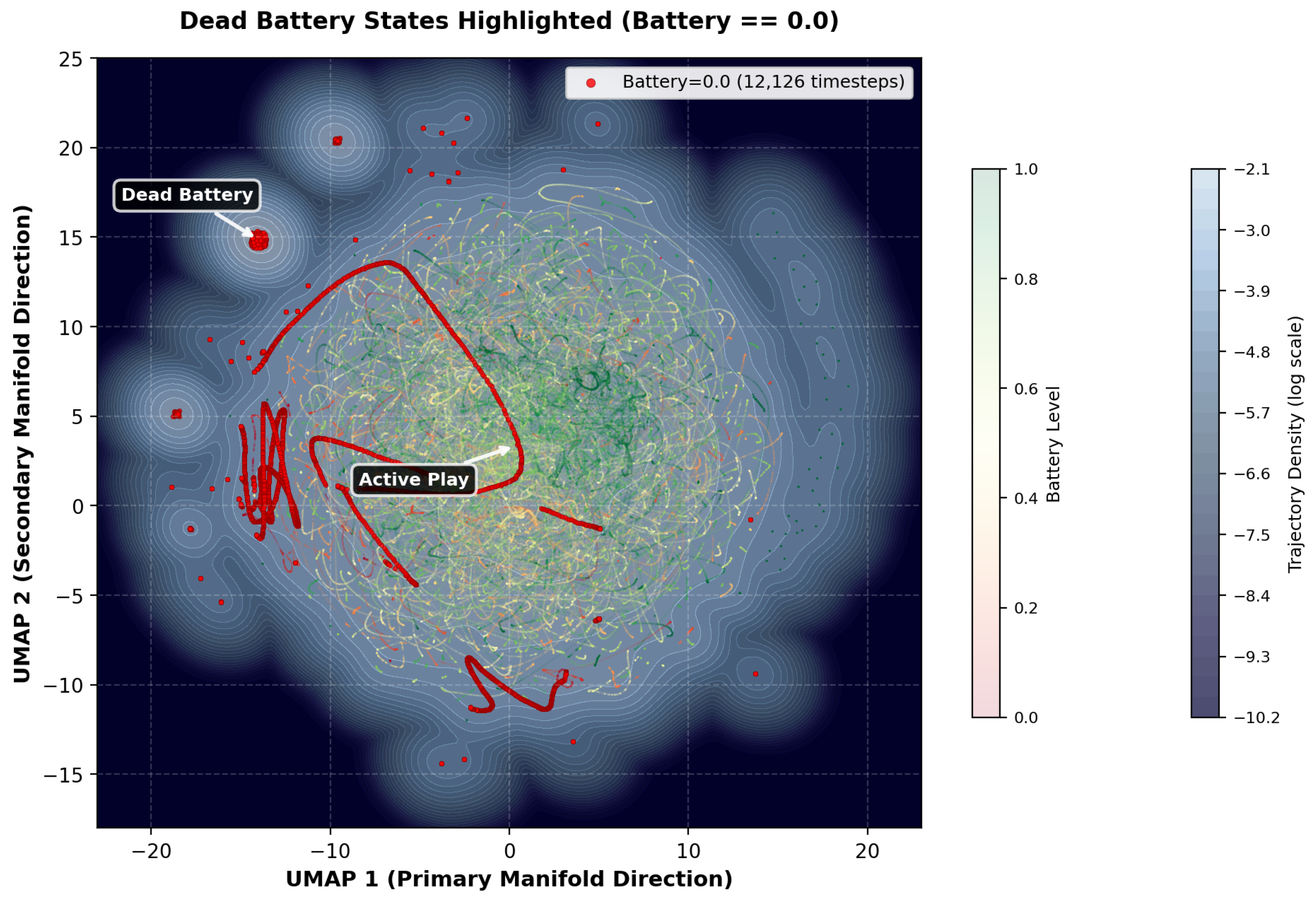
Figure 14, although the algorithm places the center at ≈UMAP (−13, 15), one can clearly see how the Dead Battery trajectory (red) occupies disjointed regions of UMAP-space. The Dead Battery regime forms its own distinct, fragmented spatial structure in UMAP-space, confirming that the reservoir dynamics are fundamentally different when the player is stuck with no battery power.
The topology of the ‘Dead Battery’ regime empirically visualizes the
Temporal Thickness of the reservoir. If the system were merely a reactive mapping of the raw input, the post-depletion trajectories would strictly reflect the static spatial coordinates (e.g., frozen distance and angle) at the time of death, lacking any temporal depth. Instead, as shown in
Figure 14, the Dead Battery trajectories are highly scattered This scattering empirically visualizes the
Temporal Thickness of the reservoir. Players deplete their battery in drastically different high-inertial contexts. Although the Affective Gradients (the input forcing) vanish instantly at the moment of depletion, the system’s
Re-membered Inertia persists. The specific momentum from the player’s unique history echoes in the reservoir, dictating exactly where in the manifold the system becomes stranded. Stripped of the erratic situational forcing (the Dustflow), this spectral trace slowly fades over ≈200 timesteps before a total structural collapse. The reservoir retains an agency driven solely by its inertia, stuck in the void of its own specific history.
This validates the shift from ‘transactional interactions’ to ‘organizing relational complexity’. We did not program the internal Dead Dattery state as a rule-based transaction. Instead, we curated the situational forcing (the Affective Gradients) by establishing a material dependency between active dusting and energy depletion. The topological Dead Battery regime (as a distinct, sedimented historical region in the reservoir’s internal state space) emerged as a relational consequence of this friction. Thus, the designer organizes the conditions of possibility rather than hard-coding the specific internal states of the agent.
The density map should not be interpreted as showing probabilistic attractor basins but rather as the accumulated material traces of gameplay. It shows where repeated enactments have left Baradian “marks on bodies”. The key difference from traditional density interpretation is that it does not show where you are likely to go (probabilistic), but rather where gameplay has already been enacted (ontological). It is a determination of past material-discursive practices rather than a prediction of future ones. An analogy to this is shredding in geomorphology. Past events leave traces in sediment/rock, but subsequent processes (erosion, deposition, weathering) rework those traces, sometimes to the point where the original signal becomes unrecognizable or fragmentary. The past is materially present but transformed, not preserved intact. Barad’s re-membering (with the hyphen) is not a strict reproduction of the past, but a re-configuration of past material traces into present configurations.
5.2. Where the Action Is: Friction and Situated Tension
The resistance to clean categorization (see
Table 3) within the Active play regime is not a failure of the architecture. HDBSCAN operates on the assumption that meaningful categories exist as dense islands separated by distinct valleys of low density. Human gameplay, however, is not a set of static islands. It is a continuous fluid trajectory. As a player continuously adapts, their behavioral states smear across the manifold. Because there are no empty valleys cleanly separating one behavior from another, HDBSCAN cannot draw a boundary. Because ’Dead Battery’ is a true discontinuity, a hard boundary where the dynamic of the player environment abruptly changes, HDBSCAN easily detects this massive valley. The fact that it can find the Dead Battery-islands shows that if discrete behavioral modes existed during active play, HDBSCAN would have found them. The 94% noise during play means those discrete modes simply do not exist as meaningful, distinct behavioral modes. It is empirical evidence that players are not snapping between discrete states.
This confirms that the system sustains a continuous relational negotiation that does not collapse into repetitive transactional loops. To borrow the title of Paul Dourish’s seminal work on embodied interaction, this is precisely “where the action is” [
30]. Dourish argues that embodied interaction is inherently situated and improvisational, unfolding in real-time rather than following a script of abstract state transitions. The noisy Active play regime visualizes this continuous entanglement. It resists clean categorization because Active gameplay is a relational process, constituted through ongoing intra-actions.
Our analysis revealed that the system operates in a state of continuous tension between memory and sensation. The Re-membered Inertia of the reservoir continuously collides with the Affective Gradients. This is most evident in the Dustflow-gradient, which generates the highest friction values. From the reservoir’s perspective, the collection of dust is not a smooth process of passive material accumulation, as if the agent were merely a container being filled. The vacuum does not simply ‘flow’ through a static world; it is constantly perturbed by the material consequences of its own actions. The strong correlation between Dustflow and Dynamical Friction () reveals the specific ‘texture’ of the organized complexity. By configuring the reservoir’s input projection (), we effectively tuned the system’s structural sensitivity to the irregular, high-frequency Dustflow, establishing it as the primary source of situated tension. Rather than programming a teleological drive to collect dust, the agent is continuously forced to negotiate the erratic material reality of the cleaning process. Design here is not an act of script-writing, but a curating of the specific material frictions that sustain the agent’s Relational rhythms.
To illustrate how this friction is co-constituted, we highlight three specific session dynamics:
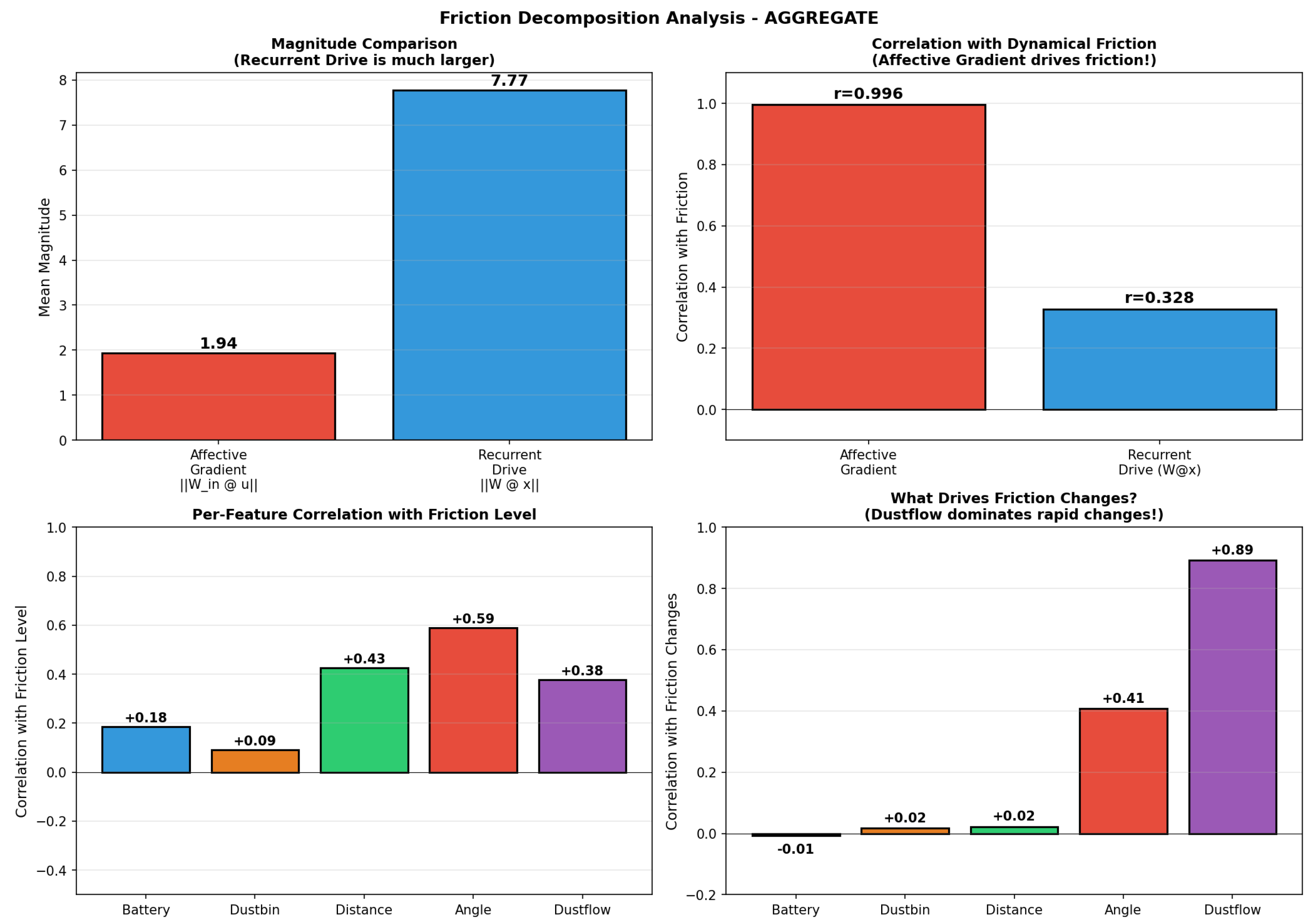
Session 10-43-26 maintains a consistent rhythm of navigation and dusting. The decomposition analysis (
Figure 15) provides a critical ontological insight here: despite the continuous depletion of energy over time, the battery has a near-zero correlation (
) with changes in Dynamical Friction. Instead, the tension is driven almost entirely by the Dustflow (+0.89). This confirms that the phenomenon of gameplay is not an internal status of the reservoir (having energy), but is co-constituted solely through active entanglement.
Session 11-13-38 shows synchronized alignment of diffraction patterns across instances, but the internal means of achieving this alignment are deeply subjective (see
Figure 13). We can observe that Seed 789 undergoes a dramatic internal collapse in its recurrent drive (dropping to
) to cope with an input sequence that other seeds handle stably. This demonstrates that co-constitution is not a uniform mechanical process but a situational negotiation. The ‘reality’, from a reservoir perspective, is enacted differently depending on the unique structural topology (and the resulting Re-membered Inertia) of the agent. It shows that the reservoir is not a passive neutral black box for the input but an active participant with a unique structural capacity to resist or succumb to the situational forcing.
The ‘Leeroy Jenkins’ session 11-39-24 visualizes the residue of co-constitution when the entanglement is ruptured (see
Figure 13). Following a high-intensity run that drains the battery, the input forcing vanishes and the friction flatlines. However, the internal dispositions do not return to a neutral zero. Instead, they freeze at widely divergent magnitudes. Traces of the specific trajectory they just traversed. These spectral traces are the lingering echoes of the co-constitution. They show that the agent is not a passive mirror that resets when the image is gone, but a material body that carries the weight of its specific history.
Dynamical Friction reveals the fundamental reciprocity of interaction. The persistent intense interference is not merely imposed on the agent; it is co-constituted by the agent’s actions. By collecting dust, the agent actively depletes that affective gradient, changing the environment, which in turn forces a reconfiguration of the reservoir state. The tension thus manifests itself not as a desire for a future goal but as the magnitude of this reciprocal friction. The tension becomes a measure of the turbulence of the encounter, created as the agent and the environment mutually reconfigure one another. Meaning is not found in the smooth continuation of the trajectory, but in the friction of the encounter. Gemeinboeck [
31] makes a similar argument, working with encounters between humans and robots. Gemeinboecks also treats interaction as Morinian, that “does not serve to make the strange look more familiar but is about rendering differences relational.” [
31] (p. 5).
Thus, computational design is not merely about tuning parameters to capture the right data. By configuring the reservoir, we design how the system resonates with its environment. Consequently, this modulates which rhythms are allowed to matter, keeping the system at the edge of chaos where gameplay can persist. In a transactional model, the divergence between the agent’s state and the surrounding world is an error to be minimized. In the Affective Reservoir, this divergence (Dynamical Friction) is the interaction itself. It is the intensity of the diffractive pattern produced when the agent’s Re-membered Inertia interferes with the Affective Gradients. We see that the Active play regime is not a sequence of correct decisions, but a sustained regime of high friction. The agent does not ‘solve’ the environment; it maintains a rhythmic tension with it. This redefines the nature of interaction. To ‘organize relational complexity’ is thus to tune the reservoir so that this friction remains in tension, keeping the system at the edge of chaos where these rhythms can persist.
From a traditional systems engineering perspective, the hierarchical clustering results (93.8% noise) might appear as a lack of structural reliability. For deterministic tasks (such as precision manufacturing), this continuous relational negotiation is indeed a limitation. Such tasks require discrete state transitions. However, for autonomous agents operating in open-ended, unpredictable environments, this high-dimensional ‘noise’ is not a failure of categorization. The unclustered variance represents the agent’s capacity to handle fluctuations without triggering rigid macro-state transitions. The practical utility lies in the resilience to absorb chaotic environmental perturbations (like Dustflow).
The divergence in internal stress highlights a limitation in traditional transactional systems design, which often assumes that identical inputs should map to identical internal processing. Our findings demonstrate that a relational agent bears the ‘cost’ of interaction subjectively based on its material topology. While the system successfully sustains the relational rhythm, the internal collapse of topologies like Seed 789 reveals that maintaining equilibrium comes at a varying internal structural cost. This naturally points to the need for systems that can not only sustain friction, but physically reconfigure their own topology to adapt.
Because the Affective Reservoir is training-free and non-teleological, evaluating whether one reservoir configuration is ‘better’ than another cannot be done using traditional accuracy metrics. A superior reservoir configuration can thus be argued to be one that exhibits a broader operational range, or one that has better capacity to sustain its continuous Relational rhythms under extreme environmental forcing without suffering structural flat-lining.
Ideally, like the autopoietic systems described by Maturana and Varela [
32], an architecture should emphasize the active maintenance of its internal organization against such environmental perturbations. We posit agency as a form of “sensorimotor life” [
24]—the precarious process of self-regulation where an agent actively modulates its coupling with the environment to sustain its existence. While the Affective Reservoir lacks the true structural plasticity of biological autopoiesis, it operationalizes the dynamical aspects of enaction by maintaining a continuous, history-dependent trajectory in state space. This points to further developing the architecture by transitioning to computing models with intrinsic structural plasticity, such as Spiking Neural Networks (SNNs) and Liquid State Machines (LSMs) [
9]. By allowing the agent to literally rewire its material-discursive apparatus in response to subjective stress, we can move from agents that merely endure relational complexity to agents that actively adapt.
5.3. Stochastic Resonance and a Flat Ontology of Affective Gradients
In traditional machine learning, a noise ratio as high as in the hierarchical sub-clustering would imply a failure to capture structure. However, in the context of our agential realist framework, and contrasted against the rigidity of the macro-boundaries, this ‘noise’ signals a wanted dynamic for design. It confirms that within the ‘Active’ regime, the agent is not toggling between discrete states (like a Finite State Machine). Instead, the dynamics are characterized by continuous relational negotiation. The reservoir does not switch modes. It sustains a fluid trajectory that is never fully resolved unless the boundary of Dead Battery is reached.
Consequently, although noise often is viewed as an impediment to signal processing, in this architecture it functions as a constitutive resource for the reservoir’s dynamics. As can be seen in the decomposition analysis (
Figure 15), the Re-membered Inertia is massive compared to the Affective Gradients. Left to its own momentum, the reservoir tends towards stasis, stuck in its sedimented habitual momentum. It is the Affective Gradients that correlate the most with Dynamical Friction, and the noisy act of dusting is what drives rapid changes in friction. In the Affective Reservoir, the ’noise’ of the past is not interference to be filtered out. It is the very medium through which the present is sensed.
This suggests that the reservoir operates through a mechanism analogous to stochastic resonance [
33]. Studies have argued that biological systems actively exploit stochasticity as a computational resource [
34]. Stochasticity can be used as a mechanism to amplify weak signals [
35] and can be leveraged as physical variability for energy-efficient processing [
36]. These studies suggest that biological and artificial agents do not process information despite noise but through it.
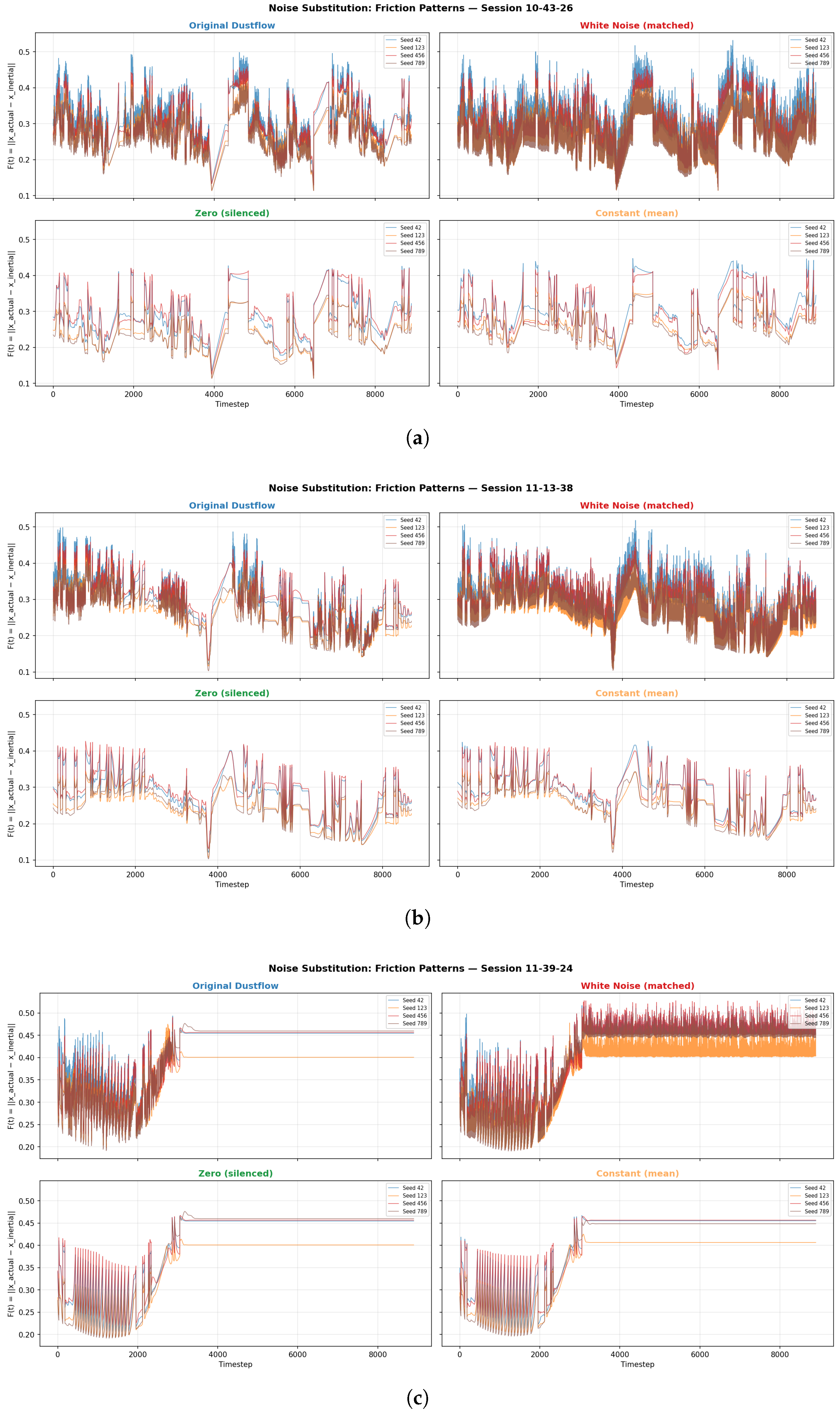
To test our assertion that the reservoir utilizes noise as a constructive resource (stochastic resonance), we conducted a noise substitution analysis on the Dustflow gradient.
Figure 16 illustrates the effect during our three sessions. Because the recorded session data is immutable, the macro-scale responses will inevitably force a reaction within the reservoir, regardless of the noise level. However, the noise analysis isolates the critical function of the erratic input
between these macro-events. Without the high-frequency noise of the Dustflow, the reservoir collapses into a rigidly reactive state. It becomes entirely dominated by the remaining structural macro-variables, losing the fluid variance that characterizes the ‘Active Play’ regime. The continuous Relational rhythms flatten into a deterministic mirroring of the raw input.
The environmental noise does not generate the macro-events; it acts as a vital computational lubricant. It keeps the internal state vector actively engaged in the non-linear operational range of the reservoir, preventing the structural collapse of the agent’s Thick Now. This allows the agent to negotiate the environment as a continuous ‘lived experience’ rather than a sequence of discrete forced triggers. The collapse is statistically robust across the entire dataset: an aggregate analysis of all 20 gameplay sessions revealed that silencing the Dustflow structurally flattens the signal, reducing the standard deviation of the agent’s Dynamical Friction in 19 out of 20 sessions. The ‘Leeroy Jenkins’ session (11-39-24) is the sole outlier where removing Dustflow increases variance (ratio = 0.762). This inversion has a simple explanation: because that player made a ballistic run, depleting the battery fast, the majority of the session consists of post-depletion flat-lined dynamics, skewing the session-wide variance metric.
The noise is thus not to be filtered out; it is the vital lubricant that prevents cognitive seizure, allowing the system to sustain its Thick now and navigate the environment as a continuous lived experience. Dustflow not only adds noise, but it also prevents the reservoir from settling in the attractor defined by the raw input only. It is literally what keeps the system from going flat.
Worth noting here is also the fact that the theoretical memory capacity (ESP index) extends up to approximately 500 timesteps. This can be compared to the causal check that revealed a decay after roughly 200 timesteps (see
Figure 7). This discrepancy further illustrates stochastic resonance: when the agent ‘dies’, the highly erratic Dustflow ceases. Without this continuous relational friction to keep the reservoir’s internal dynamics active, the Re-membered Inertia collapses into a fixed state much faster. The ‘Thick Now’ fundamentally requires the noise of the world to sustain its maximum potential.
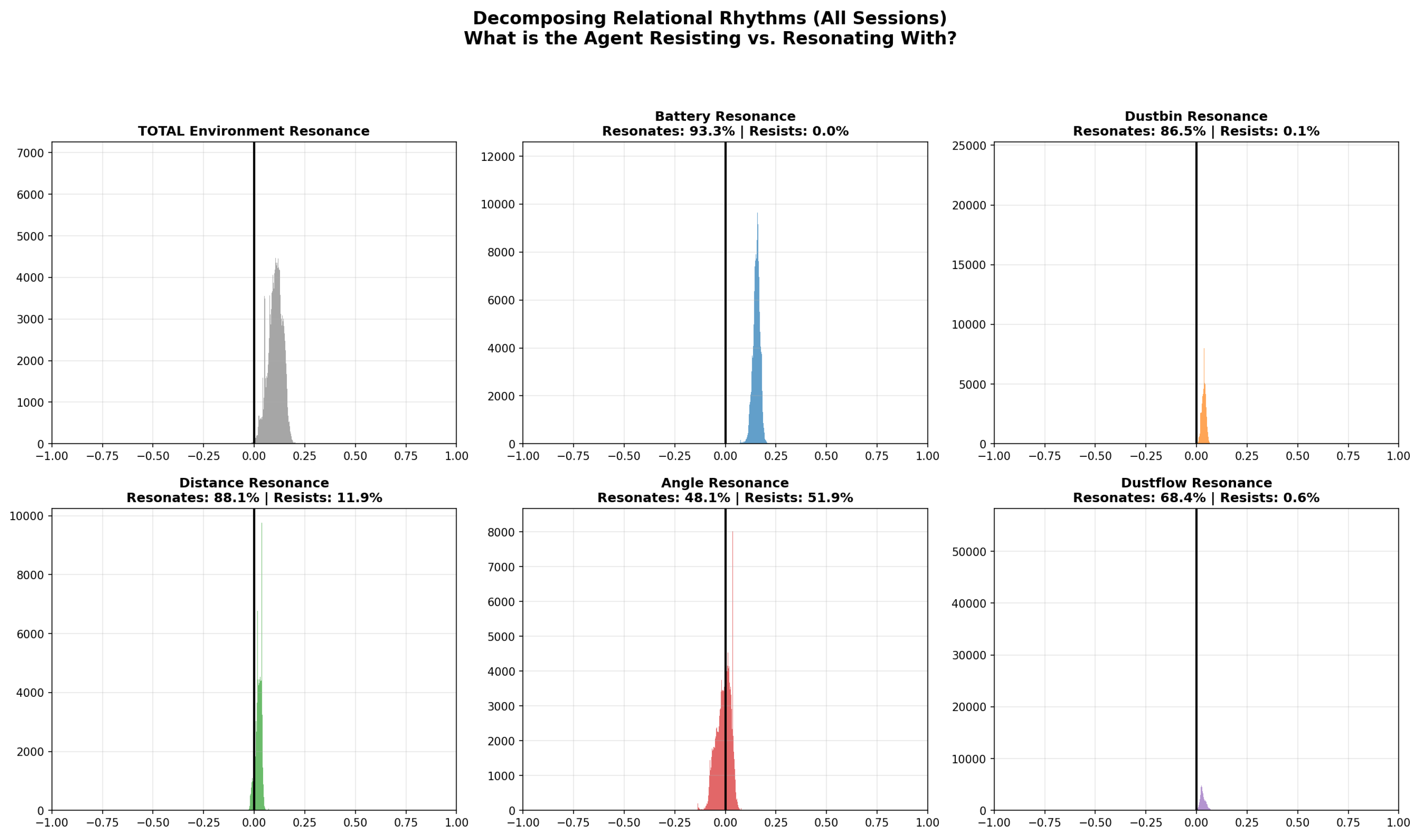
To further understand how the Affective Reservoir modulates its rhythms, we decomposed the Affective Gradients to measure how each individual environmental forcing resonated with or resisted the reservoir’s Re-membered Inertia (
Figure 17). Counterintuitively, the intense erratic noise of the Dustflow did not create the most resistance. The agent largely resonated with it (68.4%), successfully internalizing the noisy, high-frequency task of vacuuming into its habitual flow. This empirical finding directly addresses the role of stochastic resonance in our system: rather than being a purely conceptual assumption, the data demonstrates that the chaotic input of dust functions as a constructive computational resource, keeping the reservoir’s internal dynamics active without shattering its structural coherence.
The main source of resistance emerged from the spatial geometry of the game. The Angle and Distance to the charging station. Together, these two spatial constraints act as the physical tether for survival. Because the charging station resides in a fixed location, whenever the agent is forced to break its habitual exploration to reorient and traverse back, the Affective Gradients of both angle and distance intensely oppose the agent’s internal momentum. This shows how a reservoir can be capable of ’feeling’ the geometry of the room as an existential tension, which stands in stark contrast to how it assimilates the micro-fluctuations of the dust.
The decomposition of resonance and resistance exposes a critical characteristic of how our specific computational apparatus enacts the world. In biological autopoiesis, existential boundary conditions such as energy depletion do not act as parallel sensory inputs. They act as physiological modulators. A starving organism alters its yearnings, causing certain constraints to be perceived with exponentially higher tension. However, the Affective Reservoir resonated smoothly with its internal battery depletion (93.3% resonance). This occurs because our input projection () maps all sensors as parallel gradients. The architecture flattens the ontology of the agent, treating internal energy depletion computationally the same as geometric space or dust collection.
By configuring the Affective Gradients as parallel vectors, we designed an agent that processes survival as a geometric navigation problem rather than an internal physiological crisis. The existential tension of ‘dying’ is felt by the reservoir not through the battery sensor itself, but through the forced spatial re-orientations and the stretching of its physical tether to the charging station (the intense friction driven by both Angle and Distance).
This insight highlights a crucial consideration for the design of relational complexity. If we want an agent to ‘feel’ survival tension, the architecture cannot simply feed energy levels into the network alongside other data. It requires a modulated ontology where specific gradients do not just add to the state space but dynamically scale the system’s sensitivity to other inputs.
6. Conclusions
The analysis of reservoir dynamics offers an alternative approach to computational design. Rather than strictly optimizing an agent to detect predefined behavioral categories, this approach invites us to engage with the emergence of a continuous, co-constituted field of tension. The structure revealed by the UMAP-projection showed that Active gameplay was not divisible into discrete behavioral modes. The bifurcation between Active play and Dead Battery represents a fundamental ontological separation in the system, an agential cut that differentiates different modes of existence. Organizing relational complexity begins with setting the condition for this fundamental agential cut. When we selected the input vectors (Affective Gradients), we were not merely supplying data; we were enacting the ontological boundaries of the agent. We designed the capacity to be affected by dust, spatial tethers, and energy, thereby organizing the specific relational struggle that defines the gameplay.
By changing our understanding of interaction from transaction to rhythm, the Affective Reservoir offers an alternative framing that complements optimization-based approaches. Rather than strictly optimizing an agent to detect predefined behavioral categories, we propose a design orientation that engages with the emergence of co-constituted fields of tension. By embracing the ‘noise’ and ‘friction’ of active entanglement, we open a design space where agents are curated to inhabit their environments through material sensitivity rather than rigid rule-following.
However, it is important to note that the current architecture remains deterministic and defined by the designer. The selection of Affective Gradients is an imposed boundary condition, not autonomously enacted by the agent. While the system exhibits emergent dynamics, it does not engage in adaptive restructuring of its own topology.
If the agent’s ability to encounter the world is determined by a reciprocal relation to its environment, then the designer’s role transitions from designing a response to designing a capacity to be affected. Then, we effectively curate the agent’s ‘character’, its resilience, its sensitivity, and its specific way of ‘yearning’. The art of computational design therefore also lies in shaping and adapting the reservoir to resonate with the environment in particular ways.
Ultimately, this architecture provides a concrete operationalization of ‘organizing relational complexity’. Drawing on Edgar Morin’s conceptualization of organization, we posit that the system’s Re-membered Inertia functions as the locus of this regenerative activity. As evidenced by the Leeroy Jenkins session, where the situated tension persisted even after the input forcing collapsed, the reservoir demonstrated the capacity to regenerate a trajectory purely from its sedimented habitual momentum.
Limitations and Further Studies
We must acknowledge the quantitative limitation with respect to the size of our dataset. From a machine learning perspective, this constitutes a relatively small sample size. At the same time, it should be compared with standard evaluation practices in reservoir computing. Foundational ESN evaluations frequently rely on mathematically synthesized signals, such as the Mackey-Glass chaotic time series [
4,
33], to benchmark predictive accuracy. In contrast, the human-in-the-loop interactions captured in our dataset provide a rich qualitative depth. Because our methodological goal is not to benchmark algorithmic predictive power, but to map the tensions of lived interaction, we argue that the qualitative depth provides the necessary empirical material to validate the Affective Reservoir. However, future work should expand this methodology to see how these emergent rhythms evolve over extended periods of structural coupling and based on other contexts than this specific gameplay scenario.
While this study demonstrates how the Affective Reservoir can organize relational complexity, the current architecture remains bound by deterministic constraints. Unlike biological autopoiesis, where an organism actively constructs and maintains its own boundaries, our agent operates within a pre-defined ontology. The system exhibits responsiveness to the Dustflow, but it cannot question the validity of the Dustflow as its primary effect. The agent’s yearning is therefore a functional analog of situated tension, realized within a fixed state-space. The limitation is not that there are boundaries, but that they remain static. A compelling future direction is to explore mechanisms for adaptive intelligibility, where the agent autonomously reconfigures its own boundaries, discovering new gradients of significance rather than relying solely on a pre-given ontology.
The discovery of scale-dependent organizational principles in our data, with clear cuts at the macro scale and fluid interpenetration at the micro scale, suggests that future work should explore how computational systems might dynamically adjust their resolution of phenomena based on the significance of the distinctions being made. Not all differences matter equally, and a truly agential realist computational framework would need to account for how certain reconfigurations enact re-emergence in kind, whereas others enact variations, all within the same continuous field of possibility.
In this study, our focus was on the organization of relational complexity rather than the generation of output actions. Mapping the reservoir dynamics to discrete output behaviors using standard readout mechanisms would have required reverting to rule-based or target-driven mappings, fundamentally contradicting the non-teleological philosophy of our framework. The limitations of this fixed architecture point toward the exploration of adaptive ontology. Currently, the reservoir possesses a sedimented habitual momentum, but it lacks true structural plasticity. It
re-members the past, but it cannot physically adapt to restructure its own body. Furthermore, its reliance on discrete, mathematically updated timesteps retains the trace of linear, absolute time. If an enactive agent is to fully realize the ‘sensorimotor life’ [
24] observed in our stress analysis, it must be able to rewire its internal material-discursive apparatus in response to persistent friction. Additionally, existential variables (such as battery depletion) should not merely act as spatial coordinates, but dynamically modulate the sensitivity or leak rates of the entire reservoir.
By allowing the agent to physically reconfigure its own sensitivity and boundaries, we aim to move from a system that merely negotiates a fixed world to one capable of enacting its own agential cuts. This will enable the transition from an agent that simply endures relational complexity to one that actively grows through it. Therefore, future work will explore a transition from discrete fixed-topology Echo State Networks to continuous-time neuromorphic architectures that support dynamic structural plasticity. This could be achieved with an ESN by introducing unsupervised local learning rules, such as Hebbian or anti-Hebbian plasticity. However, while plastic ESNs simulate continuous structural adaptation, we think that the asynchronous spiking dynamics of SNNs and LSMs may provide a better substrate for Dynamical friction. In an LSM, plasticity (e.g., Spike-Timing-Dependent Plasticity, STDP) emerges directly from the afferent temporal interference of discrete events [
37], which aligns better with our aim for a system that builds its own ‘Thick Now’ from the bottom up.