1. Introduction
Adopting green practices remains a significant consideration for today’s firms [
1,
2]. Incorporating environmental sustainability into corporate strategy has become a strategic imperative and a key priority for firms [
3,
4]. Prior research on green innovation mainly adopted an output-oriented perspective, emphasizing the value, with a particular emphasis on corporate performance [
5,
6], derived from firms’ green activities, without fully examining their operational modes and motivators, thereby leaving cross-firm differences in green innovation engagement largely unexplained. Given that green innovation is characterized by lengthy cycles, substantial investment, high risks, and dual externality issues [
7,
8], corporate motivation to pursue it may often be insufficient [
9]. Therefore, stimulating its vitality necessitates a deeper exploration of its intrinsic drivers.
Currently, the extensive application of artificial intelligence has progressively expanded from production stages to R&D activities, driving the development of industrial intelligence while simultaneously reshaping corporate innovation behavior [
10]. The deep integration of artificial intelligence and green innovation is crucial for energy transition, promising to shift AI’s role from mere “instrumental application” to “systemic reshaping”. As a key driving force in the new round of scientific and technological revolution and industrial transformation, artificial intelligence holds significant potential in enhancing corporate productivity and fostering economic growth [
11]. It assists human employees in boosting creativity, particularly benefiting experts with stronger job skills [
12], and provides pathway support for overcoming development barriers during technological transformation by improving production operations and enhancing labor efficiency [
13]. However, the lack of an underpinning theoretical framework and difficulty accessing data are cited as barriers to further understanding the link between artificial intelligence and green innovation, and the pathways through which AI drives corporate green innovation have also rarely been systematically explored.
Notably, a profound academic paradox presents itself: why do enterprises exhibit significant heterogeneity in both the pathways adopted and the outcomes achieved in green innovation despite operating under comparable technological and market conditions? A critical yet often overlooked moderating factor may lie in the role of the manager. Corporate actions are fundamentally influenced by managerial cognition, a dimension insufficiently accounted for in conventional analytical frameworks. Prevailing theories, such as technological determinism or institutional theory, reveal explanatory gaps in addressing this observed variation. Technological determinism sees technology as an autonomous force. It predicts that AI adoption should yield uniform green innovation outcomes. This contradicts the evident differences across firms. Institutional theory emphasizes external pressures. These include regulatory, competitive, and social forces. Yet, it cannot explain why firms facing identical pressures choose divergent green innovation paths. These gaps call for a cognition-centered perspective. Such a view highlights how managers interpret AI’s potential. It also underscores their strategic agency in converting technological possibilities into innovation outcomes. In contrast, the lens of managerial cognition offers a pivotal theoretical perspective to bridge this gap. A firm’s strategic response is, in essence, a reflection of its managers’ strategic intent [
14]. In the context of corporate greening, managerial cognition filters through the organizational hierarchy to instigate specific initiatives [
15]. Substantial research corroborates that top management, by deliberately adjusting organizational structures, can catalyze the emergence of strategic responses to new innovation imperatives and hasten their implementation [
16]. Managerial cognition, a multidimensional construct, shapes how executives interpret and act within their strategic environment. As a general-purpose technology, the application of AI as a green enabler is fundamentally filtered through managerial cognition.
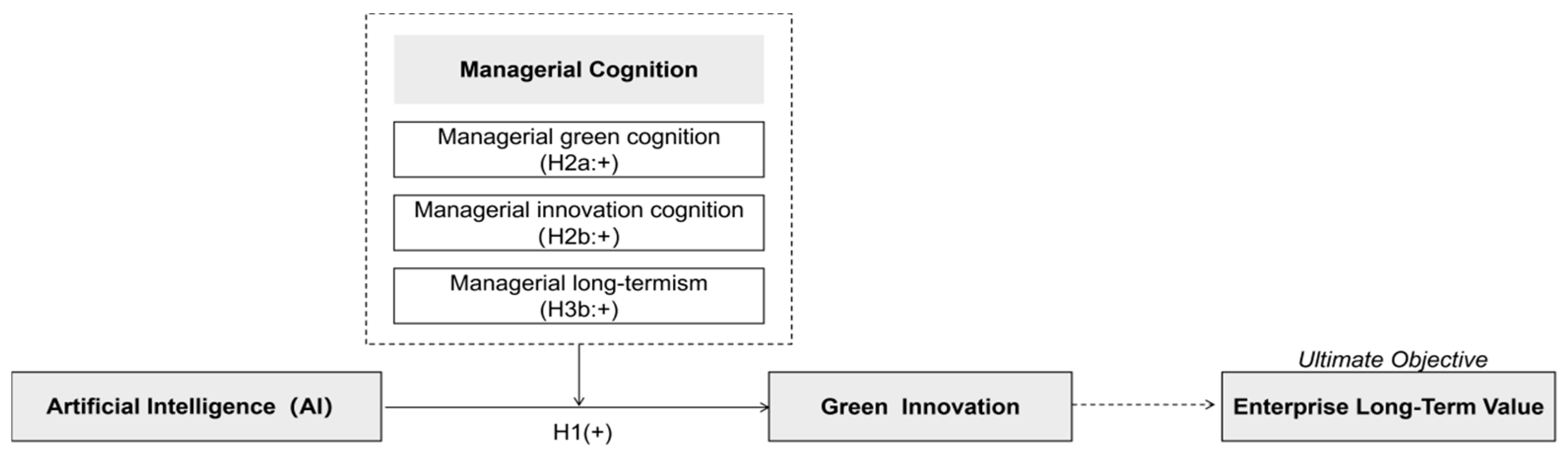
Based on the integration of socio-technical systems theory and upper echelons theory, we propose a unified analytical framework. Socio-technical systems theory offers the foundational lens of “technology-social dual subsystems.” It posits that organizational outcomes emerge from the dynamic interaction between technical elements (AI) and social elements (managerial agency). Upper echelons theory then identifies managerial cognition as the core element within the social subsystem. This cognition filters and shapes strategic responses to technological opportunities. From this integration, we derive three cognitive dimensions: managerial green cognition (motivation—whether executives prioritize environmental sustainability), managerial innovation cognition (capability—whether executives maintain open, exploratory orientations toward new technologies), and managerial long-termism (commitment—whether executives sustain strategic patience for long-cycle investments). Together, these dimensions capture the complete cognitive infrastructure required to translate AI potential into green innovation outcomes.
Grounded in this theoretical synthesis, this study delineates the critical role of managerial cognition in guiding how artificial intelligence fosters green innovation. Using panel data from Chinese A-share listed firms from 2012 to 2024, we examine how AI adoption influences corporate green innovation. Specifically, we address two questions: whether AI technology promotes green innovation, and how managerial cognition acts as a boundary condition in this relationship. Our findings offer dual contributions: theoretically, providing a systematic basis for enhancing the quality and effectiveness of corporate green innovation; and practically, furnishing theoretical insights and empirical evidence to support the transformation and upgrading of related industries through AI, thereby advancing the high-end, intelligent, and sustainable development of enterprise.
While prior literature has predominantly explored green innovation through the lenses of institutional pressure or resource-based view, and has largely treated artificial intelligence as an exogenous technological shock or a productivity-enhancing tool, this study shifts the analytical focus toward the endogenous role of AI and its interaction with managerial cognition. By integrating socio-technical systems theory and upper echelons theory, we propose a cognition-centered contingency framework that explains not only whether AI promotes green innovation but also how and under what conditions this translation occurs. This perspective moves beyond technological determinism and offers a more nuanced understanding of firm-level heterogeneity in green innovation outcomes.
This paper contributes to the literature in the following ways. First, we establish a positive relationship between AI adoption and corporate green innovation. This shifts scholarly attention from the consequences of green innovation to its antecedents. Prior work has focused on the outcomes of green innovation, such as its positive impact on financial and ESG performance. Research has also explored external enablers like environmental policy. However, the internal drivers of green innovation remain underexamined. By showing that a firm’s strategic engagement with AI acts as a significant internal motivator, our work addresses this gap. It enriches the theoretical understanding of what drives green innovation within firms. Second, we propose managerial cognition as a moderating framework. This explains how executives’ interpretations shape the translation of AI capability into green outcomes. While the overall positive effect of AI is recognized, substantial heterogeneity in firm-level outcomes exists. Why similar technological inputs lead to different innovative outputs has lacked a clear explanation. We argue that this heterogeneity is fundamentally shaped by managerial cognition. By integrating the lenses of managerial green cognition, innovation cognition, and long-termism, we provide a focused framework. It captures the motivational, absorptive, and commitment-related dimensions of management. This moves the discourse beyond simple “technology-push” or “institution-pull” narratives. It offers a more nuanced, mechanism-based account of strategic choice and reveals the key boundary conditions for translating AI into green innovation.
The rest of this paper is structured as follows:
Section 2 proposes hypotheses based on existing research.
Section 3 describes the research design and methodology.
Section 4 presents the results and discussions.
Section 5 displays further research.
Section 6 concludes this study.
6. Research Conclusions and Insights
6.1. Conclusions
Based on socio-technical systems theory and upper echelons theory, this study systematically examines the impact of artificial intelligence (AI) technology on corporate green innovation and the boundary role of managerial cognition. Using panel data from Chinese A-share listed companies (2012–2024) and textual analysis, we find:
First, AI significantly promotes green innovation. As a general-purpose technology, AI drives green technology exploration through its self-learning capabilities and strong generality, extending green innovation drivers beyond institutional pressures to technological endogeneity.
Second, managerial cognition serves as a critical boundary condition. Managerial green cognition, innovation cognition, and long-termism all positively moderate the AI–green innovation nexus. High green cognition reframes AI as a strategic engine for sustainability; strong innovation cognition enables tolerance for uncertainty and absorptive capacity building; and long-termism provides strategic patience against short-term volatility.
Third, AI operates through three transmission mechanisms: information transparency (enhancing carbon data quality and compressing greenwashing space), compliance internalization (embedding environmental regulations into digital compliance systems), and value creation (converting environmental data into economic assets and green business models).
Fourth, significant industry heterogeneity exists. AI exhibits stronger marginal effects in non-high-tech industries and under intense market competition, offering leapfrogging opportunities to bridge green innovation gaps across technological divides.
6.2. Practical Implications
The findings of this study offer important implications for corporate managers, policymakers, and investors.
First, managers should transcend the narrow perception of AI as merely a tool for cost reduction and efficiency gains, instead establishing a cognitive framework that views AI as an architect of green strategy. Second, managers must consciously cultivate their green cognition, innovation cognition, and long-term orientation through proactive learning, cross-industry exchanges, and engagement with sustainability issues, thereby building the cognitive foundations for deeply integrating AI with green innovation. Specifically, they should incorporate green value dimensions into AI project evaluations, tolerate early-stage trial-and-error costs, and establish long-term incentive mechanisms aligned with AI technology iteration cycles.
Second, when promoting the “AI+” initiative, governments should fully account for industry heterogeneity. Policymakers should increase inclusive investment in AI infrastructure to lower technology adoption barriers. Simultaneously, they should improve ESG disclosure standards and green finance incentive mechanisms to provide institutional support for the formation of managerial long-termism. Furthermore, establishing demonstration case libraries of AI-enabled green transformation could guide corporate AI investment toward green innovation through “cognitive inspiration” rather than mere regulatory pressure.
Finally, when assessing corporate AI investment value, capital markets should look beyond technology input intensity and focus instead on management cognitive characteristics and strategic intent. Managers’ emphasis on green issues, innovation orientation, and long-termism expressed in MD&A sections can serve as effective signals for predicting whether AI technology will translate into substantive green innovation outcomes.
6.3. Limitations and Future Research
This study has several limitations that directly suggest avenues for future research. First, regarding measurement validity, while text-based word frequency indicators offer objectivity and reproducibility, they may inadequately capture the full depth, complexity, and strategic ambiguity of managerial cognition. To address this, future research could adopt mixed-method designs, integrating qualitative approaches such as in-depth interviews and longitudinal case studies with quantitative analysis to illuminate the micro-psychological and organizational processes through which managerial cognition shapes AI technology absorption.
Second, the sample is limited to Chinese A-share listed companies, which constrains generalizability to non-listed SMEs or different institutional environments. Future research could extend to unlisted firms and emerging economies to examine how organizational scale and ownership structure moderate the AI–green innovation relationship, and to validate whether managerial cognition operates similarly across distinct cultural and institutional settings.
Finally, given the rapid iteration of AI technology, our data spanning 2012–2024 may not fully reflect the disruptive impact of emerging technologies such as Generative AI. Moving forward, scholars should closely monitor how next-generation AI technologies—including large language models and digital twins—influence green innovation paradigms and correspondingly transform managerial cognitive frameworks. Furthermore, future work could trace the long-term consequences of AI-driven green innovation on firm value, supply chain resilience, and carbon neutrality pathways, thereby constructing a complete “technology—cognition—innovation—performance” causal chain.