Article

Systematic Evaluation of the Spatiotemporal Dynamics of Rural Logistics Capacity and Its Influence on Rural Economic Resilience

School of Economics and Management, Hunan University of Technology, Zhuzhou 412000, China
*
Author to whom correspondence should be addressed.
Systems 2026, 14(3), 276; https://doi.org/10.3390/systems14030276
Submission received: 12 January 2026 / Revised: 26 February 2026 / Accepted: 2 March 2026 / Published: 4 March 2026
(This article belongs to the Section Complex Systems and Cybernetics)

Abstract

The rise of the digital economy necessitates a scientific framework for evaluating rural logistics capacity, a critical enabler of agricultural and rural modernization. This study conceptualizes “rural logistics capacity in the digital economy” and constructs an evaluation system comprising four primary and fourteen secondary indicators. Using provincial panel data from the China Statistical Yearbook (2012–2023) and the entropy-weighted fuzzy matter-element method, we systematically assess the spatiotemporal evolution of China’s rural logistics capacity and empirically examine its direct impact on rural economic resilience. The results show that: (1) Rural logistics capacity in China has improved overall but remains regionally uneven, with persistent bottlenecks in digital infrastructure and operational capabilities; (2) Rural logistics capacity significantly enhances rural economic resilience, with stronger effects observed in western regions and non-major grain-producing areas. These findings suggest that policymakers should adopt region-specific strategies, prioritize digital infrastructure development, promote logistics technology innovation, and strengthen mechanisms for talent cultivation and interregional coordination. Such measures are essential for comprehensively upgrading rural logistics capacity, reinforcing rural economic resilience, and fostering the sustainable development of rural logistics systems.

1. Introduction

The “No. 1 Central Document for 2026” clearly states that the “15th Five-Year Plan” period is crucial for basically realizing socialist modernization. It emphasizes the need to “accelerate efforts to address prominent shortcomings in the agricultural and rural sectors.” This strategic directive directly responds to the internal challenges and external risks facing rural development amid rising global uncertainties. Its core objective is to comprehensively enhance the stability and sustainability of rural systems. In this context, rural economic resilience—defined as the capacity of a rural economy to withstand, recover from, and adapt to shocks such as pandemics, extreme climate events, or market fluctuations [1]—emerges not merely as an academic concept, but as a critical determinant of national security and sustainable development. It encompasses three interrelated phases: resisting disruptions and maintaining core functions, recovering quickly from shocks, and ultimately enabling transformative upgrading. Recent crises have starkly illustrated the vulnerabilities of rural systems. For instance, the logistical disruptions during the COVID-19 pandemic led to significant agricultural product backlogs and price volatility, with estimates suggesting substantial income losses for farmers in specific regions. Similarly, extreme weather events, increasing in frequency and intensity, have repeatedly shattered stable supply chains for agricultural inputs and daily necessities. These events underscore that the resilience of the rural economy is fundamentally contingent on the robustness of its underlying circulatory system—rural logistics. A disruption or blockage in logistics networks rapidly propagates to both production and consumption ends, exacerbating issues like unsalable agricultural products, material shortages, and supply crunches, thereby amplifying overall economic instability. Thus, rural logistics is not merely a support sector but a foundational pillar for building and sustaining rural economic resilience.
Extant literature identifies several core factors influencing rural economic resilience, including industrial structure diversification, fiscal self-sufficiency, human capital, and digital infrastructure. Among these, rural logistics capacity occupies a uniquely foundational and integrative role. It is the physical and informational backbone that enables all other factors to function effectively—diverse products need transport to markets, information requires a physical network for e-commerce, and post-disaster recovery depends on the rapid inflow of relief and materials. However, the specific mechanisms through which logistics capacity fosters resilience remain underexplored. Compounding this gap is the profound transformation underway: the rapid penetration of the digital economy is reshaping rural logistics [2,3,4], introducing new dimensions of connectivity, intelligence, and efficiency. Accurately measuring this digitally empowered logistics capacity is a prerequisite for understanding its impact on resilience, which in turn depends on constructing a scientific evaluation index system.
Despite growing recognition of both rural logistics and economic resilience as critical research themes, existing studies have largely examined them in isolation. Research on rural logistics predominantly focuses on its role in promoting economic growth, while studies on economic resilience tend to emphasize digital infrastructure and e-commerce as key enabling factors, often at the urban or regional level. The specific question of how rural logistics capacity—particularly in its digitally empowered form—directly contributes to rural economic resilience remains empirically untested. This gap is compounded by a second limitation: the absence of a systematic measurement framework that captures the digitally enabled dimensions of rural logistics capacity, creating a critical disconnect between theoretical recognition and empirical validation.
To address these gaps, this paper aims to construct a novel evaluation index system for rural logistics capacity in the digital era and empirically test its direct impact on rural economic resilience. It seeks to answer three progressively deeper research questions:
(1)
How can rural logistics capacity under the digital economy be measured scientifically and systematically?
(2)
What spatiotemporal evolution patterns does this capacity exhibit?
(3)
How, and to what extent, does rural logistics capacity impact rural economic resilience?
To this end, this study first constructs an evaluation index system based on systems theory. This system comprises four layers: logistics environment support capability, logistics infrastructure level, logistics digitalization level, and logistics operational capability. Subsequently, the entropy weight–fuzzy matter-element model is applied to conduct a comprehensive measurement using provincial-level panel data in China, and the spatiotemporal evolution of rural logistics capacity is analyzed. Finally, drawing on the resource-based view and resilience theory, a two-way fixed effects model is employed to empirically examine the direct impact of rural logistics capacity on regional economic resilience. Robustness checks and heterogeneity analyses are also conducted.
The contributions of this study are threefold. First, it constructs a multi-dimensional evaluation index system for rural logistics capacity in the context of the digital economy, providing a theoretical measurement tool for quantitative research on rural logistics. Second, it incorporates rural logistics capacity into the analytical framework of rural economic resilience and empirically tests its direct enabling effect on economic resilience, thereby extending the application boundaries of resilience theory within rural territorial systems. Third, it reveals the spatial heterogeneity in the enabling effect of rural logistics capacity on economic resilience, deepening the contextualized understanding of the enabling role of logistics capacity.
The remainder of this paper is structured as follows. Section 2 reviews the relevant literature and develops the research hypothesis. Section 3 describes the research methodology, including the evaluation index system, measurement model, and econometric specification. Section 4 presents the empirical results, encompassing the spatiotemporal evolution of rural logistics capacity and its impact on rural economic resilience. Section 5 concludes with key findings, policy implications, and suggestions for future research.

2. Literature Review and Hypothesis Development

2.1. Rural Logistics Capacity in the Digital Economy: Concept, Composition, and Measurement

Rural logistics, distinct from its urban counterpart, encompasses service activities—including packaging, handling, transportation, warehousing, and information processing—that support rural production and daily life [5]. As articulated in the China Rural Logistics Development Report (2013), it constitutes a comprehensive, multi-domain, and multi-type industrial system characterized by seasonality, dispersion, complexity, biological relevance, and diversity. Its operational scope primarily covers agricultural means of production logistics, rural household consumption logistics, and renewable resource logistics.
Rural logistics capacity denotes the systemic efficacy of service delivery. At the macro level, it reflects the logistics service and support capacity provided by the national logistics economy to society; at the micro level, it refers to the specific service capabilities of logistics suppliers in meeting downstream client demand [6,7]. Synthesizing these perspectives, rural logistics capability is defined as the comprehensive service capacity provided by logistics suppliers to demand-side entities, with its level decisively shaped by the balance between rural logistics supply and demand [8]. The level of rural logistics capability is shaped by multiple interacting factors. First, environmental support—including market conditions that influence industrial structure through supply-demand dynamics, and policy frameworks that provide external impetus [9]—sets the foundational context. Second, infrastructure—encompassing transportation networks, warehousing facilities, and information systems—serves as the physical backbone that enables efficient operations and cost reduction [10,11]. Third, operational capability—referring to the practical management, coordination, and execution capacity of logistics actors—determines how effectively infrastructure and environmental support translate into actual service delivery [8].
The digital economy, centered on digital knowledge and information, leverages modern information networks to drive structural optimization and efficiency gains [12]. Its deep integration into economic systems has brought transformative changes characterized by high permeability, rapid diffusion, and real-time responsiveness [13]. In rural contexts, digitalization provides critical momentum for upgrading economic structures and logistical operations [14,15]. It empowers rural logistics capability through multiple mechanisms: reducing information asymmetry and transaction costs, streamlining distribution channels [16]; facilitating new models such as direct-from-origin sales and e-commerce that compress intermediary stages [17]; and reorienting agricultural supply chains from production-centric to consumption-centric models, thereby enhancing coordination, agility, and transparency [18,19].
Digital technologies are now recognized as foundational enablers of logistics modernization, helping overcome persistent inefficiencies and coordination barriers through intelligent networking and data-driven coordination [20,21]. Existing research on logistics capability evaluation spans several thematic streams. A substantial body of literature conducts macro-level assessments of regional logistics capacity, developing evaluation frameworks and examining relationships with economic development using indicators such as network density, freight turnover, and facility throughput [22,23,24]. Another stream emphasizes methodological innovation, applying techniques including fuzzy matter-element models [25], principal component analysis [26], grey relational analysis [27], and entropy-weighted TOPSIS [28] to quantify logistics performance across regional and supply chain contexts. Within the agricultural and rural logistics domain, scholars have increasingly constructed specialized evaluation indicator systems and identified key influencing factors, with provincial-level analyses remaining predominant [26,29].
Despite this growing body of work, a dedicated evaluation framework that captures the unique characteristics of rural logistics capacity under the explicit conditions of the digital economy remains underexplored. Existing measurement systems, while valuable, predominantly rely on traditional infrastructure and throughput indicators, insufficiently integrating digital dimensions such as information connectivity, network intelligence, and data-driven coordination. This gap presents both a theoretical opportunity and an empirical imperative for the present study.

2.2. Rural Economic Resilience: Measurement, Influencing Factors, and the Link to Logistics Capacity

The concept of resilience, adapted from ecology, describes a system’s ability to withstand and recover from shocks. In economics, this translates to economic resilience—a system’s capacity to resist, adapt to, and rebound from external disruptions [1,30]. However, compared to regional and urban economic resilience [31,32], research specifically focused on rural economic resilience is still in its nascent stages. Existing studies primarily revolve around two directions: measurement and the identification of influencing factors. Regarding measurement, the literature presents two main approaches. The first, and more comprehensive, approach constructs multi-dimensional indicator systems that capture different phases of resilience. For instance, scholars have developed frameworks encompassing resistance and recovery capacity, adaptation and adjustment capacity, and transformation and innovation capacity to systematically assess the dynamic performance of agricultural economic resilience [33]. This approach acknowledges resilience as a multi-faceted concept. The second, more parsimonious approach employs macro-level indicators, such as the sensitivity of regional GDP growth to national shocks, to indirectly reflect the relative stability and recovery trajectory of regional economies [34]. While useful for broad comparisons, such single indicators may obscure the underlying mechanisms that drive resilience.
In terms of influencing factors, existing research generally highlights the significant role of digital and information technology development in shaping rural economic resilience. Specifically, digital village construction enhances the connectivity and public service levels in rural areas, thereby injecting new adaptive capacity into the economic system [35,36]. The development of rural e-commerce expands market access for agricultural products, strengthening farmers’ resilience in coping with market fluctuations [37]. More broadly, the penetration of the digital economy is argued to systematically enhance comprehensive rural resilience by restructuring industrial chains, optimizing resource allocation, and fostering innovation and transformation [38].
Synthesizing these two streams of literature reveals a critical research gap. On one hand, studies on rural economic resilience identify digital infrastructure and e-commerce as key enabling factors [35,36,37,38]. On the other hand, research on rural logistics emphasizes its transformation under digitalization [16,17,18,19,20,21] and its positive impact on economic growth [5,8]. However, these two bodies of knowledge have largely evolved in parallel. While logistics capacity constitutes the physical backbone for digital infrastructure and is an integral component of rural e-commerce, few studies have directly and empirically tested whether and how rural logistics capacity contributes to rural economic resilience. The implicit assumption that the benefits of digitalization for resilience automatically translate through the logistics system remains unverified. Consequently, there is a clear need for an empirical investigation that positions a systematically measured, digitally augmented rural logistics capacity within the analytical framework of rural economic resilience. Addressing this gap is the central objective of the present study.

2.3. Research Hypothesis

The Resource-Based View (RBV) provides a foundational lens for understanding the strategic value of rural logistics capacity. According to RBV, heterogeneous and immobile resources that are valuable, rare, imperfectly imitable, and non-substitutable constitute the source of sustained competitive advantage for organizations and regions [30]. Rural logistics capacity can be conceptualized as such a strategic regional resource. It does not emerge from isolated infrastructure investments or discrete operational improvements; rather, it is formed through the systemic integration and coordination of multiple localized resources—including transportation networks, warehousing facilities, information systems, organizational routines, and human capital. This integrated capability enables rural regions to achieve efficient factor mobility, reduced transaction costs, and enhanced market connectivity, thereby constituting a distinctive competence that is difficult to replicate in the short term [8,11].
Resilience theory complements this perspective by specifying how such strategic resources translate into systemic robustness. Economic resilience is commonly understood as the capacity of a regional economy to withstand, recover from, and adapt to external shocks [31]. It encompasses three interrelated phases: resistance, the ability to absorb shocks and maintain function; recovery, the speed and extent of bounce-back after disruption; and reorientation, the capacity for structural adaptation and transformative upgrading in response to changing environments [32,33]. From this vantage point, logistics capability does not merely support routine economic activity; it fundamentally conditions a region’s capacity to cope with uncertainty and change.
The integration of RBV and resilience theory yields a coherent explanatory framework. If rural logistics capability represents a strategically valuable regional resource, and if such resources enhance systemic capacities for absorption, recovery, and adaptation, then it follows that regions endowed with superior logistics capacity should exhibit stronger economic resilience. This logic is further reinforced by the transformative role of the digital economy. Digital technologies—by enabling real-time information sharing, intelligent coordination, and supply chain visibility—amplify the strategic value of logistics resources and extend their influence across all phases of the resilience cycle [20,21]. Specifically:
Exante, well-developed logistics infrastructure and digitally enabled information networks increase system redundancy and operational flexibility, strengthening the rural economy’s resistance to potential disruptions [16]. Expost, efficient and intelligent logistics systems accelerate the flow of materials, capital, and information, thereby facilitating rapid recovery of production and consumption activities following shocks [17]. In the long term, logistics systems deeply integrated with digital technologies serve as critical platforms for incubating new business models, fostering e-commerce penetration, and promoting industrial structure upgrading—processes that collectively enhance the adaptive transformation capacity of rural economies [18,19].
Although the theoretical linkage between rural logistics capacity and economic resilience is conceptually plausible, existing empirical research remains fragmented and incomplete. On one hand, a substantial body of literature has established that rural logistics development positively contributes to regional economic growth, primarily through optimizing circulation systems, reducing transaction costs, and enabling new business formats [1,6,9]. On the other hand, studies on economic resilience have identified digital infrastructure and e-commerce development as critical enabling factors for resilience building in rural areas [14,15,37]. However, these two streams of inquiry have proceeded largely in parallel. Direct empirical investigations that position rural logistics capacity—particularly its digitally empowered dimensions—within the analytical framework of economic resilience are conspicuously absent.
This disjuncture is attributable, in part, to a measurement gap. Existing evaluation systems for rural logistics capacity remain predominantly anchored in conventional indicators such as road density, freight volume, and warehousing capacity [22,24]. While these metrics capture traditional logistics functions, they inadequately reflect the new capability dimensions catalyzed by the digital economy—including information connectivity, inter-organizational coordination, data-driven decision-making, and intelligent scheduling [25,27]. This misalignment with contemporary logistics practice constrains empirical testing of the resilience-enhancing effects of digitally empowered rural logistics capacity.
Synthesizing the foregoing theoretical reasoning and empirical gap, the following hypothesis is proposed:
H1. 
Rural logistics capacity has a significant positive impact on rural economic resilience.

3. Methodology

3.1. Evaluation Index System Construction of Rural Logistics Capacity

3.1.1. Construction Process of Rural Logistics Evaluation Index System

Informed by a comprehensive review of literature pertaining to rural logistics and logistics capacity, this research establishes an evaluation index system founded upon L.V. Bertalanffy’s Systems Theory (ST). This theoretical lens is particularly apt for investigating complex systems, as it stresses the interdependence and integrity of constituent parts and advocates for ensuring subsystem coordination through analysis of structure, function, dynamics, and feedback.
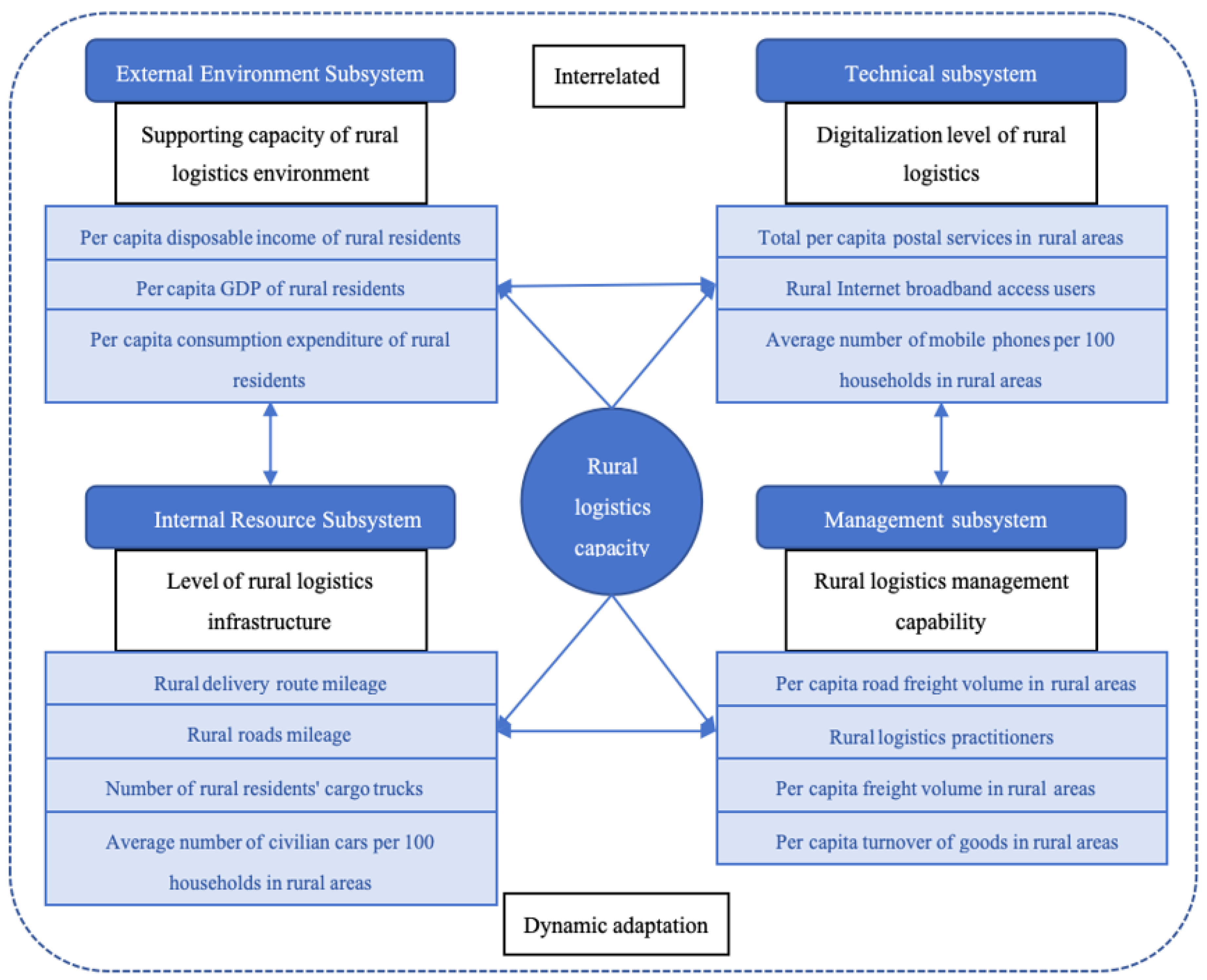
Existing research typically decomposes the logistics system into several parallel components, such as infrastructure, operational services, and information support. Under such a framework, digital technology is largely regarded as an auxiliary tool serving the information support component or is categorized as a conditional factor within the external environment. In contrast, guided by the core principles of General Systems Theory and situated within the context of the digital economy, this study conceptualizes rural logistics capacity as an integrated system comprising four subsystems: the External Environment Subsystem, Internal Resources Subsystem, Technology Subsystem, and Management Subsystem. Therefore, the key advancement of this study lies in no longer treating digital technology as a localized or peripheral element. Instead, it is established as an independent and equally important core subsystem that interacts with the physical resources’ subsystem. The design of the indicator system meticulously accounts for the interactions and synergistic effects among these subsystems, thereby guaranteeing a comprehensive and scientifically valid evaluation.
The operationalization of this framework adhered to the principle of theory-practice integration. A two-round Delphi consultation process was conducted with a panel of 20 experts in rural revitalization from provinces including Hunan, Hubei, and Guangxi to screen and finalize the indicators. Experts provided key feedback in two main areas: firstly, assessing the comprehensiveness of the indicators and identifying any significant omissions, and secondly, evaluating whether the indicators align with rural realities and data availability. Their suggestions were used to refine and finalize the indicator system, thereby enhancing its scientific rigor and practical applicability. The functional definition of each subsystem is as follows: the external environment subsystem pertains to the support level and its influence on overall system functionality; the internal resource subsystem concerns the hardware infrastructure and its role in supporting operational efficiency; the technology subsystem involves the application of digital technologies and their effect on optimizing information and material flows; and the management subsystem relates to operational management and its impact on overall system performance and benefits.
The development of secondary indicators was informed by an extensive literature synthesis—incorporating the work of scholars such as Shu (2023) [39], Kong (2019) [40], Su (2021) [24]—and consideration of established logistical models (e.g., the World Bank’s Logistics Performance Index, Bardi et al.’s National Logistics Competitiveness model). By building upon prior theoretical research and contextualizing it within the practical realities of China’s digital village initiative, a refined theoretical framework for rural logistics capacity in the digital economy was constructed (see Figure 1).
Guided by the holistic and systematic perspectives of systems theory and considering the coordination and optimization among subsystems, this study establishes a quantitative evaluation index system for rural logistics capacity. The system construction adheres to the principles of data availability, comparability, comprehensiveness, and relative independence, and is informed by theoretical analysis and expert consultation. The resulting framework comprises four primary dimensions: environmental support capacity, infrastructure level, digitalization level, and operational capacity.
  • Environmental Support Capacity
The economic environment underpins the growth potential of rural logistics. A favorable economic climate is essential for developing logistics capacity, as broader rural economic development and structural advancement can drive systematic improvements in the logistics system.
2.
Infrastructure Level
Logistics infrastructure forms the backbone of the supply chain, encompassing facilities with single or comprehensive functions. Its development is crucial for reducing costs, ensuring service quality, improving operational conditions, and enhancing efficiency, thereby fundamentally boosting rural logistics capacity.
3.
Digitalization Level
Digital logistics entails the systematic optimization of the entire logistics process through digital technologies to achieve comprehensive operational and management digitization. This reduces costs across the supply chain and enhances service levels.
4.
Operational Capacity
Logistics management capability refers to the efficiency and effectiveness of logistics asset operations. Its improvement can enhance rural logistics operational efficiency, thereby strengthening overall capacity.
Building on existing literature [39,40,41,42,43,44,45,46,47,48,49] and considering the practical context of rural logistics, the final evaluation index system and its calculation methods are presented in Appendix A, Table A1.

3.1.2. Data Source

Most of the empirical data are from the China Statistical Yearbook from 2012 to 2023, including data from 31 provinces and cities. The total amount of X31 rural postal services in 2023 is from the National Post Office, of which X21 data is missing in 2023, X24 data is missing in 2012, and X32 data is missing in some years in Shanghai and Tibet. The article uses the missing value of the linear trend of adjacent points to replace all missing data. The national data comes from the sum of data from various provinces and cities, and the data for the three major regions comes from the sum of data from their respective regions. The indicator data for each country is shown in Appendix A, Table A2.

3.1.3. Entropy Weight Method for Determining Indicator Weights

The entropy weight method is used to determine the weight of each variable, and the degree of influence of indicators on comprehensive evaluation is determined by the degree of dispersion of indicators. Compared with subjective weighting method, it can better reflect the objective weight of indicators [43].
(1) Dimensionless processing. The indicators selected in this study have different dimensions. In order to improve accuracy, the min-max normalization method is used for dimensionless processing. Among them, max(aj) is the optimal value of a certain indicator, min(aj) is the worst value of a certain indicator, Xij (i = 1, 2,…, n; j = 1, 2,…, m) represents the statistical data of the i indicator in the j evaluated indicator, as shown in Equation (1):
X i j = a i j min ( a j ) max ( a j ) min ( a j )
(2) Determine the specific gravity of the sample. Refer to Equation (2). Before determining the sample density, this study used coordinate translation, i.e., shifting Xij to the right by 0.001, to eliminate the impact of dimensionless data on data calculation;
P i j = x i j i = 1 n x i j
(3) Calculate the entropy value ej. e is the entropy value of the j evaluation indicator, with a value range of [0, 1], as shown in Equation (3);
e j = 1 ln n n = 1 P ij ln ( P ij )
(4) Calculate the information entropy of the indicator. The larger the value of information entropy dj, the greater the role of its corresponding indicator in the evaluation index system of rural logistics capacity, as shown in Equation (4);
d j = 1 e j
(5) Calculate the index weight. The weight coefficient value of the corresponding index in the rural logistics capacity evaluation index system is ωi, see Equation (5).
ω i = d j j = 1 m d j
In order to explore the weight of rural logistics capacity evaluation index reflected by each secondary index. By introducing the data into Equations (1)–(5), the weight of rural logistics capacity evaluation index is obtained. The calculation results are provided in Appendix A, Table A3.

3.1.4. Fuzzy Matter Element Method for Evaluation of Rural Logistics Capacity

Fuzzy matter-element analysis can solve the problem of fuzzy incompatibility. By combining fuzzy mathematics and matter-element analysis, the incompatibility between many influencing factors of things and the fuzziness of the corresponding values of the characteristics of things are comprehensively analyzed, so as to realize the transformation of things from qualitative to quantitative [50]. Logistics system is a complex comprehensive system, which contains multi-level and multi elements. It is difficult to accurately measure how the internal elements interact with each other and how they affect the whole. Therefore, the fuzziness and multi index of logistics system make it suitable for fuzzy matter-element method. There are several main steps to establish the model:
(1) Fuzzy matter-element and compound fuzzy matter-element analysis describe a thing with a given thing O, thing feature C and the magnitude X of C. The ordered triple R = (O, C, X) is referred to as matter-element for short. A thing and its n features C1, C2, …, Cn and the values X1, X2,…, Xn form an n dimensional complex element. The n dimensional complex matter element of m things can be expressed as:
R m n = ( X i j ) m × n
(2) The compound fuzzy matter element with optimal membership is constructed. μij is the fuzzy quantity value corresponding to the j feature of the i thing, in which the maximum and minimum values of all the quantity values Xij corresponding to the j evaluation index of the i thing are max(xij) and min(xij), respectively. See Equation (7).
u i j = x i j min ( x i j ) max ( x i j ) min ( x i j )
Using Equation (7) to calculate various factors, the fuzzy matter element R mn with optimal membership of rural logistics capacity is obtained.
R m n = ( u i j ) m × n
(3) Establish the optimal fuzzy matter element. The optimal fuzzy matter element R0n is constructed by calculating and selecting the maximum or minimum value of each factor index in R mn , as shown in Equation (9).
R 0 n = C 1 u 01 C 2 u 02 C n u 0 n
(4) Construct difference square compound fuzzy matter element R Δ . Δij (i = 1, 2,…, m; j = 1, 2,…, n) represents the square difference between u0j and uij. See Equations (10) and (11).
R Δ = ( Δ i j ) m × n
Δ i j = ( u 0 j u i j ) 2
(5) Building rural logistics capacity Euclidean paste progress compound fuzzy matter element. The rural logistics capacity Euclidean progress composite fuzzy matter element RρH is constructed by the rural logistics capacity Euclidean progress ρHi. The stronger the rural logistics capacity, the greater the rural logistics capacity Euclidean progress. Including: ρHi (i = 1, 2,…, m), See Equation (12) and (13).
ρ H i = 1 j = 1 n ω j R Δ
R ρ H = [ ρ H 1       ρ H 2       ρ H 3             ρ H n ]

3.2. Measuring the Spatiotemporal Evolution of Rural Logistics Capacity in China

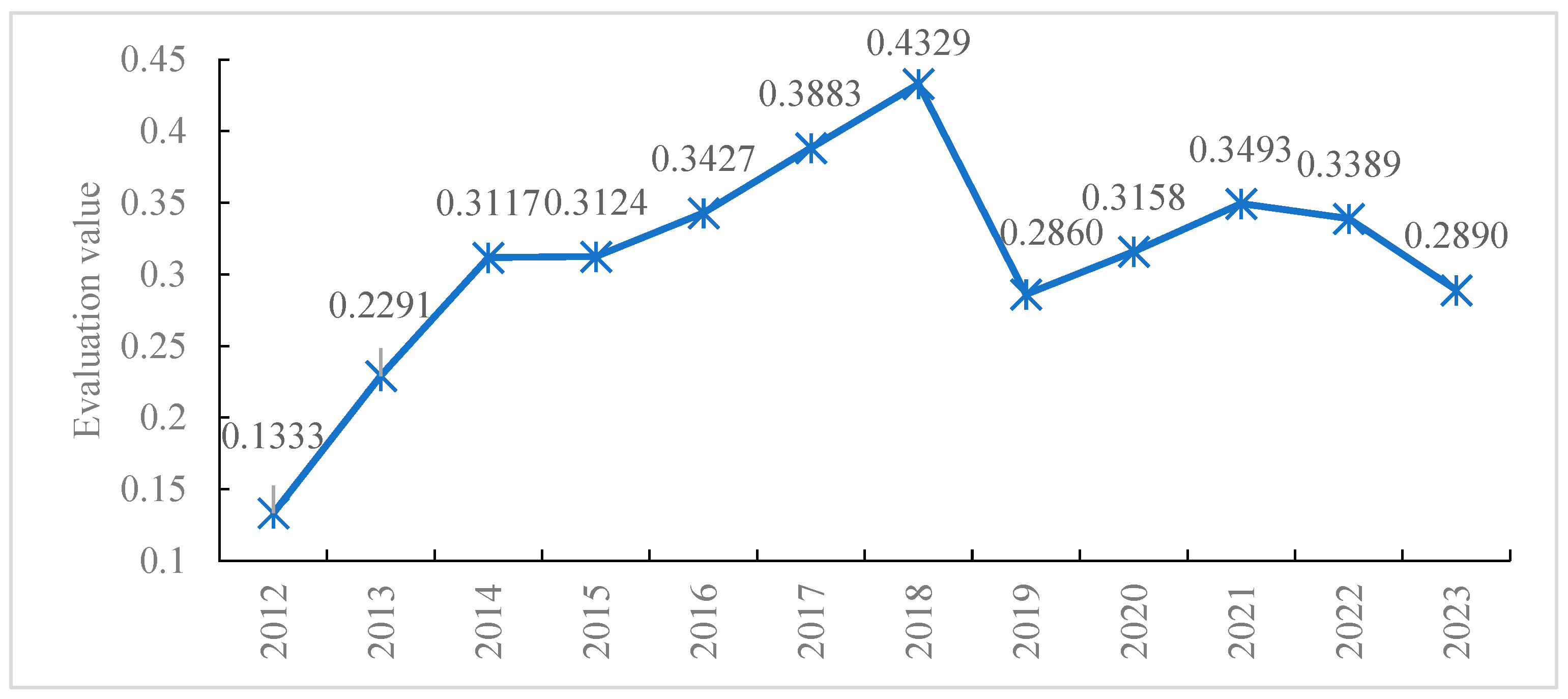
From 2012 to 2023, the calculation result of the Euclidean paste progress composite fuzzy matter element RρH of China’s rural logistics capacity is:
RpH = [0.1333   0.2291   0.3117   0.3124   0.3427   0.3883   0.4329   0.2860   0.3158   0.3493   0.3389   0.2890]

3.2.1. Analysis of the Temporal Evolution of Rural Logistics Capacity

Figure 2 shows the calculation results of the overall Euclidean Pasteur progress composite fuzzy matter element of China’s rural logistics capacity from 2012 to 2023.
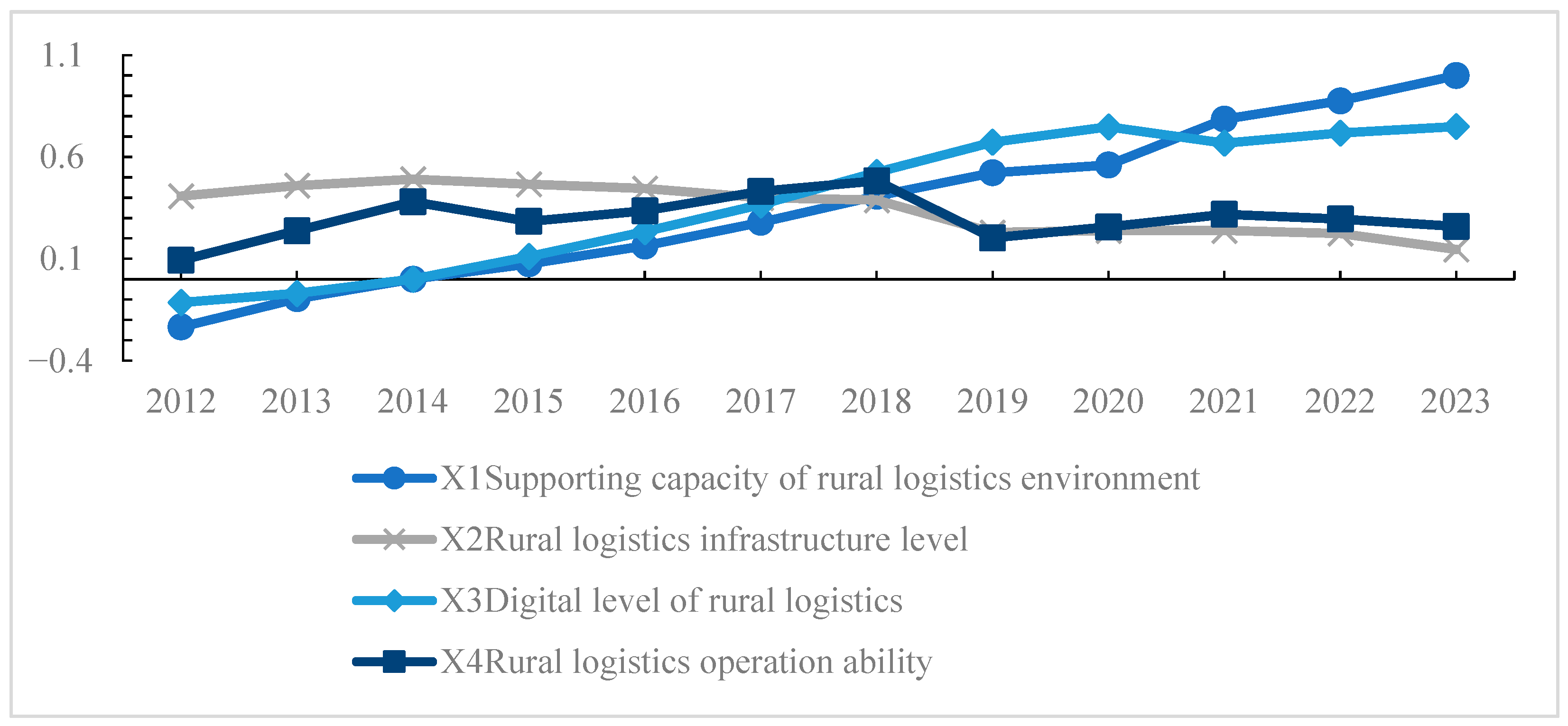
The development trend chart of four primary evaluation indicators of rural logistics capacity from 2012 to 2023 is shown in Figure 3, in order to more clearly show the development trend of China’s rural logistics capacity.
As shown in Figure 2, China’s rural logistics capacity exhibited an overall upward trend from 2012 to 2023, despite fluctuations in certain years. A detailed examination of the secondary indicators in Figure 3 reveals that the evolution of rural logistics capacity during this period can be divided into four distinct stages:
The first stage (2012–2018) marks a phase of rapid growth. During this period, rural logistics capacity increased steadily by 224.63%, although the growth rate gradually moderated. Growth across secondary indicators was uneven. The top three indicators with the highest growth rates were: total rural per capita postal business, average number of civilian vehicles per 100 rural households, and rural Internet broadband access users. As illustrated in Figure 3, the digitalization level of rural logistics served as the primary driver of this growth. The digitalization level and environmental support capacity laid a critical foundation for development.
The second stage (2018–2019) saw a sudden decline in rural logistics capacity by 33.92%. The infrastructure level dropped by 40.84%, and operational capacity fell most sharply by 58.01%. Specific contributing factors included a decrease in the number of cargo trucks owned by rural residents, a reduction in rural per capita road freight volume, and a decline in the number of rural logistics practitioners. The decline revealed bottlenecks in infrastructure and operational capacity, indicating that the benefits of national policy support were partially offset by insufficient infrastructure investment and operational inefficiencies.
The third stage (2019–2021) represented a recovery phase, with rural logistics capacity increasing by 22.14%. Environmental support capacity rose by 50.42%, infrastructure level by 4.22%, and operational capacity by 57.19%. This rebound can be attributed to increased government investment in rural logistics, which enhanced operational capability and environmental support while mitigating the negative impacts of infrastructure gaps.
The fourth stage (2021–2023) experienced a slight decline of 17.27%. Operational capacity decreased by 18.66%, and infrastructure level dropped by 38.70%. Contributing factors included reductions in the mileage of rural delivery routes, rural road mileage, and the number of cargo trucks owned by rural residents. This minor decline reflects normal economic cyclicality, driven by rural population loss, reduced investment in rural infrastructure, and disruptions from pandemic-related restrictions.

3.2.2. Analysis of Spatial Differences in Rural Logistics Capacity Development

Due to the combined effects of economic development level, infrastructure construction, policy support, and geographical location, the development of rural logistics capacity in China exhibits significant regional imbalances, forming distinct geographical spatial disparities. Based on previous studies and considering regional economic development levels and differing national development roles, this study divides China into three regions: eastern, central, and western. Using the established logistics evaluation index system, we conduct an in-depth comparative analysis of primary indicators across regions to explore the geographical spatial differentiation of rural logistics capacity in China.
In this study, the original values of the evaluation indicators were sourced from the provincial level. To obtain macro-level data representing the overall development of the eastern, central, and western regions, we performed direct summation of the values for each corresponding evaluation indicator across all provinces belonging to the same region. Subsequently, through standardization, weight integration, and closeness degree calculation within the fuzzy matter-element model, comprehensive evaluation scores and ranking results of rural logistics capacity for each region were ultimately derived. This summation approach is appropriate given that the indicators are additive in nature and the analysis aims to capture the overall scale and capacity of each region’s logistics system.
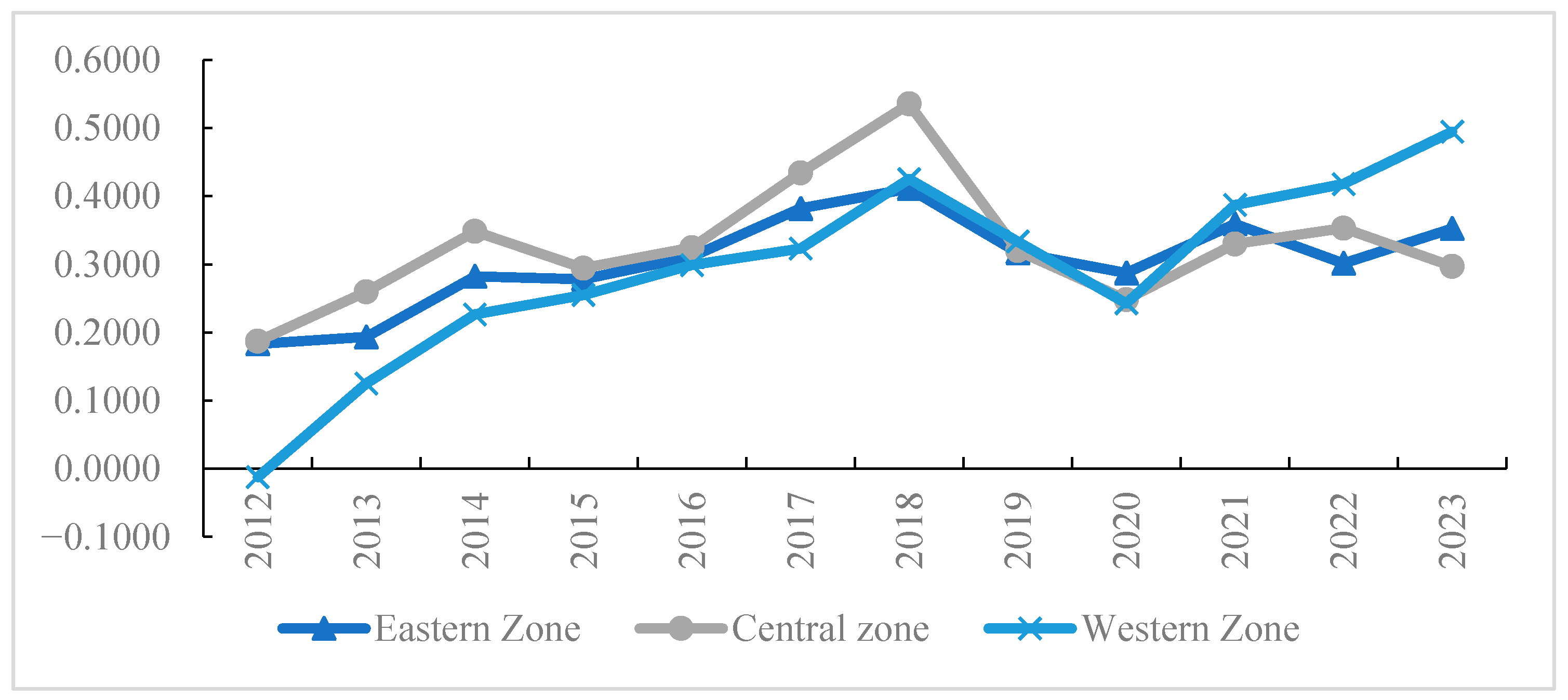
As illustrated in Figure 4, the overall trend of rural logistics capacity across China’s eastern, central, and western regions from 2012 to 2023 is generally consistent with the national trajectory, showing a steady upward movement overall, particularly in the central and western regions. As an economically developed area, the eastern region started with a high baseline level of logistics capacity, yet subsequent growth has been relatively modest, reflecting the stable characteristics of a mature market. The central region experienced rapid expansion between 2012 and 2018. Although some fluctuations occurred after 2019, it maintained a relatively high overall level. The western region, starting from a low base in 2012, achieved remarkable growth over the period, demonstrating the positive effects of infrastructure investment and policy support. These trends reflect the Chinese government’s continued efforts to promote economic development and enhance logistics capacity in rural areas. Through the analysis of changes in China’s rural logistics capacity from 2012 to 2023, several key insights emerge. First, the eastern region exhibits a pattern of steady refinement, which corroborates the “first-mover advantage” [22,24] and “diminishing marginal returns” [30] documented in regional development literature. This suggests that in highly mature markets, logistics capability enhancement has shifted from scale expansion to quality optimization, offering new evidence for understanding logistics transformation in developed regions. Second, the central region demonstrates a trajectory of progressive improvement, driven primarily by agricultural industry agglomeration and regional logistics hub construction. This aligns with Zhou et al.’s [33] theory of “agriculture-driven logistics upgrading,” while also complementing it by revealing the central region’s unique development logic as a logistics nexus connecting the east and west—a pattern distinct from the digital empowerment model in Eastern Region and the policy-driven model in Western Region [34]. Third, the western region exhibits a significant catch-up effect, benefiting from preferential logistics infrastructure investment and digital assistance policies under the national rural revitalization strategy. This catch-up trajectory is highly consistent with Li et al.’s [28] findings on “policy-enabled logistics catch-up” in less developed regions and further highlights the critical role of digital infrastructure development in enhancing rural logistics capacity in the west [36]. This finding reveals a policy-driven growth path that complements the market-driven path of the east and the industry-driven path of the center.
In summary, logistics operational capability and infrastructure construction are key pillars supporting the enhancement of rural logistics capacity [11,22], reinforcing traditional research emphasis on physical infrastructure. Meanwhile, digital technologies introduce new opportunities for rural logistics development beyond the scope of traditional research [19,20], suggesting that future research should pay greater attention to the synergistic mechanisms between digitalization and traditional factors.
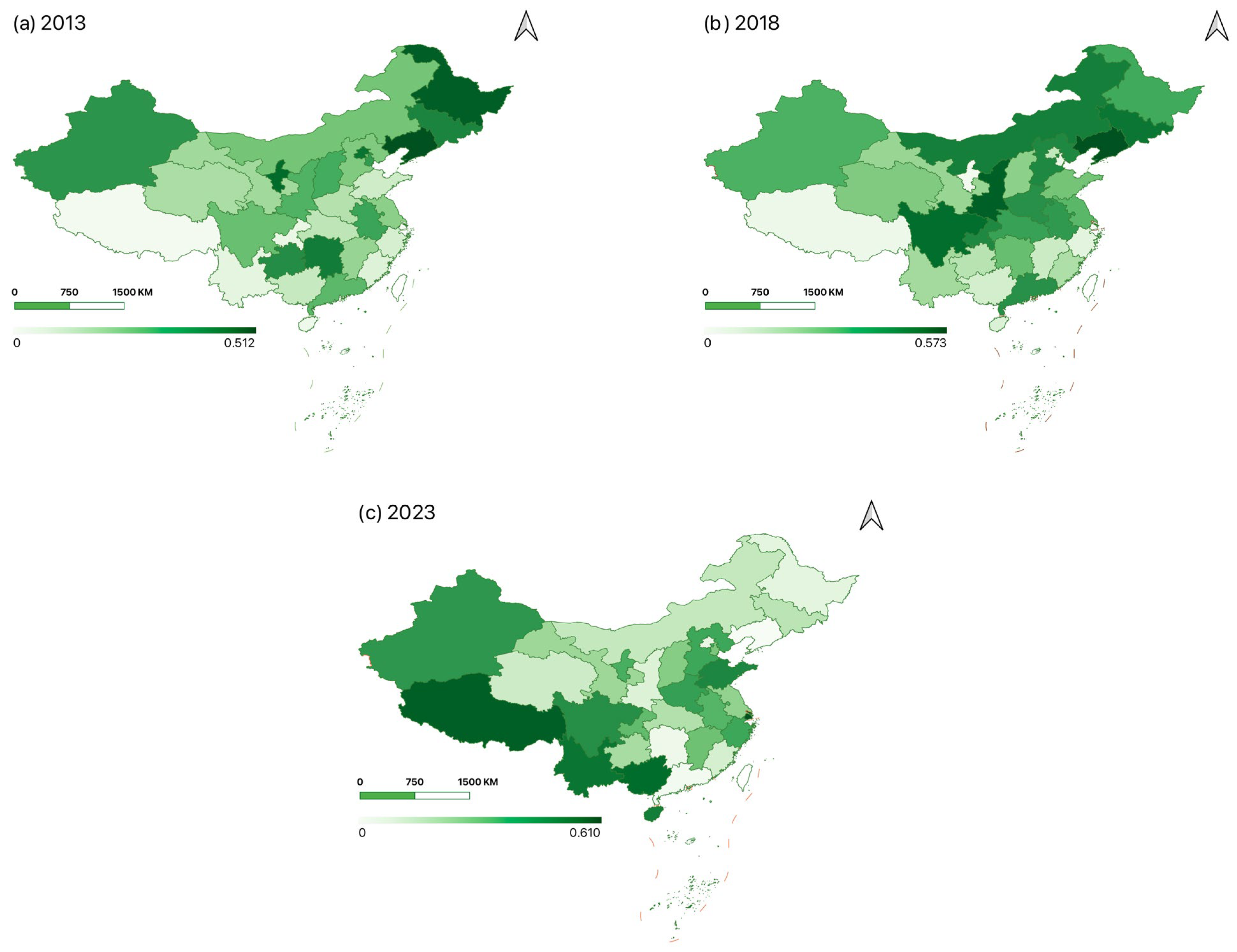
To further illustrate how rural logistics capacity has evolved across provinces, this study selected three time points—2013, 2018, and 2023—at four-year intervals. A spatial distribution map was created to visualize these changes (see Figure 5). In this map, darker colors indicate higher rural logistics capacity in a given province.
Figure 5 reveals an uneven pattern of development across the country. In 2013, coastal provinces generally showed stronger rural logistics capacity. After 2018, western inland regions began to exhibit late-mover advantages, with a clearer upward trend. Most central provinces remained relatively stable, with only a few exceptions. Compared with the rapid growth in the west, the eastern coastal region showed limited overall improvement despite its strong starting point. However, performance within this region was not uniform. Shanghai is a notable example. Its rural logistics capacity was relatively low in 2013, but by 2023, it had risen to one of the highest levels in the country. This change may be linked to the city’s economic spillover effects and continued policy support for urban-rural integration. Figure 5 captures the spatiotemporal evolution of rural logistics capacity at the provincial level, offering an intuitive basis for understanding regional disparities. Building on this, the next section will empirically examine how rural logistics capacity affects regional economic resilience.

3.3. Variable Description, Model Specification and Data Source

3.3.1. Variable Description

(1)
Explanatory Variable
Rural Logistics Capacity (RLC). This variable is directly measured by the comprehensive score derived in Section 3.1. of this study using the entropy-weighted fuzzy matter-element method. The score is constructed based on a framework of four dimensions: environmental support, infrastructure, digitalization, and operational capacity, which collectively encompass 14 secondary indicators. For details, please refer to Table A1.
(2)
Dependent Variable
Rural Economic Resilience (RER). Drawing on the existing research concerning the measurement of resilience [51], this paper uses a composite index built from risk resistance, adaptive adjustment, and transformative innovation capacities to assess rural economic resilience.
(3)
Control Variables
This study introduces several control variables into the model to more accurately estimate the impact of rural logistics capacity on rural economic resilience. The following provides an explanation of each variable.
Regional Economic Development Level (LED): A higher level of affluence in a region typically enhances its ability to invest in logistics infrastructure; meanwhile, its economic system inherently possesses more resources to withstand shocks. This variable is measured by per capita gross regional product.
Urbanization Rate (UR): Urbanization not only alters the scale and structure of logistics demand and promotes more efficient logistics organization but is also often accompanied by industrial diversification, which may enhance overall economic stability. This variable is measured by the proportion of urban population to the total population.
Industrialization Level (IND): Regions dominated by industry focus their logistics demand on bulk cargo and supply chain logistics; simultaneously, the inherent volatility of industrial economies can affect a region’s resilience to risks. This variable is represented by the proportion of secondary industry value-added to GDP.
Social Consumption Level (LSC): An active consumer market directly drives the development of commercial logistics, while strong domestic demand itself serves as an important buffer against external economic fluctuations. This variable is measured by the proportion of total retail sales of consumer goods to GDP.
Disaster Severity (DAR): Severe disasters can directly damage transportation and logistics networks, leading to immediate losses in agricultural output and economic activity, thereby interfering with the assessment of long-term resilience levels. This variable is measured by the proportion of crop disaster area to the total sown area.

3.3.2. Model Specification

The baseline model is specified as follows:
RER it = α 0 + α 1 RLC it + α 2 LED it + α 3 UR it + α 4 IND it + α 5 LSC it + α 6 DAR it + μ i + λ t + ε it
In this model, i denotes the province, t represents the time period, α0 is the constant term, μi and λt represent the individual and time fixed effects, respectively, and εit is the idiosyncratic error term.

3.3.3. Data Source

This study uses panel data from 31 provinces, autonomous regions, and municipalities for the period 2012–2023. The data are sourced from the China Rural Statistical Yearbook and the China Statistical Yearbook. Samples with missing key data were removed. All variables were winsorized at the 1% level at both tails.

4. Impact of Rural Logistics Capacity on Rural Economic Resilience in the Digital Economy

4.1. Descriptive Statistics

Table 1 shows the results of the descriptive statistical analysis for each variable. As shown in the table, during the period 2012–2023, the mean value of RER is 0.177, with a maximum of 0.549 and a minimum of 0.075. This indicates that the overall level of rural economic resilience in China remains relatively low at this stage, and there are notable disparities among different provinces. Over the same period, the mean value of the RLC indicator is 0.328, with a maximum of 0.610 and a minimum of −0.628. The substantial gap between the maximum and minimum values suggests that the level of rural logistics capacity varies significantly across provinces, reflecting a pronounced regional imbalance.

4.2. Baseline Regression

By incorporating time and individual fixed effects, we control for unobserved heterogeneity that is constant over time or across regions, thereby improving the estimation reliability of the baseline model. Table 2 reports the estimation results regarding the impact of rural logistics capacity on rural economic resilience. Column (1) presents the coefficients without any control variables, while subsequent columns display results with control variables added progressively. The findings consistently indicate that rural logistics capacity exerts a statistically significant positive effect on rural economic resilience, regardless of whether control variables are included. Specifically, the full model with all controls shows that the coefficient of rural logistics capacity is 0.104, implying that a 1% increase in rural logistics capacity is associated with a 0.104% rise in the level of rural economic resilience.

4.3. Addressing Endogeneity: Lagged Independent Variable Model

To mitigate potential reverse causality concerns—where regions with higher economic resilience may invest more in logistics infrastructure—we estimate a model using lagged rural logistics capacity (L.RLC) as the core explanatory variable. The logic is straightforward: current economic resilience cannot influence past logistics capacity. As shown in Column (2) of Table A4, the coefficient of L.RLC remains positive and statistically significant at the 1% level, consistent with the baseline findings. This provides evidence that reverse causality is unlikely to drive our main results.

4.4. Robustness Checks

We conduct a series of robustness checks to verify the stability of our findings. The results are presented in Table A4.
Column (3) excludes four provincial-level municipalities (Beijing, Tianjin, Shanghai, Chongqing) to ensure that our results are not driven by these special administrative regions with distinct economic structures. The coefficient of RLC remains positive and significant.
Column (4) excludes the pandemic years (2021–2023) to rule out the possibility that our results are driven by the unique shocks of the COVID-19 period. The estimated effect remains robust.
Across all alternative specifications, the positive impact of rural logistics capacity on rural economic resilience remains statistically significant, confirming the robustness of our findings.

4.5. Heterogeneity Analysis

To further explore regional heterogeneity, this study examines the impacts across eastern, central, and western China. The results show that rural logistics capacity has a significant positive effect on rural economic resilience in the western regions. In contrast, the effect is not statistically significant in the central and east. This pattern can be explained by the fact that in the western regions, logistics infrastructure remains a key bottleneck for agricultural development. Improving logistics capacity in these areas helps enhance the distribution efficiency of agricultural products, reduce circulation losses, and thus strengthen resilience against market and natural risks. The weaker existing infrastructure in the west likely explains its larger marginal benefit.
Given differing agricultural functions and geographical conditions across provinces, we also compare major grain-producing and non-major grain-producing areas. Rural logistics capacity most strongly promotes resilience in non-major grain-producing areas, while its effect is not significant in major grain-consuming regions. The results of the heterogeneity analysis can be found in Appendix A, Table A5.

4.6. Research Discussion

This section engages in a multi-layered dialogue with the existing literature based on the core findings of this study, thereby elucidating its theoretical contributions to understanding rural logistics capacity and its role in fostering rural economic resilience.

4.6.1. Spatiotemporal Evolution of Rural Logistics Capacity

Previous studies have assessed logistics capacity at regional or urban agglomeration levels, providing either dynamic analyses of specific areas [28] or static snapshots at particular points in time [22]. This study extends this line of inquiry by shifting the analytical focus to the rural level and employing a longitudinal dataset from 2012 to 2023. Our findings reveal that the evolution of China’s rural logistics capacity is characterized by significant spatial heterogeneity and distinct stage-based features. Specifically, we observe a pattern where the eastern region maintains relative stability while central and western regions exhibit a catching-up trend.
This finding both confirms and refines the existing literature. On one hand, it corroborates the “east-high, west-low” spatial pattern documented in prior research [22,28]. On the other hand, it offers an important revision: the development trajectory of rural logistics capacity does not rigidly adhere to a fixed gradient. Instead, less developed regions, when supported by targeted policies, demonstrate greater growth potential. This nuance—which we term “growth resilience”—was not captured by earlier cross-sectional or region-specific studies, highlighting the value of a dynamic, nationally representative analysis.

4.6.2. The Impact of Rural Logistics Capacity on Economic Resilience

Our finding that rural logistics capacity significantly enhances rural economic resilience establishes a critical bridge between two previously parallel streams of literature: research on the economic impacts of logistics and research on the determinants of economic resilience.
A growing body of work has demonstrated that the digital economy injects new momentum into rural economic resilience [38] and that e-commerce development significantly strengthens the capacity of rural economies to adapt to market fluctuations [37]. These studies powerfully illuminate the empowering role of new factors and novel business models. Building upon this foundation, our study argues that the realization of these empowering effects is conditional upon a critical supporting infrastructure. Specifically, the translation of digital empowerment and e-commerce connectivity into tangible stability and recovery capacity ultimately depends on the existence of an efficient, intelligent, and reliable rural logistics network.
This reasoning yields a key theoretical insight: digital technologies optimize production and decision-making; e-commerce bridges markets and consumer demand; but logistics capacity physically spans the space between production and consumption, serving as the essential infrastructural guarantee that converts the potential created by digitalization into realized resilience outcomes. In this sense, logistics capacity functions as a platform capacity—it carries, integrates, and materializes the benefits of other enabling factors.
Consequently, our study suggests that enhancing rural economic resilience requires not only the introduction of new factors and new business models but also the systematic investment in and upgrading of those foundational capacities capable of hosting and integrating these innovations. This finding reframes the policy discourse from a focus on individual drivers to a more holistic perspective that recognizes the hierarchical and synergistic relationships among different resilience-enhancing factors.

5. Conclusions and Suggestions

5.1. Research Conclusions

Based on the theoretical perspective of the digital economy, this study constructs a multi-dimensional evaluation system for rural logistics capacity and employs the entropy-weighted fuzzy matter-element method and two-way fixed effects model to systematically examine rural logistics capacity and its impact on rural economic resilience. The main conclusions are as follows:
First, the constructed evaluation index system for rural logistics capacity aligns with the reality of rural development in China and systematically reflects the multi-dimensional characteristics of logistics capacity in the context of the digital economy. The index system was established through expert interviews and theoretical validation, demonstrating strong explanatory power in the empirical analysis.
Second, from 2012 to 2023, China’s rural logistics capacity showed a steady upward trend overall, though development across dimensions is uneven. In terms of spatial distribution, rural logistics capacity improved synchronously across regions, yet significant regional disparities persist. Among these, the eastern region is relatively more developed, the central region exhibited the most notable growth, and the western region holds the greatest potential for future development.
Third, the empirical results indicate that rural logistics capacity has a significant positive effect on rural economic resilience, a conclusion that remains robust after a series of tests. This finding supports the research hypothesis proposed in this study based on the resource-based view and resilience theory.
Fourth, heterogeneity analysis further reveals that the enhancing effect of rural logistics capacity on economic resilience is more pronounced in the western region and non-major grain-producing areas. This suggests that in regions with relatively weaker logistics foundations or higher degrees of commercialization, the development of logistics capacity offers greater marginal contribution and policy value.

5.2. Policy Suggestions

Based on the research findings and guided by systems theory, this study proposes the following policy recommendations to leverage the digital economy in strengthening rural logistics capacity and enhancing rural economic resilience:
First, targeted investment should be directed toward upgrading rural logistics infrastructure, particularly in underdeveloped regions and non-major grain-producing areas. Priorities include expanding broadband coverage, deploying IoT and big data technologies, and improving rural road networks with integrated smart logistics systems. Cold chain storage, intelligent sorting facilities, and digital service networks should be enhanced to support end-to-end operational capability.
Second, governments should implement tailored support measures—such as subsidies, tax incentives, and preferential loans—to encourage rural logistics enterprises to adopt digital technologies. Policy guidance should also foster collaboration between research institutions and local firms to develop context-appropriate logistics solutions. Initiatives such as “Digital Outreach” can help develop rural industries and increase residents’ disposable income, thereby boosting local consumption and logistics demand.
Third, a regional coordination mechanism should be created to facilitate joint infrastructure planning, information sharing, and talent exchange between eastern, central, and western regions. Differentiated support policies should prioritize western and remote areas, accompanied by incentives to attract and retain logistics professionals. Training programs and entrepreneurship encouragement can help address the rural skills gap and ensure workforce adaptation to technological advances.
Fourth, a comprehensive data analytics framework should be established to monitor demand, optimize routes, and improve inventory management. A long-term evaluation mechanism for regional logistics capacity—covering infrastructure, service efficiency, and digitalization—will help identify gaps, guide investment, and promote the development of an efficient, smart, and sustainable rural logistics system.

5.3. Limitations and Future Research Directions

First, regarding endogeneity and causal identification. Although we employed a lagged independent variable model to mitigate reverse causality concerns (Section 4.3) and conducted multiple robustness checks (Section 4.4), these approaches cannot fully eliminate all endogeneity threats—particularly omitted variable bias. Future research should adopt more rigorous identification strategies, such as instrumental variable estimation or difference-in-differences approaches leveraging natural experiments (e.g., “Express Delivery to Villages” policy shocks).
Second, regarding mechanism exploration. While this study theoretically articulates the pathways through which logistics capacity may enhance resilience—drawing on Resource-Based View and resilience theory to highlight mechanisms such as improved factor mobility and reduced transaction costs (Section 2.3)—these mechanisms remain empirically untested. Future research should empirically examine the mediating mechanisms underlying the logistics-resilience relationship.
Third, regarding dynamic complexity. Our macro-level static framework captures average effects but not the dynamic co-evolution of logistics capacity, digital technology, and rural economic transformation. Future research could employ system dynamics models or panel vector autoregression (PVAR) to better understand these temporal interdependencies.
Fourth, regarding data and measurement. Constrained by data availability, our measurement may not fully capture emerging digitally enabled logistics forms (e.g., crowdsourced delivery, rural e-commerce integration), and provincial-level data mask intra-provincial heterogeneity. Future research would benefit from integrating multi-source micro-level data, including enterprise records and village surveys.

Author Contributions

Y.T.: Conceptualization, investigation, writing—review and editing& funding acquisition, Y.L.: Methodology, data curation &writing—original draft preparation. All authors have read and agreed to the published version of the manuscript.

Funding

This research is funded by the National Social Science Foundation of China: Research on mechanism and realization of entrepreneurial ability enhancing in hometowns by digital empowering (22BGL049) and the Hunan Provincial Natural Science Foundation General Project: Research on the Mechanism and Path of Digital Empowerment for the Resilience Formation of Entrepreneurial Teams (2025JJ50458).

Data Availability Statement

The data presented in this study are openly available in [Mendeley Data] at [https://data.mendeley.com/preview/bys58swpxt?a=9a21b236-bfec-4356-8a34-ff12be5b1be4], accessed on 16 January 2026.

Acknowledgments

The authors would like to thank Yinan Chen et al. for their support for comments on earlier drafts.

Conflicts of Interest

The authors declare no conflicts of interest.

Appendix A

Table A1. Evaluation Index System for Rural Logistics Capacity.
First Level IndicatorSecondary IndicatorsSource of Indicators
X1 Supporting capacity of rural logistics environmentX11 Per capita disposable income of rural residents (yuan)Shu, 2023 [39]; Su, 2023 [41]; Zhang & Yue, 2024 [42]; Chen, 2025 [43]
X12 Per capita GDP of rural residents (yuan)Zhang, 2023 [44]; Zhang, 2025 [45]
X13 Per capita consumption expenditure of rural residents (yuan)Shu, 2023 [39]; Su, 2023 [41]; Zhang, 2025 [45]
X2 Level of rural logistics infrastructureX21 Rural delivery route mileage (kilometers)Kong, 2019 [40]; Sun, 2022 [22]; Zhang, 2024 [46]
X22 Rural roads mileage (kilometers)Liu, 2020 [29]; Zhang & Yue, 2024 [42]; Li, 2024 [28]; Zhang, 2025 [45];
X23 Number of rural residents’ cargo trucks
(in 10,000 units)
Li, 2024 [28]
X24 Average number of civilian cars per 100 households in rural areas (vehicles)Zhang, 2025 [45]
X3 Digitalization level of rural logisticsX31 Total per capita postal services in rural areas (10,000 yuan)Zhao, 2017 [47]; Su, 2021 [24]
X32 Rural Internet broadband access users
(10,000 households)
Li, 2024 [28]; Zhang, 2025 [45]; Chen, 2025 [43]
X33 Average number of mobile phones per 100 households in rural areas (in units)Du, 2024 [48]
X4 Rural logistics management capabilityX41 Per capita road freight volume in rural areas (tons)Li, 2024 [28]
X42 Rural logistics practitioners (person)Zhao, 2017 [47]; Liu, 2020 [29]; Su, 2021 [24]; Liu & Jia, 2022 [49]; Li, 2024 [28]
X43 Per capita freight volume in rural areas (tons)Su, 2021 [24]; Li, 2024 [28]
X44 Per capita turnover of goods in rural areas (ton kilometers)Sun, 2022 [22]; Su, 2021 [24]; Zhang & Yue, 2024 [42]; Li, 2024 [28]
Notes: Rural delivery route mileage refers to the length of routes specifically used for postal and express delivery services, while rural roads mileage refers to the total length of paved and unpaved roads within rural areas.
Table A2. Evaluation Index Data of Rural Logistics in the Digital Economy.
201220132014201520162017
X117916.58 9429.60 10,488.90 11,421.70 12,363.40 13,432.40
X1218,652.60 19,795.48 20,758.56 21,301.72 22,137.08 23,693.78
X135908.02 7485.10 8382.60 9222.60 10,129.80 10,954.50
X213,731,657.00 3,744,733.00 3,775,875.00 3,756,043.00 3,767,660.00 3,805,332.00
X22198.74 198.25 197.53 195.31 193.30 189.79
X23587.75 646.01 643.11 592.77 556.39 544.16
X246.46 9.90 11.00 13.30 17.40 19.30
X31955.28 1240.18 1635.52 2167.09 3044.70 3882.05
X324075.90 4737.30 4873.70 6398.40 7454.00 9377.30
X33197.80 199.50 215.00 226.10 240.70 246.10
X4123.46 22.50 24.21 22.77 24.00 26.33
X42318,267.62 489,958.38 455,462.60 415,807.63 383,094.64 362,183.38
X4330.17 29.98 30.28 30.19 31.51 34.32
X4412,787.12 12,288.37 13,198.28 12,893.82 13,404.15 14,097.06
201820192020202120222023
X1114,617.00 16,020.70 17,131.50 18,930.90 20,132.80 21,691.00
X1225,230.59 26,132.09 25,937.09 28,707.34 29,670.82 30,238.75
X1312,124.30 13,327.70 13,713.40 15,915.60 16,632.10 18,175.00
X214,030,582.00 4,198,813.00 4,104,128.00 4,155,496.00 4,146,853.00 4,138,210.00
X22186.59 186.92 187.70 186.30 186.24 183.98
X23521.99 405.65 400.92 413.93 405.76 396.26
X2422.30 24.70 26.40 30.20 32.40 40.00
X314752.90 6052.03 7602.30 4832.77 4979.35 5175.15
X3211,741.70 13,477.30 14,189.70 15,770.50 17,632.20 19,189.20
X33257.00 261.20 260.90 266.60 266.90 271.20
X4128.15 24.36 24.26 27.71 26.29 28.62
X42357,726.22 311,095.55 325,361.57 306,257.92 302,354.71 319,230.32
X4336.66 33.43 33.47 37.51 36.50 28.62
X4414,564.23 14,140.58 14,300.81 15,829.45 16,417.07 17,575.89
Table A3. Weight Calculation Results of Various Secondary Indicator.
First Level IndicatorSecondary IndicatorsWeightWeighted Sum
X1X110.04380.1321
X120.0468
X130.0415
X2X210.07670.4381
X220.1473
X230.1705
X240.0436
X3X310.03880.1020
X320.0496
X330.0136
X4X410.05420.3278
X420.1498
X430.0614
X440.0625
Table A4. Endogeneity Treatment and Robustness Checks.
(1)(2)(3)(4)
Baseline RegressionLagging the Explained VariableExcluding MunicipalitiesExcluding the Pandemic Years
VariableRERL.RERRERRER
RLC0.104 ***0.145 ***0.150 ***0.103 **
(2.90)(3.47)(3.69)(2.10)
LED−0.000 ***−0.000 ***−0.000 ***−0.000 **
(−3.94)(−3.17)(−4.07)(−2.21)
UR−1.360 ***−1.137 ***−1.771 ***−1.243 ***
(−4.43)(−3.69)(−4.43)(−3.09)
IND0.2200.0440.0820.364
(1.15)(0.20)(0.43)(1.33)
LSC0.1270.0470.160 *0.083
(1.53)(0.58)(1.77)(1.05)
DAR−0.056 *−0.051−0.040−0.064 **
(−1.72)(−1.47)(−1.18)(−1.99)
Constant0.962 ***0.899 ***1.175 ***0.814 ***
(5.75)(5.05)(5.57)(3.94)
Observations362328315276
R-squared0.5000.4980.5300.556
Individual and Time Fixed EffectsYESYESYESYES
Notes: *, **, and *** denote statistical significance at the 10%, 5%, and 1% levels, respectively. t-statistics are reported in parentheses.
Table A5. Heterogeneity Analysis Results.
EasternCentralWesternMajor Grain-Producing AreasNon-Major Grain-Producing Areas
VariableRERRERRERRERRER
RLC0.023−0.1290.332 ***0.0210.174 ***
(0.024)(0.097)(0.095)(0.042)(0.060)
LED−0.000−0.000−0.000 ***−0.000 **−0.000 ***
(0.000)(0.000)(0.000)(0.000)(0.000)
UR−0.155−0.278−1.8230.574−1.659 ***
(0.227)(1.038)(1.185)(0.490)(0.465)
IND0.1090.0530.4140.0190.350
(0.206)(0.226)(0.355)(0.191)(0.273)
LSC0.111−0.0130.600 **−0.2130.366 ***
(0.073)(0.193)(0.279)(0.143)(0.140)
DAR−0.083 ***−0.0470.028−0.056−0.059
(0.026)(0.075)(0.089)(0.053)(0.039)
Constant0.2320.5031.0660.0121.006 ***
(0.183)(0.509)(0.701)(0.246)(0.282)
Observations141102119151211
R-squared0.6280.3340.6200.4200.572
Individual and Time Fixed EffectsYESYESYESYESYES
Notes: **, and *** denote statistical significance at the 5%, and 1% levels, respectively. t-statistics are reported in parentheses.

References

  1. Brand, F.; Jax, K. Focusing the Meaning(S) of Resilience: Resilience as a Descriptive Concept and a Boundary Object. Ecol. Soc. 2006, 12, 23. [Google Scholar] [CrossRef]
  2. Chae, B. A General framework for studying the evolution of the digital innovation ecosystem: The case of big data. Int. J. Inf. Manag. 2019, 45, 83–94. [Google Scholar] [CrossRef]
  3. Mouratiadou, I.; Lemke, N.; Chen, C.; Wartenberg, A.; Bloch, R.; Donat, M.; Gaiser, T.; Basavegowda, D.H.; Helming, K.; Hosseini Yekani, S.A.; et al. The Digital Agricultural Knowledge and Information System (DAKIS): Employing digitalisation to encourage diversified and multifunctional agricultural systems. Environ. Sci. Ecotechnol. 2023, 16, 100274. [Google Scholar] [CrossRef]
  4. Shu, L. Regional differences and distribution dynamic evolution of rural digital economy development under the background of sustainable development. GeoJournal 2025, 90, 53. [Google Scholar] [CrossRef]
  5. Ji, G.; Huang, W. China’s rural logistics distribution. In Proceedings of the 2009 6th International Conference on Service Systems and Service Management, Xiamen, China, 8–10 June 2009; pp. 564–569. [Google Scholar] [CrossRef]
  6. Closs, D.J.; Goldsby, T.J.; Clinton, S.R. Information technology influences on world class logistics capability. Phys. Distrib. Logist. Manag. 1997, 27, 4–17. [Google Scholar] [CrossRef]
  7. Arsić, M.; Jovanović, Z.; Tomić, R.; Tomović, N.; Arsić, S.; Bodolo, I. Impact of Logistics Capacity on Economic Sustainability of SMEs. Sustainability 2020, 12, 1911. [Google Scholar] [CrossRef]
  8. Gligor, D.M.; Holcomb, M.C. Understanding the role of logistics capabilities in achieving supply chain agility: A systematic literature review. Int. J. Supply Chain Manag. 2012, 17, 438–453. [Google Scholar] [CrossRef]
  9. Xiong, S.L. Evaluation and Analysis of Agricultural Logistics Capacity in Rural Communities. Pak. J. Agr. Sci. 2024, 61, 793–803. [Google Scholar] [CrossRef]
  10. Roy, V.; Schoenherr, T. Implications of Sectoral Logistical Capabilities for Export Competitiveness: A Public Policy Perspective for Interventions in the Logistics Sector. IEEE Trans. Eng. Manag. 2022, 69, 2930–2943. [Google Scholar] [CrossRef]
  11. Kaiser, N.; Barstow, C.K. Rural Transportation Infrastructure in Low- and Middle-Income Countries: A Review of Impacts, Implications, and Interventions. Sustainability 2022, 14, 2149. [Google Scholar] [CrossRef]
  12. Berisha-Shaqiri, A.; Berisha-Namani, M. Information Technology and the Digital Economy. Mediterr. J. Soc. Sci. 2015, 6, 78–83. [Google Scholar] [CrossRef]
  13. Ding, C.; Liu, C.; Zheng, C.; Li, F. Digital Economy, Technological Innovation and High-Quality Economic Development: Based on Spatial Effect and Mediation Effect. Sustainability 2021, 14, 216. [Google Scholar] [CrossRef]
  14. Philip, L.J.; Townsend, L.; Roberts, E.; Beel, D. The Rural Digital Economy. Scott. Geogr. J. 2015, 131, 143–147. [Google Scholar] [CrossRef]
  15. Stovba, E.; Stovba, A.; Nizamov, S.; Yapparova, A. Development of Rural Areas of Bashkortostan in Conditions of Digital Economy Formation. In European Proceedings of Social and Behavioural Sciences; Future Acad: London, UK, 2019; pp. 2964–2971. [Google Scholar] [CrossRef]
  16. Akmarov, P.B.; Knyazeva, O.P.; Tretyakova, E.S. Assessing the Potential of the Digital Economy in Agriculture. IOP Conf. Ser. Earth Environ. Sci. 2021, 666, 42036. [Google Scholar] [CrossRef]
  17. Rahmadani, E. Digital marketing strategies in increasing the competitiveness of agricultural products in the digital economy era. Glob. Int. J. Innov. Res. 2024, 2, 2152–2164. [Google Scholar] [CrossRef]
  18. Xie, Y.; Ni, G. A Study on Supply Chain Decision-Making in Fresh Produce Competition Considering Corporate Reputation. Systems 2025, 13, 1067. [Google Scholar] [CrossRef]
  19. Sharma, R.; Samad, T.A.; Chiappetta Jabbour, C.J.; de Queiroz, M.J. Leveraging blockchain technology for circularity in agricultural supply chains: Evidence from a fast-growing economy. J. Enterp. Inf. Manag. 2021, 38, 32–67. [Google Scholar] [CrossRef]
  20. Breskich, V.; Vasilenko, M.; Kuzina, E.; Bespalov, V.; Drozdov, N.; Tagiltseva, J.J.; Korenyakina, N.; Prokopchuk, V.; Nadolinsky, P.; Uvarova, S.S. Digital technologies in quality and efficiency management of transport service. In Proceedings of the E3S Web of Conferences 2021, Sanya, China, 28–29 August 2021; p. 244. [Google Scholar] [CrossRef]
  21. Verbivska, L.; Zhygalkevych, Z.; Fisun, Y.; Chobitok, I.; Shvedkyi, V. Digital technologies as a tool of efficient logistics. Rev. Univ. Zulia 2023, 14, 492–508. [Google Scholar] [CrossRef]
  22. Sun, Z.; Wang, T.; Xiao, X.; Zhang, Q.; Guo, H.; Najafi, S.E. Research on the Measurement of Logistics Capability of Core Cities along “the Belt and Road” in China. Adv. Math. Phys. 2022, 2022, 2223212. [Google Scholar] [CrossRef]
  23. Shi, S. Research on the Relationship between Logistics Capability and Regional Economic Development in Henan Province. In Proceedings of the 2019 International Conference on Economic Management and Model Engineering (ICEMME), Malacca, Malaysia, 6–8 December 2019; pp. 95–98. [Google Scholar] [CrossRef]
  24. Su, H. Research on the Influence Path of Regional Logistics Capability on Regional Global Value Chain Status based on PLS-SEM. World Sci. Res. J. 2021, 7, 130–142. [Google Scholar] [CrossRef]
  25. Liu, M.; Fu, S. Comprehensive evaluation and research of the rural logistics capability in Hebei province. In Proceedings of the 2015 International Conference on Logistics, Informatics and Service Sciences (LISS), Barcelona, Spain, 27–29 July 2015; pp. 1–5. [Google Scholar] [CrossRef]
  26. Qi, Y.; Wang, C. Study on the Regional Logistics Capability Based on Factor Analysis under the Background of Belt and Road Initiative. J. Phys. Conf. Ser. 2021, 1910, 12009. [Google Scholar] [CrossRef]
  27. Zhou, T.; Ye, H. Control Model of Regional Logistics Capability and Industrial Economy Based on Grey System. In Proceedings of the 2008 International Conference on Intelligent Computation Technology and Automation (ICICTA), Changsha, China, 20–22 October 2008; pp. 626–630. [Google Scholar] [CrossRef]
  28. Li, F.; He, Y.; Wang, B. Analysis of logistics capacity, influencing factors and spatial spillover effect in Yangtze River Economic Belt. PLoS ONE 2024, 19, e0303200. [Google Scholar] [CrossRef]
  29. Liu, X.; Hou, H.; Yang, J.; Geng, S.; Ju, Y.; Yao, T.; Ren, H.; Zou, J.; Wang, W.; Wang, L. Research on Regional Logistics Capacity of Agricultural Products in Henan Province. IOP Conf. Ser. Mater. Sci. Eng. 2020, 782, 42023. [Google Scholar] [CrossRef]
  30. Vella, L.B.C.F. Economic vulnerability and resilience: Concepts and measurements. Oxf. Dev. Stud. 2009, 37, 229–247. [Google Scholar] [CrossRef]
  31. Hu, X.; Li, L.; Dong, K. What matters for regional economic resilience amid COVID-19? Evidence from cities in Northeast China. Cities 2022, 120, 103440. [Google Scholar] [CrossRef]
  32. Wang, H.; Su, X.; Liu, J.M. The Spatial Spillover Effect of Logistics and Manufacturing Co-Agglomeration on Regional Economic Resilience: Evidence from China’s Provincial Panel Data. Sustainability 2023, 15, 8208. [Google Scholar] [CrossRef]
  33. Zhou, J.; Chen, H.; Bai, Q.; Liu, L.; Li, G.; Shen, Q. Can the Integration of Rural Industries Help Strengthen China’s Agricultural Economic Resilience? Agriculture 2023, 13, 1813. [Google Scholar] [CrossRef]
  34. He, Y.; Ma, J. Collaborative development of logistics hubs and free trade zones, digital finance and economic resilience. Fin. Res. Lett. 2025, 85, 108229. [Google Scholar] [CrossRef]
  35. Sun, Y.; Chen, C. Digital rural construction, financial development and regional economic resilience: Mechanism analysis and empirical test. Int. Rev. Econ. Fin. 2025, 101, 104146. [Google Scholar] [CrossRef]
  36. Liu, N.; Yang, C.; Cheng, Y. Digital rural development, insurance investment, and agricultural economic resilience. Fin. Res. Lett. 2025, 86, 108712. [Google Scholar] [CrossRef]
  37. Huang, Z.; Wang, L.; Meng, J. Does rural e-commerce improve the economic resilience of family farms? Int. Rev. Econ. Fin. 2024, 95, 103505. [Google Scholar] [CrossRef]
  38. Xiang, S.; Li, Y.; Zhu, H. Research on the impact of digital economy on rural economic resilience: Empirical experience based on China. Int. J. Emerg. Mark. 2025, 21, 702–722. [Google Scholar] [CrossRef]
  39. Shu, H.; Zhan, L.; Lin, X.; Zhou, X. Coordination measure for coupling system of digital economy and rural logistics: An evidence from China. PLoS ONE 2023, 18, e0281271. [Google Scholar] [CrossRef]
  40. Kong, L.; Wen, J.; Kelin, W. Study on Correlation among Modern Logistics and Rural Economic Development. Int. Core J. Eng. 2019, 5, 160–168. [Google Scholar]
  41. Su, J.; Shen, T.; Ma, W.C.; Zhang, J.X. Study on the Effect of Rural Low Carbon Logistics Industry Development on Rural Economic Growth. IEEE Access 2023, 11, 37108–37122. [Google Scholar] [CrossRef]
  42. Zhang, J.; Yue, L. Quality Evaluation of Rural Logistics Development Based on Partial Order Set-TOPSIS Under Rural Revitalization. In Proceedings of the 2023 4th International Conference on Management Science and Engineering Management (ICMSEM 2023); Atlantis Press: Paris, France, 2024; pp. 736–752. [Google Scholar] [CrossRef]
  43. Chen, W.; Chen, H.; Yin, J.; Sun, W. Evaluation of agricultural products e-commerce logistics service capabilities in Heilongjiang Province based on entropy weight TOPSIS method. PLoS ONE 2025, 20, e0325532. [Google Scholar] [CrossRef]
  44. Zhang, P.; Li, W.; Zhao, K.; Zhao, Y.; Chen, H.; Zhao, S. The Impact Factors and Management Policy of Digital Village Development: A Case Study of Gansu Province, China. Land 2023, 12, 616. [Google Scholar] [CrossRef]
  45. Meng, D.; Zhang, R. Study on Agricultural Products Logistics Capacity in Sichuan and Chongqing Region Based on Factor Analysis. Econ. Bus. Manag. 2025, 1, 136–146. [Google Scholar] [CrossRef]
  46. Zhang, H.; Wan, J. Study on the Synergistic Development of Rural Logistics and Rural Economy Under the New Development Pattern. In Proceedings of the 2024 5th International Conference on Management Science and Engineering Management (ICMSEM 2024); Atlantis Press: Paris, France, 2024; pp. 863–870. [Google Scholar] [CrossRef]
  47. Zhao, L.; Zhao, W.; Zhang, J.; Xavior, A.; Cai, J.; You, L. Research on Evaluation of Regional Logistics Capability under Big Data Background. Matec Web Conf. 2017, 100. [Google Scholar] [CrossRef]
  48. Du, R.; Liu, S.W.; Feng, Y.S. Influence Mechanism of Digital Village Development on Rural Residents’ Consumption. Econ. Geogr. 2024, 44, 190–200. [Google Scholar] [CrossRef]
  49. Liu, Z.; Jia, S.; Wang, Z.; Guo, C.; Niu, Y. A Measurement Model and Empirical Analysis of the Coordinated Development of Rural E-Commerce Logistics and Agricultural Modernization. Sustainability 2022, 14, 13758. [Google Scholar] [CrossRef]
  50. Wang, F.; Xu, Z.; Pan, W.; Zhang, S. Construction and Application of Groundwater Environmental Health Assessment Model Based on Entropy Weight and Fuzzy Matter Element. IOP Conf. Ser. Earth Environ. Sci. 2020, 446, 052043. [Google Scholar] [CrossRef]
  51. Zhou, L.; Xin, T. The impact of new urbanization construction on the resilience of China’s agricultural economy: Empirical analysis based on the spatial difference-in-differences model. Chin. J. Eco-Agric. 2025, 33, 807–819. [Google Scholar] [CrossRef]
Figure 1. Rural Logistics Capacity Evaluation System Based on System Theory.
Systems 14 00276 g001
Figure 2. Evaluation value of rural logistics capacity in China.
Systems 14 00276 g002
Figure 3. Evaluation Value of Logistics Capacity of Various Primary Indicators.
Systems 14 00276 g003
Figure 4. Evaluation Results of China’s Interregional Rural Logistics Capacity.
Systems 14 00276 g004
Figure 5. Provincial Spatial Distribution of Rural Logistics Capacity in China.
Systems 14 00276 g005
Table 1. Descriptive Statistics.
VariableObsMeanStd. Dev.MinMax
RER3650.1770.0670.0750.549
RLC3650.3280.124−0.6280.610
LED36563,902.68034,218.49019,188.000216,722.000
UR3650.6030.1270.2290.896
IND3650.3880.0770.1460.580
LSC3650.3830.0670.1760.603
DAR3650.1200.1110.0000.696
Table 2. Baseline Regression Results.
(1)(2)(3)(4)(5)(6)
VariableRERRERRERRERRERRER
RLC0.088 **0.090 **0.108 ***0.106 ***0.092 ***0.104 ***
(2.55)(2.49)(2.99)(3.05)(2.61)(2.90)
LED −0.000−0.000 ***−0.000 ***−0.000 ***−0.000 ***
(−0.39)(−3.70)(−3.71)(−3.94)(−3.94)
UR −1.033 ***−1.053 ***−1.357 ***−1.360 ***
(−4.58)(−4.66)(−4.48)(−4.43)
IND 0.1890.2440.220
(1.06)(1.32)(1.15)
LSC 0.144 *0.127
(1.77)(1.53)
DAR −0.056 *
(−1.72)
Constant0.149 ***0.156 ***0.857 ***0.802 ***0.940 ***0.962 ***
(13.12)(8.72)(5.73)(5.57)(5.60)(5.75)
Observations365365365365365362
R-squared0.4520.4520.4840.4870.4920.500
Individual and Time Fixed EffectsYESYESYESYESYESYES
Notes: *, **, and *** denote statistical significance at the 10%, 5%, and 1% levels, respectively. t-statistics are reported in parentheses.
Disclaimer/Publisher’s Note: The statements, opinions and data contained in all publications are solely those of the individual author(s) and contributor(s) and not of MDPI and/or the editor(s). MDPI and/or the editor(s) disclaim responsibility for any injury to people or property resulting from any ideas, methods, instructions or products referred to in the content.