
What Drives the Reverse of Overseas Brain Drain? Identifying the Critical Factors by a Hybrid Grey DANP Technique


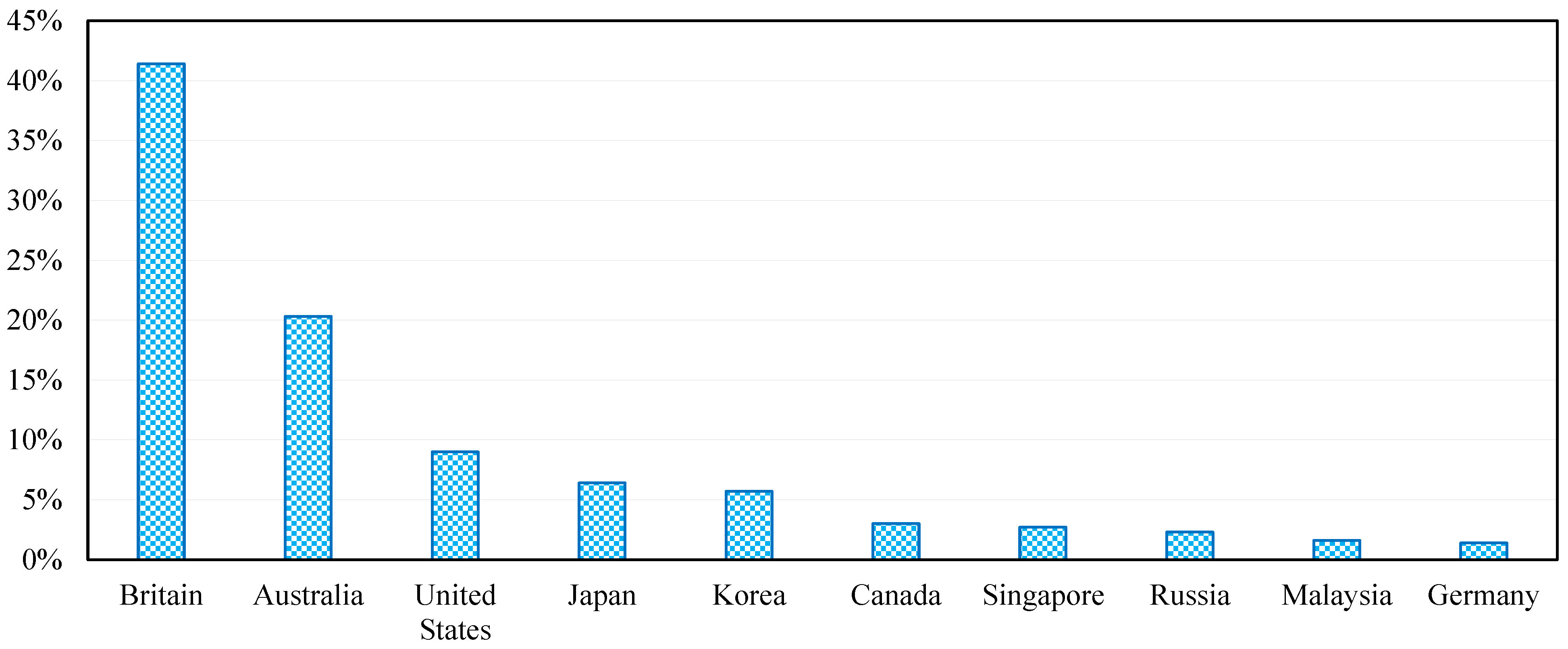
Abstract
1. Introduction
2. Establishing the Decision Structure
2.1. Economic and Career Development
2.2. Science, Technology, and Innovation Environment
2.3. Policy and Institutional Environment
2.4. Social and Family Ties
2.5. Quality of Life and Livability
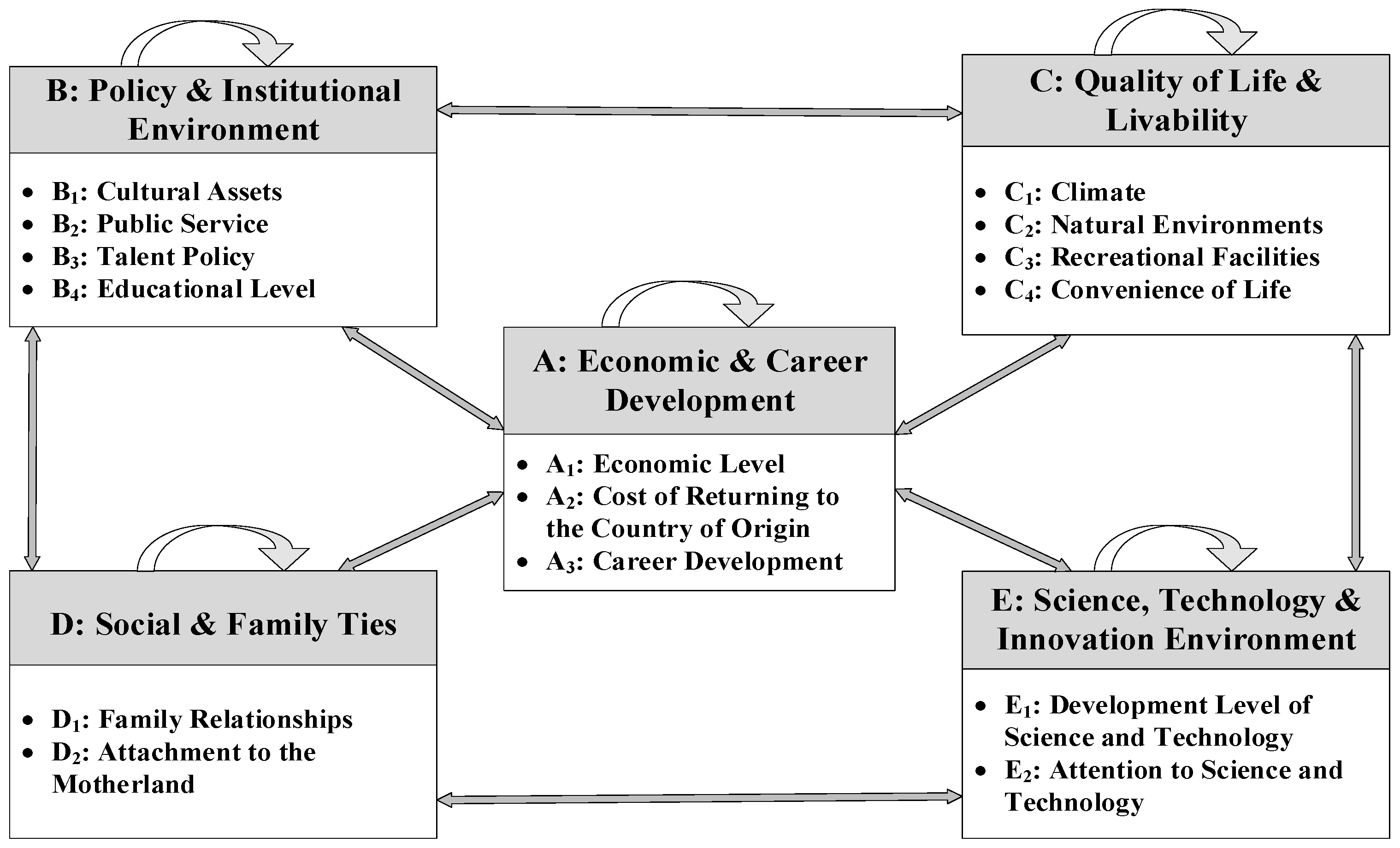
2.6. Prototype Decision Structure
2.6.1. Interlinkages Among the Five Aspects
2.6.2. Initial Index Structure
2.6.3. Hypotheses
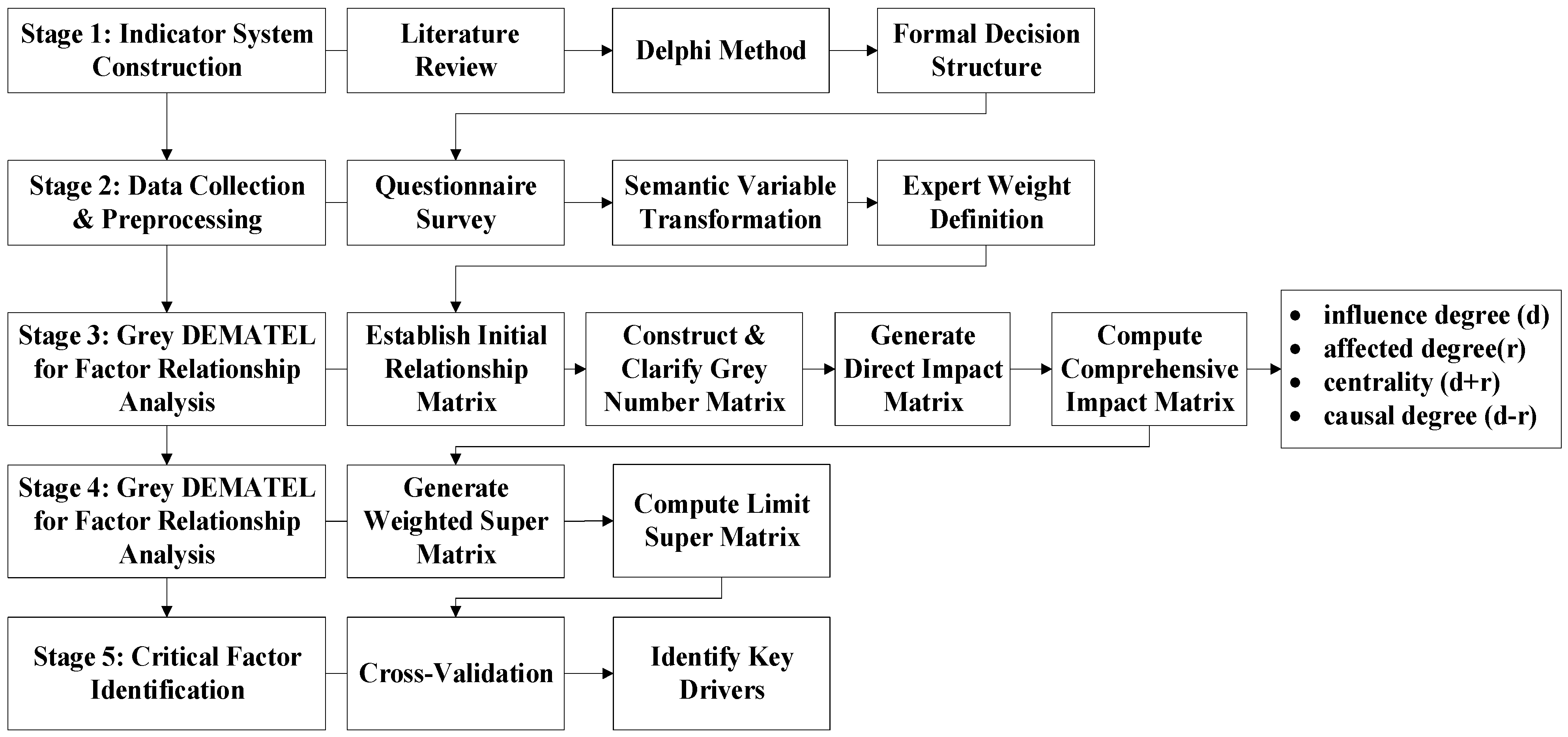
3. The Proposed Grey DANP
3.1. Relationships Among Driven Factors
3.1.1. Build an Index Structure for Influencing Factors
3.1.2. Establish Initial Direct Influencing Matrix
3.1.3. Construct Grey Number Matrix
3.1.4. Calculate Direct Impact Matrix
3.1.5. Calculate the Comprehensive Impact Matrix
3.1.6. Calculate the Degree of Influence () and the Degree of Being Influenced ()
3.1.7. Calculate the Centrality and Causal Degree of Each Influencing Factor
3.1.8. Analyze Model Calculation Results
3.2. Obtaining Weights of Driven Factors
4. Empirical Study
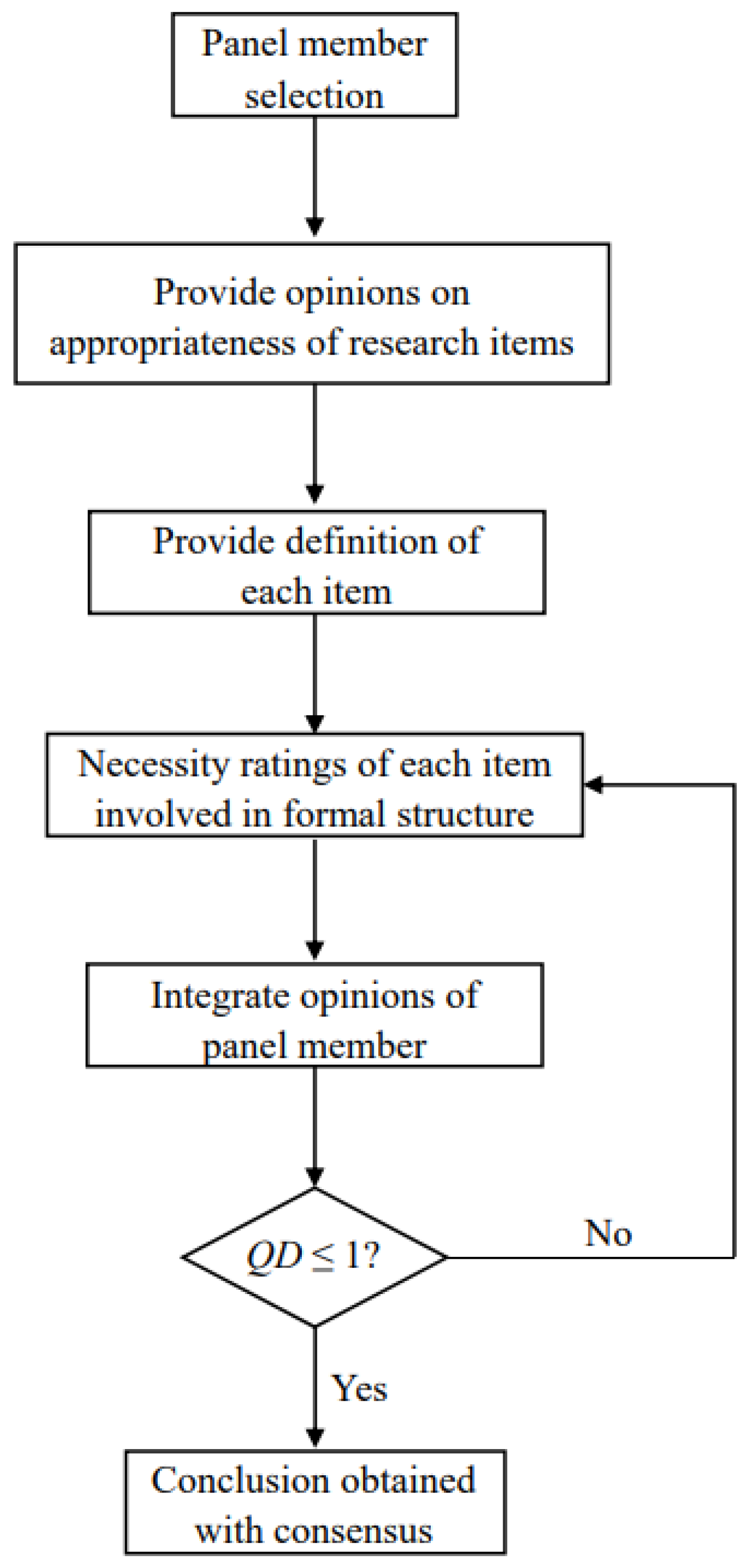
4.1. Formal Decision Structure
4.2. Identifying Critical Driven Factors
4.2.1. Data Collection
4.2.2. Obtaining Relevant Weights of Each Attribute Using Grey DANP
- (1)
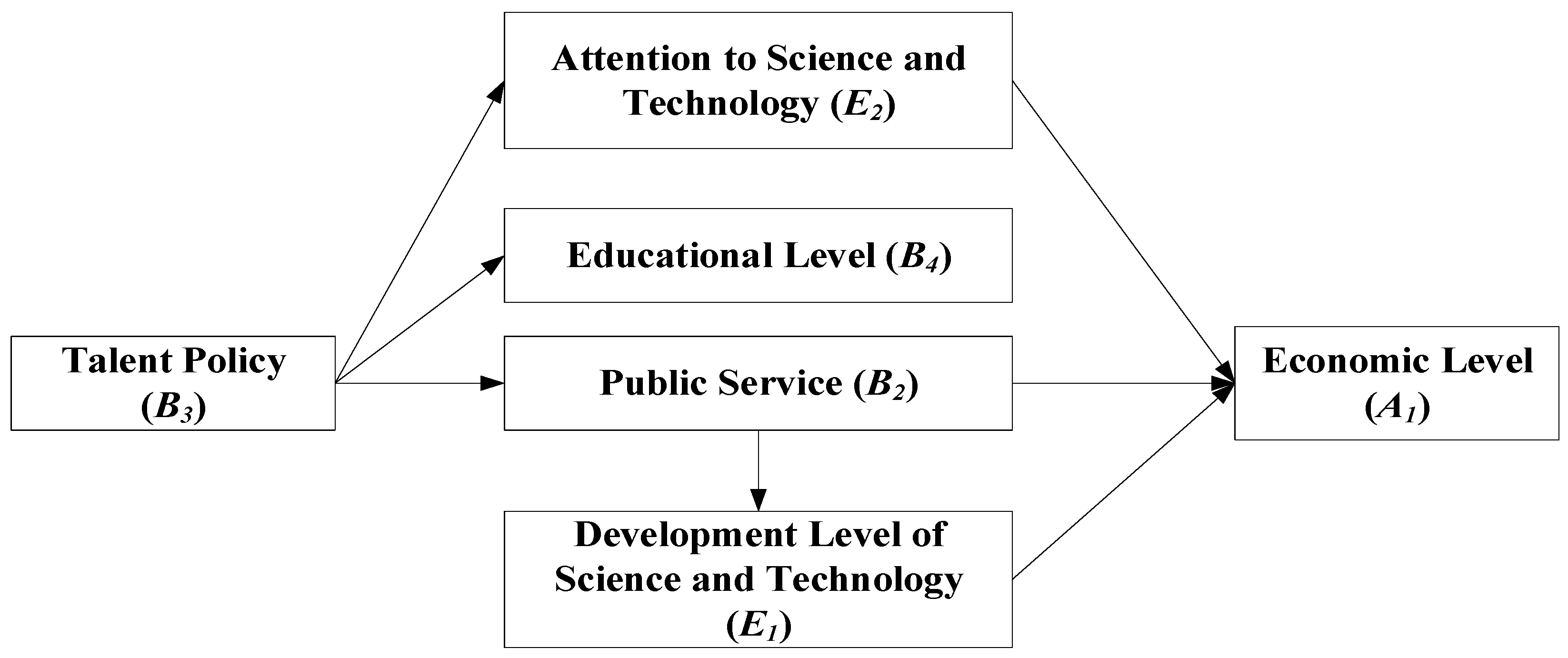
- Cause group (d − r > 0): Economic level (A1), public service (B2), talent policy (B3), educational level (B4), climate (C1), natural environments (C2), attachment to the motherland (D2), development level of science and technology (E1), and attention to science and technology (E2). These factors exert an active influence on other criteria.
- (2)
- Effect group (d − r < 0): Cost of returning to the country of origin (A2), career development (A3), cultural assets (B1), recreational facilities (C3), convenience of life (C4), and family relationships (D1). These factors are mainly affected by other criteria.
4.3. Criteria Classification by Impact Level
5. Discussion
5.1. Core Engine: The Leading Role of Science and Technology Development Level
5.2. Basic Support: The Enabling Value of Economic Level
5.3. Key Support: The Dual Guarantee Function of Educational Level
5.4. Institutional Guarantee: The Synergistic Effect of Attention to Science and Technology, Public Services, and Talent Policies
6. Conclusions and Remarks
6.1. Conclusions
6.2. Theoretical Contribution
6.3. Practical Contributions
- (1)
- For developing countries: This study identifies the six core driving factors of overseas talent return and their synergistic relationship and provides a scientific decision-making framework for developing countries to formulate targeted talent introduction policies and optimize the talent development ecosystem under the background of global talent competition.
- (2)
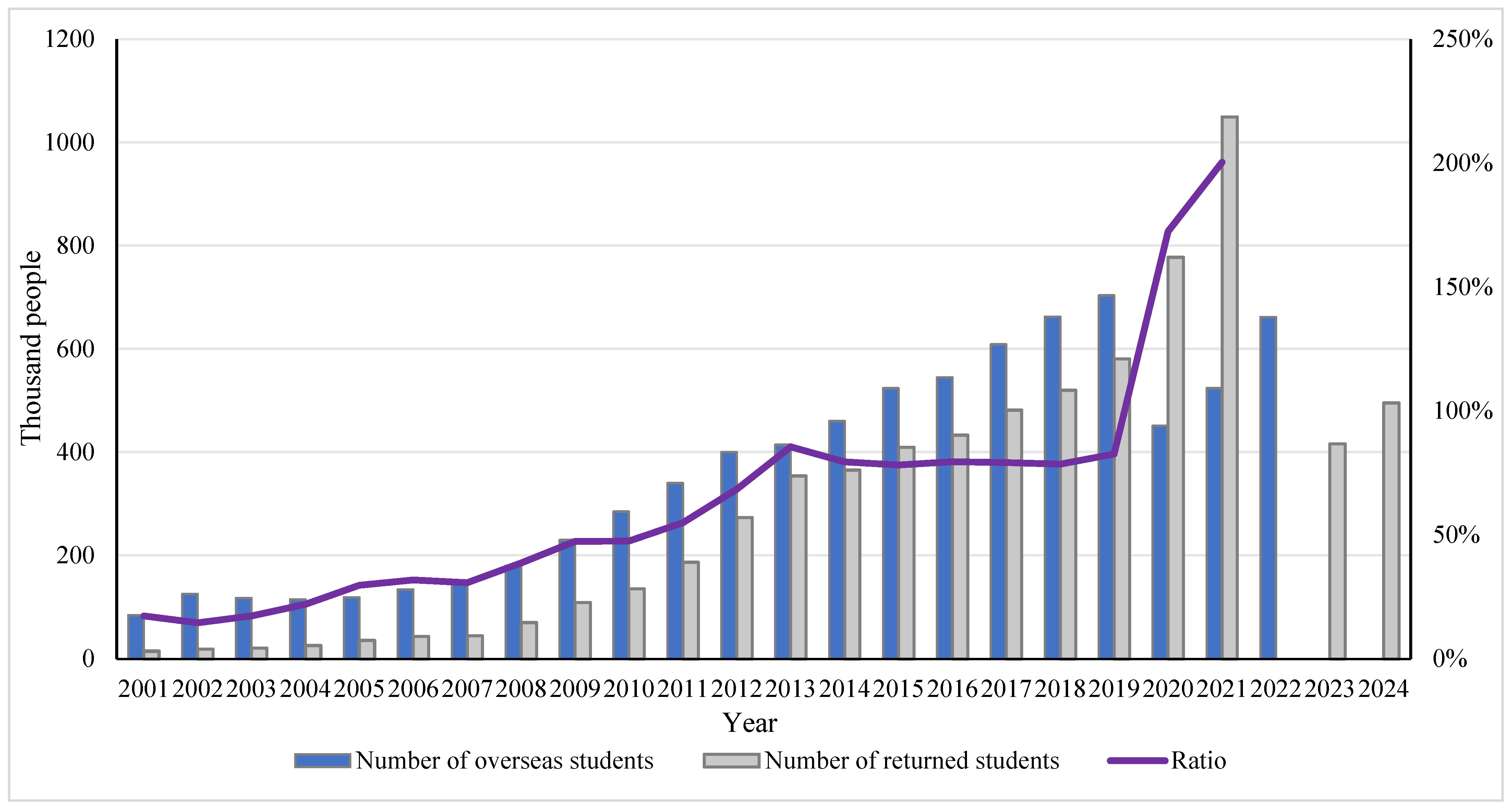
- For China: Combined with the latest talent return data (2001–2024), the study clarifies the core demands of high-end overseas talents for a scientific and technological innovation environment, economic development and educational resources, which can provide a practical reference for China to further refine talent policies, strengthen the integration of the talent chain and industrial chain, and enhance the sustainable attractiveness of overseas talents.
- (3)
- For regional talent governance: The research reveals the multi-dimensional synergy mechanism of talent return drivers and suggests that regional talent governance should break through the single-policy orientation and construct a comprehensive talent attraction system of “hard power (science and technology, and economy) + soft environment (policy and public service)”, which provides a practical path for regional talent agglomeration in developing countries.
6.4. Research Limitations and Future Study
Author Contributions
Funding
Data Availability Statement
Acknowledgments
Conflicts of Interest
Abbreviations
| MCDM | Multiple-criteria decision-making |
| DEMATEL | Decision-making trial and evaluation laboratory |
| ANP | Analytic network process |
| Grey DANP | Grey decision-making trial and evaluation laboratory analytic network process |
Appendix A

| Questionnaire | ||||||||||||||||
| Dear, Firstly, I would like to thank you for your availability of promptly responding to the invitation to be a respondent to this questionnaire. The questionnaire aims to conduct a factor analysis on attracting more international students to serve their home country, establish a framework design for the influencing factors of overseas talent return, and better serve relevant academic research. We highlight that the confidentiality of your personal data is guaranteed. Name of the specialist: Company or institution: Time of experience: Position: This questionnaire is a pairwise comparison, please fill in the table below indicating the influence among the barriers, as follows: 0—no influence|1—very low influence|2—low influence|3—high influence|4—very high influence| | ||||||||||||||||
| Abbreviation | Factors | A1 | A2 | A3 | B1 | B2 | B3 | B4 | C1 | C2 | C3 | C4 | D1 | D2 | E1 | E2 |
| - | Economic and Career Development | - | - | - | - | - | - | - | - | - | - | - | - | - | - | - |
| A1 | Economic Level | 0 | ||||||||||||||
| A2 | Cost of returning to the country of origin | 0 | ||||||||||||||
| A3 | Career development | 0 | ||||||||||||||
| - | Policy and Institutional Environment | - | - | - | - | - | - | - | - | - | - | - | - | - | - | - |
| B1 | Cultural Assets | 0 | ||||||||||||||
| B2 | Public Service | 0 | ||||||||||||||
| B3 | Talent Policy | 0 | ||||||||||||||
| B4 | Educational Level | 0 | ||||||||||||||
| - | Quality of Life and Livability | - | - | - | - | - | - | - | - | - | - | - | - | - | - | - |
| C1 | Policy and Institutional Environment | 0 | ||||||||||||||
| C2 | Natural Environments | 0 | ||||||||||||||
| C3 | Recreational Facilities | 0 | ||||||||||||||
| C4 | Convenience of Life | 0 | ||||||||||||||
| - | Social and Family Ties | - | - | - | - | - | - | - | - | - | - | - | - | - | - | - |
| D1 | Family relationships | 0 | ||||||||||||||
| D2 | Attachment to the motherland | 0 | ||||||||||||||
| - | Science, Technology, and Innovation Environment | - | - | - | - | - | - | - | - | - | - | - | - | - | - | - |
| E1 | Development Level of Science and Technology | 0 | ||||||||||||||
| E2 | Attention to Science and Technology | 0 | ||||||||||||||
Appendix B
Appendix B.1. Calculation Formulas for Direct Impact Matrix Construction
Appendix B.2. Standardization Formulas of Direct Impact Matrix
Appendix B.3. Calculation Formulas of Influence Degree and Influenced Degree
Appendix B.4. Construction and Normalization Formulas of Super Matrix
References
- Jia, N.; Fleisher, B.M. Economic incentives and return migrant scholars: Evidence from a talent recruitment program in China. World Dev. 2024, 184, 106763. [Google Scholar] [CrossRef]
- Wang, M.C.; Wei, Y.Q.; Azumah, G.; Wang, C.L. African returnees in international knowledge transfer: A social capital perspective. J. Int. Manag. 2024, 30, 101118. [Google Scholar] [CrossRef]
- Xie, Y.Y.; Yu, C.Y.; Yang, J.R.; Cui, C. Locational choices of Chinese overseas returnees: The intertwined roles of urban amenities and economic opportunities. Appl. Geogr. 2025, 178, 103608. [Google Scholar] [CrossRef]
- Zweig, D.; Kang, S.Q.; Wang, H.Y. ‘The best are yet to come’: State programs, domestic resistance and reverse migration of high-level talent to China. J. Contemp. China 2020, 29, 776–791. [Google Scholar] [CrossRef]
- Shin, G.W.; Caywood, K. Countering brain drain through circulation and linkage: Illustrations and lessons from China and India. Int. Migr. Rev. 2025. [Google Scholar] [CrossRef]
- Tan, L.S.; Yang, Z.D.; Irfan, M.; Ding, C.J.; Hu, M.J.; Hu, J. Toward low-carbon sustainable development: Exploring the impact of digital economy development and industrial restructuring. Bus. Strategy Environ. 2024, 33, 2159–2172. [Google Scholar] [CrossRef]
- Tawiah, V.; Gyapong, E.; Usman, M. Returnee directors and green innovation. J. Bus. Res. 2024, 174, 114369. [Google Scholar] [CrossRef]
- Shen, Y.Y.; Yang, H.T.; Zhu, Q.H. How does the institutional environment improve the entrepreneurial quality of returnees? A configuration analysis based on a complex system view. PLoS ONE 2025, 20, e0322863. [Google Scholar] [CrossRef]
- Varma, A.; Tung, R. Lure of country of origin: An exploratory study of ex-host country nationals in India. Pers. Rev. 2020, 49, 1487–1501. [Google Scholar] [CrossRef]
- Yang, Q.; You, X.S.; Zhang, Y.Y. Two-sided matching based on I-BTM and LSGDM applied to high-level overseas talent and job fit problems. Sci. Rep. 2021, 11, 12723. [Google Scholar] [CrossRef] [PubMed]
- Ren, G.; Zeng, P.; Zhong, X. Do returnee executives influence firms’ relative exploratory innovation focus? The moderating role of economic policy uncertainty. Bus. Process Manag. J. 2025, 31, 807–823. [Google Scholar] [CrossRef]
- He, J.L.; Song, Y.J.; Huang, X.J.; Lin, J.X. An amenity-based approach to excellent returning scientists’ location choice in China. Pap. Reg. Sci. 2022, 101, 1182–1199. [Google Scholar] [CrossRef]
- Akyildiz, I.E.; Baskol, M.O.; Eryigit, K.Y. The relationship between brain drain and human capital: Evidence from Turkey. Int. J. Manpow. 2025, 46, 1546–1562. [Google Scholar] [CrossRef]
- Arif, I. Educational attainment, corruption, and migration: An empirical analysis from a gravity model. Econ. Model. 2022, 110, 105802. [Google Scholar] [CrossRef]
- Mreji, P.; Barnard, H. The micro-foundations of the returnee liability: The interpersonal challenges of returnee entrepreneurs in Kenya. J. Int. Manag. 2021, 27, 100846. [Google Scholar] [CrossRef]
- Xia, J.; Yao, F.K.; Li, J.N.; Liu, C.L.; Wang, F.M.; Ding, W.W.; Zhang, H. Bridging the divide: How dual-background leaders unlock returnee innovation in politically connected Chinese firms. J. Manag. Stud. 2025. [Google Scholar] [CrossRef]
- Prato, M. The global race for talent: Brain drain, knowledge transfer, and growth. Q. J. Econ. 2024, 140, 165–238. [Google Scholar] [CrossRef]
- Feng, G.; Hu, X.J.; Wang, K.; Yan, S. Executives’ foreign work experience and international knowledge spillovers: Evidence from China. Emerg. Mark. Financ. Trade 2023, 59, 754–771. [Google Scholar] [CrossRef]
- Hu, Y.C. Combination forecasting using multiple attribute decision making in tourism demand. Tour. Rev. 2022, 77, 731–750. [Google Scholar] [CrossRef]
- Nelson, M.; Ehrenfeucht, R. Beyond the Jobs versus Amenities debate: Understanding the migration of educated workers and implications for planning. J. Plan. Educ. Res. 2020, 40, 16–30. [Google Scholar] [CrossRef]
- Yalcin, A.S.; Kilic, H.S.; Delen, D. The use of multi-criteria decision-making methods in business analytics: A comprehensive literature review. Technol. Forecast. Soc. Change 2022, 174, 121193. [Google Scholar] [CrossRef]
- Liu, C.; Li, K.X.; Jiang, P.; Li, D.; Su, L.P.; Lu, S.T.; Li, A.N. A hybrid multiple criteria decision-making technique to evaluate regional intellectual capital: Evidence from China. Mathematics 2021, 9, 1676. [Google Scholar] [CrossRef]
- Li, W.; Lo, L.; Lu, Y.X.; Tan, Y.N.; Lu, Z. Intellectual migration: Considering China. J. Ethn. Migr. Stud. 2021, 47, 2833–2853. [Google Scholar] [CrossRef]
- Yu, Y.J.; Shen, J.F.; Xin, G.Y.; He, J. Leave or stay? The determinants of the migration behavior of university graduates in Shanghai. Eurasian Geogr. Econ. 2025, 66, 583–605. [Google Scholar] [CrossRef]
- Bhardwaj, B.; Sharma, D. Migration of skilled professionals across the border: Brain drain or brain gain? Eur. Manag. J. 2023, 41, 1021–1033. [Google Scholar] [CrossRef]
- Pham, T. Reconceptualising employability of returnees: What really matters and strategic navigating approaches. High. Educ. 2021, 81, 1329–1345. [Google Scholar] [CrossRef]
- Zweig, D.; Tsai, K.S.; Singh, A.D. Reverse entrepreneurial migration in China and India: The role of the state. World Dev. 2021, 138, 105192. [Google Scholar] [CrossRef]
- Jiang, H.N.; Zhang, W.Z.; Duan, J. Location choice of overseas high-Level young returned talents in China. Sustainability 2020, 12, 9210. [Google Scholar] [CrossRef]
- Liu, Y.; Huang, C.Y.; Zhang, F.F.; Ma, H.T. Locational preferences of high-level overseas talent returning to China: Evidence from microdata analysis. Popul. Space Place 2023, 29, e2650. [Google Scholar] [CrossRef]
- Marini, G.; Yang, L.L. Globally bred Chinese talents returning home: An analysis of a reverse brain-drain flagship policy. Sci. Public Policy 2021, 48, 541–552. [Google Scholar] [CrossRef]
- Xu, Y.B.; Chen, Z.B.; Fan, R. Highly skilled foreign labor introduction policies and corporate innovation: Evidence from a natural experiment in China. Econ. Anal. Policy 2023, 77, 137–156. [Google Scholar] [CrossRef]
- Jiang, H.N. Spatial character and backflow pattern of high-Level returned talents in China. Complexity 2021, 2021, 839552. [Google Scholar] [CrossRef]
- Kurokawa, C.; Kusakabe, T. Reversing brain drain to brain gain: Examining the drive of educated Sudanese migrants to return and contribute to their home country. Int. J. Educ. Dev. 2025, 117, 103342. [Google Scholar] [CrossRef]
- Jin, C.; Li, B.; Jansen, S.J.T.; Boumeester, H.; Boelhouwer, P.J. Young talents’ settlement decisions in China’s metropolises: An integrated prospect theory framework. Popul. Space Place 2025, 31, e70099. [Google Scholar] [CrossRef]
- Jiang, P.; Hu, Y.C.; Yen, G.F.; Tsao, S.J. Green supplier selection for sustainable development of the automotive industry using grey decision-making. Sustain. Dev. 2018, 26, 890–903. [Google Scholar] [CrossRef]
- Ibrahim, H.; Al Sharif, F.Z.; Satish, K.P.; Hassen, L.; Nair, S.C. Should I stay or should I go now? The impact of “pull” factors on physician decisions to remain in a destination country. Int. J. Health Plan. Manag. 2019, 34, E1909–E1920. [Google Scholar] [CrossRef]
- Zhu, K.; Xu, J.L.; Wang, X.Y. The evolution of urban innovation space and its spatial relationships with talents’ living demands: Evidence from Hangzhou, China. Int. J. Urban Sci. 2023, 27, 442–460. [Google Scholar] [CrossRef]
- Qiu, J.; Lyu, P.; Tian, M. Do talent housing policies foster regional innovation? An analysis based on labor force heterogeneity. Econ. Anal. Policy 2024, 83, 150–164. [Google Scholar] [CrossRef]
- Partridge, M.D. The duelling models: NEG vs amenity migration in explaining US engines of growth. Pap. Reg. Sci. 2010, 89, 513–536. [Google Scholar] [CrossRef]
- Weinberg, B.A. Developing science: Scientific performance and brain drains in the developing world. J. Dev. Econ. 2011, 95, 95–104. [Google Scholar] [CrossRef] [PubMed]
- Iqbal, K.; Wang, Y.C.; Khurshaid, K.; Shah, M.H.; Sohaib, M. Current trend and determinants of intentions to migrate: Evidence from China. Sage Open 2021, 2021, 1–11. [Google Scholar] [CrossRef]
- Tzeng, G.H.; Huang, J.J. Multiple Attribute Decision Making: Methods and Applications; Chapman and Hall/CRC: Boca Raton, FL, USA, 2011. [Google Scholar]
- Mubarik, M.S.; Kazmi, S.H.A.; Zaman, S.I. Application of gray DEMATEL-ANP in green-strategic sourcing. Technol. Soc. 2021, 64, 101524. [Google Scholar] [CrossRef]
- Liu, X.H.; Deng, Q.W.; Gong, G.L.; Zhao, X.D.; Li, K.X. Evaluating the interactions of multi-dimensional value for sustainable product-service system with grey DEMATEL-ANP approach. J. Manuf. Syst. 2021, 60, 449–458. [Google Scholar] [CrossRef]
- Zheng, Q.; Shen, S.L.; Zhou, A.N.; Lyu, H.M. Inundation risk assessment based on G-DEMATEL-AHP and its application to Zhengzhou flooding disaster. Sustain. Cities Soc. 2022, 86, 104138. [Google Scholar] [CrossRef]
- Soares, T.D.; Silva, M.M.; Santos, S.M. A hybrid Grey-DEMATEL approach to identify barriers to the implementation of an end-of-life vehicle management system in Brazil. J. Clean. Prod. 2023, 386, 135791. [Google Scholar] [CrossRef]
- Holden, M.C.; Wedman, J.F. Future-issue of computer-mediated communication- the results of a delphi study. Educ. Technol. Res. Dev. 1993, 41, 5–24. [Google Scholar] [CrossRef]
- Faherty, V. Continuing social—Work education-results of a delphi survey. J. Educ. Soc. Work 1979, 15, 12–19. [Google Scholar] [CrossRef]
- Jiang, P.; Hu, Y.C.; Yen, G.F.; Jiang, H.; Chiu, Y.J. Using a novel grey DANP model to identify interactions between manufacturing and logistics industries in China. Sustainability 2018, 10, 3456. [Google Scholar] [CrossRef]
- Kumar, A.; Anbanandam, R. Analyzing interrelationships and prioritising the factors influencing sustainable intermodal freight transport system: A grey-DANP approach. J. Clean. Prod. 2020, 252, 119769. [Google Scholar] [CrossRef]
- Ren, J.; Raghupathi, V.; Raghupathi, W. Exploring the push and pull factors in scientific mobility. IEEE Trans. Eng. Manag. 2024, 71, 14559–14570. [Google Scholar] [CrossRef]
- de Haas, H. A theory of migration: The aspirations-capabilities framework. Comp. Migr. Stud. 2021, 9, 8. [Google Scholar] [CrossRef] [PubMed]


| Aspect | Criterion | References |
|---|---|---|
| Economic and Career Development | Financial returns | [23,34] |
| Quality of life | [23] | |
| Economic opportunities | [24,25] | |
| Local wage levels | [26] | |
| Economic incentive policies | [27] | |
| Career prospects | [13,16,23,27] | |
| Science, Technology, and Innovation Environment | Level of scientific development | [28] |
| Commitment to R&D | [28] | |
| Governmental investment in research | [29] | |
| Internationally competitive innovation ecosystem | [31] | |
| Policy and Institutional Environment | Talent policies | [31] |
| Political systems | [22] | |
| Public governance | [33,35] | |
| Targeted policy designs (educational facilities, streamlined residency, and start-up research grants) | [9] | |
| Domestic labour market conditions | [34] | |
| Social and Family Ties | Cultural attachment | [30] |
| Family bonds | [36] | |
| Quality of Life and Livability | Excellent climate and livable natural environment | [37] |
| Physical and mental health security | [11] | |
| Economic security | [38,39,40,41] | |
| Convenience and sustainability of living environment | [38,39,40,41] | |
| Work–life balance | [38,39,40,41] | |
| Recreational facilities | [38,39,40,41] |
| Semantic Variable | Interval Grey Number | Evaluation Value |
|---|---|---|
| no influence | [0.00,0.00] | 0 |
| very low influence | [0.00,0.25] | 1 |
| low influence | [0.25,0.50] | 2 |
| high influence | [0.50,0.75] | 3 |
| very high influence | [0.75,1.00] | 4 |
| Semantic Variable | Interval Grey Number |
|---|---|
| not important | [0.0,0.3] |
| slightly unimportant | [0.3,0.5] |
| important | [0.4,0.7] |
| more important | [0.5,0.9] |
| very important | [0.7,1.0] |
| Expert | Organization | Position | Duties | Seniority (yr) |
|---|---|---|---|---|
| A | Human Resources and Social Security Bureau of a certain city in China | Deputy director-general | Organize the implementation of human resources market development plans and human resources mobility policies | 23 |
| B | Organization Department of a certain municipal party committee in China | Section chief of talent | Talent attraction and development, as well as the formulation of talent policies | 14 |
| C | Science and Technology Bureau of a certain city in China | Deputy director | Responsible for the introduction of intelligence and the formulation of technology policies in the city | 18 |
| D | A headhunting company | Senior talent advisor | Assist employers in recruiting overseas returnees | 15 |
| E | School of Public Administration at a certain university | Professor | Engaged in long-term research in the field of population mobility and distribution | 22 |
| Rating | 1 | 2 | 3 | 4 | 5 |
|---|---|---|---|---|---|
| Necessity | Strongly unnecessary | Unnecessary | Average | Necessary | Strongly necessary |
| Aspect | Criteria |
|---|---|
| Economic and Career Development | Economic level |
| Quality of life | |
| Cost of returning to the country of origin | |
| Economic incentive policies | |
| Career development | |
| Science, Technology, and Innovation Environment | Development level of science and technology |
| Attention to science and technology | |
| Internationally competitive innovation ecosystem | |
| Policy and Institutional Environment | Cultural assets |
| Public service | |
| Social system | |
| Talent policy | |
| Educational level | |
| Social and Family Ties | Family relationships |
| Attachment to the motherland | |
| Quality of Life and Livability | Climate |
| Natural environments | |
| Physical and mental health security | |
| Economic security | |
| Recreational facilities | |
| Convenience life | |
| Sustainable environment |
| Criteria | Ascending Order | Average Value | QD | Classification | ||||
|---|---|---|---|---|---|---|---|---|
| Economic level | 4 | 4 | 4 | 4 | 5 | 4.2 | 0.25 | High Consensus |
| Quality of life | 1 | 2 | 4 | 4 | 5 | 3.2 | 1.50 | No Consensus |
| Cost of returning to the country of origin | 4 | 4 | 4 | 5 | 5 | 4.4 | 0.50 | High Consensus |
| Economic incentive policies | 2 | 2 | 3 | 4 | 5 | 3.2 | 1.25 | No Consensus |
| Career development | 3 | 4 | 4 | 4 | 5 | 4 | 0.50 | High Consensus |
| Development level of science and technology | 4 | 4 | 5 | 5 | 5 | 4.6 | 0.50 | High Consensus |
| Attention to science and technology | 4 | 5 | 5 | 5 | 5 | 4.8 | 0.25 | High Consensus |
| Internationally competitive innovation ecosystem | 1 | 1 | 3 | 5 | 5 | 3 | 2.00 | No Consensus |
| Cultural assets | 3 | 3 | 4 | 5 | 5 | 4 | 1.00 | Moderate Consensus |
| Public service | 5 | 5 | 5 | 5 | 5 | 5 | 0.00 | High Consensus |
| Social system | 1 | 2 | 2 | 3 | 3 | 2.2 | 0.75 | Moderate Consensus |
| Talent policy | 4 | 5 | 5 | 5 | 5 | 4.8 | 0.25 | High Consensus |
| Educational level | 3 | 4 | 4 | 4 | 5 | 4 | 0.50 | High Consensus |
| Family relationships | 4 | 4 | 4 | 4 | 5 | 4.2 | 0.25 | High Consensus |
| Attachment to the motherland | 3 | 4 | 4 | 4 | 4 | 3.8 | 0.25 | High Consensus |
| Climate | 4 | 4 | 4 | 5 | 5 | 4.4 | 0.50 | High Consensus |
| Natural environments | 4 | 4 | 4 | 4 | 5 | 4.2 | 0.25 | High Consensus |
| Physical and mental health security | 1 | 2 | 3 | 3 | 4 | 2.6 | 1.00 | Moderate Consensus |
| Economic security | 1 | 1 | 4 | 4 | 5 | 3.0 | 1.75 | No Consensus |
| Recreational facilities | 4 | 4 | 4 | 4 | 5 | 4.2 | 0.25 | High Consensus |
| Convenience life | 3 | 4 | 4 | 4 | 4 | 3.8 | 0.25 | High Consensus |
| Sustainable environment | 1 | 2 | 3 | 3 | 4 | 2.6 | 1.00 | Moderate Consensus |
| A1 | A2 | A3 | B1 | B2 | B3 | B4 | C1 | C2 | C3 | C4 | D1 | D2 | E1 | E2 | d | |
|---|---|---|---|---|---|---|---|---|---|---|---|---|---|---|---|---|
| A1 | 0.230 | 0.232 | 0.325 | 0.275 | 0.205 | 0.129 | 0.313 | 0.041 | 0.027 | 0.202 | 0.257 | 0.097 | 0.120 | 0.323 | 0.293 | 3.069 |
| A2 | 0.116 | 0.061 | 0.126 | 0.117 | 0.069 | 0.039 | 0.120 | 0.010 | 0.009 | 0.058 | 0.089 | 0.063 | 0.086 | 0.109 | 0.103 | 1.175 |
| A3 | 0.173 | 0.142 | 0.110 | 0.156 | 0.102 | 0.051 | 0.147 | 0.014 | 0.013 | 0.074 | 0.111 | 0.088 | 0.099 | 0.151 | 0.143 | 1.572 |
| B1 | 0.254 | 0.193 | 0.258 | 0.141 | 0.151 | 0.074 | 0.208 | 0.035 | 0.035 | 0.117 | 0.162 | 0.090 | 0.107 | 0.241 | 0.215 | 2.281 |
| B2 | 0.241 | 0.177 | 0.201 | 0.200 | 0.107 | 0.119 | 0.209 | 0.035 | 0.049 | 0.147 | 0.177 | 0.078 | 0.124 | 0.228 | 0.215 | 2.306 |
| B3 | 0.229 | 0.151 | 0.220 | 0.218 | 0.151 | 0.079 | 0.241 | 0.020 | 0.019 | 0.114 | 0.133 | 0.157 | 0.173 | 0.232 | 0.206 | 2.342 |
| B4 | 0.319 | 0.197 | 0.292 | 0.258 | 0.197 | 0.197 | 0.199 | 0.027 | 0.026 | 0.126 | 0.194 | 0.114 | 0.148 | 0.319 | 0.302 | 2.913 |
| C1 | 0.105 | 0.075 | 0.073 | 0.082 | 0.070 | 0.057 | 0.070 | 0.007 | 0.038 | 0.081 | 0.060 | 0.025 | 0.047 | 0.058 | 0.053 | 0.901 |
| C2 | 0.090 | 0.060 | 0.072 | 0.081 | 0.069 | 0.057 | 0.069 | 0.006 | 0.006 | 0.094 | 0.074 | 0.040 | 0.062 | 0.057 | 0.052 | 0.889 |
| C3 | 0.111 | 0.078 | 0.078 | 0.072 | 0.074 | 0.044 | 0.076 | 0.008 | 0.008 | 0.037 | 0.093 | 0.025 | 0.046 | 0.092 | 0.073 | 0.914 |
| C4 | 0.190 | 0.131 | 0.170 | 0.144 | 0.149 | 0.066 | 0.136 | 0.014 | 0.014 | 0.123 | 0.085 | 0.059 | 0.086 | 0.141 | 0.132 | 1.640 |
| D1 | 0.103 | 0.084 | 0.115 | 0.095 | 0.061 | 0.064 | 0.098 | 0.008 | 0.008 | 0.052 | 0.053 | 0.033 | 0.114 | 0.085 | 0.079 | 1.052 |
| D2 | 0.162 | 0.129 | 0.157 | 0.159 | 0.090 | 0.097 | 0.163 | 0.013 | 0.012 | 0.075 | 0.138 | 0.107 | 0.061 | 0.139 | 0.131 | 1.633 |
| E1 | 0.339 | 0.216 | 0.284 | 0.287 | 0.217 | 0.144 | 0.312 | 0.056 | 0.055 | 0.162 | 0.241 | 0.097 | 0.120 | 0.211 | 0.292 | 3.032 |
| E2 | 0.309 | 0.182 | 0.269 | 0.224 | 0.183 | 0.131 | 0.262 | 0.039 | 0.038 | 0.132 | 0.181 | 0.086 | 0.105 | 0.296 | 0.170 | 2.607 |
| r | 2.971 | 2.106 | 2.751 | 2.509 | 1.894 | 1.347 | 2.624 | 0.331 | 0.356 | 1.591 | 2.048 | 1.160 | 1.498 | 2.681 | 2.457 |
| d | r | d + r | d − r | |
|---|---|---|---|---|
| A1 | 3.0688 | 2.9710 | 6.0397 | 0.0978 |
| A2 | 1.1752 | 2.1063 | 3.2815 | −0.9311 |
| A3 | 1.5721 | 2.7510 | 4.3230 | −1.1789 |
| B1 | 2.2812 | 2.5094 | 4.7905 | −0.2282 |
| B2 | 2.3063 | 1.8945 | 4.2007 | 0.4118 |
| B3 | 2.3418 | 1.3474 | 3.6892 | 0.9944 |
| B4 | 2.9126 | 2.6237 | 5.5363 | 0.2889 |
| C1 | 0.9015 | 0.3312 | 1.2326 | 0.5703 |
| C2 | 0.8892 | 0.3559 | 1.2451 | 0.5333 |
| C3 | 0.9141 | 1.5910 | 2.5051 | −0.6769 |
| C4 | 1.6399 | 2.0485 | 3.6883 | −0.4086 |
| D1 | 1.0516 | 1.1596 | 2.2112 | −0.1081 |
| D2 | 1.6330 | 1.4979 | 3.1309 | 0.1351 |
| E1 | 3.0318 | 2.6810 | 5.7127 | 0.3508 |
| E2 | 2.6068 | 2.4574 | 5.0642 | 0.1495 |
| Impact Level | Criteria | Weight Range | Causal Role | Core Characteristics |
|---|---|---|---|---|
| High | E1 | >0.08 | All belong to the “cause group” (d − r > 0) | Active driving role; strong influence on other factors; core determinants of talent return |
| A1 | ||||
| B4 | ||||
| E2 | ||||
| B2 | ||||
| B3 | ||||
| Medium | B1 | 0.04–0.08 | Mixed (B1/D2: cause group; A3/A2/C4: effect group) | Intermediate transmission role; affected by high-impact factors while influencing low-impact factors |
| D2 | ||||
| C4 | ||||
| A3 | ||||
| A2 | ||||
| Low | D1 | <0.04 | All belong to the “effect group” (d − r < 0) | Passive response role; mainly affected by other factors; weak direct driving effect on talent return |
| C1 | ||||
| C3 | ||||
| C2 |
| A1 | A2 | A3 | B1 | B2 | B3 | B4 | C1 | C2 | C3 | C4 | D1 | D2 | E1 | E2 | RANK | |
|---|---|---|---|---|---|---|---|---|---|---|---|---|---|---|---|---|
| A1 | 0.107 | 0.107 | 0.107 | 0.107 | 0.107 | 0.107 | 0.107 | 0.107 | 0.107 | 0.107 | 0.107 | 0.107 | 0.107 | 0.107 | 0.107 | 2 |
| A2 | 0.041 | 0.041 | 0.041 | 0.041 | 0.041 | 0.041 | 0.041 | 0.041 | 0.041 | 0.041 | 0.041 | 0.041 | 0.041 | 0.041 | 0.041 | 11 |
| A3 | 0.055 | 0.055 | 0.055 | 0.055 | 0.055 | 0.055 | 0.055 | 0.055 | 0.055 | 0.055 | 0.055 | 0.055 | 0.055 | 0.055 | 0.055 | 10 |
| B1 | 0.080 | 0.080 | 0.080 | 0.080 | 0.080 | 0.080 | 0.080 | 0.080 | 0.080 | 0.080 | 0.080 | 0.080 | 0.080 | 0.080 | 0.080 | 7 |
| B2 | 0.083 | 0.083 | 0.083 | 0.083 | 0.083 | 0.083 | 0.083 | 0.083 | 0.083 | 0.083 | 0.083 | 0.083 | 0.083 | 0.083 | 0.083 | 5 |
| B3 | 0.082 | 0.082 | 0.082 | 0.082 | 0.082 | 0.082 | 0.082 | 0.082 | 0.082 | 0.082 | 0.082 | 0.082 | 0.082 | 0.082 | 0.082 | 6 |
| B4 | 0.104 | 0.104 | 0.104 | 0.104 | 0.104 | 0.104 | 0.104 | 0.104 | 0.104 | 0.104 | 0.104 | 0.104 | 0.104 | 0.104 | 0.104 | 3 |
| C1 | 0.033 | 0.033 | 0.033 | 0.033 | 0.033 | 0.033 | 0.033 | 0.033 | 0.033 | 0.033 | 0.033 | 0.033 | 0.033 | 0.033 | 0.033 | 13 |
| C2 | 0.031 | 0.031 | 0.031 | 0.031 | 0.031 | 0.031 | 0.031 | 0.031 | 0.031 | 0.031 | 0.031 | 0.031 | 0.031 | 0.031 | 0.031 | 15 |
| C3 | 0.032 | 0.032 | 0.032 | 0.032 | 0.032 | 0.032 | 0.032 | 0.032 | 0.032 | 0.032 | 0.032 | 0.032 | 0.032 | 0.032 | 0.032 | 14 |
| C4 | 0.057 | 0.057 | 0.057 | 0.057 | 0.057 | 0.057 | 0.057 | 0.057 | 0.057 | 0.057 | 0.057 | 0.057 | 0.057 | 0.057 | 0.057 | 9 |
| D1 | 0.037 | 0.037 | 0.037 | 0.037 | 0.037 | 0.037 | 0.037 | 0.037 | 0.037 | 0.037 | 0.037 | 0.037 | 0.037 | 0.037 | 0.037 | 12 |
| D2 | 0.057 | 0.057 | 0.057 | 0.057 | 0.057 | 0.057 | 0.057 | 0.057 | 0.057 | 0.057 | 0.057 | 0.057 | 0.057 | 0.057 | 0.057 | 8 |
| E1 | 0.109 | 0.109 | 0.109 | 0.109 | 0.109 | 0.109 | 0.109 | 0.109 | 0.109 | 0.109 | 0.109 | 0.109 | 0.109 | 0.109 | 0.109 | 1 |
| E2 | 0.094 | 0.094 | 0.094 | 0.094 | 0.094 | 0.094 | 0.094 | 0.094 | 0.094 | 0.094 | 0.094 | 0.094 | 0.094 | 0.094 | 0.094 | 4 |
Disclaimer/Publisher’s Note: The statements, opinions and data contained in all publications are solely those of the individual author(s) and contributor(s) and not of MDPI and/or the editor(s). MDPI and/or the editor(s) disclaim responsibility for any injury to people or property resulting from any ideas, methods, instructions or products referred to in the content. |
© 2026 by the authors. Licensee MDPI, Basel, Switzerland. This article is an open access article distributed under the terms and conditions of the Creative Commons Attribution (CC BY) license.
Share and Cite
Jiang, P.; Dong, Z.; Wan, G.; Liu, X. What Drives the Reverse of Overseas Brain Drain? Identifying the Critical Factors by a Hybrid Grey DANP Technique. Systems 2026, 14, 274. https://doi.org/10.3390/systems14030274
Jiang P, Dong Z, Wan G, Liu X. What Drives the Reverse of Overseas Brain Drain? Identifying the Critical Factors by a Hybrid Grey DANP Technique. Systems. 2026; 14(3):274. https://doi.org/10.3390/systems14030274
Chicago/Turabian StyleJiang, Peng, Zhaohu Dong, Guangxue Wan, and Xiuzheng Liu. 2026. "What Drives the Reverse of Overseas Brain Drain? Identifying the Critical Factors by a Hybrid Grey DANP Technique" Systems 14, no. 3: 274. https://doi.org/10.3390/systems14030274
APA StyleJiang, P., Dong, Z., Wan, G., & Liu, X. (2026). What Drives the Reverse of Overseas Brain Drain? Identifying the Critical Factors by a Hybrid Grey DANP Technique. Systems, 14(3), 274. https://doi.org/10.3390/systems14030274