


Abstract
Technological innovation is driving the intelligent transformation of China’s coal mining industry, leading to significant changes in miners’ working methods and risk structures. To explore the predictors of miners’ safety citizenship behaviors in an intelligent mining environment, this study introduces regulatory focus based on the JD-R model of miners and proposes safety climate and self-efficacy as additional predictors. Using multiple methods including machine learning, response surface methodology (RSM), and latent profile analysis (LPA), data from a sample of 1168 miners were analyzed. The results indicate that the random forest model performed best, with the lowest prediction error and strongest explanatory power. In the variable importance analysis, safety climate (SAC), promotion focus (PRF), prevention focus (PF), and self-efficacy (SE) were identified as key factors influencing miners’ safety citizenship behaviors. Additionally, four distinct miner work characteristic groups were identified, showing significant differences; the more aligned the job demands and resources, the higher the safety citizenship behavior. This study aims to provide a basis for segmented and classified management in coal mine safety management from the perspective of multi-method evidence and heterogeneity.
1. Introduction
Driven jointly by policies and market forces, the construction of intelligent coal mines in China has achieved remarkable progress in such aspects as 5G network positioning, intelligent fully-mechanized mining, and roadway excavation [1]. Accordingly, this has brought about changes in the working environment and modes of frontline coal miners, and reshaped their job characteristics to a certain extent—for instance, a reduction in physical workload and environmental exposure risks—while the convenience brought by intelligent systems has been accompanied by a gradual increase in technical complexity and cognitive load. After the rapid development of intelligent coal mines since 2020, although the level of coal mine safety governance in China has been continuously improving, it experienced a slight rebound in 2022. By 2023, the fatality rate per million tons of coal produced in China reached 0.094, an increase of 23.7% compared with the previous year [2]. According to statistics, safety incidents have occurred in coal mines that underwent intelligent upgrades in Shaanxi, Guizhou, Inner Mongolia, and Henan. Investigations and typical cases repeatedly reveal that issues such as illegal production organization, concealed working faces, monitoring systems and sensor data “failing to upload/being interfered with,” and inadequate maintenance and reliability of critical systems persist in some mines. As reported by the National Mine Safety Administration [3,4], the “March 2” major coal and gas outburst accident at Guizhou Limin Coal Mine resulted in eight deaths and 13 injuries. The incident involved monitoring systems failing to transmit data and methane sensors being deliberately moved or covered. The “January 12” major coal and gas outburst accident at Pingmei No. 12 Mine in Henan Province resulted in 16 fatalities and five injuries. The investigation identified concealed working faces and a failure to upload certain monitoring data. These phenomena hinder intelligent systems from establishing stable “closed-loop prevention” capabilities for risks, reflecting shortcomings in reliability, operation, and maintenance of intelligent coal mines under current technological conditions. Despite the continuous strengthening of safety management systems, investment in technical equipment, and supervision intensity by coal mining enterprises, it is still impossible to avoid accidents during the transformation period of intelligent construction [5,6]. This indicates that there are unforeseen dynamic risks and more complex safety governance challenges in the process of intelligent transformation.
Existing studies have mostly focused on topics such as miners’ safety behavior, unsafe behavior, or counterproductive work behavior [7,8,9]. However, relatively insufficient attention has been paid to miners’ safety citizenship behavior—a type of spontaneous and extra-role behavior. In numerous studies on safety management and organizational behavior, safety citizenship behavior (SCB) has been verified as an important complementary mechanism to formal management systems and supervision in safety-critical fields such as construction [10], aviation [11], railway [12], and coal mining [13]. Studies have shown that safety citizenship behavior exhibits prosocial and proactive characteristics. It transforms institutional requirements into daily practices through behaviors such as safety mutual assistance, norm maintenance, safety management participation, hazard reporting, civic virtue, and safety suggestion provision [14], and serves as a supplement in complex scenarios where regulations and supervision are difficult to cover. Regarding the coal mining industry, existing research has begun incorporating safety citizen behavior into the context of mine safety governance. However, overall, it remains characterized by a limited research volume and insufficient coverage of contextual variables: On one hand, coal mine-related studies predominantly adopt the safety participation/safety compliance scale framework, treating SCB as a supplementary dimension to safety performance metrics. Few studies contextualize SCB by examining its relationship with high-risk operational characteristics in mines or team coordination mechanisms. On the other hand, existing coal mine studies primarily explain SCB antecedents through organizational factors like management systems, leadership, and safety culture. They pay insufficient attention to how technological dependence, cognitive load, and human–machine collaboration reshape the “work demands–resource allocation” dynamic during intelligent transformation. Furthermore, they rarely reveal from a resource allocation perspective how risk combinations like “high demands–low resources” suppress SCB. Therefore, further expansion of research on the mechanism and empirical analysis of miners’ safety citizenship behavior is still needed.
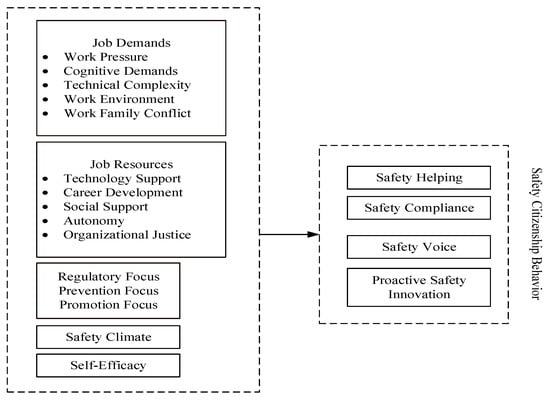
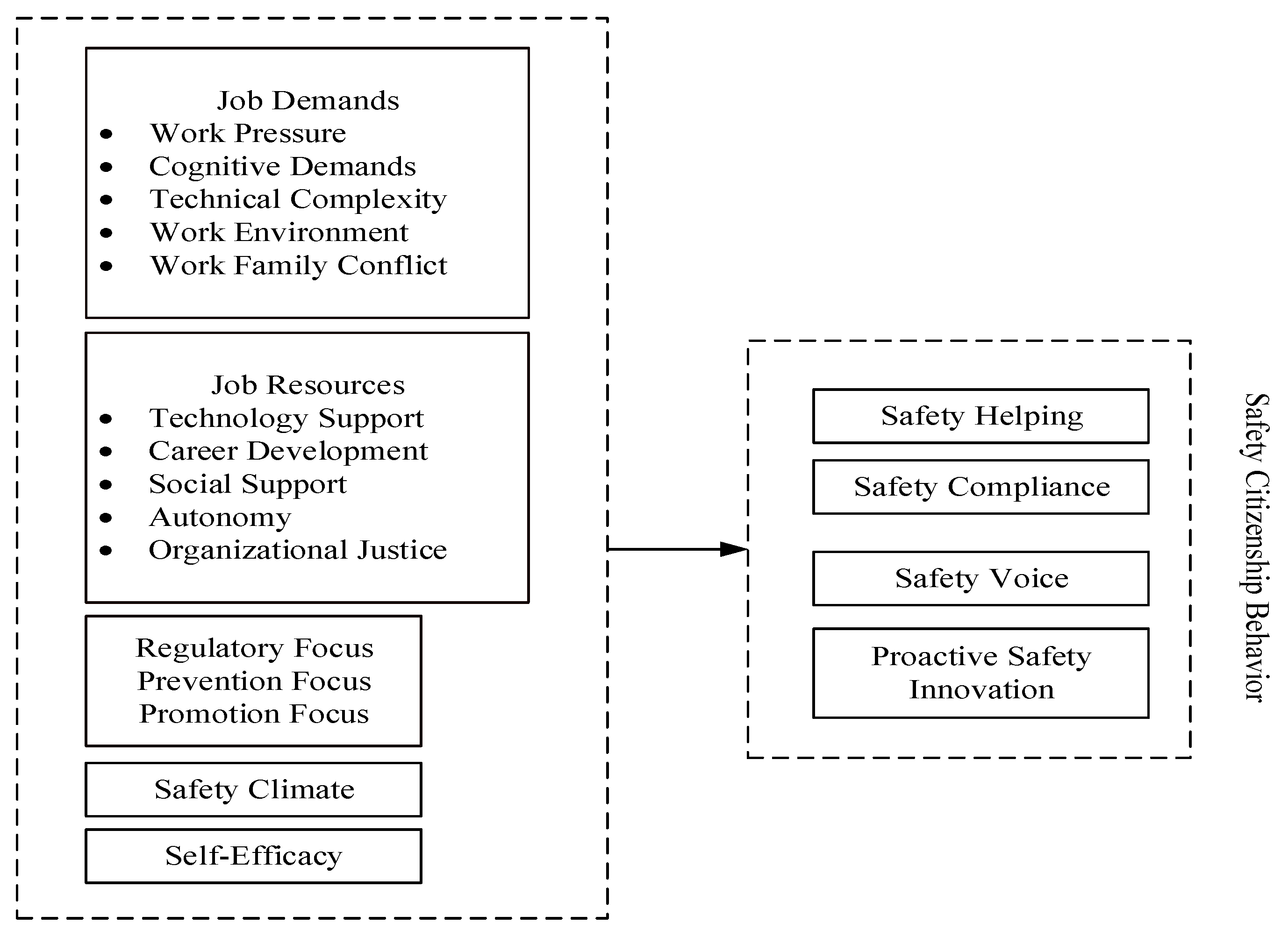
From the perspective of the Job Demands–Resources (JD-R) Model for miners, researchers often divide job characteristics into two parts: job demands and job resources. Job demands refer to the factors that require continuous physical or mental effort at work and may incur physiological and psychological costs. Job resources are regarded as the factors that help employees achieve work goals, reduce the consumption caused by job demands, and facilitate employee growth and development. The key transformation in intelligent coal mines lies in the “reduced manpower + centralized control + data-driven human–machine collaboration” model, which reshapes miners’ risk exposure structure and task execution methods: automation and monitoring systems reduce certain physical exposures, yet simultaneously increase information density, system dependency, and pressure to handle anomalies [15]. This forces miners to devote greater attention and cognitive processing in complex working conditions while bearing heavier burdens of process coordination and technical adaptation [16]; therefore, this paper defines work pressure, cognitive demands, technical complexity, work environment, and work–family conflict—factors directly reflecting this “transformational pressure structure”—as core occupational requirements. Therefore, this paper defines work pressure, cognitive demand, technical complexity, working environment, and work–family conflict as the core job demands of intelligent coal mines. Technological development-related factors, as well as organizational and learning-related factors, are considered as inhibitory factors of job demands, which can reduce job demands and improve the effective application of technology [17]. Thus, technical support, professional competence development, social support, work autonomy, and organizational justice are defined as the core job resources of intelligent coal mines. At the same time, given that safety-conscious citizen behavior constitutes a supra-role, involving a proactive contribution to safety, the “demand–resource” conditions alone are insufficient to explain its stable occurrence. At the organizational level, the safety climate provides miners with explicit safety value signals and behavioral norm expectations [18]. At the individual level, self-efficacy determines whether one possesses the capacity to translate safety intentions into sustained actions [19]. Regulatory focus characterizes miners’ strategic orientation toward promotion or prevention when pursuing safety goals [20], thereby explaining why differing safety behavioral responses emerge under identical work characteristics. Based on this logical chain, “contextual change → demand/resource restructuring → organizational signals and individual capabilities → behavioral strategies”, this paper integrates safety climate, self-efficacy, and moderating focus into the explanatory framework for miners’ safety-related citizenship behaviors. This variable selection encompasses both primary stressors arising from intelligent transformation and key resources/psychological pathways required for achieving safety closed-loop management, ensuring the model’s contextual representativeness and managerial intervenability.
To sum up, based on the inclusion of all the aforementioned variables, this paper adopts a multi-method approach integrating machine learning, response surface methodology (RSM), and latent profile analysis (LPA) to conduct an in-depth and refined study on the driving factors affecting miners’ safety citizenship behavior. This study aims to design a verifiable evidence chain across three dimensions: “variable importance ranking, demand/resource matching effects, and group heterogeneity.” It analyzes which factors exert the most critical influence on safety-oriented behavior in multi-factor intelligent coal mine transformation scenarios, thereby identifying priority intervention areas. It further examines how miners’ safety-oriented behavior changes when work demands and resources become mismatched, and whether significant differences exist among miner groups with varying job characteristics. This research provides management guidance for coal mining enterprises to identify “priority investment points” and implement segmented interventions during intelligent transformation, thereby enhancing the precision and effectiveness of safety governance during this transition period [21].
2. Materials and Methods
2.1. Research Model and Methods
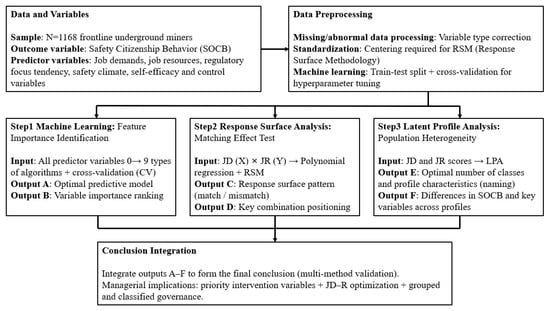
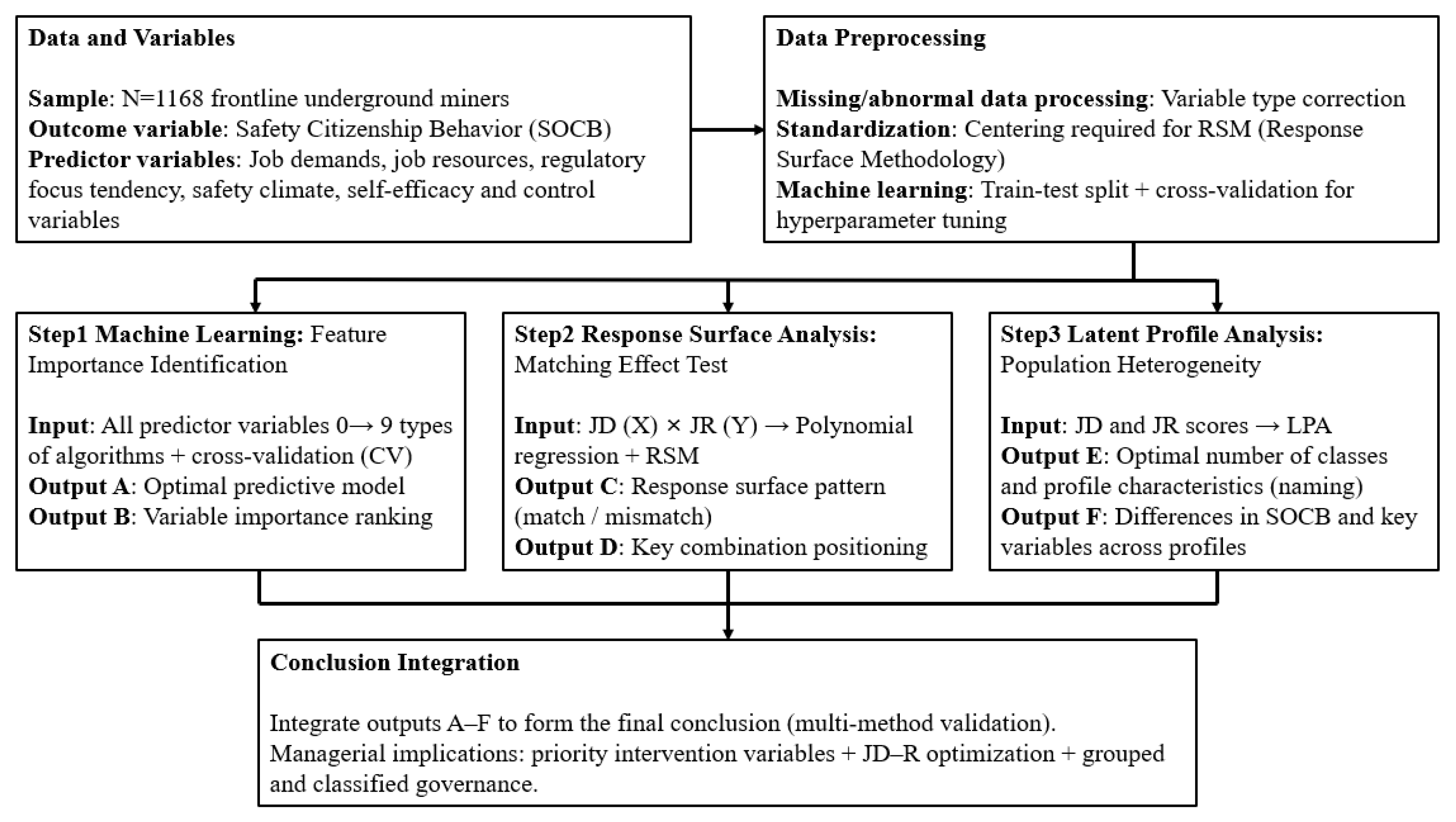
This study employs a multi-method strategy combining “machine learning importance identification—JD-R matching effect testing—population heterogeneity characterization” to establish an evidence chain for the drivers of miners’ safety-oriented citizen behavior (SOCB). First, machine learning evaluates model predictive performance while incorporating all predictor variables, generating a ranked list of variable importance to identify priority intervention factors. Second, response surface analysis focuses on the matching/mismatching relationship between job demands and job resources, testing the nonlinear variation of SOCB in scenarios such as “high demands–low resources.” Finally, latent profile analysis constructs latent groups based on task demands and resources, characterizing differences among miners with distinct work profile types. It compares their SOCB and key psychological/situational variables, enabling cross-validation of overarching patterns, matching mechanisms, and group differences, as illustrated in Figure 1.
Figure 1.
Mixed methods research framework.
Machine learning is a collective term for models that automatically learn patterns from data through algorithms to make predictions or decisions. It places greater emphasis on a model’s predictive efficacy and generalization capability—that is, its ability to accurately predict unseen data. As shown in Figure 2, to identify the key drivers of SOCB while incorporating all variables, this study employed nine machine learning algorithms to construct predictive models. Hyperparameter optimization was conducted via cross-validation, and model predictive performance was compared on the test set. The model with the best overall performance was selected as the primary model. Subsequently, variable importance rankings were generated based on the primary model’s outputs and cross-referenced with importance results from other models to enhance the robustness of conclusions. Expected outputs include: the predictive performance of the optimal model, the ranking of key variable importance (top drivers), and the results of consistency verification.
Figure 2.
Example of a machine learning model.
These nine algorithms are specifically as follows: Decision Tree, Random Forest, XG Boost (eXtreme Gradient Boosting), Lasso Ridge Regression Elastic Net, Support Vector Machine (SVM), Multilayer Perceptron (MLP, single hidden layer neural network), Logistic Regression, Light GBM (Light Gradient Boosting Machine), and KNN (K-Nearest Neighbor).
Response Surface Methodology (RSM) is a comprehensive methodological approach that integrates mathematical and statistical principles to develop, improve, and optimize industrial processes or scientific experiments. To examine the complex impact of the matching relationship (or consistency/inconsistency) between miners’ job demands and job resources on their safety citizenship behavior, this study adopts the method of polynomial regression combined with response surface analysis. This method was systematically introduced into the field of organizational behavior research by Edwards, J. R., & Parry, M. E. [22], aiming to overcome the inherent limitations of the traditional difference score method, such as reduced reliability, information loss, and overly restrictive assumptions [23,24,25]. Expected outputs include: verification of the matching effect between miner workload requirements and resources, identification of combinations that significantly reduce SOCB, and visualization of surface morphology. These findings provide contextually specific evidence for subsequent management interventions. The specific steps are as follows:
First, conduct data preprocessing and model construction. To avoid the problem of multicollinearity, the independent variables and were centralized prior to analysis [26]. Subsequently, a polynomial regression equation containing linear terms, quadratic terms, and interaction terms was constructed:
where b0 denotes the intercept, b1 and b2 represent the linear effect coefficients, b3, b4 and b5 are the coefficients of the quadratic and interaction terms, respectively, and is the error term.
Hierarchical regression was employed to verify the rationality of this polynomial model: after controlling for the control variables and linear terms (, ), quadratic terms (, , ) were incorporated into the model. If the overall ΔR2 of the model was significant, this indicated the presence of a nonlinear relationship between the variables, and thus it was appropriate and necessary to further conduct response surface analysis.
Second, response surface analysis was conducted based on the polynomial regression coefficients. The core of response surface analysis lies in intuitively displaying and quantitatively examining how different combinations of and affect through three-dimensional graphs. Its key is to analyze the properties of the response surface along two characteristic lines. Finally, all analyses were performed using SPSS27.0 and Mplus8.3 software, and three-dimensional response surface plots were generated to present the research findings more intuitively.
Latent Profile Analysis (LPA) is a statistical method that explains the associations among manifest indicators through latent profiles and achieves local independence among these indicators. As a model-based method, LPA generates more reasonable clustering results and criteria. To characterize the heterogeneity of mining workforce traits, this method employs job demands and job resources as manifest indicators for LPA. It progressively compares the fit indices and classification quality of different category models to determine the optimal latent categories and assign names. Subsequently, it examines differences across profiles in SOCB and key variables to generate evidence for classification-based governance. Expected outputs include: number of latent categories, characteristic patterns and naming for each profile, results of inter-profile difference tests, and their management implications. The specific steps of the latent profile analysis method are as follows: (1) Assume that only a null model or independent model (i.e., a single class) exists, where all manifest variables are completely independent of one another. (2) Gradually increase the number of latent classes and estimate the parameters of each model. (3) Compare the model fit indices of different models to select the optimal model. (4) Assign names to the generated latent classes.
2.2. Research Subjects
The research subjects were frontline miners in intelligent coal mines. The survey was conducted among miners from 3 coal mines affiliated to Lu’an Group and another 3 coal mines under Jinneng Holding Group in Shanxi Province. All six coal mines have undergone intelligent transformation to the same extent. The questionnaires were completed by frontline miners from departments including excavation, support, maintenance, management, and safety, with data collected via anonymous surveys. Given the numerous job classifications within coal mines and the variation in naming conventions across different mines, this paper categorizes job types into three categories—underground, surface, and safety management—to enhance the stability and comparability of statistical processing. To reduce the risk of common method bias, respondents were informed that there were no right or wrong answers and that the questionnaires were used solely for research purposes. The control variables included gender, age, years of service, educational level, job category, and marital status. Years of service refers to the cumulative length of time since commencing work in coal mining-related positions (general seniority). A total of 1300 formal questionnaires were distributed. After excluding invalid questionnaires due to incomplete information, careless responses, and blank submissions, 1168 valid questionnaires were recovered, resulting in an effective response rate of 89.85%. The basic characteristics of the respondents are presented in Table 1. A comparison with the current workforce structure of coal mine employees shows that the demographic data of the research sample are consistent with the characteristics of intelligent coal mines at the present stage and possess representative features in the context of intelligent coal mine development.
Table 1.
Basic characteristics of survey subjects.
2.3. Scale Design
This study measured miners’ individual perceptions of job demands and resources by defining the internal dimensions of job demands and job resources first, and then adopting mature scales to assess each dimension separately. Based on the well-established scales developed by multiple scholars [27,28,29,30,31,32,33], the scales were revised in combination with the actual conditions of the coal mining industry. The job demands scale consists of 5 dimensions, namely work pressure (5 items), cognitive demand (4 items), technical complexity (5 items), working environment (5 items), and work–family conflict (5 items), totaling 24 items. A higher score indicates higher job demands in the miners’ working environment. The job resources scale comprises 5 dimensions: technical support (5 items), professional competence development (4 items), social support (7 items), work autonomy (3 items), and organizational justice (4 items), with a total of 23 items. A higher score reflects more sufficient job resources available to the miners.
The miners’ safety citizenship behavior scale was developed based on interview surveys and by drawing on safety citizenship behavior scales applied in industries such as construction [10], aviation [34], maritime navigation [35], railway [12], and high-risk energy [36]. This scale includes 4 dimensions, namely safety mutual assistance, norm maintenance, safety voice and initiative, and independent innovation, with 5 items under each dimension, amounting to 20 items in total. The regulatory focus orientation scale was revised by adapting the regulatory focus scale designed by Neubert, M. J. and Kacmar et al. [37] to the actual working conditions of frontline miners in intelligent coal mines. It covers 2 dimensions: prevention regulatory focus and promotion regulatory focus, each with 9 items, resulting in 18 items overall. The safety atmosphere scale was derived from the scale designed by Zohar [38], and 10 items were selected by considering the basic characteristics and actual work scenarios of miners. This scale has demonstrated good reliability and validity in applications among Chinese coal miners. The self-efficacy scale was revised by adjusting the employee self-efficacy scale designed by Rigotti T. and Schyns B. et al. [39] to fit the practical situation of frontline miners in intelligent coal mines, consisting of 6 items.
Most of the above scales are sourced from classic English literature, and the Chinese versions of these scales exhibit differences in the descriptions of some specific items due to variations in research subjects. Therefore, a back-translation procedure was conducted on the original English scales to ensure the accuracy of the Chinese translations. Subsequently, based on the actual working context of frontline miners in intelligent coal mines, the initial Chinese versions of the scales and some existing Chinese scales were revised to enhance their applicability to the miners’ occupational background. Meanwhile, during interviews and pre-surveys, mine managers and frontline miners from different enterprises were invited to evaluate the items of the above scales. Ambiguous and unclear expressions in some items were revised and polished, ultimately forming the comprehensive measurement scale for safety citizenship behavior of frontline miners in intelligent coal mines. All scales adopted a 5-point Likert scale, with responses ranging from 1 (strongly disagree) to 5 (strongly agree), corresponding to the five options: strongly disagree, disagree, neutral, agree, and strongly agree.
Compared to existing scales, the innovation of this study’s survey instrument lies primarily in contextual adaptation and structural integration: On one hand, while preserving the core concepts of established scales, the JD-R dimensions and item wording underwent industry-specific terminology replacement and contextual revisions to address the characteristics of intelligent coal mines—namely, heightened technological dependence, increased cognitive load, and human–machine collaboration. This strengthened key elements such as cognitive demands, technological complexity, and technical support. On the other hand, the safety citizenship behavior scale was not simply transplanted. Instead, based on interviews and preliminary research, it was restructured into a four-dimensional framework (safety mutual aid, norm maintenance, proactive suggestions, autonomous innovation) that better aligns with the miners’ context. This enhances the scale’s content validity and distinctiveness within the intelligent coal mine setting.
3. Results
3.1. Common Method Bias
Harman’s single-factor test was employed to determine whether there was common method bias in the data collected via questionnaires. All items from the scales in this study were included in the factor analysis. Using principal component analysis, a total of 18 common factors with eigenvalues greater than 1 were extracted, accounting for 65.146% of the cumulative variance explained. Among them, the variance contribution rate of the first unrotated common factor was 18.784%, which is far lower than the critical threshold of 50%. In addition, the method of controlling for unmeasured latent method factors was adopted: a common method variance (CMV) factor was added to the baseline model, and the model fit between this modified model (seven-factor + CMV) and the baseline model (seven-factor) was compared. The results showed that the model fit indices of the model incorporating the CMV factor were not improved compared with the baseline model, indicating that there was no serious common method bias in this study.
3.2. Reliability and Validity Analysis
The questionnaire data were input into SPSS29.0 for reliability analysis, and the Cronbach’s α coefficients of each variable are presented in Table 2. The Cronbach’s α coefficients of the job demands–resources scale, miners’ safety citizenship behavior scale, regulatory focus orientation scale, safety atmosphere scale, and self-efficacy scale all exceeded 0.8, which demonstrates good internal consistency, stability, and high reliability of the designed scales. Validity analysis of the scales was conducted using factor analysis in SPSS29.0. The results indicate that the KMO values for all scales exceeded 0.8, and Bartlett’s sphericity test yielded p-values below 0.001, confirming that the scale data are highly suitable for factor analysis.
Table 2.
Questionnaire averages, standard deviations, and Cronbach’s α coefficients.
Additionally, to meet the normative requirements for model validation, confirmatory factor analysis was further employed to examine the structural and discriminant validity of the measurement model: Convergent validity was assessed using composite reliability (CR) and average variance extracted (AVE), as shown in Table 3. Discriminant validity was examined using the competing models comparison method (the seven-factor model demonstrated significantly superior fit compared to the six-factor and one-factor models), while simultaneously incorporating a common method factor to conduct CMV control tests, as shown in Table 4. Results indicate that the measurement model possesses good convergent and discriminant validity, and common method bias has limited improvement on model fit.
Table 3.
Convergent validity and composite reliability.
Table 4.
Sensitivity validity analysis.
3.3. Machine Learning Analysis
(1) Predictive Performance of Machine Learning Models
To evaluate the predictive performance and interpretability of machine learning models with miners’ safety citizenship behavior as the dependent variable, this study constructed and assessed nine predictive models. These models include Linear Regression (LM), Elastic Net (ENet), Decision Tree (DT), Random Forest (RF), eXtreme Gradient Boosting (XGBoost), Support Vector Machine (SVM), Multilayer Perceptron (MLP), Light Gradient Boosting Machine (LightGBM), and K-Nearest Neighbor (KNN).
The model performance was comprehensively evaluated using three metrics: Root Mean Square Error (RMSE), Coefficient of Determination (R2), and Mean Absolute Error (MAE), as presented in Table 5.
Table 5.
Predictive performance of nine machine models for safe citizen behavior.
The analysis results show that the Random Forest (RF) model exhibits the optimal overall predictive performance, with the highest R2 value (0.588), as well as the lowest RMSE (0.466) and MAE (0.333) among all models. This indicates that the model has the strongest explanatory power for data variance and the smallest prediction error. The Linear Regression (LM), Support Vector Machine (SVM), and Light GBM models also demonstrate good performance, with their R2 values all exceeding 0.56. In contrast, the Decision Tree (DT) model presents the least satisfactory predictive performance (R2 = 0.296, RMSE = 0.643, MAE = 0.431). Based on the above results, the Random Forest model has significant advantages in predicting safety citizenship behavior and is recommended as the preferred predictive algorithm.
(2) Model Interpretability
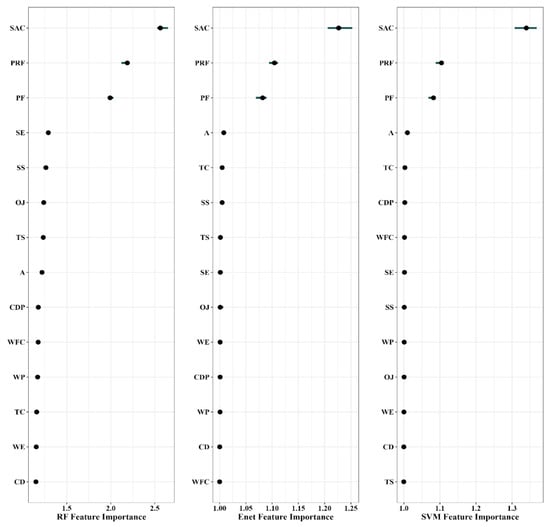
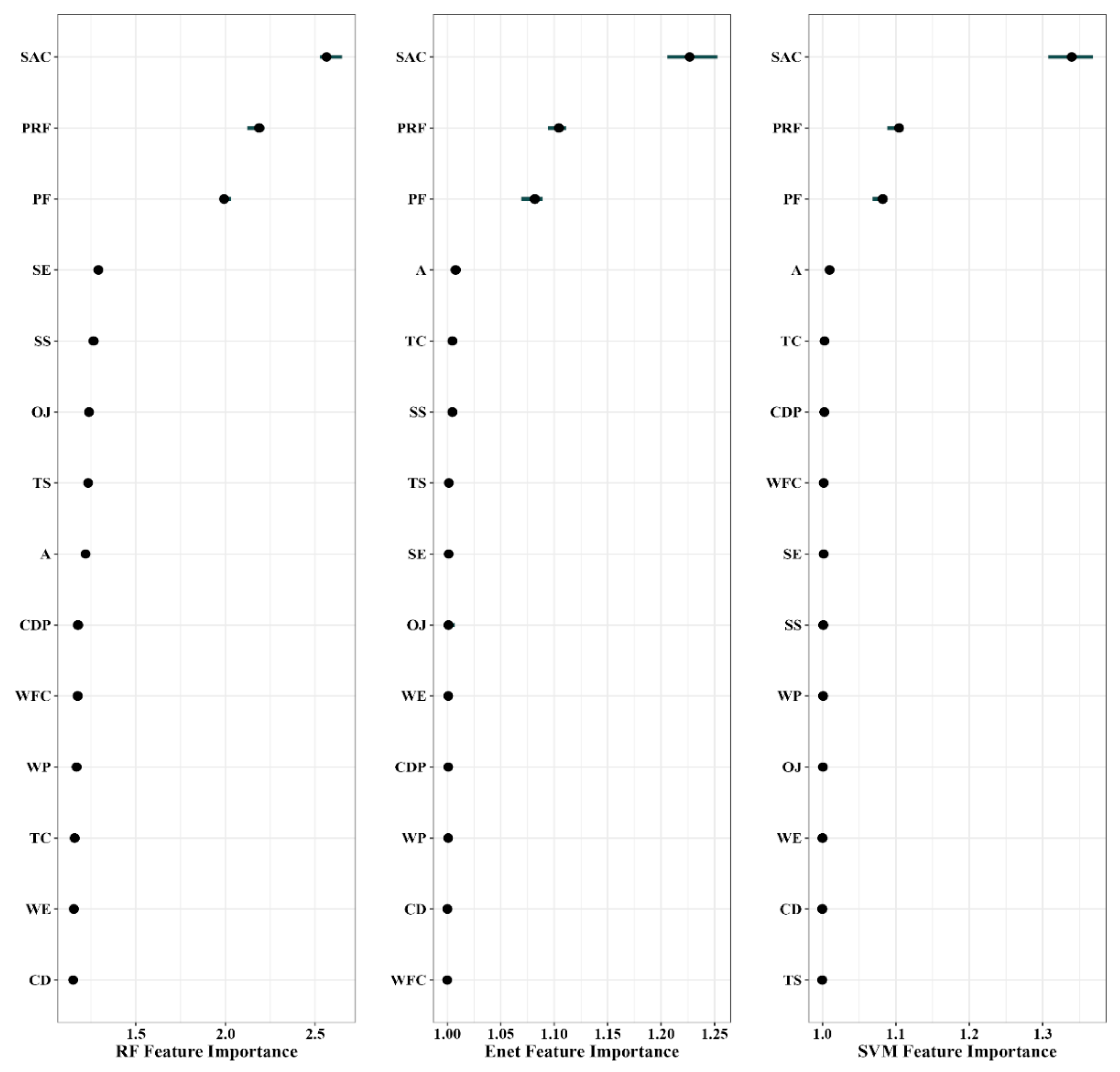
Variable feature importance visualization was performed for the three machine learning models with the best predictive performance—Random Forest (RF), Lasso Ridge Regression Elastic Net (ENet), and Support Vector Machine (SVM)—to intuitively evaluate the relative impact of the included variables on safety citizenship behavior. A higher variable feature importance value indicates a greater contribution of the variable to the prediction of safety citizenship behavior.
As shown in Figure 3, the variables are ranked in descending order of their contribution to the Random Forest model: Safety Atmosphere (SAC), Promotion Regulatory Focus (PRF), Prevention Regulatory Focus (PF), Self-Efficacy (SE), Social Support (SS), Organizational Justice (OJ), Technical Support (TS), Autonomy (A), Career Development Potential (CDP), Work–Family Conflict (WFC), Work Pressure (WP), Technical Complexity (TC), Working Environment (WE), and Cognitive Demand (CD).
Figure 3.
Variable feature importance ranking charts of three machine learning models.
3.4. Response Surface Analysis
Response surface analysis constructed three nested models to progressively examine the effects of demographic variables, main effects of job characteristics, and their nonlinear interactions on miners’ safety-related civic behaviors. Model Y1 included only demographic variables as control variables; Model Y2 incorporated linear main effects of job demands and job resources on top of Y1; and Model Y3 further introduced quadratic terms and interaction terms for job demands and job resources, thereby forming a complete quadratic polynomial model. Response surface analysis was conducted based on this model. As shown in Table 6, the results of response surface analysis and polynomial regression analysis for miners’ safety-related citizen behavior (SCB) are presented.
Table 6.
Results of response surface analysis and polynomial regression analysis.
Model comparisons indicate that incorporating quadratic and interaction terms significantly improves the fit of Y3 relative to Y2. This demonstrates that the effects of X and Y on SCB are not simply linearly additive but exhibit nonlinear and interactive structures. Therefore, response surface analysis is necessary to characterize the “match/mismatch” effects, as shown in Table 6 Panel A.
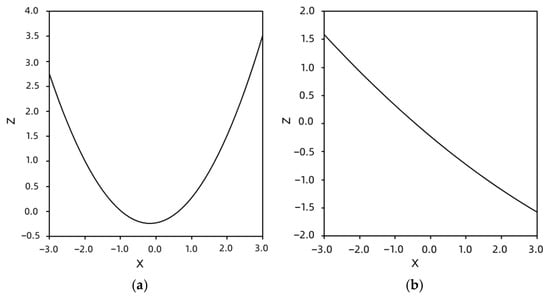
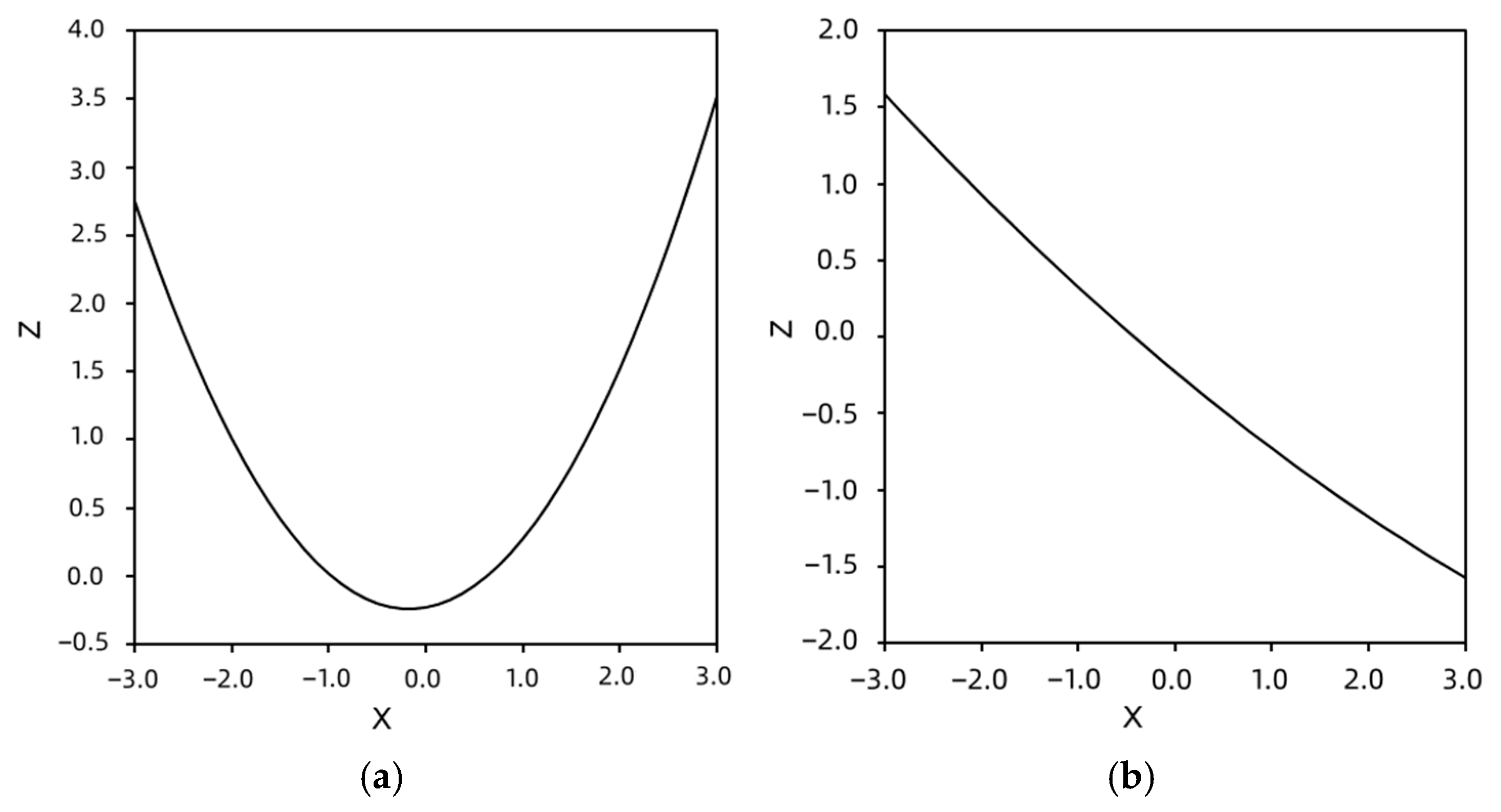
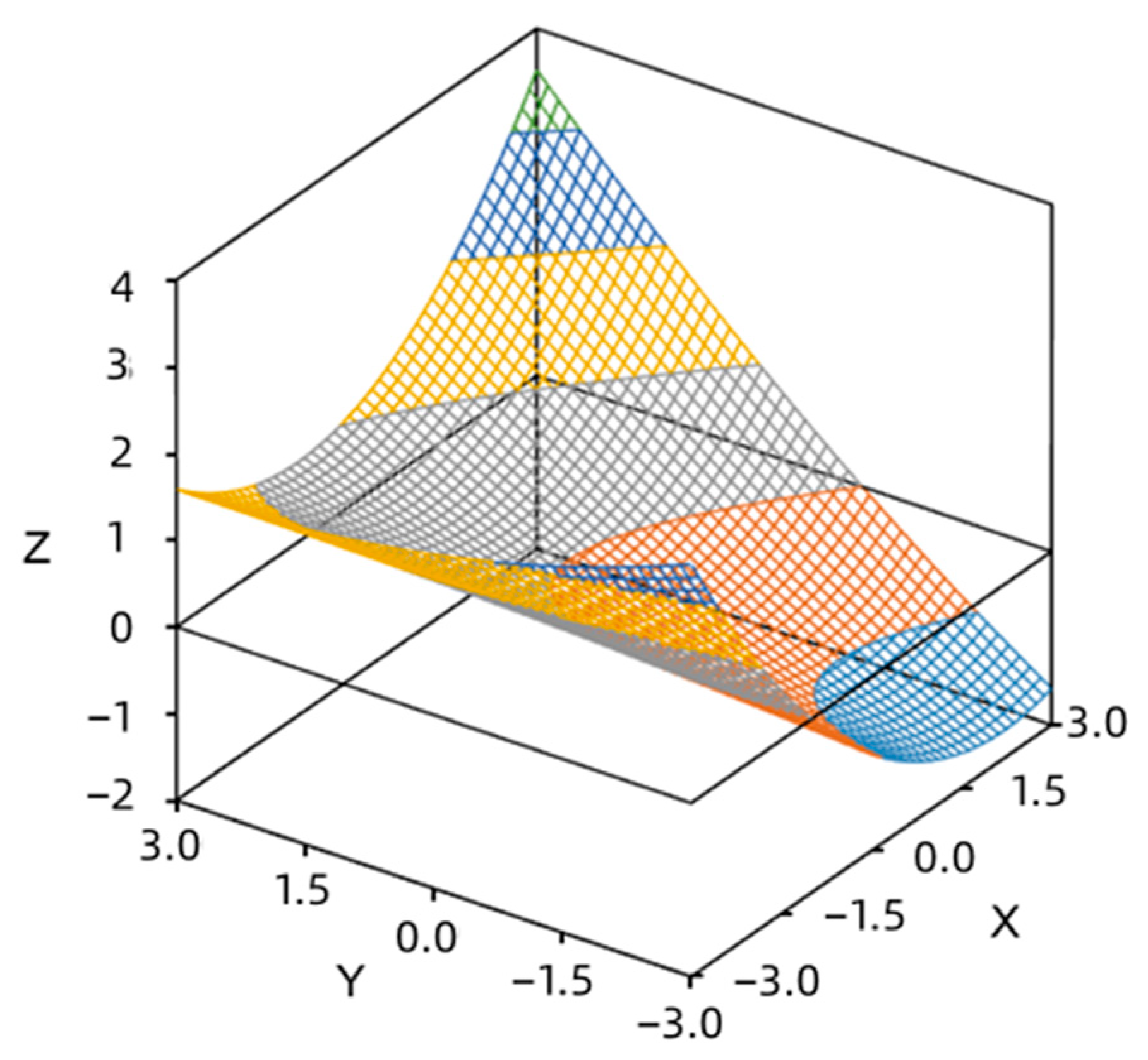
Within the full quadratic polynomial model (Y3), the linear main effects of Job Demands (X) and Job Resources (Y) exhibit opposite directions: Job Demands generally exert an inhibitory effect, while Job Resources demonstrate a promotional effect, as shown in Table 6, Panel B. This finding indicates that, within the context of intelligent coal mines, safety-related citizen behavior is not solely driven by individual traits or demographic factors. Instead, it is more directly shaped by the interplay between job stress structures and accessible support resources. Further analysis through the JD-R lens suggests: when job demands increase while resource availability is insufficient, individuals are more likely to allocate their limited attention and energy toward “task completion and stress management,” thereby reducing the space for implementing extra-role safety behaviors. Conversely, when organizations provide sufficient resources (e.g., support, tools, autonomy, and development opportunities), individuals are more likely to internalize safety goals and adopt proactive safety behaviors. Crucially, the significance of the X2 and X × Y terms implies: (1) X’s influence on SCB exhibits curvature characteristics, with marginal effects varying across demand levels; and (2) the marginal effect of X on SCB is not constant but systematically varies with Y levels (i.e., ∂SCB/∂X = b1 + 2b3X + b4Y). Therefore, it is necessary to further identify “matching/mismatch” structures through core tests along the LOC and LOIC in the response surface, as illustrated in Figure 4.
Figure 4.
(a) Inconsistency line (LOIC) section curve; (b) consistency line (LOC) section curve.
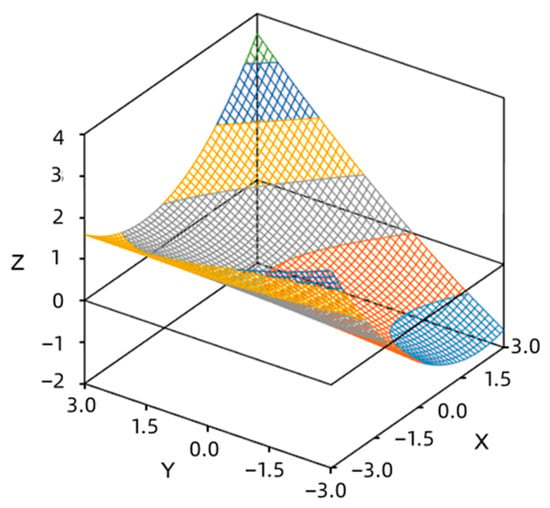
Key response surface tests further reveal, as shown in Table 6 Panel C, that along the line of consistency (LOC, X = Y), both the slope and curvature are positive, indicating that when requirements and resources increase synchronously, SCB rises with convex acceleration. This implies that in intelligent coal mines, as technological complexity and coordination demands increase, miners are more likely to translate safety objectives into stable proactive behaviors when resource allocation keeps pace (e.g., through reliable technical support, training, and coordination mechanisms). Along the inconsistency line (LOIC, X = −Y), the slope is negative while the curvature is insignificant, indicating that mismatch impacts primarily manifest as directional divergence—when system complexity and cognitive demands rise but resource supply falls short (“high demands–low resources”), SCB declines more markedly. Conversely, “low demands–high resources” does not yield equivalent negative consequences. The three-dimensional response surface intuitively illustrates this “cooperative configuration–behavior enhancement” trend, as shown in Figure 5.
Figure 5.
Response surface plot.
In summary, mining safety-related civic behavior is influenced not only by the linear main effects of job demands and job resources but also by the systemic regulation of their nonlinear matching relationship. Response surface analysis clearly demonstrates that achieving high levels of mining safety-related civic behavior hinges on promoting the synergistic enhancement of job demands and job resources, while actively avoiding the vicious cycle of “high demands–low resources” in the workplace.
3.5. Latent Profile Analysis
In this section, an exploratory latent profile analysis (LPA) approach was adopted for the data, followed by univariate and multivariate regression analyses to examine the predictive power of the identified latent profiles on other variables. Building on the overall research, a refined analysis was conducted by classifying miners based on their different scores on job demands and job resources to identify the job characteristic profiles of the miner groups.
Latent profile analysis was performed using the scores of each dimension of job demands and job resources, with all job demands–resources variables standardized before being included in the LPA model. The model analysis results are presented in Table 7.
Table 7.
Fit indexes of potential categories.
The results of the latent profile analysis showed that: Firstly, the Akaike Information Criterion (AIC), Bayesian Information Criterion (BIC), and sample size-adjusted Bayesian information criterion (aBIC) are better when smaller, but they may tend to select a larger number of classes. Secondly, for the Lo–Mendell–Rubin likelihood ratio test (LMR/aLMR), if the test result reaches a significant level (p < 0.05), it indicates that the model classification is acceptable. The Bootstrap Likelihood Ratio Test (BLRT) was further used to test the model acceptability: by comparing the fitting differences between the k-class and k-1-class models using the likelihood ratio method, a significant p-value indicates that the k-class model is better [40]. In this study, the two-class model was superior to the one-class model (PLMR < 0.001, PaLMR = 0.001, PBLRT < 0.001), the three-class model was superior to the two-class model (PLMR < 0.001, PaLMR = 0.001, PBLRT < 0.001), the four-class model was superior to the three-class model (PLMR < 0.001, PaLMR = 0.001, PBLRT < 0.001), and the five-class model was not superior to the four-class model (PLMR = 0.683, PaLMR = 0.685, PBLRT < 0.001). Thirdly, entropy is used to assess the clarity of classification, ranging between 0 and 1. The closer the entropy value is to 1, the clearer the classification, and an entropy value greater than 0.8 is generally considered to indicate good classification quality [40]. In this study, the entropy values for the two-class to five-class models were 0.813, 0.881, 0.859, and 0.825, respectively, and were all greater than 0.8. Fourthly, the proportions and absolute sizes of the sample categories are shown in Table 5. In the four-class model of this study, the smallest category proportion was 13.27% > 5%, and the smallest category sample size was 155 > 50, indicating that each category has an adequate sample size [41].
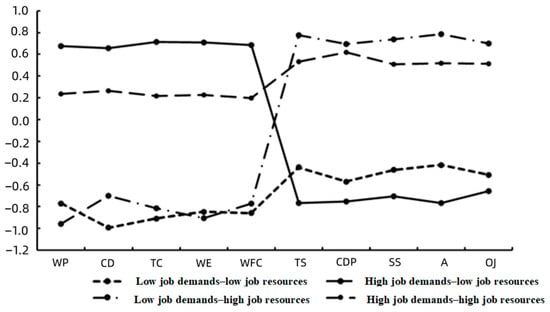
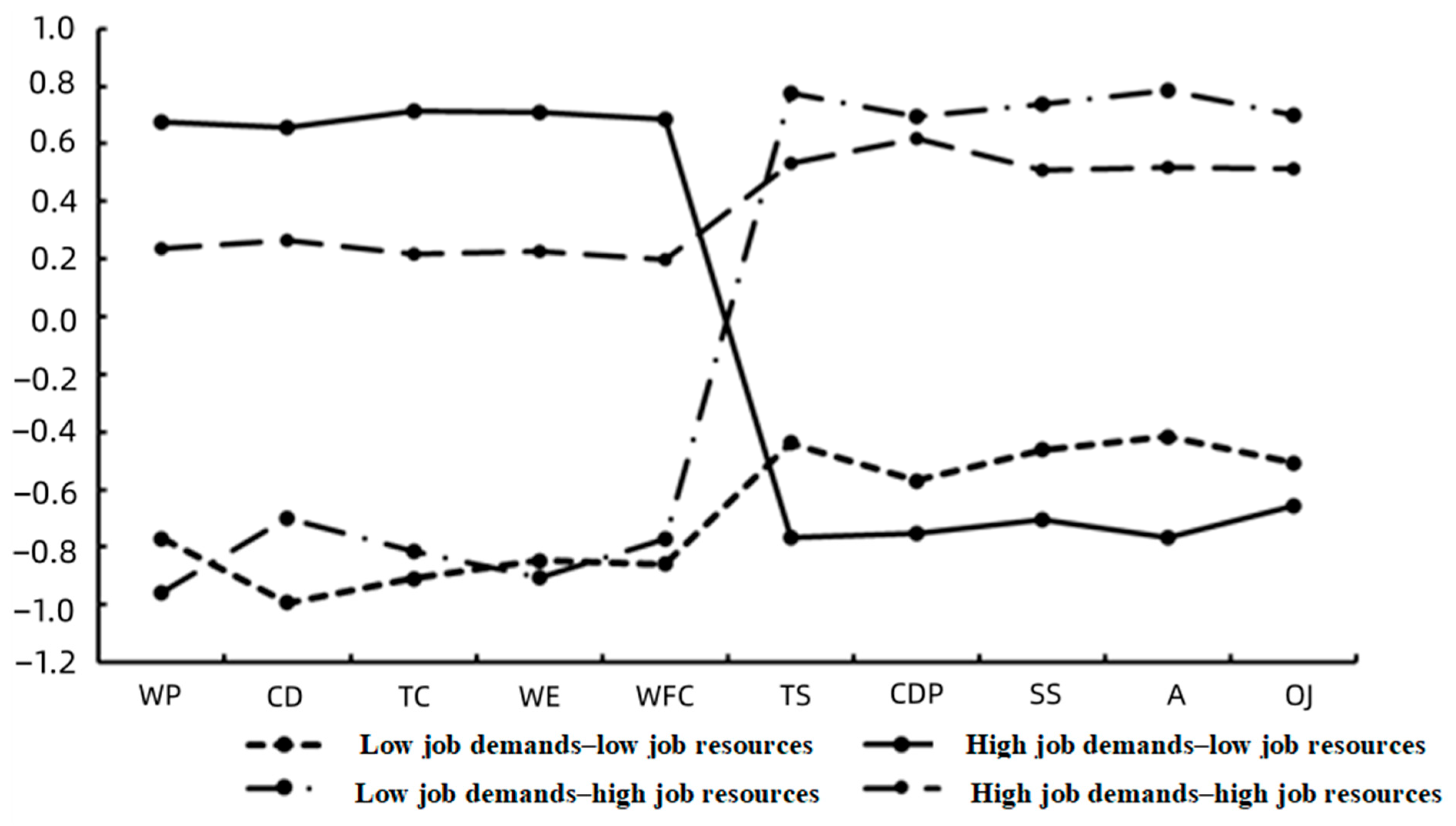
Considering all indicators comprehensively: Firstly, the information criteria (AIC, BIC, aBIC) showed that the three-class model had the lowest values. However, the LMR and BLRT tests indicated that the four-class model had a significant improvement compared to the three-class model (p < 0.001), while there was no significant difference between the five-class model and the four-class model (p > 0.05). Secondly, the four-class model had a relatively high entropy value (0.859), indicating good classification clarity. Finally, the sample proportions of each category in the four-class model were balanced (smallest category 13.27%), and the profile characteristics (low–low, high–low, low–high, high–high) had a clearer theoretical distinction and explanatory significance, as shown in Figure 6. Based on the significant improvement in model comparison tests, good classification accuracy, and theoretical interpretability, this study ultimately selected the four-class model as the optimal solution.
Figure 6.
Latent profile scores for four categories.
Each profile was named based on the score levels and specific characteristic distributions of the respective profile types. The names are as follows: as shown in Table 8, Profile 1, where both job demands and job resources scores were low, was named Low Job Demands–Low Job Resources, consisting of 225 samples (19.26%); Profile 2, characterized by high job demands scores and low job resources scores, was named High Job Demands–Low Job Resources, consisting of 348 samples (29.8%); Profile 3, with low job demands scores and high job resources scores, was named Low Job Demands–High Job Resources, consisting of 440 samples (37.67%); and Profile 4, where both job demands and job resources scores were high, was named High Job Demands–High Job Resources, consisting of 155 samples (13.27%).
Table 8.
Proportion of each model category.
Differences among profiles in prevention regulatory focus, promotion regulatory focus, miners’ safety citizenship behavior, safety atmosphere, and self-efficacy were examined using one-way analysis of variance (ANOVA) in SPSS 29.0, with post-hoc comparisons conducted using the Least Significant Difference (LSD) method. The specific results are presented in Table 9. Furthermore, multivariate analysis was conducted using SPSS regression, with marital status, age, years of service, educational level, and job type included as control variables, the latent profile groups (after dummy variable treatment) as the independent variable, and the variables that showed significant differences in the one-way ANOVA (prevention regulatory focus, promotion regulatory focus, miners’ safety citizenship behavior, safety atmosphere, and self-efficacy) as the outcome variables. This was done to analyze the changes in other variables among miners under different job demands–resources groups.
Table 9.
Results of one-way ANOVA.
The analysis results showed that the main effects of all variables across the latent profile categories reached a significant level (p < 0.05). Specifically, the main effects of prevention regulatory focus (F(3, 1164) = 83.506, p < 0.001), promotion regulatory focus (F(3, 1164) = 82.292, p < 0.001), miners’ safety citizenship behavior (F(3, 1164) = 89.013, p < 0.001), safety atmosphere (F(3, 1164) = 32.957, p < 0.001), and self-efficacy (F(3, 1164) = 4.790, p = 0.003) were all significant. In other words, there were significant differences in prevention regulatory focus, promotion regulatory focus, miners’ safety citizenship behavior, safety atmosphere, and self-efficacy among the four job demands–resources categories of miners.
Multivariate linear regression (controlling for demographic variables) further revealed that the high demands–low resources profile significantly reduced prevention regulatory focus, promotion regulatory focus, miners’ safety citizenship behavior, and safety atmosphere, while the high demands–high resources profile significantly increased these variables. The effects of the low demands–high resources profile were mostly not significant, and the high demands–high resources profile also enhanced self-efficacy. The results of the LPA characterize the combined patterns of job characteristics, clarify the differences in key psychological and behavioral outcomes among different profiles of miners, and provide empirical evidence for the implementation of differentiated management and interventions in the safety management of frontline miners in intelligent mining areas.
4. Conclusions and Management Implications
4.1. Conclusions
Comparative results of machine learning models indicate that Random Forest demonstrated the best overall predictive performance on the test set (see Table 3), exhibiting the smallest prediction error and highest interpretability. Linear regression, Support Vector Machine, and LightGBM followed in performance, while Decision Tree showed relatively weaker results. Further variable importance analysis based on the best-performing/robust model (see Figure 1) revealed that safety climate, promotional regulation focus, preventive regulation focus, and self-efficacy ranked highest, constituting key predictors influencing miners’ safety-related civic behavior. Among these, safety climate demonstrated the highest importance.
Nested model comparisons in the response surface analysis revealed that the polynomial model with quadratic and interaction terms significantly outperformed the linear model (see Table 4 Panel A), indicating nonlinear and interactive structures in the influence of work demands and resources on safety-related civic behavior. Tests along the line of consistency (LOC, X = Y) showed positive slopes and curvatures, suggesting a convex upward trend in safety-related civic behavior when demands and resources increase synchronously. Testing along the line of inconsistency (LOIC, X = −Y) revealed a negative slope and non-significant curvature, indicating that mismatch primarily manifests as directional differences—specifically, “high demands–low resources” corresponds to lower safety-related civic behavior than “low demands–high resources” (see Table 4 Panel C, Figure 3 and Figure 4).
After comparing models with different numbers of categories, the four-category model proved most reasonable in terms of fit indices and classification quality (see Table 6). This identified four work characteristic profiles: low demands–low resources, high demands–low resources, low demands–high resources, and high demands–high resources (see Figure 5). Further intergroup comparisons revealed significant differences across profiles in safety-related civic behavior and key psychological/situational variables (moderation focus, safety climate, and self-efficacy) (see Table 7).
Integrating outputs from all three methods yields a consistent evidence chain: machine learning identified the safety climate and key psychological variables as key drivers from a full-variable perspective (A–B); response surface analysis further revealed the demand–resource matching structure and the “high-demand–low-resource” risk configuration (C–D); latent profile analysis confirmed systematic differences across distinct JD-R profiles at the population heterogeneity level (E–F). Collectively, these findings indicate that the formation of miners’ safety-related citizenship behaviors exhibits three interrelated dimensions: key drivers, situational matching mechanisms, and group-level heterogeneity structures.
4.2. Management Implications
Based on cross-validation using machine learning importance identification, JD-R matching effect testing (RSM), and latent profile analysis (LPA), this study examines miners’ safety citizenship behavior (SCB) within intelligent coal mine contexts. From multiple perspectives, it converges on a core conclusion: miners’ SCB serves as a crucial complementary mechanism to formal safety systems, shaped by the combined effects of “demand–resource allocation quality” and “organizational signals–individual capability.” Accordingly, this paper proposes the following three management implications.
First, multi-method results indicate that under limited resources and attention, enterprises should prioritize allocating management efforts around “safety climate (organizational safety signals)” and “individual capability and motivation pathways (e.g., self-efficacy, regulation-focused mechanisms)” rather than spreading resources evenly. Practically, high-priority factors can be incorporated into annual safety initiatives or intelligent optimization projects (e.g., communication feedback at the team level, fair and consistent violation correction, and visible response mechanisms for safety suggestions) to enhance the marginal output of safety governance investments.
Second, response surface analysis indicates that the critical factor influencing SCB lies not in the isolated level of requirements or resources, but in their “co-directional synergy.” Therefore, intelligent transformation should advance synchronously: on one hand, identifying new demands arising from technology dependency, information density, and human–machine collaboration (cognitive load, technical complexity, and process restructuring pressure); on the other hand, mitigating their adverse effects through resource supplementation (technical support, training and standard operating procedure support, collaborative mechanisms, empowerment and feedback). Management objectives should shift from “increasing demands/intensifying assessments” to “enhancing resource-demand alignment/reducing mismatches,” particularly avoiding the long-term entrenchment of “high demands–low resources” scenarios.
Third, latent profile analysis reveals significant divergence in miners’ “demand–resource” experiences during intelligent transformation (with “high demands–low resources” being the key risk group). Therefore, coal mine safety governance should shift from a “one-size-fits-all” approach to “group-specific, categorized interventions.” Differentiated measures—such as burden reduction and safety net support, resource matching, demonstration diffusion, and innovation activation through suggestions—should be applied to different profiles to enhance miners’ safety-conscious behaviors.
4.3. Research Limitations and Future Directions
Although this study employs cross-validation through machine learning, response surface analysis, and latent profile analysis, several limitations remain: First, relying primarily on cross-sectional questionnaire data, conclusions primarily support associative and configurational patterns; causal chains require further validation through multi-time-point tracking or quasi-experimental designs. Second, the sample and context have certain boundary conditions. The generalizability across different mines with varying levels of intelligent development, job structures, and management maturity requires validation through cross-mine comparative studies. Future research could incorporate “technical governance variables” such as technological system reliability, operational maturity, and human–machine collaboration quality to more precisely characterize the dynamic risks during the intelligent transformation period and the formation mechanisms of miners’ safety-conscious behavior.
Author Contributions
Conceptualization, T.L. and J.L.; methodology, J.L.; software, Y.Y. (Yue Yu); validation, Y.Y. (Yong Yan); formal analysis, Y.Y. (Yue Yu); investigation, T.L.; resources, J.L.; data curation, Y.Y. (Yong Yan); writing—original draft preparation, T.L.; writing—review and editing, T.L.; visualization, Y.Y. (Yong Yan); supervision, Y.Y. (Yue Yu); project administration, J.L.; funding acquisition, J.L. and Y.Y. (Yue Yu). All authors have read and agreed to the published version of the manuscript.
Funding
This research was funded by the Humanities and Social Sciences Research Fund of the Ministry of Education of the People’s Republic of China, grant number 23YJA630054 and the Fundamental Research Program of Shanxi Province, grant number 202303021212043.
Data Availability Statement
The original contributions presented in this study are included in the article. Further inquiries can be directed to the corresponding author.
Conflicts of Interest
The authors declare no conflicts of interest.
References
- Wang, G.; Ren, H.; Zhao, G.; Zhang, D.; Wen, Z.; Meng, L.; Gong, S. Research and Practice of Intelligent Coal Mine Technology Systems in China. Int. J. Coal Sci. Technol. 2022, 9, 24. [Google Scholar] [CrossRef] [Scilit]
- Zhou, L.; Wang, M.; Yu, K.; Wang, T.; Mu, Z.; Wang, Z. A Simulation Study on Risk Emergence Mechanism and Transmission Path of Coal Mine Workers’ Unsafe Behaviours Based on DEMATEL-ISM and Arena Simulation. Sci. Rep. 2025, 15, 24289. [Google Scholar] [CrossRef] [Scilit]
- National Mine Safety Administration. National Mine Safety Administration Held a Press Conference on the National Mine Work Safety Situation and Key Work Progress. 2023. Available online: https://www.chinamine-safety.gov.cn/xw/mkaqjcxw/202307/t20230725_457255.shtml (accessed on 23 February 2026).
- State Council Work Safety Committee. Measures on Prevention and Containment of Major and Extraordinarily Serious Production Safety Accidents in the Mining Sector (Notice). 2024. Available online: https://www.mem.gov.cn/gk/zfxxgkpt/fdzdgknr/202401/t20240119_475615.shtml (accessed on 23 February 2026).
- Qiu, Z.; Liu, Q.; Li, X.; Zhang, J.; Zhang, Y. Construction and Analysis of a Coal Mine Accident Causation Network Based on Text Mining. Process Saf. Environ. Prot. 2021, 153, 320–328. [Google Scholar] [CrossRef] [Scilit]
- Wang, Y.; Gui, F.; Qian, L.; Wu, J.; Wu, Y.; Han, M.; Lu, Y.; Xie, X. Accident Case-Driven Study on the Causal Modeling and Prevention Strategies of Coal-Mine Gas-Explosion Accidents: A Systematic Analysis of Coal-Mine Accidents in China. Resour. Policy 2024, 88, 104425. [Google Scholar]
- Cheng, L.; Guo, H.; Lin, H. The Influence of Leadership Behavior on Miners’ Work Safety Behavior. Saf. Sci. 2020, 132, 104986. [Google Scholar] [CrossRef] [Scilit]
- Han, S.; Han, X.; Wang, X.; Qi, M. Understanding Workplace Deviant Behavior in the Coal Mining: The Roles of Self-Experience and Differential Susceptibility. Chin. Manag. Stud. 2026. ahead of print. [Google Scholar]
- Fu, G.; Xie, X.; Jia, Q.; Tong, W.; Ge, Y. Accidents Analysis and Prevention of Coal and Gas Outburst: Understanding Human Errors in Accidents. Process Saf. Environ. Prot. 2020, 134, 1–23. [Google Scholar] [CrossRef] [Scilit]
- Meng, X.; Chan, A.H. How Safety Culture Changes Safety Consciousness and Safety Citizenship Behavior of Construction Personnel in China: The Mediating Roles of Personnel Engagement and Social Relationship Exchange. Saf. Sci. 2024, 173, 106437. [Google Scholar] [CrossRef] [Scilit]
- Tear, M.J.; Reader, T.W. Understanding Safety Culture and Safety Citizenship through the Lens of Social Identity Theory. Saf. Sci. 2023, 158, 105993. [Google Scholar] [CrossRef] [Scilit]
- Li, M.; Zhai, H.; Zhang, J.; Meng, X. Research on the Relationship between Safety Leadership, Safety Attitude and Safety Citizenship Behavior of Railway Employees. Int. J. Environ. Res. Public Health 2020, 17, 1864. [Google Scholar] [CrossRef] [Scilit]
- Dodoo, J.E.; Surienty, L.; Zahidah, S. Safety Citizenship Behaviour of Miners in Ghana: The Effect of Hardiness Personality Disposition and Psychological Safety. Saf. Sci. 2021, 143, 105404. [Google Scholar] [CrossRef] [Scilit]
- Hofmann, D.A.; Morgeson, F.P.; Gerras, S.J. Climate as a Moderator of the Relationship between Leader-Member Exchange and Content Specific Citizenship: Safety Climate as an Exemplar. J. Appl. Psychol. 2003, 88, 170. [Google Scholar] [CrossRef] [Scilit]
- Parasuraman, R.; Sheridan, T.B.; Wickens, C.D. A Model for Types and Levels of Human Interaction with Automation. IEEE Trans. Syst. Man Cybern. Part A Syst. Hum. 2000, 30, 286–297. [Google Scholar] [CrossRef] [Scilit]
- Bainbridge, L. Ironies of Automation. In Analysis, Design and Evaluation of Man–Machine Systems; Elsevier: Amsterdam, The Netherlands, 1983; pp. 129–135. [Google Scholar]
- Tarafdar, M.; Tu, Q.; Ragu-Nathan, T.; Ragu-Nathan, B.S. Crossing to the Dark Side: Examining Creators, Outcomes, and Inhibitors of Technostress. Commun. ACM 2011, 54, 113–120. [Google Scholar] [CrossRef] [Scilit]
- Syed-Yahya, S.N.; Idris, M.A.; Noblet, A.J. The Relationship between Safety Climate and Safety Performance: A Review. J. Saf. Res. 2022, 83, 105–118. [Google Scholar] [CrossRef] [Scilit]
- Liu, Y.; Li, Y.; Hu, L.; Zhang, Q. How Does Artificial Intelligence Usage Affect the Safety Behavior of Bus Drivers? A Double-Edged Sword Study. Transp. Res. Part F Traffic Psychol. Behav. 2025, 111, 32–44. [Google Scholar] [CrossRef] [Scilit]
- Yang, J.; Ye, G.; Zhang, Z.; Liu, X.; Liu, Y. Linking Construction Noise to Worker Safety Behavior: The Role of Negative Emotion and Regulatory Focus. Saf. Sci. 2023, 162, 106093. [Google Scholar] [CrossRef] [Scilit]
- Yuan, X.; Fan, J.; Zhang, Y. Research on the Influence of MW on Situation Awareness in Shearer Monitoring Tasks in Intelligent Coal Mines. Exp. Brain Res. 2026, 244, 23. [Google Scholar] [CrossRef] [Scilit] [PubMed]
- Edwards, J.R.; Parry, M.E. On the Use of Polynomial Regression Equations as an Alternative to Difference Scores in Organizational Research. Acad. Manag. J. 1993, 36, 1577–1613. [Google Scholar] [CrossRef] [Scilit]
- Humberg, S.; Nestler, S.; Back, M.D. Response Surface Analysis in Personality and Social Psychology: Checklist and Clarifications for the Case of Congruence Hypotheses. Soc. Psychol. Personal. Sci. 2019, 10, 409–419. [Google Scholar] [CrossRef] [Scilit]
- Shanock, L.R.; Baran, B.E.; Gentry, W.A.; Pattison, S.C.; Heggestad, E.D. Polynomial Regression with Response Surface Analysis: A Powerful Approach for Examining Moderation and Overcoming Limitations of Difference Scores. J. Bus. Psychol. 2010, 25, 543–554. [Google Scholar] [CrossRef] [Scilit]
- Edwards, J.R. Alternatives to Difference Scores: Polynomial Regression Analysis and Response Surface Methodology. In Measuring and Analyzing Behavior in Organizations: Advances in Measurement and Data Analysis; Jossey-Bass/Wiley: Hoboken, NJ, USA, 2002. [Google Scholar]
- Aiken, L.S.; West, S.G.; Reno, R.R. Multiple Regression: Testing and Interpreting Interactions; Sage: Thousand Oaks, CA, USA, 1991; ISBN 0-7619-0712-2. [Google Scholar]
- Karasek, R.; Brisson, C.; Kawakami, N.; Houtman, I.; Bongers, P.; Amick, B. The Job Content Questionnaire (JCQ): An Instrument for Internationally Comparative Assessments of Psychosocial Job Characteristics. J. Occup. Health Psychol. 1998, 3, 322. [Google Scholar] [CrossRef] [PubMed]
- Burr, H.; Berthelsen, H.; Moncada, S.; Nübling, M.; Dupret, E.; Demiral, Y.; Oudyk, J.; Kristensen, T.S.; Llorens, C.; Navarro, A. The Third Version of the Copenhagen Psychosocial Questionnaire. Saf. Health Work 2019, 10, 482–503. [Google Scholar] [CrossRef] [Scilit]
- Ragu-Nathan, T.; Tarafdar, M.; Ragu-Nathan, B.S.; Tu, Q. The Consequences of Technostress for End Users in Organizations: Conceptual Development and Empirical Validation. Inf. Syst. Res. 2008, 19, 417–433. [Google Scholar] [CrossRef] [Scilit]
- Morgeson, F.P.; Humphrey, S.E. The Work Design Questionnaire (WDQ): Developing and Validating a Comprehensive Measure for Assessing Job Design and the Nature of Work. J. Appl. Psychol. 2006, 91, 1321. [Google Scholar] [CrossRef] [Scilit]
- Carlson, D.S.; Kacmar, K.M.; Williams, L.J. Construction and Initial Validation of a Multidimensional Measure of Work–Family Conflict. J. Vocat. Behav. 2000, 56, 249–276. [Google Scholar] [CrossRef] [Scilit]
- Al Balushi, A.K.; Thumiki, V.R.R.; Nawaz, N.; Jurcic, A.; Gajenderan, V. Role of Organizational Commitment in Career Growth and Turnover Intention in Public Sector of Oman. PLoS ONE 2022, 17, e0265535. [Google Scholar] [CrossRef] [Scilit]
- Yu, M.; Li, J. Psychosocial Safety Climate and Unsafe Behavior among Miners in China: The Mediating Role of Work Stress and Job Burnout. Psychol. Health Med. 2020, 25, 793–801. [Google Scholar] [CrossRef] [Scilit]
- Sieberichs, S.; Kluge, A. How Just Culture and Personal Goals Moderate the Positive Relation between Commercial Pilots’ Safety Citizenship Behavior and Voluntary Incident Reporting. Safety 2021, 7, 59. [Google Scholar] [CrossRef] [Scilit]
- Chen, S.-Y.; Lu, C.-S.; Ye, K.-D.; Shang, K.-C.; Guo, J.-L.; Pan, J.-M. Enablers of Safety Citizenship Behaviors of Seafarers: Leader-Member Exchange, Team-Member Exchange, and Safety Climate. Marit. Policy Manag. 2023, 50, 81–96. [Google Scholar] [CrossRef] [Scilit]
- Miao, G.; Chen, G.; Li, C. The Impact of Corporate Social Responsibility on Employee Safety Citizenship Behavior in Chinese Gas Sector. Sci. Rep. 2025, 15, 26729. [Google Scholar] [CrossRef] [Scilit]
- Neubert, M.J.; Kacmar, K.M.; Carlson, D.S.; Chonko, L.B.; Roberts, J.A. Regulatory Focus as a Mediator of the Influence of Initiating Structure and Servant Leadership on Employee Behavior. J. Appl. Psychol. 2008, 93, 1220. [Google Scholar] [CrossRef] [Scilit] [PubMed]
- Zohar, D. Safety Climate in Industrial Organizations: Theoretical and Applied Implications. J. Appl. Psychol. 1980, 65, 96. [Google Scholar] [CrossRef]
- Rigotti, T.; Schyns, B.; Mohr, G. A Short Version of the Occupational Self-Efficacy Scale: Structural and Construct Validity across Five Countries. J. Career Assess. 2008, 16, 238–255. [Google Scholar] [CrossRef] [Scilit]
- Sinha, P.; Calfee, C.S.; Delucchi, K.L. Practitioner’s Guide to Latent Class Analysis: Methodological Considerations and Common Pitfalls. Crit. Care Med. 2021, 49, e63–e79. [Google Scholar] [CrossRef] [Scilit] [PubMed]
- Yang, C.-C. Evaluating Latent Class Analysis Models in Qualitative Phenotype Identification. Comput. Stat. Data Anal. 2006, 50, 1090–1104. [Google Scholar] [CrossRef] [Scilit]

Disclaimer/Publisher’s Note: The statements, opinions and data contained in all publications are solely those of the individual author(s) and contributor(s) and not of MDPI and/or the editor(s). MDPI and/or the editor(s) disclaim responsibility for any injury to people or property resulting from any ideas, methods, instructions or products referred to in the content. |
© 2026 by the authors. Licensee MDPI, Basel, Switzerland. This article is an open access article distributed under the terms and conditions of the Creative Commons Attribution (CC BY) license.