1. Introduction
Since the 2008 global financial crisis, the stability of banking systems has drawn increasing scholarly and regulatory attention. The growing integration of banks’ asset and liability markets, coupled with heightened segmentation and complexity in financial markets, has established additional pathways for financial risk transmission. These channels can readily precipitate systemic financial crises and exacerbate the vulnerability of the financial system [
1,
2]. Interactions among financial institutions are commonly conceptualized as network structures, and a well-established line of research utilizes network theory to identify and analyze financial linkages. Consequently, the interconnected nature of financial networks provides a valuable framework for investigating and monitoring potential risk contagion channels, thereby aiding in the characterization of systemic risk and overall financial stability [
3,
4,
5,
6,
7].
Financial activities such as interbank lending and bond repurchases create direct asset–liability linkages among institutions, thereby forming direct interbank networks [
8,
9]. A substantial body of research on interbank networks across different markets has systematically examined their structural characteristics, including small-world properties, scale-free features, and core–periphery structures, and their significant implications for risk propagation [
10,
11]. Although the interbank lending market helps alleviate banks’ short-term liquidity shortages, it simultaneously serves as a conduit for risk accumulation and contagion. Extensive studies demonstrate that the relationship between network structure and risk contagion is nonlinear, with interbank networks often exhibiting “robust-yet-fragile” characteristics [
12,
13,
14,
15].
In addition to direct financial linkages, scholarly interest has increasingly focused on the transmission of systemic risk through indirect channels, particularly via common asset holdings across financial institutions. Research has extensively investigated how key factors—such as asset prices, market sentiment, trading strategies, and regulatory frameworks—shape the mechanisms of risk contagion. For instance, Duarte and Eisenbach [
16] constructed a “vulnerability index” based on banks’ asset fire sales to assess systemic vulnerability stemming from contagion spillovers. Using bank–asset network models, Huang et al. [
17] and Levy-Carciente et al. [
18] examined the cascading effects of systemic risk contagion in the U.S. and Venezuelan banking systems, respectively. Caccioli et al. [
19] developed a bipartite bank–asset network to explore system stability during fire sales of overlapping portfolios. Subsequently, Caccioli et al. [
20] expanded this approach by proposing a network model that integrates both interbank transactions and common asset fire sales, enabling an empirical assessment of systemic risk across these two contagion channels. Greenwood et al. [
21] incorporated leverage targets into the fire-sale mechanism to quantify deleveraging-induced risk spillovers among European banks during the 2010–2011 sovereign debt crisis. In a related vein, Coen et al. [
22] modeled the shock-amplification process by considering leverage-constrained banks, risk-weighted capital, and liquidity regulations. Parallel to these developments, the quantification of systemic risk has also extended to non-bank financial sectors—such as investment funds, insurance, and currency markets—through indirect contagion channels [
23,
24]. For example, Douglas et al. [
25] analyzed the influence of Solvency II regulation on the distressed portfolio adjustments of UK life insurers. Barucca et al. [
26] investigated common security holdings across UK banks, with a focus on the network structure of overlapping portfolios. Building on this work, Caccioli et al. [
27] further examined how the structure of overlapping portfolio networks shapes shock propagation using more granular data.
In practice, the disclosure of asset positions by financial institutions is often incomplete. To address this limitation, various methods have been developed to reconstruct networks from available data. These approaches differ in their emphasis on specific network characteristics: some aim to minimize exposures on individual links, while others focus on replicating aggregate network properties. Widely applied techniques include maximum entropy estimation, minimum density estimation, and network configuration models [
28]. However, the conventional maximum entropy method, which assumes full connectivity among nodes, frequently diverges from real-world linkage patterns and may substantially underestimate risk contagion effects. Squartini et al. [
29] introduced a constrained entropy maximization method for bipartite networks, demonstrating its superiority over traditional CAPM and maximum-entropy CAPM in capturing topological features and estimating fire-sale risks. Di Gangi et al. [
30] employed cross-entropy constraint minimization to evaluate the systemic importance of banking systems and individual institutions using only bank size and asset investment data. Gandy and Veraart [
31] developed an adjustable network reconstruction model based on empirical Bayesian methods, enabling the tuning of networks to align with observed specific expectations. Ramadiah et al. [
32] theoretically reconstructed Japan’s bank–firm credit networks using four methods, like
CM1,
CM2,
MinDensity, and
MaxEntropy, and compared the resulting systemic risk levels across these different approaches.
Chinese commercial banks play a pivotal role in China’s financial market, with loans to the real economy consistently accounting for over 60% of the total social financing stock in recent years. Consequently, it is imperative to assess banking system vulnerability by accounting for both direct and indirect contagion channels. This study contributes to the literature by proposing a network stress model to examine shock propagation dynamics. Using balance sheet data from Chinese commercial banks spanning 2016 to 2022, we employ exponential random graph models (ERGMs) to reconstruct the bipartite network of bank–asset allocations. We then analyze the topological properties of the reconstructed network and evaluate its structural similarity to the actual banking system. Furthermore, a novel framework for measuring aggregate network vulnerability is introduced. This framework incorporates key factors such as bank size, initial shocks, interconnectedness, leverage, and asset fire sales to capture the mechanisms of financial contagion. Through simulation analyses, this study investigates the vulnerability of the banking network to risk transmission under external shocks. The findings aim to offer technical and methodological insights to support banks and financial regulators in designing targeted risk-management policies.
The paper proceeds as follows.
Section 2 outlines the network reconstruction methodology and presents the vulnerability measurement model.
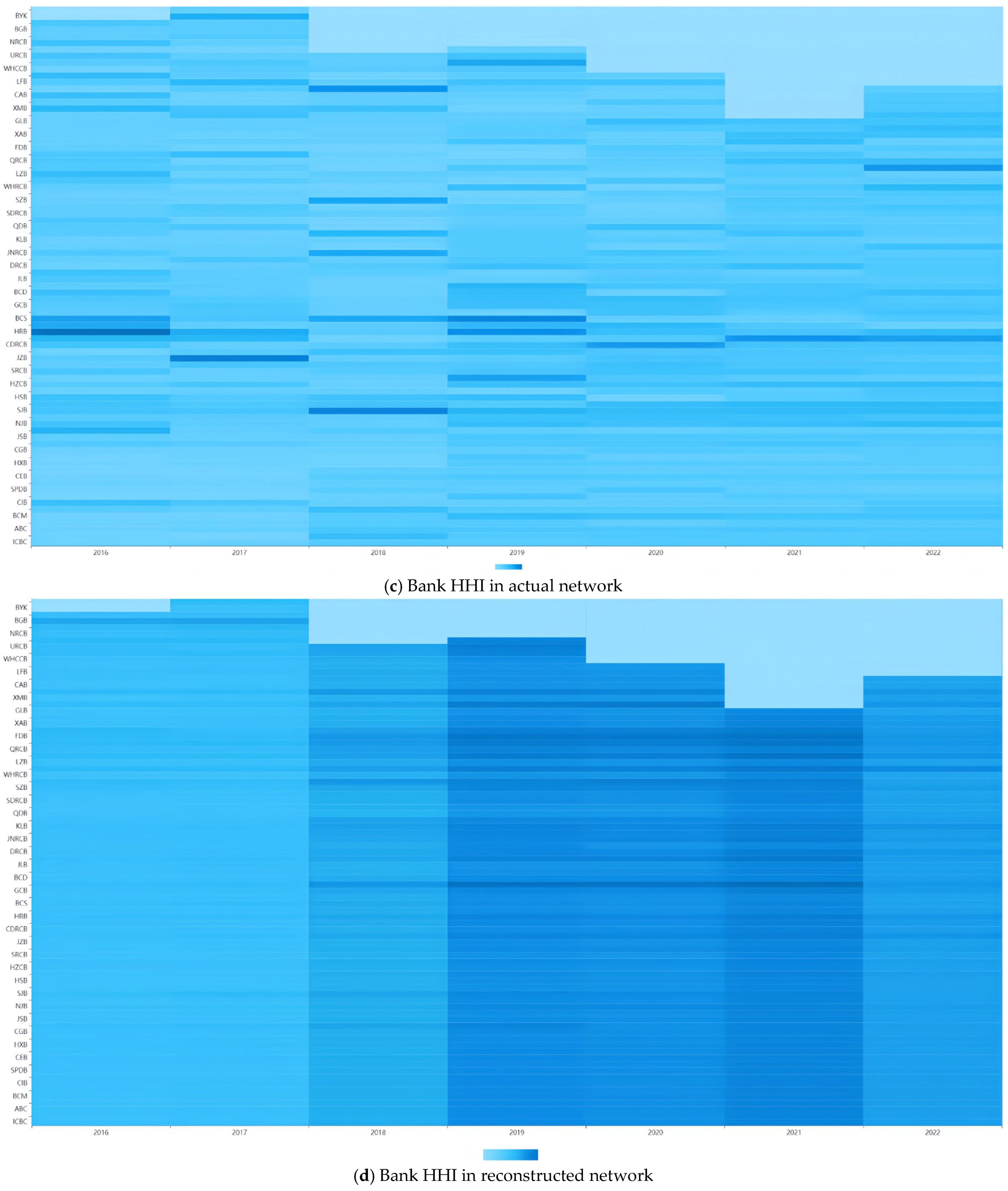
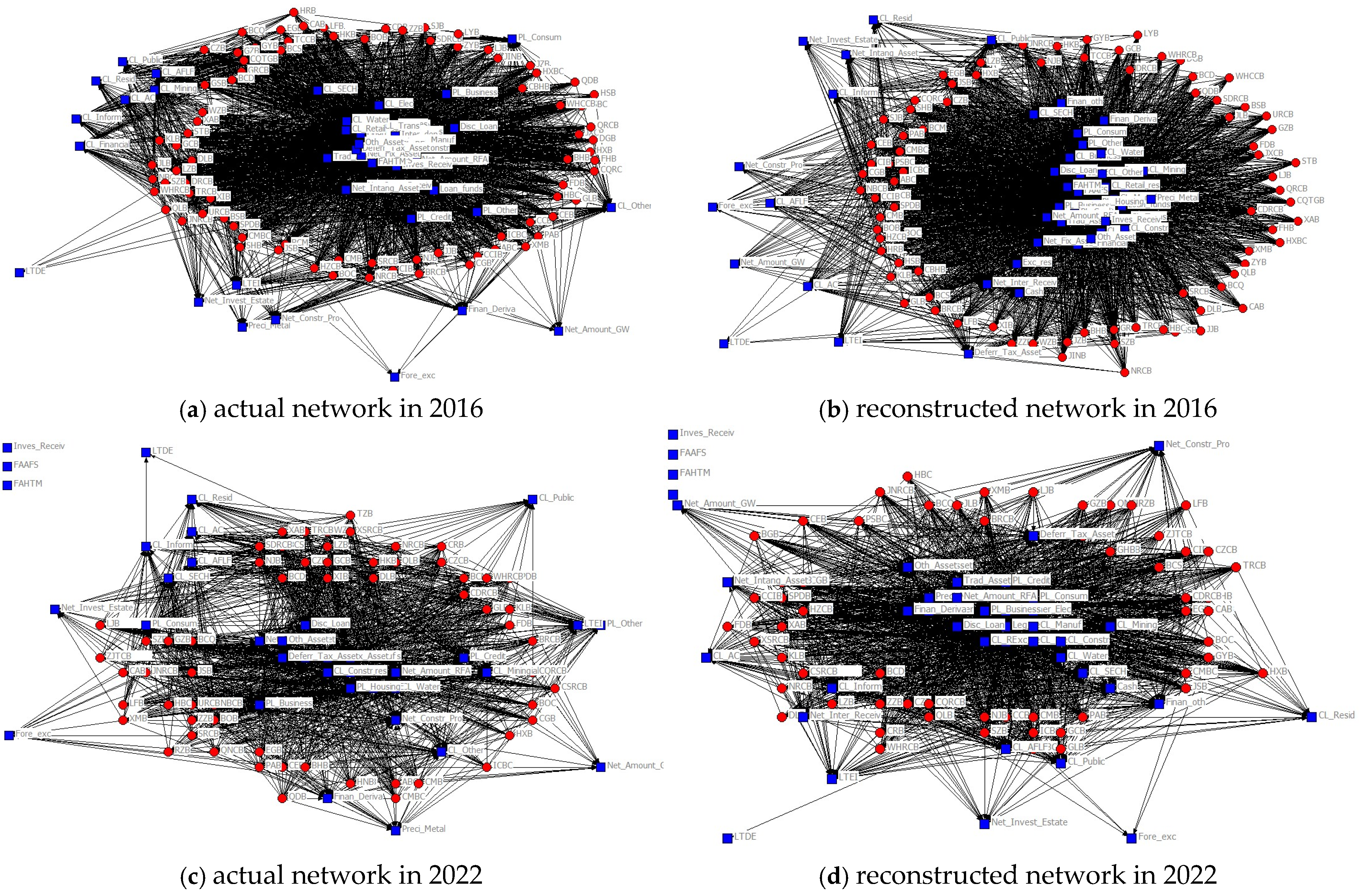
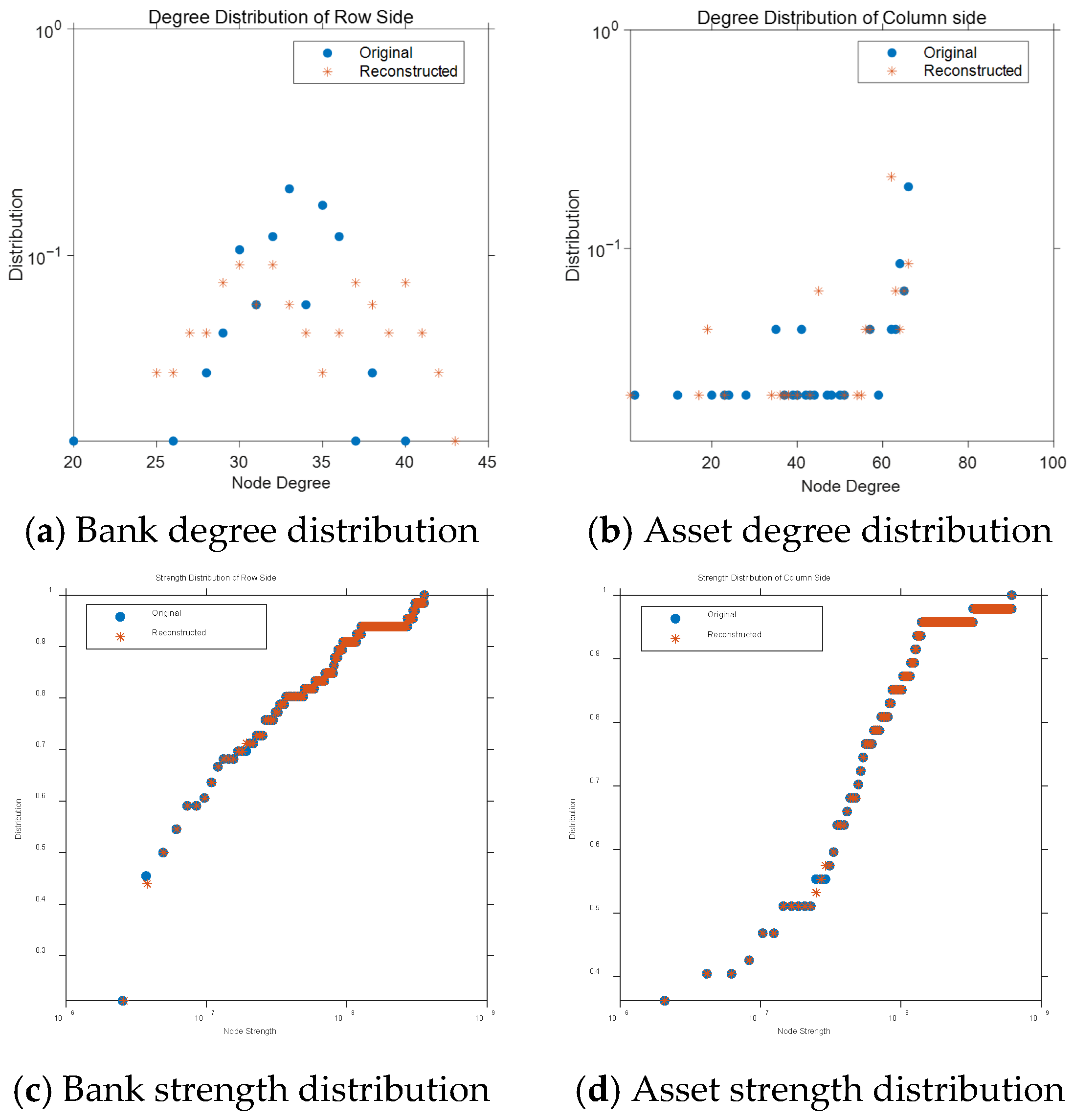
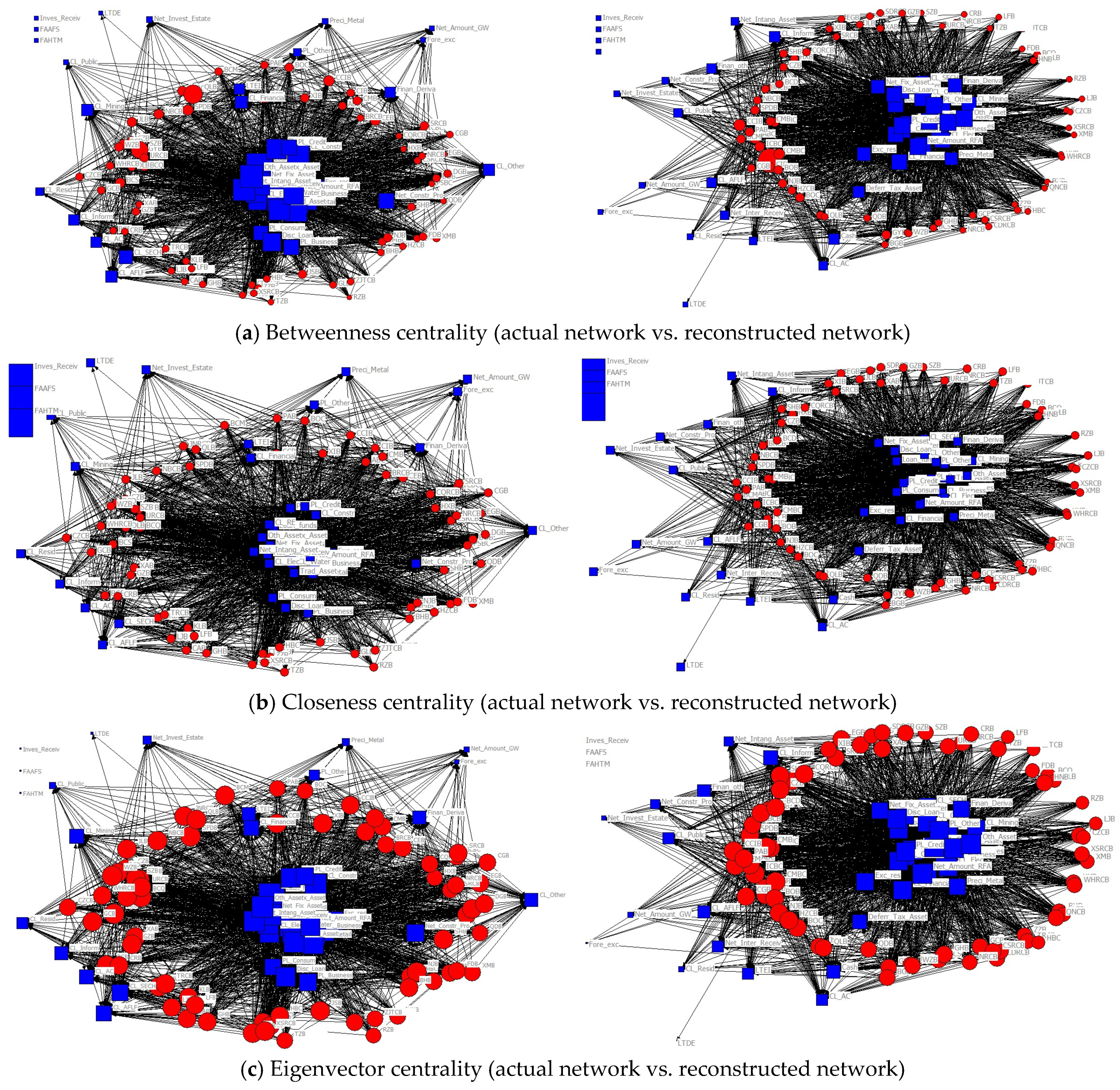
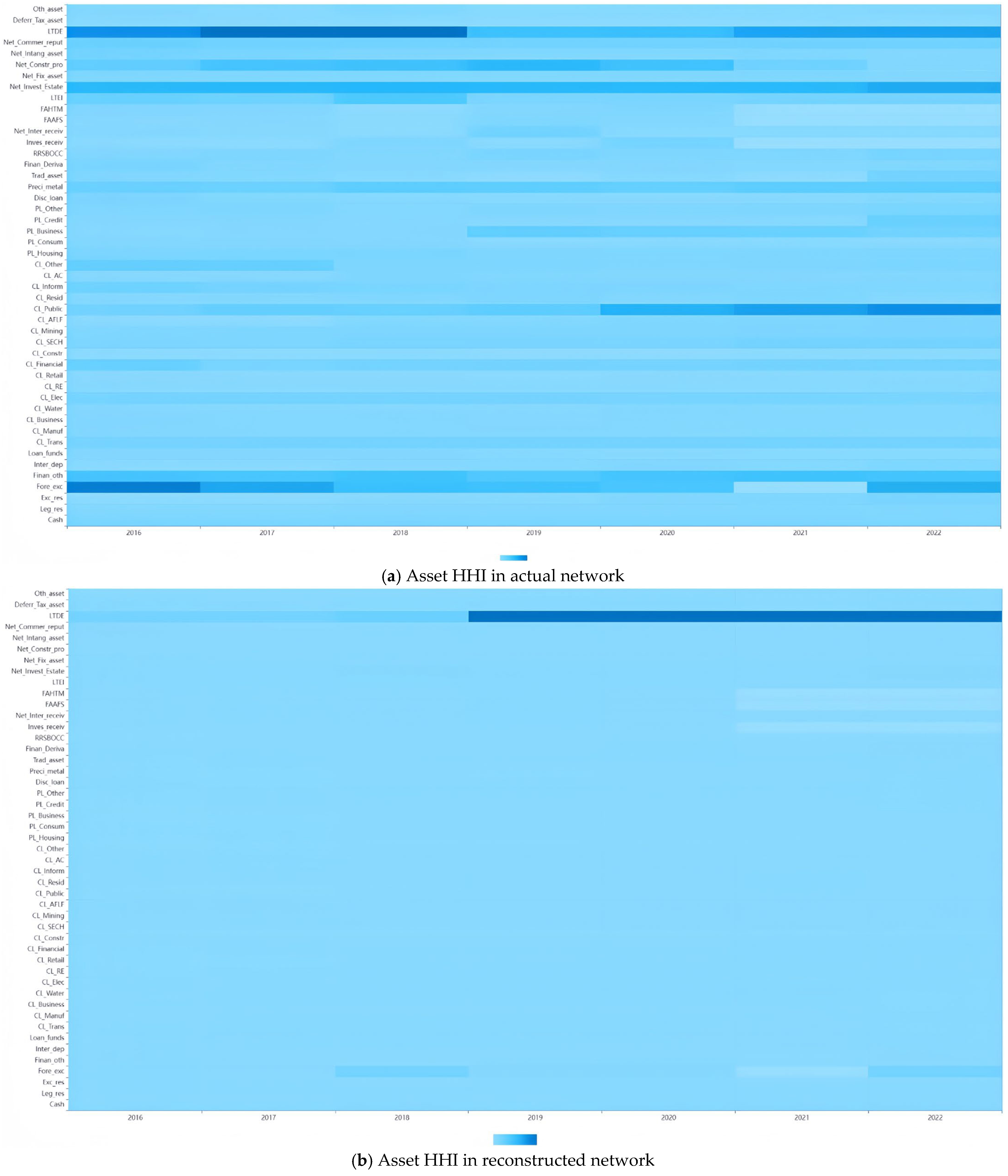
Section 3 describes the data and validates the reconstructed network’s similarity to the actual system.
Section 4 simulates aggregate network vulnerabilities across different shock scenarios.
Section 5 presents the conclusions.
2. Methodology
Based on bank balance sheet data, the linkages between commercial banks and their asset holdings can be formalized as a bipartite network . This network consists of two disjoint, non-empty vertex sets: a bank node set and an asset node set . The edge set connects banks to the assets they hold and can be represented by an matrix , where denotes the number of banks and the number of asset types. Each element of corresponds to the value of held by bank . The total value of assets held by bank is and the total value of asset across all banks is . Connectivity in the network is described by a binary bi-adjacency matrix of the same dimension, where each element equals 1 if and 0 otherwise. The degree of a bank node , defined as the number of distinct asset types it holds, is given by , and the degree of an asset node , defined as the number of banks holding that asset, is .
2.1. Network Reconstruction
Using the available data on bank strength sequences
, asset strength sequence
, and the total number of bank–asset links
, we reconstruct the bipartite network of bank–asset allocation following the constrained entropy maximization approach proposed by Squartini et al. [
29].
- (1)
First step. We use exponential random graph models (ERGMs) to generate an ensemble, denoted Ω, of randomized bipartite networks. All networks in Ω are constrained to have the same number nodes as the observed system. From this ensemble, a representative undirected bipartite network can be extracted, which reflects the most probable bank–asset holding connections. For any potential link between bank and asset , the connection probability over the entire ensemble Ω is given by , where denotes the ensemble average. We treat the observed node strength, the total value of assets for a bank or the total value held for an asset, as a fitness measure. Specifically, the strength and are modeled as linearly proportional to the Lagrange multipliers and arising from the maximum entropy formulation of the ERGMs under that degree constraints.
- (2)
Second step. We calibrate the global connection parameter by equating the expected total number of edges in the ensemble Ω with the observed total number of edges in the empirical network , , where denotes the ensemble average. The parameter is uniquely determined as the positive solution of the equation, which can be used to estimate the linking probabilities
- (3)
Third step. Given the network topology defined by the estimated link probabilities, the weight of each connection is thus determined as , where is expressed as the total asset value in the system. To sum up, the set of linking probabilities and link strength fully characterize the ensemble Ω. Consequently, the value of any asset-holding quantity in empirical network can be estimated by its ensemble average
2.2. Systemic Risk Contagion
Following the methodology established by Huang et al. [
17] and Greenwood et al. [
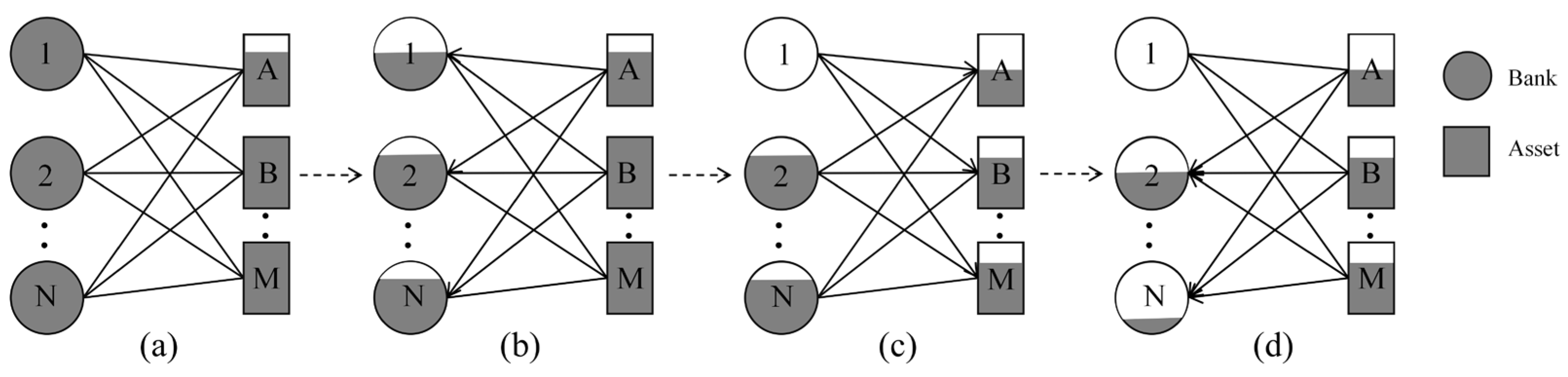
21], we quantify systemic vulnerability as the cumulative losses resulting from financial contagion triggered by exogenous shocks to specific asset classes. To this end, we first deconstruct the mechanisms of risk propagation within bank–asset holding networks, illustrated schematically in
Figure 1, and then develop a corresponding model to simulate its dynamic evolution. In
Figure 1, circles denote bank nodes and rectangles represent asset nodes. Under the assumption that no interbank linkages and no inter-asset dependencies exist, the analysis focuses exclusively on the vulnerability of the banking system that arises from bank–asset connections within the bipartite network framework.
The linkages between banks and assets are derived from banks’ investment portfolios. A bank is connected to an asset node if it holds a positive exposure to that asset class. (a) in
Figure 1 illustrates the distribution of asset holdings across banks. Due to overlapping portfolios, an exogenous shock to a particular asset class ((b) in
Figure 1) transmits losses to all banks exposed to that asset. If the resulting losses render a bank insolvent ((c) in
Figure 1), it is forced to liquidate holdings through fire sales to meet its obligations. The increase in selling pressure depresses the market price of the affected asset. This price decline forces other banks holding the same asset to mark down its value, eroding their net worth and potentially triggering additional insolvencies. This process creates a negative feedback loop of fire sales and price depreciation, thereby propagating contagion throughout the network ((d) in
Figure 1).
In a bipartite network comprising banks and asset classes, let denote the value of asset held by bank , where and . The total asset value of bank i then is , and the portfolio weight of asset for bank is . Let and represents the total liabilities and equity of bank , respectively, satisfying . The total market value of asset across all banks is . The relative size of asset in the banking system is defined as , and the market share of asset held by bank is . Denote by the value of asset held by bank at time T, with representing the initial observed value on bank balance sheet. Thus, the total asset value of bank at time T is , and the total market value of asset at time T is . We introduce the external shock parameter and the asset fire-sale coefficient to capture the impact on the remaining asset proportions after the external shock and the asset price depreciation due to fire sales respectively.
- (1)
Initial shock. Suppose that a particular asset held by banks experiences an exogenous shock. The total market value of that asset is updated to . Consequently, the value of asset held by any bank is reduced proportionally
- (2)
Leverage target. Following the leverage ratio regulatory standard for Chinese commercial banks issued by the China Banking and Insurance Regulatory Commission, which stipulates that Tier 1 capital must not fall below 4% of adjusted on and off balance sheet assets, we uniformly impose a fixed leverage target of
for all commercial banks in the model. After the initial exogenous shock, both asset values and leverage ratios are recalculated for every bank. If each bank’s total assets exceed its total liabilities and the leverage ratio satisfies the regulatory threshold, no bank enters enter bankruptcy or fire-sale proceedings, and the simulation terminates. Even when total assets exceed total liabilities
, a bank still needs to liquidate part of its holdings to restore compliance with the leverage target following losses. If
, insolvency occurs, the corresponding bank node undergoes bankruptcy liquidation according to the following rules:
where
and
represent the sets of deleveraging banks and defaulting banks at time
T, respectively. In terms of any bank
, we introduce the parameter
to denote the proportion of assets sold by the deleveraging banks, and the scale of the sold assets should be
. Assume that banks sell assets proportionally according to their holdings in each asset class to achieve the deleveraging target, the parameter should be
.
- (3)
Fire-sales effect. Whether triggered by deleveraging to meet regulatory requirements or by forced liquidation in bankruptcy, asset sales propagate internal risk diffusion through the system, imposing losses on other banks holding the same assets. To capture the market wide impact of such sales, we introduce an asset fire-sale discount coefficient , which reflects the price depreciation resulting from distressed selling. The model incorporates the following three scenarios:
① If no bank defaults, but some banks experience higher than expected leverage due to asset depreciation, they engage in fire sales. The market value of the asset is then updated as . ② If a bank becomes insolvent, it enters bankruptcy liquidation. In this case, the market value of asset is adjusted to , where bank , and all assets of the defaulting bank should be forced liquidation. ③ When both defaults and deleveraging occur simultaneously, asset prices are affected by the combined sales from defaulting banks and the fire sales of surviving banks. The market value of the asset is updated as , where represents the deleveraging induced asset sales and reflects forced liquidation sales from default banks.
When banks sell assets at discounted prices, the resulting depreciation propagates risk through the banking network. For banks that hold the same asset class but do not sell in the current period, the equity loss due to price markdowns is given by . For deleveraging banks that conduct fire sales, the value of their remaining holdings in the same asset is updated as .
- (4)
Market panic. When several external shocks trigger bank failures, they may induce market panic and herding behavior in asset sales. To capture this amplification effect, we introduce a market panic coefficient . The resulting depreciation in the market value of the affected asset due to panic driven sales is then expressed as . Owing to the dual impact from external risk shocks and internal risk contagion, more banks may be forced to deleverage by selling assets or enter bankruptcy liquidation procedures. After each round of asset price adjustments, the total asset value and leverage ratio of each bank are recalculated. The simulation then checks whether any bank becomes insolvent or breaches the regulatory leverage threshold, thereby determining the need for further fire sales or liquidation in the next period.
2.3. Vulnerability Measurement
Based on the analysis of systemic risk contagion in bank–asset bipartite networks following an external shock, we focus on both system wide and bank level vulnerability. We define aggregate vulnerability as the percentage of total banking equity that is wiped out through risk contagion effects triggered by the shock. For the direct effect does not involve interbank contagion, we isolate the contagion-induced component. Formally, aggregate vulnerability is expressed as , where = represents the cumulative contagion-related losses of all banks up to time T, and is the total initial equity of the banking system.
Following Greenwood et al. [
21], aggregate vulnerability can be decomposed into bank-level contributions. We define the systemic vulnerability of bank
as its contribution to overall system-wide losses relative to its initial equity
, where
represents the cumulative losses incurred by bank
over the time, and
is its initial equity.
Finally, we also define a bank’s indirect vulnerability with respect to the external shock as the impact of the shock on its equity through network-based risk contagion . In contrast, direct vulnerability captures the immediate equity loss caused by exogenous shock itself before any contagion occurs generated as , where denotes the direct loss of bank at the initial impact period.
4. Simulation Study
Based on the reconstructed bank–asset network and the proposed vulnerability measurement framework, we conduct a simulation analysis to examine how risk contagion propagates and amplifies systemic vulnerability. The simulation analysis incorporates the following key parameters: network size, risk exposure, leverage, external shock, asset price impact, and fire-sales effect. Network size and risk exposure parameters are derived directly from the reconstructed network. The leverage threshold is set as a fixed value of LEV = 4% as derived from the policy for simplicity. Following the risk contagion model and vulnerability measurement, the external shock parameter , asset fire-sale coefficient , and market panic coefficient can be all set within , and .
4.1. Measuring Network Aggregate Vulnerability
In terms of the external shock parameter
, three benchmark values (low, medium, high) are generated randomly according to the empirical work by Greenwood et al. [
21] and Fricke et al. [
23] to evaluate how the different magnitude external shocks affect the vulnerability of the network system, which are
,
and
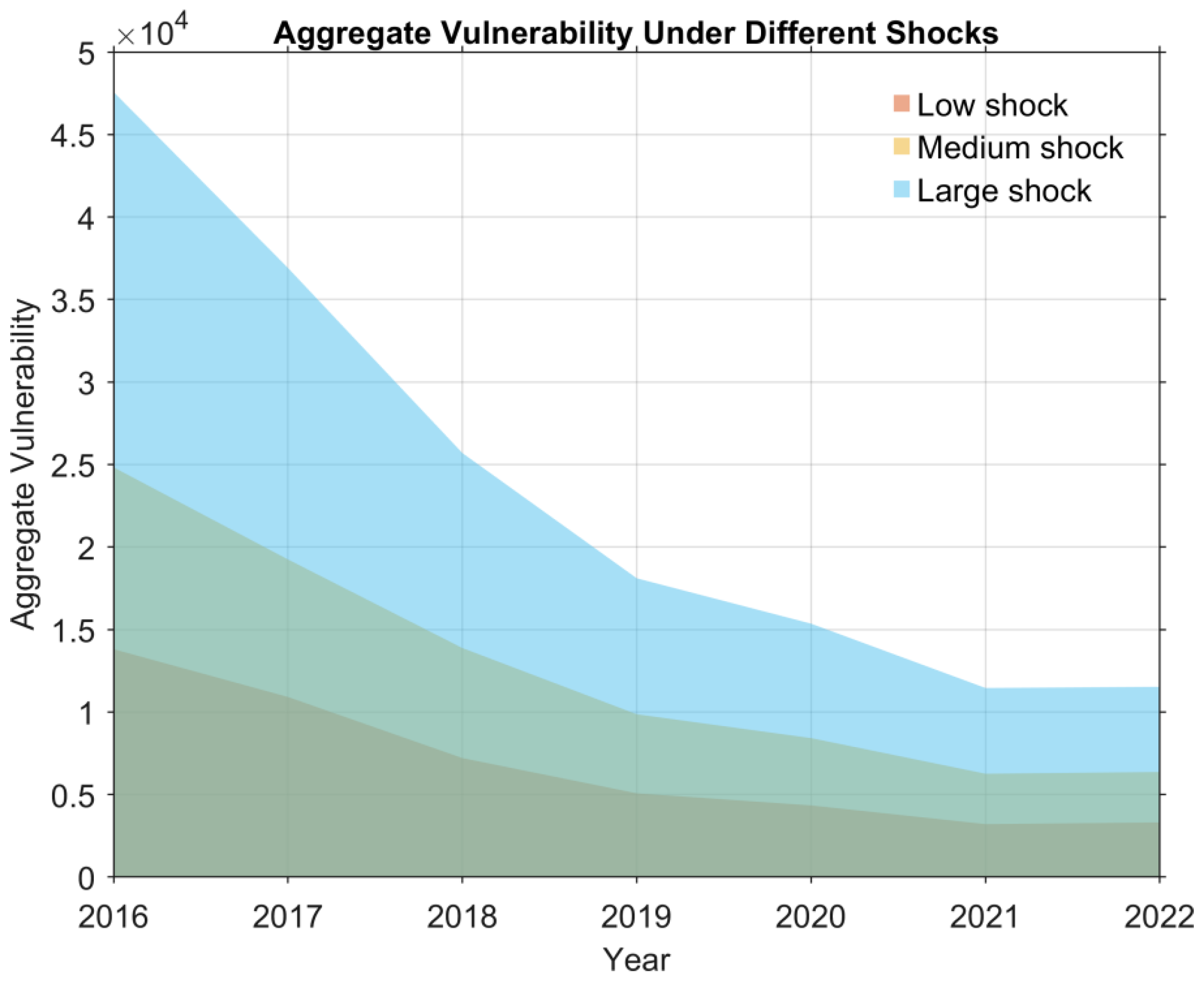
respectively. On the metric of aggregate vulnerability, the cumulative losses from risk contagion caused by bank deleveraging and asset fire sales, expressed as the percentage of total banking sector equity that would be eroded. Holding all the other parameters at their default values, we conduct the simulation analysis to measure network vulnerability for each year from 2016 to 2022 as follows.
Figure 6 depicts the vulnerability of bank–asset networks under different initial external shock scenarios from 2016 to 2022. Overall, the trajectory of network vulnerability is consistent across this period, with the magnitude of equity erosion generally decreasing over time. Under the three shock scenarios, the aggregate network maintained a relatively constant loss level from 2020 to 2022, showing no sharp increases or decreases despite variations in shock intensity. In contrast, the aggregate losses were significantly higher between 2016 and 2019 than those in the subsequent three-year period. The network aggregate vulnerability is
. To understand the intuition behind the above equation, we can rearrange the terms slightly and expand
, where
measures the connection among bank
. This is the extent to which bank owns
owns large or illiquid asset classes. According to this formulation, systemic risk increases with larger values of network structure
, leverage
, and risk exposure
, or when exposed to the shock effect
. This implies that systemic vulnerability is amplified when large, highly leveraged banks are exposed to a shock, triggering substantial asset sales. Furthermore, if these exposed banks hold illiquid assets, the resulting large price impact can render the entire network system more vulnerable.
4.2. Contribution from Each Bank to Network Vulnerability
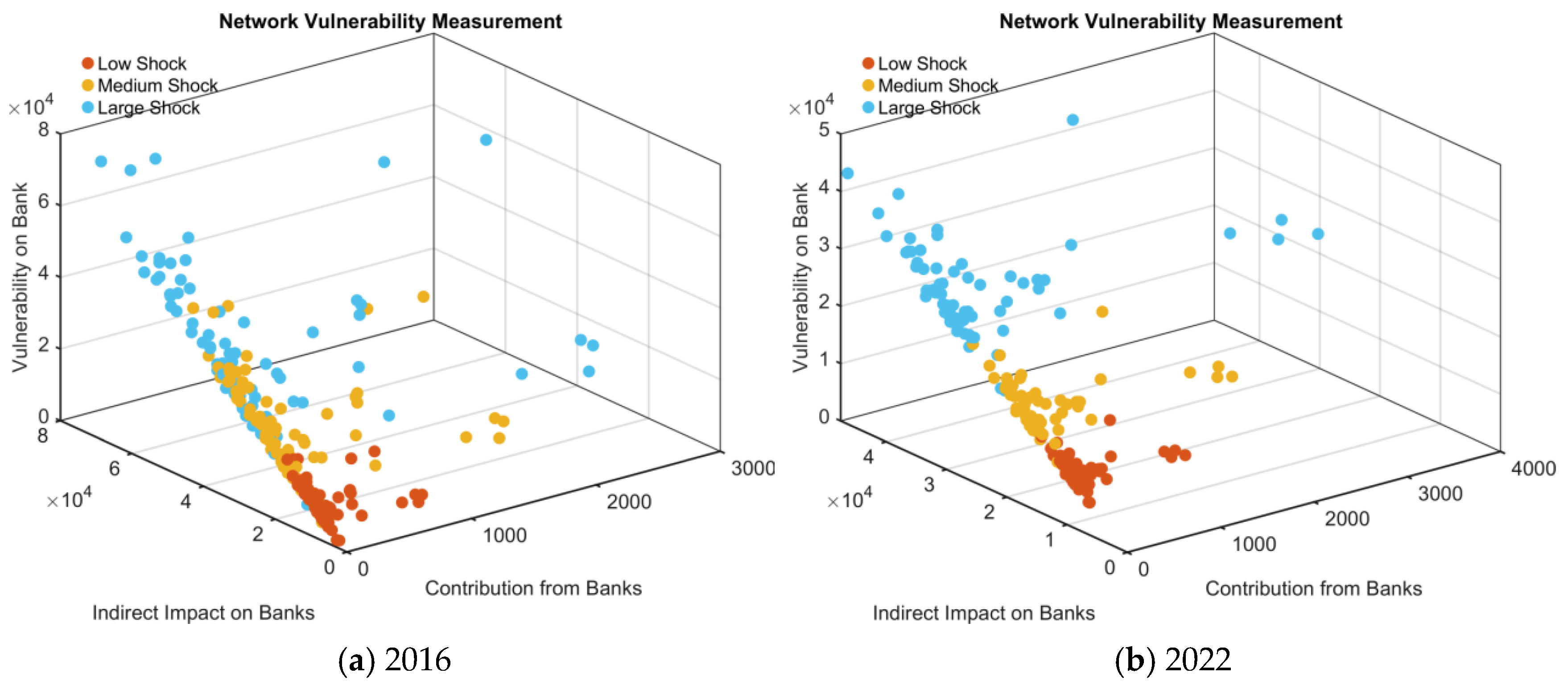
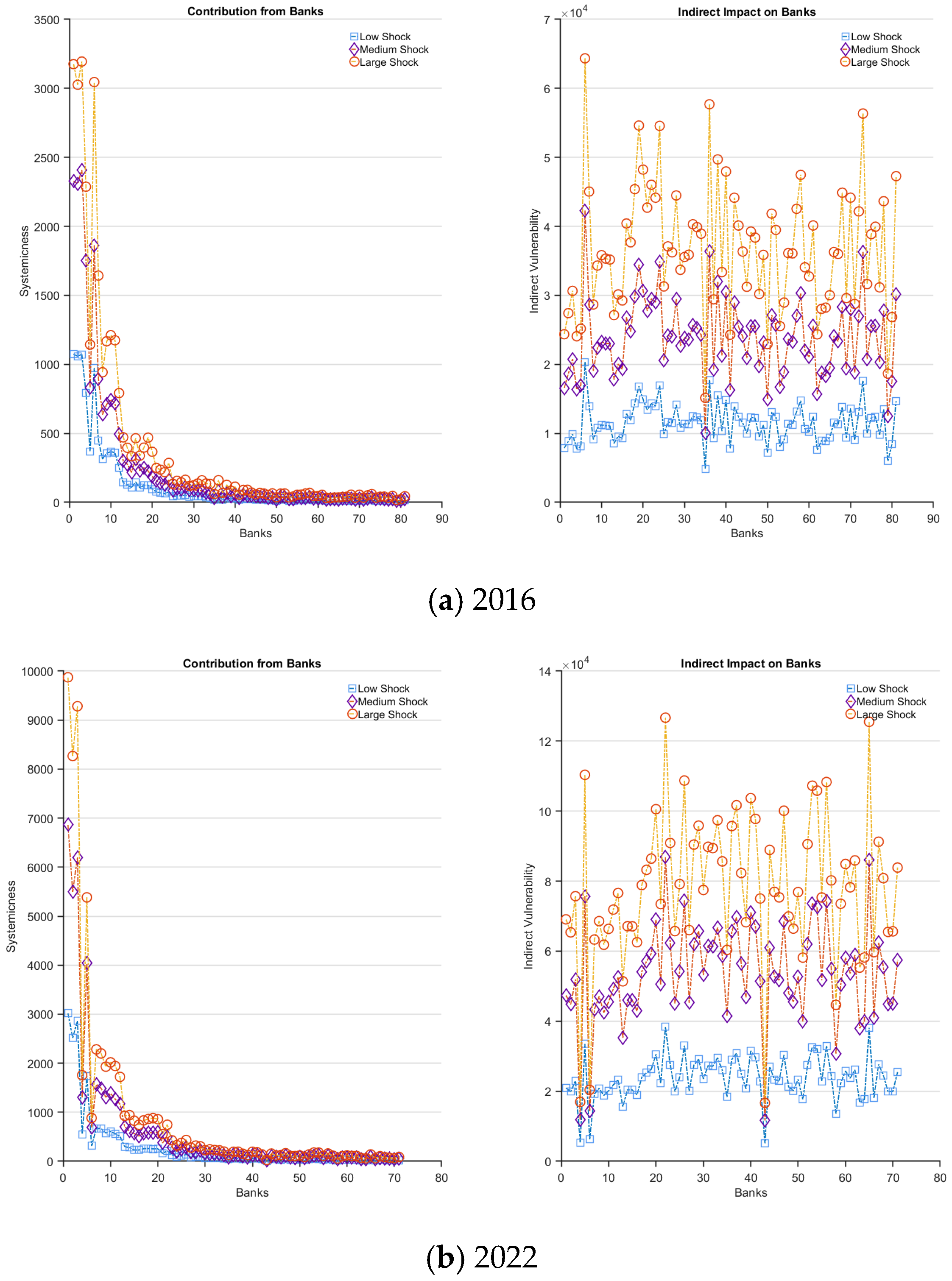
Building upon the analysis of aggregate network vulnerability, which quantifies the cumulative losses arising from bank inter-dependencies and dynamic behaviors during risk contagion under external shocks, we can decompose this systemic measure into individual bank contributions. This aggregate vulnerability can be viewed as the sum of contributions from individual nodes, transmitted through fire-sale spillover effects across the banking system. Therefore, we can calculate the vulnerability contribution of each bank, which serves as an metric of its systemic importance within the network. The systemic impact of an individual bank on the banking network can be quantified by calculating the marginal contribution . This represents the hypothetical aggregate vulnerability triggered by an initial shock exclusively to bank . Consistent with the formulation of aggregate vulnerability , the individual contribution can be similarly transformed into a function with the key network parameters. Building on this measure of individual bank loss contribution , we conduct a simulation analysis from 2016 to 2022 to examine the correlations between the following three key metrics: a bank’s systemic importance , a bank’s individual systemic vulnerability , and the overall network aggregate vulnerability . This analysis characterizes how the behavioral states and financial conditions of individual network entities influence the propagation of risk contagion and the amplification of cumulative losses.
As shown in
Figure 7, no direct linear relationship exists between systemically important banks and systemically vulnerable banks. This indicates that large, top-tier banks do not necessarily play the most critical role in risk propagation; conversely, smaller banks can also be exposed to significant indirect risks through contagion channels, even without experiencing direct shocks.
Figure 7a demonstrates that under a low magnitude external shock, banks with dense interconnections can rapidly transmit risks throughout the system.
Figure 7b reveals that although the overall level of risk spillover from systemically vulnerable banks has decreased, their marginal risk contribution remains more significant than that observed in the dimension of systemic importance. This suggests that well connected, vulnerable banks play a disproportionately large role in amplifying risk contagion processes.
Figure 8 shows the distribution of individual banks’ contributions to aggregate network vulnerability in 2016 and 2022. The figure reveals that most banks contribute at a low level to systemic vulnerability under cumulative risk contagion, while only a small subset exhibits high risk exposure. The significant heterogeneity among bank nodes and the scale-free structure of the network highlights that identifying these systemically important nodes is crucial for effective systemic risk prevention. From the perspective of individual node risk, the difference in risk contribution from systemically important banks between 2016 and 2022 is not pronounced. However, the analysis confirms that larger initial shocks lead to more significant risk accumulation effects propagated by these systemically important banks. In the network visualization, node color indicates risk spillover intensity: yellow nodes represent the highest level of risk spillover, followed by nodes of other colors. This depiction reflects not only the differential risk losses arising from variations in initial shocks but also validates the heterogeneity in node sizes and the core–periphery topological structure of the banking network. This structural pattern is consistent with the long term configuration of China’s banking sector, which is dominated by six large state-owned banks and features a multi-polar distribution of twelve national joint-stock commercial banks. Furthermore, compared to the measure of systemic importance, the systemic vulnerability of bank nodes demonstrates a wider and more stratified hierarchical distribution, indicating a more complex pattern of risk exposure across the system.
4.3. Network Topology Structure on Network Vulnerability
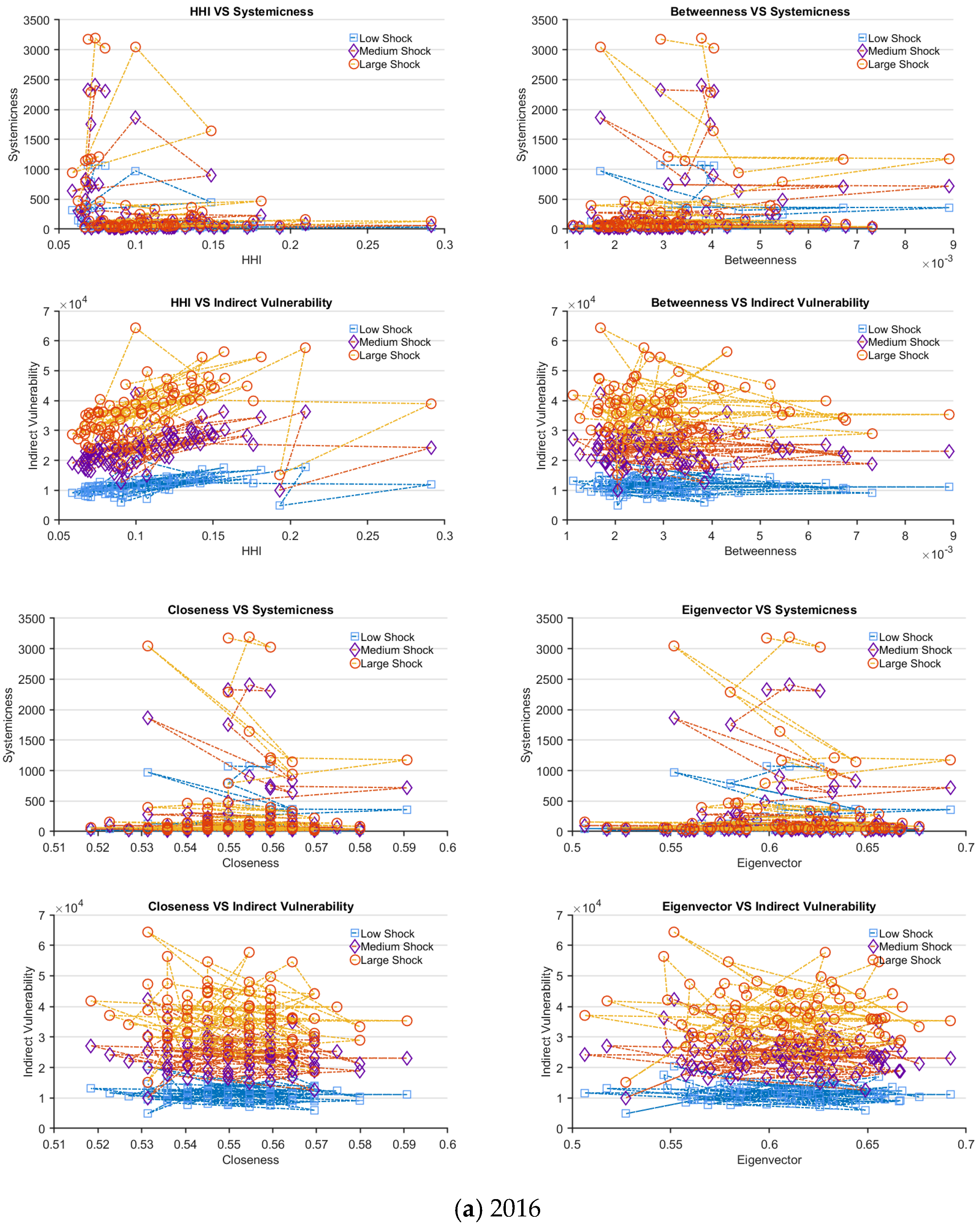
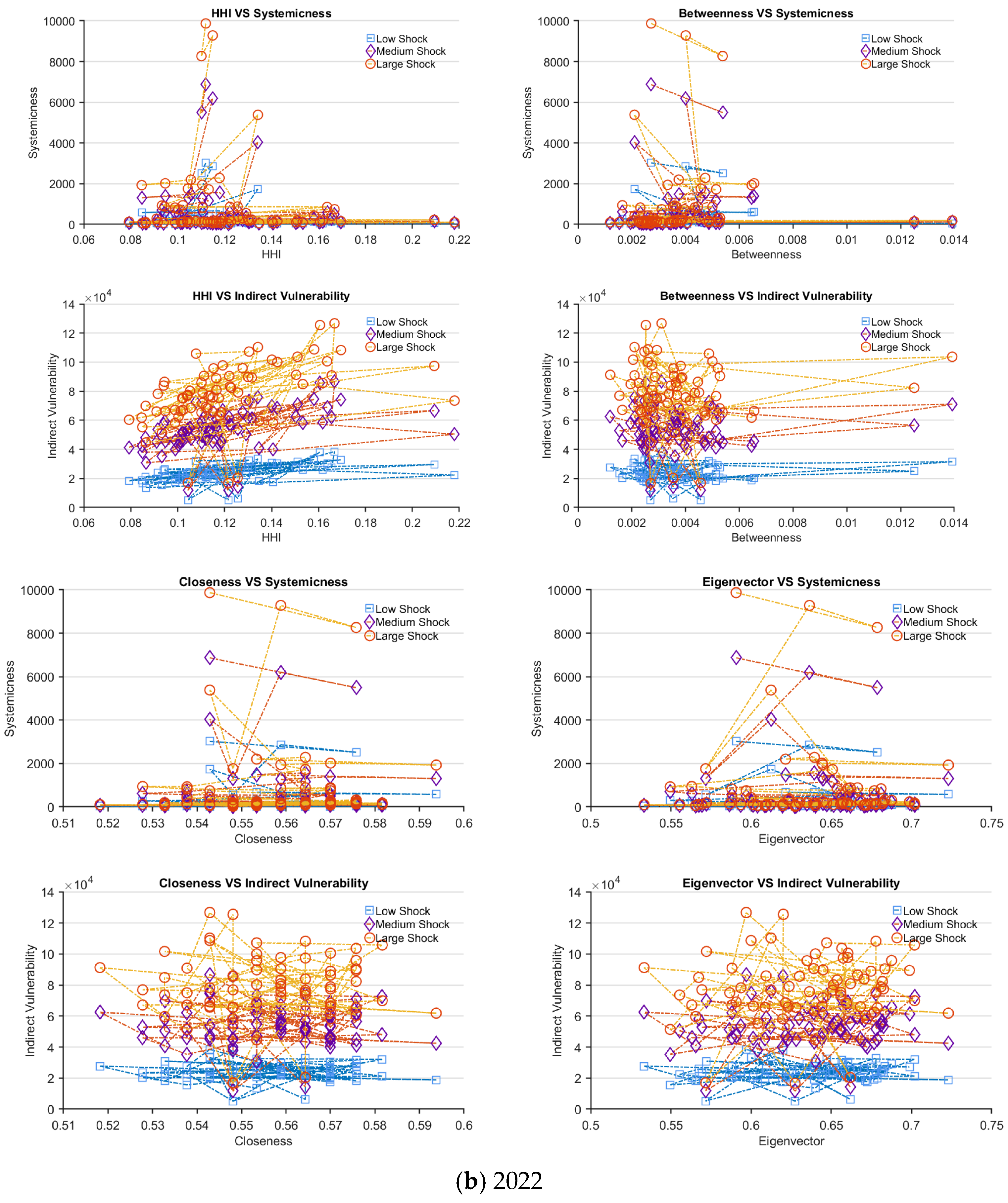
As indicated in aggregate vulnerability measurement , the network structure serves as a critical indicator of banks’ asset allocation, emerging as a pivotal determinant governing the cumulative losses incurred within networked systems. Building on the preceding analysis, we select four network topological indicators, the HHI of banks’ asset concentration, betweenness centrality, closeness centrality, and eigenvector centrality, to examine their intrinsic relationships with two key dependent variables, which are banks’ indirect vulnerability from risk contagion and contribution to aggregate systemic vulnerability .
Figure 9a,b shows the correlations between network topology metrics and node vulnerability indicators for 2016 and 2022, respectively. The figures indicate that, in both years, no significant linear relationship exists between the four network topological indicators and the vulnerability of individual nodes. The contributions of bank nodes to the cumulative systemic vulnerability varied substantially, with a subset of nodes exhibiting disproportionately high risk contributions. In contrast, the distribution of losses across banks affected by risk contagion demonstrated a relatively low dispersion under identical shock conditions. At the network level, as the concentration of bank–asset investments increases (i.e., distribution tightened), aggregate systemic vulnerability exhibits a slight downward trend. This finding is consistent with the previously observed sparsification of network density and node degree, suggesting that reduced connectivity within the bank–asset network decreases the number of available risk transmission paths, thereby weakening risk spillover and diffusion effects. This is further corroborated by the significant decline in the risk spillover contribution from systemically vulnerable banks. Regarding centrality metrics, the centrality of bank nodes demonstrates greater efficacy in identifying systemically vulnerable banks, a role that is often modulated by the magnitude of external shocks. As node centrality increases, both
and
tend to exhibit extreme values, enabling the effective identification of key nodes that contribute significantly to systemic risk. This underscores the advantage of centrality measures in characterizing both the systemic importance and vulnerability of banks within the network.
4.4. Impact of Risk Contagion on Individual Banks
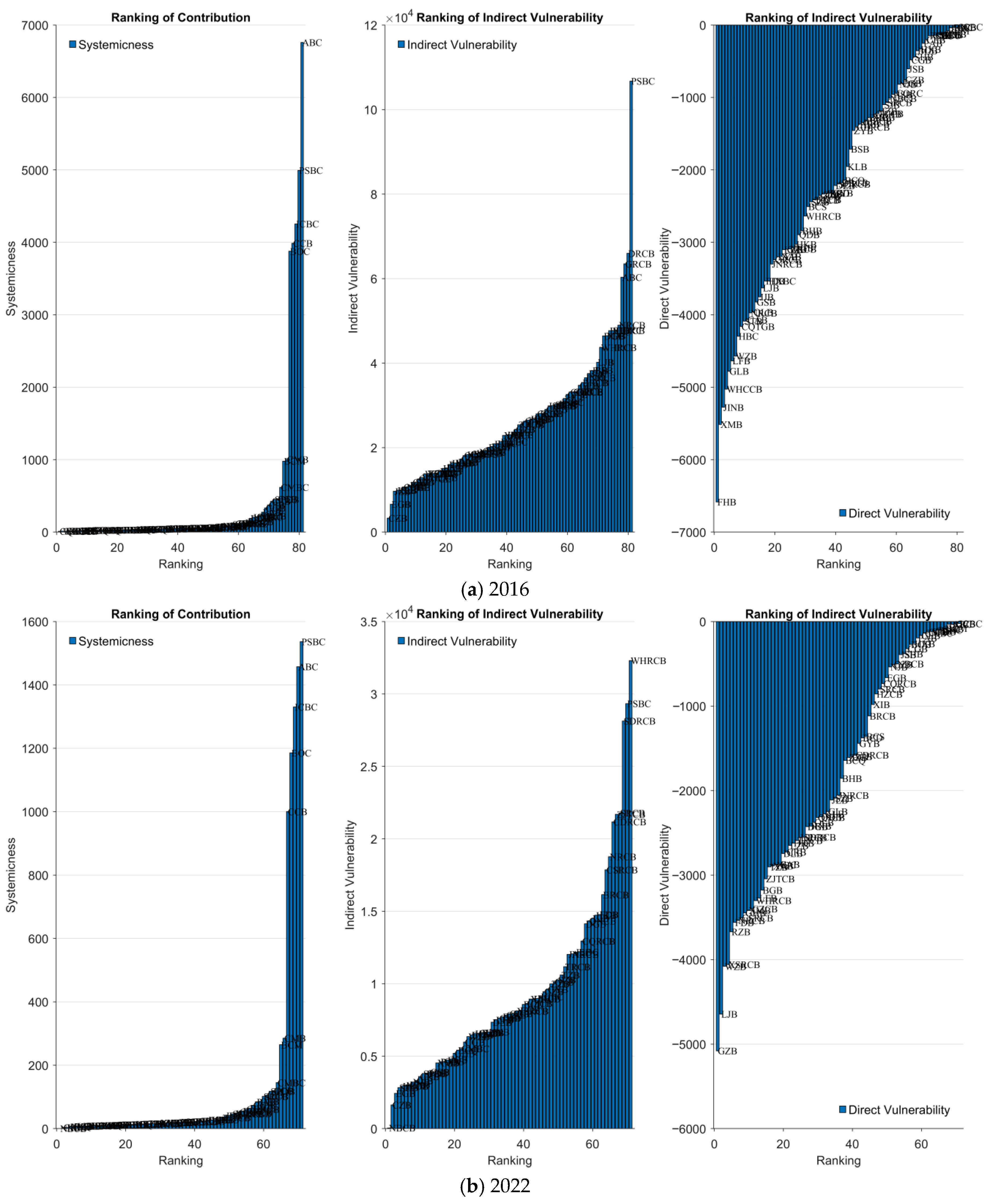
Based on the network vulnerability measurement model and its analysis framework, we define two vulnerability indicators for individual bank nodes, named direct vulnerability and indirect vulnerability , to quantify their risk exposure from contagion triggered by exogenous initial shocks. The indirect vulnerability metric specifically quantifies the risk exposure arising from the combined effect of network-wide deleveraging and the topological connections between nodes. It is a distinct concept from both direct vulnerability and a node’s systemic importance. Thus, using 2016 and 2022 as representative examples, we calculate and rank the risk vulnerability of all bank nodes for each year. This ranking aims to depict the characteristics of the risk distribution and identify the nodes most susceptible to contagion effects.
Figure 10 presents the ranking distributions of direct risk losses, indirect risk vulnerability, and network system vulnerability contribution from bank nodes in the bank–asset allocation network for 2016 and 2022, under a low external shock scenario. Additionally, the top 10 nodes ranked by indirect risk vulnerability and systemic vulnerability contribution are detailed in
Table 6. As shown in
Figure 10, the distributions of both indirect risk vulnerability and systemic vulnerability contribution exhibit a typical heavy-tailed pattern in both years, indicating that a small number of banks account for a disproportionately large share of the systemic risk. The composition of the top 10 banks by systemic vulnerability contribution, listed in
Table 6, remains consistent between 2016 and 2022, with only minor variations in their ordinal rankings. These banks are exclusively state-owned banks and leading national joint-stock commercial banks. This consistency underscores the prominent systemic importance of China’s large state-owned commercial banks. Their significant contribution to systemic vulnerability stems from their substantial asset scale, high degree of interconnectedness, and the diversity of their asset allocations.
Conversely, the composition of the top 10 banks ranked by indirect vulnerability exhibits significant turnover between 2016 and 2022. With the exception of the Postal Savings Bank of China, the lists for the two years show almost no overlap. These top ranked vulnerable banks are predominantly rural commercial banks and small and medium-sized urban commercial banks. This finding indicates that the correlation stemming from holding common asset portfolios is a primary driver of risk vulnerability at the node level. Furthermore, the role of highly central nodes in amplifying cumulative systemic vulnerability through risk contagion is particularly significant. These results imply that the optimal design of banking regulatory strategies must incorporate a dual focus: the traditional “too big to fail” principle and a “too connected to fail” principle, which accounts for the critical role of interconnectedness and common asset exposures in propagating systemic risk.
5. Conclusions
Building on and extending the frameworks of Huang et al. [
17] and Greenwood et al. [
21], this study performs a macro-prudential stress test on the Chinese banking sector for the period 2016–2022. Using balance-sheet data from Chinese commercial banks, we reconstruct a bipartite network of bank–asset holdings via exponential random graph models (ERGMs), which closely replicates the topological structure of the empirical banking system. Within this network setting, we simulate the propagation of external shocks to evaluate systemic vulnerability. Our analysis delivers two key findings. First, deleveraging and asset fire sales serve as powerful channels for distress transmission across the banking network. Second, the contribution to cumulative systemic vulnerability is predominantly concentrated in large state-owned banks and nationwide joint-stock commercial banks, a result driven by their substantial asset scales. In contrast, small and medium-sized rural and urban commercial banks are the most severely impacted by the resulting risk shocks.
Several limitations of the current modeling framework should be acknowledged. First, the model does not fully account for the strategic responses or heterogeneous expectations that banks may adopt as financial distress propagates. Second, while the simulation illustrates how cascading failures can emerge under uniform behavioral assumptions, real-world banks display substantial heterogeneity in their risk-management practices and balance-sheet resilience. Future research could usefully extend the framework to incorporate such behavioral and institutional heterogeneity, as well as to differentiate more finely among asset types. Despite these limitations, the proposed model remains sufficiently general to provide insights applicable to different segments of the financial system and to multi-market environments. It therefore offers a practical analytical tool for regulators aiming to understand the interconnected nature of financial systems and the resulting volatility, particularly from a systemic-risk perspective that emphasizes contagion channels and, potentially the strategic allocation of assets across financial institutions.