1. Introduction
The new energy vehicle (NEV) transition has entered a paradoxical phase. On the one hand, electrification is scaling rapidly and reshaping the global automotive landscape, with China remaining a central growth engine and cost frontier. On the other hand, the NEV market has become increasingly turbulent: intensified competition compresses margins, product cycles shorten, and consumers confront a flood of heterogeneous models and claims that are difficult to evaluate before purchase [
1]. Meanwhile, a prolonged price war has further intensified volatility and amplified strategic turbulence, prompting regulatory attention to what has been described as “irrational competition” in the EV industry [
2,
3]. The International Energy Agency reports that competitive pressure and falling battery and vehicle prices, especially in China, have accelerated adoption, while simultaneously intensifying rivalry and strategic uncertainty across manufacturers [
4]. In parallel, policy support is shifting toward a more structured and longer-horizon toolkit [
5], such as extended purchase tax incentives through 2027—adding new discontinuities in demand formation and enterprise strategy [
6].
Taken together, these developments suggest that the turbulence reflects more than intensified competition. When key quality attributes and long-term performance are hard to verify ex ante and policy reference points shift, competition increasingly involves the (re)definition of what counts as “credible” and “future-proof” innovation. Enterprises therefore compete not only on cost and engineering performance, but also on shaping expectations, legitimacy, and ecosystem alignment, while consumers and regulators continuously update what they regard as reliable, compliant, and future-proof [
1,
7,
8]. This combination—uncertain performance assessment, shifting benchmarks, and legitimacy-building efforts—is characteristic of DI dynamics.
The above phenomenon aligns closely with the logic of DI. According to previous research, DI describes trajectories that initially underperform on mainstream performance metrics but offer alternative value propositions (e.g., lower cost, convenience, new use contexts), improve over time, and ultimately reshape market structure and incumbent advantages [
9,
10]. Subsequent scholarship has clarified that disruption is not a mechanical “new technology replaces old technology” story; it is contingent on demand uncertainty, institutional conditions, complementary assets, and ecosystem alignment [
11,
12,
13]. This “context-conditional” view is particularly relevant for NEVs, where disruptive dynamics typically arise from a bundle of changes rather than a single technical route: electrified powertrains combined with software-defined architectures, new platform strategies, new service models, and fast-scaling digital channels that actively shape user expectations [
14,
15,
16].
From a DI perspective, the NEV transition is therefore not merely about adoption rates. It is about market re-ordering under uncertainty, where enterprises compete to define what counts as “credible innovation,” consumers update attitudes through social influence and information cues, and governments redesign policy instruments as diffusion and competition evolve. This framing immediately suggests that the relevant unit of analysis is multi-actor and feedback-driven rather than single-sided.
Because disruptive trajectories in the NEV sector are mediated by complementary assets and institutional infrastructures, diffusion and competitive advantage are inseparable from ecosystem alignment [
3,
7,
17]. NEV diffusion is therefore not the diffusion of a single-point technology, but the coordinated diffusion of a complementary system [
18], because key complementarities extend across charging networks, battery supply chains, software stacks, standards and regulatory regimes [
19], and platform-enabled services; misalignment in any layer can slow diffusion, shift rents, or change which innovation trajectory becomes viable. Innovation ecosystem research accordingly emphasizes that value creation and capture depend on coordinated alignment among focal firms and complementors, and that competition often becomes “ecosystem versus ecosystem” rather than enterprise versus firm [
20]. This ecosystem-mediated character motivates a complex-systems interpretation in which diffusion emerges from heterogeneous agents embedded in interacting networks with reinforcing feedback, rather than from a representative adopter responding to average incentives.
Within this ecosystem setting, a central mechanism that has received limited explicit modeling attention is the two-way coupling between enterprises and consumers under DI-stage uncertainty [
21]. On the demand side, classic diffusion theory highlights the roles of perceived relative advantage, compatibility, and observability [
22], while technology acceptance research underscores perceived usefulness and perceived ease of use as determinants of acceptance in uncertain environments [
23]. For NEVs, where long-term reliability, residual value, and the credibility of performance claims are difficult to verify ex ante, adoption is therefore shaped not only by price and infrastructure, but also by social learning and network-embedded attitudes [
24,
25]. Digital environments can amplify these processes. Online communities and interactive brand ecosystems shape attitude formation and purchase intention, while platform-mediated information, including reviews and recommendation mechanisms, structures how consumers update beliefs about what is credible and future-proof in a rapidly evolving market.
Policy enters this coupled system not merely as a supply-side instrument but also as a salient signal and constraint that shapes demand formation and credibility inference [
26]. Consumers revise perceptions of financial risk, convenience, and compliance partly through policy cues and governance signals, including incentive packages, charging support, privilege policies, standards, and regulatory communications. Empirical studies report that incentive policies can affect purchase intention through psychosocial value and perception channels, and that diversified policy mixes may generate differentiated impacts across consumer segments—suggesting that policy visibility and perceived credibility can shape attitudes rather than simply lowering prices [
27]. In parallel, enterprises internalize policy evolution in their strategic calculations: as NEV governance shifts from direct subsidies to broader and longer-horizon toolkits, policy changes can alter both innovation incentives and competitive tactics, thereby interacting with the demand-side belief environment [
1].
On the supply side, DI-stage enterprises do not passively respond to demand; they actively shape the information environment through visible R&D commitments, market narratives, and community operations intended to stabilize expectations and accelerate endorsement [
15]. Under information asymmetry—when key attributes and long-term performance are difficult to verify ex ante—such observable actions can function as credibility signals that shape perceived quality and reduce uncertainty [
28]. More broadly, expectations are performative in emerging technologies: narratives and public commitments can coordinate beliefs and channel diffusion trajectories, especially when uncertainty is persistent [
29]. This yields a closed feedback logic: enterprise actions influence the evolution and diffusion of consumer beliefs, while the evolving distribution of consumer belief states feeds back into enterprises’ expected market prospects and payoffs, thereby affecting subsequent strategic adaptation [
30]. Taken together, NEV DI diffusion is best understood as a coupled coevolution process in which consumer cognition spreads through social contagion and information processing, enterprises adapt strategically in response to the evolving belief landscape within their reachable market segments, and policy signals condition both layers under a changing governance regime.
However, this coupled coevolution logic is not yet fully reflected in the existing NEV literature. Despite rapid progress in NEV studies, several gaps remain salient.
First, Although NEV research has accumulated extensive demand-side evidence on adoption intention and choice [
31], consumer perceptions are often treated as static or measured at a single time point [
32], leaving limited understanding of how beliefs and attitudes evolve through intermediate states under persistent uncertainty and social influence. Supply-side and policy-oriented studies have also examined enterprises’ innovation investment and competitive responses [
1,
33], yet these analyses are frequently conducted without endogenizing the demand-side belief landscape. This framing misses a strategic reality of DI-stage competition: enterprises actively manage narratives and deploy visible investment signals to shape perceived credibility under uncertainty [
34], and these actions can alter how consumers interpret information and spread beliefs about what is reliable and future-proof. As a result, the feedback mechanism linking enterprise market-shaping actions, consumer belief updating and contagion, and the resulting shifts in market potential is rarely specified as an explicit closed loop, even though empirical work increasingly documents interaction channels and community effects.
Second, theoretical integration remains limited. Disruptive innovation theory links market re-ordering to value propositions that first gain traction outside the mainstream. It further emphasizes that institutional and regulatory conditions and ecosystem alignment shape whether disruption materializes and how it unfolds [
35,
36,
37]. Diffusion and technology acceptance theories clarify how perceptions form and how social influence affects adoption under uncertainty [
38,
39,
40]. Ecosystem theory highlights complementarity and alignment constraints that condition value creation and capture. Yet NEV research often discusses these lenses in parallel rather than synthesizing them into an actor-specific, feedback-driven explanation that connects enterprise market-shaping actions, consumer belief contagion, and policy signals within one coherent causal loop. Accordingly, these theoretical gaps have methodological implications. If NEV disruptive diffusion is conceptualized as a feedback system linking strategic enterprise responses and network-embedded belief dynamics under policy signals, modeling approaches should be able to represent multi-state cognition and social transmission and should also endogenize enterprises’ adaptive strategy updates as the belief landscape evolves.
Methodologically, NEV diffusion and policy evaluation have been studied using multiple approaches, each capturing only part of the coupled mechanism. Econometric time-series and panel analyses identify the effects of policy incentives and policy mixes, but they typically operate at aggregate outcomes and do not endogenize micro-level belief transmission or enterprises’ adaptive responses [
41,
42]. System dynamics models represent macro feedback among demand, supply, and policy in post-subsidy transitions, yet they often rely on aggregated behavioral rules and do not explicitly capture network-mediated social contagion or the enterprise–consumer strategic loop [
43].
Agent-based modeling is well suited for heterogeneous consumers and local interactions and has been increasingly used in NEV diffusion research [
44,
45]. Within this tradition, epidemic-style spreading provides a parsimonious formalism for information, awareness, and attitude diffusion by modeling state transitions driven by exposure and social contact. It can be implemented as compartmental dynamics or as stochastic simulations on networks and can accommodate multiple intermediate cognitive states under uncertainty [
44,
46,
47]. Evolutionary games and complex-network models capture bounded rationality, imitation, and topology-driven cascades, but existing work often compresses cognition into binary states, treats belief diffusion as separable from enterprise competition, or omits the mechanism by which enterprises update innovation posture based on locally observable consumer-state distributions [
48]. Consequently, many single-layer or weakly coupled models struggle to jointly capture multi-stage belief evolution, strategic enterprise adaptation grounded in observable market potential, and cross-layer feedback under evolving policy mixes [
49,
50].
On this basis, the methodological literature points to a mismatch between the complexity of NEV disruptive diffusion and the representational capacity of fragmented approaches. This motivates modeling frameworks that treat diffusion as an emergent outcome of tightly coupled enterprise–consumer coevolution under policy-conditioned belief formation. Accordingly, this study represents multi-state consumer belief dynamics and enterprises’ adaptive strategy updates as mutually reinforcing processes on interconnected networks.
These considerations motivate modeling approaches that can jointly represent multi-state consumer belief dynamics under DI-stage uncertainty, enterprises’ adaptive strategy updates based on observable consumer-state distributions, and cross-layer feedback on interconnected networks. Compartmental state-transition models offer a parsimonious formalism for information, awareness, and attitude diffusion by representing how agents move across cognitive states through exposure and social contact [
47], which makes them suitable for belief-driven diffusion under uncertainty. Moreover, multilayer and coevolution spreading research shows that interacting diffusion processes can generate thresholds and discontinuities that single-layer representations typically miss. In summary, these insights motivate coupled modeling frameworks in which cognition transmission and strategic competition evolve as an integrated system rather than as separable modules.
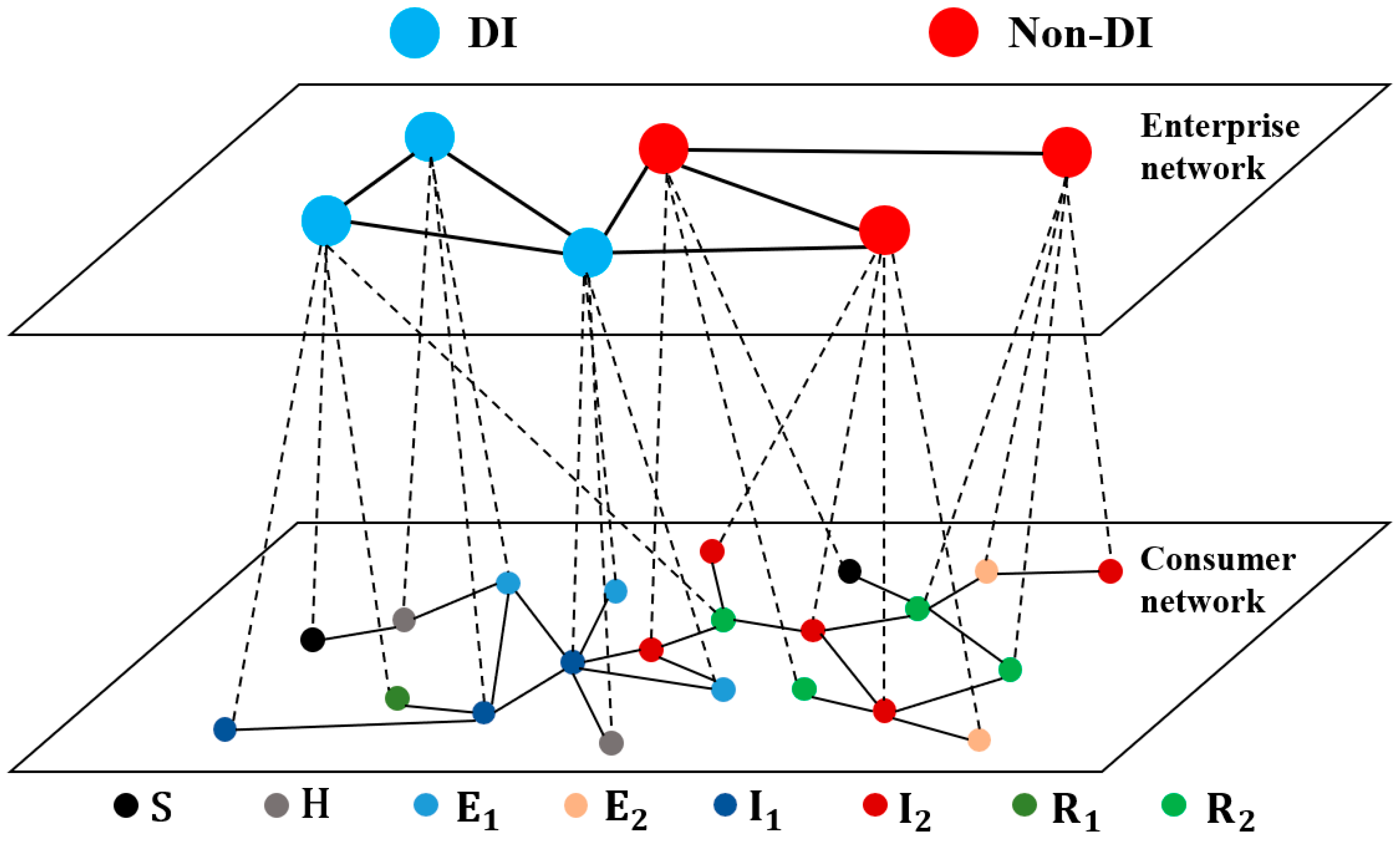
Consistent with this logic, this study asks how disruptive-innovation R&D can diffuse among NEV manufacturers. We focus on a setting in which consumer attitudes evolve through networked dissemination and enterprises’ observable strategic posture shapes consumers’ willingness to endorse and disseminate attitudes. To address this question, we develop a coupled two-layer enterprise–consumer network model that closes the feedback loop from consumer dissemination to enterprises’ perceived market potential and evolutionary strategy updating. We then conduct simulation experiments to examine three factors: enterprise modulation of consumer attitude dissemination dynamics, the consumer information environment under different policy support regimes, and network connectivity and topology. As a mechanism-oriented framework, the findings are interpreted as conditional patterns under the stated assumptions.
The major contribution of our study can be formulated as follows:
We reconceptualize NEV disruptive diffusion as an endogenous outcome of strategic enterprise market-shaping actions, network-mediated consumer belief dynamics, and evolving policy signals, rather than as a unilateral adoption curve driven by average incentives.
We synthesize DI logic with diffusion and technology acceptance mechanisms and with ecosystem complementarity constraints to build an actor-specific causal loop. In this loop, DI-stage competition operates through credibility construction and shifting evaluation criteria under uncertainty, which are mapped into consumers’ perception formation and social transmission mechanisms. These evolving beliefs then translate into changing market prospects that discipline enterprises’ strategic adaptation, while policy signals and ecosystem alignment conditions shape transition intensities and competitive viability.
We develop a tightly coupled two-layer complex-network framework that links multi-state consumer belief dynamics with adaptive enterprise strategy updating under cross-layer observability. This design addresses limitations of single-layer or weakly coupled approaches in capturing DI-stage uncertainty, feedback-driven coevolution, and policy-conditioned diffusion dynamics in the NEV context.
The remainder of this paper is organized as follows.
Section 2 presents the modeling framework.
Section 3 reports simulation design and results.
Section 4 discusses research conclusions and implications.
3. Results
3.1. Simulation Settings
To ensure the reliability and validity of the simulation results, we determine the baseline parameter values as follows: (1) Based on the study context, parameters are calibrated within the feasible ranges specified in the model assumptions. (2) We also benchmark our settings against parameter choices and calibration practices commonly adopted in related studies [
46,
61,
62].
The consumer network is built using a Barabási–Albert scale-free network structure with an average degree k = 20. The enterprise layer is constructed as a Watts–Strogatz small-world network with an average degree of 4 and a rewiring probability of 0.2, following the baseline parameterization. The linkage mechanism between the enterprise and consumer layers is established by selecting nodes from both layers to create connections until the predetermined number of links is achieved.
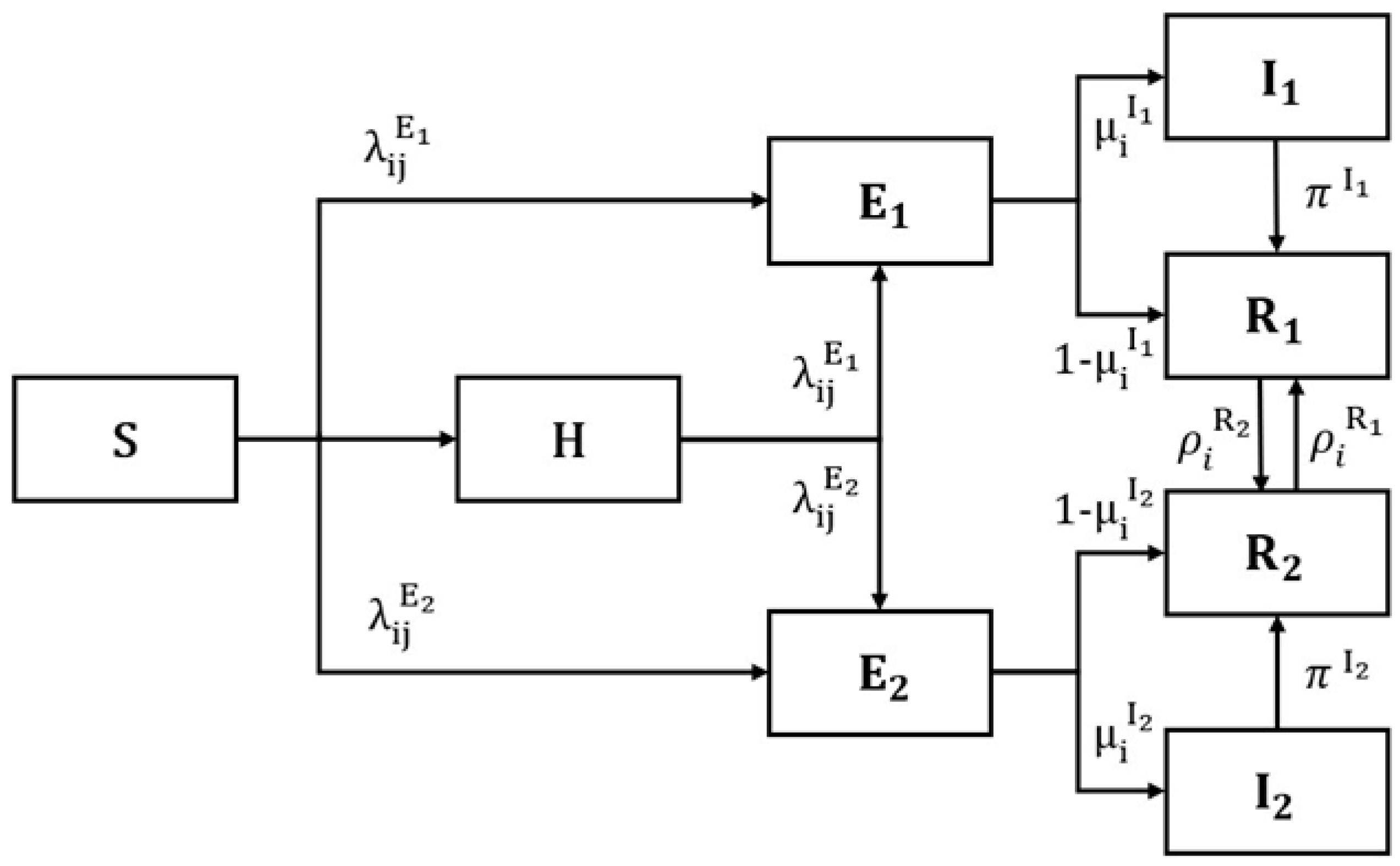
The main parameters involve strategic choices in the enterprise game model, probability functions for consumer attitude transitions. Accordingly, we set , , , , , , , , , , , , , , , , , , The basic transition probability , , , ,, and are set to 0.3. In addition, during the entire simulation, the initial values for all parameters are kept constant except for the specific parameters under examination.
Considering the uncertainty and risk in corporate research and development (R&D) strategies for DI, most automakers initially adopt a conservative stance towards DI technology. Therefore, the initial probabilities for automakers to opt for R&D strategies for DI products and to not pursue DI products R&D are set at 0.3 and 0.7, respectively. Furthermore, as consumers have little knowledge about DI products in the early stages of development, most are in the S state at the outset, with an initial probability of 0.8, while the initial probabilities for states E1 and E2 are both 0.1.
3.2. Simulation Steps
During the entire simulation, the initial values for all parameters are kept constant except for the specific parameters under examination.
The simulation process for the disruptive-innovation diffusion model is as follows:
Step 1: Construct a dual-layer coupled complex network of enterprises and consumers.
Step 2: Initialize the strategies of enterprises and the attitudes of consumers with a certain probability.
Step 3: Within the consumer layer, update the states of consumers based on the attitude dissemination mechanism.
Step 4: In the enterprise layer, calculate the cumulative expected revenue for enterprises and update the strategies of all enterprises based on the Fermi rule.
Step 5: Repeat steps 3 and 4 until the preset number of game iterations is reached.
Step 6: Collect and analyze the distribution of enterprise strategies and consumer attitudes.
3.3. Baseline Simulation
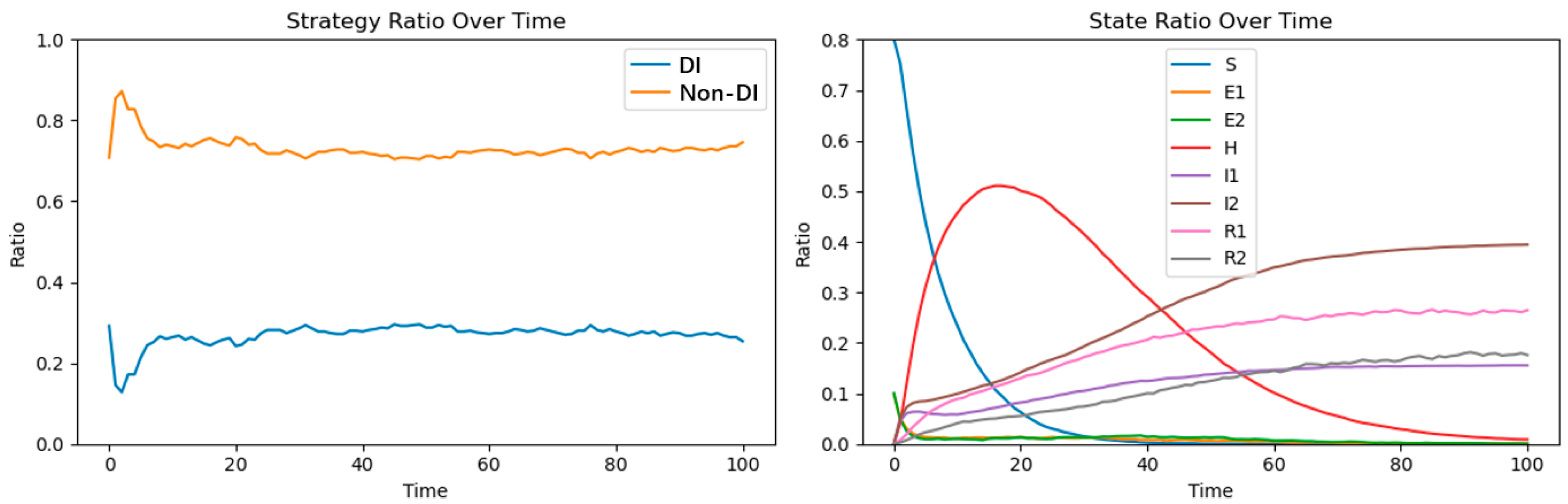
Figure 3 reports the baseline co-evolution trajectories of the enterprise strategy composition and consumer states under the initial parameter setting. The left panel shows that the share of DI-adopting enterprises increases rapidly in the early stage and then converges to a stable equilibrium slightly above 0.20, while the non-adopting strategy remains dominant. The right panel displays a consistent consumer diffusion pattern: the uninformed population declines sharply at the beginning, hesitation rises to a transient peak and then decays, and the disseminating and silent states gradually accumulate and stabilize. Taken together, the baseline simulation indicates that, given the initial incentives and network configuration, the coupled system converges to a low-adoption equilibrium for DI rather than a full-diffusion outcome.
The baseline dynamics highlight the core feedback loop in the proposed model. Early consumer exposure generates a temporary surge in belief updating and dissemination, which initially enlarges perceived market potential and supports some enterprise switching toward DI. However, as consumer state proportions stabilize and the incremental demand signal weakens, the payoff advantage of DI is insufficient to overturn the incumbent strategy at the population level, and the enterprise layer settles into a persistent mixed equilibrium with a relatively low DI adoption share. This baseline serves as the reference scenario for the subsequent structural experiments that modify the topology and connectivity of the enterprise and consumer networks.
3.4. Influence of Enterprise Modulation of Consumer Dissemination
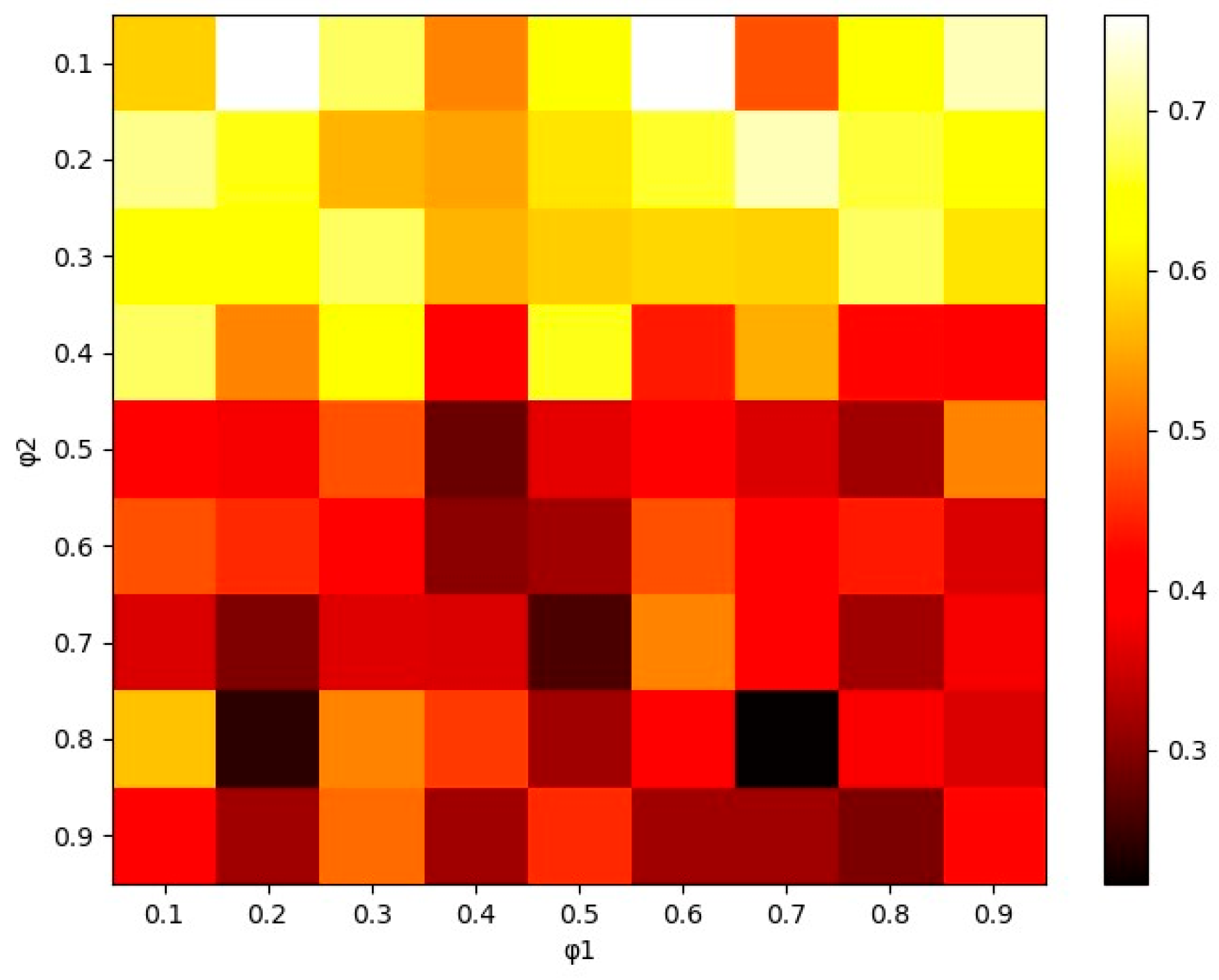
Figure 4 presents how the steady state diffusion outcome of DI in the enterprise layer, quantified by the converged proportion of enterprises adopting DI, varies with enterprises’ modulation of consumer dissemination dynamics. In this study, enterprise modulation is operationalized by
and
, which govern the extent to which enterprise posture and market facing actions amplify aligned dissemination and discourage counter attitudinal dissemination among connected consumers. Two regularities are observed. First, the equilibrium adoption level varies strongly with
. For almost any given
, increasing
is associated with a systematic reduction in the equilibrium adoption share, indicating high sensitivity to counter attitudinal discouragement intensity. Second, the equilibrium outcome is less responsive to
. Changes in aligned mobilization intensity produce comparatively modest variation and do not generate a trend comparable in magnitude to that associated with
. Taken together, the heatmap indicates that discouragement of counter attitudinal dissemination is the primary determinant of the system level diffusion outcome under the baseline setting.
The mechanism is rooted in how enterprise modulation reshapes the formation of active dissemination in the consumer network and thereby affects perceived market potential. Consumers with latent attitudes can become active disseminators, and dissemination states constitute the principal channel through which initially uninformed consumers become engaged in the diffusion process. Since uninformed consumers can update their state only after exposure to active disseminators, the size and persistence of dissemination states determine whether favorable narratives can propagate widely enough to influence enterprise expectations. Parameter captures the extent to which enterprises mobilize attitude aligned consumers into active dissemination through identity-based alignment, community engagement, and incentive compatible advocacy. Parameter captures the strength with which dissemination from counter attitudinal consumers is discouraged when enterprise strategy and consumer stance are misaligned. In the early stage, DI is typically not yet dominant among enterprises, and many latent supporters remain connected to enterprises that continue to follow the incumbent strategy. Under this configuration, a higher reduces the likelihood that latent supporters become active disseminators, limiting the probability that favorable dissemination reaches the scale required to shift perceived demand. This effect reinforces path dependence and increases the likelihood that the system converges to a low adoption equilibrium.
The dominance of has implications for key stakeholders. For enterprises, the results indicate that diffusion is constrained less by marginal improvements in activating supportive dissemination and more by whether countervailing dissemination can circulate sufficiently to reduce uncertainty and support belief revision. For consumers, higher corresponds to a more selective communication environment in which cross attitude exchange is attenuated, slowing the formation of shared expectations about DI.
3.5. Influence of the Consumer Information Environment on DI Diffusion Under Different Policy Support Regimes
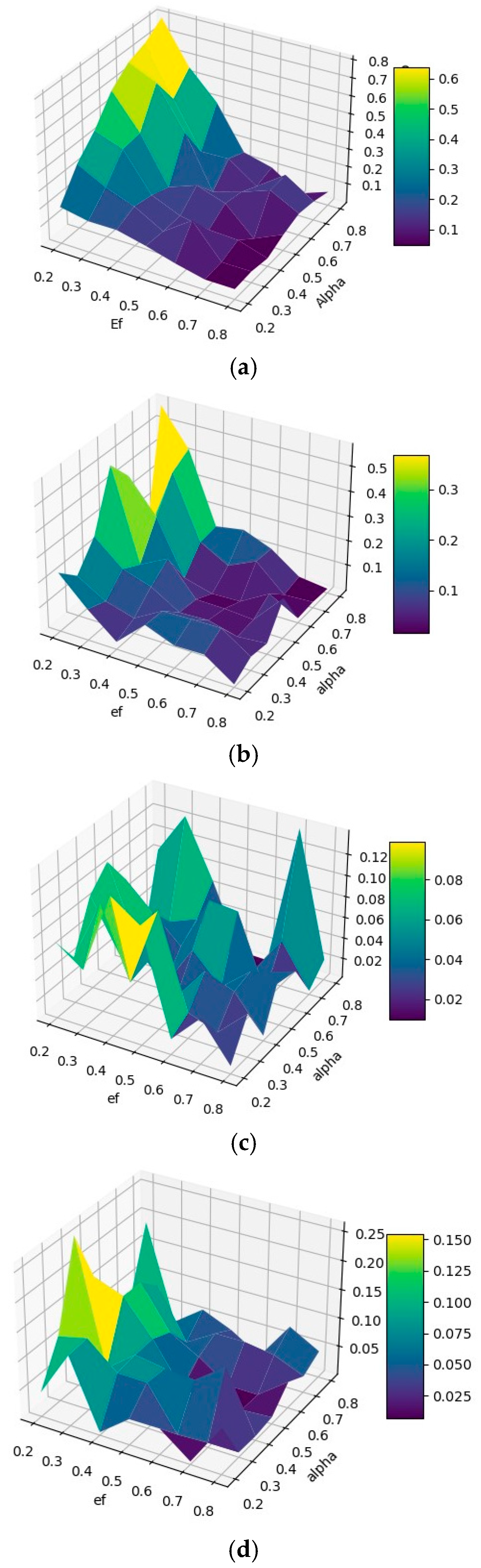
Figure 5a–c report the equilibrium share of enterprises adopting DI as a function of the consumer information parameters, the weight on public information
and the reliance on enterprise information
, under different subsidy levels. A clear regime pattern emerges. In
Figure 5a, a high adoption region concentrates in the area with high
and low
. The equilibrium adoption reaches its maximum around
and
, where the share of DI adopters approaches 0.75. Moving away from this area, either by decreasing
or by increasing
, shifts the system toward a lower adoption outcome. This indicates that DI diffusion is most likely when consumers anchor their judgements primarily on public policy signals and rely less on enterprise released information. When the subsidy level decreases to
in
Figure 5b, the location of the high adoption area remains broadly consistent, but the attainable adoption level declines. Even at
and
, the equilibrium adoption falls to slightly above 0.5. Under the low subsidy setting
in
Figure 5c, the system converges to a predominantly low adoption outcome across the
and
domain, with limited responsiveness to further changes in information weights. This suggests that once financial support is sufficiently weak, changing the composition of information reliance alone is not sufficient to lift the system out of a low adoption equilibrium.
These patterns arise from the coupled feedback between consumer belief formation and enterprise strategy updating. A larger increases the salience of public signals and improves their credibility in consumer judgment, which reduces uncertainty and facilitates the spread of favorable beliefs through social interaction. A smaller weakens the role of enterprise released information in shaping expectations, allowing public signals and peer influence to play a greater role in attitude formation. When subsidies are sufficiently strong, these information conditions translate into higher perceived market potential, increase the relative payoff of adopting DI, and support a self reinforcing diffusion process through evolutionary updating. As subsidies decline, the payoff advantage shrinks and path dependence strengthens. Under that condition, even sizeable adjustments in and do not generate sufficient favorable dissemination to raise perceived demand and overturn the incumbent strategy. The results indicate that policy effectiveness depends on the joint operation of material incentives and credible public information, rather than on either component in isolation.
Figure 5d shows that the low subsidy outcome is not fully irreversible when discouragement of counter attitudinal dissemination is reduced. Under
, lowering
to 0.2 reintroduces a discernible area of higher adoption. The equilibrium adoption reaches its local maximum when
is around 0.5 and
remains low, where the adoption share rises to roughly 0.25. Relative to
Figure 5c, the diffusion outcome becomes more responsive to information composition when
is lower, and the area supporting diffusion shifts from requiring very high
toward a more balanced role of public information and social learning, together with limited reliance on enterprise released information.
Mechanistically, a lower weakens the extent to which enterprise consumer links discourage the activation of disseminators whose stance is misaligned with the connected enterprise strategy. This increases the likelihood that cross attitude information exchange persists in the consumer network, enabling favorable dissemination to reach a scale that can modify perceived market potential even when subsidies are low. These results highlight, within the simulation setting, that information conditions can complement material incentives in shaping diffusion outcomes, especially under low-subsidy regimes.
For readability,
Table 2 summarizes the key cross-panel contrasts in
Figure 5, including the approximate peak adoption levels and their locations under each policy regime and modulation setting. This compact comparison complements the 3D surfaces and facilitates direct interpretation across panels.
3.6. Influence of Network Connectivity and Topology on DI Diffusion
3.6.1. Influence of Inter-Enterprise Connectivity on DI Diffusion
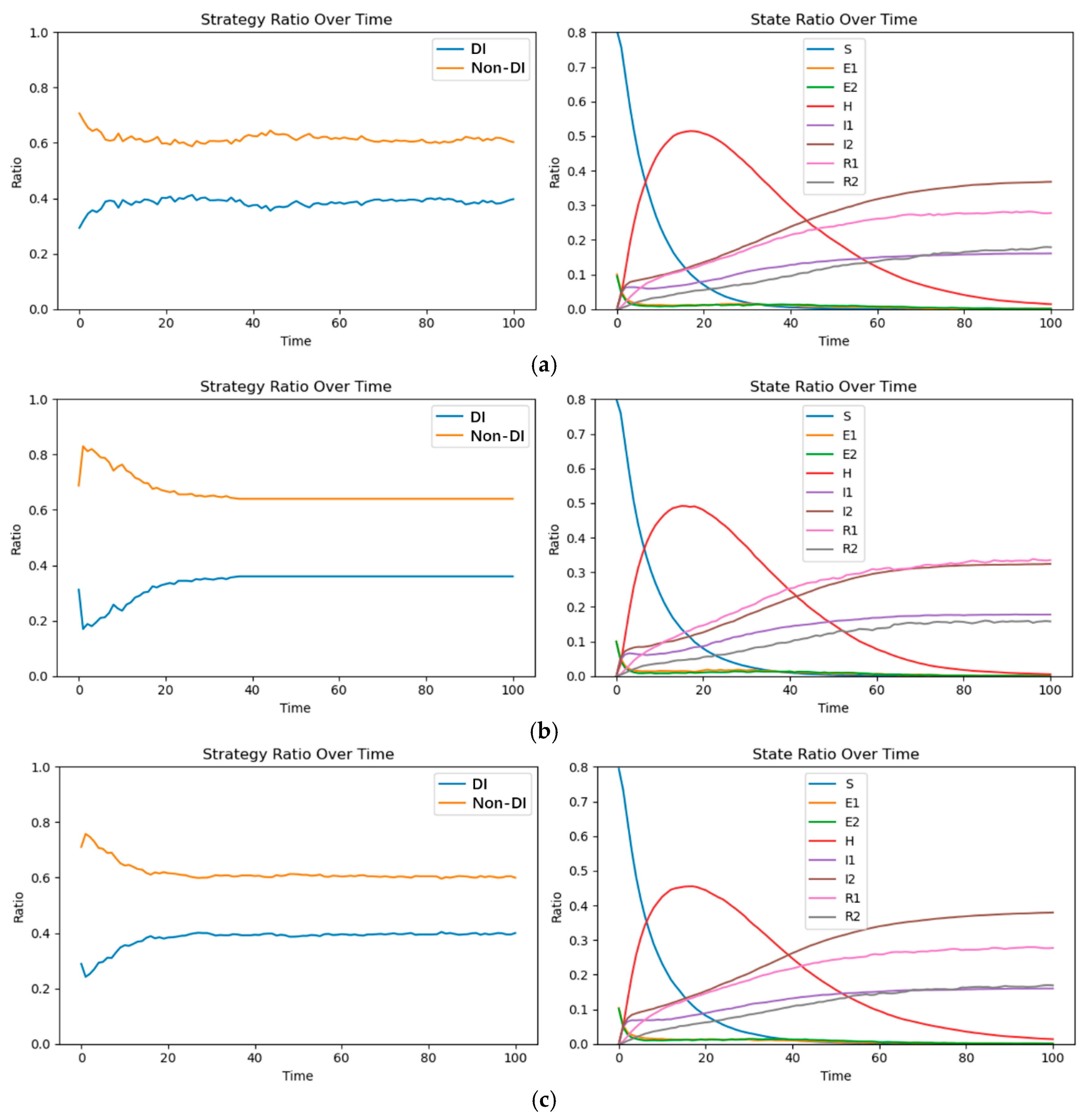
Figure 6a examines the effect of stronger inter-enterprise connectivity by increasing the average degree of the enterprise small world network from 4 to 8 while holding all other parameters fixed. The enterprise trajectory converges to a substantially higher equilibrium DI adoption level, approaching 0.40. This indicates that denser inter-enterprise connections facilitate the propagation of the DI strategy across the enterprise layer and lead to a higher steady state diffusion level.
Mechanistically, increasing enterprise connectivity enlarges the effective neighborhood through which enterprises observe payoffs and update strategies under the Fermi rule. This accelerates the spread of comparatively advantageous strategies and reduces the persistence of locally trapped configurations. In system terms, higher enterprise connectivity strengthens the link between payoff heterogeneity and evolutionary updating, enabling DI to diffuse more effectively once favorable signals emerge.
3.6.2. Influence of the Consumer Interaction Environment on DI Diffusion
Figure 6b isolates the role of the consumer interaction environment by replacing the consumer layer topology from a scale free network to a small world network while keeping the rest of the model unchanged. The scale free topology reflects a hub dominated online interaction structure, whereas the small world topology approximates locally clustered offline social relationships [
46,
63]. The equilibrium DI adoption share increases to roughly 0.35 to 0.40, indicating that an offline-like consumer environment can support stronger diffusion of DI at the enterprise level.
This effect is consistent with the structural properties of small world networks. High clustering supports repeated local reinforcement and the formation of coherent attitude clusters. Short path lengths allow information to reach distant parts of the network efficiently through a limited number of bridging links. In the coupled system, these properties increase the likelihood that favorable dissemination reaches a critical scale, improves perceived demand, and feeds back to enterprise payoffs, thereby facilitating DI diffusion.
3.6.3. Influence of the Breadth of Consumer Interaction on DI Diffusion
In this study, we further examine how changes in the average degree of the consumer network, which proxy the breadth of consumer interaction, influence the diffusion of DI. Varying the average degree in an online social environment represented by a scale free network and in an offline social environment represented by a small world network provides a distinct lens for understanding how social network structure conditions technology diffusion.
Comparing
Figure 3 and
Figure 6c, we observe that diffusion is strengthened when the average degree of the online consumer network decreases. Specifically, when the average degree is reduced from 20 to 10, the equilibrium share of enterprises adopting DI rises from below 0.30 to approximately 0.40. This pattern suggests that, in heterogeneous online environments, reducing the number of information sources can increase the salience of dominant signals and facilitate their propagation, particularly under information overload. The result implies that, to enhance market acceptance of new technologies, enterprises and policymakers may prioritize strategies that leverage influential nodes and credible intermediaries rather than relying on undifferentiated mass broadcasting.
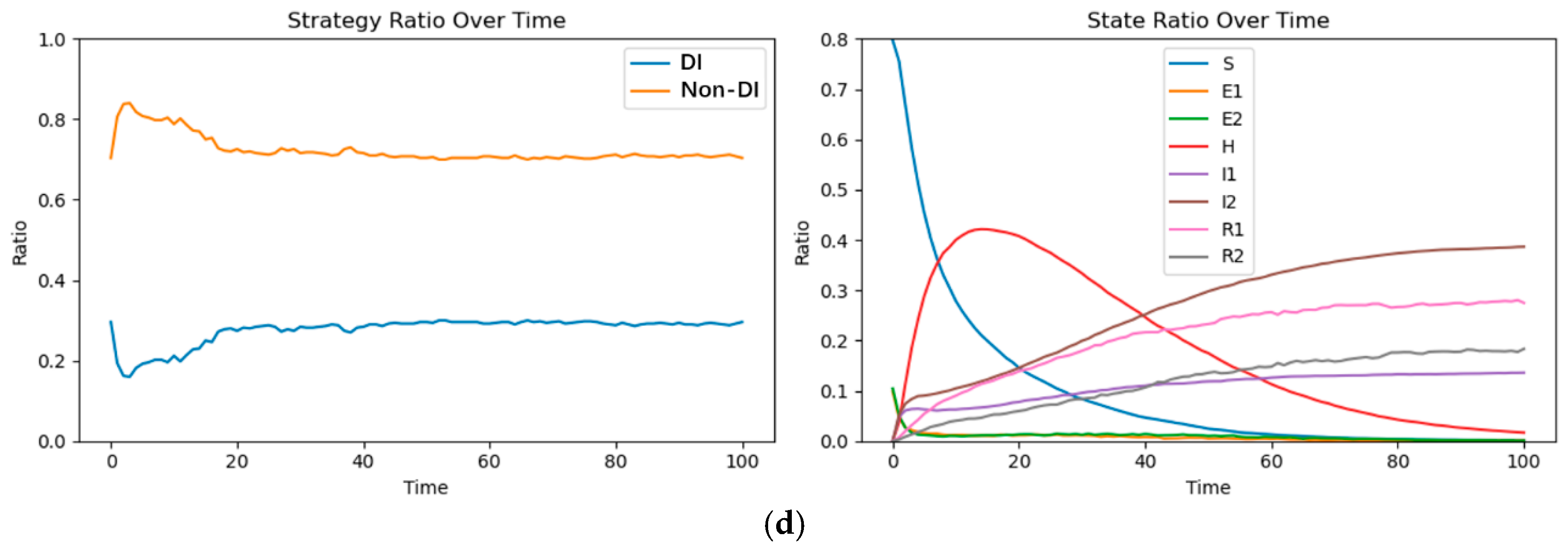
In contrast, comparing
Figure 6b,d shows that diffusion weakens when the average degree of the offline consumer network decreases. When the average degree is reduced from 20 to 10 in the small world consumer network, the equilibrium adoption share declines from around 0.40 to roughly 0.30. This finding highlights the diffusion potential of offline social interaction, especially when networks exhibit strong local cohesion and bridging ties across communities. It also underscores the importance of face-to-face engagement in accelerating diffusion and suggests that enterprises may benefit from investing more in experiential and community-based interactions to reinforce beliefs and support adoption. To facilitate comparison of experimental results, we compared the baseline simulation with the four sets of simulations in this section, as shown in
Table 3.
4. Research Conclusions and Implications
4.1. Research Conclusions
This study uses a dual-layer coupled enterprise–consumer network model to explain how DI diffusion unfolds in the NEV sector under policy-driven incentives and heterogeneous information transmission. Three conclusions emerge.
First, enterprise adoption is governed by a co-evolutionary feedback between consumer belief diffusion and enterprise strategy updating. When favorable consumer dissemination expands, enterprises infer stronger market potential, which raises the relative payoff of adopting DI under the evolutionary updating rule. As more enterprises adopt, enterprise-side signals further reshape consumer attitudes, forming a self-reinforcing loop. When this loop is weak, the system remains in a low-adoption equilibrium.
Second, discouragement of counter-attitudinal dissemination is the dominant cross-layer lever shaping the diffusion equilibrium. Variation in the discouragement intensity parameter has a strong and systematic effect on the equilibrium adoption share, whereas aligned mobilization intensity generates comparatively smaller changes. This implies that diffusion barriers arise less from insufficient activation of supportive dissemination at the margin, and more from the suppression of cross-attitude information exchange that would otherwise enable belief updating and uncertainty reduction.
Third, policy support and the consumer information environment jointly determine whether the system can escape low-adoption lock-in. Under higher subsidies, diffusion improves most when consumers place greater weight on public information and rely less on enterprise-released information. As subsidies decline, the system becomes less responsive to information reweighting and converges to low adoption. However, the low-subsidy regime is not fully irreversible. When discouragement of counter-attitudinal dissemination is reduced, diffusion pockets re-emerge even under weak financial support, indicating that information governance conditions can partially compensate for constrained incentives.
Finally, network structure conditions the strength and direction of these mechanisms. Denser inter-enterprise connectivity increases equilibrium adoption by accelerating imitation and reducing local trapping. On the consumer side, topology matters: a small-world offline-like interaction environment supports stronger diffusion than a scale-free online-like environment under the same parameters, and the effect of reducing interaction breadth is topology dependent, strengthening diffusion in the scale-free case but weakening diffusion in the small-world case. These results highlight that diffusion is shaped not only by incentives and signals, but also by structural constraints on exposure and reinforcement.
4.2. Policy and Managerial Implications
Taken together, these findings yield several important implications for policy design and strategic management.
For government, the results imply that effective NEV transition may benefit from coordinated interventions on incentives and information governance. Subsidies remain important for shifting the payoff landscape, especially in early diffusion stages. Under limited fiscal space, regulators can target the information side by strengthening transparency and independent evaluation and by protecting fair access to technology-related information, so that cross-attitude exchange is not systematically discouraged. Such measures reduce uncertainty and improve the chances that favorable beliefs reach the scale needed to alter market expectations.
For enterprises, the findings suggest that strategy should combine capability building for aligned mobilization with restraint in discouraging countervailing dissemination. Credible engagement and incentive-compatible advocacy can support diffusion, but the simulations also highlight that diffusion can be constrained in environments where opposing views are suppressed and belief revision slows. Enterprises therefore benefit from communication strategies that emphasize verifiable information, third-party validation, and open comparison, which can broaden trust and accelerate convergence toward shared expectations. In addition, managers should leverage inter-enterprise connectivity through alliances, standard-setting, and knowledge exchange to reduce uncertainty and speed up best-practice diffusion.
For consumers and platforms, the model indicates that the diversity and openness of information exposure affect system-level transition. When cross-attitude exchange persists, consumers can update beliefs more effectively, which improves market coordination and reduces the likelihood of being trapped in low-adoption equilibria. Platform governance that curbs manipulation and improves information quality can therefore play a supportive role in NEV diffusion.
4.3. Limitations
Finally, this study has several limitations. First, the framework is mechanism oriented. It is intended to identify conditional diffusion regimes under explicit assumptions rather than to deliver point prediction for the full Chinese NEV market. Relatedly, key behavioral and network parameters are specified as exogenous baseline settings; while the sensitivity and structural experiments support robustness at the mechanism level, empirical calibration with enterprise and consumer data would strengthen external validity and support stronger quantitative inference. Second, the enterprise layer abstracts from additional market mechanisms, including firm heterogeneity, endogenous pricing, sustained price competition, and supply-side constraints. These factors may affect diffusion speed and shift steady-state adoption levels. Third, the consumer layer represents attitude formation and dissemination through stylized state transitions. It does not explicitly incorporate cognitive biases, platform-specific curation, or more granular psychological processes. These features may affect exposure, belief revision, and the persistence of attitudes. Fourth, network structure and inter-layer linkage are modeled using stylized topologies and simplified coupling rules. Empirically reconstructed networks or alternative coupling logics may lead to different quantitative thresholds. Therefore, the policy and managerial implications should be interpreted as mechanism informed and conditional. Future work may integrate empirical estimation, richer competition mechanisms, and more realistic information environments while preserving the coupled co-evolutionary structure developed here.