1. Introduction
Generative artificial intelligence (GenAI) has rapidly become a central force across industries due to its ability to autonomously generate text, images, video, and other creative outputs [
1]. As these systems mature, their presence is particularly felt in domains where creativity, authorship, and originality were once considered uniquely human. The creative industries, spanning design, media, fashion, and advertising, are experiencing fundamental changes in how content is produced, evaluated, and monetized, due to the omnipresence of GenAI tools [
2].
The adoption of GenAI in these sectors brings clear benefits: it reduces time spent on routine tasks, expands access to creative tools, and enables rapid ideation and prototyping. However, it also disrupts traditional models of creative labor and raises complex questions about intellectual property, human–AI collaboration, and the future of professional identity in creative work [
3].
These tensions have sparked intense academic and public debate, as well as a growing body of research across disciplines. Scholars have examined how GenAI both augments and disrupts creative practices. For example, Ref. [
4] demonstrates that AI-assisted collaboration can improve the quality of creative output but may reduce the diversity of ideas in group settings. In design-oriented research, Ref. [
5] highlights that GenAI enables faster ideation and prototyping, yet it also introduces legal and ethical uncertainties, especially regarding intellectual property and algorithmic bias.
Beyond academia, public discourse reflects widespread concern among professionals about the unlicensed use of creative works in AI training datasets. A prominent example is the reaction of over 11,000 artists who publicly opposed the unauthorized use of their content to train GenAI systems [
6]. These developments show that the impact of GenAI on creative work is not only technological but also social, legal, and deeply cultural, warranting integrative approaches across disciplines. To structure the interpretation of the findings, this review draws on theoretical perspectives from creative ecosystems, socio-technical systems, and platform economy theory. These frameworks offer complementary lenses for analyzing the evolving role of GenAI in creative production, institutional change, and value creation across digital platforms.
Despite growing academic interest in GenAI, only a limited number of systematic reviews have addressed its implications for the creative industries in a structured, interdisciplinary manner. Among the most relevant recent studies, Ref. [
7] conducted a systematic review of 64 papers on generative artificial intelligence in creative contexts, focusing on the intersection of GenAI with creativity in art and music. However, this review addressed creative industries only marginally and did not frame them as systemic socio-technical environments. Ref. [
8] offered a meta-analysis evaluating the effects of GenAI on creative performance, particularly originality and diversity, using terms such as “large language models” and “ideation.” While methodologically rigorous, their study did not explore sectoral transformations or structural dynamics. Ref. [
9] presented a scoping review of GenAI applications among creative professionals, emphasizing empirical insights from design and media fields but without providing bibliometric or thematic mapping. In a broader technological review, Ref. [
1] examined methods and applications of GenAI across multiple domains—focusing on technical advances such as transformers, diffusion models, and image synthesis—without thematically addressing creative industries. Ref. [
10] explored GAN-enabled collaborative design tools, offering a technically rich discussion of visual design processes and human–computer interaction, though the paper lacked analysis of organizational or economic implications. These reviews provide valuable insights into specific aspects of GenAI and creativity, but none offer a structured, bibliometric, and thematically grounded synthesis of how GenAI is conceptualized and studied across the creative industries as a field. This paper aims to fill that gap.
Heigl [
7] conducted a systematic review of 64 studies, primarily exploring how GenAI affects individual creative processes such as co-creation, digital aesthetics, and content generation, with a focus on human–AI interaction in design and media domains. Holzner et al. [
8] conducted a meta-analysis examining the impact of GenAI tools on creative performance, particularly in terms of originality and idea diversity. However, they did not extend the analysis to sector-level implications. Tsao [
9] conducted a scoping review of GenAI use in professional creative practice, mapping real-world applications by artists and designers and highlighting integration challenges. However, it remained primarily descriptive and lacked a structured bibliometric approach. Broader technical reviews, such as Sengar et al. [
1], who analyze state-of-the-art GenAI techniques across domains, and Hughes et al. [
10], who focus on the use of generative adversarial networks (GANs) in collaborative visual design, provide valuable insight into technological advances, but do not investigate the organizational, cultural, or economic transformations underway in the creative industries.
In brief, these studies mostly remain focused on individual creative processes or technical capabilities, rather than on the broader systemic changes affecting the structure, labor models, and institutional logic of the creative economy. Understanding these transformations is critical not only from a research perspective but also from policy, labor law, and educational standpoints.
As GenAI technologies become embedded in production processes, they reshape skill demands, disrupt established creative professions, and pose complex questions about copyright, attribution, and fair compensation [
11,
12]. Policymakers and educators require a clearer evidence base to anticipate these shifts and develop informed frameworks for regulation and curriculum development [
13]. Moreover, the creative industries represent early examples of data-driven business ecosystems, in which value creation is increasingly shaped by algorithmic processes, platform economies, and hybrid workflows involving both human and machine agents [
14]. In practical terms, this implies the emergence of new roles (e.g., prompt engineers, AI curators), reconfiguration of revenue models (e.g., platform-based monetization), and altered power relations between creators, platforms, and audiences [
15]. In this study, creative industries are conceptualized as socio-technical ecosystems in which creative value emerges through the interaction of human creators, generative technologies, platform infrastructures, and audiences.
Despite the growing volume of research on GenAI in creative contexts, existing reviews predominantly focus on either technical developments or micro-level creative processes, offering limited insight into the broader structural and systemic transformations of the creative industries. In particular, there is a lack of integrative analyses that combine bibliometric mapping with a theoretically informed interpretation of how generative AI reshapes creative labor, organizational practices, and value creation mechanisms at the industry level.
The purpose of this study is to conduct a structured bibliometric analysis, combined with keyword co-occurrence analysis, of the literature on generative artificial intelligence in the creative industries to inform a future-oriented research agenda. Specific research objectives are as follows:
RO1: To conduct a bibliometric analysis to investigate temporal trends, diversity across disciplines and countries, publication venues, document types, and the most influential publications on GenAI in the creative industries
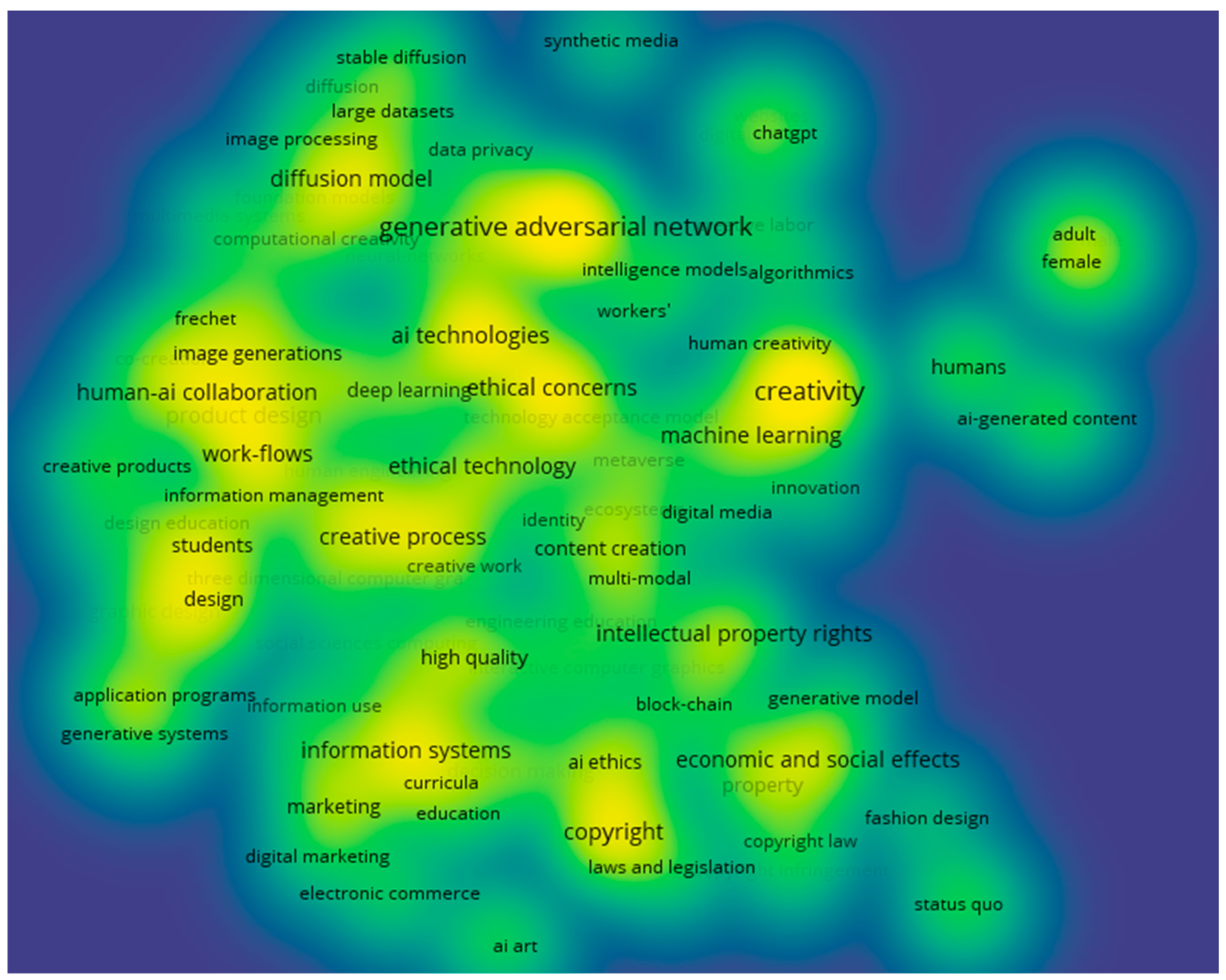
RO2. To map and visualize the density of research on GenAI in the creative industries
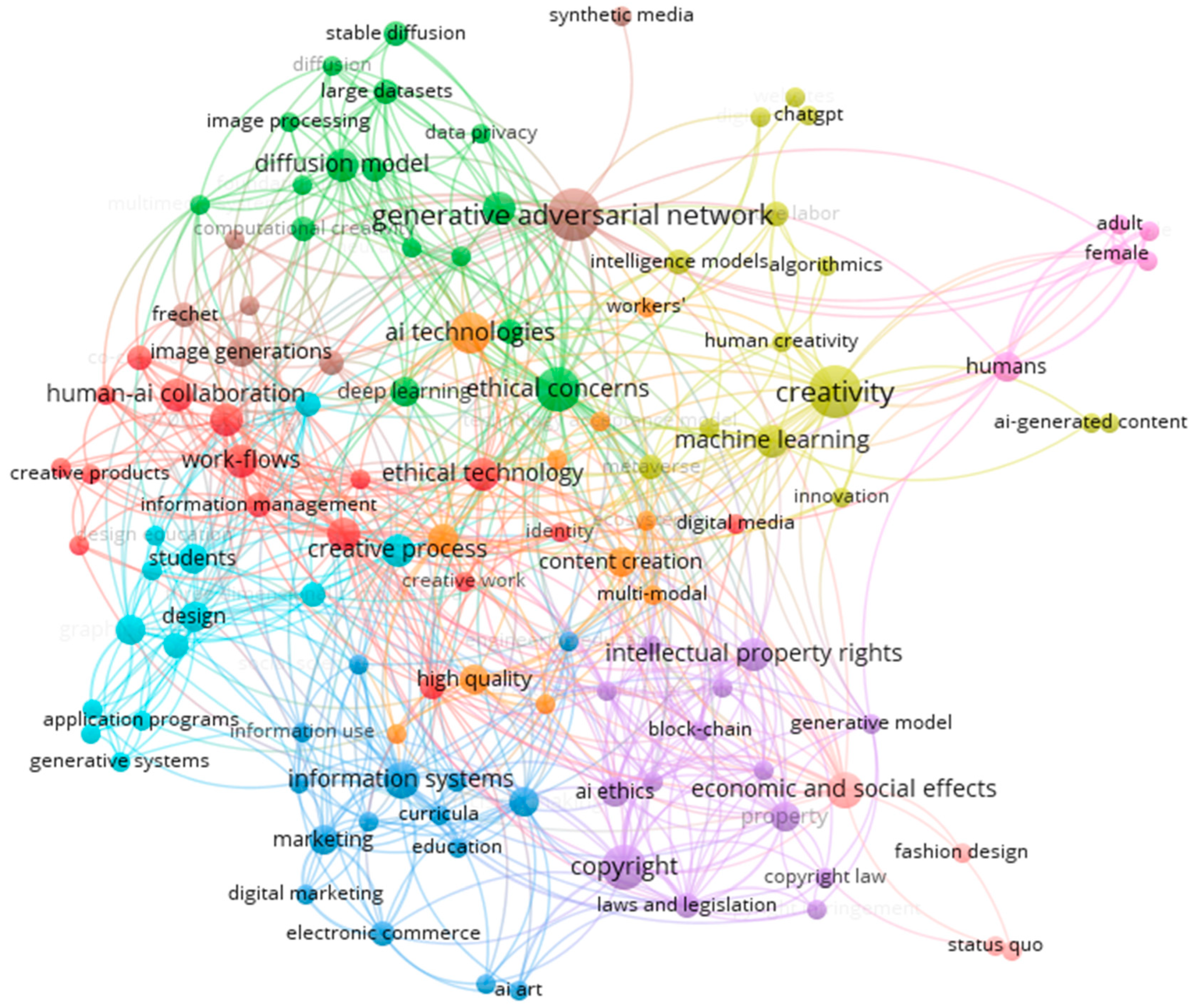
RO3. To interpret the identified thematic clusters of research on GenAI in the creative industries
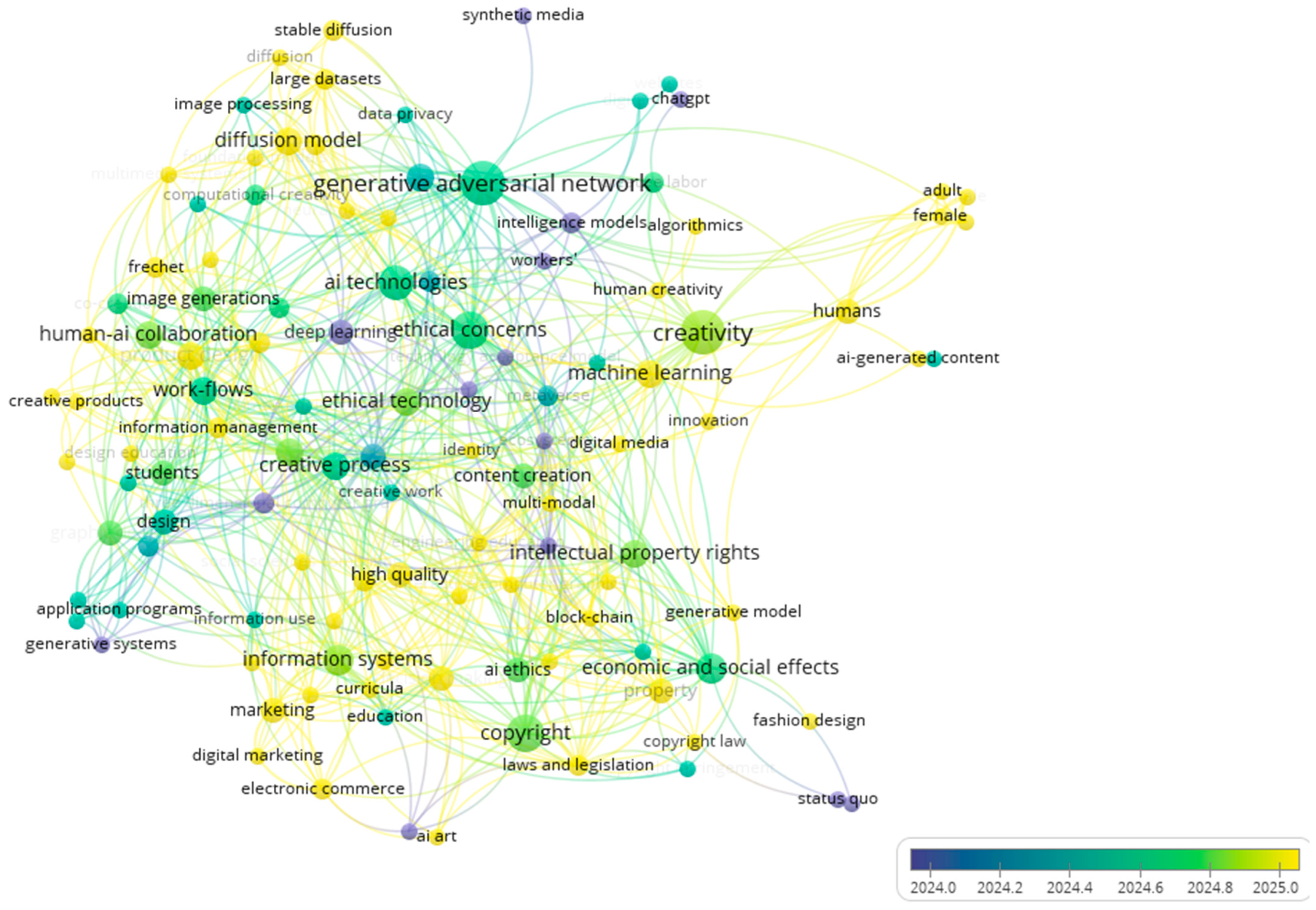
RO4. To analyze the temporal evolution of research themes on GenAI in the creative industries
By addressing these objectives, this review makes three key contributions. First, it provides a structured, bibliometric overview of the rapidly expanding literature on generative AI in creative industries, offering transparency and reproducibility in line with PRISMA 2020 guidelines. Second, it advances a system-level perspective that complements existing micro-level and technology-focused reviews by foregrounding organizational, economic, and institutional dimensions. Third, it identifies underexplored research gaps and future directions, particularly concerning governance frameworks, labor transformation, and the long-term sustainability of creative ecosystems shaped by generative AI.
While several reviews have mapped the technical progress of GenAI in specific creative domains, few have adopted a systemic perspective that considers how GenAI reshapes institutional structures, labor dynamics, and platform governance in the creative industries. Existing reviews often focus narrowly on tool performance, artistic collaboration, or single-sector applications. This review addresses that gap by combining bibliometric mapping with thematic cluster analysis to examine how GenAI reconfigures creativity not only at the level of tools and practices but across broader socio-technical and economic systems.
2. Methodology
To systematically examine how GenAI is transforming the creative industries, we conducted a structured literature review integrating bibliometric and thematic methods. The methodological approach is detailed below.
2.1. Review Protocol
This study applies a systematic literature review (SLR) methodology to examine how GenAI is reshaping the creative industries. The review follows the PRISMA 2020 (Preferred Reporting Items for Systematic Reviews and Meta-Analyses) framework, which provides a structured and transparent protocol for identifying, screening, and selecting relevant literature [
16]. PRISMA is increasingly used in social sciences, business, and interdisciplinary research to enhance methodological rigor, minimize bias, and ensure replicability [
17,
18].
Given the multidimensional character of GenAI’s impact, which spans the creative industries along multiple dimensions, such as technology, creativity, labor, intellectual property, and organizational change, this review combines bibliometric analysis with thematic synthesis. Through bibliometric analysis [
19], we capture structural patterns in a growing, fragmented field, such as GenAI deployment in the creative industries, analyzing the timeline of publications, authorship, publication venues, and citations. Thematic analysis is also used to conduct keyword co-occurrence analysis, identifying recurrent themes, conceptual clusters, and relationships among the core topics addressed in the literature.
2.2. Search Strategy, Screening, and Selection Process
The Scopus database was selected as the primary source for this review due to its comprehensive coverage of peer-reviewed literature across fields relevant to this study, including business, management, the social sciences, the arts, and interdisciplinary studies [
20].
The search was conducted in three stages in November 2025. Firstly, a Boolean query was developed to capture the intersection of GenAI and the creative industries. The search was applied to the title, abstract, and keywords fields, using the two sets of keywords. First, we used (i) keywords related to GenAI (“Generative Artificial Intelligence”, “Gen AI”, “Generative AI”), extended with names of commonly used GenAI tools in creative industries (“Midjourney”, “Stable Diffusion”, “ChatGPT”, “DALL-E”), and (ii) keywords reflecting the terminology used to describe creative industries (“Creative Industr*”, “Creative Sector*”, “Creative Business*”, “Creative Economy”). This approach yielded 146 documents. The specific GenAI tools, such as Midjourney, were selected because they are the most prominent generative platforms used in design, media, fashion, and content creation as of 2023–2025 [
21]. Including platform-specific keywords ensures that applied, practice-driven studies are not missed due to purely generic indexing. Throughout the paper, the abbreviation “GenAI” is used as a standardized term, while full expressions (“Generative Artificial Intelligence”, “Generative AI”) appear only in formal contexts such as search queries, definitions, or cited paper titles.
Secondly, to ensure methodological rigor, the following inclusion and exclusion criteria were applied: (i) Language: only publications written in English were considered; (ii) Document types included: peer-reviewed journal articles, conference papers, and book chapters; and (iii) Document types excluded: editorials, notes, errata, and books, due to their limited academic contribution or lack of peer review. This stage resulted in 136 documents.
The final stage was relevance-based screening of the retrieved papers to include a diverse yet coherent corpus of scholarly perspectives on GenAI in creative sectors and work. Titles and abstracts were assessed to determine if GenAI addressed creative practice, labor, cultural production, or business aspects of the industry. However, some technologically focused or artistically driven studies were also retained if they offered insights into creative processes or industry impact. Only publications that were clearly unrelated to creative domains or focused solely on technical model development without regard to creative production, industry practices, or socio-economic ramifications were removed. The screening process resulted in 119 papers.
This approach follows systematic review guidelines for fast-moving research topics, where overly restrictive criteria may prematurely remove relevant contributions and conceal emergent themes [
22]. By deploying this angle, our review shows how GenAI is conceptualized and deployed across creative sectors, prioritizing thematic relevance over tight disciplinary boundaries. The selection process is summarized in
Table 1, resulting in a final dataset of 119 publications, which are used as the basis for subsequent bibliometric mapping and thematic synthesis, presented in the following sections.
2.3. Data Extraction and Analysis
Following the screening process, a final corpus of 119 publications was selected for complete analysis, which was conducted in two phases (
Table 2). The combination of bibliometric and thematic analyses was employed, following the approach proposed by [
23].
Firstly, the following information was extracted into a spreadsheet for the bibliometric analysis: author, document title, publication title, year of publication, author institutions and countries, financing bodies, paper abstract, author keywords, and Scopus keywords.
Secondly, the above-mentioned data were extracted in RIS format, which served as the basis for thematic analysis, conducted using VosViewer [
24], a well-established tool for constructing and visualizing bibliometric networks. A minimum of 2 keyword occurrences per document was set, consistent with prior VOSviewer-based bibliometric analyses, such as [
25].
As a further refinement step, generic umbrella terms with limited discriminative value (e.g., artificial intelligence, GenAI, creative industry, creative professionals, article) were excluded, as their high frequency and centrality tend to obscure finer-grained thematic structures. In addition, a thesaurus file was applied to consolidate synonymous and overlapping expressions. For example, highly generic terms such as “technology” or “algorithm” were removed, while more specific expressions like “text generation” or “image generation” were retained. Similarly, closely related variants (e.g., “AI-generated art” and “generative art”) were merged under a unified label to reduce redundancy. These preprocessing decisions enhance interpretive validity by improving thematic resolution and ensuring that detected clusters reflect substantively distinct research directions rather than frequency-driven noise. After these filtering and normalization procedures, the final set was curated to 115 keywords, which served as the basis for keyword co-occurrence analysis and cluster detection.
2.4. Methodological Reliability, Limitations, and Systemic Design
To ensure methodological transparency and minimize bias, all stages of the review process, identification, screening, selection, and analysis, were conducted independently by the authors and cross-checked through iterative discussion. The adoption of PRISMA 2020 guidelines reinforced replicability, analytical structure, and procedural clarity throughout the review protocol [
16].
Nonetheless, several limitations should be acknowledged. The decision to rely exclusively on the Scopus database, while justified by its robust and interdisciplinary coverage of peer-reviewed journals in business, management, the social sciences, and the arts, may have excluded relevant studies indexed in other databases such as Web of Science, IEEE Xplore, or the ACM Digital Library. Scopus was selected because it offers broader coverage of social science and creative industry journals compared to Web of Science and provides standardized metadata compatible with bibliometric tools such as VOSviewer. Including multiple databases would have substantially increased duplication and required a more complex deduplication protocol, which was beyond the scope of this review. Nevertheless, future research could benefit from integrating multiple databases to further enhance coverage and robustness.
This limitation is particularly relevant in fast-evolving domains such as AI governance, digital ethics, and creative technology, where emerging insights often appear in less traditionally indexed outlets or grey literature [
26]. Another limitation concerns the language and document-type filters applied. While focusing on English-language peer-reviewed journal articles, conference papers, and book chapters ensured quality and consistency, it may have excluded valuable contributions published in other languages or in non-traditional formats. In technical fields such as software engineering, grey literature reviews have been shown to offer significant insights [
27,
28]. However, this review focuses not on the technical implementation of GenAI, but on its broader implications for the creative industries.
4. Discussion and Conclusions
4.1. Summary of Research
This paper presents a structured synthesis of the emerging literature on GenAI in the creative industries, covering the period from 2023 to 2025. All research objectives outlined in the introduction were systematically addressed: RO1 through temporal and disciplinary bibliometric analyses; RO2 and RO3 through keyword co-occurrence mapping and cluster detection; and RO4 through tracking the temporal evolution of research themes. By applying bibliometric techniques and thematic keyword analysis to a curated set of Scopus-indexed publications, the review identifies key research domains, evolving trends, and conceptual relationships. The analysis highlights nine thematic clusters, ranging from technical model development and design practices to legal frameworks, labor dynamics, and organizational adaptation. The presented results enable a clearer understanding of how generative AI is reshaping the creative ecosystem at the levels of tools, workflows, institutions, and markets.
4.2. Theoretical Contributions and Research Agenda
This review makes three distinct contributions to the literature on GenAI in the creative industries, addressing conceptual, methodological, and agenda-setting levels.
At the conceptual level, it advances prior literature reviews on creativity and GenAI by repositioning creativity from an individual- or task-level outcome [
7,
8] to a systemic property of creative ecosystems. Rather than treating generative AI primarily as a creativity-enhancing tool, the review conceptualizes creativity as increasingly shaped by organizational arrangements, platform logics, and data-driven infrastructures. This shift broadens existing creativity-focused accounts toward a more contextualized understanding of creative production.
At the methodological level, the review extends research on professional creative practice and workflows [
9] by embedding human–AI collaboration within organizational and labor structures. While earlier studies focused on how creative professionals use GenAI, this review highlights how such use is conditioned by changing employment relations, emerging roles, and institutional constraints. In doing so, it connects micro-level collaboration dynamics with meso-level organizational transformation.
At the agenda-setting and policy-relevant level, the review complements technically oriented surveys of generative models and applications [
1,
10] by introducing market, governance, and decision-making contexts as integral components of the theoretical landscape. By identifying clusters related to platform governance, value redistribution, and strategic decision-making, the review expands the analytical scope of GenAI research beyond performance and architecture toward economic and policy-relevant dimensions.
Building on the contributions summarized in
Table 7, we formulate a forward-looking research agenda in areas that remain theoretically underdeveloped or empirically overlooked.
Table 8 summarizes the proposed research agenda by aligning specific gaps with the broader theoretical domains introduced earlier. Each entry captures a concise research direction, offering a question-driven structure supported by appropriate methodological suggestions and data types. The final two columns clarify how each direction builds on the review’s theoretical contributions and its practical relevance for future academic, policy, or industry initiatives.
We have derived a research agenda through an integrative process: the thematic cluster analysis revealed underexplored areas; these were cross-referenced with gaps in the existing literature (as discussed in
Table 7) and then formulated into actionable, theoretically grounded research questions. In doing so, the agenda provides a structured foundation for advancing both scholarly inquiry and real-world applications in the evolving landscape of generative AI in the creative industries.
In the creativity domain, future studies are encouraged to move beyond isolated task-level assessments and investigate how platform infrastructures and data biases shape creative outcomes and cultural representation. Within the workflow domain, empirical work is needed to unpack the organizational and labor conditions that enable or constrain meaningful human–AI collaboration, particularly in dynamic or precarious creative sectors. Finally, in the technical model’s domain, research should not only track architectural progress but also interrogate the redistribution of value, legal accountability, and geographical disparities emerging from AI deployment. In particular, the analysis reveals geographic asymmetries in both research production and platform ownership, with institutions and companies based in North America and parts of East Asia dominating publication output, funding, and infrastructure development. This imbalance raises concerns regarding language representation, cultural diversity, and the applicability of GenAI tools across underrepresented regions. Without intentional strategies for inclusion, such asymmetries may reinforce epistemic inequality and limit the global relevance of creative AI research. By addressing these dimensions, future research can build a more holistic and practically relevant understanding of how generative AI reconfigures the creative industries—not just technologically, but structurally and systemically.
4.3. Practical Implications
The findings of this review are intended to support a wide range of stakeholders navigating the integration of generative AI into creative domains.
Table 9 maps relevant actors to typical decision domains and how this study’s findings can inform their choices.
The following groups of stakeholders may benefit from the results of this literature review in the following manner:
Academic researchers may use the synthesized cluster structure and research agenda to target underexamined intersections between creativity, labor, and technology. The agenda highlights the need for longitudinal, comparative, and experimental designs that move beyond tool-focused studies and toward institutional, cultural, and socio-technical contexts.
Policymakers and regulators are confronted with rapidly evolving challenges related to copyright, data ownership, and fair compensation in creative ecosystems. This review’s focus on data licensing regimes, value redistribution, and the role of GenAI in labour dynamics provides a conceptual basis for designing adaptive and inclusive regulatory frameworks that reflect new modes of content generation and distribution.
Industry managers, particularly in media, design, advertising, and fashion, face decisions about integrating GenAI into production workflows and organizational strategies. The review identifies key considerations, including organizational readiness, emerging hybrid roles, and capability development. These insights can support strategic investments in technology adoption, workforce training, and cross-functional team restructuring.
Educational institutions can draw from the identified shifts in creative labour and the emerging importance of human–AI collaboration to redesign curricula, emphasize interdisciplinary learning, and prepare students for future roles that blend creative intuition with algorithmic co-creation.
Professional associations and labour unions are increasingly tasked with representing workers whose roles are being transformed by automation and augmentation. The findings related to job mobility, hybrid workflows, and institutional change can inform advocacy strategies, standard-setting, and skills certification frameworks.
These implications reflect the systemic nature of GenAI integration, emphasizing the need for cross-sectoral coordination and ongoing evaluation of unintended consequences. These implications illustrate how the findings on GenAI-driven thematic clusters translate into tangible economic and regulatory concerns, particularly regarding authorship rights, platform monetization, and algorithmic transparency in creative ecosystems.
4.4. Concluding Remarks
This review contributes to a more integrated understanding of how GenAI is reshaping the creative industries, not only by enhancing individual creativity or technical performance but by transforming the institutional, organizational, and economic contexts in which creative production occurs. Through the combination of bibliometric mapping and thematic co-occurrence analysis, it identifies emerging intellectual directions and clusters that signal a broader paradigm shift—from tool-centred inquiry to system-level theorizing.
While this synthesis captures current developments across 2023 to 2025, it is necessarily constrained by the publication window and database scope. Future reviews may benefit from including additional corpora such as grey literature, policy reports, or sector-specific white papers to better capture practice-led innovation and regulatory dynamics. Moreover, as generative AI technologies continue to evolve rapidly, longitudinal and comparative studies will be essential to understand their sustained impact across different creative sectors and regions.
Taken together, the findings and proposed research agenda are intended to inform scholarly work, guide strategic decision-making in industry and education, and support more inclusive and future-oriented policy development in the era of generative creativity.