
Article

Are Consumers Willing to Pay More for Eco-Packaging? Insights from LDA and Conjoint Analysis: Evidence from Republic of Korea

1
Department of International Trade and Logistics, Chung-Ang University, Seoul 06974, Republic of Korea
2
Kim & Chang, Seoul 03170, Republic of Korea
3
School of Air Transportation and Logistics, Korea Aerospace University, Goyang 10540, Republic of Korea
*
Author to whom correspondence should be addressed.
Systems 2026, 14(2), 128; https://doi.org/10.3390/systems14020128
Submission received: 12 December 2025 / Revised: 5 January 2026 / Accepted: 19 January 2026 / Published: 27 January 2026
(This article belongs to the Special Issue Supply Chain Management towards Circular Economy)

Abstract

The e-commerce market is rapidly growing, driven by increased non-face-to-face services and digital convenience. However, the expansion of parcel deliveries has substantially increased packaging waste, raising environmental concerns. As ESG (environmental, social, and governance) considerations become critical for sustained competitiveness, eco-friendly packaging has emerged as an important issue in e-commerce logistics. While prior studies have examined consumer attitudes toward eco-friendly packaging, limited attention has been paid to how consumers evaluate and trade off delivery-related eco-friendly packaging attributes at the attribute level. To address this gap, this study applies Latent Dirichlet Allocation (LDA) topic modeling to news articles to identify socially salient eco-friendly packaging attributes and subsequently employs conjoint analysis to examine their relative importance based on consumer-stated preferences. The results indicate that delivery speed (27.2%), ease of recycling (20.2%), and price (19.4%) are the most influential attributes, suggesting that traditional delivery factors and eco-friendly considerations jointly shape consumer preferences in e-commerce delivery contexts. By disaggregating eco-friendly packaging into delivery-related attributes and empirically analyzing their relative importance and trade-offs, this study provides data-driven insights into consumer preference structures, contributing to the literature on sustainable consumption and e-commerce logistics.

1. Introduction

The e-commerce market is rapidly expanding due to increased non-face-to-face services and digital convenience, accelerated by COVID-19 [1,2]. Enhanced customer demands for same-day and next-day deliveries further drive market growth [3]. Particularly, Republic of Korea’s e-commerce market, a primary focus of this study, is experiencing significant growth, with the second-highest share of e-commerce in retail sales globally [4]. Republic of Korea uniquely stands out, as its e-commerce sales represent 79% of its GDP, the highest worldwide [5].
This rapid growth is due to economies of scale achieved through high internet penetration, dense population, and advanced logistics infrastructure. However, the continuous rise in parcel deliveries per capita exacerbates packaging waste, posing significant environmental challenges that conflict with global ESG standards. Both governmental bodies and private companies are actively promoting eco-friendly packaging solutions, including initiatives such as the “Comprehensive Measures for Recycling Waste Management” introduced in 2018 and regulatory updates promoting recycling, reusable boxes, buffer paper, and eco-friendly ice packs.
Many companies are making efforts to become eco-friendly (Table 1). Since September 2019, Market Kurly has transformed its expanded polystyrene (EPS) box into an eco-friendly paper box and minimized the use of plastic, EPS, and vinyl. 11st uses all five types of delivery boxes with recycled paper and has replaced the vinyl tape with paper tape. SSG.com has introduced “RB-bag,” a semi-permanently reusable cooling bag, and Coupang has recently signed a memorandum of understanding (MOU) with LG Chem to recover plastic waste and establish a virtuous cycle ecosystem for recycling resources. To increase the recycling rate, Samdasoo has introduced labelless, colorless bottles, and colorless lids to help consumers easily separate and discharge them. Amazon has introduced the Frustration-Free Packaging method and strives to protect products, making them 100% recyclable and easy to open. It uses computer modeling to reduce waste by optimizing the size and weight of packaging boxes to match the size of the product. Coca-Cola has implemented the World Without Waste initiative to collect and recycle all beverage packaging by 2030 and replace 50% of all packaging materials with recycled materials. It is also developing paper beverage bottles in collaboration with Faboco, a European packaging container venture.
Walmart has announced that it will convert plastic product packaging into paper to reduce the amount of packaging waste associated with online orders and consolidate several items into one to reduce the number of deliveries. Similar to Amazon, it is transitioning to packaging technology that creates customized outer packaging materials for various product sizes.
Eco-friendly packaging has emerged as a critical area of innovation in the logistics and distribution sectors, driven by increasing environmental concerns and regulatory pressures. Traditionally, the development and implementation of eco-friendly packaging strategies—such as the adoption of reusable materials, reduction in refrigerants, and minimization of buffer materials—have been spearheaded by distributors and logistics companies [2,6]. In the context of parcel delivery, packaging responsibilities are typically bifurcated: in some cases, distributors manage the entire process from packaging to delivery, while in others, packaging and delivery are handled separately, with couriers responsible solely for the latter stages. In both scenarios, decisions regarding packaging are predominantly made by the delivery company or the online retailer [7].
As a result, the majority of existing research has focused on the provider perspective, emphasizing the development of eco-friendly materials, cost optimization, and supply chain efficiency from a corporate standpoint [2,8]. Studies examining consumer perspectives or the cost burdens associated with eco-friendly packaging in e-commerce delivery remain limited.
However, as consumers become increasingly aware of the environmental impacts of their consumption behaviors, the need for research from the consumer perspective has grown. Orzan et al. (2018) [9] underscores the importance of consumer awareness in shaping sustainable consumption patterns, noting that packaging and packaging materials are increasingly perceived as integral components of the product itself. Understanding consumer perceptions and preferences is therefore essential for the development of effective and widely accepted eco-friendly packaging strategies. This study adopts an exploratory approach to analyze consumer preferences for eco-friendly packaging in an online shopping context. The primary objective is to identify how consumers evaluate multiple packaging attributes and to reveal preference patterns emerging from realistic choice scenarios.
Conjoint analysis is employed as an appropriate methodological tool for this purpose, as it allows consumer evaluations to be decomposed into part-worth utilities associated with individual attributes [10].
By presenting respondents with multiple alternatives that vary across key attributes, conjoint analysis approximates real-world market decision contexts and enables a quantitative assessment of trade-offs among competing packaging features [11]. In this sense, the analysis focuses on uncovering preference structures rather than modeling cognitive decision-making processes.
Accordingly, the findings provide descriptive and practical insights into consumer valuations of eco-friendly packaging attributes and serve as an empirical foundation for future theory-driven or longitudinal research. Accordingly, this study employs text-mining techniques to identify socially salient eco-friendly packaging attributes reflected in public discourse. Building on these attributes, the study examines how consumers evaluate and trade off delivery-related eco-friendly packaging features at the attribute level. By estimating the relative importance and part-worth utilities of individual attributes, this study provides empirical insights into the internal structure of consumer preferences for eco-friendly packaging in e-commerce delivery contexts.
The remainder of this paper is organized as follows: Section 2 examines previous research from the consumers’ perspective related to eco-friendly packaging and introduces the methodologies used in this study: Latent Dirichlet Allocation (LDA) topic modeling and conjoint analysis. Section 3 identifies the social trends and information on eco-friendly packaging through topics and keywords derived from LDA topic modeling analysis. Then, topics and keywords are reorganized into attributes and attribute levels for use in the conjoint analysis. Section 4 presents the results derived from the conjoint analysis. Finally, Section 5 concludes the study by summarizing the key findings and discussing the limitation and scope for future research.

2. Literature Review and Theory

2.1. Literature on Consumer Perspectives on Eco-Packaging

The packaging industry is closely related to consumers in terms of resources and the environment [12]. Consumers are well aware of the impact of packaging on the environment and waste of resources and prefer packaging that suits their needs [9,13]. Accordingly, interest in the impact and factors of eco-friendly packaging on consumers’ purchase intentions is increasing. Koenig-Lewis et al. (2014) [14] finds that the emotional evaluation of eco-friendly packaging has a direct effect on environmentally friendly purchase intention. In addition, the authors of Hao et al. (2019) [15] suggest that environment friendliness, packaging quality, commodity, and package price significantly influence consumers’ purchase intention for packaging. Song et al. (2023) [16] observe that the purchase intention for eco-friendly packaging is significantly affected by individual norms, attitudes, environmental interests, and willingness to pay. Seo et al. (2016) [17] assert that consumers evaluate the level of eco-friendliness of a package before a purchase; therefore, the higher the level of eco-friendliness of the package, the more positive the product purchase intention. Martinho et al. (2015) [12] examines the factors affecting consumers’ product purchasing behavior by dividing them into groups that strongly feel the importance of eco-friendly packaging and those that do not. Martinho et al. (2015) [12] and Hao et al. (2019) [15] and Prakash et al. (2017) [18] state that price still affects consumer behavior concerning encouraging sustainable packaging use.
Generally, eco-friendly products are more expensive than conventional products [18], and therefore, it is essential to consider price in terms of its impact on the purchase intention of eco-friendly products. According to [18,19], the more interested the consumers are in the environment, the less sensitive they are to prices, and the higher the prices they allow.
Early studies show that eco-friendly packaging is valued but secondary to price, and in beverages, price and taste remain non-negotiable [20,21]. More recent work shifts from price to norm-based drivers: in reusable express packaging, personal norms—activated by awareness of consequences and ascription of responsibility—most strongly predict intention; subjective norms, shaped by media influence and perceived policy effectiveness, along with environmental concern, further raise intention [16]. Complementing this, the eco-design stream shows that consumers read structural, graphical/iconic, and informational cues, which trigger perceived benefits and sacrifices under time pressure [22]. Overall, adoption reflects price trade-offs, normative mechanisms, and cue-based inference, implying that policy/media signals and thoughtful cue design should complement pricing to promote reuse. Additionally, Yang et al. (2025) [23] finds the acceptance of eco-friendly packaging to be related to other determinants in consumers’ product choices; however, they observe that a detailed consumer preference study on the factors constituting eco-friendly packaging itself is insufficient.
Prior research has extensively examined consumer responses to eco-friendly packaging, focusing on outcomes such as purchase intention, willingness to pay, and environmental attitudes [20,24]. These studies consistently find that consumers prefer environmentally friendly packaging materials, such as recycled paper, and hold negative attitudes toward non-recyclable plastic packaging.
However, much of this literature adopts a generalized perspective by treating eco-friendly packaging as a single construct. As a result, it pays limited attention to the distinct packaging attributes that operate within delivery-related decision-making processes.
More recent studies have begun to examine sustainable delivery options, highlighting consumer trade-offs between environmental considerations and traditional service attributes such as delivery speed or price. While these studies demonstrate the growing importance of environmental factors in delivery choices, they offer limited insight into how consumers evaluate and trade off specific packaging attributes across different stages of the delivery process.
Taken together, although consumer-focused research on eco-friendly packaging is well established, existing studies largely overlook attribute-level preference structures and delivery-specific choice contexts [25]. To address this gap, the present study disaggregates eco-friendly packaging into delivery-related attributes and empirically examines their relative importance and trade-offs using conjoint analysis.

2.2. LDA Topic Modeling

Text mining extracts valuable information from unstructured text data [26], enabling users to go beyond simple information retrieval, identify connections, and discover categories within texts [27]. Topic modeling, a popular text-mining technique, automatically identifies inherent themes and topics in extensive document collections [28]. Latent Dirichlet Allocation (LDA), a widely used probabilistic topic modeling method, represents documents as mixtures of latent topics based on word frequency and distributions [29,30]. LDA explicitly associates documents with topics through probability distributions [31]. Concurrently, there is a growing use of news data for topic modeling due to its immediacy and stakeholder insights, facilitating analysis of contemporary social issues and trends [32].
The authors of Wang et al. (2020) [33] analyze over 1100 news articles and 5500 comments during the COVID-19 pandemic using LDA topic modeling. Consequently, the degree of topic inconsistency between articles and comments is within the normal range, and people pay more attention to the spreading situation rather than treatment-related topics such as “vaccine”. Park et al. (2025) [34] uses the BIGKINDS news big data analysis service to collect news data on ESG management. Then, they apply LDA topic modeling to analyze key ESG management keywords and topics to propose strategic directions for successful ESG management in business. Similarly, inspired by China’s Belt and Road Initiative, recent research explores the international expansion of Chinese cross-border e-commerce. For example, Wang et al. (2025) [35] analyzes consumer reviews of mobile phones to compare domestic and overseas customer behavior using LDA topic modeling. The results show that foreign consumers emphasize product quality and technical specifications, while domestic consumers focus more on customer service and provide general comments. These insights suggest that strategic adjustments in product communication and customer engagement are essential for successful cross-border e-commerce operations.
This study analyzes the trends and key factors related to eco-friendly packaging in the context of e-commerce companies’ delivery services by analyzing suitable news data. To achieve this, we utilize LDA topic modeling as the primary research method. Using this approach, we reveal valuable insights into eco-friendly packaging practices adopted by e-commerce companies during their delivery processes.
In this study, news data are not intended to serve as a proxy for individual consumer preferences. Rather, they are used exclusively at the attribute generation stage to identify socially salient themes and factors related to eco-friendly packaging in the context of e-commerce delivery services. By applying LDA topic modeling, the study captures sustainability-related issues that are repeatedly emphasized in public discourse and are therefore likely to be encountered by consumers.
Potential biases inherent in news data—such as the influence of policy agendas, corporate messaging, or activist framing—are acknowledged. However, these biases do not directly affect preference estimation, as consumer evaluations are obtained separately through a conjoint survey. In the subsequent analysis, the relative importance and trade-offs among the LDA-derived attributes are empirically assessed based on consumer responses, ensuring a clear separation between attribute derivation and preference measurement.

2.3. Conjoint Analysis

Conjoint analysis estimates respondents’ preferences and utilities for products or services, predicting their preferred choices [11]. Utilities are calculated through responses for each attribute and attribute level, helping researchers identify attributes essential for market competitiveness [36]. Consumers typically consider multiple attributes simultaneously, making conjoint analysis effective as it mirrors realistic decision-making environments [37,38,39,40]. Conjoint analysis utilizes preference models, categorized into vector, ideal point, and part-worth function models [11]. The vector model evaluates each attribute’s impact, the ideal point model assumes utility decreases as attributes deviate from ideal levels, and the part-worth model considers utility variations across categorical attribute levels [41]. While a few studies have applied conjoint analysis in the logistics field, several studies, including [42], used conjoint analysis to understand preference in this field.
This study applied conjoint analysis to evaluate consumer utility and attribute importance for eco-friendly packaging attributes identified via LDA topic modeling.
In this study, a rating-based conjoint approach was adopted instead of more recently popular methods such as choice-based conjoint (CBC) or best–worst scaling (BWS). This choice reflects the exploratory objective of the study, which aims to examine the relative importance and preference structures of multidimensional eco-friendly packaging attributes derived from LDA topic modeling, rather than to predict discrete choices or estimate market shares.
In particular, several of the attributes considered in this study are relatively abstract or may be unfamiliar to consumers. In such contexts, forced-choice tasks can increase cognitive burden and potentially compromise response quality. A rating-based approach allows respondents to provide more gradual and nuanced evaluations, making it well suited for exploratory analyses focused on attribute structuring and preference assessment.

3. Methods

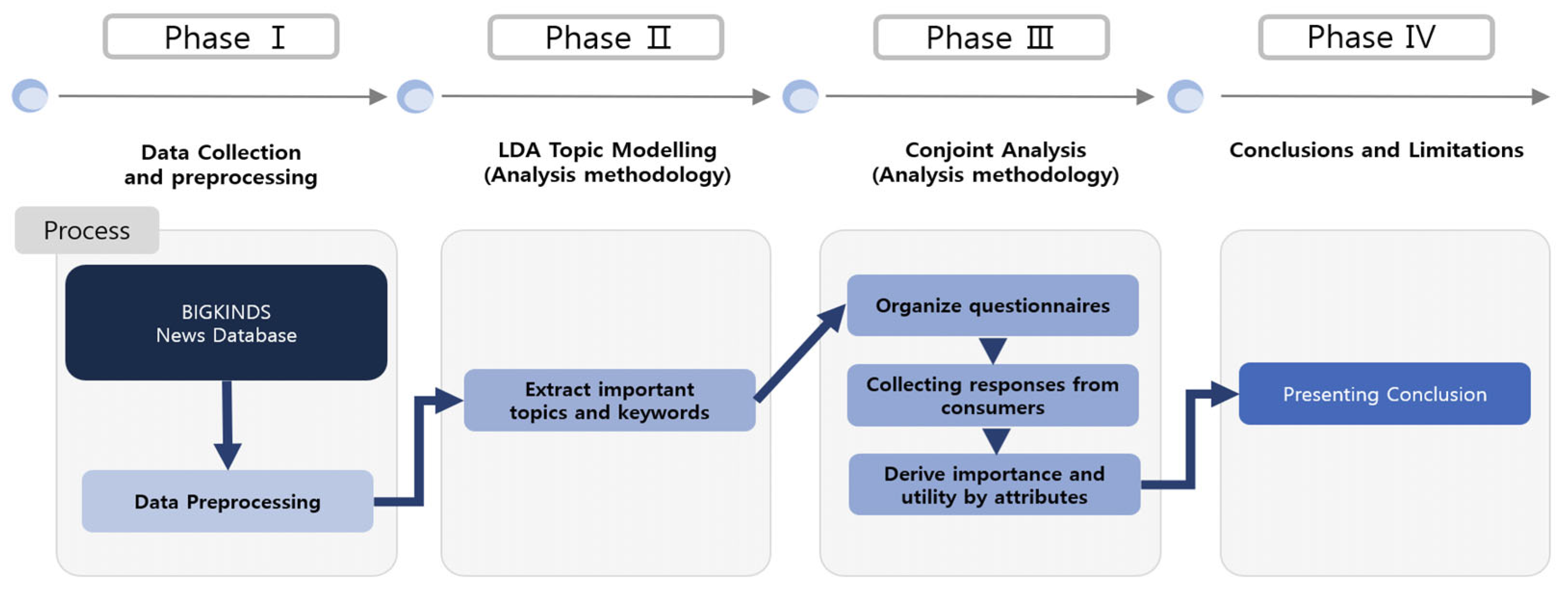
This study identifies social interests and trends in eco-friendly packaging by extracting keywords and topics and deriving and presenting the importance and utility of attributes related to eco-friendly packaging from the consumers’ perspective. Consequently, after collecting news related to eco-friendly packaging from BIGKINDS, a news big data platform, preprocessing was conducted for LDA topic modeling. Subsequently, important attributes related to eco-friendly packaging were set using topics and keywords derived from LDA topic modeling. Based on these attributes, questionnaires were constructed and distributed to consumers and their responses were collected. The relative importance and utility of each attribute were derived using conjoint analysis, and the results were presented.
The BIGKINDS database was used to identify social interest in eco-friendly packaging (Figure 1). In this study, news data were collected using the search terms “eco-friendly” and “packaging.” To reflect the packaging trend after the COVID-19 outbreak, the data collection period was limited from January 2020 to November 2022. Therefore, 8538 eco-friendly packaging-related news data were collected. The collected news data constituted 19 columns such as “News Identifier,” “Date,” “Media,” “Contributor,” “Title,” “Integrated Classification 1,” “Integrated Classification 2,” “Integrated Classification 3,” “Incident/Accident Classification 1,” “Incident/Accident Classification 2,” “Incident/Accident Classification 3,” “Person,” “Location,” “Institution,” “Keyword,” “Characteristic Extraction,” “Main text,” “URL,” and “Exclusion from analysis (yes or no).” Among them, data preprocessing was performed using the “Characteristic Extraction” column. It contains keywords considered important in the news using a Text Rank algorithm that determines the central words in a document through network analysis. Unnecessary spaces and symbols were removed, and keywords consisting of only nouns, adjectives, and roots were extracted using Python 3.11′s KoNLPy Mecab engine. Subsequently, Python 3.11′s Gensim library was used to exclude infrequent or highly frequent words from the analysis. Consequently, 5341 keywords were extracted and analyzed.
Given the relatively large number of attributes derived from LDA topic modeling, a fractional factorial design was employed to construct a manageable set of profiles while preserving orthogonality among attribute levels. A total of 16 profiles were generated to balance information efficiency and respondent cognitive burden, which is a common practice when the primary objective is to estimate main effects rather than to predict discrete choices.
Each respondent evaluated all profiles using a 10-point rating scale, reflecting overall preference. This rating-based conjoint approach was selected because the study aims to explore relative attribute importance and preference structures, rather than to simulate market choices or estimate choice probabilities. To reduce cognitive burden, respondents were provided with an example task prior to the survey to ensure familiarity with the evaluation format. Accordingly, the estimated part-worth utilities are interpreted as indicators of relative preference patterns rather than precise utility magnitudes.

4. Data Analysis

To identify topics based on the collected documents, LDA topic modeling was performed using Python 3.11′s Gensim library. LDA topic modeling involves determining the appropriate number of topics and designating their names. In this study, the perplexity and coherence scores were used to determine the number of topics. The perplexity score indicates how efficiently the model predicts new data; the lower the score, the higher the accuracy [43]. The coherence score measures whether the keywords in the topic match semantically; the higher the score, the higher is the accuracy [43]. Using the score, this study determines 12 as the number of topics. Finally, 10 keywords were derived for each of the 12 topics. The results of 10 keywords are shown in Table A1. Additional keywords were extracted (although not extracted as the top 10 keywords for each topic) by considering the CAGR of words to derive meaningful keywords according to the purpose of the study. Thus, news articles from 2020 to 2022 were classified by year, and the frequency of occurrence by year was calculated for all keywords. The CAGR of the keywords is calculated as follows:
C A G R = V 2022 V 2020 V 2020 1 ,
where Vt is the frequency of words occurring in year t.
Among the words that were not derived as the top 10 keywords for each topic and showed a positive CAGR, keywords related to eco-friendly packaging were extracted. Table 2 shows the results. Considering the results derived from LDA topic modeling and additional results derived based on CAGR, both eco-friendly materials and recyclability, as well as the usability for actual users, should be considered simultaneously when designing eco-friendly packaging (Table A2).
This study provides a basis for securing strategies related to eco-friendly packaging by identifying trends in eco-friendly packaging materials and key attributes that affect consumers’ choices and related awareness. Hence, LDA topic modeling was conducted to ascertain social interests and major factors in eco-friendly packaging by deriving them as topics and keywords.
Next, by conceptualizing them as attributes and attribute levels and using them for conjoint analysis, we identify the priorities and utility of attributes that customers consider important in eco-friendly packaging for delivery.
Meanwhile, the eco-friendly packaging experienced by customers in the delivery process can be considered in terms of the packaging attached to the product, the outer and inner packaging materials used to protect the product, and the form of packaging.
Accordingly, four themes were matched to the packaging process. The results are presented in Table A2. Attributes and attribute levels suitable for each packaging process were constructed by referencing the results of topic and keyword extraction through LDA analysis and additional keyword extraction results using CAGR (Table 3).
Price was additionally incorporated as a control attribute to capture cost-related trade-offs in delivery decisions. The price levels (KRW 3000 and KRW 4500) were determined based on commonly observed delivery fee ranges in the South Korean e-commerce market and were intended to reflect a realistic cost increase associated with the adoption of eco-friendly packaging. These values were selected to represent a noticeable yet plausible price difference, while avoiding extreme levels that could unduly bias preference responses.
However, from the perspective of a company, the transition to eco-friendly packaging entails cost consideration, and cost and price are the factors that greatly affect customers’ choice of delivery services [44,45]. For example, in the case of a paper box, the initial logistics cost is cheaper than that of a reusable cooler bag. However, in the case of multiple uses, it becomes more expensive than a reusable cooler bag that can be reused after washing. In the case of general ice packs used in the industry, the average unit price based on 500 g is approximately KRW 175 (USD 0.13), but the average unit price of eco-friendly ice packs is about KRW 213 (USD 0.16). Thus, the transition to eco-friendly packaging is accompanied by cost changes, which may be partially passed on to consumers.
Furthermore, delivery speed is an important factor in consumers’ choice of last-mile delivery services [46] and an important competitive attribute for e-commerce companies [2]. Currently, many e-commerce companies provide services with fast delivery speeds, such as next-day and early-morning deliveries, highlighting the advantages of establishing their own logistics networks. Therefore, price and delivery speed, the traditional competitive attributes of e-commerce companies, were introduced as additional attributes to identify the differences in importance from the attributes related to eco-friendly packaging.
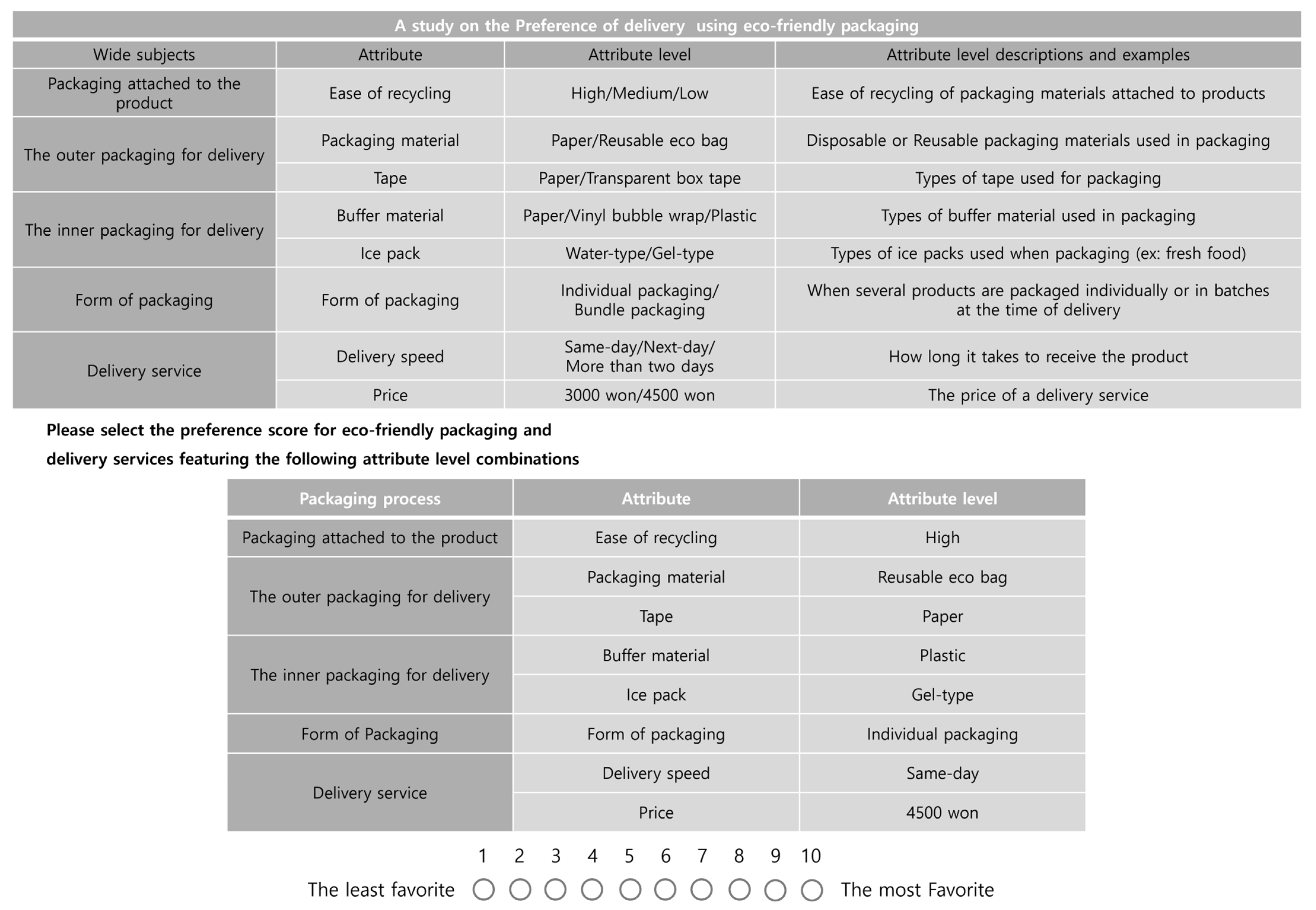
To understand the utility and importance of consumers regarding the attributes and attribute levels presented above, a conjoint analysis was conducted using a questionnaire comprising a combination of attributes and attribute levels (Table A3). When organizing a questionnaire, a trade-off method and full-profile approach can be used. The full-profile approach evaluates all attributes simultaneously, while the trade-off method receives responses for pairs at each attribute level, considering only two attributes together. We used the full-profile approach as the number of attributes used was small and to reduce contradictions between responses by considering all attributes simultaneously.
Data for this study were collected through an online survey administered via Google Forms. A purposive non-probability sampling method was adopted, targeting active e-commerce users in Republic of Korea who had made at least one online purchase within the past three months. To identify relevant participants, we first administered a preliminary screening questionnaire to 150 individuals, assessing their recent e-commerce usage and awareness or experience with eco-friendly packaging. At the end of the screening, respondents were briefly introduced to the concept and format of the conjoint analysis and then asked whether they would be willing to participate in the full survey. As a result, 70 individuals agreed and provided complete responses, which were used for the main analysis.
To address the potential for non-response bias, we compared basic demographic variables (e.g., age, gender, frequency of online purchases) between respondents and non-respondents. The analysis revealed no statistically significant differences (p > 0.05), suggesting that non-response bias is unlikely to have affected the results.
After confirming participation from 70 respondents, a detailed explanation along with example profiles was provided prior to the main conjoint tasks to ensure participants clearly understood how to interpret and evaluate the presented attribute combinations. Respondents were asked to select scores ranging from 1 (least favorite) to 10 (most favorite) for each question (Appendix A). To ensure that the respondents were familiar with the responses to the questionnaire, we provided examples before starting the survey to aid understanding.
The sample consisted of 67% male and 33% female respondents, with a strong concentration in younger age groups. Specifically, 67% of respondents were in their 20s, followed by those in their 30s (20%), 40s (7%), 50s (4%), and 60s (2%). This age distribution reflects the characteristics of the target population, as the survey focused on active e-commerce users, who are more prevalent among younger consumers. Accordingly, the findings of this study are most applicable to young, active online shoppers rather than to the entire Korean consumer population.
With respect to sample size, prior methodological studies suggest that exploratory research in business and social sciences does not require large samples to generate meaningful insights. Sekaran et al. (2016) [47] indicates that sample sizes between 30 and 500 are generally appropriate for exploratory research, while [48] notes that samples of 30 or more observations allow sampling distributions to approximate normality under the Central Limit Theorem. In addition, prior conjoint analysis studies have demonstrated that relatively small samples can yield stable estimates of attribute-level preferences [49,50]. Taken together, the final sample size of 70 respondents is considered sufficient for the exploratory objective of identifying relative preference structures among eco-friendly packaging attributes, while population-level generalization remains outside the scope of this study.
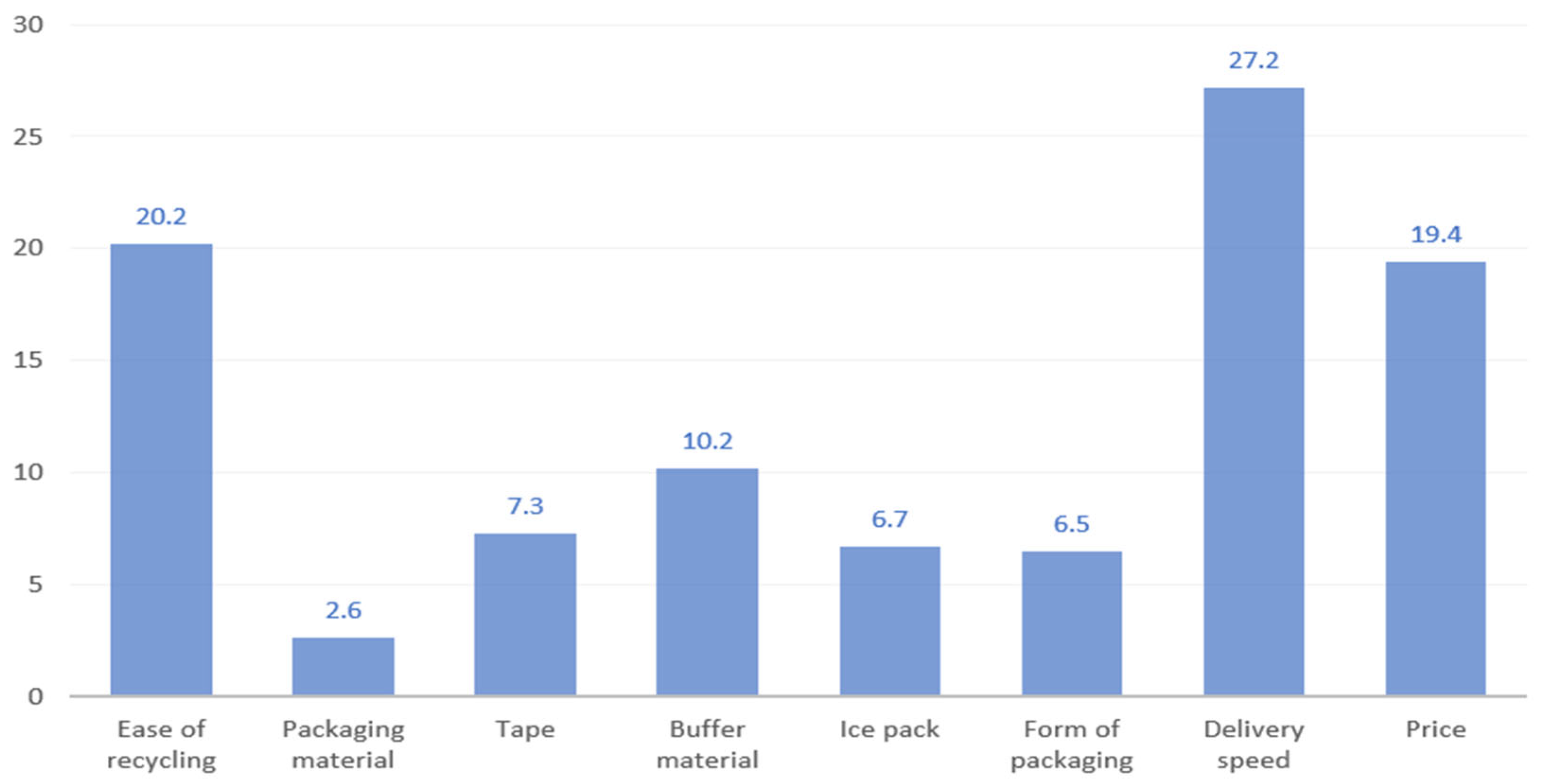
According to the conjoint analysis, the most important attribute of eco-friendly packaging for delivery is delivery speed (27.2%), followed by ease of recycling (20.2%), price (19.4%), buffer materials (10.2%), tape (7.3%), ice packs (6.7%), form of packaging (6.5%), and packaging materials (2.6%) (Figure 2). Delivery speed and price attributes, which are competitive attributes of traditional e-commerce companies, are significant, and ease of recycling and buffer materials indicate high significance in eco-friendly packaging. Table 4 summarizes the utility values by attribute level.
Regarding “Ease of recycling,” the utility analysis clearly demonstrates a strong consumer preference toward higher convenience in recycling. Specifically, the highest utility value (0.462) corresponds to “High” ease of recycling, followed by “Medium” ease (0.267). In contrast, “Low” ease of recycling exhibits a significantly negative utility (−0.729), clearly indicating consumer aversion. Thus, packaging that is inconvenient to recycle could negatively impact consumer acceptance. To effectively address this preference, it would be beneficial to enhance consumer convenience, such as by adopting packaging that can be easily detached from the product for separate disposal or by implementing label-free designs.
Regarding the “Packaging material” attribute, the utility analysis shows consumers prefer “Paper” (0.077) over “Reusable eco bag” (−0.077). Although both options are environmentally friendly, reusable eco-bags have faced ongoing issues due to delayed collection, increasing consumer dissatisfaction. For the “Tape” attribute, “Paper tape” (0.214) is clearly favored compared to “Transparent box tape” (−0.214). Consumers find paper tape easier to remove from packaging, reinforcing its perception as more environmentally friendly. Regarding “Buffer material,” consumers significantly prefer “Paper” (0.300) over “Vinyl bubble wrap” (−0.002) and “Plastic” (−0.298). This is primarily because plastic-based buffer materials are harder to dispose of and produce harmful environmental impacts. As plastic buffering is least preferred, its usage should be minimized. Concerning the “Ice pack” attribute, “Water-type ice packs” (0.196) are favored over “Gel-type ice packs” (−0.196), primarily due to the convenience of disposal. Gel-type ice packs require specialized collection, complicating disposal processes.
For the “Form of packaging,” consumers prefer “Bundle packaging delivery” (0.191) rather than “Individual packaging delivery” (−0.191). This reflects concerns regarding excessive packaging waste associated with individual deliveries.
Regarding “Delivery speed,” “Same-day delivery” shows the highest preference (0.781), followed by “Next-day delivery” (0.040), while delivery taking more than two days is highly undesirable (−0.821). This indicates that faster delivery is crucial for competitive advantage in e-commerce.
Lastly, concerning “Price,” the standard delivery fee of KRW 3000 (USD 2.30) (0.570) is strongly preferred over the increased fee of KRW 4500 (USD 3.46) (−0.570). This highlights consumer sensitivity to delivery costs, emphasizing that additional fees could negatively impact consumer acceptance of eco-friendly packaging.
Overall, the analysis model demonstrates excellent suitability, supported by a high Pearson’s R-value of 0.978, indicating a strong correlation between observed and estimated preferences. Additionally, Kendall’s tau value of 0.933 confirms the validity of the 16 questionnaires extracted through orthogonal design, further emphasizing the robustness of the results.

5. Discussion

Delivery services, specifically delivery speed and price, have traditionally been regarded as competitive attributes critical for e-commerce companies. However, these attributes now predominantly function as order qualifiers rather than order winners, prompting companies to identify alternative competitive factors to succeed in the increasingly saturated market. Recent shifts—including stringent government environmental regulations, the rising prominence of ESG criteria, heightened eco-friendly consumer awareness, and increased value-driven consumption—have positioned eco-friendly packaging as a critical differentiator for competitive advantage in e-commerce.
In this study, key topics and keywords related to eco-friendly packaging were identified through LDA topic modeling using recent news data, followed by conjoint analysis based on these derived attribute levels. Results highlight that, besides traditional attributes (delivery speed and price), eco-friendly attributes—particularly ease of recycling and buffer materials—are increasingly significant to consumers.
Interestingly, the ease of recycling was found to surpass even the price attribute in importance, indicating a strong consumer preference for packaging materials that facilitate easy separation and disposal directly from product packaging. This suggests that efforts to transition toward eco-friendly packaging should prioritize convenience in recycling practices. Consequently, e-commerce companies, particularly those outsourcing their packaging, need to actively collaborate with product suppliers to ensure packaging designs align with consumer recycling convenience preferences. Given that consumers prioritize this attribute over cost concerns, companies transitioning to eco-friendly packaging have an encouraging opportunity to offset the potential cost implications involved.
Notably, in the stated-preference context of this study, ease of recycling was ranked higher than price. This finding should not be interpreted as evidence that cost considerations have generally weakened in actual market behavior. Rather, it reflects a context-dependent preference structure observed when consumers are explicitly prompted to evaluate sustainability-related attributes.
When eco-friendly packaging features are made salient in the evaluation context, recycling convenience may emerge as a relatively more important consideration compared to traditional delivery attributes. This underscores the role of evaluative framing in shaping expressed consumer preferences and highlights the importance of distinguishing between stated preferences and revealed market behavior.
More broadly, the contribution of this study lies in disaggregating eco-friendly packaging into multiple internal attributes and empirically demonstrating how these attributes are hierarchically evaluated relative to traditional delivery factors. By grounding attribute selection in social discourse through LDA-based topic modeling, this study provides a data-driven perspective on which dimensions of eco-friendly packaging are most salient to consumers in contemporary e-commerce contexts.
The study found that the specific type of packaging material itself held the lowest relative importance. In contrast, buffer materials were deemed more significant, emphasizing that consumers have a stronger eco-friendly awareness regarding inner packaging compared to outer packaging. Consumers demonstrated clear preferences for specific attribute levels, including paper-based materials, easy separation and disposal features, bundled packaging delivery, expedited shipping, and lower delivery costs.
Overall, these insights suggest that e-commerce companies can effectively allocate resources by prioritizing attributes that resonate most strongly with consumers, thereby differentiating themselves from competitors and enhancing their market competitiveness through strategic eco-friendly packaging practices.
This study provides valuable insights for both academic researchers and industry practitioners. From an academic perspective, the contribution of this study lies in applying established analytical methods—LDA topic modeling and conjoint analysis—to examine eco-friendly packaging attributes in the context of e-commerce delivery.
Unlike prior studies that primarily relied on literature reviews or researcher judgment to derive attributes and levels for conjoint analysis, this study incorporates text-mining results from recent news data at the attribute identification stage, thereby reflecting socially salient sustainability issues in a more timely and structured manner. In doing so, the study offers empirical insights into attribute-level consumer preference structures related to eco-friendly packaging, rather than proposing a new methodological framework.
Moreover, the findings expand our theoretical understanding of consumer preferences within the context of sustainability, particularly highlighting the substantial shift toward valuing recycling convenience over cost considerations. This underscores the necessity for future research to continuously monitor and integrate dynamic consumer preferences and trends in environmental consciousness, particularly as these factors increasingly influence market competition.
From a practical perspective, the findings provide strategic guidance for e-commerce companies and supply chain stakeholders aiming to differentiate themselves in an increasingly competitive market. Specifically, the study highlights the strategic importance of prioritizing eco-friendly attributes—particularly ease of recycling and buffer materials—in packaging decisions. Companies should proactively design packaging solutions that facilitate convenient recycling, aligning closely with consumer demands. Importantly, these insights emphasize the necessity of collaboration between e-commerce firms and their product suppliers, particularly when packaging responsibilities are outsourced. Such collaboration can ensure packaging designs are not only sustainable but also enhance consumer convenience, significantly contributing to customer satisfaction and brand loyalty [6].
Moreover, the relatively lower importance consumers placed on specific packaging materials suggests companies should focus their limited resources strategically, investing primarily in aspects such as inner packaging (buffer materials) and convenience-oriented recycling practices rather than over-investing in the outer packaging itself. Such targeted allocation of resources can mitigate cost-related concerns, enhance consumer perceptions of brand sustainability, and facilitate smoother transitions toward comprehensive eco-friendly packaging practices.
In summary, this study provides meaningful academic and managerial insights, emphasizing that eco-friendly packaging has become an indispensable competitive factor for contemporary e-commerce companies. By strategically prioritizing consumer-driven eco-friendly attributes, businesses can secure long-term competitive advantages while contributing positively toward sustainability goals.

Author Contributions

Conceptualization, D.C.; methodology, M.K.; software, M.K.; validation, M.K.; formal analysis, B.S.; investigation, B.S.; resources, D.P.; data curation, D.P.; writing—original draft preparation, M.K. and D.C.; writing—review and editing, D.C.; visualization, D.P.; supervision, D.C.; project administration, D.C.; funding acquisition, D.C. All authors have read and agreed to the published version of the manuscript.

Funding

This research was funded by the Jungseok Logistics Foundation.

Data Availability Statement

Data will be made available on request.

Conflicts of Interest

Minseok Kim is from the company “Kim & Chang”, the remaining authors declare no conflicts of interest.

Appendix A

Table A1. Result of LDA topic modeling.
Topic Title Keywords
Carbon neutrality of ProductTopic 1ExpertStart-upCarbon neutralJobAutomobileProductVice-ChairmanUserSeoul city
Reusable ice pack, buffer materialTopic 2Ten thousandMinimizationCompanyReuseIce packEVContentsGift setBuffer material
Minimization of disposable useTopic 3DisposableGovernanceTumblerCarbon dioxideCJChinaVeganMinimizationEco
Zero wasteTopic 4PollutionCOVID-19Solar energyCompanyDepartment storeFirst halfMeanwhileGift setTumbler
Minimization of PetTopic 5JobPollutionEnvironmentCOVID-19PetMinimizationHomepageSustainableSeafood
Waste plastic upcyclingTopic 6ChinaWaste plasticGift setUpcyclingCarbon dioxideSamsung ElectronicsJapanDisabled personTen thousand
Minimization of polyethyleneTopic 7Republic of KoreaEcoMinimizationIce packGyeonggi-doIngredientsPolyethyleneStart-upContents
Sustainable buffer materialTopic 8Republic of KoreaSustainableBuffer materialsCOVID-19MinimizationVillagerJeonnamProductCitizen
Label-freeTopic 9DistributionLabel-freeFreshSamsung ElectronicsDistribution industryMeanwhileCustomerSustainablePollution
Separate discharge of buffer material and waste plasticTopic 10Buffer materialCJ LogisticsCarbon dioxideAutomobileWaste plasticMicrobeCOVID-19Ten thousandSeparate waste collection
Eco ice packTopic 11Gift setIce packEuropeJeonnam-cityChinaMicrobeCOVID-19UtilizationSales volume
Minimization of buffer materialTopic 12MinimizationIce packJobMicro enterpriseBuffer materialOff-lineNew-dealAffiliateCoronavirus
Table A2. Topic trend.
Topic“Reusable ice pack, buffer material (Topic 2),”
“Label-free (Topic 9),”
“Separate discharge of buffer material and waste plastic (Topic 10)”
“Minimization of polyethylene
(Topic 7)”
“Sustainable buffering materials (Topic 8),”
“Minimization of polyethylene (Topic 7)”
“Minimization of buffer material (Topic 12),” “Minimization of disposable use (Topic 3)”
Keyword using CAGR“Convenience”“Reusable container,” “Eco-bag,”
“Paper,”
“Corrugated cardboard,” “Polypropylene”
“Paper,”
“Plastic,”
“Corrugated cardboard”
“Overpackaging,”
“Each piece”
Four themes related to eco-friendly packagingTopics related to ease of reuse/useTopics related to eco-friendly products used for outer packagingTopics related to eco-friendly products used for inner packagingTopics related to form of packaging
Packaging processPackaging attached to the productOuter packaging for deliveryInner packaging for deliveryForm of packaging
Table A3. Combinations of 16 attributes presented in the questionnaire.
Ease of RecyclingPackaging MaterialTapeBuffer MaterialIce PackForm of PackagingDelivery SpeedPrice
1HighReusable
eco-bag
Paper tapePlasticGel-typeIndividualSame-dayKRW 4500 (USD 3.46)
2LowReusable
eco-bag
Transparent box tapeVinyl bubble wrapGel-typeIndividualSame-dayKRW 3000 (USD 2.30)
3HighPaperPaper tapeVinyl bubble wrapGel-typeIndividualNext-dayKRW 4500 (USD 3.46)
4MediumPaperTransparent box tapePlasticGel-typeIndividualMore than 2 daysKRW 3000 (USD 2.30)
5LowPaperTransparent box tapePaperWater-typeIndividualSame-dayKRW 4500 (USD 3.46)
6MediumReusable
eco-bag
Paper tapeVinyl bubble wrapWater-typeBundleSame-dayKRW 3000 (USD 2.30)
7LowPaperPaper tapePlasticWater-typeBundleNext-dayKRW 3000 (USD 2.30)
8LowReusable
eco-bag
Paper tapePaperGel-typeBundleMore than two daysKRW 4500 (USD 3.46)
9HighReusable
eco-bag
Transparent box tapePaperGel-typeBundleNext-dayKRW 3000 (USD 2.30)
10HighPaperTransparent box tapeVinyl bubble wrapWater-typeBundleMore than two daysKRW 4500 (USD 3.46)
11HighPaperTransparent box tapePaperGel-typeBundleSame-dayKRW 3000 (USD 2.30)
12HighPaperPaper tapePaperWater-typeIndividualSame-dayKRW 3000 (USD 2.30)
13MediumPaperPaper tapePaperGel-typeBundleSame-dayKRW 4500 (USD 3.46)
14MediumReusable
eco-bag
Transparent box tapePaperWater-typeIndividualNext-dayKRW 4500 (USD 3.46)
15HighReusable
eco-bag
Transparent box tapePlasticWater-typeBundleSame-dayKRW 4500 (USD 3.46)
16HighReusable
eco-bag
Paper tapePaperWater-typeIndividualMore than 2 daysKRW 3000 (USD2.30)
Figure A1. Examples of questionnaire questions.
Systems 14 00128 g0a1

References

  1. Beckers, J.; Weekx, S.; Beutels, P.; Verhetsel, A. COVID-19 and retail: The catalyst for e-commerce in Belgium? J. Retail. Consum. Serv. 2021, 62, 102645. [Google Scholar] [CrossRef]
  2. Kim, J.; Kim, M.; Im, S.; Choi, D. Competitiveness of E Commerce firms through ESG logistics. Sustainability 2021, 13, 11548. [Google Scholar] [CrossRef]
  3. Savelsbergh, M.; Van Woensel, T. 50th Anniversary Invited Article—City Logistics: Challenges and Opportunities. Transp. Sci. 2016, 50, 363–761. [Google Scholar] [CrossRef]
  4. Unctad, E. (Ed.) The Europa Directory of International Organizations 2021, 23rd ed.; Routledge: London, UK, 2021. [Google Scholar] [CrossRef]
  5. Hong, S.; Peterle, E. The E-Commerce Market in South Korea; Nowak & Partner: Warsaw, Poland, 2023. [Google Scholar]
  6. Wu, X.; Shu, E.; Ye, D.; Zhou, S.; Sun, H. Study on green packaging diffusion in logistics enterprise clusters based on complex network evolutionary game. J. Clean. Prod. 2025, 499, 145166. [Google Scholar] [CrossRef]
  7. Xu, C.; Niu, S.; Wang, Y.; Sima, H. Does atypical packaging design enhance the appeal of healthy food? Evidence from multiple experiments. J. Retail. Consum. Serv. 2025, 87, 104458. [Google Scholar] [CrossRef]
  8. Jabbour, C.J.C.; Seuring, S.; de Sousa Jabbour, A.B.L.; Jugend, D.; Fiorini, P.D.C.; Latan, H.; Izeppi, W.C. Stakeholders, innovative business models for the circular economy and sustainable performance of firms in an emerging economy facing institutional voids. J. Environ. Manag. 2020, 264, 110416. [Google Scholar] [CrossRef]
  9. Orzan, G.; Cruceru, A.F.; Bălăceanu, C.T.; Chivu, R.G. Consumers’ behavior concerning sustainable packaging: An exploratory study on Romanian consumers. Sustainability 2018, 10, 1787. [Google Scholar] [CrossRef]
  10. Green, P.E.; Rao, V.R. Conjoint measurement-for quantifying judgmental data. J. Mark. Res. 1971, 8, 355–363. [Google Scholar]
  11. Green, P.E.; Srinivasan, V. Conjoint analysis in consumer research: Issues and outlook. J. Consum. Res. 1978, 5, 103–123. [Google Scholar] [CrossRef]
  12. Martinho, G.; Pires, A.; Portela, G.; Fonseca, M. Factors affecting consumers’ choices concerning sustainable packaging during product purchase and recycling. Resour. Conserv. Recycl. 2015, 103, 58–68. [Google Scholar] [CrossRef]
  13. Yue, R.; Xu, X.; Li, Z.; Bai, Q. Reusable packaging adoption in e-commerce markets with green consumers: An evolutionary game analysis. J. Retail. Consum. Serv. 2024, 81, 103818. [Google Scholar] [CrossRef]
  14. Koenig-Lewis, N.; Palmer, A.; Dermody, J.; Urbye, A. Consumers’ evaluations of ecological packaging–Rational and emotional approaches. J. Environ. Psychol. 2014, 37, 94–105. [Google Scholar] [CrossRef]
  15. Hao, Y.; Liu, H.; Chen, H.; Sha, Y.; Ji, H.; Fan, J. What affect consumers’ willingness to pay for green packaging? Evidence from China. Resour. Conserv. Recycl. 2019, 141, 21–29. [Google Scholar] [CrossRef]
  16. Song, J.; Cai, L.; Yuen, K.F.; Wang, X. Exploring consumers’ usage intention of reusable express packaging: An extended norm activation model. J. Retail. Consum. Serv. 2023, 72, 103265. [Google Scholar] [CrossRef]
  17. Seo, S.; Ahn, H.K.; Jeong, J.; Moon, J. Consumers’ attitude toward sustainable food products: Ingredients vs. Packaging. Sustainability 2016, 8, 1073. [Google Scholar] [CrossRef]
  18. Prakash, G.; Pathak, P. Intention to buy eco-friendly packaged products among young consumers of India: A study on developing nation. J. Clean. Prod. 2017, 141, 385–393. [Google Scholar] [CrossRef]
  19. Cronin, J.J., Jr.; Smith, J.S.; Gleim, M.R.; Ramirez, E.; Martinez, J.D. Green marketing strategies: An examination of stakeholders and the opportunities they present. J. Acad. Mark. Sci. 2011, 39, 158–174. [Google Scholar] [CrossRef]
  20. Rokka, J.; Uusitalo, L. Preference for green packaging in consumer product choices–do consumers care? Int. J. Consum. Stud. 2008, 32, 516–525. [Google Scholar] [CrossRef]
  21. Van Birgelen, M.; Semeijn, J.; Keicher, M. Packaging and proenvironmental consumption behavior: Investigating purchase and disposal decisions for beverages. Environ. Behav. 2009, 41, 125–146. [Google Scholar] [CrossRef]
  22. Magnier, L.; Crié, D. Communicating packaging eco-friendliness: An exploration of consumers’ perceptions of eco-designed packaging. Int. J. Retail Distrib. Manag. 2015, 43, 350–366. [Google Scholar] [CrossRef]
  23. Yang, J.; Cai, L.; Gong, X.; Li, X.; Yang, M.; Long, R. Enhancing acceptance of reusable express packaging: A mixed-method study to reveal the net effects and configurational effects of consumers’ perceptions. J. Retail. Consum. Serv. 2025, 87, 104438. [Google Scholar] [CrossRef]
  24. SHARMA, V.K.; BABEL, R. Eco-friendly packaging and consumer buying behaviour in india a case study of mumbai. J. Adv. Sci. 2002, 13, 243–245. [Google Scholar] [CrossRef]
  25. Popovic, I.; Bossink, B.A.G.; van der Sijde, P.C.; Fong, C.Y.M. Why are consumers willing to pay more for liquid foods in environmentally friendly packaging? Sustainability 2020, 12, 2812. [Google Scholar] [CrossRef]
  26. Delen, D.; Crossland, M.D. Seeding the survey and analysis of research literature with text mining. Expert Syst. Appl. 2008, 34, 1707–1720. [Google Scholar] [CrossRef]
  27. Hong, J.; Tamakloe, R.; Lee, G.; Park, D. Insight from scientific study in logistics using text mining. Transp. Res. Rec. 2019, 2673, 97–107. [Google Scholar] [CrossRef]
  28. Blei, D.M. Probabilistic topic models. Commun. ACM 2012, 55, 77–84. [Google Scholar] [CrossRef]
  29. Blei, D.M.; Ng, A.Y.; Jordan, M.I. Latent dirichlet allocation. J. Mach. Learn. Res. 2003, 3, 993–1022. [Google Scholar]
  30. Song, B.; Suh, Y. Identifying convergence fields and technologies for industrial safety: LDA-based network analysis. Technol. Forecast. Soc. Change 2019, 138, 115–126. [Google Scholar] [CrossRef]
  31. Lee, W.S.; Han, E.J.; Sohn, S.Y. Predicting the pattern of technology convergence using big-data technology on large-scale triadic patents. Technol. Forecast. Soc. Change 2015, 100, 317–329. [Google Scholar] [CrossRef]
  32. Detthamrong, U.; Nguyen, L.T.; Jaroenruen, Y.; Takhom, A.; Chaichuay, V.; Chotchantarakun, K.; Chansanam, W. Topic Modeling Analytics of Digital Economy Research: Trends and Insights. J. Scientometr. Res. 2024, 13, 448–458. [Google Scholar] [CrossRef]
  33. Wang, M.; Mengoni, P. How pandemic spread in news: Text analysis using topic model. In Proceedings of the 2020 IEEE/WIC/ACM International Joint Conference on Web Intelligence and Intelligent Agent Technology (WI-IAT), Melbourne, Australia, 14–17 December 2020; IEEE: Piscataway, NJ, USA, 2020; pp. 764–770. [Google Scholar]
  34. Park, H.J.; Cho, S.G.; Lee, K.W.; Lee, S.J.; Oh, J. Topic Modeling Analysis of Children’s Food Safety Management Using BigKinds News Big Data: Comparing the Implementation Times of the Comprehensive Plan for Children’s Dietary Safety Management. Foods 2025, 14, 2650. [Google Scholar] [CrossRef]
  35. Wang, F.; Yang, Y.; Tso, G.K.; Li, Y. Analysis of launch strategy in cross-border e-Commerce market via topic modeling of consumer reviews. Electron. Commer. Res. 2019, 19, 863–884. [Google Scholar] [CrossRef]
  36. Kojcic, I.; Kuzmanovic, M. Conjoint Analysis of Green Consumer Preferences for Electronic Products. Int. J. Qual. Res. 2022, 16, 559–575. [Google Scholar] [CrossRef]
  37. Branca, G.; Resciniti, R.; Loureiro, S.M.C. Virtual is so real! Consumers’ evaluation of product packaging in virtual reality. Psychol. Mark. 2023, 40, 596–609. [Google Scholar] [CrossRef]
  38. Martin, J.L. What is field theory? Am. J. Sociol. 2003, 109, 1–49. [Google Scholar] [CrossRef]
  39. Berkowitsch, N.A.; Scheibehenne, B.; Rieskamp, J. Rigorously testing multialternative decision field theory against random utility models. J. Exp. Psychol. 2014, 143, 1331. [Google Scholar] [CrossRef] [PubMed]
  40. Busemeyer, J.R.; Townsend, J.T. Decision field theory: A dynamic-cognitive approach to decision making in an uncertain environment. Psychol. Rev. 1993, 100, 432. [Google Scholar] [CrossRef] [PubMed]
  41. Meyerding, S.G.; Bauchrowitz, A.; Lehberger, M. Consumer preferences for beer attributes in Germany: A conjoint and latent class approach. J. Retail. Consum. Serv. 2019, 47, 229–240. [Google Scholar] [CrossRef]
  42. Gawor, T.; Hoberg, K. Customers’ valuation of time and convenience in e-fulfillment. Int. J. Phys. Distrib. Logist. Manag. 2019, 49, 75–98. [Google Scholar] [CrossRef]
  43. Hasan, M.; Rahman, A.; Karim, M.R.; Khan, M.S.I.; Islam, M.J. Normalized approach to find optimal number of topics in Latent Dirichlet Allocation (LDA). In Proceedings of the International Conference on Trends in Computational and Cognitive Engineering, Dhaka, Bangladesh, 17–18 December 2020; pp. 341–354. [CrossRef]
  44. Li, K.J.; Jain, S. Behavior-based pricing: An analysis of the impact of peer-induced fairness. Manag. Sci. 2016, 62, 2705–2721. [Google Scholar] [CrossRef]
  45. Peine, K.; Heitmann, M.; Herrmann, A. Getting a feel for price affect: A conceptual framework and empirical investigation of consumers’ emotional responses to price information. Psychol. Mark. 2009, 26, 39–66. [Google Scholar] [CrossRef]
  46. Kim, T.Y.; Dekker, R.; Heij, C. Cross-border electronic commerce: Distance effects and express delivery in European Union markets. Int. J. Electron. Commer. 2017, 21, 184–218. [Google Scholar] [CrossRef]
  47. Sekaran, U.; Bougie, R. Research Methods for Business: A Skill Building Approach, 7th ed.; John Wiley & Sons: Chichester, UK, 2016. [Google Scholar]
  48. Hogg, R.V.; Tanis, E.A. Probability and Statistical Inference, 8th ed.; Pearson Prentice Hall: Upper Saddle River, NJ, USA, 2009. [Google Scholar]
  49. McCullough, D. A user’s guide to conjoint analysis. Mark. Res. 2002, 14, 18–23. [Google Scholar]
  50. Chung, T.W.; Lee, Y.J.; Jang, H.M.A. comparative analysis of three major transfer airports in Northeast Asia focusing on Incheon International Airport using a conjoint analysis. Asian J. Shipp. Logist 2017, 33, 237–244. [Google Scholar] [CrossRef]
Figure 1. Framework of the study.
Systems 14 00128 g001
Figure 2. Important attribute of eco-friendly packaging.
Systems 14 00128 g002
Table 1. Company overview.
Company
(Region)
Market Share of Each Company in the IndustryBusiness Overview
Market Kurly
(Republic of Korea)
8.4%It was established in 2014 and is divided into two main service areas: Market Kurly, specializing in food sales, and Beauty Kurly, specializing in cosmetics sales.
It has a strong advantage in delivering fresh food through its representative early-morning delivery service called “Early bird Delivery.”
11st
(Republic of Korea)
6%It started its service as an open market in 2008.
It currently offers next-day delivery service through “Shooting delivery.”
Coupang
(Republic of Korea)
13%It was founded in August 2010 as an online shopping mall.
Through its internally built logistics network, it has experienced rapid growth, with its service “Rocket Delivery” offering next-day shipping.
SSG.Com
(Republic of Korea)
15%Established on 1 March 2019, it is an integrated online shopping mall under the umbrella of the Shinsegae Group.
It is transitioned from a food-focused service called “SSG Delivery” to introducing “SSG 1 day Delivery,” to expand its product range and complement and expand its existing “SSG Delivery” service.
Samdasoo
(Republic of Korea)
43%Established in 1998, it offers “Samdasoo,” a volcanic rock water, in the market.
It has constantly maintained the top market share position since its launch.
Amazon
(U.S.)
38%Established in 1994, it is a U.S. company providing e-commerce and cloud computing services under the name Amazon and Amazon Web Service.
Coca-Cola
(U.S.)
46%Established in 1892, it is a cola brand launched by the Coca-Cola Company in the U.S.
Wal Mart
(U.S.)
6.3%Established in 1969, it is a distribution company that holds 19% of the grocery sales in the U.S.
Table 2. Keyword extraction result using CAGR.
KeywordsFrequencyCAGR
Paper cup13346%
Shopping bag13297%
Each piece5325%
Convenience504%
Wrapping paper9325%
Reusable container125178%
Polypropylene8190%
Paper box544%
Durability6753%
Plastic48713%
Eco-friendliness7163%
One-time11916%
Recyclable materials5724%
Reusable226105%
Deposit6187%
Recycling rate6028%
Eco-bag7818%
Sugar cane8613%
Microplastic5311%
Corrugated cardboard8850%
Overpackaging13439%
Paper50722%
Container39137%
Table 3. Attributes and attribute levels.
Packaging ProcessAttributeAttribute LevelAttribute Level
Descriptions and Examples
Packaging attached to the productEase of recyclingHigh/medium/lowEase of recycling of packaging materials attached to products
Outer packaging for deliveryPackaging materialPaper/reusable eco bagDisposable or reusable packaging materials used in packaging
TapePaper/transparent box tapeTypes of tape used for packaging
Inner packaging for deliveryBuffer materialPaper/vinyl bubble wrap/plasticTypes of buffer material used in packaging
Ice packWater-type/gel-typeTypes of ice packs used when packaging ((ex) fresh food))
Form of packagingForm of packagingIndividual packaging/
bundle packaging
When several products are packaged individually or in batches at the time of delivery
Delivery serviceDelivery speedSame-day/next-day/more than 2 daysHow long it takes to receive the product
PriceKRW 3000 (USD 2.30)/KRW 4500 (USD 3.46)Price of a delivery service
Table 4. Result of conjoint analysis.
AttributeAttribute LevelUtilityStandard Error
Ease of recyclingHigh0.4620.156
Medium0.2670.183
Low−0.7290.183
Packaging materialPaper0.0770.117
Reusable
Eco bag
−0.0770.117
TapePaper tape0.2140.117
Transparent box tape−0.2140.117
Buffer materialPaper0.3000.156
Vinyl bubble wrap−0.0020.183
Plastic−0.2980.183
Ice packWater-type0.1960.117
Gel-type−0.1960.117
Form of packagingIndividual packaging−0.1910.117
Bundle packaging0.1910.117
Delivery speedSame-day0.7810.156
Next-day0.0400.183
More than 2 days−0.8210.183
PriceKRW 3000 (USD 2.30)0.5700.117
KRW 4500 (USD 3.46)−0.5700.117
CorrelationPearson’s RKendall’s tau
0.9780.933
Disclaimer/Publisher’s Note: The statements, opinions and data contained in all publications are solely those of the individual author(s) and contributor(s) and not of MDPI and/or the editor(s). MDPI and/or the editor(s) disclaim responsibility for any injury to people or property resulting from any ideas, methods, instructions or products referred to in the content.