Article

Digitalization and Industrial Chain Resilience: Evidence from Chinese Manufacturing Enterprises

School of Economics and Management, Beijing Jiaotong University, Beijing 100044, China
*
Author to whom correspondence should be addressed.
Systems 2026, 14(1), 90; https://doi.org/10.3390/systems14010090
Submission received: 18 December 2025 / Revised: 12 January 2026 / Accepted: 12 January 2026 / Published: 14 January 2026
(This article belongs to the Topic Digital Technologies in Supply Chain Risk Management)

Abstract

(1) Background. The rapid development of the digital economy provides a new perspective for enhancing industrial chain resilience. This study examines how manufacturing firms’ digitalization affects their industrial chain resilience, drawing on resource dependence and dynamic capability theories, and explores spillover effects on upstream and downstream enterprises. (2) Data and Methods. Using panel data from Chinese listed manufacturing firms (2011–2023), we employ ordinary least squares (OLS) models to analyze the relationship, its mechanisms, and heterogeneity. We further match firms with their suppliers and customers to identify spillover effects. (3) Results. Digitalization significantly improves resilience, particularly by enhancing supply–demand matching and competitive capabilities. Effects are stronger for small, labor-intensive, and high-environment, social and governance (ESG) firms. Bargaining power and governance capability are key channels. Spillover effects are heterogeneous, with a stronger impact on downstream customers. (4) Discussion. The positive impact of digitalization varies by firm characteristics, and spillovers differ across the chain. These findings offer precise insights and policy implications for leveraging digitalization to strengthen industrial chain resilience.

1. Introduction

The global industrial chain system is undergoing unprecedented challenges, ranging from trade frictions to the COVID-19, and from natural disasters to geopolitical conflicts [1,2]. These black swan events continuously disrupt corporate industrial chain operations, highlighting the increasing vulnerability of global industrial networks. Amid the rapid development of the digital economy, digitalization has emerged as a revolutionary force, permeating various aspects of corporate operations [3] and gradually becoming a critical tool for enhancing industrial chain resilience. However, the impact of corporate digitalization on industrial chain resilience is dual-edged and complex. The Complex Adaptive Systems theory [4] posits that while corporate digitalization can strengthen the industrial chain resilience through data sharing and collaborative operations [5], it can also exacerbate digital divides among enterprises, leading to coordination breakdowns and reduced risk response capabilities across the industrial chain [6]. This “technological empowerment-systemic risk” duality constitutes the core tension in their relationship. Therefore, it is imperative to further investigate the relationship between corporate digitalization and industrial chain resilience, as well as the externalities it generates within industrial chain networks.
Existing research on digitalization has extensively explored its impacts on global division of labor [7,8], urban industrial chain resilience [9], industrial chain concentration [10], corporate productivity [11], financing constraints [12], and innovation capabilities [13]. It has also revealed that digital technologies can improve enterprises’ access to capital by enhancing investor information transparency [14]. However, within the complex structure of economic networks, significant research gaps remain regarding the profound effects of corporate digitalization on their respective industries chain resilience. First, although industrial chain resilience has garnered increasing attention [15,16], studies predominantly focus on using macro data or data from all listed companies, which underestimates the impact on manufacturing enterprises. Second, the specific mechanisms and pathways through which digitalization enhance industrial chain resilience remain unclear, as existing research has yet to thoroughly elucidate how technological applications translate into industrial chain resilience improvements. Third, while corporate digitalization can bolster the robustness of upstream suppliers and the adaptability of downstream customers [5,17], the channels through which spillover effects contribute to industrial chain resilience are not well-defined. Addressing these gaps is crucial for a comprehensive understanding of the interplay between digitalization and industrial chain resilience.
Therefore, to address the limitations of existing research, we utilize an unbalanced panel dataset of Chinese manufacturing enterprises from 2011 to 2023. Employing Ordinary Least Squares (OLS) estimation, we quantify how corporate digital transformation impacts industrial chain resilience. Additionally, we elucidate the underlying mechanisms and spillover effects on upstream and downstream enterprises. Our findings indicate that corporate digitalization significantly enhances industrial chain resilience, and the results remain robust to alternative specifications and endogeneity tests. Furthermore, we examine the heterogeneity of these effects across enterprises of varying sizes, capital intensities, ESG characteristics, and ownership structures. Corporate digitalization primarily influences industrial chain resilience by strengthening enterprises’ bargaining power and governance capabilities. We further reveal that digitalization generates asymmetric spillover effects within the industrial chain. While the resilience of downstream customers improves significantly, we find no statistically significant impact on upstream suppliers. These insights contribute to a deeper understanding of the role of digitalization in fostering industrial chain resilience and its broader economic implications.
This study contributes to the literature on enterprise digitalization and industrial chain resilience in three main theoretical aspects. First, this paper extends industrial chain resilience research to the enterprise level by identifying digitalization as a key micro-foundation of resilience. Compared to studies on corporate digitalization, which predominantly analyze data from all listed enterprises, this research focuses specifically on manufacturing enterprises [11,12,18,19]. the manufacturing sector, which not only features the most complex upstream and downstream division of labor but also exhibits industrial chain resilience that is more directly influenced by inter-enterprise digital coordination [16,20]. By focusing on manufacturing enterprises, this study demonstrates that industrial chain resilience emerges from firms’ digital transformation processes. This finding enriches complex adaptive systems theory and provides a micro-level explanation for the formation of industrial chain resilience.
Secondly, this study constructs a comprehensive theoretical framework based on resource dependence theory and dynamic capabilities theory to explain the mechanisms through which digitalization enhances industrial chain resilience. While existing research has examined the impact of digitalization on global value chain restructuring and the stability of regional supply networks [15,21], significant research gaps remain in the discussion of micro-level mechanisms. The dual-path theoretical framework we developed—which integrates bargaining power and governance capabilities with their synergistic effects—clarifies both the internal and external channels linking digitalization and resilience, thereby addressing the “black box” problem in the existing literature. Theoretically, it emphasizes digitalization as a strategic capability that reshapes power structures and governance efficiency within industrial chains.
Third, this study introduces a directional spillover perspective into the analysis of industrial chain resilience and elucidates the economic mechanisms underlying the asymmetric spillovers of enterprise digitalization on resilience between upstream and downstream entities in the industrial chain. Although some studies have explored the relationship between corporate digitalization and the resilience of upstream and downstream enterprises within industrial chains [5,17], the pathways and channels through which such externality operates need further research [22]. To address this, we employ enterprises’ bargaining power relative to their upstream and downstream counterparts to explain these externalities. This result expands industrial chain network theory by emphasizing the role of power asymmetry and information transmission in shaping resilience spillovers.
Overall, this study deepens the theoretical understanding of how enterprise digitalization contributes to industrial chain resilience, provides a clear micro-mechanism framework, and offers a new perspective on resilience spillover effects within industrial chain networks.

2. Theoretical Framework

2.1. Literature Review

The research stream related to this study mainly focuses on how digital technologies reshape economic systems, and the literature can be reviewed from the following perspectives.
  • ICT, global trade dynamics, and firms’ export competitiveness
As a general-purpose technology, information and communication technology (ICT) has profoundly transformed global trade patterns by reducing information search costs and improving the coordination of cross-border payments and logistics. At the theoretical level, heterogeneous firm trade models represented by Melitz (2003) provide a fundamental framework for understanding how digital technologies alter both the fixed and variable costs of firms’ participation in export markets [23]. Empirical studies further indicate that the diffusion of ICT infrastructure not only enhances a country’s overall export sophistication [24], but also significantly promotes the development of the global digital economy, including improvements in productivity, innovation, and trade performance [25].
  • Digitalization, green transformation, and environmental sustainability
Digital technologies play a complex dual role in promoting green growth and addressing environmental challenges. On the one hand, digital technologies can significantly improve energy and resource efficiency and enable more precise environmental regulation and carbon emission monitoring [26,27]. On the other hand, the energy consumption of digital infrastructure itself, together with the potential expansion of production and consumption scales induced by digitalization, may intensify environmental pressures [28]. Some studies further analyze the specific mechanisms and boundary conditions through which digital technologies affect environmental performance, emphasizing that digitalization exhibits a pronounced “double-edged sword” effect [29].
  • Institutional and industrial policies and industrial transformation
The institutional environment and targeted industrial policies constitute critical contextual factors shaping technology absorption and economic transformation. For example, studies on digital infrastructure policies such as the “Broadband China” strategy show that these policies not only directly stimulate firms’ digital investment [30], but also indirectly influence industrial agglomeration and supply chain efficiency by improving regional connectivity [31,32]. Meanwhile, research on institutional arrangements such as free trade zones demonstrates that by reducing institutional transaction costs and facilitating knowledge spillovers, these policies promote industrial upgrading and the transformation of trade patterns [33,34].
  • Technology diffusion, human capital, and inclusive development
The economic benefits of digital technologies ultimately depend on the absorptive capacity of micro-level actors. A large body of literature shows that the distribution of digital dividends is highly uneven and closely associated with human capital levels, skill structures, and social capital [35]. For instance, studies on the digital divide reveal how inequalities in access, usage, and digital skills further exacerbate existing economic and social disparities [3]. Moreover, executives’ digital cognition and employees’ digital skill endowments constitute the core of firms’ digital absorptive capacity [36], directly affecting the efficiency with which technological investments are translated into productivity gains and innovation outcomes [37].
These strands of literature provide a solid, multidimensional, and in-depth foundation for investigating the relationship between enterprise digitalization and the construction of industrial chain resilience.

2.2. Theoretical Analysis

Existing literature consistently indicates that digitalization can reshape supply chain relationships through information transparency [38] and network diversification [39], while also exerting direct impacts on enterprise operations [40] and innovation efficiency [41]. However, these discussions have yet to be systematically integrated into a unified theoretical framework. We attribute the former to the bargaining power mechanism underpinned by resource dependence theory and anchor the latter within the governance capability domain defined by dynamic capabilities theory, thereby consolidating fragmented insights into a theoretically consistent dual-channel explanatory framework. This dual-channel mechanism addresses the gap in existing resilience research, which predominantly focuses on macro levels while lacking micro-level transmission pathways. Therefore, this paper focus on bargaining power and governance capability.
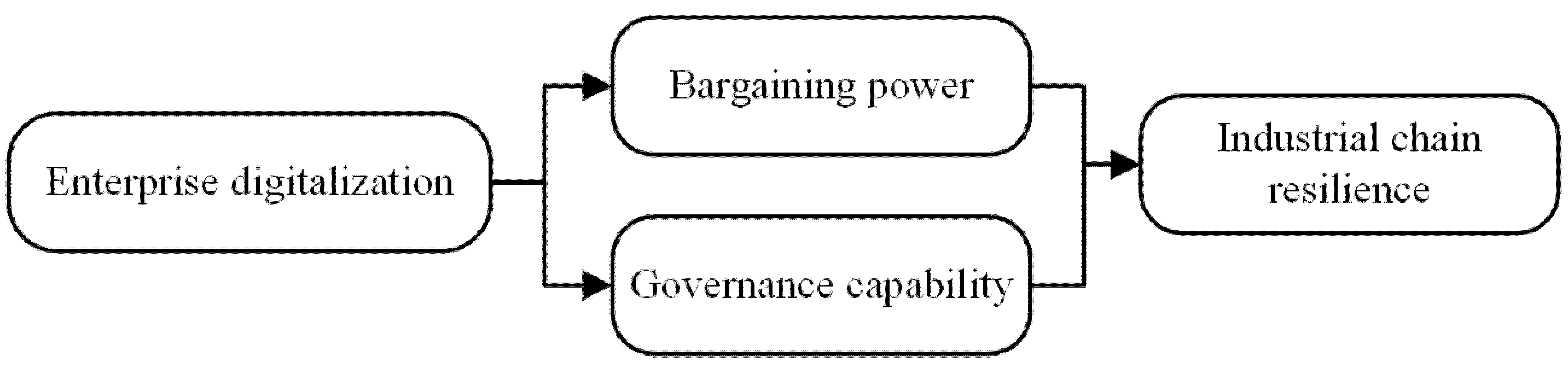
First, according to the resource-dependence theory, bargaining power stems from the power asymmetry between trading partners [42]. Bargaining power, as the core of an enterprise’s vertical industrial chain relationship, directly influences the distribution of economic benefits in transactions [43]. However, the intensification of external environmental uncertainties increases the risk of industrial chain disruptions, which may weaken an enterprise’s bargaining power [38,44]. Enterprises mitigate industrial chain risks through supplier diversification, which reduces single-supplier dependence [39]. This strategy simultaneously enhances bargaining power along the value chain and strengthens price-setting capabilities in input markets. Specifically, digitalization enhances an enterprise’s bargaining power in two ways. On the one hand, it reduces information asymmetry and external transaction costs through information sharing [45]. On the other hand, it improves the collaborative efficiency between the enterprise and its suppliers [46]. By leveraging digital tools to optimize resource allocation and enhancing the enterprise’s coordination and management capabilities in complex industrial chains, it strengthens the enterprise’s bargaining power, thereby strengthening the industrial chain resilience. Therefore, we propose Hypothesis 1:
Hypothesis 1. 
Enterprise digitization can enhance the resilience of the industrial chain by improving bargaining power with upstream and downstream enterprises.
Second, according to dynamic capabilities theory [47], the essence of governance capacity lies in an enterprise’s ability to integrate, build, and reconfigure internal and external resources to adapt to dynamic environments. Through digitalization, enterprises enhance their dynamic capabilities, thereby directly improving the synergistic optimization of innovation efficiency and production efficiency within governance capacity. This strengthens the industrial chain resilience. At the innovation level, digitalization not only enables enterprises to assess technological feasibility and profit margins by leveraging market demand insights [48] and improves iterative efficiency in research and development to elevate output quality [41], but also facilitates cross-organizational knowledge sharing and collaborative innovation through digital platforms, accelerating technological diffusion and breakthrough achievements [49]. Enterprises’ innovation capabilities generate positive knowledge externalities that vertically integrate upstream suppliers and downstream customers, leading to coordinated productivity improvements throughout the industrial chain [50], which in turn reinforces systemic resilience against disruptions. At the managerial level, digitalization enhances information transparency and traceability, curbing information asymmetry and agency costs, while promoting the transition toward flatter, networked governance structures [51,52]. Concurrently, digitalization replaces traditional rigid production lines with flexible systems, enabling dynamic resource allocation and precise capacity matching, which reduces inventory costs and shortens production cycles [40,53]. These enhancements in managerial capabilities empower enterprises to respond swiftly to market demand fluctuations [54], thereby strengthening the industrial chain resilience. Therefore, we propose Hypothesis 2:
Hypothesis 2. 
Digitalization of enterprises can enhance the resilience of the industrial chain by improving innovation efficiency and production efficiency.
The theoretical framework is shown in Figure 1.

3. Data and Methods

3.1. Data Sources

The global financial crisis from 2008 to 2010 exerted a severe impact on the world economy, during which data may have been subject to short-term anomalous fluctuations, resulting in a lack of stability [55]. Beginning in 2011, the global economy gradually entered a recovery phase, with economic development stabilizing over time. This period provides more robust and reliable data for our analysis. Therefore, this paper selects the research window period from 2011 to 2023. The data mainly come from the CSMAR (China Stock Market & Accounting Research Database). The industrial chain resilience is mainly manifested in manufacturing enterprises, we only retain the data of manufacturing enterprises among the normally listed enterprises in the CSMAR database from 2011 to 2023, that is the listed enterprises with the industry code “C.” To improve the quality of the data, we exclude observation of ST, *ST, PT, and delisted companies. Meanwhile, we also exclude enterprise samples with incomplete enterprise information records and severely missing financial information.
Additionally, we utilized corporate annual report text data and China City Statistical Yearbooks. The corporate annual report text data was used to extract information on corporate digitization. We also extracted the annual regional GDP (gross domestic product) growth rates, the tertiary sector’s share of GDP, and real per capita GDP (2011 constant prices) from the city statistical yearbooks for the analysis of omitted variables. For the integration of multi-source data, we first merged the CSMAR data with the corporate annual report text data using unique stock codes. Next, we merged the data with the China City Statistical Yearbooks using the city codes where the enterprises are located. Finally, after data cleaning and integration, we retained a total of 28,939 unbalanced panel data points for enterprise-years from 2011 to 2023.

3.2. Variables

3.2.1. Industrial Chain Resilience

Industrial chain resilience refers to its ability to adapt to internal and external shocks [15,16]. Existing studies have not reached a fully consistent view on the definition and connotation of industrial chain resilience, and there are also significant differences in measurement methods [6,56,57,58]. Accordingly, drawing on relevant literature [20,59,60], we measure industrial chain resilience from resistance capability, operational capability, supply–demand matching capability, and renewal capability. The TOPSIS-entropy method combined the advantages of the entropy and the TOPSIS [61]. Specifically, the entropy-weighted TOPSIS (Technique for Order Preference by Similarity to Ideal Solution) method is a multi-criteria decision analysis approach that combines the entropy method and the TOPSIS method. Its fundamental principle involves determining the weights of each indicator through the entropy method [61], and then calculating the relative closeness of each alternative to the ideal solution and the negative ideal solution using the TOPSIS method [62], thereby ranking and evaluating the alternatives [63]. This method is widely applied to multi-indicator, multi-alternative decision-making problems, particularly in situations where conflicts exist between indicators or where there are inconsistencies in measurement units [20]. Therefore, we utilized the Entropy-Weighted TOPSIS method to assign weights and compute the industrial chain resilience by drawing on the indicator system (the basic principles and calculation steps of the Entropy Weighted TOPSIS method are shown in Appendix A.1).
For the indicator system, specifically, resistance capability emphasizes the ability to return to the original state when facing shocks [64]. Cash reserves are helpful in dealing with uncertainties [65,66]. We use the ratio of accounts receivable to main business revenue and the ratio of cash assets to total assets to measure the resistance capability of the industrial chain. Supply–demand matching capability emphasizes the balance between supply and demand. An improvement in logistics efficiency can increase the inventory turnover rate of enterprises, thereby effectively reducing their operating costs [67]. We use the ratio of the enterprise’s inventory value to total operating revenue and the inventory turnover rate to measure the supply–demand matching capability of the industrial chain. Operational capability represents an enterprise’s organizational and livelihood-earning capabilities [68], and it mainly enhances the enterprise’s management efficiency by accelerating capital flow and capital reserve [69]. We use the accounts receivable turnover rate and the accounts payable turnover rate to gauge the operational capacity of the industrial chain. Competitiveness highlights the capacity for renewal and upgrading. Innovation constitutes a crucial element of an enterprise’s core competitiveness [70], and investment in innovation aids in offering fundamental support for the research of key technologies [71]. We choose the proportion of research and development (R&D) staff to the total number of employees and the proportion of R&D expenditure to total operating income to measure the competitiveness of the industrial chain. Table 1 presents the definitions and attributes of the specific measurement indicators for industrial chain resilience.

3.2.2. Enterprise Digitalization Level

Drawing on the existing research [72], we measure enterprise-level digitalization by counting occurrences of 76 digital technology terms from artificial intelligence, big data, cloud computing, blockchain, and general digital technology applications (the specific terminology and vocabulary are as detailed in Appendix A.2). Subsequently, to address the issue of right-skewness, the natural logarithm transformation was applied to the data obtained from the frequency counts.
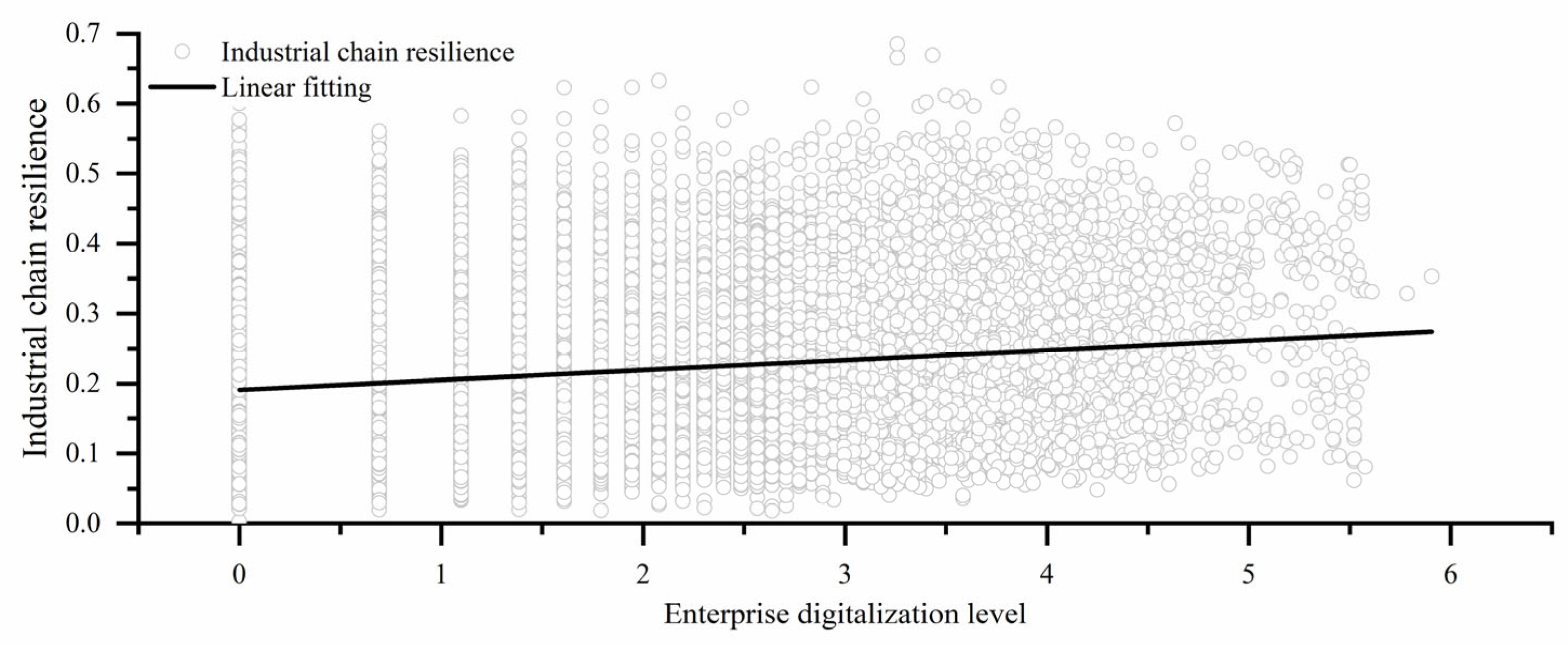
Figure 2 displays the relationship between enterprise digitalization and industrial chain resilience, with a fitted linear trend line. It could find that the slope of the linear fitting curve between them being 0.014, and as the level of enterprise digitalization advances, the industrial chain resilience exhibits a gradual increase. This presentation of factual data sets a realistic foundation for the empirical findings of this paper. To conduct a more in-depth exploration of the correlation between enterprise digitalization and industrial chain resilience, scatter plots were also constructed between enterprise digitalization and the secondary—dimension indicators of industrial chain resilience (as shown in Appendix A.3). The analysis shows that enterprise digitalization is positively correlated with resistance capability, supply–demand matching capability, and competitive capability. Conversely, a negative correlation is observed between enterprise digitalization and operational capability. These findings offer factual backing for our subsequent empirical examination of the relationship and the underlying mechanism between enterprise digitalization and industrial chain resilience.

3.2.3. Controls

Drawing on the research on industrial chains [6,71,73,74], these covariates include main business revenue ( r e v e n u e ), enterprise listing age ( a g e ), the proportion of tangible assets ( t a n g i b l e ), Tobin’s Q ( t o b i n ), and the number of employees ( s t a f f ). We conducted a 1% bilateral winsorization on all variables except age by year and industry. The definitions and descriptive statistics of the variables are shown in Table 2.

3.3. Empirical Model

We estimate the effect of enterprise digitalization on industrial chain resilience using OLS, following established empirical practice in industrial organization research [56,57,71]. The baseline specification takes the form as Equation (1).
I C R i s t = α + β d i g i t i s t + φ c o n t r o l i s t + μ i n d u s t r y s + δ y e a r t + ε i s t
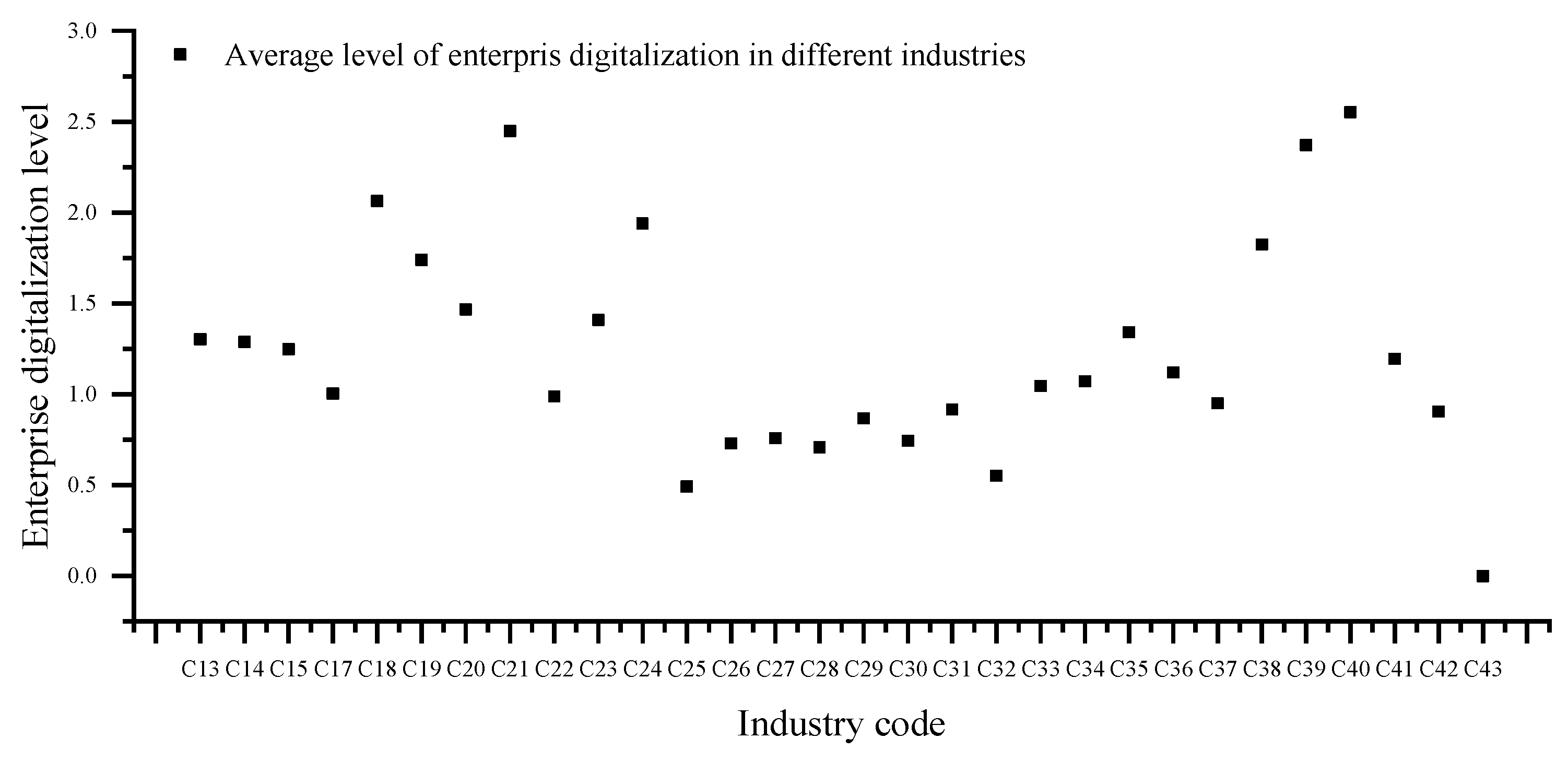
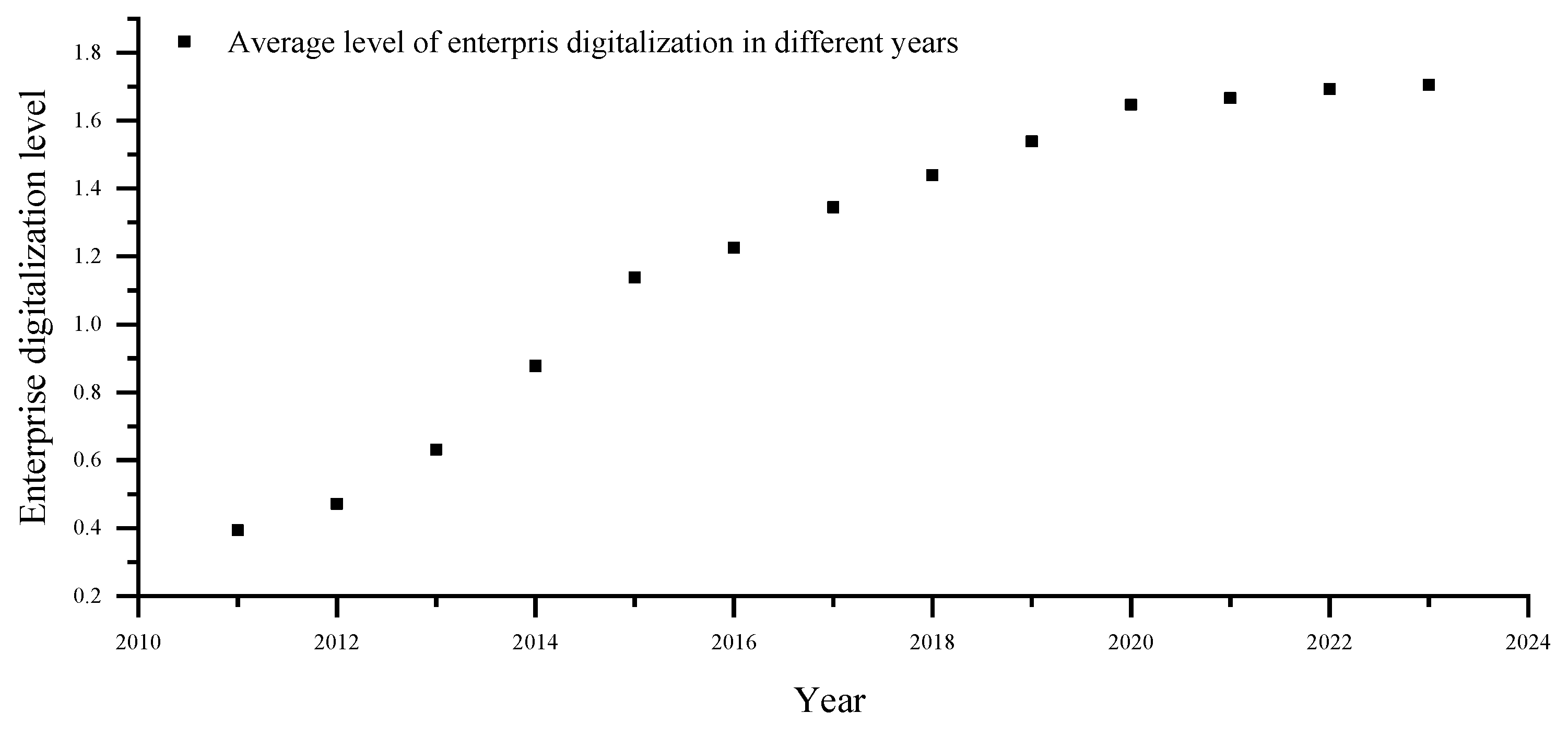
In Equation (1), i = ( 1 ,   2 ,   ,   3908 ) , s = ( 1 ,   2 ,   ,   30 ) and t = ( 2011 ,   2012 ,   ,   2023 ) . I C R i s t represents the industrial chain resilience for enterprise i in industry s in year t . d i g i t i s t denotes the digitalization level for enterprise i in industry s in year t . c o n t r o l i s t is the set of covariates in this study, including r e v e n u e , a g e , t a n g i b l e , t o b i n , and s t a f f . Notably, disparities exist in the enterprise digitalization level among different industries and across various years (the distributions of the enterprise digitalization level by industry and year are presented in Appendix A.4). Consequently, it is imperative to account for industry-specific and year-specific biases in Equation (1). i n d u s t r y s , y e a r t , and ε i s t represents industry fixed effects, year fixed effects, and error term, respectively.

4. Results

4.1. Baseline Estimation Results

We employ Equation (1) to examine the relationship between enterprise digitalization and industrial chain resilience, and the results are shown in columns 1–2 of Table 3. The coefficient on d i g i t remains positive and statistically significant both with and without the inclusion of control variables. For instance, as demonstrated in column 2, the coefficient for enterprise digitalization is estimated at 0.008, achieving significance at the 1% level. The estimates indicate that a 1% increase in enterprise digitalization leads to a 0.008-unit enhancement in industrial chain resilience. This implies that for every 1% rise in digitalization levels, industrial chain resilience increases by 3.8% relative to the average level. This economically significant effect suggests digitalization plays a crucial role in enhancing industrial chain resilience.
Building upon this foundation, we further investigated the influence of enterprise digitalization on the secondary indicators of industrial chain resilience through Equation (1). The empirical findings, as presented in columns 3–6 of Table 3, indicate that enterprise digitalization does not exhibit a statistically significant effect on resistance capability and operational capability. However, it demonstrates a markedly positive impact on both supply–demand matching capability and competitive capability. These results suggest that enterprise digitalization primarily contributes to the enhancement of industrial chain resilience by improving the supply–demand matching capability and competitive capability strength within the industrial chain.
In addition, to avoid the spurious estimation results that may arise from a decrease in main business income and total assets, leading to an increase in industrial chain resilience, we also estimated the impact of enterprise digitization on main business income and total assets (the estimation results are presented in Appendix A.5). The results show that digitization has a positive effect on both main business income and total assets, indicating that the aforementioned potential spurious estimation results do not exist.
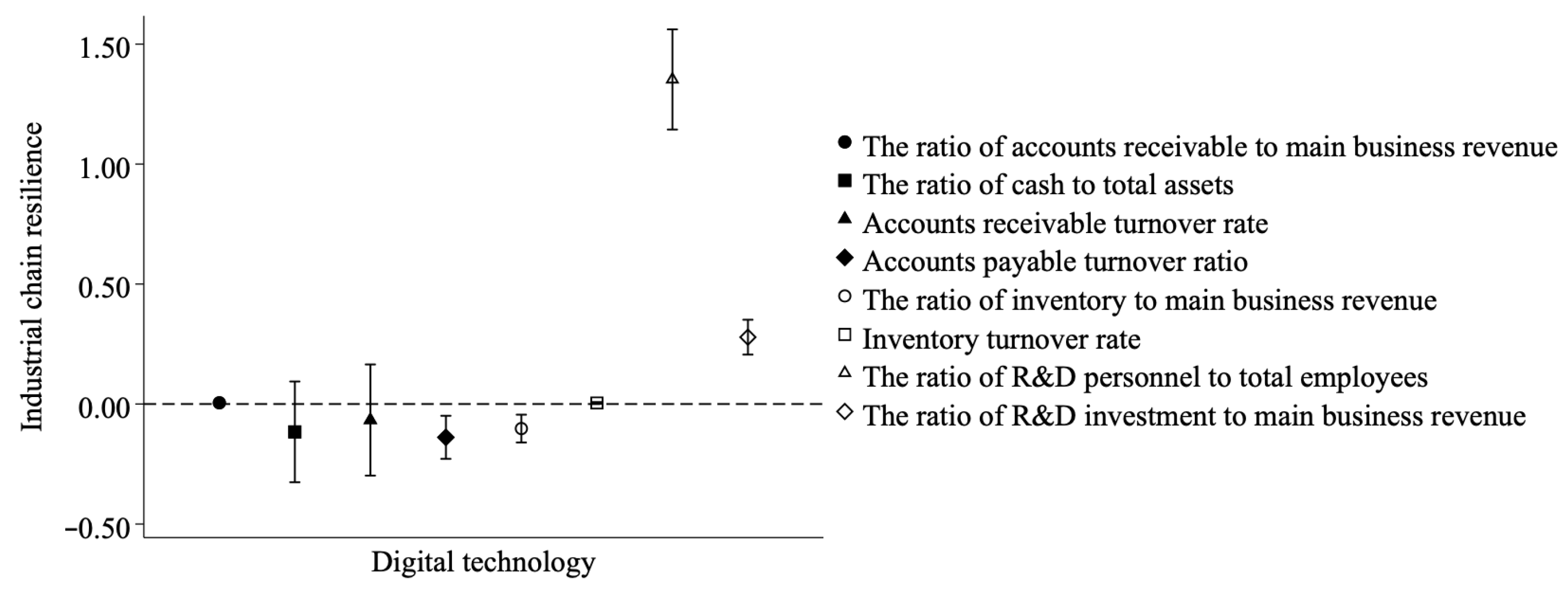
In addition, we further examined the influence of enterprise digitalization on specific indicators of industrial chain resilience, with the empirical results depicted in Figure 3. It reveals that the enterprise digitalization does not exert a statistically significant effect on the ratio of accounts receivable to total operating revenue, the ratio of cash to total assets, the accounts receivable turnover rate, or the inventory turnover rate. However, enterprise digitalization significantly reduces the accounts payable turnover rate and the ratio of inventory value to total operating revenue. Conversely, it significantly enhances the proportion of R&D personnel relative to the total workforce and the ratio of R&D investment to total operating revenue. Given that both the accounts payable turnover rate and the ratio of inventory value to total operating revenue are inverse indicators, enterprise digitalization positively influences industrial chain resilience primarily by decreasing these two metrics while simultaneously increasing the proportion of R&D personnel relative to the total workforce and the ratio of R&D investment to total operating revenue.

4.2. Robustness Test

4.2.1. Replace I C R

The industrial chain risk ( I C S ) captures the extent of misalignment between production and demand within the industrial chain, as orchestrated by the core enterprise. Building on existing research, we operationalize I C S as the ratio of the quarterly standard deviation of production volume to the quarterly standard deviation of demand volume [73]. Specifically, we use the sum of quarterly cost of sales and quarterly net inventory as the quarterly production volume indicator, and the sum of quarterly main business income and other business income as the quarterly demand volume. Before calculating the standard deviation, we perform a logarithmic transformation on the quarterly production volume and quarterly demand volume. We substitute the industrial chain resilience ( I C R ) with the industrial chain risk ( I C S ). The estimated results are shown in the column 1 of Table 4, indicating that enterprise digitization significantly reduces industry chain risks. Industrial chain risk ( I C S ) refers to the potential negative impacts of internal and external shocks on the industrial chain system [73], while industrial chain resilience denotes the system’s ability to recover from such shocks [15,16,64]. Thus, according to their definitions, a reduction in industrial chain risk can enhance industrial chain resilience.

4.2.2. Replace the Weighting Method

Factor analysis is widely adopted weighting approach, and it also was employed to reallocate weights within the industrial chain resilience index system [75]. Through this method, a revised industrial chain resilience ( I C R _ f a c t o r ) was computed via weighted aggregation. Then we re-estimated Equation (1), and the results are shown in column 2 of Table 4. The enterprises’ digitization still significantly enhances the industrial chain resilience.

4.2.3. Replace the Digital Word Frequency Library

In existing studies, prevalent approaches for quantifying digitalization also involve measuring the occurrence rates of 99 digital-relevant terms from digital technology implementation, internet-based business frameworks, intelligent production systems, and contemporary information architectures [74], while others involve enumerating 139 digital-associated terms categorized under technical taxonomies, organizational capacity enhancement, and digital operational practices [76]. Consequently, logarithmic transformations were applied to the word frequency metrics of the two enterprise digitalization indicators, respectively designated as d i g i t _ 99 and d i g i t _ 139 . Then we re-estimated Equation (1), and the results are shown in column 3–4 of Table 4. The enterprises’ digitization still has a significant positive impact on the industrial chain resilience.

4.2.4. Replace Enterprise Digitalization

Digital infrastructure constitutes the cornerstone for the enterprises digitization, and then has the potential to reconfigure existing industrial chains, enhancing their safety, stability, and operational efficiency [77]. Furthermore, some studies have used the “Broadband China” policy as a digital shock to estimate its impact on the industrial chain [78]. Similarly, we also use the “Broadband China” policy as a digital shock ( B r o a d b a n d _ C h i n a ) and employ the difference-in-differences (DID) method to estimate the impact of digitization on the industrial chain resilience1. The results are shown in column 5 of Table 4, indicating that the “Broadband China” policy has markedly bolstered the industrial chain resilience, thereby corroborating the robustness of the baseline estimation.

4.2.5. Using Firm Fixed Effects

To control for time-invariant, unobserved firm characteristics that may be related to both digitalization and industrial chain resilience, we further employ firm fixed effects. We re-estimate the model using two-way fixed effects for both firm and year. The estimation results are shown in Column 6 of Table 4. The impact of firm digitalization on industrial chain resilience remains significantly positive, consistent with the benchmark estimation results.

4.2.6. Propensity Score Matching (PSM)

To mitigate potential sample selection bias arising from the incidental nature of firms’ digital transformation, we further conduct PSM by matching non-digitalized firms with digitalized firms using a 1-to-1 matching method within a caliper of 0.052. The model is re-estimated using the matched sample. The results, presented in Column 7 of Table 4, indicate that after addressing sample selection bias, the positive impact of firm digitalization on industrial chain resilience remains statistically significant.

4.2.7. Year-by-Year Estimation

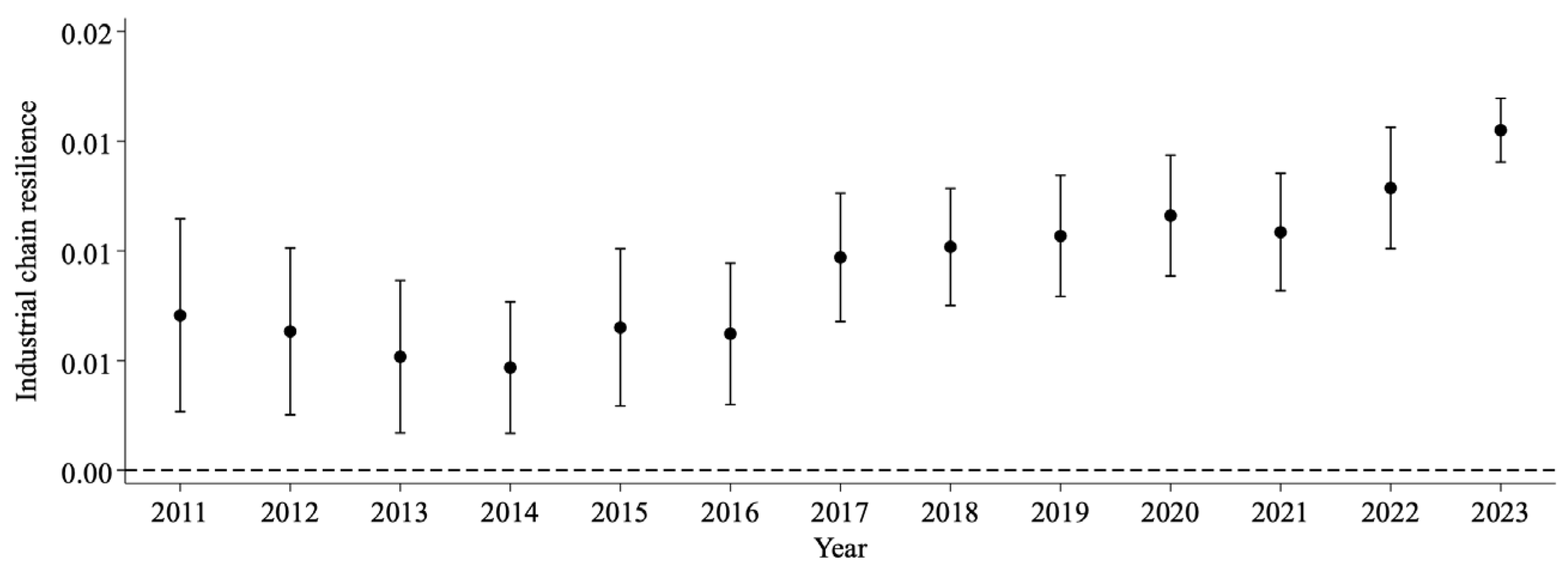
To more rigorously test the robustness of the benchmark estimation results and to exclude the potential influences of economic recovery in the early stage of the sample period and public health incident shocks in the later stage, we conduct year-by-year estimations within the research window. The estimation results, as illustrated in Figure 4, show that the effect of firm digitalization on industrial chain resilience is significantly positive in each year throughout the research window. This result helps rule out potential interference from other factors within the sample period.

4.3. Endogenous Analysis

4.3.1. Omitted Variable

The enterprise digitalization and the robustness of industrial chains are both contingent on macroeconomic conditions [8]. Our initial specification omitted city and province level controls, potentially introducing omitted variable bias. To mitigate this endogeneity concern, we incorporate annual regional GDP growth rates, the tertiary sector’s share of GDP, and real per capita GDP (2011 constant prices). These variables serve as comprehensive proxies for regional economic development. We sequentially introduce city and province level macroeconomic controls into Equation (1), and the results are shown in columns 1–2 of Table 5. After considering these additional control measures, the positive and statistically significant impact of enterprise digitization on industry chain resilience still exists. It is worth noting that the estimated coefficients are still similar in quantity to our baseline specifications, indicating that the omitted variable bias in our baseline results is very small.

4.3.2. IV Estimates

We use the frequency of words in the annual report of an enterprise to measure the endogeneity of measurement errors that may arise from enterprise digitalization, leading to inaccurate results. We adopted the instrumental variable method to obtain more accurate estimation results. The number of post offices per million people and the number of fixed telephones per 10 thousand people in 1984 are often used as instrumental variables of digitalization [79,80,81]. These instrumental variables satisfy the relevance condition, as regions with greater telecommunications infrastructure development historically exhibit higher probabilities of subsequent enterprise digitalization. However, early communication infrastructure reflects historical state planning or geographical constraints. Although it may have influenced regional development trajectories in the past, it cannot directly affect modern industrial chains. Moreover, research emphasizes that historical instrumental variables can capture long-term institutional or geographical differences without being correlated with contemporary short-term shocks [82]. Therefore, the number of post offices per million people and the number of fixed telephones per ten thousand people in 1984 serve as suitable instrumental variables. Therefore, we adopt the method of dealing with the time trend of instrumental variables and constructed I V 1 by interacting the number of post offices per million people in 1984 with the year variable, and I V 2 by interacting the number of fixed telephones per ten thousand people in 1984 with the year variable. I V 1 and I V 2 are the instrumental variables for enterprise digitalization. Then, we employ a two-stage least squares (2SLS) method to estimate the effect of enterprise digitalization on industrial chain resilience.
The results are shown in columns 3–6 of Table 5. Columns 3 and 5 report the first-stage estimates for I V 1 and I V 2 , respectively. Both instrumental variables demonstrate statistically significant positive effects on enterprise digitalization, satisfying the relevance condition for valid instruments. Columns 2 and 4 report the second-stage results, and reveal substantial and statistically significant effects of enterprise digitalization ( d i g i t ) on industrial chain resilience, with estimated coefficients of 0.038 for IV1 and 0.068 for IV2. These effect sizes notably exceed the corresponding OLS estimate from column (2) of Table 3, suggesting that conventional regression approaches may substantially underestimate digitalization’s true impact. This pattern of results serves two important purposes. First, it establishes that our baseline findings are robust to endogeneity concerns when using plausibly exogenous variation. Second, the fact that the 2SLS coefficients are consistently larger than the OLS estimates suggests that standard estimation methods may attenuate the true treatment effects because of measurement error.

4.4. Heterogeneity Analysis

The impact of enterprise digitization on industrial chain resilience may exhibit heterogeneity among enterprise attributes. Firstly, enterprises of varying scales exhibit marked differences in managerial costs, production structures, and market demand characteristics. This pattern implies that enterprise size likely moderates the digitalization–resilience relationship. We proxy enterprise size using total assets and introduce an interaction term between enterprise size and digitalization into Equation (1). The results in column 1 of Table 6 reveal a statistically significant negative coefficient for the interaction term d i g i t × s i z e , suggesting that digitalization has brought greater industrial chain resilience to small enterprises compared to large enterprises. This may be due to the more flexible operations of small enterprises [83].
Second, relative to capital-intensive enterprises, enterprise digitalization appears to exert a more pronounced effect on strengthening risk resilience in labor-intensive enterprises [84]. To examine this heterogeneity, we construct a capital intensity index ( c a p i t a l _ i n t e n s i t y ) using the ratio of net fixed asset value to total employment. Then we introduce an interaction term between capital intensity and digitalization into Equation (1). The results are shown in column 2 of Table 6, the interaction term d i g i t × c a p i t a l _ i n t e n s i t y exhibits a significant negative coefficient, suggesting that digitalization has a greater impact on the industry chain resilience of enterprises with lower capital intensity compared to those with higher capital intensity.
Third, a robust ESG (environmental, social, and governance) rating serves as both an indicator of an enterprises’ commitment to social responsibility and a proxy for substantial capital market endorsement [85]. Enterprises with elevated ESG ratings exhibit greater capacity to drive digital innovation and expedite their digital transformation processes [86]. To investigate this relationship, we introduce an enterprise’s annual ESG score as a moderating variable and include its interaction with enterprise digitalization into Equation (1). The results are shown in column 3 of Table 6, the interaction term d i g i t × E S G exhibits a significant positive coefficient, indicating that digitalization generates more substantial industrial chain resilience improvements for enterprises with higher ESG ratings. The reason may be that enterprises with higher ESG ratings demonstrate more efficient resource allocation, stricter internal controls [87], and the ability to access capital at lower costs and attract sustainable investment, providing stable funding support for digital infrastructure [88]. This results in a stronger impact of digitalization on the industrial chain resilience.
Finally, there are significant differences in production efficiency and business objectives between state-owned and private enterprises in China [89]. The impact of digitization on the industrial chain resilience may vary depending on ownership structure. Following the existing research [90], we classify enterprises into state-owned enterprises and private enterprises based on their registration types. We construct a binary variable ( o w n e r ), assigning a value of 1 to state-owned enterprises and 0 to private enterprises, and introduce its interaction with enterprise digitalization into Equation (1). The results are shown in column 4 of Table 6, the interaction term d i g i t × o w n e r is insignificant, indicating that the resilience-enhancing effect of digitalization does not differ between state-owned enterprises and private enterprises.

4.5. Mechanism Analysis

Based on the theoretical analysis, we focus on testing the bargaining power mechanism and the governance capability mechanism. Focusing first on bargaining power, enterprise digitalization enables industrial chain diversification, reducing single-supplier dependence and strengthening negotiation leverage [39]. Therefore, we use the upstream supplier concentration dispersion3 ( u p _ S C D ) and downstream customer concentration dispersion ( d o w n _ S C D ) of enterprises as proxy indicators for the enterprise bargaining power mechanism. We employ the OLS model to confirm this mechanism, and the estimation results are shown in columns 1–2 of Table 7. The positive and statistically significant coefficients on digitalization demonstrate that digital adoption reduces industrial chain concentration by 1.16% upstream and 1.83% downstream. The digitalization enhances the bargaining power of enterprises over upstream and downstream partners as theoretically predicted. These estimates support the bargaining power channel, confirmed our Hypothesis 1.
Existing research establishes that both innovation efficiency and production efficiency contribute to industrial chain resilience [13,91]. We use the ratio of the number of an enterprise’s invention patents to the total number of patents as a proxy variable for enterprise innovation efficiency ( i n n o v a t e ), and the total factor productivity of the enterprise calculated by the OP method [92] as a proxy variable for production efficiency ( T F P _ O P ). We employ the OLS model to confirm this mechanism, and the results are shown in columns 3–4 of Table 7. The results demonstrate statistically significant positive coefficients of enterprise digitalization on both innovation efficiency and production efficiency. The digitalization enhances innovation output by improving patent quality composition, boosts productive efficiency, and then consequently strengthens corporate governance capacity, as theoretically predicted. The results presented in Table 7 collectively validate our theoretical framework, demonstrating that digitalization affects industrial chain resilience through both enhanced bargaining power and improved governance capabilities, confirmed our Hypothesis 2.

5. Spillover Effects of the Industrial Chain

Corporate digitalization serves multiple critical functions in enhancing the supply-chain ecosystem. It empowers enterprises to construct industrial chain information platforms, which are instrumental in preventing suboptimal production planning and bolstering the stability of the industrial chain [5]. In addition, digitalization enables enterprises to swiftly gather customer requirements and seamlessly integrate these consumer demands into key business processes, including design, manufacturing, and marketing services. This integration not only enhances customer satisfaction but also strengthens industrial chain resilience [17]. Given these advantages, corporate digitalization not only directly bolsters an enterprise’s industrial chain resilience but also generates spillover benefits across upstream suppliers and downstream customers within the industrial chain network [93].
To empirically evaluate the spillover effects of corporate digitalization on industrial chain resilience, we employed an annual matching based on enterprises’ procurement and sales data. Finally, we have obtained the mixed panel data for 2584 core enterprises and their upstream suppliers, as well as 3978 core enterprises and their downstream customers (The matching process and descriptive statistics of the data are provided in Appendix A.10). We employ the OLS model to analyze the spillover effects of core enterprise digitalization across upstream suppliers and downstream customers. The results are shown in Table 8.
Columns 1–2 of Table 8 show the impacts of the core enterprise digitalization ( d i g i t ) on the upstream supplier digitalization ( d i g i t _ u p ) and the industrial chain resilience of upstream suppliers ( I C R _ u p ). The digitalization of core enterprises significantly enhances the digitalization level of upstream suppliers. However, its effect on improving the industrial chain resilience of upstream suppliers is not significant. Columns 3–4 of Table 8 show the impacts of the digitalization of core enterprises ( d i g i t ) on the downstream customers digitalization ( d i g i t _ d o w n ) and the industrial chain resilience of downstream customers ( I C R _ d o w n ). The digitalization of core enterprises significantly boosts both the digitalization level and the industrial chain resilience of downstream customers. The findings suggest that corporate digitalization can drive both upstream suppliers and downstream customers to embark on digitalization. However, the spillover effect of corporate digitalization on industrial chain resilience primarily manifests in the backward extension of the supply chain, with no discernible spillover effect in the forward extension. This heterogeneity may be related to supply chain power, where downstream enterprises play a dominant role in the industry chain compared to upstream suppliers [21].

6. Discussion and Conclusions

This paper examines how enterprise digitalization enhances industrial chain resilience in the manufacturing sector. Using panel data from 2011 to 2023, we employ an OLS model to estimate this relationship. Our findings indicate that enterprise digitalization significantly improves industrial chain resilience, primarily by strengthening supply–demand matching capability and competitive capability. These results remain robust after addressing endogeneity concerns and conducting extensive sensitivity tests. Heterogeneity analysis reveals that the effect varies by enterprise size, capital intensity, and ESG performance, but shows no significant difference between state-owned and private enterprises. Mechanism testing further indicates that the improvement of bargaining power and governance capability is the main channel for the impact of enterprises digitization on industrial chain resilience. Specifically, on the one hand, enterprise digitization enhances bargaining power by promoting the diversification of supplier and customer networks. On the other hand, it strengthens governance capabilities by promoting innovation and improving production efficiency. Additionally, we identify significant backward spillover effects to upstream and downstream partners.
In contrast to existing research, which predominantly examines the relationship between digitalization and industrial chains from global and urban perspectives [15,21]. We advance the discussion in three key aspects. First, we extend the analysis of industrial chain resilience from a macro perspective to the micro-level foundations of enterprises. Second, we construct a dual-channel framework based on resource dependence theory and dynamic capabilities theory, revealing both the internal and external pathways through which digitalization enhances resilience. Finally, we introduce a directional spillover perspective that clarifies the asymmetric transmission mechanisms of digitalization along the industrial chain.
With our research findings, the impact of corporate digitalization on industrial chain resilience varies by enterprise type, with the strongest effects observed in small enterprises, labor-intensive enterprises, and those with higher ESG scores. However, we find no statistically significant difference between state-owned enterprises and private enterprises. This heterogeneity is essentially the result of the reconfiguration of digital capabilities shaped by the enterprise scale threshold, factor substitution elasticity, and institutional compliance threshold. Firstly, the advantages of small enterprises in production, operation, and management efficiency make digitalization have a greater impact on the industrial chain resilience [83]. Secondly, labor-intensive enterprises benefit from the super-linear substitution elasticity of digitalization for labor, transforming their traditional reliance on human labor into an advantage in digital process control [94]. Thirdly, high-ESG enterprises can obtain a premium for green supply chain certification through tools such as blockchain traceability, converting ESG data assets into institutional legitimacy capital to avoid trade barriers and financing constraints [85]. Enterprises with higher ESG ratings also exhibit more efficient resource allocation, stricter internal controls [87], and the ability to obtain capital at lower costs and attract sustainable investment [88]. This results in a stronger impact of digitalization on the industrial chain resilience. Fourth, the null result between state-owned and private enterprises reflects institutional convergence in digital economy regulation and policy homogenization across ownership types. Specifically, cross-cutting industrial chain security policies and standardized digital governance frameworks have neutralized traditional resource disparities based on property rights [95].
The spillover effects of enterprise digitalization primarily enhance industrial chain resilience through backward propagation along the value chain. While a core function of digitalization is to reduce information asymmetries [3], we observe directional heterogeneity in the information integration capabilities across different industrial chain resilience. Enterprises typically wield greater bargaining power over upstream suppliers [21]. digitalization enables real-time monitoring that compels process standardization among suppliers, creating a reverse coercive mechanism in industrial chain governance. However, downstream suppliers face greater market fragmentation and demand heterogeneity, making them less responsive to standardized digital governance. This market structure limits the forward propagation of resilience benefits through the industrial chain [96].
To effectively enhance industrial chain resilience, the development of digitalization requires coordinated efforts at both the enterprise and policy levels. At the enterprise level, companies should formulate a digitalization strategy centered on strengthening bargaining power and governance capabilities. Specific steps include: (1) Conducting a digital maturity assessment based on their own scale and industry characteristics to clarify the transformation pathway. (2) Setting quantifiable targets, such as reducing supplier concentration through digital procurement platforms, improving inventory turnover with IoT technologies, and enhancing patent quality by promoting digital R&D collaboration. (3) Building a self-centered digital ecosystem, empowering downstream partners through standardized interfaces and data sharing to amplify the positive spillover effects on resilience. (4) Establishing a composite indicator system that covers digitalization level, resilience performance, and mechanism effectiveness to enable real-time risk perception and dynamic optimization.
At the government level, policies should shift from general encouragement to targeted empowerment. (1) Implementing differentiated incentives, such as providing tool subsidies and training for SMEs, supporting labor-intensive enterprises in integrating “automation + data cloud” upgrades, and guiding high-ESG enterprises to develop green digital supply chains while connecting them with green finance resources. (2) Launching a “Digital Enablement Program for Core Enterprises,” offering tax benefits or project preferences to core companies that actively provide technology, data, or standards to their upstream and downstream partners, thereby encouraging them to drive industrial chain collaboration. (3) Establishing regional digital transformation promotion centers to provide neutral services in capability diagnosis, solution matching, and financing coordination, systematically enhancing enterprises’ digital absorption capacity. Through coordinated efforts between enterprises and the government, digitalization can be systematically embedded in the construction of industrial chain resilience, laying a solid foundation for building a safe, efficient, and collaborative modern industrial system.
Although we have systematically analyzed the relationship between enterprise digitalization and industrial chain resilience, its mechanisms, and externalities, our research still has certain limitations. For instance, despite the resumption of economic activities, the impact of COVID-19 cannot be entirely eliminated. Additionally, in a volatile trade environment, the conservative strategies adopted by some enterprises may lead to an overestimation of the effect of enterprise digitalization on industrial chain resilience in our findings.


Author Contributions

All authors contributed to this work. Y.H. was responsible for manuscript design, data analysis and paper writing, while H.F. supervised analysis again. All authors have read and agreed to the published version of the manuscript.

Funding

This work was supported by Humanities and Social Science Youth Fund of Ministry of Education of China (Grant 24YJC790006). This funding body did not play any role in the design of the study and in the writing the manuscript but in the collection of data and charges providing.

Data Availability Statement

The datasets used and/or analyzed during the current study are available from the corresponding author on request.

Conflicts of Interest

The authors declare that there is no potential conflict of interest.

Abbreviations

The following abbreviations are used in this manuscript:
OLSOrdinary Least Squares
ESGEnvironment, Social and Governance
ICTInformation And Communication Technology
CSMARChina Stock Market & Accounting Research Database
GDPGross Domestic Product
TOPSISTechnique For Order Preference by Similarity to Ideal Solution
R&DResearch And Development
PSMPropensity Score Matching
2SLSTwo-Stage Least Squares

Appendix A

Appendix A.1. The Principle and Calculation Method of Entropy-Weighted TOPSIS

The Entropy-Weighted TOPSIS (Technique for Order Preference by Similarity to Ideal Solution) is a multi-criteria decision analysis method that combines the entropy method and the TOPSIS method. Its basic principle involves determining the weights of each indicator using the entropy method and then calculating the relative closeness of each alternative to the ideal solution and the negative ideal solution using the TOPSIS method, thereby ranking and evaluating the alternatives. The entropy method determines weights based on the information content of the data itself, avoiding the bias of subjective weighting. The TOPSIS method comprehensively considers the distances between each alternative and the ideal and negative ideal solutions, enabling a thorough evaluation of the alternatives’ strengths and weaknesses. The Entropy-Weighted TOPSIS is a multi-criteria decision method based on information entropy and distance measurement. It determines weights using the entropy method and calculates relative closeness using the TOPSIS method, providing an objective and comprehensive evaluation of the alternatives. By combining the advantages of objective weighting and distance evaluation, it offers a scientific and rational solution to multi-attribute decision problems. The basic principles and detailed calculation steps of the Entropy-Weighted TOPSIS are explained as follows.
First, data normalization. Normalize the original decision matrix X = ( x i j ) m × 8 to eliminate the influence of different units and magnitudes of the indicators. The normalized matrix is R = ( r i j ) m × 8 . Use Equations (A1) and (A2) to process and remove the dimensions for positive indicators and negative indicators, respectively. Here, max ( x j ) and m i n ( x j ) represent the maximum and minimum values, i = 1 ,   2 ,   ,   m represents the alternatives, and j = 1 ,   2 ,   ,   8 represents the indicators.
r i j = x i j m i n ( x j ) max ( x j ) m i n ( x j )
r i j = max ( x j ) x i j max ( x j ) m i n ( x j )
Second, calculate the entropy value. Using the normalized matrix, compute the entropy value e j for each indicator in the normalized matrix R . Here, p i j = r i j i = 1 m r i j , and k = 1 l n ( m ) .
e j = k i = 1 m p i j l n ( p i j )
Third, calculate the coefficient of variation. The coefficient of variation reflects the amount of information contained in an indicator; the smaller the entropy value, the larger the coefficient of variation. The coefficient of variation d j represents the amount of information for the j -th indicator, and its calculation is shown in Equation (A4).
d j = 1 e j
Fourth, determine the weights. Calculate the weights of each indicator based on the coefficient of variation. The greater the weight, the higher the importance of the indicator in the process of calculating the comprehensive index. The weight ω j of each indicator is derived from the coefficient of variation, as shown in Equation (A5).
ω j = d j j = 1 n d j
Fifth, construct the weighted normalized decision matrix. Multiply the normalized matrix R by the weights ω j determined through the entropy method to obtain the weighted normalized decision matrix V .
V = ( v i j ) m × n = ( ω j × r i j ) m × n
Sixth, determine the ideal solution and the negative ideal solution. The ideal solution is the set of optimal values for each indicator, while the negative ideal solution is the set of worst values for each indicator. The ideal solution A + and the negative ideal solution A represent the optimal and worst values of the indicators, respectively, and their specific expressions are shown in Equations (A7) and (A8).
A + = ( max ( v 1 j ) , max ( v 2 j ) , max ( v 3 j ) , , max ( v m j ) )
A + = ( min ( v 1 j ) , min ( v 2 j ) , min ( v 3 j ) , , min ( v m j ) )
Seventh, calculate the Euclidean distances of each alternative to the ideal solution and the negative ideal solution. The distance D i + of alternative i to the ideal solution and the distance D i to the negative ideal solution are calculated as shown in Equations (A9) and (A10), respectively.
D i + = j = 1 n ( v i j A j + ) 2
D i = j = 1 n ( v i j A j ) 2
Eighth, calculate the relative closeness. The relative closeness C i of alternative i is used to evaluate the superiority of the alternative, and its specific calculation method is shown in Equation (A10).
C i = D i D i + + D i
Ninth, ranking the alternatives: the alternatives are ranked based on the magnitude of the relative closeness C i , where a larger C i indicates a better alternative. Through the above steps, the entropy-weighted TOPSIS method can effectively calculate the comprehensive index of industrial chain resilience.
Based on the above process, we obtained the direction and weight of each indicator as shown in Table A1. Finally, we calculate the industrial chain resilience index ( I C R ).
I C R = 0.024 Y 1 + 0.011 Y 2 + 0.025 Y 3 0.121 Y 4 0.119 Y 5 + 0.234 Y 6 + 0.164 Y 7 + 0.302 Y 8
Table A1. Indicators and weights of industrial chain resilience.
Secondary IndicatorsThird IndicatorsAttributeWeight
I C R _ r c Resistance capabilityY1: The ratio of accounts receivable to main business revenue0.024
Y2: The ratio of cash to total assets+0.011
I C R _ o c Operational capabilityY3: Accounts receivable turnover rate+0.025
Y4: Accounts payable turnover ratio0.121
I C R _ s d m c Supply–demand matching capabilityY5: The ratio of inventory to main business revenue0.119
Y6: Inventory turnover rate+0.234
I C R _ c c Competitive capabilityY7: The ratio of R&D personnel to total employees+0.164
Y8: The ratio of R&D investment to main business revenue+0.302
Note: “−” represents a negative indicator, meaning that the larger the value, the lower the resilience of the industry chain. “+” represents a positive indicator, meaning that the larger the value, the higher the resilience of the industry chain.

Appendix A.2. Text Terminology for Enterprise Digitization

The enterprise digitalization index is constructed from 76 indicators and categorized into five dimensions: artificial intelligence, big data, cloud computing, blockchain, and general digital technology applications. The specific composition of each dimension is as follows.
Artificial Intelligence: Artificial Intelligence, Business Intelligence, Image Understanding, Investment Decision Support System, Intelligent Data Analysis, Intelligent Robotics, Machine Learning, Deep Learning, Semantic Search, Biometric Technology, Facial Recognition, Speech Recognition, Identity Verification, Autonomous Driving, Natural Language Processing
Big Data: Big Data, Data Mining, Text Mining, Data Visualization, Heterogeneous Data, Credit Investigation, Augmented Reality, Mixed Reality, Virtual Reality
Cloud Computing: Cloud Computing, Stream Computing, Graph Computing, In-Memory Computing, Multi-Party Secure Computing, Brain-Like Computing, Green Computing, Cognitive Computing, Converged Architecture, Billion-Level Concurrency, EB-Level Storage, Internet of Things (IoT), Cyber-Physical Systems.
Blockchain: Blockchain, Digital Currency, Distributed Computing, Differential Privacy Technology, Smart Financial Contracts.
General Digital Technology Applications: Mobile Internet, Industrial Internet, Mobile Connectivity, Internet Healthcare, E-Commerce, Mobile Payment, Third-Party Payment, NFC Payment, Smart Energy, B2B (Business to Business), B2C (Business to Consumer), C2B (Consumer to Business), C2C (Consumer to Consumer), O2O (Online to Offline), Internet of Vehicles, Smart Wearables, Smart Agriculture, Intelligent Transportation, Smart Healthcare, Intelligent Customer Service, Smart Home, Robo-Advisor, Smart Cultural Tourism, Intelligent Environmental Protection, Smart Grid, Intelligent Marketing, Digital Marketing, Unmanned Retail, Internet Finance, Digital Finance, Fintech, Financial Technology, Quantitative Finance, Open Banking [72].

Appendix A.3. Scatter Plot of Enterprise Digitization and the Secondary Indicators of Industrial Chain Resilience

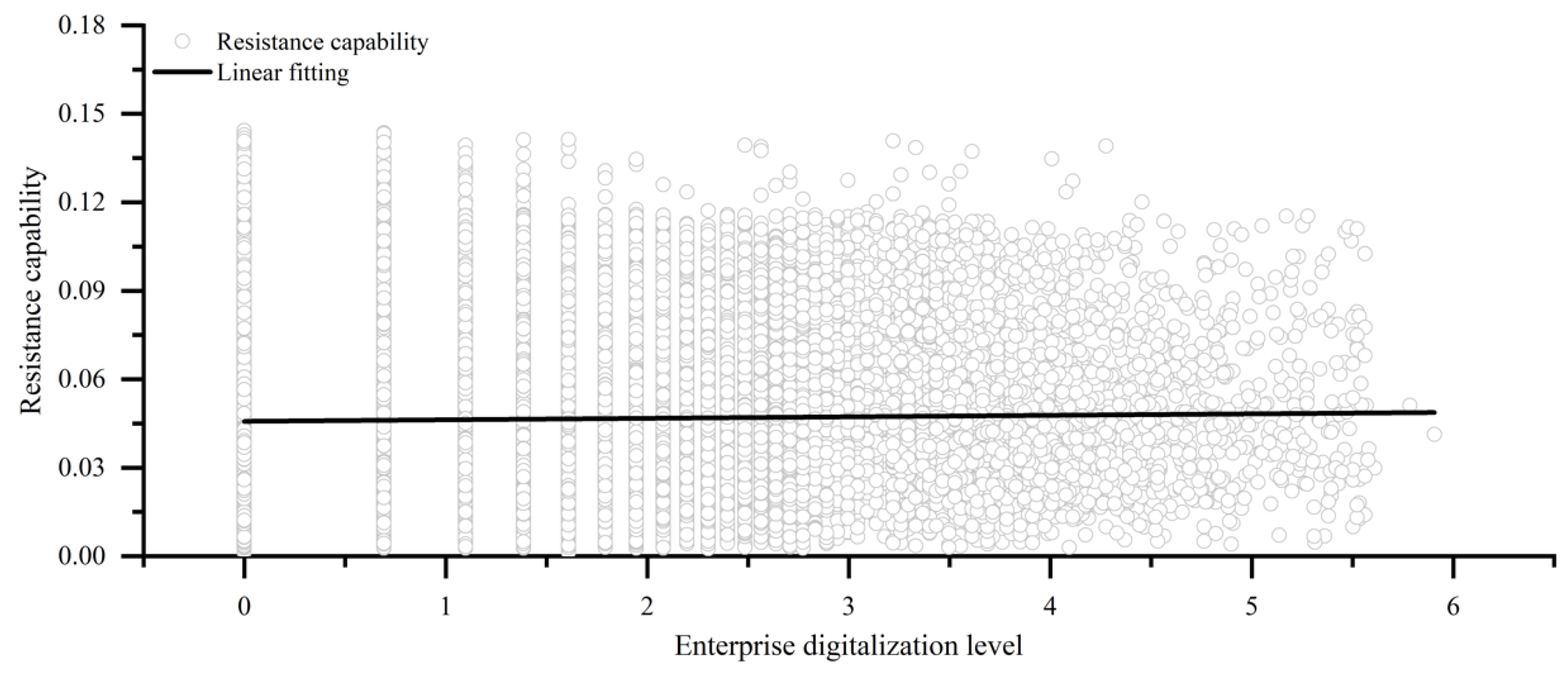
Figure A1. Scatter chart of enterprise digitalization and resistance capability.
Systems 14 00090 g0a1
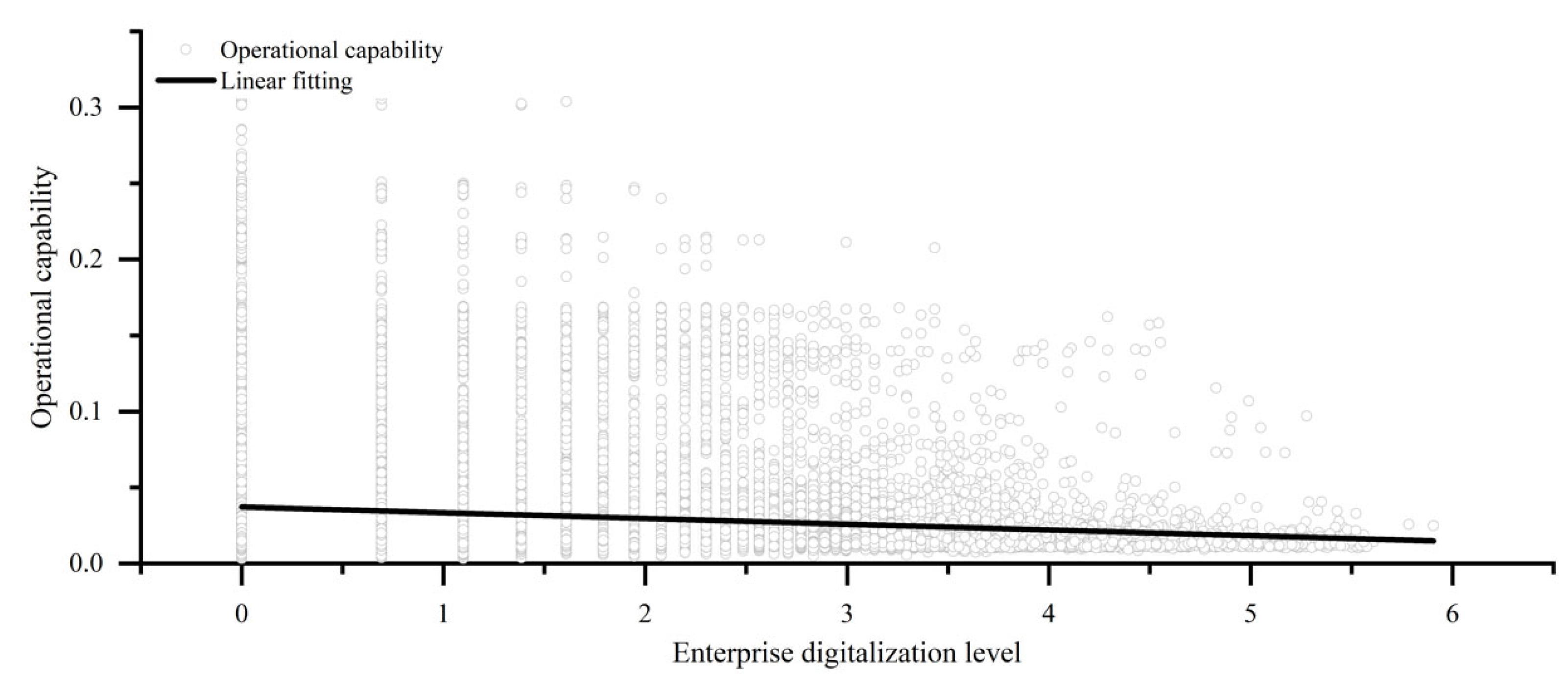
Figure A2. Scatter chart of enterprise digitalization and operational capability.
Systems 14 00090 g0a2
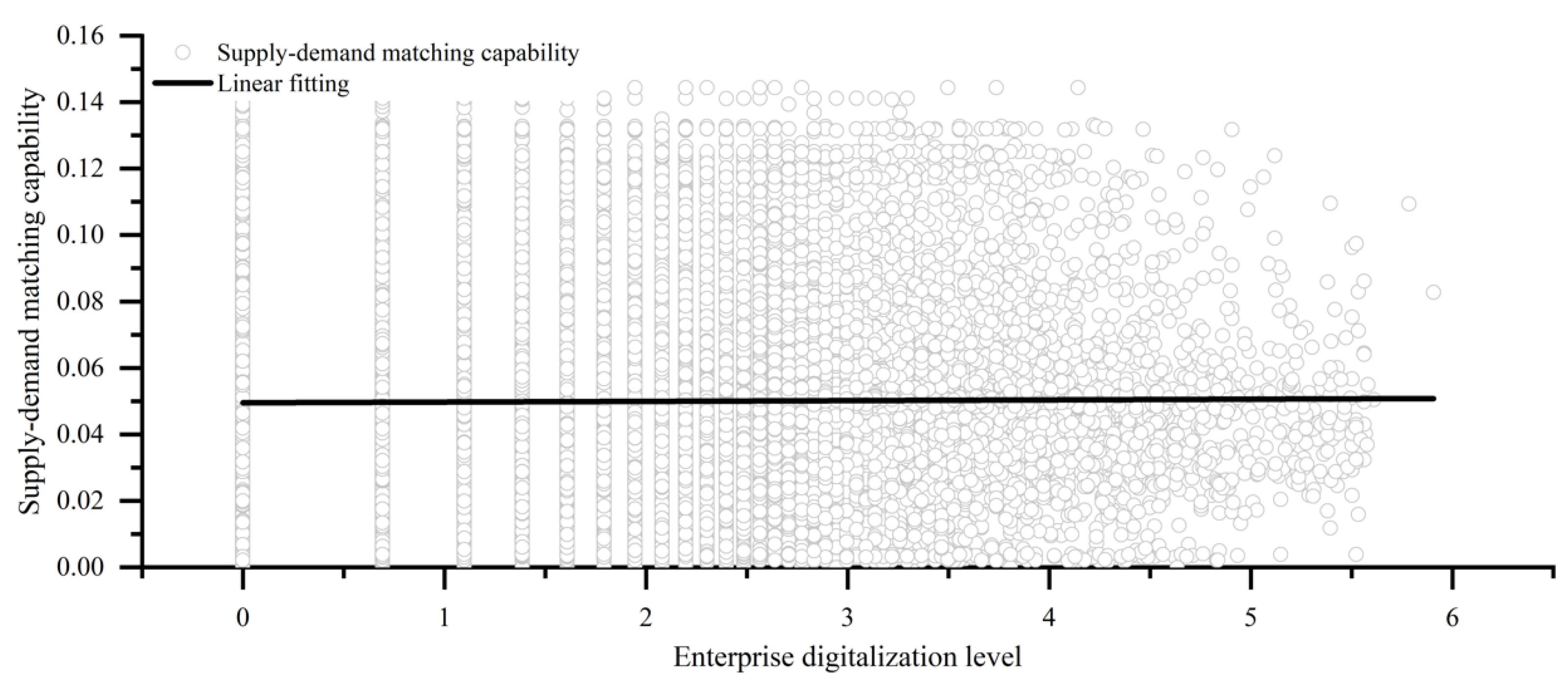
Figure A3. Scatter chart of enterprise digitalization and supply–demand matching capability.
Systems 14 00090 g0a3
Figure A4. Scatter chart of enterprise digitalization and competitive capability.
Systems 14 00090 g0a4
Figure A1 shows a scatter plot of enterprise digitalization and resistance capability, with the slope of the linear fitting curve being 0.001. Figure A2 presents a scatter plot of enterprise digitalization and operational capability, where the slope of the linear fitting curve is −0.004. Figure A3 depicts a scatter plot of enterprise digitalization and supply–demand matching capability, and the slope of its linear fitting curve is 0.002. Figure A4 shows a scatter plot of enterprise digitalization and competitive capability, with the slope of the linear fitting curve being 0.016. According to the analysis of variance, all slopes are significantly different from 0.

Appendix A.4. The Distribution of Average Enterprises Digitalization in Different Industries and Years

Figure A5. The distribution of average enterprises digitalization in different industries.
Systems 14 00090 g0a5
Figure A6. The distribution of average enterprises digitalization in different years.
Systems 14 00090 g0a6

Appendix A.5. Estimation Results of the Impact of Digitalization on Related Absolute Values of Industrial Chain Resilience

We define the logarithm of main business revenue as l n s a l e and the logarithm of total assets as l n t o t a l . Using the ordinary least squares (OLS) method with industry fixed effects and year fixed effects, we estimate the impact of firm digitalization on main business revenue and total assets. The estimation results, as shown in Table A2, indicate that firm digitalization significantly enhances both main business revenue and total assets. Therefore, there is no illusion of increased industrial chain resilience caused by a decrease in the absolute values of main business revenue and total assets. The positive impact of firm digitalization on industrial chain resilience in our benchmark estimation results is actual.
Table A2. Impact of digitalization on main business revenue and total assets.
(1)(2)
l n s a l e l n t o t a l
d i g i t 0.020 ***0.027 ***
(0.006)(0.001)
r e v e n u e 0.737 ***1.005 ***
(0.014)(0.002)
a g e 0.001−0.000 **
(0.001)(0.000)
t a n g i b l e 0.201 ***0.000
(0.061)(0.007)
t o b i n 0.007−0.001
(0.006)(0.001)
s t a f f 0.388 ***0.005 ***
(0.014)(0.002)
Constant2.060 ***−0.116 ***
(0.224)(0.034)
Industry fixed effectYesYes
Year fixed effectYesYes
N28,93228,938
R20.8730.997
Notes: (1) The robust standard errors for clustering at the enterprise level are shown in parentheses. (2) ** and *** represent significance at the 5% and 1% statistical levels, respectively.

Appendix A.6. The Results of Enterprise Digitalization on the Indicators of Industrial Chain Resilience

Table A3. The results of enterprise digitalization on the indicators of industrial chain resilience.
(1)(2)(3)(4)(5)(6)(7)(8)
ICR1ICR2ICR3ICR4ICR5ICR6ICR7ICR8
d i g i t 0.003−0.117−0.068−0.138 ***−0.102 ***0.0021.353 ***0.278 ***
(0.002)(0.107)(0.118)(0.046)(0.030)(0.002)(0.107)(0.037)
r e v e n u e 0.020 ***−1.001 ***1.432 ***−0.001−0.333 ***0.048 ***2.809 ***0.193 ***
(0.004)(0.204)(0.349)(0.101)(0.068)(0.004)(0.211)(0.067)
a g e −0.001 ***−0.195 ***0.103 ***0.027 ***0.060 ***−0.001 **−0.109 ***−0.066 ***
(0.000)(0.019)(0.032)(0.009)(0.007)(0.000)(0.018)(0.006)
t a n g i b l e −0.147 ***−32.814 ***8.818 ***−0.016−4.598 ***0.461 ***−5.492 ***−1.555 ***
(0.017)(0.853)(1.601)(0.439)(0.302)(0.017)(0.820)(0.275)
t o b i n −0.004 ***0.100 *0.338 ***−0.002−0.0100.0000.379 ***0.199 ***
(0.001)(0.055)(0.073)(0.042)(0.032)(0.001)(0.116)(0.066)
s t a f f −0.050 ***0.450 **0.482−0.316 ***0.590 ***−0.070 ***−4.031 ***−0.461 ***
(0.004)(0.205)(0.325)(0.104)(0.068)(0.004)(0.212)(0.068)
Constant0.251 ***48.123 ***−29.336 ***8.532 ***8.299 ***−0.443 ***−16.199 ***4.311 ***
(0.065)(3.422)(6.172)(1.657)(1.164)(0.064)(3.560)(1.160)
Industry fixed effectYesYesYesYesYesYesYesYes
Year fixed effectYesYesYesYesYesYesYesYes
N28,93228,93728,85528,89128,90528,93218,65723,444
R20.3140.2680.3410.2580.2610.2980.3810.364
Notes: (1) The robust standard errors for clustering at the enterprise level are shown in parentheses. (2) *, **, and *** represent significance at the 10%, 5%, and 1% statistical levels, respectively.

Appendix A.7. Parallel Trend Test and Placebo Test Results of Broadband China Policy

  • Parallel trend test
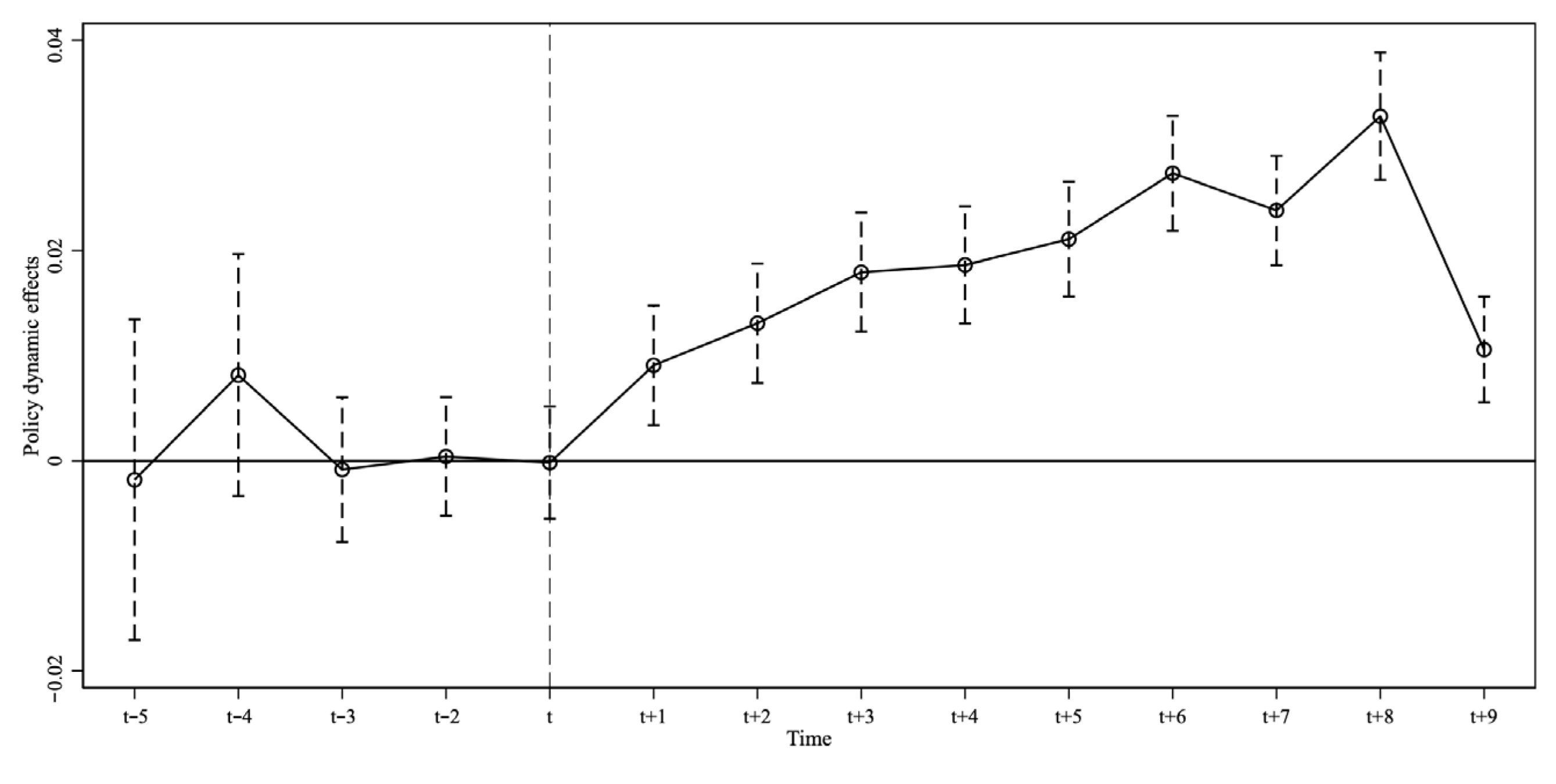
A key prerequisite for obtaining unbiased estimation results using the DID method is that the parallel trends assumption holds between the treatment and control groups. Otherwise, the DID method may overestimate or underestimate the effect of the event. We employ an event study approach to test whether the parallel trends assumption of the DID method is satisfied, using the period of policy implementation as the baseline. If there is no significant difference in the pre-policy trends between the treatment and control groups, it indicates that the parallel trends assumption of the DID method is satisfied. The parallel trends test results are shown in Figure A7. We set period t − 1 as the baseline period. The estimated coefficients before the policy implementation intersect with the zero line, indicating no significant difference in the pre-policy trends between the treatment and control groups, which satisfies the parallel trend assumption required for the DID method.
Figure A7. Parallel trend test.
Systems 14 00090 g0a7
  • Placebo test
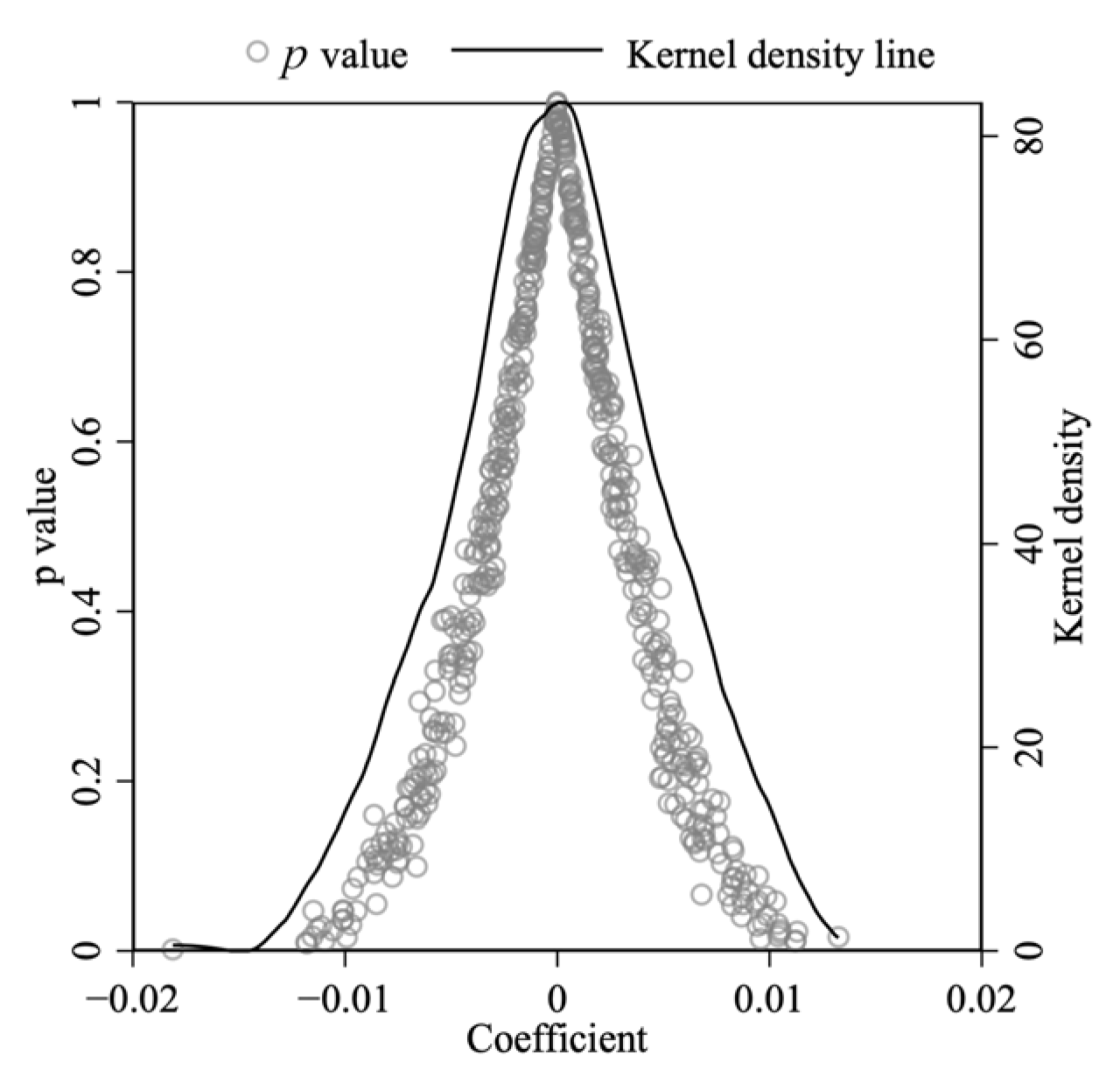
To further examine whether the baseline estimation results are driven by unobservable factors, we conduct a placebo test by randomly selecting the treatment group and randomly assigning the policy period. We perform 500 random sampling iterations and estimate the DID model accordingly. The results of the placebo test are shown in Figure A8 The estimated coefficients of the interaction term d i d are clustered around zero, with more than 90% of the p-values for these coefficients exceeding 0.1. Moreover, the vast majority of the placebo test coefficients are smaller than the baseline estimation results. These findings indicate that our baseline estimation results are not obtained by chance and are unlikely to be driven by unobservable factors.
Figure A8. Placebo test.
Systems 14 00090 g0a8

Appendix A.8. The Results of PSM and Balance Test

We employed main business revenue ( r e v e n u e ), enterprise listing age ( a g e ), the proportion of tangible assets ( t a n g i b l e ), Tobin’s Q ( t o b i n ), and the number of employees ( s t a f f ) as covariates in our analysis. We define non-digitized firms and digitized firms as a binary variable, denoted as d i g . It is used as a binary treatment variable for 1:1 Propensity Score Matching (PSM) within a caliper of 0.05 distance.
Table A4 presents the matching results for the outcome variables industrial chain resilience ( I C R ). Notably, the Average Treatment Effect on the Treated (ATT) t-test values for both outcomes exceed 1.96, indicating that the differences between the treatment group (digitized firms) and the control group (non-digitized firms) are statistically significant. This suggests that the observed effects on the industrial chain resilience (ICR) are not due to random variation but rather represent genuine treatment effects.
The statistical significance of ATT further corroborates the efficacy of the matching process, demonstrating that PSM successfully balanced observable characteristics between the treated and control groups. This reduction in selection bias enhances the reliability of our estimated treatment effects, thereby supporting the robustness of our findings.
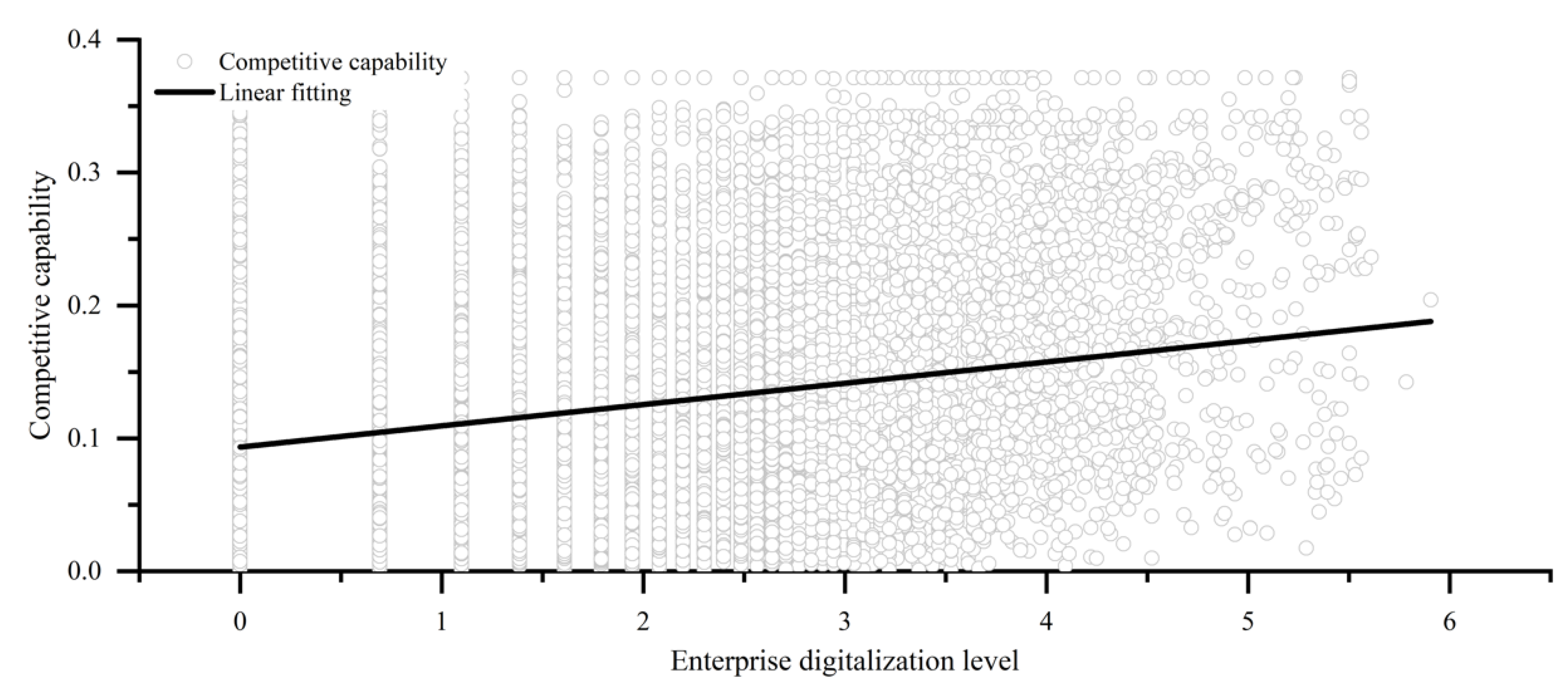
Table A4. The results of 1:1 matching within the caliper of frailty index and mental index.
VariableSampleTreatedControlsDifferenceS.E.T-Stat
I C R Unmatched0.2240.1950.0290.00126.990
ATT0.2240.1960.0280.00120.000
Furthermore, Table A5 provides the results of the PSM balance test for controlled variables, evaluating whether the matching process effectively balanced the covariates between the treated and control groups. These visualizations reveal a marked reduction in biases across all variables post-matching compared to the unmatched scenario. This evidence underscores the improvement in covariate balance achieved through PSM.
Table A5. The PSM balance test results.
VariableUnmatched/
Matched
Mean%Bias|Bias|t-TestV(T)/V(C)
TreatedControlt Valuep > t
r e v e n u e Unmatched22.09521.77527.3 21.6801.16 *
Matched22.09522.108−1.295.7−1.080.280.92 *
a g e Unmatched10.0219.7683.4 2.690.0071.09 *
Matched10.0219.8991.651.71.590.1121.08 *
t a n g i b l e Unmatched0.3350.388−34.7 −28.3700.82 *
Matched0.3350.336−0.698.4−0.560.5730.92 *
t o b i n Unmatched2.1232.149−1.1 −0.970.3320.43 *
Matched2.1232.166−1.9−68.2−1.670.0950.32 *
s t a f f Unmatched7.6667.41921.2 16.9301.12 *
Matched7.6667.6481.592.71.440.1490.93 *
Note: * represent that variance ratio outside [0.97; 1.03] for Unmatched and [0.97; 1.03] for Matched.

Appendix A.9. Year-by-Year Estimation Results

Table A6. Year-by-year estimation results of enterprises digitalization on industrial chain resilience.
Panel A: Year-by-year estimation results of 2011–2017
(1)(2)(3)(4)(5)(6)(7)
ICRICRICRICRICRICRICR
2011201220132014201520162017
d i g i t 0.007 ***0.006 ***0.005 ***0.005 ***0.007 ***0.006 ***0.010 ***
(0.002)(0.002)(0.002)(0.002)(0.002)(0.002)(0.001)
r e v e n u e 0.010 ***0.011 ***0.012 ***0.010 ***0.014 ***0.014 ***0.017 ***
(0.003)(0.003)(0.003)(0.003)(0.003)(0.003)(0.003)
a g e −0.004 ***−0.002 ***−0.001 ***−0.001 ***−0.002 ***−0.002 ***−0.002 ***
(0.000)(0.000)(0.000)(0.000)(0.000)(0.000)(0.000)
t a n g i b l e −0.0120.0010.045 ***0.062 ***0.037 ***0.0030.031 ***
(0.015)(0.013)(0.013)(0.012)(0.014)(0.012)(0.012)
t o b i n −0.000−0.002 ***0.0010.000−0.000−0.0000.004 *
(0.001)(0.001)(0.001)(0.000)(0.001)(0.000)(0.002)
s t a f f −0.006 **−0.011 ***−0.011 ***−0.011 ***−0.022 ***−0.024 ***−0.024 ***
(0.003)(0.003)(0.003)(0.003)(0.004)(0.003)(0.003)
Constant0.0440.038−0.0110.0120.0750.104 **0.028
(0.055)(0.045)(0.048)(0.043)(0.055)(0.051)(0.049)
Industry fixed effectYesYesYesYesYesYesYes
Year fixed effectYesYesYesYesYesYesYes
N1444155315301573167618232123
R20.2270.2130.1880.1840.2110.2500.243
Panel B: Year-by-year estimation results of 2018–2023
(8)(9)(10)(11)(12)(13)
ICRICRICRICRICRICR
201820192020202120222023
d i g i t 0.010 ***0.011 ***0.012 ***0.011 ***0.013 ***0.015 ***
(0.001)(0.001)(0.001)(0.001)(0.001)(0.001)
r e v e n u e 0.019 ***0.019 ***0.026 ***0.031 ***0.036 ***0.013 ***
(0.003)(0.003)(0.003)(0.003)(0.003)(0.001)
a g e −0.002 ***−0.002 ***−0.002 ***−0.002 ***−0.002 ***−0.000 ***
(0.000)(0.000)(0.000)(0.000)(0.000)(0.000)
t a n g i b l e 0.029 **−0.006−0.0150.007−0.0140.033 ***
(0.012)(0.012)(0.012)(0.012)(0.011)(0.006)
t o b i n 0.006 *0.007 ***0.003 **0.009 ***0.012 ***0.003 ***
(0.003)(0.002)(0.002)(0.001)(0.002)(0.001)
s t a f f −0.026 ***−0.025 ***−0.034 ***−0.035 ***−0.040 ***−0.012 ***
(0.003)(0.003)(0.003)(0.003)(0.003)(0.002)
Constant−0.010−0.012−0.085 *−0.193 ***−0.247 ***−0.066 ***
(0.048)(0.048)(0.045)(0.043)(0.042)(0.023)
Industry fixed effectYesYesYesYesYesYes
Year fixed effectYesYesYesYesYesYes
N224623592639304233463580
R20.2500.2710.2940.3050.3360.273
Notes: (1) The robust standard errors for clustering at the enterprise level are shown in parentheses. (2) *, **, and *** represent significance at the 10%, 5%, and 1% statistical levels, respectively.

Appendix A.10. The Matching Process and Descriptive Statistics of the Data

To identify the spillover effects of enterprise digitalization on upstream suppliers and downstream customers, we first collected the supplier enterprise codes for each core enterprise from 2011 to 2023, and filtered out the supplier enterprise dataset. It is important to note that a core enterprise typically has cooperative relationships with multiple supplier enterprises simultaneously. Therefore, when matching the data, we used the supplier enterprises as the base data and horizontally matched the core enterprise data, thereby obtaining a mixed panel dataset of core enterprises and multiple supplier enterprises. After matching, we obtained a total of 2584 pairs of core-upstream suppliers enterprise data.
Next, we employed the same approach to collect the downstream customer enterprise codes for each core enterprise and filtered out the customer enterprise dataset. Using the customer enterprise dataset as the base data, we horizontally matched the core enterprise data, thereby obtaining a mixed panel dataset of core enterprises and multiple customer enterprises. After matching, we obtained a total of 3979 pairs of core-downstream customers enterprise data.
The specific number of matched core enterprise-supplier enterprise pairs and core enterprise-customer enterprise pairs for each year are shown in Table A7.
Table A7. Number of core-upstream supplier/downstream customer enterprise pairs (2011–2023).
YearNumber of Core—Upstream SuppliersNumber of Core—Downstream Customers
201189656
2012235703
2013213687
2014169142
2015191181
2016226220
2017234212
2018201198
2019177182
2020196204
2021250228
2022279259
2023124107
After data matching, the descriptive statistics of the variables are shown in Table A8.
Table A8. Descriptive statistics of variables between core enterprises and upstream and downstream enterprises.
Core-Upstream SuppliersCore–Downstream Customers
VariableNMeanStd.VariableNMeanStd.
d i g i t 25841.0441.087 d i g i t 39790.7841.023
d i g i t _ u p 25841.1561.183 d i g i t _ d o w n 39791.1591.260
I C R _ u p 25840.1960.074 I C R _ d o w n 39790.1930.081
r e v e n u e 258421.8911.110 s i z e 397921.8401.170
a g e 25849.9808.023 a g e 39799.4187.501
t a n g i b l e 25840.3380.141 t a n g i b l e 39790.3730.147
t o b i n 25842.0961.526 t o b i n 39791.9612.245
s t a f f 25847.5291.176 s t a f f 39797.6121.166
r e v e n u e _ u p 258423.1331.372 r e v e n u e _ d o w n 397923.3171.663
a g e _ u p 258413.0777.223 a g e _ d o w n 397912.4127.289
t a n g i b l e _ u p 25840.4010.157 t a n g i b l e _ d o w n 39790.3680.148
t o b i n _ u p 25841.7701.231 t o b i n _ d o w n 39791.6030.962
s t a f f _ u p 25848.5921.228 s t a f f _ d o w n 39798.9051.460

Notes

1
The results and analysis of the parallel trend test and placebo test for the DID method are presented in Appendix A.7.
2
The matching results and balance test results for the PSM are presented in Appendix A.8.
3
Supply chain concentration (SCC) is a commonly used indicator in research. We use 1 − SCC to represent supply chain dispersion (SCD), where SCC is measured by the ratio of the top 5 transactions with the highest transaction amount to the total transaction amount.

References

  1. Lei, X.; Xu, X. Storm clouds over innovation: Typhoon shocks and corporate R&D activities. Econ. Lett. 2024, 244, 112014. [Google Scholar] [CrossRef]
  2. Lei, X. Fleeing from nature’s fury: How firms combat extreme weather risk through cross-regional investment. Financ. Res. Open 2025, 1, 100002. [Google Scholar] [CrossRef]
  3. Goldfarb, A.; Tucker, C. Digital Economics. J. Econ. Lit. 2019, 57, 3–43. [Google Scholar] [CrossRef]
  4. Holland, J.H. Hidden Order: How Adaptation Builds Complexity; Basic Books: New York, NY, USA, 1995. [Google Scholar]
  5. Hao, X.; Li, Y.; Ren, S.; Wu, H.; Hao, Y. The role of digitalization on green economic growth: Does industrial structure optimization and green innovation matter? J. Environ. Manag. 2023, 325, 116504. [Google Scholar] [CrossRef]
  6. Zheng, D.; Wang, T. Supply Chain Resilience, Logistics Efficiency, and Enterprise Competitiveness. Financ. Res. Lett. 2025, 79, 107335. [Google Scholar] [CrossRef]
  7. Gao, P.; Zhang, K.; Zheng, P. The impact of industrial digitization on the global value chains position: Evidence from China’ s industry sectors. Econ. Anal. Policy 2024, 82, 147–162. [Google Scholar] [CrossRef]
  8. Rösch, A.-L.; Härting, R.-C.; Gakharia, S. The transformation of global value chains in the age of COVID-19 and Digitization. Procedia Comput. Sci. 2022, 207, 2474–2482. [Google Scholar] [CrossRef]
  9. Yan, J. Assessing the link between digital government development and urban industrial chain resilience: Evidence from public data openness. Environ. Impact Assess. Rev. 2025, 112, 107796. [Google Scholar] [CrossRef]
  10. Jiang, M.; Fang, J.; Yang, Y.; Yu, C.; Li, J. Supply chain concentration, industry concentration and enterprise innovation performance. Financ. Res. Lett. 2024, 63, 105394. [Google Scholar] [CrossRef]
  11. Song, C.; Han, M.; Yuan, H. The impact of digital transformation on firm productivity: From the perspective of sustainable development. Financ. Res. Lett. 2025, 75, 106912. [Google Scholar] [CrossRef]
  12. Wang, K.; Sun, K.; Li, Y.; Xie, Q. Can digital technology break the financing dilemma of innovative SMEs? Based on the perspective of enterprise innovation. Technol. Forecast. Soc. Chang. 2025, 214, 124030. [Google Scholar] [CrossRef]
  13. Nottbrock, C.; Van Looy, A.; De Haes, S. Impact of digital Industry 4.0 innovations on interorganizational value chains: A systematic literature review. Bus. Process Manag. J. 2023, 29, 43–76. [Google Scholar] [CrossRef]
  14. Babich, V.; Hilary, G. Distributed Ledgers and Operations: What Operations Management Researchers Should Know About Blockchain Technology. Manuf. Serv. Oper. Manag. 2019, 22, 223–240. [Google Scholar] [CrossRef]
  15. Islam, M.T.; Chadee, D. Adaptive governance and resilience of global value chains: A framework for sustaining the performance of developing-country suppliers during exogenous shocks. Int. Bus. Rev. 2024, 33, 102248. [Google Scholar] [CrossRef]
  16. Narassima, M.S.; Gedam, V.; Gunasekaran, A.; Anbuudayasankar, S.P.; Dwarakanath, M. A novel coexistent resilience index to evaluate the supply chain resilience of industries using fuzzy logic. Supply Chain Manag. Int. J. 2024, 29, 221–243. [Google Scholar] [CrossRef]
  17. Zhang, Y.; Ge, M.; Yang, J.; Liu, C.; Chen, X. Controlling shareholders’ equity pledge, digital finance, and corporate digital transformation. Int. Rev. Financ. Anal. 2023, 90, 102853. [Google Scholar] [CrossRef]
  18. Brynjolfsson, E.; Hitt, L.M. Beyond Computation: Information Technology, Organizational Transformation and Business Performance. J. Econ. Perspect. 2000, 14, 23–48. [Google Scholar] [CrossRef]
  19. Ding, X.; Appolloni, A.; Shahzad, M.; Liu, Y.; Han, S. Digital transformation and total factor productivity in manufacturing firms: Evidence of corporate public responsibilities in China. Technol. Soc. 2025, 82, 102874. [Google Scholar] [CrossRef]
  20. Guo, T.; Tong, Y.; Yu, Y. The influence of government health investment on economic resilience: A perspective from health human capital. Int. Rev. Econ. Financ. 2025, 99, 104050. [Google Scholar] [CrossRef]
  21. Gereffi, G.; John, H.; Sturgeon, T. The governance of global value chains. Rev. Int. Political Econ. 2005, 12, 78–104. [Google Scholar] [CrossRef]
  22. Büyüközkan, G.; Göçer, F. Digital Supply Chain: Literature review and a proposed framework for future research. Comput. Ind. 2018, 97, 157–177. [Google Scholar] [CrossRef]
  23. Melitz, M.J. The Impact of Trade on Intra-Industry Reallocations and Aggregate Industry Productivity. Econometrica 2003, 71, 1695–1725. [Google Scholar] [CrossRef]
  24. Fernandes, A.M.; Mattoo, A.; Nguyen, H.; Schiffbauer, M. The internet and Chinese exports in the pre-ali baba era. J. Dev. Econ. 2019, 138, 57–76. [Google Scholar] [CrossRef]
  25. Park, N.; Choi, C.-H. The role of ICT in shaping international trade dynamics: A G20 perspective. Technol. Econ. Dev. Econ. 2025, 31, 1781–1800. [Google Scholar] [CrossRef]
  26. Zeng, J.; Yang, M. Digital technology and carbon emissions: Evidence from China. J. Clean. Prod. 2023, 430, 139765. [Google Scholar] [CrossRef]
  27. Bieser, J.; Hilty, L. Indirect Effects of the Digital Transformation on Environmental Sustainability: Methodological Challenges in Assessing the Greenhouse Gas Abatement Potential of ICT. EPiC Ser. Comput. 2018, 52, 68–81. [Google Scholar] [CrossRef]
  28. Masanet, E.; Shehabi, A.; Lei, N.; Smith, S.; Koomey, J. Recalibrating global data center energy-use estimates. Science 2020, 367, 984–986. [Google Scholar] [CrossRef]
  29. Shi, X.; Geng, S. Double-edged sword? Heterogeneous effects of digital technology on environmental regulation-driven green transformation. J. Environ. Manag. 2025, 389, 125960. [Google Scholar] [CrossRef] [PubMed]
  30. Zhang, W.; Liu, G. Digitalization and firm centralization: A quasi-natural experiment based on the “Broadband China” policy. Financ. Res. Lett. 2023, 52, 103495. [Google Scholar] [CrossRef]
  31. Li, M.; Wang, Z.; Shu, L.; Gao, H. Broadband infrastructure and enterprise digital transformation: Evidence from China. Res. Int. Bus. Financ. 2025, 73, 102645. [Google Scholar] [CrossRef]
  32. Lu, Y.; Wang, J.; Zhu, L. Place-Based Policies, Creation, and Agglomeration Economies: Evidence from China’s Economic Zone Program. Am. Econ. J. Econ. Policy 2019, 11, 325–360. [Google Scholar] [CrossRef]
  33. Sun, K.; Zhong, X.; Xiong, D. Does Institutional Opening-Up Enhance Corporate Green Innovation? Evidence From China’s Pilot Free Trade Zones. Am. J. Econ. Sociol. 2025, 84, 823–840. [Google Scholar] [CrossRef]
  34. Zhang, H.; Jia, S.; Ren, B.; Ge, H. Does the free trade zone promote green technological innovation?—Evidence from the perspective of industrial agglomeration and digital economy in 285 cities in China. Front. Sustain. Cities 2025, 7, 1652437. [Google Scholar] [CrossRef]
  35. Acemoglu, D.; Restrepo, P. The Race between Man and Machine: Implications of Technology for Growth, Factor Shares, and Employment. Am. Econ. Rev. 2018, 108, 1488–1542. [Google Scholar] [CrossRef]
  36. Forman, C.; van Zeebroeck, N. Digital technology adoption and knowledge flows within firms: Can the Internet overcome geographic and technological distance? Res. Policy 2019, 48, 103697. [Google Scholar] [CrossRef]
  37. Bresnahan, T.; Brynjolfsson, E.; Hitt, L. Information Technology, Workplace Organization, And the Demand for Skilled Labor: Firm-Level Evidence. Q. J. Econ. 2002, 117, 339–376. [Google Scholar] [CrossRef]
  38. Jiang, W.; Wang, X. Enterprise digital transformation empowers supply Chain stability. Financ. Res. Lett. 2024, 66, 105693. [Google Scholar] [CrossRef]
  39. Tang, S.Y.; Gurnani, H.; Gupta, D. Managing Disruptions in Decentralized Supply Chains with Endogenous Supply Process Reliability. Prod. Oper. Manag. 2014, 23, 1198–1211. [Google Scholar] [CrossRef]
  40. Zekhnini, K.; Anass, C.; Imane, B.; Abla, C.B.; Bag, S. A model integrating lean and green practices for viable, sustainable, and digital supply chain performance. Int. J. Prod. Res. 2022, 60, 6529–6555. [Google Scholar] [CrossRef]
  41. Chen, W.; Srinivasan, S. Going digital: Implications for firm value and performance. Rev. Account. Stud. 2024, 29, 1619–1665. [Google Scholar] [CrossRef]
  42. Lavie, D. The Competitive Advantage of Interconnected Firms: An Extension of the Resource-Based View. Acad. Manag. Rev. 2006, 31, 638–658. [Google Scholar] [CrossRef]
  43. Cho, W.; Ke, J.-Y.F.; Han, C. An empirical examination of the use of bargaining power and its impacts on supply chain financial performance. J. Purch. Supply Manag. 2019, 25, 100550. [Google Scholar] [CrossRef]
  44. Birge, J.R.; Capponi, A.; Chen, P.-C. Disruption and Rerouting in Supply Chain Networks. Oper. Res. 2023, 71, 750–767. [Google Scholar] [CrossRef]
  45. Alshehadeh, A.R.; Alia, M.; Jaradat, Y.; Injadat, E.; Al-khawaja, H. Big data analytics techniques and their impacts on reducing information asymmetry: Evidence from Jordan. Int. J. Data Netw. Sci. 2023, 7, 1259–1266. [Google Scholar] [CrossRef]
  46. Li, S.; Zhang, X. Can digital transformation of enterprise improve the information environment of the capital market?—Evidence from Analyst’s perspective. Int. Rev. Econ. Financ. 2025, 97, 103773. [Google Scholar] [CrossRef]
  47. Teece, D.J.; Pisano, G.; Shuen, A. Dynamic Capabilities and Strategic Management. Strateg. Manag. J. 1997, 18, 509–533. [Google Scholar] [CrossRef]
  48. Cockburn, I.; Henderson, R.; Stern, S. The Impact of Artificial Intelligence on Innovation: An Exploratory Analysis. In The Economics of Artificial Intelligence: An Agenda; University of Chicago Press: Chicago, IL, USA, 2019; pp. 115–148. [Google Scholar]
  49. Cheng, Q.; Peng, C.; Wan, H.; Dai, Y.; Zhang, S. How to realize digital knowledge innovation through digital technology? A perspective based on knowledge digitization and inter-organizational knowledge sharing. Technol. Soc. 2025, 82, 102905. [Google Scholar] [CrossRef]
  50. Hu, M.; Yang, X.; Zhu, Y.; Uddin, G.S. Spillover effect of corporate digitalization in the supply chain: Perspective of trade credit financing. Glob. Financ. J. 2024, 62, 101009. [Google Scholar] [CrossRef]
  51. Brynjolfsson, E.; McElheran, K. The Rapid Adoption of Data-Driven Decision-Making. Am. Econ. Rev. 2016, 106, 133–139. [Google Scholar] [CrossRef]
  52. Adner, R.; Puranam, P.; Zhu, F. What Is Different About Digital Strategy? From Quantitative to Qualitative Change. Strategy Sci. 2019, 4, 253–261. [Google Scholar] [CrossRef]
  53. Allal-Chérif, O.; Costa Climent, J.; Ulrich Berenguer, K.J. Born to be sustainable: How to combine strategic disruption, open innovation, and process digitization to create a sustainable business. J. Bus. Res. 2023, 154, 113379. [Google Scholar] [CrossRef]
  54. Li, M.; Liu, N.; Kou, A.; Chen, W. Customer concentration and digital transformation. Int. Rev. Financ. Anal. 2023, 89, 102788. [Google Scholar] [CrossRef]
  55. Bernanke, B.S. The Courage to Act: A Memoir of a Crisis and Its Aftermath; W. W. Norton & Company: New York, NY, USA, 2015. [Google Scholar]
  56. Wang, H.; Yang, L.; Feng, Y. How does digital economy affect the industry chain resilience in China? Humanit. Soc. Sci. Commun. 2024, 11, 1529. [Google Scholar] [CrossRef]
  57. Guo, Y.; Yao, R. Supply chain interconnection and SME financing: From the perspective of supply chain finance and trade credit. China Econ. Q. Int. 2024, 4, 249–265. [Google Scholar] [CrossRef]
  58. Shen, Y.; Tian, Z.; Chen, X.-L.; Wang, H.; Song, M. Unpacking the green potential: How does supply chain digitalization affect corporate carbon emissions?—Evidence from supply chain innovation and application pilots in China. J. Environ. Manag. 2025, 374, 124147. [Google Scholar] [CrossRef] [PubMed]
  59. Brakman, S.; Garretsen, H.; van Marrewijk, C. Regional resilience across Europe: On urbanisation and the initial impact of the Great Recession. Camb. J. Reg. Econ. Soc. 2015, 8, 225–240. [Google Scholar] [CrossRef]
  60. Xu, J.; Yang, B.; Yuan, C. The impact of supply chain digitalization on urban resilience: Do industrial chain resilience, green total factor productivity and innovation matter? Energy Econ. 2025, 145, 108443. [Google Scholar] [CrossRef]
  61. Chen, W.; Chen, H.; Yin, J.; Sun, W. Evaluation of agricultural products e-commerce logistics service capabilities in Heilongjiang Province based on entropy weight TOPSIS method. PLoS ONE 2025, 20, e0325532. [Google Scholar] [CrossRef]
  62. Al-Abadi, A.M.; Handhal, A.M.; Abdulhasan, M.A.; Ali, W.L.; Hassan, J.J.; Al Aboodi, A.H. Optimal siting of large photovoltaic solar farms at Basrah governorate, Southern Iraq using hybrid GIS- based Entropy-TOPSIS and AHP-TOPSIS models. Renew. Energy 2025, 241, 122308. [Google Scholar] [CrossRef]
  63. Zhu, J.; Jang-Jaccard, J.; Singh, A.; Welch, I.; Al-Sahaf, H.; Camtepe, S. A few-shot meta-learning based siamese neural network using entropy features for ransomware classification. Comput. Secur. 2022, 117, 102691. [Google Scholar] [CrossRef]
  64. Sutton, J.; Arcidiacono, A.; Torrisi, G.; Arku, R. Regional economic resilience: A scoping review. Prog. Hum. Geogr. 2023, 47, 030913252311741. [Google Scholar] [CrossRef]
  65. Demir, E.; Ersan, O. Economic policy uncertainty and cash holdings: Evidence from BRIC countries. Emerg. Mark. Rev. 2017, 33, 189–200. [Google Scholar] [CrossRef]
  66. Phan, H.V.; Nguyen, N.H.; Nguyen, H.T.; Hegde, S. Policy uncertainty and firm cash holdings. J. Bus. Res. 2019, 95, 71–82. [Google Scholar] [CrossRef]
  67. McKillop, D.; French, D.; Quinn, B.; Sobiech, A.L.; Wilson, J.O.S. Cooperative financial institutions: A review of the literature. Int. Rev. Financ. Anal. 2020, 71, 101520. [Google Scholar] [CrossRef] [PubMed]
  68. Winter, S.G. Understanding dynamic capabilities. Strateg. Manag. J. 2003, 24, 991–995. [Google Scholar] [CrossRef]
  69. Pan, X.; Pan, X.; Song, M.; Ai, B.; Ming, Y. Blockchain technology and enterprise operational capabilities: An empirical test. Int. J. Inf. Manag. 2020, 52, 101946. [Google Scholar] [CrossRef]
  70. Liao, C. The governance structures, the innovation systems and the core competitiveness of Chinese firms. Int. J. Innov. Reg. Dev. 2011, 3, 82–96. [Google Scholar] [CrossRef]
  71. Sun, K.; Wang, H.; Ye, S. How does digital transformation enhance industrial chain resilience? Evidence from China. Financ. Res. Lett. 2025, 75, 106896. [Google Scholar] [CrossRef]
  72. Wu, F.; Hu, H.; Lin, H.; Ren, X. Enterprise Digital Transformation and Capital Market Performance: Empirical Evidence from Stock Liquidity. Manag. World 2021, 37, 130–144+10. [Google Scholar] [CrossRef]
  73. Bray, R.L.; Mendelson, H. Information Transmission and the Bullwhip Effect: An Empirical Investigation. Manag. Sci. 2012, 58, 860–875. [Google Scholar] [CrossRef]
  74. Zhao, C.; Wang, W.; Li, X. How digital transformation affects total factor productivity of enterprises. Financ. Trade Econ. 2021, 42, 114–129. [Google Scholar] [CrossRef]
  75. Su, H.; He, J.; Wang, H. Analysing decision behavior styles in contingent valuation: The latent class and the factor analysis. China Econ. Rev. 2025, 90, 102363. [Google Scholar] [CrossRef]
  76. Ding, T.; Yang, L. Intellectual property protection and corporate digital transformation: An empirical analysis from the perspectives of intellectual property protection and digital governance. Int. Rev. Econ. Financ. 2025, 100, 104125. [Google Scholar] [CrossRef]
  77. Huang, J.; Tsai, K.S. Securing Authoritarian Capitalism in the Digital Age: The Political Economy of Surveillance in China. China J. 2022, 88, 2–28. [Google Scholar] [CrossRef]
  78. Zhou, X.; Hu, Q.; Luo, H.; Hu, Z.; Wen, C. The impact of digital infrastructure on industrial ecology: Evidence from broadband China strategy. J. Clean. Prod. 2024, 447, 141589. [Google Scholar] [CrossRef]
  79. Huang, L.; Zhang, H.; Si, H.; Wang, H. Can the digital economy promote urban green economic efficiency? Evidence from 273 cities in China. Ecol. Indic. 2023, 155, 110977. [Google Scholar] [CrossRef]
  80. Wang, L.; Shao, J. Digital economy, entrepreneurship and energy efficiency. Energy 2023, 269, 126801. [Google Scholar] [CrossRef]
  81. Zhang, S.; Sang, X.; Yang, W.; Luo, X. Empowering household energy transition: The impact of digital economy on clean energy use in rural China. Energy 2025, 324, 136016. [Google Scholar] [CrossRef]
  82. Nunn, N.; Qian, N. US Food Aid and Civil Conflict. Am. Econ. Rev. 2014, 104, 1630–1666. [Google Scholar] [CrossRef]
  83. Athira, A.; Ramesh, V.K.; Sinu, M. COVID-19 pandemic and firm performance: An empirical investigation using a cross-country sample. IIMB Manag. Rev. 2024, 36, 269–281. [Google Scholar] [CrossRef]
  84. Liu, Y.; Wang, H.; Pang, B.; Zhao, S. Capital investment, digital economy and innovation of high-tech industries. Int. Rev. Financ. Anal. 2024, 96, 103761. [Google Scholar] [CrossRef]
  85. Hao, P.; Alharbi, S.S.; Hunjra, A.I.; Zhao, S. How do ESG ratings promote digital technology innovation? Int. Rev. Financ. Anal. 2025, 97, 103886. [Google Scholar] [CrossRef]
  86. Wang, Z.; Tang, P. Substantive digital innovation or symbolic digital innovation: Which type of digital innovation is more conducive to corporate ESG performance? Int. Rev. Econ. Financ. 2024, 93, 1212–1228. [Google Scholar] [CrossRef]
  87. Fatemi, A.; Glaum, M.; Kaiser, S. ESG performance and firm value: The moderating role of disclosure. Glob. Financ. J. 2018, 38, 45–64. [Google Scholar] [CrossRef]
  88. Friede, G.; Busch, T.; Bassen, A. ESG and financial performance: Aggregated evidence from more than 2000 empirical studies. J. Sustain. Financ. Invest. 2015, 5, 210–233. [Google Scholar] [CrossRef]
  89. Chen, D.; Jiang, D.; Ljungqvist, A.; Lu, H.; Zhou, M. State Capitalism vs. Private Enterprise. SSRN Electron. J. 2015. [Google Scholar] [CrossRef]
  90. Brandt, L.; Van Biesebroeck, J.; Zhang, Y. Creative accounting or creative destruction? Firm-level productivity growth in Chinese manufacturing. J. Dev. Econ. 2012, 97, 339–351. [Google Scholar] [CrossRef]
  91. Vendrell-Herrero, F.; Bustinza, O.F.; Parry, G.; Georgantzis, N. Servitization, digitization and supply chain interdependency. Ind. Mark. Manag. 2017, 60, 69–81. [Google Scholar] [CrossRef]
  92. Pakes, A.; Olley, G.S. The Dynamics of Productivity in the Telecommunications Equipment Industry. Econometrica 1996, 64, 1263–1297. [Google Scholar] [CrossRef]
  93. Pourmorshed, S.; Durst, S. The Usefulness of the Digitalization Integration Framework for Developing Digital Supply Chains in SMEs. Sustainability 2022, 14, 14352. [Google Scholar] [CrossRef]
  94. Xie, W.; Zheng, D.; Li, Z.; Wang, Y.; Wang, L. Digital technology and manufacturing industrial change: Evidence from the Chinese manufacturing industry. Comput. Ind. Eng. 2024, 187, 109825. [Google Scholar] [CrossRef]
  95. Au, A. China’s Internet sector reforms and the rise of ESG in the state techno-nationalist agenda. Policy Internet 2023, 15, 646–664. [Google Scholar] [CrossRef]
  96. Ivanov, D. Viable supply chain model: Integrating agility, resilience and sustainability perspectives—Lessons from and thinking beyond the COVID-19 pandemic. Ann. Oper. Res. 2022, 319, 1411–1431. [Google Scholar] [CrossRef] [PubMed]
Figure 1. The channels of enterprise digitization on industrial chain resilience.
Systems 14 00090 g001
Figure 2. Scatter chart of enterprise digitalization and industrial chain resilience. Note: The slope of the fitted curve is 0.018.
Systems 14 00090 g002
Figure 3. The impact of enterprise digitalization on specific indicators. Notes: (1) The vertical lines in the figure represent the 99% confidence intervals, and the significance level is 1%. (2) Each estimate controls for covariates, including r e v e n u e , a g e , t a n g i b l e , T o b i n , and s t a f f . (3) Each estimate incorporates industry fixed effects and year fixed effects. (4) The specific estimation results are shown in Appendix A.6.
Systems 14 00090 g003
Figure 4. Year-by-year estimation results of firm digitalization on industrial chain resilience. Notes: (1) The vertical lines in the figure represent the 99% confidence intervals, and the significance level is 1%. (2) The dashed line on the Y-axis serves as a significance threshold at the 1% level. A vertical bar intersecting this line denotes a statistically non-significant coefficient estimate, while the absence of an intersection indicates statistical significance. (3) Each estimate controls for covariates, including r e v e n u e , a g e , t a n g i b l e , T o b i n , and s t a f f . (4) Each estimate incorporates industry fixed effects and year fixed effects. (5) The specific estimation results are shown in Appendix A.9.
Systems 14 00090 g004
Table 1. Index system of industrial chain resilience.
Secondary IndicatorsThird IndicatorsAttributeWeight
I C R _ r c Resistance capabilityThe ratio of accounts receivable to main business revenue0.024
The ratio of cash to total assets+0.011
I C R _ o c Operational capabilityAccounts receivable turnover rate+0.025
Accounts payable turnover ratio0.121
I C R _ s d m c Supply–demand matching capabilityThe ratio of inventory to main business revenue0.119
Inventory turnover rate+0.234
I C R _ c c Competitive capabilityThe ratio of R&D personnel to total employees+0.164
The ratio of R&D investment to main business revenue+0.302
Notes: (1) “−” represents a negative indicator, meaning that the larger the value, the lower the resilience of the industry chain. “+” represents a positive indicator, meaning that the larger the value, the higher the resilience of the industry chain. (2) The calculation process and results of weights are shown in Appendix A.1.
Table 2. Definition and descriptive statistics of variables.
VariableDefinitionNMeanStd.
I C R Industrial chain resilience28,9390.2100.090
d i g i t Enterprise digitalization level28,9391.3371.290
r e v e n u e Logarithmic of main business revenue28,93921.9891.191
a g e Enterprise listing age28,9398.9367.575
t a n g i b l e Proportion of tangible assets to total assets28,9390.3530.151
t o b i n The ratio of a company’s market value to its reset value28,9392.1312.139
s t a f f Logarithmic number of employees28,9397.5831.175
Notes: (1) To prevent the extreme-value effect, the d i g i t , r e v e n u e , a g e , t a n g i b l e , t o b i n , s t a f f are bilateral tail reduction at the 1% level by year and industry.
Table 3. Impact of enterprise digitization on industrial chain resilience.
(1)(2)(3)(4)(5)(6)
I C R I C R I C R _ r c I C R _ o c I C R _ s d m c I C R _ c c
d i g i t 0.007 ***0.008 ***−0.000−0.0000.001 ***0.010 ***
(0.001)(0.001)(0.000)(0.000)(0.000)(0.001)
r e v e n u e 0.019 ***−0.003 ***0.004 ***0.008 ***0.017 ***
(0.002)(0.000)(0.001)(0.001)(0.002)
a g e −0.002 ***−0.000 ***0.000 ***−0.000 ***−0.001 ***
(0.000)(0.000)(0.000)(0.000)(0.000)
t a n g i b l e 0.012 *−0.064 ***0.022 ***0.082 ***−0.045 ***
(0.007)(0.002)(0.004)(0.003)(0.006)
t o b i n 0.002 ***0.000 ***0.001 ***0.0000.004 ***
(0.001)(0.000)(0.000)(0.000)(0.001)
s t a f f −0.023 ***0.002 ***0.001 *−0.012 ***−0.026 ***
(0.002)(0.000)(0.001)(0.001)(0.002)
Constant0.201 ***−0.0330.112 ***−0.068 ***−0.069 ***−0.056 **
(0.001)(0.028)(0.008)(0.015)(0.012)(0.028)
Industry fixed effectYesYesYesYesYesYes
Year fixed effectYesYesYesYesYesYes
N28,93828,93828,93128,82628,90418,616
R20.3300.3730.2160.3340.3000.419
Notes: (1) The robust standard errors for clustering at the enterprise level are shown in parentheses. (2) *, **, and *** represent significance at the 10%, 5%, and 1% statistical levels, respectively.
Table 4. The results of robustness Test.
(1)(2)(3)(4)(5)(6)(7)
I C S I C R _ f a c t o r I C R I C R I C R I C R I C R
d i g i t −0.014 **0.049 *** 0.003 ***0.010 ***
(0.006)(0.005) (0.001)(0.001)
d i g i t _ 99 0.011 ***
(0.001)
d i g i t _ 139 0.010 ***
(0.001)
B r o a d b a n d _ C h i n a 0.013 ***
(0.002)
ControlsYesYesYesYesYesYesYes
Industry fixed effectYesYesYesYesYesNoYes
Enterprise fixed effectNoNoNoNoNoYesNo
Year fixed effectYesYesYesYesYesYesYes
N26,70828,93828,93728,93825,27228,64526,037
R20.0060.6000.3290.3320.3300.7390.330
Notes: (1) The robust standard errors for clustering at the enterprise level are shown in parentheses. (2) ** and *** represent significance at the 5%, and 1% statistical levels, respectively. (3) Controls include r e v e n u e , a g e , t a n g i b l e , t o b i n , and s t a f f .
Table 5. The results of Endogenous analysis.
(1)(2)(3)(4)(5)(6)
I C R I C R I C R I C R I C R I C R
d i g i t 0.008 ***0.008 *** 0.038 *** 0.068 ***
(0.001)(0.001) (0.007) (0.009)
I V 1 0.066 ***
(0.006)
I V 2 0.004 ***
(0.000)
Kleibergen–Paap rk LM statistic 115.536 107.628
Kleibergen–Paap Wald rk F statistic 116.330 107.606
ControlsYesYesYesYesYesYes
City ControlsYesYesNoNoNoNo
Province ControlsNoYesNoNoNoNo
Industry fixed effectYesYesYesYesYesYes
Year fixed effectYesYesYesYesYesYes
N25,26825,26823,78423,78423,78423,784
R20.3860.386 0.279 −0.060
Notes: (1) The robust standard errors for clustering at the enterprise level are shown in parentheses. (2) *** represent significance at the 1% statistical levels, respectively. (3) The Kleiberen Paap rk LM statistics for the unidentifiable tests of IV1 and IV2 are 115.536 and 107.628, respectively, while the Kleiberen Paap Wald rk F statistics for the weakly recognizable tests of IV1 and IV2 are 116.330 and 107.606, respectively, both significantly above the critical value of 16.38. (4) Controls include r e v e n u e , a g e , t a n g i b l e , t o b i n , and s t a f f . (5) The R2 in columns (4) and (6) is the R2 after centralization.
Table 6. The results of heterogeneity analysis.
(1)(2)(3)(4)
I C R I C R I C R I C R
d i g i t 0.056 ***0.034 ***0.0010.009 ***
(0.012)(0.010)(0.003)(0.001)
s i z e −0.016 ***
(0.002)
d i g i t × s i z e −0.002 ***
(0.001)
c a p i t a l _ i n t e n s i t y −0.021 ***
(0.002)
d i g i t × c a p i t a l _ i n t e n s i t y −0.002 ***
(0.001)
E S G 0.006 ***
(0.001)
d i g i t × E S G 0.001 *
(0.001)
o w n e r 0.018 ***
(0.004)
d i g i t × o w n e r −0.001
(0.002)
ControlsYesYesYesYes
Industry fixed effectYesYesYesYes
Year fixed effectYesYesYesYes
N28,93228,93527,88925,040
R20.3870.3950.3800.369
Notes: (1) The robust standard errors for clustering at the enterprise level are shown in parentheses. (2) * and *** represent significance at the 10% and 1% statistical levels, respectively. (3) Controls include r e v e n u e , a g e , t a n g i b l e , t o b i n , and s t a f f .
Table 7. The results of mechanism analysis.
(1)(2)(3)(4)
Bargaining PowerGovernance Capability
u p _ S C D d o w n _ S C D i n n o v a t e T F P _ O P
d i g i t 1.157 ***1.830 ***0.006 ***0.028 ***
(0.187)(0.233)(0.002)(0.006)
ControlsYesYesYesYes
Industry fixed effectYesYesYesYes
Year fixed effectYesYesYesYes
N26,10528,19828,93826,399
R20.2860.2410.0540.628
Notes: (1) The robust standard errors for clustering at the enterprise level are shown in parentheses. (2) *** represent significance at the 1% statistical levels, respectively. (3) Controls include r e v e n u e , a g e , t a n g i b l e , t o b i n , and s t a f f .
Table 8. Spillover effects of enterprise digitization on upstream and downstream enterprises.
(1)(2)(4)(5)
d i g i t _ u p I C R _ u p d i g i t _ d o w n I C R _ d o w n
d i g i t 0.322 ***0.0020.396 ***0.008 ***
(0.038)(0.003)(0.039)(0.002)
ControlsYesYesYesYes
Up enterprises controlsYesYesNoNo
Down enterprises controlsNoNoYesYes
Industry fixed effectYesYesYesYes
Year fixed effectYesYesYesYes
N2584258439783978
R20.3630.2390.5040.255
Notes: (1) The robust standard errors for clustering at the enterprise level are shown in parentheses. (2) *** represent significance at the 1% statistical levels, respectively. (3) Controls include r e v e n u e , a g e , t a n g i b l e , t o b i n , and s t a f f . Up enterprises controls include r e v e n u e , a g e , t a n g i b l e , t o b i n , and s t a f f of upstream suppliers. Down enterprises controls include r e v e n u e of upstream suppliers. Down enterprises controls include r e v e n u e , a g e , t a n g i b l e , t o b i n , and s t a f f of downstream customers.
Disclaimer/Publisher’s Note: The statements, opinions and data contained in all publications are solely those of the individual author(s) and contributor(s) and not of MDPI and/or the editor(s). MDPI and/or the editor(s) disclaim responsibility for any injury to people or property resulting from any ideas, methods, instructions or products referred to in the content.