Article

Lowering the Threshold for Integration of Big Data Services into Closed-Loop Supply Chain: Necessary Conditions Based on the Variational Inequality Approach

College of Economics and Management, Taiyuan University of Technology, Jinzhong 030600, China
*
Author to whom correspondence should be addressed.
Systems 2026, 14(1), 50; https://doi.org/10.3390/systems14010050 (registering DOI)
Submission received: 23 September 2025 / Revised: 29 October 2025 / Accepted: 12 November 2025 / Published: 1 January 2026
(This article belongs to the Section Supply Chain Management)

Abstract

Big data service providers (BDSPs) play a critical role in supporting the digital transformation of closed-loop supply chains (CLSCs). However, as the number of CLSC members increases, traditional coordination contracts become complex in the big data era, which challenges effective collaboration and contract implementation. To address this issue, this paper investigates the profit coordination problem in a CLSC with a BDSP, with the aim of lowering the contract implementation threshold and facilitating flexible adjustment of contract terms. This study applies the variational inequality method to derive the necessary conditions under which a CLSC with the participation of a BDSP achieves maximum system profit. The results indicate that these necessary conditions are as follows. First, the wholesale price is equal to the unit cost of new products. Second, the optimal payment level is positively correlated with production volume, unit cost savings, the BDSP marketing effort sensitivity coefficient, and the BDSP recycling effort sensitivity coefficient, while it is negatively correlated with the retail price sensitivity coefficient, the recycling price sensitivity coefficient, and the big data service cost coefficient.

1. Introduction

In the digital economy, big data service providers (BDSPs) have emerged as independent participants in supply chains [1,2]. In fact, the Nestlé Group leverages Lingyang Tiangong Zhitou’s big data analytics technology to analyze consumer profiles and deliver personalized products. This approach enhances consumer loyalty and raises conversion rates, which drives significant sales growth [3]. In the recycling process, JD.com, as a mature BDSP, collaborates with Coca-Cola to integrate waste collection into logistics services, expanding recycling coverage but increasing coordination complexity due to the participation of additional actors [4]. Similarly, Apple employs Re-Teck’s big data technology to analyze device usage and recycling demand, which substantially improves the efficiency of product take-back programs. However, these cases also show difficulties in aligning incentives and coordinating multiple roles in marketing and recycling activities. These cases demonstrate that while BDSPs play an important role in enhancing marketing and recycling efficiency [5,6,7], they also increase coordination difficulty.
The inclusion of BDSPs creates new challenges for supply chain coordination, requiring more flexible coordination mechanisms. Although BDSP participation improves efficiency, the increase in supply chain members complicates coordination contracts. Some scholars have found that when the structure expands from a two-level to a three-level network, firms need contracts that combine revenue-sharing, cost-sharing, and increased delivery prices to achieve optimal centralized profits in the e-commerce logistics service supply chain [8]. Big data marketing improves demand forecasting and enhances overall coordination efficiency [9]. However, more members also increase conflicts of interest and information asymmetry. The contracts then need a more precise design to ensure effective cooperation. High complexity raises implementation barriers and increases management costs. In force majeure events, firms struggle to adjust contracts flexibly, and some contracts may even terminate. These limits weaken traditional mechanisms and highlight the need for flexible approaches. This paper addresses the issue by classifying contract priorities and identifying necessary conditions. Classifying contract priorities means ranking contract conditions by their importance. When firms cannot meet all conditions, they keep critical ones and adjust non-critical ones. The goal is to support flexible optimization of complex supply chain contracts with BDSP participation.
Based on the above managerial problems, this study aims to address the following research questions:
  • How can we derive necessary coordination conditions when a BDSP joins a CLSC as an independent member?
  • How can decentralized coordination match centralized efficiency and reduce the need for complex contracts?
  • How does a BDSP’s involvement in marketing and recycling impact pricing decisions and the profitability of a CLSC?
This study examines how BDSPs improve coordination and performance in decentralized CLSCs under digital transformation. Using optimization analysis theory and variational inequality methods, we derive the necessary conditions for coordination and identify the essential components of coordination contracts. By focusing on the core elements of coordination rather than overly complex contractual structures, this study provides a theoretical basis for contract adjustment, lowers the implementation threshold of coordination mechanisms, and enhances the flexibility of CLSC management.
This paper makes three contributions. First, it extends CLSC coordination literature by adding BDSPs as independent decision-makers. It captures their strategic role in marketing and recycling. Second, it proposes a flexible coordination mechanism that identifies the essential components of contracts. This reduces barriers and improves adaptability under uncertainty. Third, it enriches the theory of digital and low-carbon supply chain transformation. It offers managerial insights and policy implications for enterprises seeking to integrate BDSPs into their operations.
The structure of the paper is as follows: Section 2 provides a literature review and introduces the main contributions of the paper. Section 3 describes the research problem, proposes basic hypotheses, and provides detailed explanations of the parameters. Section 4 establishes and solves the decentralized and centralized decision-making models for a CLSC with the participation of a BDSP, analyzing the equilibrium solutions for both scenarios. Section 5 optimizes the decision-making behaviors of the enterprises at each node and derives the necessary conditions for the total profit of the decentralized decision-making model to equal that of the centralized decision-making model. Section 6 analyzes the impacts of two assistance methods of the BDSP on the CLSC through numerical simulation. Finally, Section 7 summarizes the conclusions and provides directions for future research.

2. Literature Review

This paper focuses on the issue of profit coordination in a CLSC involving a BDSP. Therefore, the relevant literature primarily addresses supply chain coordination mechanisms and the application of big data services in the supply chain.

2.1. Research on Supply Chain Coordination Mechanisms

Tahiri et al. [10] reviewed coordination contracts in supply chains and found that most studies focus on dyadic structures. These models cannot reflect the complexity of real supply chains with many actors and multiple levels. Moreover, most studies design contracts from an external perspective, and few explain the necessary conditions for coordination among internal members. Heavy reliance on complex contracts raises implementation thresholds and reduces resilience under uncertainty. In practice, if disruptions occur, some contract terms cannot be enforced, and coordination becomes less effective.
To address this challenge, researchers have increasingly adopted the variational inequality framework as a general tool for identifying supply chain coordination conditions. Variational inequality provides a flexible mathematical structure suitable for multi-member and multi-tier networks. As early as 2005, Nagurney and Toyasaki [11] used the variational inequality method to model a multitiered reverse supply chain, laying the foundation for coordination analysis in complex supply chains. Later studies extended this approach to different contexts, such as competition, technology subsidy, environmental protection objectives, and dynamic systems [12,13,14,15]. These studies share a common focus on equilibrium analysis but rarely link coordination conditions to contract design, leaving a gap in practical implementation.
More recent work applies variational inequality to data-driven supply chains. Peng et al. [16] studied the platform service supply chain and showed how data services change coordination mechanisms. Their findings highlight that data empowerment alters coordination structures and creates new strategic interactions and challenges. At the same time, some studies focus on necessary conditions. Yuan et al. [17] found that decentralized and centralized profit can match only when necessary conditions are met. This view shifts attention from rigid contract execution to simple and flexible clauses. It improves coordination feasibility under uncertainty.
In short, variational inequality offers a strong tool for analyzing complex supply chains. Necessary-conditions-based contracts provide flexible and practical coordination. This paper combines these two approaches to study coordination in CLSCs with BDSP participation.

2.2. Application of Big Data Services in the Supply Chain

Big data services improve both profitability and sustainability in supply chains. Their impact is most evident in marketing and recycling [18,19,20,21,22,23,24,25,26].
On the marketing side, firms use big data to analyze customer behavior, social data, and geographical location data. These analyses improve purchase forecasting, enabling firms to promote products and services that better match customer needs. This approach supports targeted marketing, increases conversion rates, and expands market scale [27,28,29,30,31]. Manufacturers also use preference data from big data analytics to design products aligned with demand [32,33], streamline supply [34], and support differentiated competition [35]. These studies show that big data marketing improves demand forecasting. It also facilitates more accurate and flexible decision-making in supply chains.
On the recycling side, big data helps firms optimize collection processes and design more attractive incentives. It also supports diverse channels to promote recycling knowledge and environmental awareness. As a result, consumer participation increases, resource utilization efficiency improves, and the circular economy advances [36,37,38,39,40,41]. In summary, big data transforms low-value but high-potential information into actionable insights that guide supply chain operations scientifically [42,43,44].
However, most existing studies treat big data as an internal investment made by manufacturers or retailers. They often analyze marketing and recycling separately and ignore their interaction. In practice, many firms lack in-house capacity and outsource specialized BDSPs. This makes it necessary to incorporate BDSPs as independent members into supply chain models [45]. Recent studies have incorporated BDSPs into such models, showing that their participation influences pricing, recycling, and overall profitability [3,4,6,46,47]. Yet these studies remain fragmented, as they often focus only on marketing or recycling. In reality, BDSPs play dual roles in both functions. Their simultaneous impact on demand expansion and resource recovery is more relevant for sustainability and competitiveness in CLSCs. This dual role creates coordination challenges and opportunities that are not fully captured in the existing literature.

2.3. Summary

Studies on coordination mainly focus on single or hybrid contracts. These contracts mitigate double marginalization and improve overall performance. However, they depend on externally imposed contracts and ignore necessary internal conditions. Studies on big data services in the supply chain emphasize either marketing or recycling. Few consider the dual role of BDSPs or their combined effects.
These gaps are crucial. The dual role of BDSPs in marketing and recycling changes the structure and coordination mechanism of CLSCs. Existing coordination mechanisms may not adapt to this more complex structure.
This paper addresses these gaps. It examines how BDSPs enhance coordination and performance in decentralized CLSCs. It identifies essential contract components that reduce barriers and improve flexibility under uncertainty. The innovation lies in introducing a BDSP that assists both marketing and recycling. This paper builds on previous research ideas and methods [17]. It applies the variational inequality method to analyze the decision-making behavior of each member. It identifies the specific sources of profit loss in decentralized decision-making by examining the relationships among variables. Based on this analysis, the paper derives the coordination conditions under which the total profit of the decentralized model equals that of the centralized model. It further investigates the impacts of the two assistance methods of the BDSP on the CLSC. The inclusion of a BDSP provides a new perspective on decision-making and coordination in CLSCs. From a practical perspective, the results also offer a theoretical reference for corporate operations.

3. Problem Description and Basic Assumptions

This study applies mathematical modeling as a core research method to analyze the coordination of CLSC with BDSP participation. The modeling process includes three steps: (1) defining decision variables, demand functions, and recycling functions to represent interactions among the manufacturer, retailer, BDSP, and consumer; (2) constructing both the decentralized and centralized decision-making models and comparing their equilibrium outcomes to identify profit gaps and sources of inefficiency; and (3) applying the variational inequality method to derive the necessary conditions under which decentralized decisions can achieve the same total profit as centralized coordination. This step also provides a theoretical basis for designing simplified and flexible coordination mechanisms.

3.1. Problem Description

In a CLSC comprising a manufacturer, a retailer, a BDSP, and consumers, the manufacturer is in charge of producing new products and directly collecting used products from consumers at a recycling price b for remanufacturing. Both new products and remanufactured products are then uniformly wholesaled to the retailer at a wholesale price w , and the retailer sells them to consumers at a retail price P . In both the sales and recycling processes, the BDSP provides data analytics, precision marketing, and recycling process optimization, which can assist in enhancing product demand and used-product collection. Consequently, the manufacturer subscribes to big data services at a payment level m , while the BDSP determines its effort level f based on the payment level. The overall process of the CLSC is shown in Figure 1.
When a manufacturer subscribes to big data services, the total market demand for products (including new and remanufactured products) is a linear function of the retail price and the level of the BDSP’s service effort. The demand function can be expressed as:
Q = D a P + β f
where a > 0 and β > 0 . D denotes the market baseline demand when P = 0 . a is the retail price sensitivity coefficient, representing the extent to which consumers respond to changes in the retail price. β is the BDSP marketing effort sensitivity coefficient, which measures the impact of changes in the BDSP’s service effort level, when assisting in marketing, on product demand.
As the retail price increases, consumer purchasing motivation diminishes, leading to a decline in product demand. However, the BDSP’s marketing assistance can stimulate consumer purchasing desire, thereby increasing product demand.
Rising the recycling price and enhanced BDSP’s service effort level both increase the volume of recycled waste [48]. The recycling function is formulated as:
R = k b + λ f
where k > 0 and λ > 0 . k is the recycling price sensitivity coefficient and reflects how responsive consumers are to variations in the recycling price. λ denotes the BDSP recycling effort sensitivity coefficient, capturing the effect of changes in the BDSP’s service effort level, when assisting in recycling, on the volume of recycled waste.
The related notation descriptions are shown in Table 1.

3.2. Basic Assumptions

Assumption 1.
Remanufactured products are homogeneous with new products, and there is no consumer preference during the sales process [49,50].
Assumption 2.
In order to reduce manufacturing costs, the manufacturer initially uses recycled waste materials as raw inputs and then adds new materials for production. Only the combined total of remanufactured and new products can satisfy the market demand. Consequently, the volume of recycled waste materials is less than the overall market demand, i.e., R < Q . In practice, Apple disassembles collected used electronic devices to extract aluminum, copper, cobalt, and other metals for recycling, which not only reduces raw material procurement costs but also lowers carbon dioxide emissions. According to the Apple Environmental Progress Report 2025, 24% of the materials used in Apple products shipped in 2024 were recycled or renewable.
Assumption 3.
To ensure that the constructed model aligns with the fundamental characteristics of the remanufacturing industry, it is stipulated that P > C m > C r + b > b > 0 . This chain of inequalities reflects the relationship between the prices and costs of new and remanufactured products.
P > C m represents that the retail price exceeds the unit cost of new products, which is a necessary condition for enterprises to make a profit. C m > C r + b > b indicates that the unit cost of new products is higher than the total cost of producing remanufactured products, including the unit cost of remanufactured products and the recycling price. Remanufacturing can thereby reduce production costs, providing a strong incentive for manufacturers to engage in such activities.
Furthermore, b > 0 specifies that the recycling price is positive, implying that enterprises must incur costs to collect used products for remanufacturing. If the recycling price were zero or negative, consumer participation in recycling would decrease significantly.
Assumption 4.
According to previous studies in supply chain management [50,51], the model parameters are required to satisfy D > a C m and g k > λ 2  to guarantee the existence and uniqueness of the equilibrium solutions.

4. Model Construction and Solution

4.1. Decentralized Decision-Making Model

In a decentralized decision-making scenario, the manufacturer, the retailer, and the BDSP each aim to maximize their individual profits. The manufacturer’s profit function is as follows:
π m = w C m Q + C m C r b R m f
w C m Q denotes the manufacturer’s profit from producing new products, C m C r b R represents the profit from recycling and remanufacturing activities, and m f denotes the cost of procuring big data services.
The retailer’s profit function is as follows:
π r = P w Q
The retailer’s profit is derived from product sales.
Similarly to the models of Ge et al. [4] and Wu et al. [52], the BDSP’s profit function is expressed as follows:
π d = m f 1 2 g f 2
where g > 0 , 1 2 g f 2 represents the service cost of the BDSP.
This is a Stackelberg game in the CLSC, and the decision-making sequence is as follows: the manufacturer first sets the wholesale price w, recycling price b, and payment level m for big data services. Subsequently, the retailer determines the retail price P based on the manufacturer’s pricing strategy, while the BDSP decides its service effort level f based on the manufacturer’s payment level.
The proof process is provided in Appendix A.
The equilibrium solutions of the decentralized decision-making model are as follows:
w 1 = D + a C m 4 g k λ 2 + k β λ C m C r k β 2 C m 8 a g k k β 2 2 a λ 2
b 1 = 8 a g k k β 2 4 a λ 2 C m C r β λ D a C m 16 a g k 2 k β 2 4 a λ 2
m 1 = g k β D a C m + 2 a λ C m C r 8 a g k k β 2 2 a λ 2
P 1 = 3 D + a C m 4 g k λ 2 + 3 k β λ C m C r 2 k β 2 C m 16 a g k 2 k β 2 4 a λ 2
f 1 = k β D a C m + 2 a λ C m C r 8 a g k k β 2 2 a λ 2
π m 1 = 4 g k D a C m 2 λ D a C m k β C m C r 2 + 8 a g k 2 C m C r 2 32 a g k 4 k β 2 8 a λ 2
π r 1 = a D a C m 4 g k λ 2 + k β λ C m C r 2 4 8 a g k k β 2 2 a λ 2 2
π d 1 = g k β D a C m + 2 a k λ C m C r 2 2 8 a g k k β 2 2 a λ 2 2
π s c 1 = 4 g k D a C m 2 λ D a C m k β C m C r 2 + 8 a g k 2 C m C r 2 32 a g k 4 k β 2 8 a λ 2 + a D a C m 4 g k λ 2 + k β λ C m C r 2 + 2 g k β D a C m + 2 a k λ C m C r 2 4 8 a g k k β 2 2 a λ 2 2

4.2. Centralized Decision-Making Model

In a centralized decision-making scenario, the manufacturer, retailer, and BDSP collaboratively determine the recycling price b, retail price P, and the level of the BDSP’s services effort f.
The CLSC’s profit function is as follows:
π s c 2 = P C m Q + ( C m C r b ) R 1 2 g f 2
The proof process is provided in Appendix A.
The centralized decision-making model yields the following equilibrium solutions:
b 2 = 2 a g k k β 2 2 a λ 2 C m C r β λ D a C m 4 a g k 2 k β 2 2 a λ 2
P 2 = D + a C m 2 g k λ 2 + k β λ C m C r 2 k β 2 C m 4 a g k 2 k β 2 2 a λ 2
f 2 = k β D a C m + a λ C m C r 2 a g k k β 2 a λ 2
π s c 2 = 2 g k D a C m 2 λ D a C m k β C m C r 2 + 2 a g k 2 C m C r 2 8 a g k 4 k β 2 4 a λ 2
Proposition 1.
The optimal recycling price, retail price, service effort level, demand quantity, recycling quantity, and profit of the CLSC under the two scenarios exhibit the following relationships:
(1) 
b 1 > b 2 .
(2) 
P 1 > P 2 .
(3) 
Q 1 < Q 2 .
(4) 
f 1 < f 2 .
(5) 
R 1 < R 2 .
(6) 
π s c 1 < π s c 2 .
All proofs of the propositions are provided in Appendix B.
Proposition 1 indicates that the manufacturer’s optimal recycling price under decentralized decision-making is higher than that under centralized decision-making. Under decentralized decision-making, the manufacturer, retailer, and BDSP act independently. To encourage consumer participation in recycling, the manufacturer raises the recycling price to acquire more used products for remanufacturing.
Compared with centralized decision-making, the optimal retail price is higher, while the corresponding sales volume is lower. This results from the double marginalization effect: each member adds a profit margin over its cost—the manufacturer over production cost and the retailer over the wholesale price—leading to an inflated retail price that suppresses demand. Moreover, the manufacturer tends to be cautious in procuring big data services, resulting in a lower service effort level of the BDSP than in the centralized scenario. Although the optimal recycling price is higher under decentralized decision-making, the lower sales volume limits the quantity of used products available for recycling, yielding a lower optimal recycling volume.
Overall, decentralized decision-making leads to the double marginalization effect, reducing the supply chain’s operational efficiency compared to the centralized scenario where all members act as a unified entity to maximize system profit, thus resulting in partial system profit loss.

5. Optimization Analysis of Coordination Conditions

Proposition 1 demonstrates that centralized decision-making in the CLSC yields superior economic benefits compared to decentralized decision-making, highlighting the importance of coordination among members. However, centralized decision-making cannot guarantee that each participant earns higher profits, which weakens incentives for collaboration. The participation of the BDSP further increases coordination complexity, limiting the effectiveness of traditional contract mechanisms.
This section draws upon optimization analysis theory to analyze the decision-making behaviors of each member within the CLSC. By employing the variational inequality method, it identifies the specific links where profit loss occurs under decentralized decision-making and derives the necessary conditions for eliminating such losses. The necessary conditions guide the extraction of the core components of an effective coordination contract, enabling decentralized decision-making to approach the profit level of centralized decision-making. This research not only provides new theoretical insights and methods for supply chain coordination but also offers practical guidance for enterprises to address more specific forms of coordination challenges.
When the equilibrium solutions of the manufacturer, the retailer, and the BDSP in the CLSC reach the optimal point w 2 , b 2 , m 2 , P 2 , f 2 of centralized decision-making within a decentralized decision-making model (where w2′, m2′ can be freely valued as they are endogenous variables), the profit loss value of the entire supply chain system is minimized. For the sake of clarity and simplicity, we assume that
x = w , b , m , P , f ,   x = w 2 , b 2 , m 2 , P 2 , f 2 .

5.1. Manufacturer’s Optimization Analysis

For the manufacturer, set F m ( w , b , m ) = π m w , b , m , because π m / w = D a P + β f , π m / b = k C m C r 2 b λ f , π m / m = f , therefore F m ( w , b , m ) = D a P + β f , k C m C r 2 b λ f , f T .
Let the optimal point be denoted as ( w , b , m ) = w 2 , b 2 , m 2 , the manufacturer’s profit model is expressed as a variational inequality:
F m w 2 , b 2 , m 2 w , b , m w 2 , b 2 , m 2 0 , w 0 , b 0 , m 0
In other words,
D a P + β f w w 2 + k C m C r 2 b λ f b b 2 + f m m 2 0
For any w 0 , b 0 , and m 0 , the above is established.
By substituting the expressions for b2*, P2*, f2* into Equation (7), the expression can be derived:
D a C m 2 a g k a λ 2 + a k β λ C m C r 4 a g k 2 k β 2 2 a λ 2 w w 2 k β D a C m + a λ C m C r 2 a g k k β 2 a λ 2 m m 2 0
For any w 0 and m 0 , the above is established; the value of b is not constrained by the expression.
In summary, when Equation (8) holds true, w 2 , b 2 , m 2 represents the manufacturer’s optimal decisions. It should be noted, however, that w 2 , m 2 does not influence the maximization of the CLSC’s total profit.

5.2. Retailer’s Optimization Analysis

For the retailer, set F r ( P ) = π r P , because π r / P = D + a w 2 P + β f , therefore F r ( P ) = D + a w 2 P + β f T .
The optimal point is represented by ( P ) = P 2 , and the retailer’s profit model can be formulated as a variational inequality:
F r P 2 P P 2 0 , P 0
In other words,
a w C m P P 2 0
For any P 0 , the above is established.
By substituting the expressions for P2* into Equation (9), the expression can be derived:
a w C m P D + a C m 2 g k λ 2 + k β λ C m C r 2 k β 2 C m 4 a g k 2 k β 2 2 a λ 2 0
For any P 0 , the above is established. When Equation (10) holds, P 2 represents the retailer’s optimal decision.

5.3. BDSP’s Optimization Analysis

For the BDSP, set F d ( f ) = π d f , because π d / f = m g f , therefore F d ( f ) = m g f T .
Defining the optimal point as ( f ) = f 2 , and express the BDSP’s profit model as a variational inequality:
F d f 2 f f 2 0 , f 0
In other words,
m g k β D a C m + a λ C m C r 2 a g k k β 2 a λ 2 f f 2 0
For any f 0 , the above is established.
Through the substitution of the expressions for f2* into Equation (11), the expression can be obtained:
m g k β D a C m + a λ C m C r 2 a g k k β 2 a λ 2 f k β D a C m + a λ C m C r 2 a g k k β 2 a λ 2 0
For any f 0 , the above is established. In the case where Equation (12) holds, f 2 constitutes the BDSP’s optimal decision.

5.4. System Optimality Conditions Analysis

The equilibrium solution of the coordinated decentralized decision-making model equals that of the centralized decision-making level when member enterprises simultaneously satisfy the following two conditions, thereby eliminating the profit loss caused by the double marginalization effect in the CLSC.
Condition 1.
w = C m .
Condition 2.
m = g k β D a C m + a λ C m C r 2 a g k k β 2 a λ 2 .
Proof. 
The decision variables that directly affect the total profit of the CLSC system are the recycling price b, retail price P, and service effort level f. In contrast, the wholesale price w determined in the game between the manufacturer and the retailer, as well as the payment level m for big data services determined in the game between the manufacturer and the BDSP, functions as intermediate variables that indirectly influence the optimal decisions of member enterprises. □
When Equations (10) and (12) are satisfied, the total profit of the CLSC system under decentralized decision-making achieves equivalence with that under centralized decision-making, which can be formally expressed as the following conditions:
a w C m = 0 m g k β D a C m + a λ C m C r 2 a g k k β 2 a λ 2 = 0
Simplify Equation (13) to obtain the following equivalent conditions:
w = C m m = g k β D a C m + a λ C m C r 2 a g k k β 2 a λ 2
Incorporating the manufacturer’s wholesale price w 2 = C m and payment level m 2 = g k β D a C m + a λ C m C r 2 a g k k β 2 a λ 2 into Equations (3)–(5), the profit expressions for the manufacturer, retailer, and BDSP under the coordination conditions can be derived as follows:
π m 3 = C m C r b k b + λ f g k f β D a C m + a λ C m C r 2 a g k k β 2 a λ 2
π r 3 = P C m D a P + β f
π d 3 = g k f β D a C m + a λ C m C r 2 a g k k β 2 a λ 2 1 2 g f 2
By setting π m 3 / b = 0 , π r 3 / P = 0 , π d 3 / f = 0 in Equations (15)–(17), the optimal recycling price b3*, retail price P3*, and payment level f3* are derived as follows:
b 3 = 2 a g k k β 2 2 a λ 2 C m C r β λ D a C m 4 a g k 2 k β 2 2 a λ 2
P 3 = D + a C m 2 g k λ 2 + k β λ C m C r 2 k β 2 C m 4 a g k 2 k β 2 2 a λ 2
f 3 = k β D a C m + a λ C m C r 2 a g k k β 2 a λ 2
By substituting the above optimal solutions into Equations (15)–(17), we obtain the optimal profits of each supply chain member and the CLSC under the coordination scenario as follows:
π m 3 = k β λ D a C m 2 a g k C m C r 2 + k 2 k β 4 4 a g k β 2 4 g a 2 λ 2 C m C r 2 4 g k 2 β 2 D a C m 2 2 λ k 2 β 3 D a C m C m C r 4 2 a g k k β 2 a λ 2 2
π r 3 = a D a C m 2 g k λ 2 k β λ C m C r 2 4 2 a g k k β 2 a λ 2 2
π d 3 = g k β D a C m + a k λ C m C r 2 2 2 a g k k β 2 a λ 2 2
π s c 3 = 2 g k D a C m 2 λ D a C m k β C m C r 2 + 2 a g k 2 C m C r 2 8 a g k 4 k β 2 4 a λ 2
It can be seen that b 3 = b 2 , P 3 = P 2 , f 3 = f 2 . When a manufacturer’s decisions simultaneously satisfy conditions 1 and 2, the optimal decisions of the manufacturer, retailer, and BDSP align with the equilibrium solution under centralized decision-making. Concurrently, π s c 3 = π s c 2 , in other words, the total profit of the CLSC system achieves equivalence with that under centralized decision-making, effectively resolving the issue of profit loss in the CLSC under decentralized decision-making.
The coordination conditions derived in this study focus on aligning marginal decisions among the manufacturer, the retailer, and the BDSP to maximize total system profit. However, these conditions do not automatically guarantee that each participant obtains a higher profit compared to the decentralized scenario. This is because the coordination mechanism emphasizes system-level efficiency rather than individual surplus distribution.
Under the coordination conditions, the retail price decreases, the BDSP’s service effort level increases, and both market demand and recycling volume rise. As a result, the total profit of the CLSC reaches the maximum level under centralized decision-making. However, by comparing the wholesale price and the manufacturer’s payment level for big data services before and after coordination, we find that:
w 2 w 1 = D a C m 4 g k λ 2 + k β λ C m C r 8 a g k k β 2 2 a λ 2 < 0 ,   i . e . ,   w 2 < w 1 .
m 2 m 1 = a g k β D a C m 6 g k λ 2 + k λ 4 a g + β 2 C m C r 8 a g k k β 2 2 a λ 2 2 a g k k β 2 a λ 2 > 0 ,   i . e . ,   m 2 > m 1 .
The reduction in the wholesale price and the increase in the manufacturer’s payment level for big data services, together with recycling costs, squeeze the manufacturer’s profit margin. Meanwhile, the retailer benefits from the “free-riding” effect: it bears no additional cost but gains extra profit from demand stimulation through big data marketing. As a result, part of the manufacturer’s profit shifts to the retailer.
To address this issue without increasing contractual complexity, we adopt a lump-sum transfer T from the retailer to the manufacturer. This transfer is a fixed payment that redistributes part of the retailer’s coordination gain to the manufacturer. It preserves pricing, marketing, and recycling decisions, thus maintaining coordination conditions. This adjustment encourages the manufacturer to participate more actively in CLSC cooperation.
To ensure that the profit of each member under coordination is not lower than under decentralized decision-making, the lump-sum transfer T must satisfy the following condition:
π m 3 + T π m 1 π r 3 T π r 1 π d 3 π d 1
Then we have T T min , T max , where
T min = π m 1 π m 3 = 16 a g 2 k 3 a g + β 2 4 a g k 2 λ 2 5 a g + β 2 + a 2 λ 4 8 g k λ 2 D a C m 2 + 4 a g k 3 β λ 10 a g + β 2 2 a 2 k β λ 3 8 g k λ 2 D a C m C m C r + 8 a 2 g k 3 λ 2 a g + β 2 a 2 k 2 β 2 λ 4 C m C r 2 4 8 a g k k β 2 2 a λ 2 2 a g k k β 2 a λ 2 2 ,
T max = π r 3 π r 1 = a 4 D a C m 2 g k λ 2 + k β λ C m C r 2 2 a g k k β 2 a λ 2 2 D a C m 4 g k λ 2 + k β λ C m C r 2 8 a g k k β 2 2 a λ 2 2 .
When the lump-sum transfer T lies within this interval, it ensures the better operation of the CLSC. This approach maintains the simplicity and implementability of the coordination mechanism, avoiding the introduction of additional complex contractual clauses.
Proposition 2.
The impact of production volume, unit cost savings, BDSP marketing effort sensitivity coefficient, BDSP recycling effort sensitivity coefficient, retail price sensitivity coefficient, recycling price sensitivity coefficient and big data service cost coefficient on the optimal payment level after coordination is as follows:
(1) 
The value of m2′ increases as production volume rises.
(2) 
The more unit cost savings there are, the higher m2′ becomes.
(3) 
m 2 β > 0
(4) 
m 2 λ > 0 .
(5) 
When  β 0 , 2 a g k a λ 2 k , m 2 a < 0 .
(6) 
m 2 k < 0 .
(7) 
m 2 g < 0 .
Proposition 2 indicates that an increase in production volume enhances the manufacturer’s willingness to order big data services, thereby raising the optimal payment level. The greater the unit cost savings achieved through remanufacturing, the more the manufacturer values the operation of reverse logistics. By raising the optimal payment level, the manufacturer motivates the BDSP to enhance service quality in recycling activities. This, in turn, attracts more consumers to participate in recycling, thereby increasing the recycling volume of used products and reducing overall production costs.
Moreover, an increase in the BDSP marketing effort sensitivity coefficient and BDSP recycling effort sensitivity coefficient signifies a stronger impact of big data services on supply chain performance. This motivates the manufacturer to raise the optimal payment level to better leverage the positive effects of big data services.
When the BDSP marketing effort sensitivity coefficient is relatively small, it indicates that the impact of big data-assisted marketing on demand is weak. As the retail price sensitivity coefficient gradually increases, even slight price increases will have a significant negative impact on demand volume. In this case, the manufacturer tends to lower the optimal payment level to reduce operational costs and minimize the retail price. When the recycling price sensitivity coefficient increases, the manufacturer also chooses to reduce the optimal payment level to cut costs. Instead, it raises the recycling price to encourage consumer participation and boost recycling volume. An increase in the big data service cost coefficient implies higher R&D costs for the BDSP. For the same payment level, the manufacturer receives a lower level of big data services. After weighing the costs and benefits, the manufacturer chooses to reduce its expenditure on big data services.
Proposition 3.
The BDSP marketing effort sensitivity coefficient and the BDSP recycling effort sensitivity coefficient have the following direct effects on the coordinated CLSC:
(1) 
P 3 β > 0 , Q 3 β > 0 , π sc 3 β > 0 .
(2) 
b 3 λ < 0 , R 3 λ > 0 , π sc 3 λ > 0 .
The coordination scenario refers to a tactical joint decision among the manufacturer, retailer, and BDSP on wholesale price and payment level for big data services, aiming to maximize the total profit of the CLSC system. This arrangement leverages the efficiency of supply chain collaboration. The BDSP’s marketing assistance primarily relies on analyzing consumers’ behavior and preferences—private information that enables an accurate understanding of consumer motivation. This allows for the targeted offering of products that meet individual needs. As shown in Proposition 3, an increase in the BDSP marketing effort sensitivity coefficient indicates a strengthened impact of big data-assisted marketing on the forward sales channel. This enhancement stimulates the manufacturer to subscribe to big data services in order to improve its competitiveness. The resulting rise in the manufacturer’s operating costs leads to an increase in the retail price. Meanwhile, the synergy and innovation in marketing strategies contribute to higher sales volume, thereby gradually increasing the total profit of the supply chain.
Similarly, the participation of the BDSP also facilitates the efficient operation of the recycling process. The BDSP recycling effort sensitivity coefficient reflects the degree to which innovation in big data-assisted recycling influences the reverse channel. As the BDSP recycling effort sensitivity coefficient rises, the manufacturer’s recycling cost declines, leading to a lower optimal recycling price. Consequently, both the optimal recycling quantity and the total supply chain profit increase.
Proposition 4.
The BDSP marketing effort sensitivity coefficient and the BDSP recycling effort sensitivity coefficient have the following indirect effects on the coordinated CLSC:
(1) 
f 3 β > 0 , f 3 λ > 0 .
(2) 
b 3 β < 0 , P 3 λ > 0 .
Proposition 4 shows that as the BDSP marketing effort sensitivity coefficient increases, the manufacturer raises the optimal payment level to better leverage big data services, leading to a corresponding increase in the optimal service effort level of the BDSP. The same applies to the BDSP’s assistance in the recycling process. Additionally, the two forms of BDSP assistance exhibit spillover effects. An increase in the BDSP marketing effort sensitivity coefficient, reflecting the growing impact of big data-assisted marketing on the CLSC, spills over into recycling activities, resulting in a lower optimal recycling price. Conversely, an increase in the BDSP recycling effort sensitivity coefficient, highlighting the expanding influence of big data-assisted recycling on the CLSC, diffuses into marketing activities, leading to a higher optimal retail price.

6. Numerical Analysis

This section applies numerical analysis to validate the preceding conclusions and propositions and to draw managerial insights.
As shown in Table 2, when the parameters and variables fail to satisfy the necessary condition in Equation (14), the CLSC under decentralized decision-making generates lower total profit than under centralized decision-making, reflecting low efficiency. In contrast, Table 3 shows that when the necessary condition is satisfied, decentralized decision-making achieves almost the same total profit as centralized decision-making, with system efficiency improving to 99.9%.

6.1. Impacts of Key Parameters on the Optimal Payment Level

The initial parameter values are assumed as follows: C m = 20 , C r = 5 , D = 300 , a = 1 , k = 5 , β = 2 , λ = 1.5 and g = 10 , all of which satisfy the constraints specified in Section 3.
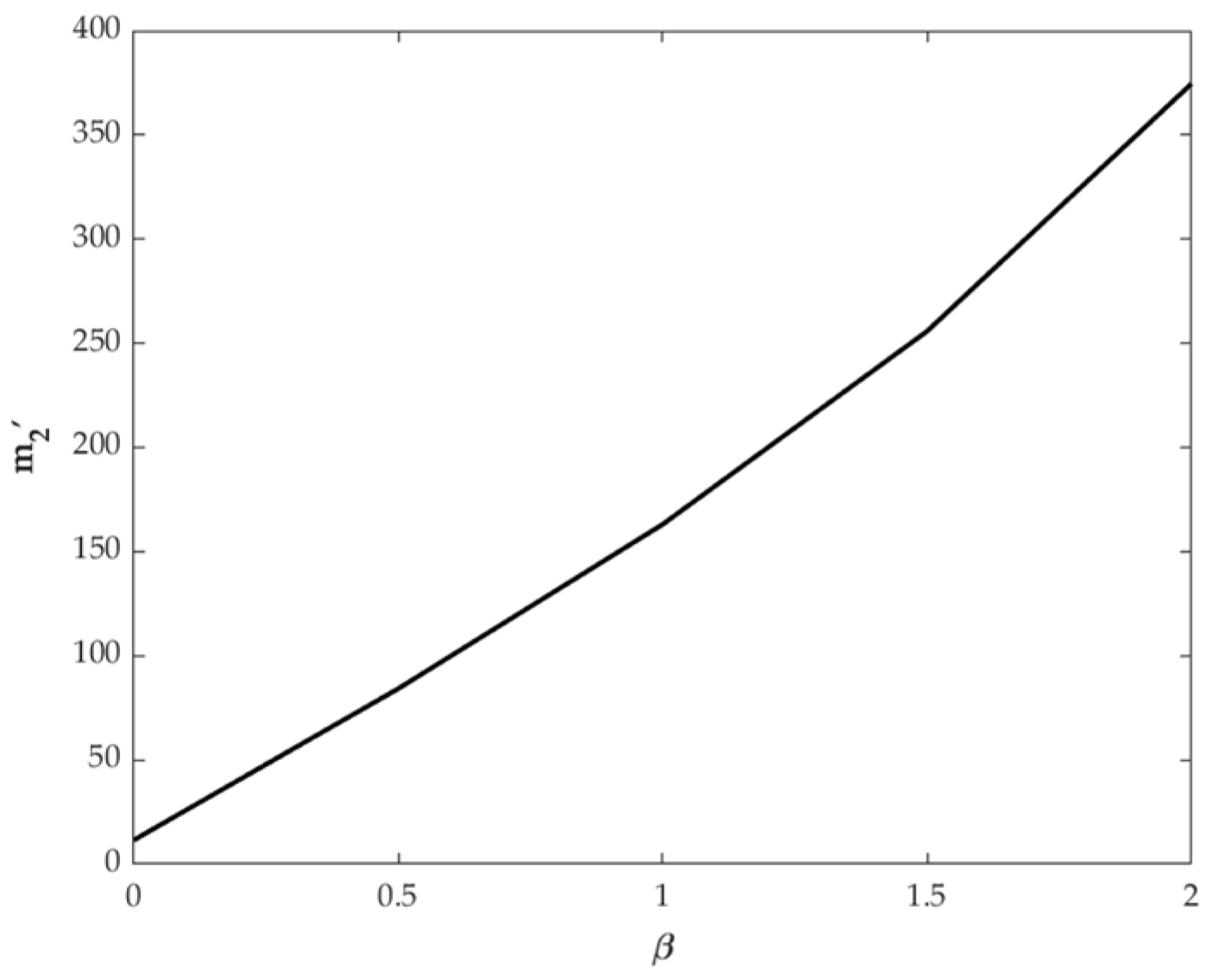
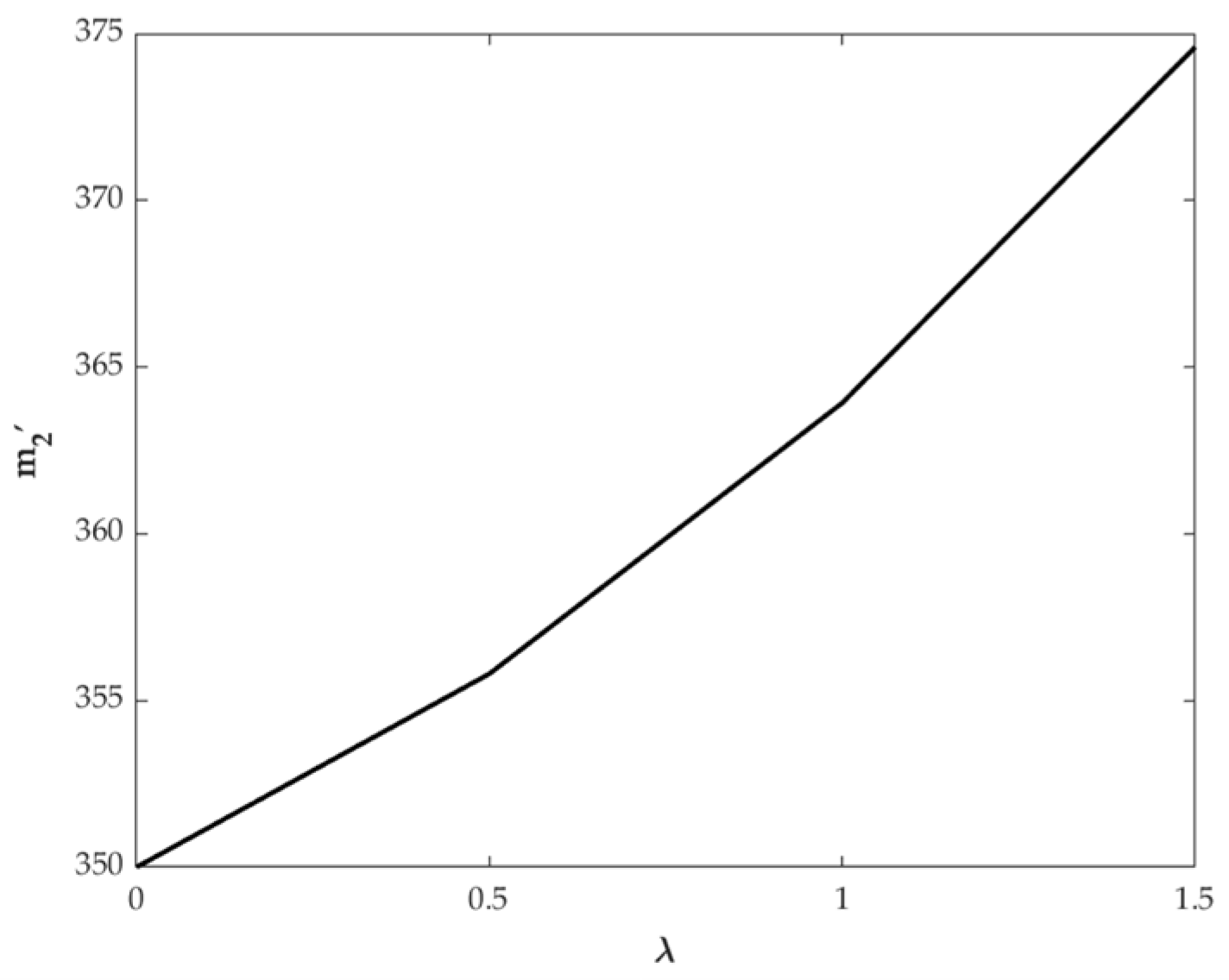
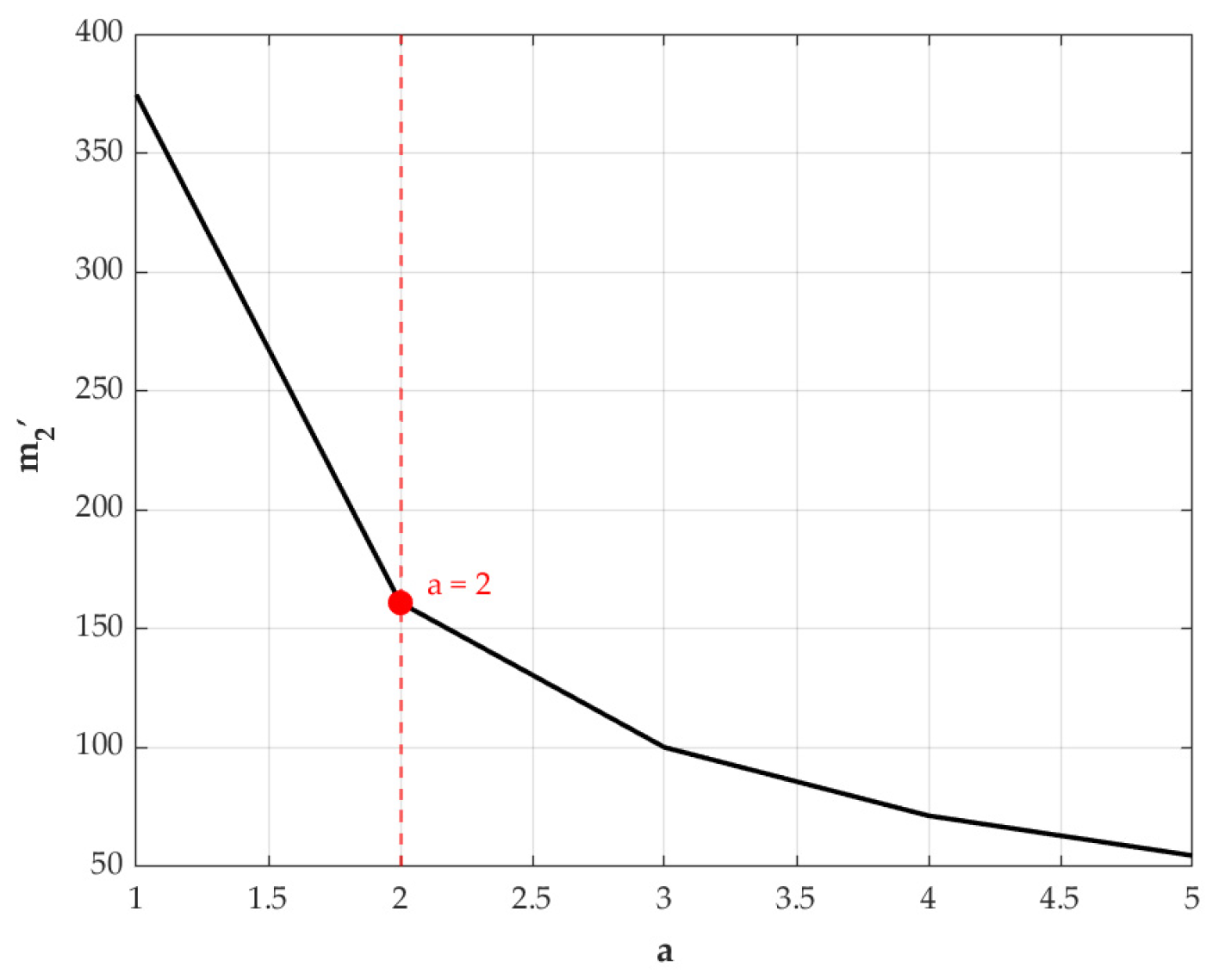
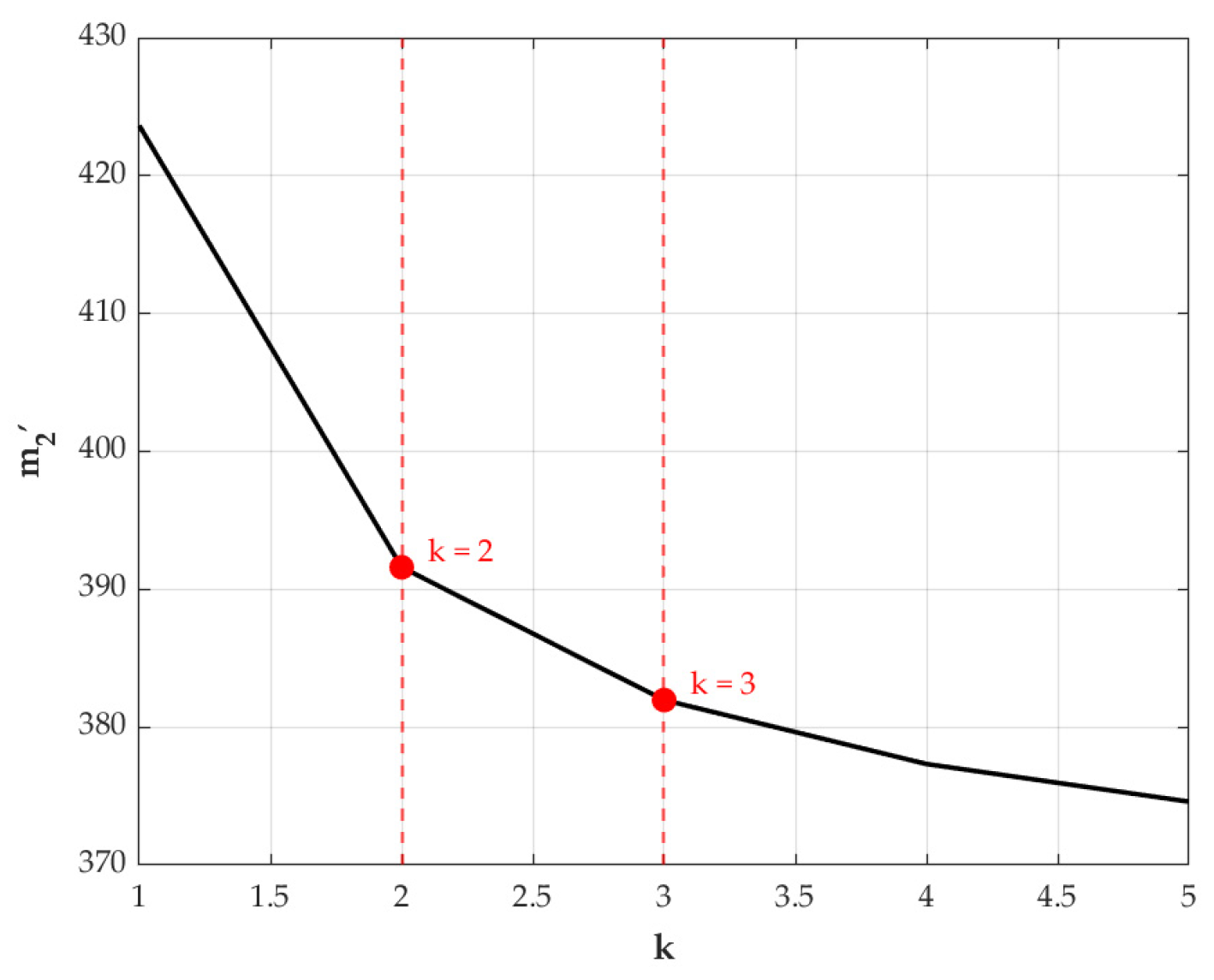
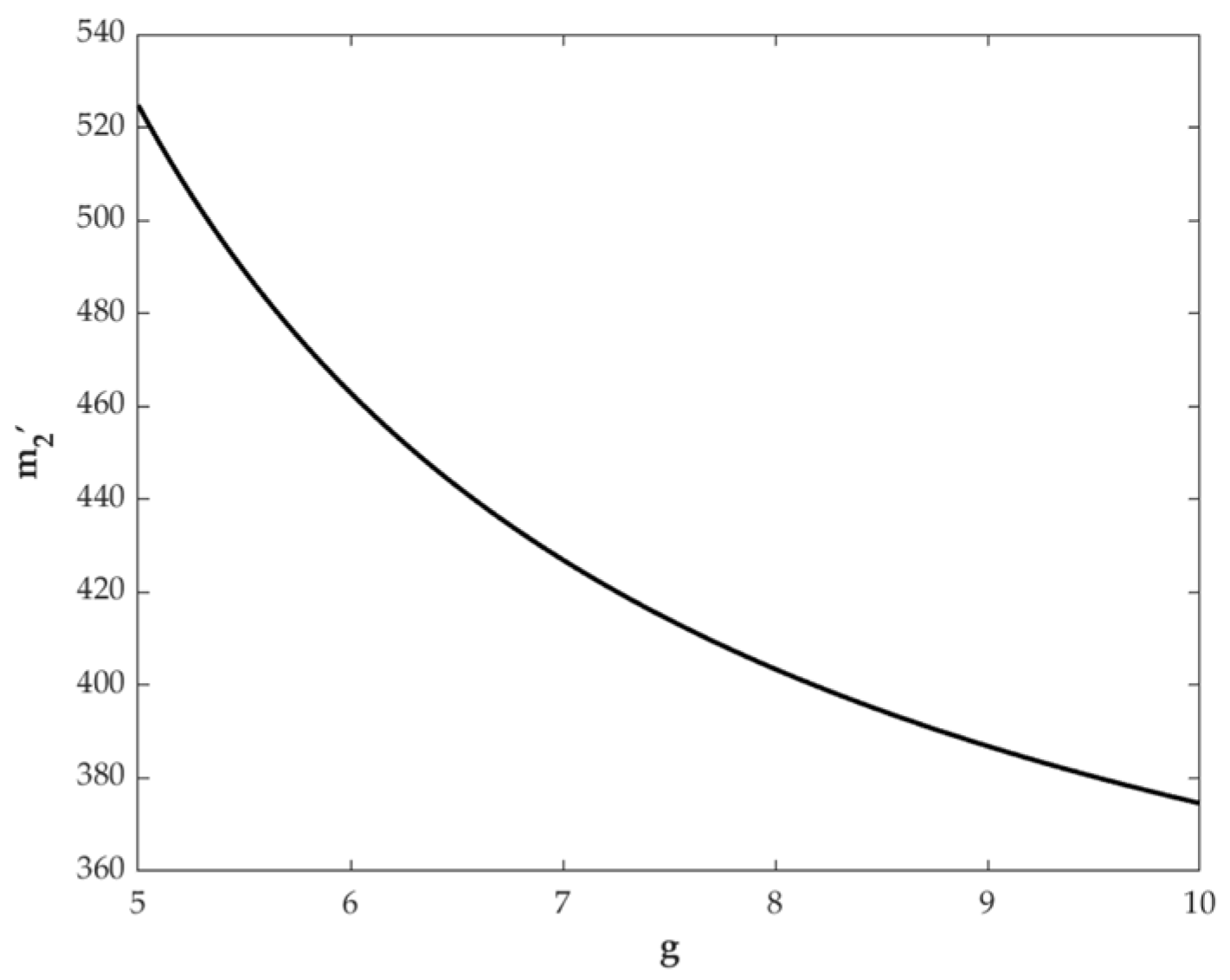
The BDSP marketing effort sensitivity coefficient β, the BDSP recycling effort sensitivity coefficient λ, the retail price sensitivity coefficient a, the recycling price sensitivity coefficient k, and the big data service cost coefficient g of the BDSP all affect the optimal payment level m2′ for big data services under coordinated conditions. The results are shown in Figure 2, Figure 3, Figure 4, Figure 5 and Figure 6.
Figure 2 and Figure 3 demonstrate that when the BDSP contributes to marketing and recycling processes, the greater the impact of service effort level on operations, the more likely the manufacturer is to raise the optimal payment level to better leverage big data services for profit generation. A comparison of Figure 2 and Figure 3 finds that the slope in Figure 2 is much steeper, implying that variations in the BDSP marketing effort sensitivity coefficient exert a stronger influence on the optimal payment level. This suggests that the manufacturers attach greater importance to the role of the BDSP in marketing, as it directly affects consumer purchase intention and sales revenue, whereas recycling primarily impacts costs. The profit contribution of big data marketing is more pronounced than that of cost savings from remanufacturing.
Figure 4 shows that as the retail price sensitivity coefficient increases, greater price flexibility strengthens the retailer’s bargaining power, prompting the manufacturer to gradually reduce the optimal payment level in order to reduce costs and maintain profits. When the coefficient exceeds an inflection point ( a = 2 ), the payment level decline slows, reflecting a trade-off between cost and benefit.
Figure 5 indicates that higher recycling price sensitivity coefficient also leads to a lower optimal payment level. As the recycling price sensitivity coefficient increases, the optimal payment level decreases. When k = 2 , the downward trend begins to slow. Once the coefficient passes an inflection point ( k = 3 ), where further increases have little impact on payment level, the marginal benefit of big data services diminishes, and the manufacturer prefers to stimulate recycling by raising the recycling price. This turning point highlights the shift from a steep to a marginally flat response, showing that the effect of increasing the recycling price sensitivity coefficient gradually becomes saturated. Figure 5 shows a smaller decline in the optimal payment level than Figure 4, implying that retail price sensitivity has a greater impact on the manufacturer’s investment in big data services. When determining the optimal payment level, the manufacturer prioritizes retail price changes over recycling price changes.
As shown in Figure 6, with the increase in the big data service cost coefficient, delivering the same level of service requires higher R&D costs for the BDSP. Since cost determines price, the manufacturer must pay more to order big data services. In this scenario, the manufacturer evaluates the trade-off between the additional benefits and costs, ultimately deciding to lower the payment level.

6.2. Impacts of Big Data Services on Member-Level and System-Level Profits in the CLSC

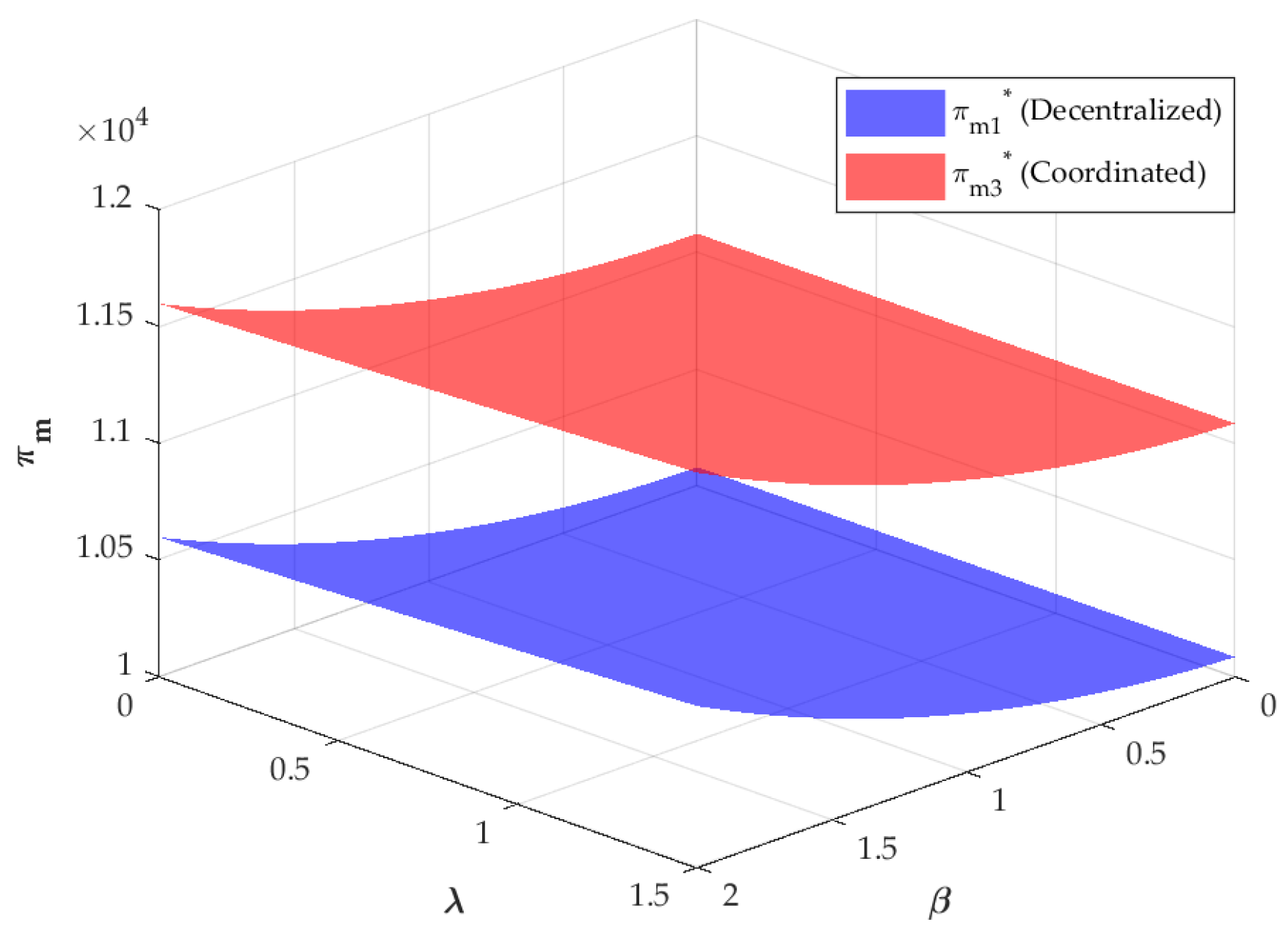
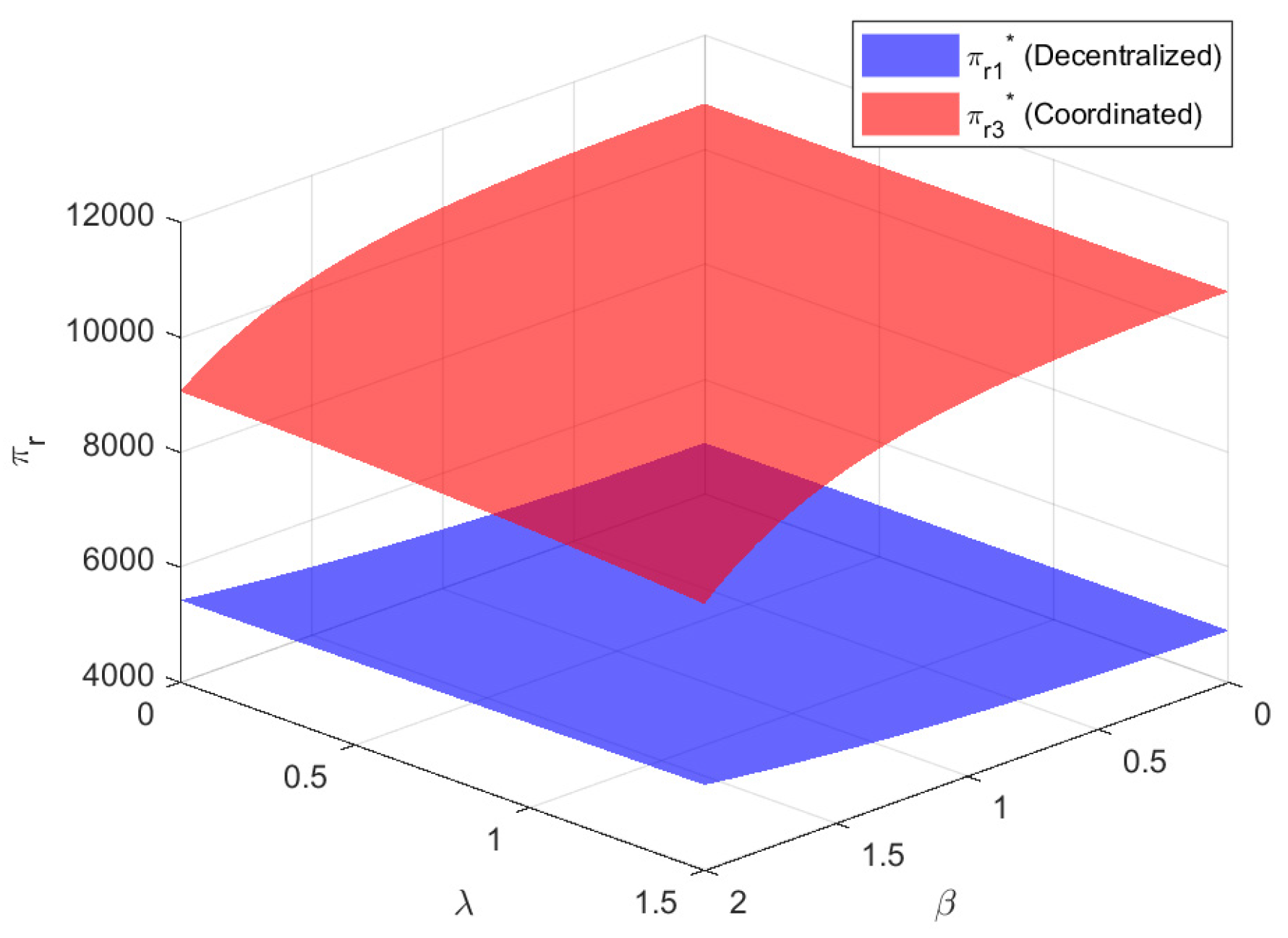
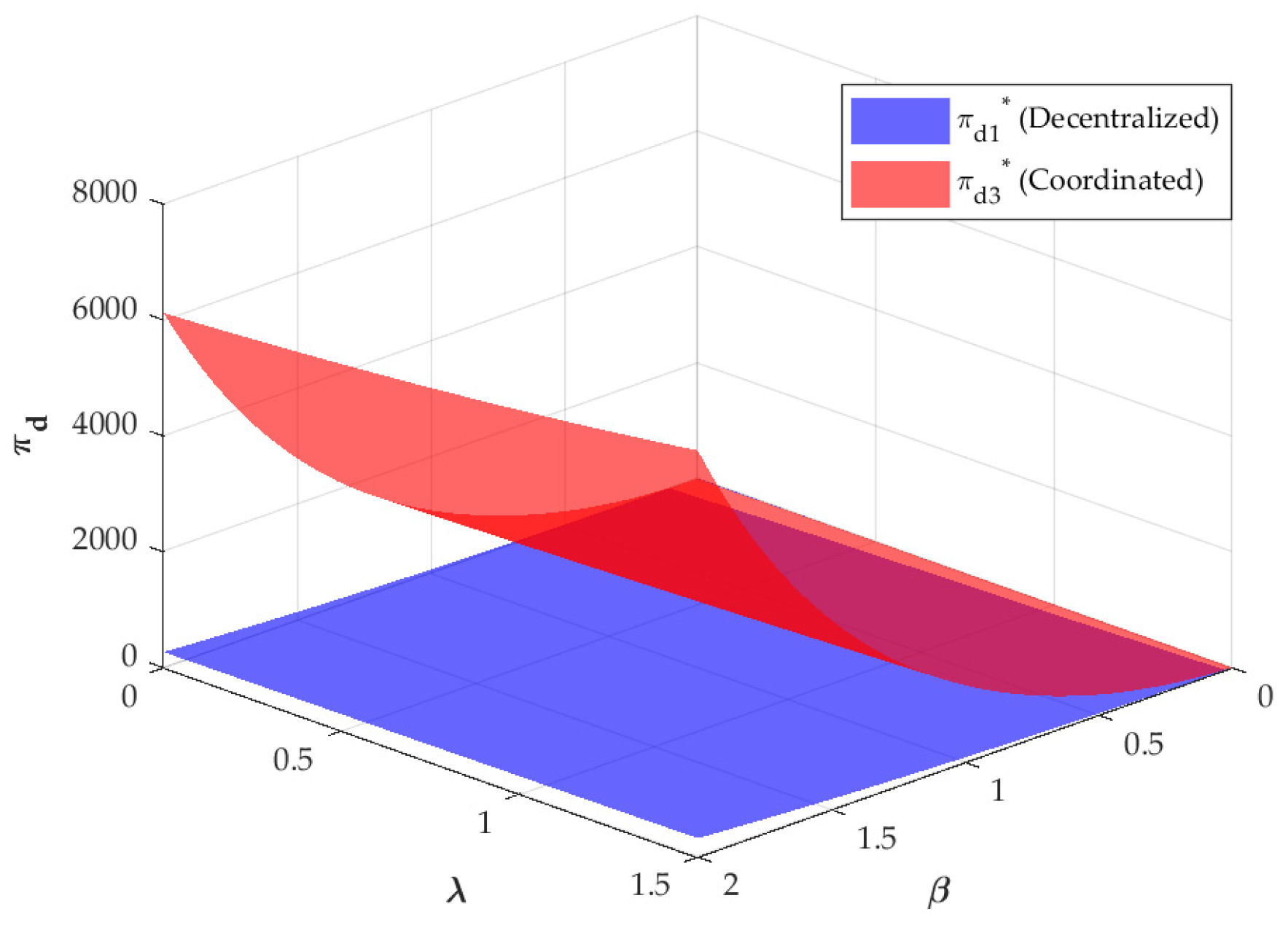
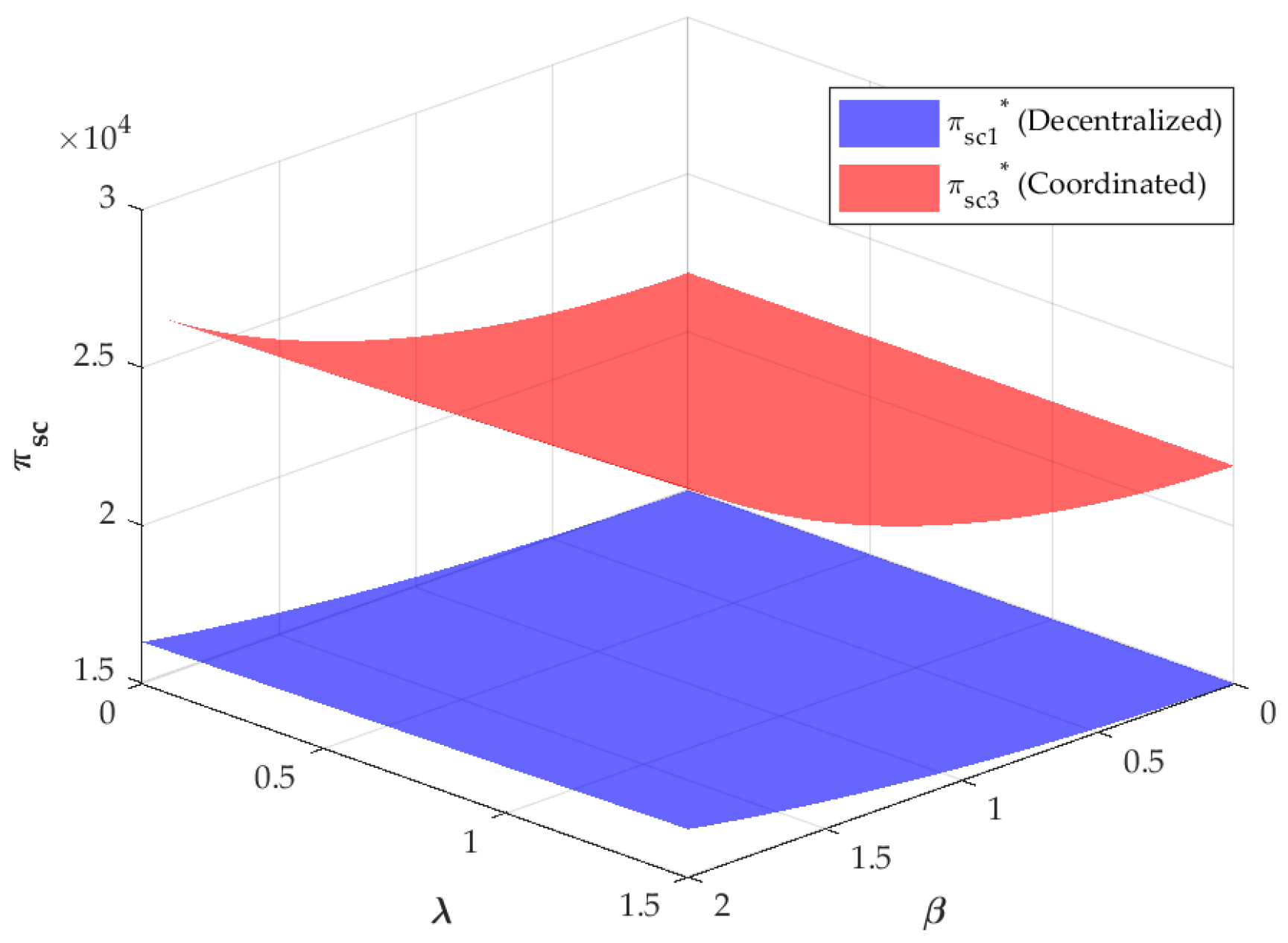
This section investigates how the BDSP marketing effort sensitivity coefficient β and the BDSP recycling effort sensitivity coefficient λ influence members and the system’s profits under decentralized and coordinated scenarios. Set T = T min + 1000 and keep the other parameters the same as above. The results are presented in Figure 7, Figure 8, Figure 9 and Figure 10.
It can be observed from Figure 7, Figure 8, Figure 9 and Figure 10 that, under the coordination mechanism, the profits of the manufacturer, retailer, BDSP, and the CLSC system are all higher than those under the decentralized decision-making scenario, demonstrating the effectiveness of the coordination mechanism. This result also supports the necessary conditions derived from the model.
As illustrated in Figure 7, when the BDSP marketing effort sensitivity coefficient is low, the manufacturer’s profit increases rapidly. As the sensitivity coefficient continues to rise, the growth rate of profit slows down. The distance between the two profit surfaces reflects the incremental profit generated through coordination. When the BDSP marketing effort sensitivity coefficient and the BDSP recycling effort sensitivity coefficient are both low, consumers are less likely to respond to big data services. This means that there is more room for profit growth. In contrast, when both coefficients are high, the incremental profit narrows, indicating diminishing marginal coordination benefits.
As illustrated in Figure 8, as both sensitivity coefficients increase, the retailer’s profit under decentralized decision-making rises steadily. In the coordinated scenario, the retailer’s profit decreases slightly due to transfer payments but remains significantly higher than in the decentralized case. Moreover, the retailer’s profit is more sensitive to changes in the BDSP marketing effort sensitivity coefficient than to the BDSP recycling effort sensitivity coefficient. This fact is because the retailer is closer to end consumers, and big data marketing efforts have a stronger direct impact on retail sales compared to recycling activities, which mainly generate indirect benefits.
As shown in Figure 9, the BDSP’s profit increases with the rise in the BDSP marketing and recycling effort sensitivity coefficients. When consumers are highly responsive to big data services, the manufacturer is more willing to increase the payment level for big data services, thereby raising the BDSP’s profit. Compared with the manufacturer and retailer, BDSP benefits more directly and steadily from higher sensitivity coefficients. This shows its central role in enhancing marketing and recycling performance.
Finally, Figure 10 shows that the total profit of the CLSC system increases steadily as the BDSP marketing effort sensitivity coefficient and recycling effort sensitivity coefficient rise. This indicates that big data services not only enhance the profitability of individual members but also bring about a win-win situation for the entire CLSC system. The larger profit gap between the two scenarios at low sensitivity levels shows that coordination mechanisms are particularly effective in unlocking the potential of less responsive markets.

6.3. Direct and Diffusive Impacts of Big Data Services in the CLSC

This section investigates the direct and diffusive impacts of the BDSP marketing effort sensitivity coefficient β and the BDSP recycling effort sensitivity coefficient λ on the optimal decisions of the CLSC under coordination. The results are presented in Figure 11, Figure 12, Figure 13, Figure 14 and Figure 15.
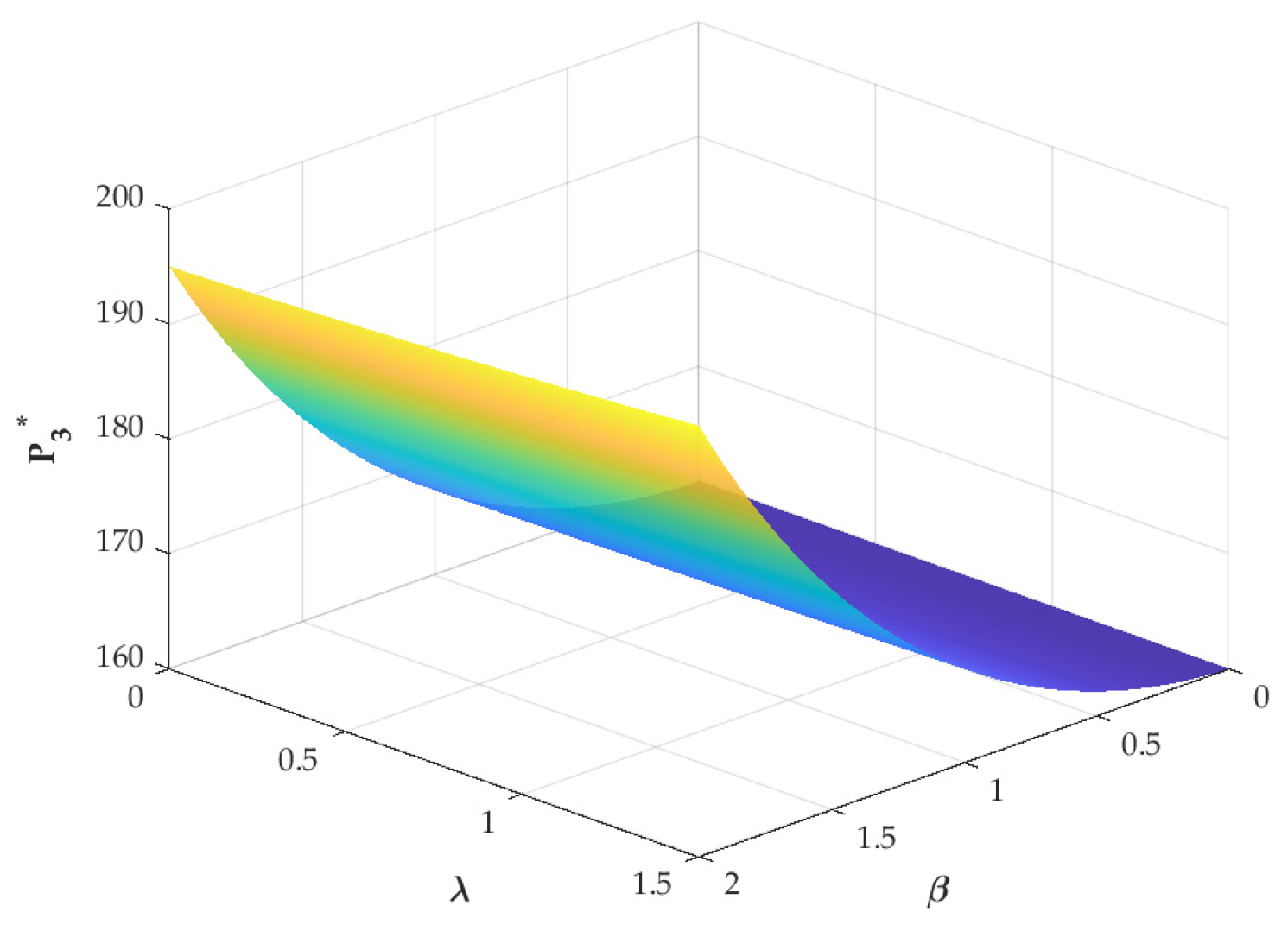
Figure 11, Figure 12 and Figure 13 illustrate the dual effects of big data services on the equilibrium solutions. As shown in Figure 11, with an increase in the BDSP marketing effort sensitivity coefficient, targeted marketing strategies become more effective in stimulating product sales. The manufacturer therefore increases investment in big data services to capture higher profits. This investment raises production costs, which are then reflected in the higher optimal retail price. Meanwhile, a higher value of the BDSP recycling effort sensitivity coefficient indicates a deeper impact of BDSP assistance on recycling, which exerts a diffusive effect on the sales channel and encourages the manufacturer to further increase the retail price.
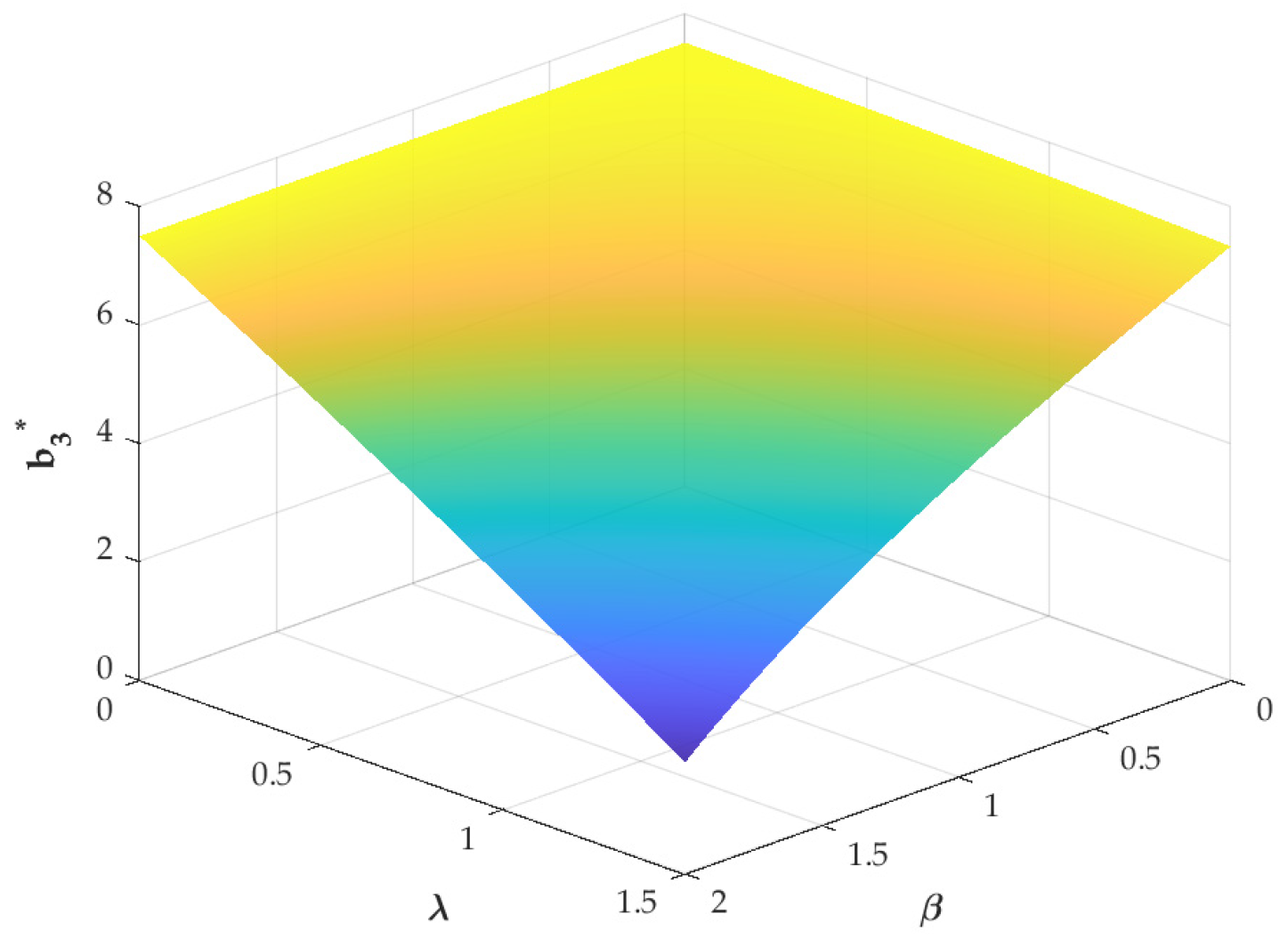
Figure 12 demonstrates that a higher recycling effort sensitivity coefficient improves the efficiency of reverse logistics, thereby reducing the optimal recycling price. Similarly, as the BDSP marketing effort sensitivity coefficient increases, the enhanced marketing effect indirectly promotes recycling participation, further lowering the recycling price. These results indicate that marketing and recycling data services reinforce each other, magnifying their overall impact on pricing decisions.
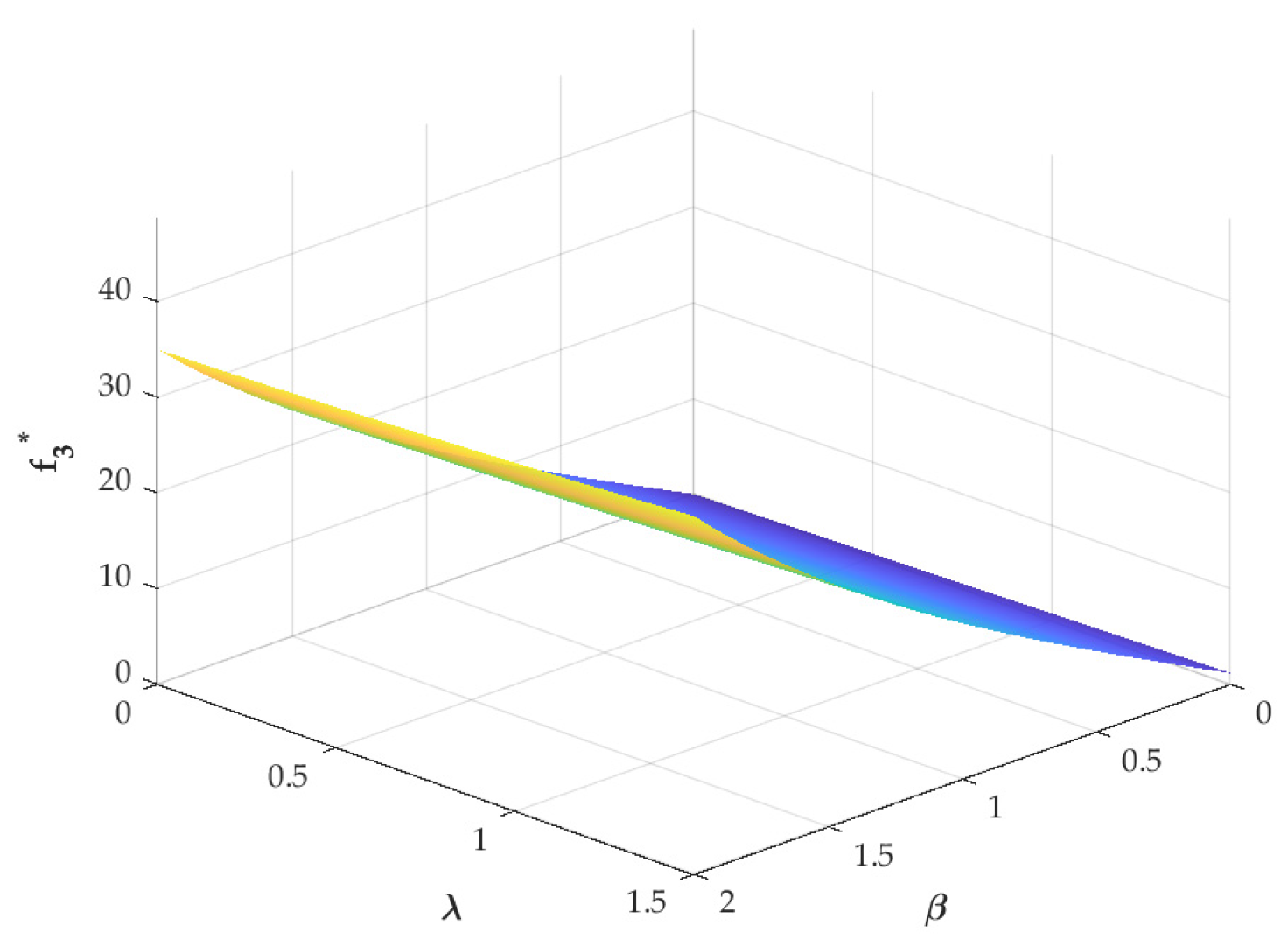
As shown in Figure 13, an increase in both the BDSP marketing effort sensitivity coefficient and the BDSP recycling effort sensitivity coefficient drives the manufacturer to raise the optimal payment level. This decision incentivizes the BDSP to enhance its service effort level, forming a positive feedback mechanism between payment and service quality. Comparing Figure 11, Figure 12 and Figure 13 reveals that the influence of marketing sensitivity on pricing decisions is generally stronger than that of recycling sensitivity. This shows that the market responds more actively to marketing-oriented data services.
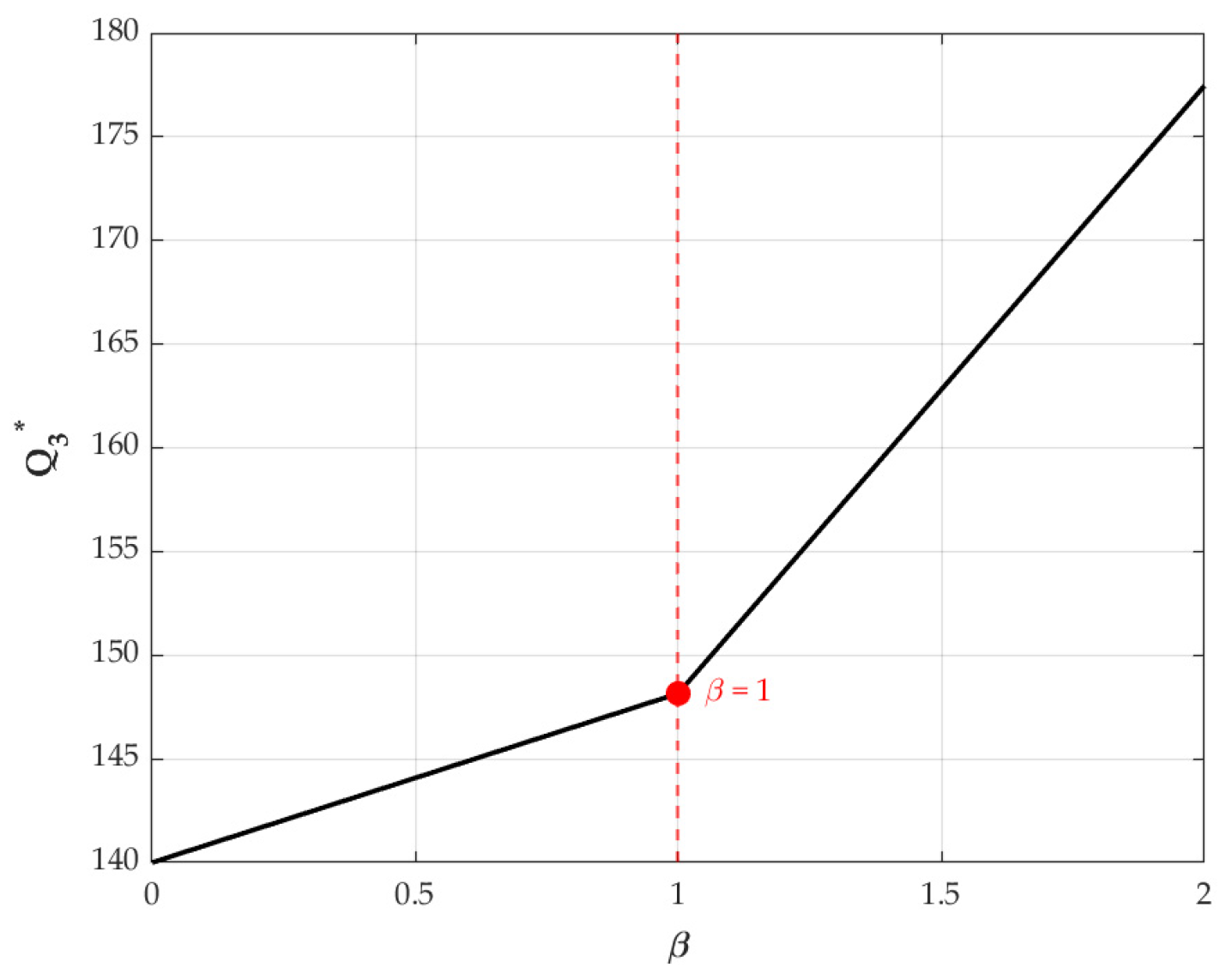
On the demand side, Figure 14 shows that the optimal demand quantity rises with the BDSP marketing effort sensitivity coefficient. When the BDSP marketing effort sensitivity coefficient is low, demand grows slowly because consumers respond weakly to marketing stimulation. Once the BDSP marketing effort sensitivity coefficient exceeds the threshold ( β = 1 ), the marketing effect strengthens. Consumers become more responsive, and their willingness to purchase increases. As a result, demand rises sharply.
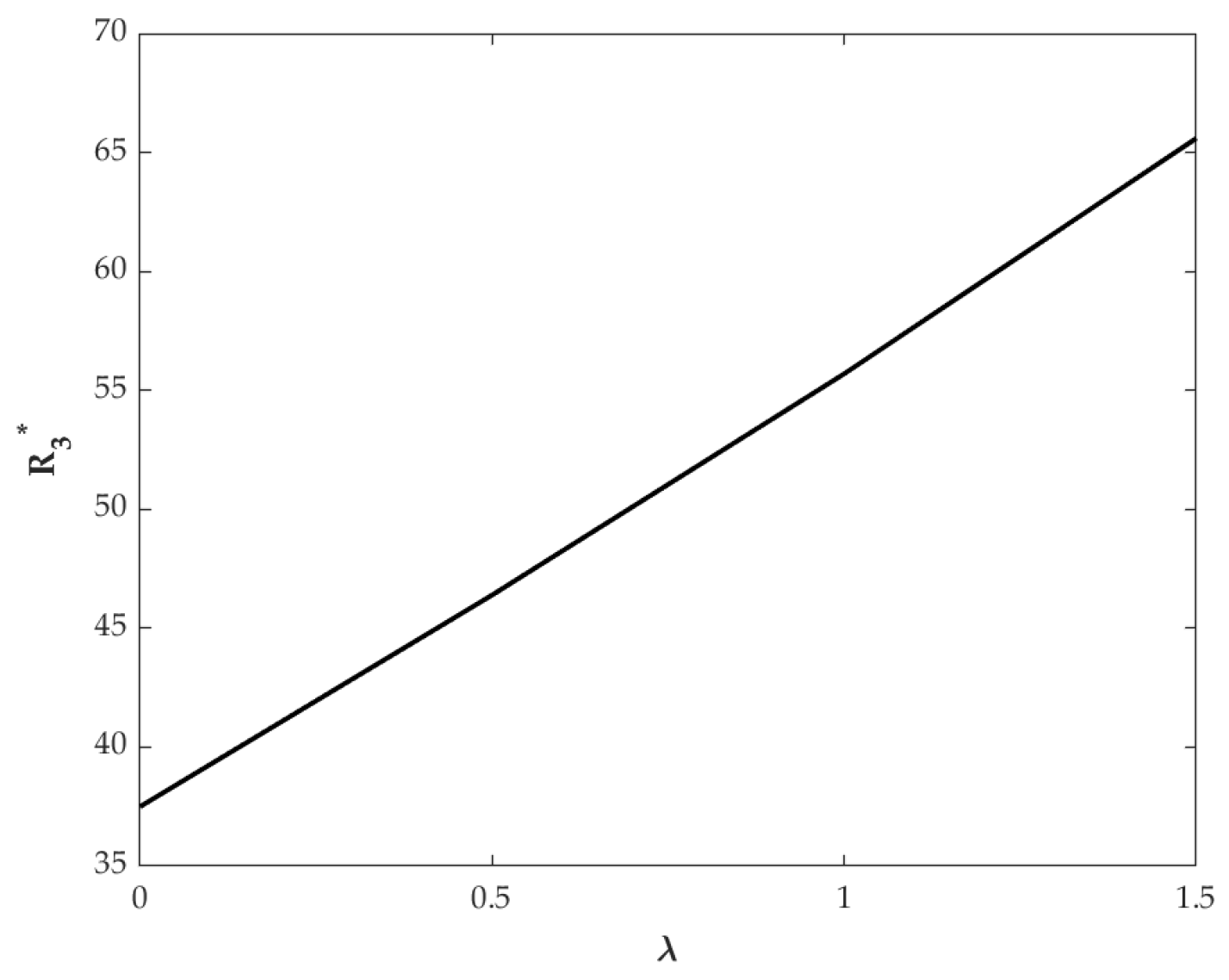
From Figure 15, it can be seen that the involvement of the BDSP promotes the optimization of the recycling business process. The use of big data for multi-channel and diversified promotional efforts has increased consumer environmental awareness, creating surplus value. Therefore, as the BDSP recycling effort sensitivity coefficient increases, consumers become more willing to participate in recycling, recycling activities are conducted more efficiently, and the optimal recycling volume increases. The simulation results align with the conclusions of Propositions 3 and 4. The BDSP engagement in both marketing and recycling effectively improves the operational and environmental performance of the CLSC system.

7. Conclusions and Future Research Direction

In the digital economy, CLSCs are expected to embrace emerging trends and integrate big data technologies to promote sustainable development. This paper establishes and solves decentralized and centralized decision-making models for a CLSC consisting of a manufacturer, a retailer, and a BDSP. Based on optimization analysis theory, we analyze the decision-making behaviors of the supply chain members and identify the specific sources of profit loss under decentralized decisions. The necessary conditions under which the total profit of the decentralized model equals that of the centralized model are derived, thereby achieving coordination. Furthermore, we explore the impacts of the BDSP’s two assistance modes on the equilibrium strategies of the CLSC. Finally, through the analysis of numerical examples, the theoretical contributions and management suggestions are drawn:
  • This study proposes an innovative approach and optimization framework for coordinating the participation of a BDSP in a CLSC. By thoroughly investigating the internal mechanisms of the supply chain system, it precisely identifies the specific sources of profit loss and determines two essential components of the coordination contract, thereby enriching research on supply chain coordination.
  • The first necessary condition for achieving coordination in the CLSC is that the wholesale price equals the unit cost of new products. When the manufacturer wholesales the product to the retailer at cost price, it helps boost market demand and enables the equilibrium in decentralized decision-making to converge with the optimal level of centralized decision-making, thereby eliminating system profit loss.
  • The second necessary condition requires that the unit payment level be positively correlated with several parameters. The parameters include production volume, unit cost savings, the BDSP marketing effort sensitivity coefficient, and the BDSP recycling effort sensitivity coefficient. Remanufacturing enterprises should (1) accurately assess market feedback on the service modes of the BDSP and the impacts of big data services on profitability, (2) streamline remanufacturing processes to achieve cost efficiencies, and (3) determine appropriate pricing for big data services based on actual output. This approach will fully unlock the value of big data.
  • In addition, the unit payment level is also negatively correlated with several parameters. The parameters include the retail price sensitivity coefficient, the recycling price sensitivity coefficient, and the big data service cost coefficient. Remanufacturing enterprises should take measures to reduce consumer price sensitivity, especially retail price. For instance, Huawei provides value-added services during the sales process, such as extended warranties, cloud storage, and dedicated customer support, as well as door-to-door recycling service during the recycling stage. This full-lifecycle service design enhances consumer experience and perceived value, reducing price sensitivity and encouraging both product purchase and participation in recycling programs.
  • BDSPs create greater benefits for CLSCs by assisting with both marketing and recycling. A BDSP enhances marketing effectiveness not only by leveraging its robust data mining capabilities to facilitate product transformation and upgrading, ensuring products better align with consumer preferences, but also by implementing targeted marketing strategies for diverse consumer segments. This significantly improves the precision of marketing campaigns, driving growth in both supply chain sales volume and overall profitability. Simultaneously, the positive impacts of marketing assistance indirectly lower waste recycling costs by reducing the recycling price, thereby decreasing the manufacturer’s recycling expenses. Furthermore, the BDSP’s assistance in recycling helps optimize the recycling process and promotes consumer participation in recycling activities through publicity, thereby increasing the volume of recycled waste and bringing more economic and environmental benefits to the CLSC. Additionally, recycling assistance exerts a diffuse influence on the product sales process, leading to a higher retail price and increased sales revenue. Marketing sensitivity has a stronger impact on pricing decisions than recycling sensitivity. The market responds more actively to marketing-oriented data services.
Our paper has certain limitations, which include the following aspects. Firstly, we only consider a single manufacturer, a single retailer, and a single BDSP. Future research could extend this framework by incorporating competition among multiple BDSPs to better reflect real-world market dynamics. Secondly, we assume that remanufactured products and new products are homogeneous; future studies could explore quality differences between them and develop models for in-depth analysis.

Author Contributions

Conceptualization, Y.Y. and L.S.; methodology, Y.Y. and L.S.; validation, L.S.; formal analysis, L.S.; data curation, L.S.; writing—original draft preparation, L.S.; writing—review and editing, Y.Y. and L.S.; visualization, L.S.; supervision, Y.Y.; project administration, Y.Y.; funding acquisition, Y.Y. All authors have read and agreed to the published version of the manuscript.

Funding

This research was funded by National Natural Science Foundation of China, grant number 11901422.

Data Availability Statement

The original contributions presented in this study are included in the article. Further inquiries can be directed to the corresponding author.

Conflicts of Interest

The authors declare no conflicts of interest.

Appendix A

Appendix A.1. Proof of the Equilibrium Solutions in the Decentralized Decision-Making Model

According to the BDSP’s profit function, it can be ascertained that 2 π d / f 2 = g < 0 ; πd is a strictly concave function with respect to f. For Equation (5), by setting the first-order derivative of f to zero, the reaction function of the BDSP’s service effort level can be derived as follows:
f = m g
Based on the retailer’s profit function, it can be shown that 2 π r / P 2 = 2 a < 0 ; πr is a strictly concave function with respect to P. For Equation (4), by setting the first-order derivative of P to zero, the reaction function of the retailer’s retail price can be derived as follows:
P = g D + a w + β m 2 a g
Substituting Equations (A1) and (A2) into Equation (3), the manufacturer’s Hessian matrix for variables w, b and m is
H 1 ( w , b , m ) = 2 π m w 2 2 π m w b 2 π m w m 2 π m b w 2 π m b 2 2 π m b m 2 π m m w 2 π m m b 2 π m m 2 = a 0 β 2 g 0 2 k λ g β 2 g λ g 2 g
It can be seen that the first-order leading principal minor H 11 = a < 0 and the second-order leading principal minor H 22 = 2 a k > 0 . For the manufacturer’s profit function to be jointly concave with respect to w, b and m, the third-order leading principal minor H 1 ( w , b , m ) = k β 2 + 2 a 4 g k + λ 2 2 g 2 must be negative, satisfying the following condition: 8 a g k k β 2 2 a λ 2 > 0 .
Setting the first-order partial derivatives of w, b and m equal to zero in Equation (3) yields the optimal wholesale price w1*, recycling price b1* and payment level m1*. Substituting these values into Equations (A1) and (A2) yields the optimal retail price P1* and the optimal service effort level f1* of the BDSP. Finally, substituting w1*, b1*, m1*, P1* and f1* into Equations (3)–(5) gives the maximum profits of each member. The optimal profit of the CLSC is the sum of the profits of its members.

Appendix A.2. Proof of the Equilibrium Solutions in the Centralized Decision-Making Model

The CLSC’s Hessian matrix for variables b, P and f is
H 2 ( b , P , f ) = 2 π s c 2 b 2 2 π s c 2 b P 2 π s c 2 b f 2 π s c 2 P b 2 π s c 2 P 2 2 π s c 2 P f 2 π s c 2 f b 2 π s c 2 f P 2 π s c 2 f 2 = 2 k 0 λ 0 2 a β λ β g
It can be seen that the first-order leading principal minor H 11 = 2 k < 0 and the second-order leading principal minor H 22 = 4 a k > 0 . For the CLSC’s profit function to be jointly concave with respect to b, P and f, the third-order leading principal minor H 2 ( b , P , f ) = 4 a g k + 2 k β 2 + 2 a λ 2 must be negative, satisfying the following condition: 2 a g k k β 2 a λ 2 > 0 .
Setting the first-order partial derivatives of b, P and f equal to zero in Equation (6) yields the optimal recycling price b2*, retail price P2* and service effort level f2*. Substituting these values into Equation (6) yields the optimal profit of the CLSC.

Appendix B

Appendix B.1. Proof of Proposition 1

(1) b 1 b 2 = a λ D a C m 6 g k β β λ 2 + 4 a g k λ + k β 2 λ C m C r 2 8 a g k k β 2 2 a λ 2 2 a g k k β 2 a λ 2 . According to the derivation in Appendix A, 8 a g k k β 2 2 a λ 2 > 0 and 2 a g k k β 2 a λ 2 > 0 ; therefore, the denominator 2 8 a g k k β 2 2 a λ 2 2 a g k k β 2 a λ 2 > 0 . Based on Assumption 3, C m C r > 0 ; therefore, 4 a g k λ + k β 2 λ C m C r > 0 . Assumption 4 specifies D > a C m and g k > λ 2 ; therefore, D a C m 6 g k β β λ 2 > 0 . As a result, the numerator a λ D a C m 6 g k β β λ 2 + 4 a g k λ + k β 2 λ C m C r > 0 . Finally, b 1 b 2 > 0 , i.e., b 1 > b 2 .
(2) Because P 1 P 2 = D a C m 2 g k 2 4 a g 5 β 2 λ 2 6 a g k 2 k β 2 a λ 2 k β λ 2 a g k + 2 k β 2 + a λ 2 C m C r 2 8 a g k k β 2 2 a λ 2 2 a g k k β 2 a λ 2 , based on the same assumptions and derivation steps as in Proposition 1-(1), it follows that P 1 P 2 > 0 . Therefore, P 1 > P 2 .
(3) By substituting the optimal retail prices and service effort levels for the two scenarios into the demand function, we obtain
Q 2 Q 1 = 2 a g k D a C m 4 a g k + k β 2 3 a λ 2 + a 2 λ 4 D a C m + a 2 k β λ 6 g k λ 2 C m C r 2 8 a g k k β 2 2 a λ 2 2 a g k k β 2 a λ 2 ,
following the same reasoning as in Proposition 1-(1) and under Assumptions 3 and 4, the numerator and denominator are both positive. Therefore, Q 2 Q 1 > 0 , i.e., Q 1 < Q 2 .
(4) f 2 f 1 = a k β D a C m 6 g k λ 2 + k λ 4 a g + β 2 C m C r 8 a g k k β 2 2 a λ 2 2 a g k k β 2 a λ 2 . By applying the same reasoning as in Proposition 1-(1) under Assumptions 3 and 4, we obtain f 1 < f 2 .
(5) By substituting the optimal recycling prices and service effort levels for the two scenarios into the recycling function, we obtain
R 2 R 1 = a k β λ D a C m 6 g k λ 2 + a k 2 λ 2 4 a g + β 2 C m C r 2 8 a g k k β 2 2 a λ 2 2 a g k k β 2 a λ 2 > 0 ,
therefore R 1 < R 2 .
(6) Subtracting the profit functions under the two decision scenarios yields π s c 2 π s c 1 = 32 a 2 g 2 k 2 g k λ 2 + 4 a g k 2 β 2 5 g k λ 2 + a 2 λ 4 10 g k λ 2 D a C m 2 + 4 a g k 2 β λ 16 a g k + k β 2 5 a λ 2 + 2 a 2 k β λ 5 D a C m C m C r + a 2 k 2 λ 2 16 a g 2 k + 10 g k β 2 β 2 λ 2 C m C r 2 4 2 a g k k β 2 a λ 2 8 a g k k β 2 2 a λ 2 2 > 0 . Based on Assumption 4 g k > λ 2 , it can be derived that 16 a g k + k β 2 5 a λ 2 > 0 and 16 a g 2 k + 10 g k β 2 β 2 λ 2 > 0 . Since each term in the numerator is positive and the denominator is also positive, it follows that π s c 2 π s c 1 > 0 , i.e., π s c 1 < π s c 2 .

Appendix B.2. Proof of Proposition 2

(1) Substitute w 2 = C m into m 2 = g k β D a C m + a λ C m C r 2 a g k k β 2 a λ 2 to obtain
m 2 = g k β D a w 2 + λ a C m C r 2 a g k k β 2 a λ 2 ,
since the total output of products produced by the manufacturer also conforms to the demand function, which is a linear function of the wholesale price, it can be assumed that E = D a w , we can find that the higher production volume, the greater the value of m2′.
(2) C m C r represents the unit cost savings achieved through recycling and remanufacturing, the expression m 2 = g k β D a w 2 + λ a C m C r 2 a g k k β 2 a λ 2 shows that m2′ is positively correlated with C m C r .
(3) m 2 β = g k D a C m 2 a g k + k β 2 a λ 2 + 2 a g k 2 β λ C m C r 2 a g k k β 2 a λ 2 2 . According to Assumption 3, C m C r > 0 , and according to Assumption 4, D > a C m and g k > λ 2 . The numerator is positive, and the denominator is a square term, which is always positive. Therefore, m 2 β > 0 .
(4) m 2 λ = a g k 2 β λ D a C m + 2 a g k k β 2 + a λ 2 C m C r 2 a g k k β 2 a λ 2 2 . Based on the same assumptions and derivation logic, we obtain m 2 λ > 0 .
(5) m 2 a = g k β D 2 g k + λ 2 + k 2 β C m k β λ C m C r 2 a g k k β 2 a λ 2 2 , when 0 < β < 2 a g k a λ 2 k , g k β D 2 g k + λ 2 + k 2 β C m k β λ C m C r < 0 ; therefore, m 2 a < 0 .
(6) m 2 k = a g λ 2 β D a C m + a λ C m C r 2 a g k k β 2 a λ 2 2 , by the same assumptions, the numerator and denominator remain positive. Therefore, m 2 k < 0 .
(7) m 2 g = k β 2 + a λ 2 k β D a C m + a k λ C m C r 2 a g k k β 2 a λ 2 2 , by the same assumptions, the numerator and denominator remain positive. Therefore, m 2 g < 0 .

Appendix B.3. Proof of Proposition 3

(1) Following the same derivation logic as in Proposition 2, we obtain
P 3 β = 2 k β D a C m 2 g k λ 2 + k λ 2 a g k + k β 2 a λ 2 C m C r 2 2 a g k k β 2 a λ 2 2 > 0 ,
substituting P3* and f3* into Equation (1), we obtain
Q 3 β = 2 a k β D a C m 2 g k λ 2 + a k λ 2 a g k + k β 2 a λ 2 C m C r 2 2 a g k k β 2 a λ 2 2 > 0 ,
Since π s c 3 = π s c 2 = 2 g k D a C m 2 λ D a C m k β C m C r 2 + 2 a g k 2 C m C r 2 8 a g k 4 k β 2 4 a λ 2 , therefore π sc 3 β = k β D a C m + a k λ C m C r D a C m 2 g k λ 2 + k β λ C m C r 2 2 a g k k β 2 a λ 2 2 > 0 .
(2) b 3 λ = β D a C m 2 a g k + k β 2 a λ 2 2 a k λ C m C r 2 a g β 2 2 2 a g k k β 2 a λ 2 2 < 0 , substituting b3* and f3* into Equation (2), we obtain
R 3 λ = k β D a C m 2 a g k k β 2 + a λ 2 + 2 a k 2 λ 2 a g β 2 C m C r 2 2 a g k k β 2 a λ 2 2 > 0 ,
π sc 3 λ = k β D a C m + a k λ C m C r β λ D a C m + 2 a g k k β 2 C m C r 2 2 a g k k β 2 a λ 2 2 > 0 .

Appendix B.4. Proof of Proposition 4

(1) Under Assumptions 3 and 4, it follows that
f 3 β = k D a C m 2 a g k + k β 2 a λ 2 + 2 a k 2 β λ C m C r 2 a g k k β 2 a λ 2 2 > 0 ,
f 3 λ = 2 a k β λ D a C m + a k 2 a g k k β 2 + a λ 2 C m C r 2 a g k k β 2 a λ 2 2 > 0 .
(2) Under Assumptions 3 and 4, we can derive that
b 3 β = λ D a C m 2 a g k + k β 2 a λ 2 + 2 a k β λ 2 C m C r 2 2 a g k k β 2 a λ 2 2 < 0 ,
P 3 λ = 2 k β 2 λ D a C m + k β 2 a g k k β 2 + a λ 2 C m C r 2 2 a g k k β 2 a λ 2 2 > 0 .

References

  1. Mariani, M.M.; Fosso Wamba, S. Exploring how consumer goods companies innovate in the digital age: The role of big data analytics companies. J. Bus. Res. 2020, 121, 338–352. [Google Scholar] [CrossRef]
  2. Fan, J.; Han, F.; Liu, H. Challenges of Big Data analysis. Natl. Sci. Rev. 2014, 1, 293–314. [Google Scholar] [CrossRef] [PubMed]
  3. Liu, P. Pricing Strategies of a Three-Stage Supply Chain: A New Research in the Big Data Era. Discret. Dyn. Nat. Soc. 2017, 2017, 9024712. [Google Scholar] [CrossRef]
  4. Ge, G.; Wang, D.; Liang, S. Dynamic game strategies and coordination of closed-loop supply chain considering product remanufacturing and goodwill in the big data environment. Environ. Dev. Sustain. 2025, 27, 16469–16502. [Google Scholar] [CrossRef]
  5. Jiao, Z.; Ran, L.; Zhang, Y.; Li, Z.; Zhang, W. Data-driven approaches to integrated closed-loop sustainable supply chain design under multi-uncertainties. J. Clean. Prod. 2018, 185, 105–127. [Google Scholar] [CrossRef]
  6. Xiang, Z.; Xu, M. Dynamic cooperation strategies of the closed-loop supply chain involving the internet service platform. J. Clean. Prod. 2019, 220, 1180–1193. [Google Scholar] [CrossRef]
  7. Ma, D.; Hu, J. Research on Collaborative Management Strategies of Closed-Loop Supply Chain under the Influence of Big-Data Marketing and Reference Price Effect. Sustainability 2020, 12, 1685. [Google Scholar] [CrossRef]
  8. Zhong, Y.; Guo, F.; Tang, H.; Chen, X. Research on Coordination Complexity of E-Commerce Logistics Service Supply Chain. Complexity 2020, 2020, 7031543. [Google Scholar] [CrossRef]
  9. Wu, Z.; Lang, H. Coordinating a platform supply chain with reference promotion effect and Big Data marketing. RAIRO-Oper. Res. 2024, 58, 1333–1357. [Google Scholar] [CrossRef]
  10. Tahiri, Y.; Beidouri, Z.; Oumami, M.E. Coordination Contracts and Their Impact on Supply Chain Performance: A Systematic Literature Review. Eng. Proc. 2025, 97, 10. [Google Scholar] [CrossRef]
  11. Nagurney, A.; Toyasaki, F. Reverse supply chain management and electronic waste recycling: A multitiered network equilibrium framework for e-cycling. Transp. Res. Part E Logist. Transp. Rev. 2005, 41, 1–28. [Google Scholar] [CrossRef]
  12. Qiang, Q.; Ke, K.; Anderson, T.; Dong, J. The closed-loop supply chain network with competition, distribution channel investment, and uncertainties. Omega 2013, 41, 186–194. [Google Scholar] [CrossRef]
  13. Wu, H.; Xu, B.; Zhang, D. Closed-Loop Supply Chain Network Equilibrium Model with Subsidy on Green Supply Chain Technology Investment. Sustainability 2019, 11, 4403. [Google Scholar] [CrossRef]
  14. Liu, Y.; Zhang, G. Closed-loop supply chain network equilibrium strategy model with environmental protection objectives. Chin. J. Popul. Resour. Environ. 2020, 18, 251–261. [Google Scholar] [CrossRef]
  15. Fargetta, G.; Scrimali, L.R.M. A sustainable dynamic closed-loop supply chain network equilibrium for collectibles markets. Comput. Manag. Sci. 2023, 20, 19. [Google Scholar] [CrossRef]
  16. Peng, Y.; Chen, B.; Veglianti, E. Platform Service Supply Chain Network Equilibrium Model with Data Empowerment. Sustainability 2022, 14, 5419. [Google Scholar] [CrossRef]
  17. Yuan, Y.; Yang, J.; Li, Y.; Li, W. Necessary conditions for coordination of dual-channel closed-loop supply chain. Technol. Forecast. Soc. Change 2020, 151, 119823. [Google Scholar] [CrossRef]
  18. Dey, S.K.; Kundu, K.; Das, P. Digital technology based game-theoretic pricing strategies in a three-tier perishable food supply chain. Ann. Oper. Res. 2024, 1–27. [Google Scholar] [CrossRef]
  19. Li, X.; Li, K.J. Beating the Algorithm: Consumer Manipulation, Personalized Pricing, and Big Data Management. Manuf. Serv. Oper. Manag. 2023, 25, 36–49. [Google Scholar] [CrossRef]
  20. Zhang, Z.; Shivendu, S.; Wang, P. Is Investment in Data Analytics Always Profitable? The Case of Third-Party-Online-Promotion Marketplace. Prod. Oper. Manag. 2021, 30, 2321–2337. [Google Scholar] [CrossRef]
  21. Esmaeeli, Z.; Mollaverdi, N.; Safarzadeh, S. A game theoretic approach for green supply chain management in a big data environment considering cost-sharing models. Expert Syst. Appl. 2024, 257, 124989. [Google Scholar] [CrossRef]
  22. Song, H.; Shu, Y.; Dai, Y.; Zhou, L.; Li, H. Big data service investment choices in a manufacturer-led dual-channel supply chain. Comput. Ind. Eng. 2022, 171, 108423. [Google Scholar] [CrossRef]
  23. Niu, B.; Zou, Z. Better Demand Signal, Better Decisions? Evaluation of Big Data in a Licensed Remanufacturing Supply Chain with Environmental Risk Considerations. Risk Anal. 2017, 37, 1550–1565. [Google Scholar] [CrossRef]
  24. Wang, H.; Chen, Y.; Xie, J.; Liu, C. Research on digital empowerment, innovation vitality and manufacturing supply chain resilience mechanism. PLoS ONE 2025, 20, e0316183. [Google Scholar] [CrossRef]
  25. Nisar, Q.A.; Haider, S.; Ameer, I.; Hussain, M.S.; Gill, S.S.; Usama, A. Sustainable supply chain management performance in post COVID-19 era in an emerging economy: A big data perspective. Int. J. Emerg. Mark. 2023, 18, 5900–5920. [Google Scholar] [CrossRef]
  26. Kamble, S.S.; Gunasekaran, A. Big data-driven supply chain performance measurement system: A review and framework for implementation. Int. J. Prod. Res. 2020, 58, 65–86. [Google Scholar] [CrossRef]
  27. Xiang, Z.; Xu, M. Dynamic game strategies of a two-stage remanufacturing closed-loop supply chain considering Big Data marketing, technological innovation and overconfidence. Comput. Ind. Eng. 2020, 145, 106538. [Google Scholar] [CrossRef]
  28. Ma, D.; Hu, J.; Yao, F. Big data empowering low-carbon smart tourism study on low-carbon tourism O2O supply chain considering consumer behaviors and corporate altruistic preferences. Comput. Ind. Eng. 2021, 153, 107061. [Google Scholar] [CrossRef]
  29. Liu, P.; Yi, S.-p. Pricing policies of green supply chain considering targeted advertising and product green degree in the Big Data environment. J. Clean. Prod. 2017, 164, 1614–1622. [Google Scholar] [CrossRef]
  30. Seyedan, M.; Mafakheri, F. Predictive big data analytics for supply chain demand forecasting: Methods, applications, and research opportunities. J. Big Data 2020, 7, 53. [Google Scholar] [CrossRef]
  31. Chen, H.; Chiang, R.H.L.; Storey, V.C. Business Intelligence and Analytics: From Big Data to Big Impact. MIS Q. 2012, 36, 1165–1188. [Google Scholar] [CrossRef]
  32. Liu, P.; Zhang, F.-J. Pricing strategies of dual-channel green supply chain considering Big Data information inputs. Soft Comput. 2022, 26, 2981–2999. [Google Scholar] [CrossRef]
  33. Jin, J.; Ying, L.; Ping, J.; Liu, H. Understanding big consumer opinion data for market-driven product design. Int. J. Prod. Res. 2016, 54, 3019–3041. [Google Scholar] [CrossRef]
  34. Feng, Q.; Shanthikumar, J.G. How Research in Production and Operations Management May Evolve in the Era of Big Data. Prod. Oper. Manag. 2018, 27, 1670–1684. [Google Scholar] [CrossRef]
  35. Sestino, A.; Prete, M.I.; Piper, L.; Guido, G. Internet of Things and Big Data as enablers for business digitalization strategies. Technovation 2020, 98, 102173. [Google Scholar] [CrossRef]
  36. Wang, Z.; Chunming, Y.; Guo, J. Optimisation of remanufacturing supply chain with dual recycling channels under improved deep reinforcement learning algorithm. Int. J. Syst. Sci. Oper. Logist. 2024, 11, 2396432. [Google Scholar] [CrossRef]
  37. Song, H.; Cao, Y.; Zhang, Y.; Dai, Y. Research on the big data information sharing in closed-loop supply chain with triple-channel recycling. RAIRO-Oper. Res. 2024, 58, 681–712. [Google Scholar] [CrossRef]
  38. Kazancoglu, Y.; Sagnak, M.; Mangla, S.K.; Sezer, M.D.; Pala, M.O. A fuzzy based hybrid decision framework to circularity in dairy supply chains through big data solutions. Technol. Forecast. Soc. Change 2021, 170, 120927. [Google Scholar] [CrossRef]
  39. Xu, F.; Li, Y.; Feng, L. The influence of big data system for used product management on manufacturing–remanufacturing operations. J. Clean. Prod. 2019, 209, 782–794. [Google Scholar] [CrossRef]
  40. Yu, H.; Dai, H.; Tian, G.; Xie, Y.; Wu, B.; Zhu, Y.; Li, H.; Wu, H. Big-Data-Based Power Battery Recycling for New Energy Vehicles: Information Sharing Platform and Intelligent Transportation Optimization. IEEE Access 2020, 8, 99605–99623. [Google Scholar] [CrossRef]
  41. Edwin Cheng, T.C.; Kamble, S.S.; Belhadi, A.; Ndubisi, N.O.; Lai, K.H.; Kharat, M.G. Linkages between big data analytics, circular economy, sustainable supply chain flexibility, and sustainable performance in manufacturing firms. Int. J. Prod. Res. 2022, 60, 6908–6922. [Google Scholar] [CrossRef]
  42. Chen, D.Q.; Preston, D.S.; Swink, M. How Big Data Analytics Affects Supply Chain Decision-Making: An Empirical Analysis. J. Assoc. Inf. Syst. 2021, 22, 1224–1244. [Google Scholar] [CrossRef]
  43. Yang, L.; Hao, C.; Yang, X. Pricing and Carbon Emission Reduction Decisions Considering Fairness Concern in the Big Data Era. Procedia CIRP 2019, 83, 743–747. [Google Scholar] [CrossRef]
  44. Govindan, K.; Cheng, T.C.E.; Mishra, N.; Shukla, N. Big data analytics and application for logistics and supply chain management. Transp. Res. Part E Logist. Transp. Rev. 2018, 114, 343–349. [Google Scholar] [CrossRef]
  45. Liu, P.; Yi, S.-P. Investment Decision-Making and Coordination of Supply Chain: A New Research in the Big Data Era. Discret. Dyn. Nat. Soc. 2016, 2016, 2026715. [Google Scholar] [CrossRef]
  46. Dai, Y.; Zhang, Y.; Song, H.; Zhou, L.; Li, H. Investment decision-making of closed-loop supply chain driven by big data technology. J. Ind. Manag. Optim. 2023, 19, 4381–4409. [Google Scholar] [CrossRef]
  47. Liu, P.; Yi, S.-p. Investment decision-making and coordination of a three-stage supply chain considering Data Company in the Big Data era. Ann. Oper. Res. 2018, 270, 255–271. [Google Scholar] [CrossRef]
  48. Bakal, I.S.; Akcali, E. Effects of Random Yield in Remanufacturing with Price-Sensitive Supply and Demand. Prod. Oper. Manag. 2006, 15, 407–420. [Google Scholar] [CrossRef]
  49. Savaskan, R.C.; Bhattacharya, S.; Van Wassenhove, L.N. Closed-Loop Supply Chain Models with Product Remanufacturing. Manag. Sci. 2004, 50, 239–252. [Google Scholar] [CrossRef]
  50. Wang, Z.; Wu, Q. Carbon emission reduction and product collection decisions in the closed-loop supply chain with cap-and-trade regulation. Int. J. Prod. Res. 2021, 59, 4359–4383. [Google Scholar] [CrossRef]
  51. Bian, J.; Zhang, G.; Zhou, G. Manufacturer vs. Consumer Subsidy with Green Technology Investment and Environmental Concern. Eur. J. Oper. Res. 2020, 287, 832–843. [Google Scholar] [CrossRef]
  52. Wu, Z.; Zhang, Y.; Dong, C. Differential game and coordination of a three-echelon closed-loop supply chain considering green innovation and big data marketing. RAIRO-Oper. Res. 2025, 59, 461–482. [Google Scholar] [CrossRef]
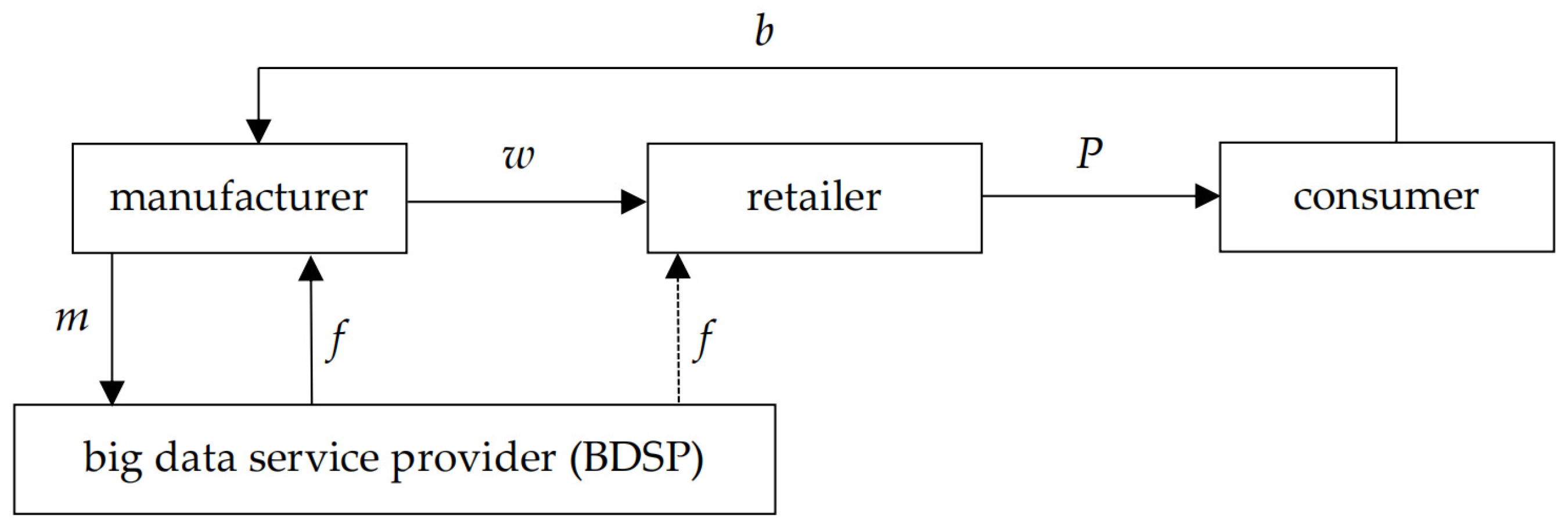
Figure 1. Operational Process of the CLSC. Note: The dashed line shows the indirect effect of BDSP’s service effort level on the retailer through increased demand.
Systems 14 00050 g001
Figure 2. Impact of β on m 2 .
Systems 14 00050 g002
Figure 3. Impact of λ on m 2 .
Systems 14 00050 g003
Figure 4. Impact of a on m 2 .
Systems 14 00050 g004
Figure 5. Impact of k on m 2 .
Systems 14 00050 g005
Figure 6. Impact of g on m 2 .
Systems 14 00050 g006
Figure 7. Comparison of Manufacturer’s Profit between Decentralized and Coordinated Scenarios.
Systems 14 00050 g007
Figure 8. Comparison of Retailer’s Profit between Decentralized and Coordinated Scenarios.
Systems 14 00050 g008
Figure 9. Comparison of BDSP’s Profit between Decentralized and Coordinated Scenarios.
Systems 14 00050 g009
Figure 10. Comparison of CLSC’s Profit between Decentralized and Coordinated Scenarios.
Systems 14 00050 g010
Figure 11. Effects of β and λ on P 3 .
Systems 14 00050 g011
Figure 12. Effects of β and λ on b 3 .
Systems 14 00050 g012
Figure 13. Effects of β and λ on f 3 .
Systems 14 00050 g013
Figure 14. Impact of β on Q 3 .
Systems 14 00050 g014
Figure 15. Impact of λ on R 3 .
Systems 14 00050 g015
Table 1. Notations.
Table 1. Notations.
NotationDefinition
C m Unit cost of new products
C r Unit cost of remanufactured products
D Market baseline demand
a Retail price sensitivity coefficient
k Recycling price sensitivity coefficient
β BDSP marketing effort sensitivity coefficient
λ BDSP recycling effort sensitivity coefficient
g Big data service cost coefficient
Decision variables
w Wholesale price
b Recycling price
m Manufacturer’s payment level for big data services
P Retail price
f Service effort level of the BDSP
π mi , π r i , π d i , π s c i Profits of the manufacturer, retailer, BDSP and CLSC
i 1 , 2 , 3 Decentralized decision-making model, centralized decision-making model and optimization analysis of coordination conditions
Table 2. Non-fulfillment of Coordination Conditions.
C m C r D a k β λ g w m π s c 1 π s c 2 Efficiency
155200142.51.5101567.88746.612,978.667.4%
205200143281590.68456.321,862.538.7%
2053001521.5102080.620,045.725,336.379.1% 1
1 Results are rounded to one decimal place.
Table 3. Fulfillment of Coordination Conditions.
C m C r D a k β λ g w m π s c 3 π s c 2 Efficiency
2053001521.51020374.625,336.325,336.399.9% 1
1 Results are rounded to one decimal place.
Disclaimer/Publisher’s Note: The statements, opinions and data contained in all publications are solely those of the individual author(s) and contributor(s) and not of MDPI and/or the editor(s). MDPI and/or the editor(s) disclaim responsibility for any injury to people or property resulting from any ideas, methods, instructions or products referred to in the content.