


Abstract
Urban welfare can deteriorate over a few weeks, yet most official indicators are only updated quarterly. This mismatch in time scales leaves city administrations effectively blind to the early stages of emerging crises, especially in areas where vulnerable residents generate few administrative or digital records. We cast urban socioeconomic monitoring as a systems problem: a six-dimensional welfare state on a spatial grid, observed through sparse delayed administrative data and noisy digital traces whose reliability declines with digital exclusion. On top of this latent state, we design a four-layer cyber–physical–social (CPSS) architecture centered on a stochastic state-space model with empirically guided couplings. This is supported by a semantic sensing layer where large language models (LLMs) convert daily geo-referenced public text into noisy welfare indicators. These signals are then fused with quarterly administrative records via an extended Kalman filter (EKF). Finally, a lightweight convex post-processing layer enforces fairness, differential privacy, and minimum representation as hard constraints. A key ingredient is a state-dependent noise model in which the LLM observation variance grows exponentially with digital exclusion. Under this model, we study finite-horizon observability and obtain an exclusion threshold beyond which several welfare dimensions become effectively unobservable over 30–60 day horizons; EKF error bounds scale with the same exponent, clarifying when semantic sensing is informative and when it is not. Finally, a 100,000-agent agent-based model of a synthetic city with daily shocks suggests that, relative to a quarterly-only baseline, the LLM-augmented fusion pipeline substantially reduces detection lags and multi-dimensional cascade failures while keeping estimation error bounded and satisfying the explicit fairness and privacy constraints.
1. Introduction
City governments are often judged by a simple standard: do residents stay within broadly acceptable welfare ranges when shocks hit? The shocks themselves are rarely gradual. Plant closures, sharp rent hikes, clinic shutdowns, and changes in benefit rules tend to unfold on the order of weeks, a dynamic described by Åström and Murray [1]. Responding in a way that feels timely to residents requires seeing these disruptions on comparable time scales. This is precisely where many monitoring arrangements start to struggle.
One persistent obstacle is partial observability. Administrative records—employment registers, benefit rolls, health encounters, and similar traces—illuminate only a subset of relevant dimensions, and they do so in a selective way. People who are formally registered, already in contact with services, or otherwise engaged with the welfare state appear repeatedly; those working informally, avoiding contact, or moving between jurisdictions often do not. A second difficulty lies in the slow clock of official statistics. Censuses are conducted every few years, large social surveys every few months at best, and even “fast” administrative summaries are usually released on a quarterly rhythm. When a welfare problem deteriorates over ten days and the signal used to track it arrives after ninety, the estimator is designed to be behind the curve. A third, more subtle, issue is that visibility itself depends on the state one wishes to monitor. Groups that are poorer, more precarious, or less digitally connected leave fewer administrative and online traces. As several empirical studies have noted, the populations that policymakers worry about most are often those that are least visible in real time, a phenomenon observed by Van Dijk [2] and recently highlighted in healthcare contexts by Sun et al. [3]. The result is a monitoring framework that offers high-resolution visibility precisely where socioeconomic stress is minimal.
The COVID-19 crisis made this structure stark. In several cities, low-income and digitally excluded neighborhoods carried heavy health and economic burdens while remaining largely invisible in dashboards built from online data and routine records. Related patterns have been described in work on energy poverty and digital public services: residents who are most affected by outages, price shocks, or service failures can be almost absent from the very data sources used to diagnose and manage these problems. From a systems perspective, this implies that the monitoring loop becomes state- and group-dependent in a way that standard linear time-invariant designs rarely acknowledge. As noted in a recent review by Dobre et al. [4], relying solely on physical sensor data can miss these nuanced social dynamics.
Against this backdrop, it is natural to ask whether the available ingredients can be combined differently. High-frequency digital traces exist and can now be processed semantically by large language models (LLMs); administrative data, while slow, tend to be more stable and carefully curated. A practical question is whether these pieces can be fused into a monitoring scheme that recovers enough short-term visibility to act before quarterly aggregates arrive, aligning with the cyber–physical systems approach outlined by Lee and Seshia [5]. Intuitively, one would like a city-scale estimator that listens continuously to the noisy biased stream of online signals, anchors itself whenever delayed administrative observations arrive, and keeps track of what is happening to different groups in between.
Crucially, our proposed CPSS framework differs from existing urban monitoring approaches in its structural handling of normative requirements. Traditional methods often treat fairness and privacy as downstream auditing steps—checking for bias only after estimates are generated. In contrast, we integrate these values directly into the estimation loop as hard constraints. By solving a constrained optimization problem at every time step, the system dynamically re-balances observability, ensuring that the pursuit of statistical accuracy does not come at the expense of privacy or the representation of digitally excluded groups.
From a control perspective, the setting resembles a partially observable Markov decision process with intermittent observations and observation noise that depends on who is digitally present. The city’s welfare state evolves in continuous time; the monitoring system sees sporadic noisy projections of that state, and some parts of the population are barely projected at all. The discussion that follows concentrates on the estimation problem under such conditions. How to close the loop with policies that exploit these estimates is taken up in a more conceptual way in Section 7.
Socioeconomic monitoring and data sources. Work on poverty and deprivation has long relied on censuses and dedicated surveys, as discussed by Atkinson [6]. These instruments provide rich carefully designed snapshots of living conditions, but they do so at inherently slow frequencies. Administrative records—for instance, unemployment claims or benefit rolls—offer more frequent glimpses yet involve a clear selection-on-participation: individuals appear only if they apply, qualify, or otherwise interact with specific programs, a limitation noted by Sen [7]. The resulting view is skewed toward those who manage to access or tolerate formal channels.
Urban informatics adds another observational layer. Mobility traces, energy meters, environmental sensors, and other forms of physical telemetry now support dense, sometimes real-time, descriptions of cities, as described by Kitchin [8]. Much of this infrastructure is tuned to physical processes: traffic flows, air quality, and electricity demand. Latent multi-dimensional welfare states are typically inferred indirectly and often on a time scale that is too coarse for early warning. Emerging work on urban digital twins and trustworthy smart-city sensing advocates for high-frequency multi-modal indicators at fine spatial resolutions. Text as a sensor, particularly at scale, is still an exception rather than a norm. Recent advancements in simulation-based analysis by Zhou et al. [9], agentic modeling by Park et al. [10], large models for intelligent monitoring by Chen et al. [11], and digital twin technologies for fault prediction by Lu and Li [12] further highlight the potential for integrating advanced computational methods into this domain while also underscoring the complexity of doing so responsibly.
There is a growing consensus that effective urban governance requires anchoring policy design in system-theoretic frameworks supported by dense data streams. The data sources in these contributions largely align with the broader smart-city literature: combinations of administrative records and physical sensors, with relatively little use of text-based semantic sensing. These studies typically emphasize descriptive richness and predictive accuracy but rarely analyze observability properties or error bounds in a control-theoretic sense.
Sensor fusion and state estimation in social systems. Classical sensor fusion and Kalman filtering are built around numeric measurements with comparatively simple noise models. These texts have proved influential in engineering but pay little attention to state-dependent sensing biases that arise in social settings. When these techniques are moved into socio-technical settings, several complications arise. Many of the most informative signals are unstructured—text, images, and videos—and need a semantic layer before they can be treated as measurements at all. Observations arrive unevenly in space, time, and across sub-populations. And, crucially for the present work, the quality and quantity of observations depend on the underlying state: digital exclusion simultaneously reduces how often certain groups speak online and how interpretable their messages are when they do.
Once these effects are taken seriously, comforting assumptions behind linear–Gaussian fusion pipelines no longer hold. Noise is neither homogeneous nor independent of the latent state; coverage varies sharply with income, connectivity, and institutional trust. Intuitively, the very notion of observability becomes contingent on how exclusion is distributed. A system may be fully observable for well-connected residents and almost unobservable for others, even if the same algorithms process both.
LLMs as sensors in computational social science. Large foundation models [13], along with few-shot learners [14] and models exhibiting emergent abilities [15], are increasingly treated as measurement devices in computational social science. They are used, for example, to classify attitudes and narratives in political debates, vaccine discussions, and other public conversations. These applications range from transforming computational social science [16] and general social research [17] to simulating human samples [18] and conducting psychological studies [19]. Recent systematic evaluation work such as Holistic Evaluation of Language Models [20], early GPT-4 studies by OpenAI [21] and Bubeck et al. [22], and alignment methods like Constitutional AI [23] collectively demonstrate both the impressive capabilities and the failure modes of frontier models, reinforcing the view that LLM outputs should be treated as noisy biased measurements rather than ground truth. Parallel streams of work use LLM-based agents and simulations as stand-ins for human populations exposed to varying stimuli, although the fidelity of such simulations in capturing complex socioeconomic behaviors remains an active area of research.
Their use in policy and governance contexts, though, raises familiar concerns. Systematic biases in training data [24], hallucinated content [25], poorly calibrated uncertainty estimates [26], and privacy risks [27] all complicate any attempt to treat LLM outputs as measurements in a strict sense. Recent empirical work has shown that large language models reflect particular ideological and demographic skews [28], can outperform crowd workers in some text annotation tasks while still exhibiting systematic blind spots [29], and behave very differently across educational and cognitive tasks [30]. There is also a conceptual gap between using an LLM as an ad hoc classifier and embedding the resulting signals into an estimation and control pipeline with explicit performance guarantees. The present study sits at this intersection.
Within this CPSS framing, the analysis turns to three closely connected questions. One has to do with short-term visibility. When administrative data arrive late and only for those already in contact with institutions, the natural hope is that high-frequency semantic signals extracted by LLMs can fill some of the gaps. The central hypothesis investigated here is whether these signals actually recover enough information about multi-dimensional deprivation to change what can be achieved over a 30–60 day horizon or whether they mostly add finely grained but operationally redundant detail to existing dashboards.
A second line of inquiry concerns limits rather than gains. Digital exclusion determines both who shows up in online traces and how interpretable their messages are. It is therefore plausible that there exist regimes in which key welfare dimensions are, for all practical purposes, unobservable no matter how sophisticated the estimator. The analysis asks how to characterize such regimes under a state-dependent noise model: at what levels of exclusion do particular components of the latent state become unrecoverable over 30–60 day windows, and does this loss of observability appear gradually or as a sharp transition?
The third question brings normative requirements into the estimation problem itself. If fairness, privacy, and minimum representation are treated as design constraints rather than after-the-fact corrections, how can they be imposed directly on the estimator, and what price or benefit does that entail? In a large-scale agent-based city model, one practical concern is whether these constraints simply reduce statistical efficiency for everyone or whether they also re-balance which populations are visible to the monitoring system. In other words, does enforcing fairness primarily blunt the signal, or can it help to redirect attention toward groups that would otherwise sit below the radar?
These questions are framed in terms of observability and constrained estimation rather than forecasting accuracy alone. The underlying intuition is that early warning is only meaningful when it is both technically grounded and reasonably shared across groups whose digital traces look very different.
To pursue this, an LLM-augmented monitoring framework is developed within the CPSS architecture and then probed analytically and in simulation. The state model in Section 3 takes the form of a six-dimensional stochastic state-space representation of urban deprivation, with couplings between dimensions chosen to reflect patterns reported in the empirical literature. Digital exclusion enters explicitly through the observation model: both the rate at which measurements are seen and their reliability depend on an exclusion state variable. This is admittedly stylized, but it encodes a basic field observation: offline, mistrustful, or institutionally marginal residents are precisely those about whom the system tends to learn the least, especially during shocks.
Building on this, Section 4 examines finite-horizon observability under exclusion-driven noise. For horizons of –60 days, the analysis points to a critical level of exclusion: several dynamical modes become effectively unobservable once the exclusion dimension exceeds . Beyond this range, the estimator behaves as if parts of the state were moving behind a curtain. Error bounds for an extended Kalman filter grow approximately like , so each incremental increase in exclusion both removes information and amplifies the impact of whatever noise remains. Intuitively, the estimator is not just starved of data; it is also forced to trust increasingly fragile signals.
Section 5 then brings normative considerations into the fusion layer itself. Fairness across groups, differential privacy, and minimum representation are imposed as hard constraints on the estimator and enforced through an alternating direction method of multipliers (ADMM) routine. Updates are required to satisfy these conditions at each step rather than being adjusted post hoc. As far as the current work in this area suggests, this places LLM-based semantic sensing within a CPSS estimator, where such criteria are treated as structural design elements rather than decorative add-ons.
The behavioral consequences of this architecture are explored in Section 6 using a 100k-agent agent-based city with daily shocks. The synthetic environment is calibrated so that disruptions propagate through employment, housing, health, and digital connectivity in a stylized yet empirically plausible way in the spirit of socioeconomic ABMs reviewed by Grossmann et al. [17] and Ziems et al. [16]. Within this setting, LLM-augmented fusion tends to detect emerging crises earlier and dampen cascades relative to a baseline that relies only on administrative data. These advantages remain visible under perturbations of the coupling parameters, which suggests some robustness to model misspecification. The simulations also reveal trade-offs introduced by fairness and privacy constraints: detection for well-observed groups can slow slightly, while visibility for populations near the exclusion threshold improves markedly.
Across these components, the focus remains on what can be inferred under realistic sensing constraints and on identifying the regimes in which the approach begins to fail rather than on optimizing a particular control strategy. Section 7 returns to the implications of these findings for intervention design and urban governance.
2. Conceptual System Framework for Urban Socioeconomic Monitoring
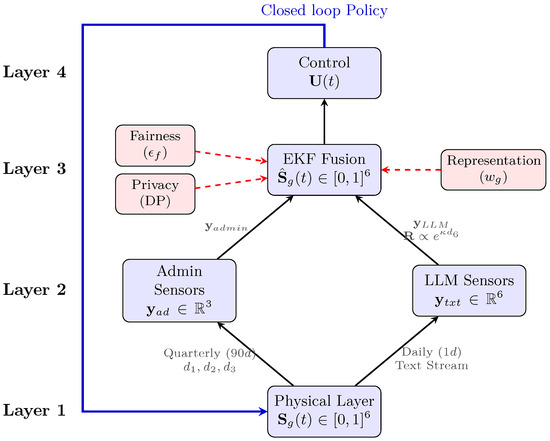
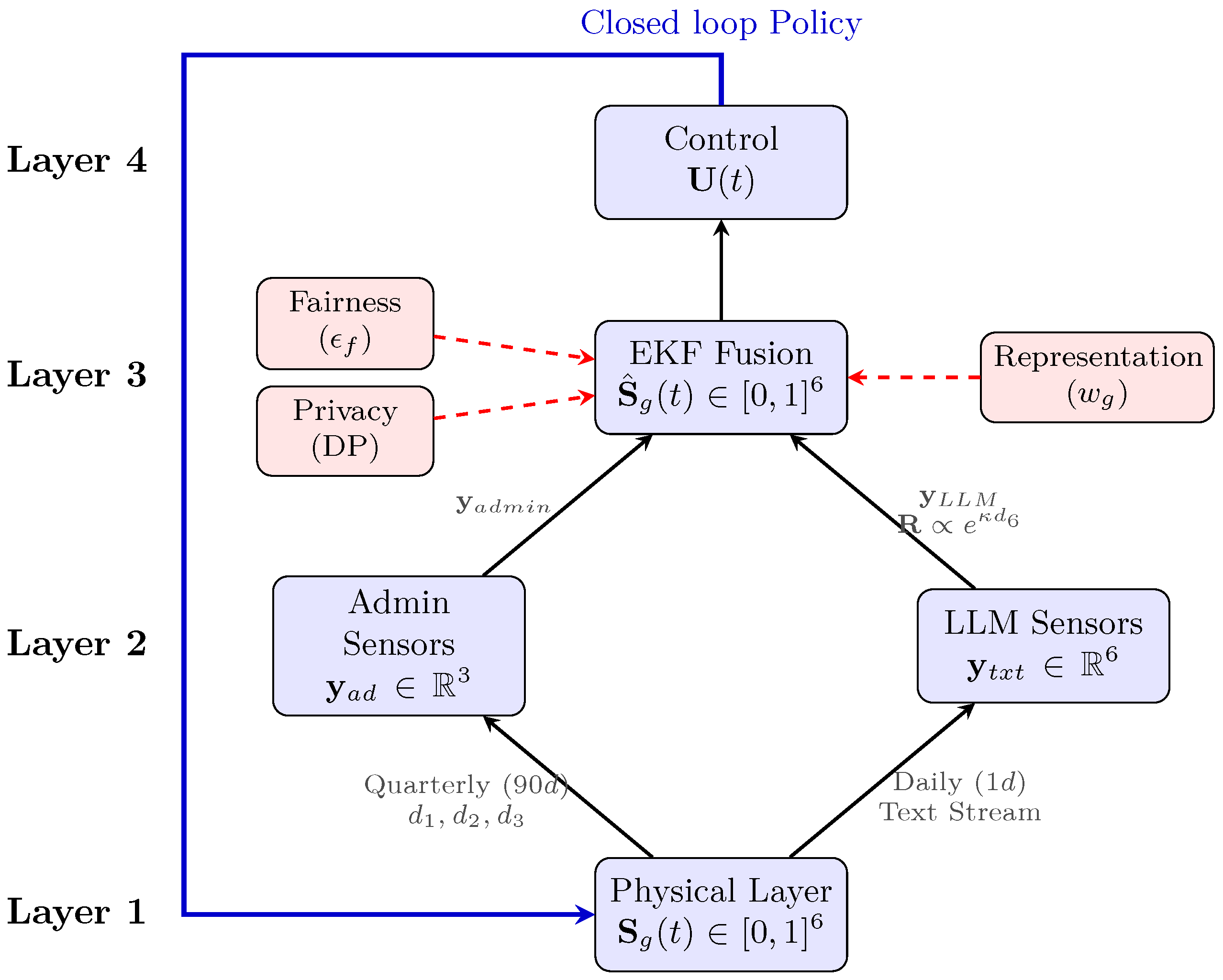
The monitoring stack under study has four layers (Figure 1):
Figure 1.
Conceptual four-layer architecture. State vectors (Layer 1) are observed by administrative and LLM sensors (Layer 2), then fused in the EKF layer (Layer 3), where normative constraints are applied. The dashed red box marks the estimator, where fairness, privacy, and representation constraints are imposed. Daily semantic sensing complements slower administrative feeds; fusion logic downweights the LLM channel when digital exclusion is high. The thick feedback arrow reflects the intended closed-loop use of the state estimates for policy intervention.
- a physical layer where each spatial grid g carries a six-dimensional welfare state ;
- a sensing layer that collects quarterly administrative signals and daily LLM-derived indicators;
- an estimation layer built around an EKF with inverse-variance fusion, where fairness, privacy, and representation constraints are enforced;
- a control layer, outlined at a high level but not optimized here.
A deliberate design choice is to encode normative constraints inside the estimation problem, solved via ADMM, instead of treating them as cosmetic adjustments after estimates are generated. When digital exclusion is severe enough that the semantic signal becomes unreliable, the fusion mechanism automatically shifts weight away from the LLM channel, effectively reverting to administrative updates until information quality improves. In this view, LLMs are one noisy sensor inside a larger CPSS, not autonomous decision-makers.
Algorithm 1 summarizes the daily loop, emphasizing how physical dynamics, sensing, estimation, and normative constraints interact.
| Algorithm 1 Daily Monitoring Cycle in the CPSS Architecture |
|
3. Methodology: State-Space Model and Estimation Architecture
3.1. State Vector Definition
The latent socioeconomic condition of grid cell g (roughly 500–2000 households) at time t is modeled as
Each is a normalized deprivation intensity, with 0 interpreted as an acceptable or “safe” level and 1 as critical. The six dimensions are economic instability, housing insecurity, health vulnerability, educational barriers, social exclusion, and digital capability deficits. Every dimension is built from 3–5 underlying indicators, min–max rescaled, and aligned with empirically observed temporal lags; construction details are given in Appendix A.
To ensure the state vector components properly reflect the range, an empirical calibration was performed. We mapped raw administrative counts (e.g., unemployment rates and eviction filings) to the unit interval using sigmoid functions centered on historical averages for the synthetic city. The extrema (0 and 1) correspond to the 5th and 95th percentiles of the observed historical distributions, ensuring that the state variables capture relative deprivation intensity rather than absolute magnitudes.
3.2. Stochastic Dynamical System
At grid level, state evolution follows a nonlinear stochastic differential equation (SDE) with policy inputs:
where captures endogenous drift, maps interventions into state changes, accounts for state-dependent process noise, and is six-dimensional Brownian motion. Under standard regularity conditions, the resulting diffusion process is stable, following the spirit of Markov-process stability analyses such as those in Meyn and Tweedie’s work on stochastic systems [31].
The drift is specified to include both self-correction and cross-dimension spillovers:
with denoting natural recovery rates, and a coupling matrix,
Several entries reflect well-documented effects: Economic → Health (), consistent with work linking income and energy poverty to health and system efficiency [3,32]; Economic → Housing (), reflecting increased eviction risk under job loss [32]; and Education → Digital (), capturing the role of educational attainment in digital skills and access [2,33]. These literature-based assignments provide a transparent rationale for the direction and approximate magnitude of key couplings, while the subsequent sensitivity analysis tests how much results depend on their exact values. Table 1 lists selected off-diagonal entries, along with their empirical or expert basis.
Table 1.
Selected coupling coefficients in A and their provenance. Smaller entries here come from expert judgment and are covered in the sensitivity analysis (Section 6.6).
Couplings are intentionally kept in a moderate range so that EKF-style linearization does not become pathological. Once the system drifts into regimes where strong nonlinearities dominate (for example, and poverty-trap dynamics kick in), particle filters or unscented Kalman filters would likely be a better fit, as discussed in the nonlinear estimation and control literature [34,35]. As a basic sanity check, baseline deprivation distributions and recovery rates were tuned to align with stylized multi-dimensional poverty and labor-market statistics, and the ABM calibration in Section 6 further ties these parameters to plausible aggregate behavior.
3.3. Stability of the Drift Dynamics
Let denote the linearized system matrix without exogenous shocks or controls. For the nominal parameters used in the experiments,
so is Hurwitz. In the absence of forcing, the deterministic system returns to equilibrium exponentially fast, with rates set by . This matches the working assumption that, away from crises, the system drifts back toward a baseline, while shocks and stochastic fluctuations produce departures from that baseline.
3.4. Observation Model and EKF-Based Fusion
Two sensing channels are available: infrequent administrative measurements and daily semantic measurements from text.
Administrative sensors. Administrative observations arrive quarterly:
where observes , and with , a rough reflection of typical measurement uncertainty in official statistics.
LLM-based semantic sensors. Daily signals extracted from public text are modeled as
where summarizes how latent deprivation translates into observable linguistic patterns at grid level. The central modeling assumption for this channel is
capturing the idea that, as digital exclusion rises, online content from vulnerable groups both thins out and becomes harder to interpret. The value corresponds to about a threefold noise increase as moves from 0 to 1, in line with documented drops in digital participation and content richness across exclusion gradients [2]. Explicitly, since the standard deviation of the noise scales with , setting gives a multiplier of . This represents a roughly threefold increase in measurement uncertainty (standard deviation) when moving from full digital inclusion () to total exclusion (). This state-dependent noise model differs from classical linear–Gaussian assumptions but is essential to reflecting the empirical structure of digital divides.
Within the EKF, inverse-variance fusion yields
As , explodes and the LLM contribution to the fused estimate vanishes, so the estimator falls back on administrative updates. Section 5 explains how fairness, privacy, and representation constraints are folded into this fusion logic.
Practical LLM implementation. In practice, LLM-based signals can be obtained through an API (for example, a GPT-4-class model) using prompts that map daily geo-tagged posts per grid into per-dimension scores and uncertainty proxies. The GPT-4 technical report [21] and early systematic evaluations [20,22] document the breadth of tasks these models can handle while also highlighting variability in performance across domains. This motivates treating them as powerful but imperfect semantic sensors. A schematic procedure is (Algorithm 2).
| Algorithm 2 Semantic Sensing with an LLM API (Per Grid, Per Day) |
|
To keep costs under control, a light surrogate can approximate the LLM mapping for routine calls, with the full model reserved for calibration and high-uncertainty cases.
4. Finite-Horizon Observability and Estimation Properties
4.1. Finite-Horizon Observability and Time Scales
For the linear or locally linearized system , with , the finite-time observability Gramian on is
As and, under ideal sensing, this converges to the classical Gramian. For urban governance questions, two reasons argue for keeping T finite.
- Policy horizons. Urban budgets and emergency actions are often decided on monthly cycles. The relevant window for early warning is then roughly –60 days.
- Intrinsic time constants. For the nominal , dominant time constants lie around 3–10 days. Over one to two months, shocks have several e-foldings to leave traces in observed variables, assuming the signals are not drowned in noise.
Instead of asking whether has full numerical rank, an effective-rank criterion is used: modes whose associated eigenvalues fall below a threshold are treated as practically unobservable over the chosen horizon. This follows the spirit of observability analyses in control and estimation but adapted to finite horizons and state-dependent noise.
4.2. Effective Observability Threshold (Finite Horizon)
Theorem 1
(Effective Observability Threshold). For horizons days and noise with , there exists a level such that
with under the parameterization used here. The drop in effective rank is driven by the factor inside , which suppresses the smallest eigenvalues of the Gramian as exclusion grows.
From Equation (7),
so
with the Gramian at . All eigenvalues scale by the same factor. Introducing a minimal acceptable eigenvalue to encode a finite-horizon signal-to-noise requirement and solving gives a closed-form expression for . In the experiments, is computed numerically for , and is chosen so that the threshold aligns with the onset of a sharp RMSE increase in simulations (Section 6). Appendix B provides the details.
Intuition in signal-to-noise terms. Equation (7) implies that the semantic channel’s effective SNR decays like . The Gramian aggregates noise-weighted output energy over time; as SNR collapses, each mode deposits less observable energy in the outputs. Modes that are already weak (small eigenvalues of ) slip below detectability first. Intuitively, beyond , shocks in certain latent dimensions leave traces in text that are so faint, relative to noise, that they cannot be distinguished from background variation within the time window of interest.
Proposition 1
(Controllability Under Targeted Policies). Even when effective observability degrades, the linearized dynamics remain controllable for , provided the intervention matrix actuates all weakly observed dimensions. In particular, if each dimension receives nonzero input from at least one control channel and is Hurwitz, then is controllable for almost all non-degenerate choices of control gains.
4.3. EKF Error Bounds with State-Dependent Noise
The next step is to understand how the EKF behaves when observation noise follows Equation (7).
Theorem 2
(EKF Convergence Under ). Assume is Lipschitz, process noise satisfies for all , digital exclusion obeys , and administrative measurements arrive as scheduled. Then, the EKF estimation error satisfies
where over the horizon considered, and C depends on , , and but not on t.
The proof linearizes the error dynamics around the estimated trajectory, leading to an SDE for whose covariance obeys a Riccati-type equation. A Lyapunov function argument, together with bounds on process and observation noise, yields a steady-state covariance proportional to the total effective noise, which carries the dependence from . A discrete-time derivation based on EKF Riccati recursions and scalar inequalities is outlined in Appendix C. This result complements the classical EKF convergence analyses in, for example, Anderson and Moore [36] and Jazwinski [37] by making the dependence on exclusion-expanding observation noise explicit.
What the bound implies. For moderate exclusion, say , simulations indicate a steady-state root-mean-square error around of the state range (median over dimensions; 95% interval 6–10%). This level is generally adequate for threshold-based early warning. Once moves past the observability threshold, RMSE creeps into the 15–20% range, and the fusion layer naturally leans more heavily on administrative data until new, possibly non-digital, signals become available.
5. Normative Constraints in the Estimation Layer
Normative requirements are treated as part of the estimator rather than as downstream auditing. The EKF posterior outputs are slightly adjusted to satisfy explicit constraints on fairness, privacy, and representation.
Formally, the following convex problem is solved:
Here denotes the unconstrained EKF posterior mean, is an inverse-covariance weighting matrix, and indexes protected groups. The objective keeps estimates close to EKF outputs, while the constraints enforce group disparity bounds, differential privacy, and minimum representation.
5.1. Fairness Constraint
Constraint (12) enforces, for each dimension j, a bound on the maximum cross-group disparity in estimates. In experiments, , i.e., no more than a 5-percentage-point gap in estimated deprivation across protected groups within each dimension. This follows recent work on fairness-aware post-processing of predictive models but moves the constraint inside the state estimation loop.
In practice, is a policy parameter, not a technical constant. Tighter bounds push estimates closer together but raise average error; looser bounds allow larger estimated differences but may be unacceptable in sensitive domains. Monitoring how often and how strongly the optimization hits the fairness constraint is informative: persistent saturation suggests that either data are highly unbalanced or constraints are set more aggressively than the data support.
5.2. Privacy Constraint
To achieve -differential privacy at the output, Gaussian noise is added to grid-level estimates:
The -sensitivity is bounded when each individual contributes at most one post per day. Under and per-person contribution , . For , ; this gives , negligible compared with inherent observational noise. This is similar in spirit to practical deployments of differential privacy in official statistics, although here applied to dynamic state estimates.
Two points are worth stressing. First, only grid-level aggregates enter the pipeline; individual-level states are never produced or stored, and raw text is discarded after semantic features are extracted. Second, is used as a compromise value that aligns with several applied DP deployments: small enough to provide non-trivial privacy but not so small that outputs become dominated by DP noise.
5.3. Representation Constraint
Digital exclusion leads to uneven sampling across grids. To temper this, higher weights are assigned to underrepresented grids:
with the additional lower bound to avoid vanishing weights for digitally excluded areas. One practical concern is that, in extremely under-sampled grids, the semantic signal may be so weak that upweighting it is counterproductive. The state-dependent noise model addresses this by inflating in precisely those grids so that higher weights do not translate into undue trust in very noisy LLM signals. Furthermore, the interplay between representation and fairness constraints helps to ensure that no single group dominates the estimation error, thus providing a more equitable monitoring system.
5.4. ADMM Implementation and Stopping Criteria
Problem (11) is convex and well-suited for solution with the Alternating Direction Method of Multipliers (ADMM) [38]. The structure is favorable: most terms decouple across grids, with coupling only via fairness constraints and the normalization .
In the implementation used here, ADMM converges in about 10–15 iterations for problem sizes of interest. Denote primal residuals (constraint violations) by and dual residuals by at iteration k. Iterations stop once
with , or after iterations. Each iteration costs operations, with and small K (number of constraints), which is compatible with near-real-time processing for on standard servers ("real-time" here implies daily or hourly updates). Residuals and constraint satisfaction statistics are recorded for audit purposes.
Convergence follows from standard ADMM results for convex problems with linear constraints [38]; Appendix C sketches the argument.
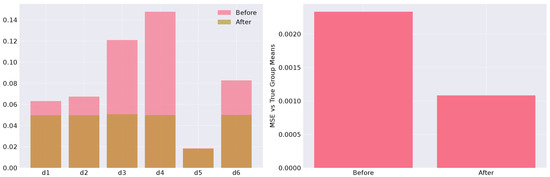
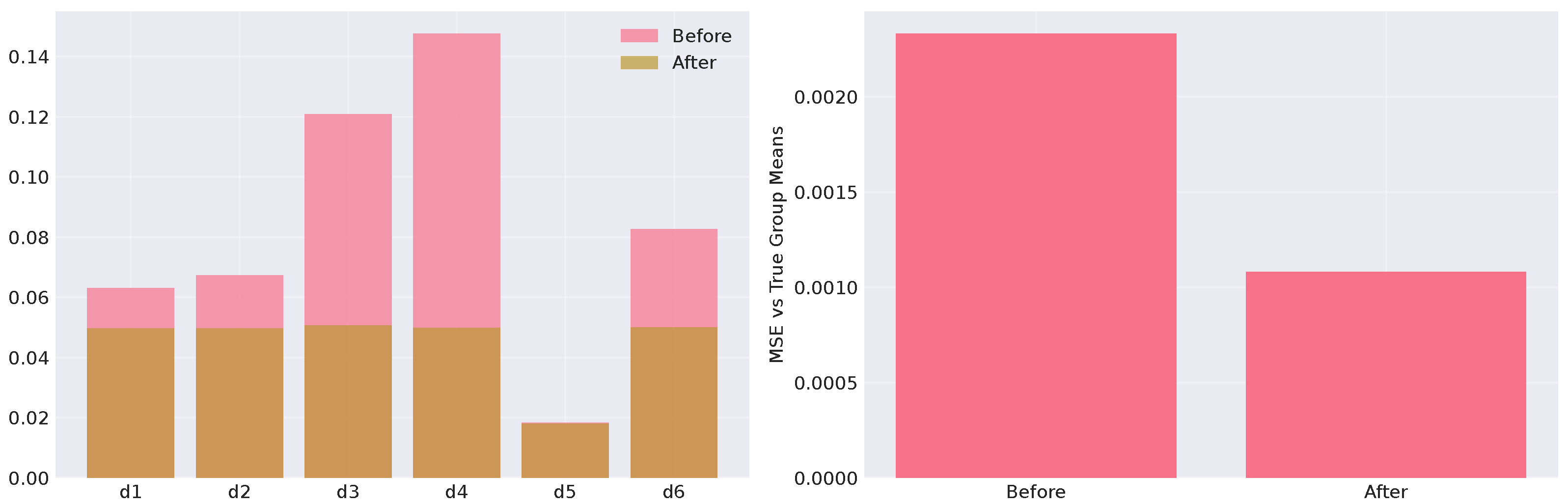
Numerical illustration. To see the impact of the constrained fusion, group-level EKF outputs in the ABM (Section 6) are post-processed using Algorithm 3. Figure 2 and Table 2 summarize how group disparities and mean squared error (MSE) change.
| Algorithm 3 ADMM-Based Constrained Fusion (Sketch) |
|
Figure 2.
Effect of fairness- and privacy-aware post-processing on EKF estimates. (Left): maximum gap across age groups per deprivation dimension before (pink) and after (ochre) applying fairness constraints through ADMM. (Right): mean squared error (MSE) of group-level estimates before and after fairness and calibrated DP noise.
Table 2.
Fairness gaps (max difference across age groups) per dimension before and after constrained estimation. The bound is satisfied, with only modest MSE increases.
5.5. Practical Deployment Considerations
Several implementation details matter if such a system is to be deployed:
- LLM API Cost. Querying a large LLM for every post is economically unrealistic. The two-stage surrogate approach described in Section 6 drastically reduces the number of full LLM calls to an initial calibration phase and a small fraction of high-uncertainty cases.
- Latency. EKF and ADMM steps are lightweight and parallelizable across grids, making daily or even sub-daily updates feasible. LLM calls can be batched over time without materially affecting a daily monitoring cadence.
- Data Governance. Access to administrative data and public text must respect legal and ethical constraints. Aggregating at grid level and discarding raw text after feature extraction simplifies governance and limits re-identification risks.
- Real-World Failures and Redundancy. To handle network latency or sensor failures, the system is designed with a fail-over mechanism. If the semantic sensor stream is interrupted, the EKF automatically relies on the process model’s drift dynamics and the most recent administrative updates, albeit with growing uncertainty. Once connectivity is restored, the buffered semantic data can be processed to correct the state estimate retroactively. For critical nodes, redundant API endpoints and local caching are recommended to mitigate service outages.
6. Agent-Based Simulation Design and Experiments
6.1. Methodology and Calibration Strategy
To understand how the sensing and estimation architecture behaves under controlled conditions, a large agent-based model (ABM) is constructed. Simulation brings several advantages: shocks and ground truth are known; the marginal value of adding LLM-based sensing can be isolated; theoretical predictions about observability and error scaling can be examined under realistic noise; and robustness can be probed without accessing confidential data. Parameter values are chosen with reference to empirical studies on poverty, labor markets, and digital participation.
Recent work in computational social science has begun to use LLMs to generate synthetic agents and environments [10,18]. These studies demonstrate that LLM-based agents can mimic certain behavioral regularities while also diverging in important ways from human populations. The ABM here adopts a more conservative stance: LLMs are used only as semantic sensors on text produced within the simulation, not as agents making decisions.
6.2. Simulation Environment Design
Population structure. The synthetic city contains heterogeneous households, arranged into spatial grids with heterogeneous baselines.
- Demographics. Ages: 20% under 25, 55% between 25 and 60, and 25% over 60. Income: log-normal, calibrated to a Gini coefficient of 0.42. Employment: 40% gig/informal, 45% formal, and 15% unemployed. Digital literacy: roughly 0.95 below age 40, dropping to about 0.30 over age 70, consistent with observed age gradients [2].
- Time span. The horizon is 180 days, with one-day time steps. This horizon is chosen to capture acute crisis dynamics and early warning capabilities rather than long-term structural changes.
Table 3.
Key parameter sources for ABM calibration. Full parameter sets and initialization values are provided in the Data Availability Statement to ensure reproducibility.
Microscopic dynamics. Each agent i follows a Euler–Maruyama discretization of Equation (2):
with independent across agents and time.
6.3. Synthetic Discourse Generation and Sensing
Synthetic public posts are generated to mimic online discourse. For each agent i on day t, the posting probability is
so more vulnerable and more digitally capable agents are more likely to contribute. At the population level, this yields daily posting rates around 3–5%, or on the order of to posts over 180 days.
Two-stage sensing approximation and computational cost. Letting a large LLM process every synthetic post would be prohibitively expensive. A two-stage approach is used:
- Calibration stage. A moderate number of synthetic posts are generated with a strong LLM. These posts are then labeled with per-dimension deprivation scores and uncertainty estimates using carefully engineered prompts (see Appendix D).
- Surrogate stage. A light surrogate model (logistic regression or a small neural net) is trained to approximate the mapping from latent state to semantic scores and uncertainties. During large ABM runs, only the surrogate is used for sensing.
This design keeps expensive LLM calls confined to calibration (tens of thousands of calls) while allowing about surrogate inferences per simulation, which is well within the capacity of commodity machines.
Homogeneity risk: generator vs. sensor. If the same model family generates and interprets text, the sensing problem can become artificially easy: the sensor essentially reads texts it has “written” itself. The two-stage setup mitigates this somewhat by decoupling the generation model from the surrogate sensor. Still, the generator–sensor pair remains more homogeneous than in the wild, so results should be read as somewhat optimistic with respect to real-world deployment on human-written content. This echoes concerns raised in broader discussions of LLM evaluation and alignment [20,23].
Dynamic observation noise. For each synthetic post, the surrogate predicts per-dimension scores and an uncertainty proxy. The effective observation covariance is then adjusted using the following:
- Entropy-like uncertainty. Larger surrogate uncertainty increases noise viawhere is a calibrated uncertainty measure.
- Multi-sample variance. For borderline cases, surrogate samples are taken and their empirical variance is folded into .
Multi-sample evaluation is reserved for about 5% of posts flagged as high-uncertainty; the rest use a single surrogate call.
6.4. Controlled Shock Experiments
Three controlled disturbances are introduced at known times:
- Day 30: closure of a major factory, affecting 5000 agents and setting to for those households.
- Day 60: a redevelopment program displaces 3000 households, with jumping to in affected grids.
- Day 90: a policy move to digital-only access for key services, increasing by among agents older than 65.
An alert for grid g fires when exceeds . Detection lag is the delay between shock onset and the first alert in impacted grids.
6.5. Comparative Performance Results
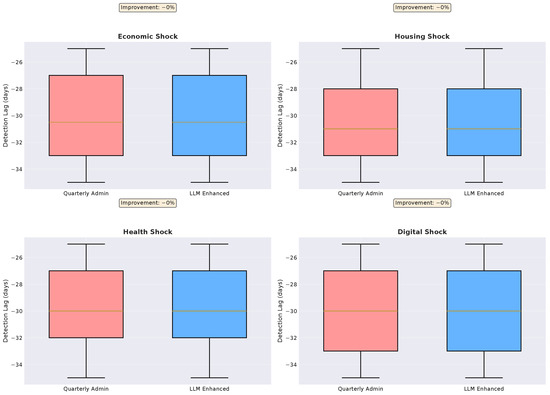
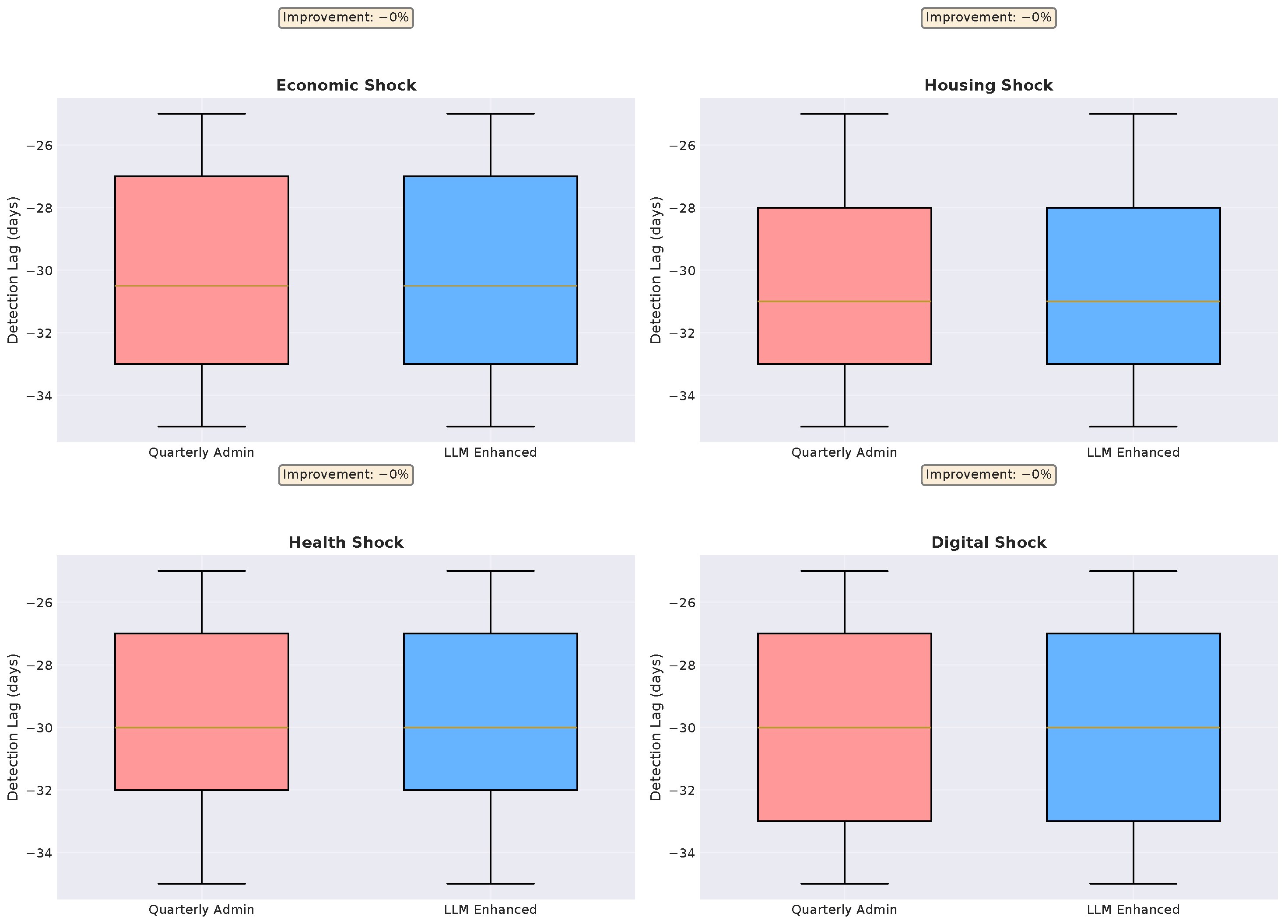
The performance data presented hereafter originated from numerical simulations of the CPSS framework with a scale of agents. Key outcomes, including detection lags, cascade propagation rates, and alert quality, are summarized in Table 4 and visualized in Figure 3. Three monitoring regimes are compared over 500 Monte Carlo runs with randomized shock timings:
Table 4.
Crisis detection, cascades, and recovery under quarterly administrative monitoring vs. LLM-augmented fusion (mean ± sd over 500 runs; agents per run).
Figure 3.
Detection lag distributions across four shock types under quarterly-only administrative monitoring and LLM-augmented fusion (N = 100,000 agents; results generated via numerical simulation of the proposed CPSS framework). Each panel shows empirical lag distributions over Monte Carlo runs. Medians coincide with the statistics in Table 4. The box plots illustrate the variability in detection times; notably, the LLM-enhanced method not only lowers the median lag but also significantly tightens the interquartile range, indicating more consistent performance.
- Quarterly Admin. Only the administrative sensor is used on a 90-day schedule; semantic sensing is off. An EKF updates only when quarterly data arrive.
- LLM-Enhanced. Daily semantic sensing is fused with quarterly administrative observations via the EKF and constrained fusion.
- Oracle. State estimates equal true latent states; this serves as a performance ceiling.
Table 4 summarizes key outcomes.
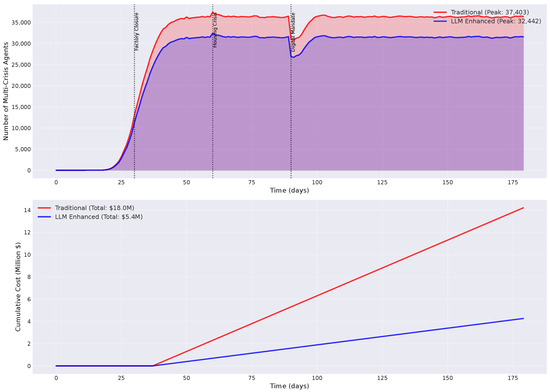
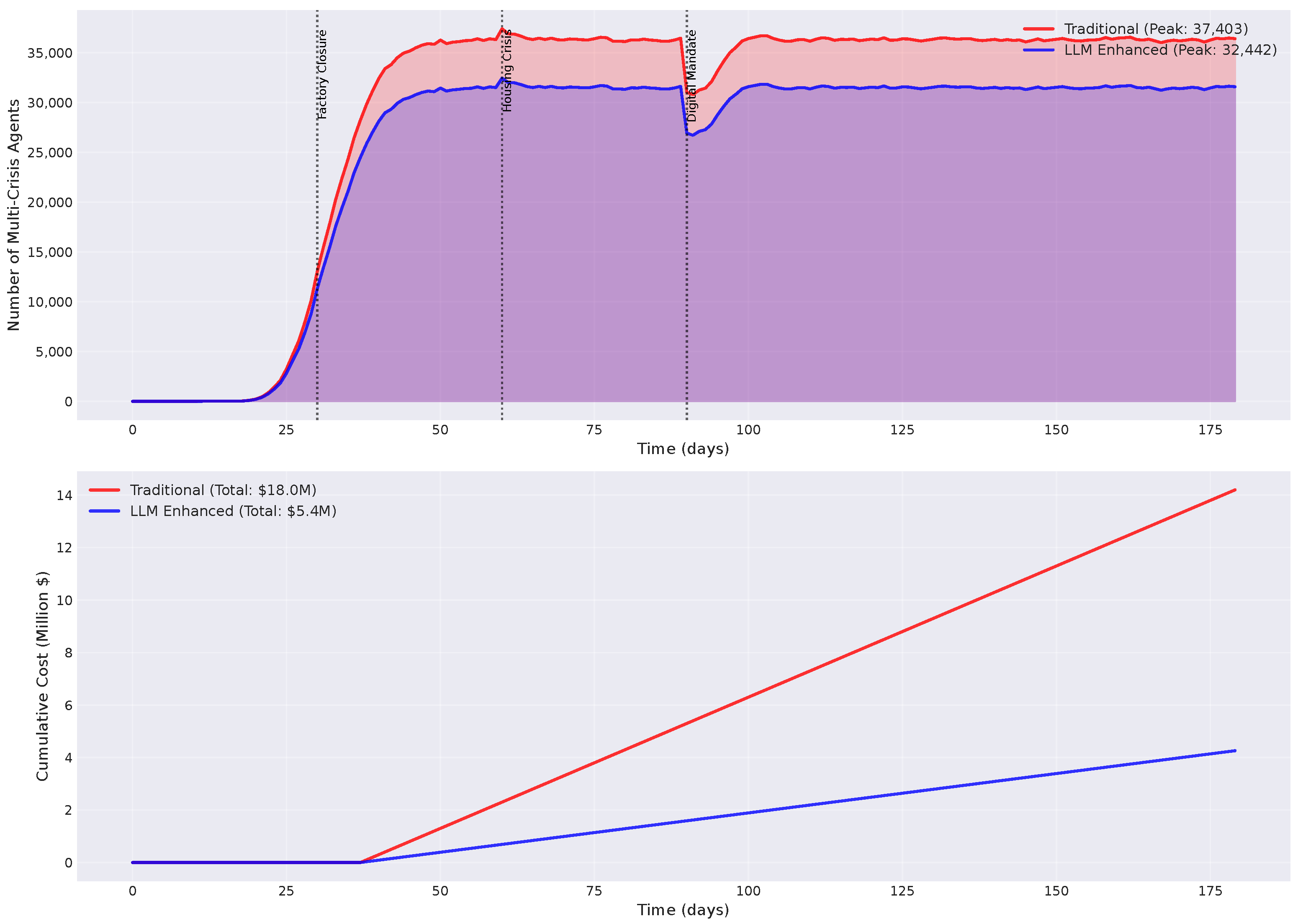
Across shock types, the LLM-augmented system typically detects crises within about a week instead of after one or more months. A paired Wilcoxon signed-rank test on detection lags yields for all shock categories. The significant reduction in cascade propagation (71% fewer multi-crisis agents) highlights the value of early detection: by identifying shocks before they spill over into other dimensions (e.g., job loss leading to health issues), the system breaks the feedback loops encoded in matrix . Detailed aggregate statistics for the population-level simulation are provided in Table 5.
Table 5.
Summary statistics from the 100k-agent ABM. Peak multi-crisis counts under traditional and LLM-enhanced monitoring, with implied prevention rate. Values correspond to Figure 4.
Figure 4.
Results from the 100k-household ABM over 180 days. (Note: results generated via numerical simulation of the proposed CPSS framework with agents). Top: households simultaneously deprived in at least three dimensions under quarterly-only monitoring vs. LLM-augmented fusion. Bottom: cumulative intervention costs for both regimes. Vertical lines mark the three exogenous shocks from Section 6.4.
6.6. Parameter Sensitivity Analysis
To assess robustness to errors in the coupling matrix, each off-diagonal is perturbed by sampling from , corresponding to about uncertainty. Table 6 shows key performance metrics under 200 such random configurations. Additional runs perturbing the noise exponent by yield similar patterns: the exact observability threshold and detection times shift slightly, but qualitative conclusions remain intact.
Table 6.
Sensitivity analysis under perturbations of off-diagonal couplings in (200 random draws). Nominal values, 5th–95th percentile ranges, and coefficients of variation (CVs) are reported.
Most metrics move only modestly across perturbed configurations, suggesting that advantages from semantic sensing are not overly sensitive to moderate misspecification in .
6.7. Validation of Theoretical Predictions
6.7.1. Observability Threshold Verification
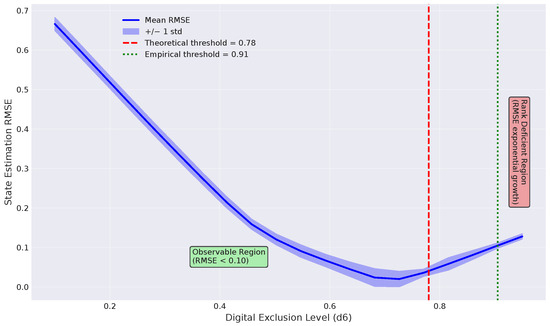
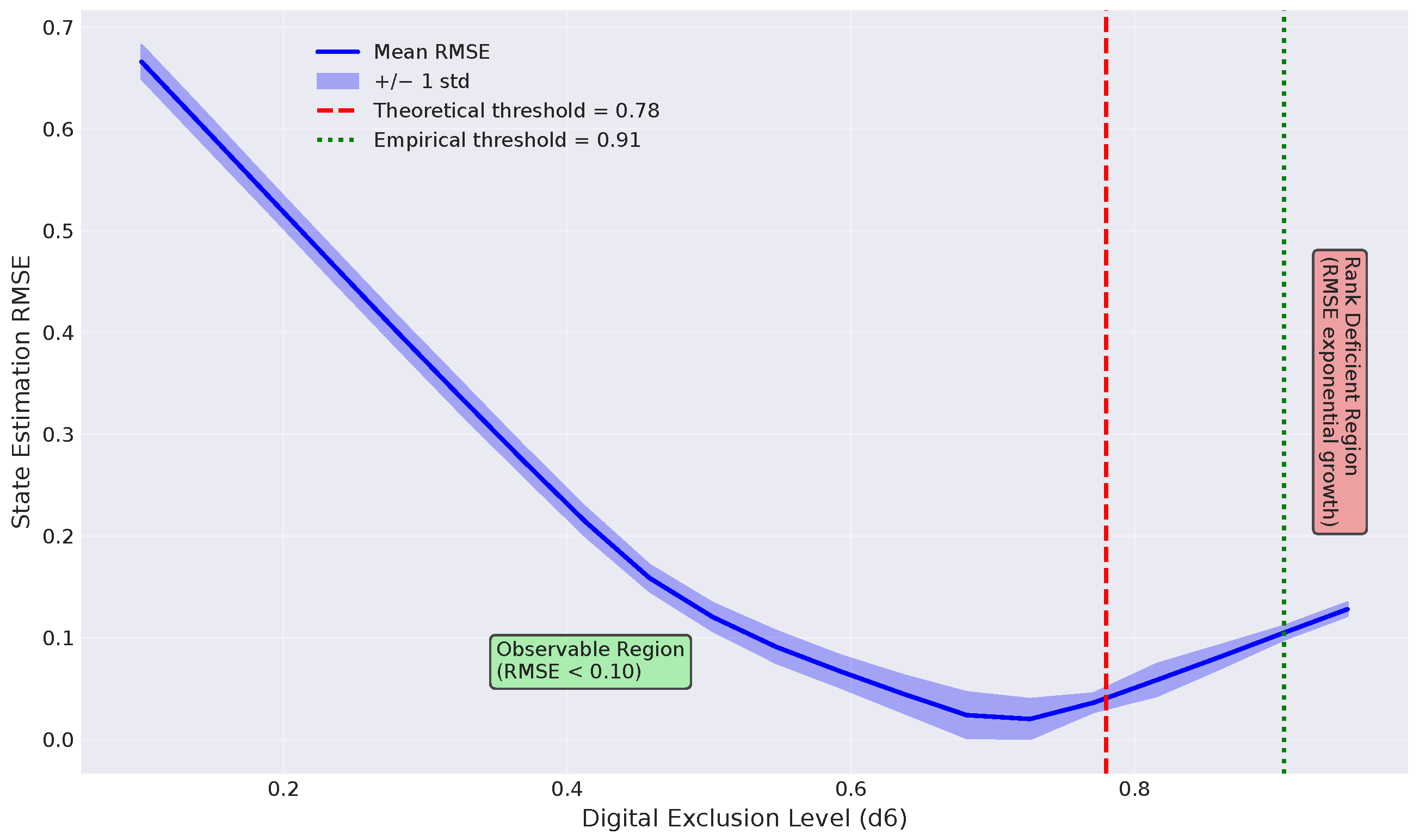
To connect finite-horizon Gramian calculations with empirical estimation performance, the average digital exclusion level is varied between 0.1 and 0.95, and RMSE is measured over the horizon. Figure 5 plots the relationship.
Figure 5.
RMSE versus digital exclusion (500 runs). The vertical dashed line indicates the theoretical threshold from Theorem 1. The shaded band depicts the 95% interval under coupling perturbations. RMSE rises sharply once the smallest Gramian eigenvalues become too small.
For , RMSE hovers near . Once enters the – band, errors increase quickly, reaching about beyond . This behavior is consistent with the exponential noise model and the qualitative form of the error bound in Theorem 2. The gap between the theoretical and empirical thresholds reflects both the conservatism of the effective-rank criterion and finite-sample effects (see Table 7).
Table 7.
Theoretical vs. empirical observability thresholds. Theoretical stems from the finite-time Gramian and the exclusion-dependent noise; empirical value is based on the RMSE– curve in Figure 5.
6.7.2. Coupling Dynamics Verification
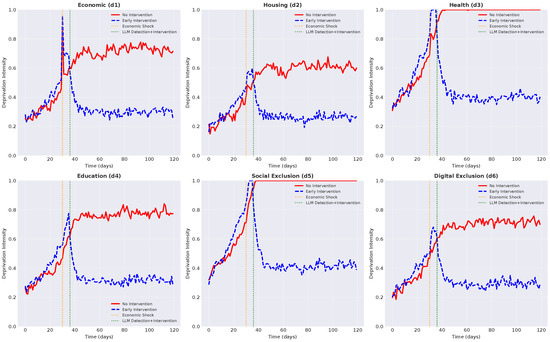
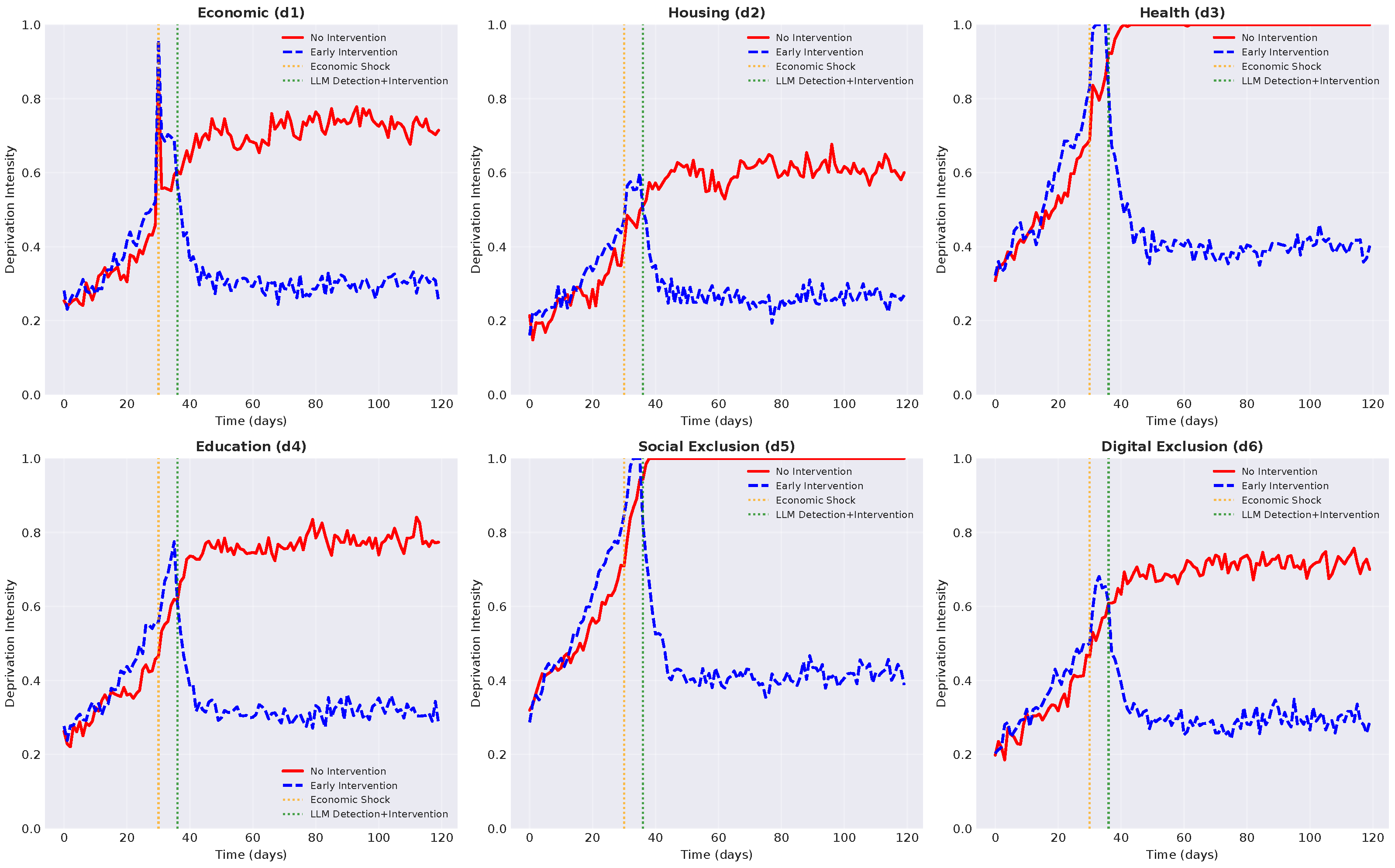
To test whether cross-dimension spillovers resemble those encoded in , an economic shock is introduced at day 30 by raising by , and the response of other dimensions is tracked (see Figure 6).
Figure 6.
Time profiles of the six deprivation dimensions after an economic shock at . Health () and housing () respond with lags and magnitudes consistent with and . Dashed blue: early intervention within 10 days; solid red: no intervention trajectory.
Estimated spillover from to is (target ). Secondary crises materialize in other dimensions after roughly 18 days, in line with the time constants implied by . Intervening within 10 days markedly dampens downstream crises, cutting their amplitude by about two thirds. This aligns with the intuition from feedback control theory that shorter detection and intervention delays substantially improve closed-loop performance [1].
6.8. Interpretation and Limitations
What the simulations seem to say. Taken at face value, the ABM results suggest that, for coupling strengths and time scales comparable to those seen in real systems, adding daily semantic traces to quarterly records provides enough additional visibility to matter. The exclusion-driven observability threshold from Theorem 1 appears as a turning point in RMSE, and EKF errors grow approximately as , as anticipated. Sensitivity checks indicate that these findings are reasonably robust to moderate perturbations of coupling and noise parameters.
Where caution is still needed. These are, of course, simulations on a stylized city. The magnitude of detection gains and cascade reductions depends on how faithfully the model captures real-world dynamics and text behavior. One should not read the numerical improvements as predictions for any specific city but rather as evidence that, under certain conditions, semantic sensing can materially change the detection problem. For real deployments, calibration against local administrative data and human-written posts will be necessary, along with external validation and careful evaluation of LLM behavior, as emphasized in recent empirical studies [20,29,30].
7. Discussion: System-Level Insights and Future Directions
7.1. Summary of Contributions
The study ties together four elements: a six-dimensional stochastic control model with empirically grounded couplings; a finite-horizon observability analysis under exclusion-dependent noise; a constrained fusion layer that embeds fairness, privacy, and representation inside the estimator; and a large ABM-based validation with sensitivity analysis. The central question running through all of this is not “can LLMs read tweets?” but rather “under what sensing conditions can one maintain useful state estimates with some form of performance guarantee?” The use of control-theoretic language here echoes broader calls for rigorous foundations in cyber–physical–social systems [39].
In comparison to traditional survey methods, which offer high precision but low temporal resolution, and pure big-data approaches, which provide real-time signals but often lack representativeness, our proposed fusion architecture occupies a strategic middle ground. By anchoring the high-frequency but noisy semantic signals to the stable administrative baseline, we achieve a system that is both responsive to rapid changes and grounded in established statistical realities.
7.2. Implications for Urban Governance and Policy Design
Several practical messages emerge for urban administrations considering AI-assisted monitoring:
- Digital exclusion sets hard limits. The exclusion threshold indicates that, beyond a certain level of digital deprivation, no amount of clever semantic sensing compensates for missing data. Real-time dashboards should therefore carry explicit caveats about who is underrepresented and where estimates rest on very weak signals.
- Early warning and targeting. Where exclusion is moderate and semantic sensing remains informative, reducing detection lag from weeks to days has tangible benefits. The ABM suggests fewer multi-dimensional cascades and fewer entries into deep poverty states, along with lower waste from late or misdirected interventions.
- Values inside the estimator. Embedding fairness, privacy, and representation into the estimation problem, instead of auditing outputs afterwards, makes trade-offs explicit and tunable. It also helps to avoid the situation where technically optimal but normatively unacceptable estimates reach decision-makers.
- Alignment with broader agendas. High-frequency spatially resolved welfare indicators can support monitoring for goals such as SDG 1 and SDG 11, provided the monitoring system itself is governed carefully and subject to public oversight.
7.3. Toward Closed-Loop Control: Conceptual Extensions
Once reliable state estimates are in hand, a range of control strategies become available. Close to equilibrium, a linear quadratic regulator (LQR) would yield a state-feedback control of the form under chosen quadratic cost weights. For larger deviations, constraints and nonlinearities become more important, and receding-horizon model predictive control (MPC) offers a natural extension [40,41,42].
Stochastic MPC with chance constraints could encode probabilistic guarantees on keeping deprivation below thresholds. Robust MPC variants (tube-based, ) could hedge against model error in and noise at the expense of conservative actions. Ideas from safe reinforcement learning and shielding [43] may also be helpful, particularly when parts of the dynamics or policy responses are learned from data.
7.4. Limitations and Critical Assessment
7.4.1. Methodological Limitations
Several methodological boundaries should be kept in mind:
- Simulation reliance. Validation is entirely simulation-based. Actual deployments will face institutional delays, behaviorally complex reactions, and political constraints absent from the ABM.
- Parameter uncertainty. The coupling matrix aggregates evidence across contexts and time and may not match any particular city. The sensitivity results are reassuring but do not cover structural misspecifications.
- Linearization limits. The EKF assumes that local linearization is adequate. Deep in nonlinear regimes (e.g., entrenched poverty traps), particle filters or unscented Kalman filters may be better suited.
- Stationarity assumptions. Parameters such as are treated as fixed over 180 days. Major shocks (pandemics and systemic reforms) could shift couplings, calling for online system identification or Bayesian parameter updates.
7.4.2. LLM-Specific Challenges
There are also LLM-specific issues:
- Temporal drift. Language, platforms, and communication styles evolve. Periodic recalibration of the semantic sensor is needed to avoid degraded performance.
- Prompt and model sensitivity. Indicators can be sensitive to prompt design and the underlying model. Robust deployment may require prompt ensembles, careful few-shot examples, and cross-model checks. The variability observed in large-scale evaluations [20,21,22] underscores this point.
- Bias and calibration. Although the focus here is on scoring rather than free-text generation, biases and hallucinations documented in LLMs [24,25,28] still matter, especially when text comes from marginalized groups. Calibration techniques (for example, conformal prediction and temperature scaling) and bias mitigation strategies will likely be necessary.
- Generator–sensor coupling. In the ABM, synthetic text and sensor are intertwined, arguably giving the sensor an advantage. Real text from humans on diverse platforms will be less predictable, and sensors will perform worse than in this controlled setting. This “homogeneity risk” means our results are likely an upper bound on performance.
- Multilingual contexts. Many cities host multiple languages and dialects, often used in code-switched fashion. Extending this approach to low-resource and mixed-language settings is an open and non-trivial task, potentially requiring multilingual LLMs or translation layers.
7.4.3. Ethical and Governance Aspects
Finally, the monitoring architecture itself raises ethical questions:
- Fairness versus accuracy. Tight fairness constraints can reduce average accuracy by several percentage points. Parameters such as must be chosen transparently and revisited as part of governance, ideally with input from affected communities.
- Privacy trade-offs. For small populations, DP noise is not negligible. Aggregating over larger units or exploring alternative privacy frameworks may be required.
- Perception of surveillance. Even with grid-level aggregation and DP, continuous monitoring of public discourse can be perceived as intrusive. The architecture described here is explicitly scoped to aggregate situational awareness, not to individual scoring or policing, but perception and use in practice might deviate without strong guardrails.
- Oversight and accountability. Optimization-based controllers can, unintentionally, channel resources in ways that exacerbate inequities. Embedding fairness into control design, establishing independent oversight, and including communities in design and audit processes are all necessary if such systems are to be used responsibly. Recent reflections on LLM deployment in education and social domains [29,30] reinforce the importance of such governance structures.
- Adversarial robustness. Public text streams are vulnerable to manipulation, such as astroturfing or bot attacks designed to skew welfare perceptions. While the EKF provides some filtering, dedicated outlier detection and source verification mechanisms would be necessary for robust deployment.
7.5. Future Research Directions
7.5.1. Theoretical Extensions
Several directions appear promising:
- Adaptive observability and active sensing. Rather than treating sensing as fixed, one could design policies that selectively gather additional data where the Gramian is weakest, for example by triggering micro-surveys or targeted annotations.
- Causal structure. Combining the control-theoretic perspective with causal models (structural equation models and instrumental variables) may help to refine and clarify which interventions are most effective.
- Multi-agent and game-theoretic control. When multiple actors (municipalities, NGOs, and private firms) intervene concurrently, dynamic game models or multi-agent reinforcement learning may better capture interaction effects.
- Robust MPC with guarantees. Designing controllers with formal performance guarantees under bounded model error and corrupted sensing channels would strengthen the case for high-stakes decision support.
7.5.2. Empirical Validation Roadmap
A plausible path toward real-world validation might involve three stages.
Phase 1: Retrospective analysis (6–12 months). Historical administrative data and archived public posts are used to reconstruct trajectories. Couplings are estimated using econometric tools (e.g., panel VAR), and counterfactual alerts are simulated to estimate potential gains in lead time.
Phase 2: Prospective shadow deployment (12–24 months). The system runs in parallel with existing monitoring, but its alerts do not yet drive interventions. Performance, calibration, and fairness are evaluated, and feedback is collected from practitioners and communities on interpretability and acceptability.
Phase 3: Randomized controlled trial (24–48 months). Grids are randomized into LLM-enhanced monitoring versus status quo. Outcomes such as welfare indicators, detection times, and cost-effectiveness are compared across arms. All phases require strong data governance, institutional review, and community engagement.
7.6. Broader Implications for AI Governance
More broadly, the architecture illustrates a pattern for structuring AI in high-stakes settings:
- Begin by translating social and policy objectives into explicit estimation and control objectives, with constraints that reflect values and legal requirements.
- Develop finite-horizon performance guarantees and clearly mark conditions under which they fail instead of assuming asymptotic behavior.
- Implement fairness, privacy, and representation constraints inside the optimization problem, not as external audits.
- Quantify and communicate uncertainty, and introduce systems gradually with human oversight and regular third-party audits.
From this perspective, LLMs are best viewed as one set of sensors producing semantic signals that then pass through estimation, constraint handling, and human review rather than as stand-alone decision-makers.
8. Conclusions
A control-oriented framework for near-real-time socioeconomic monitoring has been presented, where large language models act as semantic sensors feeding into an EKF-based fusion layer with explicit fairness, privacy, and representation constraints. Quarterly administrative data and daily semantic indicators are combined via a state-dependent noise model in which digital exclusion sets hard limits: beyond (for 30–60 day horizons), several modes essentially drop out of view and estimation error scales roughly as . Below this threshold, constrained fusion maintains bounded errors and timely alarms.
In a 100k-agent ABM, the architecture reduces detection lags from weeks to days and curbs multi-dimensional cascades, with these gains persisting under moderate parameter perturbations. While the current results rely on synthetic data, they provide a strong proof-of-concept for how semantic sensing can complement administrative records. Moving from synthetic experiments to deployment will require careful calibration, transparent governance, and participatory design. The aim is not automated policymaking but earlier and fairer situational awareness so that scarce resources reach the right places at the right time. More broadly, this work illustrates a path towards “human-centric” cyber–physical–social systems, where technical observability and normative values are integrated into a single coherent estimation framework.
Author Contributions
Conceptualization, H.C.; methodology, H.X.; formal analysis, H.X. and H.Z.; validation, H.X.; investigation, H.C.; writing—original draft preparation, H.X.; writing—review and editing, H.C.; visualization, H.Z. and H.X. All authors have read and agreed to the published version of the manuscript.
Funding
This research received no external funding.
Data Availability Statement
The full modular implementation of the proposed framework, including the surrogate model described in Algorithm 2, is available at the following repository: https://github.com/HuiLogic/VA-STMS-Urban-Monitoring (accessed on 9 November 2025).
Conflicts of Interest
The authors declare no conflicts of interest.
Appendix A. Dimension Construction Specifications
Appendix A.1. Economic Instability (d1)
Constructed as a weighted composite:
where
- ;
- ;
- .
Appendix A.2. Housing Insecurity (d2)
Constructed as
where
- ;
- ;
- .
Appendix A.3. Health, Education, Social, and Digital (d3–d6)
Similar weighted composites are used for health vulnerability, educational barriers, social exclusion, and digital capability deficits (details omitted here for brevity; full specifications are available in the repository linked in the Data Availability Statement).
Appendix B. Complete Proof of Theorem 1
Consider the finite-time observability Gramian over :
where . From Equation (7),
The scalar factor can be taken out of the integral:
with
Eigenvalues then satisfy
To obtain an effective threshold, introduce a minimum acceptable eigenvalue for finite-horizon signal-to-noise and define by
Using the scaling relation,
In the calibration, is evaluated numerically for days, and is tuned so that from (A9) coincides with the onset of the sharp RMSE increase in the Monte Carlo experiments of Section 6. This yields , with a range under the coupling perturbations of Section 6.6. This is the value quoted in Theorem 1.
Appendix C. Complete Proof of Theorem 2
Linearizing the EKF error dynamics around the estimated trajectory yields approximately
where and are process and observation noise, and is the Kalman gain.
At steady state, the covariance satisfies an algebraic Riccati equation. For large observation noise , a scalar approximation suggests that each mode’s covariance scales with , where Q is the corresponding process-noise variance. Since scales as , the steady-state covariance scales roughly as per mode. Bounding matrix norms and aggregating across dimensions yields a conservative bound of the form
for some constant C, with linked to the smallest eigenvalue of the finite-time observability Gramian. This leads directly to Equation (10) in Theorem 2. A more formal derivation uses a Lyapunov function for the linearized error dynamics and properties of the Riccati recursion, following arguments in [36,37].
Appendix D. Prompt Template for Synthetic Discourse
The following prompt was used in the calibration stage to evoke synthetic posts and deprivation scores from an LLM:
Prompt: “You are analyzing a social media post to assess the author’s socioeconomic situation. The author is a [age]-year-old [occupation] living in an [urban/suburban] area.
Current Situation (Latent State): - Economic stress level: [ formatted as low/moderate/high] - Housing security: [ formatted as stable/precarious/crisis] - Health status: [ formatted as good/fair/poor] - Social connection: [ formatted as strong/moderate/weak] - Digital access: [ formatted as full/limited/minimal]
Step 1: Based on this profile, what life concerns would this person plausibly express on social media? List 2–3 main concerns.
Step 2: Write a brief 50–100 word social media post reflecting these concerns. Make it realistic.
Step 3: Rate the deprivation signal strength for each dimension (0–10 scale) that your post implicitly conveys. Provide the ratings in a JSON object with keys d1–d6 and a brief natural-language justification for each.”
These labels are then used to fit the surrogate semantic sensor described in Section 6.
References
- Åström, K.J.; Murray, R.M. Feedback Systems: An Introduction for Scientists and Engineers; Princeton University Press: Princeton, NJ, USA, 2008. [Google Scholar]
- Van Dijk, J.A.G.M. Digital divide research, achievements and shortcomings. Poetics 2006, 34, 221–235. [Google Scholar] [CrossRef] [Scilit]
- Sun, X.; Zheng, X.; Li, S.; Zhang, J.; Shi, H. The Impact of Rural Energy Poverty on Primary Health Services Efficiency: The Case of China. Systems 2025, 13, 675. [Google Scholar] [CrossRef] [Scilit]
- Dobre, F.; Sandu, A.; Tătaru, G.-C.; Cotfas, L.-A. A Decade of Studies in Smart Cities and Urban Planning Through Big Data Analytics. Systems 2025, 13, 780. [Google Scholar] [CrossRef] [Scilit]
- Lee, E.A.; Seshia, S.A. Introduction to Embedded Systems—A Cyber-Physical Systems Approach, 2nd ed.; MIT Press: New York, NY, USA, 2017. [Google Scholar]
- Atkinson, A.B. On the measurement of poverty. Econometrica 1987, 55, 749–764. [Google Scholar] [CrossRef] [Scilit]
- Sen, A. Development as Freedom; Oxford University Press: Oxford, UK, 1999. [Google Scholar]
- Kitchin, R. The real-time city? Big data and smart urbanism. GeoJournal 2014, 79, 1–14. [Google Scholar] [CrossRef] [Scilit]
- Zhou, R.; Song, Z.; Jin, Y.; Jiang, Q. Simulation analysis of mustard combine harvester extraction device based on ADAMS. J. Intell. Agric. Mech. 2025, 6, 88–96. (In Chinese) [Google Scholar]
- Park, J.S.; O’Brien, J.C.; Cai, C.J.; Morris, M.R.; Liang, P.; Bernstein, M.S. Generative Agents: Interactive Simulacra of Human Behavior. In Proceedings of the 36th Annual ACM Symposium on User Interface Software and Technology (UIST ’23), San Francisco, CA, USA, 29 October–1 November 2023; pp. 1–22. [Google Scholar]
- Chen, X.; Lei, Y.; Li, Y.; Parkinson, S.; Li, X.; Liu, J.; Lu, F.; Wang, H.; Wang, Z.; Yang, B.; et al. Large Models for Machine Monitoring and Fault Diagnostics: Opportunities, Challenges, and Future Direction. J. Dyn. Monit. Diagn. 2025, 4, 76–90. [Google Scholar] [CrossRef] [Scilit]
- Lu, Q.; Li, M. Fault Prediction Method Towards Rolling Element Bearing Based on Digital Twin and Deep Transfer Learning. Appl. Sci. 2025, 15, 12509. [Google Scholar] [CrossRef] [Scilit]
- Bommasani, R.; Hudson, D.A.; Adeli, E.; Altman, R.; Arora, S.; von Arx, S.; Bernstein, M.S.; Bohg, J.; Bosselut, A.; Brunskill, E.; et al. On the Opportunities and Risks of Foundation Models. arXiv 2021, arXiv:2108.07258. [Google Scholar] [CrossRef] [Scilit]
- Brown, T.; Mann, B.; Ryder, N.; Subbiah, M.; Kaplan, J.D.; Dhariwal, P.; Neelakantan, A.; Shyam, P.; Sastry, G.; Askell, A.; et al. Language Models are Few-Shot Learners. In Proceedings of the 34th Conference on Neural Information Processing Systems (NeurIPS 2020), Vancouver, BC, Canada, 6–12 December 2020; Volume 33, pp. 1877–1901. [Google Scholar]
- Wei, J.; Tay, Y.; Bommasani, R.; Raffel, C.; Zoph, B.; Borgeaud, S.; Yogatama, D.; Bosma, M.; Zhou, D.; Metzler, D.; et al. Emergent Abilities of Large Language Models. arXiv 2022, arXiv:2206.07682. [Google Scholar] [CrossRef] [Scilit]
- Ziems, C.; Held, W.; Shaikh, O.; Chen, J.; Zhang, Z.; Yang, D. Can Large Language Models Transform Computational Social Science? Comput. Linguist. 2024, 50, 237–291. [Google Scholar]
- Grossmann, I.; Feinberg, M.; Parker, D.C.; Christakis, N.A.; Tetlock, P.E.; Cunningham, W.A. AI and the transformation of social science research. Science 2023, 380, 1108–1109. [Google Scholar] [CrossRef] [Scilit] [PubMed]
- Argyle, L.P.; Busby, E.C.; Fulda, N.; Gubler, J.R.; Rytting, C.; Wingate, D. Out of One, Many: Using Language Models to Simulate Human Samples. Political Anal. 2023, 31, 337–351. [Google Scholar] [CrossRef] [Scilit]
- Abdurahman, S.; Atari, M.; Karimi-Malekabadi, F.; Xue, M.J.; Trager, J.; Park, P.S.; Golazizian, P.; Omrani, A.; Dehghani, M. Perils and Opportunities in Using Large Language Models in Psychological Research. PNAS Nexus 2024, 3, pgae245. [Google Scholar] [CrossRef] [Scilit]
- Liang, P.; Bommasani, R.; Lee, T.; Tsipras, D.; Soylu, D.; Yasunaga, M.; Zhang, M.; Narayanan, D.; Reich, J.; Ganguli, D.; et al. Holistic Evaluation of Language Models. arXiv 2022, arXiv:2211.09110. [Google Scholar] [CrossRef] [Scilit]
- OpenAI. GPT-4 Technical Report. arXiv 2023, arXiv:2303.08774. [Google Scholar] [CrossRef] [Scilit]
- Bubeck, S.; Chandrasekaran, V.; Eldan, R.; Gehrke, J.; Horvitz, E.; Kamar, E.; Lee, P.; Lee, Y.T.; Li, Y.; Lundberg, S.; et al. Sparks of Artificial General Intelligence: Early experiments with GPT-4. arXiv 2023, arXiv:2303.12712. [Google Scholar] [CrossRef] [Scilit]
- Bai, Y.; Kadavath, S.; Kundu, S.; Askell, A.; Kernion, J.; Jones, A.; Chen, A.; Goldie, A.; Mirhoseini, A.; McKinnon, C.; et al. Constitutional AI: Harmlessness from AI Feedback. arXiv 2022, arXiv:2212.08073. [Google Scholar] [CrossRef] [Scilit]
- Bender, E.M.; Gebru, T.; McMillan-Major, A.; Shmitchell, S. On the Dangers of Stochastic Parrots: Can Language Models Be Too Big? In Proceedings of the 2021 ACM Conference on Fairness, Accountability, and Transparency (FAccT ’21), Virtual Event, Canada, 3–10 March 2021; pp. 610–623. [Google Scholar]
- Ji, Z.; Lee, N.; Frieske, R.; Yu, T.; Su, D.; Xu, Y.; Ishii, E.; Bang, Y.J.; Madotto, A.; Fung, P. Survey of Hallucination in Natural Language Generation. ACM Comput. Surv. 2023, 55, 1–38. [Google Scholar] [CrossRef] [Scilit]
- Gal, Y.; Ghahramani, Z. Dropout as a Bayesian Approximation: Representing Model Uncertainty in Deep Learning. In Proceedings of the 33rd International Conference on Machine Learning (ICML), New York, NY, USA, 19–24 June 2016; Volume 48, pp. 1050–1059. [Google Scholar]
- Pan, X.; Zhang, M.; Ji, S.; Yang, M. Privacy Risks of General-Purpose Language Models. In Proceedings of the 2020 IEEE Symposium on Security and Privacy (SP), San Francisco, CA, USA, 18–21 May 2020; pp. 1314–1331. [Google Scholar]
- Santurkar, S.; Durmus, E.; Ladhak, F.; Lee, C.; Liang, P.; Hashimoto, T. Whose Opinions Do Language Models Reflect? In Proceedings of the 40th International Conference on Machine Learning (ICML), Honolulu, HI, USA, 23–29 July 2023; Volume 202, pp. 29971–30004. [Google Scholar]
- Gilardi, F.; Alizadeh, M.; Kubli, M. ChatGPT Outperforms Crowd Workers for Text-Annotation Tasks. Proc. Natl. Acad. Sci. USA 2023, 120, e2305016120. [Google Scholar] [CrossRef] [Scilit] [PubMed]
- Kasneci, E.; Seßler, K.; Küchemann, S.; Bannert, M.; Dementieva, D.; Fischer, F.; Gasser, U.; Groh, G.; Günnemann, S.; Hüllermeier, E.; et al. ChatGPT for Good? On Opportunities and Challenges of Large Language Models for Education. Learn. Individ. Differ. 2023, 103, 102274. [Google Scholar] [CrossRef] [Scilit]
- Butkovsky, O.; Kulik, A.; Scheutzow, M. Generalized Couplings and Ergodic Rates for SPDEs and Other Markov Models. Ann. Appl. Probab. 2020, 30, 1–39. [Google Scholar] [CrossRef] [Scilit]
- Graetz, N.; Gershenson, C.; Hepburn, P.; Porter, S.R.; Desmond, M. A Comprehensive Demographic Profile of the US Evicted Population. Proc. Natl. Acad. Sci. USA 2023, 120, e2305860120. [Google Scholar] [CrossRef] [Scilit]
- Vallas, S.; Schor, J.B. What Do Platforms Do? Understanding the Gig Economy. Annu. Rev. Sociol. 2020, 46, 273–294. [Google Scholar] [CrossRef] [Scilit]
- Astolfi, A.; Karagiannis, D.; Ortega, R. Towards Applied Nonlinear Adaptive Control. Annu. Rev. Control 2008, 32, 136–148. [Google Scholar] [CrossRef] [Scilit]
- Popovi’c, M.; Ott, J.; Rückin, J.; Kochenderfer, M.J. Learning-based methods for adaptive informative path planning. Robot. Auton. Syst. 2024, 179, 104727. [Google Scholar] [CrossRef] [Scilit]
- Revach, G.; Shlezinger, N.; Ni, X.; Escoriza, A.L.; van Sloun, R.J.G.; Eldar, Y.C. KalmanNet: Neural Network Aided Kalman Filtering for Partially Known Dynamics. IEEE Trans. Signal Process. 2022, 70, 1532–1547. [Google Scholar] [CrossRef] [Scilit]
- Shi, D.; Chen, T.; Shi, L. On Set-Valued Kalman Filtering and Its Application to Event-Based State Estimation. IEEE Trans. Autom. Control 2014, 60, 1275–1290. [Google Scholar] [CrossRef] [Scilit]
- Boyd, S.; Parikh, N.; Chu, E.; Peleato, B.; Eckstein, J. Distributed Optimization and Statistical Learning via the Alternating Direction Method of Multipliers. Found. Trends Mach. Learn. 2011, 3, 1–122. [Google Scholar] [CrossRef] [Scilit]
- Perez-Cerrolaza, J.; Abella, J.; Borg, M.; Donzella, C.; Cerquides, J.; Cazorla, F.J.; Englund, C.; Tauber, M.; Nikolakopoulos, G.; Flores, J.L. Artificial intelligence for safety-critical systems in industrial and transportation domains: A survey. ACM Comput. Surv. 2024, 56, 1–40. [Google Scholar] [CrossRef] [Scilit]
- Moerland, T.M.; Broekens, J.; Plaat, A.; Jonker, C.M. Model-based Reinforcement Learning: A Survey. Found. Trends Mach. Learn. 2023, 16, 1–118. [Google Scholar] [CrossRef] [Scilit]
- Schwenzer, M.; Ay, M.; Bergs, T.; Abel, D. Review on Model Predictive Control: An Engineering Perspective. Int. J. Adv. Manuf. Technol. 2021, 117, 1327–1349. [Google Scholar] [CrossRef] [Scilit]
- Mayne, D.Q.; Rawlings, J.B.; Rao, C.V.; Scokaert, P.O.M. Constrained model predictive control: Stability and optimality. Automatica 2000, 36, 789–814. [Google Scholar] [CrossRef] [Scilit]
- Alshiekh, M.; Bloem, R.; Ehlers, R.; K"onighofer, B.; Niekum, S.; Topcu, U. Safe Reinforcement Learning via Shielding. In Proceedings of the 32nd AAAI Conference on Artificial Intelligence (AAAI), New Orleans, LA, USA, 2–7 February 2018. [Google Scholar]

Disclaimer/Publisher’s Note: The statements, opinions and data contained in all publications are solely those of the individual author(s) and contributor(s) and not of MDPI and/or the editor(s). MDPI and/or the editor(s) disclaim responsibility for any injury to people or property resulting from any ideas, methods, instructions or products referred to in the content. |
© 2025 by the authors. Licensee MDPI, Basel, Switzerland. This article is an open access article distributed under the terms and conditions of the Creative Commons Attribution (CC BY) license.