
From Browsing to Decision: How Artificial Intelligence Systems Influence the Modern Fashion Consumer Journey

Abstract
1. Introduction
2. Literature Review and Theoretical Framework
2.1. Perceived Quality (PQY)
2.2. Technology Attitudes (TAS)
2.3. Attitudes Toward Artificial Intelligence (ATAI)
2.4. Fashion Involvement (FIT)
2.5. Customer Experience (CEE)
2.6. Marketing Analytics Capability (MAC)
2.7. Purchase Decision (PDN)
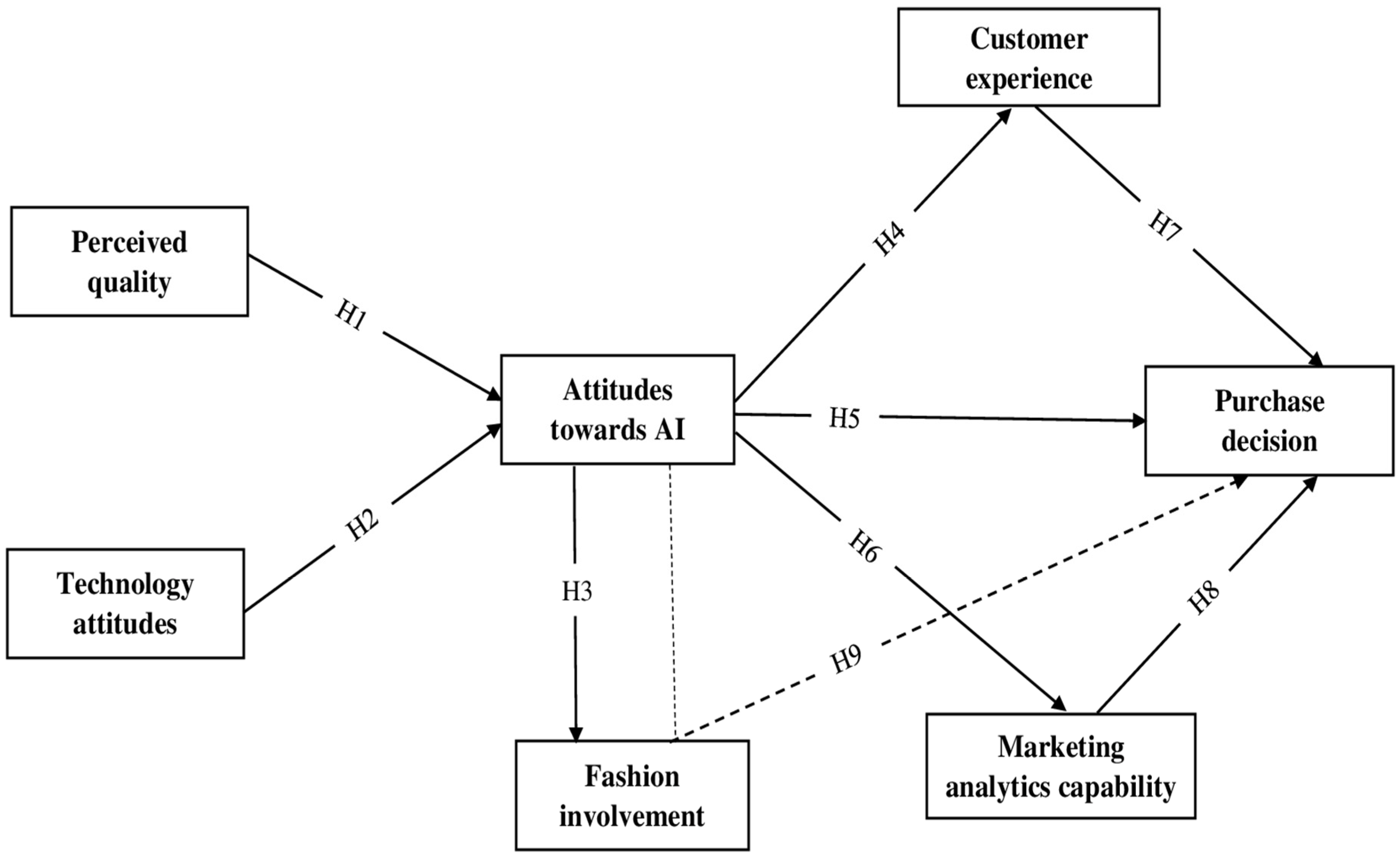
3. Hypotheses Development
3.1. Perceived Quality (PQY) and Attitudes Toward Artificial Intelligence (ATAI)
3.2. Technology Attitudes (TAS) and Attitudes Toward Artificial Intelligence (ATAI)
3.3. Attitudes Toward Artificial Intelligence (ATAI), Fashion Involvement (FIT), Customer Experience (CEE), Purchase Decision (PDN), and Marketing Analytics Capability (MAC)
3.4. Customer Experience (CEE) and Purchase Decision (PDN)
3.5. Marketing Analytics Capability (MAC) and Purchase Decision (PDN)
3.6. Fashion Involvement (FIT) as Mediator
4. Methods
4.1. Survey Strategy and Respondents of the Study
4.2. Instrument and Data Collection
4.3. Common Method Bias (CMB)
4.4. Measures
5. Results
5.1. Respondents’ Profiles
5.2. Measurement Model
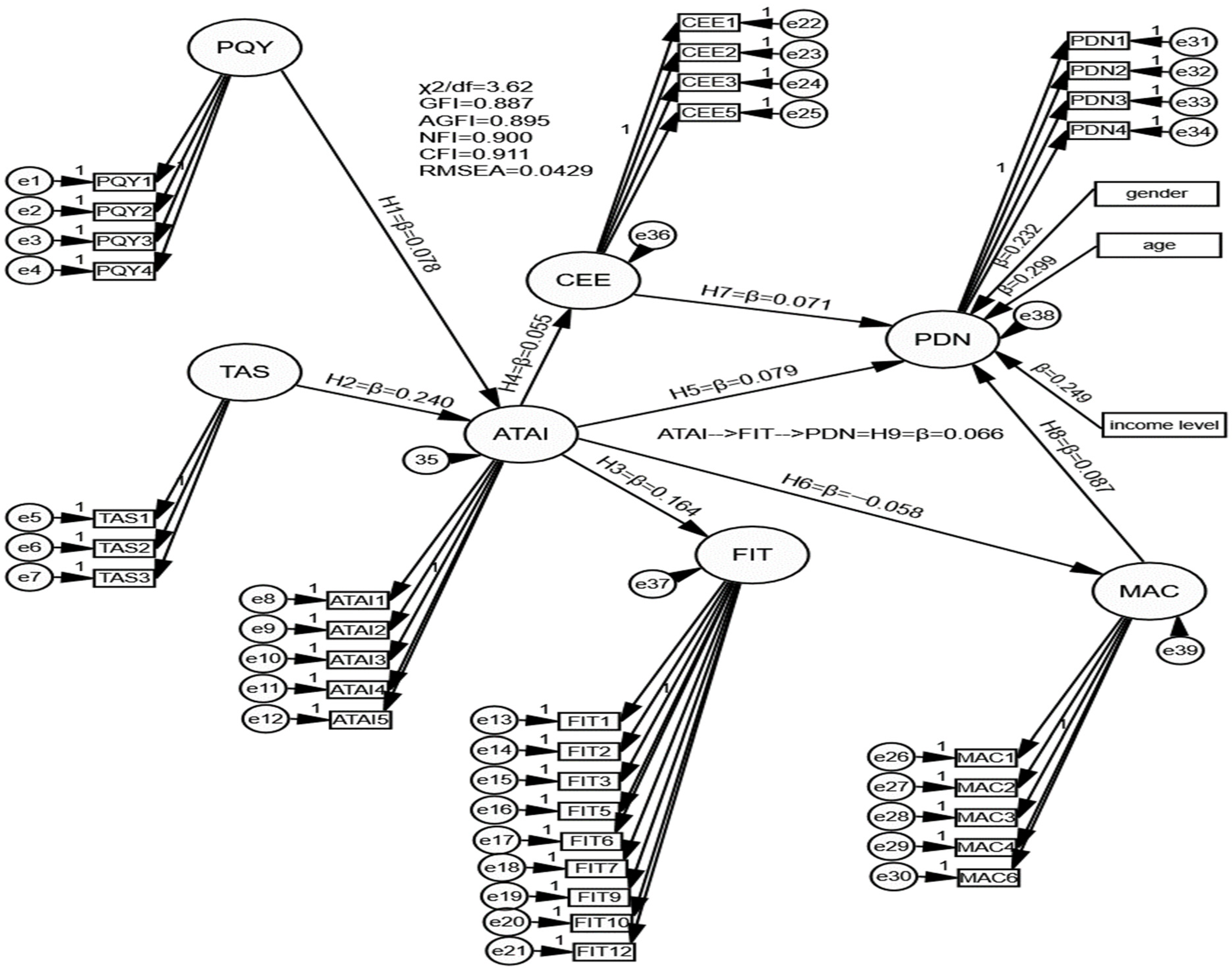
5.3. Structural Model
6. Discussion and Conclusions
7. Implications, Limitations, and Future Research Avenues
Funding
Institutional Review Board Statement
Informed Consent Statement
Data Availability Statement
Conflicts of Interest
References
- Mohsin, S. The influence of AI-Driven personalization on consumer decision-making in E-commerce platforms. Al-Rafidain J. Eng. Sci. 2024, 2, 249–261. [Google Scholar] [CrossRef]
- Shankar, V. Marketing of technology-intensive products: An AI-driven approach. Mark. Strateg. J. 2025, 2, 100008. [Google Scholar] [CrossRef]
- Boaler, A.M.; Pankajakshi, R.; Saxena, S.; Kumar, P. Consumer Adoption of AI in Online Apparel Retail Purchases Using UTAUT2 Model. In International Conference on Data Analytics & Management; Springer Nature: Singapore, 2024; pp. 645–658. [Google Scholar] [CrossRef]
- Yin, J.; Qiu, X. AI technology and online purchase intention: Structural equation model based on perceived value. Sustainability 2021, 13, 5671. [Google Scholar] [CrossRef]
- Idrees, S.; Vignali, G.; Gill, S. Technological advancement in fashion online retailing: A comparative study of Pakistan and UK fashion e-commerce. Int. J. Econ. Manag. Eng. 2020, 14, 313–328. [Google Scholar]
- Mir-Bernal, P.; Guercini, S.; Sádaba, T. The role of e-commerce in the internationalization of Spanish luxury fashion multi-brand retailers. J. Glob. Fash. Mark. 2018, 9, 59–72. [Google Scholar] [CrossRef]
- Gümüş, N.; Çark, Ö. The effect of customers’ attitudes towards chatbots on their experience and behavioural intention in Turkey. Interdiscip. Descr. Complex Syst. 2021, 19, 420–436. [Google Scholar] [CrossRef]
- Arachchi, H.D.M.; Samarasinghe, G.D. Impact of embedded AI mobile smart speech recognition on consumer attitudes towards AI and purchase intention across Generations X and Y. Eur. J. Manag. Stud. 2024, 29, 3–29. [Google Scholar] [CrossRef]
- Biriescu, S.; Olteanu, L. Technologies promoting the digital tourism economy and student attitudes towards artificial intelligence in tourism. In Green Wealth: Navigating Towards a Sustainable Future; Emerald Publishing: Leeds, UK, 2025; pp. 239–256. [Google Scholar] [CrossRef]
- Park, J.; Woo, S.E.; Kim, J. Attitudes towards artificial intelligence at work: Scale development and validation. J. Occup. Organ. Psychol. 2024, 97, 920–951. [Google Scholar] [CrossRef]
- Dang, V.T.; Pham, T.L. An empirical investigation of consumer perceptions of online shopping in an emerging economy: Adoption theory perspective. Asia Pac. J. Mark. Logist. 2018, 30, 952–971. [Google Scholar] [CrossRef]
- Fayed, A.E. In terms of complexity theory via fsQCA: The role of inbound digital marketing in purchase decision making. Int. J. Technol. Mark. 2025, 19, 60–79. [Google Scholar] [CrossRef]
- Masih, J.; Mathur, M.; Bhagwat, A.; Mishra, S.; Rokade, K. An evaluation of core factors of predictive analytics in influencing purchase decision of the consumers in e-business. In Artificial Intelligence, Internet of Things, and Society 5.0; Studies in Computational Intelligence; Hannoon, A., Mahmood, A., Eds.; Springer Nature: Cham, Switzerland, 2023; Volume 1113, pp. 51–60. [Google Scholar] [CrossRef]
- Rodgers, W.; Nguyen, T. Advertising benefits from ethical artificial intelligence algorithmic purchase decision pathways. J. Bus. Ethics 2022, 178, 1043–1061. [Google Scholar] [CrossRef]
- Saputro, D.A.; Elwisam, E.; Digdowiseiso, K. The effect of product differentiation, customer experience and product quality on the purchase decision of compass shoes in Jakarta. J. Syntax Admiration 2023, 4, 330–342. [Google Scholar] [CrossRef]
- Yeo, V.C.S.; Goh, S.K.; Rezaei, S. Consumer experiences, attitude and behavioral intention toward online food delivery (OFD) services. J. Retail. Consum. Serv. 2017, 35, 150–162. [Google Scholar] [CrossRef]
- Ruiz-Viñals, C.; Pretel-Jiménez, M.; Del Olmo Arriaga, J.L.; Miró Pérez, A. The influence of artificial intelligence on generation Z’s online fashion purchase intention. J. Theor. Appl. Electron. Commer. Res. 2024, 19, 2813–2827. [Google Scholar] [CrossRef]
- Rosen, L.D.; Whaling, K.; Carrier, L.M.; Cheever, N.A.; Rokkum, J. The media and technology usage and attitudes scale: An empirical investigation. Comput. Hum. Behav. 2013, 29, 2501–2511. [Google Scholar] [CrossRef]
- Aksu, S.; Şener, B.Ç. Factors affecting consumers’ online purchasing attitudes towards ads guided by artificial intelligence. İmgelem 2024, 14, 373–400. [Google Scholar] [CrossRef]
- O’Cass, A. Fashion clothing consumption: Antecedents and consequences of fashion clothing involvement. Eur. J. Mark. 2004, 38, 869–882. [Google Scholar] [CrossRef]
- Khamoushi Sahne, S.S.; Kalantari Daronkola, H. Enhancing loyalty in luxury fashion with AI: The mediation role of customer relationships. Asia-Pac. J. Bus. Adm. 2025, ahead-of-print. [Google Scholar] [CrossRef]
- Kumar, A.; Anjaly, B. How to measure post-purchase customer experience in online retailing? A scale development study. Int. J. Retail Distrib. Manag. 2017, 45, 1277–1297. [Google Scholar] [CrossRef]
- Latif, L.L.; Hasbi, I. Pengaruh customer experience dan brand image terhadap purchase decision. eProceedings Manag. 2021, 8, 209–241. [Google Scholar]
- Agustin, D.K.; Badi’ah, R. The influence of store atmosphere and customer experience on purchasing decisions through customer satisfaction as an intervening variable. J. Manag. Small Medium Enterp. 2025, 18, 659–675. [Google Scholar] [CrossRef]
- Hossain, M.A.; Agnihotri, R.; Islam, M.R.; Rahman, M.S.; Sumi, S.F. Marketing analytics capability, artificial intelligence adoption, and firms’ competitive advantage: Evidence from the manufacturing industry. Ind. Mark. Manag. 2022, 106, 240–255. [Google Scholar] [CrossRef]
- Proença, M.; Martins, T.S. The role of absorptive capacity in the use of digital marketing analytics for effective marketing decisions. J. Mark. Anal. 2024, 12, 687–700. [Google Scholar] [CrossRef]
- Chakim, M.H.R.; Kho, A.; Santoso, N.P.L.; Agustian, H. Quality factors of intention to use in artificial intelligence-based aiku applications. ADI J. Recent Innov. 2023, 5, 72–85. [Google Scholar] [CrossRef]
- Méndez-Suárez, M.; Delbello, L.; de Vega de Unceta, A.; Ortega Larrea, A.L. Factors affecting consumers’ attitudes towards artificial intelligence. J. Promot. Manag. 2024, 30, 1141–1158. [Google Scholar] [CrossRef]
- Gnambs, T.; Stein, J.P.; Zinn, S.; Griese, F.; Appel, M. Attitudes, experiences, and usage intentions of artificial intelligence: A population study in Germany. Telemat. Inform. 2025, 68, 346–362. [Google Scholar] [CrossRef]
- Smoła, P.; Młoźniak, I.; Wojcieszko, M.; Zwierczyk, U.; Kobryn, M.; Rzepecka, E.; Duplaga, M. Attitudes toward artificial intelligence and robots in healthcare in the general population: A qualitative study. Front. Digit. Health 2025, 7, 1458685. [Google Scholar] [CrossRef] [PubMed]
- Wang, Y.; Zhao, Y.; Tian, X.; Yang, J.; Luo, S. The influence of subjective knowledge, technophobia and perceived enjoyment on design students’ intention to use artificial intelligence design tools. Int. J. Technol. Des. Educ. 2025, 35, 333–358. [Google Scholar] [CrossRef]
- Basu, R.; Lim, W.M.; Kumar, A.; Kumar, S. Marketing analytics: The bridge between customer psychology and marketing decision-making. Psychol. Mark. 2023, 40, 2588–2611. [Google Scholar] [CrossRef]
- Vatantzi, K.; Vlachvei, A.; Antoniadis, I. Consumer attitudes toward artificial intelligence in fashion. In Applied Economic Research and Trends. ICOAE 2023. Springer Proceedings in Business and Economics; Tsounis, N., Vlachvei, A., Eds.; Springer: Cham, Switzerland, 2023; pp. 1127–1142. [Google Scholar] [CrossRef]
- Behera, R.K.; Bala, P.K.; Rana, N.P.; Algharabat, R.S.; Kumar, K. Transforming customer engagement with artificial intelligence e-marketing: An e-retailer perspective in the era of retail 4.0. Mark. Intell. Plan. 2024, 42, 1141–1168. [Google Scholar] [CrossRef]
- Gomes, S.; Lopes, J.M.; Trancoso, T. Customer experience in digital transformation: The influence of intelligent chatbots toward a sustainable market. Int. J. Innov. Sci. 2025, 17, 803–823. [Google Scholar] [CrossRef]
- Al-Mushayt, O.S.; Gharibi, W.; Armi, N. An e-commerce control unit for addressing online transactions in developing countries: Saudi Arabia—Case study. IEEE Access 2022, 10, 64283–64291. [Google Scholar] [CrossRef]
- Alharthey, B.K. The influence of artificial intelligence on customer behavior. Am. J. Manag. Econ. Innov. 2024, 6, 26–38. [Google Scholar] [CrossRef]
- Ezmigna, I.; Alghizzawi, M.; Alqsass, M.; Abu-AlSondos, I.A.; Abualfalayeh, G.; Aldulaimi, S.H. The impact of AI tools on last-mile delivery in the e-commerce sector in Saudi Arabia. In Proceedings of the 2024 International Conference on Decision Aid Sciences and Applications (DASA), Manama, Bahrain, 11–12 December 2024; IEEE: Manama, Bahrain, 2024; pp. 1–6. [Google Scholar] [CrossRef]
- Handarkho, Y.D. Impact of social experience on customer purchase decision in the social commerce context. J. Syst. Inf. Technol. 2020, 22, 47–71. [Google Scholar] [CrossRef]
- Fikri, M.; Silvianita, A. Influence of customer behaviour and customer experience on purchase decision of urban distro. Bus. J. J. Bisnis Sos. 2021, 7, 61–86. [Google Scholar] [CrossRef]
- Buck, C.; Doctor, E.; Hennrich, J.; Jöhnk, J.; Eymann, T. General practitioners’ attitudes toward artificial intelligence–enabled systems: Interview study. J. Med. Internet Res. 2022, 24, e28916. [Google Scholar] [CrossRef]
- Nguyen, T.H.; Le, X.C. Artificial intelligence-based chatbots—A motivation underlying sustainable development in banking: Standpoint of customer experience and behavioral outcomes. Cogent Bus. Manag. 2025, 12, 2443570. [Google Scholar] [CrossRef]
- Song, M.; Xing, X.; Duan, Y.; Cohen, J.; Mou, J. Will artificial intelligence replace human customer service? The impact of communication quality and privacy risks on adoption intention. J. Retail. Consum. Serv. 2022, 66, 102900. [Google Scholar] [CrossRef]
- Haverila, M.J.; Haverila, K.C. The influence of quality of big data marketing analytics on marketing capabilities: The impact of perceived market performance! Mark. Intell. Plan. 2024, 42, 346–372. [Google Scholar] [CrossRef]
- Haverila, M.; Haverila, K.; Gani, M.O.; Mohiuddin, M. The relationship between the quality of big data marketing analytics and marketing agility of firms: The impact of the decision-making role. J. Mark. Anal. 2024, 13, 162–179. [Google Scholar] [CrossRef]
- Prentice, C.; Weaven, S.; Wong, I.A. Linking AI quality performance and customer engagement: The moderating effect of AI preference. Int. J. Hosp. Manag. 2020, 90, 102629. [Google Scholar] [CrossRef]
- Cheng, V.T.P.; Guo, R. The impact of consumers’ attitudes towards technology on the acceptance of hotel technology-based innovation. J. Hosp. Tour. Technol. 2021, 12, 624–640. [Google Scholar] [CrossRef]
- Cicek, M.; Gursoy, D.; Lu, L. Adverse impacts of revealing the presence of “artificial intelligence (AI)” technology in product and service descriptions on purchase intentions: The mediating role of emotional trust and the moderating role of perceived risk. J. Hosp. Mark. Manag. 2025, 34, 2368040. [Google Scholar] [CrossRef]
- Krishnakumar, M. Adoption of AI tools in academic work: Exploring the intention of fashion students through technology acceptance model. NIFT J. Fash. 2024, 3, 40–60. [Google Scholar]
- Njiku, J.; Mutarutinya, V.; Maniraho, J.F. Developing mathematics teachers’ attitude towards technology integration through school-based lesson design teams. Int. J. Inf. Learn. Technol. 2023, 40, 485–499. [Google Scholar] [CrossRef]
- Aiolfi, S. How shopping habits change with artificial intelligence: Smart speakers’ usage intention. Int. J. Retail Distrib. Manag. 2023, 51, 1288–1312. [Google Scholar] [CrossRef]
- Muwanga, R.; Ssekakubo, J.; Nalweyiso, G.; Aarakit, S.; Kusasira, S. Do all forms of public attitudes matter for behavioural intentions to adopt solar energy technologies (SET) amongst households? Technol. Sustain. 2024, 3, 96–112. [Google Scholar] [CrossRef]
- Tenbült, P.; de Vries, N.K.; Dreezens, E.; Martijn, C. Intuitive and explicit reactions towards ‘new’ food technologies: Attitude strength and familiarity. Br. Food J. 2008, 110, 622–635. [Google Scholar] [CrossRef]
- Liang, Y.; Lee, S.H.; Workman, J.E. Implementation of artificial intelligence in fashion: Are consumers ready? Cloth. Text. Res. J. 2020, 38, 3–18. [Google Scholar] [CrossRef]
- Emon, M.M.H.; Khan, T. The mediating role of attitude towards the technology in shaping artificial intelligence usage among professionals. Telemat. Inform. Rep. 2025, 17, 213–228. [Google Scholar] [CrossRef]
- Amin, S.M.; El-Gazar, H.E.; Zoromba, M.A.; El-Sayed, M.M.; Atta, M.H.R. Sentiment of nurses towards artificial intelligence and resistance to change in healthcare organisations: A mixed-method study. J. Adv. Nurs. 2025, 81, 2087–2098. [Google Scholar] [CrossRef]
- El-Sayed, B.K.M.; El-Sayed, A.A.I.; Alsenany, S.A.; Asal, M.G.R. The role of artificial intelligence literacy and innovation mindset in shaping nursing students’ career and talent self-efficacy. Nurse Educ. Pract. 2025, 82, 1240–1257. [Google Scholar] [CrossRef]
- Bolesnikov, M.; Popović Stijačić, M.; Keswani, A.B.; Brkljač, N. Perception of innovative usage of AI in optimizing customer purchasing experience within the sustainable fashion industry. Sustainability 2022, 14, 10082. [Google Scholar] [CrossRef]
- Hashmi, M.S.; Abdullah, F.; Anees, M. Impact of personal values on ethical fashion purchase intention: Mediating effect of product involvement. Pak. J. Psychol. Res. 2016, 31, 403–417. [Google Scholar]
- Haq, M.A.; Khan, N.R.; Ghouri, A.M. Measuring the mediating impact of hedonic consumption on fashion involvement and impulse buying behavior. Indian J. Commer. Manag. Stud. 2014, 5, 50–57. Available online: https://ijcms.in/index.php/ijcms/article/view/379 (accessed on 16 July 2025).
- Sari, M.D.K.; Yasa, N.N.K. The role of hedonic consumption tendency mediate the effect of fashion involvement on impulsive buying. Int. Res. J. Manag. IT Soc. Sci. 2021, 8, 70–82. [Google Scholar] [CrossRef]
- Saxena, R.; Desai, K. Fashion self-concept and fashion involvement: A mediation model. Int. J. Bus. Forecast. Mark. Intell. 2019, 5, 285–303. [Google Scholar] [CrossRef]
- Cengiz, H.; Barin, A. How does body appreciation affect maladaptive consumption through fashion clothing involvement? A multi-group analysis of gender. J. Fash. Mark. Manag. 2025, 29, 94–112. [Google Scholar] [CrossRef]
- Shin, E.; Yang, H. Effect of Chinese consumer characteristics on the attitude of AI-curated fashion service and the purchase intention of fashion products. J. Fash. Mark. Manag. 2025, 29, 20–37. [Google Scholar] [CrossRef]
- Duarte, P.; Silva, S.C.; Magro, M.; Dias, J.C. Beyond the myth: Understanding women’s impulsive retail footwear shopping. Int. J. Retail Distrib. Manag. 2025, 53, 16–37. [Google Scholar] [CrossRef]
- Kaur, J.; Malik, P.; Singh, S. Expressing your personality through apparels: Role of fashion involvement and innovativeness in purchase intention. FIIB Bus. Rev. 2024, 13, 318–330. [Google Scholar] [CrossRef]
- Song, J.H.; Zinkhan, G. Determinants of perceived web site interactivity. J. Mark. 2008, 72, 99–113. [Google Scholar] [CrossRef]
- Mani, L.A.; Ganisasmara, N.S.; Larisu, Z.U.L.F.I.A.H. Virtual community, customer experience, and brand ambassador: Purchasing decision on YouTube. J. Theor. Appl. Inf. Technol. 2022, 100, 2735–2755. [Google Scholar]
- Calza, F.; Sorrentino, A.; Tutore, I. Combining corporate environmental sustainability and customer experience management to build an integrated model for decision-making. Manag. Decis. 2023, 61, 54–84. [Google Scholar] [CrossRef]
- Kumar, V.; Umashankar, N.; Kim, K.H.; Bhagwat, Y. Assessing the influence of economic and customer experience factors on service purchase behaviors. Mark. Sci. 2014, 33, 673–692. [Google Scholar] [CrossRef]
- Hoyer, W.D.; Kroschke, M.; Schmitt, B.; Kraume, K.; Shankar, V. Transforming the customer experience through new technologies. J. Interact. Mark. 2020, 51, 57–71. [Google Scholar] [CrossRef]
- Kaniz, R.E.; Lindon, A.R.; Rahman, M.A.; Hasan, M.A.; Hossain, A. The impact of project management strategies on the effectiveness of digital marketing analytics for start-up growth in the United States. Inverge J. Soc. Sci. 2025, 4, 8–24. [Google Scholar] [CrossRef]
- Lichtenthaler, U. Extremes of acceptance: Employee attitudes toward artificial intelligence. J. Bus. Strateg. 2020, 41, 39–45. [Google Scholar] [CrossRef]
- Lee, H.J. Customer attitude to artificial intelligence features: Exploratory study on customer reviews of AI speakers. Knowl. Manag. Res. 2019, 20, 25–42. [Google Scholar]
- Murillo, E.; Sádaba, T.; Mir-Bernal, P.; Terán-Bustamante, A.; López-Sánchez, O. Internal branding processes in a fashion organization: Turning employees into brand ambassadors. Mercados Negoc. 2024, 25, 3–30. [Google Scholar] [CrossRef]
- Tanvir, O.; Adeel, R.; Masood, K. Role of data analytics, business intelligence, and performance management in enhancing strategic marketing decision-making. Qlantic J. Soc. Sci. 2024, 5, 445–453. [Google Scholar] [CrossRef]
- Ma, Y.J.; Gam, H.J.; Banning, J. Perceived ease of use and usefulness of sustainability labels on apparel products: Application of the technology acceptance model. Fash. Text. 2017, 4, 3. [Google Scholar] [CrossRef]
- Hossain, M.E.; Biswas, S. Technology acceptance model for understanding consumer’s behavioral intention to use artificial intelligence-based online shopping platforms in Bangladesh. SN Bus. Econ. 2024, 4, 153. [Google Scholar] [CrossRef]
- Kelly, S.; Kaye, S.A.; Oviedo-Trespalacios, O. What factors contribute to the acceptance of artificial intelligence? A systematic review. Telemat. Inform. 2023, 77, 101925. [Google Scholar] [CrossRef]
- Bauer, H.H.; Sauer, N.E.; Becker, C. Investigating the relationship between product involvement and consumer decision-making styles. J. Consum. Behav. 2006, 5, 342–354. [Google Scholar] [CrossRef]
- Lee, J.; Hwang, J. Factors affecting the fashion purchase decision-making of single Koreans. Fash. Text. 2019, 6, 32. [Google Scholar] [CrossRef]
- Richardson, N.; Gosnay, R.M. Developing a consumer decision-making process (DMP) model fit for overtly sustainable fashion companies. In The Palgrave Handbook of Consumerism Issues in the Apparel Industry; Kaufmann, H.R., Panni, M.F.A.K., Vrontis, D., Eds.; Springer Nature: Cham, Switzerland, 2024; pp. 105–128. [Google Scholar] [CrossRef]
- Zhang, H.; Bai, X.; Ma, Z. Consumer reactions to AI design: Exploring consumer willingness to pay for AI-designed products. Psychol. Mark. 2022, 39, 2171–2183. [Google Scholar] [CrossRef]
- Jin, F.; Zhang, X. Artificial intelligence or human: When and why consumers prefer AI recommendations. Inf. Technol. People 2025, 38, 279–303. [Google Scholar] [CrossRef]
- Petrat, D. Attitude towards artificial intelligence in a leadership role. In Proceedings of the 21st Congress of the International Ergonomics Association (IEA 2021), Online, 13–18 June 2021; Lecture Notes in Networks and Systems. Black, N.L., Neumann, W.P., Noy, I., Eds.; Springer International Publishing: Cham, Switzerland, 2021; Volume 223, pp. 811–819. [Google Scholar] [CrossRef]
- Park, J.; Woo, S.E. Who likes artificial intelligence? Personality predictors of attitudes toward artificial intelligence. J. Psychol. 2022, 156, 68–94. [Google Scholar] [CrossRef]
- Selamat, E.M.; Sobri, H.N.M.; Hanan, M.F.M.; Abas, M.I.; Ishak, M.F.M.; Azit, N.A.; Abidin, N.D.I.Z.; Hassim, N.H.N.; Ahmad, N.; Rusli, S.A.S.S.; et al. Physicians’ attitude towards artificial intelligence in medicine, their expectations and concerns: An online mobile survey. Malays. J. Public Health Med. 2021, 21, 181–189. [Google Scholar] [CrossRef]
- Latikka, R.; Bergdahl, J.; Savela, N.; Oksanen, A. AI as an artist? A two-wave survey study on attitudes toward using artificial intelligence in art. Poetics 2023, 101, 101839. [Google Scholar] [CrossRef]
- Yadrovskaia, M.; Porksheyan, M.; Petrova, A.; Dudukalova, D.; Bulygin, Y. About the attitude towards artificial intelligence technologies. In Proceedings of the E3S Web of Conferences, International Scientific and Practical Conference “Environmental Risks and Safety in Mechanical Engineering” (ERSME-2023), Rostov-on-Don, Russia, 1–3 March 2023; EDP Sciences: Rostov-on-Don, Russia, 2023; Volume 376, pp. 1–10. [Google Scholar] [CrossRef]
- Yashashwini, A. Unveiling the role of artificial intelligence and its impact on consumer buying behaviour in online fashion retail: A comprehensive study. RVIM J. Manag. Res. 2024, 16, 69–76. [Google Scholar] [CrossRef]
- Huynh, H.; Wojdyla, W.; Van Dyk, C.; Yang, Z.; Chi, T. Transparent Threads: Understanding How US Consumers Respond to Traceable Information in Fashion. Sustainability 2024, 16, 5010. [Google Scholar] [CrossRef]
- Li, C.; Pan, R.; Xin, H.; Deng, Z. Research on artificial intelligence customer service on consumer attitude and its impact during online shopping. J. Phys. Conf. Ser. 2020, 1575, 012192. [Google Scholar] [CrossRef]
- Xie, C.; Wang, Y.; Cheng, Y. Does artificial intelligence satisfy you? A meta-analysis of user gratification and user satisfaction with AI-powered chatbots. Int. J. Hum.-Comput. Interact. 2024, 40, 613–623. [Google Scholar] [CrossRef]
- Nica, E.; Sabie, O.M.; Mascu, S.; Luţan, A.G. Artificial intelligence decision-making in shopping patterns: Consumer values, cognition, and attitudes. Econ. Manag. Financ. Mark. 2022, 17, 31–43. [Google Scholar] [CrossRef]
- Nicolescu, L.; Tudorache, M.T. Human–computer interaction in customer service: The experience with AI chatbots—A systematic literature review. Electronics 2022, 11, 1579. [Google Scholar] [CrossRef]
- Ebaietaka, T. The Use of Artificial Intelligence (AI) in Enhancing Customer Experience. Master’s Thesis, Vytautas Magnus University, Kaunas, Lithuania, 2024. Available online: https://portalcris.vdu.lt/server/api/core/bitstreams/4405254e-365a-4700-853d-38cc86be67b5/content (accessed on 24 June 2025).
- Pticek, M.; Dobrinic, D. Impact of artificial intelligence on purchasing decisions. In Proceedings of the 47th International Scientific Conference on Economic and Social Development, Prague, Czech Republic, 14–15 November 2019; Konecki, M., Kedmenec, I., Kuruvilla, A., Eds.; Economic and Social Development (ESD), Varazdin Development and Entrepreneurship Agency (VADEA): Prague, Czech Republic, 2019; pp. 80–90. Available online: https://esd-conference.com/publications-archive (accessed on 2 June 2025).
- Sharma, S.; Islam, N.; Singh, G.; Dhir, A. Why do retail customers adopt artificial intelligence (AI) based autonomous decision-making systems? IEEE Trans. Eng. Manag. 2022, 71, 1846–1861. [Google Scholar] [CrossRef]
- Jangra, G.; Jangra, M. Role of artificial intelligence in online shopping and its impact on consumer purchasing behaviour and decision. In Proceedings of the 2022 Second International Conference on Computer Science, Engineering and Applications (ICCSEA), Gunupur, India, 8 September 2022; IEEE: Gunupur, India, 2022; pp. 1–7. [Google Scholar] [CrossRef]
- Beyari, H.; Garamoun, H. The effect of artificial intelligence on end-user online purchasing decisions: Toward an integrated conceptual framework. Sustainability 2022, 14, 9637. [Google Scholar] [CrossRef]
- Twum, K.K.; Yalley, A.A. Marketing analytics acceptance: Using the UTAUT, perceived trust, personal innovativeness in information technology and user attitude. J. Sci. Technol. Policy Manag. 2024, 16, 1271–1295. [Google Scholar] [CrossRef]
- Shanmugam, G.; Rajendran, D.; Thanarajan, T.; Murugaraj, S.S.; Rajendran, S. Artificial intelligence as a catalyst in digital marketing: Enhancing profitability and market potential. Ingénierie Systèmes D’information 2023, 28, 1627–1636. [Google Scholar] [CrossRef]
- Ngo, V.M. Does ChatGPT change artificial intelligence-enabled marketing capability? Social media investigation of public sentiment and usage. Glob. Media China 2024, 9, 101–125. [Google Scholar] [CrossRef]
- Dwivedi, Y.K.; Wang, Y. Guest editorial: Artificial intelligence for B2B marketing: Challenges and opportunities. Ind. Mark. Manag. 2022, 105, 109–113. [Google Scholar] [CrossRef]
- Davenport, T.; Guha, A.; Grewal, D.; Bressgott, T. How artificial intelligence will change the future of marketing. J. Acad. Mark. Sci. 2020, 48, 24–42. [Google Scholar] [CrossRef]
- Wedel, M.; Kannan, P.K. Marketing analytics for data-rich environments. J. Mark. 2016, 80, 97–121. [Google Scholar] [CrossRef]
- Pereira, A.M.; Moura, J.A.B.; Costa, E.D.B.; Vieira, T.; Landim, A.R.; Bazaki, E.; Wanick, V. Customer models for artificial intelligence-based decision support in fashion online retail supply chains. Decis. Support Syst. 2022, 158, 113795. [Google Scholar] [CrossRef]
- Nasermoadeli, A.; Ling, K.C.; Maghnati, F. Evaluating the impacts of customer experience on purchase intention. Int. J. Bus. Manag. 2013, 8, 128–138. [Google Scholar] [CrossRef]
- Rose, S.; Hair, N.; Clark, M. Online customer experience: A review of the business-to-consumer online purchase context. Int. J. Manag. Rev. 2011, 13, 24–39. [Google Scholar] [CrossRef]
- Giannakopoulos, N.T.; Terzi, M.C.; Sakas, D.P.; Kanellos, N.; Toudas, K.S.; Migkos, S.P. Agroeconomic indexes and big data: Digital marketing analytics implications for enhanced decision making with artificial intelligence-based modeling. Information 2024, 15, 67. [Google Scholar] [CrossRef]
- Samala, N.; Singh, S. Millennial’s engagement with fashion brands: A moderated-mediation model of brand engagement with self-concept, involvement and knowledge. J. Fash. Mark. Manag. 2019, 23, 2–16. [Google Scholar] [CrossRef]
- Zaman, M.; Mohamed Jasim, K.; Hasan, R.; Akter, S.; Vrontis, D. Understanding customers’ intentions to use AI-enabled services in online fashion stores—A longitudinal study. Int. Mark. Rev. 2025, 42, 604–632. [Google Scholar] [CrossRef]
- Talaat, R.M. Fashion consciousness, materialism and fashion clothing purchase involvement of young fashion consumers in Egypt: The mediation role of materialism. J. Humanit. Appl. Soc. Sci. 2022, 4, 132–154. [Google Scholar] [CrossRef]
- Magano, J.; Au-Yong-Oliveira, M.; Walter, C.E.; Leite, Â. Attitudes toward fashion influencers as a mediator of purchase intention. Information 2022, 13, 297. [Google Scholar] [CrossRef]
- Dehalwar, K.S.S.N.; Sharma, S.N. Exploring the distinctions between quantitative and qualitative research methods. Think India J. 2024, 27, 7–15. [Google Scholar] [CrossRef]
- Pilcher, N.; Cortazzi, M. ‘Qualitative’ and ‘quantitative’ methods and approaches across subject fields: Implications for research values, assumptions, and practices. Qual. Quant. 2024, 58, 2357–2387. [Google Scholar] [CrossRef]
- Alqahtani, M.; Alqahtani, K. Artificial intelligence techniques in e-commerce: The possibility of exploiting them in Saudi Arabia. Int. J. Eng. Manag. Res. 2022, 12, 152–159. [Google Scholar] [CrossRef]
- Al-Nsour, I.A.A.F.; Ali, E.A.H.H.M. Using artificial intelligence to enhance customer communications at major Saudi companies. J. Philanthr. Mark. 2024, 4, 619–636. Available online: https://journalofphilanthrophyandmarketing.org/index.php/JPM/article/view/48 (accessed on 6 May 2025).
- Ebrahimi, A.; Ebrahimi, M.; Ebrahimi, N. Analyzing the relationship between artificial intelligence and customer experience improvement in the online retail industry. Digit. Transform. Admin. Innov. 2024, 2, 73–81. [Google Scholar] [CrossRef]
- Soori, H. Study guide: Pilot, pre-test, quality assurance, quality control, and protocol modifications. In Errors in Medical Science Investigations; Springer Nature: Singapore, 2024; pp. 193–204. [Google Scholar] [CrossRef]
- De Stefano, V.; Wouters, M. AI and digital tools in workplace management and evaluation: An assessment of the EU’s legal framework. Eur. Parliam. Res. Serv. 2022, 23, 305539. [Google Scholar] [CrossRef]
- Hedt, B.L.; Pagano, M. Health indicators: Eliminating bias from convenience sampling estimators. Stat. Med. 2011, 30, 560–568. [Google Scholar] [CrossRef]
- Chang, I.C.; Shih, Y.S.; Kuo, K.M. Why would you use medical chatbots? Interview and survey. Int. J. Med. Inform. 2022, 165, 104827. [Google Scholar] [CrossRef] [PubMed]
- Faul, F.; Erdfelder, E.; Buchner, A.; Lang, A.G. Statistical power analyses using G*Power 3.1: Tests for correlation and regression analyses. Behav. Res. Methods 2009, 41, 1149–1160. [Google Scholar] [CrossRef]
- Verma, J.P.; Verma, P.; Verma, J.P.; Verma, P. Use of G* power software. In Determining Sample Size and Power in Research Studies: A Manual for Researchers; Springer: Singapore, 2020; pp. 55–60. Available online: https://link.springer.com/chapter/10.1007/978-981-15-5204-5_5 (accessed on 12 June 2025).
- Podsakoff, P.M.; Podsakoff, N.P.; Williams, L.J.; Huang, C.; Yang, J. Common method bias: It’s bad, it’s complex, it’s widespread, and it’s not easy to fix. Annu. Rev. Organ. Psychol. Organ. Behav. 2024, 11, 17–61. [Google Scholar] [CrossRef]
- Al Masud, A.; Ahmed, S.; Kaisar, M.T.; Hossain, B.; Shimu, M.; Islam, M.F. Unveiling brand loyalty in emerging markets: Analyzing smartphone user preferences: Robustness of SEM and SEMs. J. Open Innov. Technol. Mark. Complex. 2024, 10, 100353. [Google Scholar] [CrossRef]
- Kock, N.; Lynn, G.S. Lateral collinearity and misleading results in variance-based SEM: An illustration and recommendations. J. Assoc. Inf. Syst. 2012, 13, 546–580. [Google Scholar] [CrossRef]
- Kline, B.; Tamer, E. Bayesian inference in a class of partially identified models. Quant. Econ. 2016, 7, 329–366. [Google Scholar] [CrossRef]
- Hair, J.F.; Hult, G.T.M.; Ringle, C.M.; Sarstedt, M. A Primer on Partial Least Squares Structural Equation Modeling (PLS-SEM), 3rd ed.; Sage: Thousand Oaks, CA, USA, 2022. [Google Scholar]
- Shi, D.; Lee, T.; Maydeu-Olivares, A. Understanding the model size effect on SEM fit indices. Educ. Psychol. Meas. 2019, 79, 310–334. [Google Scholar] [CrossRef] [PubMed]
- Spector, P.E. Mastering the use of control variables: The hierarchical iterative control (HIC) approach. J. Bus. Psychol. 2021, 36, 737–750. [Google Scholar] [CrossRef]
- Sturman, M.C.; Sturman, A.J.; Sturman, C.J. Uncontrolled control variables: The extent that a researcher’s degrees of freedom with control variables increases various types of statistical errors. J. Appl. Psychol. 2022, 107, 9–22. [Google Scholar] [CrossRef]
- Wang, W.; Benbasat, I. Interactive decision aids for supporting consumer decision making: A meta-analysis and research agenda. MIS Q. 2019, 43, 525–560. [Google Scholar] [CrossRef]



| Construct | Definition | Items Details | Source |
|---|---|---|---|
| Technology attitudes [TAS] | - Individuals’ perceptions and beliefs about the potential and effectiveness of technology in solving problems. | TAS1: Technology will provide solutions to many of our problems. | [18] |
| TAS2: With technology, anything is possible. | |||
| TAS3: I feel that I get more accomplished because of technology. | |||
| Attitudes towards artificial intelligence [ATAI] | - Individuals’ overall evaluative perceptions of AI, ranging from negative to positive, based on different aspects. | ATAI1: Worthless—Valuable. | [54] |
| ATAI2: Unfavorable—Favorable. | |||
| ATAI3: Disagreeable—Agreeable. | |||
| ATAI4: Harmful—Beneficial. | |||
| ATAI5: Dislike—Like. | |||
| Perceived quality [PQY] | - A customer’s evaluation of the quality of fashion items they purchase online based on product importance, seller credibility, positive feedback, and comprehensive decision-making factors. | PQY1: Fashion items’ quality is important to me when I shop online. | [16,17] |
| PQY2: Higher credibility of the online sellers indicates better quality of fashion items. | |||
| PQY3: When I shop online, more positive feedback indicates better quality of fashion items. | |||
| PQY4: I will consider all comprehensive factors to choose the best fashion items when I shop online. | |||
| Purchase decision [PDN] | - A customer’s intention and willingness to buy fashion items online is influenced by consideration, likelihood, and future expectations of online purchases. | PDN1: I will buy fashion items online. | [11] |
| PDN2: The probability that I would consider buying any fashion products online. | |||
| PDN3: My willingness to buy from the online stores. | |||
| PDN4: I expect to purchase through the online stores in the near future. | |||
| Marketing analytics capability [MAC] | - Customers’ assessment of how well online stores leverage data and analytics to understand their preferences, personalize offerings, optimize marketing strategies, and ensure privacy and security in purchase decisions. | MAC1: The online stores I shop from understand my changing preferences and demands. | [25] |
| MAC2: Online stores personalize their offerings based on my desires and shopping behavior. | |||
| MAC3: The online stores I prefer create a unique shopping experience that meets my expectations. | |||
| MAC4: I believe online stores use various strategies to optimize their marketing and resource allocation. | |||
| MAC5: The online stores I buy from analyze broad market data, including customer preferences, competitors, and industry trends, to improve my shopping experience. | |||
| MAC6: I trust online stores to protect my privacy and ensure the security of my personal information. | |||
| Fashion involvement [FIT] | - Individuals’ degree of personal significance, interest, and emotional attachment toward fashion items, reflecting their engagement, relevance, and centrality in their lives. | FIT1: Fashion items mean a lot to me. | [20] |
| FIT2: Fashion items are significant part of my life. | |||
| FIT3: I consider fashion items to be a central part of my life. | |||
| FIT4: I think about fashion items a lot. | |||
| FIT5: For me, personally, fashion items are important products. | |||
| FIT6: I am interested in fashion items. | |||
| FIT7: Some individuals are completely involved with fashion items, attached to it, and absorbed by it | |||
| FIT8: For others, fashion items are simply not that involving. | |||
| FIT9: How involved are you with fashion items? | |||
| FIT10: Fashion items are important to me. | |||
| FIT11: I am very much involved in/with fashion items. | |||
| FIT12: I find fashion items are very relevant products in my life. | |||
| Customer experience [CEE] | - A user’s overall satisfaction, fulfillment, and perception of how well a chatbot interaction meets their expectations and needs. | CEE1: I am satisfied with my experience with this chatbot. | [67] |
| CEE2: The experience with this chatbot is exactly what I needed. | |||
| CEE3: This experience with this chatbot has worked out as well as I thought it would. | |||
| CEE4: I am happy with my experience with this chatbot. | |||
| CEE5: My experience with this chatbot has not been disappointing. |
| Construct | Category | Frequency (n) | Percentage (%) |
|---|---|---|---|
| Gender | Male | 145 | 42.15 |
| Female | 199 | 57.85 | |
| Age [years] | 18–24 [Gen Z] | 75 | 21.80 |
| 25–34 [Young Millennial] | 118 | 34.30 | |
| 35–44 [Old Millennial/Young Gen X] | 86 | 25.00 | |
| 45–54 [Gen X] | 41 | 11.92 | |
| 55+ [Boomers and old shoppers] | 24 | 6.98 | |
| Income level | Low income [Households earning below SR 10,000 per month] | 45 | 13.08 |
| Medium income [Households earning between SR 10,000 and SR 20,000 per month] | 210 | 61.05 | |
| High income [Households earning above SR 20,000 per month] | 89 | 25.87 | |
| Educational level | High school diploma/below | 36 | 10.47 |
| Bachelor’s degree | 218 | 63.37 | |
| Master’s degree | 77 | 22.38 | |
| PhD | 13 | 3.78 | |
| Tech-savviness/Digital experience | Beginner [Rarely interacts with AI tools] | 66 | 19.19 |
| Intermediate [Occasionally uses AI tools like chat bots/virtual try-ons] | 110 | 31.98 | |
| Advance [Frequently uses AI-powered shopping tools and apps] | 168 | 48.83 | |
| Shopping behavior | Frequent shopper [Shops multiple times a month] | 122 | 35.46 |
| Occasional shopper [Shops a few times a year, e.g., during sale] | 153 | 44.48 | |
| Rare shoppers [Shop only when necessary] | 69 | 20.06 | |
| Shopping preference | Online | 85 | 24.71 |
| In-store | 73 | 21.22 | |
| Both | 186 | 54.07 | |
| Fashion interest level | High [Follow trends, frequently buys fashion items as needed] | 76 | 22.09 |
| Medium [Occasionally follow trends, buys fashion items as needed] | 163 | 47.39 | |
| Low [Not very engaged with fashion trends, shops only when necessary] | 105 | 30.52 |
| Construct | Item | Factor Loadings | VIF |
|---|---|---|---|
| Technology attitudes [TAS] | TAS1 | 0.876 | 2.002 |
| TAS2 | 0.869 | 2.123 | |
| TAS3 | 0.847 | 4.903 | |
| Attitudes towards artificial intelligence [ATAI] | ATAI1 | 0.872 | 3.002 |
| ATAI2 | 0.869 | 3.321 | |
| ATAI3 | 0.855 | 0.402 | |
| ATAI4 | 0.830 | 2.219 | |
| ATAI5 | 0.818 | 3.082 | |
| Perceived quality [PQY] | PQY1 | 0.873 | 4.072 |
| PQY2 | 0.868 | 2.329 | |
| PQY3 | 0.832 | 3.821 | |
| PQY4 | 0.812 | 2.721 | |
| Purchase decision [PDN] | PDN1 | 0.866 | 4.092 |
| PDN2 | 0.851 | 4.077 | |
| PDN3 | 0.836 | 2.290 | |
| PDN4 | 0.792 | 2.137 | |
| Marketing analytics capability [MAC] | MAC1 | 0.863 | 4.003 |
| MAC2 | 0.858 | 3.212 | |
| MAC3 | 0.842 | 4.333 | |
| MAC4 | 0.831 | 3.176 | |
| MAC6 | 0.800 | 4.216 | |
| Fashion involvement [FIT] | FIT1 | 0.872 | 3.892 |
| FIT2 | 0.851 | 4.821 | |
| FIT3 | 0.832 | 3.002 | |
| FIT5 | 0.828 | 1.992 | |
| FIT6 | 0.802 | 2.739 | |
| FIT7 | 0.792 | 3.821 | |
| FIT9 | 0.785 | 2.000 | |
| FIT10 | 0.771 | 3.061 | |
| FIT12 | 0.753 | 2.071 | |
| Customer experience [CEE] | CEE1 | 0.859 | 4.021 |
| CEE2 | 0.846 | 3.292 | |
| CEE3 | 0.831 | 2.637 | |
| CEE5 | 0.820 | 3.177 |
| Construct | Cronbach’s α | AVE | Composite Reliability | PDN | ATAI | CEE | FIT | TAS | PQY | MAC |
|---|---|---|---|---|---|---|---|---|---|---|
| PDN | 0.798 | 0.700 | 0.903 | 0.729 | ||||||
| ATAI | 0.819 | 0.721 | 0.928 | 0.382 | 0.818 | |||||
| CEE | 0.822 | 0.704 | 0.905 | 0.283 | 0.455 | 0.692 | ||||
| FIT | 0.898 | 0.678 | 0.937 | 0.391 | 0.347 | 0.335 | 0.592 | |||
| TAS | 0.863 | 0.747 | 0.898 | 0.278 | 0.481 | 0.438 | 0.367 | 0.637 | ||
| PQY | 0.845 | 0.717 | 0.910 | 0.482 | 0.382 | 0.392 | 0.333 | 0.299 | 0.646 | |
| MAC | 0.821 | 0.704 | 0.922 | −0.212 | −0.322 | 0.370 | 0.342 | 0.392 | 0.417 | 0.672 |
| Model Fit Indicator | Cut-Off Values | Acquired Values | Fit (Yes/No) |
|---|---|---|---|
| χ2/df | <3 or <5 | 3.652 | Yes |
| GFI | >0.9 or >0.8 | 0.887 | Yes |
| AGFI | >0.9 or >0.8 | 0.895 | Yes |
| NFI | >0.9 or >0.8 | 0.900 | Yes |
| CFI | >0.9 or >0.8 | 0.911 | Yes |
| RMSEA | <0.05 | 0.0429 | Yes |
| H.No. | Relationships | Estimate β (Path Co-Efficient) | SE | CR (t-Value) | p-Value | Decision Supported = √; Rejected = × |
|---|---|---|---|---|---|---|
| H1 | PQY → ATAI | 0.078 | 0.023 | 3.332 | 0.001 | [√] |
| H2 | TAS → ATAI | 0.240 | 0.035 | 6.906 | 0.000 | [√] |
| H3 | ATAI → FIT | 0.164 | 0.047 | 3.519 | 0.000 | [√] |
| H4 | ATAI → CEE | 0.055 | 0.021 | 2.673 | 0.008 | [√] |
| H5 | ATAI → PDN | 0.079 | 0.026 | 3.022 | 0.003 | [√] |
| H6 | ATAI → MAC | −0.058 | 0.055 | 1.062 | 0.288 | [×] |
| H7 | CEE → PDN | 0.071 | 0.023 | 3.065 | 0.002 | [√] |
| H8 | MAC → PDN | 0.087 | 0.027 | 3.225 | 0.001 | [√] |
| H9 | ATAI → FIT → PDN | 0.066 | 0.032 | 2.050 | 0.003 | [√] |
Disclaimer/Publisher’s Note: The statements, opinions and data contained in all publications are solely those of the individual author(s) and contributor(s) and not of MDPI and/or the editor(s). MDPI and/or the editor(s) disclaim responsibility for any injury to people or property resulting from any ideas, methods, instructions or products referred to in the content. |
© 2025 by the author. Licensee MDPI, Basel, Switzerland. This article is an open access article distributed under the terms and conditions of the Creative Commons Attribution (CC BY) license.
Share and Cite
Alharthi, S. From Browsing to Decision: How Artificial Intelligence Systems Influence the Modern Fashion Consumer Journey. Systems 2026, 14, 31. https://doi.org/10.3390/systems14010031
Alharthi S. From Browsing to Decision: How Artificial Intelligence Systems Influence the Modern Fashion Consumer Journey. Systems. 2026; 14(1):31. https://doi.org/10.3390/systems14010031
Chicago/Turabian StyleAlharthi, Sager. 2026. "From Browsing to Decision: How Artificial Intelligence Systems Influence the Modern Fashion Consumer Journey" Systems 14, no. 1: 31. https://doi.org/10.3390/systems14010031
APA StyleAlharthi, S. (2026). From Browsing to Decision: How Artificial Intelligence Systems Influence the Modern Fashion Consumer Journey. Systems, 14(1), 31. https://doi.org/10.3390/systems14010031