Article

Public Perceptions of Generative AI in Creative Industries: A Reddit-Based Text Mining Study

1
Faculty of Management, University of Primorska, 6000 Koper, Slovenia
2
Faculty of Economics and Business, University of Zagreb, 10000 Zagreb, Croatia
3
Faculty of Commercial and Business Sciences, Lava 7, 3000 Celje, Slovenia
4
IEDC Bled School of Management, Prešernova Street 33, 4260 Bled, Slovenia
*
Author to whom correspondence should be addressed.
Systems 2026, 14(1), 116; https://doi.org/10.3390/systems14010116
Submission received: 5 December 2025 / Revised: 17 January 2026 / Accepted: 20 January 2026 / Published: 22 January 2026

Abstract

The integration of generative AI into creative industries is reshaping how content is produced, evaluated, and distributed. While recent advancements offer new opportunities for automation and innovation, they also raise questions about authorship, authenticity, and professional identity. This study examines public discourse on generative AI in creative domains through a text-mining analysis of nearly 4000 Reddit posts and comments. Drawing on six relevant subreddits from 2022 to 2025, the research investigates the structure of user engagement, interaction dynamics, and language patterns. It identifies dominant terms and phrases related to AI creativity, explores thematic clusters, and compares discussion styles across key tools such as Midjourney, ChatGPT, Stable Diffusion, and DALL·E. Additionally, it provides a sentiment overview based on automated classification and narrative interpretation. The findings show that Reddit users engage with generative AI not only as a set of technical tools but as a source of cultural, ethical, and creative negotiation. This study contributes to a deeper understanding of how digital transformation in creative industries is shaped by public perception, platform discourse, and evolving community norms.

1. Introduction

Creative industries, including music, film, design, and advertising, have traditionally relied on human creativity and innovation. In recent years, however, the entry of artificial intelligence (AI) into the creative industries has become prevalent. Deployment of machine learning algorithms across tools such as Midjourney, ChatGPT, and Stable Diffusion enables creatives to automate repetitive tasks, generate data-driven insights, and explore new possibilities, allowing them to focus on ideas rather than routine tasks.
A complex debate has emerged over the challenges and opportunities of AI deployment in the creative industries [1]. Advocates highlight AI’s capacity to enhance productivity, streamline creative processes, and foster innovation [2]. From automated graphic design tools to generative music and text models, AI is reshaping how creative content is produced, distributed, and consumed.
Despite its benefits, AI’s growing presence in creative work has also generated significant concern. Critics point to potential losses in human autonomy, the threat of job displacement, and the dilution of traditional artistic values [3,4]. There is particular unease about the extent to which AI-generated content reduces the visibility of human contribution. Others warn of increasing homogenization in creative output and the erosion of the intuitive, emotional dimensions of artistic production, historically rooted in human experience [5].
As AI technologies increasingly permeate creative workflows, it becomes crucial to understand not only their technical implications but also how they are perceived by those who use or are affected by them. Public discourse, particularly on social media platforms, offers valuable insights into various topics [6] and can serve as a reliable source for understanding the broader social, ethical, and emotional dimensions of AI adoption [7]. Such studies analyze attitudes, sentiments, and topics discussed on various online and social media channels, such as Instagram, Twitter, Facebook, and Reddit [8,9].
Although academic research has increasingly examined the role of AI in creative contexts [1], much less is known about how these technologies are perceived and discussed by professionals and users in informal, digital environments [10,11,12]. Social media platforms, particularly Reddit, have become active spaces where designers, illustrators, freelancers, and other creative practitioners share their experiences, concerns, and expectations about AI tools. These perspectives are especially relevant in the context of digital transformation, where leadership and decision-making processes must consider not only efficiency and innovation but also trust, authorship, and cultural acceptance [13].
This study addresses this gap by analyzing Reddit discussions to explore how AI technologies are received within creative communities. This study aims to explore how generative AI tools are discussed and perceived within online creative communities, with a focus on Reddit. Specifically, the research addresses research objectives (RO) as follows: (i) RO1. Understanding the structure and evolution of discussions on generative AI in creative industries, by applying descriptive analysis of subreddit activity, temporal trends, and post/comment distribution; (ii) RO2. Identifying patterns of user interaction, by analyzing text length and contrasting short, functional exchanges with longer, reflective contributions; (iii) RO3. Exploring dominant vocabulary and concepts by extracting the most frequent words and multi-word phrases related to AI-generated creativity; (iv) RO4. Revealing key thematic clusters and shared concerns, through the identification and comparison of discussion themes across Reddit posts; (v) RO5. Comparing discourse on specific AI tools, such as Midjourney, ChatGPT, Stable Diffusion, and DALL·E, focusing on tone, content, user behavior, and recurring challenges; and (vi) RO6. Mapping the emotional and evaluative tone of discussions by applying automated sentiment classification and complementing it with a narrative interpretation of expressive language.
Methodologically, this study employs a mixed-methods text-mining approach to Reddit data, focusing on six subreddits related to creative uses of generative AI. The dataset comprises 3991 posts and comments collected between January 2022 and mid-2025. Using Wordstat for preprocessing, keyword and phrase frequency analysis, and thematic clustering, the study identifies recurring terms, sentiment-laden expressions, and content structures. Quantitative measures (e.g., term frequency, TF-IDF) are combined with qualitative interpretation to capture both surface-level patterns and deeper contextual meanings. While the analysis does not include automated sentiment classification, frequent evaluative expressions are narratively examined to highlight the emotional and attitudinal landscape of user engagement.
The findings aim to inform leadership strategies for digital transformation by highlighting how users position themselves toward AI and the implications for managing change in creative systems. Specifically, they offer insights into how different communities adopt, critique, or resist generative AI tools based on practical needs, ethical concerns, and collaborative norms. By capturing social media discourse, the study provides actionable insights for stakeholders seeking to implement AI that aligns with user expectations, fosters trust, and supports sustainable innovation within the evolving cultural and technological landscapes of the creative industries.
One important historical precedent to the current public discourse on generative AI in creative industries predates the widespread attention given to tools such as ChatGPT or Midjourney. As early as 2021, OpenAI introduced Codex, a large language model fine-tuned for code generation, which subsequently powered GitHub Copilot (Visual Studio Code extension, version 1.388.0). This represented one of the first large-scale integrations of generative AI into a professional creative workflow—software development—where coding functions as a form of technical creativity. While this earlier phase was not discussed in artistic forums, it relied on iterative human–AI feedback mechanisms that anticipated later approaches in text and image generation [1,4,7]. This lineage of generative AI adoption suggests that contemporary debates around authorship, skill, and creative autonomy in artistic communities may, in part, echo tensions previously negotiated within developer communities. Recognizing this lineage provides a broader contextual frame for interpreting how generative AI is currently discussed, contested, and normalized across creative domains.

2. Theoretical Background

2.1. AI and Innovation in the Creative Industries

Disruptive innovations, as defined by [14], are those that not only improve existing processes but also create entirely new market opportunities. Integrating AI into the creative industries can be seen as a disruptive innovation, as it has the potential to transform how creative work is performed, distributed, and consumed [1]. AI tools can create complex graphic designs or musical compositions that humans could not have imagined independently [14]. This creates opportunities for new technology-based businesses and expands access to creative resources for smaller, independent creators.
AI acts as a catalyst for innovation by accelerating creative processes and opening up new research areas. For example, in the fashion industry, AI algorithms analyze trends and design collections consistent with the latest fashion guidelines [15]. AI enables personalization, allowing companies to tailor products to the specific needs of individuals, something previously unfeasible in terms of time and money. AI is also essential in the film industry, where algorithms predict the success of scripts and tailor content to audiences. For example, Netflix uses AI to analyze viewer data, generate personalized recommendations, and produce original content tailored to viewer preferences [16]. In the music industry, AI creates songs that mimic different musical styles. For example, OpenAI’s MuseNet project uses deep learning to compose music across genres, allowing musicians to experiment with styles they might not be able to master on their own [17]. Additionally, in advertising, AI tools like IBM Watson analyze vast amounts of user data to create more effective, targeted campaigns [18]. Such innovations allow companies to reach their audiences with greater precision and lower cost. These innovations demonstrate how AI improves existing creative processes and opens up new avenues for previously unimaginable innovation.
Social media platforms such as Reddit offer spaces for user-led exchange, co-creation, and critique of AI tools, making them valuable sources for studying perceptions of technology adoption in informal yet influential creative communities [12].

2.2. Human–Computer Interaction in the Creative Industry

Within creative industries, these transformations increasingly take the form of direct human–AI interaction, where AI systems function as active collaborators rather than passive tools [19]. AI acts as a “cognitive collaborator,” augmenting creators’ abilities by analyzing data, generating new ideas, and providing feedback. Jarrahi [20] emphasizes that AI enables humans to focus on more complex, strategic tasks while automating repetitive ones. The application of AI in the creative industry is widespread. An example of such collaboration is the GPT-3 text-generation tool, which allows writers to use AI suggestions to improve their stories and articles [21]. AI offers various options for text structure, ideas, or even entire passages, which authors can then adjust and refine. In art, applications such as DeepArt enable artists to create artistic interpretations in the style of famous painters by simply uploading their photos, thereby interweaving human vision with the power of algorithmic processing [22]. In the film industry, AI algorithms predict the success of scripts and tailor content to audiences. In contrast, in the music industry, AI is employed to create songs that mimic different musical styles. Similarly, in the advertising domain, AI tools analyze user data to generate targeted campaigns that are more effective and personalized. The ability of AI systems to compose music, generate scripts, and personalize advertising campaigns has challenged the traditional notion of human-centric creativity. However, it must be emphasized that the balance between automation and human action is crucial when using AI technology in creative processes [1]. In an interactive, user-centered design approach to human-AI co-creation, a central aspect is the modulation of action and control, which argues that AI is not necessarily a substitute for human creativity [23]. Such an approach ensures that AI will assist rather than suppress designers’ creative contributions.

2.3. The Role of User Experience in the Adoption of AI Technology in the Creative Industry

User experience is critical to the adoption of AI in the creative industries. Lu et al. [24] state that the easier AI tools are to use, the more attractive they become to a wide range of users, thereby increasing their innovation potential. For example, tools such as Canva and Figma are designed to enable non-technical users to create professional designs. These interfaces enable rapid creation of visual content through features such as drag-and-drop, lowering the barrier to entry into the creative process [24]. Furthermore, research has shown that users with a better experience are more likely to adopt and integrate new technologies into their daily work. This is especially important in the creative industries, where time and ease of use often dictate the success of projects [25].
The acceptance of AI is multifaceted, encompassing work-related, demographic, and individual factors. Addressing these factors can improve user attitudes and trust, which are crucial for successfully adopting AI technologies [26].
Users’ attitudes, trust, and perceptions are important determinants of AI acceptance. Enhancing AI systems’ transparency, compatibility, and reliability can improve user trust and attitudes towards AI technologies [26]. Ye et al. [27] found that trust in AI significantly influences its adoption, highlighting the importance of transparency and reliability in AI applications. Also, the study by Hsieh [28] addresses trust issues that are essential for successful AI implementation. AI technology’s usefulness and ease of use are perceived as significant aspects. However, the technological fit within the standard workflow and systems is vital for adoption [29,30]. The study by Xu et al. [31] also emphasizes that users with prior experience in similar technologies are more receptive to adopting AI, and the system’s technical features, including usability and compatibility, play a crucial role in user acceptance. User intentions to adopt AI technologies can be influenced by factors such as subjective norms and social perceptions of AI. Such factors may determine performance expectancy and effort, as well as the user’s emotions and acceptance of technology [32,33]. Enjoyment and hedonic motivation are powerful determinants of AI acceptance, especially for products with little practical purpose [32,33]. In addition, a favorable culture and participation in the organization greatly assist in AI implementation. External factors, such as recommendations, affect acceptance [29].
Chen et al. [34] identified several demographic factors that significantly influence radiology residents’ perceptions of AI. Specifically, age, gender, education level, and prior experience with AI were found to affect residents’ views on AI’s usefulness and their concerns about job displacement. For instance, younger residents and those with higher levels of education or prior AI experience tended to have more positive perceptions of AI’s role in enhancing diagnostic accuracy. Conversely, concerns about job displacement were more prevalent among certain demographic groups, underscoring the need for targeted educational initiatives to address these apprehensions. Acceptability could be influenced by personal levels of innovativeness, past exposure to AI, and a propensity to embrace technology. Users who are believed to possess higher levels of technological skills, or those involved in AI activities more frequently, interpret AI as less complicated to use [35].
Industry practitioners and consumers generally perceive AI as applicable to content creation, though concerns about authenticity and control persist. A balanced approach to AI adoption is necessary to ensure it complements, rather than replaces, human creativity [36]. Despite the promising affordances of AI for accessibility, productivity, and personalization in creative work, critical voices in the literature have raised concerns about its broader implications. These include the potential deskilling of human creators, the erosion of artistic originality, and the perception that AI-generated content may lack emotional depth or intent [4,5,11]. Furthermore, the increasing reliance on a few dominant AI platforms has prompted debates over centralization, power asymmetries, and the homogenization of creative expression. These concerns suggest that technological enthusiasm must be balanced by critical reflection, especially in domains where human expression and authorship are central to cultural and economic value. Despite the importance of usability and personalization, user experience with AI tools is not uniformly positive. Users may express frustration due to opaque decision-making, unexpected outputs, or lack of control over generative processes. In creative domains, these tensions are amplified by concerns over originality, authorship, and loss of agency, especially among users with less technical expertise. Cultural, linguistic, and professional differences also shape perceptions of AI relevance and fairness, highlighting the need to consider inclusive and context-sensitive design. Rather than assuming seamless integration, future work must critically assess when and why AI adoption fails to meet user expectations.

2.4. Ethical Concerns in AI Within the Creative Industry

Integrating AI in the creative industries brings significant ethical concerns that must be addressed to ensure a balanced coexistence of technology and human creativity. These concerns primarily revolve around intellectual property rights issues, bias in AI algorithms, and the moral responsibilities of AI creators [37,38].
One of the most pressing ethical challenges in the creative industries is the question of intellectual property rights (IPR) for AI-generated works. Traditional IPR frameworks are designed with human creators in mind, often leaving AI-generated content in a legal grey area. The uncertainty around ownership—whether it belongs to the AI developer, the user, or the AI itself—complicates the protection and monetization of such creations. According to Gervais [39], existing copyright laws need to evolve to accommodate non-human creators, potentially by recognizing new categories of ownership that account for the unique nature of AI-generated works.
Bias in AI algorithms poses another critical ethical issue. AI systems are trained on large datasets, which may contain inherent biases reflecting societal inequalities. When these biases are not adequately addressed, they can result in discriminatory outcomes, reinforcing stereotypes or marginalizing underrepresented groups [40]. As a recent study indicates, AI-generated content is said to be an issue as negative stereotypes about different races are promulgated. The Bloomberg report further emphasizes the dangers of bias perpetuated by text-to-image AI models in advertisements. As Crawford [41] argues, the creative outputs of AI can perpetuate existing biases if not carefully monitored, leading to a homogenization of creativity that undermines diversity. This is particularly problematic in industries like advertising and film, where representation and inclusivity are critical to cultural impact.
The moral responsibilities of AI creators involve ensuring that their technologies do not exploit or diminish the role of human artists. AI developers and users must consider the societal impacts of their tools, such as job displacement and the erosion of traditional artistic values. Ethical AI development in the creative industries should focus on transparency, accountability, and the maintenance of human oversight throughout the creative process. Jarrahi [20] emphasizes the importance of balancing human creativity and AI capabilities, advocating for AI as a collaborative tool rather than a replacement.
Using AI in creative works raises questions about authenticity and artistic integrity. When AI is involved in the creation process, the originality of the work can be called into question. Some critics argue that AI-generated content lacks the emotional depth and intentionality typically associated with human creativity, thereby affecting the perceived value of such works [42]. This concern extends to AI mimicking human styles without proper attribution or compensation, which could undermine the livelihood of human artists.
Finally, there is an ongoing ethical debate about the balance of control between human creators and AI systems. As AI tools become more advanced, they can take on more creative tasks, raising the question of how much control should remain with human creators. Moruzzi and Margarido [23] suggest that a user-centered approach, where AI assists rather than overrides human input, is crucial to preserving the integrity of creative processes. Addressing these issues requires a collaborative approach involving artists, developers, and consumers to ensure responsible innovation and ethical AI design.

2.5. Research Gaps

Despite the growing body of research on AI in the creative industries, significant gaps remain in understanding the broader public’s perceptions and the ethical concerns expressed on social media platforms. While many studies focus on AI’s technical and economic impacts, there is limited exploration of the themes and sentiments that emerge in public discourse, particularly across various social media channels. The ethical concerns discussed in academic and industry literature often focus on general AI applications, with insufficient attention to specific ethical issues pertinent to the creative sector, such as the impact on artistic integrity, authorship, and the authenticity of creative works. These concerns are crucial as they touch on the core values and principles that define creativity and originality in art and media.
Furthermore, sentiment analysis studies in the context of AI tend to focus on a few domains, such as healthcare or finance, leaving a gap in understanding the emotional and thematic responses to AI’s integration into creative industries. This oversight limits our grasp of the societal implications of AI’s presence in these unique fields, where human creativity plays a pivotal role.
This study aims to bridge these gaps by analyzing social media discussions—specifically Reddit posts—related to AI in creative work, capturing both the vocabulary and tone of user-generated discourse. By focusing on social media discourse, this research will provide a richer, more comprehensive understanding of how AI is perceived in the creative sector, addressing underexplored areas in existing research.

3. Methodology

The methodology applied in this study comprises two core phases: data collection and machine learning-based analysis, following the framework proposed by [8]. To support replicability and provide value for researchers and human resource professionals, we offer a detailed explanation of the data sources and the analytical techniques used, including descriptive statistics and text mining.

3.1. Data Extraction

Reddit has emerged as a prominent digital platform where users exchange opinions, experiences, and professional insights, particularly within specialized communities known as subreddits. Because its structure supports both long-form posts and threaded discussions, Reddit provides a rich environment for capturing discourse on emerging technologies. Social media platforms, including Reddit, have increasingly been used as data sources in computational social science and AI perception studies [10,11]. In this study, Reddit was selected as the primary data source for examining public and practitioner-oriented discussions about the use of artificial intelligence (AI) tools in creative industries. The choice is consistent with prior research showing that user-generated online discourse offers valuable insights into attitudes, expectations, and ethical concerns surrounding AI [12,43]. While Reddit provides access to large volumes of organic user discourse, the presence of automated accounts and AI-generated content cannot be fully excluded during data collection, and this was taken into account when interpreting interaction patterns and sentiment distributions.
Data collection was conducted using the Python Reddit API Wrapper (PRAW) version 7.7.1, a widely used tool for programmatic access to Reddit content. A custom extraction script targeted six subreddits where discussions about AI-generated art, digital labour markets, and creative practices are most active: r/Midjourney, r/aiArt, r/Illustration, r/Marketing, r/Freelance, and r/ArtificialIntelligence. To ensure thematic relevance, a combinatorial keyword search strategy was applied, following established approaches in social media text mining that rely on structured keyword grouping to enhance retrieval precision [44]. Three semantic keyword groups were defined:
  • Group 1: “AI”, “artificial intelligence”, “genAI.”
  • Group 2: “Midjourney”, “stable diffusion”, “ChatGPT.”
  • Group 3: “design”, “illustration”, “creative.”
All possible combinations across these groups (e.g., “AI + Midjourney + design”) were generated and used as individual search queries within each subreddit. For each query–subreddit pair, up to 50 of the most recent posts were retrieved using Reddit’s built-in search function.
Each retrieved post included the title and body text, both of which were cleaned by removing redundant whitespace and non-text characters. A relevance filter was applied to retain only posts containing at least one keyword from each of the three groups. Language detection was performed using the langdetect library, which has been widely applied in multilingual social media analysis [12]. Posts and comments identified as languages other than English were flagged for later translation but retained in the dataset. Reddit users retain ownership over their contributions, which are publicly available under the platform’s terms of service. The identity of each creator remains pseudonymous, and no personally identifiable information was collected. Posts and comments were used solely for research purposes under fair use provisions applicable to public social media content.
To provide additional context, up to two top-level comments were collected for each relevant post. These comments underwent the same cleaning, relevance filtering, and language detection procedures as main posts.
All posts and comments were stored as individual records and annotated with accompanying metadata, including
  • Subreddit name
  • User pseudonym
  • UTC timestamp
  • Post title
  • Cleaned body text
  • Record type (Post or Comment)
The final dataset was compiled into a structured corpus and exported as a CSV file for subsequent descriptive analysis, topic modelling, and sentiment assessment, following standard practices in large-scale text mining of user-generated content [11,43]. The anonymity of Reddit users, combined with the platform’s lack of demographic metadata, prevents verification of author identity, intent, or expertise. This limitation restricts interpretability of user perspectives and introduces uncertainty regarding the origin and representativeness of the extracted content.

3.2. Data Analysis

The collected Reddit data were analyzed in six steps that follow the research objectives defined in the introduction.

3.2.1. Structural and Temporal Analysis of Reddit Discussions

To address RO1, descriptive analysis was used to explore the dataset by post type (original posts or comments), subreddit category, and the temporal distribution of discussions. Additionally, we examined the volume and intensity of discussion across different AI-related tools (e.g., Midjourney, ChatGPT, Stable Diffusion), as well as differences in participation and sentiment between subreddits with more artistic focus (e.g., r/Illustration) and those centered on market-oriented discourse (e.g., r/Freelance or r/Marketing).

3.2.2. Interaction Patterns and Text Length

In line with RO2, we measured post and comment lengths by word count and analyzed how interaction styles varied. The aim was to distinguish between short, functional exchanges and more elaborate, reflective contributions, and to assess whether platform usage differed across artistic and market-oriented subreddits.

3.2.3. Frequency Analysis of Words and Multi-Word Phrases

To meet RO3, we applied a text-mining approach to identify dominant terms and expressions associated with AI-generated creativity. Text mining is the process of extracting meaningful patterns and structures from large sets of unstructured textual data and is widely used to identify trends, cluster themes, and support categorization efforts [45]. In this study, text mining was conducted using WordStat 8.0, enabling a hybrid approach combining rule-based lexical analysis with statistical modeling.
The preprocessing phase included standard text normalization steps such as lowercasing, punctuation removal, and lemmatization. An exclusion dictionary was used to filter out high-frequency but semantically uninformative terms, such as common functional words (e.g., “just”, “thing”, “got”) and context-irrelevant tokens often found in social media conversations. The initial exclusion list provided by WordStat was extended manually based on domain knowledge and an iterative review of the corpus.
Following this, frequent keywords and multi-word phrases were extracted, with an emphasis on high-salience terms relevant to creativity and AI. A frequency threshold was set at 10 documents for single words and at least 25 documents for phrases of up to 5 words. These terms were used to guide further interpretation and visualization (e.g., word clouds) and to inform topic modeling and co-occurrence analysis. Multi-word expressions (e.g., “creative control”, “style theft”, “client expectations”) were prioritized, as they typically convey more context-specific meaning than individual tokens.

3.2.4. Thematic Clustering

To achieve RO4, topic extraction was performed via average-linkage hierarchical clustering. This technique generated a similarity matrix based on the co-occurrence of phrases, enabling the identification of thematic clusters—groups of terms that frequently appear together in posts. Distances between clusters were calculated using the Unweighted Pair Group Mean Averaging (UPGMA) method, which computes the average distance between each term in one cluster and every term in another. This step provided a structural overview of shared discussion themes and conceptual groupings within the Reddit corpus.

3.2.5. Tool-Specific Discussion Patterns

In line with RO5, we isolated and examined Reddit entries that mentioned specific generative AI tools—Midjourney, ChatGPT, Stable Diffusion, and DALL·E. These posts were analyzed for tone, dominant discussion topics, and recurrent concerns. We also explored community behaviors such as collaboration, debate, technical assistance, or critique. This comparative analysis provided insights into how different tools shape discourse and user engagement.

3.2.6. Sentiment Analysis and Interpretation

To address RO6, sentiment was analyzed using a hybrid approach that combined an automated sentiment analysis with narrative interpretation. A pre-trained natural language processing model was applied to classify Reddit posts and comments as positive, negative, or neutral, and to assign a continuous sentiment score reflecting emotional intensity. The sentiment analysis was conducted using the Boardflare NLP tool for automated classification [46], enabling the automated analysis to identify overall affective trends in user discourse on generative AI.
To complement and contextualize these results, representative emotionally charged expressions were manually reviewed and categorized. This allowed us to interpret emerging concerns (e.g., fears of style theft, limitations of control) alongside positive evaluations (e.g., empowerment, creativity, productivity) and ambivalent reactions (e.g., fascination mixed with ethical hesitation). The integration of quantitative and qualitative insights offers a relevant understanding of how users emotionally frame their experiences with generative AI tools in creative domains.

4. Results

First, we present the results of a descriptive analysis of Reddit posts on AI-generated creativity. Second, we identify and extract the most frequent phrases associated with AI tools such as Midjourney, ChatGPT, and Stable Diffusion. Finally, we analyze these phrases and discussion topics in relation to the specific tools mentioned, highlighting differences in user perceptions, concerns, and use cases.

4.1. Structural and Temporal Analysis of Reddit Discussions

To address the RO1, the following information unfolds. The dataset used in this study comprises 3994 Reddit entries collected from six subreddits relevant to AI-generated creativity: r/Midjourney, r/aiArt, r/artificial, r/Marketing, r/Illustration, and r/Freelance. The data spans approximately 3.5 years, covering content posted from early 2022 to June 2025. The posts and comments were collected using a custom Python script and filtered for relevance through a combinatorial keyword strategy.
Table 1 summarizes the dataset’s structure by subreddit origin, temporal distribution, and entry type (original post or comment). The majority of entries originate from the subreddits r/aiArt (31.3%) and r/Midjourney (27.4%), reflecting the centrality of visual AI tools in creative discussions. In terms of distribution over time, nearly half (49.3%) of all entries were posted in the first half of 2025, indicating a sharp increase in activity and public engagement. The dataset is nearly evenly divided between original posts (48.8%) and top-level comments (51.2%).
The descriptive analysis showed that discussions about AI-generated creativity were most active in subreddits focused on visual content, such as r/aiArt and r/Midjourney. Activity has grown rapidly, with nearly half of all posts published in the first half of 2025. The balance between original posts and comments suggests both content sharing and active user interaction, providing a solid foundation for further textual exploration. The anonymity of Reddit users, combined with the platform’s lack of demographic metadata, prevents verification of author identity, intent, or expertise. This limitation restricts the interpretability of user-generated content and raises important ethical considerations regarding authorship, consent, and context.

4.2. Text Length and Interaction Patterns

In addition to structural characteristics, we analyzed the length of Reddit entries by measuring the number of characters and words per post and per comment to address RO2 (Table 2). On average, original posts contained 1772 characters and 267 words, whereas comments were significantly shorter, with 522 characters and 76 words on average. The range of text length was notably wide. Posts varied from as short as three characters to over 31,000 characters, and from 1 to more than 5000 words. Comments ranged from single-word reactions to nearly 1000-word responses.
In addition to the variation in text length, the dataset reveals distinct patterns of user interaction. A large portion of the entries, especially comments, are brief and functional—often limited to one-word reactions, quick approvals or disapprovals (“Awesome!”, “No way”, “This looks fake”), or short follow-up questions such as “What prompt did you use?” or “Is this made with Midjourney?”. These short exchanges suggest spontaneous and fast-paced interactions typical of Reddit communities.
While many comments are brief, a substantial number of posts and comments feature extended discussions, reflecting a high level of user engagement with AI-generated creativity. On the other end of the spectrum, a notable number of posts and some comments are considerably longer, containing extended reflections, tutorials, and even narrative texts. In these contributions, users share experiences with specific tools, offer detailed advice, compare outputs, or discuss ethical and professional implications of AI-generated content.
For example, one user posted a short story inspired by AI aesthetics, while others provided step-by-step breakdowns of their creative workflows. These long-form entries demonstrate that Reddit serves not only as a space for casual discussion but also as a platform for in-depth engagement, learning, and self-expression within the creative AI community. For example, one user posted an original short story titled “A Life Unscripted—An Artificial Intelligence Short Story”, exploring speculative futures shaped by AI. Other long posts included a detailed commentary on a mainstream media article about AI and the creative industries, a multi-part report on AI tools for freelancers, and a user-led analysis of stylistic shifts in Midjourney’s visual outputs.

4.3. Word Frequency and Phrase Analysis

To better understand the key themes discussed by Reddit users regarding AI-generated creativity, we conducted a frequency analysis of both individual words and multi-word phrases, reaching RO3.

4.3.1. Word Frequency Analysis

In the first phase, we identified the most frequently mentioned words that appeared more than 500 times in the dataset, while in the second phase, we extracted the most frequently mentioned phrases that appeared more than 50 times.
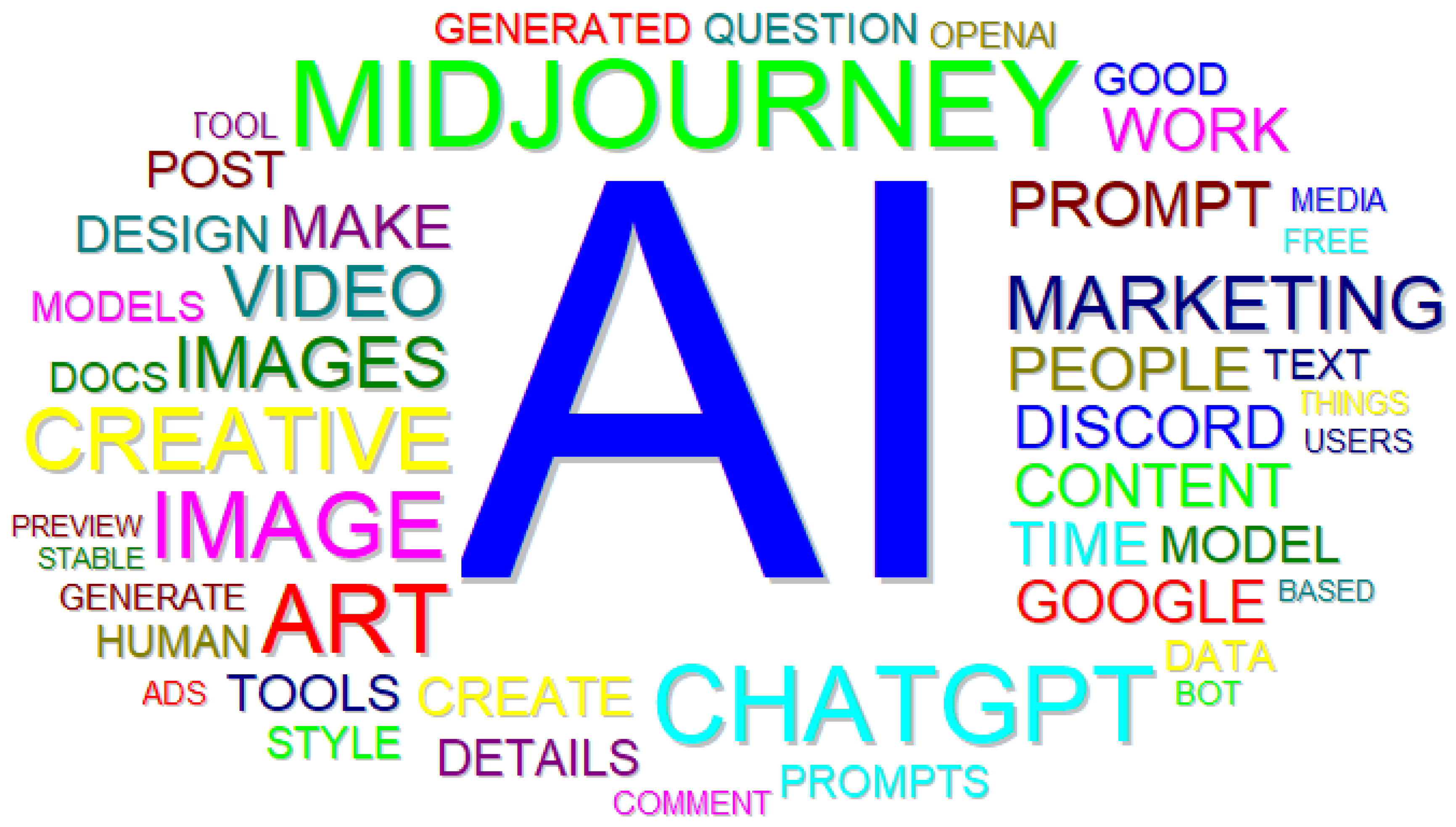
Figure 1 provides a visual summary of the most frequently occurring terms (frequency > 500) in the Reddit dataset. As expected, general terms like AI, Midjourney, and ChatGPT dominate the discussions. Other frequent words, such as creative, image, prompt, and content, point to a strong focus on visual and generative aspects of AI tools.
Table 3 presents the most frequently used words across all Reddit posts and comments related to AI-generated creativity. In the table, only words that occurred more than 500 times were included to reflect the vocabulary most often used in Reddit posts. The table contained the following indicators. The “Frequency” column showed the total number of times each word appeared across all posts and comments. “% Total” represented the proportion of each word relative to the total number of words in the dataset. “No. Cases” indicated the presence across posts and comments.
“% Total” represents the proportion of each word relative to the total number of words in the dataset. “No. Cases” refers to the number of individual entries (posts or comments) in which the word occurs at least once, while “% Cases” indicates the percentage of all entries where the word is present. Finally, the TF•IDF score (term frequency–inverse document frequency) helps assess the relative importance of a word [47], giving higher weight to words that are frequent in specific entries but not overly familiar across the entire dataset.
The most prominent term in Table 3, unsurprisingly, is “AI”, appearing in over 76% of all entries. Among specific tools, Midjourney, ChatGPT, and Stable Diffusion rank very high, with Midjourney mentioned in 34.2% of all entries and ChatGPT in 30.3%. Content-related terms such as “art”, “image”, “creative”, and “design” reflect the strong association between AI and visual or conceptual creativity. The high occurrence of “prompt”, “model”, and “tools” indicates a focus on the technical aspects of using generative AI, suggesting that users are actively discussing the mechanics and strategies of tool use, not just outcomes. Shorter but significant terms like “human”, “style”, “generated”, and “content” point to deeper concerns around authorship, aesthetic control, and originality. For example, the frequency of the word “human” (present in ~9.5% of cases) signals ongoing discourse about the role of human creativity versus machine-generated output. Interestingly, platform- and process-related terms such as “Discord”, “Google”, “OpenAI”, “media”, and “bot” reveal the broader digital ecosystems in which these tools are embedded, suggesting that users are not only focused on the creative act itself, but also on the surrounding infrastructure and platforms. The presence of words such as “question”, “good”, “style”, “tools”, and “generate” also suggests users are engaging in evaluative or exploratory conversations, asking for advice, comparing outputs, or reflecting on quality.

4.3.2. Phrase Frequency Analysis

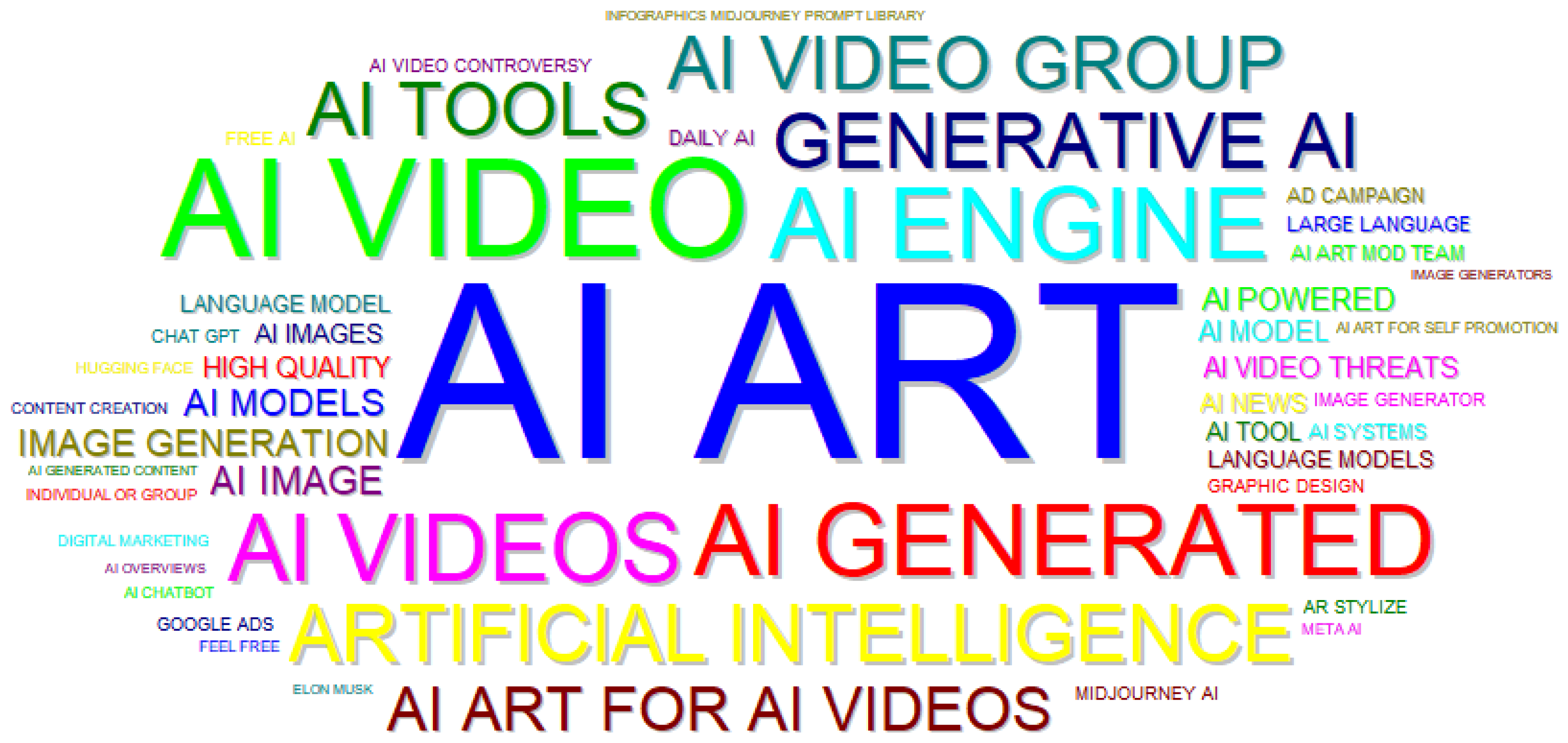
The word cloud in Figure 2 visually emphasizes the prominence of key multi-word phrases used in Reddit discussions on AI-generated creativity. The size of each phrase corresponds to its frequency, making the dominance of terms like “AI art,” “AI video,” “AI generated,” and “AI engine” immediately apparent. The clustering of related terms—such as those referring to video content, tools, or artistic applications—reflects the breadth of themes discussed, from technical infrastructure to creative output and platform-specific debates. The visual also highlights a mix of neutral, technical, and socially charged phrases, illustrating the multifaceted nature of user conversations.
Table 4 displays the most commonly used phrases across all Reddit posts and comments on AI-generated creativity that occurred more than 50 times. The phrase analysis offers deeper insight into the specific concepts and technologies dominating Reddit discussions on AI-generated creativity.
The most frequent multi-word phrases in Reddit posts clustered into four broad thematic groups: (1) creative outputs (e.g., AI art, video, image generation), (2) specific AI tools and models (e.g., Midjourney, Stable Diffusion, ChatGPT), (3) technical terms and processes (e.g., AI engine, generative AI), and (4) social or ethical concerns (e.g., bullying, threats, self-promotion).
First, the most common multi-word phrase is “AI art,” which appears 997 times and accounts for nearly 20% of all entries, reinforcing the centrality of AI-related applications in public discourse, particularly in visual content creation. Phrases like “AI video”, “AI videos”, and “AI video group” follow closely, suggesting growing interest in AI-generated video content and communities that share or produce it. The second group contains the terms related to specific tools. “Stable Diffusion”, “Generative AI”, and “Artificial Intelligence” also appear frequently, indicating sustained interest in specific technologies and broader AI paradigms. Notably, “AI engine”, mentioned in over 10% of cases, is likely a generalized term encompassing a range of tools or platforms. Third, the presence of tool-specific phrases such as “Midjourney prompt”, “Stability AI”, “Chat GPT”, and “Midjourney AI” confirms the continued attention given to leading creative AI tools. Additionally, terms like “image generation”, “graphic design”, and “text to image” show that users are not only discussing tools but also the practical processes and outcomes of their use. Fourth, social and ethical concerns are also reflected in the appearance of phrases such as “bullying and drama”, “AI video threats”, and “free from threats and bullying”, suggesting that discussions extend beyond technical use cases to include moderation, platform governance, and community dynamics.
The high TF•IDF values for many of these phrases indicate their contextual relevance: they are not just frequent, but particularly meaningful within specific clusters of discussions. This layered use of language provides evidence of both widespread engagement and thematic depth in online conversations about AI creativity.

4.4. Thematic Clusters in Reddit Discussions on AI Tools

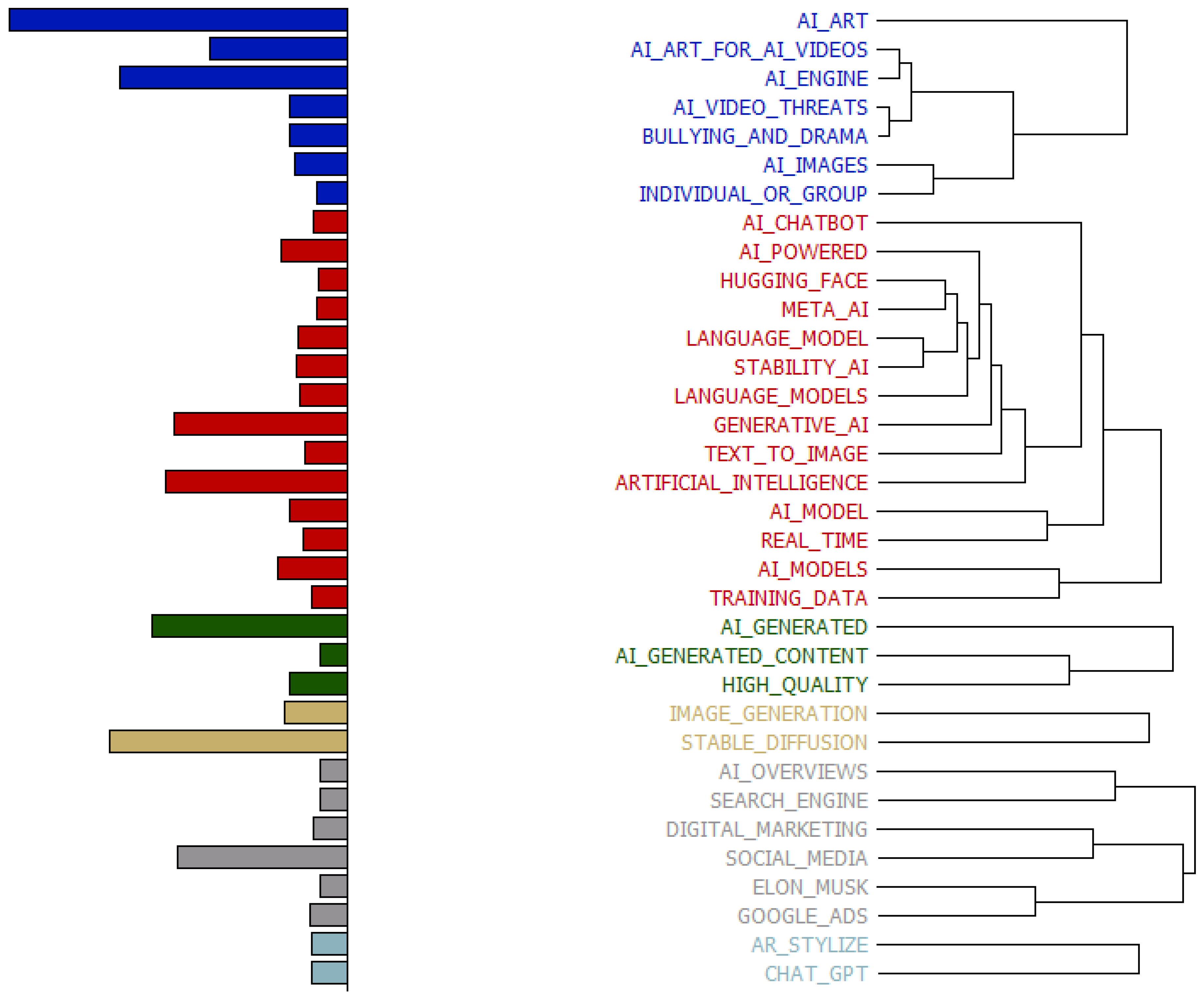
To identify overarching thematic patterns in the Reddit discourse on AI-generated creativity, for the purpose of reaching RO4, we applied hierarchical cluster analysis to the most frequent multi-word phrases. The resulting dendrogram (Figure 3) reveals a structured grouping of semantically and contextually related terms, based on their co-occurrence strength across posts and comments.
Figure 3 showed that the dataset’s discussions gravitated around several coherent thematic clusters, which could be broadly categorized into five groups:
  • Artistic Expression and Community Dynamics: This cluster (blue) includes terms such as AI art, AI art for AI videos, AI engine, AI video threats, bullying and drama, and individual or group. It captures not only the technical aspect of creating AI art and videos, but also social tensions and moderation challenges within user communities. The pairing of AI video threats with bullying and drama suggests a recurring concern about platform governance and content misuse.
  • AI Infrastructure and Language Models: The red cluster encompasses phrases like language model, language models, generative AI, stability AI, and meta AI, alongside text-to-image and artificial intelligence. This grouping reflects technical discussions on the backbone models and architectures powering creative AI applications. It also includes tool-specific references, such as Hugging Face, which indicate engagement with open-source frameworks and model training.
  • Content Generation and Quality Concerns: The green cluster features phrases like AI-generated, AI-generated content, and high quality, often discussed in relation to training data and real-time generation. This points to ongoing evaluations of output quality, data fidelity, and the perceived value of AI-produced content.
  • Tool-Specific Workflows and Outputs: The beige cluster includes image generation, Stable Diffusion, and AI overviews, capturing hands-on discussions about using specific tools and platforms. These terms are often used in tutorial-like posts or user walkthroughs of creative workflows.
  • Social, Promotional, and Cultural Themes: The grey and cyan clusters include digital marketing, Google Ads, Elon Musk, Chat GPT, AR stylize, and social media. These reflect a more externally focused discourse, covering the commercialization, cultural framing, and public figures associated with AI technologies.
The presented cluster analysis confirms that discussions about AI in creative industries are not limited to tool functionality but extend to include community governance, ethical tensions, and broader technological ecosystems.

4.5. Tool-Specific Themes and Discussion Patterns

Building on the thematic clustering of phrases, we now focus on how specific AI tools are discussed within Reddit communities, reaching towards RO5. Several tools and platforms—such as Midjourney, ChatGPT, Stable Diffusion, and DALL·E—emerge not only as frequent keywords but as central nodes around which users structure their opinions, questions, and creative practices. The discourse around each tool exhibits distinct thematic patterns.

4.5.1. Midjourney

Among the AI tools discussed on Reddit, Midjourney stands out as one of the most frequently mentioned and debated. The platform’s focus on visual outputs and its unique Discord-based interface have made it particularly salient in conversations about AI-generated creativity.
Midjourney is predominantly associated with artistic expression, aesthetics, and user experimentation. Terms like Midjourney prompt and Midjourney AI appear in contexts where users share visual outputs, seek advice on crafting better prompts, or compare image styles. Posts often include visual results and prompt formulas, indicating a community-driven learning environment.
Users often refer to Midjourney when sharing artistic outputs, discussing prompt engineering, or reflecting on aesthetic trends. A recurring topic is the evolution of the model across versions, with several users noting that updates can dramatically alter the “look” of generated images. For example, one user remarked, “I liked the grainy vintage feel of v3. Now everything looks too polished in v5.” Such comments suggest that Midjourney is not merely a technical tool but also a medium with a distinctive and evolving visual language.
Another dominant theme involves prompt crafting. Users exchange strategies, compare results, and build shared prompt libraries to fine-tune control over outputs. One contributor shared: “If you add ‘--testp’ at the end, it gives better lighting effects for portraits.” These exchanges highlight the emergence of collective experimentation and tacit knowledge-sharing, with prompt syntax acting as a new kind of creative literacy.
The Discord interface is both praised and criticized. Some users enjoy the communal environment and immediate feedback, while others find it chaotic or exclusionary. Comments such as “Midjourney’s Discord is overwhelming—I wish there was a standalone app” reflect a tension between openness and usability.
Ethical discussions also emerge in relation to Midjourney. Several threads raise concerns about style appropriation, particularly the ability to mimic living artists’ techniques without consent. A notable comment reads: “People are literally uploading Van Gogh-style art with their signature on it—that is not creation, that is theft.” These discussions often touch on authorship, authenticity, and the implications for professional artists whose work is scraped or imitated.
Finally, the tool is frequently cited in professional contexts. Freelancers mention using Midjourney for client pitches or to ideate faster. However, there is also hesitation. One user wrote: “I made a mood board with Midjourney, and the client thought I painted it. Now I don’t know what to say.” This reveals blurred boundaries between assistance and misrepresentation, especially in settings where transparency is expected.
In summary, Midjourney occupies a central place in Reddit discussions, not only for its technical capabilities but also for the cultural, aesthetic, and ethical questions it provokes. These patterns underscore how tool-specific features shape discourse and illustrate the complex relationship between users and creative AI systems.

4.5.2. ChatGPT

ChatGPT discussions lean toward textual creativity, automation, and conversational use cases. Users frequently explore its role in generating content, assisting with coding, or simulating dialogues. Although less visually oriented than Midjourney, ChatGPT prompts discussions about ethical implications, misinformation, and productivity gains.
ChatGPT is another central focus of Reddit discussions on AI-generated creativity, particularly in text-based creative domains such as copywriting, storytelling, dialogue generation, and even strategic ideation for design and marketing. Its flexibility and accessibility have made it widely adopted among both professionals and hobbyists.
A recurring theme in discussions is workflow integration. Users often describe how ChatGPT accelerates early-stage ideation or helps overcome creative blocks. One contributor noted: “I use ChatGPT to draft ad copy outlines before I go in and add brand voice. It saves hours.” This suggests that many users treat the tool as a first-draft generator rather than a final content producer, emphasizing its role as an augmentative rather than autonomous agent.
Another key topic is the quality and tone of outputs. At the same time, users praise its fluency; several express frustration with its generic or overly polished tone. One user commented: “It sounds professional, sure, but too robotic for creative writing. You have to really prompt it hard to get something with edge.” This feedback reflects a tension between efficiency and originality, highlighting the importance of user skill in steering the tool.
Prompting practices are also widely discussed. Many threads explore advanced prompt engineering, including role-based instructions (e.g., “Act as a creative director…”) or structured inputs for storytelling. As one user shared: “The difference between a good and bad result is usually one sentence in your prompt. It is all about layering context.” These exchanges reveal the emergence of a new creative literacy, where writing effective prompts is as valuable as editing the output.
Ethical and professional dilemmas also surface. Several users raise questions about authorship, disclosure, and originality. A design freelancer wrote: “I used ChatGPT to write my project description. Should I tell the client? It feels like cheating.” Others discuss academic or journalistic contexts in which AI use must be disclosed, prompting debates over transparency and intellectual property.
Notably, some users are experimenting with multi-tool workflows, combining ChatGPT with image-generation tools like Midjourney. For example, a typical pattern involves using ChatGPT to generate narrative prompts, which are then visualized in Midjourney. This synergy underscores ChatGPT’s role not just as a text tool, but as a conceptual engine across multiple creative modalities.
In sum, Reddit discourse positions ChatGPT as a versatile assistant in creative processes, powerful but imperfect, efficient but sometimes formulaic. The discussions reflect both enthusiasm for its potential and awareness of its limitations, as users negotiate the blurred boundary between automation and authorship in textual creativity.

4.5.3. Stable Diffusion

Stable Diffusion is linked to technical control and customization. Compared to other tools, users discuss model versions, installation guides, and fine-tuning options more often. This suggests a more advanced or technically engaged subset of users who prioritize open-source flexibility and local use.
Stable Diffusion appears in Reddit discussions as a widely adopted open-source image-generation model, valued for its customizability, local deployment options, and community-developed extensions. Compared to proprietary tools like Midjourney, users often highlight Stable Diffusion’s flexibility and transparency, describing it as a more “hands-on” and modifiable solution.
One of the most frequently discussed themes is control over style and outputs. Many users report using additional tools, such as ControlNet, LoRA models, and custom training datasets, to tailor results. As one user noted: “With Midjourney I get good results faster, but Stable lets me train it on my own characters—totally different level of control.” This illustrates a recurring perception of Stable Diffusion as a “developer’s tool” or an advanced option for technically skilled users.
There is also a strong emphasis on ethical considerations and content moderation. Because Stable Diffusion can be run locally and without platform-level restrictions, discussions often touch on issues of responsibility and governance. Some users express concern over deepfakes, explicit content, or misuse, while others frame its openness as empowering: “It’s your responsibility what you generate. That’s the point of open-source.” These conversations reflect broader tensions between freedom and accountability in the use of creative AI.
Users also frequently exchange technical tutorials and resources, including model repositories, prompt-tuning techniques, and workflow setups, using AUTOMATIC1111, a popular web UI for Stable Diffusion. The sharing of presets, styles, and sample outputs creates a collaborative ecosystem where experimentation and optimization are core values.
Several users compare Stable Diffusion to Midjourney and DALL·E, often favoring Stable for its custom training capabilities. One post reads: “Midjourney is magic out of the box. Nevertheless, Stable is a lab—you get out what you put in.” This dichotomy positions Stable Diffusion as a tool that rewards technical investment with creative specificity.
Overall, Reddit discussions frame Stable Diffusion as a powerful and democratized platform for generative visual content, less guided than its commercial counterparts, but more adaptable, transparent, and community-driven. It is portrayed as a space where technical knowledge becomes creative leverage, and where users must balance freedom, responsibility, and effort in pursuit of their artistic goals.

4.5.4. DALL-E

DALL·E, although less dominant, is typically discussed in relation to its visual output quality, limitations on prompt specificity, and integration with commercial platforms like OpenAI’s web services. These conversations often reflect user comparisons and trade-offs between control and accessibility.
DALL·E, developed by OpenAI, is featured primarily in Reddit discussions as a benchmark tool that helped popularize text-to-image generation among broader audiences. Although not as frequently mentioned as Midjourney or Stable Diffusion, it is commonly referenced in comparative discussions and evaluations of output quality, realism, and usability. Many users associate DALL·E with its early role in democratizing access to image generation: “DALL·E was my first contact with AI art. It opened the door, even if now I mostly use other tools.”
A dominant theme in discussions involving DALL·E is its balance between accessibility and limitations. Users often praise its simple interface and clean results, especially for less stylized or conceptual images. However, limitations on content generation, resolution, and prompt complexity are frequently noted. For example, one user remarked: “It’s great for corporate-safe visuals, but feels too sanitized for creative experimentation.” This perception aligns with OpenAI’s stricter content moderation policies, which are sometimes described as more restrictive than those of more open-source or user-directed tools.
Another recurring topic is integration—particularly DALL·E’s availability through platforms such as ChatGPT’s image generation interface or Microsoft’s tools (e.g., Bing Image Creator). This ease of access contributes to its reputation as a beginner-friendly entry point, especially for users unfamiliar with standalone generation platforms.
Although DALL·E is less prominent in in-depth workflow discussions, its influence remains visible in posts about AI adoption, platform design, and the evolution of visual outputs. Users frequently refer to it as a starting point for their AI art journey, even as they transition to more customizable or specialized systems. As one commenter put it: “DALL·E is like training wheels. You outgrow it, but you wouldn’t be riding without it.”
Reddit discourse positions DALL·E as an important gateway technology in the landscape of generative AI—valued for its accessibility and brand recognition, but often set aside in favor of tools that offer greater freedom, detail, or user control in advanced creative workflows.

4.5.5. Tool Comparison

Table 5 highlights distinct patterns in users’ engagement with different generative AI tools. While all tools serve creative purposes, the tone and focus of discussions vary considerably.
Midjourney fosters a visually driven, collaborative atmosphere centered on aesthetics and co-creation. ChatGPT threads are more pragmatic, often involving prompt optimization, problem-solving, and even philosophical reflection. Discussions around Stable Diffusion tend to be technical and customization-oriented, reflecting its open-source nature. In contrast, DALL·E is frequently discussed in terms of access limitations and platform constraints, often framed in terms of user frustration. These differences suggest that user experience with AI tools is shaped not only by technical capabilities but also by community dynamics, accessibility, and creative expectations.

4.6. Sentiment Analysis and Interpretation

To address RO6, sentiment was analyzed using a hybrid approach that combined an automated sentiment analysis with narrative interpretation. A pre-trained natural language processing model was applied to classify Reddit posts and comments as positive, negative, or neutral, and to assign a continuous sentiment score reflecting emotional intensity.
The automated model processed all entries and assigned both categorical labels and numeric sentiment scores ranging from −1 (most negative) to +1 (most positive). Table 6 presents the overall sentiment distribution across the dataset, along with key statistics for sentiment scores by category.
The sentiment landscape showed that most Reddit posts on generative AI in the creative industries were either neutral or moderately positive. However, a significant portion (20%) reflected negative sentiment, often tied to concerns about ethical implications, job security, or creative authenticity. Positive posts tended to emphasize empowerment, experimentation, and the novelty of AI tools, while neutral entries often described technical issues or provided descriptive information. This distribution offered a foundational perspective for understanding how emotional attitudes toward generative AI were shaped in informal creative communities.
In addition to automated sentiment analysis, the interpretative analysis of negative comments was conducted. Emerging themes from Reddit discussions indicate a highly ambivalent but engaged user community. Although the dataset was not processed through a formal sentiment-analysis model, the tone, vocabulary, and recurrent thematic structures allow for a reliable narrative interpretation of how users emotionally position themselves toward generative AI tools. Across subreddits, expressions of enthusiasm and curiosity coexist with frustration, skepticism, and ethical unease, creating a multidimensional sentiment landscape shaped by both practical experience and broader cultural debate.
A substantial share of comments reflects positive, opportunity-oriented sentiment, most commonly associated with productivity gains, creative acceleration, and the democratization of artistic tools. Users often describe AI systems as “helpful,” “inspiring,” “time-saving,” or “game-changing,” particularly when referring to Midjourney’s visual outputs or ChatGPT’s capacity to streamline ideation and drafting tasks. Posts that share prompt recipes, visual showcases, or workflow walkthroughs tend to carry an enthusiastic tone, emphasizing experimentation, collaborative learning, and the ease with which newcomers can now create professional-looking work. This optimistic sentiment is evident in high-activity subreddits like r/Midjourney and r/aiArt, where community dynamics are oriented toward sharing outputs and refining techniques.
In parallel, a strong, critical, and problem-oriented sentiment is evident, particularly regarding issues of quality, control, reliability, and ethical implications. Users frequently highlight shortcomings such as model inconsistency, over-polished or repetitive styles, and the difficulty of achieving precise creative intent. Comments describing results as “inaccurate,” “generic,” “frustrating,” or “too restrictive” appear especially in discussions about ChatGPT’s tone and DALL·E’s content limitations. Another recurring negative sentiment concerns style appropriation, intellectual property, and the perceived threat to professional artists and freelancers. Phrases related to “style theft,” “AI video threats,” and “bullying and drama” reflect a moral and emotional dimension that extends beyond tool performance, suggesting more profound anxieties about authorship and fairness.
Between these poles lies a broad ambivalent or cautiously optimistic sentiment, manifested in posts that appreciate the utility of AI tools while simultaneously underscoring the need for transparency, responsible use, and human oversight. Users in more professionally focused subreddits such as r/Freelance or r/Marketing often articulate conditional acceptance: AI is welcomed as long as it remains a support tool rather than a replacement. Comments emphasizing the importance of “control,” “human touch,” or “authenticity” suggest that users negotiate their relationship to AI in pragmatic terms, balancing efficiency with identity and craft.
Overall, Reddit discourse reveals a sentiment environment that is neither uniformly enthusiastic nor uniformly critical. Instead, it reflects a complex negotiation between the excitement of new creative possibilities and the uncertainties introduced by automation, platform governance, and shifting cultural norms. This layered sentiment landscape reinforces the notion that user perceptions of generative AI are shaped not only by technical capabilities but by broader values related to creativity, professional integrity, and community belonging. While interpretive in nature, this analysis is grounded in data-derived patterns and remains within the scope of empirical findings.


5. Discussion and Conclusions

5.1. Summary of Research

This study investigated how generative AI tools are discussed and perceived within online creative communities, focusing on Reddit as a platform for user-led discourse. Drawing on nearly 4000 posts and comments from six subreddits, the analysis combined descriptive statistics and text-mining techniques to examine dominant vocabulary, tool-specific themes, and sentiment patterns. Key findings suggest that user engagement is shaped not only by the technical capabilities of AI tools but also by community dynamics, accessibility concerns, and creative objectives. Midjourney, ChatGPT, Stable Diffusion, and DALL·E each prompted distinct types of discussion, reflecting their perceived roles within creative workflows. Furthermore, ethical and emotional dimensions—such as concerns about ownership, authenticity, and moderation—were deeply embedded in the discourse. The study thus confirms that generative AI is viewed not merely as a set of technologies, but as a socio-technical phenomenon reshaping creative industries at multiple levels.

5.2. Theoretical Contributions

This research makes several key contributions to the expanding literature on artificial intelligence and creativity by providing an empirically grounded, user-centered analysis of how generative AI tools are perceived and negotiated within informal online communities. Unlike prior research that often emphasizes the technical affordances of AI [1], its impact on productivity [2], or macro-level economic trends [3], this study brings forward the voices of actual users—designers, freelancers, artists, and content creators—who actively engage with tools such as Midjourney, ChatGPT, Stable Diffusion, and DALL·E. It foregrounds how individuals conceptualize, critique, and adapt these technologies within real-world creative workflows and peer-driven platforms.
By situating the analysis within the framework of human–AI interaction and social media-based knowledge production [6,7], the study extends theoretical understanding of AI not simply as a technological intervention but as a culturally and emotionally embedded phenomenon. It reveals how platforms like Reddit become arenas for sense-making, resistance, experimentation, and co-creation [11,12]. This perspective aligns with recent calls to shift attention from top-down models of AI diffusion toward bottom-up, socially situated adoption processes [13].
The findings enrich debates on digital transformation in creative industries, revealing how the integration of generative AI intersects with professional identities, aesthetic standards, and ethical concerns. As seen in previous research [3,4], questions of authenticity, authorship, and control are central to understanding how creative professionals respond to emerging technologies. Our results echo and deepen these insights by showing how users articulate such concerns organically in participatory, unstructured digital environments. For instance, debates around artistic originality, data ethics in training, and access constraints frequently arise, pointing to a complex interplay among innovation, legitimacy, and community governance [14,37].
In addition, the study illustrates how AI tools are not perceived as neutral instruments but as value-laden systems embedded in socio-technical narratives. Users position tools differently based on their accessibility, customization capabilities, visual output quality, and perceived creative autonomy. This resonates with broader concerns in the HCI and digital creativity literature that advocate for user-centered AI and emphasize symbiotic relationships between humans and machines [19,20,22,23].
Methodologically, the research contributes by showcasing the potential of combining text mining with qualitative, interpretive reading of public discourse. Building on the approaches outlined by [8], the study operationalizes machine–learning–based frequency analysis and thematic clustering to structure vast volumes of unstructured social media text. By analyzing Reddit content from over 3.5 years, the study avoids the limitations of short-term or artificially constrained sentiment analysis, instead offering a richer temporal and contextual understanding of discourse formation. This approach also aligns with recent work emphasizing the importance of integrating narrative context and linguistic nuance into computational analyses [8,10].
Taken together, the study demonstrates that examining user-led conversations on platforms like Reddit offers critical insights not only into what AI tools do, but also into how they are felt, discussed, and resisted. It thus helps bridge the gap between technical capability and lived experience, reinforcing the argument that technological adoption in creative industries must be analyzed through cultural, emotional, and ethical lenses as much as through economic or technological ones [39,41,42]. By documenting how generative AI tools are framed in everyday practice, this research provides a grounded, practice-oriented contribution to the evolving discourse on AI in the arts, design, and content production.

5.3. Practical Implications

The findings of this study offer several practical implications for stakeholders involved in the development, deployment, and governance of generative AI tools in creative industries. As AI systems become increasingly integrated into everyday creative workflows, developers, platform managers, and industry leaders need to understand not just functional adoption but also how users emotionally and socially engage with these tools.
First, the analysis confirms that user experience (UX) and accessibility play a key role in shaping attitudes toward generative AI. Tools that provide intuitive interfaces, offer low barriers to entry, and allow for meaningful customisation—such as Midjourney’s prompt-based image generation or ChatGPT’s conversational flexibility—were perceived more positively. This supports earlier findings by [24,25], who emphasize that ease of use and transparency directly influence the adoption of intelligent systems. Therefore, designers should prioritize UX-driven development, ensuring that creative users feel empowered rather than constrained by AI functionality.
Second, the data reveal that community knowledge sharing and peer learning significantly influence how users evaluate AI tools. On Reddit, collaborative discussions, tutorial-style posts, and co-creation spaces (especially within Midjourney and Stable Diffusion threads) contribute to sustained engagement. This suggests that product teams should invest in community-building features, such as in-app feedback loops, shared prompt libraries, and forums for creative exchange. Supporting horizontal, peer-to-peer learning structures may enhance trust, reduce onboarding time, and foster loyalty among non-expert users [20,23].
Third, frequent expressions of concern about ethical, legal, and professional dilemmas—such as fears of style theft, data transparency, or content censorship—highlight the importance of clear policy communication and alignment with values. Tool providers should proactively engage in ethical UX design, making algorithmic choices and data provenance visible to users [37,39]. In particular, freelance creatives voiced concerns over attribution, content originality, and the future of creative labor, echoing prior findings about the vulnerability of creative workforces in automation contexts [3,4,48]. Companies must therefore provide ethically grounded guidelines and legal clarity regarding ownership and authorship in AI-generated content. These concerns resonate with earlier phases of human–AI collaboration in professional domains, most notably in software development, where systems such as OpenAI Codex and GitHub Copilot relied on reinforcement learning from human feedback (RLHF) to align generative outputs with human intent, trust, and skill expectations [49,50].
Fourth, the observed variation in tone and community dynamics across tools (e.g., visual collaboration in Midjourney vs. pragmatic debate in ChatGPT) suggests that AI adoption is not monolithic. Adoption strategies should be context-aware, taking into account domain-specific needs. For example, visual artists may benefit more from real-time co-creation features and customizable outputs, while content writers may require semantic control and citation transparency. A one-size-fits-all approach risks alienating key user groups.
Fifth, the discourse analysis underscores that platform dynamics and gatekeeping structures—such as DALL·E’s limited accessibility and API constraints—can negatively impact perception and engagement. Accessibility barriers were frequently interpreted as a lack of inclusivity or corporate overreach. Developers and platform owners should consider inclusive design and transparent governance models to avoid alienating user communities [40,41]. Several recommendations, such as the inclusion of onboarding tutorials and multilingual support, are grounded in observed user concerns about accessibility, clarity, and inclusivity, which were frequently expressed across subreddits. Similarly, the suggestion for partnerships with educators and cultural institutions responds to user discussions on the need for ethical guidance and creative training.
Based on the findings, the following recommendations can inform practice in AI tool design, deployment, and policy development:
  • Integrate onboarding tutorials and community forums directly into the tool interface to support creative skill-building and prompt discovery.
  • Although explicit calls for ready-made templates were not frequent in the analyzed discourse, providing intuitive examples and guided creative prompts—especially for novice users—could reduce onboarding friction and improve usability.
  • Offer clear communication on data sources, copyright policy, and model training methods to build trust and address legal uncertainty.
  • Develop ethical guidelines for attribution, fair use, and content moderation, and involve user communities in shaping these standards.
  • While the analysis focused on English-language discourse, expanding multilingual and culturally adaptive features may help address perceived exclusion and broaden participation [12].
  • Monitor user sentiment and discourse through ongoing social media listening, enabling adaptive product design based on honest user feedback [7,10].
  • Although partnerships were not a recurring topic in the dataset, fostering collaboration with educators and cultural institutions could support ethical awareness, digital literacy, and socially responsible AI adoption in creative contexts.
By adopting these practices, stakeholders can help shape a generative AI landscape that is not only technologically innovative but also socially equitable, emotionally resonant, and creatively empowering.

5.4. Limitations and Future Research Directions

This study provides a valuable overview of Reddit-based discussions on generative AI in creative industries, yet several limitations warrant consideration. The analysis is limited to selected subreddits, which may not represent the full diversity of creative professionals or user communities. Reddit’s user base is also demographically skewed, limiting generalizability to broader populations. In addition, the reliability of Reddit discourse may be affected by the presence of automated accounts and AI-generated content, which can influence visibility, tone, and interaction dynamics. While moderation practices and community norms mitigate some forms of manipulation, the potential participation of bots or non-human agents cannot be fully excluded. As a result, the analyzed discussions should be interpreted as indicative of discursive tendencies rather than as a fully accurate representation of individual human opinions. In addition, future work should consider the implications of authorship and data ownership in user-generated platforms, especially in cases where the boundaries between original human contributions and AI-generated responses are blurred. The question of who constitutes the “creator” of such content remains legally and ethically ambiguous.
While text mining enabled efficient theme identification, it cannot fully capture the nuance of informal online language, irony, or shifting cultural references. Sentiment-related findings are based on automated classification supported by narrative interpretation. Although the dataset spans a three-year period, the analysis did not include explicit modeling of temporal patterns or longitudinal shifts in discourse. Future research should adopt time-sensitive methods to trace evolving public attitudes toward generative AI, capturing how perceptions and concerns change over time. Although the pre-trained model offers valuable insight into general emotional trends, future research could further validate these results using supervised NLP models and cross-platform triangulation. Moreover, focusing on a few well-known tools may overlook discourse on emerging platforms or niche applications. To deepen insight, future work should explore multiple platforms, track discourse evolution over time, and incorporate data on actual usage and creative outcomes. The platform-specific biases of Reddit—including its predominantly male, tech-oriented user base and the presence of AI bots that may reinforce certain ideological patterns—raise important questions about the representativeness and inclusivity of the captured discourse. These limitations underscore the importance of complementing Reddit-based analysis with data from diverse, demographically varied platforms.

Author Contributions

Conceptualization, M.B., M.P.B. and T.B.; methodology, M.B. and T.B.; software, M.P.B.; validation, M.P.B. and T.B.; formal analysis, M.B., M.P.B. and T.B.; investigation, M.B.; resources, M.B.; data curation, M.P.B.; writing—original draft preparation, M.B.; writing—review and editing, M.B., M.P.B. and T.B.; visualization, M.P.B.; supervision, T.B.; project administration, M.B. All authors have read and agreed to the published version of the manuscript.

Funding

This research received no external funding.

Data Availability Statement

The raw data supporting the conclusions of this article will be made available by the authors on request.

Conflicts of Interest

The authors declare no conflicts of interest.

Abbreviation

The following abbreviation is used in this manuscript:
AIArtificial intelligence

References

  1. Anantrasirichai, N.; Bull, D. Artificial intelligence in the creative industries: A review. Artif. Intell. Rev. 2022, 55, 589–656. [Google Scholar] [CrossRef]
  2. Yu, Y. The role and influence of artificial intelligence on advertising industry. In Proceedings of the 2021 International Conference on Social Development and Media Communication (SDMC 2021), Sanya, China, 26–28 November 2021; Atlantis Press: Dordrecht, The Netherlands, 2021; pp. 190–194. [Google Scholar] [CrossRef]
  3. Dobbs, R.; Manyika, J.; Woetzel, J. No Ordinary Disruption: The Four Global Forces Are Breaking All the Trends; PublicAffairs: New York, NY, USA, 2015; Volume 11, pp. 1–5. [Google Scholar]
  4. Ivcevic, Z.; Grandinetti, M. Artificial intelligence as a tool for creativity. J. Creat. 2024, 34, 100079. [Google Scholar] [CrossRef]
  5. Stephensen, J.L. Post-creativity and AI: Reverse-engineering our Conceptual Landscapes of Creativity. In Proceedings of the 11th International Conference on Computational Creativity (ICCC’20), Online, 7–11 September 2020; pp. 326–333. [Google Scholar]
  6. Sobkowicz, P.; Kaschesky, M.; Bouchard, G. Opinion mining in social media: Modeling, simulating, and forecasting political opinions in the web. Gov. Inf. Q. 2012, 29, 470–479. [Google Scholar] [CrossRef]
  7. Grover, P.; Kar, A.K.; Dwivedi, Y.K. Understanding artificial intelligence adoption in operations management: Insights from the review of academic literature and social media discussions. Ann. Oper. Res. 2022, 308, 177–213. [Google Scholar] [CrossRef]
  8. Pejic-Bach, M.; Bertoncel, T.; Meško, M.; Krstić, Ž. Text mining of industry 4.0 job advertisements. Int. J. Inf. Manag. 2020, 50, 416–431. [Google Scholar] [CrossRef]
  9. Md Saad, N.H.; San, C.W.; Yaacob, Z. Twitter sentiment analysis of the low-cost airline services after COVID-19 outbreak: The case of AirAsia. Bus. Syst. Res. Int. J. Soc. Adv. Innov. Res. Econ. 2023, 14, 1–23. [Google Scholar] [CrossRef]
  10. Wei, M.; Zhang, P.; Chen, C.; Chen, D.; Zuo, C.; Meng, L. Mapping AI ethics narratives: Evidence from Twitter discourse between 2015 and 2022. Humanit. Soc. Sci. Commun. 2025, 12, 212. [Google Scholar] [CrossRef]
  11. Qi, W.; Pan, J.; Lyu, H.; Luo, J. Excitements and concerns in the post-ChatGPT era: Deciphering public perception of AI through social media analysis. Telemat. Inform. 2024, 92, 102158. [Google Scholar] [CrossRef]
  12. Murayama, T.; Miyazaki, K.; Matsubara, Y.; Sakurai, Y. Linguistic Landscape of Generative AI Perception: A Global Twitter Analysis Across 14 Languages. Proc. Int. AAAI Conf. Web Soc. Media 2025, 19, 1262–1294. [Google Scholar] [CrossRef]
  13. Khatiwada, P.; Washington, J.; Walsh, T.; Hamed, A.S.; Bhatta, L. The Ethical Implications of AI in Creative Industries: A Focus on AI-Generated Art. arXiv 2015, arXiv:2507.05549. [Google Scholar] [CrossRef]
  14. Christensen, C. The Innovator’s Dilemma; Harvard Business School Press: Cambridge, MA, USA, 1997. [Google Scholar]
  15. Marshall, J.; Thompson-Whiteside, S.; Jan, T. Barriers to the adoption of Industry 4.0 technologies within the Australian fashion industry. Int. J. Fash. Des. Technol. Educ. 2025, 18, 321–331. [Google Scholar] [CrossRef]
  16. Garcia, M.B. The paradox of artificial creativity: Challenges and opportunities of generative AI artistry. Creat. Res. J. 2024, 37, 755–768. [Google Scholar] [CrossRef]
  17. Ferreira, P.; Limongi, R.; Fávero, L.P. Generating music with data: Application of deep learning models for symbolic music composition. Appl. Sci. 2023, 13, 4543. [Google Scholar] [CrossRef]
  18. Dhruv, G.; Roggeveen, A.L.; Nordfält, J. The future of retailing. J. Retail. 2017, 93, 1–6. [Google Scholar] [CrossRef]
  19. Xing, B.; Marwala, T. Creativity and artificial intelligence: A digital art perspective. arXiv 2018, arXiv:1807.08195. [Google Scholar] [CrossRef]
  20. Jarrahi, M.H. Artificial intelligence and the future of work: Human-AI symbiosis in organizational decision-making. Bus. Horiz. 2018, 61, 577–586. [Google Scholar] [CrossRef]
  21. Brown, T.; Mann, B.; Ryder, N.; Subbiah, M.; Kaplan, J.D.; Dhariwal, P.; Neelakantan, A.; Shyam, P.; Sastry, G.; Askell, A.; et al. Language models are few-shot learners. Adv. Neural Inf. Process. Syst. 2020, 33, 1877–1901. [Google Scholar]
  22. Gatys, L.A.; Ecker, A.S.; Bethge, M. Image style transfer using convolutional neural networks. In Proceedings of the IEEE Conference on Computer Vision and Pattern Recognition, Las Vegas, NV, USA, 27–30 June 2016; pp. 2414–2423. [Google Scholar] [CrossRef]
  23. Moruzzi, C.; Margarido, S. A user-centered framework for human-ai co-creativity. In Extended Abstracts of the CHI Conference on Human Factors in Computing Systems; Association for Computing Machinery: New York, NY, USA, 2024; pp. 1–9. [Google Scholar] [CrossRef]
  24. Lu, Y.; Yang, Y.; Zhao, Q.; Zhang, C.; Li, T.J.J. AI assistance for UX: A literature review through human-centered AI. arXiv 2024, arXiv:2402.06089. [Google Scholar] [CrossRef]
  25. Norman, D. The Design of Everyday Things: Revised and Expanded Edition; Basic Boos: New York, NY, USA, 2013. [Google Scholar]
  26. Ismatullaev, U.V.U.; Kim, S.H. Review of the factors affecting acceptance of AI-infused systems. Hum. Factors 2024, 66, 126–144. [Google Scholar] [CrossRef]
  27. Ye, T.; Xue, J.; He, M.; Gu, J.; Lin, H.; Xu, B.; Cheng, Y. Psychosocial factors affecting artificial intelligence adoption in health care in China: Cross-sectional study. J. Med. Internet Res. 2019, 21, e14316. [Google Scholar] [CrossRef]
  28. Hsieh, P.J. Determinants of physicians’ intention to use AI-assisted diagnosis: An integrated readiness perspective. Comput. Hum. Behav. 2023, 147, 107868. [Google Scholar] [CrossRef]
  29. Na, S.; Heo, S.; Han, S.; Shin, Y.; Roh, Y. Acceptance model of artificial intelligence (AI)-based technologies in construction firms: Applying the Technology Acceptance Model (TAM) in combination with the Technology–Organisation–Environment (TOE) framework. Buildings 2022, 12, 90. [Google Scholar] [CrossRef]
  30. Russo, D. Navigating the complexity of generative AI adoption in software engineering. ACM Trans. Softw. Eng. Methodol. 2024, 33, 1–50. [Google Scholar] [CrossRef]
  31. Xu, J.; Zhang, X.; Li, H.; Yoo, C.; Pan, Y. Is everyone an artist? A study on user experience of AI-based painting system. Appl. Sci. 2023, 13, 6496. [Google Scholar] [CrossRef]
  32. Sohn, K.; Kwon, O. Technology acceptance theories and factors influencing artificial Intelligence-based intelligent products. Telemat. Inform. 2020, 47, 101324. [Google Scholar] [CrossRef]
  33. Gursoy, D.; Chi, O.H.; Lu, L.; Nunkoo, R. Consumers acceptance of artificially intelligent (AI) device use in service delivery. Int. J. Inf. Manag. 2019, 49, 157–169. [Google Scholar] [CrossRef]
  34. Chen, Y.; Wu, Z.; Wang, P.; Xie, L.; Yan, M.; Jiang, M.; Zhu, J. Radiology Residents’ Perceptions of Artificial Intelligence: Nationwide Cross-Sectional Survey Study. J. Med. Internet Res. 2023, 25, e48249. [Google Scholar] [CrossRef]
  35. Mohr, S.; Kühl, R. Acceptance of artificial intelligence in German agriculture: An application of the technology acceptance model and the theory of planned behavior. Precis. Agric. 2021, 22, 1816–1844. [Google Scholar] [CrossRef]
  36. Anandaputra, G.V.; Yungistira, G.A.; Nicholas, O.; Mailangkay, A.B. Analysis on User’s Attitude Towards Content Creation Using Artificial Intelligence in Social Media. In Proceedings of the 2024 3rd International Conference on Creative Communication and Innovative Technology (ICCIT), Tangerang, Indonesia, 7–8 August 2024; IEEE: Tangerang, Indonesia, 2024; pp. 1–6. [Google Scholar]
  37. Crimaldi, F.; Leonelli, M. AI and the creative realm: A short review of current and future applications. arXiv 2023, arXiv:2306.01795. [Google Scholar] [CrossRef]
  38. Muhlenbach, F. A methodology for ethics-by-design AI systems: Dealing with human value conflicts. In Proceedings of the 2020 IEEE International Conference on Systems, Man, and Cybernetics (SMC), Toronto, ON, Canada, 11–14 October 2020; IEEE: Toronto, ON, Canada, 2020; pp. 1310–1315. [Google Scholar]
  39. Gervais, D.J. The machine as author. Iowa Law Rev. 2020, 105, 2053–2106. [Google Scholar]
  40. Campolo, A.; Crawford, K. Enchanted determinism: Power without responsibility in artificial intelligence. Engag. Sci. Technol. Soc. 2020, 6, 1–19. [Google Scholar] [CrossRef]
  41. Crawford, K. Atlas of AI: Power, Politics, and the Planetary Costs of Artificial Intelligence; Yale University Press: New Haven, CT, USA, 2021. [Google Scholar]
  42. Elgammal, A. CAN: Creative adversarial networks, generating “art” by learning about styles and deviating from style norms. arXiv 2017, arXiv:1706.07068. [Google Scholar] [CrossRef]
  43. Giachanou, A.; Crestani, F. Like it or not: A survey of Twitter sentiment analysis methods. ACM Comput. Surv. 2016, 49, 1–41. [Google Scholar] [CrossRef]
  44. Jiang, Y.; Lin, W. A comparative analysis of retrieval algorithms of land surface temperature from Landsat-8 data: A case study of Shanghai, China. Int. J. Environ. Res. Public Health 2021, 18, 5659. [Google Scholar] [CrossRef] [PubMed]
  45. Gandomi, A.; Haider, M. Beyond the hype: Big data concepts, methods, and analytics. Int. J. Inf. Manag. 2015, 35, 137–144. [Google Scholar] [CrossRef]
  46. Boardflare. Sentiment Analysis. 2025. Available online: https://www.boardflare.com/tasks/nlp/sentiment (accessed on 18 December 2025).
  47. Ramos, J. Using TF-IDF to determine word relevance in document queries. Proc. First Instr. Conf. Mach. Learn. 2003, 242, 133–142. [Google Scholar]
  48. Peterlin, J.; Meško, M.; Dimovski, V.; Roblek, V. Automated content analysis: The review of the big data systemic discourse in tourism and hospitality. Syst. Res. Behav. Sci. 2021, 38, 377–385. [Google Scholar] [CrossRef]
  49. Ouyang, L.; Wu, J.; Jiang, X.; Almeida, D.; Wainwright, C.L.; Mishkin, P.; Zhang, C.; Agarwal, S.; Slama, K.; Ray, A.; et al. Training language models to follow instructions with human feedback. arXiv 2022, arXiv:2203.02155. [Google Scholar]
  50. Wong, M.F.; Tan, C.W. Aligning crowd-sourced human feedback for reinforcement learning on code generation by large language models. IEEE Trans. Big Data 2024, 1–12. [Google Scholar] [CrossRef]
Figure 1. Word cloud of the most frequent words in Reddit posts and comments (500+ frequency); Source: Authors’ work, using Wordstat2022 (v. 2022.0.5).
Systems 14 00116 g001
Figure 2. Word cloud of the most frequent phrases in Reddit posts and comments (50+ frequency); Source: Authors’ work, using Wordstat.
Systems 14 00116 g002
Figure 3. Cluster analysis of phrases in Reddit posts and comments (50+ frequency); Source: Authors’ work, using Wordstat.
Systems 14 00116 g003
Table 1. Characteristics of the posts extracted, structured by keyword groups (n = 3994).
Characteristic# of PostsStructure in %
Subreddit
aiArt125231.3
artificial92423.1
Freelance250.6
Illustration481.2
Marketing65016.3
Midjourney109527.4
Year
20221323.3
202378519.7
2024110727.7
2025 (January–June)197049.3
Type
Comment204451.2
Post195048.8
Source: Authors’ work.
Table 2. Descriptive statistics of text length in Reddit posts and comments.
TypePostComment
Avg. Characters1772.1522.1
Avg. Words267.376.1
Min Characters31
Max Characters31,9335587
Min Words11
Max Words5036994
Std Characters2809.1531
Std Words41684.3
Source: Authors’ work.
Table 3. Word frequency distribution in Reddit posts and comments (500+ frequency).
FREQUENCY% TOTALNO. CASES% CASESTF•IDF
AI10,8181.34%304676.26%1273.0
MIDJOURNEY23300.29%136634.20%1085.7
CHATGPT20390.25%121030.30%1057.5
ART18210.23%88722.21%1190.0
IMAGE17800.22%84121.06%1204.4
CREATIVE16470.20%122030.55%848.3
MARKETING14100.18%44211.07%1347.9
IMAGES13780.17%74718.70%1003.3
VIDEO13550.17%64216.07%1075.7
PROMPT11740.15%56714.20%995.3
PEOPLE11490.14%56114.05%979.5
MAKE11450.14%68217.08%878.9
CONTENT10980.14%42910.74%1063.9
DISCORD10890.14%56314.10%926.6
TIME10860.13%61215.32%884.7
GOOGLE10580.13%3177.94%1164.2
WORK10580.13%63715.95%843.5
CREATE10400.13%63515.90%830.6
TOOLS9860.12%55813.97%842.8
DESIGN9780.12%63715.95%779.7
MODEL9730.12%3348.36%1048.6
POST9710.12%80720.21%674.4
DETAILS8910.11%2696.74%1043.9
HUMAN8840.11%3809.51%903.1
GOOD8460.11%57414.37%712.8
STYLE8170.10%43610.92%785.9
PROMPTS7950.10%42910.74%770.3
GENERATED7730.10%51512.89%687.7
DATA7660.10%3488.71%811.8
MODELS7610.09%3087.71%846.9
DOCS7390.09%49512.39%670.1
TEXT7340.09%3729.31%756.7
QUESTION7270.09%67316.85%562.3
GENERATE6800.08%45911.49%638.9
TOOL6530.08%3849.61%664.2
OPENAI6270.08%2867.16%717.9
MEDIA6080.08%2556.38%726.5
BOT5890.07%57014.27%498.0
THINGS5800.07%3749.36%596.6
USERS5740.07%2325.81%709.4
COMMENT5720.07%53613.42%498.9
ADS5710.07%1784.46%771.4
FREE5710.07%3839.59%581.4
BASED5590.07%3428.56%596.7
STABLE5560.07%3939.84%559.9
PREVIEW5450.07%2726.81%635.9
INTELLIGENCE5300.07%2536.33%635.1
META5270.07%1553.88%743.6
NEWS5240.07%2015.03%680.3
SOCIAL5120.06%2476.18%618.9
PROMOTE5080.06%50312.59%457.1
SEARCH5060.06%2045.11%653.6
WORLD5060.06%2857.14%580.2
ENGINE5040.06%47711.94%465.1
REDD5020.06%2466.16%607.7
Source: Authors’ work, using Wordstat.
Table 4. Phrase frequency distribution in Reddit posts and comments (500+ frequency).
FREQUENCYNO. CASES% CASESLENGTHTF•IDF
AI ART99777919.50%2707.7
AI VIDEO5472897.24%2623.9
STABLE DIFFUSION4253097.74%2472.4
AI ENGINE40840810.22%2404.2
AI GENERATED4012746.86%2466.6
AI VIDEOS3723368.41%2399.9
ARTIFICIAL INTELLIGENCE3261714.28%2446.1
GENERATIVE AI3121583.96%2437.7
AI TOOLS3042245.61%2380.4
SOCIAL MEDIA3041684.21%2418.3
AI VIDEO GROUP3022365.91%3371.0
AI ART FOR AI VIDEOS2482486.21%5299.3
AI IMAGE1481323.30%2219.2
IMAGE GENERATION1471263.15%2220.7
AI MODELS1401092.73%2219.0
AI POWERED122721.80%2212.8
AI MODEL114832.08%2191.8
AI VIDEO THREATS1071072.68%3168.2
BULLYING AND DRAMA1071072.68%3168.2
HIGH QUALITY107852.13%2178.9
AI NEWS103882.20%2170.7
AI IMAGES102912.28%2167.5
AI TOOL101741.85%2174.9
LANGUAGE MODEL89511.28%2168.6
LANGUAGE MODELS86531.33%2161.4
MIDJOURNEY PROMPT85280.70%2183.1
REAL TIME81551.38%2150.7
DAILY AI80802.00%2135.9
AD CAMPAIGN79260.65%2172.7
TEXT TO IMAGE77621.55%3139.3
AI ART MOD TEAM76761.90%4130.8
LARGE LANGUAGE76511.28%2143.9
FREE FROM THREATS AND BULLYING75751.88%5129.5
AI SYSTEMS74551.38%2137.7
GRAPHIC DESIGN72581.45%2132.3
IMAGE GENERATOR71641.60%2127.5
FREE AI70631.58%2126.1
GOOGLE ADS70441.10%2137.1
AR STYLIZE6780.20%2180.8
TRAINING DATA67501.25%2127.5
AI VIDEO CONTROVERSY66571.43%3121.8
CHAT GPT66551.38%2122.8
MIDJOURNEY AI66581.45%2121.3
SAM ALTMAN65471.18%2125.4
STABILITY AI65310.78%2137.2
AI ART FOR SELF PROMOTION62621.55%5112.2
AI CHATBOT62421.05%2122.6
DIGITAL MARKETING62501.25%2118.0
FEEL FREE62601.50%2113.0
INDIVIDUAL OR GROUP57571.43%3105.2
META AI55350.88%2113.2
CONTENT CREATION54421.05%2106.8
HUGGING FACE54240.60%2119.9
SEARCH ENGINE52340.85%2107.6
AI GENERATED CONTENT51421.05%3100.9
ELON MUSK51390.98%2102.5
IMAGE GENERATORS51441.10%299.9
AI OVERVIEWS50160.40%2119.9
INFOGRAPHICS MIDJOURNEY PROMPT LIBRARY5010.03%4180.1
Source: Authors’ work, using Wordstat.
Table 5. Summary of Reddit comments about the tools.
Tool# of EntriesTypical Discussion ToneContent FocusCommunity BehaviorCommon Issues/Themes
Midjourney1366Collaborative, exploratory, visual-centricPrompts, visual aesthetics, creative workflowsImage sharing, feedback exchange, co-creationStyle control, artistic ownership, and tool limitations
ChatGPT1210Pragmatic, explanatory, debate-orientedPrompt engineering, automation, ethics, and productivitySolution sharing, scenario testing, and philosophical debateMisuse, copyright, authenticity
Stable Diffusion309Technical, instructional, modding-focusedInstallation, custom models, workflow optimizationSharing walkthroughs, technical Q&A, plugin devTechnical complexity, open-source ethics
DALL·E~130Critical, reflective, constrainedOutput quality, accessibility, and comparison with othersFrustration with access limits, feature critiquesAPI limits, content filtering, platform constraints
Source: Authors’ work.
Table 6. Automated Sentiment Categories and Score Ranges Across the Dataset.
Sentiment CategoryNumber of Entries% of TotalAverage ScoreMinimum ScoreMaximum Score
Positive101928.30%0.340.010.99
Neutral186151.70%0−0.010.01
Negative72820.20%−0.38−0.99−0.01
Total3608100%
Source: Authors’ work.
Disclaimer/Publisher’s Note: The statements, opinions and data contained in all publications are solely those of the individual author(s) and contributor(s) and not of MDPI and/or the editor(s). MDPI and/or the editor(s) disclaim responsibility for any injury to people or property resulting from any ideas, methods, instructions or products referred to in the content.