1. Introduction
Amid the wave of global industrial transformation, intelligent manufacturing has emerged as a pivotal breakthrough in the transformation and upgrading of the manufacturing sector. According to the Forecast and Investment Opportunity Analysis Report on China’s Future Industries: Intelligent Manufacturing Sector (2025–2029), the market size of China’s intelligent manufacturing-related industries reached RMB 2.88416 trillion in 2023, reflecting year-on-year growth of 14.9%. This sector is expected to maintain a robust annual growth rate exceeding 15% over the next three years, with the market size projected to approach RMB 4.5 trillion by 2026. The rapid development of intelligent manufacturing is largely driven by the advancement of innovation technologies, particularly the accelerated adoption of big data, artificial intelligence (AI), and blockchain technologies [
1,
2]. innovation technologies span the entire production process, enabling swift adjustments to production plans and product types in order to cater to increasingly personalized and diversified consumer demand. This adaptability not only enhances consumer appeal but also promotes market expansion and drives up demand. For instance, in the first half of 2024, Xiangdao Mobility integrated autonomous driving and AI technologies into its ride-hailing operations, resulting in a 35% year-on-year increase in daily gross transaction value (GTV) and a 40% surge in daily orders, surpassing one million rides per day
1. These figures underscore the expansion effect of innovation technologies [
3].
However, the development of innovation technologies requires substantial investment, and limited financial resources constrain some firms’ research and development capabilities [
4,
5]. For manufacturing firms lacking in-house R&D capabilities, acquiring innovation technologies from technologically innovating enterprises offers a viable development path [
6]. For instance, Haier Group developed the COSMOPlat Industrial Internet Platform, which provides robust technological support to manufacturers of various scales. Chery, a large automobile manufacturer, has strengthened its market leadership and co-developed more advanced industrial internet solutions through its collaboration with Haier
2. Meanwhile, Compass RV, a small recreational vehicle manufacturer, adopted the COSMOPlat platform and reduced its production cycle from 35 to 20 days while cutting overall procurement costs by 7.3%, significantly enhancing its market competitiveness. These cases illustrate that firms of different sizes must consider different factors when introducing innovation technologies
3. Large manufacturers, due to their brand advantages, can use such technologies to further solidify their market dominance; however, the high costs associated with technology adoption may increase product prices, potentially dampening consumer demand. In contrast, smaller manufacturers can leverage innovation technologies to improve competitiveness and narrow the performance gap with larger firms, though they must also carefully evaluate the trade-off between costs and benefits. Therefore, for asymmetrically positioned manufacturers, whether the adoption of innovation technologies is ultimately beneficial remains a question worthy of further investigation.
When it comes to innovation technology, manufacturers face a binary decision: whether to adopt the technology or not. Under asymmetric competition between manufacturers, this gives rise to four possible technology adoption scenarios, i.e., neither firm adopts the technology, only the smaller manufacturer adopts it, only the larger manufacturer adopts it, or both manufacturers adopt it. These divergent adoption strategies lead to different competitive dynamics. While innovation technologies can enhance a firm’s own product quality, they may also exert external effects on competitors, giving rise to technological spillover effects [
7]. This suggests that in an asymmetrically competitive environment, the decision to adopt innovation technology is akin to a complex “black box,” the inner mechanisms and external manifestations of which merit in-depth investigation. The interplay between asymmetric competition and technology adoption behavior thus constitutes a research issue of substantial theoretical and practical significance.
In summary, there exists a complex interplay among innovation technology adoption, asymmetric competition, and firms’ operational strategies. It is therefore essential to investigate the underlying mechanisms through which the expansion and spillover effects of innovation technology interact with asymmetric competition under the four distinct adoption strategies. Such an exploration can provide both theoretical insights and practical guidance for firms’ strategic decision-making. Accordingly, this study aims to address the following research questions:
- (1)
Does the adoption of innovation technology always have a positive impact on manufacturers?
- (2)
Can the transfer of innovation technology alter the competitive dynamics between manufacturers?
- (3)
What are the equilibrium strategies for asymmetric manufacturers in adopting innovation technology, and can innovation technology promote overall collaborative development?
To address these research questions, this study constructs an asymmetric competition supply chain comprising one Technology Innovation Enterprise (TIE) focused on innovation technology and two manufacturers of differing sizes. The TIE acts as the Stackelberg leader, setting technology transfer fees, while the two manufacturers—engaged in a Nash game—decide whether to adopt the technology and determine their sales prices. We first analyze how asymmetric competition shapes the manufacturers’ pricing strategies and market dynamics. Next, we compare product pricing, demand, and profits across four adoption scenarios. Finally, we derive equilibrium strategies and explore how innovation technology adoption impacts the enterprises involved. By systematically investigating these interconnected phenomena, our study offers findings with both theoretical and practical value. In terms of theory, we extend the supply chain competition literature by integrating technology adoption dynamics with asymmetric capability analysis. In terms of practice, the results provide actionable insights for heterogeneously positioned firms navigating technological disruption, enabling managers to make more informed decisions about technology investments based on their competitive standing. For smaller firms, we identify strategic pathways to overcome resource disadvantages through targeted technology adoption, while larger enterprises gain insights into maintaining competitive advantages amid technological spillovers.
This study advances the existing research in three key ways. Firstly, by modeling size-based competitive asymmetries, we provide actionable insights for manufacturers to evaluate and select technologies aligned with their scale and needs—a critical yet underexplored decision-making challenge in supply chain management. Secondly, we reveal that innovation technology adoption generates dual effects—a market expansion effect (attracting more consumers) and a spillover effect (benefiting non-adopting rivals)—offering a nuanced understanding of technology-driven competition. Thirdly, under asymmetric competition, small manufacturer prefers independent adoption, whereas large manufacturer tends toward synchronized adoption with competitors. This finding extends innovation adoption theory and highlights how firm size mediates strategic responses.
This paper is structured as follows: In
Section 2, we review the literature. In
Section 3, we introduce the problem description and model foundation. In
Section 4, we analyze optimal strategies under asymmetric competition and technology effects. In
Section 5, we present a comparative analysis of different scenarios. In
Section 6, we examine equilibrium adoption strategies, and in
Section 7, we provide our conclusions.
2. Literature Review
Our study intersects two critical domains: supply chain competition and innovation technology adoption. This section synthesizes key findings from both streams of literature and positions our research within this scholarly context.
2.1. Supply Chain Competition
Supply chain competition remains a pivotal research theme in operations management. Existing studies can be categorized into two paradigms: symmetric competition and asymmetric competition. Karamemis et al. [
8] examined OEM-CM (Original Equipment Manufacturer and Contract Manufacturer) outsourcing dynamics, demonstrating that outsourcing cost allocation mechanisms significantly influence profit distributions. Their findings reveal that CM-determined costs reduce total supply chain profitability. Li et al. [
9] compared green product sales models, identifying an agency fee threshold where reselling becomes preferable. Notably, consumer eco-consciousness amplifies manufacturers’ preference for agency sales. Crette et al. [
10] highlighted the fragility of revenue-sharing contracts in capacity-constrained environments, where such agreements may destabilize competition. Fang et al. [
5] identified a blockchain investment paradox: moderate commission rates create prisoner’s dilemmas, resolvable through Nash bargaining contracts. He et al. [
11] explored technology providers’ branding strategies in technology-intensive supply chains, finding that branding increases profitability and creates manufacturer–provider win-win outcomes through enhanced bargaining power. Subsequent work [
12] on cross-border e-commerce revealed that information sharing intensifies competition, often forcing overseas suppliers toward bonded warehouse models. Liu et al. [
13] quantified demand spillover effects in platform acquisitions, showing how offline channels absorb online demand shocks. Poverty Alleviation Gallery strategies [
14] were found to recalibrate competitive imbalances, particularly when e-retailers face financing constraints. Tao et al. [
15] demonstrated that third-party distribution channels can simultaneously increase originator drug profits while curtailing generic competitors’ margins.
While the extant literature offers robust insights into symmetric and asymmetric competition, few studies have systematically examined the impacts of capability asymmetry between competitors on innovation technology adoption. We address this gap by analyzing how competitive disparity affects pricing strategies and technology adoption decisions.
2.2. Innovation Technology Adoption
The literature on technology adoption bifurcates into monopolistic and competitive contexts. Arbabian and Wagner [
4] documented 3D printing’s profit-enhancing potential for both manufacturers and retailers. Wang et al. [
16] showed blockchain’s dual effect in green loans, improving environmental compliance while reducing consumer surplus. Zhang et al. [
3] established that blockchain adoption under asymmetric competition creates paradoxical outcomes: while it boosts industry-wide prices and demand, high-quality manufacturers may not benefit proportionally. Liao et al. [
17] found partial blockchain adoption to be optimal when privacy concerns exist, with revenue-sharing contracts consistently benefiting manufacturers. Lai et al. [
18] investigated low-carbon technology sharing (LTS) in capital-constrained supply chains, revealing that LTS not only improves carbon emission reduction efficiency but also lowers total emissions. Wang et al. [
1] analyzed the impact of AI on supply chain management, demonstrating that AI adoption affects pricing strategies and market demand. Xu et al. [
19] proved blockchain’s role in harmonizing carbon trading policies with cross-channel coordination in competitive environments. Reverse supply chain applications [
20] revealed that blockchain increases remanufacturing rates without necessarily expanding market share. Hsieh et al. [
7] demonstrated how blockchain-enabled coordination unlocks cross-channel synergies in green supply chains. Shahzad et al. [
21] empirically demonstrates how blockchain technology adoption indirectly enhances sustainable supply chain performance through supply chain ambidexterity and survivability.
Previous studies overlook the interplay between competitive asymmetry and technology adoption. We bridge this gap by investigating how capability disparities moderate technology spillover effects and shape adoption equilibria.
2.3. Research Gap
While the existing research has significantly advanced our understanding of supply chain competition and innovation technology adoption, a critical gap remains in examining their combined effects—particularly how asymmetric competition dynamics interact with technological adoption decisions. This study makes three key contributions to bridge this gap. Firstly, it develops a framework analyzing how capability disparities between competing manufacturers influence their pricing strategies and market positioning during innovation technology adoption. Secondly, this framework incorporates and quantifies the expansion and spillover effects of these technologies, revealing their transformative impact on competitive equilibria. Thirdly, we identify distinct adoption patterns that emerge under asymmetric competition, providing empirically testable propositions about technology diffusion in imbalanced market structures.
Table 1 provides the differences between this paper and the related literature.
3. Problem Description and Model Foundation
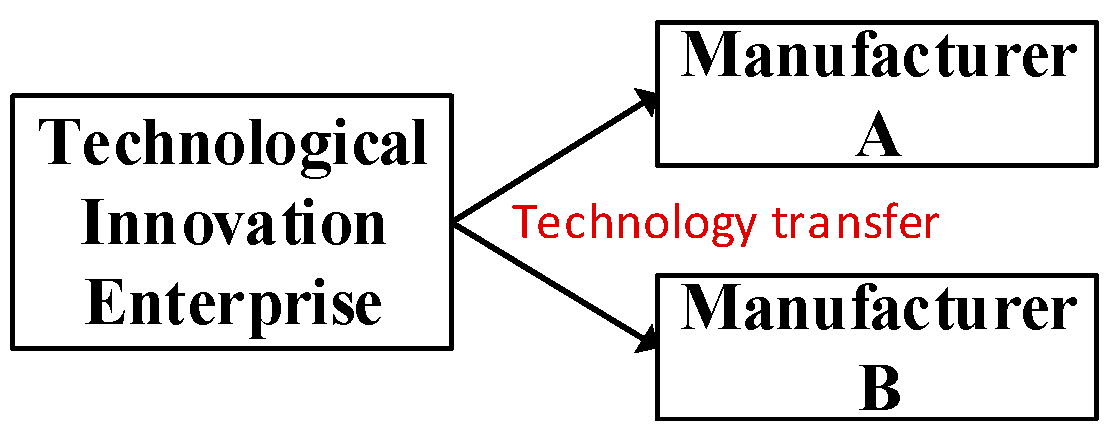
This study examines a supply chain system characterized by asymmetric competition between a TIE and two manufacturers with different competitive capabilities. The research focuses on two core mechanisms: (1) technology transfer and adoption dynamics and (2) optimal product pricing strategies under competitive asymmetry. The interaction dynamics are modeled using a Stackelberg game framework with the following sequence: the TIE, as the Stackelberg leader, first determines the optimal technology transfer fee; the two manufacturers (Followers) then simultaneously establish their product pricing strategies based on the TIE’s decisions. The structural relationships in this technology innovation supply chain are formally represented in
Figure 1.
Table 2 provides all the notations used in this paper to clearly define the models.
denotes the TIE.
represents the small manufacturer (Manufacturer A) or the large manufacturer (Manufacturer B).
represents the benchmark scenario, the scenario where only the small manufacturer adopts technology, the scenario where only the large manufacturer adopts technology, or the scenario where both manufacturers adopt technology simultaneously, respectively.
In our study, based on existing research, it is assumed that the market demand for a product is price-sensitive and competitive, inversely proportional to its own price, and directly proportional to the competitor’s price. Following [
23], Manufacturer A’s market demand before and after technology adoption are
and
, respectively. For Manufacturer B, we adopted the demand functions from [
15,
22]:
(pre-adoption) and
(post-adoption). The market exhibits fundamental asymmetry in consumer preferences between manufacturers. Due to its sustained brand investment and market presence, Manufacturer B commands greater brand recognition and consumer trust. This creates asymmetric substitution patterns: (1) all consumers leaving Manufacturer A switch to the large competitor (Manufacturer B), while (2) only a portion,
, of those abandoning Manufacturer B consider Manufacturer A, with the remainder exiting the market completely.
It should be noted that the spillover effect discussed in this study does not exist as an independent parameter; rather, it is realized indirectly through inter-firm competition and the market expansion effect induced by the technology.
The profit functions for all supply chain participants—the TIE and both manufacturers—are formally specified in
Table 3. All proofs are provided in
Appendix A.
4. Optimal Strategies and Impact Analysis Under Different Scenarios
For different technology adoption scenarios, we determine the optimal technology transfer fees and product sales prices.
4.1. Optimal Strategies and Profits
Based on the principle of profit maximization, the reverse-solving method is employed to determine the TIE’s technology transfer fees and the manufacturers’ product sales prices. Subsequently, the product demand and the enterprises’ profits are derived.
Proposition 1.
For the benchmark scenario, the sales prices are and . The corresponding demands are and , and the manufacturers’ respective profits can be expressed as and .
When neither of the two manufacturers adopts innovation technology, both product prices and demands are positively correlated with the competitive intensity of the small manufacturer. This indicates that, under asymmetric competition, as the competitive intensity between the two manufacturers increases, both product prices and demands will rise accordingly. The small manufacturer experiences more pronounced increases in both price and demand compared to the large manufacturer. This differential effect stems from three key mechanisms: (1) intensified competition expands the total market demand by attracting new consumers; (2) increased demand enhances perceived product value, making consumers more willing to accept price premiums; and (3) the small manufacturer’s initial competitive disadvantage creates greater marginal gains from market expansion.
Proposition 2.
For the scenario where only the small manufacturer adopts innovation technology, the TIE’s technology transfer fee is , and the manufacturers’ product prices are and . The corresponding demands are and , and the enterprises’ profits are , , and .
Proposition 3.
For the scenario where only the large manufacturer adopts innovation technology, the TIE’s technology transfer fee is , and the manufacturers’ product prices are and . The corresponding demands are and , and the enterprises’ profits are , , and .
Proposition 4.
For the scenario where both manufacturers adopt innovation technology, the TIE’s technology transfer fees are and , and the manufacturers’ product prices are and . The corresponding demands are and , and the enterprises’ profits are , , and .
The mechanisms of Propositions 2–4 are similar to that of Proposition 1 and will not be elaborated upon here.
Corollary 1.
, .
Corollary 1 indicates that greater competitive intensity between the two manufacturers will lead to a higher technology transfer fee being charged by the TIE. This relationship emerges because heightened horizontal competition among manufacturers strengthens the TIE’s vertical pricing power in the technology market, enabling it to command higher transfer fees.
When only the small manufacturer adopts the technology, increased market competition amplifies the TIE’s ability to extract greater technology premiums. Conversely, when only the large manufacturer adopts innovation technology, reduced inter-firm competition diminishes the TIE’s relative pricing power. Consequently, in single-adoption scenarios, the small manufacturer’s technology transfer fee demonstrates greater sensitivity to competitive intensity.
In cases where both manufacturers simultaneously adopt the technology, intensifying competition leads the TIE to disproportionately increase the transfer fee for the large manufacturer. This differential pricing strategy helps maintain the small manufacturer’s competitive position. These dynamics explain why TIEs exhibit stronger preferences for technology transfer to industries with intense homogeneous competition, as such environments offer greater potential for technology premium realization.
4.2. Impact of Expansion Effect
In this section, we analyze the impact of the expansion effect on the optimal decisions for the TIE and the two manufacturers under different scenarios.
Corollary 2.
, , .
The expansion effect positively influences product prices, though the magnitude of this effect varies across scenarios. When the TIE exclusively provides technology to a single manufacturer, the expansion effect’s direct marginal impact on the cooperating manufacturer’s product price exceeds its indirect marginal impact on the non-cooperating competitor’s price. In contrast, when the TIE supplies innovation technology to both manufacturers concurrently, the expansion effect demonstrates a more substantial influence on the large manufacturer’s product pricing. This differential impact stems from the large manufacturer’s greater capacity to leverage technological advantages due to its established market position and operational scale. Corollary 2 establishes that innovation technology transfer induces product price increases through two distinct mechanisms: (1) the direct cost channel, whereby technology adoption elevates production costs, necessitating price adjustments, and (2) the competitive intensity channel, whereby technology implementation heightens market competition, creating upward pricing pressure. The interaction of these channels explains the observed pricing dynamics, with the large manufacturer exhibiting greater price sensitivity to technological expansion effects in dual-adoption scenarios. These findings underscore the nuanced relationships between technology transfer, competitive dynamics, and pricing strategies in asymmetric markets.
5. Comparative Analysis of Different Scenarios
In this section, we compare the product pricing strategies, demands, and profits of enterprises under four different technology adoption scenarios.
5.1. Comparison of Prices
Theorem 1.
, .
The degree of differentiation among manufacturers significantly influences the TIE’s pricing strategy for innovation technology transfer. When dealing with manufacturers of varying sizes, the TIE should implement a tiered pricing approach, charging larger manufacturers higher technology transfer fees. This strategic differentiation serves to segment the product markets between manufacturers, preventing larger players from leveraging cost advantages in technology transfer to encroach upon smaller competitors’ market shares. Such an approach maintains market equilibrium and safeguards against potential profit erosion.
In practice, this pricing mechanism resembles price discrimination, wherein firms charge differential prices for identical products or services across distinct consumer segments or markets within the same timeframe. By capitalizing on variations in price sensitivity among consumers, firms can effectively transform consumer surplus into corporate profits, thereby maximizing overall returns. This differentiated pricing strategy enables firms to optimize market segmentation, enhance profitability, and strengthen their competitive positioning in the marketplace.
Theorem 2.
(1) , . (2) ; when , and otherwise; ; .
Theorem 2 demonstrates that the implementation of innovation technology results in elevated product prices. When both manufacturers either adopt or refrain from adopting the technology, the large manufacturer sets a higher price due to its established brand advantage and comparatively higher production costs. If only one manufacturer adopts the technology, its product price will exceed that in the non-adopting scenario. This price increase stems from two key factors: cost-driven adjustment and enhanced consumer valuation. The adoption of innovation technology raises production costs, compelling the manufacturer to adjust prices upward to sustain profit maximization. In addition, the technological upgrade increases consumers’ perceived value of the product, further justifying a higher price. Moreover, due to the spillover effect of the technology, even the non-adopting manufacturer will raise its prices in response to its competitor’s technological adoption, reinforcing the overall upward pricing trend in the market.
5.2. Comparison of Demand
Theorem 3.
, .
Theorem 3 reveals a counterintuitive yet economically rational outcome: when the TIE licenses innovation technology to only one manufacturer, the non-adopting manufacturer experiences greater product demand compared to the benchmark scenario due to the technological spillover effect. Contrary to initial expectations that technology transfer would strengthen the adopting manufacturer’s competitive position at the expense of its rival, our analysis demonstrates that innovation adoption can paradoxically expand the non-adopting firm’s market share. This phenomenon emerges through a dual mechanism: While the technology-adopting manufacturer benefits from demand growth, its substantially higher production costs force significant price increases. These price adjustments create a corresponding upward pricing response from the non-adopting competitor, effectively dampening the market competition intensity. The resultant reduction in competitive pressure generates an unexpected demand expansion effect for the manufacturer that did not participate in the technology transfer, illustrating the complex interplay between technological advancement and market dynamics.
Theorem 4.
.
Theorem 4 demonstrates that when the TIE exclusively partners with the small manufacturer, the total market demand experiences greater expansion as compared to the scenario involving collaboration with the large manufacturer. This strategic alliance enhances the small manufacturer’s competitive position through two key mechanisms: (1) technological adoption narrows the price differential between the small manufacturer’s products and those of the larger competitor, creating more favorable conditions for consumers, and (2) the moderated pricing structure stimulates broader market participation. This finding carries important practical implications. By directing technological support toward smaller enterprises, TIEs achieve dual objectives: they not only accelerate the diffusion of innovation across the manufacturing sector but also optimize market outcomes. The resulting demand expansion effect suggests that targeted technology transfer to small manufacturers can serve as an effective strategy for market development, benefiting both producers and consumers through improved competitive balance and enhanced market accessibility. This policy-relevant insight emphasizes the value of inclusive innovation strategies that prioritize smaller players in technology dissemination programs.
Theorem 5.
When and , .
Theorem 5 establishes a nuanced relationship between technology adoption and market outcomes: when manufacturers exhibit low differentiation, and innovation technology demonstrates strong demand expansion potential, simultaneous adoption yields greater individual market shares; otherwise, single-manufacturer adoption surprisingly generates higher aggregate demand. This paradox reveals that widespread technology implementation does not invariably expand markets, as under certain conditions—particularly when technological introduction heightens competition—the consequent cost-driven price increases may outweigh the technology’s demand-stimulating effects, ultimately contracting the total market size. These findings highlight the critical role of competitive dynamics in mediating the market impact of technological diffusion, demonstrating how technology adoption strategies must account for both the degree of firm heterogeneity and the technology’s demand elasticity to optimize market outcomes.
Theorem 6.
When , ; when , ; when , .
Theorem 6 demonstrates that innovation technology’s market impact depends critically on its demand expansion potential. When this effect is substantial, technological innovation successfully drives market growth; however, when demand expansion is limited, the cost burden of technology transfer dominates, negating any market expansion benefits. Furthermore, the analysis reveals an important size-dependent effect: in markets with significant manufacturer size asymmetry, targeted technology transfer to a single firm proves more effective for product promotion than dual adoption, as the competitive imbalance alters the technology’s market penetration dynamics and pricing effects. These findings collectively establish boundary conditions for successful technology diffusion, emphasizing that both the technology’s demand characteristics and market structure fundamentally determine whether innovation will expand or constrain the product market.
5.3. Choice of Enterprises
Theorem 7.
The small manufacturer prefers to independently adopt innovation technology, whereas the large manufacturer prefers to adopt the technology simultaneously with their competitors.
Theorem 7 reveals a strategic dichotomy in technology adoption between asymmetric manufacturers: Smaller firms demonstrate a clear preference for independent adoption of innovation technology, as the competitive benefits and market expansion effects substantially outweigh the associated implementation costs, leading to measurable profit improvement. In contrast, larger manufacturers face a fundamentally different calculus wherein unilateral adoption would exacerbate existing competitive asymmetries, with the resultant cost increases triggering disproportionate price hikes that ultimately erode profitability. Consequently, dominant firms exhibit a strategic preference for synchronized technology adoption with competitors, thereby preserving equilibrium in competitive intensity. This finding carries significant managerial implications, highlighting how optimal technology adoption strategies are contingent upon firm size and market position while simultaneously validating the strategic rationale behind avoiding indiscriminate technological expansion that could precipitate cost inflation and profit deterioration.
Theorem 8.
When the TIE collaborates with only one manufacturer, the other manufacturer benefits indirectly, with profits potentially exceeding those in other scenarios.
Theorem 8 demonstrates the dual-channel value creation mechanism of innovation technology through its spillover effect: When a manufacturer adopts the technology, the resultant enhancement in overall product valuation elevates market prices industry-wide, creating simultaneous benefits for both adopting and non-adopting firms. The technology-adopting manufacturer achieves direct profit growth through premium pricing and competitive differentiation, while non-adopting competitors experience indirect gains through demand expansion and price appreciation in the upgraded market environment. Crucially, this spillover dynamic operates through two interconnected pathways: the technology’s market-enhancing effect raises consumer willingness-to-pay across all products, while its demand-stimulating properties increase the total market volume. These findings reveal how strategic technology adoption can generate positive externalities that transcend firm boundaries, creating a rising-tide effect that elevates profitability throughout the industry ecosystem while maintaining competitive equilibrium.
Theorem 9:
Only when the expansion effect of technology is high will adopting the technology increase the manufacturer’s profit.
Theorem 9 reveals that innovation technology’s profitability hinges on its demand expansion effect: a modest expansion effect fails to offset rising costs, eroding profits in competitive markets, whereas strong demand growth enables cost absorption through expanded revenues and premium pricing. This threshold effect necessitates a careful pre-adoption evaluation of market-specific demand elasticity to predict whether implementation will enhance or diminish profitability.
Theorem 10:
The TIE most strongly tends to provide innovation technology to both manufacturers, followed by providing technology to the large manufacturer.
Theorem 10 demonstrates the TIE’s optimal licensing strategy, in which dual technology transfer maximizes market expansion through enhanced product valuation and demand growth, while single licensing presents strategic trade-offs: smaller manufacturers boost their market penetration, whereas larger manufacturers pay premium fees and their market dominance is curbed. In practice, dual licensing emerges as the dominant strategy, simultaneously optimizing profit potential and risk diversification through balanced market development.
6. Equilibrium Analysis of Technology Adoption Strategy
In this section, we identify the equilibrium strategies of the two manufacturers and explore the impacts of technology introduction through an analysis of these equilibrium strategies.
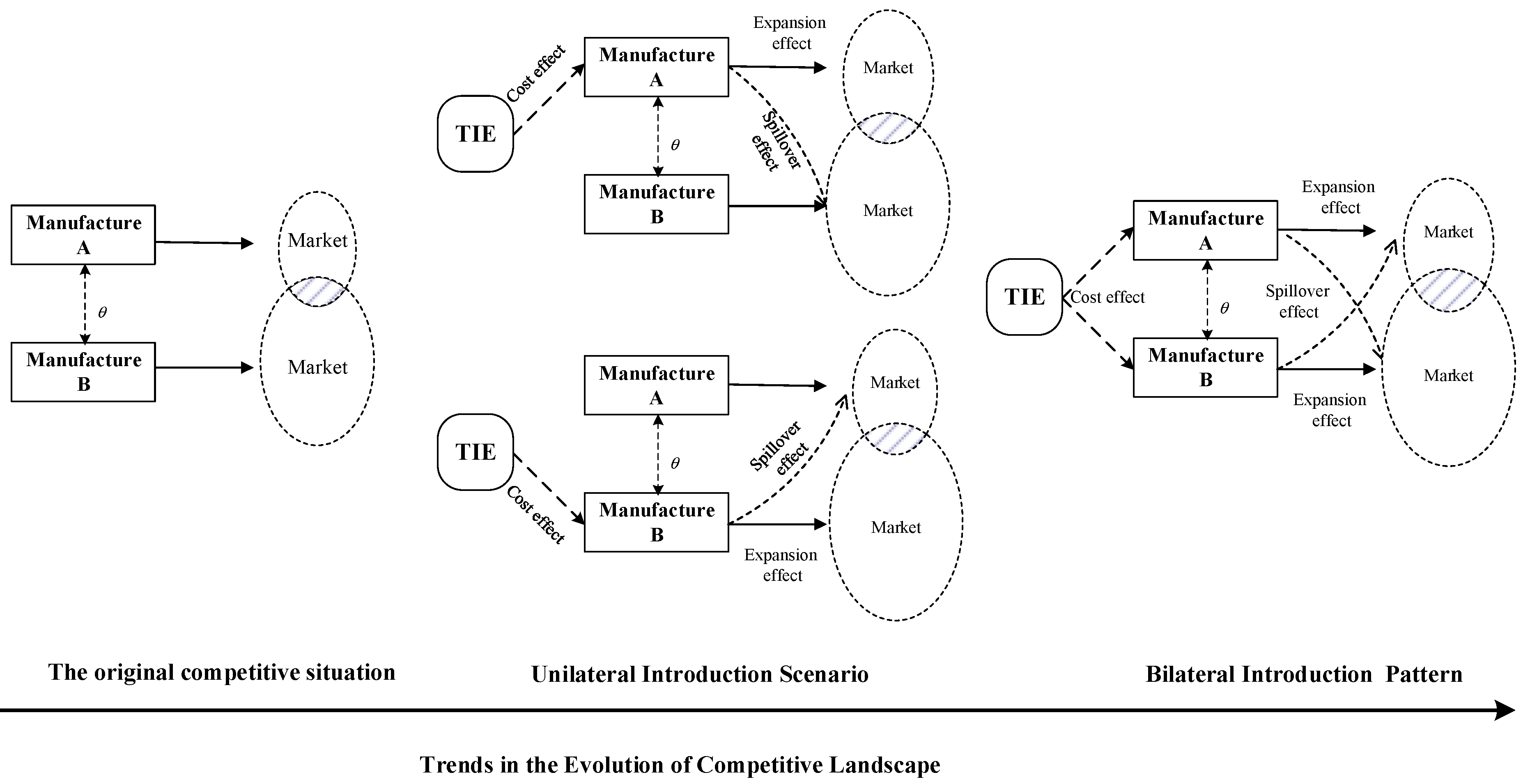
The key findings reveal that innovation technology creates dual effects—direct expansion for the adopter and positive spillover for the non-adopter—with even the non-adopting firm benefiting from demand growth through technological externalities (as visualized in
Figure 2). The competitive impact varies significantly by firm size: while technology adoption enables the small manufacturer to reduce market asymmetries and intensify competition, the large manufacturer conversely amplifies existing competitive advantages through adoption. Crucially, the technology’s value exhibits threshold behavior, becoming profitable only when its expansion effect surpasses a critical level that compensates for implementation costs and competitive repercussions. These results demonstrate how technological diffusion dynamics are fundamentally shaped by firm characteristics and market structure.
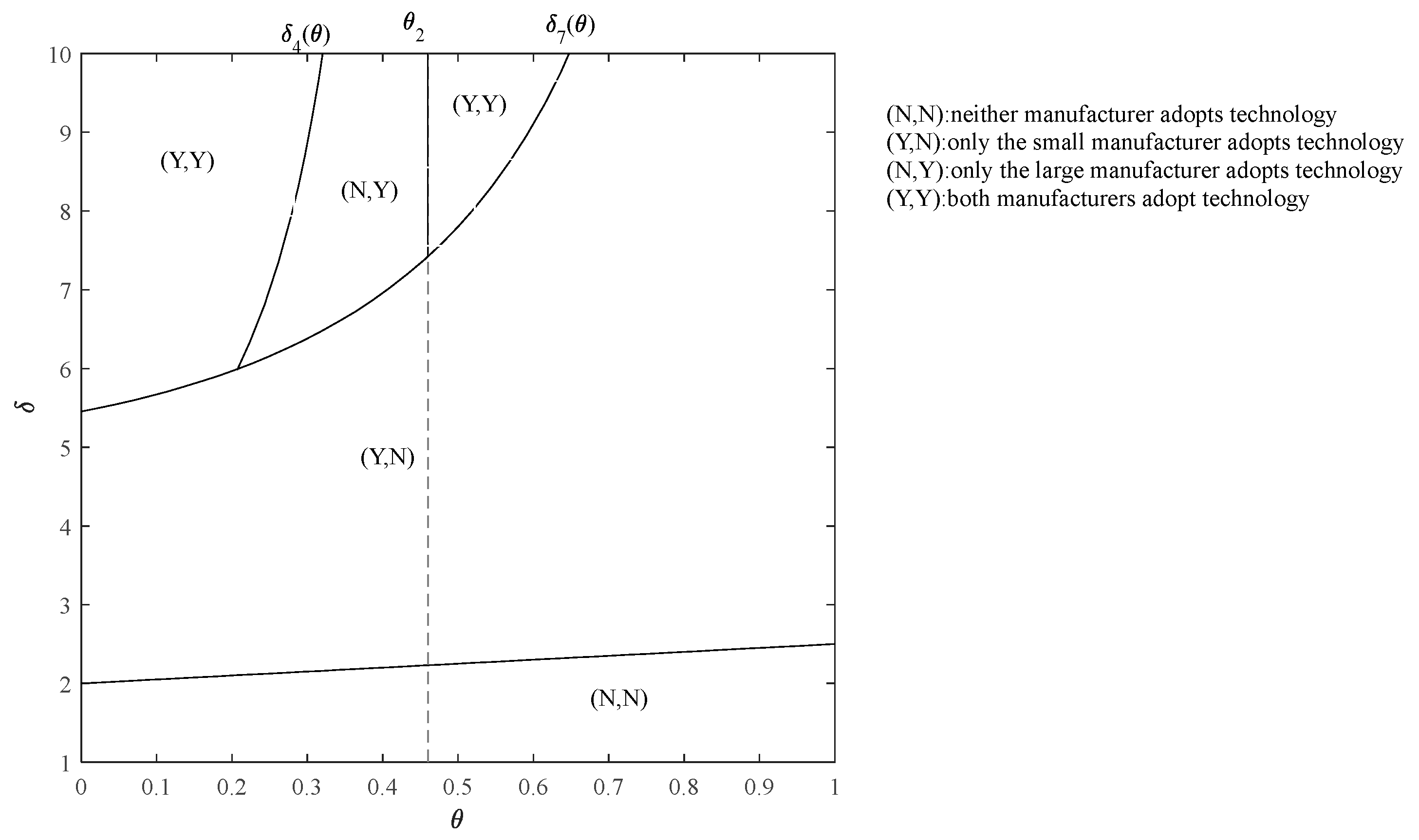
The equilibrium strategy for technology adoption by the two manufacturers is shown in
Figure 3.
In the region, both manufacturers rationally abstain from adopting innovation technology due to an unfavorable cost–benefit ratio. Regardless of whether the manufacturer is large or small, the adoption of innovation technology entails certain costs. Manufacturers typically pass a portion of these costs on to consumers through higher prices. However, when the technology’s expansion effect is limited and its impact on demand is negligible, the revenue gains from the resultant increase in demand are insufficient to offset both the investment costs and the demand reduction caused by higher prices. As the returns from technological investment fail to cover the costs, the manufacturer’s overall profitability is undermined, leading both types of manufacturers to refrain from adopting the innovation technology. The gains resulting from the adoption of innovation technology cannot compensate for implementation expenses, highlighting the importance of rigorous ROI analysis during nascent technological phases. Manufacturers must carefully evaluate the adoption timing, particularly when technological impacts remain marginal.
In the region, the equilibrium features selective adoption where the small manufacturer implements the technology while the large one abstains. For the small manufacturer, when the technology’s expansion effect is significant, the adoption of innovation technology can stimulate demand growth, thereby enhancing their market competitiveness. Moreover, the gains from adopting the technology are sufficient to offset both the initial investment costs and the potential consumer loss resulting from higher prices. Under such circumstances, small manufacturers are inclined to implement the innovation technology. In contrast, large manufacturers, which already occupy a dominant market position and possess established competitive and brand advantages, have less incentive to adopt innovation technology to further expand their market power. Although the introduction of technology can enhance their competitiveness and increase demand, the resulting benefits are insufficient to cover the associated costs and the consumer loss due to price increases. Importantly, when small manufacturers adopt new technology and generate a technology-driven market expansion effect, the demand for large manufacturers’ products may increase as a spillover effect. Consequently, it is more advantageous for large manufacturers to refrain from adopting the new technology.
In the region, under this scenario, both competing manufacturers choose to adopt the innovation technology simultaneously. At this point, the technology exerts a substantial market expansion effect, and consumers exhibit a stronger preference for high-quality products. The benefits resulting from the adoption of innovation technology are sufficient to cover the initial investment costs and exceed the gains generated by the spillover effect from the competitor’s adoption. If the small manufacturer refrains from adopting the innovation technology, it risks being driven out of the market, whereas if the large manufacturer does not implement it, it may lose its dominant market position. Therefore, under these circumstances, both manufacturers are inclined to adopt the innovation technology.
In the region, the adoption decisions of the small manufacturer and the large manufacturer constitute a classic prisoner’s dilemma. Regardless of whether the small manufacturer introduces innovation technology, the large manufacturer always has a dominant strategy to adopt, because in both cases—whether the small manufacturer adopts or not—the payoff associated with adoption is strictly higher than that associated with non-adoption. Anticipating that the large manufacturer will inevitably adopt innovation technology, the small manufacturer realizes that adopting simultaneously results in its lowest possible payoff due to intensified competition and unfavorable cost–benefit conditions. Consequently, the small manufacturer optimally chooses not to adopt, thereby achieving its highest attainable payoff given the large manufacturer’s strategy. This strategic interaction ultimately leads to an outcome in which the large manufacturer adopts while the small manufacturer abstains, even though the collective outcome may be inefficient. This strategic imbalance stems from interdependent decision-making: the small manufacturer perceives insufficient competitive returns from adoption, while the large firm reinforces its dominance through technological leadership. The resulting suboptimal equilibrium exemplifies classic game-theoretic dynamics, where individual rationality leads to collectively inferior outcomes, perpetuating the small manufacturer’s competitive disadvantage despite potential mutual gains from coordinated adoption.
7. Discussion
The use of innovation technology has become a key driver of market competition [
24]. However, because some firms are unable to independently bear the high R&D costs, they tend to acquire innovation technology from external technology providers [
8,
11,
25]. Consistently with the findings of the existing literature [
5,
12,
26,
27,
28,
29,
30,
31,
32,
33,
34,
35,
36,
37,
38,
39,
40], our results show that the adoption of innovation technology increases the product price, as the manufacturer shares the technology adoption cost with consumers through price adjustments. Moreover, product market expansion can only be achieved when innovation technology generates a sufficiently strong demand expansion effect.
When the technology provider supplies innovation technology exclusively to a single manufacturer, a spillover effect arises for the non-adopting manufacturer. Specifically, the adopting manufacturer faces higher costs and increases its product price, which mitigates competitive intensity and consequently expands the demand for its rival’s products. This mechanism aligns with the argument presented in [
13].
This study primarily examines the effect of adopting innovation technology from the manufacturer’s perspective, focusing on its implications for product price, market demand, and profitability, which distinguishes our work from [
11]. Furthermore, innovation technology becomes profitable only when its expansion effect surpasses a certain threshold. Although this finding is broadly consistent with those in [
25], our analysis emphasizes the underlying trade-off between cost and benefit.
This study examines the equilibrium strategy of two manufacturers in the context of adopting innovation technology. When the expansion effect of such technologies is minimal, rational manufacturers typically refrain from adoption due to insufficient returns. At moderate expansion levels, an asymmetric adoption pattern emerges where small manufacturers find adoption advantageous while larger firms maintain their existing strategies; this divergence stems from differing cost–benefit calculations based on firm size and market position. The dynamics shift significantly when expansion effects reach substantial levels, prompting universal adoption across manufacturers of all sizes. However, this equilibrium can create suboptimal outcomes when small manufacturers face moderate competitive intensity, potentially trapping both parties in a classic prisoner’s dilemma where individual rationality leads to collectively inferior results. This result, to some extent, extends upon the work of Fang et al. [
5].
8. Conclusions
We develop an asymmetrically competitive supply chain model comprising a TIE and two differentially scaled manufacturers to investigate their strategies for adopting innovation technology. Our analysis yield three principal findings.
This study demonstrates that the effectiveness of innovation technology adoption is significantly influenced by the technology’s market expansion effect, with not all technological upgrades yielding immediate benefits. When implementing innovation technologies, manufacturers must holistically evaluate three critical dimensions: the adoption cost, technological benefit, and competitive dynamic. In scenarios where the technology’s expansion effect is limited, it is prudent to postpone large-scale investment and instead focus on sustaining low-cost or high-brand competitive advantages. However, when the expansion effect exceeds a critical threshold, large manufacturers should proactively establish technological barriers, while smaller manufacturers can optimize benefits through strategic “free-riding” behaviors. Notably, under significant scale disparities between manufacturers, implementing unilateral technology transfer strategies proves more advantageous than simultaneous upgrades, as this phased approach minimizes trial-and-error costs and mitigates potential disruptions to existing market structures.
In asymmetrically competitive environments, manufacturers must develop real-time mechanisms to assess competitive intensity and deploy tailored technology diffusion strategies. Under conditions of low competitive intensity, a conservative approach emphasizing cost control and premium pricing is recommended. In moderately competitive scenarios, it is crucial to avoid a prisoner’s dilemma by establishing technological alliances or other Pareto improvement mechanisms. Conversely, in high-intensity competition, manufacturers should expedite technology diffusion processes to capitalize on competition-driven market expansion effects.
From an intelligent manufacturing perspective, in this research, we examine how asymmetric competition, technology expansion effects, and spillover effects shape product pricing strategies and technology adoption decisions across supply chain participants. We offer a theoretical framework for addressing practical technology adoption challenges faced by diverse manufacturers. Nevertheless, this study has several limitations. First, the analysis is based on a stylized theoretical model; thus, its generalizability requires future empirical validation using real-world data or experimental evidence. Second, the technology innovation effort is treated as exogenous. Future research could endogenize the R&D decision of the TIE and explore how strategic investment behaviors influence equilibrium outcomes. Third, this study does not explicitly account for external factors such as government subsidies, environmental regulations, or industry standards, all of which may substantially reshape firms’ technology adoption incentives. Addressing these limitations would help extend the model and offer a more comprehensive understanding of innovation technology adoption. In future research, we will further explore the various possibilities associated with the application of intelligent manufacturing.