

Neurobiological Convergence in SPDs and ADHD: Insights from a Narrative Review



Simple Summary
Abstract
1. Introduction
2. Materials and Methods
2.1. Study Experimental Design
2.2. Inclusion Criteria
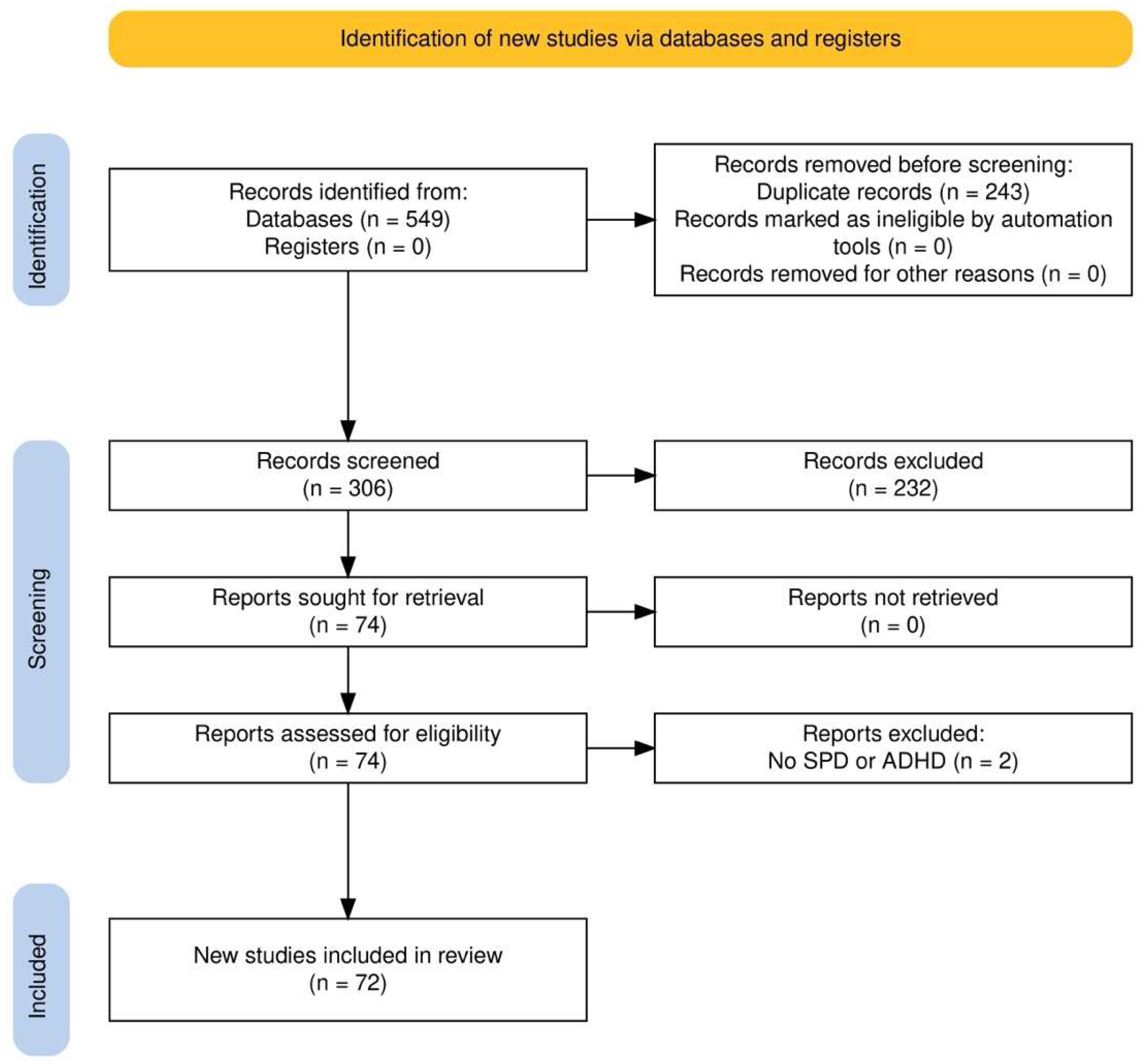
2.3. Study Selection
3. Results
3.1. Shared Brain Networks
3.2. Brain Oscillations
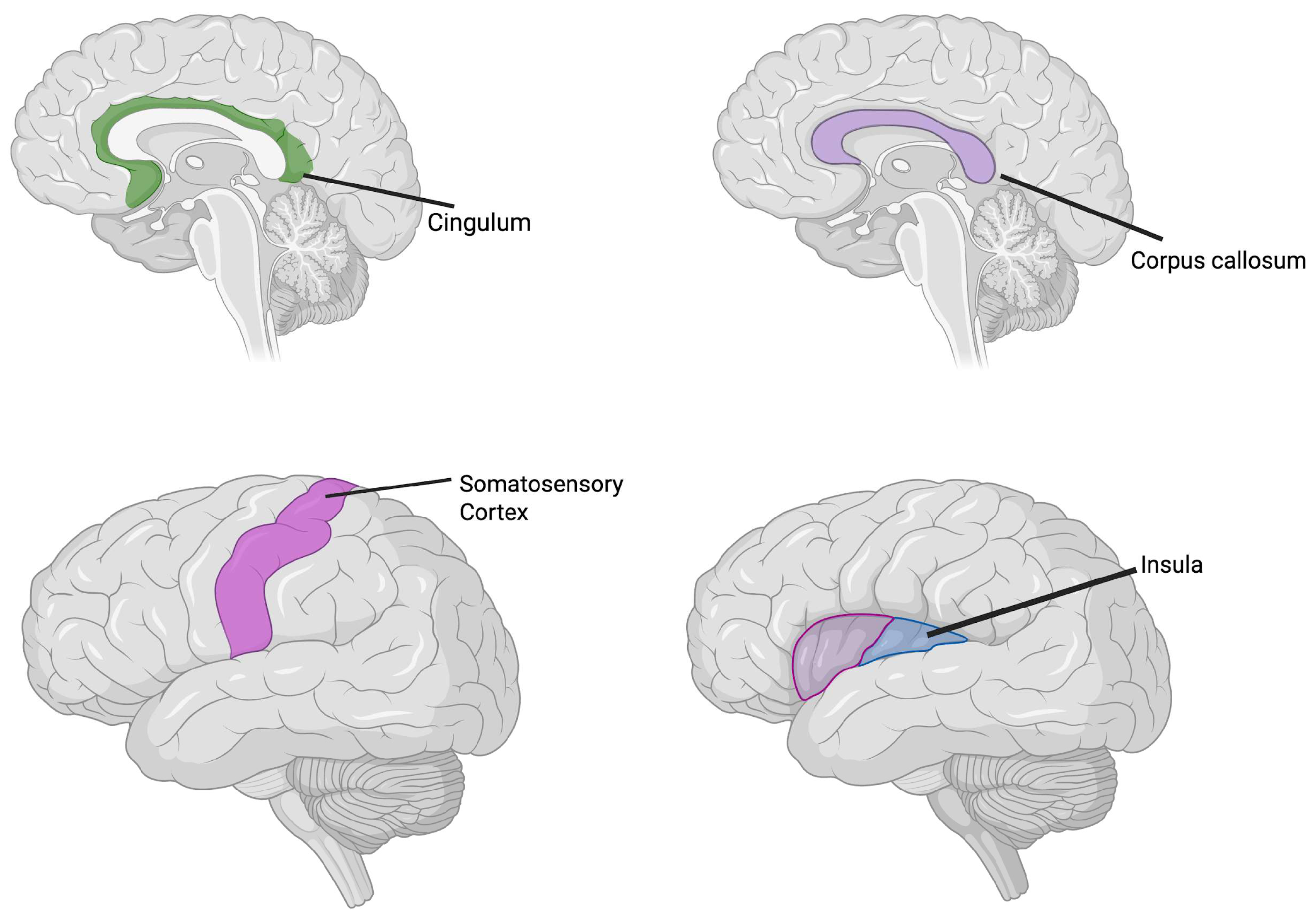
3.3. Brain Structure
4. Discussion
5. Conclusions
Author Contributions
Funding
Institutional Review Board Statement
Data Availability Statement
Conflicts of Interest
References
- Marshall, A.C.; Gentsch-Ebrahimzadeh, A.; Schütz-Bosbach, S. From the inside out: Interoceptive feedback facilitates the integration of visceral signals for efficient sensory processing. NeuroImage 2022, 251, 119011. [Google Scholar] [CrossRef] [PubMed]
- Choi, I.; Lee, J.-Y.; Lee, S.-H. Bottom-up and top-down modulation of multisensory integration. Curr. Opin. Neurobiol. 2018, 52, 115–122. [Google Scholar] [CrossRef] [PubMed]
- Miller, L.J.; Nielsen, D.M.; A Schoen, S.; A Brett-Green, B. Perspectives on sensory processing disorder: A call for translational research. Front. Integr. Neurosci. 2009, 3, 597. [Google Scholar] [CrossRef] [PubMed]
- Völter, C.; Thomas, J.P.; Maetzler, W.; Guthoff, R.; Grunwald, M.; Hummel, T. Sensory Dysfunction in Old Age. Dtsch. Ärzteblatt Int. 2021, 118, 512–520. [Google Scholar] [CrossRef]
- Wall, J.; Xu, J.; Wang, X. Human brain plasticity: An emerging view of the multiple substrates and mechanisms that cause cortical changes and related sensory dysfunctions after injuries of sensory inputs from the body. Brain Res. Rev. 2002, 39, 181–215. [Google Scholar] [CrossRef]
- American Psychiatric Association. Diagnostic and Statistical Manual of Mental Disorders (DSM-5-TR); American Psychiatric Publishing, Inc.: Washington, DC, USA, 2013. [Google Scholar]
- Tavassoli, T.; Brandes-Aitken, A.; Chu, R.; Porter, L.; Schoen, S.; Miller, L.J.; Gerdes, M.R.; Owen, J.; Mukherjee, P.; Marco, E.J. Sensory over-responsivity: Parent report, direct assessment measures, and neural architecture. Mol. Autism 2019, 10, 4. [Google Scholar] [CrossRef]
- Eiland, L.S.; Gildon, B.L. Diagnosis and Treatment of ADHD in the Pediatric Population. J. Pediatr. Pharmacol. Ther. 2024, 29, 107–118. [Google Scholar] [CrossRef]
- Ford-Jones, P.C. Misdiagnosis of attention deficit hyperactivity disorder: ‘Normal behaviour’ and relative maturity. Paediatr. Child Health 2015, 20, 200–202. [Google Scholar] [CrossRef]
- Jurek, L.; Duchier, A.; Gauld, C.; Hénault, L.; Giroudon, C.; Fourneret, P.; Cortese, S.; Nourredine, M. Sensory Processing in Individuals with Attention-Deficit/Hyperactivity Disorder Compared with Control Populations: A Systematic Review and Meta-Analysis. J. Am. Acad. Child Adolesc. Psychiatry 2025, 64, 1132–1147. [Google Scholar] [CrossRef]
- Mark, I.T.; Wren-Jarvis, J.; Xiao, J.; Cai, L.T.; Parekh, S.; Bourla, I.; Lazerwitz, M.C.; Rowe, M.A.; Marco, E.J.; Mukherjee, P. Neurite orientation dispersion and density imaging of white matter microstructure in sensory processing dysfunction with versus without comorbid ADHD. Front. Neurosci. 2023, 17, 1136424. [Google Scholar] [CrossRef]
- Page, M.J.; McKenzie, J.E.; Bossuyt, P.M.; Boutron, I.; Hoffmann, T.C.; Mulrow, C.D.; Shamseer, L.; Tetzlaff, J.M.; Akl, E.A.; Brennan, S.E.; et al. The PRISMA 2020 statement: An updated guideline for reporting systematic reviews. BMJ 2021, 372, 71. [Google Scholar] [CrossRef]
- Ullman, M.T.; Pullman, M.Y. A compensatory role for declarative memory in neurodevelopmental disorders. Neurosci. Biobehav. Rev. 2015, 51, 205–222. [Google Scholar] [CrossRef]
- Fabio, R.A.; Orsino, C.; Lecciso, F.; Levante, A.; Suriano, R. Atypical sensory processing in adolescents with Attention Deficit Hyperactivity Disorder: A comparative study. Res. Dev. Disabil. 2024, 146, 104674. [Google Scholar] [CrossRef]
- Cascio, C.J. Somatosensory processing in neurodevelopmental disorders. J. Neurodev. Disord. 2010, 2, 62–69. [Google Scholar] [CrossRef] [PubMed]
- Yochman, A.; Parush, S.; Ornoy, A. Responses of Preschool Children with and Without ADHD to Sensory Events in Daily Life. Am. J. Occup. Ther. 2004, 58, 294–302. [Google Scholar] [CrossRef] [PubMed]
- Engel-Yeger, B.; Ziv-On, D. The relationship between sensory processing difficulties and leisure activity preference of children with different types of ADHD. Res. Dev. Disabil. 2011, 32, 1154–1162. [Google Scholar] [CrossRef] [PubMed]
- Koziol, L.F.; Budding, D. ADHD and Sensory Processing Disorders: Placing the Diagnostic Issues in Context. Appl. Neuropsychol. Child 2012, 1, 137–144. [Google Scholar] [CrossRef]
- Passarello, N.; Tarantino, V.; Chirico, A.; Menghini, D.; Costanzo, F.; Sorrentino, P.; Fucà, E.; Gigliotta, O.; Alivernini, F.; Oliveri, M.; et al. Sensory Processing Disorders in Children and Adolescents: Taking Stock of Assessment and Novel Therapeutic Tools. Brain Sci. 2022, 12, 1478. [Google Scholar] [CrossRef]
- Dunn, W.; Bennett, D. Patterns of Sensory Processing in Children with Attention Deficit Hyperactivity Disorder. OTJR Occup. Particip. Health 2002, 22, 4–15. [Google Scholar] [CrossRef]
- Happel, M.F.K.; Hechavarria, J.C.; de Hoz, L. Editorial: Cortical-Subcortical Loops in Sensory Processing. Front. Neural Circuits 2022, 16, 851612. [Google Scholar] [CrossRef]
- Lenartowicz, A.; Lu, S.; Rodriguez, C.; Lau, E.P.; Walshaw, P.D.; McCracken, J.T.; Cohen, M.S.; Loo, S.K. Alpha desynchronization and frontoparietal connectivity during spatial working memory encoding deficits in ADHD: A simultaneous EEGfMRI study. NeuroImage Clin. 2016, 11, 210–223. [Google Scholar] [CrossRef]
- Koziol, L.F.; Budding, D.E.; Chidekel, D. Sensory Integration, Sensory Processing, and Sensory Modulation Disorders: Putative Functional Neuroanatomic Underpinnings. Cerebellum 2011, 10, 770–792. [Google Scholar] [CrossRef] [PubMed]
- Fettes, P.; Schulze, L.; Downar, J. Cortico-Striatal-Thalamic Loop Circuits of the Orbitofrontal Cortex: Promising Therapeutic Targets in Psychiatric Illness. Front. Syst. Neurosci. 2017, 11, 25. [Google Scholar] [CrossRef] [PubMed]
- Cupertino, R.B.; Soheili-Nezhad, S.; Grevet, E.H.; Bandeira, C.E.; Picon, F.A.; Tavares, M.E.d.A.; Naaijen, J.; van Rooij, D.; Akkermans, S.; Vitola, E.S.; et al. Reduced fronto-striatal volume in attention-deficit/hyperactivity disorder in two cohorts across the lifespan. NeuroImage Clin. 2020, 28, 102403. [Google Scholar] [CrossRef]
- Cubillo, A.; Halari, R.; Smith, A.; Taylor, E.; Rubia, K. A review of fronto-striatal and fronto-cortical brain abnormalities in children and adults with Attention Deficit Hyperactivity Disorder (ADHD) and new evidence for dysfunction in adults with ADHD during motivation and attention. Cortex 2012, 48, 194–215. [Google Scholar] [CrossRef] [PubMed]
- Cortese, S. The neurobiology and genetics of Attention-Deficit/Hyperactivity Disorder (ADHD): What every clinician should know. Eur. J. Paediatr. Neurol. 2012, 16, 422–433. [Google Scholar] [CrossRef]
- Zaher, A.; Leonards, J.; Reif, A.; Grimm, O. Functional connectivity of the nucleus accumbens predicts clinical course in medication adherent and non-adherent adult ADHD. Sci. Rep. 2025, 15, 19663. [Google Scholar] [CrossRef]
- Luman, M.; Oosterlaan, J.; Sergeant, J.A. The impact of reinforcement contingencies on AD/HD: A review and theoretical appraisal. Clin. Psychol. Rev. 2005, 25, 183–213. [Google Scholar] [CrossRef]
- Zald, D.H. The human amygdala and the emotional evaluation of sensory stimuli. Brain Res. Rev. 2003, 41, 88–123. [Google Scholar] [CrossRef]
- Turner, B.H.; Herkenham, M. Thalamoamygdaloid projections in the rat: A test of the amygdala’s role in sensory processing. J. Comp. Neurol. 1991, 313, 295–325. [Google Scholar] [CrossRef]
- Fast, C.D.; McGann, J.P. Amygdalar Gating of Early Sensory Processing through Interactions with Locus Coeruleus. J. Neurosci. 2017, 37, 3085–3101. [Google Scholar] [CrossRef]
- Brotman, M.A.; Rich, B.A.; Guyer, A.E.; Lunsford, J.R.; Horsey, S.E.; Reising, M.M.; Thomas, L.A.; Fromm, S.J.; Towbin, K.; Pine, D.S.; et al. Amygdala Activation During Emotion Processing of Neutral Faces in Children with Severe Mood Dysregulation Versus ADHD or Bipolar Disorder. Am. J. Psychiatry 2010, 167, 61–69. [Google Scholar] [CrossRef] [PubMed]
- Herpertz, S.C.; Huebner, T.; Marx, I.; Vloet, T.D.; Fink, G.R.; Stoecker, T.; Shah, N.J.; Konrad, K.; Herpertz-Dahlmann, B. Emotional processing in male adolescents with childhood-onset conduct disorder. J. Child Psychol. Psychiatry 2008, 49, 781–791. [Google Scholar] [CrossRef] [PubMed]
- Marsh, A.A.; Finger, E.C.; Mitchell, D.G.; Reid, M.E.; Sims, C.; Kosson, D.S.; Towbin, K.E.; Leibenluft, E.; Pine, D.S.; Blair, R.J. Reduced Amygdala Response to Fearful Expressions in Children and Adolescents with Callous-Unemotional Traits and Disruptive Behavior Disorders. Am. J. Psychiatry 2008, 165, 712–720. [Google Scholar] [CrossRef] [PubMed]
- Adra, N.; Cao, A.; Makris, N.; Valera, E.M. Sensory Modulation Disorder and its Neural Circuitry in Adults with ADHD: A Pilot Study. Brain Imaging Behav. 2020, 15, 930–940. [Google Scholar] [CrossRef]
- Grandi, L.C. From Sweeping to the Caress: Similarities and Discrepancies between Human and Non-Human Primates’ Pleasant Touch. Front. Psychol. 2016, 7, 1371. [Google Scholar] [CrossRef]
- Morrison, I.; Björnsdotter, M.; Olausson, H. Vicarious Responses to Social Touch in Posterior Insular Cortex Are Tuned to Pleasant Caressing Speeds. J. Neurosci. 2011, 31, 9554–9562. [Google Scholar] [CrossRef]
- Olausson, H.; Lamarre, Y.; Backlund, H.; Morin, C.; Wallin, B.G.; Starck, G.; Ekholm, S.; Strigo, I.; Worsley, K.; Vallbo, Å.B.; et al. Unmyelinated tactile afferents signal touch and project to insular cortex. Nat. Neurosci. 2002, 5, 900–904. [Google Scholar] [CrossRef]
- Björnsdotter, M.; Morrison, I.; Olausson, H. Feeling good: On the role of C fiber mediated touch in interoception. Exp. Brain Res. 2010, 207, 149–155. [Google Scholar] [CrossRef]
- Stein, J.L.; Wiedholz, L.M.; Bassett, D.S.; Weinberger, D.R.; Zink, C.F.; Mattay, V.S.; Meyer-Lindenberg, A. A validated network of effective amygdala connectivity. NeuroImage 2007, 36, 736–745. [Google Scholar] [CrossRef]
- Mufson, E.; Mesulam, M.-M.; Pandya, D. Insular interconnections with the amygdala in the rhesus monkey. Neuroscience 1981, 6, 1231–1248. [Google Scholar] [CrossRef] [PubMed]
- Mesulam, M.; Mufson, E.J. Insula of the old world monkey. III: Efferent cortical output and comments on function. J. Comp. Neurol. 1982, 212, 38–52. [Google Scholar] [CrossRef] [PubMed]
- Lopez-Larson, M.P.; King, J.B.; Terry, J.; McGlade, E.C.; Yurgelun-Todd, D. Reduced insular volume in attention deficit hyperactivity disorder. Psychiatry Res. 2012, 204, 32–39. [Google Scholar] [CrossRef] [PubMed]
- Fateh, A.A.; Huang, W.; Mo, T.; Wang, X.; Luo, Y.; Yang, B.; Smahi, A.; Fang, D.; Zhang, L.; Meng, X.; et al. Abnormal Insular Dynamic Functional Connectivity and Its Relation to Social Dysfunctioning in Children with Attention Deficit/Hyperactivity Disorder. Front. Neurosci. 2022, 16, 890596. [Google Scholar] [CrossRef]
- Smirni, D.; Smirni, P.; Carotenuto, M.; Parisi, L.; Quatrosi, G.; Roccella, M. Noli Me Tangere: Social Touch, Tactile Defensiveness, and Communication in Neurodevelopmental Disorders. Brain Sci. 2019, 9, 368. [Google Scholar] [CrossRef]
- Schnitzler, A.; Gross, J. Normal and pathological oscillatory communication in the brain. Nat. Rev. Neurosci. 2005, 6, 285–296. [Google Scholar] [CrossRef]
- Pevzner, A.; Izadi, A.; Lee, D.J.; Shahlaie, K.; Gurkoff, G.G. Making Waves in the Brain: What Are Oscillations, and Why Modulating Them Makes Sense for Brain Injury. Front. Syst. Neurosci. 2016, 10, 30. [Google Scholar] [CrossRef]
- Jasper, H.; Penfield, W. Electrocorticograms in man: Effect of voluntary movement upon the electrical activity of the precentral gyrus. Eur. Arch. Psychiatry Clin. Neurosci. 1949, 183, 163–174. [Google Scholar] [CrossRef]
- Vassalli, A.; Dellepiane, J.M.; Emmenegger, Y.; Jimenez, S.; Vandi, S.; Plazzi, G.; Franken, P.; Tafti, M. Electroencephalogram paroxysmal theta characterizes cataplexy in mice and children. Brain 2013, 136, 1592–1608. [Google Scholar] [CrossRef]
- Vassalli, A.; Franken, P. Hypocretin (orexin) is critical in sustaining theta/gamma-rich waking behaviors that drive sleep need. Proc. Natl. Acad. Sci. USA 2017, 114, E5464–E5473. [Google Scholar] [CrossRef]
- Cavanagh, J.F.; Frank, M.J. Frontal theta as a mechanism for cognitive control. Trends Cogn. Sci. 2014, 18, 414–421. [Google Scholar] [CrossRef]
- Arnau, S.; Möckel, T.; Rinkenauer, G.; Wascher, E. The interconnection of mental fatigue and aging: An EEG study. Int. J. Psychophysiol. 2017, 117, 17–25. [Google Scholar] [CrossRef]
- Onton, J.; Delorme, A.; Makeig, S. Frontal midline EEG dynamics during working memory. NeuroImage 2005, 27, 341–356. [Google Scholar] [CrossRef] [PubMed]
- De Vries, I.E.J.; van Driel, J.; Karacaoglu, M.; Olivers, C.N.L. Priority Switches in Visual Working Memory are Supported by Frontal Delta and Posterior Alpha Interactions. Cereb. Cortex 2018, 28, 4090–4104. [Google Scholar] [CrossRef] [PubMed]
- Tan, E.; Troller-Renfree, S.V.; Morales, S.; Buzzell, G.A.; McSweeney, M.; Antúnez, M.; Fox, N.A. Theta activity and cognitive functioning: Integrating evidence from resting-state and task-related developmental electroencephalography (EEG) research. Dev. Cogn. Neurosci. 2024, 67, 101404. [Google Scholar] [CrossRef] [PubMed]
- Jiang, X.; Liu, L.; Ji, H.; Zhu, Y. Association of Affected Neurocircuitry with Deficit of Response Inhibition and Delayed Gratification in Attention Deficit Hyperactivity Disorder: A Narrative Review. Front. Hum. Neurosci. 2018, 12, 506. [Google Scholar] [CrossRef]
- Kawasaki, M.; Yamaguchi, Y. Effects of subjective preference of colors on attention-related occipital theta oscillations. NeuroImage 2012, 59, 808–814. [Google Scholar] [CrossRef]
- Harris, A.M.; Dux, P.E.; Jones, C.N.; Mattingley, J.B. Distinct roles of theta and alpha oscillations in the involuntary capture of goal-directed attention. NeuroImage 2017, 152, 171–183. [Google Scholar] [CrossRef]
- Guo, J.; Luo, X.; Wang, E.; Li, B.; Chang, Q.; Sun, L.; Song, Y. Abnormal alpha modulation in response to human eye gaze predicts inattention severity in children with ADHD. Dev. Cogn. Neurosci. 2019, 38, 100671. [Google Scholar] [CrossRef]
- Lubar, J.F.; Zimmerman, A.W.; Miller, C.A.; Muenchen, R.A. Quantitative analysis of EEG in boys with attention-deficit-hyperactivity disorder: Controlled study with clinical implications. Pediatr. Neurol. 1992, 8, 30–36. [Google Scholar] [CrossRef]
- Lenartowicz, A.; Delorme, A.; Walshaw, P.D.; Cho, A.L.; Bilder, R.M.; McGough, J.J.; McCracken, J.T.; Makeig, S.; Loo, S.K. Electroencephalography Correlates of Spatial Working Memory Deficits in Attention-Deficit/Hyperactivity Disorder: Vigilance, Encoding, and Maintenance. J. Neurosci. 2014, 34, 1171–1182. [Google Scholar] [CrossRef] [PubMed]
- A Anguera, J.; Brandes-Aitken, A.N.; Antovich, A.D.; E Rolle, C.; Desai, S.S.; Marco, E.J. A pilot study to determine the feasibility of enhancing cognitive abilities in children with sensory processing dysfunction. PLoS ONE 2017, 12, e0172616. [Google Scholar] [CrossRef] [PubMed]
- Ter Huurne, N.; Onnink, M.; Kan, C.; Franke, B.; Buitelaar, J.; Jensen, O. Behavioral Consequences of Aberrant Alpha Lateralization in Attention-Deficit/Hyperactivity Disorder. Biol. Psychiatry 2013, 74, 227–233. [Google Scholar] [CrossRef] [PubMed]
- Vollebregt, M.A.; Zumer, J.M.; ter Huurne, N.; Buitelaar, J.K.; Jensen, O. Posterior alpha oscillations reflect attentional problems in boys with Attention Deficit Hyperactivity Disorder. Clin. Neurophysiol. 2016, 127, 2182–2191. [Google Scholar] [CrossRef]
- Guo, J.; Luo, X.; Li, B.; Chang, Q.; Sun, L.; Song, Y. Abnormal modulation of theta oscillations in children with attention-deficit/hyperactivity disorder. NeuroImage Clin. 2020, 27, 102314. [Google Scholar] [CrossRef]
- Ter Huurne, N.; Lozano-Soldevilla, D.; Onnink, M.; Kan, C.; Buitelaar, J.; Jensen, O. Diminished modulation of preparatory sensorimotor mu rhythm predicts attention-deficit/hyperactivity disorder severity. Psychol. Med. 2017, 47, 1947–1956. [Google Scholar] [CrossRef]
- Alexander, D.M.; Hermens, D.F.; Keage, H.A.; Clark, C.R.; Williams, L.M.; Kohn, M.R.; Clarke, S.D.; Lamb, C.; Gordon, E. Event-related wave activity in the EEG provides new marker of ADHD. Clin. Neurophysiol. 2008, 119, 163–179. [Google Scholar] [CrossRef]
- Villemonteix, T.; De Brito, S.A.; Kavec, M.; Balériaux, D.; Metens, T.; Slama, H.; Baijot, S.; Mary, A.; Peigneux, P.; Massat, I. Grey matter volumes in treatment naïve vs. chronically treated children with attention deficit/hyperactivity disorder: A combined approach. Eur. Neuropsychopharmacol. 2015, 25, 1118–1127. [Google Scholar] [CrossRef]
- Plessen, K.J.; Bansal, R.; Zhu, H.; Whiteman, R.; Amat, J.; Quackenbush, G.A.; Martin, L.; Durkin, K.; Blair, C.; Royal, J.; et al. Hippocampus and Amygdala Morphology in Attention-Deficit/Hyperactivity Disorder. Arch. Gen. Psychiatry 2006, 63, 795–807. [Google Scholar] [CrossRef]
- Stevens, M.C.; Haney-Caron, E. Comparison of brain volume abnormalities between ADHD and conduct disorder in adolescence. J. Psychiatry Neurosci. 2012, 37, 389–398. [Google Scholar] [CrossRef]
- Chang, Y.S.; Owen, J.P.; Pojman, N.J.; Thieu, T.; Bukshpun, P.; Wakahiro, M.L.J.; Berman, J.I.; Roberts, T.P.L.; Nagarajan, S.S.; Sherr, E.H.; et al. White Matter Changes of Neurite Density and Fiber Orientation Dispersion during Human Brain Maturation. PLoS ONE 2015, 10, e0123656. [Google Scholar] [CrossRef] [PubMed]
- LeDoux, J. The Emotional Brain, Fear, and the Amygdala. Cell Mol. Neurobiol. 2003, 23, 727–738. [Google Scholar] [CrossRef] [PubMed]
- Franke, B.; Michelini, G.; Asherson, P.; Banaschewski, T.; Bilbow, A.; Buitelaar, J.K.; Cormand, B.; Faraone, S.V.; Ginsberg, Y.; Haavik, J.; et al. Live fast, die young? A review on the developmental trajectories of ADHD across the lifespan. Eur. Neuropsychopharmacol. 2018, 28, 1059–1088. [Google Scholar] [CrossRef] [PubMed]
- Gillberg, C.; Gillberg, I.C.; Rasmussen, P.; Johnson, M.; Rothenberger, A.; Niklasson, L.; Kadesjö, B.; Söderström, H.; Råstam, M. Co?existing disorders in ADHD ? implications for diagnosis and intervention. Eur. Child Adolesc. Psychiatry 2004, 13, i80–i92. [Google Scholar] [CrossRef]
- Cha, J.; Fekete, T.; Siciliano, F.; Biezonski, D.; Greenhill, L.; Pliszka, S.R.; Blader, J.C.; Roy, A.K.; Leibenluft, E.; Posner, J. Neural Correlates of Aggression in Medication-Naive Children with ADHD: Multivariate Analysis of Morphometry and Tractography. Neuropsychopharmacology 2015, 40, 1717–1725. [Google Scholar] [CrossRef]
- Shaw, P.; Eckstrand, K.; Sharp, W.; Blumenthal, J.; Lerch, J.P.; Greenstein, D.; Clasen, L.; Evans, A.; Giedd, J.; Rapoport, J.L. Attention-deficit/hyperactivity disorder is characterized by a delay in cortical maturation. Proc. Natl. Acad. Sci. USA 2007, 104, 19649–19654. [Google Scholar] [CrossRef]
- Sáenz, A.A.; Villemonteix, T.; Massat, I. Structural and functional neuroimaging in attention-deficit/hyperactivity disorder. Dev. Med. Child Neurol. 2018, 61, 399–405. [Google Scholar] [CrossRef]
- Güven, A.; Altınkaynak, M.; Dolu, N.; İzzetoğlu, M.; Pektaş, F.; Özmen, S.; Demirci, E.; Batbat, T. Combining functional near-infrared spectroscopy and EEG measurements for the diagnosis of attention-deficit hyperactivity disorder. Neural Comput. Appl. 2019, 32, 8367–8380. [Google Scholar] [CrossRef]
- Hern, K.L.; Hynd, G.W. Clinical differentiation of the attention deficit disorder subtypes: Do sensorimotor deficits character-ize children with ADD/WO? Arch. Clin. Neuropsychol. 1992, 7, 77–83. [Google Scholar] [CrossRef]



| Category | ADHD | SPD | Shared/Distinct Features |
|---|---|---|---|
| Prevalence and comorbidity | Up to 64% of children with ADHD show atypical sensory responses, including both over- and under-responsivity. | About 40% of children with SPD also meet criteria for ADHD. | Bidirectional association SPD/ADHD |
| Sensory profile | Selective deficits in automatic processing and attentional control, influenced by atypical sensory modulation. | Core feature of the disorder. | ADHD shows secondary sensory atypicalities, while SPD shows primary sensory dysfunction. |
| Brain networks | Fronto-striato-thalamic, fronto-cerebellar, fronto-parietal, and salience networks, with involvement of the nucleus accumbens, amygdala, insula, and prefrontal cortex. Also includes atypical connectivity within the default mode and sensorimotor networks. | Altered connectivity in salience, sensorimotor, and parietal sensory integration networks, involving insula, amygdala, thalamus, and cerebellum. White matter abnormalities affect sensory and interhemispheric tracts. | Shared disruptions in salience, fronto-striatal, and parietal sensory networks, reflecting impaired sensory–emotional integration and attention regulation. ADHD shows broader executive and reward-related circuit alterations; SPD shows more specific sensory–integration network dysfunction. |
| Brain oscillations (EEG) | Increased theta, decreased alpha, and abnormal mu rhythm modulation. | Reduced frontal theta activity and atypical task-related theta modulation. | Both disorders exhibit atypical theta–alpha oscillatory dynamics reflecting inefficient attentional and sensory processing. Altered sensorimotor (mu) activity further suggests shared disruption in cortical inhibition and neural gating mechanisms. |
| Brain structure (MRI/DTI) | Reduced gray matter volume in frontal, temporal, cerebellar, and basal ganglia regions; disrupted white matter integrity. | Decreased neurite density in projection and commissural tracts, related to sensory integration. | ADHD shows broader cortical–subcortical alterations; SPD primarily affects sensory integration tracts. |
| Prefrontal cortex development | Delayed cortical maturation, particularly in prefrontal regions. | No delay reported, but microstructural differences in sensory-related tracts. | ADHD = maturational delay; SPD = sensory-specific microstructural alterations. |
Disclaimer/Publisher’s Note: The statements, opinions and data contained in all publications are solely those of the individual author(s) and contributor(s) and not of MDPI and/or the editor(s). MDPI and/or the editor(s) disclaim responsibility for any injury to people or property resulting from any ideas, methods, instructions or products referred to in the content. |
© 2026 by the authors. Licensee MDPI, Basel, Switzerland. This article is an open access article distributed under the terms and conditions of the Creative Commons Attribution (CC BY) license.
Share and Cite
Corbo, D.; Grandi, L.C. Neurobiological Convergence in SPDs and ADHD: Insights from a Narrative Review. Biology 2026, 15, 198. https://doi.org/10.3390/biology15020198
Corbo D, Grandi LC. Neurobiological Convergence in SPDs and ADHD: Insights from a Narrative Review. Biology. 2026; 15(2):198. https://doi.org/10.3390/biology15020198
Chicago/Turabian StyleCorbo, Daniele, and Laura Clara Grandi. 2026. "Neurobiological Convergence in SPDs and ADHD: Insights from a Narrative Review" Biology 15, no. 2: 198. https://doi.org/10.3390/biology15020198
APA StyleCorbo, D., & Grandi, L. C. (2026). Neurobiological Convergence in SPDs and ADHD: Insights from a Narrative Review. Biology, 15(2), 198. https://doi.org/10.3390/biology15020198