Article

Genome-Wide Identification of PGRP Gene Family and Its Role in Dendrolimus kikuchii Immune Response Against Bacillus thuringiensis Infection


1
College of Biological Science and Food Engineering/Forest Resources Exploitation and Utilization Engineering Research Center for Grand Health of Yunnan Provincial Universities, Southwest Forestry University, Kunming 650224, China
2
Key Laboratory of Forest Disaster Warning and Control of Yunnan Province, Southwest Forestry University, Kunming 650224, China
3
School of Biological and Chemical Science, Pu’er University, Pu’er 665000, China
*
Authors to whom correspondence should be addressed.
Biology 2025, 14(12), 1783; https://doi.org/10.3390/biology14121783 (registering DOI)
Submission received: 30 September 2025 / Revised: 10 December 2025 / Accepted: 10 December 2025 / Published: 13 December 2025

Simple Summary

Dendrolimus kikuchii is a forest defoliator widely distributed in southern China, yet its mechanisms of defense against microbial challenge remain insufficiently characterized. We focused on peptidoglycan recognition proteins (PGRPs), molecules that help insects sense bacteria and start immune responses. Using the D. kikuchii genome, we identified 10 PGRP genes and examined how they respond to infection by Bacillus thuringiensis (Bt), a common biocontrol agent. Several short-form PGRPs were strongly activated in the midgut, fat body, and hemolymph after Bt challenge. When we silenced the expression of the key genes DkikPGRP-S4 and DkikPGRP-S5, there was a significant increase in larval mortality under Bt infection. The two genes have different roles in regulating immunity in D. kikuchii. DkikPGRP-S4 has both positive and negative regulatory effects on antimicrobial peptides, while DkikPGRP-S5 primarily has a positive regulatory effect on antimicrobial peptides.

Abstract

Peptidoglycan recognition proteins (PGRPs) are conserved pattern recognition receptors (PRRs) that play key roles in insect innate immunity by binding bacterial peptidoglycan (PGN) and activating downstream signaling pathways. The Dendrolimus kikuchii, a major defoliator of coniferous forests in southern China, has incompletely characterized immune defenses. This study systematically identified the PGRP gene family in D. kikuchii based on genome-wide data, identifying 10 PGRP genes with typical PGRP/Amidase_2 conserved domains, including 6 PGRP-S proteins and 4 PGRP-L proteins. Additionally, to further investigate the evolutionary relationships of these PGRP genes, a maximum likelihood (ML) phylogenetic tree was constructed using PGRP amino acid sequences from 6 different insect species, along with the 10 PGRP amino acid sequences from D. kikuchii. Phylogenetic analysis revealed that the DkikPGRP genes of D. kikuchii are distributed across distinct evolutionary branches and share high homology with PGRP genes from other insects, suggesting a close evolutionary relationship between the PGRP genes of D. kikuchii and those of other insect species. Transcriptome profiling revealed that DkikPGRP-S1, -S2, -S3, -S4, and -S5 were upregulated in the midgut, fat body, and hemolymph after Bt infection, showing tissue- and time-specific immune responses. Functional assays using siRNA knockdown demonstrated distinct roles of DkikPGRP-S4 and DkikPGRP-S5: DkikPGRP-S5 mainly promoted antimicrobial peptide (AMP) expression, including attacin, lebocin, lysozyme, and cecropin, whereas DkikPGRP-S4 showed a complex regulatory pattern, enhancing lebocin and lysozyme but suppressing attacin without affecting gloverin or cecropin. Silencing either gene significantly increased larval mortality upon Bt challenge. These results highlight the specialized immune regulatory functions of PGRPs in D. kikuchii, provide new insights into host–pathogen interactions, and suggest potential molecular targets for sustainable pest management strategies.

1. Introduction

PGRPs are key PRRs in insect innate immunity that specifically bind bacterial cell wall PGN and initiate downstream signaling [1]. First identified in the hemolymph and cuticle of the silkworm Bombyx mori in 1996 [2], PGRPs exhibit high binding affinity to PGN and trigger immune responses via the Toll/IMD pathways and the prophenoloxidase (PPO) cascade [1,3,4]. PGRPs are categorized as non-catalytic (recognition type) and catalytic types depending on the presence of amidase activity [5,6]. The former lack zinc-binding residues and primarily mediate pathogen recognition and signal activation; the latter retain Zn2+-binding residues (His42, His152, Cys160), as seen in species such as Drosophila melanogaster, where this Zn2+-binding structure is conserved in all catalytic PGRP [7]. This reveals the mechanism of PGN hydrolysis by catalytic PGRPs, with Zn2+ acting as a catalyst to facilitate the cleavage of the amide bond. Additionally, the zinc ion ligand, Cys160, has been shown to be essential for PGN hydrolysis [4]. These residues display amidase activity that can directly cleave PGN, function as bactericidal effectors, and negatively regulate immune signaling to prevent overactivation [4,5]. Insects generally possess short-type PGRPs (PGRP-S; typically secreted) and long-type PGRPs (PGRP-L; often membrane-associated) [8,9], with considerable interspecific variation in family size and functional diversification [10]. Previous studies have characterized the PGRP gene families in Lepidoptera species such as Spodoptera frugiperda, Helicoverpa armigera, and Spodoptera exigua. In S. frugiperda, PGRPs recognize both Lys-type and Dap-type PGNs, activating the Toll and IMD pathways to induce AMP expression [11,12]. Similarly, the PGRP family in H. armigera has undergone significant expansion, and differential expression in response to various pathogen infections suggests functional diversification, highlighting the adaptive versatility of its immune function [13]. In S. exigua, PGRP-LB plays a crucial role in antiviral immunity, further emphasizing the importance of PGRPs in the immune defense of Lepidoptera species [10]. These studies provide a valuable framework for understanding the immune function of PGRPs in D. kikuchii.
Bt is a widely used Gram-positive biocontrol agent that produces insecticidal parasporal crystals during sporulation [14,15]. After ingestion, Cry protoxins are activated in the larval midgut and form pores, disrupting the epithelial barrier and the gut microbiota, which can trigger host PGN recognition and immune cascades [16]. For Gram-positive Bt, PGRP-SA/SD cooperate with GNBP1 to recognize Lys-type PGN and activate the Toll pathway, inducing AMP expression [17,18], while the PPO cascade elicits melanization to restrict pathogen spread [2,19]; Dap-type PGN can activate the IMD pathway [20]. Certain catalytic PGRPs can directly hydrolyze PGN via amidase activity, thereby exhibiting bactericidal effects while modulating immune intensity [21].
D. kikuchii is among the most destructive Lepidoptera defoliators in coniferous forests of southern China and is listed as a major forestry quarantine pest [22]. It has a broad host range, including Pinus yunnanensis, Casuarina equisetifolia, Pinus taiwanensis, and Pinus armandii, and is distributed across Yunnan, Guizhou, Sichuan, Guangxi, and Fujian, with the most severe damage in Yunnan [23]. Larvae pass through multiple instars, with the 4th–5th instars showing the most intense feeding activity; a single larva can consume approximately 7486.6 cm of pine needles during its development (measured as cumulative needle length) [24]. High larval densities can rapidly defoliate extensive forest areas, producing so-called “smokeless fires” and thereby threatening ecosystem stability and regional biodiversity. In addition, the larvae bear urticating setae that may induce dermatitis and allergic reactions in humans and animals, raising concerns for public health. Recent genomic studies of D. kikuchii have revealed substantial expansions in immune-related genes, particularly within the Toll and IMD pathways [23], suggesting adaptation to complex environmental pressures and diverse pathogen challenges. Although significant progress has been made in the study of PGRPs in various Lepidoptera species, systematic research on the PGRP family in D. kikuchii remains relatively scarce. Here, we perform genome-wide identification and expression analyses of PGRPs in D. kikuchii to elucidate their roles in innate immune recognition and to inform the development of novel biocontrol strategies.

2. Materials and Methods

2.1. Insect Material, Bt Treatment, and Tissue Sampling

Pupae of D. kikuchii were collected in June 2020 from P. yunnanensis stands in Anning County (24°31′–25°6′ N, 102°8′–102°37′ E), Kunming City, Yunnan Province, China. The pupae were kept in insectary cages, where adults were allowed to mate and oviposit. Larvae were reared at 27.5 ± 2 °C, 75 ± 3% relative humidity (RH), and a photoperiod of 16 h light/8 h dark, and were fed with P. yunnanensis needles. Fifth-instar larvae of consistent size and in healthy condition were selected for experiments.
Bt (strain ACCC 10062) was obtained from the Agricultural Culture Collection of China (ACCC, Beijing, China). Based on preliminary assays, the concentration range causing 10–90% mortality was established. The Bt suspension was serially diluted 10-fold in phosphate-buffered saline (PBS) to prepare five concentrations, which were used to determine the 24 h median lethal concentration (LC50 = 5.7 × 10⁵ spores/mL) in fifth-instar larvae. Subsequently, larvae were treated with the LC50 suspension, with 120 larvae per treatment group and three biological replicates, while a 0.01 M PBS treatment served as the control. Tissue samples were collected at 6, 12, and 24 h after Bt treatment.
Hemolymph was collected by cutting the third abdominal legs, and hemocytes were centrifuged and quickly frozen in liquid nitrogen. The midgut and fat body tissues were dissected and immediately placed into RNA stabilization solution. These samples were stored at 4 °C for 24 h before transferring to −80 °C for long-term storage.

2.2. RNA Extraction, High-Throughput Sequencing, and Data Analysis

Total RNA was extracted from tissues using the Trizol method, and RNA concentration was measured using the Nanodrop2000 (Thermo Fisher Scientific, Waltham, MA, USA). RNA integrity was assessed by agarose gel electrophoresis and the Agilent2100 system (Agilent Technologies, Santa Clara, CA, USA), with the RNA Integrity Number (RIN) calculated.
Library construction and sequencing were performed by Shanghai Major Bio-Pharmaceutical Technology Co., Ltd. (Shanghai, China), using the Illumina HiSeq 6000 platform for high-throughput sequencing. Raw sequencing data were processed using Fastp (v0.23.4) for quality control, including adapter trimming and removal of low-quality bases [25]. The cleaned data were aligned to the D. kikuchii reference genome (uploaded by our research group to NCBI GenBank: GCA_019925095.2) using HiSat2 (v2.2.1) [26]. Gene expression levels were quantified using RSEM software (v1.3.3), with results normalized to TPM (Transcripts per Million) to ensure consistent total expression across samples. Differential expression analysis was performed using DESeq2 (v1.32.0), with the thresholds for differentially expressed genes set at |log2FC| ≥ 1 and adjusted p-value < 0.05 [27].

2.3. Identification of the PGRP Gene Family

The D. kikuchii genome data used in this study was sequenced by our research group and uploaded to NCBI (GenBank: GCA_019925095.2). Using the TBtools program (v2.330), CDSs, and protein sequences were extracted from the whole-genome sequence of D. kikuchii. PGRP sequences from six species, including D. melanogaster, Bombyx mori, Manduca sexta, Apis mellifera, Anopheles gambiae, and Trichoplusia ni were retrieved from NCBI [28]. Using the PGRP sequences of the six species retrieved as the query sequences, the TBtools (v2.330) program was used to identify the homologous D. kikuchii PGRP sequences. Only sequences with an e-value ≤ 1.0 × 10⁻⁵ and a minimum length of 100 amino acids were selected. Candidate sequences were validated by NCBI BLASTp (https://blast.ncbi.nlm.nih.gov/Blast.cgi (accessed on 20 July 2025) default settings. To identify all potential sequences of DkikPGRP genes, we downloaded the HMM profile (PF01510) of the domain from the Pfam database with an e-value < 0.00 and other uses the default parameters. The sources of insect data used for PGRP comparisons are provided in Table S1.

2.4. Characterization of PGRP Genes

The PGRP domains of candidate sequences were predicted using the Pfam database (https://www.ebi.ac.uk/interpro/pfam/ (accessed on 26 July 2025), and conserved domains were further verified through NCBI-CDD (https://www.ncbi.nlm.nih.gov/cdd/ (accessed on 26 July 2025) and InterPro (http://www.ebi.ac.uk/interpro/ (accessed on 26 July 2025). The physicochemical properties of proteins were predicted using ExPASy (http://web.expasy.org/protparam/ (accessed on 27 July 2025) [29], including molecular weight (MW), isoelectric point (pI), grand average of hydropathicity (GRAVY), instability index, and aliphatic index. Conserved amino acid residues in PGRP sequences were visualized using WebLogo3 (http://weblogo.threeplusone.com/ (accessed on 27 July 2025). Signal peptides at the N-terminus were predicted with SignaIP 6.0 (https://services.healthtech.dtu.dk/services/SignalP-6.0/ (accessed on 27 July 2025), and transmembrane regions were predicted using TMHMM (http://www.cbs.dtu.dk/services/TMHMM/ (accessed on 27 July 2025). The protein sequences of DkikPGRP genes were submitted to MEME (http://meme-suite.org/meme/ (accessed on 27 July 2025) to identify conserved motifs. Motif and domain distribution maps were generated with TBtools (v2.330). In addition, TBtools was used to visualize the chromosomal locations of DkikPGRP genes.

2.5. Multiple Sequence Alignment and Phylogenetic Analysis

Multiple sequence alignment of PGRP sequences was performed using MAFFT (https://mafft.cbrc.jp/alignment/server/index.html (accessed on 28 July 2025). PGRP sequences of D. melanogaster, B. mori, S. frugiperda, T. castaneum, A. mellifera, and D. plexippus were downloaded from the NCBI database (http://www.ncbi.nlm.nih.gov/ (accessed on 28 July 2025) to identify the PGRP gene families of these species (Table S2). For the phylogenetic analysis, the D. kikuchii PGRP sequences were aligned using the Muscle tool integrated in MEGA 11. After alignment, a maximum likelihood (ML) tree was constructed using the default parameters, and 1000 bootstrap replicates were performed to assess the robustness of the tree. Finally, the tree was beautified using the iTOL online tool (accessed on 28 July 2025).

2.6. siRNA Interference and Functional Validation

To investigate the immune functions of PGRP-S4 and PGRP-S5 in D. kikuchii, specific siRNAs were synthesized according to their gene sequences by Sangon Biotech (Shanghai) Co., Ltd. (Shanghai, China) sing the phosphoramidite solid-phase synthesis method. A random nucleotide sequence was used as a negative control (siNC). Fifth-instar larvae were randomly divided into three groups and injected with siPGRP-S4, siPGRP-S5, or siNC, with 90 larvae per group and three biological replicates. The primer sequences for the siRNA experiment are provided in Table S3.
The siRNA solution was prepared at 2 µg/µL (one OD of siRNA dissolved in 20 µL of DEPC-treated water). Using a sterile microsyringe, 2 µL of the solution was injected into the hemocoel of larvae anesthetized on ice. At 24 h post-injection, 30 larvae from each group were collected for RNA extraction to evaluate interference efficiency. The β-actin gene was used as the housekeeping gene in this study for normalization. Its corresponding gene ID in the D. kikuchii genome is Dkikuchii_LG18_G00009, which was retrieved from the genome annotation file. This gene was selected due to its stable expression across different tissues and conditions. β-actin was employed as an internal control for qRT-PCR to normalize the expression of target genes, ensuring reliable comparison of gene expression levels. The remaining larvae were re-anesthetized on ice and injected with a Bt suspension (2 µL per larva, 5.7 × 10⁵ spores/mL). At 12 h post-infection, the transcript levels of downstream AMP genes (cecropin, gloverin, lysozyme, lebocin, and attacin) were quantified by qRT-PCR. At 24 h, larval mortality in each group was recorded to evaluate the effects of siRNA-mediated knockdown of the two PGRP genes on the immune response of D. kikuchii and on the virulence of Bt. The qRT-PCR primer information is provided in Table S4.

3. Results

3.1. Genome-Wide Identification of PGRP Genes in Dendrolimus kikuchii

The PGRP gene family was systematically identified in seven species, including D. melanogaster, B. mori, S. frugiperda, T. castaneum, A. mellifera, D. plexippus, and D. kikuchii. The results showed clear differences in the number of PGRP genes among these species: 13 in D. melanogaster, 12 in B. mori, 12 in S. frugiperda, 9 in T. castaneum, 10 in D. kikuchii, 4 in A. mellifera, and 5 in D. plexippus [9,12,30].
In the D. kikuchii genome, a total of 10 PGRP genes were identified, including six short-type (DkikPGRP-S1, DkikPGRP-S2, DkikPGRP-S3, DkikPGRP-S4, DkikPGRP-S5, and DkikPGRP-S6) and four long-type (DkikPGRP-L1, DkikPGRP-L2, DkikPGRP-LC, and DkikPGRP-LE) members (Table 1). Homology analysis revealed that the PGRP genes of D. kikuchii shared relatively high sequence similarity (39.4–78.5%) with those of other insects such as Trichoplusia ni, Galleria mellonella, and Samia ricini, indicating strong conservation of sequence and structure across insect PGRPs (Table 1).

3.2. Characterization of Dendrolimus kikuchii PGRPs

Based on the complete amino acid sequences of the 10 identified D. kikuchii PGRPs, their CDS lengths and physicochemical properties were systematically analyzed (Table S5). The results showed that the protein lengths ranged from 186 to 463 amino acids, with predicted molecular weights of 20.32–53.34 kDa, and theoretical isoelectric points (pI) of 5.48–8.85. The instability index values ranged from 26.68 to 52.66, among which DkikPGRP-L1, DkikPGRP-S2, DkikPGRP-S3, DkikPGRP-LC, and DkikPGRP-LE were below 40 and therefore classified as stable proteins, while the remaining members were predicted to be unstable. indicating relatively high thermostability across the PGRP family. The GRAVY index values ranged from –0.285 to 0.075, with eight PGRPs (DkikPGRP-L1, -L2, -LC, -LE, -S1, -S3, -S4, and -S6) identified as hydrophilic, whereas DkikPGRP-S2 and -S5 were predicted to be hydrophobic.

3.3. Motif Patterns, Conserved Domains, and Chromosomal Localization of PGRPs

Analysis using the CDD database revealed that all ten D. kikuchii PGRPs contained the typical PGRP domain. Among them, DkikPGRP-LC, DkikPGRP-S1, and DkikPGRP-LE were assigned to the PGRP superfamily domain (Figure 1a). Transmembrane domain prediction further showed that DkikPGRP-L1, -L2, -LC, and -LE possessed three, one, one, and one transmembrane domains, respectively, implying that these proteins may be transported extracellularly via alternative mechanisms or exist as membrane-associated proteins. Based on the SignaIP 6.0 predictions, the N termini of DkikPGRP-S2, -S4 and -S6 display signal peptide features, which is consistent with their annotation as secreted PGRPs, whereas no signal peptide was detected in the currently available amino acid sequences of DkikPGRP-S1, -S3 and -S5. Given that short PGRPs in other insects usually possess an N-terminal signal peptide, these predictions should be interpreted with caution, and the 5′ regions of these genes remain to be validated experimentally. Taken together, the signal peptide and transmembrane helix predictions suggest that D. kikuchii PGRPs may comprise secreted, membrane-bound and non-membrane forms, although the precise subcellular localization of several members still requires further investigation.
Motif analysis showed that all D. kikuchii PGRPs contained Motifs 1–3, whereas DkikPGRP-L2 and -LE contained all four identified motifs (Figure 1b). These findings indicate that, although the domains and subcellular localizations of different PGRPs varied, their core motifs remain highly conserved.
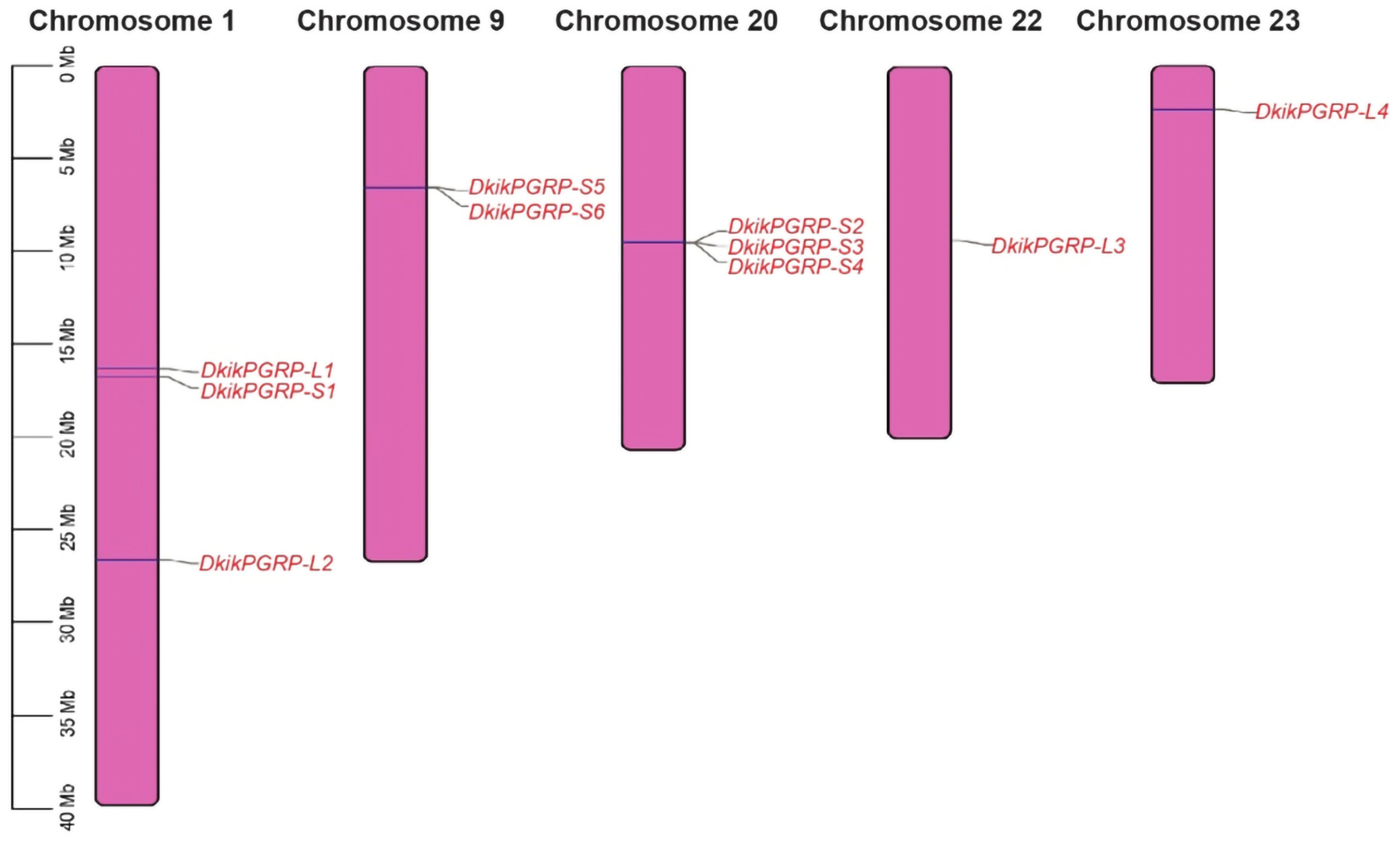
The chromosomal localization of the DkikPGRPs is shown in Figure 2. A total of ten genes were mapped to five chromosomes, with chromosomes 1 and 20 each harboring the highest number of genes (three genes each). Chromosome 9 contained two genes, while chromosomes 22 and 23 each contained one gene.

3.4. Domain Analysis of PGRPs

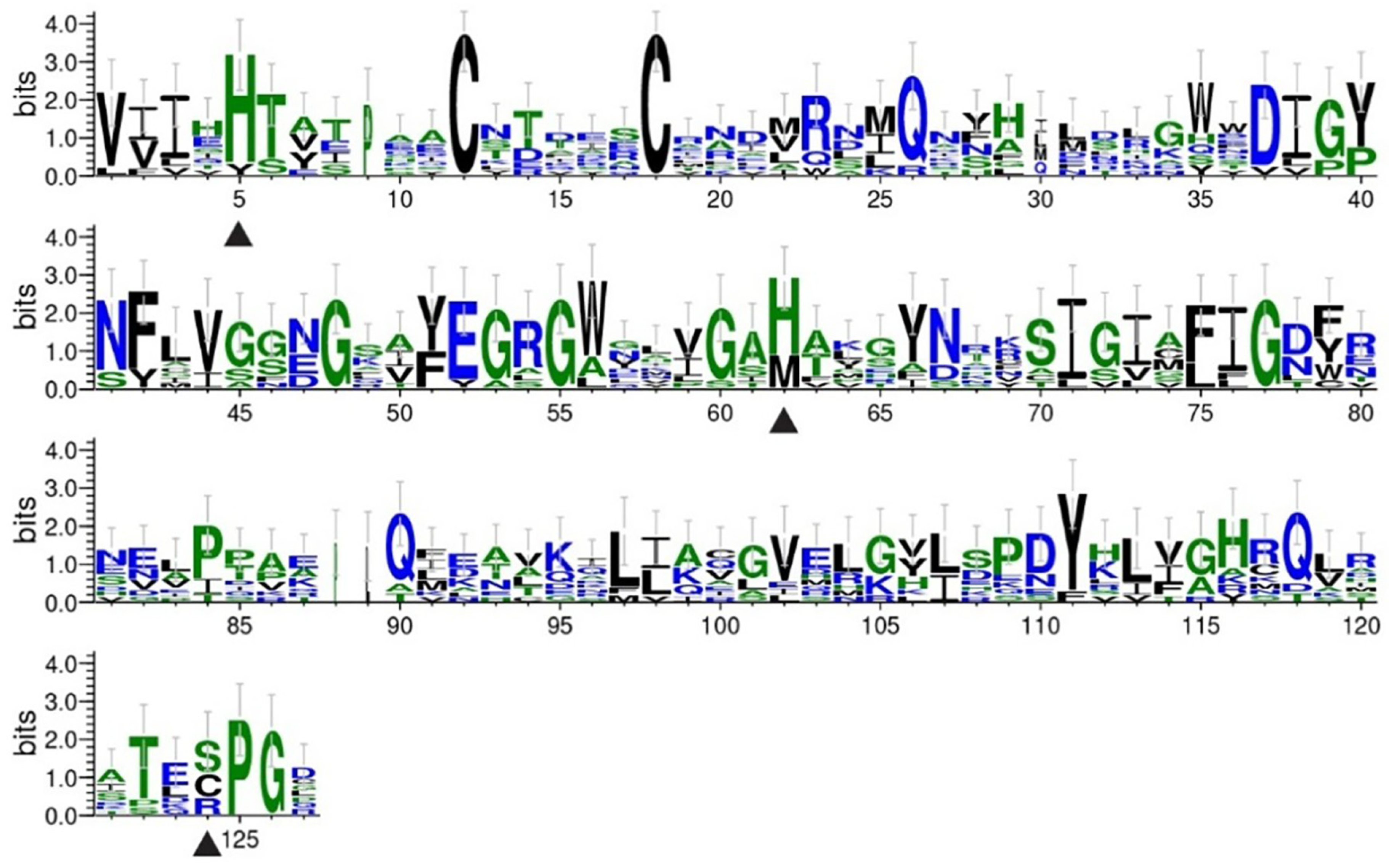
Amino acid conservation within the functional domains of D. kikuchii PGRPs was analyzed using WebLogo (v3.7.11), revealing strong conservation at several key functional sites (Figure 3). These conserved residues constitute the structural basis for immune recognition and catalytic activity of PGRPs. Specifically, Zn2+-binding sites were identified at His5, His62, and Cys124; amidase catalytic residues included His5, Tyr40, His62, Thr122, and Cys124; and additional substrate-binding sites were also detected. These results indicate that D. kikuchii PGRPs exhibit evolutionary conservation at critical residues, underscoring their functional significance in immune recognition and catalysis.
The multiple sequence alignment of PGRP domain sequences (Figure S1) showed that DkikPGRP-S2, DkikPGRP-S3, and DkikPGRP-S4 fully retained the five key catalytic residues required for amidase activity (His5, Tyr40, His62, Thr122, and Cys124), suggesting that they possess Amidase_2 activity and can hydrolyze the amide bond between N-acetylmuramic acid and L-alanine in bacterial peptidoglycan, thereby exerting direct bactericidal effects against Gram-positive bacteria. In particular, His5, His62, and Cys124 function as Zn2+-binding sites that are critical for catalysis. By contrast, mutations in certain residues may reduce catalytic activity; for example, in DkikPGRP-S5, DkikPGRP-S6, and DkikPGRP-L2, Cys124 is replaced by Ser124, which may impair Zn2+-binding and amidase function.

3.5. Phylogenetic Analysis of the PGRP Family

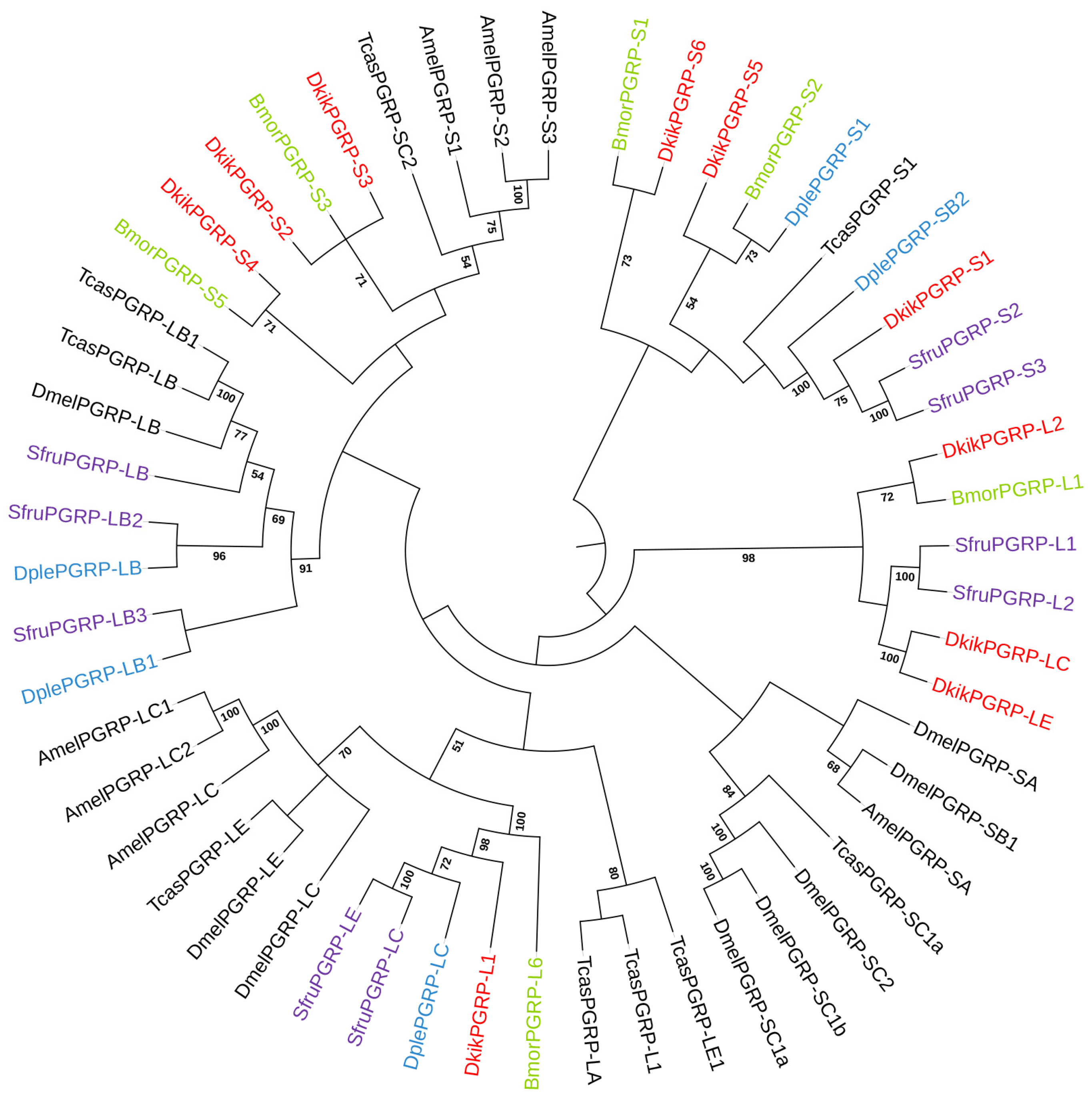
To explore the evolutionary relationships of the PGRP family, a neighbor-joining phylogenetic tree was constructed using PGRP amino acid sequences from seven insect species (Figure 4). The ten DkikPGRP of D. kikuchii were distributed across distinct clades and clustered with homologs from other Lepidoptera insects. For instance, DkikPGRP-S1 clustered with SfruPGRP-S2 and SfruPGRP-S3; DkikPGRP-S2 and DkikPGRP-S3, along with BmorPGRP-S3, cluster together in one branch, indicating a close evolutionary relationship between these genes. Similarly, DkikPGRP-S4 and BmorPGRP-S5 are grouped in another branch, suggesting they share a common evolutionary ancestor. DkikPGRP-S5 shows a clear evolutionary relationship with other PGRP genes from D. kikuchii and closely related species. Its placement in the phylogenetic tree suggests it is genetically distinct but shares a common ancestor with other PGRP family members. This positions DkikPGRP-S5 as an important, potentially unique gene in the immune response of D. kikuchii; DkikPGRP-S6 was closely related to BmorPGRP-S1. These groupings highlight the conserved nature of certain PGRP genes across different species, reflecting similar roles in immune defense. Among the long-type proteins, DkikPGRP-L1 clustered with DplePGRP-LC, SfruPGRP-LC, SfruPGRP-LE, and BmorPGRP-L6; DkikPGRP-L2 with BmorPGRP-L1; DkikPGRP-LC and DkikPGRP-LE also clustered with SfruPGRP-L1 and SfruPGRP-L2. Overall, DkikPGRPs exhibited strong homology with Lepidoptera PGRPs, highlighting their evolutionary conservation.

3.6. Tissue-Specific Transcriptional Expression of PGRP Genes Under Bt Infection

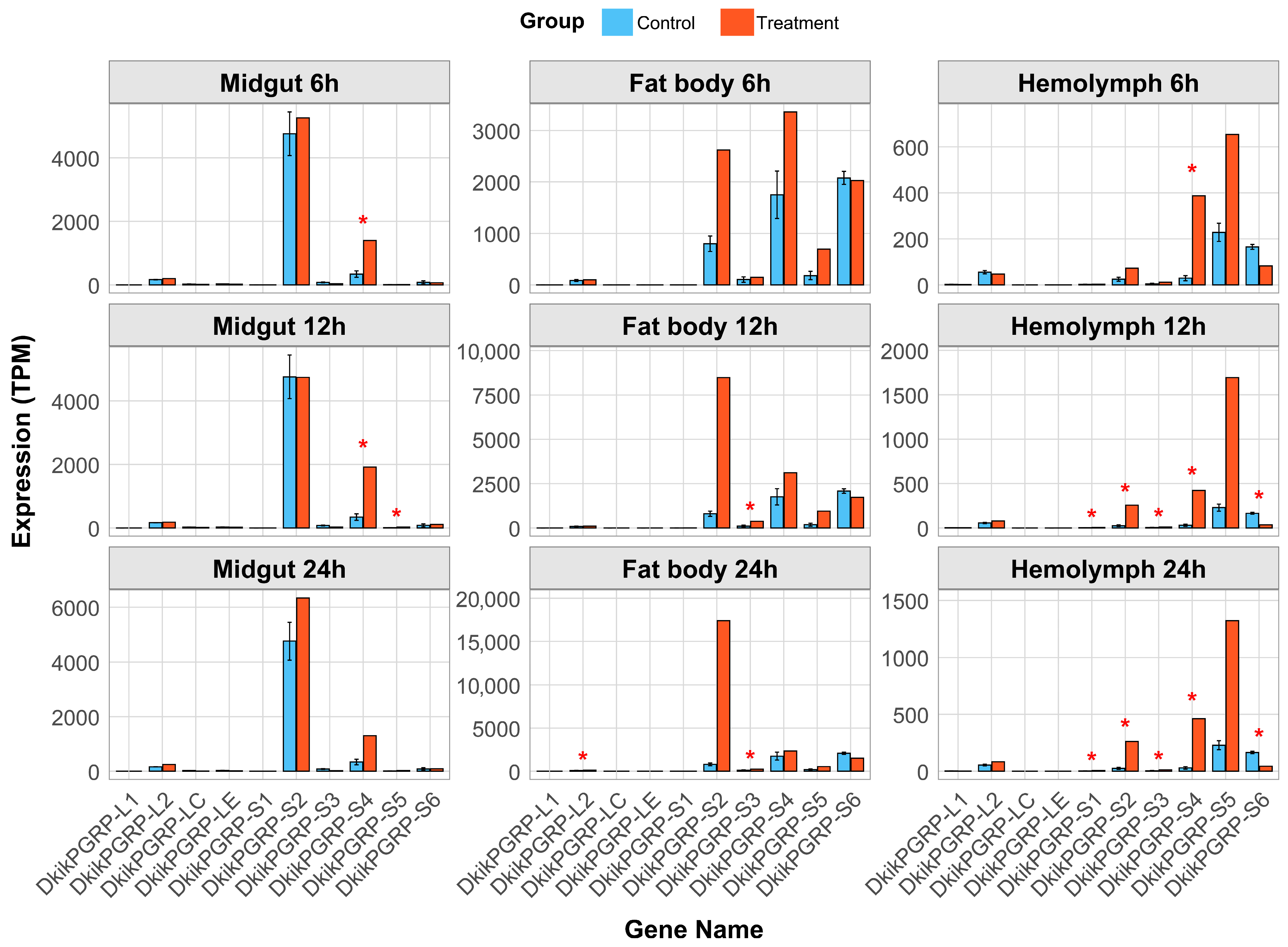
Based on transcriptomic data, the expression patterns of PGRP genes in the midgut, fat body, and hemolymph of D. kikuchii were comparatively analyzed under Bt infection (Figure 5). Among the ten identified PGRP genes, the four long-type genes (DkikPGRP-L1, -L2, -LC, and -LE) showed no significant response to Bt infection across the tested tissues, with expression levels comparable to those of the control group. In contrast, the six short-type genes (DkikPGRP-S1–S6) exhibited pronounced changes across different tissues and time points, suggesting that they play more active roles in immune responses.
Among these, DkikPGRP-S5 showed the most significant upregulation, with consistently elevated expression in the midgut, fat body, and hemolymph at nearly all examined time points. DkikPGRP-S2 and DkikPGRP-S3 were predominantly upregulated in the fat body and hemolymph, while DkikPGRP-S4 was markedly induced in the midgut and hemolymph. By contrast, DkikPGRP-S1 and DkikPGRP-S6 exhibited significant responses only in the hemolymph. Further analysis revealed that as Bt infection progressed, the number of short-type PGRPs involved in immune responses increased, indicating a cooperative role in defense against Bt. Collectively, these results suggest that short-type PGRPs play a critical role in the immune defense of D. kikuchii against the Gram-positive bacterium Bt, with responses exhibiting clear tissue specificity and temporal dependence. These findings are consistent with recent reports that Bt infection can induce enhanced immune responses in Lepidoptera pests [31].

3.7. Functional Analysis of DkikPGRP-S4 and DkikPGRP-S5 in Immune Regulation

3.7.1. Effects of siRNA on Gene Expression and Bt Virulence

Based on the transcriptional expression analysis of PGRP genes in different tissues under Bt infection, both DkikPGRP-S4 and DkikPGRP-S5 were significantly upregulated in multiple immune-related tissues, suggesting that they may play critical roles in immune responses. Domain analysis further indicated that DkikPGRP-S4 possesses a complete set of amidase catalytic residues, whereas DkikPGRP-S5 carries a mutation at Cys124, which is substituted by Ser124, potentially impairing its catalytic activity. To clarify their functional differences during Bt infection, siRNA-mediated RNAi experiments targeting DkikPGRP-S4 and DkikPGRP-S5 were performed to assess their roles in downstream immune responses and Bt virulence.
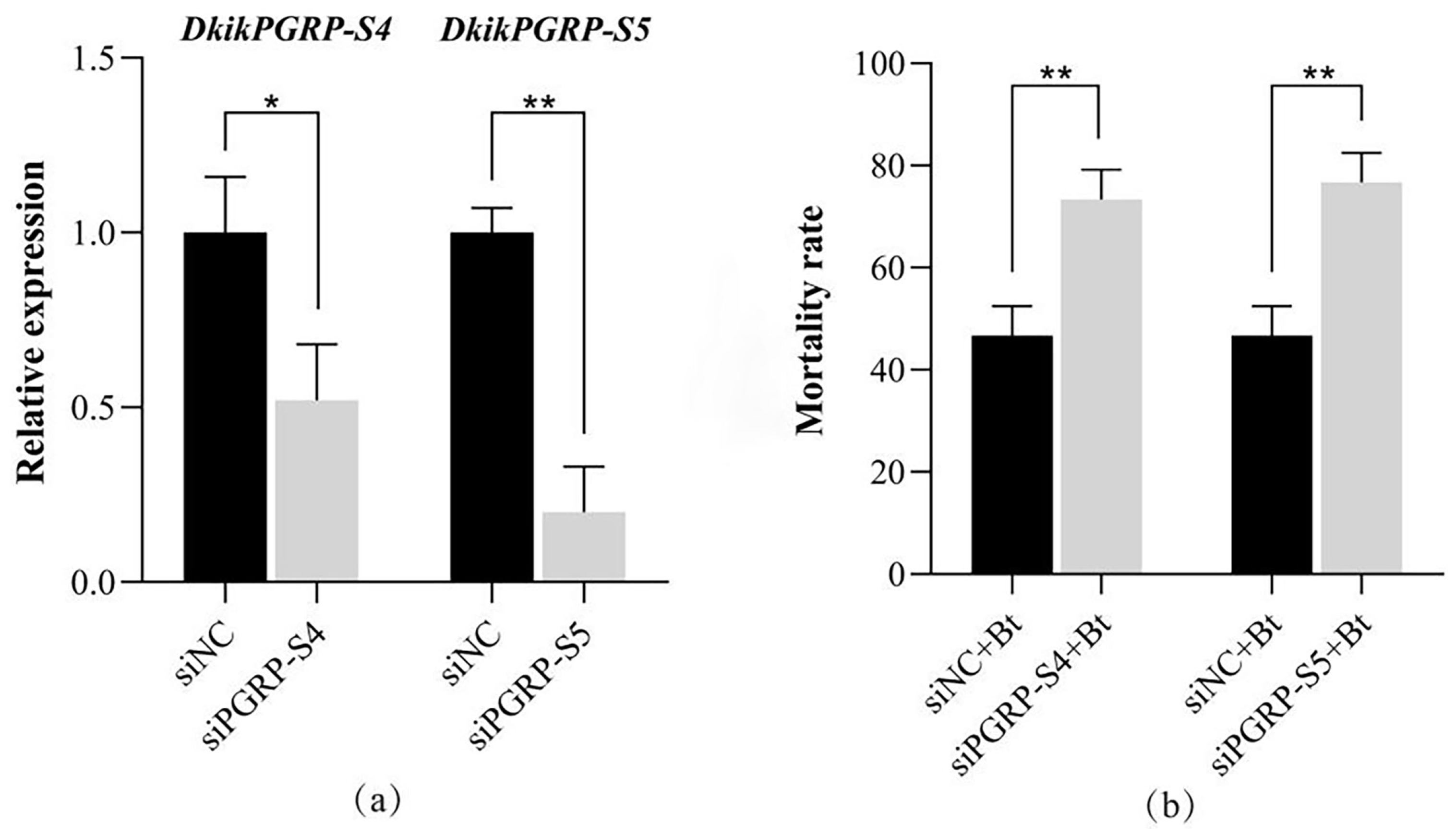
According to previous studies, the target gene silencing can be detected within 24 h after RNA interference (RNAi) injection in insects [32,33]. Therefore, the silencing efficiency was assessed at 24 h post-injection in this study. The results (Figure 6a) showed that 24 h after siRNA treatment, the relative expression levels of DkikPGRP-S4 and DkikPGRP-S5 were significantly downregulated. Compared to the control group si-NC, the silencing efficiencies of siDkikPGRP-S4 and siDkikPGRP-S5 were 48% and 80%, respectively. This indicates that the transcriptional level of DkikPGRP-S5 was more significantly inhibited by siRNA (p < 0.01), with a greater effect than the silencing effect of siRNA on DkikPGRP-S4 (p < 0.05).
After 24 h of siRNA interference in D. kikuchii, the larvae were injected with Bt bacterial solution, and the effect of siRNA-mediated target gene silencing on Bt toxicity was analyzed 24 h later. As shown in Figure 6b, effective inhibition of DkikPGRP-S4 and DkikPGRP-S5 mRNA levels by siRNA treatment led to a significant increase in the mortality rate of D. kikuchii larvae following Bt infection (p < 0.01). Although there was a considerable difference in the silencing efficiency of the two genes, both siRNAs exacerbated the toxicity of Bt on the larvae, with little difference in the lethal effect. These results indicate that both DkikPGRP-S4 and DkikPGRP-S5 play a role in regulating Bt toxicity.

3.7.2. Regulation of Downstream AMP Gene Expression by DkikPGRP-S4 and DkikPGRP-S5

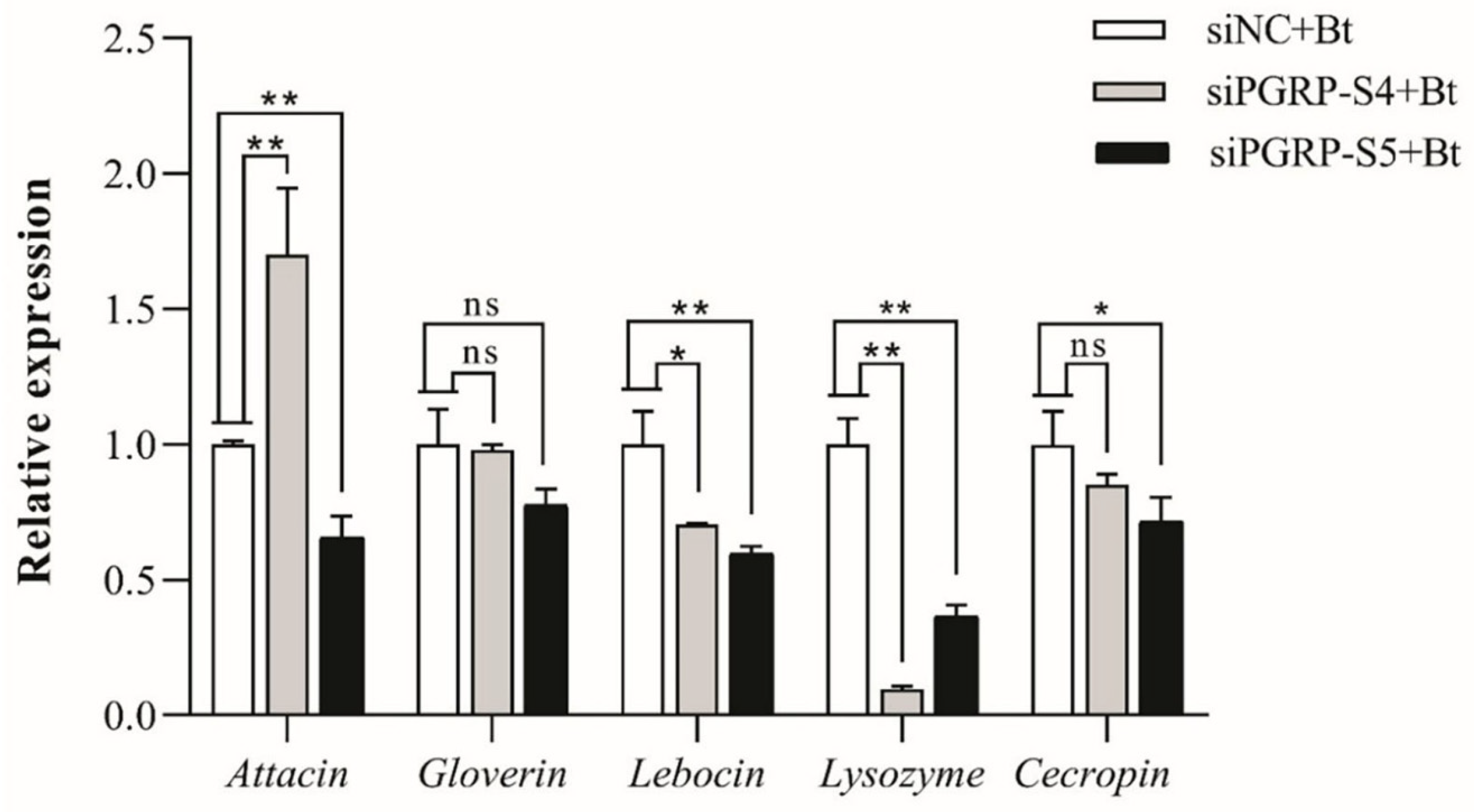
After siRNA treatment for 24 h, larvae were injected with Bt, and the mRNA levels of downstream AMP genes (attacin, gloverin, lebocin, lysozyme, and cecropin) were measured 12 h post-infection (Figure 7).
The results showed that silencing DkikPGRP-S4 significantly downregulated the expression of lebocin and lysozyme, while significantly upregulating attacin. This indicates that DkikPGRP-S4 exerts both positive and negative regulatory effects on different AMP genes. No significant changes were observed in gloverin and cecropin, indicating that these two genes may not be regulated by DkikPGRP-S4. In contrast, silencing DkikPGRP-S5 resulted in significant downregulation of all AMP genes (attacin, lebocin, lysozyme, and cecropin) except gloverin, suggesting that it primarily functions as a positive regulator of AMP expression, while gloverin may not be under its control. Collectively, these findings indicate that DkikPGRP-S4 and DkikPGRP-S5 contribute to the defense of D. kikuchii against Bt infection by regulating the expression of downstream AMP genes.
In summary, both DkikPGRP-S4 and DkikPGRP-S5 contribute to the immune defense of D. kikuchii against Bt by regulating the expression of downstream AMP genes. Specifically, DkikPGRP-S4 likely exerts its function through amidase activity that directly weakens Bt, whereas DkikPGRP-S5, despite lacking catalytic activity, enhances the defense response by recognizing Bt and inducing AMP expression. The loss of their synergistic action ultimately compromises immune defense, significantly increases larval susceptibility to Bt, and consequently leads to a marked rise in larval mortality.

4. Discussion

PGRPs are a conserved family of PRRs that recognize bacterial cell wall PGN, thereby activating the insect innate immune system and playing key roles in defense against pathogen invasion [21,28]. Most studies to date have focused on model insects such as D. melanogaster and B. mori, whereas systematic investigations of PGRPs in non-model insects remains relatively limited [22,23].
In this study, ten PGRP genes were identified in the genome of D. kikuchii, including four long-type (L-type) and six short-type (S-type) members. The number of genes was comparable to that in T. castaneum (10) and H. armigera (9) [34], suggesting that the PGRP family in D. kikuchii is similar in scale to that of other insects, regardless of their taxonomic classification [35]. Phylogenetic analysis revealed that these genes exhibit close evolutionary relationships with PGRPs from other insects, and all contain the typical Amidase_2 conserved domain, confirming that they are canonical members of the PGRP family. Furthermore, DkikPGRP-S2, DkikPGRP-S3, and DkikPGRP-S4 clustered together phylogenetically and were tandemly distributed on chromosome 20, whereas DkikPGRP-S5 and DkikPGRP-S6 were located adjacently on chromosome 9, suggesting tandem duplication events at the chromosomal level. Such a phenomenon of “tandem distribution with functional convergence” has also been reported in other insects [34], indicating that gene expansion plays an important role in shaping the diversity of immune-related genes.
PGRPs can participate in immune responses through different mechanisms: catalytic PGRPs retain Zn2+-binding sites and exhibit amidase activity, enabling them to directly hydrolyze PGN and negatively regulate immune responses [6,36,37]; whereas non-catalytic PGRPs, which have lost the Zn2+-binding residues, can only bind PGN and activate immune signaling pathways [3,38]. For example, Drosophila PGRP-SB1 can rapidly kill Gram-positive bacteria in the presence of Zn2+ [38], whereas B. mori PGRP-S4 has been shown to directly hydrolyze Escherichia coli PGN and disrupt its cell surface [39]. Consistently, structural predictions in this study indicated that the DkikPGRP family contains several functional amino acid residues, with His5, His62, and Cys124 identified as critical Zn2+-binding sites. DkikPGRP-S2, DkikPGRP-S3, and DkikPGRP-S4 were found to possess complete catalytic sites, suggesting typical amidase activity. In contrast, DkikPGRP-S5 and DkikPGRP-S6 carry a Cys124-to-Ser124 substitution, which may impair their ability to hydrolyze PGN, resembling previously reported loss-of-function mutations [3].
Transcriptomic data and RNAi functional validation further demonstrated that DkikPGRP-S4 and DkikPGRP-S5 play critical roles in the immune defense of D. kikuchii. Silencing of DkikPGRP-S4 resulted in downregulation of Lebocin and Lysozyme expression, whereas attacin was upregulated, indicating a bidirectional regulatory role in AMPs. In contrast, silencing of DkikPGRP-S5 led to significant downregulation of most AMPs (attacin, lebocin, lysozyme, and cecropin), except for gloverin, suggesting that it primarily functions as a positive regulator of AMP expression. This finding is consistent with previous studies showing that BmorPGRP-S5 in the B. mori AMP synthesis [40], and also aligns with results from Plutella xylostella exposed to Cry1Ac toxin, in which PGRPs were implicated in host immune regulation [41]. Moreover, silencing of either gene significantly increased larval mortality following Bt infection, further confirming their essential roles in antibacterial defense.
Notably, this study revealed that DkikPGRP-S4 is more likely to function through its amidase activity by directly hydrolyzing PGN, whereas DkikPGRP-S5, despite lacking amidase activity, can recognize PGN and activate the Toll and IMD pathways to induce downstream AMP expression (e.g., Cecropin), thereby enhancing immune defense. This hypothesis is consistent with RNAi experiments conducted in Antheraea pernyi and P. xylostella, where silencing of PGRPs resulted in significant downregulation of AMP expression and increased host susceptibility to pathogens [41,42].
The most novel finding in our study is the complex regulatory pattern of DkikPGRP-S4, which both activates and represses the expression of different AMPs. This dual role contrasts with the canonical model of PGRPs in D. melanogaster, where catalytic PGRPs are generally considered negative regulators of immune responses [43]. In Drosophila, catalytic PGRPs activate the immune pathway by recognizing PGN, but subsequently limit immune activation to prevent overreaction, typically by repressing certain immune responses [5].
However, our findings suggest that DkikPGRP-S4 in D. kikuchii exhibits a more complex role, modulating AMP expression both positively and negatively. Specifically, DkikPGRP-S4 activates the expression of attacin, while repressing the expression of lebocin and lysozyme, indicating that its function is more intricate than simply acting as a repressor. This suggests that D. kikuchii may have evolved a more complex immune mechanism. The complex regulatory pattern of DkikPGRP-S4 may reflect a more adaptive strategy, balancing immune activation and repression to enable D. kikuchii to more effectively respond to various pathogens, such as Bt. The broader implication of this finding is that catalytic PGRPs may have evolved different roles across insect species, providing a more flexible and refined immune response than previously thought.
It should be noted that, although SignaIP 6.0 did not predict N-terminal signal peptides in the currently available sequences of DkikPGRP-S1, -S3, and -S5, short PGRPs in other insects usually possess such signal peptides. In the present study, we did not directly verify the 5′-end completeness or subcellular localization of these PGRPs by 5′RACE or localization assays, which represents a limitation of our work. Future studies should therefore perform 5′RACE and protein localization analyses to obtain full-length sequences and clarify their precise subcellular distribution and functions within cells.
Therefore, this study not only elucidates the conservation and diversity of the PGRP gene family in D. kikuchii but also clarifies their critical molecular roles in resisting Bt infection. These findings advance our understanding of the structure and function of insect PGRPs and highlight potential molecular targets for the sustainable management of forestry pests such as D. kikuchii. With the increasing application of RNA interference (RNAi) technology in Lepidoptera pests [44], this approach shows great promise for immune regulation research and pest control in D. kikuchii, offering new strategies for future integrated pest management.

5. Conclusions

This study systematically identified 10 PGRP family members in D. kikuchii (6 short-type PGRPs and 4 long-type PGRPs), all containing typical PGRP/Amidase_2 domains. The genes are highly conserved at the sequence level, with several members showing evidence of tandem expansion. Transcriptome analysis revealed that five short PGRP genes (DkikPGRP-S1/S2/S3/S4/S5) play important roles in the innate immune response to Bt infection, exhibiting tissue specificity and temporal dependence. siRNA-mediated knockdown experiments indicated functional differences between DkikPGRP-S4, which retains full amidase activity, and DkikPGRP-S5, which has mutations at the active site. However, silencing either gene significantly increased larval mortality following Bt infection, suggesting that these PGRP genes are promising molecular targets for controlling D. kikuchii damage.

Supplementary Materials

The following supporting information can be downloaded at: https://www.mdpi.com/article/10.3390/biology14121783/s1, Table S1: Insect Genome Data for PGRP Identity (NCBI); Table S2: List of PGRP Genes and Corresponding GenBank Accession Numbers Used in the Phylogenetic Analysis; Table S3: siRNA Primer Sequence Information; Table S4: Fluorescence PCR Primer Information; Table S5: Physicochemical properties of PGRPs in Dendrolimus kikuchii; Figure S1. Multiple sequence alignment of PGRP domains in Dendrolimus kikuchii.

Author Contributions

Conceptualization, Y.T., J.Z., and N.Z.; methodology, Z.W. and Y.T.; software, Q.G.; validation, Y.T., Z.W., and X.F.; formal analysis, Q.G.; investigation, N.Z.; resources, X.F.; data curation, Y.T.; writing—original draft preparation, J.Z.; writing—review and editing, Q.G.; visualization, B.Y.; supervision, N.Z. and J.Z.; project administration, J.Z. and B.Y.; funding acquisition, B.Y., N.Z., and J.Z. All authors have read and agreed to the published version of the manuscript.

Funding

This work was funded by the Preparatory Foundation of Southwest Forestry University, grant number SWFU-18200132/110825026; the Reserve Programme for Young and Middle-aged Academic and Technical Leaders of Yunnan Province (202405AC350035); and the Doctoral Research Startup Fund project of Southwest Forestry University, grant number SWFU-110224017.

Institutional Review Board Statement

Not applicable.

Informed Consent Statement

Not applicable.

Data Availability Statement

The data presented in the study are deposited in the NCBI repository; the genome sequence and annotation accession number is JAHHIN010000000; the transcriptome analysis accession numbers are SRR15334172-SRR15334183 and SRR15927891-SRR15927903. The datasets generated and/or analyzed during the current study are available from the corresponding author upon reasonable request.

Acknowledgments

We thank Yu Qiu and Yuxiang Wang for their help with sample collection and China Shanghai Major Bio-Pharmaceutical Technology Co., Ltd. (Shanghai) for their technical services in library construction and sequencing. We are grateful to Southwest Forestry University for providing laboratory facilities and technical support, and we appreciate the constructive feedback from the anonymous reviewers, which substantially improved the manuscript.

Conflicts of Interest

The authors declare no conflicts of interest.

Abbreviations

The following abbreviations are used in this manuscript:
PGRPPeptidoglycan recognition proteins
PRRSPattern Recognition Receptors
PGNPeptidoglycan
PPOProphenoloxidase
BtBacillus thuringiensis
PBSPhosphate-Buffered Saline
AMPAntimicrobial Peptide
siNCsiRNA Negative Control
CDSCoding Sequence
CDDConserved Domain Database
mRNAMessenger RNA
siRNASmall Interfering RNA
qRT-PCRReal-Time Quantitative Reverse Transcription PCR
5′-RACERapid Amplification of cDNA Ends

References

  1. Zhang, Z.; Kong, J.; De Mandal, S.; Li, S.; Zheng, Z.; Jin, F.; Xu, X. An Immune-Responsive PGRP-S1 Regulates the Expression of Antibacterial Peptide Genes in Diamondback moth, Plutella xylostella (L.). Int. J. Biol. Macromol. 2020, 142, 114–124. [Google Scholar] [CrossRef]
  2. Yoshida, H.; Kinoshita, K.; Ashida, M. Purification of a Peptidoglycan Recognition Protein from Hemolymph of the Silkworm, Bombyx mori. J. Biol. Chem. 1996, 271, 13854–13860. [Google Scholar] [CrossRef]
  3. Wang, Q.; Ren, M.; Liu, X.; Xia, H.; Chen, K. Peptidoglycan Recognition Proteins in Insect Immunity. Mol. Immunol. 2019, 106, 69–76. [Google Scholar] [CrossRef] [PubMed]
  4. Guan, R.; Roychowdhury, A.; Ember, B.; Kumar, S.; Boons, G.-J.; Mariuzza, R.A. Structural Basis for Peptidoglycan Binding by Peptidoglycan Recognition Proteins. Proc. Natl. Acad. Sci. USA 2004, 101, 17168–17173. [Google Scholar] [CrossRef] [PubMed]
  5. Paredes, J.C.; Welchman, D.P.; Poidevin, M.; Lemaitre, B. Negative Regulation by Amidase PGRPs Shapes the Drosophila Antibacterial Response and Protects the Fly from Innocuous Infection. Immunity 2011, 35, 770–779. [Google Scholar] [CrossRef] [PubMed]
  6. Royet, J. Peptidoglycan Recognition Proteins: Modulators of the Microbiome and Inflammation. Nat. Rev. Immunol. 2011, 11, 837–851. [Google Scholar] [CrossRef] [PubMed]
  7. Werner, T.; Liu, G.; Kang, D.; Ekengren, S.; Steiner, H.; Hultmark, D. A Family of Peptidoglycan Recognition Proteins in the Fruit Fly Drosophila melanogaster. Proc. Natl. Acad. Sci. USA 2000, 97, 13772–13777. [Google Scholar] [CrossRef] [PubMed]
  8. Liu, C.; Gelius, E.; Liu, G.; Steiner, H.; Dziarski, R. Mammalian Peptidoglycan Recognition Protein Binds Peptidoglycan with High Affinity, Is Expressed in Neutrophils, and Inhibits Bacterial Growth. J. Biol. Chem. 2000, 275, 24490–24499. [Google Scholar] [CrossRef] [PubMed]
  9. Tanaka, H.; Ishibashi, J.; Fujita, K.; Nakajima, Y.; Sagisaka, A.; Tomimoto, K.; Suzuki, N.; Yoshiyama, M.; Kaneko, Y.; Iwasaki, T. A Genome-Wide Analysis of Genes and Gene Families Involved in Innate Immunity of Bombyx mori. Insect Biochem. Mol. Biol. 2008, 38, 1087–1110. [Google Scholar] [CrossRef]
  10. Li, J.; Li, J.; Jing, Z.; Yu, Q.; Zheng, G.; Zhang, B.; Xing, L.; Zhang, H.; Wan, F.; Li, C. Antiviral Function of Peptidoglycan Recognition Protein in Spodoptera exigua (Lepidoptera: Noctuidae). Insect Sci. 2023, 30, 1092–1104. [Google Scholar] [CrossRef]
  11. Wang, G.; Ran, J.; Jia, C.; Mohamed, A.; Paredes-Montero, J.R.; Al-Akeel, R.K.; Zang, L.; Zhang, W.; Keyhani, N.O.; Eleftherianos, I. Developmental Transcriptomics Reveals Stage-Specific Immune Gene Expression Profiles in Spodoptera frugiperda. Sci. Rep. 2025, 15, 25044. [Google Scholar] [CrossRef] [PubMed]
  12. Tang, Y.; Zou, Q.; Yu, G.; Liu, F.; Wu, Y.; Zhao, X.; Wang, W.; Liu, X.; Hu, F.; Wang, Z. Immunotranscriptomic Profiling of Spodoptera frugiperda Challenged by Different Pathogenic Microorganisms. Insects 2025, 16, 360. [Google Scholar] [CrossRef] [PubMed]
  13. Wang, Q.; Liu, Y.; He, H.-J.; Zhao, X.-F.; Wang, J.-X. Immune Responses of Helicoverpa armigera to Different Kinds of Pathogens. BMC Immunol. 2010, 11, 9. [Google Scholar] [CrossRef] [PubMed]
  14. Frankenhuyzen, K.V. Insecticidal Activity of Bacillus Thuringiensis Crystal Proteins. J. Invertebr. Pathol. 2009, 101, 1–16. [Google Scholar] [CrossRef]
  15. Bravo, A.; Likitvivatanavong, S.; Gill, S.S.; Soberón, M. Bacillus Thuringiensis: A Story of a Successful Bioinsecticide. Insect Biochem. Mol. Biol. 2011, 41, 423–431. [Google Scholar] [CrossRef] [PubMed]
  16. Jurat-Fuentes, J.L.; Heckel, D.G.; Ferré, J. Mechanisms of Resistance to Insecticidal Proteins from Bacillus thuringiensis. Annu. Rev. Entomol. 2021, 66, 121–140. [Google Scholar] [CrossRef] [PubMed]
  17. Michel, T.; Reichhart, J.-M.; Hoffmann, J.A.; Royet, J. Drosophila Toll Is Activated by Gram-Positive Bacteria through a Circulating Peptidoglycan Recognition Protein. Nature 2001, 414, 756–759. [Google Scholar] [CrossRef] [PubMed]
  18. Lemaitre, B.; Hoffmann, J. The Host Defense of Drosophila melanogaster. Annu. Rev. Immunol. 2007, 25, 697–743. [Google Scholar] [CrossRef]
  19. Chen, K.; Zhou, L.; Chen, F.; Peng, Y.; Lu, Z. Peptidoglycan Recognition Protein-S5 Functions as a Negative Regulator of the Antimicrobial Peptide Pathway in the Silkworm, Bombyx mori. Dev. Comp. Immunol. 2016, 61, 126–135. [Google Scholar] [CrossRef] [PubMed]
  20. Capo, F.; Charroux, B.; Royet, J. Bacteria Sensing Mechanisms in Drosophila Gut: Local and Systemic Consequences. Dev. Comp. Immunol. 2016, 64, 11–21. [Google Scholar] [CrossRef] [PubMed]
  21. Zhang, Z.; Long, Q.X.; Xie, J. Roles of Peptidoglycan Recognition Protein (PGRP) in Immunity and Implications for Novel Anti-Infective Measures. Crit. Rev. Eukaryot. Gene Expr. 2012, 22, 259–268. [Google Scholar] [CrossRef] [PubMed]
  22. Zhang, S.; Kong, X.; Zhang, Z. Research Progress on the Dendrolimus Spp. Pheromone: From Identification to Molecular Recognition. Front. Cell Dev. Biol. 2022, 10, 829826. [Google Scholar] [CrossRef]
  23. Zhou, J.; Wu, P.; Xiong, Z.; Liu, N.; Zhao, N.; Ji, M.; Qiu, Y.; Yang, B. Chromosome-Level Genome Assembly Reveals Significant Gene Expansion in the Toll and IMD Signaling Pathways of Dendrolimus kikuchii. Front. Genet. 2021, 12, 728418. [Google Scholar] [CrossRef]
  24. Tong, Q.; He, J.Z. Study of Biological Characters of Dendrolimus kikuchii matsumura and Food Consumption of Its Larva. J. Anhui Agric. Sci. 2009, 37, 13122–13124. [Google Scholar]
  25. Chen, S.; Zhou, Y.; Chen, Y.; Gu, J. Fastp: An Ultra-Fast All-in-One FASTQ Preprocessor. Bioinformatics 2018, 34, i884–i890. [Google Scholar] [CrossRef]
  26. Kim, D.; Langmead, B.; Salzberg, S.L. HISAT: A Fast Spliced Aligner with Low Memory Requirements. Nat. Methods 2015, 12, 357–360. [Google Scholar] [CrossRef]
  27. Love, M.I.; Huber, W.; Anders, S. Moderated Estimation of Fold Change and Dispersion for RNA-Seq Data with DESeq2. Genome Biol. 2014, 15, 550. [Google Scholar] [CrossRef]
  28. Lu, Y.; Su, F.; Li, Q.; Zhang, J.; Li, Y.; Tang, T.; Hu, Q.; Yu, X.-Q. Pattern Recognition Receptors in Drosophila Immune Responses. Dev. Comp. Immunol. 2020, 102, 103468. [Google Scholar] [CrossRef]
  29. Wilkins, M.R.; Gasteiger, E.; Bairoch, A.; Sanchez, J.-C.; Williams, K.L.; Appel, R.D.; Hochstrasser, D.F. Protein Identification and Analysis Tools in the ExPASy Server. Methods Mol. Biol. 1999, 112, 531–552. [Google Scholar] [CrossRef] [PubMed]
  30. Sunkes, M.S.B.; Reddy, M.S. Characterization of the Regulatory Signatures of Peptidoglycan Recognition Proteins of Apis cerana by in Silico Analysis. J. Apic. 2022, 37, 113–122. [Google Scholar] [CrossRef]
  31. Xiao, Z.; Yao, X.; Bai, S.; Wei, J.; An, S. Involvement of an Enhanced Immunity Mechanism in the Resistance to Bacillus Thuringiensis in Lepidopteran Pests. Insects 2023, 14, 151. [Google Scholar] [CrossRef] [PubMed]
  32. Paskewitz, S.M.; Andreev, O.; Shi, L. Gene Silencing of Serine Proteases Affects Melanization of Sephadex Beads in Anopheles gambiae. Insect Biochem. Mol. Biol. 2006, 36, 701–711. [Google Scholar] [CrossRef] [PubMed]
  33. Bautista, M.A.M.; Miyata, T.; Miura, K.; Tanaka, T. RNA Interference-Mediated Knockdown of a Cytochrome P450, CYP6BG1, from the Diamondback moth, Plutella xylostella, Reduces Larval Resistance to Permethrin. Insect Biochem. Mol. Biol. 2009, 39, 38–46. [Google Scholar] [CrossRef] [PubMed]
  34. Meng, Y.; Lü, L.; Dai, W.; Zhang, W.; Lin, Z.; Dong, Y. Identification, Phylogeny and Expressional Profiles of Peptidoglycan Recognition Protein (PGRP) Gene Family in Sinonovacula Constricta. J. Ocean. Univ. China 2022, 21, 1051–1060. [Google Scholar] [CrossRef]
  35. Wang, Z.; Zhou, W.; Huang, B.; Gao, M.; Li, Q.; Tao, Y.; Wang, Z. Molecular and Functional Characterization of Peptidoglycan Recognition Proteins OfPGRP-a and OfPGRP-B in Ostrinia furnacalis (Lepidoptera: Crambidae). Insects 2022, 13, 417. [Google Scholar] [CrossRef] [PubMed]
  36. Wang, J.; Song, X.; Wang, M. Peptidoglycan Recognition Proteins in Hematophagous Arthropods. Dev. Comp. Immunol. 2018, 83, 89–95. [Google Scholar] [CrossRef]
  37. Hou, H.-X.; Guo, M.-Y.; Geng, J.; Wei, X.-Q.; Huang, D.-W.; Xiao, J.-H. Genome-Wide Analysis of Peptidoglycan Recognition Protein Genes in Fig Wasps (Hymenoptera, Chalcidoidea). Insects 2020, 11, 597. [Google Scholar] [CrossRef]
  38. Kim, M.-S.; Byun, M.; Oh, B.-H. Crystal Structure of Peptidoglycan Recognition Protein LB from Drosophila melanogaster. Nat. Immunol. 2003, 4, 787–793. [Google Scholar] [CrossRef]
  39. Yang, P.-J.; Zhan, M.-Y.; Ye, C.; Yu, X.-Q.; Rao, X.-J. Molecular Cloning and Characterization of a Short Peptidoglycan Recognition Protein from Silkworm Bombyx mori. Insect Mol. Biol. 2017, 26, 665–676. [Google Scholar] [CrossRef]
  40. Chen, K.; Liu, C.; He, Y.; Jiang, H.; Lu, Z. A Short-Type Peptidoglycan Recognition Protein from the Silkworm: Expression, Characterization and Involvement in the Prophenoloxidase Activation Pathway. Dev. Comp. Immunol. 2014, 45, 1–9. [Google Scholar] [CrossRef]
  41. Liu, A.; Huang, X.; Gong, L.; Guo, Z.; Zhang, Y.; Yang, Z. Characterization of Immune-Related PGRP Gene Expression and Phenoloxidase Activity in Cry1Ac-Susceptible and-Resistant Plutella xylostella (L.). Pestic. Biochem. Physiol. 2019, 160, 79–86. [Google Scholar] [CrossRef] [PubMed]
  42. Zhang, Q.; Dou, W.; Song, Z.-H.; Jin, T.-J.; Yuan, G.-R.; De Schutter, K.; Smagghe, G.; Wang, J.-J. Identification and Profiling of Bactrocera Dorsalis microRNAs and Their Potential Roles in Regulating the Developmental Transitions of Egg Hatching, Molting, Pupation and Adult Eclosion. Insect Biochem. Mol. Biol. 2020, 127, 103475. [Google Scholar] [CrossRef] [PubMed]
  43. Tanji, T.; Ip, Y.T. Regulators of the Toll and Imd Pathways in the Drosophila Innate Immune Response. Trends Immunol. 2005, 26, 193–198. [Google Scholar] [CrossRef] [PubMed]
  44. Kebede, M.; Fite, T. RNA Interference (RNAi) Applications to the Management of Fall Armyworm, Spodoptera frugiperda (Lepidoptera: Noctuidae): Its Current Trends and Future Prospects. Front. Mol. Biosci. 2022, 9, 944774. [Google Scholar] [CrossRef] [PubMed]
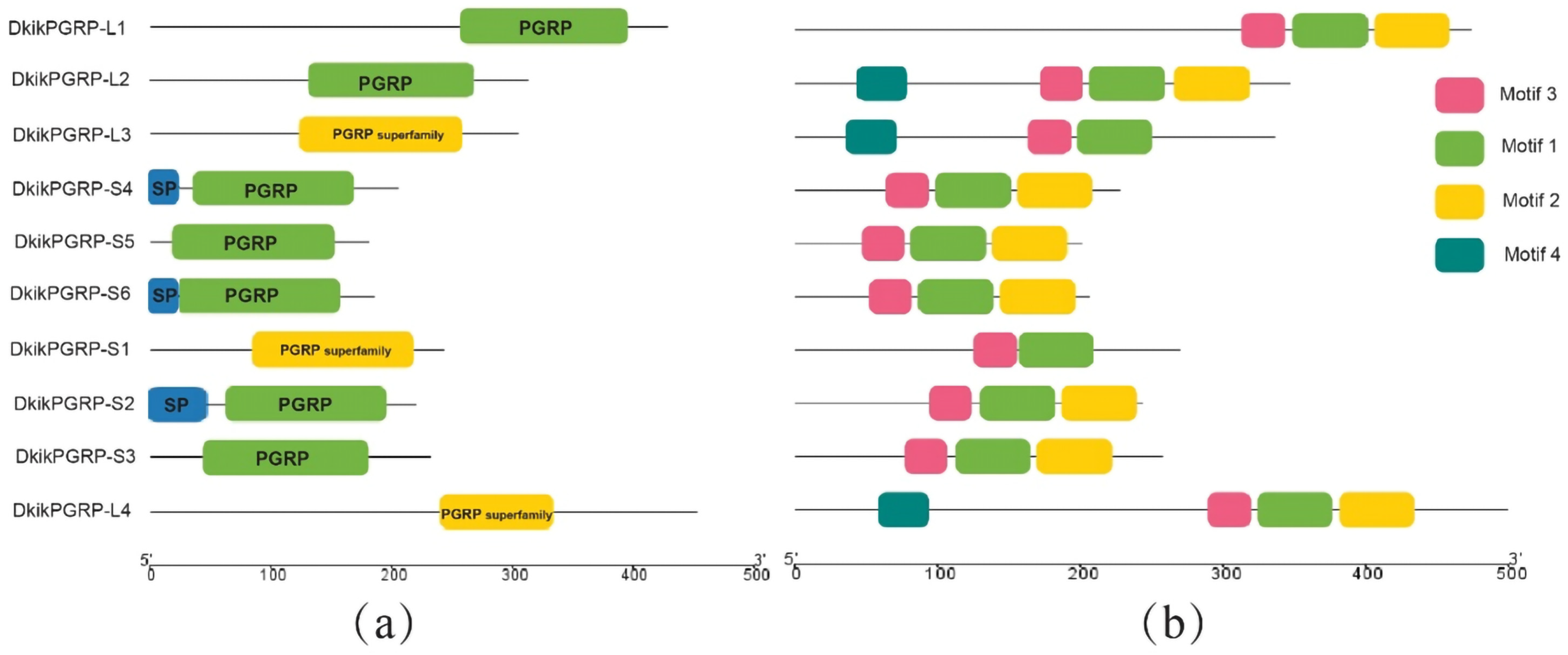
Figure 1. Domain (a) and motif (b) structure diagrams of PGRPs in D. kikuchii. (a) Conserved domains of ten PGRPs. (b) Motif organization. SP, signal peptide; PGRP, peptidoglycan recognition protein domain; PGRP superfamily, peptidoglycan recognition protein superfamily.
Biology 14 01783 g001
Figure 2. Chromosomal distribution of DkikPGRP genes in the D. kikuchii genome. The figure shows the chromosomal distribution of ten DkikPGRP genes in D. kikuchii. Numbers indicate chromosome IDs, and the left scale represents chromosome length (Mb).
Biology 14 01783 g002
Figure 3. Amino Acid Conservation of PGRP Domains in D. kikuchii. Triangles Indicate Zn2+-Binding Sites.
Biology 14 01783 g003
Figure 4. Phylogenetic analysis of the PGRP family in D. kikuchii. The maximum-likelihood tree was constructed in MEGA 11.0 using PGRP amino acid sequences from D. kikuchii, A. mellifera, B. mori, D. melanogaster, D. plexippus, S. frugiperda, and T. castaneum. The bootstrap test replicate number was set to 1000. Numbers at the internal nodes indicate bootstrap support values (%), and only values ≥ 50% are shown. Red font represents D. kikuchii PGRP genes.
Biology 14 01783 g004
Figure 5. Expression of PGRP genes in different tissues of D. kikuchii under Bt infection. The expression levels of PGRP genes in the midgut, fat body, and hemolymph were measured at 6, 12, and 24 h post-Bt infection using qRT-PCR. The red and blue bars represent the treatment and control groups, respectively. Asterisks denote statistically significant differences: * p < 0.05.
Biology 14 01783 g005
Figure 6. siRNA efficiency and effects of DkikPGRP-S4 and DkikPGRP-S5 on Bt virulence. (a) Efficiency of siRNA interference on DkikPGRP-S4 and DkikPGRP-S5 expression levels, measured by qRT-PCR at 24 h post-injection. (b) Mortality of larvae infected with Bt at 24 h after siRNA treatment. Data are presented as mean ± SD. Different asterisks indicate significant differences; * and ** indicate significance at p < 0.05 and p < 0.01, respectively.
Biology 14 01783 g006
Figure 7. Regulation of AMP gene expression by DkikPGRP-S4 and DkikPGRP-S5 after siRNA interference. After siRNA treatment and Bt injection, AMP gene expression levels were measured at 12 h post-infection using qRT-PCR. Data are shown as mean ± SD. * and ** indicate significance at p < 0.05 and p < 0.01, respectively; ns indicates no significant difference. The expression levels of each gene were normalized to its respective siNC + Bt control group, which was set as 1.0.
Biology 14 01783 g007
Table 1. Identification of PGRP genes in D. kikuchii and their homology with other insects.
Gene IDPGRP Gene NameBest-Matched Insect Gene
(Species/Accession Number)
Amino Acid Identity (%)
D.kikuchii_LG01_G00316DkikPGRP-L1Trichoplusia ni (XP-026730977.1)55.8
D.kikuchii_LG01_G00520DkikPGRP-L2Trichoplusia ni (XP-026738966.1)56.0
D.kikuchii_LG22_G00198DkikPGRP-LCTrichoplusia ni (XP-026739039.1)42.5
D.kikuchii_LG23_G00044DkikPGRP-LETrichoplusia ni (XP-026739039.1)39.4
D.kikuchii_LG01_G00331DkikPGRP-S1Galleria mellonella (XP-026757906.1)54.8
D.kikuchii_LG20_G00235DkikPGRP-S2Samia ricini (BAF03520.1)65.5
D.kikuchii_LG20_G00237DkikPGRP-S3Helicoverpa armigera (AHL58837.1)78.5
D.kikuchii_LG20_G00236DkikPGRP-S4Leguminivora glycinivorella (AXS59129.1)64.6
D.kikuchii_LG09_G00102DkikPGRP-S5Hyposmocoma kahamanoa (XP-026322322.1)57.7
D.kikuchii_LG09_G00101DkikPGRP-S6Trichoplusia ni (XP-026737257.1)64.1
Disclaimer/Publisher’s Note: The statements, opinions and data contained in all publications are solely those of the individual author(s) and contributor(s) and not of MDPI and/or the editor(s). MDPI and/or the editor(s) disclaim responsibility for any injury to people or property resulting from any ideas, methods, instructions or products referred to in the content.