Article

Contrasting Evolutionary Trajectories: Differential Population Dynamics and Gene Flow Patterns in Sympatric Halimeda discoidea and Halimeda macroloba


1
Institute of Marine Science and Technology, Shandong University, Qingdao 266237, China
2
School of Environmental and Chemical Engineering, Shanghai University, Shanghai 200444, China
3
College of Oceanography and Ecological Science, Shanghai Ocean University, Shanghai 201306, China
4
State Key Laboratory of Marine Geology, Tongji University, Shanghai 200092, China
5
Project Management Office of China National Scientific Seafloor Observatory, Tongji University, Shanghai 200092, China
6
School of Ocean and Earth Science, Tongji University, Shanghai 200092, China
7
Laoshan Laboratory, Qingdao 266237, China
*
Authors to whom correspondence should be addressed.
Biology 2025, 14(12), 1782; https://doi.org/10.3390/biology14121782 (registering DOI)
Submission received: 20 November 2025 / Revised: 8 December 2025 / Accepted: 11 December 2025 / Published: 13 December 2025

Simple Summary

Halimeda, a genus of calcified green macroalgae, is a cornerstone of tropical reef ecosystems; however, the evolutionary mechanisms driving its diversity remain largely underexplored. In this study, we analyzed molecular data from the Xisha (Paracel) Islands to assess Halimeda diversity. Focusing on two cosmopolitan species, Halimeda discoidea and Halimeda macroloba, we uncovered strikingly distinct evolutionary trajectories despite their shared environment. Populations of H. discoidea appear genetically fragmented with limited gene flow, indicating an ancient lineage shaped by long-term isolation. In contrast, H. macroloba exhibits high connectivity across islands, suggesting a stable demographic history driven by more recent dispersal events. These contrasting patterns demonstrate that both intrinsic species traits and historical oceanographic processes jointly determine population structure. Understanding these unique histories provides critical insights for predicting resilience and prioritizing conservation strategies in the face of rapid climate change.

Abstract

Calcareous tropical green macroalgae of the genus Halimeda are key reef-builders, yet the drivers of their diversification and population dynamics remain poorly understood. This study analyzed the species diversity of Halimeda in the Xisha (Paracel) Islands based on tufA gene sequences, focusing on evaluating the genetic diversity, population structure, and historical dynamics of two widespread species—Halimeda discoidea and Halimeda macroloba. The results indicate new records of Halimeda cylindracea and Halimeda cf. stuposa in the Xisha (Paracel) Islands. More importantly, H. discoidea and H. macroloba exhibited significantly different evolutionary histories. Specifically, H. discoidea showed a highly fragmented population structure, restricted gene flow, and a multimodal mismatch distribution, suggesting a complex historical process or long-term stability. In contrast, H. macroloba exhibited lower population differentiation, extensive gene flow, and non-significant neutrality test results, indicating long-term demographic stability without recent, drastic population events. Further validation based on gene flow analysis and divergence time estimation revealed that the lineage divergence of H. discoidea is older, while H. macroloba represents a lineage with a relatively younger evolutionary origin restricted to the Indo-Pacific region. This striking dichotomy clearly illustrates the interplay between intrinsic species-specific traits (e.g., dispersal capacity) and extrinsic historical factors (e.g., paleo-oceanographic events), leading to contrasting evolutionary outcomes among widespread marine taxa. By elucidating how differing evolutionary histories influence patterns of genetic diversity, this study provides a predictive framework for evaluating the resilience and guiding conservation priorities for critical marine calcifiers in the context of rapid environmental change.

1. Introduction

Marine macroalgae hold significant research importance and application value due to their extensive ecological service functions (e.g., carbon sequestration, biodiversity maintenance) and application potential (including food, pharmaceuticals, and bioenergy sectors) [1,2,3]. The genus Halimeda Lamouroux (Bryopsidales, Chlorophyta) is an important calcareous green macroalga that is widely distributed in tropical and subtropical marine regions worldwide [4]. As a significant component of coral reef ecosystems, it is renowned for its massive biomass and rich species diversity, with habitats extending from shallow waters to depths of 90–130 m on coral reef slopes [5]. Additionally, Halimeda species can produce secondary metabolites or bioactive molecules with antimicrobial activity, thereby conferring further economic value [6,7]. However, as a calcified alga, Halimeda is particularly susceptible to changes in the marine environment, especially ocean acidification [8,9]. Given its significant ecological and economic importance, the genus Halimeda has garnered widespread attention regarding its distribution and taxonomy [7,10,11].
Despite the wide geographical distribution and high ecological significance of the Halimeda genus, exploration of its diversity, particularly in large-scale coral reef systems such as the Xisha (Paracel) Islands, remains challenged by inherent limitations. On the one hand, certain Halimeda species exhibit significant phenotypic variability, i.e., they display variable morphological characteristics under different environmental conditions, which can sometimes lead to morphological misidentification [10,12]. At the same time, the genus is replete with many pseudo-cryptic and cryptic species [13,14]. These features make species definition based solely on morphology both tricky and untrustworthy.
Molecular approaches have thus become an indispensable tool for addressing such taxonomic ambiguities and vagueness [15]. Genetic markers can directly detect genetic differentiation within species, hence more informatively revealing their actual species boundaries and evolutionary relationships. Among various molecular markers, chloroplast DNA markers such as tufA, rps3-rpl14, and rbcL have been widely applied in phylogenetic and phylogeographic studies of macroalgae in the Bryopsidales order owing to their high sequence conservation and stable maternal inheritance [10,11]. The tufA gene sequence, which exhibits moderate variability and high resolution within the genus Halimeda, has proven to be the most frequently used molecular marker in deciphering its species evolutionary history and population structure [9,16,17].
Within the context of the aforementioned research background, the current work aims to utilize tufA sequence information to first investigate the species richness of the genus Halimeda in the Xisha (Paracel) Islands. Secondly, it will conduct a thorough investigation of the genetic diversity and population structure of two globally widespread Halimeda species—Halimeda discoidea Decne. and Halimeda macroloba Decaisne. By examining their population dynamics and gene exchange patterns across their wide geographical ranges, we aim to provide novel insights into their individual evolutionary histories and biogeography, further elucidating the processes that create diversity within the genus Halimeda.

2. Materials and Methods

2.1. Sample Collection and DNA Extraction

We collected Halimida samples in the Xisha (Paracel) Islands in South China Sea in April 2021, with geographical coordinates ranging from 111.2104° to 112.7286° east longitude and 15.79319° to 17.12749° north latitude. The samples are stored at low temperatures and transported to the laboratory for further processing. Total genomic DNA was extracted in the laboratory using the Ezup Spin Column Super Plant Genomic DNA Extraction Kit (Sangon Biotech Co., Ltd., Shanghai, China) in accordance with the manufacturer’s instructions. The quality and concentration of DNA were quantified using a NanoDrop spectrophotometer (Thermo Fisher Scientific, Waltham, MA, USA).

2.2. PCR Amplification and Sequencing

The tufA gene sequence was amplified by polymerase chain reaction (PCR) using the primers and amplification protocols [18]. Then the PCR products were sent to Sangon Biotech Co., Ltd. (Shanghai, China) for Sanger sequencing.

2.3. Sequence Alignment and Phylogenetic Analysis

The obtained tufA gene sequences were preliminarily aligned by BLAST v2.16.0 (Basic Local Alignment Search Tool) in the National Center for Biotechnology Information (NCBI). The sequences of related species were downloaded, and multi-sequence alignment was performed with the sample sequences of the Xisha (Paracel) Islands using MAFFT v7.526 [19]. Subsequently, manually delete double-ended sequences that cannot be aligned due to different lengths. The phylogenetic tree was constructed in MEGA X v10.2.6 using the maximum likelihood (ML) and the unweighted paired group method with arithmetic mean (UPGMA) algorithm [20].

2.4. Haplotype Analysis and Network Construction

Polymorphic locus identification was performed using DnaSP v6.12.03 [21], and haplotype diversity (Hd), nucleotide diversity (π), and the distribution of haplotypes in the population were calculated. A median-joining haplotype network was constructed using PopArt v1.7 [22].

2.5. Population Genetic Structure

Molecular analysis of variance (AMOVA), paired fixed index (FST), neutral tests including Tajima’s D and Fu’s FS, and mismatch distribution analysis were all calculated using Arlequin v3.5.2 [23]. Principal coordinate analysis based on genetic distance (PCoA) was performed in R using the “ape” package [24].

2.6. Bayesian Clustering

STRUCTURE v2.3.4 is used for Bayesian cluster analysis [25]. Set the number of genetic clusters (K) value from 1 to 10, and repeat each K value 10 times to detect the best K value. The generation number of Markov Chain Monte Carlo (MCMC) is set at 100,000 generations.

2.7. Divergence Time Estimation

Using jModelTest v2.1.7 [26], the most suitable nucleotide substitution model GTR+G (General Time Reversible with Gamma distribution) was determined based on the Akaike Information Criterion (AIC). The root age of the tree was set to 147 Ma using BEAST v2.7.7 [27,28]. The divergence time was estimated using a Yule speciation prior and an uncorrelated lognormal relaxed clock model, with the MCMC chain running for 200 million generations [13]. The convergence and effective bit size of MCMC chains were evaluated using Tracer v1.7.2 (ESS > 200) [29]. In TreeAnnotator v2.7.7, the top 10% of trees were discarded as aging trees to generate the maximum evolutionary branch confidence (MCC) tree with an average divergence time and a 95% highest posterior density (HPD) interval. All trees were visualized using FigTree v1.4.4 and iTOL (https://itol.embl.de (accessed on 11 May 2025)).

2.8. Gene Flow and Demographic Parameters

Historical gene flow and effective population sizes were estimated using MIGRATE-N v4.4.3 [30]. Heating was set with four temperatures (1.0, 1.5, 2.5, and 5.0) with a static scheme.

3. Results

3.1. Halimeda Species Diversity in the Xisha (Paracel) Islands: New Discoveries

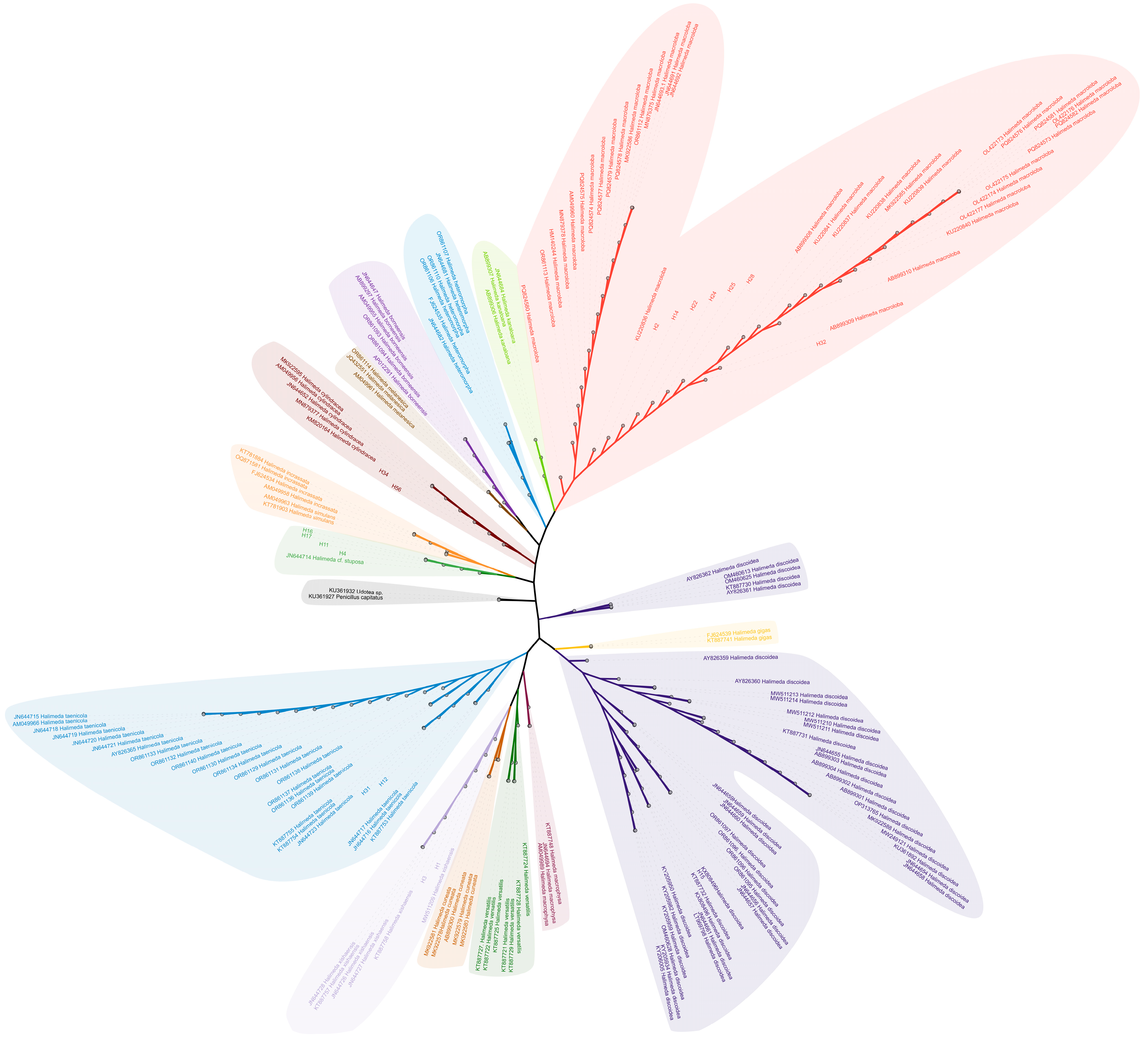
We obtained a total of 17 sequences of Halimeda in the Xisha Islands. These sequences were preliminarily compared through BLAST, and sequences of similar species in NCBI with a length greater than 800 bp, as well as the sample sequences, were selected to construct a phylogenetic tree together. The sample sequences consist of 6 species, including H. macroloba, H. discoidea, Halimeda cylindracea Decaisne, Halimeda xishaensis C.K.Tseng & M.L.Dong, Halimeda taenicola W.R.Taylor, and Halimeda cf stuposa. Among them, H. cylindracea and H. cf stuposa were first discovered in the Xisha (Paracel) Islands by us (Figure 1). In NCBI, H. macroloba and H. discoidea have the most tufA gene sequences, while other species have fewer sequences. Therefore, due to their higher number of available sequences, we selected these two species for subsequent analysis. In addition, according to the sampling information obtained from NCBI (Table 1), H. macroloba is distributed in the Pacific and Indian Oceans, while H. discoidea has a wider distribution range and is also found in the Atlantic Ocean. In summary, this preliminary analysis expanded the known Halimeda diversity in the region and identified H. discoidea and H. macroloba as ideal candidates for in-depth population studies (Figure 1; Table 1).

3.2. tufA Sequence Characteristics and Haplotype Polymorphism in Halimeda

Due to the differences in primers and sequencing quality, we obtained 41 H. discoidea sequences of 608 bp. We also obtained 713 bp sequences from H. macroloba. There are significant differences between the two in the number of haplotypes and polymorphic loci (Table 2). H. discoidea has 16 haplotypes, with haplotype diversity (Hd) of 0.906 ± 0.027 and nucleotide diversity of 0.02765. However, H. macroloba has only four haplotypes, with Hd of 0.523 ± 0.00286 and nucleotide diversity of 0.00089 ± 0.00016. These results indicate that the diversity of tufA sequences in H. discoidea is significantly higher than that in H. macroloba.
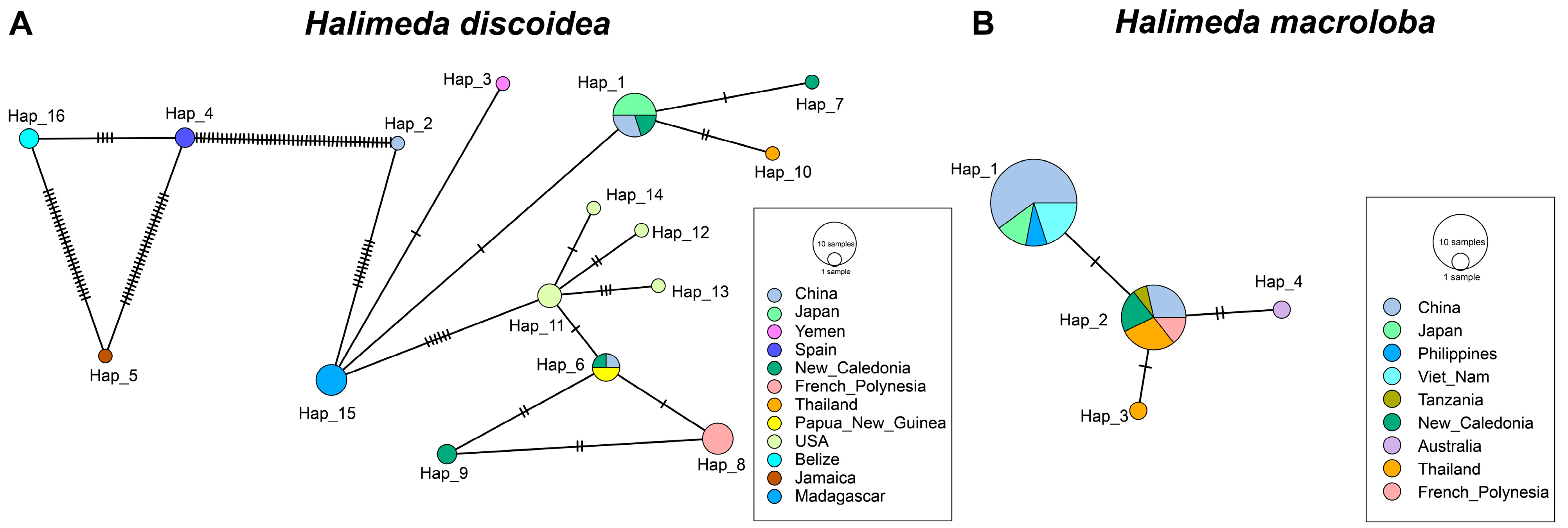
Genetic diversity varies geographically, with lower levels observed in some regions (e.g., Japan). H. discoidea maintains high diversity in New Caledonia (Hd = 0.867 ± 0.129), the United States (Hd = 0.8000 ± 0.172), and China (Hd = 0.500 ± 0.265). In contrast, H. macroloba shows relatively higher diversity in China (Hd = 0.400 ± 0.237) and Thailand (Hd = 0.341 ± 0.111). The haplotype network analysis further reveals that the four haplotypes of H. macroloba differ by only one to two base substitutions (Figure 2B). Significant base differences are observed among the H. discoidea haplotypes, among which Hap_4, Hap_5, and Hap_16 were particularly divergent from the others (Figure 2A). These three different haplotypes originated, respectively, in Belize, Jamaica, and Spain. Taken together, these findings consistently demonstrate that H. discoidea possesses a significantly deeper and more complex genetic diversity compared to H. macroloba (Figure 2; Table 2).

3.3. Genetic Divergence and Population Structure of H. discoidea

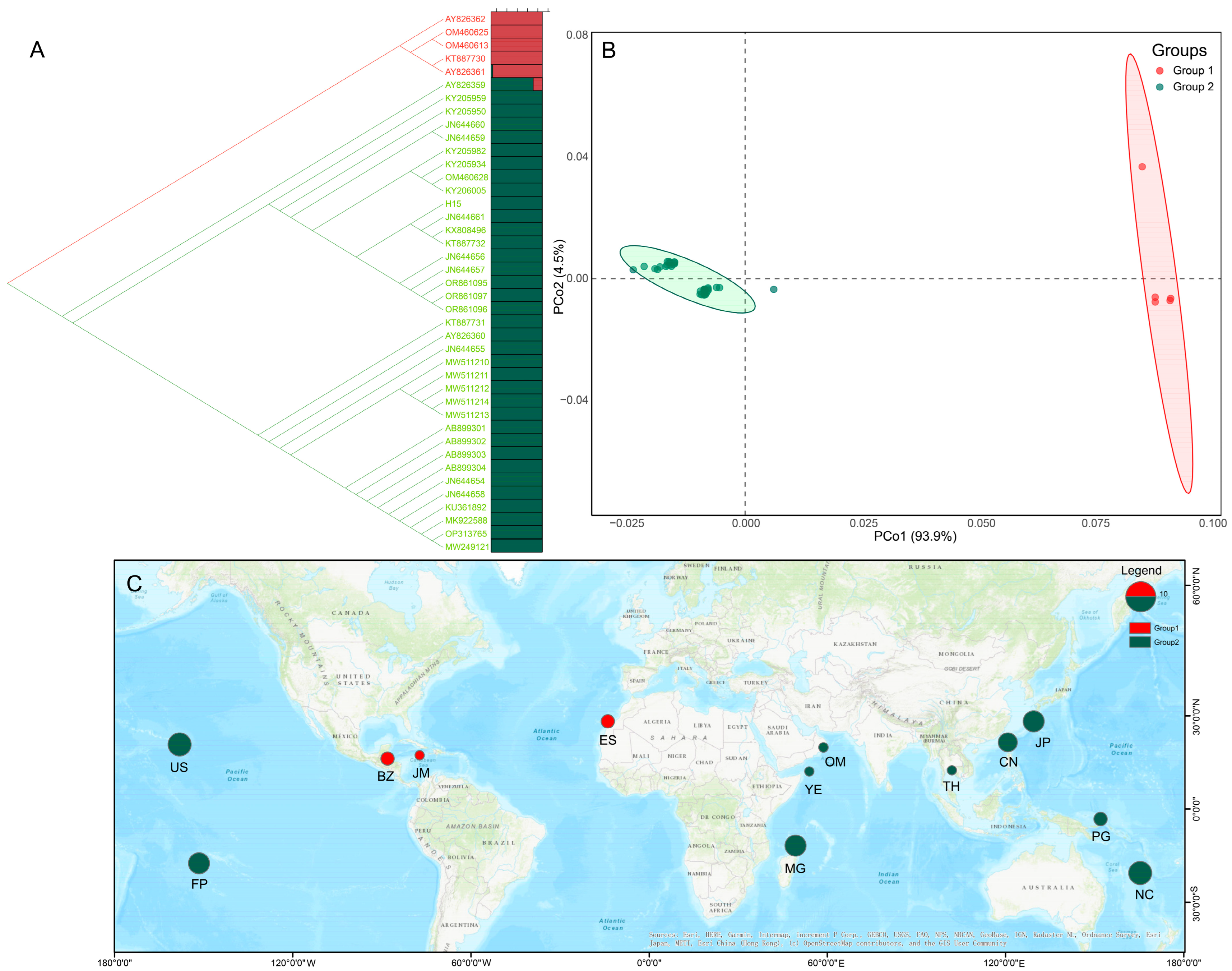
To further study the distribution of the H. discoidea tufA gene sequences, we constructed the UPGMA tree based on the genetic distance of all sequences (Figure 3A). H. discoidea can be divided into two different groups: Group 1 consists of four sequences from Belize, Jamaica, and Spain, with each country contributing at least one sequence. This grouping is consistent with our previous haplotype analysis. The second group consists of 37 sequences, primarily from China and Australia, but also includes sequences from other regions. The PCoA diagram also shows a clear separation between the two groups, further confirming our findings (Figure 3B).
To visually explore the clustering trends, we additionally performed a Bayesian cluster analysis using STRUCTURE v2.3.4. While recognizing that this software is typically applied to recombining markers, the analysis of our haploid dataset yielded a distinct peak at K = 2. This clustering pattern is highly congruent with the UPGMA tree and PCoA results, serving as a supplementary visualization of the two divergent lineages (Figure 3A,B). All the above results consistently indicate that H. discoidea can be divided into two distinct groups. We also visualized the distribution locations of these two groups on the map (Figure 3C). The first group is distributed along the Atlantic coast, while the second group is distributed along the Indian Ocean and the Atlantic coast.

3.4. Population Dynamics and Evolutionary History of H. discoidea and H. macroloba

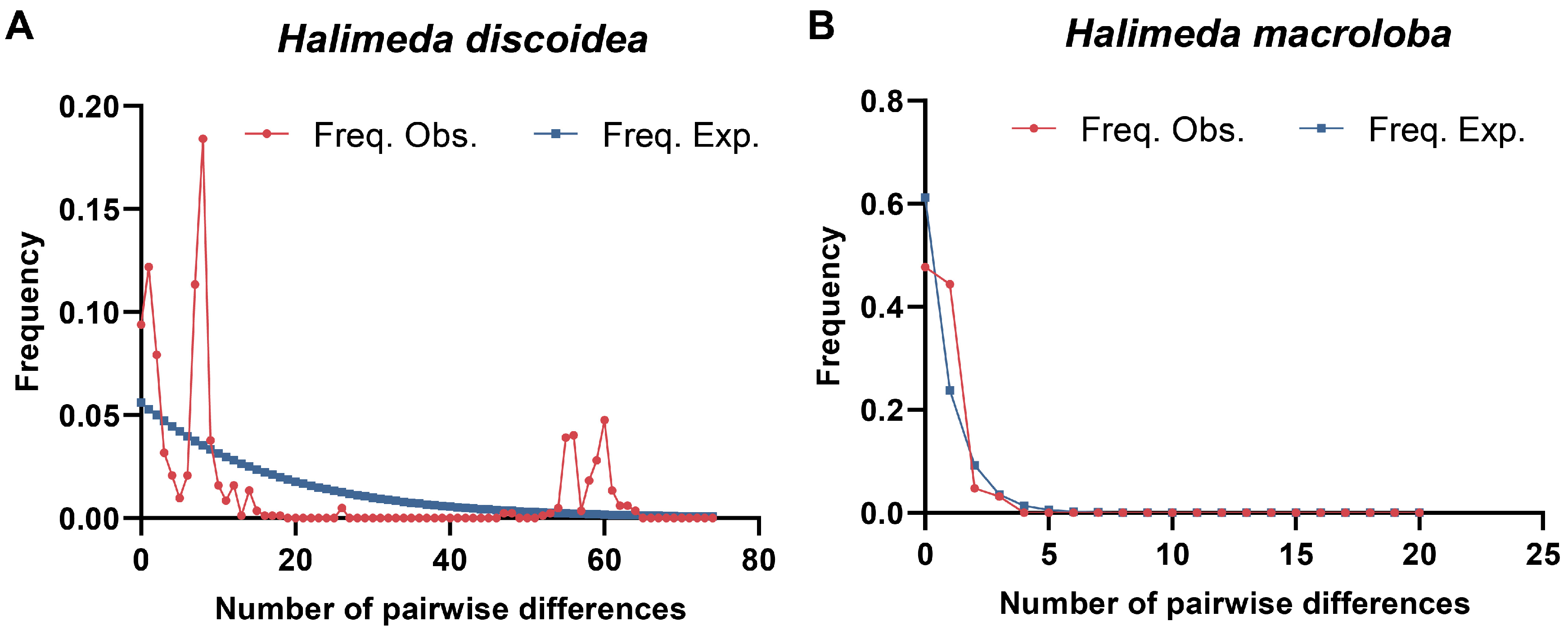
To clarify the population dynamics and evolutionary processes of H. discoidea and H. macroloba, we utilized the mismatch distribution analysis (Figure 4). The mismatch curve of H. discoidea shows a main peak at Diff = 8, supporting a possible population expansion. However, the Ewens-Watterson test did not show significant deviations from the neutral model, indicating no statistical evidence for departure from neutrality (Table 3). Chakraborty’s allele number test also showed no significant departure from the neutral expectation (≈21). Tajima’s D-test yielded a slightly negative but not significant value, which may be due to weak expansion signals or insufficient statistical power caused by a small sample size. Fu’s FS test produced a non-significant positive FS value. The Ewens-Watterson test (p = 0.618, p > 0.05) indicated that the observed F value (0.11600) was very close to the expected F value (0.11375). These results collectively indicate that there is no strong evidence to support recent population expansion in H. discoidea.
For H. macroloba, both Tajima’s D (D = −0.76354, p = 0.235) and Fu’s FS (FS = −0.42185, p = 0.354) yielded negative values. However, none of these values were statistically significant (p > 0.05), indicating no significant statistical departure from neutral expectations. This interpretation is further supported by the Ewens-Watterson test (p = 0.545), where the observed homozygosity (0.48959) closely aligned with the expected value (0.50546). Similarly, Chakraborty’s test detected no significant deviation from the neutral model (p = 0.548). Collectively, these non-significant results do not provide strong statistical evidence for recent bottlenecks or expansions in H. macroloba.

3.5. Inter-Population Genetic Differentiation (FST) in H. discoidea and H. macroloba

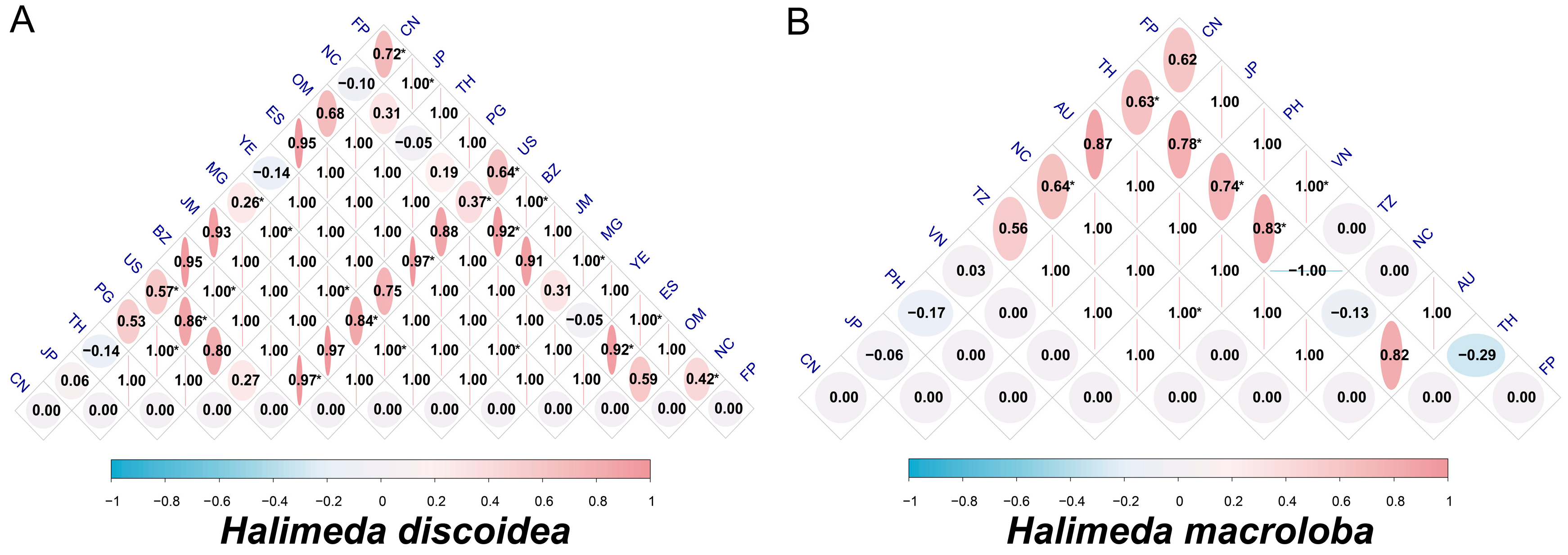
To assess inter-population genetic differentiation, we calculated pairwise FST values for H. discoidea and H. macroloba based on their sampling locations (Figure 5). H. discoidea consists of 13 populations from different locations. The USA (US) population showed significant differentiation from 7 out of the 12 other populations. This was particularly evident with populations from China (CN) (FST = 0.5665, p < 0.05), Belize (BZ) (FST = 0.97324, p < 0.05), and French Polynesia (FP) (FST = 0.63855, p < 0.05). The Belize (BZ), Madagascar (MG), and French Polynesia (FP) populations exhibited significant differentiation from over 50% of the other populations (with at least 6 out of 12 significant pairs). This suggests that these populations serve as significant hubs of genetic differentiation within the species (Figure 5A).
Conversely, populations from Thailand (TH), Jamaica (JM), Yemen (YE), and Oman (OM) did not show significant differentiation with any other population (all FST values were non-significant). Notably, while the Thailand (TH) population exhibited an FST of 1.000 (the theoretical maximum) with populations from Japan (JP) and Papua New Guinea (PG), the corresponding p-values were not significant (Figure 5A). This suggests that these extreme values might be influenced by small sample sizes or complex evolutionary histories.
Significant differentiation was observed between population pairs such as China (CN)—Madagascar (MG) (FST = 0.2638) and China (CN)—French Polynesia (FP) (FST = 0.71798). In contrast, combinations with negative FST values, such as China (CN)—Thailand (TH) (FST = −0.14286), were not significant, reflecting complex gene flow patterns among certain populations (Figure 5A).
H. macroloba includes nine populations, and its FST matrix reveals a wide range of variation. Values ranged from a minimum of −0.16684 (China (CN)—Philippines (PH)) to a maximum of 1.000, involving multiple comparisons like Japan (JP)—Tanzania (TZ), Vietnam (VN)—New Caledonia (NC), and Japan (JP)—French Polynesia (FP) (Figure 5B). Negative FST values (4 out of 9 pairs) may stem from heterozygote excess or small sample size bias.
The Thailand (TH) population exhibited significant differentiation with the China (CN), Japan (JP), Philippines (PH), and Vietnam (VN) populations (4 out of 8 significant pairs; FST ranging from 0.63196 to 0.83333), indicating a high degree of genetic isolation. The Vietnam (VN) population also showed significant differentiation with multiple populations (New Caledonia (NC), Thailand (TH), French Polynesia (FP); 3 out of 8 significant pairs; FST from 0.83333 to 1.000). Populations of Tanzania (TZ) and Australia (AU) did not show significant differentiation from any other population. Although the Tanzania (TZ) population had extreme FST values (e.g., Tanzania (TZ)—Japan (JP) FST = 1.000), their p-values were greater than 0.05 (Figure 5B). These extreme FST values should be interpreted cautiously, as they may result from very small sample sizes rather than reflecting true genetic differentiation.
Overall, H. discoidea exhibits more differentiation hubs (6 out of 13 populations vs. 1 out of 9 for H. macroloba) and a higher proportion of significantly differentiated pairs (average of 85% for H. discoidea hubs vs. 50% for H. macroloba) (Figure 5). This implies a more fragmented population structure for H. discoidea, possibly due to greater habitat heterogeneity.

3.6. Gene Flow and Dispersal Mechanisms in H. discoidea and H. macroloba Across Geographic Regions

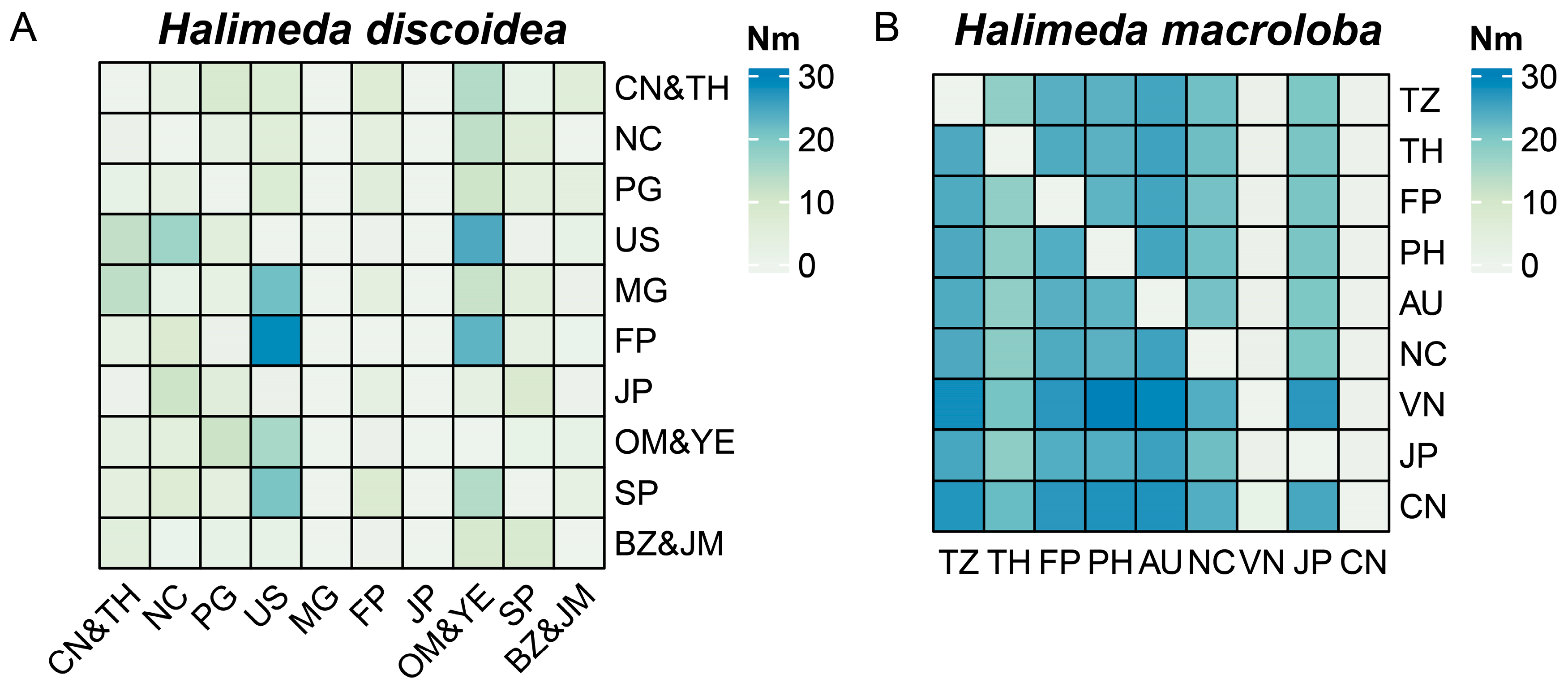
To better analyze gene flow in H. discoidea and H. macroloba across different regions, we combined closely related regions with fewer sequence combinations into single populations. Our gene flow analysis revealed significant differences in the dispersal patterns of these two species (Figure 6). Gene exchange in H. discoidea has a hierarchical source-sink structure. The Oman-Yemen (OM&YE) region acts as a core for transoceanic gene dispersal, directing the most gene flow towards the USA (US; Nm = 24.35) and French Polynesia (FP; Nm = 23.02). The USA (US) then becomes a central hub, receiving gene flow from the Oman-Yemen (OM&YE; Nm = 24.35) and New Caledonia (NC; Nm = 16.45), and subsequently sending high-intensity gene flow to Madagascar (MG; Nm = 21.20). In contrast, Japan (JP) functions as a naturally isolated node, with its total gene input (ΣNmin = 32.3) being significantly higher than its output (ΣNmout = 1.10) by 29.4 times. The Belize and Jamaica (BZ&JM) region shows marginal connectivity, with average gene flow values below 5, reflecting the impact of natural geographical fragmentation.
For H. macroloba, Vietnam (VN) and China (CN) act as terminal gene sinks. Together, they absorb 68% of the total migration, with Vietnam (VN) receiving a total input of ΣNmin = 185.0 and China (CN) receiving ΣNmin = 180.0. This creates a highly one-sided system. A clear example is the absolute unidirectional gene flow from Australia (AU) to China (CN), with a flow rate of 27.54, while the reverse flow is 0. Similarly, the gene flow from the Philippines (PH) to Vietnam (VN) (Nm = 29.79) is 27.6 times greater than the reverse flow. In contrast, the gene flow from China (CN) to Vietnam (VN) (Nm = 1.29) has no reverse flow from Vietnam to China (VN → CN = 0). These distinct gene flow patterns highlight the differing strategies and geographic influences on the dispersal of H. discoidea and H. macroloba.

3.7. Phylogenetic Relationships and Divergence Times of Halimeda Species

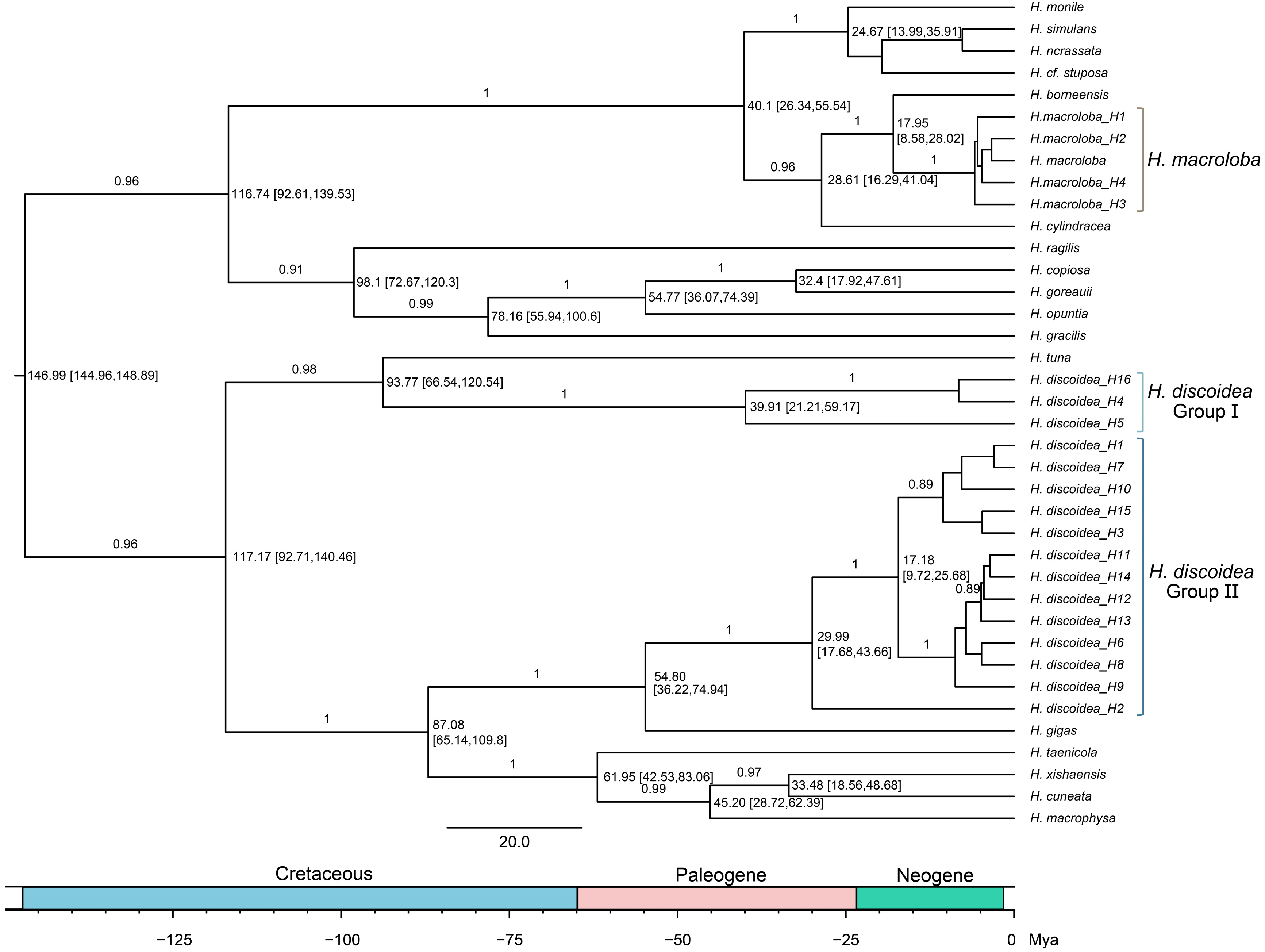
The Bayesian phylogenetic tree (Figure 7), constructed using tufA gene sequences, illustrates the evolutionary relationships and divergence times among Halimeda species. The Bayesian phylogenetic tree strongly supports the monophyly of H. macroloba and H. discoidea clades. Within H. discoidea, two well-supported, distinct lineages were identified: Group I and Group II (BPP = 0.96), confirming the significant phylogenetic differentiation within this species as observed in previous analyses. The divergence between H. discoidea Group I and Group II is estimated to have occurred in the Cretaceous period, around 117.17 Ma (95% HPD: 92.71–140.46). H. discoidea Group I, encompassing haplotypes H4, H5, H16, H7, H10, H15, H3, H11, and H13, shows a deeper divergence from H. tuna at 93.77 Ma (95% HPD: 66.54–120.54). Furthermore, H. discoidea Group II, which includes haplotypes H1, H2, H6, H8, H9, and H12, diverged from H. gigas more recently, approximately 54.80 Ma (95% HPD: 36.22–74.94). Internal nodes within H. discoidea also show recent diversification events. H16, H7, H10, H15, H3, H11, and H13 at 39.91 Ma (95% HPD: 21.21–59.17), and the divergence within Group II at 17.18 Ma (95% HPD: 3.72–25.68) and 29.99 Ma (95% HPD: 17.63–43.66) (Figure 7).
For H. macroloba, the analysis indicates a relatively recent evolutionary history within the clade. The H. macroloba clade, comprising haplotypes H1-H4, diverged from H. borneensis at 17.95 Ma (95% HPD: 8.58–28.02). Other closely related species, such as H. cylindracea, H. ragilis, H. copiosa, H. goreaui, and H. opuntia, are positioned as sister taxa to the H. macroloba/H. borneensis clade, with their common ancestor dating back to 40.1 Ma (95% HPD: 26.34–55.54) (Figure 7).
The Bayesian phylogenetic tree also depicts the phylogenetic positions of other Halimeda species, including H. monile, H. simulans, H. gracilis, H. incrassata, H. cf. stuposa, H. xishaensis, H. taenicola, H. cuneata, and H. macrophysa, thereby offering a comprehensive view of the evolutionary relationships within the genus Halimeda. The basal divergence of H. xishaensis and H. taenicola from other clades is estimated to have occurred approximately 61.95 million years ago (95% HPD: 42.53–83.06), as shown in Figure 7. Consequently, this Bayesian phylogenetic tree not only illustrates the ancient and complex global lineage history of H. discoidea compared to the regionally restricted H. macroloba, but also establishes a broader evolutionary framework for the entire genus.

4. Discussion

4.1. Halimeda Biogeography in the Xisha (Paracel) Islands: Insights from New Molecular Records

Due to challenges in sample collection, the diversity of calcified algae in the Xisha (Paracel) Islands remains insufficiently studied [31]. Phylogenetic reconstruction based on tufA gene sequences (Figure 1) not only clarified phylogenetic relationships among previously known Halimeda species but also identified new records of H. taenicola and H. cf. stuposa in the waters of the Xisha (Paracel) Islands. H. cf. stuposa was initially discovered in New Caledonia through tufA gene sequences and was assigned an identifier based on morphological congruence with H. stuposa [11]; since its initial discovery, the species has been rarely documented. This finding expands the known local species diversity of the genus and indicates that biodiversity assessments relying solely on traditional morphological methods may underestimate algal biodiversity in the Xisha (Paracel) Islands and other underexplored marine regions.
The geographical distribution patterns of species within the genus Halimeda exhibit considerable variation [32]. Among them, H. discoidea, H. macroloba, H. opuntia, and H. tuna are considered common species due to their relatively widespread presence in the South China Sea [12,16,33,34]. Notably, H. discoidea has an exceptionally broad distribution that extends into the Atlantic Ocean and adjacent islands, whereas H. macroloba is predominantly found in the vicinity of islands in the Pacific and Indian Oceans. In contrast, H. taenicola is a rare species. It was previously documented in Vietnamese waters [35,36] and more recently in Malaysia [37]. The Indo-Pacific region, which includes the Xisha (Paracel) Islands, is known for its high species richness of Halimeda, with as many as 25 species recorded [35]. However, only 13 species have been reported in Chinese waters to date [38], suggesting that the Halimeda diversity in the South China Sea region of China remains underexplored and merits further investigation.

4.2. Contrasting Population Structures: High Fragmentation in H. Discoidea Vs. Relative Connectivity in H. macroloba

Our results illustrate striking differences in population genetic structure between H. discoidea and H. macroloba, even where their geographic distributions are prone to overlap. H. discoidea exhibited an extremely disjunctive population structure, with more centers of differentiation (6 out of 13 populations) and a higher proportion of highly differentiated pairwise comparisons (averaging 85%). This pattern was exemplified by populations from the USA, Belize, Madagascar, and French Polynesia, which showed extremely high differentiation from over 50% of other sampled populations. Specific examples, such as the extreme differentiation observed between China and Madagascar (FST = 0.2638) and China and French Polynesia (FST = 0.71798), further reflect this pattern of high genetic isolation. Additionally, H. discoidea is typically divided into two groups, which may be due to the north–south orientation of the African and American continents, preventing tropical marine organisms from spreading between the Atlantic and Indo-Pacific basins [14].
In contrast, H. macroloba displayed a relatively less fragmented structure, consistent with previous studies based on multiple molecular markers [34,36,39]. In this case, only the Thai population acted as a major center of genetic isolation, strongly differentiated from four out of eight other populations (Figure 5B).
These contrasting patterns are most likely the result of species-specific dispersal capacities, life cycles, and responses to environmental heterogeneity [40,41]. For H. discoidea, high differentiation with multiple hubs evidently reveals limited gene flow and strong geographical isolating forces [14,42]. The persistently non-significant FST values observed in populations such as those from Thailand, Jamaica, Yemen, and Oman require further scrutiny, as they may indicate unique regional dynamics or simply reflect limitations in current sampling. The occurrence of negative FST values (e.g., for the China–French Polynesia pair in H. discoidea), although not significant, implies complex gene flow patterns that may be influenced by small sample size biases and complicate straightforward interpretations of population connectivity.

4.3. Divergent Gene Flow Regimes Explain Contrasting Genetic Structures

The gene flow plot (Figure 6) illustrates both the direction (Nm values) and magnitude of migration among different populations, thereby revealing the underlying mechanisms driving variation in population genetic structure. The gene flow heatmap indicates that H. macroloba exhibits more extensive and higher-intensity gene flow (Figure 6B), with Nm values among most population pairs significantly larger than those observed in H. discoidea. For instance, high Nm values were observed for gene flow from Thailand (TH) to Australia (AU) and from the Philippines (PH) to Australia (AU), reflecting intensive gene flow in these directions. This pronounced gene flow likely accounts for the relatively lower FST values and less fragmented genetic structure of H. macroloba, which is consistent with signs of demographic expansion [43]. In contrast, gene flow intensity in H. discoidea appears to be generally weaker and more restricted (Figure 6A). Although some moderate gene flow pathways exist (e.g., from China/Thailand to the USA, or from Madagascar to French Polynesia), most Nm values for most population pairs are close to zero. This restricted gene flow directly contributes to the strongly differentiated population structure of H. discoidea [44,45].

4.4. Deep Evolutionary Divergence Explains Contrasting Modern Population Structures

Based on the tree topology and divergence time estimation (Figure 7), the divergence time between Group I and Group II within H. discoidea was estimated at 117.17 Ma (95% HPD: 92.71–140.46 Ma), during the Cretaceous period. This suggests that the lineages of H. discoidea diversified during a relatively ancient period, possibly driven by geological and marine environmental changes at that time. However, this divergence timing does not align with the geological events typically used to explain the sister relationship between the strictly Atlantic and strictly Indo-Pacific lineages. These events include: (1) the expansion of the Atlantic Ocean, which began during the Jurassic period (±170–160 Ma) [46]; (2) the collision of the Afro-Arabian Plate and the Eurasian Plate during the Miocene (±15–12 Ma) [47] (Rögl & Steininger, 1984); and (3) the closure of the Central American Seaway during the Pliocene (±3 Ma) [48]. These events do not match the divergence timeline of H. discoidea.
An important oceanographic event during the Cretaceous period may have limited gene flow between the Atlantic and Indo-Pacific basins and caused the equatorial ocean current, which homogenizes tropical marine communities, to shift toward southern Africa [49]. This result suggests that geological barriers may not have been the initial cause of speciation but rather acted as reinforcing barriers after oceanographic events triggered speciation [42]. Similar conclusions have been drawn from molecular and paleontological studies of species in the Central American Isthmus [50]. The universality of this pattern requires further investigation.
For H. macroloba, its lineage’s MRCA split approximately 28.61 Ma ago (95% HPD: 16.29–41.04 Ma). This split is younger than the internal lineage split of H. discoidea, which occurred during the late Paleogene to early Neogene. This result aligns with the status of H. macroloba as an Indo-Pacific endemic species. The younger divergence time suggests that it has undergone a relatively recent diversification within this basin, rather than developing ancient and strongly differentiated global lineages like H. discoidea.

4.5. Limitations and Future Perspectives

While this study presents valuable information, several limitations need to be considered. One key limitation is the sole reliance on a single genetic marker (tufA), which may not fully capture the evolutionary history or fine-scale population structure properly. This is particularly problematic in cases of incomplete lineage sorting or hybridization. Additionally, high FST values observed in some populations with non-significant p-values (e.g., high FST values ranging from 0.8742 to 1.000 between H. macroloba in Jamaica and other regions, and between H. discoidea in Australia and other regions) could be influenced by small sample sizes, highlighting limitations in statistical power for these comparisons. The presence of H. discoidea in the Atlantic, in contrast to the strictly Indo-Pacific distribution of H. macroloba, may lead to the observation of higher genetic diversity and older divergence time estimates in the former. Consequently, direct comparisons of diversity and evolutionary age should be interpreted with caution, considering these distinct global versus regional biogeographic contexts.
Future studies should incorporate more unlinked genetic markers, such as nuclear microsatellites or genomic-scale markers (e.g., Restriction-site Associated DNA sequencing (RAD-seq), whole-genome sequencing), to achieve higher resolution in population connectivity and demographic inference [51,52]. Expanding the geographical sampling to fill the gaps will further elucidate species distribution and gene flow dynamics. Moreover, integrating molecular data with ecologically relevant information, such as dispersal capabilities, reproductive modes, and habitat occupancy, will be crucial for a deeper understanding of the mechanisms underlying the differing population structures in H. discoidea and H. macroloba [53,54,55]. Such integrated approaches will facilitate more effective conservation actions for these important marine calcifiers in a changing ocean.

5. Conclusions

This study reveals novel Halimeda diversity in the Xisha (Paracel) Islands, identifying two new records, H. cylindracea and H. cf. stuposa, through chloroplast tufA sequencing. These findings significantly expand the regional species inventory and highlight the power of molecular diagnostics in uncovering cryptic biodiversity in under-explored marine regions. Furthermore, comparative population genetics uncovered divergent evolutionary trajectories for two widespread species. H. discoidea displays a highly fragmented population structure and deep global lineage divergence, indicative of a history shaped by profound inter-oceanic geographic isolation. In contrast, H. macroloba exhibits lower differentiation and widespread gene flow, consistent with its more recent regional diversification restricted to the Indo-Pacific basin. Together, these results demonstrate that species-specific traits and historical contingencies jointly drive the evolution of cosmopolitan marine taxa. This work establishes a conceptual framework for Halimeda diversification and provides a robust foundation for future genomic studies on adaptive evolution and conservation prioritization.

Author Contributions

Conceptualization, J.L. and Y.T.; methodology, J.L. and Y.T.; validation, Y.T., W.L., Y.S., J.L. and Q.Y.; formal analysis, Y.T.; investigation, Y.T.; resources, J.L. and Q.Y.; data curation, Y.T.; writing—original draft preparation, Y.T. and J.L.; writing—review and editing, W.L., Y.S., J.L. and Q.Y.; visualization, Y.T.; supervision, W.L., J.L. and Q.Y.; project administration, J.L. and Q.Y.; funding acquisition, J.L. and Q.Y. All authors have read and agreed to the published version of the manuscript.

Funding

This work was encouraged by the Youth Development Fund Project of the State Key Laboratory of Marine Geology, the Shanghai Super Postdoctoral Incentive Plan (2024564), the National Key Research & Development Program of China (Grant Nos. 2022YFC3106004 and 2022YFC3106001), and the Shanghai Ocean Bureau Project (Shanghai Ocean Science 2022-03).

Institutional Review Board Statement

This study did not require ethical approval.

Informed Consent Statement

Not applicable.

Data Availability Statement

Data will be made available on request.

Acknowledgments

Yichao Tong would like to express his gratitude to Shiquan Chen at the Hainan Academy of Ocean and Fisheries Sciences for facilitating the sample collection. He is also indebted to all staff members of the vessel Qiong Qiong Hai Yu 83888 and the divers, especially Ming, for their essential support. Furthermore, he wishes to thank his supervisors, Peimin He and Jianheng Zhang (Shanghai Ocean University), for their continuous guidance and encouragement throughout his studies.

Conflicts of Interest

The authors declare no conflicts of interest.

References

  1. Li, S.; Hu, M.J.; Tong, Y.P.; Xia, Z.Y.; Tong, Y.C.; Sun, Y.Q.; Cao, J.X.; Zhang, J.H.; Liu, J.L.; Zhao, S.; et al. A review of volatile compounds in edible macroalgae. Food Res. Int. 2023, 165, 112559. [Google Scholar] [CrossRef] [PubMed]
  2. Pessarrodona, A.; Pedersen, M.F.; Wernberg, T.; Duarte, C.M.; Assis, J.; Bekkby, T.; Burrows, M.T.; Carlson, D.F.; Gattuso, J.; Gundersen, H.; et al. Carbon export from seaweed forests to deep ocean sinks. Nat. Geosci. 2024, 17, 552–559. [Google Scholar] [CrossRef]
  3. Yuan, H.Q.; Xia, J.; Liu, J.L.; He, P.M. “Love-hate relationships” between antibiotics and marine algae: A review. Aquat. Toxicol. 2025, 286, 107459. [Google Scholar] [CrossRef] [PubMed]
  4. Hillis-Colinvaux, L. Ecology and taxonomy of Halimeda: Primary producer of coral reefs. Adv. Mar. Biol. 1980, 17, 1–327. [Google Scholar]
  5. Littler, M.M.; Littler, D.S.; Blair, S.M.; Norris, J.N. Deep-water plant communities from an uncharted seamount off San Salvador Island, Bahamas: Distribution, abundance, and primary productivity. Deep. Sea Res. Part A Oceanogr. Res. Pap. 1986, 33, 881–892. [Google Scholar] [CrossRef]
  6. Paul, V.J.; Fenical, W. Novel bioactive diterpenoid metabolites from tropical marine algae of the genus Halimeda (Chlorophyta). Tetrahedron 1984, 40, 3053–3062. [Google Scholar] [CrossRef]
  7. Salehi, B.; Sharifi-Rad, J.; Seca, A.M.L.; Pinto, D.C.G.A.; Michalak, I.; Trincone, A.; Mishra, A.P.; Nigam, M.; Zam, W.; Martins, N. Current Trends on Seaweeds: Looking at Chemical Composition, Phytopharmacology, and Cosmetic Applications. Molecules 2019, 24, 4182. [Google Scholar] [CrossRef]
  8. Price, N.N.; Hamilton, S.L.; Tootell, J.S.; Smith, J.E. Species-specific consequences of ocean acidification for the calcareous tropical green algae Halimeda. Mar. Ecol. Prog. Ser. 2011, 440, 67–78. [Google Scholar] [CrossRef]
  9. Wei, Z.L.; Zhang, Y.T.; Yang, F.F.; Long, L.J. Increased light availability enhances tolerance against ocean acidification-related stress in the calcifying macroalga Halimeda opuntia. Acta Oceanol. Sin. 2022, 41, 123–132. [Google Scholar] [CrossRef]
  10. Verbruggen, H.; De Clerck, O.; Kooistra, W.; Coppejans, E. Molecular and morphometric data pinpoint species boundaries in Halimeda section Rhipsalis (Bryopsidales, Chlorophyta). J. Phycol. 2005, 41, 606–621. [Google Scholar] [CrossRef]
  11. Dijoux, L.; Verbruggen, H.; Mattio, L.; Duong, N.; Payri, C. Diversity of Halimeda (Bryopsidales, Chlorophyta) in New Caledonia: A Combined Morphological and Molecular Study. J. Phycol. 2012, 48, 1465–1481. [Google Scholar] [CrossRef] [PubMed]
  12. Kooistra, W.; Coppejans, E.G.G.; Payri, C. Molecular systematics, historical ecology, and phylogeography of Halimeda (Bryopsidales). Mol. Phylogenetics Evol. 2002, 24, 121–138. [Google Scholar] [CrossRef] [PubMed]
  13. Ximenes, C.F.; Cassano, V.; de Oliveira-Carvalho, M.D.; Bandeira-Pedrosa, M.E.; Gurgel, C.F.D.; Verbruggen, H.; Pereira, S.M.B. Systematics of the genus Halimeda (Bryopsidales, Chlorophyta) in Brazil including the description of Halimeda jolyana sp. nov. Phycologia 2017, 56, 369–381. [Google Scholar] [CrossRef]
  14. Verbruggen, H.; De Clerck, O.; Schils, T.; Kooistra, W.; Coppejans, E. Evolution and phylogeography of Halimeda section Halimeda (Bryopsidales, Chlorophyta). Mol. Phylogenetics Evol. 2005, 37, 789–803. [Google Scholar] [CrossRef]
  15. Sheth, B.P.; Thaker, V.S. DNA barcoding and traditional taxonomy: An integrated approach for biodiversity conservation. Genome 2017, 60, 618–628. [Google Scholar] [CrossRef]
  16. Phetcharat, S.; Pattarach, K.; Chen, P.C.; Wang, W.L.; Liu, S.L.; Mayakun, J. Species diversity and distribution of the calcareous green macroalgae Halimeda in Taiwan, Spratly Island, and Dongsha Atoll, with the proposal of Halimeda taiwanensis sp. nov. Phycol. Res. 2023, 71, 116–130. [Google Scholar] [CrossRef]
  17. Zhang, H.; Wang, Y.Y.; Zhang, L.S.; Wang, Z.Q.; Zhu, Z.J.; Long, L.J. Protein and metabolite acclimations to temperature variability in a calcareous green macroalga Halimeda macroloba. Front. Mar. Sci. 2025, 12, 1543591. [Google Scholar] [CrossRef]
  18. Kojima, R.; Hanyuda, T.; Kawai, H. Taxonomic re-examination of Japanese Halimeda species using genetic markers, and proposal of a new species Halimeda ryukyuensis (Bryopsidales, Chlorophyta). Phycol. Res. 2015, 63, 178–188. [Google Scholar] [CrossRef]
  19. Katoh, K.; Standley, D.M. MAFFT Multiple Sequence Alignment Software Version 7: Improvements in Performance and Usability. Mol. Biol. Evol. 2013, 30, 772–780. [Google Scholar] [CrossRef]
  20. Kumar, S.; Stecher, G.; Li, M.; Knyaz, C.; Tamura, K. MEGA X: Molecular Evolutionary Genetics Analysis across Computing Platforms. Mol. Biol. Evol. 2018, 35, 1547–1549. [Google Scholar] [CrossRef]
  21. Rozas, J.; Ferrer-Mata, A.; Sánchez-DelBarrio, J.C.; Guirao-Rico, S.; Librado, P.; Ramos-Onsins, S.E.; Sánchez-Gracia, A. DnaSP 6: DNA Sequence Polymorphism Analysis of Large Data Sets. Mol. Biol. Evol. 2017, 34, 3299–3302. [Google Scholar] [CrossRef] [PubMed]
  22. Leigh, J.W.; Bryant, D. POPART: Full-feature software for haplotype network construction. Methods Ecol. Evol. 2015, 6, 1110–1116. [Google Scholar] [CrossRef]
  23. Excoffier, L.; Lischer, H.E.L. Arlequin suite ver 3.5: A new series of programs to perform population genetics analyses under Linux and Windows. Mol. Ecol. Resour. 2010, 10, 564–567. [Google Scholar] [CrossRef] [PubMed]
  24. Paradis, E.; Claude, J.; Strimmer, K. APE: Analyses of Phylogenetics and Evolution in R language. Bioinformatics 2004, 20, 289–290. [Google Scholar] [CrossRef]
  25. Pritchard, J.K.; Stephens, M.; Donnelly, P. Inference of population structure using multilocus genotype data. Genetics 2000, 155, 945–959. [Google Scholar] [CrossRef]
  26. Santorum, J.M.; Darriba, D.; Taboada, G.L.; Posada, D. jmodeltest.org: Selection of nucleotide substitution models on the cloud. Bioinformatics 2014, 30, 1310–1311. [Google Scholar] [CrossRef]
  27. Verbruggen, H.; Ashworth, M.; LoDuca, S.T.; Vlaeminck, C.; Cocquyt, E.; Sauvage, T.; Zechman, F.W.; Littler, D.S.; Littler, M.M.; Leliaert, F.; et al. A multi-locus time-calibrated phylogeny of the siphonous green algae. Mol. Phylogenetics Evol. 2009, 50, 642–653. [Google Scholar] [CrossRef]
  28. Bouckaert, R.; Vaughan, T.G.; Barido-Sottani, J.; Duchêne, S.; Fourment, M.; Gavryushkina, A.; Heled, J.; Jones, G.; Kühnert, D.; De Maio, N.; et al. BEAST 2.5: An advanced software platform for Bayesian evolutionary analysis. PLoS Comput. Biol. 2019, 15, e1006650. [Google Scholar] [CrossRef]
  29. Rambaut, A.; Drummond, A.J.; Xie, D.; Baele, G.; Suchard, M.A. Posterior Summarization in Bayesian Phylogenetics Using Tracer 1.7. Syst. Biol. 2018, 67, 901–904. [Google Scholar] [CrossRef]
  30. Beerli, P. Comparison of Bayesian and maximum-likelihood inference of population genetic parameters. Bioinformatics 2006, 22, 341–345. [Google Scholar] [CrossRef]
  31. Meng, T.; Chen, Z.; Zhu, J.; Zou, X.X.; Fu, Q.Y.; Bao, S.X. Morphological and molecular study on marine green alga, Halimeda velasquezii, first recorded on Hainan Island. J. Trop. Oceanogr. 2020, 69, 114–121, (in Chinese with English abstract). [Google Scholar]
  32. Arina, N.; Rozaimi, M.; Zainee, N.F.A. High localised diversity of Halimeda (Chlorophyta: Bryopsidales) in a tropical marine park from Pahang, Malaysia. Reg. Stud. Mar. Sci. 2019, 31, 100773. [Google Scholar] [CrossRef]
  33. Rindi, F.; Pasella, M.M.; Lee, M.F.E.; Verbruggen, H. Phylogeography of the mediterranean green seaweed Halimeda tuna (Ulvophyceae, Chlorophyta). J. Phycol. 2020, 56, 1109–1113. [Google Scholar] [CrossRef] [PubMed]
  34. Song, X.H.; Yao, J.T.; Roleda, M.Y.; Liang, Y.S.; Xu, R.; Lin, Y.D.; Gonzaga, S.M.C.; Du, Y.Q.; Duan, D.L. Genetic Diversity and Connectivity of Reef-Building Halimeda macroloba in the Indo-Pacific Region. Plants 2025, 14, 1497. [Google Scholar] [CrossRef]
  35. Phang, S.M.; Yeong, H.Y.; Ganzon-Fortes, E.T.; Lewmanomont, K.; Prathep, A.; Gerung, G.S.; Tan, K.S. Marine algae of the South China Sea bordered by Indonesia, Malaysia, Philippines, Singapore, Thailand and Vietnam. Raffles Bull. Zool. 2016, 34, 13–59. [Google Scholar]
  36. Nguyen, T.H.; Nhat, N.T.N.; Nguyen, X.T.; Nguyen, V.X. Morphological variation and haplotype diversity of Halimeda macroloba and H. opuntia (Chlorophyta: Halimedaceae) from Southern Vietnam. Vietnam J. Mar. Sci. Technol. 2022, 22, 165–176. [Google Scholar]
  37. Zainee, N.F.A.; Ismail, A.H.M.A.D.; Taip, M.E.; Ibrahim, N.A.Z.L.I.N.A.; Ismail, A.S.M.I.D.A. Diversity, distribution and taxonomy of Malaysian marine algae, Halimeda (Halimedaceae, Chlorophyta). Malay. Nat. J. 2018, 70, 211–219. [Google Scholar]
  38. Ding, L.P.; Huang, B.X.; Luan, R.X. New classification system of marine green algae of China. Guangxi Sci. 2015, 22, 201–210, (in Chinese with English abstract). [Google Scholar]
  39. Pongparadon, S.; Zuccarello, G.C.; Phang, S.M.; Kawai, H.; Hanyuda, T.; Prathep, A. Diversity of Halimeda (Chlorophyta) from the Thai–Malay Peninsula. Phycologia 2015, 54, 349–366. [Google Scholar] [CrossRef]
  40. Bestion, E.; Clobert, J.; Cote, J. Dispersal response to climate change: Scaling down to intraspecific variation. Ecol. Lett. 2015, 18, 1226–1233. [Google Scholar] [CrossRef]
  41. Freestone, A.L.; Inouye, B.D. Dispersal limitation and environmental heterogeneity shape scale-dependent diversity patterns in plant communities. Ecology 2006, 87, 2425–2432. [Google Scholar] [CrossRef] [PubMed]
  42. Verbruggen, H.; Tyberghein, L.; Pauly, K.; Vlaeminck, C.; Van Nieuwenhuyze, K.; Kooistra, W.; Leliaert, F.; De Clerck, O. Macroecology meets macroevolution: Evolutionary niche dynamics in the seaweed Halimeda. Glob. Ecol. Biogeogr. 2009, 18, 393–405. [Google Scholar] [CrossRef]
  43. Wang, Q.Q.; Zhang, T.Y.; Liu, Y.J.; Nguyen, X.V.; Sun, Z.M.; Draisma, S.G.; Hu, Z.M. Low phylogeographic diversity in the calcified green macroalga Halimeda macroloba (Bryopsidales) in Southeast Asia. Algae 2025, 40, 93–102. [Google Scholar] [CrossRef]
  44. Bohonak, A.J. Dispersal, gene flow, and population structure. Q. Rev. Biol. 1999, 74, 21–45. [Google Scholar] [CrossRef]
  45. Lawson, D.J.; Hellenthal, G.; Myers, S.; Falush, D. Inference of population structure using dense haplotype data. PLoS Genet. 2012, 8, e1002453. [Google Scholar] [CrossRef]
  46. Smith, A.G.; Smith, D.G.; Funnell, B.M. Atlas of Mesozoic and Cenozoic Coastlines; Cambridge University Press: Cambridge, UK, 2004. [Google Scholar]
  47. Rögl, F.; Steininger, F.F. Neogene Paratethys, Mediterranean and Indo-Pacific Seaways. Implications for the paleobiogeography of marine and terrestrial biotas. In Fossils and Climate; Brenchley, P.J., Ed.; John Wiley and Sons Ltd.: Chichester, NY, USA, 1984; pp. 171–200. [Google Scholar]
  48. Molnar, P. Closing of the Central American Seaway and the Ice Age: A critical review. Paleoceanography 2008, 23, PA2201. [Google Scholar] [CrossRef]
  49. Lawver, L.A.; Gahagan, L.M. Evolution of Cenozoic seaways in the circum-Antarctic region. Palaeogeogr. Palaeoclimatol. Palaeoecol. 2003, 198, 11–37. [Google Scholar] [CrossRef]
  50. Knowlton, N.; Weigt, L.A. New dates and new rates for divergence across the Isthmus of Panama. Proc. R. Soc. B: Biol. Sci. 1998, 265, 2257–2263. [Google Scholar] [CrossRef]
  51. McKinney, G.J.; Larson, W.A.; Seeb, L.W.; Seeb, J.E. RAD seq provides unprecedented insights into molecular ecology and evolutionary genetics: Comment on Breaking RAD by Lowry et al. Mol. Ecol. Resour. 2017, 17, 356–361. [Google Scholar] [CrossRef]
  52. Hudson, M.E. Sequencing breakthroughs for genomic ecology and evolutionary biology. Mol. Ecol. Resour. 2008, 8, 3–17. [Google Scholar] [CrossRef]
  53. Kozak, K.H.; Graham, C.H.; Wiens, J.J. Integrating GIS-based environmental data into evolutionary biology. Trends Ecol. Evol. 2008, 23, 141–148. [Google Scholar] [CrossRef]
  54. Baguette, M.; Blanchet, S.; Legrand, D.; Stevens, V.M.; Turlure, C. Individual dispersal, landscape connectivity and ecological networks. Biol. Rev. 2013, 88, 310–326. [Google Scholar] [CrossRef]
  55. Pinseel, E.; Sabbe, K.; Verleyen, E.; Vyverman, W. A new dawn for protist biogeography. Glob. Ecol. Biogeogr. 2024, 33, e13925. [Google Scholar] [CrossRef]
Figure 1. Unrooted maximum likelihood phylogenetic tree constructed based on the tufA gene sequence. The colors of the branches represent different species.
Biology 14 01782 g001
Figure 2. Median-joining haplotype networks of the tufA locus for (A) Halimeda discoidea and (B) Halimeda macroloba. Circle fill colors indicate the geographic origin of the haplotypes. The area of each circle is proportional to its haplotype frequency. Perpendicular tick marks on the connecting lines represent the number of mutations between adjacent haplotypes.
Biology 14 01782 g002
Figure 3. The population genetic structure and global distribution of Halimeda discoidea. (A) UPGMA tree based on the genetic distance of the tufA gene sequence (left) and Bayesian clustering analysis based on the STRUCTURE software (right). (B) Principal Coordinate Analysis (PCoA) reveals genetic differentiation among populations of H. discoidea. (C) Global geographical distribution of the H. discoidea population. In Figures (AC), different colors represent cluster groups, with Group 1 being red and Group 2 being green.
Biology 14 01782 g003
Figure 4. Mismatch distribution analyses for (A) Halimeda discoidea and (B) Halimeda macroloba populations. The red line represent the observed frequencies of pairwise nucleotide differences, while the blue line indicates the expected frequencies under a sudden demographic expansion model.
Biology 14 01782 g004
Figure 5. Heatmaps illustrating pairwise FST values of (A) Halimeda discoidea and (B) Halimeda macroloba calculated based on the tufA gene sequences. The color range is from blue (indicating an FST value close to −1, low genetic differentiation/high genetic similarity) to red (indicating an FST value close to 1, high differentiation/genetic isolation). An asterisk (*) indicates a statistically significant difference (p < 0.05).
Biology 14 01782 g005
Figure 6. Heatmaps illustrating inter-population gene flow (Nm) derived from tufA sequences for (A) Halimeda discoidea and (B) Halimeda macroloba. In each heatmap, gene flow is depicted from the population in the row to the population in the column. The intensity of the color corresponds to the magnitude of gene flow (migration rate), with the scale ranging from 0 to 30. Darker colors indicate higher migration rates.
Biology 14 01782 g006
Figure 7. Bayesian phylogenetic tree constructed using tufA gene haplotype sequences. Node values indicate Bayesian posterior probabilities (BPP), while branch lengths are scaled to estimated divergence times (in millions of years ago, Ma), with 95% highest posterior density (HPD) intervals provided at each node.
Biology 14 01782 g007
Table 1. Halimeda discoidea and Halimeda macroloba samples information used for phylogenetic and population genetic analysis.
SymbolAreaSpeciesGenBank InformationSourceCollection Locality
CNChinaHalimeda discoideaH15This studyXisha (Paracel) Islands, Sansha, Hainan
Halimeda discoideaOP313765NCBITaiwan: Kenting National Park
Halimeda discoideaMK922588NCBITaiwan: Kenting National Park
Halimeda discoideaMW249121NCBITaiwan
Halimeda macrolobaH2This studyXisha (Paracel) Islands, Sansha, Hainan
Halimeda macrolobaH22This studyXisha (Paracel) Islands, Sansha, Hainan
Halimeda macrolobaH24This studyXisha (Paracel) Islands, Sansha, Hainan
Halimeda macrolobaH25This studyXisha (Paracel) Islands, Sansha, Hainan
Halimeda macrolobaH28This studyXisha (Paracel) Islands, Sansha, Hainan
Halimeda macrolobaH32This studyXisha (Paracel) Islands, Sansha, Hainan
Halimeda macrolobaPQ824575NCBIPratas Island
Halimeda macrolobaKU220841NCBIPratas Island
Halimeda macrolobaKU220837NCBIPratas Island
Halimeda macrolobaKU220838NCBIPratas Island
Halimeda macrolobaKU220839NCBIPratas Island
Halimeda macrolobaKU220840NCBIPratas Island
Halimeda macrolobaKU220836NCBIPratas Island
Halimeda macrolobaMK922585NCBIChina
Halimeda macrolobaPQ824576NCBIChina
Halimeda macrolobaMK922586NCBITaiwan: Taiping Island
Halimeda macrolobaMN879375NCBITaiwan: Taiping Island
Halimeda macrolobaMN879366NCBITaiwan: Taiping Island
Halimeda macrolobaMN879378NCBITaiwan: Taiping Island
JPJapanHalimeda discoideaAB899303NCBIAmami I., Kagoshima, Japan
Halimeda discoideaAB899304NCBIAnkyaba, Amami I., Kagoshima, Japan
Halimeda discoideaAB899302NCBIAmami I., Kagoshima, Japan
Halimeda discoideaAB899301NCBISani, Amami I., Kagoshima, Japan
Halimeda discoideaKU361892NCBIKurima Island, Miyako
Halimeda macrolobaAB899309NCBIUken, Amami I., Kagoshima, Japan
Halimeda macrolobaAB899308NCBIShirahama, Amami I., Kagoshima
Halimeda macrolobaAB899310NCBIShiraho, Ishigaki I., Okinawa
THThailandHalimeda discoideaKT887731NCBIThailand
Halimeda macrolobaPQ824574NCBIThailand
Halimeda macrolobaPQ824577NCBIThailand
Halimeda macrolobaPQ824579NCBIThailand
Halimeda macrolobaPQ824578NCBIThailand
Halimeda macrolobaPQ824580NCBIThailand
FPFrench PolynesiaHalimeda discoideaOR861097NCBIFrench Polynesia: Society Islands, Moorea
Halimeda discoideaOR861096NCBIFrench Polynesia: Society Islands, Moorea
Halimeda discoideaOR861095NCBIFrench Polynesia: Society Islands, Moorea
Halimeda discoideaJN644657NCBIFrench Polynesia: Moorea
Halimeda discoideaJN644656NCBIFrench Polynesia: Moorea
Halimeda macrolobaOR861113NCBIFrench Polynesia: Society Islands, Tahiti
Halimeda macrolobaOR861112NCBIFrench Polynesia: Society Islands, Tahiti
PGPapua New GuineaHalimeda discoideaKX808496NCBIPapua New Guinea
Halimeda discoideaKT887732NCBIPapua New Guinea
MGMadagascarHalimeda discoideaMW511210NCBIMadagascar: Antsiranana Bay, Baie de Tonnerre
Halimeda discoideaMW511214NCBIMadagascar: Antsiranana Bay, Orangea
Halimeda discoideaMW511213NCBIMadagascar: Antsiranana Bay, Petite passe Orangea
Halimeda discoideaMW511212NCBIMadagascar: Antsiranana Bay, Orangea
Halimeda discoideaMW511211NCBIMadagascar: Antsiranana Bay, Orangea
USUSAHalimeda discoideaKY206005NCBIOahu, Hunakai Beach
Halimeda discoideaKY205959NCBIOahu, Hunakai Beach
Halimeda discoideaKY205982NCBIOahu, Hunakai Beach
Halimeda discoideaKY205950NCBIOahu, Hunakai Beach
Halimeda discoideaKY205934NCBIOahu, Hunakai Beach
Halimeda discoideaOM460628NCBIKaneohe Bay, Kapaka Island, intertidal zone
NCNew CaledoniaHalimeda discoideaJN644661NCBINew Caledonia
Halimeda discoideaJN644660NCBINew Caledonia
Halimeda discoideaJN644659NCBINew Caledonia
Halimeda discoideaJN644658NCBINew Caledonia
Halimeda discoideaJN644655NCBINew Caledonia: Chesterfield
Halimeda discoideaJN644654NCBINew Caledonia
Halimeda macrolobaJN644691NCBINew Caledonia
Halimeda macrolobaJN644692NCBINew Caledonia
Halimeda macrolobaJN644693NCBINew Caledonia
OMOmanHalimeda discoideaAY826359NCBIOman
JMJamaicaHalimeda discoideaAY826362NCBIJamaica
YEYemenHalimeda discoideaAY826360NCBIYemen: Socotra
SPSpainHalimeda discoideaAY826361NCBIGran Canaria
Halimeda discoideaKT887730NCBIFuerteventura
BZBelizeHalimeda discoideaOM460625NCBICarrie Bow Cay
Halimeda discoideaOM460613NCBICarrie Bow Cay
VNViet NamHalimeda macrolobaOL422177NCBICon Dao
Halimeda macrolobaOL422174NCBIViet NaM
Halimeda macrolobaOL422175NCBINinh Thuan
Halimeda macrolobaOL422173NCBINha Trang
Halimeda macrolobaOL422176NCBIPhy Quy
PHPhilippinesHalimeda macrolobaPQ824581NCBIPhilippines
Halimeda macrolobaPQ824582NCBIPhilippines
AUAustraliaHalimeda macrolobaHM140244NCBILizard Island, Coconut Beach
TZTanzaniaHalimeda macrolobaAM049960NCBIZanzibar, Nungwi
Table 2. tufA-based haplotype distribution and genetic diversity in Halimeda discoidea and Halimeda macroloba populations.
SymbolCountry/RegionSpecies
Halimeda discoideaHalimeda macroloba
Number of Samples (n)Polymorphism Sites (S)Haplotype (Sample Numbers)Haplotype Diversity (Hd)Nucleotide Diversity (π/Pi)Number of Samples (n)Polymorphism Sites (S)Haplotype (Sample Numbers)Haplotype Diversity (Hd)Nucleotide Diversity (π/Pi)
CNChina48H1(3), H6(1)0.500 ± 0.2650.00658 ± 0.265191H1(15), H2(4)0.341 ± 0.1110.00049 ± 0.00016
JPJapan50H1(5)0030H1(3)00
THThailand10H10(1)0051H2(4), H3(1)0.400 ± 0.2370.00056 ± 0.00033
FPFrench Polynesia50H8(5)0020H2(2)00
PGPapua New Guinea20H6(2)00-----
MGMadagascar50H15(5)00-----
USUSA66H11(3), H12(1), H13(1), H14(1)0.8000 ± 0.1720.00329 ± 0.00113-----
NCNew Caledonia610H1(2), H6(1), H7(1), H9(2)0.867 ± 0.1290.00888 ± 0.0016830H2(3)00
OMOman10H2(1)00-----
JMJamaica10H5(1)00-----
YEYemen10H3(1)00-----
ESSpain10H4(2)00-----
BZBelize20H16(2)00-----
VNViet NaM-----50H1(5)00
PHPhilippines-----20H1(2)00
AUAustralia-----10H4(1)00
TZTanzania-----10H2(1)00
TotalTotal4181-0.906 ± 0.0270.02765 ± 0.00686414-0.523 ± 0.002860.00089 ± 0.00016
Table 3. Results of genetic and mismatch analyze in Halimeda discoidea and Halimeda macroloba.
SpeciesNumber of SamplesFu’s Fs, p-ValueTajima’s D, p-ValueEwens-Watterson Test (Obs/Exp), p-ValueChakraborty’s Test
Halimeda discoidea413.56909, 0.91300−0.40625, 0.326000.11600/0.11375, 0.6180.45563
Halimeda macroloba41−0.42185, 0.35400−0.76354, 0.235000.48959/0.050546, 0.5450.54814
Disclaimer/Publisher’s Note: The statements, opinions and data contained in all publications are solely those of the individual author(s) and contributor(s) and not of MDPI and/or the editor(s). MDPI and/or the editor(s) disclaim responsibility for any injury to people or property resulting from any ideas, methods, instructions or products referred to in the content.