
Article

Contrasting La Crosse Virus Lineage III Vector Competency in Two Geographical Populations of Aedes triseriatus and Aedes albopictus Mosquitoes

by
Lindsey R. Faw
1,2,
Philip M. Armstrong
3,
Sally L. Paulson
1 and
Gillian Eastwood
1,2,4,*
1
Department of Entomology, College of Agriculture and Life Sciences, Virginia Polytechnic Institute and State University, Blacksburg, VA 24061, USA
2
Center for Emerging, Zoonotic, and Arthropod-Borne Pathogens (CeZAP), Virginia Polytechnic Institute and State University, Blacksburg, VA 24061, USA
3
Connecticut Agricultural Experiment Station (CAES), New Haven, CT 06511, USA
4
The Global Change Center at VT, Virginia Polytechnic Institute and State University, Blacksburg, VA 24061, USA
*
Author to whom correspondence should be addressed.
Biology 2025, 14(12), 1771; https://doi.org/10.3390/biology14121771
Submission received: 15 October 2025 / Revised: 30 November 2025 / Accepted: 5 December 2025 / Published: 11 December 2025

Simple Summary

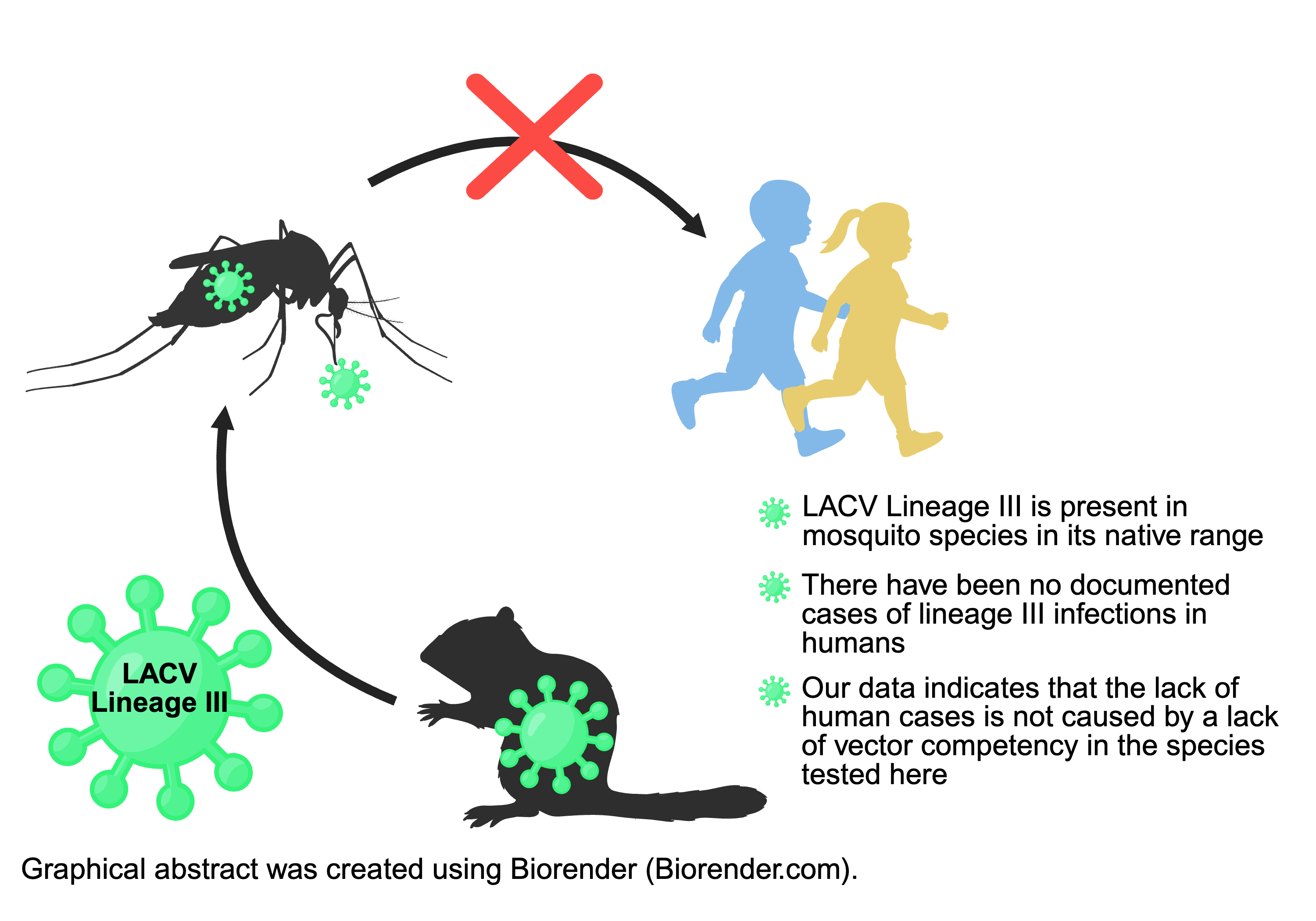
La Crosse virus (LACV) is a mosquito-transmitted virus in the United States that can cause a serious illness in children, with neurological symptoms such as seizures and swelling of the meninges and brain. Historically, there have only been two genetically distinct lineages of LACV that cause disease and correlate with geographic regions. In the Midwest and Appalachia, lineage I accounts for most of the LACV cases; lineage II is present in the South. In recent years, a new lineage, lineage III, has been detected in mosquitoes in the Northeast region, yet there have so far been no human cases attributed to lineage III. One possible reason for this is reduced vector competency (the ability of a mosquito to transmit the virus) for these novel strains of virus. We explored the vector competency of both the known LACV vector (Aedes triseriatus) and a suspected invasive vector (Aedes albopictus), with populations from Connecticut (lineage III area) and Virginia (a lineage I area). Using infection outcomes measured at 14 days post-infection, we demonstrated that both mosquito species are competent vectors for the virus, the first time that this has been shown for lineage III. We thus suggest that the lack of human disease from lineage III LACV is not due to poor transmission ability in local mosquitoes.

Abstract

La Crosse virus (LACV) is a mosquito-borne virus (family Peribunyaviridae) that can result in severe human infection in children under sixteen. Historically, LACV comprised two lineages, predominantly in the Midwest and Appalachian regions of the US. In 2005, a virus of a third lineage was detected in the Northeast; however, this and subsequently isolated strains of lineage III have not, to date, been implicated in human disease. One hypothesis for this discrepancy is that vector mosquitoes have a reduced vector competency for LACV lineage III, thus preventing horizontal transmission and clinical cases. Here, we utilized two mosquito species, Aedes triseriatus, the native vector, and Aedes albopictus, an invasive potential vector, each from both a historic LACV range (Virginia) and from the region of lineage III (Connecticut). Utilizing oral feeding and intrathoracic inoculation methods of viral exposure, rates of LACV infection, dissemination, and transmission (proxied via salivary secretion) and capability for vertical transmission (proxied via virus-positive ovaries) were determined by harvesting mosquito bodies, legs, saliva, and ovaries, respectively. Overall, we did not detect consistent differences in transmission between any lineage, species, or state of origin, at day 14 post-infection. However, we highlight the transmission potential of LACV lineage III in all mosquito populations tested here, representing the first evidence of lineage III competency in Aedes triseriatus and Aedes albopictus, indicating the potential for human disease. We thus suggest that the absence of human cases of LACV lineage III is not modulated by a lack of vector competency in mosquitoes.

Graphical Abstract

1. Introduction

La Crosse virus (LACV), first isolated in 1960 from a fatal human case in La Crosse, Wisconsin, has severe clinical manifestations that occur principally in children [1]. LACV is now the leading cause of arboviral pediatric encephalitis in the USA, La Crosse encephalitis, which occurs annually, predominantly in Appalachia and the Midwest [2,3,4]. This is a reportable disease with clinical manifestations including headache, fever, vomiting, seizures, disorientation, swelling of the brain and meninges, among other neurological symptoms that primarily affect children under 16 years of age, of which there are 30–90 cases reported to the CDC annually [5,6,7,8]. LACV can also cause a non-encephalitic clinical infection, likely vastly underreported, characterized by fever and headache, or often entirely asymptomatic [5,6,7,8]. LACV seroprevalence in humans is suspected to be as high as 17.7% [9].
LACV is a tripartite, negative-sense RNA virus in the California serogroup of the Orthobunyavirus genus of the Bunyavirales order [10,11]. LACV is maintained in a sylvatic cycle predominantly in hardwood forests using Aedes spp. mosquito vectors and Sciuridae species, such as chipmunks and squirrels, that serve as reservoir hosts [12,13,14,15,16,17]. Aedes triseriatus (Diptera: Culicidae, Say 1823) is the primary vector of LACV in endemic areas, as indicated by the continued isolation of LACV from field-caught mosquitoes, laboratory experiments, and the ecology of the vector [18,19,20]. LACV has been shown to overwinter in Ae. triseriatus eggs, where emerging adults in the spring are infected [18,19,21]. LACV in Ae. triseriatus mosquitoes can be transmitted via horizontal and vertical transmission [15,22,23,24]. Like other Orthobunyaviruses, LACV can be maintained through transovarial transmission (TOT) from mother to offspring, a form of vertical transmission [15,22,23,24,25]. TOT is likely the integral overwintering mechanism for the persistence of LACV in mosquito eggs, a phenomenon that has been experimentally demonstrated [19,26,27]. LACV can also be transmitted sexually from transovarially infected males to females and subsequently into offspring [28,29]. However, this route is not addressed in the current study.
Historically, LACV has encompassed two genetically distinct lineages that are geographically isolated in the midwestern (lineage I), the Appalachian (lineage I), and southern (lineage II) regions of the USA [25,30] (Figure 1). A lineage III strain was first isolated from a pool of Aedes triseriatus mosquitoes captured in Connecticut in 2005 [30]; since then, several additional lineage III isolations have been made in the Northeast from a wider range of mosquito species [25,30]. LACV infections are generally associated with the geographic location where the virus was acquired, and most cases of LACV thus far have been associated with LACV lineage I [12].
To date, there have not been any known LACV clinical cases associated with lineage III; even though there have been two cases of LACV disease in the Northeast, both were acquired elsewhere [25], RI Dept. of Health, Pers. Comm. With an apparent entomological risk, as determined by the continued isolation of lineage III viral strains from mosquitoes in the Northeast, the lack of human cases is unusual. The prevailing hypotheses for this discrepancy are (i) underdiagnosis in cases of human disease or lack of detection in humans, (ii) reduced virulence in lineage III LACV, (iii) low prevalence of lineage III in local mosquito and host animal populations, or (iv) reduced vector competence in local mosquito populations [25]. Here, we explore the latter hypothesis and test the vector competence of Aedes spp. mosquitoes for lineage III LACV compared to lineage I and II strains, considering two candidate mosquito vector species from two different U.S. states (one population from a historical lineage I range, Virginia, and the other from the lineage III range, Connecticut).
It is suggested that invasive mosquito species, specifically Aedes albopictus (Diptera: Culicidae, Skuse 1894), contribute to LACV spread, as they are competent vectors of LACV and are known to feed on humans [25,31,32,33]. LACV has been isolated from wild populations of both Ae. albopictus and Ae. triseriatus in Tennessee, where the maximum likelihood estimates [number of infected mosquitoes per 1000] for LACV were higher for Ae. albopictus than for Ae. triseriatus [34]. This highlights the potential role of Ae. albopictus in LACV transmission. Here, we focus on the vector competency of Ae. triseriatus as a native vector of LACV and Ae. albopictus as an invasive vector species.
Evidence shows that the sympatric ‘geographic pairing’ between mosquitoes and viruses from the same region affects vector competency [35]. Susceptibility to LACV infection and horizontal transmission ability have been shown to be higher in mosquitoes from non-endemic LACV areas and are believed to be an evolutionary adaptation towards LACV resistance in mosquitoes from endemic regions [35]. The ability of a virus to be more efficiently transmitted when geographically [allopatric] mismatched highlights the need for further vector competency studies on invasive mosquito species as they are exposed to novel pathogens. However, it was previously demonstrated that ‘geographic pairing’ had an inverse effect on the capacity for LACV vertical transmission, where sympatric pairing increased vertical transmission, indicating that vertical transmission is a more effective transmission mechanism in endemic regions, but horizontal transmission is more effective in non-endemic regions [35,36,37]. In addition to the concern of new vectors migrating to new areas, invasive vectors may be more susceptible to infection or more easily transmit the virus, which has been demonstrated in other pathogen–vector systems. In Ae. albopictus infected with dengue virus (DENV), the geographic origin of the mosquitoes has a similar effect on vector competency, where those exposed to DENV more often exhibit lower horizontal vector competency [38]. The ability of a virus to be more efficiently transmitted horizontally when not geographically paired with the vector further highlights the need for vector competency studies on different populations of mosquitoes, including invasive mosquito species exposed to novel pathogens.
Here, we explored the efficacy of mosquito acquisition and transmission of lineage III LACV compared to lineage I and II to determine the role of vector competency in the lack of human cases of lineage III LACV. Vector competency was explored here as the potential for mosquitoes to transmit the virus horizontally by examining the presence of virus in bodies, legs, and saliva of mosquitoes exposed to LACV, and vertically, through the presence of virus in the ovaries of mosquitoes exposed to LACV. We considered the mosquito species, geographic population, and virus lineage as factors of vector competency.

2. Materials and Methods

2.1. Mosquito Populations

Connecticut Ae. albopictus and Ae. triseriatus mosquito eggs were acquired from established laboratory colonies at the Connecticut Agricultural Experiment Station (CAES—New Haven, CT, USA). From Virginia, Ae. albopictus and Ae. triseriatus eggs were field collected using constructed oviposition traps (small black cups or basins lined with seed germination paper and water) in Blacksburg, VA (Figure 1). After at least a 2-week incubation at ambient temperatures, egg papers were hatched in deionized water, and larvae were provided a 3:2 liver powder–Brewer’s yeast mixture as food. Mosquitoes were reared to adulthood, with all life stages maintained at 26 °C (22 °C during the scotophase) with a photoperiod of 15 h light (L):9 h dark (D) and 80% relative humidity (RH). All adult mosquitoes were offered 10% sucrose solution ad lib, and populations were maintained by artificial blood-feeding using a Hemotek feeding system (Hemotek, Blackburn, UK) with defibrinated bovine or sheep blood (Lampire Biological Laboratories, Pipersville, PA, USA, or Hemostat Laboratories, Dixon, CA, USA) through a hog casing membrane. Due to challenges in producing viable offspring, Ae. triseriatus (from both geographical regions) were force-mated by attaching decapitated males to small pins and mating them to females anesthetized on ice, Ae. albopictus colonies were free-mating and did not require force-mating. The exact generation of both colonies is unknown, but is estimated to be approximately generation 10.
As a risk group 2 pathogen, LACV-work took place in an ACL-3 insectary similarly maintained at 26 °C using a photoperiod of 15:9 L:D at 80% RH.
Oral Infection: Prior to viral exposure, adult female mosquitoes were allowed 96 h for maturation and mating after eclosion from pupae and sugar-starved for 24 h. Mosquitoes were presented with an infectious blood meal using a Hemotek feeding system as above. Approximately 5 × 10⁵ PFU/mL of a relevant strain of virus, plus 1% 0.2 mM ATP (to increase gustation), were included in each bloodmeal. Four LACV virus strains—NC97 (lineage I), TX09 (II), NY05 (III), and CT18 (III)—representing all three lineages were used. An aliquot was taken from each bloodmeal to confirm the initial viral titer, using plaque assay methods referenced in Payne et al. (2006) [39]. Allowing one hour for feeding, or until most mosquitoes were fully engorged, the engorged mosquitoes were separated from non-engorged individuals.
Intrathoracic Inoculation: Before inoculation, mosquitoes were similarly allowed to mature for at least 96 h post-emergence. Mosquitoes were inoculated intrathoracically with approximately 20 pfu (200 nL of approximately 1 × 10⁵ pfu/mL) of the virus using a Nanoject III microinjector (Drummond, Broomall, PA, USA). Again, each of the four LACV virus strains—NC97 (lineage I), TX09 (II), NY05 (III), and LV1864 (III)—was used to represent all three lineages.

2.2. Viral Transmission Assays

Engorged or inoculated mosquitoes were housed in small (1-gallon) plastic buckets with a mesh screen lid and provided 10% sucrose ad lib. After a 14-day extrinsic incubation period (EIP), the bodies, legs, and saliva of each mosquito were harvested and assessed for virus presence as indicators of infection, dissemination, and ability to transmit, respectively. Ovaries were harvested as a proxy for the capacity for TOT due to challenges in rearing offspring from infected mothers. Briefly, mosquitoes were immobilized on ice; then, salivary secretions were acquired via forced salivation by inserting the proboscis into a 10 μL micropipette tip capillary containing 5 μL of a 1:1 ratio of 50% sucrose and fetal bovine serum (FBS), with a small drop of food coloring for visualization. After 30 min, the contents of the micropipette tip were transferred into 200 μL of Mosquito Diluent (Dulbecco’s phosphate-buffered saline (dPBS) containing 20% FBS, 100 units/mL penicillin, 100 μg/mL streptomycin, and 2.5 μg/mL amphotericin B). Legs were removed from each mosquito body, and ovaries were dissected. Bodies, legs, and ovaries were placed in individual tubes containing a glass bead and 300μL of mosquito diluent as described above. Samples of mosquito bodies, legs, and ovaries were homogenized using a TissueLyser II homogenizer (Qiagen, Hilden, Germany) at 24 Hz for 30 s twice before centrifugation at 8000 rpm and 4 °C for 4 min.
Mosquito body, leg, and ovary samples were each inoculated onto a confluent monolayer of Vero-76 cells (ATCC, Manassas, VA, USA), incubated at 37 °C with a 5% CO2 environment for 1 h. An overlay of 1:5 2% Seakem Agarose (Lonza, Basal, Switzerland): Dulbecco’s Modified Eagle’s Medium (DMEM) (supplemented with 2% FBS, 100 units/mL penicillin, 100 μg/mL streptomycin, and 2.5 μg/mL amphotericin B or 500 μg/mL gentamicin, the latter introduced to address contamination), hereafter referred to as reduced-DMEM, was applied to the sample plates. Plates were incubated at 37 °C and 5% CO2 for three days for plaque development, then fixed using 10% formaldehyde solution, and stained with 0.1% crystal violet diluted in 10% phosphate-buffered formalin. Saliva samples were inoculated onto confluent Vero-76 cells as above, but a liquid overlay consisting of reduced-DMEM was used instead, and cells were monitored for cytopathic effect (CPE) for ten days.

2.3. Statistical Analyses

Population rates were calculated as the number of positive bodies, legs, ovaries, and salivary secretions of the total number of mosquitoes tested. Because dissemination to the legs is dependent upon midgut infection, and dissemination to secondary tissues (such as the salivary glands and ovaries) is dependent upon this initial dissemination, modified rates were also included. Modified rates were calculated as the number of positive legs that resulted from mosquitoes with midgut infections, and the number of positive salivary secretions or ovaries from those with disseminated infections. Differences in infection, dissemination, ability to transmit, potential for vertical transmission, and ovary titers between LACV groups and mosquito species were analyzed using two-way ANOVA followed by Tukey’s multiple comparisons in GraphPad Prism (version 10.1.1 for Mac; GraphPad Software, Boston, MA, USA). Geographic and species analyses were conducted using two-way ANOVA followed by Tukey’s multiple comparisons in GraphPad Prism. Transmission barriers were identified as modified rates less than 0.75 (25% reduction).

3. Results

3.1. LACV Competency in Connecticut Aedes triseriatus

3.1.1. Oral Infection

Data could not be obtained for this population of the species due to a lack of survival in mosquitoes.

3.1.2. Intrathoracic Inoculation

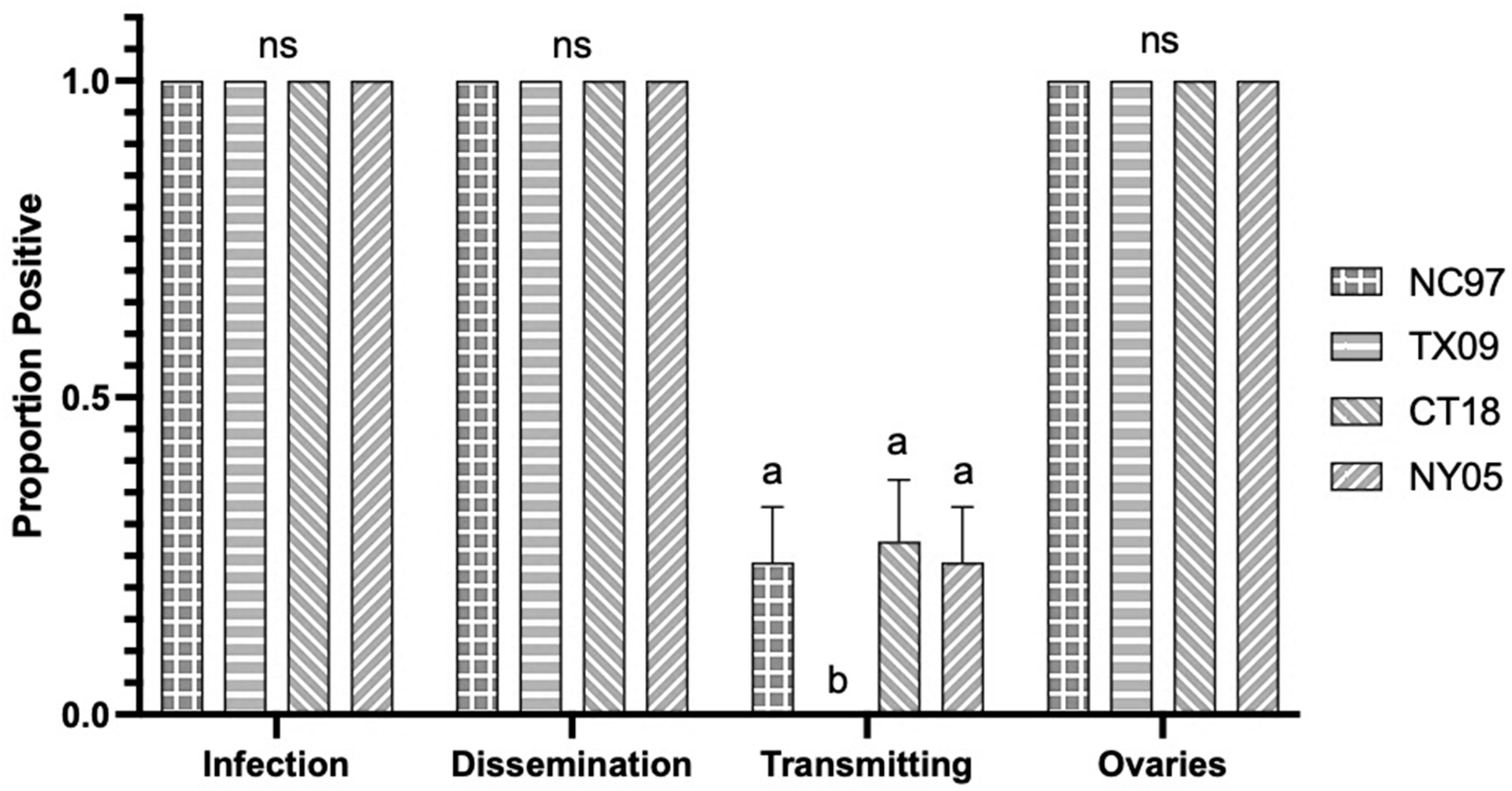
There were no significant differences in infection rates, dissemination rates, or rates of viral-positive ovaries [proxy for TOT] between strains of LACV (Table A1, with rates shown graphically in Figure 2. Saliva infection rate [horizontal transmission] for lineage II strain TX09 was significantly lower than the rates seen for strains NC97, CT18, and NY05 (Figure 2 and Table A1) (Tukey’s multiple comparisons; NC97 p-value < 0.0001, q = 7.241, 95%; CT18 p-value < 0.0001, q = 7.917; NY05 p-value < 0.0001, q = 7.241). There were no significant differences in ovary titers based on virus strain (Figure 3). Although CT Ae. triseriatus showed salivary gland barriers to infection with all lineages; lineage III was transmitted (salivary infection rates) at rates similar to lineage I and II. Other barriers could not be determined because of the absence of oral infection data for this species only.

3.2. LACV Competency in Connecticut Aedes albopictus

3.2.1. Oral Infection

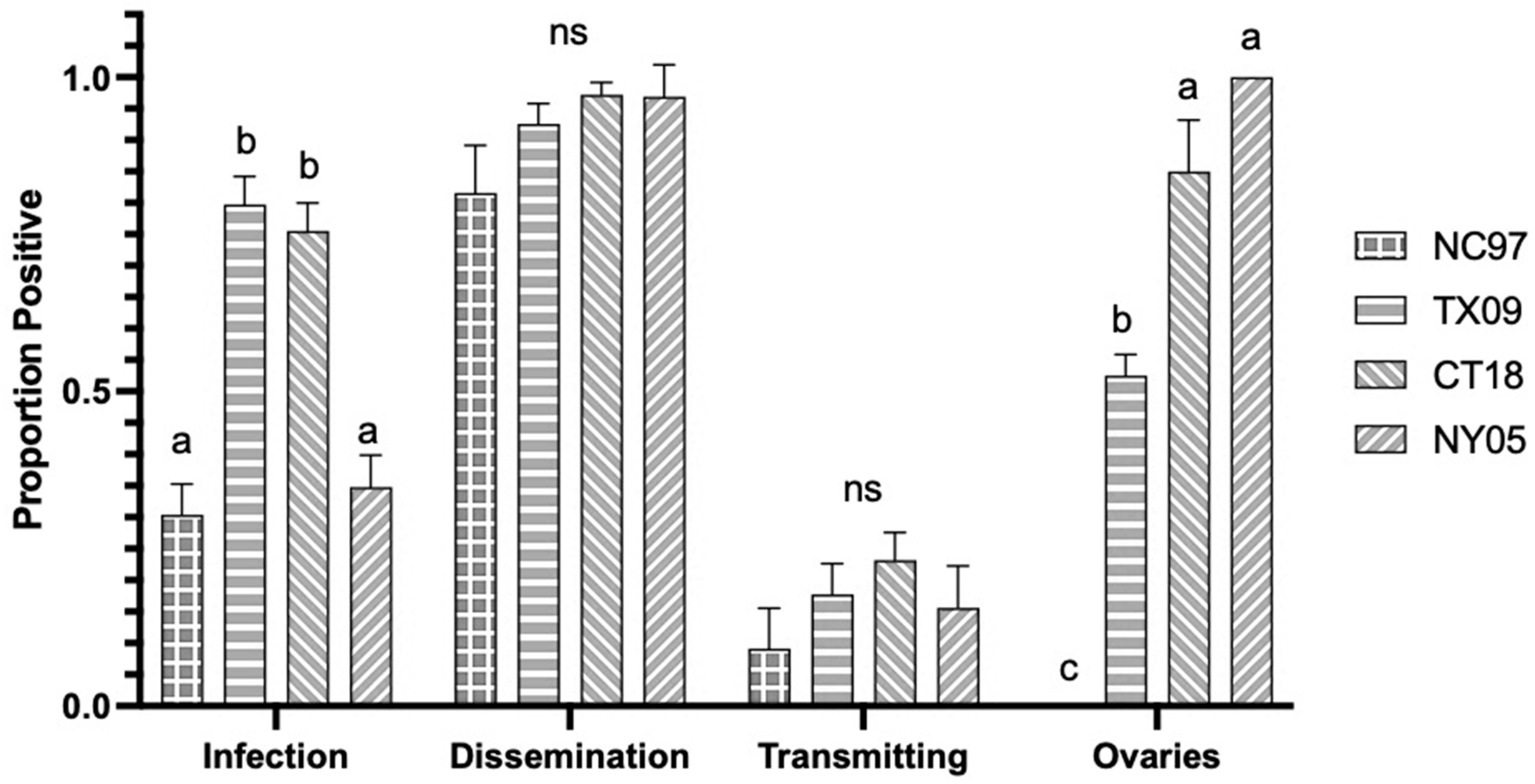
Rates are listed in Table A2, with modified rates shown graphically in Figure 4. Lineage II TX09 and lineage III CT18 showed significantly higher rates of infection than lineage I NC97 and lineage III NY05 (Tukey’s multiple comparisons; TX09:NC97 p-value < 0.0001, q = 12.32; TX09:NY05 p-value < 0.0001, q = 11.30; CT18:NC97 p-value < 0.0001, q = 11.59; CT18:NY05 p-value < 0.0001, q = 10.53). There were no significant differences in dissemination rates or rates of positive salivary secretions between strains. Lineage I strain NC97 had significantly lower rates of infected ovaries (no positive ovaries from this group) than all other groups (Tukey’s multiple comparisons; NC97:TX09 p-value < 0.0001, q = 7.499; NC97:CT18 p-value < 0.0001, q = 10.43; NC97:NY05 p-value < 0.0001, q = 7.653), while CT18 and NY05 had significantly higher rates of infected ovaries than TX09 (Tukey’s multiple comparisons; CT18:TX09 p-value = 0.0083, q = 4.499; NY05:TX09 p-value = 0.0371, q = 7.499) (Figure 4 and Table A2). There were no significant differences between ovary titers based on virus strain (Figure 5).

3.2.2. Intrathoracic Inoculation

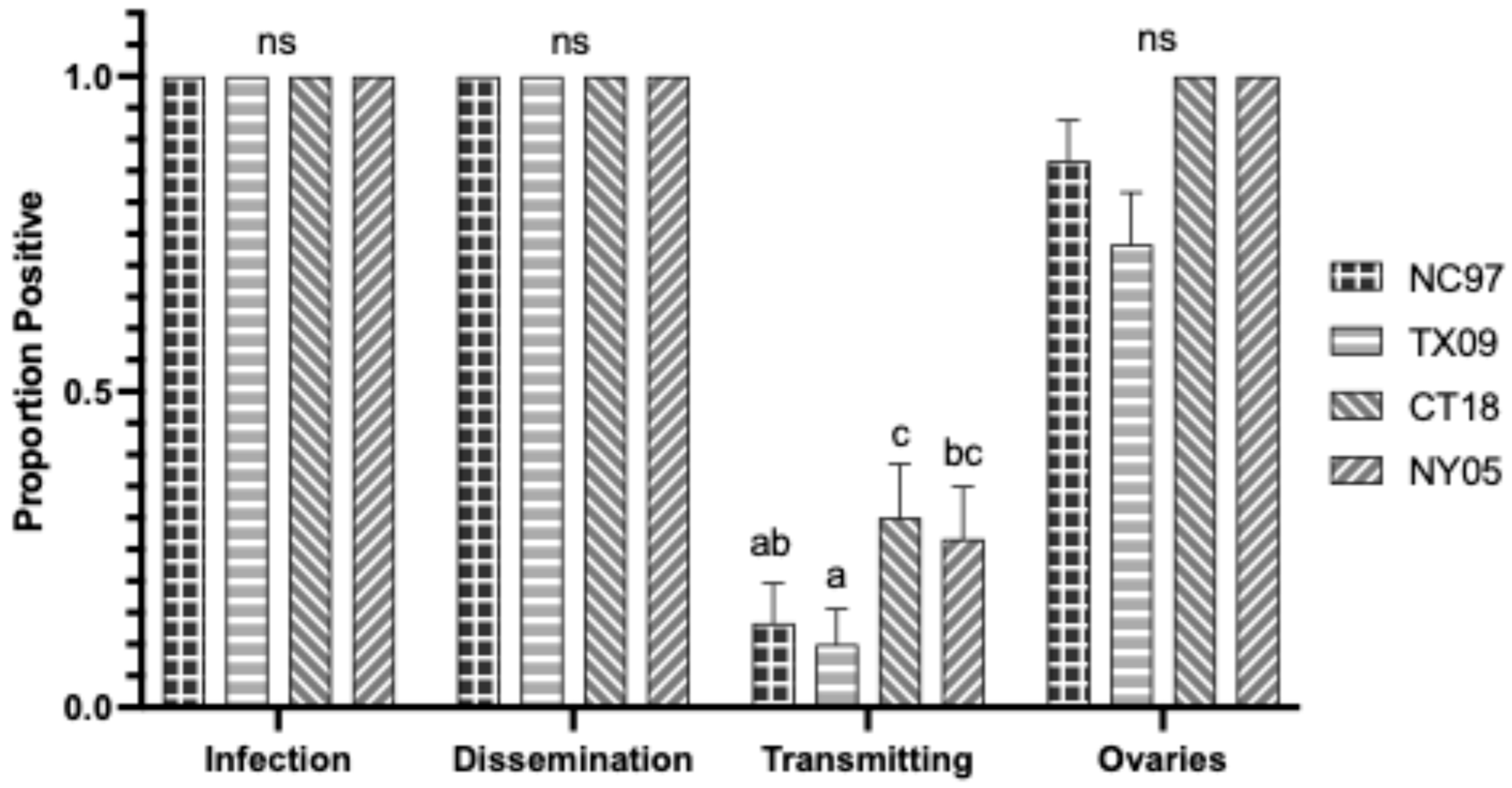
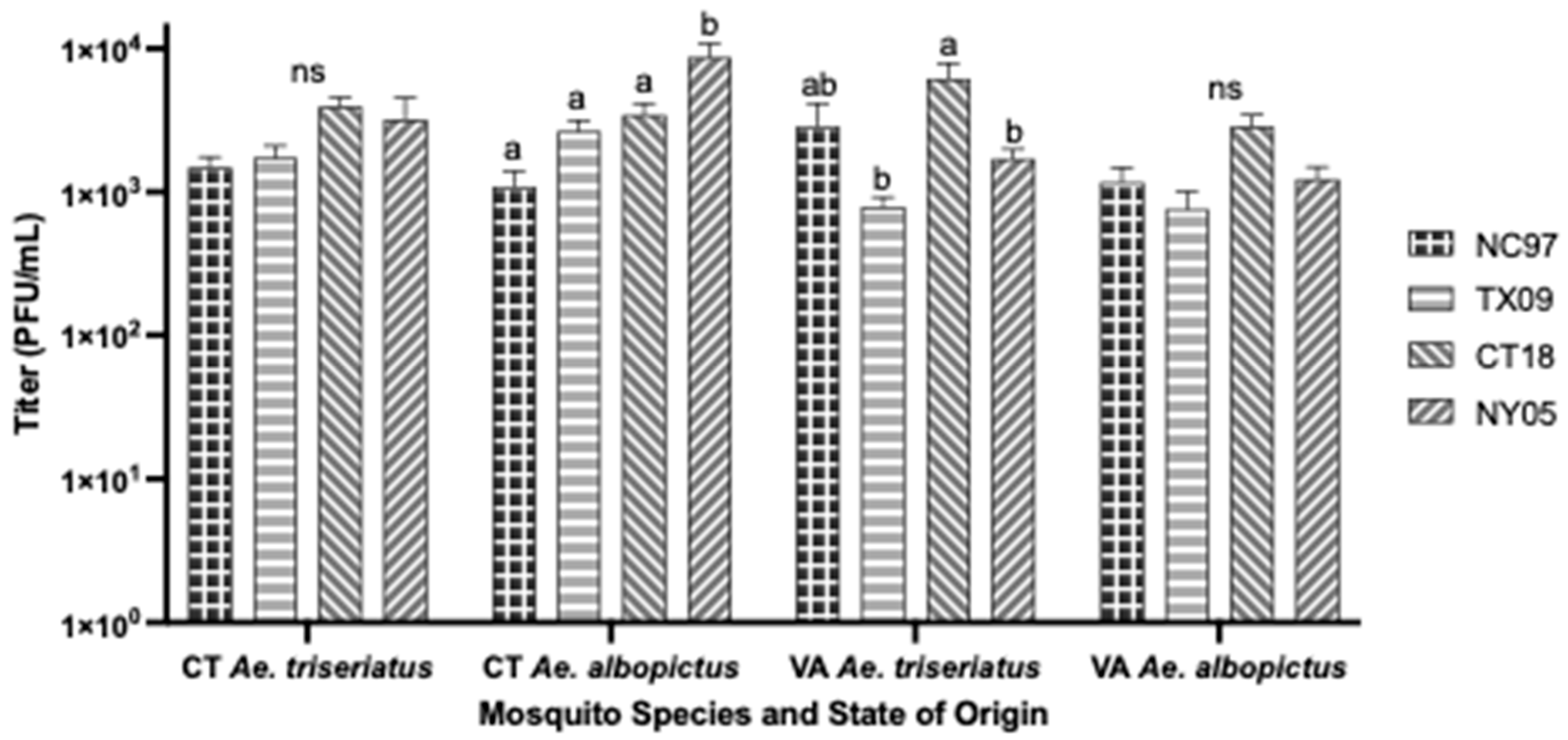
Rates are listed in Table A3, with rates shown graphically in Figure 6. There were no significant differences in infection rates, dissemination rates, or rates of positive ovaries between strains of LACV inoculated into CT Ae. albopictus. Lineage III strain CT18 had a significantly higher salivary infection rate than lineage I NC97 and lineage II TX09 (Tukey’s multiple comparisons; CT18:NC97 p-value = 0.0009, q = 5.385; CT18:TX09 p-value = 0.0060, q = 4.644) (Figure 6 and Table A3). Lineage III strain NY05 produced significantly higher ovary titers compared to the other strains (Tukey’s multiple comparisons; NY05:NC97 p-value < 0.0001, q = 6.255; NY05:TX09 p-value = 0.0034, q = 4.885; NY05:CT18 p-value = 0.0218, q = 4.067) (Figure 3).

3.3. Variation Between Mosquito Species from Connecticut

Contrasting the above results for the two different mosquito species (Ae. triseriatus and Ae. albopictus) originating in Connecticut, there were no significant differences in infection rates, dissemination rates, or rates of positive ovaries between species (this is based on intrathoracic inoculation testing). NC97 had significantly higher transmission rates of infected salivary secretions in Ae. triseriatus mosquitoes than Ae. albopictus (Tukey’s multiple comparisons; p-value = 0.0115, q = 4.946). NY05 in Ae. albopictus had significantly higher ovary titers than Ae. triseriatus mosquitoes (Tukey’s multiple comparisons; p-value = 0.0129, q = 4.313).

3.4. LACV Competency in Virginia Aedes triseriatus

3.4.1. Oral Infection

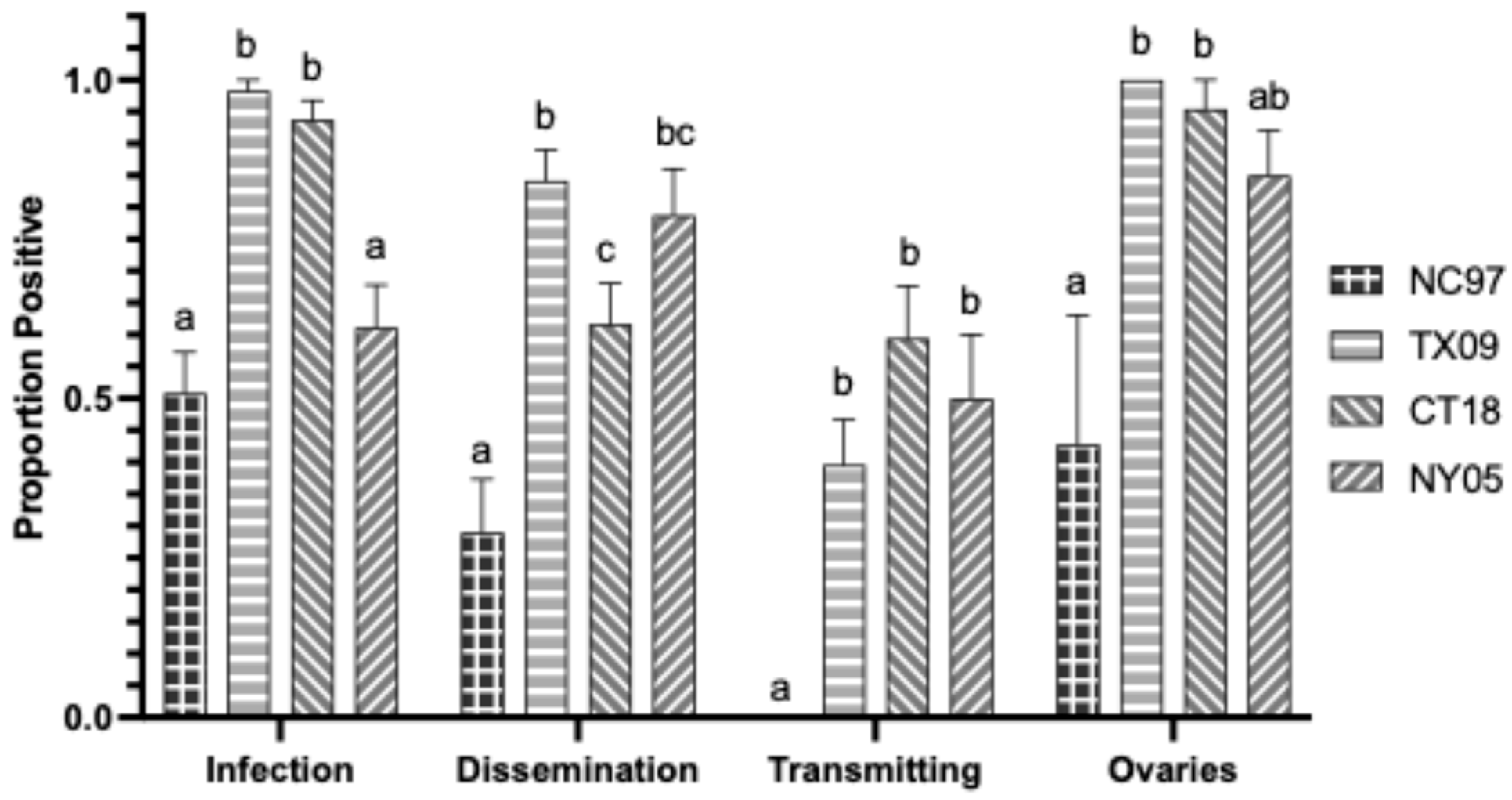
Rates are listed in Table A4, with modified rates shown graphically in Figure 7. NC97 and NY05 strains had significantly lower infection rates than TX09 and CT18 (Tukey’s multiple comparisons; NC97:TX09 p-value < 0.0001, q = 9.031; NC97:CT18 p-value < 0.0001, q = 8.373; NY05:TX09 p-value < 0.0001, q = 6.859; NY05:CT18 p-value < 0.0001, q = 6.165). NC97 has significantly lower rates of dissemination than all other strains (Tukey’s multiple comparisons; NC97:TX09 p-value < 0.0001, q = 8.630; NC97:CT18 p-value = 0.0017, q = 5.149; NC97:NY05 p-value < 0.0001, q = 6.943). TX09 had significantly higher rates of dissemination than CT18 (Tukey’s multiple comparisons; p-value = 0.0145, q = 4.254). NC97 has reduced horizontal transmission rates of infected saliva compared to all other groups (Tukey’s multiple comparisons; NC97:TX09 p-value = 0.0369, q = 3.803; NC97:CT18 p-value = 0.0005, q = 5.583; NC97:NY05 p-value = 0.0081, q = 4.512). NC97 also had a reduced ovarian infection rate compared to TX09 and CT18 (Tukey’s multiple comparisons: NC97:TX09 p-value = 0.0052, q = 4.702; NC97:CT18 p-value = 0.0153, q = 4.230), and NC97 further had reduced ovarian titers compared to lineage III strains CT18 and NY05 (Tukey’s multiple comparisons: NC97:CT18 p-value = 0.0046, q = 4.794; NC97:NY05 p-value = 0.0064, q = 4.653) (Figure 7).

3.4.2. Intrathoracic Inoculation

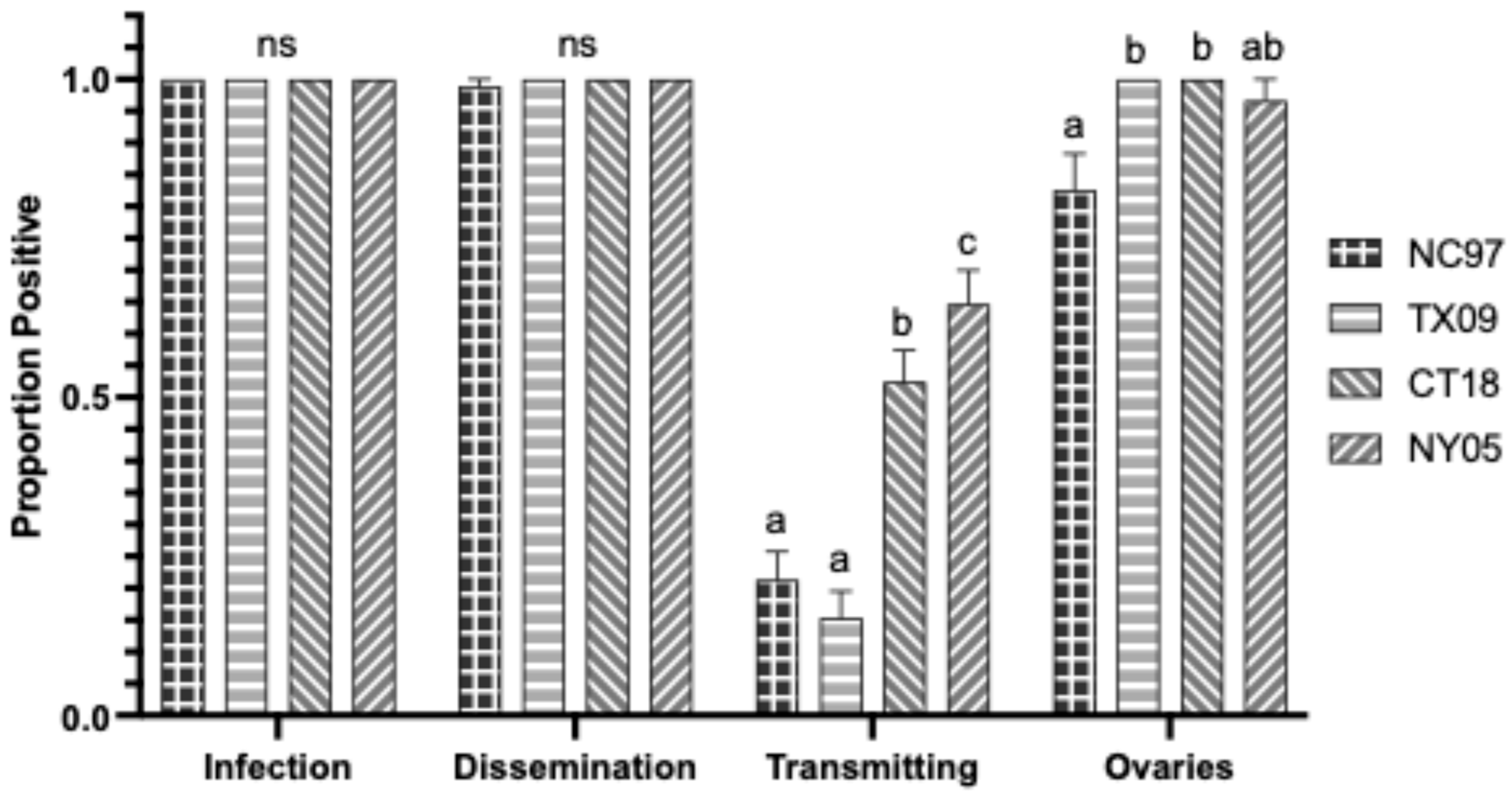
Rates are listed in Table A5 and shown graphically in Figure 8. There were no significant differences in infection and dissemination rates between LACV strains. Strains NC97 and TX09 had significantly lower transmission rates of positive saliva than lineage III strains CT18 and NY05 (Tukey’s multiple comparisons; NC97:CT18 p-value < 0.0001, q = 11.94; NC97:NY05 p-value < 0.0001, q = 15.73; TX09:CT18 p-value < 0.0001, q = 15.73; TX09:NY05 p-value < 0.0001, q = 17.32). TX09 and CT18 had significantly higher TOT rates of positive ovaries than NC97 (Tukey’s multiple comparisons; TX09:NC97 p-value = 0.0190, q = 4.122; CT18:NC97 p-value = 0.0028, q = 4.936) (Figure 8 and Table A5). CT18 had significantly higher ovarian titers than TX09 and NY05 (Tukey’s multiple comparisons; CT18:TX09 p-value = 0.0018, q = 5.130; CT18:NY05 p-value = 0.0144, q = 4.262) (Figure 3).

3.5. LACV Competency in Virginia Aedes albopictus

3.5.1. Oral Infection

Rates are listed in Table A6, with modified rates shown graphically in Figure 9. TX09 and CT18 had significantly higher rates of infection than NC97 and NY05 (Tukey’s multiple comparisons; TX09:NC97 p-value, 0.0001, q = 19.43; TX09:NY05 p-value, 0.0001, q = 19.60; CT18:NC97 p-value, 0.0001, q = 18.51; CT18:NY05 p-value, 0.0001, q = 18.72). NC97 had significantly lower rates of dissemination than all other strains (Tukey’s multiple comparisons; NC97:TX09 p-value = 0.0003, q = 5.804; NC97:CT18 p-value = 0.0055, q = 4.671; NC97:NY05 p-value = 0.0289, q = 3.922). TX09 had significantly lower horizontal transmission rates of positive saliva secretions than lineage III strains CT18 and NY05 (Tukey’s multiple comparisons; TX09:CT18 p-value = 0.0003, q = 5.727; TX09:NY05 p-value = 0.0430, q = 3.720). There were no significant differences in the rate of positive ovaries for any strain (Figure 9 and Table A6). CT18 had significantly higher ovarian titers than TX09 and NY05 (Tukey’s multiple comparisons; CT18:TX09 p-value = 0.0090, q = 4.505; CT18:NY05 p-value = 0.0301, q = 3.930) (Figure 5).

3.5.2. Intrathoracic Inoculation

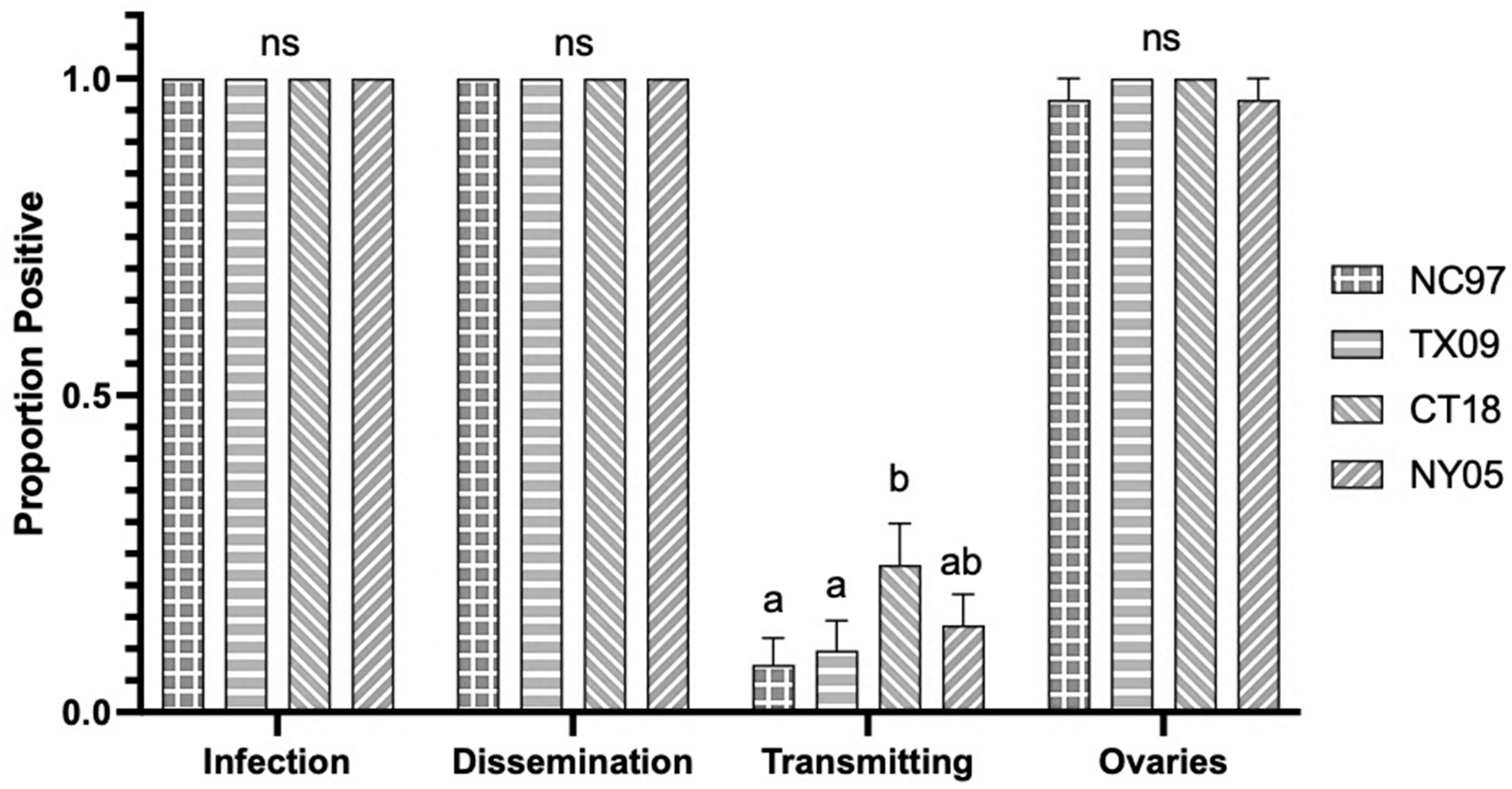
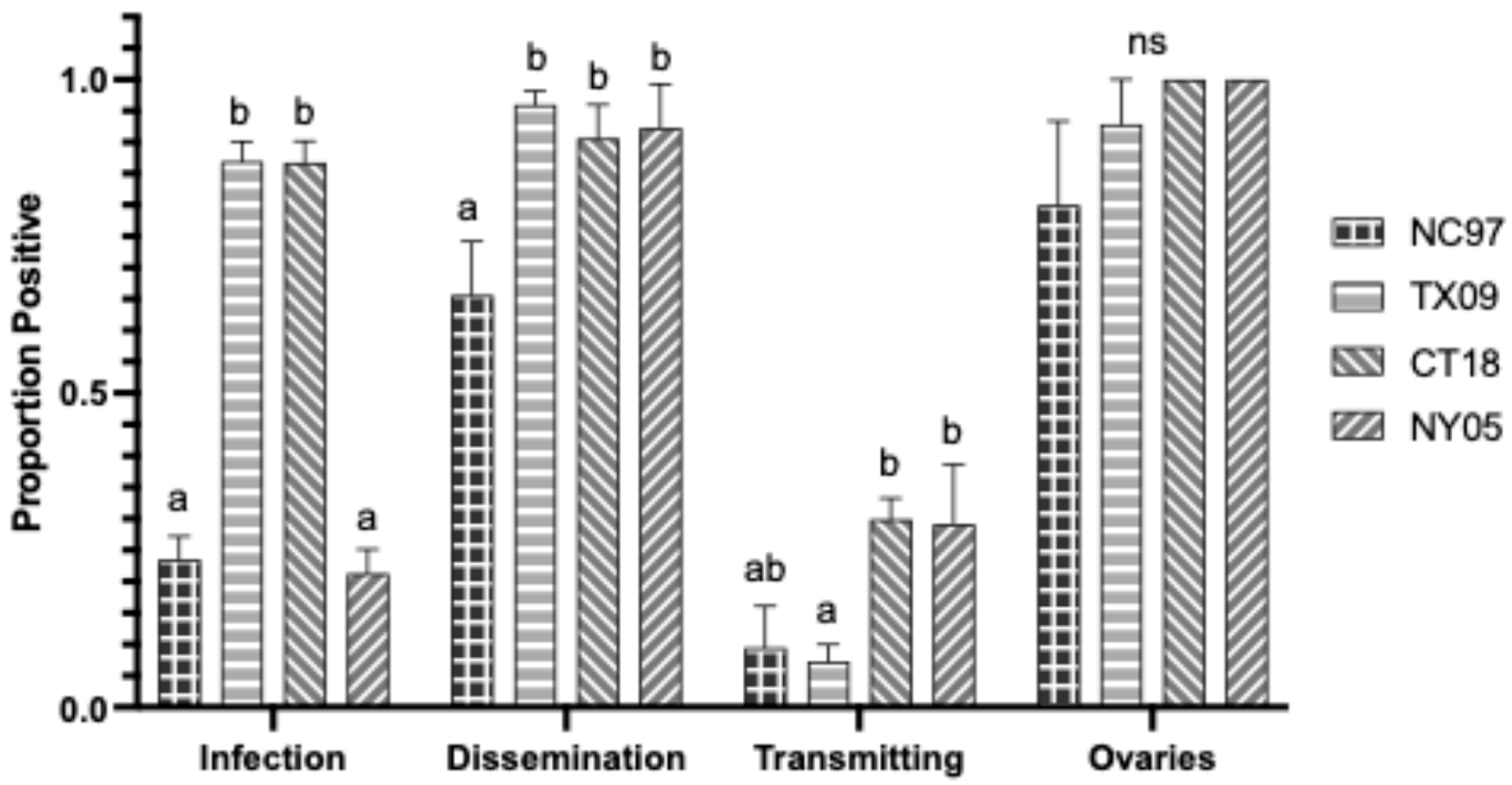
Rates are listed in Table A7 and shown graphically in Figure 10. There were no significant differences in infection rates, dissemination rates, or ovary infection rates between LACV strains. Transmission-wise, the lineage III strain CT18 had significantly higher rates of virus-positive saliva than NC97 and TX09 (Tukey’s multiple comparisons; CT18:NC97 p-value = 0.0421, q = 3.738; CT18:TX09 p-value = 0.0087, q = 4.486); NY05 had higher transmission rates of positive saliva than TX09 (Tukey’s multiple comparisons; NY05:TX09 p-value = 0.0421, q = 3.738) (Figure 10 and Table A7). There were no significant differences in the ovary titers based on virus strain (Figure 3).

3.6. Variation Between Mosquito Species from Virginia

We contrasted the above results for the two different mosquito species (Ae. triseriatus and Ae. albopictus) originating in Virginia.

3.6.1. Oral Infection

Ae. triseriatus infected with NC97 and NY05 had significantly higher infection rates than Ae. albopictus (Tukey’s multiple comparisons; NC97 p-value < 0.0001, q = 6.582; NY05 p-value < 0.0001, q = 9.050). Ae. albopictus infected with NC97 and CT18 had significantly higher dissemination rates than Ae. triseriatus (Tukey’s multiple comparisons; NC97 p-value = 0.0035, q = 5.397; CT18 p-value = 0.0002, q = 6.375). Ae. triseriatus infected with TX09 and CT18 had significantly higher horizontal transmission rates of infected salivary secretions than Ae. albopictus (Tukey’s multiple comparisons; TX09 p-value < 0.0001, q = 6.789; CT18 p-value = 0.0027, q = 5.498). While there were no significant differences in vertical transmission ovarian infection rates between the two vector species, TX09, CT18, and NY05 had significantly higher ovarian titers in Ae. triseriatus than in Ae. albopictus (Tukey’s multiple comparisons; TX09 p < 0.0001, q = 6.377; CT18 p = 0.0098, q = 4.178; NY05 p < 0.0001, q = 7.446).

3.6.2. Intrathoracic Inoculation Variation

There were no significant differences in infection or dissemination rates between inoculated species from Virginia for any LACV virus strain. CT18 and NY05 showed higher rates of infected salivary secretions in Ae. triseriatus than Ae. albopictus (Tukey’s multiple comparisons; CT18 p-value = 0.0004, q = 6.118; NY05: p-value < 0.0001, q = 10.07). TX09 had higher rates of ovarian infection in Ae. triseriatus than in Ae. albopictus mosquitoes (Tukey’s multiple comparisons; p = 0.0037, q = 5.376). There were no differences in ovary titers between VA mosquito species.

3.7. Overall Geographic Variation in LACV Vector Competency

3.7.1. Aedes triseriatus Intrathoracic Inoculation

There were no significant differences in infection rates, dissemination rates, or rates of positive ovaries between Connecticut- and Virginia-inoculated Ae. triseriatus mosquitoes. However, the vertical transmission rate of positive salivary secretions was higher in VA mosquitoes inoculated with TX09, CT18, and NY05 than in CT mosquitoes (Tukey’s multiple comparisons; TX09 p-value = 0.029, q = 4.547; CT18 p = 0.0002, q = 6.378; NY05 p < 0.0001, q = 10.59). There were no significant differences in ovary titers based on state of origin.

3.7.2. Aedes albopictus Intrathoracic Inoculation

There were no significant differences in infection rates, dissemination rates, or rates of positive salivary secretions between Connecticut- and Virginia-inoculated Ae. albopictus mosquitoes. Considering the proxy for vertical transmission, TX09 had a significantly higher rate of infected ovaries in CT Ae. albopictus than in VA Ae. albopictus (Tukey’s multiple comparisons, p = 0.0003, q = 6.285). Lineage III NY05 had significantly higher ovary titers in CT Ae. albopictus than in VA Ae. albopictus (Tukey’s multiple comparisons, p = 0.0001, q = 6.138) (Figure 3).

3.7.3. Aedes albopictus Oral Infection

There were no significant differences in infection rates, dissemination rates, and rates of positive salivary secretions between Connecticut- and Virginia- Ae. albopictus exposed to LACV via oral infection. However, Virginia mosquitoes bloodfed with NC97 and TX09 produced significantly higher rates of ovary infection than Connecticut Ae. albopictus (Tukey’s multiple comparisons; NC97 p-value < 0.0001, q = 8.053; TX09 p = 0.0102, q = 4.990). Virginia Ae. albopictus bloodfed with CT18 had higher ovary titers than Connecticut mosquitoes (Tukey’s multiple comparisons, p = 0.0016, q = 4.960) (Figure 5).

4. Discussion

Addressing the potential public health risk posed by novel lineage III LACV viral strains identified in the northeast USA, we examined the role of the mosquito as a vector for these viral strains. LACV lineage III has been isolated from mosquitoes, but there has yet to be a clinical infection associated with this third lineage [30]. Here, we sought to investigate vector competency for different lineages of LACV, to consider the hypothesis that a lack of human incidence in the Northeast USA could be due to mosquito species having a reduced capacity to transmit strains of lineage III. We demonstrated that, although there was variation between strains, lineage III was as competent for the potential for horizontal transmission (saliva) and vertical transmission (ovaries) as lineage I and II. This suggests that a lack of vector competency does not explain the absence of clinical cases of lineage III. We also highlight the presence of another tissue barrier to infection, an ovarian infection barrier.
There are three main steps to arboviral transmission in the mosquito vector: (1) midgut infection, (2) dissemination from the midgut to secondary tissues, and (3) invasion into the salivary glands [40,41]. Mosquitoes contain barriers to arboviral infection that correlate with these steps to arboviral transmission, and viruses can evade these barriers in their corresponding vectors [40]. In the midgut, arboviruses must infect the mosquito midgut (midgut infection barrier, MIB) and escape the midgut to disseminate to other tissues (midgut escape barrier, MEB) [40]. The MIB can be caused by either the virus’s inability to infect the epithelial cells or its failure to replicate in these cells [40]. Both midgut barriers are dose-dependent [40]. In Ae. triseriatus, larger mosquitoes have a stronger MIB to LACV infection than smaller females [40,42]. Our rearing methods ensured that mosquitoes were consistent in size. Aedes triseriatus also expresses a significant midgut escape barrier (MEB) in which dissemination rates of the virus are reduced when mosquitoes are fed an infectious blood meal [43]. Although this was not previously explored in Ae. albopictus, the current study also shows prevalent MEBs in both species, as detailed below [40,44].
Our data indicate that the ability of a virus to overcome mosquito infection barriers varies according to mosquito species, state of origin, and virus strain. Barriers were identified by proportions of 0.75 or less for each transmission parameter. Due to the lack of an oral feeding comparison for CT Ae. triseriatus, it is unclear whether midgut barriers exist. In the other species and geographic origins, the presence of midgut barriers (MIB and MEB) varied between groups. However, NC97 and NY05 consistently encountered MIBs in all groups, which may indicate that midgut infection barriers partially modulate transmission in these two strains.
In CT Ae. albopictus, NC97, and TX09 demonstrated a reduced ability to infect the ovaries, yet the virus disseminated through the hemolymph at high rates (shown by infected legs), indicating that there is no MEB. The absence of infected ovaries despite widespread systemic infection suggests that a barrier exists within the ovaries that limits vertical transmission. Although several potential barriers to ovarian infection have been proposed, the exact mechanisms remain unclear and are not well understood [44].
As with the midgut, mosquitoes have barriers in the salivary glands that affect virus transmission. The salivary gland infection barrier (SGIB) prevents the glands from becoming infected, while the salivary gland escape barrier (SGEB) stops viruses from being released in saliva during feeding [39]. Both types of barriers have been shown for LACV in the Triseriatus group mosquitoes, Ae. brelandi and Ae. hendersoni [42]. In our study, all species and virus strains showed SGBs after blood feeding, and this was confirmed by inoculation methods that bypassed midgut barriers. The consistent presence of SGBs suggests they play an important role in blocking transmission. However, we did not determine whether the barrier was due to infection or escape, so further research is needed. A persistent salivary gland barrier (SGB) significantly reduced horizontal transmission across all mosquito species, virus strains, and geographic origins, and its effect was greater than that of the apparent ovarian infection barrier. Previous studies, in addition to our findings, show that virus-positive salivary secretions occur at lower rates than ovarian infections [45]. Together, the presence of an SGB and high ovarian infection rates indicate that vertical transmission is more efficient than horizontal transmission in the species and strains examined. Earlier work demonstrated that LACV can persist for up to four years through transovarial transmission (TOT) alone in Ae. triseriatus, underscoring the importance of vertical transmission in LACV maintenance [22]. Infection, dissemination, transmission, and vertical transmission rates following oral infection with LACV vary in previous studies utilizing lineage I LACV strains. Infection rates reported for Ae. triseriatus range between 57% and 94%; our rates of 51% to 98% for lineage III LACV are consistent with these rates [16,45,46]. Previously reported dissemination rates for Ae. triseriatus range from 45% to 86%, while ours are lower at 29% to 84% (14% to 83% of the population) [16,43,45,46]. Previously reported vertical transmission rates were approximately 56% for Ae. triseriatus, while ours ranged from 0% to 59% (0% to 34% of the population) [43]. Note that other studies of competency have primarily utilized lineage I strains of LACV (Bara et al., 2016 [46] used lineage II), which may vary from other lineage strains and highlight the need to determine accurate transmission rates specifically for lineage III in the face of a potential human pathogen.
In Ae. albopictus, infection rates following oral infection reported elsewhere have ranged between 42% and 77% compared to our rates of 21% to 87% [16,45,46]. Reported rates of dissemination range from 18% to 70%, while ours ranged from 65% to 97% (15% to 83% of the population). There were no previous rates of LACV-positive salivary secretions for Ae. albopictus and our data ranged from 7% to 30% (1% to 23% of the population). However, when comparing rates across studies, it is essential to note that variation in extrinsic incubation periods, which ranged in previous studies from 7 to 14 days in previous studies, may affect vector competency, resulting in disparate rates.
Few studies compare the rates of LACV infection in inoculated mosquitoes. One significant advantage of inoculation over oral feeding is bypassing the midgut infection and escape barriers, which results in 100% infection and dissemination. Our data were no exception; infection rates were 100% for both populations of Ae. triseriatus and Ae. albopictus and dissemination rates ranged from 98% to 100% for Ae. triseriatus and 100% for Ae. albopictus. A 100% dissemination rate for inoculated Ae. triseriatus was previously demonstrated [43]. Previously reported rates of virus-positive saliva in Ae. triseriatus were 47–79% and in the current study, our transmission rates ranged from 0% to 65% [43,47].
Initial attempts to rear offspring from LACV-infected female mosquitoes were unsuccessful due to low egg viability and larval survival. Therefore, ovarian infection was used as an indicator of the potential to produce virus-positive offspring. Previously, in orally infected Ae. albopictus, 100% of ovaries from midgut-infected mosquitoes were infected, and titers ranged from 1 × 10² pfu/mL to 1 × 10⁴ pfu/mL by seven days post-infection [48]. In the current study, orally-infected mosquitoes had ovarian infections ranging from 0% to 100%, with titers ranging from 2.5 × 10³ pfu/mL to 2.9 × 10⁴ pfu/mL in CT Ae. albopictus mosquitoes and 80% to 100% with titers ranging from 6.9 × 10³ pfu/mL to 5.5 × 10⁴ pfu/mL (excluding the zero/lack of titer for NC97) in VA Ae. albopictus mosquitoes. Our reported ovarian titers are marginally larger than those previously reported, but this may be explained by our longer extrinsic incubation period of 14 days. In Ae. triseriatus mosquitoes from VA, ovarian infection rates ranged between 43% and 100%, with titers ranging from 3.3 × 10⁴ pfu/mL to 9.6 × 10⁴ pfu/mL.
LACV lineage III has also recently been isolated from Aedes canadensis, Aedes cinereus, and Aedes trivittatus in Connecticut [25]; the latter two species have not been previously associated with LACV, but virus isolation alone does not indicate that these species are competent vectors of LACV lineage III. LACV lineage I has been isolated from field-collected Ae. albopictus and shown in laboratory studies to be a competent vector for both lineages I and II [32,46,47,49]. In contrast, lineage III has never been isolated from Ae. albopictus, and its vector competence for this lineage was previously unknown. Our study demonstrates that Ae. albopictus can serve as a potential vector for both horizontal and vertical transmission of LACV lineage III, with no apparent differences in transmission efficiency among lineages or strains.
Previous studies concluded that sympatric matching of mosquito species and virus lineage relevant to the same geographic range resulted in reduced horizontal transmission [35]. However, considering vertical transmission, the ‘geographic pairing’ of viruses and Ae. triseriatus mosquitoes from endemic areas can increase capacity [36,37]. Together, this may indicate that LACV vertical transmission is a more effective persistence mechanism in endemic ranges, but horizontal transmission is utilized when mosquito species and viruses are allopatric [35,36,37]. Although there was geographic variation in some variables of vector competence, the current study was unable to demonstrate consistent geographic pairing for horizontal or vertical transmission.
There was no clear pattern in vector competence when comparing Ae. triseriatus, the native vector, and Ae. albopictus. Studies elsewhere have emphasized the concern regarding invasive non-native vectors and the potential for increased transmission of arboviruses as these species migrate into new areas [16,46]. Prior reports are inconclusive, with some studies demonstrating Ae. triseriatus as a better vector of LACV than Ae. albopictus [16,45] and others indicating the opposite [46]. The present study found variation between species; however, this variation was largely inconsistent across strains, and thus, we could not conclude one species was a more competent vector for LACV than the other. In the absence of clear differences between groups, it is difficult to make conclusive statements regarding species variation in vector competency.
Our testing was limited to only one strain of lineage I, one strain of lineage II, and two strains of lineage III. With few strains from each lineage used, it is difficult to conclude lineage-specific vector competency. This study was also limited by challenges in maintaining CT Ae. triseriatus mosquitoes for further experimentation. The current study employed a temperature of 26 °C with a photoperiod of 15 h of light (L) and 9 h of darkness (D) for all experiments. Previous studies have concluded that vector competency can be affected by temperature [49,50]. Photoperiod also has a profound effect on mosquito biology. Aedes spp. mosquitoes in cooler climates, such as Ae. triseriatus and Ae. albopictus, enter a photoperiod-induced diapause to overwinter as eggs [50]. Based on lineage I, LACV persists through the overwintering of LACV-infected (vertically infected) eggs, and newly emerged adults can infect naïve host species in the spring, thereby maintaining the LACV transmission cycle [19,21,51]. It is thus likely that increases in temperatures and changes in critical photoperiods may alter vector competency for LACV transmission. The use of ovaries as a proxy for vertical transmission also presents a limitation to this study. Although ovaries provide a good approximation for the potential to produce infected offspring, it is impossible to know the viability of those offspring or the rates of infection in them. Our study utilized a single time point of 14 days post-inoculation, and it would be beneficial to explore the influence of the extrinsic incubation period on vector competency to strengthen findings. Although forced salivation is an accepted proxy for the ability to transmit via the bite of an infected mosquito, it was recently demonstrated that forced salivation may not be a reliable measure of this ability [47]. In the present study, dissemination rates, both dissemination to legs and ovaries, were consistently higher for all groups than the infected saliva rates. The use of dissemination rates to approximate the ability to transmit would substantially increase the potential transmission ability in all groups and suggest a more significant human disease risk.

5. Conclusions

Overall, we indicate that LACV lineage III can be transmitted horizontally and vertically in all mosquito populations tested here, highlighting its role as a potential human pathogen risk. This is a novel finding revealing the potential vector competency of two prominent mosquito species, Aedes triseriatus and Aedes albopictus, for which lineage III virus interactions had not been previously investigated. Our data also suggest that transmission of LACV lineage III is not modulated by poor vector competency, rejecting the key hypothesis that mosquitoes are unable to transmit lineage III horizontally, and implying that another hypothesis is responsible for the apparent absence of human cases. Alternative suggestions remaining to be explored include (1) underdiagnosis in cases of human disease or lack of detection in humans, (2) reduced virulence in lineage III LACV (recent research provides evidence for this hypothesis [52]), or (3) low prevalence of lineage III in local mosquito and host animal populations. We recommend further investigation into the biology and ecoepidemiology of lineage III, with future studies to determine the human disease risk associated with LACV lineage III infection.

Author Contributions

Conceptualization, G.E.; methodology, G.E., P.M.A. and S.L.P.; formal analysis, L.R.F.; investigation, L.R.F.; resources, G.E. and S.L.P.; data curation, L.R.F.; writing—original draft preparation, L.R.F.; writing—review and editing, L.R.F., G.E. and S.L.P.; visualization, L.R.F.; supervision, G.E. and S.L.P.; funding acquisition, G.E. All authors have read and agreed to the published version of the manuscript.

Funding

Research reported in this publication was supported by the National Institute of Allergy and Infectious Diseases (NIAID) of the National Institutes of Health, under award number R03AI182773. GE is supported by the USDA National Institute of Food and Agriculture, Hatch Project VA-160131 (2020–2024) and VT-160255 (2025–date).

Institutional Review Board Statement

Not applicable.

Data Availability Statement

The raw data supporting the conclusions of this article will be made available by the authors upon request.

Acknowledgments

We would like to thank Melanie Turner and Natalie Cann, who helped maintain mosquito colonies throughout these studies. We are grateful to John Shepard and Tanya Petruff at the Connecticut Agricultural Experiment Station (CAES) for their advice and the provision of the Connecticut strain Ae. albopictus and Ae. triseriatus eggs. We also thank Alex Ciota of NY State Department of Health Wadsworth Center for providing the NY05 LACV virus strain.

Conflicts of Interest

The authors declare no conflicts of interest.

Appendix A

Table A1. Connecticut Aedes triseriatus LACV-inoculation data by trial expressed as proportion infected out of total number tested. N values in parentheses. Values in parentheses in ovary titer rows indicate the standard error. Letters indicate significance between strains within each transmission parameter in each trial (ANOVA, Tukey’s multiple comparisons).
CT Aedes triseriatus LACV Exposure by Intrathoracic Inoculation
Virus Strain (Lineage)
TrialTransmission ParameterNC97 (I)TX09 (II)CT18 (III)NY05 (III)
1Infection (bodies)1.00 (25/25) a1.00 (23/23) a1.00 (12/12) a1.00 (25/25) a
Dissemination (legs)1.00 (25/25) a1.00 (23/23) a1.00 (12/12) a1.00 (25/25) a
Transmission (saliva)0.24 (6/25) a0.00 (0/23) b0.33 (4/12) a0.24 (6/25) a
Vertical (positive ovaries)1.00 (25/25) a1.00 (23/23) a1.00 (12/12) a1.00 (25/25) a
Mean (SE) Positive Ovaries 1.5 × 10³ pfu/mL a
(±2.8 × 10² pfu/mL)
2.2 × 10³ pfu/mL a
(±5.2 × 10² pfu/mL)
3.6 × 10³ pfu/mL a
(±8.1 × 10² pfu/mL)
3.2 × 10³ pfu/mL a
(±1.4 × 10³ pfu/mL)
2Infection (bodies)NA1.00 (13/13) a1.00 (10/10) aNA
Dissemination (legs)NA1.00 (13/13) a1.00 (10/10) aNA
Transmission (saliva)NA0.00 (0/13) a0.20 (2/10) bNA
Vertical (positive ovaries)NA1.00 (13/13) a1.00 (10/10) aNA
Mean (SE) Positive Ovaries NA8.3 × 102 pfu/mL a
(±3.2 × 10² pfu/mL)
4.3 × 10³ pfu/mL a
(±1.0 × 10³ pfu/mL)
NA
TOTALS:Infection (bodies)1.00 (25/25) a1.00 (36/36) a1.00 (22/22) a1.00 (25/25) a
Dissemination (legs)1.00 (25/25) a1.00 (36/36) a1.00 (22/22) a1.00 (25/25) a
Transmission (saliva)0.24 (6/25) a0.00 (0/36) b0.27 (6/22) a0.24 (6/25) a
Vertical (positive ovaries) 1.00 (25/25) a1.00 (36/36) a1.00 (22/22) a1.00 (25/25) a
Mean (SE) Positive Ovaries 1.5 × 10³ pfu/mL a
(±2.8 × 10² pfu/mL)
1.7 × 10³ pfu/mL a
(±3.6 × 10² pfu/mL)
3.9 × 10³ pfu/mL a
(±6.3 × 10² pfu/mL)
3.2 × 10³ pfu/mL a
(±1.4 × 10³ pfu/mL)
NA indicates that data were not available for that transmission parameter.
Table A2. Connecticut Aedes albopictus LACV-oral feeding data by trial expressed as proportion infected out of total number tested. N values in parentheses. Values in parentheses in ovary titer rows indicate the standard error. Letters indicate significance (p < 0.05) between strains within each transmission parameter in each trial (ANOVA, Tukey’s multiple comparisons).
CT Aedes albopictus LACV Exposure by Oral Feeding
LACV Strain (Lineage)
TrialTransmission ParameterNC97 (I)TX09 (II)CT18 (III)NY05 (III)
1Infection (bodies)0.33 (4/12) a0.83 (5/6) b1 (14/14) b0.63 (5/8) ab
Dissemination (legs)0.08 (1/12) a0.83 (5/6) bc1 (14/14) c0.50 (4/8) ab
Transmission (saliva)0.00 (0/12) a0.50 (3/6) bc0.64 (9/14) c0.13 (1/8) ab
2Infection (bodies)0.73 (22/30) bc 0.97 (37/38) a0.88 (35/40) ab0.59 (24/41) c
Dissemination (legs)0.70 (21/30) bc0.92 (35/38) a0.88 (35/40) ab0.54 (22/41) c
Transmission (saliva)0.07 (2/30) a0.03 (1/38) a0.05 (2/40) a0.07 (3/41) a
3Infection (bodies)0.00 (0/17) a0.30 (3/10) ab0.40 (4/10) b0.15 (2/13) ab
Dissemination (legs)0.00 (0/17) a0.30 (3/10) a0.30 (3/10) a0.15 (2/13) a
Transmission (saliva)0.00 (0/17) a0.20 (2/10) a0.20 (2/10) a0.08 (1/13) a
Vertical (positive ovaries) 0.00 (0/17) a0.30 (3/10) a0.30 (3/10) a0.15 (2/13) a
Mean (SE) Positive Ovaries 0 pfu/mL a
(±0 pfu/mL)
7.5 × 10³ pfu/mL a
(±3.4 × 10³ pfu/mL)
7.7 × 10² pfu/mL a
(±5.0 × 10² pfu/mL)
3.5 × 10⁴ pfu/m b
(±2.3 × 10⁴ pfu/mL)
4Infection (bodies)0.00 (0/30) a0.73 (22/30) b0.60 (18/30) b0.1 (3/30) a
Dissemination (legs)0.00 (0/30) a0.63 (19/30) b0.57 (17/30) b0.10 (3/30) a
Transmission (saliva)0.00 (0/30) a0.17 (5/30) a0.10 (3/30) a0.00 (0/30) a
Vertical (positive ovaries) 0.00 (0/30) a0.60 (18/30) b0.50 (15/30) b0.10 (3/30) a
Mean (SE) Positive Ovaries 0 pfu/mL a
(±0 pfu/mL)
1.7 × 10³ pfu/mL a
(±4.0 × 10² pfu/mL)
8.9 × 10³ pfu/mL b
(±3.0 × 10³ pfu/mL)
2.5 × 10⁴ pfu/mL c
(±1.2 × 10⁴ pfu/mL)
TOTALS:Infection (bodies)0.30 (27/89) a0.80 (67/84) b0.76 (71/94) b0.35 (32/92) a
Dissemination (legs)0.25 (22/89) a0.75 (62/84) b0.73 (69/94) b0.34 (31/92) a
Transmission (saliva)0.02 (2/89) a0.13 (11/84) a0.17 (16/94) a0.05 (5/92) a
Vertical (positive ovaries) 0.00 (0/30) a0.53 (21/40) b0.43 (17/40) b0.16 (5/32) a
Mean (SE) Positive Ovaries 0 pfu/mL a
(±0 pfu/mL)
2.6 × 10³ pfu/mL a
(±5.1 × 10² pfu/mL)
6.8 × 10³ pfu/mL a
(±7.1 × 10² pfu/mL)
2.9 × 10⁴ pfu/mL a
(±2.2 × 10³ pfu/mL)
Table A3. Connecticut Aedes albopictus LACV-inoculation data by trial expressed as proportion infected out of total number tested. N values in parentheses. Values in parentheses in ovary titer rows indicate the standard error. Letters indicate significance (p < 0.05) between strains within each transmission parameter in each trial (ANOVA, Tukey’s multiple comparisons).
CT Aedes albopictus LACV Exposure by Intrathoracic Inoculation
LACV Strain (Lineage)
TrialTransmission ParameterNC97 (I)TX09 (II)CT18 (III)NY05 (III)
1Infection (bodies)1.00 (30.30) a1.00 (30.30) a1.00 (24/24) a1.00 (30.30) a
Dissemination (legs)1.00 (30/30) a1.00 (30/30) a1.00 (24/24) a1.00 (30/30) a
Transmission (saliva)0.03 (1/30) a0.10 (3/30) a0.42 (10/24) b0.13 (4/30) ab
Vertical (positive ovaries) 0.97 (29/30) a1.00 (30/30) a1.00 (24/24) a0.97 (29/30) a
Mean (SE) Positive Ovaries 1.1 × 10³ pfu/mL a
(±3.2 × 10² pfu/mL)
2.6 × 10³ pfu/mL a
(±5.0 × 10² pfu/mL)
3.4 × 10³ pfu/mL a
(±7.1 × 10² pfu/mL)
9.0 × 10³ pfu/mL b
(±2.3 × 10³ pfu/mL)
Table A4. Virginia Aedes triseriatus oral feeding data by trial expressed as proportion infected out of total number tested. N values in parentheses. Parentheses in the ovary titer rows indicate the standard error. Letters indicate significance (p < 0.05) between strains within each transmission parameter in each trial. (ANOVA, Tukey’s multiple comparisons).
VA Aedes triseriatus LACV Exposure by Oral Feeding
TrialTransmission ParameterNC97TX09CT18NY05
1Infection (bodies)0.38 (6/16) a0.94 (17/18) b0.95 (21/22) b0.31 (5/16) a
Dissemination (legs)0.13 (2/16) a0.72 (13/18) b 0.32 (7/22) a0.19 (3/16) a
Transmission (saliva)0.00 (0/16) a0.28 (5/18) a0.23 (5/22) a0.06 (1/16) a
2Infection (bodies)0.53 (8/15) a1 (10/10) b0.75 (9/12) ab0.75 (6/8) ab
Dissemination (legs)0.00 (0/15) a0.80 (8/10) b0.67 (8/12) b0.38 (3/8) ab
Transmission (saliva)0.00 (0/15) a0.40 (4/10) ab0.67 (8/12) b0.13 (1/8) a
3Infection (bodies)0.57 (17/30) a1.00 (30/30) b1.00 (30/30) b0.73 (22/30) a
Dissemination (legs)0.23 (7/30) a0.90 (27/30) b0.73 (22/30) b0.67 (20/30) b
Transmission (saliva)0.00 (0/30) a0.37 (10/27) b0.30 (9/30) b0.37 (11/30) b
Vertical (positive ovaries) 0.43 (3/30) a0.93 (27/30) b0.70 (21/30) bc0.85 (17/30) c
Mean (SE) Positive Ovaries 3.3 × 10⁴ pfu/mL a
(±1.8 × 10⁴ pfu/mL)
7.0 × 10⁴ pfu/mL ab
(±1.1 × 10⁴ pfu/mL)
9.6 × 10⁴ pfu/mL b
(±1.6 × 10⁴ pfu/mL)
9.5 × 10⁴ pfu/mL b
(±1.9 × 10⁴ pfu/mL)
TOTALS:Infection (bodies)0.51 (31/61) a0.98 (57/58) b0.94 (60/64) b0.61 (33/54) a
Dissemination (legs)0.15 (9/61) a0.83 (48/58) b0.58 (37/64) c0.48 (26/54) c
Transmission (saliva)0.00 (0/61) a0.33 (19/58) b0.34 (22/64) b0.24 (13/54) b
Vertical (positive ovaries) 0.1 (3/30) a0.93 (27/30) b0.70 (21/30) bc0.56 (17/30) c
Mean (SE) Positive Ovaries 3.3 × 10⁴ pfu/mL a
(±1.8 × 10⁴ pfu/mL)
7.0 × 10⁴ pfu/mL ab
(±1.1 × 10⁴ pfu/mL)
9.6 × 10⁴ pfu/mL b
(±1.6 × 10⁴ pfu/mL)
9.5 × 10⁴ pfu/mL b
(±1.9 × 10⁴ pfu/mL)
Table A5. Virginia Aedes triseriatus LACV-inoculation data by trial expressed as proportion infected out of total number tested. N values in parentheses. Values in parentheses in ovary titer rows indicate the standard error. Letters indicate significance (p < 0.05) between strains within each transmission parameter in each trial (ANOVA, Tukey’s multiple comparisons).
VA Aedes triseriatus LACV Exposure by Intrathoracic Inoculation
LACV Strain (Lineage)
TrialTransmission ParameterNC97 (I)TX09 (II)CT18 (III)NY05 (III)
1Infection (bodies)1.00 (44/44) a1.00 (48/48) a1.00 (43/43) a1.00 (52/52) a
Dissemination (legs)0.98 (43/44) a1.00 (48/48) a1.00 (43/43) a1.00 (52/52) a
Transmission (saliva)0.18 (8/44) a0.17 (8/48) a0.74 (32/43) b0.67 (35/52) b
2Infection (bodies)1.00 (16/16) a1.00 (30/30) a1.00 (30/30) a1.00 (30/30) a
Dissemination (legs)1.00 (16/16) a1.00 (30/30) a1.00 (30/30) a1.00 (30/30) a
Transmission (saliva)0.25 (4/16) bc0.13 (4/30) c0.33 (10/30) b0.60 (18/30) a
Vertical (positive ovaries) 0.50 (8/16) b1.00 (30/30) a1.00 (30/30) a0.97 (29/30) a
Mean (SE) Positive Ovaries 4.9 × 10² pfu/mL a
(±8.3 × 101 pfu/mL)
7.9 × 10² pfu/mL a
(±1.3 × 10² pfu/mL)
2.1 × 10³ pfu/mL a
(±3.1 × 10² pfu/mL)
1.2 × 10³ pfu/mL a
(±3.0 × 10² pfu/mL)
3Infection (bodies)1.00 (30/30) aNA1.00 (30/30) aNA
Dissemination (legs)1.00 (30/30) aNA1.00 (30/30) aNA
Transmission (saliva)0.23 (7/30) aNA0.40 (12/30) bNA
Vertical (positive ovaries) 1.00 (30/30) aNA1.00 (30/30) aNA
Mean (SE) Positive Ovaries 3.5 × 10³ pfu/mL a
(±1.8 × 10³ pfu/mL)
NA1.0 × 104 pfu/mL a
(±3.4 × 10³ pfu/mL)
NA
TOTALS:Infection (bodies)1.00 (90/90) a1.00 (78/78) a1.00 (103/103) a1.00 (82/82) a
Dissemination (legs)0.99 (89/90) a1.00 (78/78) a1.00 (103/103) a1.00 (82/82) a
Transmission (saliva)0.21 (19/90) a0.15 (12/78) a0.52 (54/103) b0.65 (53/82) c
Vertical (positive ovaries) 0.83 (38/46) a1.00 (30/30) b1.00 (60/60) b0.97 (29/30) ab
Mean (SE) Positive Ovaries 2.9 × 10³ pfu/mL ab
(±1.3 × 10³ pfu/mL)
7.9 × 10² pfu/mL b
(±1.3 × 10² pfu/mL)
6.2 × 10³ pfu/mL a
(±1.8 × 10³ pfu/mL)
1.2 × 10³ pfu/mL b
(±3.0 × 10² pfu/mL)
NA indicates that data were not available for that transmission parameter.
Table A6. Virginia Aedes albopictus LACV-oral feeding data by trial expressed as proportion infected out of total number tested. N values in parentheses. Values in parentheses in ovary titer rows indicate the standard error. Letters indicate significance (p < 0.05) between strains within each transmission parameter in each trial (ANOVA, Tukey’s multiple comparisons).
VA Aedes albopictus LACV Exposure by Oral Feeding
LACV Strain (Lineage)
TrialTransmission ParameterNC97 (I)TX09 (II)CT18 (III)NY05 (III)
1Infection (bodies)0.32 (12/37) a1 (31/31) b1 (31/31) b0.79 (11/14) b
Dissemination (legs)0.24 (9/37) a1 (31/31) b1 (31/31) b0.64 (9/14) c
Transmission (saliva)0.03 (1/37) a0.06 (2/31) a0.39 (12/31) b0.36 (5/14) b
2Infection (bodies)0.12 (8/69) a0.98 (53/54) b0.92 (34/37) b0.13 (6/48) a
Dissemination (legs)0.03 (2/69) a0.94 (51/54) b0.76 (28/37) c0.08 (4/48) a
Transmission (saliva)0.01 (1/69) a0.06 (3/54) ab0.16 (6/37) b0 (0/48) a
3Infection (bodies)0.40 (12/30) bNA0.67 (20/30) a0.30 (9/30) b
Dissemination (legs)0.33 (10/30) bNA0.60 (18/30) a0.30 (9/30) b
Transmission (saliva)0.00 (0/30) aNA0.17 (5/30) a0.07 (2/30) a
Vertical (positive ovaries)0.27 (8/30) bNA0.60 (18/30) a0.30 (9/30) b
Mean (SE) Positive Ovaries 1.2 × 10⁴ pfu/mL ab
(±1.2 × 10⁴ pfu/mL)
NA5.5 × 104 pfu/mL a
(±1.1 × 10⁴ pfu/mL)
7.3 × 10³ pfu/mL b
(±4.3 × 10³ pfu/mL)
4Infection (bodies)NA0.53 (16/30) aNA0.07 (2/30) b
Dissemination (legs)NA0.47 (14/30) aNA0.07 (2/30) b
Transmission (saliva)NA0.07 (2/30) aNA0.00 (0/30) a
Vertical (positive ovaries) NA0.43 (13/30) aNA0.07 (2/30) b
Mean (SE) Positive Ovaries NA7.0 × 103 pfu/mL a
(±1.5 × 10³ pfu/mL)
NA2.2 × 104 pfu/mL a
(±1.2 × 10⁴ pfu/mL)
TOTAL:Infection (bodies)0.24 (32/136) a0.87 (100/115) b0.87 (85/98) b0.21 (26/122) a
Dissemination (legs)0.15 (21/136) a0.83 (96/115) b0.79 (77/98) b0.20 (24/122) a
Transmission (saliva)0.01 (2/136) a0.06 (7/115) a0.23 (23/98) b0.06 (7/122) a
Vertical (positive ovaries) 0.27 (8/30) bc0.43 (13/30) ab0.60 (18/30) a0.18 (11/60) c
Mean (SE) Positive Ovaries 1.2 × 10⁴ pfu/mL ab
(±1.2 × 10⁴ pfu/mL)
7.0 × 10³ pfu/mL a
(±1.5 × 10³ pfu/mL)
5.5 × 10⁴ pfu/mL b
(±1.1 × 10⁴ pfu/mL)
1.0 × 10⁴ pfu/mL a (±4.3 × 10³ pfu/mL)
NA indicates that data were not available for that transmission parameter.
Table A7. VA Aedes albopictus LACV-inoculation data by trial expressed as proportion infected out of total number tested. N values in parentheses. Values in parentheses in ovary titer rows indicate the standard error. Letters indicate significance (p < 0.05) between strains within each transmission parameter in each trial (ANOVA, Tukey’s multiple comparisons).
VA Aedes albopictus LACV Exposure by Intrathoracic Inoculation
LACV Strain (lineage)
TrialTransmission ParameterNC97 (I)TX09 (II)CT18 (III)NY05 (III)
1Infection (bodies)1.00 (30/30) a1.00 (30/30) a1.00 (30/30) a1.00 (30/30) a
Dissemination (legs)1.00 (30/30) a1.00 (30/30) a1.00 (30/30) a1.00 (30/30) a
Transmission (saliva)0.13 (4/30) ab0.10 (3/30) a0.30 (9/30) c0.27 (8/30) bc
Vertical (positive ovaries) 0.87 (26/30) a0.73 (22/30) a1.00 (30/30) a1.00 (30/30) a
Mean (SE) Positive Ovaries1.2 × 103 pfu/mL a
(±3.1 × 10² pfu/mL)
7.6 × 10² pfu/mL a
(±2.5 × 10² pfu/mL)
2.9 × 10³ pfu/mL a
(±1.5 × 10³ pfu/mL)
1.2 × 10³ pfu/mL a
(±5.9 × 10² pfu/mL)

References

  1. Thompson, W.H.; Kalfayan, B.; Anslow, R.O. Isolation of California Encephalitis Group Virus from a Fatal Human Illness. Am. J. Epidemiol. 1965, 81, 245–253. [Google Scholar] [CrossRef]
  2. Weaver, S.C.; Reisen, W.K. Present and Future Arboviral Threats. Antivir. Res. 2010, 85, 328. [Google Scholar] [CrossRef]
  3. Jones, T.F.; Craig, A.S.; Nasci, R.S.; Patterson, L.E.R.; Erwin, P.C.; Gerhardt, R.R.; Ussery, X.T.; Schaffner, W. Newly Recognized Focus of La Crosse Encephalitis in Tennessee. Clin. Infect. Dis. 1999, 28, 93–97. [Google Scholar] [CrossRef] [PubMed]
  4. Bewick, S.; Agusto, F.; Calabrese, J.M.; Muturi, E.J.; Fagan, W.F. Epidemiology of La Crosse Virus Emergence, Appalachia Region, United States. Emerg. Infect. Dis. 2016, 22, 1921–1929. [Google Scholar] [CrossRef]
  5. McJunkin, J.E.; de los Reyes, E.C.; Irazuzta, J.E.; Caceres, M.J.; Khan, R.R.; Minnich, L.L.; Fu, K.D.; Lovett, G.D.; Tsai, T.; Thompson, A. La Crosse Encephalitis in Children. N. Engl. J. Med. 2001, 344, 801–807. [Google Scholar] [CrossRef] [PubMed]
  6. Gaensbauer, J.T.; Lindsey, N.P.; Messacar, K.; Staples, J.E.; Fischer, M. Neuroinvasive Arboviral Disease in the United States: 2003 to 2012. Pediatrics 2014, 134, e642–e650. [Google Scholar] [CrossRef]
  7. Centers for Disease Control and Prevention—Data and Maps for La Crosse. Available online: https://www.cdc.gov/la-crosse-encephalitis/data-maps/index.html (accessed on 18 September 2024).
  8. Balfour, H.H., Jr.; Siem, R.A.; Bauer, H.; Quie, P.G. California Arbrovirus (La Crosse) Infections. I. Clinical and Laboratory Findings in 66 Children with Meningoencephalitis. Pediatrics 1973, 52, 680–691. [Google Scholar] [CrossRef]
  9. Harding, S.; Greig, J.; Mascarenhas, M.; Young, I.; Waddell, L.A. La Crosse Virus: A Scoping Review of the Global Evidence. Epidemiol. Infect. 2018, 147, e66. [Google Scholar] [CrossRef] [PubMed]
  10. Rust, R.S.; Thompson, W.H.; Matthews, C.G.; Beaty, B.J.; Chun, R.W.M. Topical Review: La Crosse and Other Forms of California Encephalitis. J. Child. Neurol. 2016, 14, 1–14. [Google Scholar] [CrossRef]
  11. Virus Taxonomy: The Database of the International Committee on Taxonomy of Viruses (ICTV). Available online: https://ictv.global/taxonomy/ (accessed on 18 September 2024).
  12. Centers for Disease Control and Prevention—About La Crosse Virus. Available online: https://www.cdc.gov/la-crosse-encephalitis/about/index.html (accessed on 18 September 2024).
  13. Byrd, B.D. La Crosse Encephalitis: A Persistent Arboviral Threat in North Carolina. North Carol. Med. J. 2016, 77, 330–333. [Google Scholar] [CrossRef]
  14. Erwin, P.C.; Jones, T.F.; Gerhardt, R.R.; Halford, S.K.; Smith, A.B.; Patterson, L.E.R.; Gottfried, K.L.; Burkhalter, K.L.; Nasci, R.S.; Schaffner, W. La Crosse Encephalitis in Eastern Tennessee: Clinical, Environmental, and Entomological Characteristics from a Blinded Cohort Study. Am. J. Epidemiol. 2002, 155, 1060–1065. [Google Scholar] [CrossRef]
  15. Borucki, M.K.; Kempf, B.J.; Blitvich, B.J.; Blair, C.D.; Beaty, B.J. La Crosse Virus: Replication in Vertebrate and Invertebrate Hosts. Microbes Infect. 2002, 4, 341–350. [Google Scholar] [CrossRef]
  16. Costanzo, K.S.; Muturi, E.J.; Montgomery, A.V.; Alto, B.W. Effect of Oral Infection of La Crosse Virus on Survival and Fecundity of Native Ochlerotatus triseriatus and Invasive Stegomyia albopicta. Med. Vet. Entomol. 2014, 28, 77–84. [Google Scholar] [CrossRef] [PubMed]
  17. Calisher, C.H. Medically Important Arboviruses of the United States and Canada. Clin. Microbiol. Rev. 1994, 7, 89–116. [Google Scholar] [CrossRef] [PubMed]
  18. Leisnham, P.; Juliano, S.A. Impacts of Cimate, Land Use, and Biological Invasion on the Ecology of Immature Aedes mosquitoes: Implications for La Crosse Emergence. Ecohealth 2012, 9, 217–228. [Google Scholar] [CrossRef] [PubMed]
  19. Watts, D.M.; Pantuwantana, S.; DeFoliart, G.R.; Yuill, T.M.; Thompson, W.H. Transovarial Transmission of La Crosse Virus (California Encephalitis Group) in the Mosquito, Aedes triseriatus. Science 1973, 182, 1140–1141. [Google Scholar] [CrossRef]
  20. Westby, K.M.; Juliano, S.A. Simulated Seasonal Photoperiods and Fluctuating Temperatures Have Limited Effects on Blood Feeding and Life History in Aedes triseriatus (Diptera: Culicidae). J. Med. Entomol. 2015, 52, 896–906. [Google Scholar] [CrossRef]
  21. Pantuwatana, S.; Thompson, W.H.; Watts, D.M.; Yuill, T.M.; Hanson, R.P. Isolation of La Crosse Virus from Field Collected Aedes triseriatus Larvae. Am. J. Trop. Med. Hyg. 1974, 23, 246–250. [Google Scholar] [CrossRef]
  22. Kempf, B.J.; Blair, C.D.; Beaty, B.J. Quantitative Analysis of La Crosse Virus Transcription and Replication in Cell Cultures and Mosquitoes. Am. J. Trop. Med. Hyg. 2006, 74, 224–232. [Google Scholar] [CrossRef]
  23. Miller, B.R.; DeFoliart, G.R.; Yuill, T.M. Vertical Transmission of La Crosse Virus (California Encephalitis Group): Transovarial and Filial Infection Rates in Aedes triseriatus (Diptera: Culicidae). J. Med. Entomol. 1977, 14, 437–440. [Google Scholar] [CrossRef]
  24. Reese, S.M.; Beaty, M.K.; Gabitzsch, E.S.; Blair, C.D.; Beaty, B.J. Aedes triseriatus Females Transovarially-Infected with La Crosse Virus Mate More Efficiently Than Uninfected Mosquitoes. J. Med. Entomol. 2009, 46, 1152–1158. [Google Scholar] [CrossRef]
  25. Eastwood, G.; Shepard, J.J.; Misencik, M.J.; Andreadis, T.G.; Armstrong, P.M. Local Persistence of Novel Regional Variants of La Crosse Virus in the Northeast USA. Parasites Vectors 2020, 13, 569. [Google Scholar] [CrossRef] [PubMed]
  26. Elliott, R.M. Bunyaviruses and Climate Change. Clin. Microbiol. Infect. 2009, 15, 510–517. [Google Scholar] [CrossRef] [PubMed]
  27. Bergren, N.A.; Kading, R.C. The Ecological Significance and Implications of Transovarial Transmission Among the Vector-Borne Bunyaviruses: A Review. Insects 2018, 9, 173. [Google Scholar] [CrossRef] [PubMed]
  28. Beaty, B.J.; Thompson, W.H. Delination of La Crosse Virus in Developmental Stages of Transovarially Infected Aedes triseriatus. Am. J. Trop. Med. Hyg. 1976, 25, 505–512. [Google Scholar] [CrossRef] [PubMed]
  29. Thompson, W.H. Higher Venereal Infection and Transmission Rates with La Crosse Virus in Aedes triseriatus Engorged Before Mating. Am. J. Trop. Med. Hyg. 1979, 28, 890–896. [Google Scholar] [CrossRef]
  30. Armstrong, P.M.; Andreadis, T.G. A New Genetic Variant of La Crosse Virus (Bunyaviridae) Isolated from New England. Am. J. Trop. Med. Hyg. 2006, 75, 491–496. [Google Scholar] [CrossRef]
  31. Grimstad, P.R.; Kobayashi, J.F.; Zhang, M.B.; Craig, G.B. Recently Introduced Aedes Albopictus in the United States: Potential Vector of La Crosse Virus (Bunyaviridae: California Serogroup). J. Am. Mosq. Control Assoc. 1989, 5, 422–427. [Google Scholar]
  32. Harris, M.C.; Dotseth, E.J.; Jackson, B.T.; Zink, S.D.; Marek, P.E.; Kramer, L.D.; Paulson, S.L.; Hawley, D.M. La Crosse Virus in Aedes Japonicus Japonicus Mosquitoes in the Appalachian Region, United States. Emerg. Infect. Dis. 2015, 21, 646–649. [Google Scholar] [CrossRef]
  33. Gerhardt, R.R.; Gottfried, K.L.; Apperson, C.S.; Davis, B.S.; Erwin, P.C.; Smith, A.B.; Panella, N.A.; Powell, E.E.; Nasci, R.S. First Isolation of La Crosse Virus from Naturally Infected Aedes albopictus. Emerg. Infect. Dis. 2001, 7, 807–811. [Google Scholar] [CrossRef]
  34. Westby, K.M.; Fritzen, C.; Paulsen, D.; Poindexter, S.; Moncayo, A.C. La Crosse Encephalitis Virus Infection in Field-Collected Aedes albopictus, Aedes japonicus, and Aedes triseriatus in Tennessee. J. Am. Mosq. Control Assoc. 2015, 31, 233–241. [Google Scholar] [CrossRef]
  35. Grimstad, P.R.; Craig, G.B., Jr. Aedes triseriatus and La Crosse Virus: Geographic Variation in Vector Susceptibility and Ability to Transmit. Am. J. Trop. Med. Hyg. 1977, 26, 990–996. [Google Scholar] [CrossRef] [PubMed]
  36. Miller, B.R.; Beaty, B.J.; Lorenz, L.H. Variation of La Crosse Virus Filial Infection Rates in Geographic Strains of Aedes triseriatus (Diptera: Culicidae). J. Med. Entomol. 1982, 19, 213–214. [Google Scholar] [CrossRef]
  37. Woodring, J.; Chandler, L.J.; Oray, C.T.; McGaw, M.M.; Blair, C.D.; Beaty, B.J. Short Report: Diapause, Transovarial Transmission, and Filial Infection Rates in Geographic Strains of La Crosse Virus-Infected Aedes triseriatus. Am. J. Trop. Med. Hyg. 1998, 58, 587–588. [Google Scholar] [CrossRef]
  38. Wei, Y.; Wang, J.; Wei, Y.-H.; Song, Z.; Hu, K.; Chen, Y.; Zhou, G.; Zhong, D.; Zheng, X. Vector Competence for DENV-2 Among Aedes albopictus (Diptera: Culicidae) Populations in China. Front. Cell. Infect. Microbiol. 2021, 11, 649975. [Google Scholar] [CrossRef]
  39. Payne, A.F.; Binduga-Gajewska, I.; Kauffman, E.B.; Kramer, L.D. Quantitation of Flaviviruses by Fluorescent Focus Assay. J. Virol. Methods 2006, 134, 183–189. [Google Scholar] [CrossRef]
  40. Franz, A.W.E.; Kantor, A.M.; Passarelli, A.L.; Clem, R.J. Tissue Barriers to Arbovirus Infection in Mosquitoes. Viruses 2015, 7, 3741–3767. [Google Scholar] [CrossRef] [PubMed]
  41. Hardy, J.L.; Houk, E.J.; Kramer, L.D.; Reeves, W.C. Intrinsic Factors Affecting Vector Competence of Mosquitoes for Arboviruses. Annu. Rev. Entomol. 1983, 28, 229–262. [Google Scholar] [CrossRef] [PubMed]
  42. Grimstad, P.R.; Walker, E.D. Aedes triseriatus (Diptera: Culicidae) and La Crosse Virus. IV. Nutritional Deprivation of Larvae Affects the Adult Barriers to Infection and Transmission. J. Med. Entomol. 1991, 28, 378–386. [Google Scholar] [CrossRef]
  43. Paulson, S.L.; Grimstad, P.R.; Craig, G.B. Midgut and Salivary Gland Barriers to La Crosse Virus Dissemination in Mosquitoes of the Aedes triseriatus Group. Med. Vet. Entomol. 1989, 3, 113–123. [Google Scholar] [CrossRef]
  44. Thomas, R.E.; Wu, W.-K.; Verleye, D.; Rai, K.S. Midgut Basal Lamina Thickness and Dengue-1 Virus Dissemination Rates in Laboratory Strains of Aedes albopictus (Diptera: Culicidae). J. Med. Entomol. 1993, 30, 326–331. [Google Scholar] [CrossRef]
  45. Hughes, M.T.; Gonzalez, J.A.; Reagan, K.L.; Blair, C.D.; Beaty, B.J. Comparative Potential of Aedes triseriatus, Aedes albopictus, and Aedes aegypti (Diptera: Culicidae) to Transovarially Transmit La Crosse Virus. J. Med. Entomol. 2006, 43, 5. [Google Scholar] [CrossRef]
  46. Bara, J.J.; Parker, A.T.; Muturi, E.J. Comparative Susceptibility of Ochlerotatus japonicus, Ochlerotatus triseriatus, Aedes albopictus, and Aedes aegypti (Diptera: Culicidae) to La Crosse Virus. J. Med. Entomol. 2016, 53, 1415–1421. [Google Scholar] [CrossRef]
  47. Gloria-Soria, A.; Brackney, D.E.; Armstrong, P.M. Saliva Collection via Capillary Method May Underestimate Arboviral Transmission by Mosquitoes. Parasites Vectors 2022, 15, 103. [Google Scholar] [CrossRef]
  48. Darby, C.S.; Featherston, K.M.; Lin, J.; Franz, A.W.E. Detection of La Crosse Virus In Situ and in Individual Progeny to Assess the Vertical Transmission Potential in Aedes albopictus and Aedes aegypti. Insects 2023, 14, 601. [Google Scholar] [CrossRef] [PubMed]
  49. Reinhold, J.M.; Lazzari, C.R.; Lahondère, C. Effects of the Environmental Temperature on Aedes aegypti and Aedes albopictus Mosquitoes: A Review. Insects 2018, 9, 158. [Google Scholar] [CrossRef] [PubMed]
  50. Denlinger, D.L.; Armbruster, P.A. Mosquito Diapause. Annu. Rev. Entomol. 2014, 59, 73–93. [Google Scholar] [CrossRef] [PubMed]
  51. Bova, J.E. Overwintering Mechanisms of La Crosse Virus Vectors; Virginia Polytechnic Institute and State University: Blacksburg, VA, USA, 2018. [Google Scholar]
  52. Wilson, S.N.; López, K.; Coutermash-Ott, S.; Auguste, D.I.; Porier, D.L.; Armstrong, P.M.; Andreadis, T.G.; Eastwood, G.; Auguste, A.J. La Crosse Virus Shows Strain-Specific Differences in Pathogenesis. Pathogens 2021, 10, 400. [Google Scholar] [CrossRef]
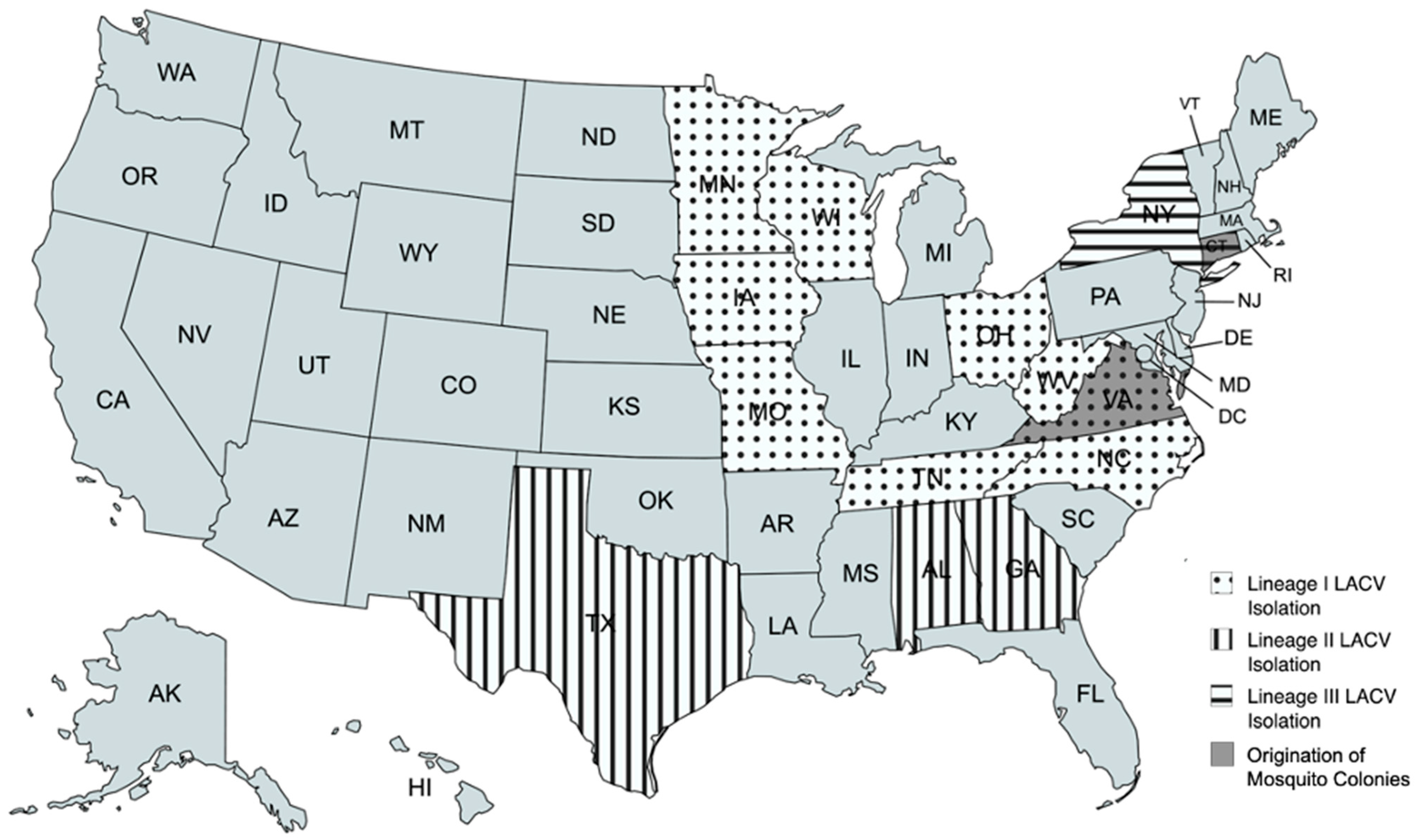
Figure 1. Map of the United States, with patterns indicating states where LACV lineage isolations have been made and gray indicating the states where mosquito colonies were acquired for this study. Created with mapchart.net.
Biology 14 01771 g001
Figure 2. Connecticut Aedes triseriatus LACV infection, dissemination, transmission ability, and ovary infection following intrathoracic inoculation of virus expressed as the proportion positive. Letters indicate the significance (p < 0.05) between virus strains within each transmission parameter (ANOVA, Tukey’s multiple comparisons); “ns” indicates non-significance.
Biology 14 01771 g002
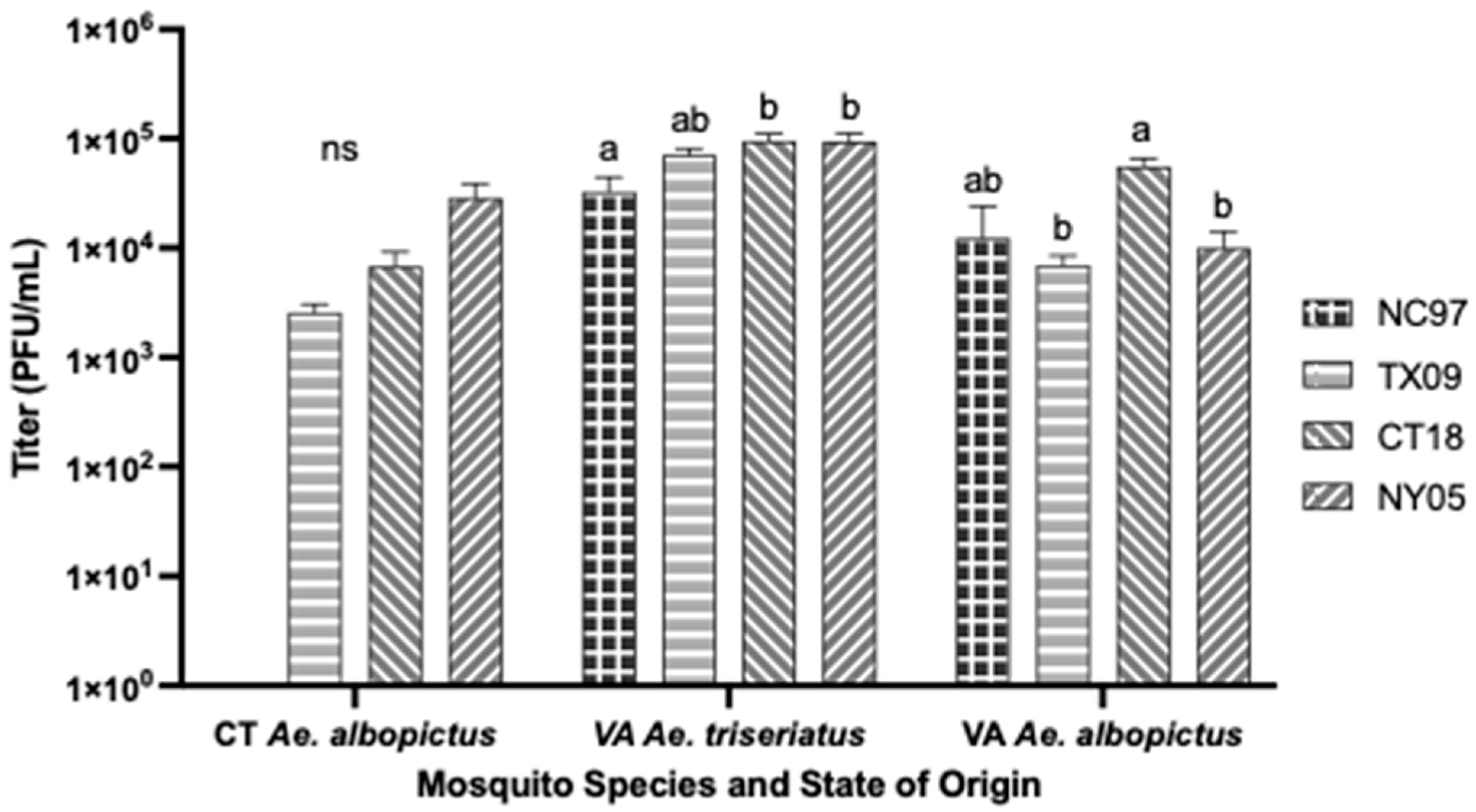
Figure 3. LACV-infected ovary titers for all species from both states of origin following intrathoracic inoculation, expressed as the average titer of positive ovaries. Error bars indicate standard error. Letters indicate the significance (p < 0.05) between virus strains within each mosquito species (ANOVA, Tukey’s multiple comparisons); “ns” indicates non-significance.
Biology 14 01771 g003
Figure 4. Connecticut Aedes albopictus LACV infection, dissemination, transmission ability, and ovary infection following oral feeding of virus expressed as the proportion positive. Letters indicate the significance (p < 0.05) between virus strains within each transmission parameter (ANOVA, Tukey’s multiple comparisons); “ns” indicates non-significance.
Biology 14 01771 g004
Figure 5. LACV-infected ovary titers for all species from both states of origin following oral infection, expressed as the average titer of positive ovaries. Error bars indicate standard error. Letters indicate the significance (p < 0.05) between virus strains within each mosquito species (ANOVA, Tukey’s multiple comparisons); “ns” indicates non-significance.
Biology 14 01771 g005
Figure 6. Connecticut Aedes albopictus LACV infection, dissemination, transmission ability, and ovary infection following intrathoracic inoculation of virus expressed as the proportion positive. Letters indicate the significance (p < 0.05) between virus strains within each transmission parameter (ANOVA, Tukey’s multiple comparisons); “ns” indicates non-significance.
Biology 14 01771 g006
Figure 7. Virginia Aedes triseriatus LACV infection, dissemination, transmission ability, and ovary infection following oral feeding of virus expressed as the proportion positive. Letters indicate the significance (p < 0.05) between virus strains within each transmission parameter (ANOVA, Tukey’s multiple comparisons).
Biology 14 01771 g007
Figure 8. Virginia Aedes triseriatus LACV infection, dissemination, transmission ability, and ovary infection following intrathoracic inoculation of virus expressed as the proportion positive. Letters indicate the significance (p < 0.05) between virus strains within each transmission parameter (ANOVA, Tukey’s multiple comparisons); “ns” indicates non-significance.
Biology 14 01771 g008
Figure 9. Virginia Aedes albopictus LACV infection, dissemination, transmission ability, and ovary infection following oral feeding of virus expressed as the proportion positive. Letters indicate the significance (p < 0.05) between virus strains within each transmission parameter (ANOVA, Tukey’s multiple comparisons); “ns” indicates non-significance.
Biology 14 01771 g009
Figure 10. Virginia Aedes albopictus LACV infection, dissemination, transmission ability, and ovary infection following intrathoracic inoculation of virus expressed as the proportion positive. Letters indicate the significance (p < 0.05) between virus strains within each transmission parameter (ANOVA, Tukey’s multiple comparisons); “ns” indicates non-significance.
Biology 14 01771 g010
Disclaimer/Publisher’s Note: The statements, opinions and data contained in all publications are solely those of the individual author(s) and contributor(s) and not of MDPI and/or the editor(s). MDPI and/or the editor(s) disclaim responsibility for any injury to people or property resulting from any ideas, methods, instructions or products referred to in the content.