
Article

Watching the South China Sea—Portiodora (Iridaceae), a New Genus for Iris speculatrix Based on Comprehensive Evidence: The Contribution of Taxonomic Resolution to Biodiversity Conservation


by
Manuel B. Crespo
1,*,
Mario Martínez-Azorín
1,2 and
Evgeny V. Mavrodiev
3
1
Departamento de Ciencias Ambientales y Recursos Naturales (dCARN), Universidad de Alicante, P.O. Box 99, ES-03080 Alicante, Spain
2
Department of Botany, Rhodes University, Makhanda 6140, South Africa
3
Florida Museum of Natural History, University of Florida, Gainesville, FL 32611, USA
*
Author to whom correspondence should be addressed.
Biology 2025, 14(12), 1767; https://doi.org/10.3390/biology14121767
Submission received: 30 October 2025 / Revised: 27 November 2025 / Accepted: 4 December 2025 / Published: 11 December 2025

Simple Summary

The Hong Kong iris (Iris speculatrix) is an enigmatic species native to southeastern China that is under threat of extinction. By comparing morphological and molecular data, we found that it truly occupies a unique position within the “Iris-flower clade” and is indeed a sister species to a wider clade of beardless and uncrested irises with much broader distributions. A re-evaluation of the ecology, karyology, distribution and phylogenetic relationships of I. speculatrix was conducted, which resulted in the establishment of the new genus Portiodora for accurate classification of the species. We confirmed that the pure comparative approach to molecular data (three-taxon statement analysis), which excludes assumptions about the history of chloroplast loci transformation, is practical for addressing taxonomic questions and may therefore be applicable to similar studies. We have provided an identification key for the entire “Iris-flower clade” to frame the unique morphology of Portiodora in the context of the whole clade. A deep understanding of the uniqueness of P. speculatrix is crucial for plant conservation efforts in southeastern China. However, our study provides a framework for a future protective strategy for the entire “Iris-flower clade”, since accurately resolving the taxonomy of cryptic biodiversity may be essential for its conservation.

Abstract

Iris speculatrix was described from plants collected in Hong Kong and is accepted to extend through southeastern China. The species is scheduled under the Forestry Regulations and is regarded as endangered (EN) according to the IUCN categories. This enigmatic plant exhibits multiple morphological connections to other congeners, and was classified in contrasting groups such as the “Chinenses” or the “Ensatae” irises. Molecular work placed it as an isolated lineage sister to the beardless/uncrested subgroup of the so-called “Xiphion s.l. clade”. In this contribution, we integrate molecular analyses, including the plastid sequence data of I. speculatrix, together with a re-evaluation of morphological, ecological, karyological, chorological and phylogenetic data on the Hong Kong plant, to describe the new genus Portiodora. Three-taxon statement analysis was employed as a primary analytical tool, helping to clarify phylogenetic relationships and support the recognition of Portiodora. Two new combinations are established, and an identification key is presented for the “Iris-flower clade”. Relationships to other Chinese taxa often related to P. speculatrix, such as I. grijsii, I. cavaleriei and I. fujianensis are discussed, and their inclusion in Portiodora is not favoured based on the available data. Furthermore, the contribution of taxonomic resolution to biodiversity conservation is discussed.

1. Introduction

The genus Iris L. (Iridaceae), when treated in a broad sense, is one of the most diverse and well-known genera in Asparagales, with nearly 300 species widespread in the Northern Hemisphere [1]. The irises (“rainbow-flowers”) are extremely popular among gardeners and have a high economic impact in the horticultural trade. They are broadly used as ornamental plants throughout the world, but have also been used for medicinal, culinary and industrial purposes since antiquity [2,3]. The group also includes some outstanding model systems in evolutionary biology, particularly those used for studying hybridisation and speciation in plants [4,5,6]. Indeed, forced hybridisation was part of the origin of thousands of garden cultivars of irises [7,8], and processes of reticulate hybridisation and allopolyploidy [9] are also responsible for speciation events in the genus. Morphologically, irises show a broad diversity in both vegetative and floral features, which is often connected to geographical or ecological radiation [6,10,11]. Further, cytogenetic variability is also common in the group, with basic chromosome numbers ranging x = 7–12, and with polyploidy, allopolyploidy, disploidy and aneuploidy processes being frequent [12,13].
However, the taxonomy of the irises is quite complex, and the position of some groups remains controversial or not entirely resolved. Molecular work including members of the major taxa (subgenera, sections, etc.) of Iris s.l. (the “Iris-flower clade” Mavrodiev et al. [14]) produced phylogenies in which morphologically close groups resulted in genetically incoherent classifications [15,16,17]. Additionally, many of the widely accepted infrageneric taxa were revealed to be non-monophyletic; hence, they should not be used as proper taxonomic entities as currently circumscribed [18].
One such contentious topic is the case of Iris speculatrix. The species was described by Hance [19] from plants collected “in monte mare prospectante, inter Victoria Peak and Mount Davis” in Hong Kong Island, and was later illustrated by Baker [20] (Figure 1). It is often accepted to extend through a vast area in southeastern China [21], where it is usually referred to as the “small-flower iris” or the “Hong Kong iris”. A more complete description was presented by Zhao et al. [21] in Flora of China, which included a drawing (Figure 355, 1–4) available at http://www.efloras.org/object_page.aspx?object_id=60614&flora_id=2 (accessed on 30 September 2025). The species is scheduled under the Forestry Regulations [22] that control the sale and possession of rare plants subject to exploitation, and it is regarded as endangered (EN) [23], according to the categories of the IUCN [24].
A unique morphology allows easy identification of I. speculatrix, such as the short rhizome, which is oblique and annulate, tufted or shortly-creeping; the evergreen leaves are linear, long tapering, grassy, somewhat glossy, much overtop the flowers, with several longitudinal ribs (at least the midrib prominent) and cross-veining. The scapes are short, bearing two long pedicellate small flowers that are unscented, ephemeral, and mostly lilac (rarely whitish). The perigone shows a short broad tube at the base. The falls (outer floral segments) and standards (inner floral segments) are rather similar in length and shape; the falls are obovate, often retuse at the apex, with the blade smooth and showing a peculiar dark-violet cordate mark that surrounds a white speckled area connecting with the yellowish to orangish undissected and low ridge-like crest. The standards are somewhat narrower, erect-patent to suberect and clawed. The capsule is patent, with a long beak and three longitudinal ridges, and opens into three valves curving backwards after dehiscence. The seeds are numerous, globose and show a whitish, long appendage resembling a wing on drying (modified from [7,21,25,26]).
Those peculiar features make I. speculatrix an enigmatic species that exhibits multiple morphological connections to other congeners. For that reason, some authorities placed I. speculatrix in contrasting groups of Iris L., such as subg. Eremiris Spach [19], or I. subg. Crossiris Spach (as I. subg. Evansia (Alef.) Baker) [27], or their respective synonyms at different infrageneric ranks (see [28]). Nonetheless, it is often considered a member of I. (subg. Limniris) ser. Chinenses (Diels) G.H.M.Lawr. [25,26], albeit its morphological and cytogenetic features are said to be deviant.
In the last two decades, molecular work has revealed that I. speculatrix constitutes an isolated lineage sister to the beardless/uncrested subgroup of the so-called “Spuriae-Tenuifoliae alliance” [29] and also the clade including “subg. Xiphion” plus “subg. Xyridion” (sensu Wilson [17]), and in any case it is not a member of I. (subg. Limniris) ser. Chinenses (Diels) G.H.M.Lawr. (see [23,28,29,30]).
The comprehensive multi-generic treatment by Crespo et al. [13] did not include molecular data for I. speculatrix, and the name was tentatively placed in the genus Zhaoanthus M.B.Crespo, Mart.-Azorín & Mavrodiev (I. subsect. Chinenses Diels) mostly based on morphological affinities and distribution. The treatment recognises up to 25 genera that basically accord with the distinction by horticulturists of the same groups as unranked working names [8]. Those names have traditionally been used during the last two centuries and to the present day, which evidences the readily distinguishable morphology (both vegetative and floral) of each group and supports acceptance at the genus rank.
In that context, the primary aims of the present contribution were: (i) to evaluate the generic position of Iris speculatrix in the “Iris-flower clade” through an integrative taxonomic approach; and (ii) to discuss the impact of accurately resolving the taxonomy of cryptic biodiversity on its conservation. In order to achieve this, information from new molecular analyses (using both the three-taxon statement and maximum likelihood approaches, hereinafter referred to as 3TA and ML, respectively) that included new plastid sequence data of I. speculatrix [23] was integrated alongside a re-evaluation of morphological, ecological, karyological, chorological and phylogenetic data. Accordingly, the generic assignment of the Hong Kong plant is reconsidered and the new genus Portiodora is herein described, providing a more complete picture of a multi-generic arrangement of the “Iris-flower clade”. Furthermore, the findings of this study suggest that the precise resolution of the taxonomy of cryptic biodiversity may be crucial for effective conservation measures, thus providing a framework for a future protective strategy for the entire “Iris-flower clade”.

2. Materials and Methods

Morphological data were obtained from observations on both digitised images and vouchers, including type material, from the herbaria A, ANUB, AU, BM, CDBI, CSFI, CSH, CUHK, E, GXMG, HK, IBK, IBSC, IMC, K, KUN, L, LE, NAS, NY, P, PE, QNUN, US, and WELT (acronyms according to Thiers [31]), as well as from the protologues of the concerned names. Over 150 herbarium vouchers were analysed, with a selection of these being presented in Section 3.1.2 as “Other selected material” and including in brackets the herbarium acronym and barcode number assigned to each specimen. Nomenclatural issues conform with the Madrid Code (ICN; [32]).
Chromosome numbers presented for the accepted taxa correspond to the first published confident count. Additional data can be accessed in the Chromosome Counts Database-CCDB (https://ccdb.tau.ac.il/Angiosperms/Iridaceae/Iris/; accessed on 3 April 2025).
Sequence data from an accession of I. speculatrix collected in Tai Tam, Hong Kong [23] were included in an expanded dataset (206 taxa) based on Mavrodiev et al. [14]. Two vouchers corresponding to the Tai Tam collection labelled “Rare and endangered plants (S.W. Shek, K.W. Lam, D.T.W. Lau & J.Y.Y. Lau) 9A & 9B” (respectively HK-0051268 and CUHK-05908) were checked for identity confirmation. Further, additional samples of that species at GenBank (https://www.ncbi.nlm.nih.gov/Taxonomy/Browser/wwwtax.cgi?id=1043429; accessed on 20 July 2024) were added: (i) the accession Guo CH08–10 from Zhejiang Province [28]; (ii) the accession ZhouSL-yunnan-Z219 (IBK-00188752) from Guangxi Province [33]; and (iii) the accession ZhouSL-xingan-Z081 (KUN-310309, barcode KUN-0360549) from Xingan, Jiangxi Province [33]. Vouchers from the latter two, respectively IBK-00188752 and KUN-0310309, were also checked for confirmation. It is worth mentioning that apparently the provenance of the latter two was accidentally permuted in Li et al. [33]. Due to the extremely high sequence identity, we selected the plastome of I. speculatrix (accession OK274247) [23] for the current analyses as the most extensive and inclusive option. Accordingly, this accession serves as an analytical placeholder for all currently available plastid sequences of I. speculatrix.
Following Mavrodiev et al. [14], we analysed the current cpDNA alignment using the 3TA and ML methods. For corresponding references and details on 3TA, see the legend of Figure S1, Table S1 and Mavrodiev et al. [14]. The ML analysis was conducted in IQ-TREE (http://www.iqtree.org/; accessed on 20 July 2024), as implemented in CIPRES (https://www.phylo.org/; accessed on 20 July 2024). See the legend of Figure S2 for more details. The resulting trees (Figures S1–S3) were interpreted in light of the morphological data of the related clades.

3. Results

3.1. Taxonomic Treatment

3.1.1. Portiodora M.B.Crespo, Mart.-Azorín & Mavrodiev gen. nov.

Type Species: Portiodora speculatrix (Hance) M.B.Crespo, Mart.-Azorín & Mavrodiev
Diagnosis: Genus notabilis Asiae austro-orientalis ab Iride s.str. distinctissimo et praecipue differt rhizomate subsuperficiali, repente, obliquo, brevi, vix incrassato, parce ramoso, tortuoso, annulato, griseo-brunneo, squamoso, reliquiis fibrosis basium foliorum obtecto, quae in fibras crassas rigidas demum mutantibus; foliis sempervirentibus, linearibus, acutis, firmis, nitidis, a basi dense dispositis, margine minute hyalino-serrulato, longitudinaliter nervosis, 1–5 nervis prominulis (praecipue centralibus saepe validioribus) percursis; scapo tereti vel vix compressi, quam foliis multo breviore, interdum arcuato, aliquot submembranaceis bracteiformibus foliis laxe vestito; spathis herbaceis, inaequalibus, lanceolatis, acuminatis, supra carinatis; floribus terminalis, tubo perigonii breve, lato, cylindrico; omnibus segmentis perigonii laevibus imberbibusque, exterioribus majoribus, erecto-patentibus, obovato-spathulatis, lamina subretusa ungue subduplo breviore, apice subfalcata recurva, costa unica centrali laeve subintegra vix prominentula, interioribus erectis vel subpatentibus, parce minoribus, oblancelolatis, obtusis, a basi longe unguiculato-canaliculatis; stylis segmentis exterioribus perigonii subaequantibus vel vix brevioribus, subrecurvatis, anguste triangularibus, ad margines exteriores dentatis; lamella stigmatica integra late subtriangulari, obtusa; capsula patente, oblongo-fusiformibus, ad apicem longe rostrata, subangulosa, transverse striata, e apice deorsum a basi valde dehiscente, valvis divergentibus recurvatisque; seminibus atrofuscis, globoso-angulosis, rugulosis, arillo albido carnoso praeditis, quo in siccitate alam brevem aemulans. Numerus basicus chromosomatum, x = 11. Sola species hujus generis per totam Sinam austro-orientalem invenitur, praesertim in Hongcongum Insula (Portus odorus) et aliis partibus montium propinquorum.
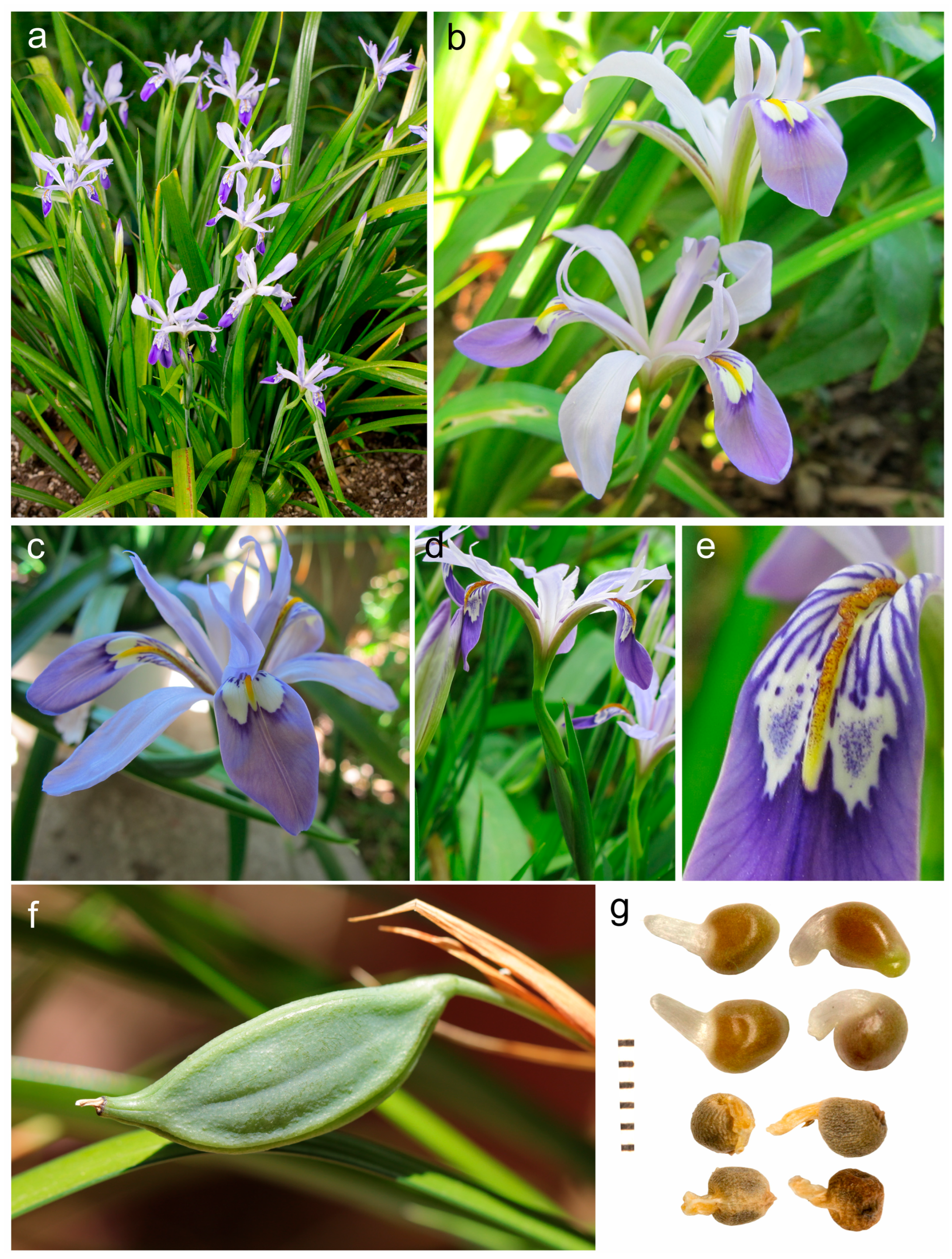
Description: Rhizomatous herbs, with evergreen aerial structures. Rhizome subsuperficial, oblique, short, few-branched, tufted or short-creeping, slender, tortuous, annulated, greyish brown, coated with fibrous remains of leaf bases that finally turn into rigid fibres; roots numerous fibrous. Leaves isobilateral, equitant, linear, long tapering, densely disposed at the base, minutely hyaline-serrulate on margins, with 1–5 prominent longitudinal ribs (at least the midrib prominent) and cross-veining, ±glossy on the adaxial surface, much overtopping flowers, not fetid, surrounded by brownish incrassate fibres at base. Stems (scapes) aerial, ±arcuate, usually slender and much shorter than the basal leaves, ±terete, bearing several submembranous bract-like leaves. Flowers (1–)2, small, terminal on scapes, long pedicellate, unscented, ephemeral, mostly lilac or rarely whitish. Spathe valves 2–3, unequal, herbaceous, green, scarcely inflated, ±lanceolate, acuminate, keeled on the upper part. Perigone in two rows, ±differing in size and shape, fused in a short broad subcylindric tube; falls erect-patent, larger, broadly obovate-spatulate, patent towards apex, subretuse, gradually tapering into a short claw, smooth, showing a peculiar dark-violet cordate mark that surrounds a white speckled area connecting with the yellowish to orangish undissected and low (ridge-like) crest on the midrib, almost entire and only sinuous in its central section; standards somewhat smaller, suberect to erect-patent, narrowly oblanceolate, acute, narrowed into a long haft. Stamen filaments free, adnate to the fall bases. Ovary trilocular, with axile placentation. Style filiform, with three petaloid branches, almost equalling to slightly shorter than falls, each one concealing a stamen; crests long, ±recurved, narrowly triangular, with dentate outer margins; stigma broadly subtriangular, obtuse, with entire margins. Capsule patent, long exerted above the spathes, oblong-fusiform, acute, subtrigonous, with three weak longitudinal ridges, transversally striate, long-beaked, opening from apex to base with valves curving backwards to expel the seeds upon dehiscing, showing a subcoriaceous pericarp. Seeds numerous, globose-angulose, dark brown, with a long, whitish to pale brownish, fleshy appendage resembling a wing on drying; testa surface ± rugulose. Basic chromosome number: x = 11. Figure 1 and Figure 2.
Etymology: Portiodora derivates from “Portus odorus”, which is the Latin adaptation for “the fragrant harbour”, a name formerly applied to Hong Kong that is literally the phonetic translation of its Cantonese name (“香港”). It thus honours the type locality of P. speculatrix, the first species described within this enigmatic lineage.

3.1.2. Portiodora speculatrix (Hance) M.B.Crespo, Mart.-Azorín & Mavrodiev comb. nov. [≡ Iris speculatrix Hance in J. Bot. 13: 196 (1875), Basionym]

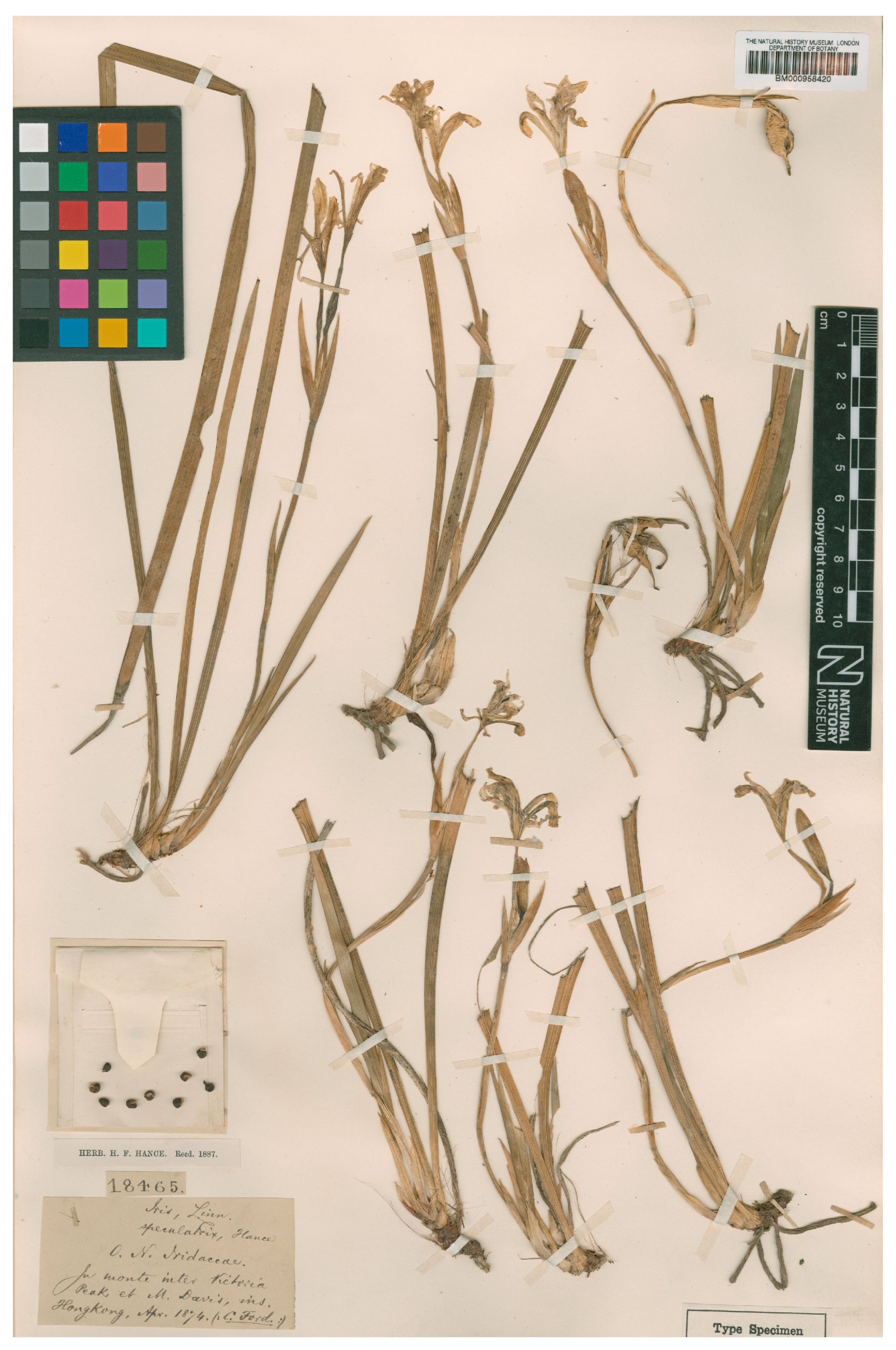
Lectotype (designated here): “In monte inter Victoria Peak et M. Davis Apr. 1874, C. Ford”, ex Herb. H.F. Hance n.º 18465 (BM-000958420 https://data.nhm.ac.uk/media/60d9e994-be9b-47a1-a64b-d0e570cdaf4b, (accessed on 30 July 2025)), Figure 3. Isolectotypes: K-000499078 [digital image]: https://images.data.kew.org/image/d0750f29-61f4-4fb0-9540-c0562c34185d, (accessed on 30 July 2025); PE-00034060 [digital image]: https://www.cvh.ac.cn/spms/detail.php?id=04805f06, (accessed on 30 July 2025); PE-01013509 [digital image]: https://www.cvh.ac.cn/spms/detail.php?id=ef698537, (accessed on 30 July 2025).
Other selected material: CHINA. Hong Kong SAR: Hong Kong, indigenous on peak to eastward of Mt. Davis, April 1874, C. Ford (K-002930862); Hong Kong, ravine Mount Victoria, April 1874, Mr. Ford (L-1473474); Hong Kong, hill above Repulse Bay [Tsin Shui Wan], 13 April 1900, W.J. Tutcher 669 (K-002930857); Hong Kong, 29 April 1930, Z. Jinglie 21659 (IBSC-0628992, IBSC-0628994); Hong Kong, Cape d’Aguilar, 3 May 1970, S.Y. Hu 10051 (A-00962200, K-002930860, PE-01013510, US-2732045); Hong Kong, Violet Hill, 21 April 1992, S.Y. Hu & P. But 20422 (A-00962199, L-3708985); Hong Kong Island, Dragon’s Back, May 1970, D.P.M. Guile 2519 (K-002930854); idem, D.P.M. Guile 2520 (K-002930855); Hong Kong, Tai Tam, 172 m elev., 20 April 2021, S.W. Shek et al. (R9A: HK-0051268; R9B: CUHK-05908, HK-0051269). Lantau Island, 9 May 1888, Native Coll. 53/88 (K-002930861) Anhui Province: Chishi, Shitai, Shuanghekou Nature Reserve, sampling track number 3, at the starting point, 273 m elev., 11 August 2012, H. Xin-Zhou SB0206 (KUN-1393279); Chizhou, Shitini County, Baniajiang Nature reserve, 221 m elev., 11 May 2017, S.J.L. Jin ANUB01248 (ANUB-001536); Jiuhua, Wubian, Shouyang, 200 m elev., 7 May 2008, L. Pan LP0805061 (CSH-0073241). Chongqing Province: Nanchuan mountain, spring, 800 m elev., 20 May 1980, L. Wei 300 (CDBI-0169631). Nanchuan District, Jinfo Shan Nature Reserve, 720 m elev., 20 May 1996, Z. Liu 17140 (PE-02238585); Jinfo Shan Mountain, 1500 m elev., 12 July 1990, L. Zengyu 901428 (IMC-0013888). Fujian Province: Kuliang hills, near Foochow [Fuzhou], 300–900 m elev., July–August 1919, J.B. Norton 1230 (US-1050954); Inghok Hsien, Tahshian, in the shade of bamboo, 20 April 1924, H.H. Chung 2618 (K-002930859); Wuyi Mountain, 9 May 1983, Matsumoto 8305054 (AU-032605); Da’anyuan, Wuyishan, 516 m elev., 30 April 2016, H. Xueliang et al. 2016043029 (AU-054672). Guangdong (Canton) Province: Kwangtung, Lokchong, 18 May 1929, C.S. Tso 20615 (PE-01013507, NY-04354496, NY-4354499); Kwangtung, Loh Fau Shan (Loh-Fau Mountain), 7 May 1917, C.O. Levine 701 (PE-01604321); Huahu village, 500–600 m elev., 12 May 1957, D. Liang 4764 (IBSC-0628954, NAS-00555473, PE-01013504). Guangxi Province: Guilin, Guanyang, Dongbing, Baoliang village, Forest of the wild boars, 69 m elev., 9 May 2016, Guanyang Censing Team 450327160509007LY (GXMG-0173704); Rong’an County, Tantou, Hedong, 211 m elev., 11 April 2019, Rong’an Censing Team 450224190411024LY (IBK-00421700); Zhuang region, 31 May 1979, L. Guangguang 63313 (IBK-00188751, IBK-00188752). Guizhou Province: Daozhen, 830 m elev., 20 May 1996, L. Zhengyu 20896 (PE-02238558); Guizhou, 420 m elev., 24 April 2018, L. Jiaojiao 20183547 (QNUN-0025878); Zhizhen, 750 m elev., 25 April 1996, L. Zhengyu 20897 (PE-02238560). Hunan Province: Xining County, 500 m elev., 5 July 1995, L.B. Luo 0867 (E-00071325, US-3524938, WELT-074625); Pingxi village, Huangsang Nature Reserve, 22 May 2013, Z.J. Zhou Dian 13388 (CSFI-028930, CSFI-028931, CSFI-028932); Dong’an county, 180 m elev., 6 May 2014, Y.X. Liming 14050601 (CSFI-028934). Jiangxi Province: Wuning County, Pingyang Mountain, Bamboo Forest Farm, 350–450 m elev., 7 August 1995, Y. Cun-su 333 (NAS-00600599); Ruijin County, Xiqi, 15 July 1958 H. Qiming 3572 (IBK-00251328, PE-00034064). Zhejiang Province: Tianmu Shan (Tianmu Mount), near the Zen Temple, 380 m elev., 9 June 1957, D.M. Bin 4314 (PE-01013456); Linan Shi, Tianmushan, Laodian, 1082 m elev., 29 April 2010, J. Wen et al. 11312 (US-3625658); Lin’an County, Xitianmu Mountain, 9 July 2014, C. Bin et al. WZW01097 (CSH-0009888); Quzhou Jiangshan, Hongyanding, 11 May 2018, Y. Yuehong et al. CFH09001954 (CSH-0156163); Tihtaishan (Tihtai Mountain), 600–1200 m elev., 5–18 May 1924, R.C. Ching 1446 (P-02162379, US-1246353). Uncertain location: Yunnan Province: Yunnan, Liu (PE-01013519, PE-01013520, PE-01013521) [Although the specimens appear to match P. speculatrix, all three vouchers lack precise collection details, which makes site location difficult. New and reliable collections are required to verify the presence of the species in this province].
Description: For a detailed description of the species, which complements the generic description presented above, see Waddick and Zhao [26] and Zhao et al. [21].
Chromosome number and formula: 2n = (4x) = 44 (4M + 24m + 14sm + 2smsat), with all chromosomes quite homogeneous and similar in size [34,35,36,37].
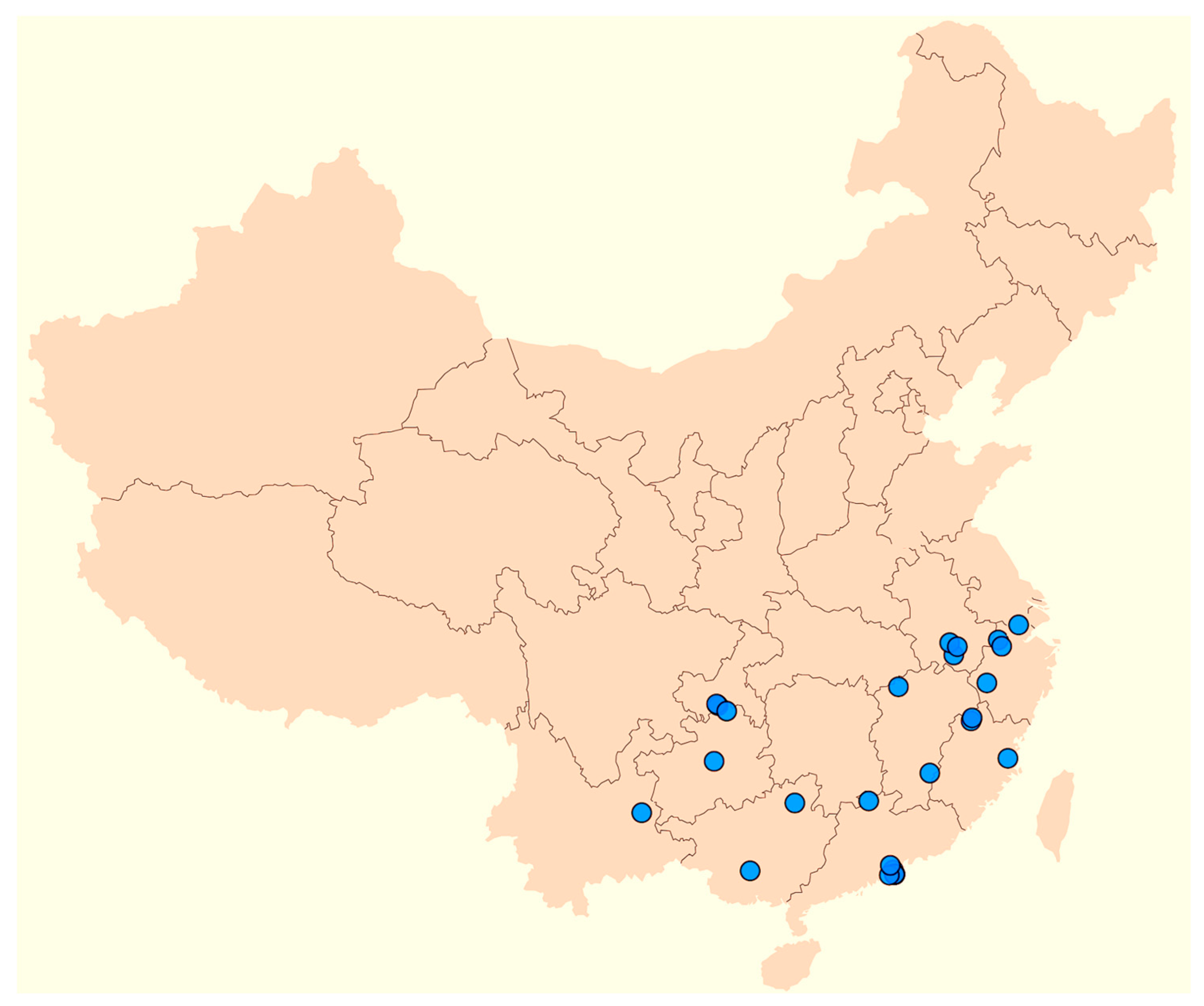
Ecology and distribution: Portiodora speculatrix usually occurs in organic matter-rich substrates of forest fringes, open groves and moist grasslands. It is also sometimes found in open windy and rocky sites, often facing the sea. It ranges from sea level up to about 1200–1500 m elevation. Described from Hong Kong Island, it extends into the neighbouring areas of southeastern China (Figure 4), namely the provinces of Anhui, Chongqing, Fujian (Fokien), Guangdong (Canton), Guangxi, Guizhou, Hunan, Jiangxi and Zhejiang, according to our data (see also [21,25,38,39,40,41] and the Selected Studied Material, above). Flowering: April–May; fruiting: July–August.
Infraspecific variation: Taxonomically, two flower-colour variants have been recognised [21]: Iris speculatrix var. speculatrix for the typical lavender- to light violet-flowered individuals (the typical form), and I. speculatrix var. alba V.H.C.Jarrett for the white-flowered (albino) individuals [42]. However, plants of both types coexist in a single population [42], and therefore they are regarded here as mere forms. Consequently, a new combination is established below to accommodate both names in the new genus:
Portiodora speculatrix f. speculatrix.
Portiodora speculatrix f. alba (V.H.C.Jarrett) M.B.Crespo, Mart.-Azorín & Mavrodiev comb. nov. [≡ Iris speculatrix var. alba V.H.C.Jarrett in Sunyatsenia 3: 265 (1937), basionym]. Type: “Hong Kong: Violet Hill, eastern slopes, 19 April 1937, growing amid the blue type forms; type in the Hongkong Botanic Garden” [42].
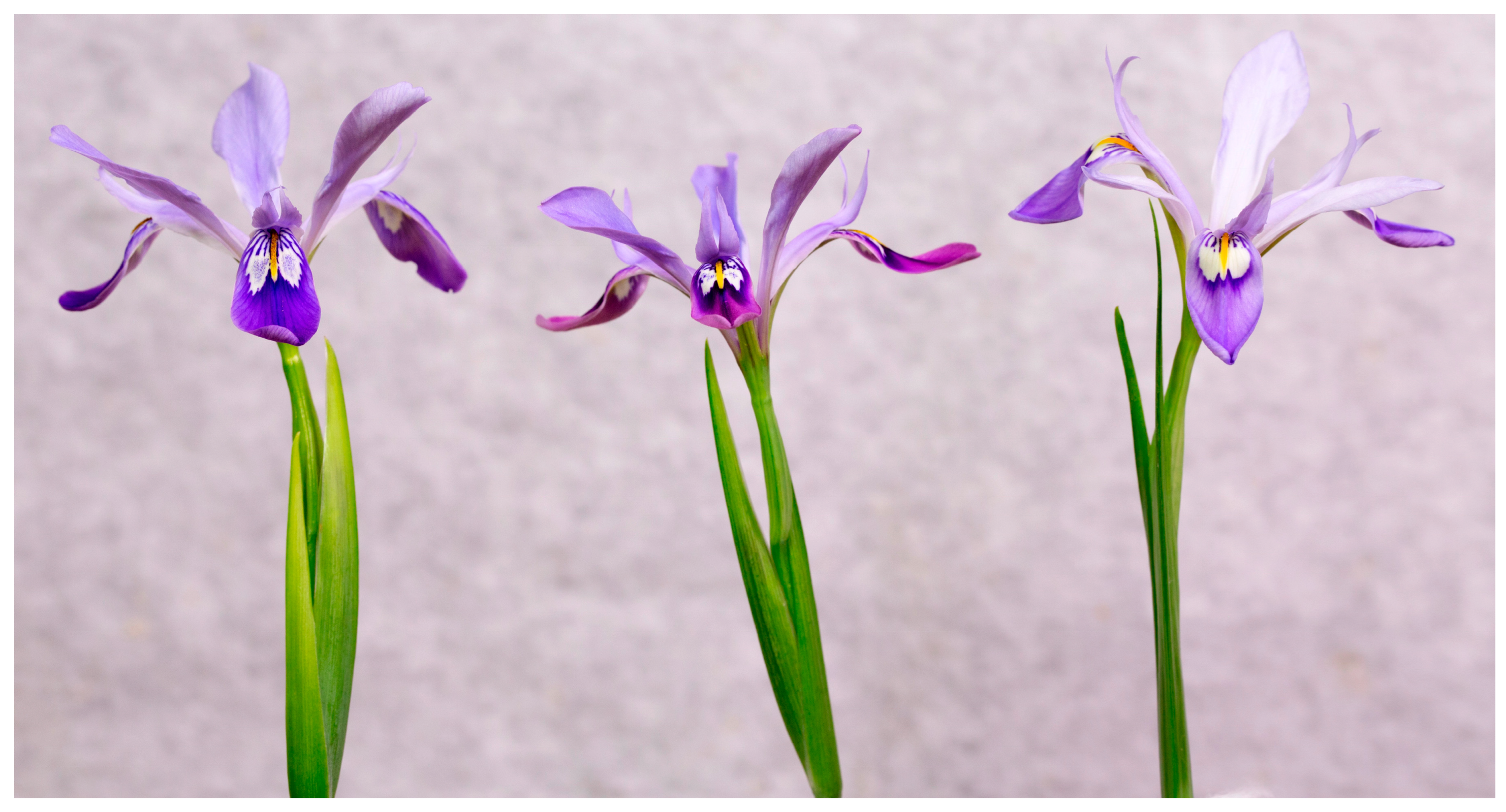
At present, not less than three clones of P. speculatrix are cultivated by horticulturists [43]: the “John Lonsdale clone” of uncertain origin, the “Darrel Probst clone” from Sanmen (Zhejiang Province), and the “Shanghai Waddick clone” (Figure 5). The specimens are consistent with the protologue and current concept of the species, and they only appear to differ in some features concerning the ornamentation and colour of the falls and the size of the spathe. Therefore, those clones should be considered to be part of the intraspecific phenotypic variation of the type form of the species. For data on floral syndrome and breeding systems of the species see Li et al. [38].
Conservation: The majority of the studied collections are dated before 1990, and P. speculatrix might be in decline or extinct in many sites. In the known localities, the species is subject to significant anthropogenic pressure and is primarily confined to natural reserves and protected areas. On this basis, the species has been evaluated as EN [23] in accordance with the IUCN [24] categories. New comprehensive data are needed to clarify this point.

3.1.3. Comparative Molecular and Phylogenetic Results

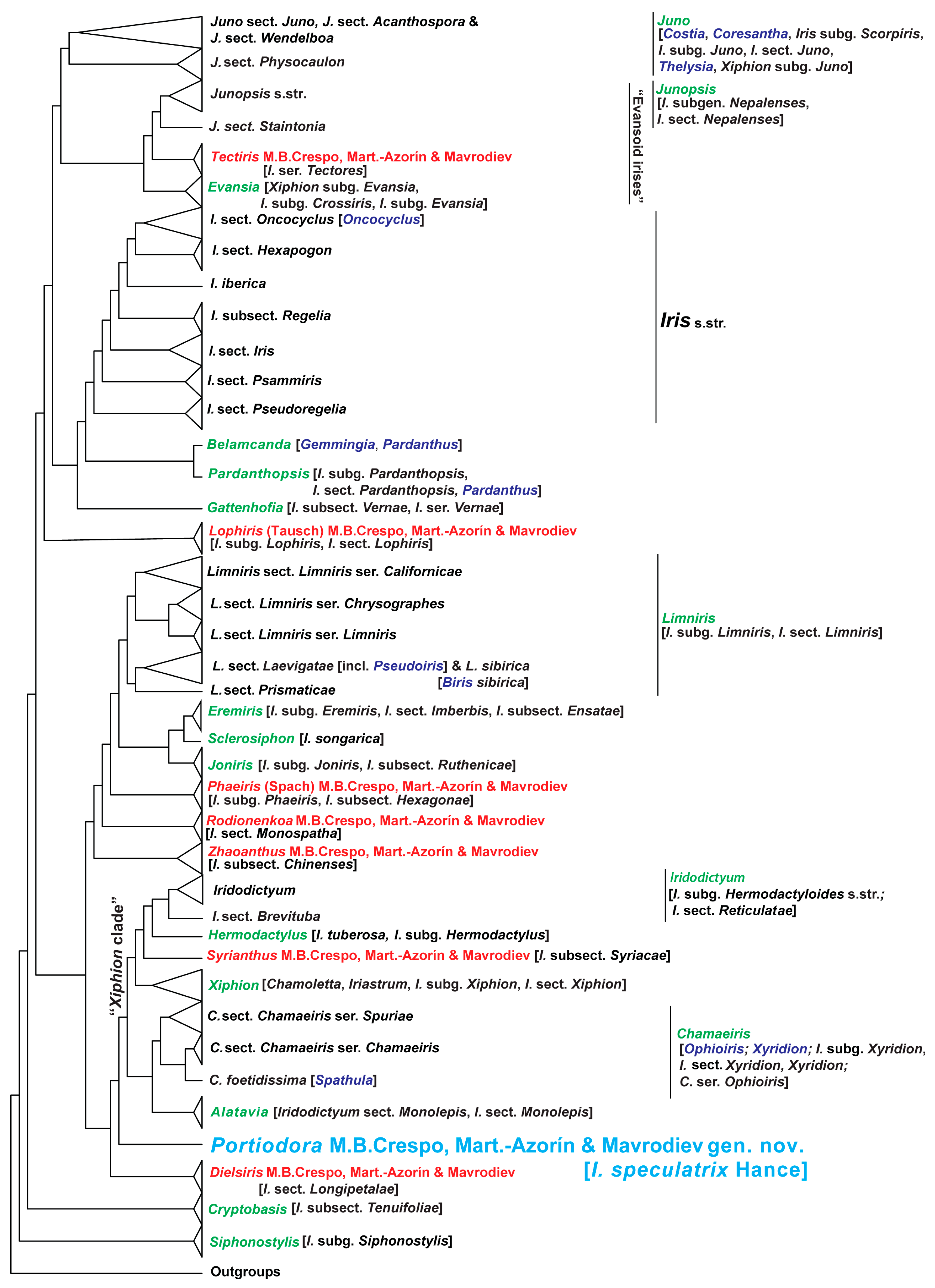
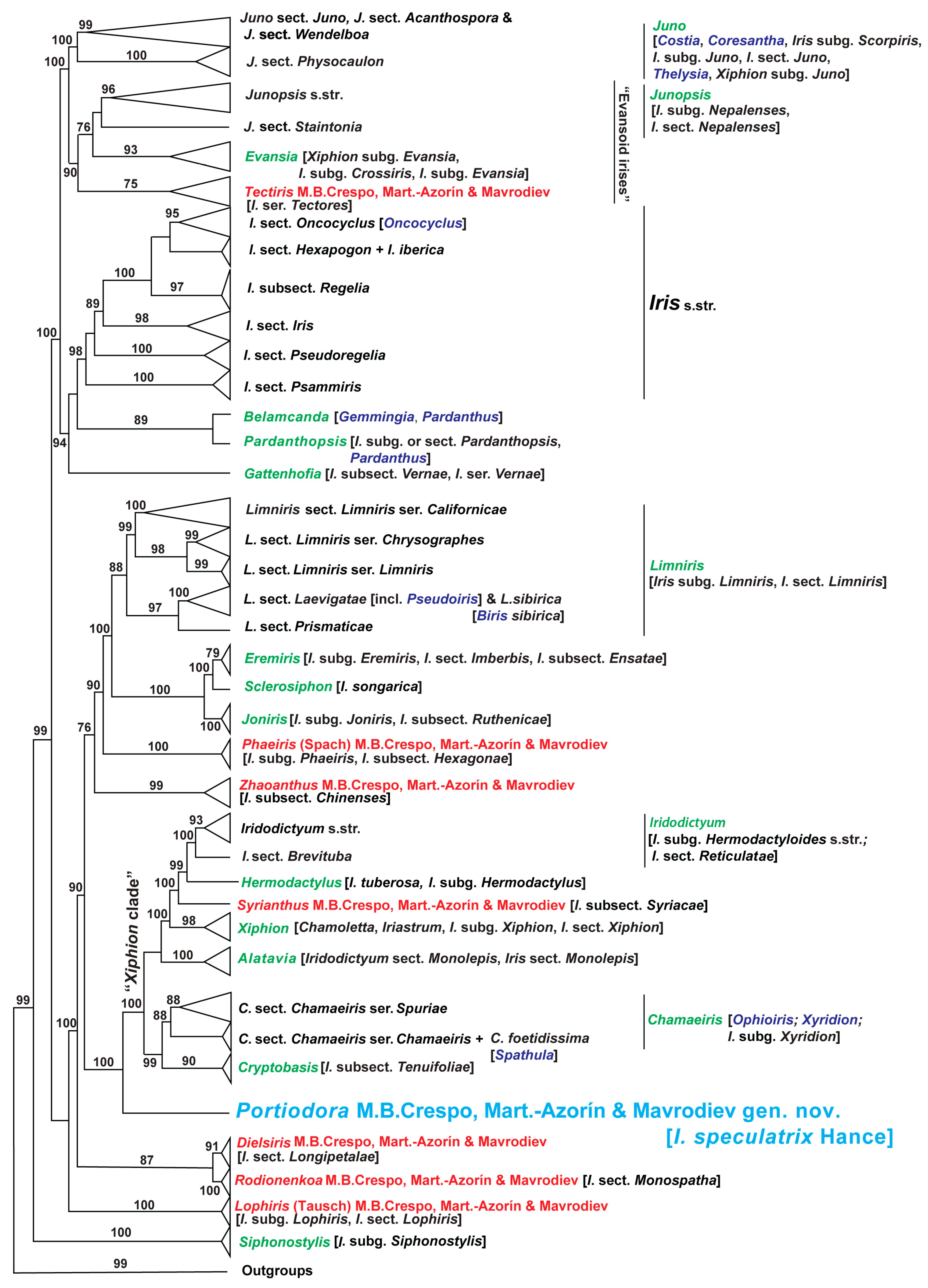
The 3TA cladogram (Figure 6) summarises the hierarchy of patterns (Figure S1) with a score of 23, representing the Robinson–Foulds (RF) median consensus of eight cladograms. Each cladogram corresponds either to a single most parsimonious tree or to the RF median consensus derived from the set of most parsimonious trees obtained through 3TA (see Table S1 and Mavrodiev et al. [14] for details and references). Only informative conventional DNA characters were included in the 3TA analyses, and the values for the operational outgroup were fixed based on the 50% majority-rule consensus of the initial conventional DNA alignment (supermatrix; 202 terminals, see Table S1 for the number of the three-taxon statements in each of eight analyses) or a subset of it. Unlike ML analysis, statistical support in 3TA is optional and not required for validating the hierarchy of patterns, as this method is not focused on probabilistic measures of confidence (see Mavrodiev et al. [14] for references). The ML cladogram (Figure 7) represents the most probable and well-resolved maximum likelihood tree (−ln likelihood = 48,909.1674) (Figure S1), inferred using IQ-TREE from a plastid supermatrix of conventional Iris s.l. and outgroup taxa (206 terminals, 8646 nucleotide sites). The best-fit model, TVM + F + I + G4, was automatically selected by IQ-TREE according to the Schwarz (Bayesian) Information Criterion. Statistical support was assessed using the approximate Likelihood Ratio Test (aLRT) (see Mavrodiev et al. [14] for references).
The general topology and internal relationships of clades in both trees match the results previously obtained by Mavrodiev et al. [14] from a narrower database (173 ingroup plus five outgroup taxa). The 3TA placed Portiodora speculatrix as a sister to the Xiphion s.l. clade (Figure 6 and Figure S1). At the same time, it shows that Zhaoanthus is nested in a completely distinct level of the obtained hierarchy of patterns, as a sister of the broad clade that includes the subclades corresponding to the genera Rodionenkoa M.B.Crespo, Mart.-Azorín & Mavrodiev, Phaeiris (Spach) M.B.Crespo, Mart.-Azorín & Mavrodiev, Joniris (Spach) Klatt, Sclerosiphon Nevsky, Eremiris (Spach) Rodion., and Limniris (Tausch) Rchb. (Figure 6 and Figure S1). The ML analyses also recovered P. speculatrix as a strongly supported sister to the Xiphion s.l. clade (100% aLTR) (Figure 7 and Figure S2). The monophyly of the Xiphion s.l. clade itself (after P. speculatrix) also received strong statistical support (100% aLTR) (Figure 7 and Figure S2). Furthermore, Zhaoanthus forms a well-supported clade (100% aLTR) thus only distantly related to Portiodora. The general placement of Zhaoanthus within the ML tree is similar to that obtained in 3TA, except for the distant relationship with Rodionenkoa (Figure 7 and Figure S2). This placement of P. speculatrix as a sister to the Xiphion s.l. clade (Figure 6, Figure 7, Figures S1 and S2) is strongly incongruent with morphology-based classifications that placed the species in Zhaoanthus. The internal relationships in this clade are congruent in both analyses, but not entirely identical. The 3TA cladogram (Figure 6 and Figure S1) recovers a Xiphion s.l. clade composed of a first subclade including Iridodictyum Rodion., Hermodactylus Mill., Syrianthus M.B.Crespo, Mart.-Azorín & Mavrodiev, and Xiphion Mill. sister to a second subclade with sisters Chamaeiris Medik. and Alatavia Rodion. (Figure 6 and Figure S1). At the same time, 3TA placed Cryptobasis Nevsky as a sister of most major clades of Iris s.l., close alongside Siphonostylis Wern.Schulze (Figure 6 and Figure S1). The ML tree (Figure 7 and Figure S2) includes a Xiphion s.l. clade with a first subclade (100% aLTR) comprising Iridodictyum, Hermodactylus and Syrianthus, which is a successively well-supported (98–100% aLTR) sister to a second subclade with Xiphion s.str. and a third one with Alatavia (100% aLTR); all of those subclades are positioned as non-supported sisters to a fourth one (Chamaeiris and Cryptobasis) (99% aLTR) (Figure 7 and Figure S2).

4. Discussion

4.1. Taxonomic and Phylogenetic Relationships of Portiodora

The phylogenetic placement of Portiodora speculatrix (I. speculatrix) in the obtained trees (Figure 6, Figure 7, Figures S1 and S2) is fully congruent with the results of previous molecular systematic studies focused on two [15] or five [28] plastid markers (respectively, rps4 plus trnL-trnF, and matK/trnK, trnL-trnF, psbJ–petA, rpl32–trnL, plus rpoB–trnC), and based on a more reduced but rather comprehensive sectional dataset. These authors, however, found that I. speculatrix was highly sequence-divergent from the remaining members of the beardless/uncrested subgroup of the so-called “Spuriae-Tenuifoliae alliance” (or also the “Xiphion s.l. clade”) and concluded that their phylogenetic position was congruent with their historically problematic taxonomic adscription in Iris (s.l.). Identical results were recently reported by Siu et al. [23] and Choi and Lee [30] based on whole plastome phylogenies, the latter authors presenting a rather complete tree covering most of the major groups of Iris (s.l.). All these findings thus corroborate the placement of Portiodora far from members of Zhaoanthus (I. subsect. Chinenses) and other crested irises [23,28,29,30] to which it has sometimes been connected [13,25,26]. Further, beside the molecular evidence some morphological, anatomical and chromosomal features well support the current basal placement of I. speculatrix regarding the Xiphion s.l. clade (see [13,29,44]).

4.2. Morphological Connections of Portiodora to Other Major Groups of Irises

In the protologue of Iris speculatrix, Hance [19] related his new species to I. oxypetala Bunge and I. biglumis Vahl (both often included in I. lactea Pall.), which are regarded here to belong to Eremiris. Although some morphological similarities exist, Eremiris and Portiodora differ significantly in terms of their floral structures (e.g., the outer petals of Eremiris are acute, lacking a central yellow crest but provided with a low entire keel), stigma features (Eremiris has long and acute stigmatic lips), and fruit and seed morphology (Eremiris produces erect, obtuse capsules with six weak nerves and a short week, and its seeds lack fleshy appendages). These divergences support their phylogenetic placement far from each other (Figure 6 and Figure 7).
Portiodora evidently differs from Eremiris but also from most members of the “Iris-flower clade”, and it is easily distinguishable by a unique morphology (Table 1). At first glance, P. speculatrix approaches to some extent species of Zhaoanthus (I. subsect. Chinenses), with which it shares several characteristics, such as the evergreen glossy leaf habit (Figure 2a), the subtriangular entire stigmatic lip, and the arillate seeds becoming winged (appendage ca 1–2 mm long) on drying (Figure 2g). These shared characteristics led Crespo et al. [13] to tentatively include the Hong Kong iris in the latter genus.
However, Portiodora considerably differs from Zhaoanthus and other Chinenses irises by the more robust rhizome ca. 10–15 mm in diameter, sparingly branched (vs. filiform, up to 5 mm in diameter and often stoloniferous), bearing stronger roots; the outer segments of the perigon (P) subequal or slightly exceeding the style branches (S) in a ratio P/S = 1.0–1.3 (Figure 2b–d) (vs. twice longer, in a ratio P/S = 1.9–2.1); the falls with a single low central smooth and subentire (ridge-like) crest (Figure 2e), lacking lateral outgrowths (vs. crest prominent and markedly wavy, toothed or fringed, flanked with lateral outgrowths); and the patent (ca 70–90° regarding the stem axis) and long-beaked (beak ca 8–14 mm long), fusiform capsules (Figure 2f), which curl the valves backwards and thus expel the seeds upon dehiscence. These fruit features are distinctive in the entire “Iris-flower clade”, and the dehiscence type is highly unusual. Only species of Joniris, Chamaeiris foetidissima (L.) Medik. and Belamcanda chinensis (L.) Medik. exhibit similar dehiscence mechanisms, albeit noteworthily the two latter produce coloured, somewhat fleshy, berry-like seeds that are said to be related to ornithochory [13].
All those features connect P. speculatrix to some beardless/uncrested species (the Xiphion s.l. clade, see above) such as Chamaeiris (the “Spuriae”), Xiphion Mill. (the “Xiphiums”), Syrianthus (the “Syriacae”), Hermodactylus, Alatavia, Iridodictyum (the “Reticulatas”; see [44]), and Cryptobasis (the “Tenuifoliae”) (Figure 6 and Figure 7). However, including P. speculatrix in any of the available genera seems unrealistic and forced, the same as placing it in any of the extant subdivisions of Iris s.l.
Beside the coloured patches or marks on the adaxial face of the falls, the presence of distinct three-dimensional structures such as trichomes, ridges and/or crests is a sort of embellishment that plays an important role in the reproductive biology of irises by directing the pollinator to walk into the pollination tunnel [45,46]. In a study on the “crested irises” usually included in I. subg. Crossiris by iridologists, Guo and Wilson [28] found that at least the presence of a crest on the fall blade is a homoplastic character that evolved at least five times in the “Iris-flower clade”. Among them, the crest morphology of Portiodora speculatrix is notably divergent from those in other cristate irises [47,48], such as members of the so-called “core-crested” clade that is formed by four lineages, i.e., Evansia Salisb. (I. subg. Crossiris), Tectiris M.B.Crespo, Mart.-Azorín & Mavrodiev (I. ser. Tectores Rodion.), Junopsis Wern.Schulze (I. sect. Nepalenses Lynch) and Juno Tratt. (I. subg. Scorpiris Spach). But it is also far from the remaining three other crested clades, i.e., Lophiris (Tausch) M.B.Crespo, Mart.-Azorín & Mavrodiev (I. sect. Lophiris Tausch), Rodionenkoa (I. sect. Monospatha Rodion.) and Zhaoanthus (I. subsect. Chinenses), which indicates that P. speculatrix originated independently from those other lineages of crested irises [28]. Indeed, the crest of P. speculatrix was described as Type I and appears to be lower, less showy and less sophisticated than most of the remaining crested irises [48]. This type is characterised by being only a little higher and more elaborately shaped at its medial segment [47], somewhat approaching the crests in Zhaoanthus but lacking the lateral rows of protuberances usually present in the latter. The absence of lateral outgrowths flanking the central crest of P. speculatrix, together with a weak development of the distal part of the crest, morphologically recalls the single central entire crest of Rodionenkoa or the low entire keel (not a crest) of Joniris, Eremiris and Phaeiris (all three from the “Limniris I clade” sensu Wilson [17]) and some members of the Xiphion s.l. clade (the subg. Xiphium + subg. Xyridion clade sensu Wilson [17]). The position of Portiodora speculatrix as a basal lineage of the Xiphion s.l. clade in the published phylogenies of the “Iris-flower clade” appears to be congruent with the crest peculiarities of the species.
For a more detailed morphological comparison of Portiodora against the rhizomatous genera in the “Iris-flower clade” to which it has often been related, refer to Table 1. Further data are also available from Crespo et al. [13] and Appendix A.

4.3. Karyological Remarks

The diploid count 2n = 44 has been repeatedly reported for P. speculatrix [34,35,36,37], and it can be considered as a tetraploid (4x) level in Iris (s.l.) from the basic chromosomenumber x = 11. This number is found in several lineages of the “Iris-flower clade” [13], such as Iris sect. Iris (i.e., I. aphylla L. p.p., I. billotii Foster, Iris florentina L., I. germanica L., I. kashmiriana Dykes, I. kochii Kerner ex Stapf, etc.), I. sect. Regelia (Foster ex Baker) Lynch (i.e., I. hoogiana Dykes, I. korolkowii Regel, I. stolonifera Maxim., etc.), Chamaeiris (i.e., Ch. carthaliniae (Fomin) M.B.Crespo, Ch. halophila (Pall.) M.B.Crespo, Ch. lilacina (Borbás) M.B.Crespo, Ch. sogdiana (Bunge) M.B.Crespo, I. violacea (Klatt) M.B.Crespo, etc.), Phaeiris (i.e., Ph. brevicaulis (Raf.) M.B.Crespo & al. p.p, Ph. giganticoerulea (Small) M.B.Crespo & al., Ph. hexagona (Walter) M.B.Crespo & al., Ph. savannarum (Small) M.B.Crespo & al., etc.), or Zhaoanthus (i.e., Z. proanthus (Diels) M.B.Crespo & al. s.l.). However, the karyogram of Portiodora speculatrix reported by Chimphamba [36] for samples from Hong Kong shows unique peculiarities among the other relatives with similar chromosome number, and it also differs considerably from the karyogram of other cristate irises (Table 2).
Indeed, P. speculatrix shows a formula 2n = 44 = 4M + 24m + 14sm + 2smsat, with all chromosomes quite homogeneous and similar in size. The karyogram is perhaps closer to that of Lophiris lacustris (Nutt.) M.B.Crespo & al. (≡ I. lacustris Nutt.), a plant with 2n = 42 chromosomes, of which one pair are also satellited but the other four pairs are notably smaller than the rest. This North American species is however quite distant in morphology, biogeography and phylogenetic position from P. speculatrix. The connections are weaker to other groups with which it was related, namely the crested irises. In fact, according to data presented in Chimphamba [36], chromosomes with secondary constrictions are typically present in Evansia and telocentric chromosomes are found in both Evansia and Rodionenkoa. All of those types are lacking in P. speculatrix and their karyograms differ much in structure. Similarly, Choi et al. [9] and Kim et al. [49] showed that other crested groups such as Zhaoanthus show non-satellited chromosomes that are markedly heterogeneous in size, with several pairs of subtelocentric chromosomes in some species such as Z. koreanus (Nakai) M.B.Crespo & al., and quite distinct from Portiodora. Additionally, other non-crested groups such as Joniris (the “Ruthenicae irises”) and Eremiris (the “Ensatae irises”), to which Portiodora was sometimes related, show chromosomes subhomogeneous in size but smaller, of which one pair is satellited. First, the karyogram of Joniris includes tiny chromosomes, with two pairs slightly larger than the rest. In contrast, Eremiris shows two pairs of subtelocentric chromosomes that are slightly smaller than the rest [9,49]. Connections to other lineages with 2n = 44 in both the Iris s.str. clade and the Xiphion s.l. clade are perhaps weaker. Species of Iris s.str. such as I. florentina L. (I. albicans Lange) show a heterogeneous karyogram with several pairs of subtelocentric and/or telocentric chromosomes, sometimes with a satellited pair [50]. Conversely, species of Chamaeiris such as Ch. violacea (I. musulmanica Fomin) exhibit a heterogeneous karyogram with only metacentric (26 pairs) and submetacentric (18 pairs) chromosomes, lacking satellites (see [51] as I. spuria s.l.). Regarding Phaeiris (the “Louisiana irises”), its members often show a heterogeneous karyogram characterised by one long pair (metacentric or submetacentric) and one short pair (subtelocentric) of marker chromosomes, often with secondary constrictions [52]. In some cases (i.e., Ph. giganticaerulea), the long pair is absent and the karyogram looks more homogeneous in chromosome size. Those marker chromosomes are accompanied by several pairs of submetacentric and subtelocentric pairs, of which 2–3 pairs of any type are satellited [52]. This conforms overall a quite different karyogram regarding Portiodora. All those karyological differences make the newly proposed genus a remarkable distinct lineage regarding other groups with 2n = 44 chromosomes.

4.4. Ecological and Biogeographical Aspects

Portiodora speculatrix is one of the few iris species outside the Chinenses group which thrives in the mesic environments, sometimes open areas, of tropical forests [26]. It is generally accepted that the species is widespread in most of central, southern and eastern China, occurring in a broad range of elevations between 500 and 1800 m [21]. However, the herbarium material we studied was collected in the lower or medium elevation lands of the southeastern provinces (i.e., Anhui, Chongqing, Fujian, Guangdong (Canton), Guangxi, Guizhou, Hunan, Jiangxi and Zhejiang) of the country, from sea level to about 1200–1500 m elevation (Figure 4). References to other Chinese inland and high mountain areas (see [21,26]) correspond to different species such as Eremiris lactea (Pall.) Rodion. (≡ Iris lactea), Junopsis decora (Wall.) Wern.Schulze (≡ Iris decora Wall.) and related taxa, or also to species of Zhaoanthus, perhaps Z. probstii (C.A.Wilson) M.B.Crespo, Mart.-Azorín & Mavrodiev (in press), according to Murrain [41] and Wilson [40]. Although the species was cited in Taiwan [41], no material from that area was studied. Citations from other territories are in need of further confirmation.

4.5. The Case of Iris grijsii., I. caveleriei and I. fujianensis

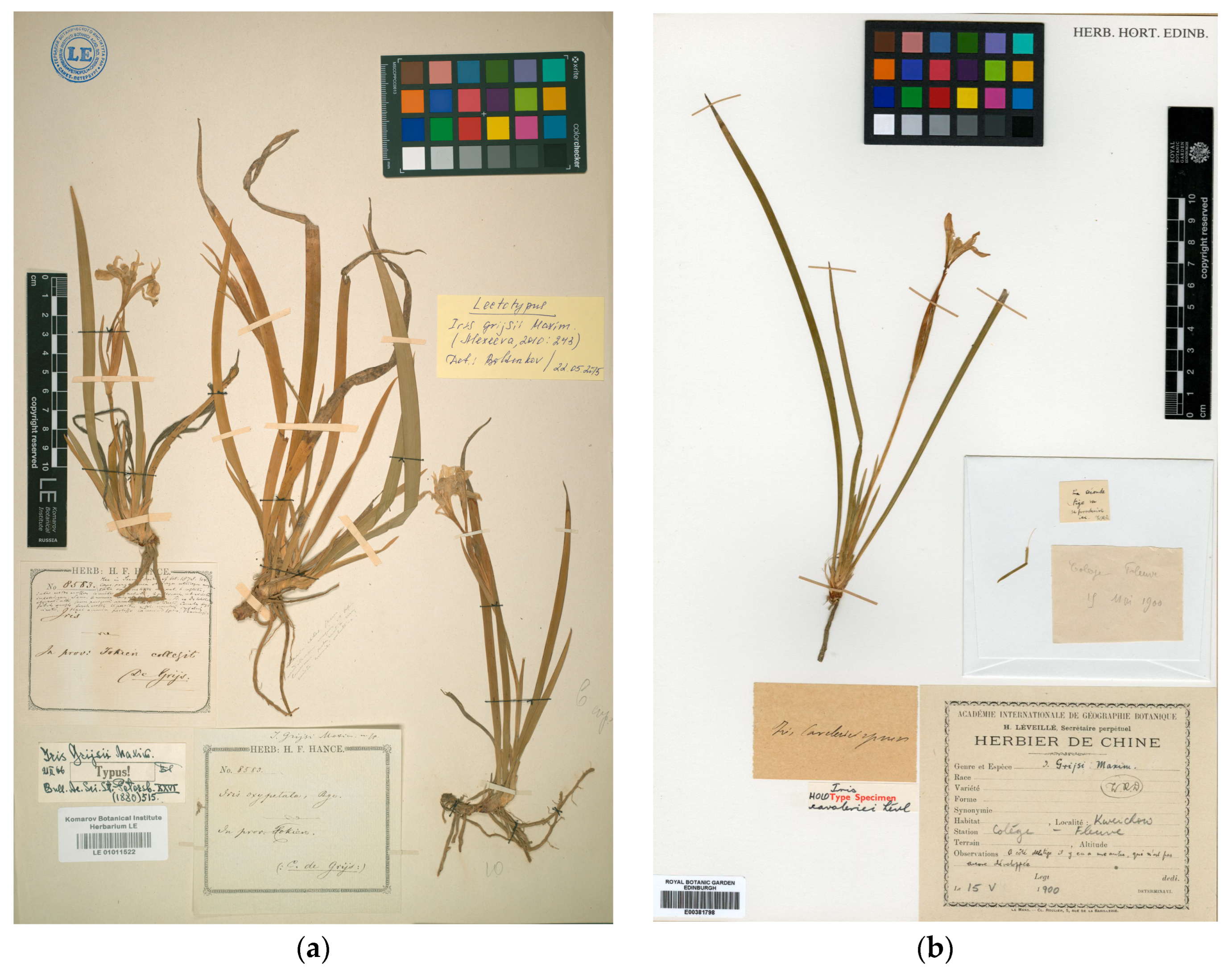
Portiodora speculatrix has frequently been regarded [7,21,25,26] as the earlier synonym of both Iris grijsii Maxim. (de Grijs 8583; lectotype: LE-01011522, isolectotype: P-01840540; see [53]) and I. cavaleriei H.Lév. (holotype: E-00381798) (Figure 8). The latter two species are also native to China, where they entirely overlap in distribution and share morphological features with Portiodora. In this respect, Wilson [40] discussed relationships among all three species when describing both I. probstii C.A.Wilson and I. dabashanensis C.A.Wilson. According to this author and the protologues of Iris grijsii [54] and I. cavaleriei [55], both species show some shared characteristics, such as the presence of reduced short leaves at the scape base (apparently often absent in P. speculatrix, but see PE-01013510; the reliability of this character is to be checked in wild populations), larger floral bracts up to 12 cm long (vs. 2.5–8 cm in P. speculatrix), and broader flowers with a perigone tube longer than 10–15 mm (vs. 5–8 mm in P. speculatrix). For the aforementioned reasons, Wilson [40] concluded that P. speculatrix is not conspecific with either Iris grijsii or I. cavaleriei, despite the close relationship between these. She also outlined the features distinguishing both of the latter species, such as the leaf width (0.4–1 cm in I. grijsii but less than 0.4 cm in I. cavaleriei), lower bract length (4.5–7.5 cm in I. grijsii but 9–12 cm in I. cavaleriei) and flower exertion (flower not exerted above the bracts, albeit visible in I. grijsii but exerted in I. cavaleriei). In our opinion, and according to Wilson [40], all these characters point to an independent taxonomic treatment of each name.
Furthermore, Maximowicz [54] described the falls of I. grijsii (Figure 8a) as being provided with a lower crest (or perhaps, a raised ridge) and minutely velutinous-papillate on the haft and lower half of the adaxial surface, a remarkable character that contrasts with the smooth falls of Portiodora. The species was collected in an unspecified location in “Fokien” (presently Fujian Province) by C. de Grijs, to whom the epithet is dedicated. He also added “Inter I. ensatam et I. ruthenicam, huic tamen propior” [between I. ensata and I. ruthenica, though closer to the latter], and listed the similarities and dissimilarities of I. grijsii versus both putative relatives. Notwithstanding the absence of data pertaining to seeds and fruits in the protologue of I. grijsii, Hance [19] had previously delineated those features from the specimens in his herbarium that he called “I. oxypetala Bge.”, which Maximowicz [54] referenced in the protologue and used as type material for his new species. The description of Hance outlines capsules that are pergameneous, fusiform, long-beaked, equidistantly 6-ribbed and reticulate-nerved between ribs; and seeds that are globose, polygonal and devoid of fleshy appendages. Those characteristics do not align with Portiodora speculatrix. Unfortunately, such data were not reported for I. cavaleriei (Figure 8b), which would facilitate refining its morphological relationships with other groups of irises. The latter species was described by Léveillé [55] from plants found by J. Cavalerie in “Kouy-Tchéou: Kouy-yang, bord de fleuve” [Guizhou: Guiyang, river edge], and Léveillé also reported the presence of I. grijsii in “Fukien, Ngan-Hoei” [Fujian and Anhui Provinces] in the original publication. Although both I. grijsii and I. cavaleriei appear to have certain affinities with the species of Eremiris or perhaps Joniris, transference to any of those genera is not favoured.
Related to this subject, Su [56] recently published a remarkable species from Fujian Province, Iris fujianensis X.X.Su (nom. inval., holotype not cited), which shares morphology and distribution with I. grijsii and P. speculatrix. Important differences exist among these three species (mostly concerning the characteristics and sizes of leaves, flowers and fruits and the arrangement of the inner floral segments), though some others such as the general habit, rhizome growth and the putative entire triangular stigmatic lip (not mentioned in the protologue of the two former) suggest a presumed closeness among them. More importantly, I. grijsii and I. fujianensis bear several short leaves at the base of the scape and show outer floral pieces similar in morphology and ornamentation, which exhibit blades with a remarkable velutinous surface that has not been documented in Portiodora and most members of the Xiphion s.l. clade. Similarly, I. grijsii produces oblong capsules with a long apical beak, and its ripe seeds are angulose and apparently lack appendages. However, the protologue of I. fujianensis [56] describes a seed structure resembling a visible peduncle that might correspond to the funicle, but it is not referred to as a fleshy appendage after ripening (perhaps evanescing with maturation). More precise data are needed about this crucial character, which also would connect it to Portiodora. Furthermore, the innermost floral pieces spread outwards in I. fujianensis but are erect to subpatent in I. grijsii. Further detailed observations are required to clarify the morphological connections of I. fujianensis to other Asian irises. Despite the similarities that can be drawn with Eremiris or potentially Joniris (as for I. grijsii) or in some respect to Portiodora, the species possesses a unique morphology that enable it to be distinguished from other irises [54], i.e., leaves longer and broader (20–80 × 1.4–2.6 cm), flowers solitary and borne on shorter pedicels (1–2 cm long) and with larger pieces (7–8 × 2.0–2.5 cm) spreading outwards. Those divergences may perhaps require further description of an unedited generic lineage.
In any case, until the required full morphological details and DNA sequence data are available for I. grijsii, I. cavaleriei and I. fujianensis, their phylogenetic relationships and generic placement in the “Iris-flower clade” [sensu 14] will remain unresolved. At the moment, based on the available morphological evidence, we provisionally exclude them from Portiodora, but this hypothesis requires further testing.

4.6. Some Reflections on the Current Vision on Iris-Segregated Genera

Iridology, like other disciplines dealing with economically important plants, is subject to a great immobility regarding the application and use of scientific names. Researchers are reluctant to change their conventional concept of a very broadly circumscribed genus Iris amalgamating widely variable infrageneric groups of irises [17], which apparently bring nomenclatural stability [57] by avoiding the use of “too many genera”. Such broad treatments are perhaps based mostly on tradition rather than on integrative taxonomic data (e.g., morphology, karyology, phytochemistry, molecular phylogenetics, biogeography, etc.) that can support more analytical treatments in the “Iris-flower clade” (see recent discussion by Crespo et al. [18]).
Traditionally, horticulturists and specifically iridologists have utilised “working names” for more than 150 years to denominate each of the clades and lineages recovered in recent molecular work, a fact that does not imply a loss of nomenclatural stability or generate any confusion. In the recent multi-generic treatment of the irises [13], most of those traditional working names were recognised at the genus rank, which paralleled other accepted analytical treatments in horticulturally important iridaceous groups such as Crocoideae (see [58]), or other families of bulbous plants such as Hyacinthaceae ≡ Asparagaceae subfam. Scilloideae (see [59,60,61,62,63]).
Popular nomenclature does not necessarily need to align with scientific nomenclatural changes. Obviously, common people will invariably refer to daisies, poppies, aloes and irises by these same names, irrespective of their scientific classification within a single genus or multiple genera [18]. Paradoxically, it is interesting to note that the adoption of new treatments by taxonomists is often dependent on the economic importance of the concerned groups, with an increasing reluctance to apply nomenclatural changes to economically relevant aggregates. This is a common assumption, despite the apparent contradiction of applying divergent criteria depending on the extra-scientific impact of the groups concerned (for further details see [18]).
New taxonomic rearrangements, predominantly promoted in the wake of molecular phylogenies, have been documented over the past two decades. The majority of these rearrangements result in a significant simplification of the taxonomy of the relevant aggregates, often leading to more homogeneous segregate genera that are more manageable [14,61,62,63]. They are typically smaller and well defined on the basis of morphological, molecular and biogeographical characteristics. In this context, the authors advocate the implementation of these homogeneous taxonomic criteria across all Iridaceae, for which the multi-generic arrangement of the “Iris-flower clade” represents a significant step forward.

4.7. Implications on Biodiversity Conservation

The use of broadly defined genera clearly biases the way in which researchers perceive both morphological and taxonomic diversity within a given group, such as the family Iridaceae. This conceptual narrowing may have serious negative consequences for conservation practices. For example, the potential extinction of I. speculatrix would not result in the disappearance of the entire genus Iris. Therefore, it would likely be regarded by many as just an unfortunate loss of one of its local forms, externally like the one growing in a domestic garden bed. However, it is unsurprising that the extinction of an entire genus of flowering plants (Portiodora), which had unique morphology and genetics, would be regarded as a far more tragic event. Such psychological differences in perception cannot be ignored or underestimated, as they will inevitably influence the intensity of conservation efforts directed toward objects facing potential extinction. The example of the so-called “Louisiana irises” [6] clearly demonstrates that in situations where conservation efforts conflict seriously with the economic interests of the State and corporations, prioritising broad traditional taxonomy over detailed taxonomic elaboration can have disastrous consequences [6].
Without delving into the much broader topic of reconciling phylogenetic and Linnaean (rank-based) classifications, it is still worth emphasising that, bearing in mind the obtained phylogenetic outcomes (Figure 6, Figure 7 and Figures S1–S3), the acceptance of the newly described genus Portiodora as a section or subgenus does not appear to be intuitively convincing; especially when genera such as Chamaeiris, Juno or Iridodictyum are simultaneously accepted at the same ranks.

5. Conclusions

Within an integrative taxonomic framework, the combination of morphological, molecular, karyological and geographical data provides sufficient evidence to place Iris speculatrix in the new genus Portiodora, which completes the multi-generic treatment adopted by Crespo et al. [13] for the “Iris-flower clade”. The morphological features of this enigmatic and pleasing evergreen iris appear to link it to multiple distinct groups. However, the unique morphology it displays, in conjunction with its outstanding karyological peculiarities and its isolated phylogenetic position within the “Iris-flower clade” support the generic rank for I. speculatrix.
The acceptance of Portiodora as an autonomous genus is in line with the rationale presented by Mavrodiev et al. [14] and Crespo et al. [13,18]. The stability of any proposed new arrangement depends on its integrative nature, i.e., the successful combination of phylogenetic, morphological and biogeographical information, as well as its comprehensiveness, so that it does not exhibit taxonomic biases or adhere to regional botanical practices [13,60,61,62,63]. The pure comparative approach to molecular data (three-taxon statement analysis) is a practical methodology for addressing taxonomic questions, since it eschews assumptions about the history of chloroplast loci transformation [64], and may therefore be applicable to similar studies. In that context, admitting monotypic or small genera such as Portiodora (as for other lineages of the “Iris-flower clade”) is not a drawback. Conversely, and irrespective of their size, these smaller groups facilitate and even render more realistic the understanding of the diversity, complexity and relationships of the irises, and have an important impact on their conservation. In this sense, the present study provides a framework for a future protective strategy for the entire “Iris-flower clade”. The accurate resolution of the taxonomy of cryptic biodiversity, such as that exhibited by Portiodora, is likely to be essential for the successful conservation of this group.

Supplementary Materials

The following supporting information can be downloaded at: https://www.mdpi.com/article/10.3390/biology14121767/s1, Figure S1: Hierarchy patterns of score 23 representing the Robinson–Foulds median consensus of eight cladograms (Table S1), the results of 3TA analyses of Iris s.l. and outgroups supermatrix (202 terminals); Figure S2: Cladogram representing the most probable maximum likelihood (ML) tree (−ln likelihood = −48,909.1674), inferred using IQ-TREE from a plastid supermatrix of Iris s.l. and outgroup taxa (206 terminals). The best-fit model, TVM+F+I+G4, was automatically selected by IQ-TREE according to the Schwarz (Bayesian) Information Criterion. The aLRT support values (see Mavrodiev et al. [14] for reference) were rounded to the nearest whole number and shown above or below branches when equal to 75% or higher; Figure S3: The simplified version of Figure 5 from the main text; Table S1. Summary of input data for final 3TA cladogram construction (Figure 6), following Mavrodiev et al. [14]. Each row corresponds to a separate 3TA analysis and represents a summary that includes the number of ingroup terminals, the number of three-taxon statements, the number of resulting hierarchies (trees), tree length, tree retention index (RI), and the Robinson–Foulds (RF) median consensus (MC) score (distance). See the main text for references.

Author Contributions

Conceptualisation, M.B.C., M.M.-A. and E.V.M.; methodology, M.B.C., M.M.-A. and E.V.M.; formal analyses, M.B.C. and E.V.M.; investigation, M.B.C., M.M.-A. and E.V.M.; writing—original draft preparation, M.B.C.; writing—review and editing, M.B.C., M.M.-A. and E.V.M.; herbarium and laboratory work, M.B.C., M.M.-A. and E.V.M. Moreover, M.B.C., M.M.-A. and E.V.M. have contributed substantially to the general discussion of results and taxonomic treatment. All authors have read and agreed to the published version of the manuscript.

Funding

This research was partly supported by the grants UADIF22–28, UADIF23–32, UAUSTI22–05, UAUSTI23–12, VIGROB22–166, and VIGROB23–166, from diverse programmes of the University of Alicante (Spain).

Institutional Review Board Statement

Not applicable.

Informed Consent Statement

Not applicable.

Data Availability Statement

The DNA sequences referred to in the present research are available at GenBank (https://www.ncbi.nlm.nih.gov/genbank/, accessed on 30 September 2025).

Acknowledgments

The curators of the herbaria cited in the text are thanked for information on iris materials. Yuen-Yung Lau (The Hong Kong Herbarium, Agriculture, Fisheries and Conservation Department, The Government of the Hong Kong Special Administrative Region) and David Tai-Wai Lau (Shiu-Ying Hu Herbarium, CUHK, The Chinese University of Hong Kong), are especially thanked for sending digital images of the Iris speculatrix collection “Rare and endangered plants (S.W. Shek, K.W. Lam, D.T.W. Lau & J.Y.Y. Lau) 9A”) at their respective herbaria, as well as Wen-Zhang Ma (KUN), and Liu Yang (IKB) for some digital images of I. speculatrix from their herbarium collections. Base maps were taken under permission from Google Maps. SIGNA (Species Iris Group of North America; http://www.signa.org/index.pl?Intro, accessed on 30 September 2025) and their contributors are acknowledged for providing photographs of living plants and seeds. James W. Waddick and Jim Murrain (Kansas, Missouri) and Kenneth Walker (Concord, California) are specially acknowledged for sharing the pictures accompanying the text as well as very useful information on the provenance of the clones currently cultivated in the USA. Four anonymous reviewers provided constructive feedback that contributed to enhancing the text.

Conflicts of Interest

The authors declare no conflicts of interest. The funders had no role in the design of the study; in the collection, analyses, or interpretation of data; in the writing of the manuscript; or in the decision to publish the results.

Appendix A. Identification Key

The dichotomous key for identification of genera in the “Iris-flower clade” that was previously published by Crespo et al. [13] is updated below to include the new genus Portiodora.
1.
Perigone segments all equal, free; style branches filiform, non-petaloid; capsule valves split down to base; seeds fleshy, blackish, globose, long persisting on the fruit axis (resembling a blackberry).......................................................Belamcanda
Perigone segments unequal (falls and standards), fused in a tube or rarely free; style branches flattened, petaloid; capsule and seeds with other characteristics.........2
2.
Leaves bifacial (dorsiventrally flattened), usually canaliculate, sometimes polygonal in cross section.....................................................................................................3
Leaves isobilateral (laterally flattened), usually equitant........................................7
3.
Roots fleshy, swollen, persistent; standards patent to reflexed; falls obovate, usually with a prominent central crest..............................................................................Juno
Roots fibrous, usually not fleshy neither swollen, deciduous; standards erect; falls panduriform, not crested or with a weak, inconspicuous crest......................4
4.
Basal leaves quadrangular to octagonal in cross section; seeds appendiculate........5
Basal leaves semicircular to circular in cross section, sometimes with prominent ribs or keel; seeds not appendiculate.........................................................................6
5.
Rootstock a bulb, with outer tunics reticulate, sometimes enclosing several offsets; standards conspicuous, longer than half the style branches length; ovary and capsule trilocular..................................................................................................Iridodictyum
Rootstock with 2–4 oblong tubercles, ±digitate; standards inconspicuous, shorter than half the style branches length; ovary and capsule unilocular....Hermodactylus
6.
Bulb outer tunics reticulate. Leaves prominently ribbed on the outer side, sometimes keeled; stem inconspicuous, underground; stigma entire........................Alatavia
Bulb outer tunics membranous to somewhat fibrous, not reticulate. Leaves without prominent ribs on the outer side, not keeled; stem conspicuous, aerial; stigma bifid, usually with acute lobes.................................................................................Xiphion
7.
Flowering stems with marked dichotomous branching pattern; flowers short-lived, shrivelling spirally and falling off just below the ovary; pedicels persistent, stiff after flower abscission; seeds winged.............................................Pardanthopsis
Flowering stems simple or without evident dichotomous branching pattern; flowers not shrivelling spirally, falling off just above the ovary; pedicels usually not stiff after flower abscission; seeds mostly unwinged, sometimes with fleshy cover or fleshy appendages......................................................................................................8
8.
Both perigone whorls usually similar in size and shape; beard (a very conspicuous central row of thick pluricellular, multiseriate, clavate hairs) present on falls and sometimes also on standards; fruit opening by clefts, the valves remaining fused apically for a long time after dehiscence........................................................Iris
Both perigone whorls usually strongly differing in size and/or shape; beard absent, or falls sometimes crested, pubescent or with slender unicellular hairs; fruit valves splitting completely from the apex up to about the middle..................................9
9.
Falls markedly crested, with 1–3 fringed, irregularly dissected or wavy rows......10
Falls uncrested or sometimes with an almost entire low crest or central ridge......14
10.
Rhizome slender, long, heterogeneous, with cord-like branches at apex, swollen at nodes; leaves herbaceous, without prominent ribs; falls with crest of three fringed rows; seeds with a long, coiled appendage...............................................Lophiris
Rhizome lacking cord-like branches at the apex; leaves ± coriaceous, with 1–5 prominent ribs; falls with crest of a single fringed row, sometimes with lateral outgrowths; seeds lacking coiled appendages......................................................11
11.
Fall crest mostly wavy; stigma oblong to triangular, entire; capsule beaked............................................................................................................Zhaoanthus
Fall crest fringed or dissected; stigma bilobed, with broad lobes; capsule ± pointed, not beaked.................................................................................................................12
12.
Rootstock a small rhizome, with many swollen tuberous roots; perigone pieces entire or weakly erose-undulate on margins; fall crest not flanked with lateral pairs of outgrowths near the base............................................................Junopsis
Rootstock a thick rhizome, usually nodose and sometimes stoloniferous, lacking swollen, tuberous roots; perigone pieces markedly undulate-erose on margins; fall crest flanked with 2–3 lateral pairs of outgrowths near the base................13
13.
Haft of the standards inconspicuous, short, nearly flat; capsule subcoriaceous; seeds brownish, matte, irregular in shape, angular, ±flattened..............Evansia
Haft of the standards conspicuous, long, canaliculate; capsule papery; seeds blackish, glossy, globose-pyriform, apiculate......................................................Tectiris
14.
Stigma triangular or linguiform, entire or with crenate margins....................15
Stigma bilobed to bifid, sometimes with denticulate lobes..................................21
15.
Style crests long triangular-lanceolate; capsule with a conspicuous long beak.....16
Style crests broadly triangular to roundish; capsule unbeaked or shortly beaked...18
16.
Nectar drops at the base of falls; stamen filaments fused into a tube; seeds covered with glistening glands, lacking fleshy appendages........................Siphonostylis
Nectar drops lacking at the base of falls; stamen filaments not fused into a tube; seeds not glandulous, with a fleshy wing-like appendage..................................17
17.
Leaves not glossy, lacking prominent ribs; stem short, hidden under spathes; perigone tube 25−65 mm long; falls with a central band of minute, velvety pubescence; capsule erect, short-beaked..........................................................Gattenhofia
Leaves glossy, prominently ribbed; stem elongated, clearly visible; perigone tube up to 8 mm long; falls smooth, not pubescent; capsule patent, long-beaked..Portiodora
18.
Rhizome slender, long, heterogeneous, with cord-like branches at apex, swollen at nodes; leaves without prominent ribs; testa surface pitted..............Rodionenkoa
Rhizome lacking cord-like branches at apex; leaves usually with prominent ribs; testa surface not pitted...........................................................................................19
19.
Leaves firm, coriaceous, up to 40 mm wide; seeds angular, discoid or semidiscoid, usually corky; testa surface smooth or papillate....................................Limniris
Leaves slender, up to 15 mm wide; seeds globose to pyriform, sometimes compressed, not corky; testa surface ± smooth, sometimes glossy..........................20
20.
Rhizome slender, up to 5 mm in diameter; perigone tube up to 15 mm long; capsule globose to ovoid, 10–15 mm long; seeds with a fleshy appendage vanishing on drying......................................................................................................Joniris
Rhizome stout, up to 10 mm in diameter; perigone tube up to 3 mm long; capsule oblong-cylindrical to fusiform, 20–80 mm long; seeds lacking fleshy appendages..........................................................................................................Eremiris
21.
Rhizome almost vertical; style crests lanceolate-triangular...........................22
Rhizome long, creeping; style crests broadly triangular, subquadrate (rarely narrowly triangular)..............................................................................................24
22.
Rootstock with needle-like bristles at the apex; rhizome tough, nearly vertical, with compact, bulbiform, swollen leaf bases; shoots extra– or intravaginal; spathe valves 2; perigone tube up to 2 cm long; capsule unbeaked; seeds tuberculate, necked...................................................................................................Syrianthus
Rootstock covered with brownish remains of leaf sheaths, not spiny; leaves not bulbiform at the base; plants forming dense tussocks, with all shoots intravaginal; spathe valves 3–4; perigone tube 4–12 cm long; capsule beaked; seeds wrinkled, unnecked........................................................................................23
23.
Stems absent or hidden among leaf remains; perigone tube scapiform; crest triangular-lanceolate to oblong-lanceolate, irregularly fringed on margins; capsule 6-ribbed, not reticulate-nerved...........................................Cryptobasis
Stems distinct; perigone tube not scapiform; crests narrowly triangular-lanceolate to linear, with slightly crenate to almost entire margins; capsule, trigonous, reticulate-nerved..................................................................................Sclerosiphon
24.
Haft of falls patent, without a central ridge; capsule conspicuously beaked; seed testa fleshy and smooth or loose-papery with irregularly ridged surface........Chamaeiris
Hafts of falls erect, with a central ridge; capsule with rounded to acute apex, rarely with a short beak; seed testa corky or hard, with wrinkled or smooth surface.....25
25.
Falls glabrous; capsule rounded in cross section; seeds nearly globular, with testa wrinkled...........................................................................................Dielsiris
Falls pubescent on or aside ridge; capsule ± hexagonal in cross section; seeds semidiscoid to discoid, flattened, ±angular, with testa corky, ±smooth.....Phaeiris

References

  1. Goldblatt, P.; Manning, J.C.; Rudall, P. Iridaceae. In The Families and Genera of Flowering Plants; Kubitzki, K., Ed.; Springer: Berlin/Heidelberg, Germany; New York, NY, USA, 1998; Volume 3, pp. 295–333. [Google Scholar]
  2. Crespo, M.B.; Herrero, A.; Quintanar, A. Iridaceae. In Flora Iberica; Rico, E., Crespo, M.B., Quintanar, A., Herrero, A., Aedo, C., Eds.; Real Jardín Botánico, CSIC: Madrid, Spain, 2013; Volume 20, pp. 400–491. [Google Scholar]
  3. Crișan, I.; Cantor, M. New perspectives on medicinal properties and uses of Iris sp. Hop Med. Plants 2016, 24, 24–36. [Google Scholar]
  4. Anderson, E. Introgressive Hybridization; John Wiley & Sons Inc. in Association with Chapman and Hall: London, UK; New York, NY, USA, 1949; pp. 1–109. [Google Scholar]
  5. Arnold, M.L.; Ballerini, E.S.; Brothers, A.N. Hybrid fitness, adaptation and evolutionary diversification: Lessons learned from Louisiana irises. Heredity 2012, 108, 159–166. [Google Scholar] [CrossRef]
  6. Mavrodiev, E.V.; Gómez, J.P.; Mavrodiev, N.E.; Melton, A.E.; Martínez-Azorín, M.; Crespo, M.B.; Robinson, S.K.; Steadman, D.W. On biodiversity and conservation of the Iris hexagona complex (Phaeiris, Iridaceae). Ecosphere 2021, 12, e03331. [Google Scholar] [CrossRef]
  7. Dykes, W.R. The Genus Iris; Cambridge University Press: Cambridge, UK, 1912; pp. 1–245, 48 pls. [Google Scholar]
  8. SGBIS—Species Group of the British Iris Society (Ed.) A Guide to Species Irises: Their Identification and Cultivation; Cambridge University Press: Cambridge, UK, 1997; pp. 172–195. [Google Scholar]
  9. Choi, B.; Weiss-Schneeweiss, H.; Temsch, E.M.; So, S.; Myeong, H.-H.; Jang, T.-S. Genome Size and Chromosome Number Evolution in Korean Iris L. Species (Iridaceae Juss.). Plants 2020, 9, 1284. [Google Scholar] [CrossRef]
  10. Sapir, Y.; Shmida, A.V.I. Species concepts and ecogeographical divergence of Oncocyclus irises. Israel J. Plant Sci. 2002, 50, 119–127. [Google Scholar] [CrossRef]
  11. Abdel Samad, N.; Bou Dagher-Kharrat, M.; Hidalgo, O.; El Zein, R.; Douaihy, B.; Siljak-Yakovlev, S. Unlocking the karyological and cytogenetic diversity of Iris from Lebanon: Oncocyclus section shows a distinctive profile and relative stasis during its continental radiation. PLoS ONE 2016, 11, e0160816. [Google Scholar] [CrossRef]
  12. Goldblatt, P.; Takei, M. Chromosome cytology of Iridaceae—Patterns of variation, determination of ancestral base numbers, and modes of karyotype change. Ann. Mo. Bot. Gard. 1997, 84, 285–304. [Google Scholar] [CrossRef]
  13. Crespo, M.B.; Martínez-Azorín, M.; Mavrodiev, E.V. Can a rainbow consist of a single colour? A new comprehensive generic arrangement of the ‘Iris sensu latissimo’ clade (Iridaceae), congruent with morphology and molecular data. Phytotaxa 2015, 232, 1–78. [Google Scholar] [CrossRef]
  14. Mavrodiev, E.V.; Martínez-Azorín, M.; Dranishnikov, P.; Crespo, M.B. At least 23 genera instead of one: The case of Iris L. s.l. (Iridaceae). PLoS ONE 2014, 9, e106459. [Google Scholar] [CrossRef] [PubMed]
  15. Tillie, N.; Chase, M.W.; Hall, T. Molecular studies in the genus Iris L.: A preliminary study. Ann. Bot. 2001, 58, 105–112. [Google Scholar]
  16. Wilson, C.A. Phylogeny of Iris based on chloroplast matK gene and trnK intron sequence data. Mol. Phylogenet. Evol. 2004, 33, 402–412. [Google Scholar] [CrossRef]
  17. Wilson, C.A. Subgeneric classification in Iris re-examined using chloroplast sequence data. Taxon 2011, 60, 27–35. [Google Scholar] [CrossRef]
  18. Crespo, M.B.; Martínez-Azorín, M.; Mavrodiev, E.V. “Reticulata irises”: A nomenclatural and taxonomic synopsis of the genera Alatavia and Iridodictyum (Iris subg. Hermodactyloides auct., Iridaceae). Plant Biosyst. 2024, 158, 763–787. [Google Scholar] [CrossRef]
  19. Hance, H.F. Exiguitates carpologicae. J. Bot. 1870, 8, 312–314. [Google Scholar]
  20. Baker, J.G. Iris speculatrix. Native of Hong-Kong. Curtis’s Bot. Mag. 1877. ser. 3, 33, Table 6306. Available online: https://www.biodiversitylibrary.org/item/203318#page/158/mode/1up (accessed on 3 December 2025).
  21. Zhao, Y.T.; Noltie, H.J.; Mathew, B.F. Iridaceae. In Flora of China; Flora of China Editorial Committee, Ed.; MBG Press & Science Press: Beijing, China; St. Louis, MO, USA, 2000; Volume 24, pp. 297–313. [Google Scholar]
  22. Hu, Q.M.; Wu, T.L.; Xia, N.H.; Xing, F.W.; Lai, P.C.C.; Yip, K.L. Rare and Precious Plants of Hong Kong; Agriculture, Fisheries and Conservation Department, The Government of the Hong Kong Special Administrative Region: Hong Kong, China, 2003; pp. 1–234. [Google Scholar]
  23. Siu, T.-Y.; Wong, K.-H.; Kong, B.L.-H.; Wu, H.-Y.; But, G.W.-C.; Shaw, P.-C.; Lau, D.T.-W. The complete chloroplast genome of Iris speculatrix Hance, a rare and endangered plant native to Hong Kong. Mitochondrial DNA Part B 2022, 7, 864–866. [Google Scholar] [CrossRef] [PubMed]
  24. IUCN. IUCN Red List Categories and Criteria: Version 3.1; IUCN Species Survival Commission, IUCN: Gland, Switzerland; Cambridge, UK, 2001; pp. 1–30. [Google Scholar]
  25. Mathew, B. The Iris, 2nd ed.; Timber Press: Portland, OR, USA, 1989; pp. 1–215. [Google Scholar]
  26. Waddick, J.W.; Zhao, Y.-T. Iris of China; Timber Press: Portland, OR, USA, 1992; pp. 1–192. [Google Scholar]
  27. Baker, J.G. Handbook of Irideae; G. Bell & Sons: London, UK, 1892; pp. 22–24. [Google Scholar]
  28. Guo, J.; Wilson, C.A. Molecular phylogeny of crested Iris based on five plastid markers (Iridaceae). Syst. Bot. 2013, 38, 987–995. [Google Scholar] [CrossRef]
  29. Hall, T.; Tillie, N.; Chase, M.W. A re-evaluation of the bulbous irises. Ann. Bot. 2001, 58, 123–126. [Google Scholar]
  30. Choi, T.-Y.; Lee, S.-R. Complete plastid genome of Iris orchioides and comparative analysis with 19 Iris plastomes. PLoS ONE 2024, 19, e0301346. [Google Scholar] [CrossRef]
  31. Thiers, B. Index Herbariorum: A Global Directory of Public Herbaria and Associated Staff (Continuously Updated). Available online: http://sweetgum.nybg.org/ih/ (accessed on 5 August 2025).
  32. Turland, N.J.; Wiersema, J.H.; Barrie, F.R.; Gandhi, K.N.; Gravendyck, J.; Greuter, W.; Hawksworth, D.L.; Herendeen, P.S.; Klopper, R.R.; Knapp, S.; et al. International Code of Nomenclature for Algae, Fungi, and Plants (Madrid Code); Regnum Veg. 162.; University of Chicago Press: Chicago, IL, USA, 2025; Available online: https://www.iaptglobal.org/_functions/code/madrid (accessed on 5 August 2025).
  33. Li, D.-Z.; Gao, L.-M.; Li, H.-T.; Wang, H.; Ge, X.-J.; Liu, J.-Q.; Chen, Z.-D.; Zhou, S.-L.; Chen, S.-L.; Yang, J.B.; et al. Comparative analysis of a large dataset indicates that internal transcribed spacer (ITS) should be incorporated into the core barcode for seed plants. Proc. Natl. Acad. Sci. USA 2011, 108, 19641–19646. [Google Scholar]
  34. Snoad, B. Chromosome counts of species and varieties of garden plants. JIHI Ann. Rep. 1952, 42, 47–50. [Google Scholar]
  35. Lenz, W.L. Iris tenuis, S. Wats., a new transfer to the subsection Evansia. Aliso 1959, 4, 311–319. [Google Scholar] [CrossRef]
  36. Chimphamba, B.B. Cytogenetic studies in the genus Iris: Subsection Evansia Benth. Cytologia 1973, 38, 501–514. [Google Scholar] [CrossRef]
  37. Mao, J.Q.; Xue, X.J. Chromosome numbers of thirteen iridaceous species from Zhejiang Province. Acta Agric. Univ. Zhejiang 1986, 12, 99–101. [Google Scholar]
  38. Li, D.; Wang, G.; Xia, Y.; Zhang, J. Floral syndrome and breeding characters of Iris speculatrix. Acta Agric. Univ. Zhejiang 2014, 26, 1218–1222. [Google Scholar]
  39. Li, D.; Zhang, J.; Zhang, J.-P.; Li, K.; Xia, Y. Green period characteristics and foliar cold tolerance in 12 Iris species and cultivars in the Yangtze Delta, China. HortTechnology 2017, 27, 399–407. [Google Scholar] [CrossRef]
  40. Wilson, C.A. Two new species in Iris series Chinenses (Iridaceae) from south-central China. PhytoKeys 2020, 161, 41–60. [Google Scholar] [CrossRef] [PubMed]
  41. Murrain, J. Iris speculatrix: Girls Who Wear Glasses. SIGNA 2012, 87, 4214–4215. [Google Scholar]
  42. Jarrett, V.H.C. A white variety of Iris speculatrix Hance. Sunyatsenia 1937, 3, 265. [Google Scholar]
  43. Waddick, J.W. (Kansas City, MO, USA); Murrain, J. (Kansas City, MO, USA). Personal communication, 2024.
  44. Hall, T. Relationships within genus Iris, with special reference to more unusual species grown at Kew. CIS Newsl. 2013, 57, 10–22. [Google Scholar]
  45. Rodionenko, G.I. The Genus Iris L. (Questions of Morphology, Biology, Evolution and Systematics); British Iris Society of London, Translator; V.L. Komarov Botanical Institute, Academy of Sciences of the USRR: Leningrad, Russia, 1961; pp. 1–222. (In Russian) [Google Scholar]
  46. Westerkamp, C.; Claßen-Bockhoff, R. Bilabiate flowers: The ultimate response to bees? Ann. Bot. 2007, 100, 361–374. [Google Scholar] [CrossRef]
  47. Guo, J. Micromorphology and anatomy of crested sepals in Iris (Iridaceae). Int. J. Plant Sci. 2015, 176, 627–642. [Google Scholar] [CrossRef]
  48. Guo, J. Mechanisms for the evolution of complex and diversely elaborated sepals in Iris identified by comparative analysis of developmental sequences. Am. J. Bot. 2015, 102, 819–832. [Google Scholar] [CrossRef] [PubMed]
  49. Kim, H.H.; Park, Y.W.; Yoon, P.S.; Choi, H.W.; Bang, J.W. Karyotype analysis of eight Korean native species in the genus Iris. Korean J. Med. Crop Sci. 2004, 12, 401–405. [Google Scholar] [CrossRef] [PubMed]
  50. Pérez, E.; Pastor, J. Contribución al estudio cariológico de la familia Iridaceae en Andalucía Occidental. Lagascalia 1994, 17, 257–272. [Google Scholar]
  51. Rahimi, V.; Sadat-Hosseini Grouh, M.; Solymani, A.; Bahermand, N.; Meftahizade, H. Assessment of cytological and morphological variation among Iranian native Iris species. Afr. J. Biotechnol. 2011, 10, 8805–8815. [Google Scholar] [CrossRef]
  52. Randolph, L.F.; Mitra, J.; Nelson, I.S. Cytotaxonomic studies of Louisiana irises. Bot. Gaz. 1961, 123, 125–133. [Google Scholar] [CrossRef]
  53. Alexeeva, N.B. Iris grijsii Maxim. In Catalogue of the Type Specimens of East-Asian Vascular Plants in the Herbarium of the V.L. Komarov Botanical Institute (LE), Part 2 (China); Gabrovskaya-Borodina, A.E., Ed.; KMK Scientific Press: Moscow/St. Petersburg, Russia, 2010; p. 243. (In Russian) [Google Scholar]
  54. Maximowicz, C.J. Diagnoses plantarum novarum asiaticarum, III. Bull. Acad. Imp. Sci. Saint-Pétersbourg 1880, 26, 420–542. [Google Scholar]
  55. Léveillé, H. Liliacées, Amaryllidacées, Iridacées et Hémodoracées de Chine. Mem. Pontif. Accad. Romana Nuovi Lincei 1905, 23, 333–378, [Reprinted in a 50-page booklet by Tipografia della Pace di F. Cuggiani, Roma]. [Google Scholar]
  56. Su, X.X. A New Species of Iridaceae from Fujian Province—Iris fujianensis. J. Fujian For. Sci. Tech. 2024, 51, 101–103. [Google Scholar]
  57. Lazkov, G.A.; Sennikov, A.N.; Koichubekova, G.A.; Naumenko, A.N. Taxonomic corrections and new records in vascular plants of Kyrgyzstan, 3. Memoranda Soc. Fauna Fl. Fenn. 2014, 90, 91–110. [Google Scholar]
  58. Goldblatt, P.; Manning, J.C. The Iris Family. Natural History and Classification; Timber Press Inc.: London, UK, 2008; pp. 1–290. [Google Scholar]
  59. Speta, F. Hyacinthaceae. In The Families and Genera of Vascular Plants; Kubitzki, K., Ed.; Springer: Berlin/Heidelberg, Germany, 1998; Volume 3, pp. 261–285. [Google Scholar]
  60. Speta, F. Systematische Analyse der Gattung Scilla L. s.l. (Hyacinthaceae). Phyton 1998, 38, 1–141. [Google Scholar]
  61. Martínez-Azorín, M.; Crespo, M.B.; Juan, A.; Fay, M.F. Molecular phylogenetics of subfamily Ornithogaloideae (Hyacinthaceae) based on nuclear and plastid DNA regions, including a new taxonomic arrangement. Ann. Bot. 2011, 107, 1–37. [Google Scholar] [CrossRef] [PubMed]
  62. Martínez-Azorín, M.; Crespo, M.B.; Alonso, M.Á.; Pinter, M.; Crouch, N.R.; Dold, A.P.; Mucina, L.; Pfosser, M.; Wetschnig, W. Molecular phylogenetics of subfamily Urgineoideae (Hyacinthaceae): Toward a coherent generic circumscription informed by molecular, morphological, and distributional data. J. Syst. Evol. 2023, 63, 42–63. [Google Scholar] [CrossRef]
  63. Martínez-Azorín, M.; Crespo, M.B.; Alonso, M.Á.; Pinter, M.; Crouch, N.R.; Dold, A.P.; Mucina, L.; Pfosser, M.; Wetschnig, W. A generic monograph of the Hyacinthaceae subfam. Urgineoideae. Phytotaxa 2023, 610, 1–143. [Google Scholar] [CrossRef]
  64. Williams, D.M.; Ebach, M.C. Cladistics: A Guide to Biological Classification, 3rd ed.; Systematics Association Special Volume Series; Cambridge University Press: Cambridge, UK, 2020; Volume 88, pp. 1–446. [Google Scholar]
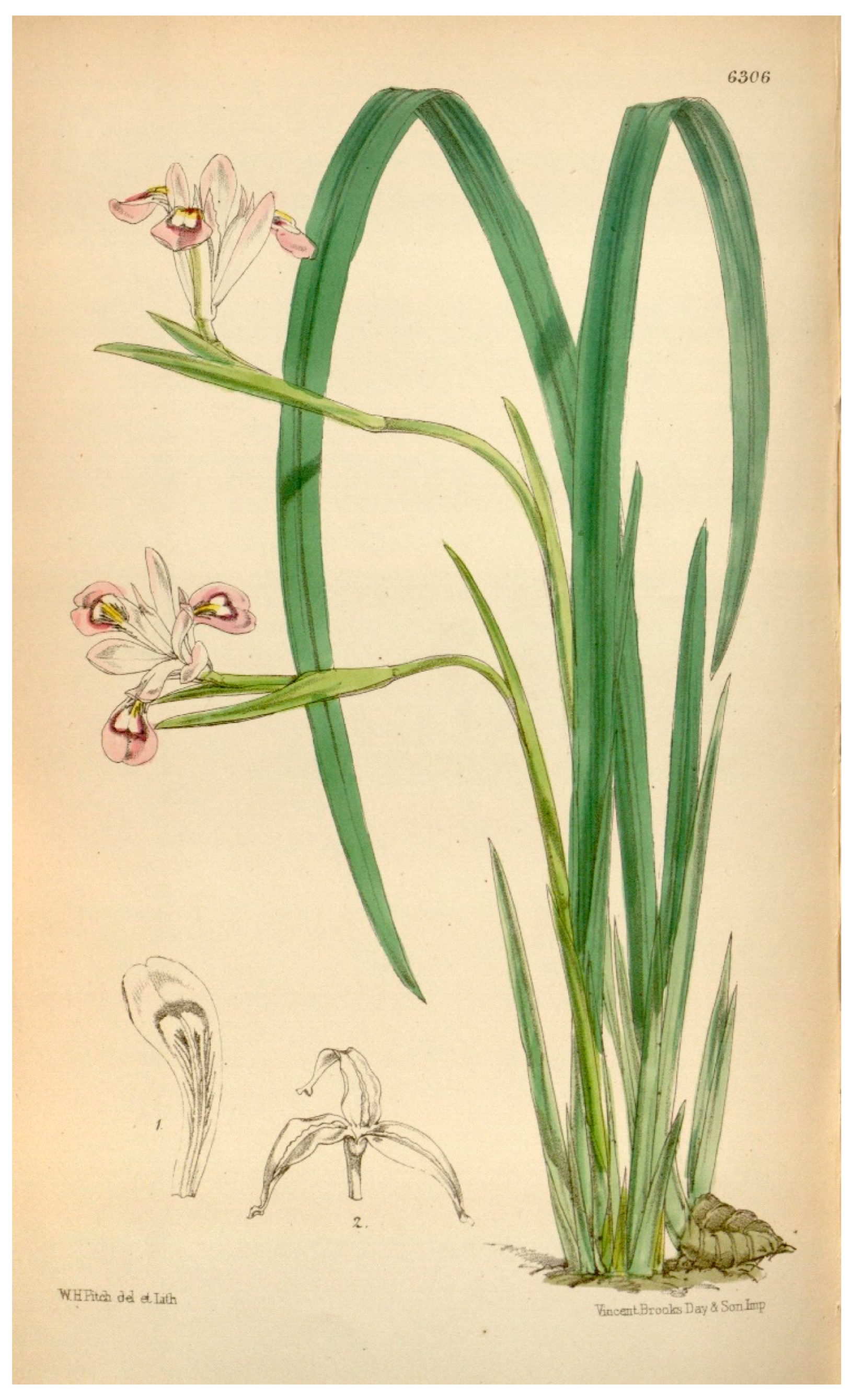
Figure 1. Iris speculatrix Hance from the type locality, Hong Kong. Illustration from J.G. Baker [20].
Biology 14 01767 g001
Figure 2. Portiodora speculatrix. (a) Habit of leaves and flowering stems; (b) Detail of flowers; (c) Detail of falls, standards and style crests; (d) View of ovary and flower tube; (e) Detail of crest and ornamentation of falls; (f) Beaked capsule; (g) Seeds with fleshy appendage (scale in mm). Photos: Kenneth Walker (a,fg), and Jim Murrain (be).
Biology 14 01767 g002
Figure 3. Lectotype (designated here) of Portiodora speculatrix (Iris speculatrix) housed in the British Museum Natural History, London (BM-000958420).
Biology 14 01767 g003
Figure 4. Distribution of Portiodora speculatrix in China (circles), based on the studied material.
Biology 14 01767 g004
Figure 5. Flower colour patterns in three cultivated clones of Portiodora speculatrix (left: “John Lonsdale clone” of uncertain origin; centre: “Darrel Probst clone” from Sanmen, Zhejiang Province; right: “Shanghai Waddick clone” from Shanghai Botanical Garden). Photo: Kenneth Walker.
Biology 14 01767 g005
Figure 6. Summarised relationships within the “Iris-flower clade”: evidence from three-taxon statement analysis. Cladogram representing the summary of hierarchy of patterns resulted from 3TA of cpDNA sequence data (Figure S1). In addition to the information presented in Figure S1, the colour-coding scheme summarises data on genera that have been restored (green font), recently described (red font), or rejected (purple font) by the authors of the present study over the past decade of research. The name of the new genus Portiodora, described in this article, is shown in light blue font. The synonymy provided in square brackets is necessary but not exhaustive. Figure S3a partially represents a simplified version of Figure 6.
Biology 14 01767 g006
Figure 7. Summarised relationships within the “Iris-flower clade”: evidence from Maximum Likelihood analysis. Tree representing the summary of conventional molecular ML analysis of the cpDNA sequence data (Figure S2). The approximate Likelihood Ratio Test (aLRT) values (see Mavrodiev et al. [14] for references) were rounded to the nearest whole number and shown above or below branches when equal to 75% or higher. All clades corresponding to accepted genera, as well as most deep branches received high statistical support as assessed by the aLRT. See the legend of Figure 6 for the description of the colour-coding scheme. The synonymy provided in square brackets is necessary but not exhaustive. Figure S3b represents a partially simplified version of Figure 7.
Biology 14 01767 g007
Figure 8. Type specimens of: (a) Iris grijsii Maxim. (lectotype: LE-01011522); and (b) I. cavaleriei H.Lév. (holotype: E-00381798).
Biology 14 01767 g008
Table 1. Main morphological features of Portiodora and related rhizomatous genera of the “Iris-flores clade” with which it was related.
CharacteristicsPortiodoraZhaoanthusEremirisJonirisCryptobasisSyrianthusChamaeiris
RhizomeStout, nodose, creepingSlender, wiry, stoloniferous, many-branchedThick, compact, creeping, branchedSlender, many-branched, creepingSlender, nodose, verticalStout, nodose, nearly verticalStout, nodose, creeping
StemsLong, visibleLong, visible, simpleLong, visible, simpleShort, slender, simpleHidden among leaf remainsLong, visible, simpleLong, visible, simple to few-branched
Keel of spathe valvesAbsentPresentPresentAbsentPresentPresentPresent
Perigone tube shape and lengthCylindric, 5–8 mm longCylindric, 1–70 mm longCup-like, 1–3 mm longCylindric, 5–15 mm longCylindric, 40–120 mm long, scapiformCylindric, up to 20 mm longCup-like,2–27 mm long
Outline of fallsObovate-spatulateSpatulateOblanceolateBroadly oblanceolatePanduriform to spatulateOblanceolate to panduriformPanduriform or subspatulate
Fall positionErect-patentErect-patentErect-patentErect-patentErect-patent to patentErect to erect-patentPatent
Style branches lengthSlightly shorter than fallsHalf the length of fallsAbout half the length of fallsAbout half the length of fallsSlightly shorter than fallsSlightly shorter than fallsAbout half the length of falls
Crest of fallsLow sinuous near the middle, no lateral outgrowthsLow, wavy, with lateral outgrowthsAbsentAbsentAbsentAbsentAbsent
Stigmatic lip Entire, triangular-obtuseEntire, oblong to triangularTriangular, long acuminateTriangular, apiculateBilobed, with rounded lobesBilobed, with rounded lobesBifid, with acute lobes
Capsule shapeOblong-fusiform, subtrigonousEllipsoid to subglobose, trigonousOblong-cylindrical to fusiform, trigonous,Globose to obovoid, trigonousOvoid to cylindric, not trigonousCylindricalellipsoid, trigonousOvate-lanceolate to oblong, not trigonous
Capsule position regarding stem and spathesPatent, long exertedErect, often exertedErect, often exertedErect, hidden into spathesErect, often exertedErect, often exertedErect, often exerted
Capsule ribs3, prominent3, prominent6, weak6, weak6, prominent6, weak6, prominent
Capsule beakPresentPresentPresentAbsentPresentAbsentPresent
Capsule dehiscenceFrom apex to baseFrom apex to about middleFrom apex to about middleFrom apex to about middleFrom apex to about middleFrom apex to about middleFrom apex to about middle
Capsule valvesCurled backwardsErect to erect-patentErect to erect-patentCurled backwardsErect to erect-patentErect to erect-patentErect to curled backwards
Seed morphologyGlobose-anguloseGlobose compressedPyriform, subapiculateGlobose to pyriformAngulose to subcubicGlobose, neckedGlobose to subcubic
Seed appendagesAril, withering as a wingFleshy rapheAbsentFleshy raphe, vanishingAbsentAbsentAbsent
Seed testaRuguloseSlightly wrinkled.Smooth, shinySmoothWrinkled on faces, smooth on backTuberculate, hardFleshy and smooth or loose-papery
Table 2. Main karyotype features of Portiodora and karyologically related rhizomatous genera of the “Iris-flower clade”.
GenusChromosomal Size StructureSatellited
Chromosomes
Secondary
Constrictions
Telocentric and/or Subtelocentric Chromosomes
PortiodoraHomogeneous1 pairAbsentAbsent
ChamaeirisHeterogeneous0AbsentAbsent
ZhaoanthusHeterogeneous0AbsentPresent
RodionenkoaHeterogeneous1 pairAbsentPresent
PhaeirisHeterogeneous2–3 pairsPresentPresent
JonirisSubhomogeneous1 pairAbsentAbsent
EremirisSubhomogeneous1 pairAbsentPresent
LophirisHeterogeneous1–2 pairsAbsentAbsent
EvansiaHeterogeneous(0–)2 pairsAbsent/presentPresent
TectirisHeterogeneous(0–)2 pairsAbsent/presentAbsent
IrisHeterogeneous0–1 pairAbsent/presentPresent
Disclaimer/Publisher’s Note: The statements, opinions and data contained in all publications are solely those of the individual author(s) and contributor(s) and not of MDPI and/or the editor(s). MDPI and/or the editor(s) disclaim responsibility for any injury to people or property resulting from any ideas, methods, instructions or products referred to in the content.