1. Introduction
Natural fiber-reinforced composites (NFRCs) are increasingly recognized as sustainable alternatives to traditional materials, reflecting a growing commitment to environmentally friendly practices across industries. Natural fibers such as hemp, flax, and jute have significant environmental benefits, including renewability, reduced carbon emissions, and biodegradability [
1]. NFRCs are used, among others, in textiles, composite structures, packaging, and agro-textiles. Compared with synthetic fibers, the production process of NFRCs is less harmful to the environment in terms of waste disposal and emission of greenhouse gases [
2]. Thus, the use of NFRCs can reduce reliance on fossil fuels and addresses the waste-disposal challenges associated with synthetic composites [
2,
3,
4]. Additionally, replacing synthetic engineering materials by natural fiber-reinforced composites enables their properties to meet the stringent qualification of engineering applications [
5,
6]. On the other hand, the interest for renewable raw materials increases when people are aware of the importance of sustainability for global warming and environmental effects in various industries.
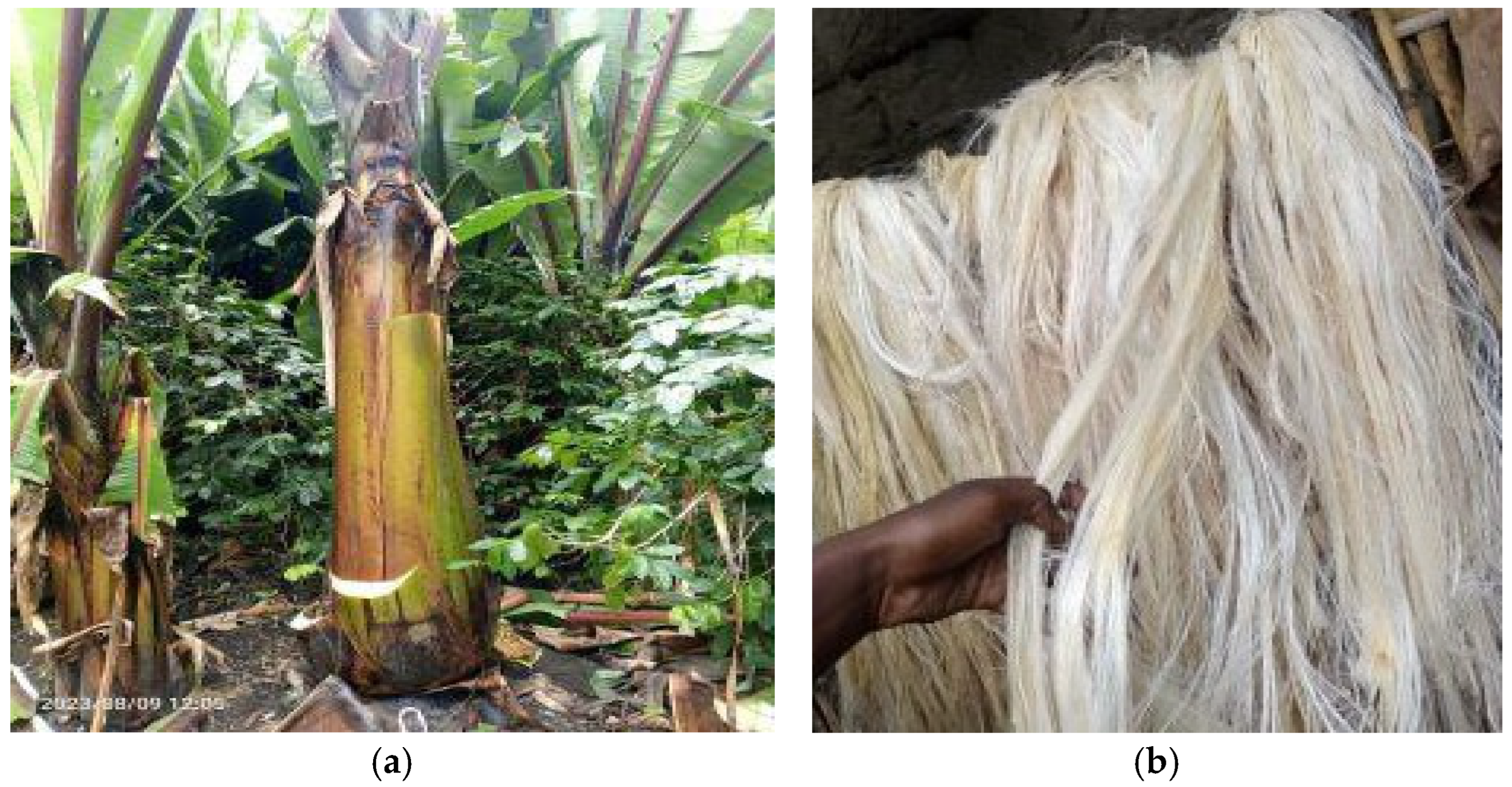
Enset (
Ensete ventricosum), depicted in
Figure 1a is a vigorous, perennial, herbaceous, monocarpic species within the Musaceae family [
7,
8]. This plant is primarily grown for its subterranean corm and the basal section of its pseudostem, which are then converted into starchy edible foods [
9]. Enset gardening is restricted to Ethiopia’s southern and southwestern highlands, where it is used as a main food source for approximately 20% of the Ethiopian population [
10]. This agricultural practice produces solid residuals as by-products (
Figure 1b), which are distinguished by their fibrous structure [
11]. Enset fiber is primarily decorticated from the inner and middle leaf sheaths, which is the core by-product of starchy food of the pseudostem of the enset plant [
12].
The fibers of the enset plant (
Figure 1b) are commonly harvested and sun-dried for use in the production of sacks, mats, bags, ropes, and sieves by the local community in the southern and southwestern parts of Ethiopia. Nonetheless, these applications account for a small proportion of the total material, leaving a significant amount of these residues with no commercial value [
10]. The effective repurposing of agricultural by-products to produce higher-value items exemplifies an environmentally sustainable strategy for managing agricultural waste because it reduces the need for disposal [
13]. Many researchers have claimed that enset fibers are distinguished by their length and flexibility, high cellulose content, excellent mechanical properties, and thermal stability [
14,
15]. In contemporary times, cellulosic fibers find extensive utilization across diverse industries, including automotive, construction, and textiles.
In addition to their advantages, NFRCs face challenges in mechanical performance, moisture absorption, and fiber–matrix adhesion, which may limit their wider application [
9,
10,
11,
16]. To address the challenges associated with NFRCs, researchers have refined processing methodologies such as treating fibers to improve adhesion within the fiber matrix [
12,
13,
16]. Furthermore, finding optimum fiber loading, orientation, and alignment, varying production techniques, and process parameters were some of the research concerns for overcoming the problem. Overall, as interest in sustainable materials grows and markets are shifting their interest towards sustainable and environmentally friendly materials, more research is needed to overcome current limitations of natural fibers and improve their performance [
17,
18,
19].
Though growing interest is observed both in application and research on enset fibers, most studies lack thorough comparisons between enset fiber-based composites and other natural fiber substitutes. Such comparisons can include studying the root causes particularly affecting the mechanical properties, identifying suitable manufacturing techniques, and compatibility with matrix materials in composite fabrication. Furthermore, research into their potential applications in emerging industries is limited, as is the optimization of fabrication techniques specific to these fibers. Addressing these shortcomings could significantly improve the overall performance and sustainability of fiber-reinforced polymer composites. Nonetheless, there is a scarcity of review literature that emphasizes enset fiber’s potential as a replacement for synthetic and other natural fibers. Thus, this review article aims to provide a comprehensive overview of the properties and applications of plant fibers in general and enset fiber-reinforced green composites in particular by outlining the current state-of-the-art in this field. The potential of enset fibers as viable substitutes for synthetic and other natural fibers is thus highlighted.
2. Materials and Methods
To conduct this study, diverse published papers on this subject were reviewed. As shown in
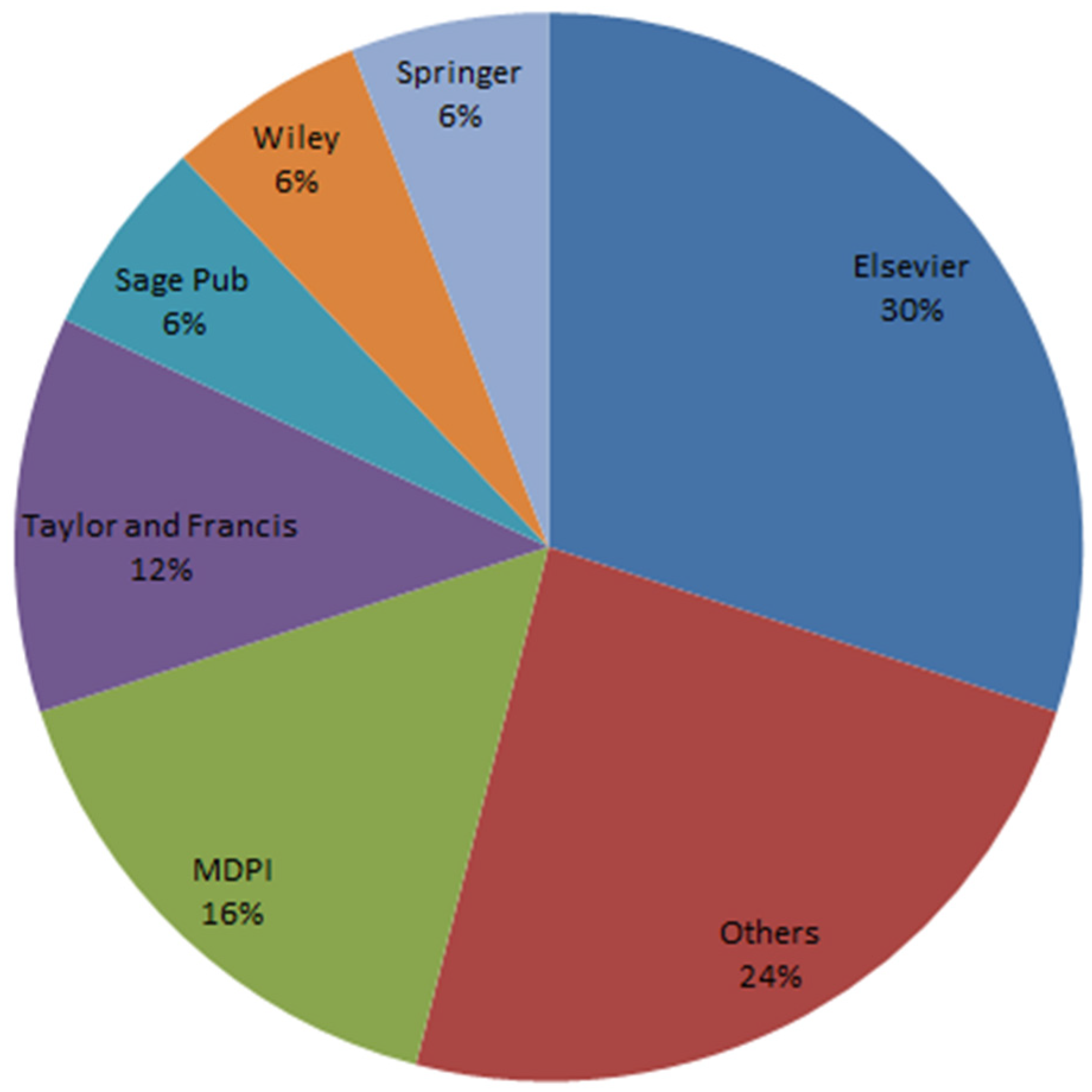
Figure 2, a total of 193 research works have been assessed and 120 were referenced. Extensive research has been conducted on synthetic fiber composites, particularly enset (also called false banana) fiber-reinforced polymer composites, in response to the growing demand for biodegradable materials. The literature from scholarly journals such as MDPI, Elsevier, Springer, Taylor and Francis, Wiley and Sage Pub was reviewed in this review article with an emphasis on fabrication techniques, treatments, matrix compatibility, inherent qualities, and real-world applications. Graphical illustration of the sources of the reviewed articles is shown in
Figure 2. Natural fiber, enset fiber, false banana fiber, mechanical characteristics, production methods, and fiber treatments were the keywords used to retrieve the published materials. The analysis gives a concise summary of the current status of composites reinforced with enset fiber, highlighting problems and outlining possible research directions to improve their qualities and performance.
The literature review was structured and executed with an emphasis on the following dimensions by reviewing related and recent published papers.
A critical examination of contemporary research about enset fiber and its associated processing techniques.
A synthesis of recent investigations into enset fiber-reinforced composites, encompassing their mechanical properties and water absorption behaviors, alongside their implications for prospective applications.
An analysis of the prevailing limitations and the identification of potential avenues for subsequent research endeavors.
3. Enset Fiber
Enset fibers, which are derived from the enset plant (
Ensete ventricosum), commonly known as false banana, remain underutilized agricultural by-products [
11]. The enset plant is indigenous to sub-Saharan Africa, particularly in the southern and southwestern parts of Ethiopia. It plays an essential role in sustainable indigenous agriculture by offering food security and resilience against drought [
9]. It provides fibers for various applications, serves as animal forage, yields construction materials, and carries medicinal benefits. It is extracted from the pseudostem and leaves of the plant and it is known for its strength and flexibility. There is also potential to obtain fibers from the leaf stalk and fallen sheath parts [
20]. The outer leaf sheaths are infrequently repurposed due to their inherent brittleness [
14]. According to data provided by the Central Statistical Agency (CSA) of Ethiopia, over one hundred million enset plants are harvested annually to supply starchy food for the nation. Based on this documentation, it is anticipated that approximately 150,000 tons of fiber will be generated each year [
9].
This plant is esteemed not only for its edible components but also for its fibers, which are often regarded as by-products. Nonetheless, these fibers possess considerable potential across various applications, encompassing textiles and construction materials. Enset fiber is crucial for sustainability, exhibiting a higher cellulose content and a lower lignin content when contrasted with other fibers, as delineated in
Table 1. The distinctive composition of enset fiber positions it as a promising candidate for the production of textiles and diverse technical products.
The fiber composition of enset is comparable to that of several significant plant fibers, as illustrated in
Table 2. Notably, enset fiber exhibits a cellulose concentration akin to that observed in bamboo, banana, and coir fibers [
20]. Moreover, natural fiber bundles are exceptionally efficient as reinforcements in composite materials and serve as superb candidates for paper pulp production due to their favorable chemical characteristics. To fully exploit the potential of enset fiber, it is imperative to employ low-chemical pre-treatment techniques, such as hydrothermal treatment, to effectively eliminate excess hemicellulose and particulate matter [
21].
In Ethiopia, the enset plant plays not only a crucial role as a food source but also provides fibers that are effectively utilized for rope and packaging [
5]. Recent research demonstrates its significant industrial potential, showcasing its biodegradability, impressive mechanical properties, low cost, and eco-friendliness. These attributes make it an ideal material for modern packaging, automotive, and construction applications [
11].
Studies have confirmed that enset fiber provides excellent reinforcement in composites, substantially enhancing tensile and flexural strengths [
20]. Although water absorption properties may vary depending on treatment methods, the advantages of enset fiber are compelling [
22,
23]. Despite these strengths, the full potential of enset fiber has not yet been fully realized. In terms of the challenges such as inconsistent data, a pressing need for further research to maximize its applications is sought [
5]. Ultimately, enset fiber stands out as a valuable resource for developing sustainable materials, significantly contributing to environmental conservation efforts.
Table 2.
Comparison of the chemical composition of various natural fibers with enset fiber [
20,
24].
Table 2.
Comparison of the chemical composition of various natural fibers with enset fiber [
20,
24].
| Fiber | Cellulose (%) | Hemicellulose (%) | Lignin (%) |
|---|
| Abaca | 72.7 | 14.6 | 8.5 |
| Banana | 57.6–62.5 | 19–29.1 | 5–13.3 |
| Coir | 32–46 | 0.15–0.3 | 40–45 |
| Cotton | 89 | 4 | 1 |
| Flax | 71–75.2 | 8.6–20.6 | 2.2–4.8 |
| Hemp | 68–74 | 15–22 | 4–10 |
| Pineapple | 80.5 | 17.5 | 8.3 |
| Ramei | 68.6–76.2 | 13–16 | <0.7 |
| Sisal | 60.78 | 10–22 | 8–14 |
| Enset | 57.2–64.46 | 22.47 | 6.88 |
3.1. Enset Fiber Extraction Methods
The enset fiber’s intrinsic qualities and qualitative characteristics are significantly impacted by the used extraction process. Aqueous retting and mechanical decortication have historically been the most widely used methods. The process of retting involves the submersion of plant material to separate fibers, followed by decortication to recover the fibers [
25,
26]. A biotechnological extraction technique that uses chemical and enzymatic agents, as reported in Zhang et al. [
27], can greatly increase extraction efficiency while also reducing structural damage and improving fiber quality. The enzymatic procedure described in the study by Liku et al. [
28] uses α-amylase to break down enset fibers into micro- and nanoscale pieces. With this technique, rust and other unnecessary materials are effectively removed, including hemicellulose and lignin, thereby ameliorating the fibers’ characteristics. The mechanical characteristics of the resulting fibers and their suitability for a variety of applications are directly impacted by the extraction technique, so choosing it carefully is crucial [
25]. The lignocellulosic components of enset fiber have a significant impact on the extraction techniques because of their chemical makeup. As an example, the Kraft pulping process can produce up to 69.92% pulp, which shows excellent recoverability and low energy consumption [
29]. Combining acid hydrolysis and ultrasonication yields a 77.69% yield in the field of nano-cellulose extraction. After lignin and hemicellulose are removed, the crystalline index rises to 80.91% [
30].
The extraction methodologies utilized for enset fiber and the quality of its derived products are closely associated with its chemical makeup, which in turn dictates the efficiency of different processing methods [
31,
32].
3.2. Enset Fiber Treatment and Preparation
Multiple factors impact the mechanical characteristics of polymers reinforced with natural fibers, including fiber treatment, orientation, loading, fiber type, matrix type, fiber dispersion, and bonding between fiber and matrix. Many researchers have examined the mechanical properties of natural fiber-reinforced composites after alkali treatment. The alkali treatment of composite materials with sodium hydroxide (NaOH) removes the lignin and hence enhances the performance of plant fibers and greatly strengthens the bond between the fibers and polymer matrices of thermoplastic composites. In particular, better fiber–matrix interlocking is promoted throughout the manufacturing process by the rougher surfaces of alkali-treated fibers [
33,
34]. According to Temesgen and Sahu [
35], the investigation of plain weave structure had higher failure during specimen test, yarn pull-out, void and yarn-to-resin debonding due to poor adhesion within the composite structure as confirmed from scanning electron microscopy (SEM) examination. It has been confirmed that biochemical treatments significantly increase enset yarn’s tensile strength. The fiber treatment also increases fiber–polymer matrix adhesion, decreases water absorption, and improves thermal stability [
36,
37,
38].
The importance of ensuring the ideal concentrations for alkali treatment is emphasized by numerous researchers. To improve the mechanical properties of enset fiber in composite applications, the use of a 5% NaOH solution is mostly recommended. According to studies [
39], this concentration significantly increases the tensile, flexural, and impact strengths of enset fiber-reinforced polylactic acid (PLA) composites, with peak values of 20.16 MPa, 30.21 MPa, and 12.02 kJ/m
2, respectively. Enset fibers treated with 5% NaOH have tensile and flexural moduli that are 55.8% and 70.3% higher than untreated fibers, respectively [
40]. According to the aforementioned study, 5% NaOH-treated fibers have 5.21% higher tensile strength and 9.25% higher flexural strength than untreated fibers. Furthermore, sisal and enset fibers treated with 5% NaOH had tensile strengths that were 51.5% and 31.67% higher, respectively, than untreated fibers [
41]. A 5% NaOH concentration is typically the most effective treatment for improving the mechanical properties of enset fibers in composite applications (
Table 3) [
15]. Generally, studies show that adding sodium hydroxide (5%) improves the mechanical properties of enset fiber-reinforced composites by increasing tensile and flexural strength by compared with 3%, 10%, and 15% of NaOH treated fiber.
To stabilize the composite material, a silane coupling agent with the chemical formula SiH
4 was used to aid the fiber’s adhesion to the matrix [
42,
43]. This coupling agent reduces the hydroxyl groups, yielding silanol. These agents improve the composite performance by strengthening the bond between fibers and matrices. As a result, covalent bonds between the reinforcement fiber and matrix caused the fiber to swell and form a crosslinked network.
According to Abraha et al. [
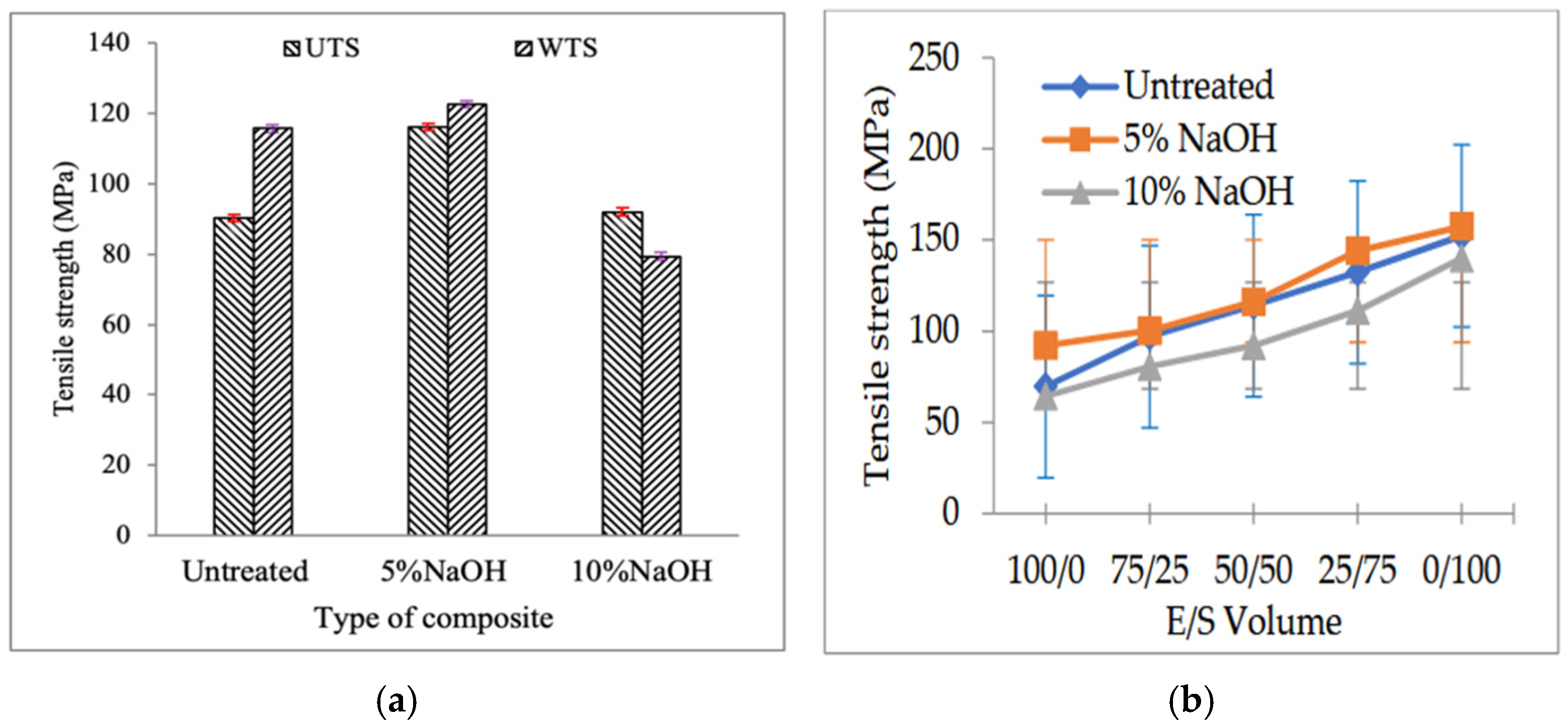
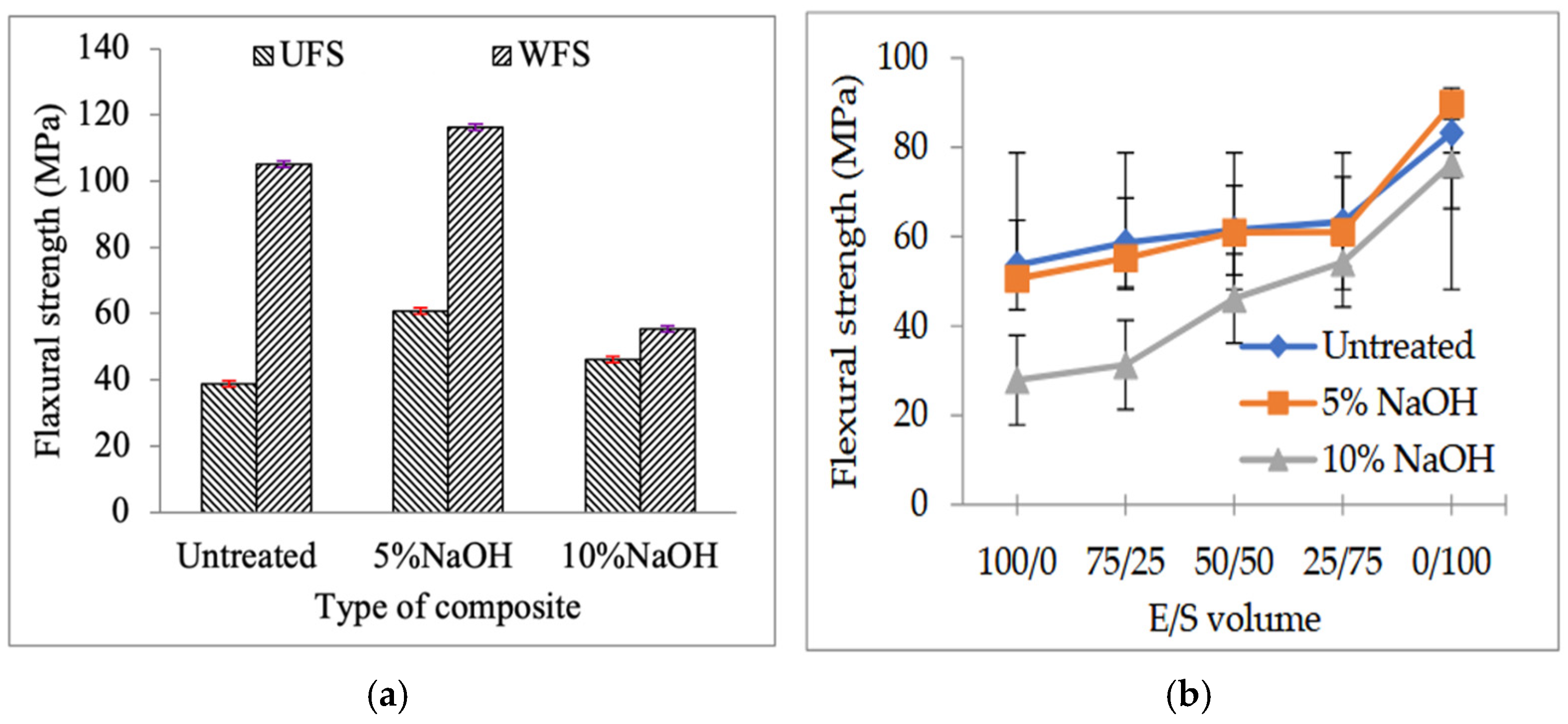
40], one effective technique is to modify enset fibers using NaOH or pectinase enzyme. These treatments enhance the fibers’ mechanical properties and compatibility with polymer matrices, such as PLA composites. For example, applying a 5% NaOH solution to the fibers significantly improves their tensile (
Figure 3) and flexural strength (
Figure 4). In contrast, pectinase treatment increases tensile strength and elongation at break even further [
40]. A process known as pre-hydrolysis soda pulping can be used to produce dissolving-grade pulp from enset fibers. This method starts with steam pretreatment and then pulps at controlled temperatures and alkali concentrations. As a result, the cellulose content is high, making it suitable for biogas and paper production applications [
21]. These methods show the versatility of enset fiber in producing sustainable materials for a variety of applications. The effect of treating fibers shows significant improvement in tensile strength, where research reported in [
44] indicated that it increased by 136.10%.
Chemical treatments can also enhance the thermal properties of fibers, making them better suited for high-temperature applications [
25]. Additionally, treatments lead to defibrillation and a reduction in fiber diameter, which can enhance the overall performance of composites [
44]. Chemical treatments can generally improve the properties of natural fibers, but there are growing concerns about their environmental impact. To address this, sustainable and environmentally friendly options have to be investigated.
4. Composite Fabrication Process
To produce polymer-based natural fiber composite, various manufacturing techniques are used. The techniques vary according to the properties, size, and cost of the component material [
14,
15,
16,
17,
38]. The fabrication methods, mostly hand lay-up and compression molding, are critical in developing sustainable enset fiber-reinforced polymer composites. These methods take advantage of natural fibers’ mechanical properties, improving the performance of polymer composites. The key aspects of these fabrication techniques are discussed in the following subsections.
4.1. Hand Lay-Up Method
The hand lay-up fabrication method is a popular way to create natural fiber-reinforced polymer composites. For composites of enset fibers, it uses the enset fiber and polyester or epoxy resin, with fiber volume fractions ranging from 10% to 40% [
46]. The resin is manually applied to the fibers, ensuring uniform distribution and adequate curing time [
14]. Researchers used this technique to investigate the mechanical properties of enset fiber-reinforced composites including tensile, flexural, and impact strength [
38,
47]. Hand lay-up molding is simple, versatile, and inexpensive, particularly for natural fiber-based. Composites made by hand lay-up show significant mechanical properties, with optimal fiber treatment and orientation increasing performance. Despite its advantages, hand lay-up presents challenges that must be managed to ensure consistent quality. The integrity of the fabricated composite component is strongly influenced by operator proficiency, which often introduces variability and irregularities in fiber distribution. Such inconsistencies typically necessitate secondary operations, including machining, that may lead to fiber pull-out, cracking, and other defects [
23,
40,
48,
49,
50]. In addition, the process can yield laminates of substandard quality with non-uniform thickness, thereby diminishing the overall mechanical performance of the composite.
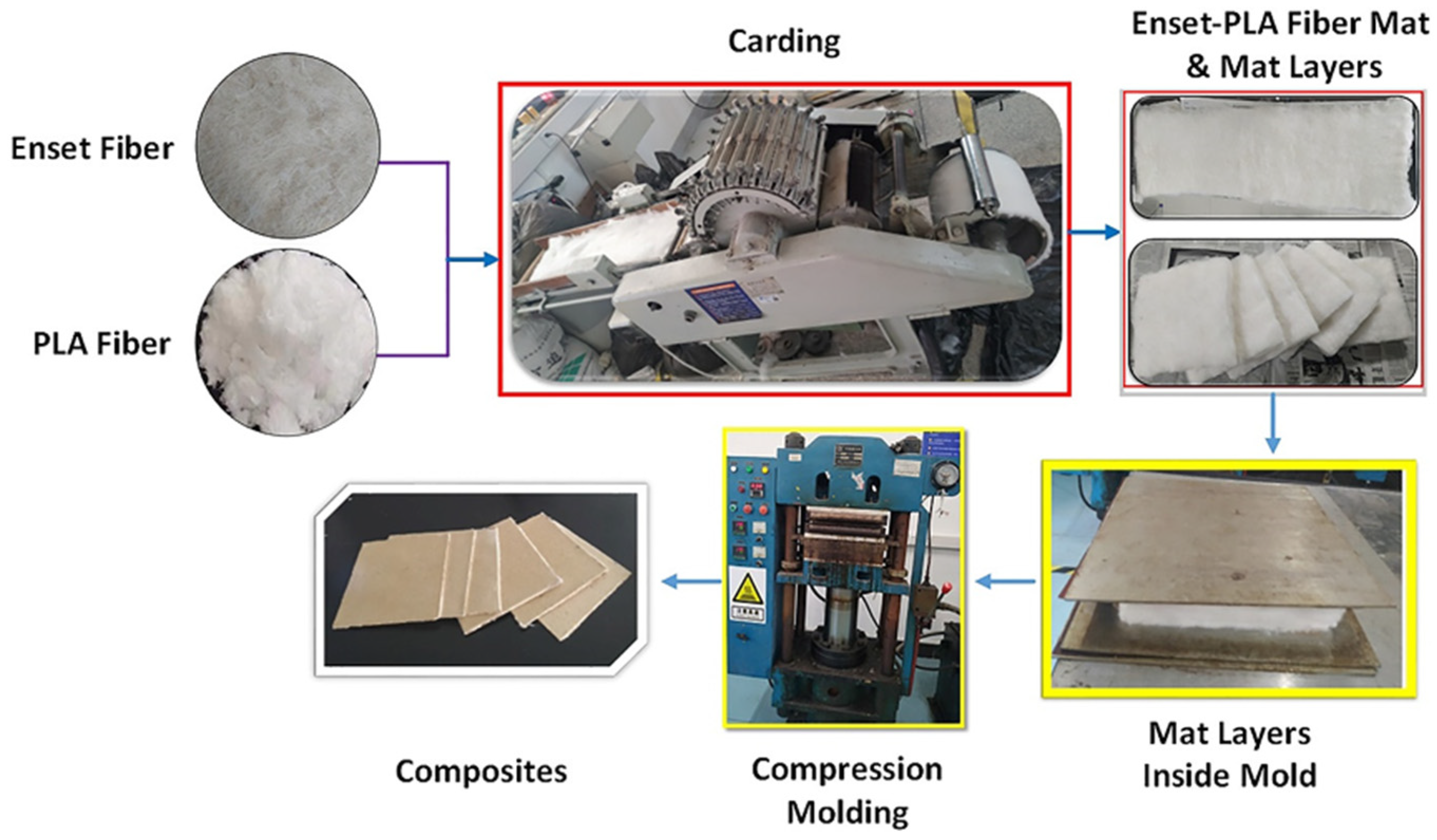
4.2. Compression Molding
Compression molding is a technique used to produce composite materials, typically reinforced with fiber of thermoset or thermoplastic materials [
12,
23]. This method creates complex shapes with minimal waste by pressing the fiber-reinforced material to deform within a mold cavity [
46,
51] as presented in
Figure 5. For enset fiber-reinforced composite production, compression molding is an effective method that leverages the properties of natural fibers and thermoset matrices [
39,
40]. The process enhances the mechanical and thermal properties of the composites, making them suitable for high-performance applications. Modifying parameters can improve performance and uniformity, addressing challenges like non-uniformity in complex geometry. The integration of enset fibers contributes to the development of sustainable and high-strength composite materials with superior mechanical properties compared to synthetic alternatives [
49]. However, as presented in Jaafar [
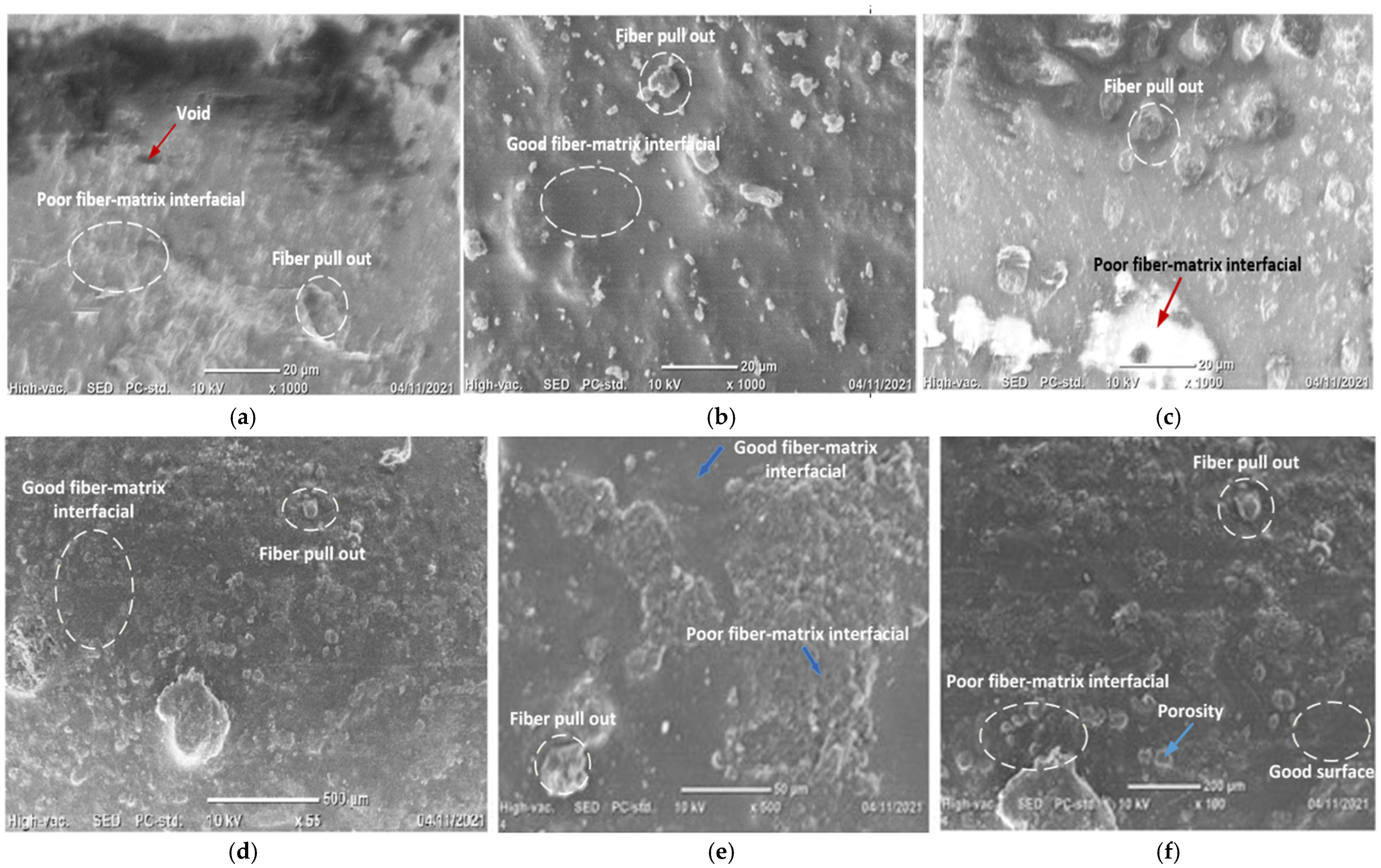
46], compression molding requires heat from 100 to 180 °C to melt thermoplastic or cure thermoset resin, which creates difficulty in uniformly distributing the fiber and poses persistent challenges, such as the degraded mechanical properties of natural fibers and the highly dependent output part on controlled parameters. The process is highly dependable on controlled variables, and it is open to formation defects such as porosity, cracks and fiber pull-out. Despite these challenges, compression molding offers opportunities for sustainable composite production.
4.3. Other Manufacturing Methods
In addition to hand lay-up and compression molding, natural fiber composites are manufactured using a variety of other advanced methods (
Table 4). resin transfer molding (RTM) is a popular technique that involves injecting resin into a mold containing dry fibers, resulting in high-volume production with superior surface finish and dimensional accuracy [
17]. Pultrusion, which pulls fibers through a resin matrix and shapes them in a die, is an effective method for creating long, uniform cross-sectional profiles [
52]. Vacuum bagging, which involves using a vacuum to remove air and excess resin, produces high quality composites with few voids, especially for complex geometries. Furthermore, autoclave molding uses high pressure and temperature to improve the mechanical properties of composites, making them suitable for aerospace applications [
17]. Lastly, filament winding involves winding fibers around a mandrel, producing structures with high strength-to-weight ratios, commonly used in industrial applications [
53].
Recent technological advances such as 3D printing/additive manufacturing, artificial intelligence and robotics have shown significant benefits in advancing the production processes of fiber-reinforced composites. Nevertheless, enset fiber-reinforced polymer composites still face limitations in their fabrication techniques, which are dominated by conventional methods such as hand lay-up, compression molding and injection molding. In the current scenario, the advances in additive fabrication technologies particularly can bring a new dimension to the fabrication of products with minimum waste and less time with better qualities. This approach may reduce human errors, waste and production time, while enhancing uniformity and quality. Thus, future trends include the adoption of other techniques such as 3D printing to fabricate better quality enset fiber-reinforced composites. For instance,
Table 4 presents cases where different fabrication methods were employed for natural fiber-based composites. Among these, the use of 3D printing is reported to have good surface finish and fiber distribution.
In particular, 3D printing has grown in popularity over the last decade due to its ability to produce a diverse range of products with complex shapes and adequate mechanical properties at a low cost. Prototypes, models, spare parts, and other items have all been created using 3D printing in the aerospace, automotive, biomedical, and construction industries. Binder jetting, direct ink writing, fused deposition modeling (FDM), powder bed fusion, sheet lamination, stereolithography apparatus (SLA), vat photopolymerization, and others are among the techniques used in 3D printing. FDM in particular is currently used to print with a wide range of materials, and various techniques are being investigated, including thermoplastic filament and granule mixtures, short fibers, and continuous fibers impregnated with thermoplastic filaments [
54].
5. Mechanical Properties of Enset Fiber-Reinforced Composites
Several studies investigated and optimized the mechanical properties of enset fiber and enset fiber-reinforced composites. Enset fiber has promising mechanical properties, making it a viable reinforcement option. The enset fiber’s tensile strength ranged from 125 to 184 MP, consisting of approximately 58.16% cellulose, 23.64% hemicellulose, and 11.12% lignin, improving its mechanical integrity, while the low moisture content contributed to dimensional stability [
60]. Furthermore, biodegradability and eco-friendliness are consistent with the growing demand for sustainable materials in industries such as packaging and automobiles [
11,
23]. However, more research is needed to precisely identify and optimize its properties for advanced applications [
5]; for instance, fiber orientation is one of the dominating factors in the mechanical properties. As presented in [
12], a tensile strength of 181.41 MPa and a flexural strength of 81.43 MPa were obtained for recorded optimal specific fiber orientation of 0° and 90°, respectively.
On the other hand, when enset fiber is modified through various treatments, it acquires several key mechanical properties that improve its suitability for composite applications. Furthermore, the structural properties of the fiber, such as its cross-sectional shape, orientation, and fiber dispersion throughout the matrix, have significant impact on its tensile properties. For the overall efficiency of the composite, optimal shape, orientation, and dispersion contribute more strength [
60]. These advancements make enset fiber a promising candidate for eco-friendly composite materials in a variety of applications, including the automotive and packaging industries [
39,
40].
5.1. Effects of Geometric Structure
The geometric structure of enset fibers significantly influences their mechanical properties in composite materials. As a general variation in shape with a larger perimeter-to-area ratio, the properties demonstrate weaker tensile strength, Young’s modulus, and strain-to-failure values [
61,
62]. Accurate diameter estimation, which considers the internal cavity of the fibers, is crucial for determining true tensile strength, as conventional microscopy often overestimates external diameters [
63,
64,
65]. The treatment of fibers, such as with sodium hydroxide, enhances interfacial adhesion and mechanical performance, leading to improved tensile and flexural strength of composites [
39]. Furthermore, the position of fibers along their length also affects their physical and mechanical properties, with tensile strength peaking at specific segments [
66]. Collectively, these factors underscore the importance of geometric structure in optimizing the performance of enset fiber-reinforced composites.
5.2. Effect of Fiber Orientation
Fiber orientation is important in composite material fabrication because it influences tensile strength, stiffness, and impact resistance of the material. Among others, the proper alignment of the fibers improves load distribution and energy absorption, resulting in better performance under a variety of stress conditions (
Figure 3a and
Figure 4a) [
67,
68,
69]. Mechanical properties differ significantly in different directions, and variations in fiber orientation can cause anisotropic behavior, making it critical to optimize fiber placement for specific applications [
69,
70,
71]. Thus, engineers and designers must understand the impact of fiber orientation for the specific demands of applications ranging from aerospace to automotive that require tailored composite materials. Beyond mechanical performance, optimizing fiber orientation contributes to weight reduction and cost efficiency, resulting in more sustainable engineering solutions [
67,
71]. This optimization process includes advanced modeling techniques as well as experimental validation to ensure that the composite materials achieve the desired properties, paving the way for high-performance structure innovations. To predict the behavior of composite materials under various loading conditions with greater accuracy, engineers can use computational methods and simulation tools to speed up the optimization process [
68]. This predictive capability enables the design of materials that can withstand extreme environments, ensuring reliability and safety in critical applications while reducing material waste. The ongoing research in this field is also focused on developing bio-based, environmentally friendly materials to meet the growing demand for sustainable materials in engineering. As industries grow, expect bio-based materials to become more adaptable and sustainable, ushering in a new era of environmentally conscious design and manufacturing practices [
68]. Water absorption is also affected by fiber orientation [
15,
45,
66]. According to Bekele and Lemu [
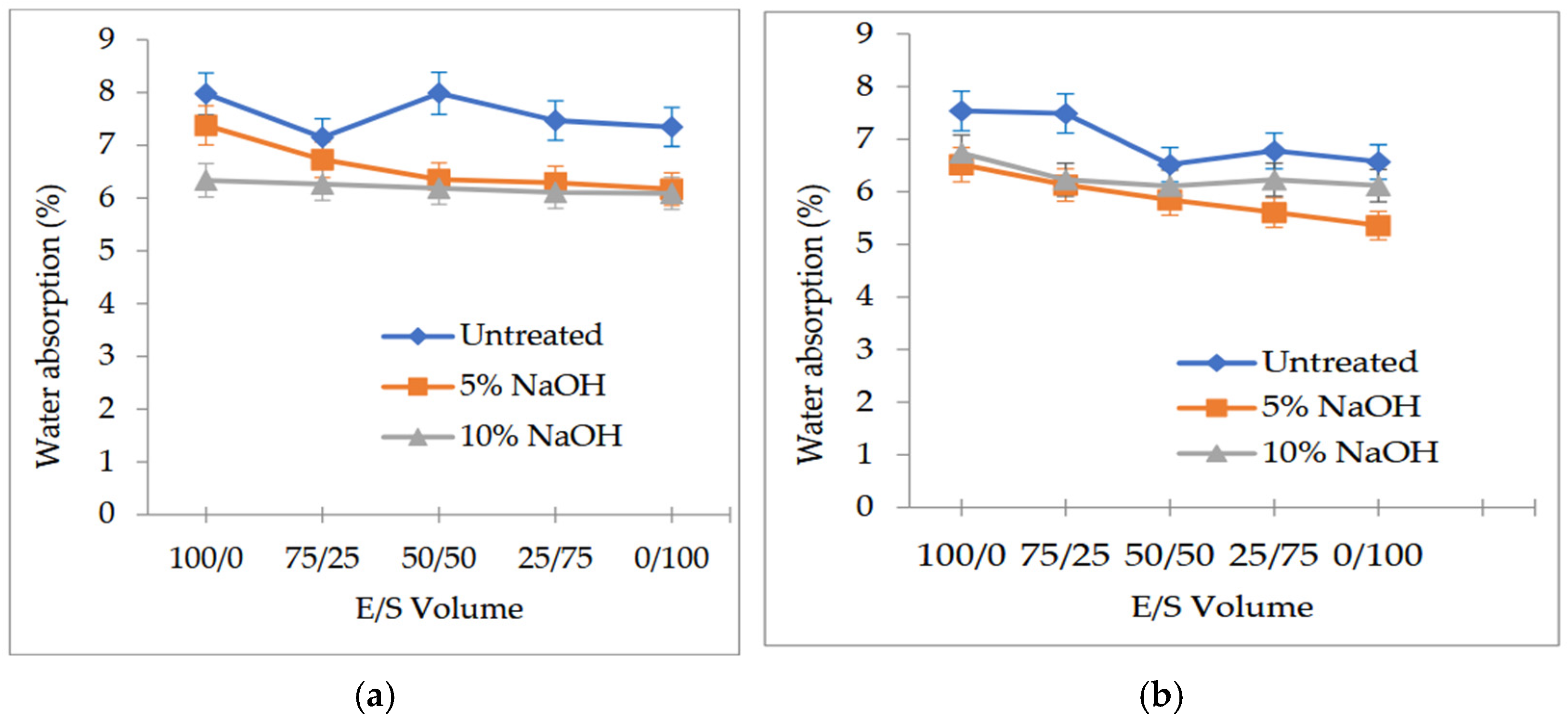
46], the water absorption behavior of untreated and NaOH-treated (5% and 10%) enset/sisal hybrid composites shows that increasing enset content increases moisture uptake. In contrast, sisal hybridization and fiber treatment significantly reduce it. Woven composites consistently exhibit lower water absorption than unidirectional ones, with 5% NaOH treatment enhancing interfacial bonding and minimizing moisture ingress-mirroring trends observed in mechanical performance (
Figure 6). Optimal fiber orientations can reduce moisture diffusion and increase the longevity of fiber–matrix composites [
66]. The increased volume fraction of plantain fibers in bio-composites resulted in higher moisture absorption, indicating that fiber characteristics are important [
68]. Overall, fiber orientation is critical in regulating water absorption in composite materials.
Furthermore, moisture absorption in enset–PLA composites varies with fiber volume fractions, with the highest absorption observed at 25% fiber content, resulting in significant tensile and bending strength reductions due to moisture effects [
15]. Optimizing fiber orientation and treatment can improve the performance and durability of enset fiber-reinforced composites in moist environments.
Generally, various studies have shown that the orientation of fibers has a significant influence on the mechanical properties of enset fiber-reinforced polymer composites. Woven fiber orientations, in particular, have been shown to outperform unidirectional configurations in terms of mechanical performance [
15,
45]. For example, enset/sisal hybrid composites with woven fibers improved tensile and flexural strengths by 5.21% and 9.25%, respectively, compared to untreated composites (
Figure 7) [
15]. Similarly, studies on jute fiber composites found that fibers aligned in the testing direction had higher stress but lower strain than those aligned at a 45° angle, emphasizing the importance of fiber alignment in optimizing mechanical behavior [
72]. Overall, these results highlight the importance of fiber orientation in improving the mechanical properties of natural fiber-reinforced composites.
5.3. Effect of Fiber Dispersion in Polymer Matrix
The fiber–matrix compatibility in composite materials matters for the properties of the resultant material. The hydrophobic nature of the polymer and the hydrophilic nature of the fiber are big challenges for the composite preparation. The nature of the matrix and the reinforcement may lead to incompatibility due to natural fibers having low moisture resistance and polymer materials being prone to agglomeration. The adhesion and load transfer capacity of the composite are noticeably reduced by agglomeration, attributable to inadequate dispersion of matrices such as polypropylene, polyethylene, and polystyrene when combined with natural fiber, resulting in poor mechanical strength [
67].
In adhesive systems, effective bonding requires the adhesive substrate attraction to exceed the cohesive forces within each material, a principle similarly applied to composite systems [
73]. Fillers tend to aggregate via hydrogen bonding, particularly on hydroxyl-rich cellulose surfaces, due to strong fiber–fiber interactions [
74]. Adhesion is fundamentally governed by interatomic and intermolecular forces at the interface, a concept explored across disciplines including surface chemistry, polymer physics, rheology, and fracture mechanics [
75]. On the other hand, treating the fiber with various chemicals significantly improves the surface and the ability of the fiber for moisture uptake. With an enhanced fiber surface, the distribution within the matrix potentially improves. The most popular chemical treatment is alkali treatment to remove impurities and unwanted parts from the fiber, which is dissolved by a base. Moreover, coupling agents such as silane and stearic acid can reduce both fiber–matrix interactions and fiber entanglement [
16]. Furthermore, to achieve a strong composite with uniform distribution, fiber bundles must be separated using the proper processing parameters. Individual large-diameter fiber bundles can impede effective stress transfer between the fiber and the matrix, so it is critical to ensure high mixing energy while preventing fiber breakage [
68].
5.4. Effects of Adding Nanoparticles
According to the literature, adding nanoparticles to enset fiber-reinforced polymer composites improves their mechanical properties and functionality. Beyan et al. [
30] found that adding silica nanoparticles to epoxy resin at the optimal concentration increased fracture toughness and impact strength by up to 49%. Nanoparticles also improve the overall performance of the composite by enhancing adhesion and stress transfer [
22,
76,
77]. The use of in situ fiber-forming techniques allows the creation of composite materials with higher strength and lower density, making them suitable for various applications [
78]. Furthermore, incorporating nanoparticles broadens the applications of natural fiber-reinforced polymer composites in different fields while also boosting thermal and water resistance properties [
79,
80,
81].
Dejene and Gudayu [
22] investigated that integrating ZnO NPs into enset fiber significantly improved both the performance and functional properties of the composites, whereas using enset fiber as reinforcement improved the performance properties but decreased the functional properties of the composites. Finally, this study discovered an optimal formulation of the nano-composite for producing durable and functional composites for a variety of packaging applications. In conclusion, the strategic use of nanoparticles offers a promising way to improve the capabilities of enset fiber-reinforced polymer composites.
Nanoparticles have the potential to improve mechanical properties, interfacial bonding between enset fibers and polymer matrix, composite durability and longevity in demanding applications, and thermal stability [
77]. This enhancement can produce composites that are not only lighter and stronger but also more resistant to environmental factors, making them suitable for use in the automotive, aerospace, and construction industries [
74,
82,
83,
84,
85]. Furthermore, the unique properties of nanoparticles can aid in improved energy absorption and impact resistance, which is critical in applications requiring high-performance materials [
76].
These advancements in enset fiber-reinforced polymer composites not only promise to improve mechanical properties but also open up new avenues for innovation in sustainable material development, in line with the growing demand for eco-friendly solutions across a wide range of industries [
86]. This shift toward sustainable materials is motivated by the desire to reduce environmental impact while maintaining high performance, prompting researchers to investigate alternative natural fibers such as enset as viable composite options [
87,
88]. This research paves the way for a new generation of materials that not only meet performance standards but also help to create a more sustainable future in manufacturing and construction. The incorporation of natural fibers into composite materials not only reduces reliance on synthetic resources but also promotes the use of renewable materials, further enhancing the sustainability profile of various applications [
89,
90].
6. Applications of Enset Fiber-Reinforced Polymer Composites
Enset fiber-reinforced polymer composites have garnered attention for their diverse application areas due to their enhanced mechanical properties and eco-friendly nature. The modifications applied to enset fibers, such as pectinase enzyme treatment, significantly improve their compatibility with polymer matrices, making them suitable for various industries such as automotive, aerospace, defense, medical, packaging and many more. Below are the key application areas identified in the literature.
6.1. Automotive Industry
The incorporation of enset fiber-reinforced polymer composites within the automotive sector represents a promising opportunity for the enhancement of various interior components [
40]. These composites exploit the distinctive properties of enset fibers, which are characterized by their low density, renewability, and mechanical robustness. The flexural strength of enset fiber composites ranges from 45 MPa to 215 MPa, making them suitable for structural applications within the vehicle interior [
15,
40,
48,
91]. For instance, the cushioning and support structure in automotive seats can be reinforced with an enset composite, enhancing durability and comfort while maintaining a lightweight profile [
92,
93,
94]. The composites’ impact toughness and fatigue strength make them ideal for high-use areas like seat frames and backrests.
In the era of sustainability and eco-friendly materials, integrating a natural fiber like enset fiber into automotive applications promises a stride towards biodegradable vehicle manufacturing. These bio-based composites provide high performance with reduced weight, which is suitable for interior design. It is capable of high mechanical strength and environmental benefits, making it applicable for parts of the automotive industry such as panels and structural reinforcement.
Furthermore, the use of locally available materials like enset fiber reduces carbon footprint during fabrication, manufacturing cost, and supports circular economies as well. Generally, for the broader application of the fiber for automotive industries and beyond, research and development play an essential role in optimizing the durability and fabrication technique.
6.2. Packaging
Enset fiber-reinforced composites present a promising alternative for sustainable packaging applications, addressing environmental concerns associated with traditional petroleum-based materials [
4,
15,
95]. Nowadays, conventional plastic packaging is being replaced by biodegradable materials for the growing demand for eco-friendly material, and their high mechanical strength and renewability [
96,
97]. Research indicates that surface treatments, particularly pectinase enzyme modification, significantly enhance the mechanical properties of enset fiber-reinforced polylactic acid (PLA) composites, achieving increased tensile strength by 55.99% and flexural strength by 51.85% [
40]. Additionally, hybrid composites combining enset and sisal fibers with polyethylene matrices exhibit superior mechanical performance, with tensile strengths reaching 66 MPa [
98]. The shift towards biodegradable materials, including those derived from agricultural waste like enset fibers, is crucial for reducing landfill waste and promoting eco-friendly packaging solutions [
99,
100]. Generally, the use of enset-based composites in packaging offered a transformative step on the road to dropping plastic dependency and enhancing sustainability. These materials combine biodegradability with high strength and stiffness, making them fit for a wide range of packaging designs from trays and containers to cushioning and wraps [
101]. Their origin from renewable agricultural resources like enset not only reduces ecological effects but also adds worth to underutilized crops. To satisfy buyer demand for greener products, and industry goals for sustainable development, as innovation in bio-composite manufacturing advances, enset-based packaging stands poised to meet both.
6.3. Other Applications
Beyond automotive, bio-composites and packaging applications, enset fibers are being explored as construction materials for paper production and textiles. Temesgen et al. [
101] recommended that after harvesting Kocho from the enset pseudo-stem, the remaining cellulose fiber has the potential to make high-value eco-friendly technical materials like biodegradable composite, geo-textile, agro-textile, and packaging mats, which give high strength without any finishing. In the construction industry, for instance, traditional materials are replaced by composite materials for infrastructure projects such as bridges and buildings due to their superior durability and resistance to environmental degradation [
102,
103]. Additionally, enset fiber composites can be used in soil erosion prevention applications like sheet piles to prevent soil erosion, showcasing their versatility in civil engineering [
104]. While enset fiber composites present numerous advantages, challenges such as moisture absorption and variability in mechanical properties remain, necessitating further research to optimize their performance across all potential applications.
Variability in fiber quality and the need for effective processing methods limit the use of enset fibers in composite materials. To realize the full potential of fibers in sectors like construction, automotive, and textiles, researchers are looking at creative ways to standardize fiber quality and enhance processing procedures (
Table 5). Standardized procedures for processing and evaluating quality will guarantee commercial viability and lessen the impact on the environment. Research and development funding will hasten the introduction of composites made of false banana fiber into traditional markets, advancing sustainable materials and a circular economy.
7. Discussions, Current Challenges and Future Perspectives
The existing challenges in the production and application of enset fiber-reinforced composites stem from various interconnected factors. One major problem is the inherent inconsistency of natural fibers, which complicates standardization and consistent performance across batches. This variability, influenced by cultivation, harvesting, climate, geographical location, and processing conditions, limits industrial scalability and benchmarking. Additionally, high moisture absorption, poor fiber–matrix compatibility, and inconsistent mechanical properties all limit the overall effectiveness of the composites [
40]. Furthermore, fiber orientation, alignment, dispersion, concentration, and treatment methods significantly affect mechanical properties [
49,
108]. Hybridizing enset with other fibers, such as sisal, leads to notable increase in tensile and flexural strengths; however, a careful balance of these properties is necessary to optimize performance [
41]. The manufacturing route of composite materials exerts a direct influence on efficiency. Conventional molding techniques frequently require post-processing, such as machining, which can introduce defects including cracks, voids, fiber pull-out, and delamination. These challenges necessitate carefully optimized cutting parameters and skilled operators to ensure product quality [
109]. Addressing such limitations is critical in advancing the sustainable application of enset fiber composites. In contrast, additive manufacturing offers a promising alternative by eliminating the need for secondary processing, reducing operator dependency and achieving more uniform fiber dispersion.
The low fiber–matrix compatibility observed in enset fiber-reinforced composites is primarily caused by a number of interconnected factors. Initially, the hydrophilic properties of natural fibers, such as enset, complicate wetting by hydrophobic polymer matrices, resulting in voids and suboptimal interfacial bonding during the manufacturing process [
110]. The multilayered structure of natural fibers necessitates a thorough understanding of the interfacial interactions between these layers, which can complicate compatibility [
111,
112].
Geometric differences among enset fibers play a significant role in this compatibility issue, where fibers with higher perimeter-to-area ratios typically have poorer tensile properties, affecting the composite’s overall performance [
61]. Furthermore, untreated enset fibers exhibit high moisture absorption and inconsistent mechanical properties, which can exacerbate compatibility issues [
113,
114]. Surface modification techniques, such as pectinase treatment, have shown promise in improving fiber–matrix interactions, thereby improving mechanical properties and addressing compatibility concerns [
40,
67].
Several important factors influence the high moisture absorption compatibility of enset fiber-reinforced composites, including fiber volume fraction, plasticizer content, and fiber chemical treatment. According to studies [
23,
62,
115], moisture uptake varies significantly with fiber ratios, with maximum absorption occurring at 25% fiber volume, whereas increasing plasticizer content improves moisture resistance. Furthermore, chemical modifications, such as chemical and enzyme treatment, improve interfacial adhesion between the fiber and matrix, lowering water absorption and improving mechanical properties [
39]. The inherent hydrophilicity of natural fibers promotes moisture absorption, which can degrade their mechanical properties over time [
116,
117]. Understanding these factors is critical for improving the performance and longevity of enset fiber-reinforced composites in humid environments.
For the future, to optimize the properties of the fiber and the composites, proper surface treatment with various chemicals and modifying through coupling agents can significantly improve the compatibility of fiber and matrix materials. On the other hand, fiber hybridization with other natural fibers, nanoparticles, bio-based resins, and synthetic fibers may enhance the mechanical strength of the composites. Finally, familiarizing recently advancing manufacture techniques for composite preparation such as 3D printing benefits the fabrication of adequately functional and sustainable products demanding no post processing such as machining.
8. Conclusions
Natural fiber-based polymer composites have obtained significant attention across various industries due to their high strength-to-weight ratio, renewability, biodegradability, and superior surface finish. By replacing synthetic fibers with natural alternatives, these composites contribute to environmental protection, minimize waste, and promote sustainability. This shift reflects a return to nature, enabling the development of eco-friendly materials that balance performance with responsibility towards the environment.
Adapting the use of natural fibers such as enset fibers in polymer composites presents several challenges. The primary difficulties include the extraction of fibers from the plant; fibers vary depending on climate conditions, location, soil type and method of extraction. Secondly, for minimizing the hydrophilicity of the fiber, treatment and surface modification are mandatory tasks in composite preparation process as observed from the review; trying-out the optimal chemical, method and amount are also challenges in composite manufacturing, as well as the preparation and fabrication of the composites. As a result, alkali (5 wt.%) and silane coupling is the optimal treatment recorded from this review. Thirdly, the manufacturing technique has its own effect on the composite properties, since the extraction of enset fibers is limited to hand lay-up and molding, having a drawback of a lack of property consistence, depending on the experience and non-uniform distribution of the fibers. Selection of the manufacturing technique is also primarily determined by the product’s design, geometry, and intended function.
In this review, both the advantages and limitations of conventional processes are examined. To address these limitations, additive manufacturing is recommended, as it provides enhanced design flexibility, reduces material waste, and enables rapid prototyping of products. Furthermore, enhancing the properties of these composites requires addressing issues such as fiber–matrix compatibility, fiber loading, fiber orientation, and the optimization of manufacturing techniques. To overcome these challenges, extensive research has been reported, aimed at improved methods and obtaining innovative solutions for the effective utilization of natural fiber-based composites.
From the conducted review, it has been observed that researchers have developed a variety of methods to achieve optimal properties and strength, with enset fibers standing out for their mechanical properties and water absorption characteristics. These composites are used in many industries, including packaging, construction, and biodegradable applications. However, significant challenges remain, hindering the full utilization of their capabilities, and only a few fabrication techniques have been thoroughly investigated.
Thus, future research and development is recommended to focus on modern manufacturing techniques, particularly additive manufacturing technologies, which have not yet been investigated for enset fiber use in composites. The discovery of new applications and market opportunities, particularly in the textile and biomedical industries, is also an important area of research.
Author Contributions
Conceptualization, T.T.T. and H.G.L.; methodology, T.T.T. and E.M.G.; validation, H.G.L.; formal analysis, T.T.T.; investigation, T.T.T.; resources, T.T.T. and H.G.L.; data curation, T.T.T.; writing—original draft preparation, T.T.T.; writing—review and editing, T.T.T. and E.M.G.; visualization, T.T.T.; supervision, H.G.L. and E.M.G.; project administration, H.G.L. and E.M.G. All authors have read and agreed to the published version of the manuscript.
Funding
This study was supported by Norway Grants (The Norwegian Agency for Development Cooperation) in the NORHED II program through the INDMET project (grant number 62862).
Institutional Review Board Statement
Not applicable.
Informed Consent Statement
Not applicable.
Data Availability Statement
No new data were created or analyzed in this study.
Acknowledgments
The financial support provided by the Norway Grants through the INDMET project for the PhD study of the first author is highly appreciated.
Conflicts of Interest
The authors declare no conflicts of interest.
References
- Jadhav, A.; Jadhav, N.; Annaldewar, B. Natural fiber-based composites and their applications. In Advances in Renewable Natural Materials for Textile Sustainability, 1st ed.; Shahid, M., Mallick, A., Debnath, S., Eds.; CRC Press: Boca Raton, FL, USA, 2024. [Google Scholar]
- Munimathan, A.; Muthu, K.; Subramani, S.; Rajendran, S. Environmental behaviour of synthetic and natural fibre reinforced composites: A review. Adv. Mech. Eng. 2024, 16, 16878132241286020. [Google Scholar] [CrossRef]
- Raissova, K.A. Investigation of the enzymatic degumming and steam explosion’s impact on the chemical and biological properties of the natural fibers. Eurasian J. Appl. Biotech. 2024, 12, 135. [Google Scholar] [CrossRef]
- Basuk, M.; Yadav, A. Eco-friendly natural fibers based sustainable agro-textiles for packaging of agro-products. In Advances in Renewable Natural Materials for Textile Sustainability; CRC Press: Boca Raton, FL, USA, 2024; pp. 37–53. [Google Scholar]
- Badanayak, P.; Jose, S.; Bose, G. Banana pseudostem fiber: A critical review on fiber extraction, characterization, and surface modification. J. Nat. Fibers 2023, 20, 2168821. [Google Scholar] [CrossRef]
- Dejene, B.K. False banana (Enset ventricosum) fibers: An emerging natural fiber with distinct properties, promising potentials, challenges and future prospects–A critical review. J. Nat. Fibers 2024, 21, 2311303. [Google Scholar] [CrossRef]
- Tenaye, T.; Mohammed, S.A.; Jabasingh, S.A. Sustainable synthesis and characterization of Enset cellulose nanocrystals (E-CNp) from Enset ventricosum biomass and its application in the fabrication of Enset cellulose nanocomposite (E-CNc). Biomass Convers. Biorefin. 2024, 14, 5019–5034. [Google Scholar] [CrossRef]
- Rajkumar, R.; Manikandan, A.; Saravanakumar, S.S. Physicochemical properties of alkali-treated new cellulosic fiber from cotton shell. Int. J. Polym. Anal. Charact. 2016, 21, 359–364. [Google Scholar] [CrossRef]
- Addis, L.B.; Sendekie, Z.B.; Habtu, N.G.; Schubert, D.W.; Roether, J.A.; Boccaccini, A.R. False banana fiber reinforced geopolymer composite–A novel sustainable material. Ceram. Int. 2024, 50, 24442–24450. [Google Scholar] [CrossRef]
- Díaz-Batista, D.; Valin-Rivera, J.L.; Brandtner-Hafner, M. Natural fibers: An important source in material design. In Biopolymers; Elsevier: Amsterdam, The Netherlands, 2023; pp. 99–130. [Google Scholar]
- Dejene, B.K.; Geletaw, T.M. A review on false banana (Enset ventricosum) fiber reinforced green composite and its applications. J. Nat. Fibers 2023, 20, 2244163. [Google Scholar] [CrossRef]
- Wondmagegnehu, B.; Alemayehu, Z. Synthesis and characterization of mechanical and physical properties of false banana (ʾənäsätə) fiber reinforced composite material. Ethiopian Int. J. Eng. Techno. 2023, 1, 49–61. [Google Scholar]
- Khalil, H.A.; Davoudpour, Y.; Saurabh, C.K.; Hossain, M.S.; Adnan, A.S.; Dungani, R.; Paridah, M.T.; Sarker, M.Z.; Fazita, M.N.; Syakir, M.I.; et al. A review on nanocellulosic fibres as new material for sustainable packaging: Process and applications. Renew. Sustain. Energy Rev. 2016, 64, 823–836. [Google Scholar] [CrossRef]
- Blomme, G.; Kearsley, E.; Buta, S.; Chala, A.; Kebede, R.; Addis, T.; Yemataw, Z. Enset production system diversity across the southern Ethiopian highlands. Sustainability 2023, 15, 7066. [Google Scholar] [CrossRef]
- Bekele, A.E.; Lemu, H.G.; Jiru, M.G. Study of the effects of alkali treatment and fiber orientation on mechanical properties of enset/sisal polymer hybrid composite. J. Compos. Sci. 2023, 7, 37. [Google Scholar] [CrossRef]
- Dutt, A.; Shukla, A.D.; Singh, A.K.; Narayanan, A. A hydrous sub-arc mantle domain within the northeastern Neo-Tethyan ophiolites: Insights from cumulate hornblendites. Geochemistry 2024, 84, 126122. [Google Scholar] [CrossRef]
- Kamarudin, S.H.; Mohd Basri, M.S.; Rayung, M.; Abu, F.; Ahmad, S.B.; Norizan, M.N.; Osman, S.; Sarifuddin, N.; Desa, M.S.; Abdullah, U.H.; et al. A review on natural fiber reinforced polymer composites (NFRPC) for sustainable industrial applications. Polymers 2022, 14, 3698. [Google Scholar] [CrossRef]
- Tyagi, A.; Meena, A.; Bhandari, M.; Shahid, M.; Gupta, B.L.; Meena, S.L. A critical review on additive manufacturing of sustainable NFRCs: Processing and applications. Green Mater. 2024, 14, 15–25. [Google Scholar] [CrossRef]
- Elser, I.; Buchmeiser, M.R. Toward Sustainable fiber-reinforced polymer composites. Macromol. Mater. Eng. 2024, 309, 2400013. [Google Scholar] [CrossRef]
- Teli, M.D.; Terega, J.M. Chemical, physical and thermal characterization of Ensete ventricosum plant fibre. Int. Res. J. Eng. Technol. 2017, 4, 67–75. [Google Scholar]
- Berhanu, Y.; Angassa, A.; Aune, J.B. A system analysis to assess the effect of low-cost agricultural technologies on productivity, income and GHG emissions in mixed farming systems in southern Ethiopia. Agric. Syst. 2021, 187, 102988. [Google Scholar] [CrossRef]
- Dejene, B.K.; Gudayu, A.D. Achieving performance and functionality in PLA-based packaging: Insights from hybrid composites with false banana (Enset) fiber and ZnO nanoparticles. J. Thermoplast. Compos. Mater. 2025, 38, 2138–2168. [Google Scholar] [CrossRef]
- Wondmagegnehu, B.T.; Alemayehu, Z.; Yohannes, G.; Gulte, E. Development and characterization of false banana (enset) fiber reinforced composite material. J. Nat. Fibers 2022, 19, 12347–12360. [Google Scholar] [CrossRef]
- Chauhan, V.; Kärki, T.; Varis, J. Review of natural fiber-reinforced engineering plastic composites, their applications in the transportation sector and processing techniques. J. Thermoplast. Compos. Mater. 2022, 35, 1169–1209. [Google Scholar] [CrossRef]
- Sinha, S.; Devnani, G.L. Natural Fiber Composites: Processing, Characterization, Applications, and Advancements; CRC Press: Boca Raton, FL, USA, 2023. [Google Scholar]
- Sathish, S.; Karthi, N.; Prabhu, L.; Gokulkumar, S.; Balaji, D.; Vigneshkumar, N.; Ajeem Farhan, T.S.; Akilkumar, A.; Dinesh, V.P. A review of natural fiber composites: Extraction methods, chemical treatments and applications. Mater. Today Proc. 2021, 45, 8017–8023. [Google Scholar] [CrossRef]
- Zhang, L.; Hu, Y. Novel lignocellulosic hybrid particleboard composites made from rice straws and coir fibers. Mater. Des. 2014, 55, 19–26. [Google Scholar] [CrossRef]
- Liku, E.T.; Desissa, T.D.; Huluka, A.W. Extraction and characterization of lignocellulosic fiber from Prosopis Juliflora bark: Effects of retting method, fiber particle size and alkali treatment cycle on cellulosic properties. Carbohydr. Polym. Technol. Appl. 2024, 8, 100626. [Google Scholar] [CrossRef]
- Melesse, E.Y.; Asrat, Z.B. Chemical Composition and Morphological Characterization of Enset (E. ventricosum) Leaf Residues for Paper Pulping Production: Kraft Pulping. Adv. Mater. Res. 2022, 1170, 129–140. [Google Scholar] [CrossRef]
- Beyan, S.M.; Amibo, T.A.; Prabhu, S.V.; Ayalew, A.G. Production of nanocellulose crystal derived from enset fiber using acid hydrolysis coupled with ultrasonication, isolation, statistical modeling, optimization, and characterizations. J. Nanomater. 2021, 2021, 7492532. [Google Scholar] [CrossRef]
- Dube, A.M.; Daba, B.J.; Muleta, M.D. Optimized isolation and characterization of cellulose for extraction of cellulose nanocrystals from Ensete ventricosum pseudo-stem fibre using a two-stage extraction method. J. Exp. Nanosci. 2023, 18, 2199989. [Google Scholar] [CrossRef]
- Majamo, S.L.; Amibo, T.A. Study on extraction and characterization of anchote (Coccinia abyssinica) starch and reinforced enset (Ensete ventricosum) fiber for the production of reinforced bioplastic film. Heliyon 2024, 10, e23098. [Google Scholar] [CrossRef]
- Bichang’a, D.O.; Oladele, I.O. Characterization of alkali-treated novel cellulosic fibres derived from Dombeya Buettneri plant as a potential reinforcement for polymer composites. Wood Mater. Sci. Eng. 2025, 20, 1255–1268. [Google Scholar] [CrossRef]
- Liu, Y.; Li, H.; Feng, Z.; Ge, L.; Li, R.; Liu, S. Study on the interfacial bonding properties between alkali-treated bamboo fibers and high-performance seawater sea-sand concrete. Constr. Build. Mater. 2024, 3, 136190. [Google Scholar] [CrossRef]
- Temesgen, A.G.; Sahu, O. Effect of weaving structures on the mechanical properties of woven fabric reinforced composites. Indian J. Eng. 2021, 18, 102–108. [Google Scholar]
- Ait-Abdellah, A.B.; Belcadi, O.U.; Balla, M.A.; Bounouader, H.A.; Kaddami, H.A.; Abidi, N.O.; Arrakhiz, F.E. Alkaline treatment of sugarcane bagasse fibers for biocomposite applications. Cellul. Chem. Technol. 2024, 58, 561–575. [Google Scholar] [CrossRef]
- Reddy, B.M.; Reddy, R.M.; Reddy, P.V.; Prashanth, N.N.; Bandhu, D. Effect of alkali treatment on mechanical properties and morphology of the Balanites aegyptiaca composite. J. Mech. Eng. Sci. 2024, 238, 5077–5086. [Google Scholar] [CrossRef]
- Beyene, M.T.; El Kadi, M.; Demissie, T.; Van Hemelrijck, D.; Tysmans, T. Mechanical behavior of cement composites reinforced by aligned Enset fibers. Constr. Build. Mater. 2021, 304, 124607. [Google Scholar] [CrossRef]
- Abraha, K.G.; Debeli, D.K.; Ghani, M.U.; Tesfahunegn, A.A.; Guo, J. Enset fiber-reinforced polylactic acid-based biocomposites for high-performance application. J. Compos. Sci. 2023, 7, 407. [Google Scholar] [CrossRef]
- Abraha, K.; Debeli, D.K.; Ghani, M.U.; Zhou, B.; Tesfahunegn, A.A.; Guo, J. Enhancing enset fiber-reinforced polylactic acid composites through different surface treatments for emerging applications. Polym. Compos. 2025, 46, 5140–5155. [Google Scholar] [CrossRef]
- Bekele, A.E.; Lemu, H.G.; Jiru, M.G. Exploration of mechanical properties of enset–sisal hybrid polymer composite. Fibers 2022, 10, 14. [Google Scholar] [CrossRef]
- Zhou, Y.; Fan, M.; Chen, L. Interface and bonding mechanisms of plant fibre composites: An overview. Compos. Part B 2016, 101, 31–45. [Google Scholar] [CrossRef]
- Hamidon, M.H.; Sultan, M.T.; Ariffin, A.H.; Shah, A.U. Effects of fibre treatment on mechanical properties of kenaf fibre reinforced composites: A review. J. Mater. Res. Technol. 2019, 8, 3327–3337. [Google Scholar] [CrossRef]
- Pratiwi, H.; Wildan, M.W. Influences of sodium hydroxide and oxalic acid treatments on physical, mechanical, thermal properties, and morphology of ramie fibers. J. Mater. Res. Technol. 2024, 30, 8648–8660. [Google Scholar] [CrossRef]
- Bekele, A.E.; Lemu, H.G. Evaluating the hybridization and treatment effects on the mechanical properties of enset and sisal hybrid composites. J. Compos. Sci. 2024, 8, 377. [Google Scholar] [CrossRef]
- Jaafar, J.; Siregar, J.P.; Tezara, C.; Hamdan, M.H.; Rihayat, T. A review of important considerations in the compression molding process of short natural fiber composites. Int. J. Adv. Manuf. Technol. 2019, 105, 3437–3450. [Google Scholar] [CrossRef]
- Mehamud, I.; Raj, J.; Zeleke, C.; Gebre, T. Fabrication and mechanical property evaluation of ethiopia banana fiber reinforced polymer composites. Adv. Res. 2016, 7, 1–10. [Google Scholar] [CrossRef]
- Dessie, E.; Tesfaye, T.; Gideon, R.K.; Tadesse, M.G.; Qiu, Y. The influence of location along the pseudostem on enset fiber physio-mechanical properties: Application of weibull distribution statistics. Appl. Sci. 2022, 12, 7323. [Google Scholar] [CrossRef]
- Dunisho, F.A.; Badasa, T.; Balasundaram, K. Improving impact strength and water absorption properties of enset fiber reinforced polyester composite. Int. J. Adv. Sci. Res. Eng. 2020, 6, 138–143. [Google Scholar] [CrossRef]
- Sravanthee, S.; Prabhu Kumar, A. A Review on the Performance of Natural Fiber Reinforced Polyester and Epoxy Matrices. Int. J. Res. Appl. Sci. Eng. Technol. 2024, 12, 2030–2042. [Google Scholar] [CrossRef]
- Balasubramanian, K.; Sultan, M.T.; Rajeswari, N. Manufacturing techniques of composites for aerospace applications. In Sustainable Composites for Aerospace Applications; Woodhead Publishing: Philadelphia, PA, USA, 2018; pp. 55–67. [Google Scholar]
- Sathish, S.; Aravindh, M.; Gokulkumar, S.; Prabhu, L.; Reddy, P.T.; Naveenkumar, A.; Thejeshwar, M.; Namburigha, K.; Sree, M.V. Manufacturing biocomposites: Resin transfer molding and pultrusion methods. In Biocomposites-Bio-Based Fibers and Polymers from Renewable Resources; Woodhead Publishing: Philadelphia, PA, USA, 2024; pp. 257–279. [Google Scholar]
- Shrigandhi, G.D.; Kothavale, B.S. Biodegradable composites for filament winding process. Mater. Today Proc. 2021, 42, 2762–2768. [Google Scholar] [CrossRef]
- Hinchcliffe, S.A.; Hess, K.M.; Srubar, W.V., III. Experimental and theoretical investigation of prestressed natural fiber-reinforced polylactic acid (PLA) composite materials. Compos. Part B 2016, 95, 346–354. [Google Scholar] [CrossRef]
- Koppula, S.B.; Karachi, S.; Kumar, V.; Borra, N.D.; Neigapula, V.S. Investigation into the mechanical characteristics of natural fiber-reinforced polymer composites: Effects of flax and e-glass reinforcement and stacking configuration. Mater. Today Proc. 2024, 115, 82–88. [Google Scholar] [CrossRef]
- Sharma, R.; Sharma, D.K.; Agarwal, R.; Rinawa, M.L.; Subbiah, R.; Kumar, P.M. Investigating the effect of nano-clay content on the mechanical characteristics of natural fiber epoxy composite. Mater. Today Proc. 2022, 66, 1319–1323. [Google Scholar]
- Rajesh, S.; Vijayaramnath, B.; Elanchezhian, C.; Vivek, S.; Prasadh, M.H.; Kesavan, M. Experimental investigation of tensile and impact behavior of aramid-natural fiber composite. Mater. Today Proc. 2019, 16, 699–705. [Google Scholar] [CrossRef]
- Marichelvam, M.K.; Kandakodeeswaran, K.; Manimaran, P. Investigation of Mechanical and Morphological analysis of natural fiber hybrid composites. Biomass Convers. Biorefin. 2024, 14, 23591–23604. [Google Scholar] [CrossRef]
- Anand, P.; Rajesh, D.; Senthil Kumar, M.; Saran Raj, I. Investigations on the performances of treated jute/Kenaf hybrid natural fiber reinforced epoxy composite. J. Polym. Res. 2018, 25, 94. [Google Scholar] [CrossRef]
- Benson, B. Utility of synthetic hybrid-scale fiber matrix in complex lower extremity wounds: A case series. Foot Ankle Surg. Tech. Rep. Cases 2023, 3, 100317. [Google Scholar] [CrossRef]
- Arefe, M.; Gebreslassie, M.G.; Van Vuure, A.W. Fibre geometries and their contribution to the global unidirectional tensile properties of enset fibre-reinforced epoxy composites. Compos. Part A 2024, 185, 108294. [Google Scholar] [CrossRef]
- Xu, D.; Ma, H.; Guo, Y. Effects of fiber shape on mechanical properties of fiber assemblies. Materials 2023, 16, 2712. [Google Scholar] [CrossRef]
- Korniejenko, K.; Kejzlar, P.; Louda, P. The influence of the material structure on the mechanical properties of geopolymer composites reinforced with short fibers obtained with additive technologies. Int. J. Mol. Sci. 2022, 23, 2023. [Google Scholar] [CrossRef]
- Lv, C.; Liu, J.; Guo, G.; Zhang, Y. The mechanical properties of plant fiber-reinforced geopolymers: A review. Polymers 2022, 14, 4134. [Google Scholar] [CrossRef]
- Abdela, A.; Vandaele, M.; Haenen, S.; Buffel, B.; Desplentere, F.; Sirahbizu, B. Moisture Absorption Characteristics and Subsequent Mechanical Properties Loss of Enset-PLA Composites. J. Compos. Sci. 2023, 7, 382. [Google Scholar] [CrossRef]
- Dessie, E.; Tesfaye, T.; Fanxizi, L.; Gideon, R.K.; Qiu, Y. The Effect of fibre position and gauge lengths along the length of enset bundle fibres on physical and mechanical properties: Application of statistics analysis. J. Nat. Fibers. 2023, 20, 2150742. [Google Scholar] [CrossRef]
- Chihai, R.; Ungureanu, C. Effect of the fiber orientation of glass fiber reinforced polymer composites on mechanical properties. Ann. “Dunarea De Jos” Univ. Galati. Fascicle IX Metall. Mater. Sci. 2022, 45, 16–21. [Google Scholar]
- Sathishkumar, S.D. Experimental study of fiber orientation on the mechanical properties of glass fiber reinforced Thermoplastic composites. In Materials Science Forum; Trans Tech Publications Ltd.: Baech, Switzerland, 2023; Volume 1082, pp. 74–83. [Google Scholar]
- Patel, H.V.; Dave, H.K. Effect of fiber orientation on tensile strength of thin composites. Mater. Today Proc. 2021, 46, 8634–8638. [Google Scholar] [CrossRef]
- Hao, X.; Zhou, H.; Mu, B.; Chen, L.; Guo, Q.; Yi, X.; Sun, L.; Wang, Q.; Ou, R. Effects of fiber geometry and orientation distribution on the anisotropy of mechanical properties, creep behavior, and thermal expansion of natural fiber/HDPE composites. Compos. Part B 2020, 185, 107778. [Google Scholar] [CrossRef]
- Ma, G.; Li, Z.; Wang, L.; Wang, F.; Sanjayan, J. Mechanical anisotropy of aligned fiber reinforced composite for extrusion-based 3D printing. Constr. Build. Mater. 2019, 202, 770–783. [Google Scholar] [CrossRef]
- Masoumy, E.; Kacir, L.; Kardos, J.L. Effect of fiber-aspect ratio and orientation on the stress-strain behavior of aligned, short-fiber-reinforced, ductile epoxy. Polym. Compos. 1983, 4, 64–72. [Google Scholar] [CrossRef]
- Olonisakin, K.; Fan, M.; Xin-Xiang, Z.; Ran, L.; Lin, W.; Zhang, W.; Wenbin, Y. Key improvements in interfacial adhesion and dispersion of fibers/fillers in polymer matrix composites; focus on PLA matrix composites. Compos. Interfaces 2022, 29, 1071–1120. [Google Scholar] [CrossRef]
- Poisson, C.; Hervais, V.; Lacrampe, M.F.; Krawczak, P. Optimization of PE/binder/PA extrusion blow-molded films. II. Adhesion properties improvement using binder/EVA blends. J. Appl. Polym. Sci. 2006, 101, 118–127. [Google Scholar] [CrossRef]
- Awaja, F.; Gilbert, M.; Kelly, G.; Fox, B.; Pigram, P.J. Adhesion of polymers. Prog. Polym. Sci. 2009, 34, 948–968. [Google Scholar] [CrossRef]
- Mohammed, M.; Rahman, R.; Mohammed, A.M.; Adam, T.; Betar, B.O.; Osman, A.F.; Dahham, O.S. Surface treatment to improve water repellence and compatibility of natural fiber with polymer matrix: Recent advancement. Polym. Test. 2022, 115, 107707. [Google Scholar] [CrossRef]
- Dejene, B.K. Advancing natural fiber-reinforced composites through incorporating ZnO nano-fillers in the polymeric matrix: A review. J. Nat. Fibers 2024, 21, 2356015. [Google Scholar] [CrossRef]
- Caldwell, K.B.; Berg, J.C. Self-assembly of nanoparticle-rich interphases in fiber reinforced polymeric composites using migrating agents. J. Adhes. Sci. Technol. 2018, 32, 1925–1933. [Google Scholar] [CrossRef]
- Vasiljević, J.; Demšar, A.; Leskovšek, M.; Simončič, B.; Čelan Korošin, N.; Jerman, I.; Šobak, M.; Žitko, G.; Van de Velde, N.; Čolović, M. Characterization of polyamide 6/multilayer graphene nanoplatelet composite textile filaments obtained via in situ polymerization and melt spinning. Polymers 2020, 12, 1787. [Google Scholar] [CrossRef]
- Nazari, S.; Ivanova, T.A.; Mishra, R.K.; Muller, M. A Review Focused on 3D Hybrid Composites from Glass and Natural Fibers Used for Acoustic and Thermal Insulation. J. Compos. Sci. 2025, 9, 448. [Google Scholar] [CrossRef]
- Dejene, B.K. Reviewing the manufacturing challenges and scientific debates: Insights into the antibacterial capabilities and potential applications of PLA/ZnO nanocomposites. J. Compos. Sci. 2025, 38, 2779–2849. [Google Scholar] [CrossRef]
- Sabet, M. Revolutionizing structures: The rise of high-performance composite and nanocomposite polymers. Polym. Bull. 2025, 82, 4257–4306. [Google Scholar] [CrossRef]
- Bukvić, M.; Milojević, S.; Gajević, S.; Đorđević, M.; Stojanović, B. Production technologies and application of polymer composites in engineering: A review. Polymers 2025, 17, 2187. [Google Scholar] [CrossRef]
- Mohajerani, A.; Burnett, L.; Smith, J.V.; Kurmus, H.; Milas, J.; Arulrajah, A.; Horpibulsuk, S.; Abdul Kadir, A. Nanoparticles in construction materials and other applications, and implications of nanoparticle use. Materials 2019, 12, 3052. [Google Scholar] [CrossRef]
- Azhary, T.; Wildan, M.W. Mechanical, morphological, and thermal characteristics of epoxy/glass fiber/cellulose nanofiber hybrid composites. Polym. Test. 2022, 110, 107560. [Google Scholar] [CrossRef]
- Ahmed, M.S.; Haque, M.M.; Khan, R.A.; Miah, M.A. A Review on Properties of Natural Fiber Reinforced Polymer Composites: Effect of Gamma Radiation and Nano particles. Int. J. Eng. Mater. Manuf. 2024, 9, 15–29. [Google Scholar] [CrossRef]
- Kumar, R.S.; Devi, V.V.; Nivedhitha, D.M.; Satya, S.S.; Visakan, S.; Sharma, S.B.; Kumar, S.S. Effect of nanoparticles in natural fiber reinforced polymer composites. Mater. Today Proc. 2023; in press. [Google Scholar] [CrossRef]
- Reddy, P.L.; Deshmukh, K.; Chidambaram, K.; Ali, M.M.; Sadasivuni, K.K.; Kumar, Y.R.; Lakshmipathy, R.; Pasha, S.K. Dielectric properties of polyvinyl alcohol (PVA) nanocomposites filled with green synthesized zinc sulphide (ZnS) nanoparticles. J. Mater. Sci. Mater. Electron. 2019, 30, 4676–4687. [Google Scholar] [CrossRef]
- Tribology, S. Nanomaterials for Sustainable Tribology, 1st ed.; CRC Press: Boca Raton, FL, USA, 2023. [Google Scholar]
- Kumar Gurajala, N.; Neelapala, R.; Kumar, A.V.; Sai, Y.K.; Manikanta, J.E. Biodegradable polymer reinforced natural fiber composition for mechanical properties: A review. Mater. Today Proc. 2023; in press. [Google Scholar] [CrossRef]
- Abdela, A.; Versteyhe, M.; Tadesse, F. Flexural properties of unidirectional enset fiber reinforced epoxy composite for automotive interior application. Chem. Mater. Res. 2019, 11, 7–15. [Google Scholar]
- Biniyam, A.A.; Ömer, S.E.; Ahmet, K.O. Enset fiber reinforced composite vehicle body crash analysis using ANSYS. Sci. Iran. 2024, 138, 8551. [Google Scholar] [CrossRef]
- Temesgen, A.G. A Research on the Use of Enset Woven Fabric Structures for the Applications of Sound Absorption and Biodegradable Composite Material Development. Doctoral Dissertation, Bursa Uludag University, Bursa, Turkey, 2021. [Google Scholar]
- Thilagavathi, G.; Pradeep, E.; Kannaian, T.; Sasikala, L. Development of natural fiber nonwovens for application as car interiors for noise control. J. Ind. Text. 2010, 39, 267–278. [Google Scholar] [CrossRef]
- Achenef, H.A.; Emire, S.A.; Kassahun, S.K.; Kim, H. Enset starch-based biocomposite film reinforced with Ethiopian bentonite clay: Improved mechanical and barrier properties. Int. J. Biol. Macromol. 2025, 287, 138499. [Google Scholar] [CrossRef] [PubMed]
- Dessie, E.; Yiping, Q.; Tesfaye, T.; Gideon, R.K.; Fanxizi, L. Effect of surface treatment on the mechanical performance of unidirectional enset fiber reinforced polypropylene composite. J. Nat. Fibers. 2022, 19, 9111–9124. [Google Scholar] [CrossRef]
- Bahiru, D. Characterization and Utilization of Fiber from Enset Waste (Ensete Vetricosum) for Paper Production Process in West Shoa Zone of Oromia Regional State, Ethiopia. Doctoral Dissertation, Ambo University, Ambo, Ethiopia, 2024. [Google Scholar]
- Feyissa, E.M.; Gudayu, A.D. Synthesis of starch-derived biopolymer reinforced Enset fiber green composite packaging films: Processes and properties optimization. Compos. Adv. Mater. 2023, 32, 26349833231200907. [Google Scholar] [CrossRef]
- Pant, R.; Rao, G.M.; Kumar, K.B.; Abbas, H.M.; Ergashev, D.; Yuldasheva, I.; Kapoor, M. Development of FRP composites using natural fibres for food packaging. In E3S Web of Conferences; EDP Sciences: Les Ulis, France, 2024; Volume 563, p. 02004. [Google Scholar]
- Hasan, K.F.; Horváth, P.G.; Alpár, T. Potential natural fiber polymeric nanobiocomposites: A review. Polymers 2020, 12, 1072. [Google Scholar] [CrossRef]
- Temesgen, A.G.; Turşucular, Ö.F.; Eren, R.; Aykut, Y. Potential of Ethiopian Enset Fiber for textile application. Int. Fiber Polym. Res. Symp. 2020, 218, 63–66. [Google Scholar]
- Seifu, B.; Singh, B.; Moera Gutu, J.; Legesse, D. Mechanical behaviours of hybrid ensete/sisal fiber, reinforced polyethylene composite materials for injection moulding. SN Appl. Sci. 2020, 2, 989. [Google Scholar] [CrossRef]
- Liang, R.R.; Hota, G.V. Infrastructure Applications of Fiber-Reinforced Polymer Composites. In Applied Plastics Engineering Handbook; William Andrew Publishing: Norwich, NY, USA, 2024; pp. 749–781. [Google Scholar]
- Esayas, E.; Agon, E.C.; Assefa, S. Development of wall construction material stabilized with Enset vegetable fibers for rural housing units. Am. J. Civ. Eng. Arch. 2018, 6, 54–62. [Google Scholar] [CrossRef]
- Abraha, K.G.; Debeli, D.K.; Ghani, M.U.; Tesfahunegn, A.A.; Guo, J. Exploring the potential of agricultural waste enset fibers reinforced poly lactic acid biocomposites. Ind. Crops Prod. 2024, 221, 119322. [Google Scholar] [CrossRef]
- Zelalem Biresaw, A.; Sirahbizu Yigezu, B. Investigation on the mechanical properties of flax/false banana hybrid fiber-reinforced polymer composite. Adv. Mater. Sci. Eng. 2022, 2022, 5696758. [Google Scholar] [CrossRef]
- Zeleke, Y.; Rotich, G.K. Design and development of false ceiling board using polyvinyl acetate (PVAc) composite reinforced with false banana fibres and filled with sawdust. Int. J. Polym. Sci. 2021, 2021, 5542329. [Google Scholar] [CrossRef]
- Batu, T.; Lemu, H.G. Investigation of mechanical properties of false banana/glass fiber reinforced hybrid composite materials. Results Mater. 2020, 8, 100152. [Google Scholar] [CrossRef]
- Muche, A.M.; Workneh, H.Z.; Zewge, M.G. Optimization of cutting parameters for milling enset fiber reinforced epoxy composite. Res. Sq. 2023; in press. [Google Scholar] [CrossRef]
- Pucci, M.F.; Liotier, P.J.; Seveno, D.; Fuentes, C.; Van Vuure, A.; Drapier, S. Wetting and swelling property modifications of elementary flax fibres and their effects on the Liquid Composite Molding process. Compos. Part A 2017, 97, 31–40. [Google Scholar] [CrossRef]
- Erden, S.; Ho, K. Fiber Reinforced Composites. Fiber Technology for Fiber-Reinforced Composites; Woodhead Publishing: Philadelphia, PA, USA, 2017; pp. 51–79. [Google Scholar]
- Sathish, S.; Aravindh, M.; Gokulkumar, S.; Kumar, S.D.; Prabhu, L.; Raj, R.R. Interface engineering-matrix modification in cellulose fiber composites. In Cellulose Fibre Reinforced Composites; Woodhead Publishing: Philadelphia, PA, USA, 2023; pp. 95–114. [Google Scholar]
- Zheng, H.; Zhang, W.; Li, B.; Zhu, J.; Wang, C.; Song, G.; Wu, G.; Yang, X.; Huang, Y.; Ma, L. Recent advances of interphases in carbon fiber-reinforced polymer composites: A review. Compos. Part B 2022, 233, 109639. [Google Scholar] [CrossRef]
- Sharma, H.; Kumar, A.; Rana, S.; Sahoo, N.G.; Jamil, M.; Kumar, R.; Sharma, S.; Li, C.; Kumar, A.; Eldin, S.M.; et al. Critical review on advancements on the fiber-reinforced composites: Role of fiber/matrix modification on the performance of the fibrous composites. J. Mater. Res. Technol. 2023, 26, 2975–3002. [Google Scholar] [CrossRef]
- Hassanpour, B.; Karbhari, V.M. Characteristics and models of moisture uptake in fiber-reinforced composites: A topical review. Polymers 2024, 16, 2265. [Google Scholar] [CrossRef]
- Bachchan, A.A.; Das, P.P.; Chaudhary, V. Effect of moisture absorption on the properties of natural fiber reinforced polymer composites: A review. Mater. Today Proc. 2022, 49, 3403–3408. [Google Scholar] [CrossRef]
- Wang, J.; Li, Y.; Yu, T.; Li, Q.; Li, Z. Anisotropic behaviors of moisture absorption and hygroscopic swelling of unidirectional flax fiber reinforced composites. Compos. Struct. 2022, 297, 115941. [Google Scholar] [CrossRef]
| Disclaimer/Publisher’s Note: The statements, opinions and data contained in all publications are solely those of the individual author(s) and contributor(s) and not of MDPI and/or the editor(s). MDPI and/or the editor(s) disclaim responsibility for any injury to people or property resulting from any ideas, methods, instructions or products referred to in the content. |