You are currently viewing a new version of our website. To view the old version click .
Fibers
  • Editor’s Choice
  • Article
  • Open Access

2 April 2025

Fiber/Free-Space Optics with Open Radio Access Networks Supplements the Coverage of Millimeter-Wave Beamforming for Future 5G and 6G Communication


,
,

,
,
,
,
and
1
Department of Electro-Optical Engineering, National Taipei University of Technology, Taipei 10608, Taiwan
2
Department of Electronic Engineering, National Taipei University of Technology, Taipei 10608, Taiwan
3
Division of Ground Communication, Taiwan Space Agency, Hsinchu 30078, Taiwan
*
Author to whom correspondence should be addressed.

Highlights

What are the main findings?
  • Fiber and FSO technology can be effectively integrated with O-RAN and deployed in practical applications. The advantages of FSO include its ability to transcend physical barriers, thereby enhancing real-world communication capabilities.
  • The mmW beamforming capabilities of array antennas can be enhanced by employing reinforcement learning techniques to optimize network resource allocation for signal reception at the receiver end.
What are the implications of the main findings?
  • When integrated with fiber and FSO, O-RAN antennas can be strategically deployed in underserved or remote regions that are beyond the reach of traditional mmW beamforming technology. This approach facilitates a more equitable distribution of network resources while effectively reducing the costs associated with future 5G and 6G communication infrastructures.
  • Both FSO and O-RAN antennas can be strategically positioned, enabling the adjustment of their locations in response to short-term network demands. This capability enhances the overall flexibility of the network infrastructure.

Abstract

Conceptually, this paper aims to help reduce the communication blind spots originating from the design of millimeter-wave (mmW) beamforming by deploying radio units of an open radio access network (O-RAN) with free-space optics (FSOs) as the backhaul and the fiber-optic link as the fronthaul. At frequencies exceeding 24 GHz, the transmission reach of 5G/6G beamforming is limited to a few hundred meters, and the periphery area of the sector operational range of beamforming introduces a communication blind spot. Using FSOs as the backhaul and a fiber-optic link as the fronthaul, O-RAN empowers the radio unit to extend over greater distances to supplement the communication range that mmW beamforming cannot adequately cover. Notably, O-RAN is a prime example of next-generation wireless networks renowned for their adaptability and open architecture to enhance the cost-effectiveness of this integration. A 200 meter-long FSO link for backhaul and a fiber-optic link of up to 10 km for fronthaul were erected, thereby enabling the reach of communication services from urban centers to suburban and remote rural areas. Furthermore, in the context of beamforming, reinforcement learning (RL) was employed to optimize the error vector magnitude (EVM) by dynamically adjusting the beamforming phase based on the communication user’s location. In summary, the integration of RL-based mmW beamforming with the proposed O-RAN communication setup is operational. It lends scalability and cost-effectiveness to current and future communication infrastructures in urban, peri-urban, and rural areas.

1. Introduction

Fiber-optic technology is an essential part of the Internet and is an area of ongoing interest and development [1]. The rollout of 5G and the upcoming 6G systems, focused on the Internet of Everything (IoE) and related applications, are significant trends in telecommunications [2,3]. These advancements signal a gradual move away from 4G technology. While 5G and 6G can offer faster internet speeds, they are expected to have higher costs and shorter ranges than 4G. Therefore, finding ways to reduce costs and improve coverage to make 5G and 6G more effective and encourage widespread adoption is crucial. Recently, researchers have made important progress in developing systems for 5G new radio (NR). This includes technologies like power-over-fiber (PoF) [4], radio-over-fiber (RoF) [5], wired–wireless convergence [6], investigations on optimization of energy-efficient configurations [3], and optical wireless communication [2,4]. These advancements will help make the rollout of 5G NR and future technologies more cost-effective, efficient, and manageable.
In 4G applications, beamforming can improve performance and signal quality by directing signals to specific devices. However, many see it as an added feature rather than a necessary part of the setup. Without advanced beamforming techniques, the characteristics of low frequencies can still provide good coverage and performance. In contrast, beamforming becomes crucial in mmW communications, which operate at higher frequencies (over 24 GHz). The shorter wavelengths at these frequencies lead to greater signal loss, especially when obstacles or atmospheric conditions are present. Beamforming helps direct signals, improving coverage and reliability for mmW applications like 5G. Machine learning, as a component of artificial intelligence, presents a viable approach to enhancing network performance and optimizing resource allocation [7,8,9,10]. Specifically, RL techniques can be applied to improve mmW beamforming by concentrating on user-specific needs to achieve superior communication outcomes [11]. However, as the steering angle increases, aligning the beam with the target receiver becomes less efficient [12,13]. If the receiver moves or changes its distance from the antenna, the ability to maintain good alignment decreases, which is often unrealistic in real-world situations. It has been found that the EVM rises with larger steering angles, leading to weaker network performance [12,13]. The network may not perform well at the edges of coverage areas served by mmW beamforming. While adding more beamforming could improve coverage, it is not a practical solution. The high costs for the necessary components, along with interference issues from antennas using the same frequency and overlapping coverage areas, make this option impractical. A better solution is to use frequency diversity [14] to place additional antennas around the outer edges of the mmW beamforming area, where coverage gaps are noticeable.
O-RAN is a cost-effective choice for 5G NR applications. It allows network operators to connect hardware and software from different manufacturers easily and flexibly. This flexibility comes from O-RAN’s use of standardized interfaces and protocols, like open application programming interfaces, which help devices and software work together smoothly [15]. O-RAN helps lower costs and speeds up deployment by using readily available standard equipment that works with commercial off-the-shelf (COTS) technologies. Traditional RANs often have high power use, high operating costs, and poor sharing of processing power because the baseband unit (BBU) and remote RU are located together at the base station and link to the core network through backhaul. O-RAN addresses this issue by separating the base station into two parts: the centralized unit (CU) and the distributed unit (DU) at the center and the RU at the far end, which is linked by a fronthaul [3].
Fiber optics can guide light through a collimator, allowing signals to be transmitted over long distances in places without fiber optics, like space, land, and underwater [16,17]. This helps simplify fiber-optic routing. As mentioned earlier, FSO systems can work with O-RAN technology in tests [18]. This shows that non-terrestrial networks are possible and highlights future applications. Previously, FSOs were often used as a backup for fiber optics [19]. However, to manage faster transmission, mobility, and lower maintenance costs, FSOs now play a key role [20,21,22], even though atmospheric turbulence, fog, bad weather, or building movement can disrupt it [23,24,25]. Solutions like power control, diversity techniques, beam steering, and adaptive modulation can help address these issues [26,27,28,29]. Recent studies have shown that FSO communication can still be effective, even in tough weather conditions [30,31].
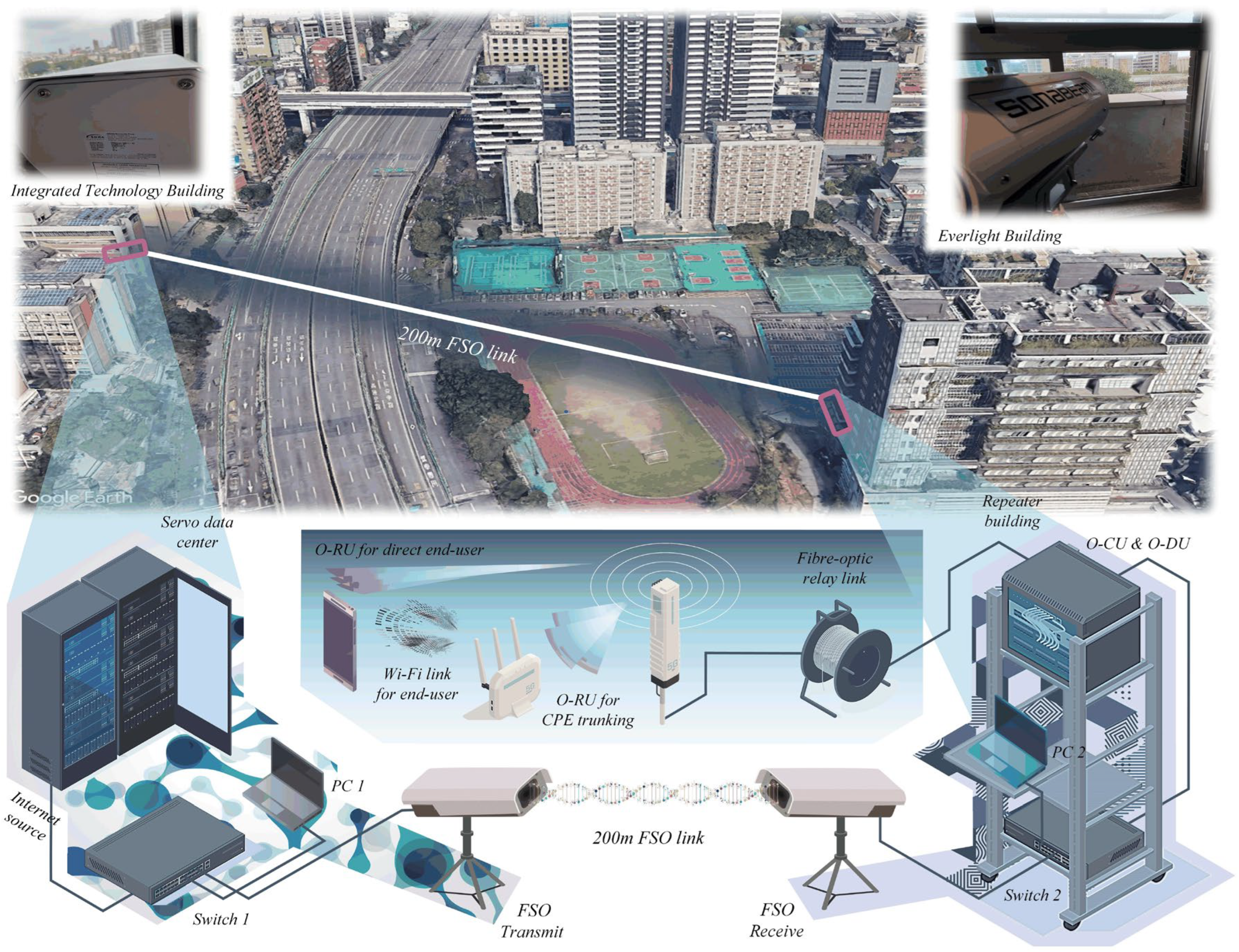
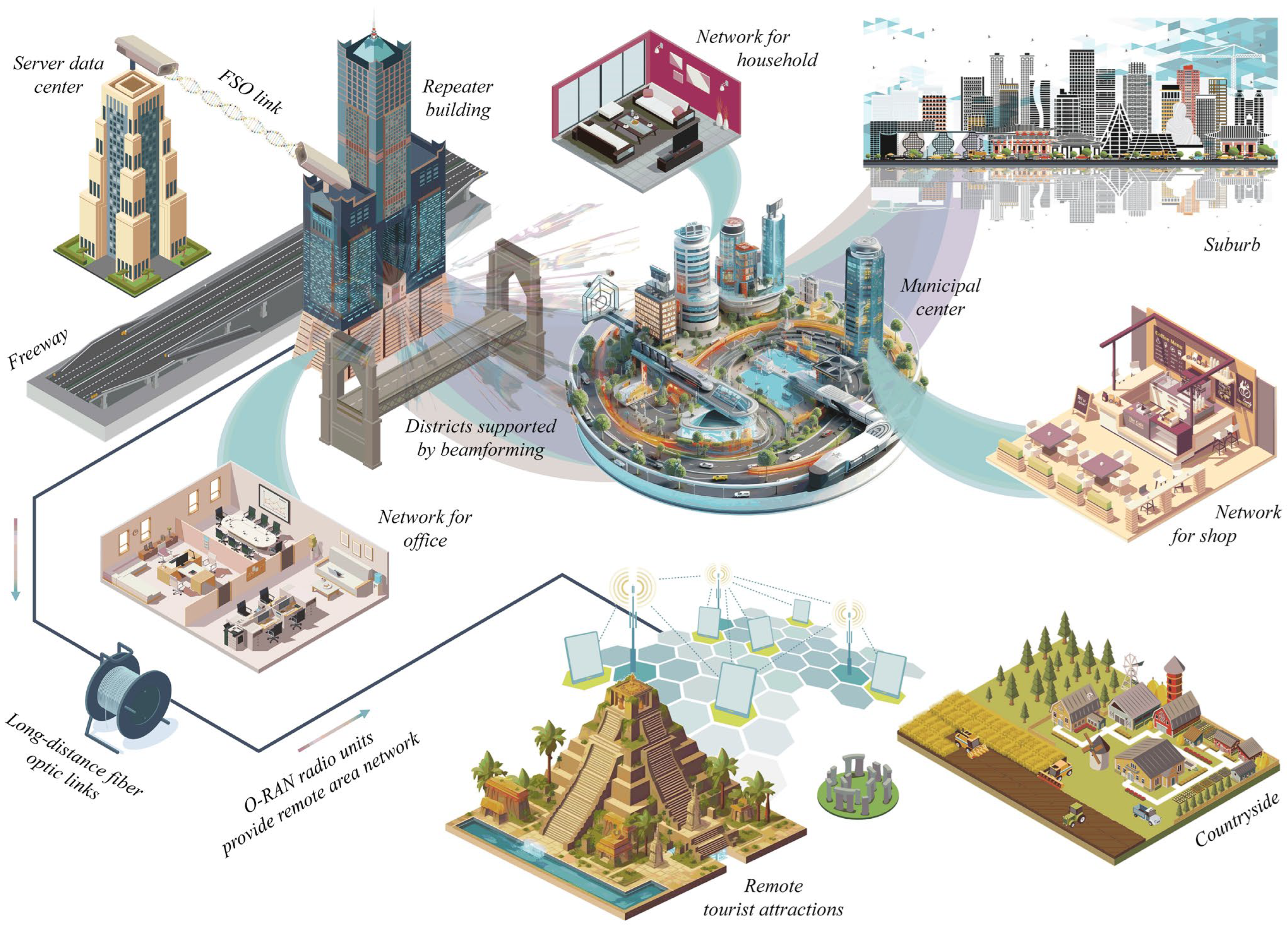
Figure 1 illustrates the solution’s primary goal: the server data center’s network sent to the repeater building via the FSO link, overcoming the land barrier for use by the office network and beamforming application through the network switch. The mmW beamforming part is installed in the repeater building, mainly supporting the civic center and its outskirts to the suburban neighborhoods, such as household and shop networks. Where mmW beamforming is not effective, O-RAN RUs can be used as fronthaul terminals via fiber-optic links to supplement the coverage. Moreover, the RUs can be extended by fiber-optic links to reach farther distances, such as villages or remote locations where beamforming would be wasteful due to a small population. Historically, FSO communication has been integrated with radio frequency (RF) systems to enhance the capacity and coverage of traditional RF communication [32]. However, these integrations often entail limited beamforming capabilities and exclude O-RAN architectures. Furthermore, the RU antennas associated with O-RAN can be strategically positioned in alignment with network demands through the deployment of long-haul FSOs or optical fiber connections. This strategic placement contributes to improved coverage efficiency and optimizes overall cost-effectiveness.
Figure 1. Conceptual vision of synergistic operation of mmW beamforming and O-RAN.
In this paper, it is emphasized that based on the 200 m FSO link as the backhaul and then processed by the O-RAN, it can undergo a fronthaul of up to 10 km to reach the RUs of the O-RAN and then through the customer premise equipment (CPE) or directly for users for 5G NR communication use. Conceptually, individual RUs of the O-RAN can be strategically positioned in the application area where mmW beamforming antennas cannot effectively cover, such as near the periphery of a sector. The 5G NR frequency band is n79. This exclusive frequency band can transmit data confidentially and is staggered from the proposed beamforming frequency of 28 GHz to avoid co-channel interference. Furthermore, mmW beamforming can optimize the phase of beamforming by RL with different beamforming steering angles for the best communication experience. Hence, conceptually, it is both cost-effective and feasible to complement the communication blindness of RL-based mmW beamforming with FSO link-based O-RAN RUs for future 5G/6G communication applications.
The subsequent sections of this paper are organized as follows: Section 2 examines the architecture and experimental findings related to the incorporation of RL techniques into beamforming. Section 3 presents a discussion of the architectural considerations and experimental results concerning the application of FSOs within the context of the O-RAN system. Finally, Section 4 provides a conclusion to the paper.

2. Adaptive Beam Alignment Using RL

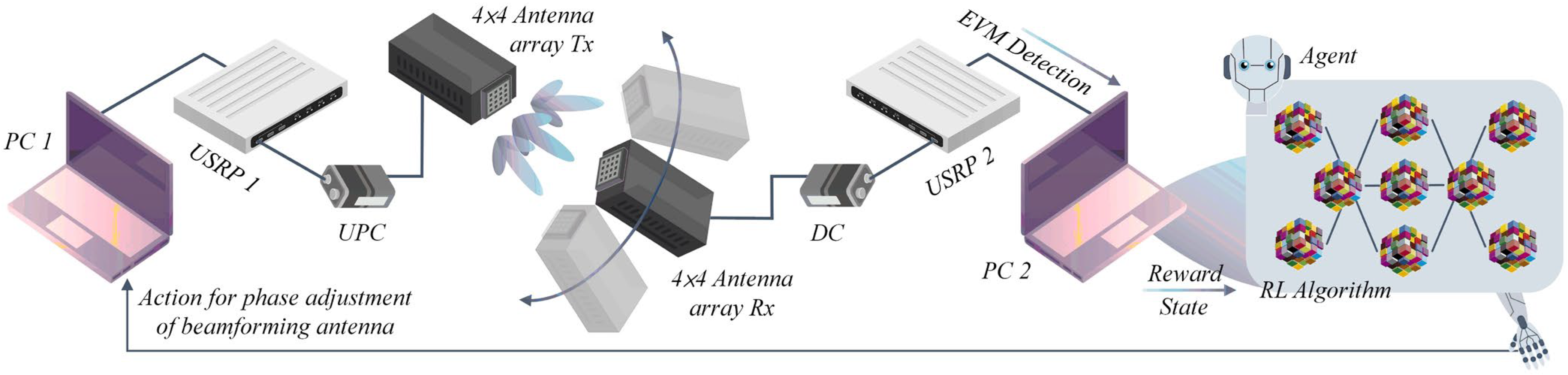
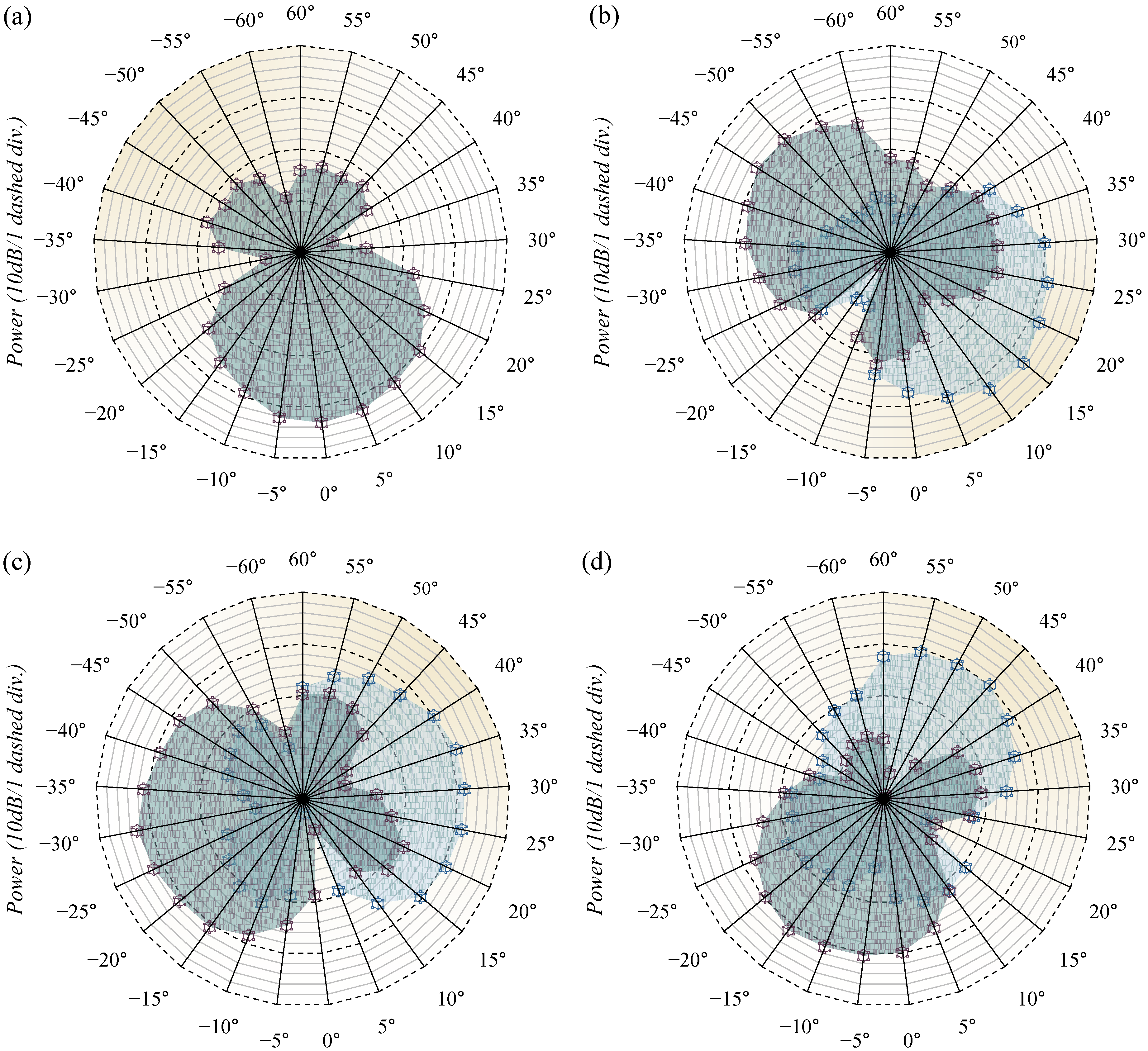
Figure 2 depicts the proposed phase adaptive tuning architecture for beamforming, which uses the universal software radio peripheral (USRP) to transmit and receive signals. The first step is to generate the baseband 16-QAM signal after setting the parameters of the modulated signal through a personal computer (PC) using the radio hardware driver software LabVIEW. Subsequently, the baseband signal will be converted to 6 GHz through the USRP by digital–analog conversion, and the bandwidth is 250 kHz. To transmit millimeter-wave signals, the 6 GHz signal is boosted to 28 GHz by a frequency upconverter (UPC) and then transmitted to the other end of the 4 × 4 array antenna through a 4 × 4 array antenna, and then the 28 GHz signal is downconverted to 6 GHz by a frequency downconverter (DC). Then, the signal is transmitted to the USRP receiver, where it is demodulated, converted to the digital signal reduced to the base frequency, and analyzed for signal quality using LabVIEW. The beamforming steering angle setting options are −45°, −30°, −15°, 0°, 15°, 30°, and 45°, and the distance between the beamforming 4 × 4 array antenna Tx and Rx is fixed at 2 m. Figure 3 shows the measured radiation patterns of the 4 × 4 array antenna at different steering angles: (a) 0°, (b) 15° and −45°, (c) 30° and −30°, and (d) 45° and −15°. It can be noticed that the maximum power point of the radiation pattern distribution is consistent with the set steering angle. Hence, the highest power associated with the main lobe is the transmission direction for the communication application. The main lobe’s power already exceeds the side lobe’s power by more than 10 dB to guarantee that the main lobe transmission will not encounter interference.
Figure 2. The arrangement of 4 × 4 array antenna beamforming with RL.
Figure 3. Radiation pattern measurement at the different steering angles (a) 0°, (b) 15° and −45°, (c) 30° and −30°, and (d) 45° and −15°.
Collecting EVM values at various phases is necessary for the application of RL-based beamforming with phase-adaptive beam alignment for the set steering angles of −45°, −30°, −15°, 0°, 15°, 30°, and 45°. The RL model, which seeks to predict and modify the beamforming antenna’s phase, is trained using collected data. RL comprises three fundamental components: state, action, and reward. The state denotes the present circumstances or environment, furnishing all necessary information for the agent to make decisions. The action is the choice taken by the agent according to the current state, which determines how the agent interacts with the environment and may lead to different outcomes. The reward is the score that the agent gets from the environment’s feedback signals after action. This score indicates how well the action accomplished the agent’s objective and serves as a basis for making subsequent decisions.
In real-world scenarios, the system relies on trained RL algorithms to anticipate and modify the phase of beamforming, as the precise angle of the user is not always known. Based on past data, these models can quickly determine the optimal phase configuration for situations when the user’s position is uncertain or fluctuating, resulting in improved signal coverage. To run efficiently and provide improved communication quality even in situations when the user’s angle is not instantly known, the system relies on broad patterns in the environment to draw inferences and optimizations instead of real-time user position information. RL is capable of dynamically adapting to changing circumstances in addition to determining the current ideal phase angle. For example, RL can swiftly adapt each beamforming phase to offer the best possible signal strength to each user even when many users’ locations change. This is done by using the knowledge it has gained over time. This approach is more efficient and adaptable to dynamically changing environments than manually testing all possible phase combinations one by one. Thus, while the optimal phase angle can be found manually in static environments, RL can respond more quickly to changes and continuously optimize system performance in real-world applications. In this setting, instead of receiving feedback from the EVM in real time, the RL model is trained offline on previously collected data. The model learns to predict the EVM based on different antenna phase configurations by analyzing these data to optimize its strategy, effectively “knowing” about the EVM because it learns the relationship between the EVM and antenna phase from experimental data.
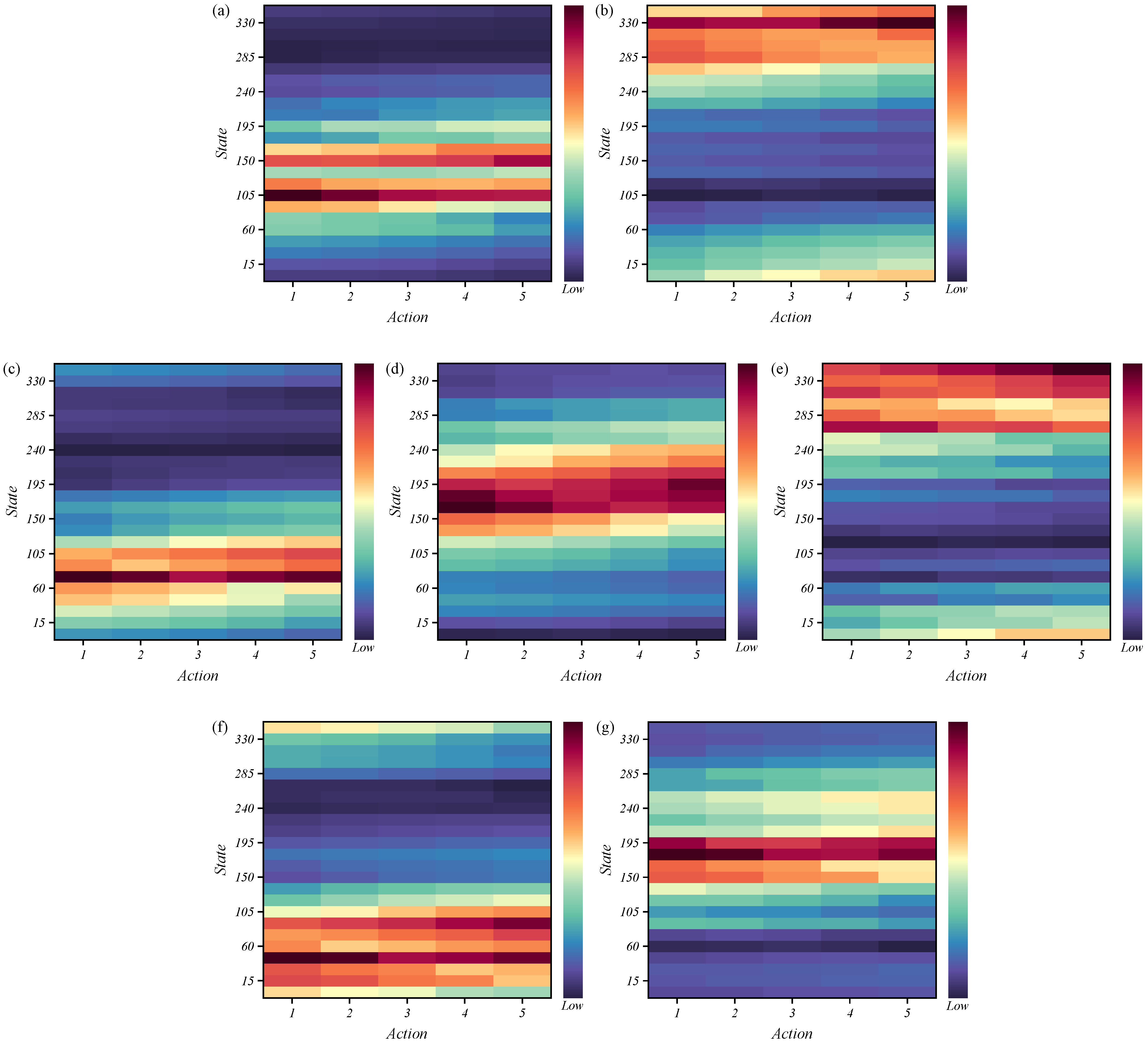
The Q-learning algorithm is one type of off-policy RL technique that allows an agent to learn from behaviors based on an alternative policy. It continuously adjusts Q-values, or state–action pairs, in order to improve the agent’s decision-making abilities over time. In this context, the ε-greedy algorithm is used to choose the next course of action, striking a balance between exploitation and exploration [33]. The impact of future rewards is taken into account using a discount factor of 0.88, which reduces their ability to affect present actions. In essence, Q-learning chooses the course of action that maximizes the Q-table by updating the value function. The agent is provided with input on the EVM and the associated variable phases of the array antenna to optimize the EVM. Until the optimal EVM performance is reached, the agent iteratively modifies the array antenna’s variable phase over a predetermined number of steps. Thus, the performance of the system may be optimized by the adaptive beam alignment approach that has been suggested, which can independently adjust the phase in response to the EVM input from the RL agent. The beamforming Q-tables for five actions in the phase state that correspond to steering angles of 45°, 30°, 15°, 0°, −15°, −30°, and −45° are displayed in Figure 4a–g. The regions in the figure that are indicated in dark red have higher Q-values, meaning that the RL agent favors choosing the movements in these areas. Conversely, the dark blue regions denote lower Q-values, suggesting that the RL agent would rather not function in these regions. On the other hand, the system takes one measurement of the EVM each time the beamforming antenna’s phase is changed, and it reports whether the EVM grows or shrinks. If the EVM becomes larger, it means the signal quality has deteriorated, and the system will give a negative reward score and vice versa, as depicted in Figure 2.
Figure 4. Mapping of Q-tables with different steering angles. The steering angles are as follows: (a) 45°, (b) 30°, (c) 15°, (d) 0°, (e) −15°, (f) −30°, and (g) −45°.
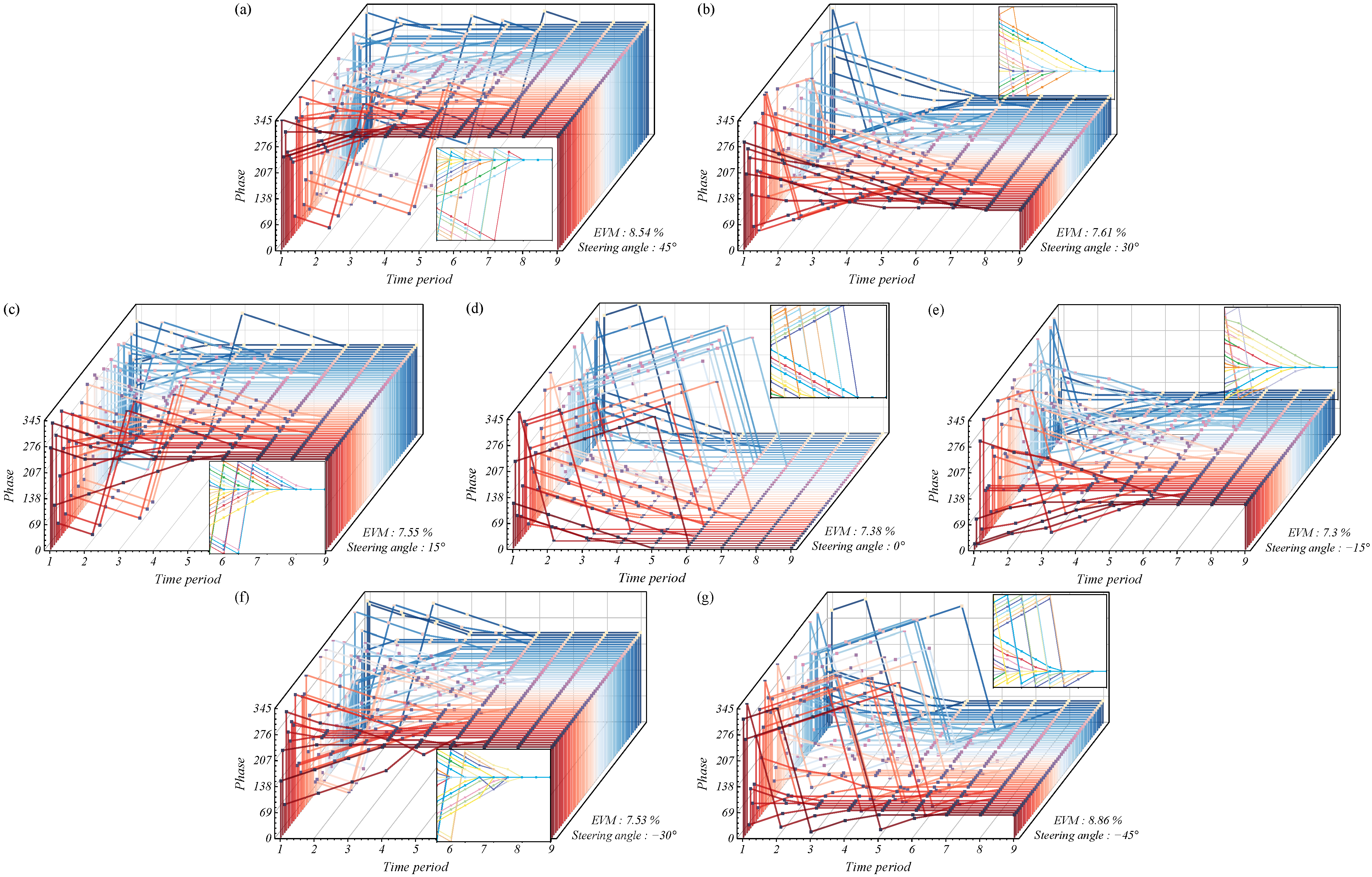
Figure 5a–g illustrate the actions that the agent can take to achieve optimal convergence within a specific time period, which represents the time of a single interaction between the agent and the environment and is used to adjust the phase of the beamforming over consecutive time periods to optimize its performance. Therefore, the time period helps the RL algorithm to adjust the phase change strategy at different time intervals. At different beamforming angles of 45°, 30°, 15°, 0°, −15°, −30°, and −45°, there were 50 random phase settings employed in the initial stage, and the optimal phase convergence and EVM values obtained after RL operation were 300° and 8.54%, 105° and 7.61%, 240° and 7.55%, 0° and 7.38%, 120° and 7.3%, 240° and 7.53%, and 60° and 8.86%, respectively. These specific phases were derived through the utilization of the pertinent Q-tables depicted in Figure 4. It can be noted that the phase summation of the symmetric angles of the beamforming steering angles at ±45°, ±30°, and ±15° are 360°, 345°, and 360°, respectively, which are close to the optimal phase angle of 0° (which is also equal to 360°) for a 0° steering angle (no steering). Furthermore, although EVM values below 12.5% of the 3GPP EVM standard for 16-QAM signals can be attainable at all of these beamforming steering angles, the EVMs obtained deteriorated significantly when the steering angle was aligned with the edge of the sector, as described previously.
Figure 5. At various steering angles—specifically, (a) 45°, (b) 30°, (c) 15°, (d) 0°, (e) −15°, (f) −30°, and (g) −45°—the agent can take actions to achieve the best phase convergence effect within a specific time period. The subfigure is a representation of a 2D overlay.

4. Conclusions

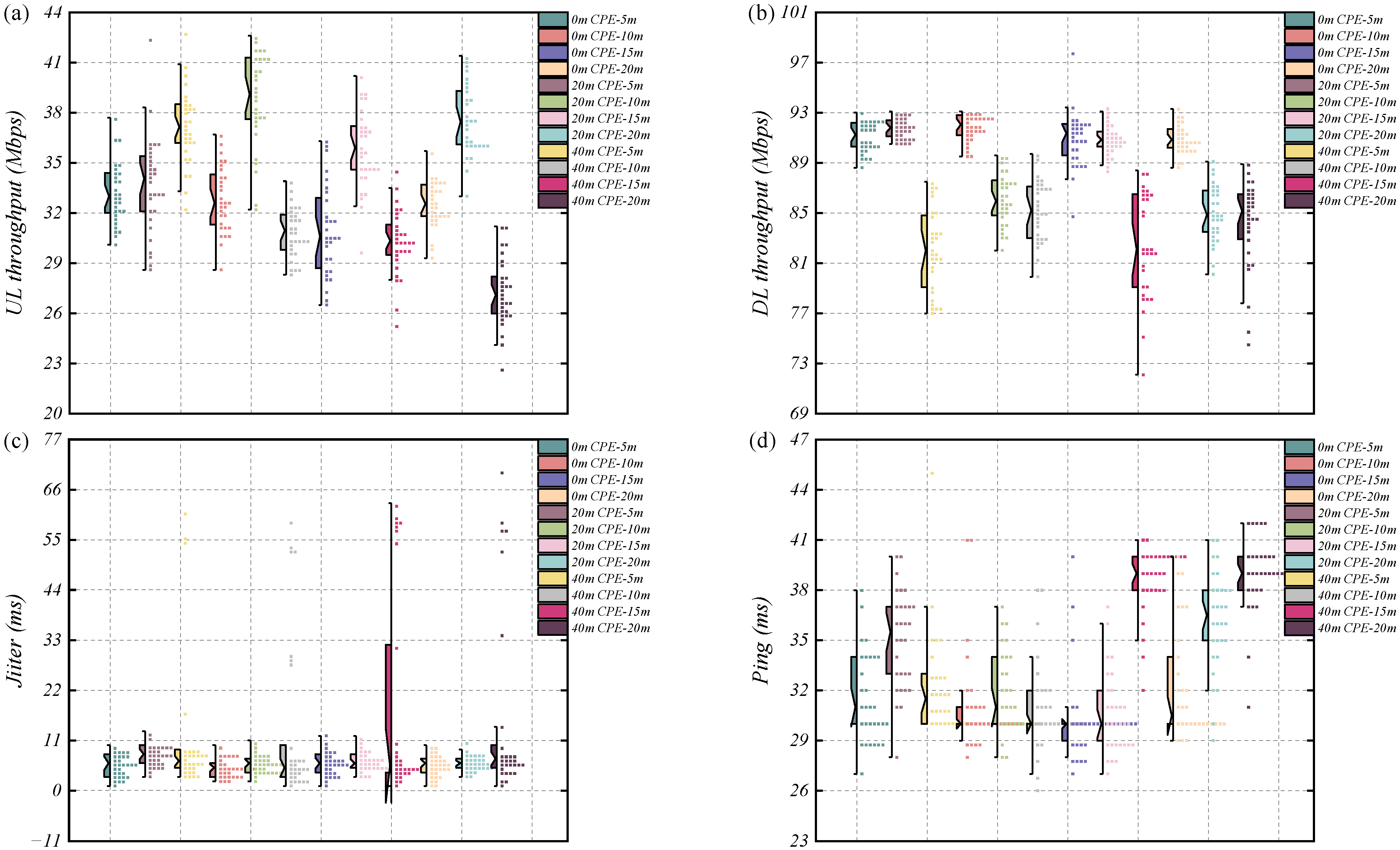
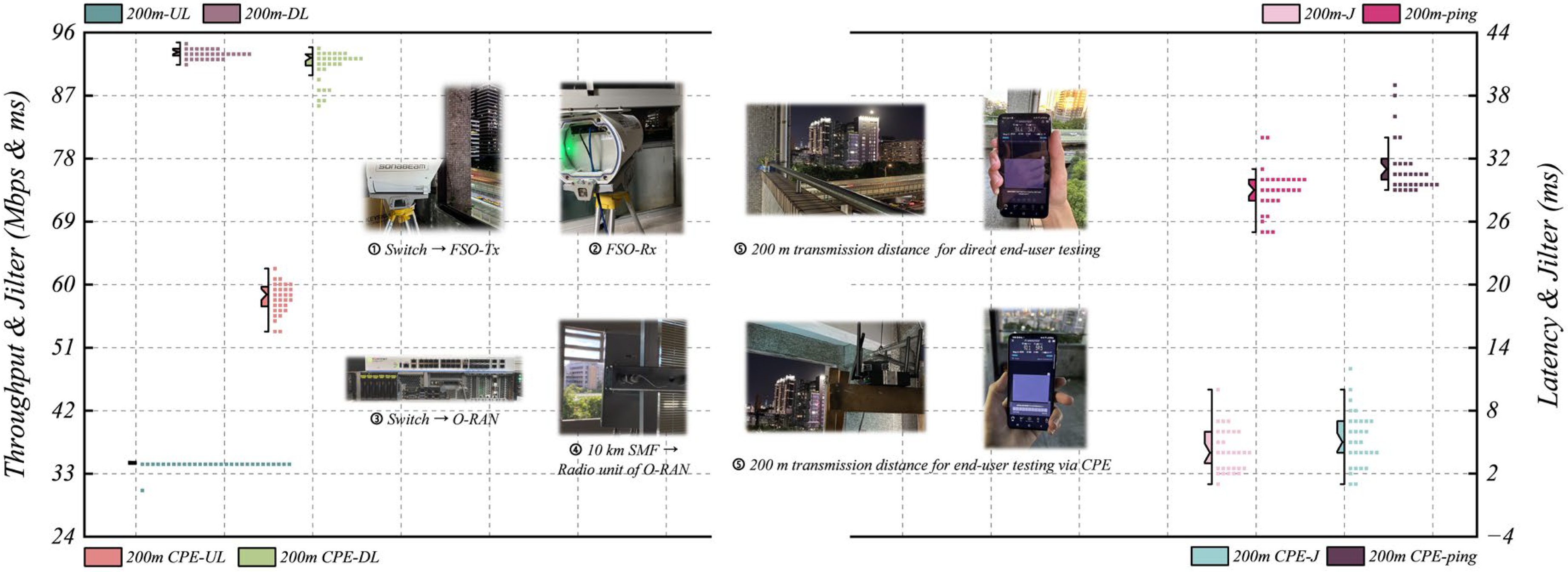
In this paper, a future 5G/6G solution integrating FSO, O-RAN, and mmW beamforming has been proposed. The FSO medium not only achieves transmission performance similar to that of physical fiber but also has the mobility to facilitate fast setup and overcome physical obstacles on the ground, thus helping to extend the end-use applications of O-RAN. In the aspect of mmW beamforming, the use of RL in the beamforming system can optimize the EVM by dynamically adjusting the beamforming phase according to the location of the communicating user. Nevertheless, beamforming at frequencies above 24 GHz has a maximum transmission distance of several hundred meters, leading to communication blind spots at the edges of the sector’s operating range of beamforming supply. O-RAN’s O-RU antenna can be placed at the edge of mmW beamforming sectors, such as mmW beamforming blind spots, by fiber-optic fronthaul. Moreover, the frequency used for O-RAN can be staggered with the frequency used for mmW beamforming to avoid signal interference. In addition, the O-RU antennas can be relayed by fiber-optic fronthaul up to 10 km to extend from urban areas to less populated suburban or rural areas instead of installing mmW beamforming in less populated areas, which is not cost-effective. According to the measurement results, with 200 m FSO backhaul and 10 km fiber fronthaul, the cellular network performance at 200 m from the O-RU antenna of O-RAN is comparable to that without a 200 m FSO link backhaul and 10 km fiber fronthaul. As a result, the adaptive and open architecture of O-RAN improves the cost-effectiveness of integration with FSOs and enables communication services to reach remote rural and suburban areas, as well as urban areas. In summary, the integration of FSOs with RL-based mmW beamforming and O-RAN communication configurations can bring scalability and cost-effectiveness to current and future communication infrastructures in urban, suburban, and rural areas.

Author Contributions

Conceptualization, C.-K.Y. and P.-C.P.; methodology, C.-K.Y., H.-P.L., C.-L.C. and M.-A.C.; data curation, Y.-S.L., W.-B.W. and C.-W.C.; model validation, C.-K.Y., Y.-S.L., W.-B.W. and C.-W.C.; formal analysis, C.-K.Y., H.-P.L., C.-L.C. and M.-A.C.; investigation, C.-K.Y., H.-P.L., C.-L.C., M.-A.C. and P.-C.P.; visualization: C.-K.Y.; writing—original draft preparation: C.-K.Y.; writing—review and editing: C.-K.Y.; supervision, P.-C.P. All authors have read and agreed to the published version of the manuscript.

Funding

This work was supported by the National Science and Technology Council, Taiwan, under Grant NSTC 112-2221-E-027-076-MY2.

Institutional Review Board Statement

Not applicable.

Data Availability Statement

The data presented in this study are available in this article.

Conflicts of Interest

The authors declare no conflicts of interest.

References

  1. Winzer, P.J.; Neilson, D.T.; Chraplyvy, A.R. Fiber-optic transmission and networking: The previous 20 and the next 20 years. Opt. Express 2018, 26, 24190–24239. [Google Scholar] [PubMed]
  2. Celik, A.; Romdhane, I.; Kaddoum, G.; Eltawil, A.M. A top-down survey on optical wireless communications for the internet of things. IEEE Commun. Surv. Tutor. 2022, 25, 1–45. [Google Scholar]
  3. Fayad, A.; Cinkler, T.; Rak, J. 5G/6G optical fronthaul modeling: Cost and energy consumption assessment. J. Opt. Commun. Netw. 2023, 15, D33–D46. [Google Scholar]
  4. Pinto, F.B.F.; Carneiro de Souza, L.; Andrade, T.P.V.; Lima, E.S.; Silva, L.G.; Portelinha, F.M.; Anderson, E.L.; Cerqueira, S.A. Power-over-fiber-based optical wireless communication systems towards 6G. J. Opt. Commun. Netw. 2024, 16, D86–D95. [Google Scholar]
  5. Lee, M.C.; Chang, C.H.; Huang, G.J.; Liou, C.W. Hybrid tree-and-multiple-ring radio-over-fiber transmission system for a 5G network in metropolitan areas. J. Opt. Commun. Netw. 2023, 15, 765–775. [Google Scholar]
  6. Zhu, P.; Yoshida, Y.; Kanno, A.; Kitayama, K.I. DSP-enhanced radio-over-fiber technologies for 5G-and-beyond wired-wireless convergence. J. Opt. Commun. Netw. 2022, 14, 595–605. [Google Scholar]
  7. Bartsiokas, I.A.; Gkonis, P.K.; Kaklamani, D.I.; Venieris, I.S. A federated learning-based resource allocation scheme for relaying-assisted communications in multicellular next generation network topologies. Electronics 2024, 13, 390. [Google Scholar] [CrossRef]
  8. Ali, R.; Zikria, Y.B.; Garg, S.; Bashir, A.K.; Obaidat, M.S.; Kim, H.S. A federated reinforcement learning framework for incumbent technologies in beyond 5G networks. IEEE Netw. 2021, 35, 152–159. [Google Scholar]
  9. Nauman, A.; Jamshed, M.A.; Qadri, Y.A.; Ali, R.; Kim, S.W. Reliability optimization in narrowband device-to-device communication for 5G and beyond-5G networks. IEEE Access 2021, 9, 157584–157596. [Google Scholar]
  10. Bartsiokas, I.A.; Gkonis, P.K.; Kaklamani, D.I.; Venieris, I.S. ML-based radio resource management in 5G and beyond networks: A survey. IEEE Access 2022, 10, 83507–83528. [Google Scholar]
  11. Li, J.W.; Teng, Y.C.; Nimura, S.; Manie, Y.C.; Yazdandoost, K.Y.; Tanaka, K.; Inohara, R.; Tsuritani, T.; Peng, P.C. Reinforcement learning-based adaptive beam alignment in a photodiode-integrated array antenna module. Opt. Lett. 2024, 49, 666–669. [Google Scholar] [PubMed]
  12. Huang, M.Y.; Chen, Y.W.; Peng, P.C.; Wang, H.; Chang, G.K. A full field-of-view self-steering beamformer for 5G mm-wave fiber-wireless mobile fronthaul. J. Light. Technol. 2019, 38, 1221–1229. [Google Scholar]
  13. Vagionas, C.; Ruggeri, E.; Tsakyridis, A.; Kalfas, G.; Leiba, Y.; Miliou, A.; Pleros, N. Linearity measurements on a 5G mmWave fiber wireless IFoF fronthaul link with analog RF beamforming and 120° degrees steering. IEEE Commun. Lett. 2020, 24, 2839–2843. [Google Scholar]
  14. Liu, C.; Zhang, L.; Zhu, M.; Wang, J.; Cheng, L.; Chang, G.K. A novel multi-service small-cell cloud radio access network for mobile backhaul and computing based on radio-over-fiber technologies. J. Light. Technol. 2013, 31, 2869–2875. [Google Scholar]
  15. Wypiór, D.; Klinkowski, M.; Michalski, I. Open ran—Radio access network evolution, benefits and market trends. Appl. Sci. 2022, 12, 408. [Google Scholar] [CrossRef]
  16. Nonay, J.R.; Rüddenklau, R.; Sinn, A.; Jakobs, J.P.; Berlitz, J.; Rödiger, B.; Schitter, G. Horizontal free-space optical link with CubeISL over 143 km. J. Opt. Commun. Netw. 2024, 16, 593–601. [Google Scholar]
  17. Guo, M.; Lu, Z.; Wang, Y.; Li, B.; Xu, D.; Wang, T.; Duan, S.; Yao, Y.; Zhang, H.; Lin, W.; et al. 40 Gbps high-speed free-space inter-island optical communication over 29 kilometers under turbulent near-sea surface environment. J. Light. Technol. 2024, 43, 2592–2598. [Google Scholar]
  18. Yao, C.K.; Lin, H.P.; Cheng, C.L.; Li, Y.L.; Du, L.Y.; Peng, P.C. Satellite communication and free space optics for open radio access network. J. Light. Technol. 2024, 42, 3546–3553. [Google Scholar]
  19. Hayle, S.T.; Manie, Y.C.; Shao, G.M.; Chiu, P.H.; Yeh, T.Y.; You, S.L.; Peng, P.C. Integration of fiber and FSO network with fault-protection for optical access network. Opt. Commun. 2021, 484, 126676. [Google Scholar]
  20. Esmail, M.A. Performance monitoring of hybrid all-optical fiber/FSO communication systems. Appl. Sci. 2023, 13, 8477. [Google Scholar] [CrossRef]
  21. Garlinska, M.; Pregowska, A.; Masztalerz, K.; Osial, M. From mirrors to free-space optical communication—Historical aspects in data transmission. Future Internet 2020, 12, 179. [Google Scholar] [CrossRef]
  22. Manie, Y.C.; Yao, C.K.; Peng, P.C. FSO and Optical Networks. In Handbook of Radio and Optical Networks Convergence; Springer Nature: Singapore, 2024; pp. 963–994. [Google Scholar]
  23. Singh, D.; Swaminathan, R.; Pham, A.T. Multiple HAPS-based space-air-ground network with FSO communication: A performance analysis. Appl. Opt. 2024, 63, 2362–2375. [Google Scholar] [PubMed]
  24. Elamassie, M.; Uysal, M. Free space optical communication: An enabling backhaul technology for 6G non-terrestrial networks. Photonics 2023, 10, 1210. [Google Scholar] [CrossRef]
  25. Toplar, H.T.; Uysal, M. Modeling of pointing errors in terrestrial FSO links caused by building sway under wind loads. IEEE open J. Commun. Soc. 2025, 6, 1161–1169. [Google Scholar]
  26. Correia, V.D.; Fernandes, M.A.; Monteiro, P.P.; Guiomar, F.P.; Fernandes, G.M. On the Impact and Mitigation of Turbulence in Fiber-Coupled FSO Systems. IEEE Access 2024, 12, 69505–69516. [Google Scholar]
  27. Al-Gailani, S.A.; Salleh, M.F.M.; Salem, A.A.; Shaddad, R.Q.; Sheikh, U.U.; Algeelani, N.A.; Almohamad, T.A. A survey of free space optics (FSO) communication systems, links, and networks. IEEE Access 2023, 9, 7353–7373. [Google Scholar]
  28. Fernandes, M.A.; Brandão, B.T.; Georgieva, P.; Monteiro, P.P.; Guiomar, F.P. Adaptive optical beam alignment and link protection switching for 5G-over-FSO. Opt. Express 2021, 29, 20136–20149. [Google Scholar] [PubMed]
  29. Bibi, S.; Baig, M.I.; Qamar, F.; Shahzadi, R. A comprehensive survey of free-space optical communication–modulation schemes, advantages, challenges and mitigations. J. Opt. Commun. 2025, 45, s2373–s2385. [Google Scholar]
  30. Guo, M.; Li, B.; Wang, Y.; Lu, Z.; Xu, D.; Xiang, Q.; Xiong, L.; Li, C.; Duan, S.; Yao, Y.; et al. Low-complexity 24-h 29-km inter-island real-time FSO communication under strong turbulences. Opt. Lett. 2025, 50, 546–549. [Google Scholar] [CrossRef]
  31. Abdulwahid, M.M.; Kurnaz, S.; Hayal, M.R.; Elsayed, E.E.; Juraev, D.A. Performance analysis of input power variations in high data rate DWDM-FSO systems under various rain conditions. J. Opt. 2025, 1–16. [Google Scholar] [CrossRef]
  32. Alsabah, M.; Naser, M.A.; Mahmmod, B.M.; Abdulhussain, S.H.; Eissa, M.R.; Al-Baidhani, A.; Noordin, N.K.; Sait, S.M.; Al-Utaibi, K.A.; Hashim, F. 6G wireless communications networks: A comprehensive survey. IEEE Access 2021, 9, 148191–148243. [Google Scholar] [CrossRef]
  33. Antony, S.; Roy, R.; Bi, Y. Q-Learning: Solutions for grid world problem with forward and backward reward propagations. In Proceedings of the International Conference on Innovative Techniques and Applications of Artificial Intelligence, Cambridge, UK, 12–14 December 2023; Springer Nature: Cham, Switzerland, 2023; pp. 266–271. [Google Scholar]
  34. Google Earth Pro. Taipei Tech 25°02′31.11″ N, 121°32′17.47″ W, Elevation 4M. 3D Buildings Data Layer. Available online: https://earth.google.com/static/single-threaded/versions/10.77.0.1/index.html?#search/Taipei/ (accessed on 6 February 2025).
  35. Municio, E.; Garcia-Aviles, G.; Garcia-Saavedra, A.; Costa-Pérez, X. O-ran: Analysis of latency-critical interfaces and overview of time sensitive networking solutions. IEEE Commun. Stand. Mag. 2023, 7, 82–89. [Google Scholar] [CrossRef]
  36. Suzuki, K.; Nakazato, J.; Sasaki, Y.; Maruta, K.; Tsukada, M.; Esaki, H. Toward b5g/6g connected autonomous vehicles: O-ran-driven millimeter-wave beam management and handover management. In Proceedings of the IEEE Conference on Computer Communications Workshops (INFOCOM WKSHPS), Vancouver, BC, Canada, 20–23 May 2024; IEEE: New York, NY, USA, 2024; pp. 1–6. [Google Scholar]
  37. Anapana, V.R.; Stephenson, N.H.; Shah, V.K. Milli-o-ran: A flexible, reconfigurable o-ran enabled mmwave network testbed. In Proceedings of the IEEE International Symposium on Dynamic Spectrum Access Networks (DySPAN), Washington, DC, USA, 13–16 May 2024; IEEE: New York, NY, USA, 2024; pp. 181–182. [Google Scholar]
Disclaimer/Publisher’s Note: The statements, opinions and data contained in all publications are solely those of the individual author(s) and contributor(s) and not of MDPI and/or the editor(s). MDPI and/or the editor(s) disclaim responsibility for any injury to people or property resulting from any ideas, methods, instructions or products referred to in the content.

Article Metrics

Citations

Article Access Statistics

Multiple requests from the same IP address are counted as one view.