1. Introduction
Particle transport and deposition represent ubiquitous phenomena across natural and industrial systems. The dust particles generated from daily life and engineering fields can lead to serious problems. Dust accumulation on the surfaces of industrial equipment can lead to a reduction in efficiency and increased operational downtime [
1,
2,
3]. Similarly, in heat exchangers, accumulated particles increase thermal resistance, resulting in a considerable decrease in heat transfer efficiency, as reviewed in recent studies of particulate and crystallization fouling mechanisms that highlight how heterogeneous deposit layers impede thermal performance and elevate energy consumption in heat exchangers [
4]. Experimental investigations under real operating conditions have demonstrated that natural dust deposition on PV systems significantly reduces electrical output, with power and current decreases observed after prolonged exposure without cleaning [
5]. Hosseini et al. examined PV soiling impact on photovoltaic performance in field conditions, reporting measurable declines in module efficiency correlated with dust deposition density [
6]. Heat exchanger fouling due to airborne particulates has also been studied numerically and experimentally, showing that adhesive dust particle deposition on finned-tube surfaces significantly degrades heat transfer, particularly at higher Reynolds numbers and for particles with stronger surface adhesion properties [
7]. These findings underscore the critical importance of understanding particle size, surface characteristics, and fluid dynamics when assessing fouling impacts in thermal systems. Consequently, particle deposition has emerged as a critical issue that urgently requires effective management strategies.
Particle deposition characteristics have been extensively investigated through both experimental measurements and numerical simulations, and recent studies have continued to deepen understanding of the mechanisms governing deposition behavior. Experimental work has shown that flow conditions, particle properties, and geometric features strongly influence particle deposition in ventilation ducts and related flows. For example, Sun et al. demonstrated through experiments in air conditioning ventilation ducts that particle size and airflow velocity significantly affect local deposition hotspots and overall deposition efficiency [
8]. In addition, experimental studies of particle deposition in industrial ventilation bends have highlighted the role of Reynolds number and curve geometry on deposition trends, with efficiency and Stokes number exhibiting an exponential relationship under varying conditions [
9].
Numerical simulations have played a fundamental role in complementing experiments by providing detailed insights into flow–particle interactions and deposition mechanisms that are difficult or costly to measure directly. CFD studies have shown that inlet velocity is negatively correlated with deposition rate, whereas particle size tends to enhance deposition when other conditions are held constant [
10]. For complex geometries, such as corrugated pipes or rough-walled channels, turbulence enhancement near wall surfaces can increase turbulent kinetic energy and promote particle deposition for small particles (<30 µm), indicating a significant interaction between surface features and particle inertia [
11,
12]. Moreover, Eulerian–Lagrangian simulations in curved pipes have revealed that inserting obstacles such as ribs can reduce deposition locally by modifying the flow field and secondary circulations, thus offering potential control strategies for engineering applications [
13].
Beyond engineering ducts, recent investigations have extended to aerosols in biological and heat transfer contexts. Particle transport and deposition in wall-sheared thermal turbulence highlight complex deposit patterns across different Stokes numbers, revealing nonlinear deposition stages that depend on both buoyancy and shear effects [
14]. Direct numerical simulations exploring charged inertial particles further show that electrostatic forces can significantly enhance near-wall accumulation and modify deposition dynamics relative to neutral particles [
15]. These studies underscore the increasingly sophisticated modeling approaches available, such as large eddy simulation, discrete phase models, and direct numerical simulation, which together improve predictive capability while reducing dependence on costly experiments. Collectively, this body of work suggests that particle size, flow regime, surface geometry, and additional forces (e.g., electrostatic or thermophoretic) jointly determine particle deposition behavior in engineered and natural turbulent flows (e.g., high-fidelity DNS of particle transport and deposition in wall-sheared flows [
16] and charged particle deposition influenced by electrostatic interactions in turbulent boundary layers [
17]).
Recent research has increasingly focused on particle deposition over textured surfaces via experimental and computational methods. Lu and colleagues investigated deposition within ribbed-wall ducts using Reynolds stress turbulence modeling integrated with discrete particle tracking, demonstrating strong geometric sensitivity of deposition rates [
18,
19,
20]. Hong et al. employed three-way coupling simulations for fine particle deposition on rib-textured substrates, finding that elevated flow velocities diminish normalized deposition rates [
21]. Li et al. experimentally studied particle impacts on rough surfaces and demonstrated that increased surface roughness leads to a reduction in the normal restitution coefficient, accompanied by higher dissipation of adhesion energy and frictional losses [
22]. Hemmati et al. investigated particle deposition in channels with roughness elements of varying shapes and heights and found that the spacing between roughness elements has a pronounced effect on the deposition behavior of small particles [
23].
Overall, particle deposition characteristics have been extensively explored using both experimental and numerical approaches, and the influence of surface morphology on deposition behavior has been well recognized. In previous years, the lattice Boltzmann method (LBM), as an efficient second-order flow solver, was rapidly developed to investigate the multi-phase flow due to its explicit solution, easier parallelism implementation, and flexibility in boundary setting. Numerous studies have explored the interaction between fluids and solids by developing various models [
24,
25,
26]. Xiong et al. employed a combined lattice Boltzmann method–discrete element method–discrete particle simulation approach to investigate particle–fluid flow dynamics, showing that this novel model effectively captures the particle–fluid interaction [
27]. In comparison, traditional CFD methods, such as RANS or LES, have been integrated with LBM to study particle deposition processes [
28]. These results demonstrate the lattice Boltzmann method’s efficacy for modeling particle transport and deposition across diverse surface morphologies.
Due to the severe particle pollution in industrial applications and human life, an efficient way for reducing the particle deposition needs to be urgently proposed. Recently, effective self-cleaning coatings have been developed to mitigate particle deposition, with superhydrophobic coatings being the most efficient. These coatings, due to their low surface energy, significantly reduce the adhesion between particles and the surface, thereby decreasing deposition. This finding has been validated by several experimental studies. Zhang et al. demonstrated that superhydrophobic coatings can substantially reduce particle deposition on glass surfaces at various tilt angles [
29]. Similarly, Pan et al. conducted experiments comparing particle deposition behavior on different glass samples coated with various materials, revealing that the superhydrophobic surface exhibited the lowest dust deposition density [
30]. Additionally, the superhydrophobic coatings consisting of different chemical components were studied as well. The coatings with fluoroalkylsilane show higher self-cleaning performance than those with other materials [
31]. Consequently, experimental research on superhydrophobic coating self-cleaning has proliferated. Nevertheless, the underlying mechanisms remain incompletely understood. A critical limitation is the absence of robust contact models for particle–rough surface interactions. Classical theories—including Hertz, Johnson–Kendall–Roberts (JKR), Derjaguin–Muller–Toporov (DMT), Muller–Yushchenko–Derjaguin (MYD), and Maugis–Daniel (MD) models—predominantly address smooth surface contacts, offering limited applicability to textured substrates [
32,
33,
34,
35,
36].
Based on the above review, although particle deposition and superhydrophobic surfaces have been extensively studied, the combined effects of randomly distributed roughness, particle–rough surface contact, and deposition dynamics remain insufficiently understood. To address these gaps, the main contributions of the present study are summarized as follows. Firstly, a randomly distributed superhydrophobic rough surface is reconstructed using an FFT-based spectral method with prescribed statistical parameters, including skewness, kurtosis, and standard deviation, enabling a more realistic description of practical surface morphologies compared with idealized smooth or regularly structured surfaces. Secondly, a particle–rough surface contact treatment is developed by extending the conventional JKR framework through surface discretization and DEM coupling, allowing detailed resolution of particle rebound, rolling, resuspension, and deposition processes on randomly rough superhydrophobic surfaces. Thirdly, the effects of surface statistical parameters on particle deposition are systematically quantified and linked to deposition morphology and deposition number, providing new physical insights into the role of random surface topography in controlling self-cleaning performance. These advances collectively extend the applicability of coupled LBM–IMBM–DEM approaches to realistic superhydrophobic surfaces and offer guidance for the design of anti-fouling and dust-mitigation coatings.
2. Numerical Methodology
The main modeling assumptions adopted in this study are summarized and justified as follows. The particles are modeled as rigid circular solids, and particle deformation is neglected because the impact velocities and elastic moduli considered in the present simulations are sufficiently small that deformation effects are minimal. The airflow is assumed to be incompressible and isothermal, which is justified by the low Mach numbers and the absence of significant thermal gradients in the microchannel configuration studied. The randomly distributed superhydrophobic rough surface is assumed to remain geometrically unchanged during the deposition process, as the particle concentration is low and deposited particles do not significantly modify the underlying surface morphology. Electrostatic forces are neglected, and gravitational acceleration is explicitly included in the particle momentum equation; however, its influence is secondary compared to aerodynamic drag, adhesion, and collision forces under the present conditions. These assumptions allow the essential physical mechanisms governing particle transport, collision, resuspension, and deposition on superhydrophobic rough surfaces to be captured with reasonable computational efficiency and accuracy.
The coupled LBM–IMBM–DEM framework employed in this study was implemented using an in-house numerical solver developed in C++. The gas phase flow was resolved using the lattice Boltzmann method with a standard D2Q9 lattice model, which is suitable for incompressible, low-Mach-number flows. Particle motion was simulated using the discrete element method (DEM), while the immersed boundary method (IMBM) was used to enforce fluid–solid coupling between the gas flow, particles, and rough surface structures.
At the inlet of the computational domain, a prescribed velocity boundary condition was applied to generate a fully developed laminar flow, while a convective (fully developed) boundary condition was imposed at the outlet. No-slip boundary conditions were enforced on the channel walls and on the rough superhydrophobic surface by the immersed boundary treatment. Periodic boundary conditions were applied in the spanwise direction to reduce finite-size effects. The gas was assumed to be incompressible and isothermal, consistent with the experimental conditions.
Particle–particle and particle–surface interactions were resolved using a JKR-based contact model implemented within the DEM framework. The time integration of particle motion was performed using an explicit time-stepping scheme, with the DEM time step chosen to be sufficiently small to resolve collision dynamics and ensure numerical stability. The coupling between the LBM and DEM solvers was realized through a momentum-exchange scheme, allowing two-way interaction between the fluid and particle phases.
2.1. Lattice Boltzmann Model for Air Flow Simulation
Airflow dynamics were simulated using the lattice Boltzmann method. Following temporal and spatial discretization of the Boltzmann equation, the widely adopted single-relaxation-time BGK formulation is expressed as:
where
denotes the particle distribution function and
represents its equilibrium counterpart. The relaxation parameter τ governs collision timescales and relates to fluid viscosity through:
where
cs is the speed of sound and
v is the kinematic of the fluid in the lattice system.
At present, the D2Q9 model is widely applied for LBM simulation. Balancing computational cost and accuracy, the D2Q9 lattice scheme was adopted. The equilibrium distribution function takes the form:
where
wi denotes the weighting factor associated with each discrete velocity direction. For the D2Q9 model, the weighting coefficients are given as
w0 = 4/9,
w1–4 = 1/9, and
w5–8 = 1/36. The discrete velocity set
ei is defined as:
Macroscopic fluid density and velocity are computed from distribution functions via:
2.2. Immersed Boundary Method for Particle–Fluid Coupling
Air flow can obviously be affected by solid particles. In this paper, the interactions between the particle and gas flow were implemented by the immersed boundary condition. Computational cells may contain solid regions [
37]. Accordingly, the lattice Boltzmann equation incorporates an additional source term:
where
denotes the collision source term accounting for fluid-solid momentum transfer, expressed as:
Here,
represents the reversed-direction distribution function.
vp(
X) specifies the particle velocity at cell position
X, determined by:
where
vp(
X) is the particle translational velocity, while the
wp is the angular velocity.
Xc is the position of the particle’s center of mass.
Hydrodynamic forces and torques result from summing momentum exchange across all lattice directions within particle-occupied cells:
2.3. DEM-Based Particle Dynamics Analysis
In this study, particles were modeled as circular solids. The discrete element method captured inter-particle and particle–wall collision dynamics. Newton’s second law governed particle motion according to:
Here, Xp and vp are the location and velocity of the particle center, respectively. Fd denotes the hydrodynamic force acting on particles, computed from preceding equations. Fb represents Brownian diffusion forces arising from molecular collisions, and Fc captures contact interactions during particle–particle and particle–wall collisions. Ip signifies the particle moment of inertia, while MF and MA correspond to torques induced by fluid flow and collision events, respectively. In the following parts, the specific value calculations of different parameters are introduced.
2.3.1. Contact Force Calculation
In this study, the elastic modulus of particles is not large, and the surface energy is considered during particle collision. Consequently, the JKR framework computed contact forces arising from van der Waals adhesion and elastic deformation. Collision dynamics involve both perpendicular and tangential force components. The total contact force
Fc and associated torque
MA are formulated as:
where
Fcn denotes the perpendicular component, while
Fcs represents the tangential component of the contact interaction. The rolling resistance torque is designated as
Mr. The perpendicular component
Fcn comprises two contributions:
Fne, which accounts for repulsive forces arising from particle deformation, and
Fnd, which captures energy dissipation effects. The subsequent sections detail the formulation of contact interactions within the JKR framework.
The perpendicular elastic component
Fne incorporates van der Waals adhesive interactions and is formulated as follows:
In the above equation, Fcr is the critical force and a0 denotes the equilibrium contact radius at mechanical equilibrium, which represents the adhesive attraction in the contact areas, balanced with the elastic repulsion. a represents the actual contact radius determined by normal deformation. In the present implementation, the JKR relations are applied locally at each particle–asperity contact point (i.e., between the particle and the contacted solid node representing the rough surface) so that the adhesive and elastic response is determined by the local contact state rather than an ideal smooth wall.
Fcr,
a0, and
a are calculated by
Here, γ denotes the effective interfacial energy used in the adhesion term, R is the effective radius, and E is the effective Young’s modulus. In this study, R and E are computed from the particle and surface material properties using Equations (22) and (23), where (E1, γ1) and (E2, γ2) correspond to the particle and the substrate (or the contacted asperity node), respectively. These material parameters are specified from measured values or literature-reported properties (see
Table 1 for the validation case), and no additional fitting parameter is introduced in the JKR formulation.
The values of the parameters can be calculated by
For particle–rough surface collisions, the overlap
δn in Equation (25) is evaluated between the particle center and the contacted roughness node, enabling the JKR-based force to respond to the local asperity geometry.
where
δc is the critical normal deformation in the JKR theory and is used to normalize the instantaneous overlap δn in Equation (21). For particle–surface collisions, the substrate is treated as a rigid wall (or an asperity node representing the rough surface); thus,
R2→∞ and the effective radius in Equation (23) reduce to the particle radius, i.e.,
R =
R1. For particle–particle collisions, the effective radius
R and equivalent modulus E are computed using Equations (22) and (23) based on the material properties of both particles.
p is Poisson’s ratio. The subscripts 1 and 2 represent the different surfaces. When the particle collides with the surface, the effective radius is the particle radius. Thus, the normal elastic force
Fne can be acquired by the previous equations.
When the particle collides with other particles or surfaces, the normal dissipation force
Fnd cannot be negligible. It is defined as
where
vpr·
n denotes the normal component of the relative velocity at the contact point and
n is the unit normal vector. The damping coefficient
ηn is computed as
where
mp is the effective (reduced) mass of the contacting pair and
kN is the normal contact stiffness given by
The dimensionless parameter
α controls the dissipation level and is calibrated by prescribing a target normal coefficient of restitution Ea (particle–particle and particle–surface), following the standard DEM practice reported in Refs. [
37,
38,
39,
40]. In the revised manuscript, we explicitly report the adopted Ea values and keep them constant across parametric studies to avoid introducing case-dependent fitting.
In this paper, the tangential force was calculated by
where
G* is the equivalent shear modulus,
μ is the friction coefficient, and Δ
t is the DEM time step. The information of the adopted model can be referred to the literature [
38,
39,
40,
41]. The limiting tangential friction force is determined by:
2.3.2. Brownian Force Calculation
The transport and deposition characteristics of the microparticle are greatly affected by the Brownian force that is caused by the Brownian diffusion mechanisms [
42]. In this paper, the Brownian force is considered, and it can be calculated by
where
ε is the random vector with Gaussian random numbers.
kB is the Boltzmann constant, while
T is the temperature.
dp is the particle diameter, while
ρp is the density of the particle.
dt is the particle interval. Therefore, the Brownian force can be computed by the above equation. Hydrodynamic forces were computed using the immersed boundary approach. Combining all force contributions enabled the prediction of particle dynamics.
2.4. Surface Roughness Reconstruction
Superhydrophobic surfaces exhibit two defining characteristics: minimal interfacial energy and textured topography. Thus, the reconstruction of a rough surface is necessary in a numerical study. For a surface with regular roughness, the structure parameters, such as the height and space of the surface, can be artificially set to obtain the regular surface structures. However, for the randomly distributed rough structures, it is difficult to clearly determine the surface structures. Thus, in this study, the Fast Fourier Transform (FFT) method was used for the reconstruction of a randomly distributed surface [
43,
44,
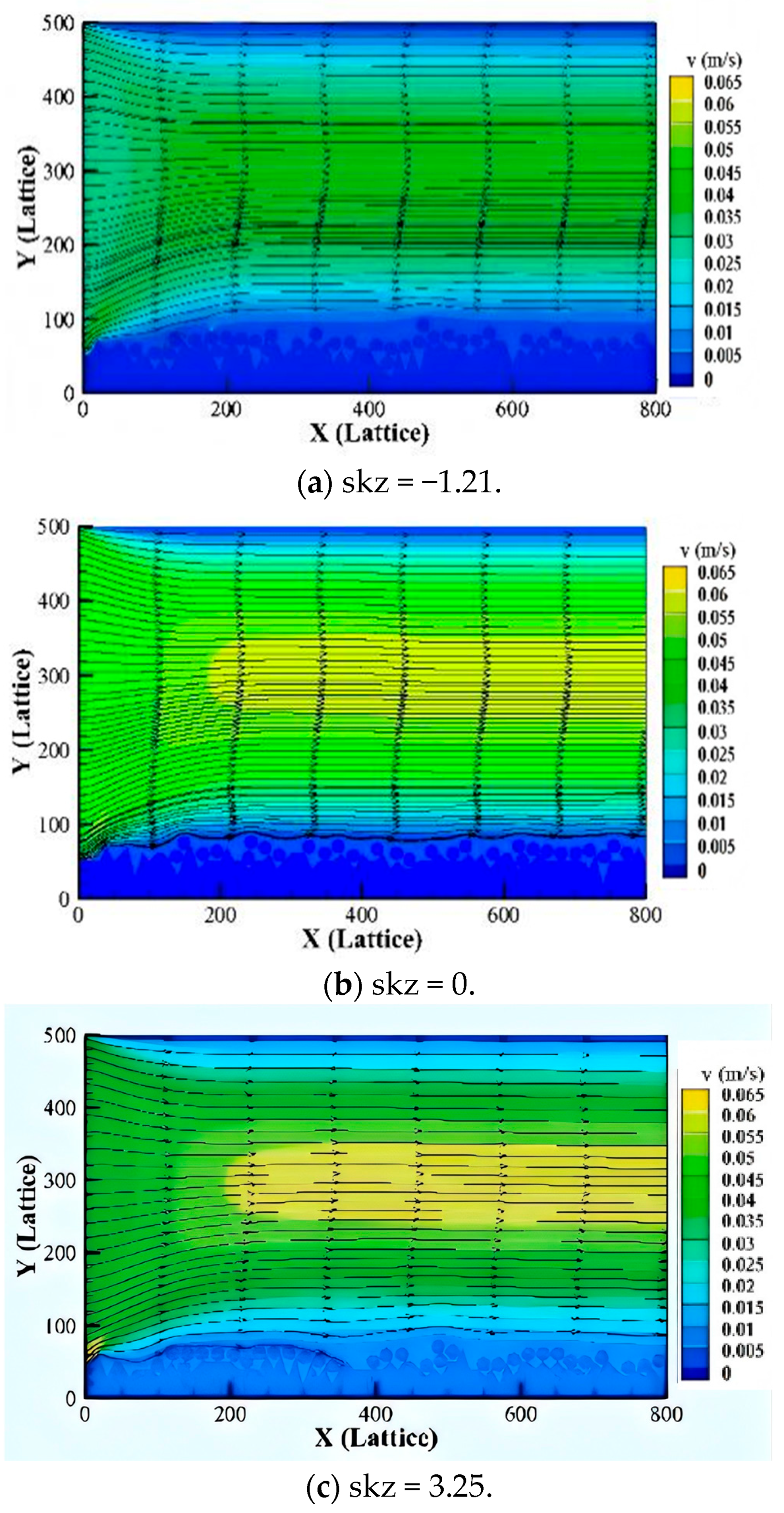
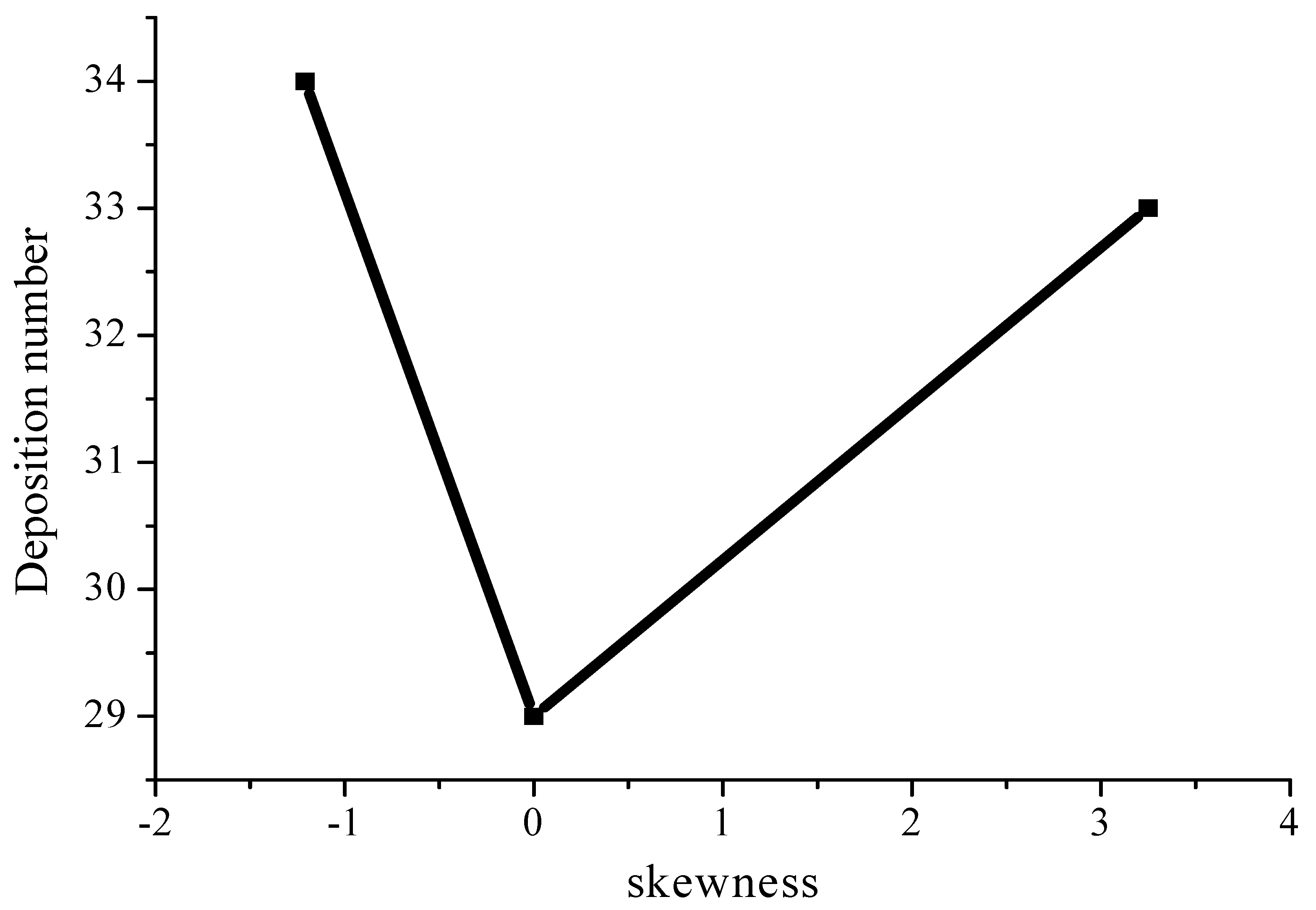
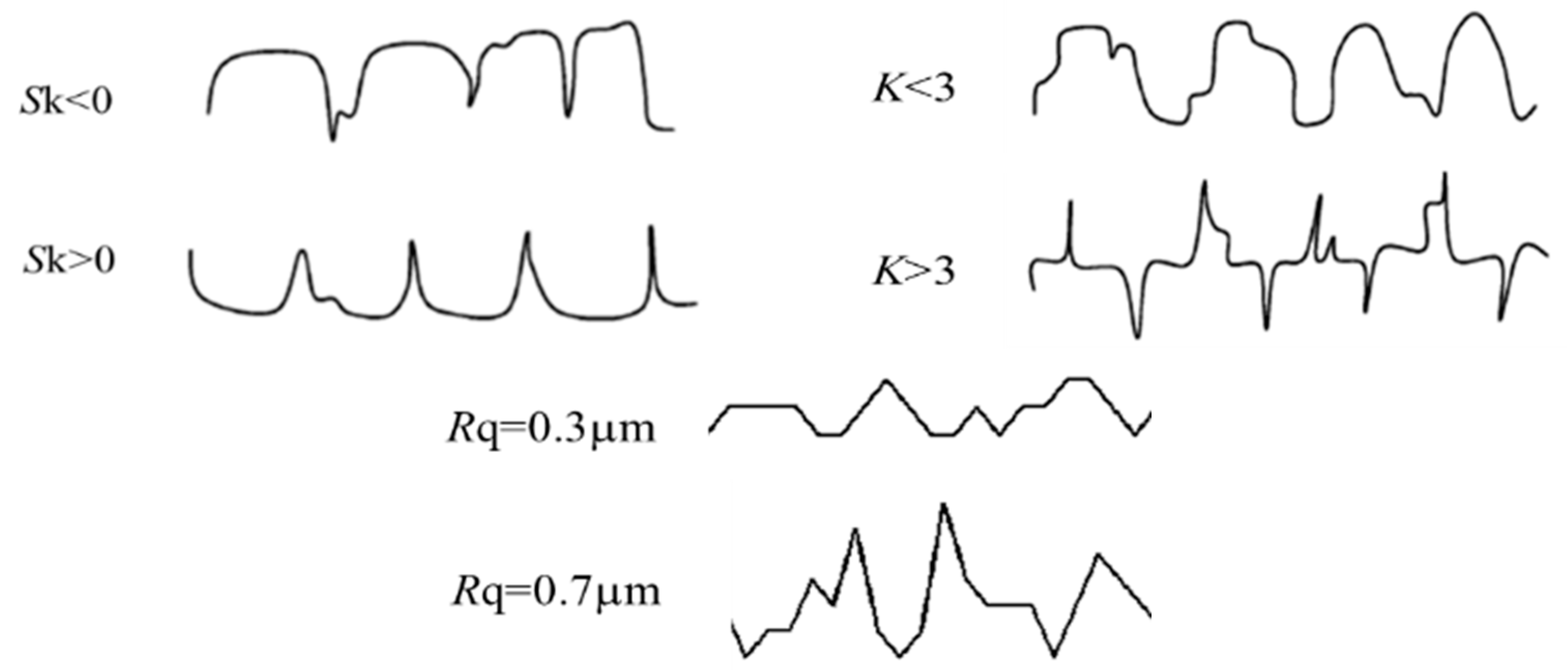
45]. The kurtosis, skewness, and standard deviation are used to ascertain the surface roughness. Skewness quantifies the asymmetry in surface topography. A skewness of zero indicates a symmetric, Gaussian height distribution. Negative skewness corresponds to surfaces dominated by deep valleys with flattened peaks, whereas positive skewness characterizes surfaces with pronounced peaks and shallow valleys. Greater absolute skewness values reflect increased topographical asymmetry. Kurtosis describes the sharpness of the height distribution. A Gaussian surface exhibits a kurtosis of 3.0. Values below 3.0 indicate a flatter, more uniform height distribution compared to the Gaussian case, while values exceeding 3.0 signify a more peaked distribution with extreme heights. Elevated kurtosis indicates a propensity for pronounced peaks and deep troughs in surface topography. Standard deviation quantifies the dispersion of height distributions relative to the mean elevation.
Figure 1 depicts morphological variations resulting from different skewness, kurtosis, and standard deviation combinations.
The reconstruction methodology is detailed below. The randomly distributed rough surface can be characterized using an exponential autocorrelation function (
Rz) and height distribution. The reconstructed domain is represented by an
N ×
M grid with corresponding height arrays
z (
i,
j). These parameters and the exponential autocorrelation function (
Rz) are formulated as follows:
Hu and Tonder proposed the 2D digital filter technique to generate the randomly distributed rough surfaces with different skewness and kurtosis for a known
Rq and
β [
46]. The input sequence
η(
I,
j) is filtered by
h(
k,
l) to obtain the height sequence
z(
I,
j) through the transformation system described as:
The computational procedure involves the following steps.
First, the Fourier transform method is applied to Equation (38), yielding Equation (39):
Next, the auto-correlation function (
Rz) is used to calculate the probability density function of the surface roughness, as shown in Equations (41) and (42):
Finally, the filter function
h(
k,
l) is calculated using Equation (43):
Thus, the sequence
η(
i,
j) must be transformed into sequence
η′, which is a non-Gaussian input sequence [
47,
48]. The specific transformation can be seen in the literature [
48].
The randomly distributed rough surfaces are generated using a two-step stochastic reconstruction procedure based on established methods reported in the literature [
43,
44,
45]. In the first step, a Gaussian random surface is constructed using an FFT-based spectral method. A target power spectral density or autocorrelation function is prescribed in the frequency domain, and an inverse Fourier transformation is applied to obtain a spatial height field with zero mean and a Gaussian height distribution. The standard deviation of surface height, σ, is then controlled by scaling the amplitude of the generated height field, allowing direct adjustment of the overall roughness intensity.
In the second step, to generate non-Gaussian surface morphologies, the Gaussian height field is transformed using a Johnson transformation [
46,
47,
48]. This transformation modifies the probability density function of surface heights while preserving the prescribed standard deviation. By appropriately selecting the transformation parameters, the skewness and kurtosis of the surface height distribution can be independently controlled. In this manner, surface skewness governs the asymmetry of asperity height distribution, while kurtosis determines the sharpness and extremeness of surface peaks and valleys. This approach enables systematic generation of random rough surfaces with identical standard deviation but different skewness and kurtosis, as illustrated in
Figure 1.
Superhydrophobic surfaces are characterized not only by low surface energy but also by complex surface topographies. In the present study, randomly distributed rough surfaces are reconstructed using an FFT-based spectral method, in which the statistical properties of the surface are prescribed through the skewness, kurtosis, and standard deviation of the height distribution. These parameters uniquely define the global morphological characteristics of the reconstructed surface, while the detailed local features are determined by the stochastic nature of the reconstruction process.
Because the surface generation procedure is inherently stochastic, different realizations with identical statistical parameters may exhibit variations in local asperity distribution. In this work, for each prescribed set of surface statistical parameters, representative rough surface realizations are generated and used consistently in the corresponding particle deposition simulations. Although the local deposition morphology may vary depending on the specific random realization, the primary objective of this study is to investigate the influence of surface statistical parameters on particle deposition behavior. As demonstrated by the systematic parametric comparisons presented in the Results and Discussion section (
Section 5), the overall deposition trends are governed by the prescribed surface statistics rather than by individual random surface features. Therefore, the conclusions drawn in this study reflect statistically meaningful trends associated with surface roughness characteristics rather than artifacts arising from a particular random surface realization.
It should be noted that, in the present LBM–IMBM–DEM framework, particle–surface contact is represented through interactions between particles and discretized surface nodes. The effective contact geometry is, therefore, influenced by the lattice resolution used to describe the rough surface. To ensure adequate resolution of contact interactions, the lattice spacing is selected to be sufficiently smaller than both the particle diameter and the characteristic roughness length scales. Within this resolution regime, the JKR-based adhesion model provides a physically consistent description of adhesive interactions.
2.5. The Contact Model
Recently, the JKR model has been extensively applied to compute contact forces in particle–particle and particle–wall collisions. Nevertheless, existing models are limited to smooth surface interactions. A computational framework for particle–rough surface impacts remains undeveloped. This study presents a novel contact model extending the JKR approach to address particle–rough surface collisions. The simulation assumes that deposited particles do not alter the rough surface morphology. The lattice Boltzmann method simulates airflow and particle–fluid interactions within a discretized computational domain. Grid nodes are classified as either solid roughness elements or fluid regions. Collision detection utilizes the spacing between particle centers and solid nodes representing surface asperities. Contact is identified when this spacing falls below the particle radius. Then, the JKR model introduced in previous parts can be employed to calculate the contact force. Here, we used the solid node to replace the solid surface; thus, the particle size must be larger than the grid length.
3. Numerical Model Validation
As summarized in
Table 1, particles with a density of 2500 kg·m
−3, a diameter of 250 μm, and a Young’s modulus of 100 MPa were released individually from a fixed height of 4.612 × 10
−3 m above the bottom surface into a microchannel with a height and width of 1.0 × 10
−2 m. This release configuration ensures well-defined and repeatable initial conditions for particle–surface interactions. The carrier gas properties correspond to ambient air conditions, with a density of 1.29 kg·m
−3 and a dynamic viscosity of 1.8 × 10
−5 Pa·s.
Particle motion within the microchannel was recorded using a high-speed camera (PCO.dimax S1, PCO AG, Kelheim, Germany), which provides sufficient temporal and spatial resolution to capture particle impact, rebound, and deposition processes. The spatial resolution was calibrated using a reference target placed in the imaging plane. Particle centroid positions were extracted from the recorded image sequences using frame-by-frame image processing techniques, and particle velocities were subsequently obtained from the measured trajectories using a central finite difference scheme. This experimental procedure enables quantitative comparison between measured particle trajectories and numerical predictions.
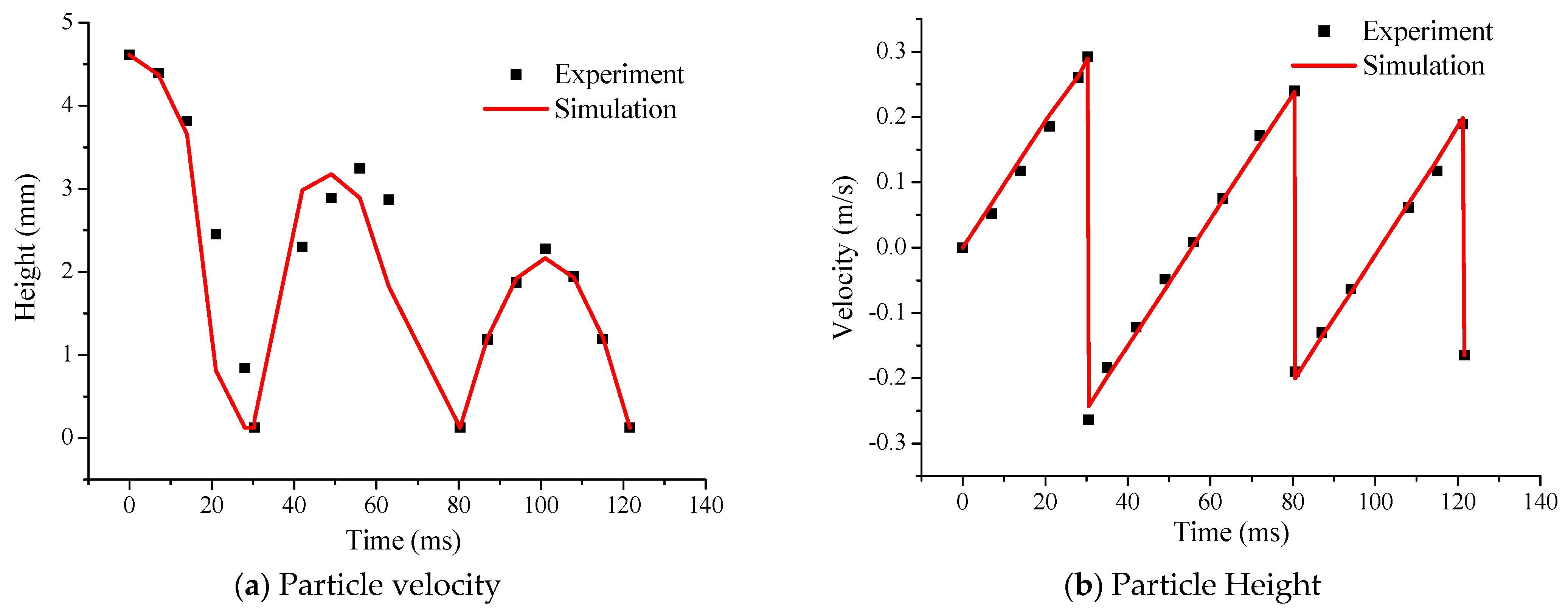
To quantitatively assess model accuracy, the root-mean-square error (RMSE) between the measured and simulated particle height and velocity time histories shown in
Figure 2 were calculated. The uncertainty in particle position was estimated from the imaging spatial resolution and centroid detection accuracy, while the time uncertainty was determined from the camera frame interval. These uncertainties were propagated to the velocity measurements using standard error propagation for finite differences.
The root-mean-square error (RMSE) was used to quantify the deviation between numerical predictions and experimental measurements and is defined as
where
X represents either particle height or velocity and
N is the number of sampled data points.
Figure 2 compares experimentally measured and numerically predicted particle height and velocity as functions of time. The quantitative agreement is assessed using estimated error metrics based on digitized data, yielding RMSE ≈ 0.06 mm and mean relative error ≈ 3.8% for particle height, and RMSE ≈ 0.012 m/s and mean relative error ≈ 5.1% for particle velocity. Based on digitized experimental data from
Figure 2, the RMSE and relative error remain below 6% for both particle height and velocity, confirming the satisfactory predictive accuracy of the proposed numerical framework.
It should be noted that the experimental validation presented in this study focuses on single-particle impact under quiescent conditions. This validation strategy is adopted to isolate and verify the fundamental particle–surface interaction mechanisms, including collision, rebound, and adhesion, which are essential components of the numerical model. While multi-particle deposition, agglomeration, and resuspension under flow conditions are central to the numerical investigations presented in
Section 5.2,
Section 5.3,
Section 5.4 and
Section 5.5, direct experimental validation of these complex coupled processes remains challenging due to limitations in experimental resolution and controllability, particularly for rough superhydrophobic surfaces. Therefore, the present validation is intended to ensure the physical consistency of the particle–surface interaction model, whereas the subsequent numerical simulations are employed to examine relative deposition trends under varying conditions.
7. Discussion
The numerical results obtained in this study are generally consistent with previously reported experimental and numerical investigations on particle deposition over superhydrophobic and rough surfaces. Numerous studies have demonstrated that superhydrophobic surfaces can significantly suppress particle deposition by reducing effective particle–surface adhesion and promoting rebound or resuspension, particularly for small particles under low surface energy conditions [
29,
30]. The present simulations reproduce this behavior, as evidenced by the low deposition rates observed for small particles and low particle–surface energies.
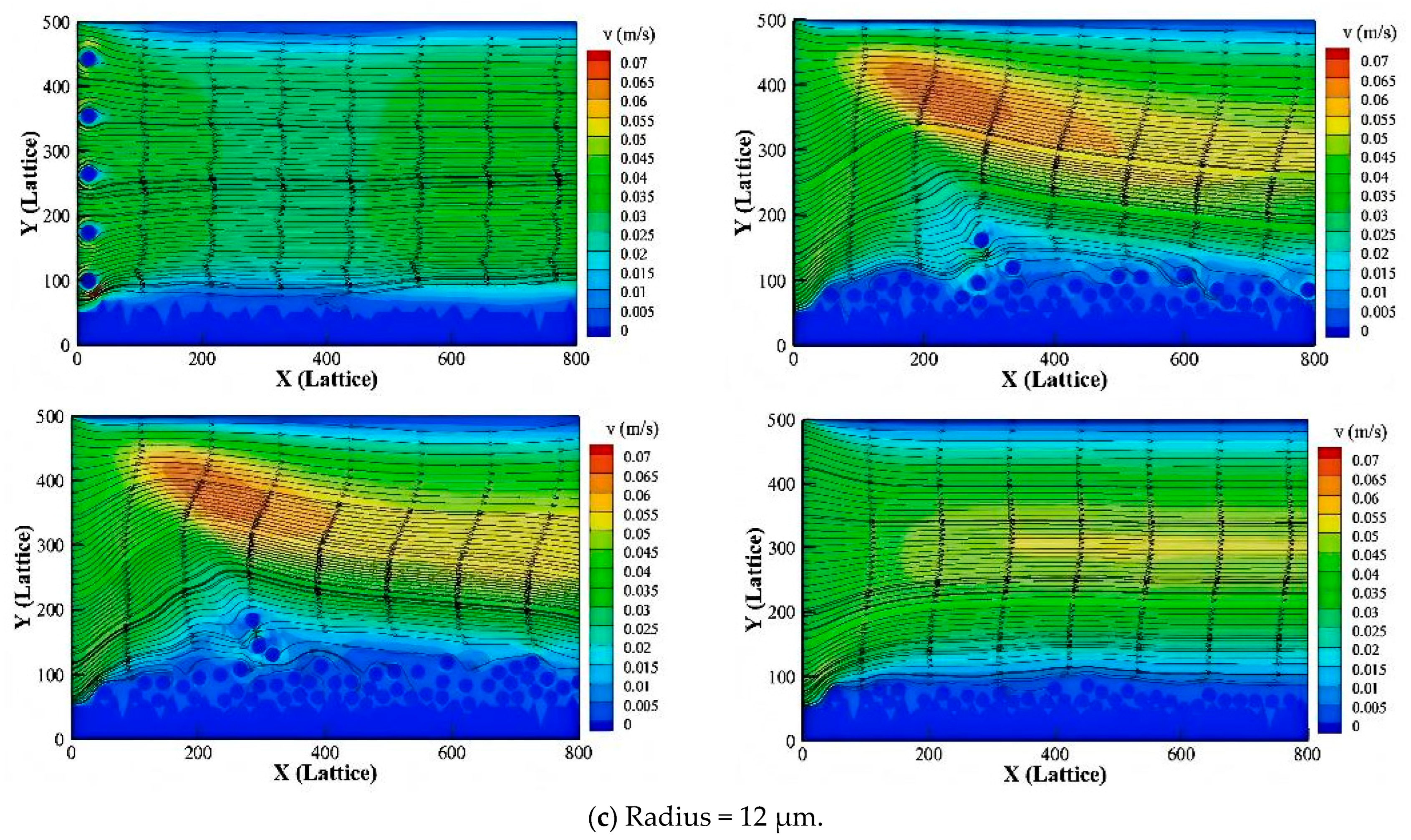
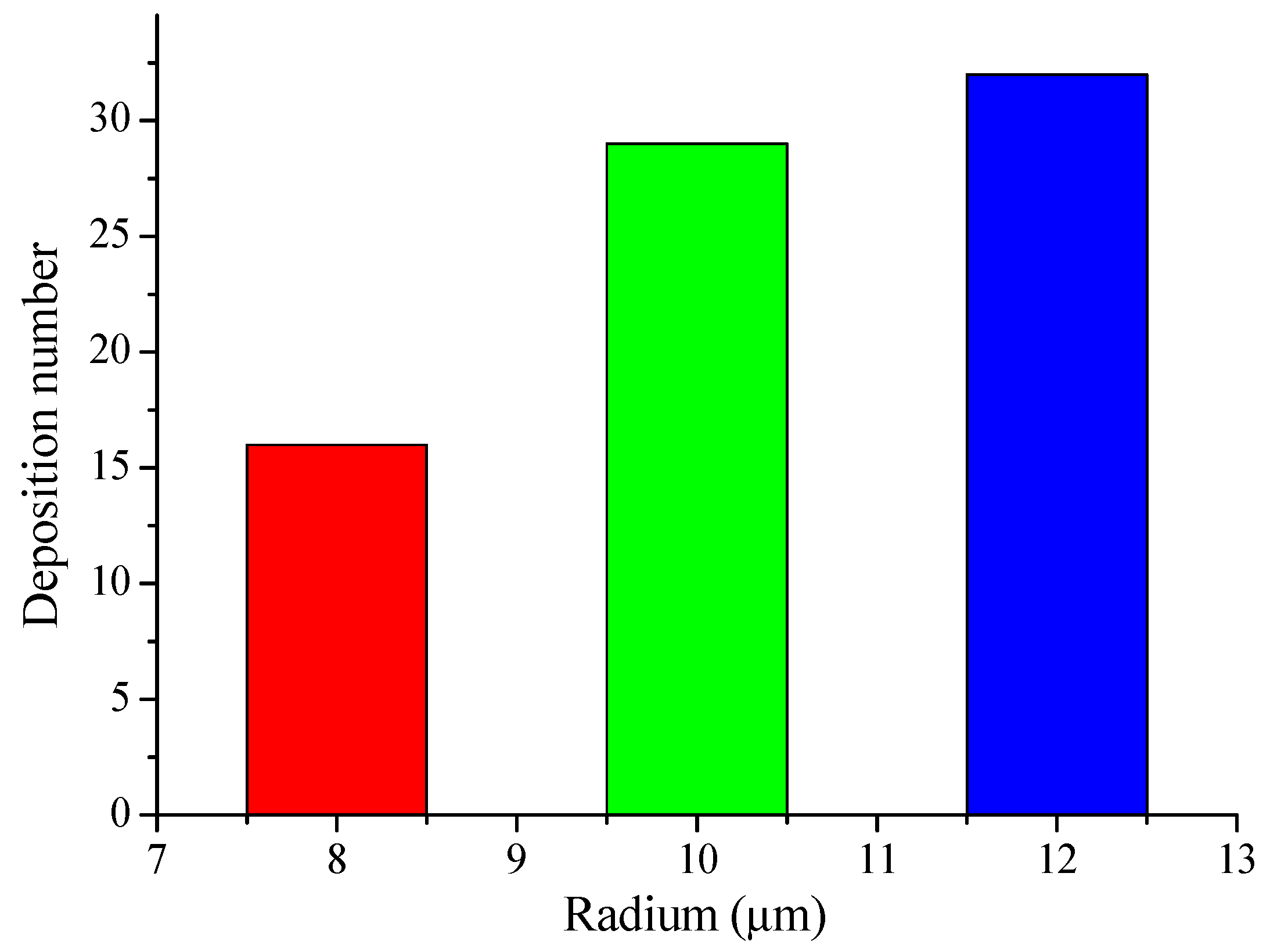
With increasing particle size, the deposition rate increases from approximately 5.7% for particles with a radius of 8 μm to about 10.7% for particles with a radius of 12 μm. This trend is consistent with earlier studies reporting enhanced deposition of larger particles due to increased inertia and higher particle–surface collision probability [
22,
37,
38,
39,
40]. The agreement suggests that the coupled LBM–IMBM–DEM framework employed here is capable of capturing particle size-dependent deposition behavior reported in the literature.
The influence of particle–surface energy on deposition behavior also agrees well with existing contact model-based numerical studies. Previous works using JKR-type adhesion models have shown that increasing surface energy leads to a rapid increase in deposition probability, followed by a saturation-like behavior once adhesion becomes dominant [
33,
34,
35,
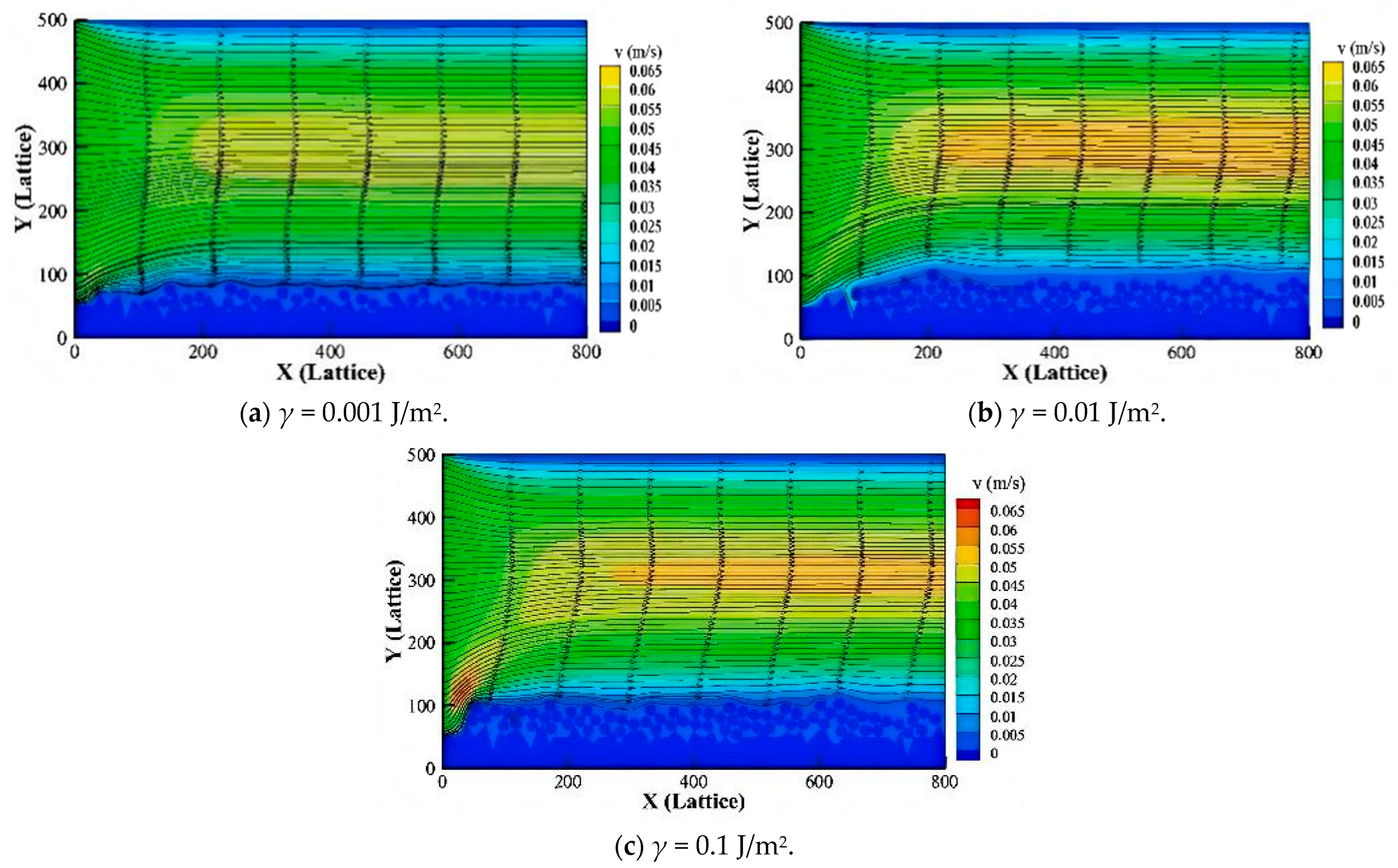
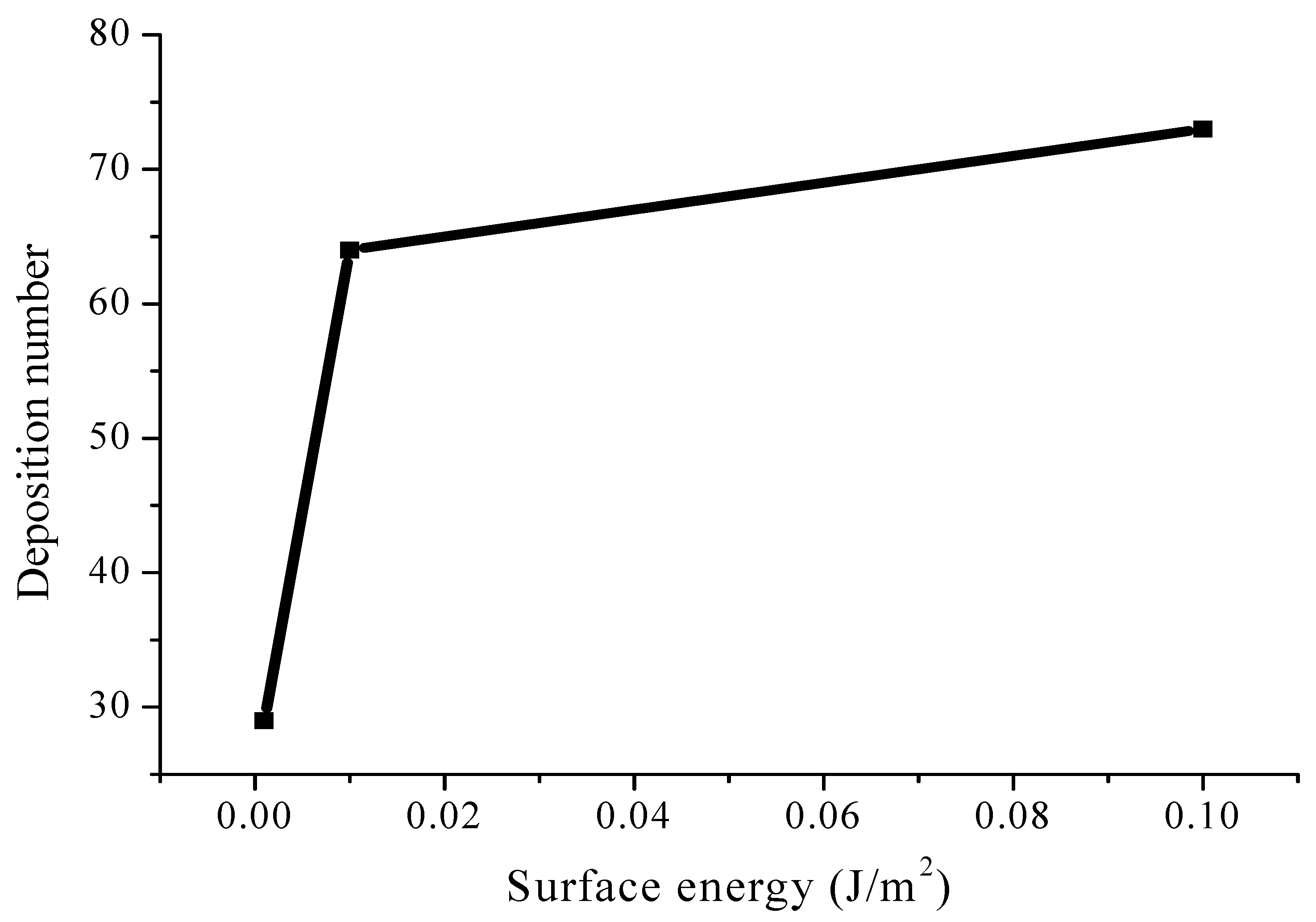
36]. In the present study, the deposition rate increases nonlinearly from approximately 9.7% at a particle–surface energy of 0.001 J·m
−2 to 21.3% at 0.01 J·m
−2, and then it increases more moderately to 24.3% at 0.1 J·m
−2. This transition behavior is consistent with the reported shift from rebound-dominated to adhesion-dominated deposition regimes in the literature.
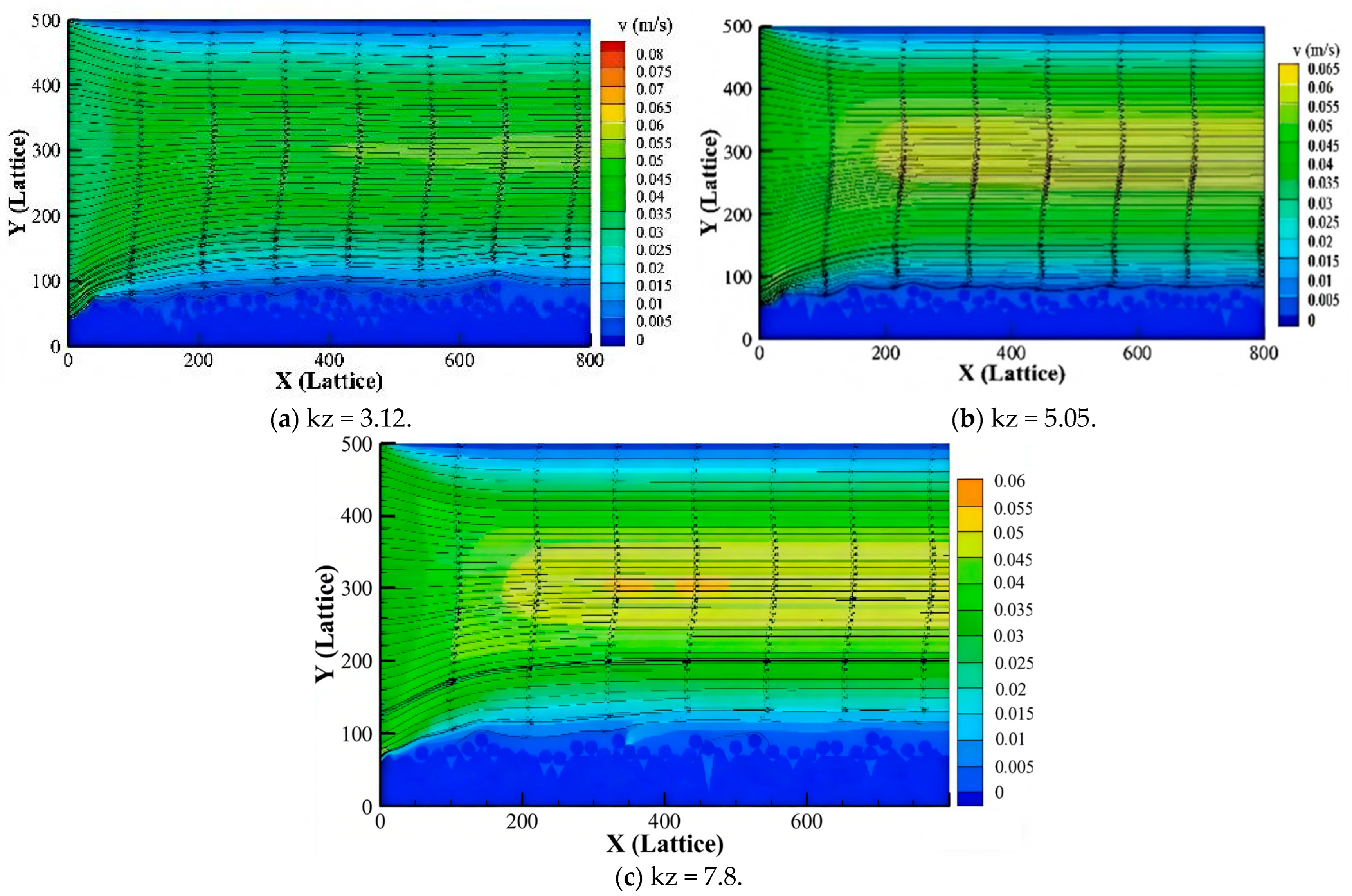
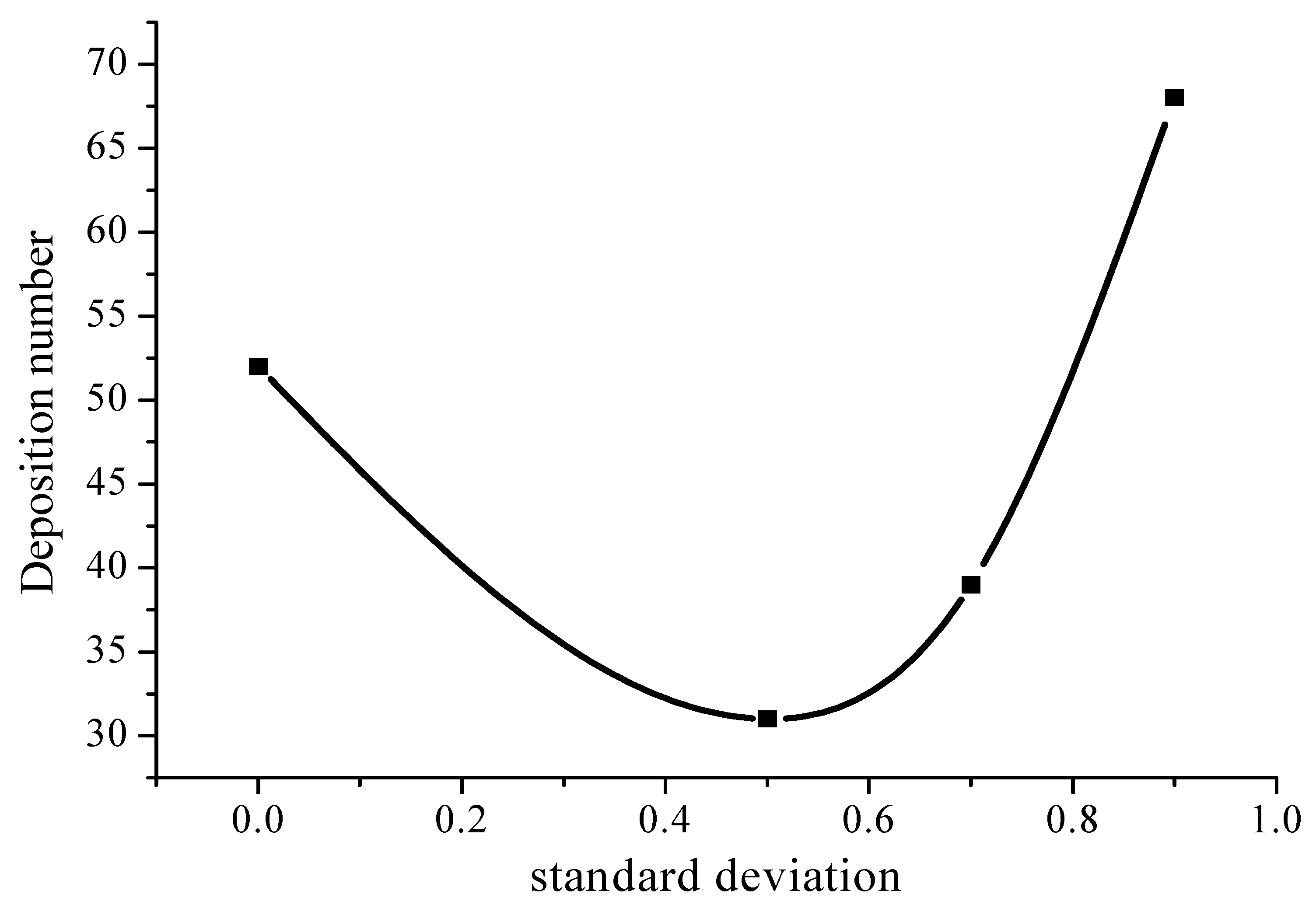
Compared with previous studies that primarily focused on idealized smooth or periodically structured surfaces, the present work extends existing knowledge by explicitly considering randomly distributed surface roughness with controlled statistical parameters. The observed increase in deposition rate with increasing roughness standard deviation is in agreement with experimental observations that rough surfaces enhance particle trapping by increasing contact probability and local flow disturbances [
29,
30]. However, the present results further demonstrate that deposition behavior is governed not only by roughness amplitude but also by the statistical characteristics of surface topography, which are rarely addressed in previous numerical studies.
Overall, the comparison with the existing literature confirms the validity of the present numerical framework while highlighting its capability to resolve the combined effects of particle size, surface energy, and random roughness statistics on particle deposition over superhydrophobic surfaces.