Article

Effect of Copper Powder Modification and Silver Content on Coating Adhesion and Corrosion Resistance of Silver-Coated Copper Powder


1
School of Materials Science and Engineering, Kunming University of Science and Technology, Kunming 650031, China
2
Yunnan Spring New Material Co., Ltd., Kunming 650212, China
*
Authors to whom correspondence should be addressed.
Coatings 2026, 16(2), 183; https://doi.org/10.3390/coatings16020183
Submission received: 6 January 2026 / Revised: 23 January 2026 / Accepted: 26 January 2026 / Published: 1 February 2026

Abstract

Silver-coated copper powder, possessing both excellent electrical conductivity and cost advantages, holds broad application prospects in electronic packaging and conductive materials. This study investigates the surface characteristics of copper powders produced by different methods and the effect of surface modification on electroless silver plating. It also analyses the regulatory role of silver content on coating structure and corrosion resistance. Results indicate varying responses to modifiers among different copper powders: contact angle decreased from 52.9° to 50.3° for physically modified copper powder and from 61.9° to 40.9° for chemically modified copper powder, demonstrating significantly improved surface wettability and enhanced silver layer coverage integrity. As silver content increased from 8 wt% to 15 wt%, the silver layer’s compactness increased, enhancing corrosion resistance. The self-corrosion current densities for physically and chemically modified copper powders decreased from 1.285 × 10⁻⁵ and 1.120 × 10⁻⁵ A·cm−2 to 4.671 × 10⁻⁶ and 5.075 × 10⁻⁶ A·cm−2, respectively. At 15 wt% silver content, the emergence of free silver particles on the powder surface led to reduced stability. This study elucidates the synergistic regulation mechanism between the properties of the copper powder matrix and the silver coating content on the silver-coated copper powder structure and its corrosion resistance. It provides experimental evidence for the design and application of high-performance silver-coated copper powders.

1. Introduction

Silver-coated copper powder is a typical core–shell composite that combines silver’s high conductivity and chemical stability with copper’s low cost and excellent processability [1]. It finds extensive applications in conductive pastes, solar cells, catalysis, antibacterial coatings, and flexible printed electronics [2,3,4,5,6]. Silver coating effectively suppresses copper oxidation and enhances the material’s conductive stability, making it a key development direction for replacing expensive silver powder [7,8]. However, the performance of silver-coated copper powder depends not only on the silver plating process but also closely relates to the surface characteristics of the base copper powder.
Research indicates that, in electroless copper plating, particle size distribution and surface morphology of copper particles significantly influence the nucleation and growth behavior of silver [9,10,11]. These characteristics determine the silver layer’s density, uniformity, and adhesion to the substrate. When excessively coarse copper particles are used in the coating process, the coating thickness increases [12,13], thereby affecting the composite powder’s conductivity and long-term stability. The preparation methods for micron-sized copper powder can be broadly categorized into physical and chemical approaches [14,15]. Standard physical methods include atomization, mechanical ball milling [16], plasma processing [17], and electroexplosion [18]. Chemical methods primarily encompass liquid-phase reduction [19], coprecipitation [20], electrolysis [21], electrodeposition [22], chemical vapor deposition [23], and disproportionation. Copper powders prepared by different methods exhibit variations in crystal structure, surface activity, and impurity content [24,25], which can influence silver plating behavior. Therefore, systematically investigating and regulating the surface properties and chemical state of copper powder is crucial for deepening understanding of the mechanisms underlying silver plating layer formation and service behavior, ultimately enabling the controlled preparation of high-performance silver-coated copper composite powders. Current research, both domestically and internationally, has primarily focused on optimizing silver plating processes or enhancing coating quality by adding transition layers [26,27,28]. However, studies investigating interfacial reactions and silver-layer structures arising from surface variations in copper powders from different sources remain relatively scarce. There is a lack of systematic analysis from the perspectives of surface free energy and surface chemistry, and comprehensive studies on their long-term stability in terms of corrosion behavior and electrical conductivity are also rare.
Based on this, this study systematically compared the surface chemical states of modified and unmodified copper powders prepared by different processes, along with their impact on subsequent electroless silver plating, by regulating surface characteristics. The study reveals the role of surface modification in promoting uniform silver deposition and enhancing interfacial bonding, as well as the influence of silver content on powder properties. By analyzing electrochemical corrosion behavior and its underlying mechanisms, it elucidates the synergistic regulation of silver-coated copper powder stability through modified and matrix characteristics. This provides theoretical support and technical guidance for the optimized design and engineering applications of highly conductive, corrosion-resistant silver-coated copper powders.

2. Experiment

2.1. Experimental Materials

The primary reagents used in the experiment were as follows: Silver nitrate (AgNO3), from Kunming Platinum Metal Materials Processing Co., Ltd. (Kunming, China); Polyvinylpyrrolidone ((C6H9NO)n), from Shanghai Aladdin Bio-Tech Co., Ltd. (Shanghai, China); Polyacrylic acid (C3H4O2), Guangdong Wengjiang Chemical Reagent Co., Ltd. (Shaoguan, China); Polyacrylamide ((C3H5NO)n), from Tianjin Kemiou Chemical Reagent Co., Ltd. (Tianjin, China); Sodium hydroxide (NaOH), from Guangdong Shantou Xilong Chemical Factory (Shantou, China); Sulfuric acid (H2SO4), from Chengdu United Chemical Reagent Research Institute (Chengdu, China); Triethylenetetramine (C6H18N4), from Shanghai Sinopharm Chemical Reagent Co., Ltd. (Shanghai, China); Glucose (C6H12O6), from Shanghai Aladdin Bio-Technology Co., Ltd.; and acetic acid (CH3COOH), from Sichuan Xilong Science Co., Ltd. (Chengdu, China). All reagents were of analytical grade. Commercial copper powder particles, PCu (physical method) and CCu (chemical method), were used in the experiment. Table 1 presents the fundamental properties of both copper powder types. SEM morphology images (Figure 1) reveal that physically produced copper powder exhibits high sphericity, a smooth surface devoid of pronounced edges or etching marks, and tightly packed particles. In contrast, chemically produced copper powder displays a distinct polyhedral shape, with each grain featuring sharp edges and a surface marked by numerous uneven micro-particle accumulations and step-like terraces.

2.2. Copper Powder Pretreatment and Surface Modification

To remove contaminants from the surface of copper powder and expose fresh copper substrate, thereby laying the groundwork for subsequent surface modification, this study first performed a pretreatment operation on the copper powder. Concurrently, to enhance the wettability and dispersibility of the copper powder and achieve more uniform bonding with the silver plating layer, surface modification of the pretreated copper powder was carried out using a polymer.
  • AlkalineCleaning Treatment
Weigh 20 g each of PCu and CCu copper powder into beakers. Add 300 mL of 3 g·L−1 NaOH solution to each beaker. Subject the contents to ultrasonic treatment at room temperature for 10 min. This aims to remove organic matter and reduce by-products from the copper powder surface, reduce adsorbed impurities, and enhance surface cleanliness. Following alkaline washing, the copper powder was centrifuged and rinsed twice with deionized water to eliminate residual NaOH.
2.
Acid pickling treatment
Place the alkali-washed copper powder in 300 mL of H2SO4 solution at a concentration of 1 g·L−1. Continue ultrasonic treatment at room temperature for 10 min. The purpose of selecting a low-concentration H2SO4 solution is to selectively dissolve the copper oxide or cupric oxide on the surface of the copper powder while minimizing corrosion of the underlying metallic copper. Following acid washing, rinse the copper powder with deionized water until the supernatant achieves neutral pH (pH = 7), thereby removing residual hydrogen ions and sulphate ions to prevent electrochemical corrosion during storage. After drying the rinsed samples, the pretreated physical copper powder (P-raw) and chemical copper powder (C-raw) are obtained.
3.
Surface Modification
Polyvinylpyrrolidone (PVP) modification: Pretreated P-raw and C-raw copper powders were separately dispersed in a 1 wt% PVP aqueous solution. Magnetic stirring was conducted at room temperature for 60 min to ensure thorough contact between polymer molecules and the copper powder surfaces. Subsequently, intermittent ultrasonic treatment was applied for 2 min to break up loose aggregates formed during stirring. The samples were then centrifuged and washed 2–3 times to remove unadsorbed PVP molecules, followed by vacuum drying at 60 °C for 4 h. The modified samples were designated as P1 and C1, respectively.
Polyacrylic acid (PAA) modification: Employing the same procedure as for PVP modification, the PAA solution concentration was 0.25 wt%. This lower concentration compared to PVP stems from PAA’s greater hydrophilicity. The system pH was adjusted to 7.5 using NaOH solution. The resulting samples were designated P2 and C2, respectively.
Polyacrylamide (PAM) modification: Following the PVP modification procedure, the PAM solution concentration was set to 0.25 wt%, matching the PAA solution concentration. The modified products were designated as P3 and C3, respectively.

2.3. Chemical Silver Plating

This study employs liquid-phase reduction to conduct electroless silver plating experiments, producing silver-plated copper powder. The core principle involves reducing silver ions to metallic silver on the copper powder surface, thereby forming a uniform and dense silver coating.
First, disperse the pretreated or modified copper powder in deionized water to prepare a copper powder suspension with a concentration of 10 g·L−1. Weigh out silver nitrate, reducing agent, and chelating agent according to the predetermined silver content of the silver-coated copper powder. Place the weighed silver nitrate into a beaker, add 50 mL of deionized water, and dissolve thoroughly. Gradually add the complexing agent to the silver nitrate solution; a white precipitate will form. Continue adding the complexing agent until the precipitate disappears, then make up the volume to 100 mL with deionized water to prepare a silver complex solution with a concentration of 0.22 mol·L−1. Dissolve the reducing agent in 100 mL of deionized water to prepare a reducing agent solution with a concentration of 0.14 mol·L−1. Excessively high concentrations may cause accelerated silver deposition, resulting in coarse and porous silver plating; conversely, excessively low concentrations may lead to incomplete reduction in silver ions, thereby reducing silver plating efficiency. Under magnetic stirring, simultaneously add the reducing agent solution and silver complex solution dropwise to the copper powder suspension. After completion of the addition, continue ultrasonic stirring for 15 min to ensure thorough reaction. The purpose of the dropwise addition method is to control the local concentration of silver ions and reducing agent within the system, thereby preventing the formation of free silver nanoparticles in solution. After reaction completion, allow the mixture to settle. Once the prepared silver-coated copper powder has fully precipitated, decant the supernatant. Wash the silver-coated copper powder with deionized water, then centrifuge and dry.

2.4. Performance Testing and Characterization

Powder surface morphology and particle size were examined using a JSM-7800F field-emission scanning electron microscope (SEM, JEOL Ltd., Tokyo, Japan). Elemental composition was analyzed by energy-dispersive spectroscopy (EDS) equipped with the SEM system. Electrical resistance was measured using a TH2512 resistance tester (Changzhou Tonghui Electronics Co., Ltd., Changzhou, China). Phase identification of the silver-coated copper powder was carried out using a TD-3500 X-ray diffractometer (XRD, Dandong Tongda Technology Co., Ltd., Dandong, China). Ion concentrations in the solutions were determined by inductively coupled plasma optical emission spectrometry (ICP-OES, Agilent 5110). The bulk density of the powder was measured using a Baite bulk density tester (Dandong Baite Instrument Co., Ltd., Dandong, China). In accordance with the instrument operating procedure, the powder sample was slowly poured into the funnel and allowed to settle naturally in the measuring vessel without external compaction. Each sample was measured in triplicate, and the average value was recorded. Surface modification of the copper powder was characterized using a Shimadzu IRAffinity-1s Fourier transform infrared (FTIR) spectrometer. Approximately 1–2 mg of the modified copper powder was mixed with 100 mg of spectroscopically pure KBr and ground thoroughly in an agate mortar until a homogeneous mixture was obtained. The mixture was then transferred into a tablet press mold and pressed under vacuum at 12 MPa for 2 min to form a transparent pellet. Pure KBr pellets were used as the background reference. Spectra were collected in the wavenumber range of 4000–400 cm−1 with a resolution of 4 cm−1, and 32 scans were accumulated. Contact angle measurements were conducted using a HARKE-SPCA contact angle goniometer (Beijing Hake Instrument Co., Beijing, China). Prior to measurement, the powder samples were pressed into flat sheets. At room temperature, three droplets of deionized water (3–5 μL per drop) were deposited onto each sample surface. The contact angle was recorded within 2–3 s after initial droplet contact. The reported contact angle represents the average of three measurements.
The corrosion behavior of the samples was investigated using a CH7006 electrochemical workstation (Shanghai Chenhua Instruments Co., Ltd., Shanghai, China). All electrochemical measurements, including potentiodynamic polarization (PDP) and electrochemical impedance spectroscopy (EIS), were performed in a conventional three-electrode system [29]. The silver-coated copper powder was pressed into circular disk-shaped specimens and used as the working electrode. The remaining surfaces were sealed with an insulating material, leaving an exposed area of approximately 1 cm2. A saturated calomel electrode (SCE) and a graphite electrode were used as the reference and counter electrodes, respectively. A 0.1 mol·L−1 NaCl solution served as the electrolyte, and all tests were conducted at 25 °C. Prior to electrochemical testing, the samples were immersed in the electrolyte for 1 h to stabilize the electrode/electrolyte interface. Open-circuit potential (OCP) measurements were then performed, and subsequent tests were initiated after the potential stabilized [30]. PDP measurements were carried out with respect to the stable OCP, using a potential range of OCP ± 350 mV and a scan rate of 1 mV·s−1. EIS measurements were conducted at the stable OCP with an AC perturbation amplitude of 10 mV over a frequency range from 105 to 10−2 Hz [31].

3. Results and Discussion

3.1. Optimization and Control of Surface Properties Through Copper Powder Modification

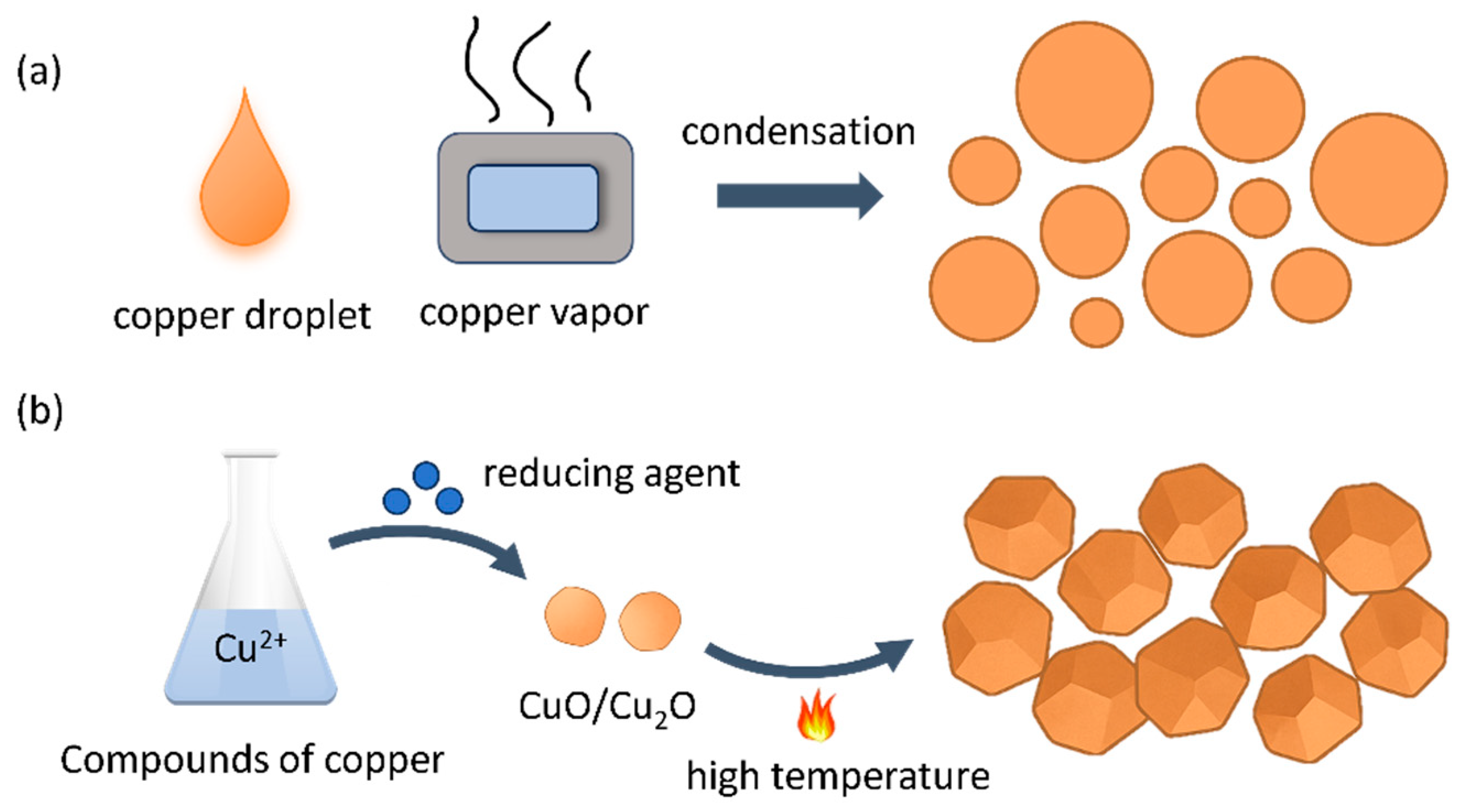
In the research and application of metal powders, even when particle-size distribution and morphology are similar, significant differences in wettability, coating adhesion, and corrosion resistance persist among powders produced by different methods. These variations stem not only from surface morphology but also from distinct surface chemical and physical properties. As shown in Figure 2, PCu formed via evaporation−condensation or atomization exhibits good sphericity but a broad particle-size distribution, with insufficient uniformity [15,32,33]. In contrast, CCu produced by wet-chemical reduction exhibits a narrow particle-size distribution and a sharply defined morphology [34].
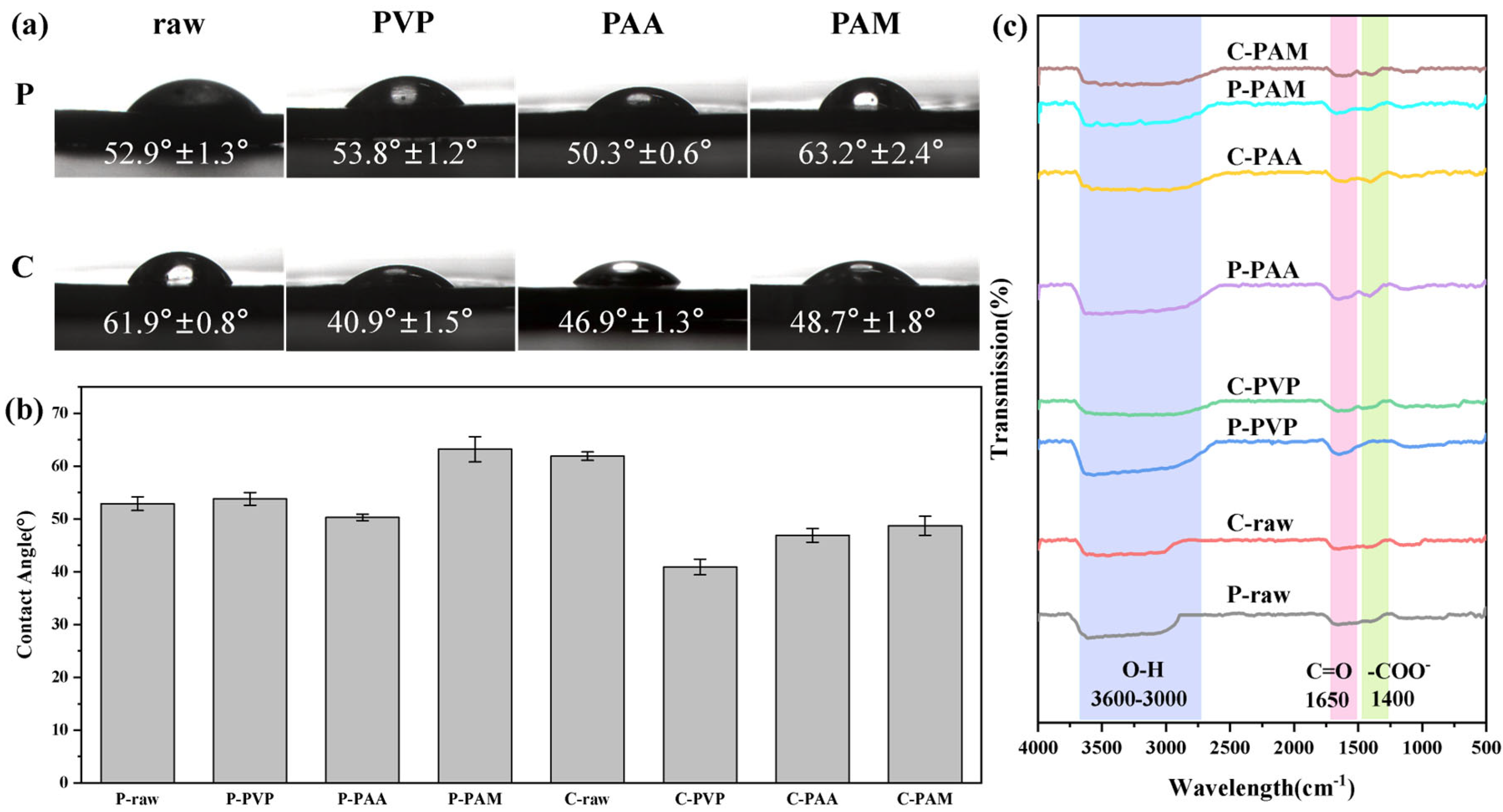
The surface energy state and chemical composition of copper powder significantly influence its wetting behavior, coating adhesion, and subsequent corrosion resistance. To this end, this paper first characterizes the surface wettability and chemical state of samples before and after modification. Contact angle measurements were primarily employed to evaluate changes in surface wettability, indirectly reflecting trends in surface free energy-related properties [35], while FTIR provided qualitative analysis of functional groups. Results are shown in Figure 3.
The contact angle results indicate that copper powders prepared by physical and chemical methods exhibit differing responses to various modifiers. The contact angles of P-raw and C-raw, subjected only to pretreatment, were 52.9° ± 1.3 and 62.9° ± 0.8, respectively. Following PAA modification, the contact angle of P-raw decreased to 50.3° ± 0.6, while PVP modification reduced that of C-raw to 40.9° ± 1.5. These changes are more clearly illustrated in the bar chart of Figure 3b. According to Young’s equation, we have the following [36]:
γ S V γ S L = γ L V c o s θ
γSV: Solid/gas interfacial energy;
γSL: Solid/liquid interfacial energy;
γLV: Liquid/vapor interfacial energy;
θ: Contact angle.
A reduction in contact angle indicates enhanced surface wettability of the material, typically associated with an improvement in surface energy state. Surface free energy reflects the high-energy state of atoms on a solid surface due to coordination unsaturation, and its magnitude directly determines the wettability and interaction capacity between the solid and liquid phases [37]. During the silver plating process, superior surface wettability facilitates the spreading and contact of silver ion solutions on the copper powder surface. This provides more favorable interfacial conditions for silver nucleation and the continuous growth of the plated layer.
It should be noted that the wetting behavior on material surfaces is influenced not only by the surface chemical composition but may also be modulated by surface topography and roughness. However, as this study did not quantitatively characterize the surface roughness of the samples, its influence is discussed here only as a secondary factor in a qualitative manner.
Figure 3c presents the FTIR spectra of copper powder before and after surface modification. To minimize the influence of baseline drift on peak intensity comparison, all FTIR spectra were subjected to baseline correction, and the intensities of characteristic peaks were subsequently normalized. The variations in peak positions and relative intensities of the characteristic bands are summarized in Table 2. For the PVP-modified sample, a distinct C=O stretching vibration peak was observed at approximately 1650 cm−1, which can be attributed to the carbonyl group of the pyrrolidone ring. The PAA-modified sample exhibited a characteristic carboxyl C=O stretching band near 1700 cm−1, together with asymmetric and symmetric stretching vibrations of –COO at around 1550 cm−1 and 1400 cm−1, respectively. Although these bands were relatively weak compared with those of pure polymers, their increased intensity relative to the unmodified sample indicates that the carboxyl groups of PAA molecules were chemically adsorbed or coordinated onto the copper surface. In the case of the PAM-modified sample, an amide I (C=O) stretching band appeared at approximately 1630 cm−1, confirming the successful adsorption of PAM molecules onto the copper powder surface. In addition, the broad O–H stretching band in the range of 3000–3600 cm−1 was slightly enhanced for all modified samples compared with the unmodified copper powder, suggesting the presence of hydrogen-bonding interactions between carboxyl, carbonyl, or amide functional groups in the polymer modifiers and surface hydroxyl groups. Due to the strong infrared reflectance of metallic powder samples, the overall absorption signals were relatively weak, resulting in broadened peak shapes and less pronounced characteristic bands. Nevertheless, discernible spectral changes were observed upon comparison with the unmodified sample, confirming the successful adsorption or binding of the modifiers onto the copper powder surface.
It can also be observed that PCu and CCu exhibit different responses to the same modifier, indicating that copper powders prepared by various methods require distinct modifiers for surface modification. This type of surface modification alters the chemical state of the surface, introducing additional active groups capable of interacting with silver ions. Consequently, it exerts a significant influence on the subsequent electroless plating process. The chemical silver plating process typically involves displacement and reduction reactions, with displacement following the following displacement reaction mechanism [38]:
2 A g + + C u 2 A g + C u 2 +
The reaction rate and coating morphology are governed by the chemical state of the copper surface. By modulating the surface chemistry to introduce additional active sites, the interfacial reactivity is synergistically enhanced, thereby promoting uniform nucleation and stable growth of the coating [39].

3.2. Effect of Copper Powder Surface Modification on the Plating Layer

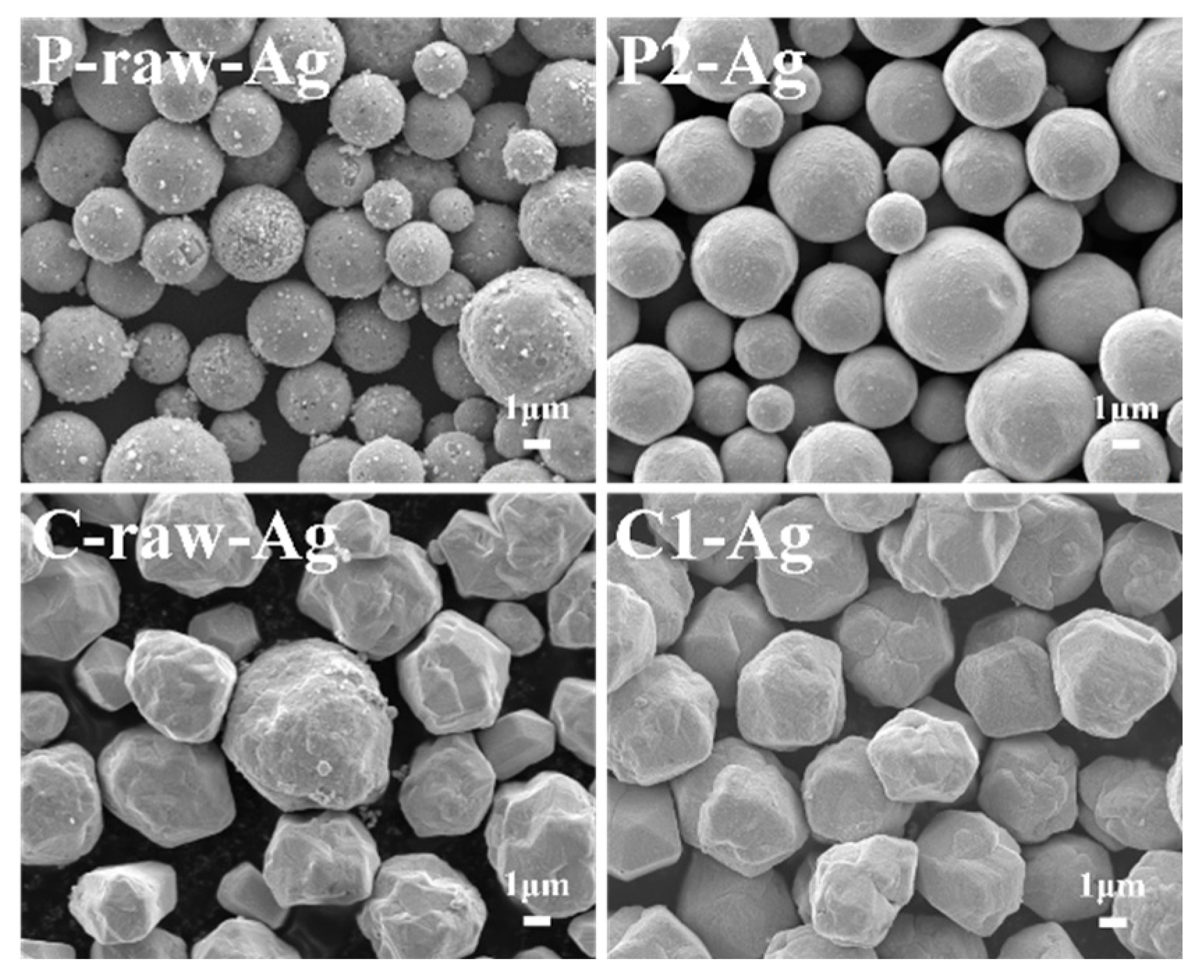
Silver plating was applied to P2 and C1, which exhibited improved wettability, and their surface morphologies at the duplicate silver content are shown in Figure 4. It is evident that the surface morphology has undergone significant changes: compared with the pretreated silver-plated samples P-raw-Ag and C-raw-Ag, the modified silver-plated samples P2-Ag and C1-Ag exhibit smoother, flatter surfaces. The silver layer distribution is more uniform and continuous, with a marked reduction in exposed areas between particles and free silver particles. This indicates that surface modification enhances coating density and nucleation uniformity. Furthermore, comparisons between different powder types reveal that spherical powders form denser, smoother silver layers after surface modification. Even polyhedral chemical copper powders with numerous edges exhibit relatively complete coverage. This result further demonstrates that regulating the surface free energy and chemical state of the copper powder matrix effectively improves silver deposition behavior and coating uniformity.

3.3. Effect of Silver Content on the Properties of Silver-Plated Copper Powder

3.3.1. Morphology and Structure of Silver-Plated Copper Powder

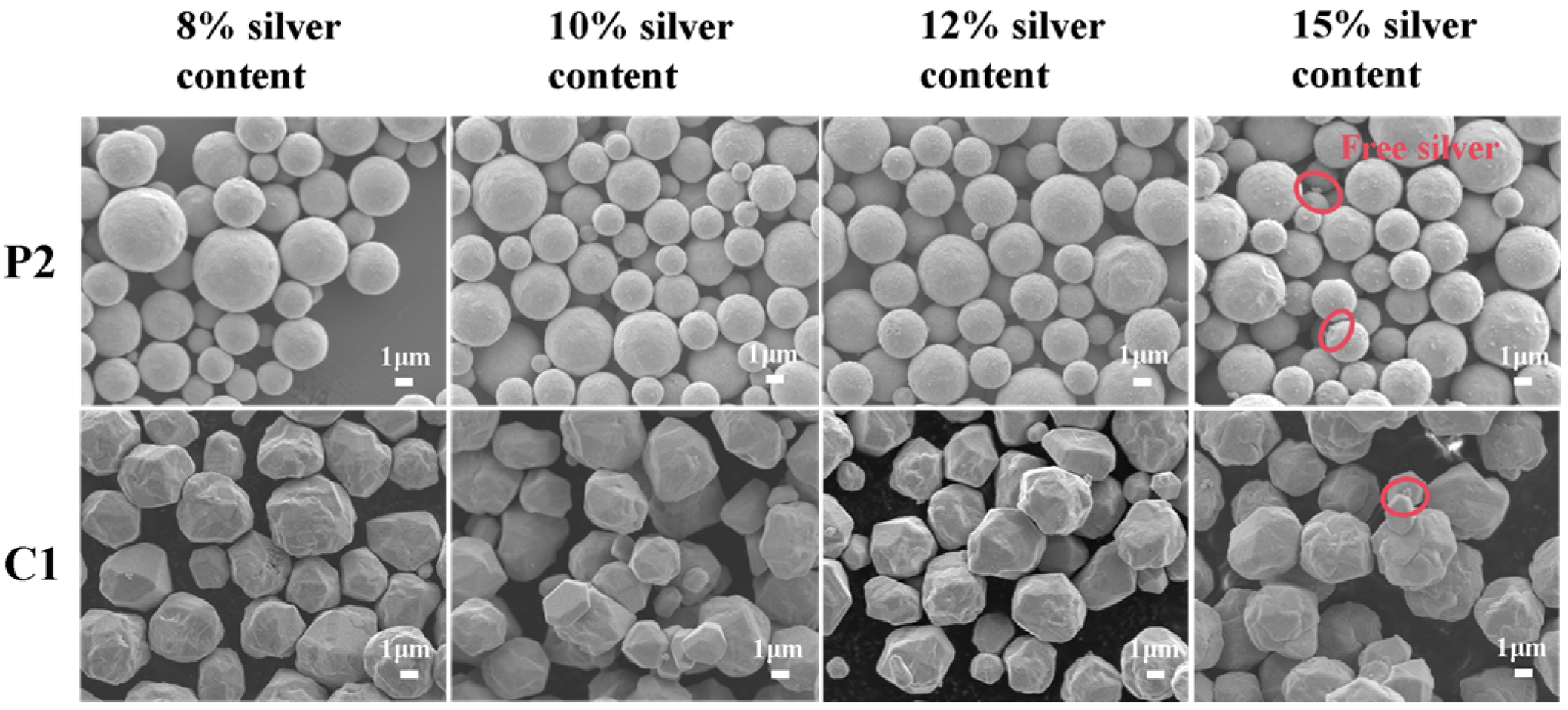
Continuing to use P2 and C1 as matrices to encapsulate different silver contents, the study investigated the effect of silver content on the properties of silver-coated copper powder. SEM characterization of the powder surface morphology is shown in Figure 5, and the relevant performance metrics for each sample are listed in Table 2.
As shown in Figure 5, the P2 series samples exhibit high sphericity, consistent with the high bulk density observed in Table 3, indicating excellent powder flowability [40]. Correspondingly, the C1 series samples demonstrate lower tableting resistance, attributed to their irregular shapes, which provide a greater effective contact area during compaction [34]. Surface morphology analysis further reveals that as silver content increases, the silver layer coating on the copper powder surface transitions from incomplete to nearly complete coverage, ultimately enveloping the entire copper matrix. Crucially, the silver deposition process does not alter the original morphological characteristics of the copper powder; each composite particle retains the spherical or polyhedral shape consistent with the matrix. However, as silver content further increases, a growing number of dispersed free silver particles appear in the system, as circled in Figure 5. The presence of free silver particles may disrupt continuous conductive pathways between powder particles, leading to localized fluctuations in electrical conductivity [26]. More critically, silver ions react with copper through galvanic corrosion, reducing the stability and corrosion resistance of silver-coated copper powder [41,42].
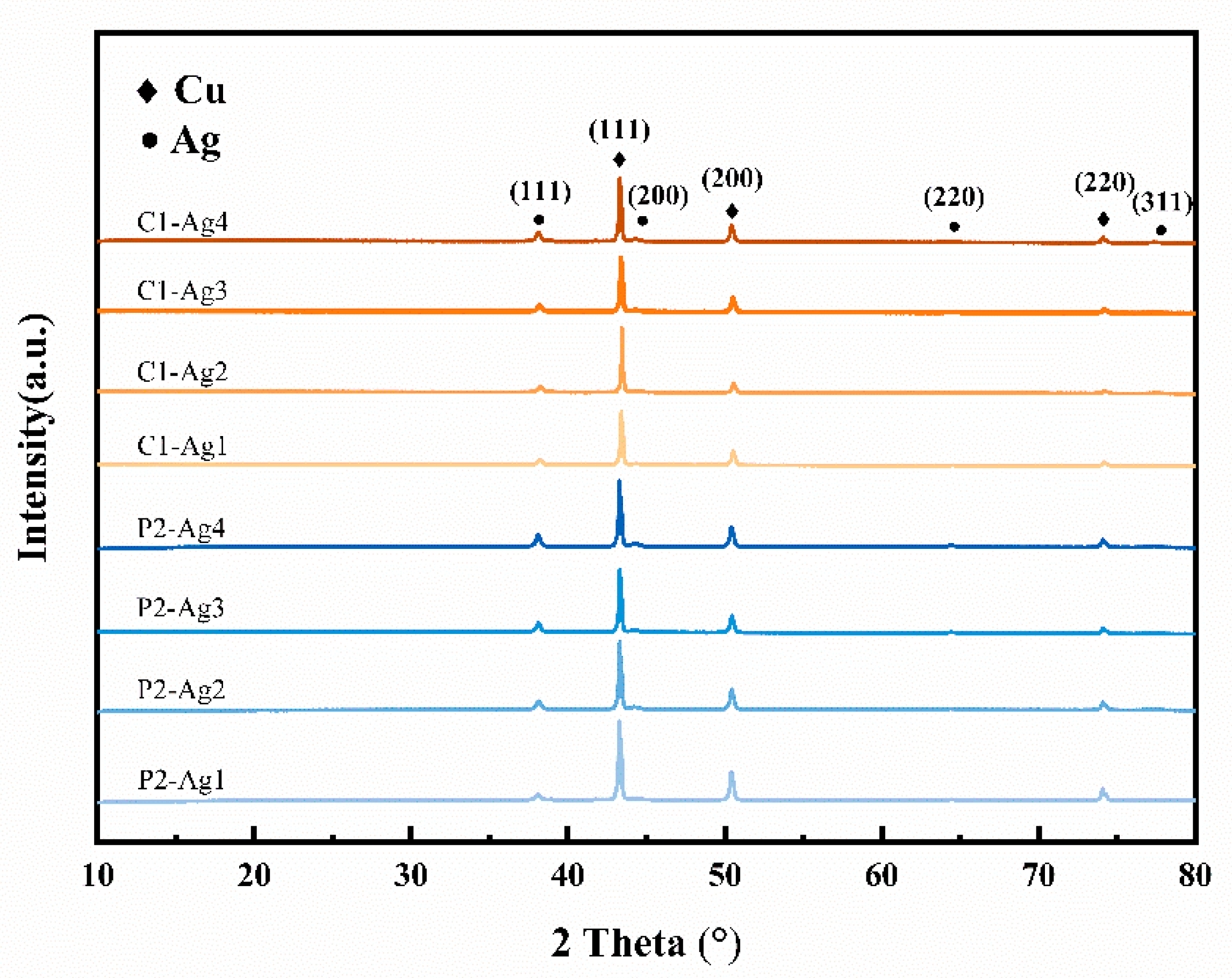
The XRD results for each sample are shown in Figure 6. The characteristic peaks of metallic silver (Ag) appear at 2θ = 38.1°, 44.3°, 64.5°, and 77.4°, corresponding to the (111), (200), (220), and (311) crystal planes, respectively. The characteristic peaks of metallic copper (Cu) appear at 2θ = 43.3°, 50.1°, and 74.1°, corresponding to the (111), (200), and (220) crystal planes, respectively. This indicates that the samples contain only silver and copper, with no copper oxide diffraction peaks observed. Calculating the average grain size of the sample using the Scherrer formula for the Ag(111) diffraction peak yields the results shown in Table 4. The Scherrer formula is as follows:
D = K λ β cos θ
D is the average particle size;
K is the shape factor;
λ is the wavelength of X-rays;
β is the half-width at half maximum;
θ is the diffraction angle.
According to this formula, grain size is inversely proportional to full width at half maximum (FWHM) [43]. A larger FWHM indicates a smaller grain size and lower crystallinity. Conversely, a reduced FWHM signifies a larger grain size and improved crystallinity. FWHM is a crucial parameter in X-ray diffraction patterns that characterizes the broadening of diffraction peaks [44]. It represents the peak width at half-maximum intensity and reflects the degree of grain refinement and the presence of crystal defects in the sample. As silver content increases, the intensity of the Ag(111) diffraction peak gradually enhances, indicating improved crystallinity and larger grain size in the silver layer [45]. This suggests that silver deposition becomes denser and structurally more complete.

3.3.2. Envelopment and Compactness

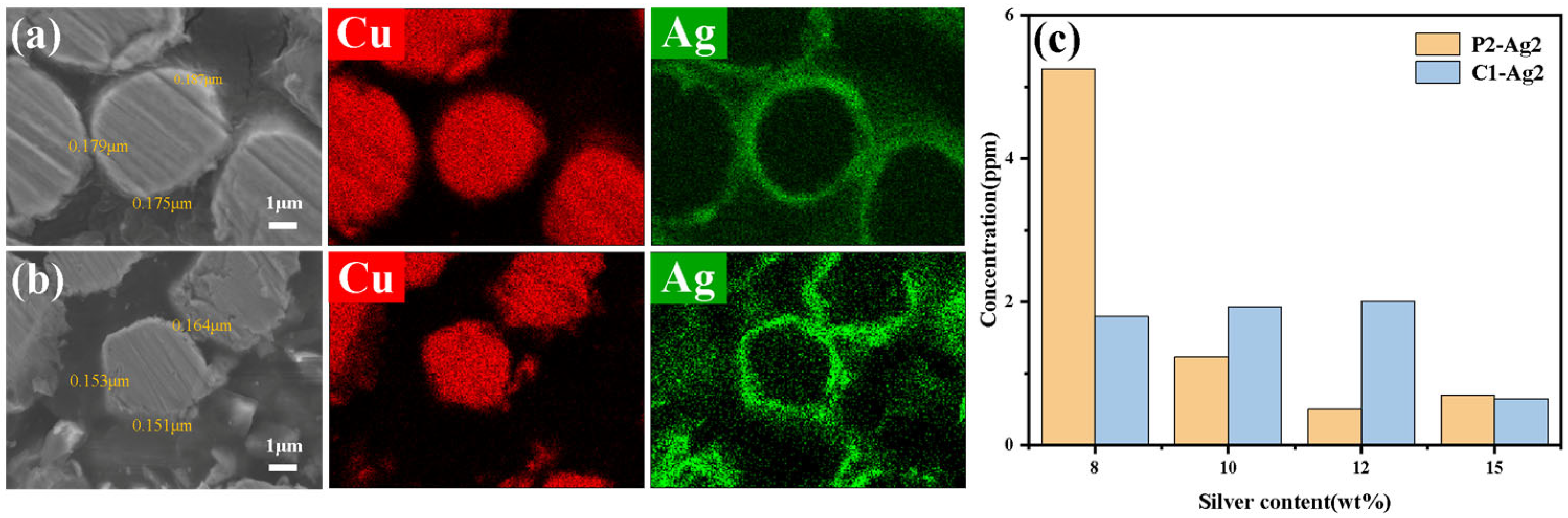
Observing the cross-sectional morphology and elemental distribution of P2-Ag2 and C1-Ag2 with 10% silver content reveals the coating properties of the modified silver-plated copper powder, as shown in Figure 7a,b. Copper is concentrated in the core region of the particles. At the same time, silver forms a continuous ring-like distribution around the periphery, indicating that silver has coated the copper particle surface to create a typical core–shell structure. Further comparison of coating thicknesses between the two samples reveals an average silver coating thickness of approximately 0.176 μm, as shown in Figure 7a. In contrast, the corresponding average thickness in Figure 7b is about 0.156 μm. Observing the elemental distribution reveals that, under identical total silver content and continuous silver coating formation, the spherical silver-coated copper powder exhibits a significantly thicker coating with clearly defined edges. In contrast, the polyhedral silver-coated copper powder, due to its lower bulk density, exhibits inherently loose packing and structural heterogeneity, resulting in a poorly defined edge of the silver coating and a more dispersed distribution.
To rapidly evaluate the compactness of the silver-coated copper powder layer and its surface oxidation state, the sample powder was immersed in acetic acid. This method relies on the shielding and protective effect of the silver layer over the internal copper core. Both CuO and Cu2O react with acetic acid at room temperature [46], but CuO reacts more rapidly, forming soluble copper acetate Cu(CH3COO)2 and water. As Cu2+ precipitates, the solution turns sky blue or pale blue. A darker supernatant indicates more copper oxides on the sample surface, suggesting a less dense silver coating. Supernatant samples were collected at 5 min, 30 min, and 60 min into the acetic acid immersion reaction. The Cu2+ concentration in the solutions was measured using ICP-OES, as shown in Figure 7c. It can be observed that, for the same immersion duration, both P2-Ag2 and C1-Ag2 exhibit a decreasing trend in Cu2+ concentration in the supernatant as silver content increases. This indicates that thicker silver layers more effectively block direct contact between the acetic acid solution and the copper substrate, thereby slowing copper dissolution.

3.3.3. Corrosion Resistance

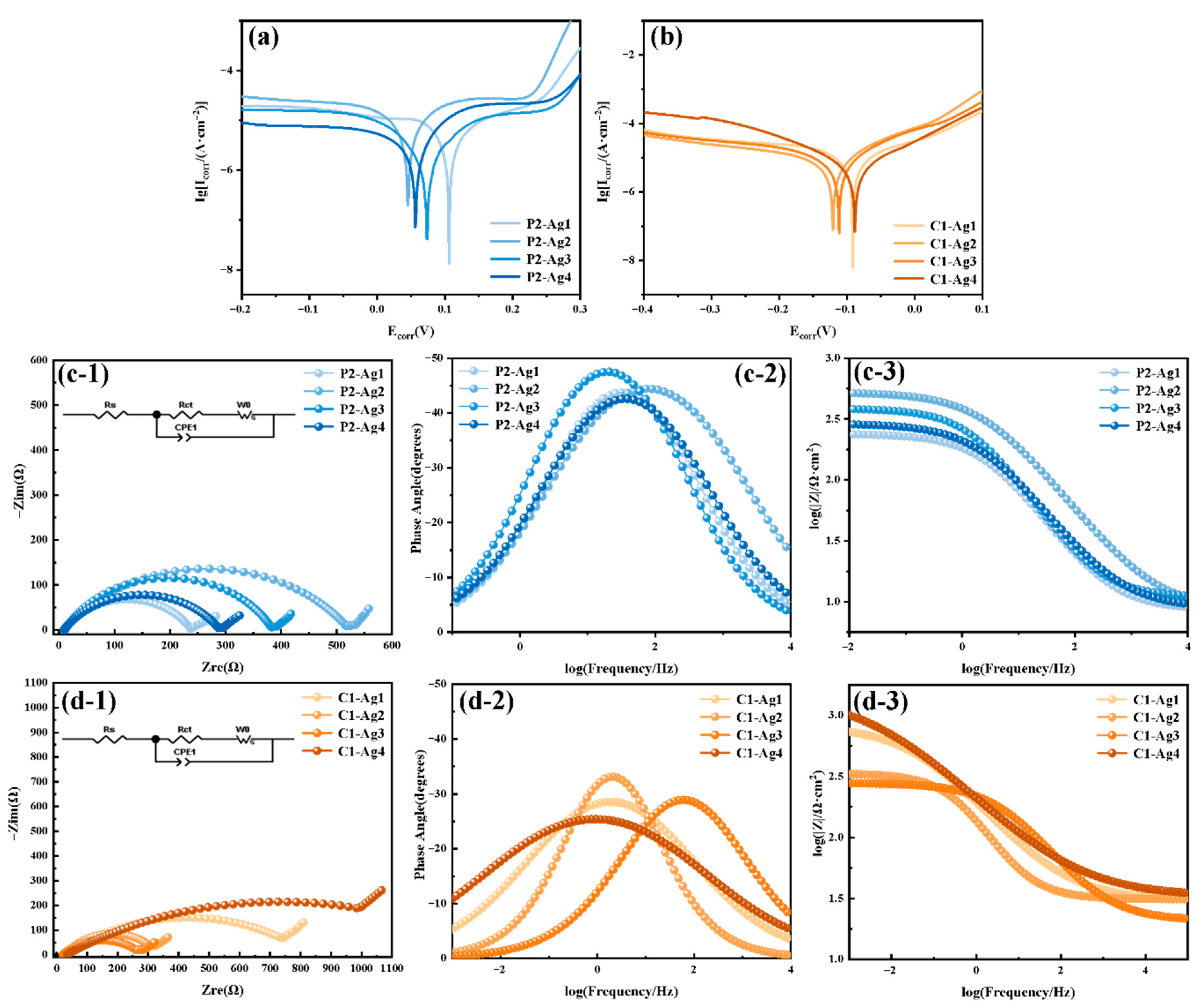
To investigate the electrochemical corrosion behavior of silver-plated copper powders with varying silver content, polarization curves of P2 series and C1 series silver-plated samples were statistically analyzed, with results shown in Figure 8. Relevant corrosion performance parameters were calculated based on the dynamic potential polarization curves in Figure 8a,b, as presented in Table 5. From the electrochemical parameters, it can be observed that, with the gradual increase in silver content, the corrosion current density Icorr of both groups of silver-coated samples first decreases markedly and then exhibits a slight recovery. This trend indicates that the introduction of a silver layer effectively blocks direct contact between the corrosive medium and the copper substrate, thereby significantly suppressing electrochemical corrosion reactions and providing effective protection. However, further increasing the silver content does not lead to a continuous reduction in Icorr; instead, a slight increase is observed. This suggests that higher silver content is not necessarily more beneficial, as the protective performance is governed by the combined effects of coating structure, continuity, and interfacial characteristics. Among the P2 series silver-coated samples, the P2-Ag3 specimen exhibited the lowest corrosion current density, with an Icorr value of 3.663 × 10⁻⁶ A·cm−2, which is significantly lower than those of the other samples, indicating superior corrosion resistance. This result implies that, at this silver content, a relatively dense and continuous silver coating was formed on the copper powder surface, thereby effectively reducing the corrosion reaction kinetics.
In contrast, the C1 series of silver-plated samples exhibited lower and more stable corrosion current densities across the entire silver content range, with more concentrated polarization curve distributions. This indicates superior structural uniformity in the silver layer of this series, providing more enduring and stable inhibition of the corrosion reaction. It also reflects that the C1 substrate is more conducive to forming a complete and uniform silver layer during the plating process, thereby enhancing overall corrosion resistance. It should be noted that although the corrosion potential Ecorr of the C1 series silver-plated samples was slightly more negative than that of the P2 series, the self-corrosion potential is a thermodynamic parameter that reflects only the tendency for material corrosion and does not directly characterize the corrosion rate. Therefore, when employing electrochemical methods to evaluate material corrosion resistance, greater emphasis should be placed on parameters reflecting corrosion kinetic characteristics, such as the corrosion current density Icorr, to obtain more objective and reliable assessment results [29].
Further electrochemical impedance spectroscopy testing was conducted on the samples, with the results shown in Figure 8(c-1)–(c-3),(d-1)–(d-3). The Nyquist plot exhibits a semicircular arc, indicating that the electrochemical process in the system is primarily charge-transfer-limited [47]. The equivalent circuits are shown in Figure 8(c-1),(d-1), where Rs represents the solution resistance reflecting the intrinsic conductivity of the electrolyte; Rct denotes the charge transfer resistance representing the kinetic resistance of the interfacial reaction; CPE1 is the constant phase element characterizing the non-ideal behavior of the interfacial double-layer capacitance [48]; W0 is the Warburg impedance describing the contribution from diffusion processes. In the low-frequency region, all curves exhibit a degree of tailing [49], reflecting Warburg diffusion impedance and indicating that ion diffusion processes influence the system. With the gradual increase in silver content, the diameter of the semicircular arc in the Nyquist plots of the P2 series silver-plated samples exhibited an overall trend of progressive enlargement. This indicates a continuous increase in the system’s charge transfer resistance (Rct), effectively suppressing electrochemical reactions at the interface. Among these, the P2-Ag2 sample corresponded to the largest impedance semicircle diameter, signifying the highest Rct value and the most pronounced inhibition of the corrosion reaction. This result indicates that, under moderate silver content conditions, the silver layer can form a relatively uniform and continuous coating structure on the copper substrate surface, thereby effectively blocking the penetration of corrosive media. However, when the silver content is further increased to P2-Ag4, the semicircle diameter in its Nyquist plot instead shows a slight tendency to decrease, suggesting that Rct does not continue to increase. This phenomenon may relate to the presence of free silver or localized silver agglomeration on the sample surface. Excessively deposited silver fails to contribute effectively to the continuous shielding layer, instead forming regions of heightened electrochemical activity at the interface. This leads to localized deterioration in electrochemical performance, thereby weakening the overall impedance response [50].
Under identical silver content conditions, the C1-Ag4 sample exhibits lesser adverse effects from free silver, with its Nyquist plot still displaying a larger semicircle diameter. This indicates that, compared to the P2 series prepared by physical methods, chemically processed copper powder facilitates more uniform deposition and continuous growth of the silver layer at higher silver concentrations. This results in a denser and more complete coating structure, significantly enhancing the interfacial shielding effect and further inhibiting charge transfer processes. Consequently, the impedance radius increases again, effectively delaying the onset of corrosion reactions. Further analysis of the Bode impedance modulus and phase angle plots reveals that increasing silver content markedly enhances the impedance modulus across the entire test frequency range. Concurrently, the phase angle increases in the low-to-medium frequency range with more concentrated peaks, indicating greater stability in the interfacial electrochemical response and suppression of both charge transfer and diffusion processes. These results further validate that enhanced silver layer continuity and compactness with increasing silver content significantly improve the material’s electrochemical stability, thereby enhancing its corrosion resistance.
Comprehensive electrochemical testing indicates that, for samples prepared by either physical or chemical methods, the corrosion current density decreases significantly with increasing silver content. The integrity and protective efficacy of the silver layer continue to improve, leading to enhanced corrosion resistance in the samples. However, corrosion resistance does not increase indefinitely with higher silver content. As Table 4 further illustrates, as silver content increases, the variation in Icorr gradually diminishes, even showing a tendency toward stabilization. This indicates that the protective effect of the silver layer reaches saturation beyond a specific thickness. Beyond this point, further increases in silver content yield diminishing marginal returns in inhibiting the corrosion reaction.

4. Conclusions

  • The preparation method and surface characteristics of copper powder significantly influence the deposition behavior of silver layers during the silver plating process. Surface modification effectively regulates the surface chemical environment of copper powder and improves wettability. Following physical modification, the water contact angle of copper powder decreased from 52.9° to 50.3°, while chemical modification reduced it from 61.9° to 40.9°. FTIR spectra of modified samples exhibited characteristic absorption peaks corresponding to the modifiers, confirming alterations in surface chemical states. Copper powders prepared by different methods exhibited varying responses to modifiers, necessitating targeted regulation.
  • Surface-modified copper powder exhibits enhanced coating density and interfacial stability following silver plating. Physically processed copper powder, with its higher sphericity and smoother surface, facilitates the formation of a continuous and uniform silver layer. Chemically processed copper powder, following modification, exhibits superior wettability and interfacial activity. Its charge transfer resistance after silver plating increased from 801 Ω to 1399 Ω, indicating significantly enhanced corrosion resistance and interfacial stability.
  • As the silver plating content increased from 8 wt% to 15 wt%, the coating integrity and density of the silver-coated copper powder significantly improved, effectively suppressing the corrosion reaction. The self-corrosion current density of physically modified copper powder after silver plating decreased from 1.285 × 10⁻⁵ A·cm−2 to 4.671 × 10⁻⁶ A·cm−2, while chemically modified samples decreased from 1.120 × 10⁻⁵ A·cm−2 to 5.075 × 10⁻⁶ A·cm−2. However, excessively high silver content readily leads to silver precipitation and the formation of free particles, thereby inducing risks of corrosion and electromigration. This necessitates optimized control between performance and cost.

Author Contributions

N.Y.: Writing—original draft, visualization, formal analysis, and conceptualization. X.Z.: Writing—review and editing, methodology, resources, and supervision. J.H.: Writing—review and editing, methodology, and supervision. X.L.: Supervision and investigation. All authors have read and agreed to the published version of the manuscript.

Funding

This research received no external funding.

Institutional Review Board Statement

Not applicable.

Informed Consent Statement

Not applicable.

Data Availability Statement

Data are contained within the article.

Conflicts of Interest

Author Xiang Li was employed by the company Yunnan Spring New Material Co., Ltd. The remaining authors declare that the research was conducted in the absence of any commercial or financial relationships that could be construed as a potential conflict of interest.

References

  1. Xu, Y.; Cui, B.; Zhang, X.; Sun, Y.; Lin, B. Uniformly Coated Cu@Ag Core-Shell Particles with Low Silver Content: Hydroxy Acid as a Complexing Agent with “Double-Sided Adhesive” Function. Surf. Interfaces 2024, 46, 104137. [Google Scholar] [CrossRef]
  2. Lopes, G.R.; Jourdan, J.; Bastide, S.; Favre, W. Evaluation of Commercial Pure Conductive Copper Pastes by Screen Printing for A-Si:H/c-Si Heterojunction Solar Cells. Sol. Energy Mater. Sol. Cells 2025, 292, 113690. [Google Scholar] [CrossRef]
  3. Kheibarian, Z.; Soleimani, E.; Mardani, H.R. Photocatalytic Activity of Cu@Ag BNCs Synthesized by the Green Method: Photodegradation Methyl Orange and Indigo Carmine. Inorg. Nano-Met. Chem. 2023, 53, 355–365. [Google Scholar] [CrossRef]
  4. Cruces, E.; Arancibia-Miranda, N.; Manquián-Cerda, K.; Perreault, F.; Bolan, N.; Azócar, M.I.; Cubillos, V.; Montory, J.; Rubio, M.A.; Sarkar, B. Copper/Silver Bimetallic Nanoparticles Supported on Aluminosilicate Geomaterials as Antibacterial Agents. ACS Appl. Nano Mater. 2022, 5, 1472–1483. [Google Scholar] [CrossRef]
  5. Kim, M.I.; Lee, J.-H. Die Sinter Bonding in Air Using Cu@Ag Particulate Preform and Rapid Formation of Near-Full Density Bondline. J. Mater. Res. Technol. 2021, 14, 1724–1738. [Google Scholar] [CrossRef]
  6. Chen, K.; Hu, Y.; Liu, M.; Wang, F.; Liu, P.; Yu, Y.; Feng, Q.; Xiao, X. Highly Stretchable, Tough, and Conductive Ag@Cu Nanocomposite Hydrogels for Flexible Wearable Sensors and Bionic Electronic Skins. Macromol. Mater. Eng. 2021, 306, 2100341. [Google Scholar] [CrossRef]
  7. Deng, M.; Subramanian, V. Screen-Printable Cu–Ag Core–Shell Nanoparticle Paste for Reduced Silver Usage in Solar Cells: Particle Design, Paste Formulation, and Process Optimization. ACS Appl. Electron. Mater. 2022, 4, 4929–4935. [Google Scholar] [CrossRef]
  8. Park, Y.-S.; An, C.Y.; Kannan, P.K.; Seo, N.; Zhuo, K.; Yoo, T.K.; Chung, C.-H. Fabrication of Dendritic Silver-Coated Copper Powders by Galvanic Displacement Reaction and Their Thermal Stability against Oxidation. Appl. Surf. Sci. 2016, 389, 865–873. [Google Scholar] [CrossRef]
  9. Güler, O.; Varol, T.; Alver, Ü.; Çanakçı, A. The Effect of Flake-like Morphology on the Coating Properties of Silver Coated Copper Particles Fabricated by Electroless Plating. J. Alloys Compd. 2019, 782, 679–688. [Google Scholar] [CrossRef]
  10. Hai, H.T.; Ahn, J.G.; Kim, D.J.; Lee, J.R.; Chung, H.S.; Kim, C.O. Developing Process for Coating Copper Particles with Silver by Electroless Plating Method. Surf. Coat. Technol. 2006, 201, 3788–3792. [Google Scholar] [CrossRef]
  11. Cao, X.G.; Zhang, H.Y. Fabrication and Performance of Silver Coated Copper Powder. Electron. Mater. Lett. 2012, 8, 467–470. [Google Scholar] [CrossRef]
  12. Shin, J.; Kim, H.; Song, K.H.; Choe, J. Synthesis of Silver-Coated Copper Particles with Thermal Oxidation Stability for a Solar Cell Conductive Paste. Chem. Lett. 2015, 44, 1223–1225. [Google Scholar] [CrossRef]
  13. Ghosh Chaudhuri, R.; Paria, S. Core/Shell Nanoparticles: Classes, Properties, Synthesis Mechanisms, Characterization, and Applications. Chem. Rev. 2012, 112, 2373–2433. [Google Scholar] [CrossRef]
  14. Han, S.; Lin, G.; Wang, S.; Hu, T.; Li, S.; Xia, H.; Zhang, L. Preparation methods and research progress of copper powder. Chin. J. Nonferrous Met. 2025, 35, 3325–3349. [Google Scholar]
  15. Yan, Y.; Hou, H.; Dang, R.; Wang, X.; Wang, Y. Preparation of Micron Copper Powder and Its Application in the Field of Flexible Electronics. Chem. Ind. Eng. Prog. 2025, 44. [Google Scholar] [CrossRef]
  16. Li, P.; Chen, C.; Zhang, C.; Xiao, N.; Zhang, H.; Li, Y.; Guo, Z. Effects of Ball Milling on Powder Particle Boundaries and Properties of ODS Copper. High Temp. Mater. Process. 2021, 40, 361–369. [Google Scholar] [CrossRef]
  17. Wu, Z.; Yao, Q.; Liu, G.; Tu, G.; Zhou, Z.; Ding, M.; Xu, H. Performance of Spherical Powder Manufactured by Arc Plasma Micro-Blasting. Mater. Rep. 2020, 34, 1386–1389. [Google Scholar]
  18. Li, S.; Feng, G.; Li, W.; Yin, J.; Zhou, S. Preparation and Phase Analysis of Cu Nano power by Electrical Explosion. High Power Laser Part Beams 2013, 25, 2408–2412. [Google Scholar] [CrossRef]
  19. Wang, M.; Yu, S. Process Optimization on Preparation of Nanometer Copper Powder by Reduction of Hydrazine Hydrate. Hunan Nonferrous Met. 2019, 35, 44–50. [Google Scholar]
  20. Rocha, A.K.S.; Magnago, L.B.; Pegoretti, V.C.B.; De Freitas, M.B.J.G.; Lelis, M.F.F.; Fabris, J.D.; Porto, A.O. Copper Local Structure in Spinel Ferrites Determined by X-Ray Absorption and Mössbauer Spectroscopy and Their Catalytic Performance. Mater. Res. Bull. 2019, 109, 117–123. [Google Scholar] [CrossRef]
  21. Zhang, C.; Wu, N.; Han, S.; Jiang, Q.; Wei, Y.; Wang, H. Preparation of Dendritic Copper Powder by Electrolysis of Scrap Copper in A New Electrolytic Clle. Hydrometall. China 2023, 42, 172–177. [Google Scholar] [CrossRef]
  22. Wu, G.; Wang, C.; Qing, Q. Effect of PEG10000 Concentrations on the Localized Electrochemical Deposition of Copper Microcolumns at Various Deposition Voltages. China Surf. Eng. 2025, 38. [Google Scholar] [CrossRef]
  23. Wu, M.; Hou, B.; Shu, S.; Li, A.; Geng, Q.; Li, H.; Shi, Y.; Yang, M.; Du, S.; Wang, J.-Q.; et al. High Oxidation Resistance of CVD Graphene-Reinforced Copper Matrix Composites. Nanomaterials 2019, 9, 498. [Google Scholar] [CrossRef]
  24. Avramović, L.; Maksimović, V.M.; Baščarević, Z.; Ignjatović, N.; Bugarin, M.; Marković, R.; Nikolić, N.D. Influence of the Shape of Copper Powder Particles on the Crystal Structure and Some Decisive Characteristics of the Metal Powders. Metals 2019, 9, 56. [Google Scholar] [CrossRef]
  25. Han, F.; Cao, M.; Lin, J.; Liu, T.; Zhu, X. Preparation and Anti-Oxidisation Resistance of Silver-Coated Copper Powders by Cobalt-Modified Copper Powders. Mater. Sci. Technol. 2024, 40, 931–940. [Google Scholar] [CrossRef]
  26. Chen, J.; Zhu, X.; Yang, N.; Li, X.; Yang, B. Mechanism of Free Silver Formation While Preparing Silver-Coated Copper Powder by Chemical Plating and Its Control. Coatings 2025, 15, 169. [Google Scholar] [CrossRef]
  27. Lu, X.; Kuang, S.; Zhao, Y.; Zeng, X. Surface Morphology Control of Ag-Coated Cu Particles and Its Effect on Oxidation Resistance. Coatings 2025, 15, 154. [Google Scholar] [CrossRef]
  28. Xu, Q.; Zhu, X.; Cao, M.; Long, J. Preparation and Properties of Silver-Coated Copper Powder with Sn Transition Layer. Mater. Res. Express 2019, 6, 076563. [Google Scholar] [CrossRef]
  29. Li, X.; Yuan, J.; Zhang, Z.; Lu, K.; Jiang, B.; Liang, X. Co-addition of Al and Cu on microstructure and corrosion behavior of FeCoNiAlCu high-entropy alloys. J. Mater. Eng. 2025, 53, 28–38. [Google Scholar]
  30. Štrbák, M.; Kajánek, D.; Knap, V.; Florková, Z.; Pastorková, J.; Hadzima, B.; Goraus, M. Effect of Plasma Electrolytic Oxidation on the Short-Term Corrosion Behaviour of AZ91 Magnesium Alloy in Aggressive Chloride Environment. Coatings 2022, 12, 566. [Google Scholar] [CrossRef]
  31. Cheng, T.; Huang, H.; Huang, G. Galvanic Corrosion Behavior between ADC12 Aluminum Alloy and Copper in 3.5 Wt% NaCl Solution. J. Electroanal. Chem. 2022, 927, 116984. [Google Scholar] [CrossRef]
  32. Özbilen, S.; Ünal, A.; Sheppard, T. Influence of Superheat on Particle Shape and Size of Gas Atomised Copper Powders. Powder Metall. 1991, 34, 53–61. [Google Scholar] [CrossRef]
  33. Chen, L.; Deng, D.; Huang, Q.; Xu, X.; Xie, Y. Development and Thermal Performance of a Vapor Chamber with Multi-Artery Reentrant Microchannels for High-Power LED. Appl. Therm. Eng. 2020, 166, 114686. [Google Scholar] [CrossRef]
  34. Wu, S. Preparation of Fine Copper Powder Using Ascorbic Acid as Reducing Agent and Its Application in MLCC. Mater. Lett. 2007, 61, 1125–1129. [Google Scholar] [CrossRef]
  35. Owens, D.K.; Wendt, R.C. Estimation of the Surface Free Energy of Polymers. J. Appl. Polym. Sci. 1969, 13, 1741–1747. [Google Scholar] [CrossRef]
  36. Montero de Hijes, P.; Shi, K.; Noya, E.G.; Santiso, E.E.; Gubbins, K.E.; Sanz, E.; Vega, C. The Young–Laplace Equation for a Solid–Liquid Interface. J. Chem. Phys. 2020, 153, 191102. [Google Scholar] [CrossRef]
  37. Chibowski, E. Some Problems of Characterization of a Solid Surface via the Surface Free Energy Changes. Adsorpt. Sci. Technol. 2017, 35, 647–659. [Google Scholar] [CrossRef]
  38. Zhang, W.; Liu, J.; Zhang, L.; Wang, J.; Zhang, Z.; Wang, J.; Liu, H.; Chen, H.; Li, M. The Synergistic Effect of Micron Spherical and Flaky Silver-Coated Copper for Conductive Adhesives to Achieve High Electrical Conductivity with Low Percolation Threshold. Int. J. Adhes. Adhes. 2022, 114, 102988. [Google Scholar] [CrossRef]
  39. Gravis, D.; Poncin-Epaillard, F.; Coulon, J.-F. Correlation between the Surface Chemistry, the Surface Free Energy and the Adhesion of Metallic Coatings onto Plasma-Treated Poly(Ether Ether Ketone). Appl. Surf. Sci. 2020, 501, 144242. [Google Scholar] [CrossRef]
  40. Abdullah, E.C.; Geldart, D. The Use of Bulk Density Measurements as Flowability Indicators. Powder Technol. 1999, 102, 151–165. [Google Scholar] [CrossRef]
  41. Mousavi, Z.; Pourabdoli, M. Physical and Chemical Properties of Ag–Cu Composite Electrical Contacts Prepared by Cold-Press and Sintering of Silver-Coated Copper Powder. Mater. Chem. Phys. 2022, 290, 126608. [Google Scholar] [CrossRef]
  42. Ershov, B.; Abkhalimov, E.V. Colloidal Copper and Peculiarities of Its Reaction with Silver Ions in Aqueous Solution. Colloid J. 2009, 71, 487–492. [Google Scholar] [CrossRef]
  43. Bokuniaeva, A.O.; Vorokh, A.S. Estimation of Particle Size Using the Debye Equation and the Scherrer Formula for Polyphasic TiO2 Powder. J. Phys. Conf. Ser. 2019, 1410, 012057. [Google Scholar] [CrossRef]
  44. Jung, H.; Jeong, S.; Park, Y.; Shin, Y.; Jeong, H. X-Ray Diffraction Analysis of Damaged Layer During Polishing of Silicon Carbide. Int. J. Precis. Eng. Manuf. 2022, 24, 25–32. [Google Scholar] [CrossRef]
  45. Yin, H.; Fan, S.; Lv, D.; Tang, X.; Peng, K.; Zhang, H.; Li, X.; Lv, J.; Zhou, M. Process Optimization of Silver-Coated Copper Powders Based on the RSM-ANNHHO Approach: Achieving High-Quality Ag Coatings and Excellent Conductivity. Surf. Interfaces 2025, 74, 107692. [Google Scholar] [CrossRef]
  46. Chavez, K.L.; Hess, D.W. A Novel Method of Etching Copper Oxide Using Acetic Acid. J. Electrochem. Soc. 2001, 148, G640. [Google Scholar] [CrossRef]
  47. Orazem, M.E.; Itagaki, M. Electrochemical Impedance Spectroscopy. Electrochem. Soc. Interface 2025, 34, 59. [Google Scholar] [CrossRef]
  48. Lukács, Z.; Kristóf, T. A Generalized Model of the Equivalent Circuits in the Electrochemical Impedance Spectroscopy. Electrochim. Acta 2020, 363, 137199. [Google Scholar] [CrossRef]
  49. Gao, X.; Liu, M. Corrosion Behavior of High-Strength C71500 Copper-Nickel Alloy in Simulated Seawater with High Concentration of Sulfide. Materials 2022, 15, 8513. [Google Scholar] [CrossRef]
  50. Hrubovčáková, M.; Kupková, M.; Fedorková, A.; Oriňáková, R.; Zeleňák, A. Effect of Silver Content on Microstructure and Corrosion Behavior of Material Prepared from Silver Coated Iron Powder. Mater. Sci. Forum 2014, 782, 499–502. [Google Scholar] [CrossRef]
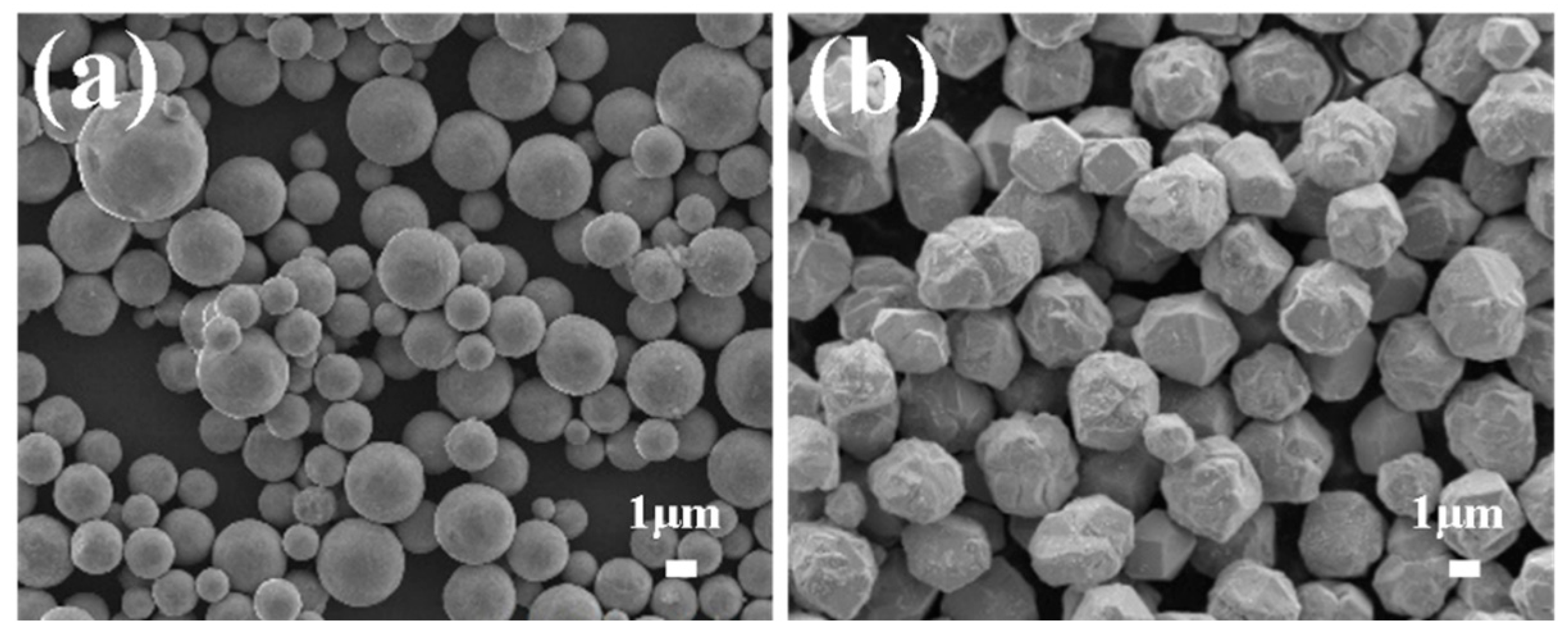
Figure 1. Morphology of copper powder matrix. (a) PCu; (b) CCu.
Coatings 16 00183 g001
Figure 2. Surface appearance of copper powder (a) physical method; (b) chemical method.
Coatings 16 00183 g002
Figure 3. Changes in surface wettability and chemical composition before and after copper powder modification (a) contact angle test results; (b) bar chart of contact angle results; (c) FTIR spectrum.
Coatings 16 00183 g003
Figure 4. Surface morphology of silver-plated surfaces before and after copper powder modification.
Coatings 16 00183 g004
Figure 5. Microstructural morphology of copper powder coated with silver at different silver contents for P2 and C1.
Coatings 16 00183 g005
Figure 6. XRD pattern of silver-coated copper powder.
Coatings 16 00183 g006
Figure 7. Copper powder coating coverage and density in silver-coated pockets. (a,b) Cross-sectional views and elemental distribution of P2-Ag2 and C1-Ag2; (c) Cu2+ concentration in supernatant after immersion in acetic acid.
Coatings 16 00183 g007
Figure 8. Electrochemical testing of different silver-coated copper powder samples: (a) Tafel curves for the P2 series; (b) Tafel curves for the C1 series; and (c-1c-3,d-1d-3) electrochemical impedance spectra for the P2 and C1 series (all conducted at open-circuit potential, frequency range 100 kHz to 10 mHz).
Coatings 16 00183 g008
Table 1. Performance specifications of copper powder.
Powder ParametersPCuCCu
Copper powder shapeSphericalPolyhedron/Spheroidal
Average particle size (μm)3.54.75
Specific surface area (m2/g)0.30.37
Tapped density (g/cm3)≥4.0≥4.5
Table 2. Assignment and relative intensity ratios of characteristic FTIR absorption bands.
Wavelength (cm−1)AssignmentUnmodified SampleModified SampleRelative Intensity Ratio *
3600–3000 O–Hmediumstrong1.36
~1650C=Oweakmedium1.20
~1400–COOweakmedium1.14
~1200C–Ostablestable1.00
* Relative intensity ratio = I (characteristic peak)/I (reference peak).
Table 3. Performance specifications of silver-coated copper powder samples.
SampleTheoretical Silver Content (wt%) *Actual Silver Content (wt%)Bulk Density
(g·cm−3)
Pressed Resistor
(mΩ)
P2-Ag187.913.164.3
P2-Ag2109.953.384.1
P2-Ag31211.923.363.7
P2-Ag41514.973.443.6
C1-Ag187.922.724.2
C1-Ag2109.932.943.4
C1-Ag31211.92.983.2
C1-Ag41514.953.082.9
* Theoretical silver content is calculated, while actual silver content is determined by third-party testing.
Table 4. Particle size of silver-coated copper powder.
SampleP2-Ag1P2-Ag2P2-Ag3P2-Ag4C1-Ag1C1-Ag2C1-Ag3C1-Ag4
2θ (XRD)38.138.138.138.138.138.138.138.1
FWHM (°)0.337070.326090.295440.294710.33090.302090.293790.29407
Grain size (nm)24.05124.85727.44027.50524.49726.83527.61527.565
Table 5. Parameters related to electrochemical testing.
Silver Content (%)SampleEcorr/mVIcorr/
(A·cm−2)
βa/(mV/dec)βc/(mV/dec)RctRs
8 P2-Ag136.231.285 × 10−53.142−2.6862308.519
C1-Ag1−78.811.120 × 10−55.597−3.10180130.619
10P2-Ag2144.609.315 × 10−64.353−0.5415158.649
C1-Ag2−124.567.403 × 10−68.402−3.61632031.150
12P2-Ag370.203.663 × 10−65.415−5.69437410.834
C1-Ag3−111.347.898 × 10−68.643−4.44526020.919
15P2-Ag423.364.671 × 10−65.019−2.7312818.826
C1-Ag4−84.405.075 × 10−69.107−8.048139933.785
Disclaimer/Publisher’s Note: The statements, opinions and data contained in all publications are solely those of the individual author(s) and contributor(s) and not of MDPI and/or the editor(s). MDPI and/or the editor(s) disclaim responsibility for any injury to people or property resulting from any ideas, methods, instructions or products referred to in the content.