Article

A Study on the Mechanical Properties of Ni-Al Alloy Based on Molecular Dynamics Simulation

1
School of Mechanical Engineering, Wuhan Polytechnic University, Wuhan 430023, China
2
School of Power and Mechanical Engineering, Wuhan University, Wuhan 430072, China
3
School of Automotive Engineering, Wuhan University of Technology, Wuhan 430070, China
4
Hubei Key Laboratory of Electronic Manufacturing and Packaging Integration, Wuhan University, Wuhan 430072, China
*
Author to whom correspondence should be addressed.
Coatings 2026, 16(2), 168; https://doi.org/10.3390/coatings16020168 (registering DOI)
Submission received: 19 December 2025 / Revised: 14 January 2026 / Accepted: 19 January 2026 / Published: 30 January 2026

Abstract

With the wide application of Ni-Al high-temperature materials, the research on their performance has increasingly attracted attention. To further advance the development of Ni-Al high-temperature materials, it is necessary to conduct an in-depth analysis of the brittleness mechanism of Ni-Al intermetallic compounds and elucidate the fundamental nature of their brittleness. In this study, the tensile mechanical behavior and microscopic mechanism of single crystals NiAl (B2) and Ni3Al (L12) at different temperatures were systematically studied by molecular dynamics simulations. It is revealed that although the mechanical properties of both NiAl and Ni3Al degrade with increasing temperature, their deformation mechanisms exhibit fundamental differences. The high-temperature strength of NiAl is attributed to stable plastic flow dominated by 1/2 <111> screw dislocation. The early softening of Ni3Al is associated with the formation of stacking fault formation, the phase transition to the HCP, and the slip of various incomplete dislocations (e.g., 1/6 <112> Shockley dislocation). Atomic strain analysis shows that regions of high strain exhibit a strong spatial correlation with the phase-transformed domains. This study reveals the distinct deformation mechanism of the two alloy phases at the atomic scale, providing a key theoretical basis for the rational selection of Ni-Al alloy in specific high-temperature applications.

1. Introduction

With the continuous increase in thrust-to-weight ratio of advanced aviation engines, the continuous increase in combustion chamber temperature, and the increasing complexity of engine structures, weight issues have become increasingly prominent [1,2,3]. Therefore, there is an urgent need to develop new high-temperature structural materials that offer superior thermal stability, lower density, higher strength, and improved processability to replace conventional traditional Ni-based superalloys in hot-section components of aviation engines [4,5,6]. Among the candidate materials, Ni-Al intermetallic compounds exhibit potential for high-temperature applications and primarily exist in five phase states: NiAl, Ni3Al, NiAl3, Ni2Al3, and Ni5Al3 [7,8]. The melting point of common Ni-Al intermetallic compounds can reach up to 1600 °C, approximately 300 °C higher than those of conventional Ni-based alloys. Among these, NiAl and Ni3Al—exhibiting high melting points of 1638 °C and 1395 °C, respectively—have received widespread attention as a substitute for Ni-based superalloys in aviation engine blades or thermal barrier coatings [9,10]. Moreover, NiAl possesses not only high thermal conductivity but also excellent resistance to high-temperature oxidation [11,12].
Previous studies on Ni-Al alloys have primarily focused on alloy design, processing routes, and microstructural strengthening mechanisms. For example, Y. Zhu et al. [13] used a complex solid compound as a toughening phase to improve the ductility of Ni-Al alloy during annealing. M. Krasnowski et al. [14] found that nanocrystalline Ni-Al materials have higher hardness and stronger heat resistance than microcrystalline Ni-Al alloys. G.P.P. Pun et al. [15] conducted a study on the impacts of chemical composition and uniaxial mechanical stress on martensitic transformation in Ni-Al alloy with a high nickel content through molecular dynamics simulation. A.M. Roy [16] investigated the influence of interfacial stress on the morphological evolution of martensitic nano-structured Ni-Al alloy and determined the evolution of the microstructure and stress field. Y. Du et al. [17] examined the precipitation behavior of Cu-Ni-Al nanoparticles in high-strength low-alloy steel and its influence on mechanical properties through atomic probe tomography and tensile tests. Although there are many studies on Ni-Al alloy, most of them focused on material preparation, doping, and performance analysis of polycrystalline materials, while the research on single-crystal structure is relatively limited. Because single-crystalline structures are superior to polycrystalline structures in mechanical properties and high-temperature durability, it is of great significance to study the characteristics of the single-crystal nickel–aluminum alloy for manufacturing high-temperature blades, turbines, etc. In this study, molecular dynamics methods were adopted to investigate the biaxial tensile process of NiAl and Ni3Al single-crystalline structures at the atomic scale, enabling a detailed examination of the evolution of their mechanical properties, crystal structures, and defects.
Despite these efforts, several critical issues remain insufficiently addressed. Most experimental and computational studies have focused on polycrystalline or nanocrystalline Ni-Al alloys, in which deformation behavior is predominantly governed by grain boundaries and phase interfaces, thereby obscuring the intrinsic mechanical response of the underlying crystal lattice. Furthermore, systematic investigations of temperature-dependent mechanical behavior in single-crystal NiAl and Ni3Al under complex loading conditions are lacking, particularly at the atomic scale. Moreover, direct comparative analyses between NiAl and Ni3Al single crystals remain limited. As a result, the fundamental mechanisms governing temperature-induced changes in elastic–plastic behavior, defect evolution, and crystal structure stability in these two materials remain incompletely understood.
Given that single-crystal materials generally exhibit superior high-temperature strength, creep resistance, and fatigue performance compared to their polycrystalline counterparts—particularly in demanding applications such as turbine blades and other hot-end components—systematic, temperature-dependent atomic-scale investigations of single-crystal NiAl and Ni3Al are critically important for elucidating their intrinsic deformation mechanisms.
In this study, molecular dynamics simulations were employed to investigate the biaxial tensile deformation behavior of single-crystal NiAl and Ni3Al across a broad temperature range. By analyzing stress–strain responses, crystal structure evolution, and defect formation mechanisms at the atomic scale, this study provides new insights into the intrinsic mechanical properties and thermal sensitivity of these intermetallic compounds. It should be noted that the findings pertain specifically to the NiAl (B2) and Ni3Al (L12) phases investigated; direct extrapolation to Al-rich brittle phases is not warranted. The results aim to clarify the fundamental differences between NiAl and Ni3Al single crystals under thermomechanical loading, thereby offering theoretical guidance for the design and application of Ni-Al-based single-crystal materials in high-temperature aerospace environments.

2. Modeling and Simulation Details

In this work, the tensile deformation of the Ni-Al alloy was simulated by using LAMMPS (LAMMPS (2023), Sandia National Laboratory, Albuquerque, NM, USA) [18], a large-scale atomic/molecular parallel simulator. LAMMPS was selected for its high efficiency in simulating atomic dynamics in large-scale metallic systems [19], its ability to accurately describe the interatomic bonding and lattice evolution, and its suitability for resolving defect evolution and atomic reconstruction in the tensile process. The simulation model of the Ni-Al alloy is displayed in Figure 1. To accurately capture the tensile deformation process, a two-end loading method was employed in this study. The NiAl system exhibits a body-centered cubic (BCC) crystal structure with a lattice constant of 2.86 Å, while Ni3Al adopts a face-centered cubic (FCC) crystal structure with a lattice constant of 3.52 Å [20]—slightly below the typical values of 3.56–3.58 Å at room temperature [21,22,23]. In order to obtain suitable tensile models, supercells of 24 × 24 × 52 unit cells for NiAl (containing 59,904 atoms) and 19 × 19 × 42 unit cells for Ni3Al (containing 60,648 atoms) were generated. Periodic boundary conditions were employed during the simulation process to avoid size effects. Prior to tensile loading, each system underwent a 60 ps relaxation process to relax internal stresses, eliminate artifacts from model construction, and ensure the system reached thermal equilibrium at the target temperature. The simulation adopted the canonical ensemble (NVT) to precisely control temperature and study its effect, a standard approach for high-strain-rate MD simulations with limited computational resources [24]. It is acknowledged, however, that the constant-volume constraint of NVT may influence stress fluctuations and dislocation kinetics, a limitation considered in the interpretation of the results [25,26,27]. The loading rate was 0.005 Å/ps (i.e., 0.5 m/s). The simulation time step was set to 1 fs.
The interatomic potential function serves as the cornerstone of MD simulations. The selection of potential functions directly influences the accuracy and reliability of the calculations. In this study, the embedded atom method (EAM) potential function developed by Zhou et al. [28] was utilized to describe Ni–Al interactions. The EAM potential is primarily used to depict the interactions among metals [29]. The formula for calculating the potential energy E is as follows:
E = F α j i ρ β r i j + 1 2 j i ϕ α β r i j
where F represents the embedding energy, which is dependent on the electron density ρ of atoms, ϕ denotes a pair potential interaction, and α and β are the element types of atoms i and j, respectively, and r is the distance between atoms i and j. The multi-body characteristic of the EAM potential is determined by the embedded energy term. The two summation terms in the formula are performed for all neighboring atoms j within the range of atom i, which are within the cutoff distance.
To conduct a detailed analysis of the subtle changes at the atomic level, OVITO 3.0 software was employed for visualization processing [30]. OVITO was selected for its robust and well-validated built-in analysis modules. Specifically, the common neighbor analysis (CNA) was utilized to examine the changes in the crystalline structure [31]. The atomic strain was adopted to analyze the strain of atoms [32]. The dislocation analysis (DXA) was applied to identify the defect structures [32]. Additionally, coordination number analysis was used to track variations in local atomic coordination and interatomic bonding during tensile deformation [33].

3. Results and Discussion

3.1. Tensile Analysis of NiAl

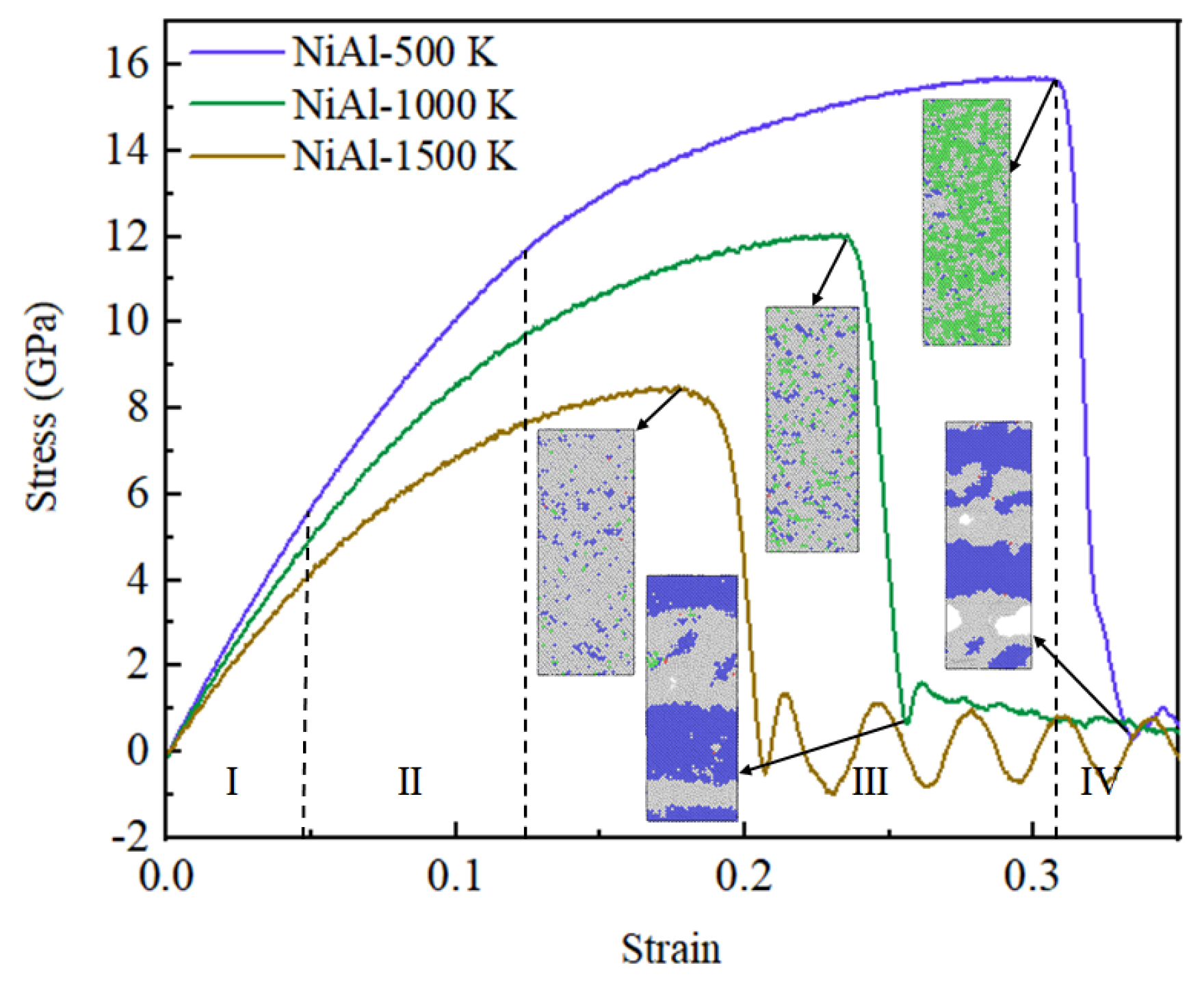
The tensile curves of NiAl under different temperatures are displayed in Figure 2. Based on these results, the tension process could be divided into four stages (corresponding to regions I, II, III, and IV in the figure): (I) there is a linear increasing relationship between stress and strain; (II) the slope of the curve has decreased, yet the relationship between stress and strain still remains approximately linear; (III) as the strain increases, the stress gradually rises and attains its maximum value; and (IV) as the strain continues to increase, the stress declines and the calculation comes to an end. The stress–strain results indicate that the fracture strain of the NiAl structure gradually diminishes with the increase in temperature, which implies that the rise in temperature causes a weakening of the deformation resistance. Correspondingly, the elastic moduli of NiAl declines from 116.37 GPa at 500 K to 102.62 GPa at 1000 K and further to 86.34 GPa at 1500 K. This reveals that, as the temperature goes up, the elastic modulus of the NiAl alloy gradually decreases. This trend arises because higher temperatures amplify atomic thermal vibration, increase the average interatomic spacing, and weaken interatomic bonding—thereby diminishing the material’s capacity to resist elastic deformation [34,35]. Additionally, the illustration in the figure depicts the crystalline structure of NiAl under the corresponding strain conditions, indicating a significant phase transition process during the tensile process of NiAl. This is because as the temperature increases, the binding force between atoms weakens and the lattice energy decreases, which weakens the lattice stability and makes it easier for the system to break through the phase transition energy barrier to produce phase transition [36].
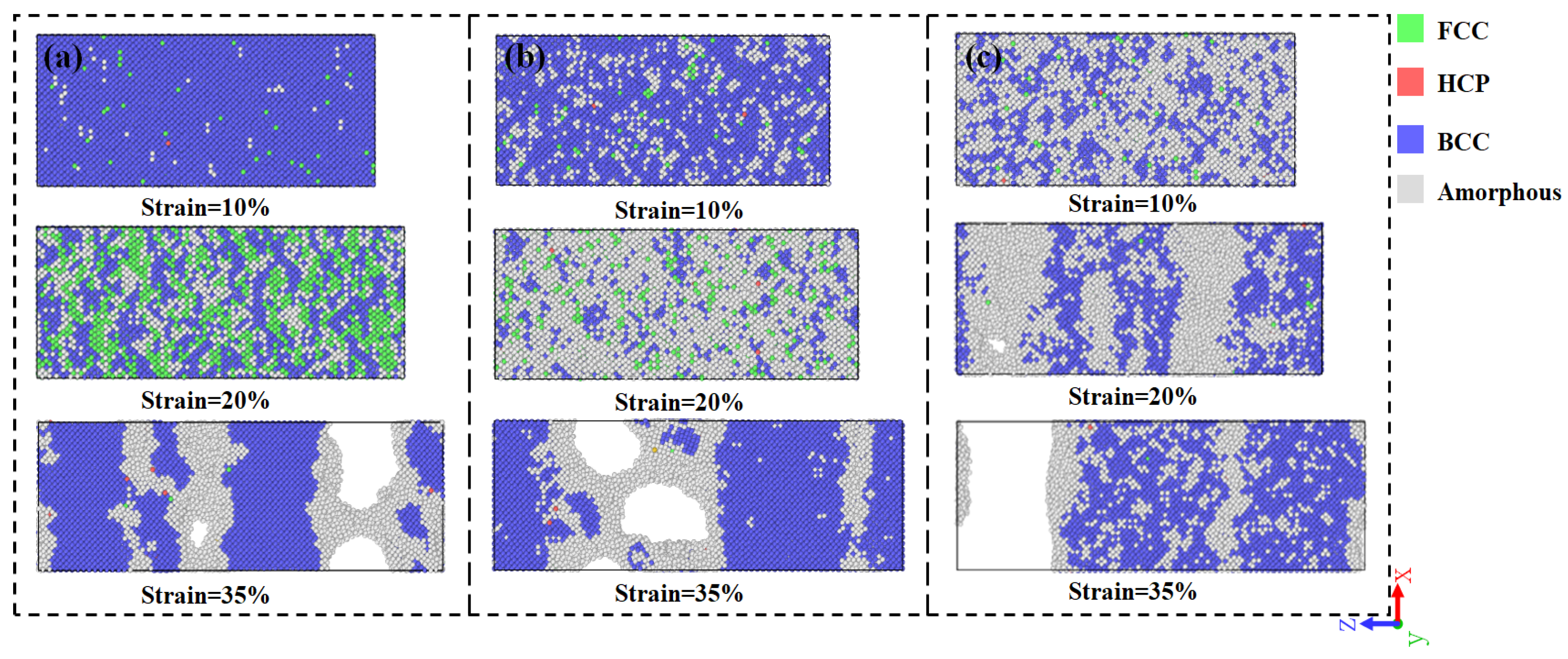
The variation in the crystalline structure of NiAl under corresponding strain conditions at different temperatures is shown in Figure 3. It can be observed that, as the temperature increases, the number of amorphous phase transition atoms increases at the same strain rate. During the elastic–plastic deformation stages (i.e., I–III stages), the B2-ordered BCC structure of NiAl progressively transformed into both FCC-like and amorphous phases, accompanied by a continuous decline in the BCC fraction. As temperature rose, the extent of transformation to the FCC phase diminished, while the amorphous content steadily grew. After the occurrence of cracks and voids in stage IV, the proportion of BCC structure gradually increased due to the rearrangement of atoms at both ends of the defect after fracture. Notably, the higher proportion of BCC in Figure 3c at 20% strain compared to Figure 3b was precisely due to the lattice reconstruction after defect formation. The primary reason is that, in the stress concentration area during the pre-fracture tensile process, local strain induces crystal structure rearrangement, and the mechanical load promotes the B2-ordered BCC phase to transform into metastable FCC-like and amorphous phases, thereby alleviating stress concentration and delaying crack propagation. Once a crack forms, the external load is partially released, and the system relaxes toward its thermodynamically favored state. Since the BCC lattice represents the lowest-energy configuration for NiAl [37], atoms near the fracture surfaces tend to revert to this stable phase during post-fracture relaxation.
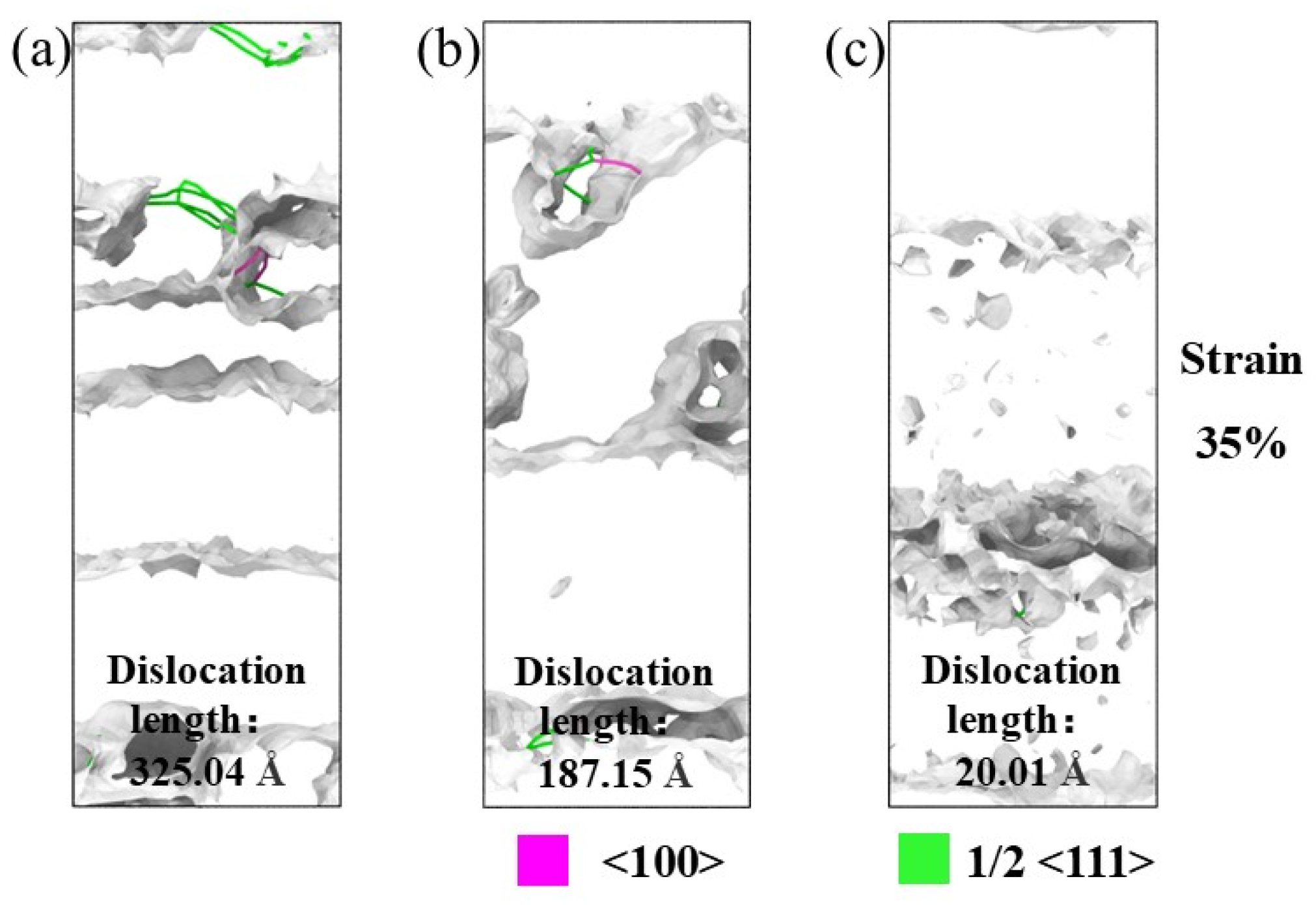
When the tensile strain was 35%, the statistical results of dislocation defects in NiAl structures at different temperatures are presented in Figure 4. It could be found that the dislocation defects in the NiAl alloy during the tensile process were mainly screw dislocations with a Burgers vector of 1/2 <111> and gap dislocation loops with a Burgers vector of <100>. This is the same as the dislocation type in other BCC crystals [38,39]. The reason for this phenomenon is that, in BCC metals or their alloys, deformation is mainly achieved through double twisted nucleation and propagation on screw dislocations [40,41]. Notably, <100>-type dislocations significantly influence the mechanical properties of BCC metal, and they will transform into 1/2 <111> dislocations. As temperature increased, the number of dislocation defects in the system gradually decreased under the same tensile strain conditions, and the defect mesh in the system gradually became fragmented, indicating the formation of more small clusters or voids in the system.
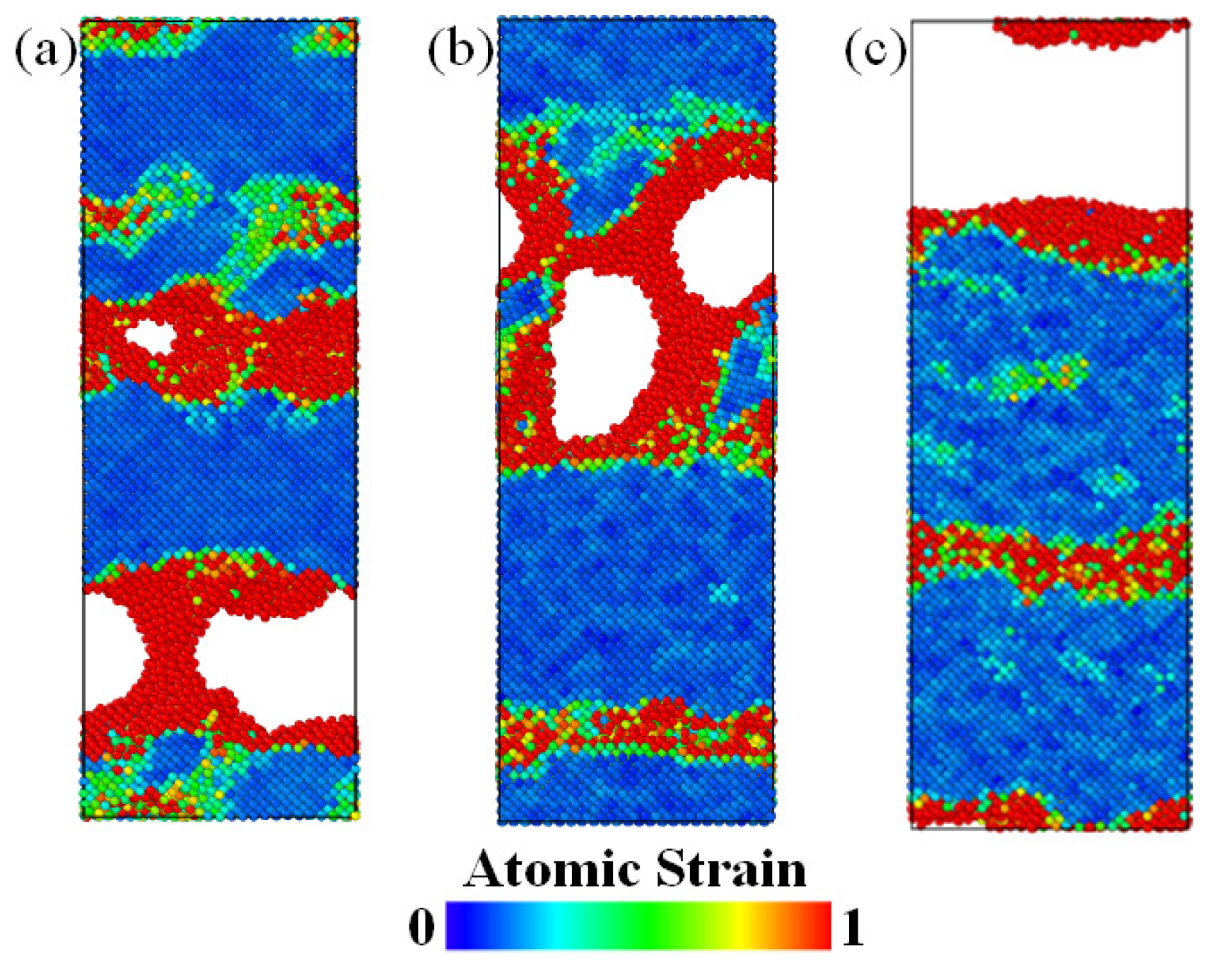
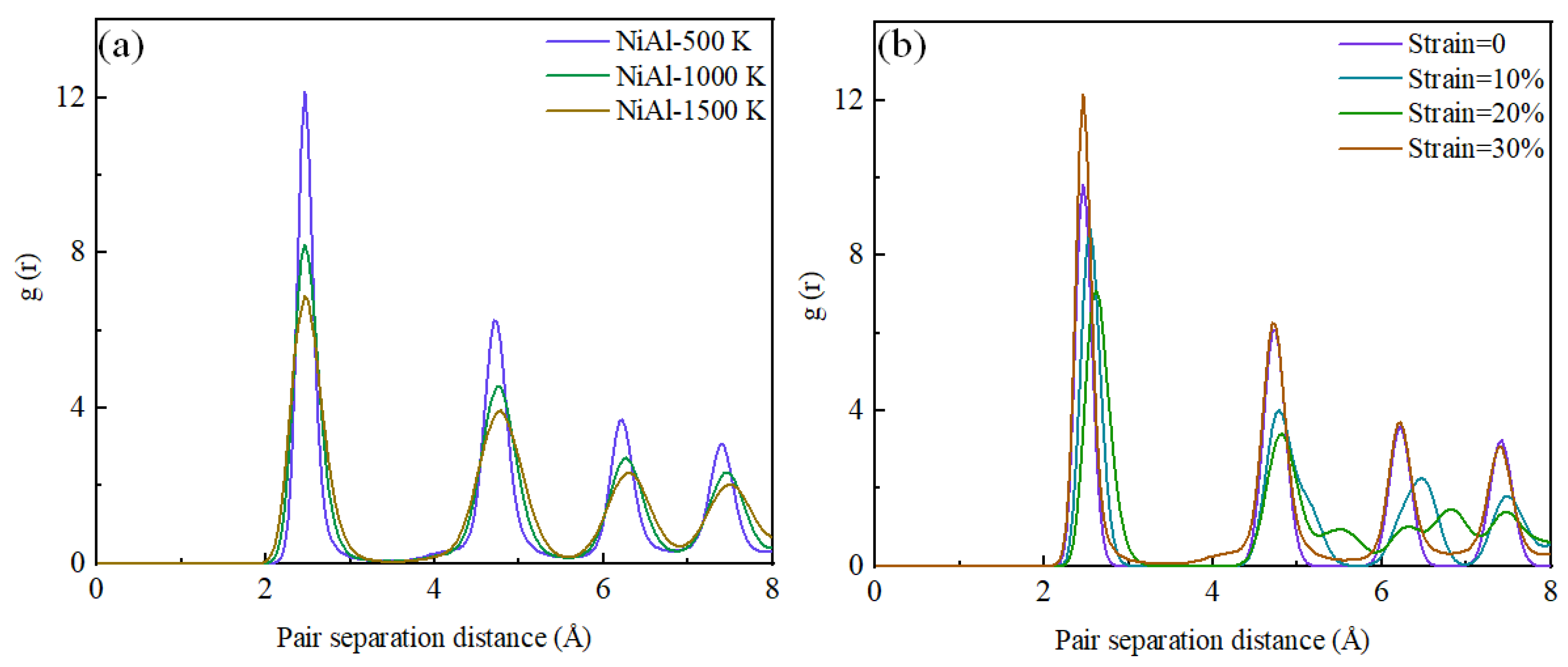
The atomic strain distribution in NiAl at a tensile strain of 35% across different temperatures is shown in Figure 5. This result indicates that as the temperature increased, the strain intensity of atoms in the matrix gradually increased after tensile (i.e., the number of atoms with cyan color in the matrix gradually increases). Compared with the results in Figure 3, it was found that the position of the high-strain atoms in Figure 5 was highly consistent with the atomic phase transition region during the tensile process. This indicated that the change in interatomic bond length caused by the phase transition leads to an increase in atomic strain. Figure 6 shows the radial distribution function (RDF) of the NiAl structure after tensile. Specifically, Figure 6a depicts the changes at different temperatures, while Figure 6b illustrates the changes at different strains at 500 K. The first and second peak positions of the RDF correspond to the positions of the nearest and second-nearest neighbor shells around a central atom, respectively. As shown in Figure 6a, with increasing temperature, the intensity of the first RDF peak decreases, the number of the nearest-neighbor atoms reduces, the probability of bonding between adjacent atoms declines, and the short-range ordering degree of atoms gradually diminishes. Meanwhile, the other peaks gradually decline, the peak shape broadens, and the peak position shifts slightly to the right, suggesting that the structure of NiAl has changed, displaying characteristics of short-range order and long-range disorder. As shown in Figure 6b, during tensile deformation from 0 to 20% strain, the probability of atomic bonding gradually decreased and the interaction force gradually weakened. However, when the strain increases further from 20% to 30%, the first peak unexpectedly intensifies and shifts leftward (to shorter interatomic distances). This behavior coincides with the occurrence of crack defects (Stage IV), the external forces acting on the atoms in the system gradually decrease, leading to the transformation of the system stress during tension into interatomic forces. As a result, atoms rearrange into a more compact configuration, strengthening local bonding and leading to a gradual shortening of bond lengths [42].

3.2. Tensile Analysis of Ni3Al

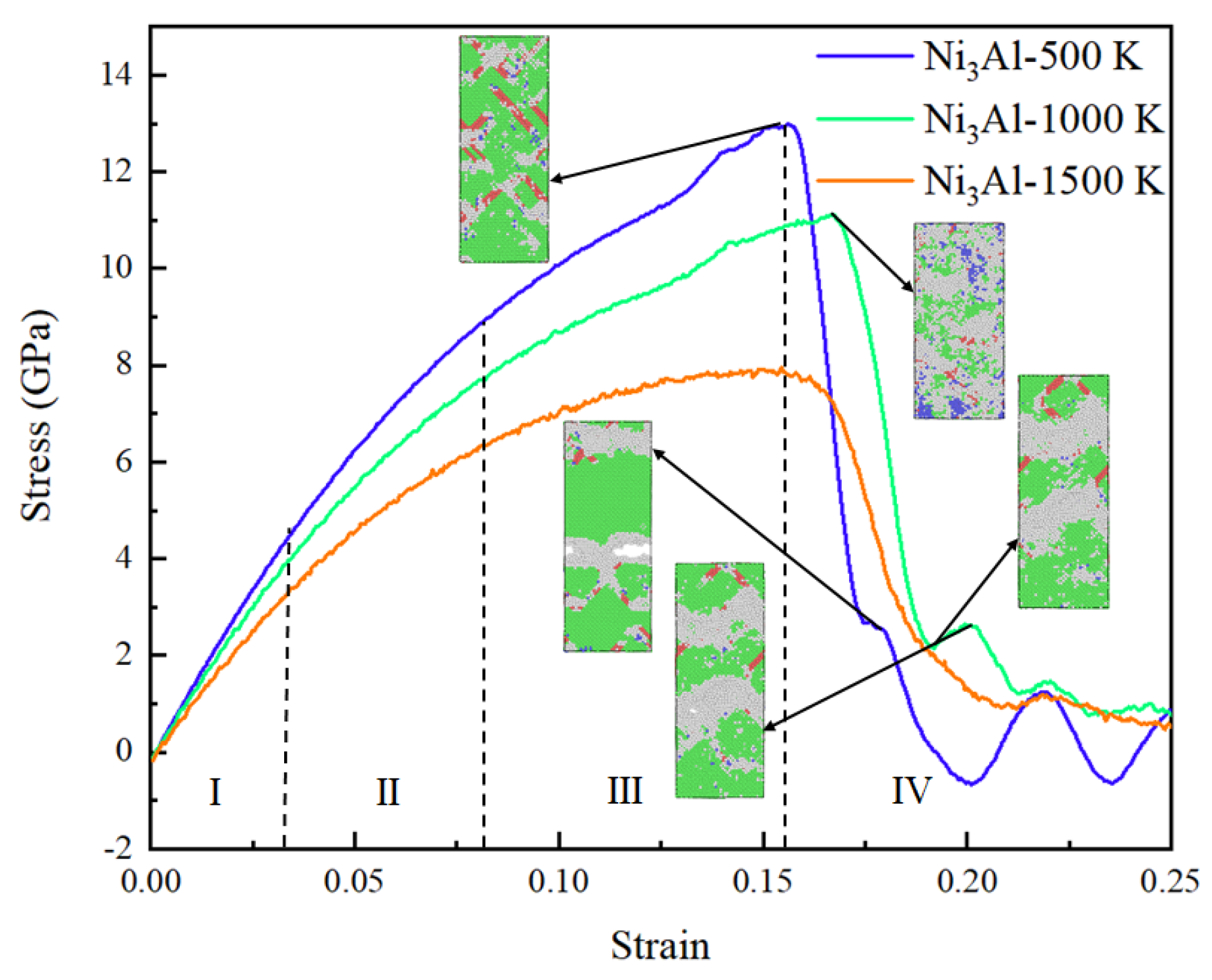
The stress–strain response of Ni3Al under different temperatures are presented in Figure 7. Similarly to NiAl, the tensile deformation of Ni3Al can be divided into four stages. With increasing temperature, both the deformation resistance and overall mechanical strength of Ni3Al progressively decline. Under identical strain conditions, Ni3Al exhibits lower stress and lower elastic modulus compared to NiAl. This is because NiAl is a B2-type ordered BCC structure, Ni and Al atoms occupy the body center and vertex positions, respectively, and the atoms in the lattice are relatively tightly packed, so the lattice has a strong intrinsic ability to resist deformation [43]. Ni3Al possesses an ordered FCC structure of the L12 type, in which Al atoms occupy the cube corners and face centers, while Ni atoms fully occupy the octahedral interstitial sites. This arrangement results in a lower atomic packing density compared to the B2-ordered BCC structure of NiAl. More crucially, the L12 lattice contains numerous parallel {111} slip planes, and the interlayer bonding force between slip planes is weaker than that between lattices in the B2 structure, so it is easier to have relative slip between layers under the action of external force, which shows lower tensile stress and elastic modulus macroscopically [44]. Moreover, the strain of Ni3Al during its elastic–plastic deformation stage was smaller. These results indicated that, at equivalent temperatures, Ni3Al exhibits inferior mechanical performance relative to NiAl. The corresponding crystalline structure changes indicated that there was a significant phase transition in Ni3Al before and after tensile fracture, and the FCC structure was restored to a certain extent after fracture.
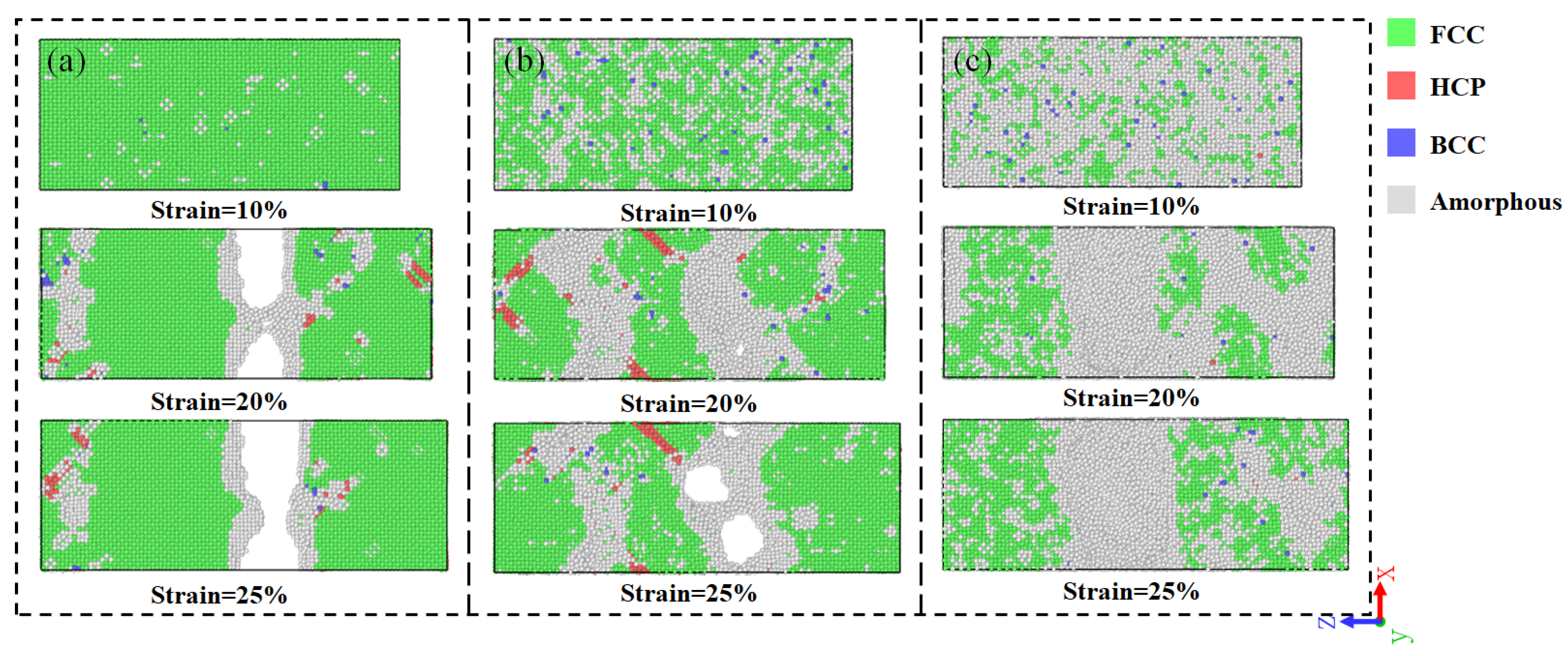
The evolution of the crystalline structure in Ni3Al under increasing tensile strain is illustrated in Figure 8. During the stretching process, the phase transition caused by atomic displacement first occurred in Ni3Al alloy, followed by the progressive nucleation and growth of voids and cracks as strain accumulated. In contrast to NiAl, Ni3Al exhibited a pronounced tendency to undergo a deformation-induced transition to an HCP phase, which is attributed to lattice slip during tensile process. As the temperature increased, the proportion of amorphous phase transformation under the same strain increased, and the proportion of HCP first increased and then decreased. In addition, as the temperature increased, the fracture strain of Ni3Al gradually increased, the fracture toughness increased gradually, the fracture cavity in the system decreased gradually, and the strain should be higher when it was completely fractured.
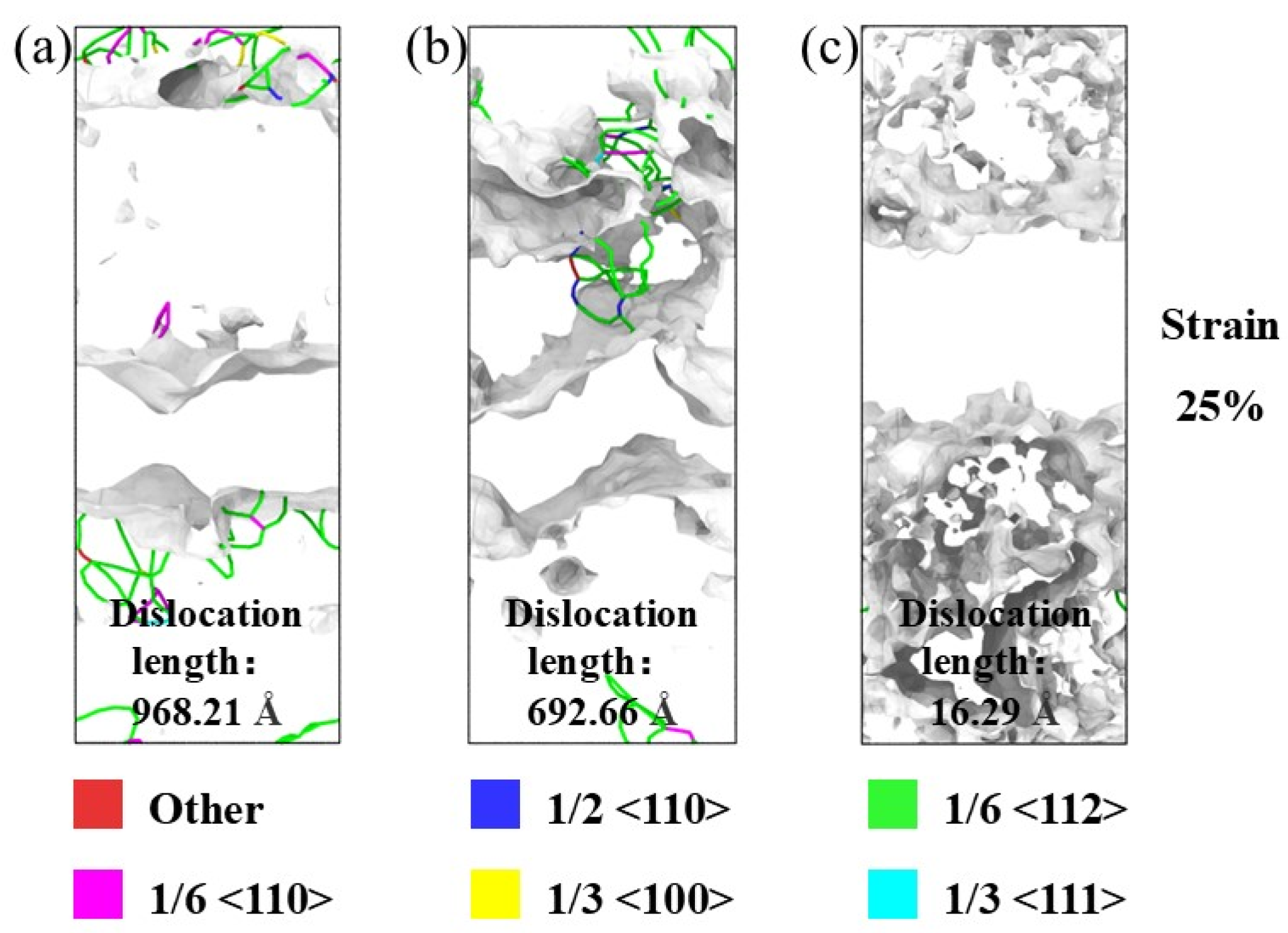
The results of dislocation defects in the Ni3Al system at different temperatures under a strain of 25% are presented in Figure 9. The dislocation types identified in the Ni3Al alloy during stretching include Shockley dislocations with a Burgers vector of 1/6 <112>, Stair rod dislocations with a Burgers vector of 1/6 <110>, Hirth dislocations with a Burgers vector of 1/3 <100>, Frank dislocations with a Burgers vector of 1/3 <111>, Perfect dislocations with a Burgers vector of 1/2 <110>, and other dislocations. Among these, Shockley dislocations and Stair rod dislocations are the predominant ones. Additionally, as the temperature rises, the total dislocation length in the Ni3Al system gradually shortens, the defect grid becomes fragmented, and the concentration of vacancy defects and small clusters progressively rises. Moreover, the dislocation density in Ni3Al remains higher than that in NiAl at a temperature below 1500 K, and the defect mesh fragmentation is more severe at 1500 K. This is because NiAl possesses a B2-type ordered BCC structure, its effective slip system is mainly <111> {110} at room temperature to moderate temperature, the number of slip systems is small, and the dislocation is 1/2 <111> total dislocation, so the lattice resistance and antiphase domain boundary (APB) resistance to be overcome in slip are high [45,46]. High resistance will inhibit the initiation and proliferation of dislocations, so the dislocation density is low. On the contrary, Ni3Al is an ordered FCC structure of L12 type, with effective slip systems of <110> {111} and <110> {112}, and the number of slip systems is far greater than that of NiAl’s B2 structure. At the same time, incomplete dislocation dominates the slip, and the critical cleavage stress (CRSS) required for slip is significantly lower than that of NiAl’s total dislocation [47,48]. The low resistance enables NiAl to quickly start a large number of slip systems under a small external stress, which leads to the continuous proliferation of dislocations and directly increases the dislocation density. This indicates that Ni3Al is more likely to fail than NiAl under the same working conditions.
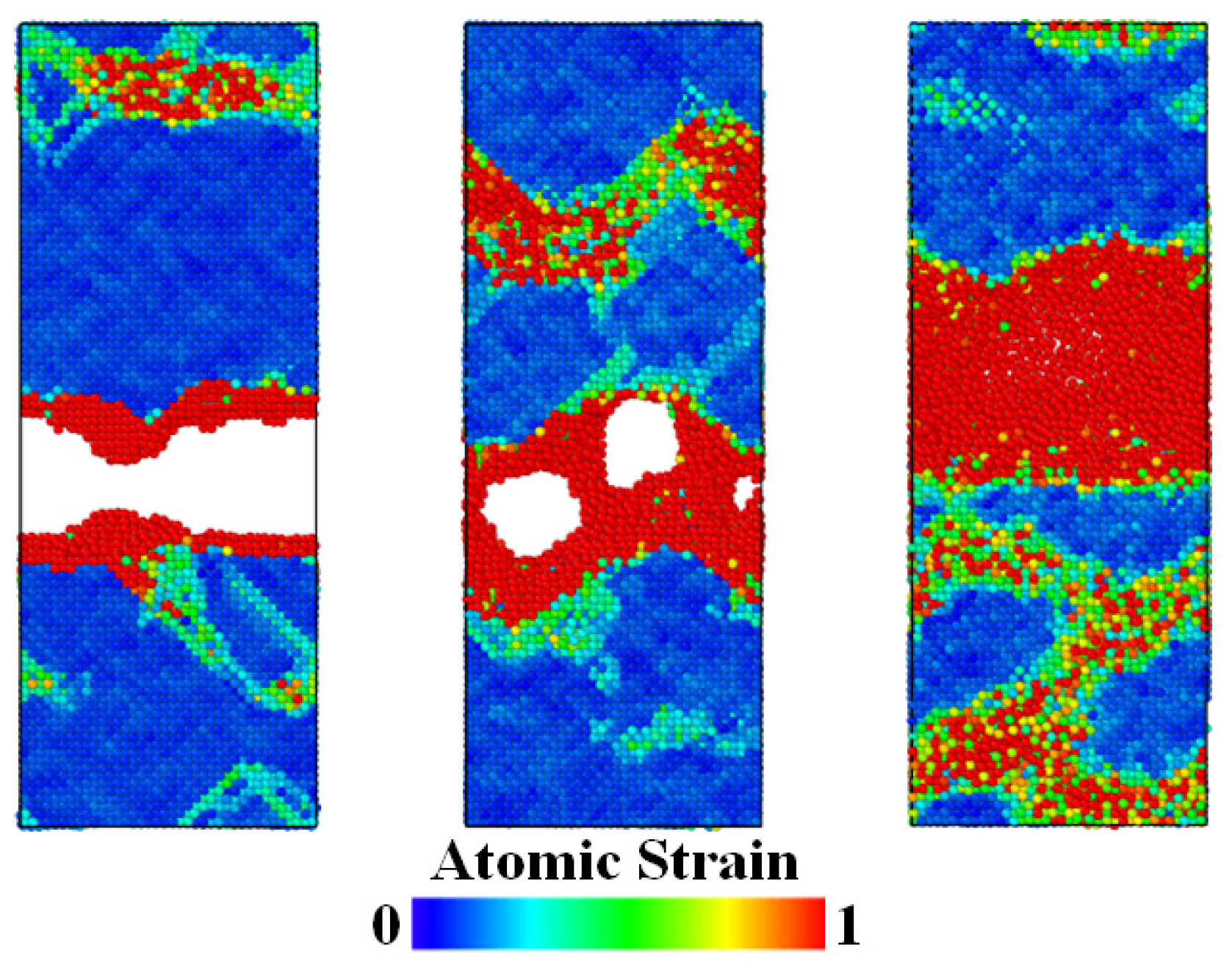
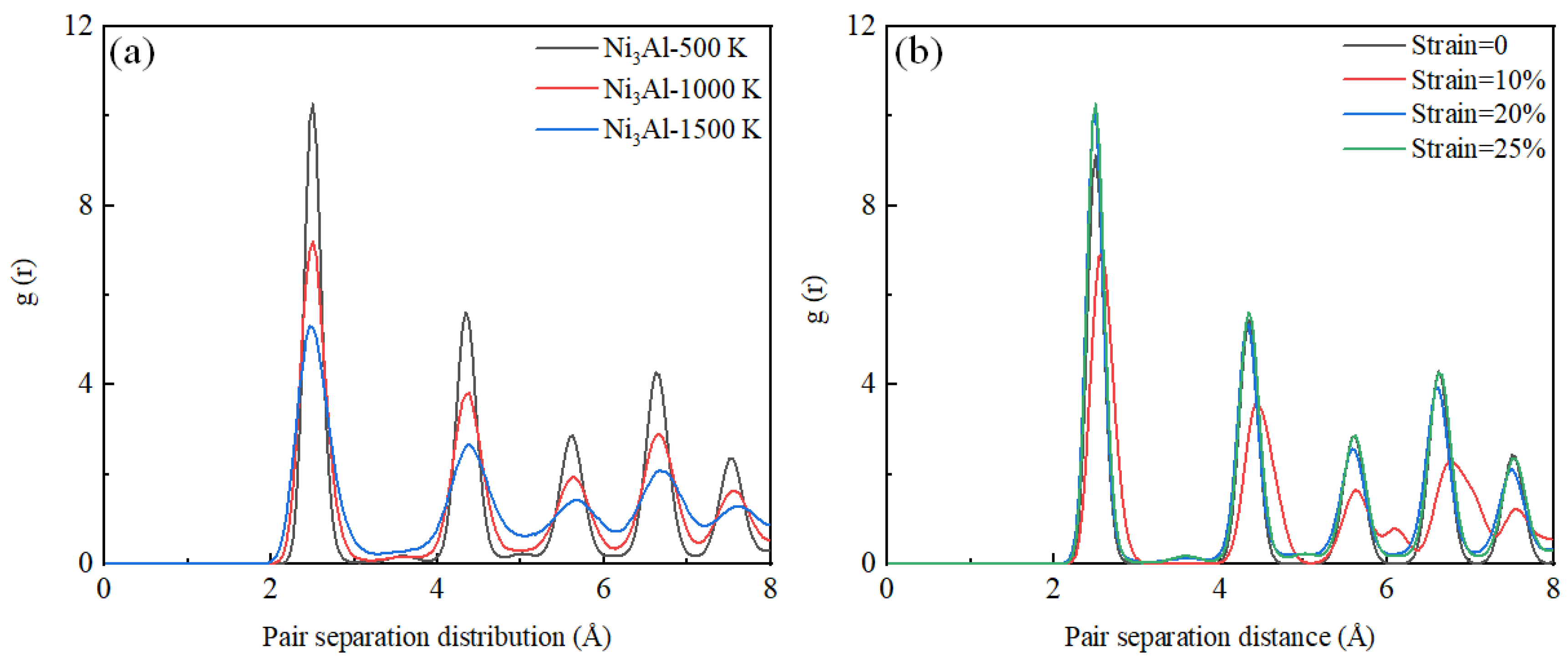
The atomic strain results in the Ni3Al alloy were represented in Figure 10. Similarly to the behavior observed in NiAl, atoms exhibiting high local strain in Ni3Al are predominantly localized in regions undergoing phase transformation. The highest strain concentrations occur at the crack tip, where the atomic-level strain reaches its maximum intensity. As the temperature increased, the number of high-strain atoms progressively rose, which was related to the enhanced extent of atomic-scale phase transitions within the system. Moreover, the range of atomic high-strain regions within the system gradually increased, indicating that the deformation resistance of the system gradually weakened as the temperature increased. Figure 11 shows the evolution of RDF for the Ni-Al atomic pairs in the Ni3Al system. Figure 11a showed that as the temperature increased, the Ni–Al interatomic interaction gradually weakened, and the peak position gradually shifted to the right. This shift indicated thermal expansion and an increase in the average Ni–Al bond length. Figure 11b displays the RDF evolution at 500 K under different tensile strain. Within the strain range of 0%–10%, as the tensile progresses, the interatomic bond length in the system increases, leading to a gradual weakening of atomic interactions, a rightward shift in the peak position, and a reduction in peak intensity. However, when the strain reached 20%–25%, the structural changes induced by atomic stretching cease due to the rupture of chemical bonds at both ends of the crack. As a result, the system underwent contraction, the bond length decreased, the interatomic interaction strengthened, the peak position shifted to the left, and the peak intensity increased.

4. Conclusions

In this study, the mechanical properties of single-crystal NiAl and Ni3Al under high-temperature tensile loading and their underlying microscopic mechanism were systematically investigated using molecular dynamics simulations. The results demonstrate that the superior high-temperature deformation resistance of NiAl originates from its stable plastic deformation mechanism, which is dominated by 1/2 <111> screw dislocation, whereas the early softening behavior observed in Ni3Al is closely associated with complex stacking fault, HCP phase transformation, and slip systems governed by Shockley incomplete dislocation (1/6 <112>). Atomic strain analysis confirms that regions of high strain are highly consistent with phase transformation zones. The increase in temperature generally weakens atomic interactions and promotes the amorphous phase transition. This work clarifies the fundamentally distinct deformation mechanisms of Ni–Al-based intermetallic compounds at the atomic scale, providing a crucial theoretical foundation and design guidance for the rational selection and design of Ni-Al-based intermetallic compounds for specific high-temperature working conditions, such as high-stress components or impact-resistant coatings.

Author Contributions

Methodology, X.Y. and S.S.; Software, K.Z. and R.L.; Validation, X.Y., X.H., F.Z. and J.Y.; Resources, R.L.; Data curation, X.H.; Writing—original draft, R.L.; Writing—review & editing, X.Y., K.Z. and R.L.; Visualization, K.Z.; Supervision, X.H., S.S., F.Z. and J.Y.; Project administration, X.Y. and R.L.; Funding acquisition, X.Y. and R.L. All authors have read and agreed to the published version of the manuscript.

Funding

This work was supported by the Hubei Key Laboratory of Electronic Manufacturing and Packaging Integration (Grant No. EMPI2025015), the Science and technology research project of Hubei Provincial Department of Education (Grant No. B2023045).

Institutional Review Board Statement

Not applicable.

Informed Consent Statement

Not applicable.

Data Availability Statement

The original contributions presented in this study are included in the article. Further inquiries can be directed to the corresponding author.

Conflicts of Interest

The authors declare no conflict of interest.

References

  1. Zeng, Q.; Chen, X. Combustor technology of high temperature rise for aero engine. Prog. Aerosp. Sci. 2023, 140, 100927. [Google Scholar] [CrossRef]
  2. Liu, Y.; Sun, X.; Sethi, V.; Nalianda, D.; Li, Y.G.; Wang, L. Review of modern low emissions combustion technologies for aero gas turbine engines. Prog. Aerosp. Sci. 2017, 94, 12–45. [Google Scholar] [CrossRef]
  3. Avan Heerden, S.J.; Judt, D.M.; Jafari, S.; Lawson, C.P.; Nikolaidis, T.; Bosak, D. Aircraft thermal management: Practices, technology, system architectures, future challenges, and opportunities. Prog. Aerosp. Sci. 2022, 128, 100767. [Google Scholar] [CrossRef]
  4. Perrut, M.; Caron, P.; Thomas, M.; Couret, A. High temperature materials for aerospace applications: Ni-based superalloys and γ-TiAl alloys. Comptes Rendus Phys. 2018, 19, 657–671. [Google Scholar] [CrossRef]
  5. Sengupta, P.; Manna, I. Advanced high-temperature structural materials in petrochemical, metallurgical, power, and aerospace sectors—An overview. In Future Landscape of Structural Materials in India; Springer Nature: Berlin/Heidelberg, Germany, 2022; pp. 79–131. [Google Scholar] [CrossRef]
  6. Darolia, R. Development of strong, oxidation and corrosion resistant nickel-based superalloys: Critical review of challenges, progress and prospects. Int. Mater. Rev. 2019, 64, 355–380. [Google Scholar] [CrossRef]
  7. Jiang, S.; Li, S. Formation mechanism and prediction of new phases in binary metallic liquid/solid interface. Rare Met. 2011, 30, 486–491. [Google Scholar] [CrossRef]
  8. Ali, S.; Huang, T.; Song, P.; Shah, S.H.; Ali, R.; Arif, M.; Lu, J. First-principle-based structural and thermodynamic parameters of Ni–Al intermetallic compounds under different pressures and temperatures. Mod. Phys. Lett. B 2021, 35, 2150124. [Google Scholar] [CrossRef]
  9. Liu, C.; Feng, H.; Yang, Y.; Zhang, E.; Ding, J.; Dai, J.; Liu, Y. Short-term corrosion behavior of polycrystalline Ni3Al-based superalloy in sulfur-containing atmosphere. Intermetallics 2022, 142, 107446. [Google Scholar] [CrossRef]
  10. Romero, A.; Rodríguez, G.P.; Marjaliza, E. Processing of intermetallic laminates by Self-Propagating High–Temperature Synthesis initiated with concentrated solar energy. J. Alloys Compd. 2022, 891, 161876. [Google Scholar] [CrossRef]
  11. Saeedi, B.; Aghdam, A.S.R.; Gholami, G. A study on nanostructured in-situ oxide dispersed NiAl coating and its high temperature oxidation behavior. Surf. Coat. Technol. 2015, 276, 704–713. [Google Scholar] [CrossRef]
  12. Jia, Q.; Li, D.; Zhang, Z.; Zhang, N.; Zhao, W. Comparison of oxidation resistance of Al–Ti and Al–Ni intermetallic formed in situ by thermal spraying. Mater. Res. Express 2019, 6, 096408. [Google Scholar] [CrossRef]
  13. Zhu, Y.; Zhou, S.; Wang, L.; Liang, Y.J.; Xue, Y.; Wang, L. Improving the ductility of high-strength multiphase NiAl alloys by introducing multiscale high-entropy phases and martensitic transformation. Mater. Sci. Eng. A 2021, 808, 140949. [Google Scholar] [CrossRef]
  14. Krasnowski, M.; Gierlotka, S.; Ciołek, S.; Kulik, T. Nanocrystalline NiAl intermetallic alloy with high hardness produced by mechanical alloying and hot-pressing consolidation. Adv. Powder Technol. 2019, 30, 1312–1318. [Google Scholar] [CrossRef]
  15. Pun, G.P.P.; Mishin, Y. Molecular dynamics simulation of the martensitic phase transformation in NiAl alloys. J. Phys. Condens. Matter 2010, 22, 395403. [Google Scholar] [CrossRef]
  16. Roy, A.M. Effects of interfacial stress in phase field approach for martensitic phase transformation in NiAl shape memory alloys. Appl. Phys. A 2020, 126, 576. [Google Scholar] [CrossRef]
  17. Du, Y.; Hu, X.; Zhang, S.; Song, Y.; Jiang, H.; Rong, L. Precipitation behavior of Cu-NiAl nanoscale particles and their effect on mechanical properties in a high strength low alloy steel. Mater. Charact. 2022, 190, 112014. [Google Scholar] [CrossRef]
  18. Plimpton, S. Fast Parallel Algorithms for Short-Range Molecular Dynamics. J. Comput. Phys. 1995, 117, 1–19. [Google Scholar] [CrossRef]
  19. Thompson, J.M.T.; Grindon, C.; Harris, S.; Evans, T.; Novik, K.; Coveney, P.; Laughton, C. Large-scale molecular dynamics simulation of DNA: Implementation and validation of the AMBER98 force field in LAMMPS. Philos. Trans. A Math. Phys. Eng. Sci. 2004, 362, 1373–1386. [Google Scholar] [CrossRef]
  20. Huang, M.; Wang, C. First-principles studies of effects of interstitial boron and carbon on the structural, elastic, and electronic properties of Ni solution and Ni3Al intermetallics. Chin. Phys. B 2016, 25, 107104. [Google Scholar] [CrossRef]
  21. Hartbauer, M.; Daoud, H.; Scherm, F.; Schumann, H.; Barroso, G.; Scherm, F.; Glatzel, U. Fe/Al and Ni/Al coatings–composition and intermetallic formation. Surf. Eng. 2025, 41, 928–941. [Google Scholar] [CrossRef]
  22. Yoo, M.H. Stability of superdislocations and shear faults in L12 ordered alloys. Acta Metall. 1987, 35, 1559–1569. [Google Scholar] [CrossRef]
  23. Shivam, V.; Basu, J.; Pandey, V.K.; Shadangi, Y.; Mukhopadhyay, N.K. Alloying behaviour, thermal stability and phase evolution in quinary AlCoCrFeNi high entropy alloy. Adv. Powder Technol. 2018, 29, 2221–2230. [Google Scholar] [CrossRef]
  24. Toton, D.; Lorenz, C.D.; Rompotis, N.; Martsinovich, N.; Kantorovich, L. Temperature control in molecular dynamic simulations of non-equilibrium processes. J. Phys. Condens. Matter 2010, 22, 074205. [Google Scholar] [CrossRef] [PubMed]
  25. Hamilton, N.E.; Mahjoub, R.; Law, K.J.; Ferry, M. A blended NPT/NVT scheme for simulating metallic glasses. Comput. Mater. Sci. 2017, 130, 130–137. [Google Scholar] [CrossRef]
  26. Mishin, Y.; Asta, M.; Li, J. Atomistic modeling of interfaces and their impact on microstructure and properties. Acta Mater. 2010, 58, 1117–1151. [Google Scholar] [CrossRef]
  27. Rosales-Pelaez, P.; Sanchez-Burgos, I.; Valeriani, C.; Vega, C.; Sanz, E. Seeding approach to nucleation in the NVT ensemble: The case of bubble cavitation in overstretched Lennard Jones fluids. Phys. Rev. E 2020, 101, 022611. [Google Scholar] [CrossRef]
  28. Zhou, X.W.; Johnson, R.A.; Wadley, H.N.G. Misfit-energy-increasing dislocations in vapor-deposited CoFe/NiFe multilayers. Phys. Rev. B 2004, 69, 144113. [Google Scholar] [CrossRef]
  29. Daw, M.S.; Baskes, M.I. Embedded-atom method: Derivation and application to impurities, surfaces, and other defects in metals. Phys. Rev. B 1984, 29, 6443. [Google Scholar] [CrossRef]
  30. Stukowski, A. Visualization and analysis of atomistic simulation data with OVITO–the Open Visualization Tool. Model. Simul. Mater. Sci. Eng. 2009, 18, 015012. [Google Scholar] [CrossRef]
  31. Liu, Z.R.; Zhang, R.F. AACSD: An atomistic analyzer for crystal structure and defects. Comput. Phys. Commun. 2018, 222, 229–239. [Google Scholar] [CrossRef]
  32. Wei, W.; Chen, L.; Gong, H.R.; Fan, J.L. Strain-stress relationship and dislocation evolution of W–Cu bilayers from a constructed n-body W–Cu potential. J. Phys. Condens. Matter 2019, 31, 305002. [Google Scholar] [CrossRef]
  33. Ehrich, H.J.; Dollmann, A.; Grützmacher, P.G.; Gachot, C.; Eder, S.J. Automated identification and tracking of deformation twin structures in molecular dynamics simulations. Comput. Mater. Sci. 2024, 236, 112878. [Google Scholar] [CrossRef]
  34. Zhang, L.; Wang, D.; Ren, X.; Wang, Y. A new mechanism for low and temperature-independent elastic modulus. Sci. Rep. 2015, 5, 11477. [Google Scholar] [CrossRef] [PubMed]
  35. Gregorová, E.; Černý, M.; Pabst, W.; Esposito, L.; Zanelli, C.; Hamáček, J.; Kutzendörfer, J. Temperature dependence of Young׳ s modulus of silica refractories. Ceram. Int. 2015, 41, 1129–1138. [Google Scholar] [CrossRef]
  36. Grimvall, G.; Magyari-Köpe, B.; Ozoliņš, V.; Persson, K. Lattice instabilities in metallic elements. Rev. Mod. Phys. 2012, 84, 945–986. [Google Scholar] [CrossRef]
  37. Zhang, J.; Li, Y.; Li, X.; Zhai, Y.; Han, X. Timely and atomic-resolved high-temperature mechanical investigation of ductile fracture and atomistic mechanisms of tungsten. Nat. Commun. 2021, 12, 2218. [Google Scholar] [CrossRef]
  38. Gao, N.; Yao, Z.W.; Lu, G.H.; Deng, H.Q.; Gao, F. Mechanisms for <100> interstitial dislocation loops to diffuse in BCC iron. Nat. Commun. 2021, 12, 225. [Google Scholar] [CrossRef] [PubMed]
  39. Ding, Y.; Guo, L.; Li, Y.; Liu, X.; Ran, G.; Wu, L.; Qiu, X.; Deng, H.; Wu, X.; Li, Y.; et al. In-situ TEM observation and MD simulation of the reaction and transformation of <100> loops in tungsten during H2+ & He+ dual-beam irradiation. Scr. Mater. 2021, 204, 114154. [Google Scholar] [CrossRef]
  40. Maresca, F.; Curtin, W.A. Mechanistic origin of high strength in refractory BCC high entropy alloys up to 1900 K. Acta Mater. 2020, 182, 235–249. [Google Scholar] [CrossRef]
  41. Rao, S.I.; Woodward, C.; Akdim, B.; Senkov, O.N.; Miracle, D. Theory of solid solution strengthening of bcc chemically complex alloys. Acta Mater. 2021, 209, 116758. [Google Scholar] [CrossRef]
  42. Weng, S.; Fu, T.; Peng, X.; Chen, X. Anisotropic Phase Transformation in B2 Crystalline CuZr Alloy. Nanoscale Res. Lett. 2019, 14, 283. [Google Scholar] [CrossRef] [PubMed]
  43. Chen, H.; Wang, Y.; Zheng, J.; Zhao, C.; Li, Q.; Wei, X.; Zhang, B. First-Principles Study on the Alloying Segregation and Ideal Fracture at Coherent B2-NiAl and BCC-Fe Interface. Materials 2025, 18, 1805. [Google Scholar] [CrossRef] [PubMed]
  44. Yuan, F.; Li, G.; Liu, C.; Han, F.; Zhang, Y.; Muhammad, A.; Gu, H.; Guo, W.; Ren, J. Cross stacking faults in Zr(Fe,Cr)2 face-centered cubic Laves phase nanoparticle. Appl. Surf. Sci. 2020, 513, 145716. [Google Scholar] [CrossRef]
  45. Weinberger, C.R.; Boyce, B.L.; Battaile, C.C. Slip planes in bcc transition metals. Int. Mater. Rev. 2013, 58, 296–314. [Google Scholar] [CrossRef]
  46. Gröger, R.; Vitek, V. Impact of non-Schmid stress components present in the yield criterion for bcc metals on the activity of {110} <111> slip systems. Comput. Mater. Sci. 2019, 159, 297–305. [Google Scholar] [CrossRef]
  47. Chen, Z.; Cai, H.; Li, S.; Zhang, X.; Wang, F.; Tan, C. Analysis of crystallographic twinning and slip in fcc crystals under plane strain compression. Mater. Sci. Eng. A 2007, 464, 101–109. [Google Scholar] [CrossRef]
  48. Chen, Z.; Zhang, X.; Liu, C.; Zhou, Z.; Li, S. Co-yield surfaces for {111} <110> slip and {111} <112> twinning in fcc metals. J. Mater. Sci. 2002, 37, 2843–2848. [Google Scholar] [CrossRef]
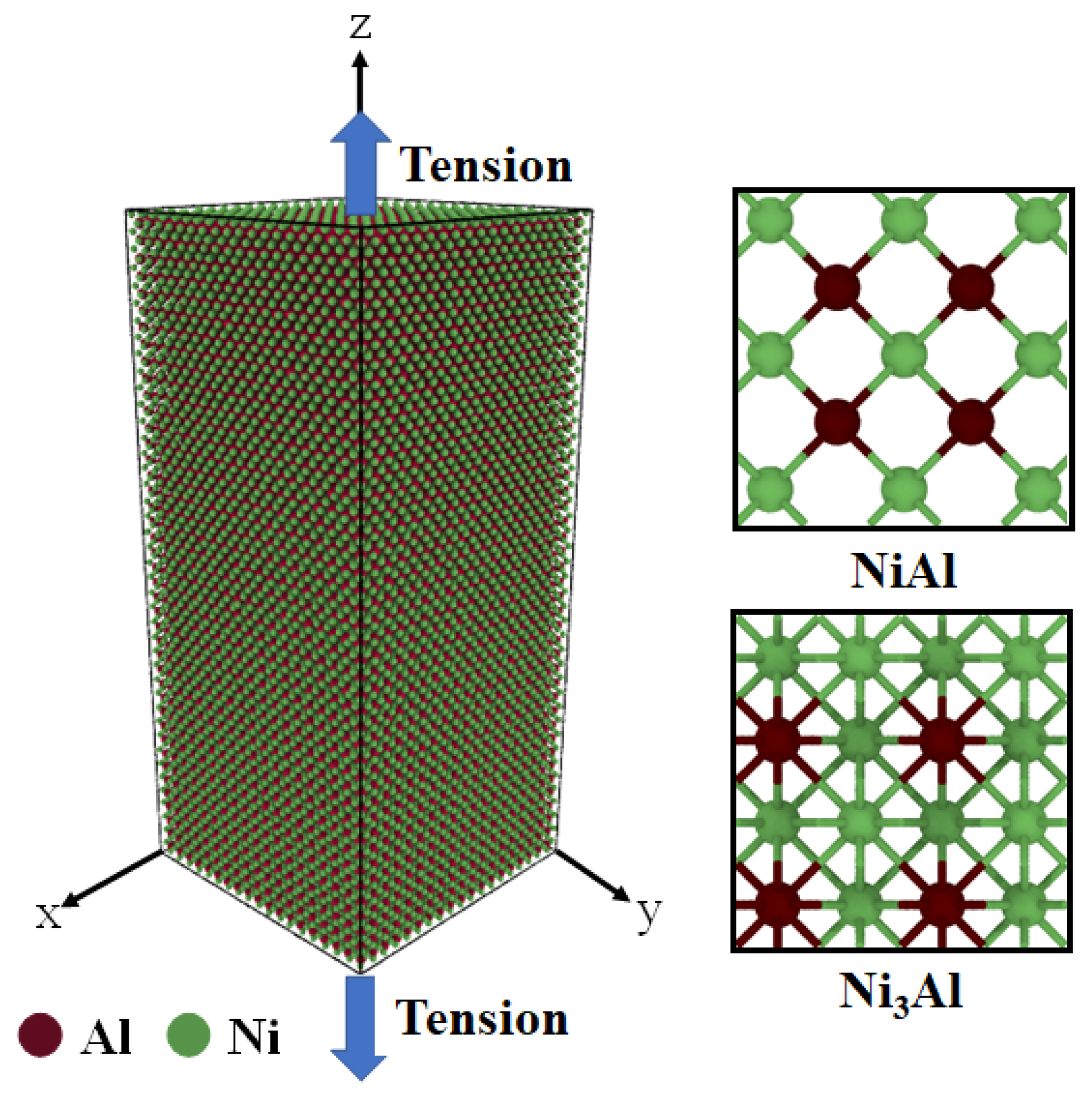
Figure 1. The three-dimensional model of tension.
Coatings 16 00168 g001
Figure 2. Mechanical response curves of NiAl under tensile process at different temperatures.
Coatings 16 00168 g002
Figure 3. The crystalline structure of the NiAl alloy when tensile process is at different temperatures. (a) 500 K, (b) 1000 K, (c) 1500 K.
Coatings 16 00168 g003
Figure 4. The statistical results of dislocation defects in NiAl after tensile at different temperatures. (a) 500 K, (b) 1000 K, (c) 1500 K.
Coatings 16 00168 g004
Figure 5. The atomic strain in the NiAl alloy after tension at different temperatures. (a) 500 K, (b) 1000 K, (c) 1500 K.
Coatings 16 00168 g005
Figure 6. The radial distribution function of Ni-Al within NiAl alloy. (a) the changes at different temperatures; (b) the changes at different strains at 500 K.
Coatings 16 00168 g006
Figure 7. Mechanical response curves of Ni3Al under tensile process at different temperatures.
Coatings 16 00168 g007
Figure 8. The crystalline structure of the Ni3Al alloy when tensile process is at different temperatures. (a) 500 K, (b) 1000 K, (c) 1500 K.
Coatings 16 00168 g008
Figure 9. The statistical results of dislocation defects in Ni3Al after tensile process at different temperatures. (a) 500 K, (b) 1000 K, (c) 1500 K.
Coatings 16 00168 g009
Figure 10. The atomic strain in the Ni3Al alloy after tension at different temperatures.
Coatings 16 00168 g010
Figure 11. The radial distribution function of Ni-Al within the Ni3Al alloy. (a) the changes at different temperatures; (b) the changes at different strains at 500 K.
Coatings 16 00168 g011
Disclaimer/Publisher’s Note: The statements, opinions and data contained in all publications are solely those of the individual author(s) and contributor(s) and not of MDPI and/or the editor(s). MDPI and/or the editor(s) disclaim responsibility for any injury to people or property resulting from any ideas, methods, instructions or products referred to in the content.