Article

Shrimp-Derived Chitosan for the Formulation of Active Films with Mexican Propolis: Physicochemical and Functional Evaluation of the Biomaterial

by
Alejandra Delgado-Lozano
1,
Pedro Alberto Ledesma-Prado
1,
César Leyva-Porras
2,
Lydia Paulina Loya-Hernández
3,
César Iván Romo-Sáenz
1,*,
Carlos Arzate-Quintana
1,
Manuel Román-Aguirre
2,
María Alejandra Favila-Pérez
1,
Alva Rocío Castillo-González
1 and
Celia María Quiñonez-Flores
1,*
1
Facultad de Medicina y Ciencias Biomédicas, Universidad Autónoma de Chihuahua, Chihuahua 31125, Mexico
2
Centro de Investigación en Materiales Avanzados (CIMAV), Chihuahua 31136, Mexico
3
Facultad de Odontología, Universidad Autónoma de Chihuahua, Chihuahua 31110, Mexico
*
Authors to whom correspondence should be addressed.
Coatings 2026, 16(1), 124; https://doi.org/10.3390/coatings16010124 (registering DOI)
Submission received: 20 December 2025 / Revised: 10 January 2026 / Accepted: 16 January 2026 / Published: 17 January 2026
(This article belongs to the Special Issue Coatings with Natural Products)

Abstract

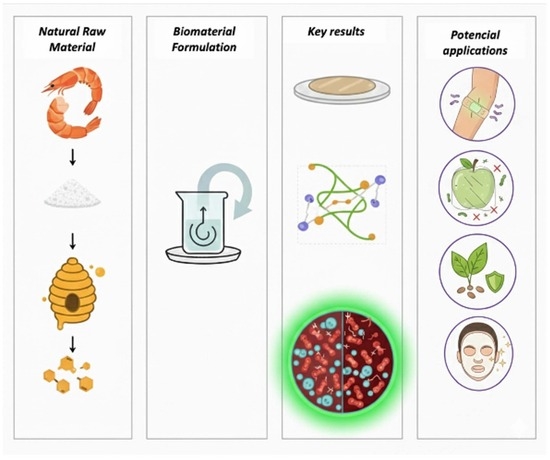
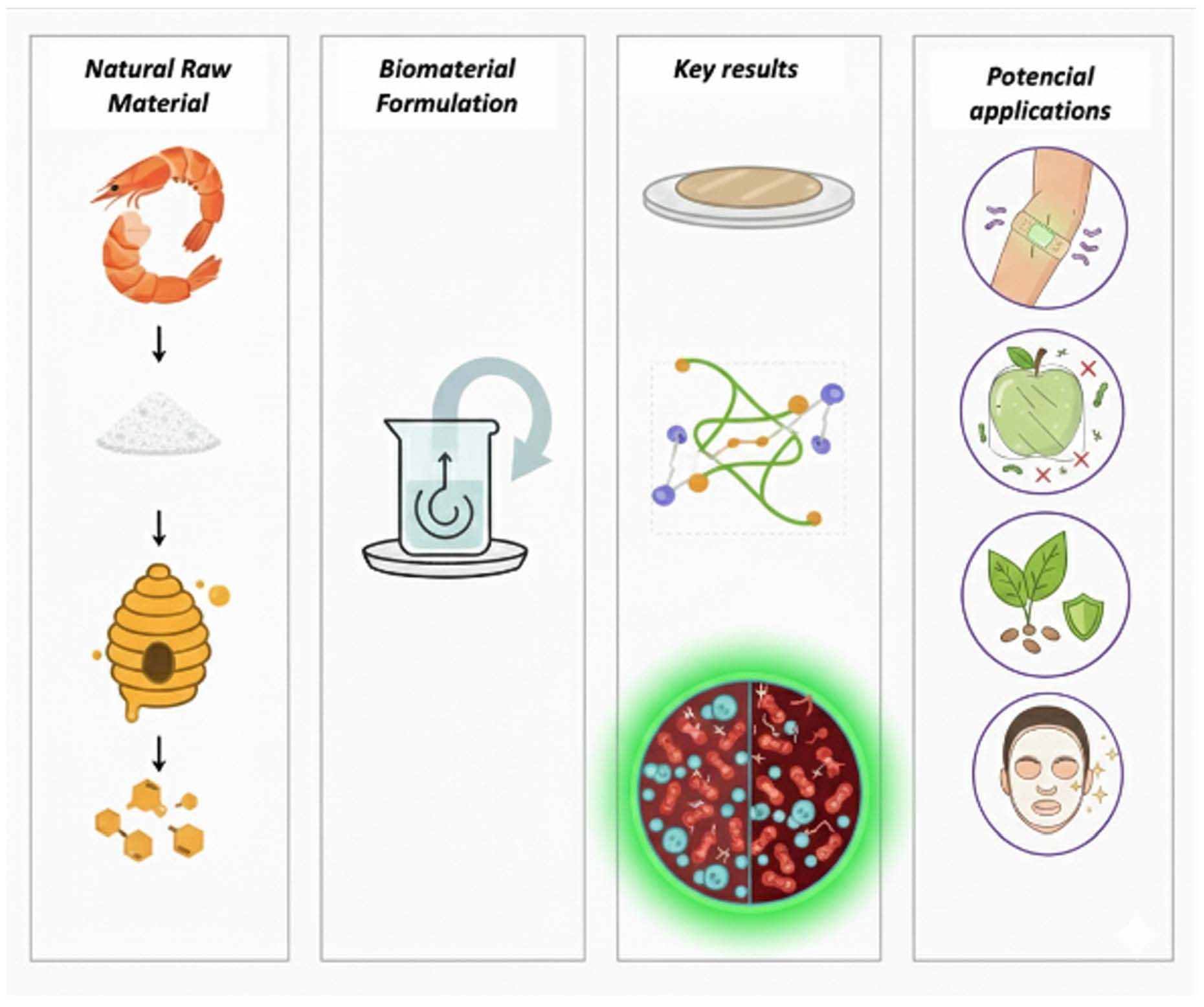
The development of functional biomaterials based on natural polymers has gained increasing relevance due to the growing demand for sustainable and bioactive alternatives for biomedical and technological applications. In this study, chitosan was obtained from shrimp exoskeletons and used to formulate active films enriched with Mexican propolis, aiming to evaluate the influence of the extract on the physicochemical and functional properties of the resulting biomaterial. Propolis was incorporated into the chitosan film-forming solution at a final concentration of 1.0% (v/v). The propolis employed met the requirements of the Mexican Official Standard NOM-003-SAG/GAN-2017 regarding flavonoid content, total phenolic compounds, and antimicrobial activity; additionally, it was evaluated through antioxidant activity, hemolysis, and acute toxicity (LD50) assays to provide a broader biological and safety assessment. The extracted chitosan exhibited a degree of deacetylation of 74% and characteristic FTIR spectral features comparable to those of commercial chitosan, confirming the quality of the obtained polymer. Chitosan–propolis films exhibited antimicrobial activity against Staphylococcus aureus, Escherichia coli, and Candida albicans, whereas pure chitosan films showed no inhibitory effect. Thermal analyses (TGA/DSC) revealed a slight reduction in thermal stability due to the incorporation of thermolabile polyphenolic compounds, along with increased thermal complexity of the system. SEM observations demonstrated reduced microbial adhesion and marked morphological damage in microorganisms exposed to the functionalized films. Overall, the incorporation of Mexican propolis enabled the development of a hybrid biomaterial with enhanced antimicrobial performance and potential application in wound dressings and bioactive coatings.

Graphical Abstract

1. Introduction

The development of functional biomaterials derived from natural polymers has gained increasing relevance in recent years, driven by the demand for sustainable, safe, and bioactive alternatives for industrial, biomedical, and technological applications [1,2,3]. Among these materials, chitosan stands out due to its biocompatibility, biodegradability, film-forming ability, and favorable mechanical properties, which enable the fabrication of thin films suitable for a wide range of applications [2,4]. Although chitosan exhibits intrinsic biological activity, its functional performance can be significantly enhanced through the incorporation of bioactive compounds.
Propolis, a natural resinous substance produced by Apis mellifera, is rich in flavonoids, phenolic acids, and other secondary metabolites responsible for its antimicrobial, antioxidant, anti-inflammatory, and wound-healing properties [5]. However, the chemical composition and biological activity of propolis are strongly influenced by its geographical origin and the local flora, leading to marked variability among samples from different regions [6]. For this reason, the comprehensive characterization of propolis prior to its incorporation into biomaterials is essential, as is the evaluation of how it modulates the physicochemical and biological properties of the resulting composite systems [7].
The incorporation of propolis into chitosan matrices has led to the development of synergistic biomaterials that combine the structural and barrier properties of the polymer with the biological activity of the extract [8]. Such systems have been widely explored in food applications, particularly as edible coatings and active packaging materials that extend shelf life by inhibiting microbial growth and oxidative processes [9]. In the biomedical field, chitosan–propolis films have shown potential as wound dressings and controlled-release platforms, owing to their bioadhesive nature and multifunctional biological activity [8,10]. Nevertheless, most studies have focused on propolis sourced from regions such as Iran [11,12,13,14], Brazil [15,16,17,18], and Egypt [19,20].
Although propolis of Mexican origin has been previously reported in clinical studies and in investigations focused on its biological properties [21,22,23], its application in functional biomaterials remains scarcely explored. In this context, the present study addresses this gap by incorporating a Mexican propolis extract validated according to the Official Mexican Standard NOM-003-SAG/GAN-2017 ensuring controlled quality. In addition, chitosan extracted directly from shrimp exoskeletons was employed, contributing to a circular economy approach. Furthermore, while most studies employing scanning electron microscopy focus primarily on the morphological characterization of the biomaterial itself, the present work extends this approach by directly evaluating microorganism–film interactions, providing complementary insight into microbial adhesion behavior and microorganism structural damage induced by the functionalized films.
Accordingly, the main objective of this study was to obtain chitosan from shrimp exoskeletons and develop active films incorporating Mexican propolis, previously characterized and validated according to the Official Mexican Standard NOM-003-SAG/GAN-2017, and to evaluate, through physicochemical, thermal, structural, and functional analyses, the effect of propolis incorporation on the properties and antimicrobial performance of the resulting biomaterial.

2. Materials and Methods

2.1. Propolis: Source and Characterization

2.1.1. Propolis Source

The extract propolis (EP) used in this study was obtained from a certified distributor, Mr. Juan Pliego, located in Toluca, Mexico.

2.1.2. Microbial Strains

The microbial strains used in this study were Escherichia coli O15:H7 (ATCC 43875), Staphylococcus aureus (ATCC 25923), and Candida albicans (ATCC 14053), selected due to their widespread use as reference microorganisms in antimicrobial susceptibility assays and in the evaluation of materials with bioactive properties.

2.1.3. Physicochemical, Antioxidant, and Antimicrobial Characterization of Propolis

The physicochemical, antioxidant, and antimicrobial characterization of the propolis extract, including the determination of total phenolic content, total flavonoid content, antioxidant activity by the DPPH• radical scavenging assay, and antimicrobial activity against Escherichia coli, Staphylococcus aureus, and Candida albicans, was performed strictly in accordance with the procedures established in the Mexican Official Standard NOM-003-SAG/GAN-2017 [24]. All assays were conducted without methodological modifications, and the results were expressed following the criteria defined by the standard.

2.1.4. Brine Shrimp Lethality Test

Artemia salina hatching was carried out in aerated saline water (33 g/L) at 25–28 °C under constant light. After 48 h, ten actively swimming nauplii were collected and transferred to 10 mL of freshly prepared saline water. Propolis solutions were prepared from a stock diluted in DMSO (1% final concentration) and tested at 500, 150, 50, 20, 10, 5, and 1 µg/mL. Experimental systems were incubated at 25–28 °C for 24 h, after which nauplii survival was recorded. Two controls were included: (1) saline water alone and (2) saline water containing 1% DMSO, to evaluate possible toxicity from the medium and the solvent. Acute toxicity was quantified by estimating the median lethal concentration (LC50) through Probit analysis.

2.1.5. Hemolysis Assay

The hemolytic activity of the ethanolic propolis extract was evaluated using human erythrocytes. Blood collected in EDTA tubes was centrifuged (1500 rpm, 10 min), and erythrocytes were washed four times with PBS (1X) and resuspended to obtain a 5% (v/v) suspension. The extract (0.05 mg/mL) was incubated with erythrocytes at 37 °C for 1 h. PBS, Triton X-100, and 3.5% ethanol were used as negative, positive, and vehicle controls, respectively. After centrifugation (1500 rpm, 10 min), supernatant absorbance was measured at 540 nm, and hemolysis (%) was calculated relative to the controls.

2.2. Preparation and Characterization of Chitosan and Chitosan–Propolis Films

2.2.1. Extraction and Characterization of Chitosan

Shrimp shells were used which, after being washed and dried in an oven at 60 °C for 24 h, were ground to obtain fine flakes; these were subjected to demineralization with 1.5 M HCl under stirring (3 h, 300–500 rpm), washed to neutral pH, and dried at 65 °C for 6 h; subsequently, deproteinization was carried out with 1 M NaOH at 80 °C for 2 h, followed by successive washes and drying; then, deacetylation was performed with 50% NaOH at 100 °C for 3 h, followed by washing and drying at 65 °C for 6 h. The degree of deacetylation of the resulting chitosan was determined by potentiometric acid–base titration. Additionally, Fourier transform infrared spectroscopy in attenuated total reflectance mode (FTIR-ATR) was employed to confirm the chemical structure and functional groups of the chitosan. FTIR-ATR analysis was carried out using a Shimadzu IRAffinity-1S spectrometer (Kyoto, Japan) equipped with a diamond ATR window with a diameter of 2 mm. Spectra were recorded in the wavenumber range of 4000–450 cm−1 at a resolution of 4 cm−1, averaging 40 scans per sample. Finally, chitosan solubility was verified by dissolving 0.1 g of the material in 5 mL of 4% (v/v) acetic acid, resulting in the formation of a transparent gel.

2.2.2. Preparation of Chitosan and Chitosan–Propolis Films

A 2% (v/v) acetic acid solution was prepared and used as the solvent for chitosan dissolution. Chitosan (0.5 g) was dissolved in 50 mL of the acetic acid solution under continuous magnetic stirring at room temperature and without heating. Glycerol (1.0 mL) was then added as a plasticizer, followed by the incorporation of 0.5 mL of a concentrated propolis extract, resulting in a final concentration of 1.0% (v/v) in the film-forming solution. The mixture was stirred for 50 min until a homogeneous solution was obtained, cast uniformly into Teflon molds, and dried at 45 °C for 24 h. After drying, the films were carefully removed from the molds and stored under dry conditions prior to characterization.

2.2.3. Antimicrobial Activity of Chitosan and Chitosan–Propolis Films

The antimicrobial activity of the chitosan films and the chitosan–propolis films was evaluated using Escherichia coli, Staphylococcus aureus, and Candida albicans. Each strain was cultured in Müller–Hinton or Sabouraud broth, as appropriate, and the suspensions were adjusted to 0.5 McFarland (1–5 × 10⁶ cells/mL). Standardized inocula were spread uniformly onto the surface of the corresponding agar plates. Circular sections of the chitosan and chitosan–propolis films (5 mm in diameter) were aseptically cut and placed onto the inoculated agar plates. In each assay, chitosan films without propolis were used as the negative control, while standard antibiotics or antifungal agents, selected according to each microorganism, were included as positive controls. Plates were incubated at 37 °C for 24 h for bacterial strains and at 35 °C for 48 h for Candida albicans. After incubation, the inhibition zones formed around each film and control were measured to assess antimicrobial activity.

2.2.4. Fourier-Transform Infrared Analysis (FTIR-ATR)

FTIR-ATR analysis of chitosan and chitosan–propolis films was performed under the same conditions described in Section 2.2.1 to identify characteristic functional groups and assess interactions between chitosan and propolis.

2.2.5. Thermogravimetric Analysis (TGA) and Differential Scanning Calorimetry (DSC)

The thermoanalytical analysis of the films was carried out using a SDT Q600 TGA/DSC system (TA Instruments Inc., New Castle, DE. USA). The samples were subjected to a heating program at a rate of 10 °C/min, from room temperature up to 800 °C, under an air atmosphere, allowing the simultaneous evaluation of thermal stability, degradation events, and transitions associated with the material components.

2.2.6. Scanning Electron Microscopy (SEM) Analysis of Film–Microorganism Interactions

Chitosan films, chitosan–propolis films, and PET reference samples were cut into 10X 10 mm squares for SEM analysis. Suspensions of Candida albicans, Staphylococcus aureus, and Escherichia coli were adjusted to 1 × 10⁸ cells/mL (0.5 McFarland). Each film fragment was fixed onto a sample holder using conductive copper adhesive tape and inoculated with 10 μL of the standardized microbial suspension. The samples were allowed to dry at room temperature for 24 h to promote microbial adhesion. Prior to SEM observation, the samples were sputter-coated with a thin layer of gold to enhance surface conductivity. The coated samples were then analyzed using a JEOL JSM-7401 scanning electron microscope (Tokyo, Japan) to evaluate surface morphology and microorganism-material interactions.

3. Results

The propolis used in this study was sourced from Toluca, Mexico. Physically, the extract exhibited a dark brown coloration and a strong balsamic aroma. The chemical profile of the extract (Table 1) met the minimum specifications established by the Mexican Official Standard NOM-003-SAG/GAN-2017 for flavonoid and total phenolic contents, as both parameters exceeded the required thresholds expressed on a weight-per-weight basis. In addition, the antioxidant capacity (CA50), determined using the DPPH• radical assay, did not comply with the values established by the standard, as it fell outside the acceptable range. From a biological standpoint, the extract demonstrated antimicrobial activity, producing inhibition zones against Staphylococcus aureus, Escherichia coli, and Candida albicans, which are considered the pathogenic microorganisms of greatest public health relevance under this regulatory framework (Table 2). Furthermore, biosafety data, including the hemolysis assay and the median lethal dose (LD50) determined using Artemia salina, fell within acceptable ranges for materials with potential biomedical applications (Table 2), indicating good hemocompatibility and low acute toxicity.
A visual overview of the different stages of the materials prepared in this study is presented in Figure 1. Figure 1a shows the chitosan obtained from shrimp shells as white, dry flakes, characteristic of a purified polymer with a degree of deacetylation of 74.06%, as determined by potentiometric titration. Figure 1b corresponds to the film produced solely from chitosan, which exhibits a translucent, slightly yellowish appearance and a homogeneous surface. In contrast, Figure 1c illustrates the chitosan–propolis film, which displays a noticeably darker brown coloration and reduced transparency, evidencing the successful incorporation of the propolis extract into the polymer matrix. Figure 1d shows the FTIR spectrum of shrimp shell-derived chitosan which further supports the degree of deacetylation determined by potentiometric titration by revealing a reduction in the relative intensity of acetyl-related bands and a predominance of amino-associated vibrations. The spectrum displays a broad band at 3400–3200 cm−1 corresponding to O–H and N–H stretching vibrations, as well as characteristic C–H stretching at approximately 2920 cm−1. The presence of amide I and amide II bands at around 1650 and 1590 cm−1, respectively, with moderate intensities, is consistent with a partially deacetylated structure. Additionally, the retention of C–O–C vibrations of the polysaccharide backbone in the 1150–1030 cm−1 region confirms the preservation of the chitosan polymer structure. Overall, the FTIR spectral features are in agreement with the degree of deacetylation value obtained by titration and are comparable to those of commercial chitosan, confirming the successful extraction and controlled deacetylation of chitosan from shrimp shells.
The chitosan–propolis films exhibited clear antimicrobial activity against all three tested microorganisms, as evidenced by the formation of inhibition zones that demonstrate the material’s ability to suppress bacterial and fungal growth (Table 3). The strongest responses were observed against Escherichia coli and Staphylococcus aureus, while Candida albicans showed a comparatively smaller inhibitory effect. In contrast, films prepared solely with chitosan did not display detectable antimicrobial activity, confirming that the observed effect is directly attributable to the incorporation of propolis.
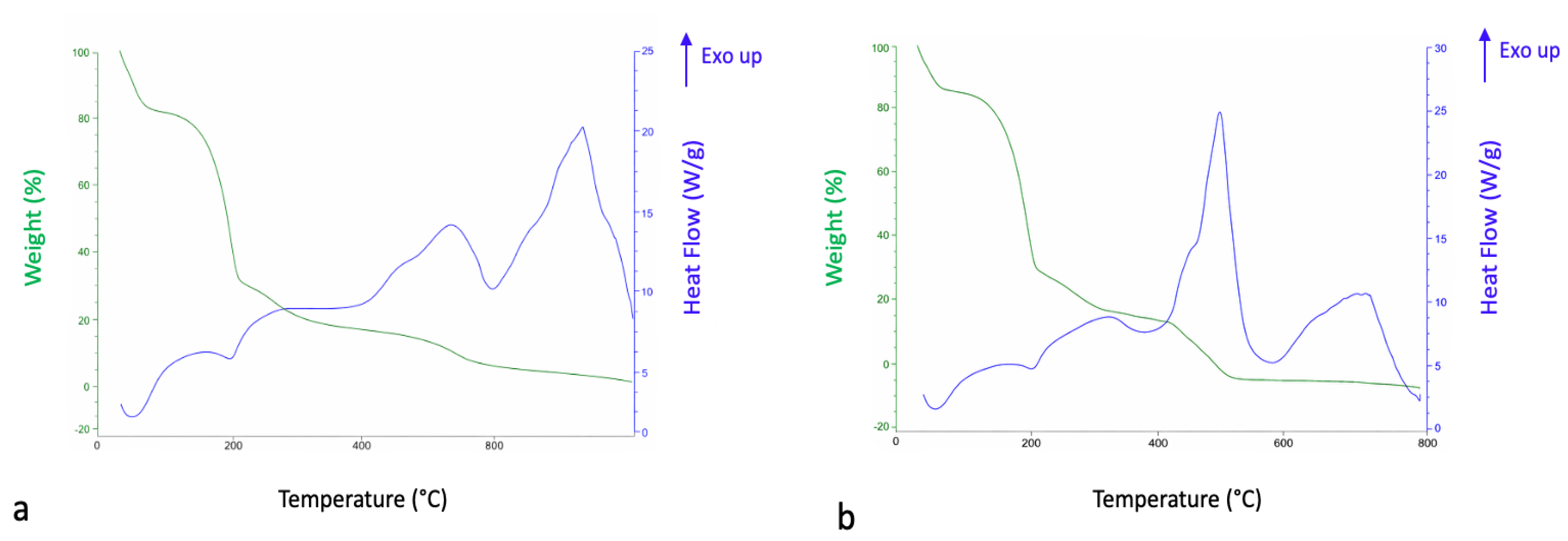
Thermogravimetric analysis (TGA) revealed a multi-step thermal degradation behavior for both films (Figure 2). The neat chitosan film exhibited an initial weight loss below 180 °C, attributed to the evaporation of physically bound water, followed by a major degradation stage between 200 °C and 400 °C associated with polysaccharide backbone decomposition. In comparison, the chitosan–propolis film showed a similar dehydration stage but a more gradual and continuous mass-loss profile at intermediate temperatures, indicating overlapping degradation of propolis-derived thermolabile compounds and the chitosan matrix, as well as an earlier onset of the main degradation process. Above 400 °C, both samples displayed a slow and continuous mass loss up to 800 °C, which can be attributed to progressive carbonization and thermal decomposition of residual organic structures.
Differential scanning calorimetry (DSC) thermograms showed a broad endothermic event below 200 °C for both samples, corresponding to water loss. At higher temperatures, the neat chitosan film exhibited multiple thermal transitions related to polymer degradation, whereas the chitosan–propolis film showed shifts in peak position and shape, reflecting the contribution of extract components within the polymer matrix. A pronounced exothermic event was observed near 500 °C in both materials, corresponding to the oxidative degradation of carbonaceous residues formed during thermal decomposition. No additional well-defined thermal events were detected beyond this temperature up to 800 °C, indicating completion of the main degradation processes within the analyzed temperature range.
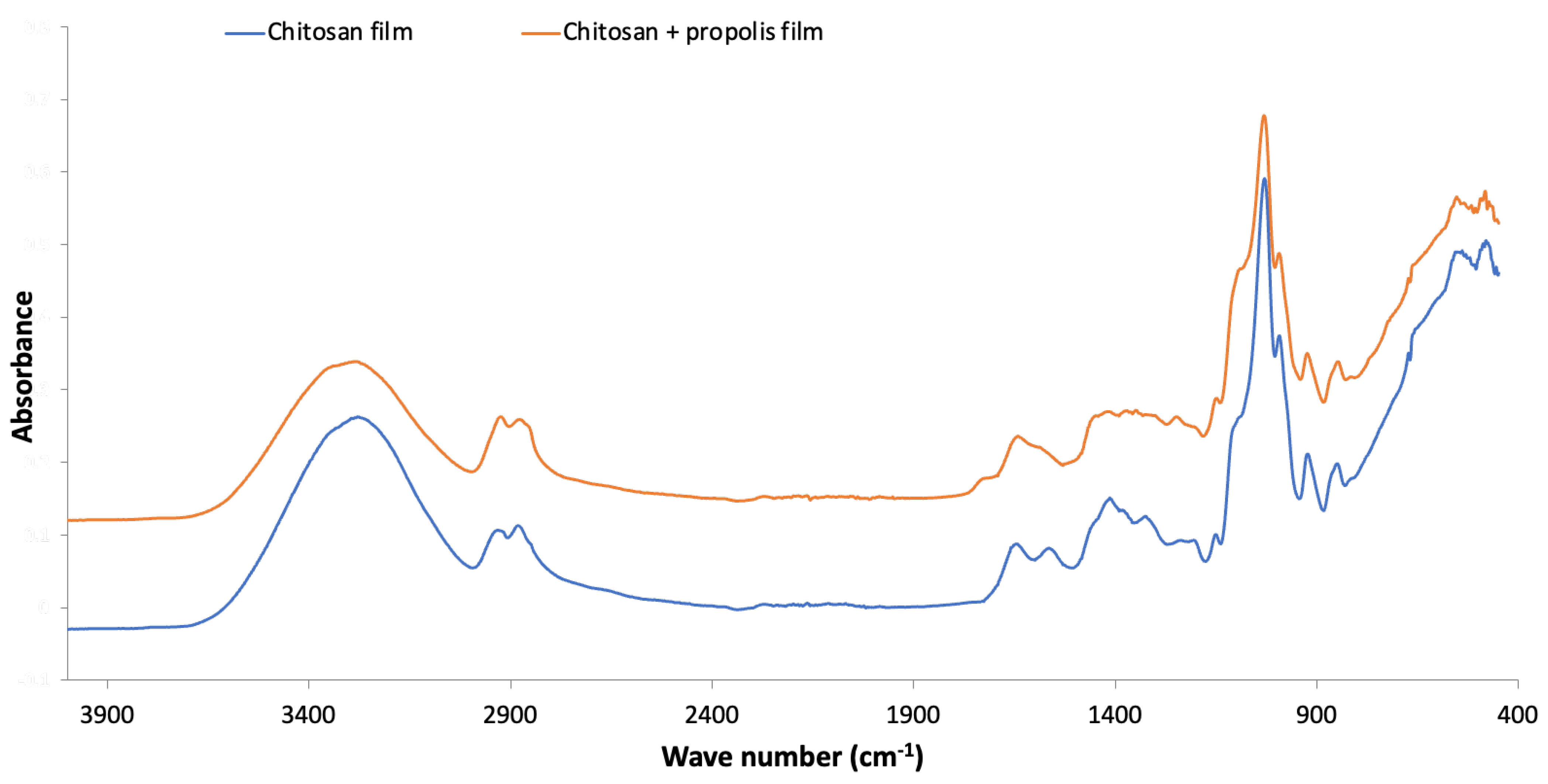
ATR-FTIR analysis revealed the characteristic spectral features of chitosan in both the pure chitosan film and the chitosan–propolis film (Figure 3). In both samples, a broad absorption band in the 3000–3600 cm−1 region was observed, corresponding to O–H and N–H stretching vibrations, along with C–H stretching bands around 2900 cm−1. The fingerprint region (1800–800 cm−1) displayed the typical absorption bands associated with the polysaccharide backbone, including amide and C–O vibrational modes. Compared with the pure chitosan film, the chitosan–propolis film showed an overall decrease in absorbance intensity and subtle changes in band shape and intensity, particularly in the 1600–1700 cm−1 region, indicating the presence and incorporation of propolis components within the polymeric matrix.
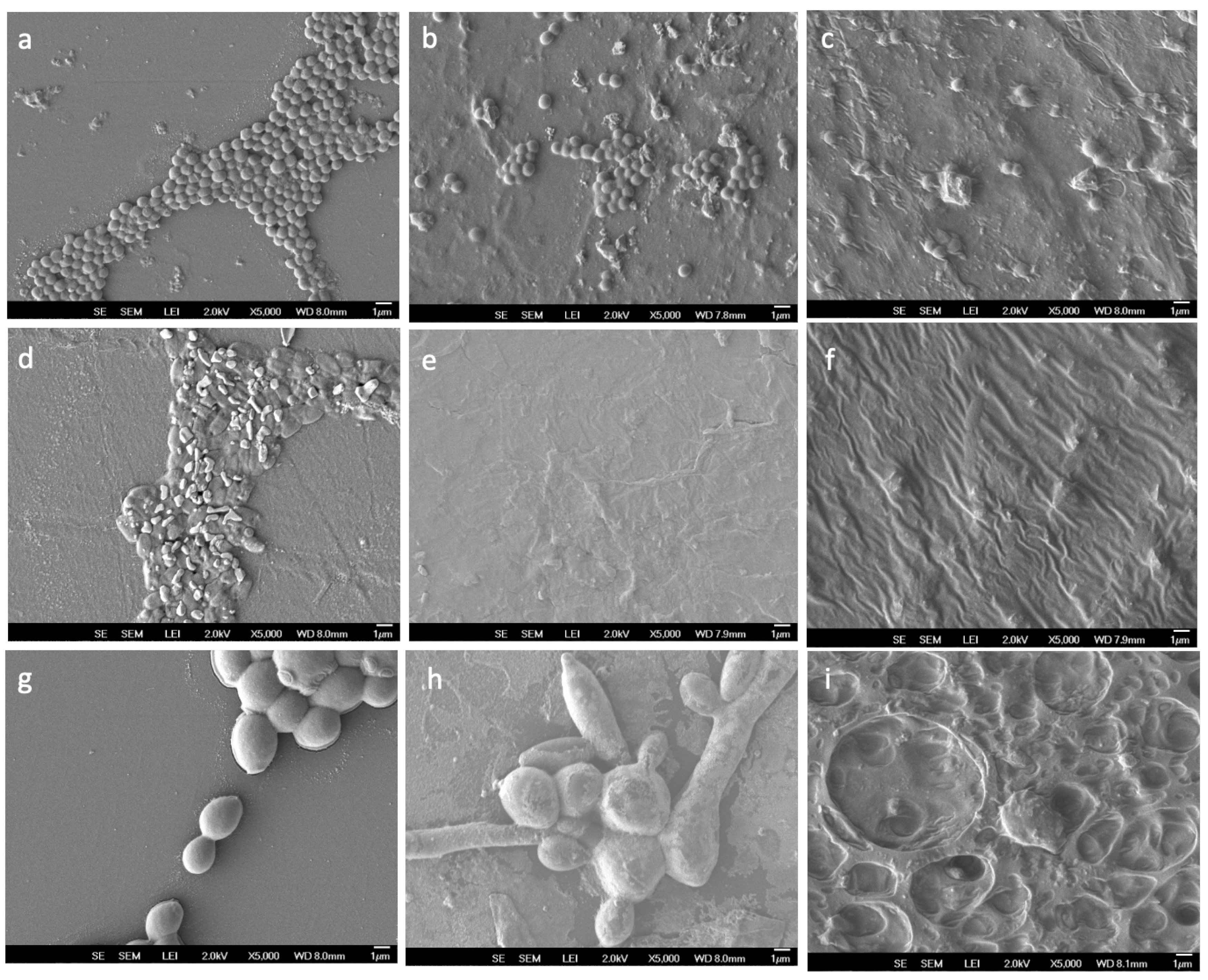
Scanning electron microscopy (SEM) analysis revealed clear differences in microbial adhesion and morphology depending on the evaluated substrate (Figure 4). For Staphylococcus aureus Figure 4a–c, the PET (polyethylene terephthalate) control surface showed clusters of cocci with preserved morphology, whereas the chitosan film reduced cell density. In the chitosan–propolis film, a marked decrease in adherent cells was observed, together with surface deformation and collapse. In the case of Escherichia coli Figure 4d–f, the PET control exhibited well-defined bacilli adhered to the surface. In contrast, no clearly defined bacilli were observed on either the chitosan film Figure 4e or the chitosan–propolis film Figure 4f, suggesting poor bacterial adhesion on both materials. For Candida albicans Figure 4g–i, the PET control showed well-preserved yeast cells. On the chitosan film, reduced cell density and the presence of filamentous structures compatible with hyphae were observed. In the chitosan–propolis film, a severely damaged yeast cell with loss of the typical oval morphology was identified, indicating a more pronounced antifungal effect.

4. Discussion

The biological efficacy of the developed material is supported by the phytochemical profile of the incorporated propolis extract, which exhibited phenolic compound levels (8%) consistent with established quality specifications. Although the phenolic content was lower than that reported for high-yield propolis from other Mexican regions, such as Cuautitlán Izcalli (19.1%) or Michoacán (18.3%) [25], it exceeded the minimum threshold of 5% established by the Mexican Official Standard NOM-003-SAG/GAN-2017, thereby confirming its compositional suitability. Similarly, the flavonoid content of the extract (3.91%) was higher than that reported for most samples analyzed in the same study and comparable only to the highest values reported [25], remaining well above the minimum requirement specified by the standard.
Compositional characterization of propolis is essential for identifying its bioactive constituents and enabling meaningful comparisons between propolis from different geographic origins. This has been demonstrated, for example, in studies conducted on propolis from the state of Chihuahua, whose compositional profile allowed its classification as poplar-type propolis, considered an international reference standard [26]. Although individual marker compounds were not specifically identified in the present study, the obtained phytochemical profile, characterized by adequate levels of phenolic compounds and flavonoids, can be associated with strong antimicrobial potential [27].
Regarding antioxidant activity, the CA50 value (150.9 µg/mL) exceeded the regulatory limit (<100 µg/mL). However, this result should be interpreted in the context of the intrinsic chemical complexity of propolis as a natural product, in which biological activity does not necessarily correlate linearly with isolated compositional parameters [28,29,30]. Indeed, previous studies have reported that propolis samples with moderate phenolic content may still exhibit significant antimicrobial and cytotoxic activity due to the synergistic action of other non-phenolic bioactive compounds [31]. From a biosafety perspective, the extract showed low hemolytic activity (3.17 ± 0.02%) and an LD50 value of 956.3 µg/mL, indicating good hemocompatibility and low acute toxicity [32,33], supporting its suitability for biomedical applications.
The propolis extract exhibited antimicrobial activity against all tested microorganisms, as evidenced by the formation of inhibition zones. Consistently, chitosan–propolis films also produced inhibition zones against Staphylococcus aureus, Escherichia coli, and Candida albicans, confirming that the antimicrobial effect was retained after incorporation of the extract into the polymer matrix. In contrast, films prepared solely from chitosan did not show detectable antimicrobial activity against any of the tested microorganisms. This behavior is consistent with previous reports by Stanicka et al. [34], who observed the absence of inhibition when chitosan was tested alone in solid film form, regardless of molecular weight, and significant activity only when combined with propolis.
The lack of antimicrobial activity detected by agar diffusion assays can be attributed both to intrinsic properties of chitosan and to methodological limitations. The chitosan used in this study was obtained from shrimp exoskeletons and exhibited a degree of deacetylation of 74%, a value close to the lower limit of commercially available chitosan. According to Raafat et al. [35], the degree of deacetylation is a critical parameter governing antimicrobial activity, as it determines the density of protonable amino groups responsible for electrostatic interactions with negatively charged microbial cell surfaces. A degree of deacetylation close to 74% implies a lower positive charge density compared to highly deacetylated chitosan (≥80%–90%), which may result in weaker intrinsic antimicrobial activity, particularly in solid form.
Although the molecular weight of chitosan was not determined in this study, available evidence suggests that this limitation does not invalidate the observed results. Raafat et al. [35] indicate that once a minimum molecular weight threshold is exceeded, antimicrobial activity does not substantially change with further increases in molecular size. Moreover, Leceta et al. [36] demonstrated that chitosan films prepared from both low- and high-molecular-weight chitosan did not produce inhibition zones in agar diffusion assays, reinforcing the hypothesis that limited diffusion of the polymer, rather than molecular weight, is the dominant factor controlling the absence of inhibition halos.
Importantly, although pure chitosan films did not show detectable antimicrobial activity in diffusion assays, SEM provided clear evidence of contact-dependent antimicrobial effects. In particular, reduced cell adhesion and morphological alterations were observed in S. aureus cells in direct contact with chitosan film surfaces. This discrepancy highlights an inherent limitation of diffusion-based methods for evaluating solid polymeric materials, which rely on the release of active agents into the surrounding medium and may fail to detect localized contact-mediated effects.
In contrast, incorporation of propolis resulted in clear antimicrobial activity detected both by agar diffusion assays and SEM observations, attributable to the presence of low-molecular-weight bioactive compounds capable of diffusing through the agar medium. Polyphenols and terpenoids are considered the main contributors to the antimicrobial activity of propolis [37]. Within the polyphenolic fraction, flavonoids such as chrysin, pinocembrin, apigenin, galangin, kaempferol, quercetin, tectochrysin, and pinostrobin, as well as aromatic acids including ferulic, cinnamic, caffeic, benzoic, salicylic, and p-coumaric acids, have been frequently reported [28,38]. The combined action of these compounds and their natural compositional variability contribute to limiting microbial resistance development [39].
SEM analysis provided direct visual evidence of antimicrobial effects under contact conditions. In S. aureus, chitosan–propolis films induced marked reductions in cell adhesion and structural collapse, significantly greater than those observed for chitosan films alone. In E. coli, no clearly defined bacilli were observed on either chitosan or chitosan–propolis films, suggesting an antiadhesive effect mainly associated with the polycationic nature of chitosan [40], complemented by propolis flavonoids interfering with adhesion and biofilm formation mechanisms [41,42,43]. In C. albicans, chitosan–propolis films caused severe cellular damage and loss of characteristic morphology, consistent with the multifactorial antifungal mechanism of propolis [44].
Despite the promising antimicrobial and physicochemical performance observed, some limitations of this study should be acknowledged. The molecular weight of chitosan was not determined, antioxidant activity was evaluated only for the propolis extract and not directly on the films, and mechanical and barrier properties were not assessed. These aspects limit a full evaluation of the films for applications such as wound dressings or bioactive coatings and will be addressed in future studies to achieve a more comprehensive characterization of chitosan–propolis films.
Finally, thermal and spectroscopic analyses confirmed that propolis incorporation modifies the physicochemical behavior of the films without disrupting the integrity of the polymer matrix. TGA revealed a multistep degradation pattern, with a slightly earlier onset of mass loss and a more gradual degradation profile in chitosan–propolis films, attributable to thermolabile compounds homogeneously dispersed within the matrix. DSC analysis showed an endothermic event associated with moisture removal and an exothermic event around 500 °C corresponding to final oxidative degradation. These changes occur at temperatures far above intended use conditions and reflect effective extract integration rather than a functional limitation. Similar behavior has been reported for chitosan films functionalized with natural extracts, indicating good compatibility and absence of phase separation [45,46]. ATR-FTIR analysis corroborated successful propolis incorporation through subtle band intensity and shape changes associated with hydrogen bonding interactions, without evidence of chemical degradation of the chitosan backbone [45,47].

5. Conclusions

Overall, this study demonstrates the potential of chitosan–propolis hybrid films as functional biomaterials and highlights Mexican propolis as an underexplored yet valuable bioactive resource in materials science. The use of propolis validated according to the Official Mexican Standard NOM-003-SAG/GAN-2017 ensured controlled quality, while chitosan extracted from shrimp exoskeletons supported a sustainable, circular economy approach. Propolis incorporation conferred clear antimicrobial activity to the films without disrupting the chitosan backbone or compromising their physicochemical integrity, despite a slight reduction in thermal stability due to thermolabile components. Notably, SEM analysis of microorganism–film interactions revealed reduced microbial adhesion and severe morphological damage, providing mechanistic insight beyond conventional morphological characterization. These findings position Mexican propolis as a promising functional additive for the development of bioactive coatings and biomedical materials.

Author Contributions

Conceptualization: C.M.Q.-F.; Methodology: L.P.L.-H., C.I.R.-S.; Investigation: A.D.-L. (propolis characterization), P.A.L.-P. (chitosan extraction), M.R.-A. (TGA/DSC analysis), C.L.-P. (SEM analysis), A.R.C.-G. (microbiological assays); Formal Analysis: C.M.Q.-F., C.A.-Q.; Data Curation: M.A.F.-P.; Resources: C.M.Q.-F.; Writing—Original Draft Preparation: C.M.Q.-F.; Writing—Review and Editing: C.I.R.-S.; Visualization: C.A.-Q.; Supervision: C.M.Q.-F.; Project Administration: C.M.Q.-F. All authors have read and agreed to the published version of the manuscript.

Funding

This research received no external funding.

Institutional Review Board Statement

Not applicable.

Informed Consent Statement

Not applicable.

Data Availability Statement

The data presented in this study are included in the article. Further inquiries can be directed to the corresponding author.

Acknowledgments

During the preparation of this manuscript, the authors used ChatGPT 5.2 (OpenAI) to assist with the translation of the original text into English. The authors carefully reviewed, edited, and validated the translated content to ensure its accuracy, clarity, and scientific integrity, and take full responsibility for the final version of the manuscript.

Conflicts of Interest

The authors declare no conflicts of interest.

Abbreviations

ATRAttenuated Total Reflectance
ATCCAmerican Type Culture Collection
CA50Concentration required to achieve 50% antioxidant activity
DSCDifferential Scanning Calorimetry
DMSODimethyl sulfoxide
DPPH•2,2-Diphenyl-1-picrylhydrazyl radical
EDTAEthylenediaminetetraacetic acid
EPPropolis extract
EPSsExtracellular polymeric substances
FTIRFourier-Transform Infrared Spectroscopy
LD50Median lethal dose
LPSLipopolysaccharide
NDNot detected
PBSPhosphate-buffered saline
PETPolyethylene terephthalate
SEMScanning Electron Microscopy
TGAThermogravimetric Analysis

References

  1. Nanda, D.; Behera, D.; Pattnaik, S.S.; Behera, A.K. Advances in Natural Polymer-Based Hydrogels: Synthesis, Applications, and Future Directions in Biomedical and Environmental Fields. Discov. Polym. 2025, 2, 6. [Google Scholar] [CrossRef]
  2. Chicea, D.; Nicolae-Maranciuc, A. A Review of Chitosan-Based Materials for Biomedical, Food, and Water Treatment Applications. Materials 2024, 17, 5770. [Google Scholar] [CrossRef] [PubMed]
  3. Amponsah, O.; Nopuo, P.S.A.; Manga, F.A.; Catli, N.B.; Labus, K. Future-Oriented Biomaterials Based on Natural Polymer Resources: Characteristics, Application Innovations, and Development Trends. Int. J. Mol. Sci. 2025, 26, 5518. [Google Scholar] [CrossRef] [PubMed]
  4. Saputra, H.A. Andreas Chitosan and Its Biomedical Applications: A Review. Next Mater. 2025, 9, 101270. [Google Scholar] [CrossRef]
  5. Rojczyk, E.; Klama-Baryła, A.; Łabuś, W.; Wilemska-Kucharzewska, K.; Kucharzewski, M. Historical and Modern Research on Propolis and Its Application in Wound Healing and Other Fields of Medicine and Contributions by Polish Studies. J. Ethnopharmacol. 2020, 262, 113159. [Google Scholar] [CrossRef]
  6. Sarapa, A.; Peter, A.; Buettner, A.; Loos, H.M. Organoleptic and Chemical Properties of Propolis: A Review. Eur. Food Res. Technol. 2025, 251, 1331–1352. [Google Scholar] [CrossRef]
  7. Woźniak, M.; Sip, A.; Mrówczyńska, L.; Broniarczyk, J.; Waśkiewicz, A.; Ratajczak, I. Biological Activity and Chemical Composition of Propolis from Various Regions of Poland. Molecules 2022, 28, 141. [Google Scholar] [CrossRef]
  8. Loya-Hernández, L.P.; Arzate-Quintana, C.; Castillo-González, A.R.; Camarillo-Cisneros, J.; Romo-Sáenz, C.I.; Favila-Pérez, M.A.; Quiñonez-Flores, C.M. Propolis-Functionalized Biomaterials for Wound Healing: A Systematic Review with Emphasis on Polysaccharide-Based Platforms. Polysaccharides 2025, 6, 74. [Google Scholar] [CrossRef]
  9. Roy, S.; Priyadarshi, R.; Rhim, J.-W. Development of Multifunctional Pullulan/Chitosan-Based Composite Films Reinforced with ZnO Nanoparticles and Propolis for Meat Packaging Applications. Foods 2021, 10, 2789. [Google Scholar] [CrossRef]
  10. Kaur, M.; Sharma, A.; Puri, V.; Aggarwal, G.; Maman, P.; Huanbutta, K.; Nagpal, M.; Sangnim, T. Chitosan-Based Polymer Blends for Drug Delivery Systems. Polymers 2023, 15, 2028. [Google Scholar] [CrossRef]
  11. Pahlevanneshan, Z.; Deypour, M.; Kefayat, A.; Rafienia, M.; Sajkiewicz, P.; Esmaeely Neisiany, R.; Enayati, M.S. Polyurethane-Nanolignin Composite Foam Coated with Propolis as a Platform for Wound Dressing: Synthesis and Characterization. Polymers 2021, 13, 3191. [Google Scholar] [CrossRef]
  12. Khoshnevisan, K.; Maleki, H.; Samadian, H.; Doostan, M.; Khorramizadeh, M.R. Antibacterial and Antioxidant Assessment of Cellulose Acetate/Polycaprolactone Nanofibrous Mats Impregnated with Propolis. Int. J. Biol. Macromol. 2019, 140, 1260–1268. [Google Scholar] [CrossRef] [PubMed]
  13. Eskandarinia, A.; Kefayat, A.; Rafienia, M.; Agheb, M.; Navid, S.; Ebrahimpour, K. Cornstarch-Based Wound Dressing Incorporated with Hyaluronic Acid and Propolis: In Vitro and in Vivo Studies. Carbohydr. Polym. 2019, 216, 25–35. [Google Scholar] [CrossRef] [PubMed]
  14. Khodabakhshi, D.; Eskandarinia, A.; Kefayat, A.; Rafienia, M.; Navid, S.; Karbasi, S.; Moshtaghian, J. In Vitro and in Vivo Performance of a Propolis-Coated Polyurethane Wound Dressing with High Porosity and Antibacterial Efficacy. Colloids Surf. B Biointerfaces 2019, 178, 177–184. [Google Scholar] [CrossRef] [PubMed]
  15. Ferreira, L.M.d.M.C.; da Cruz, N.F.; Lynch, D.G.; da Costa, P.F.; Salgado, C.G.; Silva-Júnior, J.O.C.; Rossi, A.; Ribeiro-Costa, R.M. Hydrogel Containing Propolis: Physical Characterization and Evaluation of Biological Activities for Potential Use in the Treatment of Skin Lesions. Pharmaceuticals 2024, 17, 1400. [Google Scholar] [CrossRef]
  16. Barud, H.d.S.; de Araújo Júnior, A.M.; Saska, S.; Mestieri, L.B.; Campos, J.A.D.B.; de Freitas, R.M.; Ferreira, N.U.; Nascimento, A.P.; Miguel, F.G.; Vaz, M.M.d.O.L.L.; et al. Antimicrobial Brazilian Propolis (EPP-AF) Containing Biocellulose Membranes as Promising Biomaterial for Skin Wound Healing. Evid. Based Complement. Altern. Med. 2013, 2013, 703024. [Google Scholar] [CrossRef]
  17. Krupp, T.; dos Santos, B.D.; Gama, L.A.; Silva, J.R.; Arrais-Silva, W.W.; de Souza, N.C.; Américo, M.F.; de Souza Souto, P.C. Natural Rubber-Propolis Membrane Improves Wound Healing in Second—Degree Burning Model. Int. J. Biol. Macromol. 2019, 131, 980–988. [Google Scholar] [CrossRef]
  18. Zancanela, D.C.; Funari, C.S.; Herculano, R.D.; Mello, V.M.; Rodrigues, C.M.; Borges, F.A.; de Barros, N.R.; Marcos, C.M.; Almeida, A.M.F.; Guastaldi, A.C. Natural Rubber Latex Membranes Incorporated with Three Different Types of Propolis: Physical-Chemistry and Antimicrobial Behaviours. Mater. Sci. Eng. C Mater. Biol. Appl. 2019, 97, 576–582. [Google Scholar] [CrossRef]
  19. Sharaf, S.M.; Al-Mofty, S.E.-D.; El-Sayed, E.-S.M.; Omar, A.; Abo Dena, A.S.; El-Sherbiny, I.M. Deacetylated Cellulose Acetate Nanofibrous Dressing Loaded with Chitosan/Propolis Nanoparticles for the Effective Treatment of Burn Wounds. Int. J. Biol. Macromol. 2021, 193, 2029–2037. [Google Scholar] [CrossRef]
  20. Sarhan, W.A.; Azzazy, H.M. Apitherapeutics and Phage-Loaded Nanofibers As Wound Dressings With Enhanced Wound Healing and Antibacterial Activity. Nanomedicine 2017, 12, 2055–2067. [Google Scholar] [CrossRef]
  21. Rivera-Yañez, N.; Rodriguez-Canales, M.; Nieto-Yañez, O.; Jimenez-Estrada, M.; Ibarra-Barajas, M.; Canales-Martinez, M.M.; Rodriguez-Monroy, M.A. Hypoglycaemic and Antioxidant Effects of Propolis of Chihuahua in a Model of Experimental Diabetes. Evid.-Based Complement. Altern. Med. 2018, 2018, 4360356. [Google Scholar] [CrossRef] [PubMed]
  22. Li, F.; Awale, S.; Tezuka, Y.; Esumi, H.; Kadota, S. Study on the Constituents of Mexican Propolis and Their Cytotoxic Activity against PANC-1 Human Pancreatic Cancer Cells. J. Nat. Prod. 2010, 73, 623–627. [Google Scholar] [CrossRef] [PubMed]
  23. Jurado Castañeda, E.; Ramírez Martínez, C.M.; Carrillo Miranda, L.; Díaz-Barriga, A.S.; Cabrera Contreras, I.A.; Portilla Robertson, J. Eficacia Del Propóleo Mexicano de Apis Millifera En El Tratamiento de La Estomatitis Protésica. Ensayo Clínico Controlado Aleatorizado. Rev. Odontológica Mex. 2022, 25, 204–214. [Google Scholar] [CrossRef]
  24. NOM-003-SAG/GAN-2017; Propolis: Production and Specifications for Its Processing. Official Gazette of the Federation: Mexico City, Mexico, 2017. Available online: https://www.dof.gob.mx/normasOficiales/6794/sagarpa11_C/sagarpa11_C.html (accessed on 1 January 2026).
  25. Rodríguez Pérez, B.; Canales Martínez, M.M.; Penieres Carrillo, J.G.; Cruz Sánchez, T.A. Composición Química, Propiedades Antioxidantes y Actividad Antimicrobiana de Propóleos Mexicanos. Acta Univ. 2020, 30, 1–30. [Google Scholar] [CrossRef]
  26. Rivera-Yañez, C.R.; Ruiz-Hurtado, P.A.; Reyes-Reali, J.; Mendoza-Ramos, M.I.; Vargas-Díaz, M.E.; Hernández-Sánchez, K.M.; Pozo-Molina, G.; Méndez-Catalá, C.F.; García-Romo, G.S.; Pedroza-González, A.; et al. Antifungal Activity of Mexican Propolis on Clinical Isolates of Candida Species. Molecules 2022, 27, 5651. [Google Scholar] [CrossRef] [PubMed]
  27. Przybyłek, I.; Karpiński, T.M. Antibacterial Properties of Propolis. Molecules 2019, 24, 2047. [Google Scholar] [CrossRef]
  28. Bankova, V.S.; de Castro, S.L.; Marcucci, M.C. Propolis: Recent Advances in Chemistry and Plant Origin. Apidologie 2000, 31, 3–15. [Google Scholar] [CrossRef]
  29. Wieczorek, P.P.; Hudz, N.; Yezerska, O.; Horčinová-Sedláčková, V.; Shanaida, M.; Korytniuk, O.; Jasicka-Misiak, I. Chemical Variability and Pharmacological Potential of Propolis as a Source for the Development of New Pharmaceutical Products. Molecules 2022, 27, 1600. [Google Scholar] [CrossRef]
  30. Bridi, R.; Montenegro, G.; Nuñez-Quijada, G.; Giordano, A.; Fernanda Morán-Romero, M.; Jara-Pezoa, I.; Speisky, H.; Atala, E.; López-Alarcón, C. International Regulations of Propolis Quality: Required Assays Do Not Necessarily Reflect Their Polyphenolic-Related In Vitro Activities. J. Food Sci. 2015, 80, C1188–C1195. [Google Scholar] [CrossRef]
  31. Cabral, I.S.R.; Oldoni, T.L.C.; de Alencar, S.M.; Rosalen, P.L.; Ikegaki, M. The Correlation between the Phenolic Composition and Biological Activities of Two Varieties of Brazilian Propolis (G6 and G12). Braz. J. Pharm. Sci. 2012, 48, 557–564. [Google Scholar] [CrossRef]
  32. Meyer, B.; Ferrigni, N.; Putnam, J.; Jacobsen, L.; Nichols, D.; McLaughlin, J. Brine Shrimp: A Convenient General Bioassay for Active Plant Constituents. Planta Med. 1982, 45, 31–34. [Google Scholar] [CrossRef] [PubMed]
  33. Luna-Vázquez-Gómez, R.; Arellano-García, M.E.; García-Ramos, J.C.; Radilla-Chávez, P.; Salas-Vargas, D.S.; Casillas-Figueroa, F.; Ruiz-Ruiz, B.; Bogdanchikova, N.; Pestryakov, A. Hemolysis of Human Erythrocytes by ArgovitTM AgNPs from Healthy and Diabetic Donors: An In Vitro Study. Materials 2021, 14, 2792. [Google Scholar] [CrossRef] [PubMed]
  34. Stanicka, K.; Dobrucka, R.; Woźniak, M.; Sip, A.; Majka, J.; Kozak, W.; Ratajczak, I. The Effect of Chitosan Type on Biological and Physicochemical Properties of Films with Propolis Extract. Polymers 2021, 13, 3888. [Google Scholar] [CrossRef] [PubMed]
  35. Raafat, D.; Sahl, H. Chitosan and Its Antimicrobial Potential—A Critical Literature Survey. Microb. Biotechnol. 2009, 2, 186–201. [Google Scholar] [CrossRef]
  36. Leceta, I.; Guerrero, P.; Ibarburu, I.; Dueñas, M.T.; de la Caba, K. Characterization and Antimicrobial Analysis of Chitosan-Based Films. J. Food Eng. 2013, 116, 889–899. [Google Scholar] [CrossRef]
  37. Pimenta, H.C.; Violante, I.M.P.; de Musis, C.R.; Borges, Á.H.; Aranha, A.M.F. In Vitro Effectiveness of Brazilian Brown Propolis against Enterococcus Faecalis. Braz. Oral Res. 2015, 29, S1806-83242015000100255. [Google Scholar] [CrossRef]
  38. Kędzia, B.; Hołderna-Kędzia, E. Pinocembryna–Flawonoidowy Składnik Krajowego Propolisu o Działaniu Opóźniającym Rozwój Choroby Alzheimera. Post. Fitoter. 2017, 18, 223–228. [Google Scholar] [CrossRef]
  39. Pamplona-Zomenhan, L.C.; Pamplona, B.C.; da Silva, C.B.; Marcucci, M.C.; Mimica, L.M.J. Evaluation of the in Vitro Antimicrobial Activity of an Ethanol Extract of Brazilian Classified Propolis on Strains of Staphylococcus Aureus. Braz. J. Microbiol. 2011, 42, 1259–1264. [Google Scholar] [CrossRef]
  40. Helander, I.M.; Nurmiaho-Lassila, E.-L.; Ahvenainen, R.; Rhoades, J.; Roller, S. Chitosan Disrupts the Barrier Properties of the Outer Membrane of Gram-Negative Bacteria. Int. J. Food Microbiol. 2001, 71, 235–244. [Google Scholar] [CrossRef]
  41. Tursi, S.A.; Tükel, Ç. Curli-Containing Enteric Biofilms Inside and Out: Matrix Composition, Immune Recognition, and Disease Implications. Microbiol. Mol. Biol. Rev. 2018, 82, e00028-18. [Google Scholar] [CrossRef]
  42. Roy, R.; Tiwari, M.; Donelli, G.; Tiwari, V. Strategies for Combating Bacterial Biofilms: A Focus on Anti-Biofilm Agents and Their Mechanisms of Action. Virulence 2018, 9, 522–554. [Google Scholar] [CrossRef]
  43. Bhargava, P.; Mahanta, D.; Kaul, A.; Ishida, Y.; Terao, K.; Wadhwa, R.; Kaul, S.C. Experimental Evidence for Therapeutic Potentials of Propolis. Nutrients 2021, 13, 2528. [Google Scholar] [CrossRef]
  44. Corrêa, J.L.; Veiga, F.F.; Jarros, I.C.; Costa, M.I.; Castilho, P.F.; de Oliveira, K.M.P.; Rosseto, H.C.; Bruschi, M.L.; Svidzinski, T.I.E.; Negri, M. Propolis Extract Has Bioactivity on the Wall and Cell Membrane of Candida Albicans. J. Ethnopharmacol. 2020, 256, 112791. [Google Scholar] [CrossRef]
  45. Suriyatem, R.; Auras, R.; Rachtanapun, C.; Rachtanapun, P. Biodegradable Rice Starch/Carboxymethyl Chitosan Films with Added Propolis Extract for Potential Use as Active Food Packaging. Polymers 2018, 10, 954. [Google Scholar] [CrossRef]
  46. Sutharsan, J.; Boyer, C.A.; Zhao, J. Development and Characterization of Chitosan Edible Film Incorporated with Epoxy-activated Agarose. JSFA Rep. 2022, 2, 613–622. [Google Scholar] [CrossRef]
  47. Stefanowska, K.; Woźniak, M.; Sip, A.; Mrówczyńska, L.; Majka, J.; Kozak, W.; Dobrucka, R.; Ratajczak, I. Characteristics of Chitosan Films with the Bioactive Substances—Caffeine and Propolis. J. Funct. Biomater. 2023, 14, 358. [Google Scholar] [CrossRef]
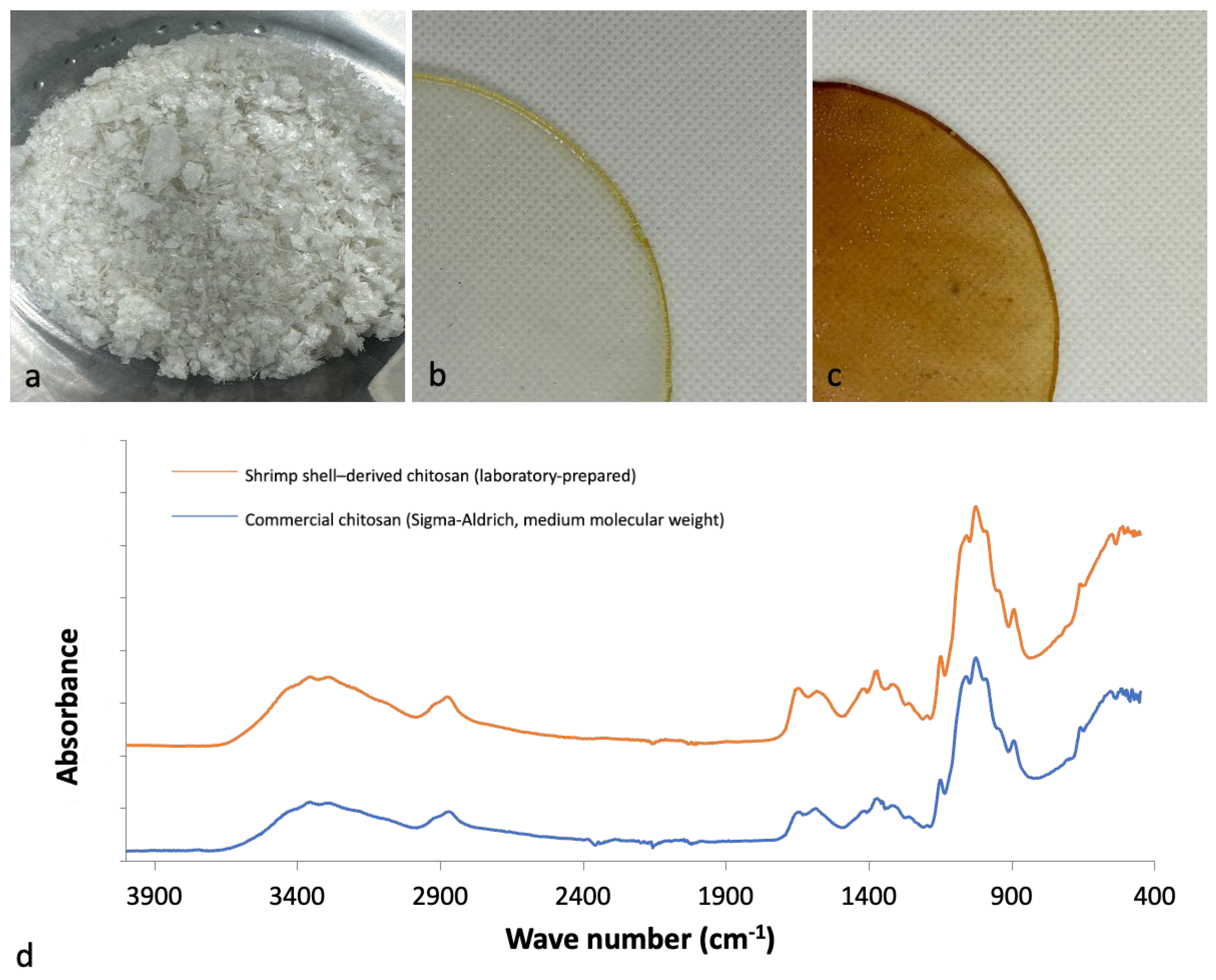
Figure 1. Materials obtained in this study. (a) Purified chitosan flakes; (b) chitosan film; and (c) chitosan–propolis film; and (d) FTIR spectrum of shrimp shellderived chitosan, showing the characteristic absorption bands of the biopolymer.
Coatings 16 00124 g001
Figure 2. TGA (green curve) and DSC (blue curve) thermograms of the films: (a) chitosan film and (b) chitosan–propolis film.
Coatings 16 00124 g002
Figure 3. ATR-FTIR spectra of the chitosan film (blue) and the chitosan–propolis film (orange).
Coatings 16 00124 g003
Figure 4. SEM micrographs of microorganisms on different substrates. (ac) Staphylococcus aureus on PET (a), chitosan film (b), and chitosan–propolis film (c); (df) Escherichia coli on PET (d), chitosan film (e), and chitosan–propolis film (f); (gi) Candida albicans on PET (g), chitosan film (h), and chitosan–propolis film (i). Scale bar: 1 µm.
Coatings 16 00124 g004
Table 1. Physicochemical and antioxidant characterization of propolis extract.
Total Phenolic Content
(% Gallic Acid Equivalents)
Total Flavonoid Content
(% Quercetin Equivalents)
Antioxidant Activity CA50 (µg/mL)
8.0 ± 2.63.91 ± 1.0150.9 ± 35.4 
Values represent mean ± SD (n = 3).
Table 2. Biosafety profile and antimicrobial activity of the propolis extract.
Hemolysis (%)Brine Shrimp
Lethality Test LD50
(µg/mL)
Candida
albicans
Escherichia
coli
Staphylococcus aureus
Inhibition Zone (mm)
3.17 ± 0.8956.3 ± 257.711.3 ± 0.413.6 ± 1.812.2 ± 0.8
Values represent mean ± SD (n = 3).
Table 3. Antimicrobial activity assay of chitosan and chitosan–propolis films.
Candida albicansEscherichia coliStaphylococcus aureus
Inhibition Zone (mm)
Chitosan filmNDNDND
Chitosan–propolis film8.9 ± 0.60 13.2 ± 0.99 11.9 ± 0.28
Values represent mean ± SD (n = 3). ND: no detectable inhibition zone.
Disclaimer/Publisher’s Note: The statements, opinions and data contained in all publications are solely those of the individual author(s) and contributor(s) and not of MDPI and/or the editor(s). MDPI and/or the editor(s) disclaim responsibility for any injury to people or property resulting from any ideas, methods, instructions or products referred to in the content.