Phage Therapy for Bone and Joint Infections: Towards Clinical Translation

 , , ,
, , ,  , , and
Abstract
1. Introduction
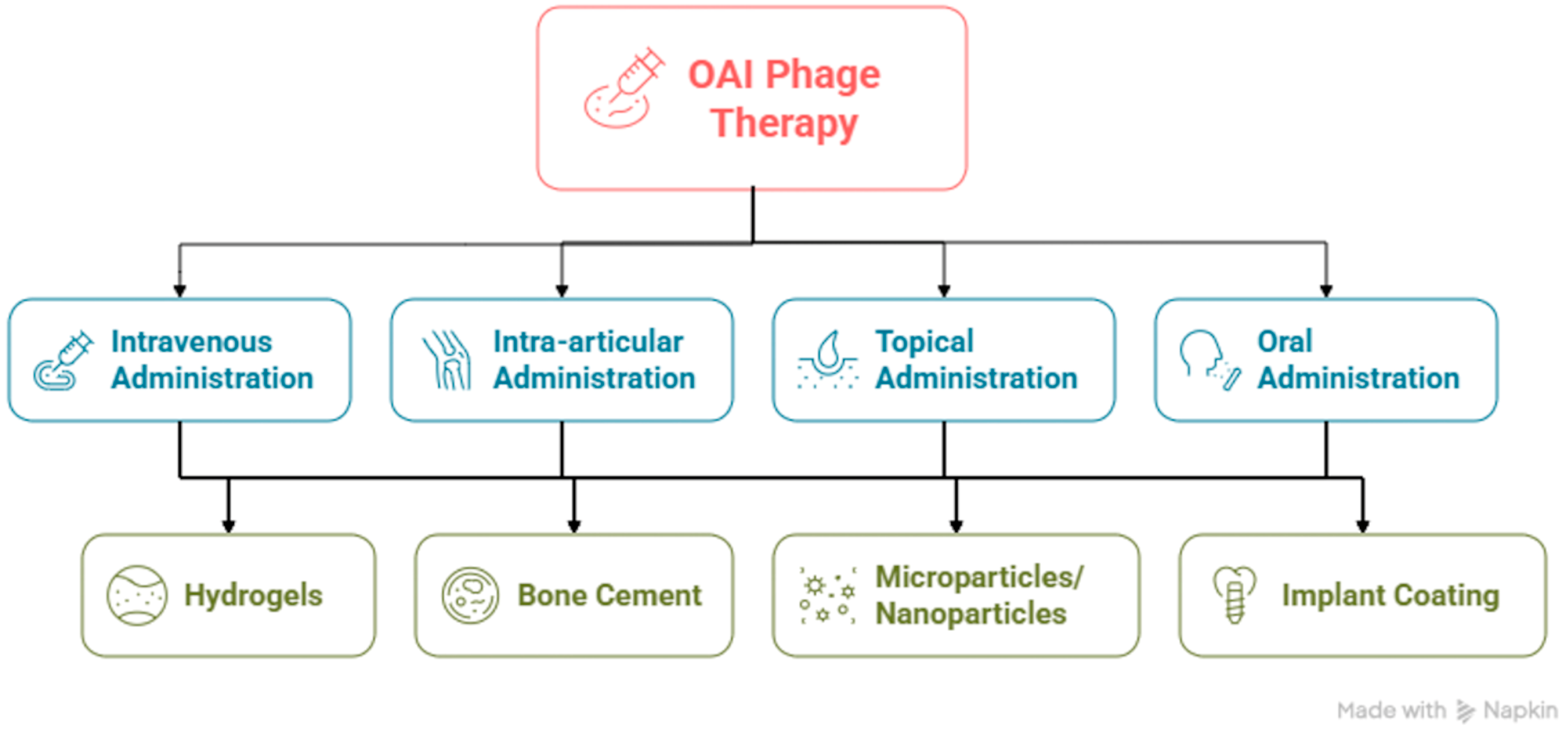
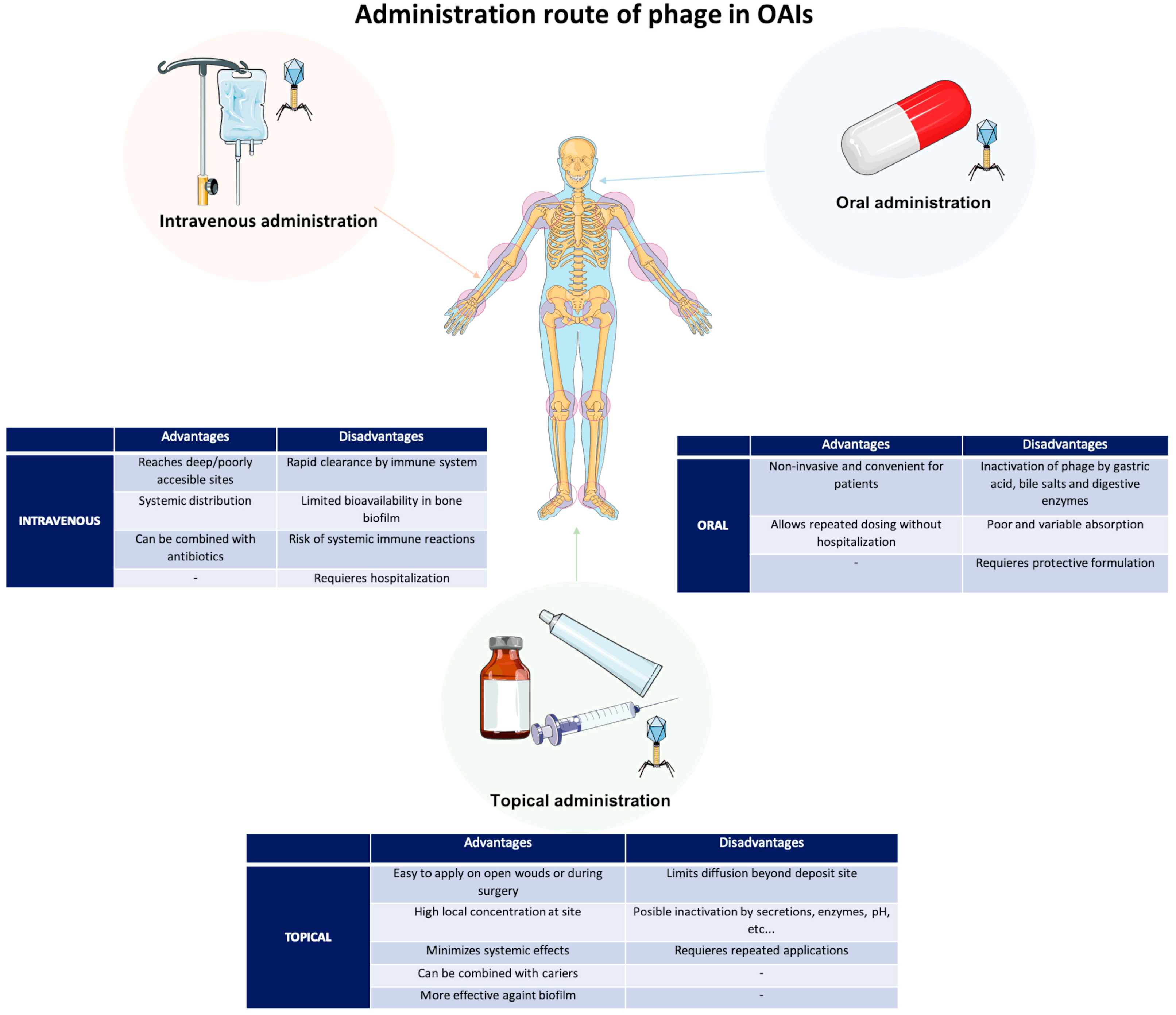
2. OAI Phage Therapy Pharmacokinetics (PK): Administration Routes
2.1. Intravenous Administration
2.2. Topical and Intra-Articular Administration
2.3. Oral Administration
3. OAI Phage Therapy Pharmacodynamics (PD)
- Administration routes:
- Monitoring:
4. OAI Phage Therapy Delivery Systems (Pharmaceutical Developments)
4.1. Hydrogels
4.2. Bone Cement
4.3. Microparticles/Nanoparticles
4.4. Implant Coatings
5. OAI Evidence from Preclinical and Clinical Studies (Table 2)

| Authors | Study Type/Size | Infection/Intervention | Treatment Regimen (Phages: Single or Alone; Route of Administration; Antibiotics and Outcome) | Ref. |
|---|---|---|---|---|
| Fish et al., 2018 | Case report (compassionate use) | Staphylococcal digital osteomyelitis | Phage: Single phage: sb-1 phage specific to S. aureus. Route: Local injection directly into the affected bone/tissue. Antibiotics: Prior levofloxacin therapy failed; phage therapy subsequently added. Outcome: Complete clinical resolution; tissue salvaged; amputation avoided. | [66] |
| Clarke et al., 2020 | Systematic review 17 reports, 277 patients | OAI (bone and joint infections) | Phage: Both monophage and cocktail regimens were reported across studies (heterogeneous data). Route: Predominantly topical/local application; in some cases, included intravenous administration. Antibiotics: Most patients received concomitant antibiotic therapy. Outcome: Review summarizes overall 93.1% clinical resolution across reports. | [67] |
| Genevière et al., 2021 | Review of bone joint infection cases of 51 patients | Bone and Joint infections | Phage: Both monophage and cocktails used. Route: Predominantly topical (85% of cases). Antibiotics: Used concomitantly in 79% of cases. Outcome: Reported overall success rate of 71%. | [17] |
| Doub et al., 2023 | Case report of rescue therapy | Chronic PJI caused by Enteroccocus faecalis | Phage: Both monophage and cocktails used. Route: Intra-articular of the joint. Antibiotics: Concomitant antibiotic therapy in addition to phage therapy. Outcome: Clinical salvage reported. | [28] |
| Pirnay et al., 2024 | Retrospective multicenter study: 100 cases | Difficult-to-treat infections including bone and OAI | Phage: 26 individual phage and 6 predefined cocktails used. Route: Varied (local, topical, intravenous). Antibiotics: Concomitant use in 69.3% of cases; absence of antibiotics significantly reduced eradication rates. Outcome: 77.2% clinical improvement; 61.3% microbiological eradication. | [68] |
| Young et al., 2024 | Systematic review and meta-analysis of 37 patients | PJI | Phage: Cocktails used in 65% of cases. Route: Mostly intra-articular administration (73% of cases). Antibiotics: Combined in 97% of treatments. Outcome: Estimated remission rate of 78%. | [22] |
| Eiselt et al., 2024 | Review of 17 publications | PJI caused by S. aureus | Phage: Both monophage and cocktails discussed. Route: Intravenous and intra-articular phage administration. Antibiotics: Phage therapy used alongside antibiotics; synergism noted. Outcome: Phage therapy reported to be a promising adjuvant | [69] |
6. OAI Phage Therapy Regulatory Perspective
- Phage therapy is regulated by the FDA Center for Biologics Evaluation and Research (CBER) and phages are classified as biological products (or biologics) when intended for therapeutic use in humans.
- Because no phage product is currently licensed/approved in the U.S. for human therapeutic use (to date), their use is possible only under investigational pathways (e.g., Investigational New Drug (IND) applications or expanded access).
- A workshop held by FDA/NIAID (“Science and Regulation of Bacteriophage Therapy”) explored many of the regulatory, manufacturing, quality and trial-design issues for phages.
- For compassionate/expanded use (single-patient IND, emergency IND, etc.), the FDA expects detailed information on, e.g., phage characterization, manufacture, bacterial host strain matching, sterility, and endotoxins.
- From a manufacturing/quality perspective: Good Manufacturing Practice (GMP) or an equivalent quality standard is expected, and key aspects such as purity, potency, identity, consistency and sterility must be addressed.
- Clinical trials of phage therapies must follow similar regulatory principles applied to other biologics: preclinical safety, toxicity, pharmacokinetics/pharmacodynamics, trial protocol, informed consent, and IRB oversight.
- Standardized (Predefined) Phage Therapy Medicinal Products (PTMPs):
- Pre-formulated, fixed-composition medicinal products containing one or more phage strains.
- The product is manufactured in advance, following GMP and regulatory authorization, similar to other biological medicinal products.
- Intended for broad or defined bacterial targets (e.g., S. aureus, P. aeruginosa).
- Advantages: easy to control, validate, and distribute; suitable for marketing authorization under the standard EU medicinal product framework.
- Limitation: may lose efficacy if the strain infecting the patient is resistant or not susceptible to phages included.
- Personalized (Tailored) Phage Therapy Products
- Active phages are selected or adapted from a pre-existing phage library for bacterial isolate from an individual patient.
- Production is case-specific, often requiring rapid adaptation or substitution of phages during therapy.
- This approach allows precision matching between phage and pathogen.
- Poses major regulatory and manufacturing challenges, including (i) very short timelines for production and testing; (ii) difficulty in maintaining full GMP compliance for each tailored batch, and (iii) complex quality control and documentation requirements.
7. OAI Phage Therapy Limitations
8. Conclusions
Author Contributions
Funding
Institutional Review Board Statement
Informed Consent Statement
Data Availability Statement
Conflicts of Interest
Abbreviations
| OAIs | Osteoarticular infections |
| GMP | Good manufacturing production |
| MRSA | Methicillin-resistant Staphylococcus Aureus |
| PJI | Prosthetic joint infection |
| DAIR | Debridement, Antibiotics, and Implant Retention |
| IA | Intra-articular administration |
| qPCR | Quantitative Polymerase Chain Reaction |
| CRP | C-Reactive Protein |
| PMMA | Polymethylmethacrylate |
| PEMs | Polyelectrolytes |
| PEI | Polyethyleneimine |
| FDA | Food, Drug, and Administration |
| MDR | Multidrug-resistant pathogen |
| CoNS | Coagulase-negative Staphylococcus |
| Phage | Bacteriophage |
| PAS | Phage–antibiotic synergy |
| IV | Intravenous administration |
| PFU | Plaque forming unit |
| ESR | Erythrocyte Sedimentation Rate |
| PAA | Polyacrylic acid |
| PLGA | Polylactic-co-glycolic |
| LbL | Layer-by-Layer |
| EMA | European Medicines Agency |
References
- Figueiredo, J.; Lindo, C.; Chaves, C.; Nogueira, C. Clinical and epidemiological differences in staphylococcal osteoarticular infections: Insights for developing hospital-based infection control interventions. Eur. J. Orthop. Surg. Traumatol. 2025, 35, 66. [Google Scholar] [CrossRef]
- Jeyaraman, M.; Jayakumar, T.; Jeyaraman, N.; Nallakumasasamy, A.; Ramasubramanian, S.; Mathu, S.; Kumar Jain, V. Combating antimicrobial resistance in osteoarticular infections: Current strategies and future directions. J. Clin. Orthop. Trauma 2024, 58, 102791. [Google Scholar] [CrossRef]
- Benito, N.; Franco, M.; Ribera, A.; Soriano, A.; Rodriguez-Pardo, D.; Sorlí, L.; Fresco, G.; Fernández-Sampedro, M.; Dolores Del Toro, M.; Guío, L.; et al. Time trends in the aetiology of prosthetic joint infections: A multicentre cohort study. Clin. Microbiol. Infect. 2016, 2, 732.e1-8. [Google Scholar] [CrossRef]
- Benito, N.; Mur, I.; Ribera, A.; Soriano, A.; Rodríguez-Pardo, D.; Sorlí, L.; Cobo, J.; Fernández-Sampedro, M.; Del Toro, M.D.; Guío, L.; et al. The Different Microbial Etiology of Prosthetic Joint Infections according to Route of Acquisition and Time after Prosthesis Implantation, Including the Role of Multidrug-Resistant Organisms. J. Clin. Med. 2019, 8, 673. [Google Scholar] [CrossRef] [PubMed]
- Patel, R. Periprosthetic Joint Infection. N. Engl. J. Med. 2023, 38, 251–262. [Google Scholar] [CrossRef]
- Fungo, G.B.N.; Uy, J.C.W.; Porciuncula, K.L.J.; Candelario, C.M.A.; Chua, D.P.S.; Gutierrez, T.A.D.; Clokie, M.R.J.; Papa, D.M.D. “Two Is Better Than One”: The Multifactorial Nature of Phage-Antibiotic Combinatorial Treatments Against ESKAPE-Induced Infections. Phage 2023, 4, 55–67. [Google Scholar] [CrossRef]
- Morrisette, T.; Kebriaei, R.; Lev, K.L.; Morales, S.; Rybak, M.J. Bacteriophage Therapeutics: A Primer for Clinicians on Phage-Antibiotic Combinations. Pharmacotherapy 2020, 40, 153–168. [Google Scholar] [CrossRef] [PubMed]
- Chan, B.K.; Sistrom, M.; Wertz, J.E.; Kortright, K.E.; Narayan, D.; Turner, P.E. Phage selection restores antibiotic sensitivity in MDR Pseudomonas aeruginosa. Sci. Rep. 2016, 6, 26717. [Google Scholar] [CrossRef] [PubMed]
- Osman, A.H.; Kotey, F.C.N.; Odoom, A.; Darkwah, S.; Yeboah, R.K.; Dayie, N.T.K.D.; Donkor, E.S. The Potential of Bacteriophage-Antibiotic Combination Therapy in Treating Infections with Multidrug-Resistant Bacteria. Antibiotics 2023, 12, 1329. [Google Scholar] [CrossRef]
- Fedorov, E.; Samokhin, A.; Kozlova, Y.; Kretien, S.; Sheraliev, T.; Morozova, V.; Tikunova, N.; Kiselev, A.; Pavlov, V. Short-Term Outcomes of Phage-Antibiotic Combination Treatment in Adult Patients with Periprosthetic Hip Joint Infection. Viruses 2023, 15, 499. [Google Scholar] [CrossRef]
- Jault, P.; Leclerc, T.; Jennes, S.; Pirnay, J.P.; Que, Y.A.; Resch, G.; Rousseau, A.F.; Ravat, F.; Carsin, H.; Le Floch, R.; et al. Efficacy and tolerability of a cocktail of bacteriophages to treat burn wounds infected by Pseudomonas aeruginosa (PhagoBurn): A randomised, controlled, double-blind phase 1/2 trial. Lancet Infect. Dis. 2019, 19, 35–45. [Google Scholar] [CrossRef]
- Sliwka, P.; Skaradzinski, G.; Dusza, I.; Grzywacz, A.; Skaradzinska, A. Freeze-Drying of Encapsulated Bacteriophage T4 to Obtain Shelf-Stable Dry Preparations for Oral Application. Pharmaceutics 2023, 15, 2792. [Google Scholar] [CrossRef]
- Xu, Y.; Yang, T.; Miao, Y.; Zhang, Q.; Yang, M.; Mao, C. Injectable Phage-Loaded Microparticles Effectively Release Phages to Kill Methicillin-Resistant Staphylococcus aureus. ACS Appl. Mater. Interfaces 2024, 16, 17232–17241. [Google Scholar] [CrossRef] [PubMed]
- Blasco, L.; Bleriot, I.; Fernandez-Grela, P.; Pano-Pardo, J.R.; Oteo-Iglesias, J.; Tomas, M. Pharmacokinetics and pharmacodynamics studies of phage therapy. Farm. Hosp. 2025, 49, T407–T412. [Google Scholar] [CrossRef]
- Briot, T.; Kolenda, C.; Ferry, T.; Medina, M.; Laurent, F.; Leboucher, G.; Pirot, F.; PHAGEinLYON Study Group. Paving the way for phage therapy using novel drug delivery approaches. J. Control. Release 2022, 347, 414–424. [Google Scholar] [CrossRef] [PubMed]
- Yilmaz, C.; Colak, M.; Yilmaz, B.C.; Ersoz, G.; Kutateladze, M.; Gozlugol, M. Bacteriophage therapy in implant-related infections: An experimental study. J. Bone Joint Surg. Am. 2013, 95, 117–125. [Google Scholar] [CrossRef] [PubMed]
- Genevière, J.; McCallin, S.; Huttner, A.; Pham, T.-T.; Suva, D. A systematic review of phage therapy applied to bone and joint infections: An analysis of success rates, treatment modalities and safety. EFORT Open Rev. 2021, 6, 1148–1156. [Google Scholar] [CrossRef]
- Vila, M.; Balcao, L.M.N.; Balcao, V.M. Phage Delivery Strategies for Biocontrolling Human, Animal, and Plant Bacterial Infections: State of the Art. Pharmaceutics 2024, 16, 374. [Google Scholar] [CrossRef]
- Peng, J.; Guo, C.; Yang, C.; Zhang, L.; Yang, F.; Huang, X.; Yu, Y.; Zhang, T. Phage therapy for bone and joint infections: A comprehensive exploration of challenges, dynamics, and therapeutic prospects. J. Glob. Antimicrob. Resist. 2024, 39, 12–21. [Google Scholar] [CrossRef]
- Suh, G.A.; Ferry, T.; Abdel, M. Phage Therapy as a Novel Therapeutic for the Treatment of Bone and Joint Infections. Clin. Infect. Dis. 2023, 77 (Suppl. S5), S407–S415. [Google Scholar] [CrossRef]
- Suh, G.A.; Lodise, T.P.; Tamma, P.D.; Knisely, J.M.; Alexander, J.; Aslam, S.; Barton, K.D.; Bizzell, E.; Totten, K.M.C.; Campbell, J.L.; et al. Considerations for the Use of Phage Therapy in Clinical Practice. Antimicrob. Agents Chemother. 2022, 6, e0207121. [Google Scholar] [CrossRef]
- Young, J.; Lee, S.W.; Shariyate, M.J.; Cronin, A.; Wixted, J.J.; Nazarian, A.; Rowley, C.F.; Rodriguez, E.K. Bacteriophage therapy and current delivery strategies for orthopedic infections: A SCOPING review. J. Infect. 2024, 8, 106125. [Google Scholar] [CrossRef]
- Nang, S.C.; Lin, Y.W.; Petrovic Fabijan, A.; Chang, R.Y.K.; Rao, G.G.; Iredell, J.; Chan, H.K.; Li, J. Pharmacokinetics/pharmacodynamics of phage therapy: A major hurdle to clinical translation. Clin. Microbiol. Infect. 2023, 29, 702–709. [Google Scholar] [CrossRef]
- Dhungana, G.; Nepal, R.; Regmi, M.; Malla, R. Pharmacokinetics and Pharmacodynamics of a Novel Virulent Klebsiella Phage Kp_Pokalde_002 in a Mouse Model. Front. Cell Infect. Microbiol. 2021, 1, 684704. [Google Scholar] [CrossRef]
- Siopi, M.; Skliros, D.; Paranos, P.; Koumasi, N.; Flemetakis, E.; Pournaras, S.; Meletiadis, J. Pharmacokinetics and pharmacodynamics of bacteriophage therapy: A review with a focus on multidrug-resistant Gram-negative bacterial infections. Clin. Microbiol. Rev. 2024, 37, e0004424. [Google Scholar] [CrossRef]
- Pires, D.P.; Melo, L.; Vilas Boas, D.; Sillankorva, S.; Azeredo, J. Phage therapy as an alternative or complementary strategy to prevent and control biofilm-related infections. Curr. Opin. Microbiol. 2017, 39, 48–56. [Google Scholar] [CrossRef]
- Ferry, T.; Kolenda, C.; Laurent, F.; Leboucher, G.; Merabischvilli, M.; Djebara, S.; Gustave, C.A.; Perpoint, T.; Barrey, C.; Pirnay, J.P.; et al. Personalized bacteriophage therapy to treat pandrug-resistant spinal Pseudomonas aeruginosa infection. Nat. Commun. 2022, 13, 4239. [Google Scholar] [CrossRef]
- Doub, J.B.; Johnson, A.J.; Nandi, S.; Ng, V.; Manson, T.; Lee, M.; Chan, B. Experience Using Adjuvant Bacteriophage Therapy for the Treatment of 10 Recalcitrant Periprosthetic Joint Infections: A Case Series. Clin. Infect. Dis. 2023, 76, e1463–e1466. [Google Scholar] [CrossRef]
- Zimmerli, W.; Trampuz, A.; Ochsner, P.E. Prosthetic-joint infections. N. Engl. J. Med. 2004, 351, 1645–1654. [Google Scholar] [CrossRef]
- Tande, A.J.; Patel, R. Prosthetic joint infection. Clin. Microbiol. Rev. 2014, 27, 302–345. [Google Scholar] [CrossRef]
- Ferry, T.; Batailler, C.; Petitjean, C.; Chateau, J.; Fevre, C.; Forestier, E.; Brosset, S.; Leboucher, G.; Kolenda, C.; Laurent, F.; et al. The Potential Innovative Use of Bacteriophages Within the DAC((R)) Hydrogel to Treat Patients With Knee Megaprosthesis Infection Requiring “Debridement Antibiotics and Implant Retention” and Soft Tissue Coverage as Salvage Therapy. Front. Med. 2020, 7, 342. [Google Scholar] [CrossRef]
- Ferry, T.; Kolenda, C.; Batailler, C.; Gaillard, R.; Gustave, C.A.; Lustig, S.; Fevre, C.; Petitjean, C.; Leboucher, G.; Laurent, F.; et al. Case Report: Arthroscopic “Debridement Antibiotics and Implant Retention” With Local Injection of Personalized Phage Therapy to Salvage a Relapsing. Front. Med. 2021, 8, 569159. [Google Scholar] [CrossRef]
- Alt, V.; Gessner, A.; Merabishvili, M.; Hitzenbichler, F.; Mannala, G.K.; Peterhoff, D.; Walter, N.; Pirnay, J.P.; Hiergeist, A.; Rupp, M. Case report: Local bacteriophage therapy for fracture-related infection with polymicrobial multi-resistant bacteria: Hydrogel application and postoperative phage analysis through metagenomic sequencing. Front. Med. 2024, 1, 1428432. [Google Scholar] [CrossRef]
- Anastassopoulou, C.; Ferous, S.; Petsimeri, A.; Gioula, G.; Tsakris, A. Phage-Based Therapy in Combination with Antibiotics: A Promising Alternative against Multidrug-Resistant Gram-Negative Pathogens. Pathogens 2024, 13, 896. [Google Scholar] [CrossRef]
- Kortright, K.E.; Chan, B.K.; Koff, J.L.; Turner, P.E. Phage Therapy: A Renewed Approach to Combat Antibiotic-Resistant Bacteria. Cell Host Microbe 2019, 25, 219–232. [Google Scholar] [CrossRef]
- Totten, K.M.C.; Cunningham, S.A.; Gades, N.M.; Etzioni, A.; Patel, R. Pharmacokinetic Assessment of Staphylococcal Phage K Following Parenteral and Intra-articular Administration in Rabbits. Front. Pharmacol. 2022, 13, 840165. [Google Scholar] [CrossRef]
- Luo, J.; Liu, M.; Wang, P.; Li, Q.; Luo, C.; Wei, H.; Hu, Y.; Yu, J. Evaluation of a direct phage DNA detection-based Taqman qPCR methodology for quantification of phage and its application in rapid ultrasensitive identification of Acinetobacter baumannii. BMC Infect. Dis. 2022, 2, 523. [Google Scholar] [CrossRef]
- Łusiak-Szelachowska, M.; Międzybrodzki, R.; Rogóż, P.; Weber-Dąbrowska, B.; Żaczek, M.; Górski, A. Do Anti-Phage Antibodies Persist after Phage Therapy? A Preliminary Report. Antibiotics 2022, 11, 1358. [Google Scholar] [CrossRef]
- Khatami, A.; Foley, D.A.; Warner, M.S.; Barnes, E.H.; Peleg, A.Y.; Li, J.; Stick, S.; Burke, N.; Lin, R.C.Y.; Warning, J.; et al. Standardised treatment and monitoring protocol to assess safety and tolerability of bacteriophage therapy for adult and paediatric patients (STAMP study): Protocol for an open-label, single-arm trial. BMJ Open 2022, 12, e065401. [Google Scholar] [CrossRef]
- Dedrick, R.M.; Guerrero-Bustamante, C.A.; Garlena, R.A.; Russell, D.A.; Ford, K.; Harris, K.; Gilmour, K.C.; Soothill, J.; Jacobs-Sera, D.; Schooley, R.T.; et al. Engineered bacteriophages for treatment of a patient with a disseminated drug-resistant Mycobacterium abscessus. Nat. Med. 2019, 25, 730–733. [Google Scholar] [CrossRef]
- Stacey, H.J.; De Soir, S.; Jones, J.D. The Safety and Efficacy of Phage Therapy: A Systematic Review of Clinical and Safety Trials. Antibiotics 2022, 11, 1340. [Google Scholar] [CrossRef]
- Barros, J.A.R.; Melo, L.D.R.; Silva, R.; Ferraz, M.P.; Azeredo, J.; Pinheiro, V.M.C.; Colaco, B.J.A.; Fernandes, M.H.R.; Gomes, P.S.; Monteiro, F.J. Encapsulated bacteriophages in alginate-nanohydroxyapatite hydrogel as a novel delivery system to prevent orthopedic implant-associated infections. Nanomedicine 2020, 24, 102145. [Google Scholar] [CrossRef]
- Wroe, J.A.; Johnson, C.T.; Garcia, A.J. Bacteriophage delivering hydrogels reduce biofilm formation in vitro and infection in vivo. J. Biomed. Mater. Res. A 2020, 108, 39–49. [Google Scholar] [CrossRef] [PubMed]
- Samokhin, A.G.; Kozlova, Y.N.; Korneev, D.V.; Taranov, O.S.; Fedorov, E.A.; Pavlov, V.V.; Tikunova, N.V. Experimental study of the antibacterial activity of the lytic Staphylococcus aureus bacteriophage Ph20 and lytic Pseudomonas aeruginosa bacteriophage Ph57 when modelling impregnation into poly (methylmetacrylate) orthopedic implants (bone cement). Vestn. Ross. Akad. Med. Nauk 2018, 73, 59–68. [Google Scholar] [CrossRef]
- Wang, L.; Tkhilaishvili, T.; Jiang, Z.; Pirlar, R.F.; Ning, Y.; Millan Laleona, A.; Wang, J.; Tang, J.; Wang, Q.; Trampuz, A.; et al. Phage-liposome nanoconjugates for orthopedic biofilm eradication. J. Control. Release 2024, 376, 949–960. [Google Scholar] [CrossRef]
- Meurice, E.; Rguiti, E.; Brutel, A.; Hornez, J.C.; Leriche, A.; Descamps, M.; Bouchart, F. New antibacterial microporous CaP materials loaded with phages for prophylactic treatment in bone surgery. J. Mater. Sci. Mater. Med. 2012, 23, 2445–2452. [Google Scholar] [CrossRef]
- Kaur, S.; Harjai, K.; Chhibber, S. Bacteriophage mediated killing of Staphylococcus aureus in vitro on orthopaedic K wires in presence of linezolid prevents implant colonization. PLoS ONE 2014, 9, e90411. [Google Scholar] [CrossRef]
- Ismail, R.; Dorighello Carareto, N.D.; Hornez, J.C.; Bouchart, F. A Localized Phage-Based Antimicrobial System: Effect of Alginate on Phage Desorption from beta-TCP Ceramic Bone Substitutes. Antibiotics 2020, 9, 560. [Google Scholar] [CrossRef] [PubMed]
- Müller, M.; Urban, B.; Mannala, G.K.; Alt, V. Poly(ethyleneimine)/Poly(acrylic acid) Multilayer Coatings with Peripherally Bound Staphylococcus aureus Bacteriophages Have Antibacterial Properties. ACS Appl. Polym. Mater. 2021, 3, 6230–6237. [Google Scholar] [CrossRef]
- Kaur, S.; Harjai, K.; Chhibber, S. In Vivo Assessment of Phage and Linezolid Based Implant Coatings for Treatment of Methicillin Resistant S. aureus (MRSA) Mediated Orthopaedic Device Related Infections. PLoS ONE 2016, 1, e0157626. [Google Scholar] [CrossRef]
- Gao, M.; Wang, Y.; Zhuang, H.; Zhu, Y.; Chen, N.; Teng, T. Insights into the Preparation of and Evaluation of the Bactericidal Effects of Phage-Based Hydrogels. Int. J. Mol. Sci. 2024, 25, 9472. [Google Scholar] [CrossRef] [PubMed]
- Yan, W.; Banerjee, P.; Liu, Y.; Mi, Z.; Bai, C.; Hu, H.; To, K.K.W.; Duong, H.T.T.; Leung, S.S.Y. Development of thermosensitive hydrogel wound dressing containing Acinetobacter baumannii phage against wound infections. Int. J. Pharm. 2021, 602, 120508. [Google Scholar] [CrossRef]
- Steadman, W.; Chapman, P.R.; Schuetz, M.; Schmutz, B.; Trampuz, A.; Tetsworth, K. Local Antibiotic Delivery Options in Prosthetic Joint Infection. Antibiotics 2023, 12, 752. [Google Scholar] [CrossRef]
- Coleman, H.J.; Yang, Q.; Robert, A.; Padgette, H.; Funke, H.H.; Catalano, C.E.; Randolph, T.W. Formulation of three tailed bacteriophages by spray-drying and atomic layer deposition for thermal stability and controlled release. J. Pharm. Sci. 2024, 113, 3238–3245. [Google Scholar] [CrossRef]
- Zhang, B.; Wang, Y.; Wang, F.; Zhang, Y.; Hao, H.; Lv, X.; Hao, L.; Shi, Y. Microencapsulated phage composites with increased gastrointestinal stability for the oral treatment of Salmonella colonization in chicken. Front. Vet. Sci. 2022, 9, 1101872. [Google Scholar] [CrossRef] [PubMed]
- Xu, M.; Feng, G.; Fang, J. Microcapsules based on biological macromolecules for intestinal health: A review. Int. J. Biol. Macromol. 2024, 276 Pt 2, 133956. [Google Scholar] [CrossRef] [PubMed]
- Kalelkar, P.P.; Moustafa, D.A.; Riddick, M.; Goldberg, J.B.; McCarty, N.A.; Garcia, A.J. Bacteriophage-Loaded Poly(lactic-co-glycolic acid) Microparticles Mitigate Staphylococcus aureus Infection and Cocultures of Staphylococcus aureus and Pseudomonas aeruginosa. Adv. Healthc. Mater. 2022, 1, e2102539. [Google Scholar] [CrossRef]
- Aparicio-Blanco, J.; Lopez, T., II; Alonso-Berenguel, M.; Torres-Suarez, A.I.; Martin-Sabroso, C. Local antimicrobial delivery systems for prophylaxis and treatment of periprosthetic traumatological infections. Eur. J. Pharm. Sci. 2025, 204, 106940. [Google Scholar] [CrossRef]
- Mahmoudian, M.; Ganji, F. Vancomycin-loaded HPMC microparticles embedded within injectable thermosensitive chitosan hydrogels. Prog. Biomater. 2017, 6, 49–56. [Google Scholar] [CrossRef]
- Parhizkar, A.; Nojehdehian, H.; Tabatabaei, F.; Asgary, S. An Innovative Drug Delivery System Loaded with a Modified Combination of Triple Antibiotics for Use in Endodontic Applications. Int. J. Dent. 2020, 2020, 8859566. [Google Scholar] [CrossRef]
- Arauzo, B.; González-Garcinuño, Á.; Tabernero, A.; Calzada-Funes, J.; Lobera, M.P.; Del Valle, E.M.M.; Santamaria, J. Engineering Alginate-Based Dry Powder Microparticles to a Size Suitable for the Direct Pulmonary Delivery of Antibiotics. Pharmaceutics 2022, 14, 2763. [Google Scholar] [CrossRef]
- Zargar, N.; Parhizkar, A.; Nasiri, M.J.; Saedi, S. Antibacterial Efficacy of Polymer-Coated Ceramic Microparticles Loaded with a Modified Combination of Antibiotics on the. Iran Endod. J. 2023, 18, 85–90. [Google Scholar]
- Vinner, G.K.; Richards, K.; Leppanen, M.; Sagona, A.P.; Malik, D.J. Microencapsulation of Enteric Bacteriophages in a pH-Responsive Solid Oral Dosage Formulation Using a Scalable Membrane Emulsification Process. Pharmaceutics 2019, 11, 475. [Google Scholar] [CrossRef] [PubMed]
- Ilomuanya, M.O.; Enwuru, N.V.; Adenokun, E.; Fatunmbi, A.; Adeluola, A.; Igwilo, C.I. Chitosan-Based Microparticle Encapsulated. Turk. J. Pharm. Sci. 2022, 19, 187–195. [Google Scholar] [CrossRef] [PubMed]
- Bouchart, F.; Vidal, O.; Lacroix, J.M.; Spriet, C.; Chamary, S.; Brutel, A.; Hornez, J.C. 3D printed bioceramic for phage therapy against bone nosocomial infections. Mater. Sci. Eng. C Mater. Biol. Appl. 2020, 1, 110840. [Google Scholar] [CrossRef] [PubMed]
- Fish, R.; Kutter, E.; Bryan, D.; Wheat, G.; Kuhl, S. Resolving Digital Staphylococcal Osteomyelitis Using Bacteriophage-A Case Report. Antibiotics 2018, 7, 87. [Google Scholar] [CrossRef]
- Clarke, A.L.; De Soir, S.; Jones, J.D. The Safety and Efficacy of Phage Therapy for Bone and Joint Infections: A Systematic Review. Antibiotics 2020, 9, 795. [Google Scholar] [CrossRef]
- Pirnay, J.P.; Djebara, S.; Steurs, G.; Griselain, J.; Cochez, C.; De Soir, S.; Glonti, T.; Spiessens, A.; Vanden Berghe, E.; Green, S.; et al. Personalized bacteriophage therapy outcomes for 100 consecutive cases: A multicentre, multinational, retrospective observational study. Nat. Microbiol. 2024, 9, 1434–1453. [Google Scholar] [CrossRef]
- Eiselt, V.A.; Bereswill, S.; Heimesaat, M.M. Phage therapy in prosthetic joint infections caused by Staphylococcus aureus—A literature review. Eur. J. Microbiol. Immunol. 2024, 14, 75–85. [Google Scholar] [CrossRef]
- Onallah, H.; Hazan, R.; Nir-Paz, R.; Brownstein, M.J.; Fackler, J.R.; Horne, B.; Hopkins, R.; Basu, S.; Yerushalmy, O.; Alkalay-Oren, S.; et al. Refractory Pseudomonas aeruginosa infections treated with phage PASA16: A compassionate use case series. Medicine 2023, 4, 600–611.e4. [Google Scholar] [CrossRef]
- Dedrick, R.M.; Smith, B.E.; Cristinziano, M.; Freeman, K.G.; Jacobs-Sera, D.; Belessis, Y.; Whitney Brown, A.; Cohen, K.A.; Davidson, R.M.; van Duin, D.; et al. Phage Therapy of Mycobacterium Infections: Compassionate Use of Phages in 20 Patients With Drug-Resistant Mycobacterial Disease. Clin. Infect. Dis. 2023, 76, 103–112. [Google Scholar] [CrossRef] [PubMed]
- Pirnay, J.P.; Verbeken, G.; Ceyssens, P.J.; Huys, I.; De Vos, D.; Ameloot, C.; Fauconnier, A. The Magistral Phage. Viruses 2018, 10, 64. [Google Scholar] [CrossRef] [PubMed]
- Verbeken, G.; Pirnay, J. European regulatory aspects of phage therapy: Magistral phage preparations. Curr. Opin. Virol. 2022, 52, 24–29. [Google Scholar] [CrossRef]
- Uyttebroek, S.; Bessems, L.; Metsemakers, W.J.; Debaveye, Y.; Van Gerven, L.; Dupont, L.; Depypere, M.; Wagemans, J.; Lavigne, R.; Merabishvili, M.; et al. Stability of magistral phage preparations before therapeutic application in patients with chronic rhinosinusitis, sepsis, pulmonary, and musculoskeletal infections. Microbiol. Spectr. 2023, 1, e0290723. [Google Scholar] [CrossRef]
- Górski, A.; Borysowski, J.; Międzybrodzki, R. Phage Therapy: Towards a Successful Clinical Trial. Antibiotics 2020, 9, 827. [Google Scholar] [CrossRef]
- Science and Regulation of Bacteriophage Therapy. 2021. Available online: https://www.fda.gov/media/159400/download (accessed on 31 October 2025).
- European Medicines Agency. Concept Paper on the Establishment of a Guideline on the Development and Manufacture of Human Medicinal Products Specifically Designed for Phage Therapy. 2023. Available online: https://www.ema.europa.eu/en/documents/scientific-guideline/concept-paper-establishment-guideline-development-manufacture-human-medicinal-products-specifically-designed-phage-therapy_en.pdf (accessed on 31 October 2025).
- European Medicines Agency. Guideline on Quality Aspects of Phage Therapy Medicinal Products. 2025. Available online: https://www.ema.europa.eu/en/documents/scientific-guideline/draft-guideline-quality-aspects-phage-therapy-medicinal-products_en.pdf (accessed on 31 October 2025).
- Ling, H.; Lou, X.; Luo, Q.; He, Z.; Sun, M.; Sun, J. Recent advances in bacteriophage-based therapeutics: Insight into the post-antibiotic era. Acta Pharm. Sin. B 2022, 12, 4348–4364. [Google Scholar] [CrossRef] [PubMed]


| In Vitro | |||||
| Delivery System | Composition | Assay | Pathogen | Reference | |
| Hydrogels | Phage+ Nanohydroxyapatite | Osteoblast Culture | E. faecalis | [42] | |
| Phage+ Adhesive peptides | Biofilm degradation | P. aeruginosa | [43] | ||
| Bone cement | Phage+ Polymethylmethacrylate | Antibacterial activity | S. aureus; P. aeruginosa | [44] | |
| Microparticles Nanoparticles | Phage+Silk fibroin+ Polyethylamine | Antibacterial activity | MRSA | [13] | |
| Phage+liposome Nanoconjugate | Antibacterial activity; Biofilm degradation | MRSA | [45] | ||
| Implant coating | Phage+hydroxyapatite+ β-TCP | Antibacterial activity | E. coli | [46] | |
| Phage+hydroxypropyl methylcellulose matrix+linezolid | Antibacterial activity; Bacterial Adhesion | MRSA | [47] | ||
| Phage+alginate CaCl+ β-TCP | Phage retention | E. coli | [48] | ||
| Phage+polyelectrolytes | Antibacterial activity; Phage adsorption | E. coli; S. aureus | [49] | ||
| In Vivo | |||||
| Delivery System | Composition | Administration Route | Pathogen | Model | Reference |
| Hydrogels | Phage+ Nanohydroxyapatite | Topical | E. faecalis | Rabbit | [42] |
| Phage + Adhesive peptides | Intra-articular | P. aeruginosa | Mouse | [43] | |
| Phage + DAC® hydrogel | Topical | S. aureus | Clinical case | [31] | |
| Bone cement | Phage+ Polymethylmethacrylate | Topical and drainage | MRSA, MRSE, VRE | Clinical case | [10] |
| Microparticles Nanoparticles | Phage+ Silk fibroin + polyethylamine | Intraperitoneal | MRSA | Mouse | [13] |
| Phage + liposome Nanoconjugate | Local injection | MRSA | Rat | [45] | |
| Implant coating | Phage + linezolid in Biopolymer | Implant cover | S. aureus | Mouse | [50] |
Disclaimer/Publisher’s Note: The statements, opinions and data contained in all publications are solely those of the individual author(s) and contributor(s) and not of MDPI and/or the editor(s). MDPI and/or the editor(s) disclaim responsibility for any injury to people or property resulting from any ideas, methods, instructions or products referred to in the content. |
© 2025 by the authors. Licensee MDPI, Basel, Switzerland. This article is an open access article distributed under the terms and conditions of the Creative Commons Attribution (CC BY) license (https://creativecommons.org/licenses/by/4.0/).
Share and Cite
Ortiz-Cartagena, C.; Blasco, L.; Bleriot, I.; Esteban, J.; del Toro, M.D.; del Pozo, J.L.; Tomás, M. Phage Therapy for Bone and Joint Infections: Towards Clinical Translation. Antibiotics 2025, 14, 1187. https://doi.org/10.3390/antibiotics14121187
Ortiz-Cartagena C, Blasco L, Bleriot I, Esteban J, del Toro MD, del Pozo JL, Tomás M. Phage Therapy for Bone and Joint Infections: Towards Clinical Translation. Antibiotics. 2025; 14(12):1187. https://doi.org/10.3390/antibiotics14121187
Chicago/Turabian StyleOrtiz-Cartagena, Concha, Lucia Blasco, Inés Bleriot, Jaime Esteban, María Dolores del Toro, José Luis del Pozo, and María Tomás. 2025. "Phage Therapy for Bone and Joint Infections: Towards Clinical Translation" Antibiotics 14, no. 12: 1187. https://doi.org/10.3390/antibiotics14121187
APA StyleOrtiz-Cartagena, C., Blasco, L., Bleriot, I., Esteban, J., del Toro, M. D., del Pozo, J. L., & Tomás, M. (2025). Phage Therapy for Bone and Joint Infections: Towards Clinical Translation. Antibiotics, 14(12), 1187. https://doi.org/10.3390/antibiotics14121187