A Cloud-Aware Scalable Architecture for Distributed Edge-Enabled BCI Biosensor System

 and
and
Abstract
1. Introduction
1.1. Background and Significance
1.2. Research Objectives and Scope
- To validate that a fully implemented physical prototype can achieve consistent edge-level inference and robust end-to-end operation interacting with the cloud under realistic connectivity conditions, including bounded packet loss and latency variability.
- To demonstrate a scalable and modular system architecture that remains cost-efficient through staged deployment strategies, including local development, simulated cloud testing, and targeted cloud benchmarking.
2. Related Work
2.1. Overview of Core Non-Invasive BCI Modalities Under Consideration
2.2. Role of Cloud and Edge Computing in Biosensors
- A fast buffer for “right-now” windows (often an in-memory time-series store);
- A structured store for queryable longitudinal slices;
- An object/archive layer for raw session artifacts and cold retention.
2.3. Limitations of Existing Biosensor Frameworks
3. Materials and Methods
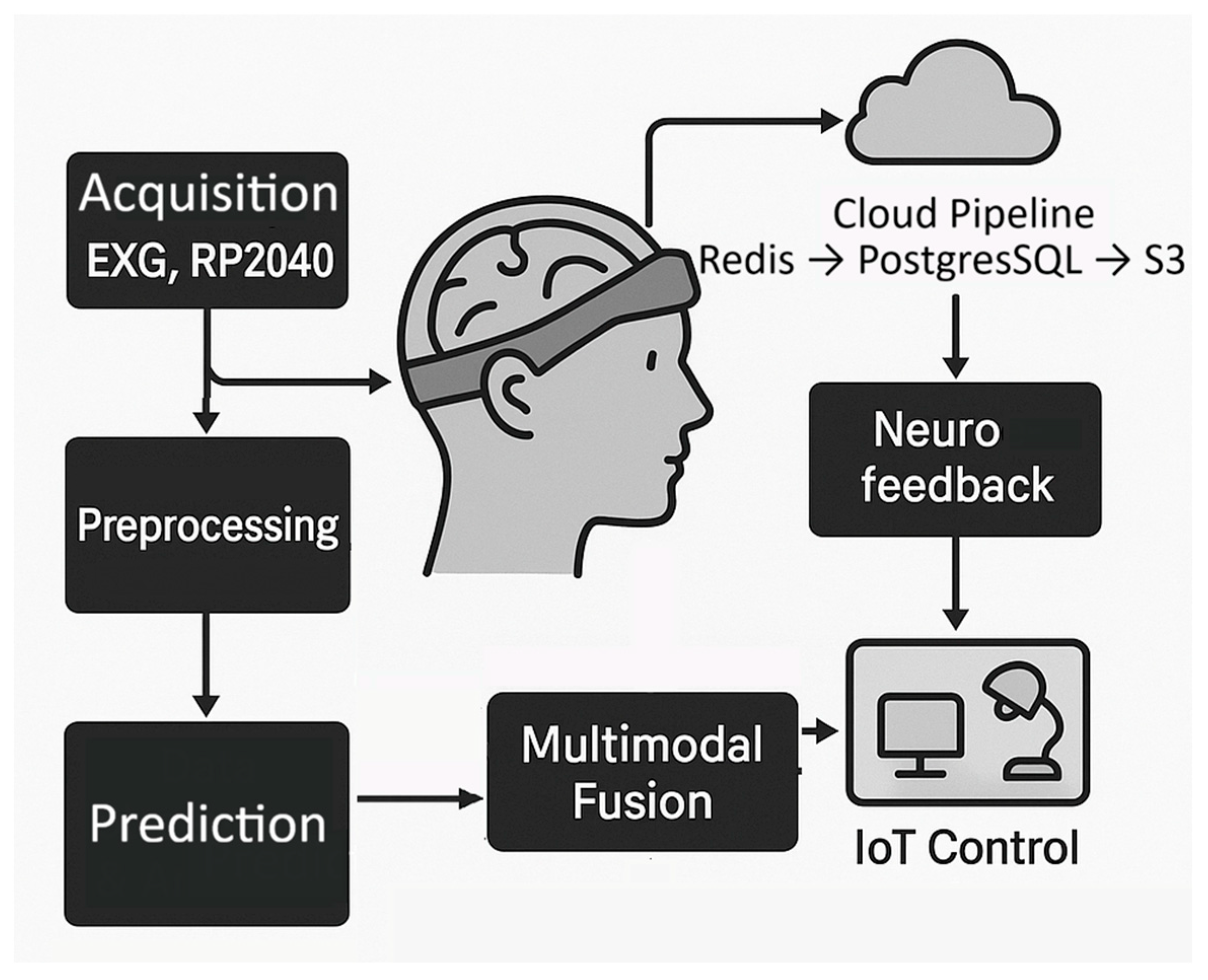
3.1. System Architecture
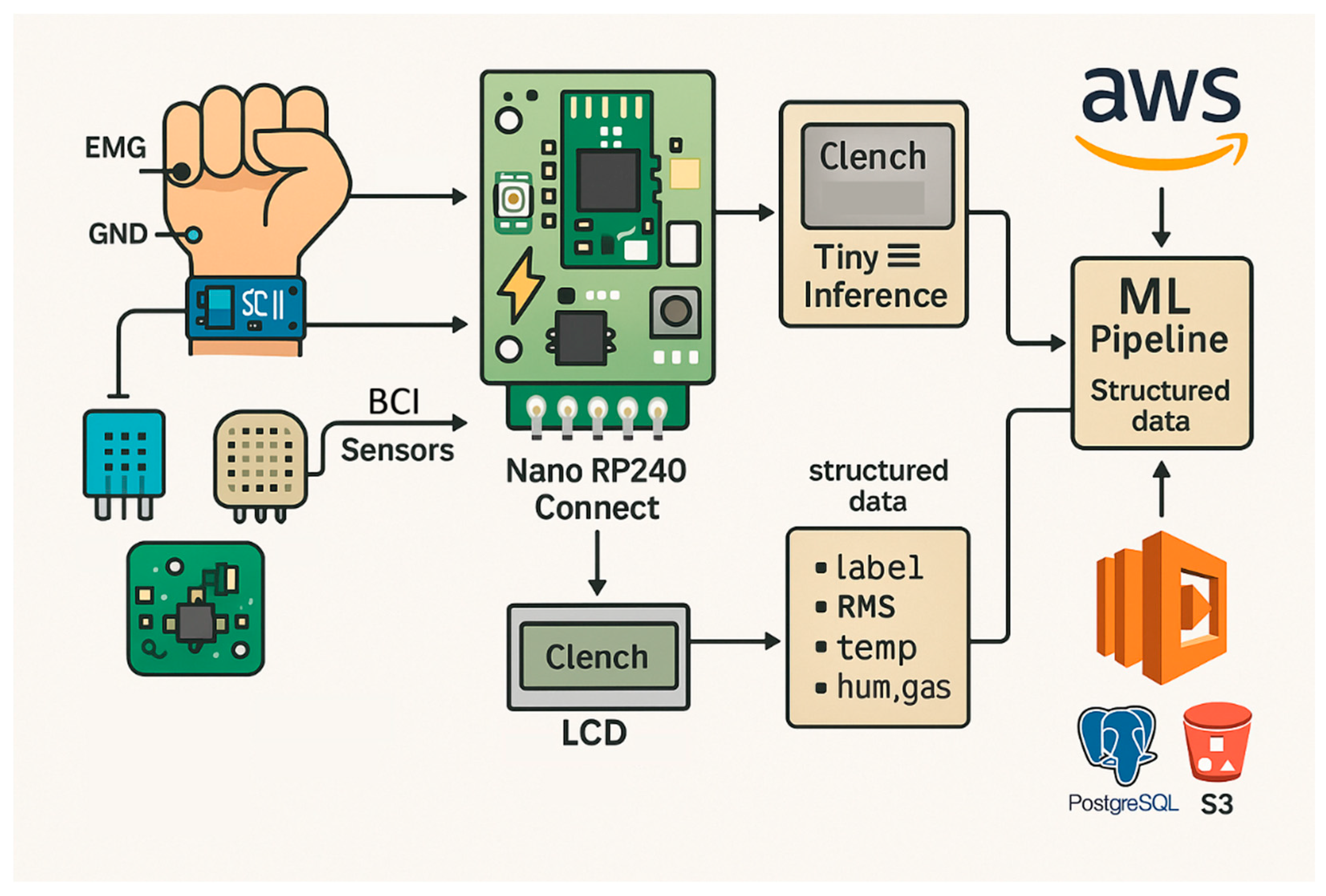
3.2. Hardware Components
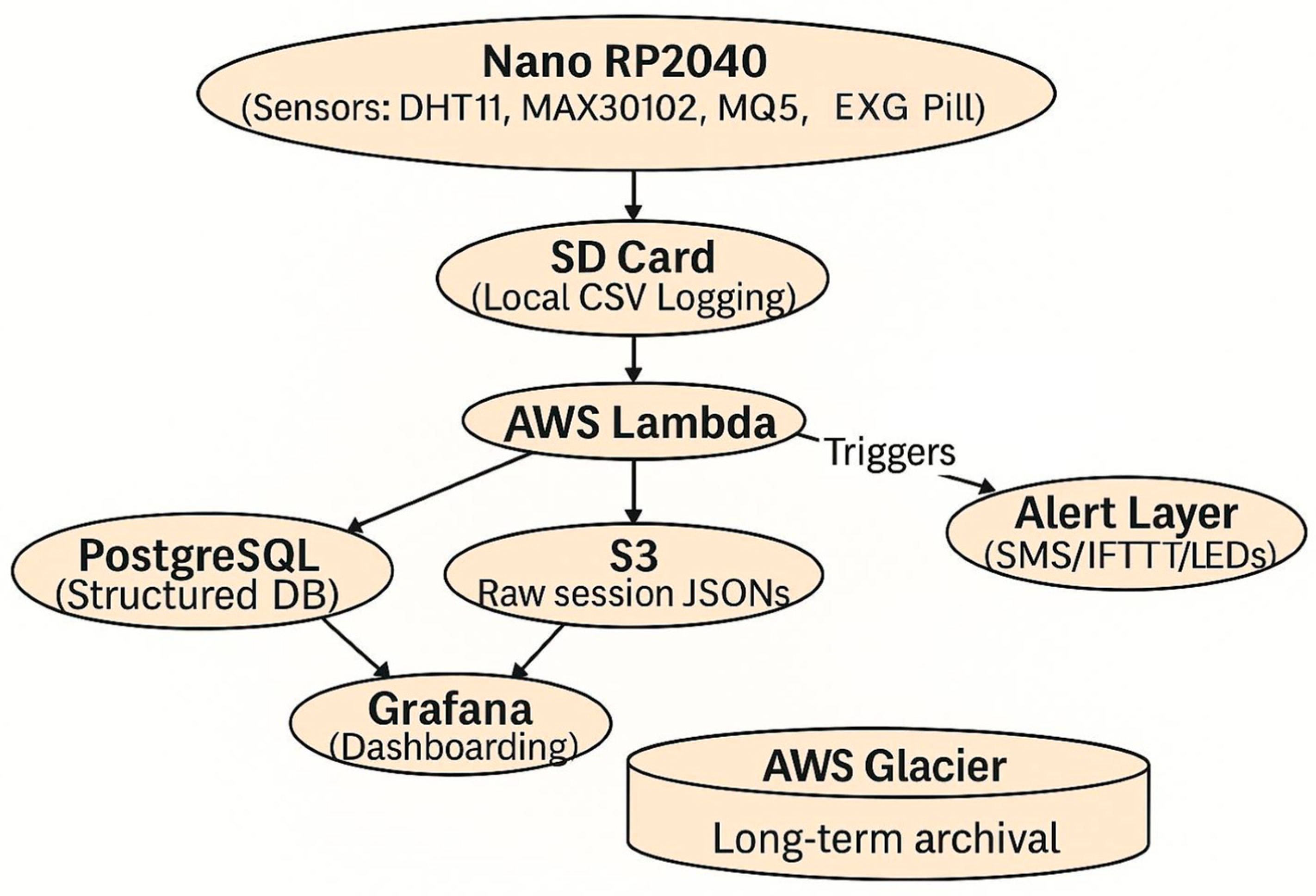
3.3. Software Stack
3.4. Data Acquisition and Preprocessing
- Root-mean-square (RMS) amplitude;
- FFT-derived bandpower over defined frequency bands;
- Statistical moment descriptors.
4. Results
4.1. System Performance Benchmarks
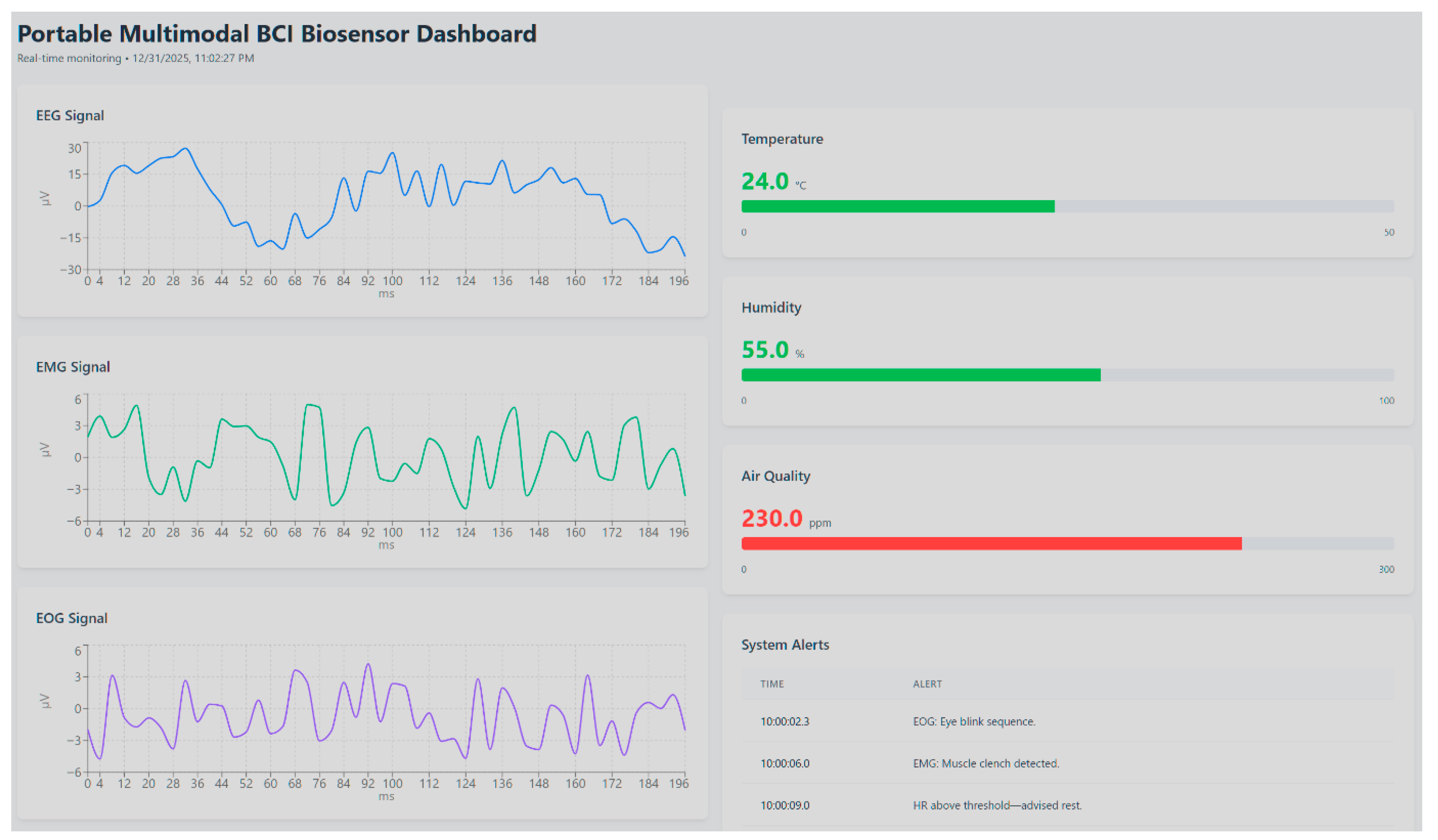
4.2. Visualization and Feedback Results
5. Discussion
5.1. Key Findings
5.2. Comparison with Existing Systems
5.3. Implications and Future Directions
- Large-scale validation and benchmarking using open electrophysiology repositories aligned with non-invasive BCI, including TUH EEG for clinical EEG variability, EEGMMIDB for motor imagery/execution paradigms, and NinaPro for sEMG-driven intent recognition benchmarks, enabling more defensible generalization across subjects and environments [96].
- Advanced cloud-based ML integration for governed training and deployment, including managed deployment primitives (real-time endpoints and edge-fleet model management) to support controlled model iteration and reproducible rollouts alongside the archival pipeline [97].
5.4. Limitations of the Present Study
6. Conclusions
Author Contributions
Funding
Institutional Review Board Statement
Informed Consent Statement
Data Availability Statement
Acknowledgments
Conflicts of Interest
References
- Niso, G.; Romero, E.; Moreau, J.T.; Araujo, A.; Krol, L.R. Wireless EEG: A Survey of Systems and Studies. Neuroimage 2023, 269, 119774. [Google Scholar] [CrossRef]
- Rancea, A.; Anghel, I.; Cioara, T.; Rancea, A.; Anghel, I.; Cioara, T. Edge Computing in Healthcare: Innovations, Opportunities, and Challenges. Future Internet 2024, 16, 329. [Google Scholar] [CrossRef]
- Nicolas-Alonso, L.F.; Gomez-Gil, J. Brain Computer Interfaces, a Review. Sensors 2012, 12, 1211–1279. [Google Scholar] [CrossRef]
- Daly, J.J.; Wolpaw, J.R. Brain–Computer Interfaces in Neurological Rehabilitation. Lancet Neurol. 2008, 7, 1032–1043. [Google Scholar] [CrossRef]
- Delorme, A.; Sejnowski, T.; Makeig, S. Enhanced Detection of Artifacts in EEG Data Using Higher-Order Statistics and Independent Component Analysis. Neuroimage 2007, 34, 1443–1449. [Google Scholar] [CrossRef]
- Müller-Putz, G.R.; Scherer, R.; Pfurtscheller, G.; Rupp, R. EEG-Based Neuroprosthesis Control: A Step towards Clinical Practice. Neurosci. Lett. 2005, 382, 169–174. [Google Scholar] [CrossRef] [PubMed]
- Heikenfeld, J.; Jajack, A.; Rogers, J.; Gutruf, P.; Tian, L.; Pan, T.; Li, R.; Khine, M.; Kim, J.; Wang, J.; et al. Wearable Sensors: Modalities, Challenges, and Prospects. Lab Chip 2018, 18, 217–248. [Google Scholar] [CrossRef] [PubMed]
- Brunner, C.; Allison, B.Z.; Altstätter, C.; Neuper, C. A Comparison of Three Brain-Computer Interfaces Based on Event-Related Desynchronization, Steady State Visual Evoked Potentials, or a Hybrid Approach Using Both Signals. J. Neural Eng. 2011, 8, 025010. [Google Scholar] [CrossRef] [PubMed]
- Allison, B.Z.; Jin, J.; Zhang, Y.; Wang, X. A Four-Choice Hybrid P300/SSVEP BCI for Improved Accuracy. Brain-Comput. Interfaces 2014, 1, 17–26. [Google Scholar] [CrossRef]
- Allison, B.Z.; Brunner, C.; Altstätter, C.; Wagner, I.C.; Grissmann, S.; Neuper, C. A Hybrid ERD/SSVEP BCI for Continuous Simultaneous Two Dimensional Cursor Control. J. Neurosci. Methods 2012, 209, 299–307. [Google Scholar] [CrossRef]
- Wang, M.; Daly, I.; Allison, B.Z.; Jin, J.; Zhang, Y.; Chen, L.; Wang, X. A New Hybrid BCI Paradigm Based on P300 and SSVEP. J. Neurosci. Methods 2015, 244, 16–25. [Google Scholar] [CrossRef]
- Tamura, H.; Yan, M.; Sakurai, K.; Tanno, K. EOG-SEMG Human Interface for Communication. Comput. Intell. Neurosci. 2016, 2016, 7354082. [Google Scholar] [CrossRef]
- Belkhiria, C.; Boudir, A.; Hurter, C.; Peysakhovich, V. EOG-Based Human–Computer Interface: 2000–2020 Review. Sensors 2022, 22, 4914. [Google Scholar] [CrossRef]
- Shu, L.; Xie, J.; Yang, M.; Li, Z.; Li, Z.; Liao, D.; Xu, X.; Yang, X. A Review of Emotion Recognition Using Physiological Signals. Sensors 2018, 18, 2074. [Google Scholar] [CrossRef] [PubMed]
- Beh, W.K.; Wu, Y.H.; Wu, A.Y. Robust PPG-Based Mental Workload Assessment System Using Wearable Devices. IEEE J. Biomed. Health Inform. 2023, 27, 2323–2333. [Google Scholar] [CrossRef] [PubMed]
- Zhang, J.; Symons, J.; Agapow, P.; Teo, J.T.; Paxton, C.A.; Abdi, J.; Mattie, H.; Davie, C.; Torres, A.Z.; Folarin, A.; et al. Best Practices in the Real-World Data Life Cycle. PLoS Digit. Health 2022, 1, e0000003. [Google Scholar] [CrossRef] [PubMed]
- Sjouwerman, R.; Lonsdorf, T.B. Latency of Skin Conductance Responses across Stimulus Modalities. Psychophysiology 2019, 56, e13307. [Google Scholar] [CrossRef]
- Islam, U.; Alatawi, M.N.; Alqazzaz, A.; Alamro, S.; Shah, B.; Moreira, F. A Hybrid Fog-Edge Computing Architecture for Real-Time Health Monitoring in IoMT Systems with Optimized Latency and Threat Resilience. Sci. Rep. 2025, 15, 25655. [Google Scholar] [CrossRef]
- Tronstad, C.; Staal, O.M.; Saelid, S.; Martinsen, O.G. Model-Based Filtering for Artifact and Noise Suppression with State Estimation for Electrodermal Activity Measurements in Real Time. In Proceedings of the Annual International Conference of the IEEE Engineering in Medicine and Biology Society, EMBS; IEEE: New York, NY, USA, 2015; pp. 2750–2753. [Google Scholar] [CrossRef]
- Tsoukas, V.; Boumpa, E.; Giannakas, G.; Kakarountas, A. A Review of Machine Learning and TinyML in Healthcare. In ACM International Conference Proceeding Series; Association for Computing Machinery: New York, NY, USA, 2021; pp. 69–73. [Google Scholar] [CrossRef]
- Alajlan, N.N.; Ibrahim, D.M. TinyML: Enabling of Inference Deep Learning Models on Ultra-Low-Power IoT Edge Devices for AI Applications. Micromachines 2022, 13, 851. [Google Scholar] [CrossRef]
- Schizas, N.; Karras, A.; Karras, C.; Sioutas, S. TinyML for Ultra-Low Power AI and Large Scale IoT Deployments: A Systematic Review. Future Internet 2022, 14, 363. [Google Scholar] [CrossRef]
- Arcas, G.I.; Cioara, T.; Anghel, I. Whale Optimization for Cloud–Edge-Offloading Decision-Making for Smart Grid Services. Biomimetics 2024, 9, 302. [Google Scholar] [CrossRef]
- Jiman, A.A.; Attar, E.T. Unsupervised Clustering of Pre-Ictal EEG in Children: A Reproducible and Lightweight CPU-Based Workflow. Front. Neurol. 2025, 16, 1665008. [Google Scholar] [CrossRef] [PubMed]
- Luganga, A. Emofusion: Toward Emotion-Driven Adaptive Computational Design Workflows. In IMX 2025—Proceedings of the 2025 ACM International Conference on Interactive Media Experiences; Association for Computing Machinery: New York, NY, USA, 2025; pp. 473–478. [Google Scholar] [CrossRef]
- Abdulmalek, S.; Nasir, A.; Jabbar, W.A.; Almuhaya, M.A.M.; Bairagi, A.K.; Khan, M.A.M.; Kee, S.H. IoT-Based Healthcare-Monitoring System towards Improving Quality of Life: A Review. Healthcare 2022, 10, 1993. [Google Scholar] [CrossRef] [PubMed]
- Wu, T.; Wu, F.; Qiu, C.; Redoute, J.M.; Yuce, M.R. A Rigid-Flex Wearable Health Monitoring Sensor Patch for IoT-Connected Healthcare Applications. IEEE Internet Things J. 2020, 7, 6932–6945. [Google Scholar] [CrossRef]
- Mamdiwar, S.D.; Akshith, R.; Shakruwala, Z.; Chadha, U.; Srinivasan, K.; Chang, C.Y. Recent Advances on Iot-Assisted Wearable Sensor Systems for Healthcare Monitoring. Biosensors 2021, 11, 372. [Google Scholar] [CrossRef] [PubMed]
- Qin, Z.; Li, Q. High Rate BCI with Portable Devices Based on EEG. Smart Health 2018, 9–10, 115–128. [Google Scholar] [CrossRef]
- Chen, S.C.; Tsai, T.T.; Luo, C.H. Portable and Programmable Clinical EOG Diagnostic System. J. Med. Eng. Technol. 2000, 24, 154–162. [Google Scholar] [CrossRef]
- Blanco, J.A.; Vanleer, A.C.; Calibo, T.K.; Firebaugh, S.L. Single-Trial Cognitive Stress Classification Using Portable Wireless Electroencephalography. Sensors 2019, 19, 499. [Google Scholar] [CrossRef]
- Adeniran, A.O.; Onuajah, S.I.; Adeniran, A.A.; Ogunmola, M.A. Implementing Cloud-Centric IoT Transformations: Merits and Demerits. Syst. Anal. 2024, 2, 174–187. [Google Scholar] [CrossRef]
- Spillner, J.; Müller, J.; Schill, A. Creating Optimal Cloud Storage Systems. Future Gener. Comput. Syst. 2013, 29, 1062–1072. [Google Scholar] [CrossRef]
- Mahmood, M.; Mzurikwao, D.; Kim, Y.-S.; Lee, Y.; Mishra, S.; Herbert, R.; Duarte, A.; Ang, C.S.; Yeo, W.-H. Fully Portable and Wireless Universal Brain–Machine Interfaces Enabled by Flexible Scalp Electronics and Deep Learning Algorithm. Nat. Mach. Intell. 2019, 1, 412–422. [Google Scholar] [CrossRef]
- Hong, K.S.; Khan, M.J. Hybrid Brain-Computer Interface Techniques for Improved Classification Accuracy and Increased Number of Commands: A Review. Front. Neurorobot. 2017, 11, 275683. [Google Scholar] [CrossRef]
- Bright, D.; Nair, A.; Salvekar, D.; Bhisikar, S. EEG-Based Brain Controlled Prosthetic Arm. In Conference on Advances in Signal Processing, CASP 2016; IEEE: New York, NY, USA, 2016; pp. 479–483. [Google Scholar] [CrossRef]
- Hochberg, L.R.; Serruya, M.D.; Friehs, G.M.; Mukand, J.A.; Saleh, M.; Caplan, A.H.; Branner, A.; Chen, D.; Penn, R.D.; Donoghue, J.P. Neuronal Ensemble Control of Prosthetic Devices by a Human with Tetraplegia. Nature 2006, 442, 164–171. [Google Scholar] [CrossRef]
- Asokan, A.; Vigneshwar, M. Design and Control of an EMG-Based Low-Cost Exoskeleton for Stroke Rehabilitation. In Proceedings of the 2019 5th Indian Control Conference, ICC 2019—Proceedings, New Delhi, India, 9–11 January 2019; pp. 478–483. [Google Scholar] [CrossRef]
- Seok, D.; Lee, S.; Kim, M.; Cho, J.; Kim, C. Motion Artifact Removal Techniques for Wearable EEG and PPG Sensor Systems. Front. Electron. 2021, 2, 685513. [Google Scholar] [CrossRef]
- Mussi, M.G.; Adams, K.D. EEG Hybrid Brain-Computer Interfaces: A Scoping Review Applying an Existing Hybrid-BCI Taxonomy and Considerations for Pediatric Applications. Front. Hum. Neurosci. 2022, 16, 1007136. [Google Scholar] [CrossRef]
- Kinney-Lang, E.; Kelly, D.; Floreani, E.D.; Jadavji, Z.; Rowley, D.; Zewdie, E.T.; Anaraki, J.R.; Bahari, H.; Beckers, K.; Castelane, K.; et al. Advancing Brain-Computer Interface Applications for Severely Disabled Children Through a Multidisciplinary National Network: Summary of the Inaugural Pediatric BCI Canada Meeting. Front. Hum. Neurosci. 2020, 14, 593883. [Google Scholar] [CrossRef] [PubMed]
- Sanchez-Iborra, R.; Skarmeta, A.F. TinyML-Enabled Frugal Smart Objects: Challenges and Opportunities. IEEE Circuits Syst. Mag. 2020, 20, 4–18. [Google Scholar] [CrossRef]
- Saoud, L.S.; Hussain, I. TempoNet: Empowering Long-Term Knee Joint Angle Prediction with Dynamic Temporal Attention in Exoskeleton Control. In IEEE-RAS International Conference on Humanoid Robots; IEEE: New York, NY, USA, 2023. [Google Scholar] [CrossRef]
- Zanghieri, M.; Benatti, S.; Burrello, A.; Kartsch, V.; Conti, F.; Benini, L. Robust Real-Time Embedded EMG Recognition Framework Using Temporal Convolutional Networks on a Multicore IoT Processor. IEEE Trans. Biomed. Circuits Syst. 2020, 14, 244–256. [Google Scholar] [CrossRef]
- Elfouly, T.; Alouani, A.; Elfouly, T.; Alouani, A. A Comprehensive Survey on Wearable Computing for Mental and Physical Health Monitoring. Electronics 2025, 14, 3443. [Google Scholar] [CrossRef]
- Li, M.; Xu, D. Transfer Learning in Motor Imagery Brain Computer Interface: A Review. J. Shanghai Jiaotong Univ. Sci. 2024, 29, 37–59. [Google Scholar] [CrossRef]
- Shah, V.; von Weltin, E.; Lopez, S.; McHugh, J.R.; Veloso, L.; Golmohammadi, M.; Obeid, I.; Picone, J. The Temple University Hospital Seizure Detection Corpus. Front. Neuroinform. 2018, 12, 83. [Google Scholar] [CrossRef] [PubMed]
- Petersen, R.C.; Aisen, P.S.; Beckett, L.A.; Donohue, M.C.; Gamst, A.C.; Harvey, D.J.; Jack, C.R.; Jagust, W.J.; Shaw, L.M.; Toga, A.W.; et al. Alzheimer’s Disease Neuroimaging Initiative (ADNI). Neurology 2010, 74, 201–209. [Google Scholar] [CrossRef]
- Kumar, Y.; Kumar, J.; Sheoran, P. Integration of Cloud Computing in BCI: A Review. Biomed. Signal Process. Control 2024, 87, 105548. [Google Scholar] [CrossRef]
- Islam, M.M.; Rahaman, A.; Islam, M.R. Development of Smart Healthcare Monitoring System in IoT Environment. SN Comput. Sci. 2020, 1, 185. [Google Scholar] [CrossRef]
- Turnip, A.; Pardede, J. Artefacts Removal of EEG Signals with Wavelet Denoising. MATEC Web Conf. 2017, 135, 58. [Google Scholar] [CrossRef]
- Butkeviciute, E.; Bikulciene, L.; Sidekerskiene, T.; Blazauskas, T.; Maskeliunas, R.; Damasevicius, R.; Wei, W. Removal of Movement Artefact for Mobile EEG Analysis in Sports Exercises. IEEE Access 2019, 7, 7206–7217. [Google Scholar] [CrossRef]
- D’Rozario, A.L.; Dungan, G.C.; Banks, S.; Liu, P.Y.; Wong, K.K.H.; Killick, R.; Grunstein, R.R.; Kim, J.W. An Automated Algorithm to Identify and Reject Artefacts for Quantitative EEG Analysis during Sleep in Patients with Sleep-Disordered Breathing. Sleep Breath. 2015, 19, 607–615. [Google Scholar] [CrossRef]
- Atzori, M.; Gijsberts, A.; Kuzborskij, I.; Elsig, S.; Mittaz Hager, A.G.; Deriaz, O.; Castellini, C.; Müller, H.; Caputo, B. Characterization of a Benchmark Database for Myoelectric Movement Classification. IEEE Trans. Neural Syst. Rehabil. Eng. 2015, 23, 73–83. [Google Scholar] [CrossRef]
- Zhang, H.; Zhao, M.; Wei, C.; Mantini, D.; Li, Z.; Liu, Q. EEGdenoiseNet: A Benchmark Dataset for Deep Learning Solutions of EEG Denoising. J. Neural Eng. 2021, 18, 056057. [Google Scholar] [CrossRef] [PubMed]
- Canali, S.; Schiaffonati, V.; Aliverti, A. Challenges and Recommendations for Wearable Devices in Digital Health: Data Quality, Interoperability, Health Equity, Fairness. PLoS Digit. Health 2022, 1, e0000104. [Google Scholar] [CrossRef] [PubMed]
- Canali, S. Towards a Contextual Approach to Data Quality. Data 2020, 5, 90. [Google Scholar] [CrossRef]
- Staunton, C.; Barragán, C.A.; Canali, S.; Ho, C.; Leonelli, S.; Mayernik, M.; Prainsack, B.; Wonkham, A. Open Science, Data Sharing and Solidarity: Who Benefits? Hist. Philos. Life Sci. 2021, 43, 115. [Google Scholar] [CrossRef] [PubMed]
- Arpaia, P.; De Luca, M.; Di Marino, L.; Duran, D.; Gargiulo, L.; Lanteri, P.; Moccaldi, N.; Nalin, M.; Picciafuoco, M.; Robbio, R.; et al. A Systematic Review of Techniques for Artifact Detection and Artifact Category Identification in Electroencephalography from Wearable Devices. Sensors 2025, 25, 5770. [Google Scholar] [CrossRef]
- Apicella, A.; Arpaia, P.; Isgro, F.; Mastrati, G.; Moccaldi, N. A Survey on EEG-Based Solutions for Emotion Recognition With a Low Number of Channels. IEEE Access 2022, 10, 117411–117428. [Google Scholar] [CrossRef]
- Yogeshappa, V.G. Designing Cloud-Native Data Platforms for Scalable Healthcare Analytics. Int. J. Res. Publ. Rev. 2025, 6, 3784–3791. [Google Scholar] [CrossRef]
- Zheng, W.L.; Lu, B.L. A Multimodal Approach to Estimating Vigilance Using EEG and Forehead EOG. J. Neural Eng. 2017, 14, 026017. [Google Scholar] [CrossRef]
- Bissoli, A.L.C.; Coelho, Y.L.; Bastos-Filho, T.F. A System for Multimodal Assistive Domotics and Augmentative and Alternative Communication. In ACM International Conference Proceeding Series 2016; Association for Computing Machinery: New York, NY, USA, 29 June 2016. [Google Scholar] [CrossRef]
- Akyildiz, I.F.; Su, W.; Sankarasubramaniam, Y.; Cayirci, E. Wireless Sensor Networks: A Survey. Comput. Netw. 2002, 38, 393–422. [Google Scholar] [CrossRef]
- Rosele, N.; Mohd Zaini, K.; Ahmad Mustaffa, N.; Abrar, A.; Fadilah, S.I.; Madi, M. Digital Transformation in Wireless Networks: A Comprehensive Analysis of Mobile Data Offloading Techniques, Challenges, and Future Prospects. J. King Saud Univ.—Comput. Inf. Sci. 2024, 36, 102071. [Google Scholar] [CrossRef]
- Gupta, B.B.; Gaurav, A.; Attar, R.W.; Arya, V.; Alhomoud, A.; Chui, K.T. LSTMBased Neural NetworkModel for Anomaly Event Detection in Care-Independent Smart Homes. CMES—Comput. Model. Eng. Sci. 2024, 140, 2689–2706. [Google Scholar] [CrossRef]
- Novák, M.; Biňas, M.; Jakab, F. Unobtrusive Anomaly Detection in Presence of Elderly in a Smart-Home Environment. In Proceedings of the 9th International Conference, ELEKTRO 2012, Rajecke Teplice, Slovakia, 21–22 May 2012; pp. 341–344. [Google Scholar] [CrossRef]
- Verma, P.; Sood, S.K.; Kalra, S. Cloud-Centric IoT Based Student Healthcare Monitoring Framework. J. Ambient Intell. Humaniz. Comput. 2018, 9, 1293–1309. [Google Scholar] [CrossRef]
- Verma, P.; Sood, S.K. Cloud-Centric IoT Based Disease Diagnosis Healthcare Framework. J. Parallel Distrib. Comput. 2018, 116, 27–38. [Google Scholar] [CrossRef]
- David, R.; Duke, J.; Jain, A.; Reddi, V.J.; Jeffries, N.; Li, J.; Kreeger, N.; Nappier, I.; Natraj, M.; Regev, S.; et al. TensorFlow Lite Micro: Embedded Machine Learning for TinyML Systems. Proc. Mach. Learn. Syst. 2021, 3, 800–811. [Google Scholar]
- Signoretti, G.; Silva, M.; Andrade, P.; Silva, I.; Sisinni, E.; Ferrari, P. An Evolving Tinyml Compression Algorithm for Iot Environments Based on Data Eccentricity. Sensors 2021, 21, 4153. [Google Scholar] [CrossRef]
- Saha, S.S.; Sandha, S.S.; Srivastava, M. Machine Learning for Microcontroller-Class Hardware: A Review. IEEE Sens. J. 2022, 22, 21362–21390. [Google Scholar] [CrossRef]
- Transitioning Objects Using Amazon S3 Lifecycle—Amazon Simple Storage Service. Available online: https://docs.aws.amazon.com/AmazonS3/latest/userguide/lifecycle-transition-general-considerations.html (accessed on 9 March 2026).
- Phinyomark, A.; Khushaba, R.N.; Scheme, E.; Phinyomark, A.; Khushaba, R.N.; Scheme, E. Feature Extraction and Selection for Myoelectric Control Based on Wearable EMG Sensors. Sensors 2018, 18, 1615. [Google Scholar] [CrossRef]
- Saraswathi, S. Real-Time Vital Sign Monitoring and Health Anomaly Detection on Edge Devices Using Lightweight Machine Learning Models. In 2025 International Conference on Intelligent Communication Networks and Computational Techniques (ICICNCT); IEEE: New York, NY, USA, 2025; pp. 1–6. [Google Scholar] [CrossRef]
- Borton, D.; Micera, S.; Millán, J.D.R.; Courtine, G. Personalized Neuroprosthetics. Sci. Transl. Med. 2013, 5, 210rv2. [Google Scholar] [CrossRef]
- Raspopovic, S.; Capogrosso, M.; Petrini, F.M.; Bonizzato, M.; Rigosa, J.; Di Pino, G.; Carpaneto, J.; Controzzi, M.; Boretius, T.; Fernandez, E.; et al. Bioengineering: Restoring Natural Sensory Feedback in Real-Time Bidirectional Hand Prostheses. Sci. Transl. Med. 2014, 6, 222ra19. [Google Scholar] [CrossRef] [PubMed]
- Shalal, N.S.; Aboud, W.S. Robotic Exoskeleton: A Compact, Portable, and Constructing Using 3D Printer Technique for Wrist-Forearm Rehabilitation. Al-Nahrain J. Eng. Sci. 2020, 23, 238–248. [Google Scholar] [CrossRef]
- Andriulo, F.C.; Fiore, M.; Mongiello, M.; Traversa, E.; Zizzo, V. Edge Computing and Cloud Computing for Internet of Things: A Review. Informatics 2024, 11, 71. [Google Scholar] [CrossRef]
- Guo, Y.; Yang, K.; Wu, Y. A Multi-Modality Attention Network for Driver Fatigue Detection Based on Frontal EEG, EDA and PPG Signals. IEEE J. Biomed. Health Inform. 2025, 29, 4009–4022. [Google Scholar] [CrossRef]
- Janapati, R.; Dalal, V.; Sengupta, R. Advances in Modern EEG-BCI Signal Processing: A Review. Mater. Today Proc. 2023, 80, 2563–2566. [Google Scholar] [CrossRef]
- Ingolfsson, T.M.; Hersche, M.; Wang, X.; Kobayashi, N.; Cavigelli, L.; Benini, L. EEG-TCNet: An Accurate Temporal Convolutional Network for Embedded Motor-Imagery Brain-Machine Interfaces. In 2020 IEEE International Conference on Systems, Man, and Cybernetics (SMC); IEEE: New York, NY, USA, 2020; pp. 2958–2965. [Google Scholar] [CrossRef]
- Delorme, A.; Makeig, S. EEGLAB: An Open Source Toolbox for Analysis of Single-Trial EEG Dynamics Including Independent Component Analysis. J. Neurosci. Methods 2004, 134, 9–21. [Google Scholar] [CrossRef] [PubMed]
- Duan, X.; Xie, S.; Xie, X.; Meng, Y.; Xu, Z. Quadcopter Flight Control Using a Non-Invasive Multi-Modal Brain Computer Interface. Front. Neurorobot. 2019, 13, 23. [Google Scholar] [CrossRef] [PubMed]
- Karunarathna, T.S.; Liang, Z. Development of Non-Invasive Continuous Glucose Prediction Models Using Multi-Modal Wearable Sensors in Free-Living Conditions. Sensors 2025, 25, 3207. [Google Scholar] [CrossRef] [PubMed]
- Zhang, J.; Wang, B.; Zhang, C.; Xiao, Y.; Wang, M.Y. An EEG/EMG/EOG-Based Multimodal Human-Machine Interface to Real-Time Control of a Soft Robot Hand. Front. Neurorobot. 2019, 13, 7. [Google Scholar] [CrossRef]
- Khalaf, A.; Sejdic, E.; Akcakaya, M. Hybrid EEG–FTCD Brain–Computer Interfaces. In Cognitive Science and Technology; Springer: Berlin/Heidelberg, Germany, 2020; pp. 295–314. [Google Scholar] [CrossRef]
- Punsawad, Y.; Wongsawat, Y.; Parnichkun, M. Hybrid EEG-EOG Brain-Computer Interface System for Practical Machine Control. In 2010 Annual International Conference of the IEEE Engineering in Medicine and Biology Society, EMBC’10; IEEE: New York, NY, USA, 2010; pp. 1360–1363. [Google Scholar] [CrossRef]
- Shumba, A.T.; Montanaro, T.; Sergi, I.; Fachechi, L.; De Vittorio, M.; Patrono, L. Leveraging IoT-Aware Technologies and AI Techniques for Real-Time Critical Healthcare Applications. Sensors 2022, 22, 7675. [Google Scholar] [CrossRef]
- Williams, N.S.; King, W.; Mackellar, G.; Randeniya, R.; McCormick, A.; Badcock, N.A. Crowdsourced EEG Experiments: A Proof of Concept for Remote EEG Acquisition Using EmotivPRO Builder and EmotivLABS. Heliyon 2023, 9, e18433. [Google Scholar] [CrossRef]
- Williams, N.S.; McArthur, G.M.; Badcock, N.A. 10 Years of EPOC: A Scoping Review of Emotiv’s Portable EEG Device. bioRxiv 2020. [Google Scholar] [CrossRef]
- Stock, V.N.; Balbinot, A. Movement Imagery Classification in EMOTIV Cap Based System by Naïve Bayes. In Proceedings of the Annual International Conference of the IEEE Engineering in Medicine and Biology Society, EMBS; IEEE: New York, NY, USA, 2016; pp. 4435–4438. [Google Scholar] [CrossRef]
- Robert, H.; Augereau, O.; Kise, K. Real-Time Wordometer Demonstration Using Commercial EOG Glasses. In UbiComp/ISWC 2017—Adjunct Proceedings of the 2017 ACM International Joint Conference on Pervasive and Ubiquitous Computing and Proceedings of the 2017 ACM International Symposium on Wearable Computers; Association for Computing Machinery: New York, NY, USA, 2017; pp. 277–280. [Google Scholar] [CrossRef]
- Luu, T.P.; He, Y.; Brown, S.; Nakagame, S.; Contreras-Vidal, J.L. Gait Adaptation to Visual Kinematic Perturbations Using a Real-Time Closed-Loop Brain-Computer Interface to a Virtual Reality Avatar. J. Neural Eng. 2016, 13, 036006. [Google Scholar] [CrossRef]
- Vidal, J.J. Realtime Detection of Brain Events in EEG. Proc. IEEE 1977, 65, 633–641. [Google Scholar] [CrossRef]
- Hernandez-Jaimes, M.L.; Martinez-Cruz, A.; Ramírez-Gutiérrez, K.A.; Feregrino-Uribe, C. Artificial Intelligence for IoMT Security: A Review of Intrusion Detection Systems, Attacks, Datasets and Cloud–Fog–Edge Architectures. Internet Things 2023, 23, 100887. [Google Scholar] [CrossRef]
- Roy, Y.; Banville, H.; Albuquerque, I.; Gramfort, A.; Falk, T.H.; Faubert, J. Deep Learning-Based Electroencephalography Analysis: A Systematic Review. J. Neural Eng. 2019, 16, 051001. [Google Scholar] [CrossRef] [PubMed]
- EEG Motor Movement/Imagery Dataset v1.0.0. Available online: https://physionet.org/content/eegmmidb/1.0.0/ (accessed on 31 December 2025).
- Ninapro. Available online: https://ninapro.hevs.ch/ (accessed on 31 December 2025).



| Modality | Role in Prototype | Edge Features Computed | Used for Final Classification Output | What Is Validated/Reported in This Paper |
|---|---|---|---|---|
| EMG | primary intent detection (clench) | RMS, FFT bandpower, summary statistics | yes | benchmarked (timing + inference pipeline) |
| EOG | ocular-activity reliability flag | blink/saccade proxy, variance/threshold features | no (gating only) | concurrent acquisition + gating role described |
| EEG | stability/quality indicator | lightweight bandpower/PSD-derived features | no (gating/monitoring only) | concurrent acquisition + quality role described |
| ECG | acquisition feasibility channel | time-domain morphology checks | no | acquisition feasibility within same pipeline |
| Component | Function | Role in RCG Layer | Notes/Specifications |
|---|---|---|---|
| BioAmp EXG Pill | Analog front-end for EEG/EMG/ECG acquisition | Cortex (signal input) | High CMRR, low-noise instrumentation amp |
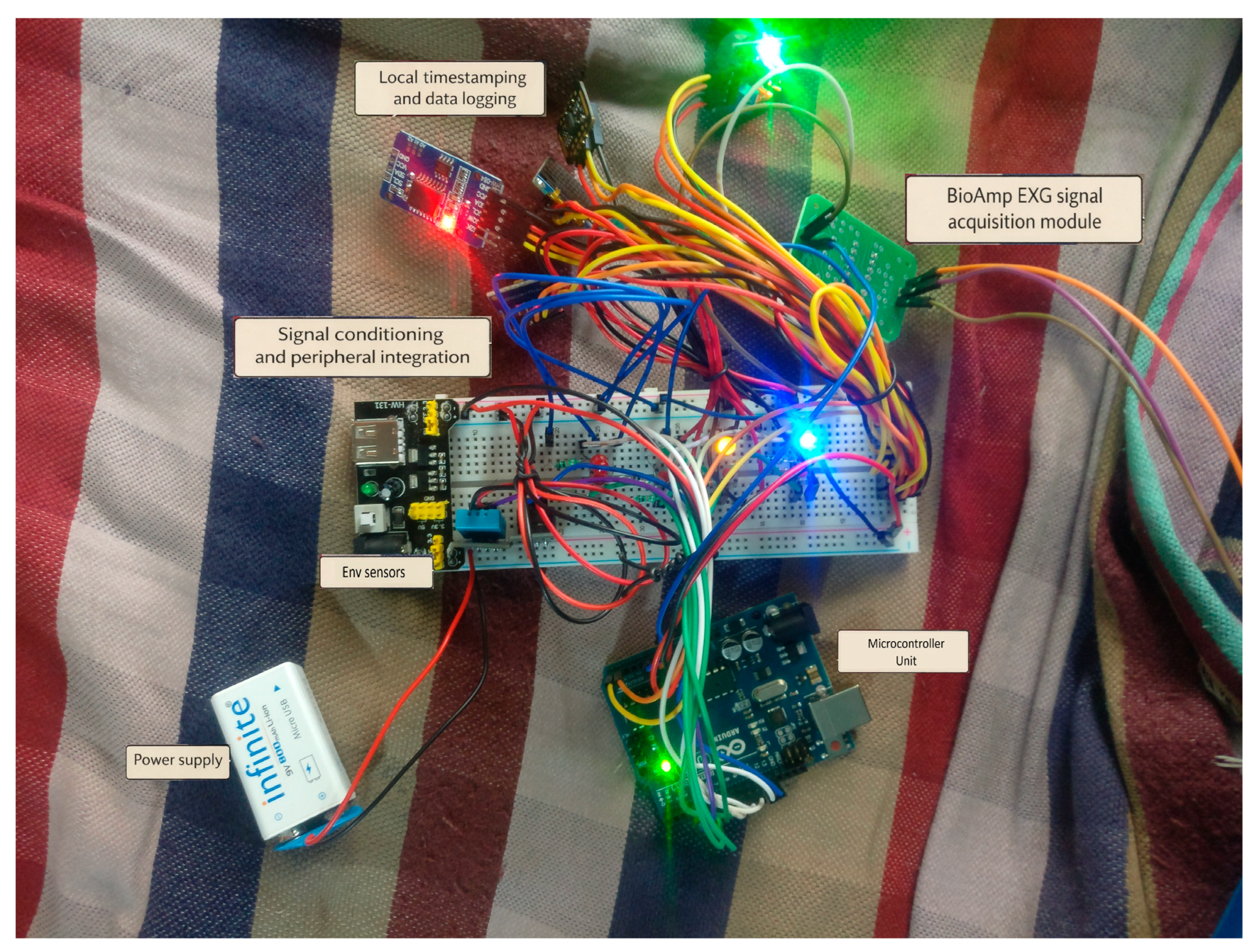
| RP2040 (Nano RP2040 Connect) | Preprocessing, RMS/FFT, TinyML inference, LCD control | Cortex (edge analytics) | Dual-core Arm Cortex-M0+, 264 kB SRAM, Wi-Fi/Bluetooth |
| ESP32 Vajravegha LTE (SIM7600 module) | Secure data uplink via HTTPS/MQTT | Gateway (uplink) | LTE/4G, integrated SIM, SSL/TLS stack |
| SD card module (SPI) | Local buffering and redundancy | Cortex/Vault (local) | 16–32 GB supported, FAT32 format |
| Nokia 5110 LCD | Real-time visualization and alerts | Dash (feedback) | 84 × 48 pixels, SPI interface |
| Redis (cloud service) | Real-time stream buffering | Dash (low latency) | Hosted in AWS, <10 ms query response |
| PostgreSQL (cloud DB) | Structured analytics and ML training datasets | Vault (structured) | RDS deployment, schema for biosignals |
| AWS S3 + Glacier | Long-term archival of session files | Vault (archival) | Lifecycle policy to Glacier for cost saving |
| DHT11 | Ambient temperature and humidity | Cortex (context sensor) | Range 0–50 °C, 20–90% RH, digital output |
| MQ-135 | Gas/air quality sensing (VOCs, CO2, alcohol) | Cortex (context sensor) | Sensitivity adjustable, analog interface |
| MAX30102 | Optical pulse sensing (PPG) | Cortex (physiological adjunct) | Integrated PPG sensor for heart rate/HRV/SpO2; red + IR LEDs with photodiode; I2C interface; low-power modes; 1.8 V core, 3.3 V logic; contextual only, not a primary BCI channel. |
| Component | Specification/Value | Measurement Method/Notes |
|---|---|---|
| Edge MCU | Arduino Nano RP2040 Connect (RP2040) | 264 kB SRAM, 16 MB external QSPI flash |
| Primary classifier | LDA + shallow Random Forest | Fixed classical model (no deep CNN) |
| Window length/hop | EMG: 0.25 s/0.125 s | 50% overlap sliding window |
| Quantization scheme | int8 (post-training) | Fixed-point deployment for bounded runtime |
| Feature extraction | RMS + FFT bandpower + summary statistics | Consistent on-device pipeline |
| Compiled firmware size | ~148 kB | Arduino build output (.bin) |
| Embedded model artifact size | LDA: ~2 kB; RF: ~68 kB | Model array size in flash |
| Peak SRAM usage | ~17 kB | Runtime profiling incl. buffers |
| Metric | Where Measured | Reported Value (from Validation) | What It Implies |
|---|---|---|---|
| tinyml inference time (quantized) | rp2040 (edge) | 12–21 ms | compute is not the bottleneck; windowing dominates response |
| analysis window length | edge feature window | 250–1000 ms | primary driver of interaction latency (consistent, window-bounded) |
| device feedback refresh | Nokia 5110 lcd | 150–300 ms | immediate local confirmation during sessions |
| end-to-end delay | acquisition → LTE → cloud handling → dashboard | 1.3–2.1 s (spikes > 2.5 s) | variability dominated by network + serverless + dashboard refresh |
| packet loss | LTE uplink session delivery | <5% | reliability acceptable with ack/retry + sd fallback |
| contextual telemetry cadence | gateway payload rate | 1 Hz (bursts on events) | stable remote monitoring with event-driven escalation |
| concurrent streams handled—edge inference pipeline | edge/gateway pipeline (RP2040 + Vajravegha) | 3 streams: EMG [TinyML inference] + DHT11 + MQ-135 [context co-sampling] | edge-layer inference concurrency demonstrated; EMG is the sole active TinyML channel; EEG and EOG are co-acquired as quality/gating streams per Table 1, not routed through the classification pipeline |
| Metric | Observed Range/Value | Where Measured | Interpretation |
|---|---|---|---|
| TinyML inference time (RP2040) | 12–21 ms | edge | compute cost of model call, excluding window accumulation |
| analysis window length | 250–1000 ms | edge | dominant term for interactive response time |
| device-level LCD refresh | 150–300 ms | edge | user-visible feedback latency on-device |
| end-to-end delay (edge → LTE → cloud → dashboard) | 1.72 ± 0.19 s (p50 = 1.68 s; p95 = 2.04 s; N = 15 runs) | full pipeline | network-dependent component; variability captured via mean ± SD and percentiles; influenced by LTE uplink + cloud ingest + dashboard refresh (and potential cold-start events) |
| packet loss (LTE uplink) | ≤5% (p95) across N = 15 runs | gateway/uplink | delivery success >95% with acknowledgement/retry logic |
| concurrent streams—acquisition and dashboard layer | 5 channels concurrently acquired and visualized | dashboard/pipeline | 1 inference stream (EMG) + 2 quality/gating streams (EEG, EOG) + 2 context streams (DHT11, MQ-135); role separation per Table 1; edge inference concurrency reported in Table 4 |
| cloud archival feasibility | validated | storage | raw sessions uploaded to S3 with lifecycle transition for archival retention |
| System Type | Modalities | Processing Level | Strengths | Limitations | Proposed System Advantage |
|---|---|---|---|---|---|
| EEG-only BCIs [3,81,82,83] | EEG | PC/cloud-based | High temporal resolution; established research | Artifact-prone; poor spatial; limited portability | Adds EMG, ECG, adjuncts; edge inference on microcontroller |
| Multimodal non-invasive BCI (literature) [80,84,85,86,87,88] | EEG, EMG, ECG, EOG, fNIRS, MEG, MRI | Lab/PC or embedded | Improved decoding; multimodal robustness | Often fragmented; limited real-time capability | Unified edge–cloud pipeline; real-time, scalable analytics |
| IoT-enabled biosensors [27,89] | EEG, ECG, basic sensors | Cloud-heavy | Scalable storage; dashboard integration | High latency; network/cost inefficiency | Hybrid edge–cloud pipeline with Redis/PostgreSQL/S3/Glacier |
| Consumer wearables [90,91,92] | EEG, HR, motion | Embedded/Cloud apps | Accessible; user-friendly; affordable | Low signal quality; limited analytics | BioAmp EXG: higher fidelity; structured cloud analytics |
| RCG (this work) | EEG, EMG, ECG, EOG, adjuncts | Edge + cloud hybrid | Multimodal; modular; sub-100 ms edge inference; reliable cloud archival | Prototype stage; dataset validation ongoing | Bridges edge inference and cloud scalability; portable, extensible |
Disclaimer/Publisher’s Note: The statements, opinions and data contained in all publications are solely those of the individual author(s) and contributor(s) and not of MDPI and/or the editor(s). MDPI and/or the editor(s) disclaim responsibility for any injury to people or property resulting from any ideas, methods, instructions or products referred to in the content. |
© 2026 by the authors. Licensee MDPI, Basel, Switzerland. This article is an open access article distributed under the terms and conditions of the Creative Commons Attribution (CC BY) license.
Share and Cite
Ghosh, S.; Bhuvanakantham, R.; Sindhujaa, P.; Harishita, P.B.; Mohan, A.; Gulyás, B.; Máthé, D.; Padmanabhan, P. A Cloud-Aware Scalable Architecture for Distributed Edge-Enabled BCI Biosensor System. Biosensors 2026, 16, 157. https://doi.org/10.3390/bios16030157
Ghosh S, Bhuvanakantham R, Sindhujaa P, Harishita PB, Mohan A, Gulyás B, Máthé D, Padmanabhan P. A Cloud-Aware Scalable Architecture for Distributed Edge-Enabled BCI Biosensor System. Biosensors. 2026; 16(3):157. https://doi.org/10.3390/bios16030157
Chicago/Turabian StyleGhosh, Sayantan, Raghavan Bhuvanakantham, Padmanabhan Sindhujaa, Purushothaman Bhuvana Harishita, Anand Mohan, Balázs Gulyás, Domokos Máthé, and Parasuraman Padmanabhan. 2026. "A Cloud-Aware Scalable Architecture for Distributed Edge-Enabled BCI Biosensor System" Biosensors 16, no. 3: 157. https://doi.org/10.3390/bios16030157
APA StyleGhosh, S., Bhuvanakantham, R., Sindhujaa, P., Harishita, P. B., Mohan, A., Gulyás, B., Máthé, D., & Padmanabhan, P. (2026). A Cloud-Aware Scalable Architecture for Distributed Edge-Enabled BCI Biosensor System. Biosensors, 16(3), 157. https://doi.org/10.3390/bios16030157