Interface Passivation Effects on the Photovoltaic Performance of Quantum Dot Sensitized Inverse Opal TiO2 Solar Cells

 ,
,
Abstract
1. Introduction
2. Results and Discussion
3. Materials and Methods
3.1. Preparation
3.2. Measurement
4. Conclusions
Supplementary Materials
Author Contributions
Acknowledgments
Conflicts of Interest
References
- Shen, Q.; Arae, D.; Toyoda, T. Photosensitization of nanostructured TiO2 with CdSe quantum dots: Effects of microstructure and electron transport in TiO2 substrates. J. Photochem. Photobiol. A Chem. 2004, 164, 75–80. [Google Scholar] [CrossRef]
- Mora-Seró, I.; Giménez, S.; Fabregat-Santiago, F.; Gómez, R.; Shen, Q.; Toyoda, T.; Bisquert, J. Recombination in quantum dot sensitized solar cells. Acc. Chem. Res. 2009, 42, 1848–1857. [Google Scholar] [CrossRef] [Scilit] [PubMed]
- Toyoda, T.; Onishi, Y.; Katayama, K.; Sawada, T.; Hayase, S.; Shen, Q. Photovoltaics and photoexcited carrier dynamics of double-layered CdS/CdSe quantum dot-sensitized solar cells. J. Mater. Sci. Eng. A B 2013, 3, 601–608. [Google Scholar]
- Sogabe, T.; Shen, Q.; Yamaguchi, K. Recent progress on quantum dot solar cells: A review. J. Photonics Energy 2016, 6, 040901. [Google Scholar] [CrossRef] [Scilit]
- Nozik, A. Quantum dot solar cells. Physica E 2002, 14, 115–120. [Google Scholar] [CrossRef] [Scilit]
- Bang, J.; Kamat, P. Quantum dot sensitized solar cells. A tale of two semiconductor nanocrystals: CdSe and CdTe. ACS Nano 2009, 3, 1467. [Google Scholar] [CrossRef] [Scilit] [PubMed]
- Hanna, M.; Nozik, A. Solar conversion efficiency of photovoltaic and photoelectrolysis cells with carrier multiplication absorbers. J. Appl. Phys. 2006, 100, 074510. [Google Scholar] [CrossRef] [Scilit]
- Shockley, W.; Queisser, H. Detailed balance limit of efficiency of pn junction solar cells. J. Appl. Phys. 1961, 32, 510–519. [Google Scholar] [CrossRef] [Scilit]
- Shen, Q.; Kobayashi, J.; Diguna, L.J.; Toyoda, T. Effect of ZnS coating on the photovoltaic properties of CdSe quantum dot-sensitized solar cells. J. Appl. Phys. 2008, 103, 084304. [Google Scholar] [CrossRef] [Scilit]
- Toyoda, T.; Oshikane, K.; Li, D.; Luo, Y.; Meng, Q.; Shen, Q. Photoacoustic and photoelectrochemical current spectra of combined CdS/CdSe quantum dots adsorbed on nanostructured TiO2 electrodes, together with photovoltaic characteristics. J. Appl. Phys. 2010, 108, 114304. [Google Scholar] [CrossRef] [Scilit]
- Benkstein, K.; Kopidakis, N.; Lagemaat, J.; Frank, A. Influence of the percolation network geometry on electron transport in dye-sensitized titanium dioxide solar cells. J. Phys. Chem. B 2003, 107, 7759–7767. [Google Scholar] [CrossRef] [Scilit]
- Batmunkh, M.; Macdonald, T.; Shearer, C.; Bat-Erdene, M.; Wang, Y.; Biggs, M.; Parkin, I.; Nann, T.; Shapter, J. Carbon nanotubes in TiO2 nanofiber photoelectrodes for high-performance perovskite solar cells. Adv. Sci. 2017, 4, 1600504. [Google Scholar] [CrossRef] [Scilit] [PubMed]
- Gao, G.; Yu, L.; Vinu, A.; Shapter, J.; Batmunkh, M.; Shearer, C.; Yin, T.; Huang, P.; Cui, D. Synthesis of ultra-long hierarchical ZnO whiskers in a hydrothermal system for dye-sensitized solar cells. RSC Adv. 2016, 6, 109406–109413. [Google Scholar] [CrossRef] [Scilit]
- Diguna, L.J.; Shen, Q.; Kobayashi, J.; Toyoda, T. High efficiency of CdSe quantum-dot-sensitized TiO2 inverse opal solar cells. Appl. Phys. Lett. 2007, 91, 023116. [Google Scholar] [CrossRef] [Scilit]
- Toyoda, T.; Yindeesuk, W.; Okuno, T.; Akimoto, M.; Kamiyama, K.; Hayase, S.; Shen, Q. Electronic structures of two types of TiO2 electrodes: Inverse opal and nanoparticulate cases. RSC Adv. 2015, 5, 49623–49632. [Google Scholar] [CrossRef] [Scilit]
- Tung, H.; Thao, N.; Vinh, L. The reduced recombination and the enhanced lifetime of excited electron in QDSSCs based on different ZnS and SiO2 passivation. Int. J. Photoenergy 2018, 8545207. [Google Scholar] [CrossRef] [Scilit]
- Huang, F.; Zhang, L.; Zhang, Q.; Hou, J.; Wang, H.; Wang, H.; Peng, S.; Liu, J.; Cao, G. High efficiency CdS/CdSe quantum dot sensitized solar cells with two ZnSe layers. ACS Appl. Mater. Interfaces 2016, 8, 34482–34489. [Google Scholar] [CrossRef] [Scilit] [PubMed]
- Zhang, Y.; Zhu, J.; Yu, X.; Wei, J.; Hu, L.; Dai, S. The optical and electrochemical properties of CdS/CdSe co-sensitized TiO2 solar cells prepared by successive ionic layer adsorption and reaction processes. Sol. Energy 2012, 86, 964–971. [Google Scholar] [CrossRef] [Scilit]
- Yang, S.M.; Huang, C.H.; Zhai, J.; Wang, Z.S.; Liang, L. High photostability and quantum yield of nanoporous TiO2 thin film electrodes co-sensitized with capped sulfides. J. Mater. Chem. 2002, 12, 1459–1464. [Google Scholar] [CrossRef] [Scilit]
- Hachiya, S.; Shen, Q.; Toyoda, T. Effect of ZnS coatings on the enhancement of the photovoltaic properties of PbS quantum dot-sensitized solar cells. J. Appl. Phys. 2012, 111, 104315. [Google Scholar] [CrossRef] [Scilit]
- Rosencwaig, A. Photoacoustic spectroscopy of solids. Phys. Today 1975, 28, 23–30. [Google Scholar] [CrossRef] [Scilit]
- Shen, Q.; Toyoda, T. Characterization of nanostructured TiO2 electrodes sensitized with CdSe quantum dots using photoacoustic and photoelectrochemical current methods. Jpn. J. Appl. Phys. 2004, 43, 2946–2951. [Google Scholar] [CrossRef] [Scilit]
- Ekimov, A.I.; Efros, A.L.; Onushchenko, A.A. Quantum size effect in semiconductor microcrystals. Solid State Commun. 1985, 56, 921–924. [Google Scholar] [CrossRef] [Scilit]
- Bawendi, M.G.; Kortan, A.R.; Steigerwald, M.L.; Brus, L.E. X-ray structural characterization of larger CdSe semiconductor clusters. J. Chem. Phys. 1989, 91, 7282–7290. [Google Scholar] [CrossRef] [Scilit]
- Nomura, S.; Kobayashi, T. Nonparabolicity of the conduction band in CdSe and CdSxSe1−x semiconductor microcrystallites. Solid State Commun. 1991, 78, 677–680. [Google Scholar] [CrossRef] [Scilit]
- Zaban, A.; Greenshtein, M.; Bisquert, J. Determination of the electron lifetime in nanocrystalline dye solar cells by open-circuit voltage decay measurements. Chem. Phys. Chem. 2003, 4, 859–864. [Google Scholar] [CrossRef] [Scilit] [PubMed]
- Zhang, Y.; Wu, G.; Mora-Seró, I.; Ding, C.; Liu, F.; Huang, Q.; Ogomi, Y.; Hayase, S.; Toyoda, T.; Wang, R.; et al. Improvement of photovoltaic performance of colloidal quantum dot solar cells using organic small molecule as hole-selective layer. J. Phys. Chem. Lett. 2017, 8, 2163–2169. [Google Scholar] [CrossRef] [Scilit] [PubMed]
- González-Pedro, V.; Xu, X.; Mora-Seró, I.; Bisquert, J. Modeling high-efficiency quantum dot sensitized solar cells. ACS Nano 2010, 4, 5783–5790. [Google Scholar] [CrossRef] [Scilit] [PubMed]
- Diguna, L.J.; Murakami, M.; Sato, A.; Kumagai, Y.; Ishihara, T.; Kobayashi, N.; Shen, Q.; Toyoda, T. Photoacoustic and photoelectrochemical characterization of inverse opal TiO2 sensitized with CdSe quantum dots. Jpn. J. Appl. Phys. 2006, 45, 5563–5568. [Google Scholar] [CrossRef] [Scilit]
- Zhang, X.; Liu, Y.; Lee, S.; Yang, S.; Kang, Z. Coupling surface plasmon resonance of gold nanoparticles with slow-photon-effect of TiO2 photonic crystals for synergistically enhanced photoelectrochemical water splitting. Energy Environ. Sci. 2014, 7, 1409–1419. [Google Scholar] [CrossRef] [Scilit]
- Gorer, S.; Hodes, G. Quantum size effects in the study of chemical solution deposition mechanisms of semiconductor films. J. Phys. Chem. 1994, 98, 5338–5346. [Google Scholar] [CrossRef] [Scilit]
- Niitsoo, O.; Sarkar, S.K.; Pejoux, C.; Ruhle, S.; Cahen, D.; Hodes, G. Chemical bath deposited CdS/CdSe-sensitized porous TiO2 solar cells. J. Photochem. Photobiol. A 2006, 181, 306–313. [Google Scholar] [CrossRef] [Scilit]
- Shen, Q.; Yamada, A.; Tamura, S.; Toyoda, T. CdSe quantum dot-sensitized solar cell employing TiO2 nanotube working-electrode and Cu2S counter-electrode. Appl. Phys. Lett. 2010, 97, 123107. [Google Scholar] [CrossRef] [Scilit]


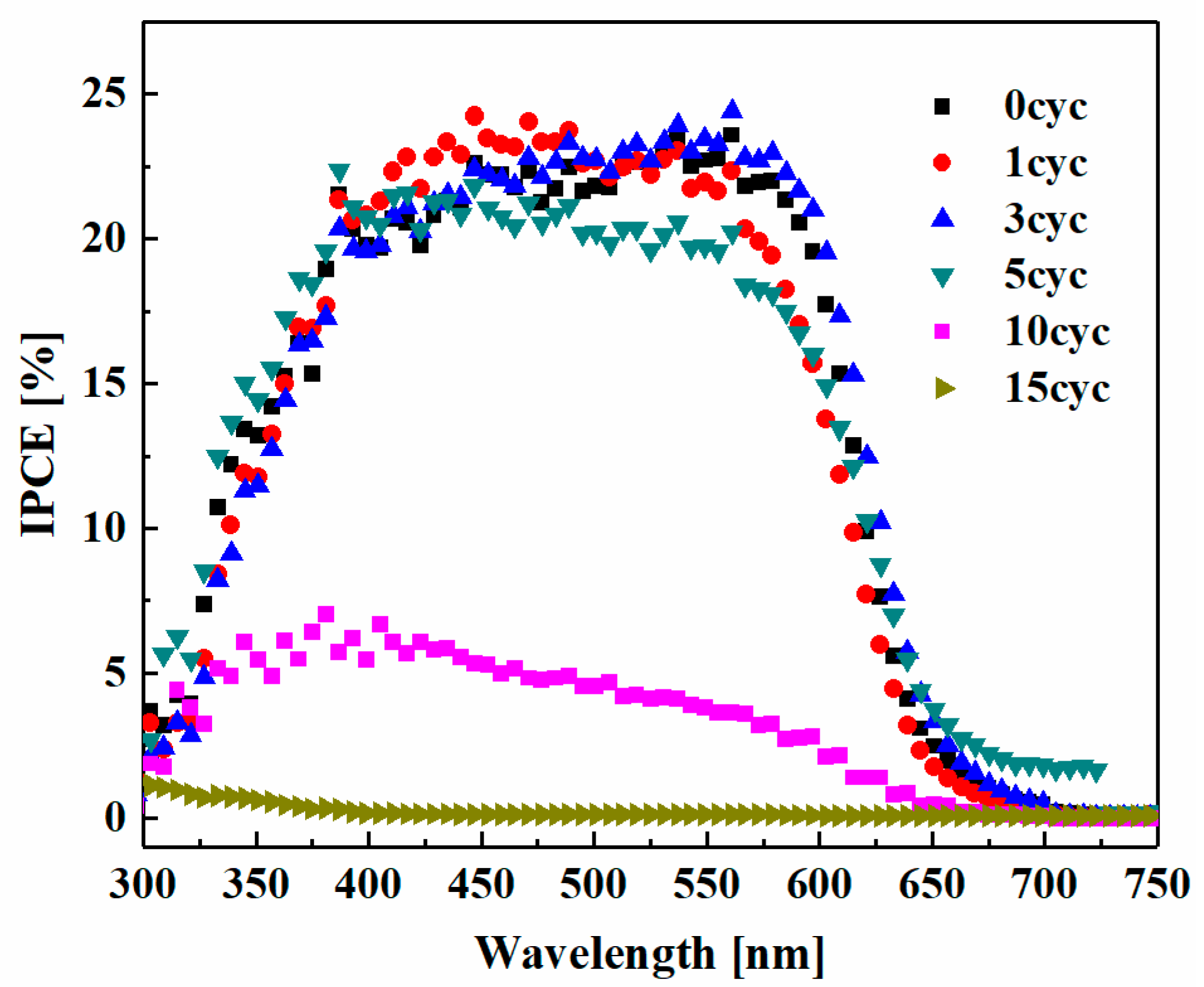
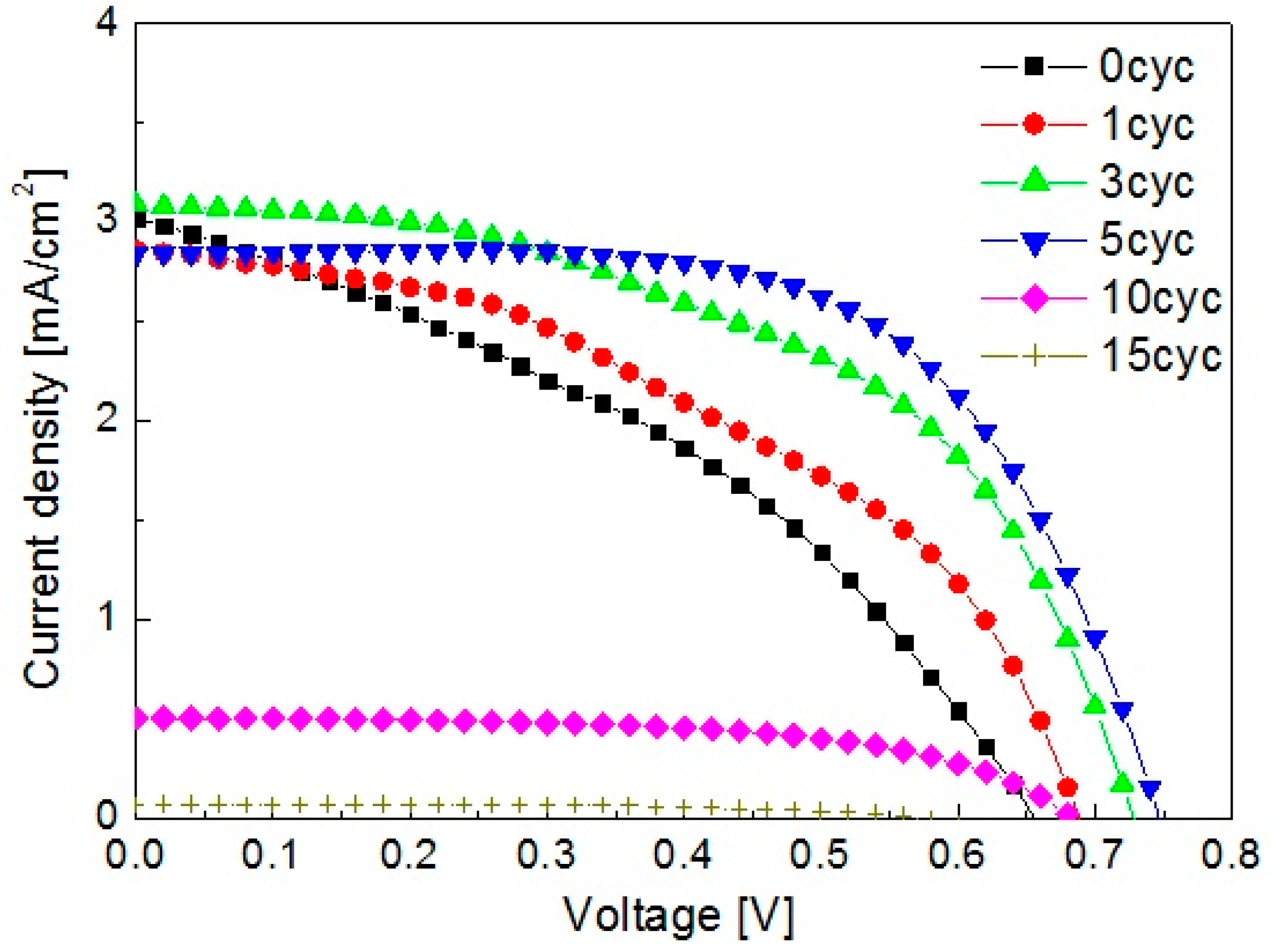
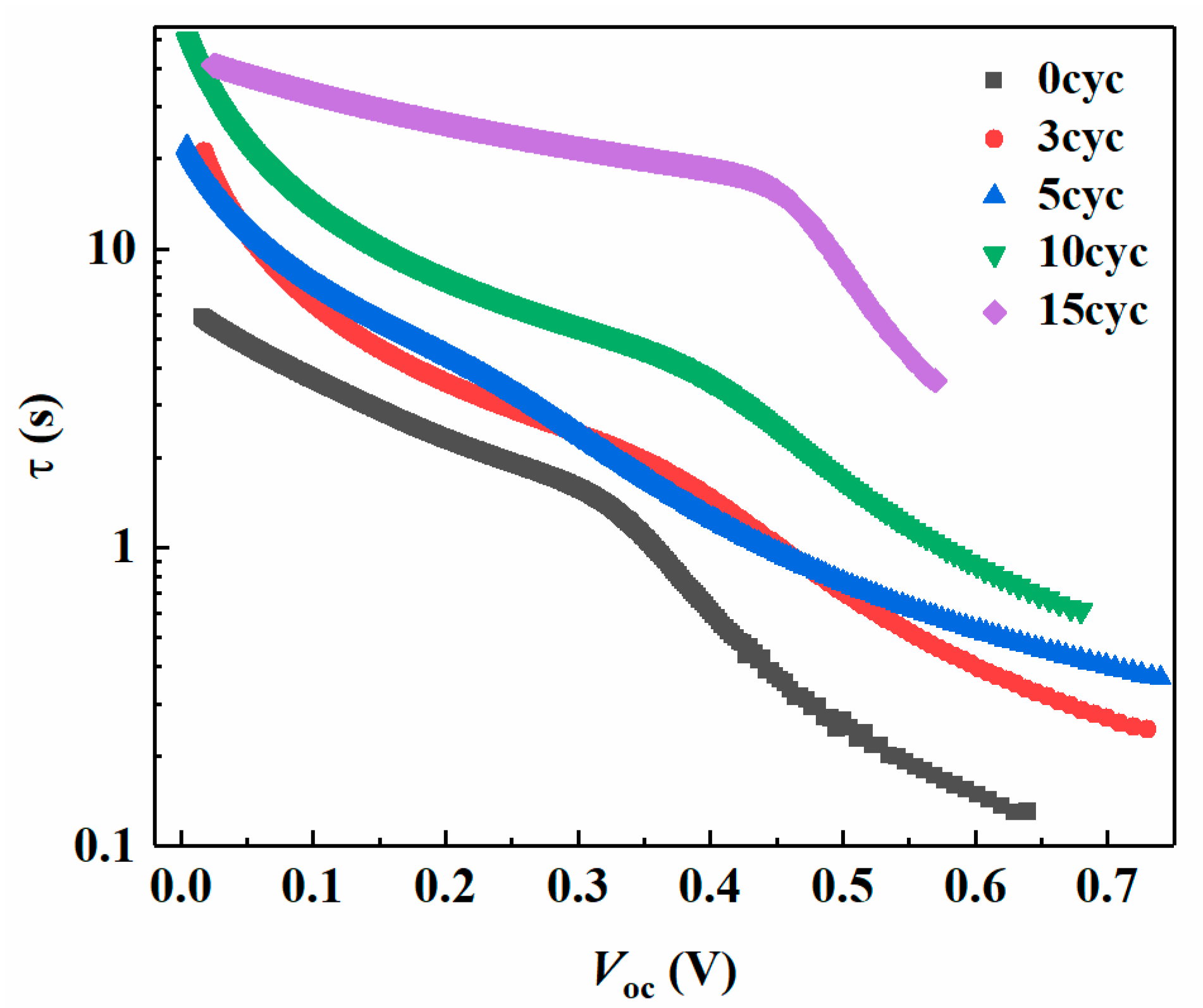

| ZnS Cycle | Jsc [mA/cm2] | Voc [V] | FF | η [%] |
|---|---|---|---|---|
| 0 | 3.0 ± 0.2 | 0.65 ± 0.01 | 0.37 ± 0.02 | 0.74 ± 0.02 |
| 1 | 2.9 ± 0.2 | 0.69 ± 0.02 | 0.44 ± 0.02 | 0.86 ± 0.05 |
| 3 | 3.1 ± 0.2 | 0.73 ± 0.01 | 0.52 ± 0.01 | 1.17 ± 0.03 |
| 5 | 2.8 ± 0.2 | 0.74 ± 0.01 | 0.63 ± 0.01 | 1.33 ± 0.03 |
| 10 | 0.5 ± 0.1 | 0.68 ± 0.02 | 0.58 ± 0.02 | 0.20 ± 0.04 |
| 15 | 0.1 ± 0.05 | 0.57 ± 0.03 | 0.57 ± 0.04 | 0.02 ± 0.01 |
© 2018 by the authors. Licensee MDPI, Basel, Switzerland. This article is an open access article distributed under the terms and conditions of the Creative Commons Attribution (CC BY) license (http://creativecommons.org/licenses/by/4.0/).
Share and Cite
Hori, K.; Zhang, Y.; Tusamalee, P.; Nakazawa, N.; Yoshihara, Y.; Wang, R.; Toyoda, T.; Hayase, S.; Shen, Q. Interface Passivation Effects on the Photovoltaic Performance of Quantum Dot Sensitized Inverse Opal TiO2 Solar Cells. Nanomaterials 2018, 8, 460. https://doi.org/10.3390/nano8070460
Hori K, Zhang Y, Tusamalee P, Nakazawa N, Yoshihara Y, Wang R, Toyoda T, Hayase S, Shen Q. Interface Passivation Effects on the Photovoltaic Performance of Quantum Dot Sensitized Inverse Opal TiO2 Solar Cells. Nanomaterials. 2018; 8(7):460. https://doi.org/10.3390/nano8070460
Chicago/Turabian StyleHori, Kanae, Yaohong Zhang, Pimsiri Tusamalee, Naoki Nakazawa, Yasuha Yoshihara, Ruixiang Wang, Taro Toyoda, Shuzi Hayase, and Qing Shen. 2018. "Interface Passivation Effects on the Photovoltaic Performance of Quantum Dot Sensitized Inverse Opal TiO2 Solar Cells" Nanomaterials 8, no. 7: 460. https://doi.org/10.3390/nano8070460
APA StyleHori, K., Zhang, Y., Tusamalee, P., Nakazawa, N., Yoshihara, Y., Wang, R., Toyoda, T., Hayase, S., & Shen, Q. (2018). Interface Passivation Effects on the Photovoltaic Performance of Quantum Dot Sensitized Inverse Opal TiO2 Solar Cells. Nanomaterials, 8(7), 460. https://doi.org/10.3390/nano8070460