Review

Catalyst Engineering for Photocatalytic Hydrogen Peroxide Production: State-of-the-Art Progress and Future Perspectives

Department of Materials Science and Engineering, College of Transportation Engineering, Dalian Maritime University, Dalian 116026, China
*
Author to whom correspondence should be addressed.
Nanomaterials 2026, 16(8), 466; https://doi.org/10.3390/nano16080466
Submission received: 20 March 2026 / Revised: 9 April 2026 / Accepted: 11 April 2026 / Published: 15 April 2026

Abstract

Hydrogen peroxide (H2O2) plays a vital role as an eco-friendly oxidizer, extensively used in environmental cleanup, energy transformation, and organic production. Nonetheless, the conventional method of creating anthraquinones is intricate, resulting in significant energy and ecological costs, which calls for the development of more eco-friendly and efficient substitute technologies. The article methodically examines the reaction processes and methods for improving efficiency in photocatalytic H2O2 generation in the past few years. This review summarizes the design principles and key structural features of various novel catalytic materials, focusing on light absorption, charge separation and migration, surface redox reactions, and enhanced mass transfer. Approaches such as expanding the range of bandgap absorption, building conjugated structures, and incorporating metal nanoclusters can significantly enhance the efficiency of light absorption. In the charge separation process, constructing built-in electric fields at the interfaces of heterojunctions, homojunctions, and Schottky junctions is crucial for improving reaction efficiency. Additionally, defect engineering may encourage targeted carrier movement and minimize recombination. The review highlights the latest advancements in enhancing selectivity and reducing H2O2 breakdown in surface redox reactions, achieved by regulating active sites, introducing new functional groups, and developing dual-channel reaction pathways. Furthermore, constructing three-phase interfaces, regulating asymmetric wettability, and designing cyclic/flow reactors provide innovative engineering solutions to address the challenges of insufficient oxygen supply and large-scale continuous production. Ultimately, the potential for producing H2O2 in photocatalytic systems is detailed.

1. Investigative Background

The main uses of hydrogen peroxide include its oxidation capabilities and eco-friendliness, and it is widely recognized as a good oxidizer. It is applied in the sanitizing and cleaning of wounds in the fields of health and hygiene. Hydrogen peroxide is applied in the industry for the bleaching of paper and textiles. In addition, in food engineering, it is applied for the bleaching of food products. Furthermore, in the field of environmental conservation, H2O2 has a major application in the treatment and disposal of wastewater. In the new generation of energy, H2O2 fuel cells allow electrochemical reactions to occur without the use of a catalyst. In the conventional proton exchange membrane fuel cell, H2O2 is an auxiliary agent. As an ideal cleaning oxidizing agent, H2O2 has a standard reduction potential as high as 1.8 V, which gives it extremely strong oxidizing power; moreover, its reaction product is merely water, so it does not cause secondary pollution. It is used as a green oxidizing agent in organic synthesis reactions and other applications [1].
The traditional method for synthesizing hydrogen peroxide involves the utilization of the anthraquinone process. During this transformation, 2-alkylanthraquinone reacts with hydrogen gas under the influence of a palladium-based catalyst, leading to the formation of 2-alkylanthrahydroquinone. The latter is then oxidized using oxygen to form hydrogen peroxide. The equation represents the overall reaction: H2 + O2 → H2O2 [2]. The autoxidation of anthraquinone is the most prominent technique to produce hydrogen peroxide, which offers many advantages, such as a high yield of H2O2 per cycle, relatively mild reaction conditions, and the possibility of continuous production. However, there remain significant inherent shortcomings. The total energy consumption for producing 1 tons of H2O2 is as high as 2.9–5.7 GJ, and the production of every 1 kg of H2O2 is accompanied by emissions of approximately 1.33 kg of carbon dioxide equivalent, resulting in annual CO2 emissions from this industry worldwide exceeding 2.8 Mt [3]. Empirical studies on life cycle assessment (LCA) have quantitatively demonstrated that the anthraquinone process accounts for over 95% of global hydrogen peroxide (H2O2) production. The hydrogenation step, due to its reliance on expensive platinum-group metal catalysts and its high thermal energy requirements, accounts for 22.2% of the process’s total Global Warming Potential (GWP); whereas catalyst loss, cooling water circulation and waste liquid treatment collectively contribute approximately 3.9% of the environmental impact, whilst also facing issues such as the need for solvents and hydrogenation catalysts, the occurrence of side reactions, the need to separate organic impurities to purify H2O2, and catalyst loss [4,5].
Conversely, the photocatalytic production of hydrogen peroxide employs semiconductor materials to absorb light energy, facilitating the catalytic reaction between oxygen and water to generate H2O2. This process typically involves three distinct stages: the absorption of light and generation of charge carriers, the separation and transfer of these charges, and finally, the surface redox reactions. The photocatalytic process exhibits distinct characteristics when compared to the anthraquinone auto-oxidation process, primarily due to its utilization of H2O and O2 as reactants, elimination of H2 or organic solvents, and reliance on solar energy as the driving force. The photocatalytic process represents a low-pollution methodology that avoids the release of any toxic or hazardous substances. The sole product generated, H2O2, aligns with the principles of green and sustainable environmental practices. This procedure can be performed at ambient temperature, thereby simplifying the operational complexity.
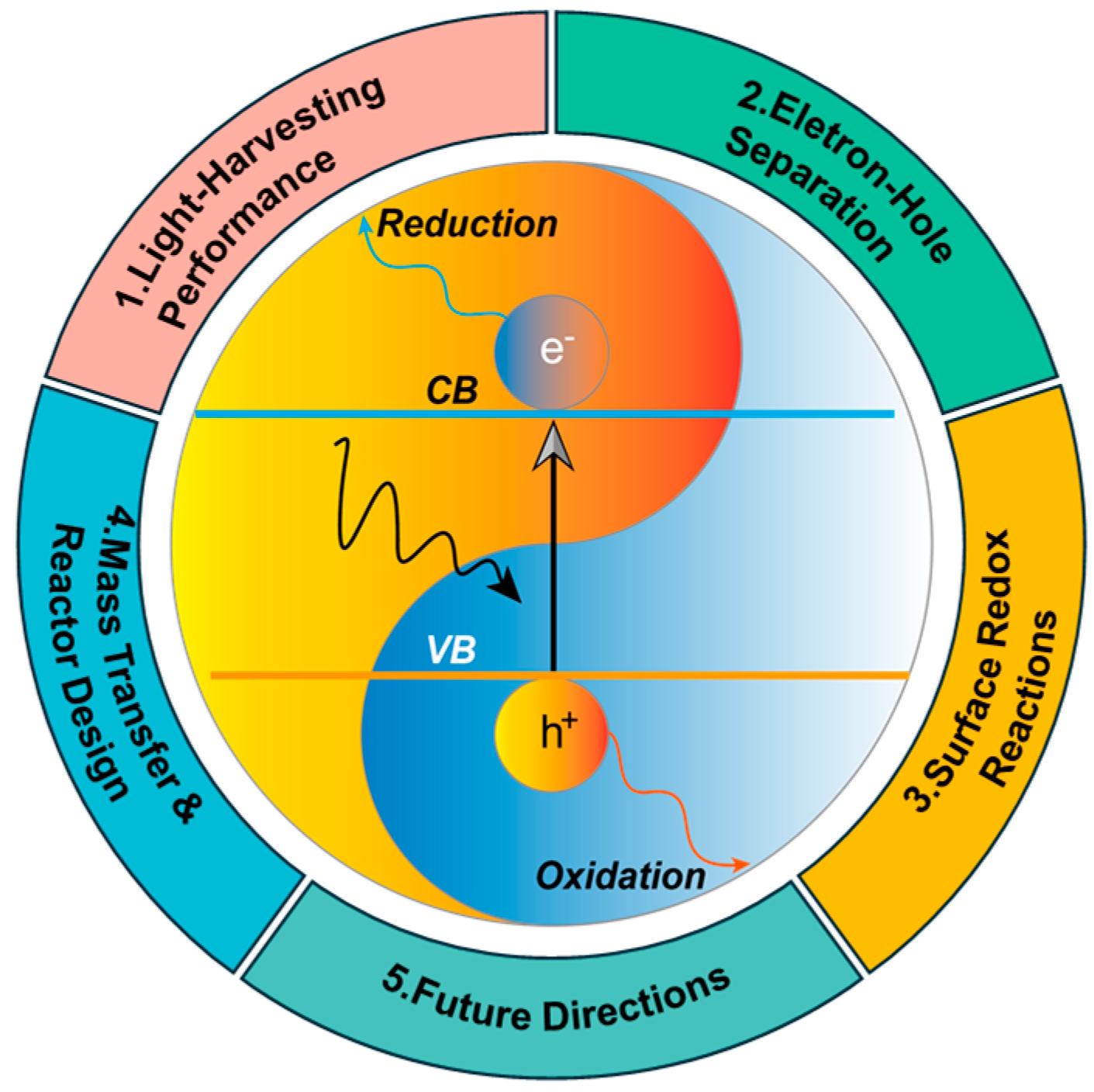
Nevertheless, the photocatalytic production of hydrogen peroxide still encounters numerous challenges and limitations. For example, most photocatalysts have a narrow range of absorption in the solar spectrum and therefore cannot effectively use sunlight for catalysis; charge carriers, such as electrons and holes, are difficult to separate due to their strong tendency to recombine; and there are problems such as instability in the photocatalysts and limited active sites. This paper is a summary of some recent literature on solutions to the problems described above. Scheme 1 shows that there are four types of solutions: those for improving light harvesting, for improving electron–hole pair separation, for improving redox reactions, and for reactor design. Suggestions for the promotion of photocatalysis are also included [6].

2. Mechanisms for Enhancing Photocatalytic Performance

Photocatalysts are well known to be crucial for the production of hydrogen peroxide, and new materials have shown promising results in the fabrication of photocatalysts [7]. The classification of new photocatalysts for the production of hydrogen peroxide is described in the following subsection.

2.1. Light Absorption and Charge Generation—Enhancing Light-Harvesting Performance

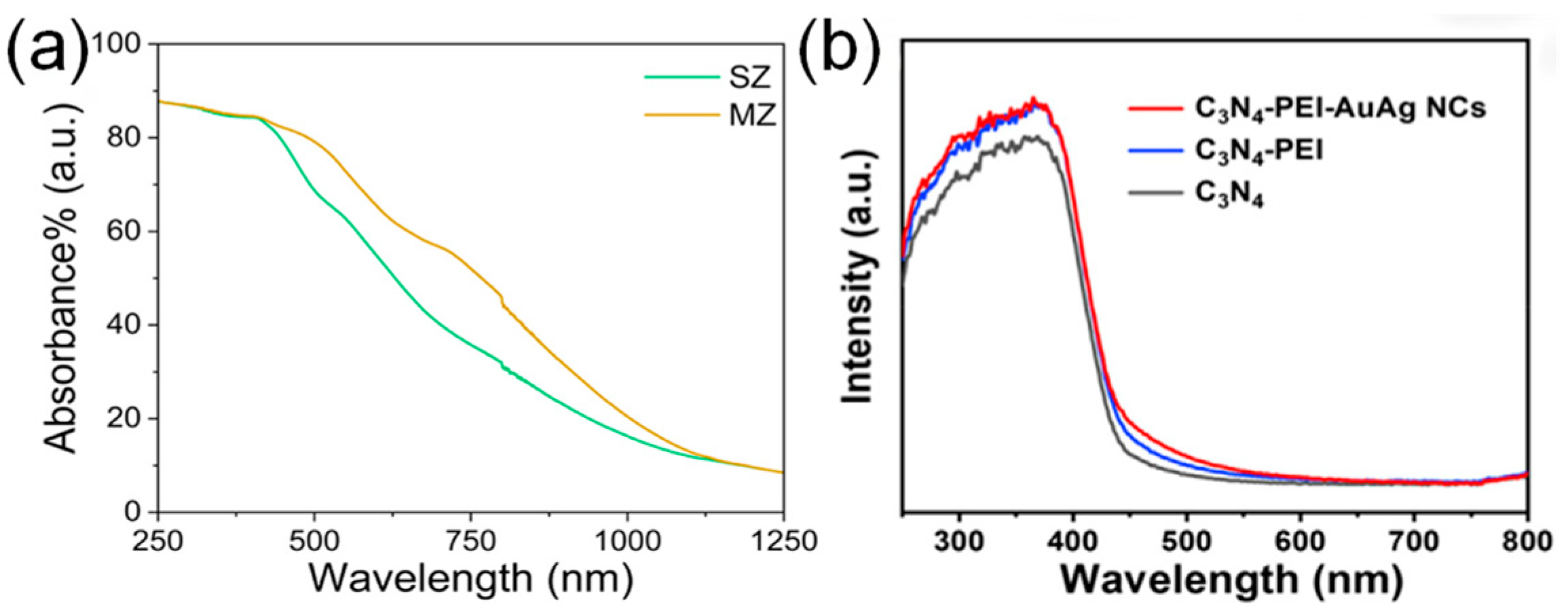
The first step in photocatalysis is photoexcitation, which emphasizes the significance of efficient light harvesting. Li et al. successfully synthesized benzothiazole (SZ)- and benzimidazole (MZ)-based porous organic polymers (POPs) using a one-step method at room temperature. By adopting a conjugated framework strategy and atomic-level electronic engineering, they were able to successfully broaden the light absorption range of POPs to cover the whole visible region. This breakthrough allowed SZ and MZ to reach H2O2 photocatalytic production rates of 3109 μmol g−1h−1 and 2700 μmol g−1h−1 in pure water, respectively, outperforming most of the currently reported POPs-based catalysts. From the analysis of the UV–Vis diffuse reflectance spectroscopy (DRS) spectra (Figure 1a), SZ has a light absorption range of 400–650 nm, while MZ has an absorption range of 400–620 nm. Both SZ and MZ have broader absorption ranges, which are 50–100 nm wider than those of amorphous POPs. With a wavelength of 500 nm, the SZ and MZ samples have absorptivities of 0.87 and 0.92, respectively, relative to a BaSO4 reference, which is 1.9 to 2.0 times higher than the absorptivity of POPs without conjugated structures (0.45) [8]. Although SZ and MZ exhibit excellent photocatalytic efficiency, their near-infrared light capture efficiency remains negligible. Zhen and colleagues achieved the chemical integration of luminescent gold-silver nanocrystals (AuAg-NCs), stabilized by glutathione (GSH) ligands, with polyethyleneimine (PEI)-functionalized C3N4 via a crosslinking approach utilizing 1-(3-dimethylaminopropyl)-3-ethylcarbodiimide hydrochloride (EDC) and N-hydroxysuccinimide (NHS). This step brings highly luminescent AuAg-NCs, which can improve the ability of C3N4 to absorb visible light. Figure 1b illustrates the UV–Vis–DRS analysis, indicating that the absorption cutoff wavelength for pristine g-C3N4 is 500 nm, whereas for C3N4-PEI-AuAg-NCs, it extends to 650 nm. The intensity of absorption within the range of 400–800 nm is increased by 2.3-fold, making it possible for C3N4-PEI-AuAg-NCs to expand the range of light absorption [9] and make full use of near-infrared light. Compared with the original C3N4 (23 μM), the concentration of H2O2 produced in pure water is increased by 3.5-fold to 82 μM. Metal nanoclusters exploit the quantum confinement effect to transform metals from simple plasmonic absorbers into molecular-like absorbers capable of multiple discrete energy level transitions. This not only overcomes the bandgap limitations of semiconductors but also significantly enhances absorption intensity in the visible light region through the ligand-to-metal charge transfer (LMCT) effect and excellent interfacial charge transfer capabilities [10].
However, improvements in photostability are necessary. Another example is the inter-resorcinol-formaldehyde resin/carbon-supported Ta-N2O single-atom catalyst (RF/C-TaSA), which can capture a broad spectrum of light up to >932 nm [11]. By precisely controlling the ratio of two aldehyde monomers, toluene-2,5-dicarboxaldehyde (TA) and 2,5-bis(thien-2-yl)-toluene-2,5-dicarboxaldehyde (DTTA), and reacting them with 2,4,6-trimethyl-1,3,5-triazine (TMT), a high-performance TA/DTTA-2-TMT photocatalyst was developed. Under the optimal ratio conditions, the TA/DTTA-2-TMT photocatalyst exhibited a H2O2 generation rate of 3451 μmol g−1h−1 in pure water, ambient air, and under 100 mW cm−2 illumination. The integration of DTTA units substantially extended the material’s light absorption spectrum. This ratio-controlled preparation method presents a novel approach for synthesizing photocatalysts [12].

2.2. Electron–Hole Separation

During the catalytic formation of H2O2, it is imperative for electrons (e) and holes (h+) to transfer to the catalyst’s surface, thereby participating in the catalytic reaction. However, in the process, there are high possibilities of recombination of the photo-generated electrons and holes either in the bulk or at the surface, which causes a reduction in the efficiency of charge separation in the conventional materials [13].

2.2.1. Enhancing the Built-In Electric Field

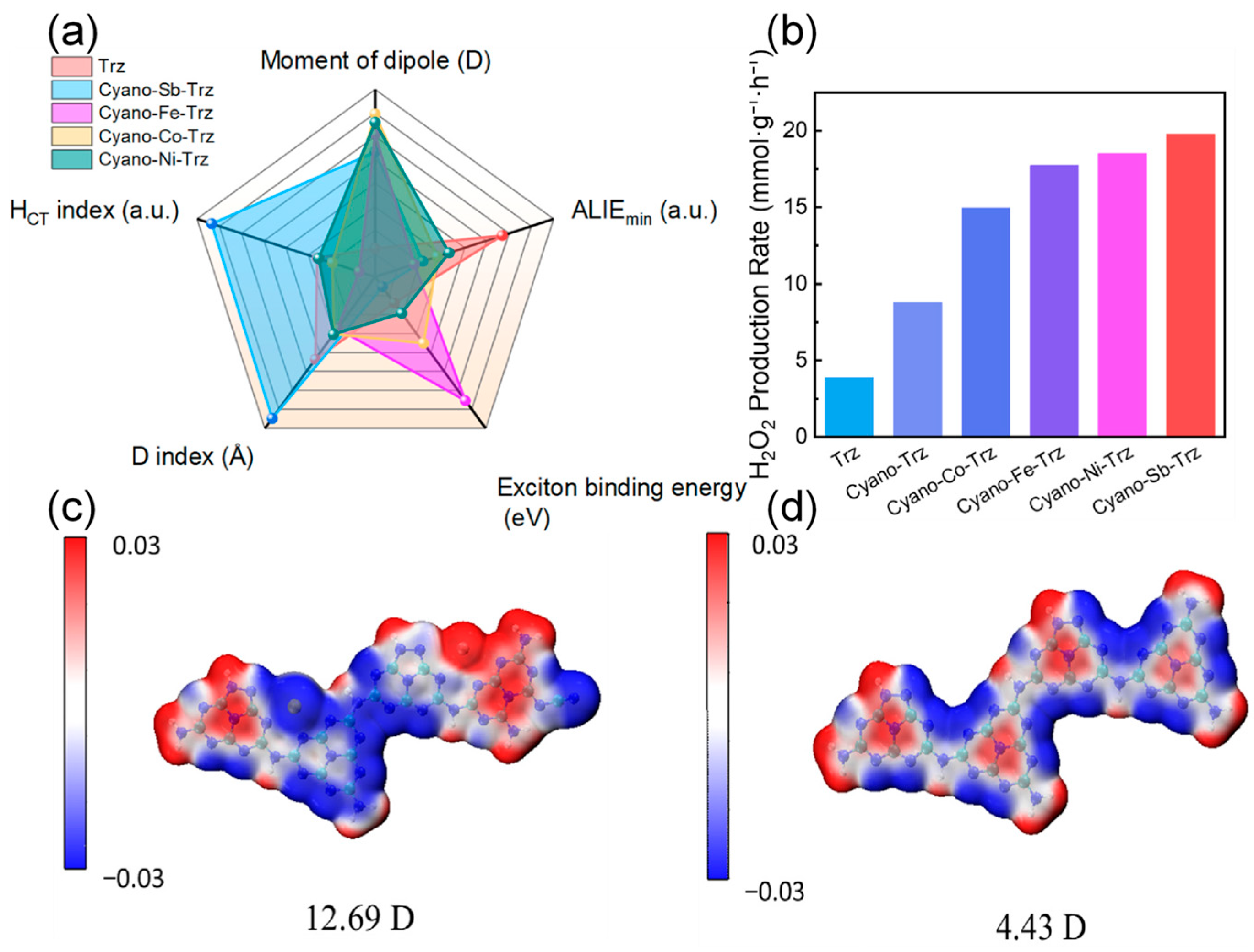
A critical issue in photocatalysis lies in the rapid recombination of photoexcited charge carriers, specifically electron–hole pairs. The inherent electric field serves as a crucial mechanism to address this challenge, efficiently directing the movement of charge carriers through a self-organized potential difference [14]. Multidimensional electronic structure parameters obtained from density functional theory (DFT) calculations reveal the mechanism by which co-doping with cyano and metal modifies the carrier behavior in carbon nitride. The modification strategy involving co-doping of the cyano group with Sb and K elements can effectively regulate key parameters of the material, including the molecular dipole moment, exciton binding energy, average local ionization energy, electron–hole centroid distance, and H indexes of charge transfer. As shown in Figure 2a, compared with the Trz, the molecular dipole moment of Cyano-Sb-Trz is significantly enhanced, the exciton binding energy is substantially reduced, whilst the electron–hole centroid distance increases significantly and H indexes of charge transfer rises markedly. This fundamentally lowers the dissociation energy barrier of photo-generated excitons and enhances the driving effect of the intramolecular electric field, providing an intrinsic structural basis for suppressing carrier recombination and improving carrier mobility. The results of the molecular electrostatic potential distribution calculations further clarify the structural essence of the directional migration and spatial separation of photo-generated carriers. As shown in Figure 2c, the Cyano-Sb-Trz material, modified by co-doping with Sb and K and cyano groups, exhibits significant spatial charge polarization: The cyano groups and Sb elements act as strong electron-withdrawing sites, causing electrons to accumulate in their vicinity, whilst holes concentrate near the K sites. This successfully constructs spatially separated redox active sites, providing sufficient driving force for the directional and rapid migration of photo-generated carriers, thereby effectively suppressing carrier recombination.
In stark contrast, as shown in Figure 2d, the unmodified pristine Trz material exhibits a uniform molecular charge distribution with no distinct regions of positive or negative potential polarization, and is thus unable to generate an effective driving force for carrier migration. The electron–hole pairs generated by photoexcitation readily recombine within the bulk phase, making it difficult to form effective carriers capable of participating in surface catalytic reactions; this is the primary reason for its extremely low intrinsic photocatalytic activity. Under simulated visible light irradiation (λ > 420 nm), catalysts modified with various metal dopants all demonstrated an improvement in H2O2 production performance compared to the Trz-based material. As shown in Figure 2b, the H2O2 yield of the pristine Trz is only 3.8 mmol g−1h−1, whereas the yield of the cyano-functionalized Cyano-Trz increases to 8.8 mmol g−1h−1, demonstrating the key promotional effect of cyano group introduction on photocatalytic performance. Among these, the Sb-doped Cyano-Sb-Trz exhibited the optimal catalytic performance, with an H2O2 yield reaching 19.8 mmol g−1h−1, which is 5.2 times and 2.6 times that of Trz and Cyano-Trz, respectively, and outperformed other metal-doped reference samples such as Co, Fe and Ni, demonstrating that Sb doping has the most significant effect on enhancing the photocatalytic H2O2 production performance of Trz-based materials. To further achieve the aforementioned highly efficient charge separation, the researchers developed various macrostructural strategies, such as the creation of built-in electric fields and defect engineering, in addition to micro-scale intrinsic regulation [15].
The external power source is not involved in the creation of this inherent electric field. It is created by space charge layers due to p-n junctions, Schottky barriers, heterojunctions, or defects. It improves the photocatalytic efficiency in the following ways: it overcomes the Coulomb forces between carriers through directed electrostatic forces, efficiently promoting their separation to reduce recombination; it promotes the carrier transport from the interior of the catalyst to the surface based on the electric potential gradient, thus lowering the reaction resistance; it can also steer the carriers to desired reactions by designing the electric potential direction and magnitude to improve selectivity; it decreases the reaction’s activation energy through the polarization of reactant molecules and the enhancement of interfacial charge density [16]. In conclusion, the internal electric field plays an effective role in overcoming the bottlenecks of photocatalysis in the entire process, from carrier separation to transport and reaction. The internal electric field is a key route for improving the efficiency of water splitting reactions for hydrogen evolution and CO2 reduction.
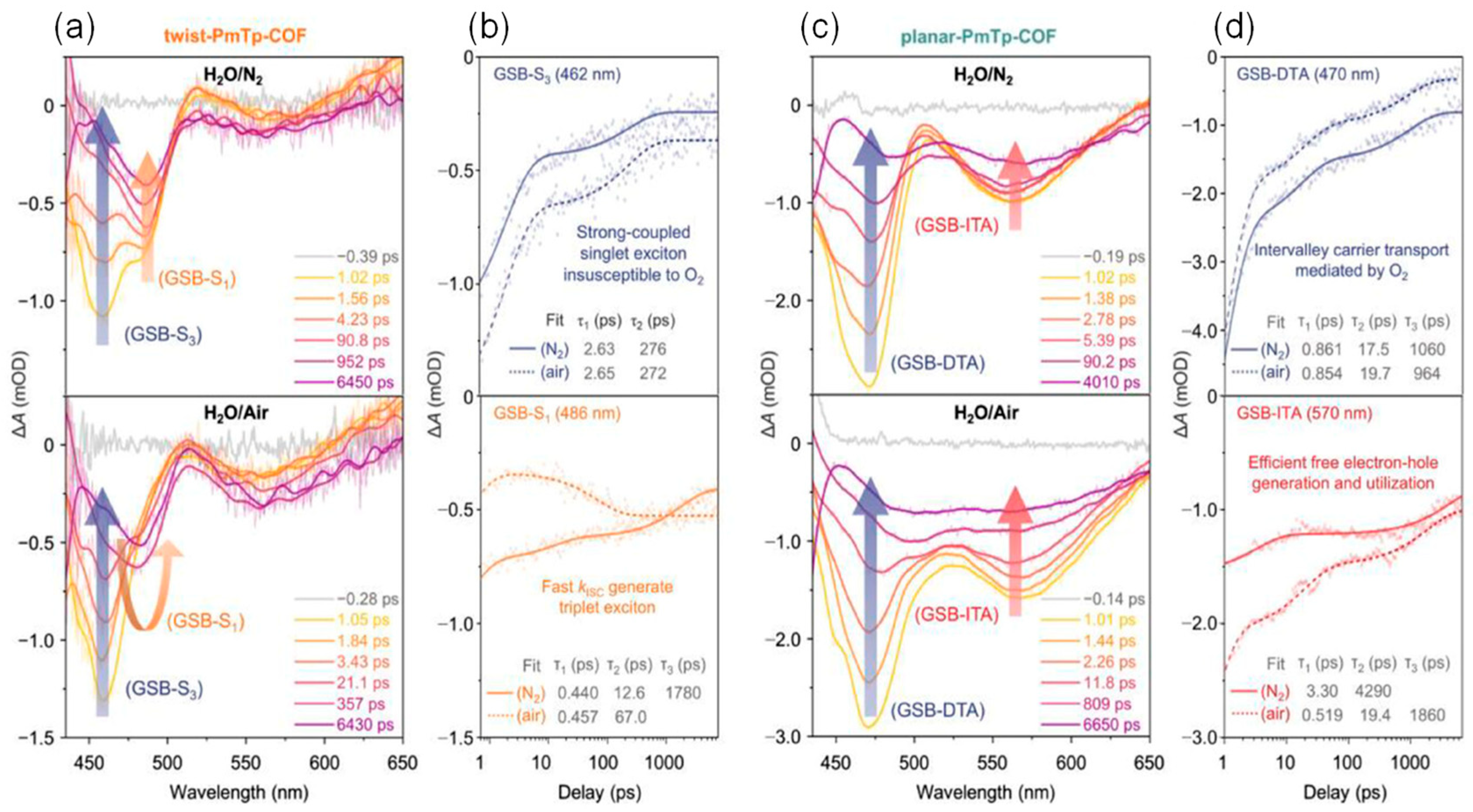
When studying built-in electric fields, the quantitative calculation and intuitive characterization of their intensity are key to elucidating charge transport mechanisms. Currently, researchers typically combine experimental observations with theoretical calculations to assess the intensity of built-in electric fields. The built-in electric field can be calculated using the formula E k δ V , which indicates that the strength of the built-in electric field is proportional to the surface charge density multiplied by the square root of the surface potential. The surface potential can be measured using a Kelvin probe force microscope [17]. Furthermore, transient absorption spectroscopy (TAS) and time-resolved photoluminescence spectroscopy (TRPL) enable the intuitive and quantitative tracking of the relaxation, transfer processes and lifetimes of excited-state electrons and holes. In recent years, researchers have extensively utilized these dynamic characterization techniques to demonstrate the role of structural design in promoting charge dynamics. For example, by comparing two covalent organic frameworks (COFs) with different topological structures, the differences in exciton evolution pathways can be clearly revealed. In the fs-TAS spectrum (Figure 3c) and kinetic decay curve (Figure 3d) of the planar configuration (planar-PmTp-COF), the photogenerated carriers exhibit extremely rapid recombination, with an average lifetime t of merely 0.861 ps. In contrast, the twist-PmTp-COF, constructed via topological regulation, exhibits distinct signal evolution in the spectrum (Figure 3a), and its kinetic curve (Figure 3b) confirms an extremely rapid intersystem crossing (ISC) process. This process enables the material to efficiently generate long-lived triplet excitons with lifetimes as high as 3830 ps, representing an improvement of several thousand times over planar structures. This extension of lifetimes on the picosecond to nanosecond scale provides an ample supply of long-lived active charges for the photolysis of H2O2, offering a kinetic explanation for the significant enhancement in catalytic performance [18].
Hence, creating and enhancing an intrinsic electric field offers a promising approach for improving the catalytic efficiency of our catalyst. We have reviewed some of the latest methods for enhancing built-in electric fields and have categorized them into the following three types.
(1)
Constructing a heterojunction:
A heterojunction is a semiconductor material structure created through the interface bonding of two or more semiconductor materials that have different compositions, crystal structures, or phases. The basic principle of a heterojunction is based on taking advantage of the differences in the electronic structures of the materials on both sides of the interface to create the force for charge transfer [19].
Its primary role is to promote charge separation upon illumination. Upon photoexcitation of a single semiconductor material, valence band electrons transition to the conduction band, thereby generating electron–hole pairs simultaneously. The creation of a heterojunction leads to the formation of an energy level gradient and an internal electric field, which disturbs the equilibrium of randomly distributed charges. This facilitates the directional separation of electrons (e) and holes (h+). Furthermore, the formation of a heterojunction structure significantly improves the stability of photocatalytic materials, thereby effectively addressing the stability challenges often encountered in photocatalysts primarily designed for enhanced light absorption efficiency [20].
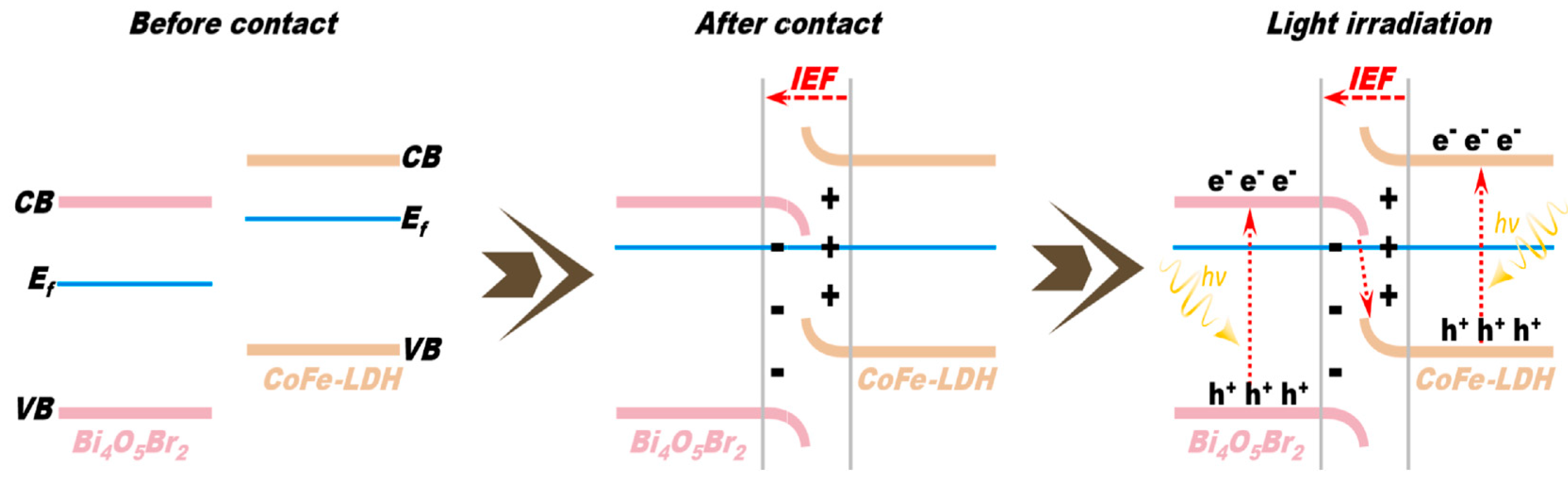
As a typical type of heterojunction, the S-type heterojunction further optimizes this core mechanism: the built-in electric field not only achieves directional separation of charge carriers but also promotes the selective recombination of low-energy charge carriers in both semiconductors, retaining only high-energy electrons and holes with strong redox capabilities, thereby balancing separation efficiency and catalytic activity. Figure 4 illustrates this mechanism using CoFe-LDH/Bi4O5Br2 as an example: prior to contact, the Fermi levels and band structures of CoFe-LDH (work function 1.36 eV) and Bi4O5Br2 (work function 5.51 eV) are misaligned. Following contact, electrons migrate from CoFe-LDH to Bi4O5Br2, creating an intrinsic electric field directed from CoFe-LDH towards Bi4O5Br2; Under illumination, this electric field drives the recombination of low-energy electrons in the conduction band of Bi4O5Br2 with low-energy holes in the valence band of CoFe-LDH, whilst allowing high-energy electrons in the conduction band of CoFe-LDH and high-energy holes in the valence band of Bi4O5Br2 to participate in the reaction, thereby clearly revealing the core operational logic of the S-type heterojunction [21].
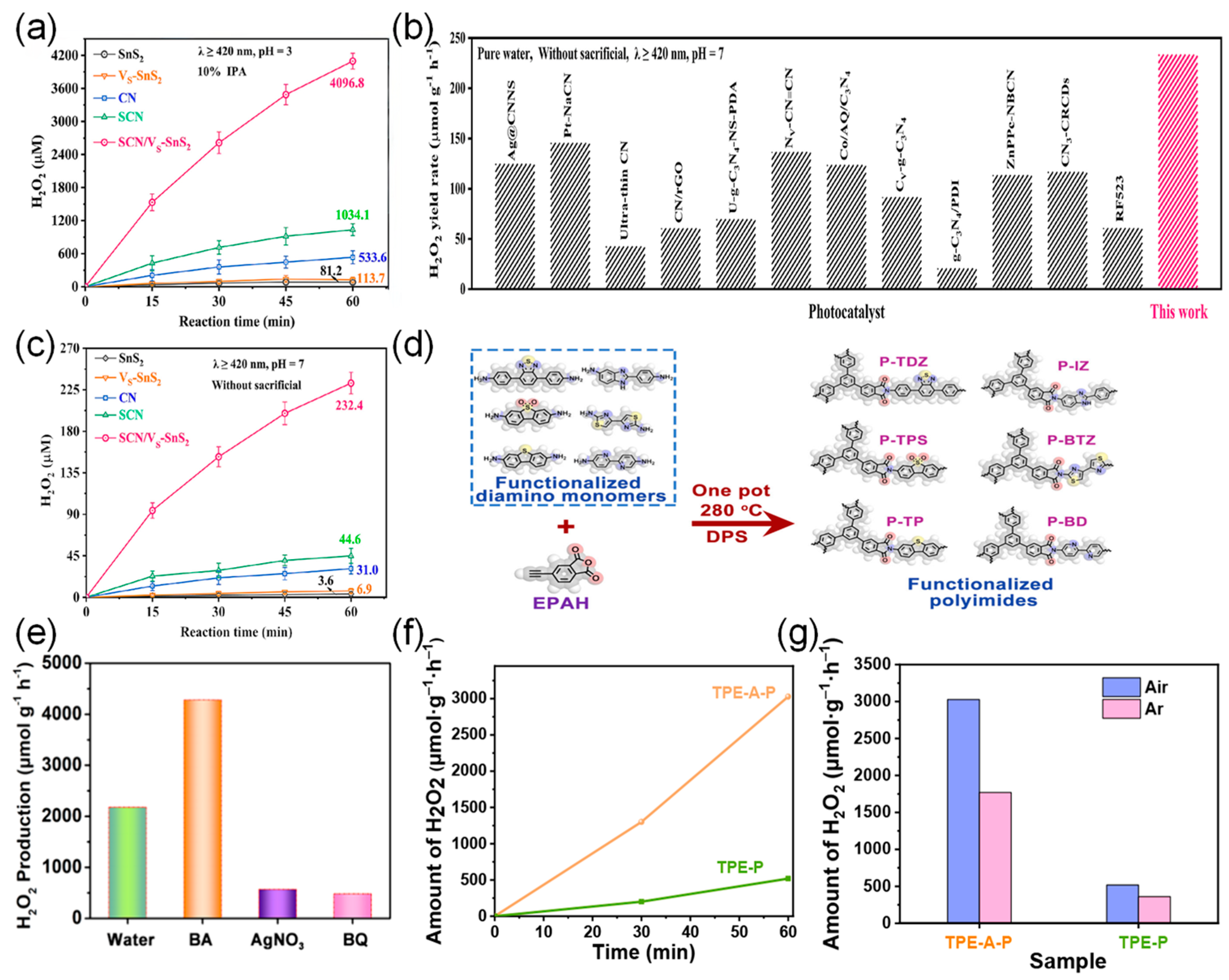
Lang et al. successfully fabricated 2D/2D SCN/VS-SnS2 heterojunctions via a one-step chemical vapor deposition process, taking advantage of the similar growth temperatures of sulfur-doped carbon nitride and sulfur vacancies (VS-SnS2), which are between 350 and 500 °C. As illustrated in Figure 5a, the sacrificial agent isopropanol (IPA) facilitated the generation of approximately 4096.8 μmol of H2O2. The data presented in Figure 5b demonstrate that the SCN/VS-SnS2 heterojunction exhibits remarkable photocatalytic performance when contrasted with the majority of previously documented photocatalytic materials [22,23,24,25,26,27,28,29,30,31,32,33]. Nevertheless, in the scenario of pure water devoid of sacrificial agents, as illustrated in Figure 5c, the production of H2O2 is confined to a mere 232.4 μmol. This limitation poses significant challenges for eliminating sacrificial agents in practical applications [34]. Thus, minimizing the use of sacrificial agents via heterojunction engineering reduces the need for conventional, highly toxic sacrificial agents, such as methanol and isopropanol, and instead uses low-toxicity biodegradable co-reactants when necessary. A strategy that seeks to harmonize catalytic performance with environmental needs is a promising area of research. Xiong et al. prepared microporous polyimides (MPIs) with donor-acceptor (D-A) architecture through domino polymerization. Enhancements in the solvothermal method enable the preparation of a set of MPIs with diverse functional groups in only 0.5 h. The schematic diagram of MPIs with various functional units synthesized by domino polymerization is shown in Figure 5d. Of these, the thiazole-containing MPI (P-TDZ) has very strong visible light absorption and separation abilities due to its D-A structure. The curve presented in Figure 5e illustrates that, with the facilitation of phenylacetone, the H2O2 generation rate of P-TDZ attains 4280 μmol g−1h−1. It is noteworthy that, even without the presence of a sacrificial agent, a H2O2 production rate of 2177 μmol g−1h−1 can still be attained [35]. The structure of this catalyst reduces the dependence on sacrificial agents, thus improving its environmental sustainability. In a similar study, Liu et al. synthesized an organic polymer named terpolymer TPE-A-P, which has a donor–bridge–acceptor (D-B-A) structure similar to that of the donor-acceptor (D-A) structure. Through the Sonogashira-Hagihara coupling reaction involving tetraphenyl ethylene (TPE) as the electron donor, acetylene (A) serving as the linker, and pyrene (P) acting as the electron acceptor, the D-B-A molecular strategy with redox activity significantly reduces the exciton binding energy of the photocatalyst. This reduction effectively suppresses the recombination process between photogenerated holes and electrons. As shown in Figure 5f, the photocatalytic H2O2 production rate of TPE-A-P is 3028 μmol g−1h−1. As illustrated in Figure 5g, remarkably, even under anaerobic conditions, TPE-A-P still exhibits over 50% H2O2-generating activity [36].
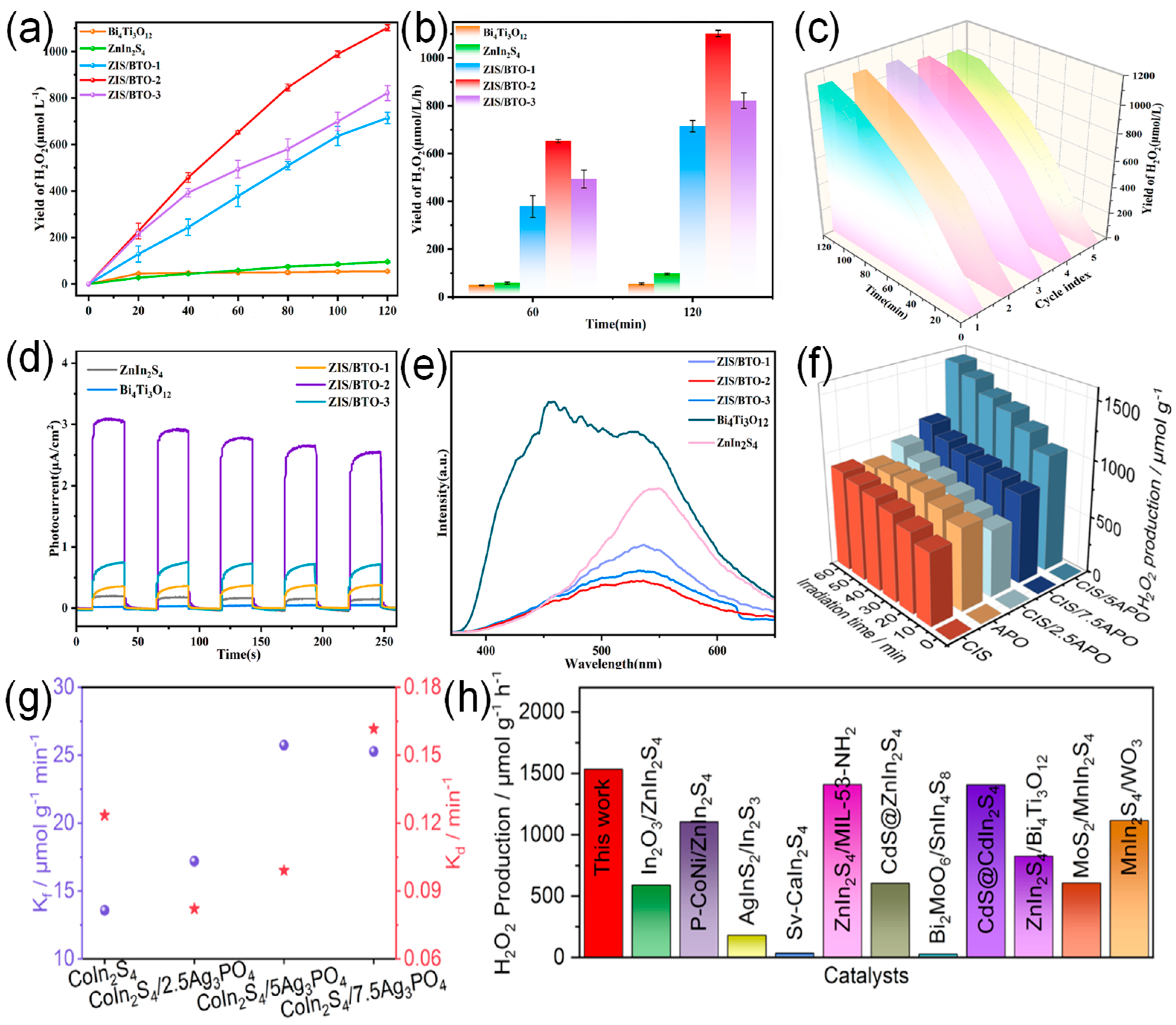
Hong et al. synthesized a Zn In2S4/Bi4Ti3O12 (ZIS/BTO) composite photocatalyst by growing ZnIn2S4 on Bi4Ti3O12 nanosheets. This catalyst efficiently generates H2O2 from water and oxygen through the oxygen reduction reaction (ORR) and oxygen evolution reaction (OER) pathways. As illustrated in Figure 6a,b, the H2O2 yield reached 1102 μmol L−1 in a 10% ethanol solution. Notably, ethanol did not act as a conventional sacrificial agent, and ZIS/BTO demonstrated exceptional stability, maintaining a yield exceeding 1000 μmol L−1 after five operational cycles (Figure 6c). The heterojunction of BiOCl/COF(TFPB-BPY)-S was successfully fabricated via a facile in situ growth approach. When the mass fraction of BiOCl in the composite was modified to 20%, referred to as the 20BTB composite, its peak photocatalytic output reached 4088.46 μmol g−1h−1, as illustrated in Figure 6d,e. This value represents an enhancement of 2.8-fold compared to COF and a significant increase of 19.2-fold relative to pure BiOCl [37]. Each of these structures is based on an S-type charge transfer process. By controlling the band gap and work function differences between the two components, they build an interleaved band structure, which is described as an “oxidation-type semiconductor-reduction-type semiconductor.” The S-type heterojunction structure is used to overcome the shortcomings of the individual materials. The “in situ growth” approach is used to build a tight interface. This approach establishes charge transfer pathways, thereby promoting the separation of photo-generated carriers. Nevertheless, with the increase in BiOCl content within the composite, the generation of H2O2 experiences an initial rise followed by a subsequent decrease. This reduction could be ascribed to enhanced light attenuation, obstruction of active sites, and restrained charge carrier transfer due to material aggregation, which ultimately impairs photocatalytic performance. Similarly, Zhen et al. employed CoIn2S4 (ECB ~ −0.893 eV, EVB ~ 0.523 eV) and Ag3PO4 (ECB ~ −0.227 eV, EVB ~ 2.453 eV) with band structures favorable for H2O2 production to construct a heterojunction for the CoIn2S4/Ag3PO4-S system. Through band structure modification, they optimized the heterojunction and obtained a H2O2 yield of 1534.78 μmol g−1. As shown in Figure 6f,g, without a sacrificial agent, the H2O2 yield of CoIn2S4 was 828.84 μmol g−1. Nevertheless, an overabundance of Ag3PO4 similarly resulted in a decline in H2O2 production (Figure 6h) [38].
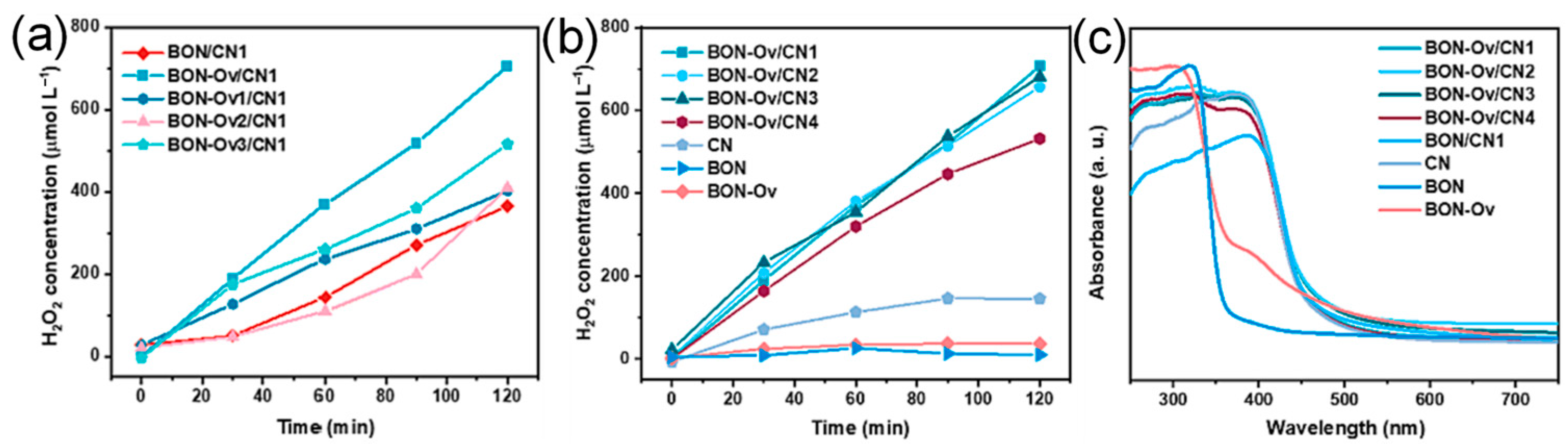
Another method that can be employed to improve charge transfer at the heterojunction interface is based on the regulation of the vacancy-induced internal electric field (IEF). The methodology employs a composite material comprising g-C3N4 and Bi2O3(NO)3(OH), which is modified with oxygen vacancies (Ovs), referred to as BON-Ov/CN. As illustrated in Figure 7a,b, the composite material exhibits a photocatalytic H2O2 production efficiency of 706.2 μmol L−1. Moreover, an efficient approach to improve the utilization of visible light enables BON-Ov to show strong tailing absorption. As shown in Figure 7c, the light absorption range of BON-Ov is extended to 520 nm [39].
In the most recent studies on heterojunctions, a titanium-based metal-organic framework (MOF) and sodium-doped carbon nitride has been synthesized as an S-type heterojunction photocatalyst. The composite material shows improved charge separation efficiency by incorporating Na-CN with strong redox capabilities [40]. The modification of MgIn2S4 nanosheets onto hollow spherical carbon-based organic frameworks (COFs) to construct MgIn2S4/COF (MC) S-type heterojunctions facilitates the simultaneous occurrence of continuous 2e O2 reduction and 4e H2O oxidation [41]. In addition, the COF/COF II heterojunction TpPa/TpDz shows a near-complete spatial separation of the highest occupied molecular orbitals (HOMO) and lowest unoccupied molecular orbitals (LUMO), facilitating the directional transport of the photoexcited carriers [42]. Furthermore, the Z-scheme heterojunction, formed through the integration of I/K+ doped g-C3N4 with the metal-organic framework NH2-UiO-66, exhibits superior catalytic performance for O2 reduction to H2O2 while significantly enhancing the selectivity of the 2e ORR [43,44].
(2)
Forming a Schottky junction:
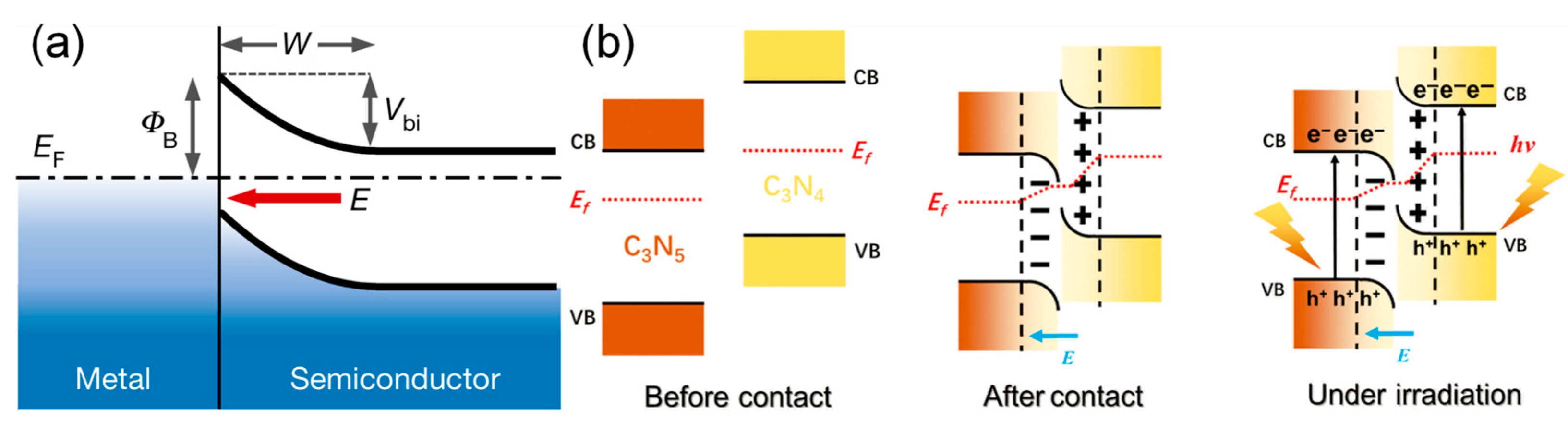
Schottky junction represents a structure of the metal–semiconductor interface with close contact between the metal and the semiconductor, having unidirectional conductivity (rectifying) properties. The essence of the junction is the Schottky barrier. The Schottky barrier represents an interfacial potential barrier that governs the flow of charge carriers, thereby differentiating it from Ohmic contacts, which are non-rectifying metal–semiconductor junctions [45]. From a basic point of view, the main difference between metals and semiconductors is based on their Fermi levels. Metals have a relatively high concentration of free electrons, and their Fermi level is usually below that of n-type semiconductors, where electrons are the majority carriers and the Fermi level is close to the conduction band [46]. When two materials are brought close together without much impurity or defect at the interface, electrons tend to move spontaneously from the conduction band of the n-type semiconductor, with a higher Fermi level, to the metal, which has a lower Fermi level. As a result of the movement of electrons, the semiconductor loses electrons, leading to a positive charge on the donor ions and the creation of a weak ‘space charge region’ or depletion region. On the other hand, the metal gains electrons and becomes negatively charged. The interface between the semiconductor and the metal exhibits an intrinsic electric field, which arises from the spatial separation of positive and negative charge regions and is directed toward the metallic side. The subsequent electron flow is impeded by this electric field. Finally, diffusion and repulsion forces reach a state of equilibrium, creating a stable energy barrier at the junction, which is called the Schottky barrier. The magnitude of the Schottky barrier is primarily determined by the metal’s work function, which represents the energy required to extract an electron from the metal, as well as the semiconductor material’s electron affinity. For n-type semiconductors, the barrier height is approximately equal to the metal’s work function minus the semiconductor’s electron affinity. Figure 8a visually illustrates the spatial distribution of the aforementioned core elements (depletion region, Fermi level, barrier, built-in electric field and potential), clearly revealing the core mechanism of the Schottky junction from contact to equilibrium [47].
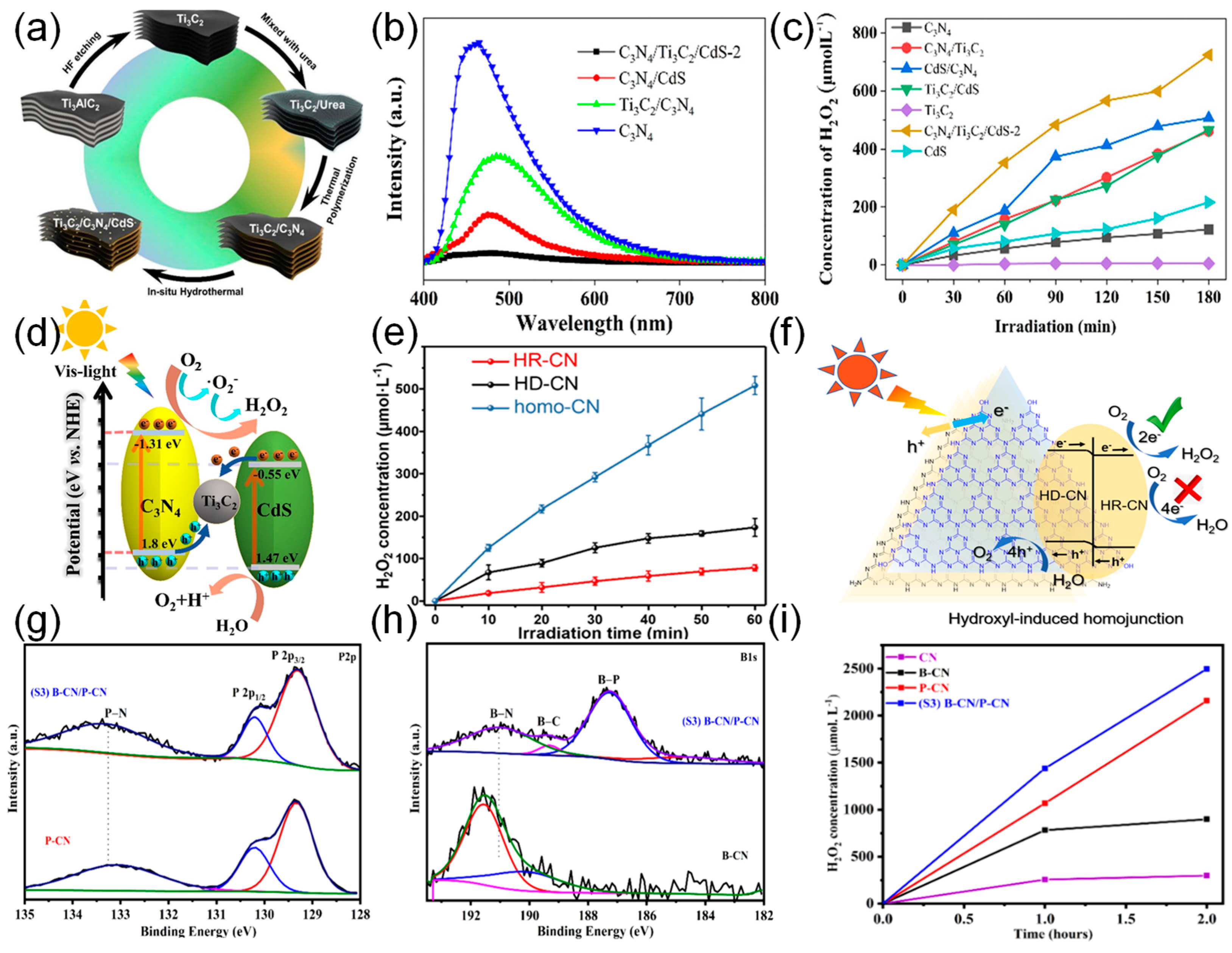
C3N4/Ti3C2/CdS was prepared using the process shown in Figure 9a. When the mass ratio of CdS to C3N4/Ti3C2 was 1 wt%, 2 wt%, they were designated as C3N4/Ti3C2/CdS-1, C3N4/Ti3C2/CdS-2, and C3N4/Ti3C2/CdS-3, respectively. In this ternary material, the addition of Ti3C2, C3N4, and CdS enables the formation of a double Schottky junction structure, which enhances the H2O2 production rate. Under visible light irradiation, the H2O2 production rate reaches as high as 256 mmol L−1h−1, as shown in Figure 9b. Among these, C3N4/Ti3C2/CdS-2 exhibits the lowest fluorescence peak intensity, while Figure 9c indicates that it has the highest photoelectron transfer efficiency. Throughout the photocatalytic system, the transfer of photogenerated carriers follows a Z-shaped transfer path, which facilitates the effective spatial separation of photogenerated electrons and holes. Figure 9d illustrates the photocatalytic mechanism of C3N4/Ti3C2/CdS [48].
Figure 8. (a) Schematic of a Schottky junction showing the potential variation in the depletion region, where EF is the Fermi level, ΦB is the barrier height, Vbi is the built-in potential, W is the depletion region and E denotes the electric field [47]. Copyright 2020, Springer Nature Limited. (b) Formation of the CNHJ S-scheme heterojunction and the proposed charge transfer and separation mechanism [49]. Copyright 2025, John Wiley & Sons, Ltd.
Nanomaterials 16 00466 g008
(3)
Forming a Homogeneous Junction:
Homojunction: A P-type junction created by doping the same semiconductor material with different dopants to form P-type and N-type regions is known as a homojunction. The main principle of a homojunction is based on the interaction between the diffusion of carriers and electric fields. At equilibrium, the variation in charge carrier concentration between the P-type and N-type regions induces electron diffusion from the N-type region towards the P-type region. On the other hand, holes diffuse from the P-type region to the N-type region. Following recombination, stationary positive and negative ions remain on either side of the interface, forming depletion zones that generate an intrinsic electric field directed from the N-type to the P-type region. This intrinsic electric field inhibits the diffusion of majority carriers while simultaneously facilitating the movement of minority carriers (electrons in P-type and holes in N-type) towards drift. At the point where diffusion and drift rates reach equilibrium, no net current flows across the junction, resulting in a stable equilibrium condition [50].
Upon the application of forward bias, the externally applied electric field counteracts the built-in electric field (BIEF), consequently diminishing both the intensity of the BIEF and the spatial extent of the charge region. This reduces the diffusion barriers for majority carriers. Electrons from the N-region and holes from the P-region can now diffuse in large numbers across the junction, acting as non-equilibrium carriers that recombine as they diffuse. The continuous supply of carriers in the semiconductor, maintained by an external power source, gives rise to a persistent forward current flow. With the augmentation of forward bias, the intensity of majority carrier diffusion correspondingly escalates, thereby leading to a rise in current flow.
Upon application of a reverse bias, the externally applied electric field aligns with the direction of the intrinsic BIEF, leading to an enhancement in both the magnitude of the BIEF and the spatial extent of the charge-depleted region. As a result, the junction region presents a significant barrier to the migration of majority carriers, causing the diffusion current to approach negligible levels. At this point, the drift component of the built-in electric field on minority carriers becomes more significant. The minority carriers can now cross the junction region, thus contributing to the reverse current. Nevertheless, due to the exceedingly low concentration of minority carriers, the reverse current diminishes and gradually reaches a stable state. When the reverse bias surpasses a specific critical threshold, the intrinsic electric field generates a significant quantity of new carriers, resulting in a sharp surge in reverse current and subsequently triggering reverse breakdown. If the current is not properly limited, it may lead to damage to the homojunction.
The S-type homojunction is a typical optimized variant of the homojunction, with its core mechanism further enhanced: The built-in electric field not only achieves the directional spatial separation of photo-generated carriers but also promotes the selective recombination of low-energy carriers in the two components of the homojunction, retaining only high-energy electrons and holes with strong redox capabilities. This enhances charge separation efficiency whilst avoiding defects commonly associated with heterojunctions, such as metal leaching, lattice mismatch and loss of redox potential. Figure 8b illustrates this mechanism using a C3N5/C3N4 polymer homojunction (CNHJ): The distribution of work functions and band offsets prior to contact; following contact, a directional built-in electric field is formed. Under illumination, this electric field drives the selective recombination of low-energy carriers, whilst retaining high-energy carriers to participate in catalytic reactions, clearly revealing the core logic that balances efficient carrier separation with strong redox activity [49].
Khan et al. used S-type carbon nitride (CN) homojunctions, which consisted of phosphorus-doped carbon nitride (P-CN) and boron-doped carbon nitride (B-CN), for the photocatalytic production of H2O2. As shown in Figure 9e, the S3 homojunction produced a H2O2 concentration of 2199.5 μmol L−1h−1 under LED365nm irradiation. Structural and optical analysis confirmed the presence of B-P bond bridges between the P-CN and B-CN nanosheets. This B-P bridge causes an increase in the built-in electric fields. As shown in Figure 9f,g, the P-N bond energy in P-CN increases to higher binding energy, and the B-N/B-C bond energy in B-CN decreases to lower binding energy. This result shows that the B-P bridge acts as a “charge transport channel,” which helps to transport electrons from P-CN to B-CN. Consequently, a robust intrinsic electric field is established at the interface, effectively facilitating charge carrier separation and inhibiting recombination processes, thereby enhancing photocatalytic efficiency [51]. Likewise, Chen et al. designed a hydrogen-bond-induced carbon nitride (CN) homojunction (homo-CN). Figure 9h shows the mechanism of the photocatalytic production of H2O2 assisted by the homo-CN. Upon visible light irradiation of the CN homojunction, the interfacial electric field established at the junction boundary facilitates the electron transfer process from the conduction band of HD-CN towards HR-CN. As shown in Figure 9i, homo-CN exhibits the highest yield, at 508.4 μM. Additionally, the SA-TCPP nanocrystal (ST-NS/NC) homojunction catalyst, modified with tetra(4-carboxyphenyl)porphyrin (SA-TCPP) nanosheets, demonstrates a significantly enhanced H2O2 production activity due to its built-in electric field [52].
Furthermore, drawing on recent advancements in other catalytic fields, the use of magnetic single atoms to induce a “spin polarization effect” is emerging as a new strategy for enhancing carrier migration driven by an intrinsic electric field. For example, in recent research on photothermal catalytic CO2 methanation, researchers successfully induced a spin polarization effect by incorporating Mn single atoms onto the surface of hollow Ni3Si2O5(OH)4 nanotubes. This effect not only promotes the directional transfer of electrons and optimizes the adsorption of intermediates but also lowers the reaction energy barrier. This design approach—which utilizes “magnetic single atoms combined with spin polarization” to create an intrinsic electric field—provides highly insightful cross-disciplinary insights for overcoming the carrier separation bottleneck and driving efficient charge transport in photocatalytic H2O2 production systems [53].
Figure 9. (a) Preparation process of C3N4/Ti3C2/CdS. (b) Photoluminescence (PL) spectra of C3N4, Ti3C2/C3N4, C3N4/CdS, and C3N4/Ti3C2/CdS-2. (c) Photocatalytic H2O2 generation rates of C3N4, Ti3C2, CdS; C3N4/Ti3C2, C3N4/CdS; Ti3C2/CdS; and C3N4/Ti3C2/CdS-2. (d) Photocatalytic mechanism of C3N4/Ti3C2/CdS [48]. Copyright 2023, The Royal Society of Chemistry. (e) The H2O2 yield of HR-CN, HD-CN and homo-CN (1 mg/mL) with 10% ethanol (f) Mechanism for the improved photocatalytic H2O2 generation over the hydroxyl-induced homojunction [52]. Copyright 2023, Elsevier B.V. (g,h) High-resolution XPS spectrum of P 2p and Bi 1s. (i) Photocatalytic performance under LED365nm of all samples [51]. Copyright 2025, American Chemical Society.
Nanomaterials 16 00466 g009

2.2.2. Defect Engineering

Defect engineering, concerning vacancy defects, metal doping, and distortion of electronic structure, can adjust the electronic structure of materials by introducing certain defects. This approach is employed to enhance the transport characteristics of photo-generated carriers and improve the efficiency of charge separation [54]. Kong et al. demonstrated that bulk defects act as deep traps, readily leading to ineffective charge recombination; surface defects, meanwhile, possess both shallow trapping and high adsorption properties, which can promote interfacial charge transfer and suppress recombination. By reducing the Cbd/Csd energy, bulk recombination centers can be eliminated, the average carrier free path extended, and surface charge output enhanced, thereby achieving efficient space charge separation and significantly improving photocatalytic performance [55]. At the same time, the concentration of surface defects is crucial for H2O2 production. A moderate concentration captures electrons and promotes two-electron reduction; an excessively high concentration not only leads to carrier recombination but also acts as an active site for the decomposition of the H2O2 that has already been generated [56].
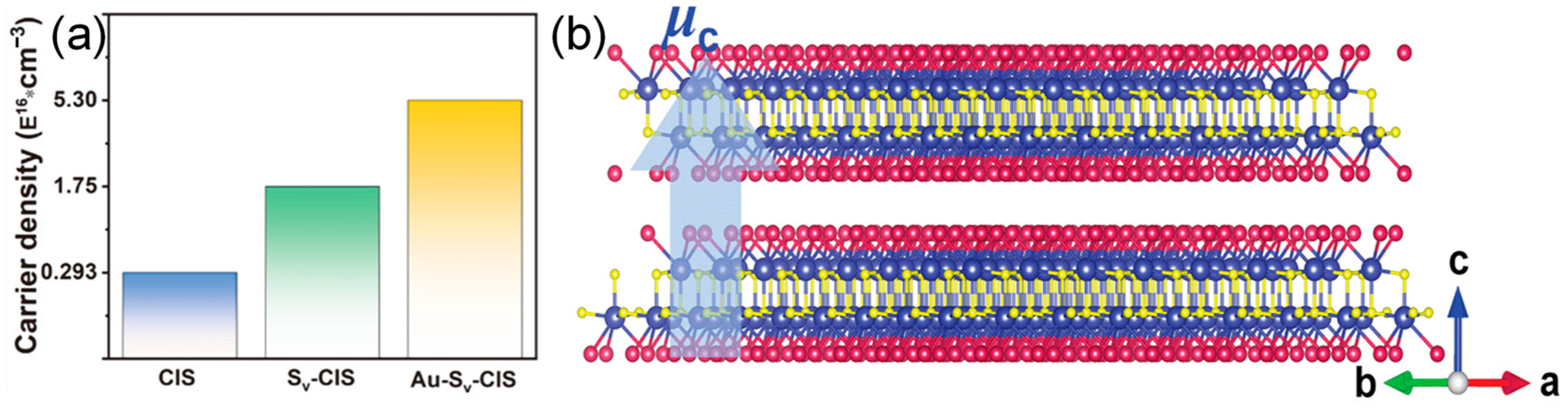
Zhao et al. introduced charge separation by synthesizing CdIn2S4 (Sv-CIS) with high sulfur vacancies, followed by the deposition of gold nanoparticles on the surface (Au-Sv-CIS) to facilitate O2 adsorption. Sulfur vacancies possess the ability to effectively catch photons, thereby impeding the rapid recombination process of electron–hole pairs. As shown in Figure 10a, Hall effect analysis shows that this setup provides more charge carriers [57]. In addition to the creation of high-defect structures by vacancy engineering, materials such as β-ZrNBr can also create layered structures with low defect concentrations by creating low-defect crystal structures, as shown in Figure 10b. This approach will minimize charge trap sites and the possibility of carrier recombination. β-ZrNBr has high carrier mobility values (>100 cm2/V·s) and a bulk charge separation efficiency of over 70% [58]. Covalent organic frameworks (COFs) may face problems such as charge recombination during the photocatalytic reaction. The integration of fluorine atoms within the imine-linked pore structures of COFs enhances carrier separation efficiency and reduces recombination rates in HITMS-COF-20 and HITMS-COF-21 [59]. In the polyethyleneimine (PEI)-grafted indium sulfide (In2S3) with a high sulfur content, the presence of sulfur vacancies (SV) within the In2S3 structure gives rise to electron-rich domains. Through the optimization of electron transfer processes, these regions facilitate oxygen activation, thereby enabling the efficient conversion of adsorbed O2 into superoxide anions (·O2) [60]. Drawing on interdisciplinary research strategies can also provide insights into the design of photocatalysts. For example, by incorporating the latest advancements in the field of electrocatalysis—specifically, the orbital hybridization between metals and specific crystal faces—it is possible to precisely induce and stabilize oxygen vacancies, offering a crucial interdisciplinary design approach for the fine-tuning of defect engineering in photocatalysis [61]. Furthermore, in biodiesel production, a novel heterogeneous bifunctional acid-base composite catalyst was developed by simply combining layered double hydroxide (LDH) active components with Cr-doped ZIFs-8 material (Cr-ZIFs-8/ZnCo-LDH). By improving the microstructure and enriching surface-active sites, this approach also significantly enhances catalytic efficiency [62]. Defect engineering can effectively modulate the electronic structure of catalysts, lower the energy barrier of key chemical bonds, and significantly enhance reaction kinetics [63]. This strategy of using defects to finely regulate surface reaction pathways in electrocatalytic systems offers significant inspiration for designing defect sites in photocatalytic H2O2 systems to promote oxygen activation and directed conversion.

2.3. Surface Redox Reactions

Surface redox reactions involve electron transfer reactions between photo-generated carriers and reactants at active surface sites. The surface redox reactions mainly involve the two-electron reduction of O2 (2e ORR), which is the major reaction. Meanwhile, the surface redox reactions suppress the four-electron reduction of O2 to H2O/O2 (a side reaction) and the subsequent decomposition of H2O2 [64]. In fact, surface redox reactions not only determine the formation of H2O2 but are also the core causes of its instability. Mechanistically, the generated H2O2 is highly prone to secondary redox side reactions on the surface: on the one hand, H2O2 competes with O2 to capture photo-generated electrons on the surface, leading to its over-reduction to hydroxyl radicals (·OH) or water [65]. On the other hand, from a thermodynamic perspective, the standard electrode potential for the oxidation of H2O2 to O2 (0.68 V vs. NHE) is significantly lower than that for the oxidation of water (1.23 V vs. NHE). Therefore, in systems where the kinetics of water oxidation are slow, H2O2 is highly susceptible to preferential attack by strongly oxidizing photo-generated holes accumulated on the surface, leading to its re-decomposition into O2; this is another key factor contributing to its instability [66]. In particular, when surface catalytic sites lack spatial isolation, the disordered distribution of electrons and holes causes them to directly evolve into catalytic decomposition centers for H2O2 [23]. The photocatalytic reaction efficiency can be improved by optimizing the adsorption ability of O2, enhancing the selectivity of 2e reduction, reducing the charge recombination rate, and preventing the decomposition of H2O2. But the low charge transport rate and instability are still important issues that hinder the practical application of photocatalysts. In recent years, new strategies have been proposed to optimize the surface redox reaction efficiency to improve photocatalytic performance [67].

2.3.1. Introduction of New Functional Groups

In photocatalytic H2O2 production studies, COFs have been identified as materials of choice for the introduction of new functional groups. As a new and rising family of new organic porous materials, the defining feature of COFs is the specific bonding of organic monomers by strong covalent bonds, yielding porous structures with high crystallinity and diversity [68]. Its tunable framework structure ensures a platform for accurate functional group implantation. The multi-porous properties and high specific surface area ensure efficient functional group activity with high stability to ensure the long-term durability of the photocatalyst. However, the main drawback of the traditional covalent organic framework (COF) photocatalyst for hydrogen peroxide production is the conflict between the proton and O2 demand and supply in the oxygen reduction reaction (ORR) and water oxidation reaction (WOR), which restricts the overall reaction efficiency [69]. As a major branch of the family of COFs, one-dimensional covalent organic frameworks (1D COFs) are defined by their structure, which are generated by the regular assembly of one-dimensional covalent bonds in a linear chain, as well as noncovalent forces such as van der Waals forces, π-π stacking, and hydrogen bonds that are oriented perpendicular to the two-dimensional and three-dimensional planes. Compared with 2D and 3D COFs, the dispersibility of 1D COFs is improved because of the reduced interchain and interlayer interactions, as well as the changed nonlinear edges and pore structures. This distinctive architecture not only enhances the accessibility of the active sites but also augments the application potential. One-dimensional COFs, such as EO-COF, ES-COF, and ESe-COF, are showing potential as low-cost H2O2 production materials. They possess well-ordered pore channels that promote oxygen diffusion and proton transfer, together with highly accessible active sites. These characteristics render them highly promising for diverse applications across multiple domains, such as catalysis, energy storage, adsorption, and sensing technologies [70].
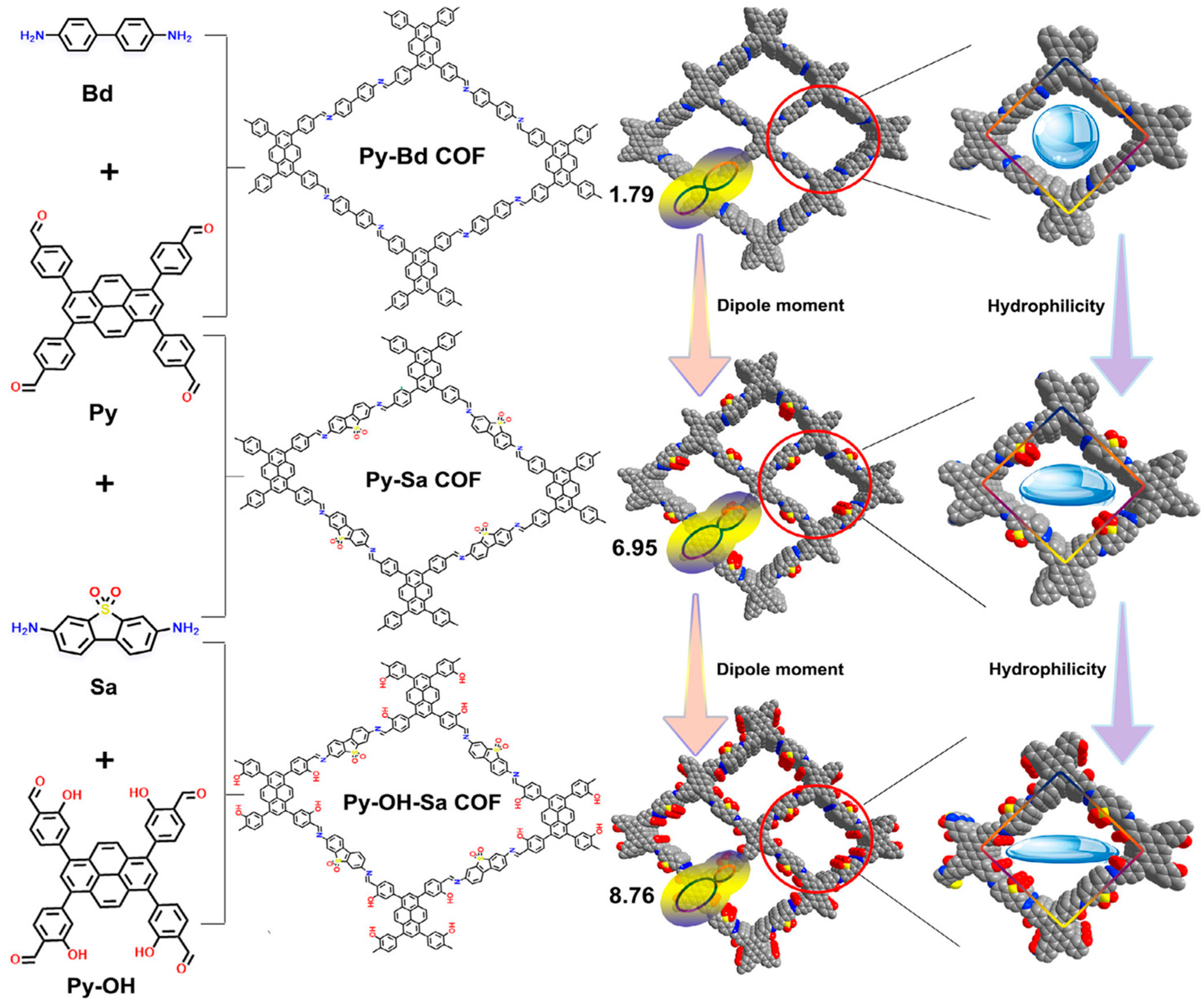
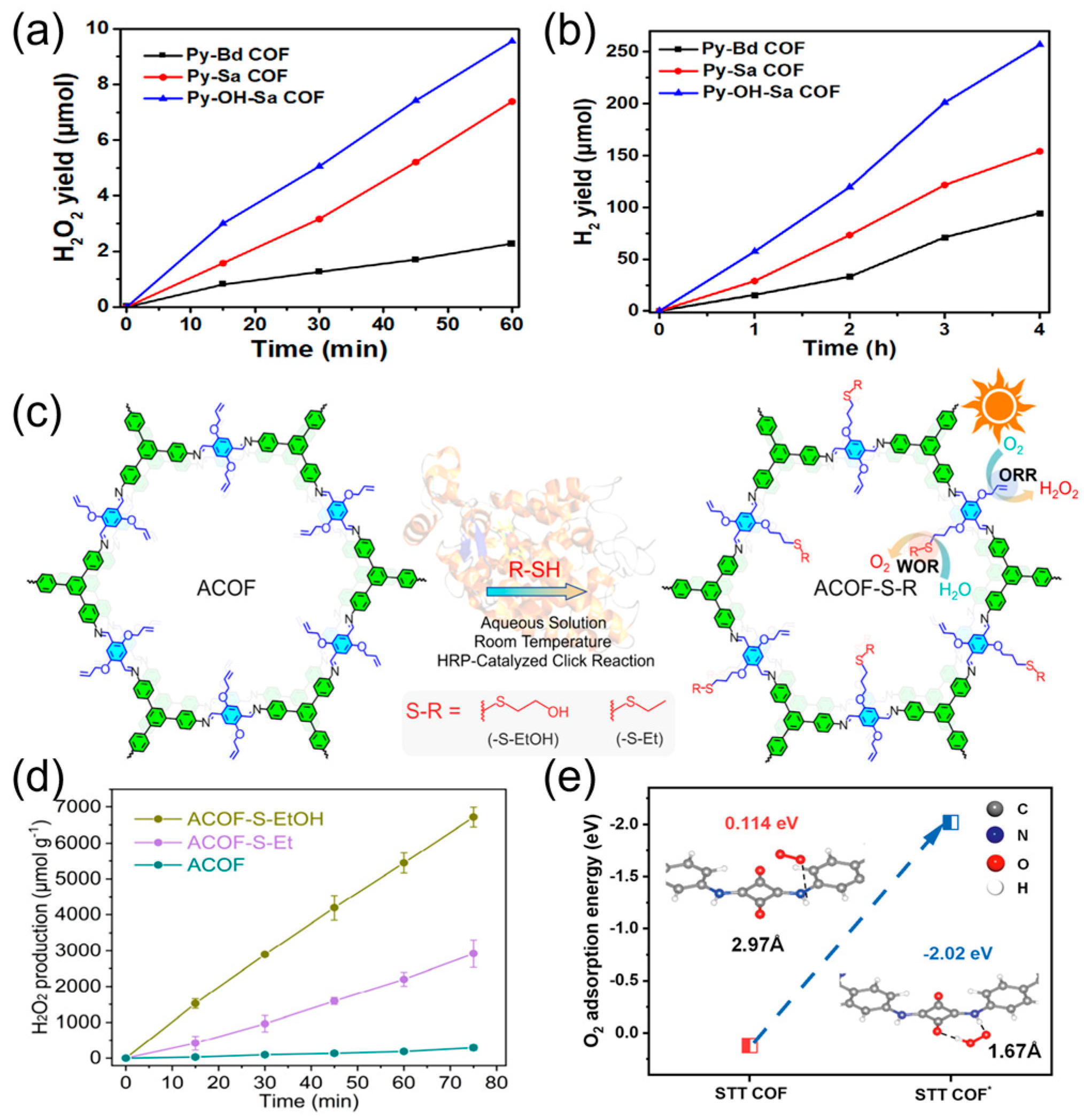
In redox reactions, there is a side reaction known as the four-electron oxygen reduction reaction (4e ORR), which produces water as its direct product. This side reaction greatly affects the efficiency of hydrogen peroxide (H2O2) production. The addition of new functional groups to the material will help in suppressing the side reaction, hence providing additional active sites for the ORR reaction [65]. Mu et al. prepared a covalent organic framework (COF) containing pyrazine units, it has a conjugated π system. They incorporated H3PO4 molecules into the COF, naming it N-heterocyclic TpDz. A hydrogen bonding network was formed between the H3PO4 molecules and the nitrogen atoms of the pyrazine units, which effectively formed a route in the COF pores to facilitate proton transfer. This strategy lowered the energy barrier of the ·ORR from ·ORR to H2O2 and improved the selectivity of the 2-electron ORR [71]. Likewise, as shown in Figure 11 below, Huang and colleagues synthesized covalent organic frameworks (COFs) through the simultaneous modulation of both the charge distribution across the framework and the microenvironment within the pores. The Py-OH-SaCOF was synthesized through a Schiff base condensation reaction involving Sa. The electron-withdrawing sulfonyl group and the electron-donating hydroxyl group in Py-OH-SaCOF facilitated the creation of more hydrophilic channels, which enabled efficient electron and proton transport to the photocatalytic sites. As a result, the hydrogen production rate reached 4.78 mmol g−1h−1 of H2O2 over time, as illustrated in Figure 12a,b [72].
The synthesis of N-heterocyclic TpDz was done by conventional post-synthetic modification (PSM), while the synthesis of Py-OH-SaCOF was done by reticular chemical design. Unlike the conventional methods of incorporating specific functional groups into covalent organic frameworks, Quan et al. introduced a new enzyme-catalyzed PSM method, which entails a click reaction catalyzed by horseradish peroxidase (HRP). Figure 12c shows the schematic representation of the enzyme-catalyzed reaction. Under aqueous media (room temperature and in the absence of toxic chemicals), 2-hydroxyethylthio (-S-EtOH) or ethylthio (-S-Et) groups are covalently bonded to the alkyloxy-functionalized pores of COF (ACOF), yielding ACOF-S-EtOH/ACOF-S-Et. This process has high grafting efficiency, is gentler, more effective, eco-friendly, and metal-free. The incorporation of the new 2-hydroxyethylthio (-S-EtOH) functional group further improves electron donation, the generation of hydrogenation intermediates, and the Gibbs free energy difference (ΔG), thus enhancing the rate of photocatalytic H2O2 production. As depicted in Figure 12d, the process exhibits a H2O2 generation rate of 5440 μmol g−1h−1 [73]. This innovative enzymatic method not only overcomes the challenges posed by the traditional methods in terms of environmental and efficiency issues but also sets a paradigm for the “molecular-level precision modification” of covalent organic frameworks (COFs).
Figure 11. Schematic illustration of the synthesis and dual regulation of framework and microenvironment pore charge distribution in Py-Bd COF, Py-Sa COF, and Py-OH-Sa COF [72]. Copyright 2025, John Wiley & Sons, Ltd.
Nanomaterials 16 00466 g011
Furthermore, the incorporation of novel functional groups could potentially enhance the density of active sites, optimize O2 adsorption capacity, and promote the direct occurrence of the two-electron oxygen reduction reaction (2e ORR) pathway. Chen et al. chose squaric acid (SQ) as the electron donor and 1,3,5-triazine-triphenylamine (TAPT) as the electron acceptor, and the resulting material was named STT COF. This material has an equimolar and ordered arrangement of cationic (C=NH+) and anionic (C-O) functional groups, forming an amphoteric ion structure. As shown in Figure 12e, the hydrogenated STT COF* has active sites where the C=NH+ groups are located near the C-OH groups. These systems fix the Yeager-type adsorption structure of O2 by hydrogen bonding, which corresponds to the most favorable adsorption state for the 2e ORR process to form H2O2. During the reaction, the system with the lower ΔG in STT COF* favors the formation of H2O2 [74]. Likewise, a bis-sulfonic acid-functionalized covalent organic framework (2-SO3H-COF) was synthesized, which acts as an effective medium for proton transfer, thereby promoting solution-phase proton/O2 absorption and facilitating fast proton diffusion in the framework via a hopping mechanism. It is worth noting that the sulfonic acid group possesses dual-functional properties in proton regulation, where in proton-rich conditions, the -SO3H group acts as a ‘proton pump’ that attracts protons from the solution via strong polar interactions and facilitates fast proton diffusion to catalytically active sites via a hydrogen-bond network in the COF framework. In deprotonated conditions, the -SO3H group acts as a ‘proton reservoir’ that directly donates its protons to the ORR, thus ensuring that the reaction is not halted by a lack of protons [75]. The structural design and modification principles of functional groups based on COFs not only provide a clear approach for the precise regulation of the 2e ORR process but also provide evidence for the feasibility of optimizing the active sites and mass transfer properties by the strategic introduction of functional groups. This provides a crucial basis for the further improvement of highly efficient ORR catalysts.
Figure 12. (a,b) Photocatalytic production of hydrogen peroxide and hydrogen over time [72]. Copyright 2025, John Wiley & Sons, Ltd. (c) Schematic of the enzymatic click reaction introducing -S-EtOH and -S-Et groups into COFs [73]. Copyright 2025, American Chemical Society. (d) Photocatalytic H2O2 production on different photocatalysts [73]. Copyright 2025, American Chemical Society. (e) Adsorption energies of O2 at optimal sites on STT COF and STT COF [74]. * indicates that oxygen is adsorbed on STT COF. Copyright 2025, Springer Nature Limited.
Nanomaterials 16 00466 g012
Another catalyst which is based on covalent organic frameworks (COFs) is trifluoro pyridyl TFPy COF. The presence of fluorinated pyridine moieties has been found to greatly improve the hydrophilicity of the material, which in turn improves the dispersion and availability of catalytic sites in aqueous media [76]. Covalent organic frameworks containing hydroquinone units (Tz-QH-COF) significantly improve the stability of photocatalysts in H2O2 production [77]. Based on the success of C3N4 materials, functional heptazine moieties have been combined with other functional units into ordered molecular frameworks to improve hydrogen peroxide production abilities [78]. The hydrogen peroxide production ability may also be affected by the heteroatom locking in COFs. For example, N-heteroatom-locked COFs have a photocatalytic H2O2 production rate of 2.08 mmol g−1h−1 in pure water and air. This is due to the ‘locking’ effect, which increases coplanarity and conjugation, and the ‘heteroatom’ effect, which increases the adsorption capacity of O2 [79].

2.3.2. Improving Redox Pathways

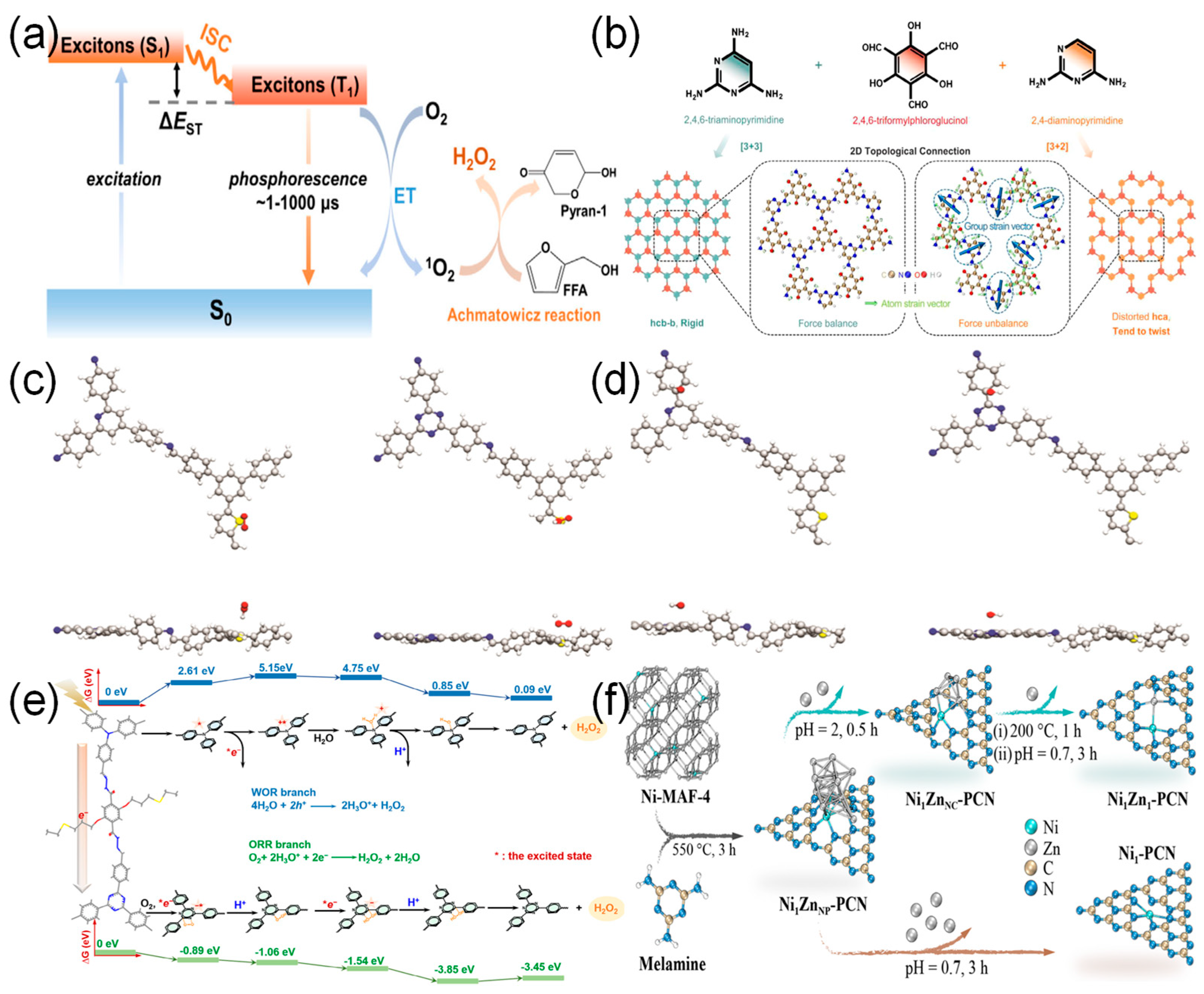
The traditional photocatalytic approach for H2O2 synthesis employs charge carriers generated from photon-induced processes as mediators for redox reactions. However, this technique is plagued by limitations, including inefficient charge separation and the inherent instability of H2O2, which renders it prone to rapid decomposition [80]. In Figure 13a, a carrier-free process was designed by combining energy transfer photocatalysis (EnTP) with the Akhmatovich reaction. In this process, O2 is activated to produce singlet oxygen (1O2) through energy transfer, thus bypassing the charge-dependent process in the traditional process, where O2 is reduced to superoxide anions by electrons. An A-CN catalyst was designed from the triazine framework by modifying the amide functional groups. This modification raised the exciton binding energy and narrowed the singlet-triplet energy gap, leading to improved efficiency and stability for H2O2 production [81]. As in Figure 13b, the pyrimidine-based COFs undergo a geometric transformation from a planar geometry (planar-PmTp-COF) to a twisted geometry (twist-PmTp-COF) by controlling the monomer linkage pattern. This geometric transformation is achieved by changing from a “3 + 3” planar linkage to a “3 + 2” asymmetric linkage. The geometric transformation is accompanied by a reaction mechanism involving triplet excitons and singlet oxygen (1O2), in which the produced triplet excitons directly excite ground-state oxygen (3O2) via triplet–triplet annihilation (TTA) [18]. However, these methods are very oxygen-dependent, and the efficiency of the reaction will decrease with lower concentrations of oxygen. Compared to catalysts that can follow both the ORR and the WOR pathways, these methods have lower environmental adaptability. These methods are difficult to apply in anoxic or hypoxic environments.
Yue et al. designed two new thiophene-based covalent organic frameworks (TD-COF and TT-COF) as catalysts for the synthesis of H2O2 via both indirect 2-electron ORR and direct 2-electron WOR. By adjusting the N-heterocyclic units in the COFs, Figure 13c,d show that the sulfur atoms in the thiophene units of TD-COF and TT-COF act as active sites for the ORR. However, the carbon atoms in the benzene units act as active sites for the WOR [82]. However, this reaction still has challenges concerning long-term stability, since the accumulation of H2O2 leads to the oxidation of the imine bonds of the catalyst, thereby deactivating it. It is worth noting that Han et al. carefully constructed the donors (triphenylamine, TN) and acceptors (triazine, TA) in COFs to create D-π-A structures. As shown in Figure 13e, the WOR on the TN moiety can interact with the ORR on the TA moiety. In addition, the TN moiety that takes part in the WOR can return to its original form during the reaction, thereby allowing for continuous photocatalytic activity [83]. In addition to the COF-based methods, the metal sites can be designed by dementalization strategies, in which one metal site assists in the electron capture for the ORR. Meanwhile, another metal site promotes the hole-steered WOR. As shown in Figure 13f, a dual-site Ni-Zn system was constructed in a PCN matrix by the N-coordination anchoring strategy, which assisted in the dual-pathway H2O2 catalysis with high stability [84]. Furthermore, co-doping Ce and Cr into MOF systems enables the construction of bifunctional systems with isolated acid and base properties; the strong synergy between the two metal sites significantly enhances the adsorption and activation efficiency of reactant molecules. In photocatalytic systems, this strategy of inducing microenvironmental synergy through bimetallic co-doping also holds great potential [85].
In redox pathways, the effective mass of a hole is greater than that of an electron, and its mobility is far lower than that of an electron; this means that the water oxidation half-reaction is often the rate-limiting step of the overall reaction. To accelerate the rate of the oxidation half-reaction, the difficult-to-proceed water oxidation reaction can be replaced with a thermodynamically more favorable organic oxidation reaction. However, most studies employ methanol or isopropanol, which are miscible with water. Whilst this achieves rapid hole consumption and enhances the production rate of hydrogen peroxide, it introduces new problems: The oxidation products of methanol or isopropanol are of low value; furthermore, the hydrogen peroxide generated mixes with these products, creating a significant challenge in terms of separation. A mixture of benzyl alcohol and water can be employed, which not only enables the efficient production of hydrogen peroxide but also allows for the selective oxidation of benzyl alcohol to produce the high-value chemical benzaldehyde. Following the reaction, the products automatically separate into layers by gravity, with benzyl alcohol and benzaldehyde distributed in the lower layer of the solution, whilst the aqueous hydrogen peroxide solution is distributed in the upper layer. For example, Ma et al. synthesized a novel antimony (Sb) and potassium (K) co-doped g-C3N4 (denoted as Cyano Sb Trz) via a tandem hydrothermal calcination strategy combined with a one-step molten salt method. By replacing the conventional sacrificial agent with benzyl alcohol, benzyl alcohol is oxidized via radical and non-radical pathways to form high-value-added benzaldehyde, whilst also establishing spatially separated redox active sites [15]. Using the Schiff base reaction, a superhydrophobic covalent organic framework photocatalyst with perfluoroalkyl functionalization was rationally designed and synthesized. This catalyst exhibits super hydrophobicity and spontaneously disperses in the oil phase, whilst the product H2O2 is extracted into the aqueous phase, forming a natural phase separation that facilitates separation [86].
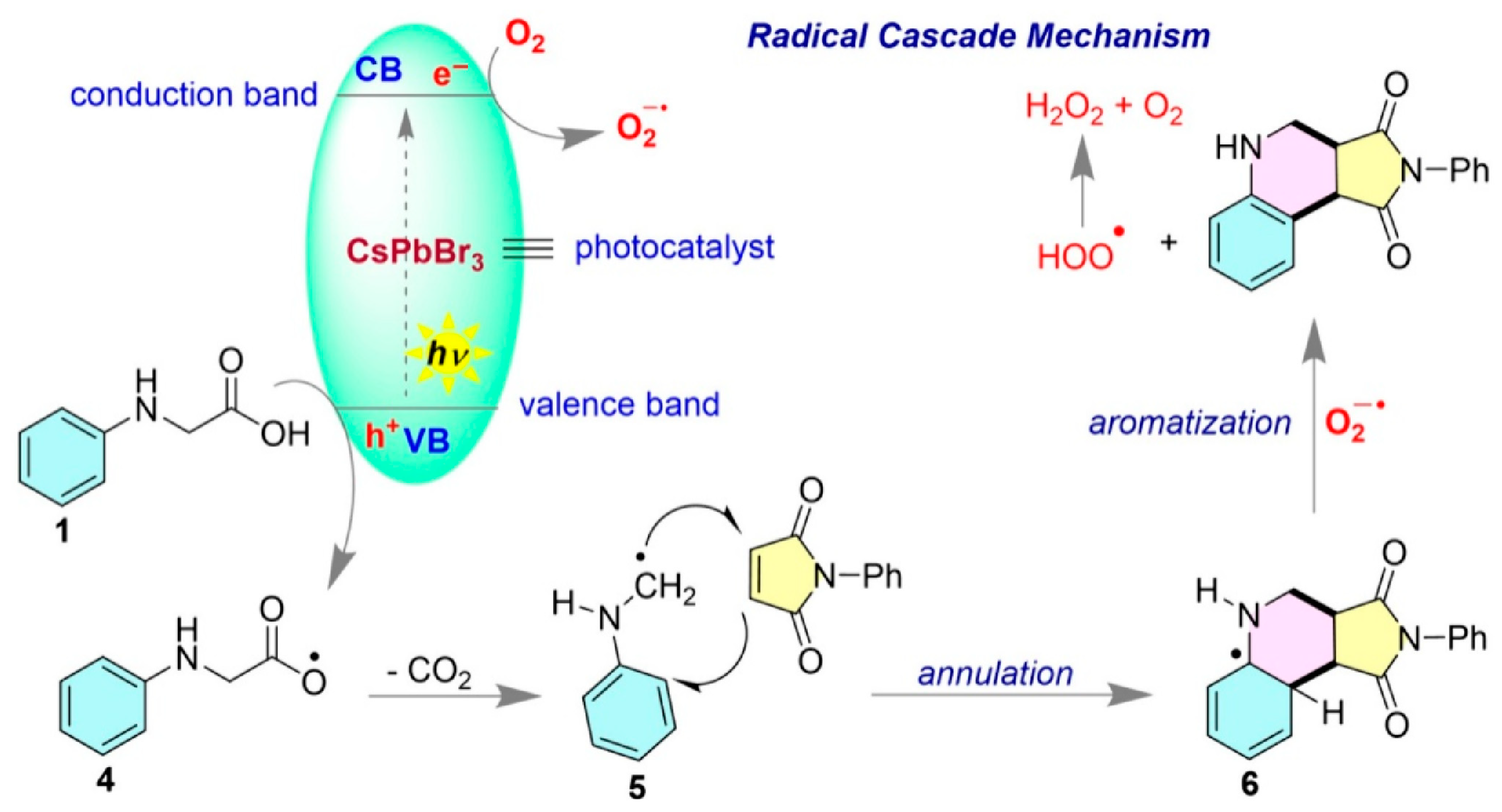
Furthermore, in photocatalytic surface redox reactions, beyond simple water oxidation or oxygen reduction pathways, coupling the oxygen reduction reaction (ORR) with radical-mediated cyclization reactions in organic synthesis offers a highly promising new strategy for the generation of H2O2 and the co-production of high-value-added chemicals. For example, in photocatalytic synthesis systems involving nitrogen-containing heterocycles, the formation of hydroperoxyl radicals (HOO·) as intermediate species is involved. Take the radical-induced cascade cyclization reaction of N-phenylglycine with N-arylmaleimide catalyzed by CsPbBr3 nanocrystals as an example. As shown in Figure 14, in this reaction mechanism, N-phenylglycine is first oxidized by valence band holes generated by the photocatalyst. The resulting radical intermediate, after transformation and decarboxylation, reacts with N-arylmaleimide to form a condensation radical product; simultaneously, a superoxide radical (or HOO· formed via protonation) generated by the reduction of oxygen by conduction band electrons couples with this condensation radical in the final reaction step. This process simultaneously constructs the final product, 2-phenyl-3a,4,5,9b-tetrahydro-1H-pyrrolo [3,4-c] quinoline-1,3(2H)-dione, while releasing H2O2. This dual-channel coupling strategy not only effectively utilizes photo-generated carriers but also enables the synergistic production of high-value-added fine chemicals and green oxidants [87].

3. Enhance Mass Transfer

In the research of photocatalytic hydrogen peroxide production, three essential steps, including light capture efficiency, separation efficiency of photo-generated charge carriers, and surface oxidation reactivity, are important key points for improving reaction performance. But optimizing the conduction and adsorption properties of reactants, such as O2, on and in the surface of the catalytic material can effectively mitigate the restrictions of catalytic activity due to the lack of reactants. This measure can further improve the overall reaction kinetics of the catalytic system, providing another way to optimize performance in the efficient and stable production of H2O2.

3.1. Gas–Liquid–Solid Three-Phase Interface

In the conventional solid-phase catalysts, the interaction between the reactants takes place only through surface adsorption, making it difficult to coordinate gas-phase and liquid-phase reactants effectively. After the formation of hydrogen peroxide (H2O2), it tends to clog the active sites, thus slowing down the reaction. In gas-solid catalysts, there is a shortage of H2O supply, and gas-phase products are susceptible to decomposition. In solid–liquid catalysts, which are the most widely used systems at present, there is an abundant supply of proton sources. But the amount of oxygen (O2) in the liquid-solid interface is restricted by its solubility, making it difficult to further improve [89]. Conversely, the gas–liquid–solid three-phase interface not only overcomes the difficulty of slow O2 diffusion in the aqueous phase but also offers a plentiful proton source. This interface promotes the concentration of active sites, shows better efficiency for the separation of photogenerated charges, and has higher catalytic activity. Moreover, it enables the joint adsorption of O2 and H2O, thus activating the reaction [90]. A photocatalytic system characterized by a gas–liquid–solid three-phase interface, employing a CdS-deposited membrane, demonstrates the effective immobilization of the catalyst onto the filtration membrane [91], in another approach, the catalyst can be deposited onto hydrophobic carbon paper to establish a three-phase interface [92]. In addition, the sp3-hybridized nonpolar C-C single bonds can be used to combine the catalytic active units, so that the wettability of the photocatalyst can be directionally controlled, thus creating a three-phase interface [93]. Moreover, the covalent organic framework (COF) membrane with asymmetric wettability can be used. Based on the control of the wettability on both sides of the COF membrane, a three-phase interface can be formed, which favors the local enrichment of O2 and H2O, thus promoting the reaction efficiency [94].
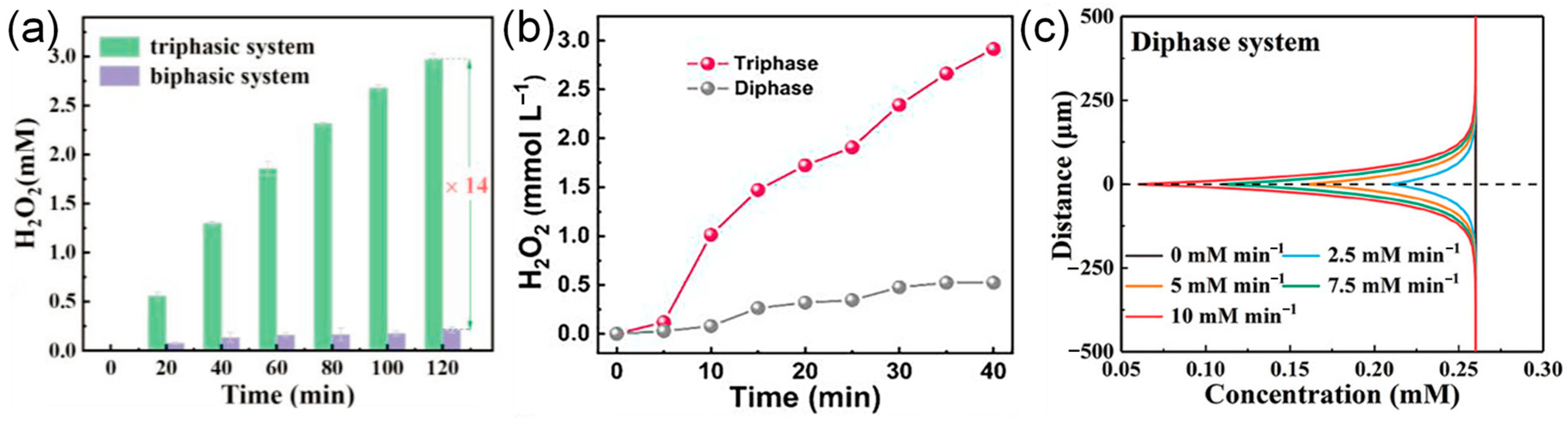
The conjugated organic polymer material (triazine-thiophene polymer, CTTP) proposed by Guo et al., under gas–liquid–solid three-phase conditions, the self-floating CTTP can rapidly capture gaseous oxygen, reduce it to superoxide radicals and transfer them to the reaction interface. As shown by the data in Figure 15a, this significantly increases the H2O2 production rate to 1.85 mM g−1h−1. The solid–liquid–gas three-phase reaction interface formed by CTTP with pure water and oxygen fundamentally resolves the issue of gas mass transfer in the oxygen reduction reaction, thereby enhancing the utilization of photo-generated electron pairs for oxygen reduction. The three-phase interface not only facilitates the fast production of H2O2 but also enhances the degradation efficiency of organic matter. As illustrated in Figure 15b, the Z-scheme heterojunction MIL-101(Fe)/g-CN3, developed by Ju, exhibited a H2O2 generation rate of 4370 μmol h−1 at the gas–liquid–solid tri-phase interface, resulting in a 17.5-fold enhancement in the organic matter degradation rate. The hydrophobic carbon cloth served as the substrate for loading the MIL-101(Fe)/g-C3N4 catalyst, thereby fabricating the composite catalyst designated as MIL-101(Fe)/g-C3N4/carbon cloth. The triphasic interface architecture of this catalytic system enhances oxygen concentration within the solution. The intrinsic hydrophobicity of the carbon cloth facilitates the diffusion of O2 from the ambient air to the photocatalytic interface, thereby establishing an optimal environment for the reaction. Additionally, the photogenerated electrons at the triphasic interface quickly reduce Fe3+ ions, produced during the reaction, to Fe2+ ions, thus facilitating continuous photo Fenton reactions [95]. In addition, through the preparation of COF membranes with asymmetric wettability, the asymmetry of the membrane creates a three-phase interface, which enriches O2 and H2O. The conversion of COF powders into nanostructured membranes optimizes light absorption properties and modifies the energy band configuration, thereby promoting water oxidation processes and amplifying photocatalytic efficiency. The study of asymmetry in this work opens up new ideas for the preparation of new COF materials [94].
In addition to providing qualitative evidence that the three-phase interface enhances H2O2 yield, multiphysics simulations can be used to model the O2 concentration at the interface in both two-phase and three-phase systems, thereby elucidating the mass transfer kinetics at the reaction interface. Yan et al. loaded polymeric carbonitride (CV-PCN), rich in pyrrole units and cyanide defects, onto a superhydrophobic melamine sponge modified with polytetrafluoroethylene (PTFE), thereby constructing a three-phase system based on a gas diffusion layer (GDL). Based on a diffusion model constructed using multiphysics simulation, the simulation results are shown in Figure 15c. The top layer shows the simulation results for the two-phase system; as O2 consumption in the catalytic layer increases, the O2 concentration at the interface decreases significantly. However, for the three-phase system (lower layer), as oxygen consumption increases, the reaction interface still maintains a high O2 concentration, approaching the standard solubility of O2 in water (0.26 mmol L−1). This phenomenon is attributed to the rapid diffusion coefficient of O2 in the GDL (2.0 × 10⁻¹ cm2s−1), which effectively supplies O2 to the catalytic layer. Quantitative model calculations indicate that, thanks to this extremely rapid oxygen supply capacity, even at equivalent high consumption rates, the O2 concentration at the three-phase reaction interface can still be maintained at a level close to the saturation state of natural water (0.26 mmol L−1). This sustained and high-concentration local supply of O2 not only overcomes the mass transfer bottleneck but also enables O2 to act as an efficient natural electron scavenger, rapidly consuming photo-generated electrons to form ·O2, thereby fundamentally suppressing the recombination of electron–hole pairs. Driven by this mechanism, the H2O2 yield of this system in pure water reached a benchmark level of 2063.21 μmol g−1h−1, which is 9.58 times that of powder catalysts and 5.68 times that of two-phase systems under equivalent conditions [96].

3.2. Reactor Design

The production of newly synthesized catalysts in reactors is a new and effective method of improving photocatalysis. Joint reactions can greatly improve the efficiency of photocatalysts in hydrogen peroxide production [97]. However, all the batch reactors can only work intermittently, requiring periodic separation and recovery of the catalysts every few hours to extract the H2O2 solution. This is because of low productivity and additional costs [86].
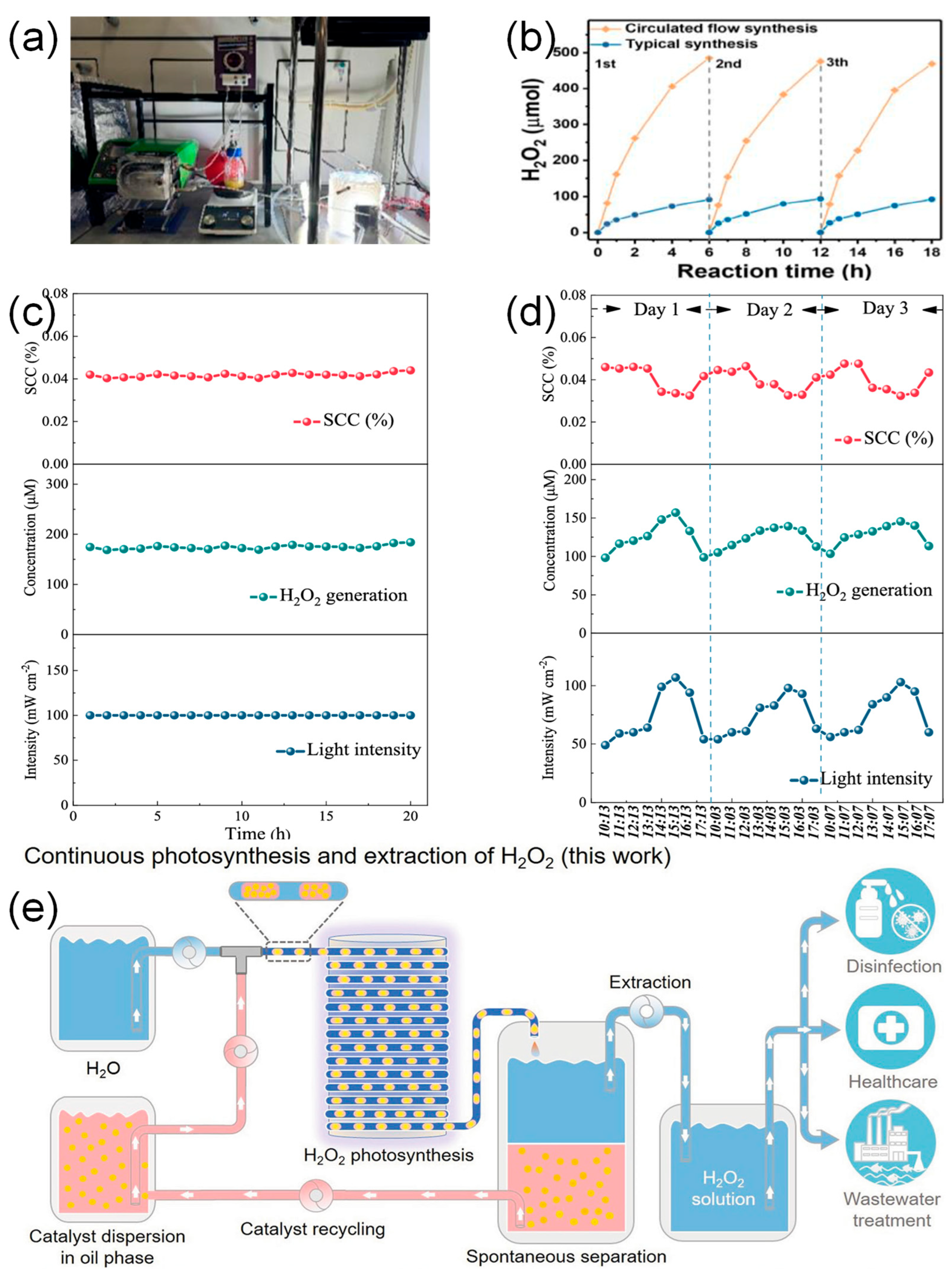
However, the use of circulating reactors and flow reactors in the production process can greatly improve the efficiency of photocatalysis and make it easier to apply in industrial production [98]. Cyclical reactions can improve mass transfer, light use, and the stability of reactions [99]. For example, a tri-monomer cross-linked polymer (PAQ-TABPB) was used to build a circulating reactor, referring to Figure 16a. In Figure 16b, the activity and stability of the circulating flow synthesis system are much higher than that of the bath reaction system. In addition, the alternate O2 bubbles and suspension droplets in the circulating reactor improve the mass transfer, which promotes the reaction efficiency [100]. The flow reactor is designed to enable the separation-free continuous production of H2O2. The reactor features a channel configuration filled with TpBpy, an imide-based covalent organic framework material, and employs a peristaltic pump to regulate the flow rate of ultrapure water. In the experiments, the flow rate was set at 2 mL min−1 to create a continuous and stable reaction system. The catalytic efficiency of hydrogen peroxide production was compared under natural and laboratory lighting. Refer to Figure 16c,d, generation rate of hydrogen peroxide in the laboratory-scale system was 11,429 mM h−1m−2, and the SCC efficiency was 0.040%. This efficiency was maintained in the absence of sacrificial agents. The process is simple and can be scaled up to satisfy the requirements of industrial continuous production [101]. Moreover, a biphasic water-oil reactor was also developed with the perfluoroalkyl-functionalized superhydrophobic covalent organic framework (PF-BTTA-COF) photocatalyst, as shown in Figure 16e. α,α,α-Trifluorotoluene (TFT) was chosen as the organic phase solvent. On the other hand, the distilled water was used in the aqueous phase reaction for the spontaneous extraction of H2O2, leading to a photocatalytic activity of 968 μmol h−1. It is pertinent to mention here that the symmetry mismatch in PF-BTTA-COF results in periodic uncondensed aldehyde site, which help in the stable dispersion of the photocatalyst in the oil phase of the two-phase fluid photoreactor [86]. Table 1 and Table 2 list the performance of photocatalytic hydrogen peroxide production reported in recent years.

4. Development Prospects

Although there have been many innovative approaches to the photocatalytic production of hydrogen peroxide, the field still faces numerous challenges. We have listed the issues facing photocatalysis in turn, summarized some examples that help address these issues, and outlined prospects for the future development of photocatalysis.
Certain semiconductor materials are prone to photodegradation under light exposure [7]; furthermore, as the H2O2 generated is itself a strong oxidizing agent, its accumulation within the reaction system readily oxidizes the active components or structural framework of the catalyst. For example, in covalent organic framework (COF) systems, accumulated H2O2 oxidizes and cleaves the imine bonds in the material, leading to structural collapse and deactivation of the catalyst, this results in poor stability of the photocatalyst [82]. Furthermore, during catalyst preparation or in two-phase flow reactors, organic solvents such as trifluoro toluene (TFT) must be used, which not only increases production costs but also poses a threat to the environment [86]. In traditional suspension-based reaction systems, most photocatalytic systems take the form of powder suspensions, which are difficult to recover and reuse; once they are released into the water cycle, they may pose environmental risks that are difficult to assess. The concentration of H2O2 generated via photocatalysis is generally low, far below the commercial standard of 1–3%, resulting in extremely high costs for the separation and purification of hydrogen peroxide from the product. Traditional batch reactors can only operate intermittently and require frequent shutdowns for catalyst separation, which leads to low productivity and makes it difficult to maintain system stability. However, when the system consists of a continuous-flow or multi-phase circulating reactor, it faces serious challenges regarding long-term operational stability: under prolonged gas–liquid–solid fluid erosion or thermal effects, catalyst coatings with insufficient interfacial adhesion are highly prone to mechanical delamination and extensive flaking, leading to a sharp decline in the reactor’s overall catalytic performance. Furthermore, in traditional suspension reactors, the depth of light penetration is extremely limited. In practical applications, catalysts in large reactors are unable to utilize light irradiation, and the low diffusion rate of oxygen in water leads to a decline in reaction efficiency. These are the engineering challenges that remain to be resolved [163].
To address the issue of photocatalyst stability, Ma et al. synthesized a carbon nitride material, Trz CN, possessing a massive built-in electric field (BEF) using a combined hydrothermal and calcination strategy. The massive BEF (4.8 times), induced by a large dipole moment, facilitated the efficient separation and directional migration of photo-generated carriers. Trz CN exhibits excellent cycling stability and remains stable in seawater environments [164]. This suggests that we can enhance BEF by developing new methods or introducing molecular units with large dipole moments, as well as by optimizing the hydrophilicity of the material to improve its stability in other environments. Through semi-solid polydimethylsiloxane (PDMS) interface engineering, the efficient immobilization of self-assembled porphyrin nanosheets (SA-TCPP) on quartz wool (QW) was achieved. The resulting PDMS/SA-TCPP/QW composite demonstrated stable photocatalytic performance over 10 reuse cycles, and in a modular flow reactor, the material continuously generated 3.5 mmol H2O2 over 50 h. This suggests that to enhance reactor stability, corrosion-resistant three-dimensional porous materials can be employed to encapsulate the catalyst and prevent its detachment; furthermore, modular reactors can be utilized to optimize fluid distribution and reduce maintenance costs. To address the difficulty in separating and purifying H2O2, a heterogeneous porous organic polymer (POP) photocatalyst has been developed, and an ‘oil-water’ two-phase reaction system has been established, utilizing lipophilicity to achieve spontaneous separation. Upon completion of the reaction, the mixed liquid enters a collector, where the two phases undergo spontaneous separation [165]. Selecting the ideal macroscopic carrier—quartz wool, PDMS is introduced as a physical encapsulation and bonding medium, forming a semi-solid coating on the surface of the quartz wool. Its viscosity firmly encapsulates the catalyst and physically anchors it within the quartz wool network. Furthermore, NH2-PDMS, containing amino end groups, reacts with the carboxyl groups on the surface of the SA-TCPP catalyst to form covalent amide bonds. This resolves the issue of organic catalysts readily leaching from the support, fundamentally eliminating the need for any powder separation steps such as centrifugation or filtration. This approach utilizes two-phase flow extraction and macroscopic immobilization to enable the spatial separation of the catalyst, substrate and products. To address the challenges of reactor scale-up for practical industrial applications, Li et al. achieved a robust and uniform dispersion of porous, nest-like mCN particles by loading them onto superhydrophobic polytetrafluoroethylene (PTFE) fibres, thereby providing a large surface area. This effectively minimized the likelihood of catalyst particles shading one another or becoming buried and avoided the issues of powder agglomeration and light attenuation in the deep water zone commonly encountered in suspensions [166]. The PDMS/SA-TCPP/QW composite prepared by Liu et al. innovatively concentrates the H2O2 produced to 100 mM via flow evaporation, demonstrating its potential for industrial-scale production. By coupling continuous flow evaporation with in situ separation of H2O2 to prevent oxidative degradation of the product, the system achieves highly efficient and stable large-scale application of the photocatalytic system [163]. Furthermore, expanding the scope of photocatalytic systems in the synthesis of complex, high-value-added organic compounds and pharmaceutical intermediates is also key to enhancing the overall economic efficiency of the system. Currently, visible-light catalysis has already achieved highly challenging transformations such as the directed radical nitration and ring-opening rearrangement of cyclobutanol [167]. Furthermore, recent research has successfully developed a hybrid photoelectrocathode based on non-precious metal molecular catalysts, achieving the efficient conversion of CO2 into high-value hydrocarbons under solar drive [168]. In future reactor and catalyst design, exploring the compatibility and coupling of efficient photosynthesis of complex pharmaceutical intermediates with systems for the conversion of challenging carbon resources and the green production of H2O2 will represent a significant leap toward industrial-scale applications in this field. Furthermore, developing “waste-to-waste” material synthesis strategies is also an important future research direction. For example, Wang et al. proposed a sustainable engineering approach that innovatively utilized red mud as a feedstock to prepare FeOOH/BiVO4 composite photoanodes, thereby transforming solid waste into highly efficient catalysts [169]. In the future, in-depth exploration of the resource utilization potential of various industrial solid wastes in the photocatalytic synthesis of H2O2 will greatly advance the low-cost implementation and commercialization of this technology.
In the areas of material science and nanotechnology, the accurate observation of the crystal structure at the atomic level is very important, and it depends largely on the advancement of electron microscopy technology [170]. The direct evidence for comprehending the influence of these defects on the electrical and optical characteristics of two-dimensional materials lies in the identification of single-atom vacancy defects. These defects arise from the absence of atoms and the dislocation defects triggered by atomic misalignment. This serves as the foundation for uncovering novel photocatalysts [171]. Furthermore, the expansion of in situ dynamic characterization scenarios and the simulation of actual reaction environments are important methods for understanding catalytic mechanisms and improving material properties [172]. The ability of dynamic characterization has broken through the constraints of traditional static characterization, providing direct experimental evidence for the correct interpretation of the “structure–property” relationship and the discovery of actual active sites. This advancement enables rational catalyst design informed by fundamental mechanisms [173]. In particular, the combined application of femtosecond/picosecond transient absorption spectroscopy (TAS), time-resolved photoluminescence (TRPL) and in situ electron spin resonance (ESR) techniques should be more widely employed in the future to track the entire charge transfer pathway from photon absorption to H2O2 generation. This will provide the most direct physicochemical evidence for overcoming the kinetic bottlenecks of the reaction and elucidating the complex multi-electron redox rate-determining steps at multiphase interfaces. The traditional characterization techniques, such as X-ray diffraction (XRD), high-resolution transmission electron microscopy (HRTEM), and Raman spectroscopy, have the ability to identify microscopic details. However, these techniques require manual analysis, which may lead to low efficiency and high subjectivity. The combination of content that enables fast machine identification of defects and crystal orientations can greatly improve the efficiency of analysis. This allows the construction of quantitative ‘defect activity’ models by big data mining, which can guide the rational design of the catalyst [174]. For example, Wang proposed a machine learning framework based on in situ infrared spectroscopy. This study moved away from traditional trial-and-error methods by directly extracting the intensity of infrared peaks corresponding to intermediates formed by the adsorption of NO molecules on the catalyst surface as data features. Using gradient-boosted regression (GBR) and random forest regression (RFR) algorithms, it successfully predicted the yield of nitrate products following illumination and the final NO removal efficiency. This machine learning approach reduced experimental time by a factor of 3.5 and enabled the quantitative determination of catalytic performance [175]. Vijay C. Karad employed a machine learning (ML)-guided strategy to optimize the doping concentration of germanium (Ge) to enhance the benchmark performance of CZTSSe. The machine learning model indicated that a Ge doping concentration of less than 5% is optimal for achieving higher device performance and reducing open-circuit voltage (VOC) loss, and that controlling the carrier density by regulating defects plays a key role in the fabrication of high-quality devices [176].
On the other hand, computer calculation based on limited experimental results can also be used to rapidly determine the best parameters in the synthesis process. Most previous research studies have used single-factor experiments. By using machine learning to construct complex nonlinear relationships between the descriptors and the properties, it is also possible to make precise predictions of the properties of the catalyst and rapidly optimize high-dimensional parameters. For example, supervised learning models such as support vector machines (SVMs), artificial neural networks (ANNs) and tree-based ensemble algorithms (such as random forests) can be used to accurately construct non-linear predictive models relating operating conditions to pollutant degradation efficiency; their predictive accuracy (R2) often exceeds 0.95, providing crucial theoretical support for the use of photocatalysis in the production of H2O2 [177]. At the same time, the goal is not merely to predict catalyst synthesis, but also to understand the underlying catalytic mechanisms and thereby identify applicable patterns. Guo et al. introduced a dual-engine AI framework that integrates closed-loop active learning with interpretable machine learning. Within this framework, the discovery engine autonomously explores the vast catalyst space by combining density functional theory with experimental feedback, extracting human-understandable physical descriptors and “transparent box” design principles from massive datasets. Applying this strategy—which integrates theoretical screening with in-depth mechanistic analysis—to the field of photocatalytic H2O2 will significantly accelerate the discovery and translation of novel, highly efficient catalysts [178].

Author Contributions

The manuscript was written through contributions of all authors. All authors have read and agreed to the published version of the manuscript.

Funding

Financial support for this study was primarily provided by the Fundamental Research Funds from the Department of Education of Liaoning Province (Grant No. LJ212510151002). Additional funding was granted by the Key Laboratory of Functional Inorganic Material Chemistry (Heilongjiang University), Ministry of Education.

Data Availability Statement

Data is contained within the article.

Conflicts of Interest

The authors declare no conflicts of interest.

References

  1. Haider, Z.; Imran, M.; Muhmood, T. Photoelectrochemical Production of Peroxydisulfate (PDS), a Clean Oxidant: Recent Development and Challenges. Int. J. Mol. Sci. 2026, 27, 3066. [Google Scholar] [CrossRef]
  2. Ingle, A.A.; Ansari, S.Z.; Shende, D.Z.; Wasewar, K.L.; Pandit, A.B. Progress and prospective of heterogeneous catalysts for H2O2 production via anthraquinone process. Env. Sci. Pollut. Res. Int. 2022, 29, 86468–86484. [Google Scholar] [CrossRef] [PubMed]
  3. Theofanidis, S.-A.; Georgiadis, A.G.; Hop, C.J.W.; Yu, X.; Yfanti, V.-L.; Fayet, G.; Villemur, C.; Vleeming, H.; Delikonstantis, E.; Heyn, R.H. Alternative H2O2 Production Processes: An Outlook on Candidate Technologies Beyond the Anthraquinone Process. ACS Omega 2025, 10, 61076–61095. [Google Scholar] [CrossRef]
  4. Dhanda, N.; Panday, Y.K.; Kumar, S. Recent advances in the electrochemical production of hydrogen peroxide. Electrochim. Acta 2024, 481, 143872. [Google Scholar] [CrossRef]
  5. ERASM. Environmental Fact Sheet (#18): Hydrogen Peroxide Petrochemical Precursor. In Environment & Health Risk Assessment and Management; Springer: Dordrecht, The Netherlands, 2017; Available online: https://www.erasm.org/wp-content/uploads/2022/07/18-ERASM-Environmental-Fact-Sheet-Hydrogen-Peroxide.pdf (accessed on 1 April 2026).
  6. Cao, W.; Li, T.; Fang, N.; Pu, L.; Li, J.; Chu, Y. Photocatalytic production of hydrogen peroxide by two-dimensional organic nanomaterials. J. Environ. Chem. Eng. 2025, 13, 118396. [Google Scholar] [CrossRef]
  7. Jiang, Z.; Li, C.; Qi, F.; Wang, Z.; Liu, Y.; Li, F.; Wang, H.; Bian, Z.; Zhu, M.; Kumirska, J.; et al. A Review on Photocatalytic Hydrogen Peroxide Production from Oxygen: Material Design, Mechanisms, and Applications. ACS Appl. Mater. Interfaces 2025, 17, 42–66. [Google Scholar] [CrossRef]
  8. Li, T.; Wang, Y.; Shen, H.; Zhu, H.; Wang, R.; Wu, S.; Jin, C.; Chen, L.; Li, Y.; Yan, X.; et al. Porous organic polymers based on benzothiazole or benzimidazole for photocatalytic synthesis of hydrogen peroxide in pure water. Appl. Catal. A Gen. 2025, 703, 120338. [Google Scholar] [CrossRef]
  9. Jiang, Z.; Li, Z.; He, Q.; Han, S.; Liu, Y.; Zhu, H.; Yuan, X. Marrying luminescent metal nanoclusters to C3N4 for efficient photocatalytic hydrogen peroxide production. Mater. Rep. Energy 2024, 4, 100267. [Google Scholar] [CrossRef]
  10. Chakraborty, I.; Pradeep, T. Atomically Precise Clusters of Noble Metals: Emerging Link between Atoms and Nanoparticles. Chem. Rev. 2017, 117, 8208–8271. [Google Scholar] [CrossRef]
  11. Tan, H.; Zhou, P.; Gu, Y.; Liu, Y.; Chen, W.; Guo, H.; Lin, F.; Luo, H.; Cao, X.; Zeng, L.; et al. Separation-free artificial photosynthesis of concentrated hydrogen peroxide and value-added fuels over Ta atomic sites. Nat. Commun. 2025, 16, 8784. [Google Scholar] [CrossRef]
  12. Lin, H.; Tan, G.; Ju, Y.; Su, P.; Chen, F.; Tang, Y. Thiophene-Doped Fully Conjugated Covalent Organic Frameworks for Efficient Photocatalytic Hydrogen Peroxide Generation. CCS Chem. 2026, 8, 1393–1406. [Google Scholar] [CrossRef]
  13. Li, H.; Wang, W.; Xu, K.; Cheng, B.; Xu, J.; Cao, S. Solar-driven H2O2 production by S-scheme heterojunction photocatalyst. Chin. J. Catal. 2025, 72, 24–47. [Google Scholar] [CrossRef]
  14. Liu, M.; Yang, W.; Xiao, R.; Li, J.; Tan, R.; Qin, Y.; Bai, Y.; Zheng, L.; Hu, L.; Gu, W.; et al. Lattice atom-bridged chemical bond interface facilitates charge transfer for boosted photoelectric response. Natl. Sci. Rev. 2025, 12, nwae465. [Google Scholar] [CrossRef]
  15. Wang, H.; Ma, H.; Jiang, W.; Yang, T.; Zhan, S.; Ma, Y.; Zhou, F. Constructing spatially separated redox active sites over cyano-Sb-Trz for the cooperative coupling of hydrogen peroxide photosynthesis and benzyl alcohol upgrading. J. Environ. Chem. Eng. 2026, 14, 121001. [Google Scholar] [CrossRef]
  16. Zhang, J.; Wang, X.; Wang, X.; Li, C. Heterophase Junction Effect on Photogenerated Charge Separation in Photocatalysis and Photoelectrocatalysis. Acc. Chem. Res. 2025, 58, 787–798. [Google Scholar] [CrossRef]
  17. An, J.; Jiang, W.; Zhuang, F.; Ma, Y.; Zhan, S.; Zhou, F. Boosting Solar-to-H2O2 by Molecularly Tunable Heterostructured Pym-CN with an Enhanced Built-In Electric Field. ACS Catal. 2024, 14, 17014–17024. [Google Scholar] [CrossRef]
  18. Huang, C.; Zhang, Y.; Shen, R.; Hao, L.; Qi, B.; Liang, G.; Zhang, P.; Li, X.; Li, X. Triplet Exciton-Enhanced Photosynthesis of Hydrogen Peroxide Enabled by Topologically Tuned Covalent Organic Frameworks. Adv. Mater. 2025, 38, e11092. [Google Scholar] [CrossRef] [PubMed]
  19. Wang, H.; Yan, D. Organic heterostructures in organic field-effect transistors. NPG Asia Mater. 2010, 2, 69–78. [Google Scholar] [CrossRef]
  20. Tang, J.-X.; Li, Z.-H.; Deng, X.-Q.; Zhang, Z.-H. Electrical contact characteristics and regulatory effects of GaN/VSe2 van der Waals heterojunction. Acta Phys. Sin. 2023, 72, 167101. [Google Scholar] [CrossRef]
  21. Pei, L.; Jiang, W.; Ma, H.; Zhao, H.; An, J.; Ma, Y.; Zhan, S.; Zhou, F. Interfacial electric field driven photocatalytic activation of peroxymonosulfate over CoFe-LDH/Bi4O5Br2 for enhanced antibiotics removal across the full pH range. Appl. Surf. Sci. 2025, 692, 162754. [Google Scholar] [CrossRef]
  22. Cai, J.; Huang, J.; Wang, S.; Iocozzia, J.; Sun, Z.; Sun, J.; Yang, Y.; Lai, Y.; Lin, Z. Crafting Mussel-Inspired Metal Nanoparticle-Decorated Ultrathin Graphitic Carbon Nitride for the Degradation of Chemical Pollutants and Production of Chemical Resources. Adv. Mater. 2019, 31, e1806314. [Google Scholar] [CrossRef] [PubMed]
  23. Chu, C.; Zhu, Q.; Pan, Z.; Gupta, S.; Huang, D.; Du, Y.; Weon, S.; Wu, Y.; Muhich, C.; Stavitski, E.; et al. Spatially separating redox centers on 2D carbon nitride with cobalt single atom for photocatalytic H2O2 production. Proc. Natl. Acad. Sci. USA 2020, 117, 6376–6382. [Google Scholar] [CrossRef] [PubMed]
  24. Feng, C.; Luo, J.; Chen, C.; Zuo, S.; Ren, Y.; Wu, Z.-P.; Hu, M.; Ould-Chikh, S.; Ruiz-Martínez, J.; Han, Y.; et al. Cooperative tungsten centers in polymeric carbon nitride for efficient overall photosynthesis of hydrogen peroxide. Energy Environ. Sci. 2024, 17, 1520–1530. [Google Scholar] [CrossRef]
  25. He, T.; Wu, J.; Li, Y.; Wei, K.; Liu, Y.; Huang, H.; Liu, Y.; Kang, Z. A step-by-step design for dual channel metal-free photocatalysts towards high yield H2O2 photo-production from air and water. Chem. Eng. J. 2023, 451, 138551. [Google Scholar] [CrossRef]
  26. Li, S.; Dong, G.; Hailili, R.; Yang, L.; Li, Y.; Wang, F.; Zeng, Y.; Wang, C. Effective photocatalytic H2O2 production under visible light irradiation at g-C3N4 modulated by carbon vacancies. Appl. Catal. B Environ. 2016, 190, 26–35. [Google Scholar] [CrossRef]
  27. Liang, F.; Sun, X.; Hu, S.; Ma, H.; Wang, F.; Wu, G. Photocatalytic water splitting to simultaneously produce H2 and H2O2 by two-electron reduction process over Pt loaded Na+ introduced g-C3N4 catalyst. Diam. Relat. Mater. 2020, 108, 107971. [Google Scholar] [CrossRef]
  28. Liu, W.; Song, C.; Kou, M.; Wang, Y.; Deng, Y.; Shimada, T.; Ye, L. Fabrication of ultra-thin g-C3N4 nanoplates for efficient visible-light photocatalytic H2O2 production via two-electron oxygen reduction. Chem. Eng. J. 2021, 425, 130615. [Google Scholar] [CrossRef]
  29. Lv, H.; Wan, B.; Kong, Y.; Suo, Z.; Zhou, C.; Xing, X.; Wang, G.; Liu, Y. Multishelled hollow CaTiO3 cubes decorated with Co0.2Cd0.8S nanoparticles for efficient photocatalytic H2 evolution via S-scheme charge transfer. Sep. Purif. Technol. 2024, 345, 127429. [Google Scholar] [CrossRef]
  30. Shiraishi, Y.; Kanazawa, S.; Kofuji, Y.; Sakamoto, H.; Ichikawa, S.; Tanaka, S.; Hirai, T. Sunlight-driven hydrogen peroxide production from water and molecular oxygen by metal-free photocatalysts. Angew. Chem. Int. Ed. Engl. 2014, 53, 13454–13459. [Google Scholar] [CrossRef]
  31. Szliszka, E.; Czuba, Z.P.; Domino, M.; Mazur, B.; Zydowicz, G.; Krol, W. Ethanolic extract of propolis (EEP) enhances the apoptosis- inducing potential of TRAIL in cancer cells. Molecules 2009, 14, 738–754. [Google Scholar] [CrossRef]
  32. Xiong, J.; Li, X.; Huang, J.; Gao, X.; Chen, Z.; Liu, J.; Li, H.; Kang, B.; Yao, W.; Zhu, Y. CN/rGO@BPQDs high-low junctions with stretching spatial charge separation ability for photocatalytic degradation and H2O2 production. Appl. Catal. B Environ. 2020, 266, 118602. [Google Scholar] [CrossRef]
  33. Zhang, X.; Ma, P.; Wang, C.; Gan, L.; Chen, X.; Zhang, P.; Wang, Y.; Li, H.; Wang, L.; Zhou, X.; et al. Unraveling the dual defect sites in graphite carbon nitride for ultra-high photocatalytic H2O2 evolution. Energy Environ. Sci. 2022, 15, 830–842. [Google Scholar] [CrossRef]
  34. Shi, L.; Chang, Z.; Wu, Y.; Tang, X.; Jiang, P.; Hua, Y.; Shi, Q.; Xie, J.-Q. Photocatalytic production of hydrogen peroxide facilitated by Homogeneously Distributed 2D/2D S-scheme SCN/VS-SnS2 heterojunction. Chem. Eng. J. 2025, 507, 160563. [Google Scholar] [CrossRef]
  35. Xiong, K.; Lin, X.; Li, S.; Ma, X.; Zhang, M.; Li, L. Rapid Preparation of D-A Microporous Polyimides via Domino Polymerization for Photocatalytic Hydrogen Peroxide Production. ACS Macro Lett. 2025, 14, 1307–1313. [Google Scholar] [CrossRef]
  36. Liu, Q.; Huang, Y.; Ye, Y.X. Construction of Conjugated Organic Polymers for Efficient Photocatalytic Hydrogen Peroxide Generation with Adequate Utilization of Water Oxidation. Materials 2024, 17, 2709. [Google Scholar] [CrossRef]
  37. Fan, H.; Ai, L.; Xu, M.; Wu, S.; Wang, L.; Tan, C. A novel dual-channel ZnIn2S4/Bi4Ti3O12 S heterojunction significantly enhances photocatalytic hydrogen peroxide synthesis. J. Colloid. Interface Sci. 2025, 697, 137896. [Google Scholar] [CrossRef] [PubMed]
  38. Ren, Z.; Ren, Q.; Li, Y.; Li, H.; Zhang, X.; Wang, M.; Liu, X. Enhanced photocatalytic hydrogen peroxide production via CoIn2S4/Ag3PO4 S-scheme heterojunction. J. Alloys Compd. 2025, 1036, 182123. [Google Scholar] [CrossRef]
  39. Liu, T.; Chen, F.; An, Y.; Huang, H.; Liu, J.; Yu, W.; Li, M.; Bai, L.; Zhang, Y.; Tian, N. Oxygen vacancy induced robust interfacial electric field for efficient photocatalytic hydrogen peroxide production. Chem. Eng. J. 2024, 479, 147724. [Google Scholar] [CrossRef]
  40. Fan, F.; Xiu, H.; Wang, Y.; Cui, Y.; Wang, Y. Construction of NH2-MIL-125/Na-doped g-C3N4 composite S-scheme heterojunction and its performance in photocatalytic hydrogen peroxide production. Acta Phys.-Chim. Sin. 2026, 42, 100143. [Google Scholar] [CrossRef]
  41. Zhang, Y.; Wang, Y.; Liu, Y.; Zhang, S.; Zhao, Y.; Zhang, J. MgIn2S4/COF S-scheme heterostructure for improved photocatalytic H2O2 production under pure water and air. J. Mater. 2025, 11, 100985. [Google Scholar] [CrossRef]
  42. Guo, H.; Wang, S.; Chen, X.; Kou, J.; He, G.; Dong, Z.; Yan, Y. Engineering a covalent organic framework-based type-II heterojunction for enhanced photocatalytic H2O2 synthesis. Nat. Synth. 2025, 4, 1610–1620. [Google Scholar] [CrossRef]
  43. Lu, X.; Chen, Z.; Hu, Z.; Liu, F.; Zuo, Z.; Gao, Z.; Zhang, H.; Zhu, Y.; Liu, R.; Yin, Y.; et al. Boosted Charge Transfer for Highly Efficient Photosynthesis of H2O2 over Z-Scheme I/K+ Co-Doped g-C3N4/Metal-Organic-Frameworks in Pure Water under Visible Light. Adv. Energy Mater. 2024, 14, 2401873. [Google Scholar] [CrossRef]
  44. Yu, X.; Wang, Z.; Kim, S.; Dong, X.; Lou, Y.; Zhang, J.; Pan, C.; Xu, J. Boosted H2O2 synthesis performance of supramolecular porphyrin homojunction catalyst for efficient photo-self-Fenton elimination of sulfonamide antibiotics, resistant bacteria and resistance genes. Appl. Catal. B Environ. Energy 2025, 371, 125209. [Google Scholar] [CrossRef]
  45. Meng, J.; Lee, C.; Li, Z. Adjustment methods of Schottky barrier height in one- and two-dimensional semiconductor devices. Sci. Bull. 2024, 69, 1342–1352. [Google Scholar] [CrossRef]
  46. Ge, X.; Liu, X.; Xu, J.; Zheng, X.; Tian, L.J.; Wang, X. Tailoring Single Co-N4 Sites Within the Second Coordination Shell for Enhanced Natural Light-Driven Photosynthetic H2O2 Production. ACS Nano 2025, 19, 12354–12365. [Google Scholar] [CrossRef]
  47. Yang, M.M.; Luo, Z.D.; Mi, Z.; Zhao, J.; Pei E, S.; Alexe, M. Piezoelectric and pyroelectric effects induced by interface polar symmetry. Nature 2020, 584, 377–381. [Google Scholar] [CrossRef]
  48. Cao, J.; Zhou, S.; Cai, J.; Han, J.; Liu, J.; Li, R.; Huang, M. In situ fabrication of Z-scheme C3N4/Ti3C2/CdS for efficient photocatalytic hydrogen peroxide production. Phys. Chem. Chem. Phys. 2023, 25, 25734–25745. [Google Scholar] [CrossRef]
  49. Cheng, Q.; Li, J.; Huang, Y.; Liu, X.; Zhou, B.; Xiong, Q.; Wang, K. Verifying the Unique Charge Migration Pathway in Polymeric Homojunctions for Artificial Photosynthesis of Hydrogen Peroxide. Adv. Sci. 2025, 12, e2500218. [Google Scholar] [CrossRef]
  50. Wang, D.; Pu, S.; Yang, Y.; Hu, S.; Zhang, J.Z.; Sun, Y. Facile synthesis of g-C3N4 nanosheets homojunction for enhanced photocatalytic oxygen reduction reaction. J. Sci. Adv. Mater. Devices 2025, 10, 100991. [Google Scholar] [CrossRef]
  51. Khan, S.; Qaiser, M.A.; Qureshi, W.A.; Xu, Y.; Li, J.; Li, H.; Sun, L.; Haider, S.N.; Zhu, B.; Wang, L.; et al. Constructing Interfacial B-P Bonding Bridge to Promote S-Scheme Charge Migration within Heteroatom-Doped Carbon Nitride Homojunction for Efficient H2O2 Photosynthesis. ACS Appl. Mater. Interfaces 2025, 17, 6249–6259. [Google Scholar] [CrossRef] [PubMed]
  52. Chen, Q.; Lu, C.; Ping, B.; Li, G.; Chen, J.; Sun, Z.; Zhang, Y.; Ruan, Q.; Tao, L. A hydroxyl-induced carbon nitride homojunction with functional surface for efficient photocatalytic production of H2O2. Appl. Catal. B Environ. 2023, 324, 122216. [Google Scholar] [CrossRef]
  53. Xu, Y.; Chen, S.; Yao, L.; Dai, W.; Fang, J.; Sun, C.; Feng, W.; Zou, J.; Luo, X. Janus Mn single atoms for triggering efficient photothermal catalytic CO2 methanation through spin polarization effect. Sci. Adv. 2026, 12, eadz7504. [Google Scholar] [CrossRef]
  54. Bai, H.; Yang, Y.; Huang, Y.; Yuan, H.; Dong, M.; Ni, C.; Liu, X. Quantum confinement and defect engineering mediated “two birds with one stone” strategy for Co/Bi self-regeneration and effective photogenerated carrier separation. Appl. Catal. B Environ. Energy 2025, 365, 125001. [Google Scholar] [CrossRef]
  55. Kong, M.; Li, Y.; Chen, X.; Tian, T.; Fang, P.; Zheng, F.; Zhao, X. Tuning the Relative Concentration Ratio of Bulk Defects to Surface Defects in TiO2 Nanocrystals Leads to High Photocatalytic Efficiency. J. Am. Chem. Soc. 2011, 133, 16414–16417. [Google Scholar] [CrossRef]
  56. Shiraishi, Y.; Kofuji, Y.; Sakamoto, H.; Tanaka, S.; Ichikawa, S.; Hirai, T. Effects of Surface Defects on Photocatalytic H2O2 Production by Mesoporous Graphitic Carbon Nitride under Visible Light Irradiation. ACS Catal. 2015, 5, 3058–3066. [Google Scholar] [CrossRef]
  57. Zhao, Y.; Wu, Z.; Zhang, Y.; Zhu, B.; Zhang, J. Enhancing photocatalytic H2O2 production via dual optimization of charge separation and O2 adsorption in Au-decorated S-vacancy-rich CdIn2S4. Acta Phys.-Chim. Sin. 2025, 41, 100142. [Google Scholar] [CrossRef]
  58. Bao, Y.; Zhang, J.; Du, S.; Hu, S.; Xiao, Y.; Feng, Z.; Zhang, F. Efficient photosynthesis of H2O2 over β-ZrNBr nitrohalide nanosheets. Chem. Catal. 2025, 5, 101386. [Google Scholar] [CrossRef]
  59. Wang, L.; Han, C.; Gao, S.; Jiang, J.-X.; Zhang, Y. Covalent Organic Frameworks Enhance Photocatalytic Hydrogen Peroxide Production through Synergistic Effects. ACS Catal. 2025, 15, 5683–5693. [Google Scholar] [CrossRef]
  60. Chu, D.; Xing, C.; Sun, D.; Li, S.; Ling, L. Defective In2S3 with Proton-Enriched Interface Enable Sacrificial-Agent-Free Visible-Light Photocatalytic H2O2 Production. Adv. Funct. Mater. 2025, 36, e16500. [Google Scholar] [CrossRef]
  61. Wang, Y.; Tian, B.; Tian, Y.; Wang, W.; Ma, X.; Liu, Y.; Hou, J. Orbital Hybridization-Mediated Decoupling of Electrocatalytic Functions for Paired CO2 Electrosynthesis. Adv. Sci. 2026, 13, e22711. [Google Scholar] [CrossRef]
  62. Duan, X.; Yan, S.; Li, Y.; Fang, S.; Tie, X.; Wang, H.; Feng, W. Preparation of chromium-doped ZIFs-8/ZnCo-LDH composite as a acid-base bifunctional catalyst for biodiesel production. Renew. Energy 2025, 238, 121940. [Google Scholar] [CrossRef]
  63. Jiang, S.; Jiang, J.; Xiong, H.; Shang, S.; He, G.; Zhang, Q. Recent Progress in Low-Temperature Electrooxidation Catalysts for Methane Conversion. Prog. Chem. 2026. [Google Scholar] [CrossRef]
  64. Yu, A.; Yang, Y. Atomically Dispersed Metal Catalysts for Oxygen Reduction Reaction: Two-Electron vs. Four-Electron Pathways. Angew. Chem. Int. Ed. Engl. 2025, 64, e202424161. [Google Scholar] [CrossRef] [PubMed]
  65. Li, S.; Shi, L.; Guo, Y.; Wang, J.; Liu, D.; Zhao, S. Selective oxygen reduction reaction: Mechanism understanding, catalyst design and practical application. Chem. Sci. 2024, 15, 11188–11228. [Google Scholar] [CrossRef]
  66. Sun, X.; Yang, J.; Zeng, X.; Guo, L.; Bie, C.; Wang, Z.; Sun, K.; Sahu, A.K.; Tebyetekerwa, M.; Rufford, T.E.; et al. Pairing Oxygen Reduction and Water Oxidation for Dual-Pathway H2O2 Production. Angew. Chem. Int. Ed. Engl. 2024, 63, e202414417. [Google Scholar] [CrossRef] [PubMed]
  67. Yan, Y.; Hao, L.; Ren, Z.; Shen, R.; Liang, G.; Zhang, P.; Teng, Y.; Xu, D.; Li, X. Design and modification strategies of covalent organic frameworks for photocatalytic hydrogen/hydrogen peroxide production. J. Mater. Sci. Technol. 2026, 249, 305–332. [Google Scholar] [CrossRef]
  68. Li, J.-X.; Zhao, Z.-H.; Jiang, Y.-X.; Jing, C.-Y.; Che, H.-T.; Zhang, G.-Y.; Wang, Y.; Dong, H.; Zhang, F.-M. Boranil-integrated covalent organic frameworks with extended π-conjugation for enhanced photocatalytic H2O2 production from water and air. Appl. Catal. B Environ. Energy 2026, 383, 126013. [Google Scholar] [CrossRef]
  69. Zhu, S.; Zhang, Z.; Li, Z.; Yue, H.; Liu, X. Progress and perspective on covalent organic frameworks for photo-catalytic hydrogen peroxide production. Chem Catal. 2024, 4, 100963. [Google Scholar] [CrossRef]
  70. Huang, P.; Hou, L.H.; Yang, M.Y.; Xiao, C.; Wu, Y.L.; Cai, S.J.; Guo, W.J.; Zhang, M.; Lu, M.; Lan, Y.Q. One-Dimensional Covalent Organic Frameworks: From Design, Synthesis to Applications. Angew. Chem. Int. Ed. Engl. 2025, 64, e202507002. [Google Scholar] [CrossRef]
  71. Mu, N.; Luo, Z.; Shan, W.; Huang, H.; Tang, H. Harnessing Proton-Coupled Electron Transfer in Covalent Organic Frameworks for High-Yield H2O2 Photosynthesis. ACS Sustain. Chem. Eng. 2025, 13, 16534–16543. [Google Scholar] [CrossRef]
  72. Huang, P.; Peng, Y.Y.; Wang, X.H.; Li, R.H.; Qin, M.H.; Zhang, M.; Wang, S.M.; Lu, M.; Li, S.L.; Lan, Y.Q. Charge-Distribution and Microenvironment Dual Regulation of Covalent Organic Frameworks for Enhancing Photocatalytic H2O2 and H2 Production. Adv. Mater. 2025, 38, e07849. [Google Scholar] [CrossRef]
  73. Zuo, Q.; Chu, B.; Ye, X.; Li, F.; Li, L.; Xu, Q. Enzyme-Click Postsynthetic Modification of Covalent Organic Frameworks for Photocatalytic H2O2 Production. J. Am. Chem. Soc. 2025, 147, 34681–34689. [Google Scholar] [CrossRef] [PubMed]
  74. Liu, C.; Liu, X.; Chen, B.; Li, Z.; Ou, X.; Lu, Y.; Liu, Y.; Wu, C.; Yao, S.; Liu, Y.; et al. Squaric acid-based zwitterionic covalent organic framework induces triple synergy for boosted hydrogen peroxide photosynthesis. Nat. Commun. 2025, 16, 8941–8952. [Google Scholar] [CrossRef]
  75. Yang, K.; Chen, L.; Xiong, K.; Yang, J.; Adeli, M.; Li, S.; Wang, M.; Cheng, C.; Zhao, C. Bisite Sulfonate-Functionalized Covalent Organic Frameworks with Efficient and Dynamic Proton Transportation for Accelerating H2O2 Photosynthesis. Adv. Funct. Mater. 2025, 36, e20900. [Google Scholar] [CrossRef]
  76. Zhang, J.; Xue, F.; Wang, Z. Insight Into Fluorine-Nitrogen Synergistic Modification on Covalent Organic Frameworks for Efficient H2O2 Synthesis by Visible Light Catalysis. Small 2025, 21, e10448. [Google Scholar] [CrossRef] [PubMed]
  77. Shu, C.; Yang, X.; Xie, P.; Yang, X.; Tan, B.; Wang, X. Long-term photocatalytic hydrogen peroxide production by hydroquinone-buffered covalent organic frameworks. Chin. J. Catal. 2025, 73, 300–310. [Google Scholar] [CrossRef]
  78. Shao, C.; He, Q.; Zhang, M.; Jia, L.; Ji, Y.; Hu, Y.; Li, Y.; Huang, W.; Li, Y. A covalent organic framework inspired by C3N4 for photosynthesis of hydrogen peroxide with high quantum efficiency. Chin. J. Catal. 2023, 46, 28–35. [Google Scholar] [CrossRef]
  79. Nan, Q.; Ning, J.; Han, B.; Wei, H.; Wang, X.; Gu, Y.Y.; Zhou, S.; Cao, G.; Zhang, G.; Li, X.; et al. Boosting the photocatalytic H2O2 production of covalent organic frameworks with a heteroatom-locked acceptor and gas diffusion system. Chem. Sci. 2025, 17, 466–474. [Google Scholar] [CrossRef]
  80. Li, Z.; Lu, S.; Xie, K.; Hu, C.; Wu, J.; Zhou, W.; Wang, H.; Zhu, R.; Huang, K.; Pan, Y.; et al. Catalyst modification from a perspective of charge separation and transfer with a built-in electric field for photocatalytic water splitting: A review. Int. J. Hydrogen Energy 2025, 127, 421–446. [Google Scholar] [CrossRef]
  81. Xu, L.; Yeung, K.S.; Li, L.; Nan, X.; Savateev, O.; Hu, Z.; Yu, J.C. Production of H2O2 via Energy Transfer Photocatalysis by Coupling with Furfuryl Alcohol Conversion over an Amide-Functionalized Heptazine Framework. Angew. Chem. Int. Ed. Engl. 2025, 64, e202504635. [Google Scholar] [CrossRef]
  82. Yue, J.Y.; Song, L.P.; Fan, Y.F.; Pan, Z.X.; Yang, P.; Ma, Y.; Xu, Q.; Tang, B. Thiophene-Containing Covalent Organic Frameworks for Overall Photocatalytic H2O2 Synthesis in Water and Seawater. Angew. Chem. Int. Ed. Engl. 2023, 62, e202309624. [Google Scholar] [CrossRef] [PubMed]
  83. Han, Y.; Jin, Y.; Ding, X.; Ma, X.; Wang, T.; Pan, H.; Qi, D.; Jiang, J. Three-Component COFs with D−π−A Units and Side-Chain-Enhanced Mass Transfer Enable Efficient Sacrificial-Agent-Free H2O2 Photosynthesis. Adv. Energy Mater. 2025, 15, e03108. [Google Scholar] [CrossRef]
  84. Huang, J.R.; Chen, H.Y.; Zhu, H.L.; Liao, P.Q.; Chen, X.M. Ni-Zn Dual-Atom Sites Enable Synergistic Parallel Pathways for Efficient Photosynthesis of H2O2 with Long-Term Stability. J. Am. Chem. Soc. 2025, 147, 37167–37175. [Google Scholar] [CrossRef]
  85. Duan, X.; Yan, S.; Tie, X.; Lei, X.; Liu, Z.; Ma, Z.; Feng, W. Bimetallic Ce-Cr doped metal-organic frameworks as a heterogeneous catalyst for highly efficient biodiesel production from insect lipids. Renew. Energy 2024, 224, 120128. [Google Scholar] [CrossRef]
  86. Shao, C.; Yu, X.; Ji, Y.; Xu, J.; Yan, Y.; Hu, Y.; Li, Y.; Huang, W.; Li, Y. Perfluoroalkyl-modified covalent organic frameworks for continuous photocatalytic hydrogen peroxide synthesis and extraction in a biphasic fluid system. Nat. Commun. 2024, 15, 8023. [Google Scholar] [CrossRef] [PubMed]
  87. Haider, Z.; Archana, R.; Ju, H. Recent Advancements in Photocatalytic Synthesis of Five Membered Nitrogen Heterocycles and Their Derivatives. Molecules 2025, 30, 3490. [Google Scholar] [CrossRef]
  88. Manna, A.; Nayek, P.; Mal, P. Tuning Dimensions of CsPbBr3 Nanocrystals through Pb(II) Counter Anions: A Dance of Dimensions and Product Selectivity in Visible-Light Photocatalysis. ACS Energy Lett. 2025, 10, 1499–1507. [Google Scholar] [CrossRef]
  89. Hui, Y.; Wang, L.; Xiao, F.S. Catalysis Enhanced by Catalyst Wettability. ACS Nano 2025, 19, 7617–7633. [Google Scholar] [CrossRef]
  90. Chen, L.; Feng, X. Enhanced catalytic reaction at an air-liquid-solid triphase interface. Chem. Sci. 2020, 11, 3124–3131. [Google Scholar] [CrossRef]
  91. Bo, X.; Yang, C.; Deng, Q.; Lu, W.; Yang, H.; Fan, Y.; Li, B.; Huang, H.; Kou, J.; Lu, C. Three-phase interfacial photocatalytic system for hydrogen peroxide synthesis coupled with pollutant degradation. J. Membr. Sci. 2026, 738, 124854. [Google Scholar] [CrossRef]
  92. Yao, D.; Chen, Z.; Chu, C.; Ran, X.; Liu, X.; Mao, S. Positionally isomeric conjugated polymers for photosynthesis of hydrogen peroxide through triphase interface reaction. Appl. Catal. B Environ. Energy 2025, 367, 124854. [Google Scholar] [CrossRef]
  93. Guo, Y.; Dong, Y.; Liu, B.; Ni, B.; Pan, C.; Zhang, J.; Zhao, H.; Wang, G.; Zhu, Y. Effective H2O2 Photosynthesis in Gas-Liquid-Solid Triphase System with Self-Floating Conjugated Organic Polymers. Adv. Funct. Mater. 2024, 34, 2402920. [Google Scholar] [CrossRef]
  94. Qiao, C.; Xian, W.; Lai, Z.; Huang, Z.; Guo, Q.; Wang, S.; Dai, Z.; Xiong, Y.; Meng, X.; Ma, S.; et al. Covalent Organic Framework Membranes with Asymmetric Wettability for Efficient Photocatalytic H2O2 Synthesis. Angew. Chem. Int. Ed. Engl. 2025, 64, e202519513. [Google Scholar] [CrossRef]
  95. Ju, Y.; Li, H.; Wang, Z.; Liu, H.; Huo, S.; Jiang, S.; Duan, S.; Yao, Y.; Lu, X.; Chen, F. Solar-driven on-site H2O2 generation and tandem photo-Fenton reaction on a triphase interface for rapid organic pollutant degradation. Chem. Eng. J. 2022, 430, 133168. [Google Scholar] [CrossRef]
  96. Yan, S.; Li, Y.; Yang, X.; Jia, X.; Xu, J.; Song, H. Photocatalytic H2O2 Generation Reaction with a Benchmark Rate at Air-Liquid-Solid Joint Interfaces. Adv. Mater. 2024, 36, e2307967. [Google Scholar] [CrossRef]
  97. Huang, X.; Song, M.; Zhang, J.; Shen, T.; Luo, G.; Wang, D. Recent Advances of Electrocatalyst and Cell Design for Hydrogen Peroxide Production. Nanomicro Lett. 2023, 15, 86. [Google Scholar] [CrossRef]
  98. Binjhade, R.; Mondal, R.; Mondal, S. Photocatalyst immobilisation on cylindrical surface: Scale-up potential of continuous photocatalytic reactor. Mater. Chem. Phys. 2024, 328, 130018. [Google Scholar] [CrossRef]
  99. Liang, D.; Zhou, Q.Q.; Xuan, J. Multiple-cycle photochemical cascade reactions. Org. Biomol. Chem. 2024, 22, 2156–2174. [Google Scholar] [CrossRef] [PubMed]
  100. Chi, W.; Wu, J.; Dong, Y.; Wu, J.; Zhu, Y. Accelerated Exciton Dissociation and Charge Transfer via Third-Motif Engineered Conjugated Polymers for Photocatalytic Circulation-flow Synthesis of H2O2. Angew. Chem. Int. Ed. Engl. 2025, 64, e202508690. [Google Scholar] [CrossRef]
  101. Ma, F.; Gao, T.; Sun, X.; Han, C.; Wang, Y.; Jiang, A.; Zhou, Y.; Liang, G.; Wang, H.; Wang, L.; et al. Keto-enol tautomerism as dynamic electron/hole traps promote charge carrier separation for hydrogen peroxide photosynthesis. Nat. Commun. 2025, 16, 7432. [Google Scholar] [CrossRef] [PubMed]
  102. Zhang, J.; Zhou, W.; Zhu, C.; Ma, W.; Li, Y.; Zhou, S.H.; Yuan, G.; Peng, Y. Regulating Built-in Electric Fields in Methylquinoline-Derived Vinylene-Linked Covalent Organic Frameworks for Enhanced Photocatalytic H2O2 Production. Angew. Chem. Int. Ed. Engl. 2026, 65, e24596. [Google Scholar] [CrossRef]
  103. Zhang, P.; Zeng, H.; Zhang, Q.; Wang, P.; Che, H.; Tang, C.; Xu, J.; Long, J.; Liu, B.; Ao, Y. In-situ formatting benzisoxazole-linked covalent organic framework for enhanced photocatalytic hydrogen peroxide generation. Nat. Commun. 2026, 17, 3365. [Google Scholar] [CrossRef]
  104. Sun, X.; Dong, Y.; Yang, T.; Ling, Y.; Zhao, H.; Zhang, J.; Zhu, Y. Enhancing the Photocatalytic Reduction of O2 to H2O2 Through Proton Enrichment on Covalent Organic Frameworks. Angew. Chem. Int. Ed. Engl. 2026, 65, e24222. [Google Scholar] [CrossRef] [PubMed]
  105. Chen, H.; Zhang, H.; Chi, K.; Zhao, Y. Pyrimidine-containing covalent organic frameworks for efficient photosynthesis of hydrogen peroxide via one-step two electron oxygen reduction process. Nano Res. 2024, 17, 9498–9506. [Google Scholar] [CrossRef]
  106. Liu, F.; Zhou, P.; Hou, Y.; Tan, H.; Liang, Y.; Liang, J.; Zhang, Q.; Guo, S.; Tong, M.; Ni, J. Covalent organic frameworks for direct photosynthesis of hydrogen peroxide from water, air and sunlight. Nat. Commun. 2023, 14, 4344. [Google Scholar] [CrossRef] [PubMed]
  107. Hou, Y.; Zhou, P.; Liu, F.; Lu, Y.; Tan, H.; Li, Z.; Tong, M.; Ni, J. Efficient Photosynthesis of Hydrogen Peroxide by Cyano-Containing Covalent Organic Frameworks from Water, Air and Sunlight. Angew. Chem. Int. Ed. Engl. 2024, 63, e202318562. [Google Scholar] [CrossRef]
  108. Tan, H.; Zhou, P.; Liu, M.; Zhang, Q.; Liu, F.; Guo, H.; Zhou, Y.; Chen, Y.; Zeng, L.; Gu, L.; et al. Photocatalysis of water into hydrogen peroxide over an atomic Ga-N5 site. Nat. Synth. 2023, 2, 557–563. [Google Scholar] [CrossRef]
  109. Gao, Z.; Liu, F.; Chen, Z.; Song, Q.; Cullen, P.J.; Zhang, X.; Zuo, Z.; Zhong, J.; Lu, X.; Hu, Z.; et al. Defect-modulated oxygen adsorption and Z-scheme charge transfer for highly selective H2O2 photosynthesis in pure water. Nat. Commun. 2025, 16, 8889. [Google Scholar] [CrossRef]
  110. Ding, X.; Wang, T.; Zhi, Q.; Zheng, T.; Jin, Y.; Liu, H.; Wang, H.; Qi, D.; Stuzhin, P.A.; Jiang, J. Engineering the conjugation of donor and acceptor units in covalent organic frameworks for efficient photocatalytic H2O2 synthesis. Sci. Bull. 2025, 70, 464–468. [Google Scholar] [CrossRef]
  111. Yang, C.; Hou, L.; Yang, J.; Adeel Sharif, H.M.; Li, C. Zwitterionic covalent organic framework triggering enhanced H2O2 photoproduction via controllable built-in electric field design. Chem. Eng. J. 2025, 510, 161631. [Google Scholar] [CrossRef]
  112. Liu, P.; Liang, T.; Li, Y.; Zhang, Z.; Li, Z.; Bian, J.; Jing, L. Photocatalytic H2O2 production over boron-doped g-C3N4 containing coordinatively unsaturated FeOOH sites and CoOx clusters. Nat. Commun. 2024, 15, 9224. [Google Scholar] [CrossRef]
  113. Liu, Y.; Li, L.; Sang, Z.; Tan, H.; Ye, N.; Sun, C.; Sun, Z.; Luo, M.; Guo, S. Enhanced hydrogen peroxide photosynthesis in covalent organic frameworks through induced asymmetric electron distribution. Nat. Synth. 2024, 4, 134–141. [Google Scholar] [CrossRef]
  114. Chi, W.; Dong, Y.; Liu, B.; Pan, C.; Zhang, J.; Zhao, H.; Zhu, Y.; Liu, Z. A photocatalytic redox cycle over a polyimide catalyst drives efficient solar-to-H2O2 conversion. Nat. Commun. 2024, 15, 5316. [Google Scholar] [CrossRef]
  115. Luo, Y.; Zhang, B.; Liu, C.; Xia, D.; Ou, X.; Cai, Y.; Zhou, Y.; Jiang, J.; Han, B. Sulfone-Modified Covalent Organic Frameworks Enabling Efficient Photocatalytic Hydrogen Peroxide Generation via One-Step Two-Electron O2 Reduction. Angew. Chem. Int. Ed. Engl. 2023, 62, e202305355. [Google Scholar] [CrossRef]
  116. Chi, W.; Liu, B.; Dong, Y.; Zhang, J.; Sun, X.; Pan, C.; Zhao, H.; Ling, Y.; Zhu, Y. Boosting H2O2 photosynthesis by accumulating photo-electrons on carbonyl active site of polyimide covalent organic frameworks. Appl. Catal. B Environ. Energy 2024, 355, 124077. [Google Scholar] [CrossRef]
  117. Lin, Y.; Zou, J.; Wu, X.; Tong, S.; Niu, Q.; He, S.; Luo, S.; Yang, C. Efficient Proton Transfer and Charge Separation within Covalent Organic Frameworks via Hydrogen-Bonding Network to Boost H2O2 Photosynthesis. Nano Lett. 2024, 24, 6302–6311. [Google Scholar] [CrossRef]
  118. Cheng, J.; Wang, W.; Zhang, J.; Wan, S.; Cheng, B.; Yu, J.; Cao, S. Molecularly Tunable Heterostructured Co-Polymers Containing Electron-Deficient and -Rich Moieties for Visible-Light and Sacrificial-Agent-Free H2O2 Photosynthesis. Angew. Chem. Int. Ed. Engl. 2024, 63, e202406310. [Google Scholar] [CrossRef]
  119. Zhang, X.; Cheng, S.; Chen, C.; Wen, X.; Miao, J.; Zhou, B.; Long, M.; Zhang, L. Keto-anthraquinone covalent organic framework for H2O2 photosynthesis with oxygen and alkaline water. Nat. Commun. 2024, 15, 2649. [Google Scholar] [CrossRef]
  120. Zadehnazari, A.; Auras, F.; Abbaspourrad, A. Ultrafast Charge Dynamics in Nitrogen-Rich Covalent Organic Frameworks for Hydrogen Peroxide Photosynthesis. Adv. Funct. Mater. 2025, 35, 2503961. [Google Scholar] [CrossRef]
  121. Meng, A.; Wu, X.; Lu, Z.; Gu, M.; Zhong, W.; Su, Y.; Yu, J. Accelerated Interfacial Charge Transfer via Ni 3d-S 3p Orbital Hybridization in a CdS/NiPc S-Scheme Heterojunction for Highly-Selective H2O2 Photosynthesis. Angew. Chem. Int. Ed. Engl. 2026. Early view. [Google Scholar] [CrossRef]
  122. Zhao, Z.; Sun, R.; Wang, Y.; Jiang, Z.; Yan, D.; Zhang, R.; Liu, D.; Li, W.; Liu, Y. Fused-Ring Acceptor-pi-Acceptor Architecture Enables Near-Infrared-Absorbing Mesoporous Covalent Organic Frameworks for Enhanced H2O2 Photosynthesis. Angew. Chem. Int. Ed. Engl. 2026. Early view. [Google Scholar] [CrossRef]
  123. Jia, X.; Chen, L.; Xiong, K.; Wang, Y.; Zhou, L.; Xu, X.; Li, S.; Wang, M.; Thomas, A.; Cheng, C. Machine learning-accelerated discovery of covalent organic frameworks for hydrogen peroxide photosynthesis. Nat. Synth. 2026, 1–12. [Google Scholar] [CrossRef]
  124. Shu, C.; Wang, L.; Yang, X.; Xie, W.; Xie, P.; Wang, X.; Yang, X.; Rao, J.; Wang, K.; Chen, L.; et al. Synthesis of covalent organic frameworks for photocatalytic hydrogen peroxide production guided by large language models. Nat. Commun. 2026, 17, 3046. [Google Scholar] [CrossRef]
  125. Ye, X.; Chu, B.; Zuo, Q.; Nian, H.; Li, L.; Xu, Q. Highly Active Nodules on Concave-Convex Channel Walls of Covalent Organic Frameworks for Photocatalytic Hydroperoxide Production. Angew. Chem. Int. Ed. Engl. 2026. Early view. [Google Scholar] [CrossRef]
  126. Lin, Z.; Wu, B.; Huang, Y.-C.; Zhang, K.; Wang, Y.; Wang, R.; Zhang, F.; Chen, J.; Shen, S. Synergistic Integration of Phosphorus-Configured Single-Atom Sites and Nanoclusters on Polymeric Carbon Nitride for Photocatalytic Overall Water Splitting via a Two-Electron Pathway. Artif. Photosynth. 2026. [Google Scholar] [CrossRef]
  127. Zhu, J.; Zhang, J.; Wang, W.; Cheng, B.; Luo, G.; Yu, J.; Cao, S. Three-Motif Molecular Junction with Long-Lived Charge Carriers for Efficient Overall Photosynthesis of H2O2. Angew. Chem. Int. Ed. Engl. 2026, 65, e23341. [Google Scholar] [CrossRef]
  128. Feng, J.; Wei, Y.; Li, X.; Wang, Q.; Wang, B.; Guo, Y.; Feng, B.; Jin, E.; Yu, J. 3D-Printed COF/Zeolite Composites for Augmented Photocatalytic Hydrogen Peroxide Production. Angew. Chem. Int. Ed. Engl. 2025, 64, e202508226. [Google Scholar] [CrossRef]
  129. Xu, M.; Shen, R.; Yan, Y.; Mo, Y.; Wang, S.; Zhang, P.; Li, X. Concerted Proton-Electron Transfer in an S-Scheme PTA/g-C3N4 Heterojunction Enables Efficient H2O2 Photocatalysis. Adv. Funct. Mater. 2026. Early view. [Google Scholar] [CrossRef]
  130. Zadehnazari, A.; Auras, F.; Koumoulis, D.; Abbaspourrad, A. Charge transfer in triphenylamine-tetrazine covalent organic frameworks for solar-driven hydrogen peroxide production. Nat. Commun. 2025, 17, 72. [Google Scholar] [CrossRef]
  131. Peng, X.; Lei, B.; Tu, Z.; He, M.; Luo, Q.; Ding, T.; Wu, S.; Peng, G. Synergy of Triphase Interface Engineering and Electronic Modulation of Carbon Nitride Networks for Continuous-Flow Photosynthesis of H2O2. Adv. Funct. Mater. 2025, 36, e22655. [Google Scholar] [CrossRef]
  132. Shan, H.; An, H.; Yao, Q.; Chen, T.; Wang, R.; Li, W.; Li, S.; Ma, X.; Li, J.; Xie, J.; et al. Photocatalytic synthesis of hydrogen peroxide by modulating the electron bridge between gold nanocluster and covalent organic framework. Appl. Catal. B Environ. Energy 2026, 385, 126258. [Google Scholar] [CrossRef]
  133. Guo, Y.; Liu, Y.; Li, L.; Xu, Y.; Lin, Z.; Sun, Z.; Luo, M.; Guo, S.; Deng, X. Intramolecular noncovalent trans ring restricting free rotation of sigma single bond enhances photosynthesis of hydrogen peroxide. Proc. Natl. Acad. Sci. USA 2026, 123, e2526675123. [Google Scholar] [CrossRef]
  134. Liao, Q.; Xie, Y.; Zhang, Z.; Shao, C.; Yang, J.; Tang, Z.; Su, S.; Wang, D.; Li, H.J. A Chain-Assembly Layered Polymer Toward Highly Effective Photosynthesis of Hydrogen Peroxide. Adv. Funct. Mater. 2026. Early view. [Google Scholar] [CrossRef]
  135. Sun, C.; Han, Y.; Guo, H.; Zhao, R.; Liu, Y.; Lin, Z.; Xiao, Z.; Sun, Z.; Luo, M.; Guo, S. Proton Reservoir in Covalent Organic Framework Compensating Oxygen Reduction Reaction Enhances Hydrogen Peroxide Photosynthesis. Adv. Mater. 2025, 37, e2502990. [Google Scholar] [CrossRef]
  136. Han, B.; He, H.; Liu, J.; Jia, Y.; Wang, S.; Xu, J.; Qiao, M.; Li, W.; Yuan, W.; Zhai, Y.; et al. Ketyl radical-mediated exfoliation and electron storage for solar hydrogen peroxide production. Nat. Commun. 2025, 16, 11046. [Google Scholar] [CrossRef] [PubMed]
  137. Dang, X.; Wu, S.; Li, Q.; Gan, X.; Jen, A.K.Y.; Lei, D.; Zhao, H. Oxygen spillover engineering design in atomically dispersed sites for high-efficiency photoproduction of hydrogen peroxide from water. Energy Environ. Sci. 2026, 19, 995–1005. [Google Scholar] [CrossRef]
  138. Yang, J.; Liu, Y.; Chen, Z.; Zhang, L.; Zhao, Y.; Li, D.S.; Chen, F.; Lan, Y.Q.; Zhang, Q. Indole-Linkages as Base-Activated Sites in a Covalent Organic Framework for Efficient Photosynthesis of Hydrogen Peroxide Under Alkaline Conditions. Angew. Chem. Int. Ed. Engl. 2026, 65, e22298. [Google Scholar] [CrossRef]
  139. Liu, Z.L.; Zhou, J.L.; Yuan, S.X.; Zhang, M.R.; Zhang, M.; Lu, T.B. Asymmetry-Engineered g-C3N4 Nanosheets with Dual Electronic-Adsorption Modulation for High-Efficiency Solar-Driven H2O2 Synthesis. Adv. Funct. Mater. 2025, 36, e23126. [Google Scholar] [CrossRef]
  140. Yan, H.; Jiang, J.; Huang, Y.; Shen, M.; Xu, J.; Ye, Y.X.; Ouyang, G. Inter-Ring Bonding Electron Donor Structure Triggers Efficient Two-Electron Water Oxidation for Photocatalytic Hydrogen Peroxide Synthesis. Adv. Mater. 2026, 38, e07961. [Google Scholar] [CrossRef]
  141. Xue, Z.; Zhang, B.; Guo, Q.; Wang, Y.; Li, Q.; Yang, K.; Qiao, S. Sacrificial-Agent-Triggered Mass Transfer Gating in Covalent Organic Framework for Hydrogen Peroxide Photocatalysis. Adv. Mater. 2025, 37, e10201. [Google Scholar] [CrossRef] [PubMed]
  142. Chen, Z.; Weng, H.; Chu, C.; Yao, D.; Li, Q.; Zhang, C.; Mao, S. Nitrogen heterocyclic covalent organic frameworks for efficient H2O2 photosynthesis and in situ water treatment. Nat. Commun. 2025, 16, 6943. [Google Scholar] [CrossRef] [PubMed]
  143. Dou, S.; Zhang, Y.; Xu, J.; Zhang, Y.; Lou, Y.; Zhang, J.; Dong, Y.; Zhu, Y.; Pan, C. Persistent semiquinone radicals enable efficient near-infrared-driven H2O2 photosynthesis. Nat. Commun. 2026, 17, 3333. [Google Scholar] [CrossRef]
  144. Sun, R.; Yang, X.; Hu, X.; Guo, Y.; Zhang, Y.; Shu, C.; Yang, X.; Gao, H.; Wang, X.; Hussain, I.; et al. Unprecedented Photocatalytic Hydrogen Peroxide Production via Covalent Triazine Frameworks Constructed from Fused Building Blocks. Angew. Chem. Int. Ed. Engl. 2025, 64, e202416350. [Google Scholar] [CrossRef] [PubMed]
  145. Mou, Y.; Wu, X.; Qin, C.; Chen, J.; Zhao, Y.; Jiang, L.; Zhang, C.; Yuan, X.; Huixiang Ang, E.; Wang, H. Linkage Microenvironment of Azoles-Related Covalent Organic Frameworks Precisely Regulates Photocatalytic Generation of Hydrogen Peroxide. Angew. Chem. Int. Ed. Engl. 2023, 62, e202309480. [Google Scholar] [CrossRef]
  146. Zhang, X.; Gao, D.; Zhu, B.; Cheng, B.; Yu, J.; Yu, H. Enhancing photocatalytic H2O2 production with Au co-catalysts through electronic structure modification. Nat. Commun. 2024, 15, 3212. [Google Scholar] [CrossRef]
  147. Dong, T.; Xu, X.; Chen, L.; Yang, J.; Guo, M.; Zhou, M.; Xu, M.; Xue, W.; Ren, X.; Li, S.; et al. Defective three-dimensional covalent organic frameworks for enhanced hydrogen peroxide photosynthesis and organic transformation. Nat. Commun. 2026. [Google Scholar] [CrossRef]
  148. Xu, K.; Li, Z.; Qian, J.; Lu, B.; Xie, T.; Tang, S.; Liu, Y.; Shen, J. Dynamic Co-S covalent bond tuning in Co9S8 enables efficient photocatalytic H2O2 production with glycerol oxidation. Appl. Catal. B Environ. Energy 2026, 380, 125790. [Google Scholar] [CrossRef]
  149. Ding, H.; Xu, M.; Shen, R.; Qi, B.; Yan, Y.; Wang, S.; Huang, C.; Li, X.; Li, X. Gradient-Polarized COFs for Paired H2O2/Imine Photosynthesis. Adv. Funct. Mater. 2026. Early view. [Google Scholar] [CrossRef]
  150. Shi, J.; Wang, X.; Li, M.M.; Wang, J.; Attfield, J.P.; Zhu, Y.; Yang, M. Dynamic Electron-Hole Shuttle at Atomic Interfaces for Solar-Driven H2O2 and Benzaldehyde Coproduction. Adv. Mater. 2026, 38, e22711. [Google Scholar] [CrossRef]
  151. Xue, Q.; Li, H.; Jin, P.; Zhou, X.; Wang, F. Singlet-Oxygen-Driven Cooperative Photocatalytic Coupling of Biomass Valorization and Hydrogen Peroxide Production Using Covalent Organic Frameworks. Angew. Chem. Int. Ed. Engl. 2025, 64, e202423368. [Google Scholar] [CrossRef]
  152. Li, Z.; Shi, X.; Cheng, H.; Song, Y.; Jiao, Y.; Shi, S.; Gao, J.; Hou, J. Atomically Dispersed Iron Active Sites on Covalent Organic Frameworks for Artificial Photosynthesis of Hydrogen Peroxide. Adv. Energy Mater. 2024, 14, 2302797. [Google Scholar] [CrossRef]
  153. Zhu, Q.; Su, J.; Lin, G.; Li, G.; Zhuo, Z.; Wang, W.; Li, J.; Xu, X. Surface indium vacancies promote photocatalytic H2O2 production over In2S3. Nat. Commun. 2025, 16, 10501. [Google Scholar] [CrossRef]
  154. Lin, B.; Si, D.H.; Li, J.J.; Gao, S.Y.; Yang, X.; Cao, R. Efficient Photocatalytic Synthesis of H2O2 via Spatial Separation Design and Anthraquinone Redox Shuttle in Covalent Organic Frameworks. Adv. Mater. 2026, 38, e20022. [Google Scholar] [CrossRef] [PubMed]
  155. Lin, X.; Cai, X.; Zheng, H.; Zheng, J.; Umar, A.B.; Yuan, Z. Conjugated-engineering covalent organic framework for synergistic artificial photosynthesis of hydrogen peroxide and high-value chemicals. Energy Mater. 2025, 5, 500148. [Google Scholar] [CrossRef]
  156. Bai, T.; Chen, W.; Zhang, R.; Yin, F.; Xu, M.; Li, B. Enhanced photocatalysis at water/toluene interfaces via amphiphilic BiOBr/g-C3N4 S-scheme heterojunctions for simultaneous production of benzaldehyde and H2O2. J. Environ. Chem. Eng. 2025, 13, 118923. [Google Scholar] [CrossRef]
  157. Han, X.; Chen, W.; Xu, M.; Bai, T.; Li, B. Two-phase interfacial photocatalysis via amphiphilic Bi2WO6 to facilitate synchronous production and spontaneous separation of H2O2 and value-added organics. Sep. Purif. Technol. 2024, 345, 127397. [Google Scholar] [CrossRef]
  158. Chen, W.; Han, X.; Xu, M.; Bai, T.; Li, B. Water/oil interfacial photocatalysis of amphiphilic CdS/Bi2WO6 S-scheme heterojunctions for efficient production and spontaneous separation of H2O2 and value-added organics. J. Environ. Chem. Eng. 2024, 12, 114349. [Google Scholar] [CrossRef]
  159. Fu, C.; Wang, Y.; Xu, L.; Shui, Q.; Zhang, Q.; Zhong, R.; Sun, Z.; Chen, W.; Wei, Y.; Liu, H.; et al. Axial Ligand Engineering of Silver Single-Atom Catalysts with N-Heterocyclic Carbenes Unlocks Efficient Photocatalytic H2O2 Production. J. Am. Chem. Soc. 2026, 148, 280–291. [Google Scholar] [CrossRef]
  160. Gao, R.; Xia, M.; Deng, Y.; Yang, B.; Huang, N.; Huang, Y.; Li, H.; Bao, L.; Liu, W.; Ma, T.; et al. Boosting hydrogen peroxide photosynthetic efficiency via enhanced adsorption of small water clusters. Energy Environ. Sci. 2026, 19, 539–550. [Google Scholar] [CrossRef]
  161. Kang, Y.; Tan, Y.; Tian, W.; Zhang, H.; Chen, Q.; Wang, J.; Henrotte, O.; Kammerer, D.; Akkerman, Q.A.; Fan, C.; et al. Promoting Formation and Suppressing Decomposition of H2O2 via Photocarrier Flow at Au@TiO2 Interfaces. J. Am. Chem. Soc. 2025, 147, 47244–47254. [Google Scholar] [CrossRef] [PubMed]
  162. Zhang, Y.; Lewis, R.J.; Li, Z.; He, X.; Ji, H.; Hutchings, G.J. Direct Synthesis of H2O2 by Spatially Separate Hydrogen and Oxygen Activation Sites on Tailored Pt-Au Catalysts. Angew. Chem. Int. Ed. Engl. 2026, 65, e21118. [Google Scholar] [CrossRef]
  163. Liu, J.; Qiu, W.; Dou, S.; Shang, H.; Zhang, Y.; Xu, J.; Zhang, J.; Lou, Y.; Zhang, Y.; Zhu, Y.; et al. Quartz wool-supported porphyrin supramolecular photocatalysts for robust and scalable H2O2 generation. EES Sol. 2025, 1, 1115–1125. [Google Scholar] [CrossRef]
  164. Ma, H.; Jiang, W.; Ma, Y.; Song, Y.; Pei, L.; Ban, H.; Zhan, S.; Zhou, F. The Direct Air Synthesis of Hydrogen Peroxide Induced by The Giant Built-In Electric Field of Trz-CN. Small Methods 2025, 9, e2401347. [Google Scholar] [CrossRef]
  165. Wang, D.; Wang, Z.; Xu, H.; Wang, H.; Zhao, W.; Jin, L.; Zhou, S.; Liu, G.; Gu, P.; Liu, P. Development of Economic Benzyl Alcohol-Based Polymers for Full Reaction Photocatalytic Hydrogen Peroxide Production. ACS Sustain. Chem. Eng. 2025, 13, 18140–18151. [Google Scholar] [CrossRef]
  166. Li, Y.; Pei, Z.; Luan, D.; Lou, X.W.D. Triple-Phase Photocatalytic H2O2 Production on a Janus Fiber Membrane with Asymmetric Hydrophobicity. J. Am. Chem. Soc. 2024, 146, 3343–3351. [Google Scholar] [CrossRef]
  167. Jiang, D.; Yang, C.; Man, X.; Li, X.; Wang, H.; Song, Y.; Qi, Z. Fe(NO3)3·9H2O-mediated visible-light photocatalysis for the nitration of cyclobutanols: Access to functionalized nitrocyclobutenes. Org. Biomol. Chem. 2026, 24, 152–156. [Google Scholar] [CrossRef]
  168. Wen, Z.; Zhang, R.; Zhu, Y.; Gao, H.; Zhao, R.; Chen, Z.; Li, F. Electrochemical and photoelectrochemical CO2 reduction to hydrocarbons by a copper-based molecular catalyst. Chem. Eng. J. 2025, 524, 168965. [Google Scholar] [CrossRef]
  169. Wang, C.; Chen, P.; Li, H.; Cheng, X.; Zhang, J.; Ni, M. Photoelectrocatalytic hydrogen evolution combined with organic waste water treatment by red mud derived catalysts. J. Power Sources 2026, 661, 238600. [Google Scholar] [CrossRef]
  170. Dong, J.; Bai, H.; Deng, Y.; Liu, S.; Wang, X.; Qiu, Y.; Shi, Y.; Walther, T. Transmission electron microscopy of epitaxial semiconductor materials and devices. J. Phys. D Appl. Phys. 2024, 58, 043001. [Google Scholar] [CrossRef]
  171. Zu, D.; Wei, H.; Lin, Z.; Bai, X.; Ivan, M.N.A.S.; Tsang, Y.H.; Huang, H. The Role of Point Defects in Heterojunction Photocatalysts: Perspectives and Outlooks. Adv. Funct. Mater. 2024, 34, 2408213. [Google Scholar] [CrossRef]
  172. Chen, L.; Ding, X.; Wang, Z.; Xu, S.; Jiang, Q.; Dun, C.; Urban, J.J. Advances in in situ/operando techniques for catalysis research: Enhancing insights and discoveries. Surf. Sci. Technol. 2024, 2, 9. [Google Scholar] [CrossRef]
  173. Guan, C.; Yue, X.; Xiang, Q. The Role of Lattice Distortion in Catalysis: Functionality and Distinctions from Strain. Adv. Mater. 2025, 37, e2501209. [Google Scholar] [CrossRef] [PubMed]
  174. Batool, M.; Pedram, S.; Jankovic, J. Advancing Microstructural Analysis: Practical and High-Throughput AI-Based Image Processing and Automated Data Analysis Techniques for Quantification of Structural Parameters for Multicomponent Catalyst Systems. ACS Appl. Energy Mater. 2025, 8, 8619–8635. [Google Scholar] [CrossRef]
  175. Wang, Y.; Sun, Y.; Wang, H.; Li, J.; Liu, X.; Dong, F. Infrared Spectra-Based Machine Learning Framework for Photocatalytic Reaction and Performance. Adv. Intell. Syst. 2025, 7, 2500101. [Google Scholar] [CrossRef]
  176. Karade, V.C.; Gour, K.S.; He, M.; Jang, J.; Enkhbat, T.; Lee, M.; Kim, J.; Sutar, S.S.; Dongale, T.D.; Ellingson, R.J.; et al. Machine Learning Drives a Path to Defect Engineering for Suppressing Nonradiative Recombination Losses in Cu2ZnSn(S,Se)4 Solar Cells. ACS Appl. Mater. Interfaces 2025, 17, 35382–35395. [Google Scholar] [CrossRef] [PubMed]
  177. Rehman, A.; Iqbal, M.A.; Haider, M.T.; Majeed, A. Artificial Intelligence-Guided Supervised Learning Models for Photocatalysis in Wastewater Treatment. AI 2025, 6, 258. [Google Scholar] [CrossRef]
  178. Tian, G.; Chen, H.; Jiang, R.; Zhang, C.; Lu, X.; Wang, X.; Wei, F. A Dual-Engine Artificial Intelligence Framework Accelerates Sustainable Aviation Fuel Component Synthesis. Am. Chem. Soc. 2026, 148, 9879–9891. [Google Scholar] [CrossRef]
Figure 1. (a) Ultraviolet–visible diffuse reflectance spectra (DRS) of SZ and MZ [8]. Copyright 2025, Elsevier B.V. (b) Ultraviolet–visible DRS spectra [9]. Copyright 2024, KeAi.
Nanomaterials 16 00466 g001
Figure 2. (a) Dipole moments, exciton binding energies, average local ionization energies, electron–hole centroid distances, and H indexes of charge transfer of different catalysts. (b) H2O2 production rate of Trz and Cyano-X-Trz in a 10% BA solution. (c) Electrostatic potential energy diagram of the basic structural unit of Cyano-Sb-Trz; (d) Electrostatic potential energy diagram of the basic structural unit of Trz [15]. Copyright 2025, Elsevier Ltd.
Nanomaterials 16 00466 g002
Figure 3. Configuration-dependent triplet exciton production (a) The fs-TAS spectra at different decay times, and (b) corresponding dynamics curves of GSB-S3 and GSB-S1 for twist-PmTp-COF in water with N2 and air atmosphere; (c) The fs-TAS spectra at different decay times, and (d) corresponding dynamics curves of GSB-DTA and GSB-ITA for planar-PmTp-COF in water with N2 and air atmosphere [18]. Copyright 2026, John Wiley & Sons, Ltd.
Nanomaterials 16 00466 g003
Figure 4. Schematic representation of the charge transfer mechanism between Bi4O5Br2 and CoFe-LDH [21]. Copyright 2019, John Wiley & Sons, Ltd.
Nanomaterials 16 00466 g004
Figure 5. Yield evolution curves of prepared samples over time: (a) 10% IPA solution (pH = 3), (b) pure water system, comparing SCN/Vs-SnS2 with previously reported photocatalysts’ generation performance, (c) pure water (pH = 7) [34]. Copyright 2025, Elsevier B.V. (d) MPIs prepared via domino polymerization. (e) H2O2 generation of P-TDZ under different scavengers [35]. Copyright 2025, American Chemical Society. (f) Photocatalytic generation rates of TPE-A-P and TPE-P in open air and pure water without any additives. (g) Photocatalytic production of TPE-A-P and TPE-P in pure water under different atmospheric conditions [36]. Copyright 2024, MDPI AG.
Nanomaterials 16 00466 g005
Figure 6. (a,b) Photocatalytic production under visible light irradiation (three experiments). (c) Cyclic photocatalytic production experiment of ZIS/BTO-2 composite. (d) Transient photocurrent measurement. (e) Photoluminescence spectrum [37]. Copyright 2025, Elsevier B.V. (f) Production rates of CoIn2S4 and CoIn2S4/Ag3PO4 under visible light irradiation. (g) Fitted production rate (Kf) and decomposition rate (Kd) for visible light production using catalysts with different composite ratios. (h) Comparative photocatalytic production performance of various sulfide-based photocatalysts [38]. Copyright 2025, Elsevier B.V.
Nanomaterials 16 00466 g006
Figure 7. (a,b) Photocatalytic H2O2 production curves of the prepared samples; (c) UV–visible diffuse reflectance spectra [39]. Copyright 2024, Elsevier B.V.
Nanomaterials 16 00466 g007
Figure 10. (a) Carrier concentration of the sample obtained through Hall effect testing [57]. Copyright 2025, Elsevier B.V. (b) Structural model of β-ZrNBr [58]. Copyright 2025, Cell Press.
Nanomaterials 16 00466 g010
Figure 13. (a) Schematic pathway for photocatalytic H2O2 synthesis, illustration of H2O2 generation, and coupling of energy transfer processes with the Akhmatovich reaction [81]. Copyright 2025, John Wiley & Sons, Ltd. (b) Schematic configuration illustrating the topological tuning strategy for constructing twisted-geometry COFs; [3 + 3] denotes the 2,4,6-triformylphloroglucinol monomer bearing three -CHO groups linked to the 2,4,6-triaminopyrimidine linker; [3 + 2] denotes the 2,4,6-triformylphloroglucinol monomer with three -CHO groups linked to the 2,4-biaminopyrimidine monomer bearing two -NH2 groups [18]. Copyright 2025, John Wiley & Sons, Ltd. (c) The S atom in the thiophene ring of TD-COF and TT-COF serves as the active site for ORR. (d) The C atom in the benzene ring serves as the active site for WOR [82]. Copyright 2023, John Wiley & Sons, Ltd. (e) Gibbs free energy evolution and the proposed catalytic cycle diagram for ORR and WOR mechanisms in TBT-COF during the reaction [83]. Copyright 2025, John Wiley & Sons, Ltd. (f) Schematic of the two-step demetallation process for Ni1Zn1-PCN preparation [84]. Copyright 2025, American Chemical Society.
Nanomaterials 16 00466 g013
Figure 14. A plausible mechanism of the radical cascaded cyclization [88]. Copyright 2025 American Chemical Society.
Nanomaterials 16 00466 g014
Figure 15. (a) Time course of H2O2 production under different reaction conditions in pure water under illumination [93]. Copyright 2024, John Wiley & Sons, Ltd. (b) Comparison of in situ H2O2 production in three-phase and two-phase systems [95]. Copyright 2022, Elsevier B.V. (c) Oxygen concentration in the diphase (the upper) and tri-phase system (the lower) calculated from diffusion model [96]. Copyright 2024, John Wiley & Sons, Ltd.
Nanomaterials 16 00466 g015
Figure 16. (a) Photograph of the PAQ-TABPB circulating flow synthesis system for H2O2 production. (b) H2O2 activity and circulation stability curves for the bath reaction system and circulating flow synthesis system [100]. Copyright 2025, John Wiley & Sons, Ltd. (c) Flow-based H2O2 production and solar-to-chemical (SCC) efficiency under simulated sunlight. (d) Flow-based H2O2 production and SCC efficiency under natural sunlight [101]. Copyright 2025, Springer Nature Limited. (e) A two-phase fluid system enabling continuous H2O2 photosynthesis, separation, and extraction. Yellow, blue, and pink represent the photocatalyst, aqueous phase, and oil phase, respectively [86]. Copyright 2024, Springer Nature Limited.
Nanomaterials 16 00466 g016
Scheme 1. Catalyst engineering for photocatalytic hydrogen peroxide production.
Nanomaterials 16 00466 sch001
Table 1. Comparison of different catalyst performances (no sacrificial agent).
MaterialSacrificial AgentAtmosphereIrradiation ConditionsRate
(mmol g−1h−1)
Activity RetentionRef
Ni1Zn1-PCNH2OO2AM 1.5G1.205Activity well-retained after 5 cycles[84]
MQ-BTH2OO2λ > 4207.095No obvious yield decreases after 5 cycles[102]
OH-COF-EH2OAirλ > 4201.987No obvious yield decreases after 5 cycles[103]
PD-TPH2OO2λ > 42012.100Excellent stability after 5 cycles[104]
 H2OAirλ > 42010.160Excellent stability after 5 cycles 
BTT-MD-COFH2OO2λ > 4205.690No obvious yield decreases after 4 cycles[105]
COF-N32H2OAirλ > 4200.605No obvious activity loss after 5 cycles[106]
 H2OAirSunlight0.667No obvious activity loss after 5 cycles 
COF-2CNH2OO2λ > 4201.601No obvious activity loss after 5 cycles[107]
CNIO-GaSAH2OO2λ > 4200.332Activity well-retained after 5 cycles[108]
U6N@ZISH2OAirλ > 4003.200No obvious yield decreases after 5 cycles[109]
 H2OO2λ > 4003.800No obvious yield decreases after 5 cycles 
USTB-46H2OO2λ > 4208.274Activity remained stable after 4 cycles[110]
SO3H-EB-COFH2OO2λ > 4201.730No obvious activity loss after 5 cycles[111]
 H2OAirλ > 4200.940No obvious activity loss after 5 cycles 
CoOX-BCN-FeOOHH2OO2λ > 4200.340Yield remained stable after multiple cycles[112]
 H2ON2λ > 4200.020Yield remained stable after multiple cycles 
TAPT–FTPB COFsH2OO2Sunlight3.780No significant activity decrease after multiple cycles[113]
PI-BD-TPBH2OO2AM 1.5G2.833Yield remained stable after long-term cycling[114]
FS-COFsH2OAirλ > 4203.904Yield remained stable after multiple cycles[115]
PB-COFH2OO2AM 1.5G2.044No obvious yield decreases after 5 cycles[116]
COF@H3PO4H2OO2λ > 4200.706No obvious yield decreases after 5 cycles[117]
BTDB-CN0.2H2OAirλ > 4201.920No obvious decrease after 4 cycles[118]
Kf-AQH2O (pH = 13)O2λ > 4004.784No obvious yield decreases after 5 cycles[119]
DT-COF-1H2OO2λ > 4204.300Negligible decay after 5 cycles[120]
CdS/NiPc-10%H2OAirλ > 42034.400Activity remained stable after multiple cycles[121]
TZ-COFH2OO2λ > 4206.800Activity well-maintained after 5 cycles[122]
COF-343H2OAirλ > 4202.980No obvious activity decrease after 5 cycles[123]
Thz-COFH2OO2λ > 42082.300Maintained excellent stability after 5 cycles[124]
DFH-COFH2OO2λ > 4006.075Yield well-maintained after 5 cycles[125]
 H2OAirλ > 4003.385Yield well-maintained after 5 cycles 
TfpBQH2OO2electro-catalysis
120 mA cm−2
19,300No obvious decay in yield and efficiency during long-term continuous electrolysis
Ni-PCN-Co2PH2OO2λ > 4200.034No significant activity decrease after multiple cycles[126]
TAS4H2OAirAM 1.5G4.302No obvious yield decreases after 5 cycles[127]
 H2OAirλ > 4203.500No obvious yield decreases after 5 cycles 
TP-DBS-
COF/ZSM-5-15%
H2OO2λ > 4201.420Yield remained stable after 5 cycles[128]
PTA/g-C3N4H2OAirλ > 4202.491No significant activity decay after multiple cycles[129]
ATP-COFsH2OO2λ > 42014.000Production rate basically unchanged after 5 cycles[130]
CNB/CFH2OO2λ > 4200.936
(mmol m−2h−1)
Excellent stability in long-term continuous/cycling tests[131]
Au18NAC14-TpBpyH2OO2AM 1.5G13.800Performance is highly stable after multiple cycles[132]
TAPT-DHBD COFsH2OO2AM 1.5G2.701No obvious activity decreases after multiple cycles[133]
TpDtH2OO2λ > 4206.499Excellent stability after 5 cycles[134]
T-ZrNH2OAirelectro-catalysis55,600Excellent stability after 5 cycles
TFBP-DHBD COFH2OAirAM 1.5G1.444No obvious yield decreases after 5 cycles[135]
TPM-DADKH2OAirAM 1.5G17.220Activity well-retained after multiple cycles[136]
Ni-CDs/COFsH2OAirVIS11.603Activity well-retained after 5 cycles[137]
CityU-45H2OO2λ > 4204.854Activity well-retained after multiple cycles[138]
TPM-DADK
(before exfoliation)
H2OO2λ > 4204.720Activity well-retained after 5 cycles[136]
TPM-DADK
(after exfoliation)
H2OO2λ > 42010.820Activity well-retained after 5 cycles[136]
g-C3N4H2OO2λ > 420, AM 1.5G
100 mW cm2
0.206Activity remained stable with no significant decay after 5 cycles[139]
g-C3N4-B10H2OAirλ > 420, AM 1.5G
100 mW cm2
2.952Activity remained stable with no significant decay after 5 cycles[139]
CZ-AQ
(inter-ring bonding)
H2OAirλ > 4004.401Excellent stability with no obvious activity decrease after 5 cycles[140]
CZ-1-AQ
(no alkynyl linker)
H2OAirλ > 4001.657Excellent stability with no obvious activity decrease after 5 cycles[140]
Tp-TTz COFH2OO2Full spectrum (300 W Xe lamp), 25 °C1.500Performance and structure remained highly stable after multiple cycles[141]
TpPm
(pyrimidine-based)
H2OO2λ > 420, 200 mW cm−217.014Activity well-retained with no obvious deactivation after 5 cycles[142]
TpMp
(benzene-based)
H2OAirλ > 420, 200 mW cm−21.556Activity well-retained with no obvious deactivation after 5 cycles[142]
PDA/SA-TCPPH2OO2Visible + NIR light (λ > 420 nm, 200 mW cm−2)0.421Excellent stability and stable yield after 5 cycles under NIR light[143]
PDA/SA-TCPPH2OO2saturated NIR light (λ > 800 nm, 80 mW cm−2)0.124Excellent stability and stable yield after 5 cycles under NIR light[143]
Table 2. Comparison of different catalyst performances (with a sacrificial agent).
MaterialSacrificial AgentAtmosphereIrradiation ConditionsRate
(mmol g−1h−1)
Activity RetentionRef
MQ-BT10% BAO2λ > 42016.892No obvious yield decreases after 5 cycles[102]
OH-COF-E10% TEOAAirλ > 4207.308Performance well-maintained after 5 cycles[103]
CTF-BTT10% BAO2λ > 42074.956Activity well-retained after 5 cycles[144]
TZ-COF50% BAAirλ > 4204.951Performance well-maintained after 5 cycles[145]
TiO2/MoSx-Au10% ethanolO2300 W Xe lamp30.440 No obvious activity decay after 4 cycles[146]
COF-300-D-F10% BAAirλ > 42019.090Performance well-maintained after 5 cycles[147]
CdS/NiPc-10%10% IsopropanolO2λ > 42034.400Activity well-maintained after 5 cycles[121]
CdS/NiPc-10%10% IPAO2λ > 42041.300Activity remained stable after multiple cycles[121]
TP-DBS-COF/ZSM-5-15%10% BAO2λ > 4202.960Yield remained stable after 5 cycles[128]
PTA/g-C3N410% BAAirλ > 4202.987No significant activity decay after multiple cycles[129]
OV-Bi2O2S/Co9S8GLYO2λ > 42052.820No obvious performance decrease after multiple cycles[148]
BTD-BTT-COFAcetonitrile system (containing 5 mM benzylamine)O2λ > 42025.670No obvious activity loss after 5 cycles[149]
H-NiMn2O4-β/Au0.5NCs10% BAO2Xe1.000No significant yield decay after continuous cycling[150]
COF-N0Furfur alcohol
(10 mM L−1)
O2λ > 4204.549No obvious yield decreases after 5 cycles[151]
Fe SAS-TpPP-COF10% BAO2AM 1.5G4.130Activity well-retained after 5 cycles[152]
In2S3-V10% TEAO2λ > 4204.770No obvious yield decreases after 5 cycles[153]
BTT-AQ10% BAO2λ > 40027.426Excellent stability with well-maintained activity after 5 cycles[154]
TANB-Py-COF1.0 eq. Benzylamine
2 mol% COF
AirΛ = 41018.320Activity well-retained after 5 cycles[155]
BiOBr/g-C3N4Benzaldehyde and waterO2AM 1.5G1.770Outstanding stability after 5 interfacial cycles[156]
Bi2WO650% BAO2AM 1.5G121.530Outstanding stability after 5 interfacial cycles[157]
CdS/Bi2WO650% BAO2AM 1.5G216.760Outstanding stability after 5 interfacial cycles[158]
IPr0.5@Ag1/TiO2FAO2AM 1.5G15.060No significant deactivation after 5 cycles[159]
PCHAmethanolAirλ > 400
100 mW cm2
0.163Activity well-retained after 5 cycles[160]
PCHA-SO3HmethanolAirλ > 400
100 mW cm2
2.277Yield remained stable after 5 cycles[160]
NC@TiO210% methanolO2Full spectrum (Xe lamp, 0.4 W cm−2, pH = 3, 6 °C)350.500Activity well-retained after long-term/cycling tests[161]
RD@TiO210% methanolO2Full spectrum (Xe lamp, 0.4 W cm−2, pH = 3, 6 °C) Activity well-retained after long-term/cycling tests[161]
Pt1Au5/TiO2methanol2.9 MPa 5% H2/N2
1.1 MPa 25% O2/N2
No light45.100No obvious yield decrease after multiple reuses[162]
 methanol2.9 MPa 5% H2/N2
1.1 MPa 25% O2/N2
No light128.600No obvious yield decrease after multiple reuses[162]
 Tp-TTz COF 10% BAO2Full spectrum (300 W Xe lamp, 100 mW cm−2), water/BA = 9:1 (v/v)100.900Performance and structure remained highly stable after multiple cycles[141]
Disclaimer/Publisher’s Note: The statements, opinions and data contained in all publications are solely those of the individual author(s) and contributor(s) and not of MDPI and/or the editor(s). MDPI and/or the editor(s) disclaim responsibility for any injury to people or property resulting from any ideas, methods, instructions or products referred to in the content.