Article

Chromium-for-Aluminum Substitution in Synthetic Serpentine

1
School of Emergent Soft Matter, South China University of Technology, Guangzhou 511442, China
2
Center for Electron Microscopy, South China University of Technology, Guangzhou 511442, China
3
Energy Geoscience Division, Lawrence Berkeley National Laboratory, Berkeley, CA 94720, USA
4
Department of Earth and Planetary Science, University of California, Berkeley, CA 94720, USA
*
Authors to whom correspondence should be addressed.
Nanomaterials 2026, 16(8), 448; https://doi.org/10.3390/nano16080448
Submission received: 28 February 2026 / Revised: 3 April 2026 / Accepted: 7 April 2026 / Published: 9 April 2026

Abstract

Cr-bearing clay minerals are products of hydrothermal alteration and fluid–rock interactions of ultramafic rocks that form serpentine minerals. Cr is typically observed to substitute for Al in serpentine minerals, but the crystal chemistry and environmental constraints on this substitution are unknown. Here, we synthesized endmember and Cr-substituted amesite, a typical Al-serpentine mineral, via the hydrothermal method. We found that the phase purity highly depends on the pH of the hydrothermal solution, which should be controlled at ~12.7 to avoid the formation of impurity phases. Additionally, amesite can incorporate Cr at a concentration equivalent to ~39.5% substitution of Al. The Cr-free and Cr-substituted amesite are highly defective and contain multiple polytypes, including 6R2, 2M1, and possibly 2H2. However, the relative proportions of these polytypes do not change with increasing chromium substitution.

1. Introduction

Hydrous layered aluminosilicates, also known as clay minerals, possess strongly anisotropic layered structures, which confer fascinating physicochemical properties [1,2,3,4] and vast civil and industrial applications [1,5,6,7]. They are abundant and usually fine-grained in soils and sedimentary rocks. Many phases can be synthesized via hydrothermal reactions with the composition and particle morphology being well-controlled, which has boosted the ever-increasing interest in nano-clay materials for applications such as energy storage, environmental protection and chemical catalysis [1,5,6,8,9,10,11,12,13,14].
Clay minerals are formed by the stacking of silicon–oxygen tetrahedral (T) sheets and metal oxide octahedral (O) sheets, typically in a 1:1 or 2:1 ratio [4]. Isomorphous substitution of metal ions within either sheet is a ubiquitous crystal chemistry feature of clay minerals, which affects many important properties. Al-for-Si substitution is common in serpentine, a family of 1:1 tri-octahedral clay minerals. Studies of natural serpentines have shown that the substitution extent varies with alternative layer stacking structures or polytypes. For lizardite, the most common serpentine with the ideal formula Mg3Si2O5(OH)4, the 1T or 2H1 polytypes contain very little Al (~3% octahedral sites) [15] while the 2H2 polytype may have 17.3% Al in O-sheets and 29.5% Al in T-sheets [16]. Higher Al concentrations favor the formation of amesite, (Mg2/3Al1/3)3(Si1/2Al1/2)2O5(OH)4, in which Al substitutions are fully or partially ordered within the O-sheets (up to 33.3% Al) and T-sheets (up to 50% Al) [17,18,19,20,21].
Clay mineral sites that can incorporate Al can also host other trivalent metal ions, including chromium. Clay minerals are an important reservoir of Cr in serpentine soils [22,23]; however, the structural controls on the limits of Cr substitution and control on Cr distribution are very challenging to establish from natural clays. It has been demonstrated that 18% of octahedral cations in montmorillonite and 8.5% in halloysite are Cr [24] in the rocks from the Crommyonia volcanic area (Greece). In contrast, Cr in kaolinite from Teslić (Republika Srpska) is quite limited, only ~1.5% [25], whereas the Cr substitution of Al can be 8.5% in illite [26], and reaches 31.5% in smectite [27]. In our recent study of natural serpentine minerals, the Cr concentration at the octahedral sites reached only a few percent [21]
As it is difficult to determine the Cr substitution limit from studies of natural clay minerals, we sought to use the hydrothermal synthesis to study Cr incorporation in amesite. Here, amesite was chosen because it has the highest Al concentration in the serpentine family and thus can provide a wide range in Cr-for-Al substitution. The hydrothermal synthesis of clay minerals has been extensively explored [6,28,29,30,31], with the synthesis strategy mainly differing in the use of gels as precursors or not [31]. In a recent synthesis effort, Al-lizardite was hydrothermally synthesized at 200 °C with intensely ground kaolinite and hydroxide powders [32]. However, in these synthesis methods, 25% Mg-containing kaolinite was always present as an impurity phase, and the Al substitutions at O and T sites were only 26.4% and 13%, respectively. It is expected to be more challenging to synthesize the high Al concentration counterpart of lizardite, amesite, by this method. Accordingly, here we used the gel-making method to synthesize endmember and Cr-substituted amesite.

2. Methods

2.1. Gel Preparation

Amesite nanopowders were synthesized via the gel-making route [33], where tetraethyl orthosilicate, Si(OC2H5)4 (Aldrich, reagent grade) and aluminum isopropoxide, Al(OCH(CH3)2)3 (Aldrich, reagent grade) served as the Si and Al source, respectively. MgCl2·6H2O (Aldrich, reagent grade) and CrCl3·6H2O (Aldrich, reagent grade) were chosen as the Mg and Cr sources. The molar ratios of Si(OC2H5)4:Al(OCH(CH3)2)3:MgCl2·6H2O:CrCl3·6H2O are 1:(2 − 3x):2:3x, where x = 0, 0.1, 0.2, 0.33. These are referred to as 0Cr, 10Cr, 20Cr and 33Cr, respectively.
First, MgCl2·6H2O (4.066 g; 0.02 mol) and the desired quantity of CrCl3·6H2O (0 g, 0 mol; 0.7993 g, 0.003 mol; 1.599 g, 0.006 mol; 2.638 g, 0.099 mol) were dissolved in deionized water (150 mL) with continuous magnetic stirring. Then, 2.230 mL tetraethyl orthosilicate was pipetted into the mixture solution. After that, the corresponding amount of aluminum isopropoxide powder was slowly added. This process was repeated 3~5 times to obtain the desired quantity. After the final addition, the mixture was stirred for 24 h to form gels. All procedures were performed under ambient conditions. Finally, the gels were dried in an air oven at 60 °C for 12 h and then powdered and stored in a desiccator.

2.2. Hydrothermal Syntheses

Either 0.8 g or 1 g of the dried gel powders were weighed into 15 mL liquid solutions (deionized water and 1 M KOH) and then mixed with magnetic stirring for 1 h. After that, the mixture solution was poured into a 50 mL Teflon-lined reactor. The amount of KOH was controlled to adjust the pH of the liquid, which was measured by a pH meter. Only 0.8 g of powdered gel was used for 20Cr and 33Cr samples to avoid the formation of impurity phases. The assembled reaction vessels were put in the oven, kept at 250 °C for one week, and then air-cooled to room temperature. After removing the liquid, the final products were washed by centrifugation five times to remove KCl and other soluble materials. Finally, the products were dried, powdered, and stored in a desiccator.

2.3. Characterizations

To determine the phase components of the synthesized powders, X-ray diffraction (XRD) patterns were collected on a Rigaku SmartLab 9 kW diffractometer with Cu Kα radiation. The step size was 0.02°. Attenuated total reflection Fourier transform infrared spectroscopy (FTIR, Nicolet 6700, Thermo Fisher Scientific, USA) was used for the spectroscopic study. The compositions were determined by inductively coupled plasma mass spectrometry. Transmission electron microscopy (TEM) was used for the microstructural characterization. For cross-sectional observation, the synthetic powders were embedded in M-bond (Ted Pella, USA), which was sandwiched between two glass slides, and then solidified. Then, cross-section samples were cut and polished and finally made electron transparent by ion milling. The TEM studies were performed on the Thermo Fisher Themis working at 200 kV. The electron energy loss spectra (EELS) were collected with a K3 camera to study the valence status of Cr.

3. Results

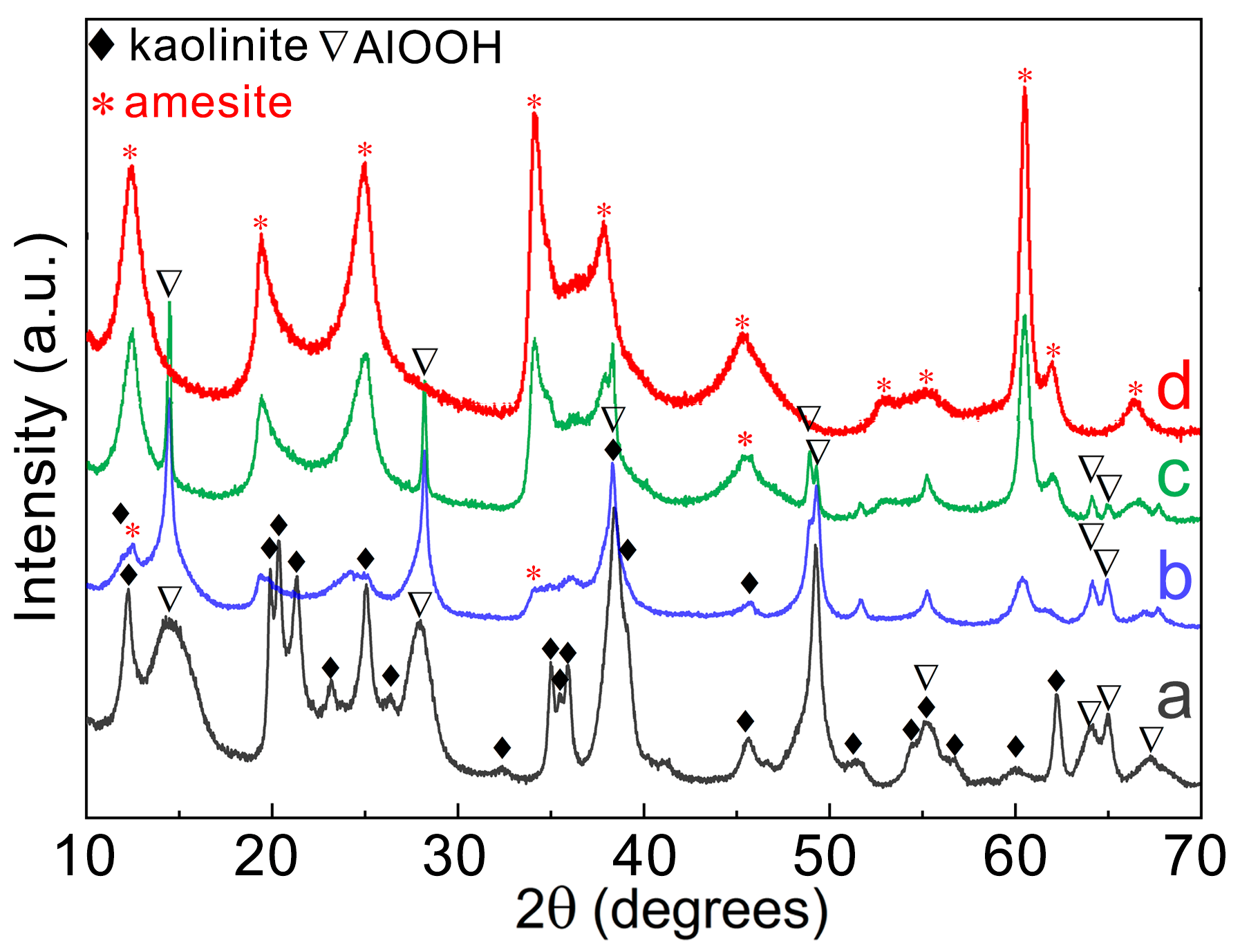
As a typical dioctahedral 1:1 clay mineral, kaolinite can be synthesized in a wide pH range from acid to base [31,33] via the hydrothermal method. However, for the trioctahedral 1:1 clay mineral amesite, we found that pH had a crucial role in the products. To elucidate the effect of pH on the formation of amesite, the pH values of the starting mixture were tuned by changing the relative volume of deionized water and 1 M KOH solution. Figure 1 shows the XRD patterns, and Table 1 lists the conditions and corresponding final phases. For sample 0Cr-a, the final products contain a large amount of boehmite besides the kaolinite, but no peaks related to amesite could be observed, as shown in Figure 1a. Increasing the pH to 9.84 significantly suppresses the formation of kaolinite, and boehmite dominates, with minor amesite being formed (Figure 1b). A further increase in pH promotes the formation of amesite (Figure 1c), and synthesis with a pH of 12.72 produces phase-pure amesite within the detection limitations of XRD (Figure 1d).
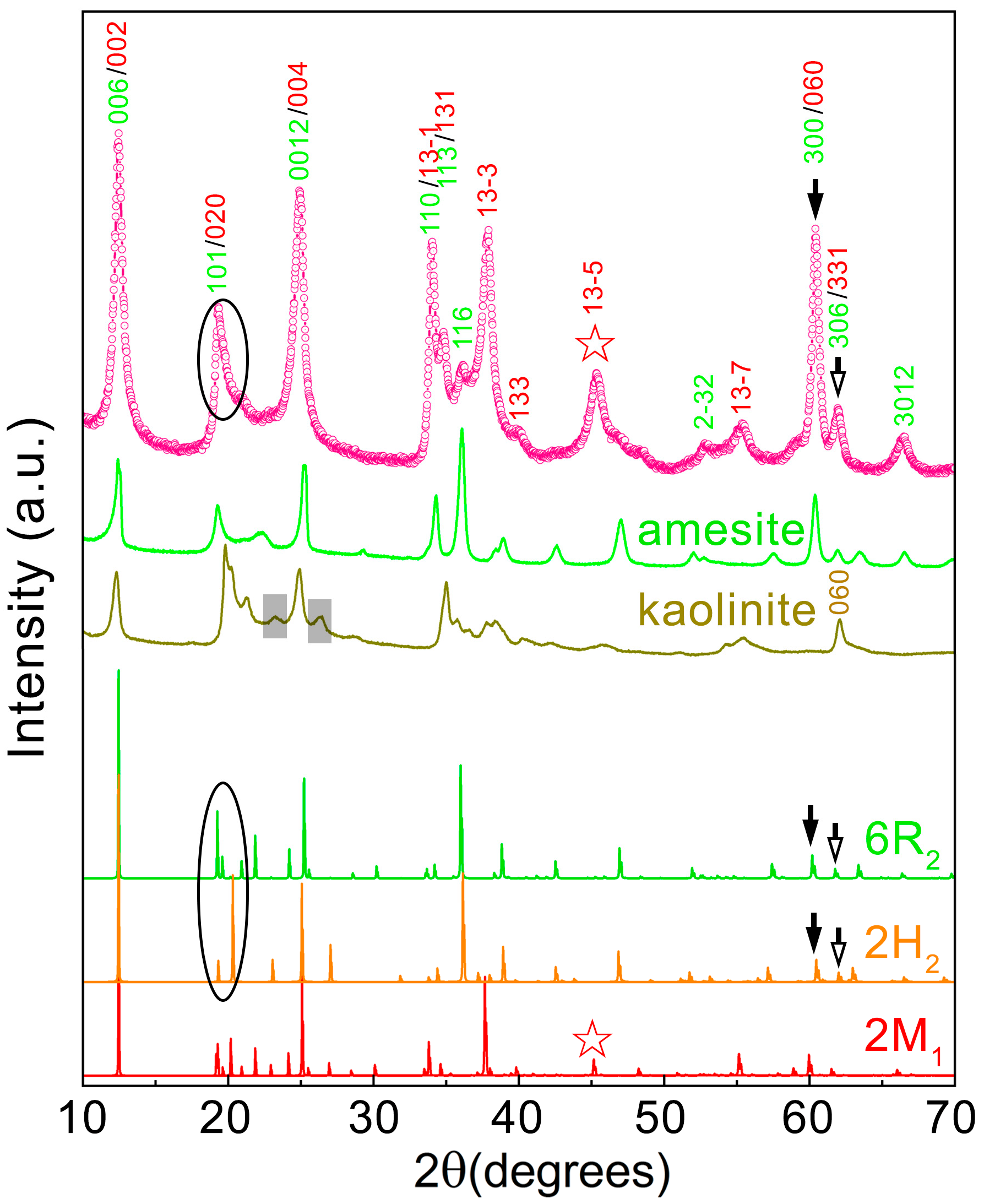
The XRD data in Figure 2 indicate that the synthetic amesite contains multiple polytypes, in common with other synthetic clay minerals [34]. The XRD pattern of 0Cr bears a great resemblance to that of natural amesite from the Saranovskoye mine (Russia) shown in the green curve. Prior work demonstrated that this natural semi-disordered amesite is mainly composed of the 6R2 and 2H2 polytypes [21]. The 6R2 polytype is more dominant than 2H2, even though 2H2 is reported to be the most abundant in fully ordered amesite crystals [17,35]. To establish the most likely polytypes in 0Cr, the XRD patterns of twelve standard polytypes and nonstandard polytype 6R2 [36] were calculated and compared with the experimental pattern from synthetic amesite. The peaks marked by arrows near 60° are indicative of 6R2 and 2H2. Comparing the circled peaks between experimental and simulated patterns suggests that 6R2 is also more dominant than 2H2 in 0Cr. However, a distinct reflection was observed at 2θ ≈ 45°, as indicated by the star, which is absent in the pattern of the natural amesite and is indicative of a different polytype. The peak at 2θ ≈ 45° is diagnostic for 2M1 and absent in 6R2 and 2H2. Thus, the XRD data from synthetic amesite can be fully indexed using 6R2 and 2M1 polytypes. The XRD data do not completely rule out the existence of the 2H2 polytype but strongly indicate 6R2 to dominate. The crystal structure information of these polytypes could befound in Bailey’s paper [36].
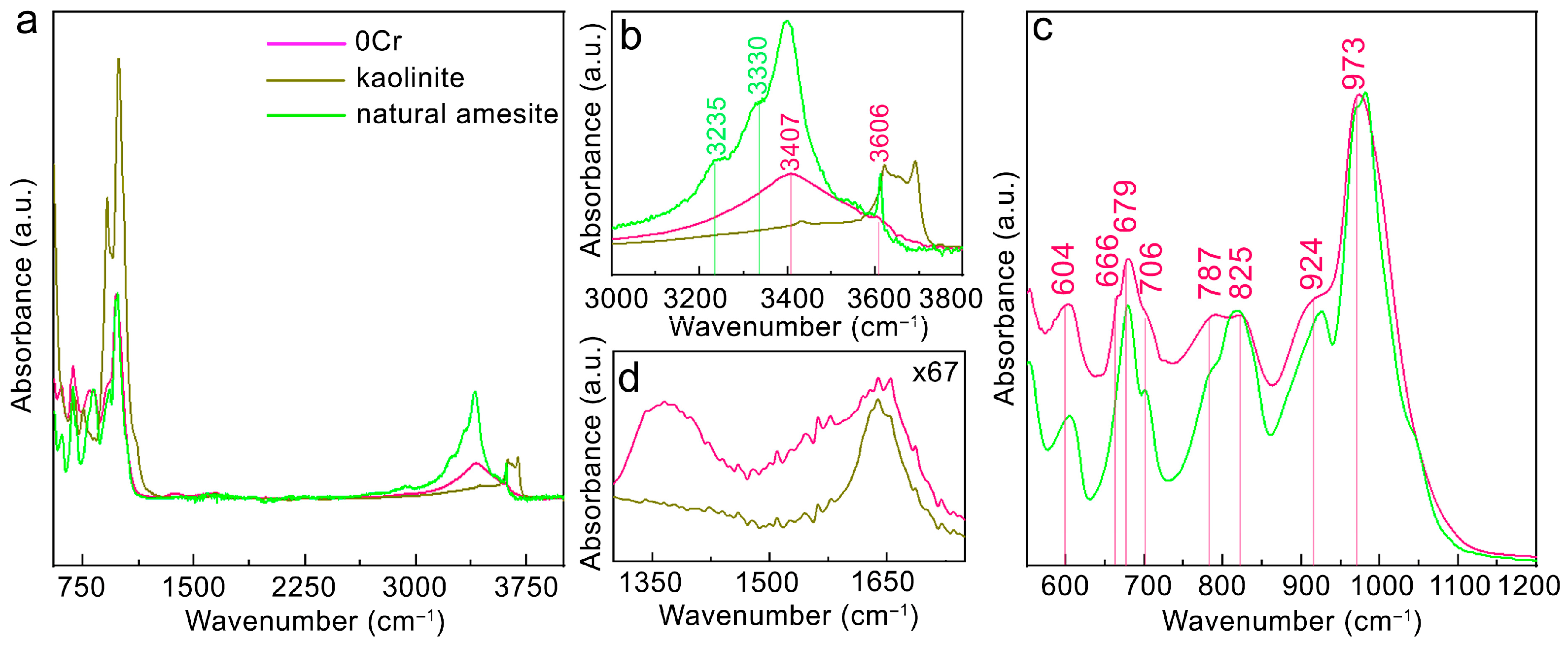
A common issue for the hydrothermal synthesis of sheet serpentine is that kaolinite often exists as an impurity phase [32,34]. The peak marked by the hollow arrow in the pattern from synthetic amesite coincides with the (060) peak of kaolinite. However, other kaolinite reflections are not observed. In addition, the kaolinite (060) peak can also be designated as (306) of 6R2 and (331) of 2M1. Therefore, XRD alone cannot conclusively determine if there is a small amount of kaolinite. FTIR was performed to further assess the kaolinite content. As shown in Figure 3a, the spectrum of 0Cr significantly differs from that of kaolinite, especially in the high wavenumber region (Figure 3b). Thus, we conclude that 0Cr does not contain kaolinite and is pure-phase amesite within the detection limitations of XRD.
A complete assignment of the FTIR spectra has not been reported in amesite so far; hence, here we refer to the work on lizardite [32,37,38,39] and compare it with the spectrum of natural amesite for a detailed analysis. Figure 3c displays the medium range spectrum, where the absorption bands of 0Cr and natural amesite are nearly identical. The band at 604 cm−1 is unique for serpentine minerals [32,37] and is attributed to the in-plane movement of hydrogen atoms [38]. The bands at 666 cm−1, 679 cm−1, 706 cm−1, 787 cm−1, 825 cm−1, 924 cm−1 and 973 cm−1 are attributed to Si–O vibrations in the tetrahedra. For example, the 924 cm−1 and 973 cm−1 bands are related to the equatorial and symmetric stretching modes of Si–O, respectively [38]. In addition to those main vibrational bands, weak signals at 1364 cm−1 and 1643 cm−1 (Figure 3d), attributable to carbonates [40] and adsorbed water [41], were observed in the spectra of synthetic amesite and kaolinite.
Clear distinctions between 0Cr and natural amesite could be observed in 3000~3800 cm−1. For 0Cr, there is only one broad band centered at 3407 cm−1 and a tiny shoulder peak at 3606 cm−1. For natural amesite, two shoulder peaks, at 3235 cm−1 and 3330 cm−1, before the main peaks at 3397 cm−1 and 3615 cm−1 were identified. All these bands are attributed to the stretching of hydroxyl groups present on the outer surface or between adjacent TO layers (Table 2) [37,38,39]. The broader bands in 0Cr compared to natural amesite suggest great disorder in synthetic amesite, especially for the bonding environment of interlayer hydroxyl groups.
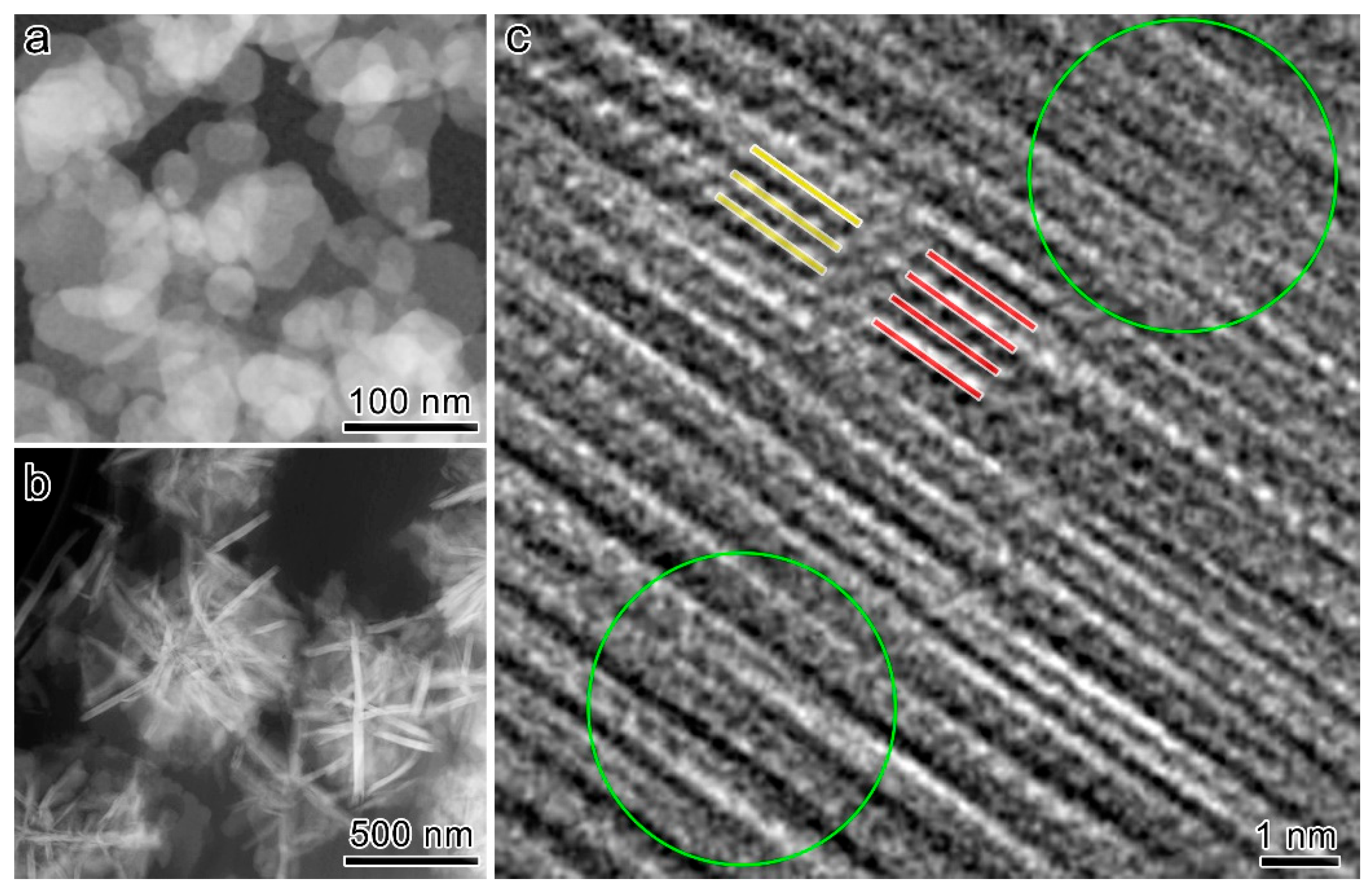
The amesite particles have a plate-like morphology. Figure 4a,b show the HAADF–STEM images of 0Cr in plane-view and cross-section samples, where the lamellar particles are prone to lying face-on and edge-on, respectively. The platy particles are, by and large, equiaxial, and have a nominal lateral size of 50~100 nm and a thickness of 10~20 nm. High-resolution TEM provides direct evidence of a highly defective stacking structure (Figure 4c). The orientation alters dramatically even within a ~10 nm field of view, such that the green circle regions are not atomically resolved and only show faint lattice fringes. For the on-zone regions, interrupted basal planes are ubiquitously observed (red and yellow lines). The basal planes marked by yellow lines are shifted along the direction perpendicular to the basal planes relative to the basal planes marked by red lines, which resembles the basal plane shift in antigorite [42].
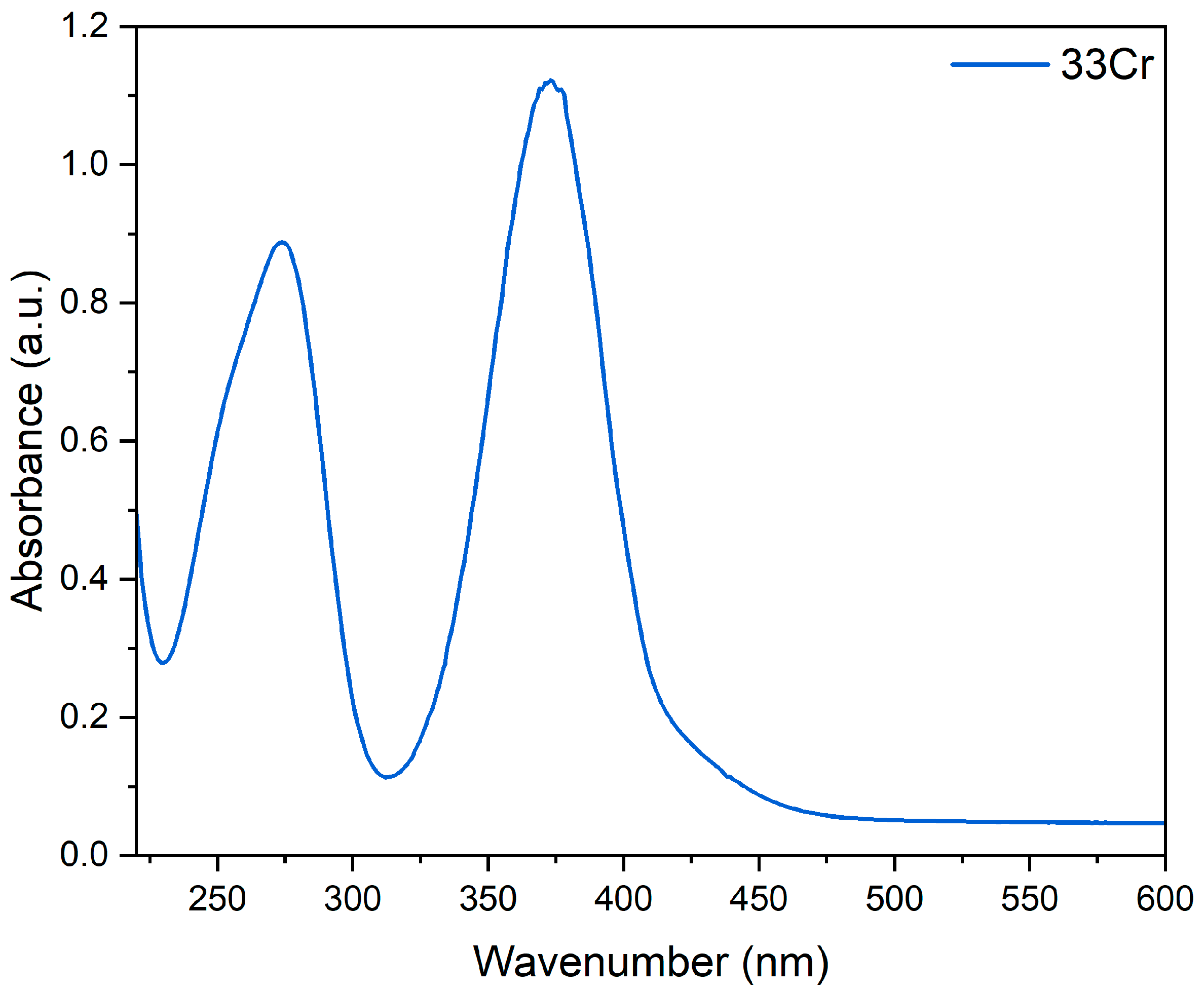
By controlling the pH at around 12.7, three Cr-containing amesite samples, 10Cr (x = 0.1), 20Cr (x = 0.2), 33Cr (x = 0.33), were synthesized (Table 3). In 10Cr and 20Cr, ~14.0% and ~27.5% Al are replaced by Cr, which are close to the designed concentrations 15.0% and 30.0%, respectively. Nevertheless, only ~39.5% Al is substituted by Cr in 33Cr, which is significantly lower than the designed 49.5%, indicating that the substitution limit is around ~39.5%. The UV-Vis spectrum of the supernatant shows two peaks at ~280 nm and ~370 nm (Figure 5), indicating that the remaining Cr3+ in the precursor was oxidized to Cr6+ and subsequently partitioned into chromate in the supernatant [43]. Trace impurities from the starting chemicals, Ca, Na, K and Fe were identified in the samples. The amesite particles in 10Cr, 20 Cr and 33Cr also show plate-like morphologies, and the particle sizes are similar to those in 0Cr. The defective microstructures shown in Figure 4 were also observed.
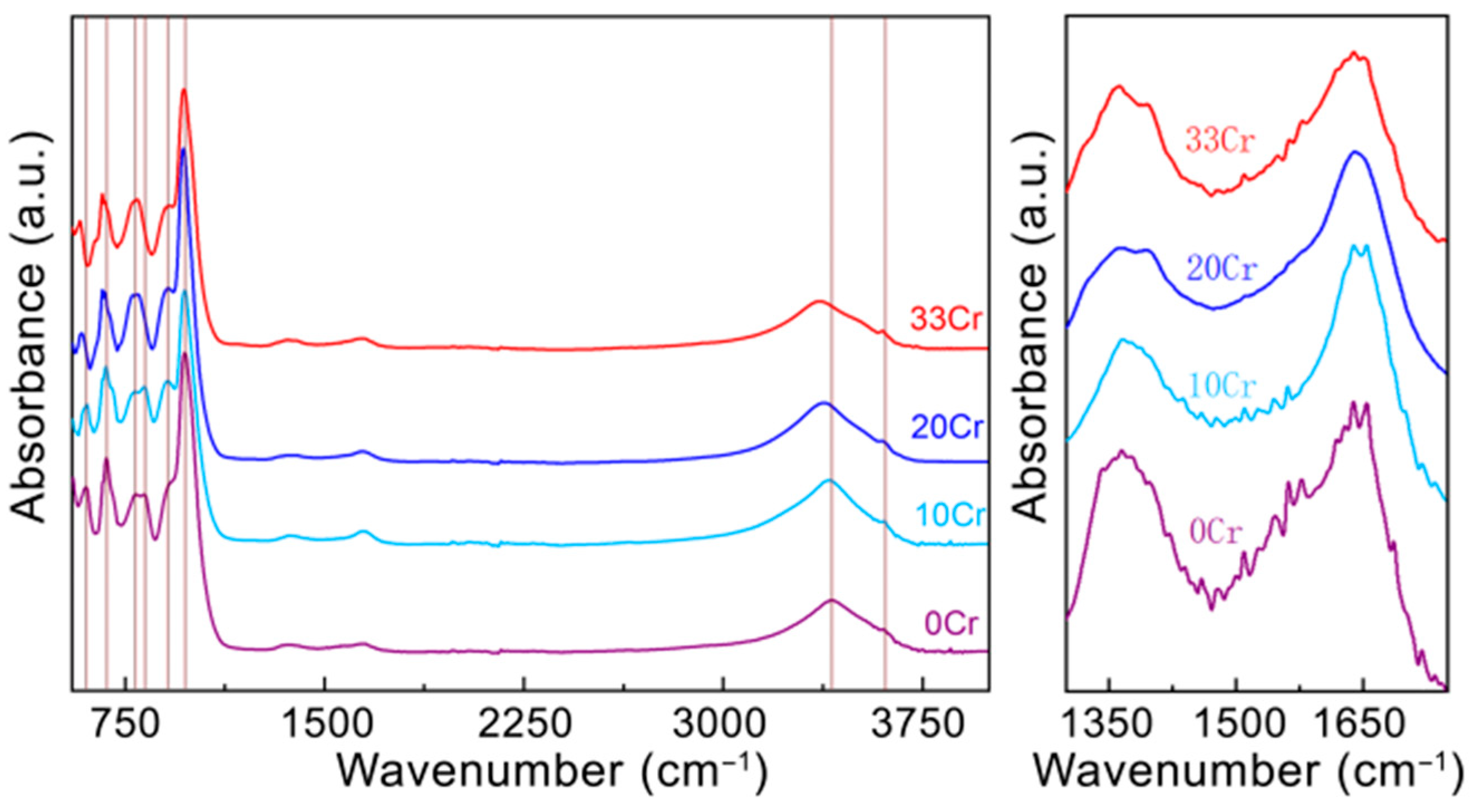
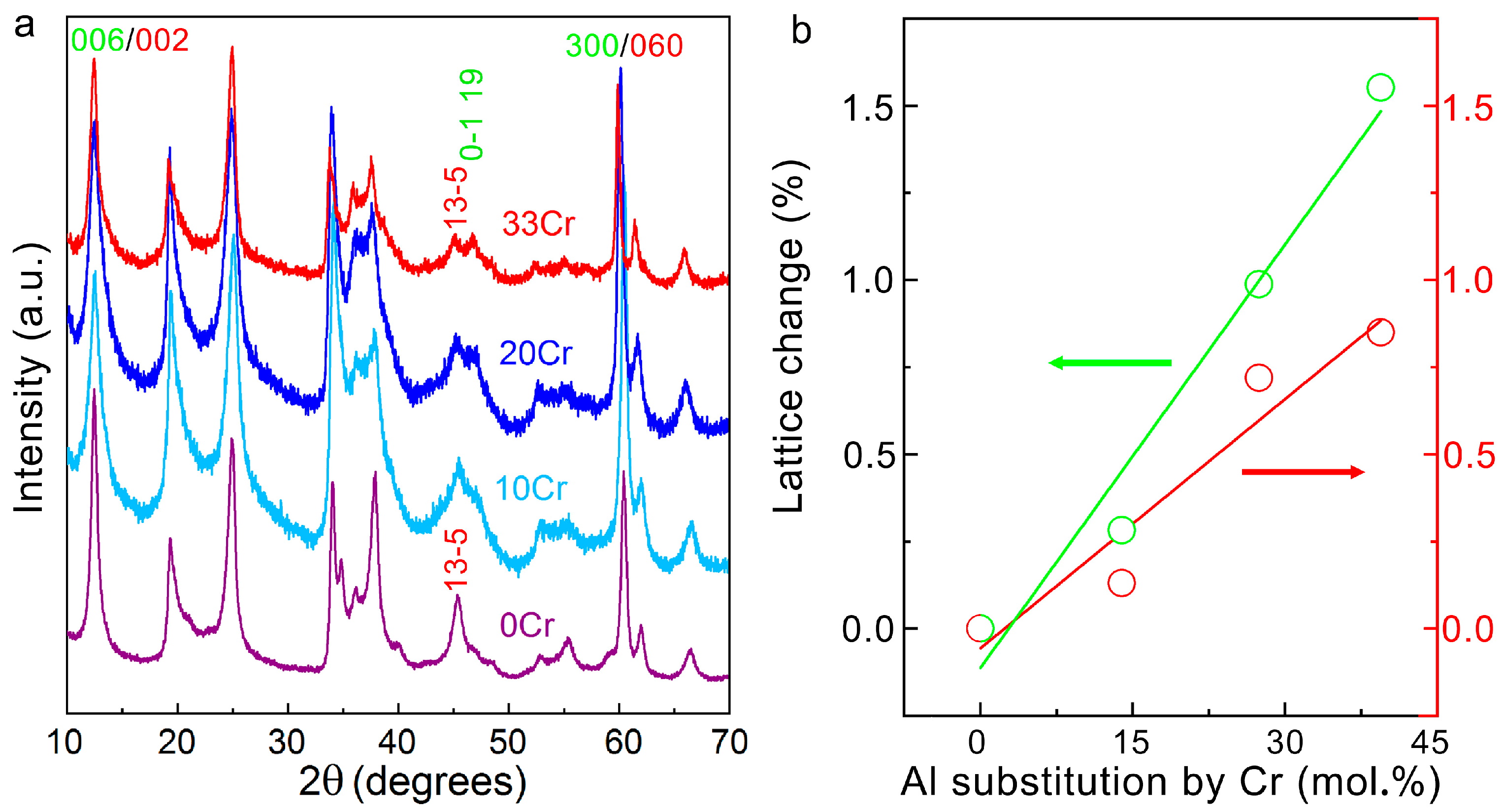
As can be seen in the XRD data in Figure 6a, the peaks of 10Cr, 20Cr and 33Cr are basically the same as those of 0Cr, and polytypes should be 6R2, 2M1, and possibly 2H2 as well. No impurity phases can be identified in the XRD patterns. Interestingly, the ( 13 5 - ) peak in 0Cr splits into two peaks in 20Cr and 33Cr, designated as ( 13 5 - ) of 2M1 and ( 0 1 - 19 ) of 6R2, suggesting that the coherency of the two polytypes deteriorates as the Cr substitution mounts. As Cr substitution increases, the c- and a-lattice-parameters also increase gradually (Figure 6b). The trend in lattice dimension is accompanied by a redshift of the absorption bands in the FTIR spectra (Figure 7). This shift is attributed to the increasing substitution of heavier Cr for Al, which does not, however, introduce new vibrational bands. Similar to 0-Cr, infinitesimal peaks possibly from carbonates and residual water were observed in all Cr-containing amesite samples.
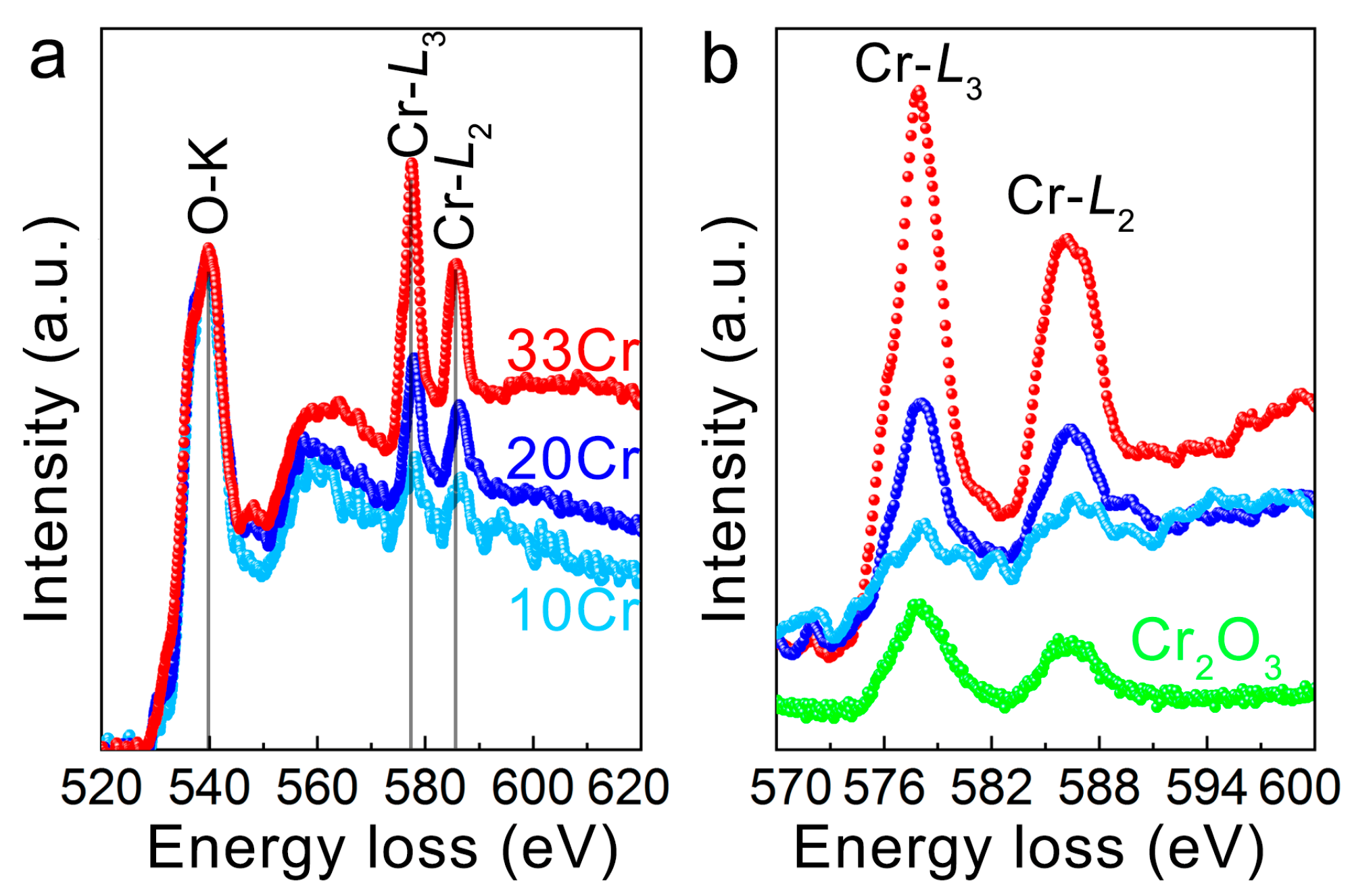
Cr in minerals typically has one of two oxidation states, Cr3+ or Cr6+ [44]. These oxidation states can be distinguished at the Cr L2,3 absorption edge because the L3 and L2 edges for Cr6+ both have two separate peaks, while only one broad peak with weak shoulder peaks is observed for Cr3+ [45]. Our previous EELS work demonstrated that Cr in natural lizardite has a trivalent charge [21,46], which agrees with the X-ray absorption near-edge structure studies in kaolin, serpentine and mica minerals [24,47,48,49]. Here, EELS were collected in 10Cr, 20Cr and 33Cr and compared with that of Cr2O3. As expected, the intensity of Cr edges increases with Cr concentration (Figure 8). Only one separate peak is observed for L3 (557.8 eV) and L2 (586.1 eV), implying that Cr in 10Cr, 20Cr and 33Cr is trivalent, as strongly supported by comparing with the edges of Cr2O3.
Large-quantity substitution of Cr3+ in serpentine indicates that Cr3+ can be readily used to tune the local strain and acidity of serpentine minerals, which greatly enriches our toolbox to engineer serpentine minerals for various catalytic applications. There remain many motivations for exploring the synthesis of metal-substituted clay minerals. First, clay minerals have applications in nanotechnology and further studies may consider Al3+ substitution with other trivalent cations with high catalytic activity [50], like Co3+, Fe3+, Rh3+, etc. Second, extensively substituting Al3+ with heavier cations like Cr3+ is also helpful to better understand the links between metal substitutions and polytypism in serpentinites. Presently, it is not possible to distinguish Al from Mg and Si by atomic-scale imaging techniques like annular dark-field scanning transmission electron microscopy (ADF-STEM) because of their very close atomic number. Alternatively, we can substitute Al with Cr or other heavy but chemically similar trivalent cations and reveal the structural features by ADF-STEM.

4. Conclusions

In summary, we synthesized amesite nanopowders via the hydrothermal method, where the pH of the solution should be controlled at around 12.7 to avoid the formation of impurities like kaolinite and AlOOH. The lamellar amesite particles are 50~100 nm in lateral directions and 10~20 nm in thickness and have abundant stacking defects. Cr can substitute up to ~39.5% Al and is trivalent in Cr-substituted amesite samples. As expected, the crystal lattices expand as Cr concentration increases. Cr substitution has little influence on the polytypism; both endmember and Cr-substituted amesite samples have multiple polytypes, including 6R2, 2M1, and possibly 2H2.

Author Contributions

Conceptualization, H.Z.; formal analysis, H.L. and H.Z.; data curation, H.L. and H.Z.; writing—original draft, H.L. and H.Z.; writing—review and editing, B.G.; visualization, H.Z.; supervision, H.Z. and B.G.; project administration, B.G.; funding acquisition, B.G. All authors have read and agreed to the published version of the manuscript.

Funding

This work was supported by the Chemical Sciences, Geosciences, and Biosciences Division, Office of Science, Office of Basic Energy Sciences, U.S. Department of Energy under Award Number DE-AC02-05CH11231. Work at the Molecular Foundry was supported by the Office of Science, Office of Basic Energy Sciences, U.S. Department of Energy under contract No. DE-AC02-05CH11231. Hui Zhang acknowledges the support of the Natural Science Foundation of Guangdong Province (No. 2025A1515011876).

Data Availability Statement

The original contributions presented in this study are included in the article. Further inquiries can be directed to the corresponding authors.

Acknowledgments

The authors would like to thank Christopher Colla and Nicholas Jon Pester for helpful discussions on hydrothermal synthesis.

Conflicts of Interest

The authors declare no conflicts of interest.

References

  1. Dedzo, G.K.; Detellier, C. Clay Minerals—Ionic Liquids, Nanoarchitectures, and Applications. Adv. Funct. Mater. 2018, 28, 1703845. [Google Scholar] [CrossRef]
  2. Stöter, M.; Rosenfeldt, S.; Breu, J. Tunable Exfoliation of Synthetic Clays. Annu. Rev. Mater. Res. 2015, 45, 129–151. [Google Scholar] [CrossRef]
  3. Evans, B.W.; Hattori, K.; Baronnet, A. Serpentinite: What, Why, Where? Elements 2013, 9, 99–106. [Google Scholar] [CrossRef]
  4. Brigatti, M.F.; Galan, E.; Theng, B.K.G. Chapter 2 Structures and Mineralogy of Clay Minerals. In Developments in Clay Science; Bergaya, F., Theng, B.K.G., Lagaly, G., Eds.; Elsevier: Amsterdam, The Netherlands, 2006; Volume 1, pp. 19–86. [Google Scholar]
  5. Carmignano, O.; Vieira, S.; Brandão, P.R.; Bertoli, A.; Lago, R. Serpentinites: Mineral Structure, Properties and Technological Applications. J. Braz. Chem. Soc. 2020, 31, 2–14. [Google Scholar] [CrossRef]
  6. Zhang, J.; Zhou, C.H.; Petit, S.; Zhang, H. Hectorite: Synthesis, Modification, Assembly and Applications. Appl. Clay Sci. 2019, 177, 114–138. [Google Scholar] [CrossRef]
  7. Carniato, F.; Gatti, G.; Bisio, C. An Overview of the Recent Synthesis and Functionalization Methods of Saponite Clay. New J. Chem. 2020, 44, 9969–9980. [Google Scholar] [CrossRef]
  8. Kwak, S.; Yoo, J.-C.; Moon, D.H.; Baek, K. Role of Clay Minerals on Reduction of Cr(VI). Geoderma 2018, 312, 1–5. [Google Scholar] [CrossRef]
  9. Zhou, S.; Howard, E.S.; Liu, J.; Bashian, N.H.; Nolan, K.; Krishnamoorthy, S.; Rangel, G.M.; Sougrati, M.-T.; Prakash, G.K.S.; Page, K.; et al. Hydrothermal Preparation, Crystal Chemistry, and Redox Properties of Iron Muscovite Clay. ACS Appl. Mater. Interfaces 2017, 9, 34024–34032. [Google Scholar] [CrossRef]
  10. Sugiura, M.; Sueyoshi, M.; Seike, R.; Hayashi, T.; Okada, T. Hydrated Silicate Layer Formation on Mica-Type Crystals. Langmuir 2020, 36, 4933–4941. [Google Scholar] [CrossRef]
  11. Ji, X.; Kang, Y.; Ouyang, J.; Chen, Y.; Artzi, D.; Zeng, X.; Xiao, Y.; Feng, C.; Qi, B.; Kim, N.Y.; et al. Synthesis of Ultrathin Biotite Nanosheets as an Intelligent Theranostic Platform for Combination Cancer Therapy. Adv. Sci. 2019, 6, 1901211. [Google Scholar] [CrossRef]
  12. Joussein, E.; Petit, S.; Churchman, J.; Theng, B.; Righi, D.; Delvaux, B. Halloysite Clay Minerals—A Review. Clay Miner. 2005, 40, 383–426. [Google Scholar] [CrossRef]
  13. Cao, C.-Y.; Liang, C.-H.; Yin, Y.; Du, L.-Y. Thermal Activation of Serpentine for Adsorption of Cadmium. J. Hazard. Mater. 2017, 329, 222–229. [Google Scholar] [CrossRef] [PubMed]
  14. Fatnassi, M.; Solterbeck, C.-H.; Es-Souni, M. Clay Nanomaterial Thin Film Electrodes for Electrochemical Energy Storage Applications. RSC Adv. 2014, 4, 46976–46979. [Google Scholar] [CrossRef]
  15. Mellini, M.; Zanazzi, P.F. Crystal Structures of Lizardite-1T and Lizardite-2H1 from Coli, Italy. Am. Mineral. 1987, 72, 943–948. [Google Scholar]
  16. Brigatti, M.F.; Galli, E.; Medici, L.; Poppi, L. Crystal Structure Refinement of Aluminian Lizardite-2H2. Am. Mineral. 1997, 82, 931–935. [Google Scholar] [CrossRef]
  17. Anderson, C.S.; Bailey, S.W. A New Cation Ordering Pattern in Amesite-2H2. Am. Mineral. 1981, 66, 185–195. [Google Scholar]
  18. Mackenzie, K.J.D.; Bowden, M.E. Thermal and Mössbauer Studies of Iron-Containing Hydrous Silicates. IV. Amesite. Thermochim. Acta 1983, 64, 83–106. [Google Scholar] [CrossRef]
  19. Wiewiora, A.; Rausell-Colom, J.A.; Garcia-Gonzalez, M.T. The Crystal Structure of Amesite from Mount Sobotka: A Nonstandard Polytype. Am. Mineral. 1991, 76, 647–652. [Google Scholar]
  20. Zheng, H.; Bailey, S.W. Refinement of an Amesite-2H1 Polytype from Postmasburg, South Africa. Clays Clay Miner. 1997, 45, 301–310. [Google Scholar] [CrossRef]
  21. Zhang, H.; Zarzycki, P.; Gilbert, B.; Banfield, J.F. Polytypism in Semi-Disordered Lizardite and Amesite by Low-Dose HAADF-STEM. Am. Mineral. 2022, 107, 221–232. [Google Scholar] [CrossRef]
  22. Oze, C.; Fendorf, S.; Bird, D.K.; Coleman, R.G. Chromium Geochemistry of Serpentine Soils. Int. Geol. Rev. 2004, 46, 97–126. [Google Scholar] [CrossRef]
  23. Oze, C.; Fendorf, S.; Bird, D.K.; Coleman, R.G. Chromium Geochemistry in Serpentinized Ultramafic Rocks and Serpentine Soils from the Franciscan Complex of California. Am. J. Sci. 2004, 304, 67–101. [Google Scholar] [CrossRef]
  24. Mitsis, I.; Godelitsas, A.; Göttlicher, J.; Steininger, R.; Gamaletsos, P.N.; Perraki, M.; Abad-Ortega, M.M.; Stamatakis, M. Chromium-Bearing Clays in Altered Ophiolitic Rocks from Crommyonia (Soussaki) Volcanic Area, Attica, Greece. Appl. Clay Sci. 2018, 162, 362–374. [Google Scholar] [CrossRef]
  25. Maksimović, Z.; White, J.L.; Logar, M. Chromium-Bearing Dickite and Chromium-Bearing Kaolinite from Teslić, Yugoslavia. Clays Clay Miner. 1981, 29, 213–218. [Google Scholar] [CrossRef]
  26. Maksimovic, Z.; Brindley, G.W. Hydrothermal Alteration of a Serpentinite near Takovo, Yugoslavia, to Chromium-Bearing Illite/Smectite, Kaolinite, Tosudite, and Halloysite. Clays Clay Miner. 1980, 28, 295–302. [Google Scholar] [CrossRef]
  27. Khoury, H.N.; Al-Zoubi, A.S. Origin and Characteristics of Cr-Smectite from Suweileh Area, Jordan. Appl. Clay Sci. 2014, 90, 43–52. [Google Scholar] [CrossRef]
  28. Dzene, L.; Brendlé, J.; Limousy, L.; Dutournié, P.; Martin, C.; Michau, N. Synthesis of Iron-Rich Tri-Octahedral Clay Minerals: A Review. Appl. Clay Sci. 2018, 166, 276–287. [Google Scholar] [CrossRef]
  29. Zhou, C.H.; Zhou, Q.; Wu, Q.Q.; Petit, S.; Jiang, X.C.; Xia, S.T.; Li, C.S.; Yu, W.H. Modification, Hybridization and Applications of Saponite: An Overview. Appl. Clay Sci. 2019, 168, 136–154. [Google Scholar] [CrossRef]
  30. Petit, S.; Baron, F.; Decarreau, A. Synthesis of Nontronite and Other Fe-Rich Smectites: A Critical Review. Clay Miner. 2017, 52, 469–483. [Google Scholar] [CrossRef]
  31. Zhang, D.; Zhou, C.-H.; Lin, C.-X.; Tong, D.-S.; Yu, W.-H. Synthesis of Clay Minerals. Appl. Clay Sci. 2010, 50, 1–11. [Google Scholar] [CrossRef]
  32. Bentabol, M.; Ruiz Cruz, M.D. Chemistry, Morphology and Structural Characteristics of Synthetic Al–Ni and Al–Co-Lizardites. Appl. Clay Sci. 2013, 77–78, 68–78. [Google Scholar] [CrossRef]
  33. Huertas, F.J.; Huertas, F.; Linares, J. Hydrothermal Synthesis of Kaolinite: Method and Characterization of Synthetic Materials. Appl. Clay Sci. 1993, 7, 345–356. [Google Scholar] [CrossRef]
  34. Bentabol, M.; Ruiz Cruz, M.D.; Huertas, F.J. Hydrothermal Synthesis (200 °C) of Co–Kaolinite and Al–Co–Serpentine. Appl. Clay Sci. 2009, 42, 649–656. [Google Scholar] [CrossRef]
  35. Hall, S.H.; Bailey, S.W. Cation Ordering Pattern in Amesite. Clays Clay Miner. 1979, 27, 241–247. [Google Scholar] [CrossRef]
  36. Bailey, S.W. Polytypism of Trioctahedral 1:1 Layer Silicates. Clays Clay Miner. 1969, 17, 355–371. [Google Scholar] [CrossRef]
  37. Serna, C.J.; Velde, B.; White, J.L. Infrared Evidence of Order-Disorder in Amesites. Am. Mineral. 1977, 62, 296–303. [Google Scholar]
  38. Balan, E.; Saitta, A.M.; Mauri, F.; Lemaire, C.; Guyot, F. First-Principles Calculation of the Infrared Spectrum of Lizardite. Am. Mineral. 2002, 87, 1286–1290. [Google Scholar] [CrossRef]
  39. Fuchs, Y.; Linares, J.; Mellini, M. Mössbauer and Infrared Spectrometry of Lizardite-1T from Monte Fico, Elba. Phys. Chem. Miner. 1998, 26, 111–115. [Google Scholar] [CrossRef]
  40. Elgayyar, T.; Azzolina-Jury, F.; Thibault-Starzyk, F. Infrared spectroscopy at the surface of carbonates. Phys. Chem. Chem. Phys. 2025, 27, 22871–22879. [Google Scholar] [CrossRef]
  41. Cheng, H.; Frost, R.L.; Yang, J.; Liu, Q.; He, J. Infrared and infrared emission spectroscopic study of typical chinese kaolinite and halloysite. Spectrochim. Acta Part A Mol. Biomol. Spectrosc. 2010, 77, 1014–1020. [Google Scholar] [CrossRef]
  42. Dódony, I.; Pósfai, M.; Buseck, P.R. Revised Structure Models for Antigorite: An HRTEM Study. Am. Mineral. 2002, 87, 1443–1457. [Google Scholar] [CrossRef]
  43. Wang, Y.; Ohishi, Y.; Shishido, T.; Zhang, Q.; Yang, W.; Guo, Q.; Wan, H.; Takehira, K. Characterizations and catalytic properties of Cr-MCM-41 prepared by direct hydrothermal synthesis and template-ion exchange. J. Catal. 2003, 220, 347–357. [Google Scholar] [CrossRef]
  44. Weckhuysen, B.M.; Wachs, I.E.; Schoonheydt, R.A. Surface Chemistry and Spectroscopy of Chromium in Inorganic Oxides. Chem. Rev. 1996, 96, 3327–3350. [Google Scholar] [CrossRef] [PubMed]
  45. Garvie, L.A.J.; Craven, A.J.; Brydson, R. Use of Electron-Energy Loss Near-Edge Fine Structure in the Study of Minerals. Am. Mineral. 1994, 79, 411–425. [Google Scholar]
  46. Zhang, H.; Gilbert, B.; Banfield, J.F. Atomic Perspective on the Serpentine–Chlorite Solid-State Transformation. Chem. Mater. 2021, 33, 6338–6345. [Google Scholar] [CrossRef]
  47. Cardelli, A.; Cibin, G.; Benfatto, M.; Della Longa, S.; Brigatti, M.F.; Marcelli, A. A Crystal-Chemical Investigation of Cr Substitution in Muscovite by XANES Spectroscopy. Phys. Chem. Miner. 2003, 30, 54–58. [Google Scholar] [CrossRef]
  48. Brigatti, M.F.; Galli, E.; Medici, L.; Poppi, L.; Cibin, G.; Marcelli, A.; Mottana, A. Chromium-Containing Muscovite: Crystal Chemistry and XANES Spectroscopy. Eur. J. Mineral. 2001, 13, 377–389. [Google Scholar] [CrossRef]
  49. Balan, E.; Allard, T.; Morin, G.; Calas, G. Incorporation of Cr3+ in Dickite: A Spectroscopic Study. Phys. Chem. Miner. 2002, 29, 273–279. [Google Scholar] [CrossRef]
  50. Yang, G.; Zhou, L. Montmorillonite-Catalyzed Conversions of Carbon Dioxide to Formic Acid: Active Site, Competitive Mechanisms, Influence Factors and Origin of High Catalytic Efficiency. J. Colloid Interface Sci. 2020, 563, 8–16. [Google Scholar] [CrossRef]
Figure 1. XRD patterns of the samples synthesized under different pH conditions: (a) pH = 6.32, (b) pH = 9.84, (c) pH = 12.53, and (d) pH = 12.72. The synthesis conditions and final phase components are listed in Table 1. Phase-pure amesite within the detection limitations of XRD was obtained under condition (d).
Nanomaterials 16 00448 g001
Figure 2. Experimental XRD patterns of 0Cr (pink) prepared with the 0Cr-d condition listed in Table 1: natural amesite (green), kaolinite (brown), and simulated XRD patterns of amesite with 6R2, 2H2 and 2M1 polytypes. The stars denote the fingerprint peak of 2M1. Solid and hollow arrows denote the peaks usually designated to the (060) diffraction of trioctahedral (amesite) and dioctahedral (kaolinite) 1:1 clay minerals when an orthorhombic unit cell is used, respectively. Our analyses show that these peaks come from amesite only. Red and green indices denote the peaks of 2M1 and 6R2, which have orthorhombic and hexagonal unit cells, respectively. For 6R2, the Bravais–Miller index was used with the third index omitted.
Nanomaterials 16 00448 g002
Figure 3. (a) FTIR spectra of 0Cr, natural amesite and synthetic kaolinite. (b) The high wavenumber region, where the significant contrast between synthetic amesite and kaolinite suggests that kaolinite is absent in 0Cr. The peaks in the middle wavenumber range are labeled in (c). (d) Weak peaks in 1300~1750 cm−1. The intensities were scaled by a factor of 67 for clarity.
Nanomaterials 16 00448 g003
Figure 4. (a,b) HAADF–STEM plane-view (a) and cross-section (b) morphology of 0Cr. (c) High-resolution TEM image. Green circled regions only show faint lattice contrast because of large orientation deviation. Red and yellow lines highlight regions of interrupted basal planes.
Nanomaterials 16 00448 g004
Figure 5. UV-Vis spectrum of the supernatant of 33Cr.
Nanomaterials 16 00448 g005
Figure 6. (a) Comparison of the XRD patterns of 0Cr, 10Cr, 20Cr and 33Cr. (b) Lattice change versus Al substitution by Cr. Green and red circles denote the relative change in c- and a-lattice-parameters, respectively. Fitted lines are plotted to illustrate the trends.
Nanomaterials 16 00448 g006
Figure 7. FTIR spectra of 0Cr, 10Cr, 20Cr and 33Cr amesite. Most peaks exhibit redshifts within increasing Cr content. The weak peaks between 1300 and ~1750 cm−1 can possibly be caused by carbonates and residual water, as presented in the right column.
Nanomaterials 16 00448 g007
Figure 8. (a) EELS of 10Cr, 20Cr and 33Cr showing O-K, Cr-L2 and Cr-L3 edges. The spectra are rescaled to ensure that the O-K edges have the same intensities. Cr-L2 and Cr-L3 edges are zoomed in and plotted together with Cr2O3 in (b).
Nanomaterials 16 00448 g008
Table 1. The conditions for hydrothermal syntheses of Cr-free amesite and the main phase components.
SampleGelLiquidpHProducts
0Cr-a1 g15 mL H2O6.32kaolinite, AlOOH
0Cr-b1 g7.5 mL H2O, 7.5 mL 1 M KOH9.84amesite, AlOOH
0Cr-c1 g5.0 mL H2O, 10.0 mL 1 M KOH12.52amesite, AlOOH
0Cr-d1 g2.5 mL H2O, 12.5 mL 1 M KOH12.72amesite
Table 2. Absorption bands observed in 0Cr.
Bands (cm−1)Interpretation
604In-plane movement of H atoms
666Vibration of Si–O
679Vibration of Si–O
706Vibration of Si–O
787Vibration of Si–O
825Vibration of Si–O
924Equatorial stretching modes of Si–O
973Symmetric stretching of apical Si–O
3407Stretching of the outer hydroxyl group
3606Stretching of the inner hydroxyl group
Table 3. Synthesis conditions, measured Cr-for-Al substitutions and lattice parameters of Cr-containing synthetic amesite. For simplicity, the lattice parameters are presented with the hexagonal structure, adopted by the observed 6R2 polytype.
SampleGel and LiquidAl Substitution by CrLattice Parameters (Å)
10Cr1 g gel, 2.5 mL H2O, 12.5 mL 1 M KOH13.9%a = 4.596, c = 42.66
20Cr0.8 g gel, 2.5 mL H2O, 12.5 mL 1 M KOH27.2%a = 4.623, c = 42.90
33Cr0.8 g gel, 2.5 mL H2O, 12.5 mL 1 M KOH39.1%a = 4.629, c = 43.20
For 0Cr, a = 4.59 Å, c = 42.54 Å
Disclaimer/Publisher’s Note: The statements, opinions and data contained in all publications are solely those of the individual author(s) and contributor(s) and not of MDPI and/or the editor(s). MDPI and/or the editor(s) disclaim responsibility for any injury to people or property resulting from any ideas, methods, instructions or products referred to in the content.