Mechanistic and Life-Cycle Framework for Green Nanomaterials in Atmospheric Water Harvesting


 ,
,  and
and 
Abstract
1. Introduction
2. Fundamentals of Atmospheric Water Harvesting: Mechanistic Considerations
2.1. Principles of Atmospheric Water Harvesting
2.2. Technological Approaches to Atmospheric Water Harvesting
2.3. Key Parameters Influencing AWH Performance
2.4. Limitations and Transition Toward Material-Centric Design
2.5. Mechanistic Thermodynamics of Adsorption–Desorption
3. Green Nanotechnology: Principles and Applications
3.1. Principles and Green Synthesis of Nanomaterials
3.1.1. Plant- and Agricultural-Waste-Based Synthesis
3.1.2. Microbial and Biogenic Routes
3.1.3. Environmental Benefits and Relevance to AWH
3.2. Life-Cycle Assessment (LCA) and the “Greenwashing” Paradigm
3.3. Green Nanoparticles Replacing Traditional Desiccants
3.4. Applications of Green Nanomaterials in Water Treatment: Implications for AWH Systems
3.5. Relevance to Contemporary Water-Management Challenges
3.6. Applications of Green Nanomaterials in Atmospheric Water-Harvesting Systems
3.7. Comparative Evaluation of Green Versus Conventional Synthesis Routes
4. Application of Green Nanotechnology in Atmospheric Water Harvesting
4.1. Nanomaterials for Green AWH Systems
4.1.1. Metal Oxides and Inorganic Nanomaterials
4.1.2. Graphene Oxide-Based Sorbents
4.1.3. Metal–Organic Frameworks
4.1.4. Covalent Organic Frameworks (COFs)
4.1.5. Bio-Derived and Photothermal Aerogels
4.2. Nano-Engineering Strategies for Efficiency Enhancement
4.2.1. Surface Wettability Engineering
4.2.2. Desiccant Nanocomposite Architectures
4.2.3. Photothermal-Enhanced Regeneration
4.2.4. Integrated Perspective
4.3. Representative Studies and Performance Benchmarks
4.4. Design Implications from Field Benchmarks
5. Challenges, Durability, and Future Directions for Green Nano-Based Atmospheric Water Harvesting
5.1. Material Durability, Hygienic Stability, and Aging Mechanisms
5.2. Environmental, Manufacturing, and Scale-Up Constraints
5.3. Research Priorities and Strategic Roadmap
6. Conclusions
Author Contributions
Funding
Data Availability Statement
Acknowledgments
Conflicts of Interest
References
- Sachs, J. Sustainable Development Report 2022; Cambridge University Press: Cambridge, UK, 2022. [Google Scholar]
- Ferroukhi, R.; Nagpal, D.; Lopez-Pena, A.; Hodges, T.; Mohtar, R.H.; Daher, B.; Mohtar, S.; Keulertz, M. Renewable Energy in the Water, Energy & Food Nexus; IRENA: Abu Dhabi, United Arab Emirates, 2015; pp. 1–125. [Google Scholar]
- Swatuk, L.A. Global water crises and challenges for water security. In Handbook of Security and the Environment; Edward Elgar Publishing: Cheltenham, UK, 2021; pp. 40–61. [Google Scholar]
- Nikkhah, H.; Azmi, W.M.B.W.; Nikkhah, A.; Najafi, A.M.; Babaei, M.M.; Fen, C.S.; Nouri, A.; Mohammad, A.W.; Lun, A.W.; Yong, N.L. A comprehensive review on atmospheric water harvesting technologies: From thermodynamic concepts to mechanism and process development. J. Water Process Eng. 2023, 53, 103728. [Google Scholar] [CrossRef]
- Bai, S.; Tian, Y.; Zeng, Y.; Chao, L.; Pan, A.; Ho, T.; Chen, S.; Shang, J.; Tso, C. Adsorption-based atmospheric water harvesting by passive radiative condensers for continuous decentralized water production. Appl. Therm. Eng. 2023, 225, 120163. [Google Scholar] [CrossRef]
- Sadek, S.; Deng, S.; Zhao, J.; Zayed, M.E. Solar-powered adsorption-based atmospheric water harvesting systems: Principles, materials, performance analysis, and configurations. Sustain. Energy Technol. Assess. 2022, 54, 102874. [Google Scholar] [CrossRef]
- Lee, Y.; Fan, S.; Yang, S. Nature-Inspired Design Strategies for Efficient Atmospheric Water Harvesting. Adv. Mater. 2025, 37, e19362. [Google Scholar] [CrossRef]
- Rao, A.K.; Fix, A.J.; Yang, Y.C.; Warsinger, D.M. Thermodynamic limits of atmospheric water harvesting. Energy Environ. Sci. 2022, 15, 4025–4037. [Google Scholar] [CrossRef]
- Kwan, T.H.; Yuan, S.; Shen, Y.; Pei, G. Comparative meta-analysis of desalination and atmospheric water harvesting technologies based on the minimum energy of separation. Energy Rep. 2022, 8, 10072–10087. [Google Scholar] [CrossRef]
- Thakur, A.K.; Hazra, S.K.; Saleque, A.M.; Bhattarai, S.; Hwang, J.-Y.; Ahamed, M.S. Toward sustainable water solutions: A review of nanomaterials for solar-driven water harvesting. ACS EST Water 2024, 4, 4741–4757. [Google Scholar] [CrossRef]
- Feng, A.; Akther, N.; Duan, X.; Peng, S.; Onggowarsito, C.; Mao, S.; Fu, Q.; Kolev, S.D. Recent development of atmospheric water harvesting materials: A review. ACS Mater. Au 2022, 2, 576–595. [Google Scholar] [CrossRef]
- Mardani, M.; Rakhshandehroo, G.; Zerafat, M. Moisture Harvesting Efficacy Utilizing Flower-Like ZnO Nanostructures Coated on Cotton Fabrics. Iran. J. Sci. Technol. Trans. Civ. Eng. 2025, 49, 787–798. [Google Scholar] [CrossRef]
- Kim, H.; Rao, S.R.; Kapustin, E.A.; Zhao, L.; Yang, S.; Yaghi, O.M.; Wang, E.N. Adsorption-based atmospheric water harvesting device for arid climates. Nat. Commun. 2018, 9, 1191. [Google Scholar] [CrossRef]
- Huang, X.; Qin, Q.; Ma, Q.; Wang, B. Atmospheric water harvesting with metal-organic frameworks and their composites: From materials to devices. Water 2022, 14, 3487. [Google Scholar] [CrossRef]
- Zhang, S.; Xu, S.; Lei, R.; Pan, Y.; Ma, T.; Zhang, Z.; Liu, C.; Zhang, Z. Core-shell-embedded Mesoporous Silica Capsules for Atmospheric Water Harvesting. J. Wuhan Univ. Technol.-Mater. Sci. Ed. 2023, 38, 951–959. [Google Scholar] [CrossRef]
- Shi, Y.; Feng, A.; Mao, S.; Onggowarsito, C.; Zhang, X.S.; Guo, W.; Fu, Q. Hydrogels in solar-driven water and energy production: Recent advances and future perspectives. Chem. Eng. J. 2024, 492, 152303. [Google Scholar] [CrossRef]
- Shi, L.; Kirlikovali, K.O.; Chen, Z.; Farha, O.K. Metal-organic frameworks for water vapor adsorption. Chem 2024, 10, 484–503. [Google Scholar] [CrossRef]
- Severino, M.I.; Freitas, C.; Pimenta, V.; Nouar, F.; Pinto, M.L.; Serre, C. Cost estimation of the production of MIL-100 (Fe) at industrial scale from two upscaled sustainable synthesis routes. Ind. Eng. Chem. Res. 2025, 64, 2708–2718. [Google Scholar] [CrossRef]
- Oktor, K.; Dhuol, M.G.R.; Kalkan, M.E. Fog harvesting: An effective solution to the water scarcity problem. Sak. Univ. J. Sci. 2024, 28, 899–911. [Google Scholar] [CrossRef]
- Aqualonis GmbH. Fog Harvesting. Available online: https://www.aqualonis.com (accessed on 23 February 2026).
- Sustainable Water Solutions. Available online: https://fogquest.org/ (accessed on 23 February 2026).
- Warka Village: Guardian of the Forest. Available online: https://www.warkawater.org/ (accessed on 23 February 2026).
- Corraide da Silva, L.; Oliveira Filho, D.; Acioli Imbuzeiro, H.M.; Barros Monteiro, P.M. Analysis of different condensing surfaces for dew harvesting. Water Supply 2022, 22, 697–706. [Google Scholar] [CrossRef]
- Xia, X.; Li, S. Improved adsorption cooling performance of MIL-101 (Cr)/GO composites by tuning the water adsorption rate. Sustain. Energy Fuels 2023, 7, 437–447. [Google Scholar] [CrossRef]
- Terzis, A.; Ramachandran, A.; Wang, K.; Asheghi, M.; Goodson, K.E.; Santiago, J.G. High-frequency water vapor sorption cycling using fluidization of metal-organic frameworks. Cell Rep. Phys. Sci. 2020, 1, 100057. [Google Scholar] [CrossRef]
- Hanikel, N.; Pei, X.; Chheda, S.; Lyu, H.; Jeong, W.; Sauer, J.; Gagliardi, L.; Yaghi, O.M. Evolution of water structures in metal-organic frameworks for improved atmospheric water harvesting. Science 2021, 374, 454–459. [Google Scholar] [CrossRef]
- Parida, V.K.; Das, S.; Maity, S.; Mahanty, A.; Datta, D.; Pradhan, A. Green Synthesis of Nanocatalysts and Nanomaterials for Effluent Treatment. In Sustainable Effluent Treatment and Resource Recovery, Volume 1; ACS Publications: Washington, DC, USA, 2025; pp. 1–44. [Google Scholar]
- Kim, H.; Yang, S.; Rao, S.R.; Narayanan, S.; Kapustin, E.A.; Furukawa, H.; Umans, A.S.; Yaghi, O.M.; Wang, E.N. Water harvesting from air with metal-organic frameworks powered by natural sunlight. Science 2017, 356, 430–434. [Google Scholar] [CrossRef]
- Wang, J.; Hua, L.; Li, C.; Wang, R. Atmospheric water harvesting: Critical metrics and challenges. Energy Environ. Sci. 2022, 15, 4867–4871. [Google Scholar] [CrossRef]
- Aghajani Hashjin, M.; Zarshad, S.; Motejadded Emrooz, H.B.; Sadeghzadeh, S. Enhanced atmospheric water harvesting efficiency through green-synthesized MOF-801: A comparative study with solvothermal synthesis. Sci. Rep. 2023, 13, 16983. [Google Scholar] [CrossRef]
- Gayoso, N.; Moylan, E.; Noha, W.; Wang, J.; Mulchandani, A. Techno-economic analysis of atmospheric water harvesting across climates. ACS EST Eng. 2024, 4, 1769–1780. [Google Scholar] [CrossRef]
- Potyka, J.; Dalibard, A.; Tovar, G. Energetic analysis and economic viability of active atmospheric water generation technologies. Discov. Appl. Sci. 2024, 6, 153. [Google Scholar] [CrossRef]
- El-Sharkawy, I.I.; Haridy, S.; Hassan, M.; Radwan, A.; Abd-Elhady, M.M. Optimization of atmospheric water harvesting cycles for sustainable water supply in arid regions. Int. J. Thermofluids 2024, 24, 100977. [Google Scholar] [CrossRef]
- Song, W.; Zheng, Z.; Alawadhi, A.H.; Yaghi, O.M. MOF water harvester produces water from Death Valley desert air in ambient sunlight. Nat. Water 2023, 1, 626–634. [Google Scholar] [CrossRef]
- Bagheri, F. Performance investigation of atmospheric water harvesting systems. Water Resour. Ind. 2018, 20, 23–28. [Google Scholar] [CrossRef]
- Watergen Ltd. Technology. Available online: https://www.watergen.com/technology/ (accessed on 26 February 2026).
- Kiyabu, S.; Shkatulov, A.; Ahmed, A.; Greene, S.M.; Huinink, H.P.; Siegel, D.J. Materials for Thermochemical Energy Storage and Conversion: Attributes for Low-Temperature Applications. Mater. Horiz. 2026, 13, 2087–2126. [Google Scholar] [CrossRef]
- SOURCE Global. How It Works. Available online: https://source.co/pages/how-it-works (accessed on 26 February 2026).
- Lin, H.; Song, Y.; Ding, Z.; Sui, Y.; Sui, Z.; Li, F.; Zhu, J.; Wu, W. Multi-stage power-to-water battery synergizes flexible energy storage and efficient atmospheric water harvesting. Nat. Commun. 2025, 16, 11098. [Google Scholar] [CrossRef]
- Lei, X.; Shao, C.; Shou, X.; Shi, K.; Shi, L.; Zhao, Y. Porous hydrogel arrays for hepatoma cell spheroid formation and drug resistance investigation. Bio-Des. Manuf. 2021, 4, 842–850. [Google Scholar] [CrossRef]
- Garba, Z.N.; Ratanatamskul, C. Kinetics, adsorption mechanism, and economic viability of an eco-friendly amorphous carbon thin-film adsorbent synthesized from agricultural waste for removal of 2,4-dichlorophenol and 2,4,6-trichlorophenol in water environment. Case Stud. Chem. Environ. Eng. 2025, 12, 101268. [Google Scholar] [CrossRef]
- Wang, Y.; Danook, S.H.; AL-bonsrulah, H.A.; Veeman, D.; Wang, F. A recent and systematic review on water extraction from the atmosphere for arid zones. Energies 2022, 15, 421. [Google Scholar] [CrossRef]
- Tene, T.; Tubon Usca, G.; Guevara, M.; Molina, R.; Veltri, F.; Arias, M.; Caputi, L.S.; Vacacela Gomez, C. Toward large-scale production of oxidized graphene. Nanomaterials 2020, 10, 279. [Google Scholar] [CrossRef]
- Pathania, S.; Jyoti, A.; Rathour, A. Understanding enzyme immobilization: Methods, technologies, and applications. In Enzyme Immobilization with Nanomaterials: Applications and Challenges; ACS Publications: Washington, DC, USA, 2025; pp. 29–50. [Google Scholar]
- Elzein, B. Nano Revolution: “Tiny tech, big impact: How nanotechnology is driving SDGs progress”. Heliyon 2024, 10, e31393. [Google Scholar] [CrossRef]
- Pechyen, C.; Tangnorawich, B.; Toommee, S.; Marks, R.; Parcharoen, Y. Green synthesis of metal nanoparticles, characterization, and biosensing applications. Sens. Int. 2024, 5, 100287. [Google Scholar] [CrossRef]
- Gupta, S.; Choudhary, D.K.; Sundaram, S. Green synthesis and characterization of silver nanoparticles using Citrus sinensis (Orange peel) extract and their antidiabetic, antioxidant, antimicrobial and anticancer activity. Waste Biomass Valorization 2025, 16, 1101–1114. [Google Scholar] [CrossRef]
- Abdullah, J.A.A.; Eddine, L.S.; Abderrhmane, B.; Alonso-González, M.; Guerrero, A.; Romero, A. Green synthesis and characterization of iron oxide nanoparticles by pheonix dactylifera leaf extract and evaluation of their antioxidant activity. Sustain. Chem. Pharm. 2020, 17, 100280. [Google Scholar] [CrossRef]
- Zou, Z.; Luo, X.; Wang, L.; Zhang, Y.; Xu, Z.; Jiang, C. Highly mesoporous carbons derived from corn silks as high performance electrode materials of supercapacitors and zinc ion capacitors. J. Energy Storage 2021, 44, 103385. [Google Scholar] [CrossRef]
- Monica, M.; Irine, J.; Jayasree, R. Eco-Friendly Synthesis of Mesoporous Silica Nanoparticles from Banana Peel Waste: A Comprehensive Study on Sustainable Waste Utilization and Advanced Material Development. Res. Sq. 2024, preprints. [Google Scholar]
- Jovanović, D.; Bognár, S.; Despotović, V.; Finčur, N.; Jakšić, S.; Putnik, P.; Deák, C.; Kozma, G.; Kordić, B.; Šojić Merkulov, D. Banana peel extract-derived ZnO nanopowder: Transforming solar water purification for safer agri-food production. Foods 2024, 13, 2643. [Google Scholar] [CrossRef]
- Wagh, S.S.; Kadam, V.S.; Jagtap, C.V.; Salunkhe, D.B.; Patil, R.S.; Pathan, H.M.; Patole, S.P. Comparative studies on synthesis, characterization and photocatalytic activity of Ag doped ZnO nanoparticles. ACS Omega 2023, 8, 7779–7790. [Google Scholar] [CrossRef]
- Ge, L.; Feng, Y.; Xue, Y.; Dai, Y.; Wang, R.; Ge, T. Mesoporous Silica-Guided Synthesis of Metal–Organic Framework with Enhanced Water Adsorption Capacity for Smart Indoor Humidity Regulation. Small Struct. 2023, 4, 2300055. [Google Scholar] [CrossRef]
- Liao, Y.; Ma, X.; Zou, J.; Zhao, M.; Chen, D.; Xu, D.; Yuan, B. Preparation and adsorption properties of microsphere geopolymers derived from calcium carbide slag and fly ash. Sci. Rep. 2025, 15, 7021. [Google Scholar] [CrossRef]
- Shen, X.; Ou, R.; Lu, Y.; Yuan, A.; Liu, J.; Gu, J.; Hu, X.; Yang, Z.; Yang, F. Record-high capture of volatile benzene and toluene enabled by activator implant-optimized banana peel-derived engineering carbonaceous adsorbents. Environ. Int. 2020, 143, 105774. [Google Scholar] [CrossRef]
- Tymoshok, N.; Demchenko, O.; Kharchuk, M.; Bityutskyy, V.; Tsekhmistrenko, O.; Tsekhmistrenko, S. Study of genus Bacillus (B. clausii) probiotic bacteria regarding the biogenic extracellular synthesis of selenium nanoparticles. Mikrobiolohichnyi Zhurnal 2025, 87, 3–12. [Google Scholar] [CrossRef]
- Salman, M.; Ismail, M.; Ullah, B.; Khan, M.M.; Hussein, M.; Khan, J.U.; Ahmad, B.; Bashar, N.U.; Baseer, A.; Munir, S. The role of Bacillus species in the synthesis of metal and metal oxide nanoparticles and their biomedical applications: A mini review. Nanomed. J. 2023, 10, 85–95. [Google Scholar]
- Slavin, Y.N.; Bach, H. Mechanisms of antifungal properties of metal nanoparticles. Nanomaterials 2022, 12, 4470. [Google Scholar] [CrossRef]
- Bag, D.S.S.; Bora, A.; Golder, A.; Raina, K.; Haridhasapavalan, K.K.; Thummer, R.P. Gelatin-Pva-AgNPs Triad Composite as Wound Healing Hydrogel with Wounded Skin Surface Protective Efficiency. 2022. Available online: https://ssrn.com/abstract=4219683 (accessed on 3 March 2026).
- Pati, P.; McGinnis, S.; Vikesland, P.J. Life cycle assessment of “green” nanoparticle synthesis methods. Environ. Eng. Sci. 2014, 31, 410–420. [Google Scholar] [CrossRef]
- Al-Sadeq, N.; Perez-Puyana, V.M.; Romero, A.; Abdullah, J.A.A. Enhancing Atmospheric Water Harvesting Applications through the Integration of Green Silica and Zinc Oxide Nanoparticles into Chitosan Biopolymer. Res. Sq. 2025, preprints. [Google Scholar]
- Thamarai, P.; Kamalesh, R.; Saravanan, A.; Swaminaathan, P.; Deivayanai, V. Emerging trends and promising prospects in nanotechnology for improved remediation of wastewater contaminants: Present and future outlooks. Environ. Nanotechnol. Monit. Manag. 2024, 21, 100913. [Google Scholar] [CrossRef]
- Nguyen, B.C.; Truong, T.M.; Nguyen, N.T.; Dinh, D.N.; Hollmann, D.; Nguyen, M.N. Advanced cellulose-based hydrogel TiO2 catalyst composites for efficient photocatalytic degradation of organic dye methylene blue. Sci. Rep. 2024, 14, 10935. [Google Scholar] [CrossRef]
- Osman, A.I.; Chen, Z.; Elgarahy, A.M.; Farghali, M.; Mohamed, I.M.; Priya, A.; Hawash, H.B.; Yap, P.S. Membrane technology for energy saving: Principles, techniques, applications, challenges, and prospects. Adv. Energy Sustain. Res. 2024, 5, 2400011. [Google Scholar] [CrossRef]
- Saud, A.; Gupta, S.; Allal, A.; Preud’Homme, H.; Shomar, B.; Zaidi, S.J. Progress in the sustainable development of biobased (nano) materials for application in water treatment technologies. ACS Omega 2024, 9, 29088–29113. [Google Scholar] [CrossRef]
- Wang, H.; Wang, T.; Xue, G.; Zhao, J.; Ma, W.; Qian, Y.; Wu, M.; Zhang, Z.; Gao, P.; Su, C. Key technologies and equipment for contaminated surface/groundwater environment in the rural river network area of China: Integrated remediation. Environ. Sci. Eur. 2021, 33, 5. [Google Scholar] [CrossRef]
- Huang, J.; Tian, W.; Liu, C.; Wang, S.; Xie, L. MOF-derived composite enables efficient reduction and rapid capture for gold recovery from e-waste leachates. Sep. Purif. Technol. 2025, 366, 132789. [Google Scholar] [CrossRef]
- Chekli, L.; Bayatsarmadi, B.; Sekine, R.; Sarkar, B.; Shen, A.M.; Scheckel, K.G.; Skinner, W.; Naidu, R.; Shon, H.K.; Lombi, E.; et al. Analytical characterisation of nanoscale zero-valent iron: A methodological review. Anal. Chim. Acta 2016, 903, 13–35. [Google Scholar] [CrossRef]
- European Water Association. Pilot Demonstrations of Bio-Derived Cellulose Aerogels for Drinking-Water Sand-Filter Retrofits. Available online: https://www.ewa-online.eu/ (accessed on 4 March 2026).
- Riva, L.; Dotti, A.; Iucci, G.; Venditti, I.; Meneghini, C.; Corsi, I.; Khalakhan, I.; Nicastro, G.; Punta, C.; Battocchio, C. Silver nanoparticles supported onto TEMPO-oxidized cellulose nanofibers for promoting Cd2+ cation adsorption. ACS Appl. Nano Mater. 2024, 7, 2401–2413. [Google Scholar] [CrossRef]
- Tian, G.; Fu, C.; Guo, Z. Biomimetic fog collector with hybrid and gradient wettabilities. ACS Appl. Mater. Interfaces 2024, 16, 43694–43703. [Google Scholar] [CrossRef]
- Kumar, N. Microporous and mesoporous materials for catalytic applications. Catalysts 2024, 14, 723. [Google Scholar] [CrossRef]
- Rabiee, N.; Sharma, R.; Foorginezhad, S.; Jouyandeh, M.; Asadnia, M.; Rabiee, M.; Akhavan, O.; Lima, E.C.; Formela, K.; Ashrafizadeh, M. Green and sustainable membranes: A review. Environ. Res. 2023, 231, 116133. [Google Scholar] [CrossRef]
- Ho, T.G.-T.; Truong, D.P.T.; Nguyen, H.B.; Do, B.L.; Dinh, T.A.; Ton-That, P.; Van Nguyen, T.T.; Truong, T.B.T.; Huynh, K.P.H.; Tri, N. Green synthesized nano-silver/cellulose aerogel as a robust active and recyclable catalyst towards nitrophenol hydrogenation. Chem. Eng. J. 2023, 471, 144604. [Google Scholar]
- Yoon, Y.; Truong, P.L.; Lee, D.; Ko, S.H. Metal-oxide nanomaterials synthesis and applications in flexible and wearable sensors. ACS Nanosci. Au 2021, 2, 64–92. [Google Scholar] [CrossRef]
- Zhu, P.; Yu, Z.; Sun, H.; Zheng, D.; Zheng, Y.; Qian, Y.; Wei, Y.; Lee, J.; Srebnik, S.; Chen, W. 3D printed cellulose nanofiber aerogel scaffold with hierarchical porous structures for fast solar-driven atmospheric water harvesting. Adv. Mater. 2024, 36, 2306653. [Google Scholar] [CrossRef] [PubMed]
- Zhao, F.; Zhou, X.; Liu, Y.; Shi, Y.; Dai, Y.; Yu, G. Super moisture-absorbent gels for all-weather atmospheric water harvesting. Adv. Mater. 2019, 31, 1806446. [Google Scholar] [CrossRef]
- Fu, C.; He, Y.; Yu, A.; Tian, G.; Zhan, D.; Zhang, H.; Guo, Z. Vertical macroporous chitosan aerogel adsorbents for simple and efficient enhancement of atmospheric water harvesting and air dehumidification. J. Mater. Chem. A 2024, 12, 33926–33938. [Google Scholar] [CrossRef]
- Ren, X.; Sui, X.; Karton, A.; Nishina, Y.; Lin, T.; Asanoma, D.; Owens, L.; Ji, D.; Wen, X.; Quintano, V. Supporting information: Synergetic hydrogen-bond network of functionalized graphene and cations for enhanced atmospheric water capture. Proc. Natl. Acad. Sci. USA 2025, 122, e2508208122. [Google Scholar] [CrossRef] [PubMed]
- Xia, X.; Liu, B.; Zhao, B.; Xia, Z.; Li, S. Enhanced water adsorption of MIL-101 (Cr) by metal-organic polyhedral encapsulation for adsorption cooling. Nanomaterials 2023, 13, 1147. [Google Scholar] [CrossRef]
- Hassan, A.A.; Ezzeddine, M.; Kordy, M.G.; Awad, M.M. Techno-economic assessment of atmospheric water harvesting (AWH) technologies. In Atmospheric Water Harvesting Development and Challenges; Springer: Cham, Switzerland, 2023; pp. 153–183. [Google Scholar]
- Anjali, C.; Renuka, N.K. Atmospheric water harvesting: Prospectus on graphene-based materials. J. Mater. Res. 2022, 37, 2227–2240. [Google Scholar] [CrossRef]
- Huang, Y.; Wang, C.; Shao, C.; Wang, B.; Chen, N.; Jin, H.; Cheng, H.; Qu, L. Graphene oxide assemblies for sustainable clean-water harvesting and green-electricity generation. Acc. Mater. Res. 2021, 2, 97–107. [Google Scholar] [CrossRef]
- Rodríguez-Rojas, M.d.P.; Bustos-Terrones, V.; Díaz-Cárdenas, M.Y.; Vázquez-Vélez, E.; Martínez, H. Life cycle assessment of green synthesis of TiO2 nanoparticles vs. chemical synthesis. Sustainability 2024, 16, 7751. [Google Scholar] [CrossRef]
- Hanikel, N.; Prévot, M.S.; Fathieh, F.; Kapustin, E.A.; Lyu, H.; Wang, H.; Diercks, N.J.; Glover, T.G.; Yaghi, O.M. Rapid cycling and exceptional yield in a metal-organic framework water harvester. ACS Cent. Sci. 2019, 5, 1699–1706. [Google Scholar] [CrossRef]
- Tao, Y.; Zhu, B.; Zhu, D.; Li, H. Thermoelectrically regulating heat flux in metal−organic framework monoliths for high-yield atmospheric water harvesting in arid regions. Ind. Eng. Chem. Res. 2024, 63, 13600–13610. [Google Scholar] [CrossRef]
- Peng, R.; Bai, Y.; Xie, Y.; Zhu, D. cis/trans Octahedral configuration induced topologically different MOFs: Syntheses, structures, and Hirshfeld surface analyses. Chin. J. Inorg. Chem. 2025, 41, 1650–1660. [Google Scholar]
- Peng, R.; Xie, Y.; Yuan, S.; Shen, R.; Zhu, D. Metal-Organic Frameworks (2014–2024): A decade pursuit for top performance. Acta Phys.-Chim. Sin. 2025, 100225. [CrossRef]
- He, Y.; Ran, J.; Gao, X.; Ding, J.; Templeton, M.R.; Peng, C.; Chu, W. Covalent organic frameworks enable efficient atmospheric water harvesting in arid climates. Environ. Sci. Water Res. Technol. 2025, 11, 2810–2824. [Google Scholar] [CrossRef]
- Nguyen, H.L.; Hanikel, N.; Lyle, S.J.; Zhu, C.; Proserpio, D.M.; Yaghi, O.M. A porous covalent organic framework with voided square grid topology for atmospheric water harvesting. J. Am. Chem. Soc. 2020, 142, 2218–2221. [Google Scholar] [CrossRef]
- Sonji, G.; Sonji, N.; El Katerji, A.; Rahal, M. Green Aerogels for Atmospheric Water Harvesting: A PRISMA-Guided Systematic Review of Bio-Derived Materials and Pathways to 2035. Polymers 2025, 18, 108. [Google Scholar] [CrossRef]
- Zhang, X.; Qu, H.; Li, X.; Zhang, L.; Zhang, Y.; Yang, J.; Zhou, M.; Suresh, L.; Liu, S.; Tan, S.C. Autonomous atmospheric water harvesting over a wide RH range enabled by super hygroscopic composite aerogels. Adv. Mater. 2024, 36, 2310219. [Google Scholar] [CrossRef]
- Feng, Y.; Ge, L.; Zhao, Y.; Li, Q.; Wang, R.; Ge, T. Active MOF water harvester with extraordinary productivity enabled by cooling-enhanced sorption. Energy Environ. Sci. 2024, 17, 1083–1094. [Google Scholar] [CrossRef]
- Gao, C.; Yu, D.; Zhu, L.; Wei, H.; Zhang, L.; Zhou, M.; Zhang, T.; Tian, B.; Wang, J.; Hou, Y. Robust Bioinspired Microcellular and Micro-Nanochannel Photothermal Aerogels for High-Efficiency Atmospheric Water Harvesting. ACS Nano 2025, 19, 39292–39302. [Google Scholar] [CrossRef] [PubMed]
- Dong, S.; Li, G.; Jin, S.; Hu, H.; Ye, G. Recent Advances and Retrospective Review in Bioinspired Structures for Fog Water Collection. Biomimetics 2025, 10, 791. [Google Scholar] [CrossRef]
- Flemming, H.-C.; Wingender, J.; Szewzyk, U.; Steinberg, P.; Rice, S.A.; Kjelleberg, S. Biofilms: An emergent form of bacterial life. Nat. Rev. Microbiol. 2016, 14, 563–575. [Google Scholar] [CrossRef]
- Gizer, G.; Önal, U.; Ram, M.; Şahiner, N. Biofouling and mitigation methods: A review. Biointerface Res. Appl. Chem. 2023, 13, 185. [Google Scholar]
- Le-Clech, P.; Chen, V.; Fane, T.A. Fouling in membrane bioreactors used in wastewater treatment. J. Membr. Sci. 2006, 284, 17–53. [Google Scholar] [CrossRef]
- Zodrow, K.; Brunet, L.; Mahendra, S.; Li, D.; Zhang, A.; Li, Q.; Alvarez, P.J. Polysulfone ultrafiltration membranes impregnated with silver nanoparticles show improved biofouling resistance and virus removal. Water Res. 2009, 43, 715–723. [Google Scholar] [CrossRef] [PubMed]
- Rasmussen, K.; Schoonjans, R.; Jantunen, P.; Rauscher, H. European Union Legislation Addressing Environment, Health and Safety Aspects of Nanomaterials. In Environmental Nanopollutants: Sources, Occurrence, Analysis and Fate; Szpunar, J., Jiménez-Lamana, J., Eds.; The Royal Society of Chemistry: London, UK, 2022. [Google Scholar]
- Pathak, J.; Xavier, K.M.; Ngasotter, S.; Goswami, A.; Hazarika, U.; Saikia, R. Sustainable nanotechnology for green environment. In Waste Derived Carbon Nanomaterials; ACS Publications: Washington, DC, USA, 2025; Volume 1, pp. 17–39. [Google Scholar]
- Sessa, A.; Rossi, E.; Prete, P.; Passarini, F.; Itatani, M.; Rossi, F.; Lagzi, I.; Lo Nostro, P.; Cespi, D.; Cucciniello, R. Life Cycle Assessment of Solvothermal Zeolitic Imidazolate Framework-8 Synthesis: Is the Substitution of N, N-Dimethylformamide with Glycerol Carbonate Environmentally Sustainable? ChemSusChem 2025, 18, e202502019. [Google Scholar] [CrossRef] [PubMed]
- Zheng, Z.; Alawadhi, A.H.; Yaghi, O.M. Green synthesis and scale-up of MOFs for water harvesting from air. Mol. Front. J. 2023, 7, 20–39. [Google Scholar] [CrossRef]
- Vardhan, H.; Rummer, G.; Deng, A.; Ma, S. Large-scale synthesis of covalent organic frameworks: Challenges and opportunities. Membranes 2023, 13, 696. [Google Scholar] [CrossRef]
- Zhu, C.; Pang, S.; Chen, Z.; Bi, L.; Wang, S.; Liang, C.; Qin, C. Synthesis of covalent organic frameworks (COFs)-nanocellulose composite and its thermal degradation studied by TGA/FTIR. Polymers 2022, 14, 3158. [Google Scholar] [CrossRef]



| Parameter | Typical Range/Influence | Relevance | References |
|---|---|---|---|
| Ambient relative humidity (RH) | 10–90% | Determines equilibrium uptake and regeneration feasibility. | [4,23,29] |
| Temperature (°C) | 10–45 | Affects the dew point and adsorption kinetics. | [4,23,29] |
| Sorption capacity (g H2O g−1 sorbent) | 0.1–3.0 | Higher capacity improves water yield per mass of material under specific RH conditions. | [26,30] |
| Specific energy consumption (SEC) | ~0.2–1.0 kWh L−1 * | Indicates overall thermal efficiency and regeneration burden. | [31,32] |
| Regeneration enthalpy (kJ mol−1 H2O) | 40–70 | Energy required for desorption. | [33] |
| Cycling stability (cycles to >90% capacity) | 100–500 | Reflects durability under humid–dry cycling. | [28,34] |
| Treatment Approach | Mechanism/Key Process | Limitations | Nanotechnology-Based Enhancement | Main Benefits |
|---|---|---|---|---|
| Coagulation–flocculation | Aggregation and sedimentation of colloids using alum, Fe salts | High sludge volume; chemical use | Magnetic and photocatalytic nanoparticles (Fe3O4, TiO2) | Easier separation, reusability, and reduced sludge |
| Adsorption | Physical/chemical capture on activated carbon or zeolites | Limited surface area, costly regeneration | Green-synthesized biochar, SiO2, ZnO nanoadsorbents | High surface area, renewable feedstocks |
| Filtration/Membranes | Pressure-driven separation (micro-, ultra-, nano-filtration) | Fouling and high energy demand | Nanocomposite and antifouling membranes (TiO2, GO, CNF) | Lower fouling, longer lifetime |
| Biological treatment | Microbial degradation of organic matter | Sensitive to temperature and toxins | Nano-bio hybrids (nZVI, biochar composites) | Enhanced microbial activity, stable performance |
| Photocatalysis/Advanced oxidation | Degradation via radicals (UV/H2O2, TiO2 catalysts) | High energy cost | Green TiO2, ZnO, or AgNP composites | Solar activation, self-cleaning capacity |
| (a) | ||||||
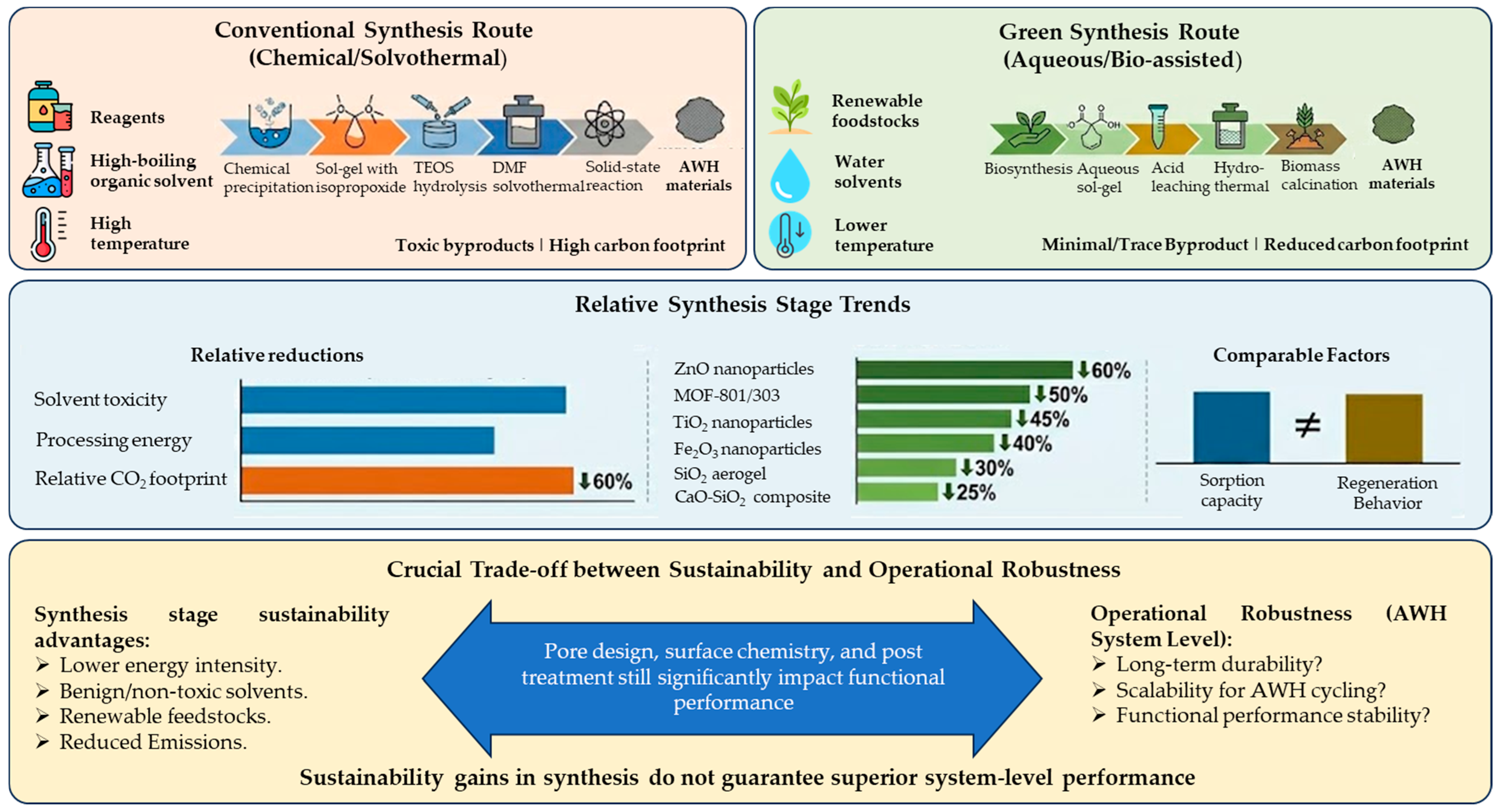
| Material | Green Synthesis Route | Conventional Route | Solvent/Medium | References | ||
| ZnO nanoparticles | Plant-extract-mediated biosynthesis (<80 °C; e.g., Moringa, tea polyphenols) | Chemical precipitation using NaOH/ethanol reflux | Aqueous bio-extract | [47,51] | ||
| TiO2 nanostructures | Sol–gel in water/ethanol with citric acid surfactant | Sol–gel using isopropoxide in DMF | Water/ethanol | [63] | ||
| SiO2 aerogel | Rice-husk ash or agricultural silica via acid leaching | Tetraethyl orthosilicate hydrolysis in ethanol | Water | [50,53] | ||
| Fe2O3 nanoparticles | Biogenic synthesis using microbial or leaf extracts | Chemical coprecipitation (FeCl2/FeCl3) | Aqueous | [48,75] | ||
| MOF-801/MOF-303 | Water-based solvothermal at ambient pressure | DMF solvothermal synthesis | Water | [30,70] | ||
| CaO–SiO2 composite | Biomass-derived calcination routes | Solid-state reaction from CaCO3 and quartz | Biomass feed | [11] | ||
| (b) | ||||||
| Material | Energy Requirement | Toxic By-products | Relative CO2 Footprint * | Remarks (AWH Relevance) | References | |
| ZnO nanoparticles | Low (<80 °C) | Minimal | ↓ 60% | Hydrophilic and antimicrobial surfaces improve hygienic AWH operation | [47,51] | |
| TiO2 nanostructures | Moderate (<120 °C) | None | ↓ 45% | Photocatalytic self-cleaning surface enhances condensation efficiency | [63] | |
| SiO2 aerogel | Moderate | Ethanol waste | ↓ 30% | Mesoporosity promotes capillary condensation at low RH | [50,53] | |
| Fe2O3 nanoparticles | Low (<90 °C) | Trace salts | ↓ 40% | Magnetic heat-transfer aid supports efficient desorption | [48,75] | |
| MOF-801/MOF-303 | Low (<100 °C) | None | ↓ 50% | High water uptake at 10–40% RH; scalable and low-impact for AWH | [30,70] | |
| CaO–SiO2 composite | Moderate (600–700 °C) | CO2 | ↓ 25% | Structural matrix for hybrid sorbents and coatings | [11] | |
| Nano-Enabled AWH System | Typical Operating Conditions | Reported Water-Harvesting Performance * | Sustainability-Enabling Component(s) | Primary Advantages | Identified Limitations | References |
|---|---|---|---|---|---|---|
| TiO2/silica biphilic fog-collection mesh | Fog tunnel (25 °C, 75–85% RH); coastal field deployment (Namibia) | ≈2× enhancement relative to fully hydrophilic mesh (Demonstrated long-term outdoor robustness) | Passive surface structuring; no active energy input | Electricity-free operation; scalable mesh architecture | Gradual UV-induced wettability degradation | [72] |
| MOF-801 embedded in chitosan–PVA monolithic sheet (roll-to-roll) | Laboratory (30% RH, 25 °C); rooftop trials (Madrid, 15–50% RH) | 1.0–1.2 g H2O g−1 in 15–25 min; ≥85% desorption in 10–15 min; <3% mass loss after 30 days | Chitosan biopolymer scaffold; low-temperature regeneration | Fast sorption kinetics; dust-free handling; mechanical robustness | Polymer dehydration under prolonged heat exposure | [70] |
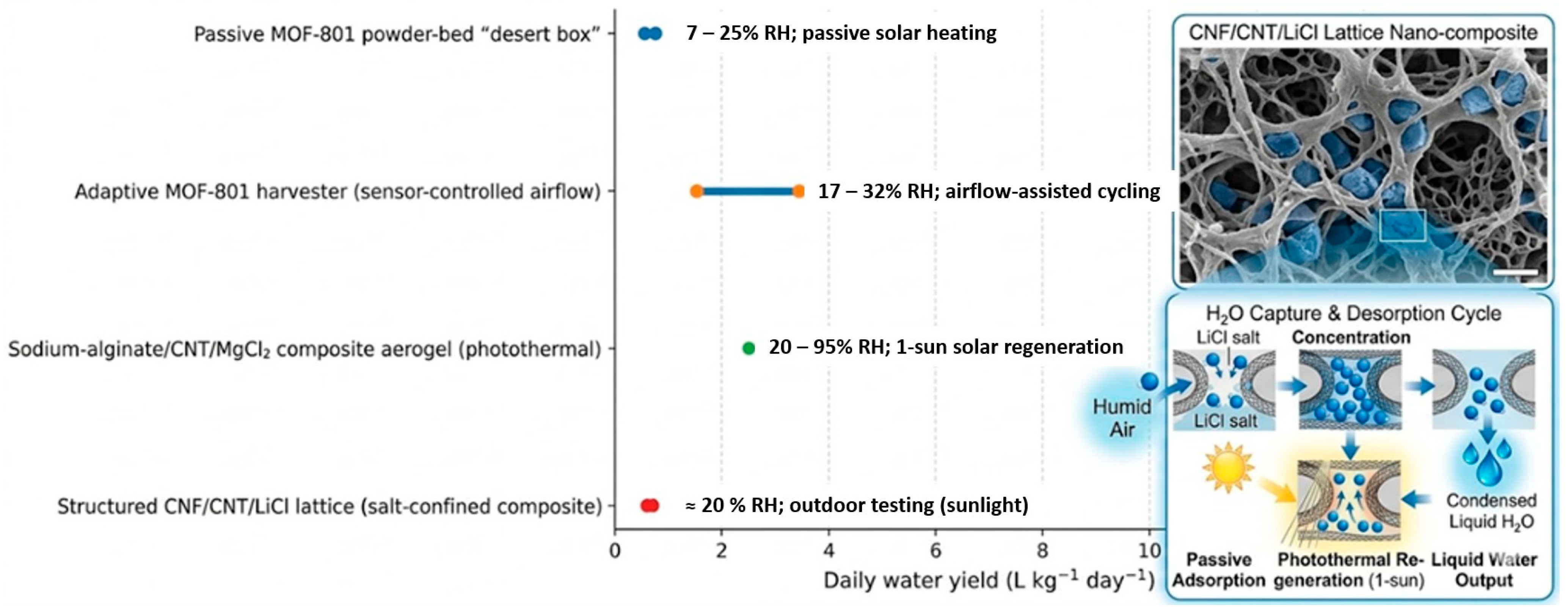
| Sodium-alginate/CNT/MgCl2 composite aerogel (3 mm slab) | 20–95% RH; 1-sun solar irradiation | 0.27 → 5.4 g H2O g−1 (20 → 95% RH); ≈10 L kg−1 day−1 (12 cycles) | Alginate from seaweed; solar-driven regeneration | Wide-humidity operability; fully passive regeneration | CNT cost; salt migration under mechanical stress | [76] |
| Structured hygroscopic lattice/aerogel (salt-confined composite) | Outdoor testing (≈20% RH, sunlight) | Up to ≈0.6–0.7 L kg−1 day−1 (representative reported outdoor productivity); cycle times on the order of tens of minutes | Polymer hydrogel matrix; salt confinement; low-temperature solar regeneration | All-weather operation; high water uptake; passive regeneration capability | Salt leakage risk; long-term mechanical stability under cycling | [77] |
| Passive MOF-801 powder-bed “desert box.” | Mojave Desert field tests (7–25% RH) | 0.6–0.8 L kg−1 day−1 (field); up to 2.8 L kg−1 day−1 (lab at 20% RH) | Passive solar heating; no moving parts | Demonstrated arid-zone functionality | Powder attrition; condenser fouling | [28] |
| Adaptive MOF-801 harvester with sensor-controlled airflow | Desert deployment (17–32% RH) | About 3.5 L·kg−1·day−1; 1.7–5.3 kWh L−1 | Operational optimization (not material-based) | High yield through dynamic cycling | Added energy demand; system complexity | [68] |
Disclaimer/Publisher’s Note: The statements, opinions and data contained in all publications are solely those of the individual author(s) and contributor(s) and not of MDPI and/or the editor(s). MDPI and/or the editor(s) disclaim responsibility for any injury to people or property resulting from any ideas, methods, instructions or products referred to in the content. |
© 2026 by the authors. Licensee MDPI, Basel, Switzerland. This article is an open access article distributed under the terms and conditions of the Creative Commons Attribution (CC BY) license.
Share and Cite
Al-Sadeq, N.; Abdullah, J.A.A.; Romero, A.; Perez-Puyana, V.M. Mechanistic and Life-Cycle Framework for Green Nanomaterials in Atmospheric Water Harvesting. Nanomaterials 2026, 16, 433. https://doi.org/10.3390/nano16070433
Al-Sadeq N, Abdullah JAA, Romero A, Perez-Puyana VM. Mechanistic and Life-Cycle Framework for Green Nanomaterials in Atmospheric Water Harvesting. Nanomaterials. 2026; 16(7):433. https://doi.org/10.3390/nano16070433
Chicago/Turabian StyleAl-Sadeq, Noor, Johar Amin Ahmed Abdullah, Alberto Romero, and Víctor M. Perez-Puyana. 2026. "Mechanistic and Life-Cycle Framework for Green Nanomaterials in Atmospheric Water Harvesting" Nanomaterials 16, no. 7: 433. https://doi.org/10.3390/nano16070433
APA StyleAl-Sadeq, N., Abdullah, J. A. A., Romero, A., & Perez-Puyana, V. M. (2026). Mechanistic and Life-Cycle Framework for Green Nanomaterials in Atmospheric Water Harvesting. Nanomaterials, 16(7), 433. https://doi.org/10.3390/nano16070433